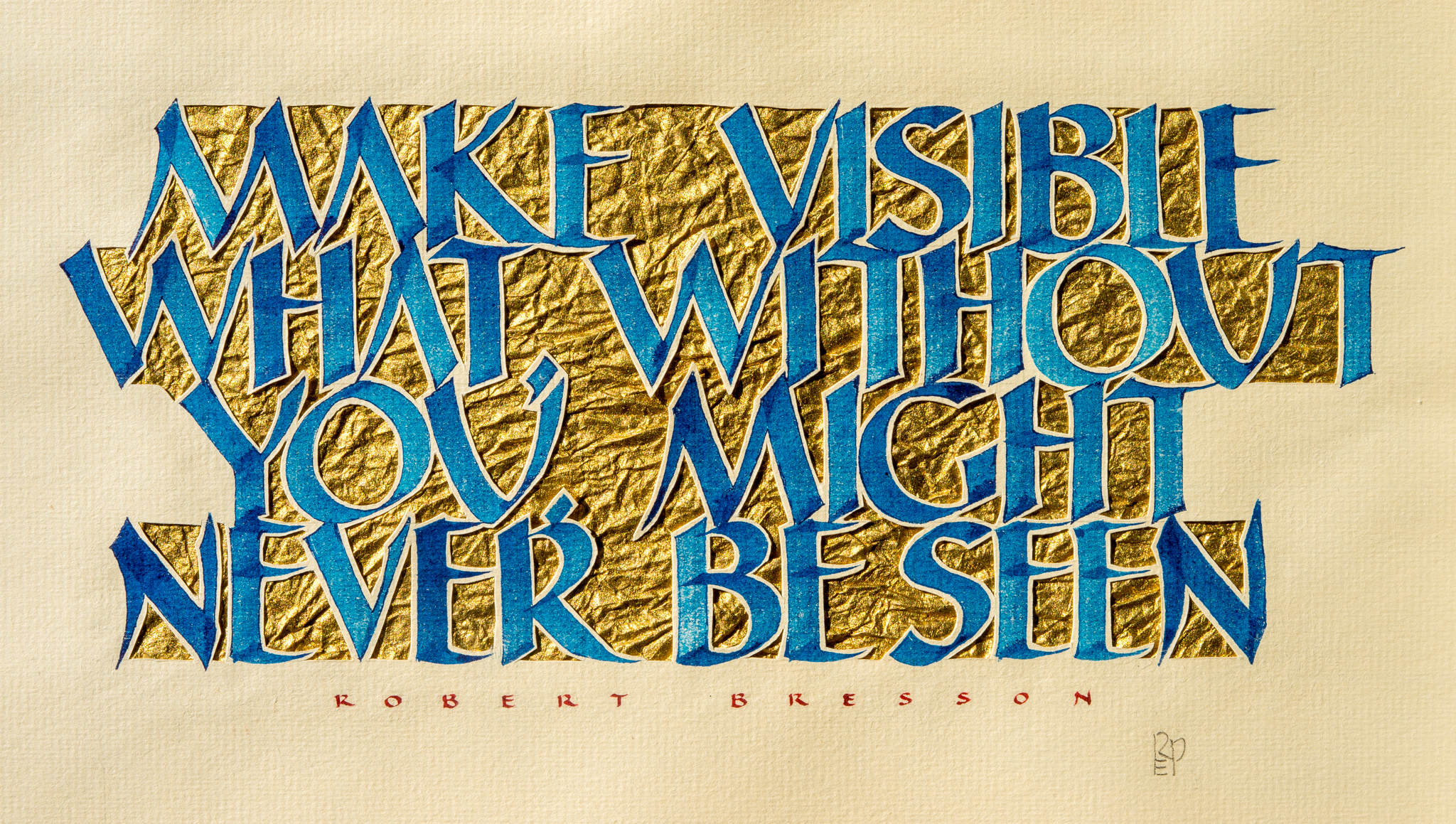
“The artist formerly known as priest”

Text:Robert Bresson; Calligraphy: Br. Roy Parker OHC

Text:Robert Bresson; Calligraphy: Br. Roy Parker OHC

We are all artists, we are all storytellers. We all have to live by art, it’s our daily bread… And we should thank the gods for great artists who draw away the veil of anxiety and selfishness and show us, even for a moment, another world…. and tell us a little bit of truth.”

— Iris Murdoch [i]

In the strict sense, of course,
We invent nothing, merely bearing witness
To what each morning brings again to light:
Gold crosses, cornices, astonishment
Of panes, the turbine-vent which natural law
Spins on the grill-end of the diner’s roof,
Then grass and grackles ….
All these things
Are there before us, there before we look
Or fail to look.

— Richard Wilbur, “Lying” [ii]

My friend and sometime colleague Mark Harris has been an Episcopal priest for half a century. Now in his seventies, with his days of institutional church employment behind him, he devotes much of his time to making art. One of his friends recently designated him as “the artist formerly known as priest.”[iii]

The Prince reference made me laugh, but I also resisted the concept. Priest and artist are not contradictory vocations. Both draw back the veil between seen and unseen; both bear witness to a depth, a meaning, a beauty, or a Presence which is ever before us whether we “look or fail to look.”

Of course the priest is committed to a particular story about the world, and is accountable to some form of ecclesiastical authority, while the artist has no such constraints. In fact, it has been a commonplace of modernity to depict religion as antithetical to artistic freedom.

After a “shameful and distressing” conversation about the subject with T.S. Eliot in 1928, Virginia Woolf wrote to her sister: “He has become an Anglo-Catholic, believes in God and immortality, and goes to church. I was really shocked. . . I mean, there’s something obscene in a living person sitting by the fire and believing in God.”[iv]

Similarly, a collective manifesto in 1948 declared art’s absolute independence from religion:

“We do not need the obsolete props of an outmoded and antiquated legend. We are creating images whose reality is self-evident and which are devoid of the props and crutches that evoke associations with outmoded images, both sublime and beautiful. We are freeing ourselves of the impediments of memory, association, nostalgia, legend, myth, or what have you. that have been the devices of Western European painting. Instead of making cathedrals out of Christ, man, or ‘life’, we are making them out of ourselves, our of our own feelings.”[v]

The modern narrative of art history, at least in western civilization, describes the messy divorce between art and religion. Art drifted away from sacred stories and theological themes to focus on the human being, the natural world, material objects and daily life. Then it stripped away all manner of content until its only subject was art itself, the pleasure of pure form and color unburdened by any external meaning.

In her persuasively argued book, The Spiritual Dynamic in Art, Charlene Spretnak refutes this narrative, documenting the deeply spiritual perspectives expressed by many of the iconic figures in modern art. For example, Van Gogh understood his revolutionary style as reinterpretation rather than rejection of a religious worldview: “I want to paint men and women with that something of the eternal which the halo used to symbolize, and which we seek to communicate by the actual radiance and vibration of our coloring.”[vi]

Writing “On the Meaning of Painting” in 1939, Joan Miró insisted that the artist’s vocation was to “endeavor to discover the religious essence, the magical significance of things,” rather than “merely add to the sources of stupefaction.” Recalling his first drawing class as a youth, he said, “That class was like a religious ceremony for me; I washed my hands carefully before touching the paper and pencils. The implements were like sacred objects, and I worked as though I were performing a religious rite.”[vii]

Spretnak cites many more such examples. But the rich and complicated relationship between art and religion is too vast for a single post, so for now let me return to my original argument. Priest and artist, for all their differences, share some essential common tasks:

To make visible what might otherwise not be seen.
To integrate life’s incompatible elements within a harmonizing vision.
To facilitate our encounter with a life-changing Presence.
To perform ritual interventions for the creation of community.

I am aware that many would define priesthood more narrowly, or art less religiously. Nevertheless, I am proud of the company I keep in this matter.

Seventeenth-century Anglican poet/priest George Herbert grounded his poems in a word or an image, morphing it into a multiplicity of resonant meanings. As one critic has put it, “he breaks the host of language” as the one becomes the many. This was more than clever wordplay. It was a worldview: one thing becomes another, like bread becoming God. Or a poet becoming a priest.

Contemporary Catholic poet Les Murray makes a similar connection between his verse and the Eucharist. Both involve “the absolute transformation of ordinary elements into the divine.”[viii]

The Orthodox composer John Tavener (d. 2013) described his music as “liquid metaphysics.” Acknowledging that his call was not to prove God’s existence but only to witness to his own experience of Presence, he said, “I cannot clearly demand belief in what I believe in, but I can ask for an openness, or certainly an acceptance that another level of reality exists beyond this commonplace one.”[ix]

Whether ordained or not, such artists perform a priestly function, inviting us to attend to the mystery of the world, in which “things which were cast down are being raised up, and things which had grown old are being made new.”[x] Or as I once heard arts innovator Peter Sellars put it, “The purpose of art is to wake people up who are sleepwalking, to grab them and say, ‘You cannot pass this by. This is your life!’”[xi]

Daniel A. Siedell, who has focused his critical attention on art and religion, makes an eloquent case for the priest/artist connection:

“There is a sacramental and liturgical presence in contemporary art, in which artists explore the potential of banal materials and gestures, in defined spaces, to embody and serve as a vehicle for profound meaning and experience. The liturgical dimension of contemporary artistic practice, which incorporates and re-performs the power of sacred space, ritualized gestures, and sacramental objects that testify to what philosopher William Desmond calls ‘the porosity of being,’ requires more expansive and richly-nuanced notions of both ‘art’ and ‘religion’ than those offered by modernist critics.”[xii]
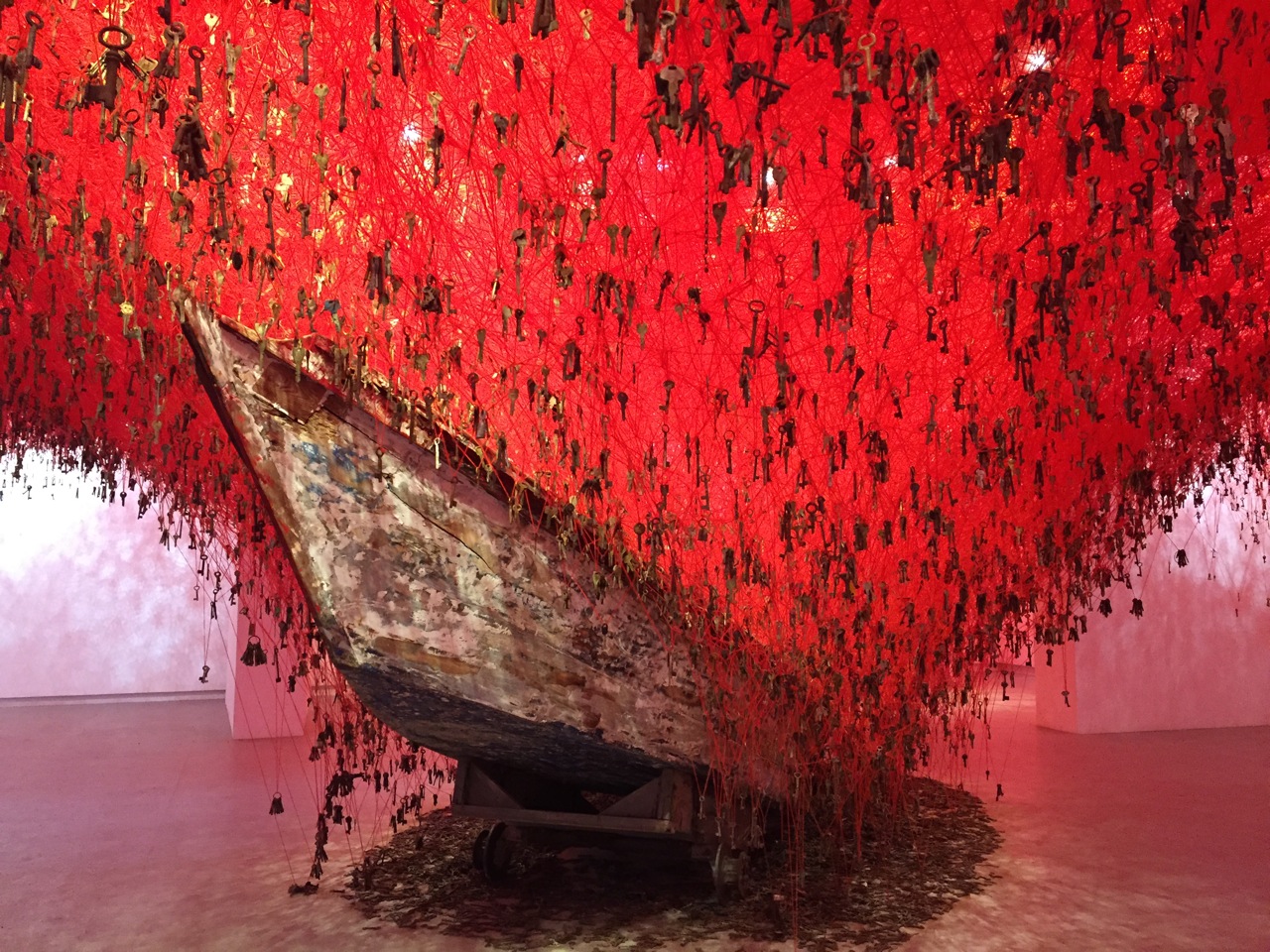
Chiharu Shiota, "The Key in the Hand", Venice Biennale 2015 (photo by Jim Friedrich)

Chiharu Shiota, “The Key in the Hand”, Venice Biennale 2015 (photo by Jim Friedrich)

Chiharu Shiota is a Japanese artist living in Berlin. Her haunting installations are inspired by religious sites and rituals which evoke “strong emotional reactions. I think those reactions are sacred, but not necessarily the objects. It is similar with my art work. It’s the emotions that are sacred.”

For her work, “Key in the Hand,” she collected 180,000 old keys from all over the world, suspending them with 250 miles of red yarn over two old boats at the Venice Biennale in 2015. The keys represent the memories and treasures we lock away until we choose to entrust their custody to others. Shiota states that keys “protect important people and spaces in our lives. They also inspire us to open the door to unknown worlds.” [xiii] The yarn evokes blood and the interconnectedness of relationship. The boats, like an immense pair of hands, “catch” the rain of memories falling from above.[xiv]

Is Shiota’s work not sacramental, employing tangible objects to manifest hidden realities and touch our own deepest places? Does not its breathtaking beauty feel like a hint of the transcendent splendor toward which all being tends?
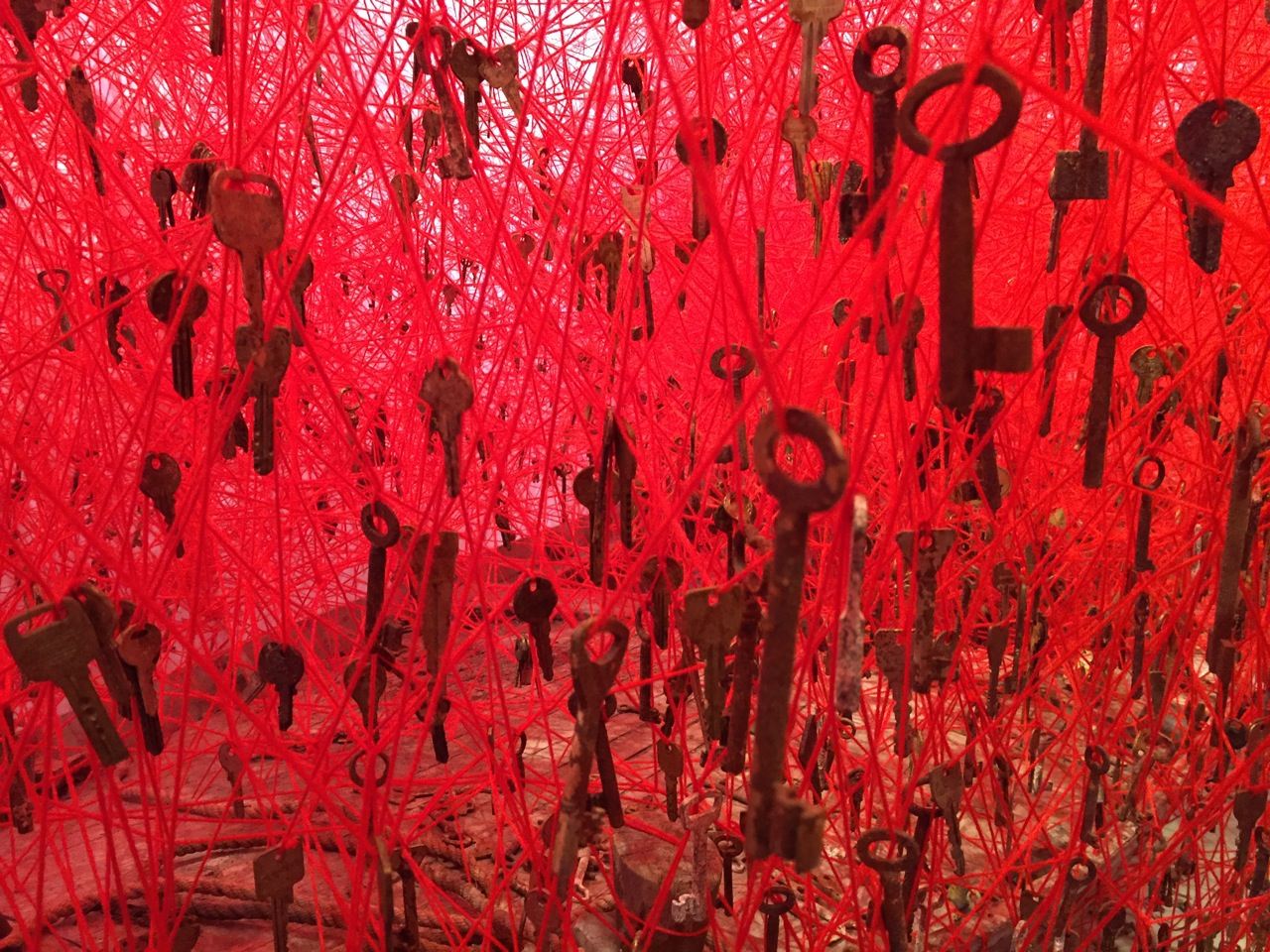
Chiharu Shiota, "The Key in the Hand", Venice Biennale 2015 (photo by Jim Friedrich)

Chiharu Shiota, “The Key in the Hand”, Venice Biennale 2015 (photo by Jim Friedrich)

Six years after Hurricane Katrina, the African-American artist William Pope.L invited residents of struggling New Orleans neighborhoods to donate photos in response to two questions:

When you dream of New Orleans, what do you dream of?
When you wake up in the morning, what do you see?

The collected photographs were to be projected onto a rear screen attached to the back of an old ice cream truck painted entirely in black. And one night in October, 2011, this 8-ton truck, with its engine shut off, was hauled through the city by a team of strong bodies from sundown to sunrise.

The artist imagined the black truck as the weight of our “collective darkness,” all those regrets and fears and demons we drag behind us. Countering the darkness, the back of the truck was illumined by projections from the inside of all the light collected from their lives and their dreams.

“I am asking people,” he said, “to show the fragility of their bodies as a collective and then go for a walk with others who are dragging the same old dreams down the same ole corridors and to take time out to wonder about that.”[xv]

Is this not priestly work? Using common materials and ritual actions, Pope.L. was the presider/curator for a “work of the people” which employed many of the elements of Christian liturgy: narrative (the photographs as “stories,” and the journey of the truck), symbol (darkness and light), time (a night passage framed by the setting and rising of the sun), and community (facilitating connections among the photographers, performers, and the neighborhoods through which they made ritual procession).

Pope.L acknowledges a “priestly” association: “Like the African shaman who chews his pepper seeds and spits seven times into the air, I believe art re-ritualizes the everyday to reveal something fresh about our lives. This revelation is a vitality and it is a power to change the world.”[xvi]

Critic and poet Donald Kuspit says that “being an artist is about being a certain kind of subject, not just about making certain kinds of objects,”[xvii] while Iranian/UK installation artist and sculptor Shirazeh Houshiary defines an artist as “someone who is capable of unveiling the invisible, not a producer of art objects.”[xviii] It seems that such artists as Shiota and Pope.L have brilliantly intuited this implicit artist/priest connection.

What I wonder, as an artist/priest myself, is whether those officially ordained by traditional Christian communities, such as my own Anglican tradition, fully understand the implications of this connection for our own work. Do we bring to our own priestly vocation the same degree of passion, creativity, imagination, curiosity and daring displayed in the work of the artist?

We may have much to learn.


Related Posts

Do Not Fear: Reflections on the Venice Colloquium

Sweet Miracle of Our Empty Hands

Heart Work and Heaven Work

Tending the Lamps of Holy Imagination

Note: The image at the top of this post was made for me by the wonderful calligrapher and Episcopal monk Br. Roy Parker OHC. For information on his work:  http://www.holycrossmonastery.com/calligraphy

[i] Iris Murdoch, Acastos: Two Platonic Dialogues, 1986, p. 62-3, q. in Theological Aesthetics after von Balthasar (Ed. by Oleg V. Bychkov & James Fodor, Burlington, VT: Ashgate Publishing Company, 2008), 162

[ii] Richard Wilbur: Collected Poems: 1943-2004 (New York: Harcourt, 2006), 83

[iii] Some of Mark’s work may be seen here: http://www.preludiumarts.net/ One of his poems is found in the Related Posts link to “Tending the Lamps of Holy Imagination”

[iv] London Review of Books, 10/23/14

[v] Originally published in Tiger’s Eye (Dec. 1948), q. in The Sublime, ed. Simon Morley, Documents of Contemporary Art (London: Whitechapel Gallery, 2010), 27

[vi] Charlene Spretnak, The Spiritual Dynamic in Art: Art History Reconsidered: 1800 to the Present (New York: Palgrave Macmillan, 2014), 40

[vii] ibid., 102, 100

[viii] Missy Daniel, “Poetry is Presence: An Interview with Les Murray”, Commonweal 119, no. 10, 1992, 10), q. in Between Human and Divine: The Catholic Vision in Contemporary Literature, ed. Mary C. Reichart (Washington, D.C.: The Catholic University of America Press, 2010), 217

[ix] John Tavener, ed. Brian Keeble, The Music of Silence: A Composer’s Testament (London: Faber and Faber, 1999), 163

[x] The Book of Common Prayer (New York: Oxford University Press, 1979), 291

[xi] From my personal notes on a “The Arts: A Catalyst for Change,” a forum at the Stanford University Centennial Weekend, October 1991

[xii] Re-Enchantment (James Elkins, David Morgan, eds., New York & London: Routledge, 2009), 234

[xiii] http://www.thisiscolossal.com/2015/05/the-key-in-the-hand/

[xiv] Interview with Shiota: http://2015.veneziabiennale-japanpavilion.jp/en/project/

[xv] Glenn Harper and Twylene Moyer, eds., Artists Reclaim the Commons: New Works/New Territories/New Publics (Ed., (Hamilton, NJ: isc Press, 2013), 247

[xvi] https://en.wikipedia.org/wiki/William_Pope.L

[xvii] Artforum (1984), q. in Daniel A. Siedell, God in the Gallery: A Christian Embrace of Modern Art (Grand Rapids, MI: Baker Academic, 2008), 124

[xviii] Interview with Stella Santacatterina (1994), q. in The Sublime, 93

 

Gone for a walk

Sunset in Montana's Beartooths range (August 2015)

Sunset in Montana’s Beartooths range (August 2015)

Keep close to Nature’s heart… and break clear away, once in awhile, and climb a mountain or spend a week in the woods. Wash your spirit clean. (John Muir)
I am taking Muir’s advice, as I do every summer. The season would be incomplete without a wilderness sojourn. So instead of writing a new post, I am loading my backpack for an early start tomorrow deep into the Cascades. I’ll be back with some new writing in a week or so.
Meanwhile, you might enjoy reading this post about a previous hike: “The Ministry of Nature.”
As always, thanks for visiting!

Why Do We Work? A Labor Day Reflection

Good work is a way of living… it is unifying and healing. It brings us home from pride and despair and places us responsibly within the human estate. It defines us as we are, not too good to work with our bodies, but too good to work poorly or joylessly or selfishly or alone.

— Wendell Berry) [i]

Labor Day began in the late nineteenth century as both an homage to American workers (parade, speeches) and a time of re-creation (picnic, dance, fireworks). Congress declared it a national holiday in the aftermath of a contentious railroad strike in 1894, where 30 workers died in violent confrontations. It was hoped that honoring workers would ease tensions and foster social harmony. As the Department of Labor currently describes it, the first Monday in September “is dedicated to the social and economic achievements of American workers. It constitutes a yearly national tribute to the contributions workers have made to the strength, prosperity, and well-being of our country.” [ii]

The holiday’s explicit homage to labor has long been overshadowed by its seasonal significance as the American farewell to summer—one last stretch of fun in the sun before the year gets busy again. But in our overworked culture, where the inbox follows you everywhere and vacations are a fraction of what Europeans enjoy, could we not make some time to reflect together about the nature of labor? What if churches were to revive the notion of Labor Sunday, where our tools could be blessed and the spirituality of work considered? [iii]

In the Bible, the pleasures of a perpetual weekend in Eden ended abruptly when God created Monday morning as a curse upon the first humans, who evidently needed to learn things the hard way. “By the sweat of your face” will you earn your daily bread,” said the Creator.[iv] The story was a way of thinking about the question, Why do we have to work so darn hard? Before the Fall, Adam and Eve were given light duties of tending the well-watered garden, more like an aristocrat’s hobby than the grueling subsistence farming bequeathed to their descendents.

Hard-working humans have been reminiscing ever since about the “happy Eden of those golden years.” [v] Stephen Duck, an eighteenth-century English poet-priest, voiced the complaint of the exploited farmworker.

Let those who feast at Ease on dainty Fare
Pity the Reapers, who their Feasts prepare …
Think what a painful Life we daily lead;
Each morning early rise, go late to Bed …
No respite from our Labour can be found;
Like Sisyphus, our Work is never done …[vi]

The justice issues arising around working conditions, exploitation, and economic inequality are themselves the shared work of any society worth its name. My ideal Labor Day would involve some serious community conversation—more listening than talking—about these things. But I would also be curious to explore the spirituality of work as well. Why do we do whatever we do? Does it give us joy? Does it matter?

An old Scottish drinking song provides a succinct answer in its praise of various occupations. The carpenter’s verse suggests the inner satisfaction of work well done, honors the process as well as the product, and celebrates the interdependence of the social world where each of us benefits from the labor of others:

Here’s a song for the carpenter, may patience guide your hand,
For the dearer your work to you, the longer it will stand.
And when the wind is at our door, we never will forget;
We’ve sung your praises many a time, and so will we yet. [vii]

Like our Creator, we are all makers and doers who enjoy the fulfillment of intentions and the solving of problems. It’s in our nature to see what needs to be done and then take a hand in making it so. We also find pleasure in the solidarity of labor, not only through our relationships with coworkers but also in the awareness of practicing a skill handed down by so many mentors and predecessors.

In an imperfect and often unjust society, not everyone has access to employment that delivers pleasure or meaning in itself, but one’s paying job may still be part of a larger labor which is absolutely worth doing, such as supporting a family or funding a future dream. Studs Terkel, who collected oral histories of countless Americans, believed that all of us long for meaningful work. “I think most of us are looking for a calling, not a job,” he said. “Most of us … have jobs that are too small for our spirit.” [viii]

Lewis Hyde makes a useful distinction between “work” and “labor.” Work is done by the hour, on the clock, usually for money. Its value is quantified, and has economic exchange value. Labor, on the other hand, keeps its own schedule, sets its own pace, and may include time off or even sleep as part of its process. Its social value may be clear, but its economic value is hard to quantify. Its product is not a commodity to exploit but a gift to share. “Writing a poem, raising a child, developing a new calculus, resolving a neurosis, invention in all forms—these are labors.” So are volunteer work, ministry, visiting the sick and the prisoner, gardening, personal soul work and “the slow maturation of talent.” [ix] Such labor is priceless.

Most of us have performed both work and labor, as well as hybrids which include elements of both. As Citizen Kane’s financial advisor said, “It’s no trick to make a lot of money, if all you want is to make a lot of money.” But the truer and nobler task is to cooperate with the Creator in repairing the world to make it a place of beauty, love and justice.

So my Labor Day question is this: Where and how can we do the labor to which we are called, the thing which étienne Souriau has called the “Angel of the work” [x]— that which gives us joy and blesses others?

There’s another verse in that Scottish song which thanks the singers who keep their voices clear:

For the world as you would have it be,
you sing with all your wit,
And ease the work of Providence,
and so will we yet.

In that spirit, I leave you with two such singers, Joan Baez and her sister Mimi Farina, who “ease the work of Providence” by voicing the universal human right to flourish: bread, yes, but roses too!


[i] Wendell Berry, The Unsettling of America, q. in Karen Speerstra, ed., Divine Sparks: Collected Wisdom of the Heart (Sandpoint, ID: Morning Light Press, 2005), 520

[ii] Department of Labor website: https://www.dol.gov/general/laborday/history

[iii] This was instituted by churches as a companion to Labor Day, but has fallen into disuse.

[iv] Genesis 3:19

[v] John Clare, “Helpstone” (1809) q. in Raymond Williams, The Country and the City (Oxford & New York: Oxford University Press, 1973), 10

[vi] Stephen Duck, “The Thresher’s Labour” (1730), in Williams, op. cit., 88

[vii] The original, “Sae Will We Yet,” is attributed to Walter Watson, but I believe the carpenter verse is a contemporary addition by Ossian’s Tony Cuffe. A fine version by Gordon Bok, Ann Muir, and Ed Trickett is here: https://www.youtube.com/watch?v=h48Db_cvdDE

[viii] In Speerstra, op. cit., 519

[ix] Lewis Hyde, The Gift: Imagination and the Erotic Life of Property (New York: Vintage Books, 1979), 50

[x] étienne Souriau, q. in Isabelle Stengers, Thinking with Whitehead: A Free and Wild Creation of Concepts, trans. Michael Chase (Cambridge, MA: Harvard University Press, 2011), 464

A Night at the Troubadour: Discovering David Ackles (and Elton John)

David Ackles singing at the author's ordination, Sept. 17, 1970 (Photo by Marilyn Robertson)

David Ackles singing at the author’s ordination, Sept. 17, 1970 (Photo by Marilyn Robertson)

I have no explanation as to why the David Ackles albums spoke to me so intensely, but it was with those records that I probably spent the most time when I was about sixteen, listening in a darkened room, trying to imagine how everything had come to exist.” (Elvis Costello, Unfaithful Music and Disappearing Ink)

 They suffer least who suffer what they choose. (David Ackles, “American Gothic”)

The Troubadour, an intimate club in West Hollywood, has seen some pretty special nights over the years. Joni Mitchell, Leonard Cohen, Randy Newman, Prince, Tom Petty, Pearl Jam and so many others have performed on its stage. Neil Young and James Taylor each made their solo debut there. The Byrds sang “Mr. Tambourine Man” for the first time in public. Tom Waits was discovered during amateur night. Springsteen, Dylan and Led Zeppelin dropped by after hours for legendary jams. Miles Davis and Van Morrison recorded there.[i]

When Elton John made his smashing American debut at the Troubadour on August 25, 1970, he was not yet widely known. He was originally booked as the opening act for David Ackles, a Los Angeles musical artist greatly admired by Elton John and his lyricist Bernie Taupin. But John’s record company pulled some strings to get the bill reversed. In conjunction with the release of his first album, John would become the headline act.

He would admit later to some embarrassment at being promoted above Ackles on the billing, since Ackles was one of his heroes, “one of the best that America has to offer.” Elvis Costello was also a fan, “It’s a mystery to me why his wonderful songs are not better known,” he has said.[ii] When Costello interviewed John on his Sundance cable series, Spectacle, they both voiced generous tributes to Ackles’ genius and influence, and closed the show with a duet of his great song of loss and longing, “Down River.” [iii]

Ackles put out four memorable albums between 1968 and 1973. His masterpiece, American Gothic (1972), generated critical raves. “The Sergeant Pepper of Folk,” gushed a noted British critic, astonished at its thematic brilliance, structural complexity and musical originality. Rolling Stone called it “moving” and “eloquent.” A retrospective appraisal in 2005 acclaimed it “a largely unrecognized work of genius, one of the most unfashionable and uncompromising American albums ever. . . Crafted layer upon layer, it reveals itself more as a dramatic work than a conventional rock or pop release, drawing on modern American classical composers such as Charles Ives and Aaron Copland as well as gospel, rock, blues, and soul. Imagine an art-folk album that bridges Woody Guthrie’s passionate storytelling and Kurt Weill’s orchestrations.” [iv]

Rolling Stone said at the time that American Gothic “deserves a wide audience,” but when sales proved weak, his recording company, Elektra, lost interest. Ackles made one more album on the Columbia label, but his music seemed too hard to categorize in an industry driven by identifiable genres. Was it folk, pop, classical, musical theater, or what? His originality didn’t fit the system. A ten-minute elegy to a lost past (“Montana Song”) was not going to get much radio time. And you couldn’t dance to it. But however neglected, the heartbreaking beauty of Ackles’ imagery still blooms like wildflowers on a deserted prairie:

The fallen barn, the broken plow,
the hoofprint-hardened clay;
where is the farmer, now,
who built his dream this way ?
Who felled the tree and cut the bough
and made the land obey,
who taught his sons as he knew how,
but could not make them stay.[v]

Disappointed by the lack of tangible support for his work, Ackles abandoned his recording career, but not his joie de vivre. “I’m not bitter about a thing that’s happened to me,” he told an interviewer in 1998. “I would hate for people to think I’m over here getting all twisted up about what happened 20 years ago. All that feels like another life, lived by someone else.” [vi]

Although he could write an achingly beautiful love song like “Love’s Enough,” he was at heart a storyteller, weaving poetic and sometimes tragic narratives of American dreamers and strivers, who “joined the circus, worked the fields,” but “never saved a dime.” And even when they had to “learn to dance to someone else’s song,” they managed to endure:

But I hold on to my dreams, anyway.
I never let them die.
They keep me going through the bad times,
while I dream
of the good times coming by.[vii]

Bernie Taupin, who produced American Gothic, summed up Ackles’ intensity and conviction in a 2008 remembrance: “Man! If you didn’t believe every word this guy was singing, you were dead inside.”[viii]

I first met David Ackles in early 1970, when I was working at Canterbury House in Ann Arbor, Michigan, an Episcopal campus ministry and coffeehouse known as one of the premiere folk music venues in the country. I was just out of seminary, working with two priests as an intern during the year of my “transitional diaconate,” the prelude to priestly ordination. While I was in residence, Canterbury House featured Neil Young, Doc Watson, Ramblin’ Jack Elliott, and David Ackles.

David was one of Canterbury’s most popular performers, loved not only for his music but also for his manifest warmth and wry humor. He was a lifelong Christian, deeply spiritual and theologically astute, an authentic and generous man. And though some of his songs revealed a profound empathy with the suffering of displaced souls, there was an essential core in him—a comedic faith in resurrection—which survived the harrowing descent of the artist into the nether regions of the human condition.

By summer of 1970, I was back home in Los Angeles, awaiting my ordination to the priesthood in September. When I saw that David was playing at the Troubadour, I knew I had to be there. Meanwhile, the radio was starting to preview a few unreleased songs by the other guy on the bill, and he sounded quite good as well. Word got around, excitement grew, and on August 25 the house was packed. We shared a table with Odetta, the “queen of American folk music.” [ix]

Before the show, I went backstage to ask David if he would consider singing at my ordination, and he graciously consented. While we were talking, Elton John entered the dressing room, wearing denim overalls with a cartoon duck patch on the front, to tell David how much he admired his work and how honored he was to share the stage with him.

And the concert? It’s been nearly fifty years now. Details grow hazy; I can’t recite the set lists anymore. But I can still feel the electricity of that Hollywood night, the passion of the performers, the visceral connection they made with their audience.

Stacy Sullivan, a jazz singer who once worked with David, is currently performing, in small New York clubs, “A Night at the Troubadour: Presenting Elton John and David Ackles.” While showing the brilliance of two stars aligning, her re-imagining of that night suggests the strangeness of fate: one singer became an international superstar, the other remained largely undiscovered.

The New York Times has called Sullivan’s tribute a “tour de force” which “interweaves more than a dozen Ackles songs with several of Mr. John’s hits, radically deconstructed, into a dual portrait in which their opposite sensibilities (Mr. John’s gregarious showmanship, and Mr. Ackles’ dignified introspection) eventually merge.” [x] Lucky Easterners can still see her at Manhattan’s Metropolitan Room on September 10 and October 8. I can only pray that she will do a West Coast reprise. I promise to come.

A few weeks after the Troubadour show, David sang two songs for my ordination at All Saints, Beverly Hills, where the opening hymn was “Let It Be” and large projected images filled the wall behind the altar. Those were the days! During communion, David sang “Be My Friend.” At the Dismissal, he led the congregation in “Family Band,” which he said was autobiographical, since he grew up in a musical family of church-going Presbyterians. I still play that song on my guitar every ordination anniversary:

I remember the songs we sang Sunday evening . . .
when my dad played the bass, mom played the drums,
I played the piano,
and Jesus sang the song.

David got lung cancer in the late nineties. When he went into remission, he and his wonderful wife Janice rented a Pasadena mansion, filled it with musicians, and threw a grand party for their friends, to celebrate the gifts of life and love. Then, in 1999, David departed this world, far too soon. He is dearly missed. But that gathering in Pasadena remains a joyous foretaste of the blessedness which awaits us all.

And I will cherish the faith in the songs we knew then,
till we all sing together, till we all sing together,
till we sing them together again.


[i] For a more extensive historical list: http://www.troubadour.com/history

[ii] Reuters obituary in March, 1999, cited in Kenny MacDonald interview: http://www.terrascope.co.uk/MyBackPages/David%20Ackles.htm

[iii] YouTube has a version of their duet: https://www.youtube.com/watch?v=sXvlCjrlHCQ and their conversation about David is at https://www.youtube.com/watch?v=Qbt1Cee7Usw

[iv] George Durbalau, 1001 Albums You Must Hear Before You Die, 2005. Along with other review quotes, found at http://www.superseventies.com/spacklesdavid.html

[v] David Ackles, “Montana Song,” on American Gothic. Some of David’s songs can be heard on YouTube, and his albums can be found online as well.

[vi] Kenny MacDonald interview

[vii] “Another Friday Night,” American Gothic

[viii] Bernie Taupin’s blog, Dec. 3, 2008

[ix] Attributed to Martin Luther King, Jr.: http://entertainment.time.com/2011/10/24/the-all-time-100-songs/slide/take-this-hammer-odetta/

[x] New York Times, July 16, 2016: http://www.nytimes.com/2016/07/16/arts/music/stacy-sullivan-david-ackles-review.html?_r=1


Merry it is while summer lasts

August Sunflower by Jim Friedrich

August Sunflower by Jim Friedrich

Such tenderness, those afternoons and evenings,
saying blackberry, blackberry, blackberry.

— Robert Hass, “Meditation at Lagunitas”

Mirie it is while somer y-last. “Merry it is while summer lasts.” So goes the 13th-century lyric, one of the earliest known secular English songs (the other being Summer is icumen in). But while such praise of summer lacks the explicit theological or liturgical character of its pious predecessors, is not the idealized notion of a happy summer a plausible echo of the joys of Paradise? History takes a vacation. Ambition is deposed. The temporal flow slows its onward rush, deepening into a placid pool of unhurried being. The poet’s longing for “world enough, and time” is fulfilled at last in a sabbath of playful ease. Children romp in the sea, lovers stroll bright gardens, readers open their books, friends converse at evening. Mirie it is.

It should always be so in August, that we might agree with Emerson: “this refulgent summer, it has been a luxury to draw the breath of life.” But of course Thoreau did a better job than his bookish friend at getting outside to see what summer was actually doing day by day. Summer in fact is not a general idea, but an aggregate of particulars.

On this date in 1856, Thoreau wandered the fields and woods of Concord, Massachusetts. His Journal tells us that “Ambrosia pollen now begins to yellow my clothes.” He was surprised to find the cassia “so obvious and abundant.” In an old garden gone wild from British days, he became “intoxicated with the fragrance” of spearmint, hounds-tongue, and bergamot. He named those plants he could, while each new discovery filled him with curiosity and wonder. He bathed in the river, registering how strong the current seemed for mid-August. And he lamented the recent dampness of the weather, causing his pressed plant specimens to mildew. “Give me the dry heat of July,” he wrote.

Reading Thoreau’s Journal entry prompted me to look up August 16 in my own yearly journals. It turns out that I honored the spirit of August by playing more than writing, but I did find one entry for this date in 1989, when I hiked at sunset to the top of Mt. Tallac, a 10,000’ peak above Lake Tahoe in California’s Sierra range, to watch the rise of a full moon in total eclipse. I carefully noted the changes as the reddish lunar disc slipped slowly out of the earth’s shadow to flood the mountain with intense milky light. Then I descended through a ghostly forest of moonlit junipers, grateful to have been present to see and to know. If I had not been there, that night would not have become part of me, nor I of it.

So now I must leave my desk to see what this summer day wants to offer the senses. I will linger in the shade of the peach tree with a book, keeping my eye on the finches, chickadees, juncos and hummingbirds who shelter and sing in its branches. I will praise the sunflowers, each a miniature daystar, towering above the flower garden, and hear the soft music of quivering aspens. I will taste blackberries ripening beyond the drying lawn, plus whatever strawberries the squirrels have spared. My skin will feel the reddish warmth of the late sun as it drops between the Douglas-firs. And when night comes, I will stroll among the lilies and dahlias, so white—and fragrant!—beneath the gibbous moon. Mirie it is.


Related Posts

Paying Attention

The Summer’s Final Mass

Summer Knowledge

The Spirituality of Running: A Meditation for the Olympiad

Jim Friedrich and Mike Riebs, Santa Monica Mountains, 1961

Jim Friedrich and Mike Riebs, Santa Monica Mountains, 1961

Therefore, since we are surrounded by so great a cloud of witnesses, let us also lay aside every weight and the sin that clings so closely, and let us run with perseverance the race that is set before us, looking to Jesus the pioneer and perfecter of our faith… who endured…so that you may not grow weary or lose heart. (Hebrews 12:1-3)

Even the youthful may faint and grow weary, 
even the fittest may stumble and fall,
but those who wait for the Lord shall renew their strength,
they shall mount up with wings like eagles,
they shall run and not be weary,
they shall walk and never faint. (Isaiah 40:30-31)

The perpetual contest between weariness and perseverance is familiar to every athlete, and every saint. You’re going to get tired. You’re going to get discouraged. You may faint and fall. But keep your eyes on the prize, hold on. On both good days and bad, you’ve got to put in the work, “lay aside every weight,” surrender to a power beyond your solitary will, and stay in the flow.

Over the coming weeks, we will see Olympic athletes do extraordinary things with their bodies, minds and hearts. Some of us will be inspired by their example to get in shape and pursue a goal, to test the limits of our own embodied existence. Others will remain passive spectators, admiring the exceptional gifts of the Olympians with no illusions of doing likewise.

Is it not the same with the saints? Their exceptional feats of faith, hope and love seem so far beyond us that we dismiss our own capacities for discipleship and transformation. But the saints want to inspire, not intimidate us. They are a cloud of witnesses cheering us on to become our truest selves. When poet William Stafford says, “Ask me if what I have done is my life,”[i] we hope the answer will be yes.

In the Divine Comedy, Virgil invites Dante to make the immense and arduous journey into God. The younger poet demurs. “I am not Aeneas,” he says. “I am not Paul.” But he sets out anyway, and in the end discovers he needs to be no one but himself. “Per ch’io te sovra te corono e mitrio,” Virgil says when they part. I crown and mitre you lord over yourself.[ii]

When I was a teenager, I wanted to be a great pole vaulter. I loved the sudden ascent from the runway, feet swinging into the sky, the joyful clearance over the bar, the happy fall back to earth. I aspired to emulate world record holder Bob Gutowski, and for two years in college competed under his coach, Payton Jordan. But I lacked the necessary speed and strength to master the event, and gave it up before my 20th birthday.

I had thought I was a pole vaulter, but would come to discover that I was actually a distance runner. I had run cross-country and the mile in high school, thinking it would be good conditioning for my “real” event. But it wasn’t until my thirties that I finally embraced running as my athletic vocation.

I love the details of training, measuring daily progress as I increase the load and intensity of my runs. I love the mental challenge of racing, the ceaseless negotiation between desire and pain. I love the sense of aliveness that can follow the most exhausting workouts. But most of all I love the poetry of bodily motion, the primal elation of loping unhindered through space, dancing with earth and sky.

Sometimes you get into “the zone” and feel you could run forever. But that feeling is the fruit of weeks and months of training. As the Bible says,

Endure trials for the sake of discipline. Sure, discipline always seems painful rather than pleasant at the time, but later it yields the peaceful fruit of righteousness to those who have been trained by it. Therefore lift your drooping hands and strengthen your weak knees, and make straight paths for your feet. (Heb. 12:7, 11-12)

St. Paul, clearly a track and field fan, knew the amount of work required to get into shape and win the race. “Every athlete concentrates completely on training,” he wrote. “I punish my body and bring it under control.” (I Cor. 9:25, 27). In other words, no pain, no gain.

That doesn’t mean not to back off and be gentle when your body needs to rest and recover. My first two marathon attempts ended with training injuries from increasing my mileage too quickly, before my body was ready. Don’t forget to keep your Sabbath days!

With a more gradual buildup (and better shoes) I stayed healthy for my next two attempts. Here are a couple of excerpts from my Los Angeles training log in 1985, when I was doing 50-60 mile weeks:

9 miles fartlek [alternating fast/slow in a continuous run] in Griffith Park. Tired, no strength, but hung in there with endurance. Instead of power on speed bursts, went for quick rhythm. On hard reps up “Merry-Go-Round hill,” faced oxygen debt pain and tried to “love” it, absorb it as my own. Is it better to go hard only when fresh and sharp, or to push through the flat periods without a full recovery? (3/22/85)

That was a tough day.

 Intense speed work on the track. Fast times. Finally have reached new strength and speed level. Recovery jogs were at higher speed. I kept wanting more work! (4/02/85)

 That was an exhilarating day.

On the tough days, the questions multiply. Why am I putting myself through this? Am I delusional about my potential for improvement? Can my body take it? What’s the point?

When the questions pounce, you need the will to embrace and accept the pain. Hello, brother pain, how nice to see you again. Shall we take a run together? You also need a capacity for self-denial. Lay aside every weight. Great runners learn to let go, to trust that the pain is bearable, to hold nothing back, to surrender to that elusive, transcendent thing that takes over when we reach our limit.

Roger Bannister, who collapsed after he broke the 4-minute mile barrier in 1954, said that “the man who can drive himself further once the effort gets painful is the man who will win.”

Another great miler, 1960 Olympic 1500 meter champion Herb Elliott, received the same lesson from his coach, Percy Cerutty, who thought that running uphill on sand dunes until you couldn’t take another step was an ideal form of training. Cerutty told Elliott, who never lost a race, that “great runners must learn to die.”

Seen in this way, athletics is not just a metaphor for spirituality, but a plunge into the deepest sources of the self. “Learning to die” is the operation of a mysticism where subjectivity is transcended and absorbed into a greater whole. This kind of ecstasy has always been hard to describe since, as Maurice Blanchot suggests, “its decisive trait is that the one who experiences is no longer there when he experiences it.”[iii] The athletes who “disappear” into the Zone or the Flow for a few fleeting moments may struggle to put language to it, but they know something extraordinary has happened that was not of their own making.

What we do with our bodies manifests and expresses inner states, the sacred ground of our being. But bodily practices can also induce inner states. How we move, how we sit, how we breathe, can all make a difference in our spiritual life. Inner and outer are intertwined and interactive. We pray in, with, through our bodies.

“Each bodily act, when purposefully carried out under the control of the Spirit, is prayer. Such bodily acts include eating, sleeping, working, recreating, and posture.”[iv]

Running is a purposive prayer practice for me. I was never an elite runner (nor will I ever be a saint!). But the body I run with is my body, inscribed with the history of my own heart, and “when I run, I can feel God’s pleasure.”[v]

While training for the Boston Marathon at age forty, I took a run down the grassy median of San Vicente Boulevard in Santa Monica, a popular running spot. I saw Johnny Gray, American record holder for 800 meters and four-time-Olympian, stepping onto the path just ahead of me, and for the next two miles I tried to keep pace with him, just to see what it felt like. He appeared to be jogging, with an effortless, graceful stride. I, on the other hand, was working hard to keep up. But for that little while, following in Gray’s footsteps, I felt my own best runner wanting to emerge.

Finishing the California Marathon, December 1984

Finishing the California Marathon, December 1984

An old Anglican prayer asks God to “give us grace…to follow daily in the blessed steps of [Jesus’] most holy life.” What more can we ask of our stories, but to follow daily the blessed steps as best we can, bringing the flawed and glorious dispositions of our embodied selves into the living of our days?

Rainer Maria Rilke puts this perfectly in his poem, “I believe in all that has never yet been spoken.”[vi] It could be the runner’s prayer.

I want to free what waits within me
so that what no one has dared to wish for
may for once spring clear
without my contriving.
If this is arrogant, God, forgive me,
but this is what I need to say.
May what I do flow from me like a river,
no forcing and no holding back …


[i] William Stafford, “Ask Me,” The Way It Is: New and Selected Poems (St. Paul, MN: Graywolf Press, 1998), 56

[ii] Inferno ii, 32; Purgatorio xxvii, 142

[iii] q. in Kevin Hart, “The Experience of Nonexperience,” in Mystics: Presence and Aporia, ed. Michael Kessler & Christian Sheppard (Chicago: University of Chicago Press, 2003), 197

[iv] Herbert Slade, Exploration into Contemplative Prayer (Mahwah, NJ: Paulist Press, 1975), 21. Slade’s groundbreaking book had a great influence on both my praying and my running.

[v] 1924 Olympic 400 meter champion Eric Liddell narrates this line during his race in the film Chariots of Fire (1981)

[vi] trans. Anita Barrows & Joanna Macy: http://www.poetry-chaikhana.com/blog/2011/01/14/rainer-maria-rilke-i-believe-in-all-that-has-never-yet-been-spoken/

Can this be happening? – Donald Trump and the Rise of Authoritarianism

image

If I had a bell,
I’d ring out danger,
I’d ring out a warning …
all over this land.

– Peter Seeger & Lee Hays

I want to write about something other than politics or violence—theology, art, music, film, nature—but it is impossible to ignore the unsettling spectacle of hate and fear in Cleveland this week. Thankfully, it has already set off a multitude of alarms in the mainstream media, which has for too long been complicit in the normalization of the Trump phenomenon as just another option.

The editorial board of the Washington Post has taken the unprecedented step of declaring, at the very outset of the general election season, that Donald Trump is not only “uniquely unqualified to serve as president, in experience and temperament,” he poses “a threat to the Constitution … a unique and present danger.” His presidency “would be dangerous for the nation and the world.”

Has a major American newspaper ever issued such stark condemnation of a presidential candidate?

Many others are joining in the chorus. The Bloomberg editorial board says that Trump’s dystopian rhetoric in Cleveland was “the most disturbing, demagogic and deluded acceptance speech by any major party nominee in the modern era.” Ezra Klein, declares that “Trump is the most dangerous major candidate for president in memory. He pairs terrible ideas with an alarming temperament; he’s a racist, a sexist, and a demagogue, but he’s also a narcissist, a bully, and a dilettante. He lies so constantly and so fluently that it’s hard to know if he even realizes he’s lying. He delights in schoolyard taunts and luxuriates in backlash.” The headline for Klein’s indictment reads: “Donald Trump’s nomination is the first time American politics has left me truly afraid.”

We are familiar with the customary partisan hyperbole of an election year, but the current cries of alarm seem radically different. We have seen American leaders exploit the politics of resentment before. But such calculated manipulation of fear and xenophobia by an unprincipled practitioner of arbitrary will seems more suggestive of Germany in the 1930’s than anything in our own history.

Although Trump’s acceptance speech attempted to paint a patently false picture of a America in extreme chaos and distress, the United States in 2016 is not the Weimar Republic. And Trump is not Hitler. But there are some parallels worth thinking about. Let me offer a few citations from Richard J. Evans’ The Coming of the Third Reich.

Describing the growing electoral success of Hitler’s roughneck party in the 1930 election, “the Nazi gains reflected deep-seated anxieties in many parts of the electorate … more and more people who had not previously voted began to flock to the polls. Roughly a quarter of those who voted for the Nazis in 1930 had not voted before.”[i]

The cult of the strong man who would fix everything quickly and easily made other leaders seem ineffective and weak by comparison. A desperate and aggrieved population was swept away by a vague and undefined promise of a better future.

“Voters were not really looking for anything very concrete from the Nazi Party in 1930. They were, instead, protesting against the failure of the Weimar Republic… The vagueness of the Nazi program, its symbolic mixture of old and new, its eclectic, often inconsistent character, to a large extent allowed people to read into it what they wanted to and edit out anything they might have found disturbing.”[ii]

The German political and economic establishment had significant reservations about Hitler and his movement, but they believed that he could be controlled and guided once he was in power. Eric D. Weitz, in his excellent piece, “Weimar Germany and Donald Trump,” sees the same cynical capitulation going on today: “Today’s Republicans and similarly-minded figures in Europe are like the conservatives who put Adolf Hitler in power: delusional about their influence, playing dangerously with the structures of our democracy.”

In exchange for returning right-wing ideology to the White House, more traditional conservatives are willing to endow Trump with an aura of legitimacy. He’s not so bad. It’s all an act. He can be controlled. But as Hitler said in 1930, “once we possess the constitutional power, we will mould the state into the shape we hold to be suitable.”[iii] Or as Trump would put it: “It will be tremendous. Believe me.”

One final thought. As a person of faith, I found the frequent linkage of God, guns and hate in Cleveland to be sickening and blasphemous. It’s not the Christianity I know, and as Holden Caulfield would say, “Jesus would puke” if he had been forced to watch (I imagine he just went fishing this week). But it troubles me to consider how easily piety can be seduced into something demonic.

As Richard Steigman-Gall has pointed out in his study of Nazi conceptions of Christianity, it became a postwar trope to dismiss Nazism as anti-Christian. We venerate the costly resistance of Bonhoeffer, the Scholls, and the Confessing Church. But there were also many German churchgoers who knelt willingly at the altar of power, hate and fear. ”Whereas millions of Catholics and Protestants in Germany did not think Nazism represented their interests or aims, there were many others who regarded Nazism as the correct Christian response to what they saw as harsh new realities.”[iv]

Lord have mercy.


Related Post

How far can we sink? – Donald Trump and the vortex of rage


[i] The Coming of the Third Reich (London/New York: Penguin Books, 2003), 261

[ii] ibid., 265

[iii] ibid., 455

[iv] The Holy Reich: Nazi Conceptions of Christianity, 1919-1945 (Cambridge/New York: Cambridge University Press, 2003), 262


American violence: Where do we go from here?

Contemplating Kehinde Wiley's "Morpheus" at the Seattle Museum of Art

Contemplating Kehinde Wiley’s “Morpheus” at the Seattle Museum of Art

O Lord, mercifully receive the prayers of your people who call upon you, and grant that they may know and understand what things they ought to do, and also may have grace and power faithfully to fulfill the same … (Book of Common Prayer)

Every Sunday in the liturgical year has a Prayer for the Day, and this is the one recited in Episcopal churches annually on the Eighth Sunday after Pentecost, which in 2016 happened to be July 10. After a week filled with so much troubling violence in America, it was a prayer we badly needed. How in such times can we know and understand what we ought to do? Who will supply the grace and power to find a constructive way forward?

So many words have been written and spoken in recent days as thoughtful people try to grasp where we are, how we got here, and where we must go. It’s an important and necessary conversation, and I feel the imperative, as all responsible citizens must, to add my own voice to the dialogue. I should say something, but I don’t know exactly what. I can hear T. S. Eliot whispering in my ear: “Wait without thought, for you are not ready for thought.”[i]

I have been on vacation, enjoying the Olympic Track & Field Trials in Oregon, staying in a house without television. I’ve heard and read some news, but have not been steeped in constant reportage. And I’ve not seen a single image of the violence. Although columnist Leonard Pitts interrupted his own vacation in Greece to write that “America has gone mad and there’s no place to hide,” I have maintained a certain religious distance from the immersive angst of endless news, since it is only at our peril that we compromise personal Sabbaths. So I am less informed than most about the events of recent days.

But I have read some commentary, and I was particularly struck by Andrew O’Hehir’s Salon article, “Death in Dallas and America’s existential crisis: Our new ‘civil war’ over the nature of reality.”[ii] He describes an America “divided not just by race, culture and ideology, but between competing versions of reality.” While political conflict, culture wars and violent acts have always been with us, today’s “mutual incomprehension” and a “near-total inability to communicate” have not. Competing sides live in alternative universes where mutually acknowledged facts are hard to come by.

At a recent confrontation between demonstrators and counter-demonstrators, a reporter stood in the street between them, taking notes on the slogans and epithets being shouted from opposite sidewalks. A policeman told her she couldn’t stay in the middle of the street. “You have to stand on one side or the other,” he said.

But is there really no place to stand between irreconcilable polarities, no place where we can honor one another with the gift of listening? O’Hehir puts the question in vivid terms:

“Which would be more useful: For me to confront the fact that large numbers of my fellow citizens really believe that black radicals are waging a race war against white America and the police, and that Obama and Hillary Clinton hope to flood the country with Muslims and Mexicans while building socialism? And then try to figure out what the hell happened, and whether I can do anything to bridge the gap between that reality and mine? Or for me to carry on ridiculing others for their paranoid and superstitious beliefs, and congratulating myself for being a product of my class and educational background?”

Can we explore ways to listen to one another? To learn each other’s names, to hear each other’s stories, to understand one another’s language? To risk being stretched and challenged by alternate perspectives?

Such conversation ought to be be curated in churches, schools, homes and civic spaces. But what about the overheated environment of a protest situation? Even there? What would happen if there were a designated “argument-free” listening space at every demonstration, where people could speak without being judged, and the real pain and anxiety beneath the reactive and polarizing rhetorics could be received and acknowledged with respect and compassion?

Impossible? Then let the artists and saints show us how. Dostoevsky, for example, envisioned an improbable example of compassionate listening in The Brothers Karamazov. The brothers and their father are meeting with the saintly Father Zossima at his monastery in the hope of resolving a bitter family dispute. It doesn’t take long for the elder Karamazov and his son Dimitri to disgrace themselves before the holy monk as they bicker and shout and wish each other dead. But instead of intervening with words, Zossima suddenly kneels before Dimitri to kiss his feet. No one knows what to make of this unseemly action, but the monk later explains that when he realized the depth of Dimitri’s inner pain, and foresaw how much suffering it would bring him, he was impelled to make an extreme gesture of compassion. Instead of being sucked into the specific content of the argument, Father Zossima had perceived the pain and suffering behind it, and responded with unconditional love.

And so must we all. As Bobby Kennedy told a shocked and grieving black audience the night Martin Luther King was shot:

“What we need in the United States is not violence and lawlessness, but love and wisdom and compassion toward one another, and a feeling of justice toward those who still suffer in our country, whether they be white or whether they be black.”[iii]

Related posts

Beyond Punch and Judy: The Art of Nonviolent Resistance

After Paris and Beirut, What Kind of Story Shall We Tell?

[i] “East Coker” in Four Quartets

[ii] http://www.salon.com/2016/07/09/death_in_dallas_and_americas_existential_crisis_our_new_civil_war_over_the_nature_of_reality/

[iii] Speech in Indianapolis, Indiana, April 4, 1968: http://www.jfklibrary.org/Research/Research-Aids/Ready-Reference/RFK-Speeches/Statement-on-the-Assassination-of-Martin-Luther-King.aspx

Requiems and rainbows

An era was over and a new Europe was being born. This much was obvious. But with the passing of the old order many longstanding assumptions would be called into question. What had once seemed permanent and somehow inevitable would take on a more transient air. . . Europe’s future would look very different—and so would its past. . . Whatever shape Europe was to take in the years to come, the familiar, tidy story of what had gone before had changed forever.

— Tony Judt[i]

In the introduction to his magisterial Postwar: A History of Europe Since 1945, Judt was writing of Europe’s rise from the ashes of World War II as a continent of some 46 countries sought to overcome a long legacy of division and conflict. His book was published in 2005, and Judt himself died in 2010, but his words could have been written after the Brexit vote. Europe remains a very untidy story, unsettled and full of questions.

When the European Union was hammering out its constitution a dozen years ago, there was considerable discussion about the status of Europe’s Christian heritage in a secular and pluralistic age. Of course, a return to a “Christendom” was neither possible nor desirable, but Scottish theologian David Jasper suggests that the noblest aims of the European Union could trace their roots to the (often neglected) Christian understanding of self-giving love rather than authoritarian power as the divine principle at the heart of reality.

A political life governed by love rather than naked power, he argues, would be “voluntary, willed, and deliberate, a working through of our diversities in totally conscious acts of friendship pursued in love and charity with our neighbors.”[ii] It would build bridges instead of walls.

It remains to be seen which kind of story will prevail, not only in Europe and the UK, but in the United States as well, where many “longstanding assumptions” about social harmony and progress have been cast into doubt by the disturbing resurgence of nativism, bigotry and racism.

image

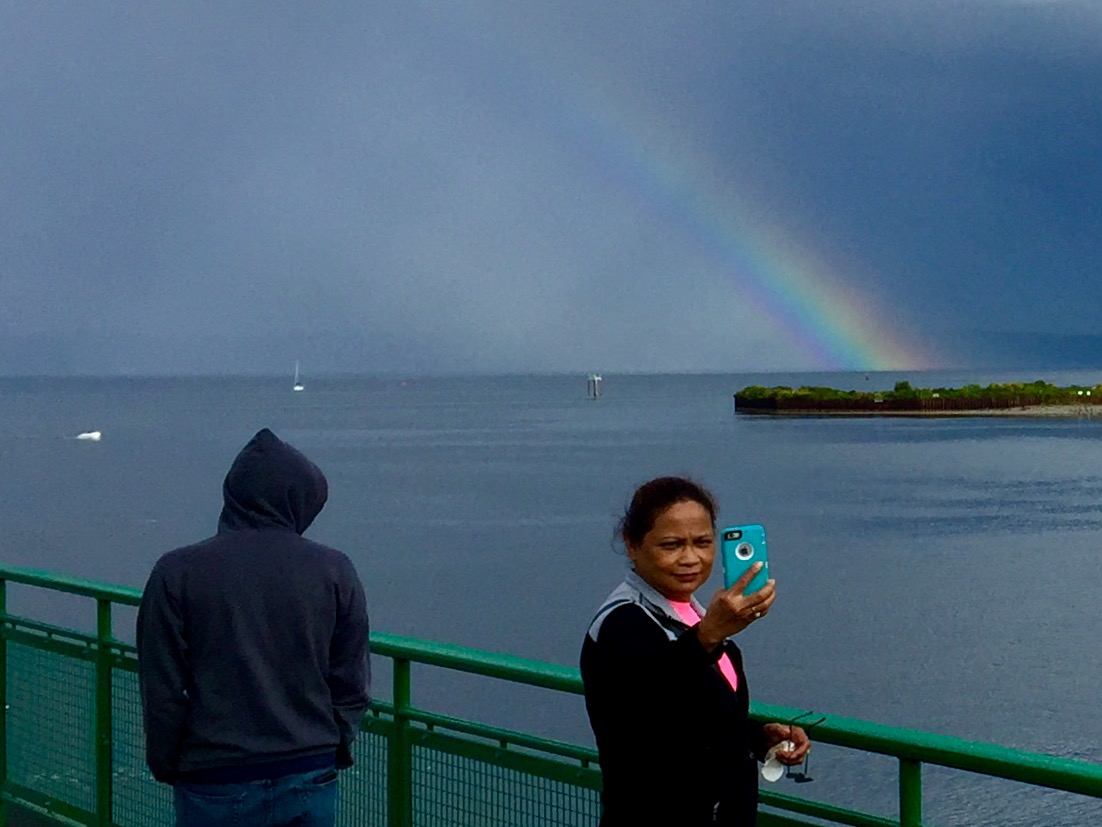
I took this photo on the Seattle-Bainbridge ferry on June 24. The Brexit vote had been announced the night before, on “Midsummer Night,” when, in olden times, mischievous spirits were said to be abroad, and bonfires were lit on British hilltops to aid the sun in its long decline toward winter.

I am not qualified to judge how much mischief and decline can be attributed to the Brexit vote, but the uncertainties of which Judt had written were much on my mind when I happened to see this rainbow, a biblical sign of promise. I snapped the photo on the fly without really composing it, but then I began to see things in it..

The woman seems representative of America as a land of immigrants. She contemplates her own image, like Venus with her mirror. Who am I? How did I get here? She is framing herself against the rainbow. She herself is part of the American rainbow. Is she surprised by what her screen is showing her? Does she register delight at existing in a world of rainbows? Will she turn to see the rainbow itself and not its image only?

We can’t see the face of the young man in the hoodie. He is a mysterious blank, the stranger from God knows where, a veiled presence destabilizing the scene with some unspoken question. His head is turned toward the rainbow, but his hands remain in his pockets. They are not extended in wonder or blessing. His thoughts and feelings are opaque to us. He is shut within the monastery of his dark clothing. Does he see promise in the sky? Is he sad, lonely, aloof, indifferent? Is he experiencing prayerful or poetic rapture?

We could compose a multitude of narratives about these two voyagers, but the only thing we know for sure is that they sail together on the same ark, and though the horizon seems dark, the shadows are illumined with the biblical sign of promise. This boat’s bound for glory, even if rough seas lie ahead.

Last night, at the Oregon Bach Festival, I heard the world premiere of A European Requiem, by Scottish composer James MacMillan. It is an astonishing work of complex sonorities, dramatic colors, and exquisite textures. Although it was composed before Brexit, its title and theme feel particularly resonant now. Do we live in a time of requiem or rebirth?

I was particularly struck by the work’s sublimity, that unnerving blend of fear and wonder generated in the presence of transcendent, overpowering mysteries. MacMillan seemed to suggest that the passage into whatever lies beyond our old familiar life is not altogether smooth and blissful. Hammering percussion and dissonant brass were anything but “rest eternal.” First the soul must be buffeted and broken open as the abyss of nonbeing widening before it. Only then can it hear the consoling chorus welcoming it into paradise.

But while MacMillan’s music allowed us to hear rapturous echoes from the “other side,” it did not take us across the divide. Instead, it concluded with the solemn sounds of the death bed. High, raspy strings whispered the last few breaths of mortal life. And after that, only the slow heartbeat of a bass drum, fading into silence.

Had the Requiem’s heavenly elements been merely a beautiful illusion, destined to vanish with every mortal thing? Or can we put our trust in something beyond the processes of dissolution and ending? Whether we are considering the fate of the world or the fate of the soul, it’s the question on which all else depends.


+


On a lighter note, you can find my new photo essay on the spirituality of summer here.


[i] Postwar: A History of Europe Since 1945 (New York: The Penguin Press, 2005), 1-2

[ii] David Jasper, The Sacred Community: Art, Sacrament, and the People of God (Waco, Texas: Baylor University Press, 2012), 127

Sacraments of Summer

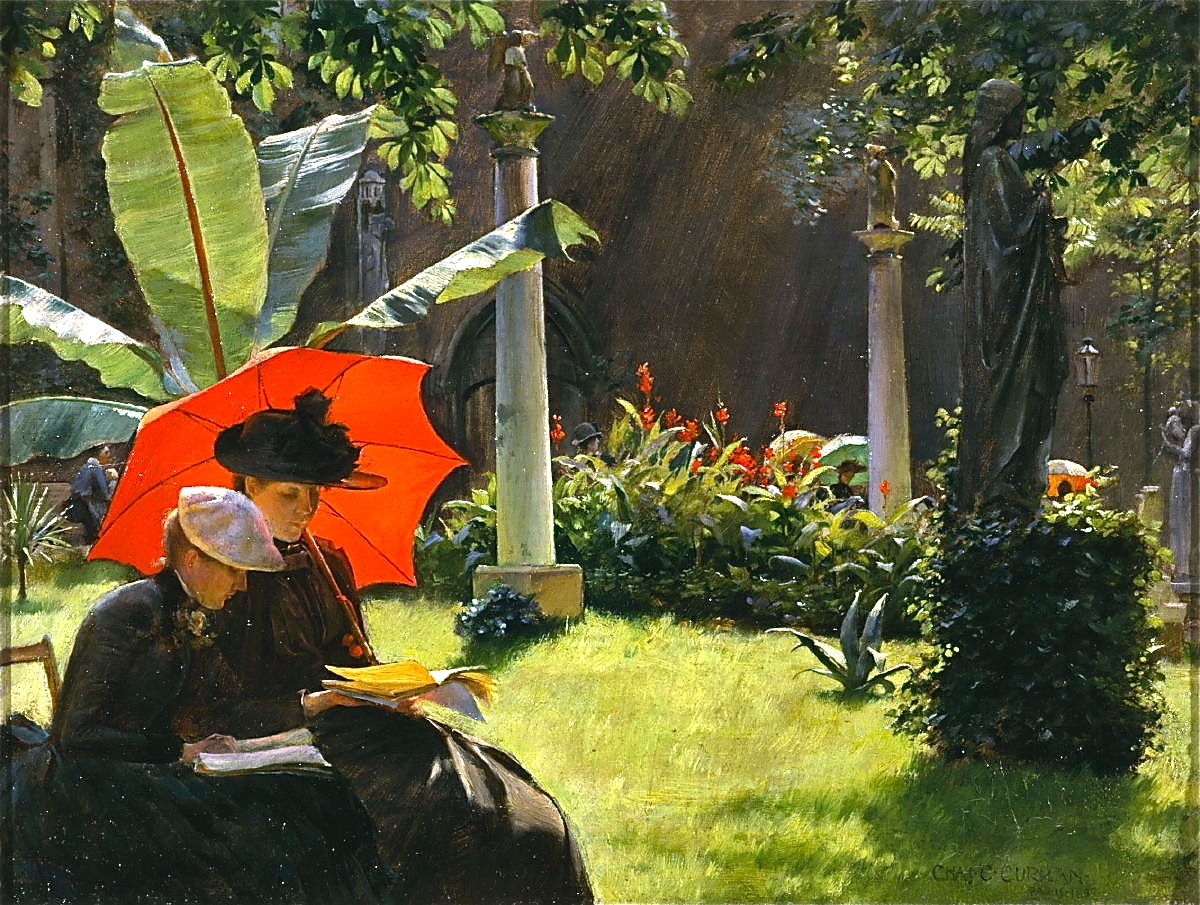
Charles Courtney Curran, Afternoon in the Cluny Garden, Paris (1889)

Charles Courtney Curran, Afternoon in the Cluny Garden, Paris (1889)

Now in midsummer come and all fools slaughtered
And spring’s infuriations over and a long way
To the first autumnal inhalations, young broods
Are in the grass, the roses are heavy with a weight
Of fragrance and the mind lays by its trouble.

– Wallace Stevens, “Credences of Summer”

In a short while, at 3:34 p.m. Pacific Daylight Time, the sun will reach its apogee of 23 degrees 27 minutes above the equator. When that moment comes, I will go outside to give Summer a proper welcome.

Every June Solstice I open Summer like a fresh novel, anticipating adventurous plots, alluring characters, and a world of fascinations presenting itself to my senses without hurry, as if both reader and text had all the time in the world. Summer is one of our sweetest fictions, suffused with a youthful happiness in a shadowless earthly paradise.

Of course, the livin’ isn’t always easy. Agonies and heartbreak may yet interrupt our revels, along with the heat waves, mosquitoes, sunburn, and poison oak. Summer is when my father died, and a dear friend committed suicide. Et in arcadia ego. In timeless Arcadia, death is still around

Even so, when summer smiles, I remember happiness once more:

Firefly nights and swimming hole days,
cold lemonade on a screened porch,
bare feet on warm ground, grass between my toes,
air-conditioned movies on a hot afternoon,
stack of summer reading by the hammock,
the holy calm of nothing to do,
cottonwoods whispering leafy poems to a quiet river,
the pleasurable sublime of high country thunderstorms,
campfire sparks rising to meet the Milky Way,
Springsteen singing us down some lost highway,
windows rolled down in the warm night air,
stars falling into a hayfield after midnight,
moonlight croquet (a candle at each wicket),
swapping songs around red Sonoma wine,
dancing till dawn on Gatsby’s lawn,
those kisses beneath the stars . . .

Do such moments only defer the inevitable erosion of temporal existence, or are they sacramental foretastes of eternal blessedness? Either way, as Michael Cunningham makes clear in The Hours, the Perfect Moment, like Summer itself, is not a gift to be wasted:

It had seemed like the beginning of happiness, and Clarissa is still somewhat shocked, more than thirty years later, to realize that it was happiness…What lives undimmed in Clarissa’s mind more than three decades later is a kiss at dusk on a patch of dead grass, and a walk around a pond as mosquitoes droned in the darkening air. There is still that singular perfection, and it’s perfect in part because it seemed, at the time, so clearly to promise more. Now she knows: That was the moment, right then. There has been no other.


Related posts

That Summer Feeling

Now Welcome Summer