But now I see

Window in Hereford Cathedral for Anglican visionary Thomas Traherne (Tom Denny, 2007)

Window in Hereford Cathedral for Anglican visionary Thomas Traherne (Tom Denny, 2007)

President Obama began his eloquent and moving eulogy for the Rev. Clementa Pinckney with a New Testament reference: “The Bible calls us to hope. To persevere, and have faith in things not seen … We are here to remember a man of God who lived by faith. A man who believed in things not seen.”[i]

According to physicists, 95% of the known universe is hidden from human observation. In reviewing a recent book on the subject of invisibility, Kathryn Schulz writes that the “whole realm of the visible is governed by the invisible … we can see a fragment of the what of things, but nothing at all of the why. Gravity, electricity, magnetism, economic forces, the processes that sustain life as well as those that eventually end it – all this is invisible. We cannot even see the most important parts of our own selves: our thoughts, feelings, personalities, psyches, morals, minds, souls.” Her conclusion sounds a note of causality which Aquinas would have admired: “Our planet, our solar system, our galaxy, our universe: all of it, all of us, are pushed, pulled, spun, shifted, set in motion, and held together by what we cannot see.”[ii]

Most of that invisibility is an inherent property of the unseen, but to that imperceptibility we human beings contribute our own forms of blindness. Some of that blindness is benign and adaptive, as we protect ourselves from sensory overload by only seeing what is necessary or unusual. But we also suffer moral blindness, closing our eyes to things we would rather not see, many of which the President boldly named in his oration.

“For too long,” he said, “we’ve been blind to the way past injustices continue to shape the present.” Blind about poverty, blind about racism, blind about our criminal justice system, blind about the unconscious impulse “to call Johnny back for a job interview but not Jamal.” As the congregation took up the cry – for too long! – he added, “For too long, we’ve been blind to the unique mayhem that gun violence inflicts upon this nation. Sporadically, our eyes are open: When eight of our brothers and sisters are cut down in a church basement, 12 in a movie theater, 26 in an elementary school. But I hope we also see the 30 precious lives cut short by gun violence in this country every single day; the countless more whose lives are forever changed — the survivors crippled, the children traumatized and fearful every day as they walk to school, the husband who will never feel his wife’s warm touch, the entire communities whose grief overflows every time they have to watch what happened to them happen to some other place.”

But it wasn’t just evil which became visible in Charleston. We also saw an answering goodness. As the philosopher Alfred North Whitehead insisted, “The kingdom of heaven is not the isolation of good from evil. It is the overcoming of evil by good.” When evil occurs, it is “met with a novel consequent as to issue in the restoration of goodness.”[iii] This novel consequent has taken many forms in recent days, most dramatically in the costly expressions of forgiveness by those so cruelly bereaved. It was not what the world expected to see.

“Oh, but God works in mysterious ways,” the President reminded us. “God has different ideas … Blinded by hatred, the alleged killer could not see the grace surrounding Reverend Pinckney and that Bible study group — the light of love that shone as they opened the church doors and invited a stranger to join in their prayer circle. The alleged killer could have never anticipated the way the families of the fallen would respond when they saw him in court — in the midst of unspeakable grief, with words of forgiveness. He couldn’t imagine that.”[iv]

Inspiring words, received by an inspired congregation. If we ever wonder whether church is worth the bother, do we need more evidence than Charleston? The radical forgiveness and faith we have witnessed there are not accidental. They have been uniquely forged and nurtured over time within a community of biblical witness, shared practice and common language. Church is where God’s friends do the collective work, generation after generation, to preserve and evolve the repertoire of faith in our stories, our praises and our actions.

Without church, we wouldn’t know how to name – or sing – “amazing grace.” We would lack the eyes – and the language – for “things unseen.” Without church, the President could never deploy Scripture with such resonance, or begin to sing a beloved hymn in the assurance that he would not have to finish it alone.

[i] Hebrews 11:1

[ii] Kathryn Schulz, “Sight Unseen: The Hows and Whys of Invisibility,” The New Yorker, April 13, 2015, 75-79

[iii] Alfred North Whitehead, Religion in the Making (New York: Fordham Press, 1996), 155

[iv] The full text of President Obama’s eulogy for the Rev. Clementa Pinckney on June 26, 2015, is widely available on the Internet.

God is a dance we do

Elaine Friedrich and friends, c. 1933

Elaine Friedrich and friends, c. 1933

At the end of last Sunday’s eucharist, we sang “You shall go out with joy,” a contemporary hymn with the infectious rhythm of Mediterranean dance.[i] The words, the tune, and the smiling worshippers all seemed to say the same thing: the Spirit really wanted to move in that place. So before we went our separate ways, I invited the congregation to repeat the song, while all who wished stepped into the open space before the altar for an impromptu circle dance. With joined hands, we circled round, spiraled inward, wove in and out of the arches and tunnels of upraised arms, manifesting with our bodies the divine fullness attributed to the Holy Trinity: an “interdependence of equally present but diverse energies … in a state of circumvolving multiplicity.”[ii] Or as St. Athanasius said more simply of the triune God, we were participating in the divine reality of “reciprocal delight.”

Communal dance is an early Christian image for the divine reality, due in part to a pun on the Greek word, perechoresis. This term (from peri = “around,” and chorein = “make room for,” “contain”) was appropriated in the fourth century to express the Trinitarian unity-in-diversity. Perechoresis implies a shared existence, a being-in-one-another where each Person, while remaining uniquely distinct, penetrates the others as each and all become the subject, not the object, of one another.

The Trinity is not a simple, static substance but an event of relationships. It is why we can say that God is love. “To be” has no ontological reality apart from “to be in relationship.” In the words of Anglican priest John Mbiti of Kenya, expressing the strongly communal mindset of African theology, “I am because we are, and since we are, therefore I am.”[iii]

Each Person contains the others and is contained by them in a shared communion of self-offering and self-surrender. But that continuous self-offering is never a one-way transaction, either one of self-emptying or one of being filled. It is always both at once – giving and receiving – as we ourselves know from our own mutual experience of love at its best. As Jesus said, “losing” yourself and “finding” yourself are equivalent and simultaneous. In giving ourselves away, we receive ourselves back. This may be counterintuitive to the modernist mindset of autonomous individual self-possession, but it is the essence of communion: “a giving of oneself that can only come from the ongoing and endless reception of the other.”[iv] This “being in communion” is explored more fully in Part 1: God is relational.

Now here’s the Greek pun: perechoresis also can mean “to dance around,” and the ancient theologians quickly seized on that image as an accessibly concrete description of a complex process. Trinity is a dance, with Creator, Christ and Spirit in a continuous movement of giving and receiving, initiating and responding, weaving and mingling, going out and coming in. And while our attention may focus at times on a particular dancer, we must never lose sight of the larger choreography to which each dancer belongs: the eternal perichoresis of Three in One, One in Three.

“I am the dance and I still go on” (Dancers at Elaine Friedrich’s Requiem)

Wallace Stevens made a poem about the process of giving ourselves over to a larger whole, “the intensest rendezvous” where we find ourselves drawn out of isolation “into one thing.” He wasn’t writing about dance or the Trinity, but his words come as close as any to describing their essential motion:

Here, now, we forget each other and ourselves.
We feel the obscurity of an order, a whole,
A knowledge, that which arranged the rendezvous.[v]

My mother Elaine knew the joy of the “intensest rendezvous” of perechoresis. She started dancing as a little girl, and as a teenager in the 1920’s she taught dance to younger children for ten cents a lesson. While studying at Northwestern she took workshops in Chicago with some of the great pioneers of modern dance, Doris Humphrey and José Limón. Her teachers encouraged her to apply to Martha Graham’s company. But then she met my father, and a career in dance was set aside for a more domestic life. I owe my own existence to that sacrificial act. Still, she remained a dancer in her heart, and later in life became a great advocate of sacred dance. Whatever I learned from her about the divine dimensions of “dancing around,” of giving yourself over to the cosmic “Love that moves the sun and all the other stars,”[vi] remains a vital part of my theological education.

There are no spectators in the Trinitarian dance, which is always extending outward to draw us and all creation into its motions. As Jürgen Moltmann said, “to know God means to participate in the fullness of the divine life.”[vii] It’s not a matter of our trying to imitate the relational being of the loving, dancing God, as if we were inferior knock-offs of the real thing. God wants us to become ourselves the real thing. God wants to gather us into the divine perechoresis as full participants in the endless offering and receiving, pouring out and being filled, which is the dance of God and the life of heaven.

And while our dance with God has its mystical, mysterious, transcendent dimensions, it is also very concrete and specific to our historical life on this earth, in this present time. As Miroslav Volf has said, “The Trinity is our social program.”[viii] We are called to make God not just an inner experience but a public truth. When Love’s dance becomes our way of being in the world – as believers, as church – the Trinity is no longer just doctrine. It is a practice, begetting justice, peace, joy, kindness, compassion, reconciliation, holiness, humility, wisdom, healing and countless other gifts.

Liberation theologian Justo L. Gonzales puts it well: “If the Trinity is the doctrine of a God whose very life is a life of sharing, its clear consequence is that those who claim belief in such a God must live a similar life … for if God is love, life without love is life without God; and if this is a sharing love, such as we see in the Trinity, then life without sharing is life without God…”[ix] So, in the immortal words of Lewis Carroll’s Mock Turtle: Will you, won’t you, will you, won’t you, won’t you join the dance?[x]

My mother was still dancing in her nineties, mostly in the gentle motions of Tai Chi. A year before her death at 96, she was asked to lead a dance prayer in her retirement community’s chapel. It was no longer easy for her to stand, so she performed the prayer seated, while the elderly congregation echoed her gestures with their own frail bodies. The prayer was Daniel Schutte’s well-known anthem, “Here I am, Lord.”[xi] In this video you can only see Elaine, but I’m pretty sure she was dancing with the whole company of heaven.

[This is the final post of a 3-part series on the Trinity. Part 1 was “God is relational,” and Part 2, on the experiential foundations of Trinitarian belief, was “You can’t make this stuff up.”]

[i] Words by Steffi Geiser Rubin, music by Stuart Dauermann (© 1975 Lillenas Publishing Company)

[ii] David Bentley Hart, The Beauty of the Infinite: The Aesthetics of Christian Truth (Grand Rapids: Eerdmans 2003), 114

[iii] q. in Veli-Matti Kärkkäinen, The Trinity: Global Perspectives (Louisville: Westminster John Knox Press, 2007), 352

[iv] Graham Ward, “The Schizoid Christ,” in The Radical Orthodoxy Reader, ed. John Milbank and Simon Oliver (NY: Routledge, 2009), 241

[v] Wallace Stevens, “Final Soliloquy of the Interior Paramour,” Collected Poetry and Prose (NY: Library of America, 1997), 444

[vi] Dante, Paradiso xxxiii, 145, trans. Robert & Jean Hollander (NY: Doubleday, 2007), 827

[vii] Jürgen Moltmann, The Trinity and the Kingdom: The Doctrine of God, trans. Margaret Kohl (San Francisco: Harper & Row, 1981), 152

[viii] Miroslav Volf, “‘The Trinity is Our Social Program’: The Doctrine of the Trinity and the Shape of Social Engagement,” Modern Theology 14, no. 3 (July 1998)

[ix] The Trinity: Global Perspectives, 301

[x] From the Mock Turtle’s song in Alice in Wonderland by Anglican cleric Charles Dodgson (Lewis Carroll)

[xi] Daniel Schutte, © OCP Publications 1981

Three things you should know about the Trinity (Part 2)

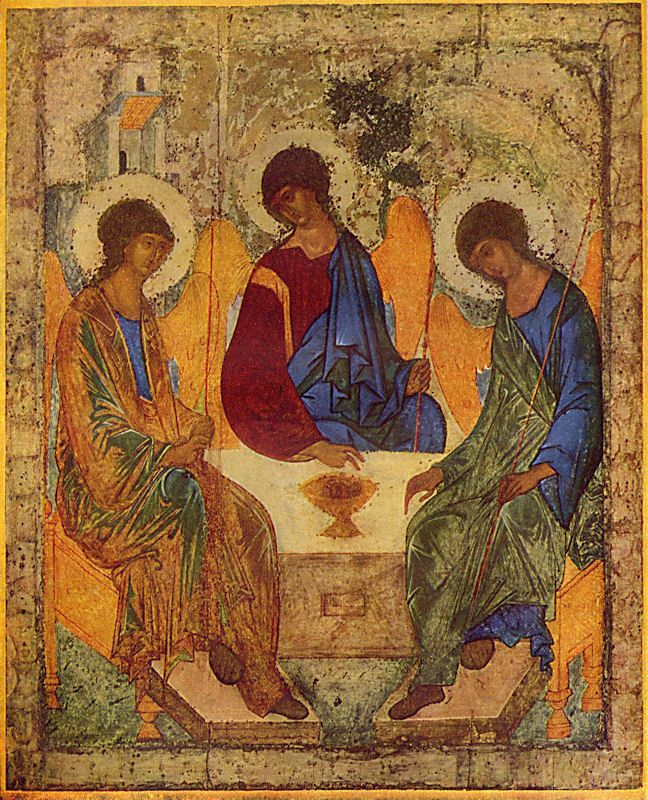
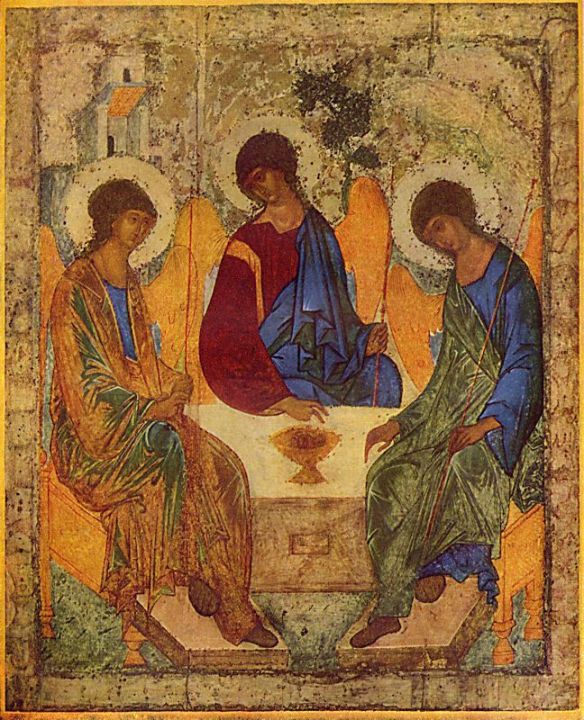
Andrei Rublev, The Holy Trinity (1425)

Andrei Rublev, The Holy Trinity (1425)

Trinitarian doctrine, like other key Christian doctrines, was hammered out, not in sterile study, but rather in the midst of lived spirituality, prayer, and the worship life of the church.[i]

                                                                        – Veli-Matti Kärkkäinen

The Trinity has to do with the lives of each of us, our daily experiences, our struggles to follow our conscience, our love and our joy, our bearing the sufferings of the world and the tragedies of human existence; it also has to do with the struggle against social injustice, with efforts at building a more human form of society, with the sacrifices and martyrdom that these endeavors so often bring. If we fail to include the Trinity in our personal and social odyssey, we shall have failed to show the saving mystery[ii]

– Leonardo Boff

Part 2: You can’t make this stuff up

Early in the twelfth century, a German monk named Rupert of Deutz went into a church where mass was being said by a white-haired bishop. At the offertory procession he experienced a vision of the Holy Trinity:

On the right at the edge of the altar stood three persons of such revered bearing and dignity that no tongue could describe them. Two were quite old, that is, with very white hair; the third was a beautiful youth of royal dignity …[iii]

A century later, Hadewijch of Antwerp, one of those remarkable women mystics who flourished in the late middle ages, also had a vision of the Trinity. But instead of three white males, what she saw was a dark whirlpool, which she described as “divine fruition in its hidden storms.” Hovering over this whirlpool was a spinning disc, on which sat a figure wearing the countenance of God – the face of God – on whose breast were written the words, “The Most Loved of All Beloveds.”

We may find Hadewijch’s vision more congenial: it is genderless, and less crudely specific than Rupert’s. And the tempestuous whirlpool, a flood of energy ceaselessly flowing through the universe, conveys a dynamic image of divinity that resembles the postmodern cosmologies of process theology and quantum physics. It’s probably easier for most of us to believe in a divine whirlpool than in three white guys.

But the crucial difference between Rupert and Hadewijch is not in the relative resonance of their imagery, but rather in what happens next. Rupert remains an observer, one who stands apart and sees God as an object. But Hadewijch does not remain separate from what she sees:

Then I saw myself received in union by the One who sat there in the whirlpool upon the circling disc, and there I became one with him in the certainty of union… In that depth I saw myself swallowed up. Then I received the certainty of being received, in this form, in my Beloved, and my Beloved also in me.

Rupert’s knowledge of God remained conceptual. Hadewijch’s knowledge of God became experiential. She was gathered into the circulating current of divinity. She became part of its flow, and that divine flow became part of her.

The language she uses for this experience is not mathematical or philosophical. Her language is the language of the heart. She describes being “swallowed up… in my Beloved, and my Beloved also in me.”[iv] Love, she discovered, is the way the soul knows. Love is the way the soul sees.

I begin this reflection with a mystic’s personal testimony because Trinitarian theology was not forged by inventive theorists, but by faithful Christians trying to make sense of the concrete, experiential data of salvation, beginning with the biblical narrative and continuing in the ongoing history of believing communities. Based on our collective and personal experience of being “saved” (or, if you prefer: healed, forgiven, reborn, renewed, resurrected, empowered), what can we say about the God who has done this? Trinitarian reflection began within an ancient community deeply grounded in the monotheism of Judaism, which had, over the centuries, found ultimate reality to be not a plurality of disconnected or contradictory energies but a coherent unity. But once the early Christians began to attribute divinity to both Jesus and the Holy Spirit, a simple self-contained oneness was no longer sufficient to describe the Reality.

Without losing the unity of God, how could they account for the divine diversity revealed in the saving activities of Christ and the Spirit? Once they began to call Jesus “Lord” (Kyrios), which happened very early in their worship and their storytelling, traditional monotheism was radically destabilized. The growing perception of the Holy Spirit as a guiding and empowering presence of deity in their communities only compounded the problem.

There were various attempts to solve the problem by downgrading Jesus and Spirit to subordinate, derivative, or semi-divine realities, by no means equal to the eternal and uncreated God. Such “heresies” were popular with those who wanted to keep God simple. But “orthodoxy” was unwilling to deny the fullness of divinity to either Christ or the Spirit. Only God can save us. Christ and Spirit, in the biblical revelation and Christian experience, are integral and essential to salvation. Therefore, they must be equally integral to the Holy One who is the Creator and Redeemer of all things.

The question wasn’t only metaphysical (What is the relation between the one and the many or the finite and the infinite?) or logical (How can One be Three and Three be One?). Trinitarian reflection was also a deep engagement with the question of suffering. If God incarnate in Christ chose to share the human condition, to live and die as one of us, does that mean that vulnerability and suffering have become part of God’s own history? And if these human elements have been added to the divine life through specific temporal events, has time itself disturbed the perfect calm of eternity? If God has been affected and changed by events in time and history, what can we then say about the consistency and transcendence of the divine nature? How can God be decisively linked to the history of the world without losing freedom or transcendence? Can a changeless God weep? Can we be saved by a God without weapons?

In his comprehensive survey of contemporary Trinitarian thought, Veli-Matti Kärkkäinen argues that “the assumption of humanity by God, the Son, means that human capacity to suffer is not foreign to the being of God. How else could one speak of God as love? … It is more biblical to think of God as passionate love, the Father who chooses to engage the suffering of the world, than as a Transcendent One whose separation from the world’s suffering guards his freedom.”[v] Robert Jenson, a foremost North American authority on the Trinity, rejects the notion of divine detachment from creation in dramatically succinct terms: “God … is what happens with Jesus… God is what will come of Jesus and us, together.”[vi]

The problems and paradoxes that arise from such far-reaching assertions have been debated and puzzled over throughout Christian history, and the recent profusion of Trinitarian theology has become an incredibly rich conversation. There is, of course, no final version of God awaiting discovery, no definitive outcome to all this reflection, only an endless attentiveness to the Mystery which may consent to dance with language, but always outruns it in the end.

So why presume to talk about the Trinity at all? Why can’t we simply say and think and pray to “God” and leave it at that? We can’t do that because Christians don’t belong to a theoretical God, a reasonable and logical divine construct worked up by professional philosophers. We belong to the self-revealing but complicated God of the Bible who has, in the form and activity of Christ and the Holy Spirit, rescued us from our own folly and gathered us into the communion that is the very life of God. And no matter what diverse strategies of insight and understanding we may employ, what we can actually say about the Trinity is always grounded in experience, both the experience of our ancestors encoded in Scripture and tradition and the contemporary revelations of communal and personal life.

Trinitarian thought isn’t made out of thin air or abstract speculation. It is produced and nourished by the concrete, tangible history of Christian experience. However each day manifests for us “the means of grace” and “the hope of glory,” whatever the myriad ways by which we love and serve and witness, we need the threefold name to account for the diversity of God’s relations with us. Anything less would impoverish our prayer and considerably reduce the scope of our attention.

For most theologians, our experience of God as threefold also reflects a Trinitarian life within God’s own self. Since God’s inner life is beyond our sight, this can only be an assumption. But it is a crucial one. If God is trustworthy and self-revealing, it must be that when we meet God as Trinity, we get the real thing. God isn’t just pretending to be Three for us; God’s own inner life is constituted by relationality and communion.

Finally, how shall we address or invoke this Mystery, which a Japanese theologian intriguingly calls “Three Betweennesses in One Concord?”[vii] The traditional “Father, Son, and Holy Spirit,” despite its authoritative pedigree, is distractingly masculine for many, and various substitutes have arisen, each with their own impediments. “Creator, Redeemer, Sanctifier,” for example, is a bit impersonal, and risks reducing the three Persons to job descriptions. Likewise, “Source, Word, Spirit,” “Creator, Liberator, Comforter,” “Parent, Child, Paraclete,” “Mother, Daughter, Spirit,” and “Mother, Lover, Friend” all have their particular assets and liabilities. My own current preference, since I suspect that God is more verb than noun, is “Love who loves us[viii], Word who saves us, Spirit who revives us.”

I leave the last word to 16th century reformer Philip Melanchthon, who said, “We adore the mysteries of the Godhead. That is better than to investigate them.”[ix]

[This is the second of three reflections on the Trinity. The first, on the essential relationality of God, may be found here.]

[i] Veli-Matti Kärkkäinen, The Trinity: Global Perspectives (Louisville: Westminster John Knox Press, 2007), 35

[ii] ibid., xv-xvi

[iii] Bernard McGinn, The Growth of Mysticism: Gregory the Great Through the 12th Century (New York: The Crossroad Publishing Company, 1994), 330

[iv] ibid., The Flowering of Mysticism (New York: The Crossroad Publishing Company, 1998), 212-16

[v] Veli-Matti Kärkkäinen, 99

[vi] Robert W. Jenson, The Triune Identity: God According to the Gospel (Philadelphia: Fortress Press, 1982), 22-3

[vii] Nozumu Miyahira, in Kärkkäinen, 314

[viii] I take this resonant phrase from Terrence Malick’s transcendent film, To the Wonder.

[ix] Kärkkäinen, xvi
Three things you should know about the Trinity (Part 1)

The Trinity is hard to visualize, as this late Gothic painting from the Louvre demonstrates.

The Trinity is hard to visualize, as this late Gothic painting from the Louvre demonstrates.

I’ve heard a lot of clergy say they hate to preach on Trinity Sunday. It seems too abstract, too complex, too heady a topic for a Sunday congregation, especially in a culture where thinking theologically is not a widely practiced art. It’s like trying to explain quantum physics to non-scientists. It took centuries for the ancient church to shape the doctrine of the Trinity. How can anyone explain it in 15 minutes? Besides, people look to the preacher for inspiration, not explanation. They want a sermon to make sense of things, not to make their heads explode.

Even Gregory of Nyssa, who thought a lot about the Trinity in the 4th century, found it a daunting subject:

You tell me first what is the unbegottenness of the Father, and I will then explain to you the physiology of the generation of the Son, and the procession of the Spirit, and we shall both of us be stricken with madness for prying into the mystery of God.[i]

I actually enjoy preaching the Trinity. I like it so well I even preached when Trinity Sunday fell on the day between my wedding and my honeymoon. It’s an inexhaustible subject – the Christian theory of everything – but over my next three posts, let me (humbly) suggest three things which I believe to be foundational for trinitarian faith.

Part 1: God is relational

We tend to think of a person as defined by his or her separateness. I’m me and you’re you! We may interact and even form deep connections, but my identity does not depend upon you. I am a self-contained unit. You can’t live in my skin and I can’t live in yours. That’s the cultural assumption, which goes back at least as far as Descartes in the seventeenth century, and continues today in such debased forms as rampant consumerism, where my needs and my desires take precedence over any wider sense of interdependence, community, or ecology.

But what we say about the Persons of the Trinity is quite different. Each Person is not an individual, separate subject who perceives the other Persons as objects. The Trinitarian persons experience one another not from the outside, but from the inside. They indwell each other in a mutual interiority.

John Lennon expressed the Trinitarian spirit when he sang, “I am he as you are she as you are me and we are all together.” And a French mystic put it this way: “it’s a case of un ‘je’ sans moi” (an “I” without a me).

But if the divine Persons are all inside each other, commingled, “of one being,” as the Creed says, what makes each Person distinct? To put it succinctly: the Persons are distinct because they are in relation with one another.

As Martin Buber observed, we are persons because we can say “Thou” to someone else. To be a person is to experience the difference – and the connection – that forms the space between two separate subjects. My consciousness is not alone in the universe. There are other centers of consciousness: Thou, I… Thou, I… The fact that you are not I is what creates self-consciousness, the awareness of my own difference from what is outside myself.

If we apply this to the Trinity, we say that there are Three Persons because there is relation within God, relation between the Source who begets, the Word who is begotten, and the Spirit who binds the two together and moves them outward in ever widening circles.

These relations are not occasional or accidental. They are eternal. There is an eternal sending within God, an eternal self-giving within God, an eternal exchange by which God is both Giver and Receiver simultaneously.

Trinitarian faith describes a God who is not solitary and alone, a God who is not an object which we can stand apart from and observe. The Trinity is an event of relationships: not three separate entities in isolation and independence from one another, but a union of subjects who are eternally interweaving and interpenetrating.

The early Church had a word for this: perechoresis. It means that each Person penetrates the others, each contains the other, and is contained by them. Each fills the space of the other, each is the subject, not the object of each other. As Jesus says in the Fourth Gospel: I am in the Father and the Father is in me.

This divine relationality is not something which an originally solitary God decided to take up at some point. God is eternally relational. Before there was an external creation to relate to, God’s own essential self was and is an event of perpetual relation. There was never simply being, but always being-with, being-for, being-in. To be and to be in relation are eternally identical.

When the Bible says, “God is love” (I John 4:16), it means that love is not just something God has or God does; love is what God is. As Orthodox theologian John D. Zizoulas says in his influential text, Being as Communion, “Love as God’s mode of existence … constitutes [divine] being.”[ii] Feminist theologian Elizabeth Johnson echoes this in her book, She Who Is: “There is no divine nature as a fourth thing that grounds divine unity in difference apart from relationality. Rather, being in communion constitutes God’s very essence.”[iii]

In other words, God is Love giving itself away – self-emptying, self-diffusing, self-surrendering – and in so doing finds itself, receives itself, becomes itself.

For those of us made in God’s image, who God is matters deeply, both for our own self-understanding and for our engagement with the world. The Trinity isn’t just a doctrine or an idea. It’s a practice, a way of life, the shape of every story.

To be continued … 

[i] Sermons of Gregory of Nyssa, Orat. xxxi, 8

[ii] John D. Zizoulas, Being as Communion: Studies in Personhood and the Church (Crestwood, NY: St. Vladimir’s Seminary Press, 1993), 46

[iii] Elizabeth Johnson, She Who Is: The Mystery of God in Feminist Theological Discourse (NY: Crossroad, 1993), 227

Cave of the Apocalypse

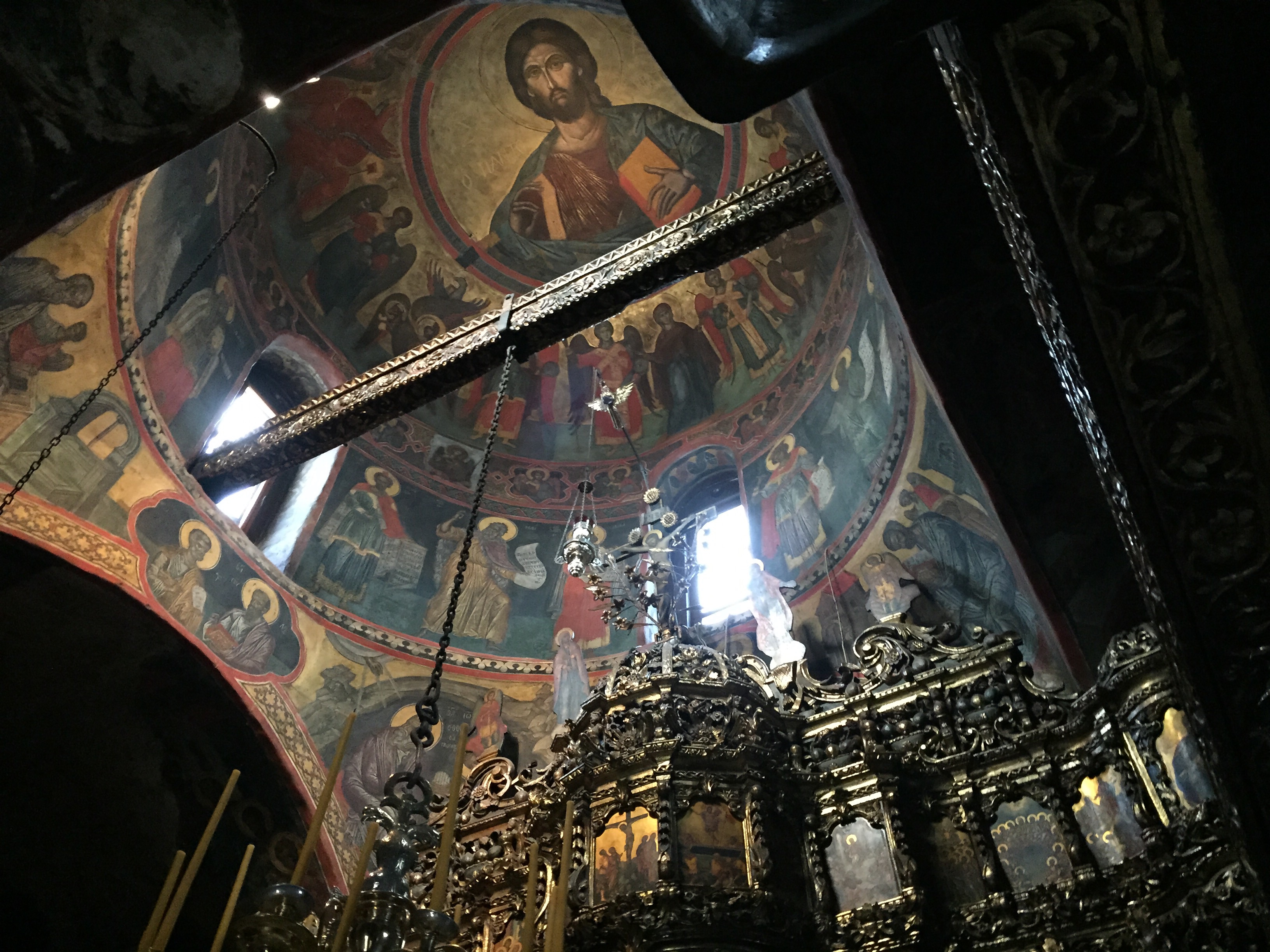
Katholikon of the Holy Monastery of St. John the Theologian

Katholikon of the Holy Monastery of St. John the Theologian


I, John … was on the island called Patmos because of the word of God and the testimony of Jesus. I was in the spirit on the Lord’s day, and I heard behind me a loud voice saying, ‘Write in a book what you see …’    (Rev. 1:9-11)

Patmos is one of the smaller Dodecanese Islands, a grueling 8-hour middle-of-the-night ferry ride east of Athens. It has gorgeous bays and quiet beaches, superb mountain views, charming villages and, at least not in summer’s high season, a tranquil predominance of locals over tourists. The outsiders I have met are themselves “regulars,” returning again and again because they love it. Yesterday a man from the Netherlands told me this was his 23rd straight year of month-long visits.

Patmos is also a place of pilgrimage, where St. John the Theologian (or “the Divine,” as we say in the western church), fell into a swoon and saw things which have intrigued, puzzled, disturbed and inspired readers ever since. The Book of Revelation has, regretfully, provided horrific weapons of mass destruction for hellfire preachers, but it is also the source for many sublime hymns and prayers in my own Anglican tradition.

Most scholars think that the book’s author is not the same person who wrote the Fourth Gospel. Language, style and themes are too different in the two works. But “tradition” has always preferred to link the Galilean fisherman “whom Jesus loved” with both the mystical composer of the Fourth Gospel and the visionary exiled to Patmos. It exemplifies the arc of discipleship as potentially a long, strange trip. As we sang in a hymn at my own ordination years ago, “the peace of God, it is no peace … Young John, who trimmed the flapping sail, homeless in Patmos died; Peter, who hauled the teeming net, headdown was crucified.”

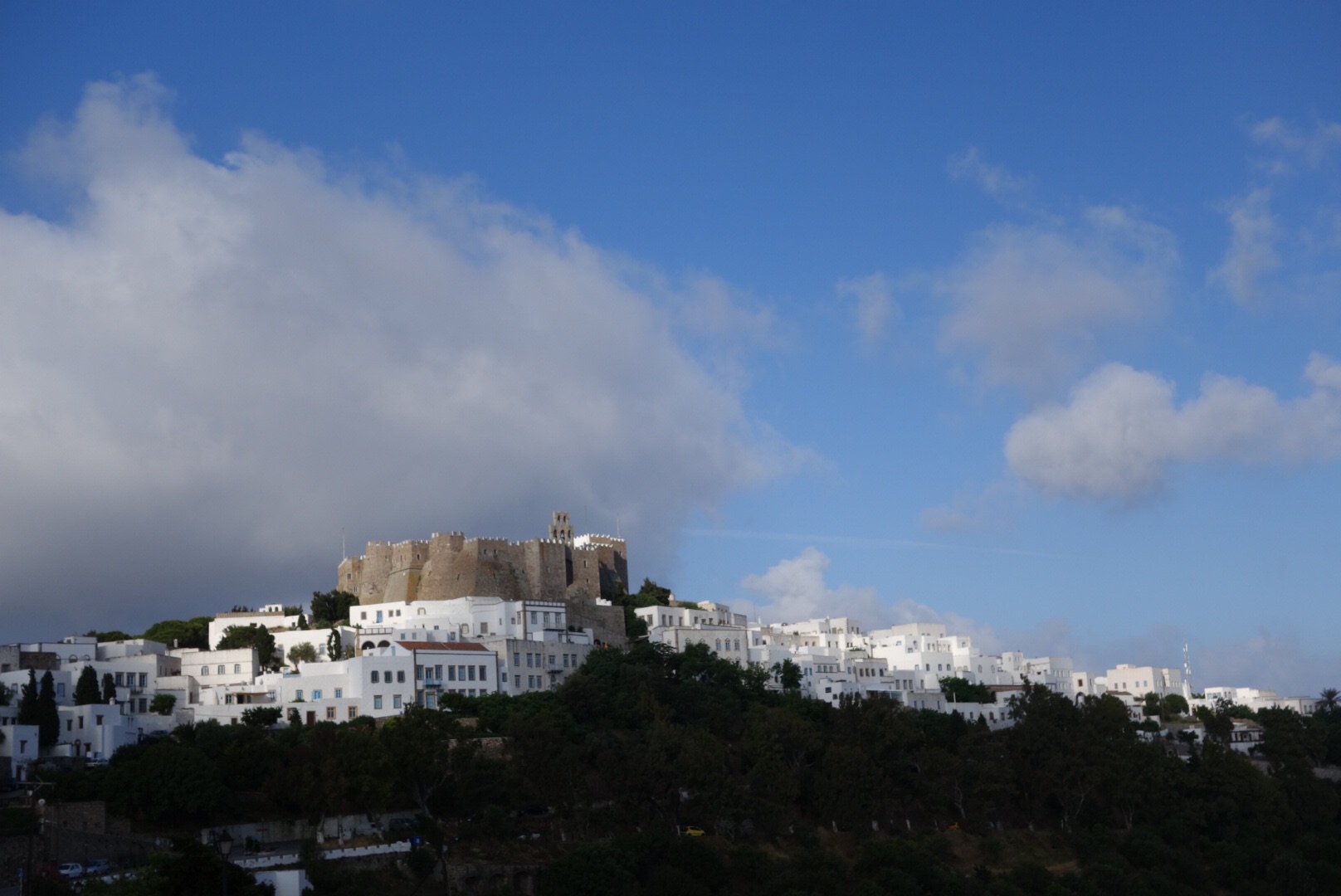
So the Christian can’t come to Patmos and simply lie on the beach or relax in the taverna. The Holy Monastery of St. John the Theologian beckons from the high ridge above the  port. Its dark-hued fortress of lion-colored stone makes somber contrast with the whitewashed village around it, as if to say that the ascent of this hill is serious business.

The monastery rises above the village of Chora.

The monastery rises above the village of Chora.

If you rise early, you can experience the awesome richness of the monastery’s Katholikon (main church) in solitude. The brilliant wall paintings, recently cleaned, immerse you in holy images. Along with the intricately carved iconostasis, hanging oil lamps, and numerous icons, they effect a ceaseless engagement of the eye. Some might find this distracting for prayer, but for me the sense that there is always more than I can take in – the visual inexhaustibility of Orthodox interiors – can lead to a kind of surrender, overwhelming and transcending the subjectivity of my own thoughts and perceptions. Here is Mystery. Give over to it. Lose yourself in it.

The monastery museum holds an eclectic assortment of treasures, including a 6th century gospel book, a 1499 Venetian collection of Aristophanes’ comedies, a 6th century BC bust of Dionysus (god of wine and ecstasy), the largest Orthodox collection of 5th-6th century Coptic textiles, preserved by the dryness of Egyptian tombs, and a police blotter in Arabic from the late 15th century, when Byzantine territories had fallen under Muslim control (“The Cadi [Judge] of the Palace is ordered to find three Patmians who were kidnapped by pirates.”).

Below the monastery, halfway up the hill from the sea, is the Cave of the Apocalypse. Here, according to tradition, John lay on the stone floor for several days while the vision unfolded. The cave is not large, but the insertion of a wooden iconostasis into its contours, along with icons and hanging lamps, has made it a compelling place for worship, prayer and veneration. John’s private ecstasy has been reimagined through specific features of the cave. Here is the cleft from which the Voice spoke. Here is the corner when he laid his head to rest between revelations. Here are the fissures where the Trinitarian God divided the rock into three parts with an earthquake.

Literal belief in the details of the cave’s legends is not required to make the site holy. It is holy because centuries of believers have given a particular kind of attention here to a Reality which yearns to make itself known in the innermost heart, for which a sheltering, enclosing cave is a tangible, sensory analogy.

Another mystical theologian, St. Bonaventure, said, “When you pray, gather up your whole self, enter with your Beloved into the chamber of your heart, and there remain alone with your Beloved, forgetting all exterior concerns.” The Cave, for the attentive, can mirror the chamber of the heart.

I entered it three times during my week here. The first time was the Sunday liturgy, full of incense and chanting voices. It was beautiful, but I had no revelations, or even deep feelings. God was present, but I was a bit absent. I was tired from a long, sleepless ferry ride. And I knew that whatever the Cave offered was not a tourist experience you can just walk in and collect.

So I went back a few days later. The voices I heard then were those of tour guides. Most just reeled off the legends uncritically as if they were prosaic facts. Here this and that happened, blah blah blah, now let’s go back to the bus. But one guide, a Greek woman speaking both in English and German, really got into it.

“People think that the Book of Revelation is about judgment and punishment. That is there, of course, but by the time you get to Chapter 21, you find what it is really about: a new world, a new heaven, a new earth, where we will be with God, and God with us.

“John’s message is trying to wake us up, to make us see that we are all one because God is with us and in us. Our original condition of oneness will be restored in the end. We lost that unity in the beginning because we had free will, and we chose to have our own experience, and forgot our connection with one another.

“If a bomb falls on someone in Syria, we think, ‘Thank God that didn’t happen to me.’ But what happens to others happens to all of us. John is trying to wake us up to this. And when he talks about the destruction of the earth, we have to think about how much closer we ourselves are to bringing that about today, unless we remember what we were made for and what we are a part of.”

When I thanked her afterward for her ‘preaching,’ she said, “I want to tell people what they don’t know, what they don’t hear in the schools, what the priests won’t tell you.” She was pretty sour on the institutional church. “I was baptized Greek Orthodox. I believe in Christ and the power of the sacraments, but I don’t belong to any church. I’m kind of a revolutionary.” I asked her name. “Vera,” she said. “Like veritas– the truth.”

This morning, my last on Patmos, I returned to the Cave for a third time. Two cantors and a priest were chanting the Divine Liturgy. I was the only other person present. This time, the spirit of prayer came easily, like a morning breeze. I received no visions, heard no voices except the beautiful earthly ones I stood among. But it was more than enough. When the priest handed out the holy bread at the end, I was aware of my outsider status as non-Orthodox. But the priest, who had the face of a Baroque Apostle, turned to me with a slight nod. And so I ate the bread of heaven, and departed well satisfied.

Stairway to heaven

image

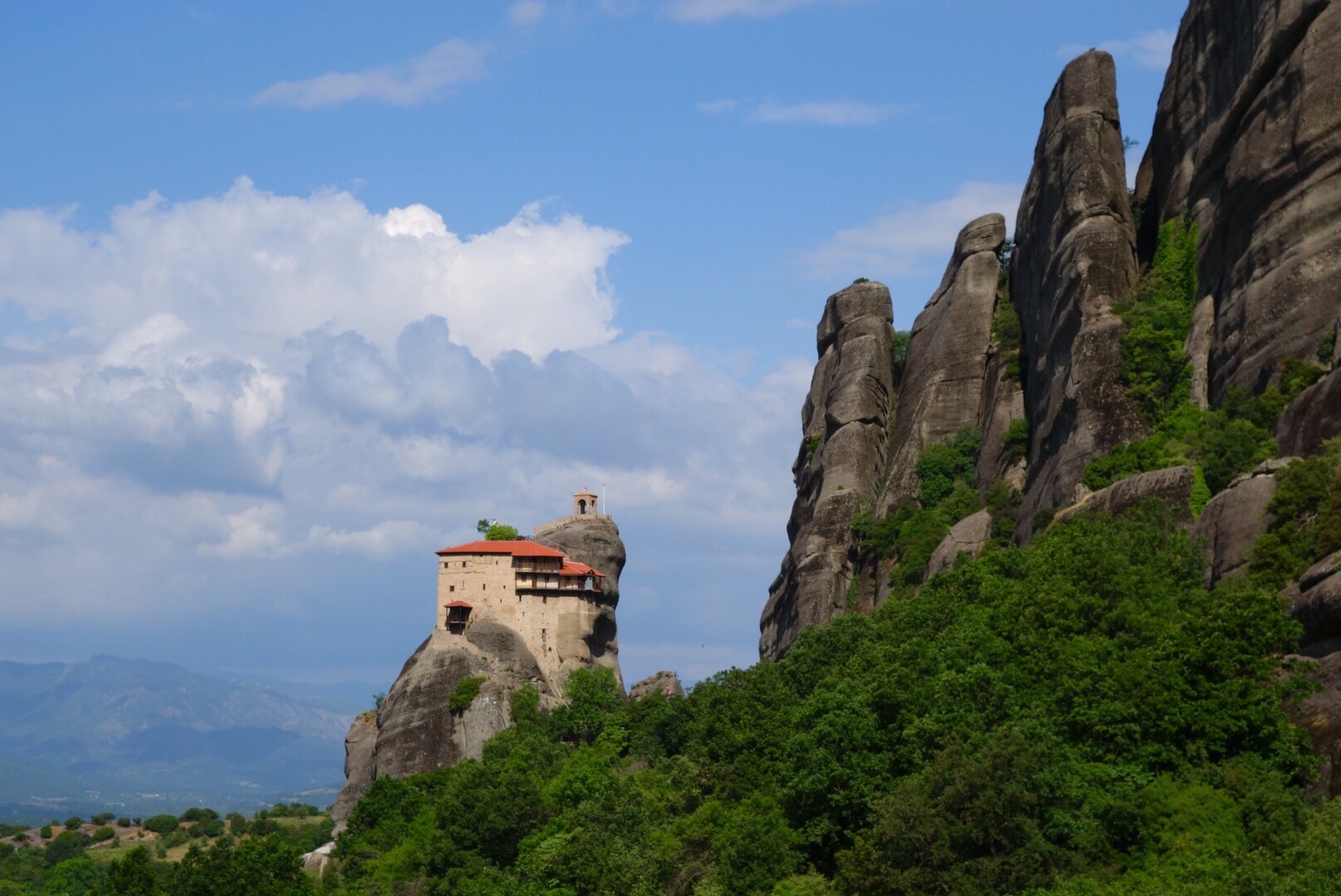
A modern road has made the monasteries accessible to tourists, but a pilgrim may still ascend more deliberately on the old wooded paths leading up from the lowlands. The way is peaceful and full of birdsong, and the upward views of immense cliffs and towers crowned with such fanciful habitats were continuously astonishing.

At the top, the hiker joins the throng who have arrived in bus or car, often to find a prevailing atmosphere of chatter which neglects or obscures the beauty of holiness. People wave and smile at cameras, offer the same brief glance to Christian images which they gave to Athena and Apollo in the Greek museums, enjoy the spectacular views, and head off to the next attraction. It doesn’t always feel like pilgrimage. And many of the monks themselves have long since fled to more solitary retreats.

But patience may be rewarded, and today there were fortunate lulls in the touristic turbulence, when the worship spaces emptied out and prayerful attention was possible.

image

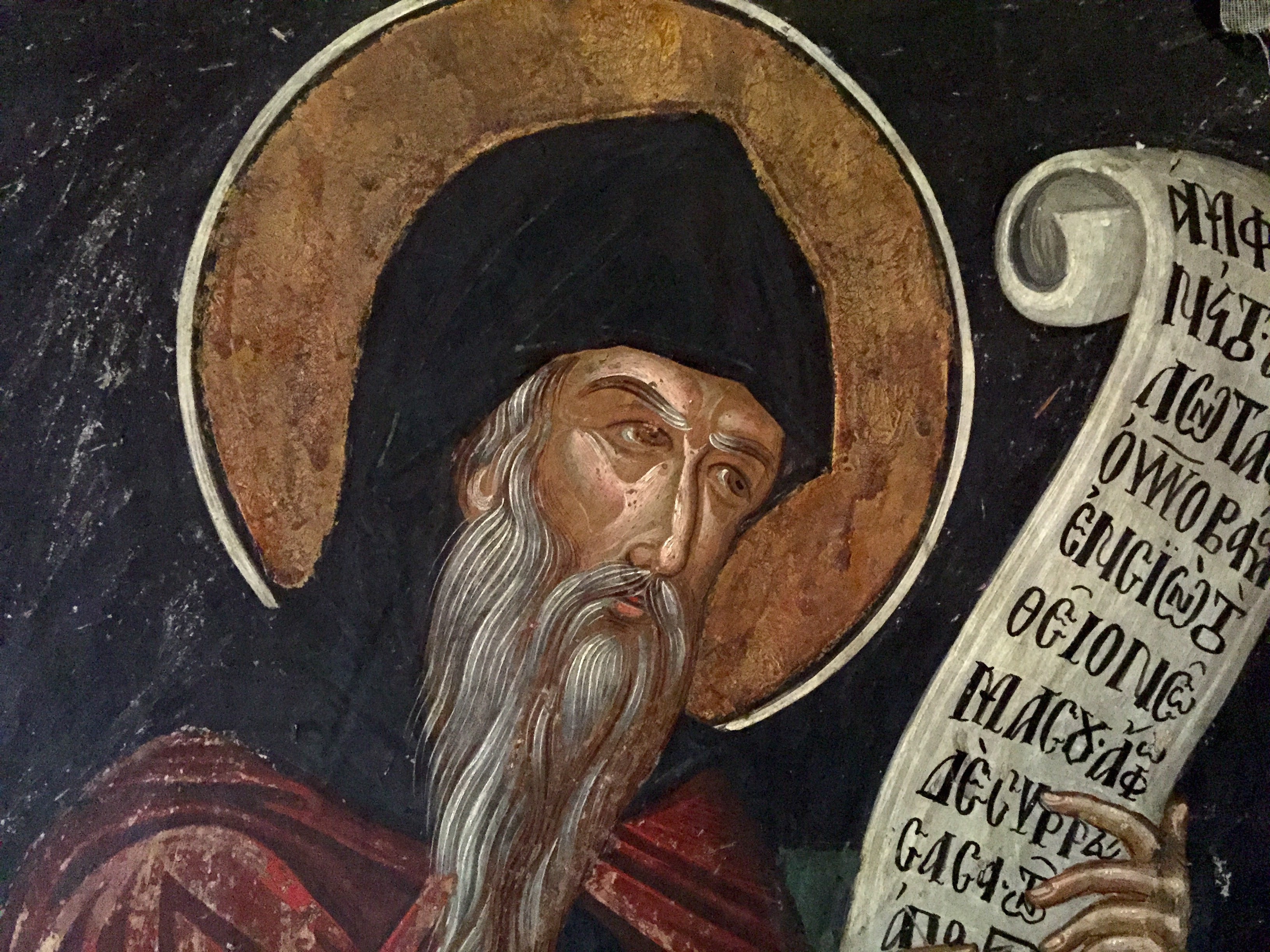
The priestly preface to a guidebook published by one of the monasteries wishes the pilgrim “a rare spiritual journey between heaven and earth, in order to “taste here newfound bliss, spiritual uplift and powerful emotions” providing release from daily routine. And I can testify to the tangible effect of a long and dramatic wilderness ascent to arrive in a room, lit only by the soft daylight falling from a few small, high windows, and there be immersed in a sepulchral interior filled with icons and hanging lanterns, where every wall is painted with frescoes of saints and biblical scenes. It feels like a space praying ceaselessly in story and image, bearing witness to the Divine Mystery until the end of time.

The images are painted in bright colors, which stand out intensely against their ink-black bakgrounds, so strikingly different from the familiar golden environments of most Byzantine iconography. This distinctive style came from Theophanes, a fifteenth-century Cretan artist who worked here as well as at Mt. Athos. To a modern viewer, for whom the gilded world of faith is no longer a given, the blackness suggests a void against which the existential cry of “let there be light” must ever be a proposal fraught with risk.

image

The holy paintings of Meteora, like the Christianity that produced them, have suffered fading and wear over the centuries, and some of their meanings have grown obscure. But unless a grain of wheat should fall into the ground and die, it cannot bear any fruit.

This wondrous day ended with a visit to the oldest Byzantine cutch in the region, built not at the summit but at the foot of the Meteora rocks. It was empty of visitors when my wife Karen and I arrived at sunset. Before leaving, I asked the Greek woman who collected admissions if I could sing a Kyrie in the resonant space. I’m not sure she understood exactly what I was asking, but she seemed agreeable enough. I stepped into the nave and began. The Kyrie I chose was an ancient Greek setting. She recognized the chant and began to sing along somewhere behind me. Orthodox and Anglican, Greek and American, female and male, praying together amid the cloud of painted witnesses all around us. “She had tears in her eyes,” Karen told me later.

As we took our leave, I said the Greek acclamation for Easter: Christos anesti! Christ is risen! “Alithos anesti,” she replied with a smile. Indeed he is risen.

The Voice That Calls us: A Reflection for Good Shepherd Sunday

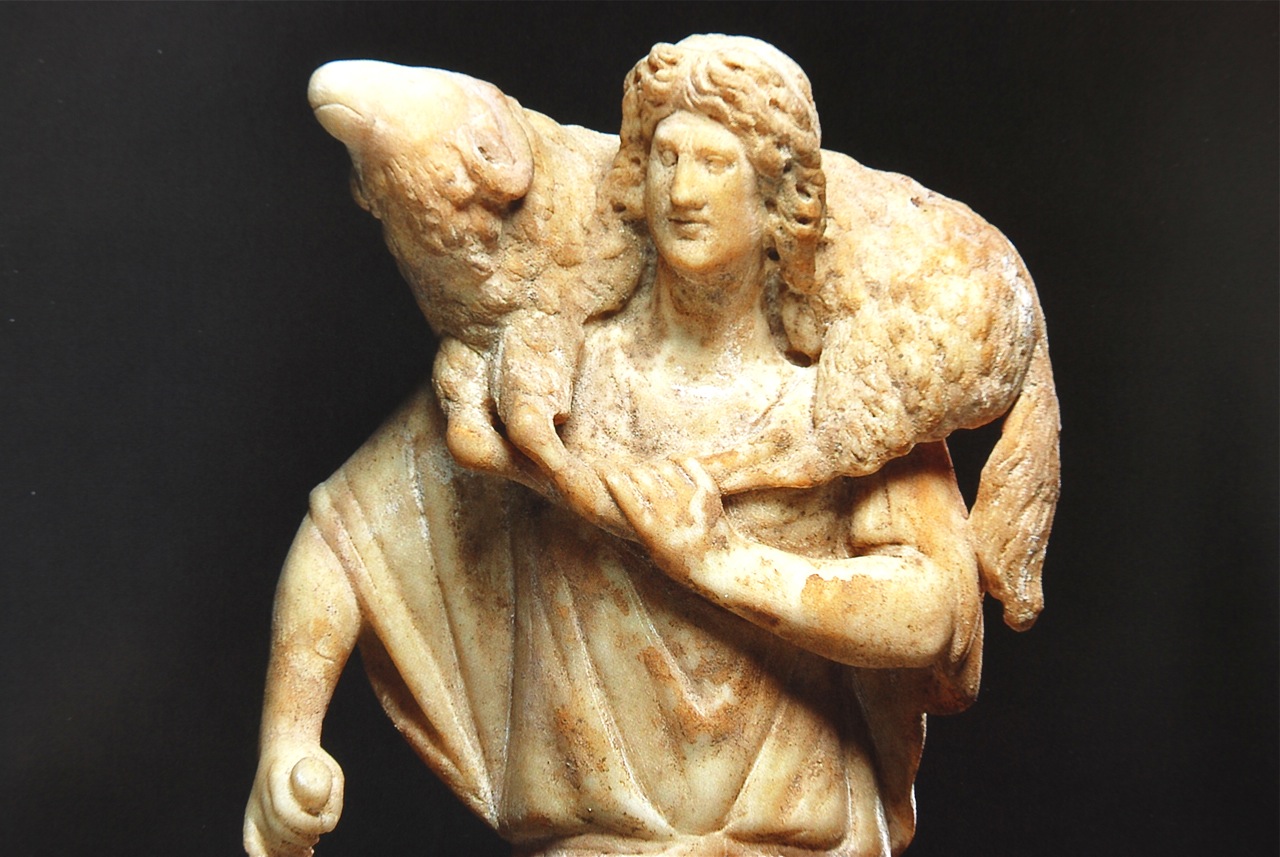
The Good Shepherd (Asia Minor, c. 390; Cleveland Museum of Art)

The Good Shepherd (Asia Minor, c. 390; Cleveland Museum of Art)

The gospel image for today, the Fourth Sunday of Easter, is the good shepherd who “calls his own sheep by name and leads them out” (John 10: 3). Unlike the hired hand who cares little for the sheep, Jesus loves his flock. He will lay down his own life for them. And they in turn know exactly where to put their trust. “I know my own and my own know me” (John 10: 14). “The sheep that belong to me hear my voice … and they follow me” (John 10:27).

Sheep are not a part of my daily life, so I didn’t fully appreciate the metaphor until I visited a sheep market in Jerusalem in 1989. Starting at 6 a.m. on Fridays, shepherds would bring their sheep in trucks, vans and even the back seats of cars to a stone-walled corral to begin spirited negotiations with potential buyers.

Once the corral had been crammed with wall to wall sheep, I wondered how the different shepherds would ever keep track of their own. But it soon became clear what Jesus was talking about: I know my own and my own know me. Although many human voices were speaking and calling simultaneously, each of the sheep responded only to the distinctive voice of its own shepherd.

Our own shepherd’s voice can still be heard, calling us every time we open the Bible. The attentive reception of Scripture is a form of real presence. When the gospel is read in the Eucharistic assembly, or meditated upon faithfully, Christ speaks – not from the past, but addressing us now in our own present with words of challenge and refreshment: Turn your lives around … Follow me … Take up your cross … Don’t be afraid … Your sins are forgiven … Peace be with you … Love one another.

Countless Christians through the centuries have heard and answered the voice of Jesus mediated in this way through the written texts of Scripture. But are there other ways of hearing the shepherd’s voice? Does it still find ways to speak in the now, without the mediation of ancient texts? Or is the God who spoke long ago now wrapped in permanent silence?

In the first book of the Bible, God speaks directly to human beings. Although we are never given a location or visual description of the speaking God, the words themselves seem as naturally delivered as any of the human speeches in the text. In the second book, the divine voice becomes less “natural,” uttered mysteriously from a stormy cloud or burning bush. By the fifth book, divine speech is largely of the past, something remembered and taught instead of heard directly: “Yahweh then spoke to you from the heart of the fire; you heard the sound of words but saw no shape; there was only a voice” (Deut. 4:12).

By the time we reach the First Book of Kings, the God whose voice had thundered commandments to Moses is reduced to “a still small voice,” or more accurately translated, “a sound of thin hush” (I Kings 19:12). The voice of God has become the sound of silence.

Thereafter, God’s biblical speeches are secondhand reports from the mouths of the prophets. The whole narrative arc of the Hebrew Scriptures “from Eve to Esther,” as Richard Elliott Friedman puts it, may be described as a “step-by-step diminishing of God’s apparent presence.”[i] As Isaiah says, “Truly, you are a God who hides himself.”[ii] Or as the Psalmist complains, “My God, my God, why have you left me?”[iii] In the public, shared experience of God’s people, the face of God becomes hidden and the voice of God grows silent. God disappears as a speaking character in the Bible.

However, incarnational faith understands this not as a process of divine withdrawal from the world, but an ever deeper embedding of God within it, until the Word of God is delivered not in thunder and lightning, but in the ordinary human speech of the man named Jesus. It turns out that the eventual disappearance of the God of power and might was a way for God to draw ever closer to us, so that now, as Bonhoeffer said, “God is in the facts themselves.”[iv]

For those attached to a more majestic divine self-disclosure, this has made God much harder to see. As Pascal put it, “when it was necessary for [God] to appear, he hid himself more deeply yet, by wrapping himself in humanity. He was much more easily recognizable when he was still invisible than when he made himself visible.”[v] But for those with ears to hear, the still small voice may be heard every day from our neighbor’s mouth.

Still, I wonder. Can God yet speak, not just in sacred text or through the mouth of friend and stranger, but more directly? Is there still an audible Voice that calls us each by name? John Milton argued that God makes a “general vocation” to all “in various ways” but sometimes “invites certain selected individuals … more clearly and insistently than is normal.”[vi] His seventeenth century contemporary, George Herbert, described such a moment of address and response in his poem, “The Collar,” whose very title uses the sartorial sign of priestly vocation to make a pun about “calling”:

But as I rav’d and grew more fierce and wild
At every word,
Methought I heard one calling, Child!
And I reply’d, My Lord.

But as the word “methought” indicates, the experience of being addressed by God, undoubtedly a real one for the prayerful Herbert, was filtered through imagination, reflection and poetic language. We can’t assume it to be verbatim.

Three centuries earlier, English mystic Julian of Norwich, while gravely ill, had an intense visual and auditory experience of the suffering Christ, which she would later recount in the first book written by a woman in English. The book’s title, Showings, categorizes her visions as something received, not simply produced in her own mind. The things Christ said to her were not simply variations on gospel texts, but words never before heard, directed specifically to Julian.

As Veronica Mary Rolf has noted, Julian was careful to specify “which of Christ’s words she heard spoken distinctly within her mind, and which words arose in her mind ‘as If’ Christ were addressing her directly, according to what she understood to be his meaning.”[vii] Julian’s experience is compelling, and when Jesus tells her that “all shall be well,” who can say she was not hearing her shepherd’s voice?

“Jesus calls us,” the hymn says. “Day by day his clear voice soundeth.”[viii] How literally should we take this? Have you, dear reader, ever heard the Voice that calls you by name? I myself have never heard it in an auditory way, as an actual sound. But I can remember one particular occasion when, I believe, the Voice addressed me, simply and directly.

In preparation for my fiftieth birthday, I spent four days at the Taize community in France. The chanted worship was very beautiful, but something about the place left me ill at ease. Most people had come to spend an entire week, but I had only arrived on Thursday, missing out on the natural bonding process of the hundreds who had been together since Sunday. I felt like an outsider. And the prevailing European reserve didn’t exude any of the warmth I associated with religious retreat. As one of my British roommates told me, “Oh, you Americans! You expect everyone to smile and say howdy.”

For whatever reason, I was not having the uncomplicatedly beautiful experience I had anticipated. I felt disappointed. On my second night, the two-hour liturgy centered around a large painted Byzantine cross. All who wanted could draw near for a time of prayer and adoration. When my turn came, I leaned my forehead against the cross and prayed, “Well, God, here I am at Taize. It’s not at all what I hoped for. Now what?” I waited, not really expecting an answer. But then these words came into my thoughts, precise and clear like something given, rather than any halting formulation of my own: Stop looking for a gift for yourself. Look for the gift you can give another.

It was an awakening. Tears filled my eyes. Tongues of flame danced in the red votives around the cross. A thousand voices chanted in the German tongue of my ancestors, “Stay with me, remain here with me, watch and pray, watch and pray.” After that moment, everything was different. My remaining days at Taize were full of grace.

When the liturgy ended, I went out into the summer night. People were sitting in small groups on the lawn, watching spectacular bolts of lightning play across the far horizon. First the still small voice, then the fire from heaven. Theophany indeed.

[i] Richard Elliott Friedman, The Hidden Face of God (San Francisco: Harper San Francisco, 1995) 79

[ii] Isaiah 45:15

[iii] Psalm 22:1

[iv] Dietrich Bonhoeffer, Letters and Papers from Prison (New York: Macmillan, 1971) 191

[v] quoted in Gerardus van der Leeuw, Sacred and Profane Beauty: The Holy in Art (Nashville: Abingdon Press, 1963) 326

[vi] De Doctrina Christiana, q. in David Lyle Jeffrey, ed., A Dictionary of Biblical Tradition in English Literature (Grand Rapids, Michigan: Eerdmans) 815

[vii] Veronica Mary Rolf, Julian’s Gospel: Illuminating the Life and Revelations of Julian of Norwich (Maryknoll, NY: Orbis Books, 2013) 262

[viii] Cecil Frances Alexander, The Hymnal 1982 (New York: The Church Hymnal Corporation) #549

Footsteps and shadows: Inscribing our traces on the Camino

This spring I find my mind often returning to the Camino de Santiago. A year ago today I began my tenth day of walking: 140 miles down, 360 to go. But by then I had stopped counting. It was better – and less tiring – to be in the moment, to “cherish every step” as one pilgrim advised me early on.

When I run long distance, or backpack up a steep mountain pass, I try to apply the mindfulness of Zen walking. Don’t think about some other time, in the past or the future, when you are in a more comfortable state of rest. And stop wondering how far you have left to go. Simply be here now. Concentrate your attention on the physical act of lifting your foot, swinging it forward, setting it down. Take note of your breath. It’s not about forgetting the pain so much as accepting your present state of being-in-motion, not wishing you were doing something less strenuous or challenging.

When you walk ten to twenty miles day after day for over a month, this kind of attention becomes more automatic. Walking becomes what you do and who you are. As I wrote in one of my Camino posts, “Walking”:

The past week was spent traversing the immense agricultural plateau of the Meseta and Tierra de Campos. Few trees, big sky, only occasional villages, and long stretches where the only human presence was the long procession of pilgrims migrating westward. The lack of distractions and variations tends to make the very act of walking to be the mind’s principal occupation. As Robert Macfarlane puts it in The Old Ways: A Journey on Foot, walking becomes “sensational” – it isn’t just conducive to thought; it becomes the form thought takes. I walk, therefore I am. Perhaps it is similar to the way that cinema thinks through the movement of the camera. It isn’t forming propositional thought, but is simply absorbing through its attentive motion the shape of the world, the textures of existence.

I have noticed that I have fewer thoughts out here than I do at home when I run for an hour, or go on a week-long backpack. On the Camino, instead of a lot of thoughts, I simply have thought: not so much words or ideas as awareness. As Thich Nhat Hanh once put it to a walking companion who asked what he was thinking about: “I’m not thinking about anything. I’m aware of the sunlight.”

Macfarlane provides a memorable image of walking as a form of writing on the earth, with every traveler leaving his or her own imprint of dreams, stories and memories as they go. Centuries of pilgrims have been leaving such traces along the Camino, traces which now lie beneath our own feet every step of the Way.

The brief video clip records my shadow and footsteps leaving their faint traces: on the Meseta west of Burgos, on the 13th century bridge of Puente de Orbigo, and among the blooming shrubs of the Alto Predela, a high ridge west of Villafranca. I hope these few steps bring back happy memories for my fellow pilgrims. And for those who want to experience our cumulative act of walking in real time, just replay the 80-second video 11,000 times!

Just a dream? – Reflections on the Easter Vigil

Byz Res mosaic

On Holy Saturday in Jerusalem, an hour past sunset 26 years ago, I greeted the Resurrection with the Ethiopian community in their courtyard on the roof above the Church of the Holy Sepulchre. Processing around a small cupola representing the empty tomb, they sang and danced with torches and umbrellas. Their graceful, white-robed bodies and joyful faces were vivid icons of the risen life, producing in me a state of dreamlike wonder. As I later made my way through the deserted stone passages of the old city in search of the midnight liturgy at the Russian church, I fell into an apocryphal reverie.

I imagined the risen Jesus quietly reversing the steps of his Via Dolorosa, away from the cross, away from the mindless crowd now sleeping off its orgiastic fury, away from the city of betrayals and farewells, away from the awful time of trial. Going home. To Galilee.

Of course we don’t know how the Resurrection actually happened, nor do we grasp the concept of passing out of existence only to return the same yet different. Perhaps the closest we come is our daily rising from sleep, when it may take a moment before we remember who we are and reconnect with the continuity of personal identity that somehow survives the abyss of unconsciousness. Even so, there sometimes remains a strange sense that we have crossed over into a new space and time full of unimagined possibilities. We are not quite the same person who closed his or her eyes the night before. Behold, says Jesus, I make all things new.

The sublime intensity of Holy Week, culminating in the Triduum, or Great Three Days of Maundy Thursday, Good Friday and the Easter Vigil, can produce a similar effect on the faithful who make the long journey from the Last Supper to the first Alleluia. We not only learn something along the Way of the Cross to the place of Resurrection, we become something as well. When it’s over, we are somebody else. Forgiven. Set free. Made new.

As I said in the Vigil homily on Saturday night, “we have made an exodus from our tired old stories of death and loss into God’s new story of possibility and promise.” Any Vigil worth its salt will enable us to dwell for a few hours in the light of that new story, the light that penetrates our shadows with the bright splendor of God’s future. And when it’s over, we may wonder: What just happened? Was it only a dream?

One of the striking things about the Easter Vigil is that there is no single representation of the Resurrection. The gospel reading might describe dazzling messengers announcing it after the fact, but the event itself is never described in the text. The closest the liturgy gets to a specific resurrection moment is when the Presider launches the eucharist with a shout of Christ is risen, and a holy tumult is made with chimes, bells and drums while all the lights switch on to banish the darkness. But the victory of Life and Love is actually manifested repeatedly throughout the liturgy in symbol, word and sacrament, as well as in the faces and gestures of the assembly. The liturgy as a whole is an experiential analog of the Paschal Mystery.

Here are a few of this year’s many resonant manifestations for me:

  • The New Fire: It is always moving, after we have all been scattered from the bare and mournful church interior of Good Friday, to see how many return the next night to gather outside around the New Fire with expectant faces. Death has done its worst, and we have come to make our reply: Love wins anyway. I especially rejoiced to see the children, already dressed for the Ark story in their animal costumes, standing right up front with their floppy ears and shaggy coats. As St. Paul said, not just humanity, but the whole creation, eagerly awaits the day of renewal.
  • The Creation: “Once upon a time, human beings had no story. Only the gods did things worth telling.” So began the Prologue to our sacred stories, concluding with the discovery, by an ancient “tribe of nobodies” that their own lives were, in fact, part of something much, much larger. “Human beings had become a story told by God.” Then out of the darkness a voice said, “Let there be light!” Projected on a 15’ screen, we saw the first light of the creation, from Terence Malick’s film, Tree of Life, continuing with spectacular cinematic images of earth’s evolution up through the arrival of the birds. Then the film switched off and a monkey and frog entered to cavort among the assembly, until a flute sounded, and the musical “breath of God” turned them into the first humans. They straightened up, removed their wooden Indonesian masks, and became suddenly conscious of their own humanity. “Adam and Eve” were played by pre-teens, but when they cautiously crossed the gap between them to touch hands and connect with the strange and unknown “other,” they gave us a transcendent image far beyond their years.
  • The Red Sea: This central metaphor for the Paschal Mystery of “crossing over” from death to life was a complex interplay of live actors, projected images (documentary-looking Exodus images from DeMille’s 1927 silent, The Ten Commandments, plus Civil Rights footage from the Selma to Birmingham march of 1965), soundscapes (6 separate cues to mark different stages of the story), and dramatic theatrical lighting. After the Red Sea had been crossed, the narrator concluded by saying, “When the world says no, the power of God is …”. The Israelites, all played by children, completed the sentence by shouting, “YES!” The brave sound of those young voices will long stay with me.
  • “Hallelujah”: After each story, we sang a song and said a prayer to reflect the story’s themes. The last story, The Valley of Dry Bones, was followed by Leonard Cohen’s “Hallelujah,” with powerful Easter lyrics by Scott Lawrence. Our hand candles were relit as we sang: “no darkness can conceal the light within you … hallelujah, hallelujah…” All those candlelit faces, all those beautiful voices raised in song, said Resurrection as powerfully as anything else we did that night.
  • The Dance: At the end, following communion, we invited people to come out of their seats to gather in a great circle to dance. I had been warned to expect only a half-hearted response. Episcopalians are reserved, I was told. Dancing in church might be outside some people’s comfort level. But as we sang a couple of choruses of “I will raise them up” from the Bread of Life hymn, everyone did in fact rise up and come out of their pews. We joined hands, and off we went, circling and spiraling as we sang the Easter Troparion (“Christ is risen from the dead, trampling down death by death”) and “Jesus Christ is risen today.” Resurrection wasn’t just something we heard about or thought about, it was something we embodied, something we danced. As Christ shows us every Easter, “I am the Dance and I still go on.” Amen to that! We proved it with our bodies.

When the Vigil was over, we each went our separate ways. The Vigil “set” was struck, like a circus tent, leaving behind little trace of what had taken place. Had it all – not just the Vigil but the entire Triduum – been just a dream, soon to fade in the glare of everyday life and ordinary time? Or had our extraordinary journey together, soaked in Paschal images, revealed something essential, enduring and profoundly transformative?

Whether in this year’s Triduum, in my Jerusalem Holy Week long ago, or in many other memorable traverses of the Paschal Mystery, I do believe I have encountered, embodied, and imbibed the core of our faith: Christ lives. Love wins. We shall be changed.

The resonant images and experiences of the Triduum have been planted deep within me, year by year. They may still have to struggle in my poor soil or compete with the choking thorns of my world, but as the collect-prayer for Thursday of Easter Week asks, “Grant that all who have been reborn into the fellowship of Christ’s Body may show forth in their lives what they profess by their faith.”

God, bring that day closer!

We are not alone

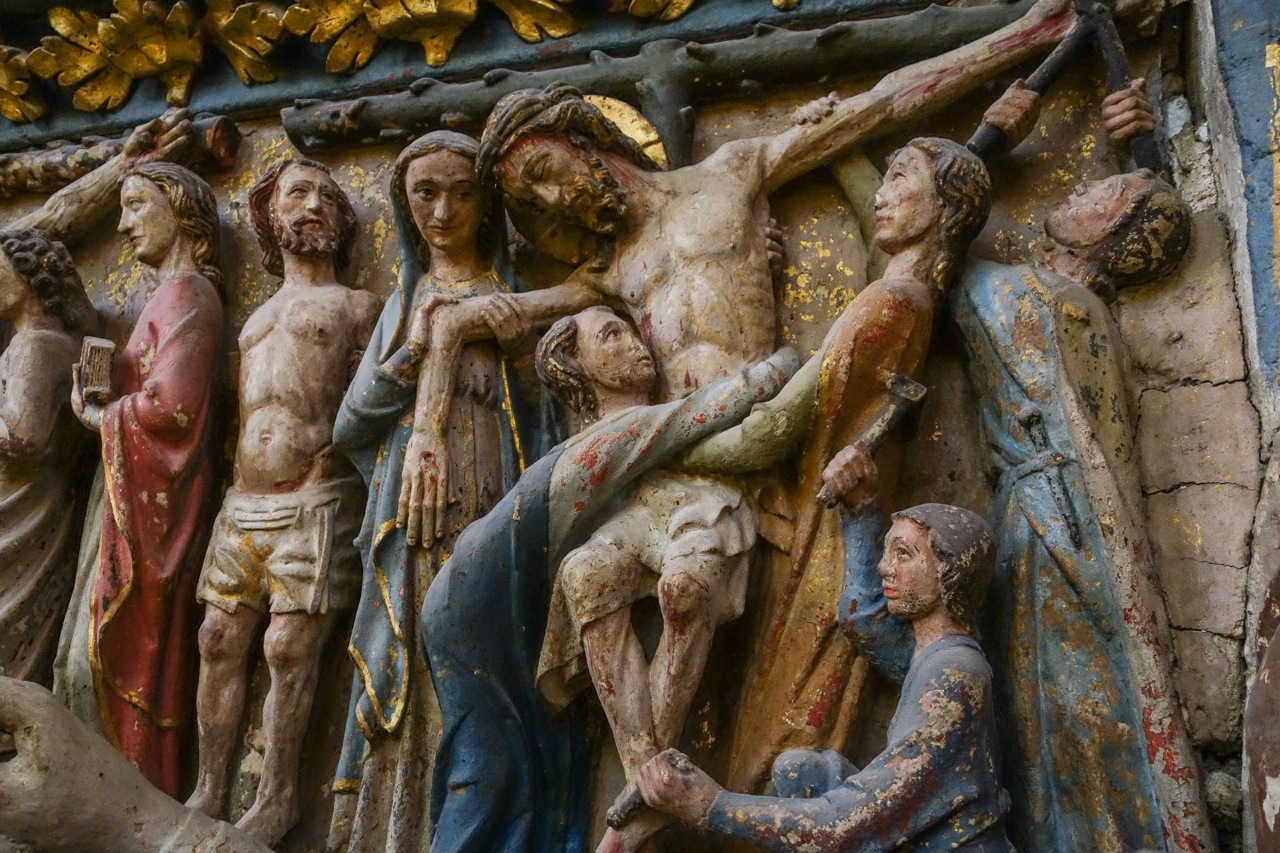
The Deposition (early Gothic; Leon cathedral on the Camino de Santiago)

The Deposition (early Gothic; Leon cathedral on the Camino de Santiago)

My God, my God, why have you forsaken me?

This cry from the cross is the most terrible verse in the Bible. God’s own Beloved, whose intimacy with God was so foundational to his existence that he could say “I and the Father are one,” here experiences the inexplicable loss of the Presence in which he has lived and moved and had his being. And God’s reply to Jesus is even more chilling: Silence.

Uncomfortable with this image of a Christ seemingly abandoned to the void of a godless universe, some have said that Jesus is merely quoting the first verse of Psalm 22, as though his piety outweighs his pain even on the cross. But Jesus was not just quoting Psalm 22; he had become Psalm 22. The Christ who was truly human had to taste even the most painful extremities of the human condition in order to redeem us fully. The one revealed to be God-with-us had to become, in that most bitter hour, us-without-God.

Have we not been there ourselves? Whether in the personal hour of trial when our own cries go unanswered, or in modernity’s cultural house of mirrors where the interventions of a loving God seems not only unnecessary but unthinkable, there are times when the Presence feels beyond our reach.

But as Paul says, Jesus became sin itself in order to save us from it (II Cor. 5:21). Sin is wherever God is shut out and we are walled in. And in making even the hellish absence of God as integral a part of his own experience as the intimacy of divine communion, Jesus performed the ultimate paradox: even when God seems most absent, God is yet present.

Good Friday means that whatever happens to us happens to God. From now on there is no place where God is not, for God has taken into Godself even the experience of separation and forsakenness. The Presence now includes the absence.

And we who have turned from God, or lost God, we who have cried out into the SILENCE, can yet live in hope. The One who died abandoned and bereft now keeps us company on our own crosses. As the Psalmist affirms with his possessive pronoun (“My God, my God!”). the relationship remains firm and unbroken even when God seems most mute and distant. We are not alone.