The Terrible Parable: Making Sense of the Dishonest Steward

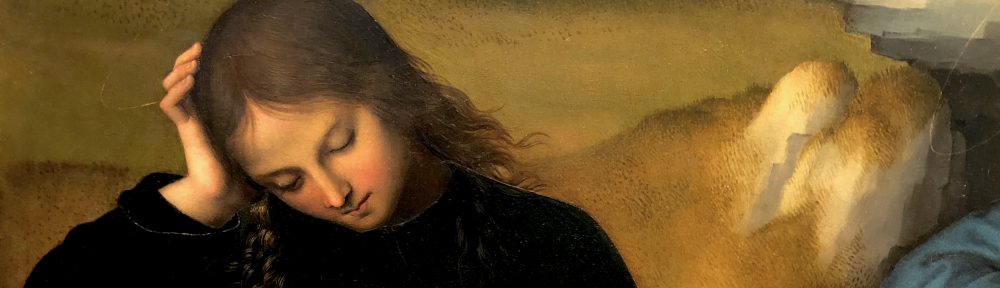
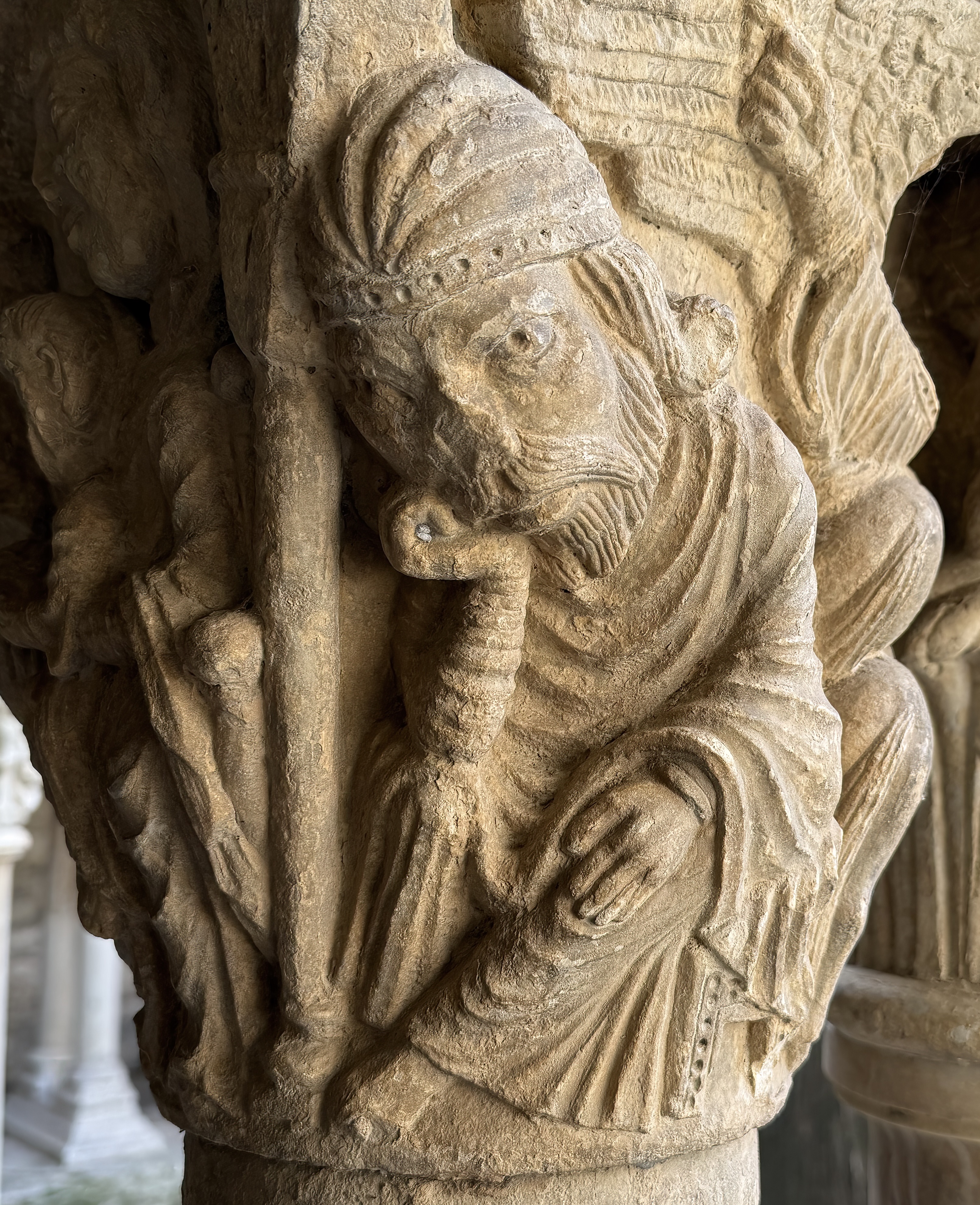
A perplexed man in the cloister of Saint Trophime, Arles, France (12th century)

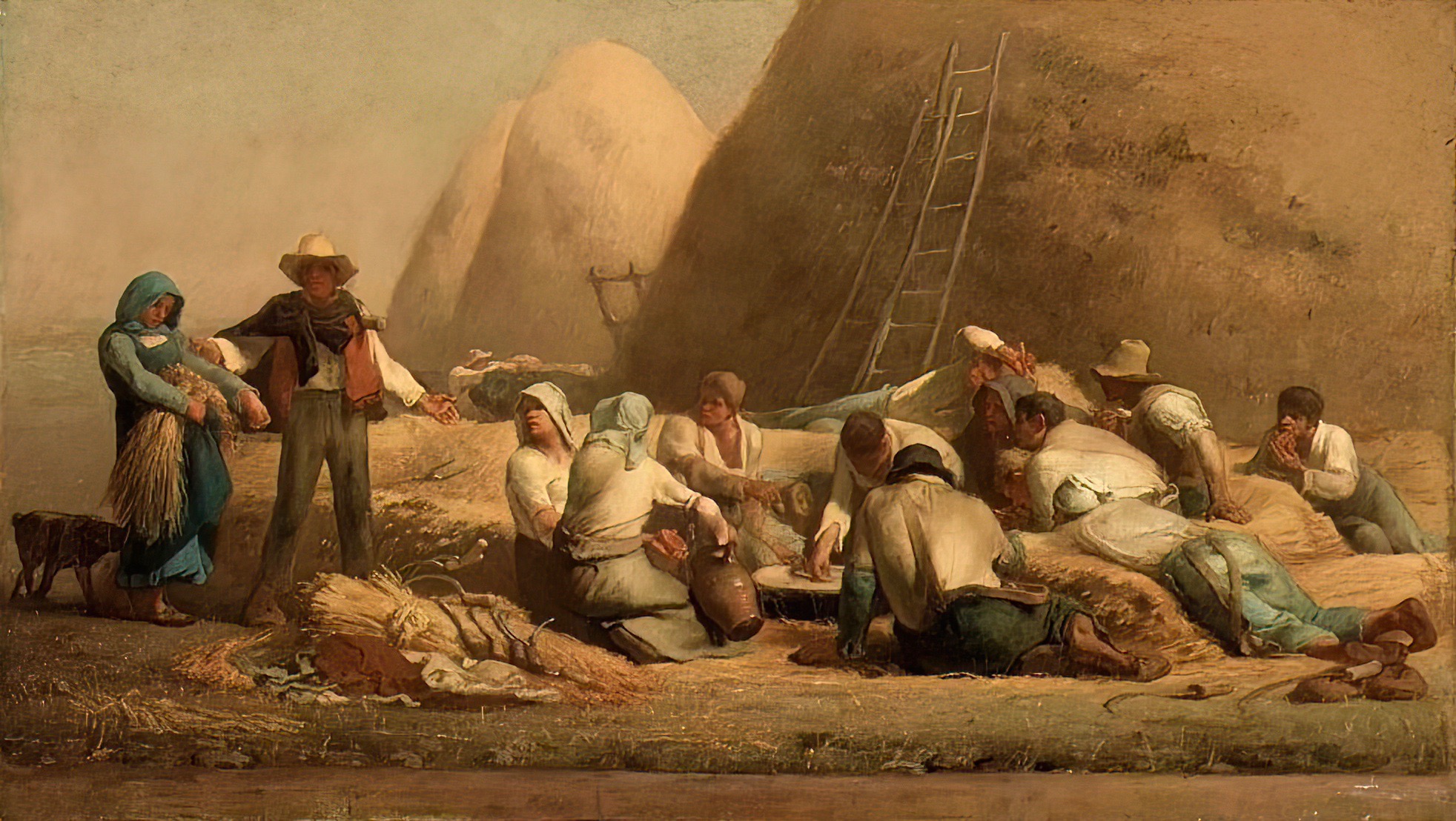
In the liturgical churches, we don’t get to choose the Scripture for our homilies. We have to take what the Lectionary gives us. I’ve been preaching for a long time, but I’ve always been lucky enough to miss the Sundays when the Parable of the Unjust Steward turns up. Until now. Some scholars have labeled it the hardest parable. I prefer to call it the “terrible parable.” But I made a stab at it, and pass on the results here.

A parable functions a little like a Zen koan. What is the sound of one hand clapping? What is your original face before you were born? Such imaginative constructions of language are meant to disrupt habitual ways of thinking and open us to new perspectives. Just so, when a prodigal son is welcomed home with open arms, or the laborers who work the fewest hours are paid the same wages as the ones who work all day, we are forced, or at least invited, to question our presuppositions and prejudices about how life works, or how God desires life to work.

That said, let’s consider the Parable of the Unjust Steward (Luke 16:1- 8). It’s not an easy one to interpret. Nor is it easy to like. There have been many efforts to explain what this story about a dishonest steward tricking his boss is even doing in Luke’s gospel, set down in the midst of far more memorable teachings and far more beloved parables. But most of those explanations fail in one way or another, either making assumptions not justified by the text or reducing its meanings to something of little value to preacher or disciple.

So what shall we make of the “terrible parable” this time around?

Let’s review what happens. A rich man, presumably an absentee landowner, discovers his property manager has been “squandering” his property, whether by mismanagement or financial monkey business we aren’t told. But he’s put on notice that he’s about to be fired.

Now the steward considers himself either too old or too scrawny for manual labor, and he’s too proud to beg, so he’s desperate for a way to avoid utter destitution. What does he do? He summons all his master’s debtors and offers to write down their debts to an affordable level. By so doing, he earns the good will of those debtors.

Maybe someday, when he’s out of work and looking for help, they’ll return the favor. And, by collecting at least some return from all those past due accounts for his master, maybe he can get back in the master’s good graces. In the end, we are told, the rich man “commended the dishonest manager because he had acted shrewdly.” The odds of the steward keeping his job are looking up, but the story stops before we find out about that.

At first glance, it’s hard to find anyone to identify with in this parable. In the Bible, rich men are rarely liked, since economic inequality in biblical times was even worse than it is today. When a story begins, “There was a rich man,” you might imagine the immediate boos and hisses from Jesus’ audience, which hopes it’s going to be a story about his comeuppance. But as soon as the steward is introduced, his own character is dragged through the mud, and the rich man gains a bit of sympathy for having been cheated.

The steward stands accused of squandering his master’s property—whether through incompetence or dishonesty is not quite clear, but his actions later, cooking the books to write down the debts owed to his master, tag him as “unjust” or “dishonest”—terms which can connote either shaky bookkeeping or outright fraud. In any case, he plays fast and loose with the numbers. And, to our surprise, he is praised for doing so. This commendation may reflect the master’s relief in recovering at least some of his bad loans. It also may indicate his delight in discovering how clever his steward is. If such a man can get things done, who cares if his methods are not always on the up and up?

Some commentators have discerned a Christ figure in the rule-breaking steward. Hoping for a different kind of future, Jesus subverts the rules of the old world, where the rich get everything and the system punishes the poor, so that the rich man gets less and the debtors finally get a break. The unjust system may consider his actions to be improper, but in God’s eyes he’s an agent of economic justice, constructing a fairer and kinder form of human community.

At the same time, the steward’s actions transform relationships. The debtors, for whom the steward might have seemed an enforcer of unpayable obligations, turns out to be a forgiver of debts. And the rich man, tricked into generosity by his steward’s unorthodox moves, is given the opportunity to forego domination and greed in his own relationships with others.  

That’s the story. But then the storyteller, who is Jesus, tacks a puzzling moral onto the end of his tale. He says the steward’s ingenuity, and the praise he receives for it, demonstrates that “the children of this age are more shrewd in dealing with their own generation than are the children of light.”  

What could this mean? Of course, to reduce a parable to a single meaning implies that you can throw out the story and just keep the meaning. That’s like Woody Allen’s joke about reading War and Peace in an hour after taking a speed-reading course. When someone asked him what the novel was about, he said, “It’s about Russia.”

His joke mocks the idea that the experience of full immersion in Tolstoy’s thousand-page epic can be replaced by a brief summary. It’s the same with Jesus’ parables. Don’t reduce them to a single meaning. Experience them, begin to wonder about them, and then—just keep on wondering.

So instead of offering the best interpretation of today’s parable—there is no best interpretation, just a story which continues to puzzle us—I will simply try out some observations with no presumption of giving you the definitive last word about it.  

The “children of light” is a New Testament term for the early Christians, the followers of the Way of Jesus, who belong not to “this age” but to the age to come, the future which God is in the process of bringing about. The steward’s ability to game the system of this age, operating successfully within its parameters with improvisation, cleverness and flexibility, should make the followers of Jesus ask themselves,

“Am I operating within the parameters of the age to come—the kingdom of God—with the same creativity and resourcefulness as the steward displays within the parameters of his story? Are my actions and choices in line with the world that is dying, or with the world that is being born?”

In living out the Christian life, which is rooted not in this age but in the age to come, we should embody the Kingdom’s precepts and pursue its goals with the same single-mindedness, the same commitment, the same shrewdness that the steward in the parable employs to navigate the crisis described in his story. His world is about to come crashing down, he’s about to lose everything, but he survives through the actions he takes and the relationships he cultivates. He doesn’t cling to the old world and its old rules to suffer its predetermined outcomes. He discovers a way to be part of what is about to happen next. He discovers a way to have a future.

Now if we are indeed the children of light, claiming allegiance to the divine future which is being born amidst the ruins of our fallen world, do we possess a comparable level of creativity and resourcefulness to survive the collapse of the old and join ourselves wholeheartedly to the emergence of the new? Can we be as good as that steward was in slipping through the present time of crisis into a future of divine intent and human flourishing?

That’s the question I hear the parable asking us today. That’s the question I leave you with today. Let me say it one more time:

If we are indeed the children of light,
claiming allegiance to the divine future
which is being born amidst the ruins of our fallen world,
do we possess a comparable level of creativity and resourcefulness
to survive the collapse of the old
and join ourselves wholeheartedly to the emergence of the new?

Can we be as good as that steward was
in slipping through the present time of crisis
into a future of divine intent and human flourishing?


What Jesus Said About Vultures

Turkey vulture.

In all my years as a priest, I had never preached on the apocalyptic imagery of Luke 17:26-37, where people disappear without warning and Jesus concludes with an unnerving proverb: “Where the corpse is, there the vultures will gather.” This is not ideal preaching material, but with the help of the Epistle reading, Hebrews 11:29—12:2, I gave it a try last Sunday.

Today’s gospel [i] has quite a punchline: “Where the corpse is, there the vultures will gather.” It’s got to be pretty low on the list of favorite Jesus quotes, but it certainly gets our attention.

A couple of weeks ago I was at a raptor show at the High Desert Museum in eastern Oregon. A variety of hawks, owls and vultures flew swiftly among the seated spectators, who were warned to stay very still lest we be mistaken for prey. I did my best not to be a target, but a turkey vulture came close enough to brush my head with its wing. Perhaps it was preparing me for this strange gospel verse.

Some scholars say Jesus was simply using a common folk expression in response to a question about discerning the times, meaning something like “where there’s smoke, there’s fire.” Such expressions have nothing to do with smoke or fire or vultures or corpses. They’re just colorful ways of making a point. Still, Jesus’ choice of such a grim illustration puts a sharp edge on his message. It certainly gets our attention. And where the enigmatic text is, there the scholars will gather.

Who is the corpse? they wonder. Who are the vultures? One interpretation suggests the corpse could represent ancient Palestine, with the rapacious vultures being the occupying army of Rome. The Book of Revelation, perhaps inspired by the vultures in the gospel text, imagined the raptors of midheaven being summoned to feast on the remains of the proud powers struck down by divine judgment. An even more fantastical interpretation identifies the sharp-eyed buzzards, who in fact can spot carrion from 3 miles away, as those perceptive disciples who gather to consume the Corpus Christi, the Body of Christ given to feed our deepest hunger.

Well, none of these images is going to qualify for a stained glass window. And the vulture verse is perhaps profitless for the preacher.

And yet, it leaves a haunting impression. It’s unlike anything else Jesus ever said, and its gruesome tone puts an exclamation point on his discourse of crisis. A world is dying, he says. Just as a world died in the days of Noah, or in the days of Lot—names which recall destructive narratives of flood and fire—so it is happening now. The times are in no way normal, Jesus warns his listeners. Anyone who pretends that is not true, who thinks we can just go on about our business as usual—eating and drinking, buying and selling, planting and building—well, they are in for a surprise.

Come gather ’round people
Wherever you roam
And admit that the waters
Around you have grown
And accept it that soon
You’ll be drenched to the bone
If your time to you is worth savin’
You better start swimmin’
Or you’ll sink like a stone
For the times they are a-changin’ [ii]

When we sang that song 60 years ago, we thought the times were changing for the better. And that was true in many ways. But the flood of changes washing over us today do not feel like something better. When Jesus speaks of people being snatched up and disappeared without warning, he could be describing what’s happening right now in “the land of the free.” To paraphrase Jesus’ metaphor, “As it was in the days of Dietrich Bonhoeffer—in 1930s Germany—so shall it be in our own time.”

I pray that this will not be our fate, but the fact that such an outcome is even conceivable is a measure of the times. It can happen here. So what are the friends of God to do? How do we start swimming so we don’t sink like a stone?

We are not the first believers to suffer the worst of times. The Epistle to the Hebrews is clear about that. History isn’t always about the lilies of the field. It has its corpses and vultures as well.

But as the author of Hebrews insists, the faithful believe in the victory of God, and they act out that faith with their bodies. Some of God’s friends have “received the test of mocking and whipping and even chains and prison. They were stoned, cut apart in a slaughter; they died upon a sword. They traveled around in ragged clothing, impoverished, oppressed, afflicted.” But for all they suffered, those who kept the faith “subdued monarchies, did the work of justice … shut the mouths of lions, quenched mighty fires …” (Hebrews 11:29-12:2)

As people baptized into the Paschal Mystery, we understand that dying and rising, defeat and victory, are deeply intertwined. You can’t have one without the other.

When certain medieval women mystics contemplated the cross in prayer and vision, they saw not the triumph of death, but a kind of birth. For them the crucified Jesus was like a woman in labor, enduring pain and travail in order to bring us all to birth: 

Ah! Sweet Lord Jesus Christ, who ever saw a mother suffer such a birth! For when the hour of your delivery came you were placed on the hard bed of the cross and … in one day you gave birth to the whole world.” [iii]

To behold the death of Christ and call it birth is the central act of Christian imagination. It is why we declare victory at the cross. We don’t wait for Easter Sunday. We declare victory at the cross because the Passion isn’t just a story about the violent powers that always trample the weak and kill the prophets. It’s also a story about the Realm of God, where dry bones breathe and lost hopes dance, where the prodigal is welcomed home and the tears are wiped from every eye.

The Love that creates such a realm was nailed to a cross, but the cross did not consume it. Yes, death did what death does, but then God did what God does. And Love won. This is the story we belong to, and on the outcome of that story, we stake everything.

That is why we are here this morning. That is why we refuse to retreat to our private worlds, why we continue to gather in community at our Savior’s table: to nurture hope, shelter love’s flame, encourage one another, strengthen our hearts for service, eat the bread of life, pray without ceasing, sing our Alleluias and grow ever more fully into the visible, tangible body of Christ.

We are not alone in this journey. We are surrounded by a cloud of witnesses, all those ancestors in the faith, from Abraham and Sarah and Mary and Luke right on down to the wise and loving mentors we’ve known in our own lives, who have taught us how to walk in the Way of life and peace.

I once heard a preacher describe the cloud of witnesses as “the balcony people” who are looking down and cheering us on as we run the race that is set before us. It’s a wonderful and resonant image. I’m sure that each of you has some very special people in that balcony, shouting their encouragement. Listen. You can hear their voices echoing through the years.

St. Luke, pray for us … St. Mary, pray for us … St. Francis, pray for us … Oscar Romero, pray for us … Dorothy Day, pray for us … Mom and Dad, pray for us.  

Last Sunday I was in Eugene for the National Track & Field Championships, and in the men’s 800 meters I witnessed one of the most stunning moments in the history of middle-distance racing. A 16-year-old high school sophomore named Cooper Lutkenhaus had qualified for the elite competition by breaking the 29-year-old high school record, running the distance in 1:45. And after stumbling and almost falling in his first race at the championships, he managed to survive the first two rounds.

Much to his surprise, he had made the final. But with some of the world’s top 800 meter runners in the race, no one expected him to be anywhere close to the top three who would earn a trip to the World Championships in September.

Rounding the last turn, Cooper was doing really well for a 16-year-old, in  sixth place out of nine racers, 10 meters behind the leader. Then, in the last 100 meters, he passed one runner, and another, and another, and another, to cross the line in second place. His time was 1:42.27, not only a personal best by an unbelievable 3 seconds, but the 18th-best all-time and the fourth-best ever by an American.

Donavan Brazier, Cooper Lutkenhaus, and Bryce Hoppel finish 1-2-3 in the 2025 U.S. Track & Field Championships in Eugene, Oregon.

Now I’ve been at a noisy NBA final with Kareem and Magic and Larry Bird. I’ve been deafened by the 12th man [iv] at a Seahawks game. But the sound of the crowd cheering on young Cooper Lutkenhaus blew my ears off. The cloud of witnesses.

When we run the race that is set before us, there will be times when our lungs burn and our legs scream with lactic acid. There will be the races that disappoint, and workouts that feel listless or discouraging. We may even stumble and fall, more than once.

But always, always, the cloud of witnesses is cheering us on. They know from their own experience what the race is like. They all had their own moments of weakness and doubt. They became acquainted with suffering by training hard every day. They all had to learn how to get up after every fall, lay aside every weight, gulp the breath of the Spirit, and accept pain as the runner’s companion.

I’ve done my own share of racing, and when the pain comes, I try to greet it as a friend. “Hello, brother pain. I knew you’d show up. Well, here we go. I know you’re not going to kill me, right?. We’ll just take it step by step.”

“Even the fittest may stumble and fall (Isaiah 40:31). As Roisin Willis and Maggi Congdon finish 1-2 in the women’s 800 meters at the U.S. Championships, Sage Hurta-Klecker dives for the third and final spot on the World Championship team. In previous years, she had missed out on a championship podium twice due to falls, but this time her fall was a triumph. She made the team.

The perpetual contest between weariness and perseverance is familiar to every athlete—and every saint. You’re going to get tired. You’re going to get discouraged. You may faint and fall. But keep your eyes on the prize, hold on. On both good days and bad, you’ve got to put in the work, “lay aside every weight,” surrender to a power and a strength that is not your own, and stay in the flow.

I began with a raptor image, so let me close with another. This time it’s not a vulture, but an eagle, in a beautiful passage from the prophet Isaiah:

Even the youthful may faint and grow weary, 
even the fittest may stumble and fall,
but those who wait for the Lord shall renew their strength, 
they shall mount up with wings like eagles, 
they shall run and not be weary,
they shall walk and never grow tired. [v]

Francesco Scaramuzza, Dante and the Eagle (c. 1860). The sleeping Dante dreamed he was carried by an eagle, but it was really St. Lucy who helped the poet on his upward journey toward heaven’s light (Purgatorio ix).


This homily was preached at St. Luke’s Episcopal Church, Renton, WA, on the 9th Sunday after Pentecost, 2025.

Race photo and video by the author.

[i] The texts for the 8th Sunday after Pentecost are in Wilda C. Gafney, A Women’s Lectionary for the Whole Church, Year C, which differs significantly for the Revised Common Lectionary used by most liturgical churches.

[ii] Bob Dylan, “The Times They Are A-Changin’” (1964).

[iii] Marguerite d’Oingt (d. 1310).

[iv] The loudest crowd in professional football is in Seattle, where the fans are called “the 12th man” for their ability to influence the game by making it hard for the other team to hear their quarterback’s signals.

[v] Isaiah 40:30-31.

No Kings? — A Biblical Parable for Independence Day

In 1776, the fourth of July became “No Kings Day.” In my lifetime, that central meaning has been largely ceremonial and festive, but in the annus horribilis of 2025 it has become profoundly existential. The crisis which provoked the Declaration of Independence is back with a vengeance. But the abuses of King George can’t hold a candle to the malignant and murderous cruelty of our current tyrants.

In the Episcopal lectionary for daily prayer, we are currently following the saga of early Israel from the First Book of Samuel, where the whole idea of kingship is up for debate. As my country rushes headlong toward the extinction of the common good, these biblical texts have felt quite timely. I am particularly struck by the eighth chapter of I Samuel as a parable of our own collective folly. [i]

In the biblical narrative, Israel’s early days in the “Promised Land” were marked by political instability. Leadership was provided by a series of charismatic figures who governed with varying degrees of cunning and force. In the ideal, the leader would be touched by the spirit of the Lord, giving the “judge” an aura of power and purpose the people could not fail to recognize. In practice, such a system of leadership was often sustained through bloodshed. As Robert Alter points out, “survival through violence, without a coherent and stable political framework, cannot be sustained, and runs the danger of turning into sheer destruction.” [ii] Indeed, the disheartening Book of Judges ends in civil war and anarchy:

In those days there was no king in Israel.
Every man did what was right in his own eyes (Judges 21:25).

When I Samuel, the next book after Judges in the Hebrew Bible, takes up the narrative, the prophet Samuel is born and raised as a divinely chosen instrument for the guidance of God’s people. As it turns out, he is far from perfect, prone to anger, rigidity and ambition. But his dream of creating a prophetic dynasty out of his descendants is thwarted by the blatant corruption of his sons, who “took bribes and twisted justice” (I Samuel 8:3).

So when Samuel’s old age raises questions about succession, the elders of Israel demand a new kind of governance. “Give us a king to rule over us, just like all the other nations.” But Samuel resists their plea. No doubt he dislikes the idea of surrendering his own authority, or admitting his dream of a prophetic dynasty is doomed. But he is also clinging to the venerable idea that ancient Israel is not like any other nation. Its only king, its only absolute ruler, is God, who rules through the direct inspiration of human agents.

Then Samuel prays, laying his dilemma before the Holy One, whose answer is surprising. “Listen to the voice of the people,” God says. “And don’t take it personally. It’s my governance they are rejecting, not yours. They’ve been rejecting and ignoring me from the very first day I delivered them from Egypt.” But even while expressing disappointment over human waywardness, God seems to accept the historical situation. Forgetting the Holy One, their Creator and Savior, is what humans do. “So give them what they ask for,” God tells Samuel. “But be sure to make it clear what they’ll be getting. Remind them what kings do: abuse power, rule with violence, steal your wealth, and turn you into slaves.”

When Samuel delivers God’s warning, he adds a dismal prophecy of the endgame: “The day will come when you will cry out before your king whom you chose for yourselves; and on that day the Lord will not answer you.”

But the people refuse to heed Samuel’s voice. “WE DON’T CARE!” they cry. “We want a king to rule us!”

When Samuel returns to his prayers to report the people’s response, God replies, perhaps with a sigh of resignation, “Heed their voice and make them a king.” And so it goes.

That’s how the conversation concludes. But I can’t help imagining God adding one more thing to the biblical text as it speaks to us across the centuries:

“Let them see for themselves what kings are like. FAFO.”


[i] I use the word “parable” here not to deny the foundation of the text in historical events, but to highlight a significance for us that does not depend on our knowing exactly how things happened in the murky past. The text of Samuel is a creative fusion of diverse sources. As Robert Alter notes in his translation of the Hebrew Bible, “What matters is that the anonymous Hebrew writer, drawing on what he knew or thought he knew of the portentous historical events, has created this most searching story of men and women in the rapid and dangerous current of history that still speaks to us, floundering in history and the dilemmas of political life, three thousand years later.” Robert Alter, The Hebrew Bible: A Translation with Commentary—Volume Two: Prophets (New York: W. W. Norton & Company, 2019), 176.

[ii] Alter, 80.

“For God so loved our stories” — Tales from the Easter Vigil

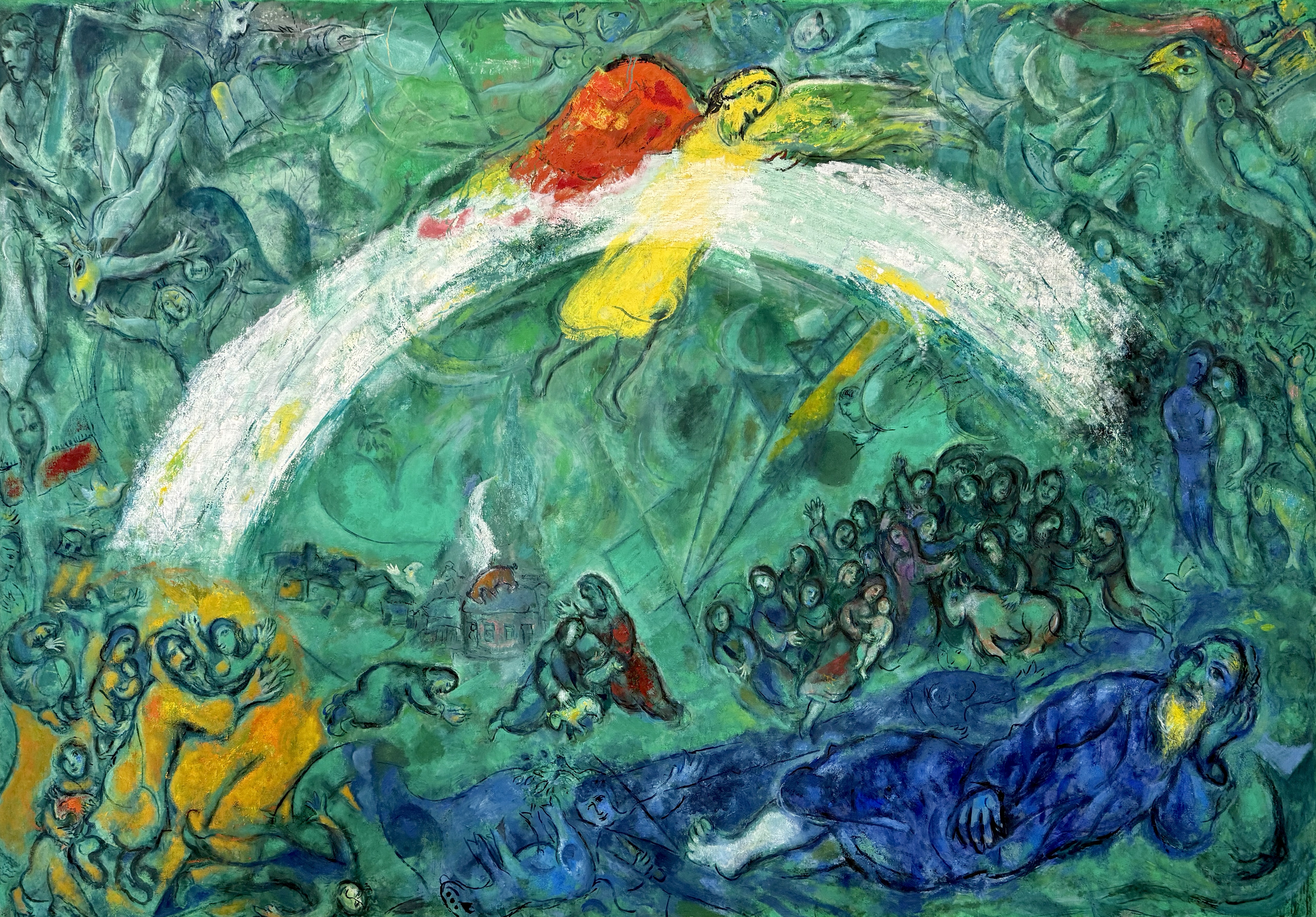
Marc Chagall, Noah and the Rainbow (1961-66)

How blessed is this night, when earth and heaven are joined …

— The Exultet [i]

The Easter Vigil is the molten core of Christian worship: a multisensory passage from darkness to light, death to life. With fire and water, stories and prayers, hymns and chants, candles and incense, bread and wine, it is the most luminous and wondrous of liturgies. The morning rites of Easter Sunday celebrate Resurrection, but the Easter Vigil on the night before feels almost like Resurrection itself. When it’s over, you come away a little dazed, wondering “oh what is that beautiful thing that just happened?” [ii]

After the New Fire is lit at sunset on Holy Saturday, one of the first things that happens at the Easter Vigil is the recitation of narratives and prophetic texts [iii] from the Hebrew Scriptures, beginning with the Creation story (Genesis 1:1—2:4a). In most churches, the texts are read from a lectern, but for nearly four decades, in a dozen different West Coast churches, I have curated the performance of the Vigil lectionary using drama, storytellers, music and projected media.

There’s nothing wrong with a well-read passage of canonical text—I’m quite fond of a good reading by a practiced and thoughtful voice—but sometimes a telling or dramatization can reach places which a reading cannot. Instead of a reader as a passive, transparent window for a sacred text to pass through without inflection or distortion, a teller embodies the text in breath, intonation, gesture and movement, making it alive and present and urgent in the moment of its speaking. And a dramatization can make a familiar story be freshly encountered. A story told or performed rather than read has a unique kind of authority, coming from the heart instead of a book.

The Easter Vigil is the Christian dreamtime, and we try to engage its lectionary accordingly. Biblical stories aren’t just memories about the past. They are living words meant to guide and shape our own responses to the present. As we become steeped in the stories, they begin to dwell in us, and we in them.

When we hear of the world drowning in its own evil, while a faithful remnant tries to navigate the sea of chaos, we recognize ourselves aboard the ark. When we hear of an evil regime trying to crush the ones who are “not like us,” the deliverance of the oppressed at the Red Sea encourages our own struggle to break free of the dark. When we hear of dry bones resurrected by divine breath, our own dead hopes begin to breathe again.  

In the darkest days of the Second World War, W. H. Auden wrote a “Christmas Oratorio” [iv] which had no illusions about the world into which God was made flesh:

The evil and the armed draw near;
The weather smells of their hate
And the houses smell of our fear …

Such days are upon us again, and we truly need our sacred stories—the ones that remember divine intention and a habitable future—more than ever. At our Episcopal parish of St. Barnabas on Bainbridge Island, Washington, where my wife is the rector, I’ve been developing fresh versions of the stories, listening carefully for whatever they want to say to us in the year of our Lord 2025.

We will begin with a pair of texts projected on a screen after the ancient Exultet is chanted. The first says, For God so loved our stories. This is of course a blend of Elie Wiesel’s “God made man because he loves stories” and John 3:16’s “For God so loved the world …” The theology of Incarnation says that God’s own self entered fully into the human story. And the theology of salvation says that we in turn are meant to participate in the divine story. Both meanings are implied in the preface to our Vigil story time, grounding the performed narratives in the conviction that we can meet God in them.

The second text is a verse from Jeremiah (29:11): For surely I know the purpose I have for you, says the Holy One: plans for peace and not for evil, to give you a future and a hope. At a time when our future is in question and hope is stretched thin, God invites us to sit around the Paschal fire and let the stories of promise speak to our hearts once more.

Here is how the telling will go at this year’s Paschal fire:

The Creation: After the voice of e.e. cummings says, “When God decided to invent everything, he took one breath bigger than a circus tent, and everything began,” a big screen lights up with spectacular footage of the natural world, taking us through the first seven days in seven minutes. In response, the congregation is urged “to pray fervently for all the people of the earth, and for ourselves, that we may repent of our careless and arrogant abuse of creation, and find our proper and constructive place within its fragile and balanced harmonies.”

The Flood: Four people at a table engage in Bible study. Some of them resist the story (“Why do we even tell this story? No one wants to believe in an angry God” … “In the beginning, God says everything’s so great. Then suddenly he wants to call the whole thing off?”). Others see a kind of learning going on—God learning to live with an imperfect creation. Then somebody argues that the story is not really about God’s choices or God’s emotional life. It’s about the ark.

“The people who first told this story were just like us. They were adrift in a sea of chaos. Everything they had hoped and believed was underwater, washed away in the blink of an eye, and they wanted to know if they still had a future.”

As the discussion winds down, someone says, “Well, I’d better go feed the animals.” Wild waves appear on the screen behind them. It turns out that they have been on their own ark the whole time. The story they were discussing was happening to them. That’s often true of Bible stories.

The exhortations to prayer that follow each story reiterate the themes of the narrative. After The Flood, the Presider reminds the assembly that “God remains deeply committed to our story … God will not forget us, though we be sinking in a sea of chaos.” And the Deacon bids us pray for victims of natural disasters, all whose lives are beset by chaos, those drowning in the dark waters of doubt and fear, and those who cling to the precious ark of faith.

The Red Sea:

Noirish images of anonymous figures (from a bleak Hungarian film) shuffle through an imprisoning corridor on the screen, while three dancers on the stage express the experience of oppression with their bodies. A narrator explains:

Three thousand years ago, in the land of Egypt,
there were people who had no name.
They were the faceless many,
exploited by the powerful,
forgotten by the privileged: slaves, immigrants, the poor,
the homeless, the vulnerable, the invisible, the outcast.

Then dismissive terms for the oppressed appear on the screen in stark animated graphics: Not like us … worthless … horrible people … trash … less than human. More images of “the faceless many” are shown as the dancers writhe in despair and an offstage choir sings a verse of “Go down, Moses.”

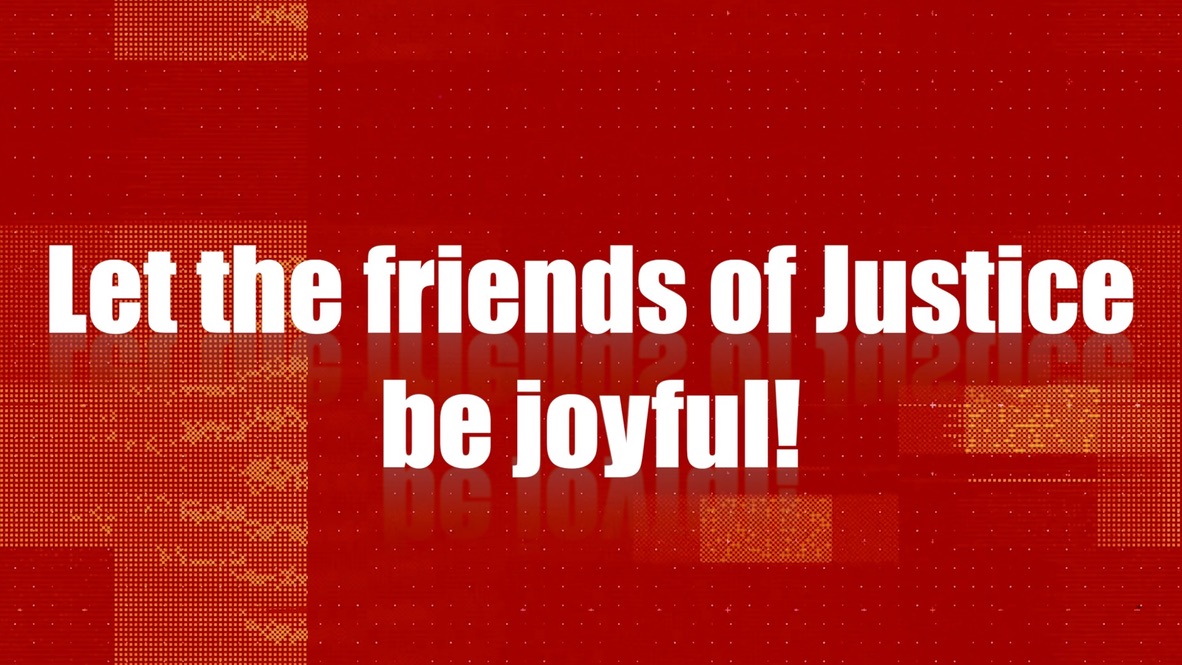
Suddenly, the divine breaks into this dark world: the screen flashes red, and we see the words from Psalm 68 that are always used in Orthodox Paschal liturgies:

Let God arise!
Let the foes of Love be scattered!
Let the friends of justice be joyful!

Then we hear a verse of a Civil Rights song: “They say that freedom is a constant struggle … Oh Lord, we’ve struggled so long, we must be free.” The dancers’ bodies shift from oppression to liberation, while the screen shows powerful footage of crowds on the march for justice. As we hear a repeating loop of Martin Luther King saying “We cannot walk alone,” the dancers begin their own march across the stage to the “Red Sea,” where they halt while the narrator declares:

This too is a creation story:
On this day, God brought a new people into existence.
On this day, God became known as the One who delivers the oppressed,
the One who remembers the forgotten and saves the lost ,
the One who opens the Way through the Sea of Impossibility,
leading us beyond the chaos and the darkness into the Light.
When the world says No, the power of God is YES!

As the dancers begin to cross the Sea, the choir sings, “We are not alone, God is with us …”
After the song, the bidding to prayer begins:

Pray now for the conscience and courage
to renounce our own complicity
in the workings of violence, privilege and oppression.
Pray in solidarity with all who are despised, rejected,
exploited, abused, and oppressed.
Pray for the day of liberation and salvation.

The Fiery Furnace: This story from the Book of Daniel is borrowed from the Orthodox lectionary for the Paschal Vigil, and its humor (yes, the Bible can be funny) provides some comic relief after the Red Sea. The story’s mischievous mockery of a vain and cruel king, outwitted in the end by divine intention, feels quite timely. The idol shown on the screen is a golden iPhone, which will be destroyed by a cartoon explosion from Looney Tunes. The humorously tedious repetition of the instruments signaling everyone to bow is performed with the following (admittedly unbiblical) instruments: bodhran, bicycle horn, slide whistle, chimes, train whistle, and Chinese wind gong. The Song of the three “young men” in the furnace is recited by three women in an abbreviated rap version. At the end, the cast of twelve exit happily, singing the old Shape Note chorus, “Babylon is fallen, to rise no more!”

The Fall of Babylon, Tapestry of the Apocalypse, Angers, France (1377-1382).

Then we give thanks “for the saints who refuse to bow down to the illusions and idolatries of this world” and pray for “the grace and courage to follow their example, resisting every evil, and entrusting our lives wholeheartedly to the Love who loves us.”

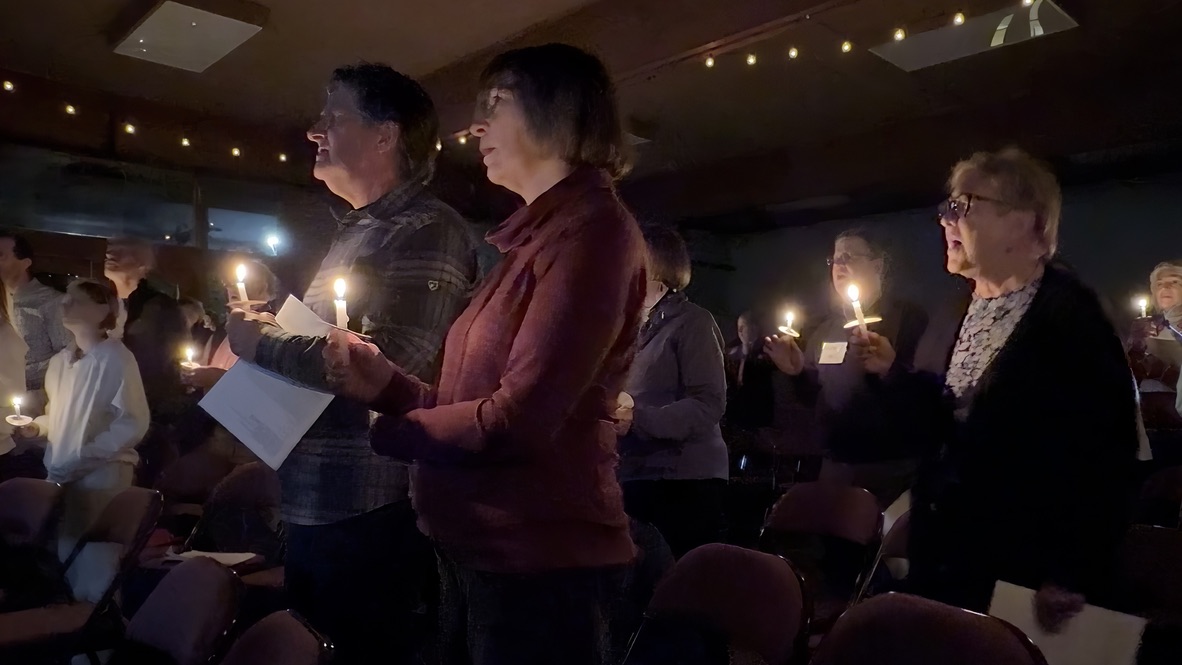
Valley of Dry Bones: Unlike the embellished retellings of the other stories, this one sticks closely to the biblical text, but is delivered in a storytelling mode by a single teller (me) in a spooky atmosphere of dim blue light. The voice of God is a college student on a high ladder. The sound of the bones joining together is made by an Indonesian unklung (8 bamboo rattles tuned to different pitches). When the story describes the breath coming into the lifeless figures sprawled across the valley, I get everyone in the assembly to inhale and exhale audibly a few times so that we can hear the spirit-breath entering our own bodies. Then I move among them, bidding one after another to rise until everyone is standing, completing the story with their own bodies: the risen assembly itself becomes a visible sign of hope reborn.
Then the Presider says,

Dear People of God: There are those who tell our story as a history of defeats and diminishments, a narrative of dashed hopes and inconsolable griefs. But tonight we tell a different story, a story that inhales God’s own breath and sings alleluia even at the grave. By your baptism, you have been entrusted with this story, to live out its great YES against every cry of defeat.
And then, with our sacred stories of faith and hope freshly written on our hearts, we will process from the Story Space to the church for the Renewal of Baptismal vows, followed by the festive first eucharist of Easter, replete with Alleluias. And God willing, by the time it’s all done, none of us will be the same.

May all of you who make the Paschal journey this weekend come to “see and know that things which were cast down are being raised up, and things which had grown old are being made new, and that all things are being brought to their perfection by the One through whom all things were made, our Savior Jesus Christ.” [v]

Resurrection of Christ, Brittany (c. 1425-1430).


All liturgical texts, unless otherwise cited, are by the author.
The Easter Vigil at St. Barnabas Episcopal Church (Bainbridge Island, WA) is on April 19, 2025.

[i] The Exultet (“rejoice”) is a chanted praise sung before the Paschal Candle at the Easter Vigil. Dating back to the 7th or 8th century, it is one of the most beautiful chants in the western rite, and its text is packed with striking images and metaphors of Christ’s passage through death to resurrection, and its implications for our own salvation. Singing it at the Vigil has been one of my greatest priestly joys over the years.

[ii] The line is taken from Mary Oliver’s poem, “At Blackwater Pond.”

[iii] The Vigil lectionary is not all stories. Beautiful texts from Isaiah, Baruch, Ezekiel, and Zephaniah are options as well. During the “Story Time” of the Vigil, we stick to the narratives. The non-narrative texts are then recited by readers along the way between the Story Space and the church, so that the people process through a corridor of continuous audible texts on their way to the font of rebirth.  

[iv] W. H. Auden began writing For the Time Being: A Christmas Oratorio in the autumn of 1941. It was published in September, 1944). Dark times indeed.

[v] Quoted from the collect (prayer) that concludes the Old Testament readings in the Episcopal Book of Common Prayer.

“A sweet fragrance filled the room” — A Homily on John 12:1-8

Jan van Scorel, Woman with the jar of nard (c. 1530).

In all four gospels, there’s a story about a woman who interrupts an intimate dinner party to kneel at the feet of Jesus and make an act of devotion. Luke’s story differs from the others in significant ways, so it may be based on a different incident. But Mark, Matthew and John all seem to be describing the same event. It was a moment which clearly had an indelible impact on the memory of the early Church.

John’s version is the only one which names the woman: Mary of Bethany, whose brother Jesus had just raised from the dead in the gospel’s previous chapter. Coming between the dramatic raising of Lazarus from the tomb and the violent clamor of the Passion, the story is a striking contrast to what came before and what comes after.

Instead of a public event with lots of people, it is quiet and intimate. No wailing mourners, no crowd shouting “Hosanna!” or “Crucify him!” Just Jesus, a few disciples, and his hosts, the siblings of Bethany:  Martha, Mary, and Lazarus.

We don’t know what they talked about during that dinner, but the moment had to have been highly charged, given the people around the table: The sisters whose grief had driven the harsh confrontation with Jesus at their brother’s tomb (If you had been here, my brother would not have died!) … the rabbi from Nazareth who had wept his own tears over the death of his friend (and perhaps some tears for the human condition in general) but who also found himself channeling the awesome life-giving power of the divine through his own mortal body …and the stunned man who had been so suddenly snatched from the land of the dead, experiencing what had to be a volatile mixture of awe, gratitude, and PTSD.

Perhaps no one said very much at all. Perhaps they were all still processing the shock of their shared experience at the tomb, letting a profound silence hold their feelings in order to preserve the mystery of it from being reduced to the poverty of language. But at some point, Mary was inspired to acknowledge the sacredness of the moment—not with words, but with a sacramental action.

The text doesn’t give the details, but I imagine her rising from the table, leaving the room for a moment, then returning with a jar of nard, a fragrant oil originating in the Himalayas and transported at great expense along the ancient trade route from Asia to the Middle East. It was worth a year’s wages, so when Mary, without saying a word of explanation, poured it all out over the feet of Jesus, it was quite shocking, like throwing a bag of gold into the sea or setting fire to a pile of paper money.

Then Mary compounded the shock by letting down her hair and using it to rub the oil into Jesus’ skin. No reputable woman would have done such a thing, nor would a religious teacher have permitted himself to be touched in such a way. Nevertheless, that’s how it went.

Judas was at that table, and he couldn’t bear to watch. He was the apostles’ money man, and he objected to wasting wealth that could have done some real good. John’s gospel doubts his sincerity, accusing Judas of embezzling the very funds he was claiming to protect.

I suspect that Judas’ discomfort had more to do with Jesus rewriting the social codes of his culture by endorsing Mary’s action. “Leave her alone,” Jesus tells him. Jesus, unlike Judas, understood that this was a very precious and significant moment, and he wanted to let it happen.

Mary’s extraordinary action, both sensual and symbolic, overflowed with meanings. For one thing, anointing with oil was a way to mark the special vocation and identity of authoritative figures, whether powerful rulers or holy persons. It consecrated them as chosen and set apart. The title of “Messiah” or “Christ” means “the anointed one.”

It was revolutionary to have a woman be the one to anoint Jesus as priest and ruler, but the kingdom of God was all about revolution: the revolution of transforming a disordered and broken world into a more perfect expression of divine intention and human possibility.

Anointing was also part of the culture’s preparation of a body for burial. Performed in the week before Jesus’ death, Mary’s gesture inaugurates the sequence of sacrificial acts culminating with her Lord’s burial in the stone-cold tomb. The feet she anoints will soon walk the Way of the Cross for the salvation of the world. That was Jesus’ chosen destiny, and the oil is an outward and visible sign of his inward consent to perform that destiny.

The story’s third meaning is in its foreshadowing of the foot-washing, when Jesus, on the night before he died, knelt at the feet of his friends to perform the work of a servant, surrendering his power for love’s sake. The foot-washing marked the turning point from a paradigm of domination to a paradigm of communion.

By kneeling at the feet of his friends, Jesus was showing them, and us, an image of humanity’s best version of itself. In that sacramental act, Jesus was saying: This is how we must be with one another, because this is exactly how God is with us.

And in today’s story, just a few days before Jesus would teach this explicit lesson at the Last Supper, Mary of Bethany, foreshadows the foot-washing when she offers, in her own way, all she has, holding nothing back.

And her devotional act of kneeling down to pour out the precious oil not only anticipated the foot washing on Maundy Thursday, it was an image of the divine nature as revealed in the incarnation and crucifixion of Jesus.  As one theologian has put it, “The self-giving extravagance of Mary’s actions point to the way Jesus would expend himself completely through his crucifixion.” [i]

In our Palm Sunday liturgy next Sunday, Paul’s Epistle to the Philippians will declare that Jesus emptied himself for us, poured himself out for us, and in so doing he revealed who God is and what God does. Whether in the costly pouring out of the Son’s life on the cross, or in the lavish pouring out of Spirit on Pentecost, God is the One who never ceases to pour out God’s own self.

And when, before his own self-offering, Jesus allowed Mary to anoint him in such a costly manner, she herself became an icon who shows us God with her own body, bowing before Jesus to wipe his feet so tenderly with her hair.

At the time, the disciples did not grasp the full significance of Mary’s act. Nor did Mary herself, I’d imagine. How could they?

As we say around here about Holy Week: The journey is how we know. The disciples had to learn by doing: following Jesus all the way to the cross—and beyond—before they could begin to understand—through memory and reflection—what it was all about. And that is what we will be doing as well during the seven days of Holy Week, not wanting to miss a single step along that sacred way. The journey is how we know.

Before we leave this story, consider the one sentence that stands out from the rest of the text:

The house was filled with the fragrance of the perfume.

There’s nothing else quite like it in the canonical gospels. The Bible in general is short on description and long on action. We never hear about the weather in Jerusalem or the colors of spring in the Galilean hills or the way light falls on the walls of the temple courtyard in late afternoon. So why does John invite us to pause and take in the sweet smell of nard?

In her fascinating book on the olfactory imagination in the ancient Mediterranean, Susan Ashbrook Harvey points out that aromatic spices were thought of as souvenirs of Paradise. When Adam and Eve were expelled from the Garden of Eden, it was said, they were allowed to take away a few fragrant plants to remind them of what they had lost.

Smells are a powerful trigger of memory, and the sweet odors of plants, spices and aromatic oils not only reminded people of Paradise Lost, they were thought to alert our senses to divine presence in a fallen world. They help us remember God. As Harvey writes, fragrance is something like God:

“Unseen yet perceived, smells traveled and permeated the consciousness, transgressing whatever boundaries might be set to restrict their course … Odors could transgress the chasm that separated the fallen order from God; they could elicit an unworldly sensation of beauty.” [ii]

And so we hear St. Paul speak of the fragrance that comes from being “in Christ,” so that we ourselves begin to give off the “aroma of Christ” from our own bodies (2 Corinthians 2:14-16). A few centuries later, Gregory of Nazianzus, in his treatise on the effects of our baptism, wrote:

“Let us be healed also in smell, that we … may smell the Ointment that was poured out for us, spiritually receiving it; and [that we may be] so formed and transformed by it, that from us too a sweet odor may be smelled.” [iii]

And St. Chrysostom, in his 5th-century sermon on today’s gospel, urged his congregation to become like thuribles, sweetening wherever they happen to be with the incense of heaven:

Now the one who perceives the fragrance knows that there is ointment lying somewhere; but of what nature it is he does not yet know, unless he happens to have seen it. So also we. [That God is, we know, but what in substance we know not yet.] We are then, as it were, a royal censer, breathing whithersoever we go of the heavenly ointment and spiritual sweet fragrance.” [iv]

In the spirit of such olfactory tropes, John’s verse about the sweet smell of the nard in that Bethany dining room endow that moment with divine peace and blessing. And the verse is especially vivid in contrast with the stench of mortality hovering around the tomb of Lazarus a few days earlier. Don’t roll away the stone, his sister pleaded. After 4 days inside, the body will smell terrible. Or as the King James Bible memorably put it, “by this time he stinketh.”

But in that sweet-smelling dining room with Jesus and his friends, death and decay are held at bay for a few precious hours. Outside, the world is wild and raging, on the verge of murdering the incarnation of Love. But inside, a woman is imaging the peace of heaven at the feet of her Lord.

For me, this beautiful moment calls to mind a scene from Ingmar Bergman’s classic 1957 film, The Seventh Seal, set in the fourteenth century when the Black Plague is ravaging Europe. A wandering knight is trying to get back home before the plague catches him, stalling for time by engaging Death in a game of chess. He’ll never win, of course, but at one point he meets a kind of holy family: a man, Jof; his wife Mia; and their baby, Michael. They are traveling players who embody the vitality of the life force.

Antonius Block, the knight (Max von Sydow), plays chess with death.

The film ends with the knight taking his inevitable place in the dance of Death, disappearing over the horizon with his fellow mortals. But the “holy family” are not seen among the dead souls, for they have been spared to carry on in this life, untroubled by death because they belong to grace. They know how to accept the music of what happens, and not live in fear.

The knight finds grace in a fallen world: “I shall remember this hour of peace.”

In the sweetest moment of this anguished film, Jof and Mia share their strawberries and milk with the knight, who receives it like a sacrament, a taste of unconquerable life:

“I shall remember this hour of peace,” he tells them. “The strawberries, the bowl of milk, your faces in the dusk, Michael asleep, Jof with his lute. I shall remember our words, and shall bear this memory between my hands as carefully as a bowl of fresh milk. And this will be a sign and a great content.”

An hour of peace, an experience of great content in a world that is coming apart—isn’t that a perfect description of the dinner at Bethany? And are we not in that same place now, with Mary, Jesus, and the rest? The powers of death and malice and mindless destruction are raging outside. We know that. Yet here we are, tasting the bread of heaven, inhaling the fragrance of divine presence.

It’s not about escaping. Not at all. It’s about renewal, so that when we go back out into the world, we can be clear about our vocation: to exude that fragrance—God’s sweetness—in every place we go. And when it gets hard out there—and it will—just call to mind the fragrance of those sacred moments when we dwell in God, and God in us.


This homily was preached at St. Barnabas Episcopal Church on Bainbridge Island in Washington State, on the Fifth Sunday in Lent.

[i] Craig R. Koester, Symbolism in the Fourth Gospel: Meaning, Mystery, Community (Minneapolis: Fortress Press, 1995), 114.

[ii] Susan Ashbrook Harvey, Scenting Salvation: Ancient Christianity and the Olfactory Imagination (Berkeley: University of California Press, 2006), 53.

[iii] Ibid., 75.

[iv] Ibid., 115.

“Let’s do it for the story”: A Farewell to Angela Lloyd

Storyteller Angela Lloyd

Once upon a time, a brilliant storyteller came into the world to touch countless hearts with tales of wisdom and wonder, losing and finding, tears and laughter. She scattered her life-giving stories far and wide, and encouraged others to do the same. She knew the power of stories to bind us together, ground us in communal wisdom, and help us imagine better futures. Hers was a serious vocation in a world so forgetful of the stories we need, the stories that nourish, the stories that save. But she always lived out her calling with levity and lightness. Everyone who has known her remembers her laughter, her joy, her delight in daily blessings, her generous and irrepressible spirit. As she liked to put it, she was “subject to bursts of enthusiasm.”

Desert dawn at Angela’s house (December 17, 2024): Looking west, looking east.

A week before Christmas, master storyteller Angela Lloyd was up at dawn, photographing the beauty of the California desert sky. She posted two photos with a greeting to her friends: “Good morning. The view from here: looking west, looking east.” She loved sharing the beauty of her desert home. But sometime after that glorious morning she was taken ill, and not long after, on the twelfth day of Christmas, Angela departed this life. When I got the news today, the world felt suddenly washed with grey, bereft of her bright presence.

I came to know Angela nearly 40 years ago, when we worked together on creative retellings of Old Testament stories for the Easter Vigils at Christ Church, an Episcopal parish in Ontario, California. We both believed that God is not known through ink so much as through breath. Without the breath of a spirited teller, our sacred stories may lie dormant and listless.

After a few years we made a film of the stories, The Electronic Campfire: New Storytelling from Scripture. Angela took some of the parts (including that of God), while I took the rest. We shot the scenes in various southern California locations.

When I heard that Angela had died, I wanted to celebrate her giftedness by sharing her work in this film. While throughout her life she told many different kinds of stories from a variety of sources and traditions, our biblical collaborations do convey, I believe, a lively sense of the engaging spirit she brought to everything she did. I offer these clips in her memory.

On the third day of Creation, God creates plants and trees.

The first is the Creation story from the first chapter of Genesis. Instead of speaking the divine words for each of the seven days (“Let there be light,” etc.), God performs an action, since in the Bible God’s word is not just description of an action, but the action itself. For God, to say is the same as to do.

The Creation Story from The Electronic Campfire

Angela’s other stories in the film were the Red Sea and the Valley of the Dry Bones. In the first story, I play the Israelites, so you’ll see a bit of that as a lead-in to Angela’s performance of both Yahweh (God) and Miriam (Moses’ sister). The Dry Bones story is all Angela, including some of her riffs on the washboard. She improvised a line the Exodus tale which, in retrospect, sums up her life: “Let’s do it for the story.”

Red Sea & Dry Bones from The Electronic Campfire

At the Easter Vigil, there is a bidding to prayer after each story. Here are the words which follow the story of the Divine Breath that ceaselessly enlivens our “dry bones”—in this world and the next:

Dear People of God:
There are those who tell our story
as a history of defeats and diminishments,
a narrative of dashed hopes and inconsolable griefs.
But tonight we tell a different story,
a story that inhales God’s own breath
and sings alleluia even at the grave …

The sixth day: “Let us make humankind in our image.”

We did a number of Easter Vigils together, and Angela would always surprise me with a new variation. One time, playing an Israelite in the Exodus, she pulled out a postcard. “I was planning to mail this when we got to the Promised Land,” she said, “but something tells me I should mail it now. It may be a while before we get there. Besides, I’m starting to think that maybe anywhere can be the Promised Land, that even in this wilderness I am standing on holy ground.”

Thank you, dear Angela, for your marvelous stories, your enthusiasm, your joy, and so much more. There’s an old song by Jane Voss that salutes absent friends, and what the song says, that is what I say:

Wherever you may be tonight,
I hope this finds your burdens light,
Your purpose high, your spirit strong,
I hope that you have got along—
My song was lost and gone, if not for you.  

Now in Flesh Appearing

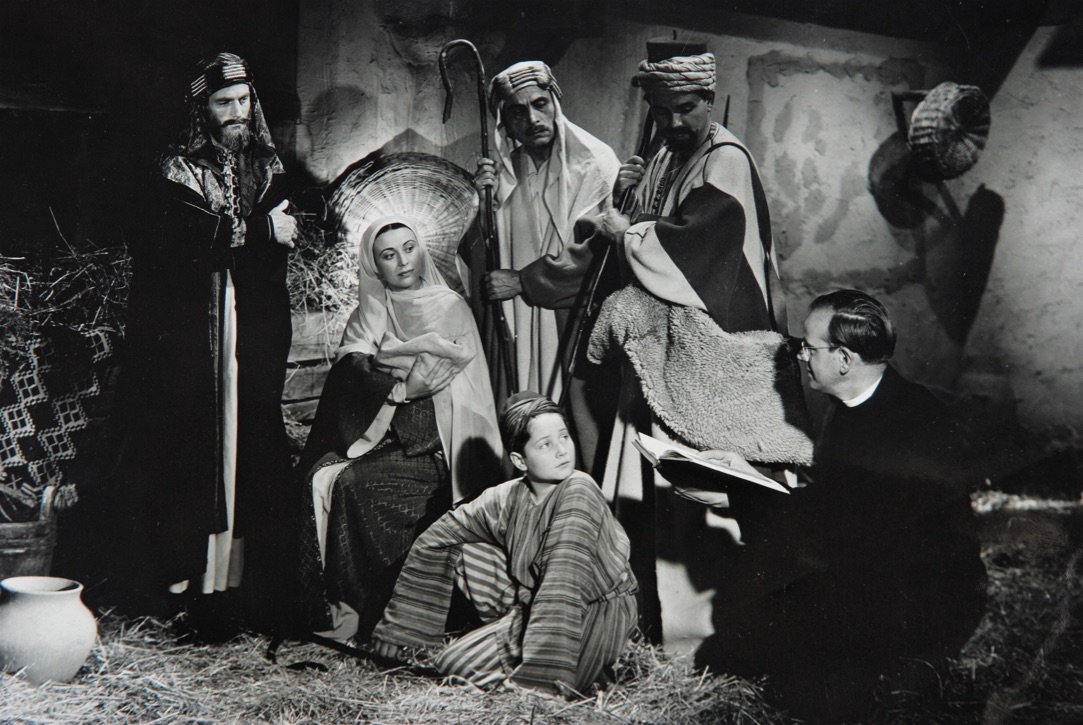
The Rev. James K. Friedrich (right) on the set of Child of Bethlehem (1940).

For he is our childhood’s pattern;
Day by day, like us He grew;
He was little, weak and helpless,
Tears and smiles like us He knew;
And He feeleth for our sadness,
And He shareth in our gladness.

— Cecil Frances Alexander, “Once in Royal David’s City”

My sisters and I each had an unusual childhood connection with the Nativity story. Our father, the Rev. James K. Friedrich, was the pioneer of Christian movie-making in America, and one of his first biblical films was Child of Bethlehem, produced in 1941. My sister Martha was a newborn child then, so she got to play the baby Jesus. Nine years later, my father made Holy Night, the first of a twelve-part series on the life of Christ. I was four years old at the time—much too old to get the leading role—so I was cast as a shepherd boy, entering the stable with several adult shepherds.

In the film, I have a dazed look on my face. I was literally blinded by the light on the Hollywood soundstage where the interiors were shot. Film stock in those days was not as light-sensitive as our camera phones. It required intense illumination to register a proper image. A big row of Klieg lights set up behind the manger threw such a blaze into my eyes that I could barely see the Holy Family. When I hear Luke’s gospel report that “the glory of the Lord shone all around” the shepherds, the indelible memory of those lights at Goldwyn Studios comes to mind.

James L. Friedrich (next to the donkey) at the manger in Holy Night (1949).

My oldest sister, Marilyn, never played in a Nativity film. Hers was a more literal reenactment. In 1936, my parents had stopped in Jerusalem during their honeymoon. In those days, as today, there was violence in the land, and they were warned not to go down the hill to Bethlehem in a car, because cars were easy targets for snipers. It was safer to ride a donkey to the place of Jesus’ birth. My dad recorded their pilgrimage with his 16mm movie camera, and now, every Christmas, I can watch the footage of my mother riding a donkey to Bethlehem, pregnant with her firstborn child.

To Marilyn’s credit, she has never made any personal claims about her origins, but there is, I believe, gospel truth in our childhood memories. Each and every one of us is called to play our part in the Nativity story, but not merely as witnesses like the shepherds or pilgrims like the Magi. God was made flesh so that our own flesh, our own story, may birth the divine intention and the divine life.

You see, the Incarnation isn’t only a matter of God wanting to share our humanity, to make our humanness part of the divine experience. It also reveals God’s desire that we in turn become partakers of the divine nature.

St. John put it this way in his gospel:

To all who received the Incarnate Word, who believed in his name, the Word gave power to become children of God, who were born, not of blood or of the will of the flesh or the will of human beings, but of God (John 1:12-13).

In the centuries that followed, this theme of theosis, or deification––becoming God-like––has pushed the envelope of anthropology by setting a very high bar for the definition of human potential.

In the early church, Irenaeus said that “God became what we are, in order to make us what he is.” Athanasius was even more explicit about the consequences of Incarnation, saying that “God became human so that humans might become God-like.” God-like! Can we even imagine this in our own day, when we are assaulted incessantly by news of human depravity.

Martin Luther, perhaps surprisingly for someone so focused on the burden of human sin, said we were all called to be “little Christs,” and in a Christmas sermon he described the Incarnation as a two-way street: “Just as the word of God became flesh,” he said, “so it is certainly also necessary that the flesh may become word. . . [God] takes what is ours to himself in order to impart what is his to us.”

In the 18th century, some of Charles Wesley’s great hymns were almost shockingly explicit about our capacity to contain divinity.

He deigns in flesh to appear,
Widest extremes to join,
To bring our vileness near,
And make us all divine.

Heavenly Adam, life divine,
Change my nature into Thine;
Move and spread throughout my soul,
Actuate and fill the whole;
Be it I no longer now
Living in the flesh, but Thou.

In the 20th-century, whose atrocities left our confidence in human potential badly shaken, the Catholic contemplative Thomas Merton could still claim that we “exist solely for this, to be the place God has chosen for the divine Presence. The real value of our own self is the sign of God in our being, the signature of God upon our being.” 

And after his famous epiphany at the corner of Fourth and Walnut in Louisville, Merton said, “It is a glorious destiny to be a member of the human race, though it is a race dedicated to many absurdities and one which makes many mistakes: yet, with all that, [God’s own self] glorified in becoming a member of the human race.

“I have the immense joy of being [a human person],” he continued, “a member of a race in which [God’s own self] became incarnate. As if the sorrows and stupidities of the human condition could overwhelm me, now that I realize what we all are. And if only everybody could realize this! But it cannot be explained. There is no way of telling people that they are all walking around shining like the sun.” 

Is this all this talk about divinization going too far? Could we really be walking around shining like the sun? Or at least have the potential for such glory, even if we’re not there yet? If the Nativity in Bethlehem means what I think it does, then the answer has to be yes.

On that wondrous night in Bethlehem, our nature was lifted up as the place where God chooses to dwell. We may still be works in progress, but we are bound for glory. St. Paul believed this when he said that “all of us, with our unveiled faces like mirrors reflecting the glory of the Lord, are being transformed into the image that we reflect in brighter and brighter glory” (II Cor. 3:18).

Another ancient theologian said, “As they who behold the light are within the light and partake of its brightness, so they who behold God are within God, partaking of God’s brightness.”

What happens in Bethlehem doesn’t stay in Bethlehem.

Adoration of the Christ Child, Flemish follower of Jan Joest of Kalkar (c. 1515)

On the Winter Solstice over 40 years ago, I was flying across the San Fernando Valley into L.A.’s Burbank airport on a brilliant December day. The noonday sun was low enough in the southern sky to be reflecting its rays off the surface of swimming pools running along a line parallel to our flight path. There are so many pools in the Valley, and each one, as it was struck by the sun, exploded with an intense dazzle of white light. In rapid succession, tranquil blue surfaces were transformed into momentary images of the sun’s bright fire. For me, it was a vision pregnant with the Christmas promise.

“They who behold the light are within the light and partake of its brightness.” Our pale mirrors are made to contain the most impossible brilliance. And though we have turned away from the Light, the Light seeks us out. No matter how shadowy the path we have taken, the Light will find us, and fill us with divine radiance. That is our destiny, says the Child in the manger.
We may not feel capable or worthy or prepared to receive the Word into the flesh of our own lives, but it is what we were made for. Paradoxical as it may sound, partaking of divinity is the only path to becoming fully human.

A month before he died, Edward Pusey, a 19th-century English priest, wrote to a spiritual friend about our God-bearing capacity:

“God ripen you more and more,” he said. “Each day is a day of growth. God says to you, ‘Open thy mouth and I will fill it.’ Only long. . . The parched soil, by its cracks, opens itself for the rain from heaven and invites it. The parched soil cries out to the living God. O then long and long and long, and God will find thee. More love, more love, more love.”

Participating in divinity doesn’t mean having superpowers or being invulnerable. We won’t be throwing any lightning bolts. Just look at Jesus. His life tells you what “God-like” means. He was born in poverty and weakness, in a stable not a palace, and he lived a life of utter self-emptying and self-offering, giving himself away for the life of the world.

In a novel by the Anglican writer Charles Williams, a young woman goes to church with her aunt on Christmas morning. She is a seeker, not quite a believer, but as they sing a carol about the mystery of the Incarnation, she leans over and whispers to her aunt, “Is it true?” Her aunt, one of those quiet saints who has spent her life submitting to Love divine, turns to her niece with a smile and says simply, “Try it, darling.”

So if you want to try it, if you want to complete your humanity by partaking of divinity, there are many ways to do that. Weep with those who weep and dance with those who dance, the Bible says. Love God with all your heart, and your neighbor as yourself. Welcome the stranger, feed the hungry, free the captive. There are plenty of to-do lists out there. Here’s an excellent one from the Dalai Lama:

May I become at all times,
both now and forever:
A protector for all who are helpless.
A guide for all who have lost their way.
A ship for all who sail the oceans.
A bridge for all who cross over rivers.
A sanctuary for all who are in danger.
A lamp for all who are in darkness.
A place of refuge for all who lack shelter.
And a servant for all those who are in need.
May I find hope in the darkest of days,
and focus in the brightest.

My friends, Bethlehem is not a dream fading away into the past.
It is the human future.
And this is not the morning after.
It is the first day of the rest of our journey into God.


A sermon for Christmas Day at Saint Barnabas Episcopal Church, Bainbridge Island, Washington.

Stumbling in the Dark

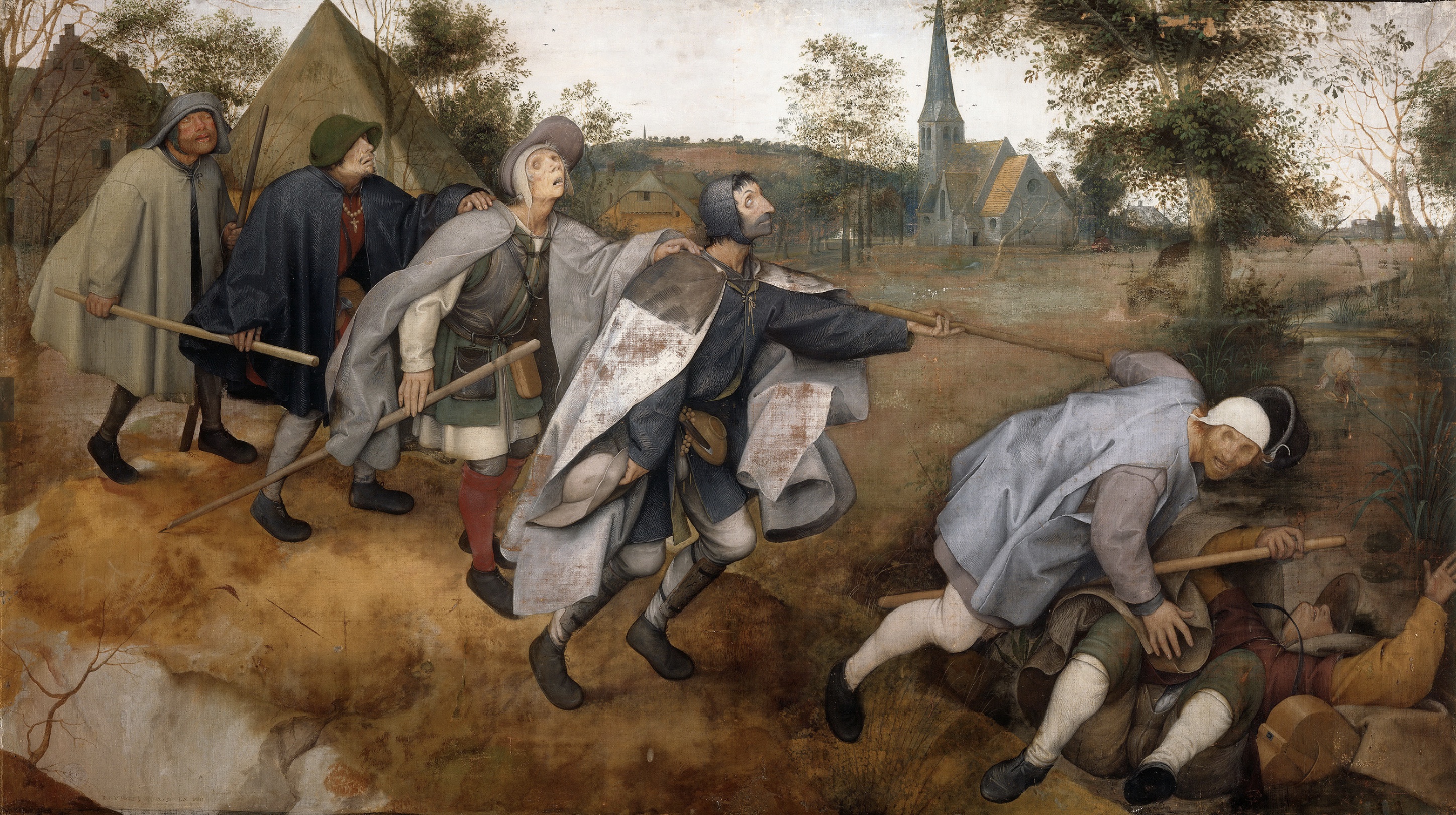
Pieter Brueghel, The Blind Leading the Blind (1658).

Note to reader: This is a post from 2021, revised to include comments on the moral blindness of admitting fascism into our political life.

Jesus was walking out of Jericho, surrounded by a big crowd. Like all such crowds, it was a mix of the curious and the adoring. Jesus was at the height of his popularity. He stirred people’s imaginations and raised their hopes. The excitement was palpable. But amid all the festive clamor, a single shout brought this parade to a sudden halt:

“Jesus, Son of David, have mercy on me!”
It was a blind beggar, sitting by the roadside.
His name was Bartimaeus.

“Shush,” people said. “Don’t make a scene.” 
But he cried all the louder: “Son of David, have mercy on me!”

And Jesus stood still, just the way the sun had stood still in the sky for Joshua in that same city of Jericho.

“Call him here,” Jesus said. And so they did. 
“Take heart!” they told him. “Get up. He is calling you.”

Immediately, Bartimaeus threw off his cloak, sprang to his feet, and came to Jesus. Then Jesus asked him a question that went straight to the point: “What do you want me to do for you?”

“Teacher,” he said, “Let me see again.”
And what Bartimaeus asked, Jesus granted.  (Mark 10: 46-52)

In Mark’s gospel, this is the last miracle performed by Jesus before he goes to his death in Jerusalem. It marks the fatal turning point between his ministry and his Passion. It is our Lord’s last act, his last word, before he begins the Way of the Cross.

To the world, that looked like the path to oblivion. But to those who have been given the eyes of faith, the Way of the Cross, as we pray every Holy Week, is “none other than the way of life and peace.”

And thus the healing of Bartimaeus is not just the story of one man’s good fortune. It is an invitation to each of us to perceive and receive the vision of salvation which is about to unfold. Mark is telling us that if you want to understand the Paschal Mystery of Passion and Resurrection, you need to open your eyes.

And notice that the climactic words of this story are not “he regained his sight,” but rather, “he followed him on the way.” Once you see what God is doing through Jesus, then it’s your turn to take up your own cross and follow. 

And yet, in the story leading up to this moment, even Jesus’ closest friends have suffered their own blindness. “Are your minds closed?” he chides them. “Have you eyes and do not see?” But they go on missing the point again and again.

To their credit, they continue to follow Jesus. They are drawn to him, they know something is happening here—but they don’t know what it is. “Do you not yet understand?” Jesus sighs. I’m sure he said this more than once.

And then, after repeated examples of the disciples’ blindness throughout Mark’s gospel, suddenly we hear a plaintive voice cry out from the crowd: “Jesus! Have mercy on me. Remove this grievous blindness.”

That’s our prayer too, isn’t it? 

Lord, take away our blindness. Help us to see.
And Jesus replies, “I thought you’d never ask!”

St. Gregory of Nyssa, in the fourth century, was one of many theologians who have shared Mark’s diagnosis of the human condition as one of persistent blindness.

“Humanity was created for this end, that it might see ‘good,’ which is God; but because humanity would not stand in the light, [in fleeing from the light] it lost its eyes… We subjected ourselves to blindness, that we should not see the interior light.”

In other words, we are all stumbling in the dark. That is the human condition, until God brings us into the place of clarity.

St. Augustine talked about the inner eye, our capacity to see the things of God, as “bruised and wounded” by the transgression of Adam and Eve, who, he says, “began to dread the Divine light [and] fled back into darkness, anxious for the shade.”

Refusing to stand in the light… subjecting ourselves to blindness. 
Is this what we do? Are we truly so “anxious for the shade?”

Arthur Zajonc is a quantum physicist who became fascinated with the literal dimensions of this question, examining case histories of blind people who recovered their sight. In his book, Catching the Light: The Entwined History of Light and Mind, he tells of an 8-year-old boy, blind at birth from cataracts, who underwent surgery in the year 1910. When the time came to remove his bandages, the doctor was very hopeful. He waved his hand in front of the boy’s eyes, which were now physically perfect. 

“What do you see?” asked the doctor.
“I don’t know,” the boy replied.
“Can’t you see my hand moving?” said the doctor.
“I don’t know,” said the boy.

The boy’s eyes did not follow the doctor’s slowly moving hand, but stared straight ahead. He only saw a varying brightness before him. Then the doctor asked him to touch his hand as it moved, and when he did, the boy cried out in a voice of triumph, “It’s moving!” He could feel it move, and even, as he said, could “hear it move,” but it would take laborious effort to learn to see it move.

As that first light passed through the child’s newly clear black pupils, it called forth no echoing image from within. His sight, Zajonc tells us, began as a hollow, silent, dark and frightening kind of seeing. The light of day beckoned, but no light of mind replied within the boy’s anxious, open eyes.

“The sober truth” says Zajonc, “remains that vision requires far more than a functioning physical organ. Without an inner light, without a formative visual imagination, we are blind.” This echoes Augustine’s description of our “bruised and wounded” inner eye. What is it that makes us so unable to process what is before us, to see what is being offered to our open eyes?

The mystical Anglican poet Thomas Traherne framed an answer in the ornately vivid language of the seventeenth century:

“As my body without my soul is a carcass, so is my Soul without Thy Spirit, a chaos, a dark obscure heap of empty faculties ignorant of itself, unsensible of Thy goodness, blind to Thy glory.” 

And what are the causes of this abysmal state? he asks. He names several: 

“[The Light within us is eclipsed] by the customs and manners of [others], which like contrary winds blew it out: by an innumerable company of other objects, rude, vulgar and worthless things, that like so many loads of earth and dung did overwhelm and bury it: by the impetuous torrent of wrong; … by a whole sea of other matters and concernments that covered and drowned it…” 

“Contrary winds” blowing out the Light within us… being overwhelmed by “an innumerable company… of rude, vulgar and worthless things”… “the impetuous torrent of wrong desires” — does any of that sound familiar in this age of consumerism, social media, and widespread disinformation?

Not long after Traherne wrote those words, another English writer, John Bunyan, told the story of two pilgrims, named Christian and Faithful, who came upon Vanity Fair, a kind of shopping mall where all the transitory pleasures of this world were on seductive display.

“What will ye buy?” cried one of the merchants.
And Christian and Faithful replied, “We buy the truth!”

This was clearly the wrong answer, for the two pilgrims were immediately set upon, beaten, smeared with mud, thrown in a cage, and finally put on trial. The jury was rigged, led by Mr. Blind Man and Mr. Hate-Light. “Guilty,” they cried, and Faithful was put to death. But Christian managed to escape, and his journey into God continued. 

Bunyan’s allegorical constructs seem quaintly archaic today, but Vanity Fair is still with us, with its endless commodification of unsatisfiable desires. And Mr. Hate-Light is still at work, generating the ceaseless illusions and lies that blind us to the beauty of holiness, the beauty of one another, the beauty of loving community. 

I was born in 1944, 40 days after D-Day, and a few weeks before the liberation of Paris, when the evils of Nazism and fascism were on the run. Once and for all, we thought. But now, eighty years later, Adolf Hitler—Mr. Hate-Light himself—is making a comeback. And millions—millions!—of people are just shrugging their shoulders. So many of the children, and grandchildren, and great-grandchildren of the generation who shed their blood to stop fascist tyranny, seem kind of okay with the return of Mr. Hate-Light.

Lord have mercy, we are stumbling in the dark.

So what happens to Christian in Bunyan’s allegory? He escapes Vanity Fair, but he still has to pass through the Valley of the Shadow of Death, where the light is so scarce, and the path so narrow, that he’s in constant danger of stumbling into the ditch on his right or the quagmire on his left. 

But Christian is not without hope in that dark valley. 
As Isaiah said, the God of light travels with us:

I shall lead the blind by a road they do not know… 
I shall turn the darkness into light before them, 
and turn the quagmire into solid ground.
   (Isa 42:16)

All of us, deep down, want the light. All of us need the light. But sometimes we resist the light, or run away from it, or shut our eyes to it. There are things we’d rather not see, in the world or in ourselves. Illuminating our dark places can feel like a judgment, as if the light were accusing our shadows.

In Franco Zefferelli’s beautiful 1977 film, Jesus of Nazareth, we meet another blind man at the pool of Bethsaida in Jerusalem, but unlike Bartimaeus, he is deathly afraid of being healed. “Leave my eyes alone!” he shouts. “Stop touching my eyes!”

After analyzing sixty-six cases of blind people who had recovered their sight, Arthur Zajonc would concur with Zeffirelli’s portrayal of our resistance to having our eyes opened.

“The project of learning to see,” he writes, “inevitably leads to a psychological crisis in the life of the patients, who may wind up rejecting sight. New impressions threaten the security of a world previously built upon the sensations of touch and hearing. Some decided it is better to be blind in their own world than sighted in an alien one… The prospect of growth is as much a prospect of loss, and threat to security, as a bounty.”

In other words, opening our eyes to a more truthful clarity can be scary—no more fictions or illusions about the state of the world or the state of our souls. If we say we have no sin, we deceive ourselves, and the truth is not in us (I John 1:8).

Seeing—clearly and accurately—the fallenness of our broken world—and our wounded selves—is a painful revelation. Once we face facts, transformation is the only way forward. We must change our life. A new way of seeing demands a new way of being. We can either fight that divine summons, like the man in the Zeffirelli film (Don’t touch my eyes!), or we can jump up and embrace it, like Bartimaeus.

But it’s not just the wrongness of things which is hidden by our blindness. The truth is, there is also so much blessing and beauty in this world, eagerly waiting to be discerned and embraced.

And whatever our doubts and fears about losing our protective blindness, the beauty revealed will be worth the price. It’s the beauty of God’s future—what Jesus called the Kingdom. We often think of the Kingdom of God as impossibly distant, but it is possible to glimpse it even now, in this present age. We only need the eyes to see. 

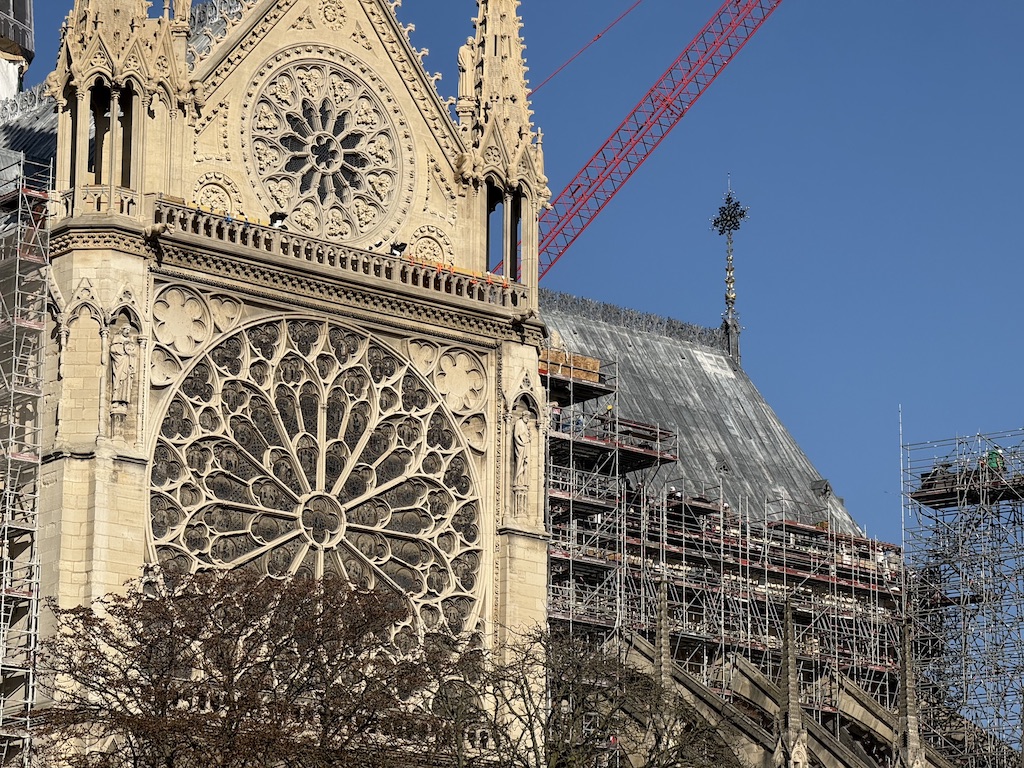
Scaffolding on the west side of Notre Dame in Paris (October 2024).

Last week my wife and I were in Paris, and it was thrilling to see the cathedral of Notre Dame in the final stages of its resurrection from the devastation of that terrible fire in 2019. There are still giant cranes and some scaffolding present, and a construction wall continues to keep the public at a distance until the house of God reopens in Advent.

And even though we could not yet go inside, it was powerful just to stand in the parvis, the open space in front of Notre Dame, joining the thousands and thousands of people who come there every day to wonder at the marriage of human creativity and divine glory.

And what made it especially moving was the beautiful photographs displayed on the temporary wall surrounding the site. In stunning black & white portraits, we saw a representative sample of the many thousands whose labor, skill and love have brought the cathedral back to life: architects, engineers, artisans, restoration experts, carpenters, stone-workers, stained glass artists, roofers, electricians, cleaners, works managers, heritage curators, scholars, liturgists, theologians, and all the service people who fed the multitude every day.

Photo of restoration team member on the construction wall at Notre Dame.
Photo of restoration team member on construction wall at Notre Dame.

What we saw in those faces, and in the fruits of their labor, was the very best of humanity, working together to repair the world, redeeming beauty and hope from the ashes of destruction and despair.

But if you walk just behind Notre Dame, to the tiny tip of the Ile de la Cité—the small island on the Seine River where the cathedral stands—you will find some stairs, which take you down into a dim, tomb-like space. There you move through a narrow passage whose floor is inscribed with the words, “They went to the ends of the earth and did not return.”

This subterranean passage is faintly illumined by 200,000 tiny, lighted crystals, representing the 200,000 people deported from France to the death camps during the Nazi occupation of the 1940s.

It is a powerful memorial—and a painful reminder. For the mass deportation in France was not simply the act of bad Germans upon an innocent French population. It was the French police who went door to door, rounding up Jews and dissidents. And though there were many French people who resisted the evils of the Occupation, there were many more who turned a blind eye to the mass deportation. The legacy of complicity and collaboration would long haunt the postwar memory of France.

Lying in the very shadow of the glorious and aspirational cathedral, the Memorial of the Deportation stands as a warning to those of any country who want to believe that “it can’t happen here.”

Lord, remove our grievous blindness. Help us see the light.

There is a passage from Willa Cather’s novel, Death Comes for the Archbishop, which perfectly expresses the faith and the hope that we are not destined to remain in the dark—that we can, by God’s grace, recover the divine light within us. The novel’s protagonist, Jean-Marie Latour, a nineteenth-century missionary bishop to the territory of New Mexico, is discussing visions and miracles with his Vicar. 

“Where there is great love,” he says, “there are always miracles. One might almost say that an apparition is human vision corrected by divine love .… The Miracles of the Church seem to me to rest not so much upon faces or voices or healing power coming suddenly near us from afar off, but upon our perceptions being made finer, so that for a moment our eyes can see and our ears can hear what is about us always.”

Human vision corrected by divine love. 
How blessed are they who receive such a miracle! 

“Mercy, O thou Son of David, 
thus poor blind Bartimaeus prayed.
“Others by thy grace are saved,
now afford to me thine aid.”

“Lord, remove this grievous blindness,
let mine eyes behold the day.”
Straight he saw, and, won by kindness,
followed Jesus in the way.

Is Cruelty the Price of Peace? — Another View on Gaza

Timothy H. O’Sullivan, Harvest of Death
(Gettysburg, July 1863: the bloodiest battle of the American Civil War).

“War is cruelty, and you cannot refine it; and those who brought war into our Country deserve all the curses and maledictions a people can pour out.”

— William Tecumseh Sherman, 1864

“I confess, without shame, that I am sick and tired of fighting—its glory is all moonshine; even success the most brilliant is over dead and mangled bodies, with the anguish and lamentations of distant families, appealing to me … for sons, husbands, and fathers … it is only those who never heard a shot, never heard the shriek and groans of wounded and lacerated … that cry aloud for more blood, more vengeance, more desolation.”

— William Tecumseh Sherman, 1865

When General Sherman’s troops pillaged and burned their way across Georgia in the American Civil War, they ignored the conventions of traditional warfare. It wasn’t enough to defeat their counterparts in battle. The enemy’s support system had to be destroyed as well. Infrastructure, manufacturing, and food supply were all fair game. Regrettably, many civilians would have to pay the price of such “total war,” but breaking the popular will through suffering was seen as a critical means for hastening surrender. According to this heartless logic, the crueler the war, the sooner the peace. 

Sherman wrote “war is cruelty” in a letter to the Mayor and Councilmen of Atlanta, insisting that the city be evacuated in advance of its wholesale destruction by federal troops. “You might as well appeal against the thunder-storm as against these terrible hardships of war,” he told them. “They are inevitable, and the only way the people of Atlanta can hope once more to live in peace and quiet at home, is to stop the war, which can only be done by admitting that it began in error and is perpetuated in pride.” [i]

Sherman’s cruelties helped end the Civil War. But a few months after the Confederate surrender, he seemed to be haunted by the memory of all those “dead and mangled bodies” strewn across the American landscape. Though the guns of war had been silenced, “the shriek and groans” of the fallen still echoed in his head. 

The current war in Gaza is rooted in its own particular history of grievance, wounding, hate, and revenge, and it’s happening in a time and a culture very different from Sherman’s America. Nevertheless, when novelist Stephen Crane described Civil War battles as an impersonal force, a mechanism operating independently of human will, he could have been describing Gaza. War is like “the grinding of an immense and terrible machine,” he wrote in 1895. “Its complexities and powers, its grim processes” have one end: to “produce corpses.”

The Gaza war, in its first 40 days, has produced over 13,000 corpses, most of which were civilian non-combatants, including thousands of women and children. The ratio of Palestinian deaths to Israeli deaths is 10 to 1. Ten eyes for an eye. How many deaths will it take till we know that too many people have died? [ii]

For the extremists on both sides, military victory is not enough. Their opponents need to be “disappeared” from history. Instead of seeking peace by implementing just relations between the contending parties, they would rather remove the “other” from the equation altogether. End of story. 

Time’s up for war criminal Franz Kindler (Orson Welles) in The Stranger (1946).

The terrible finality of such a goal calls to mind a scene in The Stranger, a 1946 film noir directed by Orson Welles, who plays Franz Kindler, a Nazi war criminal fleeing his past by posing as Professor Charles Rankin at a New England college after the war. During a dinner party with his new bride Mary (Loretta Young), Wilson (Edward G. Robinson, playing a government agent with suspicions about Rankin’s true identity), and several academic colleagues discuss Germany’s postwar future, 

“Charles” argues that “the German” is incapable of peace. “He still follows his warrior gods, marching to Wagnerian strains, his eye still fixed on the fiery sword of Siegfried … The world is waiting for the Messiah, but for the German, the Messiah is not the Prince of Peace.” His words are a pretense—he himself is German—but as the conversation continues, his mask slips just enough to give a brief glimpse of his genocidal worldview. 

“But my dear Charles,” says one of his colleagues, “if we concede your argument, there is no solution. 

Kindler/Rankin:          Well, sir, once again I differ.

Wilson:                       Well, what is it, then?

Kindler/Rankin:          Annihilation—down to the last babe in arms.

Mary:                          Oh Charles, I can’t imagine you’re advocating a Carthaginian peace.

Kindler/Rankin:          Well, as an historian, I must remind you that the world hasn’t had much trouble from Carthage in the past two thousand years. [iii]

Annihilation of the other is not only supremely evil, it is strategically stupid. The more you kill, the more enemies you create. Violence, whether by terrorists or armies, will never bring lasting peace for Israelis and Palestinians. It can only perpetuate the futile Punch and Judy show of hit and hit back. Time for a new story. Can we get a rewrite?

Bartolo di Fredi,The House of Job Falls on his Children (Duomo, San Gimignano, 14th century).
The collapsing building calls to mind the bombing of Gaza.

In the fifth century B.C.E., the community of Israelites returned to Judah from a century of exile in Babylon. They set out to rebuild the ruined temple in Jerusalem and renew their identity as God’s people, dwelling in their promised homeland. The biblical books of Ezra and Nehemiah record this challenging process. As Robert Alter notes in his celebrated translation of the Hebrew Scriptures, 

“The community of returned exiles found itself in sharp conflict with other groups in the country, and the ideology promoted by both Ezra and Nehemiah was stringently separatist. Those who had remained in the land and claimed to be part of the people of Israel—in particular, the Samaritans—were regarded as inauthentic claimants to membership in the nation and were to have no role in the project of rebuilding.” [iv]

In a first-person account, Ezra reports his shock at finding that some Israelites, instead of keeping separate from the locals, had taken “foreign” wives for themselves and their children. “When I heard this thing,” he says, “I rent my garment and my cloak and I tore out hair from my head and my beard and I sat desolate” (Ezra 9:3) Why is he so upset? It’s because, as he put it, “the holy seed has mingled with the peoples of the lands.” As Alter explains, 

“The traditional reason for avoiding intermarrying was to keep apart from pagan practices. Although Ezra has this rationale in mind, here he adds what amounts to a racist view: the people of Israel are a ‘holy seed’ and hence should avoid contamination by alien genetic stock.” [v]

The desire to preserve identity in the face of diversity has been around as long as humans have lived in communities, but separatist ideologies that devalue or demonize the “other” have terrible consequences. Sooner or later, they “produce corpses.”   

It’s not just a problem for the Middle East. Just last week, in a chilling echo of Mein Kampf, the leading American fascist said that immigrants are “poisoning the blood of our country.” And, he added, they—along with anyone who dares oppose him—are “vermin.” Such dehumanization, as history has repeatedly shown, opens the door to the Carthaginian solution: annihilation.

Not everyone in ancient Israel bought into the separatism of Ezra and Nehemiah. Another biblical book, written in the same post-exilic period, proposes an alternative way of being. It is the story of Ruth, a Moabite “foreigner.” Moab was a perennial enemy of Israel. Any interaction with Moabites was forbidden in the Torah. Despite this, an Israelite who happens to live in Moab takes Ruth as his wife. When he dies, her mother-in-law Naomi decides to return to her hometown of Bethlehem. Although she expects Ruth to remain with her own people, Ruth has other ideas. She is unwilling to break the bonds of devotion between herself and Naomi:

Wherever you go, I will go with you. And wherever you lodge, I will lodge. 
Your people is my people, and your god is my god (Ruth 1:16).

Once in Bethlehem, she meets Boaz, her future husband. Like her first spouse, he’s an Israelite. In this story, intermarriage is not a problem. Not only is Ruth given one of the few happy endings in the Bible, that Moabite woman becomes the honored ancestor of King David. Cultural difference turns out to be a gift! This charming story challenges the dominant separatist ideology by picturing a much better world. As Alter explains, 

“Unlike the narratives from Genesis to Kings, where even pastoral settings are riven with tensions and often punctuated by violence, the world of Ruth is a placid, bucolic world, where landowners and workers greet each other decorously with blessings in the name of the Lord … In the earlier biblical narratives, character is repeatedly seen to be fraught with inner conflict and moral ambiguity. Even such presumably exemplary figures in the national history such as Jacob, Joseph, David and Solomon exhibit serious weaknesses, sometimes behaving in the most morally questionable ways. In Ruth, by contrast, there are no bad people.” [vi]

Jean-François Millet, Harvesters Resting (Ruth and Boaz) (1850-53).

Is the Book of Ruth only a fairy tale? Or is the promise of a diverse humanity living in peace a dream worth inhabiting? In a region where political success is so rare that people can’t even imagine progress; where mutual trust is on life support and intransigence rules; where existing leadership is part of the problem; where everyone is too busy killing, dying or grieving to think clearly about a viable future, such a dream may seem absurd. Nevertheless, considering the present alternative, perhaps a dream is required to supply the faith to advance, step by step, toward the world God intends for us. 

It will be a long and arduous journey—risky, too, but not as risky as remaining stuck in Deathville. It’s best to start soon—and to travel light. Let go of things that won’t be needed in the better story that lies ahead: mistrust, fear, and vengeance; discouragement, despair, and hopelessness; terror, settlements, and apartheid; despots, crooks, and liars. Along the way, plant seeds of peace, justice, patience, gentleness, kindness, humility, generosity, forgiveness, love and mercy wherever you can.

It’s been said that sin is the “refusal to be touched by the pain of others.” [vii] And the antidote, says Cynthia Bourgeault, is kenosis: the self-emptying whose name is Love:  

“When surrounded by fear, contradiction, betrayal; when the ‘fight or flight’ alarm bells are going off in your head and everything inside you wants to brace and defend itself, the infallible way to extricate yourself and reclaim your home in that sheltering kingdom is simply to release whatever you are holding onto—including, if it comes to this, life itself.” [viii] 


[i] Letter from W.T. Sherman to James M. Calhoun, E.E. Rawson, and S.C. Wells, September 12, 1864.

[ii] The line is borrowed from Bob Dylan. In Israel and Gaza, the answer is still blowin’ in the wind.

[iii] The screenplay for RKO’s The Stranger was written by Anthony Veiller, with uncredited contributions from John Huston and Orson Welles. The term “Carthaginian Peace” comes from Rome’s brutal subjugation of Carthage after years of warfare. In 146 B.C.E., the Romans burned Carthage to the ground and slaughtered most of its inhabitants.

[iv] Robert Alter, The Hebrew Bible, Vol. 3: The Writings (New York: W.W. Norton, 2019), 804.

[v] Ibid., 825 n. 2.

[vi] Alter, 622.

[vii] Rowan Williams, Looking East in Winter: Contemporary Thought and the Eastern Christian Tradition (London: Bloomsbury Publishing, 2021), 221.

[viii] Cynthia Bourgeault, Centering Prayer and Inner Awakening (Cambridge, MA: Cowley Publications, 2004), 87.

The Stephen Crane quote is from The Red Badge of Courage.

Extravagant Sacrifice: A Holy Week Reflection

Jan van Scorel (c. 1530)

Mary took a pound of costly perfume made out of pure nard, anointed Jesus’s feet, and wiped them with her hair. The house was filled with the fragrance of the perfume. But Judas Iscariot, one of his disciples (the one who was about to betray him) said, “Why was this perfume not sold for three hundred denarii and the money given to the poor?” — John 12:3-5  

Judas raises a troubling question for everyone who is not destitute. As long as there is human need, how dare we spend our money on anything else? And Jesus’ answer—“The poor are always with you”—might seem equally troubling, if taken to accept economic inequality as inevitable. But Jesus was never complacent about the status quo. In both word and deed he lifted up the lowly—the ones either ignored or shamed by their culture—declaring them worthy of blessing and honor. As Jesus himself put it, he came to bring good news to the poor: Injustice has no future. God’s kingdom of loving interdependence is at hand. 

Here’s how I read this text: “You can help the destitute any time you want, Judas. If your concern is sincere, they’ll still be around after I’m gone. But I won’t be. So don’t be so quick to judge this woman. If you could only understand what’s going on here, it would save your life.”

So what is going on here? A woman, Mary of Bethany, whose brother Lazarus had recently been rescued from death by Jesus, pours very expensive oil over the feet of her Lord, and then wipes those feet with her hair. It’s an extravagant gesture of devotion, gratitude and love. The oil, worth a year’s wages for a common laborer, may have cost Mary most of her wealth, while letting down her hair to do the work of a towel was, in that culture, a shocking display of abasement and vulnerability. In other words, she was offering all that she had and all that she was to honor Jesus. 

This act, both sensory and symbolic, overflowed with meanings. Anointing with oil was a way to mark the special vocation and identity of authoritative figures, whether powerful rulers or holy persons. It consecrates them as chosen and set apart. The title of “Messiah” or “Christ” means “the anointed one.” It was revolutionary to have a woman be the one to anoint Jesus as priest and ruler, but so was the kingdom he came to manifest and embody. 

Anointing was also part of the culture’s preparation of a body for burial. Performed in the week before Jesus’ death, Mary’s gesture inaugurates the sequence of sacrificial acts culminating with her Lord’s burial in the stone-cold tomb. The feet she anoints will walk the Way of the Cross for the salvation of the world. This was his chosen destiny. 

The story’s third meaning is in its foreshadowing of the foot-washing, when Jesus, on the night before he died, knelt at the feet of his friends to perform the work of a servant, surrendering his power for love’s sake. He was teaching by showing: This is how we must be with one anotherThis is exactly how God is with us. Just a few days before Jesus taught this explicit lesson at the Last Supper, Mary of Bethany had performed it instinctively, offering all she had, holding nothing back. 

At the time, the disciples did not grasp the full significance of Mary’s act. Nor did Mary herself. How could they? As we like to say about Holy Week, the journey is how we know. The disciples had to follow Jesus all the way to the cross—and beyond—before they could begin to understand—through memory and reflection—what it was all about. 

One of the strongest triggers for memory is our sense of smell. When John’s gospel tells us that “the house was filled with the fragrance of the perfume,” it sounds like a vivid personal memory. Recalling the fragrance, the disciples could revisit that moment to absorb all the meanings which had escaped them at the time. 

As we make our own personal and communal journey through Holy Week, may we too immerse ourselves extravagantly in the sensory images and sounds of the Passion narratives and rituals, allowing them, by our faithful participation, to take us deeper and deeper into the Paschal Mystery of dying and rising in Christ. 

As for Judas’ sour complaint, Sydney Carter’s Passion carol, “Said Judas to Mary,” nicely disposes of its false premise of either/or. Devotion to Jesus and loving service to “the least” of God’s family are not opposed. They are inseparable:

Said Jesus to Mary, “Your love is so deep, 
 today you may do as you will. 
Tomorrow, you say, I am going away, 
but my body I leave with you still.”

“The poor of the world are my body,” he said,
“to the end of the world they shall be.
The bread and the blankets you give to the poor
 you’ll know you have given to me.”

Here is a lovely rendition of Carter’s Holy Week carol sung by Fiona Dunn: