“They have taken away my Lord!”—The Trumpian Hijack of Jesus

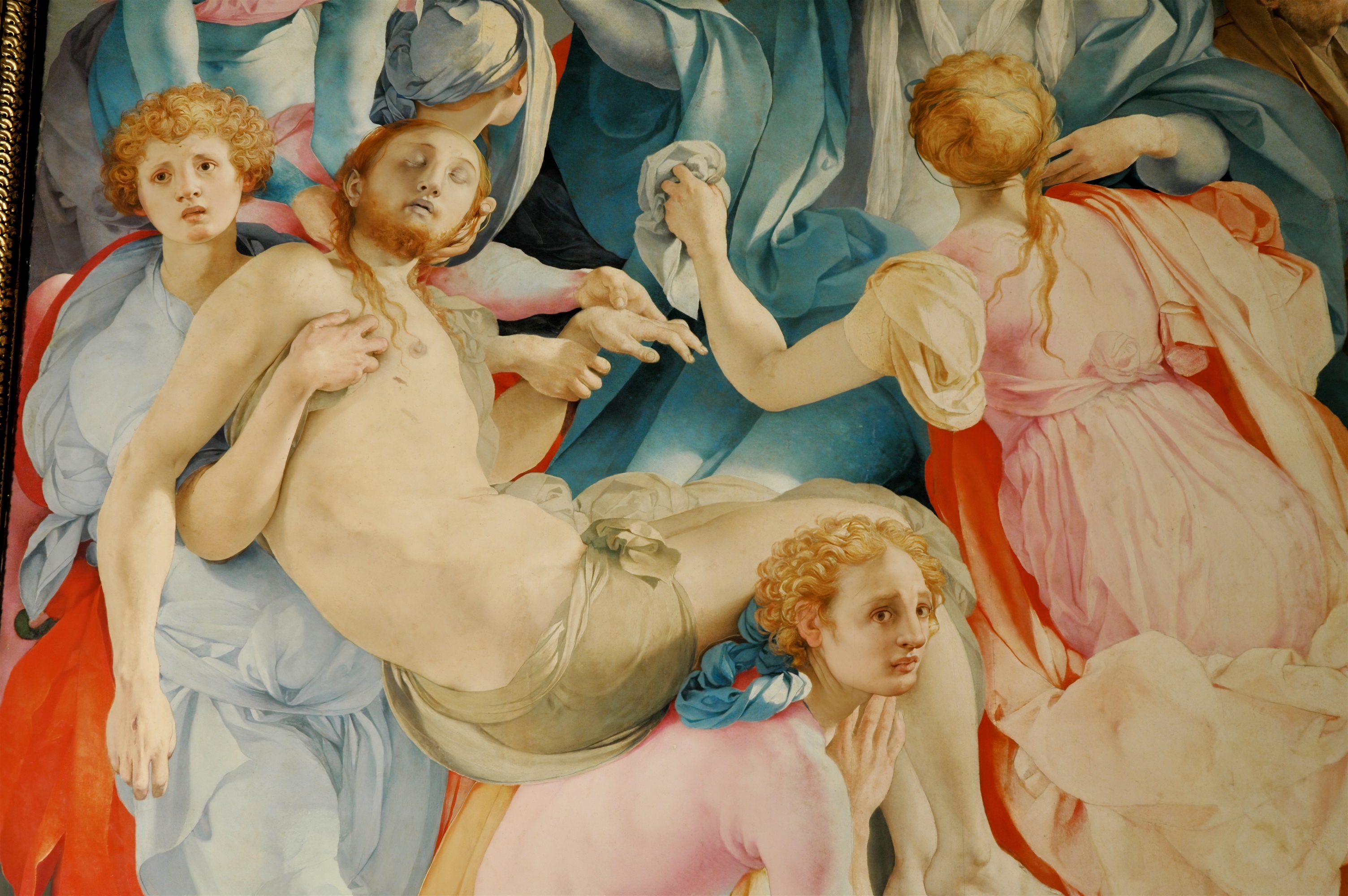
Jacopo Pontormo, The Deposition of Christ (Santa Felicita, Florence, 1528).

While my wife was studying for the priesthood in Berkeley, California, I often went for trail runs in the local hills. On one occasion, I tripped on a tree root and did a face plant. Using my hands to break my fall, I suffered minor cuts in both palms. When I returned to our apartment, I showed my bloody palms to Karen and said, “Look! I’ve got the wounds. Now all I need is the personality.”

When Donald Trump published an AI image of himself as Jesus, even his worshippers in the “Christian” right were taken aback. It was one thing to adore their dear leader as an instrument of divine will, but to equate or confuse him with Jesus Christ created some serious cognitive dissonance.

Does this look like a doctor? And who are those satanic figures in the sky?

The uproar over the preposterous image forced him to delete it from his social media, but he was typically incapable of admitting any error on his part. The blame lay with the people who misinterpreted what they saw. “It’s supposed to be me as a doctor making people better,” he claimed. “And I do make people better.” Right. I feel better already!

Of course, whatever comes out of the president’s mouth defiles him, and is rarely worth our time, except for the work of countering or limiting the damage. But this tasteless piece of kitsch does raise a question of interest to many of us: What is an authentic image of Jesus?   

Saint Veronica, Hans Memling (c. 1470/1475).
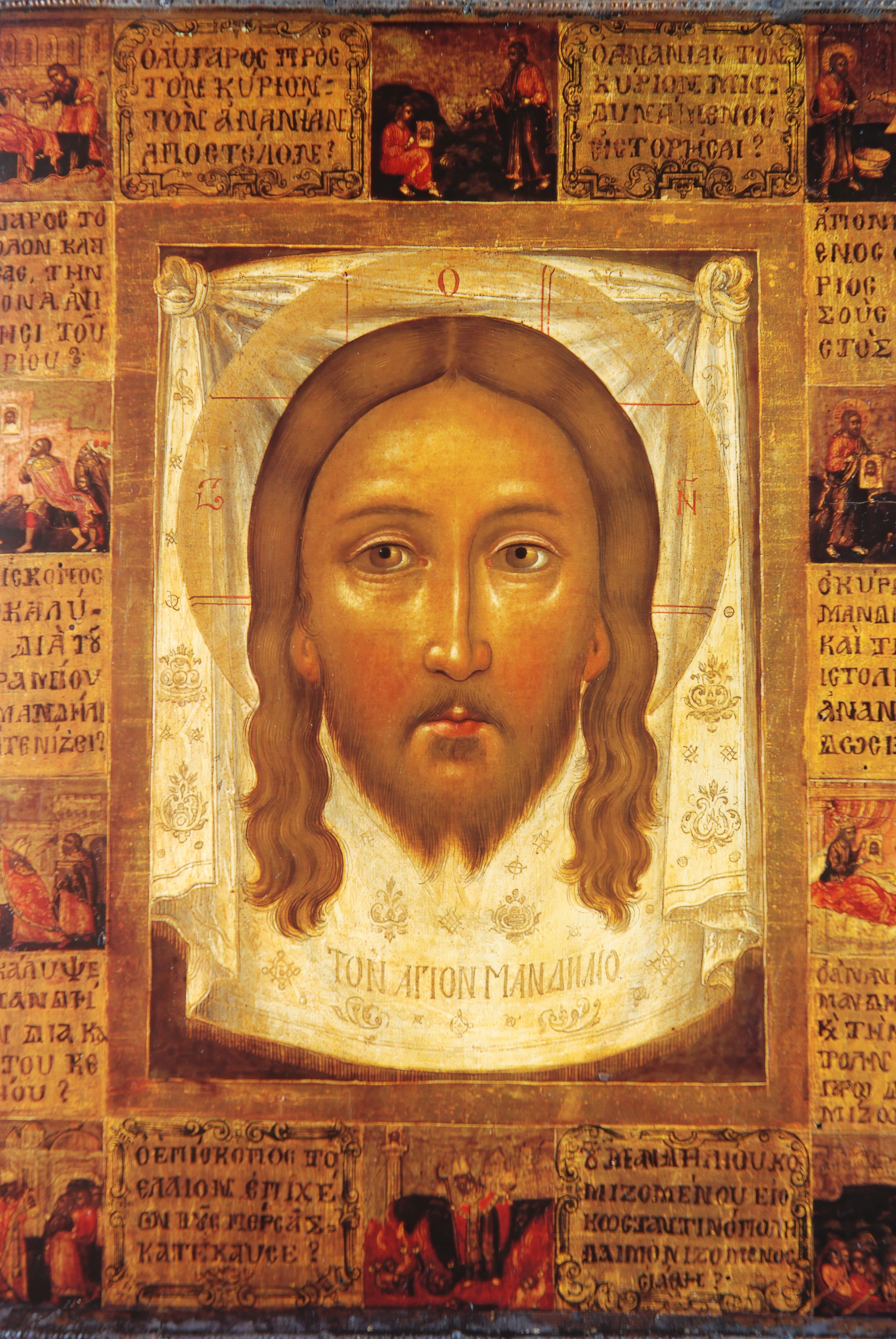
Icon of the Mandylion of Edessa (Italy?, 18th century): a copy of an ancient image.

Jesus never took a selfie, but there are interesting ancient legends about photo-like images transferred onto cloth by contact with his face. In the Christian West, the apocryphal Saint Veronica (vera icon = true icon) was said to have wiped her Savior’s face with her veil as he lugged his cross to Calvary. In the eastern version of the legend, Jesus wiped his face with a towel sometime before his Passion. The towel—later known as the Mandylion—was sent to a king as a means of his healing. In both cases, an indelible image of the Christ was left on the cloth. Whatever we may make of these legends today, they were a way of authenticating subsequent images of the Word made flesh. Iconic images of Jesus were validated by the idea that they were copies of copies of copies, traceable all the way back to his original face.

The history and evolution of Christ images is a complicated one, with many deviations from what we regard as the traditional image of a white European with long hair and a beard. Early Christian images include a young man modeled on Apollo, whose youth symbolized eternal life, and a shepherd bearing a lost lamb on his shoulders. Both were beardless. Facial hair came later, to suggest both wisdom and authority. Africans, Asians and Pacific islanders have painted Jesuses who look like them. And contemporary artists continue to explore diverse visual means to represent the confusingly “unconfused” convergence of divine and human in a single face, a mortal body.

How can the artist do justice to both the humanity and the divinity of Jesus in a single image? The iconoclasts of the 8th and 9th centuries thought we should abandon the attempt altogether. The mixture of human and divine in a single person is unrepeatable, whether in life or in art. After the Ascension took him from human sight, the eucharist was the only valid Christ image that remained on earth.

A picture of Jesus simply cannot capture the mystery of divine presence, it was argued. As a product of artistic imagination, any painted or sculpted image of Jesus would be for the iconoclast an unworthy distortion of an unrepresentable reality. “If someone makes an image of Christ,” said the Byzantine emperor Constantine V, “he has not really penetrated the depths of the dogma of the inseparable union of the two natures of Christ.” In the end, the iconoclasts lost the argument, and the production of sacred images would remain an important part of Christian devotion, theology, and imagination.

Mark Wallinger, Ecce Homo (1999).

We like to think we’ll always know Jesus when we see him. But what if he doesn’t match the image in our minds? In 1999, a life-sized figure of Jesus was displayed on a high plinth in London’s Trafalgar Square. Cast from the clean-shaven body of an art student, Mark Wallinger’s Ecce Homo (“Behold the man.”) was made of synthetic resin mixed with marble dust. The figure of Jesus, arrested and bound by the powers-that-be, was bald and beardless. Only the thorns around his head invoked traditional Jesus iconography. The rest of him was anonymously modern. In their fine book on images of Christ, Neil MacGregor and Erika Langmuir report some of the public reactions:

If that’s Jesus Christ, it’s a bloody miracle,’ a man is reported to have said … ‘You couldn’t put your faith in someone like that, he’s as weak as a kitten.’ ‘You can’t have a Christ figure like this,’ said another. ‘Where is his robe? Where is his beard? Where is his cross?’ An ice cream seller pointed out, ‘He doesn’t have long hair.’ [i]  
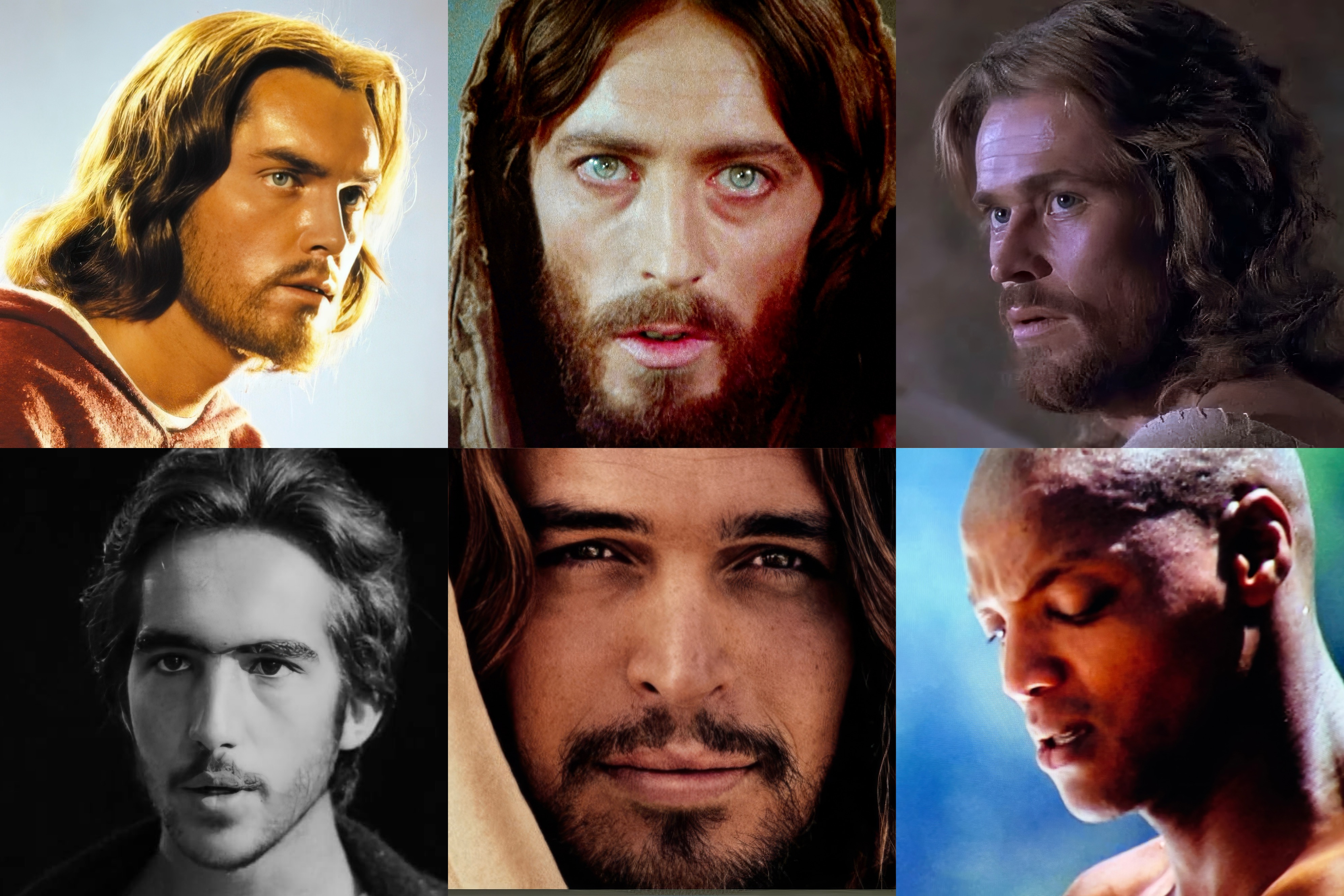
Movie Jesuses — Top (l-r): Jeffrey Hunter (King of Kings, 1961), Robert Powell (Jesus of Nazareth, 1977), Willem Dafoe (Last Temptation of Christ, 1987). Bottom (l-r): Enrique Irazoqui (Gospel According to St. Matthew, 1964), Diogo Morgado (Son of God, 2014), Andile Kosi (Son of Man, 2006).

 I used to teach a seminary course on “Jesus and the Movies,” drawing upon 16 different Jesuses in films made between 1912 and 2014. I’d begin by showing them a short clip of each “Jesus,” and then would ask:

Which one of them is the “real” Jesus?
All of them?
Some of them?
None of them?

The students’ answers were all over the map. Some shunned Robert Powell—his eyes were too blue for a Middle eastern character—while embracing the first Jewish actor in the genre (Irazoqui). Many loved the first African Jesus (Kosi) while rejecting teen idol Jeffrey Hunter as too “Hollywood.” Some found the Swedish accent of Max von Sydow (not pictured) and the New York accent of Willem Dafoe too jarring.

As the course progressed with dozens and dozens of scenes from Nativity to Resurrection, some of these objections faded away, as each film and each actor—at least in certain scenes—showed my students fresh dimensions of the Word made flesh. It’s the same process of recognition and illumination we go through when looking at a painting of Jesus. However, while we understand and accept the artificiality of a painted canvas, we tend to ascribe realism to the film image, at least in the course of watching it. We expect a film to match our ideas of what things look like, including Jesus.

Ironically, those ideas have themselves been shaped not by historical fact—the Bible offers few visual descriptions in its narratives—but by the imaginations of artists over the centuries. The films themselves owe a great deal to religious art. Pasolini, the first Jesus movie director to use unglamorous non-actors, said that “painting is the major element in the Christological tradition.” Of course, how could anyone live in Italy and not think that!

In any case, a visual representation of Jesus can engage you—sometimes profoundly—with the story of God among us, producing an immersive encounter that may change your life. It might even, in the case of Jesus icons which simply gaze back at you instead of showing a gospel narrative, become an authentic experience of real presence. And if you don’t meet Jesus in a particular image, be it a painting, a sculpture, or a film, you still come away thinking about him. Even to say “that’s not Jesus!” is a Christological statement.

Whether in painting, sculpture, or cinema, no image can be Veronica’s veil or the Mandylion. No image—even if it were a first-century photograph of the man himself—can claim to depict the real Jesus. That would be idolatry. It would also make the mistake of seeking the living among the dead. The risen and living Christ doesn’t come to us out of the past as a memory of what was, but out of the future. The first disciples—Jesus’ closest friends—had trouble seeing the person they remembered when the risen Christ first appeared to them. There was something different about him. Recognition required something more than a familiar face—a tender voice speaking their name, the breaking of the bread in Emmaus, a strange warming of the heart—before they could say for sure, “It’s you!”

No sane or honest person could ever find Jesus in the words or deeds of Donald Trump. But some have found echoes of the Antichrist. I don’t know about that, but pretty much everything he is and does is anti-love and anti-Jesus. And God help his enablers.

It didn’t take long for this parody to appear. As Christopher Marlowe’s Satan confessed centuries ago,
“Why, this is hell, nor am I out of it.”.

Images of Trump as Jesus, along with their inevitable parodies, may serve to weaken his support among the religious right. Hooray for that. But I wonder about the effect of such trivialization of the way we relate to sacred images. I fear the pollution of our visual imagination. Pope Leo’s recent criticism of cloaking despicable behavior with religious language seems applicable to images as well as actions.

“Woe to those who manipulate religion and the very name of God for their own military, economic and political gain, dragging that which is sacred into darkness and filth.” [ii]

Well, the visage of God-among-us has been spit upon before. And faith says that nothing we do to Jesus will make him stop loving us, or stop surprising us with the next form his appearing takes. If you want to find Jesus, don’t look among the evildoers, but among their victims. The Acts of Thomas, a third-century apocryphal gospel, makes this point perfectly when a Trumpian Satan bemoans his failure to appropriate Jesus for his own malicious designs:

“For when we thought that we could bring Jesus under our power, he turned and hurled us down into the abyss; for we did not know him, because he deceived us by his humble aspect, and by his need and his poverty.” [iii]
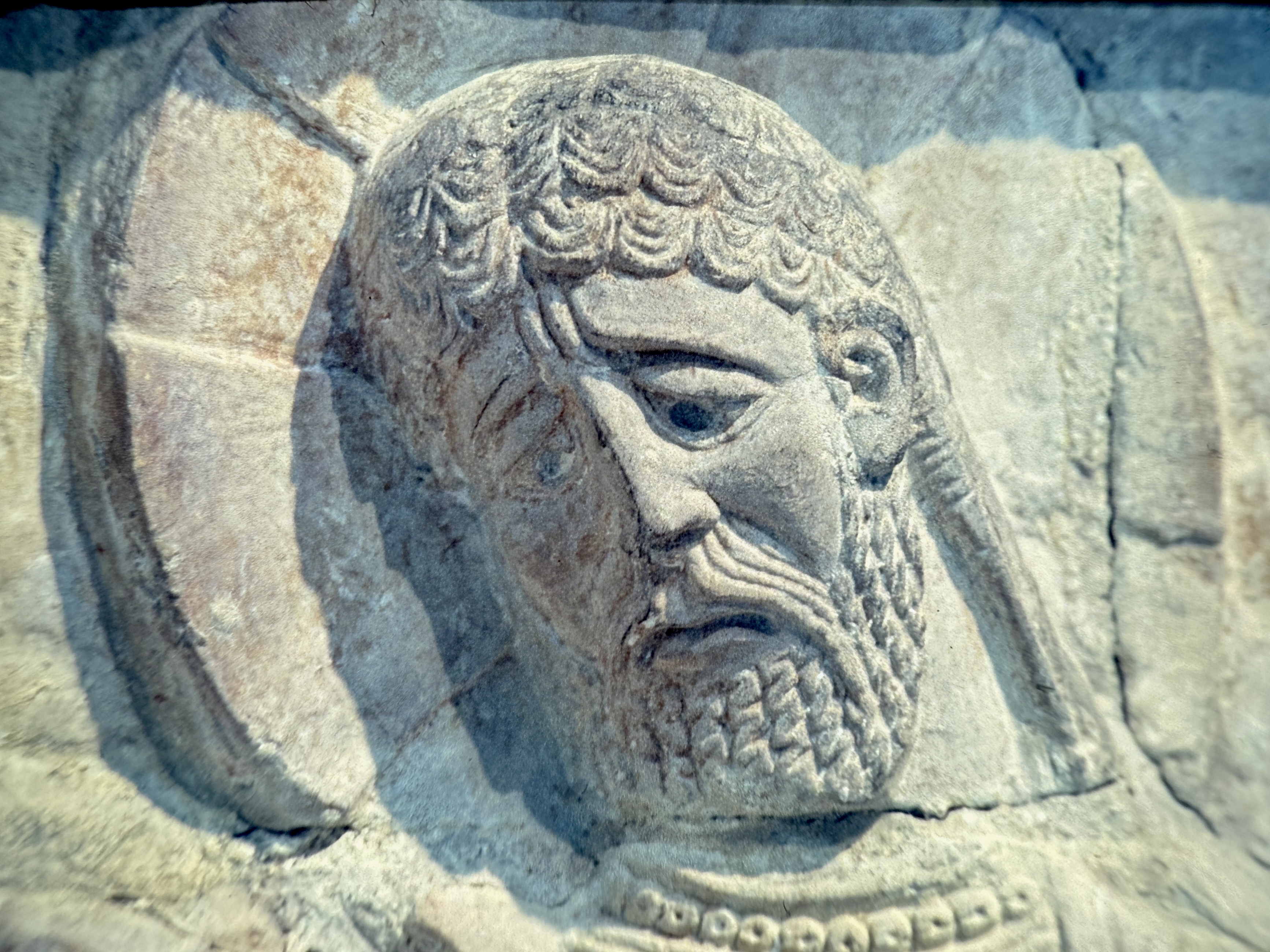
Jesus Wept (detail of the Raising of Lazarus, Chichester Cathedral, England, c. 1140).
We may imagine his sorrow at being so poorly represented by so-called followers.


[i] Neil MacGregor & Erika Langmuir, Seeing Salvation: Images of Christ in Art (New Haven & London: Yale University Press, 2000), 115.

[ii] https://www.vaticannews.va/en/pope/news/2026-04/pope-bamenda-woe-to-those-who-manipulate-religion-military.html

[iii] Michele Bacci, The Many Faces of Christ: Portraying the Holy in the East and West, 300 to 1300 (London: Reaktion Books, 2014), 106.


Marching for a Better World: A “No Kings” video from Seattle

Some of the people I saw along the way.

For the latest No Kings March to occur on the eve of Palm Sunday seemed to me a resonant conjunction. Both yesterday’s march and the “triumphal entry” of Jesus into Jerusalem stirred the deepest hopes of people suffering under oppressive regimes. Of course not all hopes are equal, and sometimes they turn out to be, as T. S. Eliot noted, “hope for the wrong thing.” Even if the folks shouting Hosanna in Jerusalem were mistaken about what God was up to that week, I imagine Jesus still being touched by their longing, that crazy feeling that the world might just get better. The capacity for hope is one of humanity’s finest qualities.

There is some irony, of course, in linking No Kings to a biblical event suffused in royal imagery. I’ve been singing the Palm Sunday processional, “All glory, laud, and honor to thee, Redeemer, King!” ever since I was a child. But God is no stranger to irony—manifesting divinity as a helpless child, “ruling” as a servant, and dying to give life. And a line by the late great songwriter Bob Franke neatly resolves, for me at least, any tension between democracy and religious language inherited from monarchists.

Well you kneel to the Lord and you will bless yourself;
Ain’t no need to kneel to no one else.

In a week when people of my tradition walk the Way of the Cross in ritual, song and story, we know that hope is no stranger to struggle and suffering. It’s a long and winding road to Easter, passing through Gethsemane and Golgotha. Yet it remains, as the Book of Common Prayer assures us, “none other than the way of life and peace.”

On yesterday’s march in Seattle, I shot video of what I saw, and in putting it together I was struck all over again by the recurrent note of joy. Not everyone would put it this way, of course, but for one gloriously sunny day, we were, as the South Africans sing, “marching in the light of God,” and the divine future of human flourishing made a significant incursion into the present moment. As the crowd chants in the opening of my video:

We are unstoppable!
Another world is possible.

No Kings March in Seattle (March 28, 2026)

What Jesus Said About Vultures

Turkey vulture.

In all my years as a priest, I had never preached on the apocalyptic imagery of Luke 17:26-37, where people disappear without warning and Jesus concludes with an unnerving proverb: “Where the corpse is, there the vultures will gather.” This is not ideal preaching material, but with the help of the Epistle reading, Hebrews 11:29—12:2, I gave it a try last Sunday.

Today’s gospel [i] has quite a punchline: “Where the corpse is, there the vultures will gather.” It’s got to be pretty low on the list of favorite Jesus quotes, but it certainly gets our attention.

A couple of weeks ago I was at a raptor show at the High Desert Museum in eastern Oregon. A variety of hawks, owls and vultures flew swiftly among the seated spectators, who were warned to stay very still lest we be mistaken for prey. I did my best not to be a target, but a turkey vulture came close enough to brush my head with its wing. Perhaps it was preparing me for this strange gospel verse.

Some scholars say Jesus was simply using a common folk expression in response to a question about discerning the times, meaning something like “where there’s smoke, there’s fire.” Such expressions have nothing to do with smoke or fire or vultures or corpses. They’re just colorful ways of making a point. Still, Jesus’ choice of such a grim illustration puts a sharp edge on his message. It certainly gets our attention. And where the enigmatic text is, there the scholars will gather.

Who is the corpse? they wonder. Who are the vultures? One interpretation suggests the corpse could represent ancient Palestine, with the rapacious vultures being the occupying army of Rome. The Book of Revelation, perhaps inspired by the vultures in the gospel text, imagined the raptors of midheaven being summoned to feast on the remains of the proud powers struck down by divine judgment. An even more fantastical interpretation identifies the sharp-eyed buzzards, who in fact can spot carrion from 3 miles away, as those perceptive disciples who gather to consume the Corpus Christi, the Body of Christ given to feed our deepest hunger.

Well, none of these images is going to qualify for a stained glass window. And the vulture verse is perhaps profitless for the preacher.

And yet, it leaves a haunting impression. It’s unlike anything else Jesus ever said, and its gruesome tone puts an exclamation point on his discourse of crisis. A world is dying, he says. Just as a world died in the days of Noah, or in the days of Lot—names which recall destructive narratives of flood and fire—so it is happening now. The times are in no way normal, Jesus warns his listeners. Anyone who pretends that is not true, who thinks we can just go on about our business as usual—eating and drinking, buying and selling, planting and building—well, they are in for a surprise.

Come gather ’round people
Wherever you roam
And admit that the waters
Around you have grown
And accept it that soon
You’ll be drenched to the bone
If your time to you is worth savin’
You better start swimmin’
Or you’ll sink like a stone
For the times they are a-changin’ [ii]

When we sang that song 60 years ago, we thought the times were changing for the better. And that was true in many ways. But the flood of changes washing over us today do not feel like something better. When Jesus speaks of people being snatched up and disappeared without warning, he could be describing what’s happening right now in “the land of the free.” To paraphrase Jesus’ metaphor, “As it was in the days of Dietrich Bonhoeffer—in 1930s Germany—so shall it be in our own time.”

I pray that this will not be our fate, but the fact that such an outcome is even conceivable is a measure of the times. It can happen here. So what are the friends of God to do? How do we start swimming so we don’t sink like a stone?

We are not the first believers to suffer the worst of times. The Epistle to the Hebrews is clear about that. History isn’t always about the lilies of the field. It has its corpses and vultures as well.

But as the author of Hebrews insists, the faithful believe in the victory of God, and they act out that faith with their bodies. Some of God’s friends have “received the test of mocking and whipping and even chains and prison. They were stoned, cut apart in a slaughter; they died upon a sword. They traveled around in ragged clothing, impoverished, oppressed, afflicted.” But for all they suffered, those who kept the faith “subdued monarchies, did the work of justice … shut the mouths of lions, quenched mighty fires …” (Hebrews 11:29-12:2)

As people baptized into the Paschal Mystery, we understand that dying and rising, defeat and victory, are deeply intertwined. You can’t have one without the other.

When certain medieval women mystics contemplated the cross in prayer and vision, they saw not the triumph of death, but a kind of birth. For them the crucified Jesus was like a woman in labor, enduring pain and travail in order to bring us all to birth: 

Ah! Sweet Lord Jesus Christ, who ever saw a mother suffer such a birth! For when the hour of your delivery came you were placed on the hard bed of the cross and … in one day you gave birth to the whole world.” [iii]

To behold the death of Christ and call it birth is the central act of Christian imagination. It is why we declare victory at the cross. We don’t wait for Easter Sunday. We declare victory at the cross because the Passion isn’t just a story about the violent powers that always trample the weak and kill the prophets. It’s also a story about the Realm of God, where dry bones breathe and lost hopes dance, where the prodigal is welcomed home and the tears are wiped from every eye.

The Love that creates such a realm was nailed to a cross, but the cross did not consume it. Yes, death did what death does, but then God did what God does. And Love won. This is the story we belong to, and on the outcome of that story, we stake everything.

That is why we are here this morning. That is why we refuse to retreat to our private worlds, why we continue to gather in community at our Savior’s table: to nurture hope, shelter love’s flame, encourage one another, strengthen our hearts for service, eat the bread of life, pray without ceasing, sing our Alleluias and grow ever more fully into the visible, tangible body of Christ.

We are not alone in this journey. We are surrounded by a cloud of witnesses, all those ancestors in the faith, from Abraham and Sarah and Mary and Luke right on down to the wise and loving mentors we’ve known in our own lives, who have taught us how to walk in the Way of life and peace.

I once heard a preacher describe the cloud of witnesses as “the balcony people” who are looking down and cheering us on as we run the race that is set before us. It’s a wonderful and resonant image. I’m sure that each of you has some very special people in that balcony, shouting their encouragement. Listen. You can hear their voices echoing through the years.

St. Luke, pray for us … St. Mary, pray for us … St. Francis, pray for us … Oscar Romero, pray for us … Dorothy Day, pray for us … Mom and Dad, pray for us.  

Last Sunday I was in Eugene for the National Track & Field Championships, and in the men’s 800 meters I witnessed one of the most stunning moments in the history of middle-distance racing. A 16-year-old high school sophomore named Cooper Lutkenhaus had qualified for the elite competition by breaking the 29-year-old high school record, running the distance in 1:45. And after stumbling and almost falling in his first race at the championships, he managed to survive the first two rounds.

Much to his surprise, he had made the final. But with some of the world’s top 800 meter runners in the race, no one expected him to be anywhere close to the top three who would earn a trip to the World Championships in September.

Rounding the last turn, Cooper was doing really well for a 16-year-old, in  sixth place out of nine racers, 10 meters behind the leader. Then, in the last 100 meters, he passed one runner, and another, and another, and another, to cross the line in second place. His time was 1:42.27, not only a personal best by an unbelievable 3 seconds, but the 18th-best all-time and the fourth-best ever by an American.

Donavan Brazier, Cooper Lutkenhaus, and Bryce Hoppel finish 1-2-3 in the 2025 U.S. Track & Field Championships in Eugene, Oregon.

Now I’ve been at a noisy NBA final with Kareem and Magic and Larry Bird. I’ve been deafened by the 12th man [iv] at a Seahawks game. But the sound of the crowd cheering on young Cooper Lutkenhaus blew my ears off. The cloud of witnesses.

When we run the race that is set before us, there will be times when our lungs burn and our legs scream with lactic acid. There will be the races that disappoint, and workouts that feel listless or discouraging. We may even stumble and fall, more than once.

But always, always, the cloud of witnesses is cheering us on. They know from their own experience what the race is like. They all had their own moments of weakness and doubt. They became acquainted with suffering by training hard every day. They all had to learn how to get up after every fall, lay aside every weight, gulp the breath of the Spirit, and accept pain as the runner’s companion.

I’ve done my own share of racing, and when the pain comes, I try to greet it as a friend. “Hello, brother pain. I knew you’d show up. Well, here we go. I know you’re not going to kill me, right?. We’ll just take it step by step.”

“Even the fittest may stumble and fall (Isaiah 40:31). As Roisin Willis and Maggi Congdon finish 1-2 in the women’s 800 meters at the U.S. Championships, Sage Hurta-Klecker dives for the third and final spot on the World Championship team. In previous years, she had missed out on a championship podium twice due to falls, but this time her fall was a triumph. She made the team.

The perpetual contest between weariness and perseverance is familiar to every athlete—and every saint. You’re going to get tired. You’re going to get discouraged. You may faint and fall. But keep your eyes on the prize, hold on. On both good days and bad, you’ve got to put in the work, “lay aside every weight,” surrender to a power and a strength that is not your own, and stay in the flow.

I began with a raptor image, so let me close with another. This time it’s not a vulture, but an eagle, in a beautiful passage from the prophet Isaiah:

Even the youthful may faint and grow weary, 
even the fittest may stumble and fall,
but those who wait for the Lord shall renew their strength, 
they shall mount up with wings like eagles, 
they shall run and not be weary,
they shall walk and never grow tired. [v]

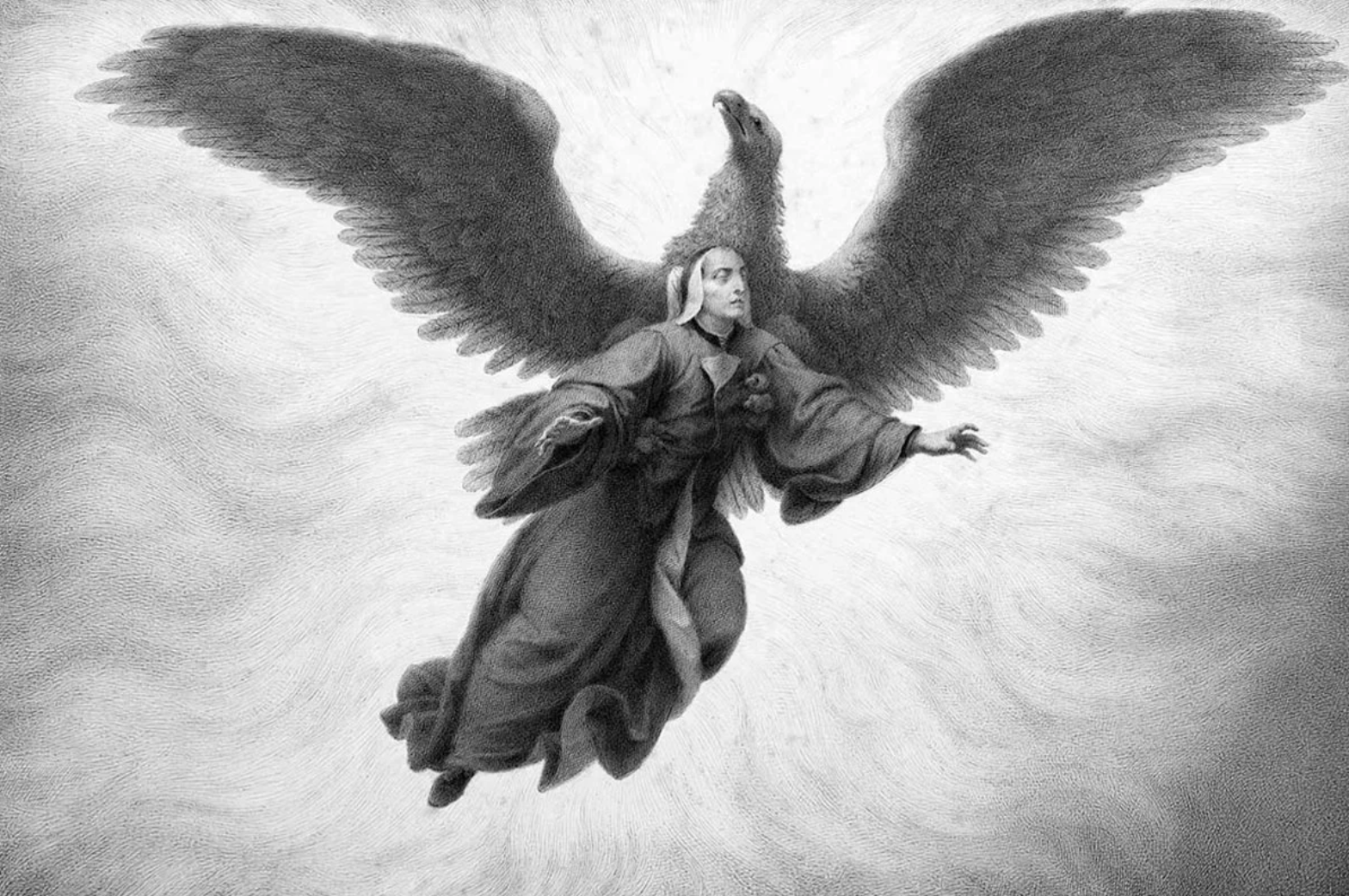
Francesco Scaramuzza, Dante and the Eagle (c. 1860). The sleeping Dante dreamed he was carried by an eagle, but it was really St. Lucy who helped the poet on his upward journey toward heaven’s light (Purgatorio ix).


This homily was preached at St. Luke’s Episcopal Church, Renton, WA, on the 9th Sunday after Pentecost, 2025.

Race photo and video by the author.

[i] The texts for the 8th Sunday after Pentecost are in Wilda C. Gafney, A Women’s Lectionary for the Whole Church, Year C, which differs significantly for the Revised Common Lectionary used by most liturgical churches.

[ii] Bob Dylan, “The Times They Are A-Changin’” (1964).

[iii] Marguerite d’Oingt (d. 1310).

[iv] The loudest crowd in professional football is in Seattle, where the fans are called “the 12th man” for their ability to influence the game by making it hard for the other team to hear their quarterback’s signals.

[v] Isaiah 40:30-31.

Three-in-One : One-in-Three

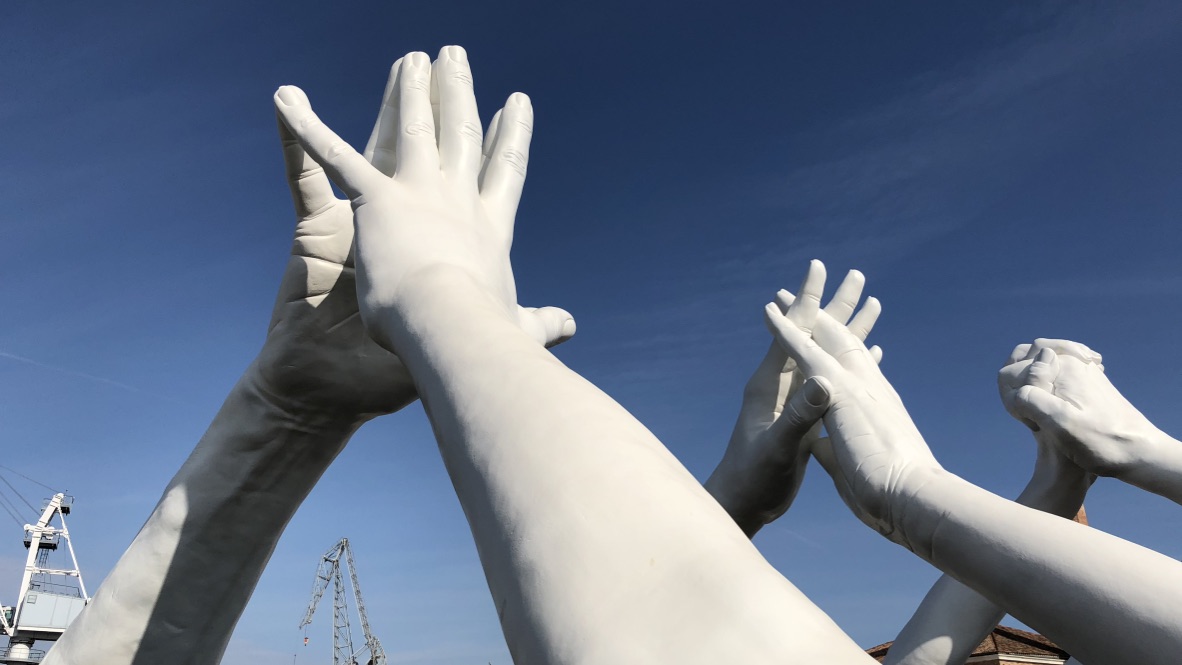
Lorenzo Quinn, Building Bridges (Venice Biennale 2019)

Sermon for Trinity Sunday 2024 at St. Barnabas Episcopal Church, Bainbridge Island, Washington

From late autumn to late spring, Christian liturgy takes us on a ritual journey through the gospel narrative, from the Incarnation and Epiphany of Christ to the dramatic finale of Passion, Resurrection, Ascension and Pentecost.This great sequence concludes with Trinity Sunday, which serves as a kind of epilogue.

The abrupt shift from the engaging world of story to the tangled thicket of doctrine can be a bit of a shock. It’s like going directly from a seminar in English literature to a class in advanced calculus. Our hearts sink and our heads explode. But fear not. The Trinity is no dreary abstraction. Nor is it a matter, as Lewis Carroll might say, of believing three impossible things before breakfast. We are not here to solve once and for all the puzzle of Three-in-One and One-in-Three. We are here to adore the mystery.

The first Christians were not inventive theorists speculating about the divine nature of a generic God. They were the friends of Jesus trying to make sense of the concrete, experiential data of salvation, beginning with the dramatic biblical events they had lived through and continuing to unfold in the common life of their believing communities. Their profound experiences of Jesus and the Holy Spirit had shaken the foundations of their monotheistic faith, and they were trying to sort out the implications.

Jesus and the Spirit had done for them what only God can do: heal, save, sanctify—even vanquish the power of death. Did that make Jesus and Spirit divine? And if so, what did that multiplication of divine persons do to their belief that God was one?  Jesus had told them, “I and the Father are one.” But it would take centuries to agree on what he meant.

Without losing the unity of God, how could the early Christian community account for the divine diversity revealed in the saving activities of Christ and the Spirit?

Once they began to call Jesus Kyrios (Lord), which happened very early in their worship and their storytelling, traditional monotheism was radically destabilized. The growing perception of the Holy Spirit as a guiding and empowering presence of deity in their communities only compounded the problem.

There were various attempts to solve the issue by downgrading Jesus and Spirit to subordinate, derivative, or semi-divine realities, by no means equal to the eternal and uncreated God. Such “heresies” were popular with those who wanted to keep God simple. But “orthodoxy” was unwilling to deny the fullness of divinity to either Christ or the Spirit. For them the bottom line was this: 

Only God can save us. Christ and Spirit, in the biblical revelation and Christian experience, are integral and essential to salvation. Therefore, they must be “of one substance with the Father.” That is to say, the Persons are all equally integral to the divine reality: God above us, the source and ground of all being; God with us and among us, the companion who is our way, our truth, and our life; and God within us, the energy and vitality of our deepest self. As the theologians put it:

“The Trinity is an account of God that says these are [each] irreducible and indispensable dimensions of the same reality, not different ones, and yet each has its own irreducible integrity.” [i]

And so, a trinitarian faith became foundational for the Christian understanding of divinity: God in three persons, blessed Trinity. But the inherent tension between the one and the three remains to this day. Human thought and human language can’t quite manage to think both things at the same time. It’s like waves and particles. Gregory of Nazianzus, one of most influential shapers of the fourth-century trinitarian consensus, admitted the futility of trying to corral the mystery with concepts. He suggested that we just go with the divine flow:  

“I cannot think of the One without immediately being surrounded by the radiance of the Three; nor can I discern the Three without at once being carried back into the One.” [ii]

In an amusing caricature of crudely literal images of the Three-in-One, British theologian Keith Ward imagines three omniscient individuals trying to have a conversation:

“I think I’ll create a universe,” says one. “I knew you were going to say that,” says the second. “I think I’ll create one as well,” says the third. “Well, it had better be the same as mine,” says number one. “You already know that it is,” says number two. “I knew you were going to say that,” says number three.[iii]

If we have difficulty with “God in three Persons,” it is because we think of a person as defined by his or her separateness. I’m me and you’re you! We may interact and even form deep connections, but my identity does not depend upon you. I am a self-contained unit. You can’t live in my skin and I can’t live in yours. That’s the cultural assumption, which goes back at least as far as Descartes in the seventeenth century and continues today in such debased forms as rampant consumerism and economic selfishness, where my needs and my desires take precedence over any wider sense of interdependence, community, or ecology.

But what we say about the Persons of the Trinity is quite different. Each Person is not an individual, separate subject who perceives the other Persons as objects. The Trinitarian persons experience one another not from the outside, but from the inside. They indwell each other in a mutual interiority.

But if the divine Persons are all inside each other, commingled, “of one being,” as the Creed says, what makes each Person distinct? To put it succinctly: the Persons are distinct because they are in relation with one another. No Father unless there is a Son. No Son without a Father. No Holy Spirit without Father and Son.

As Martin Buber observed, we are persons because we can say “Thou” to someone else. To be a person is to experience the difference – and the connection – that forms the space between two separate subjects. My consciousness is not alone in the universe. There are other centers of consciousness: Thou, I… Thou, I… The fact that you are not I is what creates self-consciousness, the awareness of my own difference from what is outside myself.

If we apply this to the Trinity, we say that there are Three Persons because there is relation within God, relation between the Source who begets, the Word who is begotten, and the Spirit who binds the two together and moves them outward in ever widening circles.

These relations are not occasional or accidental. They are eternal. There is an eternal sending within God, an eternal self-giving within God, an eternal exchange by which God is both Giver and Receiver simultaneously. God is Love giving itself away – self-emptying, self-diffusing, self-surrendering – and in so doing finds itself, receives itself, becomes itself. A French mystic put it this way: “it’s a case of un ‘je’ sans moi” (an “I” without a me).

Wallace Stevens wrote a poem about the process of giving ourselves over to a larger whole. He called it “the intensest rendezvous,” where we find ourselves drawn out of isolation “into one thing.” He wasn’t writing about the Trinity, but his words come as close as any to describing the essential dynamic of the divine Persons:

       Here, now, we forget each other and ourselves.
      We feel the obscurity of an order, a whole,
      A knowledge, that which arranged the rendezvous.[iv]

As Orthodox theologian John D. Zizioulas says in his influential text, Being as Communion, “To be and to be in relation are the same thing for the divine life … Therefore if Trinity is our guide, the most fundamental definition of being we can give is person-in-communion … The being of the one divine nature is the communion of the irreducibly different persons; the being of the individual persons is constituted by their relations with each other.” [v]

God is not a simple, static substance but an event of relationships. That’s why we say that God is love. “To be” has no ontological reality apart from “to be in relationship.” In the words of Anglican priest John Mbiti of Kenya, expressing the strongly communal mindset of African theology, “I am because we are, and since we are, therefore I am.” [vi]

Each Person contains the others and is contained by them in a shared communion of self-offering and self-surrender. But that continuous self-offering is never a one-way transaction, either one of self-emptying or one of being filled. It is always both at once – giving and receiving – as we ourselves know from our own mutual experience of love at its best. 

Trinitarian faith describes a God who is not solitary and alone, a God who is not an object which we can stand apart from and observe. The Trinity is an event of relationships: not three separate entities in isolation and independence from one another, but a union of subjects who are eternally interweaving and interpenetrating

This divine relationality is not something which an originally solitary God decided to take up at some point. God is eternally relational. Before there was an external creation to relate to, God’s own essential self was and is an event of perpetual relation. There was never simply being, but always being-withbeing-forbeing-in. To be and to be in relation are eternally identical.

When the Bible says, “God is love” (I John 4:16), it means that love is not just something God has or something God does; love is what God is.

As John Zizioulas puts it, “Love as God’s mode of existence … constitutes [divine] being.”[vii] Feminist theologian Elizabeth Johnson echoes this when she says, “being in communion constitutes God’s very essence.” [viii]  In other words, God is Love giving itself away—self-emptying, self-diffusing, self-surrendering—and in so doing finds itself, receives itself, becomes itself. The theologians of late antiquity borrowed a word from the arts to describe this process: perichoresis, which means to “dance around.”

Trinity is a dance, with Creator, Christ and Spirit in a continuous movement of giving and receiving, initiating and responding, weaving and mingling, going out and coming in. And while our attention may focus at times on a particular dancer, we must never lose sight of the larger choreography to which each dancer belongs: the eternal perichoresis of Three in One, One in Three.

As Jesus said, “losing” yourself and “finding” yourself are equivalent and simultaneous. In giving ourselves away, we receive ourselves back. This may be counterintuitive to the modernist mindset of autonomous individual self-possession, but it is the essence of communion: “a giving of oneself that can only come from the ongoing and endless reception of the other.” [ix]

If we had the space, I would invite you now to dance the divine perichoresis with your own bodies. We would join hands, circle round, spiral inward, weave in and out of the arches and tunnels of upraised arms, and manifest with our bodies the divine fullness of the Holy Trinity, which has been described as an “interdependence of equally present but diverse energies … in a state of circumvolving multiplicity.” [x] And thus we would, both symbolically and in fact, participate in the divine reality of “reciprocal delight” [xi] which transpires not only in heaven, but “on earth as it is in heaven.”

There are no spectators in the Trinitarian dance, which is always extending outward to draw us and all creation into its motions. As Jürgen Moltmann said, “to know God means to participate in the fullness of the divine life.” [xii] 

It’s not a matter of our trying to imitate the relational being of the loving, dancing God, as if we were inferior knock-offs of the real thing. God wants us to become ourselves the real thing. God wants to gather us into the divine perechoresis as full participants in the endless offering and receiving, pouring out and being filled, which is the dance of God and the life of heaven.

And while our dance with God has its mystical, mysterious, transcendent dimensions, it is also very concrete and specific to our historical life on this earth. The divine life of communion and self-diffusive love is the only antidote for the poisonous hatreds of this fearful age.

Because we ourselves are made in God’s image, who God is matters deeply, both for our own self-understanding and for our engagement with the world. The Trinity isn’t only God’s life. It is ours as well. It’s the shape of every story, the deep structure of the church, and the foundational pattern of reality.

Because God is communion, the eternal exchange of mutual giving and receiving, then God’s Church must live a life of communion as well. When Love’s perechoresis becomes our way of being in the world—as believers, as church—the Trinity is no longer just doctrine or idea. It is a practice, begetting justice, peace, joy, kindness, compassion, reconciliation, holiness, humility, wisdom, healing and countless other gifts. As theologian Miroslav Volf has said, “The Trinity is our social program.” [xiv]

The dance of Trinity is meant
For human flesh and bone;
When fear confines the dance in death,
God rolls away the stone. [xv]

The Church exists to participate in the liberating life of God, and to enable others to do the same. We exist to make divine communion not just an inner experience but a public truth. We don’t just feel God’s perichoresis. We don’t just feel Love’s eternal dance. We embody it. We live it. We show it. We share it.  

As the great Anglican preacher Austen Farrer put it so clearly a century ago:

“It is not required of us to think the Trinity.
We can do better; we can live the Trinity.” [xvi]


Photographs by the author.

[i] S. Mark Helm, The Depth of the Riches: A Trinitarian Theology of Religious Ends (Grand Rapids, MI: Eerdmans, 2003), 132.

[ii] Gregory of Nazianzus, q. in Karen Armstrong, The Case for God (New York: Knopf, 2009). 116-117.

[iii] Keith Ward, God: A Guide for the Perplexed (Oxford: Oneworld Publications, 2003), 235.

[iv] Wallace Stevens, “Final Soliloquy of the Interior Paramour,” Collected Poetry and Prose (NY: Library of America, 1997), 444.

[v] John D. Zizioulas, Being as Communion: Studies in Personhood and the Church (Crestwood, NY: St. Vladimir’s Seminary Press, 1993), 46.

[vi] quoted in Veli-Matti Kärkkäinen, The Trinity: Global Perspectives (Louisville: Westminster John Knox Press, 2007), 352.

[vii] Zizioulas, 46.

[viii] Elizabeth Johnson, She Who Is: The Mystery of God in Feminist Theological Discourse (NY: Crossroad, 1993), 227.

[ix] Graham Ward, “The Schizoid Christ,” in The Radical Orthodoxy Reader, ed. John Milbank and Simon Oliver (NY: Routledge, 2009), 241.

[x] David Bentley Hart, The Beauty of the Infinite: The Aesthetics of Christian Truth (Grand Rapids: Eerdmans 2003), 114.

[xi] St. Athanasius (c. 296-373), a bishop in Roman Egypt, was a key defender of Trinitarianism. 

[xii] Jürgen Moltmann, The Trinity and the Kingdom: The Doctrine of God, trans. Margaret Kohl (San Francisco: Harper & Row, 1981), 152.

[xiii] Richard Leach, “Come Join the Dance of Trinity.”

[xiv] Miroslav Volf, “‘The Trinity is Our Social Program’: The Doctrine of the Trinity and the Shape of Social Engagement,” Modern Theology 14, no. 3 (July 1998).

[xv] Leach.

[xvi] Austin Farrer, The Essential Sermons (London: SPCK, 1991), 78.