Bushy the Squirrel: A Justice Parable

My father, an Episcopal priest and producer of Christian media, made a series of filmstrips called Parables from Nature in the 1950s. Based on a children’s book by John Calvin Reid, they retold the parables of Jesus using characters from the natural world. One of these was “Bushy the Squirrel,” inspired by Luke 12:13-21 (the Lectionary gospel for Proper 13, 8th Sunday after Pentecost). The illustrations were painted by Hollywood animation artists, and some of them are included here.

Once upon a time there was a squirrel named Bushy. He was a fine little squirrel, but as he grew older everyone began to notice a change in him. All he cared about was gathering nuts. Every day you could hear his voice ringing through the forest: “Gotta get more nuts! Gotta get more nuts!”

As soon as he stored the nuts he had found, he’d run off to find some more. “This is not enough. Gotta get more! Gotta get more!” Bushy was so obsessed with getting more nuts, he drove all his friends away. And when anyone came to his door collecting for the needy, he just said, “Aw, don’t bother me now. I’m too busy getting nuts.”

After a while, he had so many nuts, he needed a bigger place to put them. And one day he saw an old hickory tree with a big hole in it. It was perfect. But some woodpeckers had made their home in that tree. That didn’t stop Bushy. He kicked the woodpeckers out, and filled the tree with nuts.

Bushy’s neighbors had a hard time finding any nuts left for them to eat. But Bushy didn’t care. He had what he needed. The other squirrels were not his problem.

When winter came, Bushy relaxed in his tree, the happy owner of all those nuts. He didn’t have a care in the world.

Then one night, when he was fast asleep, a wind began to blow, and the wind was so powerful, it broke his tree in half and sent Bushy tumbling into the lake.

“Help me! Help me!” Bushy cried. Mr. Bear heard the shouts, and called the other animals of the forest to the rescue. Suddenly Bushy found that he was not the only person in the world – luckily for him! He needed the others and they needed him.

Bushy’s heart was changed by his experience, and he became a new squirrel, sharing everything he had with anyone who needed it.

The story of Bushy is like a parable Jesus told: There was once a rich man who had a problem. He had too much stuff and didn’t know where to put it all. So he built bigger and bigger storage units. But that didn’t solve his problem, because his appetite for acquisition could never be satisfied. “Gotta get more nuts, gotta get more nuts!”

So is Jesus trying to be Marie Kondo here? Is he offering a useful method of self-help so we can reduce our clutter and make our lives more beautiful and satisfying? Is that why he tells this story––to foster self-improvement? Or is he doing something more radical, more demanding?

What if Jesus had said, “This story is not about you––it’s about us. It’s a story about the foolishness of trying to live as though ‘I’ am the only person in the world. It’s a story about the foolishness of being oblivious to community.” Well, he didn’t say those words, of course. He just told the story, trusting us to have ears that hear.

A certain rich man’s lands brought forth bountiful crops. And he deliberated within himself, saying, “What shall I do, since I do not have a place where I may gather my fruit?”

He deliberated within himself” is a telling image of isolation, suggesting a self utterly cut off from other voices, other perspectives. And notice how he seems surprised by the size of the harvest. As a rich man, he would already possess considerable storage space. But this harvest is bigger than he ever expected or imagined. And when the Bible talks about abundance that is excessive and surprising, that usually means one thing: God is involved, showering down blessings.

A first century listener, steeped in the stories of God’s miracles of generosity, would have picked up on this. And they would have noticed that the rich man’s first response is not one of gratitude or wonder. Does the rich man thank the Creator for the miraculous harvest? Does he laugh in wonder at such a gift? No. His first thought is, “I’ve got a problem. Where am I going to put it all?”

Then he gets an idea:

“I will do this: I will tear down my granaries and build larger ones, and I will gather there all my grain and all my goods and I will say to my self, ‘Self, you have many good things stored up for many a year. Eat, drink, and be merry!’”

In a world full of hungry people, here’s a man who has more than he knows what to do with, and it never occurs to him that he could feed all those hungry people.

As hunger experts point out, hunger is not a problem of supply; it’s a problem of distribution. But distribution is the last thing on this man’s mind. He isn’t just ignoring other people. He seems oblivious to their existence. He is the perfect expression of rampant individualism – untroubled by any sense of interdependent community.

The story makes fun of his isolationism, by having him talk only to himself.

“I will say to myself, ‘Self, you have many good things…”

A narrator would say something like: “Then the man said to himself, ‘Self, you have many good things…’” Instead, the rich man takes over his own narration: “I will say to myself, ‘Self …” and so on. Do you see the difference? This guy doesn’t need anyone, even a narrator. He takes over the telling of his own story. He’s in control, totally self-sufficient.

Whatever the future may bring, he can deal with it, no problem. Just kick back and “eat, drink, and be merry.”

Isn’t this the ideal to which consumerism aspires? Those of us with enough money can acquire everything we need to be self-sufficient. The fundamental unit of our culture is not the tribe or the village, but the single family home. We each have our own rooms, our own food supply, our own car, our own entertainment center, our own set of tools and appliances, our own insurance policies.

The only reason we need to leave the house is to earn the cash in order to maintain the autonomy of our domestic units. If we get rich enough, we don’t even have to do that.

The whole trajectory of the consumerist dream is to declare our independence from the traditional supportive networks of extended family and neighborhood community.

Vincent Miller, a Catholic ethicist, points out that the cash demands of the single family home encourage people to act selfishly:

“Social isolation and the burdens of maintaining a family in this system make it unlikely that other people’s needs will ever present themselves. If and when we do encounter them, we are likely to be so preoccupied with the tasks of maintaining our immediate families that we will have little time and resources to offer. The geography of the single-family home makes it very likely that we will care more about the feeding of our pets that about the millions of children who go to bed hungry around us.” [i]

When we live in isolation from one another, when we fail to nurture the vital aspects of interdependent community, we minimize the ways in which we can either offer help or receive it. Even if we have all the goodwill in the world, we remain trapped within the cash-intensive demands of the consumerist dream. “Gotta get more nuts!”

Ideally, a local church can function as a support system for its members. If someone gets sick or has a family emergency, others in the community step up to provide meals and other forms of assistance. But this kind of support system is exceptional in a society based largely upon isolated autonomous households.

If you don’t have the cash to keep a roof over your head, there is no village to take you in. Maybe you have some relatives somewhere, but they’re probably scattered around the country. And they’re probably running on a tight budget themselves, and don’t have any spare rooms. We’re a long way from the traditional support systems of former times and simpler cultures. Just ask the homeless to tell you their stories.

In American mythology, this is the country of the Lone Ranger, the self-made entrepreneur, the hard-boiled detective with no attachments, or the trucker rolling down that endless highway, free as a bird––and lonesome as hell.

When vast numbers of Vietnamese refugees settled in southern California in the 1970s, they found American culture to be fatal for something they had always taken for granted: the supportive network of extended family. They had to learn, as one writer puts it, that the land of the free means “the perfect freedom of strangers.” [ii]

So Bushy the Squirrel, and the rich man with the storage problem, might be seen as the products of a consumer culture. They don’t need neighbors. They don’t need community. They’ve got everything they need close at hand. There’s nothing for them to do but eat, drink and be merry.

But then what happens? Just when Bushy settles in for a long sleep, a storm breaks open his tree and casts him into the raging waters. In the Bible, whenever something breaks open your neat little world, you can be pretty sure that God is in that storm.

But in Jesus’ parable of the rich man, God intervenes even more explicitly, not with a storm but with words. God speaks to the rich man. In fact, this is the only one of Jesus’ stories where God appears as a character within the story.

And what does God say to the rich man? “Fool!” God says. “Fool!” Now that’s something to wake up your prayer life––to hear God calling you a fool.

Do you remember the most famous use of the word “fool” in the Bible? It’s in the first verse of Psalm 14: The fool says in his heart, ‘There is no God.’  The fool is the one who denies God’s presence, who thinks he or she can grab the gift without acknowledging the Giver––or the Giver’s way, which is not the self-possession of me/myself/and I, but rather a ceaseless pouring out of self.

“Fool, on this night they will demand your life from you.
And all the stuff you have stored up, to whom will it belong?”

In an instant––“this very night”––the rich fool discovers that his autonomous life is not only unstable––it is unsustainable.

He had thought that life was a commodity that could be owned and held onto. But he discovers that God operates a very different kind of economy. God’s economy, which we call the Kingdom of God, is a gift economy, where everything is received and nothing can be held onto.

Everything is like the air we breathe. We take it in, we receive the life it gives us, and then we give it back again. Breathe in, breathe out; receive, give back.

A commodity-based economy is an attempt to hold your breath. You take possession of God’s gifts, you take them out of circulation, you lock them away where others can’t use them.

Whereas a gift always keeps moving from hand to hand, a commodity is grasped and hoarded. And to grasp and to hoard is to live outside of God’s economy, where the gifts are always in circulation, always being given away as fast as they are received. If you reject God’s gift economy, and try to live apart from the interdependent circulation of life’s gifts, you are in effect denying the Trinitarian reality––the eternal self-offering, the ceaseless circulation of gifts, that comprises the heart of God.

That is why the Bible insists that if you try to live as though you were the only person in the room, if you try to exempt yourself from interconnectedness and interdependence, from the need to both give and receive, then you are indeed a fool, trying to live against the way we are made to be as images of the divine reality.

The divine reality is a circulation of gifts. When you are oblivious to the presence of your neighbor, you are oblivious to God as well. When you deny communion, you deny God.

On this night they will demand your life from you.

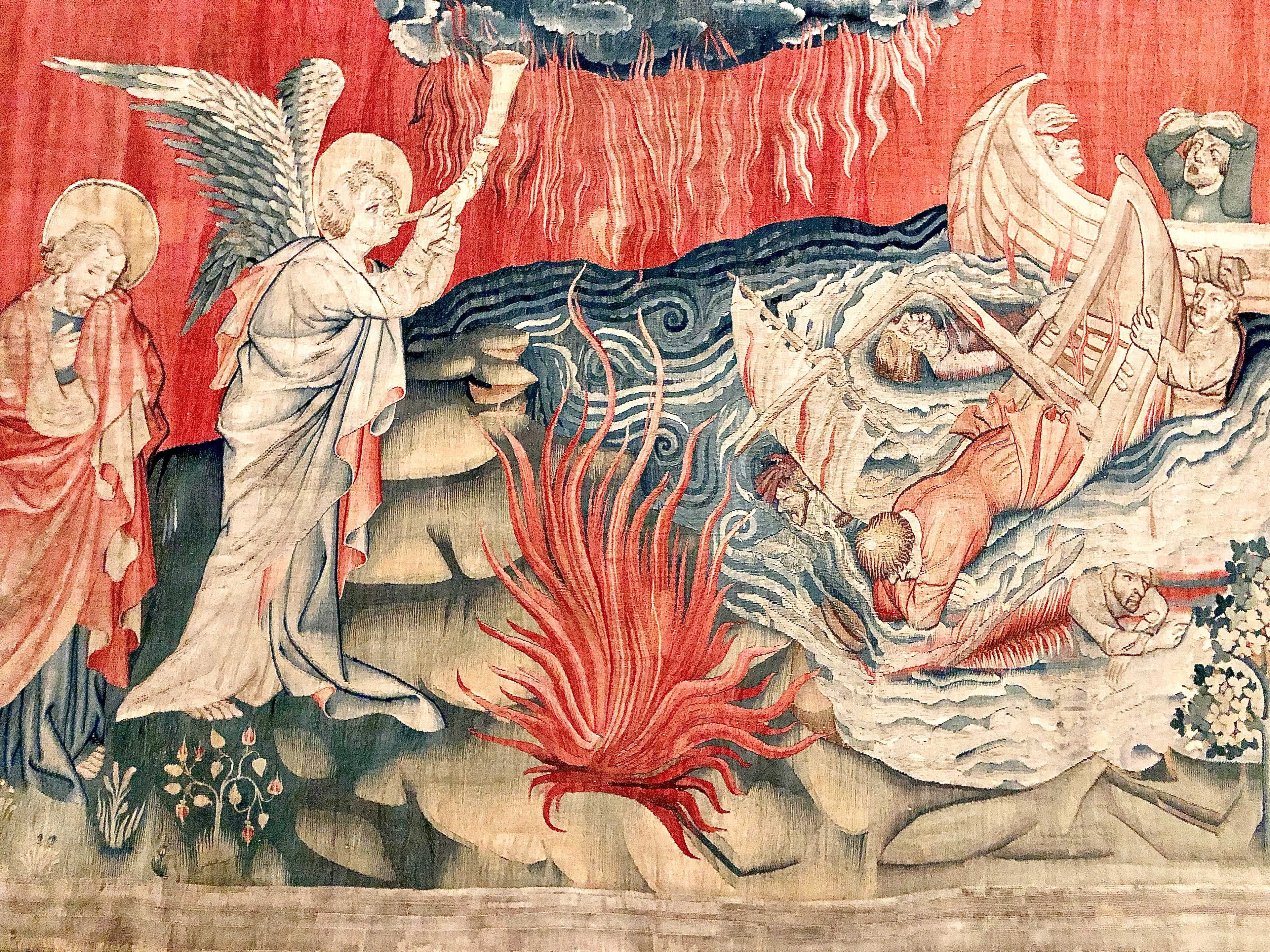
Most translations use the passive voice: “your life will be demanded of you.” But the original Greek verb is in the active third person plural: “They will demand your life from you.” So who might “they” be? The plural language could be a remnant of archaic mythological imagery, a way of speaking about death as the operation of avenging spiritual powers. But this is not really that kind of story. It’s not steeped in old-fashioned apocalyptic imagery like the Book of Revelation. For all we know the rich man dies in his sleep, without any thunder from heaven.

But what if the “they” who demand his life refers to everyone else in the world, all those neighbors whose existence has been ignored by the rich fool? Other people didn’t exist for him. He took what belonged to his fellow beings and kept it for himself. Now they want it back. As the story puts it, they “demand” his life. Is this punishment, or just a realistic understanding of how God’s universe works?

The story does not have God say, “I will demand your life…” The man’s fate is not an apocalyptic intervention from heaven. It’s simply the way things are in an interdependent reality.

The rich man tried to live outside the way of things, outside the economy of God, and in the end it all caught up with him. In the gift economy in which we live and move and have our being, he discovered that you have to keep the gift moving. You have to give everything away, even your very life.

The parable ends with a question:

What will become of everything that you have stored up?
To whom will it belong?

The question is being posed to the rich man in the parable. But it is also being posed to us. To whom does our wealth belong? Not just our money and our stuff, but every good gift we have been given since God put us on this earth, including our souls and bodies, and every breath we take––to whom does all this belong?

In a country plagued with obscene economic inequality, where the rich and powerful will even take food from the mouths of children to gather more wealth for themselves, how shall we respond to this parable? How do we answer its disturbing question?

Maybe greed is normal now. Maybe selfishness is normal now. Maybe crushing the poor and killing the planet for profit are normal now. But Jesus came to tell us that such things are decidedly not normal––not in God’s world. And we would be fools to think otherwise.

In my father’s filmstrip, Bushy learns his lesson and repents of his selfish ways. Its happy ending was meant to encourage the children who watched it in Sunday School. But Jesus concludes the original parable more ambiguously. He leaves us hanging, without knowing the ultimate fate of the rich man.

I suspect that Jesus is inviting us to finish the story ourselves, to construct a happy ending out of our own actions, as we work together to create a world whose blessings are not hoarded, but freely shared; a world where no need goes unmet, and all God’s children can flourish and thrive.

God, bring that day closer!


[i] Vincent J. Miller, Consuming Religion: Christian Faith and Practice in a Consumer Culture(New York, Continuum, 2004), 50.

[ii] Lewis Hyde, The Gift: Creativity and the Artist in the Modern World(New York: Vintage Books, 1979), 88.

This homily for Proper 13, Year C, will be preached August 4, 2019, at St. Barnabas Episcopal Church, Bainbridge Island, Washington.
Lamentation for Notre Dame

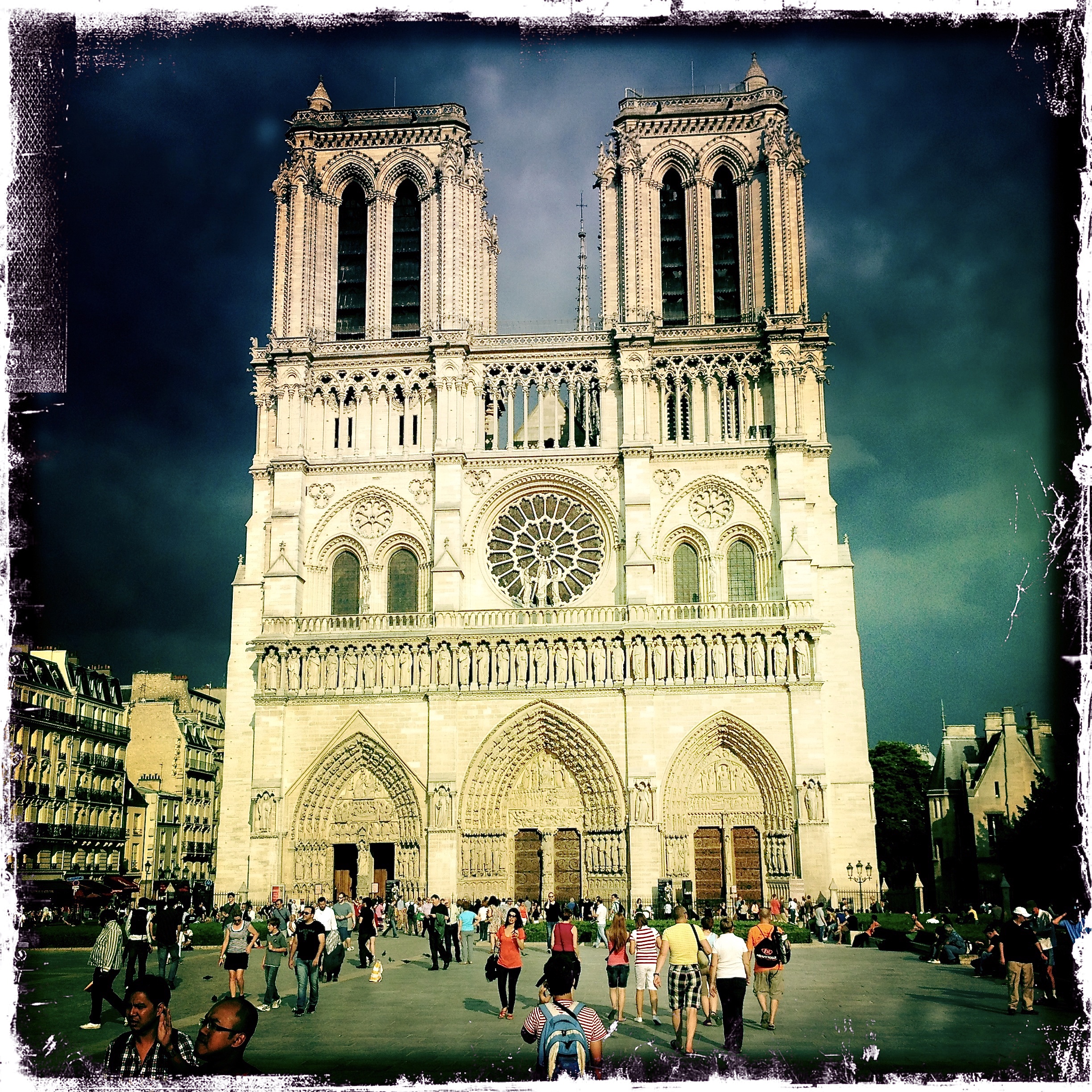
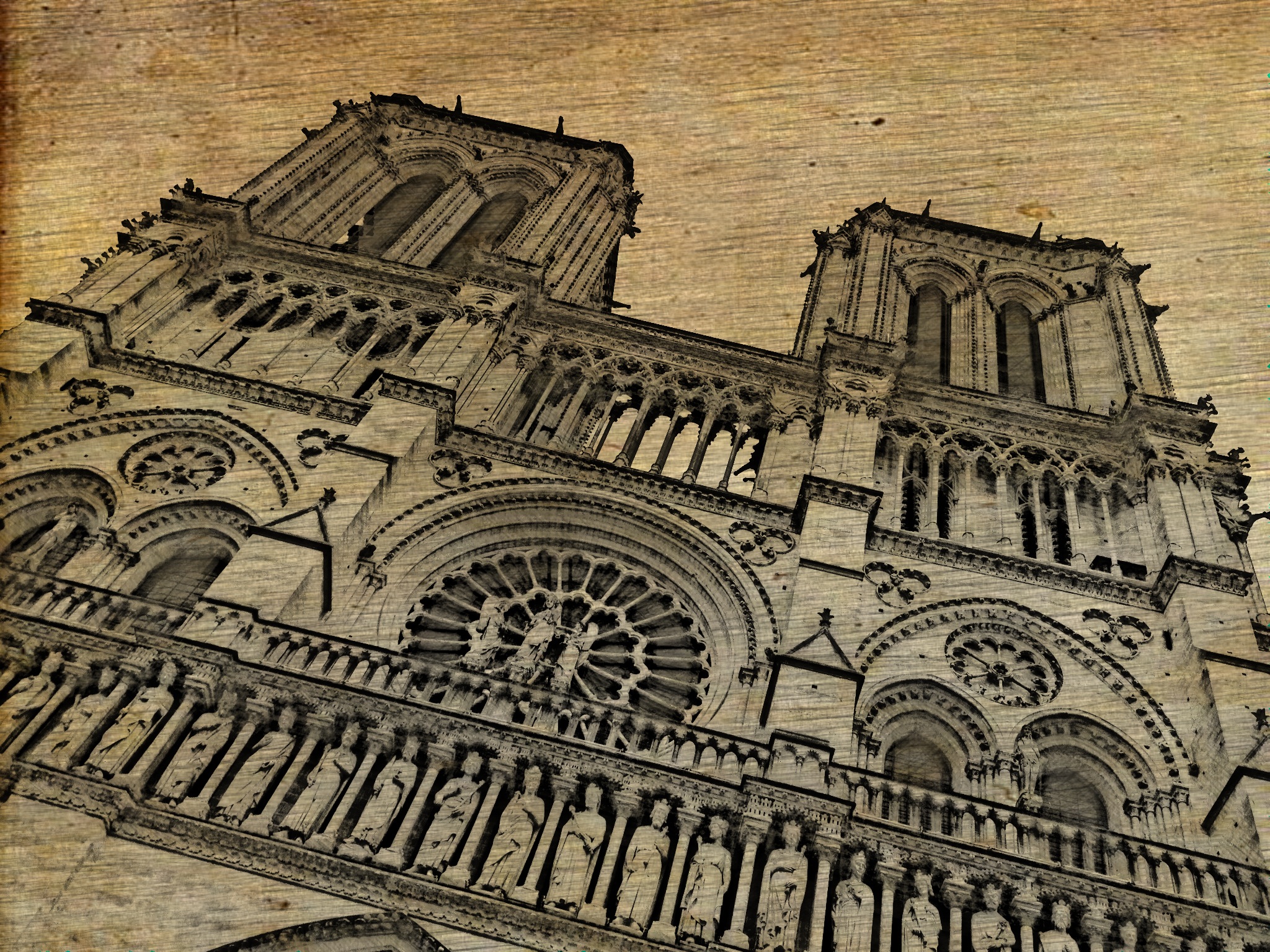
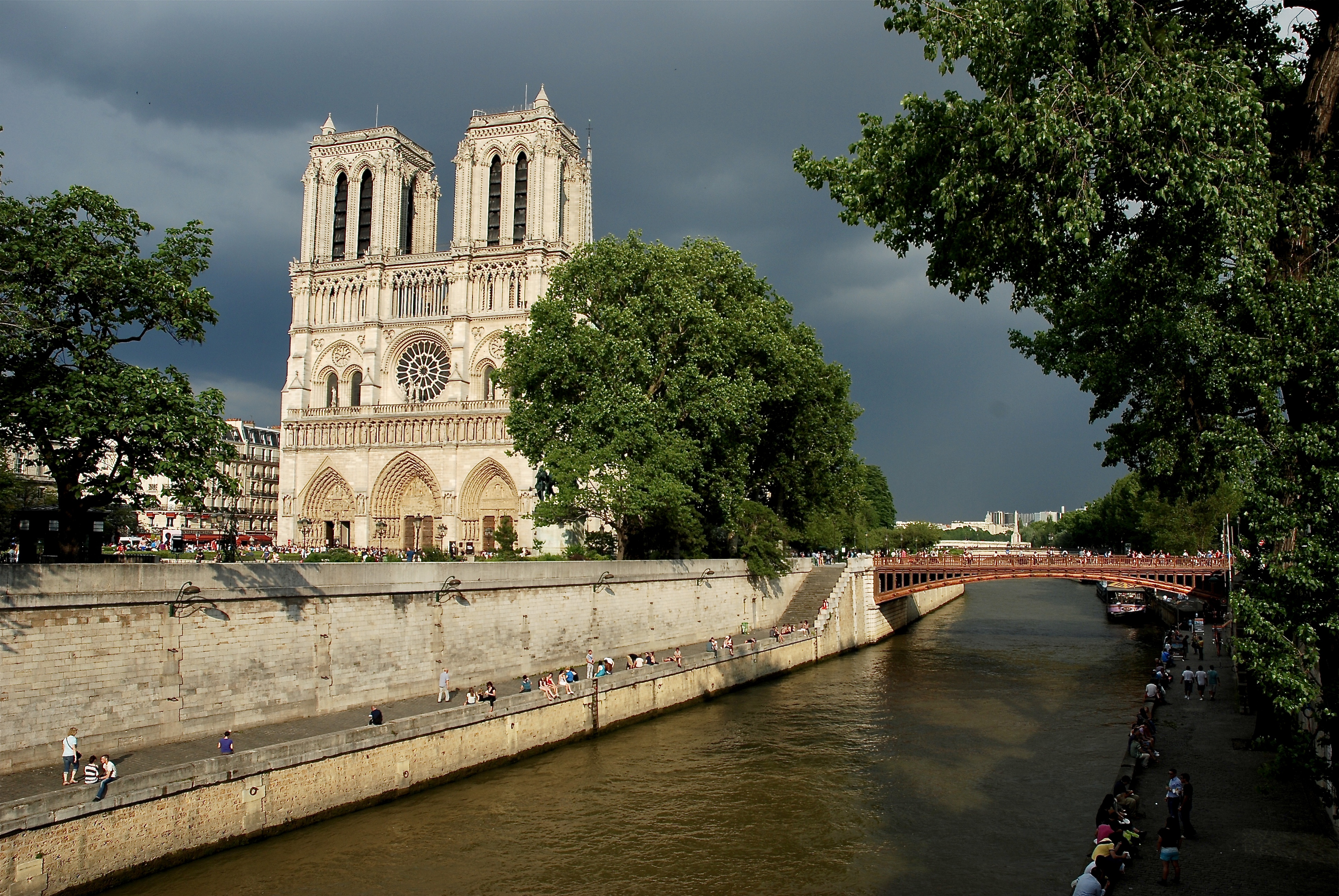
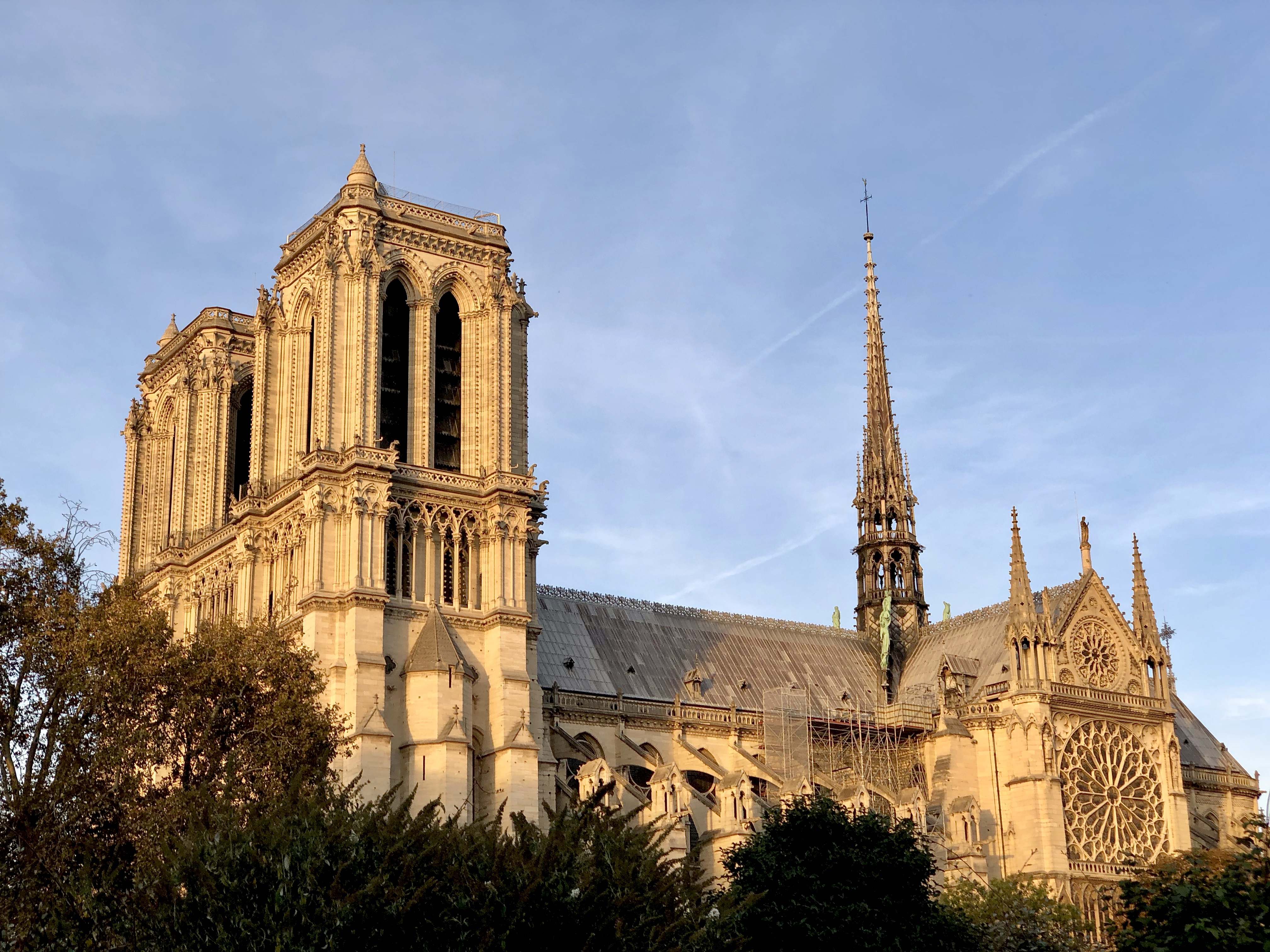
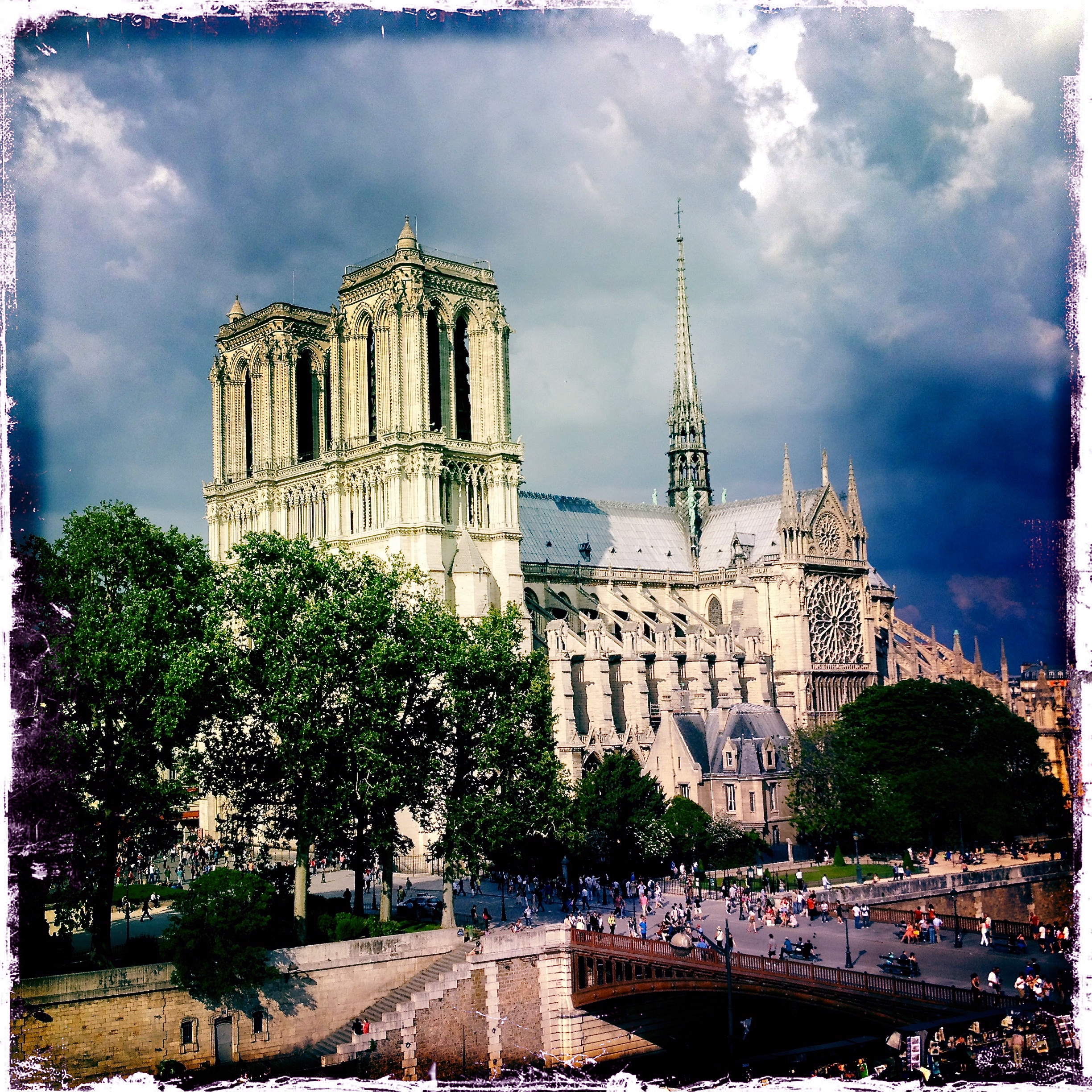
The burning of Notre Dame has broken many hearts, including mine. The fact that it happened in Holy Week feels strangely apocalyptic, as if the stability of our world were suddenly under threat. Like the earthquake at the death of Jesus, it suggests a cosmic shaking of the foundations.

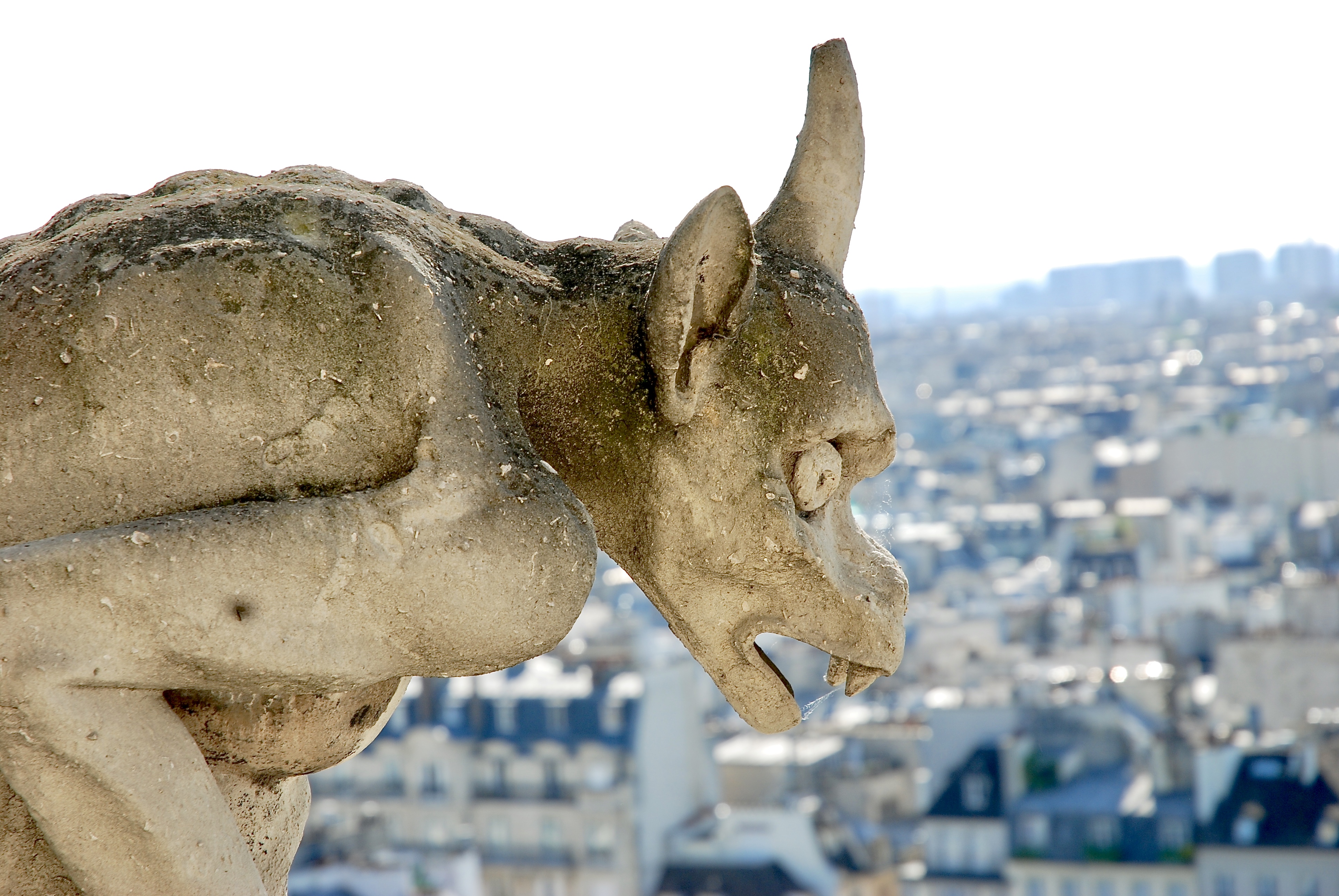
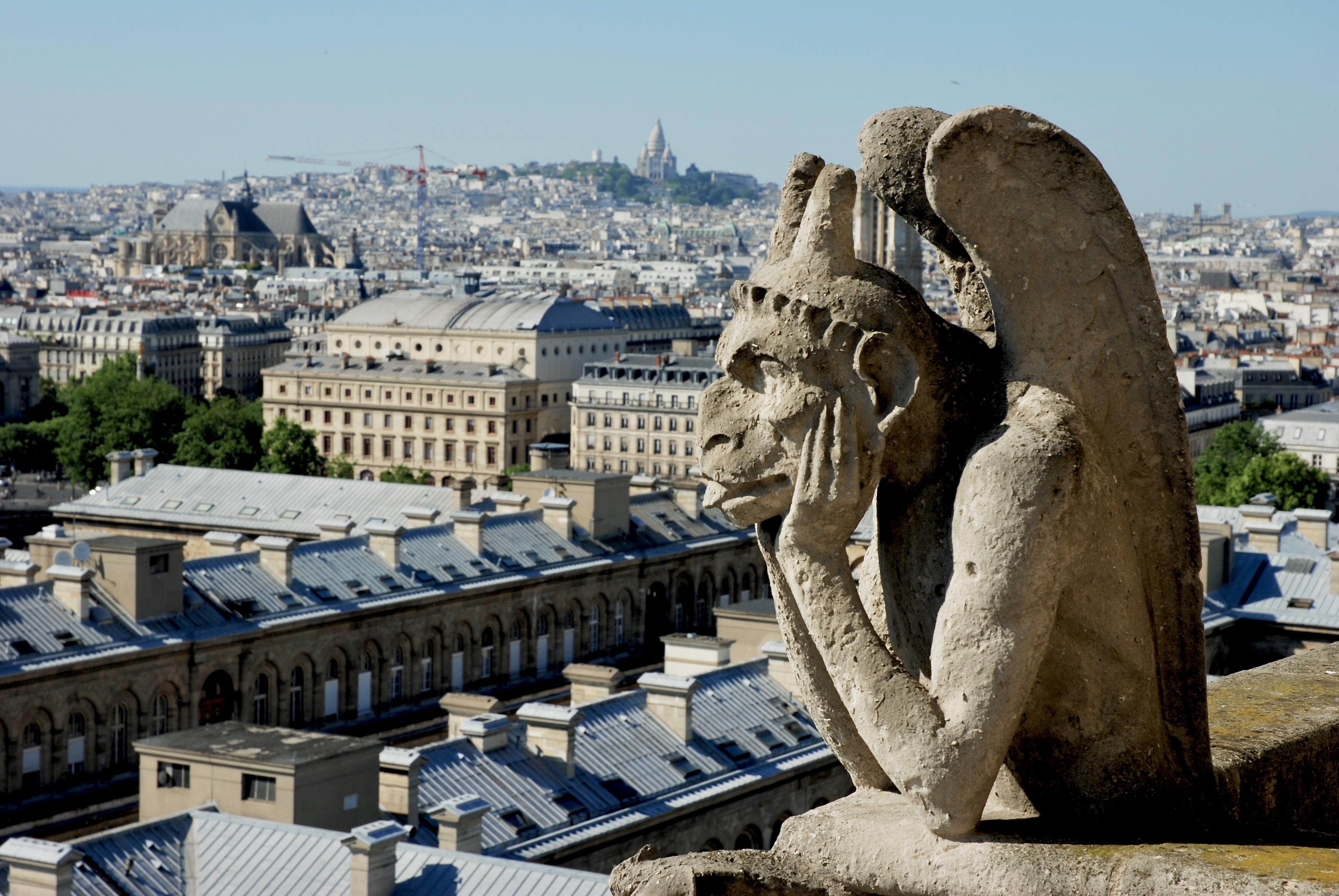
Poems from Book of Lamentations, an anguished response to the destruction of Jerusalem in 587 B.C., are often sung during Holy week. Written to grieve the loss of a sacred place, their eloquent images of affliction and grief were later appropriated by Christian liturgy to lament the suffering of Christ. In gratitude and sorrow for our beloved Notre Dame, here are some of my own past views of the cathedral, accompanied by selected lamentations from the Holy Week lectionary.

How like a widow she has become, she that was great among the nations. (Lam. 1:1)

Jerusalem remembers in the days of her affliction and distress, all the precious things that were hers in days of old. (Lam. 1:7)

All you who pass this way, look and see: is any sorrow like the sorrow inflicted on me? (Lam. 1:12)

Listen, for I am groaning, with no one to comfort me. (Lam. 1:21)

For vast as the sea is your ruin; who can heal you? (Lam. 2:13)

Cry then to the Lord, rampart of the daughter of Zion; let your tears flow like a torrent day and night. (Lam. 2:18)

He has walled me about so that I cannot escape. . . though I call and cry for help, he shuts out my prayer. (Lam. 3:7-8)

But this I call to mind, and so regain some hope: Surely God’s mercies are not over, his kindness is not exhausted. (Lam. 3:21-22)

It is good to wait in silence for Yahweh to save. (Lam.3:26)


Photographs and video by Jim Friedrich

A fig tree and a burning bush walk into a homily. . .

Richard Misrach, “Desert Fire #81” (1984)

This homily for the Third Sunday of Lent is a double feature. The lessons from the Episcopal lectionary, Exodus 3:1-15 and Luke 13: 1-9, are not thematically connected, but I felt both stories demanded attention.

Today’s gospel shows Jesus and some other folks talking about the local news. It’s something humans have always done, shooting the breeze about unusual or dramatic events. We don’t expect our conversations around the water cooler or wherever to be recorded for posterity. But 2000 years later, we’re still hearing about some Galileans slaughtered by the Romans during a sacred ritual, and eighteen unnamed victims killed by a falling tower.

But there’s no film at 11. We are given no further details. Some scholars speculate that both incidents involved the Zealots, Jewish rebels who may have been killed by the Roman soldiers during acts of resistance. Perhaps some Zealots were staging a demonstration in the Temple when the Romans struck them down. They died in the very spot where animals were being sacrificed in an atonement ritual. The image of their blood mingled with the blood of animals sacrificed on the altar was a horrific mixture of violence and the sacred. People wondered, if the animals were dying for the people’s sins, for whose sins did those Galileans die? Could it have been their own?

As for the Siloam tower, could it have been a rebel stronghold destroyed during a Roman siege, another case of those who live by the sword dying by the sword? Or maybe it collapsed in an earthquake, a so-called “act of God.” Or maybe it was built by crooked contractors who used shoddy materials. Or maybe it collapsed for no apparent reason at all.

Whatever the causes of those tragedies, people wanted to make sense of them, so they could continue to live in a predictable universe where events have reasons and everything can be explained. If we’re unwilling to live in a universe of absurdity or blind chance, we need to know why bad things happen to good people. And one of the easiest answers is to say that maybe good people aren’t so good. Maybe in some way they get what they deserve, like people’s bad habits catching up with them, or our collective addiction to oil bringing the climate apocalypse down on our heads. Or maybe human suffering is somehow God’s will, even if we can’t say why.

Jesus quickly dismisses this kind of simplistic blaming of the victim. He says there is no simple correlation between sin and suffering. The victims of those tragedies were no worse offenders than anyone else. The problem of reconciling human suffering with the providence of a loving God remains complex and ultimately insoluble in human terms. Jesus recognized that. And 2000 years later, we are still puzzled by the question of “why?”

But Jesus was not that interested in a theoretical discussion about the problem of suffering. He wanted the people in that conversation to consider their own situation. Did they think their story needed to get different? Were they prepared to change their life?

“Unless you repent, you will all perish as they did.”

What does Jesus mean by this? Without knowing the actual details of those ancient news stories, it’s hard to say for sure. If both incidents involved acts of armed rebellion, repentance could mean a refusal to participate in a world of reciprocal violence. Stop living by the sword, or else. More broadly, it could mean that we should stop describing the world as a place where God dishes out suffering or endorses any form of human violence.

Jesus could have meant many other things as well.  Renounce your self-righteous pride, and stop demeaning those who suffer as less good or less deserving than you are. Never presume your own innocence. No one is without sin, whether it’s personal sin or collective sin. The world’s troubles are not somebody else’s problem. Like it or not, everyone is implicated in a world of interrelated causes. And don’t treat life’s blessings as rewards for good behavior. They are gifts freely given by a generous and loving God, and you should receive them humbly and gratefully.

Stop trying to make the world controllable or predictable with simplistic explanations. Life is complicated and sometimes it’s sad. You can’t always have it go your way or have it make sense. You have to live by faith in love’s bigger picture.

In other words, if any of you think you can live in this world without grace, without mercy,
you have perished already.

Jesus ends this challenging conversation with a parable of mercy. A barren fig tree is taking up valuable space in a vineyard, sucking up nutrients and moisture needed by the grapevines. “Time to cut it down!” says the owner. But the gardener pleads, “Give it a little more time. I’ll add some fertilizer to help it along. That may make all the difference. If there’s still no fruit next year, then you can cut it down.”

That’s how the parable ends, but when next year rolls around, I suspect that the gardener will be telling the owner the same thing: “Just one more year. I know it can be fruitful. It just needs a little more time, a little more nourishment. A little more tender mercy.”

Now let’s leave that fig tree, and travel further back in time, 1400 years before Jesus, to see a very different kind of plant: a bush in the wilderness of Sinai—a bush which burns, without being consumed.

I saw a burning bush once, not in Sinai, but in the hills of Palestine. I was walking on a trail near Ramallah in the West Bank, when I saw a shepherd leading a small flock through a ravine below me. About 30 yards beyond him, a bush was on fire. I never found out why. But having imbibed the story of Moses since childhood, I could only experience this inexplicable reenactment with a sense of wonder. It was a gift, and I received it gratefully.

I heard no voice. For me, only the story speaks now. But for Moses, the voice came from the midst of the fire: “Moses, Moses!”

The Scripture does not tell us whether Moses is surprised, shocked, or frightened by this sudden intrusion of the divine into the routineness of a shepherd’s day, though we might imagine all of those things. All we know is that Moses responds as if his life were made for precisely this moment: “Here I am,” he says.

God calls, Moses responds. No matter how unlikely or uncanny this encounter between divine and human may be, no matter how unprepared Moses might feel for such a meeting, his whole being rises to the occasion. Before the voice even identifies itself as the God of Moses’ ancestors, Moses experiences the kind of recognition described by the mystics, an awakening to a reality so profound, so insistent, so real, that it seems to make perfect sense despite its utter strangeness.

Nobel laureate Derek Walcott wrote a poem, “Love after Love,” about the sudden recognition of your inmost reality, your deepest truth, which was there all along even though you hadn’t quite known it until it suddenly greeted you face to face:

The time will come
when, with elation,
you will greet yourself arriving
at your own door, in your own mirror,
and each will smile at the other’s welcome,

and say, sit here. Eat.
You will love again
the stranger who was yourself.
Give wine. Give bread. Give back your heart
to itself, to the stranger who has loved you
all your life, whom you ignored
for another, who knows you by heart. . .

That is what I think Moses must have experienced, must have suddenly known, when he heard his name called from the midst of the flaming bush. That voice, however uncanny and unfamiliar, also produced a sense of recognition. Oh! it’s you, isn’t it. It’s you. The one who knows me by heart!

And Moses, however surprised he may be to meet at last the stranger who has loved him all his life, consents to the encounter with his response: “Here I am.” That couldn’t have been easy, for the divine stranger in the burning bush was not the gentle presence in Derek Walcott’s poem. Whatever Moses knew about God, he believed that it was a fearful thing to look divinity in the face. Mortals were not wired to handle so much voltage. So while Moses listened to the voice, he was afraid to stare into the fire.

So what happens next? As we know from our baptismal covenant, when God calls our name, that is not the end of the story. It is the beginning of a new life, a life where something is asked of us. Vocare––to call––is the root of vocation. To be called is to be given a vocation. When God calls us, it is to do the holy work of repairing the world.

That work takes many forms, as each of us must discover as we practice our own vocation in a world of such great need. In Moses’ case, his work was to speak truth to power, stand up to the tyranny of Pharoah, and lead God’s people out of bondage to the land of promise.

That was a huge and intimidating assignment. Moses balked at first. “Who am I to do such an impossible thing?” But God was insistent. When God gets an idea, it’s no use saying no. And there’s no turning back. Keep your eyes on the prize, hold on.

Every time we gather in God’s house, the bush burns and the flames speak. We hear the voice of God, the stranger who has loved us all our lives, who knows us by heart, calling our name. But we don’t get to stay by the fire forever, gently warming ourselves in the loving presence of the divine. Mary Oliver’s poem, “What I have learned so far,” makes this point perfectly:

Meditation is old and honorable, so why should I
not sit, every morning of my life, on the hillside,
looking into the shining world? Because, properly
attended to, delight, as well as havoc, is suggestion.
Can one be passionate about the just, the
ideal, the sublime, and the holy, and yet commit
to no labor in its cause?

The poet goes on to say that our only choice is “indolence, or action. / Be ignited, or be gone.”

The voice in the flame is the voice that ignites us and sends us forth, to do the work God has given us to do. Some of that work seems feasible enough. As the Prayer Book says, “tend the sick, give rest to the weary, bless the dying, soothe the suffering, pity the afflicted, shield the joyous.” But some of the work of loving our neighbor and repairing the world can seems overwhelming, even impossible. When we hear words like “racism,” “mass killings” or “climate change,” we cringe at their magnitude. Like Moses, we are tempted to cry, “Who am I to make a difference?”

And what does God say then? Do not be afraid. I will go with you.

Okay, Moses says. But if we’re in this together, I need to understand something about who you are. I need to know your name.

And God says to Moses, “‘Ehyeh-‘Asher-‘Ehyeh.” It is a strange and mysterious name, whose precise meaning has eluded translators, scholars and theologians ever since. Robert Alter, whose recently published and profusely annotated translation of the Hebrew Bible should be in every library, says that “I-Will-Be-Who-I-Will-Be” is the most plausible rendering of the Hebrew. But he suggests that its linguistic ambiguities could also produce variations such as “I-Am-That-I-Am,” “He-Who-Brings-Things-into-Being,” and “I-Am-He-Who-Endures.”

But whether the preferred translation stresses the being of God or the doing of God, whether it evokes the eternal source and essence of reality or the ongoing providential activity woven into the causalities of time and history, God reveals to Moses that whatever happens in this finite world or in this transitory life, God is. God endures. God will be. God will be with us.

However dark the night of violence and death, however deep the waters of catastrophe, God is with us. The God who endured the cross and grave, the God who makes a way where there is no way, will share our journey and deliver us to the place of promise.

For I will be with thee, thy troubles to bless,
and sanctify to thee thy deepest distress. . .
[the] soul, though all hell should endeavor to shake,
I’ll never, no, never, no, never forsake.

This is not a prescription for passivity, as when people say stupid things like “God will take care of climate change, so why worry?” No. Passivity in the face of human sin and folly is not faith. It is complicity.

To those who are called and ignited by the Spirit’s fire for the work of repairing the world, God’s promise to be with us produces not passivity, but courage and action. Come what may, whatever sorrows, tragedies or defeats may await us: ‘Ehyeh-‘Asher-‘Ehyeh. Heaven and earth may pass away, but the Holy One remains, arms open wide, to welcome us to our abiding home, the loving heart of the divine mystery.

Or as Jesus put it, “I am with you always, even to the end of time.”


Related post: The voice that allows us to remain human


Gathering God’s Children: A Homily for Lent 2

Stanley Spencer, Christ in the Wilderness––The Hen (1939)

A homily preached on the Second Sunday of Lent at St. Barnabas Episcopal Church, Bainbridge Island, WA (Texts: Genesis 15:1-12, 17-18 / Luke 13:31-35)

The word of the Lord came to Abram in a vision:
“Do not be afraid. Your story is not over.
It will continue long into the future.”

But Abram can’t believe this. “I have no offspring, no heirs. How on earth will my story continue?”

And God says, “Step outside, and look at the stars––more than you could ever count. So shall your descendants be.”

This kind of thing happens a lot in the Bible. God makes a way where there is no way. God turns nothing into something. God makes a barren marriage the seed of countless generations.

“Great!” says Abram. “But how can I know for sure?”

So God makes a covenant with Abram––a promise binding Abram’s story to God’s story, a promise to be with Abram’s people through the long journey of time.

Now we may find their covenant ritual pretty weird: cutting three large animals in half––a heifer, a goat, and a ram––but that was a common practice in the ancient Near East. The two parties making a covenant would walk between the cloven parts of animals, as if to say, if either party severs the covenant binding us together, there will be blood.

If one of the parties is human and the other is divine, we should not be surprised to find an uncanny dimension to the ritual, as there is in this story. Abram falls into the altered state of a deep sleep, and then God seems to pass between the cloven animals in the form of a smoking fire pot and a flaming torch, anticipating the pillar of fire and the pillar of cloud which will one day lead the Israelites out of Egypt.

This sense of covenant with God, a binding relationship enduring through all the ups and downs of Jewish history, is the central dynamic of the biblical narrative. And by the time of Jesus, twenty centuries after Abram looked up at those stars, the city of Jerusalem had been well-established as the geographical and spiritual center of that ancient covenant, because it contained the Holy of Holies, the enclosed void believed to be the earthly dwelling place of the Eternal. The Holy of Holies, situated within the Temple on the city’s highest place, was so sacred that it was forbidden to everyone except the High Priest, who could only enter it once a year, on the Day of Atonement, to offer sacrifice to the Most High.

Jerusalem’s sacred stature is affirmed many times in the Hebrew scriptures, especially in the Psalms:

Blessed is the Lord out of Zion,
who dwells in Jerusalem. (Psalm 135:21)

As the hills stand about Jerusalem,
so does the Lord surround God’s people,
from this time forth for evermore. (Psalm 125:2)

If I forget you, O Jerusalem, may my right hand wither.
Let my tongue cleave to the roof of my mouth if I do not remember you,
if I do not set Jerusalem above my highest joy. (Psalm 137:5-6)

Jesus shared his people’s devotion to Jerusalem as central to both their self-understanding and their ultimate destiny. It was the place where earth meets heaven, where the blessings of God’s ancient promise would be most clearly manifested and fulfilled. And however Jesus thought his own mission would work out, he expected its definitive climax to come in the holy city.

Jerusalem is mentioned 139 times in the New Testament, and 90 of those mentions occur in Luke. His gospel might be called The Journey to Jerusalem. During Jesus’ entire ministry of teaching and healing and proclaiming God’s kingdom, Jerusalem is so often on his mind. Every step of his itinerant life takes him closer and closer to that place of destiny. As Luke puts it, “his face was turned toward Jerusalem.”

But when he draws near his goal, some Pharisees try to warn him away. “King Herod wants to kill you,” they said. “Get out of here while you still can.” But for Jesus there is no turning back. “It is necessary for me to journey on,” he tells them. “today and tomorrow and the day after that, because Jerusalem is where a prophet must go to meet his fate.”

So on he goes, eventually making the long climb up from Jericho, through a series of barren hills, until he reaches the Mount of Olives, a high point where suddenly the holy city and its great Temple come into view, stretching across a ridge on the opposite side of a ravine called the Kidron valley.

Have any of you been there, and seen that view? It is a stunning sight. And we might imagine the thrill that Jesus and his disciples must have felt at seeing the end of their long pilgrimage, right there in front of them.

Five years ago, I walked the 500-mile Camino de Santiago across northern Spain, and I remember vividly the moment when I first saw the goal of my journey, the towers of Santiago’s cathedral, from the top of a hill a few miles away. Pilgrims call that hill the Mount of Joy, because joy is what you feel when you see for the first time the place which has pulled on your soul for so many days and so many miles.

So as Jesus descends the slope of the Mount of Olives toward the eastern gate of Jerusalem, he stops for a moment to take in the view. But joy is not what he feels. According to Luke, “as he came near and saw the city, he wept over it.”

Why does Jesus weep? Is it for himself, because he knows that this is where he is going to die? Or is he weeping for Jerusalem, because it is the killer, instead of the fulfiller, of God’s dream for human flourishing? The name Jerusalem means “city of peace”––salem means peace, like the Hebrew shalom and the Arabic salaam. God desired it to be a place of loving community, a just community, a neighborly community where divine blessings would be freely and gratefully shared with one another.

But the holy city was in fact closer to hell than heaven––divided by warring factions demonizing one another, distorted by vast inequalities of wealth, poisoned by fears and tribal hatreds, governed by political and economic forces resistant to change, and blinded by an obsolete pretension of being the greatest nation on earth.

From his vantage point on the Mount of Olives, Jesus gazes upon the broken and faithless city––and he weeps. Then he says, “If you had only known the things that lead to peace! But now they have been hidden from your eyes.” (Luke 19:42)

This compelling moment is commemorated by a tear-shaped church erected on the slope where Jesus had stood. Most churches are designed to face east, toward the rising sun, but this one faces west, toward Jerusalem, as Jesus did when he lamented the sad state of the City of Peace. The window behind the altar is made of clear glass, so that the worshipper can contemplate the same view which filled Jesus’ eyes with tears. The name of the church is Dominus Flevit: The Lord wept.

What if Jesus had not wept there? What if he had looked at the faithless city, so unloving and so unjust, and been filled with anger and judgment? What if the church were called, The Lord raged? There was plenty to be angry about in the way people lived together and treated each other in that city. But the heart of Jesus was all compassion. He came to show us the God of mercy.

And in today’s gospel, when he responds to those Pharisees who urge him to avoid Jerusalem at all costs, Jesus gives perhaps his most startling self-description in all the gospels:

“Jerusalem, Jerusalem, the one killing the prophets and stoning those sent to her, how often I have longed to gather your children together as a hen gathers her brood under her wings.”

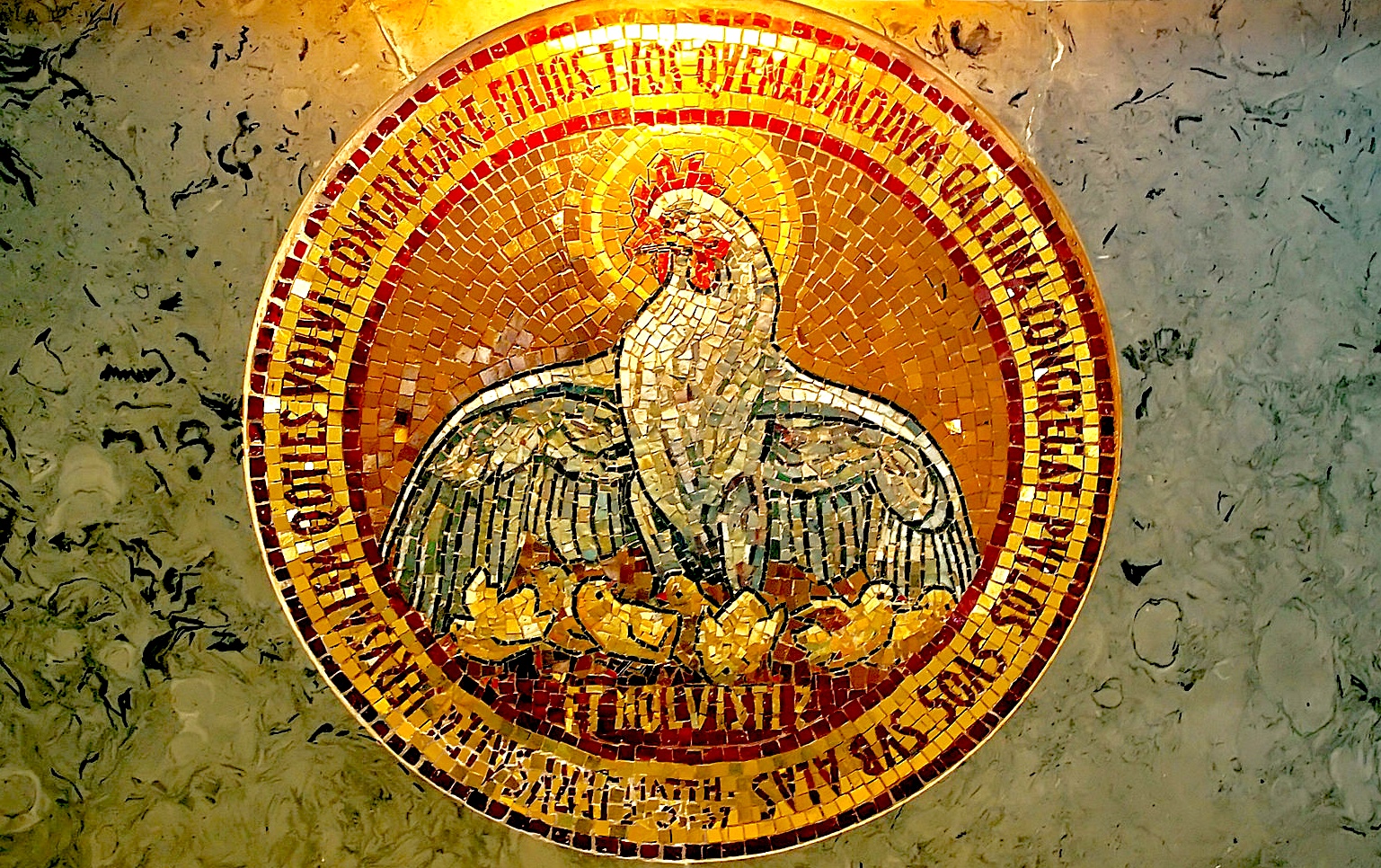
Altar mosaic, Dominus Flevit church, Jerusalem

Look at the image of the altar mosaic  in Dominus Flevit. Notice the golden halo behind the hen’s head. This is a holy creature, showing us God in a new way, as a maternal figure, protective yet vulnerable. Not the lion of Judah, or a mighty eagle, but a barnyard chicken! Her chicks don’t seem to be paying much attention to their mother. They are liable to wander off at any moment and get into all sorts of mischief. But Jesus their mother spreads her wings wide, trying her best to gather them in and keep them safe.

There’s another animal in today’s gospel––the fox. That’s what Jesus calls Herod––a fox. Now as leaders go, Herod was pretty deplorable. He was an insecure bully who didn’t care much about the divine covenant or the holiness of Jerusalem. He only cared about himself. And he was little more than a puppet, easily manipulated by a foreign power (it begins with an “R”).

Why does Jesus call him a fox? Did he mean that Herod was cunning? Perhaps. But in such close juxtaposition with the hen and her chicks, it seems more likely that Jesus was describing Herod as a predator. What a predator does is find a way to isolate and attack the most vulnerable. He divides his victims from the wider community, and then he attacks. If you’re a defenseless chick, a fox is very bad news!

Jesus wants to protect the chicks from the fox, but he refuses to do that with violence. That would only make him a mirror image of the fox. As Episcopal preacher Barbara Brown Taylor says in her memorable commentary on this passage:

“Jesus won’t be king of the jungle in this or any other story. What he will be is a mother hen, who stands between the chicks and those who mean to do them harm. She has no fangs, no claws, no rippling muscles. All she has is her willingness to shield her babies with her own body. If the fox wants them, he will have to kill her first.”

For God so loved the world, that he gave the dearest portion God’s own self, that we might not perish. Self-offering for the sake of others, however costly, is the divine way.

When I first heard about the New Zealand massacre, I had just been reading a gospel commentary comparing the protective hen to Vicki Soto, the first-grade teacher at Sandy Hook who died while shielding her little students from the bullets with her own body.

In times like these, the gospel gets very real, and we are confronted with an immediate choice: do we stand with the fox, or with the hen? God forbid that any of us should ever be in the line of fire, but even at a safe distance, we can raise our voices to resist violence, hatred, bigotry and fear. We can spread our wings to shield the vulnerable.

When our leaders echo the rhetoric of white supremacists by referring to immigrants as “invaders,” we need to shout, “No more!” When defenseless children are taken from their parents and put into cages, we need to insist, “Not in our country!” When the toxins of tribalism inspire violence even in havens like New Zealand, we need to confess our divisive ways and beg forgiveness.

As St. Paul urges us, let us all be imitators of Christ, spreading our wings in welcome, offering warmth, protection, shelter and love without qualification. The foxes of the world want to scatter us, but God yearns to gather every single one of us from the places of isolation, alienation, division and rejection, and bring us home to the welcome table.

Look again at the mosaic of the Christlike hen. She is circled by the Latin text of Jesus’ saying, “how often I have longed to gather your children together as a hen gathers her brood under her wings.” At about 10 o’clock on the circle is the verb congregare, “to gather.” You see, a congregation consists of those who have been gathered safely under the wings of Christ. You have been gathered under the wings of Christ. And we have all committed in our baptism to spread our own wings in turn, and offer our own selves––our souls and bodies––for the sake of the world.

Now just beneath the chicks, there is one more phrase. It is what Jesus says just after the text in the outer circle: et noluisti (“and they were not willing!”). Jesus wants to gather the scattered, but they refuse. For whatever reason––obstinance, foolishness, blindness, or plain old sin––they just won’t be gathered. They were not willing. And that troubling phrase, et noluisti, explains why Jesus wept as he gazed at Jerusalem, Those word are set apart from the rest of the text, and instead of swimming in the gold of eternity like the other words, they are drenched in a deep red color, the color of blood––echoing the message of that primitive covenant ritual with the butchered animals in Genesis. If you don’t find a way to live together in love, there will be blood.

Jesus offers a better way. He did it in his life and teaching, he did it on Calvary’s hill. The hen’s outstretched wings are like the arms of Jesus on the cross, still trying to gather us in with his last breath. “Father, forgive them,” he prays. Even as he is dying on the cross, Jesus is trying to gather God’s children and bring them home.

In Franco Zefferelli’s 1977 film, Jesus of Nazareth, there is an extraordinary moment during the crucifixion sequence. It is not literally scriptural––the screenwriter invented it––but it expresses so well the heart of the gospel message.

Mary, the mother of Jesus, is allowed by a centurion to pass through security to approach her dying son. Then Mary Magdalene tries to follow right behind her, but the centurion stops her.

“Please,” says Magdalene. “I’m one of the family.”

Hearing this, the mother of Jesus turns around sharply, clearly stung by the impudence of this outsider, this woman of questionable reputation, pretending to be related to Jesus. We imagine her thinking, “How dare she try to intrude on our intimate circle!” The centurion asks Mary, “Is she family?” And at that moment, the mother of Jesus has to decide whether she’s going to be tribal and exclusive, or whether she is willing to embrace the welcoming way of her son.

After a brief hesitation, she nods, but it’s not easy for her. “Yes,” she says. “She is one of the family.” And at that moment, at the foot of the cross, beneath Christ’s outstretched wings, the welcoming and sheltering community of mutual and unconditional love is born into the world.

Consumed by Love: The Flames of Candlemas

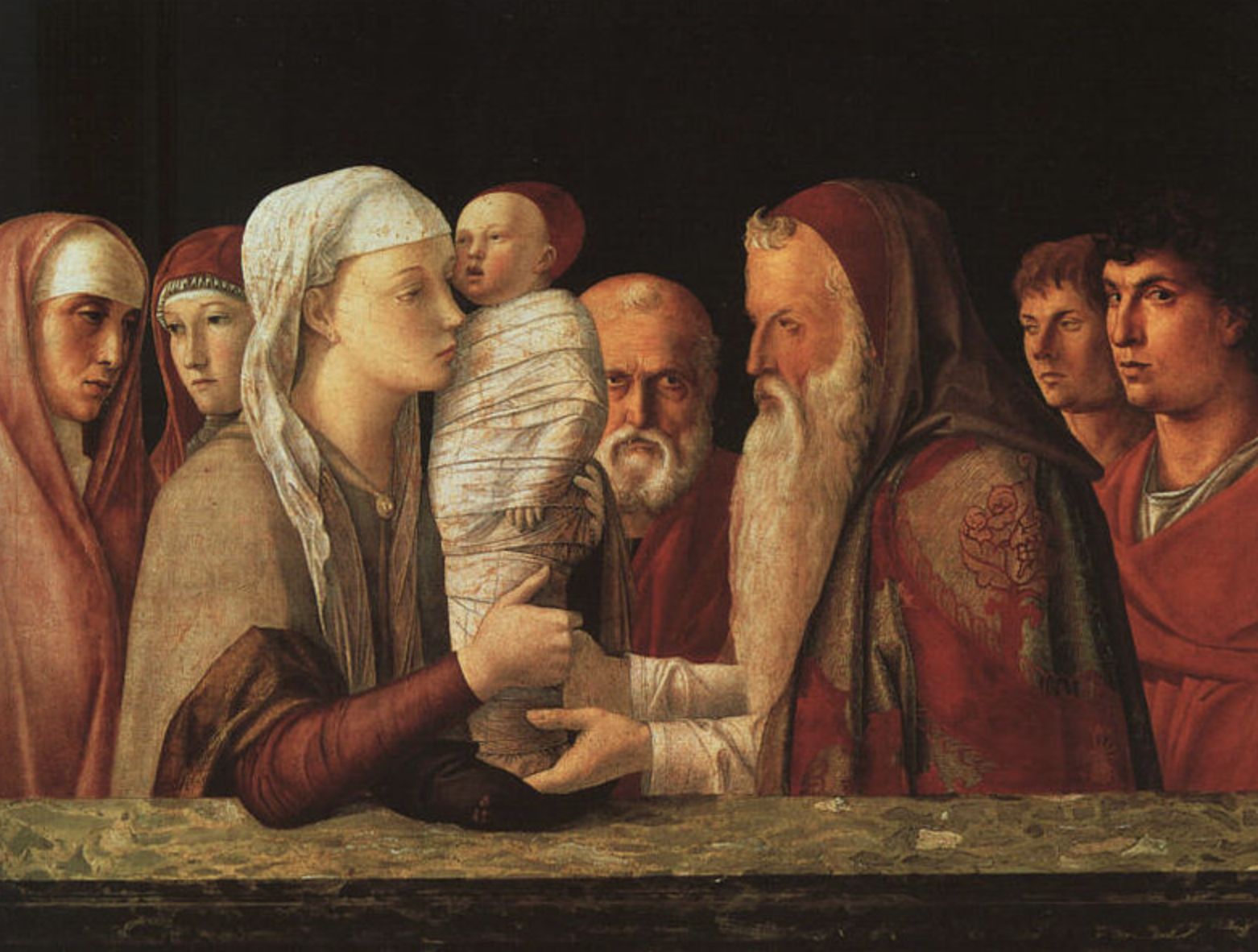
Giovanni Bellini, The Presentation in the Temple (1459)

Today is Candlemas, the 40thday after the Nativity. Its liturgical origins are obscure, but its blazing processions of candles in the winter dark not only made a glorious end to the extended Christmas celebrations of less hurried times, it also provided a brilliant preview of the resurrection fires of the Easter Vigil. Although it still may allow, for a few liturgically-minded procrastinators, a generous extension of the deadline for boxing up our holiday decorations, Candlemas is rarely observed in American homes and churches. Our minds are fixed on groundhogs and football, not the Presentation of our Lord in the Temple.

Still, I would gladly join a candlelight procession to a holy place on this night, to beseech the Light of the World “to pour into the hearts of your faithful people the brilliance of your eternal splendor, that we, who by these kindling flames light up this temple to your glory, may have the darkness of our souls dispelled.”

In the Eastern churches, Candlemas is called “The Meeting,” highlighting the moment when two old souls, Simeon and Anna, met the One for whom they had waited all their lives. Simeon had been told “by the Holy Spirit” that he would not see death before the coming of the Messiah. Every time he went to the Temple, he wondered, “Could this be the Promised Day?” Whatever he may have imagined––the House of God filled with smoke and shining angels, a mighty king arriving in noisy triumph––the long-expected day arrived like any other, without the slightest fanfare.

Simeon liked to go to the Temple early, when it was still blissfully quiet and uncrowded. He began his prayers as usual, but his attention wandered when the entrance of a young couple and their baby caught his eye. He could tell they were country people, the way they looked with such amazement at the vast interior. As they passed by him, he smiled kindly, then closed his eyes to resume his prayers.

But everything within him shouted, “Look! This is the time. Don’t miss it.” As soon as he opened his eyes again, he knew. He didn’t know how, but he knew. That child, cradled in the arms of a peasant girl, was the One!

“Please,” he said. “Please wait!” The couple stopped and turned to face him. Simeon held out his arms, and the girl, as though they had both rehearsed it a hundred times, handed him the baby without the least hesitation. And gazing into those infant eyes, seeing there the future of God’s hopes for all the world, Simeon began to murmur the prayer which the faithful have sung ever since at close of day:

Lord, now at last you release your servant
to depart in peace,
for my eyes have seen the Savior,
just as you have promised.

Then Anna, the old prophetess who had camped out in the Temple for many years, stepped out of the shadows to add her own confirming praises. Joy to the world, the Lord is come!

The Nunc Dimittis of these two old saints, near the end of their lives, being granted the grace of completion on that Temple morning, is beautifully echoed in a passage from Wendell Berry’s novel, Jayber Crow:

I am an old man now and oftentimes I whisper to myself. I have heard myself whispering things that I didn’t know I had ever thought. “Forty years” or “Fifty years” or “Sixty years,” I hear myself whispering. My life lengthens. History grows shorter…

I whisper over to myself the way of loss, the names of the dead. One by one, we lose our loved ones, our friends, our powers of work and pleasure, our landmarks, the days of our allotted time. One by one, the way we lose them, they return to us and are treasured up in our hearts. Grief affirms them, preserves them, sets the cost. Finally a man stands up alone, scoured and charred like a burnt tree, having lost everything and (at the cost only of its loss) found everything, and is ready to go. Now I am ready.

It is a custom at Candlemas to bless the candles for the rest of the year. In 2003, I happened to be in London’s Cathedral of St. Paul for a similar rite, when members of the Wax Chandlers Livery Company, in a practice dating back to the fifteenth century, brought long candles to be blessed for their service on the high altar.

The preacher on that occasion, Canon Martin Warner, took comfort in the fact that when his own brief candle should come to an end, another candle, the Paschal Candle of Easter, would burn over his coffin, declaring by its resurrection light that each of us is but wax “being consumed by the incredible flame of love that is God’s own self, melted not into oblivion but into the freedom of attaining our perfection and deepest longings.”

A candle is a temporal thing, fulfilling its function of radiance and warmth at the cost of its own vanishing. Even so, the fire that consumes it bears Love’s name, and does Love’s work. Whatever is offered up shall receive its true being. Whatever is lost shall be found anew.

Fire of heaven, make us ready.

Piero della Francesca’s Baptism of Christ

Piero della Francesca, The Baptism of Christ (after 1437), National Gallery, London. (Creative Commons license)

A few years ago, while visiting London, I wanted to connect with a friend who lives at the outskirts of the city. Neil, who is an artist as well as a priest[i], told me to meet him at Piero della Francesca’s painting of the Baptism of Christ in the National Gallery. I arrived first, and stood transfixed before that marvelous 15thcentury painting. John the Baptist pours water over Jesus as the Holy Dove hovers just overhead. They stand at the edge of the river, in the shade of a great tree. The formality of the figures and the almost eternal sense of stillness induced a responding quietude in me. When I felt a hand on my shoulder, I knew it was Neil, but I did not look away from the painting. “Remember your baptism,” he whispered, and with a small vial of water drawn from his parish font, he poured a few drops onto my head.

It was a whimsical yet powerful way of connecting my own baptism with the baptism of Christ, making them both present in a single moment, inviting me to receive their multiple meanings into my heart and soul. When the Church celebrates the Baptism of Our Lord this Sunday, I will be thinking of that moment, and that painting.

Piero’s baptismal scene is untroubled by modern oppositions between empirical and spiritual. Its visible world is charged with something more than the eye can see. Or rather, what the eye sees participates in a reality the senses cannot directly grasp.

The Renaissance embrace of the empirical is clear. The sky is blue, not the gold of eternity. The natural world is prominent in the trees and landscape. The human bodies, while in the stylized poses of dancers, are not abstractions. They have weight and substance.

Yet we also see a world governed by invisible meanings: the dove, while rhyming perfectly with the hovering clouds, is the Holy Spirit; the trio on the left is angelic; the principal gestures are sacramental signs of inward grace; and the strong heavenward reach of the picture’s verticals balances harmoniously with its earthly horizontals. Strangely, there are no shadows, as if light is not cast from a distant, separate source, but inheres equally in everything: a sure sign of divine presence.

The more you look, the more you see. The face of the Baptist, who must now “decrease” with the coming of Christ (John 3:30), is only seen in profile, while the full face of Jesus confronts us directly, like an icon. But his eyes do not look outward to fix us with an iconic gaze; their attention is wholly interior. The bent figure on the right could be a realistic touch, another candidate preparing for baptism, but his faceless anonymity suggests a more symbolic meaning. The garment that hides his individuality indicates an identity in transition: either he is shedding the old self which is left behind in the sacrament of new birth, or he is putting on New Being as in the Pauline image from Galations 3:26: “All you who have been baptized have been clothed with Christ.”

The great tree, apparently an Italian walnut, is clearly more than an object of botanical interest. Everything about it suggests the Tree of Life, a mythic image prominent in the first and last chapters of the Bible. Rooted deeply in the earth, it reaches into the heavens, beyond the frame of the painting, where human sight cannot follow. Like the Christ whose erect body it exactly parallels (even its bark shares the identical color and smoothness of Christ’s skin), the Tree unites the dualities of earth and heaven, integrating them into a harmonious whole.

Perhaps the most uncanny element in Piero’s painting is the Jordan River. As the biblical boundary between the wilderness wandering of the Exodus and the land of Promise on the other side, the Jordan became a traditional image of the passage not only between old and new, past and future, but between life and death. Many examples occur in the American spirituals and shape note songs I love to sing with my folkie friends.

I’ve almost gained my heavenly home of friends and kindred dear;
I’ve brushed the dew on Jordan’s banks, the crossing must be near.

These lines, from “Angel Band,” suggest a gentle crossing. But other songs, like “The Promised Land,” strike a note of anxiety and risk:

On Jordan’s stormy banks I stand and cast a wishful eye,
To Canaan’s fair and happy land where my possessions lie. . .
Though Jordan’s waves around me roll, fearless I’d launch away.

But in Piero’s depiction, the river is no formidable flood fraught with difficulty and danger, but a quiet, meandering channel, calm and smooth as a mirror. And it comes to an end at the place where Jesus stands. This could be a direct reference to Joshua’s crossing of the Jordan, which parted like the Red Sea to let God’s people cross over into the Promised Land (Joshua 3:14-17). Or it could be showing Christ to be the one who opens the way between the worlds of life and death, sin and salvation.

The sacrament of baptism employs the tension between water as an image of life (birth, growth, and the quenching of thirst) and an image of death (flood and drowning), expressing the inseparable connection between dying and rising in the Paschal Mystery. We die to self in order to live to God. But in the eternal stillness and calm of this painting, that tension is absent. The raging flood has been tamed into a tranquil pool. We have already crossed over into the peace of heaven.

Of course, it’s only a freeze frame. Soon history will resume and pick up speed. The river will start to rise and become once again tricky to cross. Jesus will begin to make his way through many dangers, toils and snares. So will we. But I am grateful to Piero for this moment of calm, a promising glimpse of something behind and beyond the raucous flow of time.


[i]The Rev. Neil Lambert is the vicar of St. Mary’s, Ash Vale, a 40-minute train ride from Waterloo Station. You can read more about him in my post, “Dreaming the Church that wants to be.”

The Morning After: A Sermon for Christmas Day

Nativity (12th century), Cloister of St. Trophime, Arles, France. (Photo by Jim Friedrich)

On January 2, 1734, a Boston poet and distiller named Joseph Green wrote these words in a letter to a friend:

 “The last Day I shall mention is Christmas. And this, I believe, keeps many People in good Terms with Religion, who would otherwise be at variance with it. They taste Sweet on this day, unknown to them the whole Year beside. Many who are Proof against a Religious Argument, cannot withstand a Dish of Plumb Porridge, and it is past all doubt to me, that a Christmas Sermon makes fewer converts than a Christmas Pye.”

But alas, I have no pie, so a sermon will have to do. But what exactly can we say on the morning after, when we’re trying to remember what really happened during the strange and wondrous night at that little stable on the edge of town. Some of us are still sleeping it off. Some of us didn’t get any sleep at all, or maybe we were asleep the whole time, and it was all just a dream. It seems like that now.

There was a really bright star, and then the sky started singing: Gloria in excelsis Deo! It was angels, someone said. I don’t know about that, but it was so beautiful, as if music were being invented for the very first time.

And suddenly, we all started running, don’t ask me why, until we came to this cave––it was a stable with a cow and a couple of donkeys––and in the back there was a woman lying down on some hay, and a man kneeling by her. And between them there was a little baby, just a few hours old, I’d say. What a place to begin your life! They must have been pretty desperate to end up there. Maybe they were refugees. Or undocumented. I don’t know. But they didn’t look scared or out of place. They seemed to belong there. And you know, I had the feeling that I belonged there too. We all did.

I can’t really explain it, but I got this feeling that everything in my life before that had just been waiting around for this moment, as if after a long and pointless journey I had finally come home.

And I know it sounds weird, but I swear that little baby looked right at me, as if he knew who I was––or who I was going to be, because when I left that stable I knew––I knew!––that my life was never going to be the same. Pretty crazy, right? I kind of hope it was just a dream, because if it’s not, I’m not sure I’m ready for whatever’s next.

Thus spake one of the Bethlehem shepherds. And each of us will have our own version of last night’s peculiar doings. But I suspect that everyone who was there caught at least a glimpse of a possibility, a promise, maybe even a vision of what this world could be if the angels’ beautiful song were true. But on the morning after, with the dazzling darkness of the holy night already a receding memory, will its meanings survive the cold light of everyday reality?

Well, as it turns out, what happens in Bethlehem doesn’t stay in Bethlehem. It goes home with us, it gets in our blood, it becomes part of our story. Nothing in the world will ever be the same again. Nothing in our lives will ever be the same again.

And that is why, on the morning after, we listen to St. John’s grand prologue to the Fourth Gospel. Its cosmic perspective on the birth of Christ reminds us how vast and consequential was that humble birth in a lowly stable.

In the beginning was the Word, and the Word was with God, and the Word was God. He was in the beginning with God. All things came into being through him, and without him not one thing came into being. . . And this divine Word became flesh and lived among us. (John 1:1-14)

In other words, God was not content to remain purely within the confines of the divine self. God desired to go beyond the inner life of the divine, to enter the realm of time and space and history, to become incarnate as the mortal subject of a human life and experience the human condition from the inside. The Word was made flesh and dwelt among us.

But why? Why would God want to leave the peace and bliss of heaven to live and die as one of us? The doctrine of redemption says that God became incarnate to save us from the web of wrongness we have been powerless to escape on our own. That is no small thing, and we are oh so grateful for the gift of salvation. But was that the only reason for the Incarnation? The Christian imagination has suggested there may be more to make of this great mystery.

The nature of the trinitarian God is to be self-giving, and extending the eternal self-giving of divinity beyond the Godhead to include created beings is what God has chosen to do. In the language of the Fourth Gospel, God so loved the worldthat God gave the Only-Begotten to meet creation on its own ground. God loves us so much that God wants to be intimate with us, and not just love us at a distance.

So God didn’t just come because we needed saving. God came because God enjoys our company (though given our many faults, God only knows why!). But the Incarnation isn’t only a matter of God wanting to share our humanity, to make our humanness part of the divine experience. It is also God’s desire that we in turn become partakers of the divine nature.

St. John put it this way in his gospel:

To all who received the Incarnate Word, who believed in his name,” says the gospel, “the Word gave power to become children of God, who were born, not of blood or of the will of the flesh or the will of human beings, but of God. (John 1:12-13)

In the centuries that followed, this theme of theosis, or deification––becoming God-like––has pushed the envelope of anthropology by setting a very high bar for the definition of human potential.

In the early church, Irenaeus said that “God became what we are, in order to make us what he is” Athanasius was even more explicit about the consequences of Incarnation, saying that “God became human so that humans might become God-like.” God-like! Imagine that after watching the evening news.

Martin Luther, perhaps surprisingly for someone so focused on the burden of human sin, said we were all called to be “little Christs,” and in a Christmas sermon he described the Incarnation as a two-way street: “Just as the word of God became flesh,” he said, “so it is certainly also necessary that the flesh may become word. . . [God] takes what is ours to himself in order to impart what is his to us.”

In the 18th century, some of Charles Wesley’s great hymns were almost shockingly explicit about our capacity to contain divinity.

He deigns in flesh to appear,
Widest extremes to join,
To bring our vileness near,
And make us all divine.

Heavenly Adam, life divine,
Change my nature into Thine;
Move and spread throughout my soul,
Actuate and fill the whole;
Be it I no longer now
Living in the flesh, but Thou.

In the 20thcentury, whose atrocities left our confidence in human potential badly shaken, the Catholic contemplative Thomas Merton could still claim that we “exist solely for this, to be the place God has chosen for the divine Presence. The real value of our own self is the sign of God in our being, the signature of God upon our being.” [i]

And after his famous epiphany at the corner of Fourth and Walnut in Louisville, Merton said, “It is a glorious destiny to be a member of the human race, though it is a race dedicated to many absurdities and one which makes many mistakes: yet, with all that, [God’s own self] glorified in becoming a member of the human race.

“I have the immense joy of being [a human person],” he continued, “a member of a race in which [God’s own self] became incarnate. As if the sorrows and stupidities of the human condition could overwhelm me, now I realize what we all are. And if only everybody could realize this! But it cannot be explained. “There is no way of telling people that they are all walking around shining like the sun.” [ii]

Is this all this talk about divinization going too far? Could we really be walking around shining like the sun? Or at least have the potential for such glory, even if we’re not there yet? If the Nativity in Bethlehem means what I think it does, then the answer has to be yes.

On that wondrous night in Bethlehem, our nature was lifted up as the place where God chooses to dwell. We may still be works in progress, but we are bound for glory. St. Paul believed this when he said that “all of us, with our unveiled faces like mirrors reflecting the glory of the Lord, are being transformed into the image that we reflect in brighter and brighter glory.” (II Cor. 3:18)

Another ancient theologian said, “As they who behold the light are within the light and partake of its brightness, so they who behold God are within God, partaking of God’s brightness.”

What happens in Bethlehem doesn’t stay in Bethlehem.

On the Winter Solstice about 25 years ago, I was flying across the San Fernando Valley into L.A.’s Burbank airport on a brilliant December day. The noonday sun was low enough in the southern sky to be reflecting its rays off the surface of swimming pools running along a line parallel to our flight path. There are so many pools in the Valley, and each one, as it was struck by the sun, exploded with an intense dazzle of white light. In rapid succession, tranquil blue surfaces were transformed into momentary images of the sun’s bright fire.

“They who behold the light are within the light and partake of its brightness.” Our pale mirrors are made to contain the most impossible brilliance. And though we have turned away from the Light, the Light seeks us out. No matter how shadowy the path we have taken, the Light will find us, and fill us with divine radiance. That is our destiny, says the Child in the manger.

We may not feel capable or worthy or prepared to receive the Word into the flesh of our own lives, but it is what we were made for. Paradoxical as it may sound, partaking of divinity is the only path to becoming fully human.

A month before he died, Edward Pusey, a 19thcentury English priest, wrote to a spiritual friend about our God-bearing capacity:

“God ripen you more and more,” he said. “Each day is a day of growth. God says to you, ‘Open thy mouth and I will fill it.’ Only long. . . The parched soil, by its cracks, opens itself for the rain from heaven and invites it. The parched soil cries out to the living God. O then long and long and long, and God will find thee. More love, more love, more love.”

Participating in divinity doesn’t mean having superpowers or being invulnerable. We won’t be throwing any lightning bolts. Just look at Jesus. His life tells you what “God-like” means. He was born in poverty and weakness, in a stable not a palace, and he lived a life of utter self-emptying and self-offering, giving himself away for the life of the world.

In a novel by the Anglican writer Charles Williams, a young woman goes to church with her aunt on Christmas morning. She is a seeker, not quite a believer, but as they are singing a carol about the mystery of the Incarnation, she leans over and whispers to her aunt, “Is it true?” Her aunt, one of those quiet saints who has spent her life submitting to Love divine, turns to her niece with a smile and says simply, “Try it, darling.”[iii]

So if you want to try it, if you want to complete your humanity by partaking of divinity, there are many ways to do that. Weep with those who weep and dance with those who dance,the Bible says. Love God with all your heart, and your neighbor as yourself. Welcome the stranger, feed the hungry, free the captive.There are plenty of to-do lists out there. I recently came across an excellent one from the Dalai Lama:

May I become at all times,
both now and forever:
A protector for all who are helpless.
A guide for all who have lost their way.
A ship for all who sail the oceans.
A bridge for all who cross over rivers.
A sanctuary for all who are in danger.
A lamp for all who are in darkness.
A place of refuge for all who lack shelter.
And a servant for all those who are in need.
May I find hope in the darkest of days,
and focus in the brightest.

No, Bethlehem is not a dream fading away into the past. It is the human future.
And this is not the morning after. It is the first day of the rest of our journey into God.


[i]q. in Paul Elie, The Life You Save May Be Your Own(2004), 403.

[ii]Thomas Merton, Conjectures of a Guilty Bystander (1966)

[iii]The novel is The Greater Trumps(1932)

Trying to Get Home for Thanksgiving

Tom (Thomasin McKenzie) and Will (Ben Foster) searching for home in “Leave No Trace.”

There’s no place like home.

–– Dorothy in The Wizard of Oz

 And he never had the sense of home so much as when he felt that he was going there.
It was only when he got there that his homelessness began.

–– Thomas Wolfe, You Can Never Go Home Again

To be human means both to dwell and to wander.

–– Erazim Kohák


This is the week of the great American quest for a place of belonging where we will be welcomed and known and understood. Nearly 50 million of us will travel many a mile to find such a “home.” The rest will seek it closer at hand.  But every one of us will be looking for something that may be real or imagined or both, and often beyond our reach.

The painful irony of this particular Thanksgiving is that thousands of American men and women in uniform have been denied their own chance to make it home for the holiday. Instead, they’ve been ordered to our southern border as props for a shameful and heartless message: STRANGERS NOT WELCOME HERE!

The Pilgrim immigrants at the first Thanksgiving were lucky to have had more generous hosts. And whatever the balance of truth and myth in the famous story of Europeans and native Americans sharing a feast in 1621, many of us cherish the biblical hope that every one of the human family can one day come home to a table with room enough and food enough and love enough for everyone.

The Bible is one long story of exiles trying to find their way home: Adam and Eve expelled from the garden; Cain condemned to perpetual lostness; Abraham and Sarah commanded to leave everything behind “for a place I will show you”; Joseph exiled to Egypt; the people of the Exodus wandering the Sinai; the displaced Jews weeping by the rivers of Babylon. The New Testament tacks on a happy ending in its last book: a great city of welcome where we come home to God at last. But for the time being, that abiding city remains somewhere over the rainbow. Eve’s children still walk endless roads, dreaming of home.

In Debra Granik’s powerful film, Leave No Trace (2018), a father and his teenage daughter are living off the grid in a nature reserve near Portland, Oregon. Their secret encampment seems infinitely distant from the hectic complexities of contemporary America. When they are discovered by the authorities, they are dragged back into civilization as bewildered strangers in a strange land.

As we witness their distressing exile, we share their longing for what they’ve lost: an Edenic simplicity deeply connected with the natural world. But that longing is complicated by our awareness that Will, the father, is more Cain than Adam. As a veteran with PTSD, he was suffering the condition of exile long prior to his forest sojourn. Alienated from the world which had damaged him so deeply, he had retreated into nature, trying to exit history and “get back to the garden.” Trying to get home.

His daughter Tom seems to possess a purer innocence, like a prelapsarian Eve. When she is taken to a government agency and put in a room with a couple of runaway teens, they ask about her story.

–– Where were you?
–– With my dad. In the park.
–– So you were homeless, then?
–– No.
–– Why else would you be living in the woods? If you had a home, they wouldn’t have brought you here.
–– They just don’t understand that it was my home.

Exile and the search for home are the central subjects of this unforgettable film. The meandering journey of father and daughter takes them through the kind of marginal social terrain which many of us dismissively stereotype or even fear. Granik’s compassionate eye provides a revelatory glimpse of community and kindness in places where our impoverished social maps say little more than “Here be dragons.” And while the heavenly city of an abiding home remains elusive for Will and Tom, Leave No Trace does not leave us comfortless. Even in exile, one may find divine traces of blessing and grace.

In his compelling essay, “Longing for Home,” Holocaust survivor Elie Wiesel reflects on the theme of exile and return. It is a subject that Jews know all too well. Painful memories and vanished dwelling places are deeply woven into their history. But out of loss comes longing, and out of longing, hope.

“Would the paradise be a paradise if it were not lost? But what about longing for the future? Moses did not long for his Egyptian past but for his Jewish future. Messianic redemption implies the distant kingdom of David transformed in hope for a better future, a future when every human being everywhere will feel at home––at last––at home in his or her faith, country, and socio-economic environment.” [i]

One of the greatest injunctions of the Torah was forged from the experience of exile and homelessness:

Never forget what it was like to be a homeless stranger,
grateful for whatever shelter or meal could be found.
Welcome the homeless, for you too were once homeless exiles.
Welcome the immigrant, for you too had no place of your own.[ii]

Jesus knew this law so very well,
and he practiced it every time he reached out to the lost
or dined with the outcast.

Yes, Dorothy, there is no place like home,
except where we ourselves become
both givers and receivers
of the divine hospitality:
where no one is a stranger,
and there is always room enough,
and food enough,
and love enough
for everyone at the table of welcome.

May this Thanksgiving feast be a time of welcome, blessing, and deep gratitude for you, dear reader. And until that day when everyone of God’s beloved family comes home to the welcome table, let us all remain hungry for the justice to make it so.


Related posts

No Place Like Home

Utopian Dreams and Cold Realities: A Thanksgiving Homily

We the People: Voices of the Immigrant Experience


[i]Elie Wiesel, “Longing for Home,” in Leroy S. Rouner, ed., The Longing for Home(Notre Dame, IN: Notre Dame University Press, 1996), 28.

[ii]Exodus 23:9, Leviticus 19:34, Deuteronomy 10:19. The injunction to welcome the stranger is invoked 36 times in the Torah, more than any other commandment.

The Widow’s Mite

Jesus sat down opposite the treasury, and watched people as they put money into it. 

–– Mark 12:40


How many of you have used a mite box? It’s a little blue cardboard box that’s a sort of Christian piggy bank. You put money into it every day in thanksgiving for the blessings in your life. As you call to mind the gifts you have received, your sense of gratitude is deepened.

When your box is full, you give it to a church mission fund. In the Episcopal Church, this fund is called the United Thank Offering (UTO), an early form of crowdsourcing that turns many small contributions into sums large enough to do something special. The UTO was started by Episcopal women in 1889, and it continues to fund innovative mission and ministry work throughout the Anglican Communion.

When I was growing up in the Diocese of Los Angeles, there was an annual ingathering of our mite boxes. Children from all over the diocese came together in an outdoor amphitheater to sing and pray and listen to a little preaching. And then came the big moment when all us kids got up and carried our mite boxes down a long aisle and up onto a stage, where a large hollow cross stood in the center. Then each of us in turn would place our little blue box inside that cross.

It was something I looked forward to every year. It was exciting to come together with so many other children, to see myself as part of a larger community––the community of Jesus’ youngest friends. Isn’t that one of the reasons we come to church––to see with our own eyes a living image of the communion of saints?

I was a shy child, but the experience of carrying my mite box down the aisle to put it in the cross gave me a sense of agency, a sense that I could make a difference, that my contribution mattered. It was an exercise in self-offering, a tiny imitation of the self-offering performed eternally in the trinitarian heart of God––though I certainly didn’t grasp the depths of that theological mystery at the time! It just felt good to give.

The part of the ingathering I loved best was watching all our little mite boxes, one by one, stack up inside that hollow cross. The stack grew higher and higher, turning the cross bluer and bluer, until it was completely filled in by the color of our collective gratitude.

The term “mite box” isn’t used much anymore. They’re simply called blue boxes now, but the original term is from the King James Version of the gospel story about a widow who puts two “mites”––an old English term for the smallest of coins––into the Temple treasury.

The widow’s action has become a model for sacrificial giving. The text says that the rich put “large sums” into the Temple treasury, but Jesus knows they are just showing off. The wealthy have so much money, their contribution amounts to little more than spare change. The poverty-stricken widow, on the other hand, gives everything she has. Eugene Peterson’s contemporary translation draws this contrast sharply:

“The truth is that this poor widow gave more to the collection than all the others put together. All the others gave what they’ll never miss; she gave extravagantly what she couldn’t afford––she gave her all.” [i]

Those of us who have enough, those of us who do not want––we may feel the sting of this verse. We could all give more. Who does not hold something back when it comes to the collective responsibility of caring for one another, sharing God’s word, serving the needy, and repairing the world? It’s only practical. Times are uncertain, and budgets can be tight. Still, some of us might wonder how our contributions to mission and ministry stack up against our contributions to Starbucks, Comcast, Apple, and Costco.

And so it is that countless preachers have asked: Are we going to be stingy like the scribes or generous like the widow? That’s a very good question, and well worth considering. But many biblical scholars tell us that it is not the question Jesus is asking in this particular story.

There are certainly many places in the gospel when Jesus challenges our priorities, as when he tests the commitment of the rich young man, or warns his friends about the cost of discipleship, demonstrating just how serious he is by giving himself up to death, even death on a cross. The way of Jesus isn’t easy, and when he asks whether we can drink the cup that he must drink, we do tend to stammer.

But this particular moment at the Temple treasury is not a stewardship story. It’s a justice story. You see, the Temple was not just a place of worship in the benign sense we might assume from our own church experience. It was a marketplace, an exploitative economic system which fostered and exacerbated the extreme economic inequality of first-century Palestine. The money collected into its treasury did not go to things like pastoral care or outreach. It funded a bureaucracy of sacrifice which benefitted the few while sucking up the meager portions of the many. As Ched Myers says in his study of Mark’s gospel, “The Temple, like the scribal class, no longer protects the poor, but crushes them.”[ii] Or as Jesus puts it so succinctly, the rich “devour widow’s houses” (Mark 12:40).

Now in Mark’s account, Jesus is teaching in the Temple, saying a lot of critical things about the powers-that-be. The crowd is eating it up. Then Jesus takes a break, and goes to sit down by the treasury, the offering box where people drop off their contributions. And he says to his disciples, “Listen up. I want you just to watch for a while and see what happens.” And so they do. Mostly, it’s one well-dressed person after another strutting up to the treasury, pulling out a handful of money and, with a quick glance to make sure he’s being noticed, dropping it ostentatiously into the box. They didn’t have paper currency back then, so a big offering made a lot of noise as the coins clattered into the box. It was a good way to get everyone’s attention.

But as Jesus points out, all that theatrically lavish giving was not really sacrificial for the rich folks. For them, it was a bit of spare change. I like to think Jesus makes this comment in a stage whisper loud enough to trouble the pride of the prominent givers. And then this widow steps up, very quietly, to drop in her two mites: an insignificant act by an insignificant person, the kind of thing no one usually notices. Such a small, humble gesture by the sort of person who has been virtually invisible in every society––poor, powerless, unimportant, not male.

Look, Jesus says. Look at that woman. See her situation, see who she is. Don’t just see what she is doing; see what is being done to her. She is being exploited by the injustice of an economy which takes everything from her and gives nothing back. But do you notice how, instead of acting like a helpless victim, she is taking as much charge over the situation as she can?

Though the system is corrupt, she will not be deterred from the devotional practice of making a sacrificial offering to God. She has the heart of a giver, and she will not let that be taken from her. Nor will she live in fear. Even though she has little and is living on the edge of survival, she refuses to act out of a grasping sense of scarcity. She trusts that the Lord will provide. And perhaps she is even having some fun at the expense of the preening scribes, making an ironic contrast between their stinginess and the breathtaking costliness of her two little mites.

The text doesn’t say any of this, but when Jesus tells me to look at the widow, that’s what I see. So it’s not a stewardship story in the usual sense. Jesus doesn’t end with “Go and do likewise” the way he does when he’s urging exemplary behavior. No, this is a justice story.

And I think what Jesus is telling us here is this: Look! Look closely at what’s happening around you. Start to notice what is too often invisible: the injustice of the way things are, the people who are left out or left behind, the people who are invisible. Look at the way we ourselves participate in that injustice, consciously or unconsciously. Look at the assumptions and blindnesses which allow us to enable or perpetuate the brokenness and harshness of the world with insufficiently troubled consciences.

Let the widow in the Temple be our teacher, inviting us to wonder about who she is and what she does, and about who we are and what we do. Yes, do have the heart of a giver. Fill up the hollow cross with your blue boxes. Yes, refuse the fearful mentality of scarcity, and trust that the gifts you need will continue to show up in your life. And yes, open your eyes to everything that diminishes human flourishing, and discern the actions you can take––and the actions we can take together––to restore justice, repair the world, and welcome the Kingdom of God.

In that small moment, Jesus invites us to see the wrong in our world. But he also encourages us to see the possibility for a life of gratitude and giving, manifesting itself in even the smallest of gestures.

This gospel reading happens to coincide in the Lectionary with the 100th anniversary of the end of the Great War, known to us now as the First World War. November 11, Veterans Day, used to be called Armistice Day, to commemorate the moment when the guns ceased their terrible thunder on the 11th hour of the 11th day of the 11th month in 1918, the moment when a 4-year nightmare came to an end and peace was declared at last.

At the outset of that conflict in 1914, Europe was almost buoyant with anticipation. The poet/soldier Rupert Brooke spoke for many when he romanticized the clash of armies as a way to arouse western civilization from its slumbering decadence:

Now God be thanked Who has matched us with His hour,
And caught our youth, and wakened us from sleeping,
With hand made sure, clear eye, and sharpened power,
To turn, as swimmers into cleanness leaping,
Glad from a world grown old and cold and weary. . . [iii]

This kind of romantic nonsense made even news reports start to sound like medieval sagas. “Soldiers” were called “warriors,” the “enemy” was the “foe,” to “die” was to “perish,” the battlefield dead were the “fallen,” and the blood of young men became “the red/Sweet wine of youth.” [iv]

It didn’t take long for the grim futility of trench warfare to dispel such illusions. “Never such innocence again,” wrote Philip Larkin, while Robert Graves spoke of the “Extinction of each happy art and faith /. . . The inward scream, the duty to run mad.” A German soldier called the Great War “the suicide of nations.” [v]

When it was over, the old world was finished, and one could argue that we’ve never quite recovered. Certainly the ideology of history as steady progress has been thoroughly discredited. We worry––a lot––about the future, and about our power to shape it wisely. But let me end by dropping a few mites into our common treasury, in the form of words from someone who lived through the Great War with her hope intact.

Vera Brittain was a brilliant young woman studying at Oxford when the war broke out. She left school to volunteer as a nurse, working near the front lines in France to treat the seriously wounded. The man she was in love with, as well the brother she adored, were both slaughtered in muddy battles. As a woman, and as a young person, Brittain was hardly a major player on the stage of history. She had only a few small mites to give for the repair of a world so wounded and shattered.

But for the rest of her life, she did what she could. Her memoir of the war, Testament of Youth, would inspire many over the years. And what she wrote at the end of that book a century ago still speaks to us today:

It did not seem, perhaps, as though we, the War generation, would be able to do all that we once hoped for the actual rebuilding of civilization. I understood now that the results of the War would last longer than ourselves; it was obvious . . . that its consequences were deeply rooted, and farther reaching, than any of us, with our lack of experience, had believed just after it was over. . .

 If the dead could come back, I wondered, what would they say to me? . . . In spite of the War, which destroyed so much hope, so much beauty, so much promise, life is still here to be lived; so long as I am in the world, how can I ignore the obligation to be part of it, cope with its problems . . . ? The surge and swell of its movements, its changes, its tendencies, still mold me and the surviving remnant of my generation whether we wish it or not, and no one now living will ever understand so clearly as ourselves, whose lives have been darkened by the universal breakdown of reason in 1914, how completely the future of civilized humanity depends upon the success of our present halting endeavors to control our political and social passions, and to substitute for our destructive impulses the vitalizing authority of constructive thought. To rescue [hu]mankind from that domination by the irrational which leads to war could surely be a more exultant fight than war itself . . .[vi]

What Brittain called “our present halting endeavors” to repair the world was too soon interrupted and mocked by Auschwitz and Hiroshima, and now, in our own day, is under assault again by the shocking resurgence of authoritarianism and tribal hatred in so many countries, including our own. In the face of such immensely discouraging challenges, we feel the poverty of our own capacities. Can our two mites make any difference at all?

Jesus thinks so. When he asks us to look at that widow, he wants us to see her two mites not as an indicator of poverty, but as a sign of strength.

Weakness shall the strong confound, as an old carol reminds us. That woman wasn’t daunted by  how corrupt the system was, or how uncertain tomorrow felt, or how insignificant her actions seemed. No matter what, she was going to continue being who she was: generous, grateful, and trusting.

And that young rabbi, who paid such homage to her in the Temple? It turns out that he is also the Lord of history, calling to us across the ages:

“Look,” he says. “Look: I am making all things new.
And all it’s going to cost you is two mites.”


This homily will be preached on November 11 at Grace Episcopal Church, Lopez Island, WA.

[i]Mark 12:43-44, trans. Eugene H. Peterson, The Message: The Bible in Contemporary Language(Colorado Springs: NavPress, 2002), 1836.

[ii]Ched Myers, Binding the Strong Man: A Political Reading of Mark’s Story of Jesus(Maryknoll, NY: Orbis Books, 1989).

[iii]Rupert Brooke, “Peace,” in Max Egremont, Some Desperate Glory: The First World War the Poets Knew(New York: Farrar, Strauss and Giroux, 2014), 57.

[iv]Paul Fussell, The Great War and Modern Memory (Oxford: Oxford University Press, 1975), 21-22.

[v]Philip Larkin, “MCMXIV,” in Fussell, 19; Robert Graves, “Recalling War,” in Egremont, 294; German prisoner interviewed by Philip Gibbs after the battle of the Somme, in Fussell, 72.

[vi]Vera Brittain, Testament of Youth(London and New York: Penguin Books, 1933/2004), 645, 655-56.

“Save us from the time of trial” –– Climate Change as Apocalypse

The angel dictates a word of hope and promise to St. John: “Blessed are those who are invited to the feast of the Lamb.” (Rev 19)

 The humanist/scholar became quite emotional in conceiving of the world devoid of human beings, which was a possibility brought on by one disaster or another, due, it must be said, to our own actions. This would be the worst thing he could imagine––worlds devoid of human beings, even if these worlds were populated by other intelligent and enterprising life forms.

–– Joy Williams, Ninety-Nine Stories of God

 What have you got to worry about? We’re only adrift in an open sea with a drunken captain and an engine that’s liable to explode at any moment.

–– Humphrey Bogart in Beat the Devil


The end is near! The world as we know it is on the verge of extinction, according to the United Nations’ Intergovernmental Panel on Climate Change.[i]But where is the sense of collective alarm? Where is the will to act? Our house is burning down, but instead of shouting “Fire!” and grabbing some hoses, we carry on as usual, unable to muster a sense of emergency. Perhaps we are just too exhausted by the endless stream of horrors under Republican rule, from children’s prison camps to the spread of American fascism, to have any bandwidth left to address the environmental apocalypse.

As columnist Leonard Pitts suggests,

“So then you read where the planet is melting, dire results expected soon, and you just shrug and file it away with all the other terrible things you’ll worry about when you get a chance. That’s understandable. But it presumes a luxury we don’t have — time. Again, this report says the world has 10 years in which to save itself — and we’ll spend at least two of those under Trump.” [ii]

Don’t ask me to explain why the party in power and its corporate handlers are doing everything they can to make things worse, as if the fate of the planet––and the well-being of their own children’s children––is nothing compared to the allure of short-term power and profit for themselves. Such suicidal selfishness is utterly incomprehensible to me. But we don’t have to approve of it to be caught up in it. We are all participants in an unsustainable culture.

Death rides a pale horse. (Rev 6)

Of course, there are many people, governments and institutions who recognize the climate crisis and are working to address it. Even in the heart of Trumpian coal country, West Virginia’s Charleston Gazette-Mailis sounding the alarm:

“When today’s kindergartners are in their 20s, they may find a devastated world wracked by horrible hurricanes, droughts, floods, wildfires, tornadoes and other tragedies made worse by global warming. Coastal cities may be abandoned, sunken wrecks. Poverty and misery may result.”

The editorial goes on to note that hurricanes Florence and Michael have “inflicted more loss than the entire worth of West Virginia’s coal industry — but conservative politicians still won’t act to reduce the damage.” [iii]

The Second Trumpet: The sea is polluted by fire, blood and death. (Rev 8)

Only ten years left to avert catastrophe! The message is clear: change or die. But given the dysfunctional paralysis of the American government, the iron grip of vulture capitalism, and the enormity of scale required for worldwide transformation, the prospects for success are bleak. The Titanic can’t turn on a dime. And when the captain doesn’t even believe in icebergs, it’s time to strike up “Nearer, my God, to Thee.”

On a recent trip to France, I beheld, for the first time, the extraordinary Tapestry of the Apocalypse in Angers, whose 84 large panels depict scenes from the Revelation of St. John the Divine. This riveting medieval visual sequence­­––the largest wall-hanging ever woven in Europe–– extends in parallel rows for 104 meters down the length of a vast, dimly-lit hall. It’s like a gigantic textile comic strip. Although the 700-year-old dyes have faded over time, these visionary scenes remain compellingly vivid, dense with iconography and narrative.

The Tapestry of the Apocalypse, Angers, France.

Theologian Austin Farrer described their source, the book of Revelation, as a great work of religious imagination.  “It is the one great poem which the first Christian age produced, it is a single and living unity from end to end, and it contains a whole world of spiritual imagery to be entered into and possessed.” [iv] Gonzo journalist Hunter Thompson added his own appreciation. “I still read the Book of Revelation,” he said, “when I need to get cranked up about language.” [v]

The meaning and value of the Bible’s last book have long been debated. Was it a mystical vision, a theo-political critique of the Roman Empire, or a quasi-liturgical dramatization of eschatological themes? The violent imagery of Revelation has been misused by religious cranks and maniacs in notoriously unhealthy ways, but the text has also––more than any other biblical book––given us many sublime prayer and hymn texts. Often neglected in times of contentment or complacency, it speaks loudly in times of crisis. Dietrich Bonhoeffer said that the book never made much sense to him until the rise of the Nazis.

“Babylon” is Revelation’s code name for the Roman empire, the oppressive and sinful social consensus whose claims of absolute totality were grounded in seduction, deceit and the enforcing threat of violence. And while that particular empire is long gone, Babylon is still around. “Bellicose, selfish, self-deluded, icy, absurdly resolute––behold the Rome of the book of Revelation,” said the Jesuit prophet-poet Daniel Berrigan. And, he added, “Behold also America.” [vi] Forty years after he wrote that, it seems truer than ever.

The Babylons of every age want us to believe that resistance is futile, because “this is the way things are.” We’re all implicated in the system. Even if we don’t like it, we can’t imagine living without it. Try preaching an exit from global capitalism next Sunday and see what happens! We may dream of the “New Jerusalem” of justice, peace and universal blessedness, but it seems impossibly distant. “If the Babylon of our time is already, from God’s perspective, a smoking ruin, how and where do we find the New Jerusalem? Is it really possible to ‘come out’ of empire when it surrounds us so completely?” [vii]

“Who is like the beast, and who can fight against it?” The people worship the beast of worldly power as the Dragon (Satan) approves. (Rev 13)

Like all apocalyptic literature, Revelation is pessimistic about the present age and where it is headed. But it is also full of hope about the age to come––the unexpectedly redemptive future emerging from a time of emergency. “The apocalypticist sees meaning where the uninitiated sees only chaos or catastrophe.” [viii]

Revelation insists that Babylon’s “reality” is a lie: there is an alternative to its culture of seduction and death. This alternative, the New Jerusalem, is not to be sought in some unreachable elsewhere. It is here among us, though only visible to the eyes of faith. And in every moment, every time we choose life over death, we begin to make our exodus, however small and tentative, out of Babylon’s prison into the space of divine blessedness.

The fall of Babylon. Only its demons are left to haunt the rubble. (Rev 18)

The Tapestry of the Apocalypse was created by inhabitants of their own medieval Babylon, an exitless world fraught with anxiety and doom. As half of Europe was being struck down by the Black Plague, Revelation’s harrowing images of a death-haunted, perishing world struck home. The obsessive immensity of the tapestry project testifies to a depth of existential engagement with ultimate concerns, as if the artists and weavers were driven to create a comprehensive record of their longing––and their dread––before they themselves ran out of time.

As I processed slowly, contemplatively, through the crepuscular vastness of Angers’ tapestry hall, the strange images flickered before me like an old silent movie, as though their colors and forms were signaling across the centuries with the light of a long-vanished past. Whatever these visions first said to John the Divine in his Patmos cave, whatever they meant to the fourteenth-century French weavers, they were now pleading for my attention.

See! God is making all things new.
Death will be no more,
mourning and sadness and pain will be no more.
The world of the past is gone. [ix]


The New Jerusalem comes down from heaven, bringing divine glory into earthly presence. (Rev 21)

Babylon is fallen. The gates to God’s eternal city are open wide. And the urgent question for believers today, in the face of a climate apocalypse, is this:

How do we hold fast to the redemptive vision
of the New Jerusalem
through the long dark night of catastrophe?


The Dragon pursues the expectant mother, “robed in the sun,” into the wilderness, trying to prevent the birth of hope. (Rev 12)

In the short term, we can practice both personal and collective environmental ethics, foster alliances with environmental changemakers, and incorporate a deep love and respect for the planet––and all who dwell therein––into our worship and our spiritual formation. And, setting aside for now our differences on a multitude of political and economic questions, we absolutely need to unite in casting our votes for defenders of the earth and against every climate change denier and pollution enabler. When the Beast is on the ballot, vote no!

In the long term, people of faith may face an even more daunting challenge––to cling to hope amid almost unimaginable destruction and loss: the disappearance of coastal cities and large land masses; countless millions of climate refugees; a horrific number of human deaths; mass extinction of species and habitats; economic havoc from fires, storms and floods; an endangered food supply; global conflicts over migration and dwindling resources; and the strain on political systems as they try to cope. How shall we declare God’s blessings then?

If we fail to change and the worst does come, our greatest enemy may be despair. I don’t need to contemplate the whole catalog of loss to feel the weight of immense sadness. Just picturing a single High Sierra meadow choked in smoke, or withered into a lifeless desert, is enough to make me weep.

Save us from the time of trial. That’s what the Lord’s Prayer really means by the more familiar “lead us not into temptation.” But the prayer is not asking to be spared from difficult challenges. That would make it irrelevant in the face of planetary apocalypse. We are all going to be tested by an uncertain future. But if we can beseech God with all our hearts to bring us through the experience of loss, despair and doubt with our faith and hope still intact, then “save us from the time of trial” may prove, in the climate crisis, our most earnest and necessary plea.

Meanwhile, get out of Babylon while you still can.

The Third Trumpet: A burning star falls to earth and pollutes the water supply. (Rev 8)

All photos by Jim Friedrich


[i] Summary and links to complete report: http://www.un.org/en/sections/issues-depth/climate-change/

[ii] Leonard Pitts, Jr., “We only have 10 years to save ourselves from climage change,” Miami Herald, Oct. 12, 2018: https://www.miamiherald.com/opinion/opn-columns-blogs/leonard-pitts-jr/article219870680.html

[iii] Editorial, “Like a weather report, with time, climate change projections closer, more ominous,” Charleston Gazette-Mail, October 16, 2018: https://www.wvgazettemail.com/opinion/gazette_opinion/editorial/gazette-editorial-like-a-weather-report-with-time-climate-change/article_26d13b8a-47e3-517a-9882-037b9bff6d70.html

[iv] Austin Farrer, A Rebirth of Images: The Making of St. John’s Apocalypse(1949), q. in Richard K. Emmerson, “The Apocalypse in Medieval Culture,” in The Apocalypse in the Middle Ages, ed. Richard K. Emmerson & Bernard McGinn (Ithaca: Cornell University Press, 1992), 293.

[v] Hunter Thompson interview in Atlantic Unbound, August 26, 1997, q. in Unveiling Empire: Reading Revelation Then and Now, Wes Howard-Brook & Anthony Gwyther (Maryknoll, NY: Orbis Books, 1999), 2 n. 3.

[vi] Daniel Berrigan, S.J., The Nightmare of God (1983), q. in Unveiling Empire, 44.

[vii]Unveiling Empire, 260.

[viii] Bernard McGinn, “John’s Apocalypse and the Apocalyptic Mentality,” in The Apocalypse in the Middle Ages, 9.

[ix] Revelation 21:4-5.