A Voice to Raise the Dead

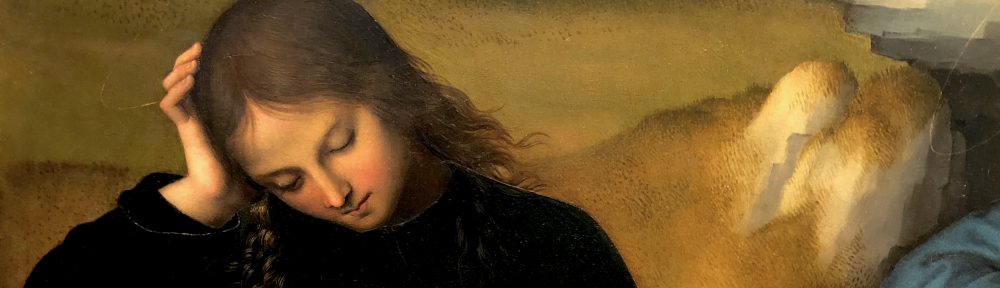
Lucas Cranach the Younger, Raising of the Son of the Widow of Nain (detail, 1569)

Lucas Cranach the Younger, Raising of the Son of the Widow of Nain (detail, 1569)

I’m writing from Hattiesburg, Mississippi, where I’ve been among some amazing people to reflect together on the deep connections between art and spirituality. The fruit of those conversations will find their way into future posts, but meanwhile here is what I’m preaching this morning from the pulpit of Hattiesburg’s Trinity Episcopal Church, based on the gospel text from Luke 7:11-17. 

Watch out! There’s going to be a collision.

Here comes a funeral parade, with a dead young man, his grieving mother, and a whole crowd of mourners, weeping and wailing and gnashing their teeth.

And from the opposite direction, pretty as you please, here comes the Jesus parade: the holy man everybody’s talking about, along with his passel of disciples and a whole bunch of folks who’ve just seen Jesus cure the centurion’s slave in the blink of an eye and who want to see what in heaven’s name he’s going to do next.

The Jesus people are all laughing and talking and telling stories, but suddenly Jesus raises his hand and they all stop, because he’s seen the widow, he’s heard her crying—they can all hear her crying—and Jesus is so moved by her tears, his heart just fills up and overflows with compassion. and whatever he was on his way to do no longer seems all that important.

He knows that moments like this are why he came into the world. So he heads straight across the town square to meet that funeral procession, with all his folks trailing after him, wondering what’s going to happen.

What is going to happen, in the middle of that dusty little country town, is a great cosmic showdown: the parade of death running smack into the parade of life. And here’s how it goes.

Jesus reaches out to touch the coffin, and the pallbearers come to a dead stop. Everybody gets real quiet. Maybe the widow recognizes Jesus. Maybe she’s heard stories about his miracles. But she’s not asking for any help. Her son is dead. She knows his story is over. Nothing Jesus can do about that, she thinks. She’s long since resigned to her grief.

And the only thing Jesus has to say to her is, “Do not weep,” because it’s her son that he wants to talk to. Then Jesus speaks the words he has been given the power to say:

Young man, arise!

And the dead man sits up, opens his mouth, takes a breath, and words start to spill out, words of wonder and joy, and he is alive again. Then Jesus gives him back to his mother. And all the people standing round don’t know whether to be scared or whether to start shouting “Glory to God! Glory to God!”

And as for all of us who listen to this story today,what do we do with the strangeness of it in a world where too many young men and women die and parents weep and there is no resurrection parade that shows up to make everything all right again?

Can we still take hope from this story, or is being snatched from the jaws of death only for the lucky few, like winning the lottery, while the rest of us can only dream of such a happy fate?

This would be a cruel story if it were about a blessing which most of us will never know. But what Jesus did that day in the village of Nain wasn’t a promise that we all now get a free pass to escape the human condition. Jesus didn’t really go around raising up everybody who died. It only happens three times in the gospels. Jesus didn’t come to give everyone a few extra decades of earthly existence. That’s not why he was here.

He was here to show us God, and to show us how humanity is made to become like God—not by grasping power and glory, but by embodying compassion, which is one of the dearest of God’s names.

It wasn’t God’s plan that Jesus spend all his time putting funeral directors out of business. But on that particular day in Nain, Jesus couldn’t help himself. He felt compassion for the widow, and as the incarnate Author of Life, he returned the widow’s son to the sensory world of dust and sunshine just so death wouldn’t get too uppity. Sometimes death needs to be reminded that it never gets the last word.

But Jesus didn’t mean for us to place our own hope in such temporary reprieves. The resurrection of the dead is a mystery more ultimate and profound than what happened to the widow’s son. Dying and rising are inseparable partners in the same transformative dance. It’s the way the story goes, and we just have to live with it. That is why, even at the grave, we make our song: Alleluia, alleluia, alleluia.

So what does this gospel story want to tell us today, wherever you and I happen to find ourselves on life’s journey in the year of grace 2016? I’ll tell you what I hear.

The first thing is, our God is compassionate. Our God is moved by our tears. And in the end, as poet Jane Kenyon said before her own untimely death, God will prove to be “mercy clothed in light.”

Secondly, I am struck by the power of the voice of the Divine Beloved, the voice of Jesus, speaking to us the word of life: Arise. And I don’t think we have to wait for the Last Day to hear it, either.

We are being called back to life every day, every moment, if we only have ears to hear. On her wonderful website, The Painted Bird, Jan Richardson has posted her poem inspired by this gospel. “Blessing for the Raising of the Dead.” tells us that ‘while this blessing / does not have the power / to raise you, /  it knows how to reach you. / It will come to you, / sit down / beside you, / look you / in the eye / and ask / if you want / to live.’ You can read the whole poem here.

Finally, I hear this gospel telling me one more thing. It is not enough simply to hear the voice that blesses and revives. I believe, now that the tongues of Pentecostal fire have settled on our own heads, that you and I are called to speak that voice as well, to be ourselves the voice that blesses, the voice that calls the dead back to life—dead hopes, dead neighborhoods, dead dreams, dead souls.

The word of life is not something we ourselves possess, but God has empowered us to speak it nonetheless: to be Christ’s voice for those in need, to be Christ’s voice to a broken and longing world—

the voice which speaks the word
uttered for all eternity
in the heart of God:

Arise, it says. Arise.


Bill Viola’s “Martyrs”

image

The souls of the righteous are in the hands of God, and no torment will ever touch them. In the eyes of the foolish they seemed to have died, and their departure was thought to be a disaster, and their going from us to be their destruction; but they are at peace.

– Wisdom of Solomon 3:1-9 (Lectionary reading for All Saints)

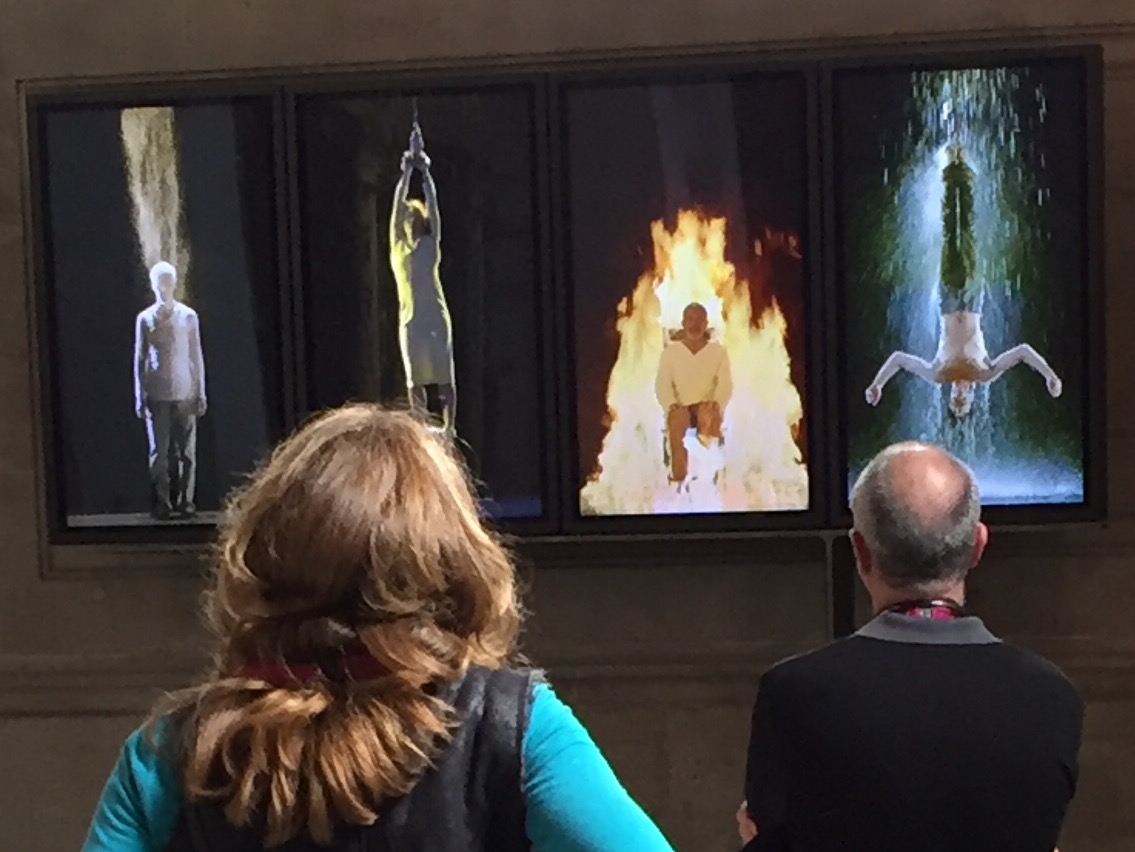
At the far end of the south choir aisle of St. Paul’s Cathedral in London, four “martyrs” perform a perpetual sacrifice in a slow-motion passage from suffering to glory. These martyrs are not the painted or sculptured figures of a traditional altarpiece, but two men and two women, recorded on high-definition video, and played back continuously on a polyptych of four adjacent vertical plasma panels, each 55” x 33.”

This stunning work is by Bill Viola, who has long been exploring the interplay of “technology and revelation.”[i] As David Morgan has written, “Viola’s work suggests that the human condition consists of the fact that we are embodied beings yearning, but ill-prepared, for communion with one another; that we suffer pain and loss, that we struggle to transcend our bodies and our suffering by connecting with a larger or inner aspect of reality; and that we die. Bodies, communion, suffering, transcendence, and death collectively constitute a condition, a worldview that the artist seeks to investigate in his work.”[ii]

Martyrs (Earth, Air, Fire, Water) was installed at St. Paul’s in 2014, and this week I had my first chance to see it. It is 7.5 minutes long, continuously repeated. Mesmerized and deeply moved, I watched it ten times, and each viewing provoked some new thought or feeling.

The figures begin in stasis, undergo an ordeal involving time and motion, and finally come to rest in a perfect stillness: not the anti-life of death or nonbeing, but something implicitly wondrous.

All the figures are facing in our direction. In the first panel, a kneeling man, head bowed to the floor, is almost completely buried beneath a triangular pile of dirt. We only see the top of his head, clutched by his two tense hands. The dirt begins to fly upward in a column, disappearing into whatever is above the frame. He rises to his feet, ever so slowly, as if it is a great struggle against gravity, or stasis. By the time he is upright, the last of the dirt has vanished into the “above,” and he is staring out at us impassively.

In the second panel, a woman in a white shift is suspended by a rope tied to her wrists. Her feet are anchored two feet above the ground by another rope securing her ankles. She is blown by a great wind coming from the left, buffeted back and forth within the constraint of her tethers, at the mercy of a relentless exterior force. After a while, the wind subsides, her suspended body grows still, and she gazes out with an unexpected measure of serenity.

A black man sits in a chair in the next panel, his head tilted to the side and downcast. Then bits of flame begin to drop from above, continuing to burn where they land. More and more flames fall, some leaving trails like shooting stars, until the whole floor, and the chair, are on fire. By this time the man has raised his head to look out at us, but he appears calm and still even as the flames envelop him. He remains in that position as the flames finally relent and die out.

In the last panel, a man is curled up in a fetal position with eyes closed. A rope tied to his angles is suspended from somewhere above the frame. The slack starts to be taken up, pulling his legs upward, and then his entire body, until he is completely upside down like the Hanged Man in the Tarot, or one of those skinned animals dangling in a Dutch genre painting as a secularized image of Christ’s Passion. When a stream of water begins to fall from above, his arms slowly stir, moving into a prayer position, bent 90 degrees at the elbow, then gradually sweeping backward, like a swimmer’s breaststroke, until they are near his side. Meanwhile, his inverted body begins to be pulled upward by the rope, toward the source of the falling water.

All of the figures have been handed over to forces or situations beyond their control. One buried, one bound and buffeted, one burned, and one left for dead. Yet none of them rages or resists. They accept their condition with a calm grounded in something greater than their own survival.

Each of the first three, after gazing out at us for a time, gradually shift their attention to whatever is above them, out of our sight, until their upturned faces glow with the light of eschatalogical radiance. Their faces never become expressive, or call attention to their own personalities; they remain still and quiet, in a condition of “absolute unmixed attention.”[iii]

The fourth figure, the “Hanged Man,” provides the dissonant harmony within this suite of images. He is the one who appeared already dead, his suffering behind him. His eyes, either closed or obscured by the water streaming down his face, are never quite visible. Although his arms eventually make hopeful gestures of prayer or embrace, the rest of his body stays limp, totally given over to the power at the other end of the rope, which pulls him up and out of the frame. The water continues to fall when he is gone.

Unlike the prayerful final images of the other panels, the fourth is fraught with absence. The other martyrs only gaze at the transcendent. The fourth has already ascended there, and we are left with only the water as a reminder of the one we can no longer see.

Noting that martyr means “witness,” an accompanying statement by Viola and his producer Kira Perov compares the active witness of martyrs to the passive witness of those who merely consume images of suffering through mass media, adding that these four figures “exemplify the human capacity to bear pain, hardship, and even death in order to remain faithful to their values, beliefs, and principles. This piece represents ideas of action, fortitude, perseverance, endurance, and sacrifice.”[iv]

But these evocative images can’t be reduced to a single meaning. The more I watched, the more meanings and associations were generated. The first figure suggested Adam formed from the mud, or Christ rising from his grave, shedding mortality clump by clump. It also seemed a kind of birth.

The strongly sidelit second figure, whose white shift and platinum hair glowed against the black background like a Zurburan crucifixion, mirrored both Jesus and Joan of Arc.

Like gold in the furnace God tried them, and like a sacrificial burnt offering God accepted them.[v] The fire in the third panel not only recalled the light of burning martyrs, but the positive biblical tropes of the refiner’s fire and tongues of flame.

The fetal position of the fourth martyr evoked both the womb and the grave. The falling water made me think of both baptism and waterboarding. Once he was gone, however, it spoke to me of both memory and promise: what had happened to him, and what might happen to us.

Just what – or who – is at the other end of that rope anyway?

[i] “Technology and Revelation” is the title of a lecture I heard Viola give at the University of California at Berkeley, September 28, 2009.

[ii] David Morgan, “Spirit and Medium: The Video Art of Bill Viola,” Image, No. 26 ((Spring 2000), 32

[iii] This was Simone Weil’s definition of prayer.

[iv] From the installation’s explanatory text.

[v] Wisdom of Solomon 3:6

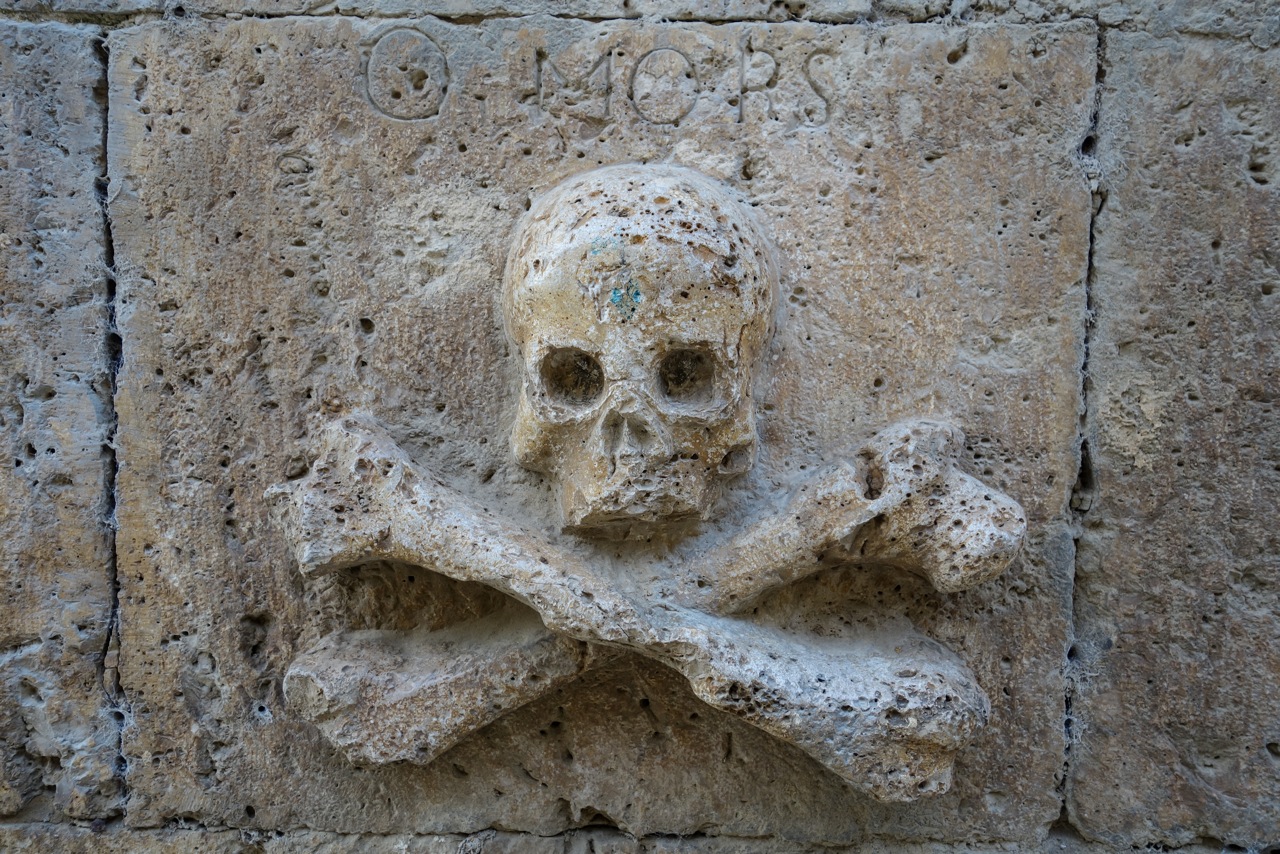
Memento mori

Wall relief in Castrojeriz on the Camino de Santiago

Wall relief in Castrojeriz on the Camino de Santiago

I tell my pupils to live each day as if it were their last… I don’t want children to fear death; I want them to respect life… It’s good for children to confront the idea of death, and… of their own mortality. Sometimes a child feels squeamish about death… skulls and skeletons. When this happens, I tell my pupils to touch themselves. “Why are you afraid?” I ask, “when each of you owns a skull and skeleton. We all carry death within us.” They feel themselves, and they say: “Yes it’s true, we too are made of bones.”

– María Antonieta Sánchez de Escamilla, a kindergarten teacher in Mexico (The Skeleton at the Feast: The Day of the Dead in Mexico, Elizabeth Carmichael & Chloë Sayer)

No leaves, no flowers, no light, no warmth, November. The eleventh month, as the year begins to slip away, evokes mortality like no other. Though it begins with the festivity of All Saints Day, celebrating the friends of God now radiant with the light of heaven, it immediately shifts to the more shadowy realm of All Souls, the Day of the Dead. Death itself, rather than what lies beyond it, becomes our focus. We visit graves, light candles, speak names, gaze at old photographs, tell stories of vanished presences.

In Mexico, death is playfully treated in comic skeleton images and candy skulls, but it is not mocked. A resigned acceptance of mortality pervades the festivities. The living remember not only the dead, but the skeleton inside themselves. They too are “made of bones.”

In American culture, we are not so adept with death. We always seem a little surprised by it. We avoid speaking its name. Memento mori is not a common spiritual practice. Few of us keep skulls on our desk, or sleep in coffins while we still have breath.

Forty-five years ago this month, I had my closest brush with death. I was sleeping in the back of a Volkswagen bus hurtling down a New York thruway at 65 miles per hour. A friend and I had been traveling all night, and it was my turn to rest. Suddenly the bus went out of control and flipped sideways, rolling over and over six times until finally coming to a stop upside down on the grassy median.

I remember two things about that long roll. My mind sped up to make everything appear in slow motion. It was like being inside the giant rotating barrel at an old amusement park. It carries you up and up until gravity kicks in and you are dropped back to the bottom to begin all over again. Slide up, drop. Slide up, drop. But slowed down, so I could observe it all in detail. Meanwhile, guitars, suitcases and croquet balls were flying around in similar motion experiments.

The other thing I remember is how familiar death seemed. I was not thinking, “This can’t be happening.” I was thinking, “Oh, so this is where we finally meet.” I’m sure the words were not so precise in the moment, but the sense of recognition was. When the rolling finally stopped, I lay face down on the ceiling of the inverted bus. I probably blacked out for a moment. Then I heard a voice, “All you all right?” I wasn’t sure how to answer – not until I actually tried to move. What if I couldn’t? I hesitated a moment, delaying the verdict. At last I tested my hands; my arms; my legs. They still worked. I rose slowly to my feet. Thankfully, nothing was broken. My friend was unharmed as well. Life was never so sweet.

The bus itself was totaled, and one of the guitars, my grandfather’s Gibson “Roy Smeck Stage Deluxe” Hawaiian guitar from the 1940’s, was pretty smashed up as well. Its broken body still hangs in our garage, my own memento mori.

In the predominant secular imaginary, a peek through death’s door finds no stairway to heaven, but only darkness. Termination. Void. A terrible forgetting. Emptiness.

This is a reasonable outlook, especially after the charnel house of the past century, but it’s not much to live by. And it is no more provable than belief’s alternative. None of us knows for sure. It’s a gamble either way.

In the 1950’s, Sylvia Plath summarized the modern formulary in her journal:

You don’t believe in God, or a life-after-death, so can’t hope for sugar-plums when your non-existent soul rises… Cats have nine lives, the saying goes. You have one; and somewhere along the thin, tenuous thread of your existence there is … the stopped heartbeat that spells the end of this particular individual which is spelled ‘I’ and ‘You’ and ‘Sylvia.’

John Donne, who himself never took death lightly, saw the outcome differently:

All mankind is of one Author and is one volume; when one man dies, one chapter is not torn out of the book, but translated into a better language; and every chapter must be so translated.

Just a month before his death from cancer in 1631, Donne preached his final sermon, Death’s Duell, at St. Paul’s, London. “That which we call life is … spent in dying,” he wrote, but “a gate into heaven I shall have.” Then, though weak from illness, he posed for a sketch that would be used to make the sculpture for his tomb. After having a fire lit in his study (it was February), he stripped naked and wrapped himself in a burial shroud with only his face showing. Rather than lie down in the traditional sleeping position, he stood erect for the sketch. The resulting statue, the only monument to survive the Great London Fire of 1666, resides in the south choir aisle of St. Paul’s. Donne is standing to greet the resurrection. His eyes are not yet open, but he is smiling with expectant delight. His epitaph reads:

He lies here in the dust
but beholds Him whose name is Rising.