All creatures great and small

Goldfinch

In the 13th century, what you did with animals was either avoid them, cook them, or work them to death. You certainly didn’t preach to them, pray with them, or receive spiritual gifts from them. Unless you were Francis of Assisi. He called animals his brothers and sisters. He saw them as our teachers. Such countercultural regard for the non-human was seen by his biographers as a restoration of a fallen creation, a renewal of the lost paradise where all creatures, great and small, might live in peace. As Bonaventure wrote,

So it was, that by God’s divine power the brute beasts felt drawn towards him and inanimate creation obeyed his will. It seemed as if he had returned to the state of primeval innocence, he was so good, so holy.

But Francis wasn’t just a dreamer. He was an environmental activist. He lobbied the officials, the governors, and even the Emperor for laws against the abuse of animals. He urged farmers to treat cattle humanely, and convinced towns to scatter seeds on the roads in winter so the birds wouldn’t starve (this is still done in Assisi today). He called for hostels for homeless strays, and raged against the caging of larks.

His love and respect for creation continues to nurture and challenge our own evolving sensibilities about the interdependence of all beings. He wasn’t quite calling for a democracy of creation – one beast, one vote. He remained distinctly medieval in his chivalrous notions of honor, deference and courtesy among the various levels of creation.

Nevertheless, Francis expanded the perimeter of love’s circle far beyond the human tribe, and his example pushes us to do the same.

On the Feast of St. Francis (Oct. 4) in 2012, a group of Episcopal clergy and laity blessed the animals at Seattle’s Woodland Park Zoo. In writing the blessings, I tried to honor and bless the qualities of each species, and name the ways in which those qualities in turn might inform and bless their human kin.

I documented the blessings on video, which you may view here.

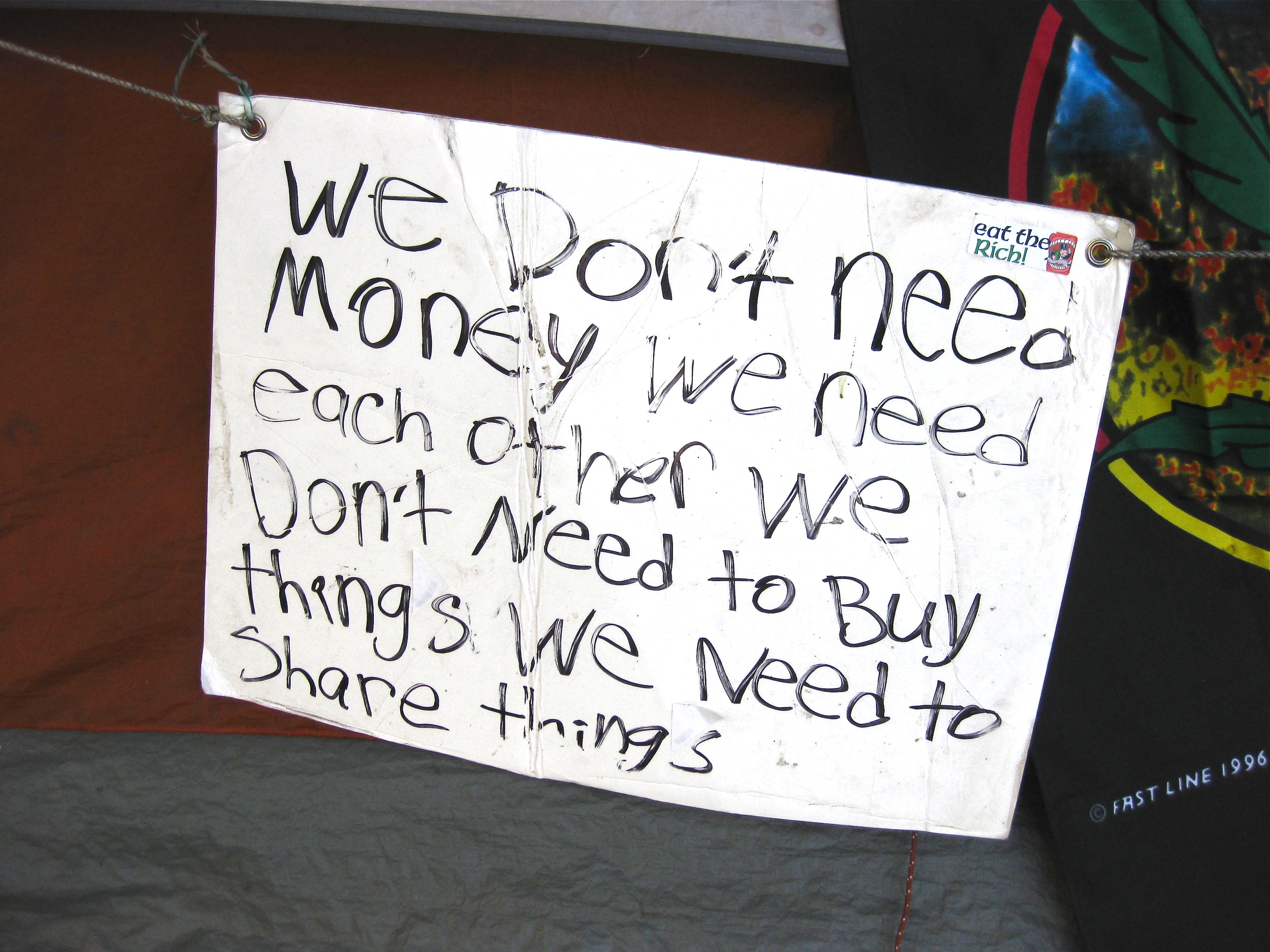
God’s not fair!

Sign at Occupy LA city hall encampment, October 2011

Sign at Occupy LA city hall encampment, October 2011

If any have toiled from the first hour,
let them receive their due reward;
If any have come after the third hour,
let them with gratitude join in the Feast!
And those that arrived after the sixth hour,
let them not doubt; for they too shall sustain no loss.
And if any delayed until the ninth hour,
let them not hesitate; but let them come too.
And those who arrived only at the eleventh hour,
let them not be afraid by reason of their delay.
For the Lord is gracious
and receives the last even as the first.
Christ gives rest to those that come at the eleventh hour,
as well as to those that toiled from the first.

This famous passage from the ancient Paschal homily of St. John Chrysostom is a marvelous riff on Jesus’ parable of the Workers in the Vineyard (Mt. 20:1-16). It’s certainly good news to the latecomers, but rather disconcerting to those of us who have a strict idea of who’s in and who’s out. You never know what kind of people you’re going to run into at God’s place. You may have to break bread with some who haven’t earned their place at the table the way you have, who haven’t paid their dues the way you have. It’s not fair. The kingdom of God is not fair.

That’s the trouble with mercy and forgiveness and grace. They are so undiscriminating. How are we supposed to know where we stand, how can we measure up, how can we hold others accountable, if the standards are so loose and slippery?

Let’s face it. Jesus was a terrible bookkeeper. He didn’t maintain accurate accounts of how everyone was doing. He was too busy throwing a party for God’s friends. Y’all come. Everyone’s welcome!

The first disciples who listened to this story undoubtedly needed to hear its message. They were anxious about where they stood with Jesus and with God. Lord, who’s going to sit at your right hand and who’s going to sit on your left? What are we going to get for following you? Whom do you love the most? This anxiety about status and privilege continues in the Book of Acts, when some of the original Jewish believers resent the influx of Gentile converts. And we have our own versions of this calculating mentality today. Who’s in, who’s out? Who’s better, who’s worse? Who belongs, who doesn’t? Who’s saved, who’s not?

But with this parable, Jesus tells us:

  • Stop worrying about wages. The kingdom isn’t something you earn. It’s a gift. Be glad you are one of the recipients.
  • Don’t worry about how much you’ll get. You’ll get what you need. You really will.
  • Stop comparing yourselves to others. God loves everyone equally.
  • Don’t be envious or resentful of someone else’s good fortune, even when you think it’s undeserved. Be glad that God is so generous, even if it’s not always about you.

Once the whole idea of a bookkeeping religion has been exploded by this parable, we begin to realize that it’s not a story about wages at all. It’s a story about the vineyard. Everyone gets invited to the vineyard, and ending up there together is the whole point. The latest have not come too late, and the earliest have not come too early. In the end, everyone is there, no one is missing.

Now if you don’t want to be part of this vineyard collective, just take what you’ve earned and go. That’s what the master tells the complainers, the bookkeepers, and to me it’s the most chilling line in the story. You don’t want any part of the kingdom’s undiscriminating generosity? OK, fine. Go off and be by yourself, or with your little circle of the like-minded. But you may find it rather lonely. And you’ll miss one hell of a party.

Seventy times seven

Jacopo da Pontormo, Deposition (1525-26), Capponi Chapel, Santa Felicita, Florence

Jacopo da Pontormo, Deposition (1525-26), Capponi Chapel, Santa Felicita, Florence

A homily on Matthew 18:21-35 for the 14th Sunday after Pentecost (and 9/11)

So Peter comes up to Jesus and says, “Lord, forgiveness is really hard work. When do I get to quit?”

And Jesus says, “Peter, sometimes you’re as dumb as a rock. If you want to stay with me, you can never stop forgiving.”

“But Lord, you don’t expect me to forgive everyone, do you?”

“Yes, Peter. Everyone.”

          The Gospel of the Lord.

I once led a workshop exercise based on the Flood story. We all wrote on cards the types of people we thought the world would be better off without – drug dealers, terrorists, polluters, tax collectors and sinners, etc. – and we put our cards in a pile in the center of our circle. Each person had to pick a card, becoming the character they drew. Then they each had to make a case for themselves, to persuade us to let them come aboard the ark rather than be left to die in the flood. Most of us had at least one or two people we didn’t want to sail with, but some of the women – though none of the men – voted to forgive everyone.

How would you vote? Saved, or drowned?

The driver who cut you off on the freeway?
The neighbor who won’t quiet her barking dogs?
The priest who failed to visit you when you were sick?

How would you vote?

The colleague who stabbed you in the back?
The friend who let you down?
The spouse who betrayed you?

How would you vote?

The football player who knocked out his fiancé in an elevator?
The fanatics who flew the planes into the towers?
The lawyers and politicians who made torture a national policy?
The men who beheaded American journalists on YouTube?

Let’s be clear. Forgiveness doesn’t mean condoning or tolerating wicked acts. It doesn’t mean a wife should stay with an abusive husband, or that we can’t feel shock and outrage when we witness hateful instances of oppression or racism or brutality.

What forgiveness does mean is that
we don’t let those things have the last word.

We all know about this on a personal level. You may never forget a wounding encounter, but you know you can’t let it fester inside forever, you can’t give it power over you forever. At some point, you have to let it go.

Tell the truth about it, to the offender if possible, and to yourself. Don’t minimize the damage. But don’t hold on to the hurt. Don’t make your life about the hurt.

Forgiveness means leaving resentment behind. It means letting go of the reactive desire for punishment. There was a POW who said he could never forgive his captors. So a friend told him, “Then they’ve still got you in their prison.”

Rabbi Harold Kushner told a woman who was betrayed and abandoned by her husband: “I’m not asking you to forgive him because what he did was acceptable… I’m asking you to forgive because he doesn’t deserve the power to live in your head and turn you into a bitter angry woman…. you keep holding on to him. You’re not hurting him by holding on to that resentment. You’re hurting yourself.”

That’s all true as far as it goes. We can be bigger than our hurts. We can live in the present, not the past. But when Jesus told us to forgive, he wasn’t just talking about our personal well-being.

He was talking about a radical revolution in human relations.
He was telling us to exit the endless cycle of violence and retribution.
He was telling us to choose life, not death.

Those terrorists who committed atrocities on YouTube,
they want our rage, they welcome our hate,
because it means we are consenting to play their game of death,
adding our own tributaries of anger to their river of violence.

So we are presented with a clear choice:
Either forgive them,
or become them.

Jesus is asking something very hard of us.
Yes, maybe we can forgive the ordinary hurts of daily life.
But how can we forgive those monsters on YouTube?
That goes against human nature. That seems impossible.

Maybe it was impossible once. But Jesus, who died forgiving his own killers, has redefined what is possible. Jesus has opened the door to redemption for even the worst of sinners.

They may not always go through that door – some may choose to remain in the godless hell of their own self-will, but we are not allowed to close the door on them. We are not allowed to deny anyone the possibility of redemption, the possibility of reconciliation and healing.

God wants to do something new with this world, and as long as we perpetuate the cycle of violence and vengeance, that new thing cannot happen.

If we say that there are some people who cannot be saved, we are limiting the power and grace of God, and we are refusing our own vocation to be God’s agents of grace and forgiveness not only for the people we know, but for the stranger and the enemy as well.

We can do this, Jesus assures us. We can forgive – not because we are saints with extraordinary powers, but because we are sinners who have ourselves been forgiven.

Just ask St. Paul, who reminds us this morning not to judge one another, who asks us to remember that since we all belong to God, we also belong to one another. These are the words of the man who held the coats for Stephen’s murderers while they stoned the first Christian martyr.

If that stoning had been on YouTube, we might still be holding that horrifying image in our minds, still hating Paul as a monster instead of reading his words as Scripture. Paul knew what it meant to be forgiven, and that’s why he could be so eloquent about grace.

“We all stand before the judgment seat of God,” he says.
Lord have mercy. Christ have mercy.

When Peter asked his question about forgiveness, Jesus told him a story.

A slave who owes his master a gazillion dollars is forgiven this unpayable debt, but then he goes right out and finds a fellow slave who happens to owe him fifty cents. He grabs him by the throat.
“Pay me now!” he says.
“Have mercy!” the man cries. “I cannot pay you.”
“That’s not my problem,” he says, and throws the man into a dungeon until he can pay what he owes.

It’s one of Jesus’ craziest stories, and it’s meant to be. The absurdity of the parable puts a spotlight on our own absurdity when we who have been forgiven so much refuse to pass that forgiveness on to others.

If we say we have no sin, we are only deceiving ourselves. It’s not just a matter of how we act as individuals. We must also acknowledge our inescapable participation, conscious or unconscious, voluntary or involuntary, in all the systemic processes that negate the flourishing of life on earth. Just by functioning within the habitual realities and practices of a fallen and imperfect world, we become complicit in the things that fall short of God’s intention, the things that disappoint God’s hope for us.

And still, God loves us.
And still, God forgives us.
And still, God keeps heaven’s door open
and leaves the light on for us.

Perhaps you saw the extraordinary film, Of Gods and Men, which came out a few years ago. It tells the true story of eight French Catholic monks who lived in the mountains of Algeria during a time of civil war and terrorist violence in the 1990’s. Their monastery was at the edge of a poor Muslim village, where they lived in harmony with their neighbors, providing the village’s only accessible health care.

As the surrounding political violence escalated, the monks were warned by the government to leave the country. As Catholics in a Muslim country, they would be suspected of trying to make converts. Their very presence was an offense to the religious extremists. But the monks felt called to remain among the people they served, despite the high probability of martyrdom. Despite their own fears.

“If something happens to us, although I do not wish it to,” wrote Brother Michael, one of the monks, “we want to live it here in solidarity with all the Algerians, men and women, who have already paid with their lives, and in union with all unknown innocent victims.”

As for the armed rebels and the armed soldiers who were fighting all around them, the monks called them “our brothers of the mountains and our brothers of the plains.”

Their abbot, Dom Christian, wrote a letter to his family in Advent, 1993, two and a half years before he and his brother monks were beheaded by terrorists. Anticipating his own martyrdom, he insists that he is not exceptional, since so many others in that land were also at risk.

“My life,” he wrote, “is not worth more than any other — not less, not more. Nor am I an innocent child. I have lived long enough to know that I, too, am an accomplice of the evil that seems to prevail in the world around, even that which might lash out blindly at me. If the moment comes, I would hope to have the presence of mind, and the time, to ask for God’s pardon … and, at the same time, to pardon in all sincerity him who would attack me…”

What an extraordinary thing to say: Here is a good and humble and holy man confessing his own complicity in the evils of the world. And what does he hope for? He hopes for the presence of mind, in the very moment of being murdered, to ask forgiveness. Forgiveness not only for himself, but for his killer as well. As he had once said of his monastic community, “we should openly be on the side of love, forgiveness and communion, against hate, vengeance and violence.”

The last part of Christian’s letter is addressed not to his family, his loved ones, but to the unknown violent stranger who will one day kill him, the stranger whom he calls “my friend of the last moment.”

He calls his killer friend, refusing the way of violence and vengeance and hate, and by so doing he plants the kingdom of forgiveness in the very place where his own blood would be spilled by his assassin’s sword.

He commends that assassin not to hell, not to eternal punishment, but to God. A-dieu, he tells him. A-dieu: “to God.” And then he imagines a future that may seem impossible to us, but is the only future which God desires.

Listen to what he says. This is how Christian ends his letter; this is what he wants to tell the stranger who will one day cut off his head:

“And to you, too, my friend of the last moment, who will not know what you are doing. Yes, for you, too, I wish this Merci, this “A-Dieu,” because in God’s face I see yours. May we meet again as happy thieves in Paradise, if it please God, the Father of us both.”

Experiments in worship

Sleepers Wakehttps://jimfriedrich.com/wp-content/uploads/2014/08/sleepers-wake.jpg
Last month’s 40th anniversary of the first Episcopal ordinations of women to the priesthood evoked a wide sharing of memories and stories about a church breaking from inherited ways to make a significant rewrite of its identity and practice. That break did not happen without resistance and struggle, but the shift was irreversible. A less complete priesthood is now unimaginable.

But there was also another revolution underway in 1974, a campaign for liturgical renewal being carried out on many fronts. Scholars had been making the case for change for decades, leading to such major revisions as Vatican II and the 1979 Book of Common Prayer. At the grassroots level, early experiments in “indigenous” youth culture masses laid the foundations for “alt.worship” and “fresh expressions.”

My first year of ordained ministry was at Canterbury House in Ann Arbor, a campus ministry known for its coffeehouse concerts (Neil Young and Joni Mitchell played there) and its innovative worship. At the end of the Sixties, our congregation of college youth valued meaning over form, allowing us the freedom to re-imagine the way we worshipped on a Sunday by Sunday basis. Sometimes the results were sublime and indelible, while there were also some abysmal flops. But that was okay. Everyone understood that our liturgical mission was to experiment: it was as important to know what didn’t work as what did.

In the Seventies, I became liturgical artist-in-residence at St. John’s, Los Angeles, a gorgeous cathedral-sized church with a progressive multi-cultural congregation. Under prophetic rectors Larry Carter and then Bill Persell, it had become a well-known site of conscientious witness against war, poverty and injustice (Cesar Chavez and the Berrigans thundered from St. John’s pulpit). Although the traditional Sunday morning liturgy was satisfyingly rich, we instituted a monthly Sunday evening series of alternative eucharists (“The Third Sunday”) to explore a wider range of themes and experiential models.

It wasn’t simply a matter of utilizing contemporary texts or plugging in unexpected kinds of music (although bagpipes and synthesizers each provided amazing sounds). We also explored different ways to structure the entire underlying form of the rite. Sometimes we employed worship templates drawn from mythic literary motifs like the Book of Revelation, the Divine Comedy, or the Harrowing of Hell. On Palm Sunday, two “carpenters” (one of whom is now the dean of the National Cathedral) built a cross near the altar throughout the liturgy, occasionally discussing the morality of capital punishment. During the Words of Institution (“This is my body … This is my blood”), their hammers pounded nails into the cross.

My favorite Third Sunday liturgy was a very early example of installation worship: an Advent journey, in groups of six, through a long enclosed corridor circling behind the chancel. The dark, narrow space was filled with projections and recorded poetry (“Inferno,” “Dover Beach,” “Four Quartets”). There was even a descent into a solipsistic hell (a dismal basement room with only live TV images of your own face). But in the end, you emerged into a candlelit chapel of shimmering gold mosaics and exquisite chant, taking your place with those who had made the journey before you, as if you were being welcomed into heaven.

The year 1974 began with the grandest alternative worship experience of my life, at a national gathering of 400 Episcopal college students, professors, and campus ministers during the first week of January. This was a few months after the Episcopal General Convention had once again rejected women’s ordination, and replaced the progressive Presiding Bishop with a southern conservative. It felt like a double slap in the face for progressives. The collegiate Episcopalians, restless and discontented, were having serious doubts about the institution. Some expressed their anger by questioning the value of the all-night liturgy planned for Epiphany. Wasn’t it being designed by three white males (Bill Teska, Mark Harris, and myself)? Down with elitism and sexism!

They had a point. We were just three friends with particular skills who had volunteered to design something memorable. We hadn’t really thought through inclusivity issues. All our attention was on the product, not the process, and we got called on it. There was talk of staging a protest to bring the liturgy to a halt, but artful negotiation transformed the proposed rupture into small group discussions that would be an official part of the liturgy.

The gathering was in Florida, where the temperature would remain comfortable through the hours of darkness. The “Great Liturgy” of Epiphany began at midnight beneath the full moon, with the congregation singing and processing three times around the worship space – a circus tent with its sides rolled up, in the middle of an empty field. When we finally entered the tent, people broke into small groups to share their hopes and fears for the church. Once these conversations were reported to the whole assembly, the liturgy began in earnest.

A simple Compline was followed by a cosmo-political Penitential Rite: a ninety-minute trip through Creation, History and Apocalypse, using 12 projectors, sampled sounds from the news, pop music, poetry, movie dialogue and Bach’s St. Matthew Passion. Then the Seven Seals in the Book of Revelation were opened by means of participatory theater games, climaxing with a ritual “dying” (falling to the ground) by the people, and then a rising up again, led by three Magi (one of them female). “We have come looking for the Holy One,” the Magi declared. And one by one we rose to our feet, crying “He is here!” and “She is here!” and “We are here!”

It was now about 3 am, time for a half hour pause of silent meditation, ending with a grand entrance procession of the eucharistic ministers preceded by six thurifers, filling the tent with incense. A jazz matins enlivened the Service of the Word, then a ninety-minute Offertory presented the gifts of the community before the altar – heartfelt testimonies, dance, a Navajo healing chant, a gospel quintet. By now the full moon, overhead when we began, was setting into the trees beyond the tent.

During the eucharistic prayer, a revolving mirror sphere painted the interior with kinetic light, and pulsing strobes flashed upon the bread and wine during the Words of Institution, making an almost hallucinatory intensification of the elements (definitely more Baroque than Cistercian!). After communion, we all processed out of the tent into the light of the rising sun, singing an Appalachian spiritual:

Bright morning stars are rising,
Day is a-breaking in my soul.”

Seven and a half hours from beginning to end,
moonlight to sunrise,
a Christian dreamtime.

It is the nature of liturgy – and language – to consist of mediating symbols. We aren’t allowed to see God face to face. As Isaiah realized in his Temple vision, such an encounter would obliterate us, swallow up our particularity, which is only made possible through the degree of separation we are given from the All. We don’t get to grasp “total presence” in this life, but only the words, images and sacraments that connect us with that (absent) presence. And yet there are times when the divine leaps across the gap, the bush burns bright before our eyes, and we hear the Voice calling our name. That Epiphany in a circus tent was one of those times.

So when I think of the church of 1974, I not only remember how we began to embrace a more inclusive priesthood, but also how free we were to explore both the means and the meaning of our deepest rituals. May it be so again.


“Have you heard the news?”

Bellini praying hands sm

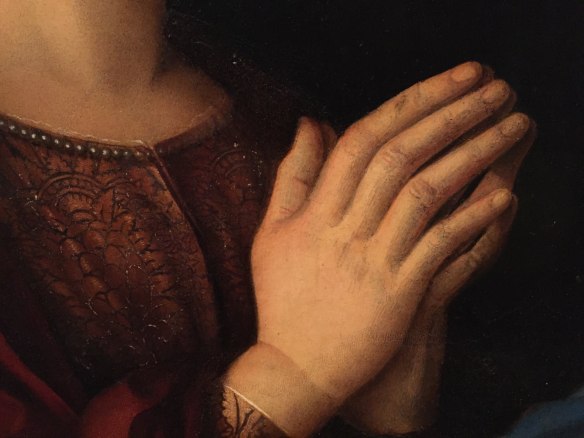
Giovanni Bellini, Madonna and Child with Saints Catherine and Magdalene (detail), c. 1500, Accademia, Venice

“Have you heard the news?” That’s the first thing the driver said when a friend and I hitched a ride out of Yosemite’s Tuolumne Meadows after hiking 150 miles from Lake Tahoe. We’d been in the wilderness for 20 days, so pretty much anything would be news to us. We shook our heads. What had we missed? “Nixon’s going to resign tonight!” he said, clearly savoring the pleasure of bearing glad tidings to fresh ears. That was August 8, 1974 (the President made the announcement that night on national television; his official resignation took place the next morning).

The sealing of Nixon’s fate wasn’t the only news I had missed in the Sierra wilderness forty years ago. Ten days earlier, when I was about halfway to Yosemite, three Episcopal bishops sped up the grinding wheels of ecclesiastical change by ordaining eleven women to the priesthood in a Philadelphia church. The ordination of women had failed to secure majority approval when the Episcopal General Convention gathered in 1973, and the next vote wouldn’t be taken again until the next convention in1976. The Spirit and the institution were clearly on different timetables. So the Philadelphia Eleven, and the bishops who ordained them, did what prophets do: they imagined an alternative future, which would remain contested and uncertain until the whole church could embrace its implications.

When the General Convention convened in Minneapolis in the summer of 1976, the ordination of women, along with a radical revision of the Prayer Book, topped the agenda. On the day the deciding vote was taken in the House of Deputies, ten thousand observers packed the hall. I was among them, and as the session unfolded I was struck by its overriding liturgical quality. This was not just another meeting with the usual amount of tedious verbosity and soul-sucking detail, but a solemn performance of a drama reimagining our collective identity. As in every liturgy, larger realities had to be contained within the imperfect significations of human language and ritual. And somehow – miracle of miracles! – a church convention became a place of theophany. I saw the Holy Spirit at work, not in spite of parliamentary procedure, but within and through that procedure.

The crucial session seemed to follow the shape of the eucharist. Once the assembly had gathered, the stories that brought us together were told. This “reading of the lessons” consisted of a long succession of speakers who had two minutes each to make the case for or against women’s ordination. This 90-minute “debate” was itself a kind of ritual, summarizing the now familiar arguments which had led to this moment. No new insights were expected – certainly no conversions – but it seemed important, before the vote, to tell the story of who we were – including our conflictedness – and the nature of the larger story we belonged to. Some told that story in terms of dwelling (tradition), while others described it as pilgrimage (innovation). But there was a sense that the story itself always exceeded our understanding of it. Many viewpoints, but still one church.

In the eucharist, the lessons are followed by the Prayers of the People, and so it was here. The resolutions committee, which had earlier reported its recommendation in favor of the motion that “no one shall be denied access” to ordination on the basis of gender, had reserved the right to present the final portion of its report just before the vote was cast. And that portion, we discovered, consisted of five minutes of silent prayer – fifteen thousand people filling the hall with a profound stillness. A large convention was the last place I would expect to experience prayer so fervent or so intense, but there it was.

Next in the eucharistic rite is the Offertory, where the gifts of the people are brought forward to the altar along with bread and wine. In this case, the gifts were the ballots filled out by the deputies. While their votes were being collected and counted, there was a Passing of the Peace. The presiding chair of the House of Deputies, the Rev. John Coburn, thanked the voting members for the courtesy with which they had treated each other in this potentially divisive process. The throng of observers rose to applaud them. Then Coburn thanked the observers for their courteous demeanor. We had refrained from any partisan displays of cheering or booing. The deputies rose to give us a standing ovation. Finally, everyone gave a standing ovation to the chair, who had so graciously guided the assembly through uncharted waters. In that moment, at least, we loved one another more than we loved our causes.

Something of that spirit remained when the results were finally announced. There was no outburst of applause or cheering. There were some quiet hugs, heads bowed in thanks, eyes moist with emotion. But as the multitude began to make its way out of the hall, most of the faces I saw appeared thoughtful, solemn, even stunned, like communicants returning from the altar, or Moses descending the mountain, glowing like fire.

For my part, when I first heard the tally and realized the motion had carried, I felt an inward elation, for this was a great and necessary moment. But mixed inextricably with my joy was a deep sense of the burden assumed by the losers in this long struggle. I couldn’t just exult in victory. I had to make room in my heart for the pain and disappointment of the defeated as well. This was surprising to me, for I have been too much a man of principle in my life, finding it hard sometimes to sympathize with incompatible perspectives and practices. That is one reason I am convinced that the Holy Spirit was blowing where she will that day. I couldn’t have come up with such sympathetic breadth on my own. Many of those I talked to later reported a similar experience.

Sympathy. Dora Greenwell, a single Anglican woman in Victorian times, wondered whether women have more capacity for sympathy than men. She had perhaps seen too many male clergy not in touch with their feminine side. She wrote about sympathy as an essential form of knowledge, without which any ministry is incapacitated.

… it is this ability to feel with others, as well as for them, that takes all hardness or ostentation from instruction and counsel – all implied superiority from pity and consolation. The woman, or man, of true feeling does not come down upon the sinner or sufferer, from another region, but is always, for the time being, on a level with those that are addressed – even able to see things as they see them.

Whether in sympathy or anything else, the Episcopal Church has been made incomparably richer by the gifts of its women clergy. I might add that I am privileged to witness this richness firsthand as the husband of a parish priest, whose singular gifts teach me about priesthood – and discipleship – every day.