“God isn’t fixing this”

Advent installation by Jim Friedrich at St. John's Episcopal Church, Los Angeles (1977)

Advent installation by Jim Friedrich at St. John’s Episcopal Church, Los Angeles (1977)

O come, O come Emmanuel,
and ransom captive Israel.

Once upon a time, worshippers entered their church on the Second Sunday of Advent to find a great wall between themselves and the sanctuary. The beautiful mosaics, the richly colored marble walls, and the magnificent carved Christ above the high altar were all hidden from view by this strange iconostasis, made from front pages of the Los Angeles Times. Instead of the images of holy men and women that adorn a traditional altar screen, there were banner headlines screaming catastrophe and mayhem.

When the assembly was seated, a mime came up the aisle to stand before the wall, searching for some way through it. His movements and gestures indicated perplexity, frustration, and finally discouragement. Then a voice from beyond the wall cried out,

Jerusalem, turn your eyes to the east,
see the joy that is coming to you from God. (Baruch 4:36).

Responding to the voice, the mime tore a small hole in the wall, and peeked through. He seemed entranced by what he saw.

The voice continued:

Take off the garment of your sorrow and affliction, O Jerusalem,
and put on forever the beauty of God’s glory. (Baruch 5:1)

The mime began to tear down the wall, encouraging others to join him. One by one, people rose from their pews to rip down the veil “of sorrow and affliction,” until the beauty of God’s sanctuary was finally revealed.

This simple but powerful ritual, the prelude to a eucharist I curated forty years ago at St. John’s Episcopal Church in Los Angeles, comes to mind whenever I hear that passage from Baruch in the December lectionary. It’s what we pray for each Advent from our place on this side of the wall: Good Lord, deliver us. Stir up your power. Tear down the wall between us. Show us your glory.

That wall of headlines reflected my ongoing interest in connecting Advent themes with the news of the world. The WTO protests in Seattle (1999) and the Occupy Movement (2011) both coincided nicely with Advent, mirroring its prophetic themes of judging the present order with the hope and vision of something better.[i] And just last week, the front page of the New York Daily News supplied a marvelous Advent provocation. By noon, it had 11 million Facebook views, and 74,000 shares.

New York Daily News, 12/3/15

New York Daily News, 12/3/15

The headline was a sharp rebuke to the shameless politicians who promise prayers for the victims of gun violence while refusing to do anything about the guns. Calling them “cowards who could truly end gun scourge” but instead “hide behind pious platitudes,” the newspaper offered a blunt theological assertion: “God isn’t fixing this.”[ii]

The daily office Old Testament readings for early Advent, calling the world to account for its evils, say much the same thing. To those who refuse to “renounce the dictates of our own wicked hearts,”[iii] the prophets imagine God declaring, “You made your own bed. Now lie in it.” (Thankfully, the prophets always redeem their rants in the end with comforting decrees of mercy and salvation).

However, the Lieutenant Governor of Texas was not comfortable with the Daily News’ riff on the old biblical idea that God sometimes gets fed up with human folly. His photoshopped revision was posted on Facebook and Twitter.

God hears our prayers

Of course this clueless retort (note the unfortunate juxtaposition of the headline with the red banner above it) did not actually answer the question of whether – or how – God acts in the world to “fix” things. It was just a clumsy attempt by a presumed gun lover to change the subject. Platitudes about prayer in the abstract are safe because they have no consequences, unlike real prayer, which always implicates the petitioner in a process of change and action. If we pray for an end to gun violence, we obligate ourselves to do all in our power to reduce it. Prayer is a call for action; it politicizes what we pray for. Prayer is not simply leaving things up to God. It is an act of volunteering to be part of God’s solution.

But is there such a thing as God’s solution? Does God – can God – fix things? It is not a question with a clear and simple answer. Human freedom has thrown a monkey wrench into the story of the world, while God has surrendered absolute control of the narrative. If we make a mess of things, God is not an indulgent parent rushing in to cover for us. We don’t get to multiply our weapons and then wonder why God allows so much violence.

So where does that leave us? In the Advent section of his Christmas Oratorio,[iv] W. H. Auden describes a closed-in, godless world where hope is absent.

Alone, alone about a dreadful wood
Of conscious evil runs a lost mankind …
The Pilgrim Way has led to the abyss.

But what if we are not alone? What if there is a God who can make the abyss into a way? What if an unexpected future is breaking through the walls of our self-made prison? The Advent message is to embrace this hope, as we take off the garments of sorrow and affliction to welcome the God of joy into our midst.

Whatever the “solution” (salvation) may be in the tangled histories of the world and the soul, it is a long-term, sometimes excruciating, process, requiring honest engagement with the consequences of human sin in acts of confession, repentance, reconciliation, justice, healing, sacrifice, and transformation. And I submit that these are not simply things we do with God, as though God were only a helper from the outside. They are things we do in God, or God does in us, as our own intentions and actions become the embodiment – the incarnation – of divine purpose.

So yes, I believe that God is fixing the world, but not in the short run. And not without us.


[i] I preached on both these events at the time, with mixed results. Some were not so ready to find traces of God in social movements which trouble the powers-that-be. One church subsequently banned me from its pulpit for being too “partisan.” Guilty as charged.

[ii] New York Daily News, December 3, 2015.

[iii] Baruch 2:8

[iv] W. H. Auden, For the Time Being: A Christmas Oratorio, in Collected Poems, ed. Edward Mendelson (New York: Random House, 1976), 273
After Paris and Beirut, what kind of story shall we tell?

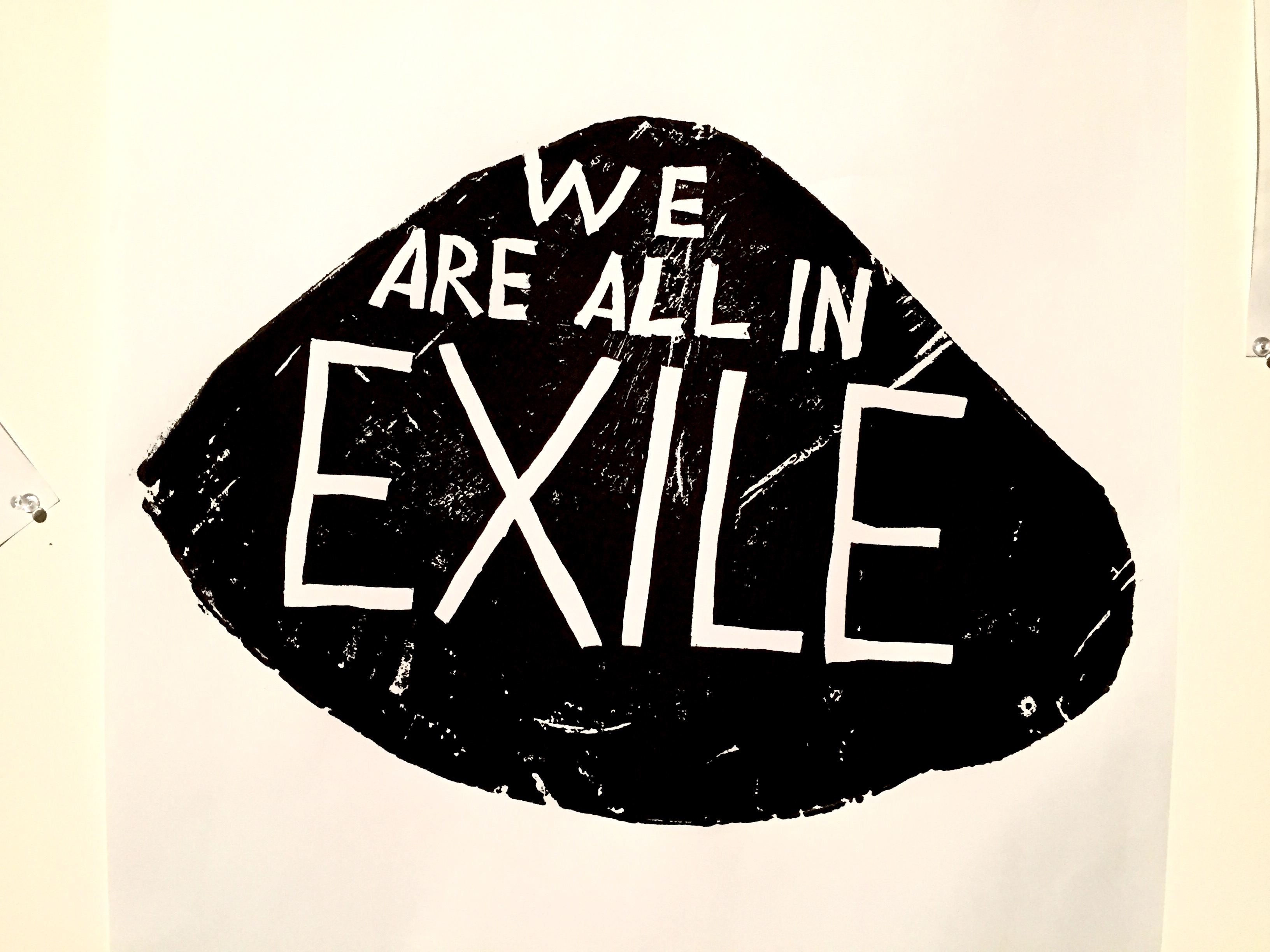
Barthelemy Toguo, wood stamp from tree trunk, Venice Biennale 2015

Barthelemy Toguo, wood stamp from tree trunk, Venice Biennale 2015

We played the pipes for you,
and you wouldn’t dance,
we sang dirges,
and you wouldn’t cry. (Luke 7:32)

This was, as Jesus observed, the perennial cry of the poor children in the marketplace, playing their instruments for the crowd, hoping for a handout. Every street performer could relate to this description of an unresponsive audience, but Jesus wasn’t using the image to address their plight. Instead, he was characterizing his critics as childish in their contradictory complaints about the prophets in their midst. They whined that John the Baptist was too austere and antisocial, but they didn’t like Jesus’ partying with sinners any better.

The failure of others to respond appropriately to the tunes we play for them could also describe the incredible discord among competing versions of reality in these days of terrorist violence. The actions of those living in alternative realities to our own seem inexplicable, and our often clueless responses to those actions fail to produce the intended results. We pipe, but they don’t dance. We bomb, but they don’t submit. We reason, but they won’t be persuaded.

In a long and unsettling article in The Atlantic last March, Graeme Wood diagnosed ISIS as a “dystopian alternate reality” grounded in an apocalyptic worldview. According to Wood, the western violent response to the Islamic State not only feeds their medieval narrative of Crusaders versus Muslims, it is the longed-for fulfillment of millenarian prophecy. In the Syrian farmland around the city of Dabiq, the armies of Islam will face down the armies of “Rome” (the West). This decisive battle will inaugurate the End of Days, resolving all the tribulations of history into a final triumph of God’s people.

In this narrative, the escalation of American military involvement would not be a deterrent, but an incentive. As Wood put it: “During fighting in Iraq in December [2014], after mujahideen (perhaps inaccurately) reported having seen American soldiers in battle, Islamic State Twitter accounts erupted in spasms of pleasure, like overenthusiastic hosts or hostesses upon the arrival of the first guests at a party.”[i]

If Wood is correct, then ISIS is operating from premises which we would dismiss as senseless and fantastic. But then what do we make of a recent poll on religion and politics, where1000 American adults were asked, “Do you think that the end of the world, as predicted in the Book of Revelation, will happen?”[ii] The results suggest that alternate realities are not exclusive to other cultures:

Yes, in my lifetime (13%)
Yes, but not in my lifetime (39%)
No (25%)
Not sure (22%)

I’m not sure what “not sure” means in this case, but I’m guessing some of those folks are at least conceding the possibility. In any case, more than half of those surveyed embraced the literal fulfillment of a highly metaphorical text with its problematic mixture of sacred violence and sublimely consoling imagery.

When they said “yes” to Revelation, did they mean verse 21:4? God will wipe every tear from their eyes. Death will be no more; mourning and crying will be no more. Or were they thinking of 11:18? The time has come to destroy those who are destroying the earth.

 Who knows? Polls on religious belief are misleading because they cannot measure ambiguity and nuance, nor do they distinguish between proposition and practice. Religion is not just what people say; it is what they do. And the correlation between the two is not always clear. If 52% of Americans believe that Revelation is predictive of human history, does that make us more or less likely to choose war as the means to “erase ISIS from the face of the earth?”[iii]

There is no consensus about the human story. The world is full of alternate realities. Sometimes we choose which story we want to live inside of. Sometimes the story chooses us. ISIS is living a story which seems crazy and evil, easily rejected by the majority of humanity who live outside it. But a consensus on competing narratives is harder to achieve when we consider our own national life.

The argument about Syrian immigrants is a perfect example. More than half of the state governors in America want to shut the door on them, while the President, speaking for many others, says that is not who we are as a people. Who is right? It depends on which story you are living inside of. Just in time for our national celebration of the Pilgrim immigrants, we get to choose between xenophobia and the Statue of Liberty. Of course my own framing of this debate tells you which story I live in.

My alternate reality, the story which I have chosen and which has chosen me, begins at the eucharistic table, where everyone is welcome, forgiveness is shared, no one goes hungry, and love is the costly gift. I may falter in my daily embodiment of that story, but I have no desire to belong to any other.

After 9/11, Americans had to choose what kind of story we wanted to live in. Many of our choices proved disastrous and toxic, but there were some who chose a better story, a better way. One of the finest articulations of that better way was a manifesto written by the Catholic Worker of Los Angeles in September, 2011. In the wake of Paris and Beirut, its eloquent faith still resonates:

Even after all this…

Our grief will not be short-circuited with cries of vengeance nor with acts of retribution. We will not cooperate with incitements to become that which we most oppose, namely perpetrators of violence.

We will honor the deeper levels of grief, acknowledging the woundedness inflicted upon us, and the woundedness that our nation has inflicted upon others…

We invite you to participate with us in all our wildest dreams and visions for peace. For now we sadly know that our affluence, our power, our possessions cannot serve as protection from harm. We invite you to clamber off the wheel of violence. It is the only worthy legacy we can offer to those who have died…

We are Catholic Workers and we still believe… the only solution is love.


[i] Graeme Wood, “What ISIS Really Wants,” The Atlantic (March 2015): http://www.theatlantic.com/magazine/archive/2015/03/what-isis-really-wants/384980/

[ii] YouGov/Huffington Post poll conducted Nov. 10-11, 2015. In the same poll, 42% said the earth was created in 6 days, but only 4% believed the pyramids were used for grain silos! https://today.yougov.com/news/2015/11/11/poll-results-bible-politics/

[iii] The quote is from a liberal politician I admire who is not an advocate for war. His use of the phrase suggests a rather apocalyptic consensus about the goal if not the means.


But now I see

Window in Hereford Cathedral for Anglican visionary Thomas Traherne (Tom Denny, 2007)

Window in Hereford Cathedral for Anglican visionary Thomas Traherne (Tom Denny, 2007)

President Obama began his eloquent and moving eulogy for the Rev. Clementa Pinckney with a New Testament reference: “The Bible calls us to hope. To persevere, and have faith in things not seen … We are here to remember a man of God who lived by faith. A man who believed in things not seen.”[i]

According to physicists, 95% of the known universe is hidden from human observation. In reviewing a recent book on the subject of invisibility, Kathryn Schulz writes that the “whole realm of the visible is governed by the invisible … we can see a fragment of the what of things, but nothing at all of the why. Gravity, electricity, magnetism, economic forces, the processes that sustain life as well as those that eventually end it – all this is invisible. We cannot even see the most important parts of our own selves: our thoughts, feelings, personalities, psyches, morals, minds, souls.” Her conclusion sounds a note of causality which Aquinas would have admired: “Our planet, our solar system, our galaxy, our universe: all of it, all of us, are pushed, pulled, spun, shifted, set in motion, and held together by what we cannot see.”[ii]

Most of that invisibility is an inherent property of the unseen, but to that imperceptibility we human beings contribute our own forms of blindness. Some of that blindness is benign and adaptive, as we protect ourselves from sensory overload by only seeing what is necessary or unusual. But we also suffer moral blindness, closing our eyes to things we would rather not see, many of which the President boldly named in his oration.

“For too long,” he said, “we’ve been blind to the way past injustices continue to shape the present.” Blind about poverty, blind about racism, blind about our criminal justice system, blind about the unconscious impulse “to call Johnny back for a job interview but not Jamal.” As the congregation took up the cry – for too long! – he added, “For too long, we’ve been blind to the unique mayhem that gun violence inflicts upon this nation. Sporadically, our eyes are open: When eight of our brothers and sisters are cut down in a church basement, 12 in a movie theater, 26 in an elementary school. But I hope we also see the 30 precious lives cut short by gun violence in this country every single day; the countless more whose lives are forever changed — the survivors crippled, the children traumatized and fearful every day as they walk to school, the husband who will never feel his wife’s warm touch, the entire communities whose grief overflows every time they have to watch what happened to them happen to some other place.”

But it wasn’t just evil which became visible in Charleston. We also saw an answering goodness. As the philosopher Alfred North Whitehead insisted, “The kingdom of heaven is not the isolation of good from evil. It is the overcoming of evil by good.” When evil occurs, it is “met with a novel consequent as to issue in the restoration of goodness.”[iii] This novel consequent has taken many forms in recent days, most dramatically in the costly expressions of forgiveness by those so cruelly bereaved. It was not what the world expected to see.

“Oh, but God works in mysterious ways,” the President reminded us. “God has different ideas … Blinded by hatred, the alleged killer could not see the grace surrounding Reverend Pinckney and that Bible study group — the light of love that shone as they opened the church doors and invited a stranger to join in their prayer circle. The alleged killer could have never anticipated the way the families of the fallen would respond when they saw him in court — in the midst of unspeakable grief, with words of forgiveness. He couldn’t imagine that.”[iv]

Inspiring words, received by an inspired congregation. If we ever wonder whether church is worth the bother, do we need more evidence than Charleston? The radical forgiveness and faith we have witnessed there are not accidental. They have been uniquely forged and nurtured over time within a community of biblical witness, shared practice and common language. Church is where God’s friends do the collective work, generation after generation, to preserve and evolve the repertoire of faith in our stories, our praises and our actions.

Without church, we wouldn’t know how to name – or sing – “amazing grace.” We would lack the eyes – and the language – for “things unseen.” Without church, the President could never deploy Scripture with such resonance, or begin to sing a beloved hymn in the assurance that he would not have to finish it alone.

https://www.youtube.com/watch?v=7WAWAnJOnRI

[i] Hebrews 11:1

[ii] Kathryn Schulz, “Sight Unseen: The Hows and Whys of Invisibility,” The New Yorker, April 13, 2015, 75-79

[iii] Alfred North Whitehead, Religion in the Making (New York: Fordham Press, 1996), 155

[iv] The full text of President Obama’s eulogy for the Rev. Clementa Pinckney on June 26, 2015, is widely available on the Internet.