
Beyond Punch and Judy: The art of nonviolent resistance

image

In Faith and Violence, a book published amid the political turbulence of 1968, Thomas Merton told an old Hasidic story about two men, one drunk and one sober, who were beaten and robbed as they traveled through the forest. Asked later about what had happened, the sober one described the violent encounter in vivid detail, but the drunken one seemed quite placid. “We’re all right,” he said. “Everything is fine.” Merton went on to observe that for some, faith “seems to be a kind of drunkenness, an anesthetic, that keeps you from realizing and believing that anything can ever go wrong.” But, he asked, is faith a “narcotic dream” or is it “an awakening”? Then he delivered his punch line: “What if we were to awaken to discover that we were the robbers, and our destruction comes from the root of hate in ourselves.”[i]

At a time when a brutal war was raging in the jungles of Vietnam, police and protestors were clashing in the American street, and leaders who spoke out for justice and peace were being assassinated, a monk dedicated to contemplative retreat from the world felt compelled to explore the theology of love in an age of violence, one which would “deal realistically with the evil and injustice of the world.”[ii] How do we resist the violence in our society without adding our own anger and demons into the mix? How do we resist systemic and social sin while harboring no illusions about our own capacities to do harm?

In recent days there have been numerous conversations about the escalating political violence surrounding the Trump campaign. My own post (March 12) on the topic has generated heartfelt responses of shared concern. Many of us are wondering what we can do about the situation without defaulting to our own versions of anger or fear. We need experienced guides through such tricky terrain, and Thomas Merton is one of the best.

“We no longer communicate,” Merton said. “We abandon communication in order to celebrate our own favorite group-myths in a ritual pseudo-event.”[iii] He wrote that in the Sixties, but he could have been describing a Trump rally, which, in the absence of substantive content, is mostly a ritual acting out of a group-myth, reaching its crescendo in the anticipated expulsion of protesters. As Rachel Maddow showed in a recent montage of those expulsions, Trump repeatedly asks the crowd, “Isn’t this exciting?” Roughing up protesters may express anything from personal rage to fascist methodology, but it is also entertainment. As Neil Postman has noted, Americans like “amusing ourselves to death.”[iv] When the anti-Trump signs come out, the crowd gets happy, knowing the real fun is about to begin.

This is all contemptible and sad. But I wonder: how do protestors avoid becoming unwitting collaborators in Trump’s entertainments? Even if they don’t hit back or give the crowd the finger, how do they escape complicity in a political Punch and Judy show? How do they avoid getting their own group-myths stuck in the futility of an endless ritualized dualism of “us versus them”?

Blessed are the peacemakers, for they shall be called the children of God. The peacemaker is committed to communion as the nature and destiny of humankind. As Martin Luther King said in a speech I remember from my college days, we must see the face of Christ even in the police who are attacking us with dogs and fire hoses. Or as Jesus himself taught, we must love our enemies. That does not mean capitulating to evil, or abstaining from the tainted ambiguities of political conflict. But it does mean that we ultimately belong to a much better story, where one day the tears will be wiped from every eye, the lion will lie down with the lamb, and the prodigal will be welcomed home. It means that our highest commitment is not to defeat our enemies but to make the divine love story of amazing grace come true for everyone.

As Merton wrote, “Christian nonviolence is not built on a presupposed division, but on the basic unity of [humankind]. It is not out for the conversion of the wicked to the ideas of the good, but for the healing and reconciliation of … the human family.”[v] This isn’t sentimental benevolence or passive submission. It’s a very tough form of love, as Jesus, Gandhi, King and many others have demonstrated in their costly commitment to a wider, more generous perspective than the self-righteous justifications of partisan interests. Our struggles must always reject the ultimacy of division in favor of communion. “The key to nonviolence,” Merton reminds us, “is the willingness of the nonviolent resister to suffer a certain amount of accidental evil in order to bring about a change of mind in the oppressor.”[vi]

But how do we apply this wisdom to the specific challenges of our own day? How can we respond creatively to the upwelling of anger, fear, racism and nativism poisoning our public life? In 1968, Merton compiled a list of principles for nonviolent resisters which is worth considering. While he admitted that the complexity and fluidity of events in that turbulent year could make any opinion lose its value in a matter of weeks, I believe his prescriptions retain an enduring value:

1) “be free from unconscious connivance with an unjust and established abuse of power”

2) “be not for [oneself[ but for others, that is for the poor and underprivileged”

3) “dread a facile and fanatical self-righteousness and refrain from being satisfied with dramatic self-justifying gestures”

4) demonstrate “a desirable alternative” to violence and injustice

5) use means which embody and manifest the emergent way of being which Christians call the Kingdom of God

6) be “willing to learn something from the adversary”

7) be grounded in hope and humility – what we strive for is a gift from God’s future: not of our own making, and not yet fully here [vii]

I particularly like Number 4 (demonstrate a desirable alternative) and Number 6 (embody and manifest the Kingdom of God). It is what we do in the eucharist, where everyone is welcome, everyone practices reconciliation, and everyone shares the bread of heaven. But can we take such countercultural vision into the street?

Yes we can. There are various ways (many of which have yet to be invented!). Even into her nineties, my mother joined the “women in black” every Friday in silent vigil against the Iraq war on the streets of Santa Barbara. Their faithful witness was impossible to ignore, while at the same time it perfectly embodied the peace for which they stood.

A very different display of visionary resistance occurred at the World Trade Organization (WTO) protests in Advent of 1999. Those who watched the news only saw the Punch and Judy show of untrained police and young provocateurs turning a shoving match into a tear-gassed conflict. But the most important things that happened were not on television. This is what I myself witnessed on the day of the big rally and march[viii]:

There was a large banner which read, AN INJURY TO ONE IS AN INJURY TO ALL. It seemed a perfect summary of the gospel: “If you do it to one of the least of my brothers and sisters, you do it to me.” All in Christ, Christ in all. Solidarity forever. We were there to speak for all those whom the WTO would rather silence or forget – voices crying in the wilderness, “Prepare the way of the Lord.”

At 12:30 pm, we took to the streets, marching up Fourth Avenue. to join the thousands more who were already downtown. It was a wonderfully diverse procession: there were people dressed as Santa Claus, sea turtles, trees, and even death. But it was not some crazy fringe out there. As one writer put it, “These were the kids at UW, the ladies from church, the guys at Boeing. It was Seattle that was marching this week.”

As in all street rituals, there was a playful, carnival atmosphere. As Richard Shechner observes in his book, The Future of Ritual:

“When people go into the streets en masse, they are celebrating life’s fertile possibilities…They put on masks and costumes, erect and wave banners, and construct effigies not only to disguise or embellish their ordinary selves, or to flaunt the outrageous, but also to act out the multiplicity each human life is…They protest, often by means of farce and parody, against what is oppressive, ridiculous and outrageous…Such playing challenges official culture’s claims to authority, stability, sobriety, immutability and immortality.”[ix]

In other words, we were exhibiting the same spirit – dare I say “holy spirit”? – of playfulness, camaraderie, irony and subversion that was seen ten years ago at Tiananmen Square and the Berlin Wall and, during biblical times, at the Red Sea and the Triumphal Entry on Palm Sunday. And as faith tells us, the powers don’t stand a chance against the foolishness of God.

There were people on stilts, people carrying giant puppets, babies in carriages and elders with canes and walkers. I stuck close to the Anti-Fascist Marching Band, which played soulful New Orleans versions of “America the Beautiful”, “Battle Hymn of the Republic” and Bob Dylan’s “Masters of War.” We all just danced up Fourth Avenue …

So, my friends, how shall we do the Kingdom dance in the year of grace 2016?


[i] Thomas Merton, Faith and Violence: Christian Teaching and Christian Practice (Notre Dame, Indiana: Indiana University Press, 1968) ix-x (All quotes from Faith and Violence are in The Thomas Merton Encyclopedia (New York: Orbis Books, 2002) under the entry on Merton’s book, but I have listed the original volume’s page numbers in the footnotes.)

[ii] ibid., 9

[iii] ibid., 159

[iv] Neil Postman, Amusing Ourselves to Death: Public Discourse in the Age of Show Business (New York: Penguin, 2005)

[v] Merton, 15

[vi] ibid., 27-28

[vii] ibid., 21-25

[viii] From a sermon I preached the following Sunday at St. Augustine’s-in-the-Woods Episcopal Church, Whidbey Island, WA (Advent II, 1999))

[ix] Richard Schechner, The Future of Ritual: Writings on Culture and Performance (London & New York: Routledge, 1993), 46
How far can we sink? – Donald Trump and the vortex of rage

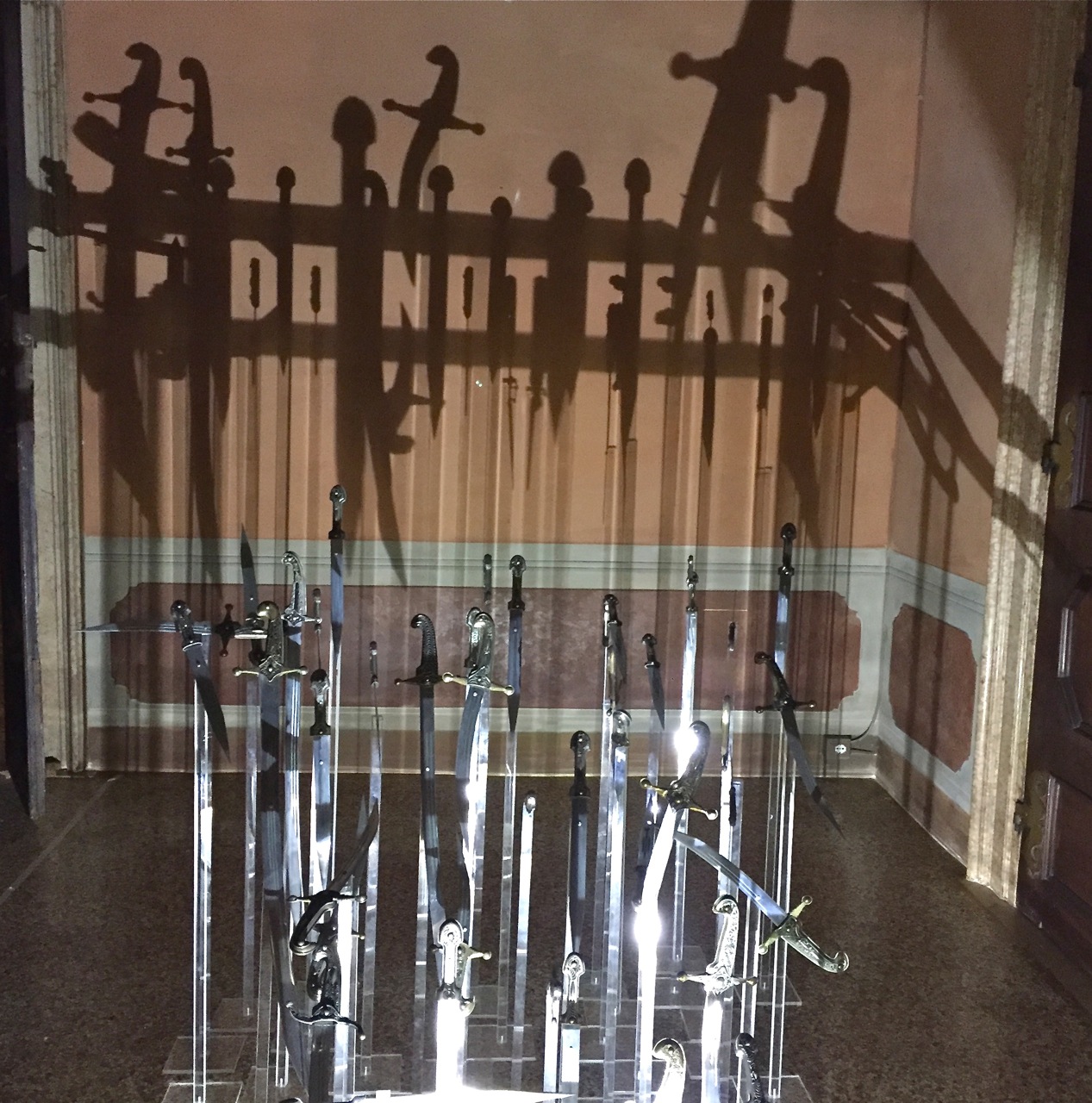
Rashad Alakbarov, "Do Not Fear," installation at Venice Biennale 2015

Rashad Alakbarov, “Do Not Fear,” installation at Venice Biennale 2015

We must love one another or die.

— W. H. Auden, “September 1, 1939”

In the early 1930s, about a hundred communists crashed a Nazi meeting in Bremen, Germany, determined to break it up. One of them, Richard Krebs, rose to interrupt a speech by Herman Göring, head of the notorious SA stormtroopers, a paramilitary group dedicated to political intimidation and violence. Krebs only got out a few words before the “brownshirts” rushed toward him. As Krebs later wrote,

“A terrifying mêlée followed. Blackjacks, brass knuckles, clubs, heavy buckled belts, glasses and bottles were the weapons used. Pieces of glass and chairs hurtled over the heads of the audience. Men from both sides broke off chair legs and used them as bludgeons. Women fainted in the crash and scream of battle. Already, dozens of heads and faces were bleeding, clothes were torn as the fighters dodged about amid masses of terrified but helpless spectators. The troopers fought like lions. Systematically they pressed us on towards the main exit. The band struck up a martial tune. Hermann Göring stood calmly on the stage, his fists on his hips.”[i]

A political life fraught with such violent thuggery once seemed unimaginable in contemporary America. What happened in Germany could never happen here, we tell ourselves. Physical violence as a routine form of political expression is not something we expect our leaders to tolerate, much less encourage. What, then, are we to make of the violent anger which has become a common feature of Donald Trump rallies?

At one such gathering, a man held up a sign, “Make America hate again!” The crowd happily obliged, ripping up the sign and roughing up the protester. At another rally, on March 10, a 78-year-old man in the crowd sucker-punched a young activist as he was being escorted out of the arena by Trump’s security guards. “He deserved it,” the man told a reporter. “Next time, we might have to kill him.”[ii]

In Ashley Parker’s excellent New York Times piece on this phenomenon, she sees the crowd’s violent reaction as “almost biological”:

“Trump supporters typically begin shouting, pointing, jeering — and sometimes kicking or spitting — at the protester, surrounding the offender in a tight circle, like antibodies trying to isolate and expel an unwanted invader from the bloodstream.”[iii]

Is Trump to blame for the passions of his followers? He has made some cursory disclaimers after the fact, but when the anger erupts he does little to discourage it.

On February 1, he told an Iowa crowd to be on the lookout for protesters with tomatoes. “If you see somebody getting ready to throw a tomato, knock the crap out of ‘em, would you? Seriously. Okay? Just knock the hell – I promise you, I will pay for the legal fees, I promise, I promise.” Later that month, as a protester was being ejected from another rally, Trump said, “I’d like to punch him in the face.”[iv] It is hard to listen to this stuff without thinking of Göring in Bremen, standing “calmly on the stage, his fists on his hips.”

When asked by reporters about the violence, Trump talks about “the good old days” when America wasn’t “weak,” and you were able to dish out a well-deserved pummeling. “This country has to toughen up,” he says. “These people are bringing us down.”[v]

Such scapegoating is one of the hallmarks of fascism. Instead of the hard work of developing concrete policies and building support for them, the leader simply invokes fear and hatred of “the other” to unite his followers. Trump repeatedly demonizes protesters as “nasty people” and blames them for initiating the violence, even though no reporter or camera has seen anything to support his claim, except for one thrown tomato that is said to have missed the mark.[vi] This one-sidedness may change, of course, for violence can be highly contagious.

Trump has argued that his supporters are not really angry people, but that they “do get angry when we see the stupidity with which our country is run and how it’s being destroyed.”[vii] His rhetoric bears a chilling resemblance to the Nazi justifications for Kristallnacht: “an expression of the people’s rage” …. “ “a just measure of indignation”… “our patience is exhausted.”[viii]

A few days ago, Trump described an incident at an earlier rally. “He was a rough guy and he was punching. And we had some people – some rough guys like we have right in here – and they started punching back. It was a beautiful thing.”[ix]

In this week’s Republican presidential debate, the three other candidates were given the opportunity to condemn the political violence of Trump’s mob, but they kept silent. Maybe they were hoping it would all just go away, without their having to risk the loss of any votes from “the base.” But silence in the face of evil is just endorsement by default.

We hear God invoked repeatedly in presidential campaigns by candidates who claim to be good Christians. But a “Christianity” so enamored of what theologian John Milbank calls the “ontology of violence” feels unrecognizable to me. Whether it is the manipulation of anger at a rally or policies of aggression against everyone who is “other,” such a politics is anathema to the transformative project of conforming the social body to the divine desire for justice, forgiveness, and peace.

Last October I had a conversation about American politics with a few British shape note singers in a London pub. They wanted to know what on earth the Trump spectacle was all about. I muttered the common wisdom of the moment about a clownish celebrity who would soon fade away. “Watch out,” warned one of the Brits, the daughter of an Anglican priest. “A single dumb candidate can make the whole process dumber, and drag everyone down to his level. That happened here when we elected our mayor. It could happen in America.”

She was right, as we now know, although “dumb” is the least of it. How far can we still sink? In Richard Evans’ acclaimed trilogy on the Third Reich, he describes Germany on the eve of the Nazi takeover in one disturbing sentence: “Years of beatings and killings and clashes on the streets had inured people to political violence and blunted their sensibilities.”[x]

The blunting of our own sensibilities should be worrying us. But how can we resist the downward pull of fear, hatred and violence without ourselves being corrupted by it, or sucked into its vortex of rage? How may we give concrete political form to the better angels of our nature?

The day after Martin Luther King was assassinated, Senator Robert Kennedy spoke against the violence permeating American culture in the 1960s:

“Some look for scapegoats, others look for conspiracies, but this much is clear: violence breeds violence, repression brings retaliation, and only a cleansing of our whole society can remove this sickness from our soul.”[xi]

Two months later, Bobby Kennedy himself would be cut down by the political violence he had so earnestly lamented. As for the rest of us, the day of our collective cleansing still remains sadly distant.


[i] Richard J. Evans, The Coming of the Third Reich (New York: Penguin Books, 2003), 270

[ii] Ashley Parker, “Riskiest Political Act: Protesting at Rallies for Donald Trump” (New York Times, March 10, 2016)

[iii] ibid.

[iv] Philip Bump, The Fix, Washington Post online, March 10, 2016

[v] Jim Salter & Jill Colvin, Associated Press, March 11, 2016

[vi] Daniel White, “Donald Trump Tells Crowd”, Time online, February 1, 2016

[vii] Salter & Colvin

[viii] Walter Laqueur & Judith Tydor Baumel, eds., The Holocaust Encyclopedia (New Haven: Yale UP 2001). 390

[ix] Jill Colvin & Michael Tarm, Associated Press, March 11, 2016

[x] Evans, 348

[xi] Robert F. Kennedy, Remarks to the Cleveland City Club, April 5, 1968

After Paris and Beirut, what kind of story shall we tell?

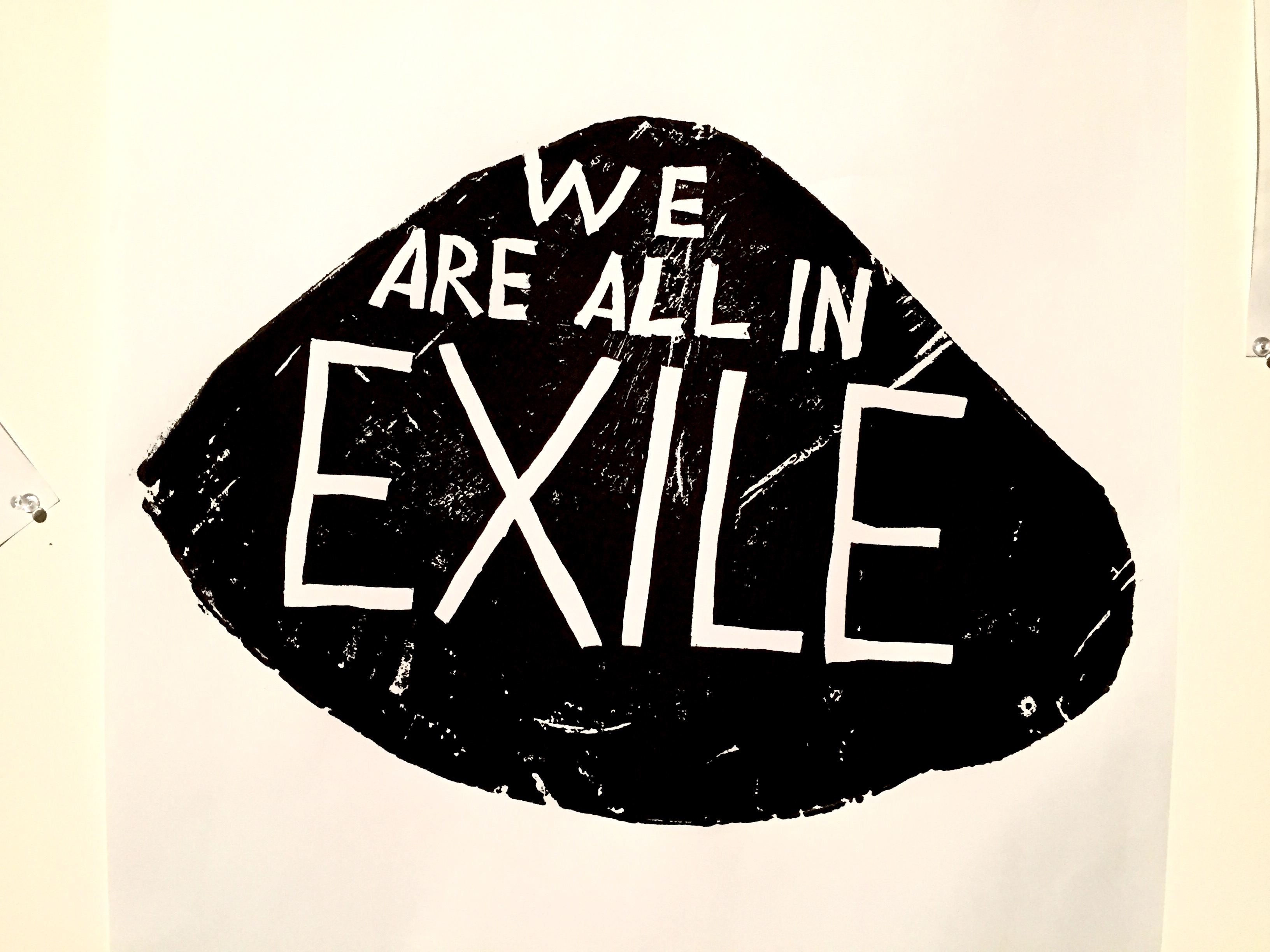
Barthelemy Toguo, wood stamp from tree trunk, Venice Biennale 2015

Barthelemy Toguo, wood stamp from tree trunk, Venice Biennale 2015

We played the pipes for you,
and you wouldn’t dance,
we sang dirges,
and you wouldn’t cry. (Luke 7:32)

This was, as Jesus observed, the perennial cry of the poor children in the marketplace, playing their instruments for the crowd, hoping for a handout. Every street performer could relate to this description of an unresponsive audience, but Jesus wasn’t using the image to address their plight. Instead, he was characterizing his critics as childish in their contradictory complaints about the prophets in their midst. They whined that John the Baptist was too austere and antisocial, but they didn’t like Jesus’ partying with sinners any better.

The failure of others to respond appropriately to the tunes we play for them could also describe the incredible discord among competing versions of reality in these days of terrorist violence. The actions of those living in alternative realities to our own seem inexplicable, and our often clueless responses to those actions fail to produce the intended results. We pipe, but they don’t dance. We bomb, but they don’t submit. We reason, but they won’t be persuaded.

In a long and unsettling article in The Atlantic last March, Graeme Wood diagnosed ISIS as a “dystopian alternate reality” grounded in an apocalyptic worldview. According to Wood, the western violent response to the Islamic State not only feeds their medieval narrative of Crusaders versus Muslims, it is the longed-for fulfillment of millenarian prophecy. In the Syrian farmland around the city of Dabiq, the armies of Islam will face down the armies of “Rome” (the West). This decisive battle will inaugurate the End of Days, resolving all the tribulations of history into a final triumph of God’s people.

In this narrative, the escalation of American military involvement would not be a deterrent, but an incentive. As Wood put it: “During fighting in Iraq in December [2014], after mujahideen (perhaps inaccurately) reported having seen American soldiers in battle, Islamic State Twitter accounts erupted in spasms of pleasure, like overenthusiastic hosts or hostesses upon the arrival of the first guests at a party.”[i]

If Wood is correct, then ISIS is operating from premises which we would dismiss as senseless and fantastic. But then what do we make of a recent poll on religion and politics, where1000 American adults were asked, “Do you think that the end of the world, as predicted in the Book of Revelation, will happen?”[ii] The results suggest that alternate realities are not exclusive to other cultures:

Yes, in my lifetime (13%)
Yes, but not in my lifetime (39%)
No (25%)
Not sure (22%)

I’m not sure what “not sure” means in this case, but I’m guessing some of those folks are at least conceding the possibility. In any case, more than half of those surveyed embraced the literal fulfillment of a highly metaphorical text with its problematic mixture of sacred violence and sublimely consoling imagery.

When they said “yes” to Revelation, did they mean verse 21:4? God will wipe every tear from their eyes. Death will be no more; mourning and crying will be no more. Or were they thinking of 11:18? The time has come to destroy those who are destroying the earth.

 Who knows? Polls on religious belief are misleading because they cannot measure ambiguity and nuance, nor do they distinguish between proposition and practice. Religion is not just what people say; it is what they do. And the correlation between the two is not always clear. If 52% of Americans believe that Revelation is predictive of human history, does that make us more or less likely to choose war as the means to “erase ISIS from the face of the earth?”[iii]

There is no consensus about the human story. The world is full of alternate realities. Sometimes we choose which story we want to live inside of. Sometimes the story chooses us. ISIS is living a story which seems crazy and evil, easily rejected by the majority of humanity who live outside it. But a consensus on competing narratives is harder to achieve when we consider our own national life.

The argument about Syrian immigrants is a perfect example. More than half of the state governors in America want to shut the door on them, while the President, speaking for many others, says that is not who we are as a people. Who is right? It depends on which story you are living inside of. Just in time for our national celebration of the Pilgrim immigrants, we get to choose between xenophobia and the Statue of Liberty. Of course my own framing of this debate tells you which story I live in.

My alternate reality, the story which I have chosen and which has chosen me, begins at the eucharistic table, where everyone is welcome, forgiveness is shared, no one goes hungry, and love is the costly gift. I may falter in my daily embodiment of that story, but I have no desire to belong to any other.

After 9/11, Americans had to choose what kind of story we wanted to live in. Many of our choices proved disastrous and toxic, but there were some who chose a better story, a better way. One of the finest articulations of that better way was a manifesto written by the Catholic Worker of Los Angeles in September, 2011. In the wake of Paris and Beirut, its eloquent faith still resonates:

Even after all this…

Our grief will not be short-circuited with cries of vengeance nor with acts of retribution. We will not cooperate with incitements to become that which we most oppose, namely perpetrators of violence.

We will honor the deeper levels of grief, acknowledging the woundedness inflicted upon us, and the woundedness that our nation has inflicted upon others…

We invite you to participate with us in all our wildest dreams and visions for peace. For now we sadly know that our affluence, our power, our possessions cannot serve as protection from harm. We invite you to clamber off the wheel of violence. It is the only worthy legacy we can offer to those who have died…

We are Catholic Workers and we still believe… the only solution is love.


[i] Graeme Wood, “What ISIS Really Wants,” The Atlantic (March 2015): http://www.theatlantic.com/magazine/archive/2015/03/what-isis-really-wants/384980/

[ii] YouGov/Huffington Post poll conducted Nov. 10-11, 2015. In the same poll, 42% said the earth was created in 6 days, but only 4% believed the pyramids were used for grain silos! https://today.yougov.com/news/2015/11/11/poll-results-bible-politics/

[iii] The quote is from a liberal politician I admire who is not an advocate for war. His use of the phrase suggests a rather apocalyptic consensus about the goal if not the means.


Whose world is it?

GTU Jesus icon face

I teach a course on “Jesus and the Movies,” examining nineteen features made on the life of Jesus between 1912 and 2014. And one of my favorites is a South African production, Son of Man (2006), which sets the gospel story in a fictional twenty-first century African country.

It begins in the desert, with Jesus and Satan sitting side by side atop a tall sand dune. There Satan offers Jesus the familiar temptations: use your power, dazzle the world, bow down to me and I will give you everything you desire.

Jesus listens for a while in silence. Suddenly he turns to Satan and shoves him off the ridge. As Satan tumbles downward – Milton’s fall of Lucifer comes to mind – Jesus shouts after him: “This is my world!”

Satan comes to a stop at the foot of the dune. He picks himself up and looks back defiantly at Jesus. “No,” he cries. “It’s my world!”

The film cuts abruptly to a village caught in the crossfire of a civil war. Terrible atrocities are taking place, making Satan’s point perfectly. It’s his world after all.

Tomorrow is the Feast of Christ the King, created by Pope Pius XI in 1925. Originally observed at the end of October as a prelude to All Saints Day, it was later moved to the last Sunday of the liturgical year, where it provides both a grand finale to the calendrical Christ narrative and a dramatic overture to Advent. In 1970 it was adopted by other churches using the Common Lectionary, including Anglicans, Lutherans, Methodists, and Presbyterians.

The pope was responding to the apocalyptic violence of World War I, where evil and madness seemed to have seized control of the world. He wanted to establish a clear reminder that it is Christ to whom the future belongs; it is Christ whom we must follow and serve.

Or in the words of Bob Dylan, “It may be the devil or it may be the Lord, but you gotta serve somebody.”

While the imagery of Christ as Lord of all may require some unpacking for interfaith dialogue, the pope’s original encyclical was clearly focused on Christian practice. If we profess Christ as our way, our truth, our life, then, in the pope’s words, “none of our faculties is exempt from his empire.”

But what do we do when Christ’s “empire” is in conflict with our other allegiances? How much do we give to Jesus, and how much do we hold back? Jesus gets Sunday mornings; does he get the working week? He gets our spiritual life; does he get our worldly affairs? Does he get our relationships, or our stewardship of time? Does Jesus get our politics, our economics?

Clarence Jordan was a Baptist preacher, New Testament teacher, and farmer in rural Georgia. In his celebrated Cotton Patch Gospels, he translated the Jesus story into a southern idiom, explaining that “the Scriptures should be taken out of the classroom and stained-glass sanctuary and put out under God’s skies where people are toiling and crying and wondering; where the mighty events of the good news first happened and where they alone feel at home.” [i]

In the 1940’s, in the middle of “the Good War,” in the heart of the segregated South, Jordan founded Koinonia, an interracial, pacifist farming collective using a communitarian model more like early Christianity than late capitalism. For his faithfulness to the dominion of Christ, he and his community were harassed, shot at, and bombed. The local church expelled him.

He was often invited to speak to groups around the country, and he would ask them, “What’s the biggest lie told in America today?” He’d let the question sink in for a bit, and then he’d say, “The biggest lie told in America today is: Jesus is Lord.”

I first heard this story when I visited Koinonia in 1980 and had a long conversation with his widow Florence (Clarence died in 1969). And in these latter days his words ring truer than ever.

Last year the Ohio legislature, hoping to derail the Affordable Care Act, blocked an expansion of Medicaid that would provide health care to 275,000 people who had no coverage. But the governor, John Kasich, made an end run around the legislature and got it done anyway.

As he said at the time: “For those who live in the shadows of life, for those who are the least among us, I will not accept the fact that the most vulnerable in our state should be ignored.”

The lawmakers howled. How dare he put the needs of the poor above our political agenda! So this is how the governor explained it to one those legislators, whom he knew to be a fellow Christian:

“Now when you die and get to the meeting with St. Peter, he’s probably not going to ask you much about what you did to keep government small; but he is going to ask you what you did for the poor. Better have a good answer.”

Governor Kasich, himself a Republican, was denounced by many in his party for appealing to a power higher than their ideology. The Wall Street Journal, wanting to make it clear that Jesus, lover of the poor, was not in fact Lord in America, offered a tart response: “Republicans get a vote before St. Peter.”

In Matthew’s gospel, the last parable Jesus tells before his arrest and crucifixion pictures all of humanity gathered before the glorified ‘Son of Man’ – the Lord of history – who reveals that he has always been among them in the bodies of the poor and needy: “I was starving … I was naked … I was an undocumented alien … I had AIDS … I was a convict …”

Everyone is of course quite surprised. But they all take his point. When you kneel before Christ the King, it won’t be at the foot of a mighty throne, but before the holy icons of “the least of these” – the vulnerable, the marginalized, the broken, the forgotten.

Well you kneel to the Lord and you will bless yourself…
Ain’t no need to kneel to no one else. [ii]

[i] G. McCleod Bryan, “Theology in Overalls: The Imprint of Clarence Jordan”, Sojourners (Dec. 1979, vol. 8, no. 12)

[ii] Bob Franke, “Trouble in This World (It’ll Be All Right),” on Heart of the Flower (Daring DR3016), © Telephone Pole Music, 1995

Dies Irae

Biblical prophet at Moissac Abbey on Le Chemin de St. Jacques

Biblical prophet at Moissac Abbey on Le Chemin de St. Jacques

Mr. McCleery, my seventh grade Latin teacher, had us memorize verses of the Dies Irae, a medieval chant describing the Last Judgment in strikingly lurid language. Most boys in junior high do not walk around chanting Latin poetry about the end of the world, but I rather enjoyed it. The tune was catchy, and those terse rhyming triplets beat time like the sensuous energy of a drum circle.

Dies irae, dies illa, 
Solvet saeclum in favilla,
Teste David cum Sibylla.

Day of wrath, O day of mourning,
See fulfilled the prophet’s warning,
Heav’n and earth in ashes burning.

The text of Dies Irae is inspired by the first chapter of Zephaniah, which was one of the eucharistic readings last Sunday. I sometimes wonder what churchgoers think about when asked to consider “a day of wrath, a day of distress and anguish, a day of ruin and devastation, a day of darkness and gloom.” In Syria or Ukraine, it’s just the latest news. But for those of us not living in one of history’s infernos, Zephaniah might be dismissed as a colorful crank carried away by the thrill of his own hyperbole.

The effect of the Bible’s more fiery rhetoric is often muted by the flat, inexpressive way it is usually read – or worse, mumbled – in the typical liturgy, as though no one really means it. Readers of prophetic texts should be given bullhorns. They should walk among the people as they shout, looking them in the eye.

I will bring such distress upon people
that they shall walk like the blind;
because they have sinned against the LORD,
their blood shall be poured out like dust,
and their flesh like dung.[i]

The church growth people might have something to say about that sort of messaging, but there is no denying that the prophets are working hard to get our attention. And in these last weeks of the Christian year, both the Sunday lectionary and the daily liturgical readings resound with the trumpet blasts of biblical warnings. People get ready. History’s chickens are coming home to roost.

Those prophetic rants have sometimes been read as endorsements of sacred violence – angry outbursts of a moody and unpredictable god – but God’s best friends have long rejected that crude picture as a tragic misreading of the divine. Nevertheless, there is no denying the violent imagery woven into some biblical texts, and we must find a way to make sense of it.

Walter Brueggemann explains that the prophets “speak in images and metaphors that aim to disrupt, destabilize, and invite to alternative perceptions of reality … [They] speak in outrageous and extreme figures because they intend to disrupt the ‘safe’ construals of reality, which are sponsored and advocated by the dominant opinion makers.”[ii] In other words, prophets blow up the old paradigms in order to make room for the new. They take seriously the power of language both to enslave and to liberate.

Zephaniah targets those “who rest complacently on their dregs,” who are blinded by their illusions, who assume divine indifference to the damage they do to the poor, the vulnerable, and the whole interdependent system of life on earth. We can find similar voices in our own time.

German writer W. G. Sebald’s apocalyptic poem, After Nature, is as harrowing as anything in the Bible. As he contemplates the dark and barren landscape of Matthias Grünewald’s Crucifixion, painted in 1505, Sebald finds a predictive warning of the planet’s own death unless we change our ways.

Here in an evil state of erosion
and desolation the heritage of the ruining
of life that in the end will consume
even the very stones has been depicted.[iii]

Today the United States Senate came just one vote shy of approving the Keystone XL pipeline, a massive fossil fuels project to enrich a few people at the expense of the whole earth. The effects of exploiting the Canadian tar sands, according to climate scientist James Hansen, could well be of biblical proportions.

Canada’s tar sands, deposits of sand saturated with bitumen, contain twice the amount of carbon dioxide emitted by global oil use in our entire history. If we were to fully exploit this new oil source, and continue to burn our conventional oil, gas and coal supplies, concentrations of carbon dioxide in the atmosphere eventually would reach levels higher than in the Pliocene era, more than 2.5 million years ago, when sea level was at least 50 feet higher than it is now. That level of heat-trapping gases would assure that the disintegration of the ice sheets would accelerate out of control. Sea levels would rise and destroy coastal cities. Global temperatures would become intolerable. Twenty to 50 percent of the planet’s species would be driven to extinction. Civilization would be at risk.[iv]

Hansen concludes that Keystone and its aftermath “will be game over for the climate.” The apocalypse was defeated today in the Senate, but there will be another vote early next year, when many of the “no” votes will be out of office. Alarmingly, the next head of the Senate Committee on Environment and Public Works will be a climate change denier who believes in a god who would never allow earth’s climate to be affected by the actions of mortals. If the senior senator from Oklahoma were to study his Bible, he might find that God takes human freedom far more seriously than he does. We do have the power to destroy God’s creations and disrupt the fragile balances of life.

The prophets are trying to make us renounce that power before it is too late. When Zephaniah warns of “a terrible end” he isn’t simply condemning us; he’s trying to save us. The “day of wrath” will not be an arbitrary vengeance from the sky, but the sum of innumerable bad choices here on earth. Zephaniah and his fellow prophets hold before us a chillingly graphic picture of where those choices are headed. What has been called the wrath of God is really something bearing our own signature.

Will God ride to the rescue? In a poem called “Emmanuel’s Nightmare,” African-American poet Gwendolyn Brooks wonders what it might be like if we were simply left to our own devices. She imagines the Second Coming of a Christ who would “clean the earth / of the dirtiness of war.” But the Savior finds himself thwarted. Humans love war too much. It is “what they lived for.” So God’s Son gives up and goes home. Mission not accomplished. “He had not the heart / To take away their chief sweet delectation.”[v] 346

The prospect of being abandoned to our own suicidal impulses is not a happy one, but – thankfully – it is not in fact the story we tell. God has destined us not for wrath but for salvation.[vi] The means of that better destiny will turn out to be quite surprising, not at all like the terrible clamor of the Dies Irae. But that is a tale for another day.

[i] Zephaniah 1:17

[ii] Walter Brueggemann, Theology of the Old Testament: Testimony, Dispute, Advocacy (Minneapolis: Fortress Press, 1997), 625

[iii] W.G. Sebald, After Nature, q. in Colin Riordan, “Ecocentrism in Sebald’s After Nature,” in W.G. Sebald – A Critical Companion, eds. J.J. Long & Anne Whitehead (Seattle: University of Washington Press, 2004), 51

[iv] New York Times, May 9, 2012

[v] Robert Atwan, George Dardess, Peggy Rosenthal, eds., Divine Inspiration: The Life of Jesus in World Poetry (New York: Oxford University Press, 1998), 346

[vi] I Thessalonians 5:9

Remember

We the People (Latina) poster

Artist: Shepard Fairey; Photographer: Arlene Mejorado

“Send them back! Send them back!” So shout the stony-hearted xenophobes in response to the unprecedented wave of Central American children entering the United States without documentation. The irony of this hateful war cry in a nation first forged by immigrants is breathtaking. Were such things screamed from the shore at Plymouth Rock?

Historical memory, never America’s strong suit, has become seriously eroded in recent years, due in large part to what Canadian scholar Henry A. Giroux has called the “violence of organized forgetting.” In a provocative essay (http://truth-out.org/news/item/24550-data-storms-and-the-tyranny-of-manufactured-forgetting), Giroux traces the sources and consequences of “the emergence of a profoundly anti-democratice culture of manufactured ignorance and social indifference.” He begins with a resonant epigraph from a book about history and memory by Yose Hayim Yerushalmi:

For in the world in which we live it is no longer merely a question of the decay of collective memory and declining consciousness of the past, but of the aggressive [assault on] whatever memory remains, the deliberate distortion of the historical record, the invention of mythological pasts in the service of the powers of darkness.

While solutions to the current humanitarian crisis on our southern border may not be entirely clear, perhaps we should begin by remembering that we are all pilgrims and refugees in this life, that welcoming the stranger is a biblical imperative, and that everything is gift before it is possession, including “native” soil. So as an aid to memory and perspective, we might listen to some voices from the immigrant experience. An excellent collection may be found in Unsettling America: An Anthology of Contemporary Multicultural Poetry (ed. Maria Mazziotti Gillan & Jennifer Gillan; Penguin 1994). Here are a few of my own favorites, from a florilegium I once compiled for a celebration of cultural diversity in the Episcopal Diocese of Chicago.

Carlos Bulosan came from the Phillippines to settle in Seattle, becoming active in the labor movement. In his book, America is in the Heart, he wrote:

America is the nameless foreigner, the homeless refugee, the hungry boy begging for a job, the illiterate immigrant… All of us, from the first Adams to the last Filipino, native born or alien, educated or illiterate – We are America!

Armenian-born Gregory Djanikian emigrated to the United States as a child. His poem, “In the Elementary School Choir,” describes the experience of absorbing a new culture at a young age:

“This is my country,” we sang,
And a few years ago there would have been
A scent of figs in the air, mangoes,
And someone playing the oud along a clear stream.

But now it was “My country ’tis of thee”
And I sang it out with all my heart…
“Land where my fathers died,” I bellowed,
And it was not too hard to imagine
A host of my great uncles and -grandfathers
Stunned from their graves in the Turkish interior
And finding themselves suddenly
On a rock among maize and poultry
And Squanto shaking their hands.

Wing Tek Lum, born in Hawaii of Chinese-American parents, resolves the melting pot vs. salad bowl debate with a distinctively Chinese meal. The biblical image of the redeemed gathered for a sacred feast is clearly echoed in “Chinese Hot Pot,” which is not surprising for a poet who attended New York’s eminent Union Seminary.

My dream of America
is like da bin louh
with people of all persuasions and tastes
sitting down around a common pot
chopsticks and basket scoops here and there
some cooking squid and others beef
some tofu and watercress
all in one broth
like a stew that really isn’t
as each one chooses what she wishes to eat
only that the pot and fire are shared
along with the good company
and the sweet soup
spooned out at the end of the meal.

God forbid that the shouting mob at the border (and in Congress and the right-wing echo chamber) should have their way in the end, reducing the refreshing tributaries from other cultures to a trickle, condemning America to the parched national sameness described by Annie Proulx in Accordion Crimes, where a Polish immigrant is forced to conclude that “to be foreign, … not to be American, was a terrible thing and all that could be done about it was to change one’s name and talk about baseball.”

May we all recover our immigrant memory and our sojourner mind, and celebrate the inclusive richness praised by Native American Joy Harjo in “Remember:”

Remember that you are all people and that all people are you.
Remember that you are this universe
and that this universe is you.

Remember that all is in motion, is growing, is you.
Remember that language comes from this.
Remember the dance that language is, that life is.
Remember.