Unsilent Night: An Advent Revelation

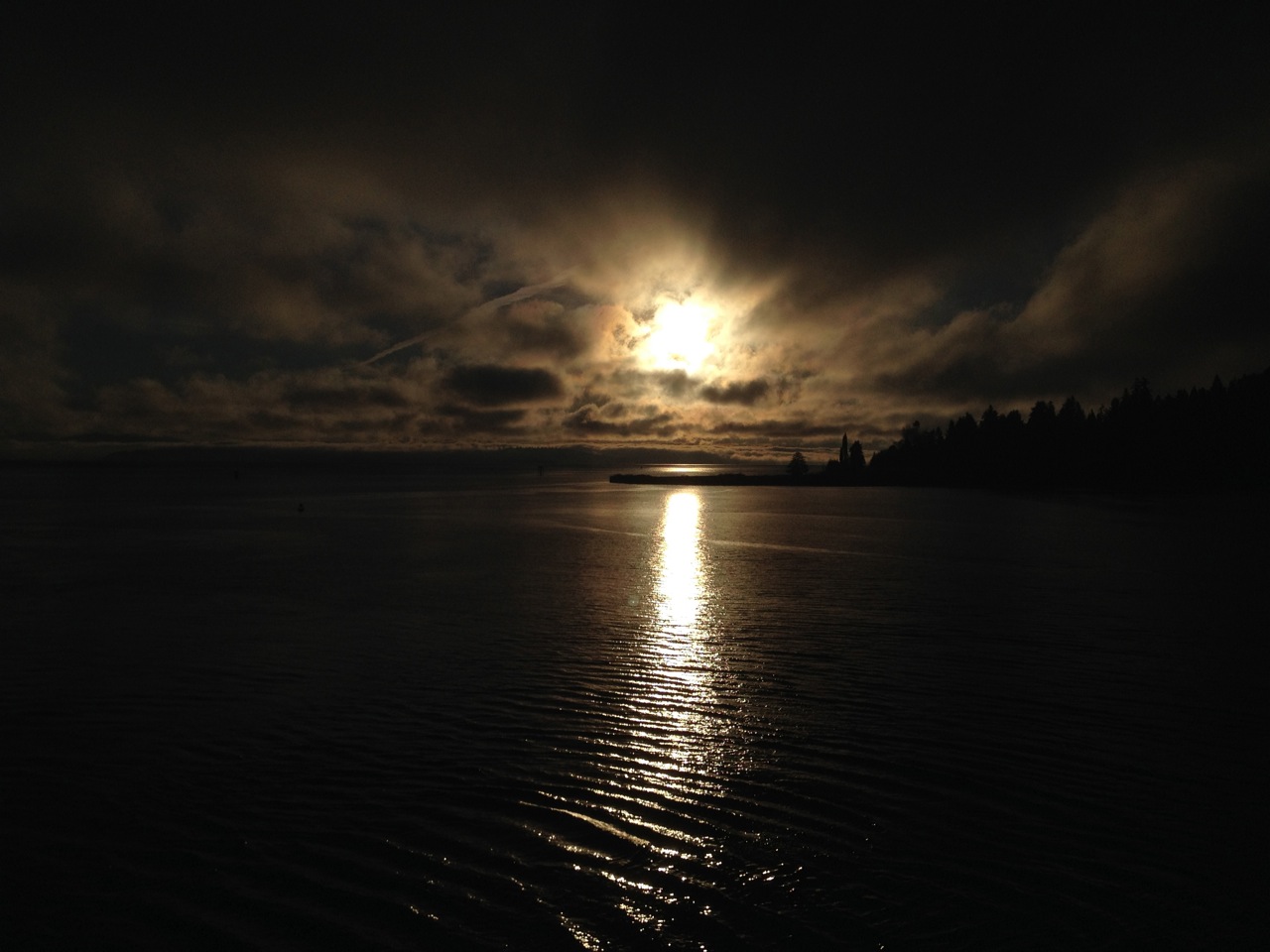
Sun in black sky

Last Saturday after dark, about 60 people gathered at a Seattle’s On the Boards theater to begin a neighborhood walk called “Unsilent Night.” Created in 1992 by New York composer Phil Kline, it is a “luminous soundscape” enacted for 45 minutes on a single night in December. This year, 37 American and Canadian cities joined in.

Participants downloaded one of 4 separate but complementary music tracks of ambient minimalism on their phones, and carried portable speakers as they walked the streets together in a collective mobile sound sculpture. NPR has described Unsilent Night this way: “chiming and chants bounce off walls and windows, transforming the coldest urban area with the warmth of musical fellowship.”

And so we began, moving block by block, a mesmerizing river of sound flowing slowly along the sidewalks of the city. An initial shimmering of bright cascading notes eventually evolved into the low rumble of droning chords, succeeded by percussive xylophone patterns, as if Steve Reich were composing for gamelan. Those metallic notes later gave way to more drones and electronic chords, which became the ground for choral fragments: Gregorian chants, wordless repetitions of ‘ah’ pitched at varied intervals, and melismatic Alleluias. Despite this discernible evolution of musical shifts and changes, the cumulative effect felt unhurried and relaxed.

The Queen Anne neighborhood is a lively mix of small shops, restaurants, and theaters, plus a cinema and basketball arena. A diverse assortment of people was already out looking for the heart of Saturday night, so there were many witnesses to our sonic procession. But surprisingly few showed much reaction. Some stared blankly, as if this unexpected phenomenon eluded their emotional register. They simply didn’t know what to make of it. Others looked away, perhaps wishing us into invisibility. Such a thing should not be happening in their world, so they pretended it wasn’t. Still others wore earbuds, disabling any receptivity to a reality beyond their own self-enclosure.

Yet some indeed had ears to hear, responding with smiles or looks of wonder. Car windows rolled down to let in the sound. The Latino doorman of a boutique hotel grinned ear to ear as we passed. A homeless woman in a wheelchair gave us a knowing smile, as if we were a welcome sign of sad times ending.

Like the best liturgy, it created community out of strangers through a shared action, and forged our collectivity into both sign and instrument of mystery and wonder. It was a perfect rite for Advent, contesting the old order while announcing an “impossible possible” drawing near. For the 45 minutes of the sound sculpture, sidewalks designed for functionality (keep moving to your next purchase, or go home!) became spaces for play. The ugliness of traffic noise was challenged by sweeter sounds. Strangers were invited to smile at one another, forgetting their solitudes for a few precious moments. And the birth of something deeply poetic usurped the accustomed prose of urban life.

As Twylene Moyer has written concerning participatory public art, it invites us “to re-evaluate what we mean by quality of life, to reassess what we think we know, and to reconsider how we choose to live with ourselves and each other.”[i] Why shouldn’t we feel fully at home in our public spaces, experiencing them as places of human affection and delight, inclusiveness and solidarity, joy and wonder? Why can’t we?

Theologian Langdon Gilkey makes an even more sweeping claim for such a re-visioning process. Art, he says, “makes us see in new and different ways, below the surface and beyond the obvious. Art opens up the truth hidden and within the ordinary; it provides a new entrance into reality and pushes us through that entrance. It leads us to what is really there and really going on. Far from subjective, it pierces the opaque subjectivity, the not seeing, of conventional life, of conventional viewing, and discloses reality.”[ii]

Seeing “the truth hidden and within the ordinary,” piercing the “not seeing of conventional life” with the inbreaking of deeper reality – these comprise the essence of Christianity’s annual Advent project. Not everyone welcomes this kind of seeing, and many reject its very possibility. But for at least some of us who experienced the wonder of Unsilent Night, a richer account of the universe, making room for the transcendent, felt more persuasive than the alternatives.

As I walked in this procession of glorious sound, an Advent hymn came to mind:

Hark! a thrilling voice is sounding.
“Christ is nigh,” it seems to say.

Not everyone would put the name of Christ to what we did and the sound we made together, but that doesn’t alter the content of the experience.

If God is more of a situation than an object, then the community, relationality, mystery, beauty, wonder, delight, and communion produced by the event seemed apt expressions of divinity taking “place,” or “being here now.” You didn’t have to name it to live it.

Toward the end of our walk we were led into a bit of open space set back from the street, where the music was not so compromised by traffic noise. And there our little speakers, one by one, began to ring with a peal of sonorous bell tones, until we were all immersed in such a joyous tintinnabulation that I could imagine myself in heaven. Every face I saw around me glowed with amazement. If the Incarnation were a sound, this would be it, suddenly sanctifying a scrubby vacant lot in Queen Anne.

As the bells faded, we processed one more block, back to our starting point, where we stood in what felt like a prayer circle while the final portion of the composition slowly faded into silence. Some closed their eyes, and everyone seemed rapt and attentive, in a state of peace and gratitude.

Once the music ended, the spell was quickly broken. We went our separate ways, strangers once more, but perhaps “no longer at ease here, in the old dispensation.”[iii] For a moment we had known something better, and would not forget.


[i] Twylene Moyer, Artists Reclaim the Commons: New Works/New Territories/New Publics (Ed. Glenn Harper and Twylene Moyer, Hamilton, NJ: isc Press, 2013), 8


[ii] Langdon Gilkey, from an address given at the Art Institute of Chicago, published as “Can Art Fill the Vacuum?” in Art, Creativity and the Sacred: An Anthology in Religion and Art, ed. Diane Apostolos-Cappadona (New York: Crossroad, 1984), 189-90

[iii] The phrase is from T. S. Eliot’s “Journey of the Magi,” expressing the incompatibility of what the Magi had experienced in Bethlehem with the unredeemed world to which they returned.


The O Antiphons: “Drenched in the speech of God”

Giovanni Bellini, Madonna and Child with Saints Catherine and Magdalene (detail), c. 1500, Accademia, Venice

Giovanni Bellini, Madonna and Child with Saints Catherine and Magdalene (detail), c. 1500, Accademia, Venice

When belief in God is the matter to be decided, the central question is whether you can and should allow yourself to retain or be drawn into the patterns of thought that make the believer’s world what it is.

– David M. Holley

Pierced by the light of God…drenched in the speech of God,
your body bloomed, swelling with the breath of God.

– Hildegard of Bingen

One of the joys of Advent’s final days is the praying of the O Antiphons, seven eloquent supplications based on biblical images or attributes of the divine. Liturgically, they begin and end the Magnificat at Vespers from December 17th to December 23rd, but they can also be a rich resource for personal prayer as Christ-mass draws near. I tape each day’s particular antiphon to the mirror where I begin and end my day. Doors, dashboards and desks would also be good places to encounter these compelling texts, letting them awaken our attention over and over throughout the day.

Today’s antiphon, in my free paraphrase:

O Sophia, you are the truth of harmonious form,
the pattern of existence, the shapeliness of love.
Come: illumine us, enable us, empower us
to live in your Wisdom, your Torah, your Way.

The best-known version of the O Antiphons is the hymn, “O Come, O Come Emmanuel.” You can find my own variations on the seven antiphons here.

In my December 17 post last year, I wrote:

Each antiphon is both greeting and supplication to the God who comes to save us:

O Sapientia, O Adonai, O Radix Jesse, O Clavis David,
O Oriens, O Rex Gentium, O Emmanuel … O … O … O …

O is such an evocative word. We use it when we come upone something outside ourselves, often unexpected, something that engages us face to face.

 “O” can be an inhalation, a gasp, the cry of astonishment at the heart of every encounter with the Holy. If our place of prayer were suddenly filled with smoke and angels, or if the Holy called us out of a burning bush, our first response might well be “O!”

 There is also the O of understanding, or recognition: “O, now I see, now I get it.” Or even, “O, it’s you!”

 And then there is the ecstatic O, expressing delight, wonder, the sigh of surrender: Ohhhhhhh!

 Each of these is a fitting response when we meet the divine:

 Astonishment
Recognition
Surrender

As the Antiphons return this year, I happen to be reading David M. Holley’s illuminating book, Meaning and Mystery: What it Means to Believe in God. In fresh and thoughtful ways, he suggests that God is not a hypothesis to be tested or a puzzle to be solved by detached observers, but an experience to be encountered by receptive participants, those who know how to say “O!”

Thinking of God as a hypothesis to be inferred from specifiable data means starting from an understanding of a world that does not presuppose God, but belief in God is not a matter of moving from such a world to a reality in which God is included. It is a matter of finding yourself within the kind of world where God is implicit already.[i]

In other words, the truth of belief isn’t something that can be decided from a position outside of the patterns of life and thought that constitute a religious view of the world. If you want to experience God, learn to genuflect, learn to pray, learn to sing and dance in the presence of the Holy.

Astonishment. Recognition. Surrender.

It is certainly possible to live inside an alternative story, where God is absent or nonexistent. But I find that a bleak and unpromising account of reality. This old world, beset by human folly, massive violence, economic injustice, and dispiriting politics, needs divine imagination more than ever.

The prophet Zephaniah responded to his own dark times with a profound hope in God’s Advent as a redemptive rewrite of the human story. Amid the current proliferation of hateful speech, faithless fear and violent bluster, how we long with Zephaniah for a new story, a better language.

At that time I will change the speech of the peoples to a pure speech, that all of them may call on the holy Name and serve God with one accord.[ii]

May that day come when we are all “drenched in the speech of God,” whose language is justice, peace, mercy, forgiveness, compassion, communion.

O Desire of all nations and peoples,
you are the strong force that draws us toward you,
the pattern which choreographs creation
to Love’s bright music.
Come: teach us the steps
that we may dance with you.


Related posts

Praying the O Antiphons

Ten Ways to Keep a Holy Advent

[i] David M. Holley, Meaning and Mystery: What it Means to Believe in God (Malden, MA: Wiley-Blackwell, 2010), 47-48 [the epigraph is also Holley, p. 48]

[ii] Zephaniah 3:9

Reprise: Ten Ways to Keep a Holy Advent

image

Here in Puget Sound, the first Sunday of Advent has begun in darkness, fog, and frost. It is for many of us a deeply felt time, the season where we wait expectantly for the dawning of the New. The spiritual practice of waiting is not a state of passivity, but rather the cultivation of attention, lest we miss what is being offered to us in the unfolding of God’s future.

I do not usually do re-runs of old posts, but some readers found last December’s “Ten Ways to Keep a Holy Advent” a useful list, and you can access it here. I hope you will find some blessing in it. And please feel free to share it with your communities.

Bill Viola’s “Martyrs”

image

The souls of the righteous are in the hands of God, and no torment will ever touch them. In the eyes of the foolish they seemed to have died, and their departure was thought to be a disaster, and their going from us to be their destruction; but they are at peace.

– Wisdom of Solomon 3:1-9 (Lectionary reading for All Saints)

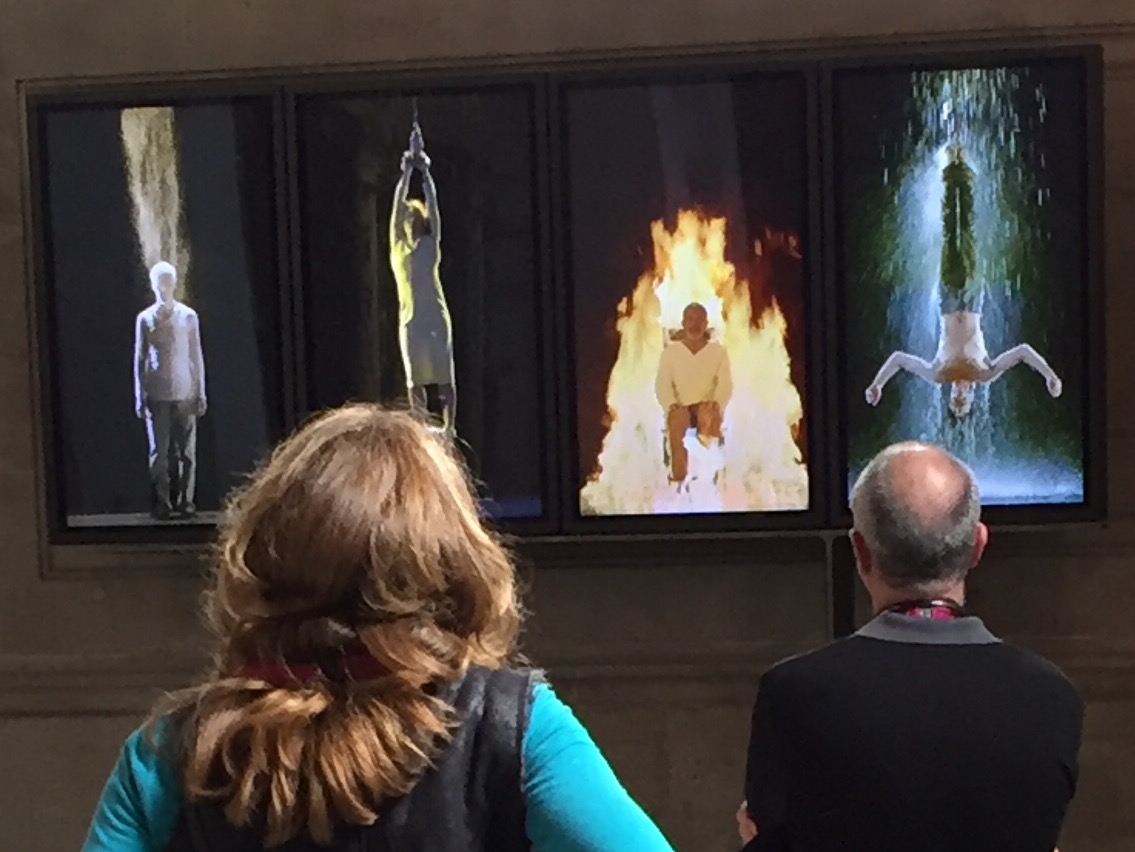
At the far end of the south choir aisle of St. Paul’s Cathedral in London, four “martyrs” perform a perpetual sacrifice in a slow-motion passage from suffering to glory. These martyrs are not the painted or sculptured figures of a traditional altarpiece, but two men and two women, recorded on high-definition video, and played back continuously on a polyptych of four adjacent vertical plasma panels, each 55” x 33.”

This stunning work is by Bill Viola, who has long been exploring the interplay of “technology and revelation.”[i] As David Morgan has written, “Viola’s work suggests that the human condition consists of the fact that we are embodied beings yearning, but ill-prepared, for communion with one another; that we suffer pain and loss, that we struggle to transcend our bodies and our suffering by connecting with a larger or inner aspect of reality; and that we die. Bodies, communion, suffering, transcendence, and death collectively constitute a condition, a worldview that the artist seeks to investigate in his work.”[ii]

Martyrs (Earth, Air, Fire, Water) was installed at St. Paul’s in 2014, and this week I had my first chance to see it. It is 7.5 minutes long, continuously repeated. Mesmerized and deeply moved, I watched it ten times, and each viewing provoked some new thought or feeling.

The figures begin in stasis, undergo an ordeal involving time and motion, and finally come to rest in a perfect stillness: not the anti-life of death or nonbeing, but something implicitly wondrous.

All the figures are facing in our direction. In the first panel, a kneeling man, head bowed to the floor, is almost completely buried beneath a triangular pile of dirt. We only see the top of his head, clutched by his two tense hands. The dirt begins to fly upward in a column, disappearing into whatever is above the frame. He rises to his feet, ever so slowly, as if it is a great struggle against gravity, or stasis. By the time he is upright, the last of the dirt has vanished into the “above,” and he is staring out at us impassively.

In the second panel, a woman in a white shift is suspended by a rope tied to her wrists. Her feet are anchored two feet above the ground by another rope securing her ankles. She is blown by a great wind coming from the left, buffeted back and forth within the constraint of her tethers, at the mercy of a relentless exterior force. After a while, the wind subsides, her suspended body grows still, and she gazes out with an unexpected measure of serenity.

A black man sits in a chair in the next panel, his head tilted to the side and downcast. Then bits of flame begin to drop from above, continuing to burn where they land. More and more flames fall, some leaving trails like shooting stars, until the whole floor, and the chair, are on fire. By this time the man has raised his head to look out at us, but he appears calm and still even as the flames envelop him. He remains in that position as the flames finally relent and die out.

In the last panel, a man is curled up in a fetal position with eyes closed. A rope tied to his angles is suspended from somewhere above the frame. The slack starts to be taken up, pulling his legs upward, and then his entire body, until he is completely upside down like the Hanged Man in the Tarot, or one of those skinned animals dangling in a Dutch genre painting as a secularized image of Christ’s Passion. When a stream of water begins to fall from above, his arms slowly stir, moving into a prayer position, bent 90 degrees at the elbow, then gradually sweeping backward, like a swimmer’s breaststroke, until they are near his side. Meanwhile, his inverted body begins to be pulled upward by the rope, toward the source of the falling water.

All of the figures have been handed over to forces or situations beyond their control. One buried, one bound and buffeted, one burned, and one left for dead. Yet none of them rages or resists. They accept their condition with a calm grounded in something greater than their own survival.

Each of the first three, after gazing out at us for a time, gradually shift their attention to whatever is above them, out of our sight, until their upturned faces glow with the light of eschatalogical radiance. Their faces never become expressive, or call attention to their own personalities; they remain still and quiet, in a condition of “absolute unmixed attention.”[iii]

The fourth figure, the “Hanged Man,” provides the dissonant harmony within this suite of images. He is the one who appeared already dead, his suffering behind him. His eyes, either closed or obscured by the water streaming down his face, are never quite visible. Although his arms eventually make hopeful gestures of prayer or embrace, the rest of his body stays limp, totally given over to the power at the other end of the rope, which pulls him up and out of the frame. The water continues to fall when he is gone.

Unlike the prayerful final images of the other panels, the fourth is fraught with absence. The other martyrs only gaze at the transcendent. The fourth has already ascended there, and we are left with only the water as a reminder of the one we can no longer see.

Noting that martyr means “witness,” an accompanying statement by Viola and his producer Kira Perov compares the active witness of martyrs to the passive witness of those who merely consume images of suffering through mass media, adding that these four figures “exemplify the human capacity to bear pain, hardship, and even death in order to remain faithful to their values, beliefs, and principles. This piece represents ideas of action, fortitude, perseverance, endurance, and sacrifice.”[iv]

But these evocative images can’t be reduced to a single meaning. The more I watched, the more meanings and associations were generated. The first figure suggested Adam formed from the mud, or Christ rising from his grave, shedding mortality clump by clump. It also seemed a kind of birth.

The strongly sidelit second figure, whose white shift and platinum hair glowed against the black background like a Zurburan crucifixion, mirrored both Jesus and Joan of Arc.

Like gold in the furnace God tried them, and like a sacrificial burnt offering God accepted them.[v] The fire in the third panel not only recalled the light of burning martyrs, but the positive biblical tropes of the refiner’s fire and tongues of flame.

The fetal position of the fourth martyr evoked both the womb and the grave. The falling water made me think of both baptism and waterboarding. Once he was gone, however, it spoke to me of both memory and promise: what had happened to him, and what might happen to us.

Just what – or who – is at the other end of that rope anyway?

[i] “Technology and Revelation” is the title of a lecture I heard Viola give at the University of California at Berkeley, September 28, 2009.

[ii] David Morgan, “Spirit and Medium: The Video Art of Bill Viola,” Image, No. 26 ((Spring 2000), 32

[iii] This was Simone Weil’s definition of prayer.

[iv] From the installation’s explanatory text.

[v] Wisdom of Solomon 3:6

Solitude (Part 2)

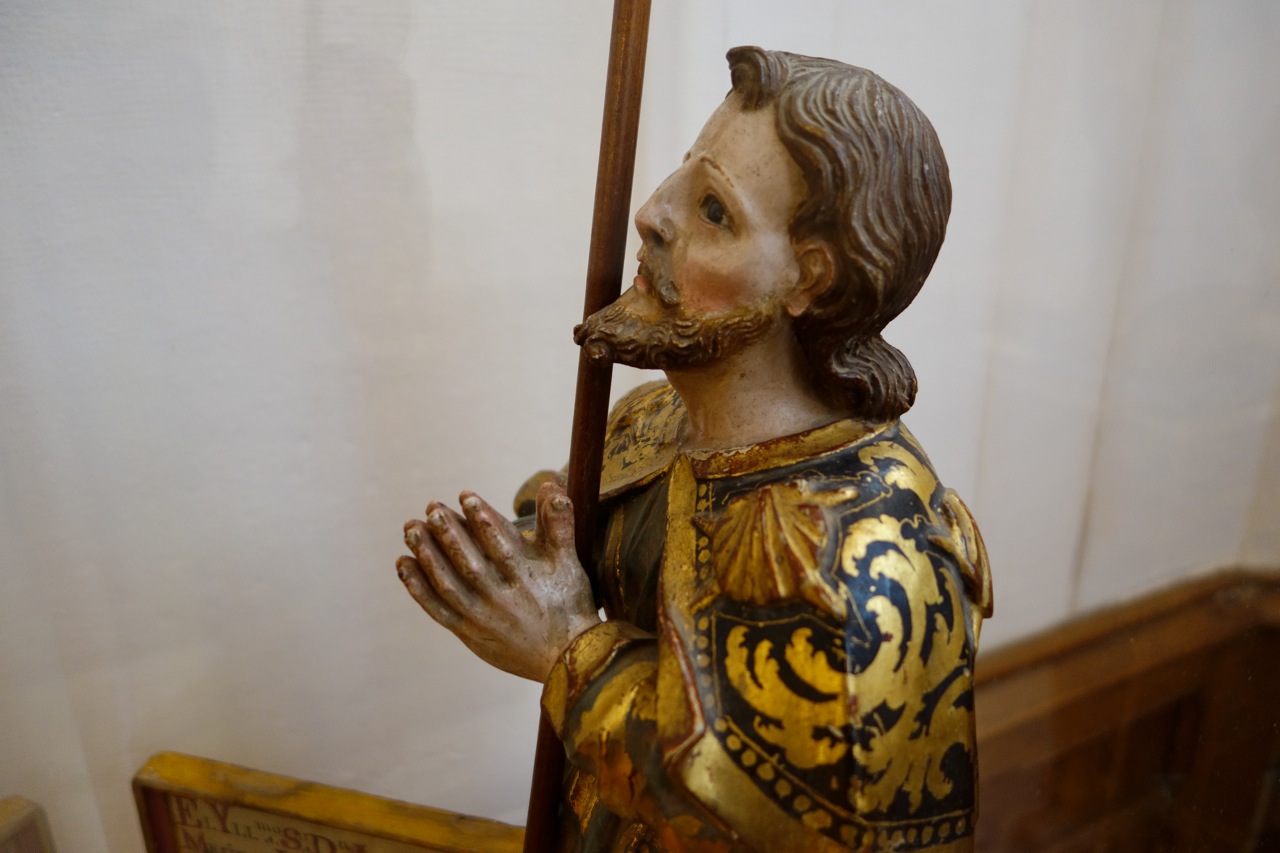
Camino de Santiago pilgrim, Museum of the Pilgrimage, Astorga

Camino de Santiago pilgrim, Museum of the Pilgrimage, Astorga

This evening, an inner light shone up from within, and a voice called, “Come to me, trust me, depend on me. You cannot do it yourself. You’re trapped where you are, and your struggling efforts to free yourself enmesh you more deeply. Come to me.” “Yes,” I answered, and surrendered. Yet my pride was soon fighting back. This is the work I came to do.

— Robert Kull[i]

In Solitude (Part 1), I described one man’s experiment of living in total solitude for one year on a remote island in southern Chile. On this Ash Wednesday, the beginning of the 40-day Christian retreat from habitual living and pesky attachments, it seems a good time to ask what Robert Kull’s experience might teach us about spending time in the “desert.” What happens out there? Will it change us?

Kull has few pretensions about being a hero. One of his first journal entries expresses a feeling of utter weakness and vulnerability: “Alone. A tiny solitary speck completely vulnerable in the face of an infinite universe intent on my annihilation.”[ii] Over the next twelve months he suffers frequent bouts of anxiety, loneliness, rage, depression, emptiness, grief, and self-doubt – all those demons that have nowhere to hide without the constructions and distractions of the social world. “What is this core I’m knotted around?” he wrote after three months. “What painful wound am I protecting? I want nothing to touch me there – but rain, wind, cold, and Cat [his feline companion] keep battering the walls I build.”[iii]

The solution, as he must learn over and over, is not to fight and overcome his human condition, but to surrender: “My goal in the wilderness was not to conquer either the external world or my own inner nature, but to give up the illusion of ownership and control and to experience myself as part of the ebb and flow of something greater than individual ego.”[iv]

He was never entirely free of the hero’s quest to attain a goal, to find the Holy Grail of a perfected self. “It’s painful to feel I’m failing,” he wrote halfway through his year.[v] He worried he was just going round in circles instead of making real progress. He felt like Sisyphus. But isn’t that how the soul dance goes? It’s not the attainment of a final cure for what ails us, but a lifelong process of continual care and self-compassion. As the monks say when asked what they do all day in the monastery, “We fall down and get up, fall down and get up.” Or as a Zen patriarch once put it, “One enlightened thought and one is a Buddha, one foolish thought and one is again an ordinary person.”[vi]

We should rejoice that enlightenment and foolishness (or grace and sin) remain so intertwined in this life. It reminds us that grace is a gift, not a possession. It frees us from pretension and pride, and makes us ever grateful.

In his last days on the island, Kull wrote:

I’m not sure what enlightenment is, but I believe there have been moments. If so, enlightenment is not something I can get. It’s the process of abandoning myself to the world. There have been times when, like a clear bell, I could hear the sound of one hand clapping and feel the sacredness of everything. It’s the sound of the world, once I remember in my heart that there is truly nothing to get. What I’m looking for, I already have.[vii]

In his year of solitude, Kull experienced many moments of enlightenment to go with the many foolish ones. Some of his best thoughts are framed in the language of his adopted Buddhist tradition, but his struggles with self-will and ego are resonant with Christian spirituality as well. “Surrendering the ego to Something Greater is at the heart of spiritual practice, and the process is endlessly subtle and challenging.”[viii]

Kull’s wilderness year did not fix him. He returned home still a work-in-progress. But he had definitely been changed by his sojourn in solitude, and the meaning of that change will only be revealed over the rest of his life. As I often heard when I walked the Camino de Santiago, “when you reach Santiago, your real Camino begins.”

Kull’s relationship with the wind is my favorite example of his spiritual growth. When he began his year in the southern summer, the winds were intense and seemingly endless. If you have ever camped in high winds, you know how wearying, even terrifying, a continuous barrage of turbulence can be. For a long time, Kull regarded the wind as his enemy – an attacking, malevolent force trying to break him down. But as he gradually learned to surrender to the world, to accept the way things are and not take them personally, he recognized the wind had been his teacher all along. In his final weeks on the island, he began to fly a kite on calmer days. The wind had become his playful companion.

For those of us beginning our Lenten retreat today, Kull’s valuable experiment in solitude has much to teach us. The subtractions of retreat – doing without, giving up, setting aside, getting away – can free us from the clutter, noise, addictions, distractions and deceptions that drown out the still, small voice calling our name in every moment. And the unaccustomed hardships of the “desert” – severity, deprivation, emptiness, loneliness, demons – can break the spell of self-sufficiency, returning us to the honest condition of primal need. Few of us will spend a year on a Patagonian island, but a faithful keeping of Lent may take us to a place of similar learning and growth.

Perhaps the best thing we can take from Kull’s journals is the gift of self-compassion. We don’t have to be heroes. We don’t have to be cured. We don’t have to pretend at spiritual competence or perfection. We don’t even have to be “good,” as Mary Oliver reminds us. We “only have to let the soft animal of [our] body / love what it loves.”[ix] And every now and then, as Kull duly notes, we get it: “Finally I am – if only briefly – the flowing All.”[x]

Tonight I will kneel in church for the imposition of ashes. A priest will trace a charred cross on my forehead and say to me, “Remember that you are dust, and to dust you shall return.”

What a relief! Only dust, neither hero nor angel. And yet, is not dust the very material God selected to fabricate a physical image of the divine self? This dust may yet shine with glory not its own.

Whether I flie with angels, fall with dust,
Thy hands made both, and I am there;
Thy power and love, my love and trust,
Make one place ev’ry where.[xi]

[i] Robert Kull, Solitude: Seeking Wisdom in Extremes – A Year Alone in the Patagonian Wilderness (Novato, CA: New World Library, 2008) 98

[ii] Kull, 4

[iii] Kull, 70

[iv] Kull, 47

[v] Kull, 141

[vi] Hui Neng, Sixth Zen Patriarch, q. in Kull, 288

[vii] Kull, 293

[viii] Kull, 271

[ix] Mary Oliver, “Wild Geese,” in New and Selected Poems (Boston: Beacon Press, 1992) 110

[x] Kull, 283 (italics mine)

[xi] George Herbert, “The Temper”

Solitude (Part 1)

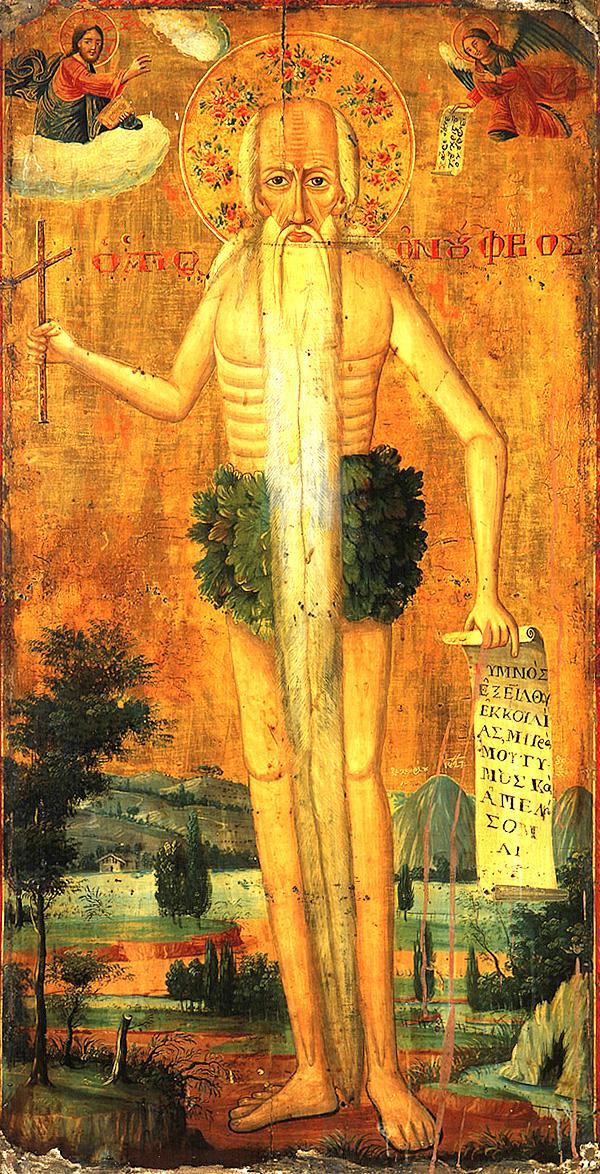
St. Onuphrius

St. Onuphrius

Go, sit in a cell, and your cell will teach you everything.

— Abba Moses (4th century)

Great liking I had in wilderness to sit, that I, far from noise, sweetlier might sing, and with quickness of heart likingest praising I might feel.

— Richard Rolle (14th century)

A man that Studies Happiness must sit alone like a Sparrow upon the House Top, and like a Pelican in the Wilderness.

— Thomas Traherne (17th century)

I went to the woods because I wished to live deliberately, to front only the essential facts of life, and see if I could not learn what it had to teach, and not, when I came to die, discover that I had not lived.

— Henry David Thoreau (19th century)

In the seclusion of a cell… the troubled waters of the mind grow still and clear, and much that is hidden away and all that clouds it floats to the surface and can be skimmed away; and after a time one reaches a state of peace that is unthought of in the ordinary world.

— Patrick Leigh Fermor (20th century)

I wondered how I could stop feeling attacked by the elements, and then remembered that I came here to be shaped by the experience of solitude in nature. In that moment, I relaxed my grip on who I think I should be and how the world should treat me, and opened myself to the process of change and growth.

— Robert Kull (21st century)

We don’t know the names of the first hermits, or exactly what drove them to flee their social world for the solitude of wilderness. Not every reason was spiritual, nor did every hermit aspire to higher consciousness. The woods and wastelands have seen their share of outlaws and misanthropes. But for many whose names we revere (such as Moses, Buddha and Jesus), as well as for countless saints who have successfully achieved anonymity, the desert, the mountaintop, the island and the forest primeval have been crucial habitats for the work of the soul.

You go to the wilderness both to lose and to gain. You lose habitual patterns and social roles, along with addictive comforts, clocks, calendars, distractions, noise, news, and the various stresses of public and personal life. You gain time, silence, solitude, freedom, wild nature, and the occasional attention of both angels and demons. If you don’t leave too soon, you may also discover a voice which has kept you company since the day of your birth, a voice which has waited patiently until your inner silence grew deep enough to hear it.

When Robert Kull was a young man, an American expatriate living in Canada, he quit his logging job and paddled a canoe deep into the interior of northern British Columbia, where he lived alone for three months. Psychologically and spiritually unprepared for such extended isolation, he almost “lost it” out there, consumed with fear of the vast unknown as his stable sense of self began to crumble. One night he left his campfire to lie down unprotected in the forest darkness. When a bear drew near, he was terrified, with no recourse but to call upon a higher power. “In that moment of surrender, I felt lifted and found myself floating in a pool of clear light. Looking down, I sensed myself lying peacefully on the forest floor. The world was no longer a hostile alien place, but my home. No true separation remained between me and the world.”[i]

During the weeks that followed, Kull felt so joyful, so “deeply integrated into the universe,” that he resolved to spend an entire year in wilderness solitude at some future time. But soon after returning to the world, “I lost my way, and the clear inner light faded.” It would be 25 years before he would keep that promise to himself, a long stretch during which he sought to recapture that original but elusive state of grace through meditation, self-analysis, and spiritual exploration.

Finally, in February, 2001, Kull set up camp on a remote island off the coast of southern Chile, where he would spend a year alone in the Patagonian wilderness. An abridged form of his journals, interspersed with later reflections about the experience, was published by New World Library in 2008 as Solitude: Seeking Wisdom in Extremes. It’s a marvelous read. By shunning a grand narrative thread or an authoritative single voice, Kull let his recorded thoughts, observations and experiences stand just as they were written, paragraph by paragraph, full of changing moods and contradictory voices. This documentary restraint allowed me to be in the moment with him. Each time I picked up the book over the past few weeks, I was immediately returned to that island solitude, its hardships and its beauties, its frustrations and its revelations. When the “year” was finally up and I resumed my accustomed life, I was left with the same question that Kull returned with: what happened out there, and has it left a permanent mark on me?

As the Lenten journey into metaphoric wilderness looms near, I want to explore the implications of Kull’s spiritual experiment for the rest of us. I will do this over the course of a few posts. Let me conclude this first installment with some thoughts about his approach.

Raised as a fundamentalist Christian, Kull eventually migrated to Buddhism. He still uses the word “God” at times, but speaks more often of a felt Presence, Something Greater, or mystery. His favorite term is alive or aliveness, always rendered vibrant with italics. Shorn of traditional theist attributes which might divorce the divine from the given world, this Presence is often interchangeable with “nature” or “universe.” Sometimes it has a voice, and responds to our attention, while sometimes it seems a more impersonal, all-embracing flow.

But constructing a coherent systematic theology is not Kull’s design. While he brings his own presuppositions to his observing, as do we all, his aim is ontologically humble. He is not trying to make an objectively comprehensive model of Being, but to describe his own experience when he opens himself to larger spiritual realities. While he draws on the wisdom of various teachers, his knowledge remains largely personal.

As he tells us, he wanted “to explore, through living, the physical, psychological, emotional, and spiritual effects of deep wilderness solitude.”[ii] Formally, his project was an academic study for a doctorate at the University of British Columbia. But as he later wrote, “although my intention at the beginning of this retreat was to explore solitude through a purely secular lens, [I] have had to admit that I cannot fully live nor write about what is happening without using spiritual terminology.”[iii]

A Christian of the last century, having spent considerable time praying in a cave in North Africa, said that “the trouble with going to the desert is that you risk meeting God there.” And as the series of epigraphs at the top of this post demonstrate, there have always been a few of us willing to take that risk. Those who stay home are all grateful for anything they can tell us afterward.

What Kull learned on that Patagonian island is valuable for several reasons. One is the sheer length of his solitude. The Desert Fathers had visitors, and said mass together on Sundays. Thoreau also enjoyed visitors, and dropped off laundry at his mom’s house in town. But Kull had only one brief visit from park rangers. The rest of the time he was entirely bereft of human presence. He thus provides an uncommon source of data about human consciousness.

Such data is hard to come by. I once heard the scholar-writer Stephen J. Pyne read a brilliant paper on the otherworldly environment of Antarctica. White on white, often without any visible separation between ice and sky, the polar landscape is stripped of the visual cues and details by which we orient ourselves in space. Being there is like dwelling in an abstract painting. I asked Pyne whether prolonged exposure to such strange phenomenology might produce interesting forms of consciousness. Shouldn’t the polar outposts be treated like monasteries where the far edges of human perception could be explored? “Maybe,” he laughed. “But the fact is, everyone just stays inside the sheds watching videos and drinking.”

Kull’s experiment is also valuable for his suspicion of preconceptions. He tried to stay open to whatever happens, as free as possible from abstract ideas about the nature of psychological and spiritual experience. Of course this is not entirely possible. We are all products of culture, language, personal history, social location and other contextual factors. But while I would be interested to see what a theologian could do with the raw data, I am glad it was Kull and not the theologian (myself included!) who did the empirical work. Fewer ideas to get in the way.

Finally, Kull’s report is imbued with his own frailty and vulnerability. He’s neither saint nor guru, just a slob like one of us. Afflicted at times by feelings of spiritual failure, and liable to follow an experience of the oneness of all beings with an angry swipe at his whining cat, we feel the camaraderie of a fellow beginner. When he comes across Merton’s sweeping assertion that the “hermit’s whole life is a life of silent adoration…. a prolonged communion … ever in the presence of God,” Kull can’t contain himself: “[N]owhere does Merton’s statement find support,” he argues. “On the contrary. The mind and heart are all over the place, from the most trivial, mundane, and negative to the joyful, peaceful, and sacred. Solitude is like the rest of life, only with less opportunity for escape into diversion.”[iv]

I like to imagine Merton laughing in agreement.

To be continued in the next post

[i] Robert Kull, Solitude: Seeking Wilderness in Extremes (Novato, CA: New World Library, 2008) xiv

[ii] Kull, 54

[iii] Kull, 214

[iv] Kull, 103

Memento mori

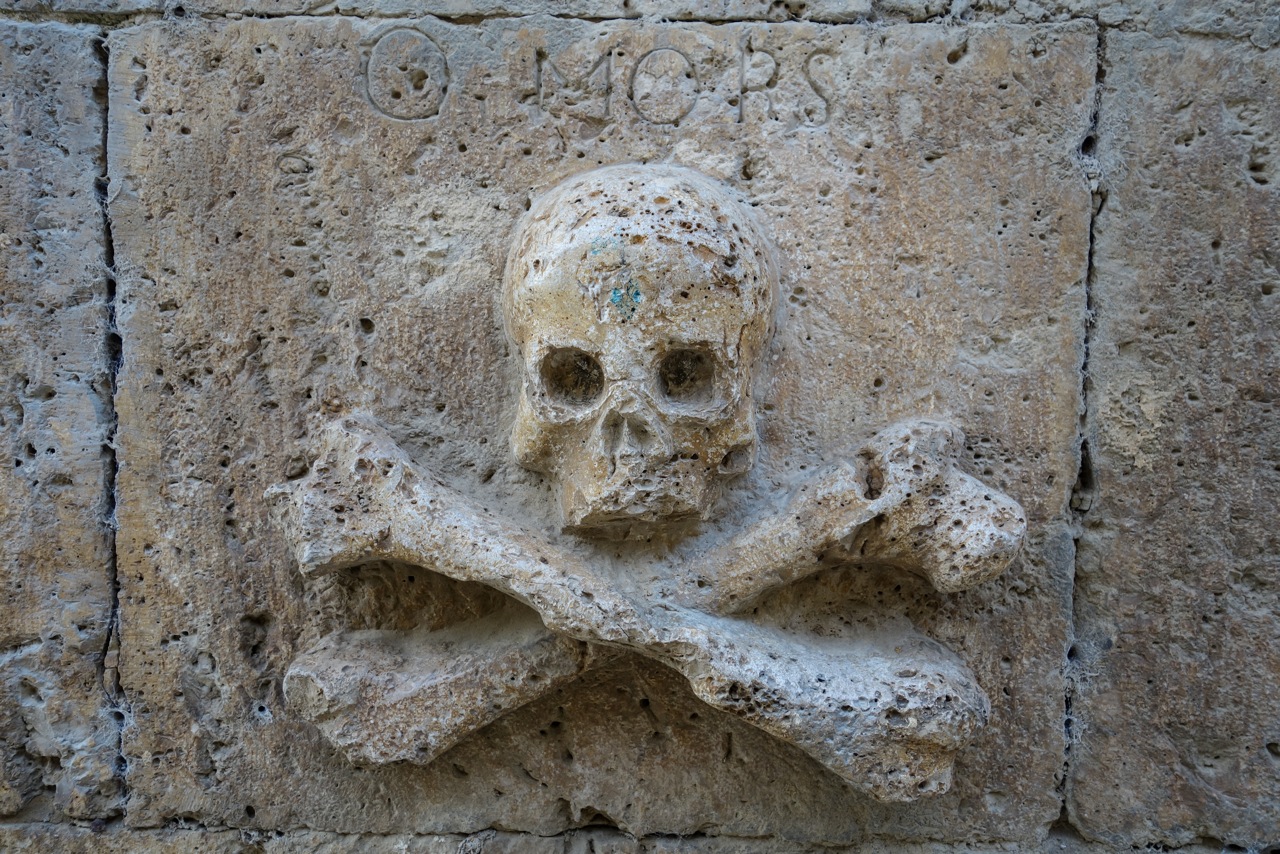
Wall relief in Castrojeriz on the Camino de Santiago

Wall relief in Castrojeriz on the Camino de Santiago

I tell my pupils to live each day as if it were their last… I don’t want children to fear death; I want them to respect life… It’s good for children to confront the idea of death, and… of their own mortality. Sometimes a child feels squeamish about death… skulls and skeletons. When this happens, I tell my pupils to touch themselves. “Why are you afraid?” I ask, “when each of you owns a skull and skeleton. We all carry death within us.” They feel themselves, and they say: “Yes it’s true, we too are made of bones.”

– María Antonieta Sánchez de Escamilla, a kindergarten teacher in Mexico (The Skeleton at the Feast: The Day of the Dead in Mexico, Elizabeth Carmichael & Chloë Sayer)

No leaves, no flowers, no light, no warmth, November. The eleventh month, as the year begins to slip away, evokes mortality like no other. Though it begins with the festivity of All Saints Day, celebrating the friends of God now radiant with the light of heaven, it immediately shifts to the more shadowy realm of All Souls, the Day of the Dead. Death itself, rather than what lies beyond it, becomes our focus. We visit graves, light candles, speak names, gaze at old photographs, tell stories of vanished presences.

In Mexico, death is playfully treated in comic skeleton images and candy skulls, but it is not mocked. A resigned acceptance of mortality pervades the festivities. The living remember not only the dead, but the skeleton inside themselves. They too are “made of bones.”

In American culture, we are not so adept with death. We always seem a little surprised by it. We avoid speaking its name. Memento mori is not a common spiritual practice. Few of us keep skulls on our desk, or sleep in coffins while we still have breath.

Forty-five years ago this month, I had my closest brush with death. I was sleeping in the back of a Volkswagen bus hurtling down a New York thruway at 65 miles per hour. A friend and I had been traveling all night, and it was my turn to rest. Suddenly the bus went out of control and flipped sideways, rolling over and over six times until finally coming to a stop upside down on the grassy median.

I remember two things about that long roll. My mind sped up to make everything appear in slow motion. It was like being inside the giant rotating barrel at an old amusement park. It carries you up and up until gravity kicks in and you are dropped back to the bottom to begin all over again. Slide up, drop. Slide up, drop. But slowed down, so I could observe it all in detail. Meanwhile, guitars, suitcases and croquet balls were flying around in similar motion experiments.

The other thing I remember is how familiar death seemed. I was not thinking, “This can’t be happening.” I was thinking, “Oh, so this is where we finally meet.” I’m sure the words were not so precise in the moment, but the sense of recognition was. When the rolling finally stopped, I lay face down on the ceiling of the inverted bus. I probably blacked out for a moment. Then I heard a voice, “All you all right?” I wasn’t sure how to answer – not until I actually tried to move. What if I couldn’t? I hesitated a moment, delaying the verdict. At last I tested my hands; my arms; my legs. They still worked. I rose slowly to my feet. Thankfully, nothing was broken. My friend was unharmed as well. Life was never so sweet.

The bus itself was totaled, and one of the guitars, my grandfather’s Gibson “Roy Smeck Stage Deluxe” Hawaiian guitar from the 1940’s, was pretty smashed up as well. Its broken body still hangs in our garage, my own memento mori.

In the predominant secular imaginary, a peek through death’s door finds no stairway to heaven, but only darkness. Termination. Void. A terrible forgetting. Emptiness.

This is a reasonable outlook, especially after the charnel house of the past century, but it’s not much to live by. And it is no more provable than belief’s alternative. None of us knows for sure. It’s a gamble either way.

In the 1950’s, Sylvia Plath summarized the modern formulary in her journal:

You don’t believe in God, or a life-after-death, so can’t hope for sugar-plums when your non-existent soul rises… Cats have nine lives, the saying goes. You have one; and somewhere along the thin, tenuous thread of your existence there is … the stopped heartbeat that spells the end of this particular individual which is spelled ‘I’ and ‘You’ and ‘Sylvia.’

John Donne, who himself never took death lightly, saw the outcome differently:

All mankind is of one Author and is one volume; when one man dies, one chapter is not torn out of the book, but translated into a better language; and every chapter must be so translated.

Just a month before his death from cancer in 1631, Donne preached his final sermon, Death’s Duell, at St. Paul’s, London. “That which we call life is … spent in dying,” he wrote, but “a gate into heaven I shall have.” Then, though weak from illness, he posed for a sketch that would be used to make the sculpture for his tomb. After having a fire lit in his study (it was February), he stripped naked and wrapped himself in a burial shroud with only his face showing. Rather than lie down in the traditional sleeping position, he stood erect for the sketch. The resulting statue, the only monument to survive the Great London Fire of 1666, resides in the south choir aisle of St. Paul’s. Donne is standing to greet the resurrection. His eyes are not yet open, but he is smiling with expectant delight. His epitaph reads:

He lies here in the dust
but beholds Him whose name is Rising.

The ambush of the marvelous

Jacob wrestling

Come, O Thou traveler unknown,
Whom still I hold, but cannot see;
My company before is gone,
And I am left alone with Thee.
With Thee all night I mean to stay,
And wrestle till the break of day.

The Sacred Harp

A century ago, Scottish theologian P.T. Forsyth described prayer as a kind of spiritual tempest blowing away all our complacencies. While giving a nod to the contemplative and aesthetic dimensions of spirituality, he was blunt about its capacity to rupture the settled proportions of daily life:

We do need more reverence in our prayer, more beauty in our praise, less dread of tried and consecrated form. But still more do we want the breathless awe, and the stammering tongue, and the solemn wonder, and the passionate gratitude, which are the true note of grace, and the worship of a soul plucked from the burning and snatched by a miracle from the abyss.

Prayer is not for the timid. Better wear a crash helmet, as Annie Dillard advised. But the fierce energies of prayer are not God’s alone. We must bring the strong force of our own desire to the encounter, pressing God to keep the ancient promise of a world made new. Every prayer may inevitably end with “thy will be done,” but it often begins in a place of struggle, if we are honest. “Hear my voice when I complain,” prayed the Psalmist. Even Jesus argued vehemently for an alternative to the cross. We were not made to go quietly. God wants us to put up a good fight. “Prayer is wrestling with God,” wrote Forsyth. “It is a resistance that God loves.”

The Bible never names the stranger who jumps Jacob in the dark and wrestles him till daybreak (Genesis 32), but interpreters have always suspected his divinity. Delmore Schwartz, in his poem “Jacob,” describes the assault as “the ambush of the marvelous, / unknown and monstrous, / at the very heart of surprise.” Jacob couldn’t see his opponent’s face, but all his inner conflicts must have risen up to give him a name:

– It is the ghost of my father Isaac, from whose deathbed I stole the blessing, and he’s come to take the blessing back.

– No. It is the spirit of my brother, with whom I wrestled in my mother’s womb, with whom I must fight in the flesh tomorrow.

– No. It is my own shadow, the unloved child and desperate trickster, here to unmask the pretense of my so-called success.

– No. It is the angel of death come to mock all God’s promises of protection and future.

– No. It is God’s own self, that merciless opponent who will not let me be until I am broken open and made new.

All night long, Jacob fought against this stranger, this Other. The stranger wounded him, dislocating the socket of his thigh, but Jacob would not give up. When dawn came, the stranger tried to flee, but Jacob held on tight.

“Let me go,” said the stranger. “I do not live in the glare of your well-lit thoughts, but only in the shadows of your intuitions.”

“I will not let you go until you bless me.”

“What is your name?” asked the stranger.

“Jacob.”

“It is Jacob no more. Your name shall be Israel – the one who wrestles with God.”

“Then what is your name?” asked Jacob.

“Ah!” said the stranger. Then he gave Jacob the blessing, and vanished.

The sun began to rise as Jacob limped away from the river, forever wounded, but ready at last to meet his future.

I once led a workshop on this story at a church retreat. After digging into the passage for a while, participants were invited to retell it in their own way. One young woman, who was differently abled and emotionally troubled, did exactly what the Bible wants us to do with its narratives. She put herself into the story.

Jacob was having a lot of problems with his family. He needed to get away from them, to get his head together. He felt a great struggle inside himself. “Why can’t I deal with my anger and frustration?” After a while he began to realize that he was wrestling with God.

He wrestled with God all night long, but when dawn came he began to think God must be pretty tired of him by now, that God must be so sick of listening to his problems that he was just going to go away. Jacob felt afraid and alone but he didn’t give up. He held on tight and wouldn’t let go. He begged God to stay and to bless him.

“What is your name,” God asked him.

“Jacob.”

“I don’t think so,” God said. “I think it’s Israel, because you’ve had the guts to face up to your problems.”

Then the sun came up and God was gone. And as Jacob began to walk away from that place, he noticed he was limping. Suddenly he remembered that he had always had this limp, but it didn’t bother him anymore. It was okay. It was just part of who he was.

God and the imagination are one

HS dove

Following this blog’s inaugural series of dispatches from the Camino de Santiago last spring, readers of The Religious Imagineer may have noticed a curious diversity of topics: saints, seasons, nature, culture, theology, Scripture, liturgy, art, theater, circus, classic cars and cinema. And perhaps they wonder, what ties all this stuff together?

The fox knows many things, but the hedgehog knows one big thing. When Isaiah Berlin explored the implications of this ancient Greek saying in his celebrated 1953 essay, he argued that Tolstoy was by nature a fox but by conviction a hedgehog. His interests were wide and his eye for the particular was acute, but he sought to contain the world’s multiplicity within a single defining idea.

I can relate. And the one big thing for this blog is found in a line from Wallace Stevens:

We say God and the imagination are one …
How high that highest candle lights the dark.

This might be taken as a secular celebration of the human mind, reducing God to one of its creative fictions. But if I read Stevens with the hermeneutic of a believer, “God and the imagination are one” is not necessarily a matter of either-or. It might also mean both-and. God dwells both in the mind and outside it. Imagination is both a way we reach beyond ourselves, and a means by which the transcendent finds a home in us, enabling us to see with the eyes of God and the mind of Christ, and to act accordingly. To say that God and the imagination are does not mean for me that they are identical, but that they participate deeply in one another.

The Creator’s “Let there be light!” and Jesus’ refusal of the tomb’s finality are the supreme biblical examples of divine imagination. But there have been countless imagineers engaged in the work (or is it play?) of bringing the new heaven and new earth into being. The activist imagining peace, the oppressed imagining justice, the forgiver imagining reconcilation, the mourner imagining joy, the saint imagining a new way of being, the theologian and the artist imagining the beauty of the infinite in the particular, are all practitioners of the holy and transformative task of conforming the world more closely to God’s image.

When Jesus quoted Isaiah 61 in his hometown sermon, he embraced such prophetic imagination as his own vocation.

The Imagination of God is upon me,
for she has sent me to bring good news to the poor.
She has sent me to proclaim release to the captives
and recovery of sight to the blind;
to let the oppressed go free,
to proclaim the year of divine favor.

So to return the original question about The Religious Imagineer’s diversity of topics, I would say that imagination is the unifying subject of this blog. How do we say the unsayable, see the invisible, dance the impossible in our images, rituals and stories? How do we attend to the traces of God amid the chronic unknowing of secular modernity? How do we imagine the really Real and the not-yet?

Video artist Bill Viola, the subject of an earlier post, has observed that “in the Middle Ages they painted the sky gold in the paintings … It was realism they were after – reality of the divine effused through everything in the physical world.” That is my theme as well.

As ever, thanks for reading.

The ten best religious films

DCP blessing2

A man goes into a butcher shop and says, “Give me your best piece of meat.” And the butcher replies, “Everything in my shop is the best.” (Zen story)

Top ten lists are inherently fraudulent. By what authority do I declare what is best? And by what criteria? And which religion? But if I had titled this post, “Ten compelling films which engage religious questions from a [mostly] western Christian perspective,” it wouldn’t be nearly as much fun. We love rankings, if for no other reason than the pleasure of argument.

My list is totally subjective of course, and infinitely revisable, depending on the day, or where I am in my life (although Robert Bresson’s Diary of a Country Priest has topped my list every since I first saw it in Ann Arbor 45 years ago and subsequently had to wander around for a couple of hours on a rainy night until I was capable of returning to ordinary life).

I have restricted myself to one film per director (or else Bresson would take up about six places, and Tarkovsky a few more, etc.). I have also stuck to the western Christian tradition, with the Russian orthodoxy of Tarkovsky the one exception.

And while there are many films with spiritual subjects or theological themes, I have focused primarily on examples of what Paul Schrader calls “transcendental style” – films which are not just about religious experience, but themselves create religious experience in the viewer, through cinematic form and language as much as story. Icon writers know this well. There’s a lot to say about transcendental style, but for now let me simply cite Susan Sontag’s remark about Robert Bresson: “His form does not merely perfectly express what he wants to say. It is what he wants to say.”

All these films are available on DVD or Blu-ray, and I hope you will be encouraged to explore them. But I must warn you that not all these films are equally accessible. Most of them refuse the usual manipulations and excitements of mass cinema, and demand a contemplative mind. Transcendental style can be as rigorous as prayer. But as Iranian director Abbas Kiorastami has said, “I would rather see a film that might even bore me in the act of watching but that later I can’t stop thinking about, than a film that keeps me on the edge of my seat and then is immediately forgotten.”

Here is my list, in alphabetical order.

1) Decalogue (Krzysztof Kieslowski, Poland 1988)   This extraordinary cycle of short films explores various lives within a single apartment block, whose grey concrete bleakness exudes the alienation and melancholy felt by many of its residents. It is the world after the Fall, when instinct and intuition no longer suffice to guide human living. Each film is roughly based on one of the Ten Commandments, but the imperatives of each situation are far from clear. Choices matter intensely (it is not such a godless world that one can do anything one wishes), but most of the characters are bewildered and beset by the questions before them. And yet – grace happens, people connect, souls find mercy. Not every time, but enough to keep alive the hope that God – embodied by a mysterious figure who always seems to be around at key moments – has not abandoned us.

2) Diary of a Country Priest (Robert Bresson, France 1950)   Bresson pares away everything inessential to show the story of a soul. The miracle of his “transcendental style” is that he shows us not so much what people do as who they are – not through explaining them psychologically, but by letting their mystery be. As with iconography, a kind of inexpressiveness on the surface allows hidden depths to shine through. As the priest walks his own Stations of the Cross, the sorrowful way becomes a revelation of grace. This is not a film about religious experience – it is religious experience.

3) Ida (Pawel Pawlikowski, Poland 2013)   Is the religious life purely a product of environment, or is it indelibly inscribed on the heart? In 1962, a young novice, raised as an orphan in her convent, is sent into the world to visit her only living relative, just prior to taking her final vows. Will her vocation survive outside the cloister? The people she encounters, the discoveries she makes about her past, the suddenly viable prospect of a life in the outside world – all present her with new options for her life and vocation. One of the many beauties of this film is that neither the convent nor the outer world are judged. Both are viewed with sympathy and respect. Until she decides her future, Ida is shown off center, at the edge or bottom of the frame. But in the film’s final shot, she is perfectly centered at last.

4) Into Great Silence (Philip Gröning, Germany 2005)   The director spent 6 months in residence at a Carthusian monastery in the Alps, filming monastic life and worship. Using only natural light, he shows us a numinous world of shadows pierced by the radiance of windows and candles. Dwelling in this world of prayer and silence for nearly three hours, we slow ourselves to the monastic rhythm, and emerge refreshed and centered, and thankful for those who give their lives to providing, as Dan Berrigan once put it, “large reserves of available sanity.”

5) Magnolia (Paul Thomas Anderson, USA 1999)   Is the world only a confusion of chance and arbitrary choice, or do providence and purpose exist? Is the universe a matter of chaos or love? Anderson explores the possibility of connection, pattern and grace in the intersecting lives of many different characters, all of whom are in some way broken, wounded or lost, casualties of a city (Los Angeles) which, like the biblical Egypt, has produced countless captives and victims. In one unforgettable scene, nine of the characters are shown, each in their particular condition of need and supplication, singing along with the soundtrack, Aimee Mann’s “Wise Up” (“It’s not going to stop till you wise up”). Their capacity to exit the prison of the self just enough to partake of the soundtrack’s “common prayer” is both ritual transcendence and the tentative praxis of real liberation. As if in answer, a biblical rain of frogs falls from heaven.

6) The Mill and the Cross (Lech Majewski, Poland 2011)   In a windmill perched high above a broad plain teeming with figures, God is a miller grinding the terrors of history into something better, even as the Christ is being dragged to the cross. This strange, haunting and difficult film immerses us within the complex world of a single painting, Pieter Brueghel’s “The Way to Calvary,” where the Passion of Christ is relocated to the painter’s own 16th century world. Through a visually stunning use of computer imaging, we dwell within the painting’s fantastic landscape and mingle at close range with its numerous characters. The effect is astonishing, as if we are dreaming with a premodern mind. The human suffering is arduous and heartbreaking, but it does not have the last word. In the end, the dance goes on.

7) Nostalghia (Andrei Tarkovsky, Russia 1983)   All of Tarkovsky’s films practice what he called “sculpting in time,” using a contemplative camera and lengthy shots to register a deeper flow and presence than films that hurry from one incident to the next. For western Christians, the image is usually about something. For an orthodox Christian like Tarkovsky, the image is something. The viewer becomes less a spectator than a supplicant. “The aim of art,” said Tarkovsky, “is to prepare a person for death, to plough and harrow the soul, rendering it capable of turning to the good.” Nostalghia is more poetry than narrative, rhyming fire and water, dream and memory, ritual and redemption, to counter the malaise of materialism.

8) Of Gods and Men (Xavier Beauvois, France 2010)   Based on a true story of a monastic community facing martyrdom in 1990’s Algeria, this is a profoundly moving story of self-offering and radical forgiveness. Structured around the liturgical hours and seasons, its unhurried scenes of prayers and chants allow us to worship along with the monks. But they are asked to sacrifice more than praise, and their faithful willingness to take up the cross poses serious questions for our own discipleship.

9) Ordet (Carl Dreyer, Denmark 1955)   Like the parables of Jesus, Ordet (“The Word”) employs the forms and situations of the everyday world only to break open the frame of that world with the startling intrusion of an alternate reality. Dreyer’s film, like its “holy fool” Johannes, presents us with divine impossibility in perpetual tension with the way we expect things to go. It uses material means – faces, architecture, landscape, language, light – to show us the immaterial, but in the end we are led not away from corporeal existence, but rather more deeply into it.

10) To the Wonder (Terrence Malick, USA 2012)   “Love everyone. Every leaf. Every ray of light. Forgive.” This line from The Tree of Life (drawn from Dostoevsky) is the theme of every Malick film. While his work has always reflected a deep interest in philosophy and religion, his most recent films have been theologically explicit to a degree unique in American cinema. The Tree of Life covers the biblical span from Creation to Apocalypse, while To the Wonder narrows its focus to the Song of Songs’ analogy between human relationships and divine-human love. Unlike the plot-driven narratives of most films, To the Wonder unfolds in hints, glimpses, ellipses and temporal leaps. We can’t always be sure whether we are seeing events, memories or thoughts. As with Bresson, there is no psychological explaining of characters. They retain the open-endedness of their essential mystery. It’s not so much a film in the usual sense as it is a dance, a poem, even a prayer. The viewers aren’t simply invited to watch the ecstatic images, but to become ecstatic themselves.