The Transfiguration of Christ (Sr. Abraham, Ethiopian community in Jerusalem, 1990)
I spent only one year in a world without nuclear weapons. My first birthday fell on July 16, 1945, the day of the initial atomic bomb test in New Mexico. A few weeks later, my country used the bomb to extinguish countless human lives on the Feast of the Transfiguration. With Transfiguration falling on a Sunday as Oppenheimer is playing in the theaters, a few comments are in order.
In an interpretive retelling of the Transfiguration by a 17th-century Anglican bishop, Moses and Elijah discuss the paradoxical mixture of evil and glory that permeates the Way of the Cross:
A strange opportunity … when [Jesus’] face shone like the sun, to tell him it must be blubbered and spat upon;… and whilst he was Transfigured on the Mount, to tell him how he must be Disfigured on the Cross! [i]
In the twentieth century, that paradox was tragically deepened when we dropped the atomic bomb at Hiroshima on the Feast of the Transfiguration. Two kinds of light, diabolic and divine, contending forever after for the soul of this world. Whose world is it, anyway? To which light do we belong? To which light do we pledge our allegiance?
In his novel Underworld, Don DeLillo chillingly mixes and confuses the primal images of divine and diabolical light when a nun, swept out of her conscious self into the informational totality of the Internet, has a visionary experience on a website devoted to the H-bomb:
She sees the flash, the thermal pulse . . . . She stands in the flash and feels the power. She sees the spray plume. She sees the fireball climbing, the superheated sphere of burning gas that can blind a person with its beauty, its dripping christblood colors, solar golds and red. She sees the shock wave and hears the high winds and feels the power of false faith, the faith of paranoia, then the mushroom cloud spreads around her, the pulverized mass of radioactive debris, eight miles high, ten miles, twenty, with skirted stem and platinum cap.
The jewels roll out of her eyes and she sees God . . . .
No, wait, sorry. It is a Soviet bomb she sees . . . . [ii]
Seattle Times, July 16, 1995 (50th anniversary of the first atomic bomb).
I’ve not yet seen Oppenheimer, the film about the creator of the atomic bomb. But I was struck by this paragraph in a review by Adam Mullins-Khatib:
“Oppenheimer … is a searing portrait of a man plagued by visions of a world that can’t be seen, a theoretical world composed of the literal particles of his ideas. Driven by an unyielding need to bring his visions to light, J. Robert Oppenheimer (Cillian Murphy) struggles with the notion of bringing theory into practice … It’s a film about the creation of something not before seen and the consequences this entails.” [iii]
Something not before seen and the consequences this entails. That could describe both the coming of Christ and the invention of the Bomb: each brought into the world something not before seen, manifested in a moment of blinding brilliance. And each has had enormous consequences which are still very much with us. But only one of them is the Light eternal, pure brightness of the everlasting Love who loves us.
To paraphrase the divine Voice in Deuteronomy 30:19,
This day I set before you life and death, blessing and curse, the light eternal and the light infernal. Choose life. Or else.
In 1944, one year before Hiroshima, Orthodox theologian Vladimir Lossky, wrote these words:
“We live in a world of suffering, a world broken and disintegrated, in which Christ’s Transfiguration uncovers reality and reveals to our skeptical minds a new humanity that has either entered into the light of the Risen One or is still called to do so … [W]e need to put on a robe of light, the apparel of those who live without fear, since they have already conquered death and the multiple anxieties associated with it.” [iv]
In this troubled and darkened age, that is exactly how the friends of God must live.
Let us put on the robe of light, and live without fear.
.
[i] Bishop Hall Joseph Hall, Contemplations upon the principal passages of the Old and New Testaments, 1612-28, found on Google Books, p. 383.
[ii]Don DeLillo, Underworld (New York: Scribner, 1997), 825-6.
[iv]Vladimir Lossky, The Mystical Theology of the Eastern Church (Crestwood, NY: St. Vladimir’s Seminary Press, 2002, Originally published in French in 1944)), 151, 244.
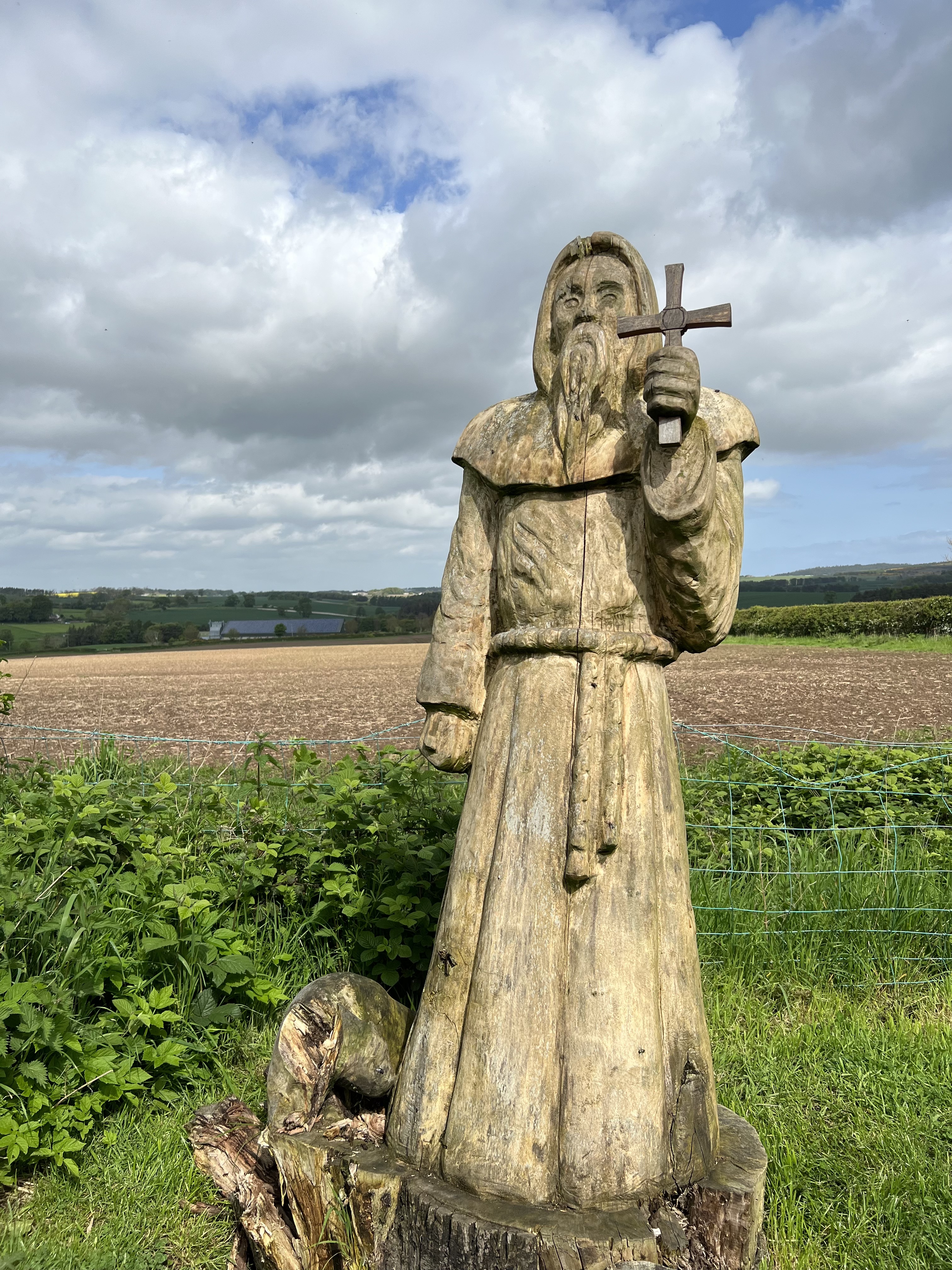
St. Cuthbert, by local sculptor Tom Fiddes (2017), blesses the wayworn traveler. The saint stands opposite a country house offering shade and water to weary pilgrims.
They confessed their sins, confided in him about their temptations, and laid open to him the common troubles of humanity they were laboring under … Spirits that were chilled with sadness he could warm back to hope again … Those beset with worry he brought back to thoughts of the joys of heaven. (The Venerable Bede, Life of Cuthbert)
Nine years ago I walked the 500-mile Camino de Santiago to the shrine of St. James. This spring I made another pilgrimage, 100-kilometers along St. Cuthbert’s Way in the north of Britain. I haven’t managed to write about it since returning home, but when this week’s Feast of St. James (July 25) brought to mind that 2014 Camino (when I first began this blog), I knew it was high time to tell my new pilgrim’s tale.
Chaucer began his celebrated pilgrimage narrative with an eloquent praise of springtime as an awakening: not only of the dormant earth, but also of the soul’s longing for transformative journeys. After three years of staying close to home in pandemic hibernation, the call of the road felt especially urgent.
Then people think of holy pilgrimages, Pilgrims dream of setting foot on far-off Lands, or worship at distant shrines, their thoughts Reaching for grace …[i]
Some pilgrimages have no map or known destination; they are undertaken with the conviction—or at least the hope—that the act of wandering far from the familiar, along the way of unknowing, will lead to what Dark Age monks called “the place of resurrection,” where an illumination might be given or a purpose revealed.
Another kind of pilgrimage takes a well-worn route to a specific destination such as Jerusalem, Rome, or Santiago, the most popular destinations in the Middle Ages. Both the journey and the arrival are still full of unknowns—hardships, obstacles, surprises, chance meetings, moments of grace—but their ultimate location and length are determined in advance. Both kinds of pilgrimage involve some combination of leaving behind (penance), letting go (trust), receptivity (grace), and spiritual desire (love).
My pilgrimage in May, from the Scottish Borders south of Edinburgh to Holy Island off the Northumbrian coast, traced a line across the varied landscapes of Cuthbert’s holy life. It was a popular route for two centuries after the saint’s death in 687, until the threat of Viking plunderers prompted the removal of Cuthbert’s remains from Holy Island to a safer inland site. And Cuthbert’s own travels, mostly on foot, would have ranged widely over the same terrain.
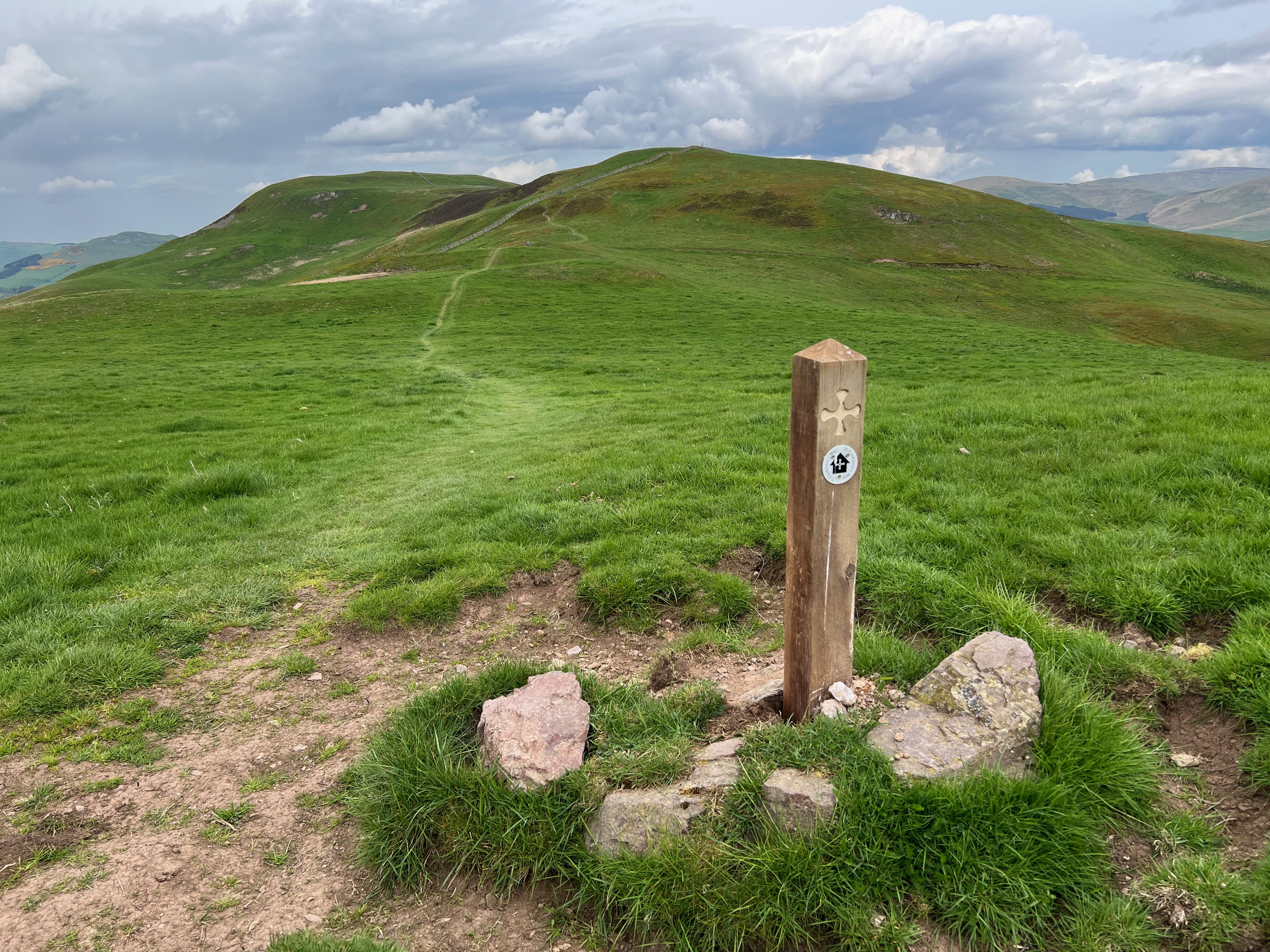
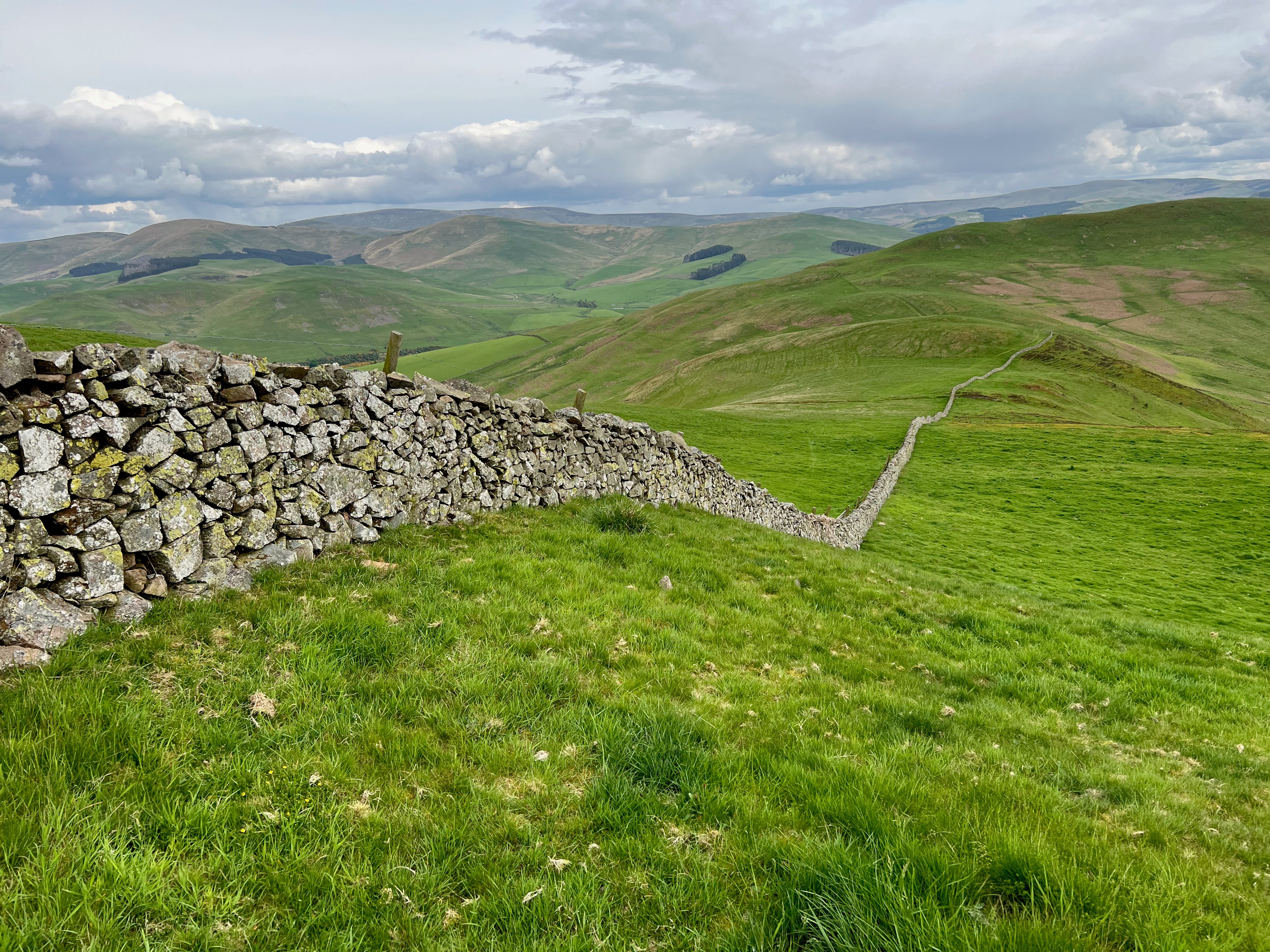
In response to the contemporary revival of pilgrimage as a spiritual practice, St. Cuthbert’s Way, with plentiful waymarks and well-tended paths, was created in 1996. Although passing through occasional towns and villages, it offers abundant solitude and beautiful countryside both pastoral and wild. Before I left, a friend who knew the trail said, “I hope you like sheep.”
Cuthbert’s birth in 634 coincided with a turning point British religion, when King Oswald took control of Northumbria and initiated the conversion of the pagan north to Christianity by importing Celtic missionaries from Iona. Although Cuthbert’s family was Anglo-Saxon, he would be shaped by the distinctive Celtic way—earthier, more idiosyncratic, less tightly organized and less hierarchical than the universalizing Roman system which would assert its dominance in British Christianity within Cuthbert’s lifetime.
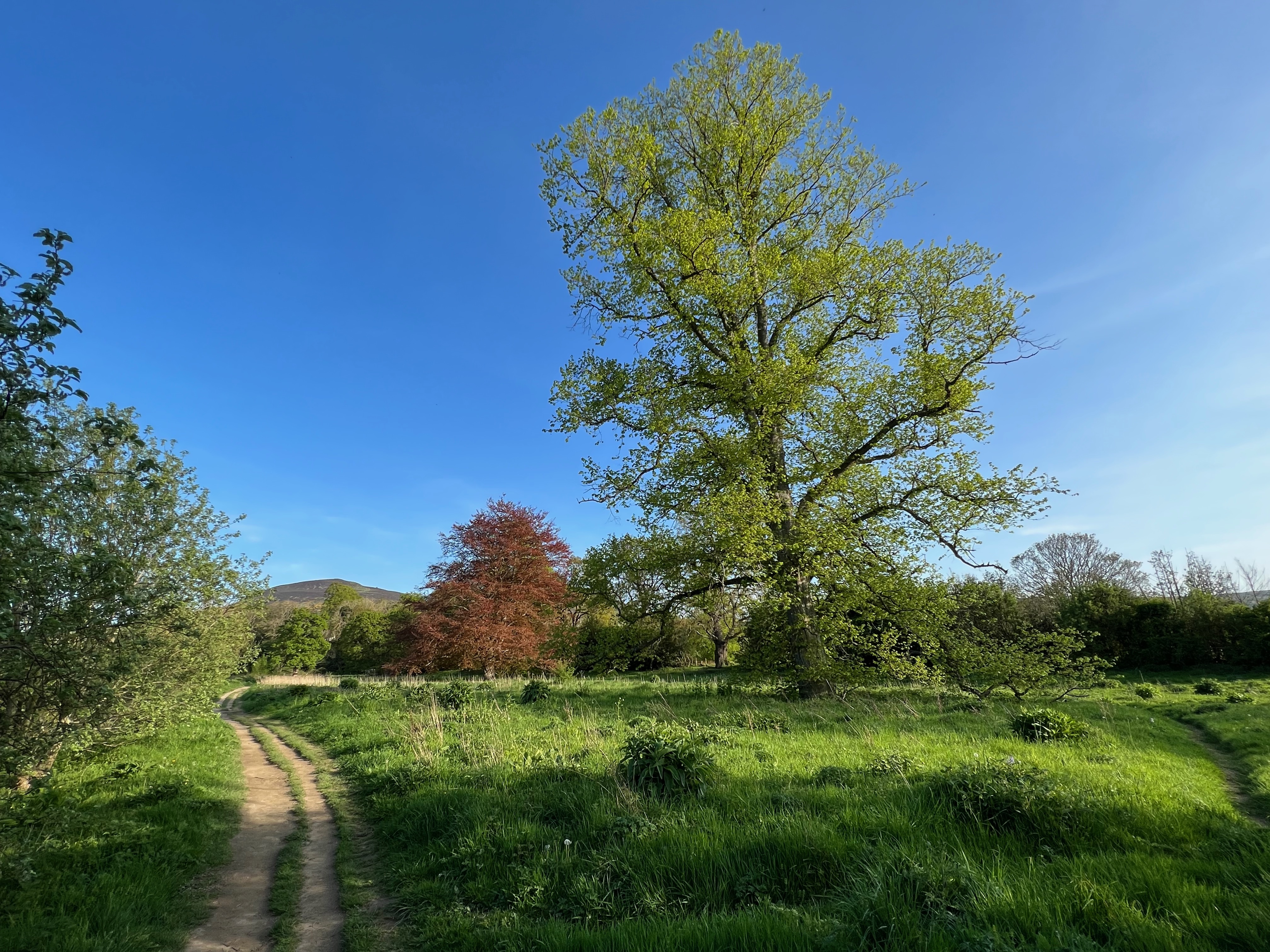
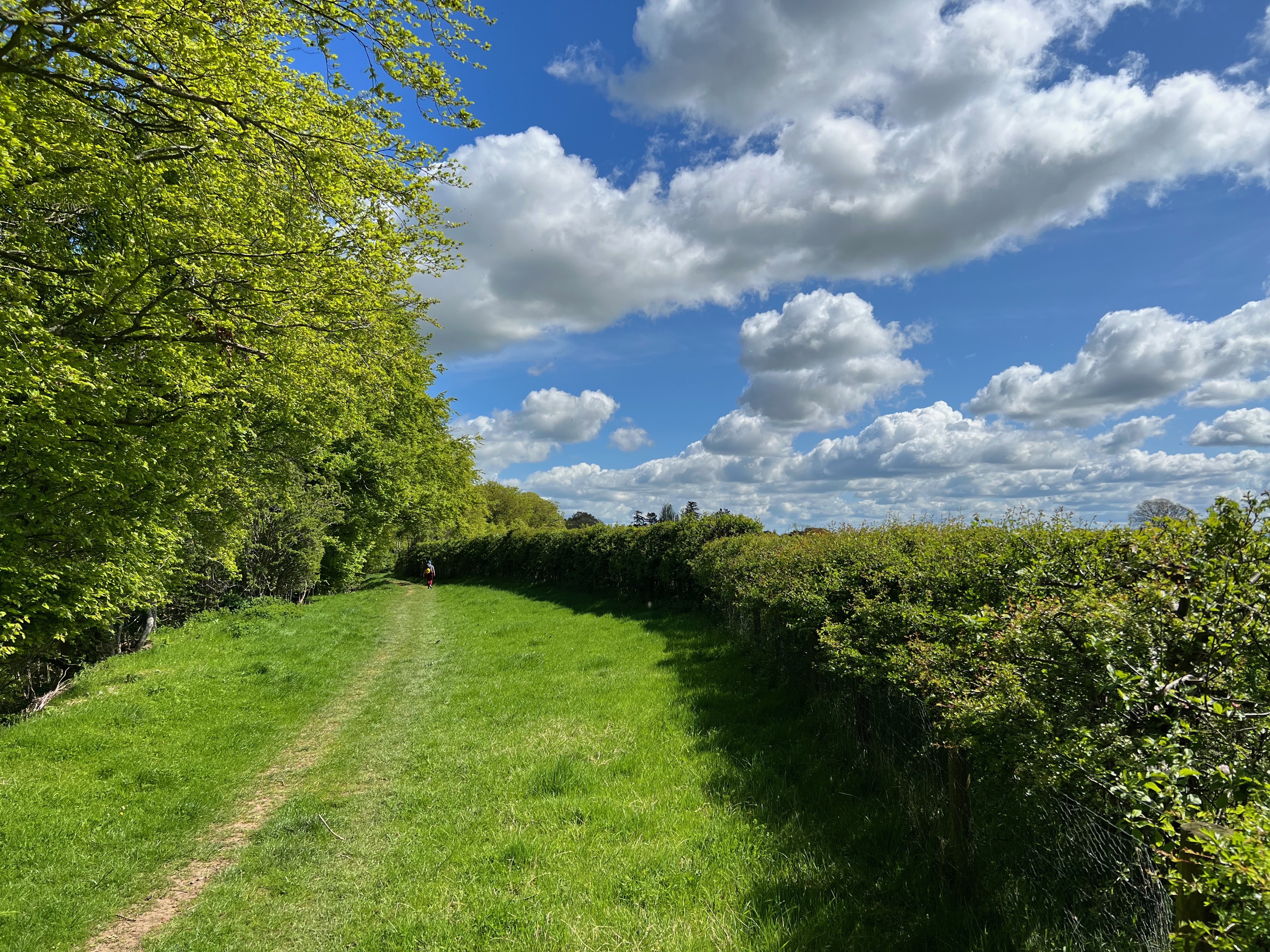
My walk began along this riverside trail from the train station into Melrose. Someone had offered me a ride in their car, but look what I would have missed! Even as a bishop, Cuthbert chose the humility of walking over the luxury of horseback, so I started my pilgrimage in the same spirit.
My pilgrimage began in Melrose, Scotland, where the River Tweed courses through the fields and hills of Cuthbert’s youth. Even as a boy he had a deeply religious sensibility. His biographers spoke of angels and miracles being part of his growing years. Whatever we ourselves may think about the facts behind those stories, they suggest a spirit alive to ineffable encounters with the transcendent. One night, while keeping watch over a flock of sheep, the sixteen-year-old Cuthbert had a vision of a dazzling light streaming down from above as angelic hosts descended to fetch a single mortal into heaven. When the vision faded, he woke his sleeping companions to tell them what they had missed. He was convinced that some holy person must have died that night.
The very next day, he learned that Aidan, the beloved Celtic bishop who spurred the conversion of Northumbria, had departed this life at the time of his vision. I might dismiss this tale as pious embellishment, had I not had my own dream, at age 30, of a close friend at the very moment of his tragic death. In the dream, he had moved to an island off the coast. I asked him if he were all right. He looked me in the eye and assured me he was. The dream came to me deep in a mountain wilderness. Only when I returned to the world two days later did I learn of his death by less mysterious means. Because of that profound experience, I must say that Cuthbert’s vision rings true for me.
Cuthbert’s experience prompted a decision which had been long in the making: to enter the monastic life and devote his heart and soul to prayer and service. He was soon welcomed into the community of monks near present-day Melrose. He would eventually become their prior, a role he would later assume on Holy Island. His first monastery’s seventh-century wooden structures on a grassy bend in the River Tweed are long gone, but the impressive ruins of the twelfth-century Cistercian abbey made a fitting place to begin my pilgrimage on St. Cuthbert’s Way.
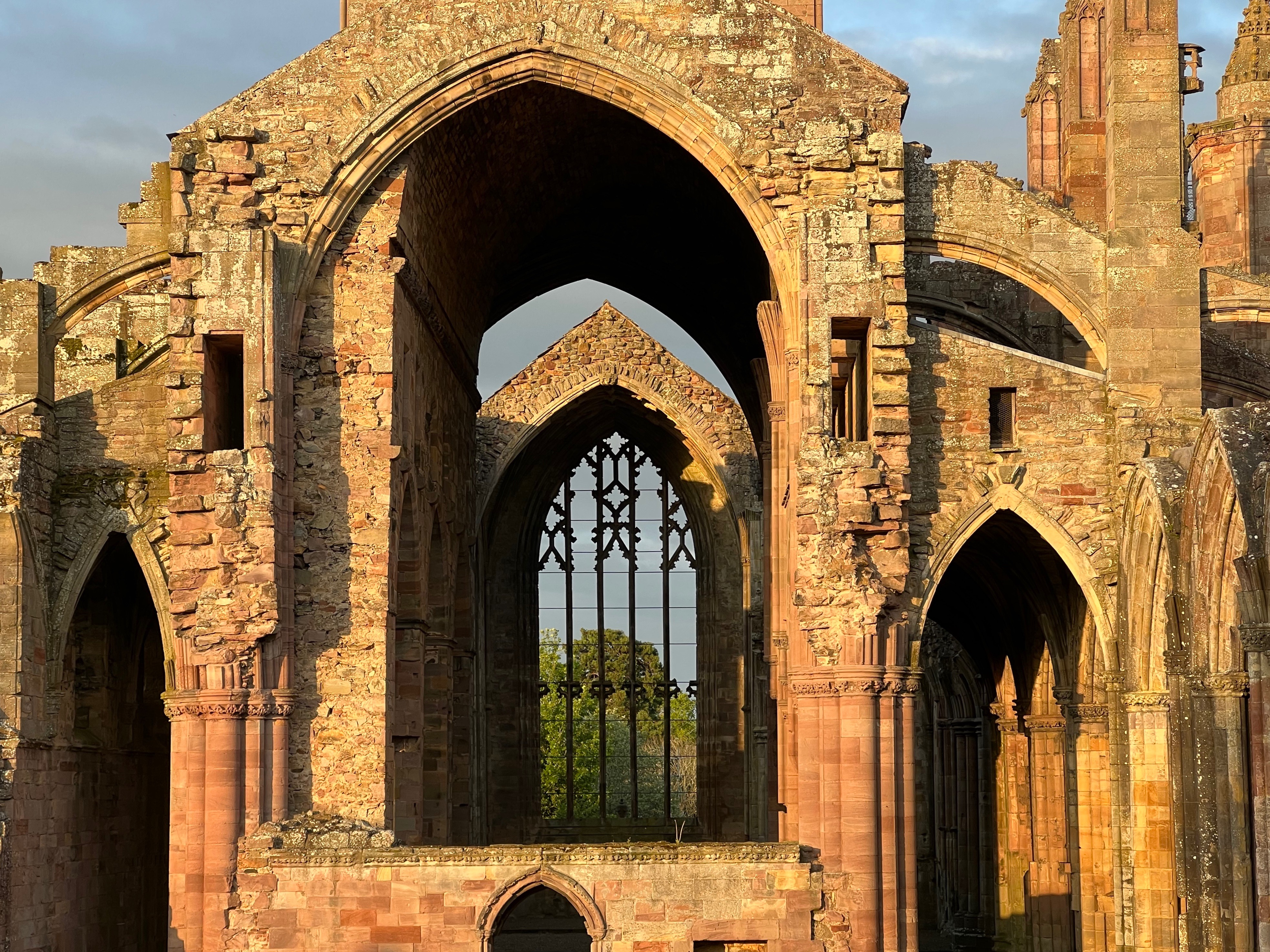
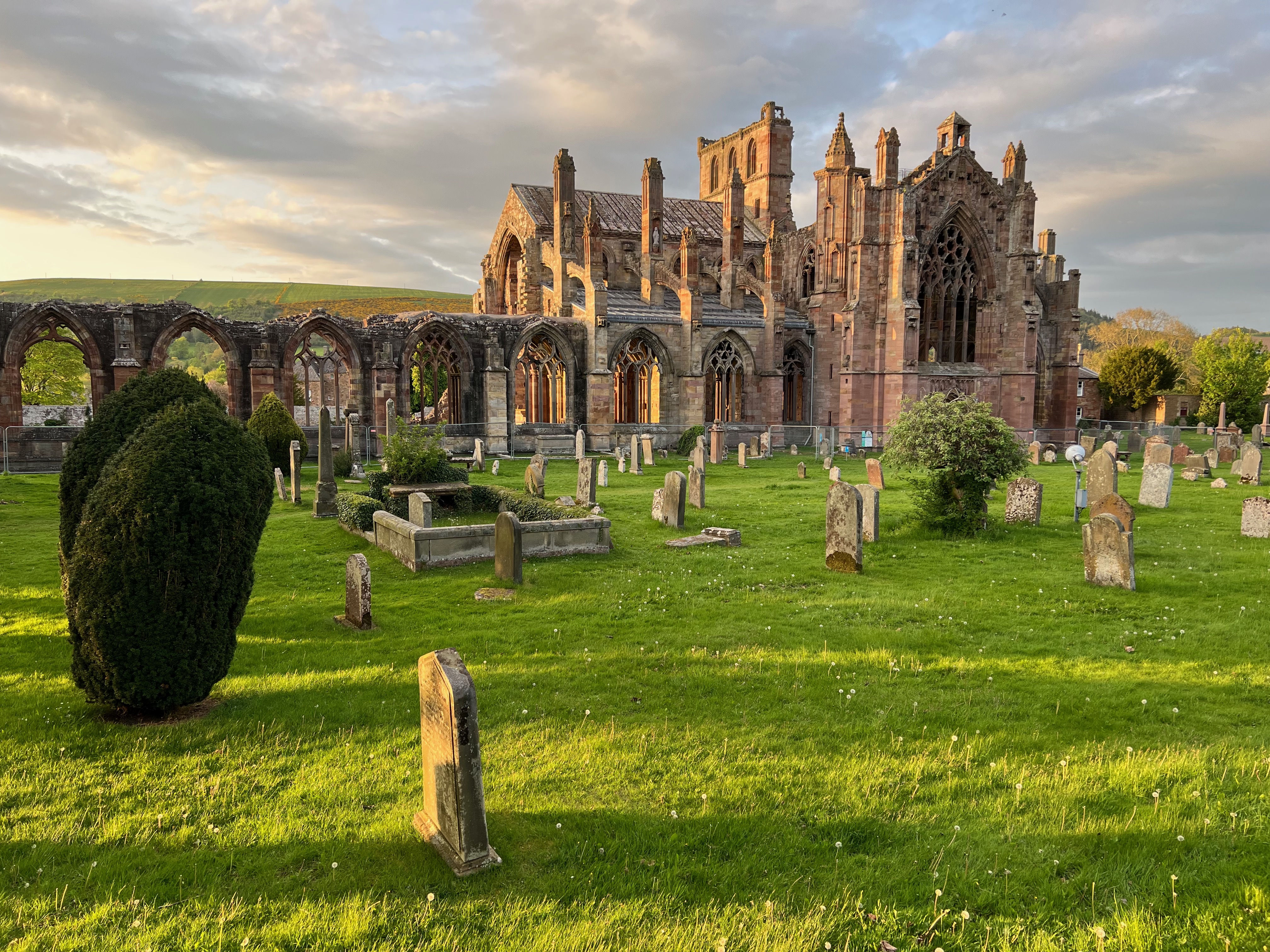
Melrose Abbey, founded by Cistercians from Rievaulx, Yorkshire, in 1136. Melrose Abbey at sunset.“My soul is like a house … It is in ruins, but I ask Thee to remake it.” — St. Augustine, City of God
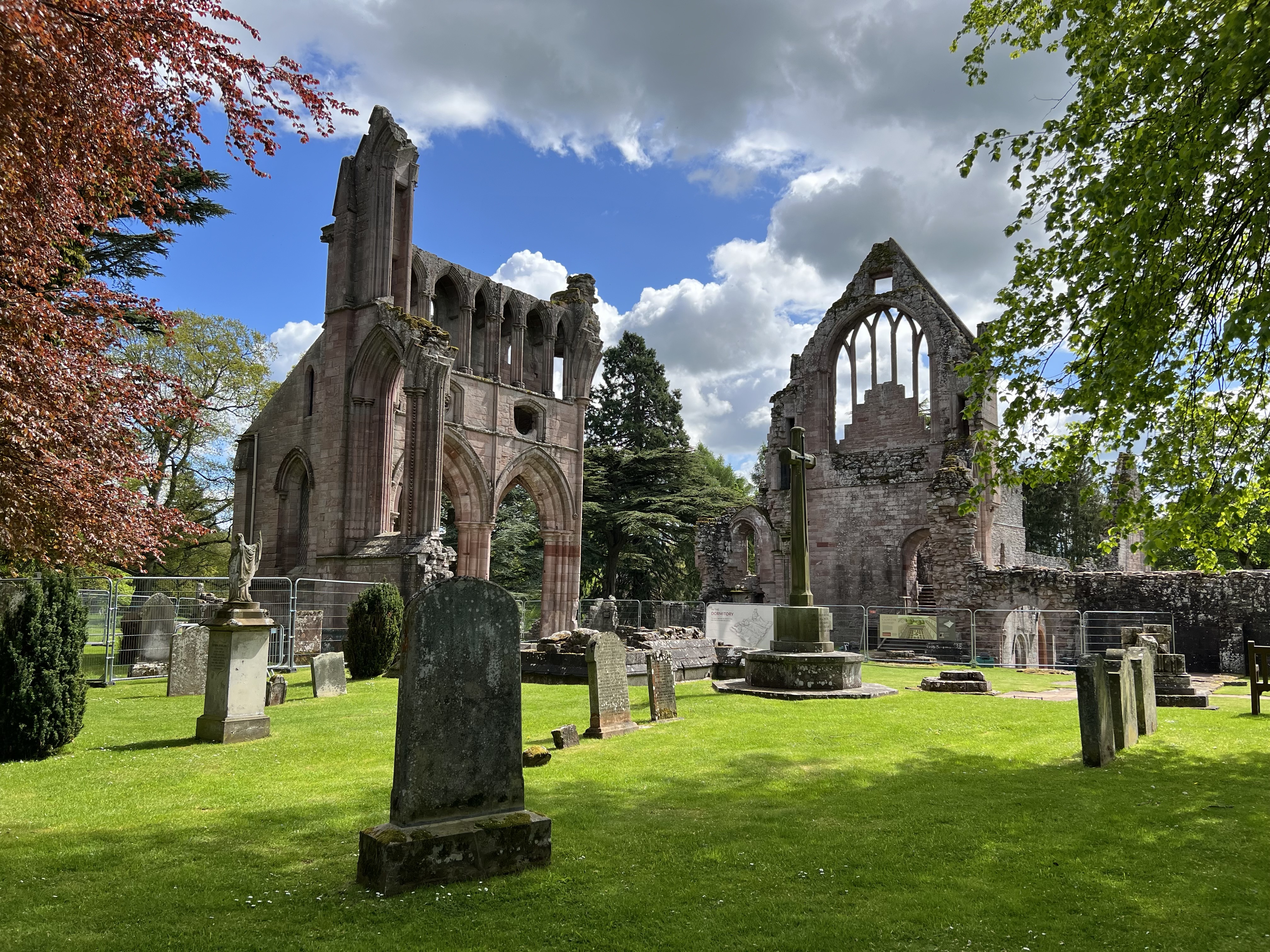
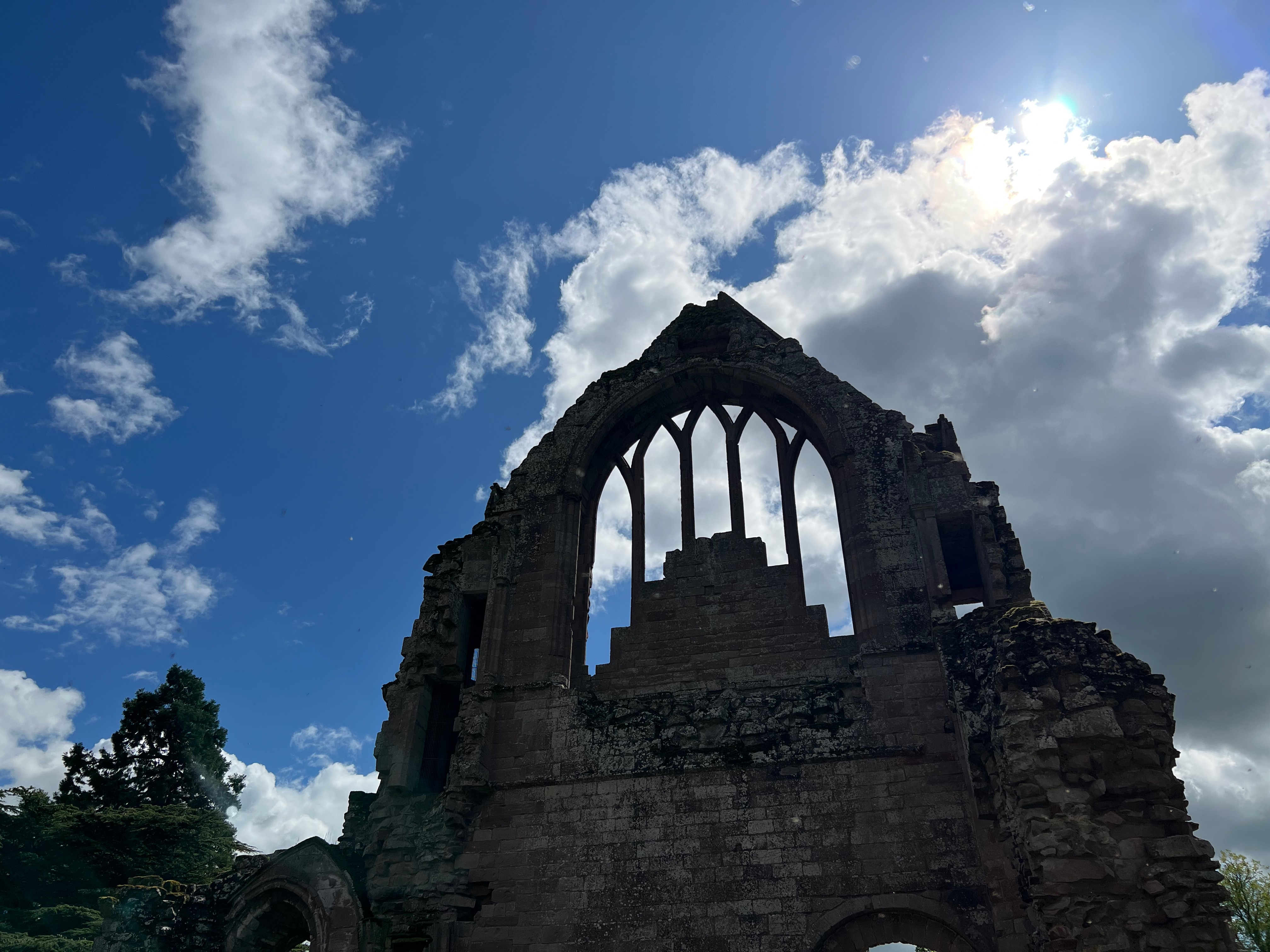
Melrose Abbey was founded in the 12th century, and at its height there were a hundred monks, who wielded great influence in the Scottish Borders. But like the other Borders abbeys (Dryburgh, Jedburgh, and Kelso), the building suffered greatly in the conflicts between England and Scotland. Richard II (14th century), Henry VIII (16th century), and Oliver Cromwell (17th century) all had a hand in its destruction. The Reformation and modernity finished off its religious life, leaving only the beautiful ruins to testify to what had been. As Susan Stewart writes, “Ruined places are often haunted, and learning to read them involves managing encounters with their resident spirits.” [ii]
I was there on the Sixth Sunday of Easter. After eucharist at the local parish, I visited the abbey under the muted light of a graying sky. In the evening I went back for another look. As I arrived, the setting sun suddenly pierced the clouds to bathe the stones in gold. Pulling up my digital Book of Common Prayer, I sang Compline, adding my voice to the echoes of vanished monks. “The Lord grant us a peaceful night and a perfect end.…” By the time I was done, the gold had faded to dusk.
The obscure trailhead leading out of town gave no hint of the glories ahead.
When I found this nondescript passage from a Melrose street to St. Cuthbert’s Way, it did not seem inviting. The White Rabbit came to mind—how curious a plunge!—and Dante, for whom the way down was the only way up. Before the pilgrim poet can ascend to Paradise, he is driven “down to where the sun is silent.” [iii] Thankfully, my descent into darkness was brief, and I soon found myself climbing toward the light.
Stairway to heaven.On a bright morning, I climbed up from Melrose to traverse the Eildon Hills. The abbey can be seen at the right edge of the town.Eildon Hill North, seen from the saddle.
The Eildon Hills, a trio of rounded summits, dominate the surrounding landscape. From the saddle, I scrambled up the North Hill, a sacred ceremonial site in the Bronze Age. The Romans, before their inevitable retreat from the barbarous north, used it as a watchtower. King Arthur was said to be buried here. In the 12thcentury, monks quarried stones for Melrose Abbey on its slopes. Even into the modern era, local legends populated these hills with fairies and imagined a gateway to the Otherworld beneath them. For me the Eildons were an imposing portal to pilgrimage.
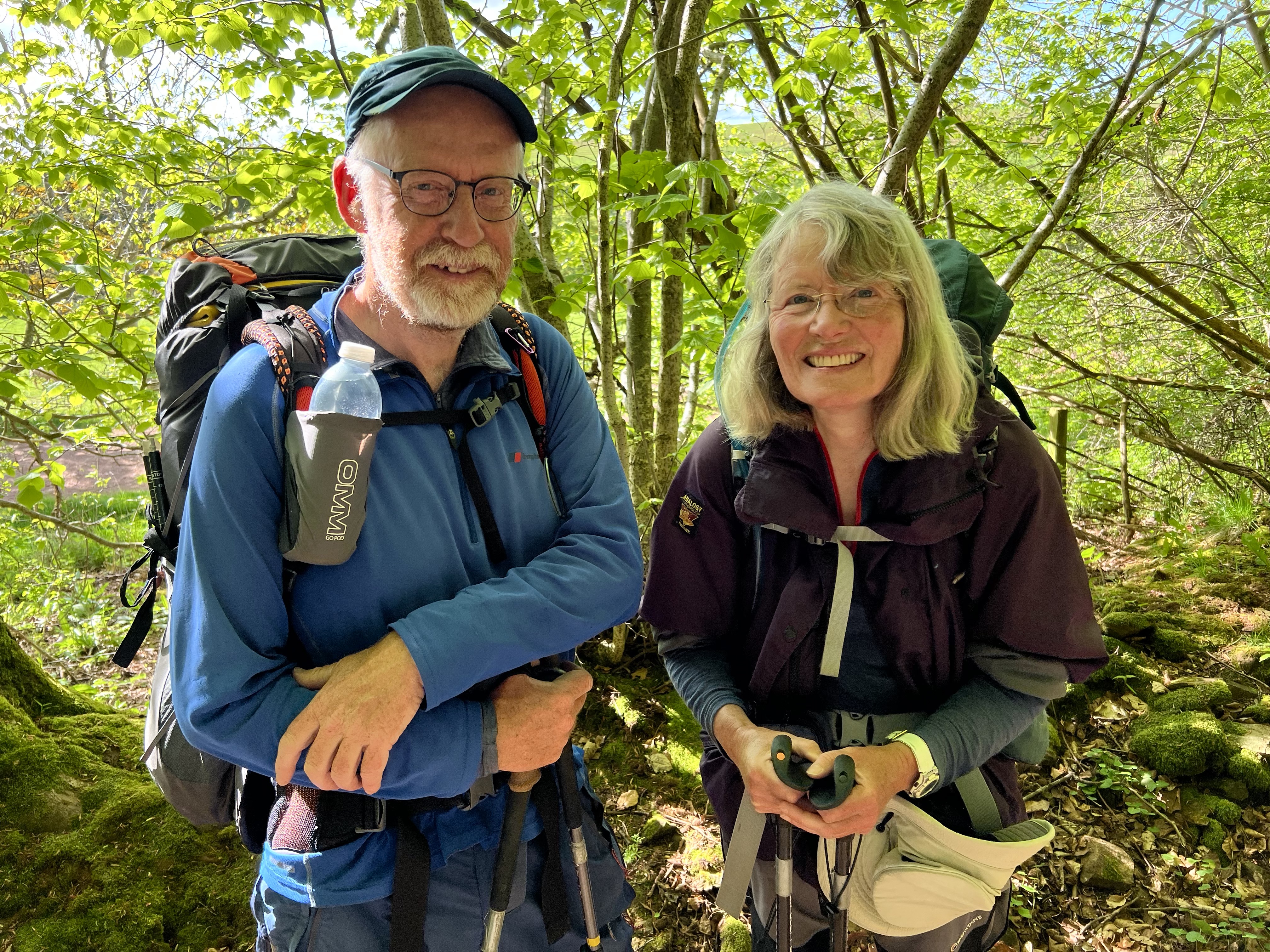
A cairn on the summit of Eildon Hill North. This has been a sacred “thin place” since pre-Christian times. The Eildon Hills seen from the southeast. I had crossed the low saddle when I left Melrose. These distinctive peaks would remain visible for the next two days, until I passed the halfway point at 31 miles. David and Julie, whom I met on my first day, were on their way to the Firth of Forth to complete a thousand-mile trek across the length and breadth of Britain. Constable, the supreme painter of clouds, said that the sky is “the chief organ of sentiment,” but rivers also touch us deeply. The River Tweed runs for 97 miles through the border country of Scotland and England. Two miles upriver from here was the site of Cuthbert’s Melrose monastery.
It would be a six-day walk to Holy Island, mostly in splendid weather—not a drop of rain, Constable skies, and only one day without sun. I felt a Wordworthian exhilaration as the road went ever on.
The earth is all before me. With a heart Joyous, nor scared at its own liberty, I look about, and should the chosen guide Be nothing better than a wandering cloud, I cannot miss my way. I breathe again! [iv]
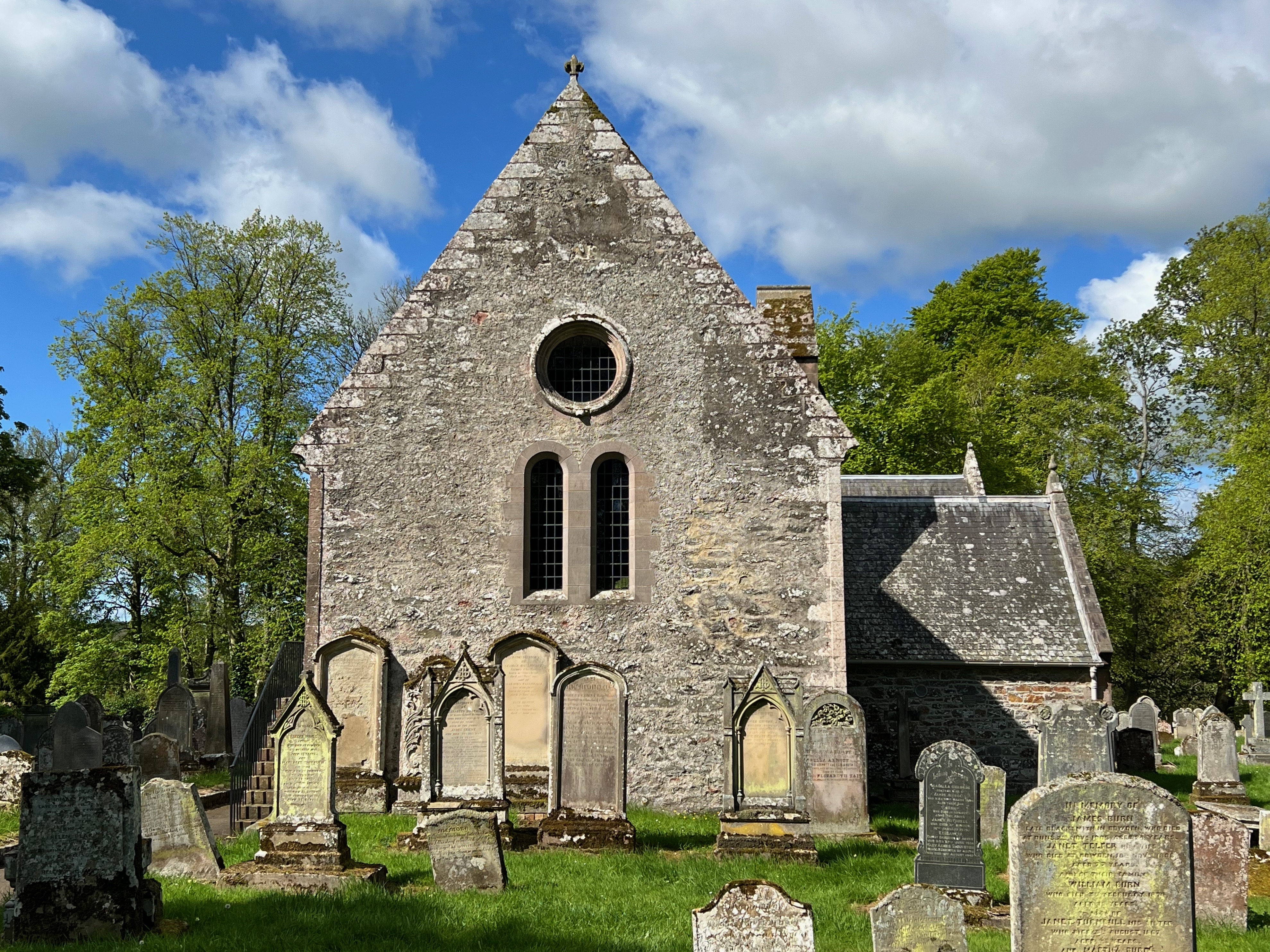
“I wandered lonely as a cloud.” — WordsworthPortions of Bowden Kirk date back to the 12th century, but there have been major changes and additions over subsequent centuries. Originally Cistercian, it has been Protestant since the 16th century.
At peaceful Bowden Kirk, a medieval foundation much remodeled over the centuries, I found a window with a text from Genesis.
Window in Bowden Kirk with text from Genesis 5:24.
This cryptic verse has been interpreted to mean that Enoch, an ancestor of Noah, was somehow taken directly to God without passing through death. To say he “was not,” or “was no more,” could mean that he simply “disappeared” from human sight without suffering an interval of nonexistence. Perhaps the window was put in Bowden Kirk as a cipher of resurrection hope, but to me it suggested the essential spirituality of pilgrimage. As we walk away from “not-God”—deeper and deeper into the divine communion—the isolating egoistic self is diminished and emptied, until it is “no more,” translated by God into its truer self: a relational participant in the divine life of self-diffusive love. That may not be achievable in this life (I certainly didn’t get there in 6 days!), but I believe it is the horizon toward which we are all headed.
As St. John of the Cross put it:
To come to be what you are not, you must go by a way in which you are not. [v]
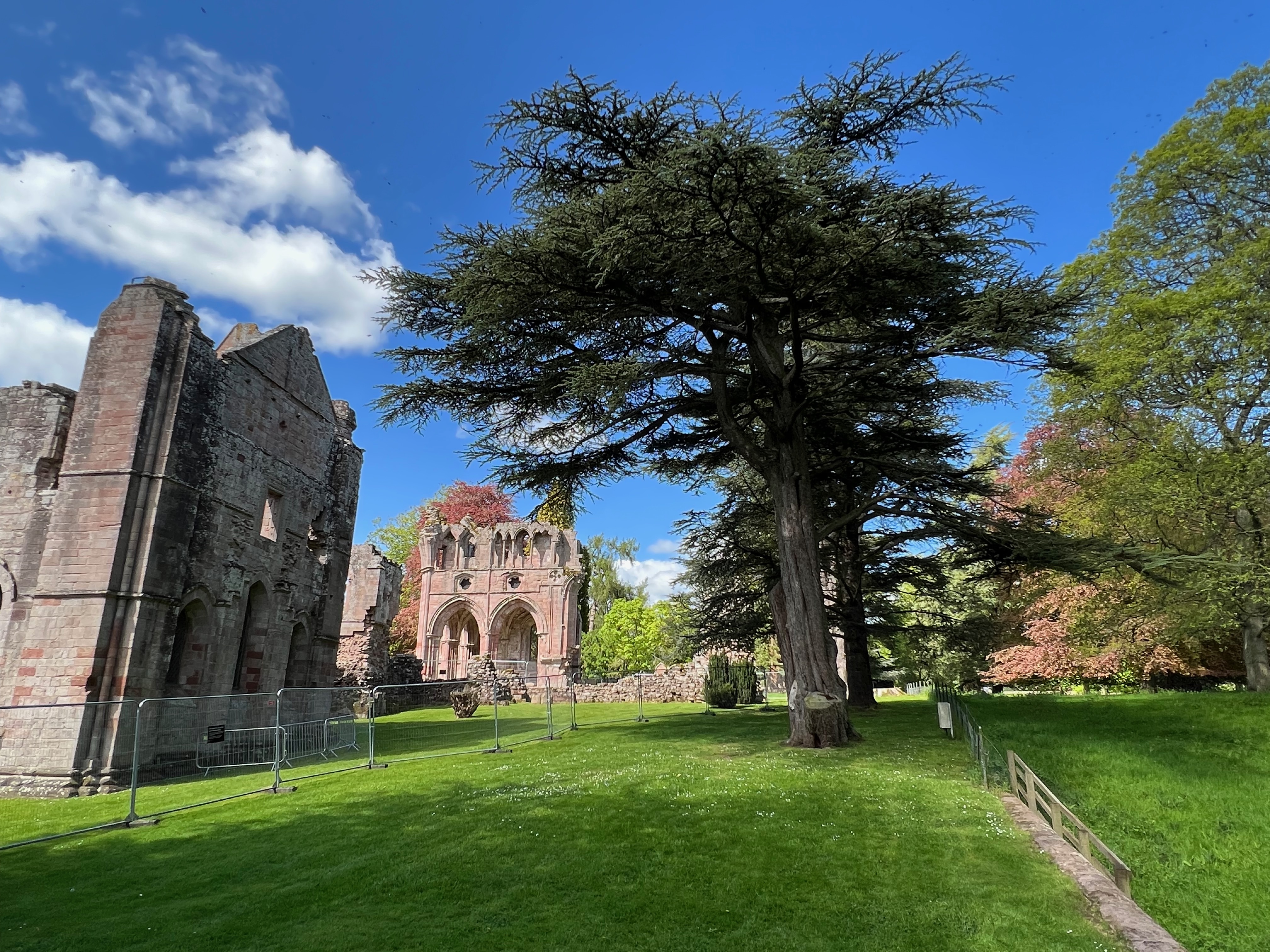
Dryburgh Abbey (12th century). Sir Walter Scott, who died on the last day of summer, 1832, is buried in the ruins of the north transept.Dryburgh Abbey is surrounded by exotic trees, like this Cedar of Lebanon, planted by the Earl of Buchan over 200 years ago. “Bare ruin’d choirs where late the sweet birds sang” (Shakespeare, Sonnet 73).
Dryburgh Abbey is the second of three Borders abbeys on St. Cuthbert’s Way. Far from any town, surrounded by a beautiful park next to the River Tweed, it is the most serene of the three.
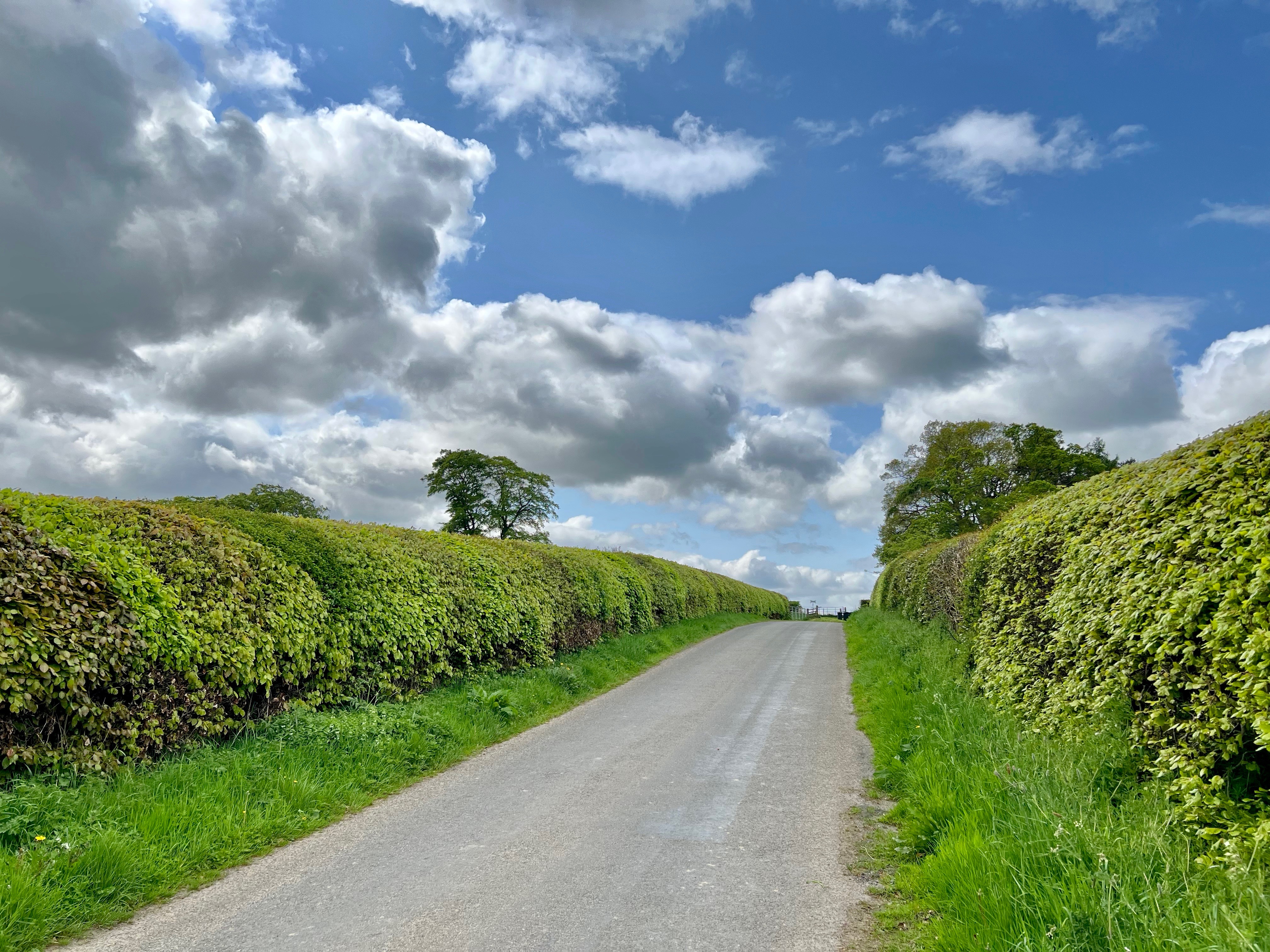
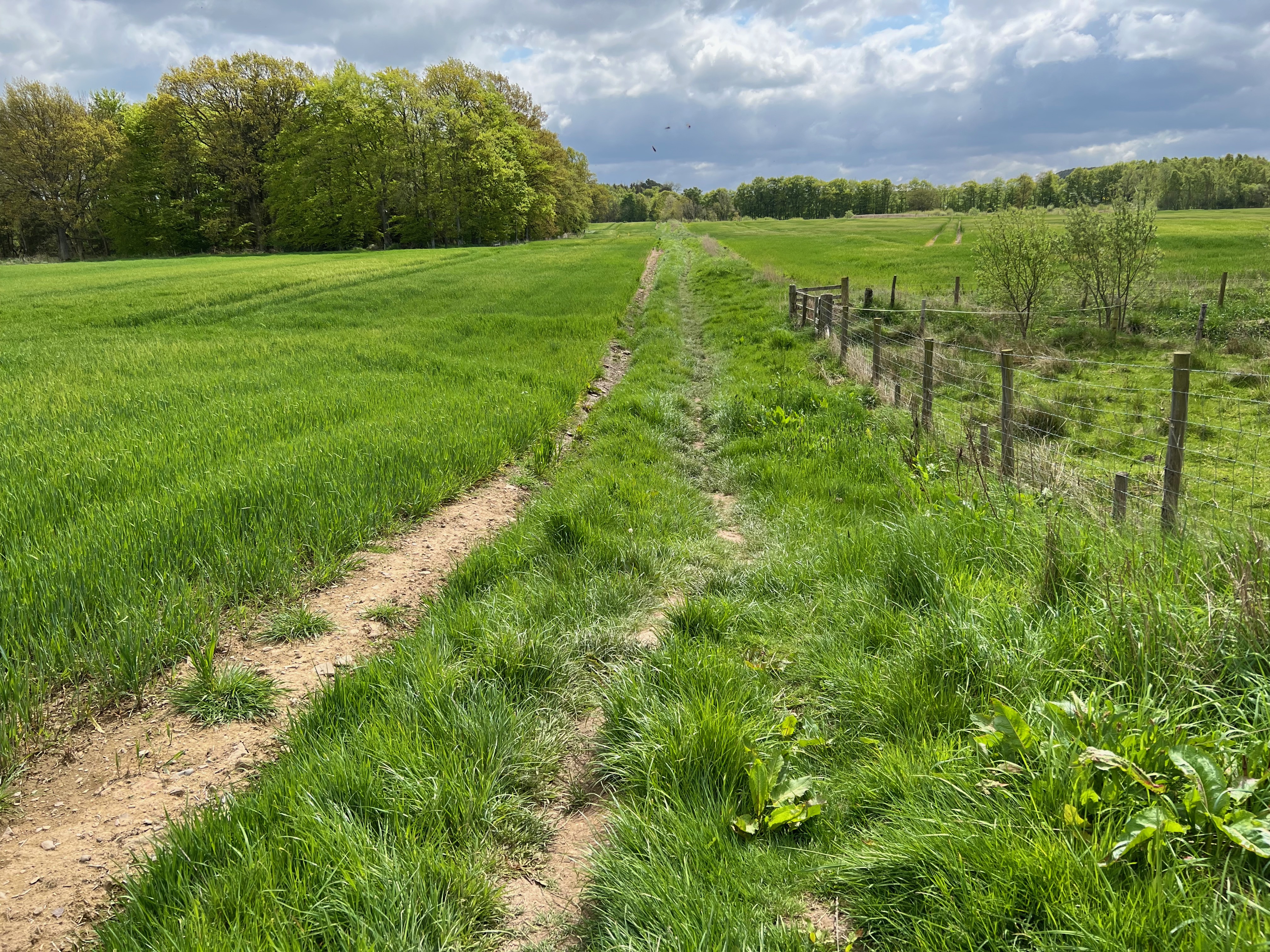
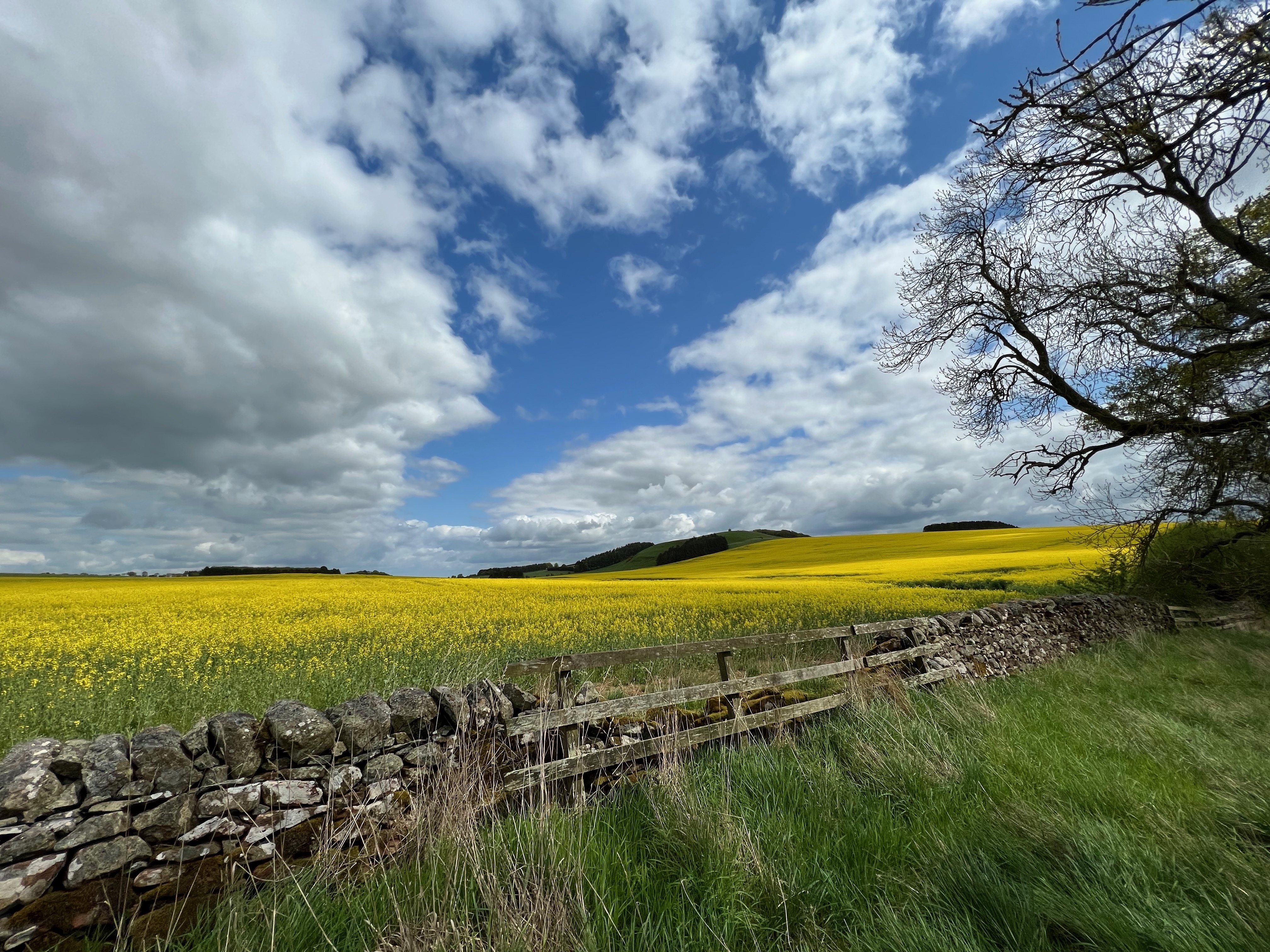
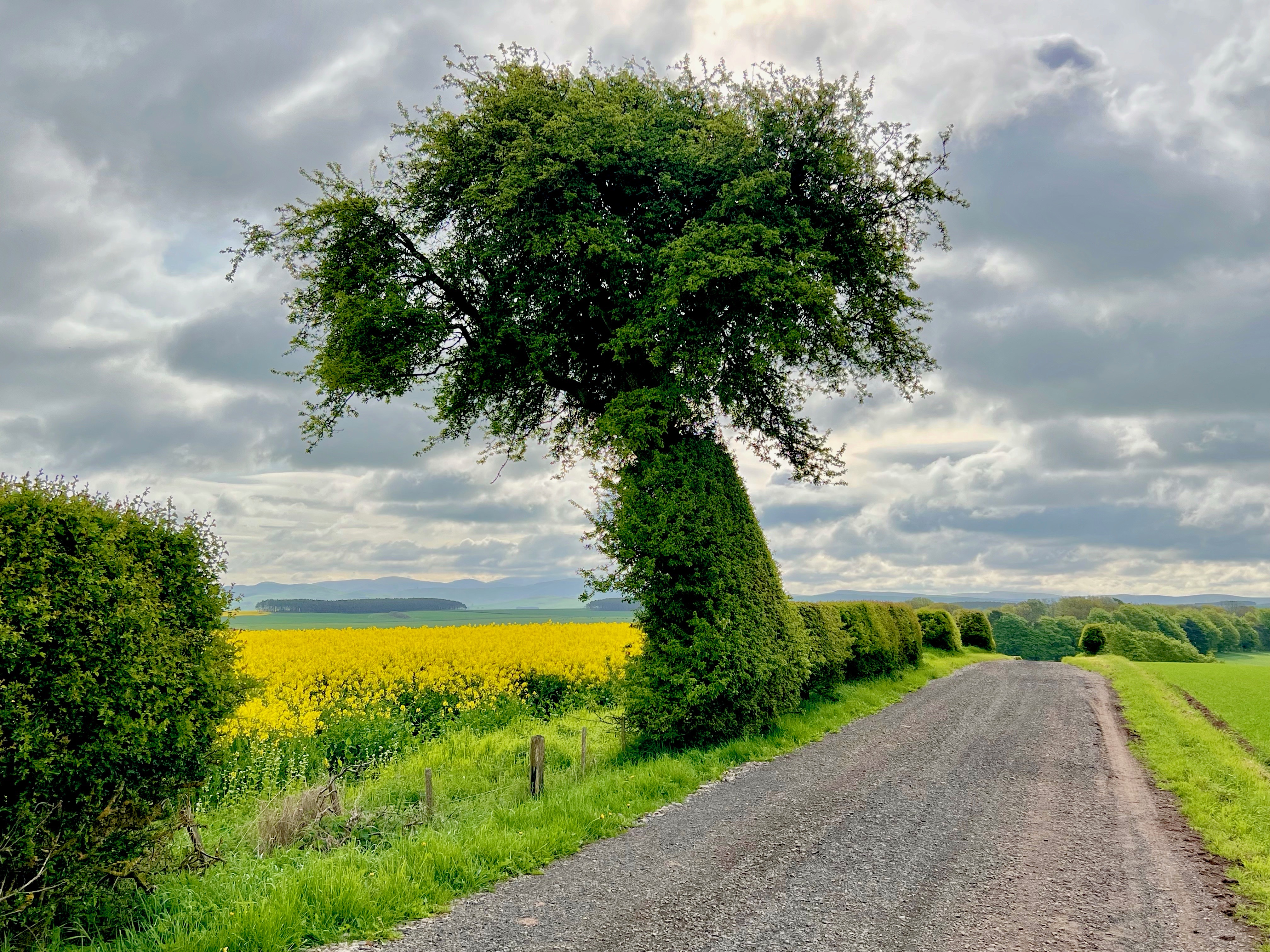
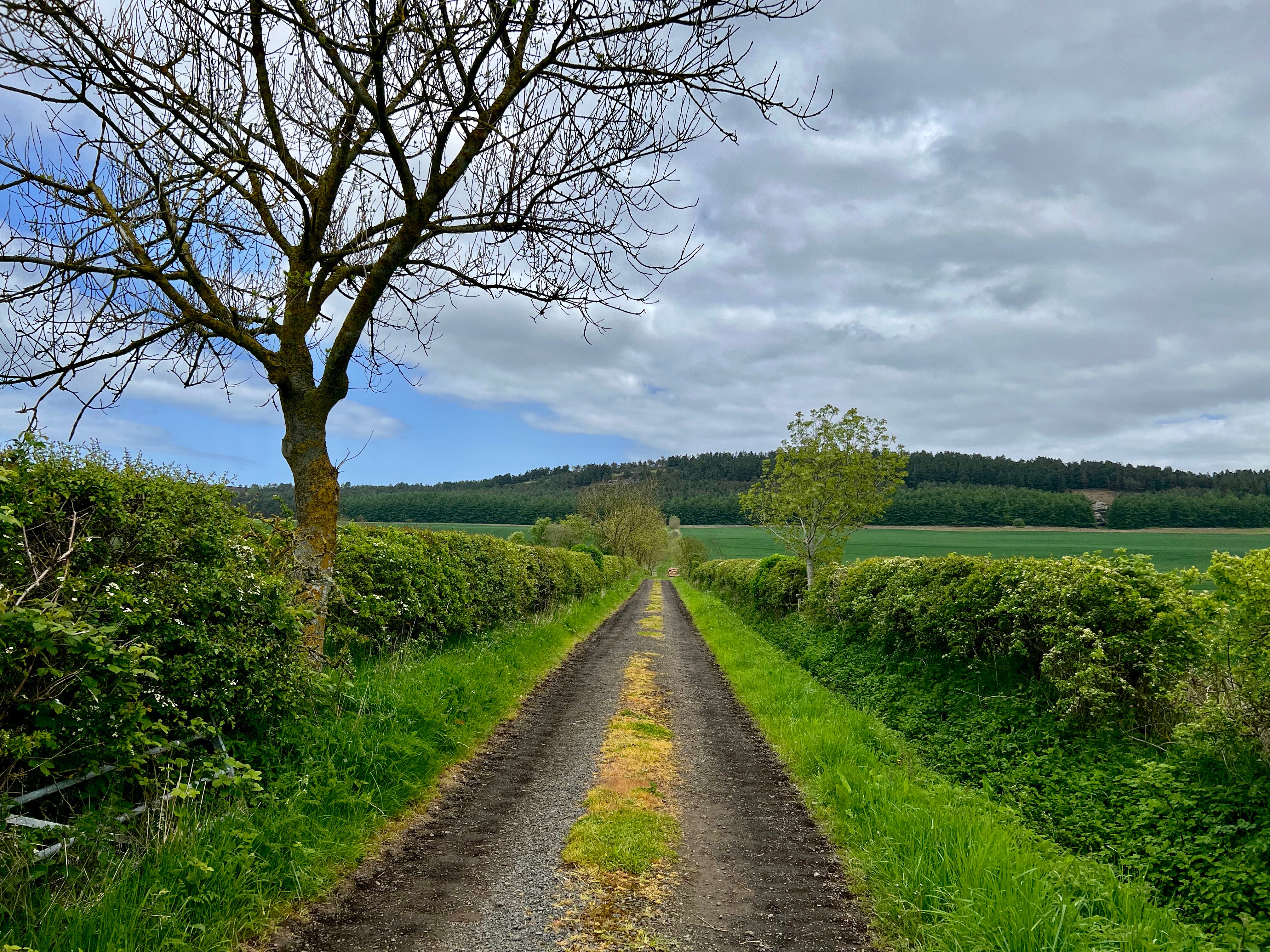
The occasional paved stretches of the Way were mostly empty.This straight path, called Dere Street, follows part of a first-century Roman road which ran from York to Scotland’s Firth of Forth.Fields of blooming rapeseed parallel the Roman road.
One day I trod the remnant of a Roman road, a faint trace of their 400-year occupation of Britain. As Gibbon observed, history “spares neither man nor the proudest of his works [and] buries empires and cities in a common grave.” [vi]
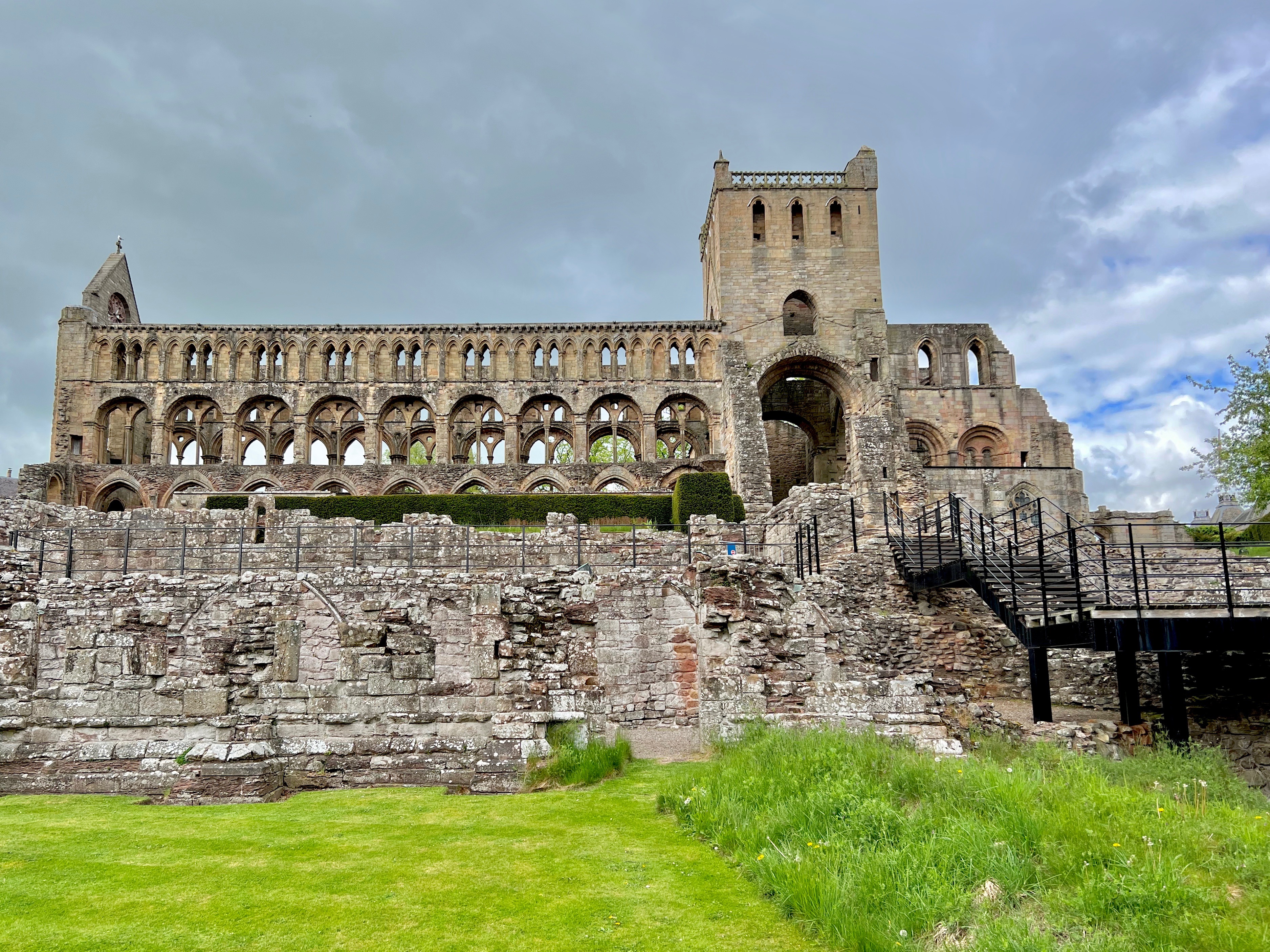
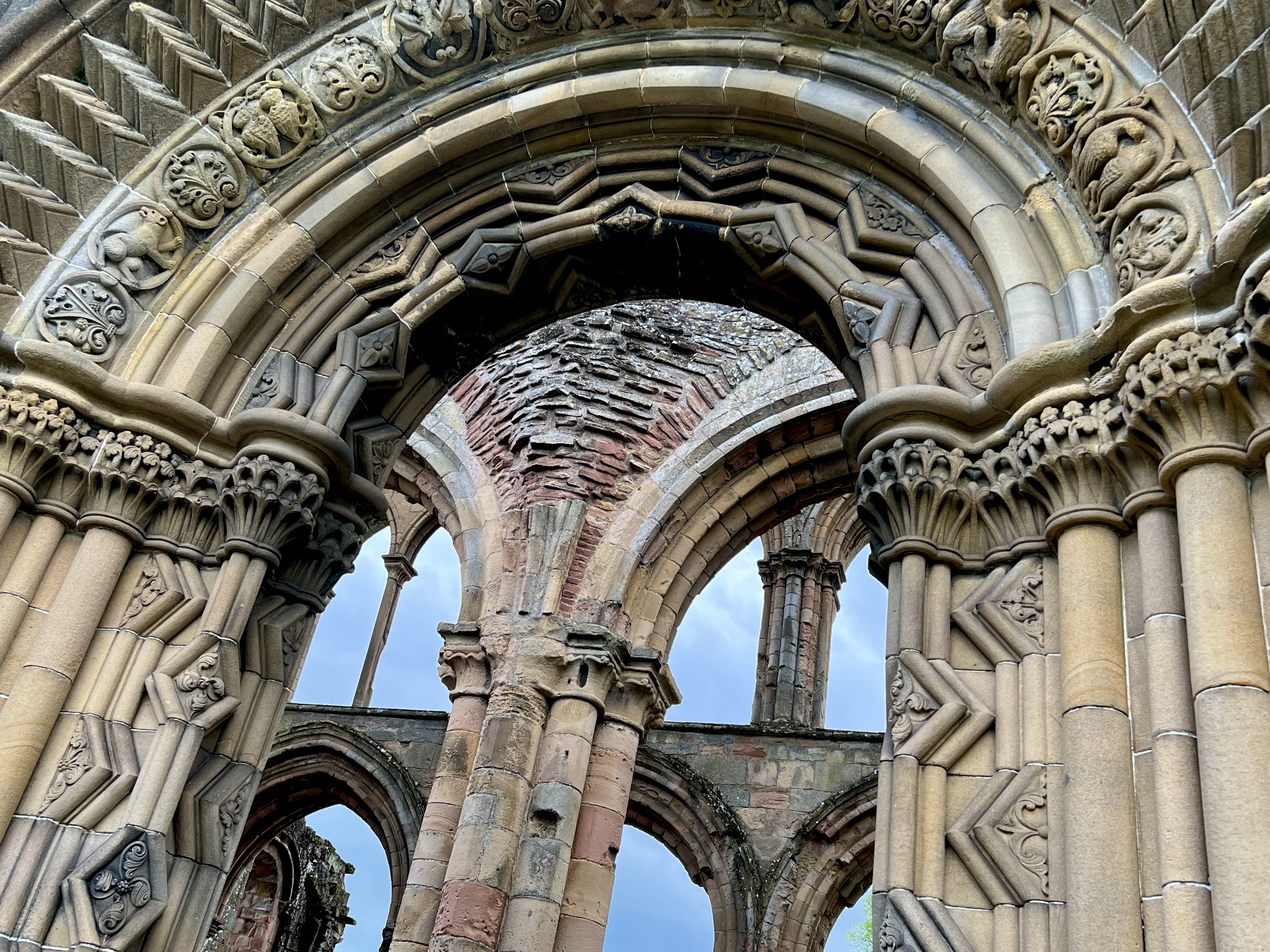
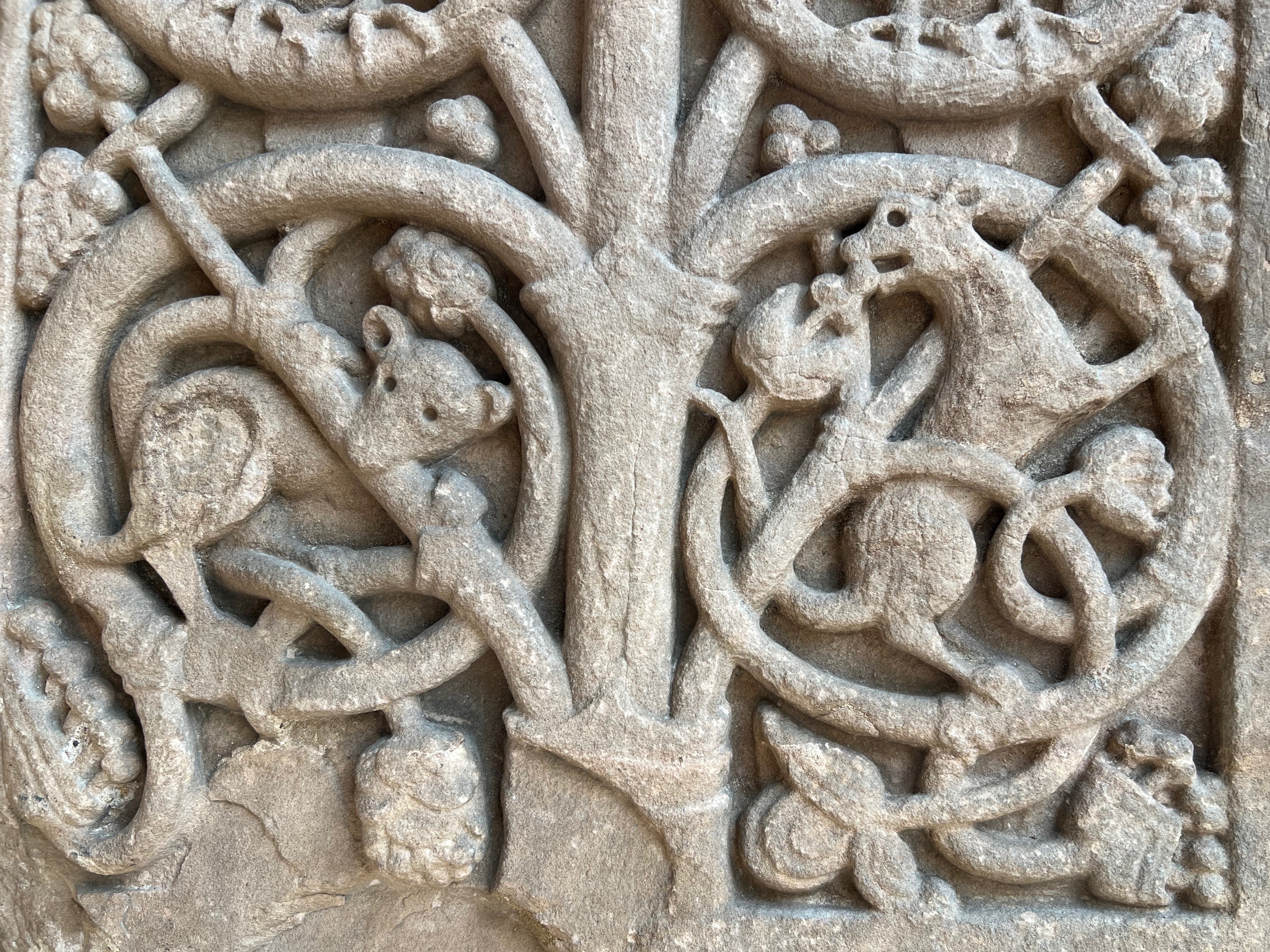
Jedburgh Abbey (12th century).South door, Jedburgh Abbey.Vine-scroll panel from a saint’s shrine (8th-century, Jedburgh).
In Jedburgh (locals say “Jeddart”), the church of St. Mary the Virgin is the best preserved abbey in the Borders. Built during the shift from Romanesque to Gothic styles, it is a blend of both. And its carved stone “vine-scroll” is one of the finest examples of Anglo-Saxon art. Like the other Borders abbeys, it did not survive the Reformation, and was abandoned in 1560.
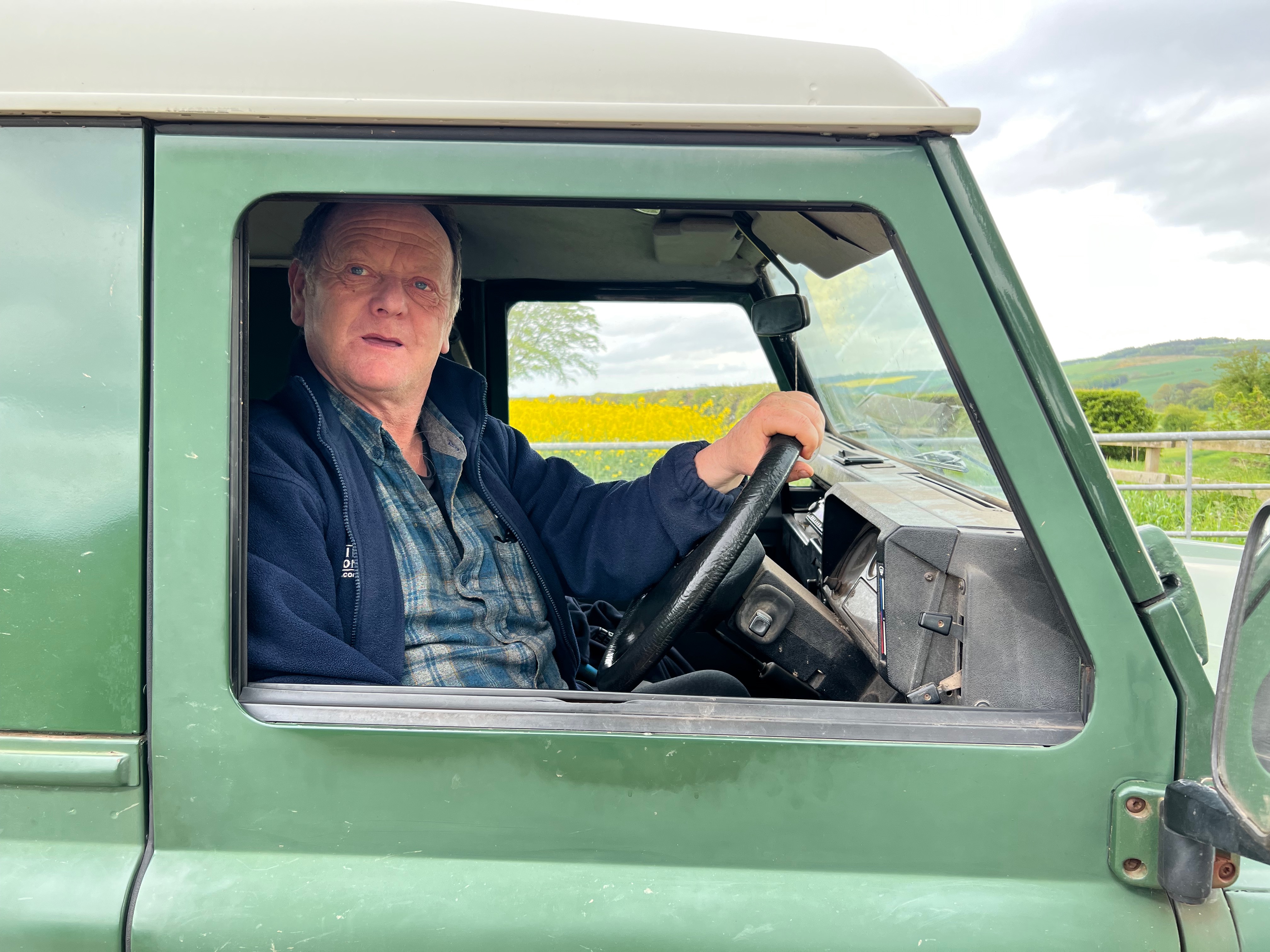
My first view of the Cheviot Hills in the distance.When I was lost, Brian appeared to show me the way.
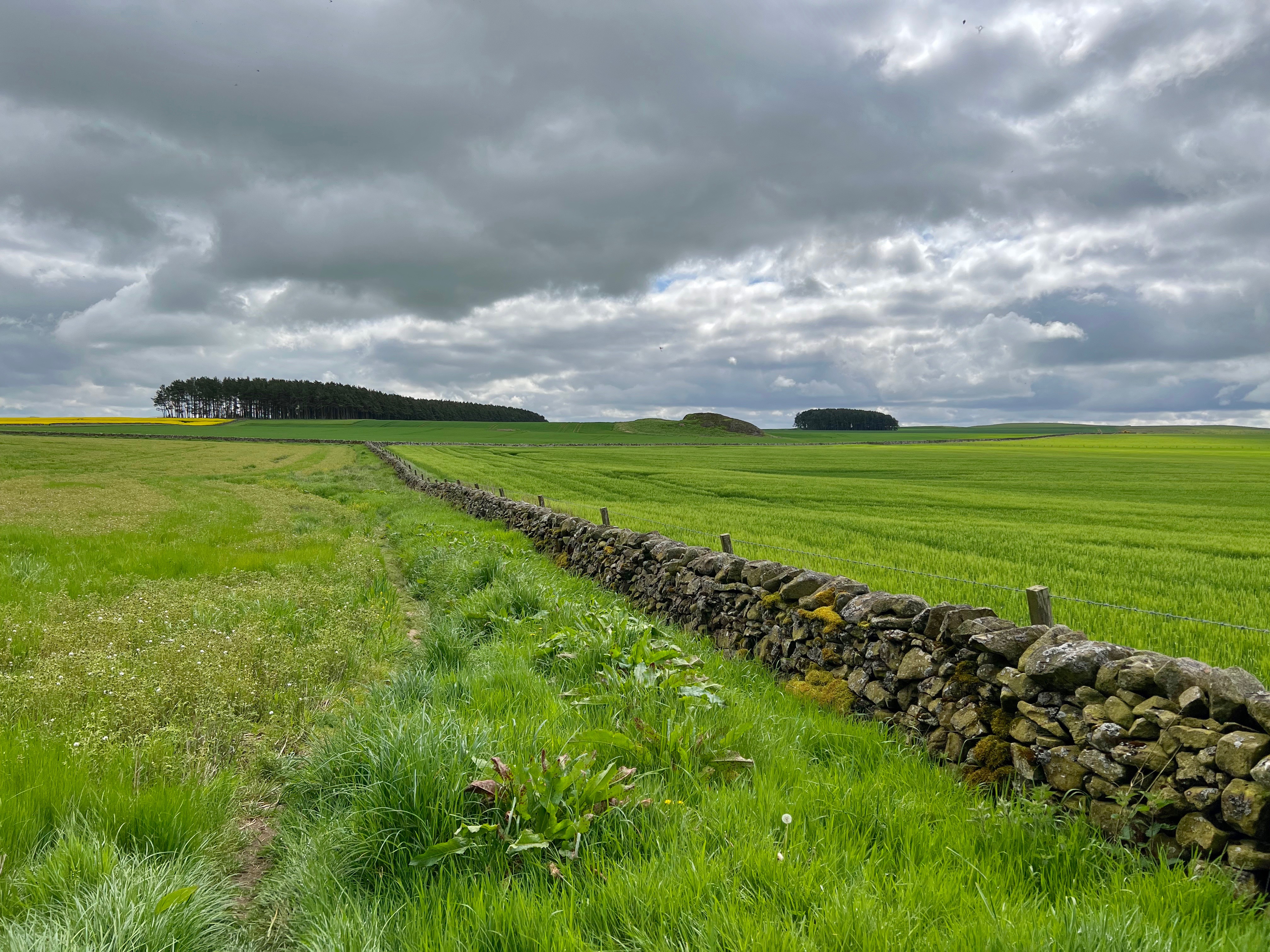
My first glimpse of the distant (and challenging) Cheviot Hills distracted me, and I missed a waymarked turn in the trail. Ten minutes later, I reached a road with no idea where to go. Like one of the angelic guides who appear out of nowhere to help Dante navigate obstacles in the Inferno, a local farmer drove up behind me to point the way. When he heard my American accent, he mentioned that his daughter was a professional golfer in California and “doing quite well.” I told him he was a gift from God. He looked bemused. Soon I was back on track, traversing broad fields of yellow and green until I reached the foot of the Cheviots, where the elevation gain got more demanding.
The path climbs toward Wideopen Hill, the halfway point of St. Cuthbert’s Way.View from Wideopen Hill, the highest point on St. Cuthbert’s Way (1207 ft./ 368 m.).I reached the highest point of the trail on Ascension Eve.
When I reached the top of Wideopen Hill, the highest point on St. Cuthbert’s Way, it occurred to me that it was Ascension Eve. What better way to celebrate than climb toward the sky!
Scotch broom in the Cheviot Hills.Dagfinn, a Norwegian pilgrim in the Cheviot Hills.Ascending the moorland of the Cheviot Hills.
The whole next day was up and down through the Cheviots. The high country has feral goats, Iron Age forts, and a couple of crashed planes that lost their way in World War II. I didn’t see any of that. I was focused on dragging my tired body over the hump. The bleak sky and the treeless summits dampened my spirits a bit (Praise God when the road is easy! Praise God when the road is hard!). But it was still thrilling to hear the long, slowly rising whistle of the Eurasian curlews as they swooped across the heather.
Gatepost lion in Wooler.
After a gloomy day in the Cheviot Hills, my final miles to the coast were brilliantly lit and my heart was high. This stone lion at a schoolyard entrance was carved by an Italian prisoner of war during World War II, when the facility was a POW camp. It looks like something you’d find in Venice. Thinking of that prisoner managing to make art amid the chaos of war, I’m tempted to say that art is long and war is short, but in these days of perpetual conflict I’m not so sure.
Toward the final ridge before the coast.St. Cuthbert’s Cave.
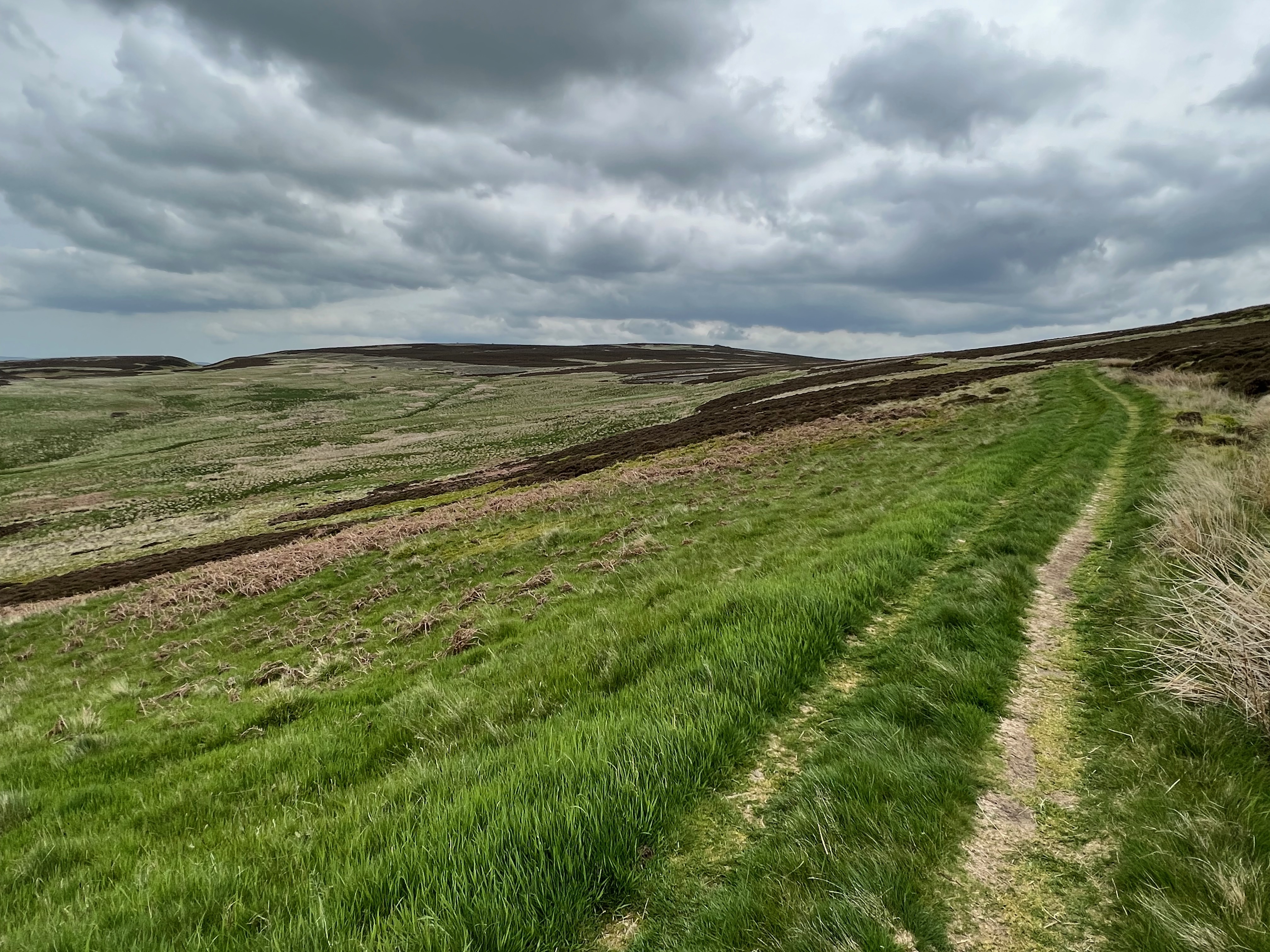
The first sign that I was nearing the sea was a flock of gulls circling above me. Just one more forested ridge, and the coast would be visible. After marveling at the massive sandstone overhang of St. Cuthbert’s Cave (where monks carrying his remains are said to have sheltered while fleeing Viking raiders), I climbed to the rise just above it. And there I saw my Promised Land: Holy Island, refulgent beneath the noonday sun.
When Lewis and Clark got their first glimpse of the Pacific after 18 months crossing the American continent, Clark recorded their delight in his journal: “Ocian in view! O the joy.” When I reached that ridge above the Northumbrian sea, I spoke those words out loud.
My first view of Holy Island.Ocean in view!
“To walk there is to earn it, through laboriousness and through the transformation that comes during a journey … We are eternally perplexed by how to move toward forgiveness or healing or truth, but we know how to walk from here to there, however arduous the journey…. In pilgrimage, the journey is radiant with hope … geography has become spiritualized.”
The Last Judgment (detail), Tympanum of the Abbey of Sainte-Foy, Conques, France (c. 1107).
God isn’t the prime mover of every natural catastrophe and human ill; inexplicable tragedies are never a so-called act of God. Life is more complicated than that; so is the universe; so is God.
— Gary Commins
Lord, if you had been here, my brother would not have died (John 11:21).
In Son of Man, a 2006 film retelling the Jesus story in a 21st-century African country, Jesus and Satan are sitting side by side atop a tall sand dune. After putting up with the three temptations, an exasperated Jesus turns suddenly toward his adversary and gives him a hard shove. As Satan tumbles down the dune, Jesus shouts after him, “This is my world!” But Satan is unbowed. When he reaches the bottom, he picks himself up, dusts himself off, and cries up to Jesus, “NO! THIS IS MY WORLD.” The film cuts to the country’s ongoing civil war, where a mass shooting of schoolchildren proves Satan’ point.
One night last week, a drunken man was shooting a gun in his front yard—reportedly a form of recreation in his Texas neighborhood. But his next-door neighbor had a baby who was trying to sleep. He asked the shooter to stop. The shooter refused. Instead, he fetched a deadlier weapon—an assault rifle—took it into his neighbor’s house, and slaughtered five people, including a nine-year-old boy. The police found a few survivors—children shielded beneath the bodies of their mothers—uninjured, but covered with maternal blood.
Such unspeakable evil has become a regular occurrence in my country. Mass shootings are setting a record pace this year. Twenty years ago, there were 200 million guns in America. Now there are 400 million. Twenty years ago, assault rifles were 2% of the market. Now they are 25%[i] The man who pulled the trigger in Texas is not alone in his guilt. He is joined by the gunmakers who make themselves rich from the carnage, the right-wing lawmakers who fetishize guns to get votes, the cable propagandists who stoke fear, rage and hate, and a dysfunctional society incapable of exorcising its legion of demons.
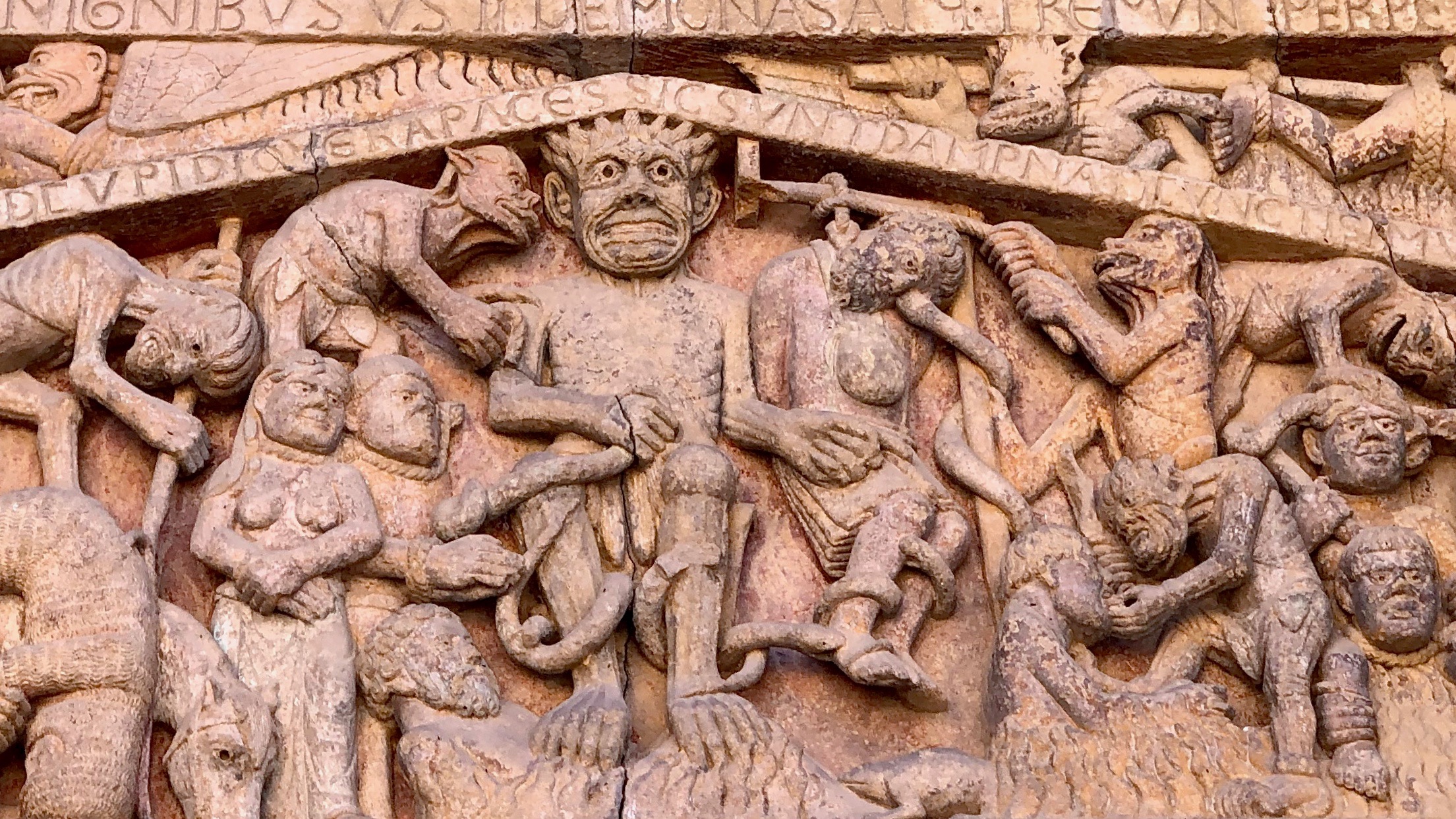
The Last Judgment (detail), Tympanum of the Abbey of Sainte-Foy, Conques, France (c. 1107).
I have written about our capacity for denial in “The Murderous Hypocrisy of ‘Thoughts and Prayers.’”If we say we have no sin, we deceive ourselves, and the truth is not in us (I John 1:8). Or as a modern theologian puts it, “It is only when our capacity for evil has been rendered explicit that we have a realistic basis for understanding that transformation or metanoia, that healing, which constitutes our salvation.” [ii]
Zooey Zephyr, a representative in the Montana state legislature, recently provided a perfect image of the cognitive dissonance inherent in pious self-deception. She was speaking against a Republican anti-trans bill which she believes will increase suicide among the young; but her words could apply to every political misuse of “thoughts and prayers”: “If you vote yes on this bill and yes on these amendments, I hope the next time there’s an invocation when you bow your heads in prayer, you see the blood on your hands.” [iii]
The Republican majority, like Pilate washing his hands of innocent blood, voted to silence Zephyr. They expelled her from the house. It’s easy to mock their fear of truth-telling, but when we look at our own hands, what do we see?
Evil is woven not only into the fabric of the world, but into each and every soul. In Terrence Malick’s great (anti)war movie, The Thin Red Line, we are shown the violence and death of a terrible battle, but the realistic sounds of gunfire, grenades and human screams are muted beneath the elegiac music of Charles Ives’ “The Unanswered Question,” as though we are watching human evil through an impartial God’s tear-stained eyes. Then we hear the voice-over questions of an American soldier, seeking to penetrate the surface of the visible:
“This great evil, where does it come from? How does it still enter the world? What seed, what root did it grow from? Who’s doing this, who’s killing us, robbing us of life and light, mocking us with the sight of what we might have known? Does our ruin benefit the earth? Is this darkness in you too?” [iv]
Who’s doing this? Who’s killing us? Is this darkness in you, too? The problem of evil is not only an unanswered question; it is unanswerable as well. In his valuable and insightful new book, Evil and the Problem of Jesus, Episcopal priest and theologian Gary Commins invites us to set aside the philosophical conundrums, engaging evil not as a theoretical puzzle but as a practical challenge.
Since ancient times, the existence of evil has raised unsettling questions about the nature of God. If God is good, why is so much evil allowed to happen? Is God indifferent to our suffering, or somehow powerless to eliminate it? Can divine purpose ever justify evil, turning it to the good? Or must we conclude that a good God, or any God at all, is a logical impossibility, given the prevalence and persistence of evil?
Theodicy is the philosophical or theological attempt to reconcile the goodness of God with the existence of evil. It has produced a vast amount of profound intellectual reflection over the centuries. But Commins, drawing on his own pastoral experience, calls the whole enterprise into question. It’s not just that a rational explanation for evil offers little real comfort to its victims (Who wants to hear “It’s God’s will” at a funeral?). It also strips both God and evil of their complexity. The sources of evil are multifarious and impossible to trace with precision. And the activity of God within our temporal, finite existence is not a unilateral and unfettered exercise of power. The self-emptying God chooses to work within incarnational limits. The vulnerable babe in the manger grows up to die on a cross, and in between does what he can to address evil, not always successfully.
“Traditional Western theodicy,” says Commins, “jams billions of people, or the planet, millions of millennia, and the infinite intricacy of subatomic matter into a solitary, simplistic enigma of God-and-evil. By tapering all its energy into one worn-out query, it diverts us away from more illuminating questions. Not only does it boil down a myriad of meanings into one conundrum of divine power or love. It concentrates on what is, in all likelihood, the least fruitful of many mysteries.” [v]
Instead of defending God’s honor or solving the ancient enigma of good and evil, we should accept the sheer givenness of “a wild, wondrous, chaotic creation [we] can’t comprehend or control.” [vi] Instead of wondering why the world is so, we should devote our energies to the divine project of making it better.
“The causes of evil and suffering are personal, social, structural, and cosmic: human delusions, collective misbehaviors, institutional grandiosity, and spiritual malice .… Until the End, suffering and evil will neither cease nor desist—they are inherent in creation and intensified by social ills; we can decrease them by aligning ourselves with God’s will.” [vii]
We may never understand why the world must be an unstable mixture “of storms and stillness, gloom and brightness,” where “suffering, evil, and chaos commingle with glory, love, and joy.”[viii] But it’s the world we’ve got, and what we really need to figure out is how to live in it.
And for that, Commins says, we must turn to Jesus, who shows us “what it means to be human.” If we seek a Christian understanding of God’s response to evil, we should start not with metaphysics, but with the gospel.
“Jesus never waxes philosophical. Rather than offering an ‘explanation’ for evil, he gives his followers ‘a charge and a benediction’: the charge to stand in solidarity with the oppressed, the benediction to empower his followers to resist evil.” [ix]
“Nowhere does Jesus construct a system of ethics or author a theology of evil. In broad terms, what we can do to undo evil is clear—act on his words, treat all as equals, seek the kingdom, go and do likewise, repent, follow, forgive, and love—but unless we face the evils within us, we won’t have a positive influence on the world around us and, even then, nothing is a sure thing.” [x]
At the same time that Jesus is showing us how to be fully human, he is revealing who God is and what God does. Jesus’ own responses to evil are “epiphanies into God’s relationship with evil.… what Jesus does in time, God does in eternity; the ways Jesus responds to evil in his lifetime—confronting, undoing, and erasing it; bending, circling, and transforming it—are ways God always engages evil.” [xi]
No metaphysical speculation needed. Just keep an eye on Jesus, and the Way will show itself. In a beautifully succinct summation of this Way, Commins says that “Jesus embodies compassion, challenges judgments, reverses fates, levels inequalities, frees from demons, forgives sins, tells truths, and plants seeds of shalom.” [xii]
So whose world is it, after all? We wonder every time we watch the news. But ultimately, it’s a question to be answered not within our minds, but in the activity of our lives. As the song says, “It may be the devil or it may be the Lord, but you’re gonna have to serve somebody.”[xiii]
The late German theologian Dorothee Soelle (1929-2003) found this paradigm of Christian discipleship perfectly expressed in The Brothers Karamazov, where Ivan and his younger brother Alyosha are earnestly discussing theodicy. Both agree that no long-range divine purpose could ever justify the torture of children in the here and now. Where the brothers differ is in their personal response to evil. Ivan blames and rejects a God who consents to the immense sufferings of history. But Alyosha, notes Soelle, does not shake his fist at heaven. He is too busy attending to the needs of earth, just like the God who became one of us.
“[Alyosha] directs his attention not to the power above but to the sufferers. He puts himself beside them. He bears their pain with them. He listens with agony as Ivan introduces examples of suffering he had assembled against the compassion of God … He is silent, he shares the suffering, he embraces the others.” [xiv]
Compassion’s embrace: from Alexander Sokurov’s “Lc. 15:11-32” (Prodigal Son installation,Venice Biennale 2019). Sculptures by Vladimir Brodarsky & Katya Pilnikova.
[i] These statistics were cited in a televised interview with Fred Guttenberg, speaking about the new book he has co-authored with Thomas Gabor: American Carnage: Shattering the Myths That Fuel Gun Violence.
[ii] Kenneth Surin, Theology and the Problem of Evil (Oxford & New York: Basil Blackwell Ltd., 1986), 157.
[iv]The Thin Red Line (1998), adapted by Terrence Malick from James Jones’ 1962 novel.
[v] Gary Commins, Evil and the Problem of Jesus (Eugene, Oregon: Cascade Books, 2023), 14. Full disclosure: Gary is an old friend. We meet up periodically in Eugene for national track & field championships, but never discuss evil during the meets. His new book not only offers a fresh and timely take on a central theological question, it does so through an illuminating method of reading Scripture and tradition in general.
“Only a sweet and virtuous soul, / Like season’d timber, never gives …”
Today is the feast day of George Herbert (1593-1633), one of my favorite poets. It is fitting that we remember him at the beginning of Lent, for his poems are imbued with the season’s themes of repentance and renewal. He was a student of what the Book of Common Prayer calls our “unruly wills and affections,” and could be brutally honest about his own need for divine grace.
The Herbert whom we meet in his poems is a person very much in process: unfinished, imperfect, always aspiring to something higher. He cared deeply about formation and growth – his own as well as that of his congregation. As poet and priest he used all possible art to move those with ears to hear.
Herbert’s spiritual environment seems so alive with correspondences between visible things and deeper, invisible realities. The Mystery of the world is met in the humblest of circumstances. The burning bush flashes through the surface of the ordinary. Everyday phenomena are saturated with significance.
This year let us honor “the holy Mr. Herbert” (as his parishioners called him) by examining a single poem. Perhaps we will make this an annual tradition on February 27. For today, the poem is “Virtue.”
Sweet day, so cool, so calm, so bright, The bridal of the earth and sky; The dew shall weep thy fall to-night, For thou must die.
Sweet rose, whose hue angry and brave Bids the rash gazer wipe his eye; Thy root is ever in its grave, And thou must die.
Sweet spring, full of sweet days and roses, A box where sweets compacted lie; My music shows ye have your closes, And all must die.
Only a sweet and virtuous soul, Like season’d timber, never gives; But though the whole world turn to coal, Then chiefly lives.
“Sweet rose … thy root is ever in its grave.”
The poem has been called “one of the purest lyrics in the language.” [i] The predominance of one-syllable words exemplifies its “fine poetic thrift.” [ii] The sixteen short lines, divided into four quatrains, overflow—almost miraculously—with diverse images, references and meanings. For example, “The bridal [wedding] of the earth and sky“ invokes the Easter Vigil’s Exultet: How blessed is this night, when earth and heaven are joined. “Thy root is ever in its grave” describes the paradox of mortal life with stunning brevity: even at our liveliest, we are dying creatures. Or as we say on Ash Wednesday: Remember that you are dust.
The poem’s opening line establishes rhythmic beat of successive iambs (short-long): “Sweet day, so cool, so calm, so bright.” This pattern is more or less followed in the first three lines of the first three quatrains, but each fourth line slams on the brakes with its sober message of mortality, delivered in a series of strong beats like the striking of a drum or the tolling of a bell: Forthoumust die … And thou must die … And all must die.
Although an apocalyptic wisdom throughout the poem reminds us that days end, flowers wither, seasons pass and worlds burn (“turn to [char]coal”), the first three quatrains seem more celebratory than melancholy. The word “sweet” occurs six times. The inevitable terminations of temporal existence need not diminish whatever pleasures and joys we experience in the moment. However, as the poem’s conclusion insists, the “soul”—our innermost self or enduring identity—can partake of something deeper and more lasting, an essential and enduring stability at its core.
The governing images of the final quatrain, “season’d timber” and “turned to coal,” each call up a constellation of meanings. Timber suggests both the cedars of Lebanon and the cross. And the seasoning of wood represents the testing of the soul, which, by God’s grace, “never gives”—never gives in, never gives up. As Herbert scholar John Drury explains, “Timber is seasoned by being left to dehydrate out of doors undercover for several years, enduring, like the soul, the extremes of weather and the seasons. After that it is stable and strong.” [iii]
But wood is flammable, and the doomsday image of a world-ending fire takes us to the brink of ancient fears of annihilation. But Herbert deftly steers us instead into a place of hope and promise. Wood tested by fire can become a glowing ember, an image of liveliness. Likewise can the tested soul become “a quick [living] coal / of mortall fire,” as Herbert says in another poem, “Employment (II).” And even should the world’s last embers cool and turn to dust, the soul which belongs to God will “chiefly” live. “Chiefly” means particularly, or mostly, but it may also reference Christ, the Chief of history, in whom all are made alive.
Unlike the last line of the first three quatrains, with their percussive stresses hammering out our doom, the stresses of the very last line, reduced from four to three, seem gentler and, aided by the use of a two-syllable word, more lilting: “Thenchief-ly lives.” Try reading just the fourth line of each quatrain in succession, and notice the difference in tone at the last.
As it always is with God, life has the last word.
[i] Arnold Stein, George Herbert’s Lyrics (Johns Hopkins, 1968), cited in Helen Wilcox, The English Poems of George Herbert(Cambridge: Cambridge University Press, 2007), 81. I am indebebted to Professor Wilcox for her richly annotated collection of Herbert’s English poems, each of which also includes summaries of the best Herbert criticism over the years. Since his poetry can be difficult and many of his terms archaic, her book is indispensable.
[ii] John Drury, Music at Midnight: The Life and Poetry of George Herbert (Chicago: Chicago University Press, 2014), 59. A must-read if you want to go deeper.
True religion, in great part, consists in holy affections.
— Jonathan Edwards
“After Thursday, I was like, okay, I’m going to go sleep. But [God] was like, ‘No, I have more for you.’”
— Lauren, Asbury University student
On February 8 the morning chapel service at Kentucky’s Asbury University concluded, as usual, with a spiritual song. Then most of the students filed out to go to class, but the band kept playing, and a few stayed behind to sing along around the altar. What happened next has startled the world.
“I was like, all right, we’re just going to be around here for one or two more songs, and we’re going to go to class,” said Lena, an Asbury student. “But there was like something in my soul that said no-no-no, we’ve just got to stay here. So I just stayed. A little while later I thought I had only been there like maybe an extra 20 minutes. It had been like 3 hours. It just started turning into something bigger and crazier.”
Word spread through the campus that people were still singing and praying in the chapel. Classrooms and dorms began to empty, and by the end of the day the 1500-seat worship space was packed with students and faculty, singing, praying, and testifying to the power of God in their lives. Two weeks later, it’s still happening, day and night without ceasing.
Live video on social media quickly went viral. People from all over North America began to converge on Asbury to join in. Still others flew in from faraway places like Finland, New Zealand, and Indonesia. University officials estimate that tens of thousands of pilgrims have shared in the experience. The line to get inside can be hours long.
It’s been called the Asbury Revival, but some are wary of this designation. Too many have been wounded or betrayed by manipulative gatherings and domineering evangelists in the name of “revival.” Some prefer to call it an “outpouring” (the university’s preference), a “renewal,” or an “awakening.” One student said she was switching from “revival” to “encounter” because the divine presence, not the internal experience of the worshipper, was the central meaning here.
Whatever is happening, the watchword has been “radical humility.” Student Asher Braughton says, “I truly believe that the revival has been built on humility; that this revival isn’t focused just on one person—not one worship leader, not one pastor, not one speaker, not one student. It’s focused solely and only on Jesus Christ.” Or as one of the event’s speakers put it: “The only celebrity in this house is Jesus.”
During the “Great Awakening” in the eighteenth-century, the emotional excesses of the revivals worried the church establishment. Was it sincere? Was it of God? Historian George M. Marsden summarizes the criticisms in vivid terms: “Using vulgar appeals to sentiment, they would generate mass hysteria that they encouraged people to regard as evidence of the work of the Holy Spirit. Scores or even hundreds of people would shriek, swoon, or fall into fits.”
Although one student leader, mindful of the building’s aging fabric, had to announce that there would be “no jumping allowed in the balconies,” the tone in the room has been generally mellow. A youth minister described it as walking into “a holy hush.” There have been moments of exuberant cheering and clapping, but much of the music and prayer invites a tranquil surrender to the spiritual flow. Watching it online, I thought of Thomas Merton’s gently fervent plea: “Sink from your shallows, soul, into eternity.”
On the first day, Asbury professor Clint Baldwin was having lunch in the cafeteria when someone stopped at his table to say, “You know, the students are still in there, and they’re still worshipping the Lord. You should go over and see what’s happening. It’s a sweet, sweet thing.” Baldwin soon joined the awakening and saw that it was good. “This was just people saying we’re going to stay on and sit in the presence of the Lord and see what the Lord would have for us.”
Lauren, the student quoted in the epigraph, described the worship as all-consuming: “Nothing else matters anymore except being in the presence of Jesus and worshipping him for the rest of my life.” She acknowledged the hyperbole of this—she would of course continue with the life of a student—but her perspective on everything had been transformed. “Ways I have of viewing people negatively—it doesn’t matter anymore. Anxieties and worries that I have, it doesn’t even matter.… Whenever you can just let go and surrender and forgive, then, you’re just set free.”
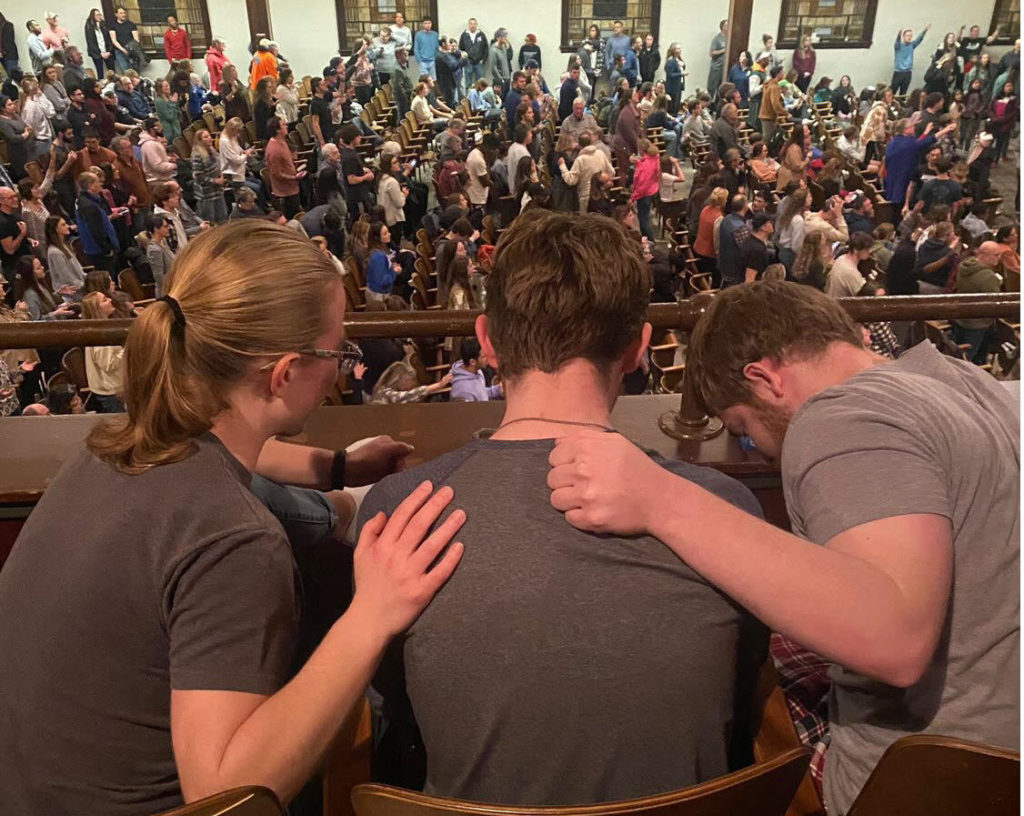
The majority of worshippers are under 25. Living through a time of immense stress, they hunger for the healing peace of God. In spontaneous prayer groups around the chapel, or in testimonials from the stage, many have openly shared their deepest griefs and heaviest burdens. Their vulnerability has been met with tenderness and love. When a young woman shared her story of attempted suicide before the whole assembly, a multitude of women came forward to lay their hands on her. “An hour later she was dancing and smiling with a joy on her face that I had never seen before,” said one witness.
“God is moving through this generation that has been so affected by mental health,” says Asher. “Once this revival ends, we can carry this message of goodness and forgiveness … The chains of suicide, the chains of depression, the chains of anxiety can be broken in Jesus.” Many of the songs reflect this hope in their melodic repetitions of heartfelt cries:
Jesus, Jesus, you make the darkness tremble— your name is a light the shadows can’t deny … You’re never gonna let, you’re never gonna let me down … He is for you, He is for you, He is for you …
There are of course critics and skeptics. All religious experience is bewildering, even suspect, for those who stand outside it. It is a reality both given and received, not grasped or possessed. Its truth abides in its own domain of experience. You can’t judge it at a distance, as a spectator. You have to go inside it, open your heart to it, be in loving relationship with it. As the mystics testify, certainty is only found within the experience.
Among believers, there is certainly a proper concern about delusion and self-deception. “Even Satan disguises himself as an angel of light” (2 Cor. 11:14). But religious experience can be tested by its fruits. Asbury’s president, Kevin J. Brown, is an encouraging witness to the Outpouring’s authenticity:
“Since the first day, there have been countless expressions and demonstrations of radical humility, compassion, confession, consecration, and surrender unto the Lord. We are witnessing the fruit of the Spirit: love, joy, peace, patience, kindness, generosity, faithfulness, gentleness and self-control.”
Some may worry that the strongly personal nature of the Asbury Outpouring excludes concerns beyond the self like racism, social justice, global conflict, and the fate of the planet. However, nothing I have seen or read so far suggests that these young people disconnect personal transformation from social change. Surrendering to God is inseparable from a lifetime of service to neighbor and world. One’s own soul is too small a kingdom for the Lord of history. The collective witness and shared compassion of the Outpouring bears witness to that truth.
As for the abundance of deep feeling, vulnerability, open-heartedness, and the ecstatic willingness to be swept away, we need more, not less of that in the Christian life. Those kids are singing and praying and testifying as if their lives depend on it; as if God matters more than anything; as if Jesus will wipe away the tears from every eye; as if a new reality is breaking through the cracks of our broken world.
But can it last? The particular happening in Asbury’s chapel is winding down this week. The university needs to resume its institutional mission, and the town of Wilmore, hospitable as it has been, can’t handle the crowds forever. “It is not ours to hold alone,” Brown says. “We are not the keepers of this movement … Pray that what is happening here will spread.”
Although it seems a bit sad that this foretaste of heaven—singing around the throne for all eternity—must come to an end in the temporal world, the Holy Spirit blows where it will. Outbreaks of public Christian fervor and collective spiritual passion may turn up elsewhere, take new forms, or return to a dormant state until the next eruption. Revelation, not longevity, is the point of epiphanies. They have their moment and vanish, but their impact—and the truth they manifest—endures in hearts and minds and communities.
I have no doubt that many of those who are living through this experience will be forever changed by it, as will the worlds they inhabit and the people they touch. Professor Baldwin, recalling similar revivals at Asbury in the 1950s and 1970s, notes that “people still talk about those [past] moments in revival that shaped the trajectory of how they chose to live for the sake of the Lord onward from that. That’s a hope that we would have for this.”
Even watching online from afar, I have found myself deeply moved by the Spirit-filled assembly. I especially love the heartfelt singing and the manifestation of shared joy. One of my favorite parts was today’s invitation for people to come forward and recite their favorite verses from Scripture. When a small African-American boy read from the prophet Joel (2:28), delivering that luminous text with his boyish voice—innocent as Eden—I was blown away:
Then I will pour out my spirit on all flesh; your sons and your daughters shall prophesy, your old ones shall dream dreams, and your young ones shall see visions …
Joel’s prophecy has taken flesh at Asbury, day after day since the eighth of February—all those beautiful young faces, shining with God’s future. Like the rest of us, they will lose it and find it again and again. But they have set their feet upon the sacred Way. God bless them.
The words of Clint Baldwin, Asher Braughton, Lauren, Lena and Kyle (the youth minister) are taken from a February 12 conversation with Shane Claiborne on his YouTube channel, Red Letter Christians: “Update from the Asbury University Revival”
The words of Asbury President Kevin J. Brown can be found at the Outpouring link above.
Merry Christmas, dear reader. May you find your heart’s desire in the stable tonight. Although we may stammer before such a Mystery, we are grateful for the writers who have bravely attempted to put it into words. One of my favorites is Frederick Buechner, who departed this life last summer on the Feast of St. Mary the Virgin. Here is what he preached to students many years ago:
The child born in the night among beasts. The sweet breath and steaming dung of beasts. And nothing is ever the same again.
Those who believe in God can never in a way be sure of him again. Once they have seen him in a stable, they can never be sure where he will appear or to what lengths he will go or to what ludicrous depths of self-humiliation he will descend in his wild pursuit of humankind. If holiness and the awful power and majesty of God were present in this least auspicious of all events, this birth of a peasant’s child, then there is no place or time so lowly and earthbound but that holiness can be present there too. And this means that we are never safe, that there is no place where we can hide from God, no place where we are safe from his power to break in two and recreate the human heart, because it is just where he seems most helpless that he is most strong, and just where we least expect him that he comes most fully.
For those who believe in God, it means, this birth, that God himself is never safe from us, and maybe that is the dark side of Christmas, the terror of the silence. He comes in such a way that we can always turn him down, as we could crack the baby’s skull like an eggshell or nail him up when he gets too big for that. God comes to us in the hungry people we do not have to feed, comes to us in the lonely people we do not have to comfort, comes to us in all the desperate human need of people everywhere that we are always free to turn our backs upon. It means that God puts himself at our mercy not only in the sense of the suffering that we can cause him by our blindness and coldness and cruelty, but the suffering that we can cause him simply by suffering ourselves. Because that is the way love works, and when someone we love suffers, we suffer with him, and we would not have it otherwise because the suffering and the love are one, just as it is with God’s love for us.
+
Buechner’s complete sermon was published in The Hungering Dark, and later in Secrets in the Dark. You can also find it here.
Our Lady of the Angels (Robert Graham, Los Angeles cathedral, 2002)
Gaudete! Gaudete! Christus est natus Ex Maria Virgine. Gaudete!
Rejoice! Rejoice! Christ is born of the Virgin Mary. Rejoice!
So goes the joyful refrain of a late medieval carol, and even though the celebration of the Divine Birth is still two weeks away, the note of rejoicing (Gaudete! Gaudete!) is already beginning to dispute the wintry gloom in our Scripture readings, our hymns, and our expectant hearts.
For many centuries, the Third Sunday of Advent has been called Gaudete Sunday—Rejoice Sunday. In the Advent wreath, the somber blue is replaced by a brighter, warmer shade of rose. Churches lucky enough to have rose vestments will be using them today. And in the Common Lectionary cycle of readings, the word “rejoice” turns up in each of the three years.
In Year C, the prophet Zephaniah exhorts his disheartened people, “Rejoice and exult with all your heart, O daughter Jerusalem” (Zephaniah 3:14). And St. Paul, overflowing with the Spirit, urges the first Christians to make joy a constant spiritual practice: “Rejoice in the Lord always,” he said. “Again I will say, Rejoice (Philippians 4:4)
In Year B, Isaiah tells us, “I will greatly rejoice in the Lord; my whole being shall exult in my God; for God has clothed me with the garments of salvation” (Isaiah 61:10), while Mary’s heart pours out the Magnificat’s ode to joy: “My spirit rejoices in God my Savior (Luke 1:47).
And now, in Year A, Isaiah promises that even the most barren and forsaken places will become a paradise in God’s future: “The desert shall rejoice and blossom,” he assures us. “God’s ransomed exiles shall return …Gladness and joy shall come upon them, while sorrow and sighing shall flee away” (Isaiah 35:10).
Such hopeful refrains lift up our hearts and light a bright candle in the dark. But we also heed the voice of St. James, who curbs our enthusiasm with his “Not so fast! The Kingdom doesn’t come all at once. We’ve got to be patient” (James 5:7).
And we know he’s right. We still abide in a severely damaged history which seems to repeat itself rather than make real progress toward the horizon of God’s future. We have been shocked in recent years to see such seemingly outdated sins as overt racism and anti-Semitism come roaring back, like the alarming return of “conquered” diseases like polio and measles.
The French thinker Jean Baudrillard wrote about the myth of human progress just before the Millennium, critiquing the optimistic talk of a New World Order by reminding us that humanity continues to have a serious waste disposal problem (theologians would call this Original Sin, the persistent flaw that burdens and bedevils every human endeavor).
As Baudrillard put it, “The problem becomes one of waste. It is not just material substances, including nuclear ones, which pose a waste problem but also the defunct ideologies, bygone utopias, dead concepts and fossilized ideas which continue to pollute our mental space. Historical and intellectual refuse pose an even more serious problem than industrial waste. Who will rid us of the sediment of centuries of stupidity?” [i]
I ask that question every day when I see the news! But the genius of Advent is its ability to perform the difficult dance of honesty and hope. It doesn’t deny the darkness, but it also refuses to accept the black hole of unredeemed history as an inescapable fate. “Give us grace to cast away the works of darkness,” we pray, “and put on the armor of light”—not just in some distant utopian future, but “now, in the time of this mortal life.”
Now, now, now. But also not yet. Gaudete, but also Kyrie eleison. Rowan Williams, borrowing an image from Diadochus, a fifth-century bishop, describes Advent spirituality as the practice of “looking east in winter.”
“Looking east in winter we feel the warmth of the sun on our faces, while still sensing an icy chill at our backs. Our divided and distorted awareness of the world is not healed instantly. But we are not looking at the phenomenon from a distance: we do truly sense the sun on our faces; and we have good reason to think that the climate and landscape of our humanity can indeed be warmed and transfigured.” [ii]
The next time there is a sunny morning, go stand somewhere on our island’s eastern shore. Feel the chill at your back, and the warming sunlight on your face. Do it without words. Let those contrary sensations of cold and warmth be your Advent prayer.
Not every morning brings a bright sun, of course. Sometimes the warmth of hope is a matter of faith, not immediate experience. Yet even when we can’t feel it, God is redeeming the time and preparing the dawn. And when we pray, “Stir up your power, O Lord, and with great might come among us,” the Holy One is listening.
“Stir up your power” is such a striking prayer, a bold cry of the heart to the One who saves. [iii] And because it is always the Collect-prayer for this day, Gaudete Sunday is also known as “Stir up” Sunday. But what do we mean when we call upon divine power? What does the power of God look like in the world we inhabit?
Well, it looks a lot like what happened when Jesus arrived: “The blind see, the lame dance, the deaf hear, the dead are raised, and the poor receive good news” (Matthew 11:5). It’s not a violent head-on clash with the powers of this world—meeting them on their own bloody terms—but the liberation of the faithful into a new form of being, enabling the friends of God to “plant the seeds of resurrection amid the blind sufferings of history.” [iv]
In Roberto Rossellini’s film, Europe ‘51 (1952), Ingrid Bergman plays a wealthy woman who gives up all her privilege to serve the poor and vulnerable. Rossellini, who had made a joyful film about St. Francis two years earlier, wanted to explore what would happen if someone behaved like St. Francis in the contemporary world. As it turns out in Europe ‘51, Irene (Bergman’s character) is judged to be insane by her husband, her social class, her doctors, and her Church, and the film ends with her locked away in an asylum. The powers-that-be have decided that there is no place in the world for the impracticality of unconditional love.
But even as Irene suffers this sad fate, we see her continue to be who she is, embodying God’s compassion for her fellow inmates. Like the incarnate God enclosed within the finite space of the Virgin’s womb, she can still practice heaven within the confines of the asylum. As she comforts a despairing woman who has tried to commit suicide, we see Irene, in a close-up reminiscent of an icon, speaking the words of Christ: “You are not alone. Don’t worry. I am with you. I will not leave you.” She becomes, in that moment, what we are all invited to become: an image of Christ for others.
“I am with you,” Irene (Ingrid Bergman) tells a distressed woman in Roberto Rossellini’s Europe ’51.
Stir up your power, O Lord, and with great might come among us. But God’s idea of “great might” is not the way the world understands it. No lightning bolts. No legions of angels. Just a babe in a manger, a tortured man on a cross, a disciple locked in an asylum. As W. H. Auden said in the Advent portion of his Christmas Oratorio: “The Real is what will strike you as really absurd.” Or as an old carol puts it, “Weakness shall the strong confound.” [v]
In another of his poems, “In Memory of W. B. Yeats,” Auden suggests that poetry operates much like divine power. Poetry “makes nothing happen,” he says. In other words, poetry doesn’t force its will upon the world, but in offering an alternate perspective for engaging reality, it makes the world different nonetheless. Auden describes poetry as if it were a stream, making its own way through the landscape.
For poetry makes nothing happen: it survives In the valley of its making where executives Would never want to tamper, flows on south From ranches of isolation and the busy griefs, Raw towns that we believe and die in; it survives, A way of happening, a mouth.
In his analysis of this poem, John Burnside notes that poetry’s work is “to survive—not in some dogged but enfeebled fashion, hanging on, though barely noticed, in an indifferent world, but actively, on its own terms—that is, ‘in the valley of its own making.’” The ‘executives’—the powers-that-be—take no notice. It means nothing to them. But “poetry flows on, through and away from ‘the busy griefs’ and the ‘raw towns that we believe in and die in,’ its business is more fundamental, its true nature more elemental” than the ‘executives’ can imagine.[vi]
And just so does the power of God flow through the world. Not to force anything to happen in a blunt cause-and-effect way, but to exist, like the waters of baptism, as an inviting and life-giving reality: “It survives, / A way of happening, a mouth.”
We find this same image of the flowing, living water in today’s passage from Isaiah: “For waters shall break forth in the wilderness, and streams in the desert; the burning sands shall become a pool, and the thirsty ground springs of water” (Isaiah 35:6-7).
The concluding words of Auden’s stanza, “a mouth,” may strike our ears jarringly after the metaphor of a quietly flowing stream, but both poetry and God are given to speech: In the beginning was the Word.
And in the same way that the “Stir up” prayer beseeches the God who saves, Auden’s poem, written on the eve of World War II, calls upon the poet to speak a word against all the dark sorrows of the world:
In the nightmare of the dark All the dogs of Europe bark, And the living nations wait, Each sequestered in its hate …
Follow, poet, follow right To the bottom of the night, With your unconstraining voice Still persuade us to rejoice … [vii]
There’s that word again: rejoice. We have prayed for a word of power today, and what we are given is: Gaudete! Rejoice! God’s power will never compel us to rejoice, or to hope, or to love. But it will always seek to persuade us, until the end of time.
Maddy Prior and Steeleye Span sing my favorite version of Gaudete.
[i] Jean Baudrillard, The Illusion of the End, trans. Chris Turner (Stanford, CA: Stanford University Press, 1994), 26
[ii] Rowan Williams, Looking East in Winter:Contemporary Thought and the Eastern Christian Tradition (London: Bloomsbury Publishing, 2021), 8.
[iii] The Collect for the Third Sunday of Advent in the Book of Common Prayer: “Stir up your power, O Lord, and with great might come among us; and, because we are sorely hindered by our sins, let your bountiful grace and mercy speedily help and deliver us; through Jesus Christ our Lord, to whom, with you and the Holy Spirit, be honor and glory, now and for ever. Amen.”
[iv] I can’t locate the source of this quote from an old homily, but it may be from either Paul Evdokimov or Olivier Clément.
[v] Auden’s line is from “For the Time Being: A Christmas Oratorio” (Collected Poems, Random House, 1976, p. 274). The carol line is from Gabriel’s Message (trans. J. M. Neale). Like Gaudete, it is in the famous Piae Cantiones collection of 1582.
[vi] John Burnside, The Music of Time: Poetry in the Twentieth Century (Princeton: Princeton University Press, 2020), 23.
[vii] W. H. Auden, “In Memory of W. B. Yeats” (Collected Poems, 197-198).
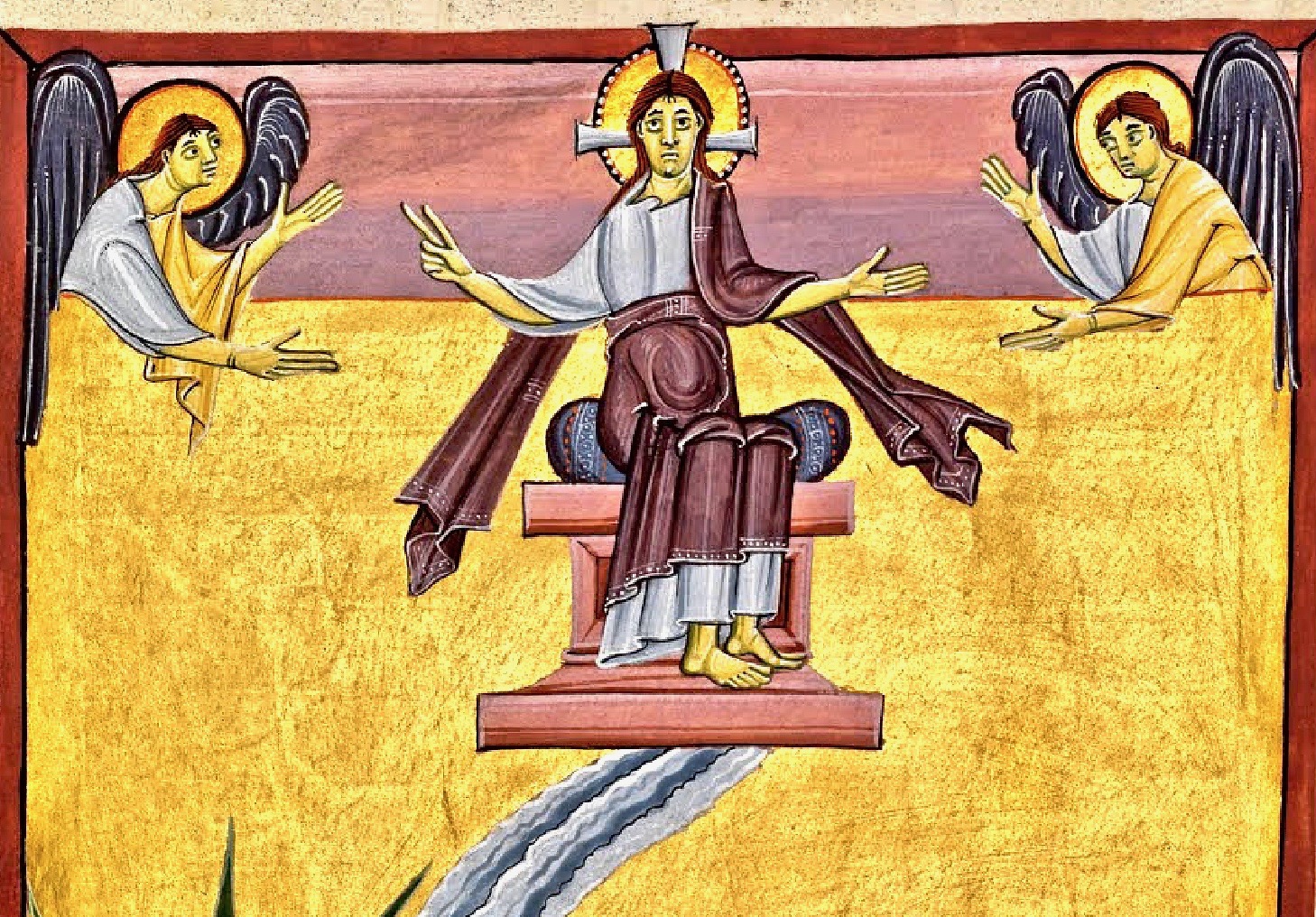
The Enthronement of Christ (Bamberg Apocalypse, early 11th century).
The extremists in American politics say that God is on their side, but such statements are lacking in content. Their “God” is not really expected to supply any concrete assistance, such as plagues or angelic legions, to carry them to victory. “God-on-our-side” language is just a dramatic way to say that “we are right and you are evil.”
However, a new video ad is selling the startling idea that God has indeed, in these latter days, directly intervened in history by anointing a human messiah to enforce divine will through political power. Over God’s-eye aerial views of land and sea, we hear a caricature of Charlton Heston recite a text with biblical cadences and a lot of reverb:
“And on the 8th day, God looked down on his planned paradise, and said, ‘I need a protector.’ So God made a fighter.… God said, ‘I need someone to be strong, advocate truth in the midst of hysteria, someone who challenges conventional wisdom, and isn’t afraid to defend what he knows to be right and just.… someone who will take the arrows, stand firm in the face of unrelenting attacks.’”
As we hear these words, photographic images of the Chosen One fill the screen. The new messiah is revealed to be—wait for it—Ron DeSantis, the governor of Florida! I knew he had presidential ambitions, but now he’s in the running for the Antichrist! Are there really enough rubes out there to fall for the old false messiah gag? [i]
About 60 years ago a southern preacher named Clarence Jordan liked to ask his fellow Christians: “What’s the biggest lie told in America today?” He’d let that sink in for a bit, and then he’d say, “The biggest lie told in America today is: ‘Jesus is Lord.’”
In other words, if you say “Jesus is Lord” and foster racism, you’re a liar. If you say “Jesus is Lord” and support white supremacy, you’re a liar. If you say “Jesus is Lord” and foment bigotry and hate, you’re a liar. If you say “Jesus is Lord” and afflict the vulnerable, you’re a liar. If you say “Jesus is Lord” and do harm to your fellow beings, you’re a liar.
Someone recently posted a short video on the internet depicting Jesus as the incarnation of our worst politics. It shows Jesus teaching his disciples in a variety of settings:
“I was hungry, and you gave me something to eat. I was thirsty, and you gave me something to drink. And behold: Now I’m all lazy and entitled. You shouldn’t have done that.”
“What is a man profited, if he gains the whole world, but loses his own soul? A lot! He has profited a lot. One soul for the whole world, that is an amazing deal!” [ii]
Sad to say, some people would prefer the anti-Jesus who does nothing but reflect their own pitiful values. In any case, as the song says, “You gonna have to serve somebody: Well, it may be the devil or it may be the Lord, but you gonna have to serve somebody.” [iii]
So who’s it going to be? Whom do we serve? Who—or what—rules our life? To whom do we belong? To what do we surrender?
In a culture of hyper-individualism, the idea of submission to a larger reality, a greater good, goes against the grain. But we are all governed by something, maybe even a whole crazy stampeding herd of somethings, pulling us here, driving us there. Whether we are conscious of it or not, there are voices, inside us and outside us, which direct and rule our hearts in every moment.
A hundred years ago, Scottish theologian P. T. Forsyth suggested that “The first duty of every soul is not to find its freedom, but its Master.” And then he added: “If within us we find nothing over us, we succumb to what is around us.” [iv] When that is the case, there is no shortage of impulses, passions, ambitions, ideologies, agendas and distractions to swallow us up and sweep us away.
On the last Sunday of the Christian year, the Feast of Christ the King, we pledge allegiance to the Divine Love that governs the universe. As Frederick Denison Maurice, nineteenth-century Anglican priest and social reformer, reminds us, the reign of Christ extends into every province of our common life:
When we say, ‘Thy kingdom come,’ we desire that the King of kings and Lord of lords will reign over our spirits and souls and bodies, which [belong to God]… We pray for the extinction of all tyranny…; [we pray] for the exposure and destruction of corruptions inward and outward; [we pray] for truth in all departments of government, art, science; [we pray] for the true dignity of professions [and labor]; [we pray] for right dealings in the commonest transactions of trade; [we pray] for blessings that shall be felt in every [dwelling].[v]
“Crown him Lord of all,” we sing at the Feast of Christ the King. But the gospel for the day does not show us a mighty ruler, but only a naked man nailed to a tree. Soldiers mock the pathetic absurdity of his “kingship.” The sign above his head—“King of the Jews”—is a mocking irony. His only apparent subject is the dying thief hanging next to him. “Jesus,” he gasps, “remember me when you come into your kingdom.” [vi]
Some kingdom! Some king!
Does Christ’s kingdom exist only in the future? Or is it somehow breaking into the here and now, even in the killing fields of history, where you need the faith of a dying thief to see it?
The question we began with—whose world is it?—is, alas, undecidable within the flux of history. You can’t choose on the basis of the evidence, because for the time being the evidence is mixed, like the wheat and the tares.
But you can decide who’s got the better story—Jesus or Satan. And you can choose which story you want to belong to: The story which overflows with life, or the one that ends in death.
A medieval hortus conclusus: The Little Garden of Paradise, Upper Rhenish Master (c. 1410).
Outside, the mountains have been drawn into the garden, becoming a part of it. Aritomo was a master of shakkei, the art of Borrowed Scenery, taking elements and views from outside a garden and making them integral to his creation.
The Rev. James Bramston, an eighteenth-century English cleric, was known for his satirical verses. One of his targets was Archibald Campbell (Lord Islay), who wanted to improve his extensive gardens by removing some of the trees blocking his view of the world beyond his private Eden.
Old Islay, to show his fine delicate taste, In improving his gardens purloin’d from the waste, Bade his gard’ner one day to open his views, By cutting a couple of grand avenues; No particular prospect his lordship intended, But left it to chance how his walks should be ended.
With transport and joy he beheld his first view end In a favorite prospect — a church that was ruin’d — But also! what a sight did the next cut exhibit! At the end of his walk hung a rogue on a gibbet! He beheld it and wept, for it caus’d him to muse on Full many a Campbell that died with his shoes on. All amazed and aghast at the ominous scene, He order’d it quick to be clos’d up again With a clump of Scotch firs, that served for a Screen. [ii]
In those days, landscape design cultivated the idea of the “Picturesque,” in which a visual environment is composed like a painting. In a picturesque scene, whether discovered or constructed, every element presenting itself to the eye of the beholder plays a part in summoning a feeling, stimulating reflection, or creating a mood. “Views were created resembling paintings or recalling events from myth or literature with the aim of producing desired states of feeling in the observer.” [iii]
One of the more unusual elements of the Picturesque was the ruin. A decaying church or temple, a weathered pagan statue, a partially collapsed arch or a broken column—traces of human pastness amidst the greenness of the natural world—aroused “la douce mélancolie qui parle à l’âme sensible” (“the sweet melancholy which speaks to the sensitive soul.”) [iv] Since authentic ruins were few and far between, it became the fashion to build new ones, in either classical or medieval styles, fabricated to appear like ancient remnants. In 1767, Diderot described the intellectual and emotional effect this way:
“The ideas aroused in me by ruins are lofty. Everything vanishes, everything perishes, everything passes away; the world alone remains, time alone continues. How old this world is! I walk between these two eternities … What is my ephemeral existence compared to that of crumbling stone?” [v]
When the poem’s Lord Islay told his gardeners to “open his views” by cutting a couple of wide avenues in the woods around his estate, he was reaching for the Picturesque, though rather by chance than careful design. In the first instance he succeeded wonderfully. At the end of the first avenue, perfectly framed, was a ruined church, promising many pleasurable ruminations on time, history, and divinity in the days to come.
But when more trees were felled to make the second avenue, the results were less agreeable. Lord Islay’s eyes were met with a ruin of the worst kind: a human corpse hanging on a gallows. “Amazed and aghast,” he quickly closed off the terrible vista with a planting of tall firs.
I recently came across Bramston’s poem in Roy Strong’s marvelous anthology, A Celebration of Gardens. While I can’t vouch for the factuality of the story, it struck me as a vivid image of the challenge for spirituality in this troubled and suffering world. How can we enjoy our gardens—the necessary environments and practices for emotional and spiritual health—and yet remain vulnerable and responsive to the cries of distress from near and far?
Isaac Walton window, Winchester Cathedral (1914).
From the Garden of Eden to the medieval cloister, the hortus conclusus (enclosed garden), a tranquil space of beauty and calm, walled off from the outside world, has been a significant image of the interior life. We all need the kinds of spaces, both physical and spiritual, where we can shelter from the storm, sink into the depths of holy Presence, and “study to be quiet.” [vi]
But we are long past the innocence of the first Eden. We know, all too well, of the terrors and horrors raging beyond the protecting walls which nurture our peace and shield our joy. We may, like Lord Islay, be aghast at the sudden glimpse of the victim on the gallows—or the cross—but we are long past surprise. A row of tall firs cannot protect us. The knowledge remains. How do we live with it—and act in response to it—and still guard our heart in its hortus conclusus?
Tan Twan Eng’s deeply moving novel, The Garden of Evening Mists, suggests a way. The Japanese gardening practice, shakkei, is described (see the epigraph above) as “the art of Borrowed Scenery.” Sometime after the Second World War, Aritomo, a Japanese master gardener living in Malaya, agrees to teach his art to the Malaysian narrator, Yun Ling. But their collaborative garden project does not enjoy the innocence of Eden. Yun Ling’s sister had suffered abuse and death in a Japanese internment camp during the war, and she wants to create a memorial garden for her lost sibling. Years later, she returns to the garden while investigating war crimes by the occupying forces. Aritomo, who had participated in that occupation, carries his own secret burdens and sorrows.
Aritomo and Yun Ling are not insulated from pain, guilt, grief and loss. Even from their beautiful garden, they can glimpse the gallows. And yet, the garden’s beauty—and the spirituality it engenders—is not diminished by the pain outside its sacred enclosure. Yes, look just beyond the garden, and you will see immense suffering. But look further, beyond the gallows. Can you borrow what lies in the greater distance? Can you make the Transcendent an integral part of your view?
Are the mists, too, an element of shakkei incorporated by Aritomo? I wonder. To use not only the mountains, but the wind, the clouds, the ever-changing light? Did he borrow from heaven itself? [vii]
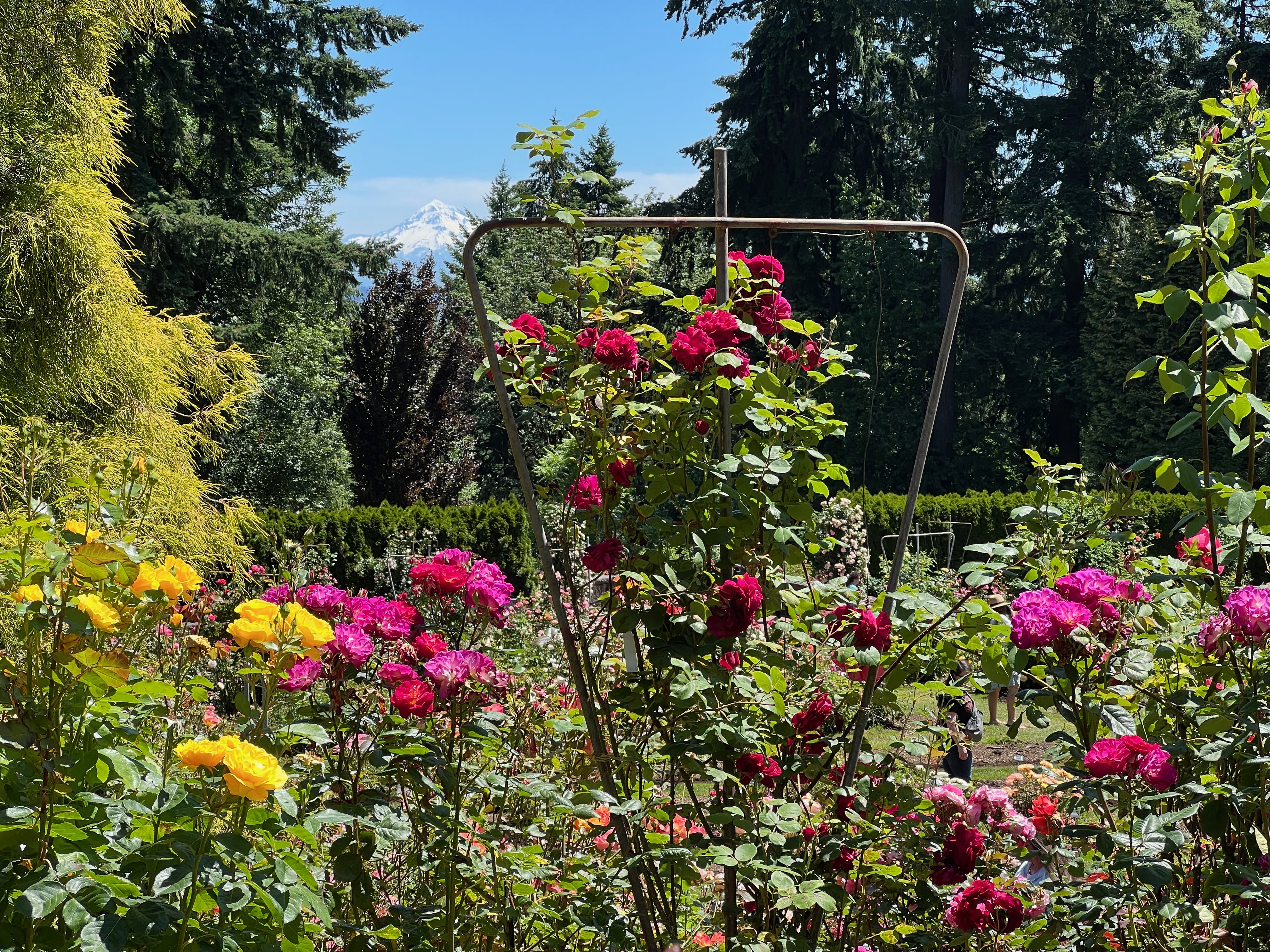
The rose garden in Portland, Oregon, “borrows” distant Mt. Hood for this view.
[i] Tan Twan Eng, The Garden of Evening Mists, (New York: Weinstein Books, 2012), 25.
[ii] Cited in Roy Strong, A Celebration of Gardens (Portland, OR: Sagapress/Timber Press, 1992), 105-106.
[iii] Diana Ketchum, Le Desért de Retz: A Late Eighteenth-Century French Folly Garden (Cambridge, MA: MIT Press, 1997), cited in Susan Stewart, The Ruins Lesson: Meaning and Material in Western Culture (Chicago: University of Chicago Press, 2020), 224.
[iv] Christopher Woodward, In Ruins (New York: Pantheon Books, 2001), 158.
Balthasar van Cortbemde, The Good Samaritan (1647).
Jesus’ parable of the Good Samaritan (Luke 10:29-37) is usually heard as a reminder to care for the needs of others, including strangers or even enemies. That’s why some hospitals have taken their name from the protagonist. I myself was born in the Episcopal Hospital of the Good Samaritan in Los Angeles and, four days before my 22nd birthday, my father died in the Intensive Care Unit of the same “Good Sam.” So this parable carries some special meanings for me.
We all hope to be like the Good Samaritan, but the late Doug Adams, an extraordinary friend and professor of Religion and Art at the Pacific School of Religion in Berkeley, proposed an alternative reading of the parable. Instead of asking us to identify with the Good Samaritan, he wondered, what if Jesus wants us to identify with the man in the ditch?
The Samaritan is the person with all the power in the situation. He has a donkey, oil and wine, enough extra clothing to make bandages, the strength to lift the wounded man onto the donkey, and money to pay for the man’s medical care. He gives, most admirably, out of his own abundance.
But the naked, beaten, half-dead man in the ditch has no power. He has no capacity or ability to help himself. He is entirely dependent on the kindness of strangers. And who is the one who stops to help him? Not the priest, not the Levite, not one of his own kind, but a Samaritan. For a Jew, including everyone in Jesus’s original audience, a Samaritan was a bad person, a despised enemy.
Now you don’t need to understand the history of the cultural and religious enmity between Jews and Samaritans to grasp Jesus’ point here. Think of anyone of whom you disapprove, or someone you have a difficult history with. If you are lying helpless in the ditch, you don’t get to be selective about your rescuer. You have to accept their help, even if they happen to be your worst enemy. And that would mean you’d have to change your mind about them and, like it or not, be in relation with them.
Remember the question that prompted Jesus to tell this parable: “Who is my neighbor?” And the answer turns out to be: Everybody! In God’s alternative version of reality (which the gospels call the Kingdom), everyone—even my enemy—is my neighbor.
When I first heard Doug talk about this parable, it was during the first Gulf War. “Imagine you are lying helpless in that ditch,” he said, “and down the road comes Saddam Hussein. When he sees you, he bends down, offers his hand and says, “Can I help you out of the ditch, brother?”
Today we might substitute Vladimir Putin for the Samaritan to experience the same radical discomfort that Jesus’ first listeners must have felt when they heard the parable. Or suppose the person in the ditch is a white supremacist, and the Samaritan is a person of color? What if the victim is homophobic, and the rescuer is gay? What if a misogynist is the helpless one, and a woman comes by? What if it’s a Progressive in that ditch, and along comes a Proud Boy?
Do you find any of these scenarios unsettling? Parables are meant to be hard. They are meant to break us open.
And as I listen to this parable in the Year of Our Lord 2022, it strikes me that America itself is in the ditch, wounded by its sins, torn by its conflicts, half-dead from innumerable unaddressed ills. White supremacists and so-called “Christian” nationalists seek a cure in the subjugation or even the elimination of those they consider to be “other”—that is, those who are “not our kind,” whether that be people of color, the LGBTQ community, empowered women, Muslims, Central American refugees, nonwhite immigrants, or whomever. That way lies madness and death.
If we are ever to be delivered from the ditch of our own national folly and sin, we desperately need the help of the “other”—the ones whose race, religion, class, gender and life experiences are different from our own. We need to listen to their voices, their perspectives, their pain, their anger, their sorrows, their hopes, their dreams. We need not only to learn from them and be taught by them; we need to receive their stories into our hearts. Otherwise, we’re just going to stay stuck in that ditch.


























 The religious imagineer