“For God so loved our stories” — Tales from the Easter Vigil

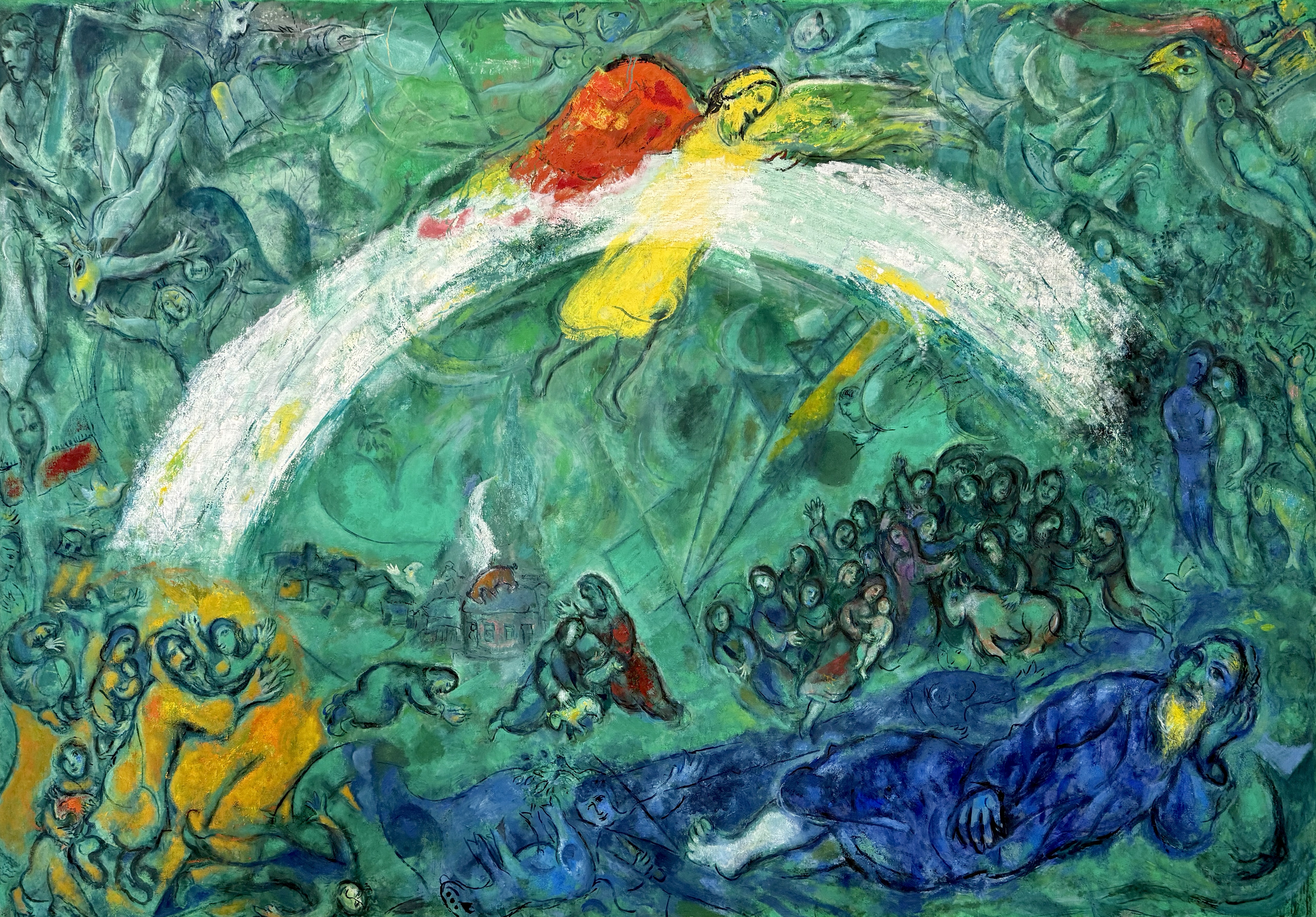
Marc Chagall, Noah and the Rainbow (1961-66)

How blessed is this night, when earth and heaven are joined …

— The Exultet [i]

The Easter Vigil is the molten core of Christian worship: a multisensory passage from darkness to light, death to life. With fire and water, stories and prayers, hymns and chants, candles and incense, bread and wine, it is the most luminous and wondrous of liturgies. The morning rites of Easter Sunday celebrate Resurrection, but the Easter Vigil on the night before feels almost like Resurrection itself. When it’s over, you come away a little dazed, wondering “oh what is that beautiful thing that just happened?” [ii]

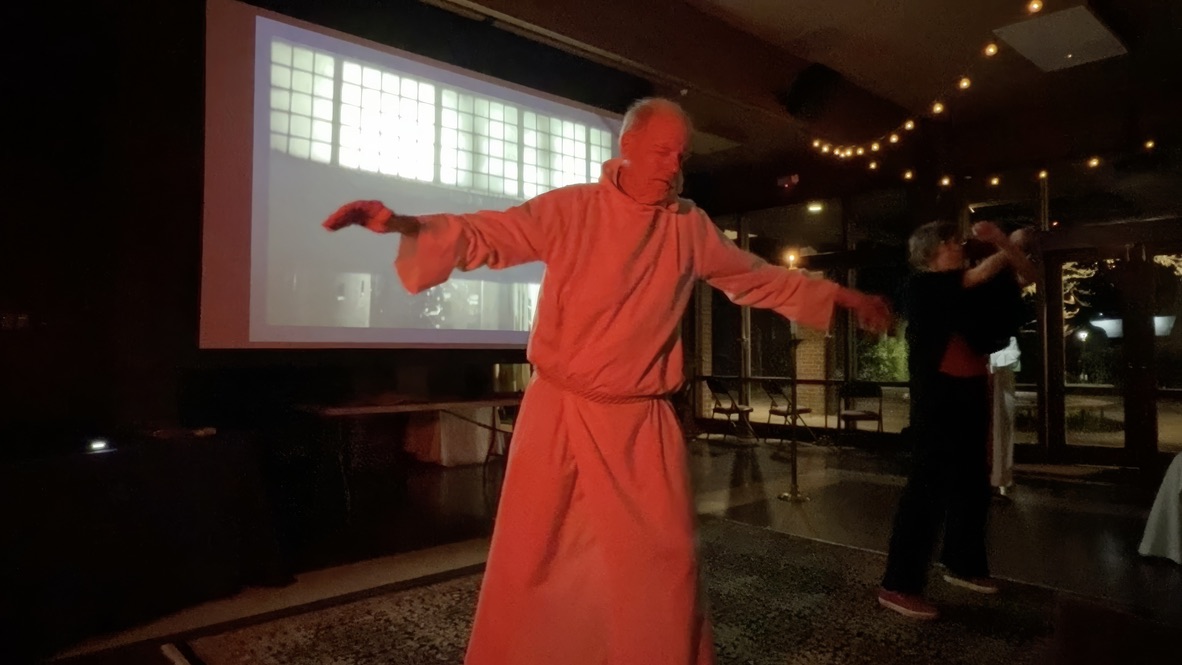
After the New Fire is lit at sunset on Holy Saturday, one of the first things that happens at the Easter Vigil is the recitation of narratives and prophetic texts [iii] from the Hebrew Scriptures, beginning with the Creation story (Genesis 1:1—2:4a). In most churches, the texts are read from a lectern, but for nearly four decades, in a dozen different West Coast churches, I have curated the performance of the Vigil lectionary using drama, storytellers, music and projected media.

There’s nothing wrong with a well-read passage of canonical text—I’m quite fond of a good reading by a practiced and thoughtful voice—but sometimes a telling or dramatization can reach places which a reading cannot. Instead of a reader as a passive, transparent window for a sacred text to pass through without inflection or distortion, a teller embodies the text in breath, intonation, gesture and movement, making it alive and present and urgent in the moment of its speaking. And a dramatization can make a familiar story be freshly encountered. A story told or performed rather than read has a unique kind of authority, coming from the heart instead of a book.

The Easter Vigil is the Christian dreamtime, and we try to engage its lectionary accordingly. Biblical stories aren’t just memories about the past. They are living words meant to guide and shape our own responses to the present. As we become steeped in the stories, they begin to dwell in us, and we in them.

When we hear of the world drowning in its own evil, while a faithful remnant tries to navigate the sea of chaos, we recognize ourselves aboard the ark. When we hear of an evil regime trying to crush the ones who are “not like us,” the deliverance of the oppressed at the Red Sea encourages our own struggle to break free of the dark. When we hear of dry bones resurrected by divine breath, our own dead hopes begin to breathe again.  

In the darkest days of the Second World War, W. H. Auden wrote a “Christmas Oratorio” [iv] which had no illusions about the world into which God was made flesh:

The evil and the armed draw near;
The weather smells of their hate
And the houses smell of our fear …

Such days are upon us again, and we truly need our sacred stories—the ones that remember divine intention and a habitable future—more than ever. At our Episcopal parish of St. Barnabas on Bainbridge Island, Washington, where my wife is the rector, I’ve been developing fresh versions of the stories, listening carefully for whatever they want to say to us in the year of our Lord 2025.

We will begin with a pair of texts projected on a screen after the ancient Exultet is chanted. The first says, For God so loved our stories. This is of course a blend of Elie Wiesel’s “God made man because he loves stories” and John 3:16’s “For God so loved the world …” The theology of Incarnation says that God’s own self entered fully into the human story. And the theology of salvation says that we in turn are meant to participate in the divine story. Both meanings are implied in the preface to our Vigil story time, grounding the performed narratives in the conviction that we can meet God in them.

The second text is a verse from Jeremiah (29:11): For surely I know the purpose I have for you, says the Holy One: plans for peace and not for evil, to give you a future and a hope. At a time when our future is in question and hope is stretched thin, God invites us to sit around the Paschal fire and let the stories of promise speak to our hearts once more.

Here is how the telling will go at this year’s Paschal fire:

The Creation: After the voice of e.e. cummings says, “When God decided to invent everything, he took one breath bigger than a circus tent, and everything began,” a big screen lights up with spectacular footage of the natural world, taking us through the first seven days in seven minutes. In response, the congregation is urged “to pray fervently for all the people of the earth, and for ourselves, that we may repent of our careless and arrogant abuse of creation, and find our proper and constructive place within its fragile and balanced harmonies.”

The Flood: Four people at a table engage in Bible study. Some of them resist the story (“Why do we even tell this story? No one wants to believe in an angry God” … “In the beginning, God says everything’s so great. Then suddenly he wants to call the whole thing off?”). Others see a kind of learning going on—God learning to live with an imperfect creation. Then somebody argues that the story is not really about God’s choices or God’s emotional life. It’s about the ark.

“The people who first told this story were just like us. They were adrift in a sea of chaos. Everything they had hoped and believed was underwater, washed away in the blink of an eye, and they wanted to know if they still had a future.”

As the discussion winds down, someone says, “Well, I’d better go feed the animals.” Wild waves appear on the screen behind them. It turns out that they have been on their own ark the whole time. The story they were discussing was happening to them. That’s often true of Bible stories.

The exhortations to prayer that follow each story reiterate the themes of the narrative. After The Flood, the Presider reminds the assembly that “God remains deeply committed to our story … God will not forget us, though we be sinking in a sea of chaos.” And the Deacon bids us pray for victims of natural disasters, all whose lives are beset by chaos, those drowning in the dark waters of doubt and fear, and those who cling to the precious ark of faith.

The Red Sea:

Noirish images of anonymous figures (from a bleak Hungarian film) shuffle through an imprisoning corridor on the screen, while three dancers on the stage express the experience of oppression with their bodies. A narrator explains:

Three thousand years ago, in the land of Egypt,
there were people who had no name.
They were the faceless many,
exploited by the powerful,
forgotten by the privileged: slaves, immigrants, the poor,
the homeless, the vulnerable, the invisible, the outcast.

Then dismissive terms for the oppressed appear on the screen in stark animated graphics: Not like us … worthless … horrible people … trash … less than human. More images of “the faceless many” are shown as the dancers writhe in despair and an offstage choir sings a verse of “Go down, Moses.”

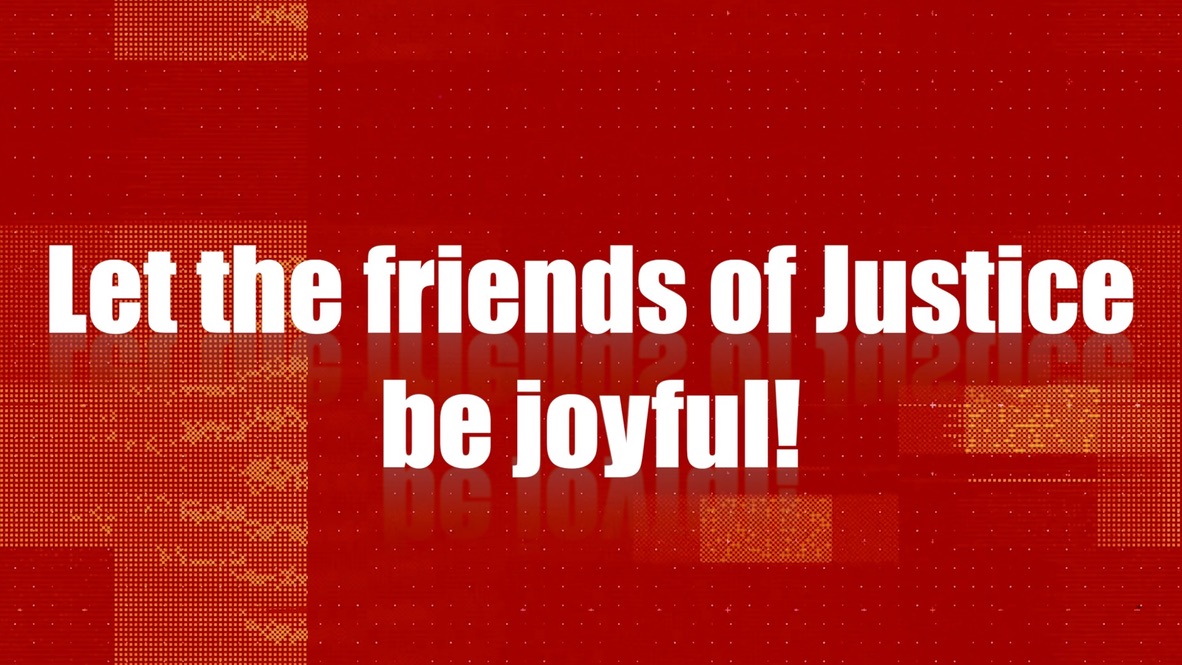
Suddenly, the divine breaks into this dark world: the screen flashes red, and we see the words from Psalm 68 that are always used in Orthodox Paschal liturgies:

Let God arise!
Let the foes of Love be scattered!
Let the friends of justice be joyful!

Then we hear a verse of a Civil Rights song: “They say that freedom is a constant struggle … Oh Lord, we’ve struggled so long, we must be free.” The dancers’ bodies shift from oppression to liberation, while the screen shows powerful footage of crowds on the march for justice. As we hear a repeating loop of Martin Luther King saying “We cannot walk alone,” the dancers begin their own march across the stage to the “Red Sea,” where they halt while the narrator declares:

This too is a creation story:
On this day, God brought a new people into existence.
On this day, God became known as the One who delivers the oppressed,
the One who remembers the forgotten and saves the lost ,
the One who opens the Way through the Sea of Impossibility,
leading us beyond the chaos and the darkness into the Light.
When the world says No, the power of God is YES!

As the dancers begin to cross the Sea, the choir sings, “We are not alone, God is with us …”
After the song, the bidding to prayer begins:

Pray now for the conscience and courage
to renounce our own complicity
in the workings of violence, privilege and oppression.
Pray in solidarity with all who are despised, rejected,
exploited, abused, and oppressed.
Pray for the day of liberation and salvation.

The Fiery Furnace: This story from the Book of Daniel is borrowed from the Orthodox lectionary for the Paschal Vigil, and its humor (yes, the Bible can be funny) provides some comic relief after the Red Sea. The story’s mischievous mockery of a vain and cruel king, outwitted in the end by divine intention, feels quite timely. The idol shown on the screen is a golden iPhone, which will be destroyed by a cartoon explosion from Looney Tunes. The humorously tedious repetition of the instruments signaling everyone to bow is performed with the following (admittedly unbiblical) instruments: bodhran, bicycle horn, slide whistle, chimes, train whistle, and Chinese wind gong. The Song of the three “young men” in the furnace is recited by three women in an abbreviated rap version. At the end, the cast of twelve exit happily, singing the old Shape Note chorus, “Babylon is fallen, to rise no more!”

The Fall of Babylon, Tapestry of the Apocalypse, Angers, France (1377-1382).

Then we give thanks “for the saints who refuse to bow down to the illusions and idolatries of this world” and pray for “the grace and courage to follow their example, resisting every evil, and entrusting our lives wholeheartedly to the Love who loves us.”

Valley of Dry Bones: Unlike the embellished retellings of the other stories, this one sticks closely to the biblical text, but is delivered in a storytelling mode by a single teller (me) in a spooky atmosphere of dim blue light. The voice of God is a college student on a high ladder. The sound of the bones joining together is made by an Indonesian unklung (8 bamboo rattles tuned to different pitches). When the story describes the breath coming into the lifeless figures sprawled across the valley, I get everyone in the assembly to inhale and exhale audibly a few times so that we can hear the spirit-breath entering our own bodies. Then I move among them, bidding one after another to rise until everyone is standing, completing the story with their own bodies: the risen assembly itself becomes a visible sign of hope reborn.
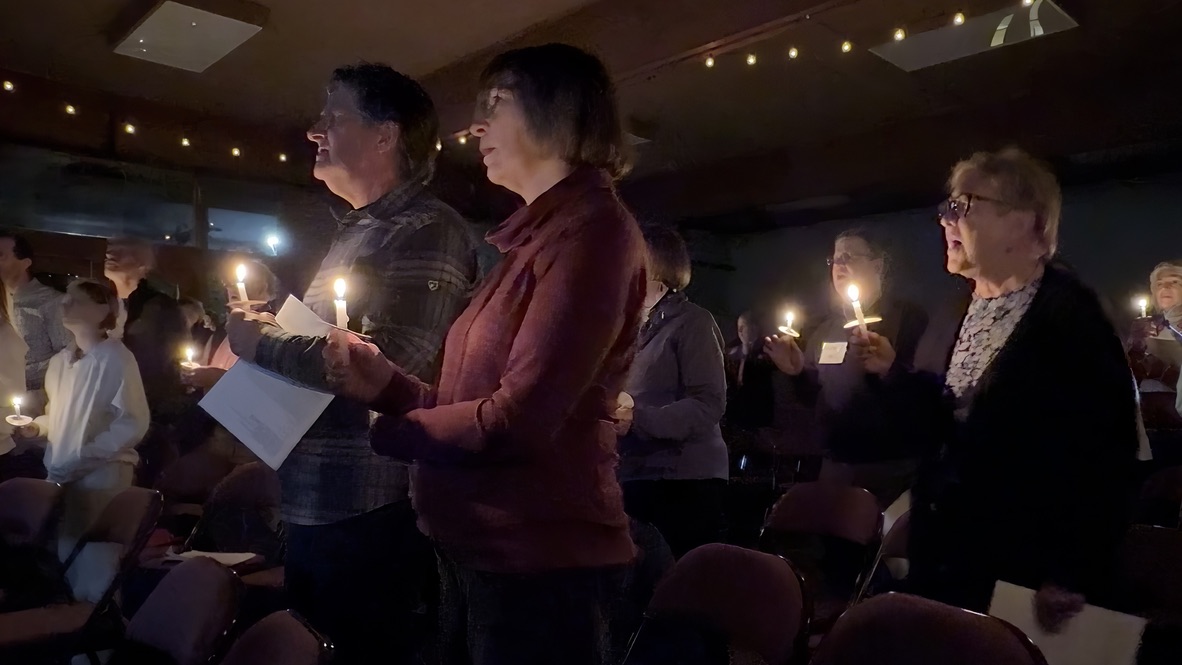
Then the Presider says,

Dear People of God: There are those who tell our story as a history of defeats and diminishments, a narrative of dashed hopes and inconsolable griefs. But tonight we tell a different story, a story that inhales God’s own breath and sings alleluia even at the grave. By your baptism, you have been entrusted with this story, to live out its great YES against every cry of defeat.
And then, with our sacred stories of faith and hope freshly written on our hearts, we will process from the Story Space to the church for the Renewal of Baptismal vows, followed by the festive first eucharist of Easter, replete with Alleluias. And God willing, by the time it’s all done, none of us will be the same.

May all of you who make the Paschal journey this weekend come to “see and know that things which were cast down are being raised up, and things which had grown old are being made new, and that all things are being brought to their perfection by the One through whom all things were made, our Savior Jesus Christ.” [v]

Resurrection of Christ, Brittany (c. 1425-1430).


All liturgical texts, unless otherwise cited, are by the author.
The Easter Vigil at St. Barnabas Episcopal Church (Bainbridge Island, WA) is on April 19, 2025.

[i] The Exultet (“rejoice”) is a chanted praise sung before the Paschal Candle at the Easter Vigil. Dating back to the 7th or 8th century, it is one of the most beautiful chants in the western rite, and its text is packed with striking images and metaphors of Christ’s passage through death to resurrection, and its implications for our own salvation. Singing it at the Vigil has been one of my greatest priestly joys over the years.

[ii] The line is taken from Mary Oliver’s poem, “At Blackwater Pond.”

[iii] The Vigil lectionary is not all stories. Beautiful texts from Isaiah, Baruch, Ezekiel, and Zephaniah are options as well. During the “Story Time” of the Vigil, we stick to the narratives. The non-narrative texts are then recited by readers along the way between the Story Space and the church, so that the people process through a corridor of continuous audible texts on their way to the font of rebirth.  

[iv] W. H. Auden began writing For the Time Being: A Christmas Oratorio in the autumn of 1941. It was published in September, 1944). Dark times indeed.

[v] Quoted from the collect (prayer) that concludes the Old Testament readings in the Episcopal Book of Common Prayer.

“Let’s do it for the story”: A Farewell to Angela Lloyd

Storyteller Angela Lloyd

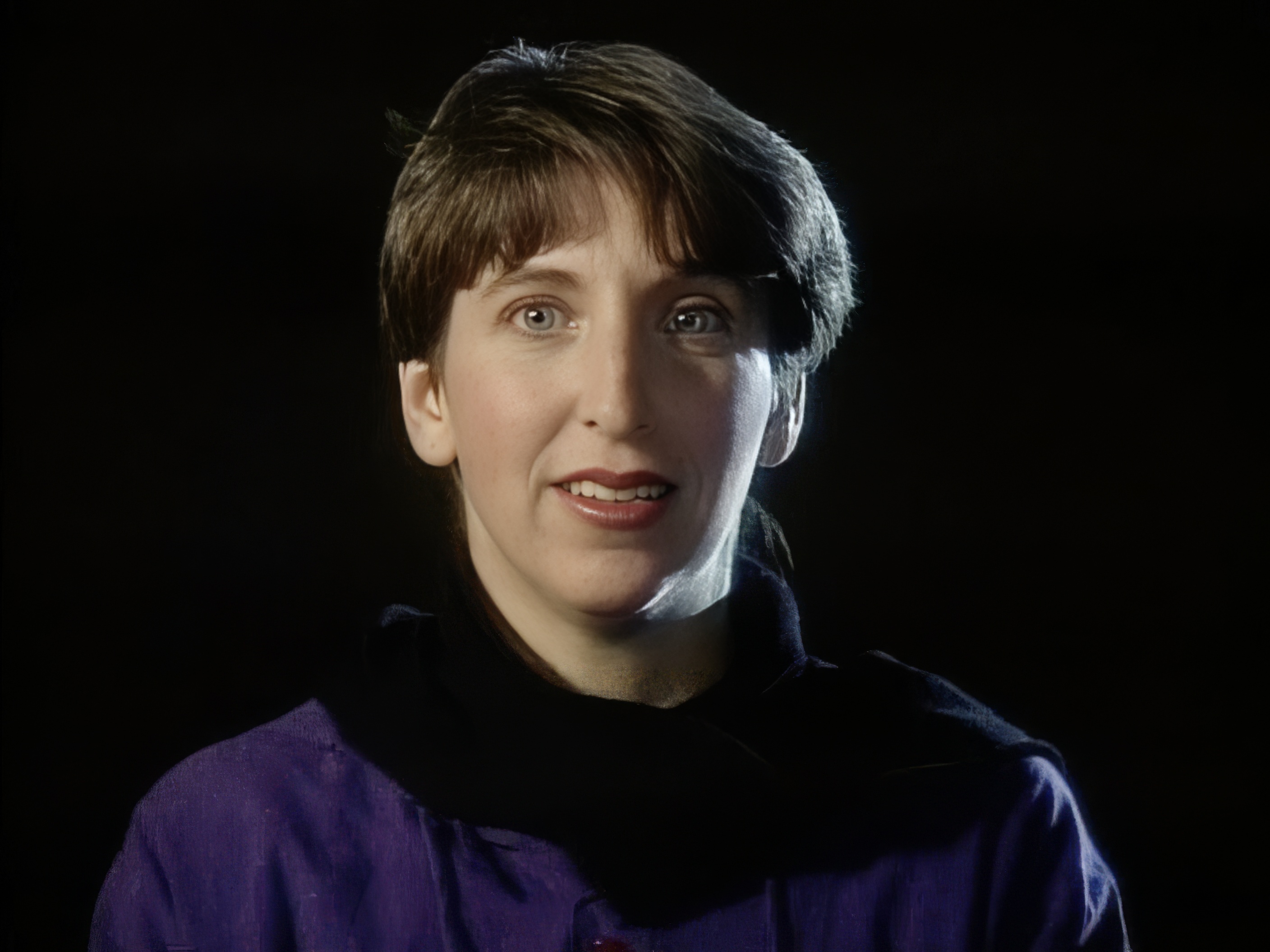
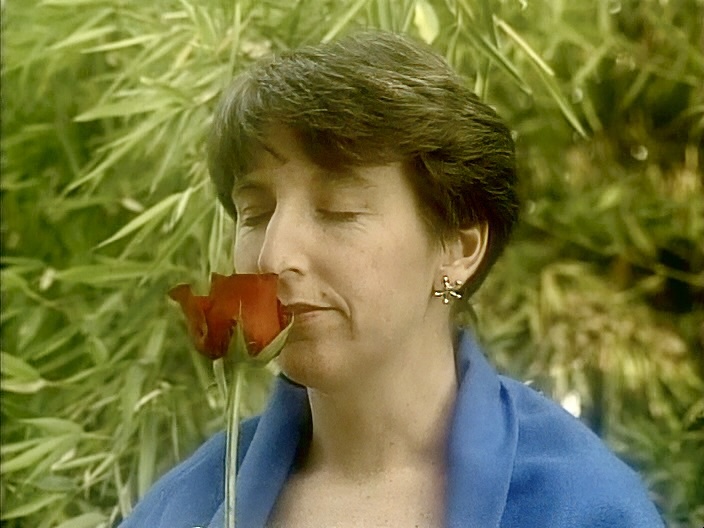
Once upon a time, a brilliant storyteller came into the world to touch countless hearts with tales of wisdom and wonder, losing and finding, tears and laughter. She scattered her life-giving stories far and wide, and encouraged others to do the same. She knew the power of stories to bind us together, ground us in communal wisdom, and help us imagine better futures. Hers was a serious vocation in a world so forgetful of the stories we need, the stories that nourish, the stories that save. But she always lived out her calling with levity and lightness. Everyone who has known her remembers her laughter, her joy, her delight in daily blessings, her generous and irrepressible spirit. As she liked to put it, she was “subject to bursts of enthusiasm.”

Desert dawn at Angela’s house (December 17, 2024): Looking west, looking east.

A week before Christmas, master storyteller Angela Lloyd was up at dawn, photographing the beauty of the California desert sky. She posted two photos with a greeting to her friends: “Good morning. The view from here: looking west, looking east.” She loved sharing the beauty of her desert home. But sometime after that glorious morning she was taken ill, and not long after, on the twelfth day of Christmas, Angela departed this life. When I got the news today, the world felt suddenly washed with grey, bereft of her bright presence.

I came to know Angela nearly 40 years ago, when we worked together on creative retellings of Old Testament stories for the Easter Vigils at Christ Church, an Episcopal parish in Ontario, California. We both believed that God is not known through ink so much as through breath. Without the breath of a spirited teller, our sacred stories may lie dormant and listless.

After a few years we made a film of the stories, The Electronic Campfire: New Storytelling from Scripture. Angela took some of the parts (including that of God), while I took the rest. We shot the scenes in various southern California locations.

When I heard that Angela had died, I wanted to celebrate her giftedness by sharing her work in this film. While throughout her life she told many different kinds of stories from a variety of sources and traditions, our biblical collaborations do convey, I believe, a lively sense of the engaging spirit she brought to everything she did. I offer these clips in her memory.

On the third day of Creation, God creates plants and trees.

The first is the Creation story from the first chapter of Genesis. Instead of speaking the divine words for each of the seven days (“Let there be light,” etc.), God performs an action, since in the Bible God’s word is not just description of an action, but the action itself. For God, to say is the same as to do.

The Creation Story from The Electronic Campfire

Angela’s other stories in the film were the Red Sea and the Valley of the Dry Bones. In the first story, I play the Israelites, so you’ll see a bit of that as a lead-in to Angela’s performance of both Yahweh (God) and Miriam (Moses’ sister). The Dry Bones story is all Angela, including some of her riffs on the washboard. She improvised a line the Exodus tale which, in retrospect, sums up her life: “Let’s do it for the story.”

Red Sea & Dry Bones from The Electronic Campfire

At the Easter Vigil, there is a bidding to prayer after each story. Here are the words which follow the story of the Divine Breath that ceaselessly enlivens our “dry bones”—in this world and the next:

Dear People of God:
There are those who tell our story
as a history of defeats and diminishments,
a narrative of dashed hopes and inconsolable griefs.
But tonight we tell a different story,
a story that inhales God’s own breath
and sings alleluia even at the grave …

The sixth day: “Let us make humankind in our image.”

We did a number of Easter Vigils together, and Angela would always surprise me with a new variation. One time, playing an Israelite in the Exodus, she pulled out a postcard. “I was planning to mail this when we got to the Promised Land,” she said, “but something tells me I should mail it now. It may be a while before we get there. Besides, I’m starting to think that maybe anywhere can be the Promised Land, that even in this wilderness I am standing on holy ground.”

Thank you, dear Angela, for your marvelous stories, your enthusiasm, your joy, and so much more. There’s an old song by Jane Voss that salutes absent friends, and what the song says, that is what I say:

Wherever you may be tonight,
I hope this finds your burdens light,
Your purpose high, your spirit strong,
I hope that you have got along—
My song was lost and gone, if not for you.  

The Spirit That Moves Us All: A Pentecost Reflection

Piero di Cosimo, Incarnation (detail), 1500-1505. “Holy Ghost over the bent / World broods with warm breast and with ah! bright wings.” (Gerard Manley Hopkins)

In spite of all the destructive forces [we] let loose against life on this planet, the Spirit of Life is at work in ever new and unforeseeable ways, countering and circumventing the obstacles we put in its path. In spite of my strong tendencies to complacency and despair, I experience the Spirit in myself as calling forth the realistic hope apart from which there is no hope, and I am confident that what I find in myself is occurring in others also … what makes for life and love and hope is not simply the decision of one individual or another but a Spirit that moves us all. 

— John Cobb [1]

Of perfect love thou art the ghostly flame.
Emperor of meekness, peace and tranquility,
My comfort, my counsel, my perfect charity,
O water of life, O well of consolation,
Against all storms of hard adversity …

— 15th century English lyric 

On the fiftieth day of Easter, our liturgical prayer addresses the Holy Spirit more than on any other day. Most of the time our words of supplication and praise address an “other” who is metaphorically outside or beyond: God, Jesus, Father, Mother …. But the dominant prayer of Pentecost calls upon the most obscure and elusive of the divine “Persons”—One who is not “out there” but “in here.”

Veni Sancte Spiritus. Come, Holy Spirit.

The tricky thing about such a prayer is that it is not prayed to the Spirit. It is prayed in the Spirit and by the Spirit. The Spirit is not the object of our prayers, but the subject, dwelling within our inmost parts more surely and substantially than the transitory, constructed “I” produced by the particular confluence of history, biology, and personality which has sculpted our individuality over time. When truth speaks through us, when our energies are directed toward the well-being of all, when our lives are written and rewritten as narratives of divine love, the Spirit isn’t just in us—the Spirit is us. 

This is to claim nothing for ourselves. Only those driven by unholy spirits make that mistake. Participation in the divine reality—life “in the Spirit”—is always a matter of giving yourself away, becoming part of something larger. The Holy Spirit’s proper name is communion. When we’re in the Spirit, that’s our name too.  

Compared to writings about “God” and “Christ,” theological expositions on the Holy Spirit can seem relatively thin. The early creeds didn’t have much to say either, making the Spirit seem like an afterthought—oh yeah, and the Holy Spirit too. But this isn’t due to neglect so much as it is to the Spirit’s way of disappearing into the world as anonymous giftedness. As Orthodox theologian Vladimir Lossky put it: 

“[T]he Holy Spirit effaces himself, as Person, before the created persons to whom he appropriates grace … He mysteriously identifies himself with human persons while remaining incommunicable. He substitutes Himself, so to speak, for ourselves.” [2]

Canadian poet Margaret Avison addresses the Spirit’s indescribability in her poem “… Person or A Hymn on and to the Holy Ghost.” 

How should I find speech 
to you, the self-effacing
whose other self was seen
alone by the only one,

to you whose self-knowing
is perfect, known to him,
seeing him only, loving
with him, yourself unseen?

Let the one you show me
ask you, for me,
you, all but lost in
the one in three,

to lead my self, effaced
in the known Light,
to be in him released 
from facelessness,

so that where you 
(unseen, unguessed, liable
to grievous hurt) would go
I may show him visible.

The poem’s profusion of pronouns makes it hard, at first, to tell which divine Person is doing what. “You” is clearly the Holy Spirit, but who is “him?” Is it Christ, or the Father, or God in general who releases us from “facelessness,” or whom we ourselves make visible in the practice of holy living? The “unseen, unguessed” Spirit may be “all but lost in / the one in three,” but without it (or him, or her, or they), Love Divine could not do its proper work in the world and in the heart.

O fiery Spirit, come burn in us.
O sacred breath, come breathe in us.
O blazing love, come flame in us.…
O delight of life, come live in us. [3]

This past year has generated its share of anxiety, fear, madness and grief, but as John Cobb reminds us, “the Spirit of Life is at work in ever new and unforeseeable ways, countering and circumventing the obstacles we put in its path.” It is in this Spirit that I have shaped my retelling of Ezekiel’s vision in the Valley of Dry Bones (see video below). When the divine breath comes into the lifeless bodies, I layer multiple inhalations and exhalations to make a chorus of breaths. For me that collective sound symbolizes the Spirit’s fierce resistance to every power that would silence and choke us. As the Psalmist says, You send forth your Spirit, and the people are created; and so you renew the face of the earth (Psalm 104:31).


[1] Cited in Marjorie Suchocki, “Spirit in and through the World,” in Suchocki and Joseph A. Bracken, S.J., Trinity in Process: A Relational Theology of God (New York: Continuum, 1997), 180. And yes, masculine pronouns are problematic. Depending on the language, Spirit has been feminine and neuter as well. Do you think She minds?

[2] Vladimir Lossky cited in Paul S. Fiddes, Participating in God: A Pastoral Doctrine of the Trinity (Louisville, KY: Westminster John Knox Press, 200), 261.

[3] Jody L. Caldwell, after Hildegard of Bingen, in Voices Found (New York: Church Publishing, 2003), #62.

Fireworks and Stories: Creativity Aboard the Easter Vigil

Noah’s Ark: Fresco, Abbey Church of Saint-Savin-sur-Gartempe, France (c. 1100).

My sister Martha Stevens is a marvelous storyteller. It was her profession for a long time, as she traveled far and wide to hold listeners spellbound with tales from many centuries and cultures. In the late 1980s, inspired by her work, I began to foster retellings of biblical narratives at the Easter Vigil—Creation, Flood, the Binding of Isaac, the Red Sea and the Valley of Dry Bones. Over the years, these Vigil retellings expanded to include theater and multimedia as well as individual storytellers. 

Although I have curated creative Easter Vigils with story teams in a wide variety of parishes over the years, I began with an 8-year stretch at Christ Church, an Anglo-Catholic parish in Ontario, California. When I introduced the storytelling component in 1988, the church already had a famously distinctive practice for welcoming resurrection. 

While a joyful noise is customary in most churches after the first shouts of “Christ is risen,” this usually means the ringing of bells and the organ’s roar. But to these were added not only dozens of wind chimes placed within the reach of every worshipper, but the boom and blaze of fireworks. After his first experience of the Christ Church Vigil in 1989, visitor David Trowbridge wrote down his impressions. His description of the fireworks reflects the assembly’s collective astonishment in that moment:

“Well, at this point, everybody for at least three miles in every direction who wasn’t awake woke up and knew that it was Easter again at Christ Church. There was a shattering explosion from the courtyard [visible through the nave’s glass wall] as the first of at least 10,000 LARGE firecrackers went off. Then the pinwheels, then the Roman candles, and then the 10-foot high cross in red fireworks with blue fireworks (representing the water of baptism) underneath. Everybody started laughing and exclaiming and jumping up and down, but nobody could hear anything. 

“The contrast between the mystical beauty of the Kyrie just before and the almost orgiastic release of the fireworks was exactly right—nothing I have ever experienced has so truly expressed the joy and release that Christians should feel in celebrating the mystery of the empty tomb. We tend to take the story for granted, but at Christ Church, the noise and the excitement made it all new again, and we all felt, for a few minutes, a little of the unbelieving excitement that the disciples must have felt that first Easter Day, when they found that He, first of all [human beings], had conquered death.”[i]

The previous year, I had approached the church’s longtime rector, Jon Hart Olson,[ii] about adding storytelling to the Easter Vigil. Jon, a brilliant theologian, exquisite liturgist, and a generous encourager of my own priestly imagination, welcomed the chance to offer fresh versions of the old stories. The people of Christ Church embraced the idea as well, and it became part of their annual tradition. When I had a chance to revisit their Vigil 20 years after leaving the parish, I was delighted to see the creativity continuing, as Dry Bones came to life in the form of two break dancers in skeleton suits. As they gyrated beneath a blacklight, all we could see in the dark was their dancing bones.[iii]

In his account of the 1989 Vigil, Trowbridge found the storytelling as compelling as the fireworks: 

“The priest who told the story of Noah and the Ark was especially entertaining. At one point, describing the animals boarding the ark two-by-two, he named about 100 animals in alphabetical order … He described how cranky and bored everyone got on the Ark, and how Noah organized singalongs for the animals. At this point he got everyone making their favorite animal noises all together. Pandemonium! I was screaming like a chimpanzee, which seemed to provoke the rector, who was sitting nearby, into a fit of laughter. At the end of the reading, the [storytelling] priest unfurled a long cloth rainbow across the room …

“After the [fireworks], the Eucharist proceeded as usual, or so we thought, but there was one more surprise in store for us. At festal Eucharists, it is customary to read the Gospel lesson with much ceremony. The Bible is carried from the altar, the deacon who is to read it is blessed by the priest, it’s carried out into the midst of the congregation with candles and incense … and so it was here. Then, as is customary, the deacon lifted up the Bible and intoned, ‘The Holy Gospel of our Lord Jesus Christ, according to Luke,’ and we all responded, ‘Glory to You, Lord Christ.’

“And the back door of the church swung open with a loud crash, and a disheveled woman in a purple sweater and black pants rushed in! She shouted, ‘Sit down, all of you,’ and pushed her way to the front, rudely shouldering aside the deacon with the Bible. ‘Sit down! I’ve got something important to say.’

“At this point, I’m sure many people (I know I was) were thinking that one of Ontario’s street people had crashed the service. After a long moment of embarrassment and that ‘what should I do? … should I do anything?’ feeling, the woman identified herself. It was Mary Magdalene, who told us, in the vernacular, instead of in the elevated style of the Bible, what happened when she went to the tomb that morning to prepare Jesus’ body for burial. What a way to hear the Gospel! It was like hearing it for the first time.”

I do wish there were more storytelling in church. There’s nothing wrong with a well-read passage of canonical text—I’m quite fond of a good reading by a practiced and thoughtful voice—but sometimes a telling can reach places which a reading cannot. Instead of a reader as a passive, transparent window for a sacred text to pass through without inflection or distortion, a teller embodies the text in breath, intonation, gesture and movement, making it alive and present and urgent in the moment of its speaking. A story told rather than read has a unique kind of authority, coming from the heart instead of a book. God is not ink. God is breath. 

Not everyone is prepared for the energy—and occasional lack of decorum—of good storytelling in church. But many find it engaging, even revelatory. Dennis Dewey,[iv] a brilliant storyteller, is careful to deflect the inevitable praise evoked by his creative delivery of Bible stories: “You make the Bible come alive!” people tell him. “No,” he says. “The Bible already is alive. I just try not to kill it.” 

At this year’s Easter Vigil, pandemic protocols were still in place, so we were streaming the liturgy. For the Flood story, I solicited participation by asking parishioners to send me videos of themselves entering the ark (their front door) and staring out the ark’s portholes (their front window). Since we have all been on our separate arks for the past year, I wanted to acknowledge the challenge of our collective pandemic experience, while affirming our enduring faith in the rainbow promise. We’re in the story, and the story is in us.

I added voice-over to the submitted clips, and inserted a segment from a video of my Vigil stories, The Electronic Campfire: New Storytelling from Scripture (1991), made in collaboration with the amazing storyteller Angela Lloyd.[v] I hope you enjoy this short video, “The Flood and the Ark.” Even more, I hope you will be inspired to explore storytelling—and storylistening—within your own faith community. 


[i] David Trowbridge, unpublished manuscript (April 1989). David’s wife Nancy sent me this writeup at the time, encouraging me to share it “here and there if you wish.” It only took me 32 years to do so. My memories from several decades of creative Easter Vigils tend to conflate and become less true as memory simplifies and smooths out the details, so I am happy to possess this vivid firsthand impression from an attentive observer having the Christ Church Vigil experience for the first time. 

[ii] The Rev. Jon Olson preached at my ordinations to the Diaconate and the Priesthood, and taught me so much about liturgy and spirituality. He was the kind of friend who kept you up well past midnight with luminous (and hilarious) conversations. I cast him as Lazarus in my 1970s film The Investigation, which explores the Jesus story in a modern setting. I will always be grateful that Jon gave this itinerant priest an abiding place of welcome in the unique community he served at Christ Church. 

[iii] The break dancers were young men, part of the parish family, who danced professionally at Disneyland. They raced to the church after work to perform Dry Bones (those Vigils started at 9 p.m. and went past midnight). The teller of the story spoke, unseen, from the balcony at the back of the church, while the skeletons danced before the altar. 

[iv] I had the pleasure of taking a workshop in biblical storytelling from Dennis Dewey. Find his website here: https://sacredstoryjourneys.wordpress.com

[v] The Electronic Campfire, not currently available on disc, may be seen here: https://youtu.be/sDDdSKFSWoE   Angela Lloyd is not in the Flood story, but is featured in most of the others. Angela took part in most of my Christ Church Vigils. She is not to be missed (“a combination of Maria von Trapp, Mary Poppins, and Tinkerbell”—Donald Davis). For her website: https://www.angelalloyd.com

Words and Memories: Recollections on My Birthday

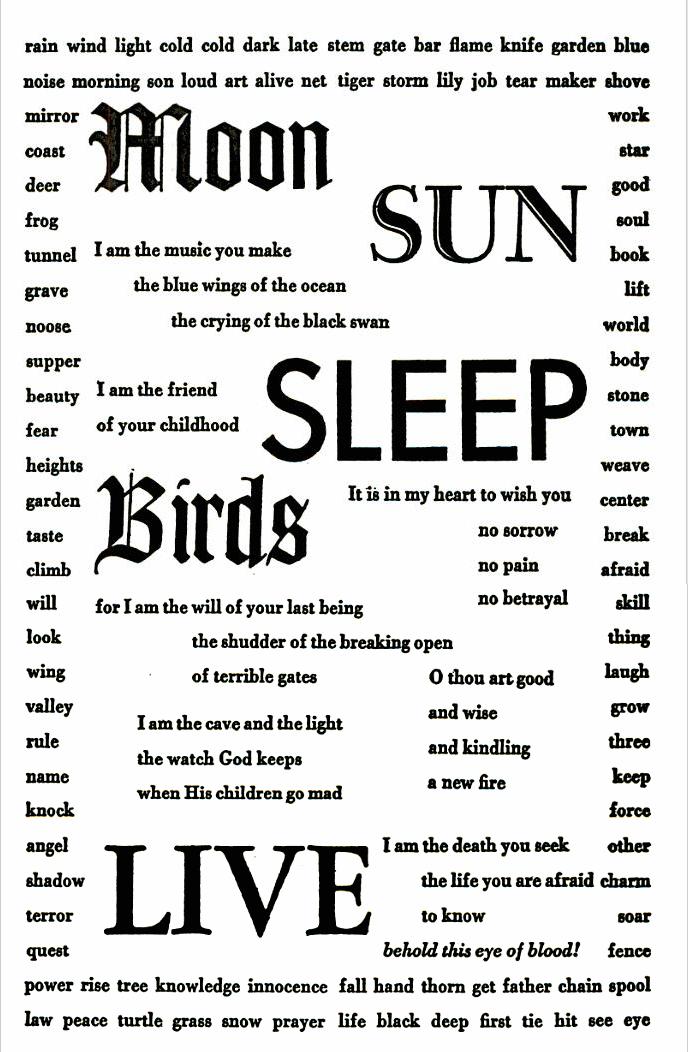
Kenneth Patchen, “Moon, Sun, Sleep, Birds, Live.”

Live long enough, and a single word can acquire a multitude of associations. Pick any word in Kenneth Patchen’s poem, for example. What images and narratives does it summon from your memory? What feelings does it unlock? I’ll get us started with the five large words.

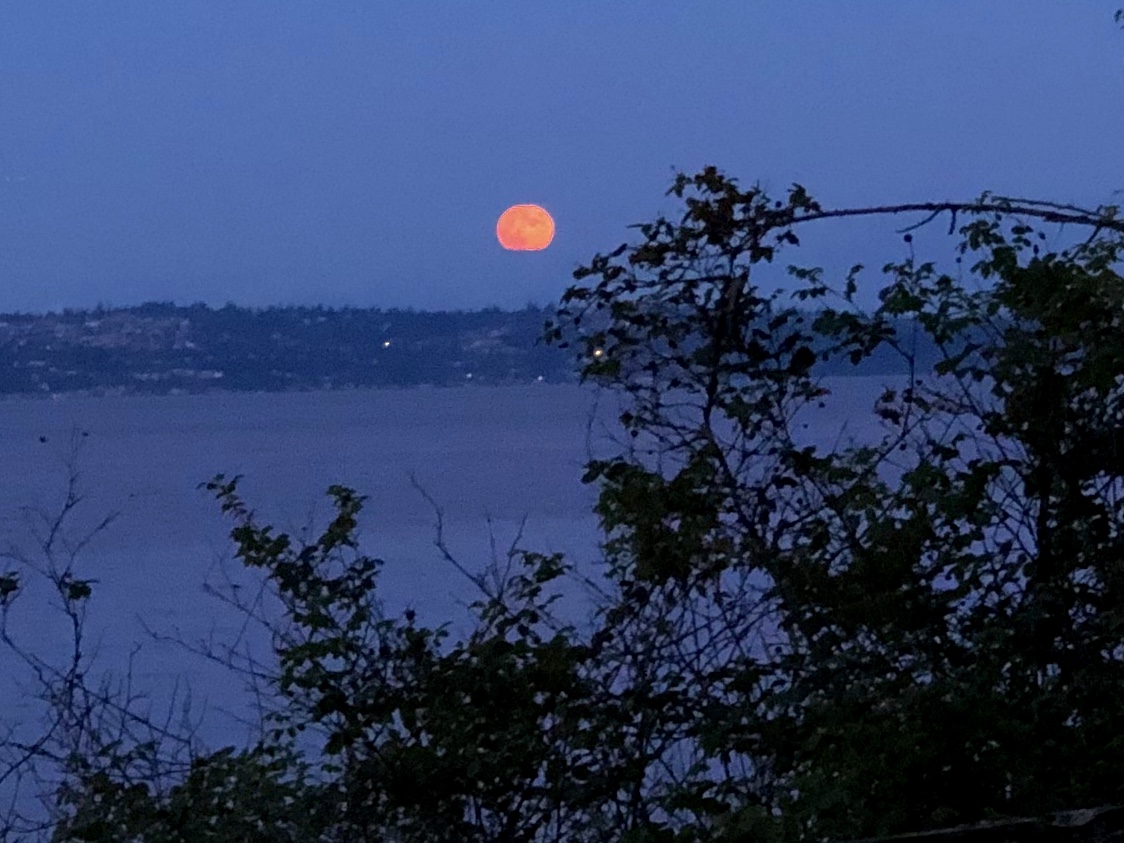
Full moon rising on the 50th anniversary of the Apollo 11 launch (July 16, 2019).

Moon:   Since the day of my birth, 912 full moons have risen into the evening sky. Whenever I am able and the sky is clear, I find an open view to the east and wait for its appearing. The moon’s predictability has never dulled the thrilling instant when its bright curved edge breaks the horizon. Over the four weeks of waning and waxing that follow, its slow dance of vanishing and renewal attunes us ever so gently to the temporal flow. The diurnal sequence of sunrise and sunset seems rushed in comparison.

I’ve had my eye on the moon since I was old enough to notice the sky. I remember specific moons the way one remembers luminous conversations: the Wyoming moon sparkling the fresh powder in a midnight ski run down Teton Pass; the Minnesota moon rising beyond the Mississippi River as we warm ourselves by a driftwood fire; the Florida moon shining down on the circus tent where 400 Episcopal collegians celebrate Epiphany all night till dawn; the Los Angeles moon traversing the sky behind a 7-hour performance of Indonesian shadow puppets; the glowing tip of a rising crescent climaxing a night of falling stars in the High Sierra; the lunar eclipse stunning three priests with wonder on a Northwest beach; the many moons lighting the way on mountain trails and desert dunes; and last year’s spectacular birthday moon, rising on the 50th anniversary of humanity’s first trip to the lunar surface.

The most recent full moon rises over Puget Sound on the Fourth of July.

When the full moon first appears, silence is best. It resembles the host of the Blessed Sacrament, a white disc lifted up before our contemplative eyes. The only words I can specifically recall from a moonrise were spoken by an American woman on the Scottish isle of Iona. “You know,” she said, “I’m 55 years old, and I’ve never seen the moonrise before.”

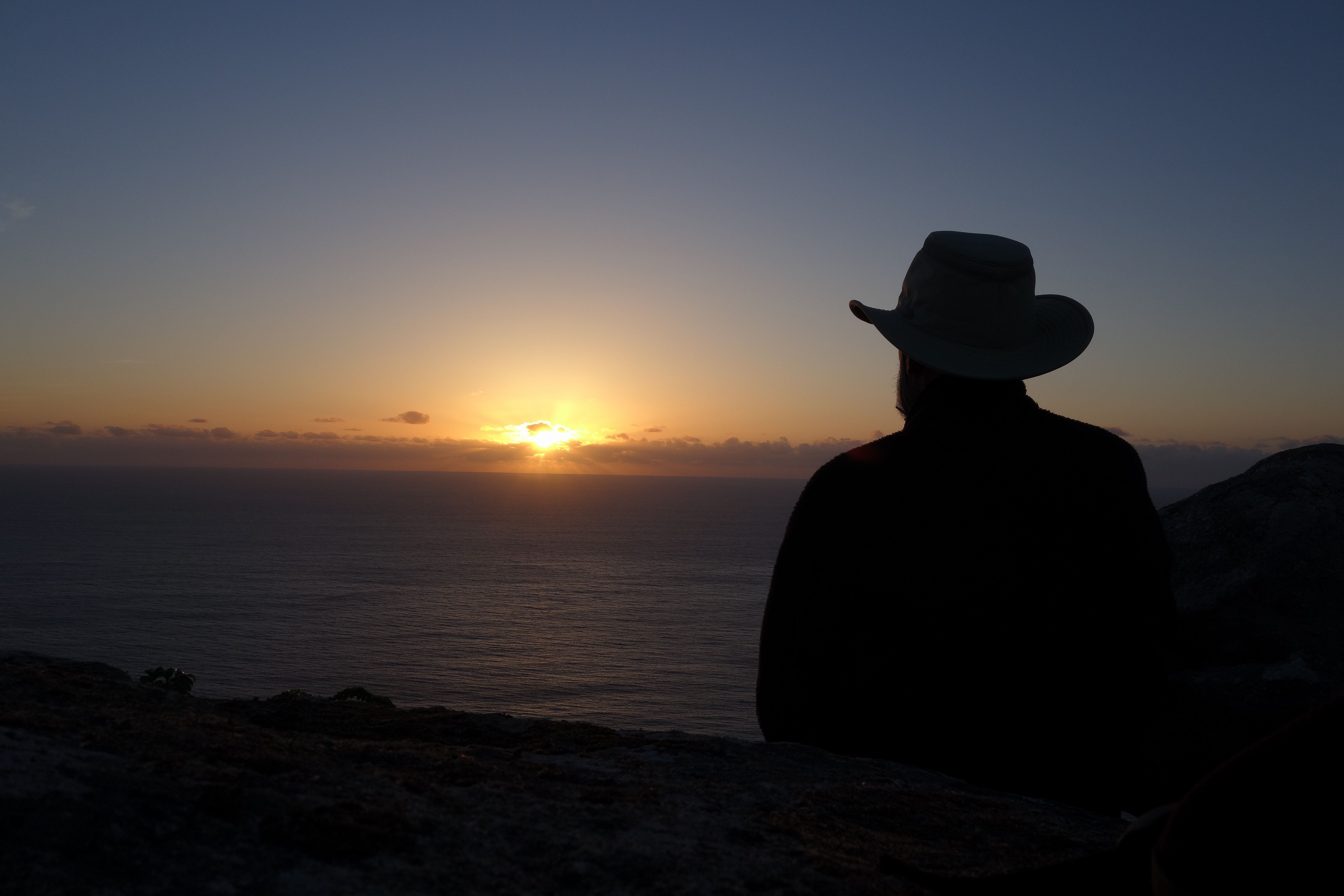
The sun sets over “the edge of the world” at Finisterre, the western terminus of the Camino de Santiago.

Sun:   The sun is a perennial symbol of life-giving energy and joyful radiance. And while climate change has certainly complicated both its literal and metaphorical meanings, we still welcome its warmth and light after a freezing night or a long winter, we still feel uplifted by its brilliance after a dreary stretch of sunless days. Even as we address the growing imbalance in our weather and our seasons, we remember to treasure in every moment the blessings we struggle to preserve.

A benevolent sun still has the power to cheer us, and the rhythms of night and day remain foundational for an embodied and temporal spirituality. Embrace each morning as the gift of creation’s new-made world, make each evening a vesper song of thanks. And in between, let us live as children of the light. Love whatever is good and beautiful and true, and work to transform whatever is not.

Sunlight, like our own breath, is easy to take for granted. Without it, life would be impossible. Even when night comes and goes, the transitions are gradual enough to ease the shock of the sun’s disappearance. We never experience the sun being abruptly switched off, except during a total eclipse. Watching the sun become a black disc, which can be viewed with the naked eye, is pure wonder, one of this world’s most unforgettable experiences. But the sudden disappearance of light from earth and sky is eerie and unsettling—so sudden, so absolute, like an apocalypse. Its return is equally swift, like the first moment of creation: Let there be light.

I shot this video clip of an Oregon landscape during the 2017 solar eclipse. I was gazing directly at the sun, of course, but the camera recorded what was happening on the earth. The shot is in real time. It only takes about 30 seconds for the darkness to vanish.


Sleep:  In 1979, after several days of sleep deprivation, I grabbed a red-eye flight from Los Angeles to New York to visit my brilliant friend Bob Sealy, a critical mentor to me in cinema, theater, the art of conversation, and all things New York. I arrived in Manhattan around 8 a.m., utterly exhausted. Bob was busy with revisions of his new play at Café La MaMa, and had arranged a place for me to nap while he worked––a windowless storage room in a seedy building reminiscent of Forties film noir. I stretched out on a dingy couch. When Bob closed the door I was left in total darkness, and soon fell into a dreamless sleep.

Ministry of Fear (Fritz Lang, 1944)

Hours later, the door swung open, awakening me from the depths of slumber into a confused state of mental fog. The room was still so dark. A faceless silhouette loomed in the doorway. For a moment, I didn’t know where I was, who he was, or what I was doing there. It was a nightmarish scene straight out of Fritz Lang. Then Bob switched on the light and my stupor began to fade. He led me out to the daylight world, the realism of city streets. But I had not entirely quit the darkness. The noirish image of that moment lingers to this day.

“Don’t watch the story,” Bob once told me about the movies. “Watch the image.” The story will go on its way toward a conclusion, but a vivid and suggestive image can detach itself from the plot to call up something deep and enduring in the psyche. Where is that dark room inside me? Who is at the door?

A goldfinch in our peach tree. They arrive at Easter and depart in the fall.

Birds:   As we shelter in place until the pandemic passes, our only regular visitors are the birds––robins, goldfinches, juncos, pine siskins, red-winged blackbirds, black-capped chickadees, spotted towhees, red-breasted nuthatches, golden-crowned kinglets, house and purple finches, varied thrushes, cedar waxwings, sparrows, wrens, ring-necked pheasants, and a pair of mallards. More rarely, a bald eagle may perch atop a Douglas-fir, or a blue heron land on the grass.

A blue heron drops in for a visit.

But the specific bird that came to mind when I first looked at Patchen’s poem was a mountain chickadee in the summer of 1973. While backpacking in California’s Desolation Valley near Lake Tahoe, I had paused to stretch out in a green meadow, leaning back on my elbows with my knees sticking up. I was in no hurry, and had settled into the stillness of reverie when the little bird landed on my right knee. It perched there calmly for some time. I like to think it was being sociable, signaling across the gulf between species the underlying kinship of all created beings. Perhaps it just mistook me for a log. But I have never forgotten our brief communion.

The author at the family plot in Red Wing, Minnesota (June 2006).

Live:    My great-grandfather, John Michael Friedrich, immigrated to Red Wing, Minnesota, in the 1860s. He died young, only 47, and for his male descendants, longevity has been in limited supply. John Michael had two sons, Charles Edward (died at 67) and John Harry (34). Charles Edward had four sons: John (72), Edward (20), my father James (62) and his twin brother Louis (8 months). John had two sons, Jack (50) and Brad (75). I am currently the oldest living male of the line, and today I become the first to reach 76. It is a humbling milestone, and I feel my ancestors cheering me on.

In these latter days, to borrow a line from Blade Runner, I want “the same answers as everybody else: Where did I come from? Where am I going? How long have I got?” But meanwhile, more moons! More suns! More birds! More sleeping and waking! As long as God gives me breath.

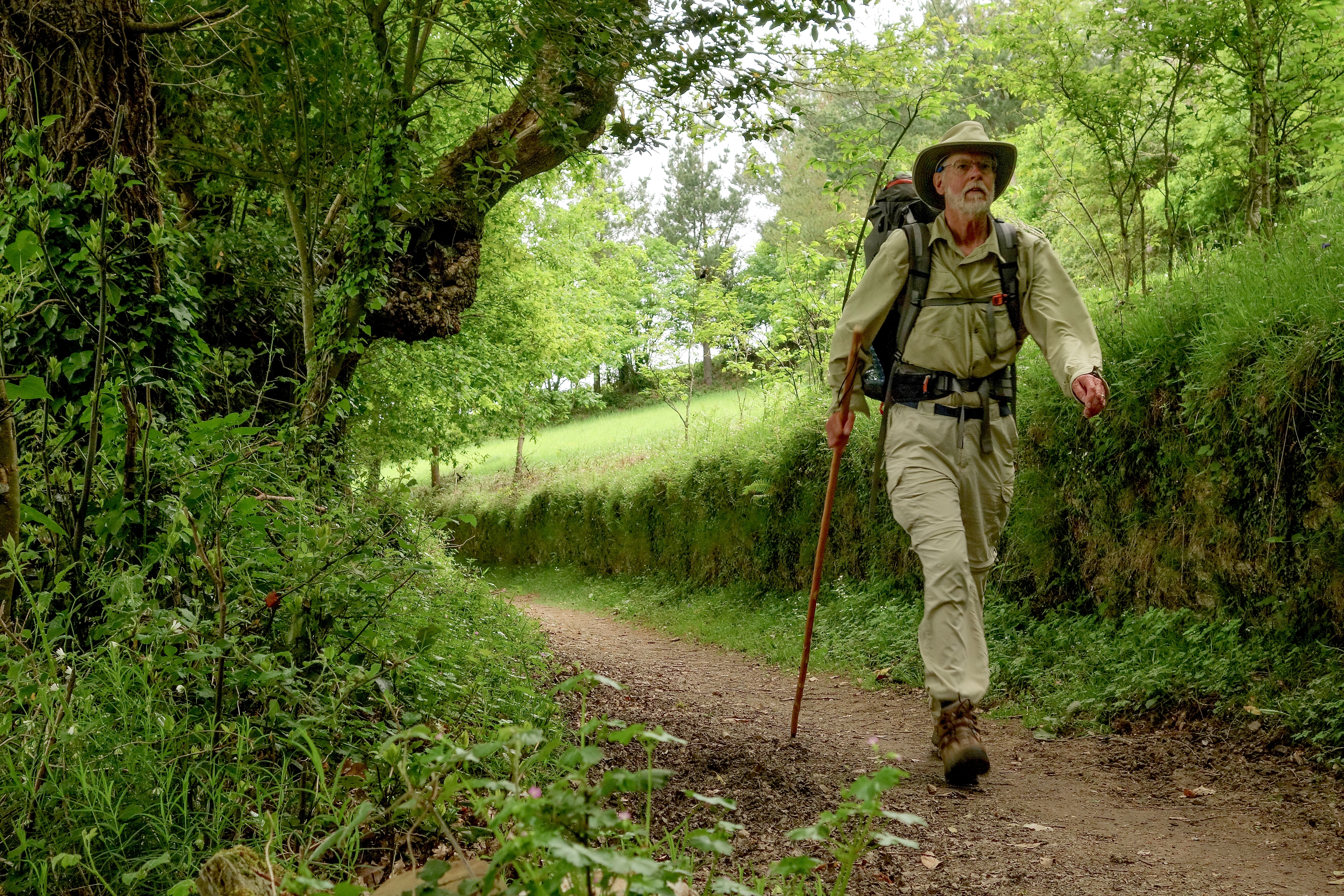
And then? For the pilgrim, the road goes ever on and on, in this life and the next.

The road goes ever on and on … (Camino de Santiago, Galicia, 2014)

Lost at Sea: Retelling the Flood Story in a Pandemic

Row on, row on, another day
May shine with brighter light.
Ply, ply the oars, and pull away,
There’s dawn beyond the night.

–– Traditional sea shanty


At the Easter Vigil, we light a fire in the dark and tell our sacred stories. One of them is the saga of the Flood from the Book of Genesis. Tonight, as we stream the Vigil liturgy from our living room for our local parish, this is how it wants to be told. 

When we wonder about things, we tell stories.  One of our oldest stories describes a great flood that sweeps away everything in the world until there is nothing left but an endless sea. Some people say it’s a story about God getting fed up with the world’s violence and greed and wanting to start over. Others say the story is about everything being thrown out of balance by human sin––the harmonies break down, and God’s beautiful creation is swallowed up by chaos.

But tonight, when a new kind of flood is sweeping across the earth, washing away the world we know, maybe the story needs to be about the ark. We’re all in this boat together, hoping and praying we can survive the raging sea until the storms are over and we can anchor in some safe and peaceful harbor.

That’s where we are now, in the middle of the story––cooped up in this ark with a bad case of cabin fever, wondering if the flood is ever going to subside so things can get back to normal. It’s not easy, being stuck in this boat. It’s strange and stressful for us. Meanwhile, the sea gets rougher, the storms wilder.

It’s like that Psalm we say in Holy Week:

Save me, O God! The waters have risen up to my neck.
I am sinking in a deep mire. The waves wash over me.
Do not let the flood swallow me up! (Psalm 69)

That’s how it feels, here in the middle of the story, in the middle of the flood. We have our fears. We have our doubts. We have our losses. And frankly, some of us are getting sick and tired of this stupid ark. Been in the storm so long, Lord! How long? Too long.

But this isn’t where the story ends, with us lost at sea, sinking into oblivion. The One who made us will not forget us. The One who loves us will not forsake us. Already, God is imagining a future for us. Maybe it will be something better.

God never said we won’t be afflicted.
God never said we won’t be disquieted.
God did say we shall not be overcome.

When through the deep waters I call thee to go,
The rivers of sorrow shall not thee overflow,
For I will be with thee, thy troubles to bless,
And sanctify to thee thy deepest distress.

The ambush of the marvelous

Jacob wrestling

Come, O Thou traveler unknown,
Whom still I hold, but cannot see;
My company before is gone,
And I am left alone with Thee.
With Thee all night I mean to stay,
And wrestle till the break of day.

The Sacred Harp

A century ago, Scottish theologian P.T. Forsyth described prayer as a kind of spiritual tempest blowing away all our complacencies. While giving a nod to the contemplative and aesthetic dimensions of spirituality, he was blunt about its capacity to rupture the settled proportions of daily life:

We do need more reverence in our prayer, more beauty in our praise, less dread of tried and consecrated form. But still more do we want the breathless awe, and the stammering tongue, and the solemn wonder, and the passionate gratitude, which are the true note of grace, and the worship of a soul plucked from the burning and snatched by a miracle from the abyss.

Prayer is not for the timid. Better wear a crash helmet, as Annie Dillard advised. But the fierce energies of prayer are not God’s alone. We must bring the strong force of our own desire to the encounter, pressing God to keep the ancient promise of a world made new. Every prayer may inevitably end with “thy will be done,” but it often begins in a place of struggle, if we are honest. “Hear my voice when I complain,” prayed the Psalmist. Even Jesus argued vehemently for an alternative to the cross. We were not made to go quietly. God wants us to put up a good fight. “Prayer is wrestling with God,” wrote Forsyth. “It is a resistance that God loves.”

The Bible never names the stranger who jumps Jacob in the dark and wrestles him till daybreak (Genesis 32), but interpreters have always suspected his divinity. Delmore Schwartz, in his poem “Jacob,” describes the assault as “the ambush of the marvelous, / unknown and monstrous, / at the very heart of surprise.” Jacob couldn’t see his opponent’s face, but all his inner conflicts must have risen up to give him a name:

– It is the ghost of my father Isaac, from whose deathbed I stole the blessing, and he’s come to take the blessing back.

– No. It is the spirit of my brother, with whom I wrestled in my mother’s womb, with whom I must fight in the flesh tomorrow.

– No. It is my own shadow, the unloved child and desperate trickster, here to unmask the pretense of my so-called success.

– No. It is the angel of death come to mock all God’s promises of protection and future.

– No. It is God’s own self, that merciless opponent who will not let me be until I am broken open and made new.

All night long, Jacob fought against this stranger, this Other. The stranger wounded him, dislocating the socket of his thigh, but Jacob would not give up. When dawn came, the stranger tried to flee, but Jacob held on tight.

“Let me go,” said the stranger. “I do not live in the glare of your well-lit thoughts, but only in the shadows of your intuitions.”

“I will not let you go until you bless me.”

“What is your name?” asked the stranger.

“Jacob.”

“It is Jacob no more. Your name shall be Israel – the one who wrestles with God.”

“Then what is your name?” asked Jacob.

“Ah!” said the stranger. Then he gave Jacob the blessing, and vanished.

The sun began to rise as Jacob limped away from the river, forever wounded, but ready at last to meet his future.

I once led a workshop on this story at a church retreat. After digging into the passage for a while, participants were invited to retell it in their own way. One young woman, who was differently abled and emotionally troubled, did exactly what the Bible wants us to do with its narratives. She put herself into the story.

Jacob was having a lot of problems with his family. He needed to get away from them, to get his head together. He felt a great struggle inside himself. “Why can’t I deal with my anger and frustration?” After a while he began to realize that he was wrestling with God.

He wrestled with God all night long, but when dawn came he began to think God must be pretty tired of him by now, that God must be so sick of listening to his problems that he was just going to go away. Jacob felt afraid and alone but he didn’t give up. He held on tight and wouldn’t let go. He begged God to stay and to bless him.

“What is your name,” God asked him.

“Jacob.”

“I don’t think so,” God said. “I think it’s Israel, because you’ve had the guts to face up to your problems.”

Then the sun came up and God was gone. And as Jacob began to walk away from that place, he noticed he was limping. Suddenly he remembered that he had always had this limp, but it didn’t bother him anymore. It was okay. It was just part of who he was.