How can this be?

Cathedral Films producer James K. Friedrich on the set of Child of Bethlehem (1940)

Cathedral Films producer James K. Friedrich on the set of Child of Bethlehem (1940)

My mother Elaine, pregnant with her firstborn child Marilyn, rode to Bethlehem on a donkey (in 1936 around Jerusalem, cars weren’t safe – they attracted gunfire). My father, the Rev. James K. Friedrich, made biblical films, including several on the birth of Jesus. In Holy Night (1949), I was a shepherd boy at the manger, with a stupefied look on my face from the blinding lights behind the camera. But no one could top my sister Martha, who played the baby Jesus in Child of Bethlehem (1940). You could say the Nativity story runs in our family. Even the Episcopal parish church of my childhood was a converted stable.

The thing about Christmas, though, is that everyone gets to be in it. By virtue of the Incarnation, our human nature, our human stories, have become the place where God chooses to dwell. Meister Eckhart put this claim most vividly in the fourteenth century:

“There is only one birth – and this birth takes place in the being and in the ground and core of the soul…Not only is the Son of the heavenly Creator born in this darkness – but you too are born there as a child of the same heavenly Creator. and the Creator extends this same power to you out of the divine maternity bed located in the Godhead to eternally give birth.”

Of course I have been reminded by women friends that only a male could find the sublime in a labor lasting for eternity. But Eckhart’s image makes us uneasy in other ways, for in these disturbing times it may be hard to imagine ourselves as worthy vessels for divinity. Everywhere we turn, we see human life devalued and held in contempt. The poor, the weak, the wounded are marginalized and forgotten. Abuse, violence, cruelty and self-loathing are rampant. Overt racism is making a comeback. Even torture has its shameless defenders.

But Christmas tells a counter-story, about a God who remembers the glory for which we were made, who yearns to speak the word of Love in the vocabulary of human flesh. The seventeenth-century metaphysical poet Henry Vaughan expressed his astonishment at this fact in a memorable line:

Brave worms, and Earth! that thus could have
A God enclosed within your Cell…

Oh, we are brave worms indeed, to believe our frail flesh made for the Incarnation, for the union of time and eternity, finite and infinite, flesh and Word. “God became human,” said St. Athanasius, “in order that humans might become godlike.” And St. Paul told the Corinthians that “all of us, with our unveiled faces like mirrors reflecting the glory of the Lord, are being transformed into the image we reflect in brighter and brighter glory.” (II Cor. 3:18)

In the face of such a wonder, we find ourselves repeating Mary’s old question: “How can this be?” And the best answer I know was given by the medieval mystic, Mechthild of Magdeburg: “Insofar as we love compassion and practice it steadfastly, to that extent do we resemble the heavenly Creator who practices these things ceaselessly in us.”

As we kneel before the Mystery this night, may we know how beloved of God we mortals are, and how very much the Glory wants to be born in us.

To you, dear readers, I wish the merriest and holiest of Christmastides.
God bless us every one!

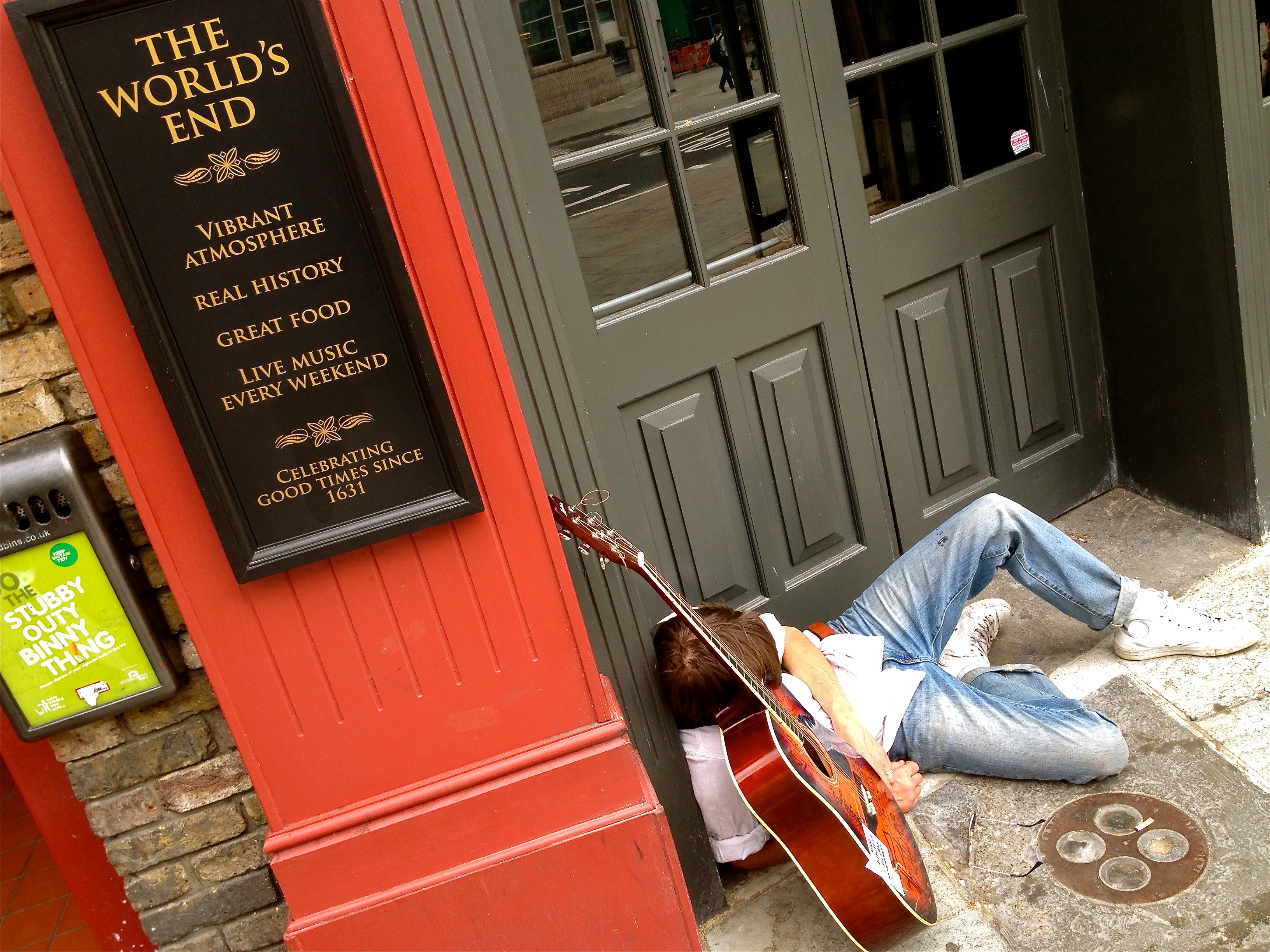
The World’s End

The World's End

When I was 8 years old, I read in LIFE magazine that in so many millions of years, the sun would burn out and life on earth would cease. This worried me, so I asked my parents, “If the world is going to end, how come we say “world without end” when we pray?” And they told me what the Bible says, that heaven and earth may pass away, but God remains. That relieved some of my anxiety, but I still wasn’t sure I liked the idea of the world ending, even if God was in charge.

Of course the world ends all the time. When I moved from California to Puget Sound in the 1990’s, my first Northwest winter felt like today’s gospel: the sun was darkened and the moon gave no light.

Who among us has not seen their world end? Adolescents exiled from childhood. Black teenagers robbed of their future. Elders deprived of their health. Unemployment …retirement …divorce … the death of a parent, a spouse, a child — in every one of these, a world comes to an end.

For anyone who has known serious loss, this is more than metaphor. The experience of grief can be so total and unrelenting that you can’t see anything beyond it. You can’t imagine the future. It feels like the end of the world.

The stars are not wanted now: put out every one;
Pack up the moon and dismantle the sun;
Pour away the ocean and sweep up the wood;
For nothing now can ever come to any good. [i]

W.H. Auden was invoking apocalyptic metaphors to express personal loss, but shared, public worlds also come to an end. As in 1789, or 1914. The Holocaust. Hiroshima. 9/11. My Lord, what a morning, when the stars begin to fall.

But why bring up such dreary stuff on this first day of the new Christian year? Shouldn’t we be breaking out the party hats, blowing horns and shouting “Happy New Year?” The wisdom of the Advent season is that it never begins with “A Holy Trinity Production,” or “The Creator of the World Presents.” No, it always opens with “The End.” Advent knows that every beginning involves some kind of ending. In this season’s Scripture, preaching and prayers, the present arrangements of collective and personal life are judged and found wanting. God’s imagination is far too rich and fertile to settle for our barren and diminished versions of human possibility.

Selfishness, greed, consumerism? Fear, racism and violence? Poverty, militarism, war, environmental degradation? That’s the best we can do? Really? God must be saying, “Come on, people. I made you a little lower than the angels, and this is what you came up with?”

George Eliot said “it is never too late to become what you might have been.” But to get to that “might have been” requires an Exodus into the wilderness beyond the way things are; an Exodus beyond even the best we can imagine for ourselves, into a place of unknowing, where only God possesses the language to speak our future into being.

So much of what we hear and pray and sing in Advent is profoundly disruptive. Bob Franke’s great Advent song, “Stir up your power,” gets right to it in the first line: This world may no longer stand. We are meant to be unsettled, to be driven beyond our narrow boundaries, our constricted realities, toward a beckoning horizon. The Christian life is a perpetual series of departures for a better place.

The world as it is – the world of racial hatred and toxic violence and economic injustice and perpetual war and addictive consumerism and pollution for profit and all the other evils which poison our common life – this world has no future in the emergent Kingdom of God. This world may no longer stand.

But the story doesn’t stop there. In my end is my beginning.[ii] Even when we have gone far astray, even when our story seems over, God remains deeply present in the processes of creation, tenderly leading and luring us into newness of life, making a way where there is no way, opening doors that none can shut.

Advent people do not just wring their hands or shake their heads over the latest news from Ferguson or the Middle East. We work and pray for something better. What we can do on our own is limited, but when we offer our priorities and energies to the larger purposes of God, Love will have its way with us.

As the Christian mystic Hadewijch put it in the thirteenth century:

Since I gave myself to Love’s service,
Whether I lose or win,
I am resolved:
I will always give her thanks,
Whether I lose or win;
I will stand in her power. [iii]

It is not always easy to stand in Love’s power and keep the faith. In some situations it is almost unimaginable. Forty years ago the African-American author James Baldwin wrote:

To be an Afro-American, or an American black, is to be in the situation, intolerably exaggerated, of all those who have ever found themselves part of a civilization which they could in no wise honorably defend – which they were compelled, indeed, endlessly to attack and condemn – and who yet spoke out of the most passionate love, hoping to make the kingdom new, to make it honorable and worthy of life. [iv]

This passionate mixture of protest and love sounds a lot like the Old Testament prophets who permeate our Advent lectionary. The very first reading of the season begins with a prophetic plea for history to be broken open by divine justice:

O that you would tear open the heavens and come down …
to make your name known to those who resist you,
so that the nations might tremble at your presence! [v]

Advent is not just a season of quiet waiting. It is also a time of protest and vision. Advent announces an insurgency against the way things are, a revolution to scatter the proud, cast down the mighty, raise the lowly, gather the lost, free the captive, and bind up the brokenhearted. Advent re-imagines the world as paradise restored, a new heaven and new earth suffused with the peace of God.

this is the day of broken sky
this is the space of conflagration-breath
speaking border-trespass
this is the feathered swoop of heaven
on the wing of now …
forking lightning into language …
breaking god into prison …
breaking the truth from jail! …

This is the fire-tongued fork of holy-ghost howl
making love on the tongue …
spitting flames of reconciliation
in the sky of war
making messiah-praise out of the air itself!

this is pentecost in your head
like becoming what you never dared
for the first time and forever

This ecstatic prophecy is from a poem by Jim Perkinson. [vi] He was talking about Pentecost, but his theme fits Advent as well:

“the day of broken sky”
the earth in conflagration
God breaking into the prisons
the truth being set loose at last
and “the fire-tongued fork of holy-ghost howl
making love on the tongue …
making messiah-praise out of the air itself!”

And each of us, all of us, becoming what we never dared.

When Jesus tells us to stay awake, he is warning us not to sleep through the day of God’s coming. Stay alert. Pay attention. Don’t miss it! Become what you never dared. Shake off the sleep of complacency, the sleep of complicity, the sleep of despair. Awake and greet the new dawn.

Jan Richardson describes this dawning reality in her beautiful poem, “Drawing Near.” [vii]

It is difficult to see it from here,
I know,
but trust me when I say
this blessing is inscribed
on the horizon.
Is written on
that far point
you can hardly see…

Richardson accurately expresses the sense of distant horizon that prevents the dominant reality of the moment from closing in on us and locking us in. That reality wants to be believed as fixed and final, permanent and stable. But the horizon calls every finality into question, disrupting its stability with the boundlessness of divine possibility. The horizon draws our attention from what is given to what may yet be. Keeping our eye on the horizon, feeling its pull, is the spiritual practice of Advent. Richardson’s poem expresses the deep longing produced by the distance between the already and the not-yet.

And then the poet discovers what every pilgrim knows: the goal of our long journey is something that has already been inscribed deep within us even before our journey began. Even before the day we were born, we were marked as God’s own forever.

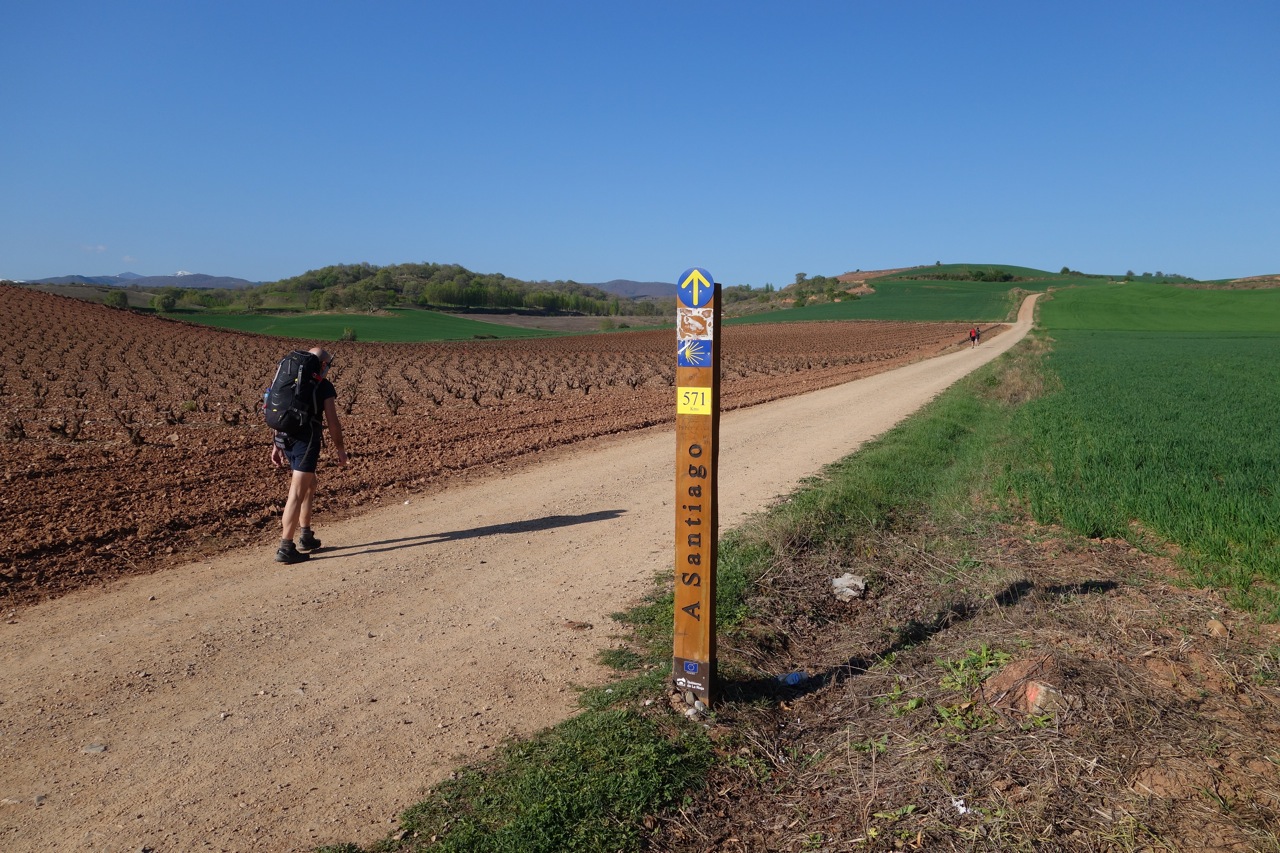
And that is where Advent ultimately leaves us – finding that the thing we have been seeking so long has been with us all the time – within us, and all around us. While we have been walking our Camino to the Promised land, our feet have already been on holy ground, every step of the way. And the God of the far horizon turns out to be the path as well, keeping us company as we stride deeper and deeper into the world.

So when Advent people talk about the end of the world, we are speaking about end in the sense of purpose rather than termination. The word “apocalypse” means “unveiling,” and the apocalypse in our future will not be an annihilation, but a revealing of the world’s ultimate purpose and destiny.

Yes, all the inadequate, incomplete versions of world will come to an end (some of them kicking and screaming!), but creation as it was intended will be restored, not discarded. Like a poet who creates a new language out of old words, Love will remake the ruins and recover the lost. And the Holy One who is the mystery of the world will be its light and its life forever.

This Advent faith is expressed memorably in a short story by British writer Carol Lake, “The Day of Judgment.” On the Last Day of the world, God sails into England aboard a new Ark. But instead of bringing history to a close and pronouncing judgment on everyone, God leaves the Ark to enter the city of Derby. Heading for the run-down inner city neighborhood of Rosehill, he joins the crowd at a local pub, a multi-ethnic mix of the working poor and the unemployed. And there God gets so caught up in being with these people that he loses track of time, and the Ark sails away without him, heading off for the horizon of eternity. As the story describes it:

The Ark is on the edge of the horizon now, its destination the heartlessness of perfection. Most of the inmates already know what they are going to find – endless fruit, endless harmony, endless entropy, endless endless compassion, black and white in endless inane tableaux of equality. It sails off to a perfect world; the sky has turned into rich primary colors and in the distance the Ark bobs about on a bright blue sea.” [viii]

Meanwhile, God is still in that Rosehill pub, in the very heart of imperfection. If you had walked in there, you would have had a hard time picking him out. He blended right in. But if you were paying attention, you might notice that there was now something different about Rosehill. The old non-descript streets and dilapidated buildings had taken on a strange beauty. Maybe it was the warm slant of afternoon light, but people were beginning to see their neighborhood in a new way. And their own faces, too, seemed to glow with an inner radiance, as if they were carrying a wonderful secret, tacitly shared with everyone around them, as if they suddenly knew there was more to life than meets the eye.

They were still poor, the world was still a mess, but something new was in the air, a spirit of change was awakening. And from that day on, the people of Rosehill found themselves becoming what they’d never dared, for the first time and forever.

[i] W.H. Auden, “Twelve Songs (ix)”, Collected Poems, ed. Edward Mendelson (NY: Random House, 1976), 120

[ii] T.S. Eliot, “East Coker,” Collected Poems 1909-1962 (London: Faber and Faber Ltd, 1974), 191

[iii] Hadewijch: The Complete Works, trans. Mother Columba Hart, Classics of Western Spirituality (Mahwah, NJ: Paulist Press, 1980), 213

[iv] James Baldwin, No Name in the Street (NY: Dell, 1972), 194

[v] Isaiah 64:1-2

[vi] Jim Perkinson, “tongues-talk,” q. in Catherine Keller, On the Mystery: Discerning God in Process (Minneapolis: Fortress Press, 2008), 157-8

[vii] Jan Richardson, “Drawing Near” (http://adventdoor.com/2012/11/25/advent-1-drawing-near)

[viii] Carol Lake, Rosehill: Portraits from a Midlands City (London: Bloomsbury, 1989), 119

Whose world is it?

GTU Jesus icon face

I teach a course on “Jesus and the Movies,” examining nineteen features made on the life of Jesus between 1912 and 2014. And one of my favorites is a South African production, Son of Man (2006), which sets the gospel story in a fictional twenty-first century African country.

It begins in the desert, with Jesus and Satan sitting side by side atop a tall sand dune. There Satan offers Jesus the familiar temptations: use your power, dazzle the world, bow down to me and I will give you everything you desire.

Jesus listens for a while in silence. Suddenly he turns to Satan and shoves him off the ridge. As Satan tumbles downward – Milton’s fall of Lucifer comes to mind – Jesus shouts after him: “This is my world!”

Satan comes to a stop at the foot of the dune. He picks himself up and looks back defiantly at Jesus. “No,” he cries. “It’s my world!”

The film cuts abruptly to a village caught in the crossfire of a civil war. Terrible atrocities are taking place, making Satan’s point perfectly. It’s his world after all.

Tomorrow is the Feast of Christ the King, created by Pope Pius XI in 1925. Originally observed at the end of October as a prelude to All Saints Day, it was later moved to the last Sunday of the liturgical year, where it provides both a grand finale to the calendrical Christ narrative and a dramatic overture to Advent. In 1970 it was adopted by other churches using the Common Lectionary, including Anglicans, Lutherans, Methodists, and Presbyterians.

The pope was responding to the apocalyptic violence of World War I, where evil and madness seemed to have seized control of the world. He wanted to establish a clear reminder that it is Christ to whom the future belongs; it is Christ whom we must follow and serve.

Or in the words of Bob Dylan, “It may be the devil or it may be the Lord, but you gotta serve somebody.”

While the imagery of Christ as Lord of all may require some unpacking for interfaith dialogue, the pope’s original encyclical was clearly focused on Christian practice. If we profess Christ as our way, our truth, our life, then, in the pope’s words, “none of our faculties is exempt from his empire.”

But what do we do when Christ’s “empire” is in conflict with our other allegiances? How much do we give to Jesus, and how much do we hold back? Jesus gets Sunday mornings; does he get the working week? He gets our spiritual life; does he get our worldly affairs? Does he get our relationships, or our stewardship of time? Does Jesus get our politics, our economics?

Clarence Jordan was a Baptist preacher, New Testament teacher, and farmer in rural Georgia. In his celebrated Cotton Patch Gospels, he translated the Jesus story into a southern idiom, explaining that “the Scriptures should be taken out of the classroom and stained-glass sanctuary and put out under God’s skies where people are toiling and crying and wondering; where the mighty events of the good news first happened and where they alone feel at home.” [i]

In the 1940’s, in the middle of “the Good War,” in the heart of the segregated South, Jordan founded Koinonia, an interracial, pacifist farming collective using a communitarian model more like early Christianity than late capitalism. For his faithfulness to the dominion of Christ, he and his community were harassed, shot at, and bombed. The local church expelled him.

He was often invited to speak to groups around the country, and he would ask them, “What’s the biggest lie told in America today?” He’d let the question sink in for a bit, and then he’d say, “The biggest lie told in America today is: Jesus is Lord.”

I first heard this story when I visited Koinonia in 1980 and had a long conversation with his widow Florence (Clarence died in 1969). And in these latter days his words ring truer than ever.

Last year the Ohio legislature, hoping to derail the Affordable Care Act, blocked an expansion of Medicaid that would provide health care to 275,000 people who had no coverage. But the governor, John Kasich, made an end run around the legislature and got it done anyway.

As he said at the time: “For those who live in the shadows of life, for those who are the least among us, I will not accept the fact that the most vulnerable in our state should be ignored.”

The lawmakers howled. How dare he put the needs of the poor above our political agenda! So this is how the governor explained it to one those legislators, whom he knew to be a fellow Christian:

“Now when you die and get to the meeting with St. Peter, he’s probably not going to ask you much about what you did to keep government small; but he is going to ask you what you did for the poor. Better have a good answer.”

Governor Kasich, himself a Republican, was denounced by many in his party for appealing to a power higher than their ideology. The Wall Street Journal, wanting to make it clear that Jesus, lover of the poor, was not in fact Lord in America, offered a tart response: “Republicans get a vote before St. Peter.”

In Matthew’s gospel, the last parable Jesus tells before his arrest and crucifixion pictures all of humanity gathered before the glorified ‘Son of Man’ – the Lord of history – who reveals that he has always been among them in the bodies of the poor and needy: “I was starving … I was naked … I was an undocumented alien … I had AIDS … I was a convict …”

Everyone is of course quite surprised. But they all take his point. When you kneel before Christ the King, it won’t be at the foot of a mighty throne, but before the holy icons of “the least of these” – the vulnerable, the marginalized, the broken, the forgotten.

Well you kneel to the Lord and you will bless yourself…
Ain’t no need to kneel to no one else. [ii]

[i] G. McCleod Bryan, “Theology in Overalls: The Imprint of Clarence Jordan”, Sojourners (Dec. 1979, vol. 8, no. 12)

[ii] Bob Franke, “Trouble in This World (It’ll Be All Right),” on Heart of the Flower (Daring DR3016), © Telephone Pole Music, 1995

Dies Irae

Biblical prophet at Moissac Abbey on Le Chemin de St. Jacques

Biblical prophet at Moissac Abbey on Le Chemin de St. Jacques

Mr. McCleery, my seventh grade Latin teacher, had us memorize verses of the Dies Irae, a medieval chant describing the Last Judgment in strikingly lurid language. Most boys in junior high do not walk around chanting Latin poetry about the end of the world, but I rather enjoyed it. The tune was catchy, and those terse rhyming triplets beat time like the sensuous energy of a drum circle.

Dies irae, dies illa, 
Solvet saeclum in favilla,
Teste David cum Sibylla.

Day of wrath, O day of mourning,
See fulfilled the prophet’s warning,
Heav’n and earth in ashes burning.

The text of Dies Irae is inspired by the first chapter of Zephaniah, which was one of the eucharistic readings last Sunday. I sometimes wonder what churchgoers think about when asked to consider “a day of wrath, a day of distress and anguish, a day of ruin and devastation, a day of darkness and gloom.” In Syria or Ukraine, it’s just the latest news. But for those of us not living in one of history’s infernos, Zephaniah might be dismissed as a colorful crank carried away by the thrill of his own hyperbole.

The effect of the Bible’s more fiery rhetoric is often muted by the flat, inexpressive way it is usually read – or worse, mumbled – in the typical liturgy, as though no one really means it. Readers of prophetic texts should be given bullhorns. They should walk among the people as they shout, looking them in the eye.

I will bring such distress upon people
that they shall walk like the blind;
because they have sinned against the LORD,
their blood shall be poured out like dust,
and their flesh like dung.[i]

The church growth people might have something to say about that sort of messaging, but there is no denying that the prophets are working hard to get our attention. And in these last weeks of the Christian year, both the Sunday lectionary and the daily liturgical readings resound with the trumpet blasts of biblical warnings. People get ready. History’s chickens are coming home to roost.

Those prophetic rants have sometimes been read as endorsements of sacred violence – angry outbursts of a moody and unpredictable god – but God’s best friends have long rejected that crude picture as a tragic misreading of the divine. Nevertheless, there is no denying the violent imagery woven into some biblical texts, and we must find a way to make sense of it.

Walter Brueggemann explains that the prophets “speak in images and metaphors that aim to disrupt, destabilize, and invite to alternative perceptions of reality … [They] speak in outrageous and extreme figures because they intend to disrupt the ‘safe’ construals of reality, which are sponsored and advocated by the dominant opinion makers.”[ii] In other words, prophets blow up the old paradigms in order to make room for the new. They take seriously the power of language both to enslave and to liberate.

Zephaniah targets those “who rest complacently on their dregs,” who are blinded by their illusions, who assume divine indifference to the damage they do to the poor, the vulnerable, and the whole interdependent system of life on earth. We can find similar voices in our own time.

German writer W. G. Sebald’s apocalyptic poem, After Nature, is as harrowing as anything in the Bible. As he contemplates the dark and barren landscape of Matthias Grünewald’s Crucifixion, painted in 1505, Sebald finds a predictive warning of the planet’s own death unless we change our ways.

Here in an evil state of erosion
and desolation the heritage of the ruining
of life that in the end will consume
even the very stones has been depicted.[iii]

Today the United States Senate came just one vote shy of approving the Keystone XL pipeline, a massive fossil fuels project to enrich a few people at the expense of the whole earth. The effects of exploiting the Canadian tar sands, according to climate scientist James Hansen, could well be of biblical proportions.

Canada’s tar sands, deposits of sand saturated with bitumen, contain twice the amount of carbon dioxide emitted by global oil use in our entire history. If we were to fully exploit this new oil source, and continue to burn our conventional oil, gas and coal supplies, concentrations of carbon dioxide in the atmosphere eventually would reach levels higher than in the Pliocene era, more than 2.5 million years ago, when sea level was at least 50 feet higher than it is now. That level of heat-trapping gases would assure that the disintegration of the ice sheets would accelerate out of control. Sea levels would rise and destroy coastal cities. Global temperatures would become intolerable. Twenty to 50 percent of the planet’s species would be driven to extinction. Civilization would be at risk.[iv]

Hansen concludes that Keystone and its aftermath “will be game over for the climate.” The apocalypse was defeated today in the Senate, but there will be another vote early next year, when many of the “no” votes will be out of office. Alarmingly, the next head of the Senate Committee on Environment and Public Works will be a climate change denier who believes in a god who would never allow earth’s climate to be affected by the actions of mortals. If the senior senator from Oklahoma were to study his Bible, he might find that God takes human freedom far more seriously than he does. We do have the power to destroy God’s creations and disrupt the fragile balances of life.

The prophets are trying to make us renounce that power before it is too late. When Zephaniah warns of “a terrible end” he isn’t simply condemning us; he’s trying to save us. The “day of wrath” will not be an arbitrary vengeance from the sky, but the sum of innumerable bad choices here on earth. Zephaniah and his fellow prophets hold before us a chillingly graphic picture of where those choices are headed. What has been called the wrath of God is really something bearing our own signature.

Will God ride to the rescue? In a poem called “Emmanuel’s Nightmare,” African-American poet Gwendolyn Brooks wonders what it might be like if we were simply left to our own devices. She imagines the Second Coming of a Christ who would “clean the earth / of the dirtiness of war.” But the Savior finds himself thwarted. Humans love war too much. It is “what they lived for.” So God’s Son gives up and goes home. Mission not accomplished. “He had not the heart / To take away their chief sweet delectation.”[v] 346

The prospect of being abandoned to our own suicidal impulses is not a happy one, but – thankfully – it is not in fact the story we tell. God has destined us not for wrath but for salvation.[vi] The means of that better destiny will turn out to be quite surprising, not at all like the terrible clamor of the Dies Irae. But that is a tale for another day.

[i] Zephaniah 1:17

[ii] Walter Brueggemann, Theology of the Old Testament: Testimony, Dispute, Advocacy (Minneapolis: Fortress Press, 1997), 625

[iii] W.G. Sebald, After Nature, q. in Colin Riordan, “Ecocentrism in Sebald’s After Nature,” in W.G. Sebald – A Critical Companion, eds. J.J. Long & Anne Whitehead (Seattle: University of Washington Press, 2004), 51

[iv] New York Times, May 9, 2012

[v] Robert Atwan, George Dardess, Peggy Rosenthal, eds., Divine Inspiration: The Life of Jesus in World Poetry (New York: Oxford University Press, 1998), 346

[vi] I Thessalonians 5:9

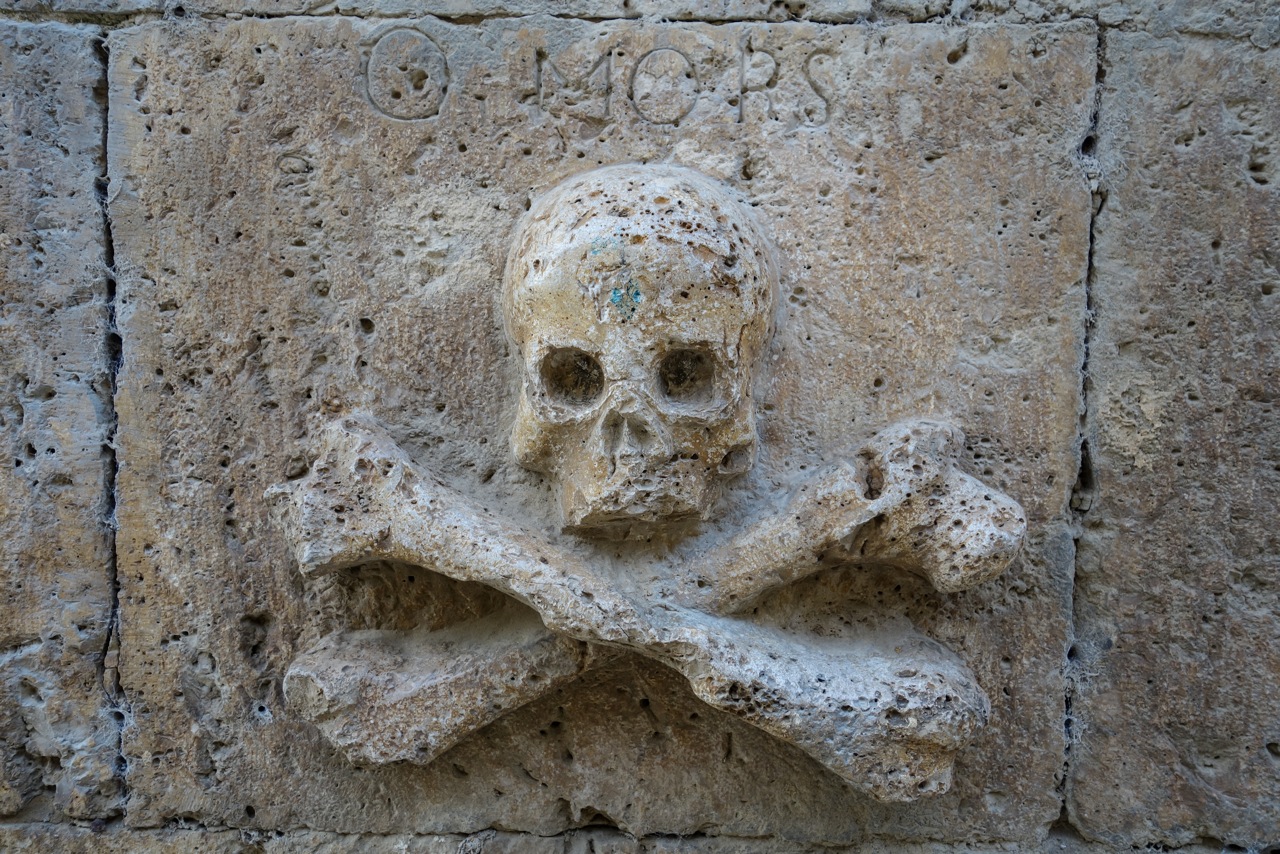
Memento mori

Wall relief in Castrojeriz on the Camino de Santiago

Wall relief in Castrojeriz on the Camino de Santiago

I tell my pupils to live each day as if it were their last… I don’t want children to fear death; I want them to respect life… It’s good for children to confront the idea of death, and… of their own mortality. Sometimes a child feels squeamish about death… skulls and skeletons. When this happens, I tell my pupils to touch themselves. “Why are you afraid?” I ask, “when each of you owns a skull and skeleton. We all carry death within us.” They feel themselves, and they say: “Yes it’s true, we too are made of bones.”

– María Antonieta Sánchez de Escamilla, a kindergarten teacher in Mexico (The Skeleton at the Feast: The Day of the Dead in Mexico, Elizabeth Carmichael & Chloë Sayer)

No leaves, no flowers, no light, no warmth, November. The eleventh month, as the year begins to slip away, evokes mortality like no other. Though it begins with the festivity of All Saints Day, celebrating the friends of God now radiant with the light of heaven, it immediately shifts to the more shadowy realm of All Souls, the Day of the Dead. Death itself, rather than what lies beyond it, becomes our focus. We visit graves, light candles, speak names, gaze at old photographs, tell stories of vanished presences.

In Mexico, death is playfully treated in comic skeleton images and candy skulls, but it is not mocked. A resigned acceptance of mortality pervades the festivities. The living remember not only the dead, but the skeleton inside themselves. They too are “made of bones.”

In American culture, we are not so adept with death. We always seem a little surprised by it. We avoid speaking its name. Memento mori is not a common spiritual practice. Few of us keep skulls on our desk, or sleep in coffins while we still have breath.

Forty-five years ago this month, I had my closest brush with death. I was sleeping in the back of a Volkswagen bus hurtling down a New York thruway at 65 miles per hour. A friend and I had been traveling all night, and it was my turn to rest. Suddenly the bus went out of control and flipped sideways, rolling over and over six times until finally coming to a stop upside down on the grassy median.

I remember two things about that long roll. My mind sped up to make everything appear in slow motion. It was like being inside the giant rotating barrel at an old amusement park. It carries you up and up until gravity kicks in and you are dropped back to the bottom to begin all over again. Slide up, drop. Slide up, drop. But slowed down, so I could observe it all in detail. Meanwhile, guitars, suitcases and croquet balls were flying around in similar motion experiments.

The other thing I remember is how familiar death seemed. I was not thinking, “This can’t be happening.” I was thinking, “Oh, so this is where we finally meet.” I’m sure the words were not so precise in the moment, but the sense of recognition was. When the rolling finally stopped, I lay face down on the ceiling of the inverted bus. I probably blacked out for a moment. Then I heard a voice, “All you all right?” I wasn’t sure how to answer – not until I actually tried to move. What if I couldn’t? I hesitated a moment, delaying the verdict. At last I tested my hands; my arms; my legs. They still worked. I rose slowly to my feet. Thankfully, nothing was broken. My friend was unharmed as well. Life was never so sweet.

The bus itself was totaled, and one of the guitars, my grandfather’s Gibson “Roy Smeck Stage Deluxe” Hawaiian guitar from the 1940’s, was pretty smashed up as well. Its broken body still hangs in our garage, my own memento mori.

In the predominant secular imaginary, a peek through death’s door finds no stairway to heaven, but only darkness. Termination. Void. A terrible forgetting. Emptiness.

This is a reasonable outlook, especially after the charnel house of the past century, but it’s not much to live by. And it is no more provable than belief’s alternative. None of us knows for sure. It’s a gamble either way.

In the 1950’s, Sylvia Plath summarized the modern formulary in her journal:

You don’t believe in God, or a life-after-death, so can’t hope for sugar-plums when your non-existent soul rises… Cats have nine lives, the saying goes. You have one; and somewhere along the thin, tenuous thread of your existence there is … the stopped heartbeat that spells the end of this particular individual which is spelled ‘I’ and ‘You’ and ‘Sylvia.’

John Donne, who himself never took death lightly, saw the outcome differently:

All mankind is of one Author and is one volume; when one man dies, one chapter is not torn out of the book, but translated into a better language; and every chapter must be so translated.

Just a month before his death from cancer in 1631, Donne preached his final sermon, Death’s Duell, at St. Paul’s, London. “That which we call life is … spent in dying,” he wrote, but “a gate into heaven I shall have.” Then, though weak from illness, he posed for a sketch that would be used to make the sculpture for his tomb. After having a fire lit in his study (it was February), he stripped naked and wrapped himself in a burial shroud with only his face showing. Rather than lie down in the traditional sleeping position, he stood erect for the sketch. The resulting statue, the only monument to survive the Great London Fire of 1666, resides in the south choir aisle of St. Paul’s. Donne is standing to greet the resurrection. His eyes are not yet open, but he is smiling with expectant delight. His epitaph reads:

He lies here in the dust
but beholds Him whose name is Rising.

God and the imagination are one

HS dove

Following this blog’s inaugural series of dispatches from the Camino de Santiago last spring, readers of The Religious Imagineer may have noticed a curious diversity of topics: saints, seasons, nature, culture, theology, Scripture, liturgy, art, theater, circus, classic cars and cinema. And perhaps they wonder, what ties all this stuff together?

The fox knows many things, but the hedgehog knows one big thing. When Isaiah Berlin explored the implications of this ancient Greek saying in his celebrated 1953 essay, he argued that Tolstoy was by nature a fox but by conviction a hedgehog. His interests were wide and his eye for the particular was acute, but he sought to contain the world’s multiplicity within a single defining idea.

I can relate. And the one big thing for this blog is found in a line from Wallace Stevens:

We say God and the imagination are one …
How high that highest candle lights the dark.

This might be taken as a secular celebration of the human mind, reducing God to one of its creative fictions. But if I read Stevens with the hermeneutic of a believer, “God and the imagination are one” is not necessarily a matter of either-or. It might also mean both-and. God dwells both in the mind and outside it. Imagination is both a way we reach beyond ourselves, and a means by which the transcendent finds a home in us, enabling us to see with the eyes of God and the mind of Christ, and to act accordingly. To say that God and the imagination are does not mean for me that they are identical, but that they participate deeply in one another.

The Creator’s “Let there be light!” and Jesus’ refusal of the tomb’s finality are the supreme biblical examples of divine imagination. But there have been countless imagineers engaged in the work (or is it play?) of bringing the new heaven and new earth into being. The activist imagining peace, the oppressed imagining justice, the forgiver imagining reconcilation, the mourner imagining joy, the saint imagining a new way of being, the theologian and the artist imagining the beauty of the infinite in the particular, are all practitioners of the holy and transformative task of conforming the world more closely to God’s image.

When Jesus quoted Isaiah 61 in his hometown sermon, he embraced such prophetic imagination as his own vocation.

The Imagination of God is upon me,
for she has sent me to bring good news to the poor.
She has sent me to proclaim release to the captives
and recovery of sight to the blind;
to let the oppressed go free,
to proclaim the year of divine favor.

So to return the original question about The Religious Imagineer’s diversity of topics, I would say that imagination is the unifying subject of this blog. How do we say the unsayable, see the invisible, dance the impossible in our images, rituals and stories? How do we attend to the traces of God amid the chronic unknowing of secular modernity? How do we imagine the really Real and the not-yet?

Video artist Bill Viola, the subject of an earlier post, has observed that “in the Middle Ages they painted the sky gold in the paintings … It was realism they were after – reality of the divine effused through everything in the physical world.” That is my theme as well.

As ever, thanks for reading.

The ten best religious films

DCP blessing2

A man goes into a butcher shop and says, “Give me your best piece of meat.” And the butcher replies, “Everything in my shop is the best.” (Zen story)

Top ten lists are inherently fraudulent. By what authority do I declare what is best? And by what criteria? And which religion? But if I had titled this post, “Ten compelling films which engage religious questions from a [mostly] western Christian perspective,” it wouldn’t be nearly as much fun. We love rankings, if for no other reason than the pleasure of argument.

My list is totally subjective of course, and infinitely revisable, depending on the day, or where I am in my life (although Robert Bresson’s Diary of a Country Priest has topped my list every since I first saw it in Ann Arbor 45 years ago and subsequently had to wander around for a couple of hours on a rainy night until I was capable of returning to ordinary life).

I have restricted myself to one film per director (or else Bresson would take up about six places, and Tarkovsky a few more, etc.). I have also stuck to the western Christian tradition, with the Russian orthodoxy of Tarkovsky the one exception.

And while there are many films with spiritual subjects or theological themes, I have focused primarily on examples of what Paul Schrader calls “transcendental style” – films which are not just about religious experience, but themselves create religious experience in the viewer, through cinematic form and language as much as story. Icon writers know this well. There’s a lot to say about transcendental style, but for now let me simply cite Susan Sontag’s remark about Robert Bresson: “His form does not merely perfectly express what he wants to say. It is what he wants to say.”

All these films are available on DVD or Blu-ray, and I hope you will be encouraged to explore them. But I must warn you that not all these films are equally accessible. Most of them refuse the usual manipulations and excitements of mass cinema, and demand a contemplative mind. Transcendental style can be as rigorous as prayer. But as Iranian director Abbas Kiorastami has said, “I would rather see a film that might even bore me in the act of watching but that later I can’t stop thinking about, than a film that keeps me on the edge of my seat and then is immediately forgotten.”

Here is my list, in alphabetical order.

1) Decalogue (Krzysztof Kieslowski, Poland 1988)   This extraordinary cycle of short films explores various lives within a single apartment block, whose grey concrete bleakness exudes the alienation and melancholy felt by many of its residents. It is the world after the Fall, when instinct and intuition no longer suffice to guide human living. Each film is roughly based on one of the Ten Commandments, but the imperatives of each situation are far from clear. Choices matter intensely (it is not such a godless world that one can do anything one wishes), but most of the characters are bewildered and beset by the questions before them. And yet – grace happens, people connect, souls find mercy. Not every time, but enough to keep alive the hope that God – embodied by a mysterious figure who always seems to be around at key moments – has not abandoned us.

2) Diary of a Country Priest (Robert Bresson, France 1950)   Bresson pares away everything inessential to show the story of a soul. The miracle of his “transcendental style” is that he shows us not so much what people do as who they are – not through explaining them psychologically, but by letting their mystery be. As with iconography, a kind of inexpressiveness on the surface allows hidden depths to shine through. As the priest walks his own Stations of the Cross, the sorrowful way becomes a revelation of grace. This is not a film about religious experience – it is religious experience.

3) Ida (Pawel Pawlikowski, Poland 2013)   Is the religious life purely a product of environment, or is it indelibly inscribed on the heart? In 1962, a young novice, raised as an orphan in her convent, is sent into the world to visit her only living relative, just prior to taking her final vows. Will her vocation survive outside the cloister? The people she encounters, the discoveries she makes about her past, the suddenly viable prospect of a life in the outside world – all present her with new options for her life and vocation. One of the many beauties of this film is that neither the convent nor the outer world are judged. Both are viewed with sympathy and respect. Until she decides her future, Ida is shown off center, at the edge or bottom of the frame. But in the film’s final shot, she is perfectly centered at last.

4) Into Great Silence (Philip Gröning, Germany 2005)   The director spent 6 months in residence at a Carthusian monastery in the Alps, filming monastic life and worship. Using only natural light, he shows us a numinous world of shadows pierced by the radiance of windows and candles. Dwelling in this world of prayer and silence for nearly three hours, we slow ourselves to the monastic rhythm, and emerge refreshed and centered, and thankful for those who give their lives to providing, as Dan Berrigan once put it, “large reserves of available sanity.”

5) Magnolia (Paul Thomas Anderson, USA 1999)   Is the world only a confusion of chance and arbitrary choice, or do providence and purpose exist? Is the universe a matter of chaos or love? Anderson explores the possibility of connection, pattern and grace in the intersecting lives of many different characters, all of whom are in some way broken, wounded or lost, casualties of a city (Los Angeles) which, like the biblical Egypt, has produced countless captives and victims. In one unforgettable scene, nine of the characters are shown, each in their particular condition of need and supplication, singing along with the soundtrack, Aimee Mann’s “Wise Up” (“It’s not going to stop till you wise up”). Their capacity to exit the prison of the self just enough to partake of the soundtrack’s “common prayer” is both ritual transcendence and the tentative praxis of real liberation. As if in answer, a biblical rain of frogs falls from heaven.

6) The Mill and the Cross (Lech Majewski, Poland 2011)   In a windmill perched high above a broad plain teeming with figures, God is a miller grinding the terrors of history into something better, even as the Christ is being dragged to the cross. This strange, haunting and difficult film immerses us within the complex world of a single painting, Pieter Brueghel’s “The Way to Calvary,” where the Passion of Christ is relocated to the painter’s own 16th century world. Through a visually stunning use of computer imaging, we dwell within the painting’s fantastic landscape and mingle at close range with its numerous characters. The effect is astonishing, as if we are dreaming with a premodern mind. The human suffering is arduous and heartbreaking, but it does not have the last word. In the end, the dance goes on.

7) Nostalghia (Andrei Tarkovsky, Russia 1983)   All of Tarkovsky’s films practice what he called “sculpting in time,” using a contemplative camera and lengthy shots to register a deeper flow and presence than films that hurry from one incident to the next. For western Christians, the image is usually about something. For an orthodox Christian like Tarkovsky, the image is something. The viewer becomes less a spectator than a supplicant. “The aim of art,” said Tarkovsky, “is to prepare a person for death, to plough and harrow the soul, rendering it capable of turning to the good.” Nostalghia is more poetry than narrative, rhyming fire and water, dream and memory, ritual and redemption, to counter the malaise of materialism.

8) Of Gods and Men (Xavier Beauvois, France 2010)   Based on a true story of a monastic community facing martyrdom in 1990’s Algeria, this is a profoundly moving story of self-offering and radical forgiveness. Structured around the liturgical hours and seasons, its unhurried scenes of prayers and chants allow us to worship along with the monks. But they are asked to sacrifice more than praise, and their faithful willingness to take up the cross poses serious questions for our own discipleship.

9) Ordet (Carl Dreyer, Denmark 1955)   Like the parables of Jesus, Ordet (“The Word”) employs the forms and situations of the everyday world only to break open the frame of that world with the startling intrusion of an alternate reality. Dreyer’s film, like its “holy fool” Johannes, presents us with divine impossibility in perpetual tension with the way we expect things to go. It uses material means – faces, architecture, landscape, language, light – to show us the immaterial, but in the end we are led not away from corporeal existence, but rather more deeply into it.

10) To the Wonder (Terrence Malick, USA 2012)   “Love everyone. Every leaf. Every ray of light. Forgive.” This line from The Tree of Life (drawn from Dostoevsky) is the theme of every Malick film. While his work has always reflected a deep interest in philosophy and religion, his most recent films have been theologically explicit to a degree unique in American cinema. The Tree of Life covers the biblical span from Creation to Apocalypse, while To the Wonder narrows its focus to the Song of Songs’ analogy between human relationships and divine-human love. Unlike the plot-driven narratives of most films, To the Wonder unfolds in hints, glimpses, ellipses and temporal leaps. We can’t always be sure whether we are seeing events, memories or thoughts. As with Bresson, there is no psychological explaining of characters. They retain the open-endedness of their essential mystery. It’s not so much a film in the usual sense as it is a dance, a poem, even a prayer. The viewers aren’t simply invited to watch the ecstatic images, but to become ecstatic themselves.

The most dangerous place in the world

Small mtn tent still

I have come to understand that this small ring is the most dangerous place in the world, but also a place where everything is possible, where eyes are opened.

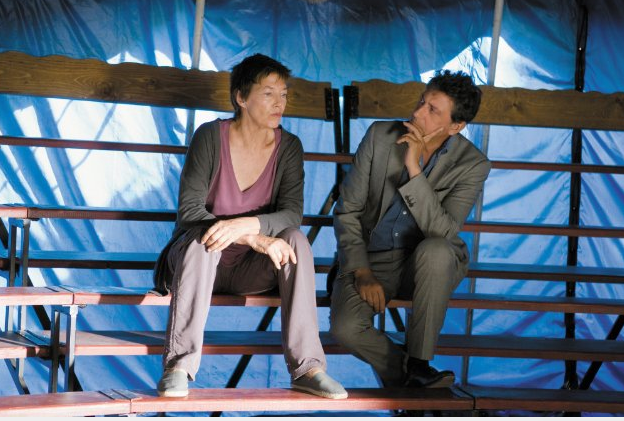
In Jacques Rivette’s magical film, Around a Small Mountain (2009), a footloose Italian named Vittorio, wandering Europe’s back roads in a sports car, chances upon a small French circus on tour in the backwater of Languedoc. Although the story is set in our own time, it is really a medieval romance. Vittorio is the knight errant questing for that nameless object of desire perpetually beyond his grasp. And the enchanted world of the cirque, curiously untouched by modernity, is the place where the knight will be tested.

When Vittorio encounters the enigmatic Kate, a woman who is “a prisoner to what happened” in the circus ring years ago, he lingers in her domain long enough to attempt a rescue. “All the dragons in our lives may be hurt princesses,” he says, echoing Rilke’s famous line: Perhaps everything terrifying is deep down a helpless thing that needs our help.

As Vittorio attempts to break the spell cast over Kate by the lingering presence of a dead father and the haunting absence of a dead lover, he has to face his own dragon, which is never specifically identified. The secret of his being remains a mystery, unknown to himself and to the actor who plays him, unknown to the audience and the director as well. The sentimentality of a conventionally romantic conclusion – man and woman settling down happily ever after – would betray this mystery, and Rivette rejects such an option. The ultimate fate of Kate and Vittorio is not revealed to themselves or us. “Will I start living again?” she wonders. “I don’t know if I am alive,” he says. Might the future perhaps return them to each other? “Who knows?” is the last line of the film.

We exit this cinematic world still mesmerized by its embrace of uncertainty, its refusal of resolution. Like the knight errant, we remain prisoners of unsatisfied longing. We wouldn’t have it any other way. As C. S. Lewis noted, an unsatisfied desire is “more desirable than any other satisfaction.”

Nevertheless, something transformational has happened to Kate and Vittorio and, vicariously, to us, in that “most dangerous place,” the circus ring. They have each stepped into the exposed and empty space where they must perform the truth of themselves, put themselves at risk, wrestle their demons, without really knowing in advance how they’ll ever get through it. But they have already taken their first steps into a new life. In the words of the German Romantic Friedrich Hölderlin, quoted in another Rivette film, “Where danger is, there grows the saving power also.”

I recently saw Around a Small Mountain for the first time, and I was particularly struck by the hermetic quality of the circus. It seems sealed within its own world, having minimal interaction with contemporary life. The landscape it travels remains little changed from the Middle Ages, as if forgotten by modernity. Though the circus is touring the towns around the perimeter of a small mountain, there is little sense of movement from place to place. Wherever the troupe pauses in their circuit, the mountain’s solitary peak still looms in the background, as if the land itself casts a spell they cannot escape.

In the course of the film, we see a number of performances, but they seem to have no public. The first time we enter the tent, there are only a few people in the audience as the camera sweeps over mostly empty seats. After that, the camera doesn’t even bother to look away from the ring to the surrounding bleachers, so we are never sure whether we are viewing a rehearsal or an actual show.

The acts are performed in an almost eerie silence, without applause or any other sounds to indicate the presence of an audience. This melancholy absence of witnesses seems of no concern to the acrobats, jugglers and clowns who carry out their rituals with as much devotion and attention as a priest saying mass in an empty church. Whether what they do is of any relevance to the outside world does not seem an issue for them. What matters is the faithful performance of the circus rites.

As I watched the ritualized actions in the circus ring, skills and gestures passed down through many centuries, imbued with the strangeness of a premodern sensibility, I could not help thinking about the Christian liturgy. We too perform rites forged in a distant past, shaped by a social imaginary largely unintelligible to secular modernity. And like the circus in the film, our “audience” has largely deserted us.

In his audio commentary on the DVD, Chris Fujimara describes the circus as “an end state, a final repository, a gathering and summation. Everything in life is being distilled and evoked from this ring in a way that has to do with aging, with memory, with death, with the imminent end of things, with the suggestion that the circus, this mode of entertainment and spectacle, already belongs to the past.”

There are those who see Christianity’s own pastness as prelude to extinction, and believe everything alien to the present social imaginary should be jettisoned as quickly as possible. I myself have spent over forty years adding radically contemporary elements to the worship mix. But that has never, I hope, been at the expense of the strangeness of what we do and the mystery of what we worship.

In some future posts I will have more to say about the implications of this strangeness for the concrete practices of worship as well as the need to connect with an absent public. But for now, like the ringmaster, may I simply direct your attention to the center ring, the most dangerous place in the world, the empty space where everything is possible, where eyes are opened. To paraphrase Jacques Rivette, “there is no other subject.”

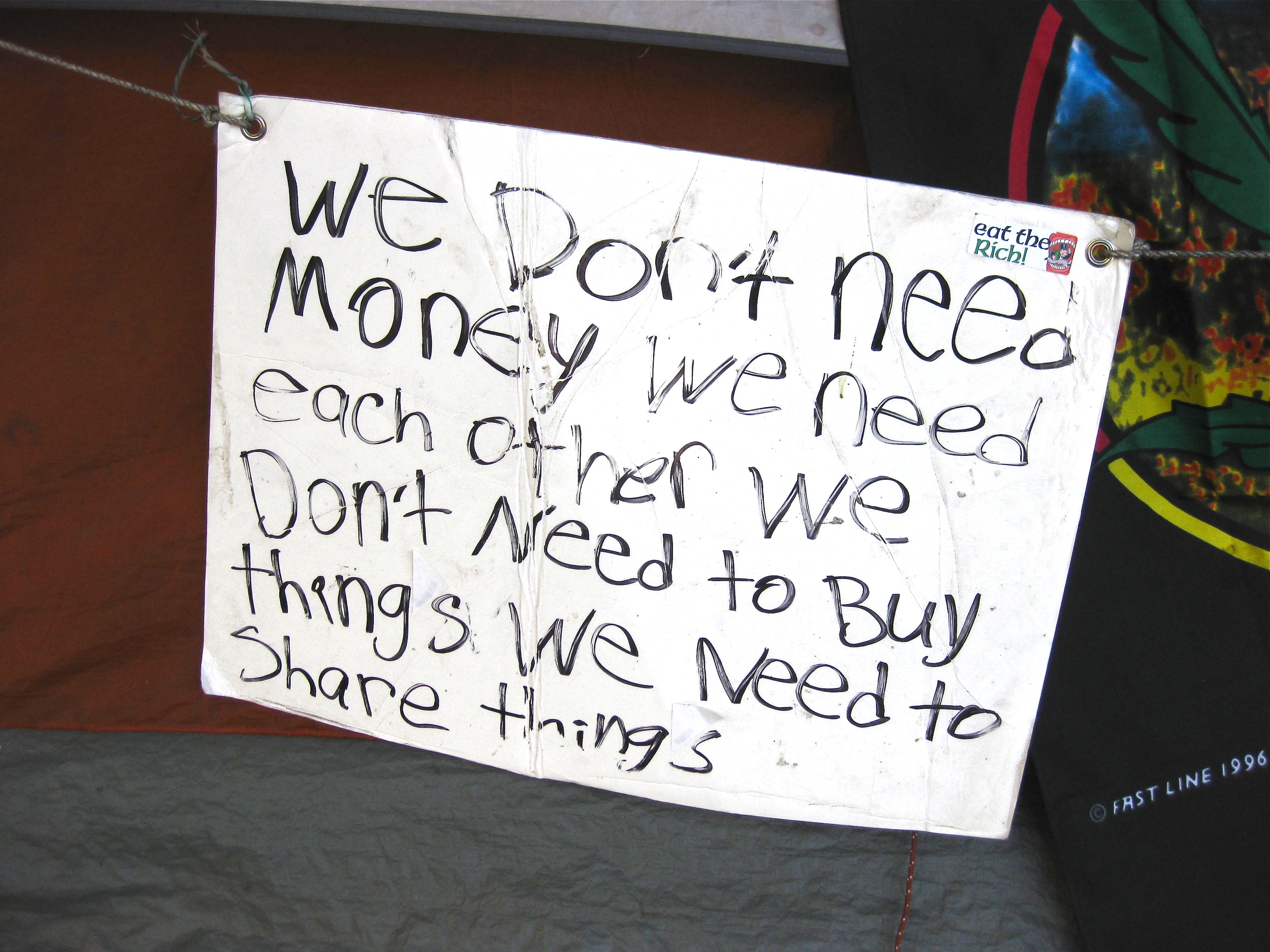
God’s not fair!

Sign at Occupy LA city hall encampment, October 2011

Sign at Occupy LA city hall encampment, October 2011

If any have toiled from the first hour,
let them receive their due reward;
If any have come after the third hour,
let them with gratitude join in the Feast!
And those that arrived after the sixth hour,
let them not doubt; for they too shall sustain no loss.
And if any delayed until the ninth hour,
let them not hesitate; but let them come too.
And those who arrived only at the eleventh hour,
let them not be afraid by reason of their delay.
For the Lord is gracious
and receives the last even as the first.
Christ gives rest to those that come at the eleventh hour,
as well as to those that toiled from the first.

This famous passage from the ancient Paschal homily of St. John Chrysostom is a marvelous riff on Jesus’ parable of the Workers in the Vineyard (Mt. 20:1-16). It’s certainly good news to the latecomers, but rather disconcerting to those of us who have a strict idea of who’s in and who’s out. You never know what kind of people you’re going to run into at God’s place. You may have to break bread with some who haven’t earned their place at the table the way you have, who haven’t paid their dues the way you have. It’s not fair. The kingdom of God is not fair.

That’s the trouble with mercy and forgiveness and grace. They are so undiscriminating. How are we supposed to know where we stand, how can we measure up, how can we hold others accountable, if the standards are so loose and slippery?

Let’s face it. Jesus was a terrible bookkeeper. He didn’t maintain accurate accounts of how everyone was doing. He was too busy throwing a party for God’s friends. Y’all come. Everyone’s welcome!

The first disciples who listened to this story undoubtedly needed to hear its message. They were anxious about where they stood with Jesus and with God. Lord, who’s going to sit at your right hand and who’s going to sit on your left? What are we going to get for following you? Whom do you love the most? This anxiety about status and privilege continues in the Book of Acts, when some of the original Jewish believers resent the influx of Gentile converts. And we have our own versions of this calculating mentality today. Who’s in, who’s out? Who’s better, who’s worse? Who belongs, who doesn’t? Who’s saved, who’s not?

But with this parable, Jesus tells us:

  • Stop worrying about wages. The kingdom isn’t something you earn. It’s a gift. Be glad you are one of the recipients.
  • Don’t worry about how much you’ll get. You’ll get what you need. You really will.
  • Stop comparing yourselves to others. God loves everyone equally.
  • Don’t be envious or resentful of someone else’s good fortune, even when you think it’s undeserved. Be glad that God is so generous, even if it’s not always about you.

Once the whole idea of a bookkeeping religion has been exploded by this parable, we begin to realize that it’s not a story about wages at all. It’s a story about the vineyard. Everyone gets invited to the vineyard, and ending up there together is the whole point. The latest have not come too late, and the earliest have not come too early. In the end, everyone is there, no one is missing.

Now if you don’t want to be part of this vineyard collective, just take what you’ve earned and go. That’s what the master tells the complainers, the bookkeepers, and to me it’s the most chilling line in the story. You don’t want any part of the kingdom’s undiscriminating generosity? OK, fine. Go off and be by yourself, or with your little circle of the like-minded. But you may find it rather lonely. And you’ll miss one hell of a party.

A feather on the breath of God

Hildegard at desk

When I was 42 years and 7 months old, a burning light of tremendous brightness coming from heaven poured into my entire mind. Like a flame that does not burn but enkindles, it inflamed my entire heart … just like the sun that warms an object with its rays.

So wrote Hildegard of Bingen, a twelfth-century abbess, artist and activist whose feast is celebrated today. In a society where women were more seen than heard, it took her a long time to find an outlet for her voice. She had experienced visions ever since her childhood, but she kept them mostly to herself until she was in her forties. Her reticence wasn’t just due to social pressure. She also shared the self-doubting anxiety of every artist. Did her visions matter? Would the world understand or care? But as every artist knows, if you have a gift and don’t make it visible, it will sicken and die within you, and your own body will suffer the effects.

And Hildegard in fact became a sickly woman: “Not in stubbornness but in humility, I refused to write for so long that I felt pressed down under the whip of God into a bed of sickness.” But at last she overcame her inhibitions. Her call was too strong to resist. She began to write, and compose, and produce paintings of her visions. Her body was restored to health, and from then on, she tried to live the life only she could live.

In one of her visions, God told her: O how beautiful your eyes are when you tell the divine story!

Tell the divine story: That was the work she had been given to do. In addition to the normal duties of a medieval abbess in the Rhineland, Hildegard became a storyteller, a musician, an artist, a writer; and through all these media she obeyed the command given to every artist, to “make visible what, without you, might never be seen.” She was also an activist, reminding the powerful to show compassion to the poor, and railing against clergy who failed to blow “the trumpets of divine justice.”

Hildegard was always mindful of the source of her creativity:

The marvels of God are not brought forth from one’s self.
Rather, it is more like a chord, a sound that is played.
The tone does not come out of the chord itself,
but rather, through the touch of the musician.
I am, of course, the lyre and harp of God’s kindness.

She put this even more succinctly when she called herself “a feather on the breath of God”

The bright-colored enigmas of her illustrated visions, painted by others under her supervision, are unlike anything else in western medieval art. Figures embedded within circles or mandalas express her experience of God as being “like a wheel, a circle, a whole, that can neither be understood, nor divided, nor begun nor ended … just as a circle embraces all that is within it, so does the Godhead embrace all …. You are encircled by the arms of the mystery of God.”

Hildegard’s music was as original as her images. Her compositions resemble the Gregorian chant of her time in their liturgical form and musical modes. They also conform to plainchant’s suppression of extroverted individuality for the sake of devotional calm. At the same time, they go beyond traditional chant in several ways: her melodies have an exotically wide range, often spanning two octaves, with sudden leaps from low notes to high notes; her texts are rhapsodic outpourings of strikingly original imagery; and her songs possess a freedom and exuberance that reflect an artist on the loose.

Her music wasn’t primarily a form of personal expression. It was a manifestation of deepest reality. “O Trinity, you are music, you are life,” she prayed. For Hildegard, “all of creation is a song of praise to God.”

She didn’t make up her songs; she listened in to the music of heaven:

Then I saw the lucent sky, in which I heard different kinds of music, marvelously embodying all the meanings I had heard before. I heard the praises of the joyous citizens of heaven, steadfastly persevering in the ways of Truth; and laments calling people back to those praises and joys; and the exhortations of the virtues.

This was more than metaphor, as her writings make clear. Her compositions came to her whole, given by God, much like the auditory mysticism of St. John the Divine, who wrote in the Book of Revelation: “And I heard a voice from heaven like the sound of many waters and like the sound of loud thunder; the voice I heard was like the sound of harpists playing on their harps, and they sang a new song before the throne.”

Hildegard believed that the music of heaven is in us and all around us. We have been created to harmonize with it. “The soul is symphonic,” she said.

She conceived a charming image of Adam before the Fall: he sang with a voice of pure honey, and the devil knew that as long as Adam managed to remember the sweetness of the heavenly songs, he could never be tempted. So with Adam, as with all of us who have come after, the devil set out “to trouble or destroy the affirmation and beauty and sweetness of divine praise and of the hymns of the spirit.”

In Hildegard’s opera, Ordo Virtutum, an allegory of the virtues, all the characters sing – except the devil, who can only heckle and shout. The devil’s work is dissonance, the shattering of harmony.

Hildegard once had a dispute with the bishops of her diocese, who tried to force her submission on a matter of principle by forbidding her nuns to take communion or to sing the liturgy. It was a terrible ordeal for her community to live without music. Hildegard remarked at the time that those who choose to silence music in their lifetime will go to a place where they will be “without the company of the angelic songs of praises in heaven.” It was her discreet way of telling the prelates to go to hell.

Every artist has to deal with philistines, but we can be thankful that Hildegard’s enormous gifts were for the most part supported by her contemporaries. She fell into obscurity for centuries after her death, but she returns anew to our own time with a voice we long to hear, a voice resonant with compassion, a voice aflame with justice, a voice attuned to the divine harmony for which all of us are made.

Sometimes Hildegard seems to live in a different universe than we do, a universe alive with multi-sensory evidence that God is “burning everywhere,” that everything in the world is dense with meaning and liveliness.

All the senses, in her universe, deliver this message to the receptive soul. Unlike the purely material universe proposed by modernity, a happenstance of mute objects and dead space, Hildegard’s universe was sacramental, alive with significant presence.

In one of her visions, a human figure stands in the center of a cosmic wheel. This Christlike image of Divinity declares to her and to all the world:

I, the highest and fiery power,
have kindled every spark of life …
I, the fiery life of divine essence,
am aflame beyond the beauty of the meadows.
I gleam in the waters. I burn in the sun, moon and stars.
With every breeze, as with invisible life that contains everything,
I awaken everything to life.

Is this not the high calling of every saint – and every artist?
To awaken everything to life.
To set our imagination aflame.
To make visible the unsurpassable beauty of God.

As Simon Weil put it so well in our own era,

A sense of beauty, although mutilated, distorted, and soiled, remains rooted in the human heart as a powerful incentive… If it were made true and pure, it would sweep all secular life in a body to the feet of God.