Hospital for the soul

“I’m not sure why I’m doing this,” an Australian told me yesterday. There are times when I wonder that myself. Last week I saw some graffiti on the Camino: WHY ARE YOU WALKING? So much time and energy goes into just reaching the next destination, it is possible to neglect or even forget the work of the soul. I suspect that this journey doesn’t have a lot to do with the quality or clarity of my thoughts, but has more to do with cultivating receptivity to the holy moments as they present themselves.

I have observed many walkers, particularly the young, who seem to rush straight ahead with barely a glance to right or left, much less a pause to listen to a small bird or the sound of rustling poplars. I myself have devoted too little time “to stray about / voluptuously through fields and rural walks, / and ask no record of the hours, resigned / to vacant musing, unreproved neglect / of all things, and deliberate holiday.” (Wordsworth, “The Prelude”). But then Wordsworth didn’t have to get to Santiago in 33 days.

Yesterday something shifted for me. Reaching the impressive ruins of the medieval monastery of San Anton, I didn’t just pause for a quick snapshot of the arch over the road and then hurry on. I found a side path that led to the roofless interior of the ancient church, where only the cooing of doves broke the deep silence. Here I ate bread and cheese in unhurried solitude, listening to the memories of ancient stones.

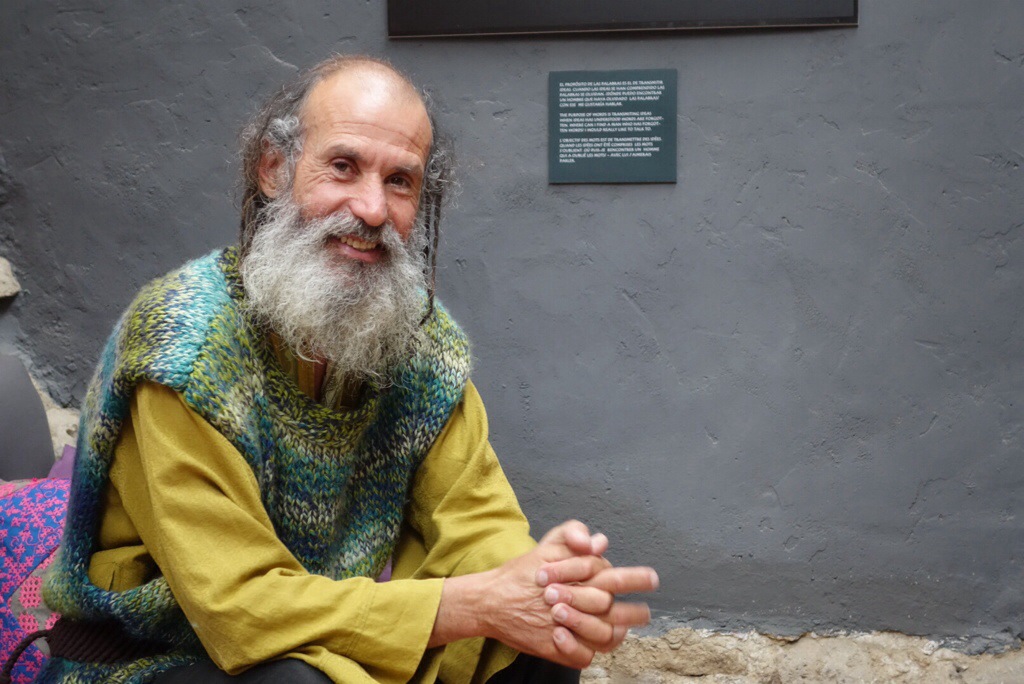
I was tempted to spend the night there, in its primitive hostel with no electricity, but something called me to press on a few more miles to the hill town of Castrojeriz. Perched on a steep slope below a the remains of an old castle, its stone streets and narrow passages wind confusingly like a maze, making it easy to get lost, or at least you never seem to go the same way twice. My own wanderings in this mysterious place brought me to an open door where gentle meditation music wafted out into the street. The sign above the door read: The Hospital of the Soul. The word “hospital” on the Camino is related to “hostel” or “hospitality,” but its modern association with healing is also fitting. Next to the door was posted an invitation to come inside, explore the house, and make retreat for a while. I entered, passing among beautiful contemplative photographs taken along the Camino. When I found the rustic fireside room painted with strong tones of stone and sea, lit by a transparent ceiling, I took a seat as if I belonged there. A Spanish man was sitting on the couch, writing. A woman brought me a cup of tea. In the sweet hour that followed, I made some journal entries until Mau, the Italian who lives there with the Spanish woman, Nia, came in to warm himself by the fire.

Mau has walked the Camino many times, and seeing so much rushing along, and so few places to stop and go inward rather than onward, that he and Nia, whom he met on the Camino seven years ago, bought this house and refurbished it into a place where the stranger is welcome and the soul can breathe, “Everyone is welcome here,” he told me, “but it”s not for everyone. Many people hurry along the Camino who show little interest in the work of the soul.”

We had a rich, even holy, conversation, one I will long remember. When I finally took my leave to attend vespers at the local convent of cloistered nuns, I told Mau I hoped I would see him again someday. “Perhaps,” he said, “but it is not necessary. We have met.”
20140424-172036.jpg

Christ is risen!

Holy Saturday began, like the previous two days of the Triduum, starting in the dark to walk by the light of Paschal moon and breaking dawn. Those early hours, the matins and lauds of newborn day, will surely remain among the sweetest of the Camino. After woods of oak and pine, sleeping villages in peaceful valleys, and the World Heritage site of the oldest discovered human remains (900,000 years ago), I pressed on into the urban sprawl of Burgos, determined to make the Easter Vigil at the great cathedral.

I knew it would not resemble the creative Vigils I have curated in the States. There would be no storytelling, theater, dance or musical eclecticism. But I was not prepared for the total absence of either mystery or joy. The solemn darkness at the beginning was shattered by the constant flashing of cameras, and the house lights were turned up full before the Exultet was sung, thus negating the holy glow of our candles. Fourteen scowling men in chasubles up front was a poor icon of Easter joy. And if your eye wandered upward to the spectacular golden retablo behind them, you were treated to St. James the Moor Slayer on his horse trampling a couple of Muslims (dressed in colorful costumes like dancers in “The Nutcracker,” so the effect was rather cheerful). Perhaps worst of all, never once did we get to shout “Christ is risen!”

I returned despondent to my tiny, cold, windowless hotel room after midnight. In the first hour of Easter morning, it felt like returning to the tomb. I didn’t go out again until noon. It was raining. The streets of the old city seemed dead. I sang “Welcome, Happy Morning” under my breath, more out of habit than conviction.

I happened to pass by the church of San Nicolas, whose splendid stone retablo was on my must-see list. So I ducked in out of the rain. And there, to my utter surprise, was the risen Christ, returning to the doubting and the sad just as he promised.

It was the end of mass. The priest pronounced the blessing, and then began the most extraordinary outpouring of Easter joy. For the next 45 minutes, children and youth in traditional costumes did festive folk dances to the sound of reeds and drum, Easter songs, and the continuous ringing of small hand bells. Sometimes they danced near the altar, sometimes they danced in procession around the aisles with priest and choir. Here was resurrection indeed:
“I am the dance and I still go on!” All the rest of us joined in hearty singing of the hymns and Alleluias, punctuated by loud shouts of “Viva!” Tears streamed down my face. O beauty so ancient and so new!

And so, as Scripture says, “Surely God’s mercies are not over; God’s kindnesses are never exhausted. They are renewed every morning.” When the celebration concluded, the priest walked among the people with a basket of sweet cookies. As he offered one to me, I received it with recognition:

“Take and eat – I am with you always.”

Good Friday

The jeweler has a shop
On the corner of the boulevard
In the night, in small spectacles
He polishes old coins
He uses spit and cloth and ashes
He makes them shine with ashes
He knows the use of ashes
He worships God with ashes

The coins are often very old
By the time they reach the jeweler
With his hands and ashes
He will try the best he can
He knows he can only shine them
Cannot repair the scratches
He knows that even new coins
Have scars so he just smiles

He knows the use of ashes
He worships God with ashes

In the darkest of the night
Both his hands will blister badly
They will often open painfully
And the blood flows from his hands
He works to take from black coin faces
Thumbprints from so many ages
He wishes he could cure the scars
When he forgets he sometimes cries

He knows the use of ashes
He worships God with ashes

(Tom Rapp & Pearls Before Swine)

20140418-062010.jpg

Jesus’ Bakery

Yesterday I was in Santa Domingo de la Calzada, whose cathedral keeps a couple of live roosters in the south transept in tribute to a local miracle involving a cooked chicken coming back to life, thus stirring the sheriff to leave his dinner in time to rescue a hanged man from death. It’s a long story.

This morning I slipped out of the sleeping town before dawn, by the light of the Paschal moon. By the time I reached a large wayside cross, the dawn was blazing behind me. It was a dramatic beginning for the great three days of the Paschal Triduum, the ritual mimesis of Christ’s passage through death into resurrection.

I have been wondering what Holy Week, and especially the Triduum, would feel like on the Camino, so far from my accustomed ways of keeping these days. Each day I walk to a new place , hoping there will be some kind of liturgy there, and that despite the language and cultural differences I can still be deeply engaged in the texts, prayers and singing. And there have been some memorable moments so far, especially the processions. But as the week enters its climax, how much will I miss the familiar words and powerful hymns of my own tradition that have always, for me, been essential to the experience? Will my ritual dislocation have its own unique gifts to offer?

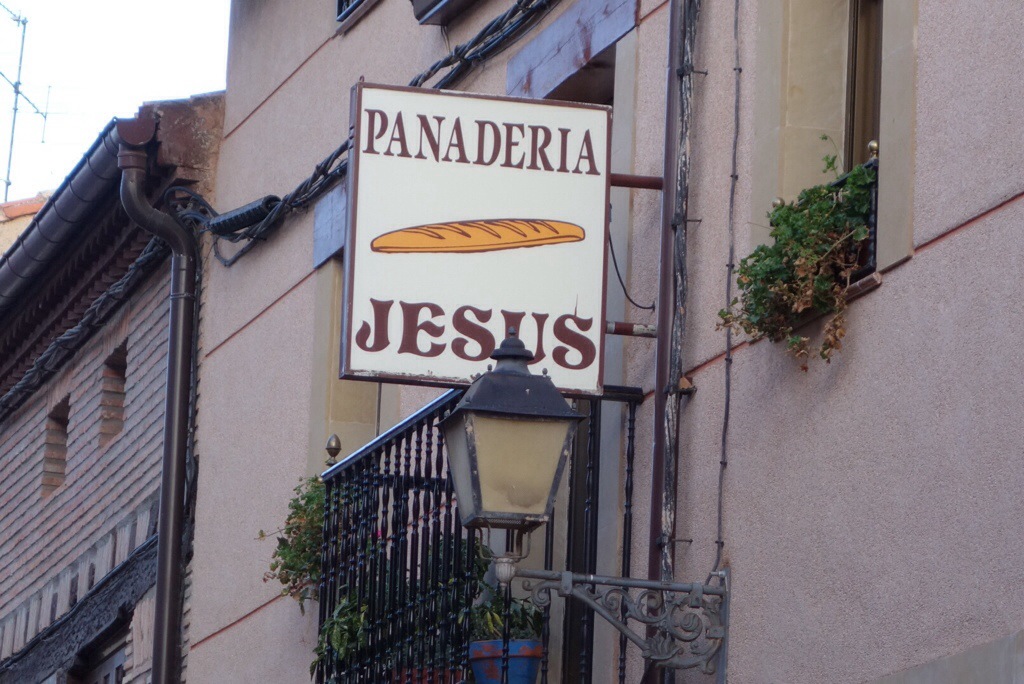
I had my answer this morning, when I entered the village of Granon. After ninety minutes of walking, I was ready for some refreshment. Just past the church, I looked up and saw the sign: PANADERIA JESUS, On the very day we remember the Last Supper, where Jesus took bread and said, “This is my body,” I had found Jesus’ Bakery. It had just opened for the day, and I entered through a bead curtain to find the baker pulling fresh loaves from the oven. The one he handed me was still warm. I have never tasted better bread. As I continued my walk, loaf in hand, I consumed each bite with the reverence of the sacrament. As the Psalmist says,

So mortals ate the bread of angels;
God provided for them food enough.

20140417-170559.jpg

20140417-170614.jpg

Small steps

18.7 miles today, plus 17.8 yesterday, made the longest two-day total of my life. Today’s cooler overcast weather made the miles easier, but a slightly sore left foot and right knee, worn down by yesterday’s grind, started to slow me down with 8 or 9 miles left to go. I felt a bit discouraged. But then I met an extraordinary pair of hikers, and their company lifted my spirit. My body felt fresh again and the miles to Najera flew by. Their sudden appearance felt like such a gift. God provides.

Mathieu Sabourin and Julia Gaubert are walking across Europe. This French couple began in Estonia in May, 2013, headed south for the Balkans, crossed the Alps from Italy to France in December, and in two more months will complete their journey in Portugal. Having entered professions in law and finance related to the European Union , they both felt a desire to know the people and places of that union more intimately before they went any further in their careers. So they started walking, shooting a documentary as they go (as we walked and talked, I realized that Julia was taping bits of our conversation).

Their time on the Camino is unlike the rest of their journey in one respect. Elsewhere, two people walking with packs has elicited a great curiosity, often resulting in rich conversations and offers of hospitality. On the Camino, however, pilgrims are such a common sight that we are barely noticed, except for the occasional wish of “Buen Camino!” Another difference is Mathieu and Julia’s more leisurely pace. They have already taken two layover days this week, while the rest of us have slogged on without a break. But see how far they have come! There may be a lesson here.

Their website is http://europedespetitspas.com/
It means “Europe in small steps.”

20140415-185308.jpg

Palm Sunday

The local masses in the impressive churches of Estella – a picturesque river town beneath a great cliff – weren’t until 12:30, and I had 13 miles to walk. So I found a few people to join me in a Eucharist along the way. Using wine provided from an outdoor spigot on the path (a winery’s gift to pilgrims), we kept Palm Sunday – Anglican, Roman Catholic, and Orthodox – in a park next to an old monastery. Then, with olive branches (the Spanish variant of palms) attached to our packs, we continued on. Most of Holy Week will be like this – prayers, hymns and rites along the way, by myself or with a few others – because this week’s itinerary may not coincide with whatever church liturgies there may be when the walking day ends. It will not be the first time I’ve been liturgically homeless during the most important week of the year, but I pray that the Camino will provide some new ways to go ever deeper into the Paschal Mystery. And if I can survive the next two 18 mile days to stay on schedule, I will make the Easter Vigil at Burgos cathedral.

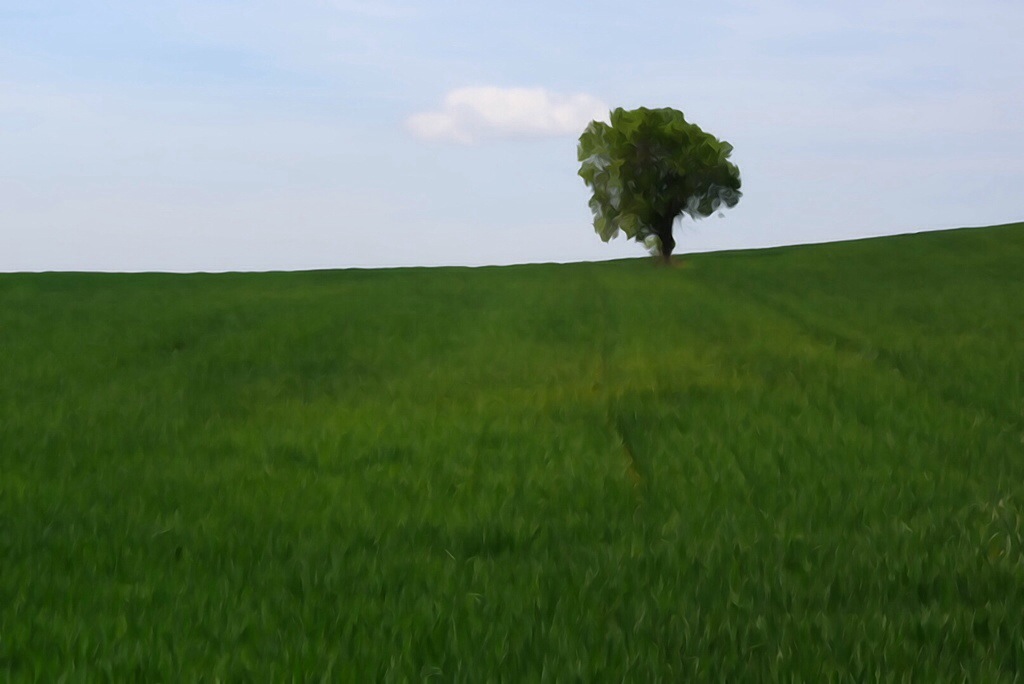
Certainly the prayers about walking in the way of the cross were deepened today by the thousands of steps that became a kind of prayer that persisted whatever my thoughts might be doing. In the afternoon’s long traverse of wide empty space under a hot sun, monkey mind receded, replaced by a kind of pedestrian trance. It’s hard to put into words, but perhaps this photograph (applying my camera’s watercolor effect), can say it for me.

20140413-211850.jpg

“Cherish every step”

The way out of Pamplona was fairly pleasant – city parks (did Hemingway stroll here?), flocks of children bound for school, strolling matriarchs who kept this pilgrim from taking a wrong turn – and suddenly the city gave way to fields and small villages. The rest of the morning recalled Wordsworth:

“The earth is all before me. With a heart
Joyous, nor scared at its own liberty,
I look about; and should the chosen guide
Be nothing better than a wandering cloud,
I cannot miss my way. I breathe again!”

The land through which we pilgrims passed today was painted with a few strong colors: dark green wheat, yellow mustard, blue sky, white clouds. Those four colors filled the eye in every direction, with no lesser hues to dilute the effect. To wander through such a scene was a glorious thing. Whatever else the Camino brings, I will have had this day. As a German woman said as she passed me by, “Cherish every step! Cherish every step!”

The halfway point was a windy pass, Alto del Perdon, where medieval pilgrims who made it this far were assured of blanket pardon for all their sins. The heart did feel lighter to see behind how far we’d come already, and to contain in one glance ahead the entire distance to our next rest. The striking contemporary sculpture of pilgrims from many centuries in procession blessed us on our way.

20140411-215300.jpg

Pamplona

After 32.6 miles in two days, 9 miles to Pamplona today was a nice “break.” I know two people who started when I did who were told by a doctor to stop walking for at least 1-3 days due to injuries from the long grind. My own knees, perhaps not at full strength yet after last year’s broken leg and torn meniscus, got rather tentative halfway through yesterday. But then I happened to sing “Villulia,” a shape note song out of The Sacred Harp, about Jesus healing the blind Bartimaeus. After I sang the line, “but he asked, and Jesus granted, alms which none but he could give,” all the soreness went out of my knees and they felt strong the rest of the day. Hmm …

It was a morning to delight in spring – blackbirds singing, trees blossoming, meadows blooming – as I followed the Rio Arga west. But by noon I was tramping through the jarring urban outskirts of Pamplona, a medieval pilgrim suddenly adrift in a 20th century future. But the final approach to the old city’s fortress walls high on a bluff passed through a riverside park and pastures of horses. At last I crossed the old stone Magdalena bridge and, like centuries of pilgrims before me, ascended the slope to the city gate.

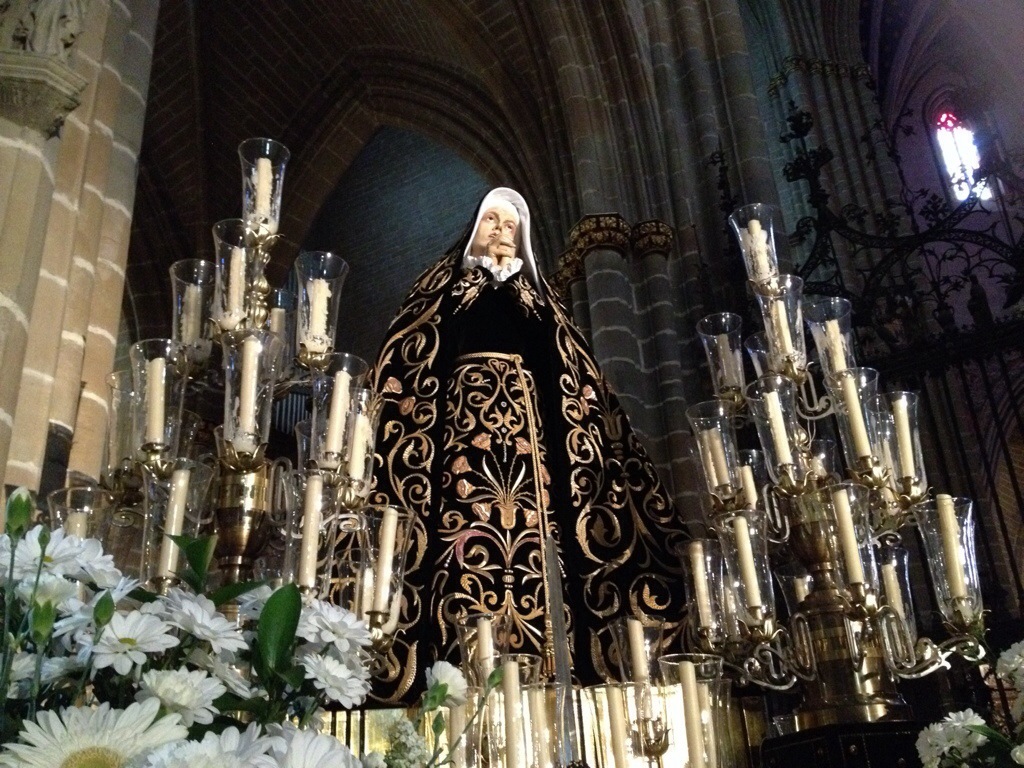
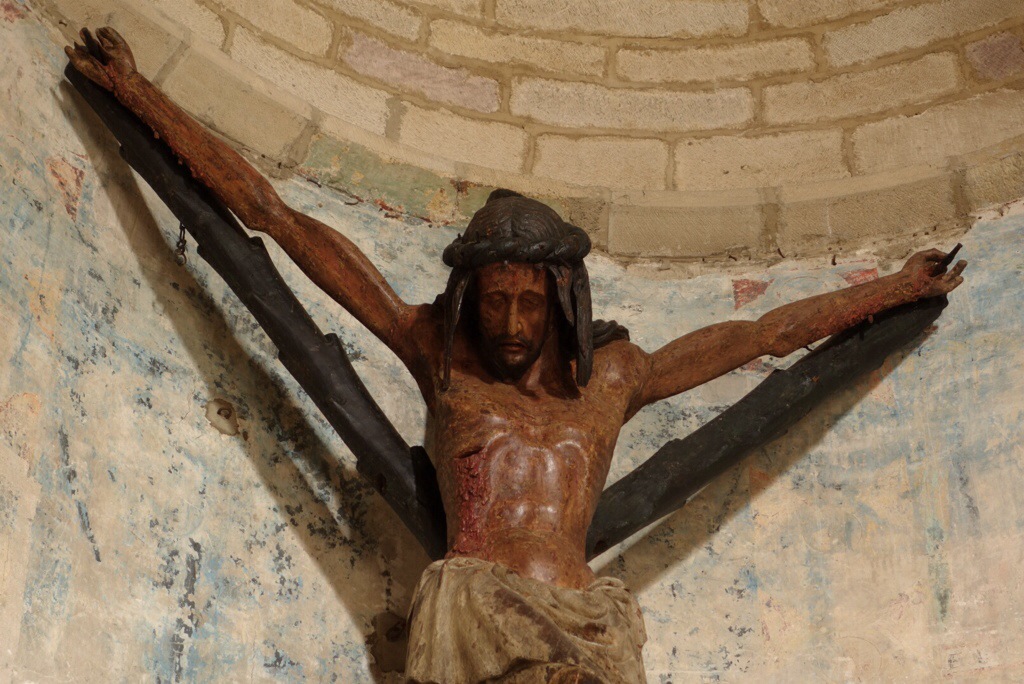
After finding my bed among the 57 cubicles of bunks filling two narrow hive-like corridors at the Jesus y Maria albergue, I set out for the late Gothic cathedral around the corner. It has one of the finest cloisters in Europe, several awesome retablos (the tall array of images, decorative motifs, and architectural elements behind an altar), and an exquisite 13th century Madonna and Child. I also found two large platforms, covered with rich fabric, flowers and candles, each featuring life-size figures: Jesus on the cross, and a distressed Virgin clothed in an embroidered black cope resembling an ancient vestment for Good Friday. These will be carried through the streets in Holy Week. Although the three protruding rods for carrying them had three shoulder cushions at either end, the eighteen men shouldering this load will surely earn Easter with their prodigious effort.

Up to now the externals of the Camino have been about hiking, nature, the Chaucer-like interactions of folk who “goon on pilgrimages,” and the daily logistics of itinerancy. But today’s encounter with holy images and sacred space (even if not uniformly congruent with contemporary spirituality), gave a sudden glimpse of the horizon toward which we move on this long journey.

20140410-213716.jpg

The first day

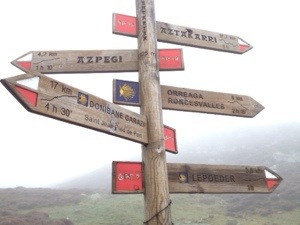
16 miles, 9 hour day, 4000′ gain and then a hard, steep 2.5 mile descent to finish. No gradual entry into the Camino, just begin with one of its hardest days. But my training paid off, and I never ran out of gas. Knees severely tested on the descent but everything held up. Everyone who made it to the marvelous monastic hostel at Roncesvalles feels very grateful tonight. The soaking drizzle that made the first two hours this morning a trial finally let up, and all the pilgrims who had crowded into a mountain cafe to dry out poured back out onto the trail. No great views today, but the summit where France turns to Spain was a brooding cloud of unknowing where we walked by faith not sight.

20140408-213453.jpg

20140408-213540.jpg

20140408-213601.jpg

20140408-213519.jpg

Birds

This flaneur strolled 12 miles around Paris today – last training before the Camino. A highlight was the courtyard in the Marais where I have always heard birds singing on one vine-covered wall. The vines were still bare of leaves today, but the songbirds were as tuneful as ever. It was the second avian blessing of this journey (preceded by the first goldfinch of the season appearing in our yard an hour before I departed). Tonight I visited a sensational exhibition at Grand Palais of Bill Viola’s transcendent video art. Among the many works I hadn’t seen was the “Ascension of Tristan,” where a motionless man on a slab comes to life and begins to ascend in slow motion (it took 10 minutes on a 20 foot vertical screen) into the full force of a waterfall – stunningly persuasive iconography for returning to the divine. It turns out that not all the art in Paris is old!

20140405-235352.jpg

20140405-235428.jpg

20140405-235455.jpg