The Voice That Calls us: A Reflection for Good Shepherd Sunday

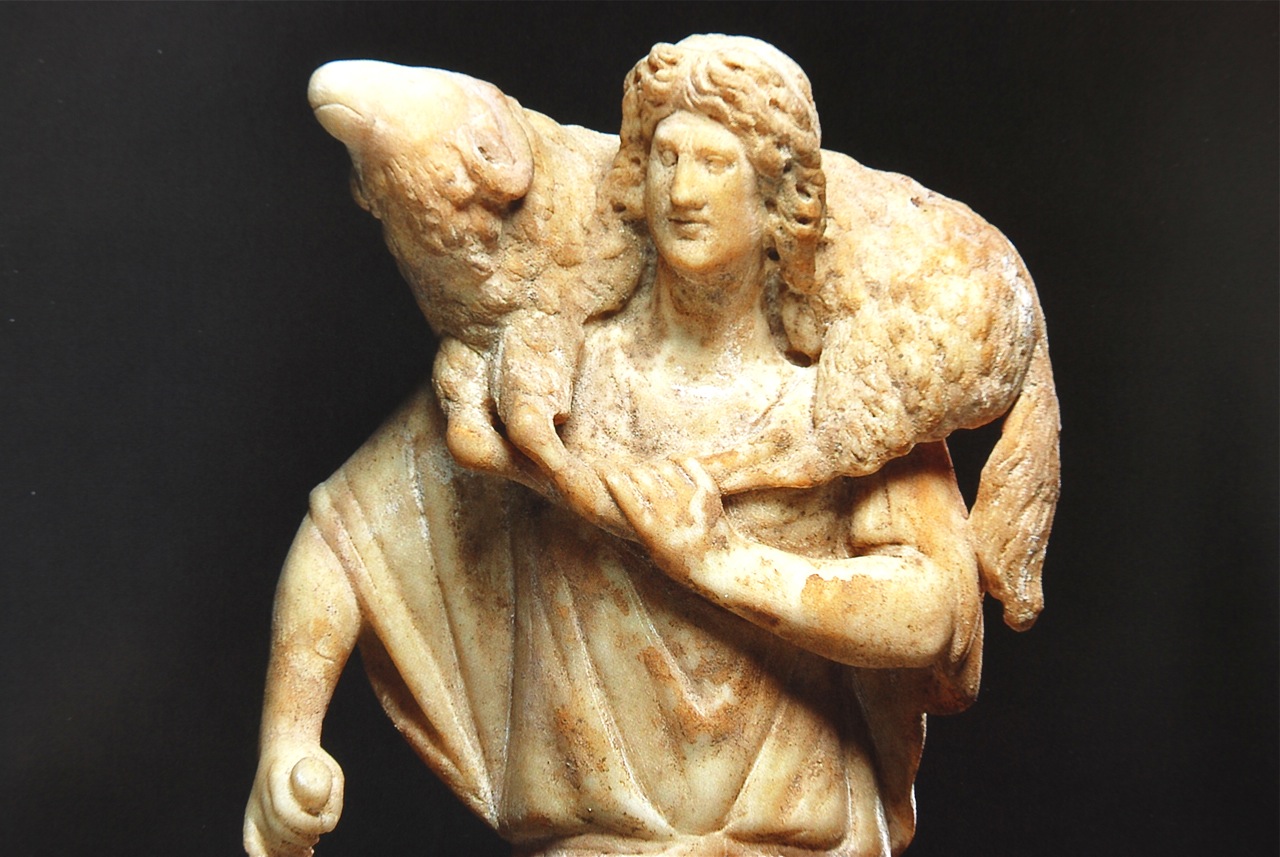
The Good Shepherd (Asia Minor, c. 390; Cleveland Museum of Art)

The Good Shepherd (Asia Minor, c. 390; Cleveland Museum of Art)

The gospel image for today, the Fourth Sunday of Easter, is the good shepherd who “calls his own sheep by name and leads them out” (John 10: 3). Unlike the hired hand who cares little for the sheep, Jesus loves his flock. He will lay down his own life for them. And they in turn know exactly where to put their trust. “I know my own and my own know me” (John 10: 14). “The sheep that belong to me hear my voice … and they follow me” (John 10:27).

Sheep are not a part of my daily life, so I didn’t fully appreciate the metaphor until I visited a sheep market in Jerusalem in 1989. Starting at 6 a.m. on Fridays, shepherds would bring their sheep in trucks, vans and even the back seats of cars to a stone-walled corral to begin spirited negotiations with potential buyers.

Once the corral had been crammed with wall to wall sheep, I wondered how the different shepherds would ever keep track of their own. But it soon became clear what Jesus was talking about: I know my own and my own know me. Although many human voices were speaking and calling simultaneously, each of the sheep responded only to the distinctive voice of its own shepherd.

Our own shepherd’s voice can still be heard, calling us every time we open the Bible. The attentive reception of Scripture is a form of real presence. When the gospel is read in the Eucharistic assembly, or meditated upon faithfully, Christ speaks – not from the past, but addressing us now in our own present with words of challenge and refreshment: Turn your lives around … Follow me … Take up your cross … Don’t be afraid … Your sins are forgiven … Peace be with you … Love one another.

Countless Christians through the centuries have heard and answered the voice of Jesus mediated in this way through the written texts of Scripture. But are there other ways of hearing the shepherd’s voice? Does it still find ways to speak in the now, without the mediation of ancient texts? Or is the God who spoke long ago now wrapped in permanent silence?

In the first book of the Bible, God speaks directly to human beings. Although we are never given a location or visual description of the speaking God, the words themselves seem as naturally delivered as any of the human speeches in the text. In the second book, the divine voice becomes less “natural,” uttered mysteriously from a stormy cloud or burning bush. By the fifth book, divine speech is largely of the past, something remembered and taught instead of heard directly: “Yahweh then spoke to you from the heart of the fire; you heard the sound of words but saw no shape; there was only a voice” (Deut. 4:12).

By the time we reach the First Book of Kings, the God whose voice had thundered commandments to Moses is reduced to “a still small voice,” or more accurately translated, “a sound of thin hush” (I Kings 19:12). The voice of God has become the sound of silence.

Thereafter, God’s biblical speeches are secondhand reports from the mouths of the prophets. The whole narrative arc of the Hebrew Scriptures “from Eve to Esther,” as Richard Elliott Friedman puts it, may be described as a “step-by-step diminishing of God’s apparent presence.”[i] As Isaiah says, “Truly, you are a God who hides himself.”[ii] Or as the Psalmist complains, “My God, my God, why have you left me?”[iii] In the public, shared experience of God’s people, the face of God becomes hidden and the voice of God grows silent. God disappears as a speaking character in the Bible.

However, incarnational faith understands this not as a process of divine withdrawal from the world, but an ever deeper embedding of God within it, until the Word of God is delivered not in thunder and lightning, but in the ordinary human speech of the man named Jesus. It turns out that the eventual disappearance of the God of power and might was a way for God to draw ever closer to us, so that now, as Bonhoeffer said, “God is in the facts themselves.”[iv]

For those attached to a more majestic divine self-disclosure, this has made God much harder to see. As Pascal put it, “when it was necessary for [God] to appear, he hid himself more deeply yet, by wrapping himself in humanity. He was much more easily recognizable when he was still invisible than when he made himself visible.”[v] But for those with ears to hear, the still small voice may be heard every day from our neighbor’s mouth.

Still, I wonder. Can God yet speak, not just in sacred text or through the mouth of friend and stranger, but more directly? Is there still an audible Voice that calls us each by name? John Milton argued that God makes a “general vocation” to all “in various ways” but sometimes “invites certain selected individuals … more clearly and insistently than is normal.”[vi] His seventeenth century contemporary, George Herbert, described such a moment of address and response in his poem, “The Collar,” whose very title uses the sartorial sign of priestly vocation to make a pun about “calling”:

But as I rav’d and grew more fierce and wild
At every word,
Methought I heard one calling, Child!
And I reply’d, My Lord.

But as the word “methought” indicates, the experience of being addressed by God, undoubtedly a real one for the prayerful Herbert, was filtered through imagination, reflection and poetic language. We can’t assume it to be verbatim.

Three centuries earlier, English mystic Julian of Norwich, while gravely ill, had an intense visual and auditory experience of the suffering Christ, which she would later recount in the first book written by a woman in English. The book’s title, Showings, categorizes her visions as something received, not simply produced in her own mind. The things Christ said to her were not simply variations on gospel texts, but words never before heard, directed specifically to Julian.

As Veronica Mary Rolf has noted, Julian was careful to specify “which of Christ’s words she heard spoken distinctly within her mind, and which words arose in her mind ‘as If’ Christ were addressing her directly, according to what she understood to be his meaning.”[vii] Julian’s experience is compelling, and when Jesus tells her that “all shall be well,” who can say she was not hearing her shepherd’s voice?

“Jesus calls us,” the hymn says. “Day by day his clear voice soundeth.”[viii] How literally should we take this? Have you, dear reader, ever heard the Voice that calls you by name? I myself have never heard it in an auditory way, as an actual sound. But I can remember one particular occasion when, I believe, the Voice addressed me, simply and directly.

In preparation for my fiftieth birthday, I spent four days at the Taize community in France. The chanted worship was very beautiful, but something about the place left me ill at ease. Most people had come to spend an entire week, but I had only arrived on Thursday, missing out on the natural bonding process of the hundreds who had been together since Sunday. I felt like an outsider. And the prevailing European reserve didn’t exude any of the warmth I associated with religious retreat. As one of my British roommates told me, “Oh, you Americans! You expect everyone to smile and say howdy.”

For whatever reason, I was not having the uncomplicatedly beautiful experience I had anticipated. I felt disappointed. On my second night, the two-hour liturgy centered around a large painted Byzantine cross. All who wanted could draw near for a time of prayer and adoration. When my turn came, I leaned my forehead against the cross and prayed, “Well, God, here I am at Taize. It’s not at all what I hoped for. Now what?” I waited, not really expecting an answer. But then these words came into my thoughts, precise and clear like something given, rather than any halting formulation of my own: Stop looking for a gift for yourself. Look for the gift you can give another.

It was an awakening. Tears filled my eyes. Tongues of flame danced in the red votives around the cross. A thousand voices chanted in the German tongue of my ancestors, “Stay with me, remain here with me, watch and pray, watch and pray.” After that moment, everything was different. My remaining days at Taize were full of grace.

When the liturgy ended, I went out into the summer night. People were sitting in small groups on the lawn, watching spectacular bolts of lightning play across the far horizon. First the still small voice, then the fire from heaven. Theophany indeed.

[i] Richard Elliott Friedman, The Hidden Face of God (San Francisco: Harper San Francisco, 1995) 79

[ii] Isaiah 45:15

[iii] Psalm 22:1

[iv] Dietrich Bonhoeffer, Letters and Papers from Prison (New York: Macmillan, 1971) 191

[v] quoted in Gerardus van der Leeuw, Sacred and Profane Beauty: The Holy in Art (Nashville: Abingdon Press, 1963) 326

[vi] De Doctrina Christiana, q. in David Lyle Jeffrey, ed., A Dictionary of Biblical Tradition in English Literature (Grand Rapids, Michigan: Eerdmans) 815

[vii] Veronica Mary Rolf, Julian’s Gospel: Illuminating the Life and Revelations of Julian of Norwich (Maryknoll, NY: Orbis Books, 2013) 262

[viii] Cecil Frances Alexander, The Hymnal 1982 (New York: The Church Hymnal Corporation) #549

Footsteps and shadows: Inscribing our traces on the Camino

This spring I find my mind often returning to the Camino de Santiago. A year ago today I began my tenth day of walking: 140 miles down, 360 to go. But by then I had stopped counting. It was better – and less tiring – to be in the moment, to “cherish every step” as one pilgrim advised me early on.

When I run long distance, or backpack up a steep mountain pass, I try to apply the mindfulness of Zen walking. Don’t think about some other time, in the past or the future, when you are in a more comfortable state of rest. And stop wondering how far you have left to go. Simply be here now. Concentrate your attention on the physical act of lifting your foot, swinging it forward, setting it down. Take note of your breath. It’s not about forgetting the pain so much as accepting your present state of being-in-motion, not wishing you were doing something less strenuous or challenging.

When you walk ten to twenty miles day after day for over a month, this kind of attention becomes more automatic. Walking becomes what you do and who you are. As I wrote in one of my Camino posts, “Walking”:

The past week was spent traversing the immense agricultural plateau of the Meseta and Tierra de Campos. Few trees, big sky, only occasional villages, and long stretches where the only human presence was the long procession of pilgrims migrating westward. The lack of distractions and variations tends to make the very act of walking to be the mind’s principal occupation. As Robert Macfarlane puts it in The Old Ways: A Journey on Foot, walking becomes “sensational” – it isn’t just conducive to thought; it becomes the form thought takes. I walk, therefore I am. Perhaps it is similar to the way that cinema thinks through the movement of the camera. It isn’t forming propositional thought, but is simply absorbing through its attentive motion the shape of the world, the textures of existence.

I have noticed that I have fewer thoughts out here than I do at home when I run for an hour, or go on a week-long backpack. On the Camino, instead of a lot of thoughts, I simply have thought: not so much words or ideas as awareness. As Thich Nhat Hanh once put it to a walking companion who asked what he was thinking about: “I’m not thinking about anything. I’m aware of the sunlight.”

Macfarlane provides a memorable image of walking as a form of writing on the earth, with every traveler leaving his or her own imprint of dreams, stories and memories as they go. Centuries of pilgrims have been leaving such traces along the Camino, traces which now lie beneath our own feet every step of the Way.

The brief video clip records my shadow and footsteps leaving their faint traces: on the Meseta west of Burgos, on the 13th century bridge of Puente de Orbigo, and among the blooming shrubs of the Alto Predela, a high ridge west of Villafranca. I hope these few steps bring back happy memories for my fellow pilgrims. And for those who want to experience our cumulative act of walking in real time, just replay the 80-second video 11,000 times!

Just a dream? – Reflections on the Easter Vigil

Byz Res mosaic

On Holy Saturday in Jerusalem, an hour past sunset 26 years ago, I greeted the Resurrection with the Ethiopian community in their courtyard on the roof above the Church of the Holy Sepulchre. Processing around a small cupola representing the empty tomb, they sang and danced with torches and umbrellas. Their graceful, white-robed bodies and joyful faces were vivid icons of the risen life, producing in me a state of dreamlike wonder. As I later made my way through the deserted stone passages of the old city in search of the midnight liturgy at the Russian church, I fell into an apocryphal reverie.

I imagined the risen Jesus quietly reversing the steps of his Via Dolorosa, away from the cross, away from the mindless crowd now sleeping off its orgiastic fury, away from the city of betrayals and farewells, away from the awful time of trial. Going home. To Galilee.

Of course we don’t know how the Resurrection actually happened, nor do we grasp the concept of passing out of existence only to return the same yet different. Perhaps the closest we come is our daily rising from sleep, when it may take a moment before we remember who we are and reconnect with the continuity of personal identity that somehow survives the abyss of unconsciousness. Even so, there sometimes remains a strange sense that we have crossed over into a new space and time full of unimagined possibilities. We are not quite the same person who closed his or her eyes the night before. Behold, says Jesus, I make all things new.

The sublime intensity of Holy Week, culminating in the Triduum, or Great Three Days of Maundy Thursday, Good Friday and the Easter Vigil, can produce a similar effect on the faithful who make the long journey from the Last Supper to the first Alleluia. We not only learn something along the Way of the Cross to the place of Resurrection, we become something as well. When it’s over, we are somebody else. Forgiven. Set free. Made new.

As I said in the Vigil homily on Saturday night, “we have made an exodus from our tired old stories of death and loss into God’s new story of possibility and promise.” Any Vigil worth its salt will enable us to dwell for a few hours in the light of that new story, the light that penetrates our shadows with the bright splendor of God’s future. And when it’s over, we may wonder: What just happened? Was it only a dream?

One of the striking things about the Easter Vigil is that there is no single representation of the Resurrection. The gospel reading might describe dazzling messengers announcing it after the fact, but the event itself is never described in the text. The closest the liturgy gets to a specific resurrection moment is when the Presider launches the eucharist with a shout of Christ is risen, and a holy tumult is made with chimes, bells and drums while all the lights switch on to banish the darkness. But the victory of Life and Love is actually manifested repeatedly throughout the liturgy in symbol, word and sacrament, as well as in the faces and gestures of the assembly. The liturgy as a whole is an experiential analog of the Paschal Mystery.

Here are a few of this year’s many resonant manifestations for me:

  • The New Fire: It is always moving, after we have all been scattered from the bare and mournful church interior of Good Friday, to see how many return the next night to gather outside around the New Fire with expectant faces. Death has done its worst, and we have come to make our reply: Love wins anyway. I especially rejoiced to see the children, already dressed for the Ark story in their animal costumes, standing right up front with their floppy ears and shaggy coats. As St. Paul said, not just humanity, but the whole creation, eagerly awaits the day of renewal.
  • The Creation: “Once upon a time, human beings had no story. Only the gods did things worth telling.” So began the Prologue to our sacred stories, concluding with the discovery, by an ancient “tribe of nobodies” that their own lives were, in fact, part of something much, much larger. “Human beings had become a story told by God.” Then out of the darkness a voice said, “Let there be light!” Projected on a 15’ screen, we saw the first light of the creation, from Terence Malick’s film, Tree of Life, continuing with spectacular cinematic images of earth’s evolution up through the arrival of the birds. Then the film switched off and a monkey and frog entered to cavort among the assembly, until a flute sounded, and the musical “breath of God” turned them into the first humans. They straightened up, removed their wooden Indonesian masks, and became suddenly conscious of their own humanity. “Adam and Eve” were played by pre-teens, but when they cautiously crossed the gap between them to touch hands and connect with the strange and unknown “other,” they gave us a transcendent image far beyond their years.
  • The Red Sea: This central metaphor for the Paschal Mystery of “crossing over” from death to life was a complex interplay of live actors, projected images (documentary-looking Exodus images from DeMille’s 1927 silent, The Ten Commandments, plus Civil Rights footage from the Selma to Birmingham march of 1965), soundscapes (6 separate cues to mark different stages of the story), and dramatic theatrical lighting. After the Red Sea had been crossed, the narrator concluded by saying, “When the world says no, the power of God is …”. The Israelites, all played by children, completed the sentence by shouting, “YES!” The brave sound of those young voices will long stay with me.
  • “Hallelujah”: After each story, we sang a song and said a prayer to reflect the story’s themes. The last story, The Valley of Dry Bones, was followed by Leonard Cohen’s “Hallelujah,” with powerful Easter lyrics by Scott Lawrence. Our hand candles were relit as we sang: “no darkness can conceal the light within you … hallelujah, hallelujah…” All those candlelit faces, all those beautiful voices raised in song, said Resurrection as powerfully as anything else we did that night.
  • The Dance: At the end, following communion, we invited people to come out of their seats to gather in a great circle to dance. I had been warned to expect only a half-hearted response. Episcopalians are reserved, I was told. Dancing in church might be outside some people’s comfort level. But as we sang a couple of choruses of “I will raise them up” from the Bread of Life hymn, everyone did in fact rise up and come out of their pews. We joined hands, and off we went, circling and spiraling as we sang the Easter Troparion (“Christ is risen from the dead, trampling down death by death”) and “Jesus Christ is risen today.” Resurrection wasn’t just something we heard about or thought about, it was something we embodied, something we danced. As Christ shows us every Easter, “I am the Dance and I still go on.” Amen to that! We proved it with our bodies.

When the Vigil was over, we each went our separate ways. The Vigil “set” was struck, like a circus tent, leaving behind little trace of what had taken place. Had it all – not just the Vigil but the entire Triduum – been just a dream, soon to fade in the glare of everyday life and ordinary time? Or had our extraordinary journey together, soaked in Paschal images, revealed something essential, enduring and profoundly transformative?

Whether in this year’s Triduum, in my Jerusalem Holy Week long ago, or in many other memorable traverses of the Paschal Mystery, I do believe I have encountered, embodied, and imbibed the core of our faith: Christ lives. Love wins. We shall be changed.

The resonant images and experiences of the Triduum have been planted deep within me, year by year. They may still have to struggle in my poor soil or compete with the choking thorns of my world, but as the collect-prayer for Thursday of Easter Week asks, “Grant that all who have been reborn into the fellowship of Christ’s Body may show forth in their lives what they profess by their faith.”

God, bring that day closer!

We are not alone

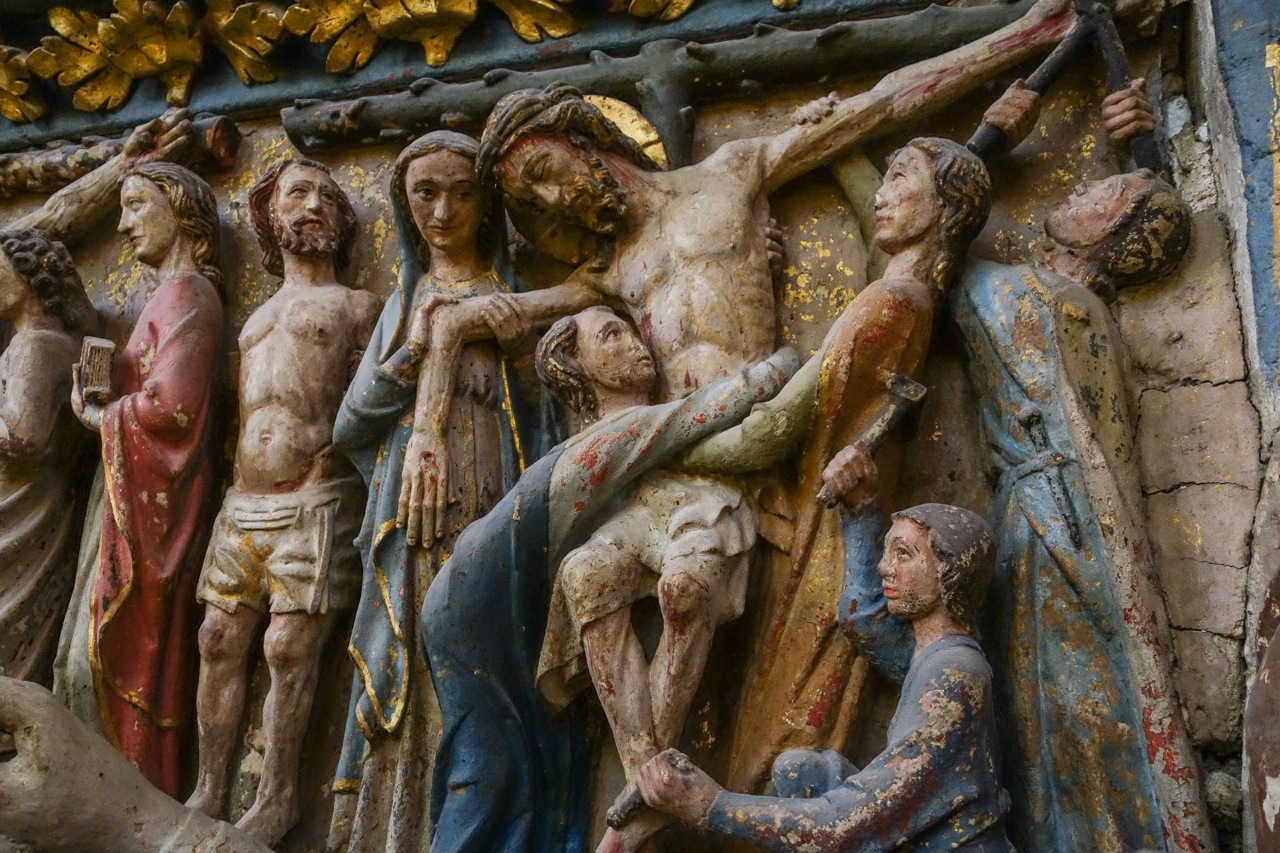
The Deposition (early Gothic; Leon cathedral on the Camino de Santiago)

The Deposition (early Gothic; Leon cathedral on the Camino de Santiago)

My God, my God, why have you forsaken me?

This cry from the cross is the most terrible verse in the Bible. God’s own Beloved, whose intimacy with God was so foundational to his existence that he could say “I and the Father are one,” here experiences the inexplicable loss of the Presence in which he has lived and moved and had his being. And God’s reply to Jesus is even more chilling: Silence.

Uncomfortable with this image of a Christ seemingly abandoned to the void of a godless universe, some have said that Jesus is merely quoting the first verse of Psalm 22, as though his piety outweighs his pain even on the cross. But Jesus was not just quoting Psalm 22; he had become Psalm 22. The Christ who was truly human had to taste even the most painful extremities of the human condition in order to redeem us fully. The one revealed to be God-with-us had to become, in that most bitter hour, us-without-God.

Have we not been there ourselves? Whether in the personal hour of trial when our own cries go unanswered, or in modernity’s cultural house of mirrors where the interventions of a loving God seems not only unnecessary but unthinkable, there are times when the Presence feels beyond our reach.

But as Paul says, Jesus became sin itself in order to save us from it (II Cor. 5:21). Sin is wherever God is shut out and we are walled in. And in making even the hellish absence of God as integral a part of his own experience as the intimacy of divine communion, Jesus performed the ultimate paradox: even when God seems most absent, God is yet present.

Good Friday means that whatever happens to us happens to God. From now on there is no place where God is not, for God has taken into Godself even the experience of separation and forsakenness. The Presence now includes the absence.

And we who have turned from God, or lost God, we who have cried out into the SILENCE, can yet live in hope. The One who died abandoned and bereft now keeps us company on our own crosses. As the Psalmist affirms with his possessive pronoun (“My God, my God!”). the relationship remains firm and unbroken even when God seems most mute and distant. We are not alone.

The journey is how we know

The Paschal Moon will be full on Holy Saturday.

The Paschal Moon will be full on Holy Saturday.

Monday in Holy Week: for a liturgist, the next few days comprise the precious last bit of calm before hitting the rapids of the Triduum, the Great Three Days of Maundy Thursday, Good Friday, and the Easter Vigil.

For those who undertake this marathon ritual experience, it is the molten core of our worship life, a sacramental immersion into the Paschal Mystery of dying and rising with Christ. It is where we do our best theology and our most heartfelt common prayer. Richly layered, multi-sensory, dramatic and moving, the Triduum is a liturgy like no other.

I say “liturgy” singular, even though there are three distinctive rites between sundown Thursday and the late hours of Saturday night. It is one single liturgy with successive parts, like a three-act play or a symphony in three movements. At the end of the first two parts, there is no blessing or dismissal. The people simply exit in silence to rest up until the liturgy continues the next day.

Each of the parts has an integral relation to the other two. There is of course a narrative relationship: the three parts follow the sequence of Jesus’ last days. But there is also a theological relationship: each part finds its full meaning only in relation to the others. “No rising without dying” is the prime example of this interrelationship, but there are many others, such as the theme of community. The disciples gathered so memorably on Thursday evening, then scattered by Friday’s betrayals and denials, are themselves resurrected from the isolation of sin and shame by the Christ who returns as Forgiveness. We learn this all over again by being in the story.

These aren’t things we just hear about or think about. We enact them with our bodies and emotions. We taste the warm table fellowship of the Last Supper, and the bitter cup of Gethsemane. We ascend Golgotha’s hill to gaze Wondrous Love in the face and kiss the wood which proved the “tree of glory” for the “healing of the nations.” We wait out the long silence of Holy Saturday until the New Fire contradicts the darkness and the Easter Acclamation (“Christ is risen!”) ignites a miracle of collective joy that was barely conceivable the day before.

To treat the Triduum as a la carte, or to skip it altogether, would be to miss the richness of the interrelated whole. Imagine only seeing one act of Hamlet, or skipping the final movement of Beethoven’s Ninth. There are things we can only find out by entering into them fully. The journey is how we know.

This is, of course, the passionate liturgist talking. If I were a parish priest, I would acknowledge the many demands of my parishioner’s lives and the realities of a 24/7 secularized culture, where going to church three nights in a row is not just rare – it’s incomprehensible. And we don’t want to shame the faithful, or call them wrong because they only do Palm Sunday and Easter, bypassing the Triduum entirely. Lives get busy.

But still, every year, even the most indulgent and compassionate pastor continues to issue the invitation to exit ordinary time and habitual existence in order to “enter with joy upon the contemplation of those mighty acts, whereby [God has] given us life and immortality,” because the Triduum is too good, too important, not to share. Something very specific to the process happens to those who make the journey. It’s like the Camino de Santiago in that respect. Even the most casual pilgrim is affected by the simple fact of going all the way from beginning to end, whatever their state of mind and heart when they first set out. The journey is how they know.

For me, a year without the Triduum experience is unimaginable. I have done it with the Orthodox in Jerusalem (no problem with attendance there!) and last year observed it with a small group of believers as we walked the Camino. But mostly I have done it as liturgical artist-in-residence at various parishes in California and Washington.

This year I’m collaborating with St. Stephen’s Episcopal Church in Seattle, where we will add some distinctive touches to the tradition. On Maundy Thursday, Sidney Carter’s “Bitter Was the Night” will be sung over a didgeridoo drone during the Stripping of the Altar. The sacred stories at the Easter Vigil will employ drama, film and soundscapes. God will be played by a 7-year-old girl in the Valley of Dry Bones. Music will mix medieval chant and Holy Week hymns with folk traditions and contemporary songwriters. You can read more about it here.

In the apocryphal Acts of John, Jesus leads his disciples in a dance. Some are resistant, but he tells them, “Those who do not dance do not know what happens.” By the time we reach the Vigil finale Saturday night, dancing around the altar to “Jesus Christ is Risen Today,” we will all know what happens.

Grace me guide

Holy Saturday dawn at Laguna Beach, California (2005)

Holy Saturday dawn at Laguna Beach, California (2005)

My wife recently asked me what my favorite prayer was. Interesting question. We are both Episcopal priests, steeped in a tradition of eloquent prayers, so there were plenty to choose from (the Lord’s Prayer was ruled ineligible in order to make the competition fair). But one particular “collect” from the Book of Common Prayer came immediately to mind, not only because I know it by heart and begin most days with it, but also because I am drawn to the theology and spirituality that underlie it.

O God, the King eternal, whose light divides the day from the night and turns the shadow of death into the morning: Drive far from us all wrong desires, incline our hearts to keep your law, and guide our feet into the way of peace; that, having done your will with cheerfulness during the day, we may, when night comes, rejoice to give you thanks; through Jesus Christ our Lord. Amen.[i]

In three beautiful clauses, this Collect for the Renewal of Life from the Office of Morning Prayer spans the daily round from night to day to night. Its origins lie in the Benedictine practice of creating liturgies to fit each period of the passing day. Like time-lapse photography, this collect compresses the temporal flow into a single unity of beginning, middle and end. The ordinary succession of the hours is sanctified by the simple act of attention.

But the prayer casts its net into deeper pools as well. The light dividing the day from the night recalls the first day of creation, making every dawn the renewal of the world. And the shadow of death turning into morning invokes the Resurrection, when creation is restored and the wound of death is healed at last.

Having turned our attention to the divine source of this perpetual renewal, the prayer then asks for the grace to become conformed to the shaping pattern or formative way of that originating and empowering source. The first request addresses the obstacles to that conformity – the things that misshape or distort our truest selves.

Drive far from us all wrong desires.

Religion is sometimes caricatured as the repression of desire. It’s not only the mockers who do this; many of the devout have striven for a passionless existence in imitation of a supposedly passionless God. But wanting to want nothing is itself a form of desire, and it doesn’t always end well.

We are made of desire. We come into the world reaching for a larger source of sustenance, nurture and love. Everbody’s got a hungry heart. Springsteen said that. Or was it St. Augustine? Some argue that our primal maternal nurturing is then projected onto the void to produce the consolations of religion, but Christian faith insists that our longing never ceases to thirst for something actual and real, from our first breath to our last.

But desire is easily misdirected to fix on easier, less demanding objects, unworthy of our true nature. In one of Jean-Luc Godard’s early films, a worldly couple is given a ride in a convertible. When the driver reveals that he happens to be God, they immediately ask him for things: Can I own a hotel on Miami Beach? Can you make me more beautiful? God is disgusted. “Is that all you want? I don’t do miracles for jerks like you.” He throws them out of the car and drives away.

As Gregory of Nyssa said, our task is not the eradication of desire, but the education of desire. How do we live in such a way that our desire may find its proper object? It is not desire that is wrong, but only its misdirection. And so we pray for whatever it takes to steer us toward our ultimate goal, “the great meeting with being which one way or another everything in our life strains to achieve.”[ii]

Incline our hearts to keep your law,
and guide our feet into the way of peace.

There may be times in our life when God’s will feels radically disruptive. “Thus says the Lord: I am going to tear down what I have built, and pluck up what I have planted.” (Jer. 45:4) Or John Donne: “Batter my heart, three-person’d God …. / and bend / Your force to break, blow, burn, and make me new.”

But in this prayer said at the start of each day, “incline” and “guide” propose a much gentler formational process than the cataclysmic upheavals of Jeremiah and Donne. An inclination may only be a slight tipping from the vertical, just enough so everything leans or flows in a particular direction. And the act of guiding does not itself create momentum; it only steers a motion which is already underway. These are subtler influences than earthquake, wind and fire, but their long-term effect on us is no less profound.

The entire prayer assumes a dailiness about grace, and the constancy of prayerful attention that allows it to work on us over time. This quiet, steady, cumulative spirituality is so very Anglican. I once found a perfect motto for this habitual spirituality in an old English church. Painted in golden Gothic lettering, repeated in every panel of the coffered ceiling, are the words, Grace me guide. Even a bored worshipper, glancing upward to relieve the tedium of a poor sermon, could not miss this summons to the beauty of holiness.

The prayer’s third clause assumes a happy outcome for a day given over to God’s shaping influence. Throughout the passing hours, God’s will is done “with cheerfulness.” Does this word appear anywhere else in the history of formal Christian prayer? There are plenty of texts to remind us how hard the journey, how recalcitrant the will. But how rare to make the Christian life sound so easy, so effortless, so fun!

But perhaps the prayer has in mind the ease of the ballet dancer, whose extraordinary physical grace, while appearing effortless, is achieved through a sometimes painful and always demanding discipline. Or maybe “cheerfulness” refers to the saintly joy that St. Francis spoke of – the ability to accept even life’s hardest blows with a grateful and trusting heart. Who can say?  I only know that whenever I say this prayer, it is hard not to smile, at least inwardly. Cheerfulness is an attractive quality in the Christian life.

The entire prayer assumes that we are capable, that we can be conformed to divine intention, that this day has potential for us. We may not make it to nightfall without lapses major and minor. The cheerfulness may fail us, more than once. We are well acquainted with that scenario. But to begin each morning by visualizing a day that will end with thanksgiving for what God has done in us and through us – this expresses the incredible hope of Christian faith. God has amazing plans for us, no matter what.

The gratitude the prayer envisions is not contingent on what we manage to accomplish in any given day. Perfection is a process, not a possession. But as this prayer puts it so beautifully, we are nevertheless invited to begin each morning as if we are actually capable of living into the full humanity for which are made. And at the close of a day begun with this kind of mindfulness, even though it be fraught with imperfections, there will be reason enough for thanksgiving.

Saying this prayer was one of the very last things I did with my mother. I had been visiting her in Santa Barbara, and it was always our custom to read Morning Prayer whenever we were together. After our prayers, we said farewell and I headed for home a thousand miles north. A few hours after I left, her 96-year-old heart suddenly gave out. She died three days later. I didn’t quite make it back in time, but we had already made the perfect goodbye, with the cheerfulness of our morning prayers.

We each had our own copy of The Daily Office Book, containing services and Scripture readings for the entire year. After she died, I started using her copy instead of mine. It seemed a way to stay in touch, acknowledging the unbroken connection of the communion of saints. And one day I happened to look at the inside back cover. She had written a prayer on the blank endpaper. Whether she had made it up, or found it somewhere, I don’t know. But it perfectly expressed her own faithful spirit. It also seemed to echo my own favorite prayer. In her distinctive hand, familiar from so many letters over the years, she had written:

God, whatever …. Thanks.

[i] Book of Common Prayer (New York, Oxford University Press, 1979) 99

[ii] Ann & Barry Ulanov, Primary Speech: A Psychology of Prayer (Louisville, KY: Westminster John Knox Press, 1983) 14

Via Negativa: A Lenten worship installation

"Desert Words" from "Via Negativa" worship installation by Jim Friedrich

“Desert Words” from “Via Negativa” worship installation by Jim Friedrich

“The trouble with going to the desert is that you risk meeting God there.” These words of a French monk, which I heard decades ago in a documentary on the Little Brothers of Jesus, have haunted me ever since. Anyone who has spent serious time in the desert knows that the monk was right. Flee the culture’s house of mirrors for the counter-world of rocks and sand, silence and emptiness, and like Elijah you too may hear the “voice of thin silence.” You may meet the necessary Other.

I wrote these words in an introduction to my Lenten worship installation Via Negativa, an experiential journey through a symbolic desert. A worship installation is more like an art gallery than the theater model of traditional Western liturgy. Instead of finding a seat and remaining there (except for the Peace and Communion), you move around, follow your own path, pay attention at your own pace, linger where something in particular calls to you. An installation also resembles the labyrinth in being a mixture of both solitude and community. You do it in your own way, yet always aware that you make the journey in the company of fellow pilgrims.

The installation introduction goes on to say:

In this installation, you are invited to make your own exodus out of the ordinary into a desert made of signs, symbols and experiences. There is no path. You wander as you will, or as the Spirit wills, though the Burning Bush is best deferred until you have spent some time here.

There is a multitude of texts: like grains of sand they are too vast to consume in their entirety. But somewhere amid those endless texts are words that may whisper a message just for you. Open a book at random. Consider the many juxtapositions of word and image scattered around the space. Read the “the shifting language of sand, traces, and mirage.”[i] Inhabit “a fragile tent of words erected in the desert” where we are “struck with infinity and the letter.”[ii]

There are also images, sounds, places to linger, practices to enact. It is better not to hurry. There is no time in the desert, only space. Wander. Explore. Abide. Pay attention. Take off your shoes. You stand on holy ground.      

The installation occupies three rooms. In the first room, there are images and texts representing the “Egypt” which need to be left behind – the personal and cultural distractions, distortions, oppressions and addictions which mar or obscure the goodness of creation and the Imago Dei within us all. A monitor shows a video loop of the Exodus story from The Electronic Campfire, a video I produced of creatively told biblical stories from the Easter Vigil.

The second room contains a small tent where you can listen to a recording of sayings and stories of the early Christian Desert Fathers and Mothers, playing softly from a small portable speaker. There are printed collections of these texts available as well. Sitting on a Persian carpet inside the tent, you may linger to hear and read the wisdom of those ancient spiritual explorers. A sign outside the entrance displays a key text from that tradition: Go sit in your cell, and your cell will teach you everything.

The third room represents the desert itself, that indeterminate space free of human constructs, which for millennia has drawn the hungry of spirit. As God tells Hosea, “I will lure her into the wilderness; there I will speak tenderly to her heart.”[iii] The video artist Bill Viola describes the value of this alternate reality as well as any:

“I want to go to a place that seems like it’s at the end of the world. A vantage point from which one can stand and peer out into the void – the world beyond… There is nothing to lean on. No references… You finally realize that the void is yourself. It is like some huge mirror for your mind. Clear and uncluttered, it is the opposite of our urban distractive spaces. Out here, the unbound mind can run free. Imagination reigns. Space becomes a projection screen. Inside becomes outside. You can see what you are.”[iv]

At the entrance to the third room, a sign invites you to take off your shoes before entering the “desert.” Once inside, you begin to read, see, hear, touch, smell, taste and do:

  • Torn fragments of a large desert map scattered across the entry floor, with a sign: “Throw away your maps.”
  • Dozens of magazine photographs and postcard images of the desert, each accompanied by a text related to desert spirituality. These numerous pairings of image and text are designed to provoke endless reflection.
  • Various books and guides on desert natural history, geology and spirituality.
  • Large signs hanging from the ceiling proclaiming key themes of desert spirituality, such as T. S. Eliot’s “Teach us to sit still, even among these rocks.”[v]
"Via Negativa" installation by Jim Friedrich

“Via Negativa” installation by Jim Friedrich

  • At different locations, three video monitors:
    • A slide show of desert wildflowers
    • A montage of desert film footage (time lapse of cloud shadows moving across dry landscapes, dreamlike images of humans and animals on sand dunes, the Temptation scene from Pasolini’s Gospel According to St. Matthew, and a desert father atop his 40-foot pillar in Luis Buñuel’sSimon of the Desert).
    • A live image of whoever is standing in front of the monitor, to which this text is attached: You do not go into the desert to find identity, but to lose it, to lose your personality, to become anonymous.[vi]
  • A large rectangle of sand containing over 70 words naming dimensions of the desert quest (deprivation, emptiness, hunger, listening, negation, repentance, solitude, tears, trial, unknowing, waiting, etc.) Each word seems on the verge of erasure by the enveloping sand.
"Desert Words" from "Via Negativa" worship installation by Jim Friedrich

“Desert Words” from “Via Negativa” worship installation by Jim Friedrich

  • A pile of rocks contains a couple of iPods. You can sit among the rocks, put on headphones, and listen to a trilogy of desert songs by the great Bob Franke: “Walking in the Wilderness,” “Israelite” (“nobody suffers here another night”), and “Holy Ground” (“on holy ground you better not play no tourist”)[vii]. Or you may be swept into trance by Steve Reich’s “Desert Music.”
  • A woven basket with “manna” (fry bread), water trickling from a pile of rocks with cups for drinking, and a pillar of fire (Paschal Candle), each with accompanying biblical texts.
  • The fragrance of sage incense and the recorded sounds of desert birds and insects.
  • Large medieval images of Jesus confronting Satan, hanging above a small table where a small New Testament is opened to the Temptation story. Also on the table: a plate with a bread-shaped stone, and a chalice filled with sand. Another text asks, “Can God make a banquet in the wilderness?”[viii]
  • Nearby, a ladder holds referents to Mt. Sinai on every rung: a book of Sinai photographs, incense grains from St. Catherine’s monastery at the foot of Sinai, a collection of sayings by St. Nilus of Sinai, a reproduction of the Sinai monastery’s famous icon, “The Ladder of Divine Ascent,” and – at the top of the ladder – the Ten Commandments in Hebrew and English.
  • Finally, the Burning Bush, reached by following a winding path of stones past a “veil” with the single word, Absence, on the front. When you reach the other side of the veil, the single word is Presence. set above an altar with a large photograph of a burning bush (Richard Misrach’s “Desert Fire #81”), illumined by many candles.
"Burning Bush" - Richard Misrach's "Desert Fire #81" in "Via Negativa" worship installation

“Burning Bush” – Richard Misrach’s “Desert Fire #81” in “Via Negativa” worship installation

Of course, there is no substitute for doing the real desert in real time. I have never forgotten a solitary Lenten retreat years ago in California’s eastern Mojave – sleeping on sand dunes beneath the moon, listening to silence, trying (unsuccessfully) to pray the entire Psalter in one sitting in the cool of a remote cave. But you can’t become a desert father in a few days. My mind wandered. I failed to find the burning bush.

And yet my brief immersion in desert’s “no-where” lodged itself deep within me. The Via Negativa installation is an attempt to give it symbolic form. Like any liturgy, it compresses a universe of meaning into the space of an hour or two, providing mere glimpses and fragments. But perhaps – like any liturgy – it can plant a few seeds for God to cultivate in the fullness of time.


[i] David Jasper, The Sacred Desert: Religion, Literature, Art, and Culture (Oxford: Blackwell Publishing, 2004) 181

[ii] Jacques Derrida, q. in Jasper, p. 161

[iii] Hosea 2:14

[iv] Bill Viola, Reasons for Knocking at an Empty House: Writings 1973-1994 (London: Thames & Hudson, 1995) 54

[v] “Ash Wednesday,” T.S. Eliot: Collected Poems 1909-1962 (London: Faber & Faber, 2002) 95

[vi] Edmond Jabés, q. in Jasper, p. 2

[vii] The first two songs are on Franke’s powerful Desert Questions album. “Holy Ground” is on In This Night.

[viii] Psalm 78:19

Heart work and heaven work

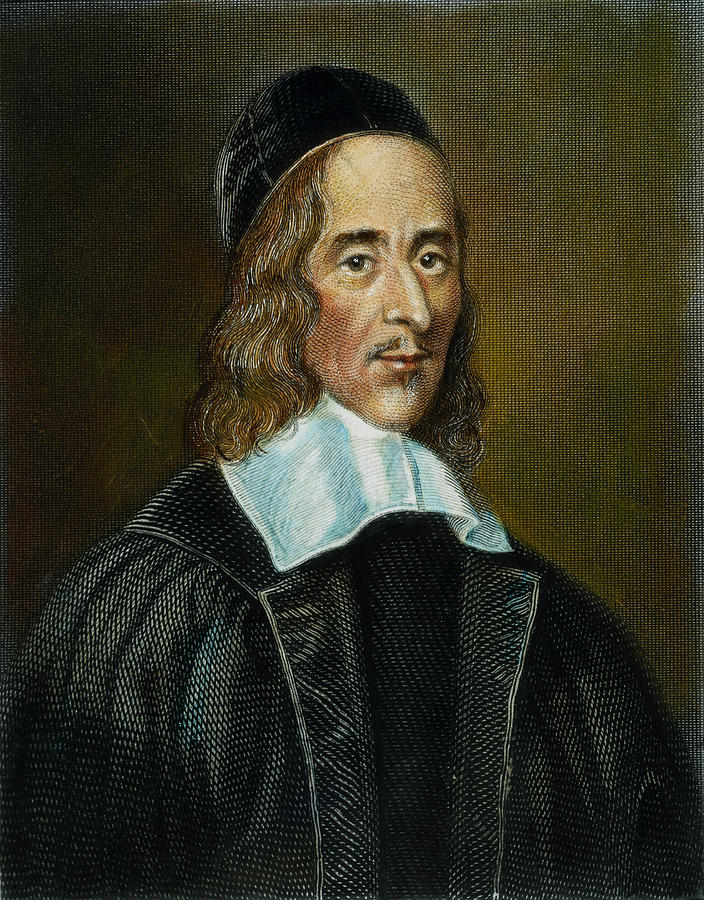
Robert White portrait of George Herbert painted 41 years after his death.

Robert White portrait of George Herbert painted 41 years after his death.

Today is the feast day of George Herbert, the seventeenth-century Anglican poet and priest whose remarkable verse was inseparable from his prayer life. As one admirer put it, “Herbert wrote most of it, but God wrote quite a lot.” That’s a proportionality to which every creative, and every priest, might aspire.

Izaak Walton tells a story about a time Herbert set out for a walk with some friends. Suddenly, without saying why, he excused himself and returned to his church. His friends assumed he’d only be a moment, but they waited and waited and he still didn’t come back out. So they went up to a window and peered in. As Walton relates, they “saw him [lying] prostrate on the ground before the Altar; at which time and place (as he after told [his friend Mr. Woodnot] he set some Rules to himself, for the future management of his life.”

The “holy Mr. Herbert,” they called him around his parish. It was a term of affection. In his late thirties he had given up worldly ambitions to enter the priesthood, and he spent the rest of his life at a country parish in the English village of Bemerton. He died of consumption only four years after being ordained. But his famous manual of advice to country parsons proved a lasting legacy, shaping the self-understanding of clergy for generations to come.

And his poetry! Such astonishing verbal images in a century famous for great language, where words could be bent to the subtlest purposes without losing a speck of passion or truth. Herbert’s art, as the Puritan Richard Baxter put it, was “heart work and heaven work.”

He was both poet and priest; indeed, he showed that poet and priest have similar business, the sacramental work of paying close attention, and enabling others to do the same. Another poet, Mary Oliver, has put this perfectly: “I don’t know exactly what a prayer is, but I do know how to pay attention.”

Herbert liked puns. It wasn’t just a cleverness with language. It was the way he saw the universe: one thing becomes another, like bread becoming God. He often starts with a word or an image, and morphs it into a multiplicity of resonant meanings, or as one critic put it, “he breaks the host of language.” The one is broken into the many so that all the scattered fragments may one day again be made one when God is all in all.

In ‘Church Monuments,’ he’s sitting in church, his mind wandering, and he starts looking at the big marble tombs all around him. First he thinks of his own mortality, “this heap of dust,” but in a few more lines he makes us see the marble monuments themselves crumble into dust, pressing upon us the awareness that everything on this earth must pass away. We are all passing away. And then in one stunning final image, Herbert makes our dust to be the sand in an hourglass, where time is always running out.

flesh is but the glass, which holds the dust
That measures all our time; which also shall
Be crumbled into dust… (‘Church Monuments’)

And in the process he makes a nice pun: “flesh is but the glass” makes the biblically literate reader think of “all flesh is grass,” one of the most vivid evocations of mortality in all of literature.

Herbert believed in words. Language was held more dear in his day, and he used it as a ladder to bridge earth and heaven. Grammar itself became a finely tuned instrument of praise. In ‘Prayer I,’ there are almost no verb forms. It’s mostly nouns, conveying a changelessness transcending the busy world of doing: Prayer the Churches banquet, Angels age, Gods breath … The soul in paraphrase, heart in pilgrimage … Engine against th’ Almightie, sinner’s towre, Reversed thunder … Heaven in ordinairie, man well drest … The land of spices, something understood. And in ‘The Call,’ it is nouns that dominate both the stresses and the structure of every verse: Way, Truth, Life  … Light, Feast, Strength … Joy, Love, Heart.

Some of Herbert’s imagery speaks of humankind misreading or misspelling reality, and it was the poet’s job to put it right, to give everything its proper name once again.

We say amisse
This or that is:
Thy word is all, if we could spell. (‘The Flower’)

When Herbert lay dying, he entrusted his poems to his friend Nicholas Ferrar. They were, he said, “a picture of the many spiritual Conflicts that have passed betwixt God and my soul, before I could subject mine to the will of Jesus my master, in whose service I have found perfect freedom.” As to whether to publish his manuscript, he left that to Ferrar. “If he think it may turn to the advantage of any poor dejected soul, let it be made public; if not, let him burn it.” Thank God for Ferrar’s good judgment!

The Herbert whom we meet in his poems is a person very much in process: unfinished, imperfect, always aspiring to something higher. He cared deeply about formation and growth – his own as well as that of his congregation. As poet and priest he used all possible art to move those with ears to hear.

Hearken unto a Verser, who may chance
Ryme thee to good, and make a bait of pleasure.
A verse may finde him, who a sermon flies,
And turn delight into a sacrifice. (‘The Church Porch’)

As the subject of many of his poems, he used his own life, his own wrestling with God, as a lens for examining the frailty of mortals and the workings of grace. And as his own audience, he used the very process of writing as a form of prayer and self-examination. His poems are both the record of a soul and a source of instruction.

Herbert was extremely honest – even ruthless – about his prayer life. His mind was a “case full of knives,” as he put it, and he was no stranger to doubt, particularly doubt about traversing the abyss between human frailty and divine glory.

He wrestled with God, he wrestled with his own frail and mortal nature. “My searches are my daily bread,” he wrote, “but never prove.” He doesn’t get proof. He gets something better – faith.

Perhaps his signature poem is ‘Love III,’ which Simone Weil called “the most beautiful poem in the world.” I often use it to begin the liturgy of Maundy Thursday, with the congregation taking the part of the guest, and a solo voice speaking for Christ the host.

In the poem, the guest is full of self-abasement: not worthy to be here, not worthy even to look upon the One who invites him to the feast. And yet, the calmly insistent voice of Love will not be denied. There is nothing the guest can say or do that can ever separate him or her from that Love.

Love bade me welcome: yet my soul drew back,
Guilty of dust and sin.
But quick-ey’d Love, obeserving me grow slack
From my first entrance in,
Drew nearer to me, sweetly questioning,
If I lacked anything.

A guest, I answer’d, worthy to be here:
Love said, You shall be he.
I, the unkind, ungrateful? Ah my dear,
I cannot look on thee.
Love took my hand, and smiling did reply,
Who made the eyes but I?

Truth Lord, but I have marr’d them: let my shame
Go where it doth deserve.
And know you not, says Love, who bore the blame?
My dear, then I will serve.
You must sit down, says Love, and taste my meat:
So I did sit and eat.

The Desert and the Flood (Homily for Lent 1)

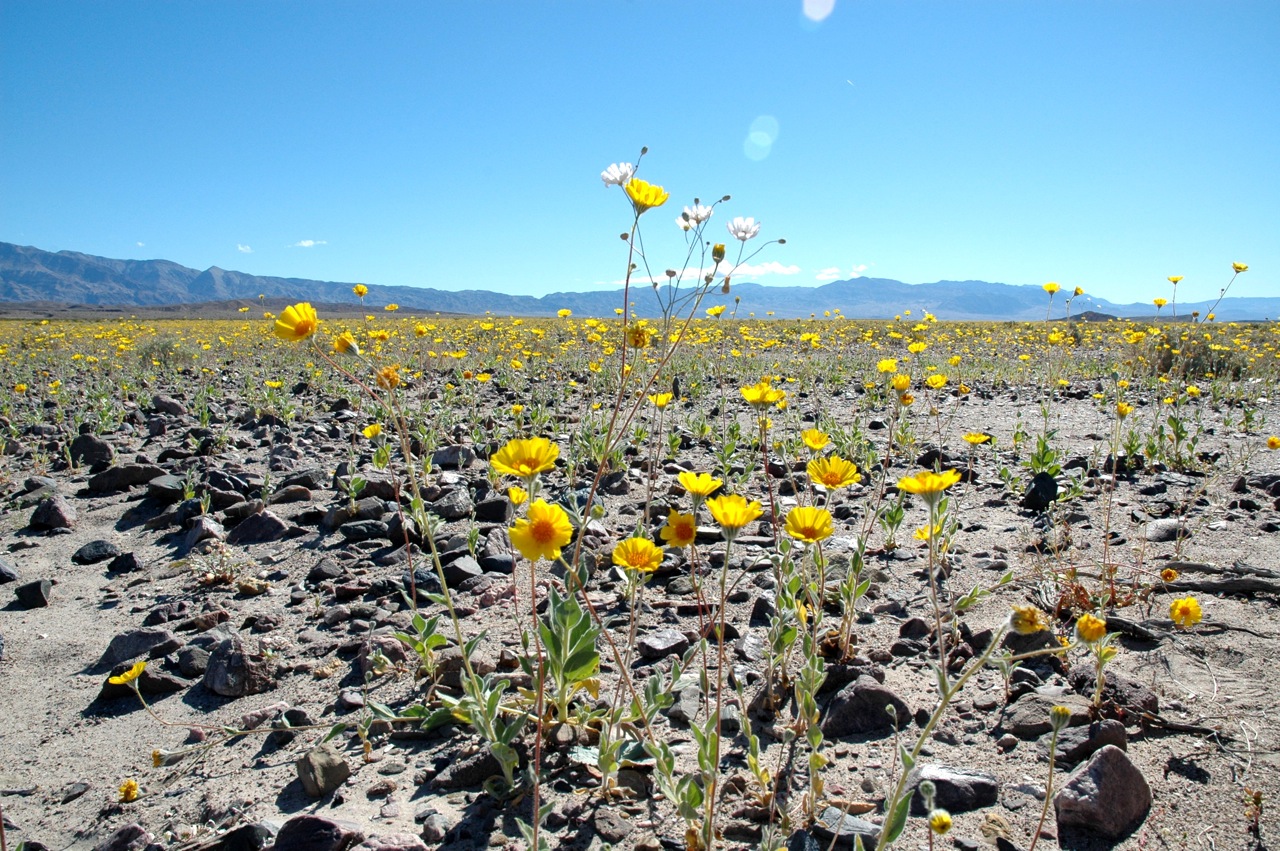
Death Valley flowers

Today’s Old Testament reading takes us to the end of the great Flood in Genesis. Many people have trouble with this story, because they read it as a tale of crime and punishment, with an angry father god who will get us if we don’t behave.

But the rest of Scripture won’t let us read it that way. The rest of Scripture, including the ending of the Flood story itself – the rainbow and the promise – shows us the face of God as the face of love. God doesn’t want to kill us. God wants to make a covenant with us. God wants to marry us.

So what is the Flood story really about? It actually generates a multitude of meanings, but one of the central ones has to do with violence. Genesis says that God looked upon the earth and saw that it was filled with violence. Sound familiar?

Violence is what happens when we put ourselves in the center instead of God, and try to make the world over in our own image. We are unable to honor or even see the existence of other beings as independent of our own desire. We lose all curiosity for anything outside ourselves.

Violence is intolerance of difference: other selves, other perspectives, other cultures are treated as obstacles to our desire, and must be made either to serve us or be swept away. This intolerance of difference, of otherness, may be seen in the rhetoric of terrorists, as well as its mirror image in the anti-Muslim ranting of certain American politicians. It is may also be seen in the recent outbreaks of overt racism in this country. Fear and hatred of those not like us has become far too common.

Such boundless self-assertion, says the Bible, is the foundational violence that threatens to swallow the whole earth. The Flood is not a punishment imposed from the outside; it is what we have made of ourselves.

When we are hostile to those who are not like us, who are not useful in the boundless expansion of our swelling desire, we destroy the balances and boundaries of which the world is made. You can see this violence in relationships, on the freeway, in the crucifixion of Nature, in the current phenomenon of endless war. If we let creation’s harmonious balance be smashed by human violence, we will all be washed away, the innocent and guilty alike. Not even the billionaire profiteers will be able to hide on that day.

A world drowning in its own violence.
Is this an ancient myth, or the daily news?

But the Flood story has a surprise ending. Instead of destruction, new possibility. Instead of anger, love. Instead of violence, reverence for all beings with whom we share the planet. God tears up all the sad old tragedy scripts and gives us a comedy instead. God invites us to join in the re-imagination of the world. God writes a new story in our hearts.

This is why the Epistle of Peter links the waters of the Flood to the waters of baptism. Both are the ending of an old story and the birthing of a new one. When our old selves drown in the depths of the font, we are reborn in Christ. No longer I, but Christ in me, as Paul says.

But before Christ could become our future, he first had to become himself. We are all tempted to live some other life than our own, to wear other people’s faces instead of becoming what God made us to be. Jesus was no exception. He could have lived some other life. Tradition says that he was tempted to dominate others and to escape the Way of the Cross.

“You don’t have to suffer,” Satan told him. “Not you. You were born King of the World. Think of the good you could do with all that power.”

But if Jesus had not lived with the poor and the outcast, if he had spent his time making rich and powerful friends, would he have been Jesus? If he had led a violent uprising to overthrow Roman tyranny, if he had devoted his life to reforming the religious establishment, would he have been Jesus? If he had turned stones into bread, or not risen from the dead, would he have been Jesus?

“Ask me whether what I have done is my life.”
writes poet William Stafford.[i]
Ask me whether what I have done is my life.

Well, what Jesus did was his life. So, we may wonder, how do we do our own lives? To answer that question, we must go, with Jesus, to the desert.

The desert is the emptiness where there’s no place to hide. In the desert, you come face to face with yourself, your demons, and your God. Nothing is defined there, nothing known in advance. Your scripts are no good in the desert. Your evasions are futile. Whatever makes you want to turn around and run back to the safety of your old illusions is the very thing that is trying to kill you.

Only in the desert is the silence deep enough for you to hear the whisper of your innermost heart. And what is your heart trying to tell you? Listen. Listen to your heart.

As Parker Palmer says:

“Before you tell your lives what you intend to do with it, listen for what it intends to do with you … Vocation does not come from willfulness. It comes from listening. I must listen to my life and try to understand what it is truly about – quite apart from what I would like it to be about… Vocation does not mean a goal that I pursue. It means a calling that I hear. Before I can tell my life what I want to do with it, I must listen to my life telling me who I am…”[ii]

We’re always making up stories about ourselves. Sometimes we’re heroes, sometimes we’re victims. But all of these stories are fictions that make us deaf and blind to what our life is actually trying to tell us. What are the stories that you need to let go of in order to let your life speak? If you are going to give up anything this Lent, give up those tired old stories about yourself. They are no longer true.

When we are baptized, we die to our old fictions; we let go of the old stories by which we try to direct our lives. That’s why the Flood story is one of the great images for baptism. There are all those people of Noah’s time clinging to their own fictions, sinking down under the weight of their false identities just as we ourselves sink under the weight of our own fictions.

And when in baptism we are freed from the burden of our false selves, we rise, newly buoyant, to the surface; we are pulled out of the water and given a new story, a new name, which is our true self, our true life, which has been wanting to speak to us all these years.

That is the work we have come to do, as we begin our long Lenten journey, as we step out into that desert where every fiction will be stripped away. At first it will feel like loss, like too much giving up. We may even want to turn around and quit, like the Israelites who complained in the midst of their own desert journey: Let’s go back! It wasn’t so bad, being slaves in Egypt!

But with God’s help, we will keep going, deeper and deeper into that desert, determined to save the only life we can save,[iii] and there will come a day, some 40 days hence, when we will reach the other side. And there we will hear a voice, a voice that calls us each by name.

Come to the waters, the voice will say.
Come to the life-giving pool of the baptismal font.
Come to the Easter waters, and dive in.
Wash yourselves clean of the old fictions, the tired stories,
and rise again out of the watery depths,
newborn, with a new name,
a name which is: Not I but Christ in me.
And this new name, this new self,
is what our life has been trying to tell us all these years.

As Derek Walcott describes it,

The day will come when with elation you will greet
yourself arriving at your own door, in your own mirror,
And each will smile at the other’s welcome
Saying, “Sit here, eat, you will love again
the stranger who was yourself …
the stranger who has loved you all your life …
who knows you by heart.[iv]

The desert is wide, the journey long, but keep on keeping on, because it will lead you, step by step, into the heart of the Beloved who has loved you all your life, who knows you by heart.

And when we finally draw near the end of our Lenten journey, everything that the desert is about, everything the Christian faith is about, everything our very lives are about, will be intensified and distilled in the incomparable passage from death to life which we call the Paschal Mystery: the life-giving mystery experienced both ritually and personally in the Great Three Days of Holy Week: Maundy Thursday, Good Friday, and the Easter Vigil.

Right now, in these first lean and hungry days of the Lenten desert, the transformative joy of the Easter feast may seem unimaginable. But beyond the hunger and thirst, beyond the trials and temptations, the doubts and the stumbles, beyond even the faded Hosannas and the terrible shouts of “Crucify! Crucify!,” there will rise the jubilant Alleluias of the Easter Vigil, breaking at last the stony silence of defeat and death.

The great journey begins here. Now.
And when it’s over,
you will be somebody else:
Not I, but Christ in me.

[i] William Stafford, “Ask Me”

[ii] Parker Palmer, Let Your Life Speak: Listening for the Voice of Vocation (San Francisco: Jossey-Bass, Inc. 2000) 3-4

[iii] Mary Oliver, “The Journey”

[iv] Derek Walcott, “Love after Love”

Solitude (Part 2)

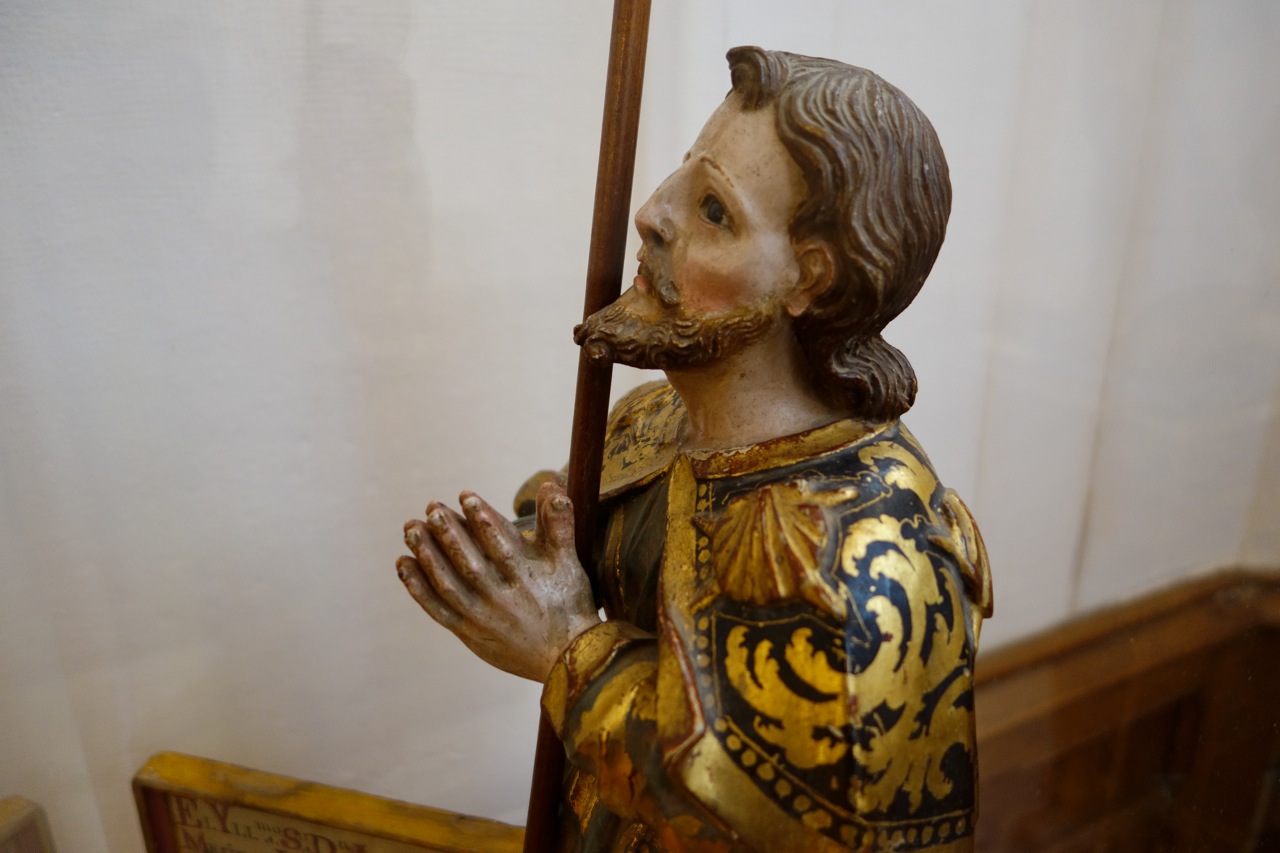
Camino de Santiago pilgrim, Museum of the Pilgrimage, Astorga

Camino de Santiago pilgrim, Museum of the Pilgrimage, Astorga

This evening, an inner light shone up from within, and a voice called, “Come to me, trust me, depend on me. You cannot do it yourself. You’re trapped where you are, and your struggling efforts to free yourself enmesh you more deeply. Come to me.” “Yes,” I answered, and surrendered. Yet my pride was soon fighting back. This is the work I came to do.

— Robert Kull[i]

In Solitude (Part 1), I described one man’s experiment of living in total solitude for one year on a remote island in southern Chile. On this Ash Wednesday, the beginning of the 40-day Christian retreat from habitual living and pesky attachments, it seems a good time to ask what Robert Kull’s experience might teach us about spending time in the “desert.” What happens out there? Will it change us?

Kull has few pretensions about being a hero. One of his first journal entries expresses a feeling of utter weakness and vulnerability: “Alone. A tiny solitary speck completely vulnerable in the face of an infinite universe intent on my annihilation.”[ii] Over the next twelve months he suffers frequent bouts of anxiety, loneliness, rage, depression, emptiness, grief, and self-doubt – all those demons that have nowhere to hide without the constructions and distractions of the social world. “What is this core I’m knotted around?” he wrote after three months. “What painful wound am I protecting? I want nothing to touch me there – but rain, wind, cold, and Cat [his feline companion] keep battering the walls I build.”[iii]

The solution, as he must learn over and over, is not to fight and overcome his human condition, but to surrender: “My goal in the wilderness was not to conquer either the external world or my own inner nature, but to give up the illusion of ownership and control and to experience myself as part of the ebb and flow of something greater than individual ego.”[iv]

He was never entirely free of the hero’s quest to attain a goal, to find the Holy Grail of a perfected self. “It’s painful to feel I’m failing,” he wrote halfway through his year.[v] He worried he was just going round in circles instead of making real progress. He felt like Sisyphus. But isn’t that how the soul dance goes? It’s not the attainment of a final cure for what ails us, but a lifelong process of continual care and self-compassion. As the monks say when asked what they do all day in the monastery, “We fall down and get up, fall down and get up.” Or as a Zen patriarch once put it, “One enlightened thought and one is a Buddha, one foolish thought and one is again an ordinary person.”[vi]

We should rejoice that enlightenment and foolishness (or grace and sin) remain so intertwined in this life. It reminds us that grace is a gift, not a possession. It frees us from pretension and pride, and makes us ever grateful.

In his last days on the island, Kull wrote:

I’m not sure what enlightenment is, but I believe there have been moments. If so, enlightenment is not something I can get. It’s the process of abandoning myself to the world. There have been times when, like a clear bell, I could hear the sound of one hand clapping and feel the sacredness of everything. It’s the sound of the world, once I remember in my heart that there is truly nothing to get. What I’m looking for, I already have.[vii]

In his year of solitude, Kull experienced many moments of enlightenment to go with the many foolish ones. Some of his best thoughts are framed in the language of his adopted Buddhist tradition, but his struggles with self-will and ego are resonant with Christian spirituality as well. “Surrendering the ego to Something Greater is at the heart of spiritual practice, and the process is endlessly subtle and challenging.”[viii]

Kull’s wilderness year did not fix him. He returned home still a work-in-progress. But he had definitely been changed by his sojourn in solitude, and the meaning of that change will only be revealed over the rest of his life. As I often heard when I walked the Camino de Santiago, “when you reach Santiago, your real Camino begins.”

Kull’s relationship with the wind is my favorite example of his spiritual growth. When he began his year in the southern summer, the winds were intense and seemingly endless. If you have ever camped in high winds, you know how wearying, even terrifying, a continuous barrage of turbulence can be. For a long time, Kull regarded the wind as his enemy – an attacking, malevolent force trying to break him down. But as he gradually learned to surrender to the world, to accept the way things are and not take them personally, he recognized the wind had been his teacher all along. In his final weeks on the island, he began to fly a kite on calmer days. The wind had become his playful companion.

For those of us beginning our Lenten retreat today, Kull’s valuable experiment in solitude has much to teach us. The subtractions of retreat – doing without, giving up, setting aside, getting away – can free us from the clutter, noise, addictions, distractions and deceptions that drown out the still, small voice calling our name in every moment. And the unaccustomed hardships of the “desert” – severity, deprivation, emptiness, loneliness, demons – can break the spell of self-sufficiency, returning us to the honest condition of primal need. Few of us will spend a year on a Patagonian island, but a faithful keeping of Lent may take us to a place of similar learning and growth.

Perhaps the best thing we can take from Kull’s journals is the gift of self-compassion. We don’t have to be heroes. We don’t have to be cured. We don’t have to pretend at spiritual competence or perfection. We don’t even have to be “good,” as Mary Oliver reminds us. We “only have to let the soft animal of [our] body / love what it loves.”[ix] And every now and then, as Kull duly notes, we get it: “Finally I am – if only briefly – the flowing All.”[x]

Tonight I will kneel in church for the imposition of ashes. A priest will trace a charred cross on my forehead and say to me, “Remember that you are dust, and to dust you shall return.”

What a relief! Only dust, neither hero nor angel. And yet, is not dust the very material God selected to fabricate a physical image of the divine self? This dust may yet shine with glory not its own.

Whether I flie with angels, fall with dust,
Thy hands made both, and I am there;
Thy power and love, my love and trust,
Make one place ev’ry where.[xi]

[i] Robert Kull, Solitude: Seeking Wisdom in Extremes – A Year Alone in the Patagonian Wilderness (Novato, CA: New World Library, 2008) 98

[ii] Kull, 4

[iii] Kull, 70

[iv] Kull, 47

[v] Kull, 141

[vi] Hui Neng, Sixth Zen Patriarch, q. in Kull, 288

[vii] Kull, 293

[viii] Kull, 271

[ix] Mary Oliver, “Wild Geese,” in New and Selected Poems (Boston: Beacon Press, 1992) 110

[x] Kull, 283 (italics mine)

[xi] George Herbert, “The Temper”