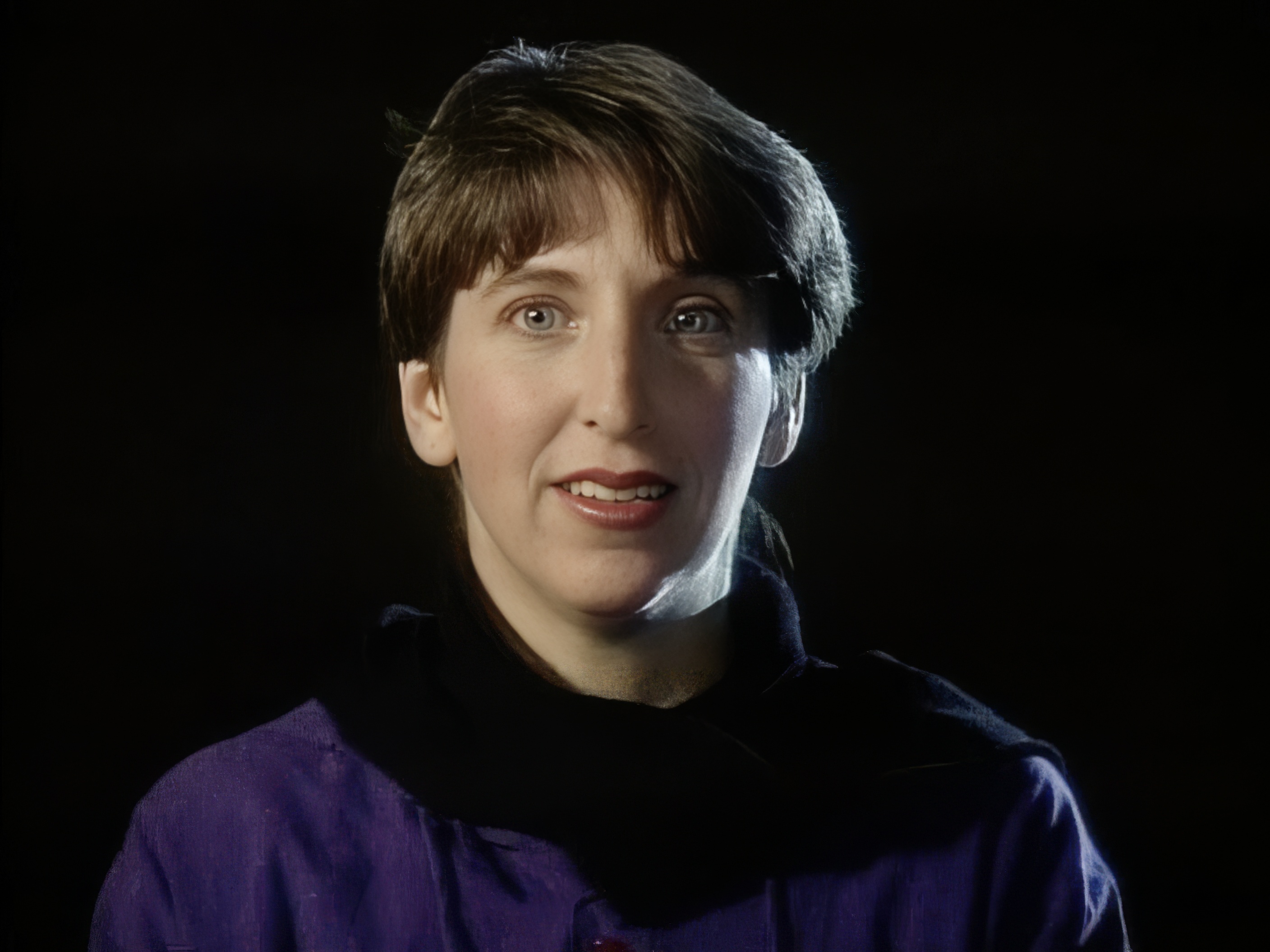
Once upon a time, a brilliant storyteller came into the world to touch countless hearts with tales of wisdom and wonder, losing and finding, tears and laughter. She scattered her life-giving stories far and wide, and encouraged others to do the same. She knew the power of stories to bind us together, ground us in communal wisdom, and help us imagine better futures. Hers was a serious vocation in a world so forgetful of the stories we need, the stories that nourish, the stories that save. But she always lived out her calling with levity and lightness. Everyone who has known her remembers her laughter, her joy, her delight in daily blessings, her generous and irrepressible spirit. As she liked to put it, she was “subject to bursts of enthusiasm.”
Desert dawn at Angela’s house (December 17, 2024): Looking west, looking east.
A week before Christmas, master storyteller Angela Lloyd was up at dawn, photographing the beauty of the California desert sky. She posted two photos with a greeting to her friends: “Good morning. The view from here: looking west, looking east.” She loved sharing the beauty of her desert home. But sometime after that glorious morning she was taken ill, and not long after, on the twelfth day of Christmas, Angela departed this life. When I got the news today, the world felt suddenly washed with grey, bereft of her bright presence.
I came to know Angela nearly 40 years ago, when we worked together on creative retellings of Old Testament stories for the Easter Vigils at Christ Church, an Episcopal parish in Ontario, California. We both believed that God is not known through ink so much as through breath. Without the breath of a spirited teller, our sacred stories may lie dormant and listless.
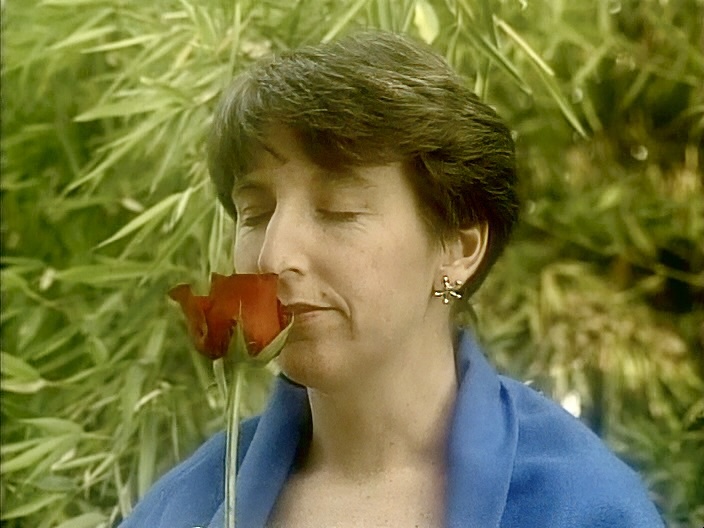
After a few years we made a film of the stories, The Electronic Campfire: New Storytelling from Scripture. Angela took some of the parts (including that of God), while I took the rest. We shot the scenes in various southern California locations.
When I heard that Angela had died, I wanted to celebrate her giftedness by sharing her work in this film. While throughout her life she told many different kinds of stories from a variety of sources and traditions, our biblical collaborations do convey, I believe, a lively sense of the engaging spirit she brought to everything she did. I offer these clips in her memory.
On the third day of Creation, God creates plants and trees.
The first is the Creation story from the first chapter of Genesis. Instead of speaking the divine words for each of the seven days (“Let there be light,” etc.), God performs an action, since in the Bible God’s word is not just description of an action, but the action itself. For God, to say is the same as to do.
The Creation Story from The Electronic Campfire
Angela’s other stories in the film were the Red Sea and the Valley of the Dry Bones. In the first story, I play the Israelites, so you’ll see a bit of that as a lead-in to Angela’s performance of both Yahweh (God) and Miriam (Moses’ sister). The Dry Bones story is all Angela, including some of her riffs on the washboard. She improvised a line the Exodus tale which, in retrospect, sums up her life: “Let’s do it for the story.”
Red Sea & Dry Bones from The Electronic Campfire
At the Easter Vigil, there is a bidding to prayer after each story. Here are the words which follow the story of the Divine Breath that ceaselessly enlivens our “dry bones”—in this world and the next:
Dear People of God: There are those who tell our story as a history of defeats and diminishments, a narrative of dashed hopes and inconsolable griefs. But tonight we tell a different story, a story that inhales God’s own breath and sings alleluia even at the grave …
The sixth day: “Let us make humankind in our image.”
We did a number of Easter Vigils together, and Angela would always surprise me with a new variation. One time, playing an Israelite in the Exodus, she pulled out a postcard. “I was planning to mail this when we got to the Promised Land,” she said, “but something tells me I should mail it now. It may be a while before we get there. Besides, I’m starting to think that maybe anywhere can be the Promised Land, that even in this wilderness I am standing on holy ground.”
Thank you, dear Angela, for your marvelous stories, your enthusiasm, your joy, and so much more. There’s an old song by Jane Voss that salutes absent friends, and what the song says, that is what I say:
Wherever you may be tonight, I hope this finds your burdens light, Your purpose high, your spirit strong, I hope that you have got along— My song was lost and gone, if not for you.
Noah’s Ark: Fresco, Abbey Church of Saint-Savin-sur-Gartempe, France (c. 1100).
My sister Martha Stevens is a marvelous storyteller. It was her profession for a long time, as she traveled far and wide to hold listeners spellbound with tales from many centuries and cultures. In the late 1980s, inspired by her work, I began to foster retellings of biblical narratives at the Easter Vigil—Creation, Flood, the Binding of Isaac, the Red Sea and the Valley of Dry Bones. Over the years, these Vigil retellings expanded to include theater and multimedia as well as individual storytellers.
Although I have curated creative Easter Vigils with story teams in a wide variety of parishes over the years, I began with an 8-year stretch at Christ Church, an Anglo-Catholic parish in Ontario, California. When I introduced the storytelling component in 1988, the church already had a famously distinctive practice for welcoming resurrection.
While a joyful noise is customary in most churches after the first shouts of “Christ is risen,” this usually means the ringing of bells and the organ’s roar. But to these were added not only dozens of wind chimes placed within the reach of every worshipper, but the boom and blaze of fireworks. After his first experience of the Christ Church Vigil in 1989, visitor David Trowbridge wrote down his impressions. His description of the fireworks reflects the assembly’s collective astonishment in that moment:
“Well, at this point, everybody for at least three miles in every direction who wasn’t awake woke up and knew that it was Easter again at Christ Church. There was a shattering explosion from the courtyard [visible through the nave’s glass wall] as the first of at least 10,000 LARGE firecrackers went off. Then the pinwheels, then the Roman candles, and then the 10-foot high cross in red fireworks with blue fireworks (representing the water of baptism) underneath. Everybody started laughing and exclaiming and jumping up and down, but nobody could hear anything.
“The contrast between the mystical beauty of the Kyrie just before and the almost orgiastic release of the fireworks was exactly right—nothing I have ever experienced has so truly expressed the joy and release that Christians should feel in celebrating the mystery of the empty tomb. We tend to take the story for granted, but at Christ Church, the noise and the excitement made it all new again, and we all felt, for a few minutes, a little of the unbelieving excitement that the disciples must have felt that first Easter Day, when they found that He, first of all [human beings], had conquered death.”[i]
The previous year, I had approached the church’s longtime rector, Jon Hart Olson,[ii] about adding storytelling to the Easter Vigil. Jon, a brilliant theologian, exquisite liturgist, and a generous encourager of my own priestly imagination, welcomed the chance to offer fresh versions of the old stories. The people of Christ Church embraced the idea as well, and it became part of their annual tradition. When I had a chance to revisit their Vigil 20 years after leaving the parish, I was delighted to see the creativity continuing, as Dry Bones came to life in the form of two break dancers in skeleton suits. As they gyrated beneath a blacklight, all we could see in the dark was their dancing bones.[iii]
In his account of the 1989 Vigil, Trowbridge found the storytelling as compelling as the fireworks:
“The priest who told the story of Noah and the Ark was especially entertaining. At one point, describing the animals boarding the ark two-by-two, he named about 100 animals in alphabetical order … He described how cranky and bored everyone got on the Ark, and how Noah organized singalongs for the animals. At this point he got everyone making their favorite animal noises all together. Pandemonium! I was screaming like a chimpanzee, which seemed to provoke the rector, who was sitting nearby, into a fit of laughter. At the end of the reading, the [storytelling] priest unfurled a long cloth rainbow across the room …
“After the [fireworks], the Eucharist proceeded as usual, or so we thought, but there was one more surprise in store for us. At festal Eucharists, it is customary to read the Gospel lesson with much ceremony. The Bible is carried from the altar, the deacon who is to read it is blessed by the priest, it’s carried out into the midst of the congregation with candles and incense … and so it was here. Then, as is customary, the deacon lifted up the Bible and intoned, ‘The Holy Gospel of our Lord Jesus Christ, according to Luke,’ and we all responded, ‘Glory to You, Lord Christ.’
“And the back door of the church swung open with a loud crash, and a disheveled woman in a purple sweater and black pants rushed in! She shouted, ‘Sit down, all of you,’ and pushed her way to the front, rudely shouldering aside the deacon with the Bible. ‘Sit down! I’ve got something important to say.’
“At this point, I’m sure many people (I know I was) were thinking that one of Ontario’s street people had crashed the service. After a long moment of embarrassment and that ‘what should I do? … should I do anything?’ feeling, the woman identified herself. It was Mary Magdalene, who told us, in the vernacular, instead of in the elevated style of the Bible, what happened when she went to the tomb that morning to prepare Jesus’ body for burial. What a way to hear the Gospel! It was like hearing it for the first time.”
I do wish there were more storytelling in church. There’s nothing wrong with a well-read passage of canonical text—I’m quite fond of a good reading by a practiced and thoughtful voice—but sometimes a telling can reach places which a reading cannot. Instead of a reader as a passive, transparent window for a sacred text to pass through without inflection or distortion, a teller embodies the text in breath, intonation, gesture and movement, making it alive and present and urgent in the moment of its speaking. A story told rather than read has a unique kind of authority, coming from the heart instead of a book. God is not ink. God is breath.
Not everyone is prepared for the energy—and occasional lack of decorum—of good storytelling in church. But many find it engaging, even revelatory. Dennis Dewey,[iv] a brilliant storyteller, is careful to deflect the inevitable praise evoked by his creative delivery of Bible stories: “You make the Bible come alive!” people tell him. “No,” he says. “The Bible already is alive. I just try not to kill it.”
At this year’s Easter Vigil, pandemic protocols were still in place, so we were streaming the liturgy. For the Flood story, I solicited participation by asking parishioners to send me videos of themselves entering the ark (their front door) and staring out the ark’s portholes (their front window). Since we have all been on our separate arks for the past year, I wanted to acknowledge the challenge of our collective pandemic experience, while affirming our enduring faith in the rainbow promise. We’re in the story, and the story is in us.
I added voice-over to the submitted clips, and inserted a segment from a video of my Vigil stories, The Electronic Campfire: New Storytelling from Scripture (1991), made in collaboration with the amazing storyteller Angela Lloyd.[v] I hope you enjoy this short video, “The Flood and the Ark.” Even more, I hope you will be inspired to explore storytelling—and storylistening—within your own faith community.
[i] David Trowbridge, unpublished manuscript (April 1989). David’s wife Nancy sent me this writeup at the time, encouraging me to share it “here and there if you wish.” It only took me 32 years to do so. My memories from several decades of creative Easter Vigils tend to conflate and become less true as memory simplifies and smooths out the details, so I am happy to possess this vivid firsthand impression from an attentive observer having the Christ Church Vigil experience for the first time.
[ii] The Rev. Jon Olson preached at my ordinations to the Diaconate and the Priesthood, and taught me so much about liturgy and spirituality. He was the kind of friend who kept you up well past midnight with luminous (and hilarious) conversations. I cast him as Lazarus in my 1970s film The Investigation, which explores the Jesus story in a modern setting. I will always be grateful that Jon gave this itinerant priest an abiding place of welcome in the unique community he served at Christ Church.
[iii] The break dancers were young men, part of the parish family, who danced professionally at Disneyland. They raced to the church after work to perform Dry Bones (those Vigils started at 9 p.m. and went past midnight). The teller of the story spoke, unseen, from the balcony at the back of the church, while the skeletons danced before the altar.
[v]The Electronic Campfire, not currently available on disc, may be seen here: https://youtu.be/sDDdSKFSWoE Angela Lloyd is not in the Flood story, but is featured in most of the others. Angela took part in most of my Christ Church Vigils. She is not to be missed (“a combination of Maria von Trapp, Mary Poppins, and Tinkerbell”—Donald Davis). For her website: https://www.angelalloyd.com



 The religious imagineer