What Jesus Said About Vultures

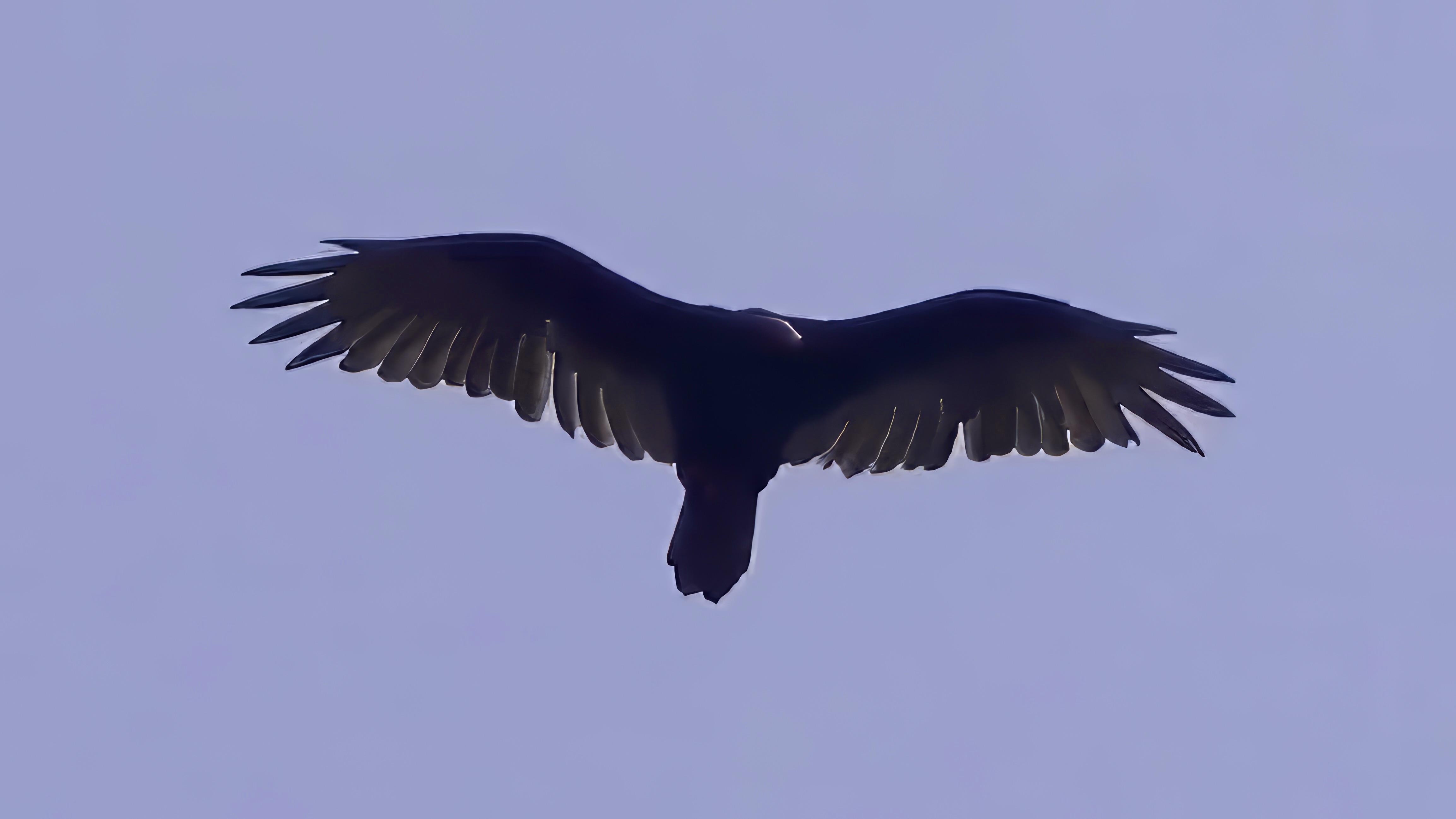
Turkey vulture.

In all my years as a priest, I had never preached on the apocalyptic imagery of Luke 17:26-37, where people disappear without warning and Jesus concludes with an unnerving proverb: “Where the corpse is, there the vultures will gather.” This is not ideal preaching material, but with the help of the Epistle reading, Hebrews 11:29—12:2, I gave it a try last Sunday.

Today’s gospel [i] has quite a punchline: “Where the corpse is, there the vultures will gather.” It’s got to be pretty low on the list of favorite Jesus quotes, but it certainly gets our attention.

A couple of weeks ago I was at a raptor show at the High Desert Museum in eastern Oregon. A variety of hawks, owls and vultures flew swiftly among the seated spectators, who were warned to stay very still lest we be mistaken for prey. I did my best not to be a target, but a turkey vulture came close enough to brush my head with its wing. Perhaps it was preparing me for this strange gospel verse.

Some scholars say Jesus was simply using a common folk expression in response to a question about discerning the times, meaning something like “where there’s smoke, there’s fire.” Such expressions have nothing to do with smoke or fire or vultures or corpses. They’re just colorful ways of making a point. Still, Jesus’ choice of such a grim illustration puts a sharp edge on his message. It certainly gets our attention. And where the enigmatic text is, there the scholars will gather.

Who is the corpse? they wonder. Who are the vultures? One interpretation suggests the corpse could represent ancient Palestine, with the rapacious vultures being the occupying army of Rome. The Book of Revelation, perhaps inspired by the vultures in the gospel text, imagined the raptors of midheaven being summoned to feast on the remains of the proud powers struck down by divine judgment. An even more fantastical interpretation identifies the sharp-eyed buzzards, who in fact can spot carrion from 3 miles away, as those perceptive disciples who gather to consume the Corpus Christi, the Body of Christ given to feed our deepest hunger.

Well, none of these images is going to qualify for a stained glass window. And the vulture verse is perhaps profitless for the preacher.

And yet, it leaves a haunting impression. It’s unlike anything else Jesus ever said, and its gruesome tone puts an exclamation point on his discourse of crisis. A world is dying, he says. Just as a world died in the days of Noah, or in the days of Lot—names which recall destructive narratives of flood and fire—so it is happening now. The times are in no way normal, Jesus warns his listeners. Anyone who pretends that is not true, who thinks we can just go on about our business as usual—eating and drinking, buying and selling, planting and building—well, they are in for a surprise.

Come gather ’round people
Wherever you roam
And admit that the waters
Around you have grown
And accept it that soon
You’ll be drenched to the bone
If your time to you is worth savin’
You better start swimmin’
Or you’ll sink like a stone
For the times they are a-changin’ [ii]

When we sang that song 60 years ago, we thought the times were changing for the better. And that was true in many ways. But the flood of changes washing over us today do not feel like something better. When Jesus speaks of people being snatched up and disappeared without warning, he could be describing what’s happening right now in “the land of the free.” To paraphrase Jesus’ metaphor, “As it was in the days of Dietrich Bonhoeffer—in 1930s Germany—so shall it be in our own time.”

I pray that this will not be our fate, but the fact that such an outcome is even conceivable is a measure of the times. It can happen here. So what are the friends of God to do? How do we start swimming so we don’t sink like a stone?

We are not the first believers to suffer the worst of times. The Epistle to the Hebrews is clear about that. History isn’t always about the lilies of the field. It has its corpses and vultures as well.

But as the author of Hebrews insists, the faithful believe in the victory of God, and they act out that faith with their bodies. Some of God’s friends have “received the test of mocking and whipping and even chains and prison. They were stoned, cut apart in a slaughter; they died upon a sword. They traveled around in ragged clothing, impoverished, oppressed, afflicted.” But for all they suffered, those who kept the faith “subdued monarchies, did the work of justice … shut the mouths of lions, quenched mighty fires …” (Hebrews 11:29-12:2)

As people baptized into the Paschal Mystery, we understand that dying and rising, defeat and victory, are deeply intertwined. You can’t have one without the other.

When certain medieval women mystics contemplated the cross in prayer and vision, they saw not the triumph of death, but a kind of birth. For them the crucified Jesus was like a woman in labor, enduring pain and travail in order to bring us all to birth: 

Ah! Sweet Lord Jesus Christ, who ever saw a mother suffer such a birth! For when the hour of your delivery came you were placed on the hard bed of the cross and … in one day you gave birth to the whole world.” [iii]

To behold the death of Christ and call it birth is the central act of Christian imagination. It is why we declare victory at the cross. We don’t wait for Easter Sunday. We declare victory at the cross because the Passion isn’t just a story about the violent powers that always trample the weak and kill the prophets. It’s also a story about the Realm of God, where dry bones breathe and lost hopes dance, where the prodigal is welcomed home and the tears are wiped from every eye.

The Love that creates such a realm was nailed to a cross, but the cross did not consume it. Yes, death did what death does, but then God did what God does. And Love won. This is the story we belong to, and on the outcome of that story, we stake everything.

That is why we are here this morning. That is why we refuse to retreat to our private worlds, why we continue to gather in community at our Savior’s table: to nurture hope, shelter love’s flame, encourage one another, strengthen our hearts for service, eat the bread of life, pray without ceasing, sing our Alleluias and grow ever more fully into the visible, tangible body of Christ.

We are not alone in this journey. We are surrounded by a cloud of witnesses, all those ancestors in the faith, from Abraham and Sarah and Mary and Luke right on down to the wise and loving mentors we’ve known in our own lives, who have taught us how to walk in the Way of life and peace.

I once heard a preacher describe the cloud of witnesses as “the balcony people” who are looking down and cheering us on as we run the race that is set before us. It’s a wonderful and resonant image. I’m sure that each of you has some very special people in that balcony, shouting their encouragement. Listen. You can hear their voices echoing through the years.

St. Luke, pray for us … St. Mary, pray for us … St. Francis, pray for us … Oscar Romero, pray for us … Dorothy Day, pray for us … Mom and Dad, pray for us.  

Last Sunday I was in Eugene for the National Track & Field Championships, and in the men’s 800 meters I witnessed one of the most stunning moments in the history of middle-distance racing. A 16-year-old high school sophomore named Cooper Lutkenhaus had qualified for the elite competition by breaking the 29-year-old high school record, running the distance in 1:45. And after stumbling and almost falling in his first race at the championships, he managed to survive the first two rounds.

Much to his surprise, he had made the final. But with some of the world’s top 800 meter runners in the race, no one expected him to be anywhere close to the top three who would earn a trip to the World Championships in September.

Rounding the last turn, Cooper was doing really well for a 16-year-old, in  sixth place out of nine racers, 10 meters behind the leader. Then, in the last 100 meters, he passed one runner, and another, and another, and another, to cross the line in second place. His time was 1:42.27, not only a personal best by an unbelievable 3 seconds, but the 18th-best all-time and the fourth-best ever by an American.

Donavan Brazier, Cooper Lutkenhaus, and Bryce Hoppel finish 1-2-3 in the 2025 U.S. Track & Field Championships in Eugene, Oregon.

Now I’ve been at a noisy NBA final with Kareem and Magic and Larry Bird. I’ve been deafened by the 12th man [iv] at a Seahawks game. But the sound of the crowd cheering on young Cooper Lutkenhaus blew my ears off. The cloud of witnesses.

When we run the race that is set before us, there will be times when our lungs burn and our legs scream with lactic acid. There will be the races that disappoint, and workouts that feel listless or discouraging. We may even stumble and fall, more than once.

But always, always, the cloud of witnesses is cheering us on. They know from their own experience what the race is like. They all had their own moments of weakness and doubt. They became acquainted with suffering by training hard every day. They all had to learn how to get up after every fall, lay aside every weight, gulp the breath of the Spirit, and accept pain as the runner’s companion.

I’ve done my own share of racing, and when the pain comes, I try to greet it as a friend. “Hello, brother pain. I knew you’d show up. Well, here we go. I know you’re not going to kill me, right?. We’ll just take it step by step.”

“Even the fittest may stumble and fall (Isaiah 40:31). As Roisin Willis and Maggi Congdon finish 1-2 in the women’s 800 meters at the U.S. Championships, Sage Hurta-Klecker dives for the third and final spot on the World Championship team. In previous years, she had missed out on a championship podium twice due to falls, but this time her fall was a triumph. She made the team.

The perpetual contest between weariness and perseverance is familiar to every athlete—and every saint. You’re going to get tired. You’re going to get discouraged. You may faint and fall. But keep your eyes on the prize, hold on. On both good days and bad, you’ve got to put in the work, “lay aside every weight,” surrender to a power and a strength that is not your own, and stay in the flow.

I began with a raptor image, so let me close with another. This time it’s not a vulture, but an eagle, in a beautiful passage from the prophet Isaiah:

Even the youthful may faint and grow weary, 
even the fittest may stumble and fall,
but those who wait for the Lord shall renew their strength, 
they shall mount up with wings like eagles, 
they shall run and not be weary,
they shall walk and never grow tired. [v]
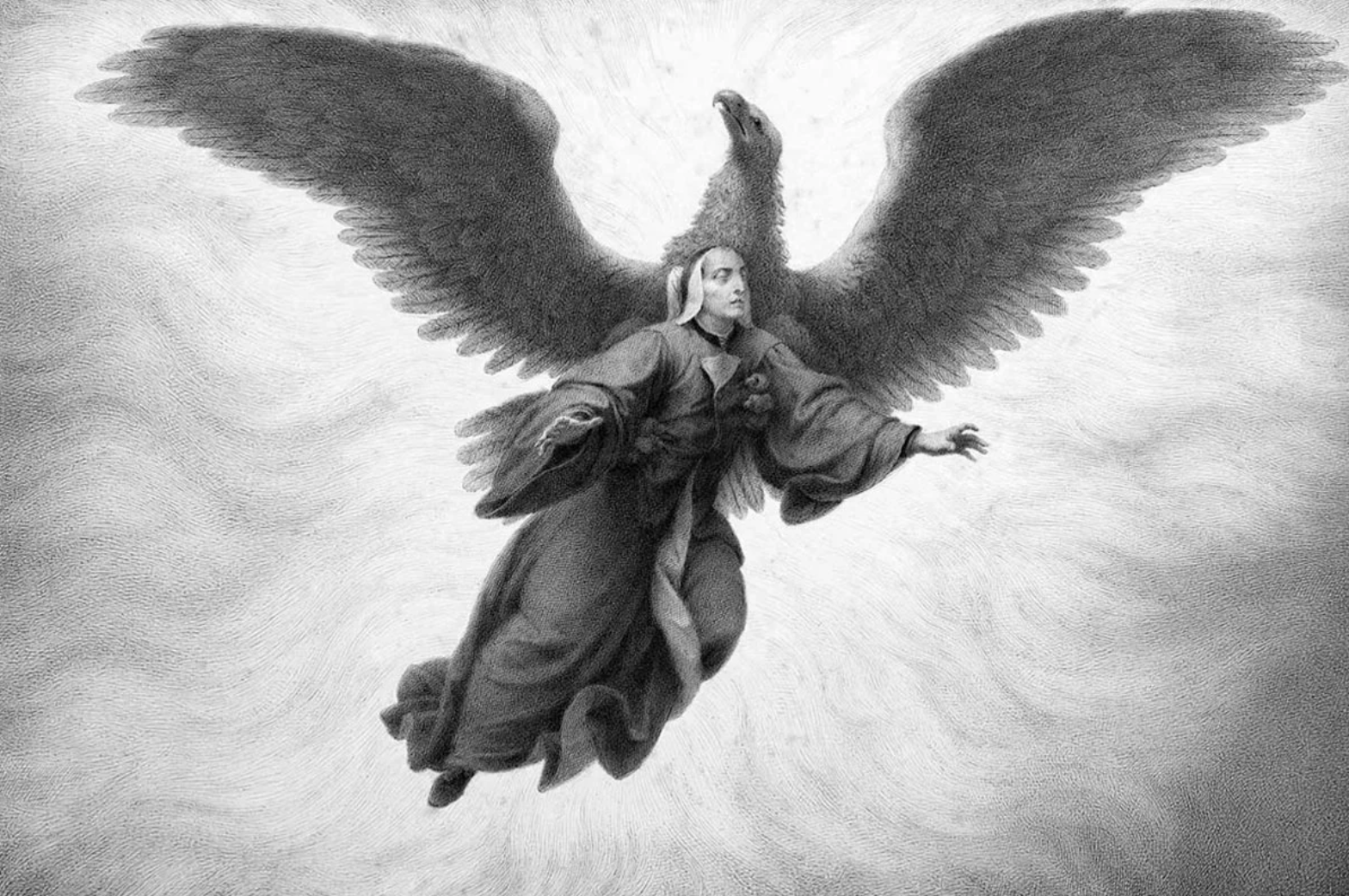
Francesco Scaramuzza, Dante and the Eagle (c. 1860). The sleeping Dante dreamed he was carried by an eagle, but it was really St. Lucy who helped the poet on his upward journey toward heaven’s light (Purgatorio ix).


This homily was preached at St. Luke’s Episcopal Church, Renton, WA, on the 9th Sunday after Pentecost, 2025.

Race photo and video by the author.

[i] The texts for the 8th Sunday after Pentecost are in Wilda C. Gafney, A Women’s Lectionary for the Whole Church, Year C, which differs significantly for the Revised Common Lectionary used by most liturgical churches.

[ii] Bob Dylan, “The Times They Are A-Changin’” (1964).

[iii] Marguerite d’Oingt (d. 1310).

[iv] The loudest crowd in professional football is in Seattle, where the fans are called “the 12th man” for their ability to influence the game by making it hard for the other team to hear their quarterback’s signals.

[v] Isaiah 40:30-31.

“Save us from the time of trial” –– Climate Change as Apocalypse

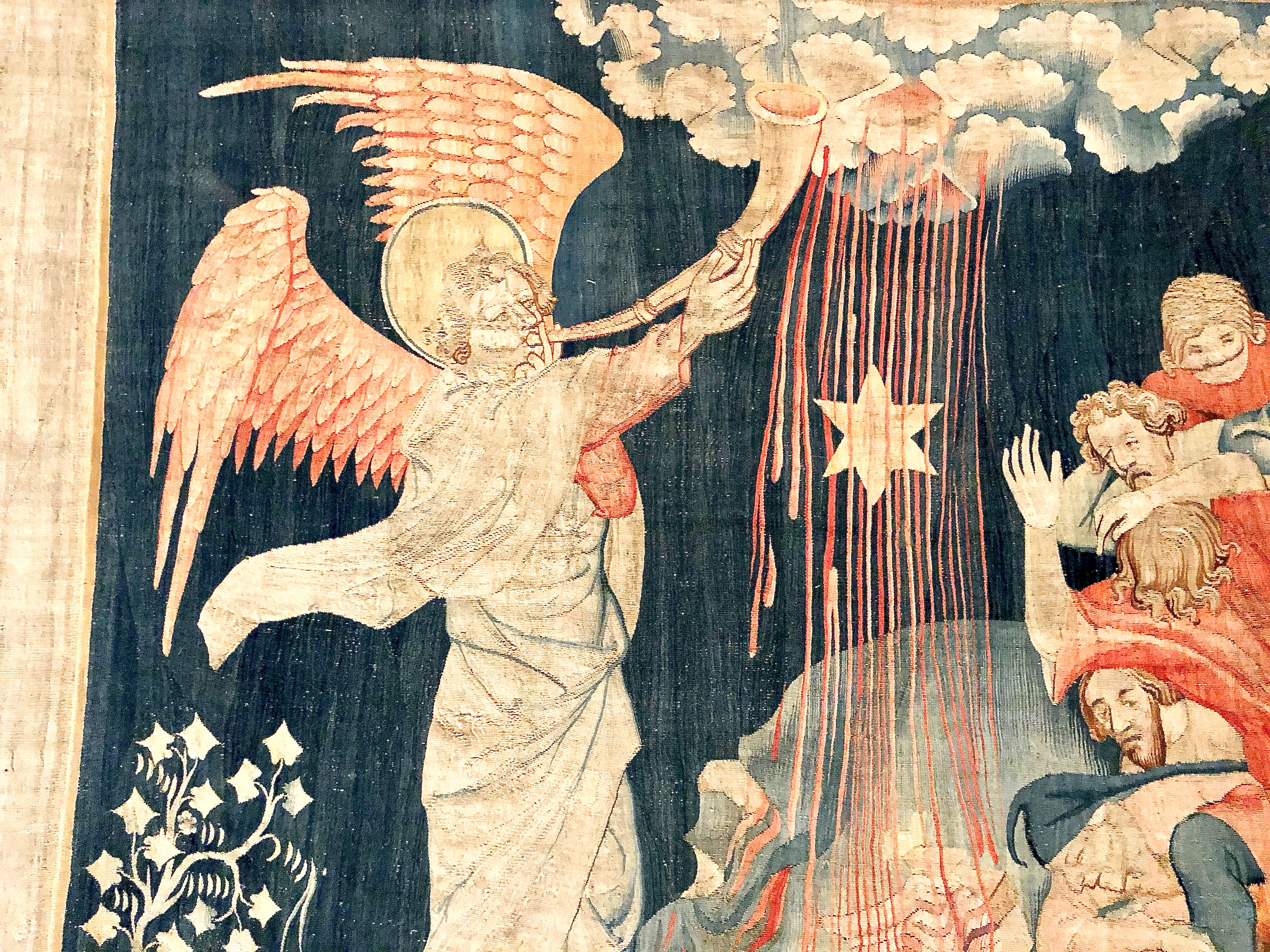
The angel dictates a word of hope and promise to St. John: “Blessed are those who are invited to the feast of the Lamb.” (Rev 19)

 The humanist/scholar became quite emotional in conceiving of the world devoid of human beings, which was a possibility brought on by one disaster or another, due, it must be said, to our own actions. This would be the worst thing he could imagine––worlds devoid of human beings, even if these worlds were populated by other intelligent and enterprising life forms.

–– Joy Williams, Ninety-Nine Stories of God

 What have you got to worry about? We’re only adrift in an open sea with a drunken captain and an engine that’s liable to explode at any moment.

–– Humphrey Bogart in Beat the Devil


The end is near! The world as we know it is on the verge of extinction, according to the United Nations’ Intergovernmental Panel on Climate Change.[i]But where is the sense of collective alarm? Where is the will to act? Our house is burning down, but instead of shouting “Fire!” and grabbing some hoses, we carry on as usual, unable to muster a sense of emergency. Perhaps we are just too exhausted by the endless stream of horrors under Republican rule, from children’s prison camps to the spread of American fascism, to have any bandwidth left to address the environmental apocalypse.

As columnist Leonard Pitts suggests,

“So then you read where the planet is melting, dire results expected soon, and you just shrug and file it away with all the other terrible things you’ll worry about when you get a chance. That’s understandable. But it presumes a luxury we don’t have — time. Again, this report says the world has 10 years in which to save itself — and we’ll spend at least two of those under Trump.” [ii]

Don’t ask me to explain why the party in power and its corporate handlers are doing everything they can to make things worse, as if the fate of the planet––and the well-being of their own children’s children––is nothing compared to the allure of short-term power and profit for themselves. Such suicidal selfishness is utterly incomprehensible to me. But we don’t have to approve of it to be caught up in it. We are all participants in an unsustainable culture.

Death rides a pale horse. (Rev 6)

Of course, there are many people, governments and institutions who recognize the climate crisis and are working to address it. Even in the heart of Trumpian coal country, West Virginia’s Charleston Gazette-Mailis sounding the alarm:

“When today’s kindergartners are in their 20s, they may find a devastated world wracked by horrible hurricanes, droughts, floods, wildfires, tornadoes and other tragedies made worse by global warming. Coastal cities may be abandoned, sunken wrecks. Poverty and misery may result.”

The editorial goes on to note that hurricanes Florence and Michael have “inflicted more loss than the entire worth of West Virginia’s coal industry — but conservative politicians still won’t act to reduce the damage.” [iii]

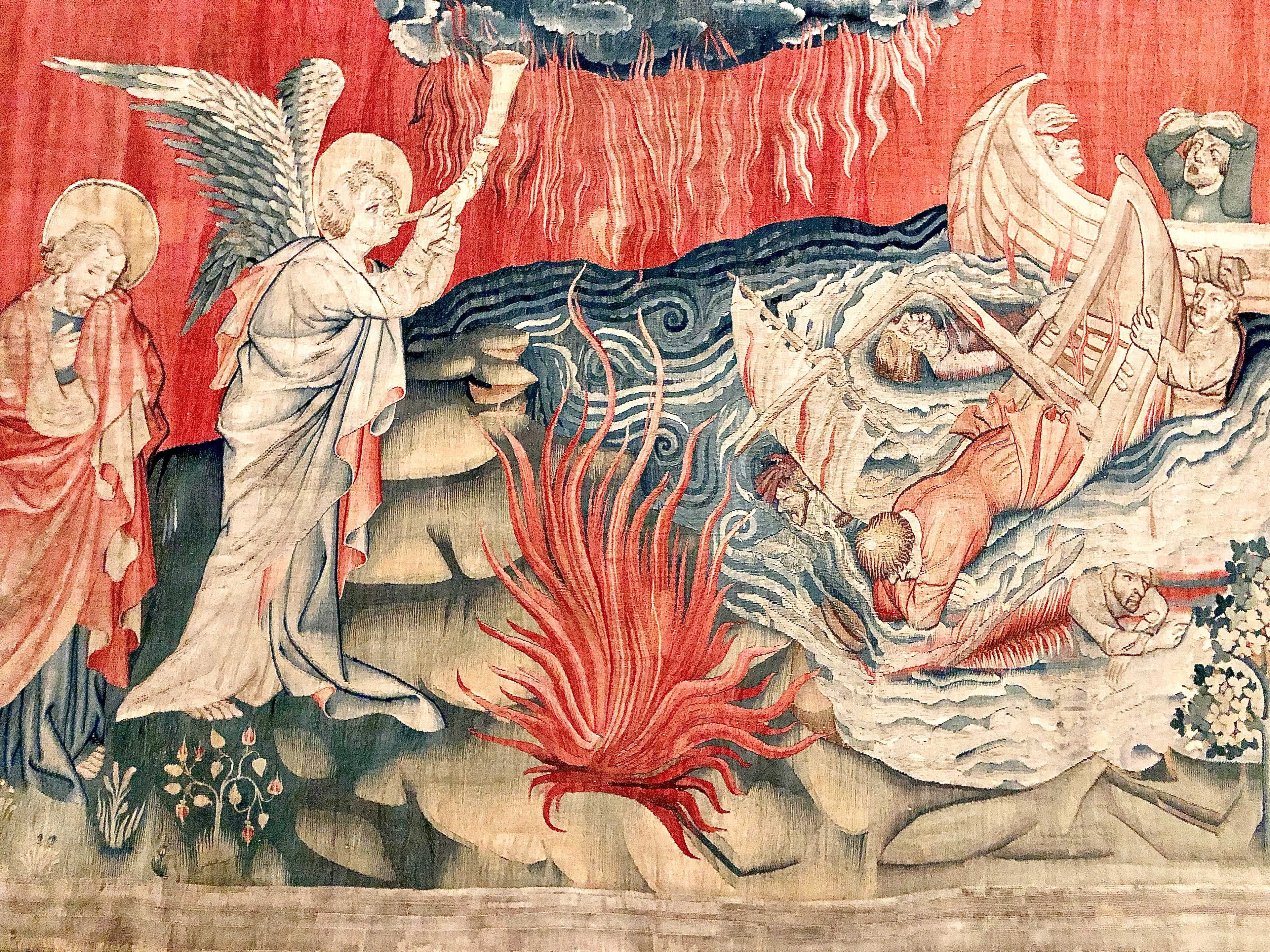
The Second Trumpet: The sea is polluted by fire, blood and death. (Rev 8)

Only ten years left to avert catastrophe! The message is clear: change or die. But given the dysfunctional paralysis of the American government, the iron grip of vulture capitalism, and the enormity of scale required for worldwide transformation, the prospects for success are bleak. The Titanic can’t turn on a dime. And when the captain doesn’t even believe in icebergs, it’s time to strike up “Nearer, my God, to Thee.”

On a recent trip to France, I beheld, for the first time, the extraordinary Tapestry of the Apocalypse in Angers, whose 84 large panels depict scenes from the Revelation of St. John the Divine. This riveting medieval visual sequence­­––the largest wall-hanging ever woven in Europe–– extends in parallel rows for 104 meters down the length of a vast, dimly-lit hall. It’s like a gigantic textile comic strip. Although the 700-year-old dyes have faded over time, these visionary scenes remain compellingly vivid, dense with iconography and narrative.

The Tapestry of the Apocalypse, Angers, France.

Theologian Austin Farrer described their source, the book of Revelation, as a great work of religious imagination.  “It is the one great poem which the first Christian age produced, it is a single and living unity from end to end, and it contains a whole world of spiritual imagery to be entered into and possessed.” [iv] Gonzo journalist Hunter Thompson added his own appreciation. “I still read the Book of Revelation,” he said, “when I need to get cranked up about language.” [v]

The meaning and value of the Bible’s last book have long been debated. Was it a mystical vision, a theo-political critique of the Roman Empire, or a quasi-liturgical dramatization of eschatological themes? The violent imagery of Revelation has been misused by religious cranks and maniacs in notoriously unhealthy ways, but the text has also––more than any other biblical book––given us many sublime prayer and hymn texts. Often neglected in times of contentment or complacency, it speaks loudly in times of crisis. Dietrich Bonhoeffer said that the book never made much sense to him until the rise of the Nazis.

“Babylon” is Revelation’s code name for the Roman empire, the oppressive and sinful social consensus whose claims of absolute totality were grounded in seduction, deceit and the enforcing threat of violence. And while that particular empire is long gone, Babylon is still around. “Bellicose, selfish, self-deluded, icy, absurdly resolute––behold the Rome of the book of Revelation,” said the Jesuit prophet-poet Daniel Berrigan. And, he added, “Behold also America.” [vi] Forty years after he wrote that, it seems truer than ever.

The Babylons of every age want us to believe that resistance is futile, because “this is the way things are.” We’re all implicated in the system. Even if we don’t like it, we can’t imagine living without it. Try preaching an exit from global capitalism next Sunday and see what happens! We may dream of the “New Jerusalem” of justice, peace and universal blessedness, but it seems impossibly distant. “If the Babylon of our time is already, from God’s perspective, a smoking ruin, how and where do we find the New Jerusalem? Is it really possible to ‘come out’ of empire when it surrounds us so completely?” [vii]

“Who is like the beast, and who can fight against it?” The people worship the beast of worldly power as the Dragon (Satan) approves. (Rev 13)

Like all apocalyptic literature, Revelation is pessimistic about the present age and where it is headed. But it is also full of hope about the age to come––the unexpectedly redemptive future emerging from a time of emergency. “The apocalypticist sees meaning where the uninitiated sees only chaos or catastrophe.” [viii]

Revelation insists that Babylon’s “reality” is a lie: there is an alternative to its culture of seduction and death. This alternative, the New Jerusalem, is not to be sought in some unreachable elsewhere. It is here among us, though only visible to the eyes of faith. And in every moment, every time we choose life over death, we begin to make our exodus, however small and tentative, out of Babylon’s prison into the space of divine blessedness.

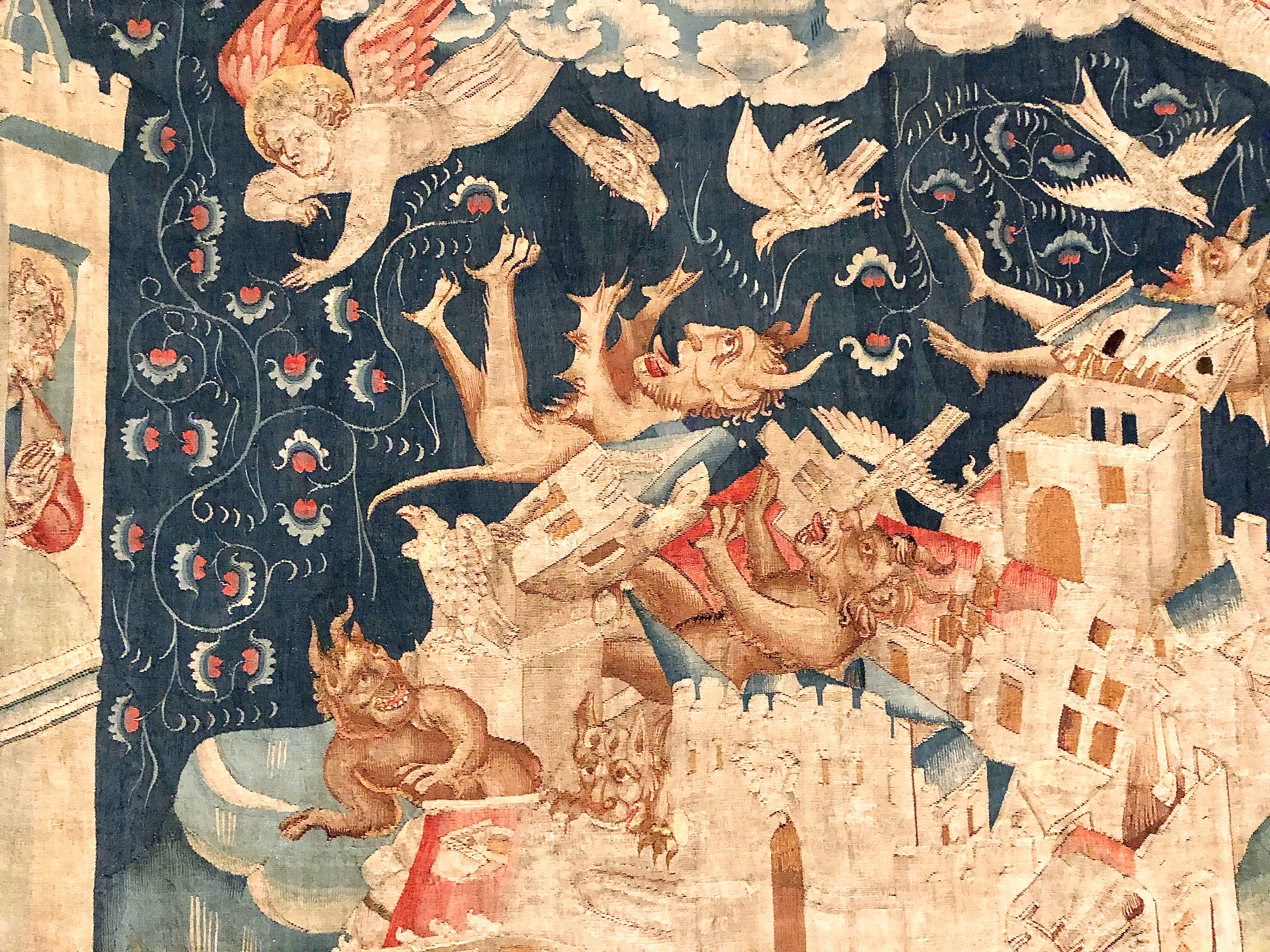
The fall of Babylon. Only its demons are left to haunt the rubble. (Rev 18)

The Tapestry of the Apocalypse was created by inhabitants of their own medieval Babylon, an exitless world fraught with anxiety and doom. As half of Europe was being struck down by the Black Plague, Revelation’s harrowing images of a death-haunted, perishing world struck home. The obsessive immensity of the tapestry project testifies to a depth of existential engagement with ultimate concerns, as if the artists and weavers were driven to create a comprehensive record of their longing––and their dread––before they themselves ran out of time.

As I processed slowly, contemplatively, through the crepuscular vastness of Angers’ tapestry hall, the strange images flickered before me like an old silent movie, as though their colors and forms were signaling across the centuries with the light of a long-vanished past. Whatever these visions first said to John the Divine in his Patmos cave, whatever they meant to the fourteenth-century French weavers, they were now pleading for my attention.

See! God is making all things new.
Death will be no more,
mourning and sadness and pain will be no more.
The world of the past is gone. [ix]


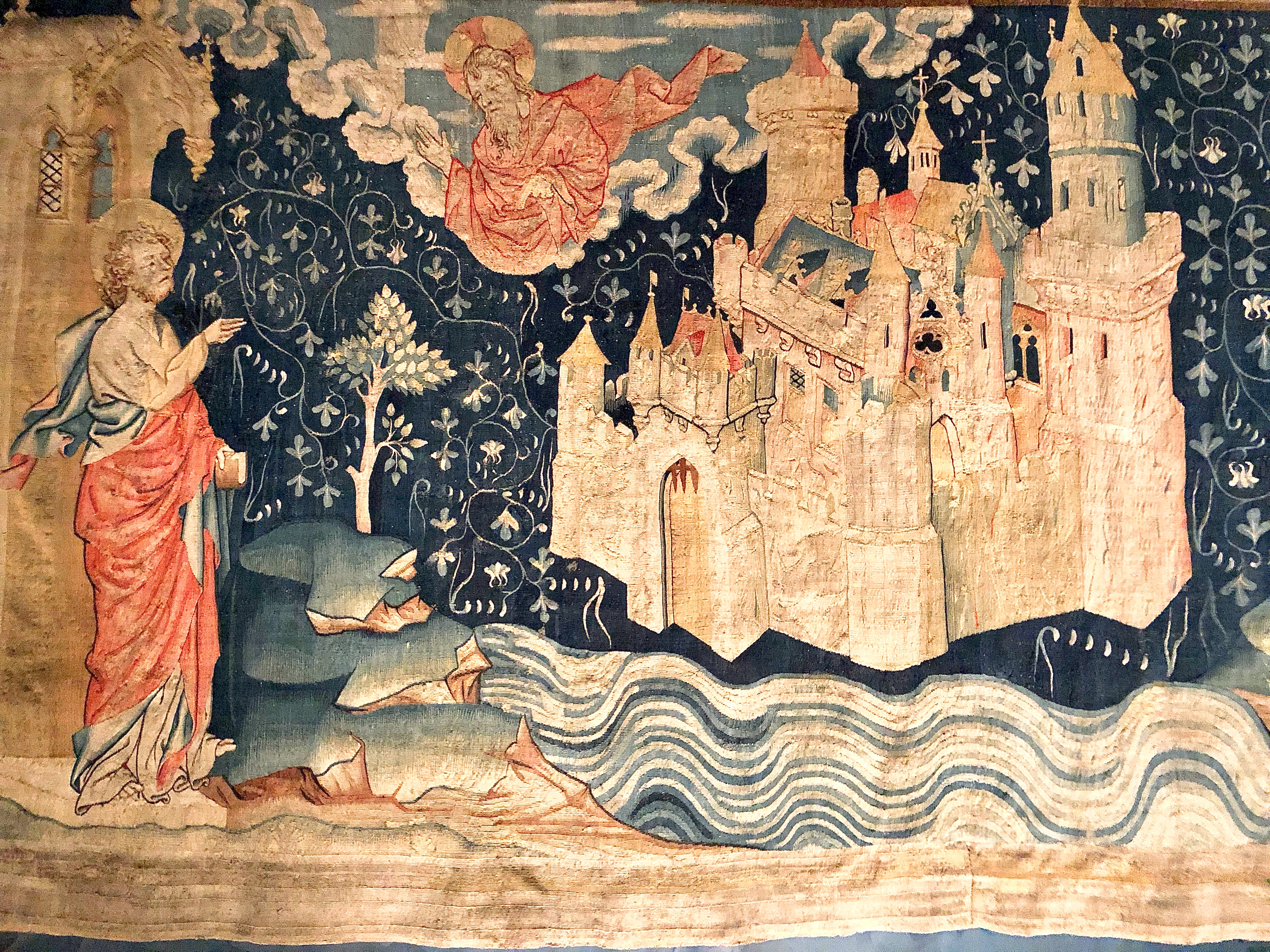
The New Jerusalem comes down from heaven, bringing divine glory into earthly presence. (Rev 21)

Babylon is fallen. The gates to God’s eternal city are open wide. And the urgent question for believers today, in the face of a climate apocalypse, is this:

How do we hold fast to the redemptive vision
of the New Jerusalem
through the long dark night of catastrophe?


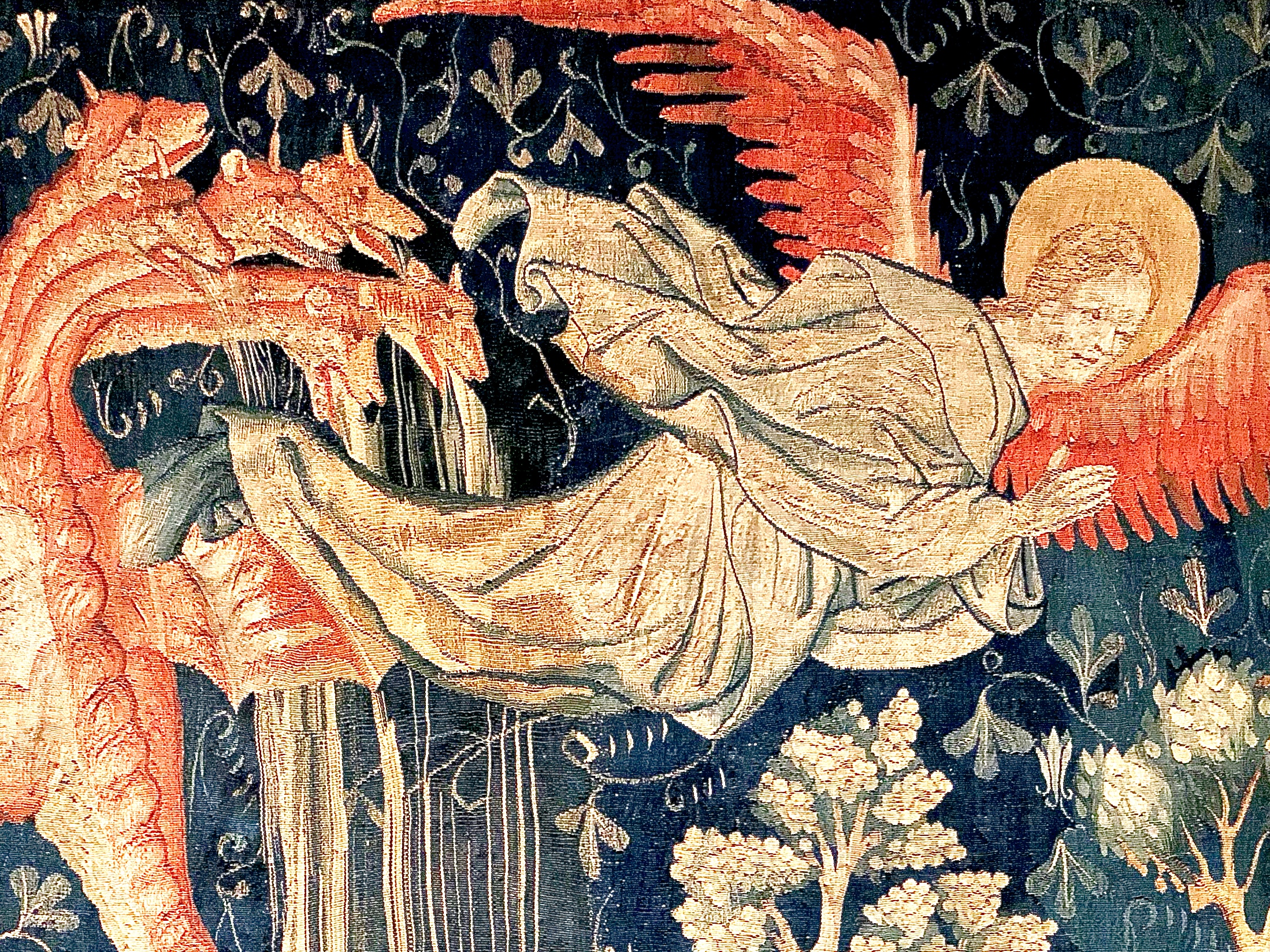
The Dragon pursues the expectant mother, “robed in the sun,” into the wilderness, trying to prevent the birth of hope. (Rev 12)

In the short term, we can practice both personal and collective environmental ethics, foster alliances with environmental changemakers, and incorporate a deep love and respect for the planet––and all who dwell therein––into our worship and our spiritual formation. And, setting aside for now our differences on a multitude of political and economic questions, we absolutely need to unite in casting our votes for defenders of the earth and against every climate change denier and pollution enabler. When the Beast is on the ballot, vote no!

In the long term, people of faith may face an even more daunting challenge––to cling to hope amid almost unimaginable destruction and loss: the disappearance of coastal cities and large land masses; countless millions of climate refugees; a horrific number of human deaths; mass extinction of species and habitats; economic havoc from fires, storms and floods; an endangered food supply; global conflicts over migration and dwindling resources; and the strain on political systems as they try to cope. How shall we declare God’s blessings then?

If we fail to change and the worst does come, our greatest enemy may be despair. I don’t need to contemplate the whole catalog of loss to feel the weight of immense sadness. Just picturing a single High Sierra meadow choked in smoke, or withered into a lifeless desert, is enough to make me weep.

Save us from the time of trial. That’s what the Lord’s Prayer really means by the more familiar “lead us not into temptation.” But the prayer is not asking to be spared from difficult challenges. That would make it irrelevant in the face of planetary apocalypse. We are all going to be tested by an uncertain future. But if we can beseech God with all our hearts to bring us through the experience of loss, despair and doubt with our faith and hope still intact, then “save us from the time of trial” may prove, in the climate crisis, our most earnest and necessary plea.

Meanwhile, get out of Babylon while you still can.

The Third Trumpet: A burning star falls to earth and pollutes the water supply. (Rev 8)

All photos by Jim Friedrich


[i] Summary and links to complete report: http://www.un.org/en/sections/issues-depth/climate-change/

[ii] Leonard Pitts, Jr., “We only have 10 years to save ourselves from climage change,” Miami Herald, Oct. 12, 2018: https://www.miamiherald.com/opinion/opn-columns-blogs/leonard-pitts-jr/article219870680.html

[iii] Editorial, “Like a weather report, with time, climate change projections closer, more ominous,” Charleston Gazette-Mail, October 16, 2018: https://www.wvgazettemail.com/opinion/gazette_opinion/editorial/gazette-editorial-like-a-weather-report-with-time-climate-change/article_26d13b8a-47e3-517a-9882-037b9bff6d70.html

[iv] Austin Farrer, A Rebirth of Images: The Making of St. John’s Apocalypse(1949), q. in Richard K. Emmerson, “The Apocalypse in Medieval Culture,” in The Apocalypse in the Middle Ages, ed. Richard K. Emmerson & Bernard McGinn (Ithaca: Cornell University Press, 1992), 293.

[v] Hunter Thompson interview in Atlantic Unbound, August 26, 1997, q. in Unveiling Empire: Reading Revelation Then and Now, Wes Howard-Brook & Anthony Gwyther (Maryknoll, NY: Orbis Books, 1999), 2 n. 3.

[vi] Daniel Berrigan, S.J., The Nightmare of God (1983), q. in Unveiling Empire, 44.

[vii]Unveiling Empire, 260.

[viii] Bernard McGinn, “John’s Apocalypse and the Apocalyptic Mentality,” in The Apocalypse in the Middle Ages, 9.

[ix] Revelation 21:4-5.

Cave of the Apocalypse

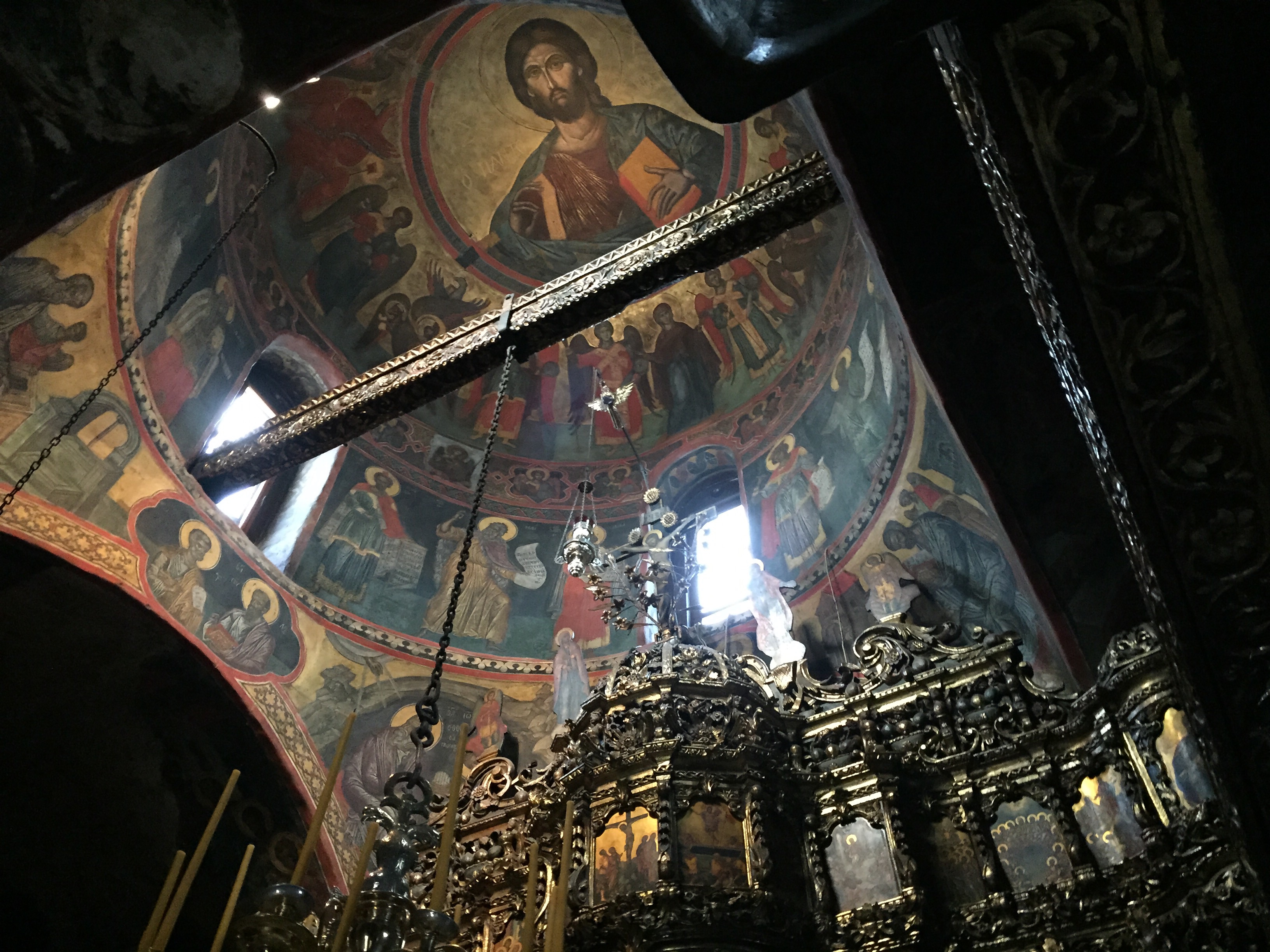
Katholikon of the Holy Monastery of St. John the Theologian

Katholikon of the Holy Monastery of St. John the Theologian


I, John … was on the island called Patmos because of the word of God and the testimony of Jesus. I was in the spirit on the Lord’s day, and I heard behind me a loud voice saying, ‘Write in a book what you see …’    (Rev. 1:9-11)

Patmos is one of the smaller Dodecanese Islands, a grueling 8-hour middle-of-the-night ferry ride east of Athens. It has gorgeous bays and quiet beaches, superb mountain views, charming villages and, at least not in summer’s high season, a tranquil predominance of locals over tourists. The outsiders I have met are themselves “regulars,” returning again and again because they love it. Yesterday a man from the Netherlands told me this was his 23rd straight year of month-long visits.

Patmos is also a place of pilgrimage, where St. John the Theologian (or “the Divine,” as we say in the western church), fell into a swoon and saw things which have intrigued, puzzled, disturbed and inspired readers ever since. The Book of Revelation has, regretfully, provided horrific weapons of mass destruction for hellfire preachers, but it is also the source for many sublime hymns and prayers in my own Anglican tradition.

Most scholars think that the book’s author is not the same person who wrote the Fourth Gospel. Language, style and themes are too different in the two works. But “tradition” has always preferred to link the Galilean fisherman “whom Jesus loved” with both the mystical composer of the Fourth Gospel and the visionary exiled to Patmos. It exemplifies the arc of discipleship as potentially a long, strange trip. As we sang in a hymn at my own ordination years ago, “the peace of God, it is no peace … Young John, who trimmed the flapping sail, homeless in Patmos died; Peter, who hauled the teeming net, headdown was crucified.”

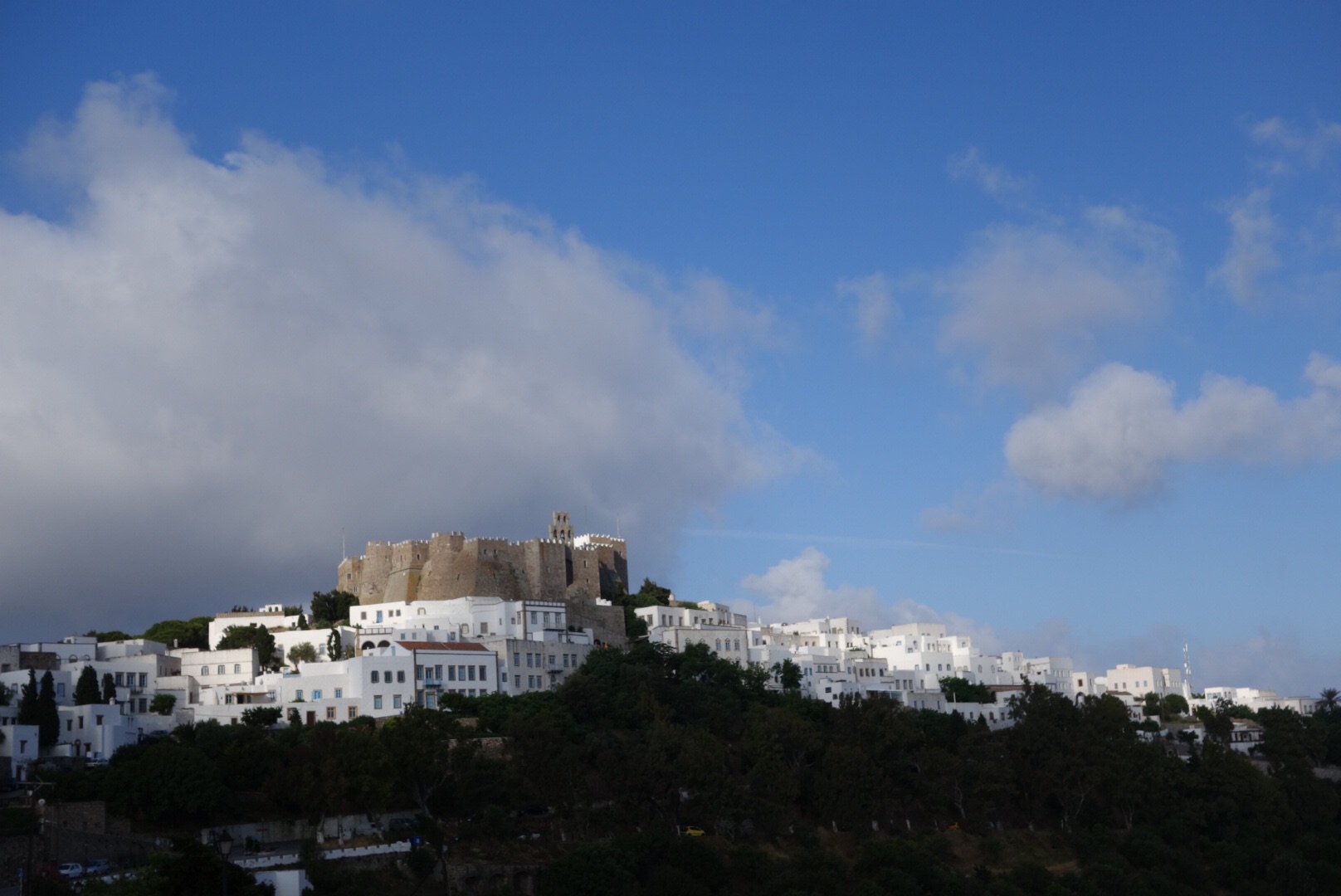
So the Christian can’t come to Patmos and simply lie on the beach or relax in the taverna. The Holy Monastery of St. John the Theologian beckons from the high ridge above the  port. Its dark-hued fortress of lion-colored stone makes somber contrast with the whitewashed village around it, as if to say that the ascent of this hill is serious business.

The monastery rises above the village of Chora.

The monastery rises above the village of Chora.

If you rise early, you can experience the awesome richness of the monastery’s Katholikon (main church) in solitude. The brilliant wall paintings, recently cleaned, immerse you in holy images. Along with the intricately carved iconostasis, hanging oil lamps, and numerous icons, they effect a ceaseless engagement of the eye. Some might find this distracting for prayer, but for me the sense that there is always more than I can take in – the visual inexhaustibility of Orthodox interiors – can lead to a kind of surrender, overwhelming and transcending the subjectivity of my own thoughts and perceptions. Here is Mystery. Give over to it. Lose yourself in it.

The monastery museum holds an eclectic assortment of treasures, including a 6th century gospel book, a 1499 Venetian collection of Aristophanes’ comedies, a 6th century BC bust of Dionysus (god of wine and ecstasy), the largest Orthodox collection of 5th-6th century Coptic textiles, preserved by the dryness of Egyptian tombs, and a police blotter in Arabic from the late 15th century, when Byzantine territories had fallen under Muslim control (“The Cadi [Judge] of the Palace is ordered to find three Patmians who were kidnapped by pirates.”).

Below the monastery, halfway up the hill from the sea, is the Cave of the Apocalypse. Here, according to tradition, John lay on the stone floor for several days while the vision unfolded. The cave is not large, but the insertion of a wooden iconostasis into its contours, along with icons and hanging lamps, has made it a compelling place for worship, prayer and veneration. John’s private ecstasy has been reimagined through specific features of the cave. Here is the cleft from which the Voice spoke. Here is the corner when he laid his head to rest between revelations. Here are the fissures where the Trinitarian God divided the rock into three parts with an earthquake.

Literal belief in the details of the cave’s legends is not required to make the site holy. It is holy because centuries of believers have given a particular kind of attention here to a Reality which yearns to make itself known in the innermost heart, for which a sheltering, enclosing cave is a tangible, sensory analogy.

Another mystical theologian, St. Bonaventure, said, “When you pray, gather up your whole self, enter with your Beloved into the chamber of your heart, and there remain alone with your Beloved, forgetting all exterior concerns.” The Cave, for the attentive, can mirror the chamber of the heart.

I entered it three times during my week here. The first time was the Sunday liturgy, full of incense and chanting voices. It was beautiful, but I had no revelations, or even deep feelings. God was present, but I was a bit absent. I was tired from a long, sleepless ferry ride. And I knew that whatever the Cave offered was not a tourist experience you can just walk in and collect.

So I went back a few days later. The voices I heard then were those of tour guides. Most just reeled off the legends uncritically as if they were prosaic facts. Here this and that happened, blah blah blah, now let’s go back to the bus. But one guide, a Greek woman speaking both in English and German, really got into it.

“People think that the Book of Revelation is about judgment and punishment. That is there, of course, but by the time you get to Chapter 21, you find what it is really about: a new world, a new heaven, a new earth, where we will be with God, and God with us.

“John’s message is trying to wake us up, to make us see that we are all one because God is with us and in us. Our original condition of oneness will be restored in the end. We lost that unity in the beginning because we had free will, and we chose to have our own experience, and forgot our connection with one another.

“If a bomb falls on someone in Syria, we think, ‘Thank God that didn’t happen to me.’ But what happens to others happens to all of us. John is trying to wake us up to this. And when he talks about the destruction of the earth, we have to think about how much closer we ourselves are to bringing that about today, unless we remember what we were made for and what we are a part of.”

When I thanked her afterward for her ‘preaching,’ she said, “I want to tell people what they don’t know, what they don’t hear in the schools, what the priests won’t tell you.” She was pretty sour on the institutional church. “I was baptized Greek Orthodox. I believe in Christ and the power of the sacraments, but I don’t belong to any church. I’m kind of a revolutionary.” I asked her name. “Vera,” she said. “Like veritas– the truth.”

This morning, my last on Patmos, I returned to the Cave for a third time. Two cantors and a priest were chanting the Divine Liturgy. I was the only other person present. This time, the spirit of prayer came easily, like a morning breeze. I received no visions, heard no voices except the beautiful earthly ones I stood among. But it was more than enough. When the priest handed out the holy bread at the end, I was aware of my outsider status as non-Orthodox. But the priest, who had the face of a Baroque Apostle, turned to me with a slight nod. And so I ate the bread of heaven, and departed well satisfied.