A poem! A film! An argument! Sing, Muse, of the wrath of artists, critics, readers and viewers. Tell of the pains they have suffered on the wild seas of culture. It’s only been a month since The Odyssey film came out, but it feels like ten years. Attacks and counterattacks. The clashing of sharpened wits. The endless toll of wounded opinions. As our hero wonders onscreen: Will we ever get off this [friggin’] beach?
Some say a woman started the war. No, not Helen of Troy, but Emily Wilson, a British classics scholar whose popular 2017 translation of The Odyssey inspired Christopher Nolan, the maker of Memento, The Dark Night and Oppenheimer to navigate his own sea of challenges to cinematize one of the founding stories of Western civilization. Wilson’s negative reaction to the film was withering:
“I would be ashamed to have written any part of this script.”
“Nolan lets the fragments of an incomplete set of big ideas spin around in the epic whirlpool, with no plank of solid, specific human experience to which we might cling.”
“Nolan’s Odyssey lacks many of the elements that make the poem great. It has nothing convincing to say about time, memory, history, war, or about the relationship between one warrior’s glorious return and the lives of his family, adversaries, comrades, friends and neighbours.” [i]
Wilson seems to take considerable pleasure in disliking the movie (echoes of Pauline Kael at her snarkiest), although the review that launched a thousand angry tweets has done no harm to her own book sales. In any case, as it was way back in Homer’s day, so it is for us. Everyone is spoiling for a fight, and the battles over the film and its meanings continue to rage on.
The controversies over a movie version of Homer’s classic text reminds me of the furor over controversial interpretations of the gospels in Martin Scorcese’s The Last Temptation of Christ (1989) and Mel Gibson’s The Passion of the Christ (2006). When the former was released, Jesus made the cover of Time magazine, while picketers carried signs saying, “God doesn’t like this movie!” As far as I know, Zeus hasn’t weighed in on Nolan’s epic, but the fervor over The Odyssey has a kind of religious intensity, as if something vitally important were at stake.
The nature and destiny of human life. Our universal longing for “home”—whatever, however, and wherever that means. The curse of conflict and war. The fragility of civilization. Our fraught relationships with the “other.” Traces of divine presence and action in the visible world. The role of the arts in telling the truth about ourselves. There are many reasons to care about canonical texts and the way they are interpreted—or misinterpreted—by cinema. So much is indeed at stake, as Russian filmmaker Andrei Tarkovsky memorably insisted:
“The allotted function of art is not, as is often assumed, to put across ideas, to propagate thoughts, to serve as example. The aim of art is to prepare a person for death, to plough and harrow his soul, rendering it capable of turning to the good.” [ii]
Nolan’s film didn’t do much of that for me. I was certainly entertained, but little of those three hours on the IMAX screen lingered long in my heart and soul the way the greatest films do. When I exited the theater, the spell broke quickly, and I returned to my familiar world unchanged by the journey.
At this point, another response to the summer’s most talked-about film risks being one too many. But the Odyssey’s enduring themes, however translated or adapted, invite serious thought. Now that I’ve seen the movie and read the excellent new translation by Daniel Mendelsohn, here’s what I’m musing about.
THE HERO

Who is Odysseus? Is he an Everyman who speaks to the ages, or a perplexing stranger unique to a vanished time and place? In the Proem (the 10-line prelude), his 12,000-line story is concisely summarized:
“Tell me about a complicated man.
Muse, tell me how he wandered and was lost
when he had wrecked the holy town of Troy …” [iii]
As the narrative proceeds, this complicated (polytropos: “many-sided”) man is talked about by the people back home, but he himself has been gone for twenty years. He doesn’t take the stage as a ccollections are not always reliable. Odysseus is a cunning and resourceful trickster, who has survived many a scrape by shading the truth when necessary. As Daniel Mendelsohn explains in the introduction to his own new translation, Odysseus is a “chameleon-like hero, whose adeptness at falsifying his appearances and fictionalizing his life story makes it almost impossible to trust what we think we know about him—and hence, impossible to know who he is.” [iv]
One of the disappointing omissions in Nolan’s film is the moment when the Cyclops asks the man who has intruded into his cave: Who are you? Wishing to stay anonymous, the hero replies, “No-One is my name. No-One is what people call me.” It was a life-saving ruse (“No-One is killing me,” Polyphêmos told his fellow Cyclopes when they offered to come to his aid), but it also conveyed an existential truth about the hero, as Mendelsohn observes:
“When the epic begins, Odysseus is very much a nobody; so long absent from home that his family and friends are convinced that he is dead, constantly in danger of disappearing without a trace during his perilous return journey, repeatedly shipwrecked and cast away on distant shores that are far from the world familiar to him and from anyone who knows him.” [v]
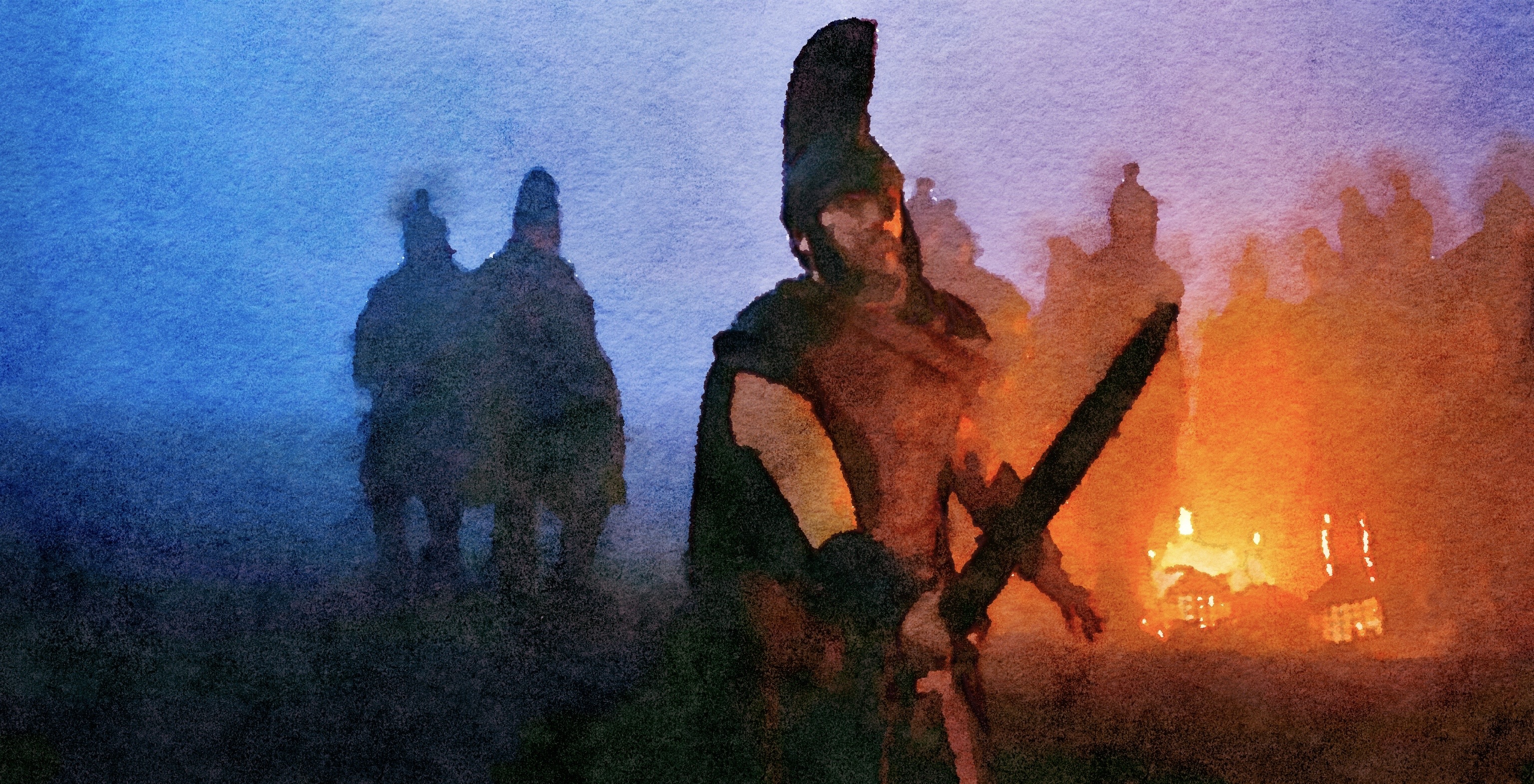
Nolan dropped the crucial dialogue with the Cyclops, but he made up for it when Odysseus arrives back home. Disguised as a beggar, not quite ready to reveal and resume his “true” identity as Penelope’s husband and Ithaka’s king, the hero sits quietly amid the clamor of Penelope’s suitors in the royal banqueting hall. His head is covered with a hood concealing his visage in deep shadow. We strain to see a face, but only a black void looks back at us. It could be anyone—or No-One.
THE JOURNEY
“The Prayer Book has it that ‘in returning and rest we shall be saved,’ yet there is no returning; there is no resting. It is not a matter of some original sin, separating us from authentic being to which we could return. There is a tension built into the very dynamic of being human upon this earth, ever in the world, yet never of it. The problem is not just that we are alienated dwellers, but that we are irreducibly both dwellers and wayfarers.”
— Erazim Kohak [vi]
“You have made us for yourself, O God, and our hearts are restless until they find their rest in you.”
— St. Augustine [vii]
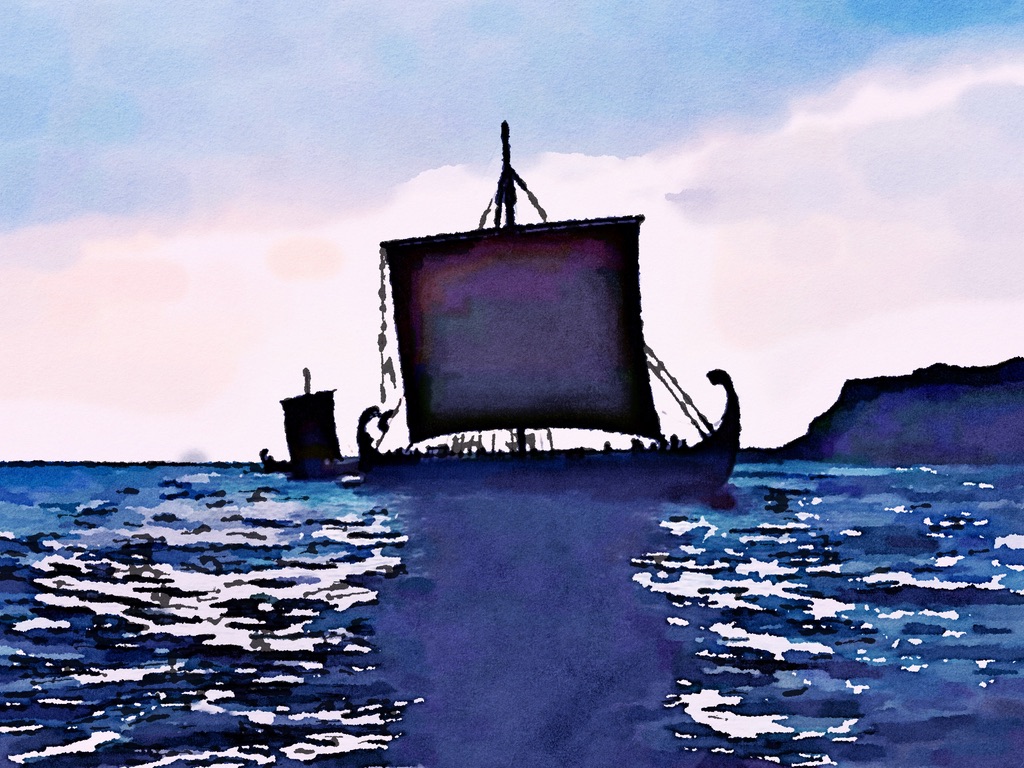
Odysseus is a man trying to get home: a wayfarer trying to become a dweller. The journey is hard and painful (“Many the toils he suffered”) but it is also a process of learning—about the world and about himself. The journey “away from here” [viii] may be driven by curiosity about the undiscovered parts of world and self; or by the need to escape the confines of whatever is trying to kill you; or by the soul’s restless desire for what is not here and not yet.
The journey back is driven by a profound longing for home, the place of true belonging. That place may be where you started, experienced in a fresh way. It may be some new place that has been expecting you for years. Or it may be a place that always remains somewhere over the rainbow, endlessly luring us onward, deeper and deeper into the Mystery.
In Nolan’s film, the unbearable truth revealed by the Sirens’ song is that the hero’s aching for home is an illusion. It’s a story Odysseus tells himself, but it’s not what he really wants, deep down. The reasons for this are not explicitly developed, but after twenty years of battles and adventures, perhaps the weary war veteran fears that he can never fit himself back into his old life. Or maybe the commonplace experiences of ordinary life would feel thin and pale after the intensity of war, the adrenalin of wild seas and the wonders of magic lands. Such psychologizing wasn’t really Homer’s thing, but the original poem does suggest, at its midway point in Book 11, that Odysseus will never be a dweller who can stay put.
When the hero crosses the boundary between the living and the dead to converse with the ghosts of Hades, the prophet Teiresias previews the sequel to the happy homecoming. Sometime after the Suitors are slain, Odysseus will leave home again, though not by sea. He will carry with him an oar, symbol of his past wanderings, until he meets people who have never seen an oar and “have no knowledge of the sea.” And there he will plant the oar in the ground as a sign, and, presumably, relate his unsettling tales of a restless life on a restless ocean to landlocked farmers accustomed to solid ground.
In Dante’s Commedia, the brilliant Christian spinoff of the Odyssey, Ulysses (the Roman name for Homer’s wanderer) can’t stay home either.
‘not fondness for my son, nor reverence
for my aged father, nor Penelope’s claimto the joys of love, could drive out of my mind
the lust to experience the far-flung world
and the failings and felicities of humankind. [ix]
Taking a small crew, Ulysses sails beyond the edge of the known world, catching a brief glimpse of Purgatory’s holy mountain before his ship is sunk by a fierce whirlwind from “that unknown land.” Then, as his soul in hell would later describe his last moment to Dante, “the sea closed over us and the light was gone.” [x]
Dante identified with Ulysses in that his own daring poem presumed to go “where no one has gone before,”[xi] and he worried about the perils of his own immense journey as well as the risk of excessive pride in his poetic powers. He even warns his readers, who follow “in your little skiffs the wake of my great ship that sails and sings,” to “turn back and make your way to your own coast. Do not commit yourselves to the main deep …” [xii]
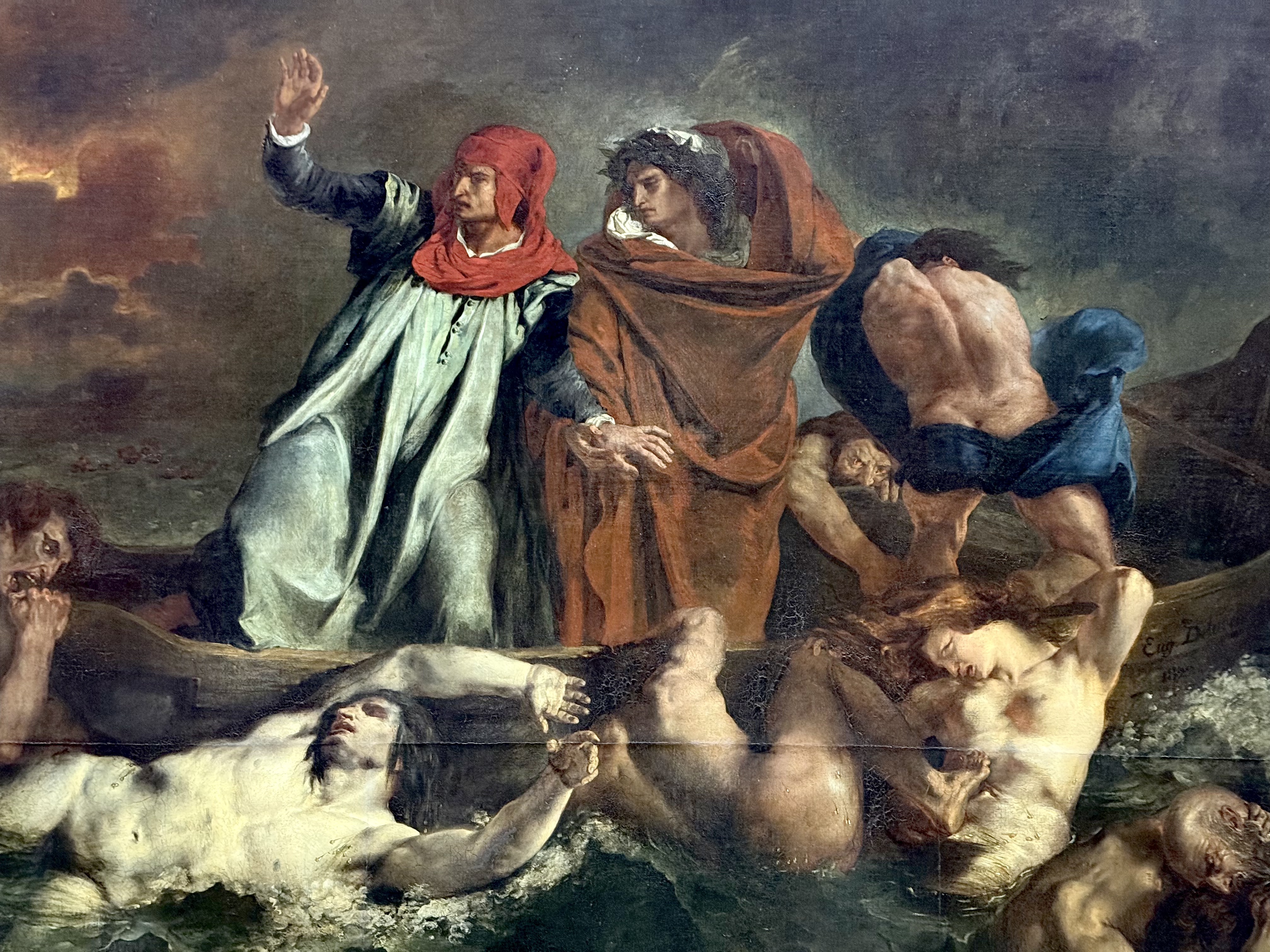
In Dante’s version of the hero’s fate, the crucial difference between the tragic “folly” of Ulysses’ last voyage and his own poetic trespass into divine territory was grace. Not for him the reckless, self-willed hubris of the hero’s quest, but the humility to be guided by the love and wisdom of “Another.” And while both Dante and the Greek wanderer embodied homo viator—the being who journeys—as the human condition, Odysseus’ goal was an Ithaka which, in the Commedia’s universe, could never quite satisfy. Dante, on the other hand, journeyed toward the place where every goal converges, every hunger is satisfied, and history comes home to stay.
XENIA
Xenia, the Greek term for welcoming the stranger, is a recurring theme in the Odyssey. It comes from xenos, which can mean either (or both) stranger and guest. In Nolan’s film, it’s called “Zeus’ Law,” making explicit the hospitality code as a divine command: the way things ought to be if the world is to work as intended. Ignore the way of the universe at your peril.
In the unsettled Homeric world of migration and societal dislocation, life was precarious if you were on the move. Wanderers and beggars were dependent on the kindness of strangers. The hospitality code was a social safety net. And in cultures plagued with tribalism and violence, xenia provided a measure of stability. You could knock on any door without fearing ill treatment, even if you were “other.” At a minimum, the guest could say, “Thank you for not killing me.” In the best case, the host provided a bath, a banquet and a bed. In return, appropriate decorum was required of the guest.
That was the ideal, and it is echoed in biblical tradition as well. “The alien who resides among you shall be treated like the native-born. You shall love the alien as yourself, for you yourselves were aliens in Egypt” (Leviticus 19:34). “Do not neglect to show hospitality to strangers, for by doing that some have entertained angels unawares” (Hebrews 13:2). “Do to others as you would have them do to you, for this is the Law and the Prophets” (Matthew 7:12).
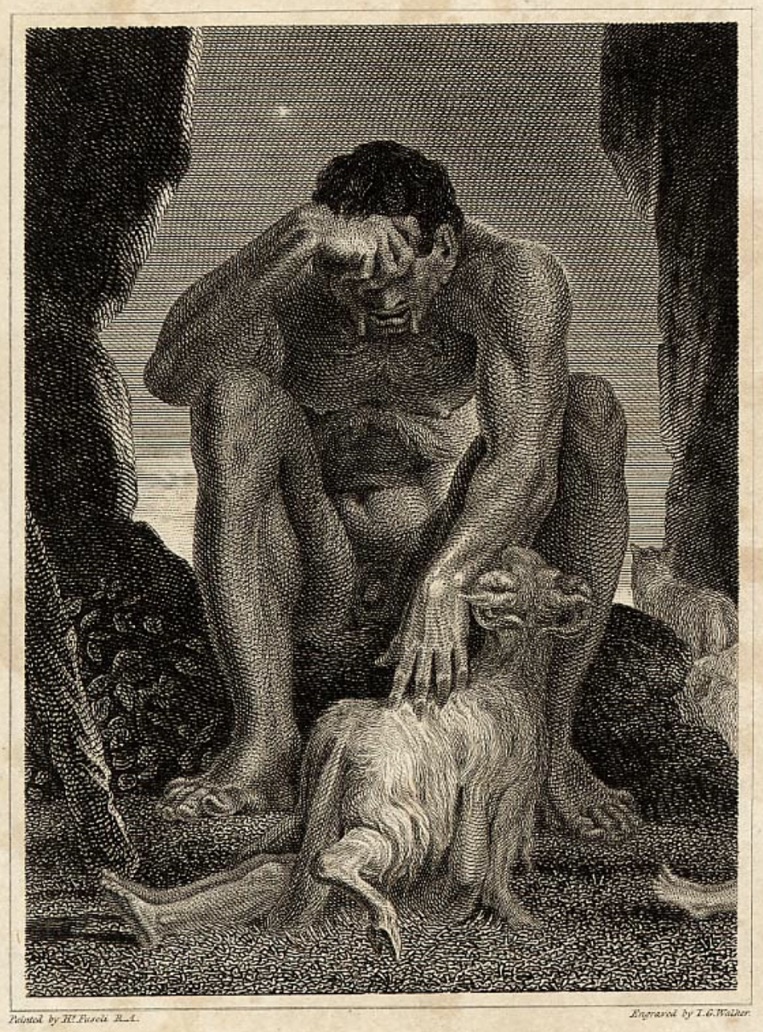
However, in Homer’s epics, xenia is frequently violated by both hosts and guests, with disastrous results. Menelaus’ guest steals his beautiful wife Helen, triggering the Trojan War. Polyphêmos the Cyclops eats the guests who have barged into his cave, and is blinded in return. Odysseus’ crew slaughter the sun god’s protected cattle, only to end up swimming with the fishes. Penelope’s Suitors drain her larder with ceaseless feasting, overstaying their welcome. When Odysseus finally gets home, he kills them all. So it goes.
The breakdown of xenia’s courtesies and protections is a key theme of Nolan’s retelling, which can be applauded as an indictment of our present-day fear of strangers, hostility toward migrants, and belligerence toward people and nations who feel alien to us.
In the United States, where we like to think of ourselves as innocent and kind, aid to desperate people at home and abroad is being slashed; migrants who manage to survive their arrest are being crammed into concentration camps; empathy and compassion are denounced by the right as weaknesses undermining civilization; and the trust-based norms of the global order, fashioned after World War II, are being shredded by a lawless and murderous tyrant. A chief White House official has boasted about these things out loud:
“We live in a world … that is governed by strength, that is governed by force, that is governed by power. These are the iron laws of the world since the beginning of time.” [xiii]
Homer’s epics describe a world in many ways incomprehensible to us today. But the disastrous consequences of violating xenia’s divine ordinance translates easily into modern reality. As W. H. Auden warned in a poem written at the start of the Second World War:
We must love one another or die.
WAR AND VIOLENCE
“[A]ny pleasure or solace [the Homeric epics] present is tainted by the horrors they depict. Extricating pure, untainted cultural and aesthetic or ethical value from Homer is an impossible task.”
— James I. Porter [xiv]
“[Nolan’s] film asks us both to be horrified at war and to celebrate the action-movie sequences in which the reluctant warrior finally gets his hands on his bow and the blood starts flowing.”
— Emily Wilson [xv]
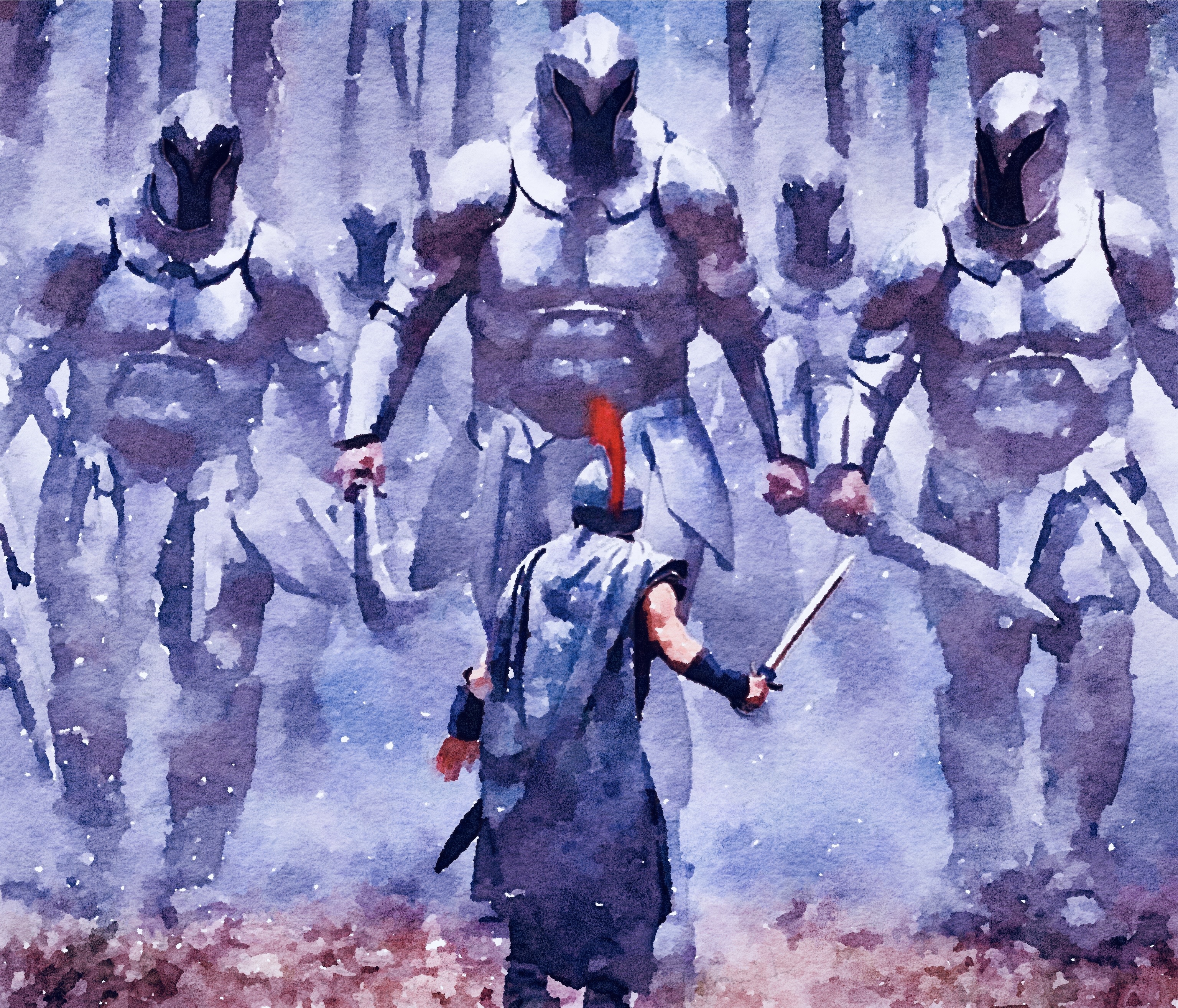
The bloodiness of Homer’s epics has always posed a problem. “Unfortunately,” said classicist C. G. Heyne in 1801, “the main subject of epic poetry is war and murder.” [xvi] The Odyssey text is certainly graphically clear about war being “destructive,” “deadly,” “dreadful,” and “abominable.” Homer is not pro-war. But neither is he anti-war. He simply reports what he sees. And in his world, violence is one of the things that happens. And it happens a lot. Simone Weil’s remarks on the Iliad apply equally to the Odyssey’s violence:
“The cold brutality of the deeds of war is left undisguised; neither victors nor vanquished are admired, scorned, or hated … Those comparisons which liken them to beasts or things can inspire neither admiration nor contempt, but only regret that men are capable of being so transformed.” [xvii]
The beauty of Homer’s writing has enabled centuries of readers to help digest the violence. As Nietzsche put it, the poetry “casts a spell over even the most terrifying things before our very eyes.” [xviii] In Nolan’s film, the technological dazzle of big-screen spectacle does the same. But the trauma and regret that violence produces is also reported. In the poem, veterans of the Trojan War weep copiously when they think of it. And the film makes regret a major theme with its depiction of Odysseus’s “anguish” as PTSD.
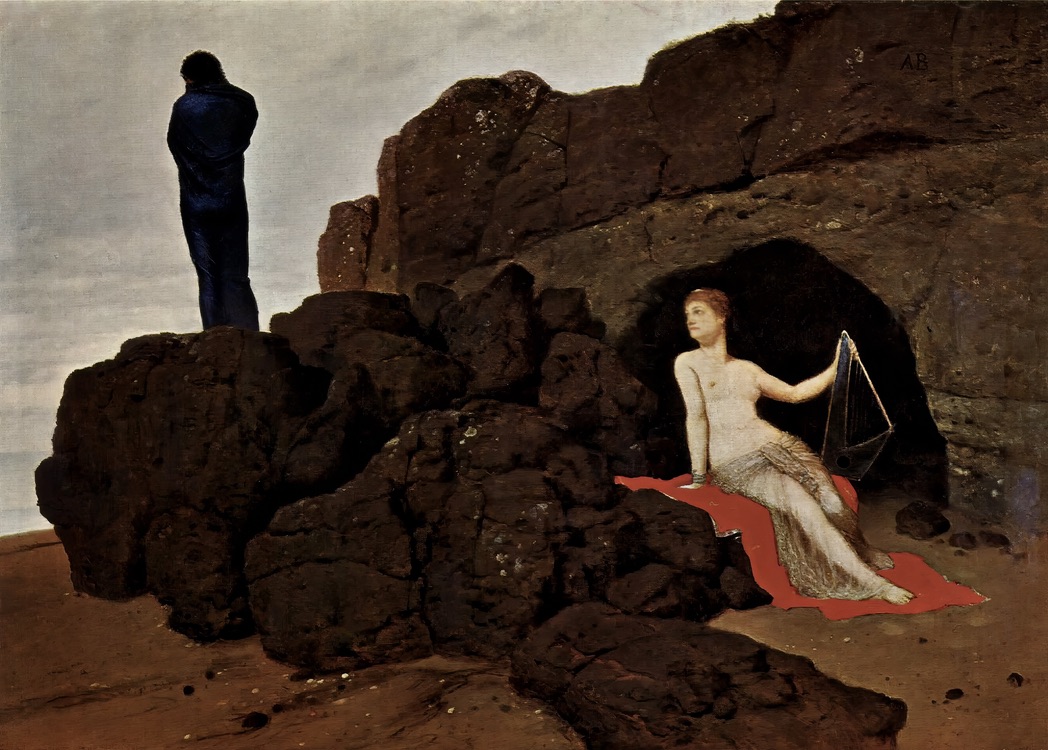
With eyes gazing homeward, Odysseus is longing to resume his journey.
The film hero’s long sojourn on Kalypso’s island becomes a therapeutic retreat, a seven-year blank in his story, empty of incident. In this idyllic place somewhere outside the flow of time and story, the goddess encourages him to forget his past, at the risk of forgetting his future as well. But it can’t last. An Odysseus free of trouble and longing is not Odysseus. At the insistence of the gods, his journey will eventually resume.
Meanwhile, what about the audience’s PTSD? What does all the screen violence do to us? Does it strengthen our resolve to live in peace, to resist the gods of war? The relationship between aesthetics and morality is very tricky, but in a warring age like our own, how can we represent the evil of violence without celebrating its energy? How can we refrain from rooting for one side to annihilate the other?
In Terence Malick’s The Thin Red Line (1998), set in the Pacific theater of World War II, American troops are assaulting a Japanese stronghold. But the camera has no favorites. It watches, if you will, with the unblinking eyes of God as mortals kill one another. And what those eyes see is not victory or defeat, but the terrible sadness of mortal violence. The battle sounds—gunfire, explosions, screams—are suppressed, heard only faintly beneath a flowing melancholy score (Charles Ives’ “The Unanswered Question”) that enables us to reflect on the suffering without cheering for a particular outcome. Divine compassion feels more real than human folly. Amid the swirl of action, the camera pauses to notice the lovely light filtered through palm leaves, or the surprised stare of a dead soldier’s face. And we hear these words in a contemplative voice-over by a soldier who is something of a Christ figure in the film:
This great evil, where does it come from? … How does it still enter the world? … What seed, what root did it grow from? … Who’s doing this, who’s killing us, robbing us of life and light, mocking us with the sight of what we might have known? … Does our ruin benefit the earth? … Is this darkness in you too?” [xix]
THE ENDING
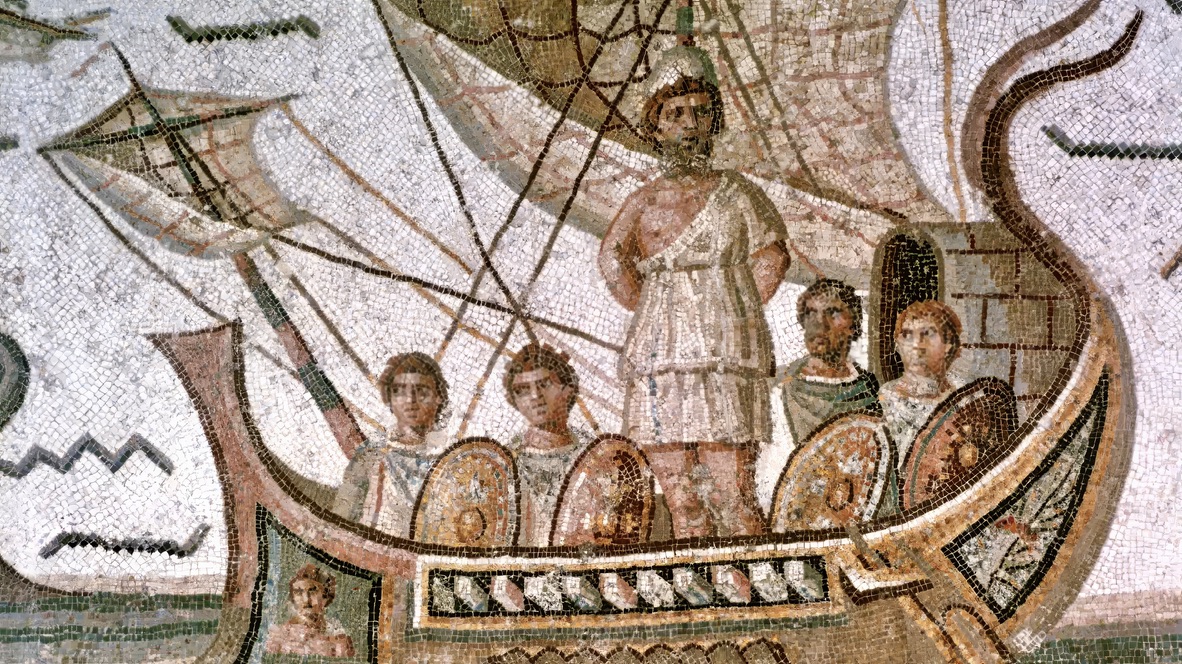
Come, my friends,
‘Tis not too late to seek a newer world.
Push off, and sitting well in order smite
The sounding furrows; for my purpose holds
To sail beyond the sunset, and the baths
Of all the western stars, until I die.— Alfred Lord Tennyson, “Ulysses”
Homer’s Odyssey ends with the hero arriving home at last. After disposing of the Suitors and reclaiming his throne, he tends to neglected relationships with his wife, son and father, and begins to repair the disarray of his kingdom after twenty years of anarchy and strife. The wanderer is home to stay, exchanging the endless transitory episodes of the wanderer for the long-term commitments of dwelling in one place and living one particular life.
Nolan’s film invents a different ending. Instead of the return home completing the hero’s journey through reintegration into communal life, there is a new departure. Instead of doing the work of dwelling, Odysseus, like Tennyson’s Ulysses, is “away from here” yet again. Although he mutters something about tracking down the bodies of his dead comrades to give them proper burials, that impractical project seems just an excuse to keep wandering. The epic’s ancient pattern is thus betrayed by a romantic Hollywood ending: Odysseus and Penelope sail into the sunset to live happily ever after. Homer would demand his money back.
BRINGING IT ALL BACK HOME
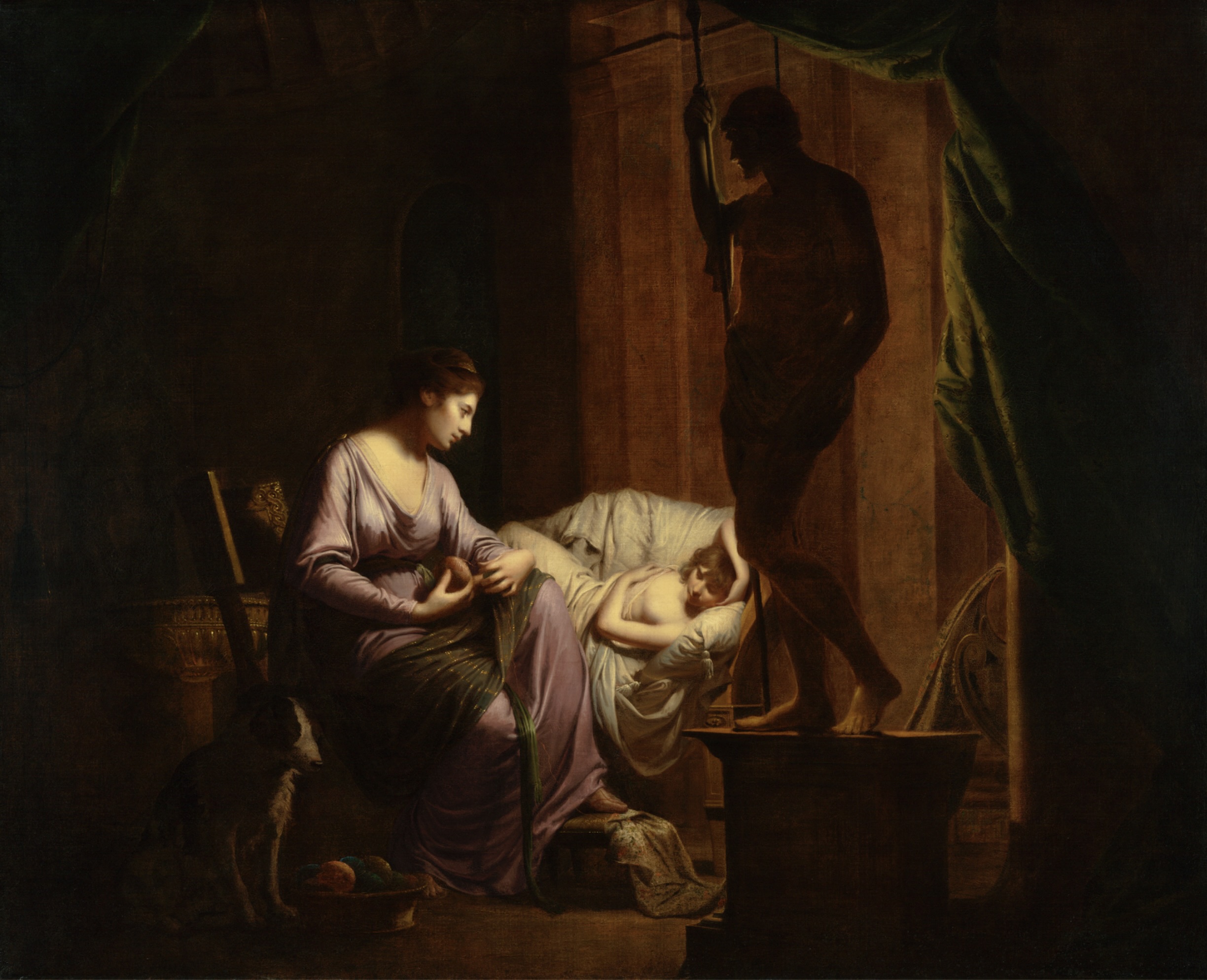
Odysseus’ wife deceives her Suitors by unraveling her weaving each night,
while the memory of her absent husband hovers in the shadows.
“And so this work, famous for its exciting narrative of the hero’s adventures in exotic worlds and among strange creatures, is in fact preoccupied above all with the business of being a human being—an identity that turns out to be defined by relationships: between hosts and guests, strangers and intimates, foreigners and countrymen, mortals and immortals; between the idealized past and the troubled present, the dead and the living; between men and women, spouses and lovers, parents and children; relationships, finally, among the myriad and sometimes contradictory elements of our own natures.” (Daniel Mendelsohn) [xx]
After seeing Nolan’s film, I refreshed my palate with Ulysses’ Gaze (1995), a modern reworking of the Odyssey by Greek filmmaker Theo Angelopoulos, whose movies are suffused with a mythical sensibility and populated by questing wanderers. The story follows a Greek-American director (Harvey Keitel) as he wanders the Balkans in search of three cans of undeveloped film shot by the first Greek filmmakers, the Manakia brothers, in 1895—the year cinema was born. During a century of regional conflicts, the film had passed through various hands, from country to country, and Keitel’s unnamed character (called “A” in the script) is trying to find where it ended up.
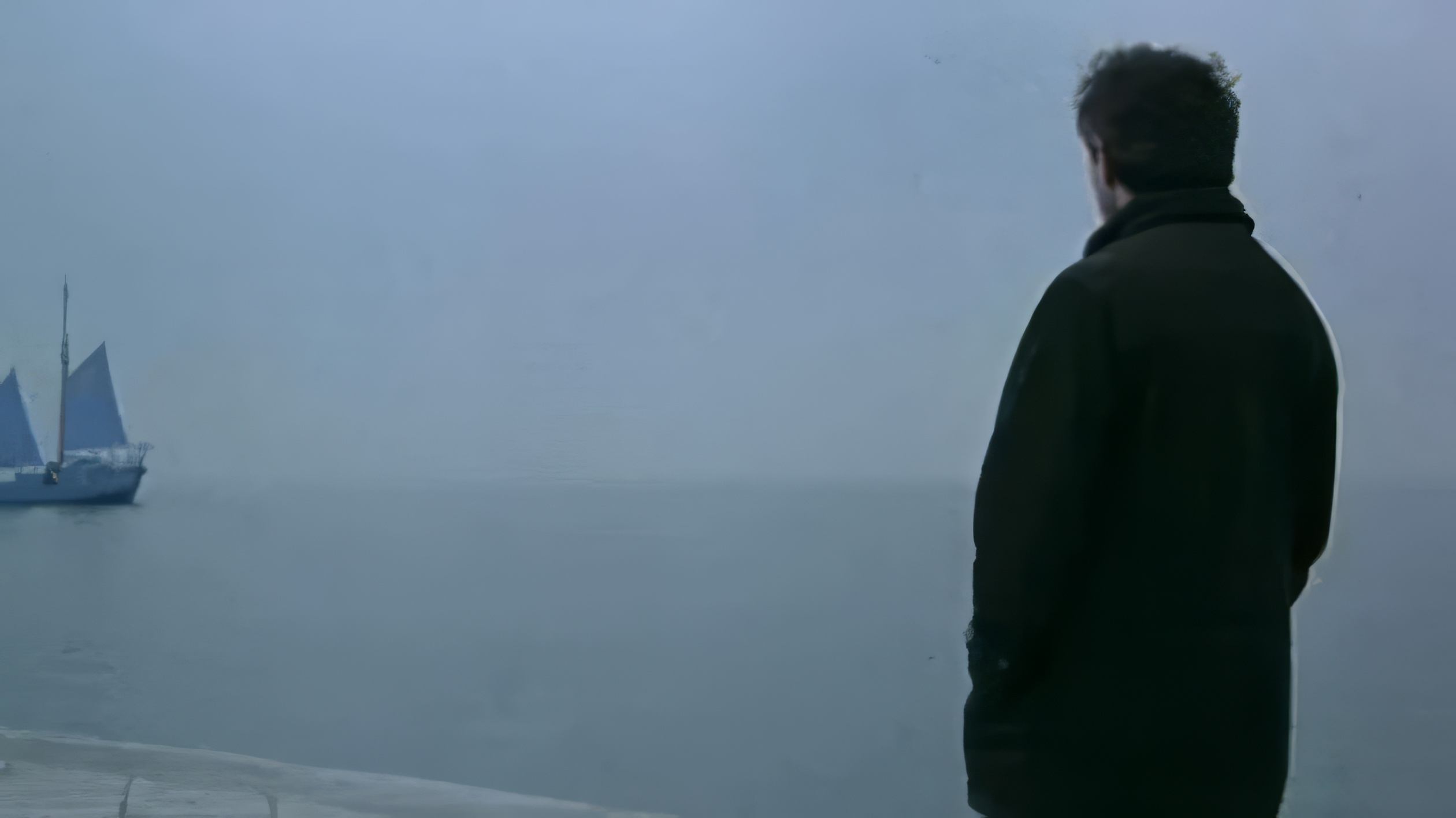
For “A”, the undeveloped film mattered because it held light captured in the primal past of cinema’s creation—“a lost gaze,” he calls it, “a lost innocence.” Like starlight traveling through time to reach the human eye, this film had traveled in darkness for a hundred years, waiting to be seen for the very first time. It wasn’t just original cinema inside those three cans. It was something even more precious, like a shard of light from Eden’s first day, not yet muddied by history.
After many Odyssean adventures, “A” locates the cans in a Sarajevo film lab during the Bosnian war. The lab is badly battered from shells and bombs, but “A” manages to get the film developed. As he views the film in the lab’s ruined cinematheque, we ourselves do not see what is being projected. We only see “A” in the act of watching, and when the film runs out, he recites a Homeric speech, as if he has become Odysseus addressing Penelope:
“When I return, it will be with another man’s clothes, another man’s name. My coming will be unexpected. If you look at me unbelieving, and say, You are not he, I will show you signs, and you will believe me … I will tell you about the journey, all night long. And in all the nights to come, between one embrace and the next, between lovers’ calls, the whole human story. The story that never ends.” [xxi]
Angelopoulos originally planned to show us what “A” saw—the developed footage that turned out to be (in this fictional story) the very first cinematic image of Homer’s Odyssey. Using the original motion picture camera constructed by the Lumière brothers in 1895, Angelopoulos filmed a shipwrecked Odysseus staggering out of the sea to walk toward the camera. He stops in front of the lens, staring into it: Odysseus gazing at us from the distant past. The lost gaze, visible at last.
But Angelopoulos then decided not to use this shot in his movie. “For me,” he said, “the purpose of his search is the discovery of himself … It doesn’t matter what is on the film … The journey leading to its discovery in Sarajevo today, this is the important thing.” [xxii] His compelling image of Odysseus did not remain a lost gaze, however; in the same year as Ulysses’ Gaze, it was included in a compilation of one-minute films made by 41 different filmmakers to honor the 100th anniversary of the first movie. [xxiii]
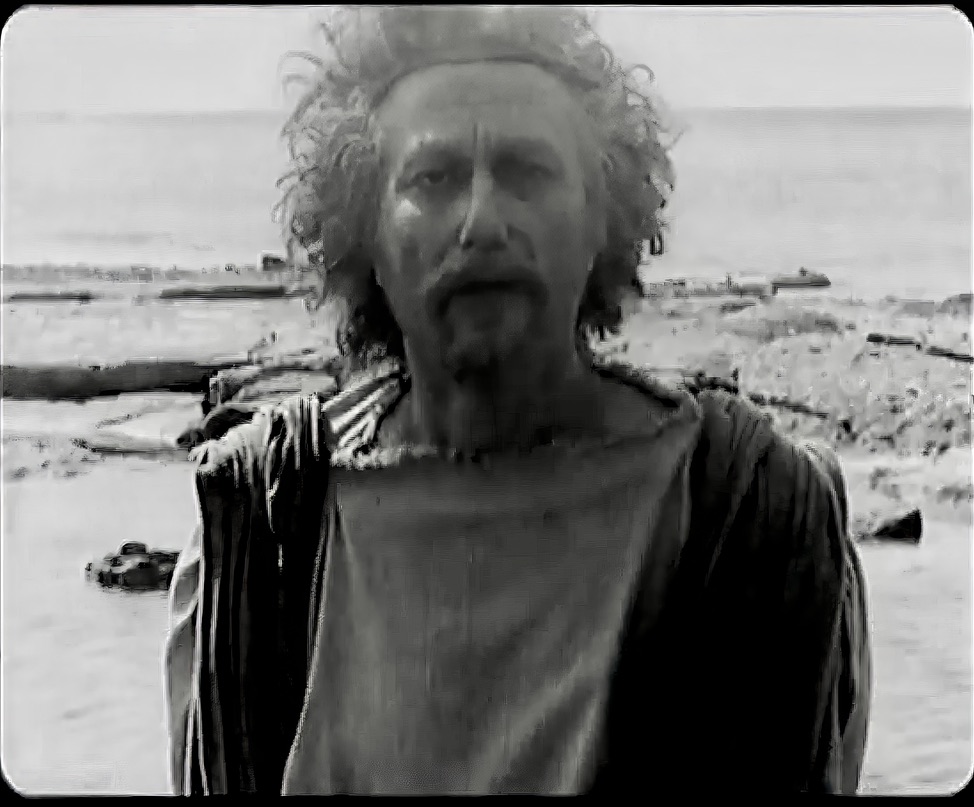
What I see in this wanderer’s gaze, captured by an 1895 camera in 1995, is the same thing I find in the Homeric texts: strange and haunting figures from a vanished past, asking us questions that leap the centuries:
What have you learned from our story?
How fares your own odyssey?
Is it leading you to your heart’s desire?
+
For further reading on the subject of Homer and war, see my 2022 post, “We must love one another or die”—What Does the Iliad Tell Us about the Invasion of Ukraine?
[i] Emily Wilson, “An Uncomplicated Man,” London Review of Books, August 13, 2026.
[ii] Andrei Tarkovsky, Sculpting in Time: Reflections on the Cinema (Austin: University of Texas Press, 1986, 1987), 43.
[iii] Homer, The Odyssey, trans. Emily Wilson (New York: W. W. Norton & Company, 2017): Book 1.1-3.
[iv] Homer, The Odyssey, trans. Daniel Mendelsohn (Chicago: Chicago University Press, 2025), 4.
[v] Ibid., 36.
[vi] Erazim Kohak, “Of Dwelling and Wayfaring: The Quest for Metaphors,” in The Longing for Home, ed. Leroy S. Rouner (Notre Dame, IN: University of Notre Dame Press, 1996), 36.
[vii] St. Augustine, from his prayer that begins his Confessions.
[viii] Phrase from a Kafka parable about a journey “away from here” which is so immense that one can take enough supplies to survive its length. You must find what you need along the way, or die.
[ix] Dante Alighieri, Inferno xxvi.89-93, trans. John Ciardi (New York: W. W. Norton, 1970).
[x] Ibid., line 131.
[xi] From the introduction to Star Trek, one of many spinoffs of Homer’s Odyssey.
[xii] Dante, Paradiso ii.2-5, trans. John Ciardi.
[xiii] Stephen Miller, White House Deputy Chief of Staff for Policy, in a January 2026 interview on CNN’s The Lead with Jake Tapper.
[xiv] James I. Porter, Homer: The Very Idea (Chicago: University of Chicago Press, 2021), 194.
[xv] Emily Wilson, LRB review of the Odyssey film.
[xvi] C. G. Heyne (1801), quoted in Porter, 178.
[xvii] Simone Weil, The Iliad, or, The Poem of Force (1939), quoted in Porter, 213.
[xviii] Friedrich Nietzsche, quoted in Porter, 211.
[xix] Terrence Malick adapted his screenplay from James Jones’ 1962 novel, The Thin Red Line.
[xx] Mendelsohn, 38.
[xxi] Dialogue from Ulysses’ Gaze, quoted in Andrew Horton, The Films of Theo Angelopoulos: A Cinema of Contemplation (Princeton, NJ: Princeton University Press, 1997), 196.
[xxii] Theo Angelopoulos: Interviews, ed. Dan Fainaru (Jackson MS: University Press of Mississippi, 2001), 98.
[xxiii] Lumière and Company (1995).

