“Not dark yet, but it’s getting there” — What Can America Learn from the Nazi Occupation of Paris?

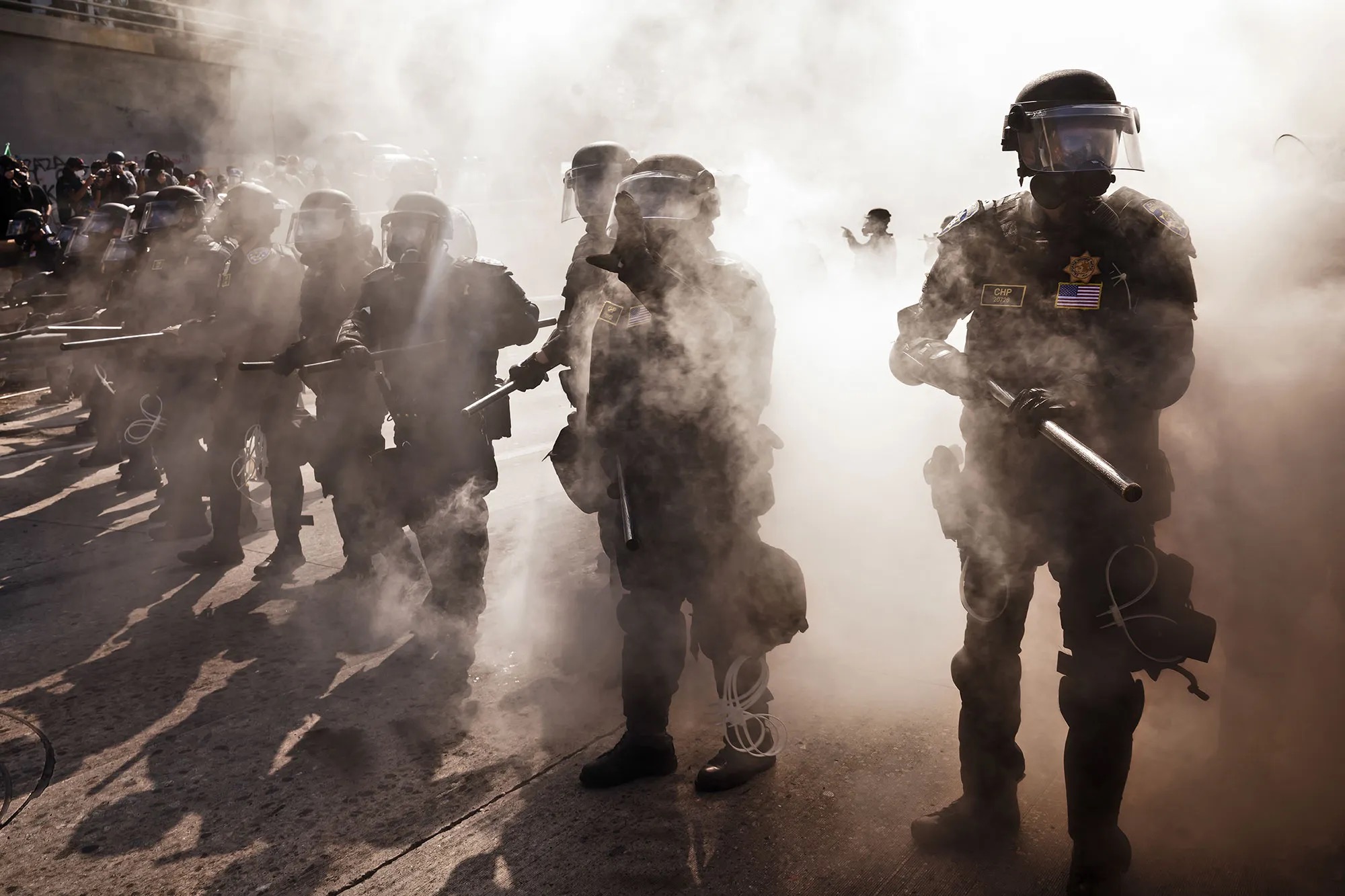
Police clear demonstrators from a freeway during the right wing occupation of Los Angeles in June 2025.

Survivors of the twentieth century, we are all nostalgic for a time when we were not nostalgic. But there seems to be no way back. — Svetlana Boym

In the Second World War, Paris was spared the physical destruction suffered by so many other cities. It surrendered without a fight to the Germans, some of whom cherished fond memories of living there as students before the war. And the Nazi government, believing itself to be the future of Europe, had no desire to smash such a cultural icon into rubble. It coveted the prestige of the City of Light for itself.
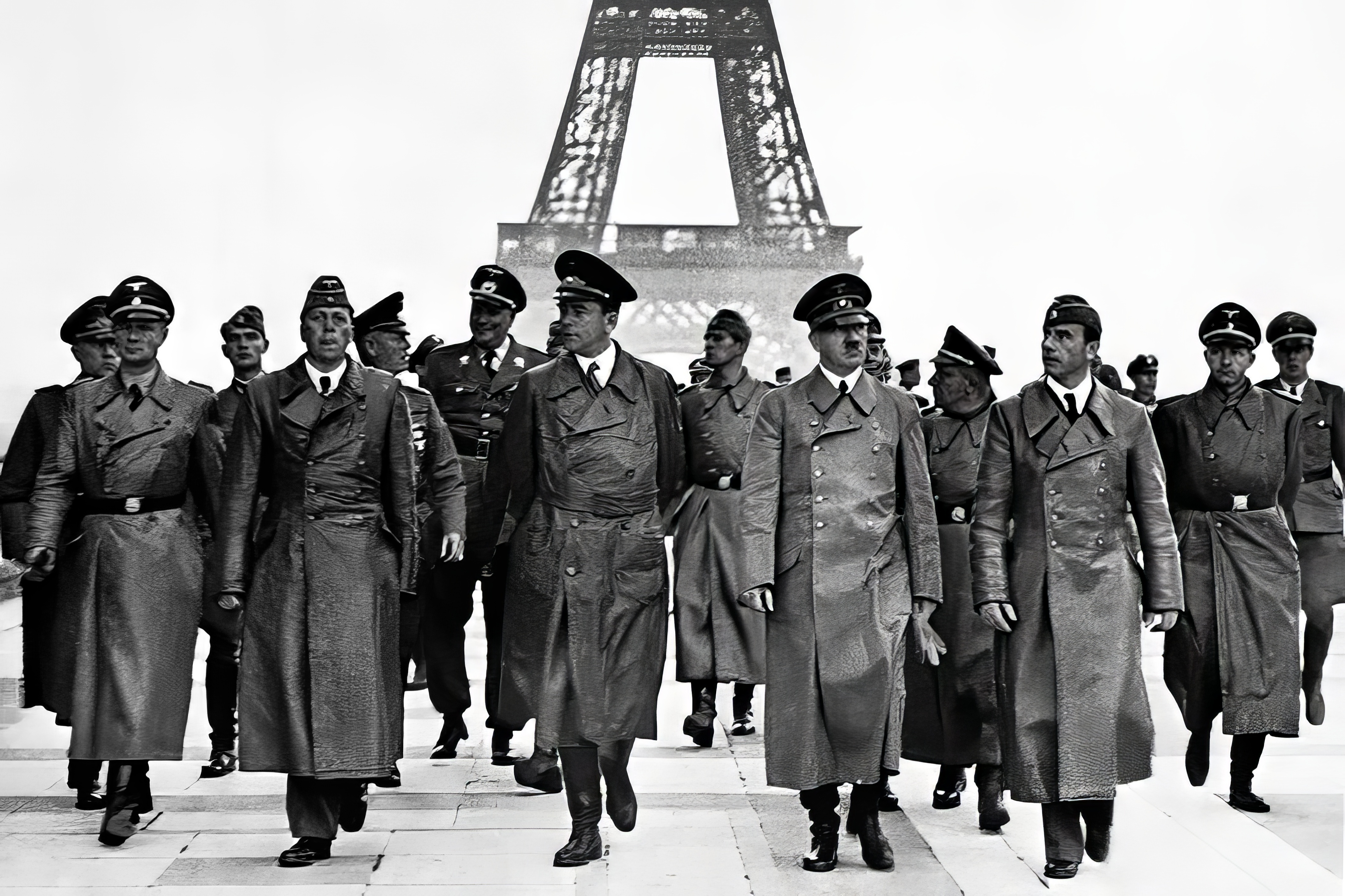
Hitler’s entourage in Paris (June 28, 1940). He was gone the next day, and never saw the city again.

The example of a city physically unchanged while suffering the invasive presence of a hostile power may have something to teach Americans, whose own cities face threats of military occupation by the dictatorial regime in Washington, D.C.. When I read Ronald C. Rosbottom’s riveting study, When Paris Went Dark: The City of Light Under German Occupation, 1940-1944, I could not help noticing some striking parallels to our own “les annes noires” (the dark years).

The radical right in the United States likes to dismiss any comparisons between Nazis and themselves as hyperbolic and slanderous, and it is fair to argue that their own movement may never go as far as the Nazis did. It’s too early to tell. But they’ve made a good start: terrorizing the vulnerable with the ICE-capades of masked thugs, demonizing and disappearing “aliens” and “enemies,” attacking the judicial system, vitiating the free press, purging opposition in the military and civil service, compelling the complicity of corporate leaders, seducing gullible and idolatrous evangelicals, and corrupting everything they touch. Fueling it all is their ceaseless stream of lies and propaganda. As Hannah Arendt warned in the aftermath of World War II:

“If everybody always lies to you, the consequence is not that you believe the lies, but, rather, that nobody believes anything any longer. And the people that no longer can believe anything cannot make up its mind. It is deprived not only of its capacity to act, but also of its capacity to think and to judge. And with such people, you can then do what you please.” [1]

Parisians tried to look the other way, but the invaders were everywhere (Photo by André Zucca for Signal, a German propoganda magazine).

Much more could be said about that, but for now our subject is the occupation of Paris. When the Germans entered the French capital in June, 1940, they encountered no resistance. Parisians were disheartened by the swift collapse of the French army and unhappy to see so many German soldiers and officials suddenly walking their streets and filling their cafés, but what could they do? Many fled Paris before the troops arrived, but most of those returned when they saw how “normal” things seemed. Daily life was not radically affected at first, and few thought the occupation would last such a long time. There was shame in defeat, certainly, and resentment of a foreign presence, but for a time passivity and resignation kept the anger of many Parisians’ turned inward.
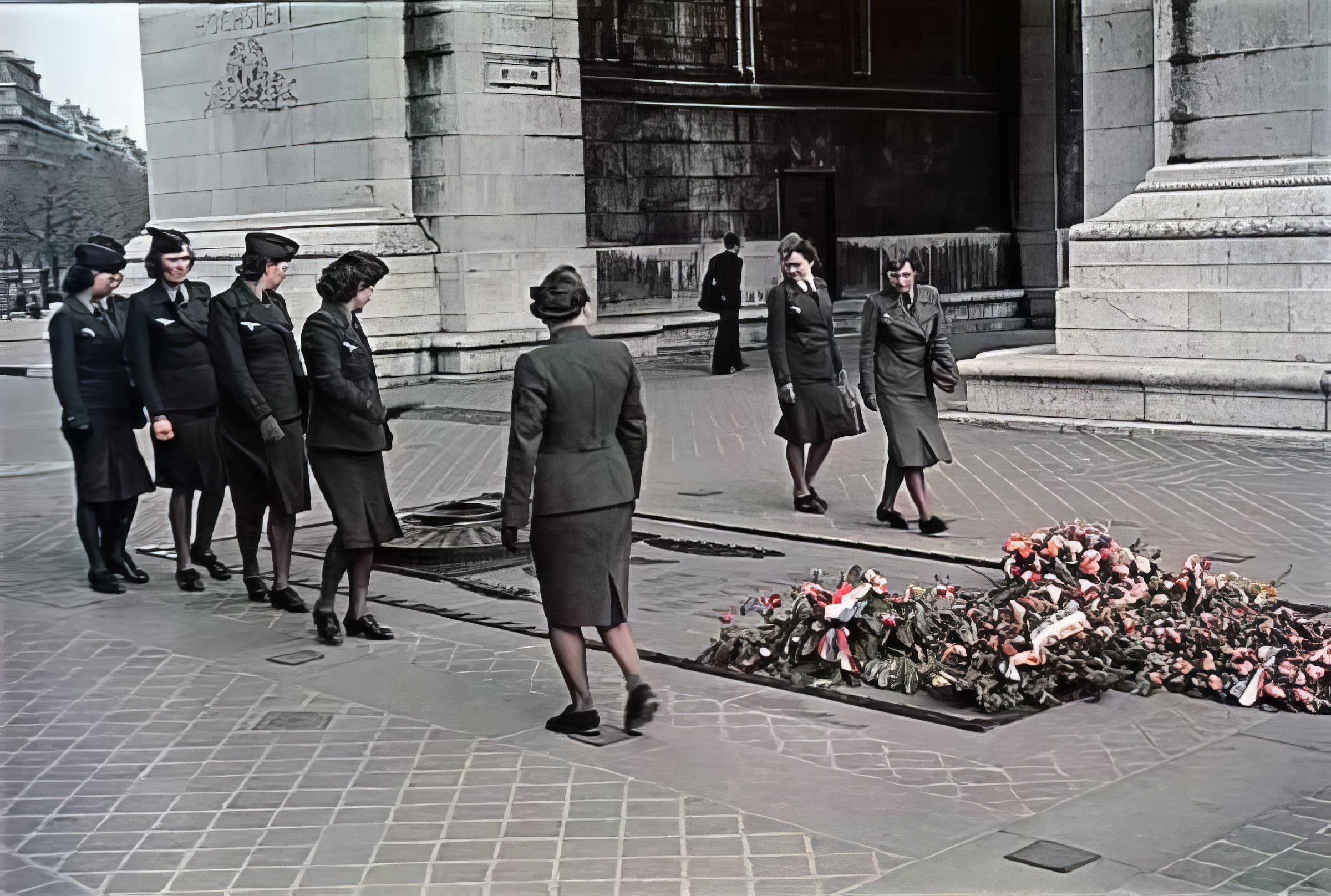
German soldiers at the Arc de Triomphe. The Occupation produced an invasion of unwanted tourists (Photo by André Zucca for Signal, a German propoganda magazine).

There was a degree of make-believe on both sides. German soldiers were instructed to be polite. If someone drops a package on the sidewalk, pick it up for them. Parisians tried not to reciprocate any such acts of kindness, but to practice what they called Paris sans regard (“Paris without looking”). As much as possible, pretend the Germans don’t exist. Over time, this depersonalization would create a great sense of loneliness among the occupiers. As for Parisians, the make-believe minuet with the occupiers was both wearying and fragile. As one young man wrote in his journal,

“In spite of oneself, one dreams, laughs, and then falls back into reality, or even into excessive pessimism, making the situation more painful.” [2]    

A month after the Germans arrived, “Tips for the Occupied,” a mimeographed flyer, began to appear in apartment mailboxes. “Don’t be fooled,” it warned. “They are not tourists … If one of them addresses you in German, act confused and continue on your way … Show an elegant indifference, but don’t let your anger diminish. It will eventually come in handy …” [3]

The sense of normality didn’t last. The restaurants, cabarets and cinemas remained crowded, but when audiences began to boo and jeer at Nazi newsreels, the houselights would be turned up. People lost their courage when they could be easily spotted. Parisians also learned to be careful about saying the wrong thing in a café. Neighbors began to denounce each other to the authorities. Singing “The Marseillaise” in public became a punishable crime.  

As the Occupation dragged on, the sense of dépaysement (“not feeling at home”) began to wear on the soul. Historian Jean-Paul Cointet describes the condition in his 2001 study of wartime Paris:

“The Parisian now knows the condition of being ‘occupied’ in a city that does not belong to him anymore and that offers him the schizophrenic images of an environment suddenly foreign to his gaze. Constraints and humiliations, restrictions and punishments accompany this disorientation and the upending of daily routine.” [4]
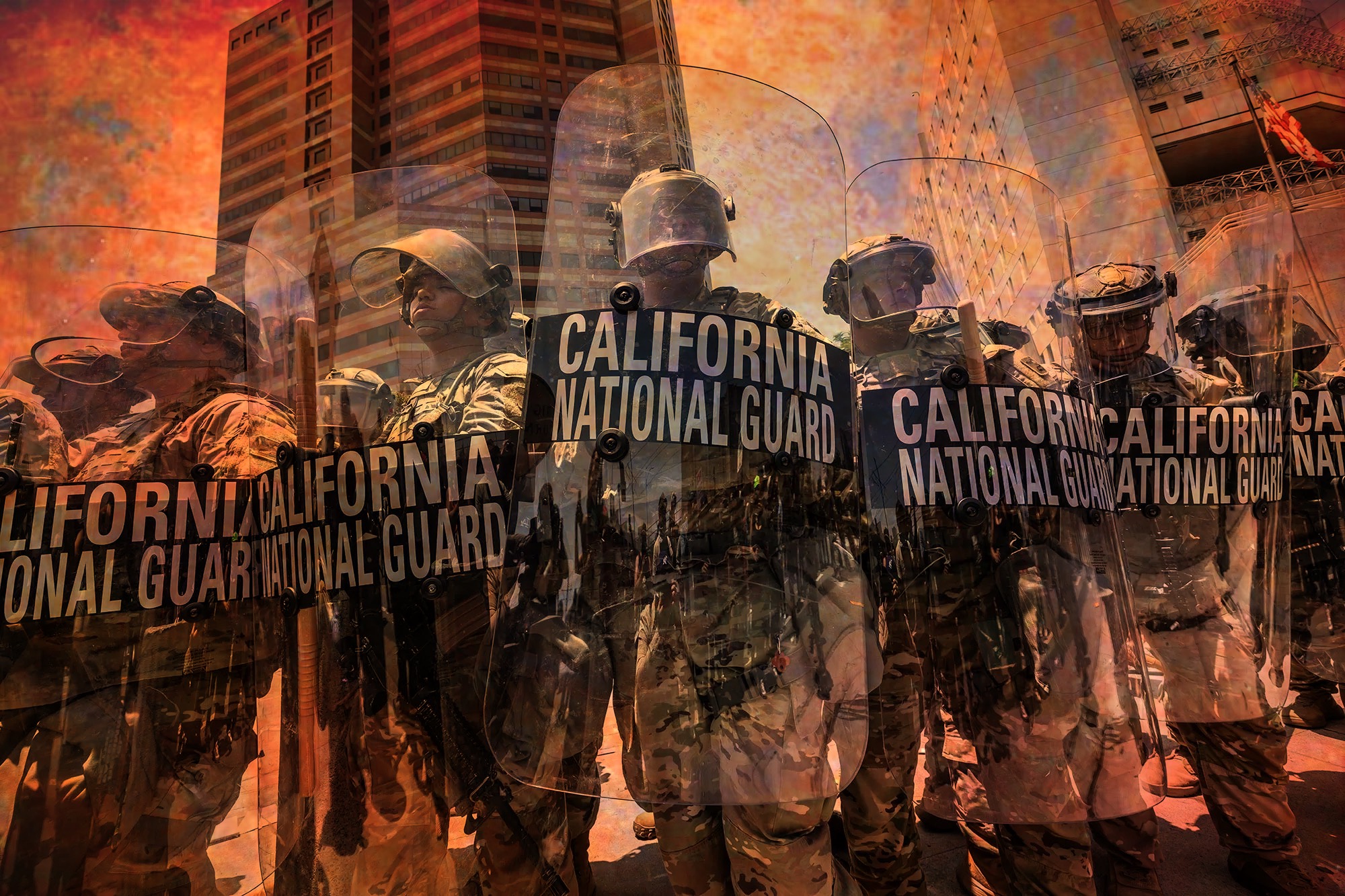
Troops at a federal detention center in Los Angeles (Ted Soqui for Cal Matters, June 8, 2025).

The narrowing of space—both physical and psychological—became increasingly oppressive, as Rosbottom notes:

“Whether because of the sight of German uniforms, the closed-off streets, the insufficient nourishment, the cold winters, crowded transportation, long lines—or just the suffocating feeling of being suspicious of one’s acquaintances, neighbors, or even family—the city seemed to be contracting, closing in on Parisian lives, as the Occupation dragged on.” [5]

By the bitterly cold winter of 1941, life just got harder. Shortages of food and coal brought malnutrition and sickness, especially among the lower classes. French police, willing agents of Nazi oppression, started to raid neighborhoods known for Jewish or immigrant populations. At first, Parisians in uninvaded neighborhoods could close their eyes and swallow the lie that the authorities were simply trying to control immigration and prevent terrorism.
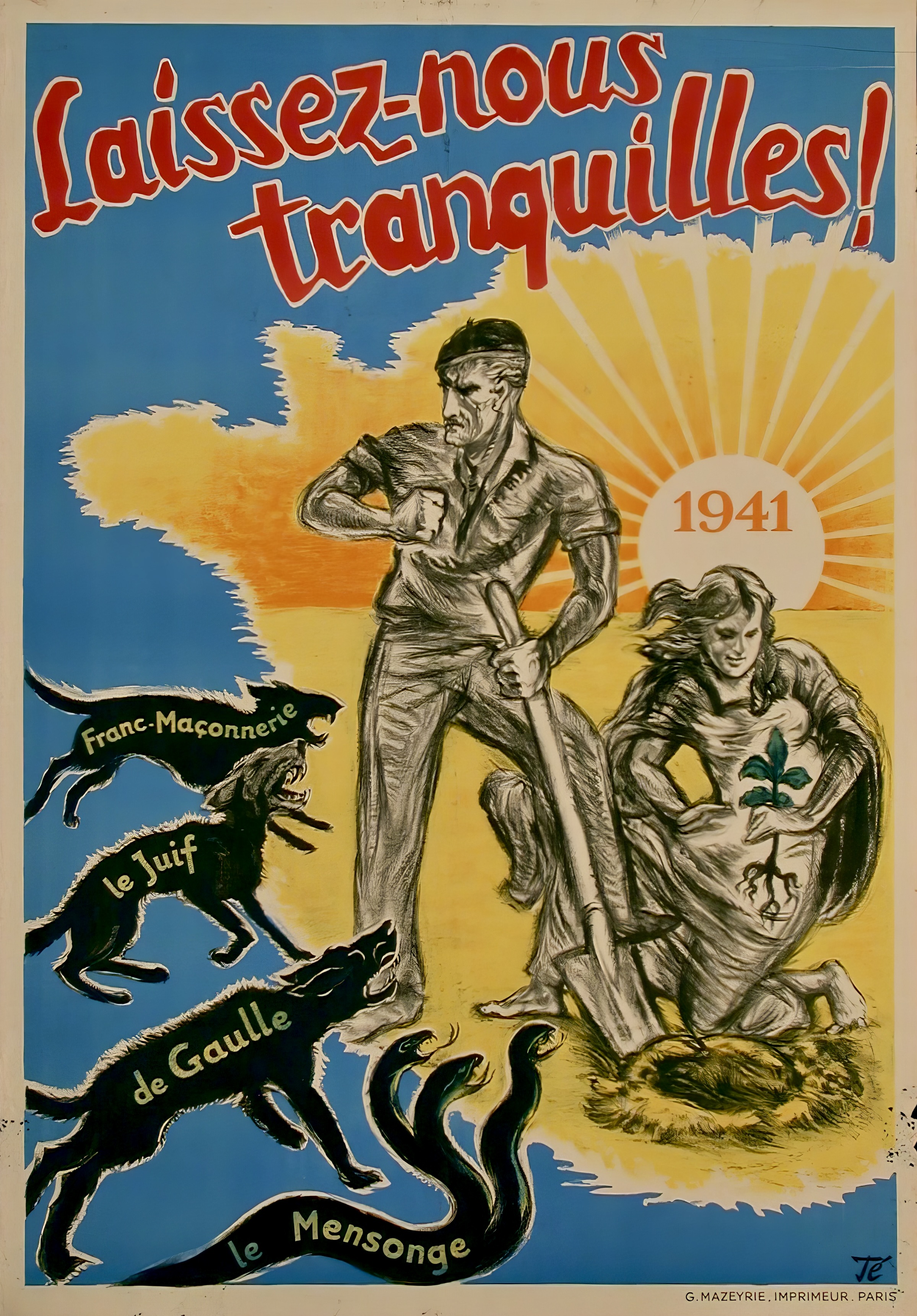
“Leave us in peace!” A German propaganda poster show Vichy France threatened by its perceived enemies: Freemasons, Jews, de Gaulle, and “lies.”

However, by mid-1942, rumors of the “final solution” began to reach Paris, and the mass roundups of Jews in France became impossible to ignore. “[Most Parisians] certainly did not know of the plans to deport them to their deaths,” writes Rosbottom, “but to their deaths they went: the last, sad convoy to carry children, three hundred of them, left Drancy for Auschwitz on July 31, 1944 … The final transport of adult deportees left on August 17, a week before Paris would be liberated.” [6]  

Ernst Jünger, a cultured writer serving as a captain in the occupying Wehrmacht, kept a journal of the Occupation. In July 1942 he wrote:

“Yesterday some Jews were arrested here in order to be deported—first they separated parents from their children, so firmly that one could hear their distressed cries in the streets. At no moment must I forget that I am surrounded by unhappy people, humans experiencing the most profound suffering. If I forgot, what sort of man or soldier would I be?” [7]  

Jünger may have shed a tear, but he continued to serve as a loyal employee of the Nazi death industry, whose business, as Hannah Arendt so bluntly noted, was “the mass production of corpses.” [8]

Hélène Berr also kept a diary, from Spring, 1942 until Spring, 1944. As a young Jewish woman, she tried to keep terror at bay by imagining herself in a Paris magically untouched by the darkness. A student at the Sorbonne, she copied out verses of Keats to calm her soul, and took refuge in her friendships. She made frequent walking tours of the city she loved, as if to reclaim possession of Paris from the occupiers who made her wear a yellow star, the mark of social exile.  

In April of 1943, Hélène wrote:

“I’ve a mad desire to throw it all over. I am fed up with not being normal. I am fed up with no longer feeling free as air, as I did last year. It seems that I have become attached to something invisible and that I cannot move away from it as I wish to, and it makes me hate this thing and deform it … I am obliged to act a part … As time passes, the gulf between inside and outside grows ever deeper.” [9]   

As Rosbottom notes, personal accounts of the period recall “the sound of police—French police—beating on the door” as their “most vivid aural memory.” [10]  In March 1944, that percussive death knell sounded in the Berr’s apartment. Hélène, along with her parents, was arrested, but she managed to slip her journal to their cook before the police barged in. Three weeks later the Berrs were on a train to Auschwitz. They never returned. Hélène’s beloved Paris would be liberated five months later.
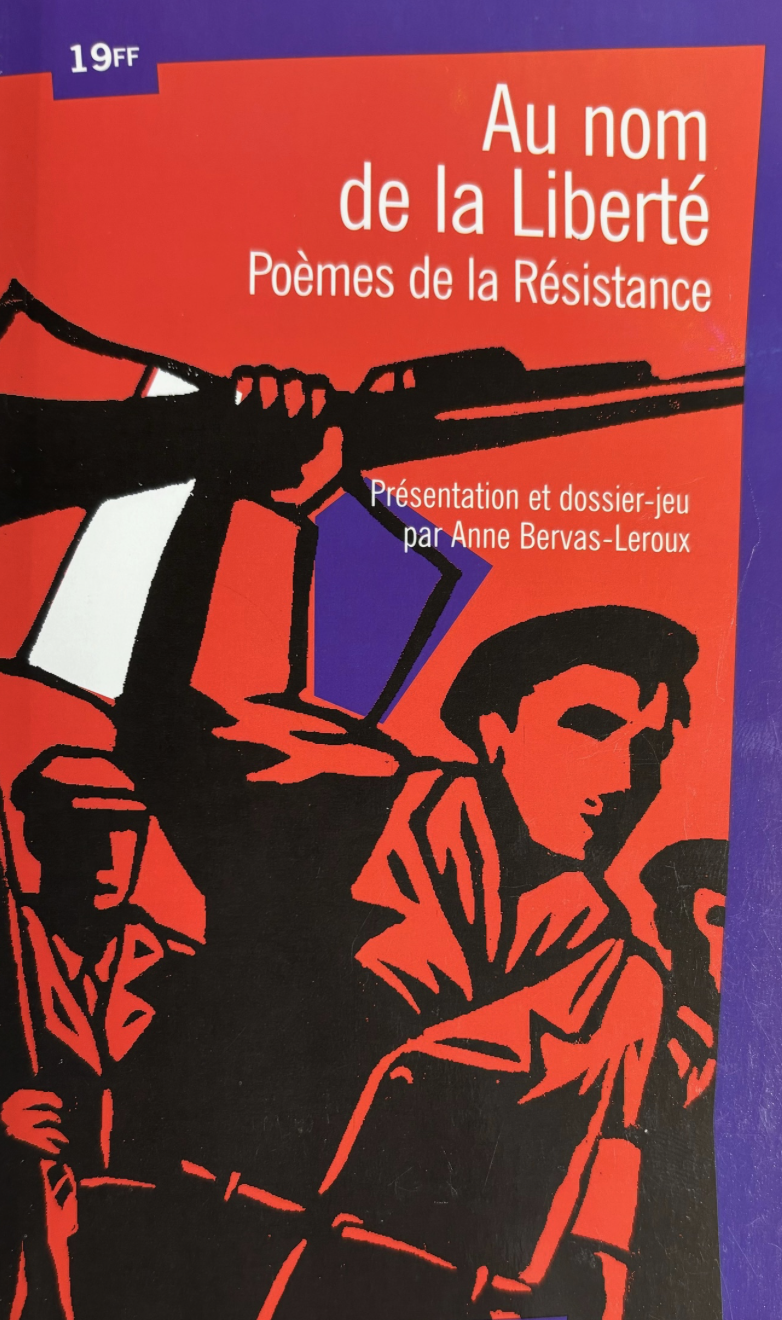
Illustration for a collection of French Resistance poetry.

There were many forms of active resistance to the Nazis in France, but the number of French patriots who risked their own lives was relatively small—less than 2% of the population. The threat of death and brutal reprisals was too daunting for most. For a visceral immersion in the anxious milieu of the French Resistance, watch Jean-Pierre Melville’s haunting film, Army of Shadows. Critic Amy Taubin’s summary of the film feels descriptive of wartime Paris: “Elegant, brutal, anxiety-provoking, and overwhelmingly sad.” [11] One resister recounted his experience in an interview decades after the war:

“Fear never abated; fear for oneself; fear of being denounced, fear of being followed without knowing it, fear that it will be ‘them’ when, at dawn, one hears, or thinks one hears, a door slam shut or someone coming up the stairs. Fear, too, for one’s family, from whom, having no address, we received no news and who perhaps had been betrayed and were taken hostage. Fear, finally, of being afraid and of not being able to surmount it.” [12] 
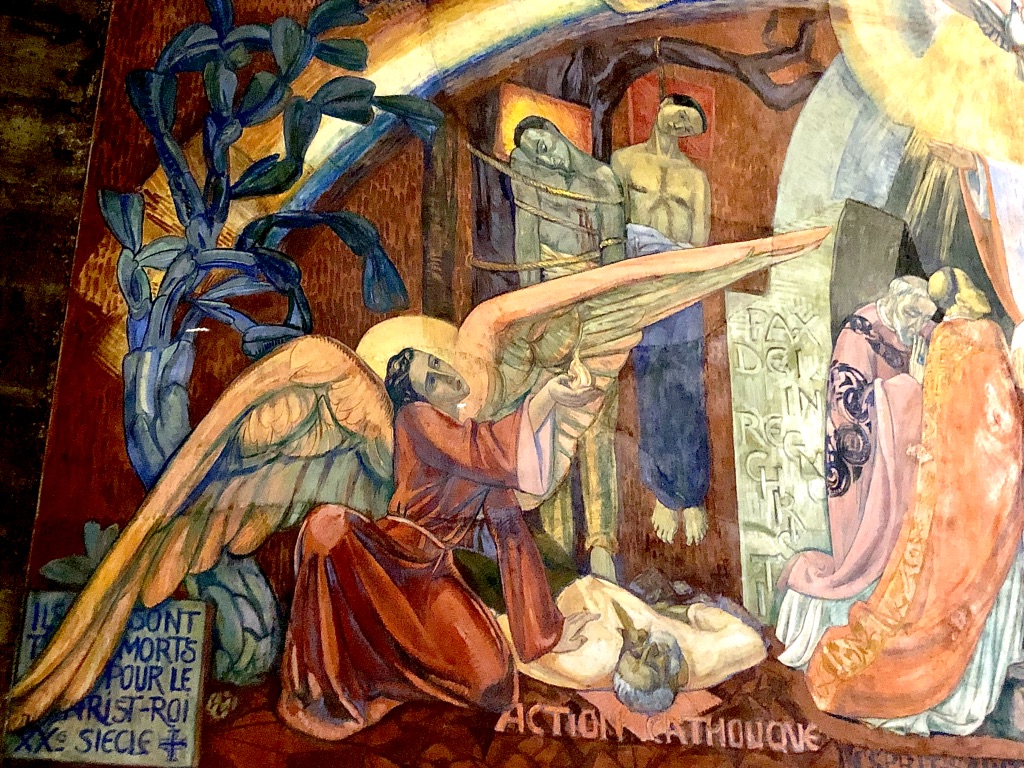
A prewar fresco of modern martyrs who refused to bow to anyone but Christ (Église du Saint-Esprit, Paris, 1930s).

As I read Paris in the Dark, I had to wonder: Is this America’s future? For many of us (to borrow a line from Bob Dylan), “It’s not dark yet—but it’s getting there.” Daily life —for now, at least—goes on pretty much as usual. But for some of our neighbors, the darkness has definitely arrived. The military occupation of cities. The terrifying knock on the door. The roundups, disappearances, and concentration camps. The shamelessly gleeful cruelty. Demonization, bigotry and hate. The repression of customary freedoms. The criminalization of dissent. The collapse of legal safeguards. The willing complicity of the powerful with the enemies of life.

Citizens try to block an ICE roundup of immigrants at the Ambiance Apparel factory, downtown Los Angeles (J.W. Hendricks for CalMatters, June 6, 2025).

I am not without hope. Seven million protesters took to the streets on No Kings Day. Then large majorities voted against America’s reign of madness. And regardless of any political swings of the pendulum, I believe that resurrection continues to plant its seeds among the blind sufferings of history. But the oligarchs and fascists won’t go quietly. On the day after the recent election, the Episcopal Daily Office included this timely verse from the Book of Revelation:

Woe to the earth and the sea,
for the devil has come down to you
in a great rage,
because he knows that his time is short. (Rev. 12:12)

The Beast and Satan rage, but their time is short (Apocalypse Tapestries, Angers, France, 1373-1382).

This Scripture feels ripped from the headlines. We know that satanic rage all too well. It has sickened our country, and we struggle to keep it out of our own hearts. May its time be short. In the meantime, the woes are not done. God’s friends have their work cut out for them. Believe. Resist. Endure.

And guard your heart against the demons of dejection and despair. After Trump’s election in 2016, I suggested seven spiritual practices for the time of trial: pray, fast, repent, prophesy, love, serve, hope. Click the link for the details. Nine years later, these practices are more necessary than ever, and I encourage you to share the link as a small act of resistance.
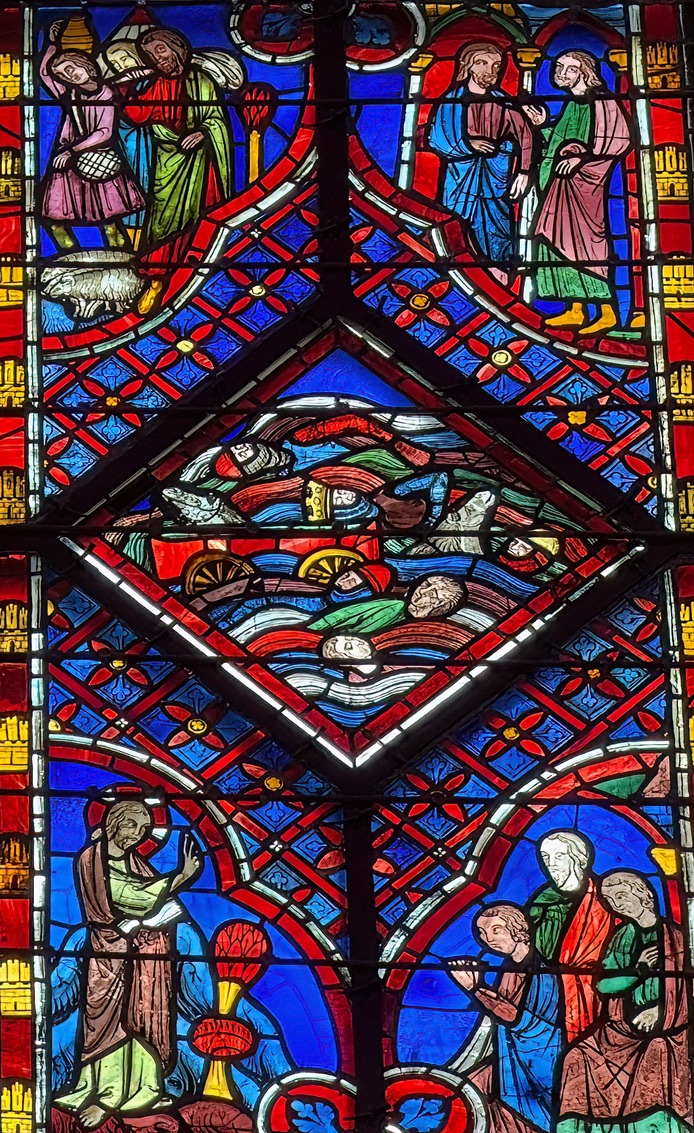
Pharoah sent his troops to round up the Israelites, but the forces of violence ended up sleeping with the fishes (13th-century window, Sainte-Chappelle, Paris).

Finally, don’t be in love with outcomes. Divine intention takes mysterious forms, and should not be confused with our own plans. Let us heed the counsel of two twentieth-century saints who were deeply committed to holy resistance and well acquainted with its challenges and ambiguities. Dietrich Bonhoeffer, martyred in a Nazi prison in 1945, believed that we must always act with deep humility, shedding our presumptions about the part we play or the difference we make. Don’t fret about your success. Just be faithful to Love’s command:

“No one has the responsibility of turning the world into the kingdom of God … The task is not to turn the world upside down but in a given place to do what, from the perspective of reality, is necessary objectively, and to really carry it out.” [13]

And Thomas Merton, who forged a delicate balance between contemplation and activism, taught that right action is not a tactic but a persistent way of being, grounded in something deeper and more enduring than any of our consequences:

“The message of Christians is not that the kingdom ‘might come, that peace might be established, but that the kingdom is come, and that there will be peace for those who seek it.’” [14]
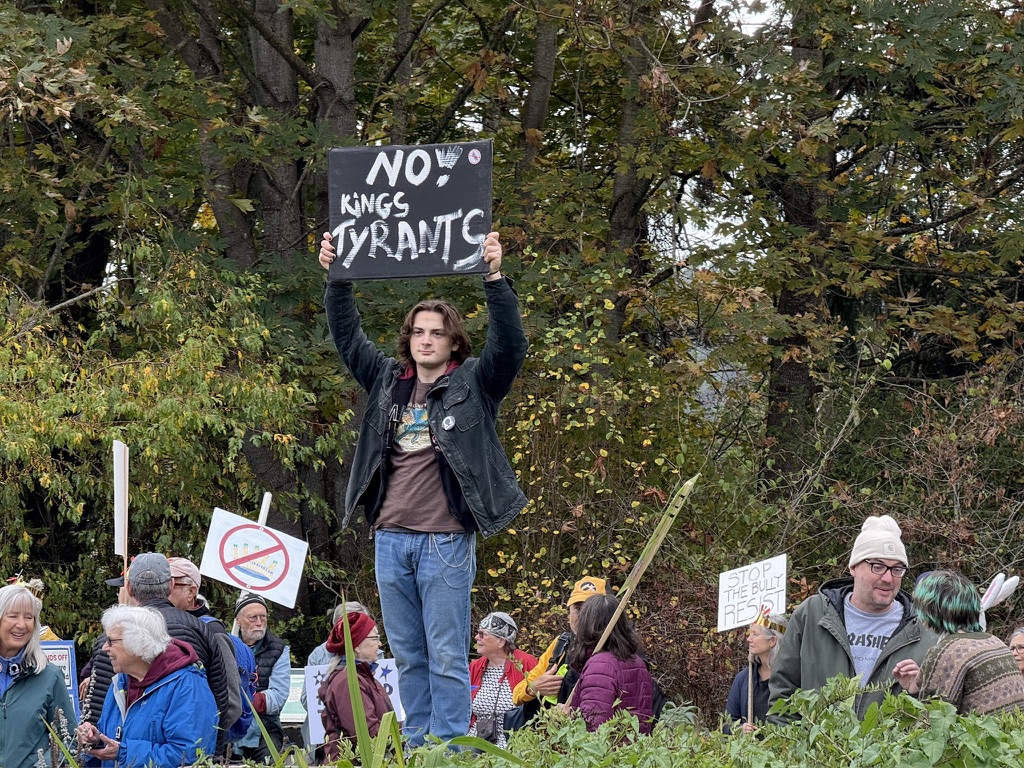
No Kings Day on Bainbridge Island, Washington (Photo by the author, October 18, 2025).


[1] Hannah Arendt, quoted in the PBS documentary, Hannah Arendt: Facing Tyranny (American Masters, 2025).

[2] Ronald C. Rosbottom, When Paris Went Dark: The City of Light Under German Occupation, 1940-1944 (New York: Back Bay Books, 2014), 106.

[3] Ibid., 196-197. The flyer was produced by Jean Texcier.

[4] Ibid., 160.

[5] Ibid., 161.

[6] Ibid., 286.

[7] Ibid., 154.

[8] Hannah Arendt: Facing Tyranny.

[9] Rosbottom, 256.

[10] Ibid., 160.

[11] Amy Taubin, ”Out of the Shadows,” Criterion booklet for their 2010 Blu-ray release of Melville’s 1969 film.

[12] Rosbottom, 223, quoted from interviews with WWII resisters published in 2012.

[13] Dietrich Bonhoeffer, q. in Christiane Tietz, Theologian of Resistance: The Life and Thought of Dietrich Bonhoeffer (Minneapolis, MN: Fortress Press), 121.

[14] Thomas Merton, Turning Toward the World: The Journals of Thomas Merton, Volume Four, 1960-1963 (New York: Harper Collins, 1996), 188.


What Jesus Said About Vultures

Turkey vulture.

In all my years as a priest, I had never preached on the apocalyptic imagery of Luke 17:26-37, where people disappear without warning and Jesus concludes with an unnerving proverb: “Where the corpse is, there the vultures will gather.” This is not ideal preaching material, but with the help of the Epistle reading, Hebrews 11:29—12:2, I gave it a try last Sunday.

Today’s gospel [i] has quite a punchline: “Where the corpse is, there the vultures will gather.” It’s got to be pretty low on the list of favorite Jesus quotes, but it certainly gets our attention.

A couple of weeks ago I was at a raptor show at the High Desert Museum in eastern Oregon. A variety of hawks, owls and vultures flew swiftly among the seated spectators, who were warned to stay very still lest we be mistaken for prey. I did my best not to be a target, but a turkey vulture came close enough to brush my head with its wing. Perhaps it was preparing me for this strange gospel verse.

Some scholars say Jesus was simply using a common folk expression in response to a question about discerning the times, meaning something like “where there’s smoke, there’s fire.” Such expressions have nothing to do with smoke or fire or vultures or corpses. They’re just colorful ways of making a point. Still, Jesus’ choice of such a grim illustration puts a sharp edge on his message. It certainly gets our attention. And where the enigmatic text is, there the scholars will gather.

Who is the corpse? they wonder. Who are the vultures? One interpretation suggests the corpse could represent ancient Palestine, with the rapacious vultures being the occupying army of Rome. The Book of Revelation, perhaps inspired by the vultures in the gospel text, imagined the raptors of midheaven being summoned to feast on the remains of the proud powers struck down by divine judgment. An even more fantastical interpretation identifies the sharp-eyed buzzards, who in fact can spot carrion from 3 miles away, as those perceptive disciples who gather to consume the Corpus Christi, the Body of Christ given to feed our deepest hunger.

Well, none of these images is going to qualify for a stained glass window. And the vulture verse is perhaps profitless for the preacher.

And yet, it leaves a haunting impression. It’s unlike anything else Jesus ever said, and its gruesome tone puts an exclamation point on his discourse of crisis. A world is dying, he says. Just as a world died in the days of Noah, or in the days of Lot—names which recall destructive narratives of flood and fire—so it is happening now. The times are in no way normal, Jesus warns his listeners. Anyone who pretends that is not true, who thinks we can just go on about our business as usual—eating and drinking, buying and selling, planting and building—well, they are in for a surprise.

Come gather ’round people
Wherever you roam
And admit that the waters
Around you have grown
And accept it that soon
You’ll be drenched to the bone
If your time to you is worth savin’
You better start swimmin’
Or you’ll sink like a stone
For the times they are a-changin’ [ii]

When we sang that song 60 years ago, we thought the times were changing for the better. And that was true in many ways. But the flood of changes washing over us today do not feel like something better. When Jesus speaks of people being snatched up and disappeared without warning, he could be describing what’s happening right now in “the land of the free.” To paraphrase Jesus’ metaphor, “As it was in the days of Dietrich Bonhoeffer—in 1930s Germany—so shall it be in our own time.”

I pray that this will not be our fate, but the fact that such an outcome is even conceivable is a measure of the times. It can happen here. So what are the friends of God to do? How do we start swimming so we don’t sink like a stone?

We are not the first believers to suffer the worst of times. The Epistle to the Hebrews is clear about that. History isn’t always about the lilies of the field. It has its corpses and vultures as well.

But as the author of Hebrews insists, the faithful believe in the victory of God, and they act out that faith with their bodies. Some of God’s friends have “received the test of mocking and whipping and even chains and prison. They were stoned, cut apart in a slaughter; they died upon a sword. They traveled around in ragged clothing, impoverished, oppressed, afflicted.” But for all they suffered, those who kept the faith “subdued monarchies, did the work of justice … shut the mouths of lions, quenched mighty fires …” (Hebrews 11:29-12:2)

As people baptized into the Paschal Mystery, we understand that dying and rising, defeat and victory, are deeply intertwined. You can’t have one without the other.

When certain medieval women mystics contemplated the cross in prayer and vision, they saw not the triumph of death, but a kind of birth. For them the crucified Jesus was like a woman in labor, enduring pain and travail in order to bring us all to birth: 

Ah! Sweet Lord Jesus Christ, who ever saw a mother suffer such a birth! For when the hour of your delivery came you were placed on the hard bed of the cross and … in one day you gave birth to the whole world.” [iii]

To behold the death of Christ and call it birth is the central act of Christian imagination. It is why we declare victory at the cross. We don’t wait for Easter Sunday. We declare victory at the cross because the Passion isn’t just a story about the violent powers that always trample the weak and kill the prophets. It’s also a story about the Realm of God, where dry bones breathe and lost hopes dance, where the prodigal is welcomed home and the tears are wiped from every eye.

The Love that creates such a realm was nailed to a cross, but the cross did not consume it. Yes, death did what death does, but then God did what God does. And Love won. This is the story we belong to, and on the outcome of that story, we stake everything.

That is why we are here this morning. That is why we refuse to retreat to our private worlds, why we continue to gather in community at our Savior’s table: to nurture hope, shelter love’s flame, encourage one another, strengthen our hearts for service, eat the bread of life, pray without ceasing, sing our Alleluias and grow ever more fully into the visible, tangible body of Christ.

We are not alone in this journey. We are surrounded by a cloud of witnesses, all those ancestors in the faith, from Abraham and Sarah and Mary and Luke right on down to the wise and loving mentors we’ve known in our own lives, who have taught us how to walk in the Way of life and peace.

I once heard a preacher describe the cloud of witnesses as “the balcony people” who are looking down and cheering us on as we run the race that is set before us. It’s a wonderful and resonant image. I’m sure that each of you has some very special people in that balcony, shouting their encouragement. Listen. You can hear their voices echoing through the years.

St. Luke, pray for us … St. Mary, pray for us … St. Francis, pray for us … Oscar Romero, pray for us … Dorothy Day, pray for us … Mom and Dad, pray for us.  

Last Sunday I was in Eugene for the National Track & Field Championships, and in the men’s 800 meters I witnessed one of the most stunning moments in the history of middle-distance racing. A 16-year-old high school sophomore named Cooper Lutkenhaus had qualified for the elite competition by breaking the 29-year-old high school record, running the distance in 1:45. And after stumbling and almost falling in his first race at the championships, he managed to survive the first two rounds.

Much to his surprise, he had made the final. But with some of the world’s top 800 meter runners in the race, no one expected him to be anywhere close to the top three who would earn a trip to the World Championships in September.

Rounding the last turn, Cooper was doing really well for a 16-year-old, in  sixth place out of nine racers, 10 meters behind the leader. Then, in the last 100 meters, he passed one runner, and another, and another, and another, to cross the line in second place. His time was 1:42.27, not only a personal best by an unbelievable 3 seconds, but the 18th-best all-time and the fourth-best ever by an American.

Donavan Brazier, Cooper Lutkenhaus, and Bryce Hoppel finish 1-2-3 in the 2025 U.S. Track & Field Championships in Eugene, Oregon.

Now I’ve been at a noisy NBA final with Kareem and Magic and Larry Bird. I’ve been deafened by the 12th man [iv] at a Seahawks game. But the sound of the crowd cheering on young Cooper Lutkenhaus blew my ears off. The cloud of witnesses.

When we run the race that is set before us, there will be times when our lungs burn and our legs scream with lactic acid. There will be the races that disappoint, and workouts that feel listless or discouraging. We may even stumble and fall, more than once.

But always, always, the cloud of witnesses is cheering us on. They know from their own experience what the race is like. They all had their own moments of weakness and doubt. They became acquainted with suffering by training hard every day. They all had to learn how to get up after every fall, lay aside every weight, gulp the breath of the Spirit, and accept pain as the runner’s companion.

I’ve done my own share of racing, and when the pain comes, I try to greet it as a friend. “Hello, brother pain. I knew you’d show up. Well, here we go. I know you’re not going to kill me, right?. We’ll just take it step by step.”

“Even the fittest may stumble and fall (Isaiah 40:31). As Roisin Willis and Maggi Congdon finish 1-2 in the women’s 800 meters at the U.S. Championships, Sage Hurta-Klecker dives for the third and final spot on the World Championship team. In previous years, she had missed out on a championship podium twice due to falls, but this time her fall was a triumph. She made the team.

The perpetual contest between weariness and perseverance is familiar to every athlete—and every saint. You’re going to get tired. You’re going to get discouraged. You may faint and fall. But keep your eyes on the prize, hold on. On both good days and bad, you’ve got to put in the work, “lay aside every weight,” surrender to a power and a strength that is not your own, and stay in the flow.

I began with a raptor image, so let me close with another. This time it’s not a vulture, but an eagle, in a beautiful passage from the prophet Isaiah:

Even the youthful may faint and grow weary, 
even the fittest may stumble and fall,
but those who wait for the Lord shall renew their strength, 
they shall mount up with wings like eagles, 
they shall run and not be weary,
they shall walk and never grow tired. [v]

Francesco Scaramuzza, Dante and the Eagle (c. 1860). The sleeping Dante dreamed he was carried by an eagle, but it was really St. Lucy who helped the poet on his upward journey toward heaven’s light (Purgatorio ix).


This homily was preached at St. Luke’s Episcopal Church, Renton, WA, on the 9th Sunday after Pentecost, 2025.

Race photo and video by the author.

[i] The texts for the 8th Sunday after Pentecost are in Wilda C. Gafney, A Women’s Lectionary for the Whole Church, Year C, which differs significantly for the Revised Common Lectionary used by most liturgical churches.

[ii] Bob Dylan, “The Times They Are A-Changin’” (1964).

[iii] Marguerite d’Oingt (d. 1310).

[iv] The loudest crowd in professional football is in Seattle, where the fans are called “the 12th man” for their ability to influence the game by making it hard for the other team to hear their quarterback’s signals.

[v] Isaiah 40:30-31.

Seeking the Good at the End of the World (Homily for Advent 1)

Extra! Extra! Read all about it.
SUN GOES OUT!
STARS FALL FROM HEAVEN!
THOUSANDS FAINT FROM FEAR!

On the first day of the Christian Year, do we break out the champagne and shout “Happy New Year.” No we do not. What we say is, “The end is near!”

We don’t get all Fundamentalist about it. We don’t walk around wearing signboard warnings. We don’t declare a fixed date for the end of history. We prefer to keep our end time theology more metaphorical than literal. Worlds end all the time. Personal worlds. Public worlds.

Still, this year, from Gaza and Ukraine to Washington, D.C., the end of the world feels closer to being literal than any other time in my 80 years on the planet. To borrow some lines from W. H. Auden’s Good Friday poems, lately it feels as if the world we know has been “wrecked, / Blown up, burnt down, cracked open, / Felled, sawn in two, hacked through, [and] torn apart.”

For Christians, the end of the world should not come as a total surprise. Every gospel on the First Sunday of Advent includes a forecast of the apocalypse—the end of the world as we know it. It’s not that uncommon, actually. Who has not experienced apocalypse on a personal level—the exit from childhood, the loss of a job or a loved one, a scary diagnosis? And throughout history, apocalyptic episodes have periodically disrupted the stability of humanity’s collective life: the fall of empires, economic crashes, military invasions, revolutions, authoritarian nightmares, environmental crises, and the like.

In the Humphrey Bogart movie, Beat the Devil, a ship is floundering on a stormy sea. In his typical wise-cracking manner, Bogie says to a panicky passenger, “What have you got to worry about? We’re only adrift on an open sea with a drunken captain and an engine that’s liable to explode at any moment!”

A crewman chimes in: “Perfectly ordinary situation. It happens every day.”

Like it or not, we’re all on board that sinking ship at the close of 2024, praying desperately with the Psalmist, “Save me, O God! The water has risen up to my neck; I’m sinking into the mire” (Psalm 69:1-2) Perfectly ordinary situation. It happens every day.

Angel blowing the 2nd trumpet as the sea swallows ships and sailors (Revelation 8:8). The Apocalypse Tapestry of Angers (1373-1382). Photograph by the author.

When I was younger, I had a crushing experience of my personal world coming undone. A spiritual director summed up my situation as being washed overboard into a wild sea, where I’m flailing to keep my head above water.” “Sounds about right,” I said mournfully. “Well, congratulations!” he told me. “You’re exactly where you need to be.” I had to laugh at the aptness of his metaphor. My apocalypse had indeed revealed the unsustainability of my former state, even as it hurled me into the formless chaos from which my new world would be born.

Saint Michael weighing souls (c. 1180), Saint-Trophime, Arles, France. Photograph by the author.

Apocalypse can be an unwelcome judgment on the way things are. It weighs the world in the scales of justice and finds it wanting. The judgment is not punitive, simply accurate. As a 14th-century English poem on the end of the world put it, the apocalypse judges “without revenge or pity.” It just tells it like it is. Still, it’s a hard thing to face the truth about our flawed condition. However, the end of an old reality can also be life-giving, freeing us to discover a better version of self and world.  

But where can we put our feet when the ground is crumbling beneath us?  We stand on God’s word, God’s promise, God’s hope. “Heaven and earth will pass away,” Jesus says, “but my words will not pass away.” Let the Savior’s words guide us. Let them encourage us. As he told his disciples,

“When the chaos comes, keep your heads high and stand your ground. Your liberation is on its way.  Don’t be distracted by thoughtless living, or get weighed down with worry,” he says. “Be alert at all times, and pray that you’ll have the strength to get through all this craziness.” [i]

This is my 55th year of preaching in Advent. It’s my favorite season, so rich with resonant and stirring themes: endings and beginnings, light and darkness, waiting and preparing, watching and hoping, expectation and, in the end, marvelous birth. But this year Advent feels decidedly more urgent and more serious to me than ever before. We aren’t just reading about a people who sit in darkness. We are those people.

We could weep and moan about being stuck in this particular moment in history. But what if the Lord of history is telling us, “Congratulations! You are just where you need to be—in the wild baptismal sea of rebirth. Come, take up your cross. Following me is about to get really real and really intense. Costly? Yes. Suffering? Yes. Dying? Yes. Rising? Yes! Start to live the risen life like you mean it!

Okay, Lord. But what exactly is that going to entail? This question came up when I ran into friend from church on the ferry last week. “What are we supposed do if they begin to round up the most vulnerable in our midst?” she asked. “Join hands to block their way with our bodies?” The strangeness of such a hypothetical even being asked in our peaceful corner of the world prompted a helpless shrug.

Seeking some guidance from my library, I pulled out a book published a few years ago: The Year of Our Lord 1943: Christian Humanism in an Age of Crisis. The author, Alan Jacobs, examins the responses of Christian intellectuals to the violent chaos of the Second World War. What did some of the most articulate of God’s friends have to say about being faithful in a dark and dangerous time?  

When the war broke out in 1939, Anglican poet W. H. Auden put the case bluntly: We must love one another or die. A year later, he wrote New Year Letter (January 1, 1940), a long poem considering “what is possible and what is not” in such a time.

Most of the poem is addressed to Elizabeth Mayer, a supportive maternal figure who was a key source of peace and happiness in Auden’s life.

We fall down in the dance,” he wrote. “We make
The old ridiculous mistake,
But always there are such as you
Forgiving, helping what we do.
O every day in sleep and labour
Our life and death are with our neighbor.

In other words, we are all in this together. The end of New Year Letter is addressed to God, asking for divine help in making a better world, since we humans are too muddled to do it on our own.

“Send strength sufficient for our day,” he wrote. “And point our knowledge on its way.”[ii]

His friend C. S. Lewis worried about the Church endorsing the violence in its prayers. On September 10, 1940, he wrote to his brother, “In the litany this morning we had some extra petitions, one of which was ‘Prosper, O Lord, our righteous cause.’ I ventured to protest against the audacity of informing God that our cause was righteous—a point on which He may have His own view.” [iii]

Lewis preferred the wartime collect of Thomas Cranmer, the Archbishop of Canterbury who made the first Book of Common Prayer. During hostilities with Scotland in 1548, Cranmer wrote this extraordinary collect:

“Most merciful God, the Granter of all peace and quietness, the Giver of all good gifts, the Defender of all nations, who hast willed all men to be accounted as our neighbours, and commanded us to love them as ourself, and not to hate our enemies, but rather to wish them, yea and also to do them good if we can: … Give to all us desire of peace, unity, and quietness, and a speedy wearisomeness of all war, hostility, and enmity to all them that be our enemies; that we and they may, in one heart and charitable agreement, praise thy most holy name, and reform our lives to thy godly commandments.” [iv]

In other words, in times of conflict, Christians must take care not to mirror the violence we oppose. We must find a way toward peace and reconciliation. But what if there are no good choices available?

The German theologian Dietrich Bonhoeffer knew how bitter conflict corrodes the human heart. In a 1942 letter to fellow members of the German resistance, he wrote:

“Unbearable conflicts have worn us down or even made us cynical. Are we still of any use? We will not need geniuses, cynics, people who have contempt for others, or cunning tacticians, but simple, uncomplicated and honest human beings.” [v]

In the desperate hope of derailing the Nazi horror, Bonhoeffer reluctantly joined a conspiracy to assassinate Hitler. The plot failed and he was executed for his role in it. A new film about him depicts him going to the gallows confident in his own purity of heart, but the fact is he never stopped feeling guilty for his participation the way of violence. He felt corrupted by the whole milieu of bloody conflict: shooting, wrecking, bombing—none of it is untainted by evil.

Simone Weil, French philosopher and activist, agreed that everyone is a victim of war. No one involved in the application of force escapes its toxicity. “To the same degree,” she said, “though in different fashions, those who use it and those who endure it are turned to stone.” When the Second World War started, Weil warned that

“We should not think that because we are less brutal, less violent, less inhuman than those we are confronting, we will prevail.” We must find a way, she insisted, to exercise the opposing virtues.

In late 1942, when Weil was working in the London office of the French Resistance, she proposed a plan to parachute hundreds of white-uniformed nurses onto battlefields, not only to tend to the wounded but also to provide an image of self-sacrificial goodness in the midst of cruelty and violence. She herself wanted to be in the first wave of this non-violent invasion. In submitting her plan to the Free French authorities, she made a visionary argument:

A small group of women exerting day after day a courage of this kind would be a spectacle so new, so significant, and charged with such obvious meaning, that it would strike the imagination more than any of Hitler’s conceptions have done.” [vi]

Charles de Gaulle thought her quite mad, and her plan of course went nowhere. But her saintly resistance to the application of force was a bright candle in the wind of war.

I am moved by all the stories of faithful people trying to follow the light in an age of shadows. Their wsdom can guide us. Their endurance can encourage us.

Now saintly virtues may not be the way of the world, but as Thomas Merton liked to say, we are not called to be successful. We are called to be faithful. “Perfect hope,” he wrote, “is achieved on the brink of despair when, instead of falling over the edge, we find ourselves walking on air.” [vii]

Remember those old Sherlock Holmes movies with Basil Rathbone> In 1942, when the outcome of the war was still uncertain, Universal Studios modernized Holmes, recruiting the Victorian detective for the war effort in Sherlock Holmes and the Voice of Terror. After a successful takedown of Nazi spies, Holmes and Watson walk to edge of Dover’s cliffs to gaze across the English Channel. Watson begins the conversation that concludes the film:

—“It’s a lovely morning, Holmes.”
—“There’s an east wind coming, Watson.”
—“Oh, I don’t think so. It looks like another warm day.”
—“Good old Watson. The one fixed point in a changing age. There’s an east wind coming, all the same. Such a wind as never blew in England yet. It will be cold and bitter, Watson. And a good many of us may wither before its blast. But it’s God’s own wind, none the less. And a greener, better, stronger land will lie in the sunshine when the storm has cleared.”

That bit of wartime propaganda, pep talk for a battered nation, came to mind as I pondered on today’s apocalyptic theme. “A cold and bitter wind … many of us may wither before its blast.” An accurate forecast. But beyond that, a glorious spring, when a “greener, better, stronger land will lie in the sunshine.”

God, bring that day closer. In the meantime, we pray with Emily Dickinson (#131):

Grant me, O Lord, a sunny mind—
Thy windy will to bear!  

So—How exactly do we cultivate a sunny mind in a gloomy time? We’ve all been working that problem this fall. Over the past month, I’ve found myself focusing on three spiritual practices: Do not let your hearts be troubled … Don’t get lost in the dark … Remember beauty.

First thing: Do not let your hearts be troubled. Step away from the screen. Don’t obsess on worst case scenarios, fretting over every potential bad outcome. There are too many to count, and it will only discourage and exhaust you. Sufficient unto the day is the evil thereof.

As Palestinian-American poet Naomi Shihab Nye reminds us, we must “Break the Worry Cocoon”—

To live with what we are given—
graciously, as if our windows open wide as our
neighbors’, as if there weren’t insult at every turn.
How did you do that? … 

How did you survive so much hurt and remain gracious,
… how did you believe,
then and forever, breaking out
of the endless worry cocoon,
something better might come your people’s way? [viii]

Second thing: Don’t get lost in the dark. Don’t get mesmerized by the horror. Evil is like Medusa’s face. Gaze too long and you turn to stone. How do we hate hate without becoming hateful ourselves? The rage provoked by repugnant beliefs, bad behavior and delusional assertions can become addictive. It feels good to denounce the deplorable scoundrels. It’s even entertaining to watch others do it. We think we are resisting evil, but our hate only serves to feed the beast.

Third thing: Remember beauty.

During the American Civil War, landscape painting was very popular. It offered tranquil scenes of an American Eden, unspoiled by the tragedies of history. There wasn’t the slightest hint of the violence raging in the land. When I was looking through reproductions of those works the other day, I was particularly struck by Alfred Thompson Brecher’s “Up the Hudson.” The broad river is absolutely still. The misty atmosphere glows with amber light. One tiny figure drifts quietly in his canoe. It is a picture of absolute calm and peace. I was taken by its beauty, but what really hit me was the year it was painted: 1864, the same year the painter’s brother died in one of the war’s bloodiest battles.

Alfred Thompson Brecher, Up the Hudson (1864).

And I wondered: Did Brecher paint it before or after he got the terrible news? I’d like to think it was after, as if the artist were resisting despair by pledging his allegiance to the harmonizing beauty of God’s creation, a beauty that transcends every evil.

Remember beauty. In October, 1967, 100,000 people gathered at the Lincoln Memorial in the nation’s capital for the first national demonstration against the war in Vietnam. I was there with a number of fellow seminarians. There were speeches and songs during the day, but around sunset about half the crowd marched across the Potomac to the Pentagon, which was surrounded by soldiers in gas masks holding rifles with fixed bayonets. They stood frozen like statues when young women stuck flowers in their gun barrels. I had a camera, and took some dramatic closeups of the soldiers.

Paratroopers guard the Pentagon during the first national protest against the war in Vietnam (Octobver 21, 1967). Photograoph by the author.

As the evening progressed, tensions grew, and a riot broke out, with lots of tear gas and hundreds of arrests. But I missed all that violence, because I had left early in order see the full moonrise over the reflecting pool in the National Mall. It was absolutely beautiful. I still have the photograph.

The full moonrise at the National Mall in Washington, D.C., on October 21, 1967. Across the Potomac at this moment, demonstators are clashing with paratroopers at the Pentagon. Photograph by the author.

On that day I had done my part in a public witness for peace; but when night came, the very best thing I could do was to notice the beauty of the moonrise. I like to think that both those things got recorded in the Book of Life. Come, labor on; but don’t forget the Sabbath moments.

Dear friends in Christ, let us cast away the works of darkness and put on the armor of light. Keep the faith. Fear not. Embody hope. Love one another. Trust divine intention. This is the holy work God has given us to do.

A few hundred years ago, Turlough O’Carolan, the blind harper and last of the Irish bards, was sitting in a tavern with his friend, the poet Charles McCabe. McCabe said, “Your music, sir, is grand and lovely stuff, but too light-hearted. This is a dark time we live in, Mr. Carolan, and our songs should reflect that.”

And the harper replied, “Tell me something, McCabe. Tell me this: Which do you think is harder—to make dark songs in the darkness, or to make brilliant ones that shine through the gloom?” [ix]

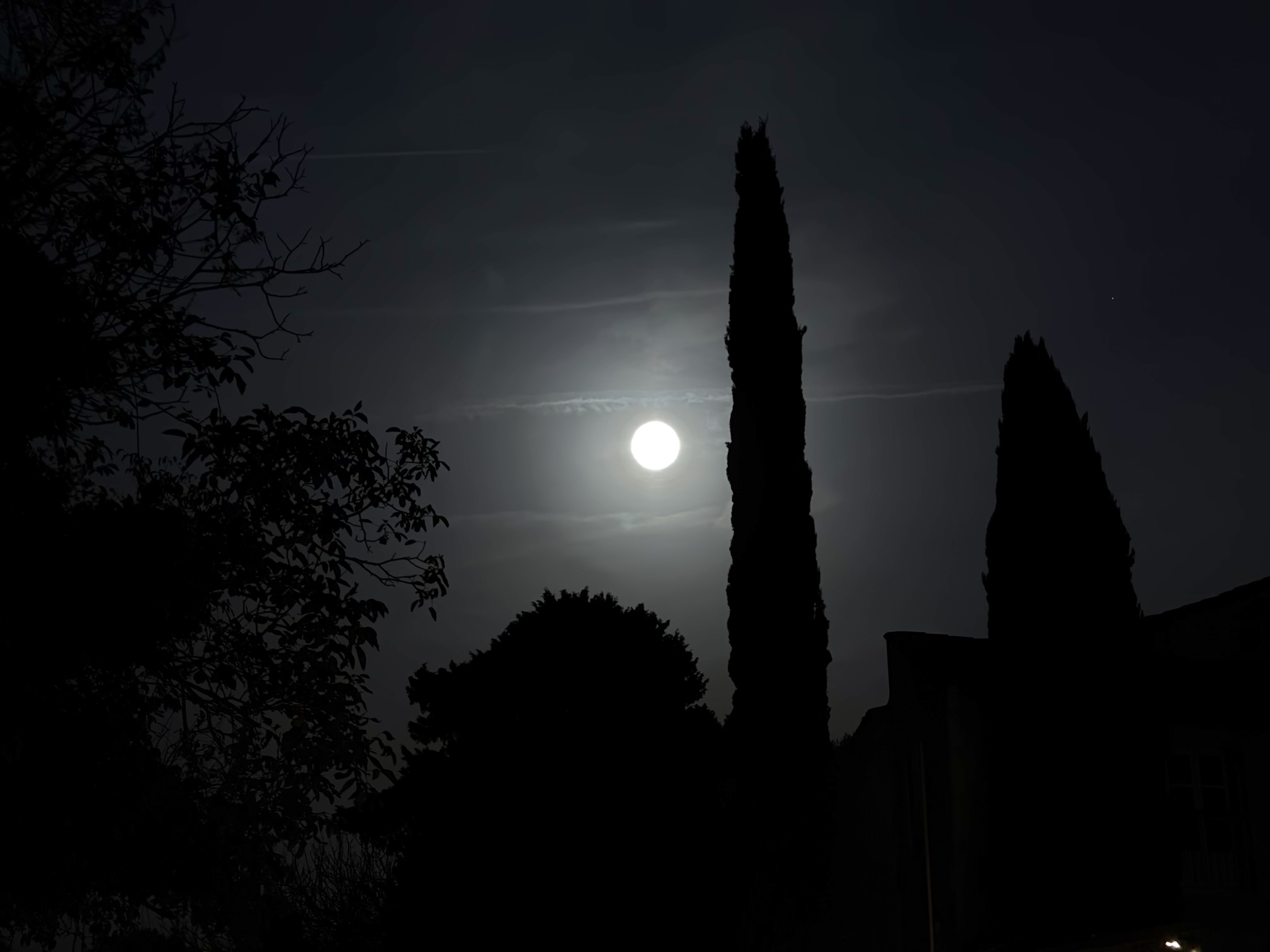
Provencal moon. Photograph by the author.

A homily for the First Sunday of Adven at Saint Barnabas Episcopal Church, Bainbridge Island, Washington.

The images of the Apocalypse are from the Tapestry of the Apocalypse in Angers, France. Originally 140 meters long, over time it has been reduced by a third. Woven in the late 14th century, it offers spectacular illustrations of the Book of Revelation.

[i] My free translation of Luke 21:28, 34-36.

[ii] W. H. Auden, New Year Letter (January 1, 1940).

[iii] q. in Alan Jacobs, The Year of Our Lord 1943: Christian Humanism in an Age of Crisis (Oxford: Oxford University Press, 2018), 10.

[iv] Ibid., 11.

[v] Dietrich Bonhoeffer, “After Ten Years” in Letters and Papers from Prison (Minneapolis: Fortress Press, 2010). Translated by Barbara and Martin Rumscheidt.

[vi] Simone Weil, quoted in Robert Zaretsky, The Subversive Simone Weil: A Life in Five Ideas (Chicago: University of Chicago Press, 2021), 155.

[vii] Thomas Merton, No Man Is an Island (206), q. in The Thomas Merton Encyclopedia (Maryknoll, NY: Orbis Books, 2002), 213.

[viii] Naomi Shihab Nye, “Break the Worry Cocoon,” Voices in the Air: Poems for Listeners (New York: Greenwillow Books, 2022), 96-97.

[ix] From the play, O’Carolan’s Farewell to Music by Patrick Ball and Peter Glazer, on the California Revels CD, Christmas in an Irish Castle (2001).

The Paschal Wisdom of Holy Week

In the Garden, an icon by the hand of the artist, Angelica Sotiriou, 2009.

I’m writing this on Maundy Thursday, the night of Jesus’ tender farewell supper with his friends—and the night he was handed over to malevolent powers. The beautiful icon from the hand of California sacred artist Angelica Soteriou [i] captures the wrenching moment between the solidarity of his loving community and the fatal desolation of his Passion. He is alone. Neither friends nor enemies share his existential space. He’s kneeling in prayer, arms stretched out, beseeching his Father for whatever is needed to make it through the night. But his hands remain open, receptive to a will not his own. Not my will, but thine. And though an annihilating blackness surrounds him, his body is held safely within the warm color of the mountain of God. Even when we feel alone, even abandoned, we are still enfolded within divine love and mercy. Our divine milieu is not an exemption from trouble, but an assurance against trouble’s finality.

On this holy Thursday, many churches, including mine, do the eucharist in the context of an actual shared meal. It is is our custom to eat in silence, which monastics know is a profound way to be together. Our silence is punctuated by a series of meditative readings from the Farewell Discourses, the words of encouragement, comfort and challenge which, in John’s gospel, Jesus speaks to his friends on the night before his execution. It’s not a reenactment of a past event. Those words are spoken directly to us, in our own fraught time.  

Tonight, however, we added a word from one of Jesus’ more recent friends, the theologian Dietrich Bonhoeffer, who was facing his own Gethsemane in a German prison. At Christmastide, 1944, a few months before he would be executed by the Nazis, he wrote a poem which was smuggled out of prison in a letter to his mother. Its expression of confidence and hope in the midst of an evil time not only echoes the spirit of Jesus’ Farewell Discourses, but it speaks strongly to our own latter days, when so many things are in peril.

Here is the versified translation of Bonhoeffer’s poem by the British hymn writer Fred Pratt Green:

By gracious powers so wonderfully sheltered,
and confidently waiting come what may,
we know that God is with us night and morning,
and never fails to greet us each new day.

Yet is this heart by its old foe tormented;
still evil days bring burdens hard to bear;
O give our frightened souls the sure salvation
for which, O Lord, you taught us to prepare.

And when this cup you give is filled to brimming
with bitter suffering, hard to understand,
we take it thankfully and without trembling,
out of so good and so beloved a hand.

Yet when again in this same world you give us
the joy we had, the brightness of your Sun,
we shall remember all the days we lived through,
and our whole life shall then be yours alone.[ii]

Yes, we too are living through “evil days” which weigh down “our frightened souls” with “burdens hard to bear.” But our brother Dietrich, like our brother Jesus, reminds us that there is an alternative to fear and despair, if we can find the courage to live into God’s future, come what may, and the Paschal wisdom to walk the Way of the Cross “thankfully and without trembling,” because we know that death doesn’t get the last word.

Now, as we move into Good Friday, listen to what Rowan Williams, former Archbishop of Canterbury, says about the cross:

Jesus crucified is God crucified; so we believe. Jesus is the total and final embodiment in history of God’s loving mercy; and so this cross is a unique, terrible, extreme act of violence—a summary of all sin. It represents the human rejection of love. And not even that can destroy God; with the wounds of the cross still disfiguring his body, he returns out of hell to his disciples and wishes them peace. There is our hope—the infinite resource of God’s love, the relationship with God’s creatures that no sin can finally unmake. God cares what we do because God suffers what we do. God is forever wounded, but forever loving. The possibilities of our relationship to God are indeed ‘new every morning.’” [iii]

In other words, says Williams, “we have a future because of God’s grace.” Bonhoeffer said the same thing, and he said it from death row. That’s what the Paschal Mystery of dying and rising is trying to tell us—not only in the rituals and narratives of Holy Week, but in the kind of lives we live when we fully embody the archetypal pattern of surrender and transformation. The way down is the way up. Lose your life to find it. Let go and let God.

There’s always more to say about this, of course, but it’s almost midnight, and tomorrow is the rigorous journey to the foot of the cross. And beyond that, there’s the Easter Vigil, a night of wonders when heaven and earth are joined and liturgical curators are left exhausted yet exultant in its wake. If you want to read more about the cross, try What Will the Cross Make of Us?, written in 2022 by my less tired self. For more on the Easter Vigil, try Just a Dream?—Reflections on the Easter Vigil.

I’m going to bed now, but let me leave you with a 3-minute trailer for the Triduum, pushing the point that the Triduum is not a la carte, but a 3-part connected sequence that wants to be experienced in full. The three-day Paschal passage from Passion to Resurrection isn’t just bingeing on liturgy. It’s a profound way of knowing that delivers you to a different place. As we say at my church every Holy Week, “The journey is how we know.”


[i] For more of Angelica Sotiriou’s compelling work, see her website: https://angelicasotiriou.com

[ii] Fred Pratt Green’s hymn adaptation of Dietrich Bonhoeffer’s poem appears in many hymnals and is available from Hope Publishing, Carol Stream, IL. For more on the poem’s creation and reception: https://www.umcdiscipleship.org/resources/history-of-hymns-by-gracious-powers

[iii] Rowan Williams, from a sermon excerpted in A Time to Turn: Anglican Readings for Lent and Easter Week (Harrisburg, PA: Morehouse Publishing, 2004), 99.

Keep Your Eyes on the Prize: Following Jesus in the Worst of Times

Caravaggio, The Calling of St. Matthew (1599-1600)

Any number of things can happen when we encounter Jesus. We might be comforted—or we might be uncomfortable. We might be healed—or we might be wounded. We might be instructed—or we might be turned upside down. Jesus is a difference maker. For better or worse, he comes to interrupt—and disrupt—our lives. 

Sometimes Jesus speaks to our heart. Sometimes he speaks to our mind. But every time, he speaks to our will, as he puts the crucial question: 

Will you come and follow me if I but call your name?
Will you go where you don’t know and never be the same?
Will you let my love be shown?
Will you let my Name be known?
Will you let my life be grown in you and you in me? [i]

We can always say no, of course. Many people have; many people do. Or we may profess our unreadiness or our inadequacy. “Are you kidding me?” said Moses at the Burning Bush. “Who am I to go and talk to Pharoah? I am slow of speech and slow of tongue.” In the same way, the prophet Jeremiah also resisted his call: “No way, Lord! Don’t ask me to be a prophet. I don’t know how to speak. I’m only a child.” God has heard all the excuses, but the Divine Intention is not easily dissuaded. “Just do it,” God says.

When Jesus tries to recruit a few followers in Luke 9:51-62, he hears plenty of excuses. “Lord, let me first go home and bury my father,” says one. This sounds reasonable enough, if he’s talking about a corpse back at the house that needs some prompt attention. But this line can also be understood to mean, “I can’t go anywhere as long as my parents are still living. Family obligations come first.”

Another makes a similar excuse: “I will follow you, Lord, but first I must go home to take my leave. I need to get permission from my family before I can come with you. And that may take some time.”

I don’t think Luke’s gospel is telling us to walk out of important relationships. Rather, it is prompting us to ask ourselves: What is so important in my life that I need its permission before I can follow Jesus? My true master might be something as big as the security of having somewhere comfortable to lay my head at night, or as trivial as my habitual routines. I’d love to follow you, Jesus, but let me check my calendar first. 

The excuses in Luke’s passage suggest a world of expectations, obligations, and best-laid plans that prevent us from running away to join the Jesus circus. Today we may enjoy far more social mobility than a first-century Middle-Easterner, but we each have our own version of situations and circumstances that delay and distract us. Some things just won’t let us go. It might be something lingering from our past, like unhealed anger or grief. Or it might be a present concern, like a steady income, emotional needs, or personal ambition.

Jesus says: If you want to follow me, nothing can have more authority over you than the will of God. As for the things that hold you back, just let them go. Let the dead bury the dead. It’s time to move on, deeper and deeper into God. Seek ye first the kingdom of God. And once you’ve put your hand to the gospel plow, don’t look back. Keep your eyes on the prize, hold on!

The call to be a follower of Jesus may arrive unexpectedly. It may seem inconvenient, or even impossible. But as the saints all tell us, it’s what we are made for. To borrow a line from songwriter Bob Franke, 

I can’t really say it’s the thing I do best, 
but it’s the best thing that I do. [ii]

True vocation is not so much surrender to an outside force as it is the recognition of an internal capacity. In his book, Let Your Life Speak, Parker Palmer makes this point beautifully. “Vocation does not come from a voice ‘out there’ calling me to be something I am not,” he writes. “It comes from a voice ‘in here’ calling me to be the person I was born to be, to fulfill the original selfhood given me at birth by God.”

“Vocation does not come from willfulness. It comes from listening. I must listen to my life and try to understand what it is truly about—quite apart from what I would like it to be about.… The word vocation … is rooted in the Latin for “voice.” Vocation does not mean a goal that I pursue. It means a calling that I hear. Before I can tell my life what I want to do with it, I must listen to my life telling me who I am.” [iii]

When Jesus calls me, it is, as it were, “my life telling me who I am.” And Jesus has many voices. You may hear him in the Scriptures or the liturgy, or when you enter the prayerful state of “absolute unmixed attention.”[iv] He will speak through the need of your neighbor, or in your deepest longing. His voice may come as dissatisfaction with the old, or as the intuition of fresh possibility. It may proceed from the mouth of friend and stranger. It may thunder like the transcendent Other, or whisper like the intimate inward presence who has known you all your life.

However Jesus may call us, what happens if we say yes? How do we put our hands to the plow, keep our eyes on the prize, and not look back? When we decide to follow Jesus, when we consent to lose our old lives in the Paschal Mystery of dying and rising, we are born again into a new way of being. No turning back, no turning back. But what will that new being look like? How will we be different? How will we make a difference?

St. Paul gives us a good list to start with in his letter to the Galatians (5:1, 13-25). Everything that binds, enslaves, and weighs you down, forget it. Instead of indulging yourselves, start loving one another. Say goodbye to enmities, strife, jealousy, anger, quarrels, dissensions, factions, envy and licentiousness. Practice love, joy, peace, patience, kindness, generosity, faithfulness, gentleness, and self-control. Let the Spirit dance in you. 

Paul’s advice seems radically countercultural in an America so sickened by hatred, division, malice, and fear—a contagion which has spread to a degree unimaginable just five years ago. As Judge Michael Luttig recently lamented in his testimony before the January 6th Select Committee, “In the moral, catatonic stupor America finds itself in today, it is only disagreement we seek, and the more virulent that disagreement, the better.” [v]

In such a country, such a world, such a time, what is a disciple to do? Well, there’s no easy answer, no single method or path. We must figure it out as we go, the way the saints of old did amid crumbling empires, or as Dietrich Bonhoeffer did in 1930s Germany, or as Martin Luther King did in a Birmingham jail. It will certainly require steadfast faith and boundless love, but perhaps it is courageous hope we will need most of all. 

In the worst of times, hope is the engine of persistence and the antidote for despair. Never forget: God makes a way where there is no way, and as God’s friends we are called to shine with that truth every day, “planting the seeds of resurrection amid the blind sufferings of history.” [vi]


[i] “The Summons,” a song from the Iona Community in Scotland (GIA Publications, 1987).

[ii] Bob Franke, “Boomerang Pancakes” (Telephone Pole Music, 1986).

[iii] Parker J. Palmer, Let Your Life Speak: Listening for the Voice of Vocation (San Francisco: Jossey-Bass, 2000), 10, 4.

[iv] The phrase is from Simone Weil.

[v] Michael Luttig, testimony before the January 6 Select Committee of the U.S. House of Representatives, June 16, 2022.

[vi] I believe I got this quote from an Orthodox theologian, but I can no longer trace the source. 

This post is adapted from a homily for the Third Sunday after Pentecost, 2022.

Living by the Sword: Putin and the Perils of Messianic Politics

Vladimir Putin and the icon of the Savior “not made by hands,” (Attibution: AP Photo/RIA Novosti, Alexei Nikolsky, Pool)

“The hour is late. The world is choked with weapons, and dreadful is the mistrust peering from all men’s eyes. The trumpets of war may blow tomorrow. Who knows if we shall see each other in another year? What are we waiting for? Peace must be dared. Peace is the great venture.”

— Dietrich Bonhoeffer (August 1934)

At a pro-war rally in Moscow last month, Vladimir Putin praised his troops for their embodiment of Christian love. “And this is where the words from the Scriptures come to mind,” he said. “‘There is no greater love than if someone gives up his soul for his friends.’ The heart of the message is that this is a universal value for all the people and all the confessions of Russia …. Shoulder to shoulder they are helping and supporting each other and when it’s necessary they cover as if it was their own brother, they cover each other from the bullets. We haven’t had such unity in a long time.”[i]

The crowd loved the speech. “Forward Russia!” they chanted. Jesus! Love! Unity! Was this a political rally, or a religious revival? Some of each, I would think. For a thousand years of Russian history, politics and religion have been closely entwined. In 988, after the Christian conversion of Prince Vladimir of Kievan Rus’—the original Russian state—his subjects waded into the Dnieper River to be baptized en masse.

The fact that this birth narrative of Slavic Orthodoxy took place in Kyiv helps explain the lingering Russian attachment to the Ukrainian capital. It’s their Jerusalem. Even though the Ukrainian Orthodox Church was granted independence from its Russian counterpart in 2018, one third of the Orthodox churches still loyal to the Moscow Patriarchate are situated in the Ukraine, and Putin has argued that his army is coming to their defense. 

The mythology of Holy Rus’, a divinely ordered “kingdom” of Slavic believers—a “Third Rome” inheriting the world-transforming mission of its failed predecessors in Europe and Constantinople—became a staple of Russian identity. In contrast to the perceived decadence, individualism, and secularism of the West, Holy Rus’ was thought to preserve communal spiritual values for the sake of all humankind. In a famous speech given in 1880, Dostoevsky said:

“[T]o be a true Russian does indeed mean to aspire finally to reconcile the contradictions of Europe, to show the end of European yearning in our Russian soul, omni-human and all-uniting, to include within our soul by brotherly love all our brethren, and at last, it may be, to pronounce the final Word of the great general harmony, of the final brotherly communion of all nations in accordance with the law of the gospel of Christ!”[ii]

When Russia seized Crimea in 2014, such Third Rome mythology seemed alive and well when Foreign Minister Sergei Lavrov dismissed the protests of the “godless West, hostile to the Russians because we [remain] Christian traditionalists.”[iii] Many observers think the invasion of Ukraine is fueled by the same mythology. If so, Putin’s nostalgia for the old Russian Empire would be more than the product of personal and political ambition. It would amount, in that case, to a crusade to recover the lost lands of Holy Rus’ and restore the Third Rome to its proper glory. To let Ukraine drift away into western decadence would betray the myth.

Historian Anna Geifman dismisses any speculation about Putin’s mental stability:

“He’s not crazy — he’s messianic,” she says. “What Putin says is logical, and consistent with his entire policy since 2008 … To sustain his legitimacy, the regime chose to delineate a more national-patriotic and anti-Western direction, grounding its appeal on a strong conservative, Orthodox [Christian] foundation …  He may not use that term [the Third Rome], but he talks about the corruption of the West, with its ‘everything goes’ lifestyle that no longer differentiates between good and evil … Disregarding historical evidence to the contrary, Putin views Ukraine as part of the Russian family. Their independence is a slap in the face to his ideology.”[iv]

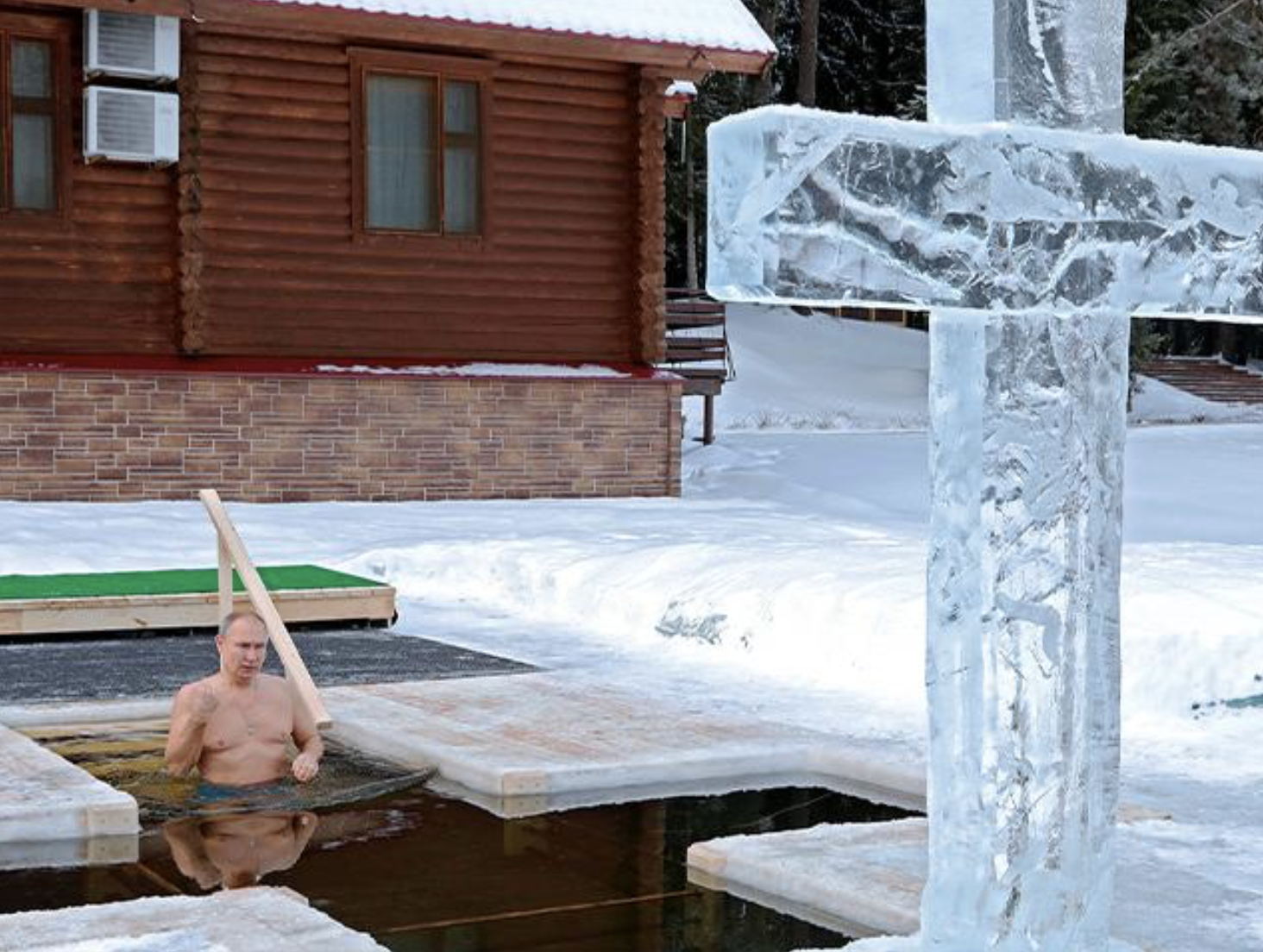
Vladimir Putin observers an Orthodox Epiphany ritual imitating the baptismal immersion of Christ.(Attribution: Mikhail Klimentyev, Sputnik, Kremlin Pool Photo)

Putin is coy about his personal beliefs, though he wears a cross around his neck and makes a public display of his Orthodox rituals. Is his employment of Holy Rus’ rhetoric just a cynical ploy to move the masses, or is he a religious crusader at heart? And which would be worse? Either way, the resulting atrocities have been horrifically evil. The Russian messiah is a war criminal.

Empty strollers in Lviv represent the children killed in the war’s first 3 weeks.

The unholy matrimony of religion and violence is always toxic, poisoning both church and world. We have seen too much of that right here in the United States. Many of the violent seditionists who stormed the Capitol on January 6, 2021, thought they were enacting God’s will. They blew shofars to make “the walls of corruption crumble.” They waved Jesus banners and Bibles, dragged large crosses into the fray, erected a gallows for their enemies. Their madness was driven by a core belief: “God, guns, and guts made America.”[v]

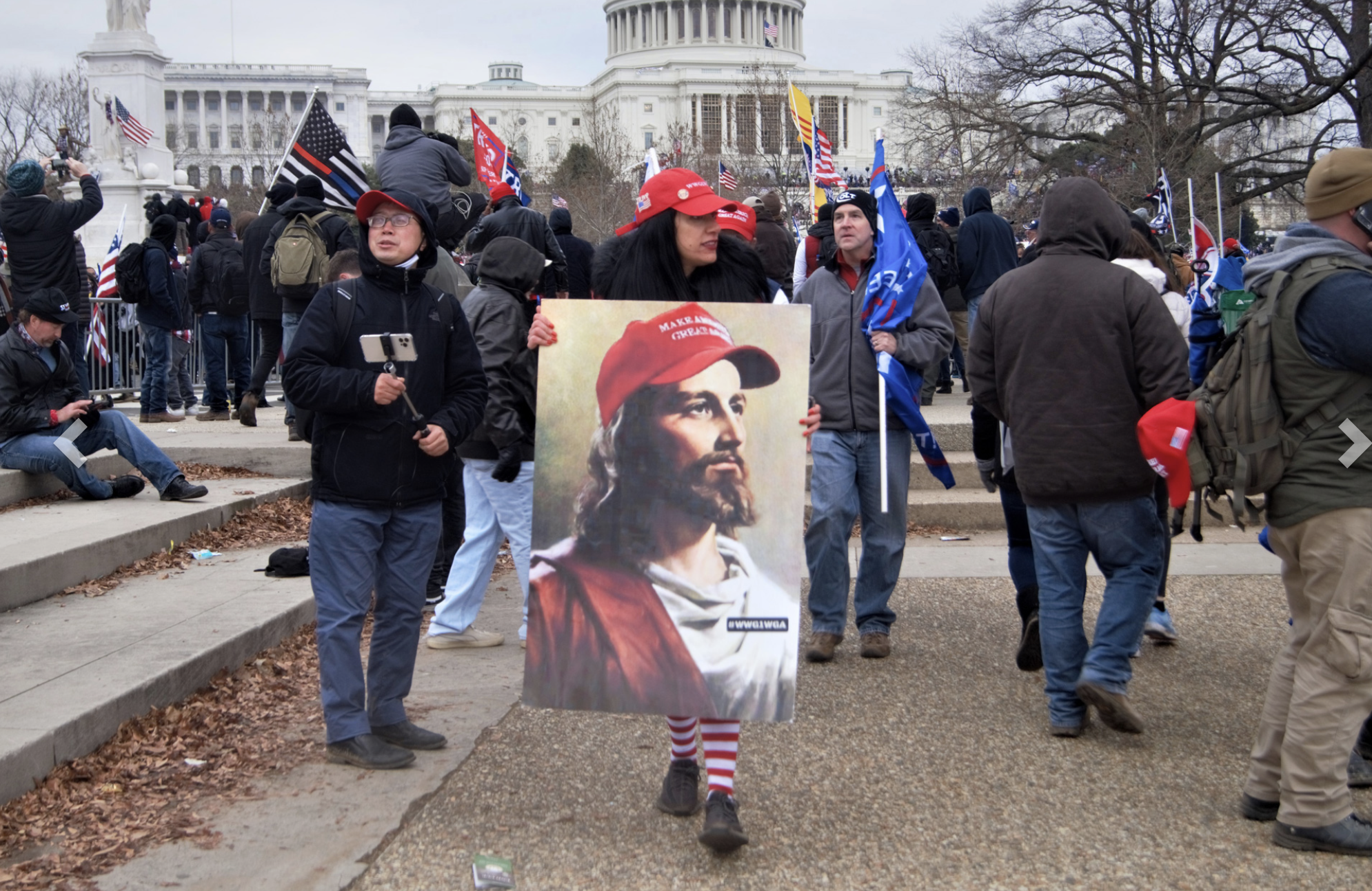
MAGA Jesus at the January 6 insurrection.

It wasn’t just the confused angers of the mob at work. The madness was deployed by the highest levels of government. As Capitol police were being beaten and killed and politicians were running for their lives, the President’s Chief of Staff sent an email from the White House to the sedition-enabling wife of a Supreme Court justice: 

“This is a fight of good and evil … Evil always looks like the victor until the King of Kings triumphs. Do not grow weary in well doing. The fight continues …”[vi]

For the seditionists, and a majority of white Evangelicals overall, Trump was a messianic figure, seeming to offer deliverance and rebirth to a desperate and despised people. “Donald Trump is in the Bible,” a rioter told a journalist. “Get yourself ready.”[vii]

The moral and theological collapse of right-wing Christianity in America echoes the capitulation of the Protestant German Church to the Third Reich. In the 1930s, most German clergy and theologians joined the Nazi party. Some were just playing it safe, but others were swept up in the nationalistic fervor. It became customary to conclude the baptismal rite by praying “that this child may grow up to be like Adolf Hitler.” And the head of the government Ministry of Church Affairs declared in 1935 that the Führer was “the bearer of a new revelation … Germany’s Jesus Christ.”[viii]

In the face of such absurd and blasphemous perversions of Christianity as we have seen in Russia, Germany, and the United States, what are God’s friends to do? Some would have us abandon religion altogether. Recent American studies have shown that many of the “nones” cite bad politics as their primary reason for rejecting Christianity, while many churches are themselves retreating from public life to avoid the contaminating risks of political action.[ix]

Dietrich Bonhoeffer

Dietrich Bonhoeffer was a German theologian and pastor who came of age during the rise of the Nazis. During a fellowship year at Union Theological Seminary in New York, he absorbed Professor Reinhold Niebuhr’s Christian realism. If you avoid history’s messy struggles to preserve your purity, Niebuhr warned, the vacuum you leave will be filled by the demonic. 

Attending an activist black church in Harlem also had an enormous impact on young Bonhoeffer. As his superb biographer Charles Marsh has written, “No longer would he speak of grace as a transcendent idea but as a divine verdict requiring obedience and action. The American social theology … had remade him into a theologian of the concrete.”[x] When, a decade later, he joined a conspiracy to assassinate Hitler, “he would abandon any hope of innocence, incurring the guilt of responsible action. Of the two evils, it was the one he could abide.”[xi] The failed plot would cost him his life. He died in a concentration camp two weeks before it was liberated by the Allies. His body was never found. 

Bonhoeffer had assented to a selective use of violence in order to interrupt mass murder. The unspeakable suffering of the many outweighed his own need for innocence. But he did not do it lightly, and the political captivity of the German Church made him keenly aware of how religion’s engagement with culture can easily go off the rails. He thought deeply about the ambiguities involved in repairing a broken world, but he knew that we cannot just think our way out of the human condition. We need something more, something divine. And words he wrote during the dark days of World War II still point the way:

“Who stands firm amidst the tumult and cataclysms? … The huge masquerade of evil has thrown all ethical concepts into confusion … The failure of ‘the reasonable ones’—those who think, with the best of intentions and in their naïve misreading of reality, that with a bit of reason they can patch up a structure that has come out of joint—is apparent. With their ability to see impaired, they want to do justice on every side, only to be crushed by the colliding forces without having accomplished anything at all. Disappointed that the world is so unreasonable, they see themselves condemned to unproductiveness; they withdraw in resignation or helplessly fall victim to the stronger … Who stands firm? Only the one whose ultimate standard is not their reason, their principles, conscience, freedom, or virtue; only the one who is prepared to sacrifice all of these when, in faith and relationship to God alone, they are called to obedient and responsible action. Such a person is the responsible one, whose life is to be nothing but a response to God’s question and call.”[xii]


[i] https://www.thenationalnews.com/world/europe/2022/03/18/putin-rallies-stadium-crowds-and-lauds-troops-fighting-in-ukraine/ The quotation is a paraphrase of Jesus’ words in John 15:13, just after he says, “Love one another as I have loved you.” Putin used the Russian word for soul (душу (dushu) instead of the biblical “life.”

[ii] Dostoevsky’s speech, given in honor of Russian poet Aleksandr Pushkin (1799-1837), can be found here: http://web.archive.org/web/20050207093332/http://www.dwightwebber.com/pushkinspeech.html

[iii] Quoted in Binyamin Rose, “Russia’s Deep-Seated Messianic Complex,” Mishpacha: Jewish Family Weekly (Mar. 15, 2022) https://mishpacha.com/russias-deep-seated-messianic-complex/

[iv] Ibid.

[v] Emma Green, “A Christian Insurrection” (The Atlantic, Jan. 8, 2021).

[vi] David French, “The Worst Ginni Thomas Text Wasn’t from Ginni Thomas (The Atlantic, March 25, 2022).

[vii] Jeffrey Goldberg, “Mass Delusion in America” (The Atlantic, Jan. 6, 2021).

[viii] Charles Marsh, Strange Glory: A Life of Dietrich Bonhoeffer (New York: Vintage Books, 2014), 283, 271.

[ix] Ruth Braunstein, “The Backlash against rightwing evangelicals is reshaping American politics and faith” (The Guardian, Jan. 25, 2022).

[x] Marsh, 135.

[xi] Ibid., 346.

[xii] Ibid., 341.

When Love is the Way

Magnus Zeller, The Orator, Germany c. 1920 (Los Angeles County Museum of Art)

The Episcopal “Daily Office” provides prayers and Scripture for various times of day. Derived from medieval monastic liturgies, the practice of hallowing the beginning, middle and end of our days with both corporate and private prayer can offer refuge and refreshment, lifting us out of the relentless rush of time to remember what it’s all about and deepen our connection with the holy One, who is our Source, our Companion, and our End.

This venerable prayer practice is not an escape from the world, but a way of attending to it with clearer vision. Thus the Daily Office offers challenge as well as comfort. The God of history will not let us ingore the calamity and suffering wrought by what the original Book of Common Prayer called “the devices and desires of our own hearts.”

Sometimes the biblical readings seem ripped from the headlines, like this week’s Wednesday reading from Proverbs:

There are six things that the Lord hates,
seven that are an abomination to him:
haughty eyes,
a lying tongue,
and hands that shed innocent blood,
a heart that devises wicked plans,
feet that hurry to run to evil,
a lying witness who testifies falsely,
and one who sows discord in a family.[i]

I have to confess that in the midst of my prayer time I succumbed to uncharitable amusement when I read these words. They describe the American president––and his corrupt and cruel minions––so perfectly! But neither righteous outrage nor satirical jesting––and certainly not any presumption of our own goodness––will deliver us from the menace of these times.

Of course we must take sides against the malicious designs of evil tyrants in order to defend the vulnerable and preserve the common good. As Reinhold Niebuhr reminded my generation of theology students, trying to keep one’s own hands clean in a dirty conflict can be a form of capitulation. Sometimes our innocence must be sacrificed in the historical struggle for a better world. Dietrich Bonhoeffer knew this when he joined the plot against Hitler.

But engaging the powers of darkness solely on their own terms is toxic, perhaps fatal, in the long run. If our goal is community and communion, we cannot make division and opposition our primary weapons. On the day following the assassination of Martin Luther King (and two months before his own violent end), Bobby Kennedy made this point boldly to an audience afflicted by passions of grief, fear and rage.

“We must recognize that this short life can neither be ennobled or enriched by hatred or revenge. . . . violence breeds violence, repression brings retaliation, and only a cleansing of our whole society can remove this sickness from our soul.”[ii]

The United States has weathered dark and dangerous times before. But with the exception of the Civil War, has there been another time when our nation’s very survival has been in such doubt? Institutional and legal norms are under daily assault by the White House and Congress; Republicans turn a blind eye to corruption and the clear threat to democracy; racism, hatred and fear are fostered and encouraged by “the most powerful man on earth,” and a third of this country lives in a fact-free bubble, impervious to reason and morality. A recent headline called us “The Banana States of America.”[iii]

Bells of warning should ring out Danger! in every city and town. Prophets should shout The end is near! on every street. Pundits may worry, dissenters object, and activists resist, but where is the widespread public cry of peril and alarm? Imagine such passivity after Pearl Harbor or 9/11. Are most of us still taking for granted our national stability? Do we simply assume everything will return to normal after the next two elections?

In a recent Washington Post column, “Watch What Happens in Rome,” Anne Applebaum examines current Italian politics as a disturbing cautionary tale for the United States. After finally ousting a corrupt authoritarian leader, Italy failed to revert to a more benign and centrist public order.

“Reeling from the flood of broken promises, electorates did not turn back to honest realists who told them hard truths or laid out the hard choices. On the contrary: In Italy, as in so many Latin American countries in the past, the failure of populism has led to greater dislike of “elites,” both real and imaginary; a greater demand for radical and impossible change; and a greater sense of alienation from politics and politicians than ever before.”

Applebaum then wonders what we all should be wondering:

“In President Trump’s wake, we too are not necessarily going to return to the status quo ante, to a tame trade-off between centrist conservatives and centrist liberals, all of whom respect the Constitution, believe in the old definitions of patriotism and get elected based on their experience and political views. It is just as likely that national politics becomes a patchwork of competing, incompatible single-issue groups and causes; that otherwise disparate groups meet one another online and form temporary alliances. It is just as likely that irresponsibility and irrationality become something that people vote for, not something that they reject. Watch what happens in Rome, because it could be America’s future.”[iv]

Whether this or some other equally destabilizing scenario should come to pass, what are the friends of God called to do? Sadly, many of my Christian brothers and sisters are only making things worse. As another columnist, Leonard Pitts, lamented last week:

“Having seen putative Christians excuse the liar, rationalize the alleged pedophile, justify the sexual assaulter and cheer as walls are raised against the most vulnerable, it’s obvious that many of those who claim that name embody a niggardly, cowardly, selfish and situational “faith” that has little to do with Jesus.”[v]

In encouraging contrast to such shameless apostasy, an ecumenical group of Christian leaders has issued a timely manifesto, “Reclaiming Jesus: A Confession of Faith in a Time of Crisis.” Click the link to read the whole text, and share widely. It’s a good theoretical foundation for a gospel-based resistance.

The Confession is structured in six sections, pairing what we believe as disciples of Jesus and what we reject. Yes to imago Dei, no to racism; yes to compassion and kindness, no to neglect or abuse of the vulnerable; yes to servanthood, no to domination; yes to communion, no to division and oppression; yes to truth, no to lies; yes to global community, no to “America first.”

The last of these may be the most challenging for those who subscribe to the great American heresy of exalting nation over God. As Clarence Jordan observed many years ago, the biggest lie told in America is, “Jesus is Lord.” But “Reclaiming Jesus” aims higher: “Our churches and our nations are part of an international community whose interests always surpass national boundaries. We in turn should love and serve the world and all its inhabitants rather than to seek first narrow nationalistic purposes.”

Tonight the framers of this Confession are processing to the White House gates for a candlelight vigil. As they have written,

“We are living through perilous and polarizing times as a nation, with a dangerous crisis of moral and political leadership at the highest levels of our government and in our churches. We believe the soul of the nation and the integrity of faith are now at stake.”[vi]

Among the many church leaders marching in that procession will be the Most Rev. Michael Curry, the Episcopal Presiding Bishop whose sermon on love’s redemptive power, at last week’s royal wedding, invited a global audience to imagine the world as God made it to be:

Imagine our homes and families when love is the way.
Imagine neighborhoods and communities when love is the way.
Imagine our governments and nations when love is the way.
Imagine business and commerce when love is the way.
Imagine this tired old world when love is the way.[vii]

Let all the people say: Amen!


 Related posts

7 Spiritual Practices: A To-do List for the Time of Trial

Dante and Lewis Carroll Walk into a Dark Wood


[i] Proverbs 6:16-19.

[ii] Remarks to the Cleveland City Club, April 5, 1968: https://www.jfklibrary.org/Research/Research-Aids/Ready-Reference/RFK-Speeches/Remarks-of-Senator-Robert-F-Kennedy-to-the-Cleveland-City-Club-Cleveland-Ohio-April-5-1968.aspx

[iii] Patrick T. Fallon, “The Banana States of America,” Washington Post, May 22, 2018.

[iv] Anne Applebaum, “Watch what happens in Rome. It could be our post-Trump future,” Washington Post, May 18, 2018.

[v] Leonard Pitts, “Oregon school district forced LGBTQ students to read the Bible––how Christian,” Miami Herald, May 17, 2018 (http://www.miamiherald.com/opinion/opn-columns-blogs/leonard-pitts-jr/article211384374.html).

[vi] “Reclaiming Jesus: A Confession of Faith in a Time of Crisis” (http://www.reclaimingjesus.org)

[vii] https://www.episcopalchurch.org/posts/publicaffairs/presiding-bishop-currys-sermon-royal-wedding