Seeking the Good at the End of the World (Homily for Advent 1)

Extra! Extra! Read all about it.
SUN GOES OUT!
STARS FALL FROM HEAVEN!
THOUSANDS FAINT FROM FEAR!

On the first day of the Christian Year, do we break out the champagne and shout “Happy New Year.” No we do not. What we say is, “The end is near!”

We don’t get all Fundamentalist about it. We don’t walk around wearing signboard warnings. We don’t declare a fixed date for the end of history. We prefer to keep our end time theology more metaphorical than literal. Worlds end all the time. Personal worlds. Public worlds.

Still, this year, from Gaza and Ukraine to Washington, D.C., the end of the world feels closer to being literal than any other time in my 80 years on the planet. To borrow some lines from W. H. Auden’s Good Friday poems, lately it feels as if the world we know has been “wrecked, / Blown up, burnt down, cracked open, / Felled, sawn in two, hacked through, [and] torn apart.”

For Christians, the end of the world should not come as a total surprise. Every gospel on the First Sunday of Advent includes a forecast of the apocalypse—the end of the world as we know it. It’s not that uncommon, actually. Who has not experienced apocalypse on a personal level—the exit from childhood, the loss of a job or a loved one, a scary diagnosis? And throughout history, apocalyptic episodes have periodically disrupted the stability of humanity’s collective life: the fall of empires, economic crashes, military invasions, revolutions, authoritarian nightmares, environmental crises, and the like.

In the Humphrey Bogart movie, Beat the Devil, a ship is floundering on a stormy sea. In his typical wise-cracking manner, Bogie says to a panicky passenger, “What have you got to worry about? We’re only adrift on an open sea with a drunken captain and an engine that’s liable to explode at any moment!”

A crewman chimes in: “Perfectly ordinary situation. It happens every day.”

Like it or not, we’re all on board that sinking ship at the close of 2024, praying desperately with the Psalmist, “Save me, O God! The water has risen up to my neck; I’m sinking into the mire” (Psalm 69:1-2) Perfectly ordinary situation. It happens every day.

Angel blowing the 2nd trumpet as the sea swallows ships and sailors (Revelation 8:8). The Apocalypse Tapestry of Angers (1373-1382). Photograph by the author.

When I was younger, I had a crushing experience of my personal world coming undone. A spiritual director summed up my situation as being washed overboard into a wild sea, where I’m flailing to keep my head above water.” “Sounds about right,” I said mournfully. “Well, congratulations!” he told me. “You’re exactly where you need to be.” I had to laugh at the aptness of his metaphor. My apocalypse had indeed revealed the unsustainability of my former state, even as it hurled me into the formless chaos from which my new world would be born.

Saint Michael weighing souls (c. 1180), Saint-Trophime, Arles, France. Photograph by the author.

Apocalypse can be an unwelcome judgment on the way things are. It weighs the world in the scales of justice and finds it wanting. The judgment is not punitive, simply accurate. As a 14th-century English poem on the end of the world put it, the apocalypse judges “without revenge or pity.” It just tells it like it is. Still, it’s a hard thing to face the truth about our flawed condition. However, the end of an old reality can also be life-giving, freeing us to discover a better version of self and world.  

But where can we put our feet when the ground is crumbling beneath us?  We stand on God’s word, God’s promise, God’s hope. “Heaven and earth will pass away,” Jesus says, “but my words will not pass away.” Let the Savior’s words guide us. Let them encourage us. As he told his disciples,

“When the chaos comes, keep your heads high and stand your ground. Your liberation is on its way.  Don’t be distracted by thoughtless living, or get weighed down with worry,” he says. “Be alert at all times, and pray that you’ll have the strength to get through all this craziness.” [i]

This is my 55th year of preaching in Advent. It’s my favorite season, so rich with resonant and stirring themes: endings and beginnings, light and darkness, waiting and preparing, watching and hoping, expectation and, in the end, marvelous birth. But this year Advent feels decidedly more urgent and more serious to me than ever before. We aren’t just reading about a people who sit in darkness. We are those people.

We could weep and moan about being stuck in this particular moment in history. But what if the Lord of history is telling us, “Congratulations! You are just where you need to be—in the wild baptismal sea of rebirth. Come, take up your cross. Following me is about to get really real and really intense. Costly? Yes. Suffering? Yes. Dying? Yes. Rising? Yes! Start to live the risen life like you mean it!

Okay, Lord. But what exactly is that going to entail? This question came up when I ran into friend from church on the ferry last week. “What are we supposed do if they begin to round up the most vulnerable in our midst?” she asked. “Join hands to block their way with our bodies?” The strangeness of such a hypothetical even being asked in our peaceful corner of the world prompted a helpless shrug.

Seeking some guidance from my library, I pulled out a book published a few years ago: The Year of Our Lord 1943: Christian Humanism in an Age of Crisis. The author, Alan Jacobs, examins the responses of Christian intellectuals to the violent chaos of the Second World War. What did some of the most articulate of God’s friends have to say about being faithful in a dark and dangerous time?  

When the war broke out in 1939, Anglican poet W. H. Auden put the case bluntly: We must love one another or die. A year later, he wrote New Year Letter (January 1, 1940), a long poem considering “what is possible and what is not” in such a time.

Most of the poem is addressed to Elizabeth Mayer, a supportive maternal figure who was a key source of peace and happiness in Auden’s life.

We fall down in the dance,” he wrote. “We make
The old ridiculous mistake,
But always there are such as you
Forgiving, helping what we do.
O every day in sleep and labour
Our life and death are with our neighbor.

In other words, we are all in this together. The end of New Year Letter is addressed to God, asking for divine help in making a better world, since we humans are too muddled to do it on our own.

“Send strength sufficient for our day,” he wrote. “And point our knowledge on its way.”[ii]

His friend C. S. Lewis worried about the Church endorsing the violence in its prayers. On September 10, 1940, he wrote to his brother, “In the litany this morning we had some extra petitions, one of which was ‘Prosper, O Lord, our righteous cause.’ I ventured to protest against the audacity of informing God that our cause was righteous—a point on which He may have His own view.” [iii]

Lewis preferred the wartime collect of Thomas Cranmer, the Archbishop of Canterbury who made the first Book of Common Prayer. During hostilities with Scotland in 1548, Cranmer wrote this extraordinary collect:

“Most merciful God, the Granter of all peace and quietness, the Giver of all good gifts, the Defender of all nations, who hast willed all men to be accounted as our neighbours, and commanded us to love them as ourself, and not to hate our enemies, but rather to wish them, yea and also to do them good if we can: … Give to all us desire of peace, unity, and quietness, and a speedy wearisomeness of all war, hostility, and enmity to all them that be our enemies; that we and they may, in one heart and charitable agreement, praise thy most holy name, and reform our lives to thy godly commandments.” [iv]

In other words, in times of conflict, Christians must take care not to mirror the violence we oppose. We must find a way toward peace and reconciliation. But what if there are no good choices available?

The German theologian Dietrich Bonhoeffer knew how bitter conflict corrodes the human heart. In a 1942 letter to fellow members of the German resistance, he wrote:

“Unbearable conflicts have worn us down or even made us cynical. Are we still of any use? We will not need geniuses, cynics, people who have contempt for others, or cunning tacticians, but simple, uncomplicated and honest human beings.” [v]

In the desperate hope of derailing the Nazi horror, Bonhoeffer reluctantly joined a conspiracy to assassinate Hitler. The plot failed and he was executed for his role in it. A new film about him depicts him going to the gallows confident in his own purity of heart, but the fact is he never stopped feeling guilty for his participation the way of violence. He felt corrupted by the whole milieu of bloody conflict: shooting, wrecking, bombing—none of it is untainted by evil.

Simone Weil, French philosopher and activist, agreed that everyone is a victim of war. No one involved in the application of force escapes its toxicity. “To the same degree,” she said, “though in different fashions, those who use it and those who endure it are turned to stone.” When the Second World War started, Weil warned that

“We should not think that because we are less brutal, less violent, less inhuman than those we are confronting, we will prevail.” We must find a way, she insisted, to exercise the opposing virtues.

In late 1942, when Weil was working in the London office of the French Resistance, she proposed a plan to parachute hundreds of white-uniformed nurses onto battlefields, not only to tend to the wounded but also to provide an image of self-sacrificial goodness in the midst of cruelty and violence. She herself wanted to be in the first wave of this non-violent invasion. In submitting her plan to the Free French authorities, she made a visionary argument:

A small group of women exerting day after day a courage of this kind would be a spectacle so new, so significant, and charged with such obvious meaning, that it would strike the imagination more than any of Hitler’s conceptions have done.” [vi]

Charles de Gaulle thought her quite mad, and her plan of course went nowhere. But her saintly resistance to the application of force was a bright candle in the wind of war.

I am moved by all the stories of faithful people trying to follow the light in an age of shadows. Their wsdom can guide us. Their endurance can encourage us.

Now saintly virtues may not be the way of the world, but as Thomas Merton liked to say, we are not called to be successful. We are called to be faithful. “Perfect hope,” he wrote, “is achieved on the brink of despair when, instead of falling over the edge, we find ourselves walking on air.” [vii]

Remember those old Sherlock Holmes movies with Basil Rathbone> In 1942, when the outcome of the war was still uncertain, Universal Studios modernized Holmes, recruiting the Victorian detective for the war effort in Sherlock Holmes and the Voice of Terror. After a successful takedown of Nazi spies, Holmes and Watson walk to edge of Dover’s cliffs to gaze across the English Channel. Watson begins the conversation that concludes the film:

—“It’s a lovely morning, Holmes.”
—“There’s an east wind coming, Watson.”
—“Oh, I don’t think so. It looks like another warm day.”
—“Good old Watson. The one fixed point in a changing age. There’s an east wind coming, all the same. Such a wind as never blew in England yet. It will be cold and bitter, Watson. And a good many of us may wither before its blast. But it’s God’s own wind, none the less. And a greener, better, stronger land will lie in the sunshine when the storm has cleared.”

That bit of wartime propaganda, pep talk for a battered nation, came to mind as I pondered on today’s apocalyptic theme. “A cold and bitter wind … many of us may wither before its blast.” An accurate forecast. But beyond that, a glorious spring, when a “greener, better, stronger land will lie in the sunshine.”

God, bring that day closer. In the meantime, we pray with Emily Dickinson (#131):

Grant me, O Lord, a sunny mind—
Thy windy will to bear!  

So—How exactly do we cultivate a sunny mind in a gloomy time? We’ve all been working that problem this fall. Over the past month, I’ve found myself focusing on three spiritual practices: Do not let your hearts be troubled … Don’t get lost in the dark … Remember beauty.

First thing: Do not let your hearts be troubled. Step away from the screen. Don’t obsess on worst case scenarios, fretting over every potential bad outcome. There are too many to count, and it will only discourage and exhaust you. Sufficient unto the day is the evil thereof.

As Palestinian-American poet Naomi Shihab Nye reminds us, we must “Break the Worry Cocoon”—

To live with what we are given—
graciously, as if our windows open wide as our
neighbors’, as if there weren’t insult at every turn.
How did you do that? … 

How did you survive so much hurt and remain gracious,
… how did you believe,
then and forever, breaking out
of the endless worry cocoon,
something better might come your people’s way? [viii]

Second thing: Don’t get lost in the dark. Don’t get mesmerized by the horror. Evil is like Medusa’s face. Gaze too long and you turn to stone. How do we hate hate without becoming hateful ourselves? The rage provoked by repugnant beliefs, bad behavior and delusional assertions can become addictive. It feels good to denounce the deplorable scoundrels. It’s even entertaining to watch others do it. We think we are resisting evil, but our hate only serves to feed the beast.

Third thing: Remember beauty.

During the American Civil War, landscape painting was very popular. It offered tranquil scenes of an American Eden, unspoiled by the tragedies of history. There wasn’t the slightest hint of the violence raging in the land. When I was looking through reproductions of those works the other day, I was particularly struck by Alfred Thompson Brecher’s “Up the Hudson.” The broad river is absolutely still. The misty atmosphere glows with amber light. One tiny figure drifts quietly in his canoe. It is a picture of absolute calm and peace. I was taken by its beauty, but what really hit me was the year it was painted: 1864, the same year the painter’s brother died in one of the war’s bloodiest battles.

Alfred Thompson Brecher, Up the Hudson (1864).

And I wondered: Did Brecher paint it before or after he got the terrible news? I’d like to think it was after, as if the artist were resisting despair by pledging his allegiance to the harmonizing beauty of God’s creation, a beauty that transcends every evil.

Remember beauty. In October, 1967, 100,000 people gathered at the Lincoln Memorial in the nation’s capital for the first national demonstration against the war in Vietnam. I was there with a number of fellow seminarians. There were speeches and songs during the day, but around sunset about half the crowd marched across the Potomac to the Pentagon, which was surrounded by soldiers in gas masks holding rifles with fixed bayonets. They stood frozen like statues when young women stuck flowers in their gun barrels. I had a camera, and took some dramatic closeups of the soldiers.

Paratroopers guard the Pentagon during the first national protest against the war in Vietnam (Octobver 21, 1967). Photograoph by the author.

As the evening progressed, tensions grew, and a riot broke out, with lots of tear gas and hundreds of arrests. But I missed all that violence, because I had left early in order see the full moonrise over the reflecting pool in the National Mall. It was absolutely beautiful. I still have the photograph.
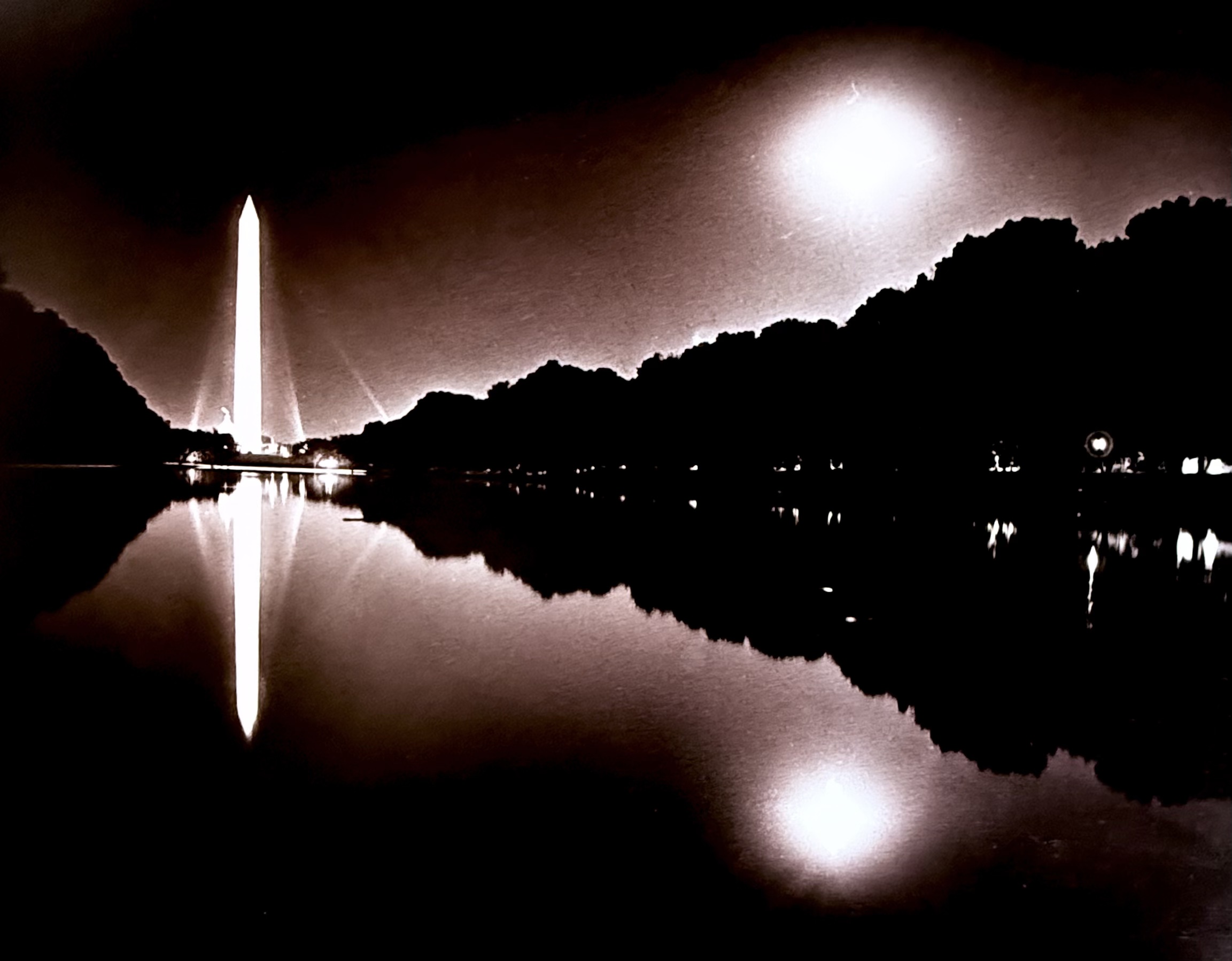
The full moonrise at the National Mall in Washington, D.C., on October 21, 1967. Across the Potomac at this moment, demonstators are clashing with paratroopers at the Pentagon. Photograph by the author.

On that day I had done my part in a public witness for peace; but when night came, the very best thing I could do was to notice the beauty of the moonrise. I like to think that both those things got recorded in the Book of Life. Come, labor on; but don’t forget the Sabbath moments.

Dear friends in Christ, let us cast away the works of darkness and put on the armor of light. Keep the faith. Fear not. Embody hope. Love one another. Trust divine intention. This is the holy work God has given us to do.

A few hundred years ago, Turlough O’Carolan, the blind harper and last of the Irish bards, was sitting in a tavern with his friend, the poet Charles McCabe. McCabe said, “Your music, sir, is grand and lovely stuff, but too light-hearted. This is a dark time we live in, Mr. Carolan, and our songs should reflect that.”

And the harper replied, “Tell me something, McCabe. Tell me this: Which do you think is harder—to make dark songs in the darkness, or to make brilliant ones that shine through the gloom?” [ix]
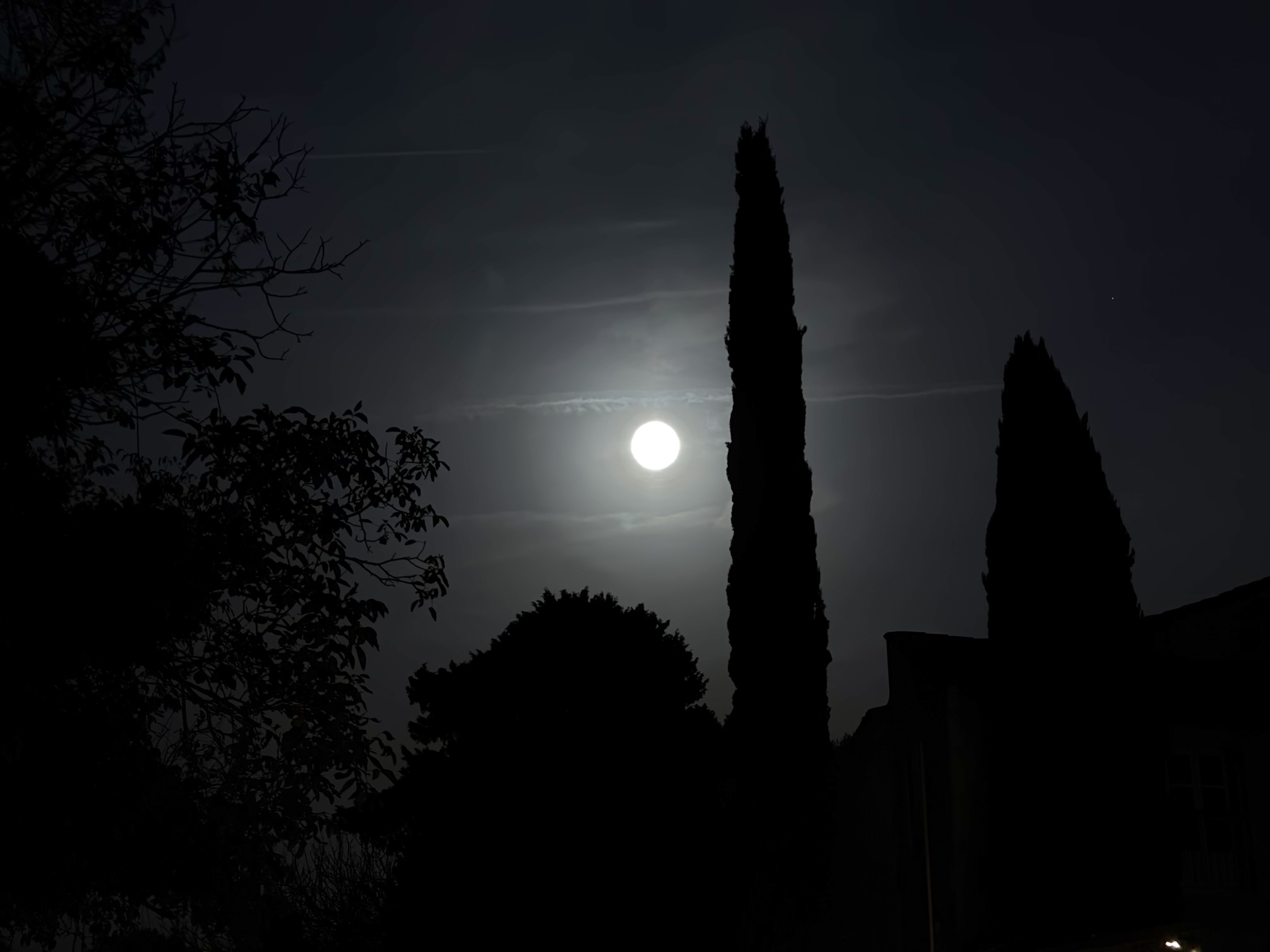
Provencal moon. Photograph by the author.

A homily for the First Sunday of Adven at Saint Barnabas Episcopal Church, Bainbridge Island, Washington.

The images of the Apocalypse are from the Tapestry of the Apocalypse in Angers, France. Originally 140 meters long, over time it has been reduced by a third. Woven in the late 14th century, it offers spectacular illustrations of the Book of Revelation.

[i] My free translation of Luke 21:28, 34-36.

[ii] W. H. Auden, New Year Letter (January 1, 1940).

[iii] q. in Alan Jacobs, The Year of Our Lord 1943: Christian Humanism in an Age of Crisis (Oxford: Oxford University Press, 2018), 10.

[iv] Ibid., 11.

[v] Dietrich Bonhoeffer, “After Ten Years” in Letters and Papers from Prison (Minneapolis: Fortress Press, 2010). Translated by Barbara and Martin Rumscheidt.

[vi] Simone Weil, quoted in Robert Zaretsky, The Subversive Simone Weil: A Life in Five Ideas (Chicago: University of Chicago Press, 2021), 155.

[vii] Thomas Merton, No Man Is an Island (206), q. in The Thomas Merton Encyclopedia (Maryknoll, NY: Orbis Books, 2002), 213.

[viii] Naomi Shihab Nye, “Break the Worry Cocoon,” Voices in the Air: Poems for Listeners (New York: Greenwillow Books, 2022), 96-97.

[ix] From the play, O’Carolan’s Farewell to Music by Patrick Ball and Peter Glazer, on the California Revels CD, Christmas in an Irish Castle (2001).

Blinded by the Light –– An Advent Meditation

spectra III, an installation by Ryoji Ikeda at Venice Biennale 2019: “a blinding excess, rendering the space itself almost invisible.” (Photo by Jim Friedrich)

Orthodox theologian David Bentley Hart describes atheism as “a fundamentally irrational view of reality, which can be sustained only by a tragic absence of curiosity or a fervently resolute will to believe the absurd. . . [T]rue philosophical atheism,” he says, “must be regarded as a superstition, often nurtured by an infantile wish to live in a world proportionate to one’s own hopes or conceptual limitations.”[1]

For the people of Advent, “a world proportionate to our own hopes” is too mean a thing. The mystery of the world and the destiny of mortals are too deep, too immense, to be contained by language or thought. They exceed everything we can ask or imagine. They explode our limited notions of what is real and what is possible.

Not for the people of Advent that “tragic absence of curiosity” so common in a complacent secular culture too busy amusing itself to consider the deepest questions of human existence. Advent people want to know who we are, why we’re here, where we’re going, and how long we’ve got. Most of all, we want to know whether we matter, and whether we are loved.

But are such questions answerable? Our thoughts and concepts only take us so far, like a compass pointing north. “North” is a pretty useful guide––until you reach the North Pole, where the very concept of north loses its meaning. Just so, the closer our thoughts take us toward the divine center, the less they are able to tell us.

At the end of The Divine Comedy, when Dante beholds the presence of God unveiled at last, words fail him:

What then I saw is more than tongue can say.
Our human speech is dark before the vision.
The ravished memory swoons and falls away. [2]

The mystery we call God is always beyond us. Beyond our grasp, beyond our language, beyond our sight. The mystics and great spiritual teachers sometime use the word darkness to convey their experience in close encounters with the divine.

But what they call the darkness of God is not so much a matter of cognitive deprivation, where divinity simply hides its incommunicable essence from finite minds and hearts unprepared to receive it. No, they say, the darkness of God is not deprivation, but saturation. It is not an absence of light, but an excess of glory, that makes our eyes become so dim to divine presence.

It sounds paradoxical––to be blinded by the light of God––but only paradox has the wings to carry us beyond the prosaic into the heavenly place where all contraries are reconciled. The metaphysical poets of the seventeenth century, like John Donne and George Herbert, reveled in such holy paradox. Henry Vaughan, for example, wrote that

There is in God (some say)
A deep, but dazzling darkness; As men here
Say it is late and dusky, because they
See not all clear;
O for that night! where I in him
Might live invisible and dim. [3]

Was Vaughan just playing with words, or was he on to something? At this year’s Venice Biennale, I had a very literal experience of being blinded by the light in an installation by Japanese artist Ryoji Ikeda. What happened to me there is perfectly described by the text posted at the entrance:

“spectra III” consists of a corridor of bright fluorescent tubes. This all-encompassing installation bathes the visitor in light so bright it is difficult to see. Akin to a blizzard of data, the experience short-circuits our ability to process what we are seeing, and results paradoxically in a sensory wipe-out. Ryoji Ikeda sees this state of overload as opening the door to an experience of the sublime––a landscape of light too complex to comprehend. The installation functions in parallel to the experience of total darkness, yet inverts this experience. We are similarly disoriented but instead of an absence of light by which to see, there is a blinding excess, rendering the space itself almost invisible.

That’s exactly what happened to me in that corridor. I had never before experienced such a literal analogue to the blinding luminosity described by the mystics. It was truly a “deep and dazzling darkness.” Almost painful, to tell the truth. Certainly too much for my mortal eyes to take in.

It may seem paradoxical to speak of the darkness of God at the beginning of Advent, when we light candles against the lengthening nights, and pray for the “grace to cast away the works of darkness, and put on the armor of light,” as if the soul’s journey were a straightforward itinerary from deepest midnight to eternal day. But as the mystics and poets insist, God-talk must be paradoxical to be useful and true. “God draws straight with crooked lines,” they say. God is the burning bush and the cloud of unknowing. You can’t have one without the other.

“God goes belonging to every riven thing,” says the poet Christian Wiman.

He’s made
the things that bring him near,
made the mind that makes him go.
A part of what man knows,
apart from what man knows,
 
God goes belonging to every riven thing he’s made. [4]

God is “apart” from what we know, transcendent to our empirical minds––minds which themselves keep God at a distance through our forgetfulness, idolatry, and egoism. And yet God wants to be near, wants to be known. God “goes belonging” to every riven thing: the broken, the wounded, the lost. God goes belonging to us all. And in so doing God’s own self is riven into the contraries of darkness and light, near and far, infinite and incarnate, present and absent, visible and invisible.

Advent’s great themes are seeking and waiting, hoping and expecting, longing and desiring. We go looking for God, searching for signs of God’s appearing.

Sometimes, in our search, we seem only to find darkness, silence, or absence, because we are looking in the wrong place, or in the wrong way. Or we are simply looking for the wrong thing, and need to be denied the fulfillment of inadequate expectations because they are too small or ill-proportioned to fit the immeasurable desire of God. For example, we might expect a well-armed conqueror instead of a servant and sufferer. Or we might expect an irresistible righter of wrongs instead of a helpless refugee child lying in a manger­­––or, these days, lying in a cage.

We were made to be in union with God, and our desire for that union is the deepest truth within us. We feel incomplete and unfinished without it. But our desire often goes astray and misses its mark, attaching itself to something well short of God. If our desire gets stuck on anything less than God, we will waste our lives worshipping the wrong thing,

In a 1967 film by Jean-Luc Godard, a well-dressed couple in a sporty convertible pick up a hitchhiker who tells them he is God. They are very excited to meet him. “Can you do miracles?” asks the man, “Can you make me richer?” His wife adds her own requests: “Can you make me young and beautiful?” And “God” replies, “Really? Is that all you want? I don’t do miracles for idiots like you!” [5]

One of the reasons that Christians worship together and pray together and learn together is to train our desire, so we don’t wait for the wrong thing, or hope for the wrong thing, or love the wrong thing, but always keep our eyes on the prize. Admittedly, God isn’t all that easy, and God is certainly not tame. As Emily Dickinson said, the divine “invites––appalls––endows–– / Flits––glimmers––proves––dissolves–– / Returns––suggests––convicts––enchants / Then––flings in Paradise––“[6]

Still, we are not deterred. Still, we cry Maranatha! Come, Lord, come! At least some of us do. There are those who don’t, for they think God is too invisible or too impossible to take into account. But isn’t that the point? Nothing we can see can save us. Nothing that is possible can rescue us. Paradox, paradox…

The human condition, suspended somewhere between the finite and the infinite, is a complicated puzzle, a question with no clear answer. As for the times we live in, Humphrey Bogart summed it up nicely in the film Beat the Devil:

“What’ve you got to worry about? We’re only adrift on an open sea with a drunken captain and an engine that’s likely to explode any moment.”

Is God coming to save us? As we know, that question is often answered by delay. Or worse, silence. We peer toward an uncertain horizon, looking for the One who comes with clouds descending, or at least for the comforting glow of dawn. But the horizon is hidden by what Nicholas of Cusa, a fifteenth-century German theologian, called “that obscuring haze of impossibility.”

And the darker and more impossible that obscuring haze of impossibility is known to be, the more truly the Necessity shines forth and the less veiledly it draws near and is present… I give You thanks, my God, because… You have shown me that You cannot be seen elsewhere than where impossibility appears and faces me.” [7]

I love Nicholas’ name for God: “the Necessity.” And I love his image of divine revelation as the moment when “impossibility appears and faces me.” The impossibility, the beyondness of God––beyond all knowing, beyond all saying, beyond all seeing––abolishes our limiting notions of what is possible, making a way where there is no way. O for that Night! where I in him may live invisible and dim.

All this talk of the darkness of God, the hiddenness of God, the elusiveness of God, may seem to run counter to the more affirmative language we usually employ in the liturgy as well as in the conversations we have together as people of faith.

We call ourselves God’s friends. We experience God’s closeness in times of gratitude and times of need. We see God’s hand in works of justice and mercy, and feel God’s Spirit in the reconciling and sacrificial love of human relationships. We meet God in Scripture, in community, in nature, and in beauty. We meet God in the poor, the vulnerable, and the dispossessed.

But sometimes God is hard to find or hard to perceive, and in those times we must speak the Advent language of not-exactly, not-here, and not-yet. That’s why the gospel for the First Sunday of Advent always has Jesus warning us to be on the ready. “Out with the old and in with the new! The world of the past is falling down, falling down. Whatever is going to happen next, expect the unexpected.”

Faced with the collapse of old ways and familiar certainties, where shall we look for God in the brave new world?

There’s a story about a man who dreams he is wandering among the labyrinthine stacks of the immense Clementine library in Prague. A librarian wearing dark glasses approaches him to ask, “What are you looking for?”

“I am looking for God,” he says.

“Ah,” said the librarian. “God is one of the letters on one of the pages of one of the four hundred thousand volumes in the Clementine Library. My parents and my parents’ parents searched for that letter. I myself have gone blind searching for it.” [8]

We’re all searching for that word, that moment, that appearing. It may bring the holy blindness of the mystics, or it may bathe you in the gentler glow of illumination. God only knows. Either way, you will not be left comfortless. God goes belonging to every riven heart.

In this season of Advent, I invite you to contemplate the paradoxical depths of the divine, to immerse yourselves in periods of wordless prayer within God’s luminous darkness. Set aside your concepts and your dogmas, and wait in the stillness of unknowing for the Word to speak. The God who is beyond all language and beyond all knowing wants to disclose Godself to us, wants to give Godself to us. That is the divine desire––the siege of God at the gates of our heart.

Stay awake. Pray for grace. Do not lose faith. As Jackson Browne exhorts us in his great Advent song, “For a Dancer”:

Keep a fire burning in your eye,
and pay attention to the open sky––
you never know what will be coming down.

One last thing.

Paul Celan was a Romanian Jewish poet who survived the Holocaust. It has been said that his difficult poetry “is not willed obscurity” but “comes out of lived experience and is ‘born dark.’” [9]  Celan knew the darkness of hell, but he also knew another kind of darkness, a darkness which paradoxically contains the seeds of light.

His poem called “The Narrowing” [10] includes a stanza of four short lines that express the spirit of Advent people––the people who sit in darkness without losing faith in the light to come. In just 16 words, the verb “came” is spoken 5 times, like an incantation in response to our beseeching prayer, “O come, O come, Emmanuel.” What comes, comes in the dark, but it brings a desire for light:

Came, came.
Came a word, came,
came through the night,
wanted to glow, wanted to glow.


This post was delivered as a sermon on the First Sunday of Advent, 2019, at St. Barnabas Episcopal Church, Bainbridge Island, WA 98110.

For links to other Advent resources: How Long? Not Long!––The Advent Collection


[1] David Bentley Hart, The Experience of God: Being, Consciousness, Bliss (New Haven: Yale University Press, 2013), 16.

[2] Dante Alighieri, Paradiso xxxiii: 55, trans. John Ciardi.

[3] Henry Vaughan, “The Night,” cited in Peter O’Leary, Thick and Dazzling Darkness: Religious Poetry in a Secular Age (New York: Columbia University Press, 2018), 85.

[4] Christian Wiman, “Every Riven Thing,” in Every Riven Thing (New York: Farrar, Strauss & Giroux, 2011).

[5] Jean-Luc Godard, Weekend (1967).

[6] Emily Dickinson, “The Love a Life can show Below.”

[7] Cited in Didier Maleuvre, The Horizon: A History of Our Infinite Longing (Berkeley: University of California Press, 2011), 143.

[8] From “The Secret Miracle,” a story by Jorge Luis Borges.

[9] From Shoshana Olidort’s Chicago Tribune review of Breathturn into Timestead: The Collected Later Poetry of Paul Celan, cited on the Poetry Foundation website: https://www.poetryfoundation.org/poets/paul-celan

[10] The original German title is “Engführung.”

Dancing with Time: An Advent Prelude

Time is our choice of How to love and Why.

–– W. H. Auden[i]


Every December, as we approach the border between the years, I think a lot about time. Where did the last twelve months go? How will this year be remembered? What will the New Year bring? How will I ever find time––or make time––to breathe during the holiday rush?

Then there are the big questions. What am I meant to do with the gift of time? How much of it is left? Does time have any purpose or meaning? Is it going anywhere?

The season of Advent, beginning this Sunday, is all about time.

  • We recall the past, pondering the Scriptural history of humanity’s deepest longing and desire, and celebrate the coming of the One in whom “the hopes and fears of all the years” converge at last.
  • We look to the future, when Creation will one day correspond to the purposes of God: the broken mended, wounds made whole, tears wiped from every eye––and everyone gathered into Love’s eternal dance.
  • And we attend to the present, alert for the signs of God’s self-revealing in every moment. The world is saturated with divine appearance, and the practice of Advent is to keep watch and stay awake.

But time is tricky, elusive and complex. It takes many forms. In The Myths of Time, London priest Hugh Rayment-Pickard posits four distinct modes of time.

CATASTROPHIC TIME is devoid of redemption or meaning. It is going nowhere fast. The world feels dark, empty, terrifying. There is neither purpose nor hope nor beauty. It’s a state of utter depression: time has no goal, and everything is sinking into the abyss of nonbeing.

Catastrophic time extinguishes every impulse to rise up and live anew. It is hell’s “darkling plain,” where there is “neither joy, nor love, nor light, / Nor certitude, nor peace, nor help for pain.”[ii] Most of us have experienced this temporal condition––even Christ in his cry of abandonment––but it’s not a place you can stay for long.

APOCALYPTIC TIME shares with the catastrophic a deep disillusionment with the projects of human history. The apocalyptic view knows the mess we’re in: “genocide, ravenous capitalism, grotesque inequalities, world-destroying technologies and competing fundamentalisms.”[iii]

And it looks to God alone for deliverance, as in this lyric by Leonard Cohen:

If it be your will, let your mercy spill
on all these burning hearts in hell,
if it be your will to make us well…
and end this night,
if it be your will.[iv]  

Yes, the world is broken and wounded in ways that seem beyond human remedy. Still, we hope: God is coming to save us. We don’t know how, we don’t know when, we don’t even know what. But we believe, trust and hope that in the end God will “end this night” and “make us well.”

PROPHETIC TIME shares the apocalyptic sense of crisis and judgment, but it doesn’t leave all the work to an outside, transcendent agency. We ourselves are invited and encouraged to become the hands and feet of God, the visible embodiment of divine intention. The prophets don’t just wait for God’s future to arrive like a package from Amazon Prime (expedited shipping available!). They point to the Now as the place where “every heart prepares him room,” where we all can join the work of repairing the world as well as our own broken and unfinished selves.

The prophetic sense, like the apocalyptic, longs for a better world; but it insists on our own participation in the process of revolutionary transformation. We don’t just sit still until the Kingdom comes; we go out to meet it.

The source of so much positive social change, the prophetic understanding of historical time as an unfolding of divine purpose may at times overestimate human potential and underestimate human sin. It can leave us disillusioned when our efforts go awry or the world fails to improve in a timely manner.

KAIRIC TIME differs sharply from both the apocalyptic and the prophetic. Instead of looking to the future end of time and the completion of salvation history, it devotes all its attention to the profound depths of the present moment, to what the Greeks called kairos: the epiphanic Now, charged with meaning in its own right, whatever its connection to a larger ongoing story.

Kairic time is the domain of the poet, the artist and the mystic, who know how to find what T. S. Eliot called “a lifetime burning in every moment.” But in fact it is available to us all. We only need the discipline to wait until it shows itself, and the attentiveness to be fully present and receptive when it comes.

As the 14th century author of The Cloud of Unknowing recommends:

“Be attentive to time and how you spend it. Nothing is more precious. This is evident when you recall that in one tiny moment heaven may be gained or lost. God, the master of time, never gives the future. God gives only the present, moment by moment.”[v]

The Incarnation is in one sense a validation of kairos, because it shifts the crucial moment of history from the end of time to the middle: God comes into the midst of world and time, giving the divine presence fully, holding nothing back. Therefore we can find “God-with-us” in every moment, if we pay attention and stay awake.

But kairic time, like the other modes, has its liabilities and limitations. We can be so swept away by the beauty of the moment that we become insensible of the suffering all around us. We may grow so enamored of our own experience that the demands and tasks of a shared public life fade into insignificance––the world out there is “not our problem.” Living in the moment can be enlightenment. It can also be escape.

Does any single mode take precedence over the others?
Or do they all have gifts for us?
The fact is, we live and move and have our being
in all the temporal modes––sometimes simultaneously.
And each of them calls us to respond in a particular way:[vi]

Apocalyptic: Renounce and resist the things that bind us to the ways of violence, greed and death, and wait upon the surprises of God with faith and hope.

Prophetic: Prepare ourselves to make room for God’s coming, offering our energies and our choices as visible signs of the dawning Kingdom.

 Kairic:  Stay awake for the revelation in every moment.

“My times are in your hand,” says the Psalmist.[vii]
What would happen if we could realize this in every moment?
This Advent, may your own dance with time be full of grace.


Related posts:

Ten Ways to Keep a Holy Advent

The World’s End (An Advent Manifesto)


[i] W. H. Auden, “For the Time Being: A Christmas Oratorio,” Collected Poems (New York: Random House, 1976), 297.

[ii] Matthew Arnold, “Dover Beach.”

[iii] Hugh Rayment-Pickard, The Myths of Time: From St. Augustine to American Beauty (London: Darton, Longman and Todd Ltd, 2004), 99.

[iv] Leonard Cohen, “If It Be Your Will,” on Various Positions (1984)

[v] The Cloud of Unknowing, q. in Hugh Rayment-Pickard, 92.

[vi] Even catastrophic time may contain a gift. Good Friday is the prelude to Resurrection.

[vii] Psalm 31:15

Reprise: Ten Ways to Keep a Holy Advent

image

Here in Puget Sound, the first Sunday of Advent has begun in darkness, fog, and frost. It is for many of us a deeply felt time, the season where we wait expectantly for the dawning of the New. The spiritual practice of waiting is not a state of passivity, but rather the cultivation of attention, lest we miss what is being offered to us in the unfolding of God’s future.

I do not usually do re-runs of old posts, but some readers found last December’s “Ten Ways to Keep a Holy Advent” a useful list, and you can access it here. I hope you will find some blessing in it. And please feel free to share it with your communities.

The World’s End

The World's End

When I was 8 years old, I read in LIFE magazine that in so many millions of years, the sun would burn out and life on earth would cease. This worried me, so I asked my parents, “If the world is going to end, how come we say “world without end” when we pray?” And they told me what the Bible says, that heaven and earth may pass away, but God remains. That relieved some of my anxiety, but I still wasn’t sure I liked the idea of the world ending, even if God was in charge.

Of course the world ends all the time. When I moved from California to Puget Sound in the 1990’s, my first Northwest winter felt like today’s gospel: the sun was darkened and the moon gave no light.

Who among us has not seen their world end? Adolescents exiled from childhood. Black teenagers robbed of their future. Elders deprived of their health. Unemployment …retirement …divorce … the death of a parent, a spouse, a child — in every one of these, a world comes to an end.

For anyone who has known serious loss, this is more than metaphor. The experience of grief can be so total and unrelenting that you can’t see anything beyond it. You can’t imagine the future. It feels like the end of the world.

The stars are not wanted now: put out every one;
Pack up the moon and dismantle the sun;
Pour away the ocean and sweep up the wood;
For nothing now can ever come to any good. [i]

W.H. Auden was invoking apocalyptic metaphors to express personal loss, but shared, public worlds also come to an end. As in 1789, or 1914. The Holocaust. Hiroshima. 9/11. My Lord, what a morning, when the stars begin to fall.

But why bring up such dreary stuff on this first day of the new Christian year? Shouldn’t we be breaking out the party hats, blowing horns and shouting “Happy New Year?” The wisdom of the Advent season is that it never begins with “A Holy Trinity Production,” or “The Creator of the World Presents.” No, it always opens with “The End.” Advent knows that every beginning involves some kind of ending. In this season’s Scripture, preaching and prayers, the present arrangements of collective and personal life are judged and found wanting. God’s imagination is far too rich and fertile to settle for our barren and diminished versions of human possibility.

Selfishness, greed, consumerism? Fear, racism and violence? Poverty, militarism, war, environmental degradation? That’s the best we can do? Really? God must be saying, “Come on, people. I made you a little lower than the angels, and this is what you came up with?”

George Eliot said “it is never too late to become what you might have been.” But to get to that “might have been” requires an Exodus into the wilderness beyond the way things are; an Exodus beyond even the best we can imagine for ourselves, into a place of unknowing, where only God possesses the language to speak our future into being.

So much of what we hear and pray and sing in Advent is profoundly disruptive. Bob Franke’s great Advent song, “Stir up your power,” gets right to it in the first line: This world may no longer stand. We are meant to be unsettled, to be driven beyond our narrow boundaries, our constricted realities, toward a beckoning horizon. The Christian life is a perpetual series of departures for a better place.

The world as it is – the world of racial hatred and toxic violence and economic injustice and perpetual war and addictive consumerism and pollution for profit and all the other evils which poison our common life – this world has no future in the emergent Kingdom of God. This world may no longer stand.

But the story doesn’t stop there. In my end is my beginning.[ii] Even when we have gone far astray, even when our story seems over, God remains deeply present in the processes of creation, tenderly leading and luring us into newness of life, making a way where there is no way, opening doors that none can shut.

Advent people do not just wring their hands or shake their heads over the latest news from Ferguson or the Middle East. We work and pray for something better. What we can do on our own is limited, but when we offer our priorities and energies to the larger purposes of God, Love will have its way with us.

As the Christian mystic Hadewijch put it in the thirteenth century:

Since I gave myself to Love’s service,
Whether I lose or win,
I am resolved:
I will always give her thanks,
Whether I lose or win;
I will stand in her power. [iii]

It is not always easy to stand in Love’s power and keep the faith. In some situations it is almost unimaginable. Forty years ago the African-American author James Baldwin wrote:

To be an Afro-American, or an American black, is to be in the situation, intolerably exaggerated, of all those who have ever found themselves part of a civilization which they could in no wise honorably defend – which they were compelled, indeed, endlessly to attack and condemn – and who yet spoke out of the most passionate love, hoping to make the kingdom new, to make it honorable and worthy of life. [iv]

This passionate mixture of protest and love sounds a lot like the Old Testament prophets who permeate our Advent lectionary. The very first reading of the season begins with a prophetic plea for history to be broken open by divine justice:

O that you would tear open the heavens and come down …
to make your name known to those who resist you,
so that the nations might tremble at your presence! [v]

Advent is not just a season of quiet waiting. It is also a time of protest and vision. Advent announces an insurgency against the way things are, a revolution to scatter the proud, cast down the mighty, raise the lowly, gather the lost, free the captive, and bind up the brokenhearted. Advent re-imagines the world as paradise restored, a new heaven and new earth suffused with the peace of God.

this is the day of broken sky
this is the space of conflagration-breath
speaking border-trespass
this is the feathered swoop of heaven
on the wing of now …
forking lightning into language …
breaking god into prison …
breaking the truth from jail! …

This is the fire-tongued fork of holy-ghost howl
making love on the tongue …
spitting flames of reconciliation
in the sky of war
making messiah-praise out of the air itself!

this is pentecost in your head
like becoming what you never dared
for the first time and forever

This ecstatic prophecy is from a poem by Jim Perkinson. [vi] He was talking about Pentecost, but his theme fits Advent as well:

“the day of broken sky”
the earth in conflagration
God breaking into the prisons
the truth being set loose at last
and “the fire-tongued fork of holy-ghost howl
making love on the tongue …
making messiah-praise out of the air itself!”

And each of us, all of us, becoming what we never dared.

When Jesus tells us to stay awake, he is warning us not to sleep through the day of God’s coming. Stay alert. Pay attention. Don’t miss it! Become what you never dared. Shake off the sleep of complacency, the sleep of complicity, the sleep of despair. Awake and greet the new dawn.

Jan Richardson describes this dawning reality in her beautiful poem, “Drawing Near.” [vii]

It is difficult to see it from here,
I know,
but trust me when I say
this blessing is inscribed
on the horizon.
Is written on
that far point
you can hardly see…

Richardson accurately expresses the sense of distant horizon that prevents the dominant reality of the moment from closing in on us and locking us in. That reality wants to be believed as fixed and final, permanent and stable. But the horizon calls every finality into question, disrupting its stability with the boundlessness of divine possibility. The horizon draws our attention from what is given to what may yet be. Keeping our eye on the horizon, feeling its pull, is the spiritual practice of Advent. Richardson’s poem expresses the deep longing produced by the distance between the already and the not-yet.

And then the poet discovers what every pilgrim knows: the goal of our long journey is something that has already been inscribed deep within us even before our journey began. Even before the day we were born, we were marked as God’s own forever.

And that is where Advent ultimately leaves us – finding that the thing we have been seeking so long has been with us all the time – within us, and all around us. While we have been walking our Camino to the Promised land, our feet have already been on holy ground, every step of the way. And the God of the far horizon turns out to be the path as well, keeping us company as we stride deeper and deeper into the world.

So when Advent people talk about the end of the world, we are speaking about end in the sense of purpose rather than termination. The word “apocalypse” means “unveiling,” and the apocalypse in our future will not be an annihilation, but a revealing of the world’s ultimate purpose and destiny.

Yes, all the inadequate, incomplete versions of world will come to an end (some of them kicking and screaming!), but creation as it was intended will be restored, not discarded. Like a poet who creates a new language out of old words, Love will remake the ruins and recover the lost. And the Holy One who is the mystery of the world will be its light and its life forever.

This Advent faith is expressed memorably in a short story by British writer Carol Lake, “The Day of Judgment.” On the Last Day of the world, God sails into England aboard a new Ark. But instead of bringing history to a close and pronouncing judgment on everyone, God leaves the Ark to enter the city of Derby. Heading for the run-down inner city neighborhood of Rosehill, he joins the crowd at a local pub, a multi-ethnic mix of the working poor and the unemployed. And there God gets so caught up in being with these people that he loses track of time, and the Ark sails away without him, heading off for the horizon of eternity. As the story describes it:

The Ark is on the edge of the horizon now, its destination the heartlessness of perfection. Most of the inmates already know what they are going to find – endless fruit, endless harmony, endless entropy, endless endless compassion, black and white in endless inane tableaux of equality. It sails off to a perfect world; the sky has turned into rich primary colors and in the distance the Ark bobs about on a bright blue sea.” [viii]

Meanwhile, God is still in that Rosehill pub, in the very heart of imperfection. If you had walked in there, you would have had a hard time picking him out. He blended right in. But if you were paying attention, you might notice that there was now something different about Rosehill. The old non-descript streets and dilapidated buildings had taken on a strange beauty. Maybe it was the warm slant of afternoon light, but people were beginning to see their neighborhood in a new way. And their own faces, too, seemed to glow with an inner radiance, as if they were carrying a wonderful secret, tacitly shared with everyone around them, as if they suddenly knew there was more to life than meets the eye.

They were still poor, the world was still a mess, but something new was in the air, a spirit of change was awakening. And from that day on, the people of Rosehill found themselves becoming what they’d never dared, for the first time and forever.

[i] W.H. Auden, “Twelve Songs (ix)”, Collected Poems, ed. Edward Mendelson (NY: Random House, 1976), 120

[ii] T.S. Eliot, “East Coker,” Collected Poems 1909-1962 (London: Faber and Faber Ltd, 1974), 191

[iii] Hadewijch: The Complete Works, trans. Mother Columba Hart, Classics of Western Spirituality (Mahwah, NJ: Paulist Press, 1980), 213

[iv] James Baldwin, No Name in the Street (NY: Dell, 1972), 194

[v] Isaiah 64:1-2

[vi] Jim Perkinson, “tongues-talk,” q. in Catherine Keller, On the Mystery: Discerning God in Process (Minneapolis: Fortress Press, 2008), 157-8

[vii] Jan Richardson, “Drawing Near” (http://adventdoor.com/2012/11/25/advent-1-drawing-near)

[viii] Carol Lake, Rosehill: Portraits from a Midlands City (London: Bloomsbury, 1989), 119