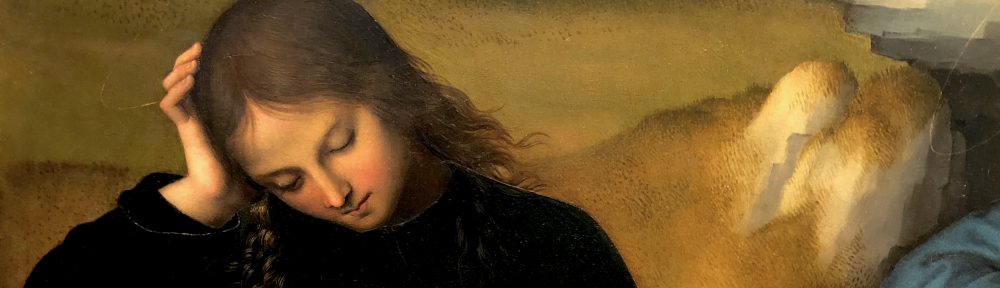
“A sweet fragrance filled the room” — A Homily on John 12:1-8

Jan van Scorel, Woman with the jar of nard (c. 1530).

In all four gospels, there’s a story about a woman who interrupts an intimate dinner party to kneel at the feet of Jesus and make an act of devotion. Luke’s story differs from the others in significant ways, so it may be based on a different incident. But Mark, Matthew and John all seem to be describing the same event. It was a moment which clearly had an indelible impact on the memory of the early Church.

John’s version is the only one which names the woman: Mary of Bethany, whose brother Jesus had just raised from the dead in the gospel’s previous chapter. Coming between the dramatic raising of Lazarus from the tomb and the violent clamor of the Passion, the story is a striking contrast to what came before and what comes after.

Instead of a public event with lots of people, it is quiet and intimate. No wailing mourners, no crowd shouting “Hosanna!” or “Crucify him!” Just Jesus, a few disciples, and his hosts, the siblings of Bethany:  Martha, Mary, and Lazarus.

We don’t know what they talked about during that dinner, but the moment had to have been highly charged, given the people around the table: The sisters whose grief had driven the harsh confrontation with Jesus at their brother’s tomb (If you had been here, my brother would not have died!) … the rabbi from Nazareth who had wept his own tears over the death of his friend (and perhaps some tears for the human condition in general) but who also found himself channeling the awesome life-giving power of the divine through his own mortal body …and the stunned man who had been so suddenly snatched from the land of the dead, experiencing what had to be a volatile mixture of awe, gratitude, and PTSD.

Perhaps no one said very much at all. Perhaps they were all still processing the shock of their shared experience at the tomb, letting a profound silence hold their feelings in order to preserve the mystery of it from being reduced to the poverty of language. But at some point, Mary was inspired to acknowledge the sacredness of the moment—not with words, but with a sacramental action.

The text doesn’t give the details, but I imagine her rising from the table, leaving the room for a moment, then returning with a jar of nard, a fragrant oil originating in the Himalayas and transported at great expense along the ancient trade route from Asia to the Middle East. It was worth a year’s wages, so when Mary, without saying a word of explanation, poured it all out over the feet of Jesus, it was quite shocking, like throwing a bag of gold into the sea or setting fire to a pile of paper money.

Then Mary compounded the shock by letting down her hair and using it to rub the oil into Jesus’ skin. No reputable woman would have done such a thing, nor would a religious teacher have permitted himself to be touched in such a way. Nevertheless, that’s how it went.

Judas was at that table, and he couldn’t bear to watch. He was the apostles’ money man, and he objected to wasting wealth that could have done some real good. John’s gospel doubts his sincerity, accusing Judas of embezzling the very funds he was claiming to protect.

I suspect that Judas’ discomfort had more to do with Jesus rewriting the social codes of his culture by endorsing Mary’s action. “Leave her alone,” Jesus tells him. Jesus, unlike Judas, understood that this was a very precious and significant moment, and he wanted to let it happen.

Mary’s extraordinary action, both sensual and symbolic, overflowed with meanings. For one thing, anointing with oil was a way to mark the special vocation and identity of authoritative figures, whether powerful rulers or holy persons. It consecrated them as chosen and set apart. The title of “Messiah” or “Christ” means “the anointed one.”

It was revolutionary to have a woman be the one to anoint Jesus as priest and ruler, but the kingdom of God was all about revolution: the revolution of transforming a disordered and broken world into a more perfect expression of divine intention and human possibility.

Anointing was also part of the culture’s preparation of a body for burial. Performed in the week before Jesus’ death, Mary’s gesture inaugurates the sequence of sacrificial acts culminating with her Lord’s burial in the stone-cold tomb. The feet she anoints will soon walk the Way of the Cross for the salvation of the world. That was Jesus’ chosen destiny, and the oil is an outward and visible sign of his inward consent to perform that destiny.

The story’s third meaning is in its foreshadowing of the foot-washing, when Jesus, on the night before he died, knelt at the feet of his friends to perform the work of a servant, surrendering his power for love’s sake. The foot-washing marked the turning point from a paradigm of domination to a paradigm of communion.

By kneeling at the feet of his friends, Jesus was showing them, and us, an image of humanity’s best version of itself. In that sacramental act, Jesus was saying: This is how we must be with one another, because this is exactly how God is with us.

And in today’s story, just a few days before Jesus would teach this explicit lesson at the Last Supper, Mary of Bethany, foreshadows the foot-washing when she offers, in her own way, all she has, holding nothing back.

And her devotional act of kneeling down to pour out the precious oil not only anticipated the foot washing on Maundy Thursday, it was an image of the divine nature as revealed in the incarnation and crucifixion of Jesus.  As one theologian has put it, “The self-giving extravagance of Mary’s actions point to the way Jesus would expend himself completely through his crucifixion.” [i]

In our Palm Sunday liturgy next Sunday, Paul’s Epistle to the Philippians will declare that Jesus emptied himself for us, poured himself out for us, and in so doing he revealed who God is and what God does. Whether in the costly pouring out of the Son’s life on the cross, or in the lavish pouring out of Spirit on Pentecost, God is the One who never ceases to pour out God’s own self.

And when, before his own self-offering, Jesus allowed Mary to anoint him in such a costly manner, she herself became an icon who shows us God with her own body, bowing before Jesus to wipe his feet so tenderly with her hair.

At the time, the disciples did not grasp the full significance of Mary’s act. Nor did Mary herself, I’d imagine. How could they?

As we say around here about Holy Week: The journey is how we know. The disciples had to learn by doing: following Jesus all the way to the cross—and beyond—before they could begin to understand—through memory and reflection—what it was all about. And that is what we will be doing as well during the seven days of Holy Week, not wanting to miss a single step along that sacred way. The journey is how we know.

Before we leave this story, consider the one sentence that stands out from the rest of the text:

The house was filled with the fragrance of the perfume.

There’s nothing else quite like it in the canonical gospels. The Bible in general is short on description and long on action. We never hear about the weather in Jerusalem or the colors of spring in the Galilean hills or the way light falls on the walls of the temple courtyard in late afternoon. So why does John invite us to pause and take in the sweet smell of nard?

In her fascinating book on the olfactory imagination in the ancient Mediterranean, Susan Ashbrook Harvey points out that aromatic spices were thought of as souvenirs of Paradise. When Adam and Eve were expelled from the Garden of Eden, it was said, they were allowed to take away a few fragrant plants to remind them of what they had lost.

Smells are a powerful trigger of memory, and the sweet odors of plants, spices and aromatic oils not only reminded people of Paradise Lost, they were thought to alert our senses to divine presence in a fallen world. They help us remember God. As Harvey writes, fragrance is something like God:

“Unseen yet perceived, smells traveled and permeated the consciousness, transgressing whatever boundaries might be set to restrict their course … Odors could transgress the chasm that separated the fallen order from God; they could elicit an unworldly sensation of beauty.” [ii]

And so we hear St. Paul speak of the fragrance that comes from being “in Christ,” so that we ourselves begin to give off the “aroma of Christ” from our own bodies (2 Corinthians 2:14-16). A few centuries later, Gregory of Nazianzus, in his treatise on the effects of our baptism, wrote:

“Let us be healed also in smell, that we … may smell the Ointment that was poured out for us, spiritually receiving it; and [that we may be] so formed and transformed by it, that from us too a sweet odor may be smelled.” [iii]

And St. Chrysostom, in his 5th-century sermon on today’s gospel, urged his congregation to become like thuribles, sweetening wherever they happen to be with the incense of heaven:

Now the one who perceives the fragrance knows that there is ointment lying somewhere; but of what nature it is he does not yet know, unless he happens to have seen it. So also we. [That God is, we know, but what in substance we know not yet.] We are then, as it were, a royal censer, breathing whithersoever we go of the heavenly ointment and spiritual sweet fragrance.” [iv]

In the spirit of such olfactory tropes, John’s verse about the sweet smell of the nard in that Bethany dining room endow that moment with divine peace and blessing. And the verse is especially vivid in contrast with the stench of mortality hovering around the tomb of Lazarus a few days earlier. Don’t roll away the stone, his sister pleaded. After 4 days inside, the body will smell terrible. Or as the King James Bible memorably put it, “by this time he stinketh.”

But in that sweet-smelling dining room with Jesus and his friends, death and decay are held at bay for a few precious hours. Outside, the world is wild and raging, on the verge of murdering the incarnation of Love. But inside, a woman is imaging the peace of heaven at the feet of her Lord.

For me, this beautiful moment calls to mind a scene from Ingmar Bergman’s classic 1957 film, The Seventh Seal, set in the fourteenth century when the Black Plague is ravaging Europe. A wandering knight is trying to get back home before the plague catches him, stalling for time by engaging Death in a game of chess. He’ll never win, of course, but at one point he meets a kind of holy family: a man, Jof; his wife Mia; and their baby, Michael. They are traveling players who embody the vitality of the life force.

Antonius Block, the knight (Max von Sydow), plays chess with death.

The film ends with the knight taking his inevitable place in the dance of Death, disappearing over the horizon with his fellow mortals. But the “holy family” are not seen among the dead souls, for they have been spared to carry on in this life, untroubled by death because they belong to grace. They know how to accept the music of what happens, and not live in fear.

The knight finds grace in a fallen world: “I shall remember this hour of peace.”

In the sweetest moment of this anguished film, Jof and Mia share their strawberries and milk with the knight, who receives it like a sacrament, a taste of unconquerable life:

“I shall remember this hour of peace,” he tells them. “The strawberries, the bowl of milk, your faces in the dusk, Michael asleep, Jof with his lute. I shall remember our words, and shall bear this memory between my hands as carefully as a bowl of fresh milk. And this will be a sign and a great content.”

An hour of peace, an experience of great content in a world that is coming apart—isn’t that a perfect description of the dinner at Bethany? And are we not in that same place now, with Mary, Jesus, and the rest? The powers of death and malice and mindless destruction are raging outside. We know that. Yet here we are, tasting the bread of heaven, inhaling the fragrance of divine presence.

It’s not about escaping. Not at all. It’s about renewal, so that when we go back out into the world, we can be clear about our vocation: to exude that fragrance—God’s sweetness—in every place we go. And when it gets hard out there—and it will—just call to mind the fragrance of those sacred moments when we dwell in God, and God in us.


This homily was preached at St. Barnabas Episcopal Church on Bainbridge Island in Washington State, on the Fifth Sunday in Lent.

[i] Craig R. Koester, Symbolism in the Fourth Gospel: Meaning, Mystery, Community (Minneapolis: Fortress Press, 1995), 114.

[ii] Susan Ashbrook Harvey, Scenting Salvation: Ancient Christianity and the Olfactory Imagination (Berkeley: University of California Press, 2006), 53.

[iii] Ibid., 75.

[iv] Ibid., 115.
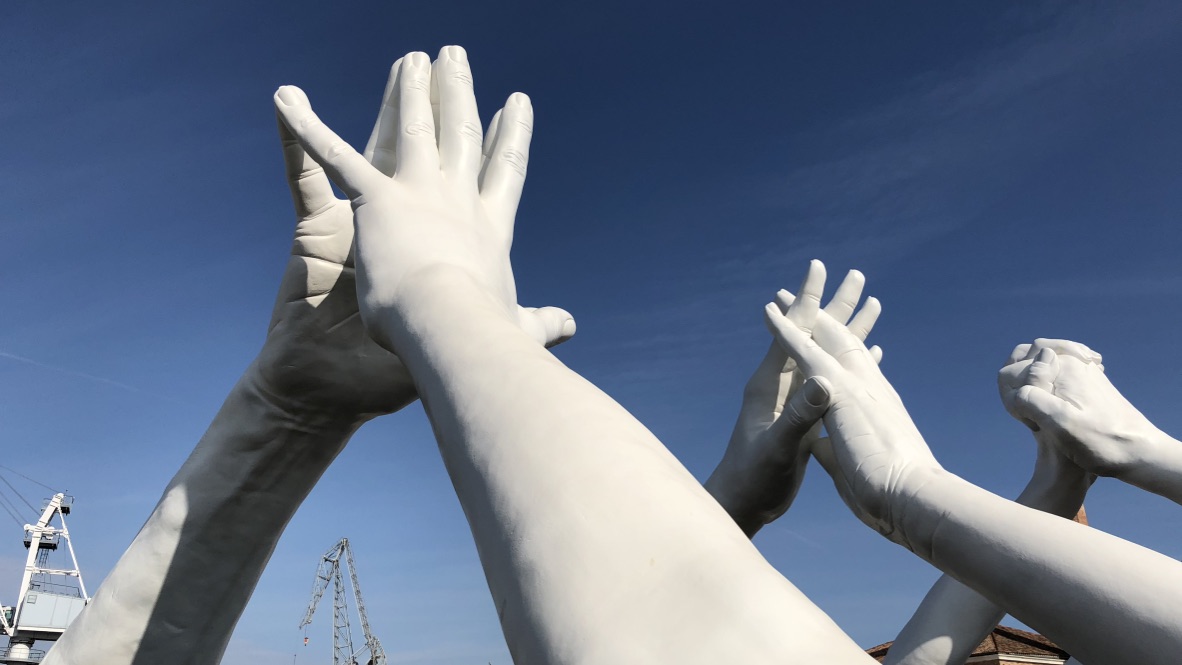
Three-in-One : One-in-Three

Lorenzo Quinn, Building Bridges (Venice Biennale 2019)

Sermon for Trinity Sunday 2024 at St. Barnabas Episcopal Church, Bainbridge Island, Washington

From late autumn to late spring, Christian liturgy takes us on a ritual journey through the gospel narrative, from the Incarnation and Epiphany of Christ to the dramatic finale of Passion, Resurrection, Ascension and Pentecost.This great sequence concludes with Trinity Sunday, which serves as a kind of epilogue.

The abrupt shift from the engaging world of story to the tangled thicket of doctrine can be a bit of a shock. It’s like going directly from a seminar in English literature to a class in advanced calculus. Our hearts sink and our heads explode. But fear not. The Trinity is no dreary abstraction. Nor is it a matter, as Lewis Carroll might say, of believing three impossible things before breakfast. We are not here to solve once and for all the puzzle of Three-in-One and One-in-Three. We are here to adore the mystery.

The first Christians were not inventive theorists speculating about the divine nature of a generic God. They were the friends of Jesus trying to make sense of the concrete, experiential data of salvation, beginning with the dramatic biblical events they had lived through and continuing to unfold in the common life of their believing communities. Their profound experiences of Jesus and the Holy Spirit had shaken the foundations of their monotheistic faith, and they were trying to sort out the implications.

Jesus and the Spirit had done for them what only God can do: heal, save, sanctify—even vanquish the power of death. Did that make Jesus and Spirit divine? And if so, what did that multiplication of divine persons do to their belief that God was one?  Jesus had told them, “I and the Father are one.” But it would take centuries to agree on what he meant.

Without losing the unity of God, how could the early Christian community account for the divine diversity revealed in the saving activities of Christ and the Spirit?

Once they began to call Jesus Kyrios (Lord), which happened very early in their worship and their storytelling, traditional monotheism was radically destabilized. The growing perception of the Holy Spirit as a guiding and empowering presence of deity in their communities only compounded the problem.

There were various attempts to solve the issue by downgrading Jesus and Spirit to subordinate, derivative, or semi-divine realities, by no means equal to the eternal and uncreated God. Such “heresies” were popular with those who wanted to keep God simple. But “orthodoxy” was unwilling to deny the fullness of divinity to either Christ or the Spirit. For them the bottom line was this: 

Only God can save us. Christ and Spirit, in the biblical revelation and Christian experience, are integral and essential to salvation. Therefore, they must be “of one substance with the Father.” That is to say, the Persons are all equally integral to the divine reality: God above us, the source and ground of all being; God with us and among us, the companion who is our way, our truth, and our life; and God within us, the energy and vitality of our deepest self. As the theologians put it:

“The Trinity is an account of God that says these are [each] irreducible and indispensable dimensions of the same reality, not different ones, and yet each has its own irreducible integrity.” [i]

And so, a trinitarian faith became foundational for the Christian understanding of divinity: God in three persons, blessed Trinity. But the inherent tension between the one and the three remains to this day. Human thought and human language can’t quite manage to think both things at the same time. It’s like waves and particles. Gregory of Nazianzus, one of most influential shapers of the fourth-century trinitarian consensus, admitted the futility of trying to corral the mystery with concepts. He suggested that we just go with the divine flow:  

“I cannot think of the One without immediately being surrounded by the radiance of the Three; nor can I discern the Three without at once being carried back into the One.” [ii]

In an amusing caricature of crudely literal images of the Three-in-One, British theologian Keith Ward imagines three omniscient individuals trying to have a conversation:

“I think I’ll create a universe,” says one. “I knew you were going to say that,” says the second. “I think I’ll create one as well,” says the third. “Well, it had better be the same as mine,” says number one. “You already know that it is,” says number two. “I knew you were going to say that,” says number three.[iii]

If we have difficulty with “God in three Persons,” it is because we think of a person as defined by his or her separateness. I’m me and you’re you! We may interact and even form deep connections, but my identity does not depend upon you. I am a self-contained unit. You can’t live in my skin and I can’t live in yours. That’s the cultural assumption, which goes back at least as far as Descartes in the seventeenth century and continues today in such debased forms as rampant consumerism and economic selfishness, where my needs and my desires take precedence over any wider sense of interdependence, community, or ecology.

But what we say about the Persons of the Trinity is quite different. Each Person is not an individual, separate subject who perceives the other Persons as objects. The Trinitarian persons experience one another not from the outside, but from the inside. They indwell each other in a mutual interiority.

But if the divine Persons are all inside each other, commingled, “of one being,” as the Creed says, what makes each Person distinct? To put it succinctly: the Persons are distinct because they are in relation with one another. No Father unless there is a Son. No Son without a Father. No Holy Spirit without Father and Son.

As Martin Buber observed, we are persons because we can say “Thou” to someone else. To be a person is to experience the difference – and the connection – that forms the space between two separate subjects. My consciousness is not alone in the universe. There are other centers of consciousness: Thou, I… Thou, I… The fact that you are not I is what creates self-consciousness, the awareness of my own difference from what is outside myself.

If we apply this to the Trinity, we say that there are Three Persons because there is relation within God, relation between the Source who begets, the Word who is begotten, and the Spirit who binds the two together and moves them outward in ever widening circles.

These relations are not occasional or accidental. They are eternal. There is an eternal sending within God, an eternal self-giving within God, an eternal exchange by which God is both Giver and Receiver simultaneously. God is Love giving itself away – self-emptying, self-diffusing, self-surrendering – and in so doing finds itself, receives itself, becomes itself. A French mystic put it this way: “it’s a case of un ‘je’ sans moi” (an “I” without a me).

Wallace Stevens wrote a poem about the process of giving ourselves over to a larger whole. He called it “the intensest rendezvous,” where we find ourselves drawn out of isolation “into one thing.” He wasn’t writing about the Trinity, but his words come as close as any to describing the essential dynamic of the divine Persons:

       Here, now, we forget each other and ourselves.
      We feel the obscurity of an order, a whole,
      A knowledge, that which arranged the rendezvous.[iv]

As Orthodox theologian John D. Zizioulas says in his influential text, Being as Communion, “To be and to be in relation are the same thing for the divine life … Therefore if Trinity is our guide, the most fundamental definition of being we can give is person-in-communion … The being of the one divine nature is the communion of the irreducibly different persons; the being of the individual persons is constituted by their relations with each other.” [v]

God is not a simple, static substance but an event of relationships. That’s why we say that God is love. “To be” has no ontological reality apart from “to be in relationship.” In the words of Anglican priest John Mbiti of Kenya, expressing the strongly communal mindset of African theology, “I am because we are, and since we are, therefore I am.” [vi]

Each Person contains the others and is contained by them in a shared communion of self-offering and self-surrender. But that continuous self-offering is never a one-way transaction, either one of self-emptying or one of being filled. It is always both at once – giving and receiving – as we ourselves know from our own mutual experience of love at its best. 

Trinitarian faith describes a God who is not solitary and alone, a God who is not an object which we can stand apart from and observe. The Trinity is an event of relationships: not three separate entities in isolation and independence from one another, but a union of subjects who are eternally interweaving and interpenetrating

This divine relationality is not something which an originally solitary God decided to take up at some point. God is eternally relational. Before there was an external creation to relate to, God’s own essential self was and is an event of perpetual relation. There was never simply being, but always being-withbeing-forbeing-in. To be and to be in relation are eternally identical.

When the Bible says, “God is love” (I John 4:16), it means that love is not just something God has or something God does; love is what God is.

As John Zizioulas puts it, “Love as God’s mode of existence … constitutes [divine] being.”[vii] Feminist theologian Elizabeth Johnson echoes this when she says, “being in communion constitutes God’s very essence.” [viii]  In other words, God is Love giving itself away—self-emptying, self-diffusing, self-surrendering—and in so doing finds itself, receives itself, becomes itself. The theologians of late antiquity borrowed a word from the arts to describe this process: perichoresis, which means to “dance around.”

Trinity is a dance, with Creator, Christ and Spirit in a continuous movement of giving and receiving, initiating and responding, weaving and mingling, going out and coming in. And while our attention may focus at times on a particular dancer, we must never lose sight of the larger choreography to which each dancer belongs: the eternal perichoresis of Three in One, One in Three.

As Jesus said, “losing” yourself and “finding” yourself are equivalent and simultaneous. In giving ourselves away, we receive ourselves back. This may be counterintuitive to the modernist mindset of autonomous individual self-possession, but it is the essence of communion: “a giving of oneself that can only come from the ongoing and endless reception of the other.” [ix]

If we had the space, I would invite you now to dance the divine perichoresis with your own bodies. We would join hands, circle round, spiral inward, weave in and out of the arches and tunnels of upraised arms, and manifest with our bodies the divine fullness of the Holy Trinity, which has been described as an “interdependence of equally present but diverse energies … in a state of circumvolving multiplicity.” [x] And thus we would, both symbolically and in fact, participate in the divine reality of “reciprocal delight” [xi] which transpires not only in heaven, but “on earth as it is in heaven.”

There are no spectators in the Trinitarian dance, which is always extending outward to draw us and all creation into its motions. As Jürgen Moltmann said, “to know God means to participate in the fullness of the divine life.” [xii] 

It’s not a matter of our trying to imitate the relational being of the loving, dancing God, as if we were inferior knock-offs of the real thing. God wants us to become ourselves the real thing. God wants to gather us into the divine perechoresis as full participants in the endless offering and receiving, pouring out and being filled, which is the dance of God and the life of heaven.

And while our dance with God has its mystical, mysterious, transcendent dimensions, it is also very concrete and specific to our historical life on this earth. The divine life of communion and self-diffusive love is the only antidote for the poisonous hatreds of this fearful age.

Because we ourselves are made in God’s image, who God is matters deeply, both for our own self-understanding and for our engagement with the world. The Trinity isn’t only God’s life. It is ours as well. It’s the shape of every story, the deep structure of the church, and the foundational pattern of reality.

Because God is communion, the eternal exchange of mutual giving and receiving, then God’s Church must live a life of communion as well. When Love’s perechoresis becomes our way of being in the world—as believers, as church—the Trinity is no longer just doctrine or idea. It is a practice, begetting justice, peace, joy, kindness, compassion, reconciliation, holiness, humility, wisdom, healing and countless other gifts. As theologian Miroslav Volf has said, “The Trinity is our social program.” [xiv]

The dance of Trinity is meant
For human flesh and bone;
When fear confines the dance in death,
God rolls away the stone. [xv]

The Church exists to participate in the liberating life of God, and to enable others to do the same. We exist to make divine communion not just an inner experience but a public truth. We don’t just feel God’s perichoresis. We don’t just feel Love’s eternal dance. We embody it. We live it. We show it. We share it.  

As the great Anglican preacher Austen Farrer put it so clearly a century ago:

“It is not required of us to think the Trinity.
We can do better; we can live the Trinity.” [xvi]


Photographs by the author.

[i] S. Mark Helm, The Depth of the Riches: A Trinitarian Theology of Religious Ends (Grand Rapids, MI: Eerdmans, 2003), 132.

[ii] Gregory of Nazianzus, q. in Karen Armstrong, The Case for God (New York: Knopf, 2009). 116-117.

[iii] Keith Ward, God: A Guide for the Perplexed (Oxford: Oneworld Publications, 2003), 235.

[iv] Wallace Stevens, “Final Soliloquy of the Interior Paramour,” Collected Poetry and Prose (NY: Library of America, 1997), 444.

[v] John D. Zizioulas, Being as Communion: Studies in Personhood and the Church (Crestwood, NY: St. Vladimir’s Seminary Press, 1993), 46.

[vi] quoted in Veli-Matti Kärkkäinen, The Trinity: Global Perspectives (Louisville: Westminster John Knox Press, 2007), 352.

[vii] Zizioulas, 46.

[viii] Elizabeth Johnson, She Who Is: The Mystery of God in Feminist Theological Discourse (NY: Crossroad, 1993), 227.

[ix] Graham Ward, “The Schizoid Christ,” in The Radical Orthodoxy Reader, ed. John Milbank and Simon Oliver (NY: Routledge, 2009), 241.

[x] David Bentley Hart, The Beauty of the Infinite: The Aesthetics of Christian Truth (Grand Rapids: Eerdmans 2003), 114.

[xi] St. Athanasius (c. 296-373), a bishop in Roman Egypt, was a key defender of Trinitarianism. 

[xii] Jürgen Moltmann, The Trinity and the Kingdom: The Doctrine of God, trans. Margaret Kohl (San Francisco: Harper & Row, 1981), 152.

[xiii] Richard Leach, “Come Join the Dance of Trinity.”

[xiv] Miroslav Volf, “‘The Trinity is Our Social Program’: The Doctrine of the Trinity and the Shape of Social Engagement,” Modern Theology 14, no. 3 (July 1998).

[xv] Leach.

[xvi] Austin Farrer, The Essential Sermons (London: SPCK, 1991), 78.