Three-in-One : One-in-Three

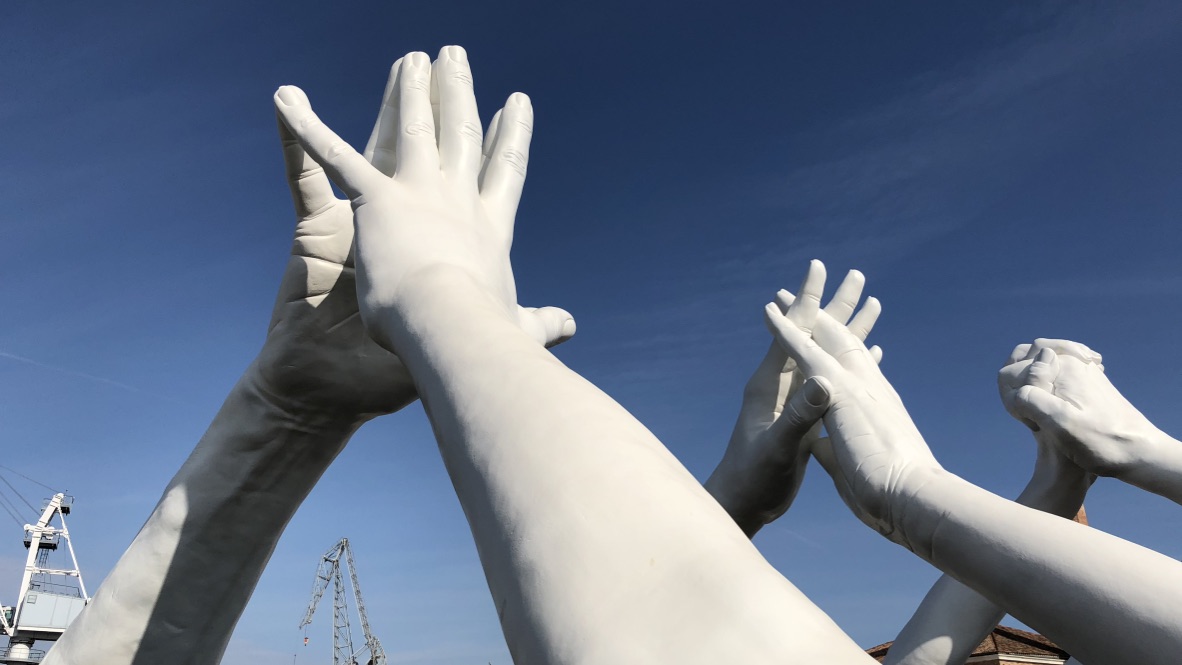
Lorenzo Quinn, Building Bridges (Venice Biennale 2019)

Sermon for Trinity Sunday 2024 at St. Barnabas Episcopal Church, Bainbridge Island, Washington

From late autumn to late spring, Christian liturgy takes us on a ritual journey through the gospel narrative, from the Incarnation and Epiphany of Christ to the dramatic finale of Passion, Resurrection, Ascension and Pentecost.This great sequence concludes with Trinity Sunday, which serves as a kind of epilogue.

The abrupt shift from the engaging world of story to the tangled thicket of doctrine can be a bit of a shock. It’s like going directly from a seminar in English literature to a class in advanced calculus. Our hearts sink and our heads explode. But fear not. The Trinity is no dreary abstraction. Nor is it a matter, as Lewis Carroll might say, of believing three impossible things before breakfast. We are not here to solve once and for all the puzzle of Three-in-One and One-in-Three. We are here to adore the mystery.

The first Christians were not inventive theorists speculating about the divine nature of a generic God. They were the friends of Jesus trying to make sense of the concrete, experiential data of salvation, beginning with the dramatic biblical events they had lived through and continuing to unfold in the common life of their believing communities. Their profound experiences of Jesus and the Holy Spirit had shaken the foundations of their monotheistic faith, and they were trying to sort out the implications.

Jesus and the Spirit had done for them what only God can do: heal, save, sanctify—even vanquish the power of death. Did that make Jesus and Spirit divine? And if so, what did that multiplication of divine persons do to their belief that God was one?  Jesus had told them, “I and the Father are one.” But it would take centuries to agree on what he meant.

Without losing the unity of God, how could the early Christian community account for the divine diversity revealed in the saving activities of Christ and the Spirit?

Once they began to call Jesus Kyrios (Lord), which happened very early in their worship and their storytelling, traditional monotheism was radically destabilized. The growing perception of the Holy Spirit as a guiding and empowering presence of deity in their communities only compounded the problem.

There were various attempts to solve the issue by downgrading Jesus and Spirit to subordinate, derivative, or semi-divine realities, by no means equal to the eternal and uncreated God. Such “heresies” were popular with those who wanted to keep God simple. But “orthodoxy” was unwilling to deny the fullness of divinity to either Christ or the Spirit. For them the bottom line was this: 

Only God can save us. Christ and Spirit, in the biblical revelation and Christian experience, are integral and essential to salvation. Therefore, they must be “of one substance with the Father.” That is to say, the Persons are all equally integral to the divine reality: God above us, the source and ground of all being; God with us and among us, the companion who is our way, our truth, and our life; and God within us, the energy and vitality of our deepest self. As the theologians put it:

“The Trinity is an account of God that says these are [each] irreducible and indispensable dimensions of the same reality, not different ones, and yet each has its own irreducible integrity.” [i]

And so, a trinitarian faith became foundational for the Christian understanding of divinity: God in three persons, blessed Trinity. But the inherent tension between the one and the three remains to this day. Human thought and human language can’t quite manage to think both things at the same time. It’s like waves and particles. Gregory of Nazianzus, one of most influential shapers of the fourth-century trinitarian consensus, admitted the futility of trying to corral the mystery with concepts. He suggested that we just go with the divine flow:  

“I cannot think of the One without immediately being surrounded by the radiance of the Three; nor can I discern the Three without at once being carried back into the One.” [ii]

In an amusing caricature of crudely literal images of the Three-in-One, British theologian Keith Ward imagines three omniscient individuals trying to have a conversation:

“I think I’ll create a universe,” says one. “I knew you were going to say that,” says the second. “I think I’ll create one as well,” says the third. “Well, it had better be the same as mine,” says number one. “You already know that it is,” says number two. “I knew you were going to say that,” says number three.[iii]

If we have difficulty with “God in three Persons,” it is because we think of a person as defined by his or her separateness. I’m me and you’re you! We may interact and even form deep connections, but my identity does not depend upon you. I am a self-contained unit. You can’t live in my skin and I can’t live in yours. That’s the cultural assumption, which goes back at least as far as Descartes in the seventeenth century and continues today in such debased forms as rampant consumerism and economic selfishness, where my needs and my desires take precedence over any wider sense of interdependence, community, or ecology.

But what we say about the Persons of the Trinity is quite different. Each Person is not an individual, separate subject who perceives the other Persons as objects. The Trinitarian persons experience one another not from the outside, but from the inside. They indwell each other in a mutual interiority.

But if the divine Persons are all inside each other, commingled, “of one being,” as the Creed says, what makes each Person distinct? To put it succinctly: the Persons are distinct because they are in relation with one another. No Father unless there is a Son. No Son without a Father. No Holy Spirit without Father and Son.

As Martin Buber observed, we are persons because we can say “Thou” to someone else. To be a person is to experience the difference – and the connection – that forms the space between two separate subjects. My consciousness is not alone in the universe. There are other centers of consciousness: Thou, I… Thou, I… The fact that you are not I is what creates self-consciousness, the awareness of my own difference from what is outside myself.

If we apply this to the Trinity, we say that there are Three Persons because there is relation within God, relation between the Source who begets, the Word who is begotten, and the Spirit who binds the two together and moves them outward in ever widening circles.

These relations are not occasional or accidental. They are eternal. There is an eternal sending within God, an eternal self-giving within God, an eternal exchange by which God is both Giver and Receiver simultaneously. God is Love giving itself away – self-emptying, self-diffusing, self-surrendering – and in so doing finds itself, receives itself, becomes itself. A French mystic put it this way: “it’s a case of un ‘je’ sans moi” (an “I” without a me).

Wallace Stevens wrote a poem about the process of giving ourselves over to a larger whole. He called it “the intensest rendezvous,” where we find ourselves drawn out of isolation “into one thing.” He wasn’t writing about the Trinity, but his words come as close as any to describing the essential dynamic of the divine Persons:

       Here, now, we forget each other and ourselves.
      We feel the obscurity of an order, a whole,
      A knowledge, that which arranged the rendezvous.[iv]

As Orthodox theologian John D. Zizioulas says in his influential text, Being as Communion, “To be and to be in relation are the same thing for the divine life … Therefore if Trinity is our guide, the most fundamental definition of being we can give is person-in-communion … The being of the one divine nature is the communion of the irreducibly different persons; the being of the individual persons is constituted by their relations with each other.” [v]

God is not a simple, static substance but an event of relationships. That’s why we say that God is love. “To be” has no ontological reality apart from “to be in relationship.” In the words of Anglican priest John Mbiti of Kenya, expressing the strongly communal mindset of African theology, “I am because we are, and since we are, therefore I am.” [vi]

Each Person contains the others and is contained by them in a shared communion of self-offering and self-surrender. But that continuous self-offering is never a one-way transaction, either one of self-emptying or one of being filled. It is always both at once – giving and receiving – as we ourselves know from our own mutual experience of love at its best. 

Trinitarian faith describes a God who is not solitary and alone, a God who is not an object which we can stand apart from and observe. The Trinity is an event of relationships: not three separate entities in isolation and independence from one another, but a union of subjects who are eternally interweaving and interpenetrating

This divine relationality is not something which an originally solitary God decided to take up at some point. God is eternally relational. Before there was an external creation to relate to, God’s own essential self was and is an event of perpetual relation. There was never simply being, but always being-withbeing-forbeing-in. To be and to be in relation are eternally identical.

When the Bible says, “God is love” (I John 4:16), it means that love is not just something God has or something God does; love is what God is.

As John Zizioulas puts it, “Love as God’s mode of existence … constitutes [divine] being.”[vii] Feminist theologian Elizabeth Johnson echoes this when she says, “being in communion constitutes God’s very essence.” [viii]  In other words, God is Love giving itself away—self-emptying, self-diffusing, self-surrendering—and in so doing finds itself, receives itself, becomes itself. The theologians of late antiquity borrowed a word from the arts to describe this process: perichoresis, which means to “dance around.”

Trinity is a dance, with Creator, Christ and Spirit in a continuous movement of giving and receiving, initiating and responding, weaving and mingling, going out and coming in. And while our attention may focus at times on a particular dancer, we must never lose sight of the larger choreography to which each dancer belongs: the eternal perichoresis of Three in One, One in Three.

As Jesus said, “losing” yourself and “finding” yourself are equivalent and simultaneous. In giving ourselves away, we receive ourselves back. This may be counterintuitive to the modernist mindset of autonomous individual self-possession, but it is the essence of communion: “a giving of oneself that can only come from the ongoing and endless reception of the other.” [ix]

If we had the space, I would invite you now to dance the divine perichoresis with your own bodies. We would join hands, circle round, spiral inward, weave in and out of the arches and tunnels of upraised arms, and manifest with our bodies the divine fullness of the Holy Trinity, which has been described as an “interdependence of equally present but diverse energies … in a state of circumvolving multiplicity.” [x] And thus we would, both symbolically and in fact, participate in the divine reality of “reciprocal delight” [xi] which transpires not only in heaven, but “on earth as it is in heaven.”

There are no spectators in the Trinitarian dance, which is always extending outward to draw us and all creation into its motions. As Jürgen Moltmann said, “to know God means to participate in the fullness of the divine life.” [xii] 

It’s not a matter of our trying to imitate the relational being of the loving, dancing God, as if we were inferior knock-offs of the real thing. God wants us to become ourselves the real thing. God wants to gather us into the divine perechoresis as full participants in the endless offering and receiving, pouring out and being filled, which is the dance of God and the life of heaven.

And while our dance with God has its mystical, mysterious, transcendent dimensions, it is also very concrete and specific to our historical life on this earth. The divine life of communion and self-diffusive love is the only antidote for the poisonous hatreds of this fearful age.

Because we ourselves are made in God’s image, who God is matters deeply, both for our own self-understanding and for our engagement with the world. The Trinity isn’t only God’s life. It is ours as well. It’s the shape of every story, the deep structure of the church, and the foundational pattern of reality.

Because God is communion, the eternal exchange of mutual giving and receiving, then God’s Church must live a life of communion as well. When Love’s perechoresis becomes our way of being in the world—as believers, as church—the Trinity is no longer just doctrine or idea. It is a practice, begetting justice, peace, joy, kindness, compassion, reconciliation, holiness, humility, wisdom, healing and countless other gifts. As theologian Miroslav Volf has said, “The Trinity is our social program.” [xiv]

The dance of Trinity is meant
For human flesh and bone;
When fear confines the dance in death,
God rolls away the stone. [xv]

The Church exists to participate in the liberating life of God, and to enable others to do the same. We exist to make divine communion not just an inner experience but a public truth. We don’t just feel God’s perichoresis. We don’t just feel Love’s eternal dance. We embody it. We live it. We show it. We share it.  

As the great Anglican preacher Austen Farrer put it so clearly a century ago:

“It is not required of us to think the Trinity.
We can do better; we can live the Trinity.” [xvi]


Photographs by the author.

[i] S. Mark Helm, The Depth of the Riches: A Trinitarian Theology of Religious Ends (Grand Rapids, MI: Eerdmans, 2003), 132.

[ii] Gregory of Nazianzus, q. in Karen Armstrong, The Case for God (New York: Knopf, 2009). 116-117.

[iii] Keith Ward, God: A Guide for the Perplexed (Oxford: Oneworld Publications, 2003), 235.

[iv] Wallace Stevens, “Final Soliloquy of the Interior Paramour,” Collected Poetry and Prose (NY: Library of America, 1997), 444.

[v] John D. Zizioulas, Being as Communion: Studies in Personhood and the Church (Crestwood, NY: St. Vladimir’s Seminary Press, 1993), 46.

[vi] quoted in Veli-Matti Kärkkäinen, The Trinity: Global Perspectives (Louisville: Westminster John Knox Press, 2007), 352.

[vii] Zizioulas, 46.

[viii] Elizabeth Johnson, She Who Is: The Mystery of God in Feminist Theological Discourse (NY: Crossroad, 1993), 227.

[ix] Graham Ward, “The Schizoid Christ,” in The Radical Orthodoxy Reader, ed. John Milbank and Simon Oliver (NY: Routledge, 2009), 241.

[x] David Bentley Hart, The Beauty of the Infinite: The Aesthetics of Christian Truth (Grand Rapids: Eerdmans 2003), 114.

[xi] St. Athanasius (c. 296-373), a bishop in Roman Egypt, was a key defender of Trinitarianism. 

[xii] Jürgen Moltmann, The Trinity and the Kingdom: The Doctrine of God, trans. Margaret Kohl (San Francisco: Harper & Row, 1981), 152.

[xiii] Richard Leach, “Come Join the Dance of Trinity.”

[xiv] Miroslav Volf, “‘The Trinity is Our Social Program’: The Doctrine of the Trinity and the Shape of Social Engagement,” Modern Theology 14, no. 3 (July 1998).

[xv] Leach.

[xvi] Austin Farrer, The Essential Sermons (London: SPCK, 1991), 78.
Imitating the Trinity in Our Common Life

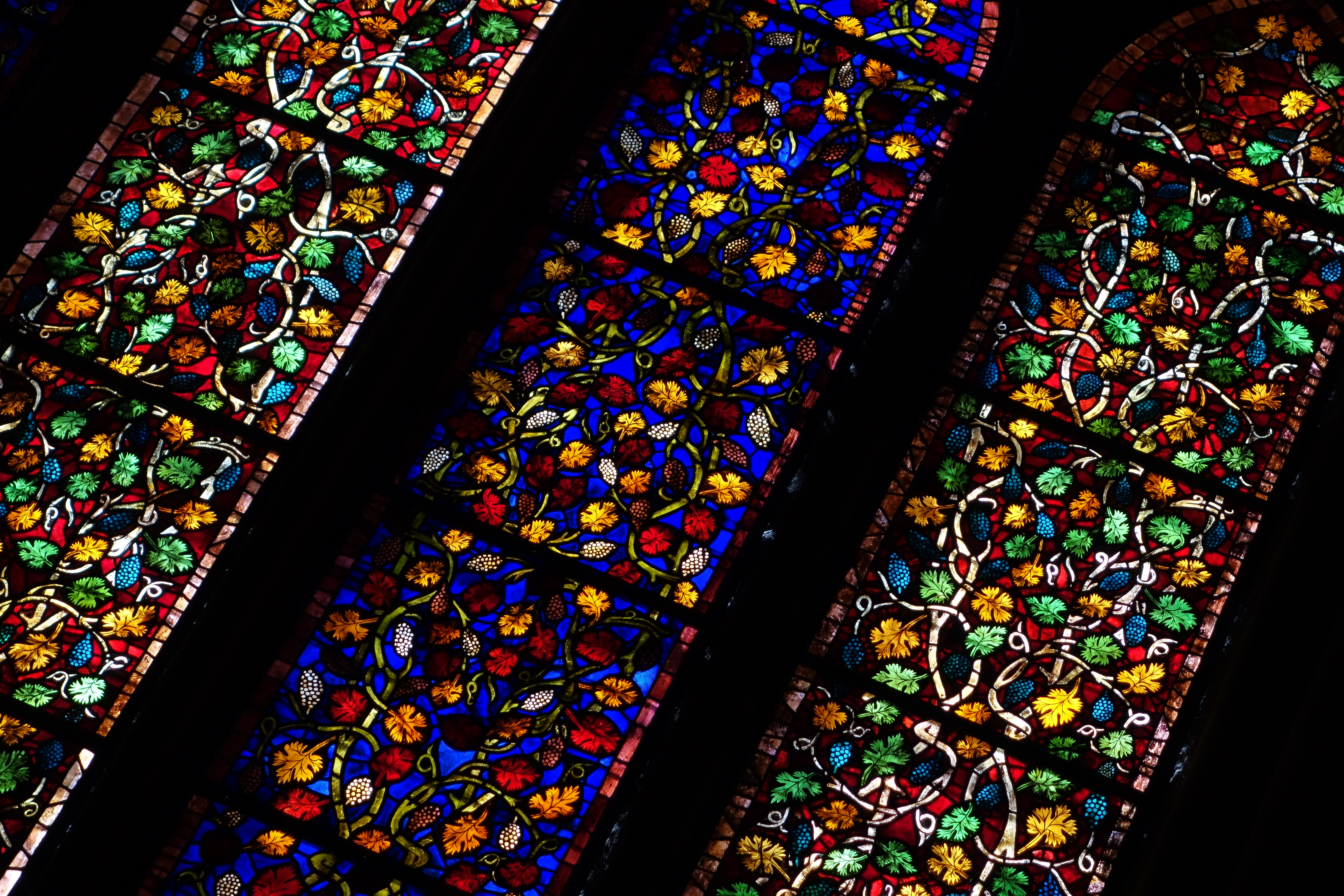
Windows, south nave of León Cathedral on the Camino de Santiago.

I was walking instead of writing in May, on pilgrimage along St. Cuthbert’s Way from the Scottish Borders to Holy Island in Northumbria. More on that soon. Meanwhile, I’m preaching the following for Trinity Sunday at my home parish, St. Barnabas Episcopal Church on Bainbridge Island, Washington. Some of it has appeared before on this blog, but the ending is entirely new.

Part of the fun of Trinity Sunday is getting to watch the preacher attempt to explain the most formidable mystery of Christian faith in less than 20 minutes. It can’t be done! We all know that—the preacher knows it too—and the fun part is seeing how he or she is going to fail this time. 

Of course, we could just say that a mystery is not meant to be explained, and leave it at that. Let’s just adore the mystery, not investigate it.

But if, as the theologians insist, “the nature of the church should manifest the nature of God,”[i] then we need to know enough about the nature of God to understand how to be a church whose own way of being reflects and manifests that divine nature. 

And if investigating the nature of God seems like a daunting task best left to the professionals, those who have the aptitude and training to navigate levels of complexity and nuance which would make our own heads explode, we must remember that the doctrine of the Trinity is not a math problem (How can one be three and three be one?), nor is it an abstract, highly technical construction of the metaphysical elite who spent centuries sorting out differences between Arians, Monophysites, Monothelites, Monarchians, Modalists, Ebionites and Sabellians.

Trinitarian thought isn’t made of thin air or abstract speculation. It is produced and nourished by the concrete, tangible history of Christian experience. Whatever we can actually say about the Trinity is first of all grounded in experience, both the experience of our spiritual ancestors, encoded in Scripture and tradition, and the contemporary, ongoing revelations of our own communal and personal life.

Ever since the first Easter and the first Pentecost, Christians have been trying to make sense of the concrete, experiential data of salvation. Based on our collective and personal experience of being “saved” (or, if you prefer: healed, forgiven, reborn, renewed, resurrected, empowered), what can we say about the God who has done this? 

Trinitarian reflection began within an ancient community deeply grounded in the monotheism of Judaism, which had, over the centuries, found ultimate reality to be not a plurality of disconnected or contradictory energies—what the ancients called “the gods”—but a coherent unity, understood to be the “one God.” However, once the early Christians began to attribute divinity to both Jesus and the Holy Spirit, a simple self-contained oneness was no longer sufficient to describe the Reality.

Without losing the unity of God, how could they account for the divine diversity revealed in the saving activities of Christ and the Spirit? Once they began to call Jesus Kyrios (Lord), which happened very early in their worship and their storytelling, traditional monotheism was radically destabilized. The growing perception of the Holy Spirit as a guiding and empowering presence of deity in their communities only compounded the problem.

There were various attempts to solve the problem by downgrading Jesus and Spirit to subordinate, derivative, or semi-divine realities, by no means equal to the eternal and uncreated God. Such “heresies” were popular with those who wanted to keep God simple. But “orthodoxy” was unwilling to deny the fullness of divinity to either Christ or the Spirit. For them the bottom line was this: 

Only God can save us. Christ and Spirit, in the biblical revelation and Christian experience, are integral and essential to salvation. Therefore, they must be equally integral to the Holy One who is the Creator and Redeemer of all things

As a consequence, the doctrine of God became trinitarian: Three in one and one in three. In other words, God is relational. God is social. God is a communion of Persons. 

If we have difficulty with “God in three Persons,” it is because we think of a person as defined by his or her separateness. I’m me and you’re you! We may interact and even form deep connections, but my identity does not depend upon you. I am a self-contained unit. You can’t live in my skin and I can’t live in yours. That’s the cultural assumption, which goes back at least as far as Descartes in the seventeenth century, and continues today in such debased forms as rampant consumerism and economic selfishness, where my needs and my desires take precedence over any wider sense of interdependence, community, or ecology.

But what we say about the Persons of the Trinity is quite different. Each Person is not an individual, separate subject who perceives the other Persons as objects. The Trinitarian persons experience one another not from the outside, but from the inside. They indwell each other in a mutual interiority.

Is this image of trinitarian indwelling difficult to conceive? Or is it something like the old John Lennon lyric?: “I am he as you are she as you are me and we are all together.” A French mystic put it this way: “it’s a case of un ‘je’ sans moi” (an “I” without a me). Subjectivity, yes, a distinct consciousness within my own body, particular and unique, yes; but a consciousness deeply permeated by the otherness of interdependent reality.

But if the divine Persons are all inside each other, commingled, “of one being,” as the Creed says, what makes each Person distinct? To put it succinctly: the Persons are distinct because they are in relation with one another.

As Jewish theologian Martin Buber observed, we are persons because we can say “Thou” to someone else. To be a person is to experience the difference – and the connection – that forms the space between two separate subjects. My consciousness is not alone in the universe. There are other centers of consciousness: Thou, I… Thou, I… The fact that you are not I is what creates self-consciousness, the awareness of my own difference from what is outside myself.

If we apply this to the Trinity, we say that there are Three Persons because there is relation within God, relation between the Source who begets, the Word who is begotten, and the Spirit who binds the two together and carries them—and the love between them—outward in ever widening circles.

These relations are not occasional or accidental. They are primordial. They are eternal. There is an eternal sending within God, an eternal self-giving within God, an eternal exchange by which God is both Giver and Receiver simultaneously.

Trinitarian faith describes a God who is not solitary and alone, a God who is not an object which we can stand apart from and observe. The Trinity is an event of relationships: not three separate entities in isolation and independence from one another, but a union of subjects who are eternally interweaving and interpenetrating.

The early Church had a word for this: perechoresis. It means that each Person penetrates the others, each contains the other, and is contained by them. Each fills the space of the other, each is the subject, not the object of each other. As Jesus says in the Fourth Gospel: I am in the Father and the Father is in me.

The word perechoresis literally means “to dance around,” and the ancient theologians quickly seized on that image as an accessibly concrete description of a complex process. The Trinity is a dance, with Creator, Christ and Spirit in a continuous movement of giving and receiving, initiating and responding, weaving and mingling, going out and coming in. And while our attention may focus at times on a particular dancer, we must never lose sight of the larger choreography to which each dancer belongs: the eternal perichoresis of Three in One, One in Three.

Wallace Stevens made a poem about the process of giving ourselves over to a larger whole. He calls it “the intensest rendezvous,” where we find ourselves drawn out of isolation “into one thing.” He wasn’t writing about the Trinity, but his words come as close as any to describing the essential dynamic of the divine Persons:

Here, now, we forget each other and ourselves.
We feel the obscurity of an order, a whole,
A knowledge, that which arranged the rendezvous.[ii]

This divine relationality is not something which an originally solitary God decided to take up at some point. God is eternally relational. Before there was an external creation to relate to, God’s own essential self was and is an event of perpetual relation. There was never simply being, but always being-withbeing-forbeing-in. To be and to be in relation are eternally identical.

When the Bible says, “God is love” (I John 4:16), it means that love is not just something God has or something God does; love is what God is. As Orthodox theologian John D. Zizoulas says in his influential text, Being as Communion, “Love as God’s mode of existence … constitutes [divine] being.”[iii] Feminist theologian Elizabeth Johnson echoes this when she says, “being in communion constitutes God’s very essence.”[iv]

In other words, God is Love giving itself away—self-emptying, self-diffusing, self-surrendering—and in so doing finds itself, receives itself, becomes itself.

For those of us made in God’s image, who God is matters deeply, both for our own self-understanding and for our engagement with the world. The Trinity isn’t just a doctrine or an idea. It’s a practice, a way of life, the shape of every story, the deep structure of the church, and indeed of all reality.

The mystics can help us out here. Early in the twelfth century, a German monk named Rupert of Deutz went into a church where mass was being said by a white-haired bishop. At the offertory procession he experienced a vision of the Holy Trinity:

“On the right at the edge of the altar stood three persons of such revered bearing and dignity that no tongue could describe them. Two were quite old, that is, with very white hair; the third was a beautiful youth of royal dignity …”[v]

A century later, Hadewijch of Antwerp, one of those remarkable women mystics who flourished in the late Middle Ages, also had a vision of the Trinity. But instead of three white males, what she saw was a dark whirlpool, which she described as “divine fruition in its hidden storms.” Hovering over this whirlpool was a spinning disc, on which sat a figure wearing the countenance of God – the face of God – on whose breast were written the words, “The Most Loved of All Beloveds.”

We may find Hadewijch’s vision more congenial: it is genderless, and less crudely specific than Rupert’s. And the tempestuous whirlpool, a flood of energy ceaselessly flowing through the universe, conveys a dynamic image of divinity that resembles the postmodern cosmologies of process theology and quantum physics. It’s probably easier for most of us to believe in a divine whirlpool than in three white guys.

But the crucial difference between Rupert and Hadewijch is not in the relative resonance of their imagery, but rather in what happens next. Rupert remains an observer, one who stands apart and sees God as an object. But Hadewijch does not remain separate from what she sees:

“Then I saw myself received in union by the One who sat there in the whirlpool upon the circling disc, and there I became one with him in the certainty of union… In that depth I saw myself swallowed up. Then I received the certainty of being received, in this form, in my Beloved, and my Beloved also in me.”

Rupert’s knowledge of God remained conceptual. Hadewijch’s knowledge of God became experiential. She was gathered into the circulating current of divinity. She became part of its flow, and that divine flow became part of her.

The language she uses for this experience is not mathematical or philosophical. Her language is the language of the heart. She describes being “swallowed up… in my Beloved, and my Beloved also in me.” Love, she discovered, is the way the soul knows. Love is the way the soul sees.[vi]

And what Love knows, what Love sees, is this: God is not a simple, static substance but an event of relationships. That’s why we say that God is love. “To be” has no ontological reality apart from “to be in relationship.” In the words of Anglican priest John Mbiti of Kenya, expressing the strongly communal mindset of African theology, “I am because we are, and since we are, therefore I am.”[vii]

Each Person contains the others and is contained by them in a shared communion of self-offering and self-surrender. But that continuous self-offering is never a one-way transaction, either one of self-emptying or one of being filled. It is always both at once – giving and receiving – as we ourselves know from our own mutual experience of love at its best. 

As Jesus said, “losing” yourself and “finding” yourself are equivalent and simultaneous. In giving ourselves away, we receive ourselves back. This may be counterintuitive to the modernist mindset of autonomous individual self-possession, but it is the essence of communion: “a giving of oneself that can only come from the ongoing and endless reception of the other.”[viii] 

As God’s friends, we are not merely observers of this divine life of self-offering and self-surrender. We are participants.

If God is communion, the eternal exchange of mutual giving and receiving, then the Church must live a life of communion as well. When Love’s perechoresis becomes our way of being in the world—as believers, as church—the Trinity is no longer just doctrine or idea. It is a practice, begetting justice, peace, joy, kindness, compassion, reconciliation, holiness, humility, wisdom, healing and countless other gifts. As theologian Miroslav Volf has said, “The Trinity is our social program.”[ix]

The Church exists to participate in the life of God, and to enable others to do the same. We exist to make divine communion not just an inner experience but a public truth. We don’t just feel God’s perichoresis. We don’t just feel Love’s eternal dance. We embody it. We live it. We show it. We share it.  

Church isn’t something we decide to do—or not do—on a Sunday, when we’re not otherwise occupied. It’s not a consumer item, just one of many options competing for our individual time and attention. Nor is it like a fire hose safely stored in a glass case, for emergency use only. And it is certainly not an antiquarian society preserving quaint rituals, or a museum to display our nostalgia for a lost past.  

No! The Church is the society of God’s friends—resurrection people, animated by divine breath—striving to imitate the triune communion of divine life in our human life together. By showing up, by committing to the shared vocation of worshipping, witnessing and serving together, by tending the holy flame of faith in a heedless world, we offer ourselves, our souls and bodies, as vessels of that communion—not only in our sacramental life, but wherever we happen to live and move and have our being. 

Is that too hard for us? Are we up to it? My friend Bob Franke once wrote a song about the various ways he showed love for his daughter when she was a little girl. He didn’t do it perfectly, of course. No one does. But he gave it everything he had. And a line from that song, I think, speaks to our own calling as a community of faith to imitate the divine communion of the Trinity in our common life, to practice trinitarian love on earth as it is in heaven:

It may not be the thing we do best, but it’s the best thing that we do.[x] 

May the grace of our Lord Jesus Christ, the love of God, and the communion of the Holy Spirit, be with us all, now and forever. Amen.


[i] Catherine LaCugna, God for Us: The Trinity and the Christian Life (San Francisco: Harper San Francisco, 1991), 403.

[ii] Wallace Stevens, “Final Soliloquy of the Interior Paramour,” Collected Poetry and Prose (New York: Library of America, 1997), 444.

[iii] John D. Zizoulas, Being as Communion: Studies in Personhood and the Church (Crestwood, NY: St. Vladimir’s Seminary Press, 1993), 46.

[iv] Elizabeth Johnson, She Who Is: The Mystery of God in Feminist Theological Discourse (NY: Crossroad, 1993), 227.

[v] Bernard McGinn, The Growth of Mysticism: Gregory the Great Through the 12thCentury (New York: The Crossroad Publishing Company, 1994), 330.

[vi] ibid., The Flowering of Mysticism (New York: The Crossroad Publishing Company, 1998), 212-16.

[vii] q. in Veli-Matti Kärkkäinen, The Trinity: Global Perspectives (Louisville: Westminster John Knox Press, 2007), 352.

[viii] Graham Ward, “The Schizoid Christ,” in The Radical Orthodoxy Reader, ed. John Milbank and Simon Oliver (NY: Routledge, 2009), 241.

[ix] Miroslav Volf, “‘The Trinity is Our Social Program’: The Doctrine of the Trinity and the Shape of Social Engagement,” Modern Theology 14, no. 3 (July 1998).

[x] Adapted from Bob Franke, “Boomerang Pancakes,” on For Real (1986). The original line is in the first person singular.  

What is God? — A Trinity Sermon

Abbey at Conques on Le Chemin de St. Jacques de Compostelle, France (Jim Friedrich)

What is God? When the biblical Jews asked that question, they responded from their experience of salvation history.  God is the one who told me to leave behind everything I knew and set out for God-knows-where, says Abraham. God is the one who asked me to go back to the land of oppression and enslavement so I could speak truth to power, says Moses. God is the one who made a covenant with us on Mount Sinai, in the cloud of unknowing. God is the one who remembered us in the days of exile. God is the one who brought us home from Babylon. 

Then Jesus came along, and even though he lived and died as a human being, there were those who experienced the fullness of God in the unique particularity of his life, death, and resurrection. The risen Lord, who said “I am with you always,” would become an object of worship very early in the life of the Church. 

And after the Ascension of Jesus came the Holy Spirit, not only as an indwelling presence but also as a radically transformative force, in whom divine fullness was equally and uniquely manifest.  

For the early Christians, then, the One they called God had been revealed to have three distinct ways of being: Source, Savior, and Spirit. Love who loves us; Word who saves us; Spirit who renews us. And before long they were offering worship not only to the God of Israel, but to Jesus and the Holy Spirit as well. 

They were not polytheists. They rejected pagan notions of a heaven and earth populated by competing deities. But their experiences of God in Christ and God in the Spirit were unique enough to differentiate them from the Holy One who sent Jesus into the world. 

At the same time, the second and third Persons were not understood to be partial or lesser versions of God. Only the true God can save us, as Christ did. Only the true God can sanctify us, as the Spirit does. 

Those first Christians couldn’t deny their experience, or the witness of Scripture. Christ was God. The Spirit was God. But that posed a conceptual problem. 

How can the Three be One? How can the One be Three? Mathematics or logic can’t solve this puzzle. Several centuries of ecumenical councils struggled with the questions, doing their best to preserve the paradox of Three in One and One in Three from collapsing into the simplicity of God as “One is One and all alone.” 

Although it would have put a lot of theologians out of work, It would have been a lot easier just to stick with the Oneness. But that would not have been true to Christian experience. The Threeness is essential to our informed—and formative—encounters with God. As contemporary Catholic theologian Catherine LaCugna puts it, “The doctrine of the Trinity is ultimately a practical doctrine with radical consequences for Christian life.” [1]

Does that mean that the friends of God have to master the bewildering terminology and complicated nuances of ancient dogma in order to live the Christian life? Will heaven admit only the most sophisticated thinkers? Let’s hope not. 

I’ve read a lot of theology and Church history over the last fifty years, and I still have trouble remembering the differences between Monophysites, Monothelites, Monarchians, Modalists, Ebionites and Sabellians. As Japanese theologian Kosuke Koyama wonders, what if we were to exchange the metaphysical tangles of the West for more down-to-earth analogies. For example, he asks, what might the yin-yang of “pepper” and “salt” tell us about the divine nature? [2] Or St. Patrick’s shamrock, for that matter. 

For the Offertory anthem at the liturgy for Trinity Sunday, Mozart’s Laudate Dominum, I’ve assembled 26 concrete images of persons and objects grouped in threes. As you watch the video, I invite you to contemplate the Christian koan of Three-in-One and One-in-Three. 

Now then, what shall we say about the Trinity? One of the sixteenth-century reformers counseled intellectual modesty. “We adore the mysteries of the Godhead,” he said. “That is better than to investigate them.” [3] In a similar vein, a contemporary theologian reminds us that the “triune God is not simply unknown, but positively known to be unknown and unknowable—which is a dear and profound knowledge.” [4]

But on Trinity Sunday, it is the preacher’s ritual duty to offer a sacrifice of ignorance on the altar of unknowing. So here we go.

Back in the day—the fourth century, that is—when the Council of Nicaea was parsing theories of the divine life, theology was a popular sport, and people kicked around trinitarian doctrines the way some of us recite the arcane numbers of baseball metrics today. But in the late Middle Ages, the doctrine of the Holy Trinity went into cold storage. By the time of the Enlightenment, Immanuel Kant could say that Trinitarian theology had “no practical relevance at all, even if we think we understand it.” [5]

In recent centuries, any sort of God talk has been drained of content for many people. We live in a secular age, where a divine power who is in but not of the world has become increasingly unthinkable. Religion, in the world’s eyes, has become more of a private matter than a public truth. 

And yet, the Spirit continues to work, and in the last few decades we have seen a remarkable resurgence of attention and thought devoted to the meaning and relevance of the Trinity. It’s not just white, western males doing this work. Feminists, Africans, Asians, Middle Easterners and Latin Americans are all bringing fresh and urgent perspectives to Christianity’s core doctrine of God. And their work is of enormous consequence for both our personal faith and our common life.

The Nicene Creed declares that the three Persons are “of one substance.” In other words, whatever God is made of, Father, Son, and Holy Spirit have all got it—and in equal measure. 

But what is that “substance?” Is it a divine essence which existed prior to, or in addition to, the Persons themselves? Is there a one God hidden behind or beyond the Trinity? Such a notion would undercut the completeness of the Trinity, making it dependent on something external—in other words, less than fully divine in itself. 

Or is the divine substance like a pie which has been cut into three equal pieces? That would divide God into parts and lose the unity of the whole. It would also make the Persons less than eternal, since the whole pie would have to precede the creation of the separate pieces. 

But what if we were to give up the idea of divine “substance” as some kind of stuff which exists on its own and gets divided into three, or possesses a reality in addition to whatever the three Persons consist of? What if being the divine Trinity does not mean to have a divine substance, a kind of primordial stuff. What if being a Trinity means to be in relation with one another? 

Perhaps the Trinitarian God is best described not as a fixed, objective entity, but as an event or activity, an eternal communion shared between the Persons. The Greek word perichoresisdescribes the divine communion as a dance where the partners are in continuous motion, weaving in and out of one another. 

This conceptual shift from substance to relation is a central theme of contemporary theology. As feminist theologian Elizabeth Johnson writes (using inclusive terms for the Persons):

“The mutual coinherence, the dancing around together of Spirit, Wisdom and Mother; or of mutual Love, Love from Love, and unoriginate Love; or of the three divine persons – this defines who God is as God. There is no divine nature as a fourth thing that grounds divine unity in difference apart from relationality. Rather, being in communion constitutes God’s very essence.” [6]

A couple of British theologians elaborate this point when they say that the divine Persons do not “exist over against the others as self-enclosed centers of consciousness, as with human persons … but rather each dwells in the other through a kind of inter-permeation.” Then they sum it up this way: “The consciousnesses are fused but not confused.” [7]

This is not a new idea. The First Epistle of John assures us that “God is love” (4:8). And love, as we all know, cannot exist alone, without an “other” to share with, give to, receive from. Love exists only by going beyond the self in a process of perpetual self-offering.

Love is not a secondary or optional property of God. Love is who God is, and how God exists. Simply put: “the Trinity is not derived from God’s essence; the Trinity is God’s essence.” The communion and community of the Persons is God’s nature and essence.” [8]

Jürgen Moltmann notes the impossibility of a loving God being otherwise. “God cannot find bliss in eternal self-love,” he writes, “if selflessness is part of love’s very nature. God is in all eternity self-communicating love.” [9] A Kenyan Christian, John Mbiti, who comes from a more communal culture, puts this even more succinctly:

“I am because we are, and since we are, therefore I am.”[10]

We may struggle with this interdependent Trinitarian model because our culture has taught us to think of a person as an autonomous individual, whose identity, mind and will are separate and independent from every other person. 

But what the doctrine of the Trinity tells us is that you cannot be a person alone. You can only be a person in relationship with others. Addressing another, listening to another, conversing with another, loving one another, offering ourselves to one another—these are the means of becoming a person and existing as a person, if we are to live in the image of the relational personhood of the divine, in whom the one does not exist without the many. 

When we hear Jesus say, you must lose yourself to find yourself,[11] we may think he’s speaking of death, either metaphorical or physical, some kind of painful stripping away. And sometimes that is the case. 

But I think Jesus is also describing the divinely grounded process of communion and community. “I am because we are, and since we are, therefore I am.” St. Athanasius had a wonderful term for this state of being in communion. He called it “reciprocal delight.”[12]  We are all in this together, God says, and so say God’s friends as well.  

It seems especially fitting at this particular moment to contemplate communion as the essential and constitutive fact of divine life, for in one week’s time we will gather together, in person at last, as the Body of Christ at St. Barnabas. It has been fourteen months since we last did this. What joy it will be to share the sacrament of God’s self-diffusive love once again and celebrate the bonds between us.

After so many words about the Holy Trinity, let me conclude with an image. Thirty years ago, Polish film director Krzysztof Kieslowski made a series of 10 one-hour films called Decalogue. Each of the films is based on one of the Ten Commandments, and the series is one of the masterpieces of spiritual cinema. [13]

Pawel (Wojciech Klata), Decalogue 1

In the first film, there’s an exchange between Pawel, an eleven-year-old boy, and his aunt Irena. Pawel has a great curiosity about God, which his single-parent father, an unbeliever, cannot satisfy. So Pawel takes his questions to Irena, his devout Catholic aunt: 

Pawel: Do you believe that God exists?
Irena:  Yes.
Pawel: What is God?

Irena doesn’t answer with words. 
Instead, she puts her arms around Pawel and pulls him close.

Irena:  What do you feel now?
Pawel: I love you.
Irena:   Exactly. That’s what God is.


[1] Catherine M. LaCugna, cited in Veli-Matti Kärkkäinen, The Trinity: Global Perspectives (Louisville, KY: Westminster ]ohn Knox Press, 2007), 179.. This is the opening sentence of LaCugna’s God for Us: The Trinity and Christian Life (1991). As you will see, I found Kärkkäinen’s study of recent Trinitarian theology to be an invaluable resource. 

[2] Veli-Matti Kärkkäinen, 312.

[3] Philip Melanchthon, in Veli-Matti Kärkkäinen, xvi.

[4] Elizabeth Johnson, in Veli-Matti Kärkkäinen, 212, from Johnson’s She Who Is: The Mystery of God in Feminist Theological Discourse(1993).

[5] Immanuel Kant, in Veli-Matti Kärkkäinen, 206.

[6] Elizabeth Johnson, in Veli-Matti Kärkkäinen, 56.

[7] Ninian Smart & Steven Konstantine, in Veli-Matti Kärkkäinen, 249, from their Christian Systematic Theology: Theology in a World Context (1991).

[8] Richard Rice, in Veli-Matti Kärkkäinen, 140.

[9] Jurgen Moltmann, in Veli-Matti Kärkkäinen,106;  from Moltmann’s classic Trinity and the Kingdom: The Doctrine of God (1981)

[10] John Mbiti, in Veli-Matti Kärkkäinen, 352.

[11] Matthew 10:38.

[12] St. Athanasius (c. 296-373), a bishop in Roman Egypt, was a key defender of Trinitarianism. Cited in in Veli-Matti Kärkkäinen, 39.

[13] See my post, Kieslowski’s Decalogue: A Masterpiece of Religious Cinema (Jan. 28, 2017): https://jimfriedrich.com/2017/01/28/kieslowskis-decalogue-a-masterpiece-of-religious-cinema/