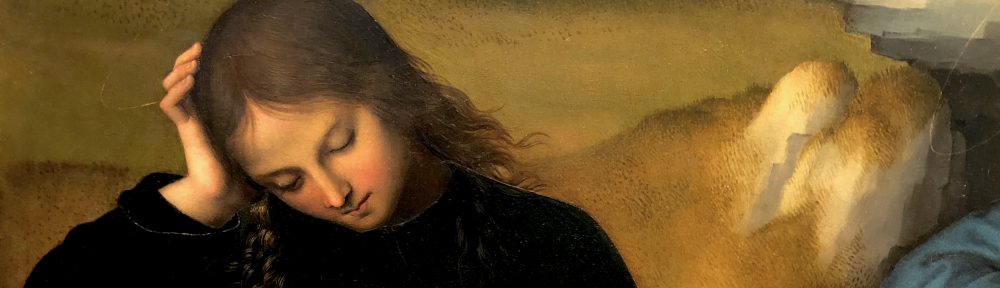
Whose World Is It?—Rethinking the Problem of Evil

The Last Judgment (detail), Tympanum of the Abbey of Sainte-Foy, Conques, France (c. 1107).

God isn’t the prime mover of every natural catastrophe and human ill; inexplicable tragedies are never a so-called act of God. Life is more complicated than that; so is the universe; so is God. 

— Gary Commins

Lord, if you had been here, my brother would not have died (John 11:21).

In Son of Man, a 2006 film retelling the Jesus story in a 21st-century African country, Jesus and Satan are sitting side by side atop a tall sand dune. After putting up with the three temptations, an exasperated Jesus turns suddenly toward his adversary and gives him a hard shove. As Satan tumbles down the dune, Jesus shouts after him, “This is my world!” But Satan is unbowed. When he reaches the bottom, he picks himself up, dusts himself off, and cries up to Jesus, “NO! THIS IS MY WORLD.” The film cuts to the country’s ongoing civil war, where a mass shooting of schoolchildren proves Satan’ point. 

One night last week, a drunken man was shooting a gun in his front yard—reportedly a form of recreation in his Texas neighborhood. But his next-door neighbor had a baby who was trying to sleep. He asked the shooter to stop. The shooter refused. Instead, he fetched a deadlier weapon—an assault rifle—took it into his neighbor’s house, and slaughtered five people, including a nine-year-old boy. The police found a few survivors—children shielded beneath the bodies of their mothers—uninjured, but covered with maternal blood.  

Such unspeakable evil has become a regular occurrence in my country. Mass shootings are setting a record pace this year. Twenty years ago, there were 200 million guns in America. Now there are 400 million. Twenty years ago, assault rifles were 2% of the market. Now they are 25%[i] The man who pulled the trigger in Texas is not alone in his guilt. He is joined by the gunmakers who make themselves rich from the carnage, the right-wing lawmakers who fetishize guns to get votes, the cable propagandists who stoke fear, rage and hate, and a dysfunctional society incapable of exorcising its legion of demons.
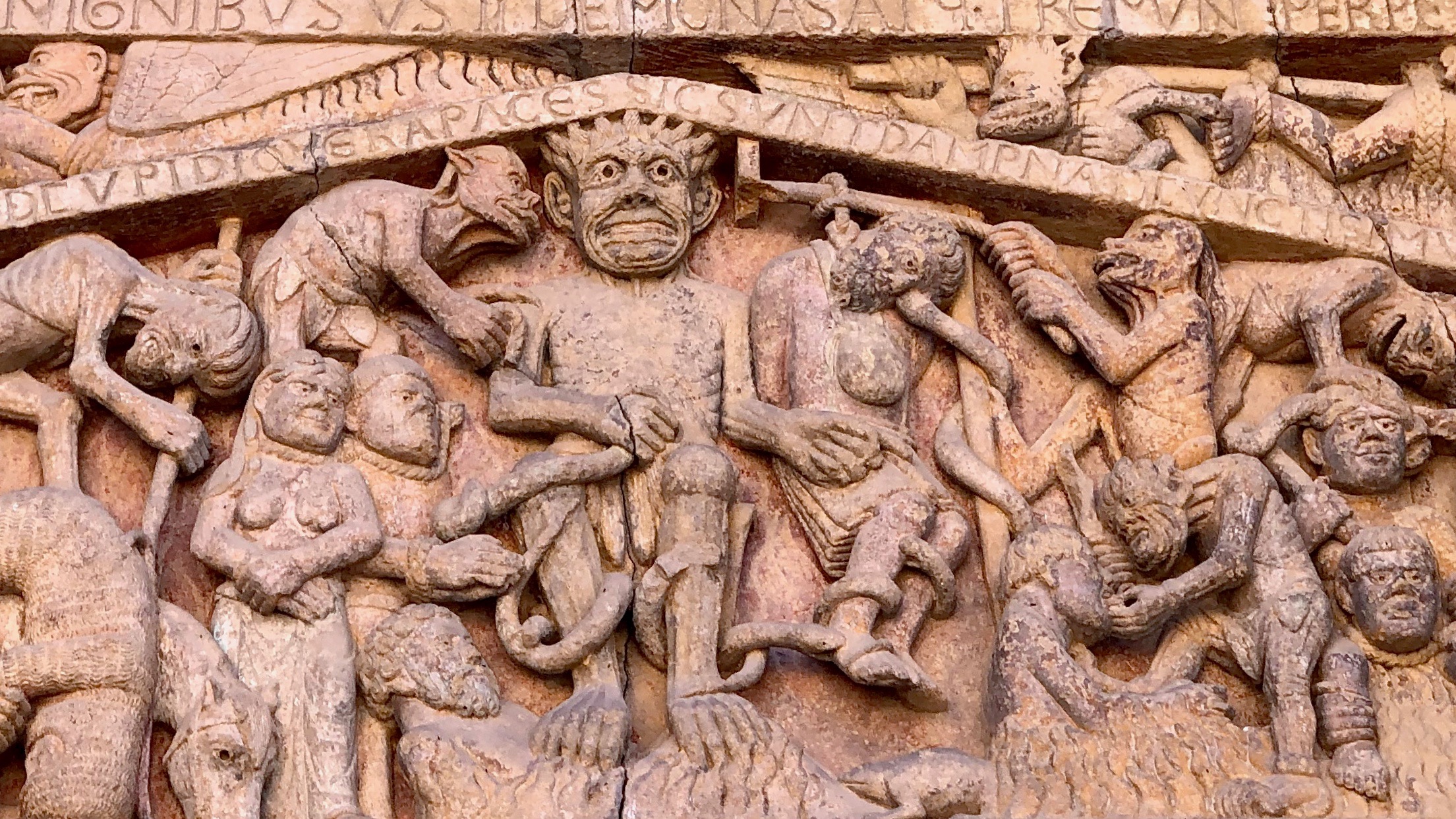
The Last Judgment (detail), Tympanum of the Abbey of Sainte-Foy, Conques, France (c. 1107).

I have written about our capacity for denial in “The Murderous Hypocrisy of ‘Thoughts and Prayers.’” If we say we have no sin, we deceive ourselves, and the truth is not in us (I John 1:8). Or as a modern theologian puts it, “It is only when our capacity for evil has been rendered explicit that we have a realistic basis for understanding that transformation or metanoia, that healing, which constitutes our salvation.” [ii]

Zooey Zephyr, a representative in the Montana state legislature, recently provided a perfect image of the cognitive dissonance inherent in pious self-deception. She was speaking against a Republican anti-trans bill which she believes will increase suicide among the young; but her words could apply to every political misuse of “thoughts and prayers”: “If you vote yes on this bill and yes on these amendments, I hope the next time there’s an invocation when you bow your heads in prayer, you see the blood on your hands.” [iii]

The Republican majority, like Pilate washing his hands of innocent blood, voted to silence Zephyr. They expelled her from the house. It’s easy to mock their fear of truth-telling, but when we look at our own hands, what do we see? 

Evil is woven not only into the fabric of the world, but into each and every soul. In Terrence Malick’s great (anti)war movie, The Thin Red Line, we are shown the violence and death of a terrible battle, but the realistic sounds of gunfire, grenades and human screams are muted beneath the elegiac music of Charles Ives’ “The Unanswered Question,” as though we are watching human evil through an impartial God’s tear-stained eyes. Then we hear the voice-over questions of an American soldier, seeking to penetrate the surface of the visible: 

“This great evil, where does it come from? How does it still enter the world? What seed, what root did it grow from? Who’s doing this, who’s killing us, robbing us of life and light, mocking us with the sight of what we might have known? Does our ruin benefit the earth? Is this darkness in you too?” [iv]

Who’s doing this? Who’s killing us? Is this darkness in you, too? The problem of evil is not only an unanswered question; it is unanswerable as well. In his valuable and insightful new book, Evil and the Problem of Jesus, Episcopal priest and theologian Gary Commins invites us to set aside the philosophical conundrums, engaging evil not as a theoretical puzzle but as a practical challenge.  

Since ancient times, the existence of evil has raised unsettling questions about the nature of God. If God is good, why is so much evil allowed to happen? Is God indifferent to our suffering, or somehow powerless to eliminate it? Can divine purpose ever justify evil, turning it to the good? Or must we conclude that a good God, or any God at all, is a logical impossibility, given the prevalence and persistence of evil?

Theodicy is the philosophical or theological attempt to reconcile the goodness of God with the existence of evil. It has produced a vast amount of profound intellectual reflection over the centuries. But Commins, drawing on his own pastoral experience, calls the whole enterprise into question. It’s not just that a rational explanation for evil offers little real comfort to its victims (Who wants to hear “It’s God’s will” at a funeral?). It also strips both God and evil of their complexity. The sources of evil are multifarious and impossible to trace with precision. And the activity of God within our temporal, finite existence is not a unilateral and unfettered exercise of power. The self-emptying God chooses to work within incarnational limits. The vulnerable babe in the manger grows up to die on a cross, and in between does what he can to address evil, not always successfully. 

“Traditional Western theodicy,” says Commins, “jams billions of people, or the planet, millions of millennia, and the infinite intricacy of subatomic matter into a solitary, simplistic enigma of God-and-evil. By tapering all its energy into one worn-out query, it diverts us away from more illuminating questions. Not only does it boil down a myriad of meanings into one conundrum of divine power or love. It concentrates on what is, in all likelihood, the least fruitful of many mysteries.” [v]

Instead of defending God’s honor or solving the ancient enigma of good and evil, we should accept the sheer givenness of “a wild, wondrous, chaotic creation [we] can’t comprehend or control.” [vi]  Instead of wondering why the world is so, we should devote our energies to the divine project of making it better. 

“The causes of evil and suffering are personal, social, structural, and cosmic: human delusions, collective misbehaviors, institutional grandiosity, and spiritual malice .… Until the End, suffering and evil will neither cease nor desist—they are inherent in creation and intensified by social ills; we can decrease them by aligning ourselves with God’s will.” [vii]

We may never understand why the world must be an unstable mixture “of storms and stillness, gloom and brightness,” where “suffering, evil, and chaos commingle with glory, love, and joy.”[viii]  But it’s the world we’ve got, and what we really need to figure out is how to live in it.

And for that, Commins says, we must turn to Jesus, who shows us “what it means to be human.” If we seek a Christian understanding of God’s response to evil, we should start not with metaphysics, but with the gospel.

“Jesus never waxes philosophical. Rather than offering an ‘explanation’ for evil, he gives his followers ‘a charge and a benediction’: the charge to stand in solidarity with the oppressed, the benediction to empower his followers to resist evil.” [ix]

“Nowhere does Jesus construct a system of ethics or author a theology of evil. In broad terms, what we can do to undo evil is clear—act on his words, treat all as equals, seek the kingdom, go and do likewise, repent, follow, forgive, and love—but unless we face the evils within us, we won’t have a positive influence on the world around us and, even then, nothing is a sure thing.” [x]

At the same time that Jesus is showing us how to be fully human, he is revealing who God is and what God does. Jesus’ own responses to evil are “epiphanies into God’s relationship with evil.… what Jesus does in time, God does in eternity; the ways Jesus responds to evil in his lifetime—confronting, undoing, and erasing it; bending, circling, and transforming it—are ways God always engages evil.” [xi]

No metaphysical speculation needed. Just keep an eye on Jesus, and the Way will show itself. In a beautifully succinct summation of this Way, Commins says that “Jesus embodies compassion, challenges judgments, reverses fates, levels inequalities, frees from demons, forgives sins, tells truths, and plants seeds of shalom.” [xii]

So whose world is it, after all? We wonder every time we watch the news. But ultimately, it’s a question to be answered not within our minds, but in the activity of our lives. As the song says, “It may be the devil or it may be the Lord, but you’re gonna have to serve somebody.”[xiii]

The late German theologian Dorothee Soelle (1929-2003) found this paradigm of Christian discipleship perfectly expressed in The Brothers Karamazov, where Ivan and his younger brother Alyosha are earnestly discussing theodicy. Both agree that no long-range divine purpose could ever justify the torture of children in the here and now. Where the brothers differ is in their personal response to evil. Ivan blames and rejects a God who consents to the immense sufferings of history. But Alyosha, notes Soelle, does not shake his fist at heaven. He is too busy attending to the needs of earth, just like the God who became one of us.

“[Alyosha] directs his attention not to the power above but to the sufferers. He puts himself beside them. He bears their pain with them. He listens with agony as Ivan introduces examples of suffering he had assembled against the compassion of God … He is silent, he shares the suffering, he embraces the others.” [xiv]

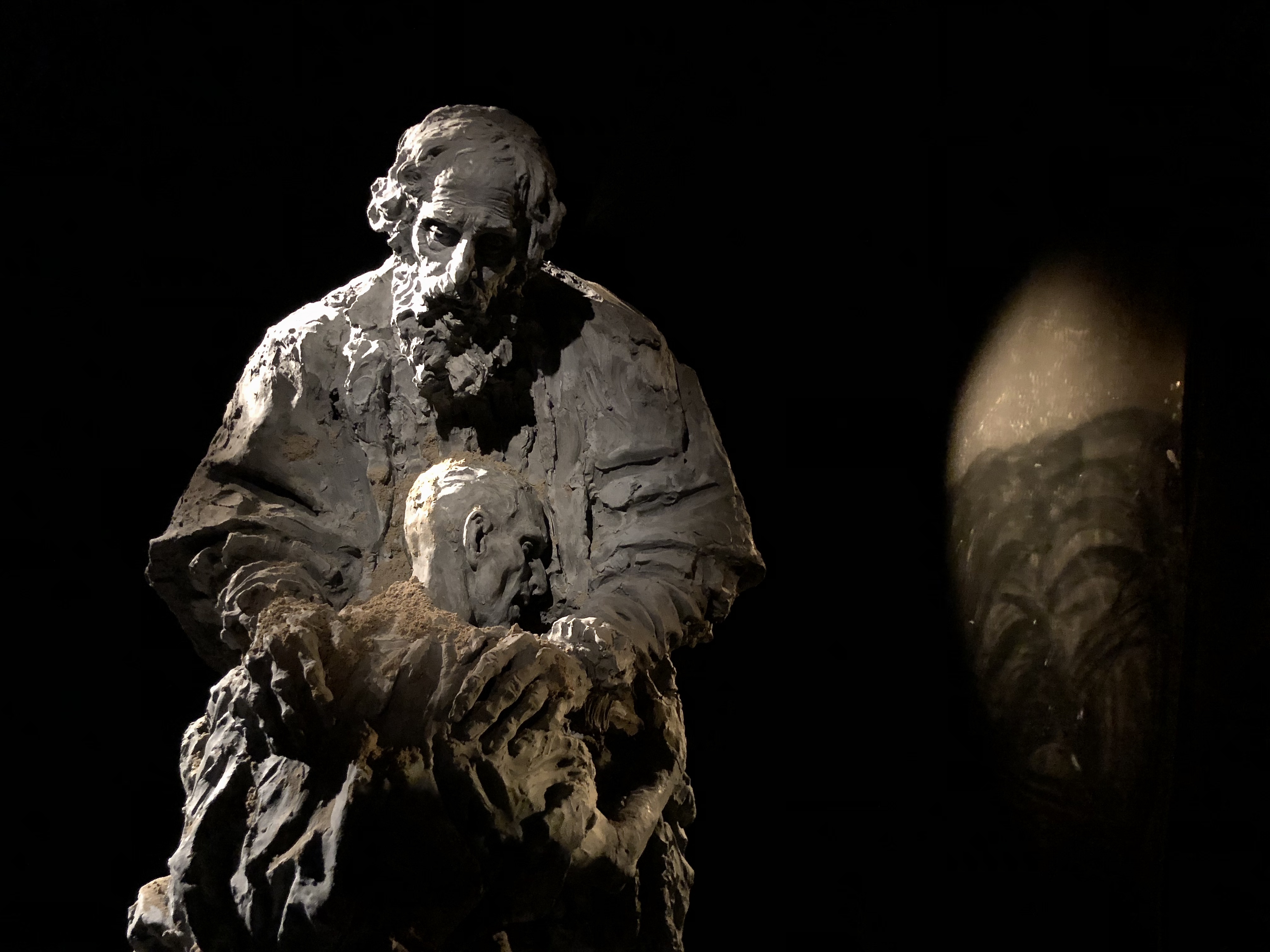
Compassion’s embrace: from Alexander Sokurov’s “Lc. 15:11-32” (Prodigal Son installation,Venice Biennale 2019). Sculptures by Vladimir Brodarsky & Katya Pilnikova.

Photographs by the author. For more on the Tympanum at Conques, including a video of what the original painted colors might have been: https://www.tourisme-conques.fr/en/en-conques/the-tympanum

[i] These statistics were cited in a televised interview with Fred Guttenberg, speaking about the new book he has co-authored with Thomas Gabor: American Carnage: Shattering the Myths That Fuel Gun Violence. 

[ii] Kenneth Surin, Theology and the Problem of Evil (Oxford & New York: Basil Blackwell Ltd., 1986), 157.

[iii] https://apnews.com/article/montana-trans-lawmaker-silenced-zooey-zephyr-d398d442537a595bf96d90be90862772

[iv] The Thin Red Line (1998), adapted by Terrence Malick from James Jones’ 1962 novel. 

[v] Gary Commins, Evil and the Problem of Jesus (Eugene, Oregon: Cascade Books, 2023), 14. Full disclosure: Gary is an old friend. We meet up periodically in Eugene for national track & field championships, but never discuss evil during the meets. His new book not only offers a fresh and timely take on a central theological question, it does so through an illuminating method of reading Scripture and tradition in general.

[vi] Commins, 68.

[vii] Ibid., 194.

[viii] Ibid., 155, 194.

[ix] Ibid., 41. The quoted phrases are from Susan R. Garrett’s article, “Christ and the Present Evil Age,” Interpretation 57 (2003), 370-383.

[x] Ibid., 129-130.

[xi] Ibid., 159.

[xii] Ibid., 149.

[xiii] Bob Dylan, “Gotta Serve Somebody,” on Slow Train Coming (1979). 

[xiv] Dorothee Soelle, Suffering (London: Darton, Longman and Todd, 1975), 175.

“I Once Was Lost”: Rethinking Jesus’ Most Beloved Parable

Alexander Sokurov, “Lc. 15:11-32” (Prodigal Son installation, 2019). Sculptures by Vladimir Brodarsky & Katya Pilnikova.

 Life is a dialectic of dwelling and wayfaring, in the world yet not of it.

––– Erazim Kohák

I once was lost, but now I’m found.

––– John Newton


Jesus’ parable of the Prodigal Son is the Bible’s preeminent tale of forgiveness and reconciliation. The welcoming father’s embrace of his foolish and errant son is a vividly concise summary of the gospel message: We can never be so lost that we cannot be found. We can never be so wrong that we cannot be loved.

Rembrandt’s celebrated painting, The Return of the Prodigal Son, would be one of his final works. He was bankrupt, his style no longer in vogue. His wife and three of their children were long dead, and he would have to sell his wife’s grave to pay his debts. His only surviving son Titus, age 27, died of the plague even as the parable’s “lost son” was taking form on canvas. As Rembrandt struggled with his own sadness and despair, he created the most indelible image of mercy in the history of art.

Rembrandt van Rijn, “The Return of the Prodigal Son” (c. 1167-1669).

Father and son emerge from a world of shadows, for compassion is the light of the world which no darkness can comprehend. The arch formed by the father’s welcoming arms is echoed by the arched doorway in the background, showing love to be the true way home. And unlike most other artistic depictions of this scene, there is no happy glance between the reunited pair. The prodigal’s repentant posture delays the moment when their eyes will meet.

Kierkegaard wrote at length about the “infinite qualitative abyss” between God and humanity, a condition due not only to the uncrossable difference between finite and infinite, but also to the profound estrangement from the holy wrought by human sin. Given the magnitude of the gulf between ourselves and the divine, how could we ever be in relation with One who is so totally other? “The danger,” said Kierkegaard, “is that God becomes so dreadfully and irreconcilably Other to the self that one is swallowed up by the horror of this infinite qualitative abyss.” [1]

The modern solution to the gulf between human and divine has been to ignore (or forget entirely) the Holy Other and concentrate on the human situation in solely human terms, permanently severing the problem of earthly existence from the problem of God. How well that works is a matter of some debate, but for the faithful, such a strategy omits far too much of value. Exiling God from the world is not a solution for our own condition of exile.

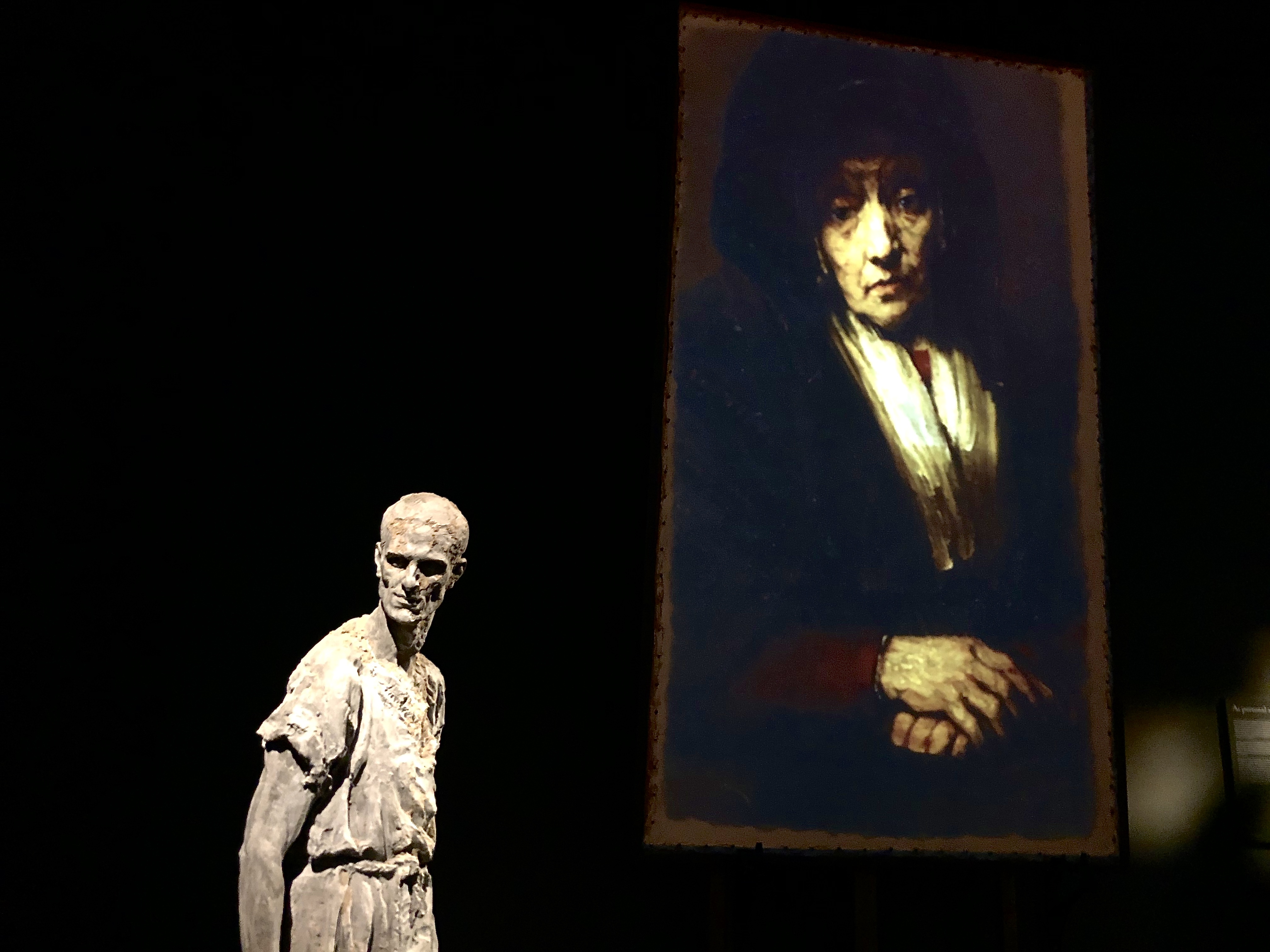
The Prodigal Son under the melancholy gaze of Rembrandt’s “Portrait of an Old Woman” (1654) in Sokurov’s installation.

We all long to go home, to find the place where we are loved and known and welcomed, the place where all wanderings cease, and we can finally know what it means to dwell. But with the longing comes doubt. Is there such a place? Can we ever get there? And how will the journey change us?

For the unbeliever, human life concludes with annihilation. After our last breath––nothing. But the future of the believer may also be described as a kind of annihilation. As we draw near the absolute center of all that is, the egocentric self can no longer maintain its pretentious fictions. The really Real exposes our own unreality. The gaze of God is fatal to our illusions.

When Moses asked to see God’s face, God told him that “no human may look upon Me and live” (Exodus 33:20). This crucial Hebrew text reflects an ancient fear of direct contact with the divine, whose infinite voltage could fry the circuits of finite beings. But the biblical God posed an additional, even greater threat: the penetrating gaze which sees us for what we are.

Day of wrath! . . .
What a great tremor there will be,
when the Judge is to come,
who will examine all things strictly  . . .
I groan, as if accused;
my face blushes because of my fault . . . [2]

Who among us is ready to have every story told, every failure examined, every blemish known? Therapeutic honesty is hard and painful work. Kierkegaard wrote in his Journal that “to see yourself is to die, to die to all illusions and all hypocrisy––it takes great courage to look at yourself.” And, he added, this “can only take place in the mirror of the Word.” [3]

The Christian goals of illumination and divine union must be preceded by confession and purgation. “If we say we have no sin, we deceive ourselves, and the truth is not in us” (I John 1:8). Even the saints are not exempt; the best of them are brutally honest about their own incompleteness. St. John of the Cross, speaking from personal experience, said that the journey of faith “does not consist in consolations, delights, and spiritual feelings, but in the living death of the cross, sensory and spiritual, exterior and interior.” [4]

This annihilation of self––“the living death of the cross”––is not morbid self-hatred (fixating on my sin is just another form of ego), but the abandonment of everything false or misshapen as the necessary prelude to profound transformation. The death of self becomes the beginning of Self.

I abandoned and forgot myself,
laying my face on my Beloved;
all things ceased;
I went out from myself,
leaving my cares
forgotten among the lilies. [5]

In Rembrandt’s painting, the Prodigal Son presses his face against his father’s comforting body. He is still in the confessional stage, kneeling with downcast eyes, not yet daring to stand face-to-face with the one he has hurt so deeply. But consciousness of his fault is overcome by grace––the leap of faith which accepts the “impossible possibility” of being forgiven. Only by knowing ourselves as sinners needing mercy can we become aware of forgiveness. The eyes which were cast down by shame will soon be raised up to see the welcoming father face-to-face. “By surrendering its despair before God, the self becomes open to forgiveness: the gift from the divine which is the impossible possibility of coming to know oneself as one is known by God.” [6]

The Kierkegaardian surrender of existential despair in order to receive the gift of mercy applies perfectly to Rembrandt’s painting:

“Justice looks judgingly at a person, and the sinner cannot endure its gaze; but love, when it looks at him––yes, even if he avoids its gaze, looks down, he nevertheless does perceive that it is looking at him, because love penetrates far more inwardly into life, deep inside life, in there where life emanates, than justice does, which repellingly establishes a chiasmic abyss between the sinner and itself, whereas love is on his side, does not accuse, does not judge, but pardons and forgives.” [7]

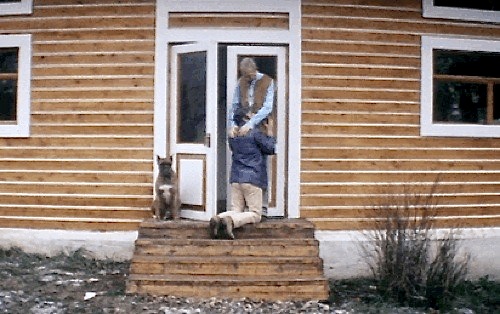
The Return of the Prodigal Son, acquired by St. Petersburg’s Hermitage Museum over 250 years ago, has long haunted the imagination of Russian visual artists. In his metaphysical sci-fi film Solaris (1972), Andrei Tarkovsky returns his cosmonaut protagonist from the “far country” of outer space to the door of his childhood house, where he is embraced like Rembrandt’s prodigal. But his father, we have learned, is deceased, and his son remains somewhere out in space, light years from earth. Tarkovsky’s moving image of ultimate reunion with both parent and planet earth turns out to be only memory or dream. It is in fact “impossible”––which only deepens the desire to make it so.

The son returns home (in his imagination), from the closing scene of Andrei Tarkovsky’s “Solaris” (1972).

Another Russian filmmaker, Alexander Sokurov, included Rembrandt’s actual painting in Russian Ark (2002), a meditation on Russia’s troubled history filmed entirely inside the Hermitage in a single 87-minute shot, with the camera moving through the galleries to encounter both paintings and people from different centuries. The pensive French aristocrat we follow from room to room stops for a long time in front of Rembrandt’s great canvas, silently paying homage to its power. For the Russian Pavilion at this year’s Venice Biennale, Sokurov himself returns to the painting, rethinking its themes with sculpture, video, music, lighting, a mirror, and various objects from an artist’s studio. His installation is called “Lc. 15:11-32,” after the biblical citation for Luke’s telling of the parable.

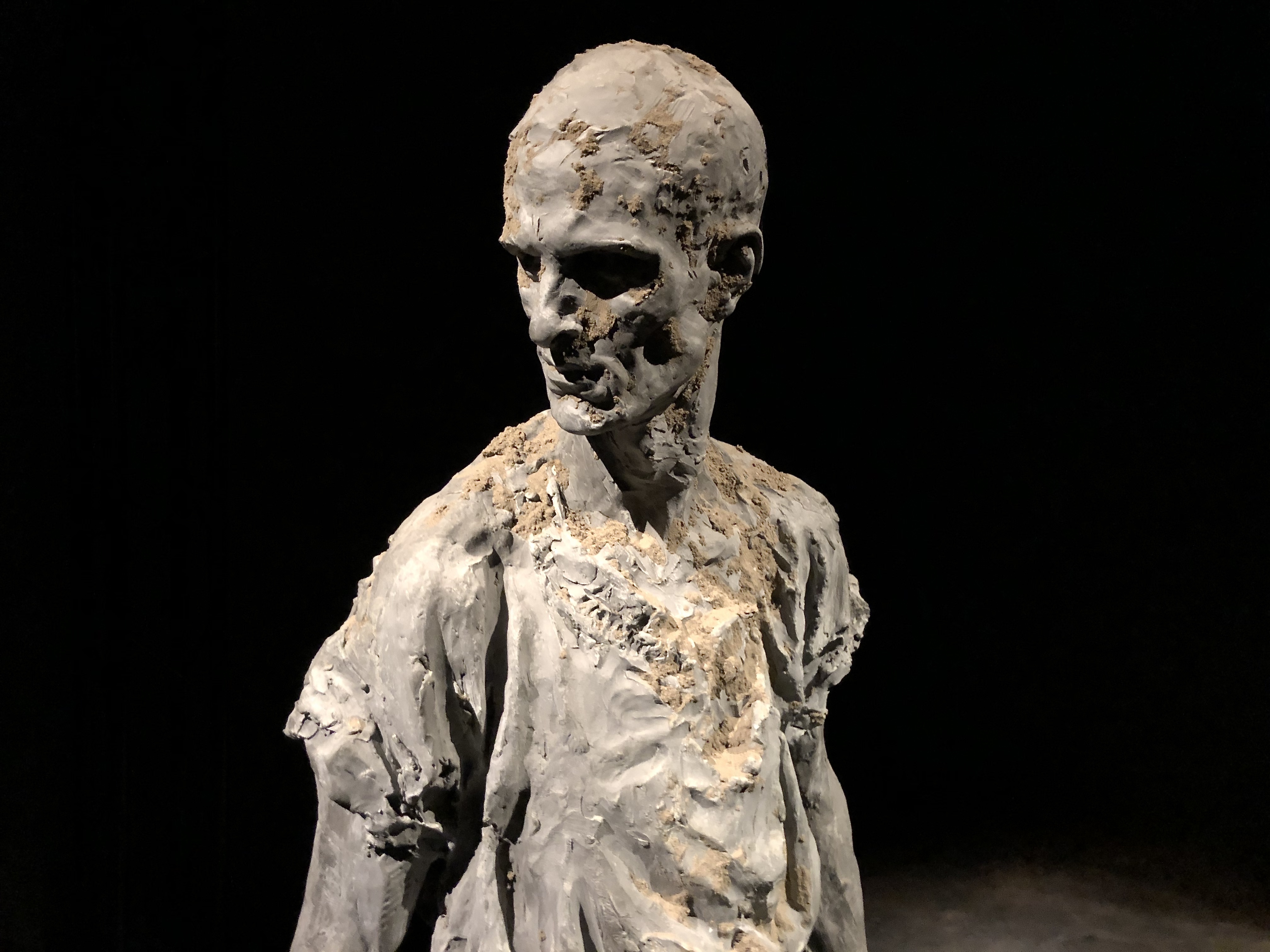
The sorrowful father in the first room of Alexander Sokurov’s installation, “Lc. 15:11-32.”

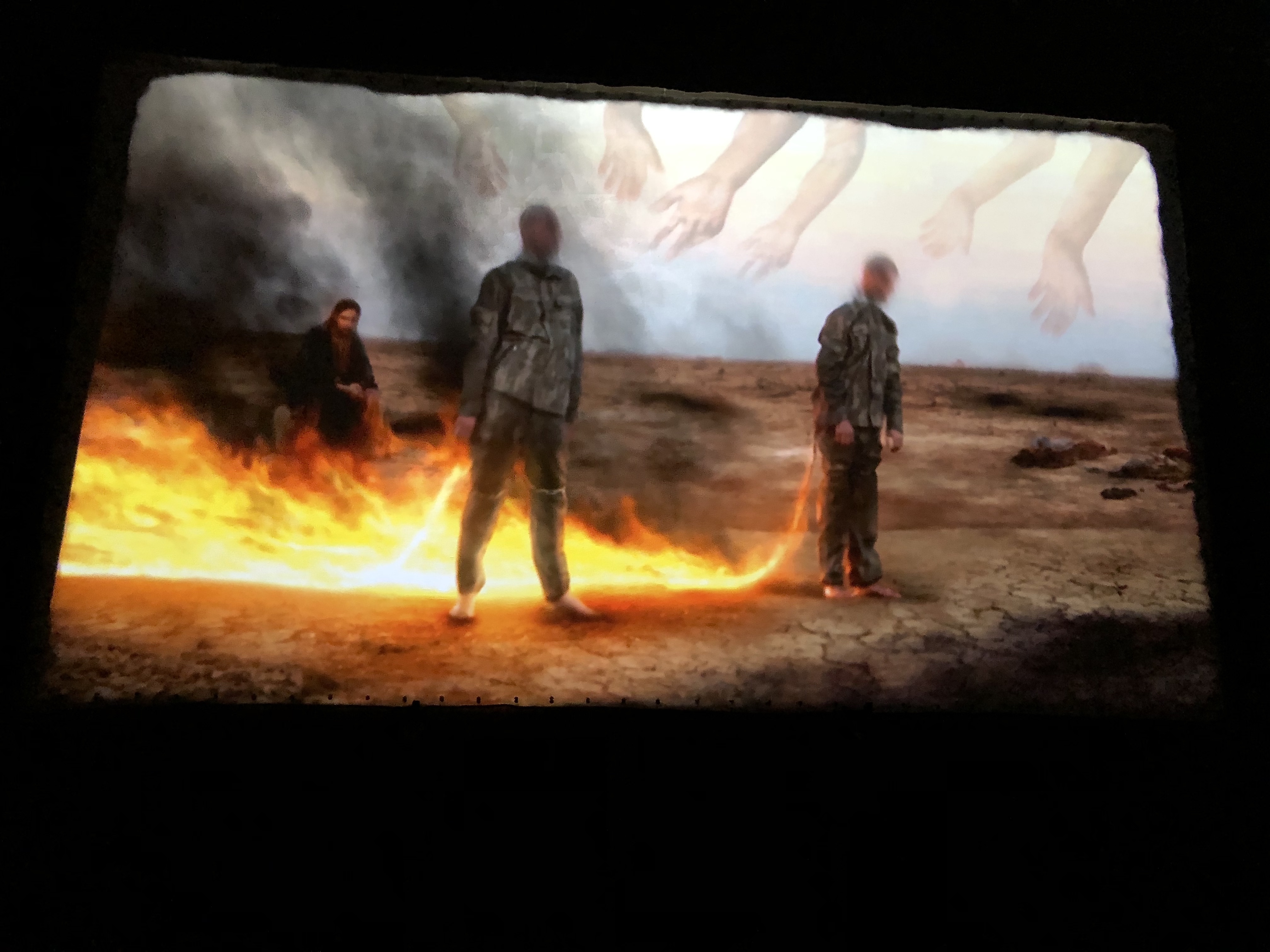
In the first of two dark rooms, father and son stand far apart in the gloom. It is not clear whether they even see each other across the black abyss that separates them. Behind the father are two large video projections representing a world gone wrong. One shows a blurred image of a city dissolving in flames, like an apocalypse by Hieronymus Bosch. The other shows Christ sitting in a desert as soldiers enter with flame throwers to fill the screen with fire and smoke. We realize that not just the son, but the whole world has gone astray. Not even a divine father can fix it. Grace and redemption remain an impossibility in this terrifying darkness.

Ivan Nikolaevich Kromskoy, “Christ in the Wilderness” (1872).

The Christ in the video image is taken from a nineteenth-century Russian painting, Christ in the Wilderness (1872), by Ivan Nikolaevich Kromskoy, whose humanized Jesus, unlike the serenely transcendent Savior of Orthodox iconography, reflected the revolutionary and questioning mood of the painter’s generation. In an age of religious doubt, traditional understandings seemed out of touch with experience. For Kromskoy, a self-assured Christ radiant with divinity was too detached from human suffering. “My God––Christ––is the greatest of atheists,” he said, “a person who has destroyed God in the universe and shifted him directly to the center of the human spirit and who, therefore, goes calmly to his death.” [8]

One of the video projections in the first room of Alexander Sokurov’s installation, “Lc. 15:11-32.”.

But how calm can such a Christ really be, sitting now, according to Sokurov, amid the flames and smoke of our endless desert wars? He may be the “fellow sufferer who understands,”[9] but he appears to be as lost as the Prodigal Son, exiled to the far country of human sin. His inheritance of divine power has been squandered by incarnation. He may share our griefs––does he also share our helplessness?

In the vast first room of Sokurov’s installation, estrangement is absolute and unchanging. But beyond it lies a second room, like a small cave, where the abyss of sin and separation is overcome at last. In a sculpted restaging of Rembrandt’s painting, the lost son comes home to the father’s compassionate embrace.

In the second room of Sokurov’s installation, father and son are reunited.

Behind the figures there is a large mirror, whose reflected image repeats the scene, reminding us that every retelling of the parable is but a version of an original which cannot be grasped directly, but only experienced in the second-hand reflections of Luke, Rembrandt, Sokurov, and all the rest of us who engage Jesus’ story. The mirror’s surface is slightly wavy, and it sways slowly back and forth, producing a continuously distorted image, suggesting the instability and uncertainty of every interpretation.

The figures are reflected in a distorting mirror.

The mirror also includes the viewer, allowing each of us to know ourselves as witnesses to the impossible mystery of divine mercy. But such seeing does not always come naturally. While I stood transfixed in this cave of revelation, two young women entered. After a brief glance at the sculpture, they became absorbed with photographing their own misshapen reflections in the mirror, giggling at the funhouse gag.

In my mind, I judged their heedless frivolity, and the moment I did so I became equally blind to the meaning of The Return. I forgot my own prodigal culpability, my own need to kneel with downcast eyes. I forgot the unconditional nature of the father’s embrace. I had become the elder brother.

No matter, says the parable. The prodigal, the proud, the penitent, the foolish––we’ll all be gathered in eventually. And the conclusion of all our wandering stories will be a home of abiding welcome. The door is open. The feast is ready. Love is waiting. Come.


Related Posts:

The Return of the Prodigal Son

Venice Biennale 2019: “A wound in a dance with love”


[1] Søren Kierkegaard, Without Authority, cited in Simon D. Podmore, Kierkegaard and the Self Before God: Anatomy of the Abyss (Bloomington, IN: Indiana University Press, 2011), 8.

[2] Dies Irae (“Day of Wrath”), a thirteenth-century Latin poem about the Last Judgment and our collective plea for forgiveness. It became a traditional part of requiem masses, but its vivid images of doom and “wrath” sound jarring to modern ears accustomed to a kinder and gentler eschatology. However, when we consider the moral and apocalyptic implications of climate change, the notion of a “day of reckoning” when “nothing will remain unpunished” and “even the just can scarcely be secure” seems uncomfortably apt, as does the poem’s anguished cry for rescue and “the gift of forgiveness.”

[3] Kierkegaard Journal, cited in Podmore, 155.

[4] John of the Cross, cited in Hans Boersma, The Beatific Vision in Christian Tradition (Grand Rapids, MI: Eerdmans, 2018), 184.

[5] John of the Cross, “The Dark Night,” cited in Boersma, 178.

[6] Podmore, 179.

[7] Kierkegaard, Without Authority, cited in Podmore, 173-174.

[8] Ivan Kromskoy in a letter to a friend, quoted in Walther K. Lang, “The ‘Atheism’ of Jesus in Russian Art: Representations of Christ by Ivan Kromskoy, Vasily Polenov, and Nikolai Ghe,” I recommend the entire article for those interested in art and faith. It is found on the website Nineteenth-Century Art Worldwide: http://www.19thc-artworldwide.org/autumn03/272-the-qatheismq-of-jesus-in-russian-art-representations-of-christ-by-ivan-nikolevich-kramskoy-vasily-polenov-and-nikolai-ghe

[9] Alfred North Whitehead’s famous description of God has provided a moving and influential image of a divinity deeply affected by human suffering, a God who takes our pain into Godself. Critics of such theology wonder whether too much divine power has been relinquished. Can a vulnerable God still save us?

Summoning the Sanity to Scream

Painting by Richard Stott (June 13, 2016). Used by permission of the artist.

Painting by Richard Stott (June 13, 2016). Used by permission of the artist.

Investigators at the scene were overwhelmed by the sounds of endlessly ringing phones coming from the bodies, as people continued to call, hoping for their loved ones to answer.

— CNN

We rise and fall and light from dying embers
remembrances that hope and love last longer,
And love is love is love is love is love is love is love is love
cannot be killed or swept aside.

— Lin-Manuel Miranda[i]


The Orlando massacre is the 179th mass shooting so far this year in the United States of America.[ii] It will not be the last. There’s too much madness, too many guns, too much hate to hope otherwise. We are angry and we are sad, but then what? Gun worship seems the most powerful religion in America. From presidents to schoolchildren, the blood of countless victims stains its altars. And however much we rage and moan we feel powerless to stay the hand of sacrifice.

Each time it happens, causes are discussed, solutions proposed, and we cry, ‘Never again!’ The pundits wring their hands, the NRA and gun-makers pause briefly to reload, Congress turns a blind eye, and then rat-a-tat-tat! More bodies strewn across our public spaces. The cycle repeats itself endlessly.

Why? Mental illness, social pathologies, alienation, racism, resentment, homophobia, hate, terrorism, profiteering by gun-makers, violence as entertainment, social media copycats, an American predilection for the quick fix and the fast draw—probable causes multiply exponentially.

Songwriter Dan Bern summarized the search for answers in his powerful “Kids’ Prayer,” written after the Springfield, Oregon school shooting in 1996:

And all the world descends to offer up their condolences
And offer up their theories what went wrong
And who and why and when and how:

It’s all the killing day and night on television
It’s all the movies where violence is as natural as breathing
It’s guns and bullets as easily obtainable as candy
It’s video games where you kill and begin to think it’s real
It’s people not having God in their lives anymore
Or it’s all of it, or none of it, or some of it, in various combinations …

As a hate crime directed against the LGBT community, Orlando adds a disturbing new dimension to the plague of gun violence. Whatever blend of madness and calculation drove the killer, he didn’t invent homophobia. He just fed off of it. It is still, sadly, in plentiful supply.

Decades ago, James Baldwin, who was both gay and black, wrote about the American capacity for self-delusion as to the extent of its own sickness. Facing up to our social pathologies, whether racism, bigotry, nativism or gun violence, would endanger the national myth of innocence. Better to remain silent and pretend everything is fine.

“But if we say we have no sin, we deceive ourselves” (I John 1:8). A sin unconfessed only makes us sicker. In a 1961 conversation with Malcolm X, Baldwin said:

If I know that any one of you has murdered your brother, your mother, and the corpse is in this room and under the table, and I know it, and you know it, and you know I know it, and we cannot talk about it, it takes no time at all before we cannot talk about anything. Before absolute silence descends. And that kind of silence has descended on this country.[iii]

In a gesture of protest, a Connecticut Congressman has vowed to abstain from the “moment of silence” which seems to be the only Congressional response to mass shootings. “Our silence does not honor the victims; it mocks them,” said Rep. Jim Himes.[iv]

Or in the words of Dan Bern, how many Orlandos will it take before we “summon up the sanity to scream?”[v]

+

Note: The Pieta image is by British painter and Methodist minister Richard Stott, a member of last October’s Venice Colloquium. He painted it in response to Orlando. Thanks to Ric for letting me use it here. Check out his website, “I ask for wonder.”

Related Posts

Is the American Dream a Con Game?

How Far Can We Sink?

We are the singers of life, not of death


[i] Miranda delivered his “sonnet” during the Tony Awards, the night after the Orlando shooting.

[ii] Mass Shooting Tracker

[iii] “Notes for a Hypothetical Novel,” in Nobody Knows My Name, quoted in Nathaniel Rich, “James Baldwin and the Fear of a Nation,” The New York Review of Books, May 12, 2016, p. 42.

[iv] @jahimes, 5:45 pm, June 12, 2016

[v] Dan Bern, “Kids’ Prayer”