Keep Your Eyes on the Prize: Following Jesus in the Worst of Times

Caravaggio, The Calling of St. Matthew (1599-1600)

Any number of things can happen when we encounter Jesus. We might be comforted—or we might be uncomfortable. We might be healed—or we might be wounded. We might be instructed—or we might be turned upside down. Jesus is a difference maker. For better or worse, he comes to interrupt—and disrupt—our lives. 

Sometimes Jesus speaks to our heart. Sometimes he speaks to our mind. But every time, he speaks to our will, as he puts the crucial question: 

Will you come and follow me if I but call your name?
Will you go where you don’t know and never be the same?
Will you let my love be shown?
Will you let my Name be known?
Will you let my life be grown in you and you in me? [i]

We can always say no, of course. Many people have; many people do. Or we may profess our unreadiness or our inadequacy. “Are you kidding me?” said Moses at the Burning Bush. “Who am I to go and talk to Pharoah? I am slow of speech and slow of tongue.” In the same way, the prophet Jeremiah also resisted his call: “No way, Lord! Don’t ask me to be a prophet. I don’t know how to speak. I’m only a child.” God has heard all the excuses, but the Divine Intention is not easily dissuaded. “Just do it,” God says.

When Jesus tries to recruit a few followers in Luke 9:51-62, he hears plenty of excuses. “Lord, let me first go home and bury my father,” says one. This sounds reasonable enough, if he’s talking about a corpse back at the house that needs some prompt attention. But this line can also be understood to mean, “I can’t go anywhere as long as my parents are still living. Family obligations come first.”

Another makes a similar excuse: “I will follow you, Lord, but first I must go home to take my leave. I need to get permission from my family before I can come with you. And that may take some time.”

I don’t think Luke’s gospel is telling us to walk out of important relationships. Rather, it is prompting us to ask ourselves: What is so important in my life that I need its permission before I can follow Jesus? My true master might be something as big as the security of having somewhere comfortable to lay my head at night, or as trivial as my habitual routines. I’d love to follow you, Jesus, but let me check my calendar first. 

The excuses in Luke’s passage suggest a world of expectations, obligations, and best-laid plans that prevent us from running away to join the Jesus circus. Today we may enjoy far more social mobility than a first-century Middle-Easterner, but we each have our own version of situations and circumstances that delay and distract us. Some things just won’t let us go. It might be something lingering from our past, like unhealed anger or grief. Or it might be a present concern, like a steady income, emotional needs, or personal ambition.

Jesus says: If you want to follow me, nothing can have more authority over you than the will of God. As for the things that hold you back, just let them go. Let the dead bury the dead. It’s time to move on, deeper and deeper into God. Seek ye first the kingdom of God. And once you’ve put your hand to the gospel plow, don’t look back. Keep your eyes on the prize, hold on!

The call to be a follower of Jesus may arrive unexpectedly. It may seem inconvenient, or even impossible. But as the saints all tell us, it’s what we are made for. To borrow a line from songwriter Bob Franke, 

I can’t really say it’s the thing I do best, 
but it’s the best thing that I do. [ii]

True vocation is not so much surrender to an outside force as it is the recognition of an internal capacity. In his book, Let Your Life Speak, Parker Palmer makes this point beautifully. “Vocation does not come from a voice ‘out there’ calling me to be something I am not,” he writes. “It comes from a voice ‘in here’ calling me to be the person I was born to be, to fulfill the original selfhood given me at birth by God.”

“Vocation does not come from willfulness. It comes from listening. I must listen to my life and try to understand what it is truly about—quite apart from what I would like it to be about.… The word vocation … is rooted in the Latin for “voice.” Vocation does not mean a goal that I pursue. It means a calling that I hear. Before I can tell my life what I want to do with it, I must listen to my life telling me who I am.” [iii]

When Jesus calls me, it is, as it were, “my life telling me who I am.” And Jesus has many voices. You may hear him in the Scriptures or the liturgy, or when you enter the prayerful state of “absolute unmixed attention.”[iv] He will speak through the need of your neighbor, or in your deepest longing. His voice may come as dissatisfaction with the old, or as the intuition of fresh possibility. It may proceed from the mouth of friend and stranger. It may thunder like the transcendent Other, or whisper like the intimate inward presence who has known you all your life.

However Jesus may call us, what happens if we say yes? How do we put our hands to the plow, keep our eyes on the prize, and not look back? When we decide to follow Jesus, when we consent to lose our old lives in the Paschal Mystery of dying and rising, we are born again into a new way of being. No turning back, no turning back. But what will that new being look like? How will we be different? How will we make a difference?

St. Paul gives us a good list to start with in his letter to the Galatians (5:1, 13-25). Everything that binds, enslaves, and weighs you down, forget it. Instead of indulging yourselves, start loving one another. Say goodbye to enmities, strife, jealousy, anger, quarrels, dissensions, factions, envy and licentiousness. Practice love, joy, peace, patience, kindness, generosity, faithfulness, gentleness, and self-control. Let the Spirit dance in you. 

Paul’s advice seems radically countercultural in an America so sickened by hatred, division, malice, and fear—a contagion which has spread to a degree unimaginable just five years ago. As Judge Michael Luttig recently lamented in his testimony before the January 6th Select Committee, “In the moral, catatonic stupor America finds itself in today, it is only disagreement we seek, and the more virulent that disagreement, the better.” [v]

In such a country, such a world, such a time, what is a disciple to do? Well, there’s no easy answer, no single method or path. We must figure it out as we go, the way the saints of old did amid crumbling empires, or as Dietrich Bonhoeffer did in 1930s Germany, or as Martin Luther King did in a Birmingham jail. It will certainly require steadfast faith and boundless love, but perhaps it is courageous hope we will need most of all. 

In the worst of times, hope is the engine of persistence and the antidote for despair. Never forget: God makes a way where there is no way, and as God’s friends we are called to shine with that truth every day, “planting the seeds of resurrection amid the blind sufferings of history.” [vi]


[i] “The Summons,” a song from the Iona Community in Scotland (GIA Publications, 1987).

[ii] Bob Franke, “Boomerang Pancakes” (Telephone Pole Music, 1986).

[iii] Parker J. Palmer, Let Your Life Speak: Listening for the Voice of Vocation (San Francisco: Jossey-Bass, 2000), 10, 4.

[iv] The phrase is from Simone Weil.

[v] Michael Luttig, testimony before the January 6 Select Committee of the U.S. House of Representatives, June 16, 2022.

[vi] I believe I got this quote from an Orthodox theologian, but I can no longer trace the source. 

This post is adapted from a homily for the Third Sunday after Pentecost, 2022.

“No Dove, no Church”—Keeping Pentecost in a Dispiriting Time

Gerard David, Annunciation (detail), 1506

“Hope does not disappoint us, because God’s love has been poured into our hearts
through the Holy Spirit which has been given to us. 

— Romans 5.5

What do you believe?
“I believe in everything.”
“You make it sound almost easy.”
“It’s hard as hell.” 

— Frederick Buechner, The Book of Bebb

Hope is hard to come by these days. Overwhelmed by climate apocalypse, exhausted by COVID, horrified by mass shootings, outraged by war crimes, saddened by the evisceration of democracy, savaged by racism, maddened by tribalism, sickened by political insanity, many of us have grown increasingly dispirited. Are we just going from bad to worse, or is hope still a viable practice? On this Pentecost, the Feast of the Holy Spirit, I choose hope, no question. But I have to admit, it’s hard as hell. 

My hope does not rest in any existing social mechanism or political ideology. As an American embedded in this historical moment, I will continue to support political efforts and movements to bend our political, economic, and social order toward justice and human flourishing. But recent years have left me with few illusions about the capacity of our frail and broken system to deliver us from crisis. Although the stupidest man in Congress complained last week that “you can’t even lie to Congress or lie to an FBI agent or they’re coming after you,” the safeguards aren’t what they used to be.[i] And the prospect of America becoming a dystopian “Gilead” is no longer inconceivable.[ii]

But despite the heretical and dangerous claims of America’s “Christian nationalists,” God’s friends do not rest their faith in any nation-state, which by its nature has no theological aim or sense of ultimate purpose (telos). “The Church as a community transcends every political order because it is animated by the Holy Spirit and has as its telos and aim friendship with God and neighbor.… What distinguishes the community that is the body of Christ is not only its redirection to humanity’s proper telos, but also the regeneration of the heart that makes redirection toward the pursuit of this telos possible.… As such, it stands in contrast to every other polis [communal society] insofar as no other shares its narrative (the Scriptures) or is the site for the Spirit’s regenerative, sacramental, and sanctifying presence.” [iii]

Is it realistic to expect communities of faith, consisting of flawed human beings, to be sites of the Spirit’s sanctifying and renewing presence? Many of us have encountered spiritless churches in our own day, and through the centuries far too many Christian communities have managed to extinguish the Pentecostal flame. But for God’s friends, “people of the Spirit” is who we must be. In the 17th century, Anglican bishop Lancelot Andrewes used a memorable image to preach the centrality of the Spirit to Christian identity: 

“The Holy Ghost is a Dove” he said, “and He makes Christ’s Spouse, the Church, a Dove … No Dove, no Church.” Noting that the dove is a symbol of peace and blessing, innocence and gentleness, he warned against all who “seek and do all that is in them to chase away this Dove, the Holy Ghost.” In its place they would have a monster of their own making, with “the beak and claws of a vulture.” Instead of an olive branch, this terrible creature would “have a match-light in her beak or a bloody knife.” [iv] (“Christians” who love your guns more than children, I’m looking at you!)

We may not always make the best Spirit-people, but that is our only true vocation—to receive the Holy Spirit into our hearts and our communities, not hoarding it for ourselves, but distributing its gifts for the repair of the world and the flourishing of humankind. 

Edwin Hatch, a nineteenth-century Oxford scholar who wrote the famous Spirit hymn, “Breathe on me, breath of God,” said that “the fellowship of the Divine Spirit is a sharing in [its] Divine activity, in an unresisting and untiring life, always moving, because motion and not rest is the essence of [the Spirit’s] nature—always moving with a blessing.”  In other words, the Holy Spirit is a gift, and gifts exist to be shared—passed around freely in perpetual circulation. As Jesus exhorted us, let your light so shine, that all the world may see and know Divine blessing. Or as Hatch put it:

“The blessing of God, if it be within us, must shine forth from us.
No one can see God face to face without [their] own face shining.” [v]

The gifts of the Spirit are many, but hope is my subject today, so I’ll stick with that. As divine gift, hope isn’t a mood that comes and goes. Nor is it something we work hard to produce out of our own psyches, willing it with all our might against all odds. Rather, it comes from beyond ourselves, as a gift from God, not to be grasped in blindness or indifference to the chaos and sufferings of history, but as an enduring disposition, a habit of being, practiced daily in confident fidelity to the divine future which “broods over the world warm breast and with ah! bright wings.” [vi]

I will close with two compelling affirmations of the nature of hope. May they be an encouragement to your own practice of life in the Spirit. The first is by theologian John Cobb: 

In spite of all the destructive forces [we] let loose against life on this planet, the Spirit of Life is at work in ever new and unforeseeable ways, countering and circumventing the obstacles [we] put in its path. In spite of my strong tendencies to complacency and despair, I experience the Spirit in myself as calling forth the realistic hope apart from which there is no hope, and I am confident that what I find in myself is occurring in others also.… what makes for life and love and hope is not simply the decision of one individual or another, but a Spirit that moves us all.” [vii]

And from the inimitable Frederick Buechner:

But the worst isn’t the last thing about the world. It’s the next to last thing. The last thing is the best. It’s the power from on high that comes into the world, that wells up from the rock-bottom worst of the world like a hidden spring. Can you believe it? The last, best thing is the laughing deep in the hearts of the saints, sometimes our hearts even. Yes. You are terribly loved and forgiven. Yes. You are healed. All is well. [viii]


[i] Louis Gohmert, a Republican representative from Texas, made this sadly revealing remark in an interview on right-wing media on June 3, 2022. 

[ii] Gilead is the name of the scary theocratic American state in Margaret Atwood’s The Handmaid’s Tale (1985). If you don’t have HBO, just watch the latest news from Texas and Florida. 

[iii] James K. A. Smith, Introducing Radical Orthodoxy: Mapping a Post-secular Theology (Grand Rapids, MI: Baker Academic, 2004), 237, 239.

[iv] Love’s Redeeming Work: The Anglican Quest for Holiness, eds. Geoffrey Rowell, Kenneth Stevenson, Rowan Williams (Oxford: Oxford University Press, 2001), 118.

[v] Ibid., 491.

[vi] The full line from Gerard Manley Hopkins’ poem, “God’s Grandeur,” is: Because the Holy Ghost over the bent / World broods with warm breast and ah! bright wings.” The gift of the Holy Spirit is the gift of God’s future, nurturing the new creation into being, even as the Spirit brooded creatively over the waters at the beginning of time.

[vii] John B. Cobb, Jr., Is It Too Late? A Theology of Ecology (Beverly Hills, CA: Bruce, 1971), cited in Marjorie Hewitt Suchoki, “Spirit in and through the World,” in Trinity in Process: A Relational Theory of God (New York: Continuum, 1997), 180.

[viii] Dale Brown, The Book of Buechner: A Journey Through His Writings (Louisville, KY: Westminster John Knox Press, 2006), 124.

The Pursuit of Happiness

Comet Falls, Mt. Rainier National Park (July 29, 2005).

The tables outside the cantina were full of beautiful laughing men and women.… Everyone who sat there looked on display, the women in their lovely summer dresses, the men with their hair oiled back on their heads, their tanned bare feet resting proprietorially on top of their Gucci loafers. One wanted to applaud them for presenting such a successful vision of life: you could almost believe they had lived their whole lives, had been reared and groomed from birth, for this one particular night: that this was the pinnacle, this golden summery evening they had all reached simultaneously. 

Yet it made me a little sad to see them there, laughing and drinking champagne, for you knew it was all downhill from here.[i]

— Peter Cameron, Andorra

The narrator in Cameron’s novel experiences the “golden summery evening” at the cantina through the lens of his own unhappiness. He has fled a failed life in America for a Mediterranean idyll, but joy continues to elude him. This apparently happy scene of shared human pleasure only deepens his alienation. Unable to join the fun, he judges the beautiful, laughing people for their complacency, their privilege, and their shallow indifference to mortality. 

In Michael Cunningham’s The Hours, Clarissa Vaughan recalls her own close encounter with happiness, when she made the mistake of thinking it would last. 

It had seemed like the beginning of happiness, and Clarissa is still somewhat shocked, more than thirty years later, to realize that it was happiness.… What lives undimmed in Clarissa’s mind more than three decades later is a kiss at dusk on a patch of dead grass, and a walk around a pond as mosquitoes droned in the darkening air. There is still that singular perfection, and it’s perfect in part because it seemed, at the time, so clearly to promise more. Now she knows: That was the moment, right there. There has been no other. [ii]

What is happiness? It can be pursued, but can it be possessed? The word is derived from “hap,” an Old English term for fortune or chance—something that happens to us, for good or ill. But “happy” and “happiness” have come to denote only the good things, without the mishaps. 

If asked to recall our happiest moments, a multitude of memories would rise to the surface. But if asked whether we are happy now, or living happy lives, how would we answer? The University of Pennsylvania is conducting an online Authentic Happiness Survey, with twenty-four groups of five statements each to measure the presence or absence of happiness. Group 24, for example, offers the following choices: 

  1. My life is a bad one.
  2. My life is an OK one.
  3. My life is a good one.
  4. My life is a very good one.
  5. My life is a wonderful one. 

The #1 statement in a group is always pretty dismal (I’m usually in a bad mood … I’m pessimistic … I am unhappy with myself … I feel like a failure, etc.) The #5 statement sounds way too good to be true (My life is filled with pleasure … If I were keeping score in life, I would be far ahead … I always get what I want … My life is filled with joy … I could not be happier with myself, etc.). 

The majority of my own answers landed in the middle (#3), reflecting a pretty typical mix of highs and lows. I had no #1s, a couple of #2s, six #4s (three due to privilege, three due to personality), and two #5s (“I truly love my work” and “Most of the time I am fascinated by what I am doing”—both of these reflecting a mixture of privilege, personality, and the good fortune of getting to do what I love). My authentic happiness score was 3.46 out of 5. That seems about right for a privileged white male occasionally beset by the minor melancholies of disappointed hopes, both personal and generational.

It was an interesting survey, one of many attempts to grapple with the unhappiness of our times. Currently, the most popular course at Yale is “Psychology and the Good Life,” created by Professor Laurie Santos in response to the mental health crisis among college students, who, she says, are “much more overwhelmed, much more stressed, much more anxious, and much more depressed than they’ve ever been.” 

In a survey of Yale students taken before the pandemic, 60% said they had felt “overwhelmingly anxious” sometime during the last year. And 50% reported feeling “completely overwhelmed” in the past week. For many college students, and for Americans in general, “happiness feels increasingly out of reach.” The pandemic, climate change, and the politics of fear and hate have multiplied our sorrows and anxieties almost beyond measure.

According to University of California (Irvine) professor Sonia Lyubomirski, author of The How of Happiness, 50% of one’s happiness is determined by genes, while 40% flows from our thoughts, actions, and attitudes. That leaves only 10% attributable to circumstances, although many people believe that circumstance is the key factor in personal happiness. If I change my job, my home, my partner, I will be happier. Lyubomirski’s numbers assume, of course, that one’s basic needs are being met. For a war zone Ukrainian, a Central American refugee, or a long Covid sufferer, circumstance weighs far more heavily.

Santos’ course, and her ongoing podcast, The Happiness Lab, seek to help people address the more significant 40% factors: thoughts, actions, and attitudes. I’ve only listened to the first episode, but many have testified to the value of her efforts.[iii]

Happiness is a subject of supreme interest. Everyone wants it, but for many it seems in short supply. It’s also hard to define. A century ago, Vita Sackville-West questioned its usefulness as an index for life.

But what was happiness? Had she been happy? That was a strange, clicking word to have coined—meaning something definite to the whole English-speaking race—a strange clicking word with its short vowel and its spitting double p’s, and its pert tip-tilted y at the end, to express in two syllables a whole summary of life. Happy. But one was happy at one moment, unhappy two minutes later, and neither for any good reason; so what did it mean? … Certainly, there had been moments of which one could say: Then, I was happy; and with greater certainty: Then, I was unhappy—when little Robert had lain in his coffin, for instance, strewn with rose petals by his sobbing Syrian nurse—but whole regions had intervened, which were just existence. Absurd to ask of those, had she been happy or unhappy? … No, that was not the question to ask her—not the question to ask anybody. Things were not so simple as all that. [iv]

Well then. Am I happy or unhappy? I have had moments and days when it was indeed bliss to be alive. But what should I say about those intervening regions where the evidence is mixed? Is happiness only an occasional oasis in the desert of ordinary time, or can happiness reside in the barren places as well?

“Small things go a long way,” says Zadie Smith. “All day long I can look forward to a Popsicle. The persistent anxiety that fills the rest of my life is calmed for as long as I have the flavor of something good in my mouth,” [v] Rebecca Solnit, arrested for demonstrating at a nuclear test site in the Nevada desert, said that “even when you’re in handcuffs, the sunset is still beautiful.” [vi]

In The Spiritual Meadow, John Moschos’ seventh-century collection of tales about desert monastics, an elder warns a wayward disciple, “Brother, pay attention to your own soul, for death awaits you and the road to punishment.” The disciple took little heed, and when he died, the elder continued to worry about his fate. 

The elder fell to his prayers and said, “Lord Jesus Christ, reveal to me the state of the brother’s soul.” He went into a trance and saw a river of fire with a multitude of people in the fire itself. Right in the middle was the brother, submerged up to his neck. The elder said to him, “Didn’t I warn you to look after your own soul, my child?” And the brother answered, “I thank God, father, that at least my head is spared from the fire. Thanks to your prayers, I am standing on the head of a bishop.” [vii]

Even in hell, small things go a long way! And happiness can turn up anywhere, as poet Jane Kenyon reminds us:

There’s just no accounting for happiness …
It comes to the monk in his cell.
It comes to the woman sweeping the street
with a birch broom, to the child
whose mother has passed out from drink.
It comes to the lover, to the dog chewing 
a sock, to the pusher, to the basket maker,
and to the clerk stacking cans of carrots 
in the night. [viii]

We are grateful when it comes, and for the memory it leaves. But happiness is more than the occasional perfect moment. It is a practice, a way of being, a fullness of life which transcends the inevitable fluctuations of fortune. Such a practice might be summarized in two words: authenticity and love. 

At my ordination to the priesthood (September 17, 1970).

Authenticity is fidelity to your truest self: becoming more and more like the person you have been created and called to be. Sometimes the way is rough and steep. Sometimes you get lost or delayed. But by God’s grace, you embrace the journey. Parker Palmer describes this process as a matter of vocation:

Our deepest calling is to grow into our own authentic selfhood, whether or not it conforms to some image of who we ought to be. As we do so, we will not only find the joy that every human being seeks—we will also find our path of authentic service in the world. True vocation joins self and service, as Frederick Buechner asserts when he defines vocation as “the place where your deep gladness meets the world’s deep need.” [ix]

Authenticity, then, finds its greatest expression in acts of love. Becoming our truest self takes us beyond our individuality, into the interdependent communion of the Divine Whole. My own happiness cannot be sustainably severed from collective well-being. Happiness, as it turns out, is not a private affair. It is the way of self-diffusive, self-offering love. And until justice and human flourishing are universally shared, the way of love will include suffering. Self-sacrifice for love’s sake can be costly and painful, as Jesus and the saints have shown. Happiness accepts the truth of that. No justice, no peace. But it is also true, as Catherine of Siena said, that “all the way to heaven is heaven.” You don’t have to wait until the end of time for happiness to show up.

“Do not look for rest in any pleasure,” said Thomas Merton, “because you were not created for pleasure; you were created for JOY.” [x]  Happy are those with a hungry heart. Happy are those who give themselves away. Happy are those who do not mistake crumbs for the feast. Happy are those who know it’s not just about them. Happy are those who say yes to the gift. Happy are those who yearn for the Divine Beloved. Happy are those who don’t count the cost. Happy are those who love their story. 

On the summit of Mount Sinai (May, 1989). Blessed is the way up. Blessed is the way down.
The trail is beautiful. Be still.

We think of Saint Francis of Assisi as a joyful saint, but he was also pierced by the stigmata, the wounds of Christ. And he taught that the most perfect joy is to be found neither in worldly things nor in spiritual enjoyments. Nor is perfect joy simply a matter of pleasure, contentment, or delight. This was bewildering and counterintuitive for his brothers, so he explained it this way:

“Imagine coming home to the monastery on a stormy night.
We knock on the door, but it is so dark
that the surly porter mistakes us for tramps.
‘Go away!’ he shouts.
And if we continue to knock and the porter comes out 
and drives us away with curses and hard blows—
and if we bear it patiently
and take the insults with joy and love in our hearts.
Oh Brother Leo, write down that that is perfect joy! 
Above all the graces and gifts of the Holy Spirit 
which Christ gives to his friends is that of conquering oneself 
and willingly enduring sufferings, insults, humiliations and hardships 
for the love of Christ.” [xi]

Saint Francis wouldn’t have sold many self-help books, but he knew that happiness unacquainted with suffering and sorrow isn’t the real deal. “If it be sweet, if it be not sweet,” [xii] my story is what I was made for. My story is why I’m here. Happiness is saying yes to the story’s gift with a thankful heart.

The late Joseph Golowka, one of my most beloved elders, still roughing it in Baja at 86 (Sept. 24, 2005).

When I go back to earth
And all my joyous body 
Puts off the red and white
That once had been so proud,
If men should pass above
With false and feeble pity,
My dust will find a voice
To answer them aloud: 

“Be still, I am content,
Take back your poor compassion!—
Joy was a flame in me
Too steady to destroy.
Lithe as a bending reed
Loving the storm that sways her—
I found more joy in sorrow
Than you could find in joy.” [xiii]

— Sara Teasdale, “The Answer” 


[i] Peter Cameron, Andorra (New York: Farrar, Straus and Giroux, 1997), 149-150.

[ii] Michael Cunningham, The Hours (New York: Farrar, Strauss and Giroux, 1988), 98.

[iii] The statistics and quotes from Santos and Lyubomirsky are found in Adam Sternbergh, “The Case for New York Face,” in Lapham’s Quarterly, Vol. XII, No. 3 (Summer 2019), 81-85. Four times a year, Lapham’s Quarterly presents a marvelous and stimulating collection of writings and images from many periods and sources on a given topic. This issue’s subject is “Happiness.” Sternbergh’s article was originally published in New York Magazine in 2018. Additional quotes from Santos were taken from her podcast, The Happiness Lab, Season 1, Episode 1 (“You Can Change”): https://www.happinesslab.fm

[iv] This excerpt from Sackville-West’s novel, All Passion Spent (1931), is also in the “Happiness” issue of Lapham’s Quarterly, p. 139.

[v] Ibid., 134. Smith’s excerpt is from her essay “Joy” (New York Review of Books, Jan. 10, 2013). 

[vi] Rebecca Solnit, Storming the Gates of Paradise: Landscapes for Politics (Berkeley: University of California Press, 2007).

[vii] John Moschos, The Spiritual Meadow (written c. 600), trans. John Wortley (Collegeville, MN: Cistercian Publications, 1992/2008), 35. 

[viii] Jane Kenyon, “Happiness.”  

[ix] Parker Palmer, Let Your Life Speak: Listening for the Voice of Vocation (San Francisco: Jossey-Bass, 2000), 16.

[x] Thomas Merton, Seeds of Contemplation (1949), p. 172. Cited in William H. Shannon, Christine M. Bochen, Patrick F. O’Connell, eds., The Thomas Merton Encyclopedia (Maryknoll, NY: Orbis Books, 2002), 231.

[xi] Adapted from The Little Flowers of St. Francis, 53 chapters on the life of Francis of Assisi written at the end of the 14th century.

[xii] Anne Sexton, “Rowing.” “As the African says, / This is my tale which I have told,/ If it be sweet, if it be not sweet,”/ Take somewhere else and let some return to me.…” 

[xiii] Sara Teasdale, “The Answer,” in Christian Wiman, ed., Joy: 100 Poems (New Haven: Yale University Press, 2017), 138. 

What Will the Cross Make of Us? — A Good Friday Sermon

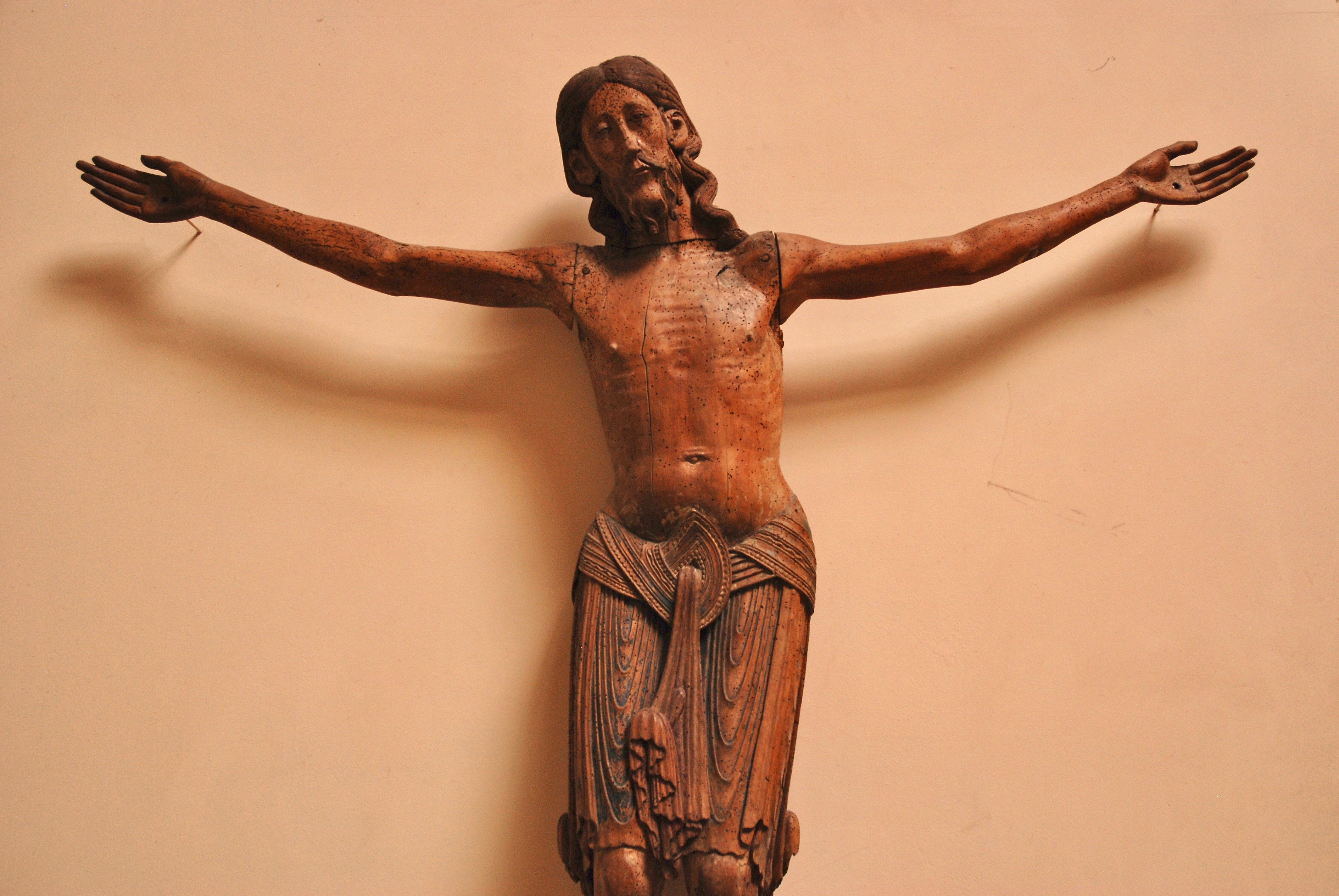
Christ on the Cross (Auvergne, 12th century), Cluny Museum, Paris.

A sermon preached on Good Friday at St. Barnabas Episcopal Church, Bainbridge Island, WA

I’m going to ask you some questions, 
and the answer you will give is, “I am here”.

Judas, slave of jealousy, where are you?…
Peter, slave of fear, where are you?…
Thomas, slave of doubt, where are you?…
Men and women of Jerusalem,  enslaved by mob violence, where are you?…
Pilate, slave of expediency, where are you?…

You’re all here, then. Good. 
Because the crucified God has something to say to you: 

Mercy.

Let us pray.

God, we pray you, look upon your family 
for whom our Lord Jesus Christ was willing to undergo 
the torture of the cross. Amen.

I find this opening Collect for Good Friday so moving, because it doesn’t make any requests for particular outcomes. It simply asks God to look at us—just look at us—with the loving gaze of mercy. In the middle of a terrible war, with a million dead from COVID in this country alone, and a pandemic of hate and racism and sheer folly leaving us dispirited and exhausted: Lord, have mercy. That’s our prayer at the foot of the cross. Lord, have mercy

In the 1965 Jesus movie, The Greatest Story Ever Told, the Holy Family is returning from Egypt after the death of Herod. And when they’re back in their own country, on their way home, they come up over a rise, and there before them are dozens of crosses along the road, with a man dying on every one—human billboards advertising Roman justice and the cruel fate awaiting anyone who might trouble the tranquility of the empire. In those days, it was an all too common sight.

The camera gives us a good look at those suffering victims, anonymous in their pain, and then cuts to a closeup of the two-year-old Jesus, riding on a donkey in his mother’s arms, looking at those crosses with wide and wondering eyes. 

Thirty years later, another donkey would bring Jesus toward his own cross, and there he would be cradled one last time in the arms of his grieving mother.

Can’t we have a better story? Why couldn’t the people have been transformed and the authorities converted and the Anointed Son of God lived to a ripe old age teaching and healing and wisely overseeing the first generation of God’s Kingdom on earth as it is in heaven?

That’s what the disciples expected of the Messiah. Of course, you and I know better. We expect the good to die young. We’ve seen enough of it in our own day. As someone says in an A.S. Byatt novel: “There will always be people who will slash open the other cheek when it is turned to them. In this life love will not overcome, it will not, it will go to waste and it is no good to preach anything else.” 

But it could have been otherwise. Everyone had choices. That was the problem, of course. God let everybody choose, and God’s own choices were limited by the choices that his creatures made. When Jesus fell upon the ground and begged for an alternative to the cross, God remained silent. There was no reversing the choices already made by Judas and the clergy and the police who were already closing in on the garden.

But God never stopped working to bring good out of the situation, to accomplish the purpose for which Christ was sent into the world. An illuminating perspective on this can be found in that notable theological work, The Joy of Cooking, In its advice to the host of a party, it says, 

“Satisfy yourself that you have anticipated every possible emergency…Then relax and enjoy your guests….If, at the last minute, something does happen to upset your well-laid plans, rise to the occasion. The mishap may be the making of your party…[As the Roman poet] Horace observed, ‘ A host is like a general: it takes a mishap to reveal genius.” 

The mishap of sin revealed God’s genius. O felix culpa, as Augustine said. O happy fault. God never gave up on the party we call the Kingdom. But since God refused to control others’ free will, God had to improvise, to work with whatever hand God was dealt by the choices made by human beings. And the hand God was dealt was the cross. But God said, “The cross will not foil my plan. In fact, I will make of it the cornerstone of salvation.” And so it was that Jesus could say with his dying breath: “It is accomplished.”

A century ago, Russian theologian Sergei Bulgakov described the accomplishment of the cross this way: 

God tells His creation: you are created by My hands. You are my work, and you would not exist if I did not will it. And, since I am responsible for you, I take upon Myself the responsibility for your guilt. I forgive you; I return your glory to you, for I take your sin upon Myself; I redeem it with My suffering.[i]

There are those who recoil at the idea that the death of one innocent man somehow atones for humanity’s collective guilt. But the death of Jesus was not a crude transaction where Jesus just picks up the check for our feast of follies when we prove unable to pay the debt ourselves. Admittedly, there is some language in our tradition which might prompt such a misreading of the cross. For example, in the beautiful Easter Vigil chant, the Exultet, there is the line, 

“O blessed iniquity, for whose redemption such a price was paid by such a Savior.”

That may be true poetically, but not theologically. There’s plenty of guilt to atone for, no doubt. Just watch the news. And by ourselves we can never hope to set it right. But redemption has nothing to do with accounting. It has to do with love. For God so loved the world, and there is no love without vulnerability—and sacrifice. Anyone who has ever suffered because of their love for another knows the truth of this.

Christ’s death didn’t just happen on Golgotha. It took place in God’s own heart. And the salvation wrought on the cross wasn’t because somebody named Jesus got punished for our crimes, but because love proved greater than sin and death. 

The powers of hell have done their worst to God this day, but Christ their legions hath dispersed. The victory didn’t have to wait for Easter. Love wins today—on the cross—because it absorbs every evil without returning the violence, and it refuses to give up on any of us—not even the killers who know not what they do. 

David Bentley Hart, a contemporary Orthodox theologian, sums this up beautifully:

“The only true answer to the scandal of this blood-soaked cosmos is the restoration of the very One who was destroyed … the only horizon of hope is that of the humanly impossible; and the only peace for which [we] can now properly long is not that which can be bought by a victim’s blood, which is a plentifully available coin, but that which can be given solely by that One who has borne the consequences of human violence and falsehood all the way to the end and then miraculously returned, still able and willing to forgive …”[ii]

Therefore, kind Jesus, since I cannot pay thee,
I do adore thee, and will ever pray thee,
Think on thy pity, and thy love unswerving,
Not my deserving.[iii]

One of my Facebook friends, an Episcopal priest in Delaware, posted a story this week about a young woman, a newcomer to her parish, who asked her, “What are the qualifications to carry the cross in church? Because, you know, well, see? I was homeless for about five years. Yeah, and you know, see? I did some things I’m not proud of, but it was really the best choice between some really bad choices. So, I’m kinda embarrassed and I don’t want a lot of people asking a lot of questions so, you know, am I qualified?” 

“Oh, sweetheart,” said the priest, “I don’t know anyone in this congregation who is more qualified than you are to carry the cross. I have no doubt that you will be one of the best-qualified crucifers in the history of crucifers in The Episcopal Church.”

“Well, I don’t know about that,” she said. “But thank you. Just one more question: Do I get to wear white gloves?”

“Absolutely, my friend. Let’s go find you a pair.”[iv]

That’s such a perfect story because Jesus made his own cross an act of solidarity with people just like her—with the outcast, the homeless, the powerless, and the survivors of bad choices. He shared their condition and he suffered their pain. He bore their griefs and carried their sorrows. He made the sin, alienation, and brokenness of the world his own, so that no human experience would ever be alien to God. 

As a Franciscan scholar has written: 

“The Crucified is the diffusing center of God’s love in the world whereby he reaches down to that which is furthest from [God] to draw all into [the divine] goodness and thus into the love of the Trinity.” [v]

And an Anglican theologian puts it this way: 

“In [God’s] own Trinitarian history of suffering, God opens [Godself] to include the uproar of all human history; oppressed and forsaken people can find themselves within the situation of a suffering God, and so can also share in [God’s] history of glorification.”[vi]  

I love the image of that young woman carrying the cross as she herself, I would say, is being drawn into the divine goodness and sharing in the history of Christ’s glorification. And it being an Episcopal church, she got to do it with white gloves!

So here we are on God’s Friday, at the foot of the holy cross, puzzling over its multiple meanings. Why did Jesus have to die? How exactly has that death broken the power of sin and death? What does the cross tell us about God’s love for us? 

These are all profound questions, but I will let the liturgy’s hymns and prayers speak to those questions rather than my trying to reduce the mystery of Good Friday to a few paragraphs. Just open your heart and the liturgy will speak the word you need to hear today. It may come in a hymn, or when you venerate the cross, or receive Sacrament. But it will come.

So rather than explore what we make of the cross, I will conclude with a few thoughts about what the cross wants to make of us

On Palm Sunday, we heard St. Paul urge us to “Let the same mind be in you that was in Christ Jesus … who humbled himself and became obedient to death—even death on a cross” (Philippians 2:8). This isn’t telling us to try harder, but to see differently, or as Paul says in Romans, “be transformed by the renewing of your minds so that you may discern what is the will of God—what is good and acceptable and perfect” (Romans 12:2).

When we start to put on the mind of Christ Jesus, when we begin to think God’s thoughts instead of our own, not only will the world become different, but we will begin to live differently—not in fear of death, despairing over the uproar of the times, or retreating into our fortress egos—but in self-diffusive love, offering all that we have and all that we are for the sake of others, as we move deeper and deeper into the holy communion with God and one another that is our destiny. The cross proves that Jesus lived that way until his last breath. And the cross invites us to do the same.

The gospels never tell us what’s going on in the mind of Christ. They simply show us what kind of life that mind produced. But if I were to venture a glimpse into Christ’s mind, I might choose a passage from The Brothers Karamazov, where young Alyosha, the most saintly of those memorable siblings, is out looking at the stars when he is suddenly seized, as it were, by the mind of Christ: 

The silence of the earth seemed to merge with the silence of the heavens, the mystery of the earth touched the mystery of the stars. . . Alyosha stood gazing and suddenly, as if he had been cut down, threw himself to the earth.

He did not know why he was embracing it, he did not try to understand why he longed so irresistibly to kiss it, to kiss all of it, but he was kissing it, weeping, sobbing, and watering it with his tears, and he vowed ecstatically to love it, to love it unto ages of ages. “Water the earth with the tears of your joy, and love those tears. . . ,” rang in his soul. 

What was he weeping for? Oh, in his rapture he wept even for the stars that shone on him from the abyss, and “he was not ashamed of this ecstasy.” It was as if threads from all those innumerable worlds of God all came together in his soul, and it was trembling all over, “touching other worlds.” He wanted to forgive everyone and for everything, and to ask forgiveness, oh, not for himself! but for all and for everything. . .[vii]


[i] Sergius Bulgakov, The Lamb of God (Grand Rapids, MI: Eerdmans, 2008), 364.

[ii] David Bentley Hart, Theological Territories: A David Bentley Hart Digest (Notre Dame, IN: Notre Dame University Press, 2020), 23.

[iii] “Ah, holy Jesus,” verse 5, text by Johann Herrmann, tr. Robert Seymour Bridges.

[iv] Thanks to the Rev. Elizabeth Kaeton for letting me use her story.

[v] Ilia Delio, Crucified Love: Bonaventure’s Mysticism of the Crucified Christ (Fransciscan Media, 1999), 165.

[vi] Paul Fiddes, The Creative Suffering of God (Oxford: Oxford University Press, 1988), 151.

[vii] Fyodor Dostoevsky, The Brothers Karamazov, tr. Richard Pevear & Larissa Volokhonsky (New York, Vintage Classics, 1990), 362.

The Importance of Tables—A Maundy Thursday Reflection

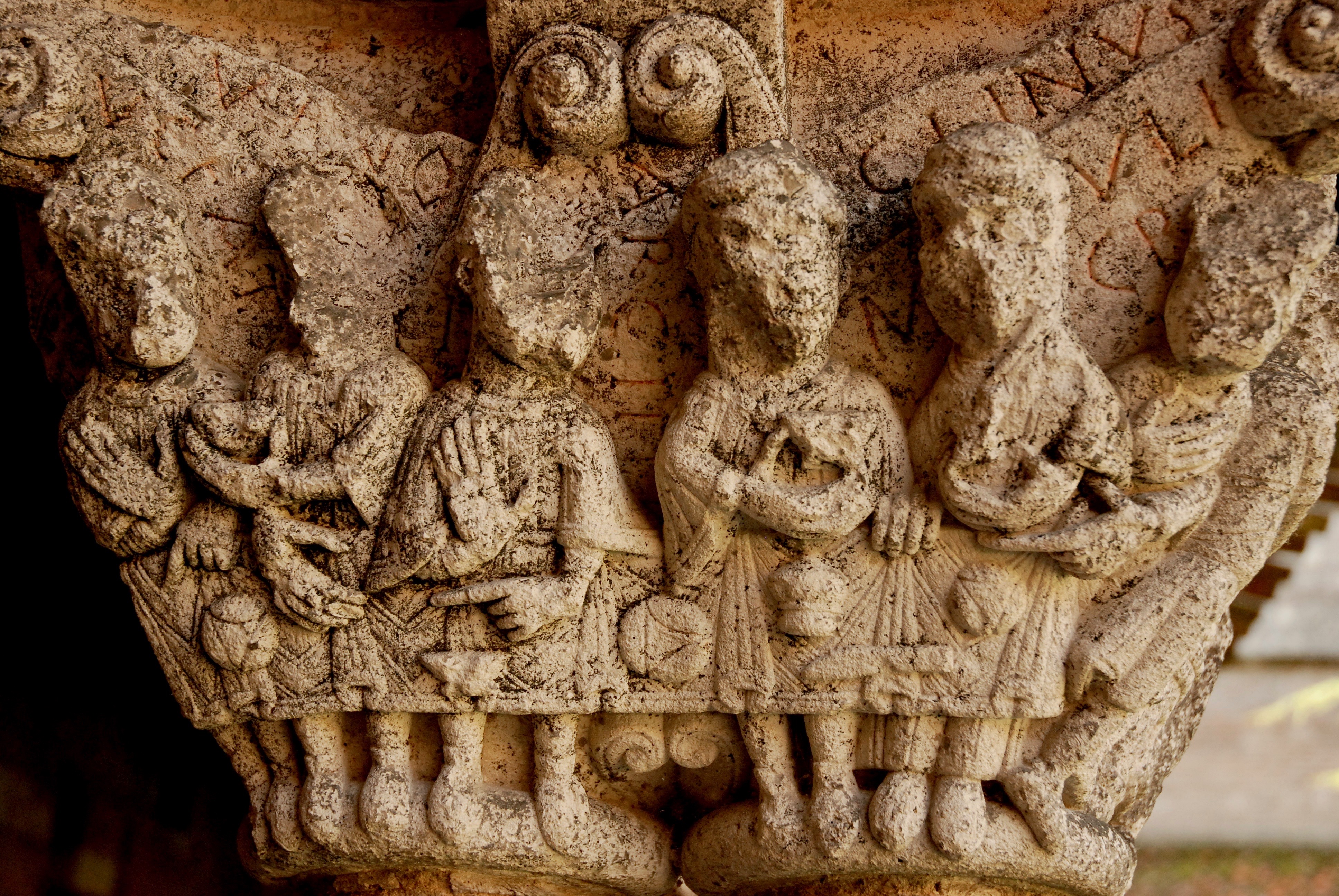
The Last Supper, Cloister of Moissac (12th century).

If this were the last night of your life, what would you do?
On his last night, Jesus gathered at table with his friends.

Jesus loved tables. He spent a lot of time sitting at tables.
At a table, Jesus ate and drank with sinners,
so that you and I would know we are always welcome at God’s feast.
At a table a woman became a teacher to the apostles
when she anointed Jesus with oil.
At a table Jesus presented a startling image of God
as slave and servant of all, when he washed his disciples’ feet.
At a table our Lord gave us, in bread and wine,
the means of tasting his sweetness forever.

I think Jesus liked tables because they are places of intimacy.
Everyone is close together—
it’s a place to let your guard down.
Jesus probably did more teaching quietly around a table
than he did shouting from boats or mountaintops to vast multitudes.

And I don’t think Jesus just walked into a room
and started telling people about God.
I think he sat down with them, and learned their names,
and listened to their stories.
And after a while, they would open up to him,
sharing their broken dreams and broken hearts,
their longings and their demons.
And it was there, responding to their particular stories,
that he would bring God to them, casting out their demons,
unbinding them with forgiveness,
empowering them to stand up and walk through that open door into God’s story,
proclaiming them—even the most prodigal sinner—the beloved children of God.

Tables also got Jesus into deep trouble.
In the Temple of Jerusalem, he overturned the tables of the old paradigm,
the tables of the smug and comfortable religionists
who can’t see the fault lines running through their ecclesiastical constructions
and their lifeless pieties.
He overturned the tables where some are in and some are out,
where some are welcome and some are not.

“This isn’t what God wants!” said the carpenter from Nazareth,
and he made a new table,
a table where all divisions and discriminations are put aside,

where enemies are embraced,
where outcasts and fools are honored as our wisest teachers,
where the abundant life of God’s future is as close
as the food you see before you tonight.

The world was not ready to sit at such a table –
the world didn’t even want to know there was such a table.
So it stretched its maker upon another piece of wood,
hoping to bury the dream before it could infect the general population.

But the table survived, and we sit round it tonight.
How costly and precious it is!
Gathered around Christ’s table,
we will do simple things—wash feet, share a meal, tell stories.

And as we do, we will begin,
as St. Augustine says,
to say Amen to the mystery we have become.

The Footwashing, Cloister of St. Trophime, Arles (12th century).

Living by the Sword: Putin and the Perils of Messianic Politics

Vladimir Putin and the icon of the Savior “not made by hands,” (Attibution: AP Photo/RIA Novosti, Alexei Nikolsky, Pool)

“The hour is late. The world is choked with weapons, and dreadful is the mistrust peering from all men’s eyes. The trumpets of war may blow tomorrow. Who knows if we shall see each other in another year? What are we waiting for? Peace must be dared. Peace is the great venture.”

— Dietrich Bonhoeffer (August 1934)

At a pro-war rally in Moscow last month, Vladimir Putin praised his troops for their embodiment of Christian love. “And this is where the words from the Scriptures come to mind,” he said. “‘There is no greater love than if someone gives up his soul for his friends.’ The heart of the message is that this is a universal value for all the people and all the confessions of Russia …. Shoulder to shoulder they are helping and supporting each other and when it’s necessary they cover as if it was their own brother, they cover each other from the bullets. We haven’t had such unity in a long time.”[i]

The crowd loved the speech. “Forward Russia!” they chanted. Jesus! Love! Unity! Was this a political rally, or a religious revival? Some of each, I would think. For a thousand years of Russian history, politics and religion have been closely entwined. In 988, after the Christian conversion of Prince Vladimir of Kievan Rus’—the original Russian state—his subjects waded into the Dnieper River to be baptized en masse.

The fact that this birth narrative of Slavic Orthodoxy took place in Kyiv helps explain the lingering Russian attachment to the Ukrainian capital. It’s their Jerusalem. Even though the Ukrainian Orthodox Church was granted independence from its Russian counterpart in 2018, one third of the Orthodox churches still loyal to the Moscow Patriarchate are situated in the Ukraine, and Putin has argued that his army is coming to their defense. 

The mythology of Holy Rus’, a divinely ordered “kingdom” of Slavic believers—a “Third Rome” inheriting the world-transforming mission of its failed predecessors in Europe and Constantinople—became a staple of Russian identity. In contrast to the perceived decadence, individualism, and secularism of the West, Holy Rus’ was thought to preserve communal spiritual values for the sake of all humankind. In a famous speech given in 1880, Dostoevsky said:

“[T]o be a true Russian does indeed mean to aspire finally to reconcile the contradictions of Europe, to show the end of European yearning in our Russian soul, omni-human and all-uniting, to include within our soul by brotherly love all our brethren, and at last, it may be, to pronounce the final Word of the great general harmony, of the final brotherly communion of all nations in accordance with the law of the gospel of Christ!”[ii]

When Russia seized Crimea in 2014, such Third Rome mythology seemed alive and well when Foreign Minister Sergei Lavrov dismissed the protests of the “godless West, hostile to the Russians because we [remain] Christian traditionalists.”[iii] Many observers think the invasion of Ukraine is fueled by the same mythology. If so, Putin’s nostalgia for the old Russian Empire would be more than the product of personal and political ambition. It would amount, in that case, to a crusade to recover the lost lands of Holy Rus’ and restore the Third Rome to its proper glory. To let Ukraine drift away into western decadence would betray the myth.

Historian Anna Geifman dismisses any speculation about Putin’s mental stability:

“He’s not crazy — he’s messianic,” she says. “What Putin says is logical, and consistent with his entire policy since 2008 … To sustain his legitimacy, the regime chose to delineate a more national-patriotic and anti-Western direction, grounding its appeal on a strong conservative, Orthodox [Christian] foundation …  He may not use that term [the Third Rome], but he talks about the corruption of the West, with its ‘everything goes’ lifestyle that no longer differentiates between good and evil … Disregarding historical evidence to the contrary, Putin views Ukraine as part of the Russian family. Their independence is a slap in the face to his ideology.”[iv]

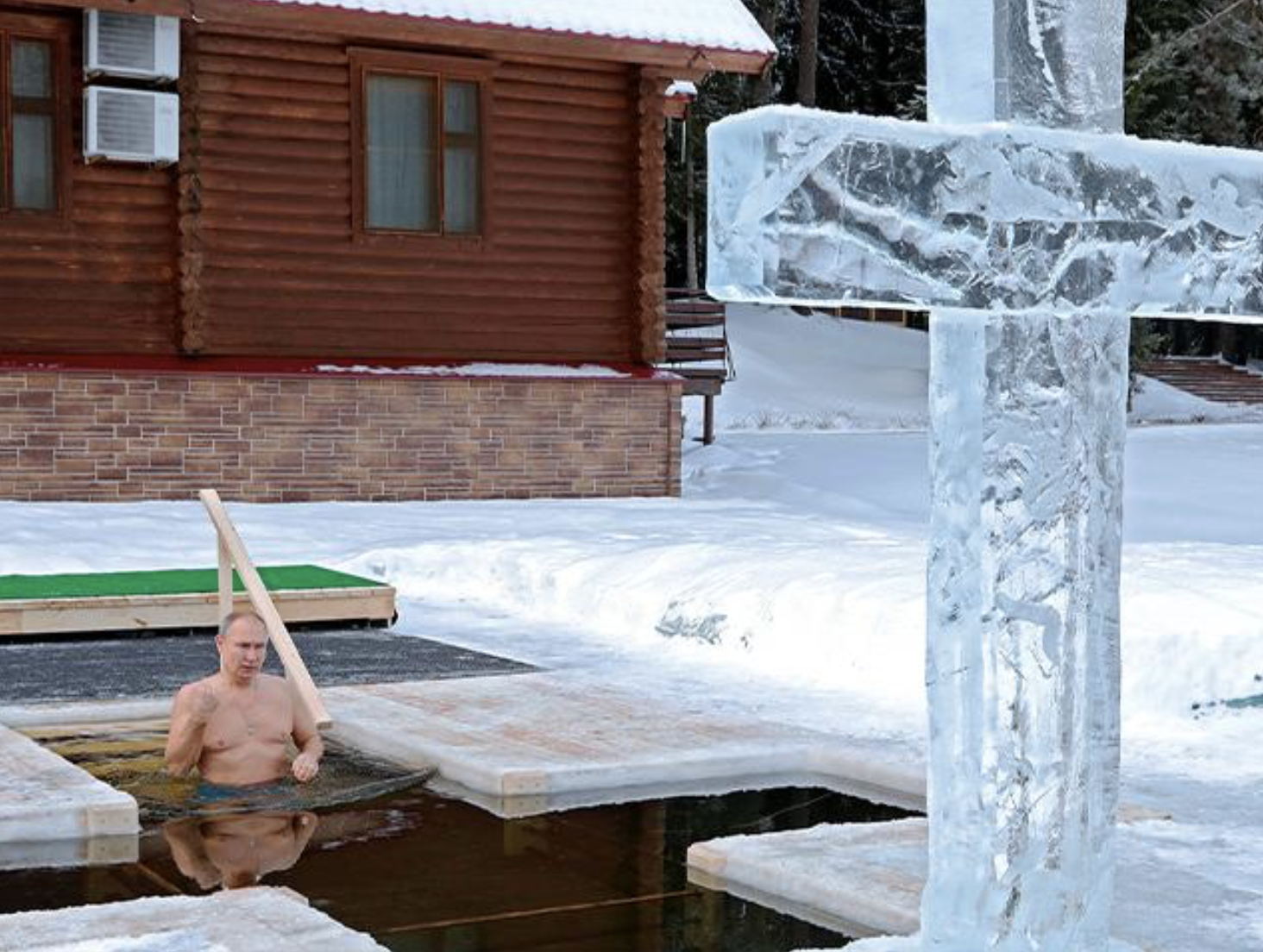
Vladimir Putin observers an Orthodox Epiphany ritual imitating the baptismal immersion of Christ.(Attribution: Mikhail Klimentyev, Sputnik, Kremlin Pool Photo)

Putin is coy about his personal beliefs, though he wears a cross around his neck and makes a public display of his Orthodox rituals. Is his employment of Holy Rus’ rhetoric just a cynical ploy to move the masses, or is he a religious crusader at heart? And which would be worse? Either way, the resulting atrocities have been horrifically evil. The Russian messiah is a war criminal.

Empty strollers in Lviv represent the children killed in the war’s first 3 weeks.

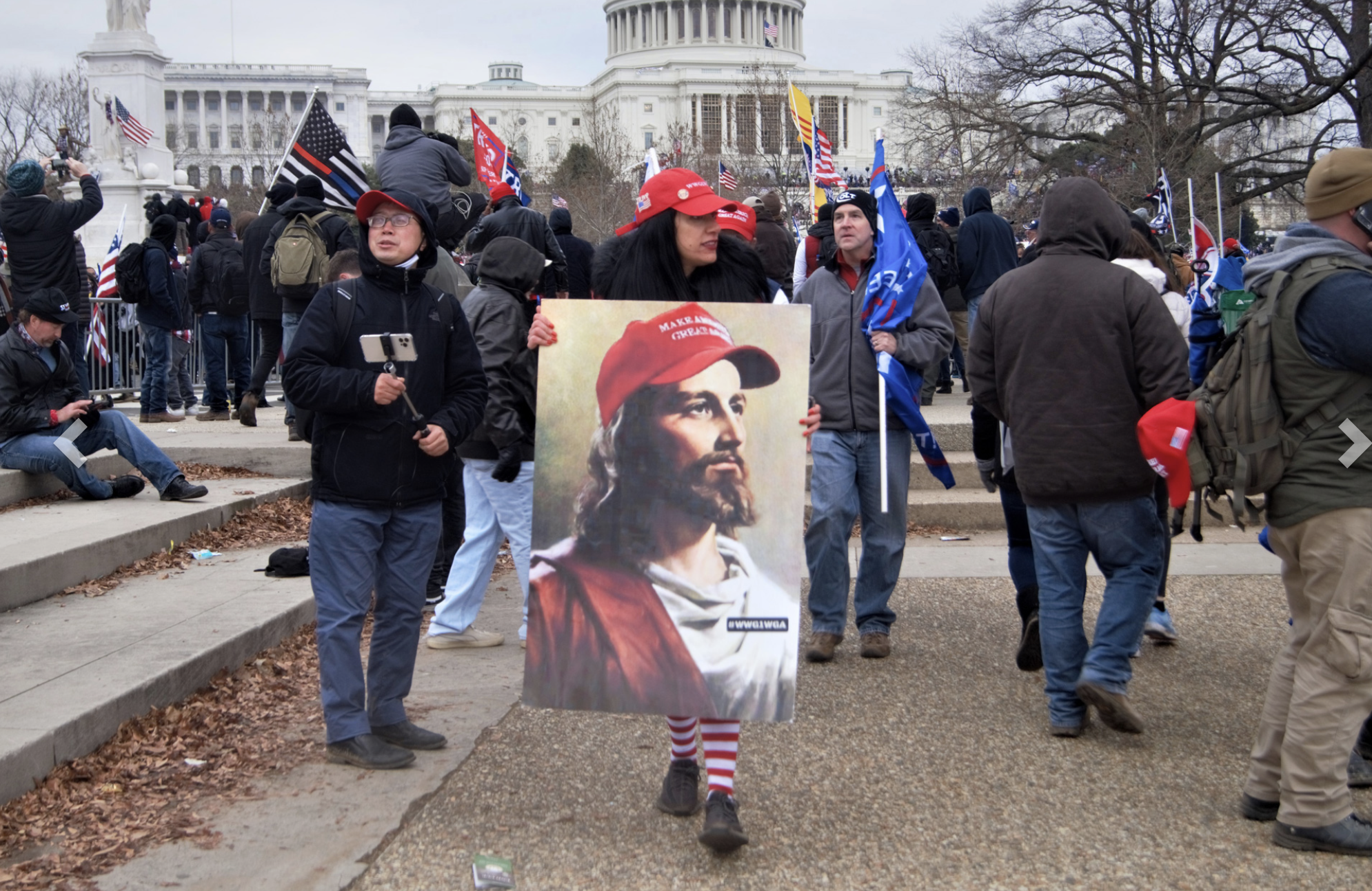
The unholy matrimony of religion and violence is always toxic, poisoning both church and world. We have seen too much of that right here in the United States. Many of the violent seditionists who stormed the Capitol on January 6, 2021, thought they were enacting God’s will. They blew shofars to make “the walls of corruption crumble.” They waved Jesus banners and Bibles, dragged large crosses into the fray, erected a gallows for their enemies. Their madness was driven by a core belief: “God, guns, and guts made America.”[v]

MAGA Jesus at the January 6 insurrection.

It wasn’t just the confused angers of the mob at work. The madness was deployed by the highest levels of government. As Capitol police were being beaten and killed and politicians were running for their lives, the President’s Chief of Staff sent an email from the White House to the sedition-enabling wife of a Supreme Court justice: 

“This is a fight of good and evil … Evil always looks like the victor until the King of Kings triumphs. Do not grow weary in well doing. The fight continues …”[vi]

For the seditionists, and a majority of white Evangelicals overall, Trump was a messianic figure, seeming to offer deliverance and rebirth to a desperate and despised people. “Donald Trump is in the Bible,” a rioter told a journalist. “Get yourself ready.”[vii]

The moral and theological collapse of right-wing Christianity in America echoes the capitulation of the Protestant German Church to the Third Reich. In the 1930s, most German clergy and theologians joined the Nazi party. Some were just playing it safe, but others were swept up in the nationalistic fervor. It became customary to conclude the baptismal rite by praying “that this child may grow up to be like Adolf Hitler.” And the head of the government Ministry of Church Affairs declared in 1935 that the Führer was “the bearer of a new revelation … Germany’s Jesus Christ.”[viii]

In the face of such absurd and blasphemous perversions of Christianity as we have seen in Russia, Germany, and the United States, what are God’s friends to do? Some would have us abandon religion altogether. Recent American studies have shown that many of the “nones” cite bad politics as their primary reason for rejecting Christianity, while many churches are themselves retreating from public life to avoid the contaminating risks of political action.[ix]

Dietrich Bonhoeffer

Dietrich Bonhoeffer was a German theologian and pastor who came of age during the rise of the Nazis. During a fellowship year at Union Theological Seminary in New York, he absorbed Professor Reinhold Niebuhr’s Christian realism. If you avoid history’s messy struggles to preserve your purity, Niebuhr warned, the vacuum you leave will be filled by the demonic. 

Attending an activist black church in Harlem also had an enormous impact on young Bonhoeffer. As his superb biographer Charles Marsh has written, “No longer would he speak of grace as a transcendent idea but as a divine verdict requiring obedience and action. The American social theology … had remade him into a theologian of the concrete.”[x] When, a decade later, he joined a conspiracy to assassinate Hitler, “he would abandon any hope of innocence, incurring the guilt of responsible action. Of the two evils, it was the one he could abide.”[xi] The failed plot would cost him his life. He died in a concentration camp two weeks before it was liberated by the Allies. His body was never found. 

Bonhoeffer had assented to a selective use of violence in order to interrupt mass murder. The unspeakable suffering of the many outweighed his own need for innocence. But he did not do it lightly, and the political captivity of the German Church made him keenly aware of how religion’s engagement with culture can easily go off the rails. He thought deeply about the ambiguities involved in repairing a broken world, but he knew that we cannot just think our way out of the human condition. We need something more, something divine. And words he wrote during the dark days of World War II still point the way:

“Who stands firm amidst the tumult and cataclysms? … The huge masquerade of evil has thrown all ethical concepts into confusion … The failure of ‘the reasonable ones’—those who think, with the best of intentions and in their naïve misreading of reality, that with a bit of reason they can patch up a structure that has come out of joint—is apparent. With their ability to see impaired, they want to do justice on every side, only to be crushed by the colliding forces without having accomplished anything at all. Disappointed that the world is so unreasonable, they see themselves condemned to unproductiveness; they withdraw in resignation or helplessly fall victim to the stronger … Who stands firm? Only the one whose ultimate standard is not their reason, their principles, conscience, freedom, or virtue; only the one who is prepared to sacrifice all of these when, in faith and relationship to God alone, they are called to obedient and responsible action. Such a person is the responsible one, whose life is to be nothing but a response to God’s question and call.”[xii]


[i] https://www.thenationalnews.com/world/europe/2022/03/18/putin-rallies-stadium-crowds-and-lauds-troops-fighting-in-ukraine/ The quotation is a paraphrase of Jesus’ words in John 15:13, just after he says, “Love one another as I have loved you.” Putin used the Russian word for soul (душу (dushu) instead of the biblical “life.”

[ii] Dostoevsky’s speech, given in honor of Russian poet Aleksandr Pushkin (1799-1837), can be found here: http://web.archive.org/web/20050207093332/http://www.dwightwebber.com/pushkinspeech.html

[iii] Quoted in Binyamin Rose, “Russia’s Deep-Seated Messianic Complex,” Mishpacha: Jewish Family Weekly (Mar. 15, 2022) https://mishpacha.com/russias-deep-seated-messianic-complex/

[iv] Ibid.

[v] Emma Green, “A Christian Insurrection” (The Atlantic, Jan. 8, 2021).

[vi] David French, “The Worst Ginni Thomas Text Wasn’t from Ginni Thomas (The Atlantic, March 25, 2022).

[vii] Jeffrey Goldberg, “Mass Delusion in America” (The Atlantic, Jan. 6, 2021).

[viii] Charles Marsh, Strange Glory: A Life of Dietrich Bonhoeffer (New York: Vintage Books, 2014), 283, 271.

[ix] Ruth Braunstein, “The Backlash against rightwing evangelicals is reshaping American politics and faith” (The Guardian, Jan. 25, 2022).

[x] Marsh, 135.

[xi] Ibid., 346.

[xii] Ibid., 341.

Human Vision Corrected by Divine Love — A Homily on Jesus and Bartimaeus

The Healing of Bartimaeus ( Master of the Gathering of the Manna, c. 1465).

Jesus was walking out of Jericho, surrounded by a big crowd. Like all such crowds, it was a mix of the curious and the adoring. Jesus was at the height of his popularity. He stirred people’s imaginations and raised their hopes. The excitement was palpable. But amid all the festive clamor, a single shout brought this parade to a sudden halt:

“Jesus, Son of David, have mercy on me!”
It was a blind beggar, sitting by the roadside. His name was Bartimaeus.
“Shush,” people said. “Don’t make a scene.”
But he cried all the louder: “Son of David, have mercy on me!”

And Jesus stood still, 
just the way the sun had stood still in the sky for Joshua 
in that same city of Jericho.

“Call him here,” Jesus said. And so they did. 
“Take heart!” they told him. “Get up. He is calling you.”

Immediately, Bartimaeus threw off his cloak, sprang to his feet, and came to Jesus. Then Jesus asked him a question that went straight to the point: “What do you want me to do for you?”

“My teacher,” he said, “Let me see again.”
And what Bartimaeus asked, Jesus granted.

— Mark 10: 46-52

In Mark’s gospel, this is the last miracle performed by Jesus before he goes to his death in Jerusalem. It marks the fatal turning point between his ministry and his Passion. It is our Lord’s last act, his last word, before beginning the Way of the Cross. To the world, that looked like the path to oblivion. But to those who have been given the eyes of faith, the Way of the Cross, as we pray every Holy Week, is “none other than the way of life and peace.”

And thus the healing of Bartimaeus is not just the story of one man’s good fortune. It is an invitation to each of us to perceive and receive the vision of salvation which is about to unfold. Mark is telling us that if you want to understand the Paschal Mystery of Passion and Resurrection, you need to open your eyes. And it is crucial to note that the climactic words of this story are not “he regained his sight,” but rather, “he followed him on the way.” Once you see what God is doing through Jesus, then it’s your turn to take up your own cross and follow. 

Let there be light!” says the God of Genesis. 
“I am the light of the world,” says the God incarnate. 

And yet, in the story leading up to this moment, even Jesus’ closest friends have suffered their own blindness. “Are your minds closed?” he chides them. “Have you eyes and do not see?” But they go on missing the point again and again. To their credit, they continue to follow Jesus. They are drawn to him, they know something is happening here—but they don’t know what it is. “Do you not yet understand?” Jesus sighs. I’m sure he said this more than once.

And then, after repeated examples of the disciples’ blindness throughout Mark’s gospel, suddenly we hear a plaintive voice cry out from the crowd: “Jesus! Have mercy on me. Remove this grievous blindness.”

That’s our prayer too, isn’t it? Lord, take away our blindness. Help us to see.
And Jesus replies, “I thought you’d never ask!”

St. Gregory of Nyssa, in the fourth century, was one of many theologians who have shared Mark’s diagnosis of the human condition as one of persistent blindness:

“Humanity was created for this end, that it might see ‘good,’ which is God; but because humanity would not stand in the light, [in fleeing from the light] it lost its eyes… We subjected ourselves to blindness, that we should not see the interior light.”

St. Augustine described the interior eye, our capacity to see the things of God, as “bruised and wounded” by the transgression of Adam and Eve, who, he says, “began to dread the Divine light [and] fled back into darkness, anxious for the shade.”

Refusing to stand in the light… subjecting ourselves to blindness. 
Is this what we do? Are we truly so “anxious for the shade?”

Arthur Zajonc is a quantum physicist who became fascinated with the literal dimensions of this question, examining case histories of blind people who recovered their sight. In his book, Catching the Light: The Entwined History of Light and Mind, he tells of an 8-year-old boy, blind at birth from cataracts, who underwent surgery in the year 1910. When the time came to remove his bandages, the doctor was very hopeful. He waved his hand in front of the boy’s eyes, which were now physically perfect. 

“What do you see?” asked the doctor.
“I don’t know,” the boy replied.
“Can’t you see my hand moving?” said the doctor.
“I don’t know,” said the boy.

The boy’s eyes did not follow the doctor’s slowly moving hand, but stared straight ahead. He only saw a varying brightness before him. Then the doctor asked him to touch his hand as it moved, and the boy cried out in a voice of triumph, “It’s moving!” He could feel it move, and even, as he said, could “hear it move,” but it would take laborious effort to learn to see it move.

As that first light passed through the child’s newly clear black pupils, it called forth no echoing image from within. His sight, Zajonc tells us, began as a hollow, silent, dark and frightening kind of seeing. The light of day beckoned, but no light of mind replied within the boy’s anxious, open eyes.

“The sober truth” says Zajonc, “remains that vision requires far more than a functioning physical organ. Without an inner light, without a formative visual imagination, we are blind.”

This echoes Augustine’s description of our “bruised and wounded” inner eye. What is it that makes us so unable to process what is before us, to see what is being offered to our open eyes?

The mystical Anglican poet Thomas Traherne framed an answer in the ornately vivid language of the seventeenth century:

“As my body without my soul is a carcass, so is my Soul without Thy Spirit, a chaos, a dark obscure heap of empty faculties ignorant of itself, unsensible of Thy goodness, blind to Thy glory.” 

And what are the causes of this abysmal state? he asks. They are several. 

“[The Light within us is eclipsed] by the customs and manners of [others], which like contrary winds blew it out: by an innumerable company of other objects, rude, vulgar and worthless things, that like so many loads of earth and dung did overwhelm and bury it: by the impetuous torrent of wrong desires in all others whom I saw and knew that carried me away … from it: by a whole sea of other matters and concernments that covered and drowned it…” 

“Contrary winds” blowing out the Light within us… being overwhelmed by “an innumerable company… of rude, vulgar and worthless things”… “the impetuous torrent of wrong desires” – does any of that sound familiar? Who among us has not had days like that, or even years like that? Is that not the world we live in today?

Not long after Traherne wrote those words, another English writer, John Bunyan, told the story of two pilgrims, named Christian and Faithful, who came upon Vanity Fair, a kind of shopping mall where all the transitory pleasures of this world were on seductive display.

“What will ye buy?” cried one of the merchants.
And Christian and Faithful replied, “We buy the truth!”

This was clearly the wrong answer, for the two pilgrims were immediately set upon, beaten, smeared with mud, thrown in a cage, and finally put on trial. The jury was rigged, led by Mr. Blind Man and Mr. Hate-Light. “Guilty,” they cried, and Faithful was put to death. But Christian managed to escape, and his journey into God continued. 

Bunyan’s allegorical constructs seem quaintly archaic today, but Vanity Fair is still with us, with its endless commodification of unsatisfiable desires. And Mr. Hate-Light is still at work, generating the ceaseless illusions that blind us to the beauty of holiness. 

Now once Christian had escaped Vanity Fair, he still had to pass through the Valley of the Shadow of Death, where the light was so scarce, and the path so narrow, that he was in constant danger of stumbling into the ditch on his right or the quagmire on his left. 

But Christian was not without hope in that dark valley. 
As Isaiah says, the God of light travels with us:

I shall lead the blind by a road they do not know… 
I shall turn the darkness into light before them, 
and the quagmire into solid ground. (Isa 42:16)

All of us, deep down, want the light. All of us need the light. But sometimes we resist the light, or run away from it, or shut our eyes to it. There are things we’d rather not see, in the world or in ourselves. Illuminating our dark places can feel like a judgment, as if the light were accusing our shadows.

Light of the world, rescue us from darkness!

In Franco Zefferelli’s film, Jesus of Nazareth, we meet another blind man at the pool of Bethsaida in Jerusalem, but unlike Bartimaeus, he is deathly afraid of being healed. “Leave my eyes alone!” he shouts. “Stop touching my eyes!”

After analyzing sixty-six cases of blind people who had recovered their sight, Arthur Zajonc would concur with Zeffirelli’s portrayal of our resistance to an enlarged perception of the world:

“The project of learning to see,” he writes, “inevitably leads to a psychological crisis in the life of the patients, who may wind up rejecting sight. New impressions threaten the security of a world previously built upon the sensations of touch and hearing. Some decided it is better to be blind in their own world than sighted in an alien one… The prospect of growth is as much a prospect of loss, and threat to security, as a bounty.”

In other words, opening our eyes to a more truthful clarity can be scary—no more fictions or illusions about the state of the world or the state of our souls. If we say we have no sin, we deceive ourselves, and the truth is not in us (I John 1:8). Seeing—clearly and accurately—the fallenness of our broken world—and our wounded selves—is a painful revelation. Once we face facts, transformation is the only way forward. We must change our life. A new way of seeing demands a new way of being. We can either fight that divine summons, like the man in the Zeffirelli film (Don’t touch my eyes!), or we can jump up and embrace it, like Bartimaeus.

But it’s not just the wrongness of things which is hidden by our blindness. The truth is, there is also so much blessing and beauty in this world, eagerly waiting to be discerned and embraced. And whatever our doubts and fears about losing our protective blindness, the beauty revealed will be worth the price. It’s the beauty of God’s future—what Jesus called the Kingdom. We often think of the Kingdom as impossibly distant, but it is possible to glimpse it even now, in this present age. We only need the eyes to see. 

This healing of our inner eye, this recovery of the divine Light within us, is perfectly expressed in a passage from Willa Cather’s novel, Death Comes for the Archbishop. Her protagonist, Jean-Marie Latour, a nineteenth-century missionary bishop to the territory of New Mexico, is discussing visions and miracles with his Vicar. 

“Where there is great love,” he says, “there are always miracles. One might almost say that an apparition is human vision corrected by divine love .… The Miracles of the Church seem to me to rest not so much upon faces or voices or healing power coming suddenly near us from afar off, but upon our perceptions being made finer, so that for a moment our eyes can see and our ears can hear what is about us always.”

Human vision corrected by divine love. 
How blessed are they who receive such a miracle! 

Let us close by hearing the gospel story one more time, succinctly told by John Newton, the author of “Amazing Grace,” in an old American shape note hymn called “Villulia.”

“Mercy, O thou Son of David, 
thus poor blind Bartimaeus prayed.
“Others by thy grace are saved,
now afford to me thine aid.”

Money was not what he wanted,
though by begging used to live;
but he asked, and Jesus granted
alms which none but he could give.

“Lord, remove this grievous blindness,
let mine eyes behold the day.”
Straight he saw, and, won by kindness,
followed Jesus in the way.

“The only solution is love”—Remembering 9/11

A decade ago, the 10th anniversary of 9/11 fell on a Sunday when I was the preacher. The Scriptures for that day were strikingly apt, a divine Word spoken directly to us in the turbulent here and now. The questions which 9/11 raised about the American future—and the human future—have not gone away. They have only grown more urgent. The text of my 2011 sermon is below.

9/11 Memorial & Museum, NYC. Virgil’s words from the Aeneid were forged from steel remnants of the Twin Towers by Tom Joyce. The background—2983 unique shades of blue painted by Stuart Finch— is entitled, “Trying to Remember the Color of the Sky on That September Morning.”

It was one of those perfect late summer mornings, the sky above an impossible blue, the city below humming with life. Suddenly, without warning, the world ended in smoke and fire and falling dust. 

On that day, a great city, and all of us who watched at a distance, suffered a kind of violence strangely new to American experience. In an instant we became citizens of an unfamiliar, nightmarish world. As a Catholic poet noted at the time, on 9/11 “the united states of america spent a night and a day in beirut… walked the length of somalia… entered the gates of auschwitz.” Or as the writer Don DeLillo said about this demise of American exceptionalism, “Parts of our world have crumbled into theirs, which means we are living in a place of danger and rage.”

On the 10th anniversary of that terrible day, the Lectionary speaks to us with an eerie timeliness. From the Hebrew Scriptures, we hear the story of the Red Sea, where Pharoah’s entire army is drowned by an act of God. 

Thus the Lord saved Israel that day from the Egyptians;
and the Israelites saw the Egyptians dead on the seashore.

Thousands dead. An act of God?

Now the miraculous deliverance of unarmed slaves from a pursuing army that wants to slaughter them is not the same thing as deliberate acts of violence committed in God’s name. The Red Sea was not an instance of religious terrorism. But the Exodus passage does raise the uncomfortable topic of sacred violence, where God, whether by proxy or direct intervention, saves some and lets others perish. In God’s defense, such actions are always on the side of the powerless and the oppressed in the Bible. As we recite in the Magnificat at Evening Prayer:

He has cast down the mighty from their thrones,
and has lifted up the lowly.

We find a lot of this casting down in Revelation, a book written to encourage persecuted Christians: Don’t worry. The day is coming when mighty Rome will fall. While consoling to the downtrodden, this is not good news for the powers that be. The 11th chapter delivers this chilling line: the time has come to destroy those who are destroying the earth.(Rev. 11:18). 

These words express the eschatological hope for a better world, but they sound uncomfortably close to the kind of writings that informed the pious, angry young men who hijacked those planes to strike a blow against “godless” modernity. 

John Brown, painted by John Steuart Curry in 1939. After visiting the 9/11 Memorial in 2019, I saw this unsettling portrait at the Whitney Museum. The accompanying commentary strikes a chord in the America of 2021: “Brown’s crazed expression suggests the messianic fervor and wrath that fueled his opposition to human bondage through armed rebellion.”

A critical examination of sacred violence—the blood on religion’s hands—and the way such texts are countered with more life-affirming scriptures—these are complicated subjects for another time. For now let us simply note that passionate religious certainty, and the tendency to escalate difference and conflict into a cosmic struggle between good and evil, is not exclusive to the jihadists. We can find it in our own scriptures. 

On a different day, the Red Sea story might be a joyful celebration of God’s defense of the powerless, or an image of baptismal passage through the waters of death. But on this day—ten years after 9/11—it may simply want to pose a troubling question, lest we be too eager to say that God is on our side. We can’t just dance with the Israelites anymore. We must also weep with the Egyptians. 

A litany published the week after 9/11 embraces this inclusiveness, affirming that Jesus is carrying the “dead, the wounded, and those who mourn; the killers and those who were killed; the frightened, the angry, the sorrowful – Jesus is carrying all of this, all of us, every part of us, into the loving heart of God.”

Our second reading offers the comforting assurance from St. Paul’s letter to the Romans that we hear every time we bury a loved one: 

Yet none of us has life in himself or herself.
If we have life, we are alive in the Lord,
and if we die, we die in the Lord.
So, then, whether we live or die, 
we are the Lord’s possession.

The shock of 9/11 inflicted enormous trauma upon the American people, a trauma that still lives in our bodies. We have never fully worked through the grief process, so eager were our leaders to launch into war, short-circuiting the work we really needed to do. 

A recent PBS documentary, Faith and Doubt at Ground Zero, explored a wide range of religious questions arising from 9/11. And one of the things people talked about in interviews was the presence – or absence – of God in the face of such evil and suffering. There were no easy answers. 

As one rabbi put it, “Since September 11th, people keep asking me, ‘Where was God?’ And they think because I’m a rabbi, I have answers. And I actually think that my job as a rabbi is to help them live with those questions. If God’s ways are mysterious, live with the mystery. It’s upsetting. It’s scary. It’s painful. It’s deep. And it’s interesting. No plan. That’s what mystery is. It’s all of those things.”

The rabbi goes on to say that he resists any answers that get God off the hook, because “right now, everything is on the hook.”

And yet, wherever or whatever God may be in this, and whether we find ourselves among the living or the dead, we always remain inside the divine mystery, enfolded in the loving arms of God. If I make the grave my bed, you are there also, says the Psalmist. Only such a faith can deliver us from the icy grip of fear and dread. 

Martin Johnson Heade, Approaching Thunder Storm, 1859 (detail). Painted on the eve of the Civil War, the figure peers into the imminent darkness with extraordinary calm.

Today’s final text is from Matthew’s gospel, and what a gospel it is for September 11th! “How long should I keep forgiving, Lord?” And Jesus says, “Oh, about a billion times.” The text actually says seventy-seven, or in the math of King James, seventy times seven. But the point is: stop counting. Don’t keep track. Forgiveness isn’t a one-time transaction; it’s a practice, a way of being. 

We exist to forgive, to reconcile, to mend, to heal— 
generously, unreservedly, endlessly.

A recent feature film, Of Gods and Men, tells the true story of eight French Catholic monks who lived in the mountains of Algeria during a time of civil war and terrorist violence in the 1990s. Their monastery was at the edge of a poor Muslim village, where they lived in harmony with their neighbors, providing the only accessible health care. As the surrounding political violence escalated, the monks were warned by the government to leave the country. But they felt called to remain among the people they served, despite the high probability of martyrdom. Despite their own fears.

Their abbot, Dom Christian, wrote a letter to his family in Advent, 1993, two years before he and his brother monks were killed by terrorists. Anticipating his own martyrdom, he insists that he is not exceptional, since so many others in that land were also at risk.

“My life,” he wrote, “is not worth more than any other — not less, not more. Nor am I an innocent child. I have lived long enough to know that I, too, am an accomplice of the evil that seems to prevail in the world around, even that which might lash out blindly at me. If the moment comes, I would hope to have the presence of mind, and the time, to ask for God’s pardon … and, at the same time, to pardon in all sincerity him who would attack me…”

What an extraordinary thing to say: Here is a good and humble and holy man confessing his own complicity in the evils of the world. And what does he hope for? He hopes for the presence of mind, in the very moment of being murdered, to ask forgiveness. Forgiveness not only for himself, but for his killer as well. 

The end of his letter is addressed not to his family, his loved ones, but to the stranger who will one day kill him, the stranger whom he calls “my friend of the last moment.” 

“And to you, too, my friend of the last moment, who will not know what you are doing. Yes, for you, too, I wish this thank-you, this “A-Dieu,” whose image is in you also, that we may meet in heaven, like happy thieves, if it pleases God, our common Father.”

Such faithfulness to the way of Jesus is sheer nonsense to the world, and perhaps to many Christians as well. 

How dismal a contrast we find in the official government reaction to 9/11, when our leaders, most of them Christians, set out to hunt down and kill the “evildoers.” Their violent, retaliatory response bequeathed a dark legacy which continues to poison our common life: the politics of fear and division, the launching of endless war, the shameless profiteering that feeds and encourages armed conflict, the stain of Guantanamo and the worldwide network of secret prisons, and the outrageous authorization of torture as national policy. 

In an article entitled “Did Osama bin Laden Win?” —written just after bin Laden’s death—Mark Sumner offers the analogy of the human body’s autoimmune system, where the worst damage is not done by the original disease, but by the overreaction of “the same systems that fought off and destroyed the invader. Long after the bacteria is excised by the body,” he writes, “the damage lingers.” Then turning to the overactive immune system that gave us two ruinous wars as well as the corrosion of the American conscience by torture and other public sins, Sumner points out that “it wasn’t bin Laden who did this. He could never do this. It’s our response to bin Laden. That’s what has already crippled us, and what may yet kill us.”

But there is an antidote for this poison, and it too rose out of the ashes of Ground Zero. A sample of this antidote is contained in a statement by the Catholic Worker communities of California ten years ago.

The Catholic Worker movement was co-founded by Dorothy Day, one of the true saints of the last century. As an eight-year-old child, she was in San Francisco during the great earthquake and fire of 1906. When she witnessed on the streets of San Francisco the same kind of care and camaraderie among strangers as we saw in New York after 9/11, she asked, “Why can’t people live like this all the time?” 

When she grew up, she explored that child’s question through a network of small lay communities who today continue to live among the poorest of the poor to feed the hungry, clothe the naked, shelter the homeless, and visit the sick and imprisoned. 

In the immediate aftermath of 9/11, this is what the Catholic workers had to say: 

Even after all this… 

Our grief will not be short-circuited with cries of vengeance nor with acts of retribution. We will not cooperate with incitements to become that which we most oppose, namely perpetrators of violence. 

We will honor the deeper levels of grief, acknowledging the woundedness inflicted upon us, and the woundedness that our nation has inflicted upon others…

We invite you to participate with us in all our wildest dreams and visions for peace. For now we sadly know that our affluence, our power, our possessions cannot serve as protection from harm. We invite you to clamber off the wheel of violence. It is the only worthy legacy we can offer to those who have died…

We are Catholic Workers and we still believe… the only solution is love. 

More love, more love … the angels are calling: Oh children, more love. The love that birthed the universe into being and raised the dead. A love as defenseless and potent as Christ on the cross. 

You can’t build empires with it, 
but it is the only true way out of the abyss, 
the only antidote for evil’s poison.

We saw love at work in countless ways in the days after 9/11: 
So much solidarity, generosity, selflessness and compassion, 
so much courage and resilience, 
so much caring for one another. 

We’ve all been moved by the stories. One of my favorites is of a man in Manhattan’s Union Square. Just as people were filing out of a memorial service, he began to sing: “Start spreadin’ the news…” And one by one, others joined in, until hundreds of people were singing “New York, New York” at the top of their lungs, in streets still swirling with the dust of fallen towers. Who knew there was a resurrection hymn in the Sinatra canon?

Even at the grave we make our song: Alleluia, alleluia, alleluia! But is this enough? Can love’s fragile flowers break the rocks in the desert of abandonment and lament? Can they get us through the time of trial? Can they deliver us from evil? I will let a New Yorker answer that question. 

At the end of the documentary, Faith and Doubt at Ground Zero, we hear several voices reflecting on the haunting televised image of two anonymous people, co-workers or strangers, we don’t know, who jumped together from the south tower. Just before they jumped, they reached out to take each other’s hand. Then they fell into space. Holding hands. 

For an unbelieving novelist in the film interviews, this was an image of human desperation and despair in an indifferent universe. For an NPR correspondent, the gesture of mutual touch was a frail sign of hope that we are not totally alone when we face the abyss. 

As we hear these voice-overs, we don’t see the image they are talking about. That would be unbearable. Instead, we are shown nighttime shots of the two vertical columns of blue light that shine every year on September 11th in the empty space left by the collapsed towers. Emanating from 88 searchlights aimed straight at the heavens, transparent twin towers: ghostly evocations of presence and absence, absence and presence.

The voices continue over these shots, and finally we hear from a Catholic writer, Brian Doyle, a New Yorker by birth. His words speak for all people of faith:

A couple leaped from the south tower, hand in hand. They reached for each other and their hands met, and they jumped. I try to whisper prayers for the sudden dead and the harrowed families of the dead and the screaming souls of the murderers, but I keep coming back to his hand in her hand, nestled in each other with such extraordinary, ordinary, naked love. 

It’s the most powerful prayer I can imagine, the most eloquent, the most graceful. It’s everything we’re capable of against horror and loss and tragedy.

It’s what makes me believe that we’re not fools to believe in God, to believe that human beings have greatness and holiness within them, like seeds that open only under great fire, to believe that who we are persists past what we were, to believe, against evil evidenced hourly, that love is why we are here.

What is God? — A Trinity Sermon

Abbey at Conques on Le Chemin de St. Jacques de Compostelle, France (Jim Friedrich)

What is God? When the biblical Jews asked that question, they responded from their experience of salvation history.  God is the one who told me to leave behind everything I knew and set out for God-knows-where, says Abraham. God is the one who asked me to go back to the land of oppression and enslavement so I could speak truth to power, says Moses. God is the one who made a covenant with us on Mount Sinai, in the cloud of unknowing. God is the one who remembered us in the days of exile. God is the one who brought us home from Babylon. 

Then Jesus came along, and even though he lived and died as a human being, there were those who experienced the fullness of God in the unique particularity of his life, death, and resurrection. The risen Lord, who said “I am with you always,” would become an object of worship very early in the life of the Church. 

And after the Ascension of Jesus came the Holy Spirit, not only as an indwelling presence but also as a radically transformative force, in whom divine fullness was equally and uniquely manifest.  

For the early Christians, then, the One they called God had been revealed to have three distinct ways of being: Source, Savior, and Spirit. Love who loves us; Word who saves us; Spirit who renews us. And before long they were offering worship not only to the God of Israel, but to Jesus and the Holy Spirit as well. 

They were not polytheists. They rejected pagan notions of a heaven and earth populated by competing deities. But their experiences of God in Christ and God in the Spirit were unique enough to differentiate them from the Holy One who sent Jesus into the world. 

At the same time, the second and third Persons were not understood to be partial or lesser versions of God. Only the true God can save us, as Christ did. Only the true God can sanctify us, as the Spirit does. 

Those first Christians couldn’t deny their experience, or the witness of Scripture. Christ was God. The Spirit was God. But that posed a conceptual problem. 

How can the Three be One? How can the One be Three? Mathematics or logic can’t solve this puzzle. Several centuries of ecumenical councils struggled with the questions, doing their best to preserve the paradox of Three in One and One in Three from collapsing into the simplicity of God as “One is One and all alone.” 

Although it would have put a lot of theologians out of work, It would have been a lot easier just to stick with the Oneness. But that would not have been true to Christian experience. The Threeness is essential to our informed—and formative—encounters with God. As contemporary Catholic theologian Catherine LaCugna puts it, “The doctrine of the Trinity is ultimately a practical doctrine with radical consequences for Christian life.” [1]

Does that mean that the friends of God have to master the bewildering terminology and complicated nuances of ancient dogma in order to live the Christian life? Will heaven admit only the most sophisticated thinkers? Let’s hope not. 

I’ve read a lot of theology and Church history over the last fifty years, and I still have trouble remembering the differences between Monophysites, Monothelites, Monarchians, Modalists, Ebionites and Sabellians. As Japanese theologian Kosuke Koyama wonders, what if we were to exchange the metaphysical tangles of the West for more down-to-earth analogies. For example, he asks, what might the yin-yang of “pepper” and “salt” tell us about the divine nature? [2] Or St. Patrick’s shamrock, for that matter. 

For the Offertory anthem at the liturgy for Trinity Sunday, Mozart’s Laudate Dominum, I’ve assembled 26 concrete images of persons and objects grouped in threes. As you watch the video, I invite you to contemplate the Christian koan of Three-in-One and One-in-Three. 

Now then, what shall we say about the Trinity? One of the sixteenth-century reformers counseled intellectual modesty. “We adore the mysteries of the Godhead,” he said. “That is better than to investigate them.” [3] In a similar vein, a contemporary theologian reminds us that the “triune God is not simply unknown, but positively known to be unknown and unknowable—which is a dear and profound knowledge.” [4]

But on Trinity Sunday, it is the preacher’s ritual duty to offer a sacrifice of ignorance on the altar of unknowing. So here we go.

Back in the day—the fourth century, that is—when the Council of Nicaea was parsing theories of the divine life, theology was a popular sport, and people kicked around trinitarian doctrines the way some of us recite the arcane numbers of baseball metrics today. But in the late Middle Ages, the doctrine of the Holy Trinity went into cold storage. By the time of the Enlightenment, Immanuel Kant could say that Trinitarian theology had “no practical relevance at all, even if we think we understand it.” [5]

In recent centuries, any sort of God talk has been drained of content for many people. We live in a secular age, where a divine power who is in but not of the world has become increasingly unthinkable. Religion, in the world’s eyes, has become more of a private matter than a public truth. 

And yet, the Spirit continues to work, and in the last few decades we have seen a remarkable resurgence of attention and thought devoted to the meaning and relevance of the Trinity. It’s not just white, western males doing this work. Feminists, Africans, Asians, Middle Easterners and Latin Americans are all bringing fresh and urgent perspectives to Christianity’s core doctrine of God. And their work is of enormous consequence for both our personal faith and our common life.

The Nicene Creed declares that the three Persons are “of one substance.” In other words, whatever God is made of, Father, Son, and Holy Spirit have all got it—and in equal measure. 

But what is that “substance?” Is it a divine essence which existed prior to, or in addition to, the Persons themselves? Is there a one God hidden behind or beyond the Trinity? Such a notion would undercut the completeness of the Trinity, making it dependent on something external—in other words, less than fully divine in itself. 

Or is the divine substance like a pie which has been cut into three equal pieces? That would divide God into parts and lose the unity of the whole. It would also make the Persons less than eternal, since the whole pie would have to precede the creation of the separate pieces. 

But what if we were to give up the idea of divine “substance” as some kind of stuff which exists on its own and gets divided into three, or possesses a reality in addition to whatever the three Persons consist of? What if being the divine Trinity does not mean to have a divine substance, a kind of primordial stuff. What if being a Trinity means to be in relation with one another? 

Perhaps the Trinitarian God is best described not as a fixed, objective entity, but as an event or activity, an eternal communion shared between the Persons. The Greek word perichoresisdescribes the divine communion as a dance where the partners are in continuous motion, weaving in and out of one another. 

This conceptual shift from substance to relation is a central theme of contemporary theology. As feminist theologian Elizabeth Johnson writes (using inclusive terms for the Persons):

“The mutual coinherence, the dancing around together of Spirit, Wisdom and Mother; or of mutual Love, Love from Love, and unoriginate Love; or of the three divine persons – this defines who God is as God. There is no divine nature as a fourth thing that grounds divine unity in difference apart from relationality. Rather, being in communion constitutes God’s very essence.” [6]

A couple of British theologians elaborate this point when they say that the divine Persons do not “exist over against the others as self-enclosed centers of consciousness, as with human persons … but rather each dwells in the other through a kind of inter-permeation.” Then they sum it up this way: “The consciousnesses are fused but not confused.” [7]

This is not a new idea. The First Epistle of John assures us that “God is love” (4:8). And love, as we all know, cannot exist alone, without an “other” to share with, give to, receive from. Love exists only by going beyond the self in a process of perpetual self-offering.

Love is not a secondary or optional property of God. Love is who God is, and how God exists. Simply put: “the Trinity is not derived from God’s essence; the Trinity is God’s essence.” The communion and community of the Persons is God’s nature and essence.” [8]

Jürgen Moltmann notes the impossibility of a loving God being otherwise. “God cannot find bliss in eternal self-love,” he writes, “if selflessness is part of love’s very nature. God is in all eternity self-communicating love.” [9] A Kenyan Christian, John Mbiti, who comes from a more communal culture, puts this even more succinctly:

“I am because we are, and since we are, therefore I am.”[10]

We may struggle with this interdependent Trinitarian model because our culture has taught us to think of a person as an autonomous individual, whose identity, mind and will are separate and independent from every other person. 

But what the doctrine of the Trinity tells us is that you cannot be a person alone. You can only be a person in relationship with others. Addressing another, listening to another, conversing with another, loving one another, offering ourselves to one another—these are the means of becoming a person and existing as a person, if we are to live in the image of the relational personhood of the divine, in whom the one does not exist without the many. 

When we hear Jesus say, you must lose yourself to find yourself,[11] we may think he’s speaking of death, either metaphorical or physical, some kind of painful stripping away. And sometimes that is the case. 

But I think Jesus is also describing the divinely grounded process of communion and community. “I am because we are, and since we are, therefore I am.” St. Athanasius had a wonderful term for this state of being in communion. He called it “reciprocal delight.”[12]  We are all in this together, God says, and so say God’s friends as well.  

It seems especially fitting at this particular moment to contemplate communion as the essential and constitutive fact of divine life, for in one week’s time we will gather together, in person at last, as the Body of Christ at St. Barnabas. It has been fourteen months since we last did this. What joy it will be to share the sacrament of God’s self-diffusive love once again and celebrate the bonds between us.

After so many words about the Holy Trinity, let me conclude with an image. Thirty years ago, Polish film director Krzysztof Kieslowski made a series of 10 one-hour films called Decalogue. Each of the films is based on one of the Ten Commandments, and the series is one of the masterpieces of spiritual cinema. [13]

Pawel (Wojciech Klata), Decalogue 1

In the first film, there’s an exchange between Pawel, an eleven-year-old boy, and his aunt Irena. Pawel has a great curiosity about God, which his single-parent father, an unbeliever, cannot satisfy. So Pawel takes his questions to Irena, his devout Catholic aunt: 

Pawel: Do you believe that God exists?
Irena:  Yes.
Pawel: What is God?

Irena doesn’t answer with words. 
Instead, she puts her arms around Pawel and pulls him close.

Irena:  What do you feel now?
Pawel: I love you.
Irena:   Exactly. That’s what God is.


[1] Catherine M. LaCugna, cited in Veli-Matti Kärkkäinen, The Trinity: Global Perspectives (Louisville, KY: Westminster ]ohn Knox Press, 2007), 179.. This is the opening sentence of LaCugna’s God for Us: The Trinity and Christian Life (1991). As you will see, I found Kärkkäinen’s study of recent Trinitarian theology to be an invaluable resource. 

[2] Veli-Matti Kärkkäinen, 312.

[3] Philip Melanchthon, in Veli-Matti Kärkkäinen, xvi.

[4] Elizabeth Johnson, in Veli-Matti Kärkkäinen, 212, from Johnson’s She Who Is: The Mystery of God in Feminist Theological Discourse(1993).

[5] Immanuel Kant, in Veli-Matti Kärkkäinen, 206.

[6] Elizabeth Johnson, in Veli-Matti Kärkkäinen, 56.

[7] Ninian Smart & Steven Konstantine, in Veli-Matti Kärkkäinen, 249, from their Christian Systematic Theology: Theology in a World Context (1991).

[8] Richard Rice, in Veli-Matti Kärkkäinen, 140.

[9] Jurgen Moltmann, in Veli-Matti Kärkkäinen,106;  from Moltmann’s classic Trinity and the Kingdom: The Doctrine of God (1981)

[10] John Mbiti, in Veli-Matti Kärkkäinen, 352.

[11] Matthew 10:38.

[12] St. Athanasius (c. 296-373), a bishop in Roman Egypt, was a key defender of Trinitarianism. Cited in in Veli-Matti Kärkkäinen, 39.

[13] See my post, Kieslowski’s Decalogue: A Masterpiece of Religious Cinema (Jan. 28, 2017): https://jimfriedrich.com/2017/01/28/kieslowskis-decalogue-a-masterpiece-of-religious-cinema/

“The terrible work that gives life to the world”—A Good Friday sermon

Fra Angelico, The Mocking of Christ (1440)

In the convent of San Marco in Florence, Fra Angelico painted a fresco of the mocking of Christ. The cruelties of Christ’s tormenters are represented as fragments, floating in the space around the white-robed, blindfolded victim: a disembodied head spits at our Lord, a floating hand strikes him with a rod. These fragments are very flat, two-dimensional, as though pasted on the image’s surface. But Christ himself is not restricted to the plane of the image. It projects forward in an illusion of three-dimensionality, into the space occupied by two saints. The suffering Christ emerges from his own time into theirs. 

But neither saint is looking at him. They face away from the scene, toward us. The mocking is not something they look at with their physical eyes. It is for them an interior contemplation. And their devotion to the Passion takes two different forms. On the right, St. Dominic, the great intellect and preacher, is looking at a book, open in his lap. The Passion is something he is reading about, and processing in his mind. On the left side, the mother of Jesus, sitting in an attitude of quiet sorrow, has no book. She is apprehending the Passion through the medium of her heart. Dominic is thinking about the suffering of Christ. Mary is feeling it.

On God’s Friday we bring both head and heart to the foot of the cross. We may want to puzzle over the why of it: Why did this have to happen? Why do we keep returning to this bloody act? Why does it matter? Or maybe we just prefer to watch and weep over a mystery beyond all comprehension. 

In any case, here we are again, at the foot of the cross. A lot has happened since the last Good Friday—so much suffering, so much struggling, so much dying. We bring all that with us to the cross today, along with our questions, our wounds, our laments. Finding the right words for this strange time is a daunting task. 

Wiliam Sloane Coffin, one of the great Christian voices of the twentieth century, once told a young minister not to worry too much about his Holy Week sermon. “Anybody can preach on Good Friday,” he said. “Hell, read the newspaper!”[i]

On Good Friday, 2021, we don’t need a crucifix to remind us of a premature death which should never have happened. We’ve seen it replicated over half a million times in this country alone—worldwide, nearly 3 million times. 

We don’t need an ancient form of execution, designed to cause asphyxiation in a sagging body, to remind us of human cruelty. This very week, in a Minneapolis courtroom, a congregation of judge and jury is meditating on the last words—of George Floyd: “I can’t breathe.” 

We don’t have to go back 2000 years to learn the story of hatred, violence, and innocent victims. We’ve got Atlanta and Boulder and far too many other examples. 

As for the mindless mob shouting “Crucify! Crucify!” in Pilate’s courtyard, we’ve got our own version from January 6th, that epiphany of collective rage by the ones who “know not what they do.”  

Yes, we still see crucifixions every day. So why do we keep returning to Golgotha? How is the death of Jesus not like any other? In one sense, it is like every death. In choosing to embrace human experience, to live and die as one of us, the Divine identified completely with our suffering as well as our joy. 

Anglican poet Thomas Traherne expressed this truth with 17th-century fluency:

“O Christ, I see thy cross of thorns in every eye, thy bleeding naked wounded body in every soul, thy death lived in every memory. Thy crucified person is embalmed in every affliction, thy pierced feet are bathed in everyone’s tears ….” [ii]

Jesus is not only the icon of God but also the representative human, our “Everyman” and “Everywoman,” who bears our griefs and carries our sorrows. A folksong from back in the day said it this way:

If somehow you could pack up your sorrows, 
and give them all to me,
you would lose them, I know how to use them,
give them all to me.[iii]

Why did, and why does, Jesus want to carry the full weight of our human condition? Love. Love so amazing, so divine. God thirsts for us even more than we thirst for God. And as the incarnation of that love, as the divine thirst for communion in human form, Jesus was willing to drink the bitter as well as the sweet. 

Why on earth does God desire us so much? It’s not because we’re so easy to love—God knows we’re not. It’s because love is God’s nature, love is who God is. When the eternal self-offering, self-giving, that constitutes the Holy Trinity, got narrowed down into human shape, that loving nature came with it. Jesus loves me, this I know, because Jesus is love incarnate. It’s who Jesus is, and what Jesus does. 

And what happens to love in a world gone so wrong? It suffers. Love hurts. On Palm Sunday we sang about “love’s agony, love’s endeavor, love’s expense:”

Drained is love in making full, 
bound in setting others free;
poor in making many rich, 
weak in giving power to be. 

Therefore he who shows us God, 
helpless hangs upon the tree;
and the nails and crown of thorns 
tell of what God’s love must be.[iv]

Antonello da Messina, The Antwerp Crucifixion (1475)

Nobody wants to suffer, but it seems to be part of the deal. As Julian of Norwich said in the century of Europe’s most deadly plague:

If there be anywhere on earth a lover of God who is always kept safe from falling, I know nothing of it — for it was not shown me. But this was shown: that in falling and rising again, we are always held close in one love.[v]

In early 19th century Kentucky, 3 women founded a religious community called the Friends of Mary at the Foot of the Cross. They were dedicated, in their words, “to bring the healing spirit of God into our world.” One of their current sisters, Elaine Prevallet, has written some very helpful words about suffering:

Suffering is always about change — either something needs to change, or something is changing. And changing means letting go of the way things are, the way I know them, the way I have put and held my life together…The idol of control holds out to us the hope that suffering and death can be eliminated. ..That false hope, in turn, has the effect of setting suffering up as an enemy to be avoided at all costs. [But] if we are unwilling to suffer, we are unwilling to love.[vi]

Nobody gets off lightly on God’s Friday, not God, not the world, not us. But we get through, we all get through—it is the way, the only way in this mysterious universe of freedom and risk, dying and rising.

You can do several things with suffering. You can try to avoid it or at least repress your awareness of it. Some people make that their life’s work. But avoiding suffering means you avoid a lot of love and a lot of life. Jesus considered this strategy of avoidance, in the desert Temptation and in the agony of Gethsemane. But that “adamant young man”[vii] chose instead to embrace the consequences of his divine nature and his human vocation. 

Another way to deal with suffering is to struggle against its causes, to work for its elimination. As both healer and prophet, Jesus demonstrated this way, even onto death at the hands of the oppressive powers. But like the weeds among the wheat, violence and suffering remain a persistent part of the fabric of creation, despite our best efforts. We do what we can, but suffering remains.

And so we, with Jesus, come to the third way: to undergo suffering as a means, not an end. To see suffering not as life-threatening, but life-giving. Suffering, instead of thwarting God’s purposes, becomes part of the repertoire of salvation. God does not create suffering, but does deal creatively with it. Suffering becomes, in God’s hands, formative rather than destructive. The Passion is not a detour. It is the way. As a recent hymn puts it, God is “wiser than despair.” [viii]

I once read about a Quaker meeting held on Easter Day. The assembled Friends were speaking, as the Spirit moved them, about the Resurrection. Then one woman got up and said that her only son had been killed in a car crash some months before. A chord of shared grief was struck in every heart. We know about that, don’t we, here on Bainbridge Island, thinking about Hannah, Hazel and Marina.[ix] But then this sorrowing mother said, “My heart is broken, but it is broken open—this is my resurrection and my hope.” [x]

To speak of the way of the cross as the way of life is not to deny its pain or its horror—Jesus himself cried out in deep protest from the cross: Why? Why? And the way of the cross is more than a simple homily about building character or learning compassion or awakening our own vocations to relieve the world’s pain where we can. Those are all valuable outcomes of our suffering, but on this day, at the foot of this cross, we must say something deeper and more difficult to grasp.

For this dying man, this Jesus upon the cross, is not just one more victim ground up by the teeth of history. This Jesus “bears in His Heart all wounds”[xi] carries our griefs and our sorrows, carries them into the divine heart, into the deepest place of God.  Our pain has become God’s own pain, and however long we must dwell in that Pit where there seems to be suffering without end, God dwells there with us. The One who died abandoned and alone now keeps us company on our own crosses—for as long as it takes.

Jane Kenyon, the poet who died too young of leukemia, knew the truth of this: 

The God of curved space, the dry 
God, is not going to help us, but the son
whose blood spattered 
the hem of his mother’s robe.[xii]

God does not create suffering. But God is the place where all suffering comes to rest. “Give it to me, ” God says. “I can take it. I will transform it.” When our suffering becomes God’s suffering, something new happens. It is no longer the tomb of dead hopes. It is the place of new birth. 

How does this happen? How does God bring forth good from evil?
How does the cross of Christ make all our crosses into trees of life? 
How does God turn our abyss into a redemptive journey? 

We could discuss theologies of atonement and sacrifice, or reflect upon the spiritual and psychological and social implications of Christ’s death. But on this day, we don’t come to the cross for ideas. We come for love.

In Antonello da Messina’s Crucifixion we see, as in Fra Angelico’s Mocking, two witnesses in the foreground: Mary, the mother of Jesus, and John, the beloved disciple. John is gazing intently at his Crucified Lord, while Mary looks inward, to her pierced heart. For me this image expresses something written by a present-day friend of Jesus, Virginia Stem Owens:

“Good Friday is the day when you can do nothing. Bewailing and lamenting your manifold sins does not in itself make up for them. Scouring your soul in a frenzy of spring cleaning only sterilizes it; it does not give it life. On Good Friday, finally, we are all, mourners and mockers alike, reduced to the same impotence. Someone else is doing the terrible work that gives life to the world.” [xiii]

So here we are, at the foot of the cross on God’s Friday, while Jesus does the terrible work that gives life to the world. 

“Give me your pain,” Jesus says. “Give me your sorrow. I will make it the place where your healing begins. I work good in all things. That is my nature. There is nothing that I cannot make into the means of new life. 

“Suffering…fear…grief…illness…anger…depression…despair…abandonment….
whatever your burden, give it to me, join your pain to mine, and I promise you: You shall rise up with me. 

For there is only one death in the history of the world,
and I have made it mine. 
And there is only one life in God’s universe, 
and from now until forever it is yours. I give it to you. 

“Die with me today…rise with me tomorrow…It is accomplished.”


This sermon may be seen on video in the Liturgy for Good Friday at St. Barnabas Episcopal Church (Bainbridge Island, WA), available on YouTube starting at noon on Good Friday, 2021. The link is here.


[i] Personal reminiscence by Will Willimon, in “Stunned observers: A Conversation between Richard Lischer and Will Willimon, The Christian Century (March 24, 2021), 35.

[ii] Thomas Traherne, Centuries of Meditations, i.86.

[iii] Richard Fariña and Paula Marden, “Pack up your sorrows” (1965). I heard Farina and his wife Mimi sing this in concert in my college years. They were local favorites, and I often played their songs on my campus radio show. A promising writer and novelist, Fariña died in a motorcycle accident a year after writing this song. He was 29. To hear the song: https://youtu.be/NHRNqjOcaMM

[iv] W. H. Vanstone, “Morning glory, starlit sky.” This powerful text is set to a beautiful tune, Bingham, by Dorothy Howell Sheets, in The Episcopal Hymnal 1982, #585.

[v] Julian of Norwich, Showings (the Long Text), 14th century.

[vi] Elaine Prevallet, Weavings: A Journal of the Christian Spiritual Life (“Letting Go,” Vol. 12, No. 2, March/April 1997), 14.

[vii] I love Dag Hammarskjöld’s use of adamant, a Greek word for a hard stone or diamond. This term for a resistant substance came to mean “invincible.” Jesus’ refusal to let his love be misshapen by the world makes this an apt adjective for him. I found Hammarskjöld’s phrase in Bread and Wine: Readings for Lent and Easter (Maryknoll, NY: Orbis Books, 2003), 163.

[viii] Brian Wren, “Bring many names” (1989): “calmly piercing evil’s new disguises, glad of good surprises, wiser than despair.”

[ix] The tragic death of these three teenagers in an automobile accident last month has deeply shaken my local community. 

[x] Weavings, “Letting Go.” Page unknown. 

[xi] The line is from Edith Sitwell’s poem, “Still Falls the Rain.” Written during the bombing of London in 1940, it does not single out the enemy, but laments the collective guilt of a warring humankind. The last lines: “Then sounds the voice of One who like the heart of man / Was once a child who among beasts has lain—/ ‘Still do I love, still shed my innocent light, my Blood, for thee.’

[xii] Jane Kenyon, “Looking at Stars.”

[xiii] Virginia Stem Owens, cited in “It Is Done,” a reflection on the Passion by Watchman Nee in Bread and Wine, p. 244. Nee (1903-1972) was a Chinese Christian who spent his final 20 years imprisoned for his faith.