
Stories That Save Us: Performing Scripture as an Act of Resistance

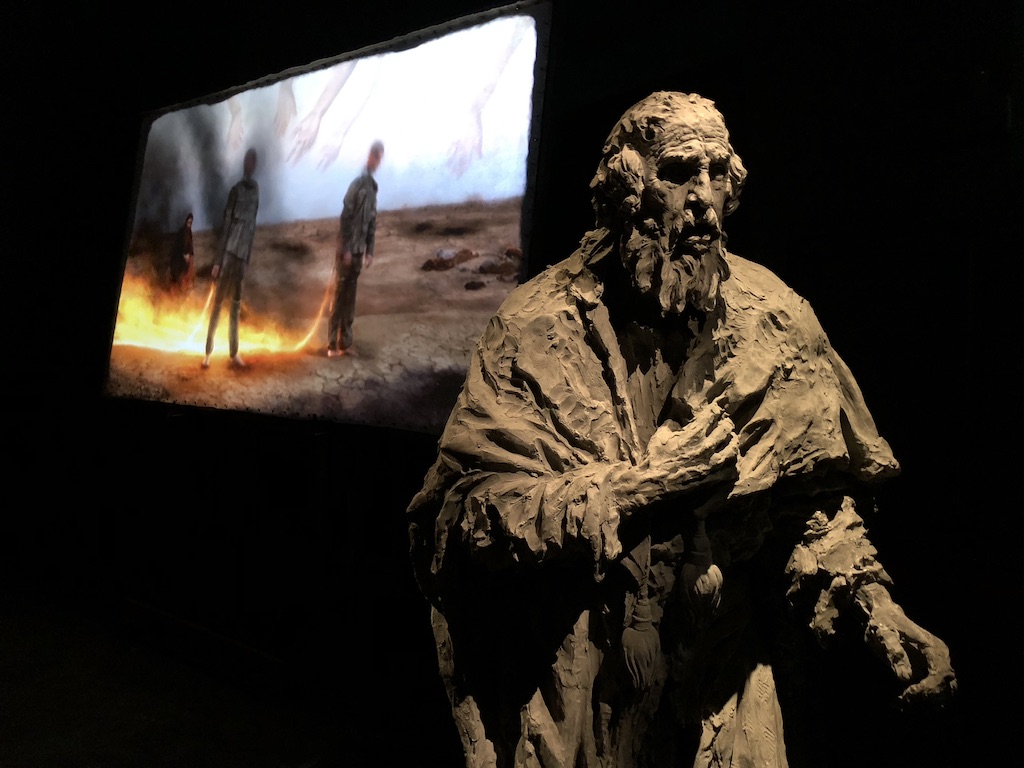
Biblical stories can be retold in many ways with a variety of media. This is part of The Prodigal Son parable in an elaborate and moving installation by Alexander Sokurov at the Venice Biennale in 2019. (Photo by the author)

This is the third in a series of posts responding to the alarming events in Minneapolis. It may be the most arcane, of interest only to worship planners and storytellers. I usually try to write posts of more general interest, but my long experience as a liturgical creative and biblical storyteller impels me to set this down, for what it’s worth, as a small personal contribution to the ongoing efforts of the faithful to resist public malice and hold fast to the good with all the means at our disposal.

In evil times such as these, how can churches be faithful to the Baptismal Covenant to “persevere in resisting evil … seek and serve Christ in all persons … strive for justice and peace among all people, and respect the dignity of every human being”? In recent weeks, we have seen many clergy and laity adding their voices and bodies to the resistance against tyranny and cruelty in Minneapolis, and to the increasingly dangerous work of loving our neighbor and protecting the vulnerable.

As a longtime liturgist, I find myself wondering how—and to what degree—our worship gatherings, in addition to our witness in the public square, might themselves be responsive to what is happening around us—and inside us—during America’s current authoritarian nightmare. Prayer and preaching are two vital ways, and I have given some striking examples in my two previous posts, White House Brutality (prayer as a “refusal to consent to an unredeemed world … It breaks the silence, awakens the passive, and cultivates action, both human and divine.”) and Murder in Minneapolis (featuring one priest’s prophetic sermon, forged in the crucible of tyranny and protest).

Singing is also a powerful weapon against evil and its sad progeny—discouragement, fear and despair. It’s been said that the Civil Rights movement succeeded in part because it had a great soundtrack. Its stirring adaptations of black spirituals, sung not only in the marches but also in the jails, kept voices high and spirits strong. As they say, the people united will never be defeated. And nothing unites like communal singing. The resistance to American fascism is taking this to heart as collective song becomes once again a vital part of public protests.

Prayer, preaching and singing are all powerful ways to say yes to God and no to evil. And to that list I would add the telling of our sacred stories. Creative engagement with Scripture deserves equal attention as a means to lift up our hearts and shine the light of hope against the darkness.  Week after week, year after year, Christians tell formative stories of sin and redemption, strife and reconciliation, despair and hope, losing and finding, oppression and liberation, death and resurrection. Then the preacher strives to connect those biblical stories with our own lives and times. But what if we were to make those connections not just in our homiletic reflections following the stories, but in the storytelling act itself?

As a young priest in Los Angeles during the Vietnam War, I staged a dramatized version of Jesus’ parable of the Unforgiving Debtor for an experimental eucharist. The man whose debt was very small was a draft resister, thrown into prison by an angry creditor dressed as Uncle Sam. That creditor was then reminded of the immensity of his own debt, illustrated by projected images of the atrocious violence in Southeast Asia.

Such a pointed retelling of Scripture might be too edgy for typical Sunday worship, but there are times when biblical stories really want to be heard in fresh and compelling ways. Holy Week 2026 can be a great opportunity to do that. How might worship planners think creatively about the Paschal journey from death to life in the context of our current experience of state-sponsored hate and violence?

The next No Kings march is scheduled for March 28, the day before Palm Sunday. How will it feel to reenact Jesus’ provocative entry into Jerusalem after millions of us will have shouted our own hopeful hosannas in the streets of America? What will be in our hearts on Maundy Thursday when our beautiful feast of loving one another concludes with the arrest our Lord by armed thugs? And when we come to the foot of the cross, will we see the God who not only shares our present suffering but also transforms it, making a Way where there is no way?

I love the traditional Scriptural texts for the Holy Week rites which take us on the Paschal journey from death into life. As containers for all the thoughts and feelings we bring to that journey, especially in times of immense public distress, they need no inventive retelling. They will be heard in fresh ways simply by virtue of what is in our minds and in our hearts throughout Holy Week 2026.

But when the sun goes down on Holy Saturday, and the Great Vigil of Easter begins to transport us from the world of sin and death into the realm of light and life, the world of the past is gone, and it is time to let imagination flourish, that we may find our own struggles and hopes vividly enacted in the performance of biblical narratives.

At the Easter Vigil, which I take to be the molten core of Christian worship, it is critical to experience those stories as if they are happening to us. We need to feel ourselves delivered from the flood of chaos and liberated from bondage to the powers-that-be. The dry bones of our damaged hopes need to rise again and inhale the breath of the Spirit. As the ancient Exultet chant declares at the outset of the liturgy,

How holy is this night, when wickedness is put to flight, and sin is washed away. It restores innocence to the fallen, and joy to those who mourn. It casts out pride and hatred, and brings peace and concord.

What does it take to do the Vigil stories justice? Well, it takes time and effort, a creative team, prayerful engagement with the stories, and openness to the Holy Spirit. Before offering a few tips for your own Vigil storytelling, let me give some examples from a Vigil I curated last year, as described in my April 2025 blog post, “For God so loved our stories”—Tales from the Easter Vigil:
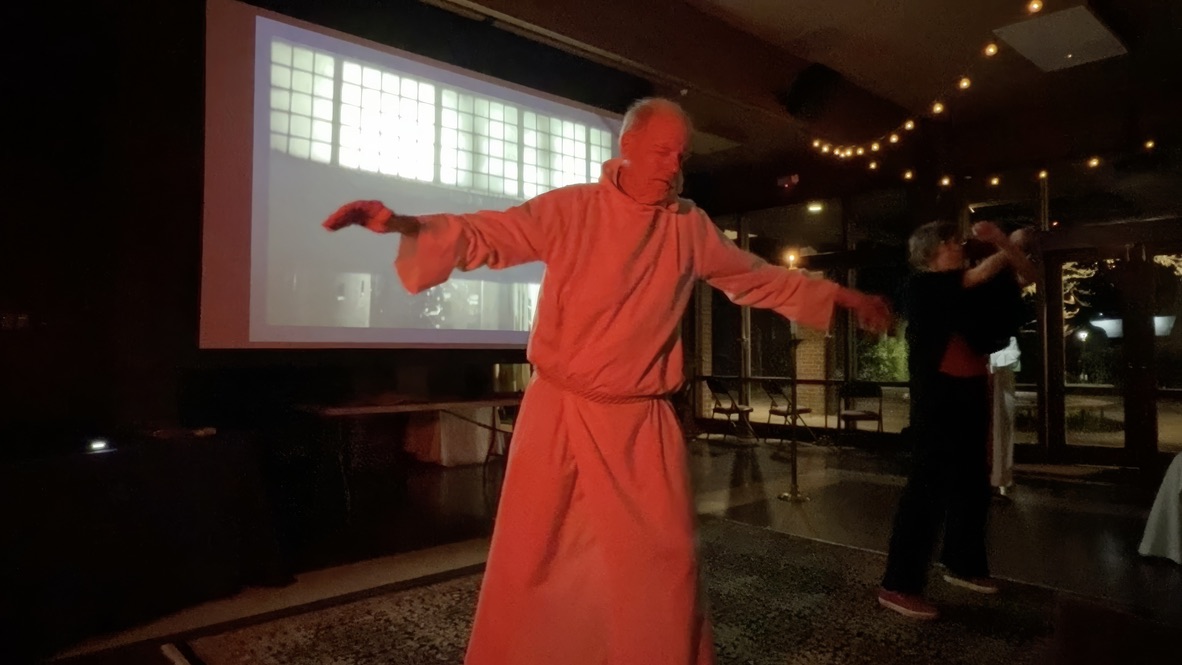
The author as one of the dancers in the Red Sea story at the Easter Vigil 2025.

The Red Sea: Noirish projected images (from Bela Tarr’s bleak film, Werckmeister Harmonies) show anonymous figures shuffling through an imprisoning corridor, while dancers on the stage express the experience of oppression with their bodies. An offstage narrator explains:

Three thousand years ago, in the land of Egypt,
there were people who had no name.
They were the faceless many,
exploited by the powerful,
forgotten by the privileged: slaves, immigrants, the poor,
the homeless, the vulnerable, the invisible, the outcast.

Then dismissive terms for the oppressed appear on the screen in stark animated graphics: Not like us … worthless … horrible people … trash … less than human. More images of “the faceless many” are shown as the dancers continue, until an offstage choir sings a verse of “Go down, Moses.”

Suddenly, the divine breaks into this dark world: the screen flashes red, and we see the words from Psalm 68 that are always used in Orthodox Paschal liturgies:

Let God arise!
Let the foes of Love be scattered!
Let the friends of justice be joyful!

Then a song from the Civil Rights movement fills the room: “They say that freedom is a constant struggle … Oh Lord, we’ve struggled so long, we must be free.” The dancers’ bodies shift from oppression to liberation, while the screen shows powerful footage of crowds on the march for justice. As we hear a dub track with a repeated phrase by Martin Luther King, Jr.(“We cannot walk alone!”), the dancers begin their own march across the stage to the “Red Sea,” where they halt while the narrator declares:

This too is a creation story:
On this day, God brought a new people into existence.
On this day, God became known as the One who delivers the oppressed,
the One who remembers the forgotten and saves the lost ,
the One who opens the Way through the Sea of Impossibility,
leading us beyond the chaos and the darkness into the Light.
When the world says No, the power of God is YES!

As the dancers, joined by a small crowd of others, begin to cross the Sea, the choir (offstage) sings Pepper Choplin’s moving anthem, “We are not alone, God is with us …” After the song, a bidding to prayer begins:

Pray now for the conscience and courage
to renounce our own complicity
in the workings of violence, privilege and oppression.
Pray in solidarity with all who are despised, rejected,
exploited, abused, and oppressed.
Pray for the day of liberation and salvation.

The Fiery Furnace: This story from the Book of Daniel is borrowed from the Orthodox lectionary for the Paschal Vigil, and its humor (yes, the Bible can be funny) provides some comic relief after the Red Sea. The story’s mischievous mockery of a vain and cruel king, outwitted in the end by divine intention, feels quite timely. The idol shown on the screen is a golden iPhone, which will be destroyed by a cartoon explosion from Looney Tunes. The humorously tedious repetition of the instruments signaling everyone to bow is performed with the following (admittedly unbiblical) instruments: bodhran, bicycle horn, slide whistle, chimes, train whistle, and Chinese wind gong. The Song of the three “young men” in the furnace is recited by three women in an abbreviated rap version. At the end, the cast of twelve exit happily, singing the old Shape Note chorus, “Babylon is fallen, to rise no more!”

Then we give thanks “for the saints who refuse to bow down to the illusions and idolatries of this world” and pray for “the grace and courage to follow their example, resisting every evil, and entrusting our lives wholeheartedly to the Love who loves us.”

Valley of Dry Bones: Unlike the embellished retellings of the other stories, this one sticks closely to the biblical text, but is delivered in a storytelling mode by a single teller (me) in a spooky atmosphere of dim blue light. The voice of God is a college student on a high ladder. The sound of the bones joining together is made by an Indonesian unklung (8 bamboo rattles tuned to different pitches). When the story describes the breath coming into the lifeless figures sprawled across the valley, I get everyone in the assembly to inhale and exhale audibly a few times so that we can feel and hear the spirit-breath entering all of us. Then I move among them, bidding one after another to rise until everyone is standing, completing the story with their own bodies: the risen assembly itself becomes a visible sign of hope reborn.
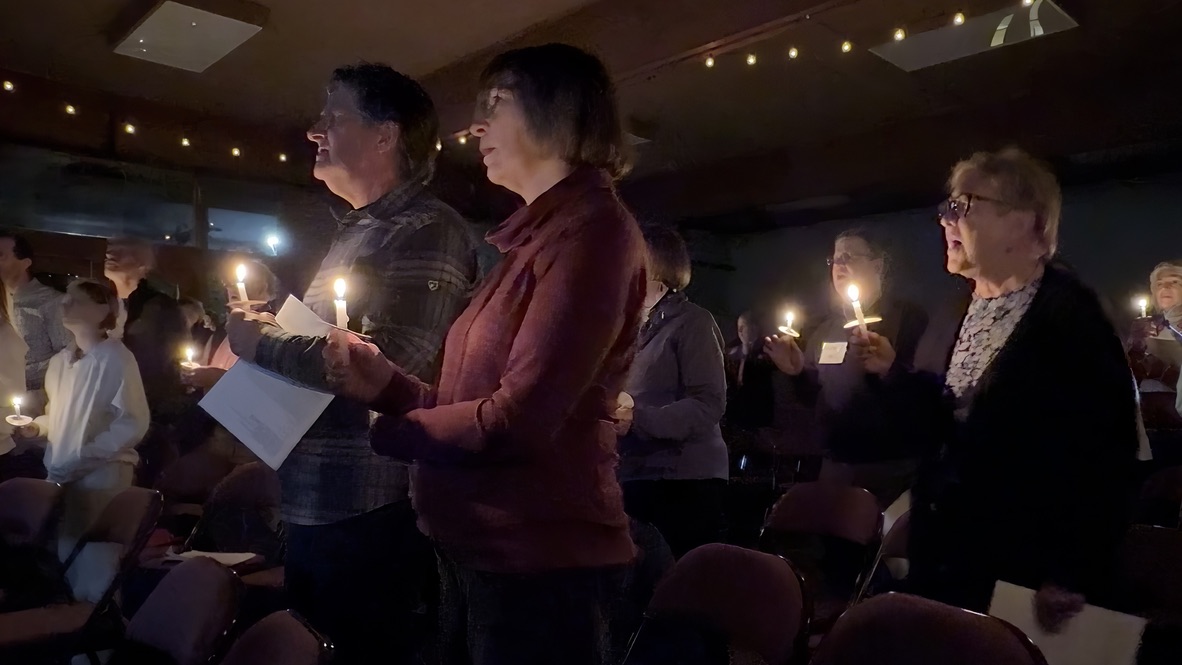
Easter Vigil 2025 at St. Barnabas, Bainbridge Island, Washington.

Many churches don’t do the Easter Vigil, and of those that do, all too few give it proper attention as the richest and most luminous liturgy of the entire year. It requires a lot of preparation, effort and energy at the end of a very labor-intensive week. It also involves a long-term project of educating a congregation to understand the Vigil as the preeminent Easter rite.

You can celebrate the Resurrection gloriously on Sunday morning, but if you want to experience Resurrection in a kind of Christian dreamtime, come to the Vigil as well. And if you are in a community which already knows the unique power of the Vigil experience, I encourage you to explore the potential of its stories to empower our bodies and restore our souls in this dark and dangerous age.

If you are not part of a community that does the Easter Vigil, I thank you for reading this far anyway. But if you are in a position to shape a creative Vigil, here are some suggestions to get you started.

You may want to begin with just one or two stories. Find the creatives in your community and form a team to study the texts and discern what they are trying to say now. And think about the connections they make with our lives and our society. For example, footage from the Minneapolis protests could be part of the Red Sea saga, or the king’s ruffians throwing their victims into the fiery furnace could be dressed like ICE agents.

Decide for each story whether to use simple storytelling (one or more voices, scripted or retelling freely) or more theatrical means (scripts, actors, visual design, visual media, singing, musical score, sound effects, etc.). Think about ways to involve children (e.g., animals on the ark, or part of the Red Sea march to freedom) and even the whole assembly, through singing or collective reading, like a Greek chorus, of projected words on a screen. Involving as many people as possible in creating and performing the stories bolsters both attendance and enthusiasm. Play with ideas, images and words until the stories take shape. Then provide sufficient time for learning lines and rehearsals.

Ideally, the Story Space will be separate from the worship space. A parish hall is usually more flexible than a church interior in terms of seating and a stage area. If there is a screen or a large white wall, large images can be projected. Strings of party lights on a dimmer and LED spotlights with variable colors are easy ways to restrict light to the stage area and establish the mood for each story. The other advantage of a separate Story Space is that a liturgy conducted in a sequence of spatial locations underscores the Vigil as a journey—from the New Fire outside to the Story Space to the font to the altar and finally back into the world.

And let each story be followed by an appropriate song (I use both folk music and contemporary songwriters to fit the relaxed spirit of “tales around the sacred campfire,” in contrast to the chant and hymnody in the church portion of the liturgy). Then comes a bidding to prayer, summarizing the themes of the particular story.

Let me close with the bidding I wrote to follow The Valley of Dry Bones. It expresses everything I want to say about the liberating power of our stories to resist evil, proclaim hope, and lift up our hearts:

Dear People of God: There are those who tell our story as a history of defeats and diminishments, a narrative of dashed hopes and inconsolable griefs. But tonight we tell a different story, a story that inhales God’s own breath and sings alleluia even at the grave. By your baptism, you have been entrusted with this story, to live out its great YES against every cry of defeat.
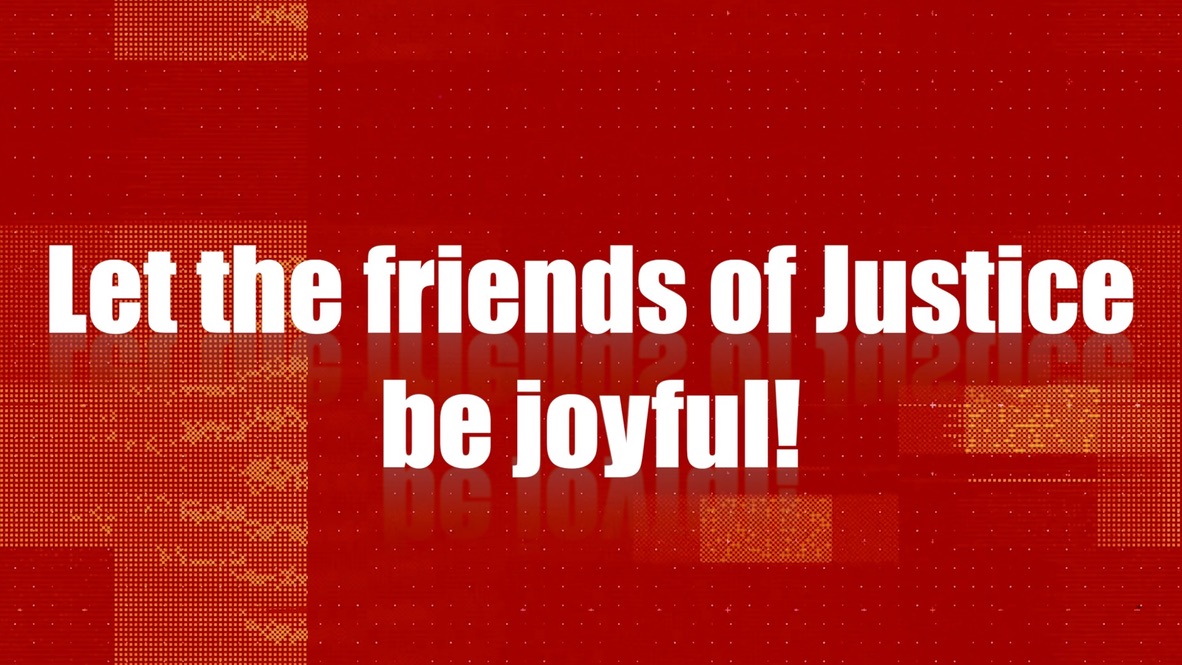
Psalm 68:3, one of the texts projected in the background of the Red Sea story.


“It is what we do.”—Ash Wednesday in a Troubled America

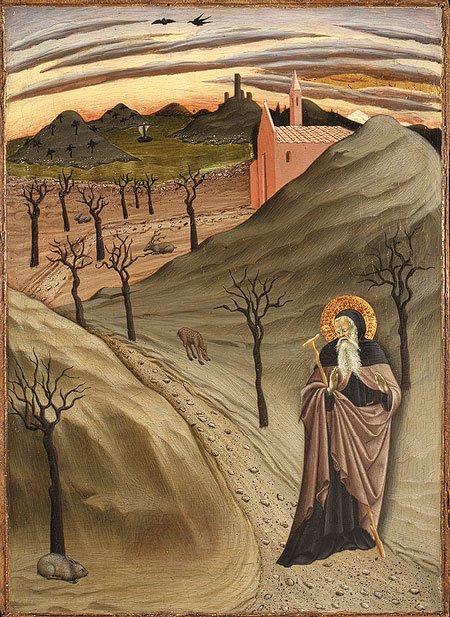
St. Anthony the Abbot in the Wilderness (Osservanza Master, Siena, c. 1435)

For your hand was heavy upon me day and night;
my moisture was dried up as in the heat of summer. 

— Psalm 32:4 [i]

Ash Wednesday is a border crossing. Our foreheads, like passports, are stamped with ashes, and we step bravely into the forbidding wastes of Lent’s strange land. By the time we reach the other side, we will be someone else. 

The Lenten journey is commonly viewed as a time of personal growth and transformation, a solitary immersion in the refiner’s fire, a testing and cleansing of our innermost heart. We learn to travel light, shed the inessentials. We face our demons. We renounce regrets and angers, and interrogate our desire. We listen patiently, till the Silence speaks. The desert saints, who fled the corruptions and distractions of the Roman Empire to meet God on open ground, modeled the classic regimen: 

“[G]et up early every day and acquire the beginning of every virtue and commandment of God. Use great patience, with fear and long-suffering, in the love of God, with all the fervor of your soul and body. Exercise great humility, bear with interior distress, be vigilant and pray often with reverence and groaning, with purity of speech and control of your eyes… Do your work in peace. Persevere in keeping vigil, in hunger and thirst, cold and nakedness, and in sufferings.”[ii]

This year, however, Lent’s collective dimension comes to the fore. The pandemic has made our social behavior a literal choice between life and death. Thoughtless selfishness about masks and social distancing, however trivial it may seem in the moment, may have murderous results. Necessity has forced us all to live, as Thoreau advised, “deliberately.” At the same time, climate change, racism, economic dysfunction and political crisis continue to issue their own relentless summons to collective conversion. 

Return to me with all your heart, says the Lord, with fasting, with weeping, and with mourning; rend your hearts, not your garments.… Blow the trumpet in Zion, sanctify a fast; call a solemn assembly; gather the people.…Between the vestibule and the altar let the priests, the ministers of the Lord, weep. Let them say, “Spare your people, O Lord, and do not make your heritage a mockery, a byword among the nations.” [iii]

These words of the prophet Joel, recited aloud in the Ash Wednesday liturgy, seem so well-aimed this year. Although the United States is not the biblical chosen people, Joel’s words do hit home. Our toxic national quagmire should put us all in sackcloth and ashes, rending our hearts and crying “Mercy!” for 40 days of public atonement. 

It’s not enough to blame Trump, Hawley, Cruz, McConnell and rest of that sorry mob of schemers and traitors. However despicable their betrayals of democracy, however pathetic their black hearts and shrunken souls, those individuals are but the rotten fruit of our unaddressed national sins, what Martin Luther King called “the giant triplets of racism, extreme materialism and militarism.” [iv] The common response to the violent insurrection unleashed at the U.S. Capitol on January 6 has been a claim of innocence: “This is not who we are. And yet, in the words of one candid observer, “It is what we do.” [v]

Writing about coming of age during the Vietnam War, Patricia Hampl describes her attempt to identify with the American ideal rather than its present reality. Walt Whitman was her guide. “Out of the ashes of the Civil War … Whitman fashioned his thrilling American conception, …  envisioning a country full of charmed lovers with arms around each others’ waists.” Distressed by napalm abroad and civil strife at home, Hampl wanted to cling to America’s best idea of itself.

“I could escape American history which was a bad dream and enter the dream of America which I wished could be history. A sleight of hand, a last-ditch attempt to return to the purity of abstraction, to the Mayflower moment, the radiant arrival in paradise before anything had happened. Ourselves—but rinsed of history.” [vi]

No such luck. We the people can only be rinsed on the far side of the Lenten desert. For now, nothing but ashes, sand, and dust, as we endure our dryness with broken and contrite hearts, engage our demons without evasion or fear, renounce our innocence, and surrender to grace. 

Alleluias burned by worshippers on the Last Sunday after Epiphany, 2013.

Related posts:

Ash Wednesday: A Time for Self-Compassion

Is Holiness a Lenten Obligation?


[i] Daily Office Psalm for Ash Wednesday, Episcopal Book of Common Prayer.

[ii] The Apophthegmata (Sayings of the Desert Fathers), in William Harmless, S.J., Desert Christians: An Introduction to the Literature of Early Monasticism (Oxford and New York: Oxford University Press, 2004), 199-200.

[iii] Joel 2:12-13, 15-17. This passage is one of two choices of Ash Wednesday texts from the Hebrew prophets. The other, Isaiah 58:1-12, is also a cry for collective repentance, adding a list of corporate sins well-known in our own day: injustice, oppression, neglect of the poor, hungry and homeless. 

[iv] Martin Luther King, Jr., from a famous sermon at New York’s Riverside Church on April 4, 1967. The text (with audio) is here: https://www.americanrhetoric.com/speeches/mlkatimetobreaksilence.htm  A superb article by Andrew Bacevich in June 2020 shows the continuing relevance of King’s sermon today: https://billmoyers.com/story/martin-luther-kings-giant-triplets-racism-yes-but-what-about-militarism-and-materialism/

[v] Mark Danner, “’Be Ready to Fight,’” New York Review of Books (Feb. 11, 2021), 4-8.

[vi] Patricia Hampl, I Could Tell You Stories: Sojourns in the Land of Memory (New York: W.W. Norton & Company, 1999), 49. Hampl is one of my favorite writers and storytellers. 

Beyond Punch and Judy: The art of nonviolent resistance

image

In Faith and Violence, a book published amid the political turbulence of 1968, Thomas Merton told an old Hasidic story about two men, one drunk and one sober, who were beaten and robbed as they traveled through the forest. Asked later about what had happened, the sober one described the violent encounter in vivid detail, but the drunken one seemed quite placid. “We’re all right,” he said. “Everything is fine.” Merton went on to observe that for some, faith “seems to be a kind of drunkenness, an anesthetic, that keeps you from realizing and believing that anything can ever go wrong.” But, he asked, is faith a “narcotic dream” or is it “an awakening”? Then he delivered his punch line: “What if we were to awaken to discover that we were the robbers, and our destruction comes from the root of hate in ourselves.”[i]

At a time when a brutal war was raging in the jungles of Vietnam, police and protestors were clashing in the American street, and leaders who spoke out for justice and peace were being assassinated, a monk dedicated to contemplative retreat from the world felt compelled to explore the theology of love in an age of violence, one which would “deal realistically with the evil and injustice of the world.”[ii] How do we resist the violence in our society without adding our own anger and demons into the mix? How do we resist systemic and social sin while harboring no illusions about our own capacities to do harm?

In recent days there have been numerous conversations about the escalating political violence surrounding the Trump campaign. My own post (March 12) on the topic has generated heartfelt responses of shared concern. Many of us are wondering what we can do about the situation without defaulting to our own versions of anger or fear. We need experienced guides through such tricky terrain, and Thomas Merton is one of the best.

“We no longer communicate,” Merton said. “We abandon communication in order to celebrate our own favorite group-myths in a ritual pseudo-event.”[iii] He wrote that in the Sixties, but he could have been describing a Trump rally, which, in the absence of substantive content, is mostly a ritual acting out of a group-myth, reaching its crescendo in the anticipated expulsion of protesters. As Rachel Maddow showed in a recent montage of those expulsions, Trump repeatedly asks the crowd, “Isn’t this exciting?” Roughing up protesters may express anything from personal rage to fascist methodology, but it is also entertainment. As Neil Postman has noted, Americans like “amusing ourselves to death.”[iv] When the anti-Trump signs come out, the crowd gets happy, knowing the real fun is about to begin.

This is all contemptible and sad. But I wonder: how do protestors avoid becoming unwitting collaborators in Trump’s entertainments? Even if they don’t hit back or give the crowd the finger, how do they escape complicity in a political Punch and Judy show? How do they avoid getting their own group-myths stuck in the futility of an endless ritualized dualism of “us versus them”?

Blessed are the peacemakers, for they shall be called the children of God. The peacemaker is committed to communion as the nature and destiny of humankind. As Martin Luther King said in a speech I remember from my college days, we must see the face of Christ even in the police who are attacking us with dogs and fire hoses. Or as Jesus himself taught, we must love our enemies. That does not mean capitulating to evil, or abstaining from the tainted ambiguities of political conflict. But it does mean that we ultimately belong to a much better story, where one day the tears will be wiped from every eye, the lion will lie down with the lamb, and the prodigal will be welcomed home. It means that our highest commitment is not to defeat our enemies but to make the divine love story of amazing grace come true for everyone.

As Merton wrote, “Christian nonviolence is not built on a presupposed division, but on the basic unity of [humankind]. It is not out for the conversion of the wicked to the ideas of the good, but for the healing and reconciliation of … the human family.”[v] This isn’t sentimental benevolence or passive submission. It’s a very tough form of love, as Jesus, Gandhi, King and many others have demonstrated in their costly commitment to a wider, more generous perspective than the self-righteous justifications of partisan interests. Our struggles must always reject the ultimacy of division in favor of communion. “The key to nonviolence,” Merton reminds us, “is the willingness of the nonviolent resister to suffer a certain amount of accidental evil in order to bring about a change of mind in the oppressor.”[vi]

But how do we apply this wisdom to the specific challenges of our own day? How can we respond creatively to the upwelling of anger, fear, racism and nativism poisoning our public life? In 1968, Merton compiled a list of principles for nonviolent resisters which is worth considering. While he admitted that the complexity and fluidity of events in that turbulent year could make any opinion lose its value in a matter of weeks, I believe his prescriptions retain an enduring value:

1) “be free from unconscious connivance with an unjust and established abuse of power”

2) “be not for [oneself[ but for others, that is for the poor and underprivileged”

3) “dread a facile and fanatical self-righteousness and refrain from being satisfied with dramatic self-justifying gestures”

4) demonstrate “a desirable alternative” to violence and injustice

5) use means which embody and manifest the emergent way of being which Christians call the Kingdom of God

6) be “willing to learn something from the adversary”

7) be grounded in hope and humility – what we strive for is a gift from God’s future: not of our own making, and not yet fully here [vii]

I particularly like Number 4 (demonstrate a desirable alternative) and Number 6 (embody and manifest the Kingdom of God). It is what we do in the eucharist, where everyone is welcome, everyone practices reconciliation, and everyone shares the bread of heaven. But can we take such countercultural vision into the street?

Yes we can. There are various ways (many of which have yet to be invented!). Even into her nineties, my mother joined the “women in black” every Friday in silent vigil against the Iraq war on the streets of Santa Barbara. Their faithful witness was impossible to ignore, while at the same time it perfectly embodied the peace for which they stood.

A very different display of visionary resistance occurred at the World Trade Organization (WTO) protests in Advent of 1999. Those who watched the news only saw the Punch and Judy show of untrained police and young provocateurs turning a shoving match into a tear-gassed conflict. But the most important things that happened were not on television. This is what I myself witnessed on the day of the big rally and march[viii]:

There was a large banner which read, AN INJURY TO ONE IS AN INJURY TO ALL. It seemed a perfect summary of the gospel: “If you do it to one of the least of my brothers and sisters, you do it to me.” All in Christ, Christ in all. Solidarity forever. We were there to speak for all those whom the WTO would rather silence or forget – voices crying in the wilderness, “Prepare the way of the Lord.”

At 12:30 pm, we took to the streets, marching up Fourth Avenue. to join the thousands more who were already downtown. It was a wonderfully diverse procession: there were people dressed as Santa Claus, sea turtles, trees, and even death. But it was not some crazy fringe out there. As one writer put it, “These were the kids at UW, the ladies from church, the guys at Boeing. It was Seattle that was marching this week.”

As in all street rituals, there was a playful, carnival atmosphere. As Richard Shechner observes in his book, The Future of Ritual:

“When people go into the streets en masse, they are celebrating life’s fertile possibilities…They put on masks and costumes, erect and wave banners, and construct effigies not only to disguise or embellish their ordinary selves, or to flaunt the outrageous, but also to act out the multiplicity each human life is…They protest, often by means of farce and parody, against what is oppressive, ridiculous and outrageous…Such playing challenges official culture’s claims to authority, stability, sobriety, immutability and immortality.”[ix]

In other words, we were exhibiting the same spirit – dare I say “holy spirit”? – of playfulness, camaraderie, irony and subversion that was seen ten years ago at Tiananmen Square and the Berlin Wall and, during biblical times, at the Red Sea and the Triumphal Entry on Palm Sunday. And as faith tells us, the powers don’t stand a chance against the foolishness of God.

There were people on stilts, people carrying giant puppets, babies in carriages and elders with canes and walkers. I stuck close to the Anti-Fascist Marching Band, which played soulful New Orleans versions of “America the Beautiful”, “Battle Hymn of the Republic” and Bob Dylan’s “Masters of War.” We all just danced up Fourth Avenue …

So, my friends, how shall we do the Kingdom dance in the year of grace 2016?


[i] Thomas Merton, Faith and Violence: Christian Teaching and Christian Practice (Notre Dame, Indiana: Indiana University Press, 1968) ix-x (All quotes from Faith and Violence are in The Thomas Merton Encyclopedia (New York: Orbis Books, 2002) under the entry on Merton’s book, but I have listed the original volume’s page numbers in the footnotes.)

[ii] ibid., 9

[iii] ibid., 159

[iv] Neil Postman, Amusing Ourselves to Death: Public Discourse in the Age of Show Business (New York: Penguin, 2005)

[v] Merton, 15

[vi] ibid., 27-28

[vii] ibid., 21-25

[viii] From a sermon I preached the following Sunday at St. Augustine’s-in-the-Woods Episcopal Church, Whidbey Island, WA (Advent II, 1999))

[ix] Richard Schechner, The Future of Ritual: Writings on Culture and Performance (London & New York: Routledge, 1993), 46