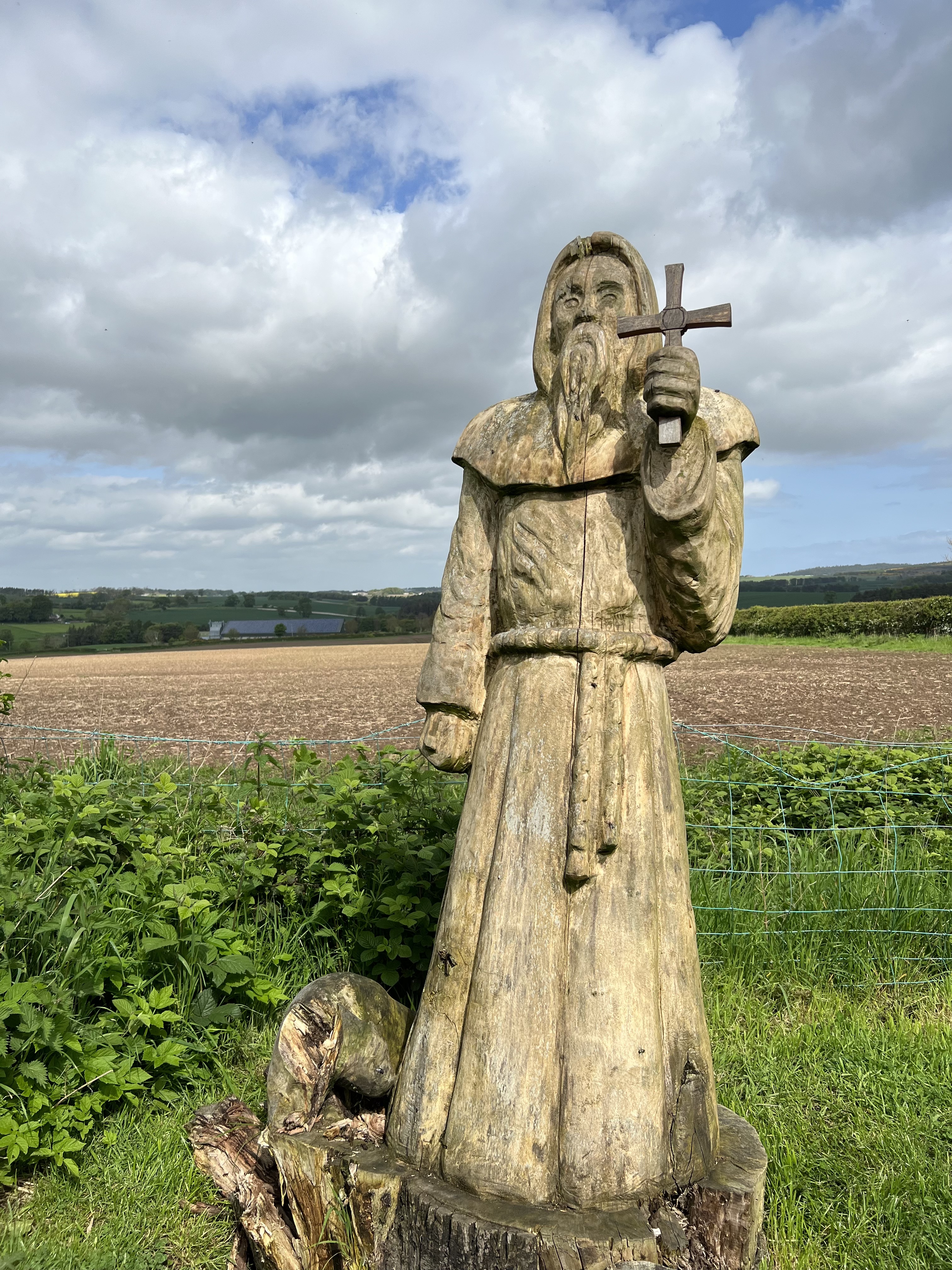
St. Cuthbert, by local sculptor Tom Fiddes (2017), blesses the wayworn traveler. The saint stands opposite a country house offering shade and water to weary pilgrims.
They confessed their sins, confided in him about their temptations, and laid open to him the common troubles of humanity they were laboring under … Spirits that were chilled with sadness he could warm back to hope again … Those beset with worry he brought back to thoughts of the joys of heaven. (The Venerable Bede, Life of Cuthbert)
Nine years ago I walked the 500-mile Camino de Santiago to the shrine of St. James. This spring I made another pilgrimage, 100-kilometers along St. Cuthbert’s Way in the north of Britain. I haven’t managed to write about it since returning home, but when this week’s Feast of St. James (July 25) brought to mind that 2014 Camino (when I first began this blog), I knew it was high time to tell my new pilgrim’s tale.
Chaucer began his celebrated pilgrimage narrative with an eloquent praise of springtime as an awakening: not only of the dormant earth, but also of the soul’s longing for transformative journeys. After three years of staying close to home in pandemic hibernation, the call of the road felt especially urgent.
Then people think of holy pilgrimages, Pilgrims dream of setting foot on far-off Lands, or worship at distant shrines, their thoughts Reaching for grace …[i]
Some pilgrimages have no map or known destination; they are undertaken with the conviction—or at least the hope—that the act of wandering far from the familiar, along the way of unknowing, will lead to what Dark Age monks called “the place of resurrection,” where an illumination might be given or a purpose revealed.
Another kind of pilgrimage takes a well-worn route to a specific destination such as Jerusalem, Rome, or Santiago, the most popular destinations in the Middle Ages. Both the journey and the arrival are still full of unknowns—hardships, obstacles, surprises, chance meetings, moments of grace—but their ultimate location and length are determined in advance. Both kinds of pilgrimage involve some combination of leaving behind (penance), letting go (trust), receptivity (grace), and spiritual desire (love).
My pilgrimage in May, from the Scottish Borders south of Edinburgh to Holy Island off the Northumbrian coast, traced a line across the varied landscapes of Cuthbert’s holy life. It was a popular route for two centuries after the saint’s death in 687, until the threat of Viking plunderers prompted the removal of Cuthbert’s remains from Holy Island to a safer inland site. And Cuthbert’s own travels, mostly on foot, would have ranged widely over the same terrain.
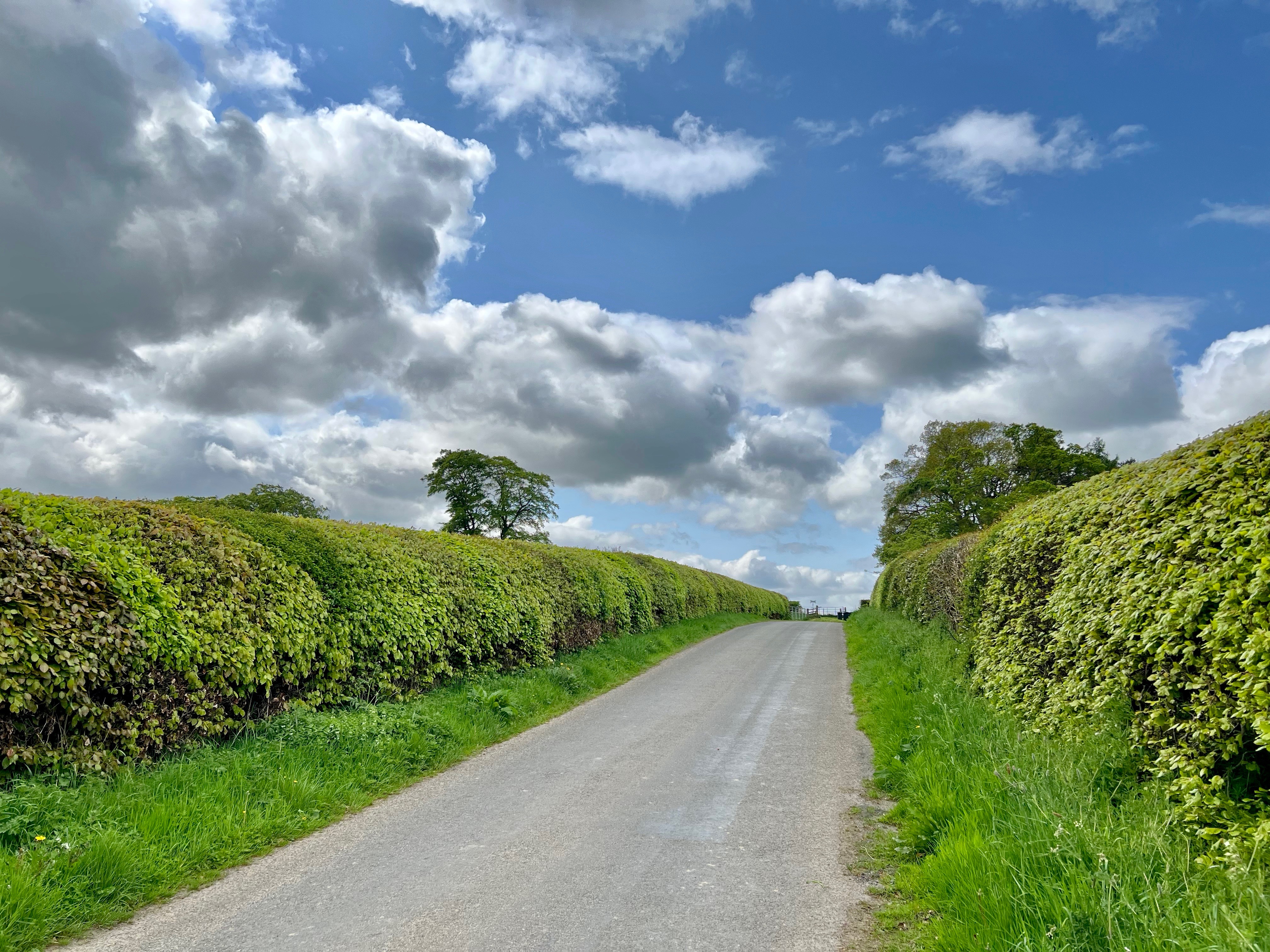
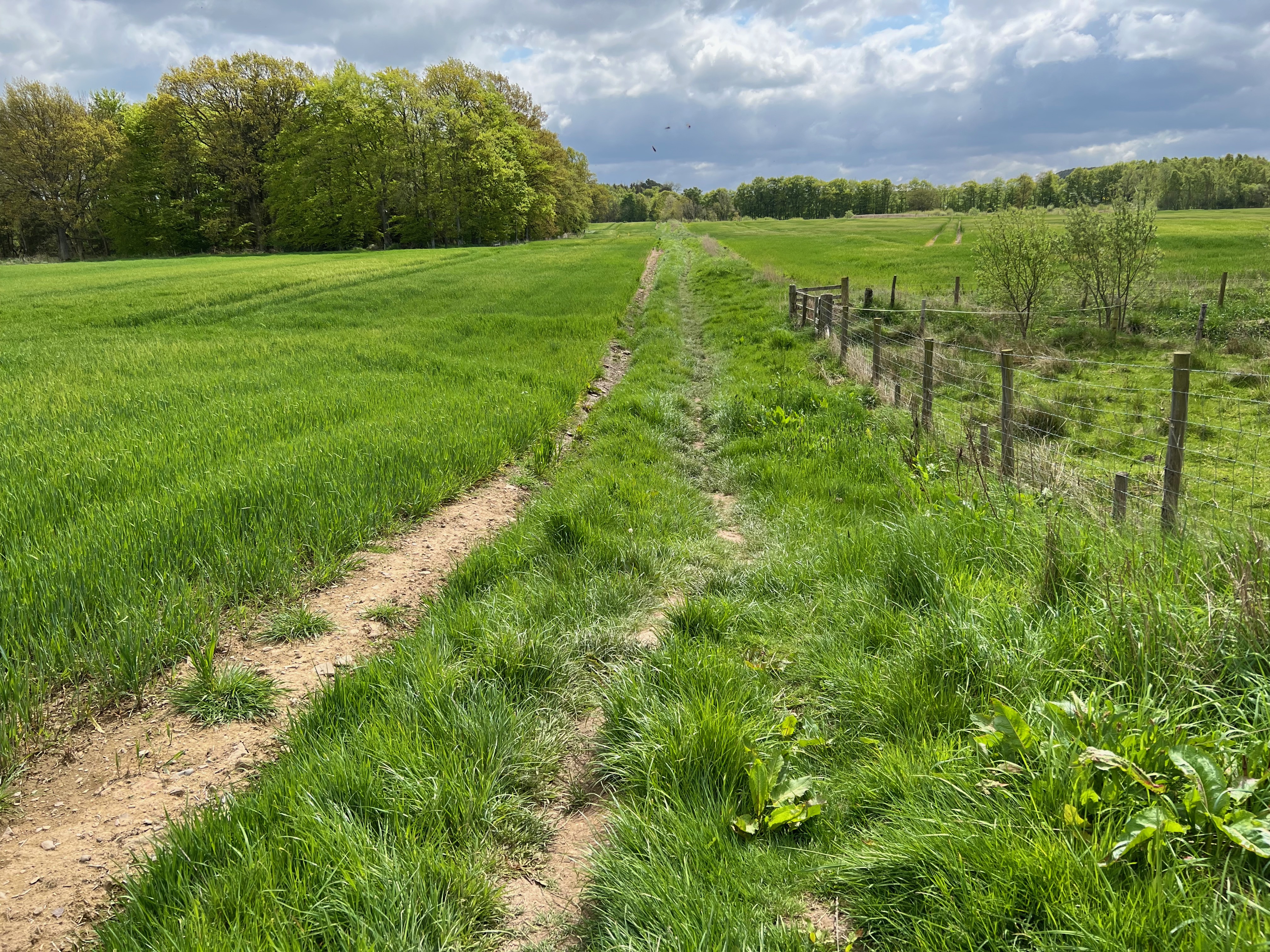
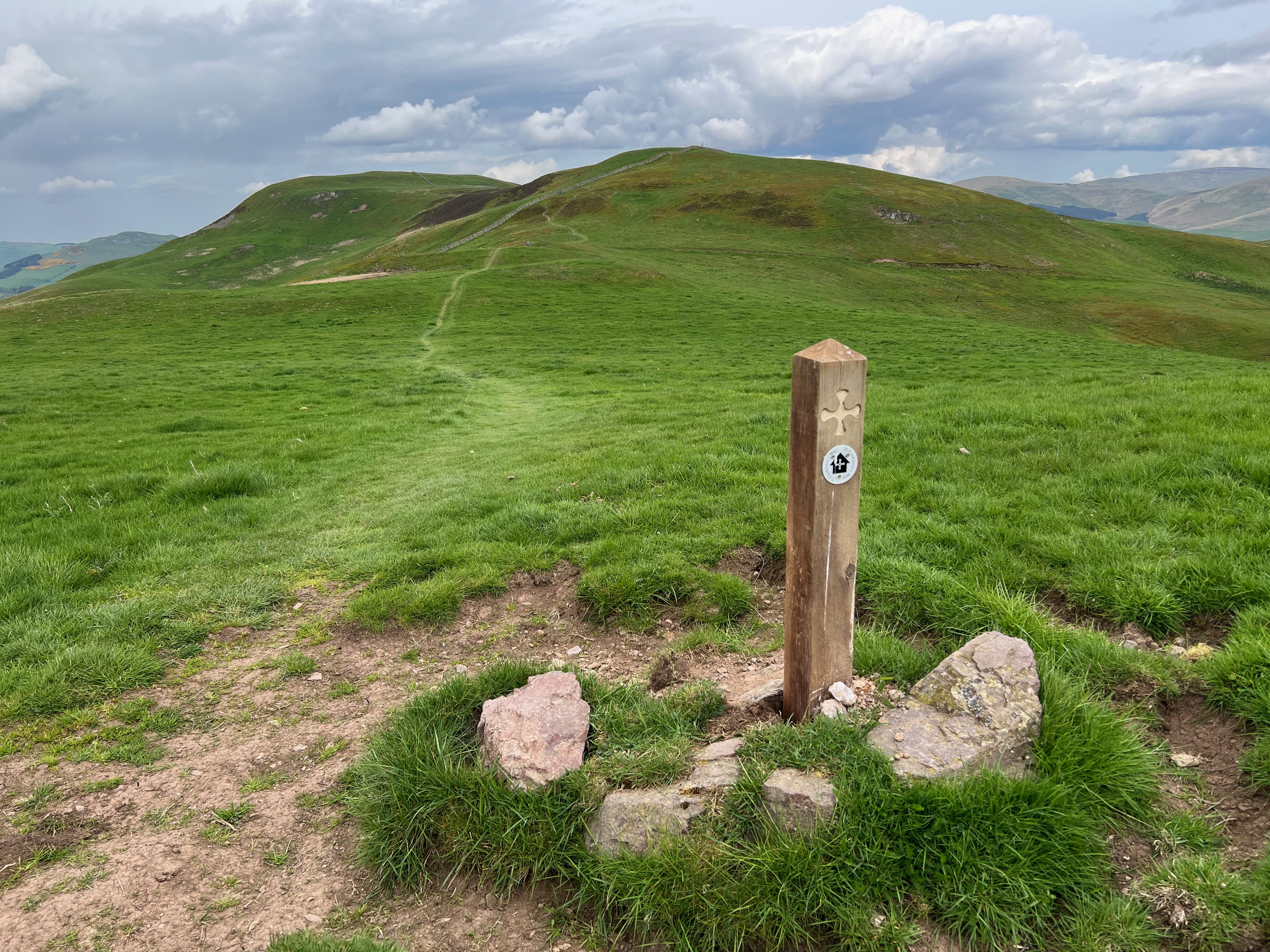
In response to the contemporary revival of pilgrimage as a spiritual practice, St. Cuthbert’s Way, with plentiful waymarks and well-tended paths, was created in 1996. Although passing through occasional towns and villages, it offers abundant solitude and beautiful countryside both pastoral and wild. Before I left, a friend who knew the trail said, “I hope you like sheep.”
Cuthbert’s birth in 634 coincided with a turning point British religion, when King Oswald took control of Northumbria and initiated the conversion of the pagan north to Christianity by importing Celtic missionaries from Iona. Although Cuthbert’s family was Anglo-Saxon, he would be shaped by the distinctive Celtic way—earthier, more idiosyncratic, less tightly organized and less hierarchical than the universalizing Roman system which would assert its dominance in British Christianity within Cuthbert’s lifetime.
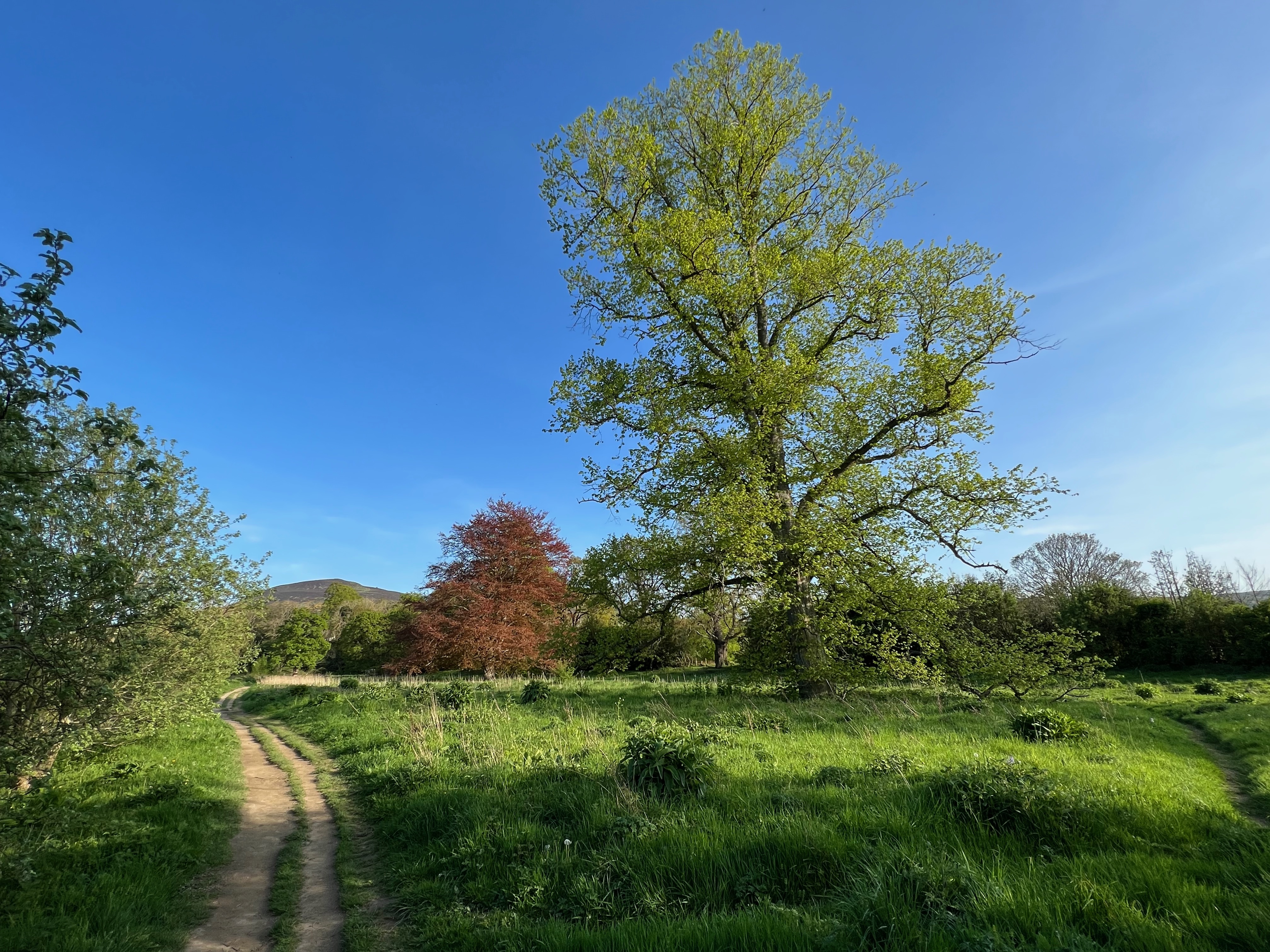
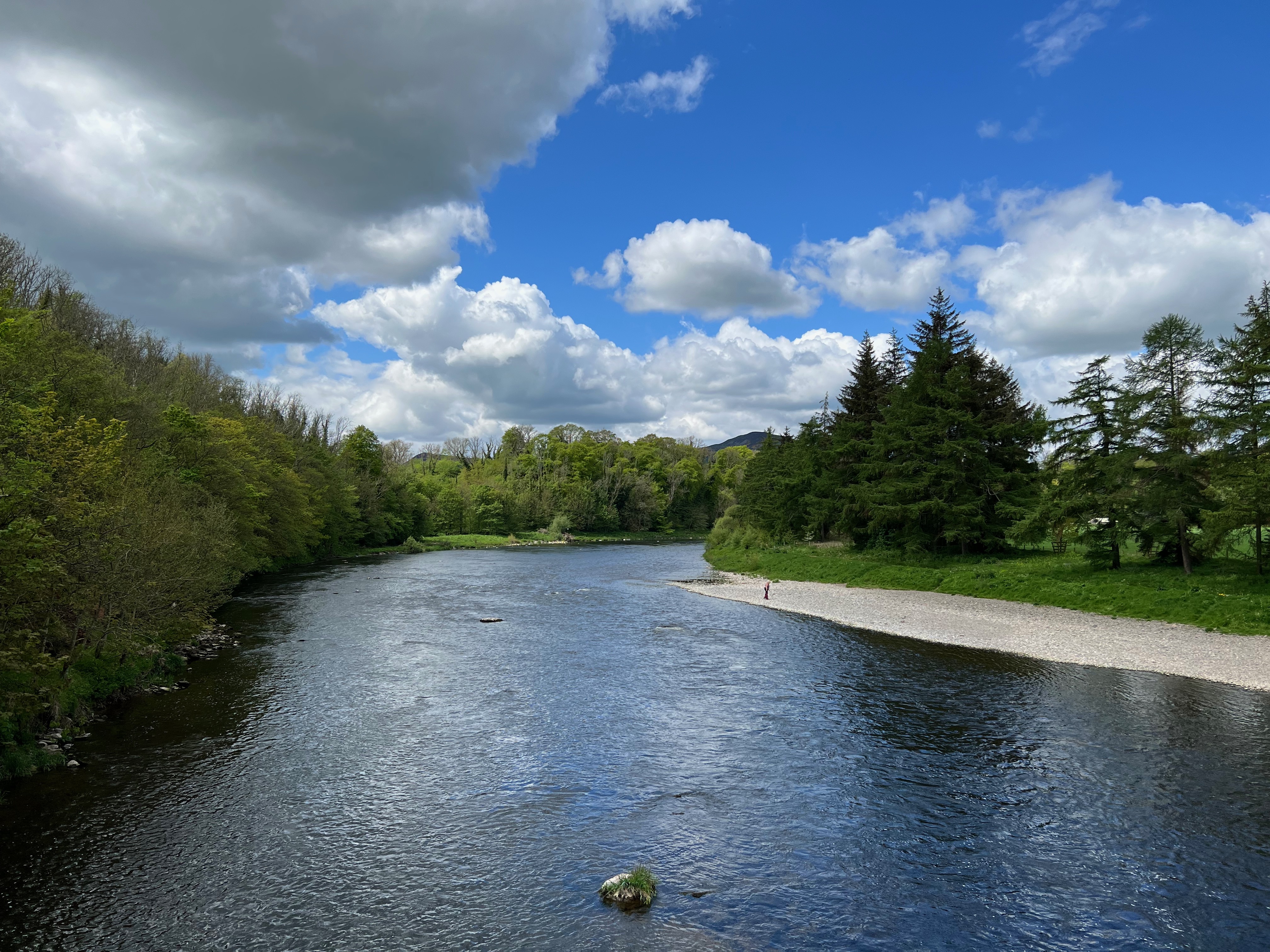
My walk began along this riverside trail from the train station into Melrose. Someone had offered me a ride in their car, but look what I would have missed! Even as a bishop, Cuthbert chose the humility of walking over the luxury of horseback, so I started my pilgrimage in the same spirit.
My pilgrimage began in Melrose, Scotland, where the River Tweed courses through the fields and hills of Cuthbert’s youth. Even as a boy he had a deeply religious sensibility. His biographers spoke of angels and miracles being part of his growing years. Whatever we ourselves may think about the facts behind those stories, they suggest a spirit alive to ineffable encounters with the transcendent. One night, while keeping watch over a flock of sheep, the sixteen-year-old Cuthbert had a vision of a dazzling light streaming down from above as angelic hosts descended to fetch a single mortal into heaven. When the vision faded, he woke his sleeping companions to tell them what they had missed. He was convinced that some holy person must have died that night.
The very next day, he learned that Aidan, the beloved Celtic bishop who spurred the conversion of Northumbria, had departed this life at the time of his vision. I might dismiss this tale as pious embellishment, had I not had my own dream, at age 30, of a close friend at the very moment of his tragic death. In the dream, he had moved to an island off the coast. I asked him if he were all right. He looked me in the eye and assured me he was. The dream came to me deep in a mountain wilderness. Only when I returned to the world two days later did I learn of his death by less mysterious means. Because of that profound experience, I must say that Cuthbert’s vision rings true for me.
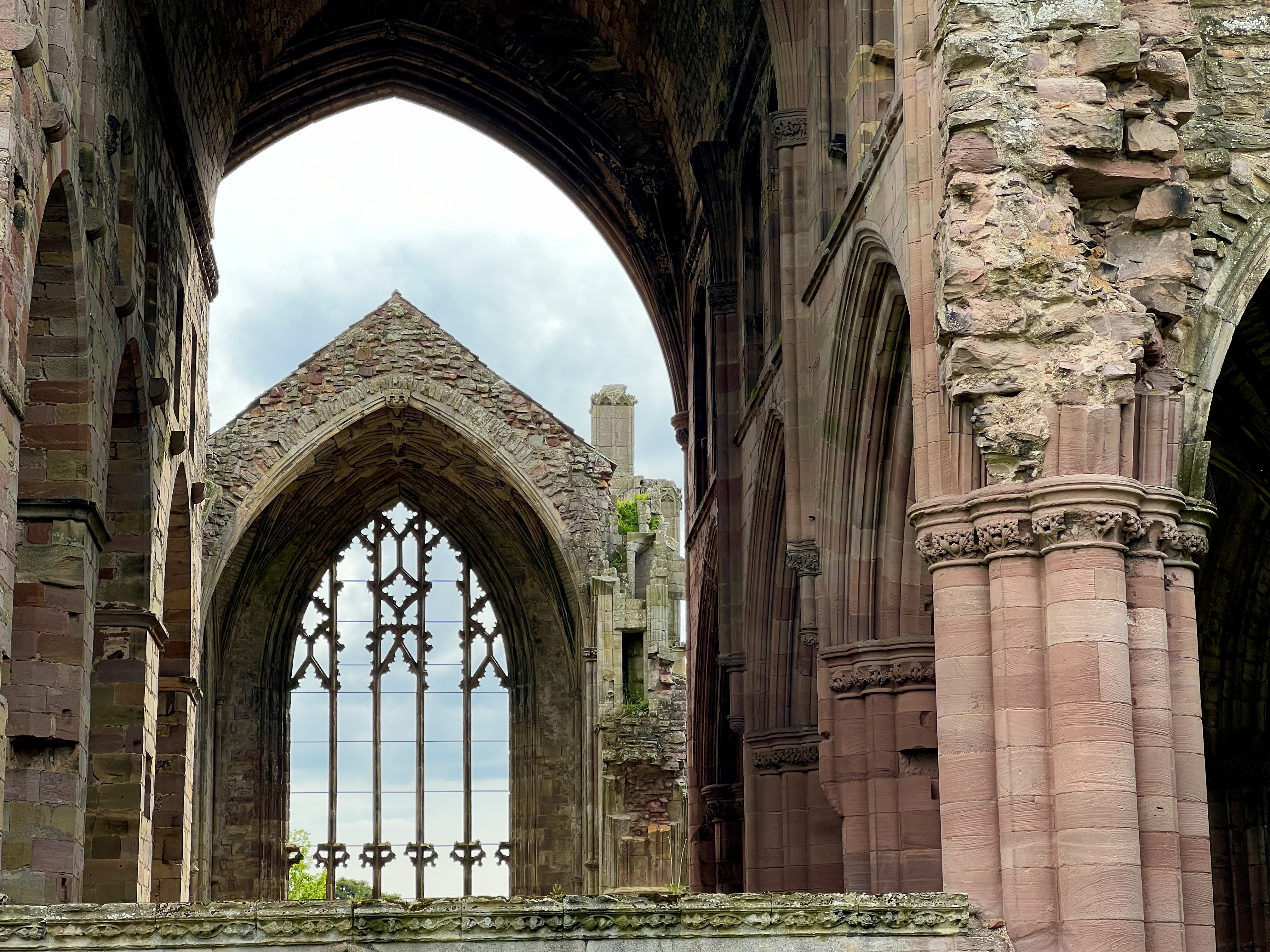
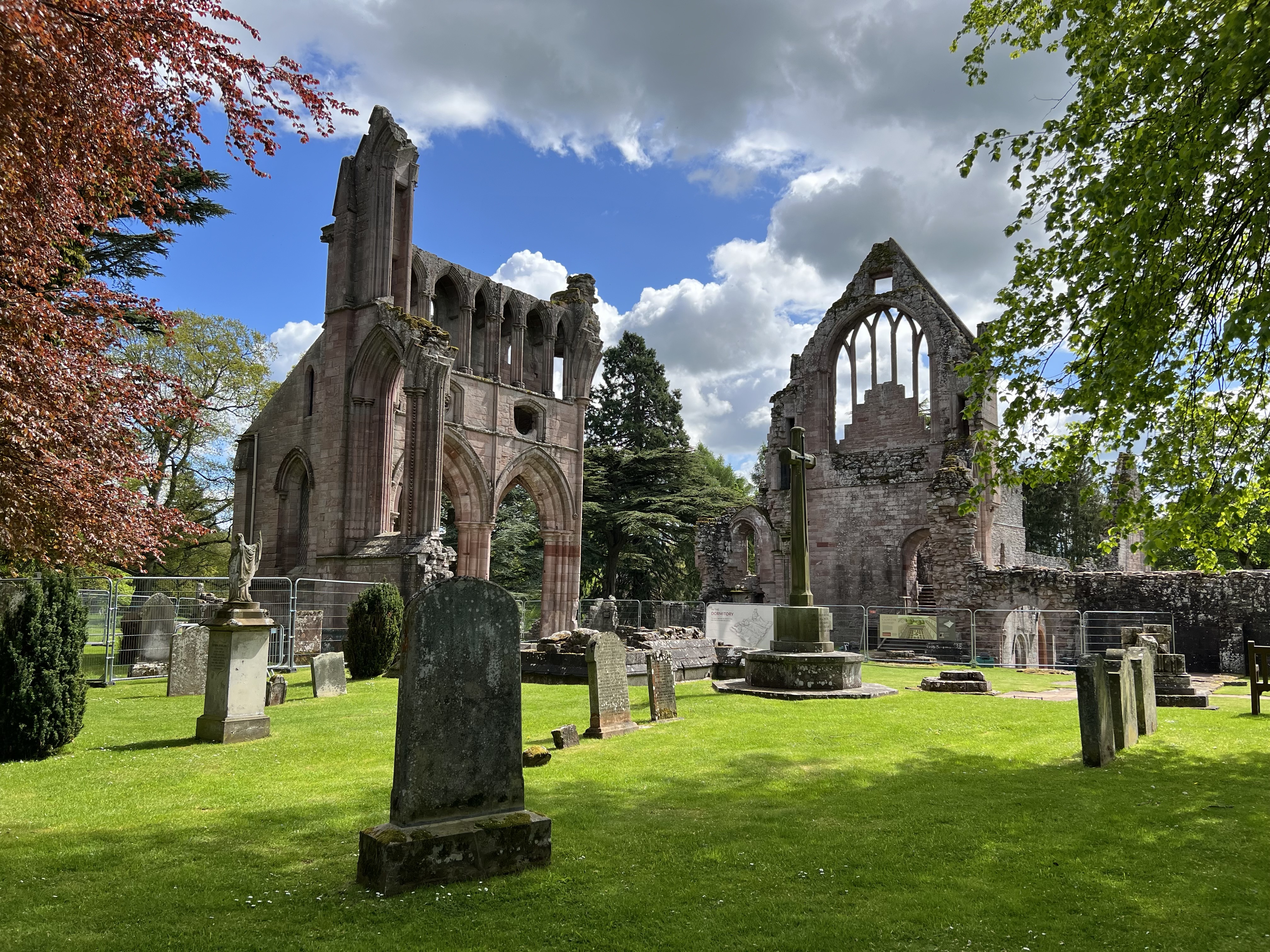
Cuthbert’s experience prompted a decision which had been long in the making: to enter the monastic life and devote his heart and soul to prayer and service. He was soon welcomed into the community of monks near present-day Melrose. He would eventually become their prior, a role he would later assume on Holy Island. His first monastery’s seventh-century wooden structures on a grassy bend in the River Tweed are long gone, but the impressive ruins of the twelfth-century Cistercian abbey made a fitting place to begin my pilgrimage on St. Cuthbert’s Way.
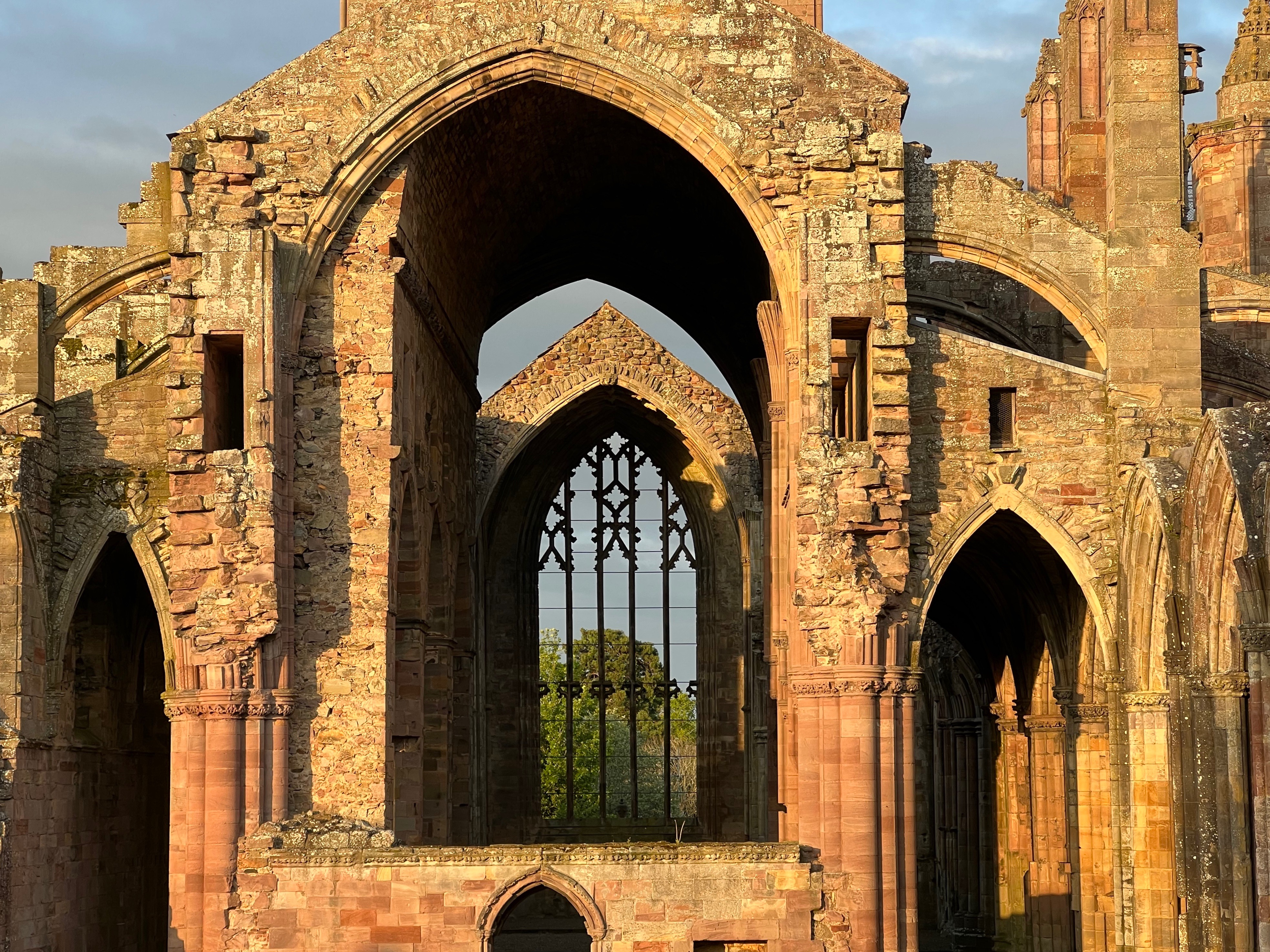
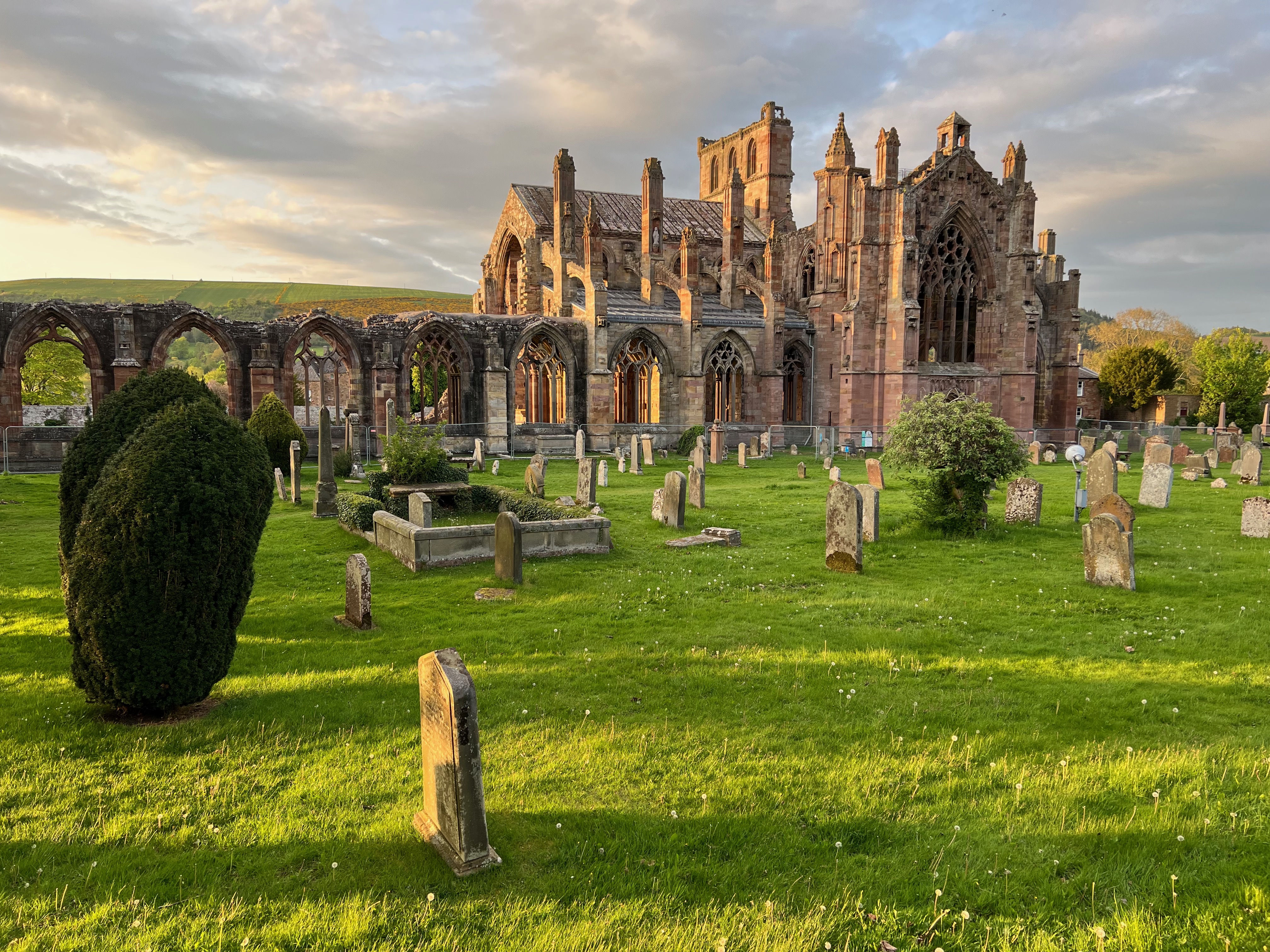
Melrose Abbey, founded by Cistercians from Rievaulx, Yorkshire, in 1136. Melrose Abbey at sunset.“My soul is like a house … It is in ruins, but I ask Thee to remake it.” — St. Augustine, City of God
Melrose Abbey was founded in the 12th century, and at its height there were a hundred monks, who wielded great influence in the Scottish Borders. But like the other Borders abbeys (Dryburgh, Jedburgh, and Kelso), the building suffered greatly in the conflicts between England and Scotland. Richard II (14th century), Henry VIII (16th century), and Oliver Cromwell (17th century) all had a hand in its destruction. The Reformation and modernity finished off its religious life, leaving only the beautiful ruins to testify to what had been. As Susan Stewart writes, “Ruined places are often haunted, and learning to read them involves managing encounters with their resident spirits.” [ii]
I was there on the Sixth Sunday of Easter. After eucharist at the local parish, I visited the abbey under the muted light of a graying sky. In the evening I went back for another look. As I arrived, the setting sun suddenly pierced the clouds to bathe the stones in gold. Pulling up my digital Book of Common Prayer, I sang Compline, adding my voice to the echoes of vanished monks. “The Lord grant us a peaceful night and a perfect end.…” By the time I was done, the gold had faded to dusk.
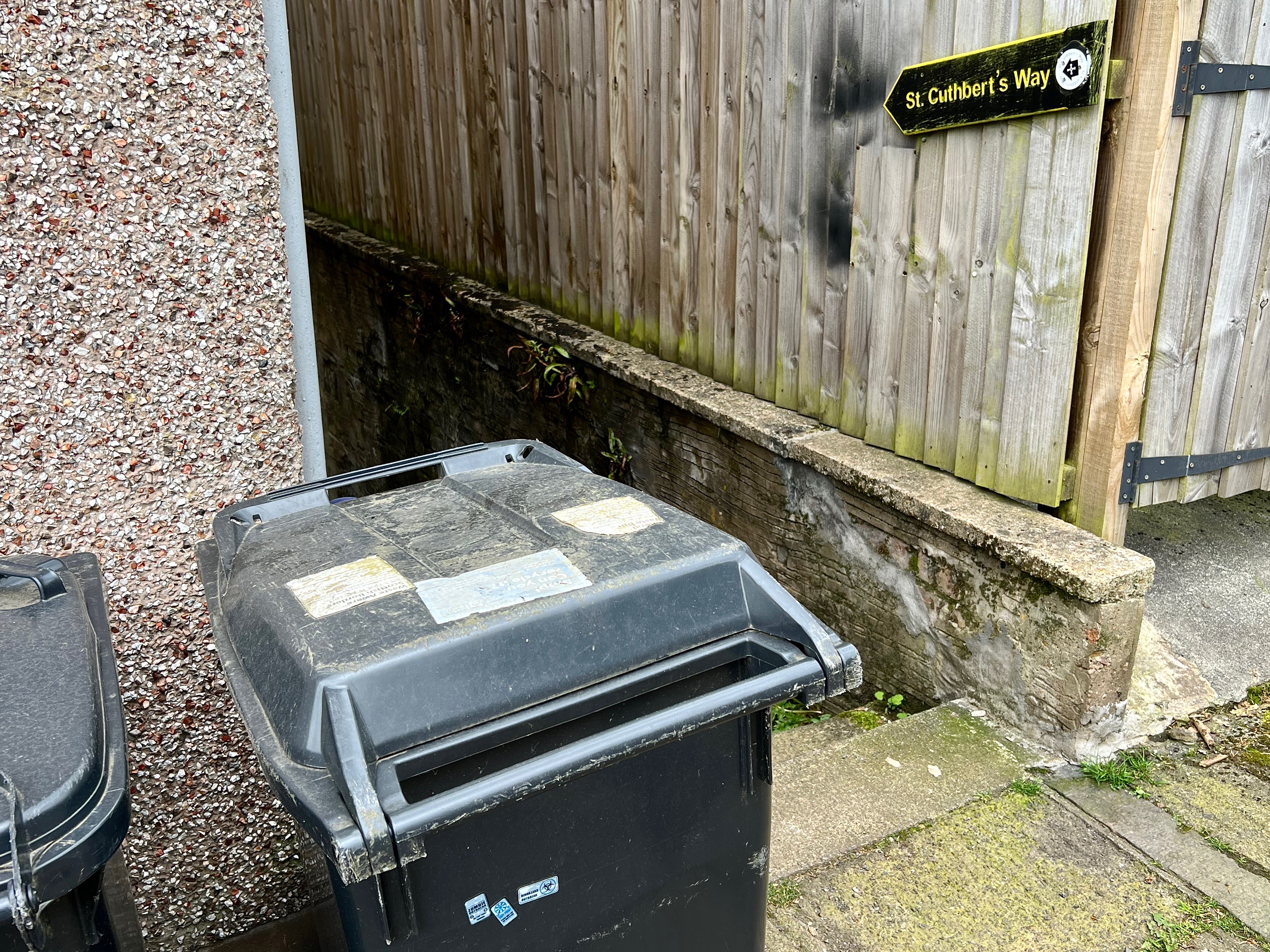
The obscure trailhead leading out of town gave no hint of the glories ahead.
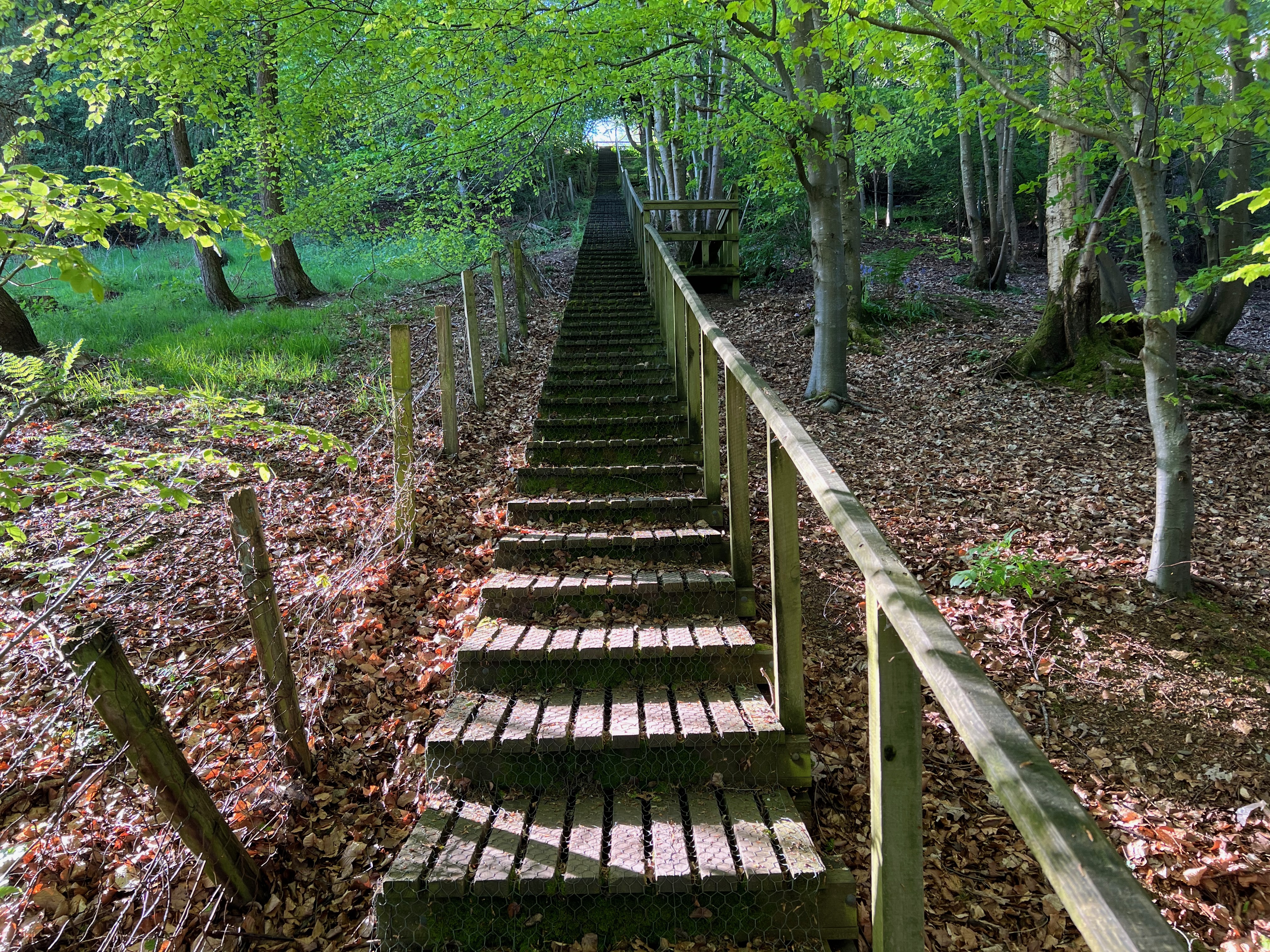
When I found this nondescript passage from a Melrose street to St. Cuthbert’s Way, it did not seem inviting. The White Rabbit came to mind—how curious a plunge!—and Dante, for whom the way down was the only way up. Before the pilgrim poet can ascend to Paradise, he is driven “down to where the sun is silent.” [iii] Thankfully, my descent into darkness was brief, and I soon found myself climbing toward the light.
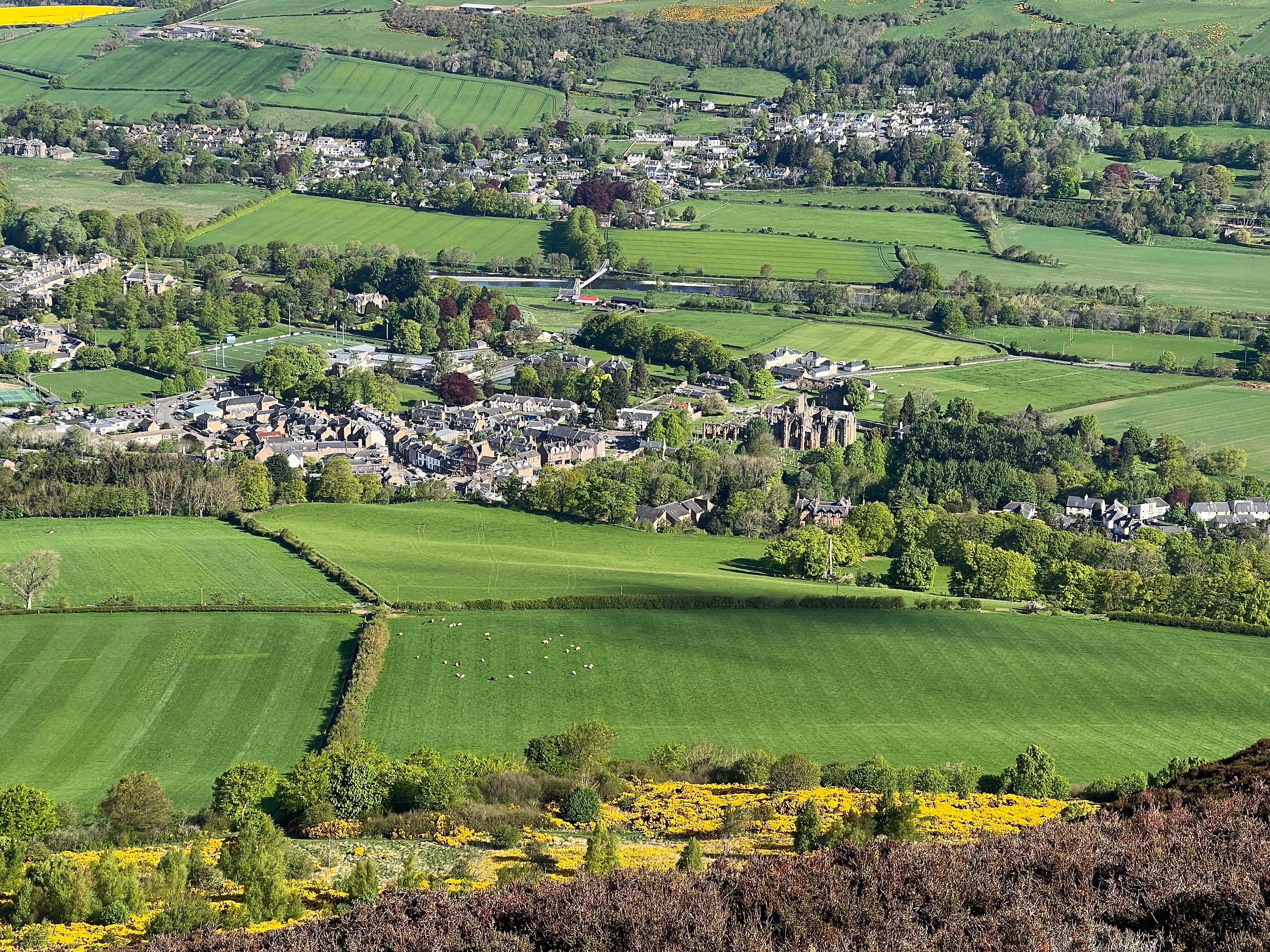
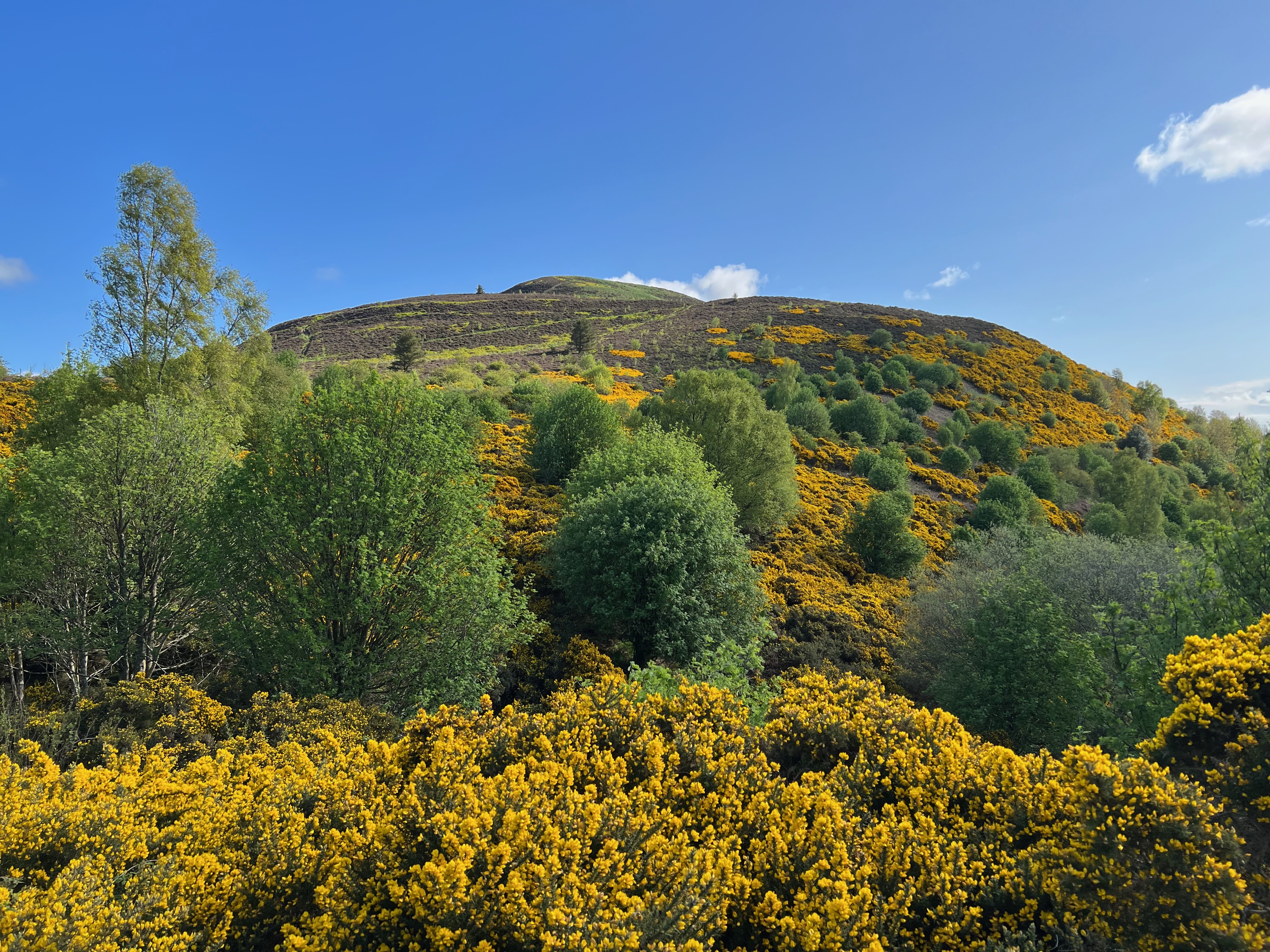
Stairway to heaven.On a bright morning, I climbed up from Melrose to traverse the Eildon Hills. The abbey can be seen at the right edge of the town.Eildon Hill North, seen from the saddle.
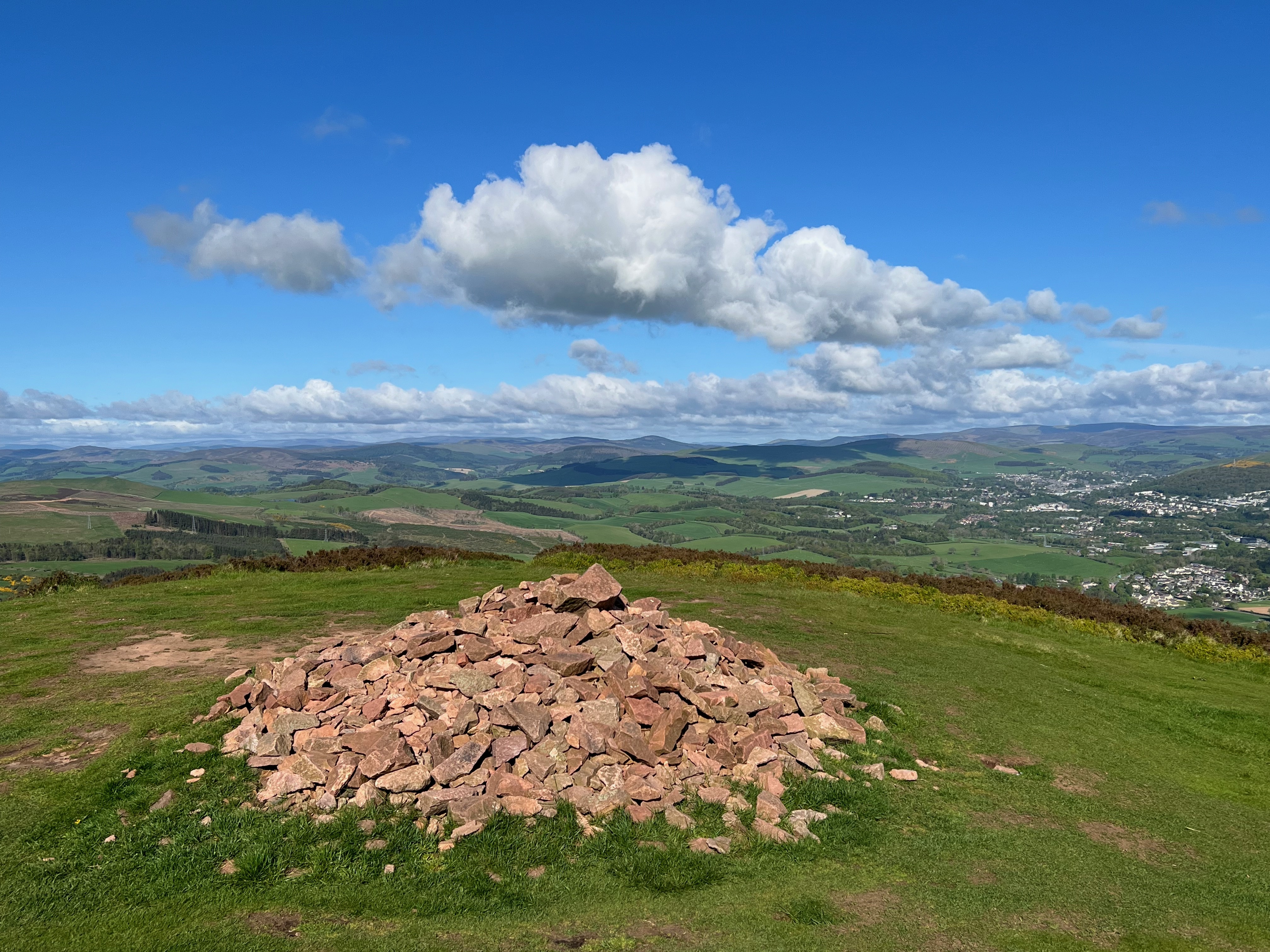
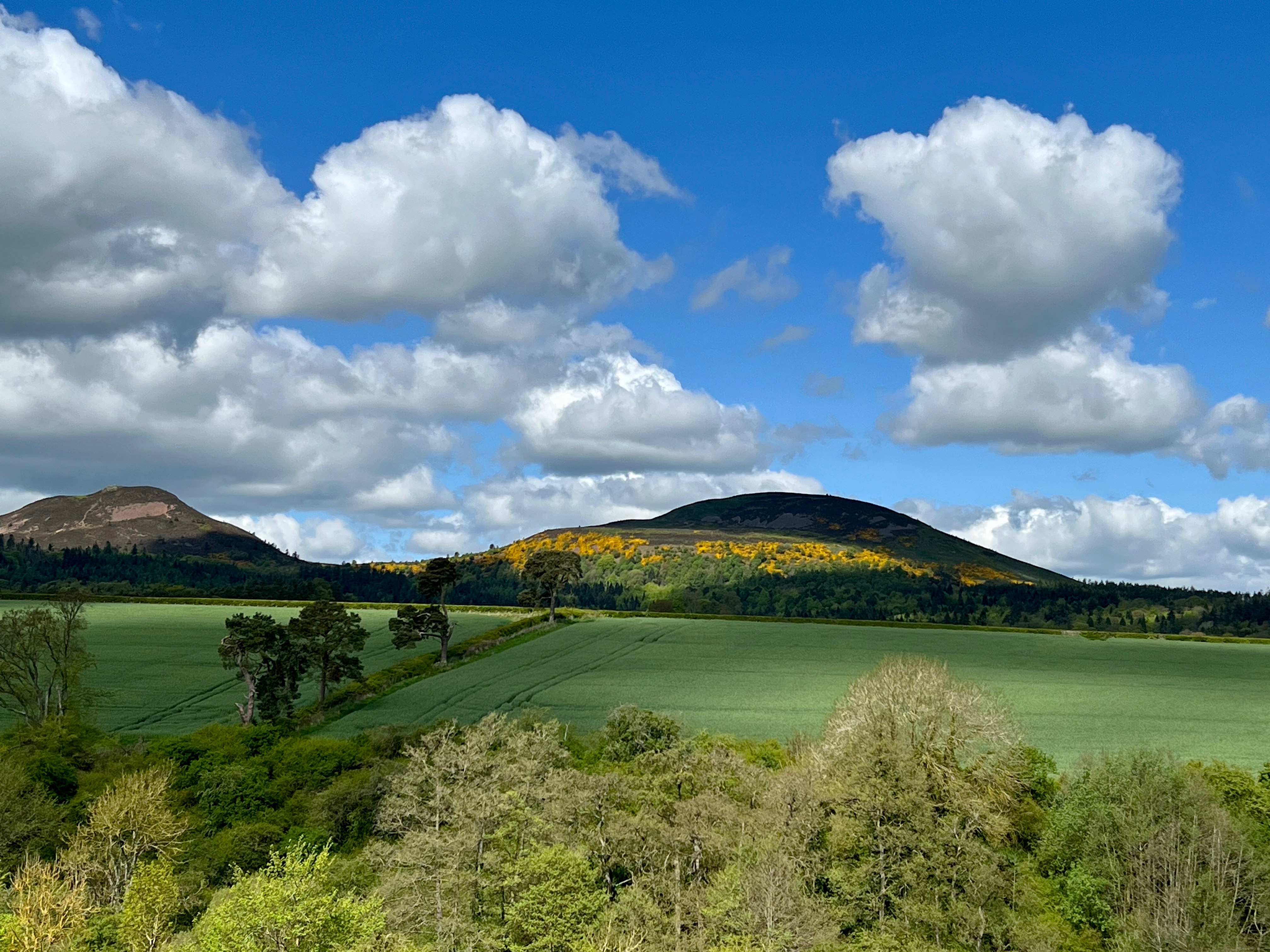
The Eildon Hills, a trio of rounded summits, dominate the surrounding landscape. From the saddle, I scrambled up the North Hill, a sacred ceremonial site in the Bronze Age. The Romans, before their inevitable retreat from the barbarous north, used it as a watchtower. King Arthur was said to be buried here. In the 12thcentury, monks quarried stones for Melrose Abbey on its slopes. Even into the modern era, local legends populated these hills with fairies and imagined a gateway to the Otherworld beneath them. For me the Eildons were an imposing portal to pilgrimage.
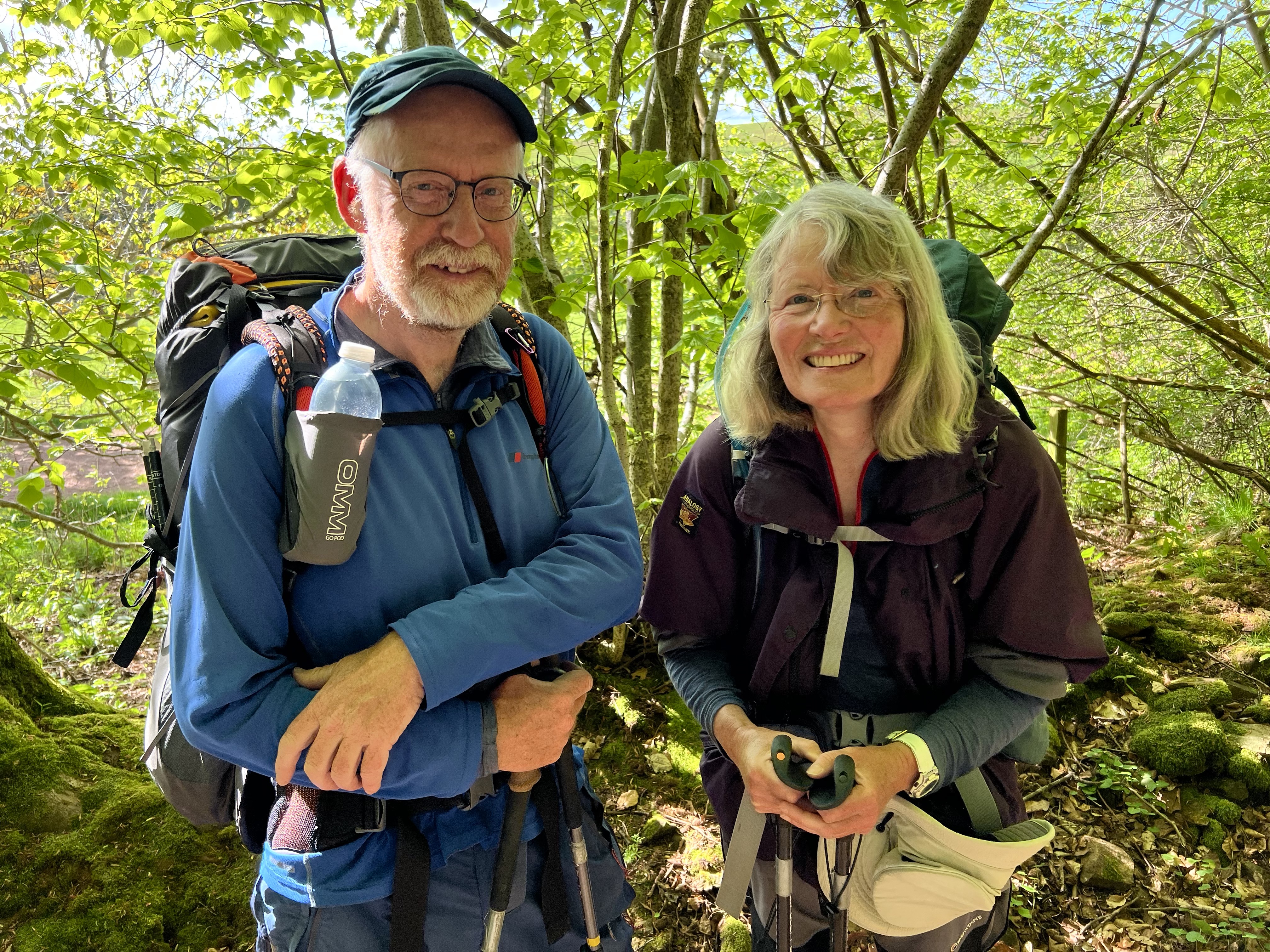
A cairn on the summit of Eildon Hill North. This has been a sacred “thin place” since pre-Christian times. The Eildon Hills seen from the southeast. I had crossed the low saddle when I left Melrose. These distinctive peaks would remain visible for the next two days, until I passed the halfway point at 31 miles. David and Julie, whom I met on my first day, were on their way to the Firth of Forth to complete a thousand-mile trek across the length and breadth of Britain. Constable, the supreme painter of clouds, said that the sky is “the chief organ of sentiment,” but rivers also touch us deeply. The River Tweed runs for 97 miles through the border country of Scotland and England. Two miles upriver from here was the site of Cuthbert’s Melrose monastery.
It would be a six-day walk to Holy Island, mostly in splendid weather—not a drop of rain, Constable skies, and only one day without sun. I felt a Wordworthian exhilaration as the road went ever on.
The earth is all before me. With a heart Joyous, nor scared at its own liberty, I look about, and should the chosen guide Be nothing better than a wandering cloud, I cannot miss my way. I breathe again! [iv]
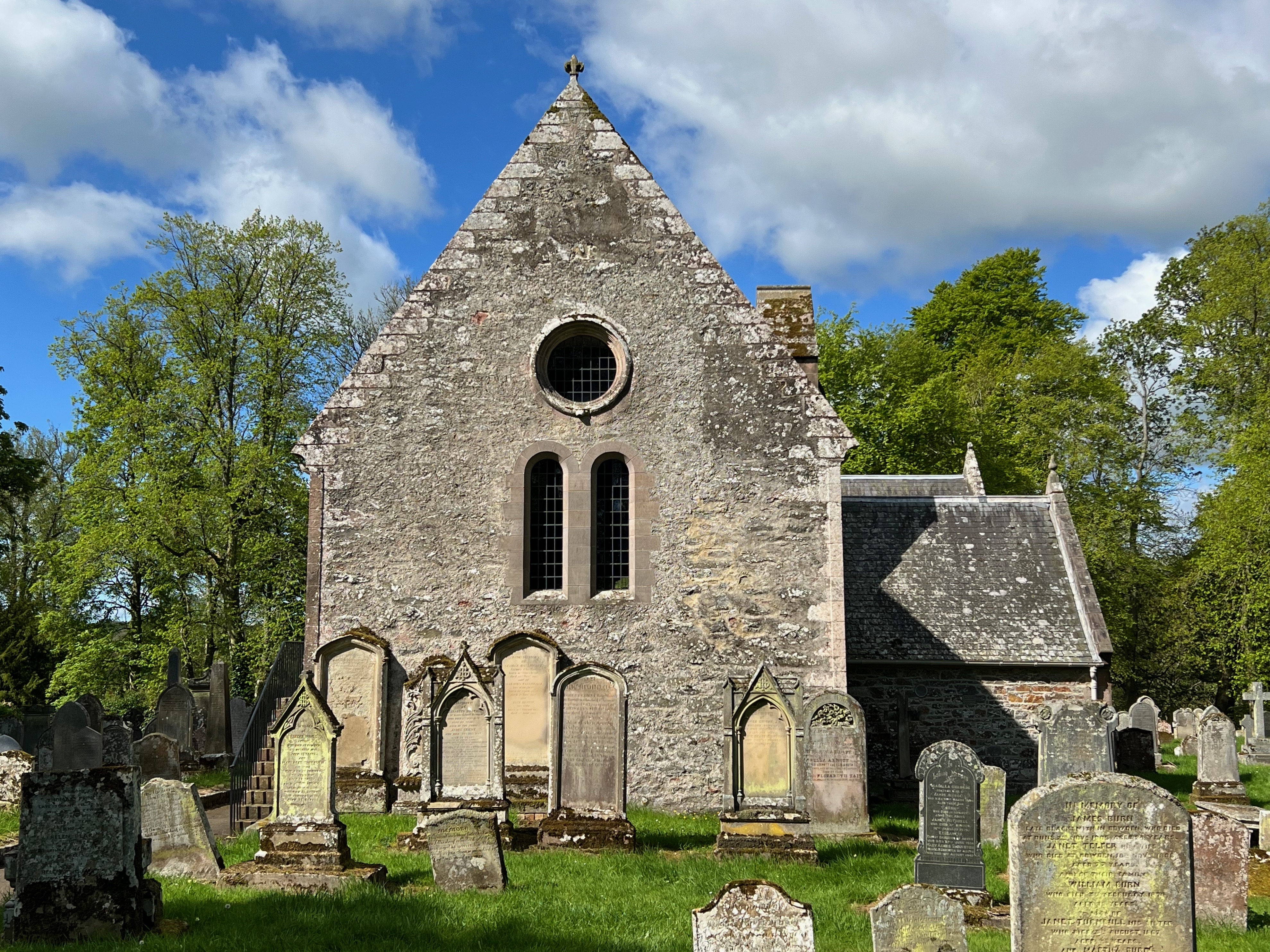
“I wandered lonely as a cloud.” — WordsworthPortions of Bowden Kirk date back to the 12th century, but there have been major changes and additions over subsequent centuries. Originally Cistercian, it has been Protestant since the 16th century.
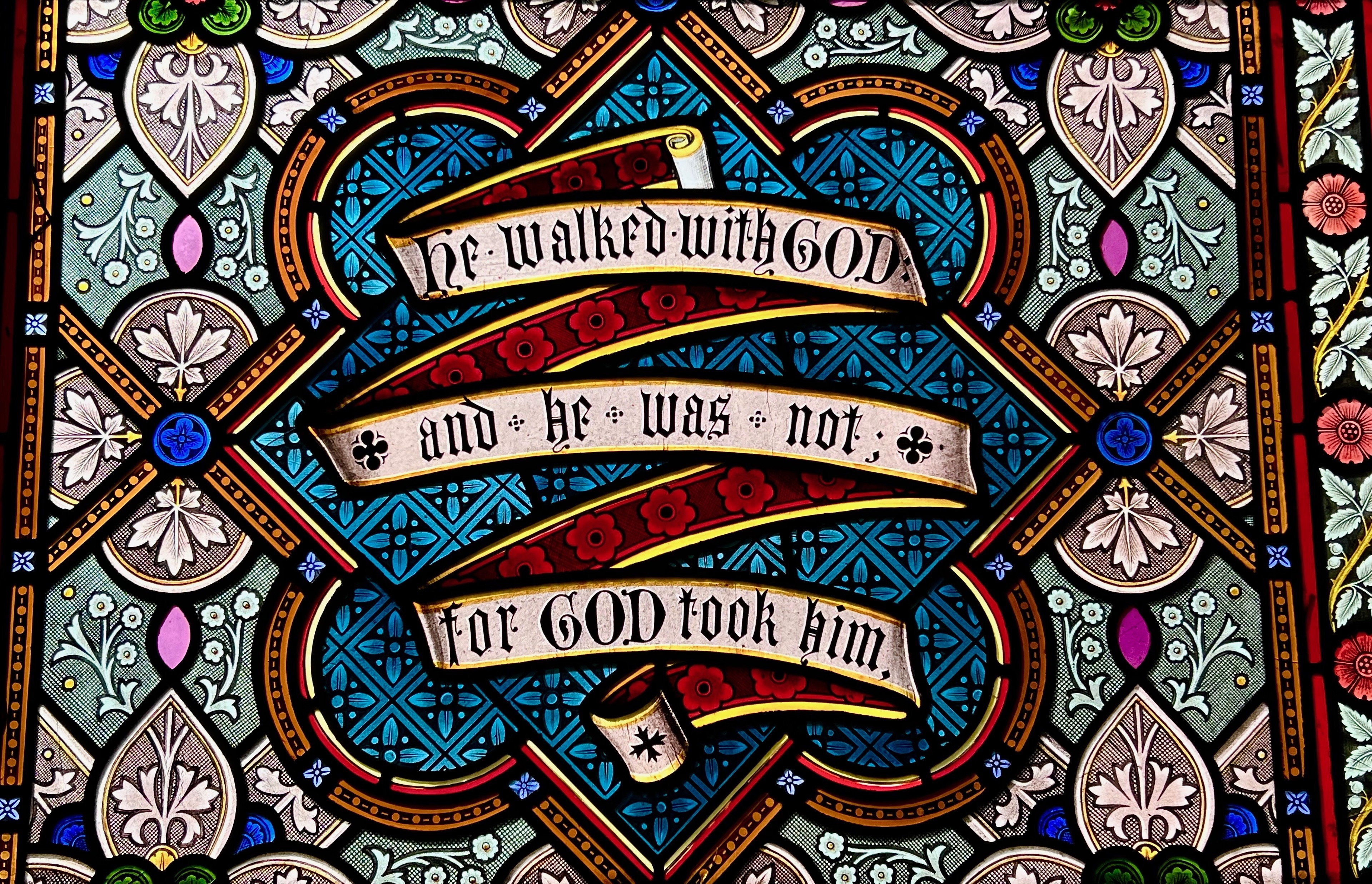
At peaceful Bowden Kirk, a medieval foundation much remodeled over the centuries, I found a window with a text from Genesis.
Window in Bowden Kirk with text from Genesis 5:24.
This cryptic verse has been interpreted to mean that Enoch, an ancestor of Noah, was somehow taken directly to God without passing through death. To say he “was not,” or “was no more,” could mean that he simply “disappeared” from human sight without suffering an interval of nonexistence. Perhaps the window was put in Bowden Kirk as a cipher of resurrection hope, but to me it suggested the essential spirituality of pilgrimage. As we walk away from “not-God”—deeper and deeper into the divine communion—the isolating egoistic self is diminished and emptied, until it is “no more,” translated by God into its truer self: a relational participant in the divine life of self-diffusive love. That may not be achievable in this life (I certainly didn’t get there in 6 days!), but I believe it is the horizon toward which we are all headed.
As St. John of the Cross put it:
To come to be what you are not, you must go by a way in which you are not. [v]
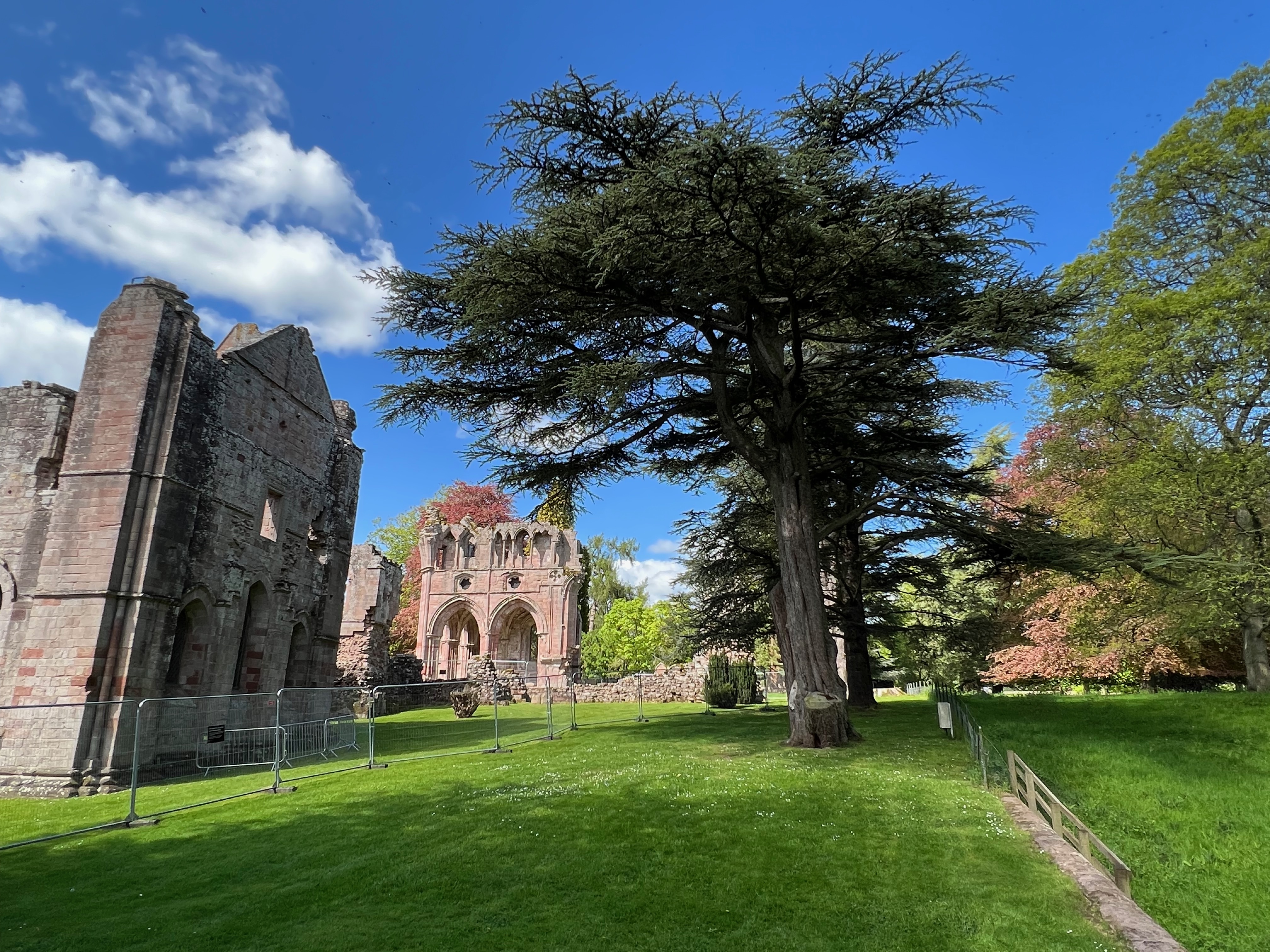
Dryburgh Abbey (12th century). Sir Walter Scott, who died on the last day of summer, 1832, is buried in the ruins of the north transept.Dryburgh Abbey is surrounded by exotic trees, like this Cedar of Lebanon, planted by the Earl of Buchan over 200 years ago. “Bare ruin’d choirs where late the sweet birds sang” (Shakespeare, Sonnet 73).
Dryburgh Abbey is the second of three Borders abbeys on St. Cuthbert’s Way. Far from any town, surrounded by a beautiful park next to the River Tweed, it is the most serene of the three.
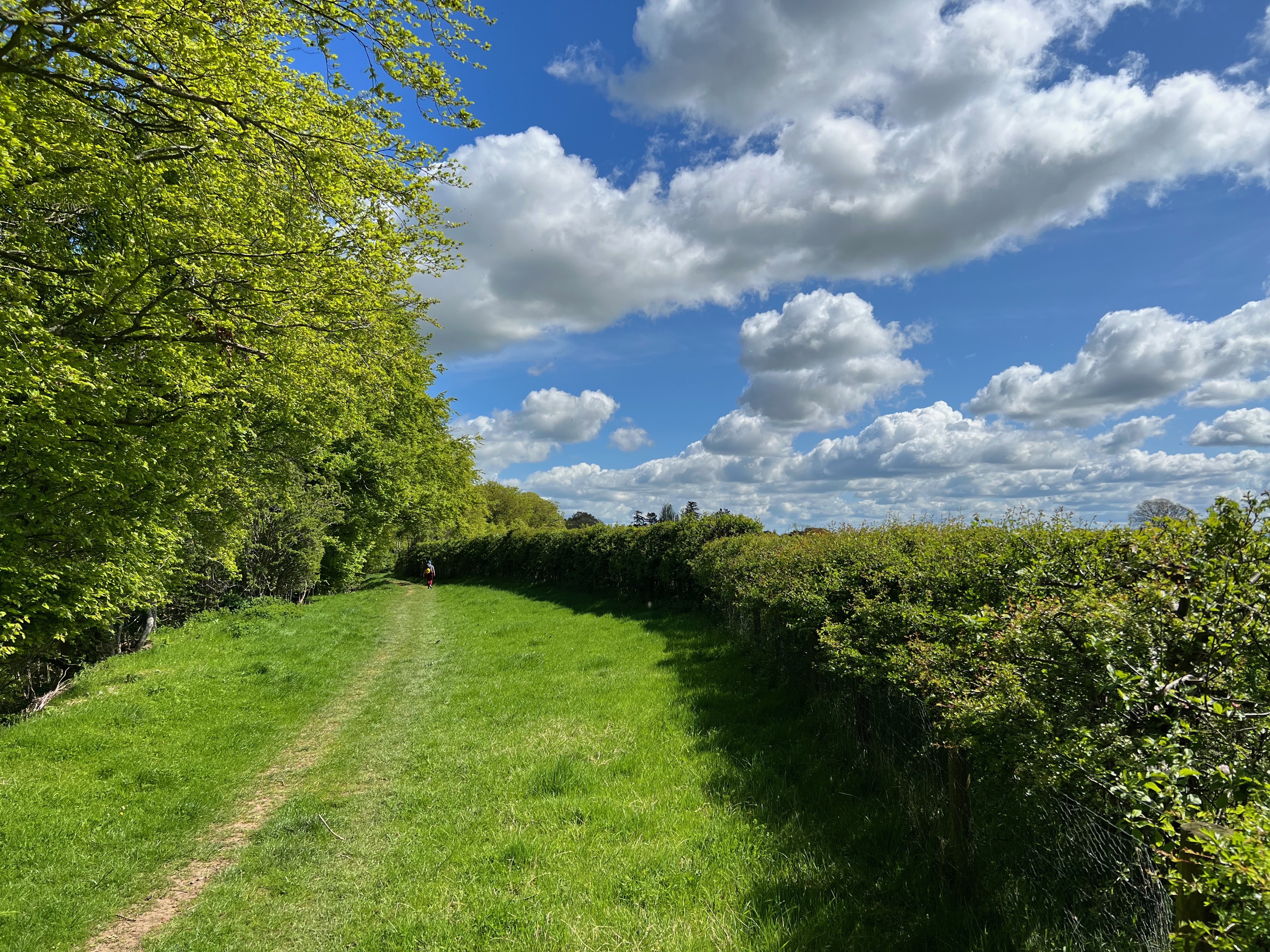
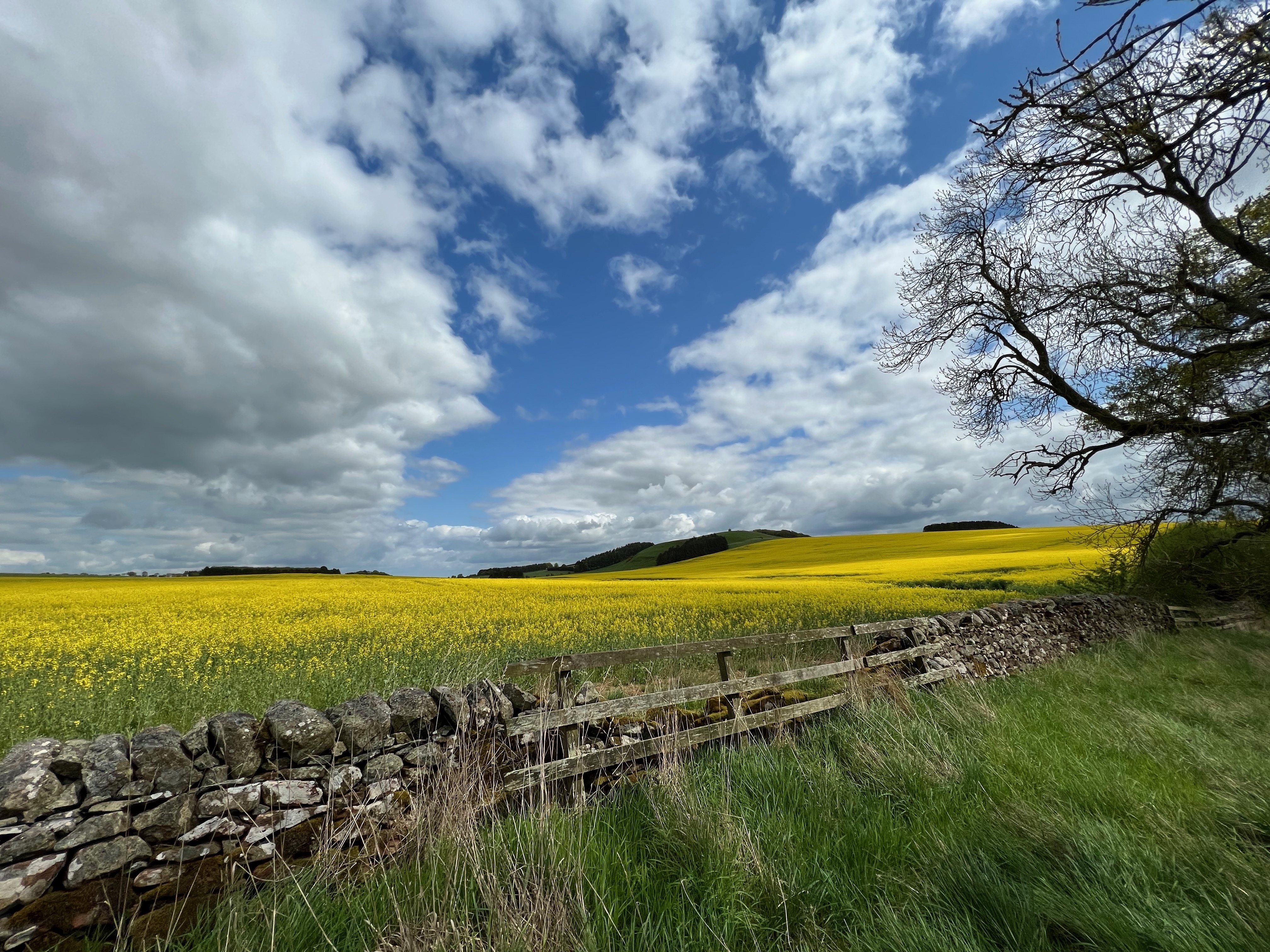
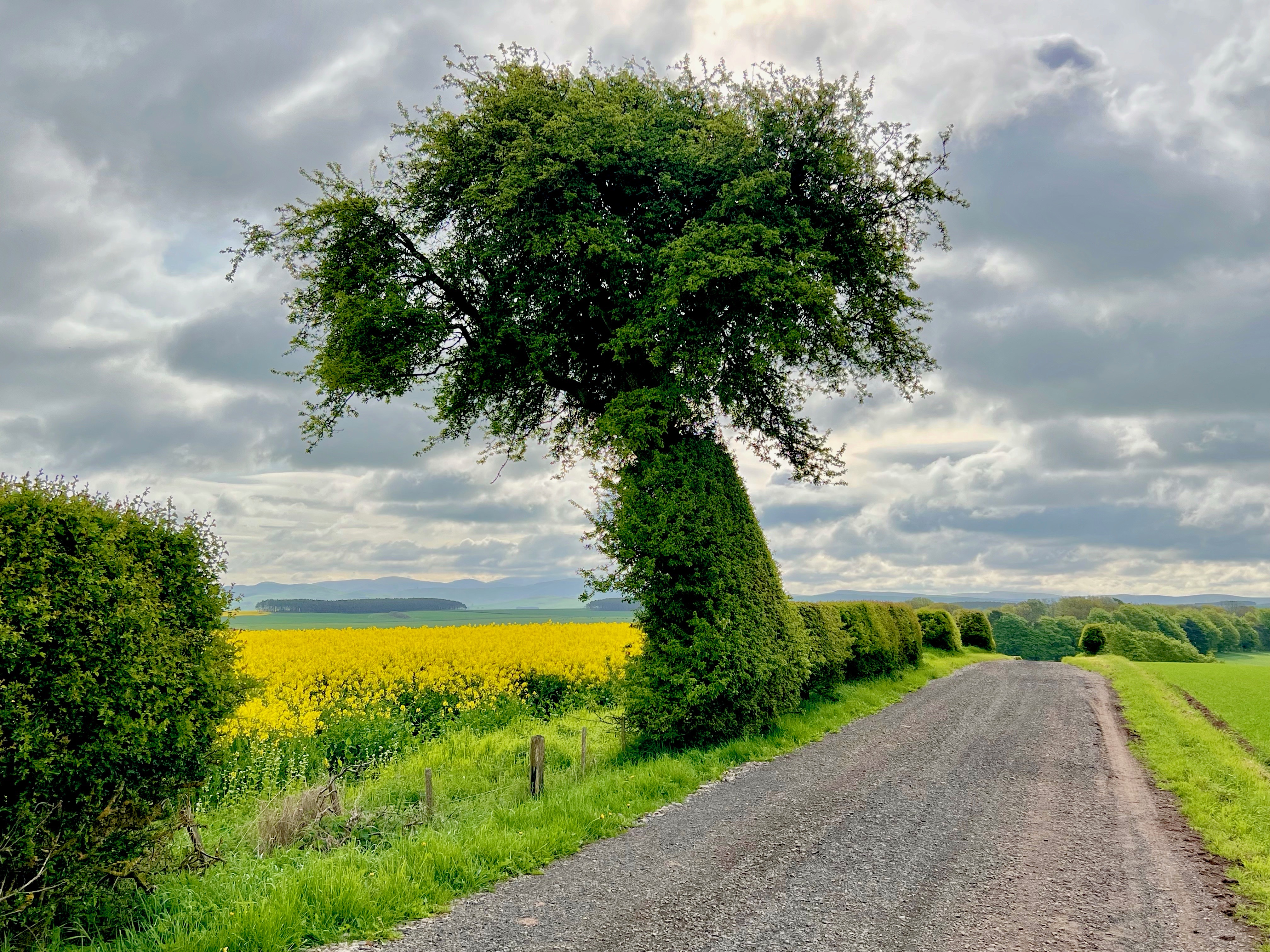
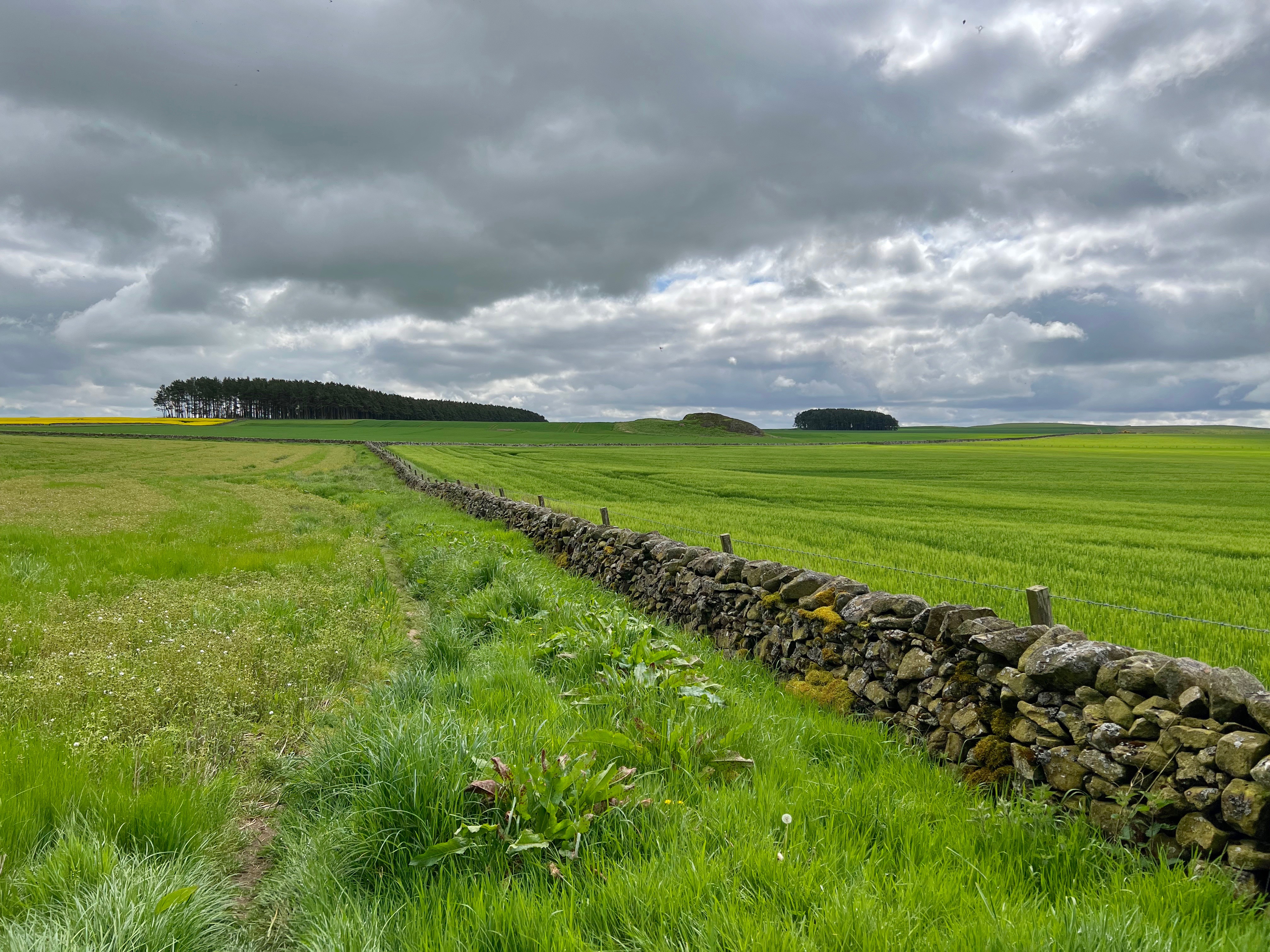
The occasional paved stretches of the Way were mostly empty.This straight path, called Dere Street, follows part of a first-century Roman road which ran from York to Scotland’s Firth of Forth.Fields of blooming rapeseed parallel the Roman road.
One day I trod the remnant of a Roman road, a faint trace of their 400-year occupation of Britain. As Gibbon observed, history “spares neither man nor the proudest of his works [and] buries empires and cities in a common grave.” [vi]
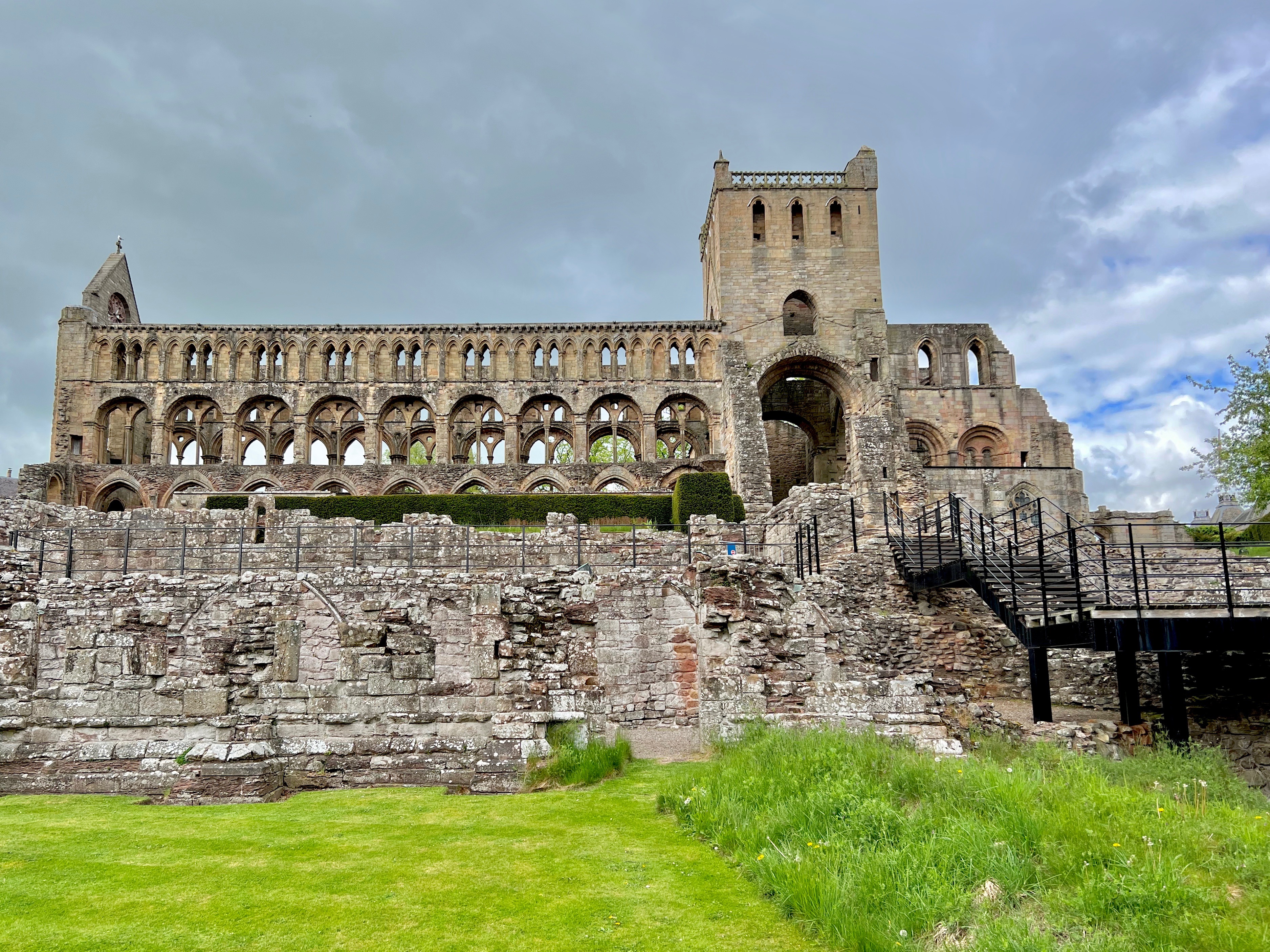
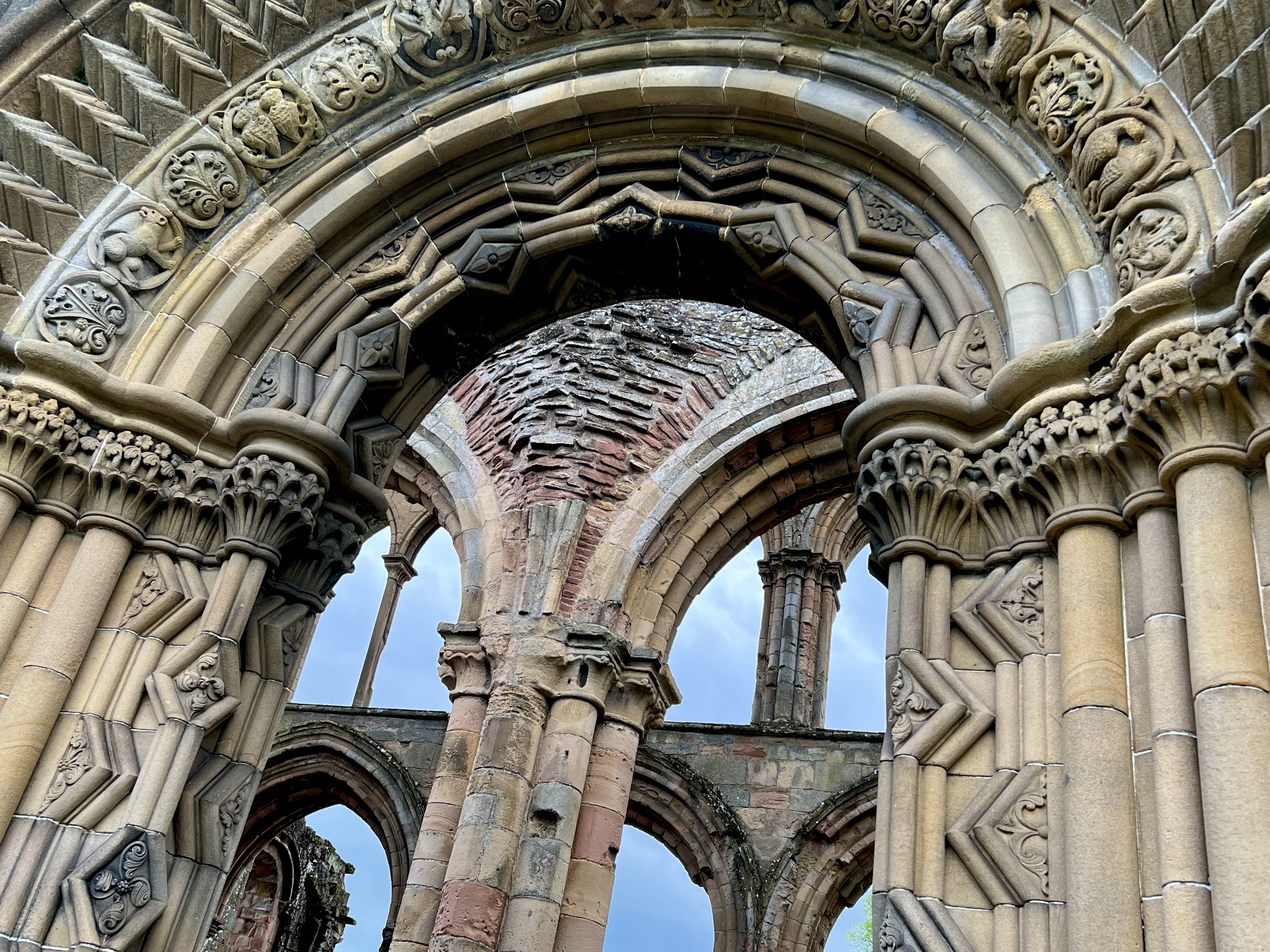
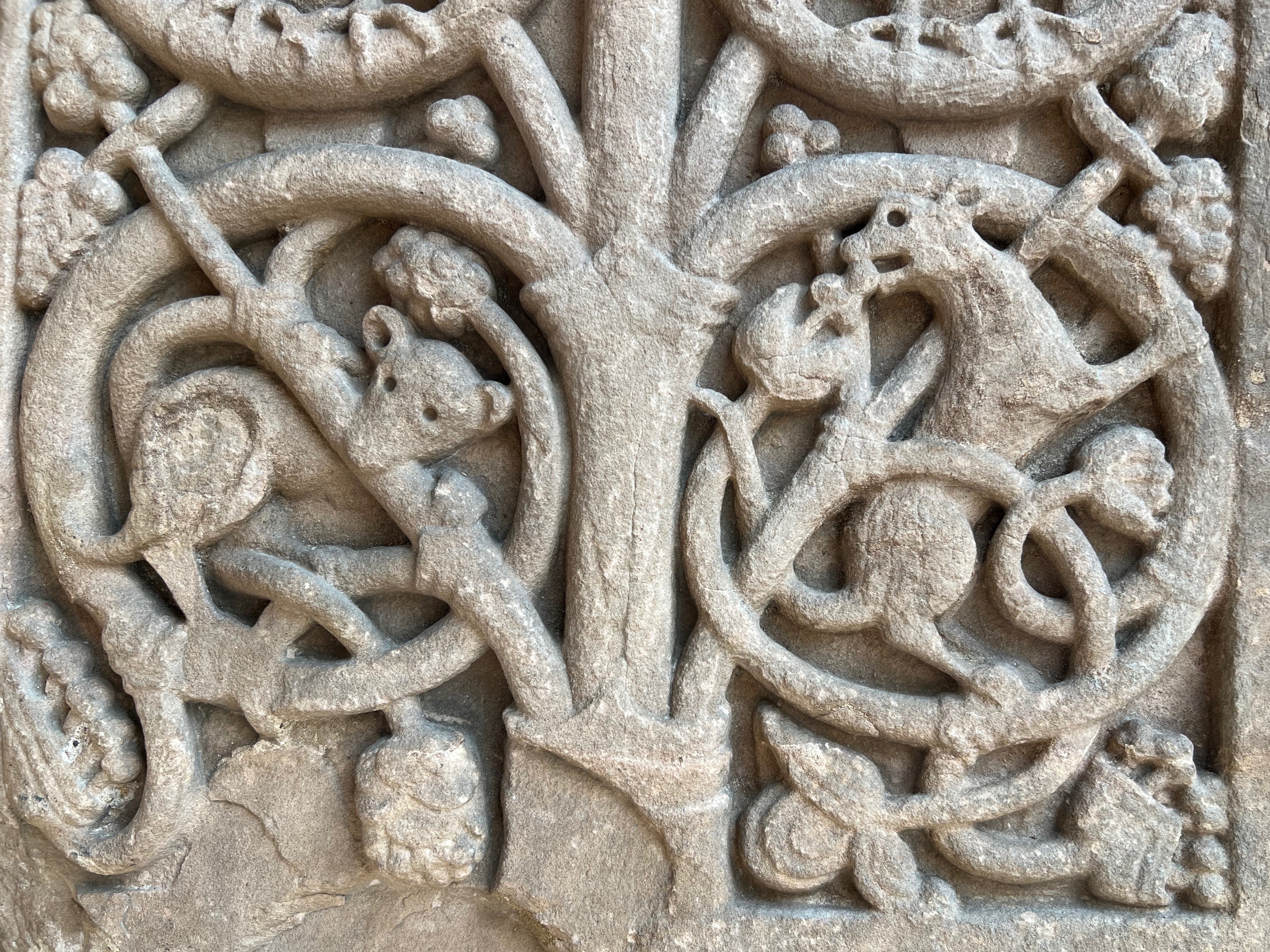
Jedburgh Abbey (12th century).South door, Jedburgh Abbey.Vine-scroll panel from a saint’s shrine (8th-century, Jedburgh).
In Jedburgh (locals say “Jeddart”), the church of St. Mary the Virgin is the best preserved abbey in the Borders. Built during the shift from Romanesque to Gothic styles, it is a blend of both. And its carved stone “vine-scroll” is one of the finest examples of Anglo-Saxon art. Like the other Borders abbeys, it did not survive the Reformation, and was abandoned in 1560.
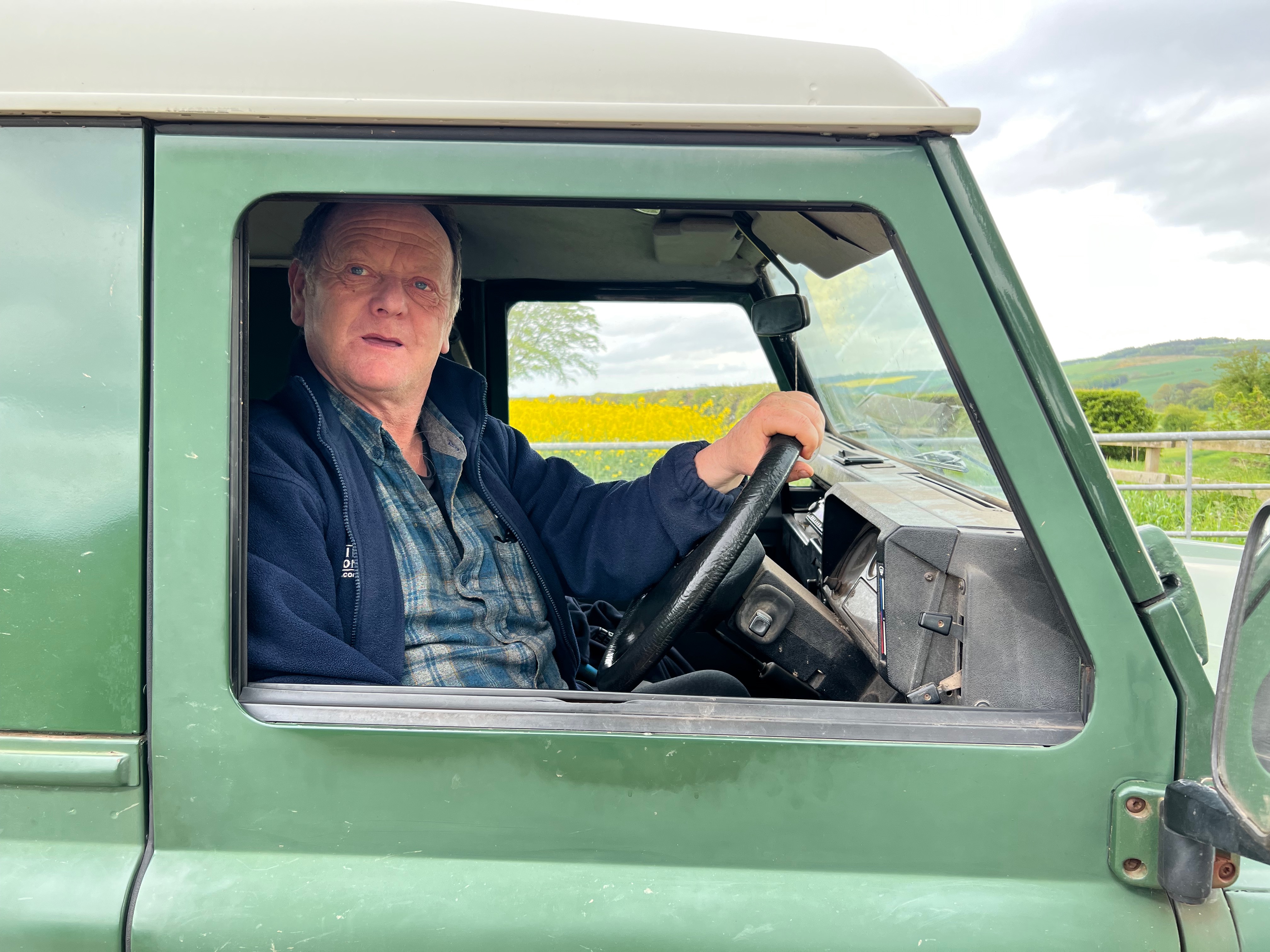
My first view of the Cheviot Hills in the distance.When I was lost, Brian appeared to show me the way.
My first glimpse of the distant (and challenging) Cheviot Hills distracted me, and I missed a waymarked turn in the trail. Ten minutes later, I reached a road with no idea where to go. Like one of the angelic guides who appear out of nowhere to help Dante navigate obstacles in the Inferno, a local farmer drove up behind me to point the way. When he heard my American accent, he mentioned that his daughter was a professional golfer in California and “doing quite well.” I told him he was a gift from God. He looked bemused. Soon I was back on track, traversing broad fields of yellow and green until I reached the foot of the Cheviots, where the elevation gain got more demanding.
The path climbs toward Wideopen Hill, the halfway point of St. Cuthbert’s Way.View from Wideopen Hill, the highest point on St. Cuthbert’s Way (1207 ft./ 368 m.).I reached the highest point of the trail on Ascension Eve.
When I reached the top of Wideopen Hill, the highest point on St. Cuthbert’s Way, it occurred to me that it was Ascension Eve. What better way to celebrate than climb toward the sky!
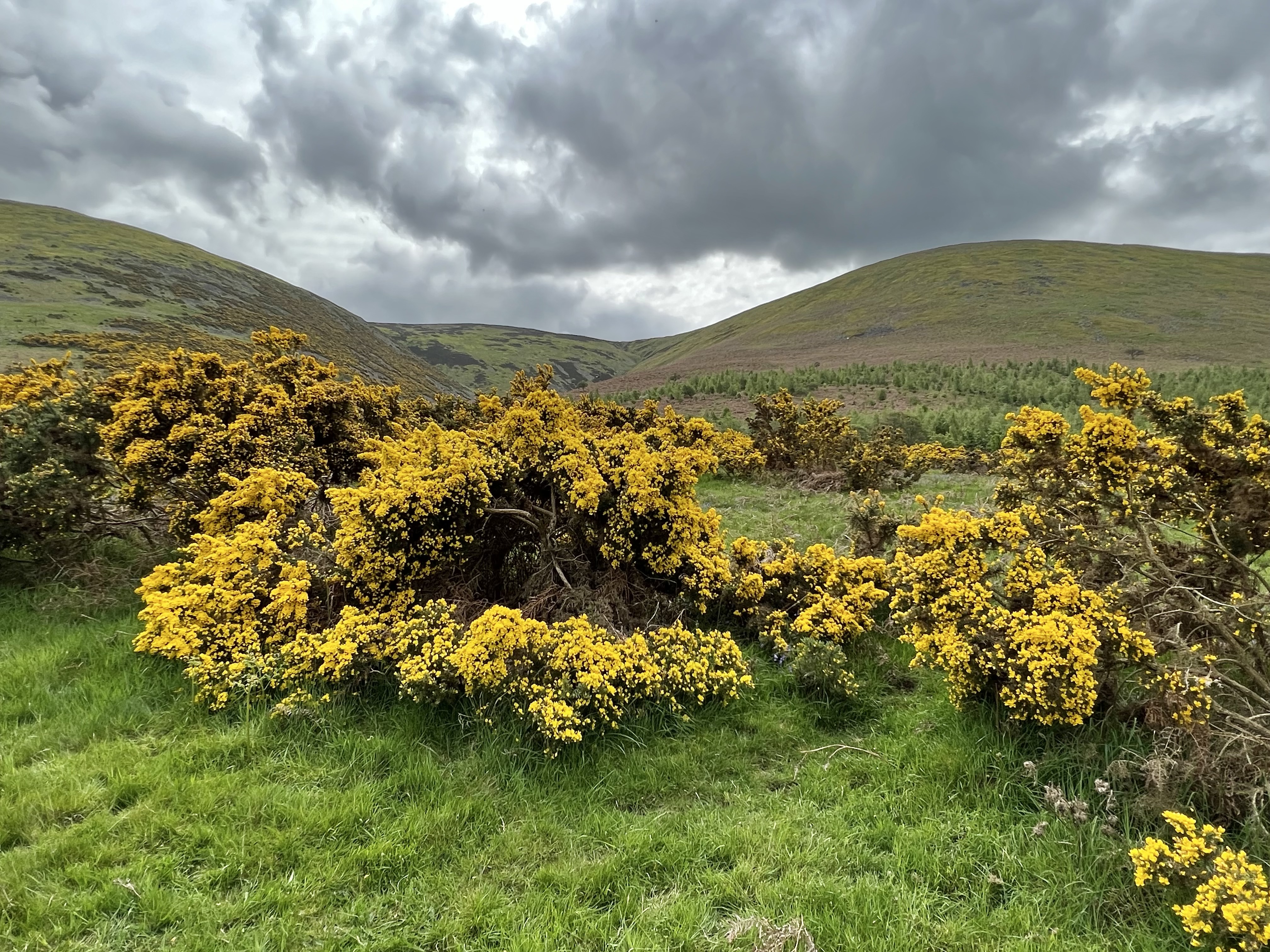
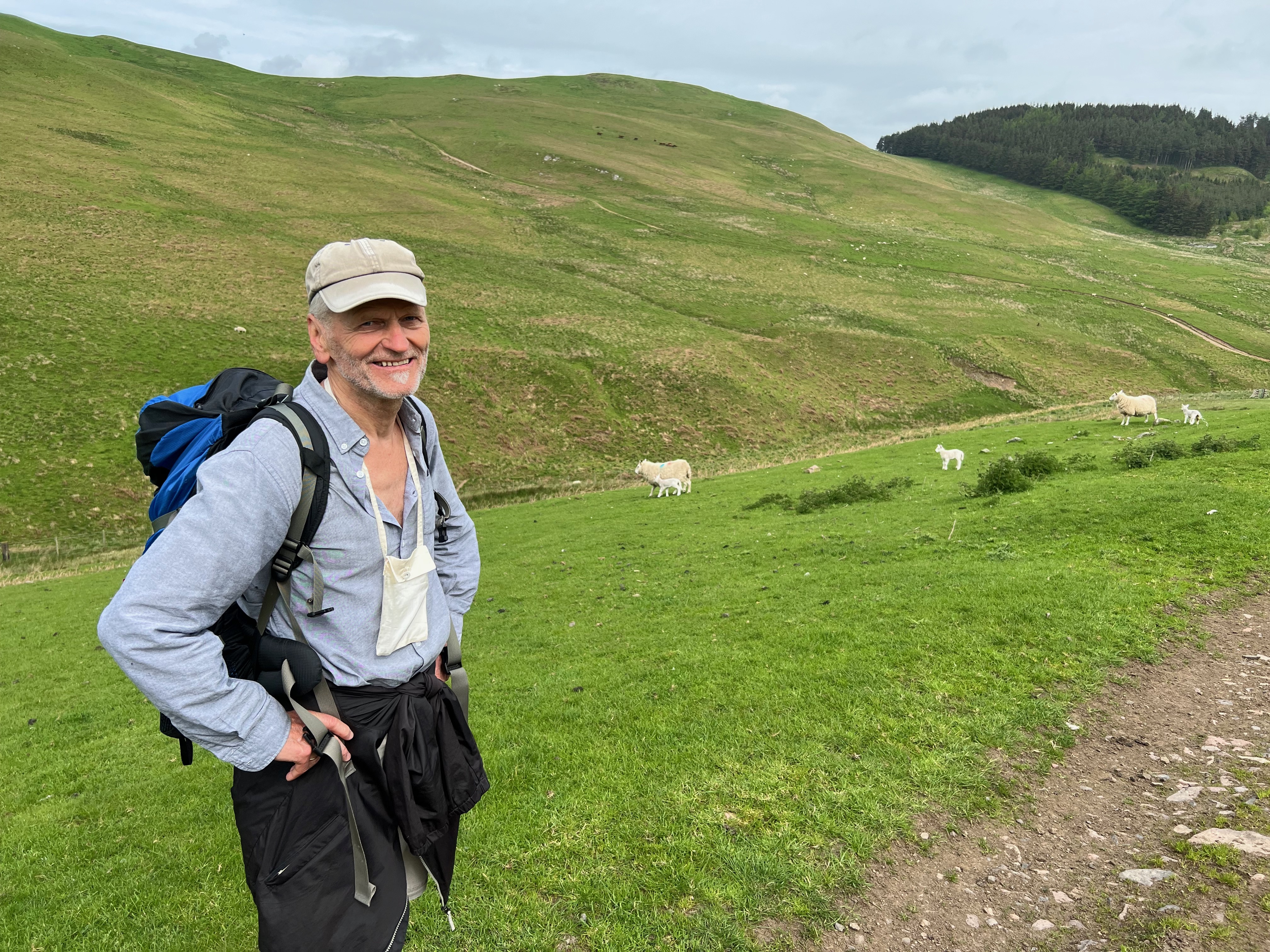
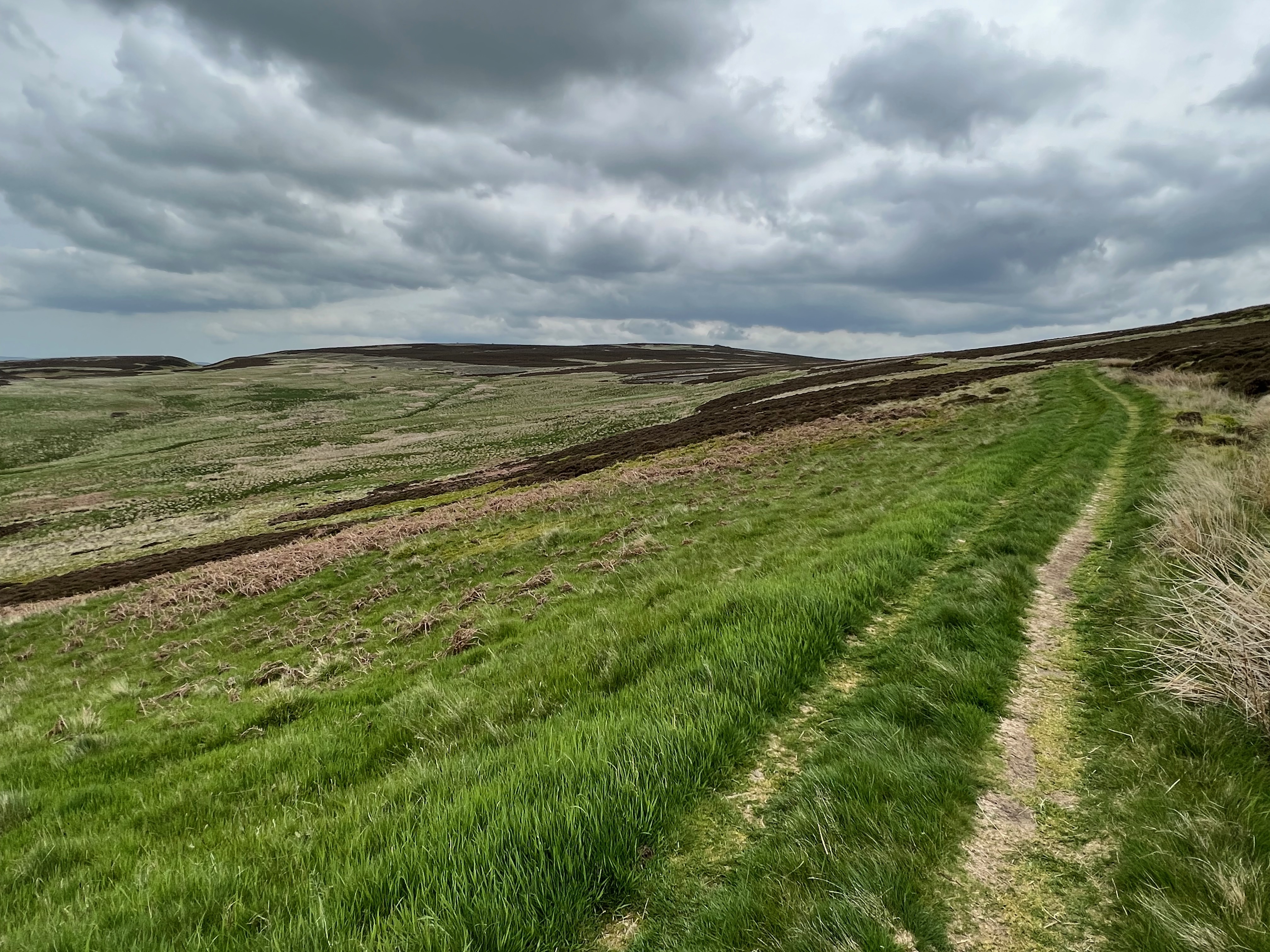
Scotch broom in the Cheviot Hills.Dagfinn, a Norwegian pilgrim in the Cheviot Hills.Ascending the moorland of the Cheviot Hills.
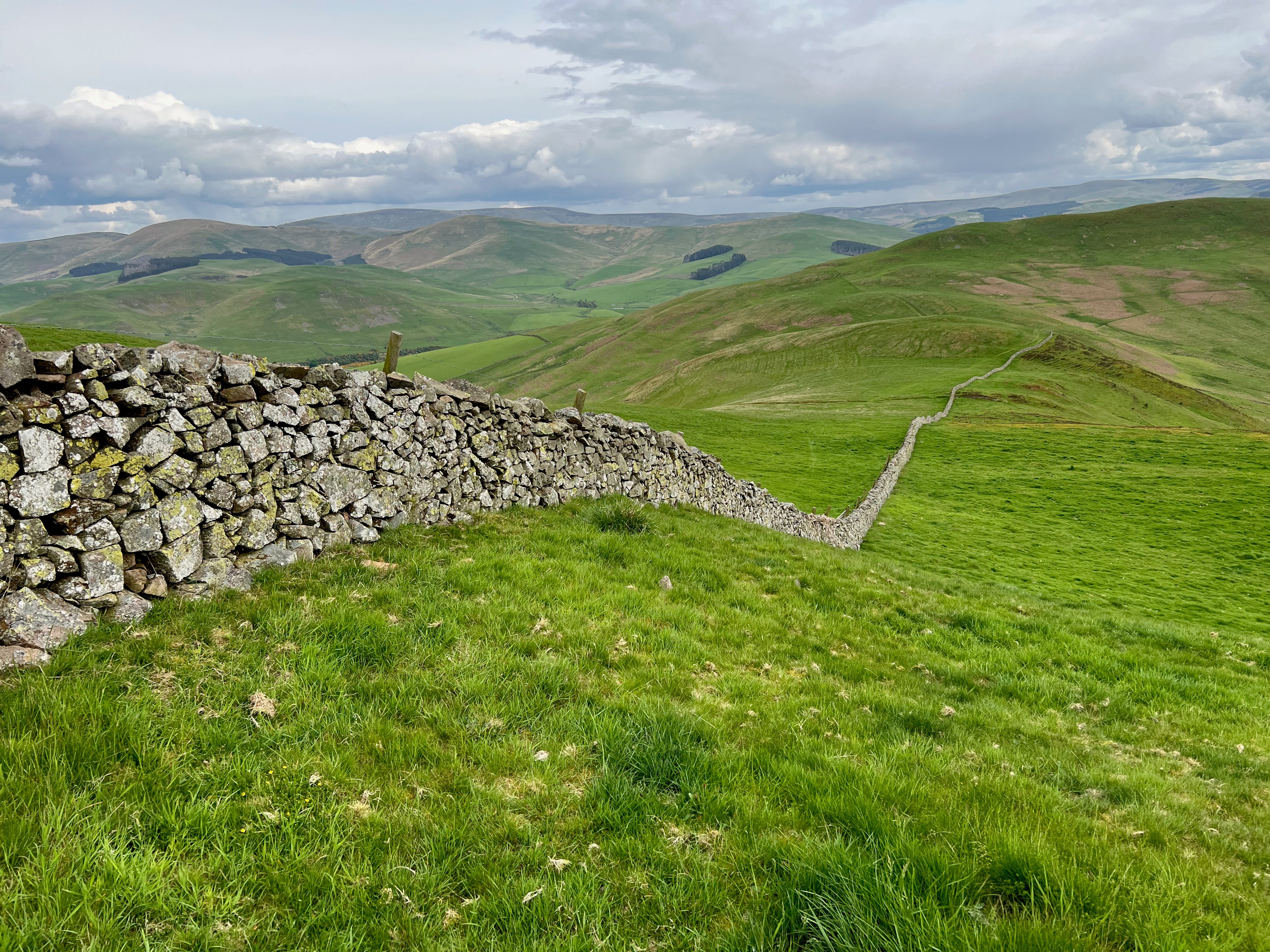
The whole next day was up and down through the Cheviots. The high country has feral goats, Iron Age forts, and a couple of crashed planes that lost their way in World War II. I didn’t see any of that. I was focused on dragging my tired body over the hump. The bleak sky and the treeless summits dampened my spirits a bit (Praise God when the road is easy! Praise God when the road is hard!). But it was still thrilling to hear the long, slowly rising whistle of the Eurasian curlews as they swooped across the heather.
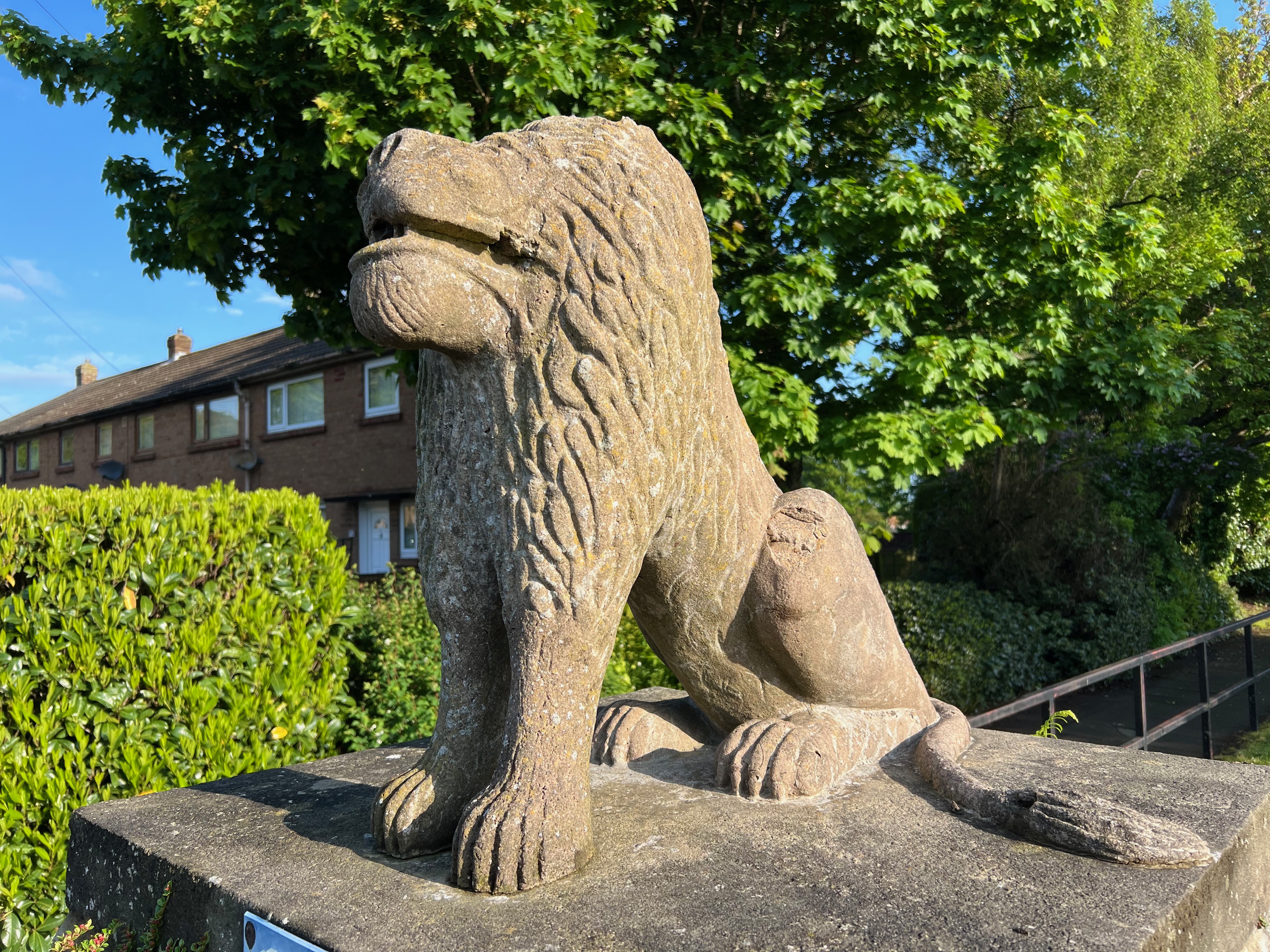
Gatepost lion in Wooler.
After a gloomy day in the Cheviot Hills, my final miles to the coast were brilliantly lit and my heart was high. This stone lion at a schoolyard entrance was carved by an Italian prisoner of war during World War II, when the facility was a POW camp. It looks like something you’d find in Venice. Thinking of that prisoner managing to make art amid the chaos of war, I’m tempted to say that art is long and war is short, but in these days of perpetual conflict I’m not so sure.
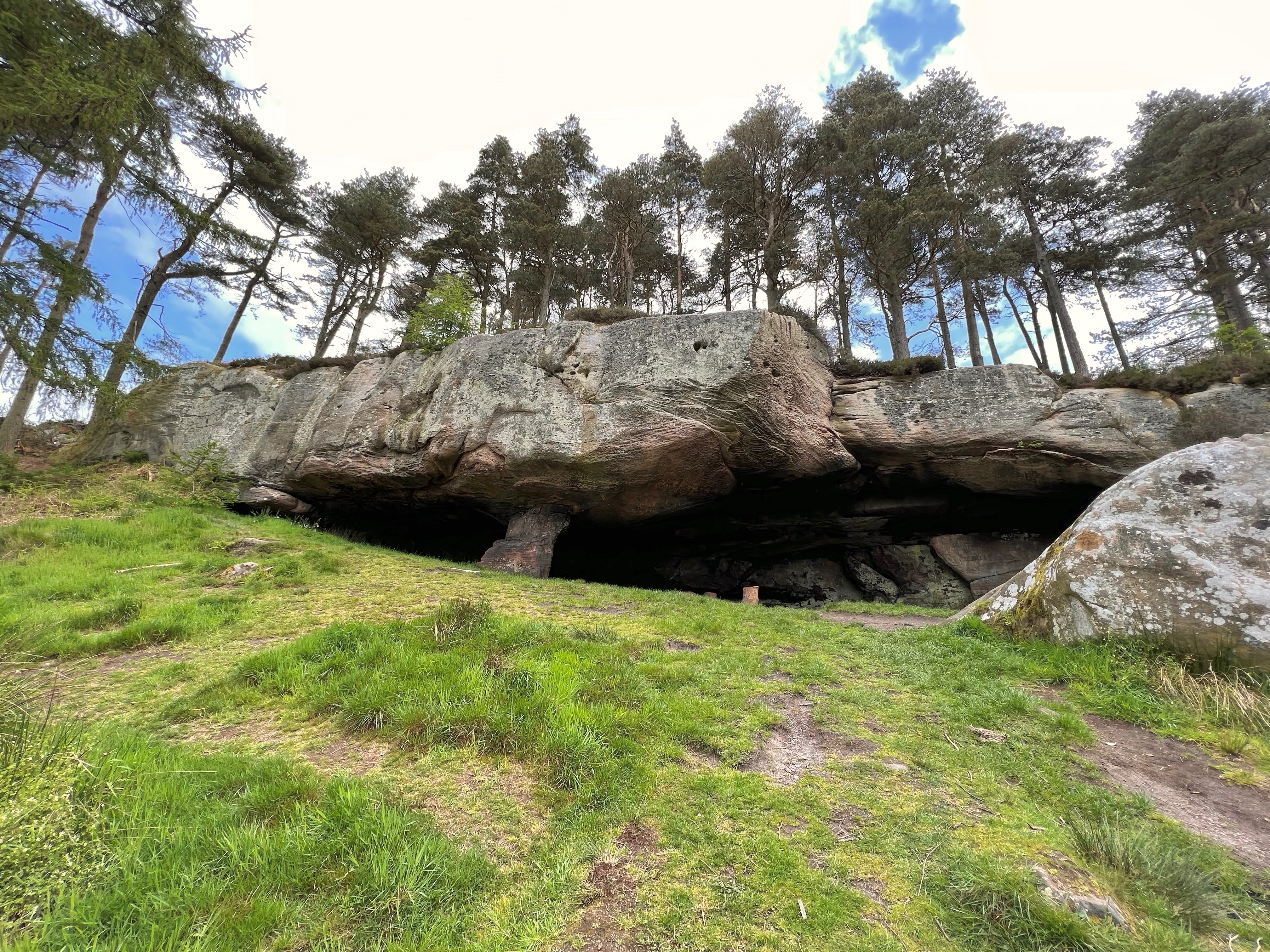
Toward the final ridge before the coast.St. Cuthbert’s Cave.
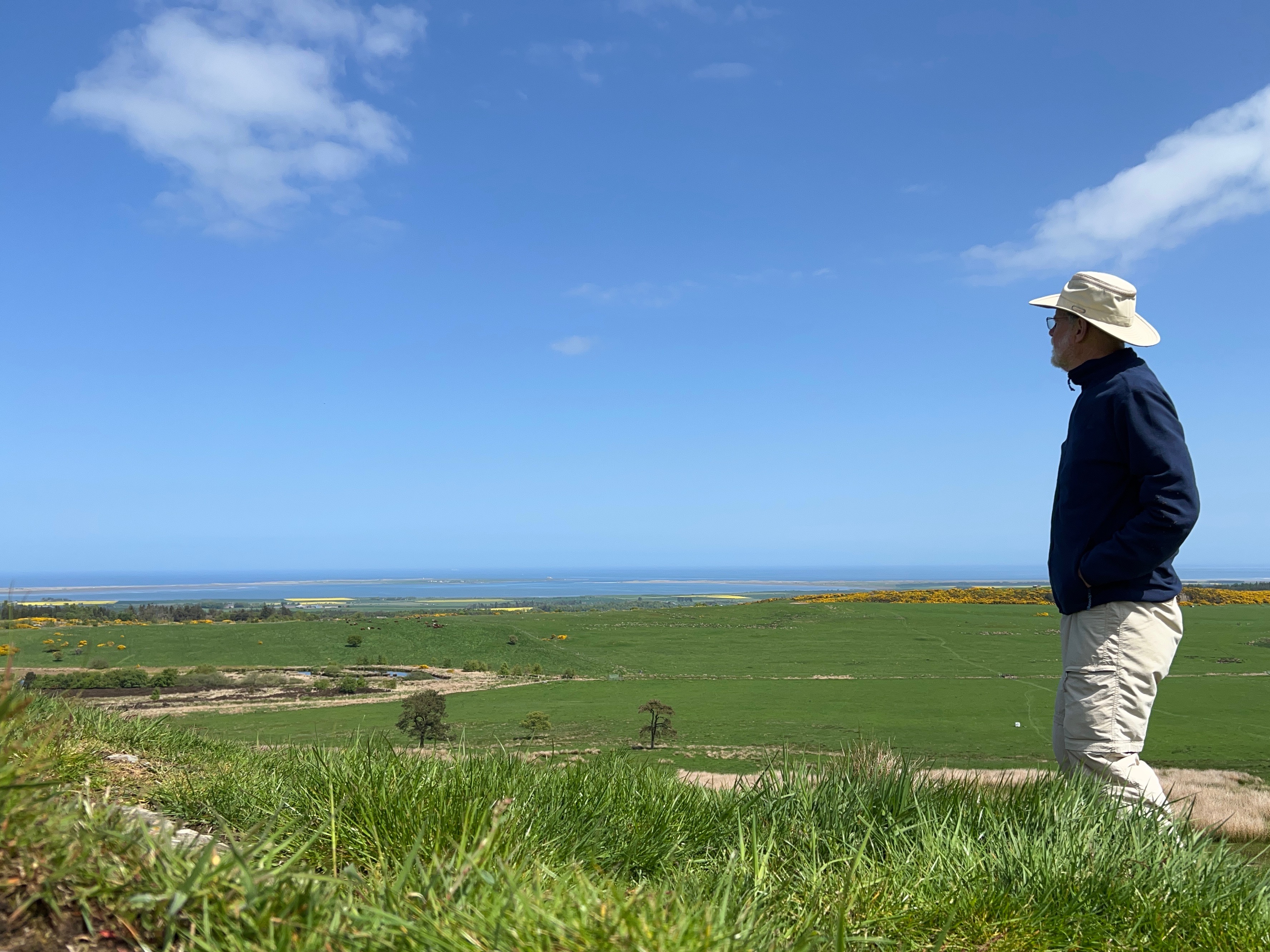
The first sign that I was nearing the sea was a flock of gulls circling above me. Just one more forested ridge, and the coast would be visible. After marveling at the massive sandstone overhang of St. Cuthbert’s Cave (where monks carrying his remains are said to have sheltered while fleeing Viking raiders), I climbed to the rise just above it. And there I saw my Promised Land: Holy Island, refulgent beneath the noonday sun.
When Lewis and Clark got their first glimpse of the Pacific after 18 months crossing the American continent, Clark recorded their delight in his journal: “Ocian in view! O the joy.” When I reached that ridge above the Northumbrian sea, I spoke those words out loud.
My first view of Holy Island.Ocean in view!
“To walk there is to earn it, through laboriousness and through the transformation that comes during a journey … We are eternally perplexed by how to move toward forgiveness or healing or truth, but we know how to walk from here to there, however arduous the journey…. In pilgrimage, the journey is radiant with hope … geography has become spiritualized.”
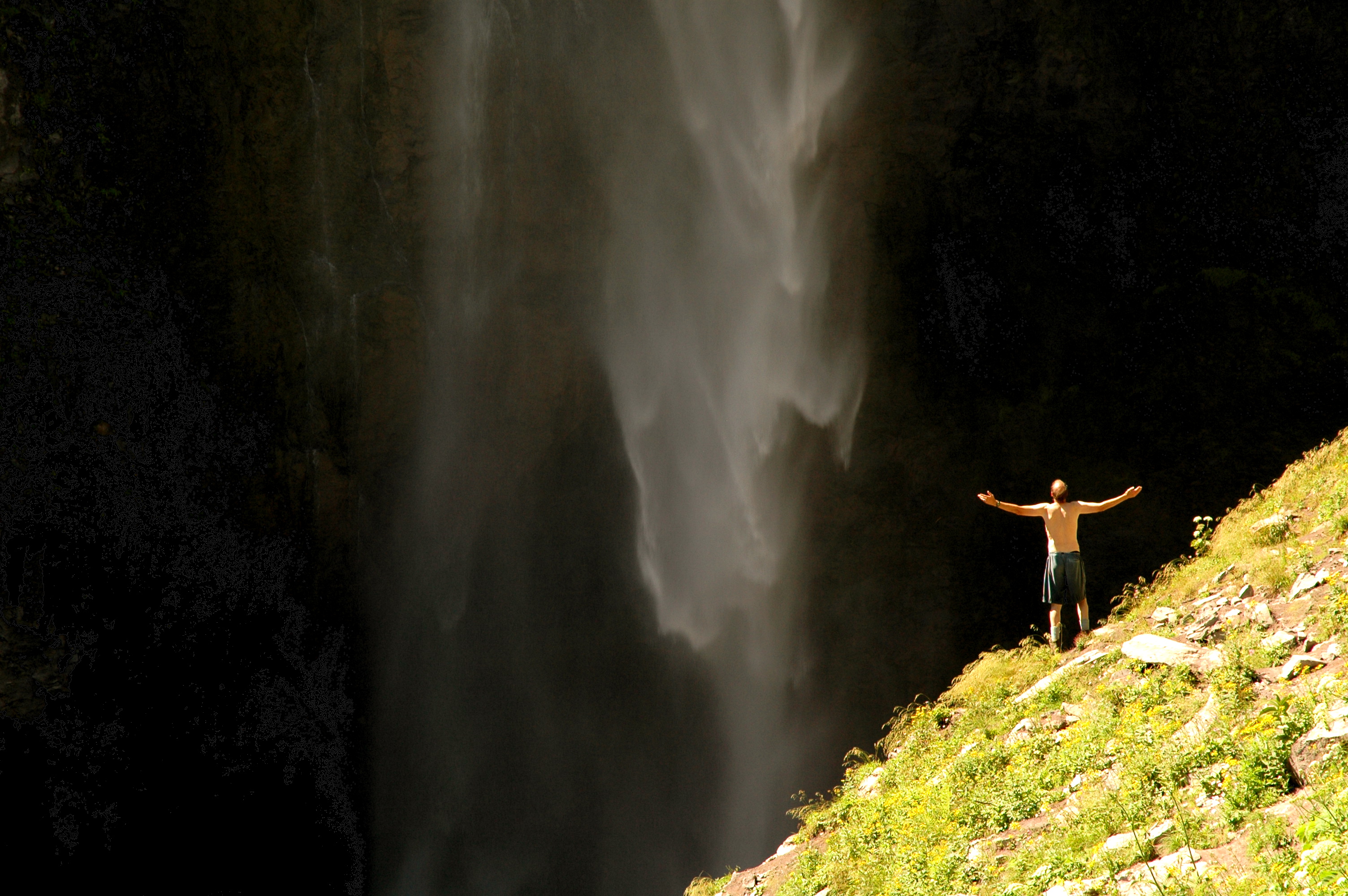
Comet Falls, Mt. Rainier National Park (July 29, 2005).
The tables outside the cantina were full of beautiful laughing men and women.… Everyone who sat there looked on display, the women in their lovely summer dresses, the men with their hair oiled back on their heads, their tanned bare feet resting proprietorially on top of their Gucci loafers. One wanted to applaud them for presenting such a successful vision of life: you could almost believe they had lived their whole lives, had been reared and groomed from birth, for this one particular night: that this was the pinnacle, this golden summery evening they had all reached simultaneously.
Yet it made me a little sad to see them there, laughing and drinking champagne, for you knew it was all downhill from here.[i]
— Peter Cameron, Andorra
The narrator in Cameron’s novel experiences the “golden summery evening” at the cantina through the lens of his own unhappiness. He has fled a failed life in America for a Mediterranean idyll, but joy continues to elude him. This apparently happy scene of shared human pleasure only deepens his alienation. Unable to join the fun, he judges the beautiful, laughing people for their complacency, their privilege, and their shallow indifference to mortality.
In Michael Cunningham’s The Hours, Clarissa Vaughan recalls her own close encounter with happiness, when she made the mistake of thinking it would last.
It had seemed like the beginning of happiness, and Clarissa is still somewhat shocked, more than thirty years later, to realize that it was happiness.… What lives undimmed in Clarissa’s mind more than three decades later is a kiss at dusk on a patch of dead grass, and a walk around a pond as mosquitoes droned in the darkening air. There is still that singular perfection, and it’s perfect in part because it seemed, at the time, so clearly to promise more. Now she knows: That was the moment, right there. There has been no other. [ii]
What is happiness? It can be pursued, but can it be possessed? The word is derived from “hap,” an Old English term for fortune or chance—something that happens to us, for good or ill. But “happy” and “happiness” have come to denote only the good things, without the mishaps.
If asked to recall our happiest moments, a multitude of memories would rise to the surface. But if asked whether we are happy now, or living happy lives, how would we answer? The University of Pennsylvania is conducting an online Authentic Happiness Survey, with twenty-four groups of five statements each to measure the presence or absence of happiness. Group 24, for example, offers the following choices:
My life is a bad one.
My life is an OK one.
My life is a good one.
My life is a very good one.
My life is a wonderful one.
The #1 statement in a group is always pretty dismal (I’m usually in a bad mood … I’m pessimistic … I am unhappy with myself … I feel like a failure, etc.) The #5 statement sounds way too good to be true (My life is filled with pleasure … If I were keeping score in life, I would be far ahead … I always get what I want … My life is filled with joy … I could not be happier with myself, etc.).
The majority of my own answers landed in the middle (#3), reflecting a pretty typical mix of highs and lows. I had no #1s, a couple of #2s, six #4s (three due to privilege, three due to personality), and two #5s (“I truly love my work” and “Most of the time I am fascinated by what I am doing”—both of these reflecting a mixture of privilege, personality, and the good fortune of getting to do what I love). My authentic happiness score was 3.46 out of 5. That seems about right for a privileged white male occasionally beset by the minor melancholies of disappointed hopes, both personal and generational.
It was an interesting survey, one of many attempts to grapple with the unhappiness of our times. Currently, the most popular course at Yale is “Psychology and the Good Life,” created by Professor Laurie Santos in response to the mental health crisis among college students, who, she says, are “much more overwhelmed, much more stressed, much more anxious, and much more depressed than they’ve ever been.”
In a survey of Yale students taken before the pandemic, 60% said they had felt “overwhelmingly anxious” sometime during the last year. And 50% reported feeling “completely overwhelmed” in the past week. For many college students, and for Americans in general, “happiness feels increasingly out of reach.” The pandemic, climate change, and the politics of fear and hate have multiplied our sorrows and anxieties almost beyond measure.
According to University of California (Irvine) professor Sonia Lyubomirski, author of The How of Happiness, 50% of one’s happiness is determined by genes, while 40% flows from our thoughts, actions, and attitudes. That leaves only 10% attributable to circumstances, although many people believe that circumstance is the key factor in personal happiness. If I change my job, my home, my partner, I will be happier. Lyubomirski’s numbers assume, of course, that one’s basic needs are being met. For a war zone Ukrainian, a Central American refugee, or a long Covid sufferer, circumstance weighs far more heavily.
Santos’ course, and her ongoing podcast, The Happiness Lab, seek to help people address the more significant 40% factors: thoughts, actions, and attitudes. I’ve only listened to the first episode, but many have testified to the value of her efforts.[iii]
Happiness is a subject of supreme interest. Everyone wants it, but for many it seems in short supply. It’s also hard to define. A century ago, Vita Sackville-West questioned its usefulness as an index for life.
But what was happiness? Had she been happy? That was a strange, clicking word to have coined—meaning something definite to the whole English-speaking race—a strange clicking word with its short vowel and its spitting double p’s, and its pert tip-tilted y at the end, to express in two syllables a whole summary of life. Happy. But one was happy at one moment, unhappy two minutes later, and neither for any good reason; so what did it mean? … Certainly, there had been moments of which one could say: Then, I was happy; and with greater certainty: Then, I was unhappy—when little Robert had lain in his coffin, for instance, strewn with rose petals by his sobbing Syrian nurse—but whole regions had intervened, which were just existence. Absurd to ask of those, had she been happy or unhappy? … No, that was not the question to ask her—not the question to ask anybody. Things were not so simple as all that. [iv]
Well then. Am I happy or unhappy? I have had moments and days when it was indeed bliss to be alive. But what should I say about those intervening regions where the evidence is mixed? Is happiness only an occasional oasis in the desert of ordinary time, or can happiness reside in the barren places as well?
“Small things go a long way,” says Zadie Smith. “All day long I can look forward to a Popsicle. The persistent anxiety that fills the rest of my life is calmed for as long as I have the flavor of something good in my mouth,” [v] Rebecca Solnit, arrested for demonstrating at a nuclear test site in the Nevada desert, said that “even when you’re in handcuffs, the sunset is still beautiful.” [vi]
In The Spiritual Meadow, John Moschos’ seventh-century collection of tales about desert monastics, an elder warns a wayward disciple, “Brother, pay attention to your own soul, for death awaits you and the road to punishment.” The disciple took little heed, and when he died, the elder continued to worry about his fate.
The elder fell to his prayers and said, “Lord Jesus Christ, reveal to me the state of the brother’s soul.” He went into a trance and saw a river of fire with a multitude of people in the fire itself. Right in the middle was the brother, submerged up to his neck. The elder said to him, “Didn’t I warn you to look after your own soul, my child?” And the brother answered, “I thank God, father, that at least my head is spared from the fire. Thanks to your prayers, I am standing on the head of a bishop.” [vii]
Even in hell, small things go a long way! And happiness can turn up anywhere, as poet Jane Kenyon reminds us:
There’s just no accounting for happiness … It comes to the monk in his cell. It comes to the woman sweeping the street with a birch broom, to the child whose mother has passed out from drink. It comes to the lover, to the dog chewing a sock, to the pusher, to the basket maker, and to the clerk stacking cans of carrots in the night. [viii]
We are grateful when it comes, and for the memory it leaves. But happiness is more than the occasional perfect moment. It is a practice, a way of being, a fullness of life which transcends the inevitable fluctuations of fortune. Such a practice might be summarized in two words: authenticity and love.
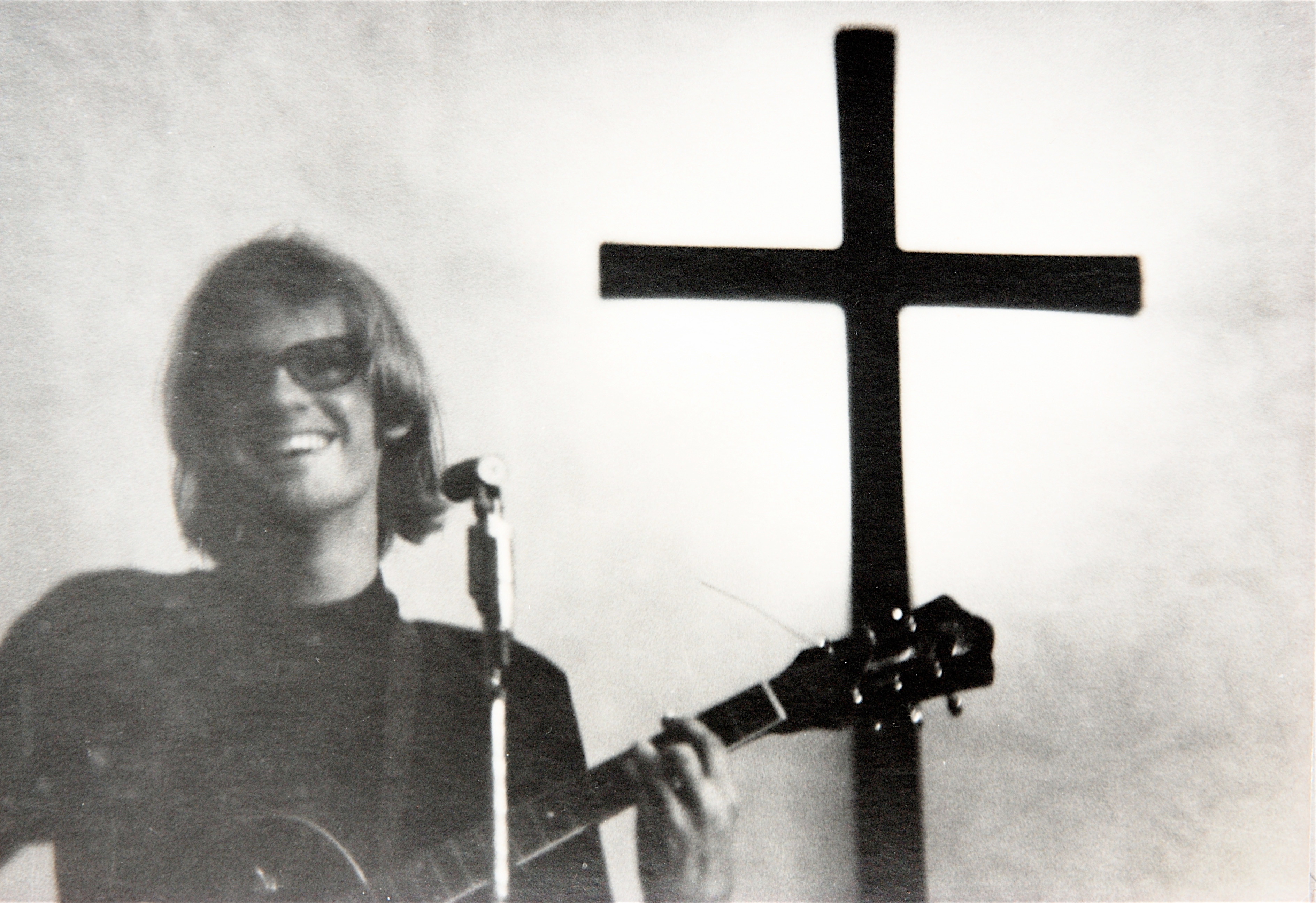
At my ordination to the priesthood (September 17, 1970).
Authenticity is fidelity to your truest self: becoming more and more like the person you have been created and called to be. Sometimes the way is rough and steep. Sometimes you get lost or delayed. But by God’s grace, you embrace the journey. Parker Palmer describes this process as a matter of vocation:
Our deepest calling is to grow into our own authentic selfhood, whether or not it conforms to some image of who we ought to be. As we do so, we will not only find the joy that every human being seeks—we will also find our path of authentic service in the world. True vocation joins self and service, as Frederick Buechner asserts when he defines vocation as “the place where your deep gladness meets the world’s deep need.” [ix]
Authenticity, then, finds its greatest expression in acts of love. Becoming our truest self takes us beyond our individuality, into the interdependent communion of the Divine Whole. My own happiness cannot be sustainably severed from collective well-being. Happiness, as it turns out, is not a private affair. It is the way of self-diffusive, self-offering love. And until justice and human flourishing are universally shared, the way of love will include suffering. Self-sacrifice for love’s sake can be costly and painful, as Jesus and the saints have shown. Happiness accepts the truth of that. No justice, no peace. But it is also true, as Catherine of Siena said, that “all the way to heaven is heaven.” You don’t have to wait until the end of time for happiness to show up.
“Do not look for rest in any pleasure,” said Thomas Merton, “because you were not created for pleasure; you were created for JOY.” [x] Happy are those with a hungry heart. Happy are those who give themselves away. Happy are those who do not mistake crumbs for the feast. Happy are those who know it’s not just about them. Happy are those who say yes to the gift. Happy are those who yearn for the Divine Beloved. Happy are those who don’t count the cost. Happy are those who love their story.
On the summit of Mount Sinai (May, 1989). Blessed is the way up. Blessed is the way down. The trail is beautiful. Be still.
We think of Saint Francis of Assisi as a joyful saint, but he was also pierced by the stigmata, the wounds of Christ. And he taught that the most perfect joy is to be found neither in worldly things nor in spiritual enjoyments. Nor is perfect joy simply a matter of pleasure, contentment, or delight. This was bewildering and counterintuitive for his brothers, so he explained it this way:
“Imagine coming home to the monastery on a stormy night. We knock on the door, but it is so dark that the surly porter mistakes us for tramps. ‘Go away!’ he shouts. And if we continue to knock and the porter comes out and drives us away with curses and hard blows— and if we bear it patiently and take the insults with joy and love in our hearts. Oh Brother Leo, write down that that is perfect joy! Above all the graces and gifts of the Holy Spirit which Christ gives to his friends is that of conquering oneself and willingly enduring sufferings, insults, humiliations and hardships for the love of Christ.” [xi]
Saint Francis wouldn’t have sold many self-help books, but he knew that happiness unacquainted with suffering and sorrow isn’t the real deal. “If it be sweet, if it be not sweet,” [xii] my story is what I was made for. My story is why I’m here. Happiness is saying yes to the story’s gift with a thankful heart.
The late Joseph Golowka, one of my most beloved elders, still roughing it in Baja at 86 (Sept. 24, 2005).
When I go back to earth And all my joyous body Puts off the red and white That once had been so proud, If men should pass above With false and feeble pity, My dust will find a voice To answer them aloud:
“Be still, I am content, Take back your poor compassion!— Joy was a flame in me Too steady to destroy. Lithe as a bending reed Loving the storm that sways her— I found more joy in sorrow Than you could find in joy.” [xiii]
— Sara Teasdale, “The Answer”
[i] Peter Cameron, Andorra (New York: Farrar, Straus and Giroux, 1997), 149-150.
[ii] Michael Cunningham, The Hours (New York: Farrar, Strauss and Giroux, 1988), 98.
[iii] The statistics and quotes from Santos and Lyubomirsky are found in Adam Sternbergh, “The Case for New York Face,” in Lapham’s Quarterly, Vol. XII, No. 3 (Summer 2019), 81-85. Four times a year, Lapham’s Quarterly presents a marvelous and stimulating collection of writings and images from many periods and sources on a given topic. This issue’s subject is “Happiness.” Sternbergh’s article was originally published in New York Magazine in 2018. Additional quotes from Santos were taken from her podcast, The Happiness Lab, Season 1, Episode 1 (“You Can Change”): https://www.happinesslab.fm
[iv] This excerpt from Sackville-West’s novel, All Passion Spent (1931), is also in the “Happiness” issue of Lapham’s Quarterly, p. 139.
[v] Ibid., 134. Smith’s excerpt is from her essay “Joy” (New York Review of Books, Jan. 10, 2013).
[vi] Rebecca Solnit, Storming the Gates of Paradise: Landscapes for Politics (Berkeley: University of California Press, 2007).
[vii] John Moschos, The Spiritual Meadow (written c. 600), trans. John Wortley (Collegeville, MN: Cistercian Publications, 1992/2008), 35.
[ix] Parker Palmer, Let Your Life Speak: Listening for the Voice of Vocation (San Francisco: Jossey-Bass, 2000), 16.
[x] Thomas Merton, Seeds of Contemplation (1949), p. 172. Cited in William H. Shannon, Christine M. Bochen, Patrick F. O’Connell, eds., The Thomas Merton Encyclopedia (Maryknoll, NY: Orbis Books, 2002), 231.
[xi] Adapted from The Little Flowers of St. Francis, 53 chapters on the life of Francis of Assisi written at the end of the 14th century.
[xii] Anne Sexton, “Rowing.” “As the African says, / This is my tale which I have told,/ If it be sweet, if it be not sweet,”/ Take somewhere else and let some return to me.…”
[xiii] Sara Teasdale, “The Answer,” in Christian Wiman, ed., Joy: 100 Poems (New Haven: Yale University Press, 2017), 138.


 The religious imagineer