
“Not dark yet, but it’s getting there” — What Can America Learn from the Nazi Occupation of Paris?

Police clear demonstrators from a freeway during the right wing occupation of Los Angeles in June 2025.

Survivors of the twentieth century, we are all nostalgic for a time when we were not nostalgic. But there seems to be no way back. — Svetlana Boym

In the Second World War, Paris was spared the physical destruction suffered by so many other cities. It surrendered without a fight to the Germans, some of whom cherished fond memories of living there as students before the war. And the Nazi government, believing itself to be the future of Europe, had no desire to smash such a cultural icon into rubble. It coveted the prestige of the City of Light for itself.
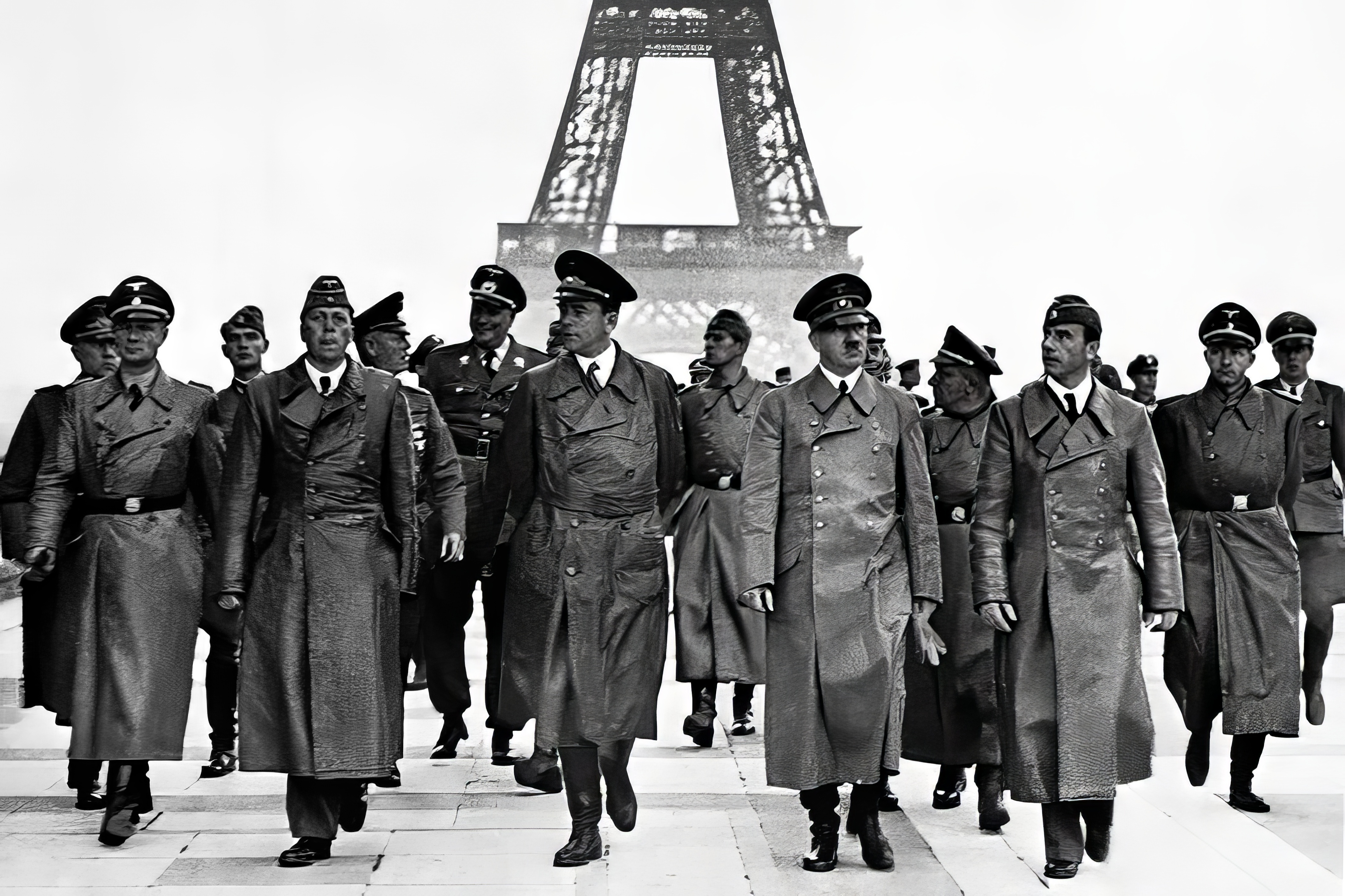
Hitler’s entourage in Paris (June 28, 1940). He was gone the next day, and never saw the city again.

The example of a city physically unchanged while suffering the invasive presence of a hostile power may have something to teach Americans, whose own cities face threats of military occupation by the dictatorial regime in Washington, D.C.. When I read Ronald C. Rosbottom’s riveting study, When Paris Went Dark: The City of Light Under German Occupation, 1940-1944, I could not help noticing some striking parallels to our own “les annes noires” (the dark years).

The radical right in the United States likes to dismiss any comparisons between Nazis and themselves as hyperbolic and slanderous, and it is fair to argue that their own movement may never go as far as the Nazis did. It’s too early to tell. But they’ve made a good start: terrorizing the vulnerable with the ICE-capades of masked thugs, demonizing and disappearing “aliens” and “enemies,” attacking the judicial system, vitiating the free press, purging opposition in the military and civil service, compelling the complicity of corporate leaders, seducing gullible and idolatrous evangelicals, and corrupting everything they touch. Fueling it all is their ceaseless stream of lies and propaganda. As Hannah Arendt warned in the aftermath of World War II:

“If everybody always lies to you, the consequence is not that you believe the lies, but, rather, that nobody believes anything any longer. And the people that no longer can believe anything cannot make up its mind. It is deprived not only of its capacity to act, but also of its capacity to think and to judge. And with such people, you can then do what you please.” [1]

Parisians tried to look the other way, but the invaders were everywhere (Photo by André Zucca for Signal, a German propoganda magazine).

Much more could be said about that, but for now our subject is the occupation of Paris. When the Germans entered the French capital in June, 1940, they encountered no resistance. Parisians were disheartened by the swift collapse of the French army and unhappy to see so many German soldiers and officials suddenly walking their streets and filling their cafés, but what could they do? Many fled Paris before the troops arrived, but most of those returned when they saw how “normal” things seemed. Daily life was not radically affected at first, and few thought the occupation would last such a long time. There was shame in defeat, certainly, and resentment of a foreign presence, but for a time passivity and resignation kept the anger of many Parisians’ turned inward.
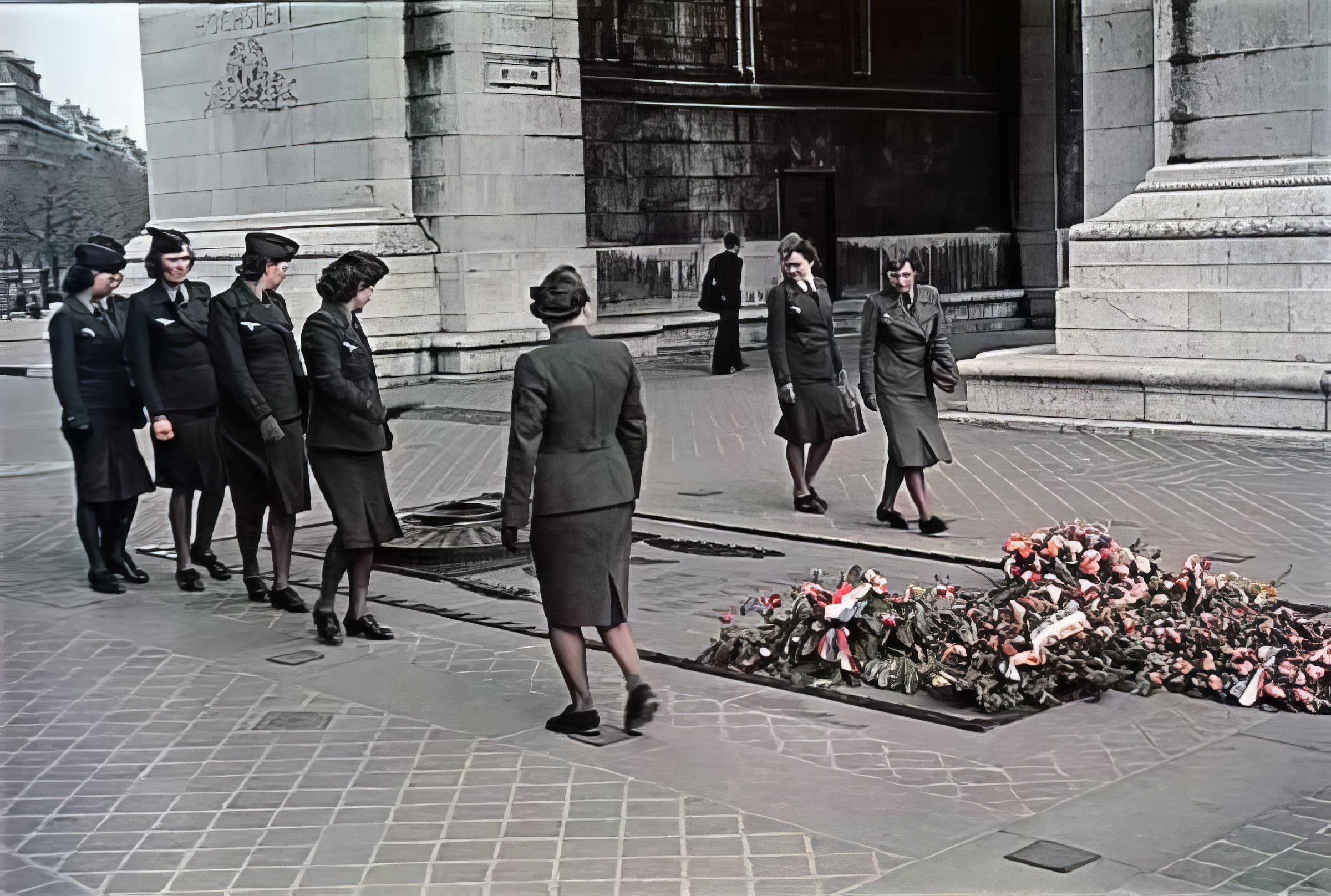
German soldiers at the Arc de Triomphe. The Occupation produced an invasion of unwanted tourists (Photo by André Zucca for Signal, a German propoganda magazine).

There was a degree of make-believe on both sides. German soldiers were instructed to be polite. If someone drops a package on the sidewalk, pick it up for them. Parisians tried not to reciprocate any such acts of kindness, but to practice what they called Paris sans regard (“Paris without looking”). As much as possible, pretend the Germans don’t exist. Over time, this depersonalization would create a great sense of loneliness among the occupiers. As for Parisians, the make-believe minuet with the occupiers was both wearying and fragile. As one young man wrote in his journal,

“In spite of oneself, one dreams, laughs, and then falls back into reality, or even into excessive pessimism, making the situation more painful.” [2]    

A month after the Germans arrived, “Tips for the Occupied,” a mimeographed flyer, began to appear in apartment mailboxes. “Don’t be fooled,” it warned. “They are not tourists … If one of them addresses you in German, act confused and continue on your way … Show an elegant indifference, but don’t let your anger diminish. It will eventually come in handy …” [3]

The sense of normality didn’t last. The restaurants, cabarets and cinemas remained crowded, but when audiences began to boo and jeer at Nazi newsreels, the houselights would be turned up. People lost their courage when they could be easily spotted. Parisians also learned to be careful about saying the wrong thing in a café. Neighbors began to denounce each other to the authorities. Singing “The Marseillaise” in public became a punishable crime.  

As the Occupation dragged on, the sense of dépaysement (“not feeling at home”) began to wear on the soul. Historian Jean-Paul Cointet describes the condition in his 2001 study of wartime Paris:

“The Parisian now knows the condition of being ‘occupied’ in a city that does not belong to him anymore and that offers him the schizophrenic images of an environment suddenly foreign to his gaze. Constraints and humiliations, restrictions and punishments accompany this disorientation and the upending of daily routine.” [4]

Troops at a federal detention center in Los Angeles (Ted Soqui for Cal Matters, June 8, 2025).

The narrowing of space—both physical and psychological—became increasingly oppressive, as Rosbottom notes:

“Whether because of the sight of German uniforms, the closed-off streets, the insufficient nourishment, the cold winters, crowded transportation, long lines—or just the suffocating feeling of being suspicious of one’s acquaintances, neighbors, or even family—the city seemed to be contracting, closing in on Parisian lives, as the Occupation dragged on.” [5]

By the bitterly cold winter of 1941, life just got harder. Shortages of food and coal brought malnutrition and sickness, especially among the lower classes. French police, willing agents of Nazi oppression, started to raid neighborhoods known for Jewish or immigrant populations. At first, Parisians in uninvaded neighborhoods could close their eyes and swallow the lie that the authorities were simply trying to control immigration and prevent terrorism.

“Leave us in peace!” A German propaganda poster show Vichy France threatened by its perceived enemies: Freemasons, Jews, de Gaulle, and “lies.”

However, by mid-1942, rumors of the “final solution” began to reach Paris, and the mass roundups of Jews in France became impossible to ignore. “[Most Parisians] certainly did not know of the plans to deport them to their deaths,” writes Rosbottom, “but to their deaths they went: the last, sad convoy to carry children, three hundred of them, left Drancy for Auschwitz on July 31, 1944 … The final transport of adult deportees left on August 17, a week before Paris would be liberated.” [6]  

Ernst Jünger, a cultured writer serving as a captain in the occupying Wehrmacht, kept a journal of the Occupation. In July 1942 he wrote:

“Yesterday some Jews were arrested here in order to be deported—first they separated parents from their children, so firmly that one could hear their distressed cries in the streets. At no moment must I forget that I am surrounded by unhappy people, humans experiencing the most profound suffering. If I forgot, what sort of man or soldier would I be?” [7]  

Jünger may have shed a tear, but he continued to serve as a loyal employee of the Nazi death industry, whose business, as Hannah Arendt so bluntly noted, was “the mass production of corpses.” [8]

Hélène Berr also kept a diary, from Spring, 1942 until Spring, 1944. As a young Jewish woman, she tried to keep terror at bay by imagining herself in a Paris magically untouched by the darkness. A student at the Sorbonne, she copied out verses of Keats to calm her soul, and took refuge in her friendships. She made frequent walking tours of the city she loved, as if to reclaim possession of Paris from the occupiers who made her wear a yellow star, the mark of social exile.  

In April of 1943, Hélène wrote:

“I’ve a mad desire to throw it all over. I am fed up with not being normal. I am fed up with no longer feeling free as air, as I did last year. It seems that I have become attached to something invisible and that I cannot move away from it as I wish to, and it makes me hate this thing and deform it … I am obliged to act a part … As time passes, the gulf between inside and outside grows ever deeper.” [9]   

As Rosbottom notes, personal accounts of the period recall “the sound of police—French police—beating on the door” as their “most vivid aural memory.” [10]  In March 1944, that percussive death knell sounded in the Berr’s apartment. Hélène, along with her parents, was arrested, but she managed to slip her journal to their cook before the police barged in. Three weeks later the Berrs were on a train to Auschwitz. They never returned. Hélène’s beloved Paris would be liberated five months later.

Illustration for a collection of French Resistance poetry.

There were many forms of active resistance to the Nazis in France, but the number of French patriots who risked their own lives was relatively small—less than 2% of the population. The threat of death and brutal reprisals was too daunting for most. For a visceral immersion in the anxious milieu of the French Resistance, watch Jean-Pierre Melville’s haunting film, Army of Shadows. Critic Amy Taubin’s summary of the film feels descriptive of wartime Paris: “Elegant, brutal, anxiety-provoking, and overwhelmingly sad.” [11] One resister recounted his experience in an interview decades after the war:

“Fear never abated; fear for oneself; fear of being denounced, fear of being followed without knowing it, fear that it will be ‘them’ when, at dawn, one hears, or thinks one hears, a door slam shut or someone coming up the stairs. Fear, too, for one’s family, from whom, having no address, we received no news and who perhaps had been betrayed and were taken hostage. Fear, finally, of being afraid and of not being able to surmount it.” [12] 
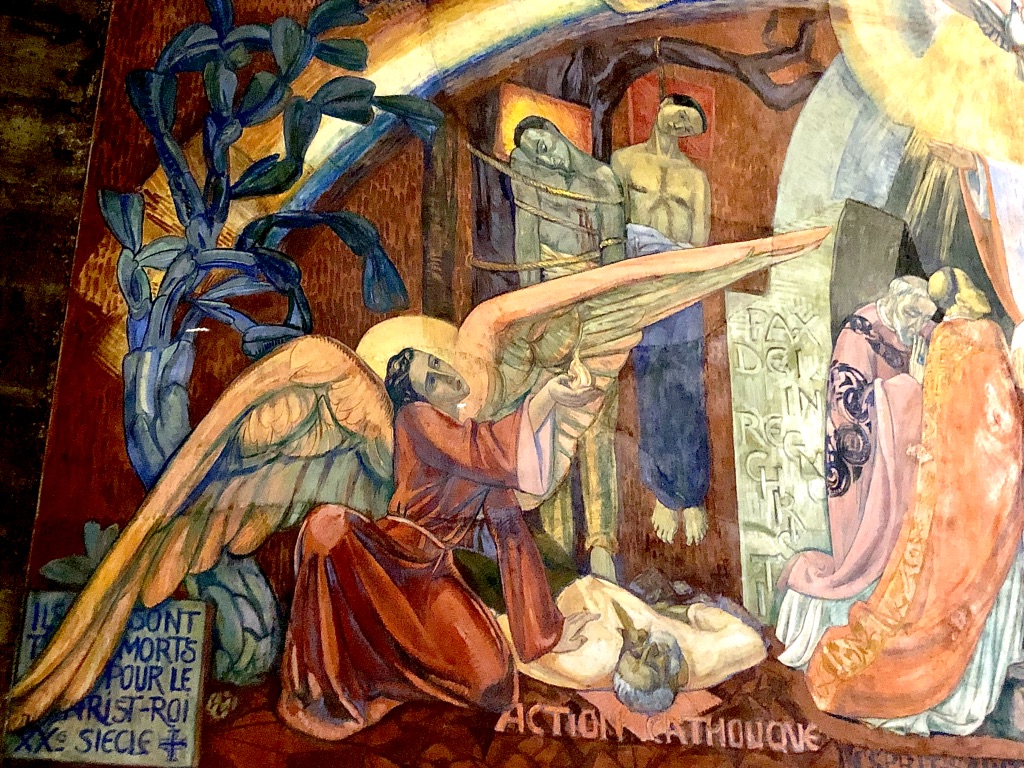
A prewar fresco of modern martyrs who refused to bow to anyone but Christ (Église du Saint-Esprit, Paris, 1930s).

As I read Paris in the Dark, I had to wonder: Is this America’s future? For many of us (to borrow a line from Bob Dylan), “It’s not dark yet—but it’s getting there.” Daily life —for now, at least—goes on pretty much as usual. But for some of our neighbors, the darkness has definitely arrived. The military occupation of cities. The terrifying knock on the door. The roundups, disappearances, and concentration camps. The shamelessly gleeful cruelty. Demonization, bigotry and hate. The repression of customary freedoms. The criminalization of dissent. The collapse of legal safeguards. The willing complicity of the powerful with the enemies of life.

Citizens try to block an ICE roundup of immigrants at the Ambiance Apparel factory, downtown Los Angeles (J.W. Hendricks for CalMatters, June 6, 2025).

I am not without hope. Seven million protesters took to the streets on No Kings Day. Then large majorities voted against America’s reign of madness. And regardless of any political swings of the pendulum, I believe that resurrection continues to plant its seeds among the blind sufferings of history. But the oligarchs and fascists won’t go quietly. On the day after the recent election, the Episcopal Daily Office included this timely verse from the Book of Revelation:

Woe to the earth and the sea,
for the devil has come down to you
in a great rage,
because he knows that his time is short. (Rev. 12:12)
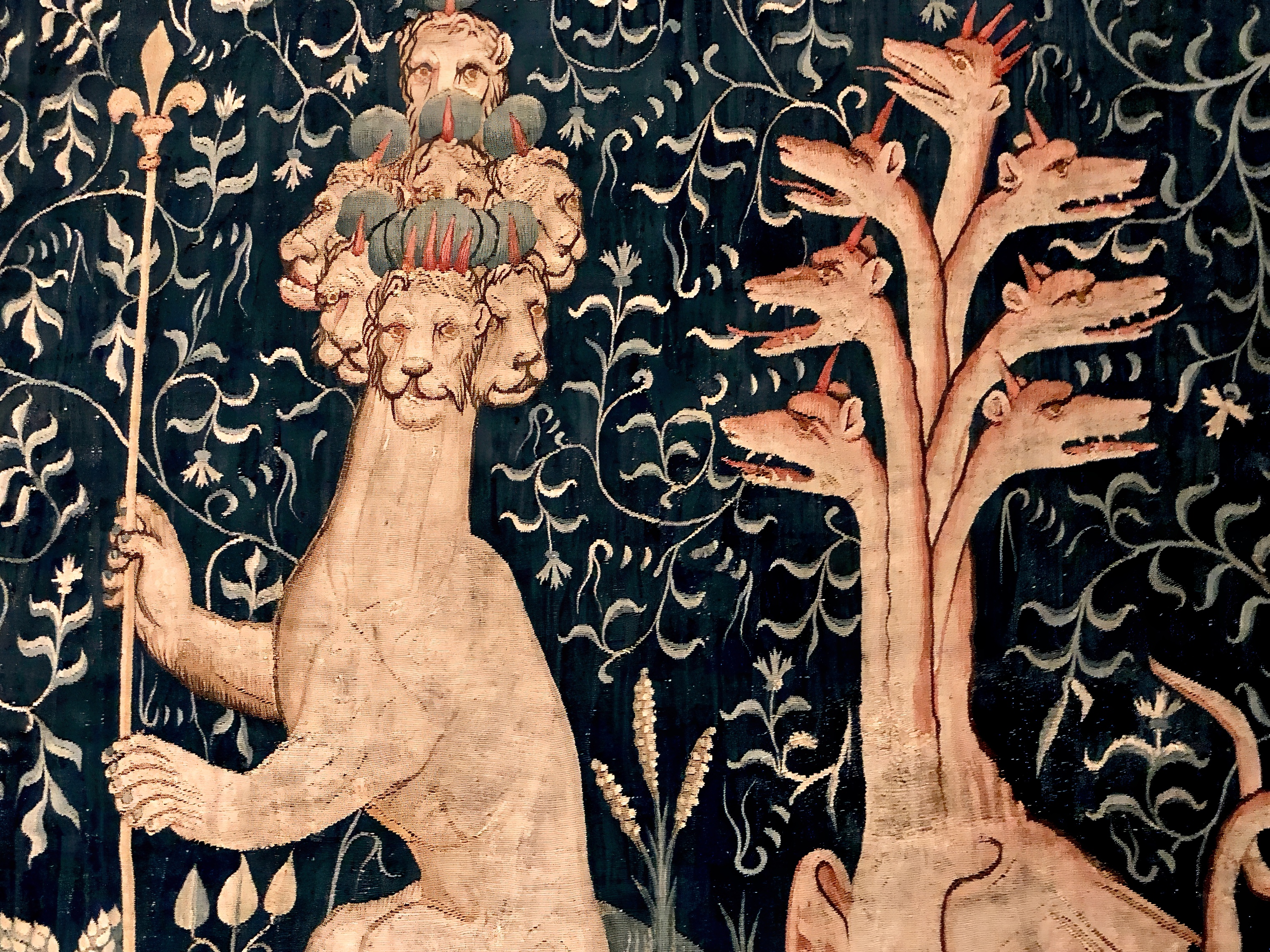
The Beast and Satan rage, but their time is short (Apocalypse Tapestries, Angers, France, 1373-1382).

This Scripture feels ripped from the headlines. We know that satanic rage all too well. It has sickened our country, and we struggle to keep it out of our own hearts. May its time be short. In the meantime, the woes are not done. God’s friends have their work cut out for them. Believe. Resist. Endure.

And guard your heart against the demons of dejection and despair. After Trump’s election in 2016, I suggested seven spiritual practices for the time of trial: pray, fast, repent, prophesy, love, serve, hope. Click the link for the details. Nine years later, these practices are more necessary than ever, and I encourage you to share the link as a small act of resistance.
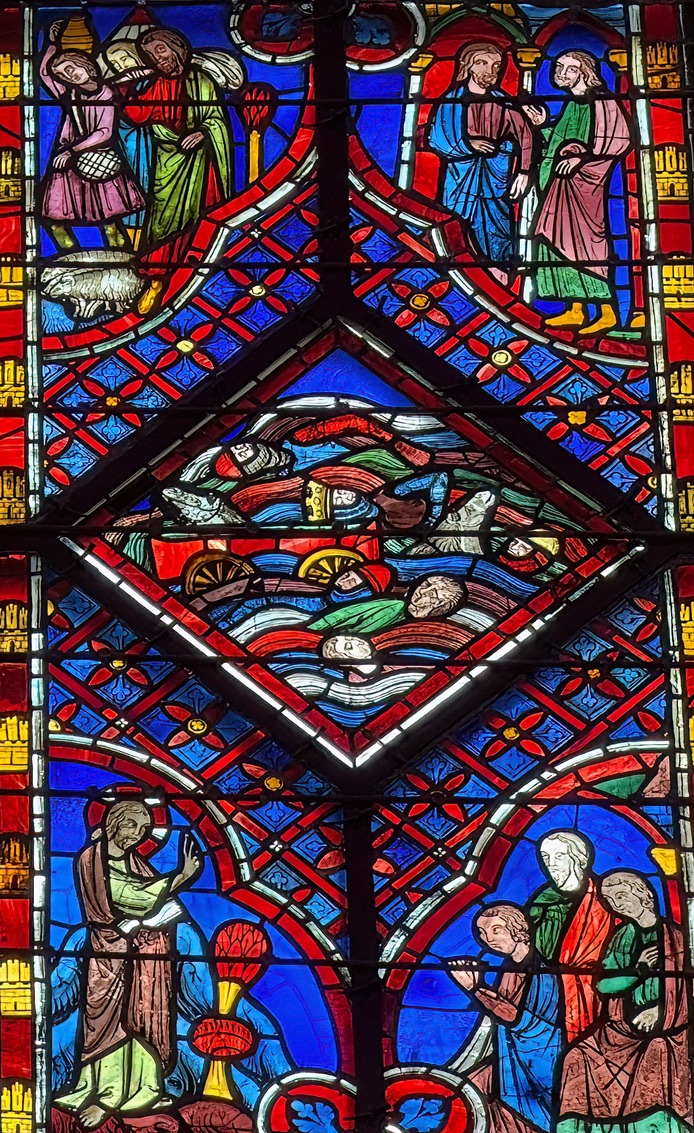
Pharoah sent his troops to round up the Israelites, but the forces of violence ended up sleeping with the fishes (13th-century window, Sainte-Chappelle, Paris).

Finally, don’t be in love with outcomes. Divine intention takes mysterious forms, and should not be confused with our own plans. Let us heed the counsel of two twentieth-century saints who were deeply committed to holy resistance and well acquainted with its challenges and ambiguities. Dietrich Bonhoeffer, martyred in a Nazi prison in 1945, believed that we must always act with deep humility, shedding our presumptions about the part we play or the difference we make. Don’t fret about your success. Just be faithful to Love’s command:

“No one has the responsibility of turning the world into the kingdom of God … The task is not to turn the world upside down but in a given place to do what, from the perspective of reality, is necessary objectively, and to really carry it out.” [13]

And Thomas Merton, who forged a delicate balance between contemplation and activism, taught that right action is not a tactic but a persistent way of being, grounded in something deeper and more enduring than any of our consequences:

“The message of Christians is not that the kingdom ‘might come, that peace might be established, but that the kingdom is come, and that there will be peace for those who seek it.’” [14]

No Kings Day on Bainbridge Island, Washington (Photo by the author, October 18, 2025).


[1] Hannah Arendt, quoted in the PBS documentary, Hannah Arendt: Facing Tyranny (American Masters, 2025).

[2] Ronald C. Rosbottom, When Paris Went Dark: The City of Light Under German Occupation, 1940-1944 (New York: Back Bay Books, 2014), 106.

[3] Ibid., 196-197. The flyer was produced by Jean Texcier.

[4] Ibid., 160.

[5] Ibid., 161.

[6] Ibid., 286.

[7] Ibid., 154.

[8] Hannah Arendt: Facing Tyranny.

[9] Rosbottom, 256.

[10] Ibid., 160.

[11] Amy Taubin, ”Out of the Shadows,” Criterion booklet for their 2010 Blu-ray release of Melville’s 1969 film.

[12] Rosbottom, 223, quoted from interviews with WWII resisters published in 2012.

[13] Dietrich Bonhoeffer, q. in Christiane Tietz, Theologian of Resistance: The Life and Thought of Dietrich Bonhoeffer (Minneapolis, MN: Fortress Press), 121.

[14] Thomas Merton, Turning Toward the World: The Journals of Thomas Merton, Volume Four, 1960-1963 (New York: Harper Collins, 1996), 188.

Now Welcome Summer!

18th-century altarpiece (detail), San Martin Pinario, Santiago, Spain.

“I implore you—be calmer.” — Goethe

I know the world is a hot mess at the moment, but I’m taking the rest of the day off to welcome summer. I’m not even going to compose a long-overdue new post (more of those soon). Instead, before I retire to the garden with a pleasurable book, I’ll do the lazy thing and share a few paragraphs from something I wrote years ago, after my first journey to Greece. I posted the following words on the Summer Solstice in 2001. A few months later, the world as we knew it would come to an end. But the lesson I learned in Greece still speaks to my heart, even in (or especially in) our fractious and fallen present condition.

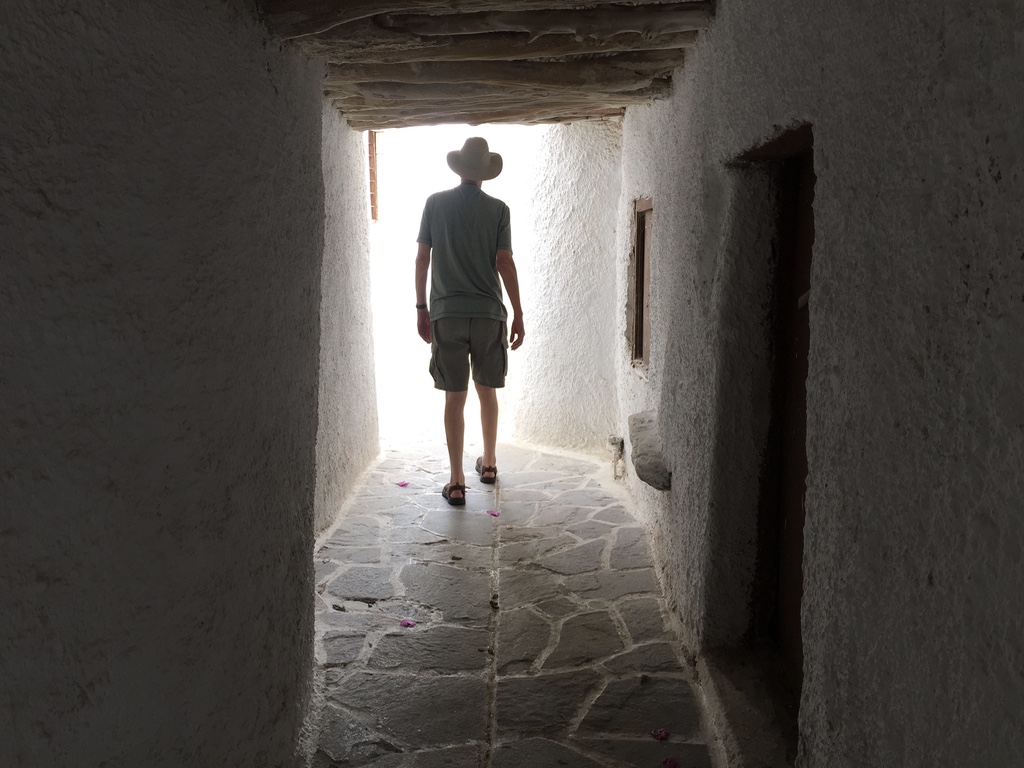
The author on Naxos, Greece.

After a few weeks of history, culture and religion on the mainland, I boarded a ferry for the Greek islands, only to be put off by the scene on the sun-drenched deck. Everyone was a tourist, slathered with sun block; the Greeks had vanished. We were like an occupying army, obliterating the local culture with our foreign speech, our alien ways, our crass desires. But there was something else that bothered me. We lacked seriousness. We were a ship of fools.

During the first half of my journey, I had contemplated the noble remnants of classical culture, walked in the footsteps of Socrates and Paul, hiked to Byzantine monasteries scattered along the summits of towering rock formations, breathed the incense of exotic rituals, conversed passionately about ideas late into the night. It had felt something like pilgrimage. But now the only quest was for the perfect tan, the languorous cafe, the idle beach. I feared a loss of purpose. Had I come all this way to fall into a resort mentality, and forget the Greece of myth and history, liturgy and philosophy?

In the end, my Puritan rigor succumbed to the regime of pleasure. I rediscovered summer mind. Time to be, not do. Sink down into the deep pool of the moment. Enjoy the sun-dazzled days and fairy tale nights without anxiety, as though they will last forever. I am not perfect at this. At times I am likely to rush from place to place, acquiring experiences greedily, not wanting to miss anything. But a brisk pace is fatal to deeper forms of attention.

On my first day hike on Naxos, the greenest isle in the Cyclades, I took a quick look inside one of the little Byzantine churches that frequent its charming hills and valleys. I saw only bare stones inside, not too interesting. I soon returned into the sunlight, where I heard a voice calling to me. It was a German hiker, looking for the entrance into the churchyard. I showed her the way in.

“Look at these wonderful old frescoes!” she said. “What frescoes?” I thought to myself as I peered into the shadows. Once I had given my sun-blinded eyes time to adjust, I began to see what I had missed in my hasty first glances—the faint images of saints. Some of the figures were clearly defined, while others had weathered into dreamlike blurs, like background figures in a Munch painting.

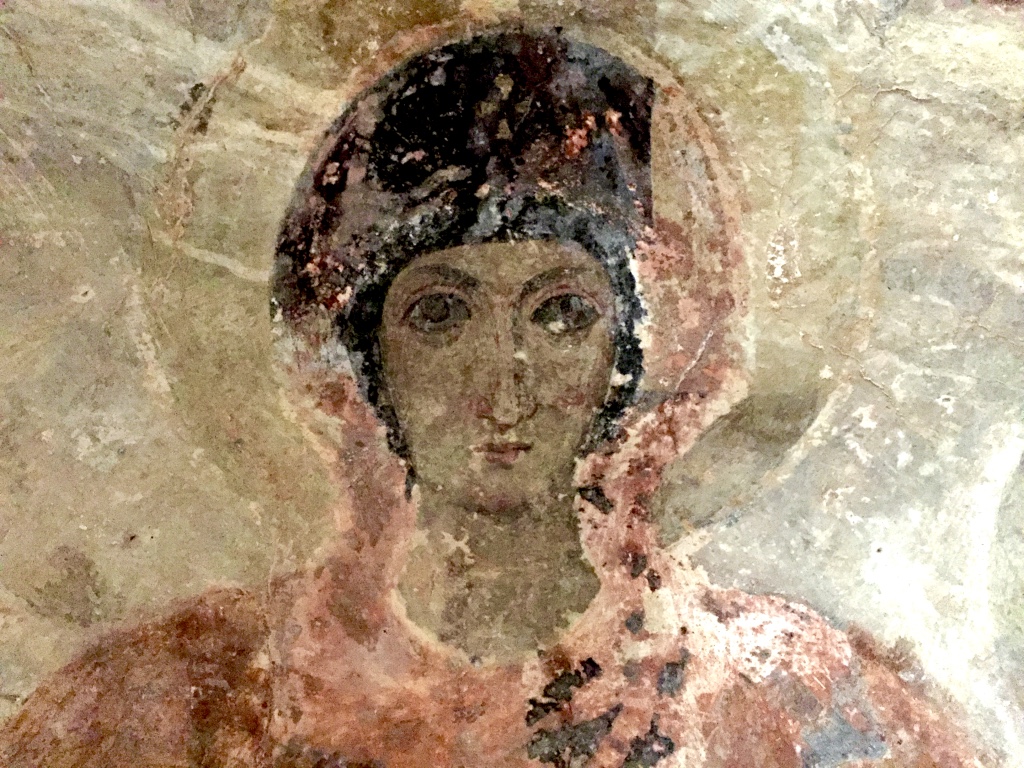
Sixth-century fresco in a Naxos church.

Early in that journey, I had read these words by Thomas Merton in the shaded balcony of a clifftop monastery:  “In prayer we discover what we already have. You start where you are and you deepen what you already have. And you realize that you are already there … All we need to do is experience what we already possess. The trouble is, we aren’t taking the time.”

Now welcome summer. Let the heavy fragrance of its green world release you from obligations. Let it be enough for now to wander aimlessly around the neighborhood, linger over relaxed conversations, or lie in the hammock and wait for falling stars. Idleness is the incense we offer the gods of summer.

Now in Flesh Appearing

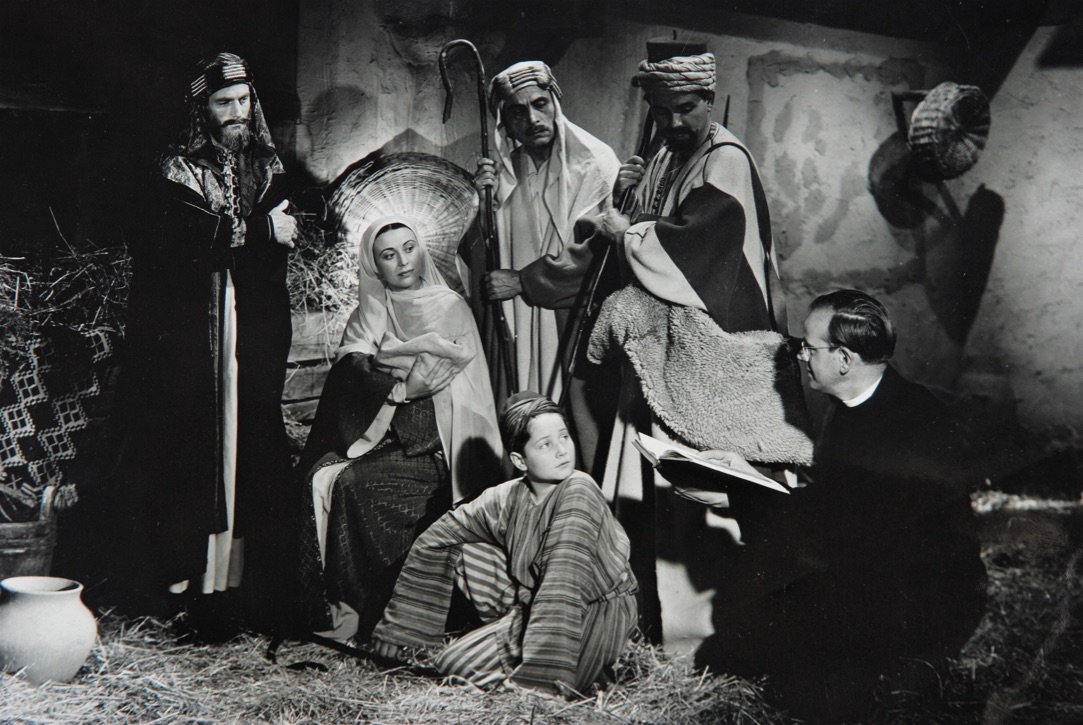
The Rev. James K. Friedrich (right) on the set of Child of Bethlehem (1940).

For he is our childhood’s pattern;
Day by day, like us He grew;
He was little, weak and helpless,
Tears and smiles like us He knew;
And He feeleth for our sadness,
And He shareth in our gladness.

— Cecil Frances Alexander, “Once in Royal David’s City”

My sisters and I each had an unusual childhood connection with the Nativity story. Our father, the Rev. James K. Friedrich, was the pioneer of Christian movie-making in America, and one of his first biblical films was Child of Bethlehem, produced in 1941. My sister Martha was a newborn child then, so she got to play the baby Jesus. Nine years later, my father made Holy Night, the first of a twelve-part series on the life of Christ. I was four years old at the time—much too old to get the leading role—so I was cast as a shepherd boy, entering the stable with several adult shepherds.

In the film, I have a dazed look on my face. I was literally blinded by the light on the Hollywood soundstage where the interiors were shot. Film stock in those days was not as light-sensitive as our camera phones. It required intense illumination to register a proper image. A big row of Klieg lights set up behind the manger threw such a blaze into my eyes that I could barely see the Holy Family. When I hear Luke’s gospel report that “the glory of the Lord shone all around” the shepherds, the indelible memory of those lights at Goldwyn Studios comes to mind.

James L. Friedrich (next to the donkey) at the manger in Holy Night (1949).

My oldest sister, Marilyn, never played in a Nativity film. Hers was a more literal reenactment. In 1936, my parents had stopped in Jerusalem during their honeymoon. In those days, as today, there was violence in the land, and they were warned not to go down the hill to Bethlehem in a car, because cars were easy targets for snipers. It was safer to ride a donkey to the place of Jesus’ birth. My dad recorded their pilgrimage with his 16mm movie camera, and now, every Christmas, I can watch the footage of my mother riding a donkey to Bethlehem, pregnant with her firstborn child.

To Marilyn’s credit, she has never made any personal claims about her origins, but there is, I believe, gospel truth in our childhood memories. Each and every one of us is called to play our part in the Nativity story, but not merely as witnesses like the shepherds or pilgrims like the Magi. God was made flesh so that our own flesh, our own story, may birth the divine intention and the divine life.

You see, the Incarnation isn’t only a matter of God wanting to share our humanity, to make our humanness part of the divine experience. It also reveals God’s desire that we in turn become partakers of the divine nature.

St. John put it this way in his gospel:

To all who received the Incarnate Word, who believed in his name, the Word gave power to become children of God, who were born, not of blood or of the will of the flesh or the will of human beings, but of God (John 1:12-13).

In the centuries that followed, this theme of theosis, or deification––becoming God-like––has pushed the envelope of anthropology by setting a very high bar for the definition of human potential.

In the early church, Irenaeus said that “God became what we are, in order to make us what he is.” Athanasius was even more explicit about the consequences of Incarnation, saying that “God became human so that humans might become God-like.” God-like! Can we even imagine this in our own day, when we are assaulted incessantly by news of human depravity.

Martin Luther, perhaps surprisingly for someone so focused on the burden of human sin, said we were all called to be “little Christs,” and in a Christmas sermon he described the Incarnation as a two-way street: “Just as the word of God became flesh,” he said, “so it is certainly also necessary that the flesh may become word. . . [God] takes what is ours to himself in order to impart what is his to us.”

In the 18th century, some of Charles Wesley’s great hymns were almost shockingly explicit about our capacity to contain divinity.

He deigns in flesh to appear,
Widest extremes to join,
To bring our vileness near,
And make us all divine.

Heavenly Adam, life divine,
Change my nature into Thine;
Move and spread throughout my soul,
Actuate and fill the whole;
Be it I no longer now
Living in the flesh, but Thou.

In the 20th-century, whose atrocities left our confidence in human potential badly shaken, the Catholic contemplative Thomas Merton could still claim that we “exist solely for this, to be the place God has chosen for the divine Presence. The real value of our own self is the sign of God in our being, the signature of God upon our being.” 

And after his famous epiphany at the corner of Fourth and Walnut in Louisville, Merton said, “It is a glorious destiny to be a member of the human race, though it is a race dedicated to many absurdities and one which makes many mistakes: yet, with all that, [God’s own self] glorified in becoming a member of the human race.

“I have the immense joy of being [a human person],” he continued, “a member of a race in which [God’s own self] became incarnate. As if the sorrows and stupidities of the human condition could overwhelm me, now that I realize what we all are. And if only everybody could realize this! But it cannot be explained. There is no way of telling people that they are all walking around shining like the sun.” 

Is this all this talk about divinization going too far? Could we really be walking around shining like the sun? Or at least have the potential for such glory, even if we’re not there yet? If the Nativity in Bethlehem means what I think it does, then the answer has to be yes.

On that wondrous night in Bethlehem, our nature was lifted up as the place where God chooses to dwell. We may still be works in progress, but we are bound for glory. St. Paul believed this when he said that “all of us, with our unveiled faces like mirrors reflecting the glory of the Lord, are being transformed into the image that we reflect in brighter and brighter glory” (II Cor. 3:18).

Another ancient theologian said, “As they who behold the light are within the light and partake of its brightness, so they who behold God are within God, partaking of God’s brightness.”

What happens in Bethlehem doesn’t stay in Bethlehem.

Adoration of the Christ Child, Flemish follower of Jan Joest of Kalkar (c. 1515)

On the Winter Solstice over 40 years ago, I was flying across the San Fernando Valley into L.A.’s Burbank airport on a brilliant December day. The noonday sun was low enough in the southern sky to be reflecting its rays off the surface of swimming pools running along a line parallel to our flight path. There are so many pools in the Valley, and each one, as it was struck by the sun, exploded with an intense dazzle of white light. In rapid succession, tranquil blue surfaces were transformed into momentary images of the sun’s bright fire. For me, it was a vision pregnant with the Christmas promise.

“They who behold the light are within the light and partake of its brightness.” Our pale mirrors are made to contain the most impossible brilliance. And though we have turned away from the Light, the Light seeks us out. No matter how shadowy the path we have taken, the Light will find us, and fill us with divine radiance. That is our destiny, says the Child in the manger.
We may not feel capable or worthy or prepared to receive the Word into the flesh of our own lives, but it is what we were made for. Paradoxical as it may sound, partaking of divinity is the only path to becoming fully human.

A month before he died, Edward Pusey, a 19th-century English priest, wrote to a spiritual friend about our God-bearing capacity:

“God ripen you more and more,” he said. “Each day is a day of growth. God says to you, ‘Open thy mouth and I will fill it.’ Only long. . . The parched soil, by its cracks, opens itself for the rain from heaven and invites it. The parched soil cries out to the living God. O then long and long and long, and God will find thee. More love, more love, more love.”

Participating in divinity doesn’t mean having superpowers or being invulnerable. We won’t be throwing any lightning bolts. Just look at Jesus. His life tells you what “God-like” means. He was born in poverty and weakness, in a stable not a palace, and he lived a life of utter self-emptying and self-offering, giving himself away for the life of the world.

In a novel by the Anglican writer Charles Williams, a young woman goes to church with her aunt on Christmas morning. She is a seeker, not quite a believer, but as they sing a carol about the mystery of the Incarnation, she leans over and whispers to her aunt, “Is it true?” Her aunt, one of those quiet saints who has spent her life submitting to Love divine, turns to her niece with a smile and says simply, “Try it, darling.”

So if you want to try it, if you want to complete your humanity by partaking of divinity, there are many ways to do that. Weep with those who weep and dance with those who dance, the Bible says. Love God with all your heart, and your neighbor as yourself. Welcome the stranger, feed the hungry, free the captive. There are plenty of to-do lists out there. Here’s an excellent one from the Dalai Lama:

May I become at all times,
both now and forever:
A protector for all who are helpless.
A guide for all who have lost their way.
A ship for all who sail the oceans.
A bridge for all who cross over rivers.
A sanctuary for all who are in danger.
A lamp for all who are in darkness.
A place of refuge for all who lack shelter.
And a servant for all those who are in need.
May I find hope in the darkest of days,
and focus in the brightest.

My friends, Bethlehem is not a dream fading away into the past.
It is the human future.
And this is not the morning after.
It is the first day of the rest of our journey into God.


A sermon for Christmas Day at Saint Barnabas Episcopal Church, Bainbridge Island, Washington.

What Happens in Bethlehem Doesn’t Stay in Bethlehem

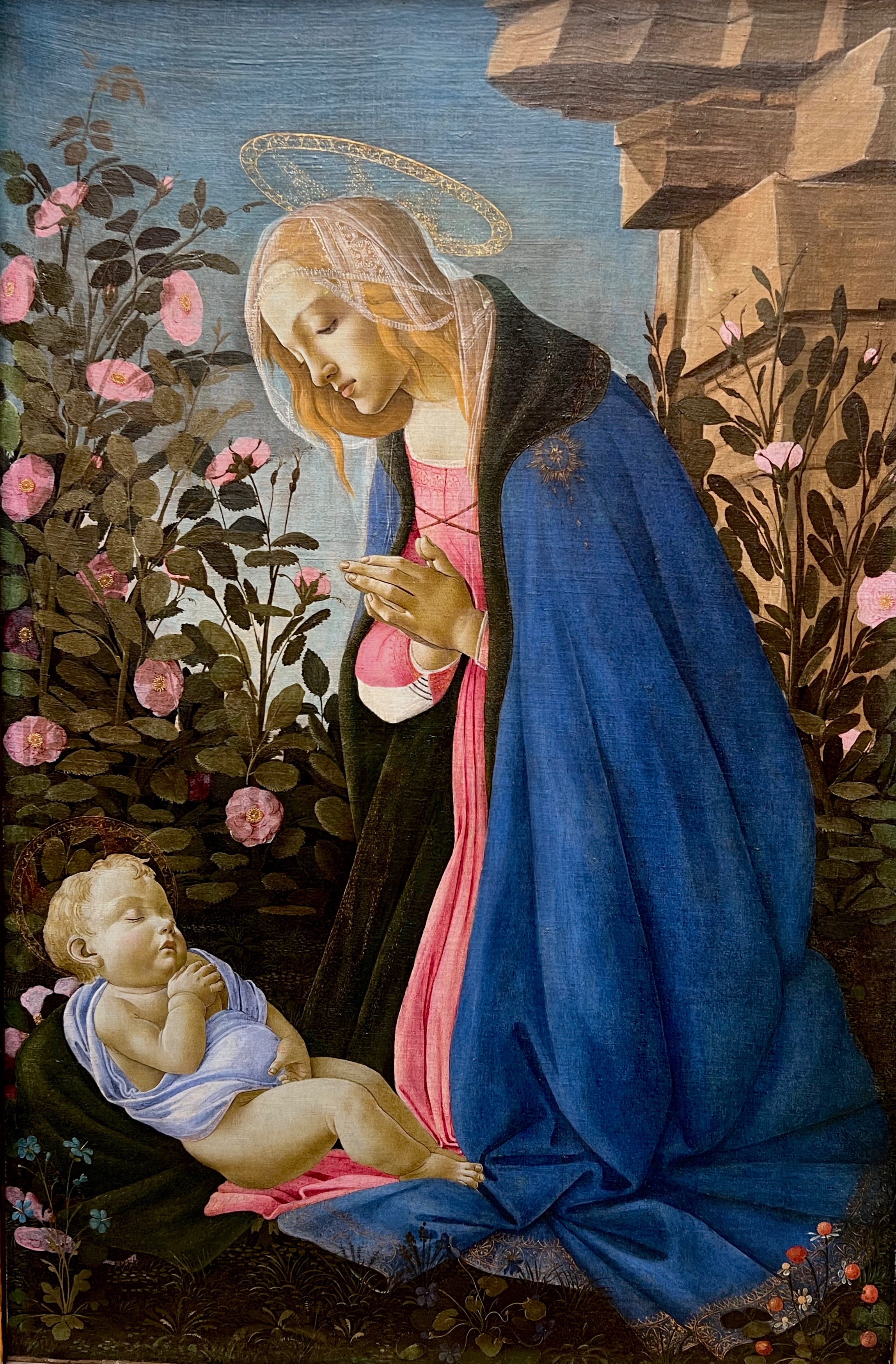
Sandro Botticelli, The Virgin adoring the sleeping Christ Child (c. 1485), Scotland National Gallery, Edinburgh.

What on earth happened last night—at that little stable on the edge of town? It was all so strange, so unbelievable. Some of us are still sleeping it off. Some of us didn’t get any sleep at all, or maybe we were asleep the whole time and it was all just a dream. 

There was a really bright star, and then the sky started singing: Gloria in excelsis Deo! It was angels, someone said. I don’t know about that, but it was so beautiful, as if music were being invented for the very first time. 

And suddenly, we all started running, don’t ask me why, until we came to this cave––it was a stable with a cow and a couple of donkeys––and in the back there was a woman lying down on some hay, and a man kneeling beside her. And between them there was a little baby, just a few hours old, I’d say. What a place to begin your life! They must have been pretty desperate to end up there. Maybe they were refugees. Or undocumented. I don’t know. But they didn’t look scared or out of place. They seemed to belong there. And you know, I had the feeling that I belonged there too. We all did. 

I can’t really explain it, but I got this feeling that everything in my life before that had just been waiting around for this moment, as if after a long and pointless journey I had finally come home. 

And I know it sounds weird, but I swear that little baby looked right at me, as if he knew who I was––or who I was going to be, because when I left that stable I knew––I knew!––that my life was never going to be the same. Pretty crazy, right? I kind of hope it was just a dream, because if it’s not—where is all this going to take me?

That’s how I imagine the morning after speech of a Bethlehem shepherd. Intoxicated by wonder, struggling to make sense of it, and feeling both curious and anxious about what happens now, after this wondrous birth. What happens to me, to you, to the whole wide world? A change is gonna come, yes it will. Yes it will, because what happens in Bethlehem doesn’t stay in Bethlehem. It goes home with us, it gets in our blood, it becomes part of our story. Nothing in the world will ever be the same again. Nothing in our lives will ever be the same again. 

And that is why, on the morning after, we listen to St. John’s grand prologue to the Fourth Gospel. Its cosmic perspective on the birth of Christ reminds us how vast and consequential was that humble birth in a lowly stable. 

In the beginning was the Word, and the Word was with God, and the Word was God. He was in the beginning with God. All things came into being through him, and without him not one thing came into being. . . And this divine Word became flesh and lived among us. (John 1:1-14)

In other words, God was not content to remain purely within the essence of the divine self. God desired to go beyond the inner life of the divine, to enter the confines and contingencies of time and space and history, to become incarnate as the mortal subject of a human life and experience the human condition from the inside. The Word was made flesh and dwelt among us.

What a fantastic thought: God wants to be with us—not just love us at a distance but to be intimate with us, in communion with us, participating in our humanity while enabling us to participate in divinity, because Incarnation means that divinity and humanity are now and forever inextricably joined.  Joy to the world, the Lord is come … let every heart prepare him room.

But perhaps we have some doubts about our capacity to receive such a guest. A 17th-century poet named Matthew Hale worried about this in a poem called “Christmas Day” (1659):

                           I have a room
‘Tis poor, but ‘tis my best, if thou wilt come
Within so small a cell, where I would fain [willingly]
Mine and the world’s Redeemer entertain; 

[He’s speaking about his heart here as the place he might entertain the world’s Redeemer;
Then he describes sweeping up the dust and cleaning up the mess, just as we would if we expected a houseguest. The poet will even try to wash this “room”—with his own penitent tears:]

And when ‘tis swept and washed, I then will go,
And with Thy leave, I’ll fetch some flowers that grow
In Thine own garden, [these flowers being faith and love];
With those I’ll dress it up …

yet when my best
Is done, the room’s [still] not fit for such a Guest. 

[Well, if we can’t make our lives and our souls fit dwellings to house the divine, who can? God. God can make us fit, the poet says:]

            Thy presence, Lord, alone
Will make [an oxen] stall a court, a cratch [manger] a throne.  

These days, it’s not very easy to believe that humanity is a fit habitation for the God of love and the Prince of Peace. It’s a sign of our sad times that Christmas got cancelled in Bethlehem this year. The war, you know. No liturgies in the Church of the Nativity, no pilgrims crowding Manger Square. They say Bethlehem is like a ghost town now. 

Posted on the Internet during the 2023 Gaza invasion (source unknown).

Sixty years ago, the Catholic contemplative Thomas Merton, who was not blind to the atrocities committed in his own time, could still say that we “exist solely for this, to be the place God has chosen for the divine Presence. The real value of our own self is the sign of God in our being, the signature of God upon our being.” [i] The Word indelibly inscribed on our own hearts and souls!

Some—theologians, poets, mystics—go even further, insisting that the Word becoming flesh means that the whole world is “charged with the grandeur of God.” [ii]  Maximus the Confessor, perhaps the greatest Byzantine theologian, put it this way in the 7th century: 

“For having hidden Himself for us in the inner principles of existent things, [God] is correspondingly spelled out by each visible thing as if by letters. [The Divine] is wholly present in all together in the fullest possible way and completely in each individually, whole and undiminished.”  [iii]

Contemporary songwriter Peter Mayer makes this point more simply: 

When I was a boy in Sunday school, we would learn about the time 
that Moses split the sea in two,
And Jesus made the water wine.
And I remember feeling sad miracles don’t happen still.
But now I keep track ‘cause everything’s a miracle:
Everything, everything, everything’s a miracle.…

This morning outside I stood and saw a little red-winged bird
Shining like a burning bush, singing like a scripture verse: 
It made me want to bow my head …
‘cause everything is holy now.
Everything, everything, everything is holy now. [iv]

In other words, what happens in Bethlehem doesn’t stay in Bethlehem.
It wants to happen everywhere.

We might call this the Bethlehem effect—discovering the Word made “flesh” in the concrete stuff of our world, our stories, our very lives. The great Christian poet of the 4th century, Ephrem the Syrian, describes the Bethlehem effect in one of his poems. He begins by proclaiming his Christmas joy:

Blessed be the Child Who today delights Bethlehem.
Blessed be the Newborn Who today made humanity young again.

[Then he describes the effect this holy birth wants to have on us:] 

On this day of the Humble One let us be neither proud nor haughty.
On this day of forgiveness let us not avenge offenses.
On this day of rejoicing let us not share sorrows.
On this sweet day let us not be vehement.
On this calm day let us not be quick-tempered.
On this day on which God came into the presence of sinners, 
let not the righteous look down on any sinner.
On this day on which the Lord of all came among servants, 
let the powerful bow down to the powerless.
On this day when the Rich One was made poor for our sake, 
let the rich share their table with the poor. [v]

On that holy night in Bethlehem, our human nature was lifted up when God chose to be one of us, to live and die as one of us. And we in turn may now share in the divine life. We are still works in progress no doubt, but we are bound for glory. St. Paul put this so beautifully: “All of us,” he said, “all of us, with our unveiled faces like mirrors reflecting the glory of the Lord, are being transformed into the image that we reflect in brighter and brighter glory” (II Cor. 3:18).

Another ancient theologian said it this way: “As they who behold the light are within the light and partake of its brightness, so they who behold God are within God, partaking of God’s brightness.” [vi]

They who behold the light are within the light and partake of its brightness. That’s the Christmas miracle! Our pale mirrors are made to contain the most impossible brilliance. And even when we turn away from the Light, the Light comes looking for us. No matter how shadowy the paths we have taken, the Light will find us, and fill us with divine radiance. That is our destiny, says the Child in the manger. To walk around “shining like the sun.” [vii]

 However … Before we get too carried away with our glorious destiny, listen to a line from the Victorian poet Mary Elizabeth Coleridge. When she imagines coming to the stable, and seeing the babe in the manger, she says:

The safety of the world was lying there.
And the world’s danger. [viii]

The babe in the manger is the world’s danger? What does she mean? I think she is saying that giving our lives to the Holy One will change everything. It will change who we are, what we care about, and how we live. In other words, participation in the divine life (which is the only way to become fully human) is not just a matter of “walking around shining like the sun.” 

It also means letting go of certain cherished things and taking up our cross. The story of the Incarnation is more than the beautiful new-born child away in the manger. The child will become a man, and he is going to ask some difficult things of us someday. 

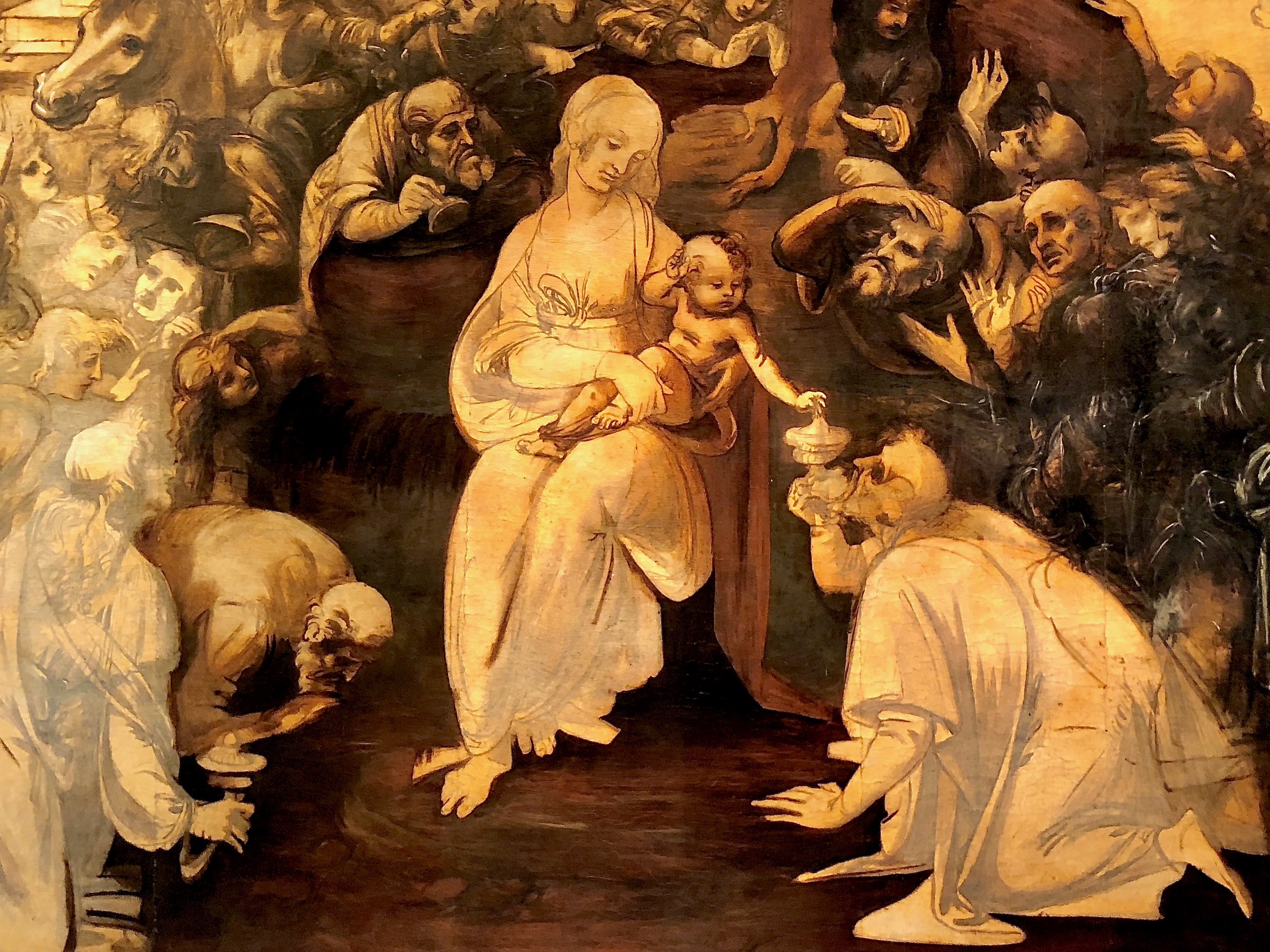
Leonardo da Vinci, Adoration of the Magi (1481-2).

I don’t want to go very far down that road on Christmas Day. The twelve days of Christmas are a time for celebration and feasting, carols and good cheer, light hearts and extravagant hopes, joy and wonder, and lots of love. But I do want to share a poem by Luci Shaw, a Christian writer now in her 90s. She reminds us that the lovely babe of Bethlehem is going to grow up, and that we’re going to have to grow up with him.

One time of the year
the new-born child
is everywhere,
planted in madonnas’ arms
hay mows, stables
in palaces or farms,
or quaintly, under snowed gables,
gothic angular or baroque plump,
naked or elaborately swathed,
encircled by Della Robia wreaths,
garnished with whimsical
partridges and pears,
drummers and drums,
lit by oversize stars,
partnered with lambs,
peace doves, sugar plums,
bells, plastic camels in sets of three
as if these were what we need
for eternity.

But Jesus the Man is not to be seen.
We are too wary, these days,
of beards and sandalled feet.

Yet if we celebrate, let it be
that He
has invaded our lives with purpose,
striding over our picturesque traditions,
our shallow sentiment,
overturning our cash registers,
wielding His peace like a sword,
rescuing us into reality
demanding much more
than the milk and the softness
and the mother’s warmth
of the baby in the storefront creche,
(only the [grown] Man would ask
all, of each of us)
reaching out
always, urgently, with strong
effective love
(only the [grown] Man would give
his life and live
again for love of us).

Oh come, let us adore him—
Christ—the Lord[ix]

Okay, I can’t leave you there, not on Christmas Day. So let me end on a note of wonder, with a poem by G. K. Chesterton. It was sung at this year’s Christmas Eve Lessons and Carols at Kings College, Cambridge. [x]

The Christ-child lay on Mary’s lap,
His hair was like a light.
(O weary, weary were the world,
But here is all aright.)

The Christ-child lay on Mary’s breast,
His hair was like a star.
(O stern and cunning are the kings,
But here the true hearts are.)

The Christ-child lay on Mary’s heart,
His hair was like a fire.
(O weary, weary is the world,
But here the world’s desire.)

The Christ-child stood at Mary’s knee,
His hair was like a crown.
And all the flowers looked up at Him,
And all the stars looked down.

Church of St. Mary the Virgin on Holy Island, Northumbria.

This sermon was preached at St. Barnabas Episcopal Church on Bainbridge Island, Washington, on Christmas Day, 2023.


[i] Thomas Merton, “A Letter on the Contemplative Life” (August 1967), in Lawrence S. Cunningham, ed., Thomas Merton: Spiritual Master—The Essential Writings (Mahwah, NJ: Paulist Press, 1992), 425.

[ii] Gerard Manley Hopkins, “God’s Grandeur.” 

[iii] Maximus the Confessor (c. 580-662). Quoted in Nikolaos Loudovikos, A Eucharistic Ontology: Maximus the Confessor’s Eschatological Ontology of Being as a Dialogical Reciprocity (Brookline, MA: Holy Cross Press, 2010), 125.

[iv] Peter Mayer, “Holy Now.”

[v] Ephrem the Syrian (c. 306-379), Hymns on the Nativity (trans. Kathleen E. McVey, Paulist Press, 1989), adapted from a citation in Wendy M. Wright, The Vigil: Keeping Watch in the Season of Christ’s Coming, Nashville, TN: Upper Room Books, 1992), 95-96. 

[vi] Irenaeus (c. 130-202), Against Heresies, IV.20.

[vii] The phrase is from Thomas Merton’s famous revelatory experience at the corner of Fourth & Walnut in Louisville in March 1958. “And if only everybody else could realize this! [the dignity of humanity conferred by the Incarnation]. But it cannot be explained. There is no way of telling people that they are all walking around shining like the sun.”

[viii] Mary Elizabeth Coleridge (1861-1907), “Salus Mundi.”  She was the great-grandniece of Samuel Taylor Coleridge. 

[ix] Luci Shaw, “It is as if infancy were the whole of incarnation,” quoted in Sarah Arthur, ed., Light Upon Light: A Literary Guide to Prayer for Advent, Christmas, and Epiphany (Brewster, MA: Paraclete Press, 2014), 125-126.

[x] G. K. Chesterton, “A Christmas Carol,” was sung in a lovely setting by John Rutter on the 2023 Lessons and Carols from Kings College, Cambridge, during the annual live BBC broadcast with which I begin every Christmas Eve at 7 a.m. Pacific Time.

What’s Going On at the Asbury Revival?

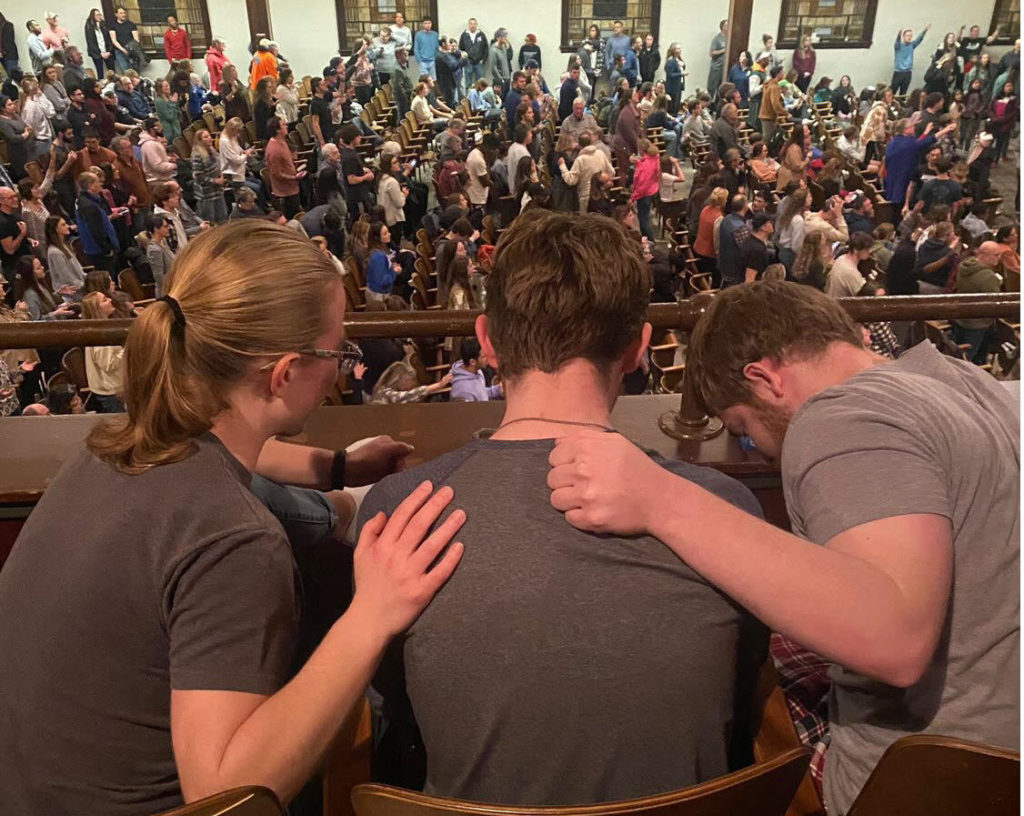
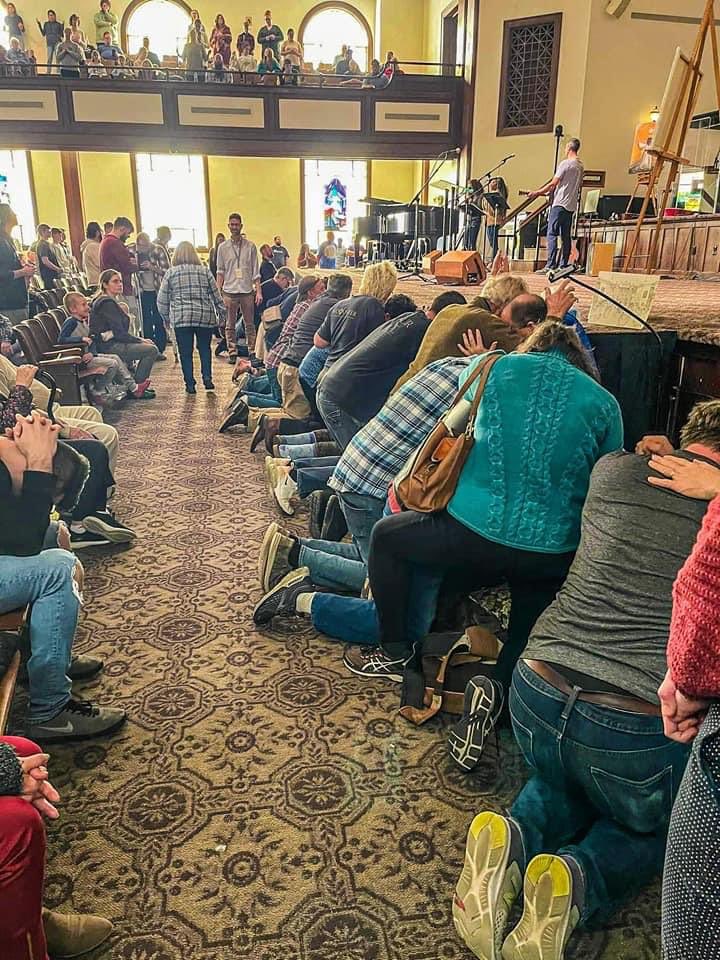
Asbury University Revival (February 2023).

True religion, in great part, consists in holy affections.

— Jonathan Edwards

“After Thursday, I was like, okay, I’m going to go sleep. But [God] was like, ‘No, I have more for you.’”

— Lauren, Asbury University student

On February 8 the morning chapel service at Kentucky’s Asbury University concluded, as usual, with a spiritual song. Then most of the students filed out to go to class, but the band kept playing, and a few stayed behind to sing along around the altar. What happened next has startled the world.

“I was like, all right, we’re just going to be around here for one or two more songs, and we’re going to go to class,” said Lena, an Asbury student. “But there was like something in my soul that said no-no-no, we’ve just got to stay here. So I just stayed. A little while later I thought I had only been there like maybe an extra 20 minutes. It had been like 3 hours. It just started turning into something bigger and crazier.” 

Word spread through the campus that people were still singing and praying in the chapel. Classrooms and dorms began to empty, and by the end of the day the 1500-seat worship space was packed with students and faculty, singing, praying, and testifying to the power of God in their lives. Two weeks later, it’s still happening, day and night without ceasing.

Live video on social media quickly went viral. People from all over North America began to converge on Asbury to join in. Still others flew in from faraway places like Finland, New Zealand, and Indonesia. University officials estimate that tens of thousands of pilgrims have shared in the experience. The line to get inside can be hours long.

It’s been called the Asbury Revival, but some are wary of this designation. Too many have been wounded or betrayed by manipulative gatherings and domineering evangelists in the name of “revival.” Some prefer to call it an “outpouring” (the university’s preference), a “renewal,” or an “awakening.” One student said she was switching from “revival” to “encounter” because the divine presence, not the internal experience of the worshipper, was the central meaning here. 

Whatever is happening, the watchword has been “radical humility.” Student Asher Braughton says, “I truly believe that the revival has been built on humility; that this revival isn’t focused just on one person—not one worship leader, not one pastor, not one speaker, not one student. It’s focused solely and only on Jesus Christ.” Or as one of the event’s speakers put it: “The only celebrity in this house is Jesus.”

During the “Great Awakening” in the eighteenth-century, the emotional excesses of the revivals worried the church establishment. Was it sincere? Was it of God? Historian George M. Marsden summarizes the criticisms in vivid terms: “Using vulgar appeals to sentiment, they would generate mass hysteria that they encouraged people to regard as evidence of the work of the Holy Spirit. Scores or even hundreds of people would shriek, swoon, or fall into fits.” 

Although one student leader, mindful of the building’s aging fabric, had to announce that there would be “no jumping allowed in the balconies,” the tone in the room has been generally mellow. A youth minister described it as walking into “a holy hush.” There have been moments of exuberant cheering and clapping, but much of the music and prayer invites a tranquil surrender to the spiritual flow. Watching it online, I thought of Thomas Merton’s gently fervent plea: “Sink from your shallows, soul, into eternity.”

On the first day, Asbury professor Clint Baldwin was having lunch in the cafeteria when someone stopped at his table to say, “You know, the students are still in there, and they’re still worshipping the Lord. You should go over and see what’s happening. It’s a sweet, sweet thing.” Baldwin soon joined the awakening and saw that it was good. “This was just people saying we’re going to stay on and sit in the presence of the Lord and see what the Lord would have for us.”

Lauren, the student quoted in the epigraph, described the worship as all-consuming: “Nothing else matters anymore except being in the presence of Jesus and worshipping him for the rest of my life.” She acknowledged the hyperbole of this—she would of course continue with the life of a student—but her perspective on everything had been transformed. “Ways I have of viewing people negatively—it doesn’t matter anymore. Anxieties and worries that I have, it doesn’t even matter.… Whenever you can just let go and surrender and forgive, then, you’re just set free.”

The majority of worshippers are under 25. Living through a time of immense stress, they hunger for the healing peace of God. In spontaneous prayer groups around the chapel, or in testimonials from the stage, many have openly shared their deepest griefs and heaviest burdens. Their vulnerability has been met with tenderness and love. When a young woman shared her story of attempted suicide before the whole assembly, a multitude of women came forward to lay their hands on her. “An hour later she was dancing and smiling with a joy on her face that I had never seen before,” said one witness. 

“God is moving through this generation that has been so affected by mental health,” says Asher. “Once this revival ends, we can carry this message of goodness and forgiveness … The chains of suicide, the chains of depression, the chains of anxiety can be broken in Jesus.” Many of the songs reflect this hope in their melodic repetitions of heartfelt cries: 

Jesus, Jesus, you make the darkness tremble— 
your name is a light the shadows can’t deny …
You’re never gonna let, you’re never gonna let me down … 
He is for you, He is for you, He is for you …

There are of course critics and skeptics. All religious experience is bewildering, even suspect, for those who stand outside it. It is a reality both given and received, not grasped or possessed. Its truth abides in its own domain of experience. You can’t judge it at a distance, as a spectator. You have to go inside it, open your heart to it, be in loving relationship with it. As the mystics testify, certainty is only found within the experience.

Among believers, there is certainly a proper concern about delusion and self-deception. “Even Satan disguises himself as an angel of light” (2 Cor. 11:14). But religious experience can be tested by its fruits. Asbury’s president, Kevin J. Brown, is an encouraging witness to the Outpouring’s authenticity:

“Since the first day, there have been countless expressions and demonstrations of radical humility, compassion, confession, consecration, and surrender unto the Lord. We are witnessing the fruit of the Spirit: love, joy, peace, patience, kindness, generosity, faithfulness, gentleness and self-control.”

Some may worry that the strongly personal nature of the Asbury Outpouring excludes concerns beyond the self like racism, social justice, global conflict, and the fate of the planet. However, nothing I have seen or read so far suggests that these young people disconnect personal transformation from social change. Surrendering to God is inseparable from a lifetime of service to neighbor and world. One’s own soul is too small a kingdom for the Lord of history. The collective witness and shared compassion of the Outpouring bears witness to that truth. 

As for the abundance of deep feeling, vulnerability, open-heartedness, and the ecstatic willingness to be swept away, we need more, not less of that in the Christian life. Those kids are singing and praying and testifying as if their lives depend on it; as if God matters more than anything; as if Jesus will wipe away the tears from every eye; as if a new reality is breaking through the cracks of our broken world. 

But can it last? The particular happening in Asbury’s chapel is winding down this week. The university needs to resume its institutional mission, and the town of Wilmore, hospitable as it has been, can’t handle the crowds forever. “It is not ours to hold alone,” Brown says. “We are not the keepers of this movement … Pray that what is happening here will spread.” 

Although it seems a bit sad that this foretaste of heaven—singing around the throne for all eternity—must come to an end in the temporal world, the Holy Spirit blows where it will. Outbreaks of public Christian fervor and collective spiritual passion may turn up elsewhere, take new forms, or return to a dormant state until the next eruption. Revelation, not longevity, is the point of epiphanies. They have their moment and vanish, but their impact—and the truth they manifest—endures in hearts and minds and communities.

I have no doubt that many of those who are living through this experience will be forever changed by it, as will the worlds they inhabit and the people they touch. Professor Baldwin, recalling similar revivals at Asbury in the 1950s and 1970s, notes that “people still talk about those [past] moments in revival that shaped the trajectory of how they chose to live for the sake of the Lord onward from that. That’s a hope that we would have for this.”

Even watching online from afar, I have found myself deeply moved by the Spirit-filled assembly. I especially love the heartfelt singing and the manifestation of shared joy. One of my favorite parts was today’s invitation for people to come forward and recite their favorite verses from Scripture. When a small African-American boy read from the prophet Joel (2:28), delivering that luminous text with his boyish voice—innocent as Eden—I was blown away: 

Then I will pour out my spirit on all flesh; 
your sons and your daughters shall prophesy, 
your old ones shall dream dreams,
and your young ones shall see visions …

Joel’s prophecy has taken flesh at Asbury, day after day since the eighth of February—all those beautiful young faces, shining with God’s future. Like the rest of us, they will lose it and find it again and again. But they have set their feet upon the sacred Way. God bless them.


The Outpouring will continue to be streamed by Asbury University through Thursday, February 23, at https://www.asbury.edu/outpouring/

The words of Clint Baldwin, Asher Braughton, Lauren, Lena and Kyle (the youth minister) are taken from a February 12 conversation with Shane Claiborne on his YouTube channel, Red Letter Christians: “Update from the Asbury University Revival”

The words of Asbury President Kevin J. Brown can be found at the Outpouring link above.

The Pursuit of Happiness

Comet Falls, Mt. Rainier National Park (July 29, 2005).

The tables outside the cantina were full of beautiful laughing men and women.… Everyone who sat there looked on display, the women in their lovely summer dresses, the men with their hair oiled back on their heads, their tanned bare feet resting proprietorially on top of their Gucci loafers. One wanted to applaud them for presenting such a successful vision of life: you could almost believe they had lived their whole lives, had been reared and groomed from birth, for this one particular night: that this was the pinnacle, this golden summery evening they had all reached simultaneously. 

Yet it made me a little sad to see them there, laughing and drinking champagne, for you knew it was all downhill from here.[i]

— Peter Cameron, Andorra

The narrator in Cameron’s novel experiences the “golden summery evening” at the cantina through the lens of his own unhappiness. He has fled a failed life in America for a Mediterranean idyll, but joy continues to elude him. This apparently happy scene of shared human pleasure only deepens his alienation. Unable to join the fun, he judges the beautiful, laughing people for their complacency, their privilege, and their shallow indifference to mortality. 

In Michael Cunningham’s The Hours, Clarissa Vaughan recalls her own close encounter with happiness, when she made the mistake of thinking it would last. 

It had seemed like the beginning of happiness, and Clarissa is still somewhat shocked, more than thirty years later, to realize that it was happiness.… What lives undimmed in Clarissa’s mind more than three decades later is a kiss at dusk on a patch of dead grass, and a walk around a pond as mosquitoes droned in the darkening air. There is still that singular perfection, and it’s perfect in part because it seemed, at the time, so clearly to promise more. Now she knows: That was the moment, right there. There has been no other. [ii]

What is happiness? It can be pursued, but can it be possessed? The word is derived from “hap,” an Old English term for fortune or chance—something that happens to us, for good or ill. But “happy” and “happiness” have come to denote only the good things, without the mishaps. 

If asked to recall our happiest moments, a multitude of memories would rise to the surface. But if asked whether we are happy now, or living happy lives, how would we answer? The University of Pennsylvania is conducting an online Authentic Happiness Survey, with twenty-four groups of five statements each to measure the presence or absence of happiness. Group 24, for example, offers the following choices: 

  1. My life is a bad one.
  2. My life is an OK one.
  3. My life is a good one.
  4. My life is a very good one.
  5. My life is a wonderful one. 

The #1 statement in a group is always pretty dismal (I’m usually in a bad mood … I’m pessimistic … I am unhappy with myself … I feel like a failure, etc.) The #5 statement sounds way too good to be true (My life is filled with pleasure … If I were keeping score in life, I would be far ahead … I always get what I want … My life is filled with joy … I could not be happier with myself, etc.). 

The majority of my own answers landed in the middle (#3), reflecting a pretty typical mix of highs and lows. I had no #1s, a couple of #2s, six #4s (three due to privilege, three due to personality), and two #5s (“I truly love my work” and “Most of the time I am fascinated by what I am doing”—both of these reflecting a mixture of privilege, personality, and the good fortune of getting to do what I love). My authentic happiness score was 3.46 out of 5. That seems about right for a privileged white male occasionally beset by the minor melancholies of disappointed hopes, both personal and generational.

It was an interesting survey, one of many attempts to grapple with the unhappiness of our times. Currently, the most popular course at Yale is “Psychology and the Good Life,” created by Professor Laurie Santos in response to the mental health crisis among college students, who, she says, are “much more overwhelmed, much more stressed, much more anxious, and much more depressed than they’ve ever been.” 

In a survey of Yale students taken before the pandemic, 60% said they had felt “overwhelmingly anxious” sometime during the last year. And 50% reported feeling “completely overwhelmed” in the past week. For many college students, and for Americans in general, “happiness feels increasingly out of reach.” The pandemic, climate change, and the politics of fear and hate have multiplied our sorrows and anxieties almost beyond measure.

According to University of California (Irvine) professor Sonia Lyubomirski, author of The How of Happiness, 50% of one’s happiness is determined by genes, while 40% flows from our thoughts, actions, and attitudes. That leaves only 10% attributable to circumstances, although many people believe that circumstance is the key factor in personal happiness. If I change my job, my home, my partner, I will be happier. Lyubomirski’s numbers assume, of course, that one’s basic needs are being met. For a war zone Ukrainian, a Central American refugee, or a long Covid sufferer, circumstance weighs far more heavily.

Santos’ course, and her ongoing podcast, The Happiness Lab, seek to help people address the more significant 40% factors: thoughts, actions, and attitudes. I’ve only listened to the first episode, but many have testified to the value of her efforts.[iii]

Happiness is a subject of supreme interest. Everyone wants it, but for many it seems in short supply. It’s also hard to define. A century ago, Vita Sackville-West questioned its usefulness as an index for life.

But what was happiness? Had she been happy? That was a strange, clicking word to have coined—meaning something definite to the whole English-speaking race—a strange clicking word with its short vowel and its spitting double p’s, and its pert tip-tilted y at the end, to express in two syllables a whole summary of life. Happy. But one was happy at one moment, unhappy two minutes later, and neither for any good reason; so what did it mean? … Certainly, there had been moments of which one could say: Then, I was happy; and with greater certainty: Then, I was unhappy—when little Robert had lain in his coffin, for instance, strewn with rose petals by his sobbing Syrian nurse—but whole regions had intervened, which were just existence. Absurd to ask of those, had she been happy or unhappy? … No, that was not the question to ask her—not the question to ask anybody. Things were not so simple as all that. [iv]

Well then. Am I happy or unhappy? I have had moments and days when it was indeed bliss to be alive. But what should I say about those intervening regions where the evidence is mixed? Is happiness only an occasional oasis in the desert of ordinary time, or can happiness reside in the barren places as well?

“Small things go a long way,” says Zadie Smith. “All day long I can look forward to a Popsicle. The persistent anxiety that fills the rest of my life is calmed for as long as I have the flavor of something good in my mouth,” [v] Rebecca Solnit, arrested for demonstrating at a nuclear test site in the Nevada desert, said that “even when you’re in handcuffs, the sunset is still beautiful.” [vi]

In The Spiritual Meadow, John Moschos’ seventh-century collection of tales about desert monastics, an elder warns a wayward disciple, “Brother, pay attention to your own soul, for death awaits you and the road to punishment.” The disciple took little heed, and when he died, the elder continued to worry about his fate. 

The elder fell to his prayers and said, “Lord Jesus Christ, reveal to me the state of the brother’s soul.” He went into a trance and saw a river of fire with a multitude of people in the fire itself. Right in the middle was the brother, submerged up to his neck. The elder said to him, “Didn’t I warn you to look after your own soul, my child?” And the brother answered, “I thank God, father, that at least my head is spared from the fire. Thanks to your prayers, I am standing on the head of a bishop.” [vii]

Even in hell, small things go a long way! And happiness can turn up anywhere, as poet Jane Kenyon reminds us:

There’s just no accounting for happiness …
It comes to the monk in his cell.
It comes to the woman sweeping the street
with a birch broom, to the child
whose mother has passed out from drink.
It comes to the lover, to the dog chewing 
a sock, to the pusher, to the basket maker,
and to the clerk stacking cans of carrots 
in the night. [viii]

We are grateful when it comes, and for the memory it leaves. But happiness is more than the occasional perfect moment. It is a practice, a way of being, a fullness of life which transcends the inevitable fluctuations of fortune. Such a practice might be summarized in two words: authenticity and love. 

At my ordination to the priesthood (September 17, 1970).

Authenticity is fidelity to your truest self: becoming more and more like the person you have been created and called to be. Sometimes the way is rough and steep. Sometimes you get lost or delayed. But by God’s grace, you embrace the journey. Parker Palmer describes this process as a matter of vocation:

Our deepest calling is to grow into our own authentic selfhood, whether or not it conforms to some image of who we ought to be. As we do so, we will not only find the joy that every human being seeks—we will also find our path of authentic service in the world. True vocation joins self and service, as Frederick Buechner asserts when he defines vocation as “the place where your deep gladness meets the world’s deep need.” [ix]

Authenticity, then, finds its greatest expression in acts of love. Becoming our truest self takes us beyond our individuality, into the interdependent communion of the Divine Whole. My own happiness cannot be sustainably severed from collective well-being. Happiness, as it turns out, is not a private affair. It is the way of self-diffusive, self-offering love. And until justice and human flourishing are universally shared, the way of love will include suffering. Self-sacrifice for love’s sake can be costly and painful, as Jesus and the saints have shown. Happiness accepts the truth of that. No justice, no peace. But it is also true, as Catherine of Siena said, that “all the way to heaven is heaven.” You don’t have to wait until the end of time for happiness to show up.

“Do not look for rest in any pleasure,” said Thomas Merton, “because you were not created for pleasure; you were created for JOY.” [x]  Happy are those with a hungry heart. Happy are those who give themselves away. Happy are those who do not mistake crumbs for the feast. Happy are those who know it’s not just about them. Happy are those who say yes to the gift. Happy are those who yearn for the Divine Beloved. Happy are those who don’t count the cost. Happy are those who love their story. 

On the summit of Mount Sinai (May, 1989). Blessed is the way up. Blessed is the way down.
The trail is beautiful. Be still.

We think of Saint Francis of Assisi as a joyful saint, but he was also pierced by the stigmata, the wounds of Christ. And he taught that the most perfect joy is to be found neither in worldly things nor in spiritual enjoyments. Nor is perfect joy simply a matter of pleasure, contentment, or delight. This was bewildering and counterintuitive for his brothers, so he explained it this way:

“Imagine coming home to the monastery on a stormy night.
We knock on the door, but it is so dark
that the surly porter mistakes us for tramps.
‘Go away!’ he shouts.
And if we continue to knock and the porter comes out 
and drives us away with curses and hard blows—
and if we bear it patiently
and take the insults with joy and love in our hearts.
Oh Brother Leo, write down that that is perfect joy! 
Above all the graces and gifts of the Holy Spirit 
which Christ gives to his friends is that of conquering oneself 
and willingly enduring sufferings, insults, humiliations and hardships 
for the love of Christ.” [xi]

Saint Francis wouldn’t have sold many self-help books, but he knew that happiness unacquainted with suffering and sorrow isn’t the real deal. “If it be sweet, if it be not sweet,” [xii] my story is what I was made for. My story is why I’m here. Happiness is saying yes to the story’s gift with a thankful heart.

The late Joseph Golowka, one of my most beloved elders, still roughing it in Baja at 86 (Sept. 24, 2005).

When I go back to earth
And all my joyous body 
Puts off the red and white
That once had been so proud,
If men should pass above
With false and feeble pity,
My dust will find a voice
To answer them aloud: 

“Be still, I am content,
Take back your poor compassion!—
Joy was a flame in me
Too steady to destroy.
Lithe as a bending reed
Loving the storm that sways her—
I found more joy in sorrow
Than you could find in joy.” [xiii]

— Sara Teasdale, “The Answer” 


[i] Peter Cameron, Andorra (New York: Farrar, Straus and Giroux, 1997), 149-150.

[ii] Michael Cunningham, The Hours (New York: Farrar, Strauss and Giroux, 1988), 98.

[iii] The statistics and quotes from Santos and Lyubomirsky are found in Adam Sternbergh, “The Case for New York Face,” in Lapham’s Quarterly, Vol. XII, No. 3 (Summer 2019), 81-85. Four times a year, Lapham’s Quarterly presents a marvelous and stimulating collection of writings and images from many periods and sources on a given topic. This issue’s subject is “Happiness.” Sternbergh’s article was originally published in New York Magazine in 2018. Additional quotes from Santos were taken from her podcast, The Happiness Lab, Season 1, Episode 1 (“You Can Change”): https://www.happinesslab.fm

[iv] This excerpt from Sackville-West’s novel, All Passion Spent (1931), is also in the “Happiness” issue of Lapham’s Quarterly, p. 139.

[v] Ibid., 134. Smith’s excerpt is from her essay “Joy” (New York Review of Books, Jan. 10, 2013). 

[vi] Rebecca Solnit, Storming the Gates of Paradise: Landscapes for Politics (Berkeley: University of California Press, 2007).

[vii] John Moschos, The Spiritual Meadow (written c. 600), trans. John Wortley (Collegeville, MN: Cistercian Publications, 1992/2008), 35. 

[viii] Jane Kenyon, “Happiness.”  

[ix] Parker Palmer, Let Your Life Speak: Listening for the Voice of Vocation (San Francisco: Jossey-Bass, 2000), 16.

[x] Thomas Merton, Seeds of Contemplation (1949), p. 172. Cited in William H. Shannon, Christine M. Bochen, Patrick F. O’Connell, eds., The Thomas Merton Encyclopedia (Maryknoll, NY: Orbis Books, 2002), 231.

[xi] Adapted from The Little Flowers of St. Francis, 53 chapters on the life of Francis of Assisi written at the end of the 14th century.

[xii] Anne Sexton, “Rowing.” “As the African says, / This is my tale which I have told,/ If it be sweet, if it be not sweet,”/ Take somewhere else and let some return to me.…” 

[xiii] Sara Teasdale, “The Answer,” in Christian Wiman, ed., Joy: 100 Poems (New Haven: Yale University Press, 2017), 138. 

On the Morning After the Nativity

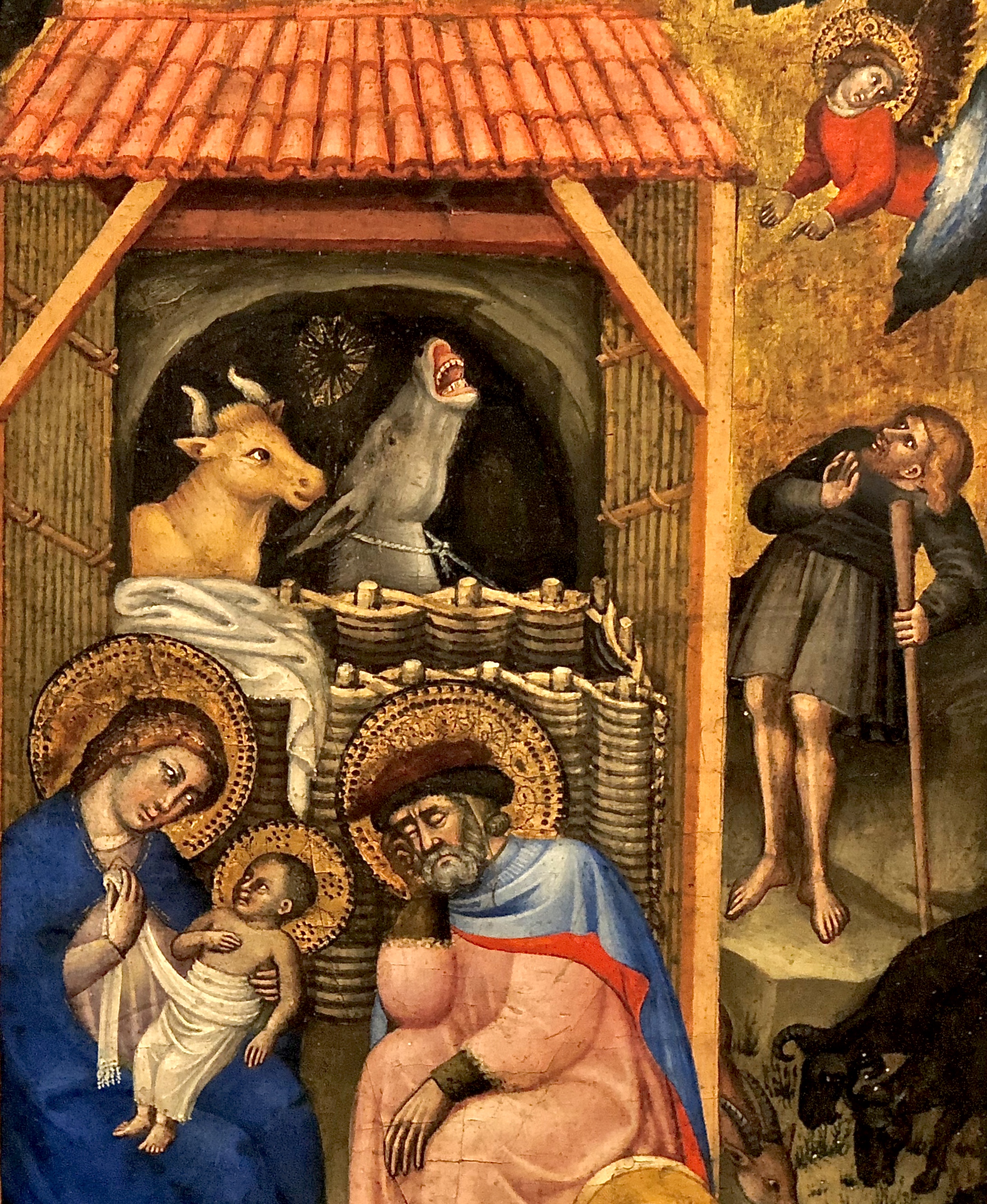
Simone di Filippi, Nativity (c. 1380, Uffizi Gallery, Florence).

That glorious Form, that Light unsufferable, 
And that far-beaming blaze of Majesty, 
Wherewith he wont at Heav’n’s high council-table, 
To sit the midst of Trinal Unity, 
He laid aside, and here with us to be, 
Forsook the courts of everlasting day, 
And chose with us a darksome house of mortal clay. 

— John Milton, “Ode on the Morning of Christ’s Nativity”

What on earth happened last night—at that little stable on the edge of town? It was all so strange, so unbelievable. Some of us are still sleeping it off. Some of us didn’t get any sleep at all, or maybe we were asleep the whole time and it was all just a dream. 

There was a really bright star, and then the sky started singing: Gloria in excelsis Deo! It was angels, someone said. I don’t know about that, but it was so beautiful, as if music were being invented for the very first time. 

And suddenly, we all started running, don’t ask me why, until we came to this cave––it was a stable with a cow and a couple of donkeys––and in the back there was a woman lying down on some hay, and a man kneeling beside her. And between them there was a little baby, just a few hours old, I’d say. What a place to begin your life! They must have been pretty desperate to end up there. Maybe they were refugees. Or undocumented. I don’t know. But they didn’t look scared or out of place. They seemed to belong there. And you know, I had the feeling that I belonged there too. We all did. 

I can’t really explain it, but I got this feeling that everything in my life before that had just been waiting around for this moment, as if after a long and pointless journey I had finally come home. 

And I know it sounds weird, but I swear that little baby looked right at me, as if he knew who I was––or who I was going to be, because when I left that stable I knew––I knew!––that my life was never going to be the same. Pretty crazy, right? Part of me hopes it was just a dream, because if it’s not, I have no idea what happens next. But I have to admit I’m a little nervous about where all this is going to take me.[i]

That’s how I imagine the “morning after” speech of a Bethlehem shepherd. After such a vision, he’s intoxicated by wonder, struggling to make sense of it, and feeling both curious and anxious about what happens now, after this wondrous birth. What will happen now—to me, to you, to the whole wide world? A change gonna come, yes it will.[ii] Yes it will, because what happens in Bethlehem doesn’t stay in Bethlehem. It goes home with us, it gets in our blood, it becomes part of our story. Nothing in the world will ever be the same again. Nothing in our lives will ever be the same again. 

And that is why, on the morning after, we listen to St. John’s grand prologue to the Fourth Gospel. Its cosmic perspective on the birth of Christ reminds us how vast and consequential was that humble birth in a lowly stable. 

In the beginning was the Word, and the Word was with God, and the Word was God. He was in the beginning with God. All things came into being through him, and without him not one thing came into being. . . And this divine Word became flesh and lived among us (John 1:1-14).

In other words, God was not content to remain purely within the confines of the divine self. God desired to go beyond the inner life of the divine, to enter the confines of time and space and history, to become incarnate as the mortal subject of a human life and experience the human condition from the inside. The Word was made flesh and dwelt among us.

What a fantastic thought: God wants to be with us—not just love us at a distance but to be intimate with us. Joy to the world, the Lord is come … let every heart prepare him room. But perhaps we have some doubts about our capacity to receive such a guest. 

I’ve been reading a couple of 17th-century poets who expressed their own doubts our capacity to host divinity. Matthew Hale (1609-1676) in a poem titled “Christmas Day” (1659), said:

                                    I have a room
‘Tis poor, but ‘tis my best, if thou wilt come
Within so small a cell, where I would fain [willingly]
Mine and the world’s Redeemer entertain … 

Here he’s speaking about his heart as the place he would entertain the Redeemer. He goes on to describe sweeping up the dust and cleaning up the mess, just as we would if we expected an important houseguest. The poet even attempts to wash this “room”—with his own penitent tears.

And when ‘tis swept and washed, I then will go,
And with Thy leave, I’ll fetch some flowers that grow
In Thine own garden [i.e., the flowers of faith and love];
With those I’ll dress it up …
yet when my best
Is done, the room’s [still] not fit for such a Guest. 

Well, if we can’t make our hearts fit dwellings to house the divine, who can?
Only God can make us so:

            Thy presence, Lord, alone
Will make a stall a court, a cratch [manger] a throne.  

The poet/priest George Herbert, in his own “Christmas” poem (1633), expresses the same need for divine assistance:

O thou, whose glorious, yet contracted light,            
Wrapt in nights mantle, stole into a manger;
Since my dark soul and brutish is thy right,    
To Man of all beasts be not thou a stranger:             

Herbert’s poetry is always resonant with Scriptural references. “Beasts” recalls Psalm 49:12—prideful humans are like “the beasts that perish”—while “a stranger” evokes Ephesians 2:12—without Christ, we remain “strangers to the covenants of promise.”

Then Herbert, like Hale, calls upon God as the only one who can complete his moral and spiritual remodeling project: 

Furnish & deck my soul, that thou mayst have         
A better lodging, than a rack, or grave. 

“Rack” is another word for a manger, but it can also mean an instrument of torture, suggesting the cross. In other words, the first time Christ came, humanity provided him the cross and the grave. The poet prays that next time Christ comes to us, we may give him better lodging—a newly furnished soul, adorned with God’s grace. 

Both of these poets were saying: Let every heart prepare him room. But they were also confessing that such preparation is more than we can do by ourselves. However, with God’s help, we may yet become fit lodging for divine presence. 

In the 20th century, whose atrocities left our confidence in human potential badly shaken, the Catholic contemplative Thomas Merton could still claim that we “exist solely for this, to be the place God has chosen for the divine Presence. The real value of our own self is the sign of God in our being, the signature of God upon our being.” 

Merton wrote this after a life-changing experience at the corner of Fourth and Walnut in downtown Louisville. As he was studying all the faces of the milling crowd, he suddenly felt an overwhelming love for all of them, even though they were all strangers to him. It was like what the shepherds experienced in the Bethlehem stable, where, as W. H. Auden said in his own Christmas poem, “everything became a You and nothing was an It.” [iii]  Merton would later put his street-corner epiphany at into words.

“It is a glorious destiny to be a member of the human race, though it is a race dedicated to many absurdities and one which makes many mistakes: yet, with all that, [God’s own self] glorified in becoming a member of the human race. 

“I have the immense joy of being [a human person], a member of a race in which [God’s own self] became incarnate. As if the sorrows and stupidities of the human condition could overwhelm me, now I realize what we all are. And if only everybody could realize this! But it cannot be explained. There is no way of telling people that they are all walking around shining like the sun.” [iv]

Just so, on that wondrous Christmas night in Bethlehem, our human nature was lifted up as the place where God chooses to dwell. We are still works in progress no doubt, but we are bound for glory. St. Paul believed this when he said that “all of us, with our unveiled faces like mirrors reflecting the glory of the Lord, are being transformed into the image that we reflect in brighter and brighter glory” (II Cor. 3:18).

A thousand years later, St. Symeon the New Theologian echoed Paul’s luminous text: “As they who behold the light are within the light and partake of its brightness, so they who behold God are within God, partaking of God’s brightness.”

They who behold the light are within the light and partake of its brightness. Our pale mirrors are made to contain the most impossible brilliance. And even when we turn away from the Light, the Light comes looking for us. No matter how shadowy the path we have taken, the Light will find us, and fill us with divine radiance. That is our destiny, says the Child in the manger. 

What happens in Bethlehem does not stay in Bethlehem.

Nativity (12th century), Cloister of St. Trophime, Arles, France. 

Bethlehem is not a dream fading away into the past. It is the human future. And Christmas Day is not the morning after. It is the first day of the rest of our journey deeper and deeper into God. And whether we know it or not, as we walk that pilgrim road, we are all shining like the sun.

As we used to say back in the day, “Can you dig it?” Can you embrace the wonder of the holy birth: the immensity of heaven cloistered in one small room, be it the Virgin’s womb, the Bethlehem stable, the human heart, or whatever place you’re in right now? Can you embrace the wonder? Will you?

The world wants you to believe far less. 
But why would you want to do so?  

In a novel by the Anglican writer Charles Williams, a young woman goes to church with her aunt on Christmas morning. She is a seeker, not quite a believer, but she finds herself touched by a carol they are singing:

Christians, awake, salute the happy morn
Whereon the Savior of the world was born;
Rise to adore the mystery of love, 
Which hosts of angels chanted from above. 

The young woman leans over and whispers to her aunt, “Is it true?” Her aunt, one of those quiet saints who has spent her life submitting to divine love, turns to her niece with a smile and says simply, “Try it, darling.”[v]


[i] It’s a risky thing to follow Jesus. At the end of the Fourth Gospel, Jesus tells Peter that “someone else will put a belt around you and take you where you would rather not go” (John 21:18).

[ii] Sam Cooke’s prophetic cry for social transformation was influenced by Martin Luther King’s “I have a dream” speech and Bob Dylan’s “Blowin’ in the Wind.” Cooke said the song came to it in a dream. Listen to it and imagine a shepherd singing it after the Nativity: https://youtu.be/fPr3yvkHYsE

[iii] W. H. Auden, For the Time Being: A Christmas Oratorio. The line is from the Narrator’s concluding speech. Auden’s marvelous poetic dramatization of the Nativity, written during the dark days of World War II, is imbued with hope. Alan Jacobs’ helpful annotated edition is highly recommended (Princeton University Press, 2015).

[iv] Thomas Merton, Conjectures of a Guilty Bystander (1966).

[v] Charles Williams’ Christmas novel is The Greater Trumps (1932).

“The year changing its mind”— Embracing Impermanence at the Autumnal Equinox

Cherry Tree, University of Washington.

These are the last days.
Already the stalks of lilies
have withered, and the gold petals
of the rose melt on the grass.

— Patricia Hooper, “Equinox” [i]

Summer has just ended, twenty minutes past noon in the Pacific Northwest. I am always sorry to see it go. The languorous days, granting us license to play and to dream, now bid us farewell. The year’s shadowless noon gives way to the urgencies of time. Poet Penelope Shuttle describes September’s turning point with succinct perfection: “The year changing its mind.” [ii] The autumn may be agreeably mellow at first, but we all know where it’s headed. Every Arcadia must fail in the end, every Paradise be lost.

Yesterday I made my final communion with summer in a tranquil float down the Deschutes River. Ponderosa pines, willows and tall grasses lined the banks. Snowy egrets swept past on radiant wings. An osprey spiraled upward into the blue. My mind sank into stillness. I knew nothing but Now. 

Deschutes River, Sunriver, Oregon.

When I threw some books into my suitcase for an end-of-summer vacation in eastern Oregon, I didn’t realize how autumnal my reading would turn out to be. Patrick Leigh Fermor’s account of his epic walk from the Hook of Holland to Constantinople—before he turned 20—preserves his vivid memories of an exotic world, from shepherds’ campfires in the Carpathian wilds to the sumptuous libraries in the country estates of cultured Austro-Hungarian patricians. But Fermor didn’t write his trilogy until he was an old man, long after the Middle Europe of 1934 had been swept away. The reader feels the shadow of not only lost youth but also a lost world. [iii]

Johan Huizinga’s The Autumn of the Middle Ages documents the passing away, in the cultural imagination of France and the Netherlands, of chivalric dreams of a more beautiful life. Before the sadness of fate and history set the dominant tone, says Huizinga, “in many respects life still wore the color of fairy tales.” [iv] At the end of the 14thcentury, a French poet summed up the spirit of his despondent age: 

La fin s’approche, en verité …
Tout va mal.

The end is truly near …
Everything is going bad. [v]

At a time when so much of our own “reality” seems to be a fading dream—democracy, climate, human health, civic sanity—the poet’s autumnal lament rings true. Happily, I brought a third book, containing a cure for such melancholy themes. In Thomas Merton’s journal of his experiences in the far East, the Catholic contemplative wonders whether he is seeing the “real Asia,” or simply finding “an illusion of Asia that needed to be dissolved by experience.” In a deep valley within the Himalayan foothills, he is instructed by the landscape:

“What does this valley have? Landslides. Hundreds of them. The mountains are terribly gashed, except where the forest is thick. Whole sections of tea plantations were carried away six weeks ago. And it is obviously going to be worse the next time there are really heavy rains. The place is a frightening example of annicca—‘impermanence.’ A good place, therefore, to adjust one’s perspectives. I find my mind rebelling against the landslides. I am distracted by reforestation projects and other devices to deny them, to forbid them. I want all this to be permanent. A permanent postcard for meditation, daydreams. The landslides are ironic and silent comments on the apparent permanence, the ‘eternal snows’ of solid [Mount] Kanchenjunga.”

The landslides become Merton’s teacher. Stability is an illusion. Even the great Himalayan mountain, in all its sublime majesty, is subject to impermanence. Once this is accepted, Merton is liberated from autumnal sadness, and a measure of Edenic summer knowledge is restored. He can live in the given moment, accepting its blessings with a peaceful, unanxious heart.

“The sun is high, at the zenith. Clear soft sound of a temple bell far down in the valley. Voices of children near the cottages above me on the mountainside. The sun is warm. Everything falls into place. Nothing is to be decided … There is nothing to be judged.” [vi]


Photographs by the author.

[i] Reprinted in The Heart of Autumn: Poems for the Season of Reflection, ed. Robert Atwan (Boston: Beacon Press, 2003), 16. This fine anthology is one of a series on poetry of the 4 seasons. 

[ii] From “September,” Ibid., 17.

[iii] I am currently reading the 2nd volume of the trilogy, Between the Woods and Water (New York: New York Review of Books, 1986/2005).

[iv] Johan Huizinga, The Autumn of the Middle Ages, trans. Rodney J. Payton & Ulrich Mammitzsch (Chicago: University of Chicago Press, 1996), 9. This more recent translation is much preferable to the one I read in my youth, The Waning of the Middle Ages.

[v] Eustache Deschamps (1346-1406), in Huizinga, 35.

[vi] Thomas Merton, The Asian Journal (New York: New Directions, 1975), 150-151.

The Most Misunderstood Christian Virtue

God guides the humble in doing right and teaches the divine way to the lowly

— Psalm 25:8

There was a hermit who was able to banish the demons. And he asked them: “What makes you go away? Is it fasting?” They replied: “We do not eat or drink.” “Is it vigils?” They said: “We do not sleep.” “Then what power sends you away?” They replied: “Nothing can overcome us except humility alone.”

— Sayings of the Desert Fathers and Mothers

When I spent Orthodox Holy Week in Jerusalem years ago, I saw an unusual ritual in the Syrian church on Holy Thursday. The patriarch, imitating the humility of Jesus, girded himself with a towel and knelt at the feet of the clergy to wash their feet. After this, he took his seat. Then the clergy surrounded his chair and lifted it above their heads, for “all who humble themselves shall be exalted” (Luke 14:11). From this elevated position, the patriarch gave us all a blessing.  

Humility is perhaps the most misunderstood of Christian virtues. It has been confused with low self-esteem, or suffering devaluation by others without complaint. Religious tropes of unworthiness (“I am a worm, not a person!”) haven’t helped. But humility is foundational to spiritual growth. When the Psalm says that God “teaches the divine way to the lowly,” it means that there is something essential, life-giving and godly which comes only through humility.

In the 4th century, Christian men and women fled the corruptions of a dehumanizing culture in search of a more authentic way of being. In the deserts of Egypt and Palestine, they discovered that humility was not just the first step on the path toward the “divinization” of our humanity; it was the path itself—the self-emptying process which makes room for God to fill us. This is the wisdom the Psalmist promised, and it became foundational for western monasticism, of which every contemporary Christian is a beneficiary. As Thomas Merton put it, humility “empties the soul of all pride and annihilates it in the sight of God, so that nothing may be left of it but the pure capacity for God.” [i]

Humility is countercultural in the age of “selfies.” It is the antidote for narcissism—grandiose self-importance, entitlement, insatiable lust for attention, and self-promotion. It gives glory only to God. 

Humility begins with consciousness of sin—our own incompleteness, our distance from what we are made to be. This frees us from having to pretend to be what we are not. We drop the disguises and self-delusion, admit our weaknesses and limitations. We relinquish the need to be in control or make everything about us. We accept our dependence on God—everything is gift, not possession. We acknowledge our need for mercy. 

Humility also heals our relationships with others. If we don’t have to be the smartest in the room, or the most important, or always correct, we can shed the arrogance, egotism, fear and competitiveness which disable loving community. We submit ourselves to the presence, influence and “otherness” of others, even when it is difficult to do, because interdependence is the truth of love. We even accept the hard things beyond our control without losing faith. And by not insisting on always having the best for myself, or asserting my rights without reverent regard for humanity or the planet, humility restores the balance of paradise.

Benedictine sister Joan Chittister sums it up this way: “Humility is the total continuing surrender to God’s power in my life and in the lives of those around me.” [ii]


[i] Thomas Merton, New Seeds of Contemplation (182), cited in William H. Shannon, Christine M. Bochen, & Patrick F. O’Connell, The Thomas Merton Encyclopedia (Maryknoll, NY: Orbis Books, 2002), 216.

[ii] Joan Chittister, O.S.B., Wisdom Distilled from the Daily: Living the Rule of St. Benedict Today (New York: Harper One, 1991), 65.

I took the photograph at the Venice Biennale in 2019. The sculpture is “The Guardians of Time” (2018) by Austrian artist Manfred Kielnhofer. The faceless anonymity of the monkish figures and the young woman refute the assertion of self. Even the latter’s self-conscious pose is at least practicing the posture of humility and surrender, if only in play (her act was spontaneous, inspired by the figures). But is not all Christian practice a form of play, where we try out a self we have not yet become?

Praying the Hours (2): Vigils

This is the second in a series on the canonical hours, the ancient Christian practice for living a mindful day. The first, “Reclaiming My Time,” gives a general introduction, with a list of helpful resources for your own practice of prayer and meditation. This second reflection concerns “Vigils,” the liminal space between yesterday and tomorrow.

“Could you not stay awake for one hour?” — Lippo Memmi, Agony in the Garden (detail), Collegiata Santa Maria Assunta, San Gimignano, Italy (c. 1340).

What if you slept? And what if, in your sleep, you dreamed? And what if, in your dream, you went to heaven and plucked a strange and beautiful flower? And what if, when you awoke, you had the flower in your hand? Ah, what then? 

— Samuel Taylor Coleridge, “What if you slept?”

The night, O my Lord, is a time of freedom. You have seen the morning and the night, and the night was better. In the night, all things began, and in the night the end of all things has come before me. 

— Thomas Merton, “Fire Watch, July 4, 1952”

Vigils is the most fluid of the canonical hours. It may be kept at midnight, or at 3 a.m., or just before dawn, as a prelude to the sunrise hour of Lauds. While the world sleeps, monastics rise from their beds and make their way in the dark to the choir. The sixth-century Rule of St. Benedict recommends that the first Psalm be read “slowly and deliberately,” to allow the community’s sleepyheads extra time to arrive. “If the resurrection of the dead is anything like getting up in the morning,” complains one monk, “I am not completely convinced that I want to be included.”[i] But prayer never sleeps. “At midnight I will rise to give you thanks,” says the Psalmist. “My eyes are open in the night watches.”[ii]

Vigils is not for all people at all times, but as an occasional practice it has much to offer. Being awake in the night is not like being awake in the day. We are different, our surroundings are different, and time is different. All these differences affect the quality of our consciousness, our physical energies, and our prayer. It’s no accident that the two most mysterious events in the gospels, the Nativity and the Resurrection, took place in deepest night.[iii] “When all things were wrapped in peaceful silence and night was in the midst of its swift course,” said Meister Eckhart, “a secret word leaped down from heaven.…”[iv]

The hours between midnight and dawn should not go unvisited by the waking self. They whisper secrets which sleepers never know. I’ve driven through black nights on lost highways, watched 72-hour film marathons with (mostly) open eyes, arisen at midnight to ascend Mt. Rainier with a headlamp, drifted in and out of sleep lying on the floor of the Fillmore Auditorium in the wee hours of a Grateful Dead concert, and curated all-night multi-sensory worship in a circus tent with 400 Episcopalians.[v] Even though only the last of these was a specifically religious event, I always felt transformed to some degree by my night-journeys. By the time the sun restored the ordinary, I was no longer quite the same person. Something had shifted. Maybe it was the world; maybe it was just my eyes, or my heart. But the next morning I always felt radiant and new, like the first morning of Creation. 

What is it about a vigil experience that makes this so? For one thing, my post-midnight self, even when awake, is more prone to a state of reverie, when the daytime’s fully conscious subject gives way to the “night dream” which, as Gaston Bachelard suggests, “does not belong to us. It is not our possession. With regard to us, it is an abductor, the most disconcerting of abductors: it abducts our being from us. Nights, nights have no history.… we are returned to an ante-subjective state. We become elusive to ourselves, for we are giving pieces of ourselves to no matter whom, to no matter what.”[vi]  

The world, too, is different in the dark—its solid forms dissolved into shadow, purged of detail and color, cloaked in absence. The noise and strife of daytime forgotten in the hush. Deep, deep silence: like the primordial stillness before the birth of everything. An environment without verbs. “Baptized in the rivers of night,” said Thomas Merton of the Vigils hour, the earth recovers its “innocence.”[vii]

Time slows, pausing deliberately between yesterday and tomorrow. No longer a flowing river, it becomes a pool of infinite depth where we can wash away our hurry-sickness. “A single hour takes a long time to pass,” says a modern Book of Hours, “but living in it is discipleship for eternity.”[viii]

In the Book of Genesis, Jacob has two contrasting experiences at the Vigils hour. In one, he is given a blissful vision of a ladder between heaven and earth, revealing the ultimate Reality so often invisible in the glare of sunlight. In the other, he wrestles desperately with God till dawn.[ix] So it is for us. Sometimes our night vigil is bathed in tranquility and illumined by love. And sometimes we watch anxiously over a sick child or a dying friend, or pray for the ones who are afraid or lost in the dark, or wrestle with our own troubled thoughts, or wait with expectant and vulnerable hearts for the dawn of God.

Benedictine writer Macrina Wiederkeh distills the essence of Vigils prayer, when even the most restlessly wakeful are invited to rest in the sacred pause of what T. S. Eliot called “the uncertain hour before the morning.”[x]

“In the middle of the night, I pray for those who sleep and those who cannot sleep. I pray for those with fearful hearts, for those whose courage is waning. I pray for those who have lost vision of what could be. When I rise in the middle of the night, my prayer is simply one of waiting in silence, waiting in darkness, listening with love. It is a prayer of surrender. In my night watch I do not ordinarily use words. My prayer is a prayer of intent. I make my intention and I wait. I become a deep yearning. The silence and the darkness are healing. My prayer is now a prayer of trust. I keep vigil with the mystery.”[xi]

When I was a teenager, the climactic all-night vigil in Alan Paton’s novel, Cry the Beloved Country, made a deep impression on me. In the days of South African apartheid, on the night before his prodigal son’s execution, the Rev. Stephen Kumalo, an Anglican priest, climbs a high mountain to pray—for his own failings, for the soul of his son, and for the liberation of his people. Hour after hour, through the darkness, he keeps vigil for Absalom (“my son, my son!”) and for all the broken and lost. When the sun finally breaks the horizon—the very moment of his son’s execution—he makes eucharist with a maize cake and tea, remembering with thanksgiving God’s promise of salvation. “But when that dawn will come, of our emancipation, from the fear of bondage and the bondage of fear, why, that is a secret.”[xii]

Over the years, the image of Fr. Kumalo on that nocturnal summit has informed my own affinity for Vigils. There is something profoundly uncanny about every “night watch,” when sleep is forsaken in order to contemplate “the Mystery of the world,”[xiii] whose ineffability is uniquely conveyed in the hours of deepest dark and silence.

At Gethsemani Abbey in Kentucky, the monks would take turns making the rounds of the expansive main building on “fire watch,” guarding the multitude of flammable wooden spaces through the night while the community slept. Thomas Merton’s shift on the night of July 4th, 1952, became for him a vivid metaphor for the spiritual journey into God, related in his famous “Fire Watch” essay. 

As Merton moves thoughtfully and prayerfully through the monastic spaces, he retraces his personal history as a monk. Every room is inscribed with significant memory. But his fire watch is also the journey of the human soul. By first descending into the monastery’s lower depths and gradually ascending to its highest point in the abbey tower, he replicates the pattern of the Paschal Mystery and the Divine Comedy, where the way down becomes, in the end, the way up. 

Merton’s “Fire Watch” reflection is framed by biblical images. It begins with Isaiah’s tower watchman keeping vigil through the long night, alert for a word of revelation. And it concludes with a divine word of comfort to Jonas, better known as Jonah, whose descent into the belly of the fish foreshadowed Christ’s death and resurrection. 

“The sign of Jonas”––Merton’s term for the Paschal Mystery of dying and rising––is “burned into the roots of our being,” he said. And he described his own life’s pilgrimage as “traveling toward my destiny in the belly of a paradox.”[xiv]

For the receptive soul, Vigils is the hour when we listen to the voice of silence, and rest in the grace of unknowing. In “Fire Watch,” Merton sums up prayer in the dark in four lines:

While I am asking questions which You do not answer, 
You ask me a question which is so simple that I cannot answer.
I do not even understand the question. 
This night, and every night, it is the same question.
[xv]


[i] Mark Barrett, O.S.B., Crossing: Reclaiming the Landscape of Our Lives (Harrisburg, PA: Morehouse Publishing, 2008), 11.

[ii] Psalm 119: 62, 148.

[iii] The Christmas midnight mass and the Easter Vigil both incorporate the Vigils aura of nocturnal mystery when they take the assembly deep into the night. But many churches sacrifice this dimension when they choose the convenience of starting so early that they end well before midnight. 

[iv] Meister Eckhart, cited in Elizabeth Yates, A Book of Hours (Noroton, CT: Vineyard Books, 1976), 50. Yates’ book contains prayers and reflections for each of the 24 hours. The Eckhart quote appears at Midnight.

[v] A description of the all-night liturgy may be found here: https://jimfriedrich.com/2014/08/12/experiments-in-worship/

[vi] Gaston Bachelard, The Poetics of Reverie: Childhood, Language, and the Cosmos (Boston: Beacon Press, 1971), 145.

[vii] Thomas Merton, “Fire Watch, July 4, 1952,” epilogue to The Sign of Jonas (1953), cited in Lawrence S. Cunningham, Thomas Merton: Spiritual Master—The Essential Writings (Mahwah, NJ: Paulist Press, 1992), 107.

[viii] Yates, A Book of Hours, 55.

[ix] Genesis 28:10-17; 32:23-33.

[x] T. S. Eliot, “Little Gidding” (section II), in Four Quartets. “In the uncertain hour before the morning / Near the ending of interminable night …”

[xi] Macrina Wiederkehr, O.S.B., Seven Sacred Pauses: Living Mindfully Through the Hours of the Day (Notre Dame, IN: Sorin Books, 2008), 31.

[xii] The last line of Paton’s novel, published in 1948. 

[xiii] Eberhard Jüngel’s name for the Divine, unencumbered with overuse or limiting connotations, offers an open space for the varieties of religious experience.

[xiv] Merton, The Sign of Jonas (New York: Harcourt Brace Jovanovich, 1953). 

[xv] Merton, “Fire Watch,” in Cunningham, 111.