Thinking About America on Bastille Day

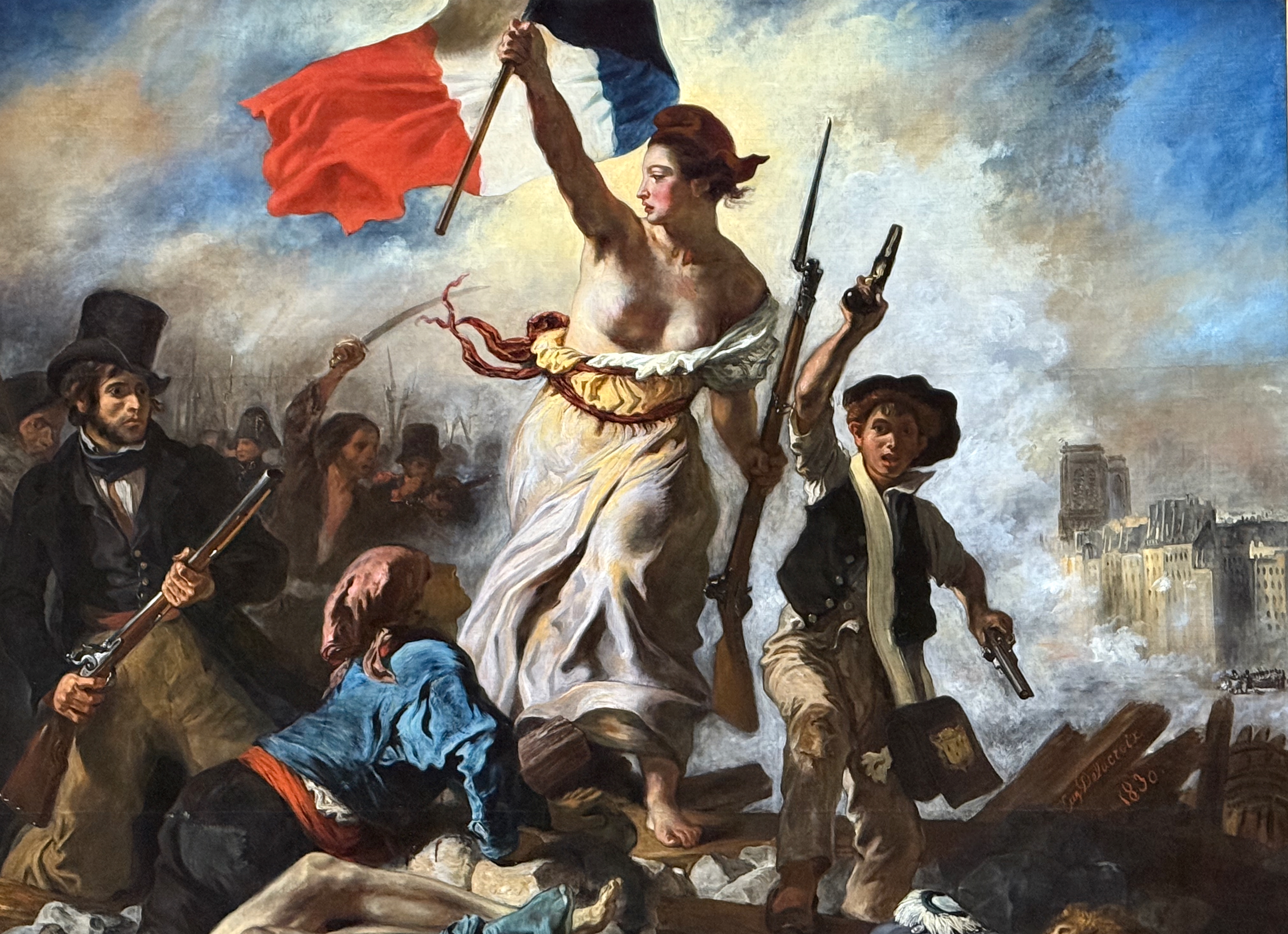
Eugène Delacroix, LIberty Leading the People (1830).

“Nothing collapses more quickly than civilization during crises like this one [the French Revolution of June 1848]; lost in three weeks is the accomplishment of centuries. Civilization, life itself, is something learned and invented … After several years of peace men forget it all too easily. They come to believe that culture is innate, that it is identical with nature. But savagery is always lurking two steps away, and it regains a foothold as soon as one stumbles.”

— Sainte-Beuve [i]

When an inflamed crowd of Parisian citizens stormed the Bastille on July 14, 1789, the obsolete medieval fortress had long outlived its usefulness as an instrument of royal tyranny. It was destined for demolition, and a mere seven prisoners inhabited its dungeons when the crowd broke through the gates. A year later, Lafayette presented the key for the Bastille to President George Washington, honoring the quest for liberty by both countries. The key still resides at Washington’s Mount Vernon home.

Historians have suggested that the king’s capitulation to the political power of commoners (the ‘Third Estate’) on July 9 marks the true beginning of the French Revolution, but the bloody drama of Bastille Day proved a more potent symbol than the parliamentary negotiations being conducted at the king’s palace of Versailles. In any case, the once unthinkable destruction of the Ancien Régime had been decades in the making.

In The Revolutionary Temper: Paris, 1748-1789, American historian Robert Darnton traces the growth of revolutionary sentiment as it was expressed in the Paris street: café conversations (often transcribed by police spies), underground gazettes and pamphlets, street songs, sidewalk speeches, public demonstrations and processions, and personal diaries. Eighteenth-century Paris had its own version of an information society, where “the ebb and flow of information among ordinary Parisians” was shared widely in cafés, marketplaces, wineshops, street corners and salons. [ii]

When the 72-year reign of Louis XIV ended in 1715, it was hard to imagine an alternative to absolute monarchy. His successor, Louis XV, would still be claiming dictatorial authority as late as 1766:

“In my person alone resides the sovereign power: from me alone my courts derive their existence and their authority, without any dependence and any division.” [iii]

“Although the words were printed on paper, the messages of pamphlets flew through the air and mixed in the cacophony known as bruits publics [‘public rumors’]. Pamphlets were bruited about. They were read aloud, performed, applauded, rebutted, and assimilated in the talk that filled lieux publics [“public places”]. Readers also pondered tracts in the quiet of their studies, but when they went outside they encountered other Parisians, in marketplaces, along the quais, in the courtyard of the Louvre, on benches in the gardens of the Palais-Royal, the Tuileries, and the Luxembourg palace. Like smoke from thousands of chimneys gathering over the city, a climate of opinion gradually took shape.” [v]

It took half of the eighteenth-century to produce such a climate of opinion in France, a ”revolutionary temper” which was perfected, like tempered steel, through repeated heating and cooling. People would complain about this tax or that scandal, this outrage or that cruelty, but the tectonic shift from specific complaints to general discontent and clamor for change was a process of decades. Only when the climate of opinion attained sufficient density was it possible to imagine the impossible. Once revolution became conceivable, the leaps from absolute monarchy to constitutional monarchy to no monarchy at all were breathtakingly swift.

Revolution doesn’t necessarily require the refinements of political theory. By 1788, the high cost of bread by itself (like our egg or gas prices) was enough to elicit calls for radical change. One angry woman in a boulangerie was heard to say, “They should march on Versailles and burn the place down.” [vi]  She was not alone, and by then the people of Paris were beginning to conceive of themselves as part of a movement, and act accordingly.

“Whether or not they followed the arguments of the theoreticians, Parisians were swept up in the conviction of becoming a nation, a sovereign body that would defy privileged orders and take charge of its own destiny. This way of constructing reality—the drawing of lines, the identification of a common enemy, the creation of a collective self-awareness—can be understood as a process of radical simplification. Although it had origins that went far back in the past, it came together with unprecedented force in 1788 and underlay a revolutionary view of the world: us against them, the people against the grands, the nation against the aristocracy.” [vii]

I could not read Darnton’s illuminating account without thinking of my own deeply troubled country. Although there are of course countless dissimilarities between 18th-century France and 21st-century America, some parallels got me thinking.

First of all, I found the accounts of a Paris alive with ardent conversations about public life to be inspirational. There was an urgency and a passion which feels lacking in America’s current collective consciousness. “Everyone writes, everyone reads,” said one of those pre-revolutionary Parisians. “Even the coachman reads the latest work on his perch,” said another. “Every person down to domestic servants and water carriers is involved in the debating.” [viii] But in America, 2025, while we may consume volumes of news in private, most of us carry on as if life is pretty much normal, even as our would-be dictator dispatches masked thugs to terrorize our communities, trains the military to act as his personal army, and builds concentration camps to torture and disappear his “enemies.”

Like 18th-century Paris, we need to converse with one another in earnest, employing a reliable flow of factual information and strategic thought to shape a collective consciousness for the common good. The forces of tyranny and greed have worked for decades to create its opposite, a seductive web of lies and rage to poison and incapacitate the consciences of millions of Americans. Those who care about the common good are still, I believe, in the majority, but that means nothing if we lack the means and the will to be connected with one another in public truth-telling, mutual encouragement, and collective action. As long as we feel isolated, alone and discouraged, tyranny will flourish.

I was also struck by the importance of imagining alternatives to consensus reality in our public life. A sense of inevitability is the mother of inaction. In France under Louis XIV, the monarchy seemed inevitable—until it didn’t. In America, at least until Trump, democracy and the rule of law were assumed to be inevitable. And while many of us have come to realize how fragile and conditional our democracy actually is, the press, along with many Democratic politicians, continue to play the game of “Let’s Pretend.”

Let’s pretend that everyone is playing by the same rules. Let’s pretend the president is not fascist, childish, ignorant, cruel, and increasingly incoherent and nonsensical. Let’s pretend that normal protocols are the best way to engage with him. Let’s pretend we don’t have an American gestapo, or a White House dominated by racists, white nationalists and shameless liars. Let’s pretend our government isn’t supporting genocide in Gaza, or robbing millions of their health care. Let’s pretend that climate change is nothing to worry about. Let’s pretend it’s all just politics as usual and both sides do the same thing, so there’s no cause for alarm.

Finally, I was intrigued by the theatricality of what the French called emotions populaires [mass protests]. Straw effigies of unpopular or disgraced officials were mocked, paraded through the streets, and forced to kneel before statues of honored officials and beg divine pardon. On one occasion, the crowd seized a passing priest, demanding that he hear the dummy’s confession. Eyed with suspicion as a symbol of the Ancien Régime, the priest was careful not to anger the crowd by refusing to play. He put his ear to the effigy’s mouth for a few moments, then declared to all that it had so many sins to confess that it would take all night! The people laughed, applauded the priest’s wit, and let him go. As for the dummy official, he “was pitched into a giant feu de foie [‘fire of joy’].” [ix]

I suspect that setting fire to effigies of our American tyrants would not be a safe practice these days, and I am aware that the emotions populaires in revolutionary Paris often led to serious violence. But I wonder if there might be, in our own acts of resistance and witness, creative theatrical ways to engage with flanks of armed soldiers or gangs of ICE agents using guerilla theater, humor, song, ritual, and even clowning and mime—anything to subvert, disarm, or transcend the deadly Punch and Judy face-off of venomous gazes. Is there any way to make the other laugh, or wonder, or think, if only for a moment? Send in the clowns! Could you still want to shoot someone who made you laugh—or cry?

You may say that I’m a dreamer, but I’m not (I hope) the only one.


[i] Charles Augustin Sainte-Beuve (1804-1869), a French literary critic, is quoted by George Eliot in Impressions of Theophrastus Such; cited in Frederick Brown, The Embrace of Unreason: France, 1914-1940 (New York: Anchor Books, 2014), 3.

[ii] Robert Darnton, The Revolutionary Temper: Paris, 1748-1789 (New York: W. W. Norton & Company, 2024), xix.

[iii] Ibid., 131.

[iv] Ibid., 333.

[v] Ibid., 390.

[vi] Ibid., 366.

[vii] Ibid., 400.

[viii] Ibid., 391.

[ix] Ibid., 371.

Tending Faith’s Flame in the American Gloom

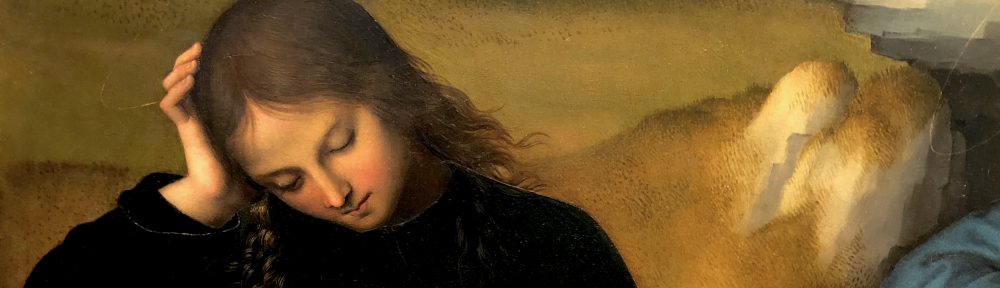
Anonymous, The Descent from the Cross (detail), German c. 1500.

The evil and the armed draw near;
The weather smells of their hate
And the houses smell of our fear.

— W. H. Auden, For the Time Being

“ … because all you of Earth are idiots!”

Plan 9 from Outer Space (Ed Wood, 1957)

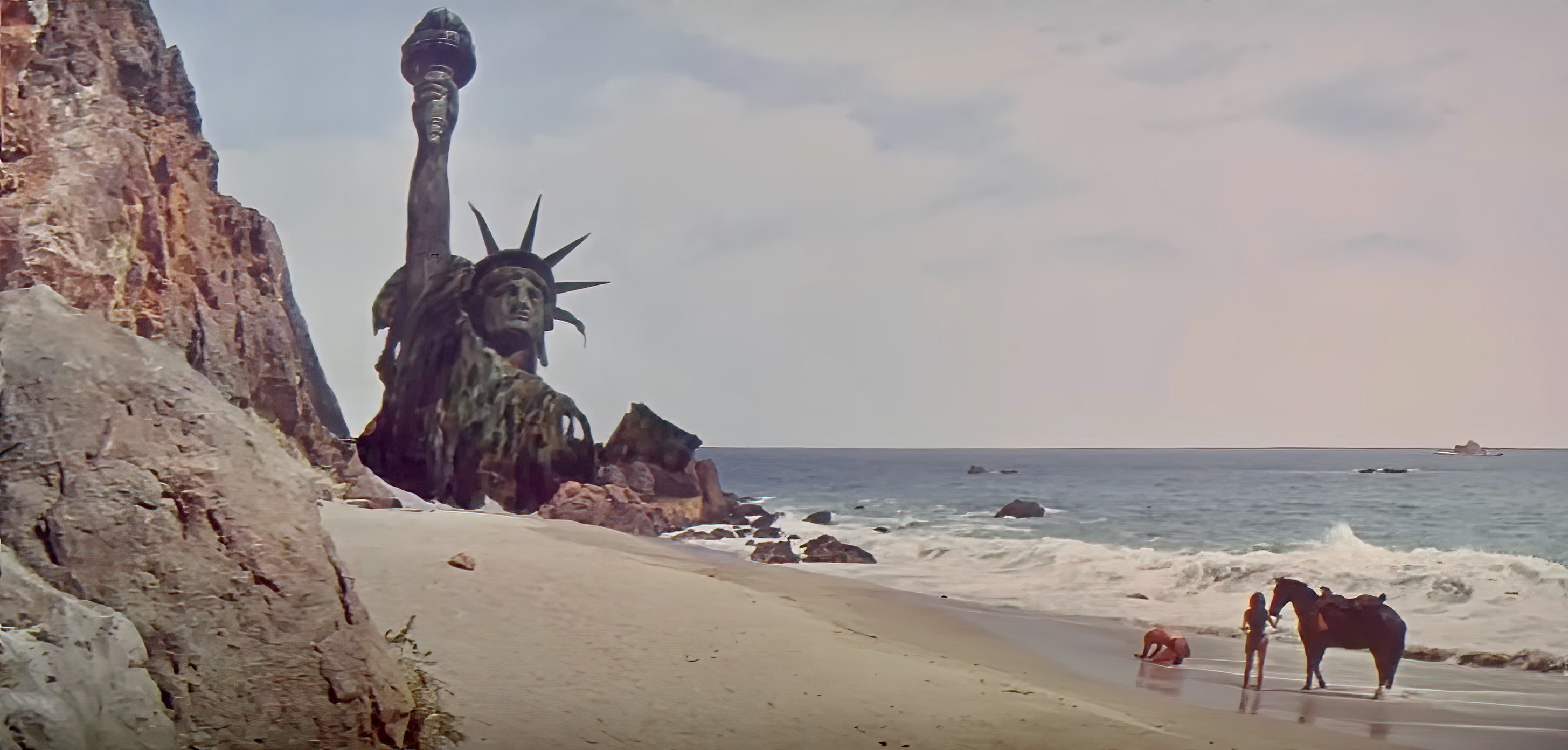
How bad is it, anyway? In the first hours of the new Amerika last Tuesday, the original Planet of the Apes (1968) came to mind. Finding a half-buried Statue of Liberty on a deserted beach, space-and-time traveler Charlton Heston realizes he has not landed on some distant planet, but on his own earthly home, where humanity has evidently committed nuclear suicide. Literally pounding the sand, he cries out to his long-vanished fellow mortals, “You really, finally, did it! You maniacs! You blew it up! Damn you! God damn you all to hell!”

A ruined earh: The final image of Planet of the Apes (1968).

In the Year of our Lord 2024, a decisive majority of Americans have chosen to blow up democracy, the rule of law, the common good, civil liberty, women’s rights, health care, international stability, public sanity, and our last hopes of staving off climate apocalypse. Did they know what they were doing? I confess to zero interest in their motivation at this point. Their decision, measured by its inevitable consequences, was neither rational nor moral. The harm it will do is immeasurable. Even if they thought they were trying to make a point about their personal economic pain, the mad embrace of a fascistic, unstable sociopath and the MAGA dream of demolishing the American experiment—not to mention the livability of our planet—will impose a price none of us can afford.

The American minority, meanwhile, has spent the past week trying to cope with the shock and the horror of the Antichrist’s second coming (I use that name not in a mythical sense, but in a moral one, describing the Trump who in every respect is against the way of Jesus).

Some have engaged in second-guessing the Democratic campaign, as if putting the argument differently could have penetrated the thick shields of delusion and hate erected by right-wing propagandists and their carefully crafted algorithms. Some have sought comfort in the long view, looking toward the distant horizon where hope and history will someday rhyme. Some see the moment as a sobering diagnosis of our national maladies, putting an end to further denial. There’s no use pretending we’re still healthy. Some are tuning out, or contemplating flight to saner climes. Some, sadder and wiser, are vowing to carry on the fight for the common good. God help them.

Marc Chagall, Adam and Eve Expelled from Paradise (detail), 1961.

Many people have been passing poems around on social media, lighting candles of gentleness and peace for one another in this dark night. I have taken comfort in these tender gestures, offered like balm in Gilead for the sin-sick soul. But I also have found myself browsing post-WWII poems that register the shock of brutal conflict. “The Last War” by Kingsley Amis (1948) touched a chord in me with its opening line: “The first country to die was normal in the evening.” By morning it was disfigured and dead

The poem narrates a kind of Agatha Christie murder story in a country house. No one, in the end, survives the weekend. When the sun (the light of Reason? the eye of God?) shows up to survey the damage and “tidy up,” he is unable to separate “the assassins from the victims.” Sickened by the folly and horror of human self-destruction, the sun goes back to bed. The last two stanzas begin with the sound of gunfire and end with a deathly quiet:

Homicide, pacifist, crusader, tyrant, adventurer, boor
Staggered about moaning, shooting into the dark.
Next day, to tidy up as usual, the sun came in
When they and their ammunition were all finished,
And found himself alone.

Upset, he looked them over, to separate, if he could,
The assassins from the victims, but every face
Had taken on the flat anonymity of pain;
And soon they’ll all smell alike, he thought, and felt sick,
And went to bed at noon.

The sense of recognition I felt in reading the poem oddly eased my post-election malaise. Though I dwell in the valley of the shadow, I’m not alone. Like Dante in hell, I’ve got a good poet for company.

Virgil and Dante in the 8th Circle of Hell The Roman poet would guide Dante through the infernal regions until they found the way out.

Well, what now? If there were ever a time demanding religious imagination—the ability to see resurrection light even on Good Friday—this is it. Such envisioning will be one of the ongoing tasks of The Religious Imagineer. But we can’t just leap into Easter. We must first do our time at the foot of the cross, living in solidarity—and risk?—with the victims and the vulnerable, tuning our hearts to the bells that toll for every human tear:

Tolling for the luckless, the abandoned and forsaked,
Tolling for the outcast, burning constantly at stake …
Tolling for the aching ones whose wounds cannot be nursed,
For the countless confused, accused, misused, strung-out ones and worse,
And for every hung-up person in the whole wide universe. [1]

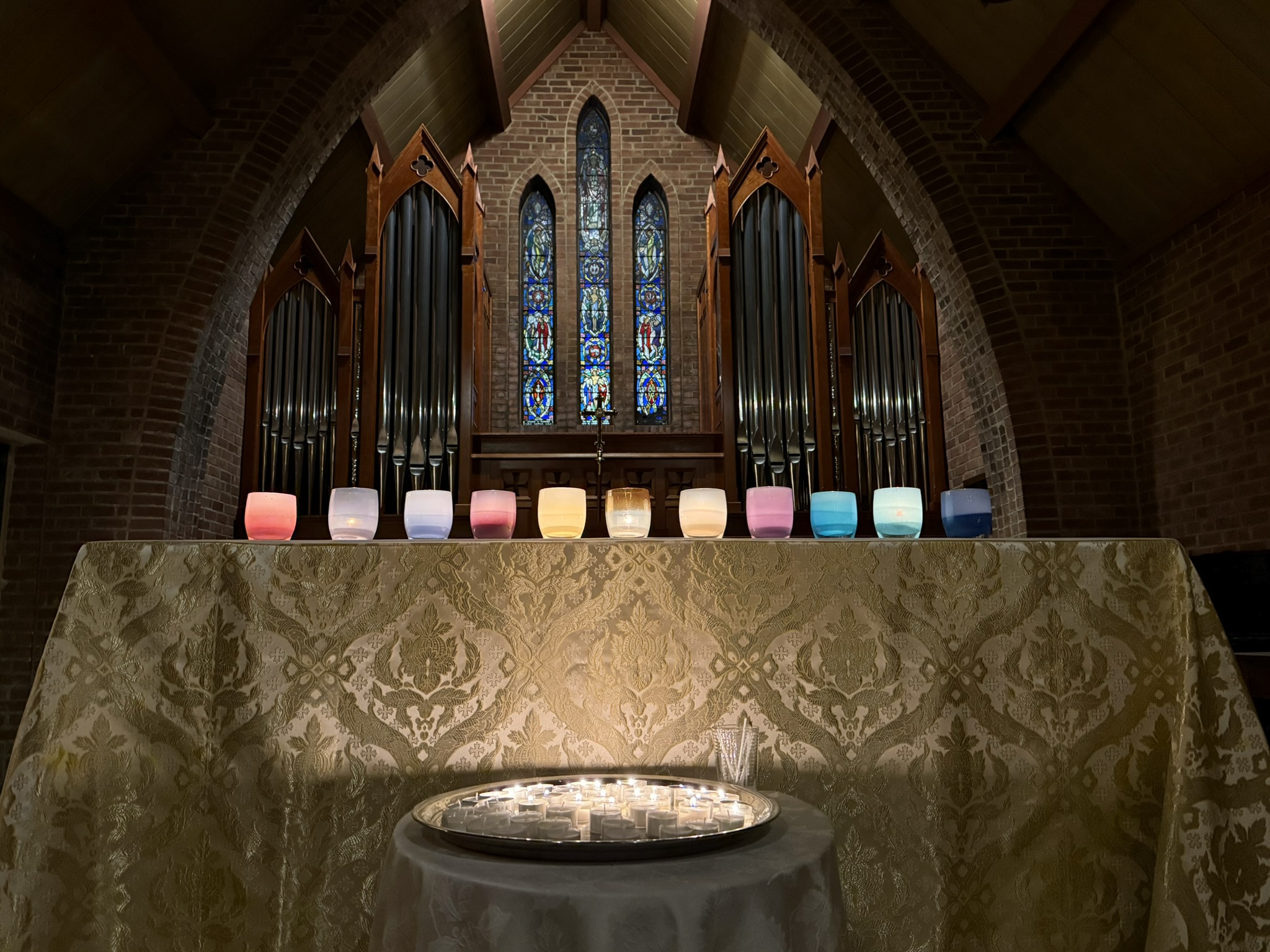
St. Barnabas Episcopal Church, Bainbridge Island, Washington. Prayers silent and aloud were offered here the night before and the night after the election.

I feel blessed to be in Christian community during this time of trial. It is better to hold hands than clench fists. It restores the soul to share our griefs and voice our hopes in sacred discourse and common prayer. Preachers are encouraging our renewed commitment to the Baptismal Covenant: to persevere in resisting evil; seek and serve Christ in all persons; strive for justice and peace among all people; and respect the dignity of every human being.[2] Pastors, meanwhile, are reminding us to love those who voted against most of those things.

(I confess to my own struggle with the Christly precept of loving the haters. Yes, we all fall short, but the so-called Christians cheering the triumph of our basest impulses are, IMHO, falling short with unseemly enthusiasm. As Henry James noted, “when you hate you want to triumph.”) [3]

Tom Tomorrow always nails it: MAGA House of Horror (October 28, 2024).

Many of us, like the desert monks of Late Antiquity, are feeling the need to go on retreat from the public square, to hush the noise and attend the still small voice of holy wisdom. Our spiritual practices seem more necessary than ever.

For me over the past week, that has taken the form of Daily Offices, running, watching the birds in the garden, reading Henry James, a Monteverdi concert, and a splendid evening of Balanchine works by the Pacific Northwest Ballet. I have also been fasting from political news, limiting myself to a small amount of reflective commentary from trusted sources. Such self-care through withdrawal from the fray is “meet and right so to do.” But unless we are contemplatives whose job is to provide for the rest of us what Jesuit activist Dan Berrigan called “large reserves of available sanity,” we can’t stay in the desert forever.

Old Testament scholar Walter Brueggemann has responded to the election with a fine reflection on Elijah’s flight from the danger and exhaustion of public justice-making to the solitude and safety of the holy mountain. After a while, God tracks him down to ask, “What are you doing here, Elijah?”  

“Go back to your proper place; you can linger here in self-pity only so long and then you must remember your call and perform your responsibility.” So Elijah is freshly dispatched back to his dangerous work. He is dispatched by the one who has lordly authority for him. The only assurance he is offered is that there are others—7000—who stand alongside in solidarity.[4]

We are not alone. God is with us. The night after the election, some of our local parish church gathered for Evening Prayer, with generous pauses for quiet resting in the Divine Presence. When words fail, let silence speak. Afterward, we had a deep and earnest conversation about the effect of the election on our hearts, minds, and bodies. The empowering richness of that exchange, a gift of the Holy Spirit, raised us from the depths to remember our vocation as God’s friends: to plant the seeds of resurrection amid the blind sufferings of history.  

Henri Matisse, The Rosary Chapel in Vence, French Riviera.

Let me close with an encouraging story from the desert monks.

The disciple of a great old man was once attacked by the demons within him. The old man, seeing it in his prayer, said to him, ‘Do you want me to ask God to relieve you of this battle?’ The other said, ‘Abba, I see that I am afflicted, but I also see that this affliction is producing fruit in me; therefore ask God to give me endurance to bear it.’ And his Abba said to him, ‘Today I know you surpass me in perfection.’” [5]

Throughout this time of trial and affliction, God grant each of us, and our communities, the endurance to bear what we must bear, and do what we must do, that our lives may prove both faithful and fruitful in due season.


[1] Bob Dylan, “Chimes of Freedom,” from Another Side of Bob Dylan (Columbia Records, 1964).

[2] From the Baptismal Covenant, Episcopal Book of Common Prayer (1979).

[3] Henry James, The Ambassadors (New York: Modern Library, 2011), 427.

[4] Walter Brueggemann’s reflection on I Kings 19, “Beyond a Fetal Position,” Nov. 7, 2024 on Church Anew: https://churchanew.org/brueggemann/beyond-a-fetal-position

[5] Cited in John Moses, The Desert: An Anthology for Lent (Norwich: The Canterbury Press, 1997), 62.

“No faith, no truth, no trust”—The Cost of Lies in American Politics

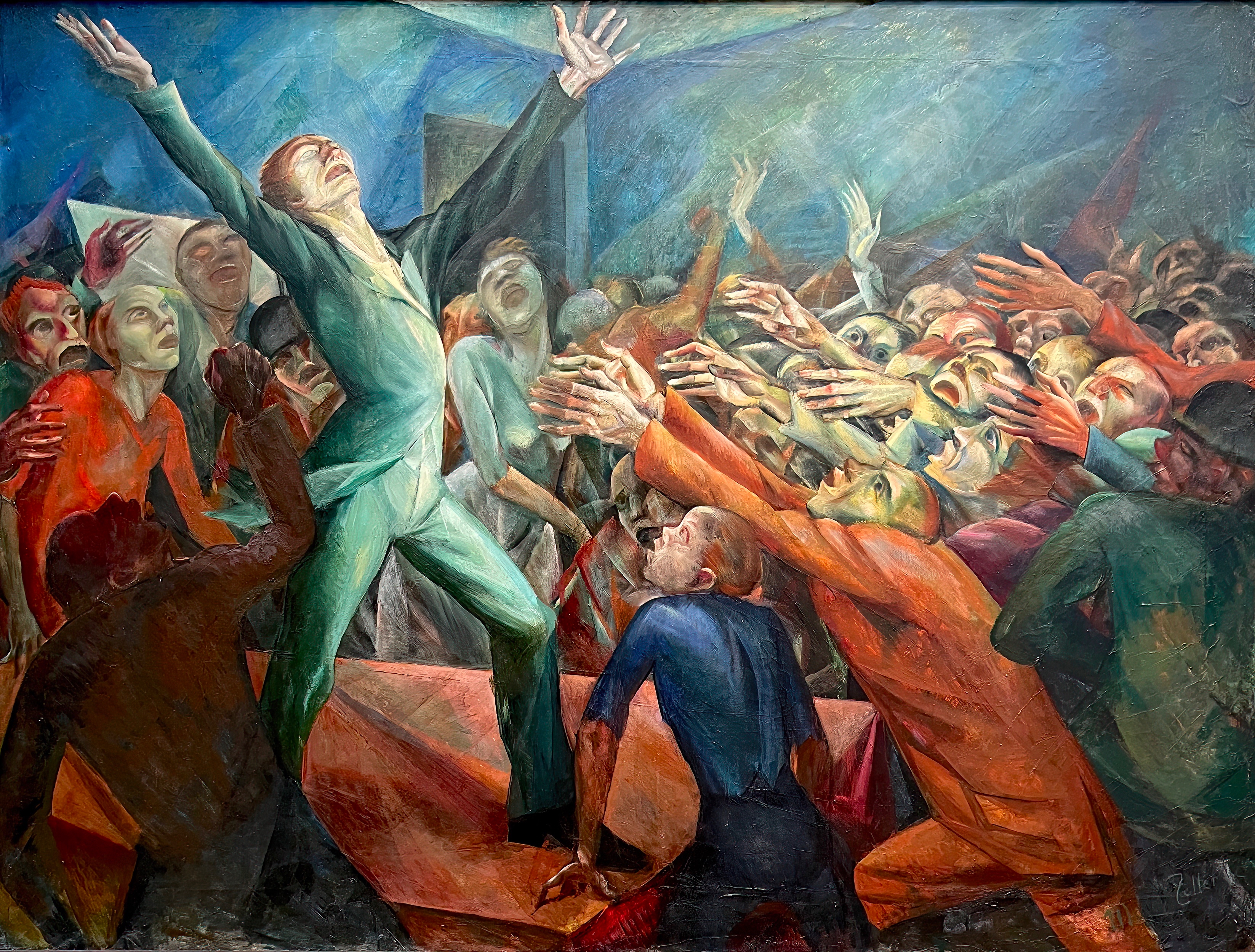
Magnus Zeller, The Orator (c. 1920). The German painter foresaw the danger of authoritarians who prey on the emotions of the mindless mob.

The problem is, when you marry intelligence
To ill will and brute force,
People are helpless against it.

— Dante, Inferno xxxi [1]

On November 5th, Guy Fawkes Day, the citizens of Great Britain will celebrate the defeat of a conspiracy to overthrow the political order in 1605. Thirty-six barrels of gunpowder hidden beneath the House of Lords were discovered before they could blow King and Parliament to kingdom come, and the plotters were brought to justice.

Also on November 5th, the citizens of the United States will vote whether to thwart or assist the overthrow of their own political order. Democracy itself is on the ballot, and the party of insurrection is determined to blow it up. If the latest polls are accurate, they have a fair chance of success.

Seventeenth-century England and twenty-first century America are dissimilar in countless ways, but the Gunpowder Plot of 1605 and the Presidential election of 2024 have one crucial thing in common: the toxic social effect of equivocation.

When the seventeenth century began, “equivocation” was a neutral, rarely used term for statements deemed ambiguous. But in the aftermath of the Gunpowder Plot, it became a widespread byword for deceitful speech. The term’s sudden prominence was triggered by the discovery of the plotters’ handbook, A Treatise of Equivocation, which detailed various ways for persecuted Roman Catholics to lie under oath without endangering their conscience.

When Catholic worship and practice were being suppressed after the English Reformation, the Roman faithful needed to conceal from the authorities the presence of priests and the saying of masses in their private homes. If asked, they could equivocate: give ambiguous or incomplete answers, or practice “mental reservation”—speaking aloud partial truths, while retaining in their minds any bits which might get them into trouble. As long as you speak the whole truth in your mind, where God can hear it, leaving your inquisitor in the dark is not a sin. In other words, the Treatise argued, it is possible to lie without guilt.

In a time when Roman priests were being hunted down and threatened with prison or the gallows, such equivocation was understandable. We do not fault the Dutch family who lied about Anne Frank hiding in their secret annex. But as the Gunpowder Plot made clear, social stability was not a given in the early days of King James’s reign. However, neither factions, plots, religious difference or the clash of ideas seemed the greatest threat to common life in Britain.  The greatest threat was thought to be equivocation, the solvent of bad faith which dissolves communal trust. As an English court put it a few years after the insurrection was foiled:

“The commonwealth cannot possibly stand if this wicked doctrine be not beaten down and suppressed, for if it once take root in the hearts of people, in a short time there will be no faith, no truth, no trust … and all civil societies will break and be dissolved.” [2]

The Earl of Salisbury, responding to A Treatise of Equivocation with a book of his own, An Answer to Certain Scandalous Papers, warned against “that most strange and gross doctrine of equivocation,” which would “tear in sunder all the bonds of human conversation.” [3]

A similar anathema was issued from a London pulpit:

“He that lyeth doth deprive himself of all credit among men (for they will also suspect him to be a liar), so that he that once deceiveth his neighbor by equivocation, shall always be suspected to equivocate … If deceit by equivocation be used, then all covenants and contracts between man and man must cease, and have an end, because all men will be suspicious of one another … So, no commonwealth can stand, no civil society can be maintained.” [4] 

 The nightmarish world of Shakespeare’s Macbeth, written just after the Gunpowder Plot, dramatizes the dread of social disintegration, as even the more admirable characters find themselves “unspeaking” truth. “Fair is foul and foul is fair,” cry the weird sisters at their cauldron of deconstruction. Once language begins to mean anything and nothing, civil discourse is mortally wounded, and it is not just Macbeth who begins “to doubt th’ equivocation of the fiend / That lies like truth.” [5]

Shakespearean scholar James Shapiro notes that the moral chaos of the play is draining not just for the characters but for the audience as well:

“Equivocation makes following Macbeth’s dialogue a mentally exhausting experience, for playgoers—much like those conversing with equivocators—must decide whether a claim should be accepted at face value, and, if not, must struggle to construct what may be suppressed through mental reservation. But with equivocators, one never knows what, if anything, is left unspoken.” [6] 

In the American election of 2024, we are well acquainted with the fiend that lies like truth. “Fair is foul, and foul is fair,” cry the weird brothers Trump and Vance, poisoning our national speech and our common life like there’s no tomorrow. The lying is in their natures—it’s who they are: hollow men without principles, shapeless hulks of impulse and ambition. But their lying, a weapon as destructive as gunpowder, is also an instrument of power. If truth and trust can be blown to bits, the weird brothers will be free to soar beyond accountability into a realm of naked, unfettered tyranny.

It will not go well for them. As Dante assures us, the lowest place in Hell is reserved for the fraudulent, because fraud is the polar opposite of love. Love nurtures community. Fraud disintegrates it. Dorothy Sayers’ eloquent notes on Dante’s Inferno describe the bleak endgame for the ones who are only in it for themselves:

“Beneath the clamor, beneath the monotonous circlings, beneath the fires of Hell, here at the center of the lost soul and the lost city, lie the silence and the rigidity and the eternal frozen cold. It is perhaps the greatest image in the whole Inferno … A cold and cruel egotism, gradually striking inward till even the lingering passion of hatred and destruction are frozen into immobility—that is the final state of sin.” [7]

Gustave Doré, Dis frozen in the lake of ice (1861). Immobilized in the pit of hell, the prince of lies is trapped in wordless solitude, dis-connected from every form of relation.

The evils of Trumpworld have multiplied ceaselessly over the years: tens of thousands of unnecessary Covid deaths, families torn apart at the border, political violence, the abuse of immigrants and women, the corruption of the Supreme Court, the stoking of anger, racism and hate, the relentless erosion of social bonds, the corrosive degradation of the rule of law, et cetera, et cetera. And so much lying. J. D. Vance’s gleeful admission that he invented the terrible stories about immigrants eating pets is just the latest example of a shamelessly destructive addiction to untruth. These people don’t care how many people they hurt.

It’s exhausting. That too is part of the Trump/Vance strategy. We’re supposed to grow weary and discouraged in the face of their unrelenting and senseless chaos. I find an apt metaphor for this moment of American politics in Washington Irving’s account of a transatlantic voyage in the early nineteenth century. Traveling by land, he said, keeps us connected with a sense of where we are and where we’ve come from.

“But a wide sea voyage severs us at once. It makes us conscious of being cast loose from the secure anchorage of settled life, and sent adrift upon a doubtful world. It interposes a gulf not entirely imaginary, but real, between us and our homes—a gulf subjected to tempest and fear and uncertainty, rendering distance palpable, and return precarious.” [8]

Winslow Homer, The Gulf Stream (1899/1906).

Irving’s harrowing journey took about as many weeks as we have left until the election. Sail on, friends, sail on. It is my hope that come November 5th, we will anchor once again in safe harbor, put the chaos behind us, and begin to mend the torn fabric of our common life.

In the meantime, citizens, we all have some serious work to do.


[1] Dante Alighieri, Inferno xxxi, 55-57, translated by Mary Jo Bang. Dante is explaining why the Creator made large creatures like elephants and whales, but abandoned the making of giants. Intelligence, granted too much size and power, could do great damage if corrupted.

[2] James Shapiro, The Year of Lear: Shakespeare in 1606 (New York: Simon & Schuster, 2015), 158.

[3] Ibid., 173.

[4] Ibid., 177-178. John Dove, sermon at St. Paul’s Cathedral, June 1, 1606.

[5] William Shakespeare, Macbeth 5.5, 41-42.

[6] Shapiro, 185-186.

[7] Dorothy Sayers, commentary on her translation of Inferno, quoted in Helen Luke, Dark Wood to White Rose: Journey and Transformation in Dante’s Divine Comedy (New York, Parabola Books, 1989), 41.

[8] Washington Irving, The Sketch Book of Geoffrey Crayon (1819-1820), quoted in David McCullough, The Greater Journey: Americans in Paris (New York: Simon & Schuster, 2011), 12.

Tyranny is on the Ballot

It’s a scary time. Vote as if your life depends on it.

“Noncooperation with evil is as much a moral obligation as is cooperation with the good.”

— Martin Luther King, Jr.

At the end of World War II, there were 8 million Nazis in Germany, about 10 percent of the population. Millions more, whether from fear, ignorance, or true belief, had also given their consent to the evils of the Third Reich. Of those who had chosen noncooperation, most were either dead or gone, and the occupying Allied authorities believed that a program of “denazification” was necessary to awaken Germany from Hitler’s bad dream.

One of the Allied strategies was to make people attend documentary films before they could receive their food ration cards. The hope was to reshape indoctrinated minds with the facts. Years later, a German writer recalled the experience of sitting through death camp footage in a Frankfurt cinema:

“In the half-light of the projector, I could see that most people turned their faces away after the beginning of the film and stayed that way until the film was over. Today I think that that turned-away face was indeed the attitude of many millions; … The unfortunate people to which I belonged was … not interested in being shaken by events, in any ‘know thyself.’” [i]

That postwar Frankfurt screening could be a sad parable for my own country, where tens of millions continue to turn their faces away from reality. Forty percent of Americans still approve of Donald Trump. Sixty percent of Republicans believe his “big lie” that the 2020 election was stolen. And 345 Republican candidates for federal or statewide office continue to push the big lie despite zero evidence. At least 58% of them are expected to win.[ii]

In his absolutely indispensable handbook, On Tyranny, Timothy Snyder notes that many of the democracies founded in the wake of two world wars collapsed when authoritarians (mis)used the electoral system to seize power and eliminate opposition. The relatively long history of American democracy suggests stability, but the future of our democracy suddenly seems terribly uncertain. As Snyder observes:

“Some of the Germans who voted for the Nazi Party in 1932 no doubt understood that this might be the last meaningful free election for some time, but most did not.… No doubt the Russians who voted in 1990 did not think that this would be the last free and fair election in their country’s history, which (thus far) it has been. Any election can be the last, or at least the last in the lifetime of the person casting the vote.” [iii]

Democracy is on the ballot next week, they say. But since it is hard for most Americans to conceive an absence before it happens, or grasp the immensity of the threat, I would state the emergency in more urgent terms: Tyranny is on the ballot! The barbarians are at our gates! Democracy is burning! The end is near.

If we act as if this were a normal election, where we choose between ordinary political parties based on habit, tribal preference, or the issue of the moment, then I tremble for my country. The GOP is no longer a mainstream party. It has become the vehicle of choice for racists, white supremacists, liars, thugs and criminals. It is trying to dismantle democracy by any means necessary. 

Many traditional Republicans who have not yet left the party are surely uncomfortable with where the far-right has taken them, but the voices of conscience and truth remain disappointingly silent. Adam Kinzinger, one of the few Congressional Republicans to speak out, says it’s simply his duty to put country over party: 

“By the way,” he said recently, “Liz [Cheney] and I are not courageous. There’s no strength in this. We’re just surrounded by cowards.”

I know we must be careful about throwing the word “Nazi” around. Although American neo-Nazis have a love affair with Trump, and some 50 current Republican candidates have been advertising on a website frequented by Nazi sympathizers, it would be inaccurate, unhistorical, and inflammatory to apply the term directly to Republicans.[iv] However, I do find some chilling affinities, which in a sane world would disqualify the GOP, in its current state, from any voter’s serious consideration. Let me offer a florilegium of various sources to make my point.

Charismatic leader

For those who wonder why people surrender their wills to charismatic leaders, Stephen Jaeger describes the “mindset of the followers that enables them to dream the master’s dreams, to create or acknowledge a higher world in which he lives, to be deaf to criticism, resist with aggression any attempt to undermine the idol, and long to live in that world themselves. It is a condition in which the mind is under a spell and in the grip of an uncritical awe that extends to selfless devotion and beyond, to self-sacrifice.” 

We may be puzzled by the ardent devotion that attaches itself to demagogues and tyrants—even the repulsive ones—but Jaeger says the rewards seem worth it to their uncritical followers:

“Through him the troubles of the world will end; he will redeem from its dreariness a world threatened by disenchantment. He embodies renewal. He awakens extravagant hopes in the devotee, visions of happiness, heroism, divinity, the restoration of the spirit, and the realization of fantasies. The charismatic and the followers create and share a world in which the boundaries of reality become unclear. Dreams and impossible or unlikely enterprises appear realizable, the deepest hopes and desires appear attainable.” [v]

The Big Lie

Trump and his enablers have shown the effectiveness of the shameless lie told over and over. Say it enough times, and people will come to believe it. Hitler provided the cynical playbook for all his successors: 

“All propaganda must be popular and its intellectual level must be adjusted to the most limited intelligence among those it is addressed to. Consequently, the greater the mass it is intended to reach, the lower its purely intellectual level will have to be.… The receptivity of the great masses is very limited, their intelligence is small, but their power of forgetting is enormous. In consequence of these facts, all effective propaganda must be limited to a very few points and must harp on those in slogans until the last member of the public understands what you want him to understand by your slogan.” (Mein Kampf, 1925) [vi]

“Above all one must get rid of the idea that ideological concepts can satisfy the crowd. For the masses, knowledge is an unstable basis. What is stable is feeling, hatred.… What the masses need to feel is triumph in their own vigor.” (1926 speech) [vii]

Imagine what Hitler could have done with Twitter.

Contempt for Democracy

Once the Nazis were in power, Minister of Propaganda Joseph Goebbels explained how easy it was to use “the stupidity of democracy” for undemocratic ends. “It will always remain one of democracy’s best jokes,” he said, “that it provided its deadly enemies with the means by which it was destroyed.” [viii]

Republicans hope to seize total control of the voting process across the United States, through gerrymandering, limited eligibility and access for voters, partisan supervision of vote counts, and the empowering of state legislatures to override unfavorable results. The Republican candidate for governor in Wisconsin said it out loud last week: “Republicans will never lose another election in Wisconsin after I’m elected governor.” [ix]

Political Violence

Authoritarian movements need to amputate dissenters from the body. This can be done through rhetorical dehumanization of opponents, physical intimidation of critics, imprisonment, or even murder. Right-wing violence in America is nowhere near its heyday under the Nazis, but it is real and it is growing. Threats against political office-holders and anyone “not like us” has increased alarmingly since Trump took control of the Republican party. Timothy Snyder says that this is a matter of cause and effect:

“What was novel in 2016 was a candidate who ordered a private security detail to clear opponents from rallies and encouraged the audience itself to remove people who expressed different opinions. A protestor would first be greeted with boos, then with frenetic cries of ‘USA,’ and then be forced to leave the rally. At one campaign rally the candidate said, ‘There’s a remnant left over. Maybe get the remnant out. Get the remnant out.’ The crowd, taking its cue, then tried to root out other people who might be dissenters, all the while crying ‘USA.’ The candidate interjected, ‘Isn’t this more fun than a regular boring rally? To me, it’s fun.’ This kind of mob violence was meant to transform the political atmosphere, and it did.” [x]

In January, 1933, a German girl named Melita Maschmann was taken by her parents to watch a Nazi torchlight parade. Suddenly one of the marchers attacked a bystander, who apparently had shouted a criticism of the Nazis. The man fell to the ground, where his bloody face turned the snow red. Maschmann later recalled her excited reaction: 

“The horror it inspired in me was almost imperceptibly spiced with an intoxicating joy. ‘We want to die for the flag,’ the torch-bearers had sung.… I was overcome with a burning desire to belong to these people for whom it was a matter of death and life.… I wanted to escape from my childish, narrow life and I wanted to attach myself to something that was great and fundamental.” [xi]

In 1933, the Nazi leaders were still making some effort to appear respectable, stoking political violence with their rhetoric while distancing themselves from the consequences. They needed to consolidate their power before showing their darkest colors. We have seen that in America as well, most recently in the brutal attack on Paul Pelosi, husband of Nancy Pelosi, the third person in line for the Presidency. After years of dehumanizing and sometimes violent rhetoric against Speaker Pelosi, most Republicans have indignantly denied any responsibility for the consequences of their words. A deplorable few found the violence to be humorous.

Kari Lake, Republican candidate for governor of Arizona, joked about the attack in a campaign appearance while 82-year-old Paul Pelosi was lying in the hospital with a skull fractured by his assailant’s hammer. Lake’s audience burst into laughter, and she did nothing to stop them in the name of human decency. When criticized for her tasteless insensitivity (I’m being kind here), she doubled down, claiming that her remark was taken out of context by “creative editing” which ignored her other remarks about security blah blah blah. “I never made light of the attack,” she insisted. 

Well, you can judge for yourself. The following clip isolates her remark and the laughter it provoked. Whatever was said before and after cannot disguise the callousness of what she said, or the inhuman, howling amusement of her crowd. And yes, I did some “creative editing,” repeating, and finally slowing, the clip, giving us sufficient time, as the political mask slips for an instant, to contemplate the true face of democracy’s destroyers.


[i] Tony Judt, Postwar: A History of Europe Since 1945 (New York: Penguin Books, 2006), 57.

[ii] https://www.brookings.edu/blog/fixgov/2022/10/07/democracy-on-the-ballot-how-many-election-deniers-are-on-the-ballot-in-november-and-what-is-their-likelihood-of-success/

[iii] Timothy Snyder, On Tyranny: Twenty Lessons from the Twentieth Century (New York: Crown, 2017), 28-29. This little book is a must-read for our times!

[iv] https://www.milescitystar.com/content/republicans-have-nazi-infestation-0

[v] Enchantment: On Charisma and the Sublime in the Arts of the West, C. Stephen Jaeger (Philadelphia: University of Pennsylvania Press, 2012), 23-24.

[vi] Richard J. Evans, The Coming of the Third Reich (New York: Penguin Books, 2003), 168.

[vii] Eric Michaud, The Cult of Art in Nazi Germany, trans. Janet Lloyd (Stanford, CA: Stanford University Press, 2004), 23. Emphasis mine.

[viii] Evans, 451.

[ix] https://www.esquire.com/news-politics/a41843910/wisconsin-republicans-tim-michel-never-lose-another-election/

[x] Snyder, 45.

[xi] Evans, 313.

Can the Right Please Stop Taking God’s Name in Vain?

Fra Bartolomeo, St.Dominic (c. 1506-7), Museo di San Marco, Florence.

How hath man parcel’d out thy glorious name,
And thrown it on that dust which thou hast made …

— George Herbert, “Love (I)”

I sometimes meditate on a poem by George Herbert in my morning prayers, assisted by Helen Wilcox’s marvelous annotations [i] (the poet’s 17th-century idioms can be obscure for the contemporary reader).  And although “Love (I)” is not one of Herbert’s best poems, these lines jumped out at me when I read them today, for the debasement of the divine Name by American extremists has been very much on my mind. 

For example: Last week on Newsmax, a far-right cable channel, Eric Bolling (fired by Fox News in 2017 for sexual harassment) was interviewing conspiracy fabulist Lara Logan (“dumped”—her words—by Fox six months ago). Their subject was immigration at the southern border, which Logan said was a plot “to dilute the pool of patriots” in the United States. 

Bolling: “How does it end?”

Logan: “… this is a spiritual battle. I am a firm and solid and immovable believer in God and I believe that God wins.… and if you fight for god, god will fight for you.”

Bolling: “I have to ask you, because my audience is very god-fearing, god-loving, etc. Final thought, please, just a couple seconds: Is god ok with a closed border?”

Logan: “… God believes in sovereignty and national identity and the sanctity of families and all the things that we’ve lived with since the beginning of time, and he knows that the open border is Satan’s way of taking control of the world through all of these people who are his stooges and his servants … the ones who want us eating insects, cockroaches and that while they dine on the blood of children.”

Bolling (nervously): “Ha, ha, yeah.” [ii]

A day later, the opening prayer at the “ReAwaken America” tour in East Hempfield Township, Pennsylvania, went like this:

“Father god, we come to you in the name of Jesus. We’re asking you to open the eyes of president Trump’s understanding, that he will know the time of divine intervention, that he will know how to implement divine intervention, and you will surround him, father, with none of this Deep-State trash, none of this RINO trash. You will surround him with people that you pick with your own mighty hand. In the name of Jesus.”

The crowd, including Eric Trump, Michael Flynn (his father’s disgraced national security adviser), and the current Republican candidate for Pennsylvania governor, repeated this evil prayer phrase by phrase.

White “Christian” nationalism is on the rise in America. It’s a toxic mixture of xenophobia, racism, anti-Semitism, resentment and rage, thinly dressed in pious nostalgia, theological ignorance, and historical lies. For the increasingly extreme right, these are features, not bugs: 61% of Republicans—and 78% of Republican evangelicals—believe the United States should be declared “a Christian nation.” [iii]

I shudder to imagine what they have in mind, but I’m sure it has more to do with reactionary tribal identity and fear of the “other” than with the gospel, or love, or justice, or caring for the vulnerable, or welcoming the stranger, or healing God’s creation. And it’s not just a disgruntled and deluded mob that wants a more theocratic and less inclusive America. The defilement of both democracy and religion extends to the highest levels of government. 

I have written previously about the Supreme Court rushing in where angels fear to tread, substituting highly contested theological assertions for legal reasoning. If Republicans have their way in upcoming elections, it will only get worse. In a carefully argued response to the Dobbs decision on abortion, legal scholar Laurence Tribe warns, 

“… as the Court continues on the path of replacing long-settled individual rights with religiously inspired mandates, the odds would increase that the rules under which we live will reflect the preferences of ever smaller minorities.” [iv]

Gilead, here we come. 

In the January 6 insurrection, the rallying cry was “God! Guns! Trump!” The mob carried signs and shouted slogans proclaiming the will of God and the will of Trump to be identical. One attacker later told the Wall Street Journal how he sought divine guidance before storming the Capitol: 

“Lord, is this the right thing to do? Is this what I need to do?” He says he felt God’s hand on his back, pushing him forward. “I checked with the Lord,” he says. “I checked with Him three times. I never heard a ‘No.’” [v]

Insurrectionist wanted photo.

It is distressing to hear the word “god” on the lips of the wicked. But not shocking. Taking God’s name in vain is an ancient sin, from the Crusaders and Inquisitors of the past to the terrorists and extremists (including elected officials!) of our own day. Whether they sincerely believe that ultimate reality is backing them up, or cynically employ the word to authorize their own seething id, “god” on their lips becomes drained of meaningful content. It refers to nothing outside themselves. To borrow Herbert’s image, they have “parcel’d” out the divine Name, cut it into tiny pieces and tossed it into the trash.[vi]

Of course, “God” has never been a proper name. It’s more of a nickname, enabling us to talk to or talk about the “ground of our being” (Paul Tillich) or the “Love who loves us” (my personal favorite[vii]) without thinking we have reduced the Real to the dimensions of language. The Holy One has many such nicknames: Kyrie, Deus, Abba, Creator, Deliverer, Father, Mother, Spirit, and countless others. In Herbert’s poem, the “glorious name” is “Immortal Love.” If “love” had been invoked instead of “god” by the mob at the Capitol, might it have tempered their violence or extinguished their rage? Or would Love, too, have been thrown so carelessly into the dust?

Seventy years ago, Jewish philosopher Martin Buber wrote a moving defense of the problematic necessity of “God” language in human discourse. I first heard this passage read aloud in a theology class by one of my great mentors, the saintly Robert McAfee Brown. It touched my heart then, and has remained with me through the years: 

“‘God’ is the most heavy-laden of human words. None has become so soiled, so mutilated. Just for this reason I may not abandon it. Generations of men have laid the burden of their anxious lives upon this word and weighed it to the ground; it lies in the dust and bears their whole burden. The races of man with their religious factions have torn the word to pieces; they have killed for it and died for it, and it bears their finger-marks and their blood. Where might I find a word like it to describe the highest! … We may not give the word ‘God’ up. How understandable it is that some suggest we should remain silent about the ‘last things’ for a time in order that misused words may be redeemed! But they are not to be redeemed thus. We cannot cleanse the word ‘God’ and we cannot make it whole; but, defiled and mutilated as it is, can raise it from the ground and set it over an hour of great care.” [viii]


[i] Helen Wilcox, ed., The English Poems of George Herbert (Cambridge/New York: Cambridge University Press, 2011). Each poem is accompanied by extensive notes and a survey of modern critical views.

[ii] I have not capitalized “god” in these kinds of statements, since they speak of something quite other than God. https://twitter.com/JasonSCampbell/status/1583069972267696134?s=20&t=KwdkjkDH7hvg0GSnYm79NA

[iii] https://www.politico.com/news/magazine/2022/09/21/most-republicans-support-declaring-the-united-states-a-christian-nation-00057736

[iv] Laurence Tribe, “Deconstructing Dobbs,” New York Review of Books, Sept. 22, 2022, p. 81.

[v] Michael M. Phillips, Jennifer Levitz, and Jim Oberman, One Trump Fan’s Descent Into the Capitol Mob, Wall Street Journal, Jan. 10, 2021, www.wsj.com/articles/one-trump-fans-descent-into-the-u-s- capitol-mob-11610311660 I found it in Andrew L. Seidel, “Attack on the Capitol: Evidence of the Role of White Christian Nationalism,” which contains many such examples. Seidel’s article is Part VI of a highly recommended report and analysis, “Christian Nationalism and the January 6 Insurrection”: https://bjconline.org/wp-content/uploads/2022/02/Christian_Nationalism_and_the_Jan6_Insurrection-2-9-22.pdf

[vi] Herbert’s poem was contrasting the immensity of divine love with the trivializing reductions and diminishments of love we creatures of dust make when we apply it to the wrong object. But as I say at the outset, his lines seem a perfect match for the misuses we make of “God” in our political life.

[vii] From Terence Malick’s film, The Tree of Life (2011).

[viii] Martin Buber, The Eclipse of God (1952), 8-9.

“It is what we do.”—Ash Wednesday in a Troubled America

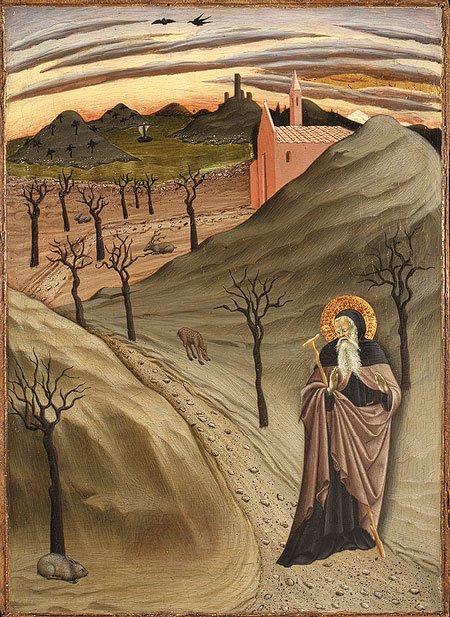
St. Anthony the Abbot in the Wilderness (Osservanza Master, Siena, c. 1435)

For your hand was heavy upon me day and night;
my moisture was dried up as in the heat of summer. 

— Psalm 32:4 [i]

Ash Wednesday is a border crossing. Our foreheads, like passports, are stamped with ashes, and we step bravely into the forbidding wastes of Lent’s strange land. By the time we reach the other side, we will be someone else. 

The Lenten journey is commonly viewed as a time of personal growth and transformation, a solitary immersion in the refiner’s fire, a testing and cleansing of our innermost heart. We learn to travel light, shed the inessentials. We face our demons. We renounce regrets and angers, and interrogate our desire. We listen patiently, till the Silence speaks. The desert saints, who fled the corruptions and distractions of the Roman Empire to meet God on open ground, modeled the classic regimen: 

“[G]et up early every day and acquire the beginning of every virtue and commandment of God. Use great patience, with fear and long-suffering, in the love of God, with all the fervor of your soul and body. Exercise great humility, bear with interior distress, be vigilant and pray often with reverence and groaning, with purity of speech and control of your eyes… Do your work in peace. Persevere in keeping vigil, in hunger and thirst, cold and nakedness, and in sufferings.”[ii]

This year, however, Lent’s collective dimension comes to the fore. The pandemic has made our social behavior a literal choice between life and death. Thoughtless selfishness about masks and social distancing, however trivial it may seem in the moment, may have murderous results. Necessity has forced us all to live, as Thoreau advised, “deliberately.” At the same time, climate change, racism, economic dysfunction and political crisis continue to issue their own relentless summons to collective conversion. 

Return to me with all your heart, says the Lord, with fasting, with weeping, and with mourning; rend your hearts, not your garments.… Blow the trumpet in Zion, sanctify a fast; call a solemn assembly; gather the people.…Between the vestibule and the altar let the priests, the ministers of the Lord, weep. Let them say, “Spare your people, O Lord, and do not make your heritage a mockery, a byword among the nations.” [iii]

These words of the prophet Joel, recited aloud in the Ash Wednesday liturgy, seem so well-aimed this year. Although the United States is not the biblical chosen people, Joel’s words do hit home. Our toxic national quagmire should put us all in sackcloth and ashes, rending our hearts and crying “Mercy!” for 40 days of public atonement. 

It’s not enough to blame Trump, Hawley, Cruz, McConnell and rest of that sorry mob of schemers and traitors. However despicable their betrayals of democracy, however pathetic their black hearts and shrunken souls, those individuals are but the rotten fruit of our unaddressed national sins, what Martin Luther King called “the giant triplets of racism, extreme materialism and militarism.” [iv] The common response to the violent insurrection unleashed at the U.S. Capitol on January 6 has been a claim of innocence: “This is not who we are. And yet, in the words of one candid observer, “It is what we do.” [v]

Writing about coming of age during the Vietnam War, Patricia Hampl describes her attempt to identify with the American ideal rather than its present reality. Walt Whitman was her guide. “Out of the ashes of the Civil War … Whitman fashioned his thrilling American conception, …  envisioning a country full of charmed lovers with arms around each others’ waists.” Distressed by napalm abroad and civil strife at home, Hampl wanted to cling to America’s best idea of itself.

“I could escape American history which was a bad dream and enter the dream of America which I wished could be history. A sleight of hand, a last-ditch attempt to return to the purity of abstraction, to the Mayflower moment, the radiant arrival in paradise before anything had happened. Ourselves—but rinsed of history.” [vi]

No such luck. We the people can only be rinsed on the far side of the Lenten desert. For now, nothing but ashes, sand, and dust, as we endure our dryness with broken and contrite hearts, engage our demons without evasion or fear, renounce our innocence, and surrender to grace. 

Alleluias burned by worshippers on the Last Sunday after Epiphany, 2013.

Related posts:

Ash Wednesday: A Time for Self-Compassion

Is Holiness a Lenten Obligation?


[i] Daily Office Psalm for Ash Wednesday, Episcopal Book of Common Prayer.

[ii] The Apophthegmata (Sayings of the Desert Fathers), in William Harmless, S.J., Desert Christians: An Introduction to the Literature of Early Monasticism (Oxford and New York: Oxford University Press, 2004), 199-200.

[iii] Joel 2:12-13, 15-17. This passage is one of two choices of Ash Wednesday texts from the Hebrew prophets. The other, Isaiah 58:1-12, is also a cry for collective repentance, adding a list of corporate sins well-known in our own day: injustice, oppression, neglect of the poor, hungry and homeless. 

[iv] Martin Luther King, Jr., from a famous sermon at New York’s Riverside Church on April 4, 1967. The text (with audio) is here: https://www.americanrhetoric.com/speeches/mlkatimetobreaksilence.htm  A superb article by Andrew Bacevich in June 2020 shows the continuing relevance of King’s sermon today: https://billmoyers.com/story/martin-luther-kings-giant-triplets-racism-yes-but-what-about-militarism-and-materialism/

[v] Mark Danner, “’Be Ready to Fight,’” New York Review of Books (Feb. 11, 2021), 4-8.

[vi] Patricia Hampl, I Could Tell You Stories: Sojourns in the Land of Memory (New York: W.W. Norton & Company, 1999), 49. Hampl is one of my favorite writers and storytellers. 

Fourth of July 2020: Last Rites for a Dying America?

The burning of Washington, 1814.

“The country is on fire. It is in flames. We cannot stomp it out.
And the rest of the world is looking on in horror.”

— Chris Hayes [i]


I was born between D-Day and the liberation of Paris, and for the first time in my life, the Fourth of July will not be a celebration. Even when our country had gone astray in Vietnam or Iraq, even in the shameful eras of segregation or government-sanctioned torture, it still seemed possible to make ritual remembrance of America’s ideals and renew our collective hope in the better angels of our nature. Not this year.

For 1260 miserable days, we have endured a relentless assault on Constitutional principles and democratic norms by an authoritarian president, with a Congress and political structure either too paralyzed or too corrupt to resist. An unending stream of atrocities has made us so numb that even Trump’s despicable (and treasonous?) betrayal of American soldiers in Afghanistan is not sufficient to force his resignation. But as it turns out, the erosion (and potential demise) of our democracy will be of no concern for hundreds of thousands—perhaps millions—of U. S. citizens. By the next Fourth of July, they will be dead.

It’s not entirely Trump’s fault. Our healthcare delivery system is not well-suited to the conditions of pandemic. Neither is an economy which forces many workers into close proximity. And then there are those lockdown rebels, defiant to the end: “Give me liberty AND give me death.”

But there’s no denying the conclusion that Trump’s well-documented incompetence, unpreparedness, and criminal neglect have already caused, by some estimates, 60% of the U.S. deaths from COVID-19. As of today, we count 78,000 Americans whose lives were lost because the White House was incapable of a timely and well-managed response.[ii] And it is only getting worse. As we surpassed 50,000 new cases per day on July 1, Trump was still preaching magical thinking: Pretend there’s no problem and it will soon go away.

“How long can we live with this President?” is no longer a figure of speech. For the most vulnerable among us, it has become existential. Is it hyperbole to call Trump a mass murderer? Do the math. Sixteen 9/11s in a single day. According to Dr. Anthony Fauci, that could soon double. Thank you, Mr. President.

In a sobering Atlantic article, “The 3 Weeks That Changed Everything,” James Fallows compares the United States to an airplane being flown into a mountain. “At least in an airplane cockpit, the first officer can grab the controls from a captain who is steering the aircraft toward doom.” But our politics don’t work that way. A veteran intelligence official quoted in the article sums up the problem exactly: “Our system has a single point-of-failure: an irrational president.” [iii]

In his classic study, The American Adam [iv], R. W. B. Lewis examines fresh starts and new possibilities as the dominant tropes of American myth-making: a new Eden, the land of the free. This has required the repression of certain facts. North America was not an uninhabited space for the taking. “All men are created equal” was written by a slaveholder. The degree to which these tragic ironies have been balanced by substantial instances of liberation, justice and human flourishing continues to be contested.

But in any case, America identity—e pluribus unum—is a construction of fact and myth, (selective) memory and metaphor, aspiration and ideal. As one scholar puts it, “America has to be thought in order to be lived, but for both to happen, it had to be written.… America was invented, not discovered.”[v] We trace our nation’s birth to a rhetorical scripture, “for the truth of which,” as Thomas Jefferson put it, “we pledge a faith as yet unsullied by falsehood.” [vi]

Independence Day celebrates a radical break from the past, a casting off of the old order for the new. In “Earth’s Holocaust,” Nathaniel Hawthorne’s fable of revolution written in 1844, a great crowd gathers on a vast prairie to make a bonfire of everything humanity needs to renounce: the trappings and symbols of repressive institutions and economic inequality—all the “outworn trumpery” (!) of the world. The unprecedented scale and duration of the Black Lives Matter protests is a vivid enactment of this trope, evoking America’s most radical premise: We are not bound to our past; we can reinvent the social order.

Meanwhile, the COVID-19 pandemic is forcing institutions, communities, and individuals to reimagine how we live and move and have our being. When the pandemic passes, will we resume the old ways, or insist on something better? In another of his stories, Hawthorne proposed a state of perpetual renewal:

I doubt whether even our public edifices—our capitols, statehouses, courthouses, city-halls and churches—ought to be built of such permanent materials as stone or brick. It were better that they should crumble to ruin once every twenty years or thereabouts, as a hint to people to examine and reform the institutions which they symbolize.[vii]

Whether collective and personal transformation will come through purifying fire or the gentler urgings of wisdom and spirit, it will unmask our illusions and disturb our slumber. As David R. Williams reminds us, the sin of “profound unknowing” cannot endure:

We imagine we are awake and aware of what we are doing, but in fact we are walking in our sleep. We live in a constructed illusion of sounds we call words, and ideas we think we believe, and sights that at least seem to have reality. Most of the time, the illusion holds. But, as Puritan theologian Jonathan Edwards warned …, “we walk over the pit of hell as on a rotten covering, and there are places in that covering so rotten that they will not bear our weight, and these places are unseen.” [viii]

So no, not a normal Fourth of July this year. In the worst case scenario, it could be our last, if our democracy continues to implode. As a member of what Emerson called the Party of Hope [ix], I do not foresee that happening. But I do worry that my country is ill-prepared—emotionally or spiritually—for apocalypse of any kind. Even should the sun go out and the moon turn to blood, some will still be shouting, “Fake news!”

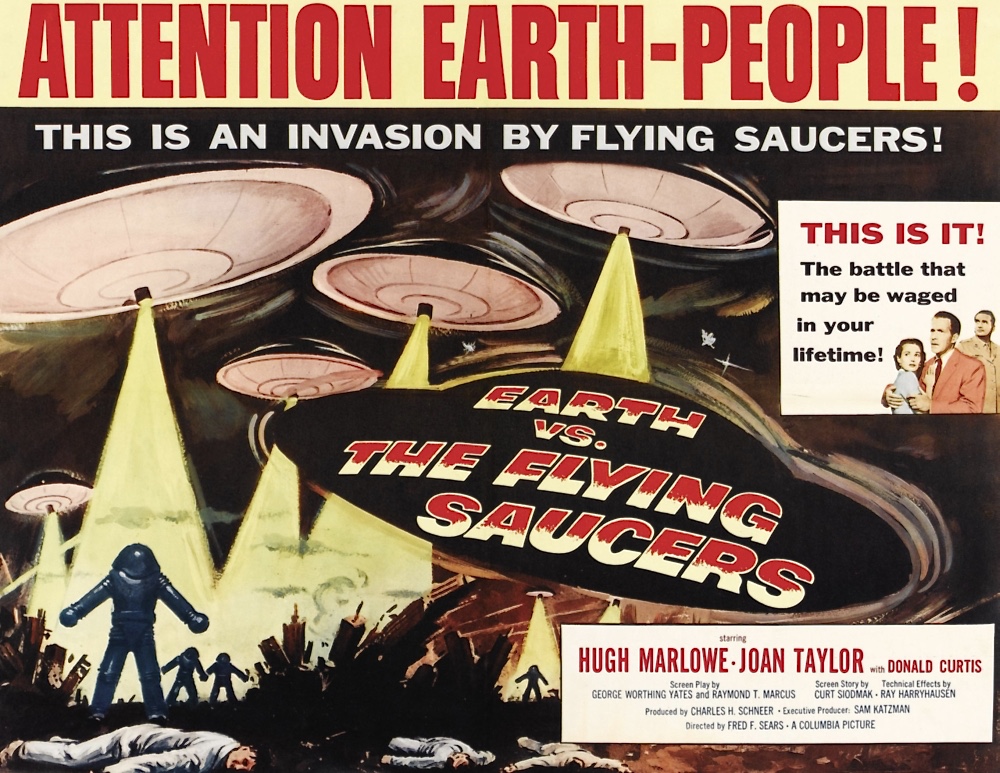
In 1957, a ten-year-old Stephen King was watching a movie matinee of Earth vs. the Flying Saucers, a sci-fi film about alien invaders from outer space.

“[J]ust when it was reaching the good part, with Washington in flames and the final, cataclysmic interstellar battle about to be joined—the screen suddenly went dead. Well, kids started to clap and hoot, thinking the projectionist made a mistake or the reel had broken, but then, all of a sudden, the theater lights went on at full strength … then the theater manager came striding down the center aisle, looking pale, and he mounted the stage and said, in a trembling voice, ‘I want to tell you that the Russians have put a space satellite into orbit around Earth. They call it Sputnik. … ’ There was a long hushed pause as this crowd of fifties kids in cuffed jeans, with crewcuts or ducktails or ponytails, struggled to absorb all that; and then, suddenly, one voice, near tears but also charged with terrible anger, shrilled through the stunned silence: ‘Oh, go show the movie, you liar!” [x]


Related posts:

Fourth of July

July 4th and the Pursuit of Happiness

“Your celebration is a sham” — Independence Day in an Age of Cruelty


[i] Chris Hayes, from his MSNBC program, All In with Chris Hayes, July 2, 2020.

[ii] https://trumpdeathclock.com

[iii] https://www.theatlantic.com/politics/archive/2020/06/how-white-house-coronavirus-response-went-wrong/613591/?fbclid=IwAR34gDXbfiSeHF-WEnBx5mR-g-sJBkkgskC29rSIY2NH_UdZBBuwgf9RYC0

[iv] R. W. B. Lewis, The American Adam: Innocence, Tragedy, and Tradition in the Nineteenth Century (Chicago: University of Chicago Press, 1955)

[v] Geoff Ward, The Writing of America: Literature and Cultural Identity from the Puritans to the Present (Cambridge, MA: Polity Press, 2002), 17.

[vi] This line from Jefferson’s original draft of the Declaration of Independence would be deleted by committee, but it expresses the document’s Edenic spirit (“as yet unsullied by falsehood”). Cited in Ward, 28.

[vii] Nathaniel Hawthorne, The House of the Seven Gables (1850), cited in Lewis, 19.

[viii] David R. Williams, Searching for God in the Sixties (Newark, DE: University of Delaware Press, 2010), 204.

[ix] Ralph Waldo Emerson described a duality in American culture as a schism between the Party of Memory (tradition, or reverence for a “sacred” past or origin) and the Party of Hope (dedicated to rebirth and new possibilities). These are not, of course, to be confused with specific political parties, and most of us belong to both (except, perhaps, for members of a third party, the Party of Irony). See the discussion in Lewis, 7.

[x] Tim Underwood and Chuck Miller (eds), Bare Bones: Conversations on Terror with Stephen King (New York: New English Library, 1990), p. 22, cited in Ward, 119.

“Here, right matters.”

Riding upward on Fortune’s wheel (Paolo Manucci, pavement of Siena cathedral, 1504-1506)

“. . . their motives escape us like rites of an unknown religion.”

––– Gilles Deleuze [1]


At the end of the eighteenth century, the President of the United States, supported by the religious right and a wealthy elite, began to round up dissidents and throw journalists in jail. He garnered support for this assault upon civil liberties by stirring up fears about war and foreign enemies while dividing the country along the fault lines of self-interest and resentment.

The Vice President, deeply disturbed by this mockery of America’s founding ideals of liberty and the common good, tried to summon hope.

“A little patience,” he said, “and we shall see the reign of witches pass over, their spells dissolved, and the people recovering their true sight, restoring their government to its true principles. It is true, that in the meantime, we are suffering deeply in spirit, and incurring the horrors of a war, and long oppressions of enormous public debt. … If the game runs sometimes against us at home, we must have patience till luck turns, and then we shall have an opportunity of winning back the principles we have lost. For this is a game where principles are the stake.” [2]

So wrote Thomas Jefferson to a friend in 1798.

After watching this week’s Congressional impeachment hearings, I am trying hard to “have patience till luck turns,” but whether our nation can ever truly recover “the principles we have lost” remains an undecided question. The lawlessness of crimes, corruption and coverup appears to be more than a match for constitutional processes, at least so far.

“This is America,” insists Lt. Col. Alexander Vindman. “Here, right matters”[3]  But the President and his allies are doing their worst to prove him wrong. It’s become so difficult to stay ethically focused in the blizzard of bad acts that is the Trump administration, with its distracting whack-a-mole of endless evils.[4] Words and actions which would have scandalized prior generations have been normalized into the banality of daily, sometimes hourly, experience. But during the past week, the House Intelligence Committee has extracted one particular crime out of the ceaseless flow, enabling millions of Americans to examine it in depth.

In the face of a mountain of damning evidence, Congressional Republicans cover their ears and shut their eyes. Their posturing at the hearings has been shamelessly mendacious and painfully childish. Whether their behavior is driven by fear, ambition, or blindness, they act under a malignant spell which not even a clear and present danger to Constitution and country can dissolve. Their motives escape us like rites of an unknown religion. They sleepwalk toward the abyss, dragging America with them.

“We are better than that!” cried Elijah Cummings earlier this year. And Adam Schiff, the chair of this week’s hearings, chose his late colleague’s passionate plea to be the final words of yesterday’s concluding session. So now we must ask: Are we? Are we better than that?

A foundational American myth has been the story of rebirth and renewal. Unburdened by the weight of the past, perpetually empowered to reinvent ourselves, we want to believe in our own agency, the chance to start afresh in every moment. No Old World fatalism shall deter our capacity to act. If there’s a problem, we’ll solve it. If there’s an obstacle, we’ll overcome it. “I know if we come together, there’s nothing we can’t do,” says presidential candidate Joe Biden, expressing a mandatory trope of American rhetoric.

Writing about American cinema, Gilles Deleuze says that it “constantly shoots and reshoots a single fundamental film, which is the birth of a nation-civilization.”[5] And in that sense our politics are like our movies. We watch in order to rediscover America. But, as Deleuze cautions,

 “. . . we do not perceive the thing or the image in its entirety, we always perceive less of it, we perceive only what we are interested in perceiving, or rather what it is in our interest to perceive, by virtue of our economic interests, ideological beliefs and psychological demands. We therefore normally perceive only clichés.[6]

Epistemology––the study of what we know and how we know it––is not just the domain of philosophical reflection. When 30-40% of Americans now perceive the world as a place where monstrous and murderous acts are somehow acceptable, epistemology is a political problem. Trump will be gone, sooner or later, but the toxicity of unknowing will take decades to dispel, assuming we manage to survive this perilous time with our democracy intact.

In yesterday’s impeachment testimony, foreign affairs specialist Fiona Hill warned Americans about the Russian strategy to destabilize western democracies:

“When we are consumed by partisan rancor, we cannot combat these external forces as they seek to divide us against each other, degrade our institutions, and destroy the faith of the American people in our democracy.”

Hill went on to say, “Russia’s security services and their proxies have geared up to repeat their interference in the 2020 election. We are running out of time to stop them. In the course of this investigation, I would ask that you please not promote politically driven falsehoods that so clearly advance Russian interests.”[7]

In other words, if America lives by the lie, it will die by the lie. If a deluded public loses the ability to distinguish what is imaginary from what is real, we are lost. The false narratives of others will be substituted for our own freedom of thought. Who, then, will rescue us from this “body of death?”[8]

This week, in addition to missing three days of rare and precious Northwest November sunshine while staying inside to watch the hearings, I curated a conversation about St. Paul at the Episcopal church of St. Barnabas on Bainbridge Island, Washington. We began with a pivotal passage from his letter to the church at Philippi:

“Let this mind be in you which was also in Christ Jesus.” (Phil. 2:5)

These words were inscribed in large letters on the wall of the assembly hall in my boyhood school, and for six formative years, from seventh through twelfth grade, they were before my eyes at every morning assembly. Ever since, Paul’s invitation to a radically new kind of perception has continued to challenge my ethical complacency and disturb my spiritual sleep.

To have the mind of Christ, I believe, isn’t asking us to do a little better, but to be radically different, to make our center not the ego or all the assumptions and biases implanted by nature and culture, but something transcending our limited (and limiting) personal standpoint.

As Episcopal theologian Mark McIntosh puts it, faith becomes “a new cognitive framework . . . restructuring the mind and prying it open to the infinite, deathless reality of God.”[9] With the mind of Christ, we see with the eyes of the Compassionate One, the Merciful One, not only desiring what God desires, but becoming the very means of actualizing divine desire in the mending of the world.

In the seventh century, Maximus the Confessor said that “to have the mind of Christ is, in my opinion, to think in his wayand of him in all situations.”[10] In other words, when we “put on Christ” (to use another Pauline image), the question of “what would Jesus do?” becomes existential: What would we do? What will we do? It’s not simply a way of thinking. It is a way of acting and being.

St. Paul was an itinerant pastor to some pretty wayward and quarrelsome congregations, who, he worried, only “bite and devour one another” (Gal. 5:15). He repeatedly exhorted them to renounce partisan rancor and fearful self-indulgence, to let Christ’s mind be in them, manifesting itself in the way they live with each other, and in the way they exist to invite everyone else into Love’s dance.

Let love be genuine; hate what is evil, hold fast to what is good; love one another with mutual affection; outdo one another in showing honor. Do not lag in zeal, be ardent in spirit, serve the Lord. Rejoice in hope, be patient in suffering, persevere in prayer. Contribute to the needs of the saints; extend hospitality to strangers. Bless those who persecute you; bless and do not curse them. Rejoice with those who rejoice, weep with those who weep. Live in harmony with one another; do not be haughty, but associate with the lowly; do not claim to be wiser than you are. Do not repay anyone evil for evil, but take thought for what is noble in the sight of all. If is it possible, so far as it depends on you, live peaceably with all (Romans 12:9-18).

The gap between Paul’s exalted vision of communal life and the present reality of America’s broken public could not be greater. You don’t have to be a Christian, or conflate church and country, to see the wisdom of Paul’s words for our common life as citizens and neighbors. Our refusal to love cannot stand. Paul’s warning to his congregations is aimed at America as well:

Take care, lest you be consumed by one another. (Gal. 5:15).


I recently photographed the 16th-century pavement image of Fortune’s wheel in the cathedral of Siena in Italy. There are 4 figures riding the wheel; one at the top, one at the bottom, one going down, and one riding upward. I chose the latter for this post as sign of hope.

[1] Gilles Deleuze, Cinema 2: The Time-Image (Minneapolis: University of Minnesota Press, 1989), p. 94. Deleuze was describing the wealthy characters in the films of Luchino Visconti, but it seems an apt image for the inexplicable behavior of Trump’s political allies.

[2] Thomas Jefferson, letter to John Taylor, June 4, 1798.

[3] Testimony before the House Intelligence Committee, Nov. 20, 2019.

[4] This does not seem hyperbole to me. My post before the 2016 election, Ten Reasons to Stop Trump Now, has proved all too accurate as far as it goes, but who then could have predicted children in cages, the pardoning of war criminals, the betrayal of Kurdish allies, etc. etc.? Just today I read that almost 10,000 premature deaths per year can be attributed to Trump’s gutting of EPA rules. As I said, endless evils.

[5] Deleuze, Cinema 1: The Movement-Image (Minneapolis: University of Minnesota Press, 1986), 148.

[6] Deleuze, Cinema 2, p. 21.

[7] Fiona Hill, testimony before the House Intelligence Committee, Nov. 21, 2019.

[8] “Wretched man that I am! Who will rescue me from this body of death?” (Romans 7:24)

[9] Mark McIntosh, “Faith, Reason, and the Mind of Christ,” in Paul J. Griffiths & Richard Hutter, eds., Reason and the Reasons of Faith (New York/London: T&T Clark, 2005), 141.

[10] Maximus the Confessor (580-662), Chapters on Knowledge, II, 83, cited in McIntosh, 121.

When Love is the Way

Magnus Zeller, The Orator, Germany c. 1920 (Los Angeles County Museum of Art)

The Episcopal “Daily Office” provides prayers and Scripture for various times of day. Derived from medieval monastic liturgies, the practice of hallowing the beginning, middle and end of our days with both corporate and private prayer can offer refuge and refreshment, lifting us out of the relentless rush of time to remember what it’s all about and deepen our connection with the holy One, who is our Source, our Companion, and our End.

This venerable prayer practice is not an escape from the world, but a way of attending to it with clearer vision. Thus the Daily Office offers challenge as well as comfort. The God of history will not let us ingore the calamity and suffering wrought by what the original Book of Common Prayer called “the devices and desires of our own hearts.”

Sometimes the biblical readings seem ripped from the headlines, like this week’s Wednesday reading from Proverbs:

There are six things that the Lord hates,
seven that are an abomination to him:
haughty eyes,
a lying tongue,
and hands that shed innocent blood,
a heart that devises wicked plans,
feet that hurry to run to evil,
a lying witness who testifies falsely,
and one who sows discord in a family.[i]

I have to confess that in the midst of my prayer time I succumbed to uncharitable amusement when I read these words. They describe the American president––and his corrupt and cruel minions––so perfectly! But neither righteous outrage nor satirical jesting––and certainly not any presumption of our own goodness––will deliver us from the menace of these times.

Of course we must take sides against the malicious designs of evil tyrants in order to defend the vulnerable and preserve the common good. As Reinhold Niebuhr reminded my generation of theology students, trying to keep one’s own hands clean in a dirty conflict can be a form of capitulation. Sometimes our innocence must be sacrificed in the historical struggle for a better world. Dietrich Bonhoeffer knew this when he joined the plot against Hitler.

But engaging the powers of darkness solely on their own terms is toxic, perhaps fatal, in the long run. If our goal is community and communion, we cannot make division and opposition our primary weapons. On the day following the assassination of Martin Luther King (and two months before his own violent end), Bobby Kennedy made this point boldly to an audience afflicted by passions of grief, fear and rage.

“We must recognize that this short life can neither be ennobled or enriched by hatred or revenge. . . . violence breeds violence, repression brings retaliation, and only a cleansing of our whole society can remove this sickness from our soul.”[ii]

The United States has weathered dark and dangerous times before. But with the exception of the Civil War, has there been another time when our nation’s very survival has been in such doubt? Institutional and legal norms are under daily assault by the White House and Congress; Republicans turn a blind eye to corruption and the clear threat to democracy; racism, hatred and fear are fostered and encouraged by “the most powerful man on earth,” and a third of this country lives in a fact-free bubble, impervious to reason and morality. A recent headline called us “The Banana States of America.”[iii]

Bells of warning should ring out Danger! in every city and town. Prophets should shout The end is near! on every street. Pundits may worry, dissenters object, and activists resist, but where is the widespread public cry of peril and alarm? Imagine such passivity after Pearl Harbor or 9/11. Are most of us still taking for granted our national stability? Do we simply assume everything will return to normal after the next two elections?

In a recent Washington Post column, “Watch What Happens in Rome,” Anne Applebaum examines current Italian politics as a disturbing cautionary tale for the United States. After finally ousting a corrupt authoritarian leader, Italy failed to revert to a more benign and centrist public order.

“Reeling from the flood of broken promises, electorates did not turn back to honest realists who told them hard truths or laid out the hard choices. On the contrary: In Italy, as in so many Latin American countries in the past, the failure of populism has led to greater dislike of “elites,” both real and imaginary; a greater demand for radical and impossible change; and a greater sense of alienation from politics and politicians than ever before.”

Applebaum then wonders what we all should be wondering:

“In President Trump’s wake, we too are not necessarily going to return to the status quo ante, to a tame trade-off between centrist conservatives and centrist liberals, all of whom respect the Constitution, believe in the old definitions of patriotism and get elected based on their experience and political views. It is just as likely that national politics becomes a patchwork of competing, incompatible single-issue groups and causes; that otherwise disparate groups meet one another online and form temporary alliances. It is just as likely that irresponsibility and irrationality become something that people vote for, not something that they reject. Watch what happens in Rome, because it could be America’s future.”[iv]

Whether this or some other equally destabilizing scenario should come to pass, what are the friends of God called to do? Sadly, many of my Christian brothers and sisters are only making things worse. As another columnist, Leonard Pitts, lamented last week:

“Having seen putative Christians excuse the liar, rationalize the alleged pedophile, justify the sexual assaulter and cheer as walls are raised against the most vulnerable, it’s obvious that many of those who claim that name embody a niggardly, cowardly, selfish and situational “faith” that has little to do with Jesus.”[v]

In encouraging contrast to such shameless apostasy, an ecumenical group of Christian leaders has issued a timely manifesto, “Reclaiming Jesus: A Confession of Faith in a Time of Crisis.” Click the link to read the whole text, and share widely. It’s a good theoretical foundation for a gospel-based resistance.

The Confession is structured in six sections, pairing what we believe as disciples of Jesus and what we reject. Yes to imago Dei, no to racism; yes to compassion and kindness, no to neglect or abuse of the vulnerable; yes to servanthood, no to domination; yes to communion, no to division and oppression; yes to truth, no to lies; yes to global community, no to “America first.”

The last of these may be the most challenging for those who subscribe to the great American heresy of exalting nation over God. As Clarence Jordan observed many years ago, the biggest lie told in America is, “Jesus is Lord.” But “Reclaiming Jesus” aims higher: “Our churches and our nations are part of an international community whose interests always surpass national boundaries. We in turn should love and serve the world and all its inhabitants rather than to seek first narrow nationalistic purposes.”

Tonight the framers of this Confession are processing to the White House gates for a candlelight vigil. As they have written,

“We are living through perilous and polarizing times as a nation, with a dangerous crisis of moral and political leadership at the highest levels of our government and in our churches. We believe the soul of the nation and the integrity of faith are now at stake.”[vi]

Among the many church leaders marching in that procession will be the Most Rev. Michael Curry, the Episcopal Presiding Bishop whose sermon on love’s redemptive power, at last week’s royal wedding, invited a global audience to imagine the world as God made it to be:

Imagine our homes and families when love is the way.
Imagine neighborhoods and communities when love is the way.
Imagine our governments and nations when love is the way.
Imagine business and commerce when love is the way.
Imagine this tired old world when love is the way.[vii]

Let all the people say: Amen!


 Related posts

7 Spiritual Practices: A To-do List for the Time of Trial

Dante and Lewis Carroll Walk into a Dark Wood


[i] Proverbs 6:16-19.

[ii] Remarks to the Cleveland City Club, April 5, 1968: https://www.jfklibrary.org/Research/Research-Aids/Ready-Reference/RFK-Speeches/Remarks-of-Senator-Robert-F-Kennedy-to-the-Cleveland-City-Club-Cleveland-Ohio-April-5-1968.aspx

[iii] Patrick T. Fallon, “The Banana States of America,” Washington Post, May 22, 2018.

[iv] Anne Applebaum, “Watch what happens in Rome. It could be our post-Trump future,” Washington Post, May 18, 2018.

[v] Leonard Pitts, “Oregon school district forced LGBTQ students to read the Bible––how Christian,” Miami Herald, May 17, 2018 (http://www.miamiherald.com/opinion/opn-columns-blogs/leonard-pitts-jr/article211384374.html).

[vi] “Reclaiming Jesus: A Confession of Faith in a Time of Crisis” (http://www.reclaimingjesus.org)

[vii] https://www.episcopalchurch.org/posts/publicaffairs/presiding-bishop-currys-sermon-royal-wedding