“For God so loved our stories” — Tales from the Easter Vigil

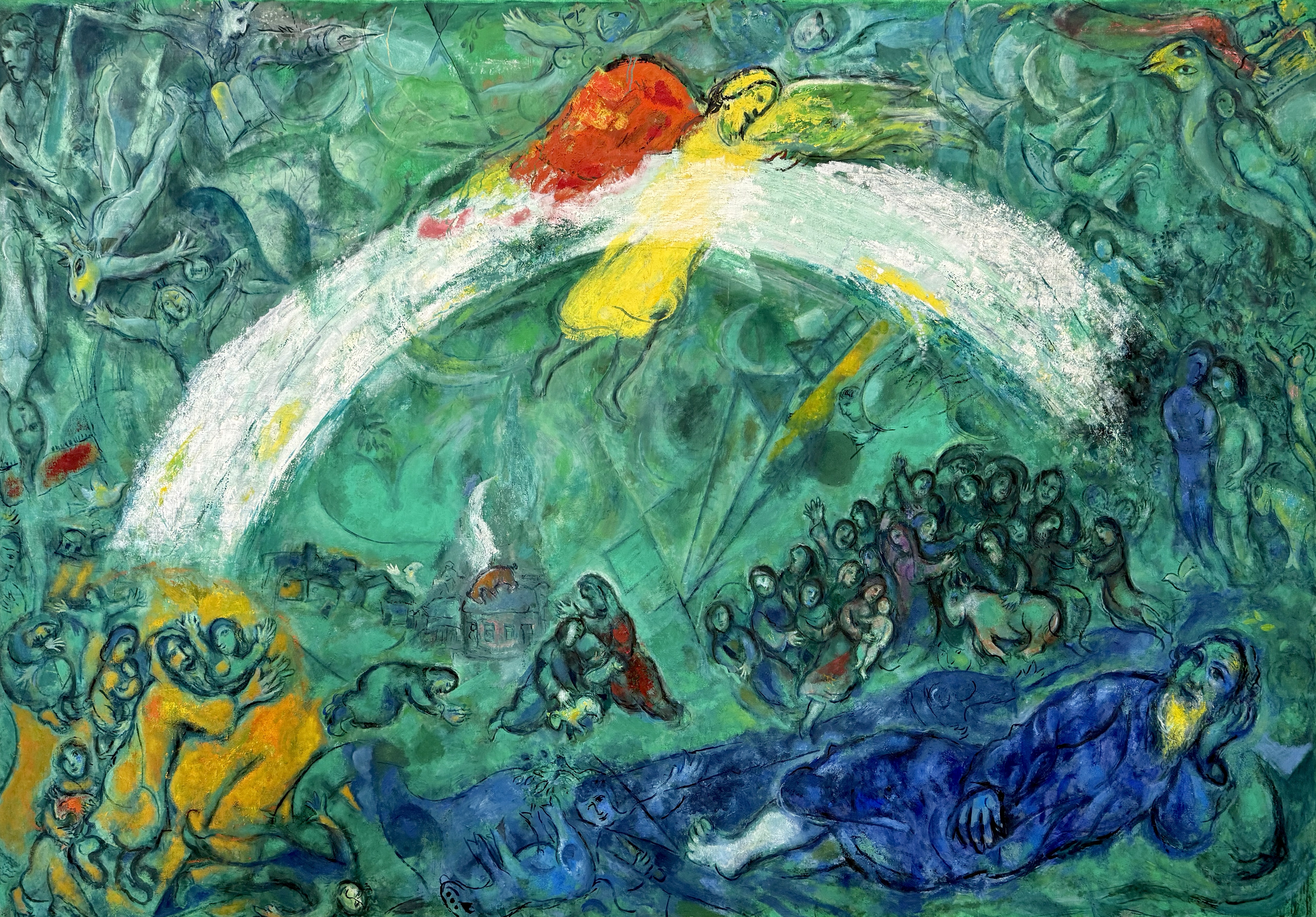
Marc Chagall, Noah and the Rainbow (1961-66)

How blessed is this night, when earth and heaven are joined …

— The Exultet [i]

The Easter Vigil is the molten core of Christian worship: a multisensory passage from darkness to light, death to life. With fire and water, stories and prayers, hymns and chants, candles and incense, bread and wine, it is the most luminous and wondrous of liturgies. The morning rites of Easter Sunday celebrate Resurrection, but the Easter Vigil on the night before feels almost like Resurrection itself. When it’s over, you come away a little dazed, wondering “oh what is that beautiful thing that just happened?” [ii]

After the New Fire is lit at sunset on Holy Saturday, one of the first things that happens at the Easter Vigil is the recitation of narratives and prophetic texts [iii] from the Hebrew Scriptures, beginning with the Creation story (Genesis 1:1—2:4a). In most churches, the texts are read from a lectern, but for nearly four decades, in a dozen different West Coast churches, I have curated the performance of the Vigil lectionary using drama, storytellers, music and projected media.

There’s nothing wrong with a well-read passage of canonical text—I’m quite fond of a good reading by a practiced and thoughtful voice—but sometimes a telling or dramatization can reach places which a reading cannot. Instead of a reader as a passive, transparent window for a sacred text to pass through without inflection or distortion, a teller embodies the text in breath, intonation, gesture and movement, making it alive and present and urgent in the moment of its speaking. And a dramatization can make a familiar story be freshly encountered. A story told or performed rather than read has a unique kind of authority, coming from the heart instead of a book.

The Easter Vigil is the Christian dreamtime, and we try to engage its lectionary accordingly. Biblical stories aren’t just memories about the past. They are living words meant to guide and shape our own responses to the present. As we become steeped in the stories, they begin to dwell in us, and we in them.

When we hear of the world drowning in its own evil, while a faithful remnant tries to navigate the sea of chaos, we recognize ourselves aboard the ark. When we hear of an evil regime trying to crush the ones who are “not like us,” the deliverance of the oppressed at the Red Sea encourages our own struggle to break free of the dark. When we hear of dry bones resurrected by divine breath, our own dead hopes begin to breathe again.  

In the darkest days of the Second World War, W. H. Auden wrote a “Christmas Oratorio” [iv] which had no illusions about the world into which God was made flesh:

The evil and the armed draw near;
The weather smells of their hate
And the houses smell of our fear …

Such days are upon us again, and we truly need our sacred stories—the ones that remember divine intention and a habitable future—more than ever. At our Episcopal parish of St. Barnabas on Bainbridge Island, Washington, where my wife is the rector, I’ve been developing fresh versions of the stories, listening carefully for whatever they want to say to us in the year of our Lord 2025.

We will begin with a pair of texts projected on a screen after the ancient Exultet is chanted. The first says, For God so loved our stories. This is of course a blend of Elie Wiesel’s “God made man because he loves stories” and John 3:16’s “For God so loved the world …” The theology of Incarnation says that God’s own self entered fully into the human story. And the theology of salvation says that we in turn are meant to participate in the divine story. Both meanings are implied in the preface to our Vigil story time, grounding the performed narratives in the conviction that we can meet God in them.

The second text is a verse from Jeremiah (29:11): For surely I know the purpose I have for you, says the Holy One: plans for peace and not for evil, to give you a future and a hope. At a time when our future is in question and hope is stretched thin, God invites us to sit around the Paschal fire and let the stories of promise speak to our hearts once more.

Here is how the telling will go at this year’s Paschal fire:

The Creation: After the voice of e.e. cummings says, “When God decided to invent everything, he took one breath bigger than a circus tent, and everything began,” a big screen lights up with spectacular footage of the natural world, taking us through the first seven days in seven minutes. In response, the congregation is urged “to pray fervently for all the people of the earth, and for ourselves, that we may repent of our careless and arrogant abuse of creation, and find our proper and constructive place within its fragile and balanced harmonies.”

The Flood: Four people at a table engage in Bible study. Some of them resist the story (“Why do we even tell this story? No one wants to believe in an angry God” … “In the beginning, God says everything’s so great. Then suddenly he wants to call the whole thing off?”). Others see a kind of learning going on—God learning to live with an imperfect creation. Then somebody argues that the story is not really about God’s choices or God’s emotional life. It’s about the ark.

“The people who first told this story were just like us. They were adrift in a sea of chaos. Everything they had hoped and believed was underwater, washed away in the blink of an eye, and they wanted to know if they still had a future.”

As the discussion winds down, someone says, “Well, I’d better go feed the animals.” Wild waves appear on the screen behind them. It turns out that they have been on their own ark the whole time. The story they were discussing was happening to them. That’s often true of Bible stories.

The exhortations to prayer that follow each story reiterate the themes of the narrative. After The Flood, the Presider reminds the assembly that “God remains deeply committed to our story … God will not forget us, though we be sinking in a sea of chaos.” And the Deacon bids us pray for victims of natural disasters, all whose lives are beset by chaos, those drowning in the dark waters of doubt and fear, and those who cling to the precious ark of faith.

The Red Sea:

Noirish images of anonymous figures (from a bleak Hungarian film) shuffle through an imprisoning corridor on the screen, while three dancers on the stage express the experience of oppression with their bodies. A narrator explains:

Three thousand years ago, in the land of Egypt,
there were people who had no name.
They were the faceless many,
exploited by the powerful,
forgotten by the privileged: slaves, immigrants, the poor,
the homeless, the vulnerable, the invisible, the outcast.

Then dismissive terms for the oppressed appear on the screen in stark animated graphics: Not like us … worthless … horrible people … trash … less than human. More images of “the faceless many” are shown as the dancers writhe in despair and an offstage choir sings a verse of “Go down, Moses.”

Suddenly, the divine breaks into this dark world: the screen flashes red, and we see the words from Psalm 68 that are always used in Orthodox Paschal liturgies:

Let God arise!
Let the foes of Love be scattered!
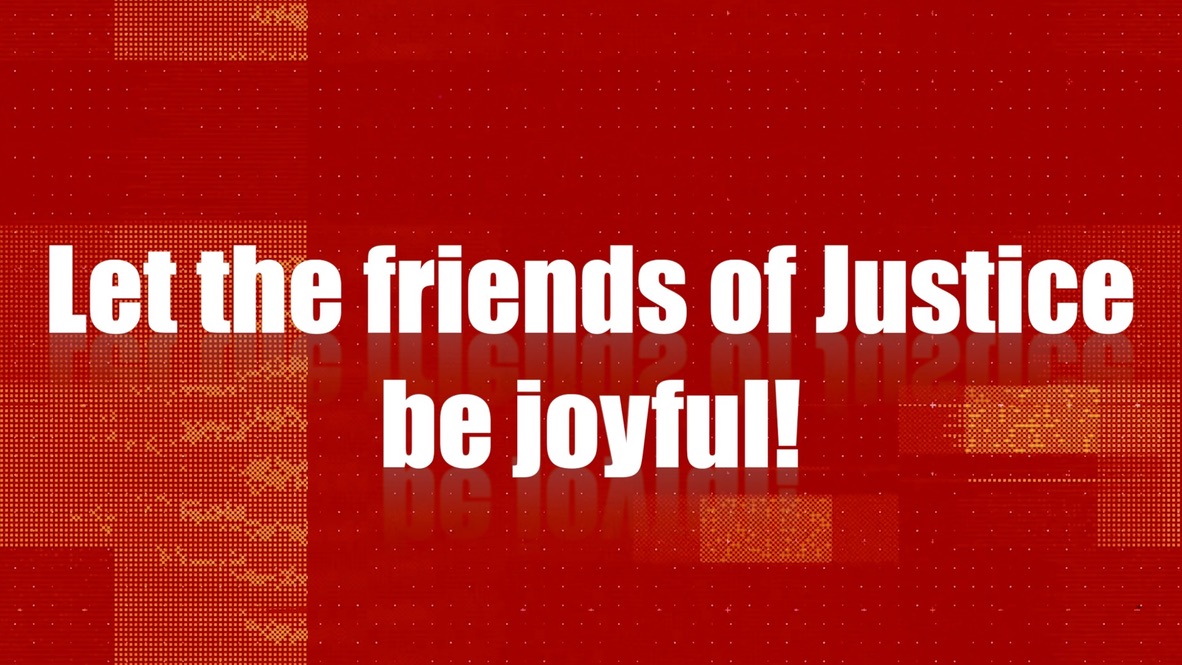
Let the friends of justice be joyful!

Then we hear a verse of a Civil Rights song: “They say that freedom is a constant struggle … Oh Lord, we’ve struggled so long, we must be free.” The dancers’ bodies shift from oppression to liberation, while the screen shows powerful footage of crowds on the march for justice. As we hear a repeating loop of Martin Luther King saying “We cannot walk alone,” the dancers begin their own march across the stage to the “Red Sea,” where they halt while the narrator declares:

This too is a creation story:
On this day, God brought a new people into existence.
On this day, God became known as the One who delivers the oppressed,
the One who remembers the forgotten and saves the lost ,
the One who opens the Way through the Sea of Impossibility,
leading us beyond the chaos and the darkness into the Light.
When the world says No, the power of God is YES!

As the dancers begin to cross the Sea, the choir sings, “We are not alone, God is with us …”
After the song, the bidding to prayer begins:

Pray now for the conscience and courage
to renounce our own complicity
in the workings of violence, privilege and oppression.
Pray in solidarity with all who are despised, rejected,
exploited, abused, and oppressed.
Pray for the day of liberation and salvation.

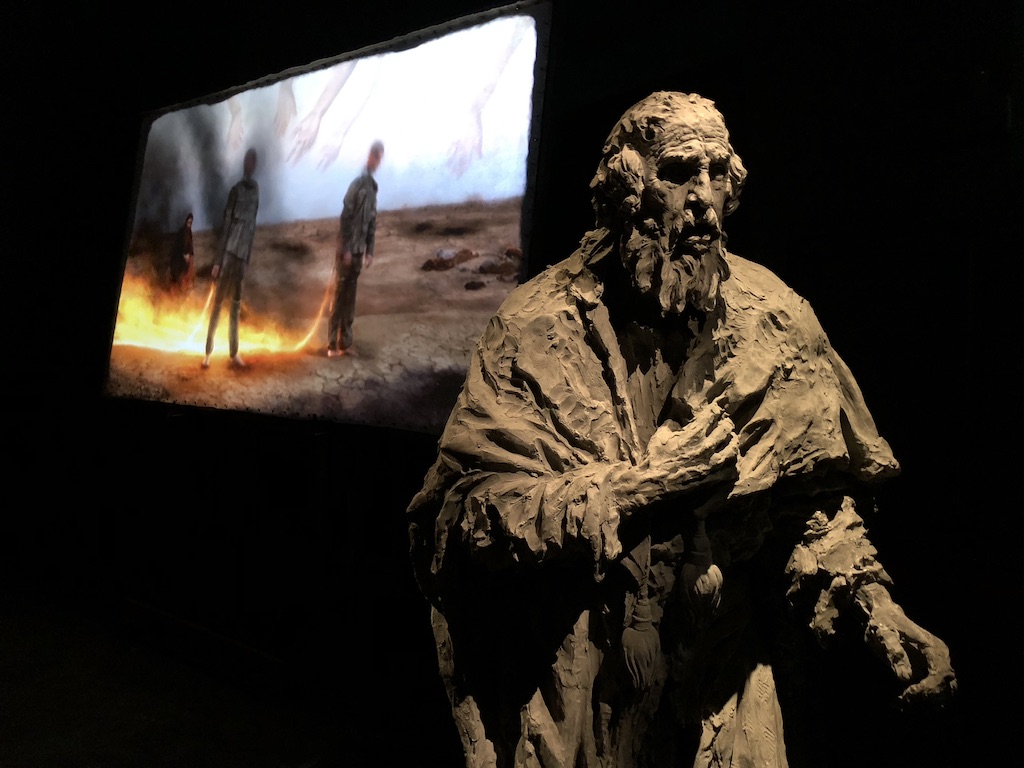
The Fiery Furnace: This story from the Book of Daniel is borrowed from the Orthodox lectionary for the Paschal Vigil, and its humor (yes, the Bible can be funny) provides some comic relief after the Red Sea. The story’s mischievous mockery of a vain and cruel king, outwitted in the end by divine intention, feels quite timely. The idol shown on the screen is a golden iPhone, which will be destroyed by a cartoon explosion from Looney Tunes. The humorously tedious repetition of the instruments signaling everyone to bow is performed with the following (admittedly unbiblical) instruments: bodhran, bicycle horn, slide whistle, chimes, train whistle, and Chinese wind gong. The Song of the three “young men” in the furnace is recited by three women in an abbreviated rap version. At the end, the cast of twelve exit happily, singing the old Shape Note chorus, “Babylon is fallen, to rise no more!”

The Fall of Babylon, Tapestry of the Apocalypse, Angers, France (1377-1382).

Then we give thanks “for the saints who refuse to bow down to the illusions and idolatries of this world” and pray for “the grace and courage to follow their example, resisting every evil, and entrusting our lives wholeheartedly to the Love who loves us.”

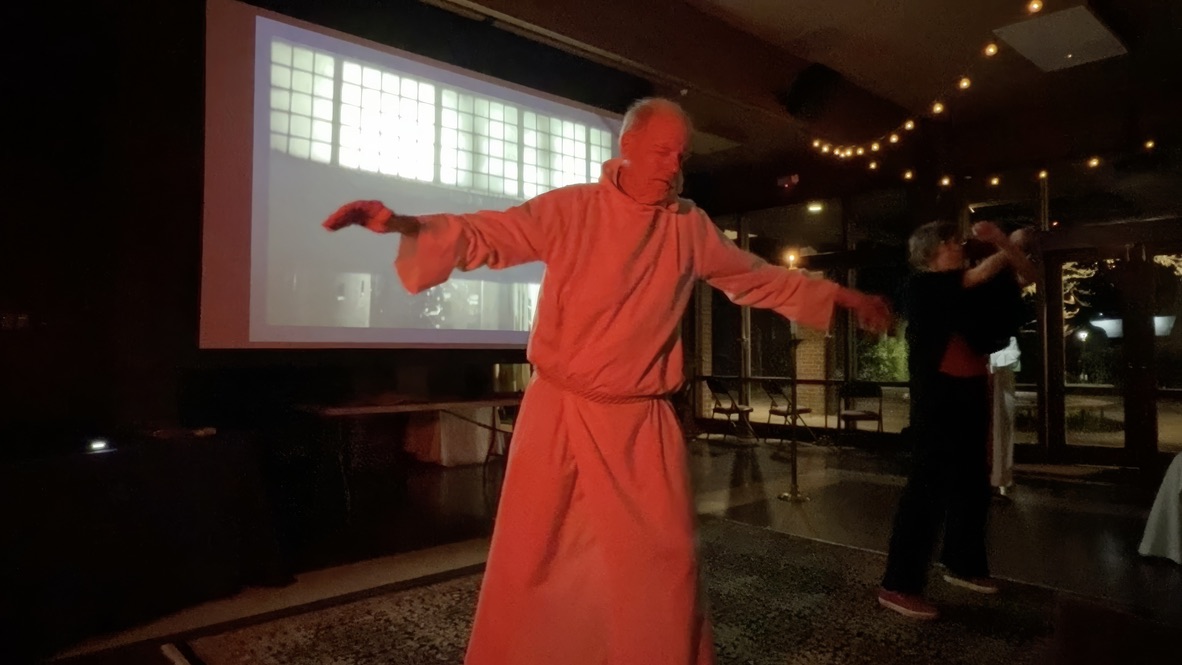
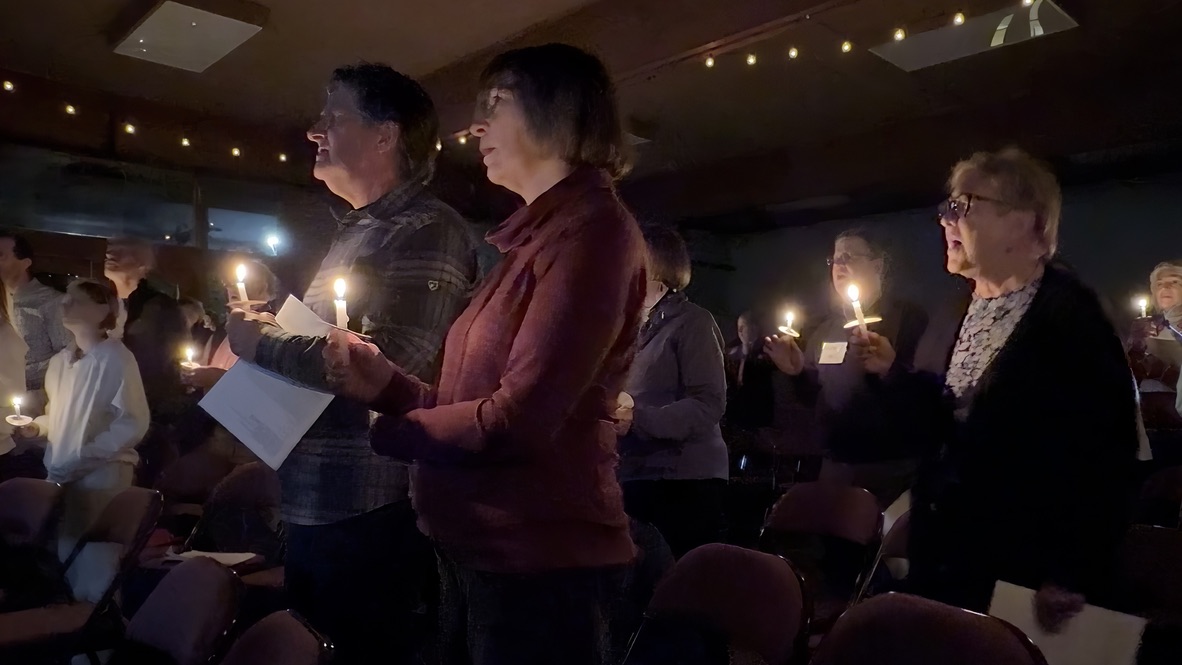
Valley of Dry Bones: Unlike the embellished retellings of the other stories, this one sticks closely to the biblical text, but is delivered in a storytelling mode by a single teller (me) in a spooky atmosphere of dim blue light. The voice of God is a college student on a high ladder. The sound of the bones joining together is made by an Indonesian unklung (8 bamboo rattles tuned to different pitches). When the story describes the breath coming into the lifeless figures sprawled across the valley, I get everyone in the assembly to inhale and exhale audibly a few times so that we can hear the spirit-breath entering our own bodies. Then I move among them, bidding one after another to rise until everyone is standing, completing the story with their own bodies: the risen assembly itself becomes a visible sign of hope reborn.
Then the Presider says,

Dear People of God: There are those who tell our story as a history of defeats and diminishments, a narrative of dashed hopes and inconsolable griefs. But tonight we tell a different story, a story that inhales God’s own breath and sings alleluia even at the grave. By your baptism, you have been entrusted with this story, to live out its great YES against every cry of defeat.
And then, with our sacred stories of faith and hope freshly written on our hearts, we will process from the Story Space to the church for the Renewal of Baptismal vows, followed by the festive first eucharist of Easter, replete with Alleluias. And God willing, by the time it’s all done, none of us will be the same.

May all of you who make the Paschal journey this weekend come to “see and know that things which were cast down are being raised up, and things which had grown old are being made new, and that all things are being brought to their perfection by the One through whom all things were made, our Savior Jesus Christ.” [v]

Resurrection of Christ, Brittany (c. 1425-1430).


All liturgical texts, unless otherwise cited, are by the author.
The Easter Vigil at St. Barnabas Episcopal Church (Bainbridge Island, WA) is on April 19, 2025.

[i] The Exultet (“rejoice”) is a chanted praise sung before the Paschal Candle at the Easter Vigil. Dating back to the 7th or 8th century, it is one of the most beautiful chants in the western rite, and its text is packed with striking images and metaphors of Christ’s passage through death to resurrection, and its implications for our own salvation. Singing it at the Vigil has been one of my greatest priestly joys over the years.

[ii] The line is taken from Mary Oliver’s poem, “At Blackwater Pond.”

[iii] The Vigil lectionary is not all stories. Beautiful texts from Isaiah, Baruch, Ezekiel, and Zephaniah are options as well. During the “Story Time” of the Vigil, we stick to the narratives. The non-narrative texts are then recited by readers along the way between the Story Space and the church, so that the people process through a corridor of continuous audible texts on their way to the font of rebirth.  

[iv] W. H. Auden began writing For the Time Being: A Christmas Oratorio in the autumn of 1941. It was published in September, 1944). Dark times indeed.

[v] Quoted from the collect (prayer) that concludes the Old Testament readings in the Episcopal Book of Common Prayer.

“Let’s do it for the story”: A Farewell to Angela Lloyd

Storyteller Angela Lloyd

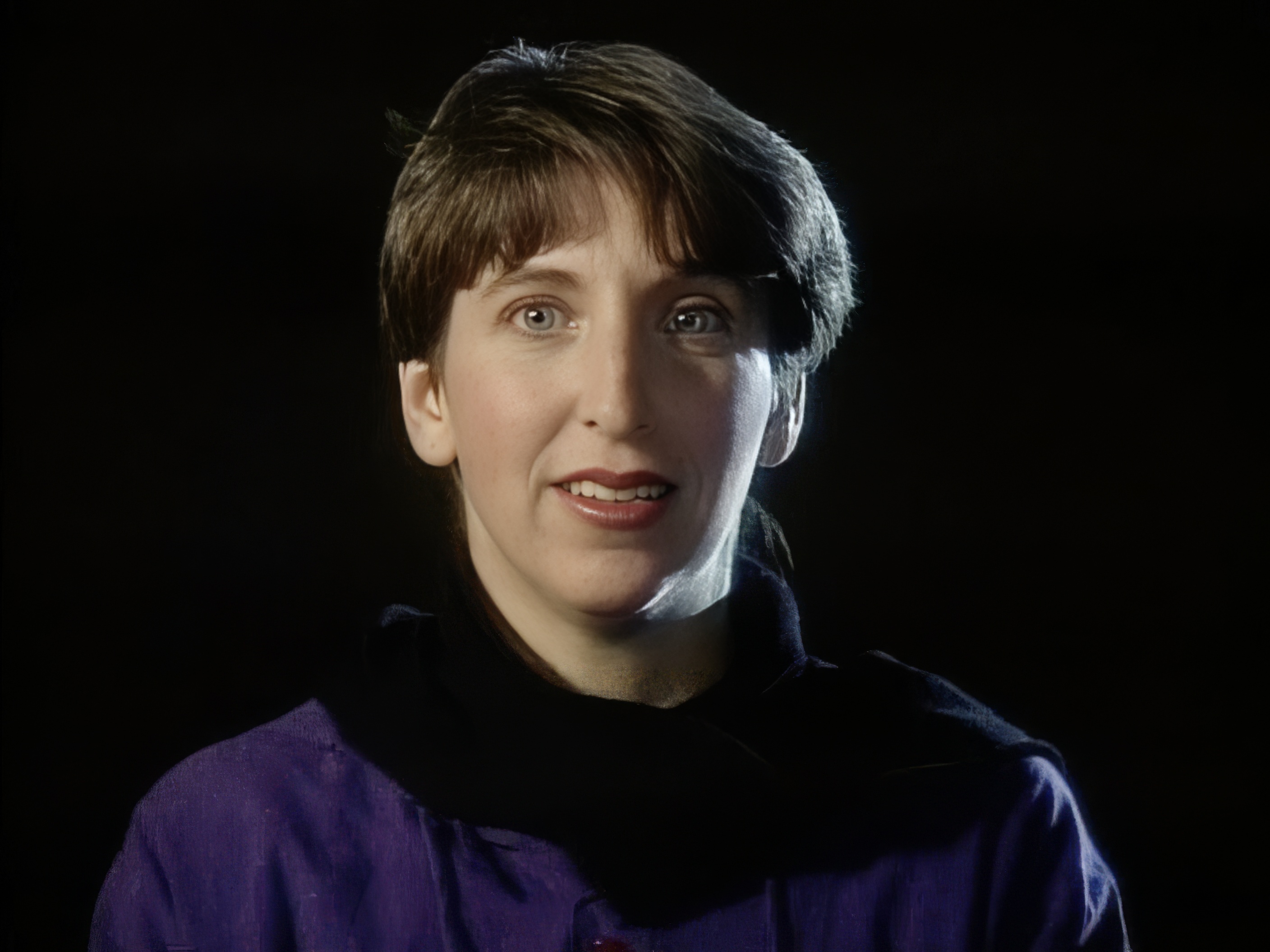
Once upon a time, a brilliant storyteller came into the world to touch countless hearts with tales of wisdom and wonder, losing and finding, tears and laughter. She scattered her life-giving stories far and wide, and encouraged others to do the same. She knew the power of stories to bind us together, ground us in communal wisdom, and help us imagine better futures. Hers was a serious vocation in a world so forgetful of the stories we need, the stories that nourish, the stories that save. But she always lived out her calling with levity and lightness. Everyone who has known her remembers her laughter, her joy, her delight in daily blessings, her generous and irrepressible spirit. As she liked to put it, she was “subject to bursts of enthusiasm.”

Desert dawn at Angela’s house (December 17, 2024): Looking west, looking east.

A week before Christmas, master storyteller Angela Lloyd was up at dawn, photographing the beauty of the California desert sky. She posted two photos with a greeting to her friends: “Good morning. The view from here: looking west, looking east.” She loved sharing the beauty of her desert home. But sometime after that glorious morning she was taken ill, and not long after, on the twelfth day of Christmas, Angela departed this life. When I got the news today, the world felt suddenly washed with grey, bereft of her bright presence.

I came to know Angela nearly 40 years ago, when we worked together on creative retellings of Old Testament stories for the Easter Vigils at Christ Church, an Episcopal parish in Ontario, California. We both believed that God is not known through ink so much as through breath. Without the breath of a spirited teller, our sacred stories may lie dormant and listless.

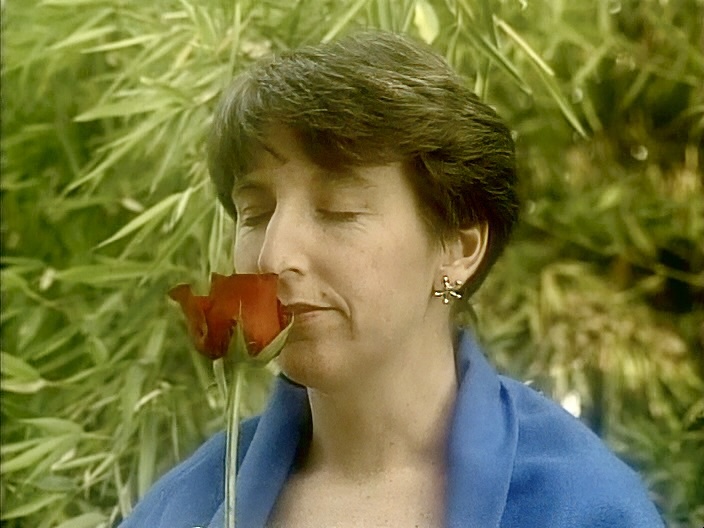
After a few years we made a film of the stories, The Electronic Campfire: New Storytelling from Scripture. Angela took some of the parts (including that of God), while I took the rest. We shot the scenes in various southern California locations.

When I heard that Angela had died, I wanted to celebrate her giftedness by sharing her work in this film. While throughout her life she told many different kinds of stories from a variety of sources and traditions, our biblical collaborations do convey, I believe, a lively sense of the engaging spirit she brought to everything she did. I offer these clips in her memory.

On the third day of Creation, God creates plants and trees.

The first is the Creation story from the first chapter of Genesis. Instead of speaking the divine words for each of the seven days (“Let there be light,” etc.), God performs an action, since in the Bible God’s word is not just description of an action, but the action itself. For God, to say is the same as to do.

The Creation Story from The Electronic Campfire

Angela’s other stories in the film were the Red Sea and the Valley of the Dry Bones. In the first story, I play the Israelites, so you’ll see a bit of that as a lead-in to Angela’s performance of both Yahweh (God) and Miriam (Moses’ sister). The Dry Bones story is all Angela, including some of her riffs on the washboard. She improvised a line the Exodus tale which, in retrospect, sums up her life: “Let’s do it for the story.”

Red Sea & Dry Bones from The Electronic Campfire

At the Easter Vigil, there is a bidding to prayer after each story. Here are the words which follow the story of the Divine Breath that ceaselessly enlivens our “dry bones”—in this world and the next:

Dear People of God:
There are those who tell our story
as a history of defeats and diminishments,
a narrative of dashed hopes and inconsolable griefs.
But tonight we tell a different story,
a story that inhales God’s own breath
and sings alleluia even at the grave …

The sixth day: “Let us make humankind in our image.”

We did a number of Easter Vigils together, and Angela would always surprise me with a new variation. One time, playing an Israelite in the Exodus, she pulled out a postcard. “I was planning to mail this when we got to the Promised Land,” she said, “but something tells me I should mail it now. It may be a while before we get there. Besides, I’m starting to think that maybe anywhere can be the Promised Land, that even in this wilderness I am standing on holy ground.”

Thank you, dear Angela, for your marvelous stories, your enthusiasm, your joy, and so much more. There’s an old song by Jane Voss that salutes absent friends, and what the song says, that is what I say:

Wherever you may be tonight,
I hope this finds your burdens light,
Your purpose high, your spirit strong,
I hope that you have got along—
My song was lost and gone, if not for you.  

The Spirit That Moves Us All: A Pentecost Reflection

Piero di Cosimo, Incarnation (detail), 1500-1505. “Holy Ghost over the bent / World broods with warm breast and with ah! bright wings.” (Gerard Manley Hopkins)

In spite of all the destructive forces [we] let loose against life on this planet, the Spirit of Life is at work in ever new and unforeseeable ways, countering and circumventing the obstacles we put in its path. In spite of my strong tendencies to complacency and despair, I experience the Spirit in myself as calling forth the realistic hope apart from which there is no hope, and I am confident that what I find in myself is occurring in others also … what makes for life and love and hope is not simply the decision of one individual or another but a Spirit that moves us all. 

— John Cobb [1]

Of perfect love thou art the ghostly flame.
Emperor of meekness, peace and tranquility,
My comfort, my counsel, my perfect charity,
O water of life, O well of consolation,
Against all storms of hard adversity …

— 15th century English lyric 

On the fiftieth day of Easter, our liturgical prayer addresses the Holy Spirit more than on any other day. Most of the time our words of supplication and praise address an “other” who is metaphorically outside or beyond: God, Jesus, Father, Mother …. But the dominant prayer of Pentecost calls upon the most obscure and elusive of the divine “Persons”—One who is not “out there” but “in here.”

Veni Sancte Spiritus. Come, Holy Spirit.

The tricky thing about such a prayer is that it is not prayed to the Spirit. It is prayed in the Spirit and by the Spirit. The Spirit is not the object of our prayers, but the subject, dwelling within our inmost parts more surely and substantially than the transitory, constructed “I” produced by the particular confluence of history, biology, and personality which has sculpted our individuality over time. When truth speaks through us, when our energies are directed toward the well-being of all, when our lives are written and rewritten as narratives of divine love, the Spirit isn’t just in us—the Spirit is us. 

This is to claim nothing for ourselves. Only those driven by unholy spirits make that mistake. Participation in the divine reality—life “in the Spirit”—is always a matter of giving yourself away, becoming part of something larger. The Holy Spirit’s proper name is communion. When we’re in the Spirit, that’s our name too.  

Compared to writings about “God” and “Christ,” theological expositions on the Holy Spirit can seem relatively thin. The early creeds didn’t have much to say either, making the Spirit seem like an afterthought—oh yeah, and the Holy Spirit too. But this isn’t due to neglect so much as it is to the Spirit’s way of disappearing into the world as anonymous giftedness. As Orthodox theologian Vladimir Lossky put it: 

“[T]he Holy Spirit effaces himself, as Person, before the created persons to whom he appropriates grace … He mysteriously identifies himself with human persons while remaining incommunicable. He substitutes Himself, so to speak, for ourselves.” [2]

Canadian poet Margaret Avison addresses the Spirit’s indescribability in her poem “… Person or A Hymn on and to the Holy Ghost.” 

How should I find speech 
to you, the self-effacing
whose other self was seen
alone by the only one,

to you whose self-knowing
is perfect, known to him,
seeing him only, loving
with him, yourself unseen?

Let the one you show me
ask you, for me,
you, all but lost in
the one in three,

to lead my self, effaced
in the known Light,
to be in him released 
from facelessness,

so that where you 
(unseen, unguessed, liable
to grievous hurt) would go
I may show him visible.

The poem’s profusion of pronouns makes it hard, at first, to tell which divine Person is doing what. “You” is clearly the Holy Spirit, but who is “him?” Is it Christ, or the Father, or God in general who releases us from “facelessness,” or whom we ourselves make visible in the practice of holy living? The “unseen, unguessed” Spirit may be “all but lost in / the one in three,” but without it (or him, or her, or they), Love Divine could not do its proper work in the world and in the heart.

O fiery Spirit, come burn in us.
O sacred breath, come breathe in us.
O blazing love, come flame in us.…
O delight of life, come live in us. [3]

This past year has generated its share of anxiety, fear, madness and grief, but as John Cobb reminds us, “the Spirit of Life is at work in ever new and unforeseeable ways, countering and circumventing the obstacles we put in its path.” It is in this Spirit that I have shaped my retelling of Ezekiel’s vision in the Valley of Dry Bones (see video below). When the divine breath comes into the lifeless bodies, I layer multiple inhalations and exhalations to make a chorus of breaths. For me that collective sound symbolizes the Spirit’s fierce resistance to every power that would silence and choke us. As the Psalmist says, You send forth your Spirit, and the people are created; and so you renew the face of the earth (Psalm 104:31).


[1] Cited in Marjorie Suchocki, “Spirit in and through the World,” in Suchocki and Joseph A. Bracken, S.J., Trinity in Process: A Relational Theology of God (New York: Continuum, 1997), 180. And yes, masculine pronouns are problematic. Depending on the language, Spirit has been feminine and neuter as well. Do you think She minds?

[2] Vladimir Lossky cited in Paul S. Fiddes, Participating in God: A Pastoral Doctrine of the Trinity (Louisville, KY: Westminster John Knox Press, 200), 261.

[3] Jody L. Caldwell, after Hildegard of Bingen, in Voices Found (New York: Church Publishing, 2003), #62.

Running on Fast Forward

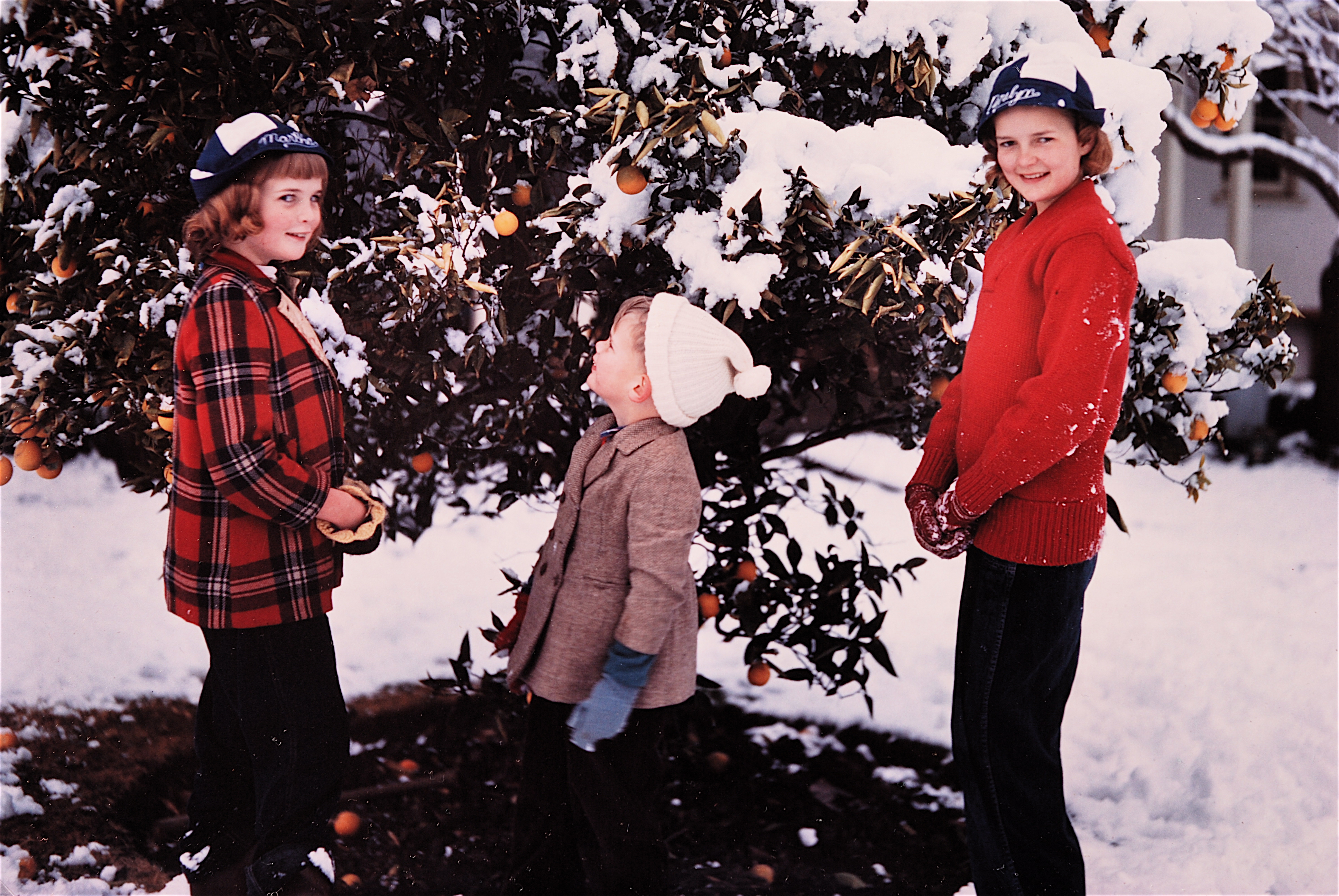
Martha, Jim and Marilyn Friedrich, after the great Los Angeles snowfall (January 1949)

They were so young then, the four of them
sitting on a log in the sand, a row of apartments
in the background, each window facing the sea.

We must have been ten, in matching swimsuits,
riding the long rollers toward shore, dreaming
of soldiers handsome in their uniforms.

They look happy, our parents, as if they had
given away all their secrets and could relax,
not one of them thinking of tomorrow

or yesterday, or any peril that might befall
their children, tumbling about in inner tubes
over the thrilling ocean.

A breeze ruffles the hem of my mother’s skirt.
My father has taken off his shoes.

– Marilyn Robertson, “The Photograph”[i]

My oldest sister Marilyn wrote this poem about an old photo from the 1940s. She and a friend were off-camera, playing in the surf, while their parents kept watch from the shore. “The Photograph” is in a new collection of her poems she presented to her siblings, Martha and me, last weekend, on the occasion of her 80th birthday. I found some of my own childhood inside, like the time I fell out of a moving car at two years old.

In return, I gave her my DVD compilation edit of scenes from our childhood and youth, captured with the clarity of 16mm film by our father. I had added an interpretive music track ranging from “My Blue Heaven” to “Magical Mystery Tour.”

A retrospective mood is common enough on significant birthdays, but the documentary evidence of those home movies gave a vivid immediacy to our memories. Both still and moving pictures preserve long-vanished light. They become the past the instant they are shot. To look at them brings the joy of remembered presence, but also the melancholy of realized absence. Our parents are gone; so is our own past. Who are those bewildered little siblings in the old films, inventing their place in this world, improvising as they go? Did they really grow up to be us?

Eight members of the family––by coincidence, one for each of Marilyn’s decades––gathered for her birthday weekend in one of architect Julia Morgan’s rustic wood and stone houses at Asilomar (“refuge by the sea”) on the tip of California’s Monterey Peninsula. My sisters and I, along with various spouses and children, savored the chance to share memories, plans and dreams, as well as games, walks, and very un-Lenten feasts.

Present and future were as much on our minds as the past. But still, the theme of passing time was inescapable. We grow old, we lose loved ones, we know the meter is running. “Last Times,” another of Marilyn’s poems, considers the divided consciousness of mortal beings. Though “now” is all we ever really have, we can’t help but wonder how long we’ve got.

Halfway through December, a day comes when
I wonder how many more turkeys I’ll bake, worrying
over the gravy, the pan always hard to clean.

Or how many more times I’ll unwrap the crèche
from its colored tissue, lifting out the holy family,
the shepherds and their docile sheep.

I am running on fast forward.
If only I could change direction, like movies
my father ran backward in the projector:

smashed bricks gathering themselves
into a wall again, a smashed truck suddenly
good as new, rolling backward down the road,
clouds of dust sucked in by the tires.

The last time I saw that film I was a girl.
We’d beg him to run it again
and finally he’d agree: But this is the last time.

I make out the grocery list,
slip on my jacket, plan the week
as if the days will follow one another
through this house forever.[ii]

Marilyn Robertson, Jim Friedrich, and Martha Stevens at their father’s childhood home (Summer 1980)

On our last evening together we lingered well past bedtime, happy to postpone the inevitable scattering of the clan. We wandered out to the coastal dunes beyond the lights, where Orion hovered brightly beside the Paschal Moon. To the music of breaking waves, we recited Greek myths about the heavens. When we returned to the house, Martha, a brilliant storyteller, gave us an epic tale about a red-headed woman, Maud Applegate, who tracks Death across the wide world to beg for the life of her cowboy love, grievously wounded in a gunfight. When Maud finally spots her quarry climbing the steep trail to his mountain home, she shouts, “Hey, Mr. Death, wait up!”

She not only finds Mr. Death, she also meets his mother, who proves very sympathetic, and the three of them form a surprising bond. Death eventually grants Maud the boon of sparing her man, but the cowboy turns out to be a cad, and in the end the red-headed woman goes back to Death’s place, to help out as best she can and ease the burden of his loneliness. It was a story both funny and strange, deftly told. We all listened intently, like children with upturned faces. Somehow a tale about befriending Mr. Death was just the thing for our little group of aging mortals.

My wife lost her father in January. Four other people dear to me have also departed in the last six months. Our family has loved ones struggling with cancer and Parkinson’s. The losses are mounting up.

“Oh the separations we endure!” laments my poet sister.

A young man arrives at the station,
two black stones in his pocket.
His beautiful face breaks into a hundred pieces,

then reassembles itself
as he boards the train, waving
goodbye, goodbye to the life that loved him,

watching it fall backward into the wind,
the bamboo gate, the garden
with its wooden bridge over the pond.[iii]

Goodbye, goodbye to the ones we love. And then it’s goodbye to the life that loved us. And yet, as Rilke insists, “there is Someone, whose hands, infinitely calm, holds up all this falling.”[iv] While it’s no use to deny our mortality, there remains a mysterious surplus to human life for which death has no accounting.

On Sunday morning we celebrated eucharist together (it helps to have two priests in the family!), and the readings for the Fifth Sunday of Lent seemed especially apt. First came Ezekiel’s vision of the Valley of Dry Bones, contradicting the human sense of loss with the divine promise that our story is never quite over. I am going to open your graves, O my people, and raise you up. I will put my Spirit in you and you shall live.

The gospel for the day was the raising of Lazarus, the Fourth Gospel’s overture to resurrection on the brink of Holy Week. Perfect. Two sisters and a brother. Death doing what it does. Then Jesus doing what God does.

On the way to the post office this morning
I thought about the odd things we believe.

Things we swear by, pray for, put our trust in,
or wear printed on the back of a T-shirt.

Tarot cards. Crystal balls.
Runes and rattlesnakes.

First stars, second sight––
not to mention elves and Armageddon.

Just look at me, believing that someone
might have written me a letter,

that the world is in good hands,
that a man once walked out of a stone cold tomb

into the light of day, leaving
poor old Death completely in the dark.[v]


Related posts:

Tick-Tock: Thoughts for New Year’s Eve

Are we too late for the Resurrection?

You say goodbye, I say hello: A Requiem sermon


[i] When a Color Calls Your Name: Poems by Marilyn Robertson (Santa Cruz, California, Limited Edition, 2017), 28

[ii] “Last Times,” ibid., 82

[iii] from “Separations,” ibid., 51

[iv] Rainer Maria Rilke, “Fall”

[v] “Belief,” Robertson, 53