August 6: Light Eternal or Light Infernal?

The Transfiguration of Christ (Sr. Abraham, Ethiopian community in Jerusalem, 1990)

I spent only one year in a world without nuclear weapons. My first birthday fell on July 16, 1945, the day of the initial atomic bomb test in New Mexico. A few weeks later, my country used the bomb to extinguish countless human lives on the Feast of the Transfiguration. With Transfiguration falling on a Sunday as Oppenheimer is playing in the theaters, a few comments are in order.

In an interpretive retelling of the Transfiguration by a 17th-century Anglican bishop, Moses and Elijah discuss the paradoxical mixture of evil and glory that permeates the Way of the Cross:

A strange opportunity … when [Jesus’] face shone like the sun, to tell him it must be blubbered and spat upon;… and whilst he was Transfigured on the Mount, to tell him how he must be Disfigured on the Cross! [i]

In the twentieth century, that paradox was tragically deepened when we dropped the atomic bomb at Hiroshima on the Feast of the Transfiguration. Two kinds of light, diabolic and divine, contending forever after for the soul of this world. Whose world is it, anyway? To which light do we belong? To which light do we pledge our allegiance?

In his novel Underworld, Don DeLillo chillingly mixes and confuses the primal images of divine and diabolical light when a nun, swept out of her conscious self into the informational totality of the Internet, has a visionary experience on a website devoted to the H-bomb:

She sees the flash, the thermal pulse . . . . She stands in the flash and feels the power. She sees the spray plume. She sees the fireball climbing, the superheated sphere of burning gas that can blind a person with its beauty, its dripping christblood colors, solar golds and red. She sees the shock wave and hears the high winds and feels the power of false faith, the faith of paranoia, then the mushroom cloud spreads around her, the pulverized mass of radioactive debris, eight miles high, ten miles, twenty, with skirted stem and platinum cap.

The jewels roll out of her eyes and she sees God . . . . 

No, wait, sorry. It is a Soviet bomb she sees . . . . [ii]

Seattle Times, July 16, 1995 (50th anniversary of the first atomic bomb).

I’ve not yet seen Oppenheimer, the film about the creator of the atomic bomb. But I was struck by this paragraph in a review by Adam Mullins-Khatib:

Oppenheimer … is a searing portrait of a man plagued by visions of a world that can’t be seen, a theoretical world composed of the literal particles of his ideas. Driven by an unyielding need to bring his visions to light, J. Robert Oppenheimer (Cillian Murphy) struggles with the notion of bringing theory into practice … It’s a film about the creation of something not before seen and the consequences this entails.” [iii]

Something not before seen and the consequences this entails. That could describe both the coming of Christ and the invention of the Bomb: each brought into the world something not before seen, manifested in a moment of blinding brilliance. And each has had enormous consequences which are still very much with us. But only one of them is the Light eternal, pure brightness of the everlasting Love who loves us. 

To paraphrase the divine Voice in Deuteronomy 30:19, 

This day I set before you life and death, blessing and curse, 
the light eternal and the light infernal. 
Choose life. 
Or else. 

In 1944, one year before Hiroshima, Orthodox theologian Vladimir Lossky, wrote these words: 

“We live in a world of suffering, a world broken and disintegrated, in which Christ’s Transfiguration uncovers reality and reveals to our skeptical minds a new humanity that has either entered into the light of the Risen One or is still called to do so … [W]e need to put on a robe of light, the apparel of those who live without fear, since they have already conquered death and the multiple anxieties associated with it.” [iv]

In this troubled and darkened age, that is exactly how the friends of God must live. 

Let us put on the robe of light, 
and live without fear.

.


[i] Bishop Hall Joseph Hall, Contemplations upon the principal passages of the Old and New Testaments, 1612-28, found on Google Books, p. 383.

[ii] Don DeLillo, Underworld (New York: Scribner, 1997), 825-6.

[iii] Adam Mullins-Khatib, Chicago Reader, July 26, 2003: https://chicagoreader.com/film/review-oppenheimer/

[iv] Vladimir Lossky, The Mystical Theology of the Eastern Church (Crestwood, NY: St. Vladimir’s Seminary Press, 2002, Originally published in French in 1944)), 151, 244.

The Spirit That Moves Us All: A Pentecost Reflection

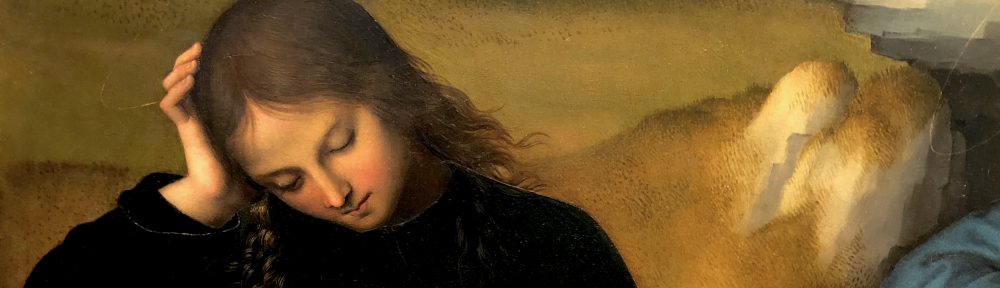
Piero di Cosimo, Incarnation (detail), 1500-1505. “Holy Ghost over the bent / World broods with warm breast and with ah! bright wings.” (Gerard Manley Hopkins)

In spite of all the destructive forces [we] let loose against life on this planet, the Spirit of Life is at work in ever new and unforeseeable ways, countering and circumventing the obstacles we put in its path. In spite of my strong tendencies to complacency and despair, I experience the Spirit in myself as calling forth the realistic hope apart from which there is no hope, and I am confident that what I find in myself is occurring in others also … what makes for life and love and hope is not simply the decision of one individual or another but a Spirit that moves us all. 

— John Cobb [1]

Of perfect love thou art the ghostly flame.
Emperor of meekness, peace and tranquility,
My comfort, my counsel, my perfect charity,
O water of life, O well of consolation,
Against all storms of hard adversity …

— 15th century English lyric 

On the fiftieth day of Easter, our liturgical prayer addresses the Holy Spirit more than on any other day. Most of the time our words of supplication and praise address an “other” who is metaphorically outside or beyond: God, Jesus, Father, Mother …. But the dominant prayer of Pentecost calls upon the most obscure and elusive of the divine “Persons”—One who is not “out there” but “in here.”

Veni Sancte Spiritus. Come, Holy Spirit.

The tricky thing about such a prayer is that it is not prayed to the Spirit. It is prayed in the Spirit and by the Spirit. The Spirit is not the object of our prayers, but the subject, dwelling within our inmost parts more surely and substantially than the transitory, constructed “I” produced by the particular confluence of history, biology, and personality which has sculpted our individuality over time. When truth speaks through us, when our energies are directed toward the well-being of all, when our lives are written and rewritten as narratives of divine love, the Spirit isn’t just in us—the Spirit is us. 

This is to claim nothing for ourselves. Only those driven by unholy spirits make that mistake. Participation in the divine reality—life “in the Spirit”—is always a matter of giving yourself away, becoming part of something larger. The Holy Spirit’s proper name is communion. When we’re in the Spirit, that’s our name too.  

Compared to writings about “God” and “Christ,” theological expositions on the Holy Spirit can seem relatively thin. The early creeds didn’t have much to say either, making the Spirit seem like an afterthought—oh yeah, and the Holy Spirit too. But this isn’t due to neglect so much as it is to the Spirit’s way of disappearing into the world as anonymous giftedness. As Orthodox theologian Vladimir Lossky put it: 

“[T]he Holy Spirit effaces himself, as Person, before the created persons to whom he appropriates grace … He mysteriously identifies himself with human persons while remaining incommunicable. He substitutes Himself, so to speak, for ourselves.” [2]

Canadian poet Margaret Avison addresses the Spirit’s indescribability in her poem “… Person or A Hymn on and to the Holy Ghost.” 

How should I find speech 
to you, the self-effacing
whose other self was seen
alone by the only one,

to you whose self-knowing
is perfect, known to him,
seeing him only, loving
with him, yourself unseen?

Let the one you show me
ask you, for me,
you, all but lost in
the one in three,

to lead my self, effaced
in the known Light,
to be in him released 
from facelessness,

so that where you 
(unseen, unguessed, liable
to grievous hurt) would go
I may show him visible.

The poem’s profusion of pronouns makes it hard, at first, to tell which divine Person is doing what. “You” is clearly the Holy Spirit, but who is “him?” Is it Christ, or the Father, or God in general who releases us from “facelessness,” or whom we ourselves make visible in the practice of holy living? The “unseen, unguessed” Spirit may be “all but lost in / the one in three,” but without it (or him, or her, or they), Love Divine could not do its proper work in the world and in the heart.

O fiery Spirit, come burn in us.
O sacred breath, come breathe in us.
O blazing love, come flame in us.…
O delight of life, come live in us. [3]

This past year has generated its share of anxiety, fear, madness and grief, but as John Cobb reminds us, “the Spirit of Life is at work in ever new and unforeseeable ways, countering and circumventing the obstacles we put in its path.” It is in this Spirit that I have shaped my retelling of Ezekiel’s vision in the Valley of Dry Bones (see video below). When the divine breath comes into the lifeless bodies, I layer multiple inhalations and exhalations to make a chorus of breaths. For me that collective sound symbolizes the Spirit’s fierce resistance to every power that would silence and choke us. As the Psalmist says, You send forth your Spirit, and the people are created; and so you renew the face of the earth (Psalm 104:31).


[1] Cited in Marjorie Suchocki, “Spirit in and through the World,” in Suchocki and Joseph A. Bracken, S.J., Trinity in Process: A Relational Theology of God (New York: Continuum, 1997), 180. And yes, masculine pronouns are problematic. Depending on the language, Spirit has been feminine and neuter as well. Do you think She minds?

[2] Vladimir Lossky cited in Paul S. Fiddes, Participating in God: A Pastoral Doctrine of the Trinity (Louisville, KY: Westminster John Knox Press, 200), 261.

[3] Jody L. Caldwell, after Hildegard of Bingen, in Voices Found (New York: Church Publishing, 2003), #62.