Surrender

Yesterday morning, having walked a couple of hours as the rising sun burned away the fog, I stopped for breakfast in a serene cafe setting of lawn and trees. Soon David, an Irishman I bunked with a couple of weeks ago, came by, followed by an American (from Seattle!) who slammed his pack down and whined loudly, “Why did they make us take that pissy little trail when we could have stayed on the road?” He was referring to a steep shortcut that took pilgrims safely off a blind curve. It wasn’t long, but the footing was tricky.

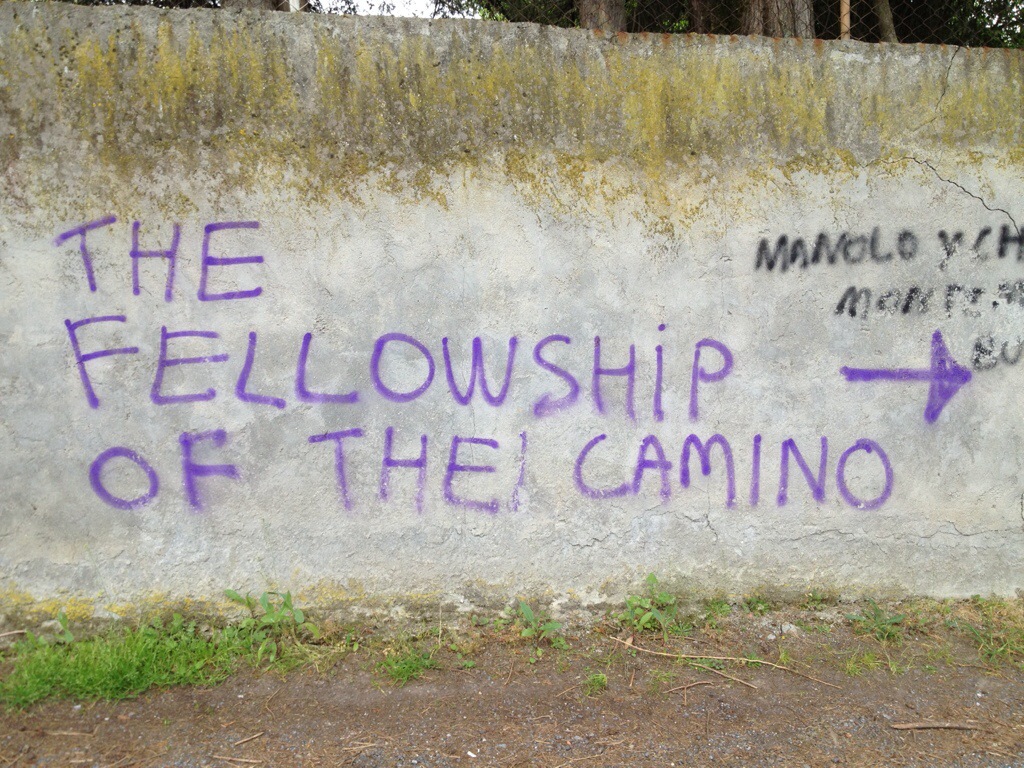
David replied softly, “The Camino wants you to go its way, not your own.” And I chimed in, “The Camino is all about surrender.” The poor man had no reply. He was a newbie, one of the many who had only recently joined the trail to rack up the minimum 100 final kilometers required to earn a “Compostela” – the treasured certificate of completion. He hadn’t yet put in enough mileage to have the willfulness walked out of him.

But can I, having now trod 478 miles in 31 days, really claim any kind of illumination or transformation as a result? I still get annoyed by the loud and incessant talkers who mar the tranquility, I still get angry when a speeding truck comes close to knocking me into a ditch. I have yet to perfect the pilgrim equanimity urged by my guidebook, which sees every irritation as the sand that produces the pearl. But at least I try to make these things part of my walking prayer. As the monks say of life in the monastery, “We fall down and get up, fall down and get up …”

Speaking of which, I took a fall today. After a month without a mishap, now but a day’s walk from Santiago, I tripped on a root and did a spectacular face plant: bloody nose, minor nicks and scratches, and broken sunglasses. A French woman and an American student stopped to help, and walked with me to the next town, where I found a room and cleaned up. I am fine, but it was odd that this occurred only minutes after I had paused at a touching trailside memorial for Guillermo Watt, a man exactly my age who had died there in 1993, just one day short of completing his pilgrimage.

These final stretches of walking have been especially lovely, reminiscent of the English countryside of the Romantics – low stone walls dividing leaf-shaded paths from sunny green pastures, as wandering clouds drift lazily overhead. While the degree of my spiritual surrender to the Camino may be difficult to measure, I have wholly surrendered to its beauty.

20140509-215039.jpg

20140509-215207.jpg

20140509-215227.jpg

The movement of hearts and souls

“We were … like travelers pondering the road ahead who send their souls on while their bones delay.”
– Purgatorio ii:10-12

58 miles – nearly 100 kilometers – in three days, with a wearying amount of elevation gain and loss, have made this portion the most physically demanding portion of my Camino. But whenever my spirit slackened, or knees complained, I only had to look around me. What splendid countryside! What fortunate walking!

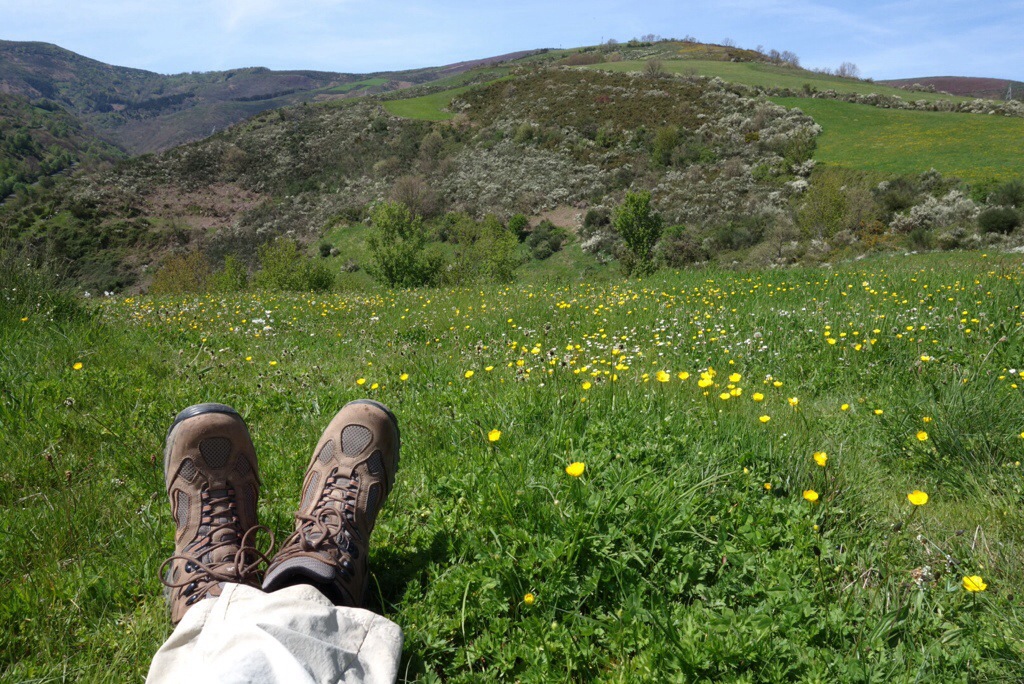
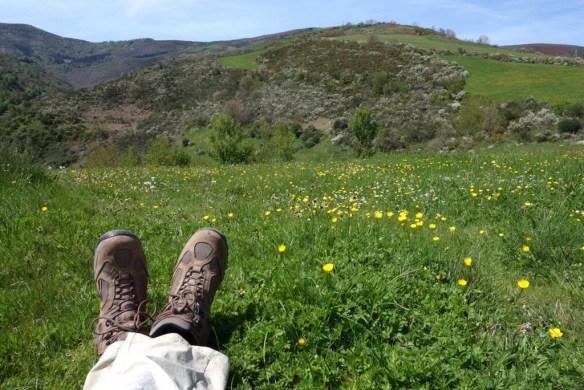
On the first long day, I began at sunrise in sight of snowy peaks, navigated (barely) a busy city, traversed a wide plain to the rolling wine country of El Bierzo, and finished in the picturesque river town of Villafranca. The next day took me up and down, then up again, steep-sided ridges of red and white flowering shrubs and the fresh spring green of chestnut groves. After the last hard climb, I lay down in a high meadow of buttercups and daisies to read Wordsworth’s lines about “the calm existence that is mine when I am worthy of myself.” A few more steps put me in the Celtic region of Galicia, land of stone houses, damp weather, and lingering traces of premodern spirituality and culture. I spent the night in the quaint mountaintop village of O’Cebreiro.

My third 20 mile day was a charming medley of rivers , woods and birdsong, until I reached the monastery of Samos, one of the oldest and largest in the western world. Situated in an isolated valley reminiscent of Shangri-La, the imposing collection of buildings, plain and austere on the outside, contains a magnificent Baroque church, an immense garden cloister in the classical style and, covering three long walls of an upper portico, a 1960 mural of obscure saintly miracles. Its wild, unsettling intensity seemed to contradict the ideal of monastic balance, as if the community’s shadow side had been somehow consigned to these painted walls, a la Dorian Gray. In any case, the monks, sans shadow, sang a lovely vespers to restore the body and soul of weary pilgrims.

And tonight, the third Tuesday of Easter, I am writing in a “casa rural,” a traditional stone farmhouse accommodation where I hung my laundry among grazing cows and am enjoying a spacious bedroom overlooking the chickens – a restful change from last night’s monastic dorm with 40 people. Over dinner with the other three guests in the house, all of them Americans who have worked for good in Third World countries, we immediately discovered a number of remarkable connections between us. With the rapport, even intimacy, of old friends, we spent the next three hours conversing about the meaning of our own Caminos. When I had trudged an extra two kilometers past the last town, up a steep hill in the middle of nowhere, hoping I could just find a bed at this place, I did not know I was being led to such a holy meeting, such a convergence of thoughtful and passionate souls. Grace happens.

Halfway to Santiago, a Camino friend was feeling some pain and discouragement on a particularly demanding stretch. But then he saw a handwritten sign: “Don’t give up before the miracle.” As far as I know, he is still on the Camino, along with his vision-impaired son, though they have fallen a few days behind me. May they find, as I have, that there may be more than one miracle along this Way. Tonight was one of them.

As I myself draw near the goal, now less than 100 kilometers from Santiago, my thoughts turn to those who were unable to complete their intended journey. I have seen many memorials on the Camino to pilgrims who died at a particular spot. These crosses, cairns and fading photographs have signified the precariousness of every journey, the preciousness of each day we are given to walk in beauty. I have also shared the path with pilgrims who had to drop out due to physical problems. In Dante’s expressive image, their hearts reached for Santiago, but their bones delayed.

One of these was Monty, a devout Catholic from Nebraska, who walked with severe foot pain every day for two weeks until he finally had to give up. He always started before dawn, while the rest of us slept, so he could match our progress at a slower pace. Monty is one of my Camino heroes, not only for his determination and grit, but for the way he valued the community he had fallen in with. He suffered in order to maintain the connection.

He was able to take a train to Santiago before flying home, where his doctor told him that continuing to walk would have been disastrous. Some might regard his journey as incomplete, but not Monty. Here’s what he wrote to what he called his “Camino family”:

“With sleep apnea, asthma, one artificial knee, and one arthritic knee, I knew from the beginning that my chances of walking the enire distance were slim. I could have started someplace else, but then I wouldn’t have met you. Each of you, in your own way, made my Camino special, and I am grateful. It was never about the paper, and if I finished by train I still walked about 200 miles.

“A friend of mine who is also one of my favorite priests said this: ‘A pilgrimage is not measured by the movement of the feet, but by the movement of hearts and souls.’ By that standard, I had an outstanding pilgrimage, and I walked long enough to find what I didn’t even know I was looking for.”
20140507-110913.jpg

20140507-110959.jpg

20140507-111058.jpg

A mountain day

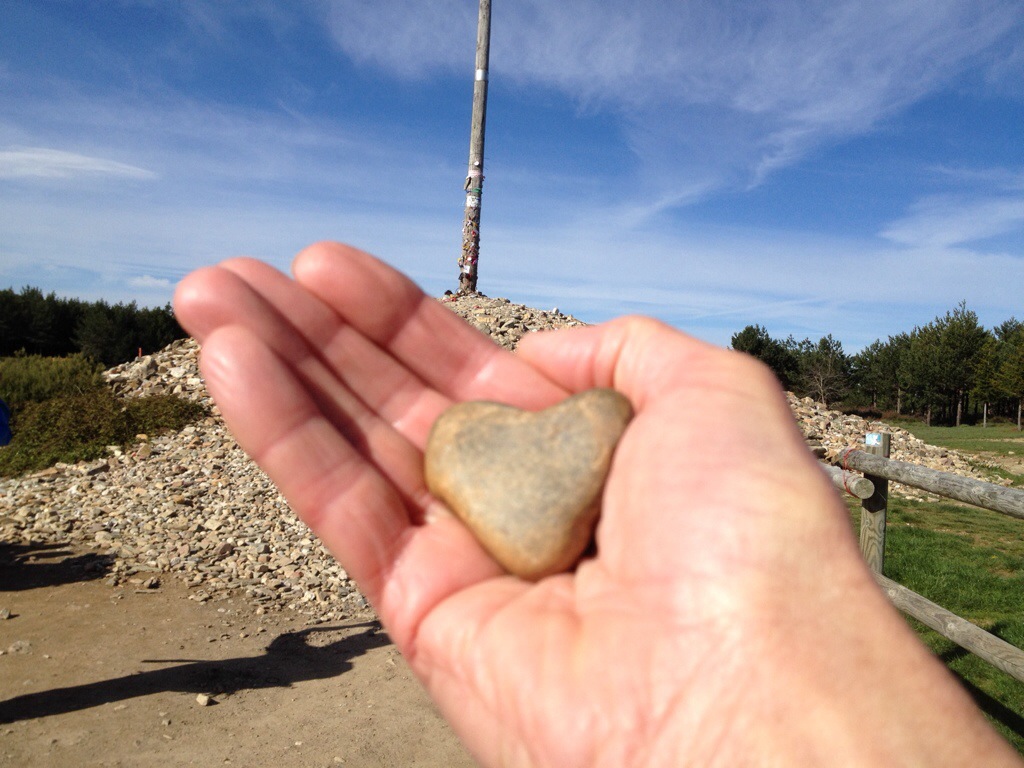
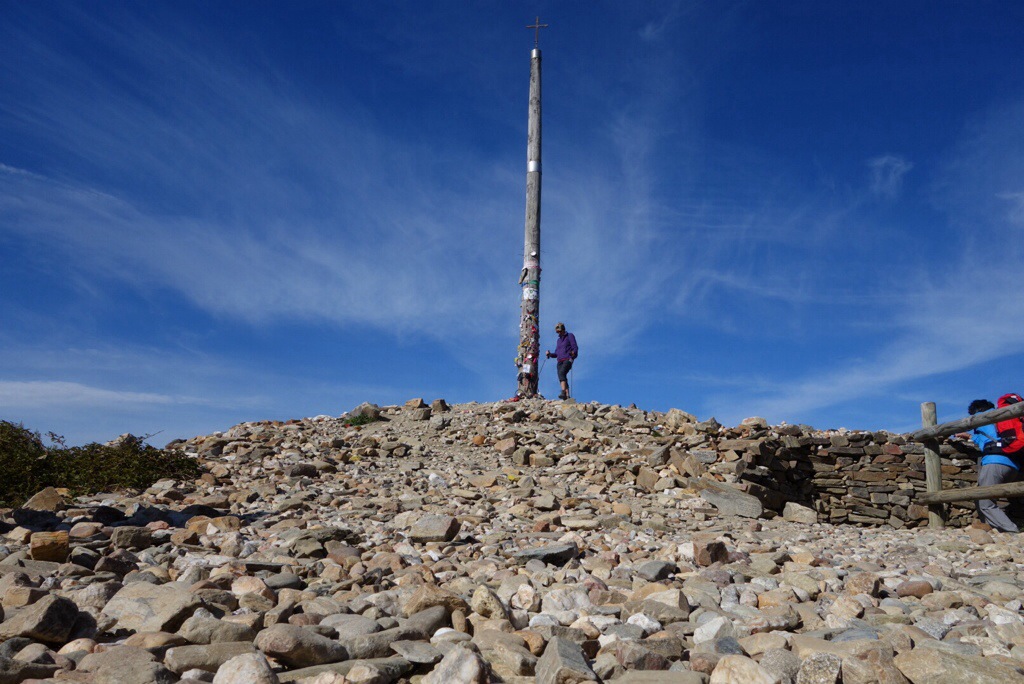
I climbed the mountain this morning to add my stone to the great pile left by pilgrims past at the foot of the Cruz de Ferro. Everyone was taking a turn on top of the rocks, striking a pose for the camera. Someone offered to take my picture, but I declined. To me the ritual of offering was not a matter of the public self, but of disappearing, at least for a moment, into something larger.

And from there it was the most strikingly beautiful day of the Camino so far – brilliant light, a profusion of spring color, a backdrop of snowy peaks, and grand views of where I have been and where I am headed.

20140502-212527.jpg

20140502-212556.jpg

20140502-212639.jpg

The third phase

When I started the Camino, someone told me the first third is about the body, the second is about the mind, and the last is about the soul. And indeed, the early days were a crash course in one’s physical capacities and the toll taken by so many miles, so little rest. And the long middle stretch across the Meseta became an intriguing laboratory of mental states under conditions of relative environmental emptiness.

And now it is time for the soul. I have finally reached the foot of the snowy mountains that a week ago were first only visible as a distant horizon. Tomorrow I ascend to the highest point on the Camino (nearly 5000′), where an iron cross rises out of a great pile of stones left by pilgrims over many years. Some stones were brought from home, others were found along the way. Some represent prayers or blessings for others, some denote burdens or tired stories that need to be left behind, some symbolize an offering of self. It is one of the central rites of the Camino.

There are many along this road who began it as a form of athletic challenge or youthful adventure or unusual vacation. And many will finish it that way. But in talking with those who profess no religious intention, or who are dismissive of Christianity as something they outgrew, I still hear the spiritual language of pilgrimage breaking through the verities of secularism. One has lost a job and is trying to discern a meaningful alternative. Another is trying to listen to her life from a place of unknowing. Another has no answer to the question of why he is walking, but still presses on to Santiago. To borrow a phrase from the great Spanish mystic, John of the Cross, every pilgrim is trying to arrive at a place we know not by following a way which we know not.

As we move together into the final phase, there is less idle chatter, more silence, and an increasing sense of shared participation in something deeply meaningful that eludes or exceeds our attempts to put words to it.

Tonight many pilgrims attended compline in the beautiful village church next to my hostel (see photo), and we were blessed with a prayer asking that Christ “be a companion for them on the way, a guide at the crossroads, shelter on the road, shade in the heat, light in the darkness, and comfort in their weariness, so that they may arrive safe at the end of their way and, rich with grace and virtue, return home healthy and full of joy.”

20140501-222340.jpg

Walking

The past week was spent traversing the immense agricultural plateau of the Meseta and Tierra de Campos. Few trees, big sky, only occasional villages, and long stretches where the only human presence was the long procession of pilgrims migrating westward. The lack of distractions and variations tends to make the very act of walking to be the mind’s principal occupation. As Robert MacFarlane puts it in The Old Ways: A Journey on Foot, walking becomes “sensational” – it isn’t just conducive to thought, it becomes the form thought takes. I walk, therefore I am. Perhaps it is similar to the way that cinema thinks through the movement of the camera. It isn’t forming propositional thought, but is simply absorbing through its attentive motion the shape of the world, the textures of existence.

I have noticed that I have fewer thoughts out here than I do at home when I run for an hour, or go on a week-long backpack. On the Camino, instead of a lot of thoughts, I simply have thought: not so much words or ideas as awareness. As Thich Nhat Hanh once put it to a walking companion who asked what he was thinking about: “I’m not thinking about anything. I’m aware of the sunlight.”

Tonight at dinner a young man from Munich, Daniel, told me he sometimes listens to classical piano as he walks. That music is his passion, and playing piano is his daily practice at home. And he knows the repertoire well. But Daniel said that is as if out here he is hearing the music more clearly, more completely than ever before, because his mind has become more acutely attentive and centered in the act of walking the Camino. It is as if the music he listens to has slowed down in order to reveal its structure to him.

What a shock, then, to come from such a contemplative environment into the city of Leon on Monday. There were wonders there not to be missed: the luminous cathedral which, along with Chartres, has the most medieval stained glass in Europe; the “Sistine Chapel of Spain,” the spectacular and unfaded 12th century frescoes covering the arches and ceilings of San Isidro’s royal burial vault; and the sumptuous Renaissance facade and cloister of San Marcos, now a luxury hotel. These are achievements only attainable through the collectivity of energy, artistry and wealth which cities make possible. And I was grateful, even thrilled to see them,

But I found myself relieved today to return to the flowered landscapes and peaceful villages, and to resume the undistracted act of walking that is the Camino’s most eloquent and heartfelt prayer.

20140429-225153.jpg

20140429-225246.jpg

20140429-225534.jpg

By the numbers

A few miles before reaching tonight’s hostel in the village of Terrafillos de Templarios, I passed the halfway point to Santiago de Compostela: 245 miles. This was my 17th day of walking, with 16 to go before – God willing – I reach Santiago. The first 10 miles today were on a straight dirt road between green wheat fields under the big Castillian sky. There was a sense of endlessness to the walk that some found tedious or wearying, but I felt to be exhilarating, like striding into infinity. Every so often a row of trees provided shade from the glaring sun, as in this 30 second video. If you want to experience the length of my walk in real time, replay it 27,000 times.

Hospital for the soul

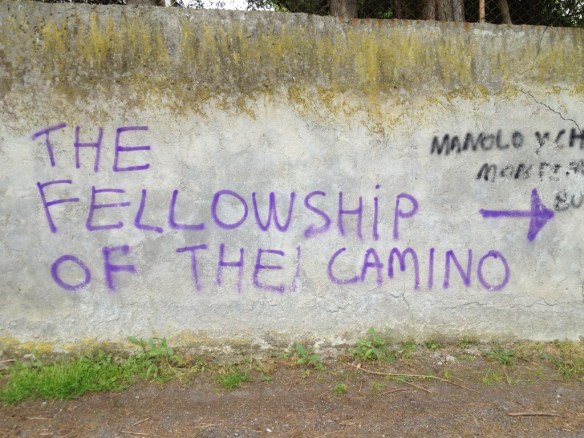
“I’m not sure why I’m doing this,” an Australian told me yesterday. There are times when I wonder that myself. Last week I saw some graffiti on the Camino: WHY ARE YOU WALKING? So much time and energy goes into just reaching the next destination, it is possible to neglect or even forget the work of the soul. I suspect that this journey doesn’t have a lot to do with the quality or clarity of my thoughts, but has more to do with cultivating receptivity to the holy moments as they present themselves.

I have observed many walkers, particularly the young, who seem to rush straight ahead with barely a glance to right or left, much less a pause to listen to a small bird or the sound of rustling poplars. I myself have devoted too little time “to stray about / voluptuously through fields and rural walks, / and ask no record of the hours, resigned / to vacant musing, unreproved neglect / of all things, and deliberate holiday.” (Wordsworth, “The Prelude”). But then Wordsworth didn’t have to get to Santiago in 33 days.

Yesterday something shifted for me. Reaching the impressive ruins of the medieval monastery of San Anton, I didn’t just pause for a quick snapshot of the arch over the road and then hurry on. I found a side path that led to the roofless interior of the ancient church, where only the cooing of doves broke the deep silence. Here I ate bread and cheese in unhurried solitude, listening to the memories of ancient stones.

I was tempted to spend the night there, in its primitive hostel with no electricity, but something called me to press on a few more miles to the hill town of Castrojeriz. Perched on a steep slope below a the remains of an old castle, its stone streets and narrow passages wind confusingly like a maze, making it easy to get lost, or at least you never seem to go the same way twice. My own wanderings in this mysterious place brought me to an open door where gentle meditation music wafted out into the street. The sign above the door read: The Hospital of the Soul. The word “hospital” on the Camino is related to “hostel” or “hospitality,” but its modern association with healing is also fitting. Next to the door was posted an invitation to come inside, explore the house, and make retreat for a while. I entered, passing among beautiful contemplative photographs taken along the Camino. When I found the rustic fireside room painted with strong tones of stone and sea, lit by a transparent ceiling, I took a seat as if I belonged there. A Spanish man was sitting on the couch, writing. A woman brought me a cup of tea. In the sweet hour that followed, I made some journal entries until Mau, the Italian who lives there with the Spanish woman, Nia, came in to warm himself by the fire.

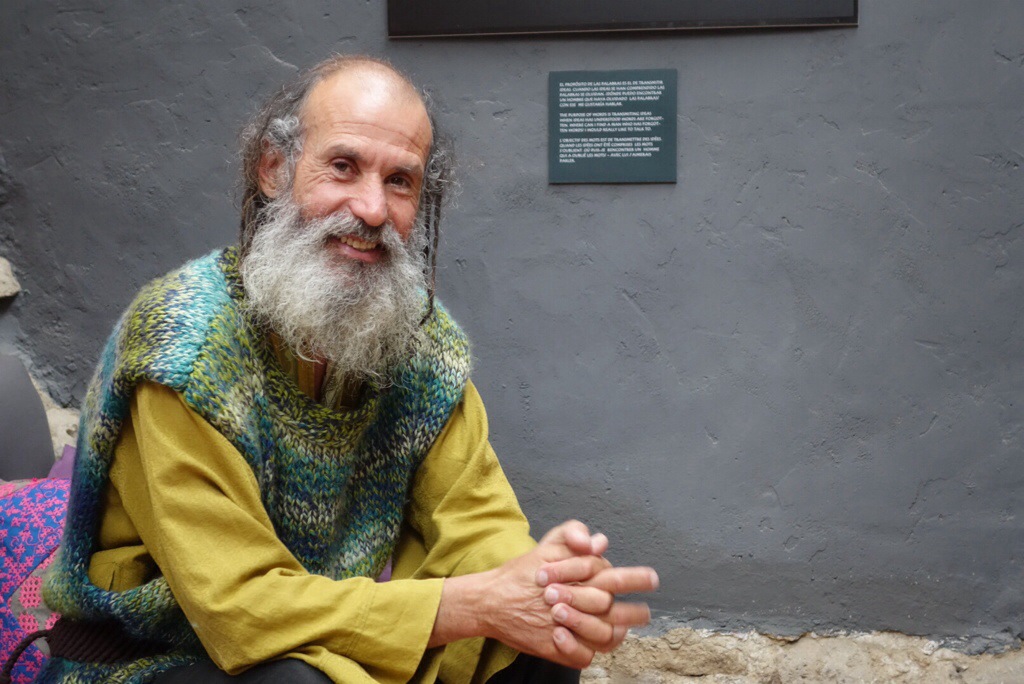
Mau has walked the Camino many times, and seeing so much rushing along, and so few places to stop and go inward rather than onward, that he and Nia, whom he met on the Camino seven years ago, bought this house and refurbished it into a place where the stranger is welcome and the soul can breathe, “Everyone is welcome here,” he told me, “but it”s not for everyone. Many people hurry along the Camino who show little interest in the work of the soul.”

We had a rich, even holy, conversation, one I will long remember. When I finally took my leave to attend vespers at the local convent of cloistered nuns, I told Mau I hoped I would see him again someday. “Perhaps,” he said, “but it is not necessary. We have met.”

20140424-172036.jpg

Christ is risen!

Holy Saturday began, like the previous two days of the Triduum, starting in the dark to walk by the light of Paschal moon and breaking dawn. Those early hours, the matins and lauds of newborn day, will surely remain among the sweetest of the Camino. After woods of oak and pine, sleeping villages in peaceful valleys, and the World Heritage site of the oldest discovered human remains (900,000 years ago), I pressed on into the urban sprawl of Burgos, determined to make the Easter Vigil at the great cathedral.

I knew it would not resemble the creative Vigils I have curated in the States. There would be no storytelling, theater, dance or musical eclecticism. But I was not prepared for the total absence of either mystery or joy. The solemn darkness at the beginning was shattered by the constant flashing of cameras, and the house lights were turned up full before the Exultet was sung, thus negating the holy glow of our candles. Fourteen scowling men in chasubles up front was a poor icon of Easter joy. And if your eye wandered upward to the spectacular golden retablo behind them, you were treated to St. James the Moor Slayer on his horse trampling a couple of Muslims (dressed in colorful costumes like dancers in “The Nutcracker,” so the effect was rather cheerful). Perhaps worst of all, never once did we get to shout “Christ is risen!”

I returned despondent to my tiny, cold, windowless hotel room after midnight. In the first hour of Easter morning, it felt like returning to the tomb. I didn’t go out again until noon. It was raining. The streets of the old city seemed dead. I sang “Welcome, Happy Morning” under my breath, more out of habit than conviction.

I happened to pass by the church of San Nicolas, whose splendid stone retablo was on my must-see list. So I ducked in out of the rain. And there, to my utter surprise, was the risen Christ, returning to the doubting and the sad just as he promised.

It was the end of mass. The priest pronounced the blessing, and then began the most extraordinary outpouring of Easter joy. For the next 45 minutes, children and youth in traditional costumes did festive folk dances to the sound of reeds and drum, Easter songs, and the continuous ringing of small hand bells. Sometimes they danced near the altar, sometimes they danced in procession around the aisles with priest and choir. Here was resurrection indeed:
“I am the dance and I still go on!” All the rest of us joined in hearty singing of the hymns and Alleluias, punctuated by loud shouts of “Viva!” Tears streamed down my face. O beauty so ancient and so new!

And so, as Scripture says, “Surely God’s mercies are not over; God’s kindnesses are never exhausted. They are renewed every morning.” When the celebration concluded, the priest walked among the people with a basket of sweet cookies. As he offered one to me, I received it with recognition:

“Take and eat – I am with you always.”

Good Friday

The jeweler has a shop
On the corner of the boulevard
In the night, in small spectacles
He polishes old coins
He uses spit and cloth and ashes
He makes them shine with ashes
He knows the use of ashes
He worships God with ashes

The coins are often very old
By the time they reach the jeweler
With his hands and ashes
He will try the best he can
He knows he can only shine them
Cannot repair the scratches
He knows that even new coins
Have scars so he just smiles

He knows the use of ashes
He worships God with ashes

In the darkest of the night
Both his hands will blister badly
They will often open painfully
And the blood flows from his hands
He works to take from black coin faces
Thumbprints from so many ages
He wishes he could cure the scars
When he forgets he sometimes cries

He knows the use of ashes
He worships God with ashes

(Tom Rapp & Pearls Before Swine)

20140418-062010.jpg

Jesus’ Bakery

Yesterday I was in Santa Domingo de la Calzada, whose cathedral keeps a couple of live roosters in the south transept in tribute to a local miracle involving a cooked chicken coming back to life, thus stirring the sheriff to leave his dinner in time to rescue a hanged man from death. It’s a long story.

This morning I slipped out of the sleeping town before dawn, by the light of the Paschal moon. By the time I reached a large wayside cross, the dawn was blazing behind me. It was a dramatic beginning for the great three days of the Paschal Triduum, the ritual mimesis of Christ’s passage through death into resurrection.

I have been wondering what Holy Week, and especially the Triduum, would feel like on the Camino, so far from my accustomed ways of keeping these days. Each day I walk to a new place , hoping there will be some kind of liturgy there, and that despite the language and cultural differences I can still be deeply engaged in the texts, prayers and singing. And there have been some memorable moments so far, especially the processions. But as the week enters its climax, how much will I miss the familiar words and powerful hymns of my own tradition that have always, for me, been essential to the experience? Will my ritual dislocation have its own unique gifts to offer?

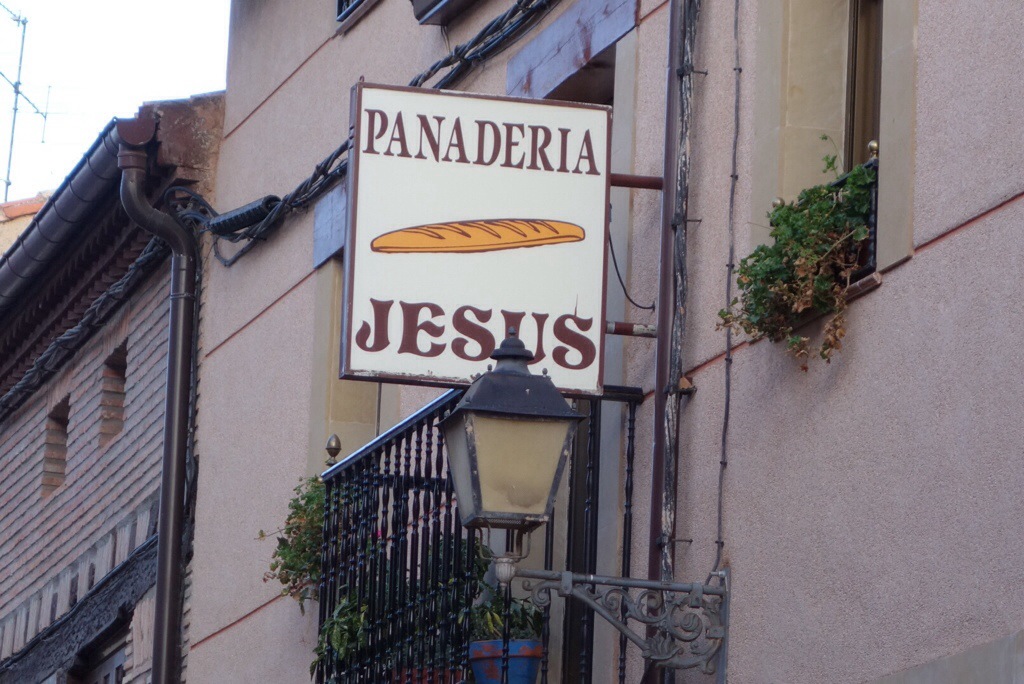
I had my answer this morning, when I entered the village of Granon. After ninety minutes of walking, I was ready for some refreshment. Just past the church, I looked up and saw the sign: PANADERIA JESUS, On the very day we remember the Last Supper, where Jesus took bread and said, “This is my body,” I had found Jesus’ Bakery. It had just opened for the day, and I entered through a bead curtain to find the baker pulling fresh loaves from the oven. The one he handed me was still warm. I have never tasted better bread. As I continued my walk, loaf in hand, I consumed each bite with the reverence of the sacrament. As the Psalmist says,

So mortals ate the bread of angels;
God provided for them food enough.

20140417-170559.jpg

20140417-170614.jpg