Unknown's avatar

About jimfriedrich

I am an Episcopal priest, liturgical creative, filmmaker, writer, musician, teacher and retreat leader. My itinerant ministry is devoted to religious imagination and holy wonder. My blog is a space where diverse ideas and perspectives - theology and culture, liturgy and spirituality, arts and religion - can meet and converse with one another.

Daniel Berrigan: Sword of Wisdom, Maker of Peace

Berrigan in cuffs

There is no peace because there are no peacemakers. There are no makers of peace because the making of peace is at least as costly as the making of war— at least as exigent, at least as disruptive, at least as liable to bring disgrace and prison and death in its wake. — Daniel Berrigan[i]

On May 17, 1968, nine Roman Catholic activists broke into a draft board office in Catonsville, Maryland, transferring 378 files to the parking lot to be incinerated with home-made napalm. As the fire burned, the “Catonsville Nine” prayed for peace. They were arrested, tried and sentenced to prison, but four of them, including two priests— Daniel and Philip Berrigan— went underground, eluding capture for a number of months, occasionally surfacing to speak at antiwar rallies.

At one of these public appearances, following a dramatic tableau of the Last Supper with giant puppets, Dan Berrigan made his escape inside one of the Apostles. “I was hoping it wasn’t the puppet of Judas,” he said later. His comical getaway affirmed irrepressible life even as it mocked the powers of death. Berrigan, a puckish and playful spirit, knew that laughter could be a serious form of subversion.

After being sheltered by 37 different families, Dan Berrigan, S.J., was finally captured August 11, 1970, in the house of Episcopal lawyer and theologian William Stringfellow. He was reading Plato’s The Trial and Death of Socrates when F.B.I. agents showed up at the door.

On Palm Sunday of the following year, I designed a liturgy where two carpenters constructed a large cross near the altar during the course of the ritual. At various points, dialogue between the carpenters would interrupt the liturgical texts. The two workers expressed curiosity about the intended victim and the nature of his crime. They wondered about the morality of their own complicity in the official machinery of death. What if they just stopped making crosses? Would it make any difference? Or would they just find themselves without a job? In the end, they suppressed their doubts and finished the cross, hammering it together loudly during the eucharistic prayer: This is my body, given for you … This is my blood, shed for you …

It was no coincidence that I had just been reading No Bars to Manhood, Dan Berrigan’s compelling account of the influences and experiences underlying his Christian activism. Its conclusions were clear: as witnesses to the Resurrection, the friends of God must say no to death. No more cross-building. No more remaining passive spectators at the world’s crucifixions. “There are times so evil,” he wrote, “that the first and indeed the only genuinely prophetic function is to cast down the images of injustice and death that claim [the human being] as victim.”[ii]

A Newsweek blurb on my well-worn 95-cent paperback from 1971 reads, “Daniel Berrigan is the sort of priest who causes the lights of the Vatican to burn through the night.” The actions he took and the company he kept often strained the patience and understanding of his clerical superiors. One of his friends in the Society of Jesus told him, “Do you want to know why you’re in trouble so frequently? It’s because you and some others show us what Jesuits can be. And that’s why we can’t stand you.”[iii]

Today, when so many horrors are cloaked in euphemisms like “collateral damage,” Dan Berrigan’s truthful language still delivers a shock. His response to the charge of incinerating draft board records is justly famous:

Our apologies, good friends, for the fracture of good order, the burning of paper instead of children, the angering of the orderlies in the front parlor of the charnel house. We could not, so help us God, do otherwise. For we are sick at heart, our hearts give us no rest from thinking of the Land of Burning Children … We have chosen to say with the gift of our liberty, if necessary our lives: the violence stops here. The death stops here. The suppression of the truth stops here. This war stops here.[iv]

Even in his contentious moments with the Church, Berrigan understood his priesthood to be deeply rooted in the ethos of his religious community, where, he wrote, one’s life might “be purified of the inhuman drives of egoism, acculturation, professional pride and dread of life.”[v] In the trial of the Catonsville Nine, when asked whether such radical protest was in harmony with Catholic teaching, he replied, “May I say that if that is not accepted as a substantial part of my action, then the action is eviscerated of all meaning and I should be committed for insanity.”[vi]

For those of us who tend to play it safe in conforming our own choices to the gospel, Berrigan’s life of witness poses hard questions about discipleship and the imperatives of conscience. “He was dangerous, as holiness should be; he was a sword of wisdom.”[vii] A college student, after hearing Berrigan speak at Stanford in the late Sixties, put it this way: “Father Berrigan has raised the ante for all of us.”[viii]

That student’s religion professor, Robert McAfee Brown (one of my own most admired teachers), considered the question of whether the Berrigan brothers were signs or models. Their words and actions clearly signified the world’s sin and brokenness in parabolic gestures difficult to ignore. But were we obligated to model our lives after theirs, or might we find other ways to be faithful, according to our own distinctive calling? This question has troubled the conscience of many, including my own.

“We must continually ask ourselves why we are so attracted to them.” Brown wrote, “when we hear what they say and yet do not do the things they do … [T]heir actions provide a disturbing sign that we must take seriously, particularly if those actions are not yet the model most of us are prepared to imitate.”[ix] Brown himself had the courage to live into those questions for the rest of his life, becoming one of the most eloquent theological voices for justice and peace.

As “the man who hears handcuffs close upon him,”[x] Berrigan felt a deep kinship with biblical prisoners for God like the prophet Jeremiah. “There is a meaning to things, however dark and damaging … Jeremiah wrestles with the meaning; his wrestling is the meaning; it defines the moral substance and limits of his activity in the world. At the same time, his struggle with the unknown One interiorizes, draws to a fine point and gravity his moral life.”[xi]

Like Jeremiah, Berrigan knew a God who contends with human injustice, who plucks up and breaks down our tainted and presumptuous projects.

We are so used to an acculturated and childish religion, whose ethos has joined forces with the society— with its militarism and racism and fear of life, that we are almost illiterate before a document such as Jeremiah’s. Can it be true that God is not a Niagara of pablum, spilling His childish comfort upon the morally and humanly neutral, whose faces are raised blankly to partake of that infantile nourishment?[xii]

Not every Christian received his rhetoric gladly. And the radical priest’s liturgical fusion of sacrament and protest also drew fire. After baptizing a baby in the chapel at Cornell, he kissed the new Christian’s forehead and invited him “out of the world of war and destruction.” While presiding at an “Electric Mass for Peace” on the same campus, he made explicit connections in the eucharistic prayer between Christ’s blood and the blood shed on both sides in Vietnam. Some saw these things as careless, even blasphemous. Others found them prophetic and profoundly faithful.

Berrigan’s words and actions had a deep and lasting influence on many in the antiwar and anti-nuclear movements, as well as progressive Christians. His dramatic forms of witness also drew immense media attention, for which he took some criticism as a “media freak.” But his vocation was stronger than the temptations of celebrity. As Paul Elie, chronicler of the great twentieth century Catholic writers, noted in a New Yorker blog:

He created no foundation, nonprofit, or N.G.O.; headed no pacifist think tank or Jesuit school of advanced study; gave no TED talk; engaged in no stagey dialogues offering equal time to the military point of view; and never reframed the ideals of nonviolence in any pocket-size manual for personal growth.[xiii]

Berrigan had no neutral gear. Even when the public spotlight moved on to other subjects, his writing lost nothing of its urgency and fire. In The Discipline of the Mountain, his poetic reflection on “Dante’s Purgatorio in a Nuclear World,” he wrote, “There is a hell for those who go too far, and there is a hell, or at least an anteroom of hell, for those who refuse to go far enough.”[xiv] Going far enough for the sake of the gospel was the driving force of his life. But as he once confessed to Robert Coles, “We are groping. We shouldn’t be sure of ourselves, because we can’t be, not now— not ever.”[xv]

Only death is sure, and that finally came last week, on Orthodox Holy Saturday, to Daniel Berrigan, S.J., in his 95th year. I barely knew him, hearing him preach twice and breaking bread with him once in a Los Angeles rectory. But this loss feels personal. He was both sign and model for many priests of my generation, and there are things he said which haunt me still.

In 1964, midway in his life’s journey, Berrigan imagined the moment of his own death:

As I walk patiently through life
poems follow close …

The poem called death
is unwritten yet. Some day will show
the violent last line,
the shadow rise,
a bird of omen

snatch me for its ghost.
And a hand somewhere, purposeful as God’s
close like two eyes, this book.[xvi]

And then what? Only faith can say, that Easter faith which alone can contain and complete the fullness of human life. At the end of his meditation on Dante’s Purgatorio, the poet/priest peers beyond death’s horizon to see a resurrected humanity being gathered into God.

Leading the way are “the intractable ones” who have suffered prison, torture and martyrdom for their faithful witness. In them we see at last “the human venture vindicated.” Their faces and Christ’s face become as one, in an upward gaze that “breaks the glacial will of God.”[xvii]

They embrace         one after another
Tears    laughter     two weathers
contending in one sky


[i] Daniel Berrigan. S.J., No Bars to Manhood (New York: Bantam Books, 1971), 49

[ii] ibid., 97

[iii] ibid., 19

[iv] q. in Robert McAfee Brown, “The Berrigans: Signs or Models?”, in The Berrigans, ed. William Van Etten Casey, S.J. & Philip Nobile (New York: Praeger Publisher, 1971), 62

[v] q. in Edward Duff, S.J., “The Burden of the Berrigans,” in The Berrigans, 19

[vi] ibid., 15

[vii] Daniel Berrigan, The Discipline of the Mountain: Dante’s Purgatorio in a Nuclear World (New York: The Seabury Press, 1979), 99. The quote is by Berrigan, describing “an Indian holy man” with whom he once led a retreat. But it also seems aptly applied to Berrigan himself.

[viii] R.M. Brown, 61

[ix] ibid., 66, 69

[x] No Bars, 99

[xi] ibid., 96

[xii] ibid., 97

[xiii] Paul Elie, “Postscript: Daniel Berrigan, 1921-2016” (New Yorker online, May 2, 2016)

[xiv] Discipline, 39

[xv] Robert Coles, “Thinking About Those Priests,” in The Berrigans, 219

[xvi] Daniel Berrigan, “A Dark Word,” Poetry Magazine, April 1964, online at http://www.poetryfoundation.org/poetrymagazine/browse?contentId=29700

[xvii] Discipline, 119-120

Changemaking Churches and the Transformation of Neighborhoods

From "This is not a gentle poem" by Arne Pihl, part of "All Rise," a Seattle art happening about neighborhood change and social struggle, 2014-15 (Photo by Jim Friedrich)

From “This is not a gentle poem” by Arne Pihl, part of “All Rise,” a Seattle art happening about neighborhood change and social struggle, 2014-15 (Photo by Jim Friedrich)

It is not so much the gift of tongues that we now need as the gift of ears, not so much the proclamation of our beliefs as the willingness to listen to the ways in which we ourselves are being addressed, not so much the assertion of our knowledge but the silent admission that we are ready to learn. — Alan Ecclestone[i]


Does institutional Christianity have a future? We have certainly heard the dismal narratives of decline. Churches and seminaries are closing, congregations are aging, and budgets are shrinking, while the unaffiliated— “Nones” and “Dones”— are on the rise. There are still many pockets of vitality— thriving, growing, committed churches— but their long-term sustainability remains a serious question in the unsupportive habitat of postmodernity.

How many Christian bodies, at either the local or the denominational level, have resigned themselves to a diminished role as complacent and compliant chaplains to the dominant culture, or as harmless historical societies dedicated to the preservation of endangered practices and memories? An English priest of the last century, Alan Ecclestone, warned that such abdication of its changemaking mission would produce a “miserly and unexpectant” church.

Thankfully, we have antidotes for such a fate: resurrection and the Holy Spirit. Resurrection transforms death into rebirth; the Holy Spirit makes all things new. The Book of Common Prayer describes this potency with elegant brevity: “things which were cast down are being raised up, and things which had grown old are being made new.”

Enough with the narratives of decline! It is time to tell Easter stories. And at the recent Inhabit Conference in Seattle, I was blessed to hear many encouraging accounts of new life and abundant Spirit. For two days, Christian changemakers shared stories about doing and being “church” in new ways and new places. Even though many of the speakers do ministry in the lusterless environs of makeshift buildings and impoverished neighborhoods, their stories glowed with resurrection light.

Strangers sharing nothing but a zip code become friends over soup suppers. A trashy vacant lot is transformed into a beautiful park or neighborhood garden. Economic wastelands bloom as social entrepreneurs are raised up locally. The hungry and homeless become neighbors-in-need rather than faceless problems. The powerless organize to make their voices heard in civic planning and development. Police and residents defuse tensions and break stereotypes by socializing together. “Low-status neighborhoods” are redeemed by the work of many hands, becoming places of human flourishing. Such things don’t always happen, but when they do, the Kingdom of God draws near, and the church of God rises from the dead.

The Inhabit conference presenters, many in their twenties and thirties, have committed themselves to simplified and generous lifestyles as residents of the struggling communities they serve. Their “churches” tend to be improvisational— living rooms, storefronts, neighborhood centers, local watering holes, and street corners. If any of their ministries employ a traditional church space, it is usually where the old congregation has been on the verge of extinction.

These youthful pastors understand “parish” in its original sense— designating a whole neighborhood rather than simply the church situated within it. Their ministry is dedicated not to their faith community alone, but to the flourishing of their whole geographical parish. Don’t just feed the hungry; get to know them by breaking bread together. Don’t just serve the poor; help them get the skills and opportunities they need. Don’t just care about people, but work with them to challenge and change the forces which impact their lives. Organize for parks and housing. Educate. Demand justice. Reclaim the commons. Foster hope. Develop local economies. Lift up social entrepreneurs. Build equity. Break barriers. Nurture relationships. Network solutions. Innovate. Improvise. Advocate, organize, include, connect, encourage and empower. Be Jesus for others. Imagine.[ii]

The mission statement of Parish Collective, one of the Inhabit conference sponsors, summarizes the vital work of fostering communities of belonging in the forgotten corners of an alienating and divisive society: “We seek to reconcile fractured relationships and celebrate differences by collaborating across cultural barriers and learning to live in solidarity with those in need.” Or put more simply, “Living local together” for “street-level renewal.”[iii]

All of the speakers were passionate about making a difference in the neighborhoods they inhabit. But they are careful to act “with” rather than act “for” the local community. They don’t arrive as colonists imposing their vision, or saviors with the big idea for everyone else to follow. They come as relentless listeners, with the gifts of ears and respectful attention. As one speaker said, “Love listens.” Another added, “Let the neighborhood speak to us, rebuke us, teach us.”

This is not easy work, nor is it quickly done. As one pastor told the conference, “Our church is in the oven, not the microwave. It starts slow and takes longer, but it tastes better.” Sometimes faith is a lot like patience. The Tree of Life doesn’t grow overnight. But still we believe in the promised fruit, as Shane Claiborne, a young Christian changemaker, reminds us:

“Faith is believing despite the evidence—
and then watching that evidence start to change.”


[i] Alan Ecclestone, q. in Gordon Mursell, English Spirituality: From 1700 to the Present Day (London: SPCK 2008), 472

[ii] Good recent resources on these themes are The New Parish: How Neighborhood Churches are Transforming Mission, Discipleship and Community (Paul Sparks, Tim Soerens, Dwight J. Friesen; Downers Grove, IL: InterVarsity Press, 2014) and Live Like You Give a Damn: Join the Changemaking Celebration (Tom Sine; Eugene, OR: Cascade Books, 2016)

[iii] http://parishcollective.org


Cinematic Resurrections (Part 2)

image

And is not the language of the cinema of its very nature a way of telling stories that carry a reasoned argument, as it were, reasoning by way of stories? Here one can see how the narrative dimension – constitutive of the cinema – complements the icon’s symbolic dimension: and it is by dint of this bringing together of icon and story that the cinema can be a language uniquely capable of mediating transcendence.[i]

— Bruno Forte

The danger, however, that in our attempt to conceive and understand [the Resurrection] we in fact suppress the very revolution that the story embodies, naturalize the alienness of its ideas, tame the violence it does to our logic, and anesthetize its wounding of our pride.[ii]

— Alan E. Lewis


In Part 1 of Cinematic Resurrections, we looked at how Jesus films have represented the event of Jesus’ rising as well as the stories of his empty tomb. But the sensory appearances of the risen Christ present an even greater challenge for the filmmaker, involving a tension between visual plausibility and underlying truth. What really happened in the appearances, and what might that have looked like?

In the gospel texts, these appearances are not presented as private, interior experiences, subjective and dreamlike. They always convey a sense of concreteness and physicality, experienced as something outside the observer. Jesus has a bodily presence which occupies the spaces of encounter.

There is of course an inherent strangeness to meeting someone whose death you just witnessed. And the appearances stories do have a certain inexplicable “now you see me, now you don’t” quality. Jesus comes and goes at will. He is not barred by locked doors, nor does he ever linger for a proper goodbye, since “I am with you always.”

But the strangest aspect of the appearance stories, given their transcendent and astonishing subject, is their plainness. Jesus does not glow with supernal light, as in the mystical Transfiguration story, nor does he radiate the sublime and fearsome grandeur with which he appears in the Book of Revelation. The risen Christ is so down-to-earth that he is mistaken for a gardener. Later we find him barbecuing fish on the beach,

He still has human form, but something about him has changed. Catching sight of him is not enough to make the connection between the crucified teacher and this man from God knows where. Recognition is triggered not by his appearance, but by something he says or does, such as “Peace be with you,” or the breaking of bread at Emmaus (beautifully shown in The Miracle Maker). But even after the disciples discern the Risen One’s identity (“It’s Jesus!”), they still sense that something is different, something which begins to make them fall to their knees.

Both identity and difference are essential components of the Resurrection. The risen Christ is not a different person from the one who was crucified. At the same time, his body has undergone an incomprehensible transformation. As Wolfhart Pannenberg puts it, “Resurrection has to be understood in terms of transformation of the old life into the new one rather than in terms of replacing the perishable body by a new one.”[iii]

It is hard to convey this sense of “same but different” on film when a single actor plays Jesus both before and after the resurrection. In King of Kings (1961), for example, it is still clearly the boyish Jeffrey Hunter, apparently unaffected by the harrowing passage through death into divine futurity, who meets Mary Magdalene outside the tomb. In Jesus (1999), the risen Christ has lost nothing of the California cool which Jeremy Sisto brought to his pre-Easter Jesus. Such scenes are all familiarity without the slightest trace of difference— it’s the same actor, the same affect, the same voice.

Many of the films convey a sense of difference in the way the disciples respond to the appearances. When Jesus comes into their midst, they do not resume their accustomed rapport with their old companion of the road. They don’t rush to embrace him as you would a long-lost friend. They are respectfully hesitant to approach. Is this fear of the uncanny, or is it the beginning of worship? Then they move from astonishment and wonder to a place of prayerful receptivity. They bow their heads or close their eyes as Jesus speaks to them, touches them, or breathes the Holy Spirit upon them (as in The Gospel of John). The risen Christ soothes the anxious heart. Peace be with you.

How far can a film go in representing a resurrection appearance? Whar are the rules of engagement for the visual artist? Son of God (2014) attempts to communicate the strangeness of the Resurrection in two interesting scenes. In the first, we follow Magdalene from the glare of the Middle Eastern sun into the darkness of the tomb. As she puzzles over the grave cloths, the camera shifts to reveal the tomb entrance, and there is Jesus, just outside in the bright light of day.

Since the lens aperture is open wide to compensate for the dimness of the cave, the figure standing in the sunlight is extremely overexposed. The details of his face and body are burned out, erased by intense luminosity. This is not a special effect added to the image in post-production. It is simply how a camera sees under those conditions. With the cinematic eye calibrated to the darkness of death’s realm, we are literally blinded by the light.

So Mary sees, but does not recognize, until Jesus speaks her name. “Teacher?” she answers, hesitant but hopeful. Then her face tells us— she knows him. But the distance between them remains: she in the tomb, Jesus in the light. “Go and tell the others,” he says. “I am here.” Then he turns to walk away, and after a few steps his figure vanishes into the white light.

The encounter feels both plausible and strange at the same time. In this world but not of it. It has the naturalness of story, something which might have happened that way, but also the transcendent otherness of an icon. It’s only a movie— the artifice of representation using actors, camera and music, but it has the capacity to draw the viewer into effective proximity to what is being represented.

Then, the same film gives us an upper room appearance scene unique to the genre— an audacious attempt to bridge the ineffable transition from physical presence to sacramental presence. Once the sensory appearances of Jesus ceased not long after the Resurrection, the eucharist became the tangible and revelatory sign that Christ is now present in all times and places. This scene creatively depicts a single presence behind both experiences.

Peter and John, doubting Magdalene’s news, go back to the tomb with her. Peter enters alone, finds the burial shroud, and takes it outside to John and Mary. “Now do you believe me?” she says. But John shakes his head: “He’s gone.” Suddenly a strong gust of wind whirls a cloud of dust through the frame. It’s like a little Pentecost, the Spirit blowing Peter’s mind with the truth. “Gone?” he says. “No! He’s back.”

They run into town, pick up bread from a street seller and take it to the other disciples, waiting in the upper room. “I need a cup,” Peter cries. “And some wine.” Thomas, bewildered by Peter’s excitement, asks what happened. Peter doesn’t reply. There’s no time to waste.

He joins the others at table, breaking the bread and pouring the wine. “His body … his blood,” he says fervently, as if these things were Jesus himself. Offering the cup to the dubious Thomas, he begins to repeat their teacher’s words: “I am the way, the truth . . . ” but the final line, “and the life,” is spoken by a different voice, off camera. At first we see only a close shot of Thomas, glancing up in surprise. Then we see what he sees: Jesus, coming into focus as he enters the open door. Thomas looks down at the table. “No,” he says. “No, this isn’t real.”

Jesus just smiles, and begins to walk around the table, pausing to lay a hand of blessing on each disciple. In the gospel stories of the upper room, Jesus speaks the words, “Peace be with you,” but here his wordless gesture says it all. When he reaches Thomas, he sits down to face him. Jesus shows him his wounded hand, and then gently caresses the doubter’s cheek with it. Love becomes the evidence Thomas has been longing for.

Like Luke’s Emmaus story, this film scene blends narrative and symbol. Is it describing an original and unique appearance of the risen Christ, or is it representing the common experience of every believer who shares the bread of life and the cup of salvation? I would say both.

What happened then, happens now. What happened there, happens here. And whatever the nature of the first resurrection appearances, those stories are deeply flavored by eucharistic practice. When the lector, deacon or presider says the words, Jesus speaks. When the bread is shared and the wine poured out for many, “he’s back.” And whenever two or three gather in Christ’s name, the peace which passes all understanding is bestowed all over again. As it was in the beginning, is now, and will be forever.

…. I looked
at him, not with the eye
only, but with the whole
of my being, overflowing with
him as a chalice would
with the sea…[iv]


Related Posts

Cinematic Resurrections (Part 1)

Are we too late for the Resurrection?


[i] Bruno Forte, The Portal of Beauty: Towards a Theology of Aesthetics (Grand Rapids, MI: Eerdmans, 2008), 108

[ii] Alan E. Lewis, Between Cross and Resurrection: A Theology of Holy Saturday (Grand Rapids: Eerdmans, 2001), 27

[iii] Wolfhart Pannenberg, “History and the Reality of the Resurrection,” in Resurrection Reconsidered, ed. Gavin D’Costa (Oxford: Oneworld Publications, 1996), 70

[iv] R.S. Thomas, “Suddenly”, in Collected Poems: 1945-1990 (London: Phoenix Giant, 1993), 283

Cinematic Resurrections (Part 1)

Rossana Di Rocco as the Angel in "The Gospel According to St. Matthew" (Pier Paolo Pasolini, 1964)

Rossana Di Rocco as the Angel in “The Gospel According to St. Matthew” (Pier Paolo Pasolini, 1964)

Very little can be verified historically above and beyond the disciples’ faith: something, a mysterious something, happened to them, but further than that we cannot penetrate.[i]

— A. J. M. Wedderburn

The delayed recognition of Jesus has nothing to do with a lesser visibility of his resurrected body due to the lesser reality of the shadowy afterlife to which he would now belong. The opposite is true. This resurrection is too real for a perception dimmed by the false transfigurations of mimetic idolatry.[ii]

— Rene Girard

The revolution will not be televised.

— Gil Scott- Heron


As a mortal being, Jesus shared the human condition. He lived and died as one of us. In this way, his story is universal. But it is also unique, for it does not end with his death. In the Gospels, the presence of Jesus persists beyond the cross. The violence of the world is not able to consume him. His story is completed not with death but resurrection. But by definition, resurrection is beyond the range of common experience. It doesn’t take place within ordinary history, where just anyone can see it.

The Resurrection is not the restoration of the past, a returning of Jesus’ old body to this life, but the translation of Jesus into a new reality which cannot be neutrally observed, but is only revealed to the faithful. “Things beyond our seeing, things beyond our hearing, things beyond our imagining”[iii] remain discretely offstage in the gospel narratives. The resurrection will not be televised.

 But some things were seen, as attested to in the gospel texts. There was an empty tomb, one or two mysterious messengers who tell them Jesus is not “here,” and a series of encounters with the risen Christ. The reports are fragmentary, and sometimes contradictory, befitting something so strange experienced by different subjects, each of them groping for language to express the inexpressible.

The cinematic accounts of the Jesus story provide an interesting way to consider what can be shown or seen of the Easter event. There is an inherent literalness to whatever the camera shows us: real objects under the light. Music, editing, and other cinematic devices can add layers of interpretation, but we are still seeing actual material things, visible to anyone in their presence.[iv] How, then, can a film show us something that so radically eludes and exceeds the visible, the resurrection that is, in Rene Girard’s delicious phrase, “too real for a perception dimmed by the false transfigurations of mimetic idolatry”?

In this two-part survey of resurrection stories in Jesus films from 1927 to 2014, we will look at three elements: the Resurrection itself, the empty tomb, and the appearances.

The Resurrection

Of the nearly twenty lives of Jesus produced as commercial features or television miniseries since the early twentieth century, few have attempted to represent the actual moment of resurrection. Cecil B. DeMille, always the showman, couldn’t resist giving us Jesus actually walking out of the tomb in The King of Kings (1927). The stone covering the entrance begins to glow, then falls away, and a Jesus bathed in radiance stands tall before our eyes. He looks a bit lonely, perhaps unsure of what to do next as he takes a few tentative steps back into the world of space and time.

DeMille’s camera remains respectfully outside the tomb. We don’t actually see whatever happened inside. Mel Gibson, in The Passion of the Christ (2004), is bolder, placing the viewer within the sacred epicenter. As the camera pans around the tomb, we see the sunlight penetrate the darkness as the stone is rolled away, and then we see the slab where the Savior was laid. But instead of a body, we see only the shroud collapsing into flatness as the form which gave it shape apparently vanishes. If we are witnessing the moment when a a corpse is translated into something else, the facts of the matter remain discretely veiled from sight.

It is a stunning and poetic moment. Not quite seeing the mystery itself, we glimpse its trace — white fabric, suddenly emptied of its content, falling gently onto a stone slab. We see what can be seen, and no more. And yet so much is implied. However, when the camera pulls back to show the naked Christ, sitting quietly on the edge of the slab as he opens his eyes, the delicate balance of the visible and invisible is broken. The image is too literal, too crudely specific for an event which shatters all language.

Pier Paolo Pasolini’s The Gospel According to St. Matthew (1964) presents the Resurrection with the naïve simplicity of a medieval mystery play. Soldiers doze before the sealed tomb. The mother of Jesus arrives with a few disciples, male and female. They kneel, clutching bouquets of wildflowers. Suddenly, an earthquake. The stone door falls. The tomb is empty. The camera zooms in on the abandoned shroud. We hear an exuberant African Gloria. We see a young “angel” in close-up, announcing the resurrection and sending the disciples forth to evangelize the world. Mary smiles and gives a courteous bow to the angel. Cut to the disciples, on fire with the good news, running, running, running, their faces full of joy. With the movements of their bodies compressed and blended tightly by a telephoto lens, the screen explodes with their collective energy, which becomes the perfect icon of the risen life — empowered, unconstrained, joyous and overflowing.

Pasolini doesn’t worry about plausibility. He represents the Resurrection with a kind of magic realism, where the camera, in a matter-of-fact manner, gives equal weight to the natural and the supernatural. This is more like the poetry of an Easter hymn than a documentary. Instead of explanation, here is proclamation.

Son of Man (2006), the South African retelling of the Jesus story in a fictional 21st-century African country, brings Jesus out of the grave twice. Instead of being crucified, Jesus is abducted and “disappeared” — beaten to death and buried in a secret grave the way so many activists were killed in South Africa under apartheid. But Jesus’ mother manages to find the grave, and a few disciples help her dig up the body and display it on a hilltop cross in a gesture of defiance, as if to say, We will not let crimes against the people be hidden. This shockingly literal crucifix inspires the disciples to risk their own lives in protest against the murderous oppressors.

The empowered disciples, singing and dancing in front of armed soldiers at the foot of the cross, made me think of what Oscar Romero said just before his own martyrdom, “If they kill me, I shall arise in the Salvadoran people. Let my blood be a seed of freedom and the sign that hope will soon be reality. A bishop will die, but the Church of God, which is the people, will never die.”[v]

But then the film gives us a second resurrection, proclaiming the Easter faith that the resurrection did not only happen to the community Jesus created. It also happened to Jesus. The time is early morning. The camera puts us a few feet below the rim of the dirt grave where Jesus’ body had lain before the disciples took it away. The sun is behind us. We see the wall of the grave and the blue sky above it. The shadow of a man begins to rise up the wall from below, and a tenor’s voice breaks the silence with a South African song:

The sun in Spring will rise over the mountain.
Today we are united.
We are one people.

The voices of a choir begin to add their soaring harmonies. The man’s tall shadow is joined by shadows of the angels who have watched over Jesus since his birth, played by small boys adorned with ostrich feathers. These elongated sunrise shadows of Jesus and the angels stretch beyond the grave into an open field. It is a haunting image, hovering between the spectral and the substantial.

We cut to close-ups of the boys’ angelic faces, beautiful and smiling as they look into the distance. Then we see what they see: Jesus, dressed in his familiar denim work clothes, ascending a hill. The boys, suddenly a great multitude, follow after him. This powerful final image evokes not only the host of heaven welcoming Jesus home, but also the departed souls he drew into his risen life when he descended to the dead.

The Empty Tomb

In contrast to the affirmative mood of the resurrection scenes, the empty tomb creates uncertainty and bewilderment. What has happened to the body? In The Greatest Story Ever Told (1965), Mary Magdalene goes to the tomb at dawn, only to find the stone rolled away from the entrance. A young man is standing just inside the shadowy cave. “He is gone,” he says. “Why seek ye the living among the dead? He is risen.” There is nothing particularly uncanny about the man’s appearance. Played by Pat Boone, he is disappointingly prosaic.

Magdalene departs the tomb just as some male disciples arrive. When the men enter the tomb, the figure in white doesn’t even speak to them. He simply takes a seat at the rear of the cave like a museum guard, thinking his thoughts while the tourists have a look around. It is awkward staging, without the slightest aura of transcendence. Only the soundtrack’s “Hallelujah Chorus” tells you something religious is happening.

In The Gospel of John (2003), Magdalene is so disturbed to find the stone rolled away, she doesn’t linger to look inside. She goes immediately to tell the other disciples. Peter and John come on the run to check it out for themselves. They appear puzzled by the missing body, though John, the narrator tells us, “saw and believed.” But neither of the men actually looks convinced of anything. According to the narrator, “They still did not understand the scripture, which said that he must rise from death.”

The CBS miniseries Jesus (2000) also follows the Johannine account (John 20: 1-10), but when John joins Peter in the tomb, he has no problem grasping the situation. “He is risen!” he declares. This is faithful to the absence of any psychological processing in John 20:8 (“he saw and believed”), but on film such instant belief seems unconvincing. We need to see John thinking, as the truth sinks in. We want to experience the drama of recognition played out over time, reflecting our own wrestling with doubt as the horizon of the possible is radically expanded before us. Peter offers some token resistance (“Risen? No! The body’s stolen.”), but he soon joins John in embracing resurrection faith as though it were something easy.

The problem with such scenes lies in the inherent ambiguity of the empty tomb. It does not prove resurrection. Christian claims about the meaning of the empty tomb were countered very early on by alternative explanations: the body was stolen; Jesus, not really dead, woke up and walked away; the women went to the wrong tomb; or — my personal favorite — the gardener moved the body so that the disciples wouldn’t trample the vegetables while venerating their master’s grave. The most that the empty tomb can do is prompt questions. The Resurrection is about presence, and the tomb is only absence. He is not here. Why seek the living among the dead?

Still, there is something decidedly uncanny about the messenger(s) at the tomb. In Mark’s early account, the “young man in a white robe” was not yet Matthew’s dramatically embellished angel, with a face like lightning and a dazzling snow-white robe. Even so, the women who saw him were “struck with amazement.” Luke’s later text has them bow to the ground, a clear act of worship. There is something here that does not want to be explained away. The strange quality of this encounter preserves an essential trace of the divine at work. Reducing the story to whatever we call plausibility would only evacuate its power to convey a deeper truth.

How, then, can the filmmaker strike us with amazement? Pat Boone won’t suffice, nor could computer wizardry, riffing on Matthew’s special effects, ever be anything more than distracting artifice. But in Franco Zeffirelli’s Jesus of Nazareth (1977), there is a compelling balance between cinema’s inherent naturalism and the gospel story’s overflowing transcendence. We see three women walking toward the tomb, escorted by a Roman guard. When the soldiers move on ahead, only the disciples are left within the frame. It is then that they hear a voice meant only for the faithful: “Where are you going? Why seek the living among the dead? Jesus is not there.” The women look up to see two gardeners on the hillside. The eerie electronic notes of a Theremin over a low percussive rumble underscore the sense of the uncanny. The women hurry on to the tomb, only to find it empty. They run back, full of questions, to where they saw the gardeners, but now the hillside is empty. Only a couple of hoes remain as tangible signs that this was more than a vision.

Other than the music, everything in this scene is natural: women walking, a gardener speaking, an empty tomb, two abandoned hoes. No faces like lightning, no dazzling raiment, no echo effects on the vocal. And yet, we feel that the women, and we as well, have been touched by something wondrous, just beyond the grasp of our senses.


In Part 2 (coming soon to a computer near you!), we will examine how Jesus movies have handled the most critical element of the resurrection stories: the appearances of the risen Christ to his disciples.

Related Posts

The Ten Best Jesus Movies

My Ten Favorite Jesus Movie Moments


[i] A. J. M. Wedderburn, Beyond Resurrection (London: SCM Press, 1999), 89

[ii] Rene Girard, A Theater of Envy: William Shakespeare (Oxford: Oxford University Press, 2004), 341-2

[iii] I Cor 2:9

[iv] Of course, computer-generated imagery can show us things which do not exist in the empirical universe, but while we may be amused or awed by such effects, we are fully aware of their artificiality. It is quite a different thing to gaze at a real object, or a human face, and wonder whether there might be something there beyond the visible.

[v] Quoted in the Paulist Productions film, Romero (1989) directed by John Duigan

Are we too late for the Resurrection?

Guercino, "The Incredulity of Thomas" (1621)

Guercino, “The Incredulity of Thomas” (1621)

What we have heard,
what we have seen with our eyes,
what we have looked at and touched with our hands—
the Word of life— this is our theme . . .
We declare to you what we have seen and heard,
so that you too may share our life.    (I John 1:1,3)

The Easter Vigil is a night of wonders. Beginning after dark on Holy Saturday, God’s friends gather around a fire under the stars, as poets and singers, accompanied by the sounds of loon, whale and wolf, take us back to the beginning of time, when all things came to be. Then we follow the Paschal Candle, symbol of the risen Christ, into the Story Space to experience creative retellings of our sacred narratives, recalling God’s unfailing covenant with us throughout history. Theater, storytelling, music and multimedia immerse us in the rich play of Scriptural meanings. After that we process into the church, to the font of new birth, renewing our baptismal vows by candlelight. Suddenly, the contemplative quiet is broken by a great tumult of drums, bells, chimes (and sometimes fireworks!) as we welcome the first eucharist of Easter, sharing the feast of heaven with bread and champagne,and dancing our praises around God’s table.[i]

The Easter Vigil is the Christian dreamtime, the molten core of our worship life, but for those who missed it, who didn’t arrive at church until Easter morning, it exists only as a rumor of something quite out of the ordinary, hard to imagine after the fact. I could describe what happened in great detail, but a considerable amount of the joy and the wonder would be lost in the telling. Hearing about it is not the same as actually experiencing it.

Just ask Thomas the Doubter. He had missed out when the risen Christ first appeared to the other disciples.[ii] Oh Thomas, it was so amazing, so incredible! If only you had been there. “No way,” he says. “I just can’t see it. You must have been dreaming.” And so Thomas became known as the Doubter, and the Church made him patron saint of the blind. And yet, we always honor Thomas by telling this story on the Second Sunday of Easter, as if to say,

We welcome those who take questions seriously;
we believe that faith and doubt must dance together;
we are in fact a community of those
who wrestle with God’s absences
as well as God’s presences.

Another Thomas, the 20th century Welsh poet and Anglican priest, R. S. Thomas, wrote a poem about this gospel story:

His are the echoes
We follow, the footprints he has just
Left. We put our hands in
His side hoping to find
It warm.[iii]

The sense of belatedness, of arriving too late, haunts every religious tradition whose foundations lie in definitive past events. Even Jesus’ closest friends, who had shared a last supper with him just days before, felt the warmth of his presence quickly cooling into memory.

But then they discovered that Christ does not come to us out of the past, locked within well-worn expectations. The risen One comes out of the future, often in a form we don’t expect: the stranger, the other, the outcast, even the enemy. If we only look for Jesus in the vacated tombs of past experience, we will get the admonishing angel: “He is not here. He’s already waiting for you somewhere else. Go and see.”

For a while after the resurrection of Jesus, there were sensory appearances in a form the disciples could recognize and relate to in the old familiar ways. They spoke with him. They ate with him. They experienced his peace. And their primal witness remains vital. A positive identification of the risen One as the same person who died on the cross was essential to the core Easter message: Jesus lives! Not a memory, substitute, or simulacrum, but a continuing presence which not even death could kill.

These appearances eventually ceased, but before they did, Thomas finally got his moment with the Jesus he had known. It blew away his doubts and drove him to his knees. But then Jesus said, “Blessed are those who have not seen, and yet believe.” And later he said, “I am with you always, even to the end of time.”

In other words, Christ’s resurrection is not limited to the personal experiences of a few first century people. If that were the case, then it would be something we could only hear about later but never experience for ourselves. Like Thomas before his late encounter, we would have only Christ’s absence.

But the Easter faith affirms the continuing presence of the living Christ among us, now and always. That presence is not always clear or obvious. Even the saints wrestle with doubt and absence. Sometimes divinity seems to withdraw for a time. Sometimes it is we who are absent— distracted, inattentive, looking in the wrong place, using the wrong language. Divine presence can’t be switched on, or grasped possessively. It is elusive. It is fond of surprise.

But we are not left without clues. Jesus tells us, “If you want to keep experiencing me, love one another. Forgive one another.”[iv] Thus we meet the risen Christ in the life of forgiveness, reconciliation, peace, justice, love. Where love and charity abound, there God is, there Christ is. It’s not enough to proclaim resurrection. We need to embody it.

As Rowan Williams explains: “the believer’s life is a testimony to the risen-ness of Jesus: he or she demonstrates that Jesus is not dead by living a life in which Jesus is the never-failing source of affirmation, challenge, enrichment and enlargement.”[v]

The Book of Acts tells us the first believers made their common life a “laboratory of the resurrection”[vi]— not just a theological mystery but a daily practice, rejecting the economics of selfishness and scarcity for radical acts of generosity and compassion. Their belief was a practice of entrusting themselves to the renewing force of divine love that is never exhausted by the sufferings of the world. In other words, resurrections have consequences.

These are large claims, of course, and not universally embraced. But for me resurrection’s greatest challenge is not that I am being asked to believe something difficult; it is that I am being asked to do something difficult:

to be utterly transformed by immersion into the dying-and-rising of Christ,
to become my baptismal self,
to cast off the rags of ego and fear
and be clothed in “garments of indescribable light.”[vii]

It’s not intellectual or empirical doubt that makes me hesitate at the threshold of the risen life. It’s not that I think such transformation to be impossible. No, for countless saints have already demonstrated its possibility. My doubt concerns myself. Am I up to it?

Have you ever stood on a rock
twenty feet above the surface
of an icy mountain lake?
The summer day is hot;
you know the water will refresh you.
You are caked with grime and sweat from hours of hiking.
It will feel so good to wash it all away.

You imagine the explosive energy of the splash,
the exhilarating shock of glacial waters.
And you anticipate the joy of swimming,
the bliss of weightlessness
setting you free from the gravity of things.

But you hesitate.
You doubt.
The water is dark.
Are there rocks beneath the surface?
Will the sudden cold take your breath away?
The very act of stepping out into nothing
is resisted by an inner voice of self-preservation.

There’s no way to stop the mind’s questions or the body’s fears.
They persist for as long as you stand there.
The lake doesn’t get any warmer.
The boulder doesn’t get any lower.

Then you just lean out into space
and let yourself go.


Related Posts

Just a dream? Reflection on the Easter Vigil

Christ is risen!


[i] Although most Easter Vigils don’t happen quite this way, they can, and (IMHO) should. I have been curating them this way for several decades in various worship communities, and I believe that such a rich interplay of ritual and the arts, engaging all the senses in a multigenerational, visionary happening, at once contemplative, playful, and ecstatic, does true justice to our celebration of the Paschal Mystery – the passage from darkness and death into the risen life..

[ii] John 20:24-29

[iii] R.S. Thomas, “Via Negativa,” Collected Poems: 1945-1990 (London: Phoenix Giant, 1995), 220

[iv] My gloss on the Farewell Discourse in the Fourth Gospel (John 14-17)

[v] Rowan Williams, Resurrection (New York: The Pilgrim Press NY, 1984), 62-3

[vi] Dumitru Staniloae, q. in Olivier Clement, The Roots of Christian Mysticism (Hyde Park, NY: New City Press, 1993), 82

[vii] Pseudo-Macarius (desert father, c. 400, Mesopotamia/Asia Minor) First Homily

Keeping the faith in a time of terror

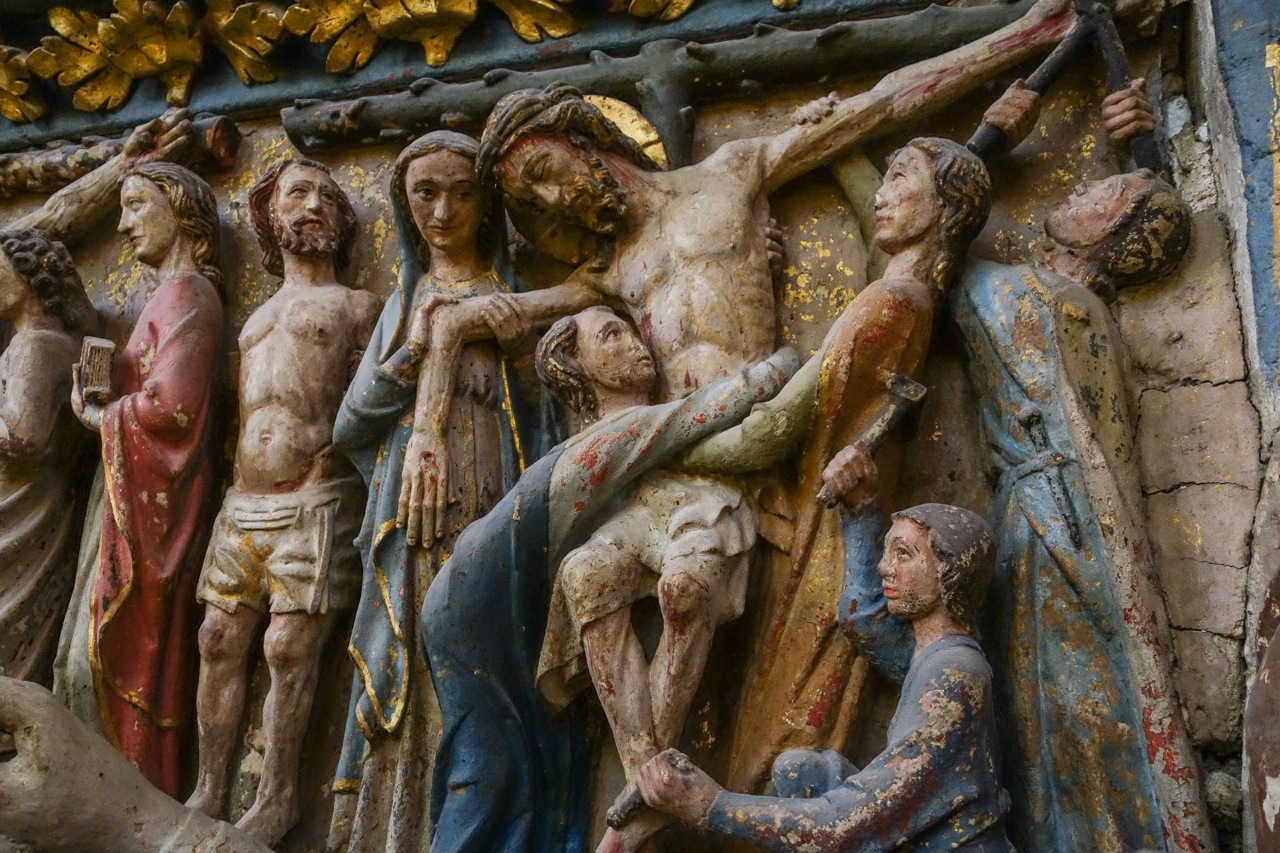
The Deposition (early Gothic; Leon cathedral on the Camino de Santiago)

The Deposition (early Gothic; Leon cathedral on the Camino de Santiago)

Keep your mind in hell, and despair not.

— Staretz Silouan[i]

Ah, children, ah, dear friends, do not be afraid of life!

— Fyodor Dostoevsky[ii]

How do we sing the Lord’s song in the shadow of terror? In solidarity with all the victims of Brussels and the whole human family this week, I protest, I rage, I grieve, I pray. But I must also try to think.

Indiscriminate terror has long been a scourge on this earth, but its globalization through television and social media has now made it emotionally inescapable. Were I to dwell in the uttermost parts of the sea, I could not flee from its presence.[iii]

So as we try to absorb the terrible news from Brussels, how do we “despair not” even in the face of monstrous evil? No simple task, and easy answers seem disrespectful in the time of weeping. But I do believe the antidote to despair is to keep the faith. We must never forget the sacred story we belong to. Even at the grave we make our song: Alleluia, alleluia, alleluia.[iv]

The terrorist, on the other hand, belongs to a story which for most of us in inconceivable. Terror is “the language of being noticed,”[v] a kind of performative rhetoric designed to bring a neglected or disregarded worldview into the open by subjecting others to the violent norms of its alternate reality. They see themselves as global victims, in search of a global audience for their cruel narrative. Mark Juergensmeyer, in his study of religious violence, explains this terrorist rationale:

If the world is perceived as peaceful, violent acts appear as terrorism. If the world is thought to be at war, violent acts may be regarded as legitimate. They may be seen as preemptive strikes, as defensive tactics in an ongoing battle, or as symbols indicating to the world that it is indeed in a state of grave and ultimate conflict.[vi]

In the minds of many terrorists, the war they are so eager to wage is apocalyptic, a cosmic conflict of good and evil in which there is no compromise or bridging of differences. They are, in Don DeLillo’s term, “lethal believers.” And the very worst thing we could do in response would be to play the part they have written for us: satanic enemies in a cosmic struggle. The proposals of certain American presidential candidates to “bomb the hell out of them,” or bring back the good old days of torture, would play perfectly into the terrorists’ hands, conceding the primacy of their deadly story.

However, I choose to belong to a better story, the one enacted and embodied in the powerful liturgies of Christ’s Passion. Step by step on the Way of the Cross this Holy Week, Christians will bring to mind and heart the saving journey which Jesus made, without weapons, into the abyss of suffering and death.

Renouncing all violence and hatred, Jesus remained faithful to the end. After pouring his whole life into a ministry of healing, forgiveness, and reconciliation, he continued to show us the face of love even as he was tortured on the cross. “Father, forgive,” he said with his dying breath. To the last moment, in his most bitter hour, he remained the human who shows us God by doing what God does.

Which story do we choose to live in? The story of terror and violence, or the story of self-diffusive love? Both are costly in the end, but only one leads to new and unconquerable life. Even after Brussels, the word remains: Be not afraid! Love makes the abyss into a Way.

The cross shows us how it is possible to absorb evil and neutralize its effects, rather than pass on the anger and live in bitterness. Turning the other cheek, going the extra mile, giving away your coat to the robber who steals your shirt, loving enemies, doing good to those who hate, blessing those who curse us – all this turns out to be an intelligent and intelligible Christian way of living.[vii]

When medieval women mystics contemplated the cross in prayer and vision, they saw not death’s triumph but a kind of birth. The crucified Jesus was like a woman in labor, enduring pain and travail in order to bring us all to birth: Ah! Sweet Lord Jesus Christ, who ever saw a mother suffer such a birth! For when the hour of your delivery came you were placed on the hard bed of the cross and … in one day you gave birth to the whole world.[viii]

To see such a death and call it birth is the central act of Christian imagination. It is why we declare victory at the cross. We don’t wait for Easter Sunday. We declare victory at the cross, because the Passion isn’t just a story about violent powers that always trample the weak and kill the prophets. It’s also a story about the Realm of God, where dry bones breathe and lost hopes dance, where the prodigal is welcomed home and the tears are wiped from every eye. The Love that makes such a realm was nailed to a cross, but was not consumed by it. Death did what death does, and God did what God does.

And on the outcome of that story, I stake everything.


Related posts

We are the singers of life, not of death

After Paris and Beirut, what story shall we tell?

Beyond Punch and Judy: The art of nonviolent resistance


[i] Staretz Silouan (1866-1938) was a Russian monk on Mt. Athos in Greece. Appearing as an epigraph to Gillian Rose’s book, Love’s Work, I found this provocative saying in Andrew Shanks’ Against Innocence: Gillian Rose’s Reception and Gift of Faith (London: SCM Press, 2008), 9. Rose herself added this typically intense comment: “What Staretz Silouan is talking about is the subjective experience of God-forsakenness,” and even there finding God. “I want to sob and sob and sob,” she says, “until the prolonged shrieking becomes a shout of joy.”

[ii] From Alyosha Karamazov’s final speech in Dostoevsky’s The Brothers Karamazov, trans. Richard Pevear and Larissa Volokhonsky (New York: Vintage Classics, 1991), 776

[iii] cf. Psalm 139:6, 8

[iv] Burial of the Dead, Episcopal Book of Common Prayer, 499

[v] Don DeLillo, quoted in Mark Juergensmeyer, Terror in the Mind of God: The Global Rise of Religious Violence, (Berkeley: University of California Press, 2000 ), 139

[vi] Juergensmeyer, 10

[vii] David Wood, in Consuming Passion: Why the Killing of Jesus Really Matters, eds. Simon Barrow & Jonathan Bartley (London: Darton, Longman and Todd, 2007), 118

[viii] Marguerite d’Oingt (d. 1310)

Beyond Punch and Judy: The art of nonviolent resistance

image

In Faith and Violence, a book published amid the political turbulence of 1968, Thomas Merton told an old Hasidic story about two men, one drunk and one sober, who were beaten and robbed as they traveled through the forest. Asked later about what had happened, the sober one described the violent encounter in vivid detail, but the drunken one seemed quite placid. “We’re all right,” he said. “Everything is fine.” Merton went on to observe that for some, faith “seems to be a kind of drunkenness, an anesthetic, that keeps you from realizing and believing that anything can ever go wrong.” But, he asked, is faith a “narcotic dream” or is it “an awakening”? Then he delivered his punch line: “What if we were to awaken to discover that we were the robbers, and our destruction comes from the root of hate in ourselves.”[i]

At a time when a brutal war was raging in the jungles of Vietnam, police and protestors were clashing in the American street, and leaders who spoke out for justice and peace were being assassinated, a monk dedicated to contemplative retreat from the world felt compelled to explore the theology of love in an age of violence, one which would “deal realistically with the evil and injustice of the world.”[ii] How do we resist the violence in our society without adding our own anger and demons into the mix? How do we resist systemic and social sin while harboring no illusions about our own capacities to do harm?

In recent days there have been numerous conversations about the escalating political violence surrounding the Trump campaign. My own post (March 12) on the topic has generated heartfelt responses of shared concern. Many of us are wondering what we can do about the situation without defaulting to our own versions of anger or fear. We need experienced guides through such tricky terrain, and Thomas Merton is one of the best.

“We no longer communicate,” Merton said. “We abandon communication in order to celebrate our own favorite group-myths in a ritual pseudo-event.”[iii] He wrote that in the Sixties, but he could have been describing a Trump rally, which, in the absence of substantive content, is mostly a ritual acting out of a group-myth, reaching its crescendo in the anticipated expulsion of protesters. As Rachel Maddow showed in a recent montage of those expulsions, Trump repeatedly asks the crowd, “Isn’t this exciting?” Roughing up protesters may express anything from personal rage to fascist methodology, but it is also entertainment. As Neil Postman has noted, Americans like “amusing ourselves to death.”[iv] When the anti-Trump signs come out, the crowd gets happy, knowing the real fun is about to begin.

This is all contemptible and sad. But I wonder: how do protestors avoid becoming unwitting collaborators in Trump’s entertainments? Even if they don’t hit back or give the crowd the finger, how do they escape complicity in a political Punch and Judy show? How do they avoid getting their own group-myths stuck in the futility of an endless ritualized dualism of “us versus them”?

Blessed are the peacemakers, for they shall be called the children of God. The peacemaker is committed to communion as the nature and destiny of humankind. As Martin Luther King said in a speech I remember from my college days, we must see the face of Christ even in the police who are attacking us with dogs and fire hoses. Or as Jesus himself taught, we must love our enemies. That does not mean capitulating to evil, or abstaining from the tainted ambiguities of political conflict. But it does mean that we ultimately belong to a much better story, where one day the tears will be wiped from every eye, the lion will lie down with the lamb, and the prodigal will be welcomed home. It means that our highest commitment is not to defeat our enemies but to make the divine love story of amazing grace come true for everyone.

As Merton wrote, “Christian nonviolence is not built on a presupposed division, but on the basic unity of [humankind]. It is not out for the conversion of the wicked to the ideas of the good, but for the healing and reconciliation of … the human family.”[v] This isn’t sentimental benevolence or passive submission. It’s a very tough form of love, as Jesus, Gandhi, King and many others have demonstrated in their costly commitment to a wider, more generous perspective than the self-righteous justifications of partisan interests. Our struggles must always reject the ultimacy of division in favor of communion. “The key to nonviolence,” Merton reminds us, “is the willingness of the nonviolent resister to suffer a certain amount of accidental evil in order to bring about a change of mind in the oppressor.”[vi]

But how do we apply this wisdom to the specific challenges of our own day? How can we respond creatively to the upwelling of anger, fear, racism and nativism poisoning our public life? In 1968, Merton compiled a list of principles for nonviolent resisters which is worth considering. While he admitted that the complexity and fluidity of events in that turbulent year could make any opinion lose its value in a matter of weeks, I believe his prescriptions retain an enduring value:

1) “be free from unconscious connivance with an unjust and established abuse of power”

2) “be not for [oneself[ but for others, that is for the poor and underprivileged”

3) “dread a facile and fanatical self-righteousness and refrain from being satisfied with dramatic self-justifying gestures”

4) demonstrate “a desirable alternative” to violence and injustice

5) use means which embody and manifest the emergent way of being which Christians call the Kingdom of God

6) be “willing to learn something from the adversary”

7) be grounded in hope and humility – what we strive for is a gift from God’s future: not of our own making, and not yet fully here [vii]

I particularly like Number 4 (demonstrate a desirable alternative) and Number 6 (embody and manifest the Kingdom of God). It is what we do in the eucharist, where everyone is welcome, everyone practices reconciliation, and everyone shares the bread of heaven. But can we take such countercultural vision into the street?

Yes we can. There are various ways (many of which have yet to be invented!). Even into her nineties, my mother joined the “women in black” every Friday in silent vigil against the Iraq war on the streets of Santa Barbara. Their faithful witness was impossible to ignore, while at the same time it perfectly embodied the peace for which they stood.

A very different display of visionary resistance occurred at the World Trade Organization (WTO) protests in Advent of 1999. Those who watched the news only saw the Punch and Judy show of untrained police and young provocateurs turning a shoving match into a tear-gassed conflict. But the most important things that happened were not on television. This is what I myself witnessed on the day of the big rally and march[viii]:

There was a large banner which read, AN INJURY TO ONE IS AN INJURY TO ALL. It seemed a perfect summary of the gospel: “If you do it to one of the least of my brothers and sisters, you do it to me.” All in Christ, Christ in all. Solidarity forever. We were there to speak for all those whom the WTO would rather silence or forget – voices crying in the wilderness, “Prepare the way of the Lord.”

At 12:30 pm, we took to the streets, marching up Fourth Avenue. to join the thousands more who were already downtown. It was a wonderfully diverse procession: there were people dressed as Santa Claus, sea turtles, trees, and even death. But it was not some crazy fringe out there. As one writer put it, “These were the kids at UW, the ladies from church, the guys at Boeing. It was Seattle that was marching this week.”

As in all street rituals, there was a playful, carnival atmosphere. As Richard Shechner observes in his book, The Future of Ritual:

“When people go into the streets en masse, they are celebrating life’s fertile possibilities…They put on masks and costumes, erect and wave banners, and construct effigies not only to disguise or embellish their ordinary selves, or to flaunt the outrageous, but also to act out the multiplicity each human life is…They protest, often by means of farce and parody, against what is oppressive, ridiculous and outrageous…Such playing challenges official culture’s claims to authority, stability, sobriety, immutability and immortality.”[ix]

In other words, we were exhibiting the same spirit – dare I say “holy spirit”? – of playfulness, camaraderie, irony and subversion that was seen ten years ago at Tiananmen Square and the Berlin Wall and, during biblical times, at the Red Sea and the Triumphal Entry on Palm Sunday. And as faith tells us, the powers don’t stand a chance against the foolishness of God.

There were people on stilts, people carrying giant puppets, babies in carriages and elders with canes and walkers. I stuck close to the Anti-Fascist Marching Band, which played soulful New Orleans versions of “America the Beautiful”, “Battle Hymn of the Republic” and Bob Dylan’s “Masters of War.” We all just danced up Fourth Avenue …

So, my friends, how shall we do the Kingdom dance in the year of grace 2016?


[i] Thomas Merton, Faith and Violence: Christian Teaching and Christian Practice (Notre Dame, Indiana: Indiana University Press, 1968) ix-x (All quotes from Faith and Violence are in The Thomas Merton Encyclopedia (New York: Orbis Books, 2002) under the entry on Merton’s book, but I have listed the original volume’s page numbers in the footnotes.)

[ii] ibid., 9

[iii] ibid., 159

[iv] Neil Postman, Amusing Ourselves to Death: Public Discourse in the Age of Show Business (New York: Penguin, 2005)

[v] Merton, 15

[vi] ibid., 27-28

[vii] ibid., 21-25

[viii] From a sermon I preached the following Sunday at St. Augustine’s-in-the-Woods Episcopal Church, Whidbey Island, WA (Advent II, 1999))

[ix] Richard Schechner, The Future of Ritual: Writings on Culture and Performance (London & New York: Routledge, 1993), 46

How far can we sink? – Donald Trump and the vortex of rage

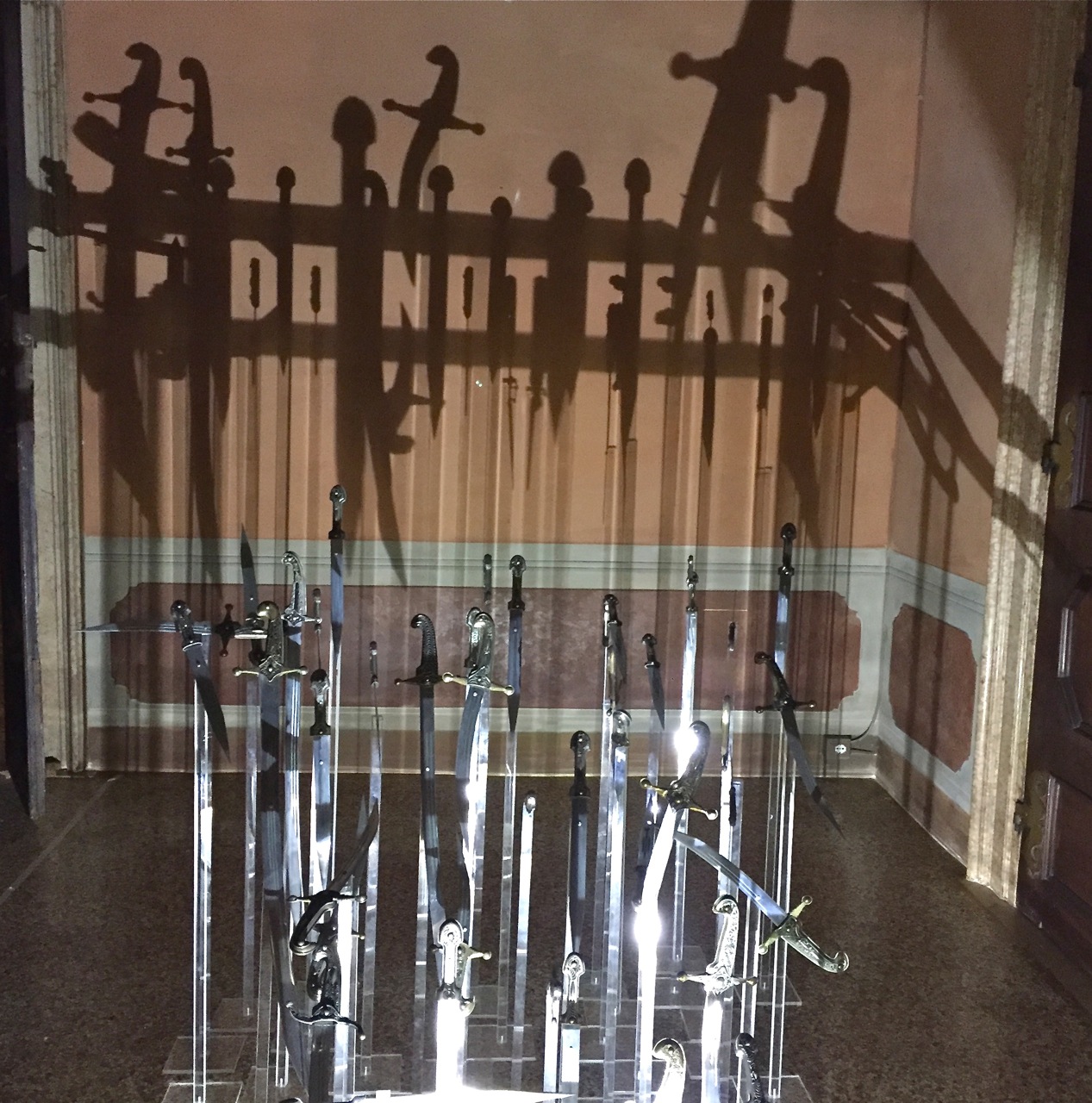
Rashad Alakbarov, "Do Not Fear," installation at Venice Biennale 2015

Rashad Alakbarov, “Do Not Fear,” installation at Venice Biennale 2015

We must love one another or die.

— W. H. Auden, “September 1, 1939”

In the early 1930s, about a hundred communists crashed a Nazi meeting in Bremen, Germany, determined to break it up. One of them, Richard Krebs, rose to interrupt a speech by Herman Göring, head of the notorious SA stormtroopers, a paramilitary group dedicated to political intimidation and violence. Krebs only got out a few words before the “brownshirts” rushed toward him. As Krebs later wrote,

“A terrifying mêlée followed. Blackjacks, brass knuckles, clubs, heavy buckled belts, glasses and bottles were the weapons used. Pieces of glass and chairs hurtled over the heads of the audience. Men from both sides broke off chair legs and used them as bludgeons. Women fainted in the crash and scream of battle. Already, dozens of heads and faces were bleeding, clothes were torn as the fighters dodged about amid masses of terrified but helpless spectators. The troopers fought like lions. Systematically they pressed us on towards the main exit. The band struck up a martial tune. Hermann Göring stood calmly on the stage, his fists on his hips.”[i]

A political life fraught with such violent thuggery once seemed unimaginable in contemporary America. What happened in Germany could never happen here, we tell ourselves. Physical violence as a routine form of political expression is not something we expect our leaders to tolerate, much less encourage. What, then, are we to make of the violent anger which has become a common feature of Donald Trump rallies?

At one such gathering, a man held up a sign, “Make America hate again!” The crowd happily obliged, ripping up the sign and roughing up the protester. At another rally, on March 10, a 78-year-old man in the crowd sucker-punched a young activist as he was being escorted out of the arena by Trump’s security guards. “He deserved it,” the man told a reporter. “Next time, we might have to kill him.”[ii]

In Ashley Parker’s excellent New York Times piece on this phenomenon, she sees the crowd’s violent reaction as “almost biological”:

“Trump supporters typically begin shouting, pointing, jeering — and sometimes kicking or spitting — at the protester, surrounding the offender in a tight circle, like antibodies trying to isolate and expel an unwanted invader from the bloodstream.”[iii]

Is Trump to blame for the passions of his followers? He has made some cursory disclaimers after the fact, but when the anger erupts he does little to discourage it.

On February 1, he told an Iowa crowd to be on the lookout for protesters with tomatoes. “If you see somebody getting ready to throw a tomato, knock the crap out of ‘em, would you? Seriously. Okay? Just knock the hell – I promise you, I will pay for the legal fees, I promise, I promise.” Later that month, as a protester was being ejected from another rally, Trump said, “I’d like to punch him in the face.”[iv] It is hard to listen to this stuff without thinking of Göring in Bremen, standing “calmly on the stage, his fists on his hips.”

When asked by reporters about the violence, Trump talks about “the good old days” when America wasn’t “weak,” and you were able to dish out a well-deserved pummeling. “This country has to toughen up,” he says. “These people are bringing us down.”[v]

Such scapegoating is one of the hallmarks of fascism. Instead of the hard work of developing concrete policies and building support for them, the leader simply invokes fear and hatred of “the other” to unite his followers. Trump repeatedly demonizes protesters as “nasty people” and blames them for initiating the violence, even though no reporter or camera has seen anything to support his claim, except for one thrown tomato that is said to have missed the mark.[vi] This one-sidedness may change, of course, for violence can be highly contagious.

Trump has argued that his supporters are not really angry people, but that they “do get angry when we see the stupidity with which our country is run and how it’s being destroyed.”[vii] His rhetoric bears a chilling resemblance to the Nazi justifications for Kristallnacht: “an expression of the people’s rage” …. “ “a just measure of indignation”… “our patience is exhausted.”[viii]

A few days ago, Trump described an incident at an earlier rally. “He was a rough guy and he was punching. And we had some people – some rough guys like we have right in here – and they started punching back. It was a beautiful thing.”[ix]

In this week’s Republican presidential debate, the three other candidates were given the opportunity to condemn the political violence of Trump’s mob, but they kept silent. Maybe they were hoping it would all just go away, without their having to risk the loss of any votes from “the base.” But silence in the face of evil is just endorsement by default.

We hear God invoked repeatedly in presidential campaigns by candidates who claim to be good Christians. But a “Christianity” so enamored of what theologian John Milbank calls the “ontology of violence” feels unrecognizable to me. Whether it is the manipulation of anger at a rally or policies of aggression against everyone who is “other,” such a politics is anathema to the transformative project of conforming the social body to the divine desire for justice, forgiveness, and peace.

Last October I had a conversation about American politics with a few British shape note singers in a London pub. They wanted to know what on earth the Trump spectacle was all about. I muttered the common wisdom of the moment about a clownish celebrity who would soon fade away. “Watch out,” warned one of the Brits, the daughter of an Anglican priest. “A single dumb candidate can make the whole process dumber, and drag everyone down to his level. That happened here when we elected our mayor. It could happen in America.”

She was right, as we now know, although “dumb” is the least of it. How far can we still sink? In Richard Evans’ acclaimed trilogy on the Third Reich, he describes Germany on the eve of the Nazi takeover in one disturbing sentence: “Years of beatings and killings and clashes on the streets had inured people to political violence and blunted their sensibilities.”[x]

The blunting of our own sensibilities should be worrying us. But how can we resist the downward pull of fear, hatred and violence without ourselves being corrupted by it, or sucked into its vortex of rage? How may we give concrete political form to the better angels of our nature?

The day after Martin Luther King was assassinated, Senator Robert Kennedy spoke against the violence permeating American culture in the 1960s:

“Some look for scapegoats, others look for conspiracies, but this much is clear: violence breeds violence, repression brings retaliation, and only a cleansing of our whole society can remove this sickness from our soul.”[xi]

Two months later, Bobby Kennedy himself would be cut down by the political violence he had so earnestly lamented. As for the rest of us, the day of our collective cleansing still remains sadly distant.


[i] Richard J. Evans, The Coming of the Third Reich (New York: Penguin Books, 2003), 270

[ii] Ashley Parker, “Riskiest Political Act: Protesting at Rallies for Donald Trump” (New York Times, March 10, 2016)

[iii] ibid.

[iv] Philip Bump, The Fix, Washington Post online, March 10, 2016

[v] Jim Salter & Jill Colvin, Associated Press, March 11, 2016

[vi] Daniel White, “Donald Trump Tells Crowd”, Time online, February 1, 2016

[vii] Salter & Colvin

[viii] Walter Laqueur & Judith Tydor Baumel, eds., The Holocaust Encyclopedia (New Haven: Yale UP 2001). 390

[ix] Jill Colvin & Michael Tarm, Associated Press, March 11, 2016

[x] Evans, 348

[xi] Robert F. Kennedy, Remarks to the Cleveland City Club, April 5, 1968

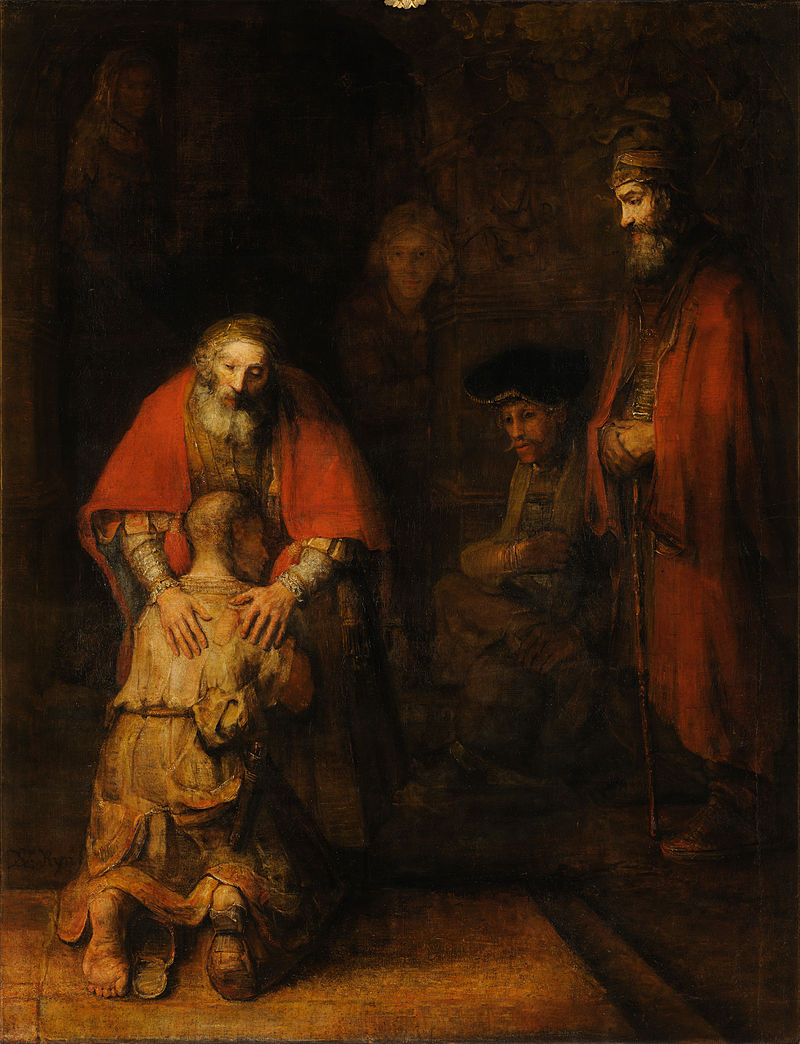
The Return of the Prodigal Son

Rembrandt van Rijn, The Return of the Prodigal Son, c. 1661–1669 (Hermitage Museum, Saint Petersburg)

Rembrandt van Rijn, The Return of the Prodigal Son, c. 1661–1669 (Hermitage Museum, Saint Petersburg)

Sometimes I lead retreats to explore correlations between biblical narratives and our own stories. It’s not just a matter of putting ourselves in a given Bible story as a method of interpreting it. We also need to let it interpret us, as we discover the biblical motifs which are playing out in the particular circumstances of our own lives. What is my creation story, what is your exodus story, what is each one’s death and resurrection story?

At one such retreat, we considered Jesus’ parable of the Prodigal Son. After studying the text, we tried out various ways of retelling it in our own words. Then we divided into three groups: Fathers, prodigal sons, and elder brothers. Membership in each group was determined by chance, although it turned out that the “elder brothers” consisted mostly of firstborn children.

Each group was asked to wrestle with their assigned character. What do you feel about this character? What does the story tell you about him? What does the story leave unsaid? Then they were invited to share a related story from their own lives. Tell about the struggles of being a parent, a child, or a sibling. Tell about a time you were forgiven, or needed to forgive. Tell about a time you felt neglected or ignored, envious or resentful.

One man said he had been disappointed at first to draw the father’s group, because he always related more strongly to the elder brother. As the oldest child in his family, he had some of the issues common to that role. He knew the burden of wanting to live up to his parents’ expectations, to be “perfect,” obedient, one who pleases by getting everything right. He had also experienced some envy and resentment of younger siblings who seemed more carefree and less responsible.

But as he listened to others in the group engage with the father’s side of the story, it occurred to him that he himself had actually been a father for as long as he had been only a son and brother. Maybe, he said, it was time to rethink his own story and who he was in it.

In the early nineties, Henri Nouwen wrote “a meditation on fathers, brothers, and sons” using the parable of the Prodigal Son along with Rembrandt’s famous painting of the moment when the errant child is welcomed home. Like the people in my retreat, he found critical insights into his own life in each of the characters. And in doing so, he realized that there were two sons, not just one, who went astray from their father’s will, into “a distant country,” the place of alienation.[i]

The younger son’s sins may have been more dramatic and colorful, but the elder brother’s bitter and jealous heart grieved his father just as much. Both sons are lost. Both need to be welcomed “home.” As Rembrandt’s painting shows, the elder stands in the shadows, separated from the radiant light surrounding the father and his youngest child.

“There is not only the light-filled reconciliation between the father and the younger son, but also the dark, resentful distance of the elder son. There is repentance, but also anger. There is communion, but also alienation. There is the warm glow of healing, but also the cooling of the critical eye; there is the offer of mercy, but also the enormous resistance against receiving it.”[ii]

Whether the elder brother will be able to step out of his darkness into love’s radiance remains unknown in both the painting and the original parable. But the father has made it clear that his parental love will never be withdrawn. Like the loving mercy of God, his welcoming arms remain ever extended and expectant, now and forever. As Nouwen writes, “The heart of the father burns with an immense desire to bring his children home.”[iii]

Nouwen describes the differences between the father’s hands in Rembrandt’s painting. His left hand is strong, masculine, gripping his son encouragingly. His right hand seems more refined, almost feminine, offering the caress of consolation. The father’s red cloak also conveys shelter and protection, like the enfolding wings of a mother bird.

Love so amazing, so divine, has a cost. It does not always produce happy endings. In the “fathers” group at the retreat, one woman told us about her own prodigal son, a forty-year old man who had struggled for years with his own lostness. “I welcomed him home every time,” she said, “and then he would just break my heart all over again.” Six months before our retreat, he had committed suicide.

When we hear the parable, it is natural to focus on the prodigal’s experience of unconditional, unmerited welcome. We all long to hear the word of mercy for ourselves: weary pilgrim welcome home. But Nouwen won’t let us stay there. Although we each need to make our way on the difficult journey home, in the end we are called to claim the role of the father as well. Forgiven so much, may we also become the ones who forgive, whatever it costs.

“His outstretched hands are not begging, grasping, demanding, warning, judging, or condemning. They are hands that only bless, giving all and expecting nothing … As I look at my own aging hands, I know that they have been given to me to stretch out toward all who suffer, to rest upon the shoulders of all who come, and to offer the blessing that emerges from the immensity of God’s love.”[iv]


[i] Henri J. M. Nouwen, The Return of the Prodigal Son: A Meditation on Fathers, Brothers, and Sons (New York: Doubleday, 1992)

[ii] ibid., 126-7

[iii] ibid., 89

[iv] ibid., 127-8, 130

The voice that allows us to remain human

Moses before the Burning Bush, 13th century icon, Monastery of St. Catherine, Mt. Sinai

Moses before the Burning Bush, 13th century icon, Monastery of St. Catherine, Mt. Sinai

Even in the darkest hours of mankind, there might be a voice within us that allows us to remain human.

– László Nemes, director of Son of Saul, accepting the Oscar for Best Foreign Film

These words, spoken last night at the Academy Awards, struck me with particular force, since one of the most famous accounts of that voice had just been told in the morning liturgy. Although Exodus 3: 1-15, the story of the burning bush, does not describe a voice coming from “within,” I believe that the voice which Moses heard at the foot of God’s mountain was the same voice which the Hungarian filmmaker longs to hear, the same voice we all long to hear in a dark time when the humanity of our country, our world, and ourselves is being called into question.

Whether it speaks in an interior whisper, or calls to us from an exterior source, the voice “that allows us to remain human,” to remember (or discover) our true humanity, is the voice which has been speaking us into being since the beginning of the world. It is the voice of revelation.

Revelation, in the words of Ashton Nichols, is “a moment when the soul of the recipient is filled with something outside the self. A literal inspiration occurs. Consciousness finds itself flooded, or breathed into, or simply filled, by a force it ascribes to an external agency. The metaphoric agent may be a wind, a flash of light, or a disembodied voice. Divine grace descends; the voice of God is heard in the whirlwind; a spirit inspires the prophet or poet with a truth that comes from outside the self and is incorporated into the soul of the recipient.”[i]

The sense of a truth coming from “outside the self” may seem a contradiction to Nemes’ “voice within us,” but only if we understand ourselves as separate, autonomous beings more or less self-contained and complete. If we are made in the image of the Trinitarian God, then we are part of a larger, interdependent flow of self-diffusive love in which outside and inside, or divine and human, are not strict opposites, but partners in a dance. We are constituted by a process of receiving our being from somewhere else, and in turn giving ourselves away. We “lose” our life to find it, as Jesus said. Like that bush in the Sinai, we burn with divine fire, yet are not consumed.

The first time I went to the Holy Land, in 1989, I saw a burning bush. It happened to be Ascension Day. I was visiting the Anglican sisters in Ramallah, with whom my mother had once worked to teach and care for Palestinian Christian children. Since a border closing prevented us from going to mass at a Benedictine church known for its beautiful chanting, a couple of the sisters took me for a walk in the local hills. As we descended a ravine, we encountered a shepherd with his small flock. And behind him, a little further on, I saw, with considerable astonishment, a burning bush. Why it was on fire, I never learned. If it spoke, I did not hear. Sometimes the voice is for the shepherd’s ears only. But I never forgot the wonder of it.

The bush which will burn and speak to you, or me, is out there somewhere, waiting for the proper moment of holy meeting. Anglican poet/priest R. S. Thomas described his own encounter in “The Bright Field.”

I have seen the sun break through
to illuminate a small field
for a while, and gone my way
and forgotten it. But that was the pearl
of great price, the one field that had
the treasure in it. I realize now
that I must give all that I have
to possess it. Life is not hurrying

on to a receding future, nor hankering after
an imagined past. It is the turning
aside like Moses to the miracle
of the lit bush, to a brightness
that seemed as transitory as your youth
once, but is the eternity that awaits you.

Mary in The Burning Bush, Nicolas Froment (1475-6)

Mary in The Burning Bush, Nicolas Froment (1475-6)

In an exquisite fifteenth-century tryptich by Nicolas Froment, Moses beholds the Madonna and Christ Child in the “burning” bush. There are no prominent flames. The Word made flesh is both voice and fire. God incarnate is the ultimate revelation by whom and through whom and in whom we may, at last, become fully human.


[i] Ashton Nichols, The Poetics of Epiphany: Nineteenth Century Origins of the Modern Literary Movement