Unknown's avatar

About jimfriedrich

I am an Episcopal priest, liturgical creative, filmmaker, writer, musician, teacher and retreat leader. My itinerant ministry is devoted to religious imagination and holy wonder. My blog is a space where diverse ideas and perspectives - theology and culture, liturgy and spirituality, arts and religion - can meet and converse with one another.

“This Is My Body”: What is the Olympics’ “Last Supper” Controversy Really About?

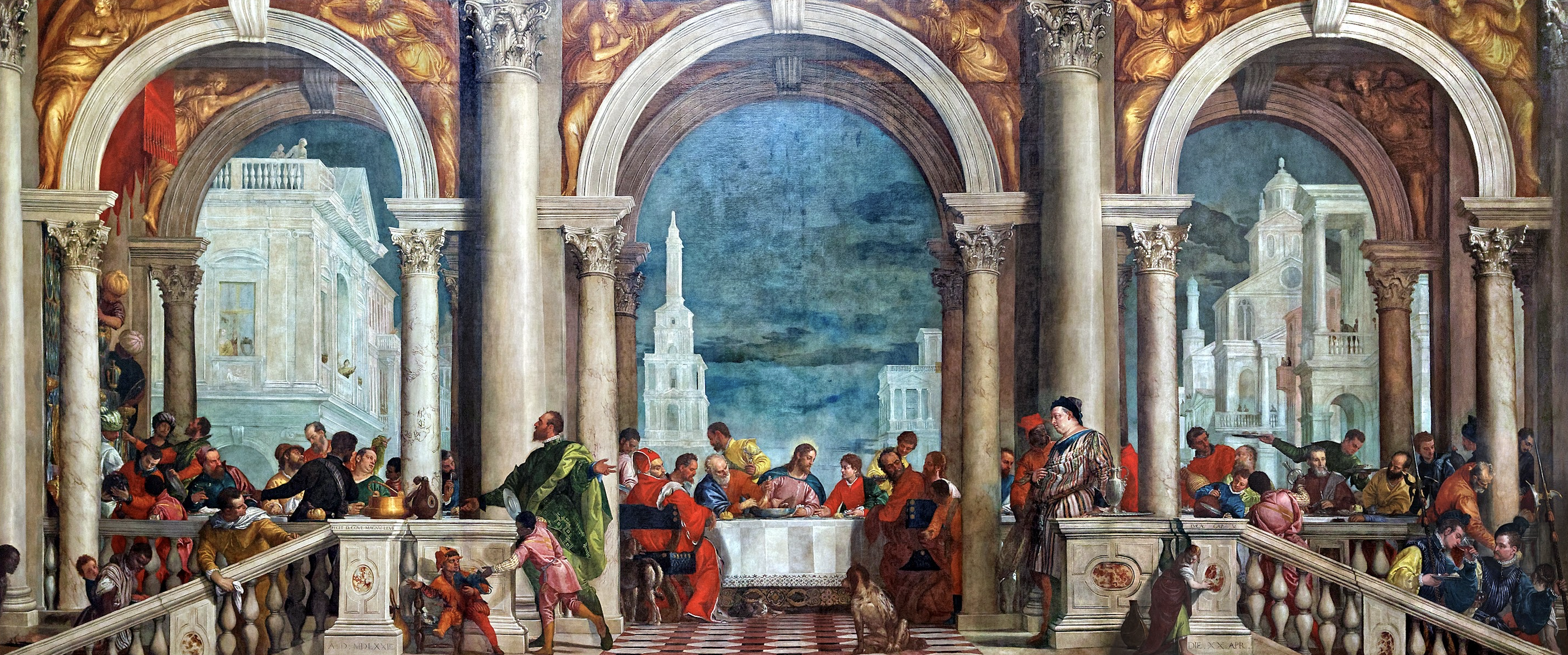
Paolo Veronese, Christ in the House of Levi (1573).

“The image can be worn down to the point that it is almost invisible, it can be plunged into darkness and disfigured, it can be clear and beautiful, but it does not cease to be.”

— Saint Augustine

Four hundred and fifty years ago, Paolo Veronese painted his controversial version of the Last Supper for a Venetian monastery. It was hung in the refectory, where the monks could contemplate the sacredness of every meal in the artist’s image of the first eucharist. But when the censors of the Venetian Inquisition had a look, they were shocked to find the holy scene crowded with “buffoons, drunken Germans, dwarfs and other such scurrilities.”[i] Although Veronese argued that the invented characters were needed to fill the immense canvas (42 feet wide), and that Christ was safely separated from the more unseemly guests within the central arch, the Inquisitors were not persuaded. The disorderly and irreverent scene was antithetical to the purpose of religious art. It would produce distraction, not devotion.

Veronese was given three months to change the painting. Instead, he gave it a new title: Christ in the House of Levi. As Luke’s gospel tells us, Jesus was known for eating with “publicans and sinners,” so the switch of subjects from Last Supper to Levi’s party made the scandalous scene properly scriptural. The artist was off the hook, and the Inquisitors dropped their complaint.
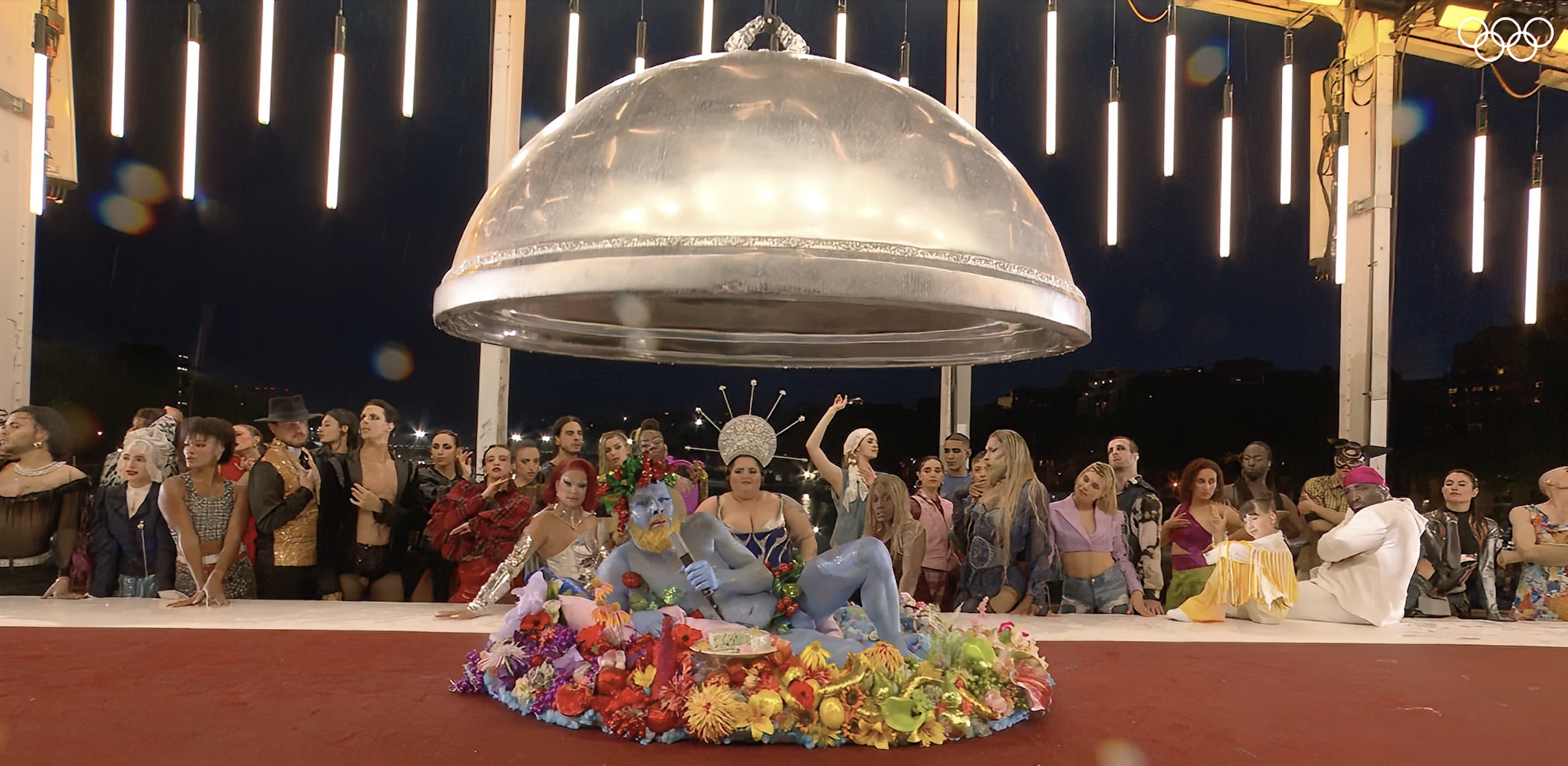
The controversial tableau at the Paris Olympics.
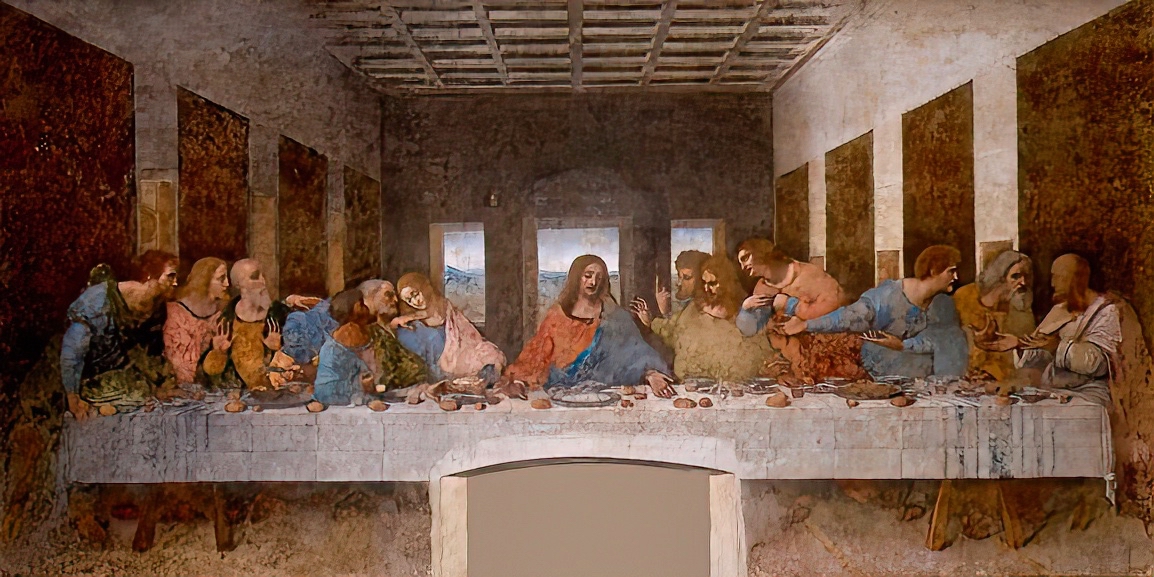
Leonardo da Vinci, The Last Supper (c. 1495-1498).

At the Opening Ceremonies of the Paris Olympics, a similar controversy arose when a brief tableau of a pagan feast was taken to be a mocking parody of the Last Supper. The diverse figures standing behind the raised runway of a fashion show, grouped on either side of a central figure with a silver “halo”, evoked for some the well-known iconography of Leonardo da Vinci’s Last Supper. But instead of a male Christ, the central figure was a woman, flanked not by pious apostles but dancing drag queens.

The French Bishops’ Conference slammed the tableau as a “mockery and derision of Christianity.” Mike Johnson, the right-wing Evangelical Speaker of the House in the United States Congress, decreed the performance “shocking and insulting to Christian people around the world.” The event’s artistic director, Thomas Jolly, denied the Last Supper allusion. The scene was a pagan feast on Mount Olympus. The Olympics! Get it? The blue man sitting on a pile of fruit in the foreground depicted Dionysos, Greek god of wine and fertility. There was no intention to “be subversive or shock people or mock people,” Jolly said. [ii]
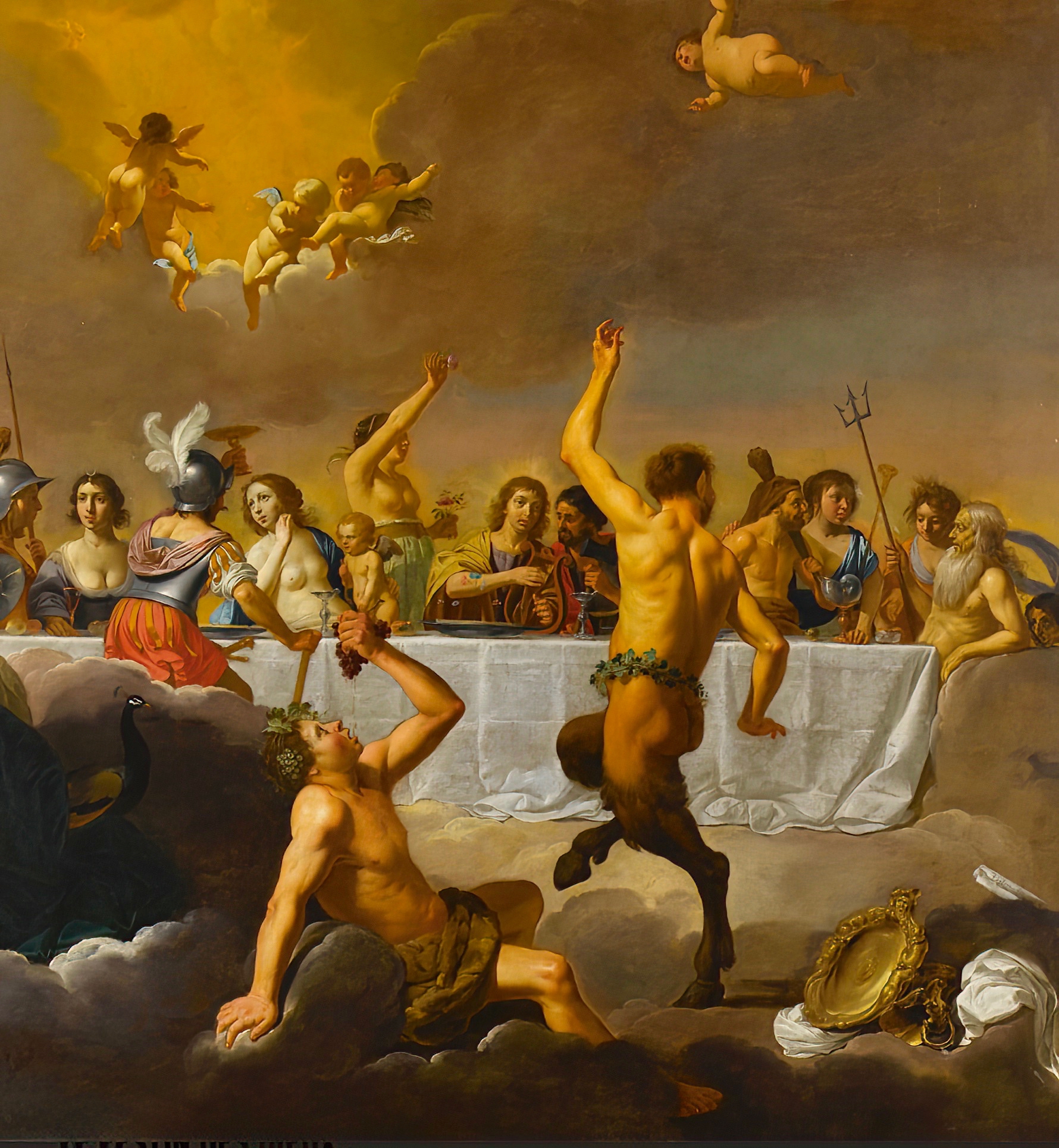
Jan van Bijlert, The Feast of the Gods (c. 1635-1640).

The true inspiration for the tableau, suggested its defenders, was not Leonardo’s masterpiece, but a seventeenth-century painting by Dutch artist Jan van Bijlert, The Feast of the Gods. There is a table with a central figure behind it, but it’s Apollo. And no one would mistake all those Olympian carousers for Christian saints. However, I do wonder. Was Bijlert’s table itself inspired by Leonardo’s, making his own pagan tableau a sly remix of the Last Supper?

Whatever the intention of the Olympic organizers, the negative outrage poses a critical question. What is the table fellowship of Jesus all about? Is it not an indelible image of divine welcome? If so-called “Christians” profess to be shocked at the presence of misfits and outcasts at God’s feast, are not they the true blasphemers against the Love Supreme?

The Last Supper has long been one of the most recycled images of Christian iconography. As a widely recognizable motif of human solidarity and divine gift, it is a visual code for what everyone longs to hear: Come in. Sit down. You are welcome here.

Homer Simpson and friends in the manner of Leonardo.
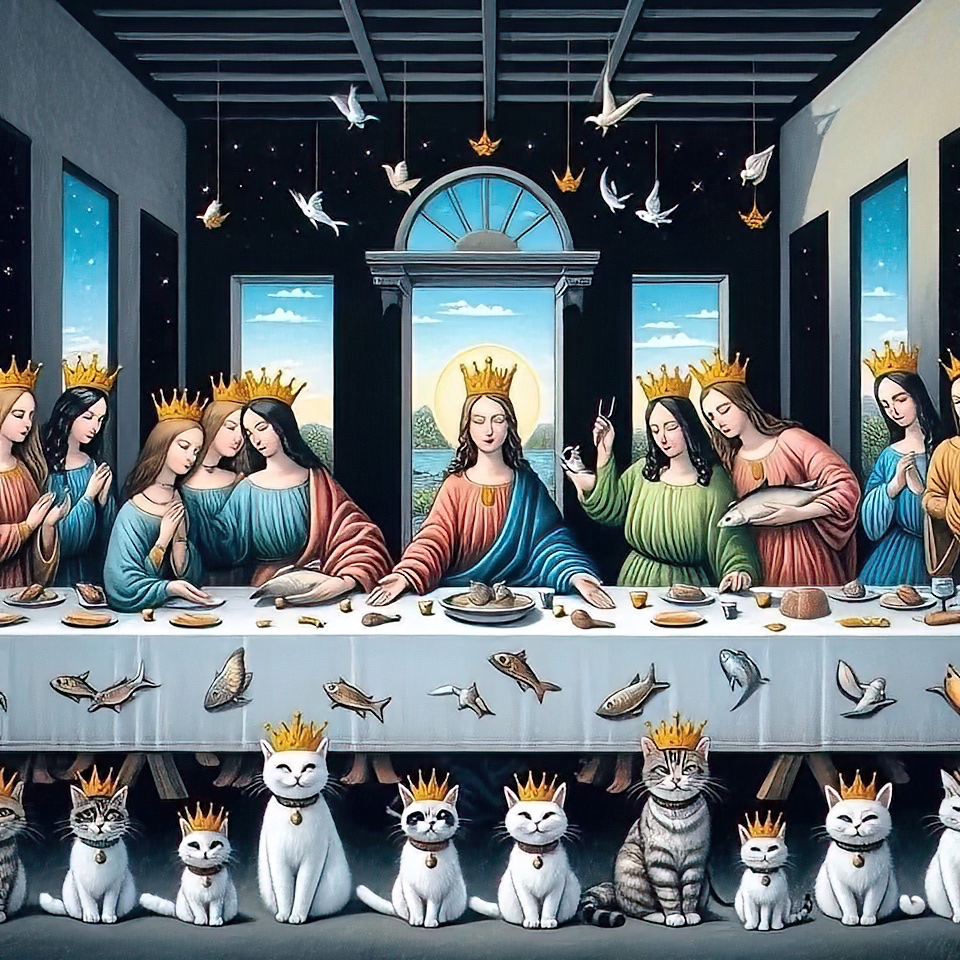
Two controversies in a single meme: Paris Opening Ceremonies and Cat Ladies.

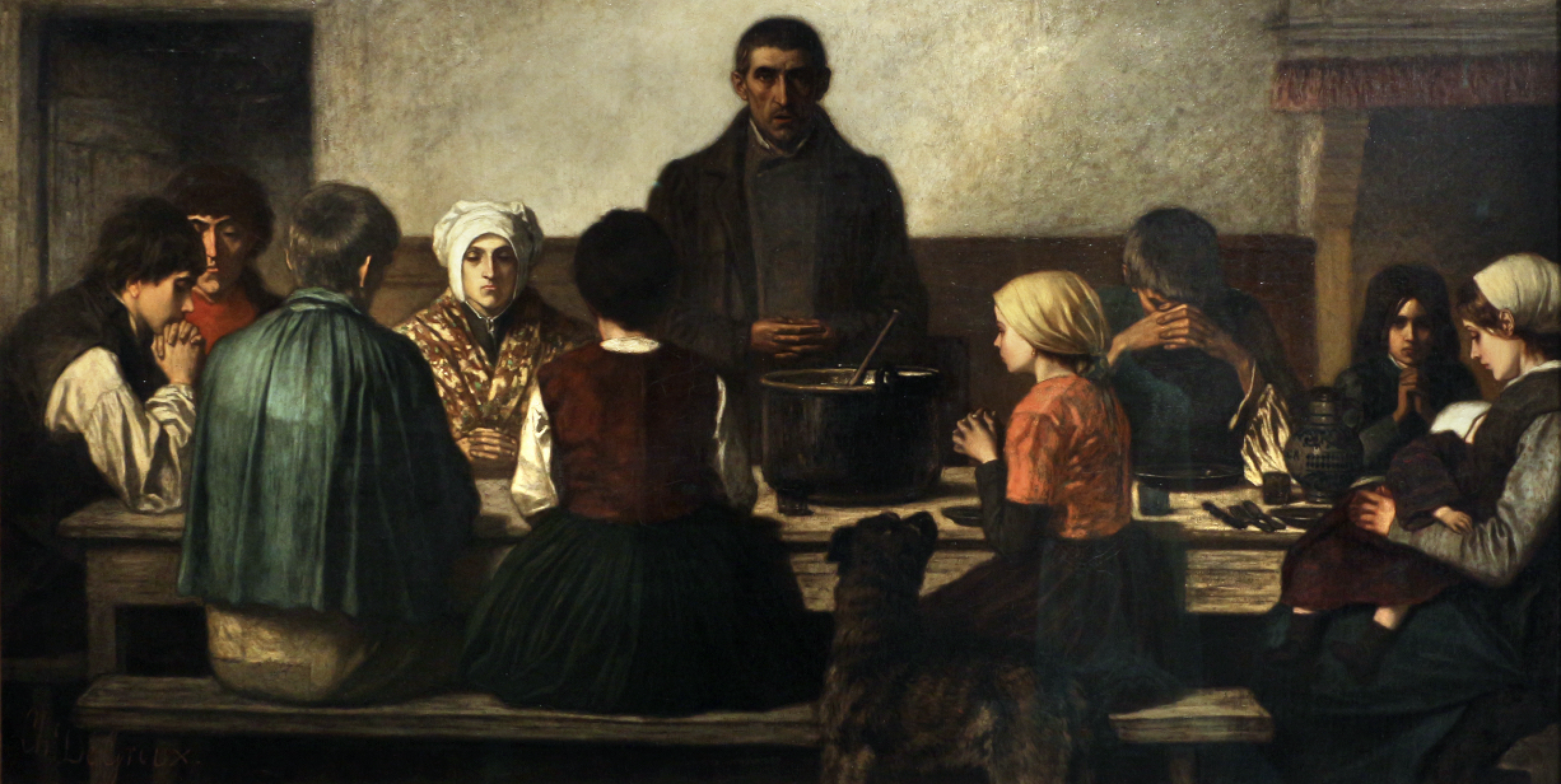
Van Gogh’s The Potato Eaters, manifesting the eucharistic dimension of every table, however humble, was inspired by the Last Supper paintings of Tintoretto (1518-1594) and Charles de Groux (1825-1870).
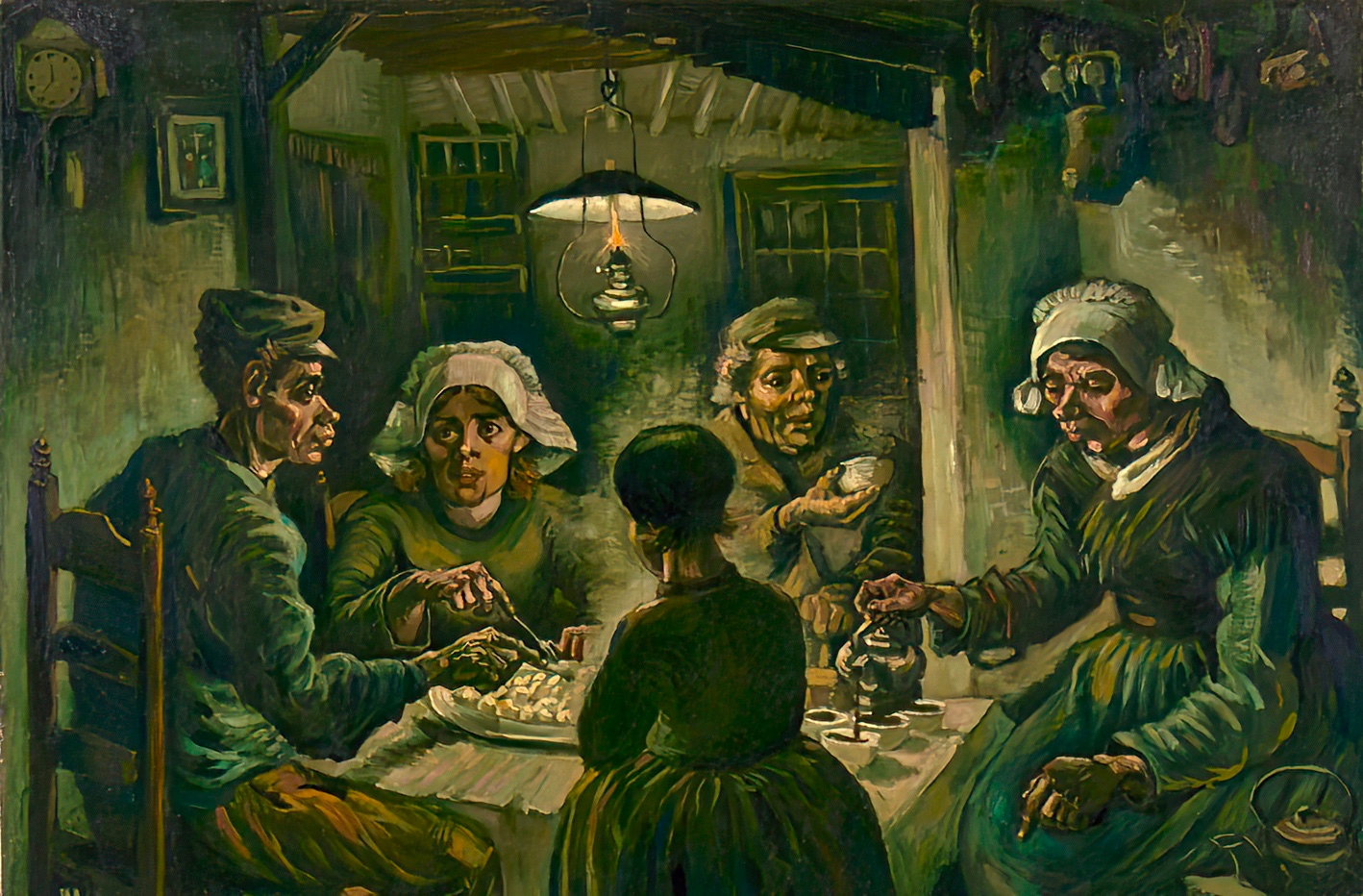
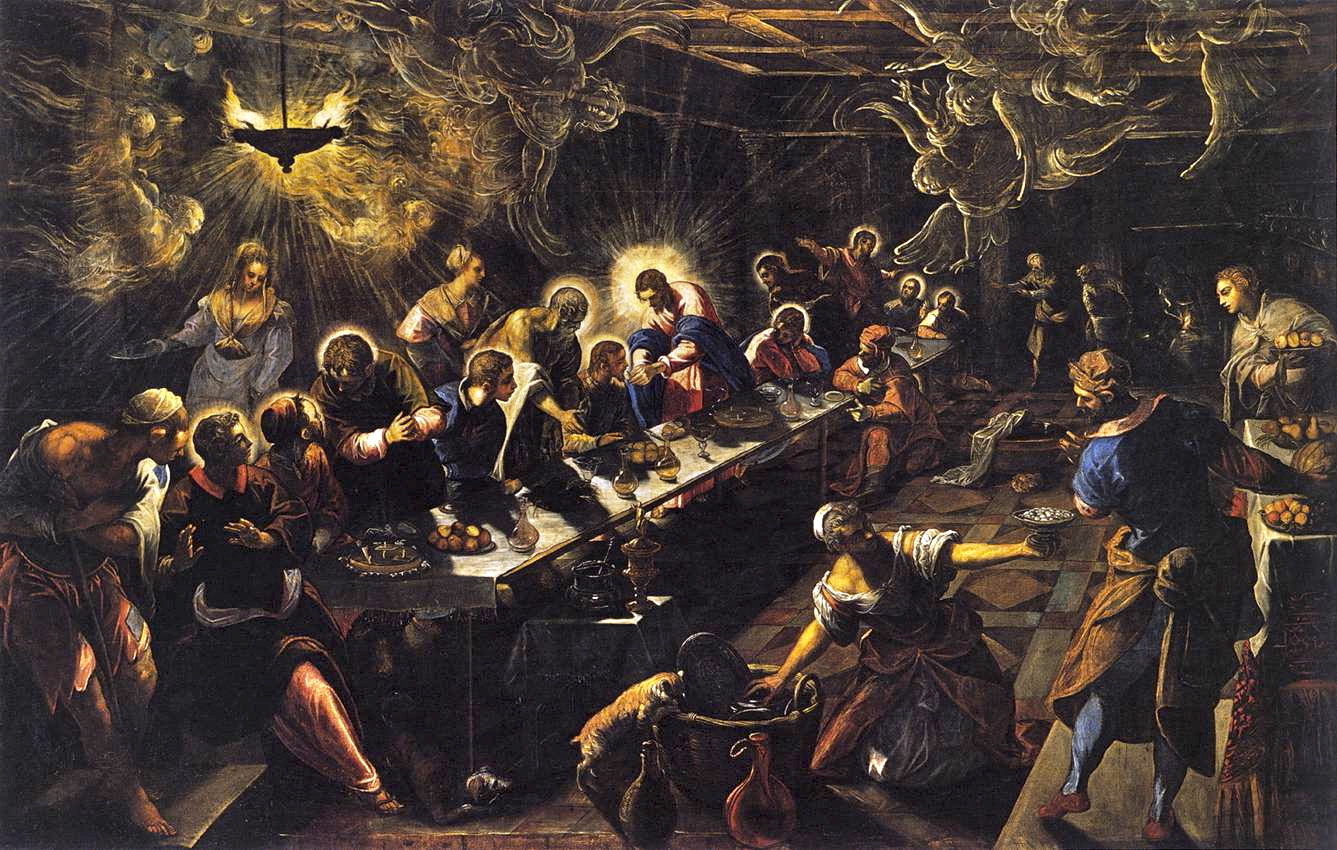
Vincent van Gogh, The Potato Eaters (1885). The lamp, borrowed from Tintoretto’s Last Supper, illumines this humble “communion” table with divine light.
Jocopo Tintoretto, The Last Supper (1592). The spiritual turbulence swirling through the room reveals the sacredness of the first eucharist. The untraditional angle of vision intensifies the moment’s dynamic power.
Charles de Groux, The Blessing Before Supper (1861). The Last Supper imagery in an everyday setting inspired Van Gogh’s The Potato Eaters.

In recent decades, photographers have invited some surprising guests to the table, often with a subversive image of Christ in the middle. Nathalie Dietschy’s extensively illustrated book, The Figure of Christ in Contemporary Photography, provides a wide variety of examples, such as David LaChapelle’s Last Supper from his 2003 series, Jesus is My Homeboy. “If Jesus was alive today,” says the artist, “this is who he would be with. He was with the outcasts, the apostle. What would the apostles look like today? The apostles were not the aristocracy, they were not the well to do, they were not the popular people, they were sort of the dreamers, the misfits.” [iii]
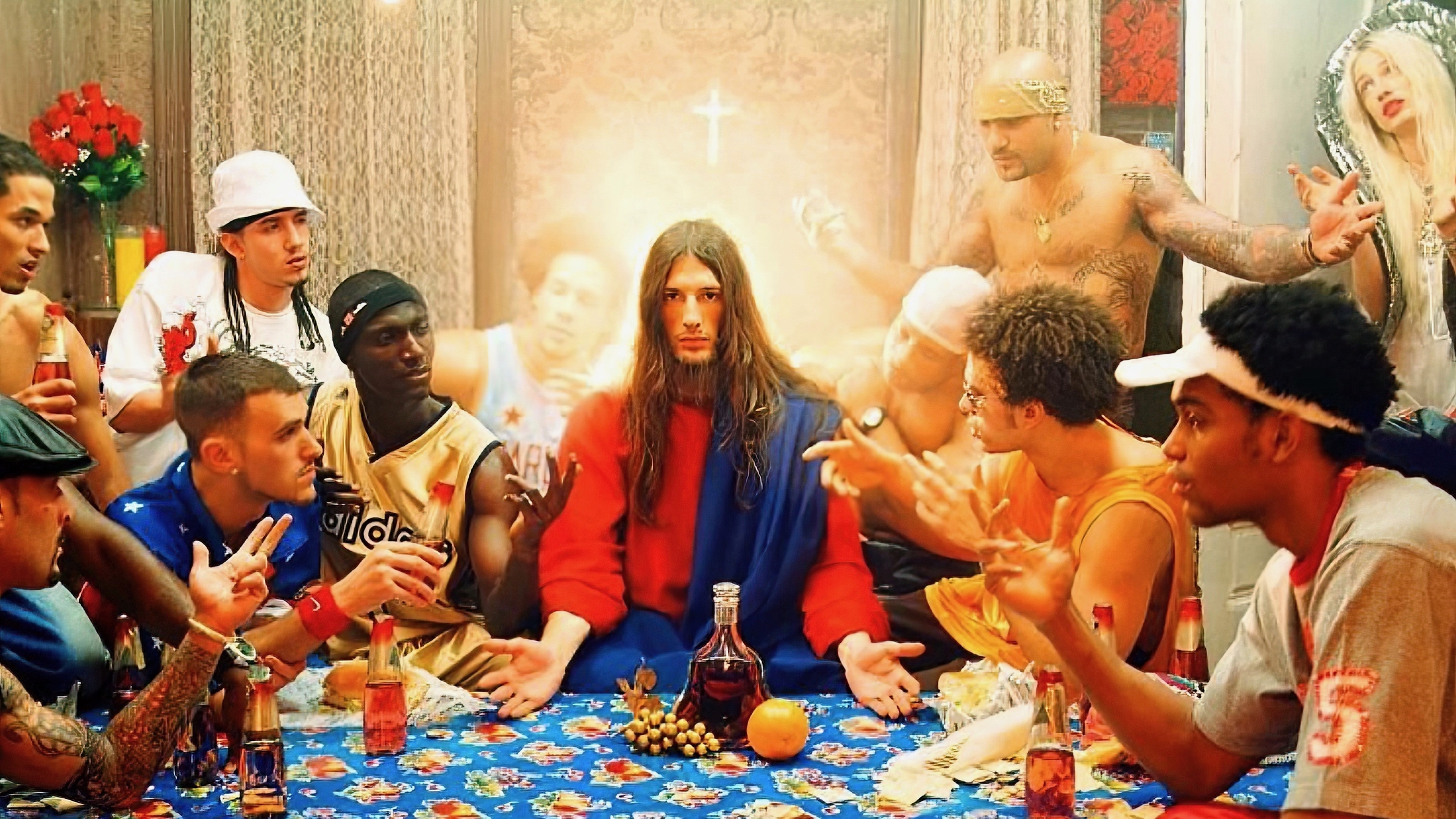
David LaChappelle, Last Supper (detail). Part of the series, Jesus is my Homeboy (2003).

Raised a Roman Catholic, LaChapelle wanted to “rescue” Jesus from limiting stereotypes. He described his Homeboy series as “a personal attempt to say [to fundamentalists]: ‘you have ruined so much, but you are not going to take this.’” [iv]

Some of Dietschy’s other photographic examples of the Last Supper genre are Marcos López’s Roast Meat in Mendiolaza, with the central figure at the table stabbing a hunk of meat with a knife at an outdoor barbecue in Argentina … Rauf Mamedov of Azerbaijan having men with Down’s Syndrome reproduce the gestures of Leonardo’s apostles as they ask, “Is it I, Lord?” … Faisal Abdu’Allah, a Jamaican-born American, inserting his own blackness into the story with disciples of color, both men and women, dressed as rap artists or veiled and robed in traditional Muslim dress … New Zealander Greg Semu exploring the tensions between indigenous and colonial cultures in The Last Cannibal Supper … ‘Cause Tomorrow We Become Christians, where the artist himself, as the Christ figure, presides over a table laden with cooked flesh and a human skull, as his disciples, anxious about transitioning identity, look ill at ease … and a couple of Chinese artists filling the table with Red Army soldiers, or Chinese schoolgirls with identical faces.

Such revisions of sacred iconography can be challenging, bewildering, or even disturbing. And any erosion of the “aura” of religious symbols, especially in this secular age where technology’s infinite reproducibility of images has revoked all the Christian copyrights, is a subject worth thoughtful consideration. But the persistence of sacred tropes, even when trivialized or misappropriated, is itself a testimony to their power. The logic of the Incarnation means that the divine can become indistinguishable from the human, erasing the boundary between sacred and profane.

Brigitte Niedermair, The Last Supper (2005)

The Last Supper by Swedish artist Brigitte Niedermair in 2005 first appeared in women’s magazines as an ad for a contemporary clothing brand. Leonardo’s postures and gestures are explicitly performed, strikingly, by women. There is one enigmatic young man, with his bare torso turned away from the viewer. He seems bent in sorrow, perhaps foreshadowing the Pietà.

The image’s feminine casting created a stir, unnerving the patriarchal segments of the Church. It was condemned, even banned, in some Catholic countries. But others expressed understandable reservations concerning the slick commercialization of a sacred image in order to sell expensive clothing. The ad agency seemed taken aback by the objections. “We wanted to convey a sort of spirituality through this image,” they said. It was “an homage to art and to women.” [v]

A pair of Last Suppers, each set in the Middle East, demonstrates how critical context is to the reception of art. The current violence in Gaza endows them with a fresh layer of tragic intensity. Put next to each other in 2024, they touch a raw nerve. If only humanity could heed the divine commandment spoken at the original table: Love one another.
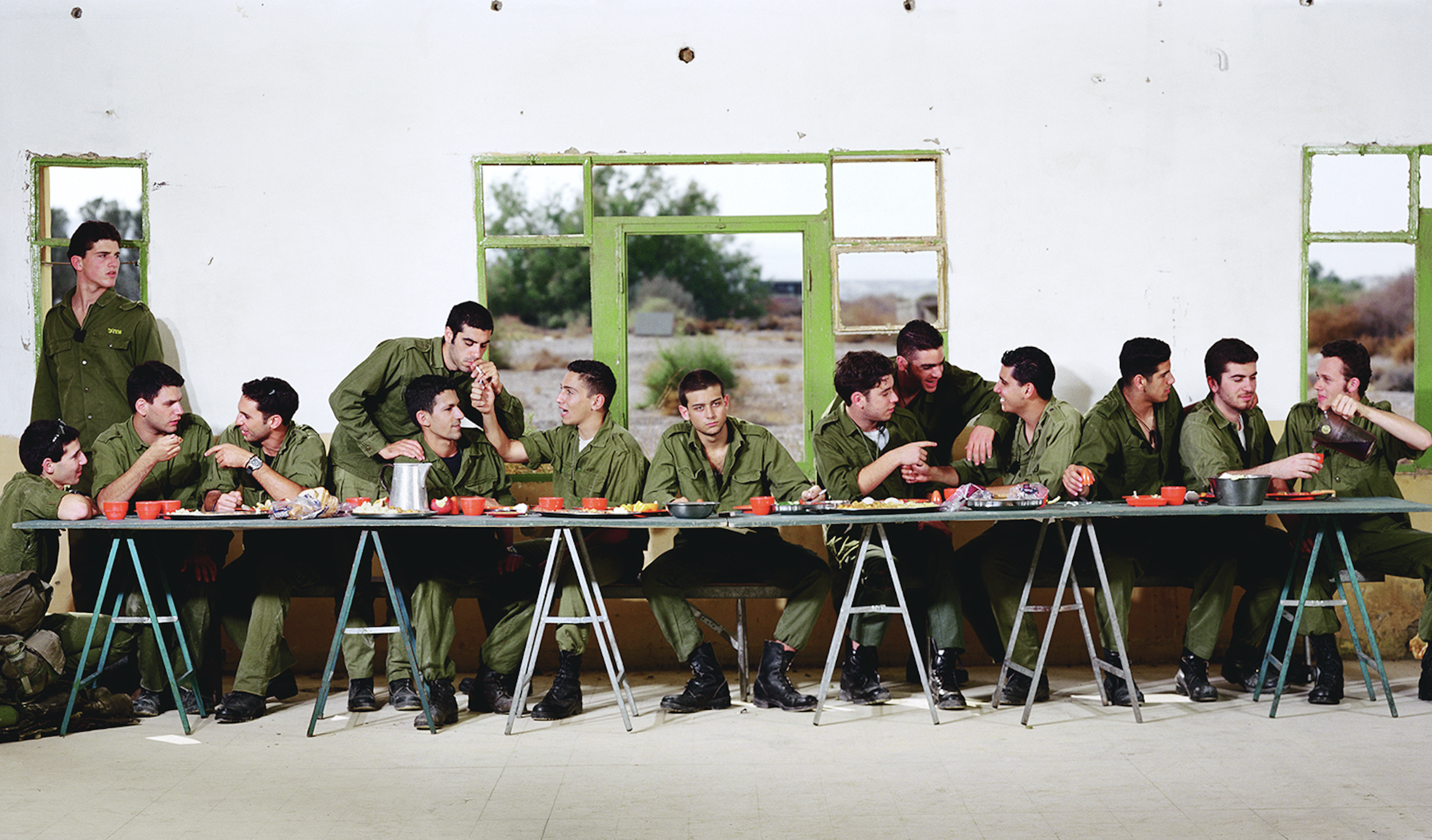

Adi Nes, Untitled (Soldiers series,1999).
Vivek Vilasini, Last Supper—Gaza (2008). From the series, Between One Shore and Several Others.

Adi Nes’s untitled photograph from his 1999 Soldiers series, by arranging fourteen men on one side of a table, invokes Leonardo’s iconography. The soldiers are conversing in small groups, but the man in the Christ position appears lost in his own thoughts. Nes, who himself spent three years in the Israeli Defense Force, has said that “all of them are Jesus, all of them are Judas.” All equally at risk, all equally in need of forgiveness and compassion. “I hope this isn’t their last supper,” he says.[vi]

A similar nod to Leonardo by Indian artist Vivek Vilasini, Last Supper—Gaza (2007), fills the table with Palestinian women, whose anxious and fearful eyes show the distress of living under constant threat. Is it I, Lord? Is it I who will betray? Is it I who will run away? Is it I who will die?

Yo Mama’s Last Supper (1996), by Jamaican-American Renee Cox, is one of the most controversial versions. It employs Leonardo’s canonical table image, but the apostles themselves, except for a white male as Judas, are black or mixed-race and not exclusively male. They all wear traditional biblical dress, except for Jesus, who is naked. Played by the artist herself, the Christ figure spreads her arms wide like the presider at the eucharist. A white shroud is artfully draped over her arms in the manner of crosses decorated at Easter.

There is no mockery in the image. It shares the solemn stillness of traditional religious painting. But in showing Jesus as a “triply marginalized figure due to race, gender and physicality,”[vii] the image aroused heated attacks. When it was first exhibited in New York in early 2001, Mayor Rudy Giuliani called it “disgusting, outrageous and anti-catholic.” William Donohue, President of the Catholic League, said that “to vulgarize Christ in this manner is unconscionable.” However, in a debate with Cox at the Brooklyn Museum, he admitted that “there would be no problem if you had kept your clothes on.” [viii]

Cox’s response to her critics was not apologetic. “An African-American woman putting herself in a position of empowerment seems to be a national threat,” she said. “I’m not taking a backseat. I’m going to sit at the head of the table.” As for the nakedness, she insisted it was not her intent to eroticize a sacred scene. “I chose to play the Christ figure in the nude because it represents a certain sense of purity. I come to the table with nothing to hide.”[ix]
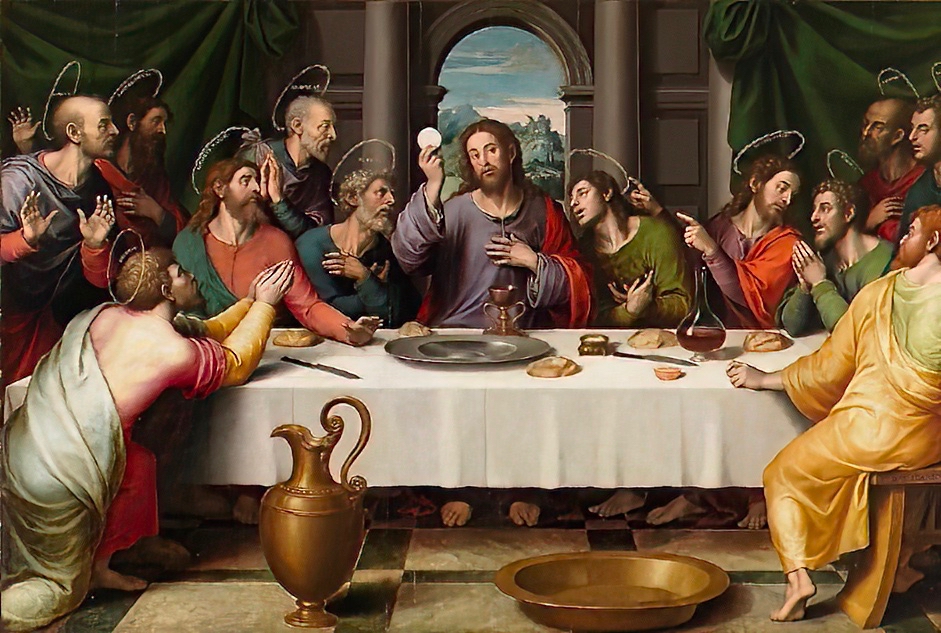
Juan de Juanes, The Last Supper (c. 1560).
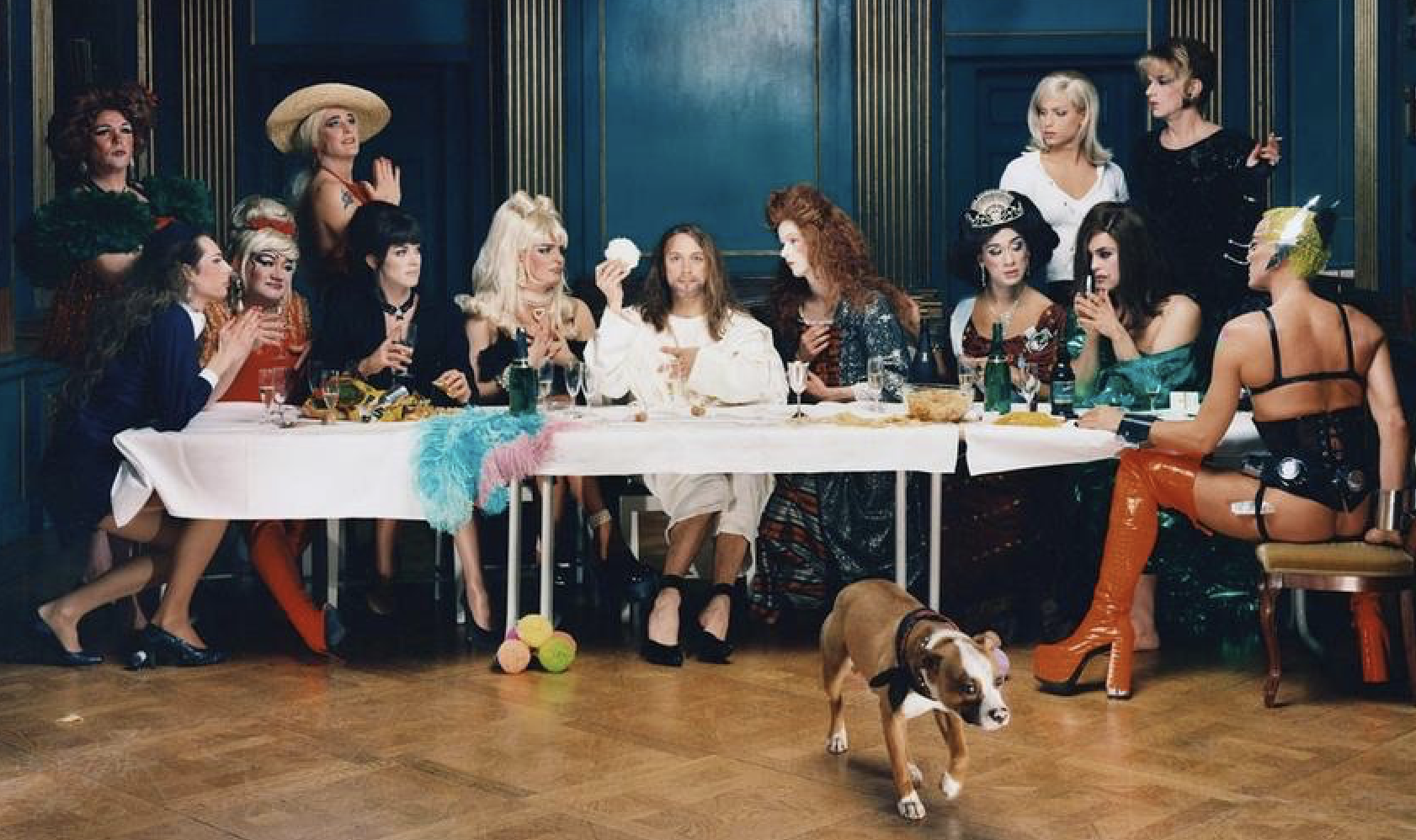
Elisabeth Ohlson Wallin, The Last Supper (1996-8). Part of the Ecce Homo series.

The Last Supper by Swedish artist Elisabeth Ohlson Wallin is perhaps the closest parallel to the Olympics’ notorious tableau. Modeled after a 16th-century painting by Juan de Juanes, it populates the table with transvestite disciples and a Jesus of uncertain gender, wearing high heels and holding up a makeup sponge instead of the sacred Host. Created by a lesbian artist raised in the Church, it was part of a photographic series, Ecce Homo, featuring biblical scenes with LGBTQ models.

The Ecce Homo photographs, unsurprisingly, created a furor in the last years of the 20th century. The fact that they were exhibited in churches rather than museums served to fuel the outrage. The propriety of untraditional visuals in sacred space is a particularly fraught question. Placing Wallin’s Last Supper above the altar of a Zurich church prompted vandalism and bomb threats.

While I do wonder whether the cognitive dissonance of Wallin’s image competing for attention with the actual sacrament would deepen or disrupt a worshipper’s ocular piety, the radical inclusiveness conveyed by Ecce Homo was a blessing to many. “Thank you for this wonderful representation of the life and deeds of Jesus,” someone wrote in the Visitors’ book at the Zurich exhibition. “Through it, I can now identify with them, today, in the 21st century. I pray for all those who are rejected by our society: ‘The Last shall be the first!’” [x]

That’s really what it’s all about, isn’t it? Who belongs at the table? Who is welcome at the table? The Opening Ceremonies controversy was not about Leonardo vs. Jan van Bijlert, Mount Olympus vs. the Upper Room, pagan vs. Christian, Jesus vs. Apollo. It was about who gets to sit at Love’s table. And for those who think that the Last Supper represents anything less than that: You are in for a surprise.

Lcve bade me welcome, yet my soul drew back
Guilty of dust and sin.
But quick-ey’d Love, obeserving me grow slack
From my first entrance in,

Drew nearer to me, sweetly questioning,
If I lacked anything.
A guest, I answer’d, worthy to be here:
Love said, You shall be he.

I, the unkind, ungrateful? Ah my dear,
I cannot look on thee.
Love took my hand, and smiling did reply,
Who made the eyes but I?

Truth Lord, but I have marr’d them: let my shame
Go where it doth deserve.
And know you not, says Love, who bore the blame?
My dear, then I will serve.

You must sit down, says Love, and taste my meat:
So I did sit and eat.

— George Herbert, Love (III)


[i] The Inquisition transcript: https://web.archive.org/web/20090929022528/http://www.efn.org/~acd/Veronese.html 

[ii] Yan Zhuang, “An Olympics Scene Draws Scorn. Did It Really Parody the Last Supper?”, New York Times, July 28, 2024. I can’t help noting that any such outrage from the Christian right in America rings hollow. They have lost the credibility to speak on behalf of the friends of God. Their shameful worship of a depraved, and hate-filled sexual predator, convicted fraudster and would-be dictator as an instrument of divine will has brought more disgrace to Christianity than a thousand pagan parodies.

[iii] Nathalie Dietschy, The Figure of Christ in Contemporary Photography (London: Reaktion Books, Ltd.: 2020), 123.

[iv] Ibid., 128.

[v] Ibid., 167.

[vi] Ibid., 110.

[vii] Katharine Wilkinson, The Last Will Become First: Liberation of Race, Gender and Sexuality in Renee Cox’s “Yo Mama’s Last Supper”, quoted inDietschy, 254.

[viii] Dietschy, 256.

[ix] Ibid., 256, 257.

[x] Ibid., 261.

Living the Dream: Thoughts at 80

William Blake, Oberon, Titania, Puck & Fairies Dancing (1786)

“The tables outside the cantina were full of beautiful laughing men and women. I didn’t like the cantina at night: it was hard to book a table, and everyone who sat there looked on display, the women in their lovely summer dresses, the men with their hair oiled back on their heads, their tanned bare feet resting proprietorially on top of their Gucci loafers. One wanted to applaud them for presenting such a successful vision of life: you could almost believe they had lived their whole lives, had been reared and groomed from birth, for this one particular night: that this was the pinnacle, this golden summer evening they had all reached simultaneously.

“Yet it made me a little sad to see them there, laughing and drinking champagne, for you knew it was all downhill from here.”

— Peter Cameron, Andorra [i]  

The beautiful laughing men and women in Cameron’s cantina do not arouse our envy. Their self-display seems shallow, narcissistic and unreal. They appear ignorant of time. Golden summer evenings do not last forever. Having achieved the pinnacle, what Wallace Stevens called “the barrenness of the fertile thing that can attain no more,”[ii] they have nowhere to go but down.

The traditional lore of Midsummer Eve shares this suspicion. To mark the year’s longest day, bonfires were lit on British hilltops to assist and encourage the sun at the outset of its long inevitable decline into the winter dark. And “Midsummer Night”—blessedly short—was said to be a time of both mischief and danger, when chaotic pressures cracked open the stability of the world and wild spirits were abroad.

In A Midsummer Night’s Dream, Shakespeare explores these themes with a complicated plot in which the normal order of the world is unraveled for a night, and confusion rules until the dawn. Rulers find their commands thwarted. Lovers aim their desire at mistaken targets. The beautiful queen of the fairies falls madly in love with a low-born mortal who, by magic spell, has the monstrous head of an ass. Puck, the fairy trickster, multiplies the mischief by both design and error. And even words of dialogue take on altered and contradictory meanings.

All this takes place in an enchanted forest, a wild, liminal state outside the civilized order, where societal assumptions and rules are suspended or reversed, hierarchies are overturned, and identities become fluid and changeable. As Bottom says to Titania, “reason and love keep little company together these days.”

In Shakespeare, such liminal spaces serve a critical purpose. Their disorder offers a freedom to reshuffle and reconsider accepted realities, inviting transformation at both a personal and social level. Removed for a time from the customary rules and roles, characters discover new possibilities for themselves and society before returning to “reality.”

However, once you leave your given world for a time, you can never again accept its reality as absolute. You realize that there is more than one way to do both the self and the world. Any single version of reality is but an alternative. In this sense, life itself is but a dream. This refusal to absolutize the given world is the foundation of social justice: we can live better lives and make a better world. It also, however, can open the door to irrationality and madness, exemplified by the millions who live, happily and hatefully, in the fact-free world of American fascism..

At the end of Shakespeare’s play, Puck delivers an epilogue to the audience, those “who have slumbered here, / While these visions did appear.” It’s all been a dream, he assures us, as if we had never really crossed the boundary into the transformative space of a visionary world.

But can we be so sure? Have we not ourselves been touched, perhaps even transformed? Within A Midsummer Night’s Dream, there is a play-within-a-play (the comically performed tragedy of Pyramus and Thisbe). The actors in Midsummer watch the actors playing actors in Pyramus, just as we the audience watch all these permutations from our safe position outside the “fourth wall” which separates the stage from reality. But are we so different from the players on the stage? As Shakespeare scholar Marjorie Garber writes,

“A play is a fiction, art is an illusion, ‘no more yielding but a dream.’ Can we be blamed if we wonder—now that we have been told that we are reality—when someone will wake and recognize that we are only a dream? Can we be blamed for looking over our shoulders, and wondering who is watching the play in which we are acting, while we watch, onstage, actors watching actors who play actors performing a play?” [iii]

Two weeks after Midsummer Eve, I saw a magical outdoor production of A Midsummer Night’s Dream at the Bloedel Reserve, an Arcadian refuge of woods and meadows on my island. Beginning before sunset, it utilized the fading of the day to intensify our immersion into the dreamworld. By play’s end, it was almost night. The narrow path across a rolling meadow to the exit prevented an immediate return to reality. For a few precious minutes more we lingered in the dream, making our ghostly procession of shadows in the twilight.

Every play comes to an end. Every actor must make an exit. I have no plans to do so any time soon (God willing). There are more lines to deliver! However, since I begin my ninth decade tomorrow, time may not be on my side—but it’s on my mind.  

Medieval thinkers divided a human lifetime into “ages.” Some had just four: Childhood, Youth, Maturity, and Old Age. Isadore of Seville (c. 560-636) expanded that to six: infancy (up to 7), childhood (7-14), adolescence (14-28), youth (28-50), gravitas (50-70), and, for anything beyond 70, senectum  (the same root as senior and senility).

[Of course, senectum is a hot topic in this election year. Is the President too old to govern? Perhaps a better question would be: Why can’t the other guy act his age? As the Bible says, “Woe to you, land, if your king is a child!” (Ecclesiastes 10:16). But I digress.]

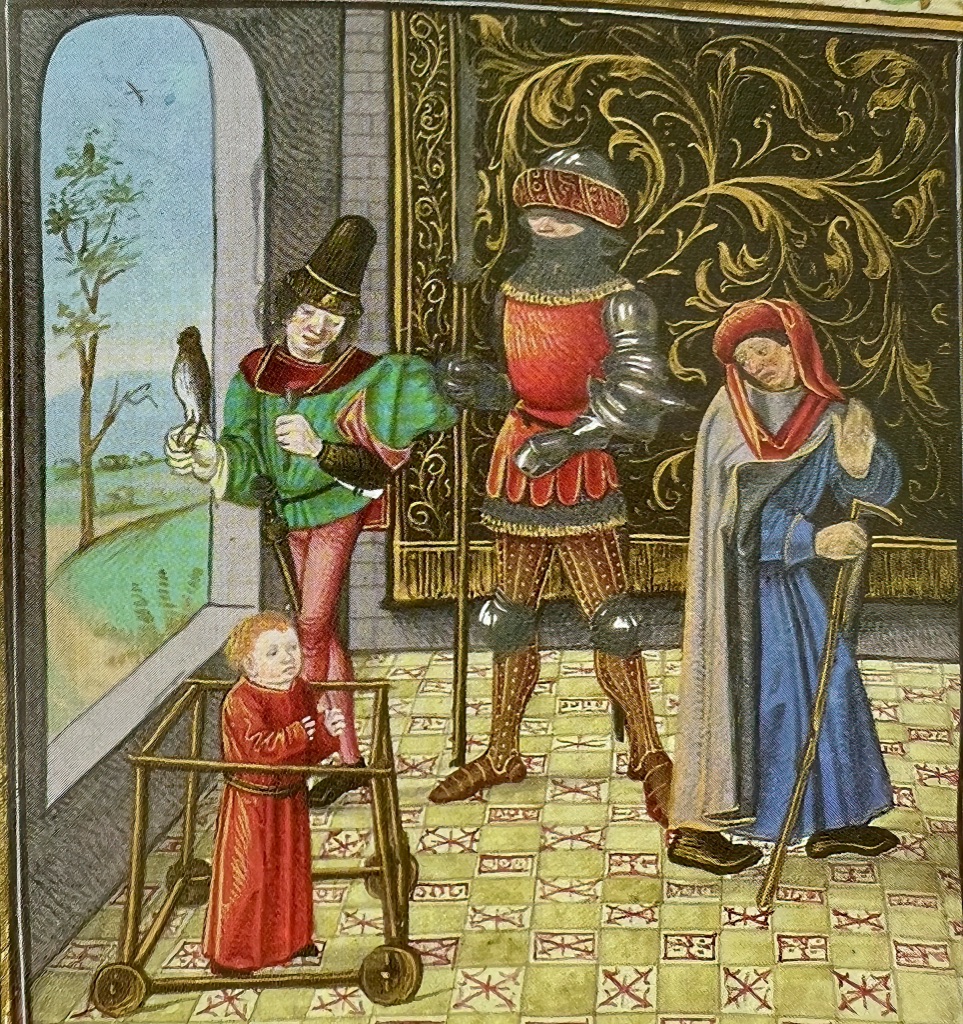
Bartholomaeus Anglicus, The Four Ages (1467-1475)

In this fifteenth-century illumination by Bartholomaeus Anglicus, the four ages of the human life-cycle stand in the same room, as if each of us is all the ages we have ever been. Childhood is clothed in red, the color of sanguinity (eager hopefulness). Youth is into fashion and sports, while Maturity dresses for battle. Old Age, warmly attired for the wintry years, glances back at all his past selves, hopefully with gratitude rather than regret.

Bartholomaeus Anglicus, The Seven Ages (1482)

A later image by the same artist depicts seven ages standing in two groups. On the right, Childhood plays with a stick and ball, Adolescence clasps his schoolbooks, and Youth carries a spear, perhaps dreaming of competitive glory. The first three stages of Maturity are not radically distinct from one another, but Old Age, shorter and bearded, is starting to separate his body from the group. Yet he still keeps an eye on the Child he once was.

Idleness, Dunois Book of Hours (c. 1439-50)

Time is a gift, and I am truly grateful for my years so far—the dreams as well as the realities. Je ne regrette rien. As for the road ahead (even if it’s all downhill), I wish not to be the man on the donkey, idly dozing along the pilgrim way. Like the figure gazing at the view from the bridge, I want to keep taking it all in. As an old man advised a younger friend in Henry James’ The Ambassadors:

“Live all you can; it’s a mistake not to.”


[i] Peter Cameron, Andorra (New York: Farrar Strauss Giroux, 1997), 149-150.

[ii] Wallace Stevens, “Credences of Summer.”

[iii] Marjorie Garber, Shakespeare After All (New York: Anchor, 2005), 237.

Three-in-One : One-in-Three

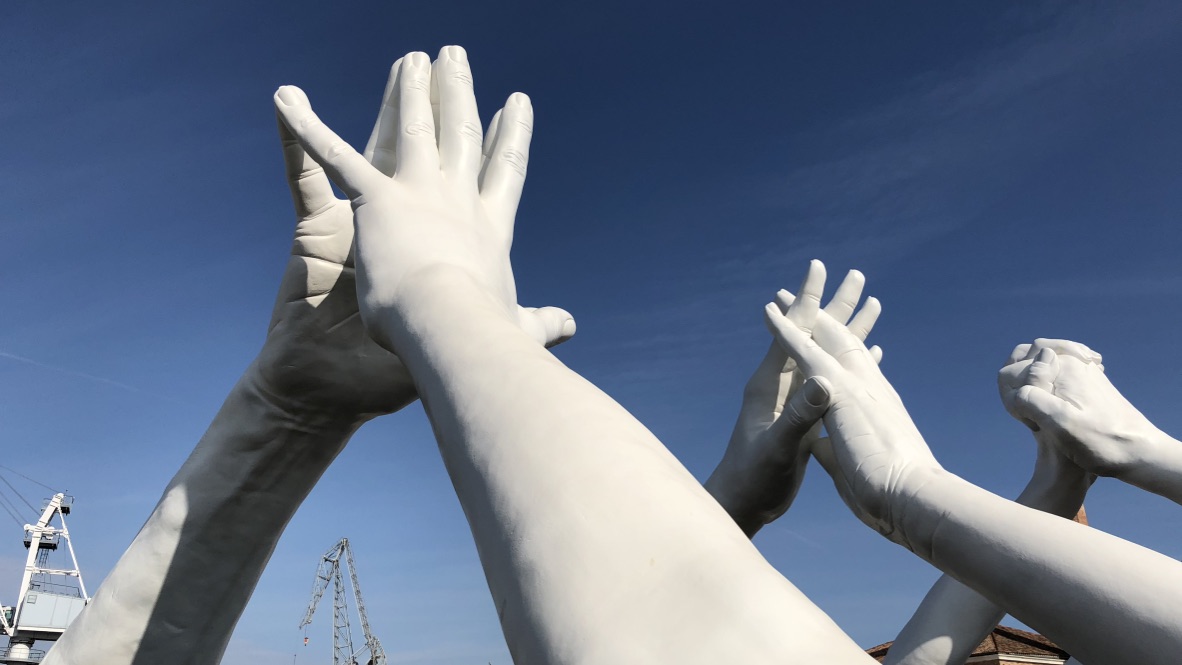
Lorenzo Quinn, Building Bridges (Venice Biennale 2019)

Sermon for Trinity Sunday 2024 at St. Barnabas Episcopal Church, Bainbridge Island, Washington

From late autumn to late spring, Christian liturgy takes us on a ritual journey through the gospel narrative, from the Incarnation and Epiphany of Christ to the dramatic finale of Passion, Resurrection, Ascension and Pentecost.This great sequence concludes with Trinity Sunday, which serves as a kind of epilogue.

The abrupt shift from the engaging world of story to the tangled thicket of doctrine can be a bit of a shock. It’s like going directly from a seminar in English literature to a class in advanced calculus. Our hearts sink and our heads explode. But fear not. The Trinity is no dreary abstraction. Nor is it a matter, as Lewis Carroll might say, of believing three impossible things before breakfast. We are not here to solve once and for all the puzzle of Three-in-One and One-in-Three. We are here to adore the mystery.

The first Christians were not inventive theorists speculating about the divine nature of a generic God. They were the friends of Jesus trying to make sense of the concrete, experiential data of salvation, beginning with the dramatic biblical events they had lived through and continuing to unfold in the common life of their believing communities. Their profound experiences of Jesus and the Holy Spirit had shaken the foundations of their monotheistic faith, and they were trying to sort out the implications.

Jesus and the Spirit had done for them what only God can do: heal, save, sanctify—even vanquish the power of death. Did that make Jesus and Spirit divine? And if so, what did that multiplication of divine persons do to their belief that God was one?  Jesus had told them, “I and the Father are one.” But it would take centuries to agree on what he meant.

Without losing the unity of God, how could the early Christian community account for the divine diversity revealed in the saving activities of Christ and the Spirit?

Once they began to call Jesus Kyrios (Lord), which happened very early in their worship and their storytelling, traditional monotheism was radically destabilized. The growing perception of the Holy Spirit as a guiding and empowering presence of deity in their communities only compounded the problem.

There were various attempts to solve the issue by downgrading Jesus and Spirit to subordinate, derivative, or semi-divine realities, by no means equal to the eternal and uncreated God. Such “heresies” were popular with those who wanted to keep God simple. But “orthodoxy” was unwilling to deny the fullness of divinity to either Christ or the Spirit. For them the bottom line was this: 

Only God can save us. Christ and Spirit, in the biblical revelation and Christian experience, are integral and essential to salvation. Therefore, they must be “of one substance with the Father.” That is to say, the Persons are all equally integral to the divine reality: God above us, the source and ground of all being; God with us and among us, the companion who is our way, our truth, and our life; and God within us, the energy and vitality of our deepest self. As the theologians put it:

“The Trinity is an account of God that says these are [each] irreducible and indispensable dimensions of the same reality, not different ones, and yet each has its own irreducible integrity.” [i]

And so, a trinitarian faith became foundational for the Christian understanding of divinity: God in three persons, blessed Trinity. But the inherent tension between the one and the three remains to this day. Human thought and human language can’t quite manage to think both things at the same time. It’s like waves and particles. Gregory of Nazianzus, one of most influential shapers of the fourth-century trinitarian consensus, admitted the futility of trying to corral the mystery with concepts. He suggested that we just go with the divine flow:  

“I cannot think of the One without immediately being surrounded by the radiance of the Three; nor can I discern the Three without at once being carried back into the One.” [ii]

In an amusing caricature of crudely literal images of the Three-in-One, British theologian Keith Ward imagines three omniscient individuals trying to have a conversation:

“I think I’ll create a universe,” says one. “I knew you were going to say that,” says the second. “I think I’ll create one as well,” says the third. “Well, it had better be the same as mine,” says number one. “You already know that it is,” says number two. “I knew you were going to say that,” says number three.[iii]

If we have difficulty with “God in three Persons,” it is because we think of a person as defined by his or her separateness. I’m me and you’re you! We may interact and even form deep connections, but my identity does not depend upon you. I am a self-contained unit. You can’t live in my skin and I can’t live in yours. That’s the cultural assumption, which goes back at least as far as Descartes in the seventeenth century and continues today in such debased forms as rampant consumerism and economic selfishness, where my needs and my desires take precedence over any wider sense of interdependence, community, or ecology.

But what we say about the Persons of the Trinity is quite different. Each Person is not an individual, separate subject who perceives the other Persons as objects. The Trinitarian persons experience one another not from the outside, but from the inside. They indwell each other in a mutual interiority.

But if the divine Persons are all inside each other, commingled, “of one being,” as the Creed says, what makes each Person distinct? To put it succinctly: the Persons are distinct because they are in relation with one another. No Father unless there is a Son. No Son without a Father. No Holy Spirit without Father and Son.

As Martin Buber observed, we are persons because we can say “Thou” to someone else. To be a person is to experience the difference – and the connection – that forms the space between two separate subjects. My consciousness is not alone in the universe. There are other centers of consciousness: Thou, I… Thou, I… The fact that you are not I is what creates self-consciousness, the awareness of my own difference from what is outside myself.

If we apply this to the Trinity, we say that there are Three Persons because there is relation within God, relation between the Source who begets, the Word who is begotten, and the Spirit who binds the two together and moves them outward in ever widening circles.

These relations are not occasional or accidental. They are eternal. There is an eternal sending within God, an eternal self-giving within God, an eternal exchange by which God is both Giver and Receiver simultaneously. God is Love giving itself away – self-emptying, self-diffusing, self-surrendering – and in so doing finds itself, receives itself, becomes itself. A French mystic put it this way: “it’s a case of un ‘je’ sans moi” (an “I” without a me).

Wallace Stevens wrote a poem about the process of giving ourselves over to a larger whole. He called it “the intensest rendezvous,” where we find ourselves drawn out of isolation “into one thing.” He wasn’t writing about the Trinity, but his words come as close as any to describing the essential dynamic of the divine Persons:

       Here, now, we forget each other and ourselves.
      We feel the obscurity of an order, a whole,
      A knowledge, that which arranged the rendezvous.[iv]

As Orthodox theologian John D. Zizioulas says in his influential text, Being as Communion, “To be and to be in relation are the same thing for the divine life … Therefore if Trinity is our guide, the most fundamental definition of being we can give is person-in-communion … The being of the one divine nature is the communion of the irreducibly different persons; the being of the individual persons is constituted by their relations with each other.” [v]

God is not a simple, static substance but an event of relationships. That’s why we say that God is love. “To be” has no ontological reality apart from “to be in relationship.” In the words of Anglican priest John Mbiti of Kenya, expressing the strongly communal mindset of African theology, “I am because we are, and since we are, therefore I am.” [vi]

Each Person contains the others and is contained by them in a shared communion of self-offering and self-surrender. But that continuous self-offering is never a one-way transaction, either one of self-emptying or one of being filled. It is always both at once – giving and receiving – as we ourselves know from our own mutual experience of love at its best. 

Trinitarian faith describes a God who is not solitary and alone, a God who is not an object which we can stand apart from and observe. The Trinity is an event of relationships: not three separate entities in isolation and independence from one another, but a union of subjects who are eternally interweaving and interpenetrating

This divine relationality is not something which an originally solitary God decided to take up at some point. God is eternally relational. Before there was an external creation to relate to, God’s own essential self was and is an event of perpetual relation. There was never simply being, but always being-withbeing-forbeing-in. To be and to be in relation are eternally identical.

When the Bible says, “God is love” (I John 4:16), it means that love is not just something God has or something God does; love is what God is.

As John Zizioulas puts it, “Love as God’s mode of existence … constitutes [divine] being.”[vii] Feminist theologian Elizabeth Johnson echoes this when she says, “being in communion constitutes God’s very essence.” [viii]  In other words, God is Love giving itself away—self-emptying, self-diffusing, self-surrendering—and in so doing finds itself, receives itself, becomes itself. The theologians of late antiquity borrowed a word from the arts to describe this process: perichoresis, which means to “dance around.”

Trinity is a dance, with Creator, Christ and Spirit in a continuous movement of giving and receiving, initiating and responding, weaving and mingling, going out and coming in. And while our attention may focus at times on a particular dancer, we must never lose sight of the larger choreography to which each dancer belongs: the eternal perichoresis of Three in One, One in Three.

As Jesus said, “losing” yourself and “finding” yourself are equivalent and simultaneous. In giving ourselves away, we receive ourselves back. This may be counterintuitive to the modernist mindset of autonomous individual self-possession, but it is the essence of communion: “a giving of oneself that can only come from the ongoing and endless reception of the other.” [ix]

If we had the space, I would invite you now to dance the divine perichoresis with your own bodies. We would join hands, circle round, spiral inward, weave in and out of the arches and tunnels of upraised arms, and manifest with our bodies the divine fullness of the Holy Trinity, which has been described as an “interdependence of equally present but diverse energies … in a state of circumvolving multiplicity.” [x] And thus we would, both symbolically and in fact, participate in the divine reality of “reciprocal delight” [xi] which transpires not only in heaven, but “on earth as it is in heaven.”

There are no spectators in the Trinitarian dance, which is always extending outward to draw us and all creation into its motions. As Jürgen Moltmann said, “to know God means to participate in the fullness of the divine life.” [xii] 

It’s not a matter of our trying to imitate the relational being of the loving, dancing God, as if we were inferior knock-offs of the real thing. God wants us to become ourselves the real thing. God wants to gather us into the divine perechoresis as full participants in the endless offering and receiving, pouring out and being filled, which is the dance of God and the life of heaven.

And while our dance with God has its mystical, mysterious, transcendent dimensions, it is also very concrete and specific to our historical life on this earth. The divine life of communion and self-diffusive love is the only antidote for the poisonous hatreds of this fearful age.

Because we ourselves are made in God’s image, who God is matters deeply, both for our own self-understanding and for our engagement with the world. The Trinity isn’t only God’s life. It is ours as well. It’s the shape of every story, the deep structure of the church, and the foundational pattern of reality.

Because God is communion, the eternal exchange of mutual giving and receiving, then God’s Church must live a life of communion as well. When Love’s perechoresis becomes our way of being in the world—as believers, as church—the Trinity is no longer just doctrine or idea. It is a practice, begetting justice, peace, joy, kindness, compassion, reconciliation, holiness, humility, wisdom, healing and countless other gifts. As theologian Miroslav Volf has said, “The Trinity is our social program.” [xiv]

The dance of Trinity is meant
For human flesh and bone;
When fear confines the dance in death,
God rolls away the stone. [xv]

The Church exists to participate in the liberating life of God, and to enable others to do the same. We exist to make divine communion not just an inner experience but a public truth. We don’t just feel God’s perichoresis. We don’t just feel Love’s eternal dance. We embody it. We live it. We show it. We share it.  

As the great Anglican preacher Austen Farrer put it so clearly a century ago:

“It is not required of us to think the Trinity.
We can do better; we can live the Trinity.” [xvi]


Photographs by the author.

[i] S. Mark Helm, The Depth of the Riches: A Trinitarian Theology of Religious Ends (Grand Rapids, MI: Eerdmans, 2003), 132.

[ii] Gregory of Nazianzus, q. in Karen Armstrong, The Case for God (New York: Knopf, 2009). 116-117.

[iii] Keith Ward, God: A Guide for the Perplexed (Oxford: Oneworld Publications, 2003), 235.

[iv] Wallace Stevens, “Final Soliloquy of the Interior Paramour,” Collected Poetry and Prose (NY: Library of America, 1997), 444.

[v] John D. Zizioulas, Being as Communion: Studies in Personhood and the Church (Crestwood, NY: St. Vladimir’s Seminary Press, 1993), 46.

[vi] quoted in Veli-Matti Kärkkäinen, The Trinity: Global Perspectives (Louisville: Westminster John Knox Press, 2007), 352.

[vii] Zizioulas, 46.

[viii] Elizabeth Johnson, She Who Is: The Mystery of God in Feminist Theological Discourse (NY: Crossroad, 1993), 227.

[ix] Graham Ward, “The Schizoid Christ,” in The Radical Orthodoxy Reader, ed. John Milbank and Simon Oliver (NY: Routledge, 2009), 241.

[x] David Bentley Hart, The Beauty of the Infinite: The Aesthetics of Christian Truth (Grand Rapids: Eerdmans 2003), 114.

[xi] St. Athanasius (c. 296-373), a bishop in Roman Egypt, was a key defender of Trinitarianism. 

[xii] Jürgen Moltmann, The Trinity and the Kingdom: The Doctrine of God, trans. Margaret Kohl (San Francisco: Harper & Row, 1981), 152.

[xiii] Richard Leach, “Come Join the Dance of Trinity.”

[xiv] Miroslav Volf, “‘The Trinity is Our Social Program’: The Doctrine of the Trinity and the Shape of Social Engagement,” Modern Theology 14, no. 3 (July 1998).

[xv] Leach.

[xvi] Austin Farrer, The Essential Sermons (London: SPCK, 1991), 78.

Ascension Day Double Bill

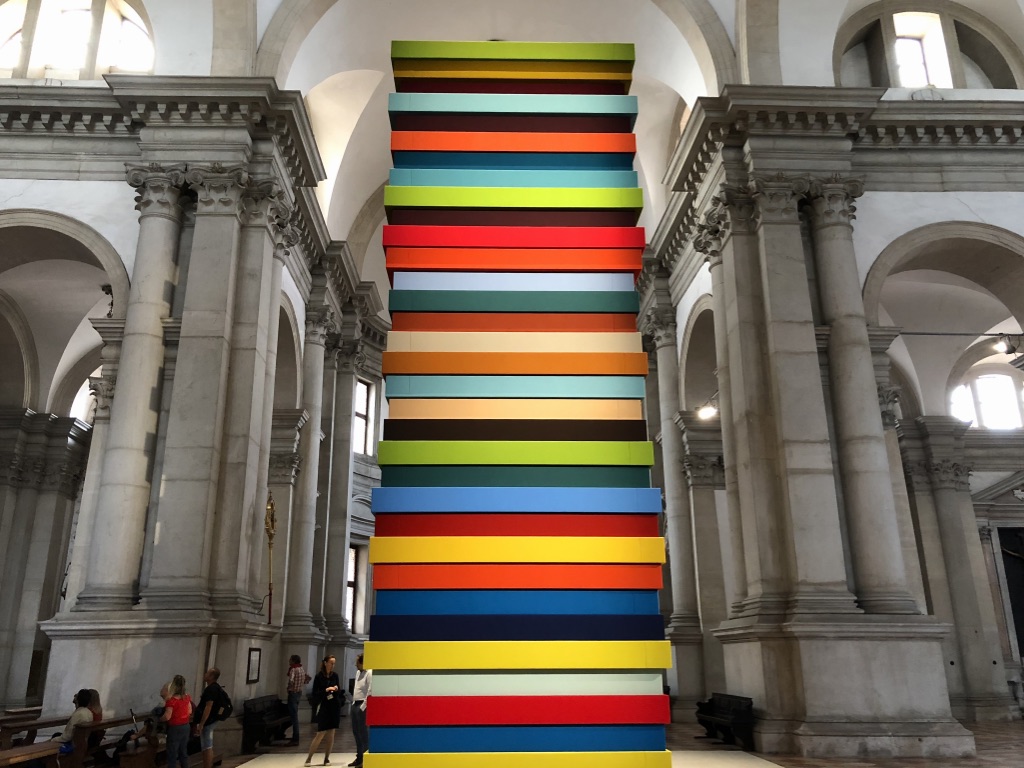
“Opulent Ascension,” an installation by Sean Scully in San Giorgio Maggiore (Venice Biennale, 2019).

Inspired by Jacob’s dream of a ladder to heaven (Genesis 28:12), Scully’s stack of colored felt slabs rises more than ten meters toward the luminous dome of San Giorgio Maggiore, Palladio’s splendid Renaissance church in Venice. Amid the subdued grays and whites of the interior, the miraculous colors exude the vitality of spiritual aspiration, like spring flowers refuting winter’s drab.

On this Ascension Day, let me offer another image, a 36-second “video icon” of a cloud disappearing into the blue. Consider it a brief meditation on Luke’s text, “As they were watching, he was lifted up, and a cloud took him out of their sight” (Acts 1:9).

The Ascension of Christ takes us into an ineffable realm, far above the literalism of earthly life. What are we to make of such a strange story? The following video of an Ascension Day homily was streamed during the pandemic a few years ago, when we were not able to gather in person to celebrate the mystery. Fittingly, it was recorded mostly outside, under the open sky.

What Is Your Most Precious Possession?

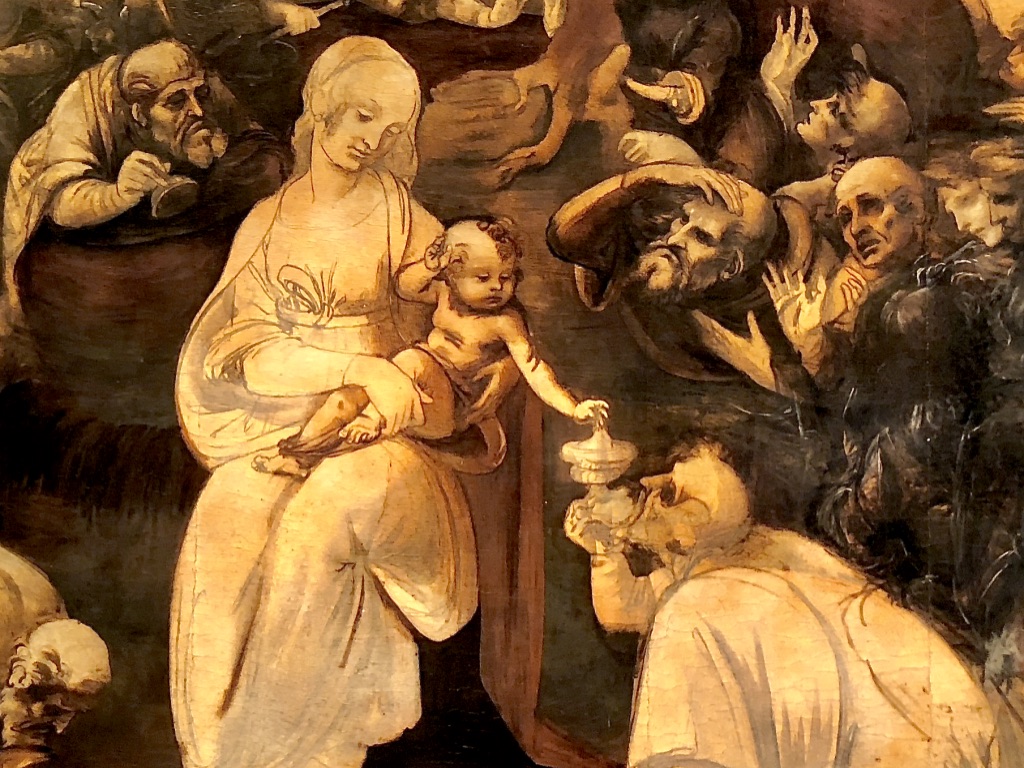
Leonardo da Vinci, Adoration of the Magi (1481).

What is your most precious possession? This was the question posed by two British artists in their random encounters with strangers at the Venice Biennale. For three days in April, Neil Musson and Jono Retallick wandered about the art festival venues literally clothed in the question, printed in various languages on their white smocks. Whenever a curious glance at their outfits prompted conversational engagement, the artists recorded whatever answers people chose to give. From more than fifty responses, the artists will edit the results to post on their website, M+R, in the near future.

Jono Retallick and Neil Musso wearing The Question in Venice.
(Photo by Neil Lambert)

It’s a great question! In my monthly Zoom converation with longtime clergy friends, Jono made a guest appearance from the Venice apartment of one of our members.[i] When he invited each of us to name our most precious possession, no one selected a material object. David, a gifted writer and preacher, chose the stories he’s lived—and lived by—over a lifetime. Richard cited his sense of humor, which has never deserted him even when laughter was scarce. Mark, who in his eighties finds himself, as he put it, “in the process of disappearing” as time grows ever shorter, said that what he values most is “now”—the savored fullness of the present moment.

I’m still working on my own answer. The first thing I told Jono was that since everything we are and everything we have is a gift—from the Creator of all as well as the secondary causes of heredity, culture, and the labor of others—it could be said that we in fact possess nothing. But that seems a bit of a cheat, a way to avoid the work of values clarification. The question wants me to think: Where does my greatest treasure lie? What would be the hardest thing to lose?

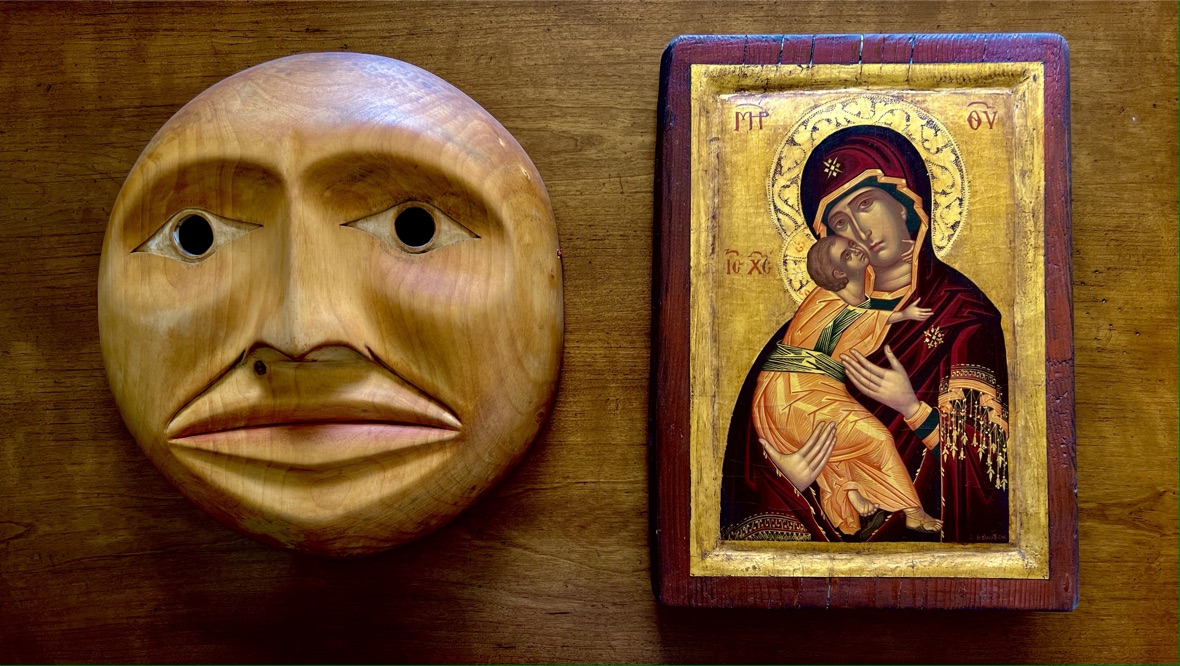
I’ve known people who had only a few minutes to flee their homes in the path of racing wildfires. And I’ve wondered: If I were in that situation, what irreplaceable items would I grab before running out the door? The box with 50 years of journals? An album of family photographs? The Theotokos icon painted for us on a Greek island? The wooden moon carved by a First Nation artist in Canada? A guitar once played by the legendary Ramblin’ Jack Elliott? It’s only stuff of course, but the things we love best are saturated with stories. They are outward and visible signs of inward and beloved memories. I would feel the poverty of their loss. But I would not call them “most precious.”[ii]

Moon mask (1991) carved on Vancouver Island from alder wood by Richard Menard duing a lunar eclipse. Theotokos icon (2015) by Dimitris Koliousis, Santorini, Greece.

All of us, of course, would reserve “most precious” for our deepest relationships—with God, lovers and friends. But it would violate the integrity of their otherness to deem any of these to be possessions. So I must look elsewhere for my answer to the question.

Good health comes to mind, or even life itself. These are certainly very highly treasured—but as gifts to enjoy, impossible to possess. As the Psalmist reminds us, we are “but flesh, a breath that goes forth and does not return” (Psalm 78:39). We all must learn to loosen our grip in this transitory life.

He who binds to himself a joy
Does the winged life destroy
He who kisses the joy as it flies
Lives in eternity’s sunrise

— William Blake. “Eternity”

I could call faith my most precious possession, for without it I would be hopelessly adrift in a sea of unmeaning. But faith is a communal possession. It is not distinctively mine. Faith is plural, shared and nourished within the collectivity of God’s friends. If I am to speak in the singular, to name what is uniquely mine, I would say that my most precious possession is my imagination—the particular way I see the givenness of the world, processing it within my own heart and intellect, then reflecting my perception back into the world in some fresh way, whether that be in the form of conversation, writing, art, or simply as praise and thanks for a world of beauty and blessing (or lament and protest in the case of suffering and evil).

Calligraphy of Robert Bresson text by Br. Roy Parker OHC.

“Make visible what, without you, might never be seen,” said Robert Bresson, who made films unlike any other. As one critic put it, “Bresson’s films are not merely the most lucid; they are, in essence, lucidity itself.”[iii] Perhaps only the saints attain “lucidity itself,” but each of us has our own unique way of seeing and being. And I imagine that God finds equal delight in what each of us has to report from our respective locations in a universe of infinite possibility.  

Dante and Beatrice each adore the heavenly light from their own location
Venetian woodcut by Francesco Marcolini (1544).

Light the first light of evening, as in a room
In which we rest and, for small reason, think
The world imagined is the ultimate good.

This is, therefore, the intensest rendezvous.
It is in that thought that we collect ourselves,
Out of all the indifferences, into one thing:

Within a single thing, a single shawl
Wrapped tightly round us, since we are poor, a warmth,
A light, a power, the miraculous influence.

Here, now, we forget each other and ourselves.
We feel the obscurity of an order, a whole,
A knowledge, that which arranged the rendezvous.

Within its vital boundary, in the mind.
We say God and the imagination are one…
How high that highest candle lights the dark.

Out of this same light, out of the central mind,
We make a dwelling in the evening air,
In which being there together is enough.

— Wallace Stevens, “Final Soliloquy of the Interior Paramour”


[i] The Rev. Neil Lambert, an Anglican artist/priest at St. Mary’s, Ash Vale, UK, has collaborated on some previous projects with Musson and Retallick. For more on Lambert and Venice, see Dreaming the Church That Wants to Be.

[ii] In a time when the people of Gaza, Ukraine and many other places are being dispossessed of nearly everything, I am not entirely comfortable talking about the things I have due to my privilege. Situations where the most precious possession might be a loaf of bread, a bottle of water, or a bomb shelter shatter all complacency.  

[iii] Sharad Raj, “The Austere Ascetic,” Just Cinema website, Dec. 18, 2020 — https://www.just-cinema.com/post/the-austere-ascetic-by-sharad-raj

M+R, the webstie of artists Neil Musso and Jono Retallick, is well worth a visit. They are exploring creative ways to transform the way we experience public spaces and social interaction.

Missing the Eclipse

Jarret and Aida were among a dozen pilgrims who converged from four states and a Canadian province to view the 2017 eclipse in Oregon ranch country.

When I experienced my first total solar eclipse seven years ago, it was so overwhelmingly awesome that I resolved to make it to the next one in North America, due on April 8, 2024. Its path across the U.S. will run from the sourthwest border of Texas to the eastern edge of Maine, so my plan was to start driving from the Pacific Northwest a week in advance, adjusting my course daily toward whatever region promised clear skies. I thought I might end up somewhere in Texas, but a high probability of cloudy skies ruled that out, along with most of the other states except perhaps northern New England (too far) and some stretches from southern Missouri to central Indiana (too unspecific). So I abandoned my quest. Why drive 2000 miles to watch a cloud get dark? I can do that at home.

I was relieved in a way. The idea of a demainding road trip right after the exhausting rigors of Holy Week did verge on madness. And I have thoroughly enjoyed catching up on sleep and reading this Easter Week. But come Monday, I’m sure I will be visited by the demons of regret and envy. I do hate missing out.

In the instant of the sun’s vanishing in 2017, my first thought was, “Why did it take me so many decades to see this breathtaking phenomenon?” A few minutes later, when the light began to return, I thought, “When’s the next one?” And even if I never see another eclipse, the two minutes of pure wonder in between those thoughts will live in me forever.

To all of you fortunate enought to be in the path under a cloudless sky on Monday. I wish you a totality of amazement. There is nothing else in Nature so uniquely sublime. After seeing the 2017 eclipse, I wrote a piece about its effect on the senses and the soul, with the help of Dante, John Donne, Henry Vaughan, and Michelangelo Antonioni. In a decade of blogging (yesterday marked the tenth anniversary of The Religious Imagineer), it has been my most popular post. You can read it at the following link:

A Deep but Dazzling Darkness

Totality in Oregon, August 21, 2017 (Photograph by the author)

The Paschal Wisdom of Holy Week

In the Garden, an icon by the hand of the artist, Angelica Sotiriou, 2009.

I’m writing this on Maundy Thursday, the night of Jesus’ tender farewell supper with his friends—and the night he was handed over to malevolent powers. The beautiful icon from the hand of California sacred artist Angelica Soteriou [i] captures the wrenching moment between the solidarity of his loving community and the fatal desolation of his Passion. He is alone. Neither friends nor enemies share his existential space. He’s kneeling in prayer, arms stretched out, beseeching his Father for whatever is needed to make it through the night. But his hands remain open, receptive to a will not his own. Not my will, but thine. And though an annihilating blackness surrounds him, his body is held safely within the warm color of the mountain of God. Even when we feel alone, even abandoned, we are still enfolded within divine love and mercy. Our divine milieu is not an exemption from trouble, but an assurance against trouble’s finality.

On this holy Thursday, many churches, including mine, do the eucharist in the context of an actual shared meal. It is is our custom to eat in silence, which monastics know is a profound way to be together. Our silence is punctuated by a series of meditative readings from the Farewell Discourses, the words of encouragement, comfort and challenge which, in John’s gospel, Jesus speaks to his friends on the night before his execution. It’s not a reenactment of a past event. Those words are spoken directly to us, in our own fraught time.  

Tonight, however, we added a word from one of Jesus’ more recent friends, the theologian Dietrich Bonhoeffer, who was facing his own Gethsemane in a German prison. At Christmastide, 1944, a few months before he would be executed by the Nazis, he wrote a poem which was smuggled out of prison in a letter to his mother. Its expression of confidence and hope in the midst of an evil time not only echoes the spirit of Jesus’ Farewell Discourses, but it speaks strongly to our own latter days, when so many things are in peril.

Here is the versified translation of Bonhoeffer’s poem by the British hymn writer Fred Pratt Green:

By gracious powers so wonderfully sheltered,
and confidently waiting come what may,
we know that God is with us night and morning,
and never fails to greet us each new day.

Yet is this heart by its old foe tormented;
still evil days bring burdens hard to bear;
O give our frightened souls the sure salvation
for which, O Lord, you taught us to prepare.

And when this cup you give is filled to brimming
with bitter suffering, hard to understand,
we take it thankfully and without trembling,
out of so good and so beloved a hand.

Yet when again in this same world you give us
the joy we had, the brightness of your Sun,
we shall remember all the days we lived through,
and our whole life shall then be yours alone.[ii]

Yes, we too are living through “evil days” which weigh down “our frightened souls” with “burdens hard to bear.” But our brother Dietrich, like our brother Jesus, reminds us that there is an alternative to fear and despair, if we can find the courage to live into God’s future, come what may, and the Paschal wisdom to walk the Way of the Cross “thankfully and without trembling,” because we know that death doesn’t get the last word.

Now, as we move into Good Friday, listen to what Rowan Williams, former Archbishop of Canterbury, says about the cross:

Jesus crucified is God crucified; so we believe. Jesus is the total and final embodiment in history of God’s loving mercy; and so this cross is a unique, terrible, extreme act of violence—a summary of all sin. It represents the human rejection of love. And not even that can destroy God; with the wounds of the cross still disfiguring his body, he returns out of hell to his disciples and wishes them peace. There is our hope—the infinite resource of God’s love, the relationship with God’s creatures that no sin can finally unmake. God cares what we do because God suffers what we do. God is forever wounded, but forever loving. The possibilities of our relationship to God are indeed ‘new every morning.’” [iii]

In other words, says Williams, “we have a future because of God’s grace.” Bonhoeffer said the same thing, and he said it from death row. That’s what the Paschal Mystery of dying and rising is trying to tell us—not only in the rituals and narratives of Holy Week, but in the kind of lives we live when we fully embody the archetypal pattern of surrender and transformation. The way down is the way up. Lose your life to find it. Let go and let God.

There’s always more to say about this, of course, but it’s almost midnight, and tomorrow is the rigorous journey to the foot of the cross. And beyond that, there’s the Easter Vigil, a night of wonders when heaven and earth are joined and liturgical curators are left exhausted yet exultant in its wake. If you want to read more about the cross, try What Will the Cross Make of Us?, written in 2022 by my less tired self. For more on the Easter Vigil, try Just a Dream?—Reflections on the Easter Vigil.

I’m going to bed now, but let me leave you with a 3-minute trailer for the Triduum, pushing the point that the Triduum is not a la carte, but a 3-part connected sequence that wants to be experienced in full. The three-day Paschal passage from Passion to Resurrection isn’t just bingeing on liturgy. It’s a profound way of knowing that delivers you to a different place. As we say at my church every Holy Week, “The journey is how we know.”


[i] For more of Angelica Sotiriou’s compelling work, see her website: https://angelicasotiriou.com

[ii] Fred Pratt Green’s hymn adaptation of Dietrich Bonhoeffer’s poem appears in many hymnals and is available from Hope Publishing, Carol Stream, IL. For more on the poem’s creation and reception: https://www.umcdiscipleship.org/resources/history-of-hymns-by-gracious-powers

[iii] Rowan Williams, from a sermon excerpted in A Time to Turn: Anglican Readings for Lent and Easter Week (Harrisburg, PA: Morehouse Publishing, 2004), 99.

Time’s Gentle Admonition: George Herbert Faces Death

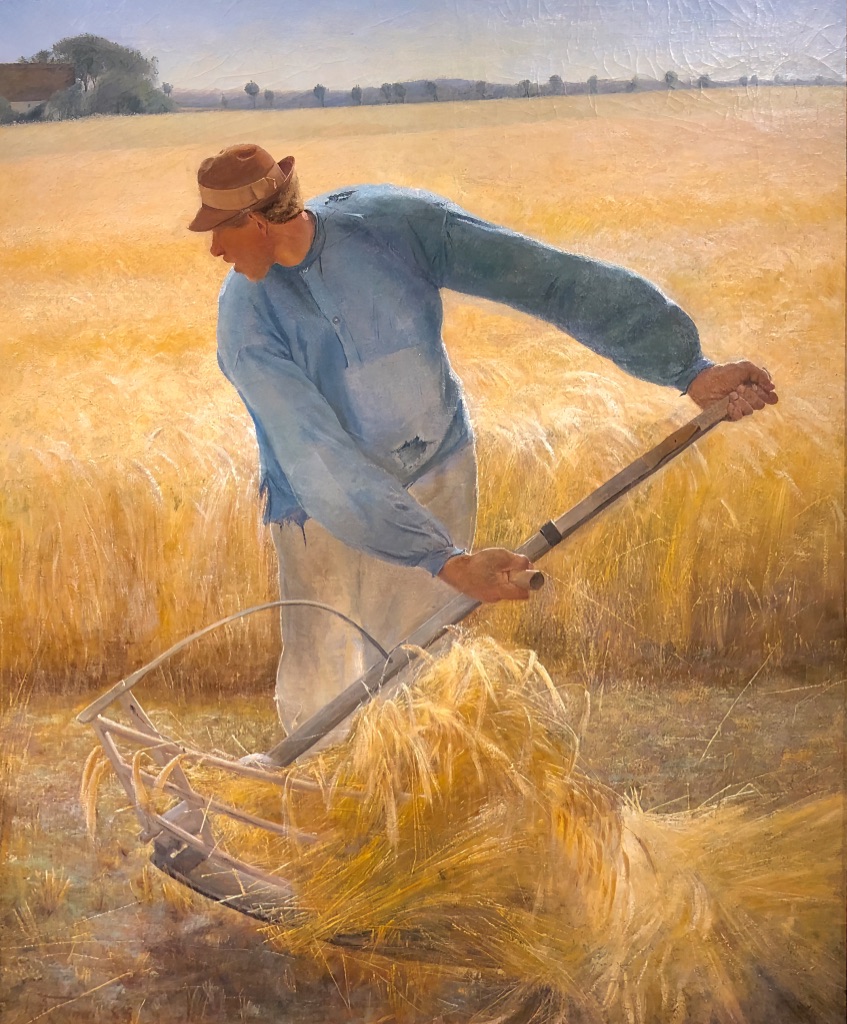
J. R. Ring, Harvest (1885)

This is the fifth time in ten years of blogging that I have observed the feast day of poet-priest George Herbert—”the greatest devotional poet in the English language”[i]—with a reflection on his poetic “heart work and heaven work.”[ii] For me, in our spiritually impoverished secular age, he remains an indispensable guide for a life of prayer. As I wrote in a previous post,

“Herbert’s passionate engagement with the Transcendent––among us, within us, over-against us––was not theoretical or abstract, but intimate and experiential, employing the first-person form of lyric poetry to open a clearing where his inmost feelings could show themselves to both the speaker and his readers. In his striking play of words, images and sounds, a consort of meanings both public and private, we overhear Herbert’s prayers, and witness the argument of his soul. The brilliance of his poetic invention is never for its own sake. He seeks not to show off his skill, but to surrender his will.”

You can find more general information about Herbert’s life and works in the links at the end of this post. Today I want to look at two poems about the inescapable mortality of the human condition. In the first, “Time,” the poet meets up with the Grim Reaper, wielding his scythe used to harvest the ripe field of human souls. He is, of course, the personification of the temporal flow that sweeps us all toward death. Instead of cowering in fear, the poet initiates a playful bantering, as if Time were his equal. Courteously, Time calls the poet “Sir,” and lets him do most of the talking.

Meeting with Time, slack thing, said I,
Thy sithe is dull; whet it for shame.
No marvell Sir, he did replie,
If it at length deserve some blame:
But where one man would have me grinde it,
Twentie for one too sharp do finde it.

Perhaps some such of old did passe,
Who above all things lov’d this life:
To whom thy sithe a hatchet was,
Which now is but a pruning knife.
Christs coming hath made man thy debter,
Since by thy cutting he grows better.

And in his blessing thou art blest:
For where thou onely wert before
An executioner at best;
Thou art a gard’ner now, and more,
An usher to convey our souls
Beyond the utmost starres and poles.

And this is that makes life so long,
While it detains us from our God.
Ev’n pleasures here increase the wrong,
And length of dayes lengthen the rod.
Who wants the place, where God doth dwell,
Partakes already half of hell.

Of what strange length must that needs be,
Which ev’n eternitie excludes!
Thus farre Time heard me patiently:
Then chafing said, This man deludes:
What do I here before his doore?
He doth not crave lesse time, but more.

From the first moment, the poet disses Time—none other than Mr. Death—calling him “slack” (meaning lazy and slow), and mocking his scythe as shamefully dull. Herbert’s health was poor when this was written (he would die at 40), and his jibe may have been the black humor of a dying man: With such a failing body, how come I’m still here? You need to sharpen your blade, Mr. Death!

But the poet’s surprisingly light tone here is a form not of denial, but of faith. For the believer, Time’s fatal blade brings not annihilation, but new growth: “By thy cutting he grows better.” We’re not sure what Time makes of this argument, but when the poet begins a more speculative discourse about time and eternity, wondering whether they intersect or remain totally separate, Time loses his patience. Why is he standing here listening to this mortal prattle on, wasting Time’s time?

What do I here before his doore? / He doth not crave lesse time, but more. Mr. Death thinks the poet is stalling, trying to gain a little more time with his philosophical filibuster. But knowing the poet’s faith, we may assume that Time is mistaken. What the poet craves is not more time, but eternity: freedom from temporality itself, in “the place where God doth dwell” beyond the binaries of here and there, then and now, presence and absence.

When the 20th-century poet and critic Paul Zweig was diagnosed with lymphoma in his forties, he wrote about his oncologist’s assurances that he might still have a “long time” left.

“Listening to my doctor was delicate. I took in every shrug, every rise and fall of his voice. I weighed his words on a fine scale, to detect hope or despair. Then I called up another doctor, to hear how the words sounded in his voice. I triangulated and compared all to find something that would shut off the terror for a while.” [iii]

Zweig’s “terror” feels searingly authentic. Can we say the same about Herbert’s tranquility? And what happens next, when Time finally loses its patience with us? Herbert does not say. Cannot say, in fact. No one can. Does the silence after the final line signify emptiness (nothing at all), or absolute wholeness (God all in all)? Your answer will shape your religious practice.

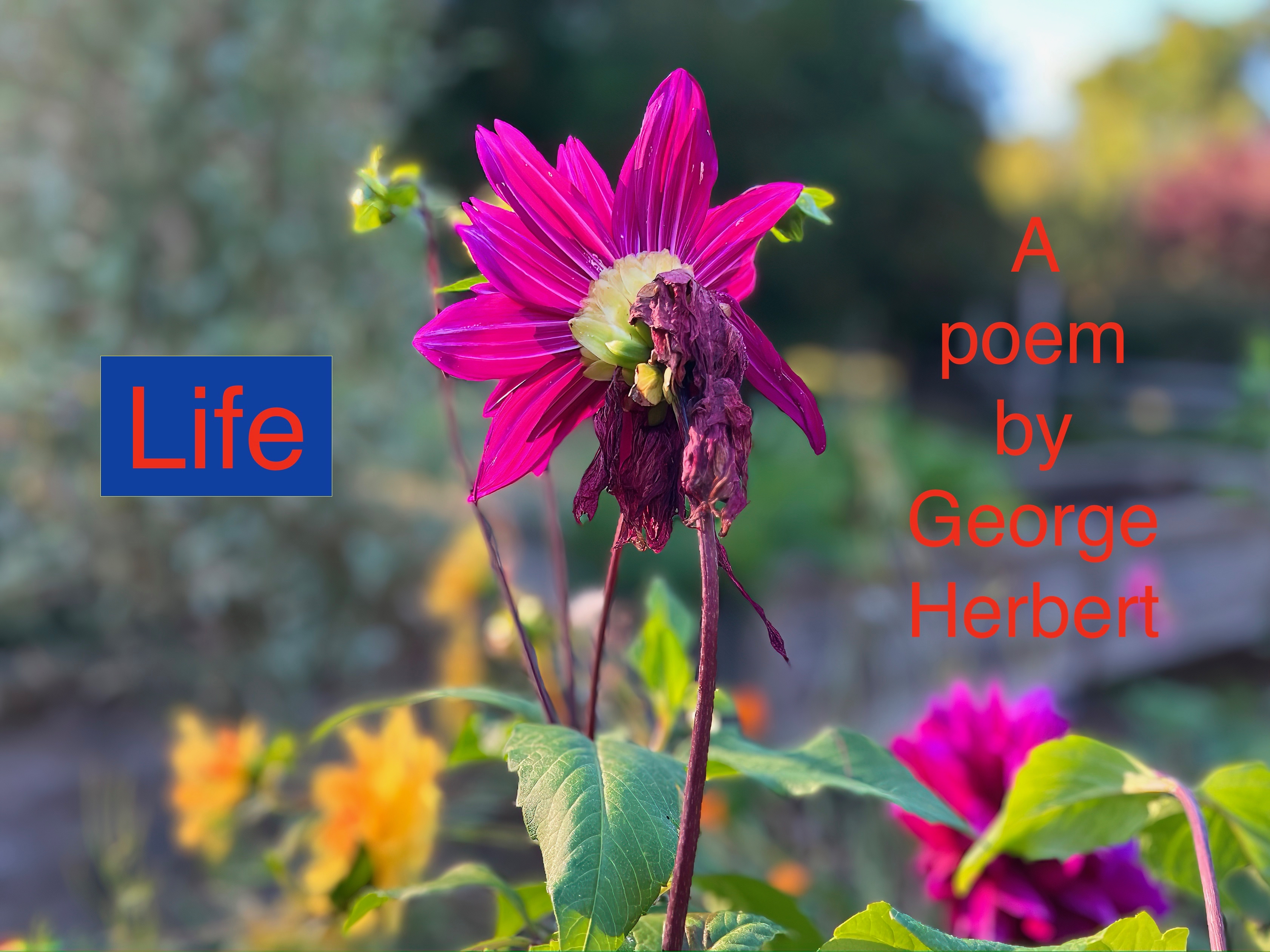
Our second poem, “Life,” surprises us when we discover it’s really about death. But isn’t that how life is?—surprising us by coming to an end. Whether it be bitter or sweet, our continued existence seems so convincing. Until it’s not.

The poem’s imagery is very simple. A small bundle of cut flowers, already starting to wither by midday, becomes, through the poet’s act of sustained attention, a metaphor for his own mortality. The materiality of the flowers—which the reader is enabled by the text to see, smell, and touch—is a striking example of Herbert’s “sacramental poetics.” The 16th-century Reformation debates about real Presence haunted the religious poetry of the 17th century. What is the relationship between matter and spirit? Can bread and wine be God, and still remain their material selves? Or as Herbert put it, “how shall I know / Whether in these gifts thou bee so …” [iv]

The inseparability of sign and signified, visible and invisible, matter and spirit was foundational for Herbert. The sacramental bread and wine are capable of “Leaping the wall that parts / Our souls and fleshly hearts.”[v] (The HC 1633) But the sacred elements never vanish into abstractions, mere ideas. They remain material objects we can taste and see with our own material bodies. As Kimberly Johnson explains in Made Flesh: Sacrament and Poetics in Post-Reformation England:

“Just as in the Incarnation the Word was made flesh, such that material and spiritual ontologies might be maintained simultaneously, Herbert’s poetics endorses a representational system wherein the material is not supplanted by spiritual significance but persists as a site of sensory participation … Poetry, as Herbert recognizes, is an embodied art. It activates the flesh as a perceptual instrument and preserves in its nonreferential features the incarnational properties of language, and it is because of these qualities that poetry serves, for Herbert, a sacramental function.” [vi]

In “Life,” the words that engage our senses are not disposable means for grasping abstractions; the flowers remain outward and visible objects in the world (heard, seen, smelled, felt) which are at the same time inseparable from the inward and spiritual meanings they signify. As you read the next poem, notice how the text takes hold of your senses.

I Made a posie, while the day ran by:
Here will I smell my remnant out, and tie
                      My life within this band.
But Time did becken to the flowers, and they
By noon most cunningly did steal away,
                      And wither'd in my hand.

My hand was next to them, and then my heart:
I took, without more thinking, in good part
                      Times gentle admonition:
Who did so sweetly deaths sad taste convey,
Making my minde to smell my fatall day;
                      Yet sugring the suspicion.

Farewell deare flowers, sweetly your time ye spent,
Fit, while ye liv'd, for smell or ornament,
                      And after death for cures.
I follow straight without complaints or grief,
Since if my sent be good, I care not if
                      It be as short as yours.

Following the structural pattern of the 17th-century “poetry of meditation,” whose sensuous imagery was strongly influenced by the Ignatian “application of the senses” to biblical visualizations, “Life” begins by declaring its topic. The speaker has made a “posie” (meaning both a posy of flowers and the “poesy” of Herbert’s verse, adroitly binding those flowers to the written text which offers them to our senses). Next comes a statement of the meditation’s purpose: by comparing his life to the flowers, the poet will “smell my remnant out.” Using the verb’s secondary meaning—to discern as if by smell (think of “sniff out”)—the poet proposes to reflect on the remainder of his life. The rest of the poem moves through a series of sensations and feelings to reach its conclusion of acceptance and resolution in the face of death.[vii]

Before the first stanza ends, the flowers have already withered, though the day is but half done. In the second stanza, the poet absorbs the flowers’ fate with his senses, his feelings, and his thought. He can’t help but “smell” his “fatall day.” This time, however, the sense of smell seems less metaphorical: even the reader cannot miss the whiff of decay.

And yet, Time’s admonition is “gentle.” The flowers are not mowed down by a sharpened scythe, but softly “beckened” to “steal away.” The idea of death is so “sweetly” conveyed by this natural process that it feels sugar-coated and easy to swallow. And like the flowers which have spent their allotted time pouring out their sweet fragrance, the poet resolves to follow their example “without complaints or grief.” As long as his “sent” (scent) is fragrant with goodness, then whatever the actual date on which he is sent to God, all is well. How long we live doesn’t matter nearly so much as how well we live.    

In our own violent and dispirited age, we may wonder over the lack of anguish, or fear, or rage, or grief in these poems. Where is “the terror?” How gently—and confidently—do Herbert’s speakers go into death’s good night. Many will find such tranquil surrender to be false, naïve, archaic, unrealistic, incomprehensible, or simply impossible. Nevertheless, Herbert’s poetry remains to pose the vital question: Are we still capable of imagining “Such a Way, as gives us breath … Such a Life, as killeth death?” [viii]

Going gently: The Starry Mountain Singers perform Sam & Peter Amidon’s exquisite arrangement of “All Is Well.”

Previous posts about George Herbert:

Heart Work and Heaven Work (2015)

“Flie with angels, fall with dust”— Appreciating George Herbert (2019)

Tune My Heart to Sing Thy Grace — George Herbert’s “Denial” (2020)

“Though the whole world turn to coal” — George Herbert’s “Virtue” (2023)


[i] Helen Wilcox, The English Poems of George Herbert (Cambridge, UK/NY: Cambridge University Press, 2007), xxi. This extensively footnoted collection is indispensable for navigating Herbert’s  17th-century idioms and discovering the wide variety of interpretive strategies applied to his deeply-layered texts over the years.

[ii] This term was applied to Herbert by his contemporary Richard Baxter, a Puritan divine. Herbert’s feast day is February 27.

[iii] Paul Zweig, Departures (New York: Penguin Books, 1988), q. in Death (Lapham’s Quarterly, Vol. VI, No. 4, Fall 2013, p. 210). Zweig wrote this c. 1981, and died in 1984.

[iv] George Herbert, “The H. Communion” (W).

[v] Ibid., “The H. Communion” (1633).

[vi] Kimberly Johnson, Made Flesh: Sacrament and Poetics in Post-Reformation England (Philadelphia, PA: University of Pennsylvania Press, 2014), 60-61.

[vii] Louis L. Martz, The Poetry of Meditation (New Haven, CT: Yale University Press, 1962), 58-59. This classic study covers the poets who applied the spiritual exercises of the Counter-Reformation to their poetry and compositional practice: John Donne, George Herbert, Henry Vaughan, Richard Crashaw, Richard Baxter, and Robert Southwell.

[viii] George Herbert, “The Call.” This beautiful poem, set to a memorable tune by Ralph Vaughan Williams, is #487 in the Episcopal Hymnal 1982.

No Shortcuts: Transitioning from Transfiguration to Lent

Fra Angelico, Transfiguration fresco on the wall of a monastic cell, San Marco, Florence (c. 1440).

O voi ch’ avete li ‘ntelletti sani,
Marate la dottrina cha s’asconde
Sotto ‘l velame de li versi strani.

O you whose minds are sound and full of sense,
consider the deeper meaning hidden here
behind the veil of these strange verses.

— Dante Alighieri, Inferno IX.61-63

Epiphany is a visual season. The mystery of God among us is shown to the world. And this showing culminates with the visionary experience of the Transfiguration: the veil covering Christ’s divinity is pulled aside, and three of his friends are dazzled by the radiance. The stark clarity of this revelation lasts only a moment. Epiphanies are brief by nature. When Jesus and the disciples descend from the mountaintop, the gospel narrative returns us to a more “normal” reality.

What did the disciples actually see in that moment on the mountain? Gregory of Palamas, a 14th-century theologian, believed that they glimpsed something actual and substantial, which he called the “uncreated light.”

“Christ is transfigured,” he said, “not by putting on some quality he did not possess previously, nor by changing into something he never was before, but by revealing to his disciples what he truly was, in opening their eyes and in giving sight to those who were blind. For while remaining identical to what he had been before, he appeared to the disciples in his splendor; he is indeed the true light, the radiance of glory.” [i]

Whatever we make of Gregory’s metaphysical claims, which were disputed by many of his contemporaries, the spiritual resonance of light is undeniable and universal. It ialways seems to be about something more than physics. It seems inevitably imbued with Spirit.

Where does such light come from? Is it something that happens to our eyes but is not really in the world? Or is it somehow there, within the heart of things, “born of the one light Eden saw play?” Is it not just a simulacrum of divinity, but a direct manifestation? Opinion is divided on this question, but I myself side with the visionaries who say there is more to reality than meets the eye. At the very least, this makes for a more interesting—and radiant—universe. Thoreau put the alternative as well as any when he said, “I perceive that we inhabitants of New England live this mean life that we do because our vision does not penetrate the surface of things.” [ii]

In the 17th century, when the science of optics was expanding to match developments in the telescope, the microscope, and the camera obscura, Jesuit thinkers took a keen interest in both the science and the theology of light. Observable facts and theological metaphors were for them compatible and complementary ways of knowing reality.

In Ars magna lucis et umbrae (“The great art of light and shadow”), published in 1646, Athanasius Kircher, S.J., described Christ as the Light of the World who contains divine glory and manifests it to the visible realm. “For Kircher, the infinite and eternal light is God the Father, thus the Son is the light from the light. The divine light first became visible as a result of his incarnation.” [iii]  It became common for his fellow Jesuits to employ optical phenomena in their devotional literature. The light from above, the light from within, the light which pierces the dark, the light which creates the visible world, and the light which illumines the mind of the receptive perceiver—all have their source in the eternal energies of God.

Theodore Galle, “Speculum urens,” from Jan David, S.J., Duodecim specula (1610).

Last year I had the good fortune to see the exhibition of a lifetime: 28 paintings by Johannes Vermeer at Amsterdam’s Rijksmuseum. It was the largest number of his works ever assembled in one place, an historic event which may never be repeated. To be in the presence of those miracles of brush and pigment was an epiphany of the heart—three precious hours I will never forget.

According to art scholar Gregor J. M. Weber, Vermeer’s art was strongly influenced by the optical theology of the Jesuits. Light itself, simultaneously natural and transcendent, could be seen as the true subject of his pictures. Many of his images feature light pouring into an otherwise shadowy interior from a window on the left edge of the canvas. And even the defining lines of persons and objects, softened and blurred by subtle gradations of color and tone, seem on the verge of dematerializing into pure luminosity.

Johannes Vermeer, Woman with a Pearl Necklace (1662-1664).

A striking example of this is Woman with a Pearl Necklace (c. 1662-1664). Its explicit content employs a common visual trope for worldly vanity. A fashionably dressed woman, clutching a pearl necklace, admires herself in a mirror. Similar images can be found in the engravings of Jesuit devotional books. This illustration from a 1682 Jesuit publication contrasts vanity before a mirror with piety before a crucifix.

Frederick Bouttats, “Different Ways of Life,” from Adriaen Poirters, S.J., Den spieghel van Philagie (1682).

While the mirror and the pearls in Vermeer’s painting were certainly “customary symbols of transience and vanity,” art historian Arthur K. Wheelock, Jr., argues that the woman’s priestly posture and the chaste beauty of the visual elements represent self-knowledge and truth. Perhaps. But Weber, making his case for Jesuit influence, focuses on the empty wall behind the preoccupied figure. In his original composition, Vermeer had darkened much of that wall with a large map. But then he painted out the map, leaving that wondrously glowing surface. “One must therefore ask,” writes Weber, “if the strikingly empty but bright white wall in Vermeer’s painting does not refer to God, invisible to the woman, fixated on her vain reflection—a metaphor for someone entangled in worldly things only.” [iv] 

God is there all the time, in the form of light, but the woman is oblivious! I find that an attractive reading of the painting, because it educates my own spiritual vision. “Find God in all things,” said Jesuit founder Ignatius Loyola—even in a glowing wall. While riding the ferry to Seattle the other day, I did just that when I became absorbed by light reflected from Puget Sound onto the ceiling of the passenger cabin.

LIght on a ferry ceiling, Puget Sound, Washington (Last weekend of Epiphany)

I knew factually that this light had traveled 93 million miles to be deflected upward by rippling water so it could dance upon the white ceiling above me. Still, it seemed charged with significance beyond the basic prose of solar optics: the miracle of light itself, without which nothing would be seen; the miracle of perception, enabling our own inwardness to connect with a reality beyond us; the inescapable sense of gift bestowed by luminosity and warmth; the ineffable poetics of glory, without which there would be neither beauty nor art nor religion.

I’m putting this badly, of course. I don’t have the right words. There may be no right words whatsoever. But as I sat transfixed by the bright pulsations, they felt like a semaphore from a transcendent source, delivering a message for which I simply lacked the code. Was it saying “I am with you always,” or “All shall be well”? For a moment as brief as the Transfiguration, the sense of something shown and something received was at the very least an inner truth, what faith calls the light of God shining in my heart. In a time of so much darkness, that’s no small thing.

Alleluias burned to ashes on the Last Sunday after the Epiphany.

Just three days after beholding the light of Transfiguration on the Last Sunday of Epiphany, we step through the gateway to Lent on Ash Wednesday. It’s quite a shift. For a brief moment, we see the divine light right in front of us—so close we can almost touch it. Then, just like that, we find ourselves back at the bottom of the mountain, where the only way to return to the light is the long and winding road through the desert of unknowing and unmaking.

That’s exactly how Dante’s Divine Comedy begins. Lost in a dark wood, alone and afraid, the pilgrim poet looks up. A steep hill rises before him, and behind its summit a tentative glow suggests an end to the dreadful night. The lively translation by Sandow Birk and Marcus Sanders conveys the hope awakened in the poet by this glimpse of dawning:

Just when / I was feeling completely lost and was ready to give up, / I looked up and saw a faint light in the distance. / I figured that meant there must be a way out up ahead / somewhere. When I saw that light, I felt better, and the / fear I’d been holding inside me that whole time started / to lift a little bit, because I figured I’d be outta there soon.[v]

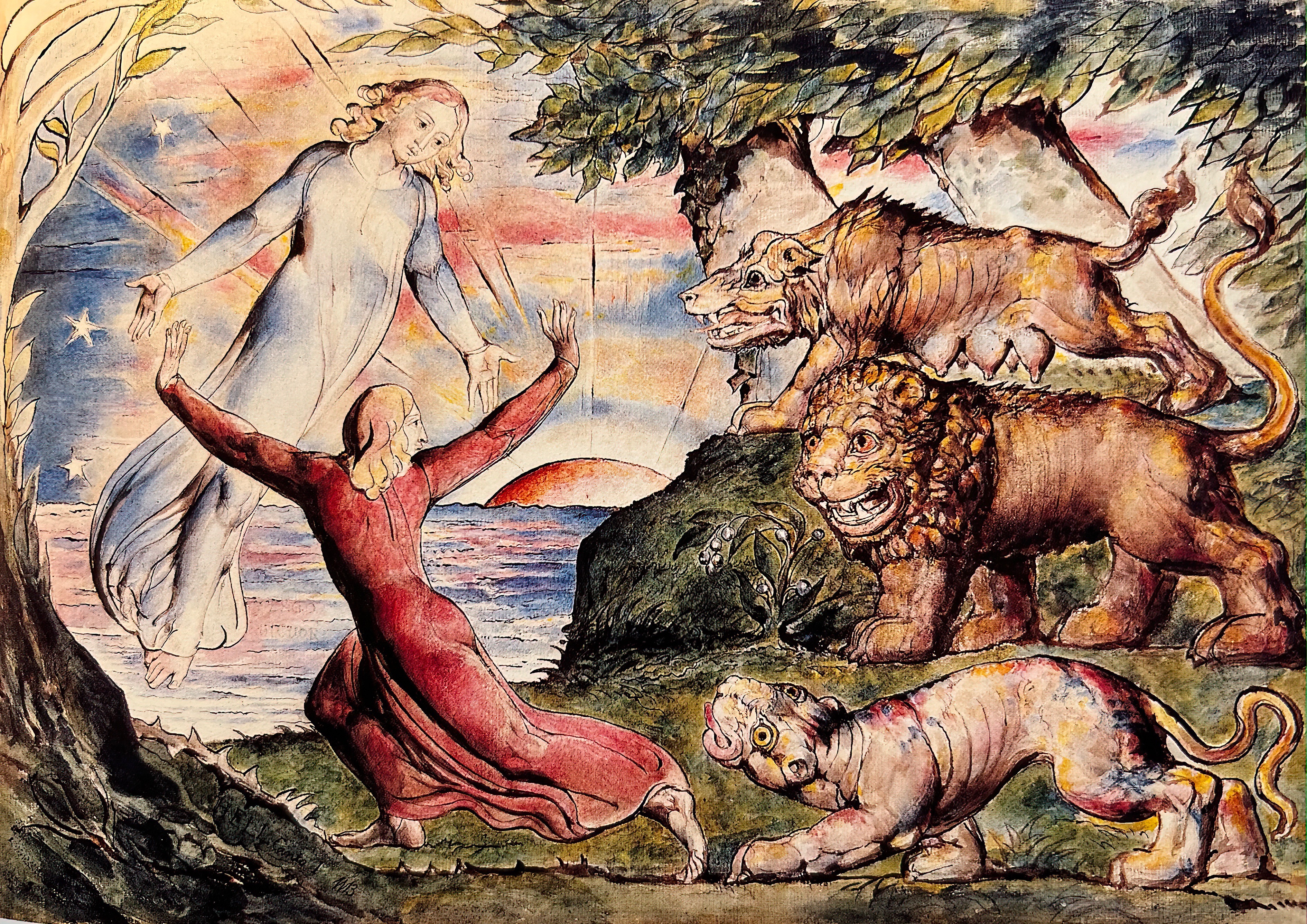
So Dante starts to climb toward the saving Light. As Helen Luke put it in her Jungian study of the poem, “He wanted, as we all want, to go the shortest and the quickest way to his goal.” [vi] But his way was suddenly blocked by three fierce beasts—the leopard, the lion, and the wolf—representing all the malformed and misdirected energies and aggressions of the ego.

William Blake, Dante Running from the Three Beasts (1824-1827).

Realizing there could be no easy way out of his darkness, no direct path to the Light, Dante surrenders his ambition to conquer the luminous summit by his own strength. He stops climbing, turns around, and begins the initially downward course along the arduous road of purgation and rebirth. Helen Luke sees in this radical change of itinerary an archetype for every spiritual journey:

“So indeed do we learn, struggling out of the dark wood, that we cannot hope to find wholeness by repressing the shadow sides of ourselves, or by the most heroic efforts of the ego to climb up, to achieve goodness. The leopard, the lion, and the wolf will not allow it, we may thank God. It is when we admit our powerlessness that the guide appears.” [vii]  

For Dante, the guide is Virgil, the long-dead poet who has been his greatest literary inspiration. In William Blake’s dramatic illustration, the beasts as well as Dante’s red garment signify turbulent emotion, while the soothing blue of Virgil’s gown suggests the transcendent imagination which nourishes hope and peace even in the abyss.

“I entreat you,” Dante tells his guide, “take me to the places I must go, that I may escape this evil and much worse.” [viii] And so they descend together, into the existential abyss of pain and  woundedness, on a journey which will, by God’s grace, lead upward in the end, to the Light that cleaves every darkness.

In the Transfiguration story, the disciples are also looking for a shortcut to wholeness. If only they could stay on the summit, clinging to the vision of Love’s brilliance. But Jesus, their own wise guide, takes them down the slope to resume the Way of the Cross: the long but necessary path of negation and affirmation, losing and finding, dying and rising.

Perhaps we ourselves would rather skip Lent, or at least Holy Week, and go straight to the cheering New Fire of the Easter Vigil. But there are no shortcuts. Still, even in the desert time of trial, the vision on the mountain can be rekindled and sustained by the burning bushes along the way—if only we turn aside to see them!

Icon of Moses before the Burning Bush (early 13th century, Mt. Sinai).


[i] St. Gregory Palamas, The Triads, in Richard Harries, Art and the Beauty of God: A Christian Understanding (London: Mowbray, 1993), 85

[ii] Henry David Thoreau, Walden (1854).

[iii] Gregor J.M. Weber, Johannes Vermeer: Faith, Light and Reflection (Amsterdam: Rijksmuseum, 2022), 89.

[iv] Ibid., 131-132.

[v] Sandow Birk & Marcus Sanders, Dante’s Inferno (San Francisco: Chronicle Books, 2004), 2.

[vi] Helen Luke, Dark Wood to White Rose: Journey and Transformation in Dante’s Divine Comedy (New York: Parabola Books, 1989), 5.

[vii] Ibid., 7.

[viii] Inferno I.130-132.

Time to Take a Cup of Kindness (Happy New Year!)

Peering into the unknown in Jónsi’s FLÓÐ, a multi-sensory installation in Seattle’s Nordic Museum.

I have been writings this blog since 2014, and the turning of time at the New Year has always provoked an annual reflection on our temporal existence. If, as 2023 slips away, you’re in the mood for one of those essays, here are some links:

The Angel of Possibility (2014)
Tick-Tock: Thoughts for New Year’s Eve (2015)
Foolishness and Hope on the Eve of 2017 (2016)
On New Year’s Eve, My Inner Clown is Full of Hope (2018)
The Music of What Happens (2022)

Hope has been my recurring theme at year’s end. On the eve of 2024, it’s a precious commodity. Two years ago, I wrote Tending Hope’s Flame on an Anxious New Year’s Eve. With the flag of hope tattered and torn by endless battles, I drew inspiration from Thoreau, who continued his quiet work of studying the natural world even as the Civil War ravaged the American consciousness. We must, he argued, refuse the hypnotic spell of the chaos which seeks to seduce our gaze. The refusal to take our eye from the transcendent goodness and beauty at the heart of things is “the only fatal weapon you can direct against evil.”

As midnight fast approaches, I don’t have much to add, except a few lines from W. H. Auden’s New Year Letter (January 1940). Written in search of a foundation for living amid amid the chaos of war and the collapse of the known order nearly a century ago, some of it speaks directly to our own present moment:

The situation of our time
Surrounds us like a baffling crime …

We find ourselves in Purgatory,
Back on the same old mountain side
With only guessing for a guide …

The New Year brings an earth afraid …

But then Auden addresses a particular friend who has been for him a shelter from the storm:

We fall down in the dance, we make
The old ridiculous mistake,
But always there are such as you,
Forgiving, helping what we do …

Tonight let’s raise a glass to the ones who forgive, and the ones who help. And that brings me to the photograph I took last summer while immersed in FLÓÐ (Flood), a multi-sensory simulation of oceanic depths by Icelandic artist Jónsi. The two figures gazing into the mist remind me of old illustrations of Dante and Virgil in the Inferno. No matter how unsettling the sights along the way, the companions of the Divine Comedy are usually seen side by side, slightly apart from the next horror, retaining enough detachment from the chaos and pain to analyze and learn from it, without getting sucked into it themselves. And whenever the pilgrim Dante misunderstands what he sees, or succumbs to fear, his guide is there to help.

Virgil leads Dante out of Hell (14c MS).

One of my favorite Divine Comedy illustrations is in a 14th-century manuscript of Dante’s poem. Having traversed the dark way to stand once more beneath the stars, Virgil reaches back to pull Dante out of the pit as well. It’s like that beautiful line in “Auld Lang Syne”:

And here’s a hand, my trusty friend,
And gie’s a hand o’ thine.

As we make our own way through the peril and promise of the coming year, may the helpers be there when we need them. And God willing, may we all “take a cup o’ kindness yet.”

Happy New Year, dear Reader. May peace and wisdom abound in the days to come! Thank you for your thoughtful attention in 2023. I’ll see you again on the other side.