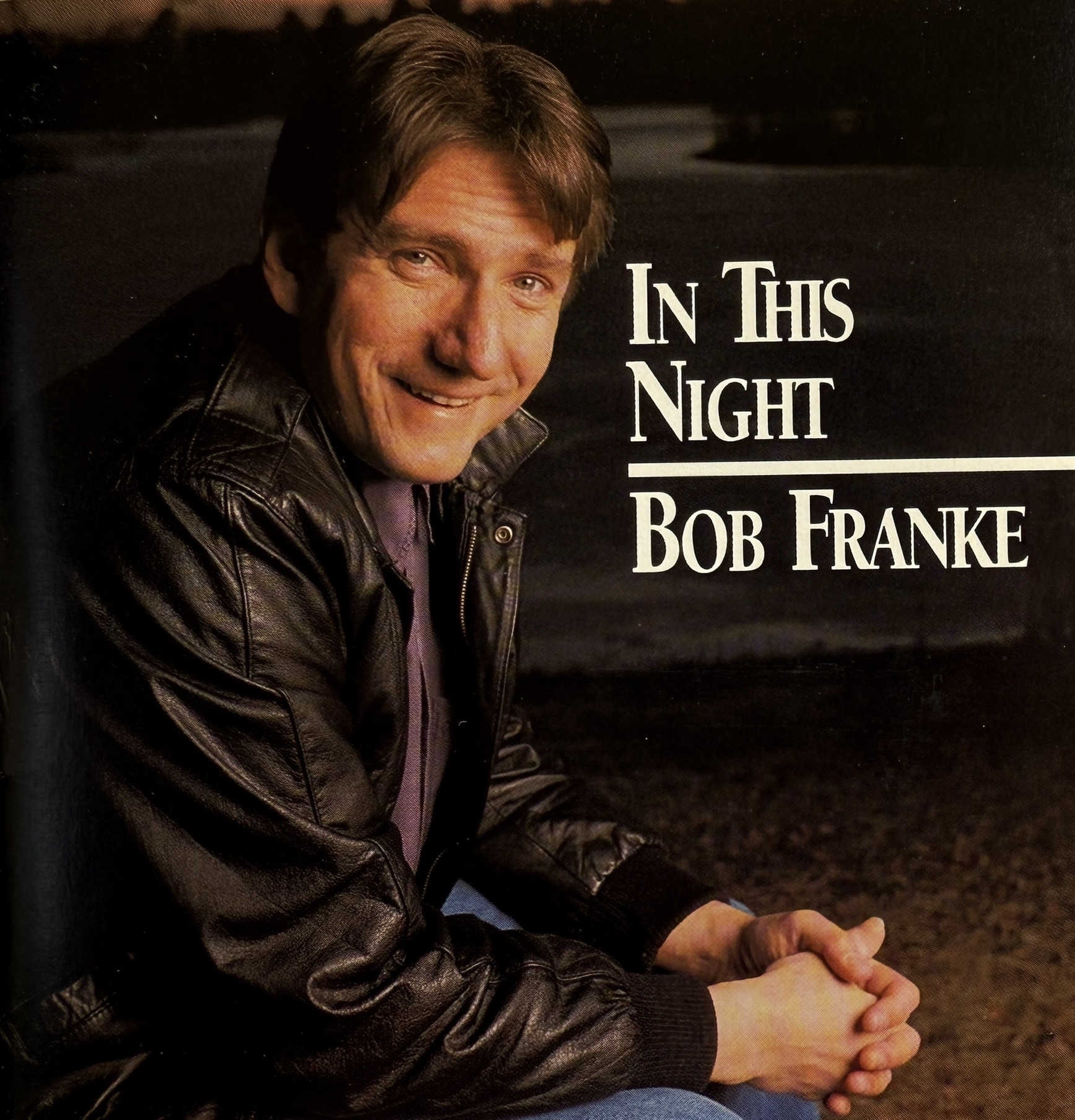
Cover of Bob Franke’s fifth album, 1991 (Photo: Susan Wilson)
And when all the stars and sentimental songs dissolved to day, There was nothing left to sing about but hard love.
— Bob Franke, “Hard Love”
Yet even at the grave we make our song: Alleluia, alleluia, alleluia.
— Burial Office, Episcopal Book of Common Prayer
“Bob Franke! Ten years ago, one of his songs literally saved my life.” That’s what a theology professor told me back in the nineties, when I was catching a ride with her to Salem from the Massachusetts coast. She taught at Harvard Divinity School and had offered to drop me at a friend’s house on her way to work. “What’s your friend’s name?” she asked. I told her, and I have never forgotten her heartfelt response. But I was not surprised by it. Bob’s songs have been a source of comfort and healing for many of us over the years.
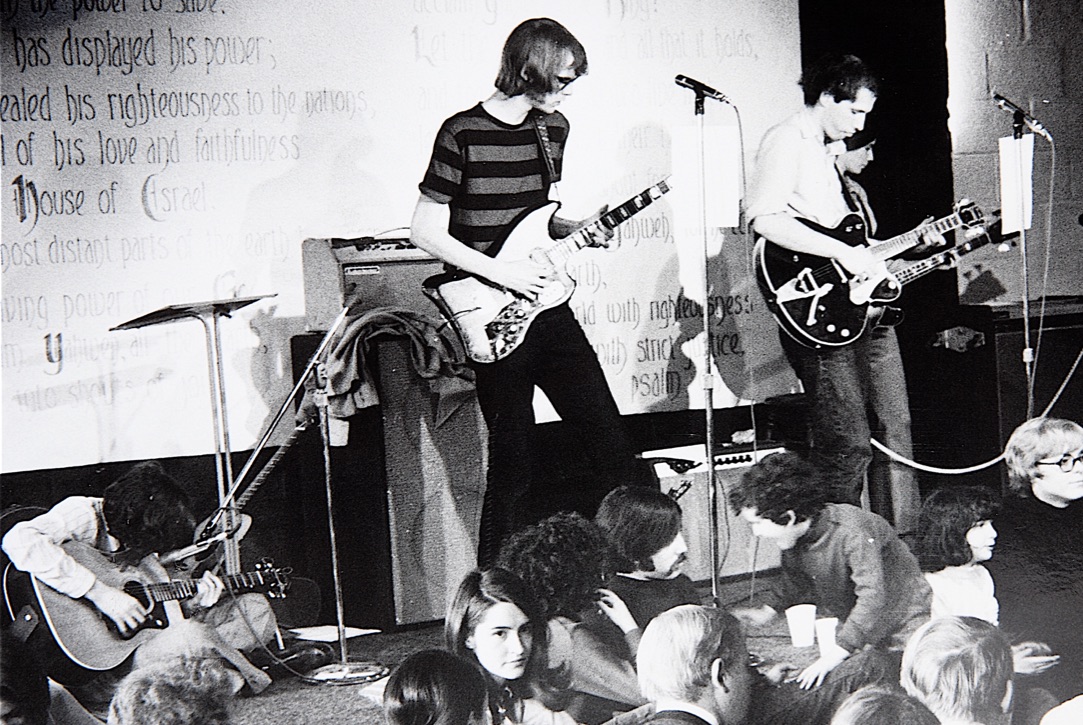
I first met Bob in 1969, when he was a student and aspiring singer-songwriter at the University of Michigan, and I was a Cambridge seminarian visiting Ann Arbor during spring break. Bob was part of an impromptu band I helped put together for the Easter liturgy at Canterbury House, the Episcopal campus ministry coffeehouse renowned not only for its folk concerts (Neil Young, Joni Mitchell and Richie Havens were on the bill that year), but also for its wonderfully creative alternative worship. On Easter morning, about 150 students and faculty descended into the gloomy basement “tomb,” until a clown in white face appeared to announce that “Christ is risen!” As the congregation exited the tomb into the light-filled hall above, our band played the opening hymn—“Mr. Tambourine Man.” Nothing like resurrection to make a “jingle-jangle morning.”
Bob Franke (seated on floor), Jim Friedrich, Ed Reynolds at Canterbury House Easter Sunday, 1969
Canterbury House was also the first place Bob sang his own songs on stage. In the previous year, the headline act—the unpredictable Ramblin’ Jack Elliott—had wandered away between sets to get ice cream in Detroit, 45 miles away. During his long absence, someone asked Bob to fill in until Jack returned. And a star was born.
Bob was a faithful friend of God, an Episcopalian by tradition. He attended my seminary in Massachusetts for a year, but it soon became clear that, in his words, “a guitar fit better around my neck than a clerical collar.” But his songs, and the way he would speak about them in concert, became a unique ministry of illumination, comfort and blessing which touched so many lives. Bob himself put it this way:
“Whenever I sing, I’m trying to create in my listeners an awareness of the beauty and sacredness of their own lives, both individually and together, as a community. A woman came up to me recently and said that my story and my song put her relationship with her dad in a new light, gave her insight into her dad’s love for her. That’s all I need to take home from a show.”
Some of his work engages biblical topics, such as his Nativity carol, “Straw Against the Chill,” or “We’re Walking in the Wilderness.” Some lyrics incorporate Scriptural references (“new streams in the desert, new hope for the poor”). But most of his songs, whatever the topic, touch on fundamentally religious questions: yearning, journey, justice, death, loss, mercy, gratitude, love.
But it was always more than the songs with Bob, whose own authenticity, depth, humility and warmth made every concert an event of the heart. As music programmer Alan Korolenko describes the Bob Franke experience:
“No matter the size of the audience, you’re going to get an intimate evening with Bob. He just pulls everybody in, which is the key. You’ll meet other artists, and they’re not the same as their work. That’s not the case with Bob. He appeals to folk fans and general audiences, because he knows how to create a full, emotional journey, and how to share that journey. By the end, you’ve laughed and thought and cared; you’ve gotten to know the guy. He’s a class act.”
In the folk world, Bob’s songwriting has long been held in high esteem. Peter, Paul and Mary, David Wilcox, John McCutcheon, Sally Rogers, Martin Simpson, Lui Collins, Garnet Rogers, June Tabor and countless others have all recorded from his songbook. Claudia Schmidt has a beautiful version of “Hard Love,” one of the most truthful and hard-earned songs ever written on the subject.
Yes, it’s hard love, but it’s love all the same Not the stuff of fantasy, but more than just a game And the only kind of miracle that’s worthy of the name For the love that heals our lives is mostly hard love
Bob’s melodies have a way of drawing you into a place of receptivity, where his words, so precise, truthful and unafraid, whisper their truth to your heart.
For the Lord’s cross might redeem us, but our own just wastes our time. (“Hard Love”)
There’s a hole in the middle of the prettiest life, so the lawyers and the prophets say … (“For Real”)
But there are ears to hear me in my softest voice, There are hands to hold and point the way … (“A Healing in This Night”)
Over the years, Bob’s songs have been woven like bright threads into the fabric of my own life. When my grandmother died three months short of a hundred, my folk-singing sister Marilyn wasn’t sure what to perform at her funeral. Then one of Bob’s songs arrived by chance (or grace) in the mail. A friend had just come across “Alleluia, the Great Storm is Over,” and thought Marilyn would like it. It proved the perfect choice, heaven-sent, to sing our dear Nana home.
Sweetness in the air, and justice on the wind, laughter in the house where the mourners had been. The deaf shall have music, the blind have new eyes, the standards of death taken down by surprise.
In a very low-def 2010 video of Bob and friends singing the song in a Massachusetts coffeehouse, you can hear the audience jumping in with the chorus before Bob even sings a word. His lyrics were so deeply planted in their hearts, they could not keep silent.
Bob wrote a cantata on Christ’s Passion, performing it with musician friends every Good Friday at his home parish, St. Andrew’s Episcopal Church in Marblehead, Massachusetts. One of those songs, “Roll Away the Waters,” a rousing celebration of the Exodus, became a regular part of the storytelling portion of my creative Easter Vigils over the years. Here is Bob’s version.
And when we hear again the Annunciation story in Advent, it’s time for Bob’s “Say Yes,” an artfully succinct summary of spirituality’s essence: receptivity and consent. Here’s a version I did during the pandemic for one of my church’s worship streams:
The author performs Bob Franke’s “Say Yes.”
And whenever I need serious picking up, I’ll play “A Healing in This Night.” Here’s a fine version by Annie Patterson and Peter Blood:
“I always think of Bob as if Jefferson and Thoreau had picked up acoustic guitars and gotten into songwriting. There are touches of Mark Twain and Buddy Holly in there, too.” — Tom Paxton
Bob’s songs, and his spirit, are deeply rooted in American tradition—musically, culturally, politically. He sang on radio shows like Prairie Home Companion and A Mountain Stage, and traveled down many roads to perform in festivals, coffeehouses, churches and living rooms. His songs are imbued with the questions, dreams, struggles and shadows of American life. Even the hardest times are seen with a measure of possibility and redemption.
But in recent years he and his wife Joan saw the country they loved disintegrating into madness and rage. Feeling that the United States was becoming unsafe, and mindful of those who waited too long to exit Nazi Germany in the 1930s, Bob and Joan emigrated to Guatemala in September. They were barely into their second month in a new land when Bob was hit by a speeding motorcycle while crossing a road. Yesterday, October 16, a few days after surgery to repair the damage, he died in hospital of a heart attack. He was 78.
What can you do with your days but work and hope, Let your dreams bind your work to your play. What can you do with each moment of your life But love till you’ve loved it away?
When the news of Bob’s death reached me around midnight, it hit hard. I lit a candle before an icon of the Theotokos, and picked up my guitar: “Thanksgiving Eve,” of course, “Alleluia, the Great Storm is Over,” and “A Healing in This Night.” I imagined people far and wide were doing the same—joining our voices withthe whole company of heaven, as we say at mass.
Give rest, O Christ, to your servant with your saints, where sorrow and pain are no more, neither sighing, but life everlasting.
As for the song which saved that Harvard theologian’s life years ago, let Bob have the last word:
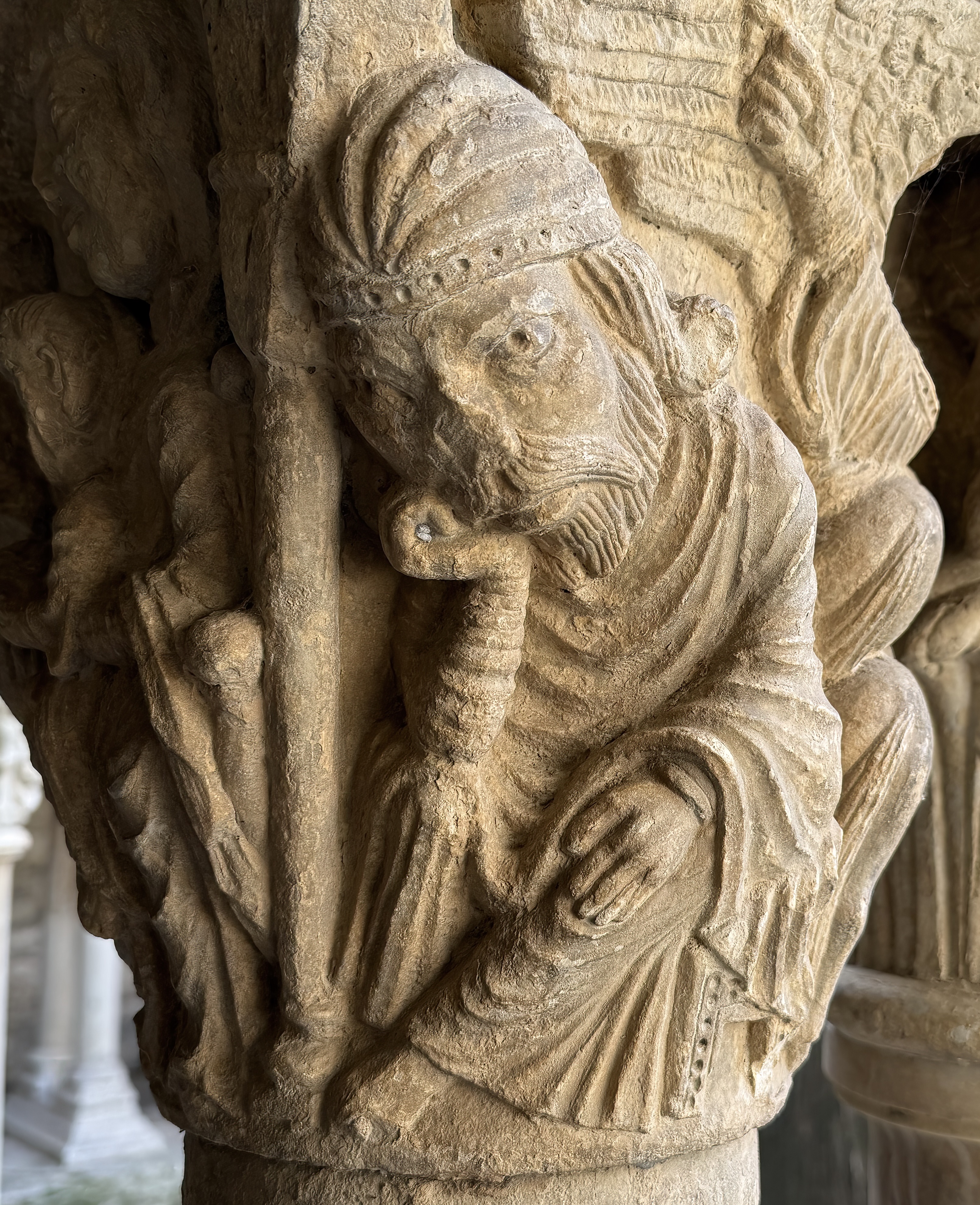
A perplexed man in the cloister of Saint Trophime, Arles, France (12th century)
In the liturgical churches, we don’t get to choose the Scripture for our homilies. We have to take what the Lectionary gives us. I’ve been preaching for a long time, but I’ve always been lucky enough to miss the Sundays when the Parable of the Unjust Steward turns up. Until now. Some scholars have labeled it the hardest parable. I prefer to call it the “terrible parable.” But I made a stab at it, and pass on the results here.
A parable functions a little like a Zen koan. What is the sound of one hand clapping? What is your original face before you were born? Such imaginative constructions of language are meant to disrupt habitual ways of thinking and open us to new perspectives. Just so, when a prodigal son is welcomed home with open arms, or the laborers who work the fewest hours are paid the same wages as the ones who work all day, we are forced, or at least invited, to question our presuppositions and prejudices about how life works, or how God desires life to work.
That said, let’s consider the Parable of the Unjust Steward (Luke 16:1- 8). It’s not an easy one to interpret. Nor is it easy to like. There have been many efforts to explain what this story about a dishonest steward tricking his boss is even doing in Luke’s gospel, set down in the midst of far more memorable teachings and far more beloved parables. But most of those explanations fail in one way or another, either making assumptions not justified by the text or reducing its meanings to something of little value to preacher or disciple.
So what shall we make of the “terrible parable” this time around?
Let’s review what happens. A rich man, presumably an absentee landowner, discovers his property manager has been “squandering” his property, whether by mismanagement or financial monkey business we aren’t told. But he’s put on notice that he’s about to be fired.
Now the steward considers himself either too old or too scrawny for manual labor, and he’s too proud to beg, so he’s desperate for a way to avoid utter destitution. What does he do? He summons all his master’s debtors and offers to write down their debts to an affordable level. By so doing, he earns the good will of those debtors.
Maybe someday, when he’s out of work and looking for help, they’ll return the favor. And, by collecting at least some return from all those past due accounts for his master, maybe he can get back in the master’s good graces. In the end, we are told, the rich man “commended the dishonest manager because he had acted shrewdly.” The odds of the steward keeping his job are looking up, but the story stops before we find out about that.
At first glance, it’s hard to find anyone to identify with in this parable. In the Bible, rich men are rarely liked, since economic inequality in biblical times was even worse than it is today. When a story begins, “There was a rich man,” you might imagine the immediate boos and hisses from Jesus’ audience, which hopes it’s going to be a story about his comeuppance. But as soon as the steward is introduced, his own character is dragged through the mud, and the rich man gains a bit of sympathy for having been cheated.
The steward stands accused of squandering his master’s property—whether through incompetence or dishonesty is not quite clear, but his actions later, cooking the books to write down the debts owed to his master, tag him as “unjust” or “dishonest”—terms which can connote either shaky bookkeeping or outright fraud. In any case, he plays fast and loose with the numbers. And, to our surprise, he is praised for doing so. This commendation may reflect the master’s relief in recovering at least some of his bad loans. It also may indicate his delight in discovering how clever his steward is. If such a man can get things done, who cares if his methods are not always on the up and up?
Some commentators have discerned a Christ figure in the rule-breaking steward. Hoping for a different kind of future, Jesus subverts the rules of the old world, where the rich get everything and the system punishes the poor, so that the rich man gets less and the debtors finally get a break. The unjust system may consider his actions to be improper, but in God’s eyes he’s an agent of economic justice, constructing a fairer and kinder form of human community.
At the same time, the steward’s actions transform relationships. The debtors, for whom the steward might have seemed an enforcer of unpayable obligations, turns out to be a forgiver of debts. And the rich man, tricked into generosity by his steward’s unorthodox moves, is given the opportunity to forego domination and greed in his own relationships with others.
That’s the story. But then the storyteller, who is Jesus, tacks a puzzling moral onto the end of his tale. He says the steward’s ingenuity, and the praise he receives for it, demonstrates that “the children of this age are more shrewd in dealing with their own generation than are the children of light.”
What could this mean? Of course, to reduce a parable to a single meaning implies that you can throw out the story and just keep the meaning. That’s like Woody Allen’s joke about reading War and Peace in an hour after taking a speed-reading course. When someone asked him what the novel was about, he said, “It’s about Russia.”
His joke mocks the idea that the experience of full immersion in Tolstoy’s thousand-page epic can be replaced by a brief summary. It’s the same with Jesus’ parables. Don’t reduce them to a single meaning. Experience them, begin to wonder about them, and then—just keep on wondering.
So instead of offering the best interpretation of today’s parable—there is no best interpretation, just a story which continues to puzzle us—I will simply try out some observations with no presumption of giving you the definitive last word about it.
The “children of light” is a New Testament term for the early Christians, the followers of the Way of Jesus, who belong not to “this age” but to the age to come, the future which God is in the process of bringing about. The steward’s ability to game the system of this age, operating successfully within its parameters with improvisation, cleverness and flexibility, should make the followers of Jesus ask themselves,
“Am I operating within the parameters of the age to come—the kingdom of God—with the same creativity and resourcefulness as the steward displays within the parameters of his story? Are my actions and choices in line with the world that is dying, or with the world that is being born?”
In living out the Christian life, which is rooted not in this age but in the age to come, we should embody the Kingdom’s precepts and pursue its goals with the same single-mindedness, the same commitment, the same shrewdness that the steward in the parable employs to navigate the crisis described in his story. His world is about to come crashing down, he’s about to lose everything, but he survives through the actions he takes and the relationships he cultivates. He doesn’t cling to the old world and its old rules to suffer its predetermined outcomes. He discovers a way to be part of what is about to happen next. He discovers a way to have a future.
Now if we are indeed the children of light, claiming allegiance to the divine future which is being born amidst the ruins of our fallen world, do we possess a comparable level of creativity and resourcefulness to survive the collapse of the old and join ourselves wholeheartedly to the emergence of the new? Can we be as good as that steward was in slipping through the present time of crisis into a future of divine intent and human flourishing?
That’s the question I hear the parable asking us today. That’s the question I leave you with today. Let me say it one more time:
If we are indeed the children of light, claiming allegiance to the divine future which is being born amidst the ruins of our fallen world, do we possess a comparable level of creativity and resourcefulness to survive the collapse of the old and join ourselves wholeheartedly to the emergence of the new?
Can we be as good as that steward was in slipping through the present time of crisis into a future of divine intent and human flourishing?
In all my years as a priest, I had never preached on the apocalyptic imagery of Luke 17:26-37, where people disappear without warning and Jesus concludes with an unnerving proverb: “Where the corpse is, there the vultures will gather.” This is not ideal preaching material, but with the help of the Epistle reading, Hebrews 11:29—12:2, I gave it a try last Sunday.
Today’s gospel [i] has quite a punchline: “Where the corpse is, there the vultures will gather.” It’s got to be pretty low on the list of favorite Jesus quotes, but it certainly gets our attention.
A couple of weeks ago I was at a raptor show at the High Desert Museum in eastern Oregon. A variety of hawks, owls and vultures flew swiftly among the seated spectators, who were warned to stay very still lest we be mistaken for prey. I did my best not to be a target, but a turkey vulture came close enough to brush my head with its wing. Perhaps it was preparing me for this strange gospel verse.
Some scholars say Jesus was simply using a common folk expression in response to a question about discerning the times, meaning something like “where there’s smoke, there’s fire.” Such expressions have nothing to do with smoke or fire or vultures or corpses. They’re just colorful ways of making a point. Still, Jesus’ choice of such a grim illustration puts a sharp edge on his message. It certainly gets our attention. And where the enigmatic text is, there the scholars will gather.
Who is the corpse? they wonder. Who are the vultures? One interpretation suggests the corpse could represent ancient Palestine, with the rapacious vultures being the occupying army of Rome. The Book of Revelation, perhaps inspired by the vultures in the gospel text, imagined the raptors of midheaven being summoned to feast on the remains of the proud powers struck down by divine judgment. An even more fantastical interpretation identifies the sharp-eyed buzzards, who in fact can spot carrion from 3 miles away, as those perceptive disciples who gather to consume the Corpus Christi, the Body of Christ given to feed our deepest hunger.
Well, none of these images is going to qualify for a stained glass window. And the vulture verse is perhaps profitless for the preacher.
And yet, it leaves a haunting impression. It’s unlike anything else Jesus ever said, and its gruesome tone puts an exclamation point on his discourse of crisis. A world is dying, he says. Just as a world died in the days of Noah, or in the days of Lot—names which recall destructive narratives of flood and fire—so it is happening now. The times are in no way normal, Jesus warns his listeners. Anyone who pretends that is not true, who thinks we can just go on about our business as usual—eating and drinking, buying and selling, planting and building—well, they are in for a surprise.
Come gather ’round people Wherever you roam And admit that the waters Around you have grown And accept it that soon You’ll be drenched to the bone If your time to you is worth savin’ You better start swimmin’ Or you’ll sink like a stone For the times they are a-changin’ [ii]
When we sang that song 60 years ago, we thought the times were changing for the better. And that was true in many ways. But the flood of changes washing over us today do not feel like something better. When Jesus speaks of people being snatched up and disappeared without warning, he could be describing what’s happening right now in “the land of the free.” To paraphrase Jesus’ metaphor, “As it was in the days of Dietrich Bonhoeffer—in 1930s Germany—so shall it be in our own time.”
I pray that this will not be our fate, but the fact that such an outcome is even conceivable is a measure of the times. It can happen here. So what are the friends of God to do? How do we start swimming so we don’t sink like a stone?
We are not the first believers to suffer the worst of times. The Epistle to the Hebrews is clear about that. History isn’t always about the lilies of the field. It has its corpses and vultures as well.
But as the author of Hebrews insists, the faithful believe in the victory of God, and they act out that faith with their bodies. Some of God’s friends have “received the test of mocking and whipping and even chains and prison. They were stoned, cut apart in a slaughter; they died upon a sword. They traveled around in ragged clothing, impoverished, oppressed, afflicted.” But for all they suffered, those who kept the faith “subdued monarchies, did the work of justice … shut the mouths of lions, quenched mighty fires …” (Hebrews 11:29-12:2)
As people baptized into the Paschal Mystery, we understand that dying and rising, defeat and victory, are deeply intertwined. You can’t have one without the other.
When certain medieval women mystics contemplated the cross in prayer and vision, they saw not the triumph of death, but a kind of birth. For them the crucified Jesus was like a woman in labor, enduring pain and travail in order to bring us all to birth:
Ah! Sweet Lord Jesus Christ, who ever saw a mother suffer such a birth! For when the hour of your delivery came you were placed on the hard bed of the cross and … in one day you gave birth to the whole world.”[iii]
To behold the death of Christ and call it birth is the central act of Christian imagination. It is why we declare victory at the cross. We don’t wait for Easter Sunday. We declare victory at the cross because the Passion isn’t just a story about the violent powers that always trample the weak and kill the prophets. It’s also a story about the Realm of God, where dry bones breathe and lost hopes dance, where the prodigal is welcomed home and the tears are wiped from every eye.
The Love that creates such a realm was nailed to a cross, but the cross did not consume it. Yes, death did what death does, but then God did what God does. And Love won. This is the story we belong to, and on the outcome of that story, we stake everything.
That is why we are here this morning. That is why we refuse to retreat to our private worlds, why we continue to gather in community at our Savior’s table: to nurture hope, shelter love’s flame, encourage one another, strengthen our hearts for service, eat the bread of life, pray without ceasing, sing our Alleluias and grow ever more fully into the visible, tangible body of Christ.
We are not alone in this journey. We are surrounded by a cloud of witnesses, all those ancestors in the faith, from Abraham and Sarah and Mary and Luke right on down to the wise and loving mentors we’ve known in our own lives, who have taught us how to walk in the Way of life and peace.
I once heard a preacher describe the cloud of witnesses as “the balcony people” who are looking down and cheering us on as we run the race that is set before us. It’s a wonderful and resonant image. I’m sure that each of you has some very special people in that balcony, shouting their encouragement. Listen. You can hear their voices echoing through the years.
St. Luke, pray for us … St. Mary, pray for us … St. Francis, pray for us … Oscar Romero, pray for us … Dorothy Day, pray for us … Mom and Dad, pray for us.
Last Sunday I was in Eugene for the National Track & Field Championships, and in the men’s 800 meters I witnessed one of the most stunning moments in the history of middle-distance racing. A 16-year-old high school sophomore named Cooper Lutkenhaus had qualified for the elite competition by breaking the 29-year-old high school record, running the distance in 1:45. And after stumbling and almost falling in his first race at the championships, he managed to survive the first two rounds.
Much to his surprise, he had made the final. But with some of the world’s top 800 meter runners in the race, no one expected him to be anywhere close to the top three who would earn a trip to the World Championships in September.
Rounding the last turn, Cooper was doing really well for a 16-year-old, in sixth place out of nine racers, 10 meters behind the leader. Then, in the last 100 meters, he passed one runner, and another, and another, and another, to cross the line in second place. His time was 1:42.27, not only a personal best by an unbelievable 3 seconds, but the 18th-best all-time and the fourth-best ever by an American.
Donavan Brazier, Cooper Lutkenhaus, and Bryce Hoppel finish 1-2-3 in the 2025 U.S. Track & Field Championships in Eugene, Oregon.
Now I’ve been at a noisy NBA final with Kareem and Magic and Larry Bird. I’ve been deafened by the 12th man [iv] at a Seahawks game. But the sound of the crowd cheering on young Cooper Lutkenhaus blew my ears off. The cloud of witnesses.
When we run the race that is set before us, there will be times when our lungs burn and our legs scream with lactic acid. There will be the races that disappoint, and workouts that feel listless or discouraging. We may even stumble and fall, more than once.
But always, always, the cloud of witnesses is cheering us on. They know from their own experience what the race is like. They all had their own moments of weakness and doubt. They became acquainted with suffering by training hard every day. They all had to learn how to get up after every fall, lay aside every weight, gulp the breath of the Spirit, and accept pain as the runner’s companion.
I’ve done my own share of racing, and when the pain comes, I try to greet it as a friend. “Hello, brother pain. I knew you’d show up. Well, here we go. I know you’re not going to kill me, right?. We’ll just take it step by step.”
“Even the fittest may stumble and fall (Isaiah 40:31). As Roisin Willis and Maggi Congdon finish 1-2 in the women’s 800 meters at the U.S. Championships, Sage Hurta-Klecker dives for the third and final spot on the World Championship team. In previous years, she had missed out on a championship podium twice due to falls, but this time her fall was a triumph. She made the team.
The perpetual contest between weariness and perseverance is familiar to every athlete—and every saint. You’re going to get tired. You’re going to get discouraged. You may faint and fall. But keep your eyes on the prize, hold on. On both good days and bad, you’ve got to put in the work, “lay aside every weight,” surrender to a power and a strength that is not your own, and stay in the flow.
I began with a raptor image, so let me close with another. This time it’s not a vulture, but an eagle, in a beautiful passage from the prophet Isaiah:
Even the youthful may faint and grow weary, even the fittest may stumble and fall, but those who wait for the Lord shall renew their strength, they shall mount up with wings like eagles, they shall run and not be weary, they shall walk and never grow tired. [v]
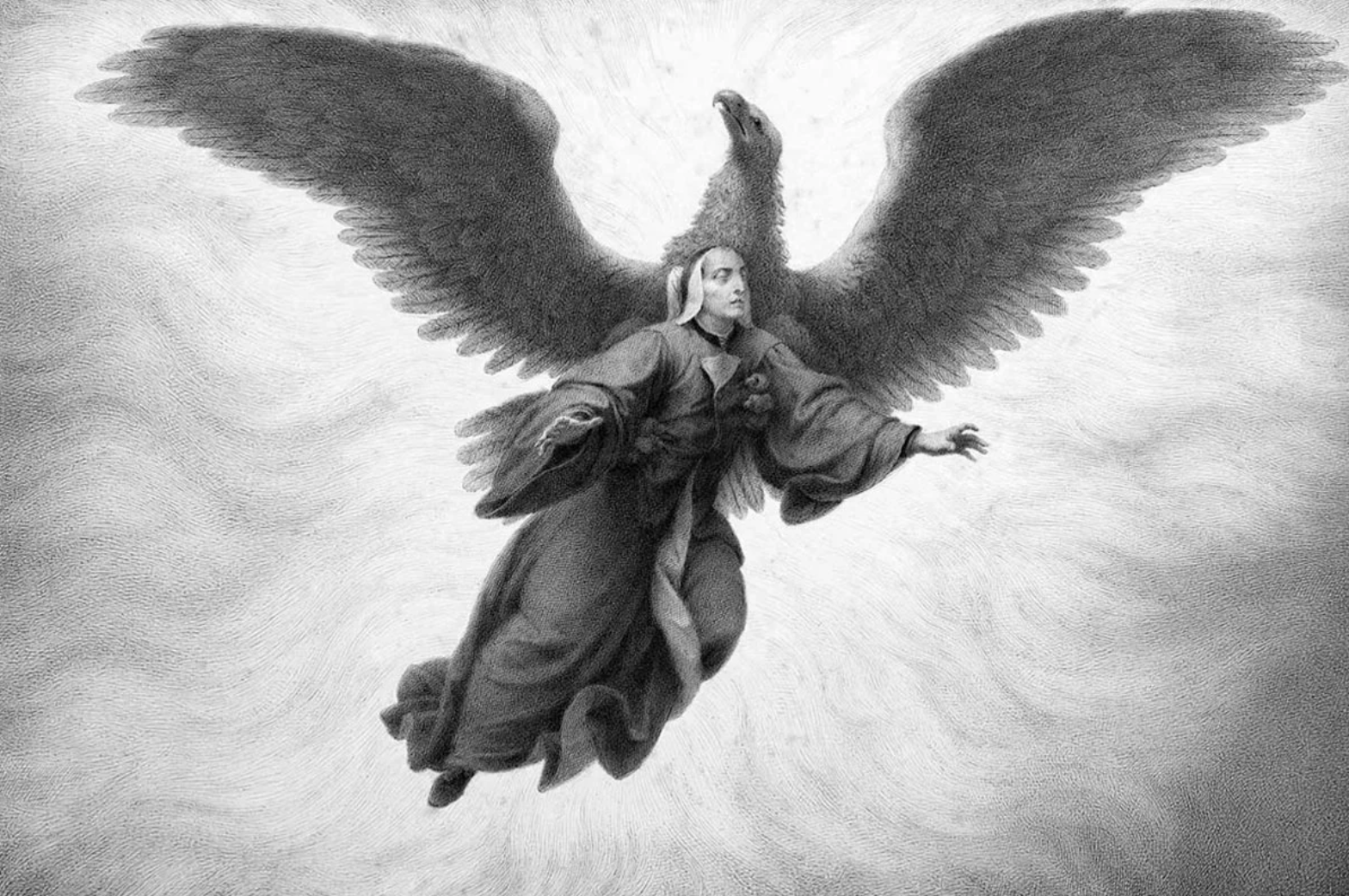
Francesco Scaramuzza, Dante and the Eagle (c. 1860). The sleeping Dante dreamed he was carried by an eagle, but it was really St. Lucy who helped the poet on his upward journey toward heaven’s light (Purgatorio ix).
This homily was preached at St. Luke’s Episcopal Church, Renton, WA, on the 9th Sunday after Pentecost, 2025.
Race photo and video by the author.
[i] The texts for the 8th Sunday after Pentecost are in Wilda C. Gafney, A Women’s Lectionary for the Whole Church, Year C, which differs significantly for the Revised Common Lectionary used by most liturgical churches.
[ii] Bob Dylan, “The Times They Are A-Changin’” (1964).
[iv] The loudest crowd in professional football is in Seattle, where the fans are called “the 12th man” for their ability to influence the game by making it hard for the other team to hear their quarterback’s signals.
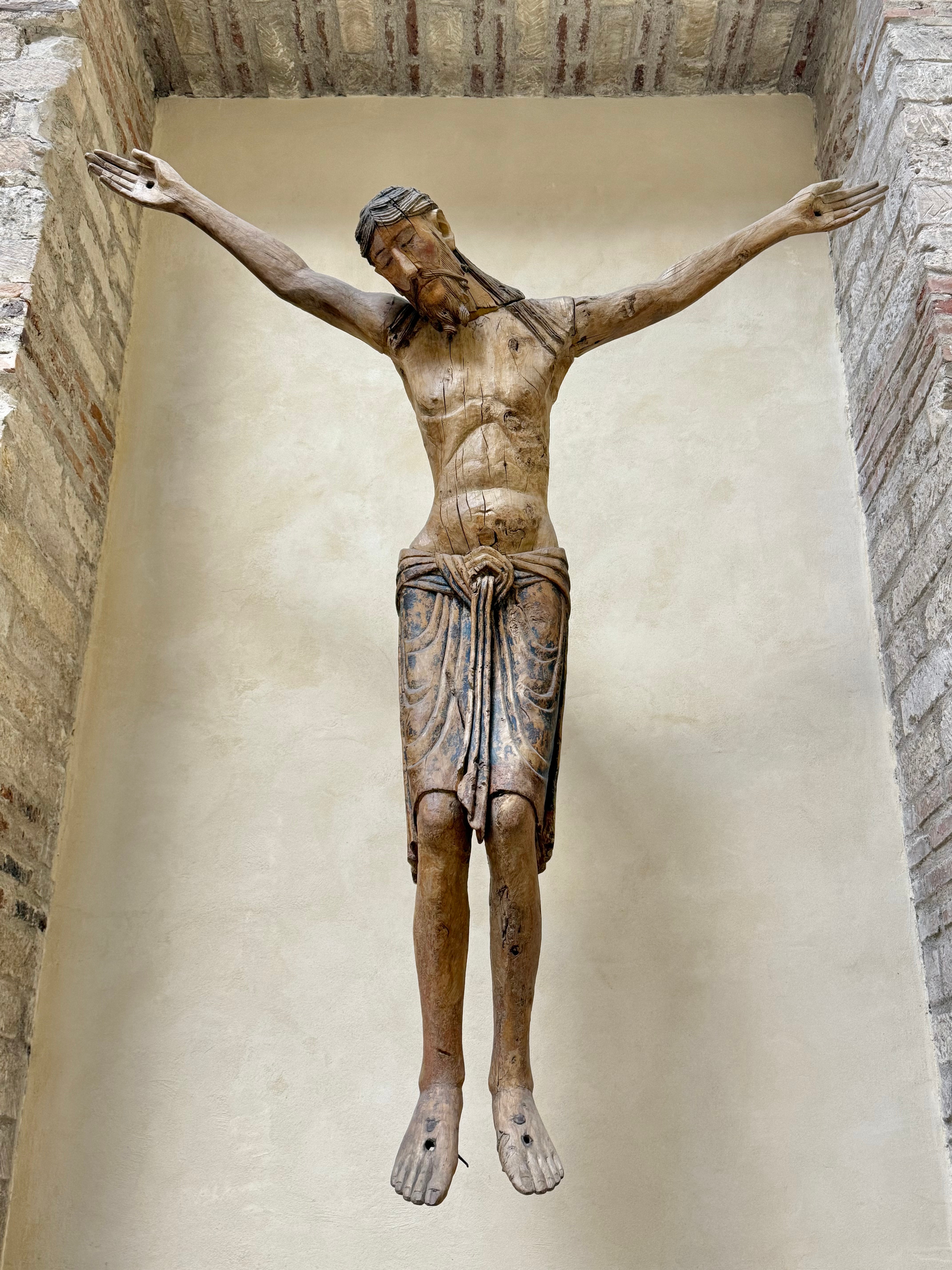
Crucified Christ (northern France, late 12th century).
Isaiah 53:5 But he was wounded for our transgressions, crushed for our iniquities; upon him was the punishment that made us whole, and by his bruises we are healed.
Was it really necessary for Jesus to be pierced and crushed? And how exactly did his suffering and death make us whole? There has never been a conclusive single answer, because any attempt to “solve” the Paschal Mystery with a reductive formula is missing the point. The cross is an experience to enter, not an idea to be explained. “I wonder as I wander out under the sky,” says the old Nativity carol, “why Jesus our Savior did come for to die / for poor ornery people like you and like I. . .” And now, this Holy Week, we come again to the foot of the cross, and we wonder.
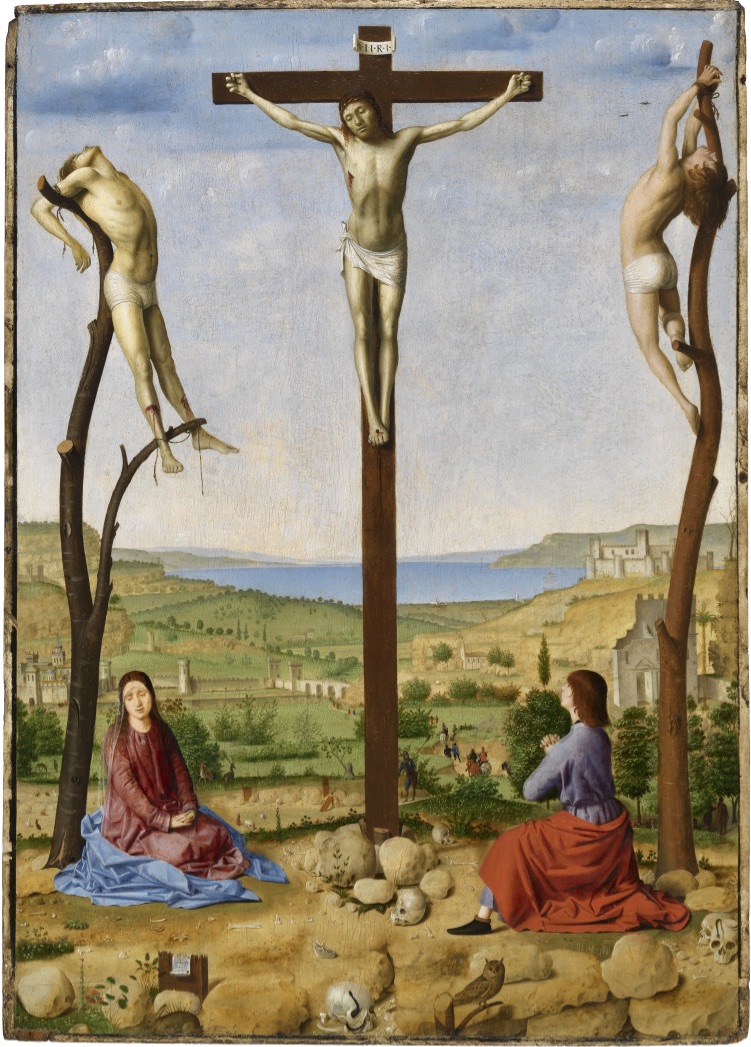
Antonello da Messina, The Antwerp Crucifixion (1475).
Let us discard any crude notions of the cross as a transaction, as if somebody had to pay for all the damage wrought by human sin, so Jesus stepped up like a big spender to declare, “This one’s on me.” Such “substitution” theology either trivializes the cost of sin (can Auschwitz or Gaza be so lightly dismissed?) or risks masochism by stressing the pain of the Passion, as Mel Gibson did in his notorious movie. The sacredness of God’s Friday is not in the violence or the blood, but in the Love that rewrites the darkest story.
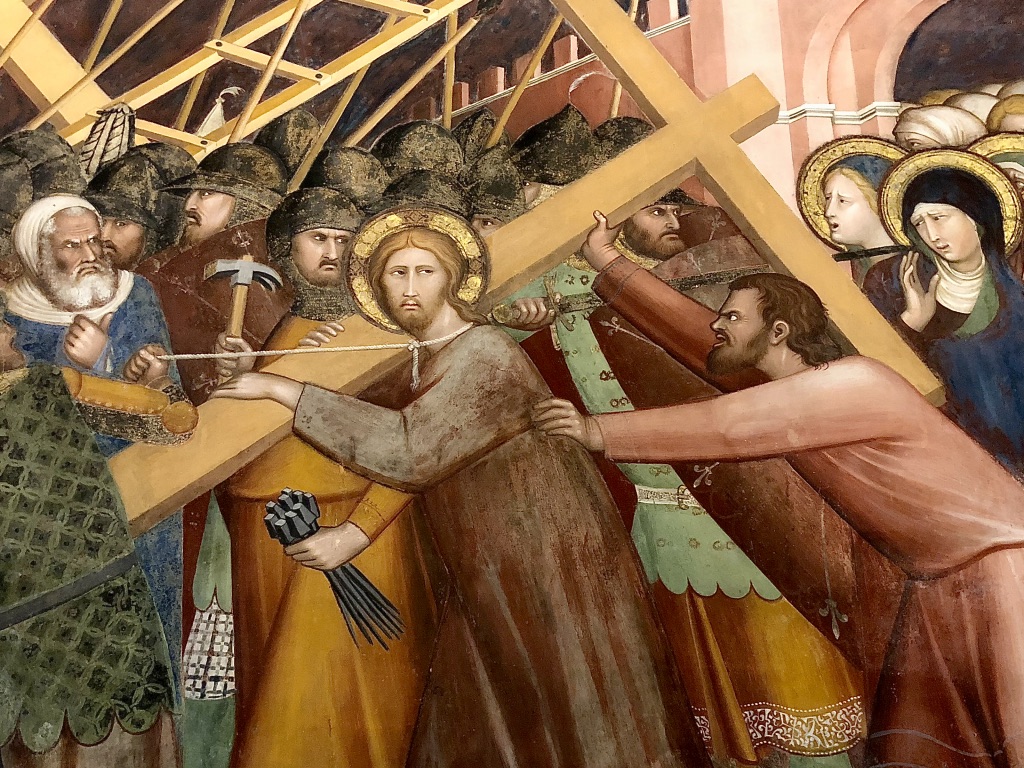
Lippo Memmi, Christ carrying the cross, Duomo di San Gimignano, Tuscany (1335-1345).
And let us not reduce the salvific death of Jesus to a simple case of human cruelty claiming one more victim. Something more than human tyranny and human tragedy—something divine—was at work in the cross. But the divine presence on Calvary’s hill was not in the form of any punishment dished out by an angry God. God was there in the vulnerable, suffering body of Jesus, the Incarnate Word of self-diffusive love, who chose to share the human condition in all its forms—even the bleakest and most wretched. Jesus didn’t suffer instead of us. Jesus suffered with us. And through the humanity of Jesus, our own experience of alienation and affliction has been absorbed into the trinitarian life of God, where it is held in love’s eternal embrace and drained of its toxicity. As the prophet said, By his wounds we are healed.
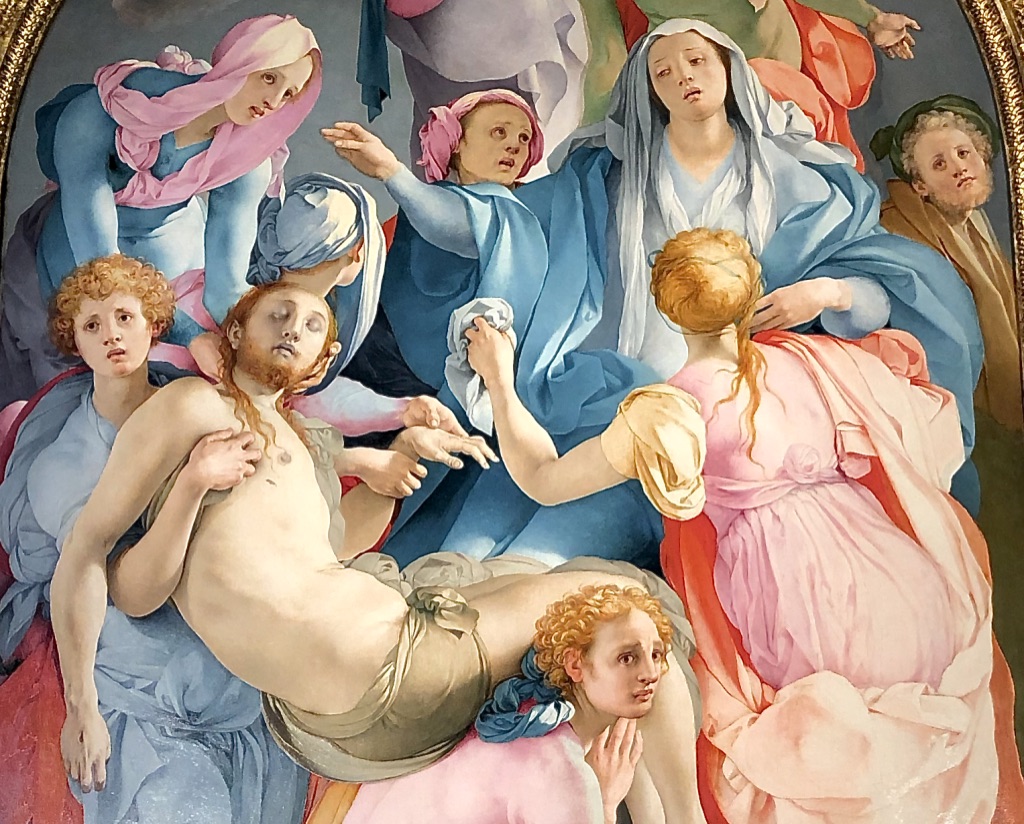
Jacopo Pontormo, Deposition from the Cross, Santa Felicita, Florence (1525-1528).
Or as theologian Paul Fiddes put it, “Far from simply forgetting about the sins of the world, [God] journeys deeply into the heart of [the human] condition. . . God participates in our brokenness, to win us to the offer of healing.” In our own evil time, when hate and cruelty are running wild, sometimes we feel overwhelmed, discouraged, or powerless. But that’s exactly where Jesus comes to join us, not simply to keep us company on the countless crosses of this world, but to transform our sufferings into the seeds of resurrection.
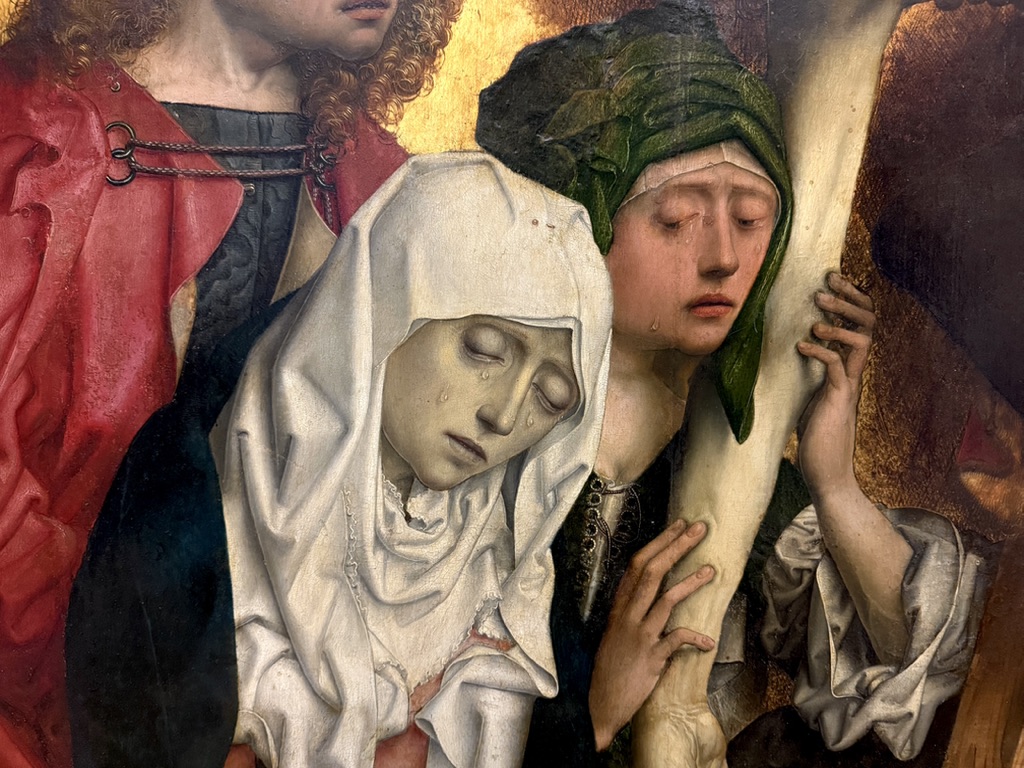
Anonymous “Master of St. Bartholomew,” The Descent from the Cross, Cologne, c. 1480-1510 (detail).
The title is from a hymn by W. H. Vanstone, “Morning Glory, Starlit Sky” (585 in the Episcopal Hymnal 1982)
The Easter Vigil is the molten core of Christian worship: a multisensory passage from darkness to light, death to life. With fire and water, stories and prayers, hymns and chants, candles and incense, bread and wine, it is the most luminous and wondrous of liturgies. The morning rites of Easter Sunday celebrate Resurrection, but the Easter Vigil on the night before feels almost like Resurrection itself. When it’s over, you come away a little dazed, wondering “oh what is that beautiful thing that just happened?” [ii]
After the New Fire is lit at sunset on Holy Saturday, one of the first things that happens at the Easter Vigil is the recitation of narratives and prophetic texts [iii] from the Hebrew Scriptures, beginning with the Creation story (Genesis 1:1—2:4a). In most churches, the texts are read from a lectern, but for nearly four decades, in a dozen different West Coast churches, I have curated the performance of the Vigil lectionary using drama, storytellers, music and projected media.
There’s nothing wrong with a well-read passage of canonical text—I’m quite fond of a good reading by a practiced and thoughtful voice—but sometimes a telling or dramatization can reach places which a reading cannot. Instead of a reader as a passive, transparent window for a sacred text to pass through without inflection or distortion, a teller embodies the text in breath, intonation, gesture and movement, making it alive and present and urgent in the moment of its speaking. And a dramatization can make a familiar story be freshly encountered. A story told or performed rather than read has a unique kind of authority, coming from the heart instead of a book.
The Easter Vigil is the Christian dreamtime, and we try to engage its lectionary accordingly. Biblical stories aren’t just memories about the past. They are living words meant to guide and shape our own responses to the present. As we become steeped in the stories, they begin to dwell in us, and we in them.
When we hear of the world drowning in its own evil, while a faithful remnant tries to navigate the sea of chaos, we recognize ourselves aboard the ark. When we hear of an evil regime trying to crush the ones who are “not like us,” the deliverance of the oppressed at the Red Sea encourages our own struggle to break free of the dark. When we hear of dry bones resurrected by divine breath, our own dead hopes begin to breathe again.
In the darkest days of the Second World War, W. H. Auden wrote a “Christmas Oratorio” [iv] which had no illusions about the world into which God was made flesh:
The evil and the armed draw near; The weather smells of their hate And the houses smell of our fear …
Such days are upon us again, and we truly need our sacred stories—the ones that remember divine intention and a habitable future—more than ever. At our Episcopal parish of St. Barnabas on Bainbridge Island, Washington, where my wife is the rector, I’ve been developing fresh versions of the stories, listening carefully for whatever they want to say to us in the year of our Lord 2025.
We will begin with a pair of texts projected on a screen after the ancient Exultet is chanted. The first says, For God so loved our stories. This is of course a blend of Elie Wiesel’s “God made man because he loves stories” and John 3:16’s “For God so loved the world …” The theology of Incarnation says that God’s own self entered fully into the human story. And the theology of salvation says that we in turn are meant to participate in the divine story. Both meanings are implied in the preface to our Vigil story time, grounding the performed narratives in the conviction that we can meet God in them.
The second text is a verse from Jeremiah (29:11): For surely I know the purpose I have for you, says the Holy One: plans for peace and not for evil, to give you a future and a hope. At a time when our future is in question and hope is stretched thin, God invites us to sit around the Paschal fire and let the stories of promise speak to our hearts once more.
Here is how the telling will go at this year’s Paschal fire:
The Creation: After the voice of e.e. cummings says, “When God decided to invent everything, he took one breath bigger than a circus tent, and everything began,” a big screen lights up with spectacular footage of the natural world, taking us through the first seven days in seven minutes. In response, the congregation is urged “to pray fervently for all the people of the earth, and for ourselves, that we may repent of our careless and arrogant abuse of creation, and find our proper and constructive place within its fragile and balanced harmonies.”
The Flood: Four people at a table engage in Bible study. Some of them resist the story (“Why do we even tell this story? No one wants to believe in an angry God” … “In the beginning, God says everything’s so great. Then suddenly he wants to call the whole thing off?”). Others see a kind of learning going on—God learning to live with an imperfect creation. Then somebody argues that the story is not really about God’s choices or God’s emotional life. It’s about the ark.
“The people who first told this story were just like us. They were adrift in a sea of chaos. Everything they had hoped and believed was underwater, washed away in the blink of an eye, and they wanted to know if they still had a future.”
As the discussion winds down, someone says, “Well, I’d better go feed the animals.” Wild waves appear on the screen behind them. It turns out that they have been on their own ark the whole time. The story they were discussing was happening to them. That’s often true of Bible stories.
The exhortations to prayer that follow each story reiterate the themes of the narrative. After The Flood, the Presider reminds the assembly that “God remains deeply committed to our story … God will not forget us, though we be sinking in a sea of chaos.” And the Deacon bids us pray for victims of natural disasters, all whose lives are beset by chaos, those drowning in the dark waters of doubt and fear, and those who cling to the precious ark of faith.
The Red Sea:
Noirish images of anonymous figures (from a bleak Hungarian film) shuffle through an imprisoning corridor on the screen, while three dancers on the stage express the experience of oppression with their bodies. A narrator explains:
Three thousand years ago, in the land of Egypt, there were people who had no name. They were the faceless many, exploited by the powerful, forgotten by the privileged: slaves, immigrants, the poor, the homeless, the vulnerable, the invisible, the outcast.
Then dismissive terms for the oppressed appear on the screen in stark animated graphics: Not like us … worthless … horrible people … trash … less than human. More images of “the faceless many” are shown as the dancers writhe in despair and an offstage choir sings a verse of “Go down, Moses.”
Suddenly, the divine breaks into this dark world: the screen flashes red, and we see the words from Psalm 68 that are always used in Orthodox Paschal liturgies:
Let God arise! Let the foes of Love be scattered! Let the friends of justice be joyful!
Then we hear a verse of a Civil Rights song: “They say that freedom is a constant struggle … Oh Lord, we’ve struggled so long, we must be free.” The dancers’ bodies shift from oppression to liberation, while the screen shows powerful footage of crowds on the march for justice. As we hear a repeating loop of Martin Luther King saying “We cannot walk alone,” the dancers begin their own march across the stage to the “Red Sea,” where they halt while the narrator declares:
This too is a creation story: On this day, God brought a new people into existence. On this day, God became known as the One who delivers the oppressed, the One who remembers the forgotten and saves the lost , the One who opens the Way through the Sea of Impossibility, leading us beyond the chaos and the darkness into the Light. When the world says No, the power of God is YES!
As the dancers begin to cross the Sea, the choir sings, “We are not alone, God is with us …” After the song, the bidding to prayer begins:
Pray now for the conscience and courage to renounce our own complicity in the workings of violence, privilege and oppression. Pray in solidarity with all who are despised, rejected, exploited, abused, and oppressed. Pray for the day of liberation and salvation.
The Fiery Furnace: This story from the Book of Daniel is borrowed from the Orthodox lectionary for the Paschal Vigil, and its humor (yes, the Bible can be funny) provides some comic relief after the Red Sea. The story’s mischievous mockery of a vain and cruel king, outwitted in the end by divine intention, feels quite timely. The idol shown on the screen is a golden iPhone, which will be destroyed by a cartoon explosion from Looney Tunes. The humorously tedious repetition of the instruments signaling everyone to bow is performed with the following (admittedly unbiblical) instruments: bodhran, bicycle horn, slide whistle, chimes, train whistle, and Chinese wind gong. The Song of the three “young men” in the furnace is recited by three women in an abbreviated rap version. At the end, the cast of twelve exit happily, singing the old Shape Note chorus, “Babylon is fallen, to rise no more!”
The Fall of Babylon, Tapestry of the Apocalypse, Angers, France (1377-1382).
Then we give thanks “for the saints who refuse to bow down to the illusions and idolatries of this world” and pray for “the grace and courage to follow their example, resisting every evil, and entrusting our lives wholeheartedly to the Love who loves us.”
Valley of Dry Bones: Unlike the embellished retellings of the other stories, this one sticks closely to the biblical text, but is delivered in a storytelling mode by a single teller (me) in a spooky atmosphere of dim blue light. The voice of God is a college student on a high ladder. The sound of the bones joining together is made by an Indonesian unklung (8 bamboo rattles tuned to different pitches). When the story describes the breath coming into the lifeless figures sprawled across the valley, I get everyone in the assembly to inhale and exhale audibly a few times so that we can hear the spirit-breath entering our own bodies. Then I move among them, bidding one after another to rise until everyone is standing, completing the story with their own bodies: the risen assembly itself becomes a visible sign of hope reborn.
Then the Presider says,
Dear People of God: There are those who tell our story as a history of defeats and diminishments, a narrative of dashed hopes and inconsolable griefs. But tonight we tell a different story, a story that inhales God’s own breath and sings alleluia even at the grave. By your baptism, you have been entrusted with this story, to live out its great YES against every cry of defeat.
And then, with our sacred stories of faith and hope freshly written on our hearts, we will process from the Story Space to the church for the Renewal of Baptismal vows, followed by the festive first eucharist of Easter, replete with Alleluias. And God willing, by the time it’s all done, none of us will be the same.
May all of you who make the Paschal journey this weekend come to “see and know that things which were cast down are being raised up, and things which had grown old are being made new, and that all things are being brought to their perfection by the One through whom all things were made, our Savior Jesus Christ.” [v]
Resurrection of Christ, Brittany (c. 1425-1430).
All liturgical texts, unless otherwise cited, are by the author. The Easter Vigil at St. Barnabas Episcopal Church (Bainbridge Island, WA) is on April 19, 2025.
[i] The Exultet (“rejoice”) is a chanted praise sung before the Paschal Candle at the Easter Vigil. Dating back to the 7th or 8th century, it is one of the most beautiful chants in the western rite, and its text is packed with striking images and metaphors of Christ’s passage through death to resurrection, and its implications for our own salvation. Singing it at the Vigil has been one of my greatest priestly joys over the years.
[ii] The line is taken from Mary Oliver’s poem, “At Blackwater Pond.”
[iii] The Vigil lectionary is not all stories. Beautiful texts from Isaiah, Baruch, Ezekiel, and Zephaniah are options as well. During the “Story Time” of the Vigil, we stick to the narratives. The non-narrative texts are then recited by readers along the way between the Story Space and the church, so that the people process through a corridor of continuous audible texts on their way to the font of rebirth.
[iv] W. H. Auden began writing For the Time Being: A Christmas Oratorio in the autumn of 1941. It was published in September, 1944). Dark times indeed.
[v] Quoted from the collect (prayer) that concludes the Old Testament readings in the Episcopal Book of Common Prayer.
Jan van Scorel, Woman with the jar of nard (c. 1530).
In all four gospels, there’s a story about a woman who interrupts an intimate dinner party to kneel at the feet of Jesus and make an act of devotion. Luke’s story differs from the others in significant ways, so it may be based on a different incident. But Mark, Matthew and John all seem to be describing the same event. It was a moment which clearly had an indelible impact on the memory of the early Church.
John’s version is the only one which names the woman: Mary of Bethany, whose brother Jesus had just raised from the dead in the gospel’s previous chapter. Coming between the dramatic raising of Lazarus from the tomb and the violent clamor of the Passion, the story is a striking contrast to what came before and what comes after.
Instead of a public event with lots of people, it is quiet and intimate. No wailing mourners, no crowd shouting “Hosanna!” or “Crucify him!” Just Jesus, a few disciples, and his hosts, the siblings of Bethany: Martha, Mary, and Lazarus.
We don’t know what they talked about during that dinner, but the moment had to have been highly charged, given the people around the table: The sisters whose grief had driven the harsh confrontation with Jesus at their brother’s tomb (If you had been here, my brother would not have died!) … the rabbi from Nazareth who had wept his own tears over the death of his friend (and perhaps some tears for the human condition in general) but who also found himself channeling the awesome life-giving power of the divine through his own mortal body …and the stunned man who had been so suddenly snatched from the land of the dead, experiencing what had to be a volatile mixture of awe, gratitude, and PTSD.
Perhaps no one said very much at all. Perhaps they were all still processing the shock of their shared experience at the tomb, letting a profound silence hold their feelings in order to preserve the mystery of it from being reduced to the poverty of language. But at some point, Mary was inspired to acknowledge the sacredness of the moment—not with words, but with a sacramental action.
The text doesn’t give the details, but I imagine her rising from the table, leaving the room for a moment, then returning with a jar of nard, a fragrant oil originating in the Himalayas and transported at great expense along the ancient trade route from Asia to the Middle East. It was worth a year’s wages, so when Mary, without saying a word of explanation, poured it all out over the feet of Jesus, it was quite shocking, like throwing a bag of gold into the sea or setting fire to a pile of paper money.
Then Mary compounded the shock by letting down her hair and using it to rub the oil into Jesus’ skin. No reputable woman would have done such a thing, nor would a religious teacher have permitted himself to be touched in such a way. Nevertheless, that’s how it went.
Judas was at that table, and he couldn’t bear to watch. He was the apostles’ money man, and he objected to wasting wealth that could have done some real good. John’s gospel doubts his sincerity, accusing Judas of embezzling the very funds he was claiming to protect.
I suspect that Judas’ discomfort had more to do with Jesus rewriting the social codes of his culture by endorsing Mary’s action. “Leave her alone,” Jesus tells him. Jesus, unlike Judas, understood that this was a very precious and significant moment, and he wanted to let it happen.
Mary’s extraordinary action, both sensual and symbolic, overflowed with meanings. For one thing, anointing with oil was a way to mark the special vocation and identity of authoritative figures, whether powerful rulers or holy persons. It consecrated them as chosen and set apart. The title of “Messiah” or “Christ” means “the anointed one.”
It was revolutionary to have a woman be the one to anoint Jesus as priest and ruler, but the kingdom of God was all about revolution: the revolution of transforming a disordered and broken world into a more perfect expression of divine intention and human possibility.
Anointing was also part of the culture’s preparation of a body for burial. Performed in the week before Jesus’ death, Mary’s gesture inaugurates the sequence of sacrificial acts culminating with her Lord’s burial in the stone-cold tomb. The feet she anoints will soon walk the Way of the Cross for the salvation of the world. That was Jesus’ chosen destiny, and the oil is an outward and visible sign of his inward consent to perform that destiny.
The story’s third meaning is in its foreshadowing of the foot-washing, when Jesus, on the night before he died, knelt at the feet of his friends to perform the work of a servant, surrendering his power for love’s sake. The foot-washing marked the turning point from a paradigm of domination to a paradigm of communion.
By kneeling at the feet of his friends, Jesus was showing them, and us, an image of humanity’s best version of itself. In that sacramental act, Jesus was saying: This is how we must be with one another, because this is exactly how God is with us.
And in today’s story, just a few days before Jesus would teach this explicit lesson at the Last Supper, Mary of Bethany, foreshadows the foot-washing when she offers, in her own way, all she has, holding nothing back.
And her devotional act of kneeling down to pour out the precious oil not only anticipated the foot washing on Maundy Thursday, it was an image of the divine nature as revealed in the incarnation and crucifixion of Jesus. As one theologian has put it, “The self-giving extravagance of Mary’s actions point to the way Jesus would expend himself completely through his crucifixion.” [i]
In our Palm Sunday liturgy next Sunday, Paul’s Epistle to the Philippians will declare that Jesus emptied himself for us, poured himself out for us, and in so doing he revealed who God is and what God does. Whether in the costly pouring out of the Son’s life on the cross, or in the lavish pouring out of Spirit on Pentecost, God is the One who never ceases to pour out God’s own self.
And when, before his own self-offering, Jesus allowed Mary to anoint him in such a costly manner, she herself became an icon who shows us God with her own body, bowing before Jesus to wipe his feet so tenderly with her hair.
At the time, the disciples did not grasp the full significance of Mary’s act. Nor did Mary herself, I’d imagine. How could they?
As we say around here about Holy Week: The journey is how we know. The disciples had to learn by doing: following Jesus all the way to the cross—and beyond—before they could begin to understand—through memory and reflection—what it was all about. And that is what we will be doing as well during the seven days of Holy Week, not wanting to miss a single step along that sacred way. The journey is how we know.
Before we leave this story, consider the one sentence that stands out from the rest of the text:
The house was filled with the fragrance of the perfume.
There’s nothing else quite like it in the canonical gospels. The Bible in general is short on description and long on action. We never hear about the weather in Jerusalem or the colors of spring in the Galilean hills or the way light falls on the walls of the temple courtyard in late afternoon. So why does John invite us to pause and take in the sweet smell of nard?
In her fascinating book on the olfactory imagination in the ancient Mediterranean, Susan Ashbrook Harvey points out that aromatic spices were thought of as souvenirs of Paradise. When Adam and Eve were expelled from the Garden of Eden, it was said, they were allowed to take away a few fragrant plants to remind them of what they had lost.
Smells are a powerful trigger of memory, and the sweet odors of plants, spices and aromatic oils not only reminded people of Paradise Lost, they were thought to alert our senses to divine presence in a fallen world. They help us remember God. As Harvey writes, fragrance is something like God:
“Unseen yet perceived, smells traveled and permeated the consciousness, transgressing whatever boundaries might be set to restrict their course … Odors could transgress the chasm that separated the fallen order from God; they could elicit an unworldly sensation of beauty.” [ii]
And so we hear St. Paul speak of the fragrance that comes from being “in Christ,” so that we ourselves begin to give off the “aroma of Christ” from our own bodies (2 Corinthians 2:14-16). A few centuries later, Gregory of Nazianzus, in his treatise on the effects of our baptism, wrote:
“Let us be healed also in smell, that we … may smell the Ointment that was poured out for us, spiritually receiving it; and [that we may be] so formed and transformed by it, that from us too a sweet odor may be smelled.” [iii]
And St. Chrysostom, in his 5th-century sermon on today’s gospel, urged his congregation to become like thuribles, sweetening wherever they happen to be with the incense of heaven:
Now the one who perceives the fragrance knows that there is ointment lying somewhere; but of what nature it is he does not yet know, unless he happens to have seen it. So also we. [That God is, we know, but what in substance we know not yet.] We are then, as it were, a royal censer, breathing whithersoever we go of the heavenly ointment and spiritual sweet fragrance.” [iv]
In the spirit of such olfactory tropes, John’s verse about the sweet smell of the nard in that Bethany dining room endow that moment with divine peace and blessing. And the verse is especially vivid in contrast with the stench of mortality hovering around the tomb of Lazarus a few days earlier. Don’t roll away the stone, his sister pleaded. After 4 days inside, the body will smell terrible. Or as the King James Bible memorably put it, “by this time he stinketh.”
But in that sweet-smelling dining room with Jesus and his friends, death and decay are held at bay for a few precious hours. Outside, the world is wild and raging, on the verge of murdering the incarnation of Love. But inside, a woman is imaging the peace of heaven at the feet of her Lord.
For me, this beautiful moment calls to mind a scene from Ingmar Bergman’s classic 1957 film, The Seventh Seal, set in the fourteenth century when the Black Plague is ravaging Europe. A wandering knight is trying to get back home before the plague catches him, stalling for time by engaging Death in a game of chess. He’ll never win, of course, but at one point he meets a kind of holy family: a man, Jof; his wife Mia; and their baby, Michael. They are traveling players who embody the vitality of the life force.
Antonius Block, the knight (Max von Sydow), plays chess with death.
The film ends with the knight taking his inevitable place in the dance of Death, disappearing over the horizon with his fellow mortals. But the “holy family” are not seen among the dead souls, for they have been spared to carry on in this life, untroubled by death because they belong to grace. They know how to accept the music of what happens, and not live in fear.
The knight finds grace in a fallen world: “I shall remember this hour of peace.”
In the sweetest moment of this anguished film, Jof and Mia share their strawberries and milk with the knight, who receives it like a sacrament, a taste of unconquerable life:
“I shall remember this hour of peace,” he tells them. “The strawberries, the bowl of milk, your faces in the dusk, Michael asleep, Jof with his lute. I shall remember our words, and shall bear this memory between my hands as carefully as a bowl of fresh milk. And this will be a sign and a great content.”
An hour of peace, an experience of great content in a world that is coming apart—isn’t that a perfect description of the dinner at Bethany? And are we not in that same place now, with Mary, Jesus, and the rest? The powers of death and malice and mindless destruction are raging outside. We know that. Yet here we are, tasting the bread of heaven, inhaling the fragrance of divine presence.
It’s not about escaping. Not at all. It’s about renewal, so that when we go back out into the world, we can be clear about our vocation: to exude that fragrance—God’s sweetness—in every place we go. And when it gets hard out there—and it will—just call to mind the fragrance of those sacred moments when we dwell in God, and God in us.
This homily was preached at St. Barnabas Episcopal Church on Bainbridge Island in Washington State, on the Fifth Sunday in Lent.
[i] Craig R. Koester, Symbolism in the Fourth Gospel: Meaning, Mystery, Community (Minneapolis: Fortress Press, 1995), 114.
[ii] Susan Ashbrook Harvey, Scenting Salvation: Ancient Christianity and the Olfactory Imagination (Berkeley: University of California Press, 2006), 53.
Marc Chagall, Moses at the Burning Bush (1960-1966): Uniting “incompatible distances.”
I have written repeatedly about major moments of the year such as Christmas, Easter and New Year’s Eve, but the only individual person (other than Jesus) to make repeated appearances on this site is the seventeenth-century Anglican poet-priest, George Herbert (1593-1633). I enjoy many poets, but Herbert’s psalmic verse is a regular part of my prayer life, and I am particularly partial to priests for whom art is a spiritual practice.https://jimfriedrich.com/2015/02/27/heart-work-and-heaven-work/
In “Mans medley,” the poet tests the tension between the earthly and heavenly elements in humanity’s hybrid nature. Just as a musical medley is composed of contrasting parts, so are we a unique blend of animal and angel. When Herbert was seven years old, playgoers first heard Hamlet pondering this paradox of human existence: “how like an angel in apprehension” is this “quintessence of dust”. Ten years after Herbert’s poems were published, Sir Thomas Browne wrote that “we are only that amphibious piece between a corporall and spirituall essence, that middle forme that links these two together” and “unites incompatible distances.” [i]
Mans medley
Hark, how the birds do sing, And woods do ring. All creatures have their joy: and man hath his.| Yet if we rightly measure, Mans joy and pleasure Rather hereafter, then in present, is.
To this life things of sense Make their pretence: In th’ other Angels have a right by birth: Man ties them both alone, And makes them one, With th’ one hand touching heav’n, with th’ other earth.
In soul he mounts and flies, In flesh he dies. He wears a stuffe whose thread is course and round, But trimm’d with curious lace, And should take place After the trimming, not the stuffe and ground.
Not that he may not here Taste of the cheer, But as birds drink, and straight lift up their head, So he must sip and think Of better drink He may attain to, after he is dead.
But as his joyes are double; So is his trouble. He hath two winters, other things but one: Bothe frosts and thoughts do nip, And bite his lip; And he of all things fears two deaths alone.
Yet ev’n the greatest griefs May be reliefs, Could he but take them right, and in their wayes. Happie is he, whose heart Hath found the art To turn his double pains to double praise.
The poem begins with a cheerful celebration of creation: Birds sing, forests ring, and all creatures, humans included, “have their joy.” But difference soon declares itself: below and above, material and spiritual, this life and the next. Only humans partake in each of the oppositions, with “th’ one hand touching heav’n, with th’ other earth.” This is a great privilege. The human alone “ties them both” and “makes them one,” but as the next verse reminds us, our mixed nature is also a problem. We may “flie with angels” as Herbert says in another poem, but we also “fall with dust.”[ii] In soul we mount and fly, but in flesh we die.
“Medley” is related to “motley,” and the image in verse 3 of being clothed in an awkward mixture of fine and coarse materials illustrates our chronic discomfort with humanity’s hybrid nature. To resolve the clashing colors of our mortal outfit, some have sought to suppress, downgrade, or disregard either the earthly or the heavenly. But Herbert seeks to harmonize them in the human medley. Let our joys be “double,” that we may “taste of the cheer” in our sensory existence while continuing to cultivate our taste for the “better drink” of spiritual reality.
The verse about the sipping birds is my favorite part of the poem. Unlike the generalized trope of singing birds in the poem’s first line, the birds in verse 4 are keenly observed in a way that was rare until the Romantics and naturalists of later centuries. The birds don’t keep their beaks in the water until they’re done, but follow each sip with a lifting of the head. Here Herbert takes a homely image from the visible world and makes it a lively spiritual metaphor. Like the birds, we should not gulp down reality without giving it our proper attention. We must learn to “sip and think,” alternating our experience with thoughtful reflection.
And from there the meanings multiply. The “better drink” evokes the sacred wine of the Eucharist, while also recalling the water Jesus changed into wine at the Cana wedding feast. Sip and think. Sip and think. Could that be the essence of spiritual practice?
Our mortality is touched upon in verse 3 (“In flesh he dies”) and verse 4 (“after he is dead”), but verse 5 stops to face our fate directly. As both physical and spiritual creatures, we alone fear “two deaths”—the death of the body and the death of the soul. As dwellers in a secular age, some no longer worry about the fate of body and soul in the afterlife, but is anxiety over a failing body, a shriveled soul or an emotionally dead heart any improvement on the medieval fear of hell? There are many kinds of death, but the inward ones may be the worst.
Marc Chagall, The Prophet Jeremiah (1968).
Herbert doesn’t leave us there. As he warns in his manual of advice for country parsons, “nature will not bear everlasting droopings.” We need to stand on the rock of hope, and remember joy. “Yet ev’n the greatest griefs,” he says, “May be reliefs, / Could he but take them right … / Happy is he whose heart / Hath found the art / To turn his double pains to double praise.”
We may wonder what it means specifically to “take them right.” We could all use some detailed instruction in the art of turning pain into praise, given the rapid escalation of pain in our collective life by a heartless coterie of dead souls. Herbert doesn’t spell it out in this poem, but turning pain into praise is a major theme in his work.
In both our personal spiritual journeys and our collective project of repairing the world, we must practice many virtues: patience, persistence, resistance, constancy, solidarity, compassion, humility—and, crucially, faith, hope and love—if we are to keep moving toward the light. And it is my firm conviction that the antidote to despair is trust in what I would call divine intention: the abiding and faithful Mystery whose desire is the flourishing of creation. That doesn’t mean everything goes perfectly. The Cross is planted deep in human history. But God will not leave us comfortless. The divine Yes has more future in it than a billion Nevers. Here’s how Herbert says it:
I knew that thou wast in the grief, To guide and govern it to my relief, Making a scepter of the rod:
Hadst thou not had thy part, Sure the unruly sigh had broke my heart. [iii]
Virgin and St. John at the Cross, Flanders or Northern France (early 16th century).
[i] Sir Thomas Browne, Religio Medici xxxiv (1643).
I have been writing New Year’s Eve posts since I started this blog in 2014, reflecting on time and change, endings and beginnings, hope and dread, impermanence and possibility. If you are curious about the workings of hope in the best of times and the worst of times, follow the links in my post on the last day of 2023. But let me say a few things here and now.
On the eve of 2025, many Americans are finding it hard to celebrate the unfolding of a dubious future. The powers of negation are shamelessly eager to destroy the good and torment the vulnerable, both here and abroad. Their malice and corrruption have no apparent bounds. LIke poor Lillian Gish lying exhausted and unconscious on an ice floe in the silent movie classic, Way Down East (1920), we the people (also exhausted and to some degree unconscious) are being swept toward the waterfall of doom.
Lillian Gish in D. W. Griffith’s Way Down East (1920). Her hand suffered lifelong damage from the freezing river. In the movie, she is rescued just before going over the falls. Will the same go for us?
So Happy New Year, right? But as a friend declared on his Christmas card, “Hope is here—if we have eyes to see and hearts to respond.” Hope isn’t knowledge. It does its work before any outcomes are experienced. Who knows exactly how we will get through the coming year?
Since evil is the rejection of the co-inherence which is Love’s foundation—we are all in this together, part of one another—the toxic collection of so many egos dedicated to themselves alone may eat itself into oblivion. Or perhaps this time of trial will prove the refiner’s fire that burns away enough of our own sins and offenses to produce souls better fit for the human destiny of communnion and service revealed by the Incarnation. Or perhaps these awful times will ruthlessly strip away our false dependencies and hollow illusions until we are able to entrust ourselves wholly to Divine Mercy and nothing else. None of these options is a get-out-of-suffering card, but they are the kinds of things that clarify how real and urgent our faith, hope and love need to be these days.
This Christmastide, I’ve been re-reading Charles Williams’ “supernatural thriller,” War in Heaven, in which several malevolent individuals invoke demonic forces, not only to gain power but also for the perverse pleasure of destroying whatever is true and good. Their chief nemesis is an Anglican archdeacon, who endures their evil words and deeds with an extraordinary calm, rooted in his sense of the creative and loving God holding all things together. “This also is Thou” is one of Williams’ key phrases. Everything is pregnant with invisible reality, and souls may be won or lost in the most ordinary situations, words and gestures as they embody—or renounce—the Way of Love. Neither calamity nor chaos can shake the priest’s steadfast faith in an upholding, transcendent Presence. In the kind of dialogue only Williams could write, the Archdeacon declares,
“After all, one shouldn’t be put out of one’s stride by anything phenomenal and accidental. The just man wouldn’t be.”
Well, there we are. The evils of the coming days will be phenomenal and accidental. Though they will hurt, they will never be quite solid or real or enduring in the way that the Love, Justice and Mercy of God are, now and forever. We shall not remain silent about the damage, or complacent about the consequences of those evils. But we must not give them the power and glory which are God’s alone.
Weeping may spend the night, but joy will come in the morning (Psalm 30:6). In the meantime, may we rest securely in the One who makes all things new.
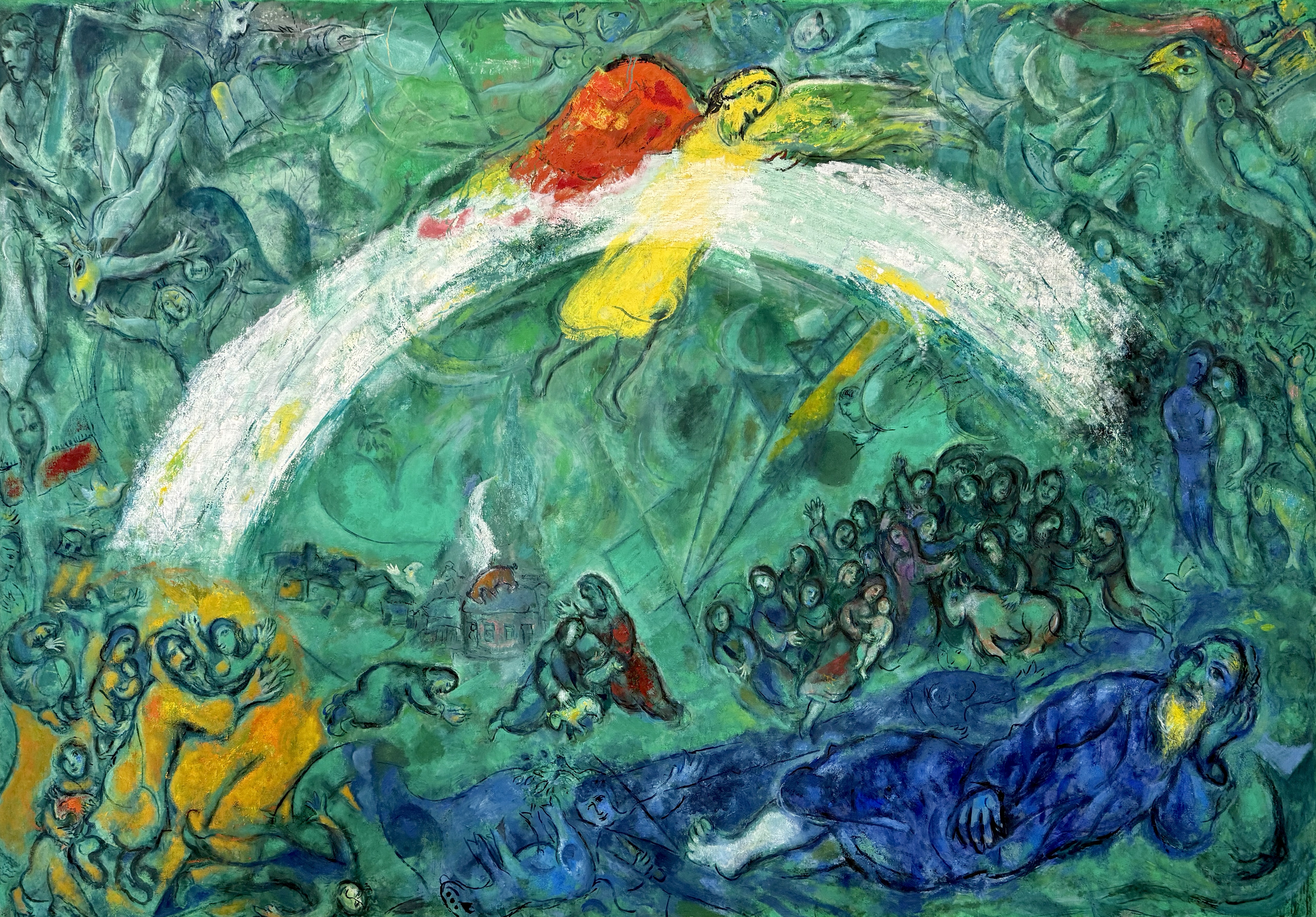
Marc Chagall, Noah’s Ark (detail), 1961-1966. Artists have typically painted the ark from outside, tossed by an angry sea. But Chagall shows the ark’s interior as an aquatic womb where hope is biirthed amid the storm. His head bent in prayer, Noah sends forth the dove as a sign of enduring faith and living hope.
Thank you to all of you who have read, pondered, commented, and shared my posts during the past year. Your own responses (shared or unshared) are why I write. I wish you great joy and real peace in 2025. Happy New Year! I’ll see you in January. I’m sure there will be lots to talk about.
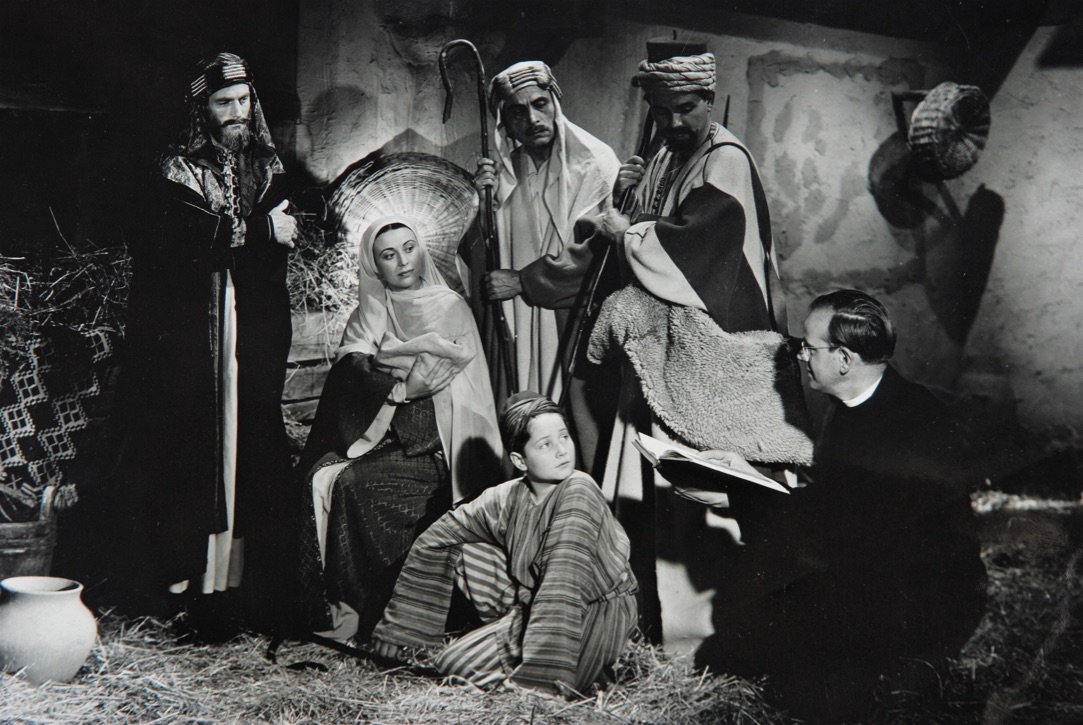
The Rev. James K. Friedrich (right) on the set of Child of Bethlehem (1940).
For he is our childhood’s pattern; Day by day, like us He grew; He was little, weak and helpless, Tears and smiles like us He knew; And He feeleth for our sadness, And He shareth in our gladness.
— Cecil Frances Alexander, “Once in Royal David’s City”
My sisters and I each had an unusual childhood connection with the Nativity story. Our father, the Rev. James K. Friedrich, was the pioneer of Christian movie-making in America, and one of his first biblical films was Child of Bethlehem, produced in 1941. My sister Martha was a newborn child then, so she got to play the baby Jesus. Nine years later, my father made Holy Night, the first of a twelve-part series on the life of Christ. I was four years old at the time—much too old to get the leading role—so I was cast as a shepherd boy, entering the stable with several adult shepherds.
In the film, I have a dazed look on my face. I was literally blinded by the light on the Hollywood soundstage where the interiors were shot. Film stock in those days was not as light-sensitive as our camera phones. It required intense illumination to register a proper image. A big row of Klieg lights set up behind the manger threw such a blaze into my eyes that I could barely see the Holy Family. When I hear Luke’s gospel report that “the glory of the Lord shone all around” the shepherds, the indelible memory of those lights at Goldwyn Studios comes to mind.
James L. Friedrich (next to the donkey) at the manger in Holy Night (1949).
My oldest sister, Marilyn, never played in a Nativity film. Hers was a more literal reenactment. In 1936, my parents had stopped in Jerusalem during their honeymoon. In those days, as today, there was violence in the land, and they were warned not to go down the hill to Bethlehem in a car, because cars were easy targets for snipers. It was safer to ride a donkey to the place of Jesus’ birth. My dad recorded their pilgrimage with his 16mm movie camera, and now, every Christmas, I can watch the footage of my mother riding a donkey to Bethlehem, pregnant with her firstborn child.
To Marilyn’s credit, she has never made any personal claims about her origins, but there is, I believe, gospel truth in our childhood memories. Each and every one of us is called to play our part in the Nativity story, but not merely as witnesses like the shepherds or pilgrims like the Magi. God was made flesh so that our own flesh, our own story, may birth the divine intention and the divine life.
You see, the Incarnation isn’t only a matter of God wanting to share our humanity, to make our humanness part of the divine experience. It also reveals God’s desire that we in turn become partakers of the divine nature.
St. John put it this way in his gospel:
To all who received the Incarnate Word, who believed in his name, the Word gave power to become children of God, who were born, not of blood or of the will of the flesh or the will of human beings, but of God (John 1:12-13).
In the centuries that followed, this theme of theosis, or deification––becoming God-like––has pushed the envelope of anthropology by setting a very high bar for the definition of human potential.
In the early church, Irenaeus said that “God became what we are, in order to make us what he is.” Athanasius was even more explicit about the consequences of Incarnation, saying that “God became human so that humans might become God-like.” God-like! Can we even imagine this in our own day, when we are assaulted incessantly by news of human depravity.
Martin Luther, perhaps surprisingly for someone so focused on the burden of human sin, said we were all called to be “little Christs,” and in a Christmas sermon he described the Incarnation as a two-way street: “Just as the word of God became flesh,” he said, “so it is certainly also necessary that the flesh may become word. . . [God] takes what is ours to himself in order to impart what is his to us.”
In the 18th century, some of Charles Wesley’s great hymns were almost shockingly explicit about our capacity to contain divinity.
He deigns in flesh to appear, Widest extremes to join, To bring our vileness near, And make us all divine.
Heavenly Adam, life divine, Change my nature into Thine; Move and spread throughout my soul, Actuate and fill the whole; Be it I no longer now Living in the flesh, but Thou.
In the 20th-century, whose atrocities left our confidence in human potential badly shaken, the Catholic contemplative Thomas Merton could still claim that we “exist solely for this, to be the place God has chosen for the divine Presence. The real value of our own self is the sign of God in our being, the signature of God upon our being.”
And after his famous epiphany at the corner of Fourth and Walnut in Louisville, Merton said, “It is a glorious destiny to be a member of the human race, though it is a race dedicated to many absurdities and one which makes many mistakes: yet, with all that, [God’s own self] glorified in becoming a member of the human race.
“I have the immense joy of being [a human person],” he continued, “a member of a race in which [God’s own self] became incarnate. As if the sorrows and stupidities of the human condition could overwhelm me, now that I realize what we all are. And if only everybody could realize this! But it cannot be explained. There is no way of telling people that they are all walking around shining like the sun.”
Is this all this talk about divinization going too far? Could we really be walking around shining like the sun? Or at least have the potential for such glory, even if we’re not there yet? If the Nativity in Bethlehem means what I think it does, then the answer has to be yes.
On that wondrous night in Bethlehem, our nature was lifted up as the place where God chooses to dwell. We may still be works in progress, but we are bound for glory. St. Paul believed this when he said that “all of us, with our unveiled faces like mirrors reflecting the glory of the Lord, are being transformed into the image that we reflect in brighter and brighter glory” (II Cor. 3:18).
Another ancient theologian said, “As they who behold the light are within the light and partake of its brightness, so they who behold God are within God, partaking of God’s brightness.”
What happens in Bethlehem doesn’t stay in Bethlehem.
Adoration of the Christ Child, Flemish follower of Jan Joest of Kalkar (c. 1515)
On the Winter Solstice over 40 years ago, I was flying across the San Fernando Valley into L.A.’s Burbank airport on a brilliant December day. The noonday sun was low enough in the southern sky to be reflecting its rays off the surface of swimming pools running along a line parallel to our flight path. There are so many pools in the Valley, and each one, as it was struck by the sun, exploded with an intense dazzle of white light. In rapid succession, tranquil blue surfaces were transformed into momentary images of the sun’s bright fire. For me, it was a vision pregnant with the Christmas promise.
“They who behold the light are within the light and partake of its brightness.” Our pale mirrors are made to contain the most impossible brilliance. And though we have turned away from the Light, the Light seeks us out. No matter how shadowy the path we have taken, the Light will find us, and fill us with divine radiance. That is our destiny, says the Child in the manger. We may not feel capable or worthy or prepared to receive the Word into the flesh of our own lives, but it is what we were made for. Paradoxical as it may sound, partaking of divinity is the only path to becoming fully human.
A month before he died, Edward Pusey, a 19th-century English priest, wrote to a spiritual friend about our God-bearing capacity:
“God ripen you more and more,” he said. “Each day is a day of growth. God says to you, ‘Open thy mouth and I will fill it.’ Only long. . . The parched soil, by its cracks, opens itself for the rain from heaven and invites it. The parched soil cries out to the living God. O then long and long and long, and God will find thee. More love, more love, more love.”
Participating in divinity doesn’t mean having superpowers or being invulnerable. We won’t be throwing any lightning bolts. Just look at Jesus. His life tells you what “God-like” means. He was born in poverty and weakness, in a stable not a palace, and he lived a life of utter self-emptying and self-offering, giving himself away for the life of the world.
In a novel by the Anglican writer Charles Williams, a young woman goes to church with her aunt on Christmas morning. She is a seeker, not quite a believer, but as they sing a carol about the mystery of the Incarnation, she leans over and whispers to her aunt, “Is it true?” Her aunt, one of those quiet saints who has spent her life submitting to Love divine, turns to her niece with a smile and says simply, “Try it, darling.”
So if you want to try it, if you want to complete your humanity by partaking of divinity, there are many ways to do that. Weep with those who weep and dance with those who dance, the Bible says. Love God with all your heart, and your neighbor as yourself. Welcome the stranger, feed the hungry, free the captive. There are plenty of to-do lists out there. Here’s an excellent one from the Dalai Lama:
May I become at all times, both now and forever: A protector for all who are helpless. A guide for all who have lost their way. A ship for all who sail the oceans. A bridge for all who cross over rivers. A sanctuary for all who are in danger. A lamp for all who are in darkness. A place of refuge for all who lack shelter. And a servant for all those who are in need. May I find hope in the darkest of days, and focus in the brightest.
My friends, Bethlehem is not a dream fading away into the past. It is the human future. And this is not the morning after. It is the first day of the rest of our journey into God.
A sermon for Christmas Day at Saint Barnabas Episcopal Church, Bainbridge Island, Washington.
Extra! Extra! Read all about it. SUN GOES OUT! STARS FALL FROM HEAVEN! THOUSANDS FAINT FROM FEAR!
On the first day of the Christian Year, do we break out the champagne and shout “Happy New Year.” No we do not. What we say is, “The end is near!”
We don’t get all Fundamentalist about it. We don’t walk around wearing signboard warnings. We don’t declare a fixed date for the end of history. We prefer to keep our end time theology more metaphorical than literal. Worlds end all the time. Personal worlds. Public worlds.
Still, this year, from Gaza and Ukraine to Washington, D.C., the end of the world feels closer to being literal than any other time in my 80 years on the planet. To borrow some lines from W. H. Auden’s Good Friday poems, lately it feels as if the world we know has been “wrecked, / Blown up, burnt down, cracked open, / Felled, sawn in two, hacked through, [and] torn apart.”
For Christians, the end of the world should not come as a total surprise. Every gospel on the First Sunday of Advent includes a forecast of the apocalypse—the end of the world as we know it. It’s not that uncommon, actually. Who has not experienced apocalypse on a personal level—the exit from childhood, the loss of a job or a loved one, a scary diagnosis? And throughout history, apocalyptic episodes have periodically disrupted the stability of humanity’s collective life: the fall of empires, economic crashes, military invasions, revolutions, authoritarian nightmares, environmental crises, and the like.
In the Humphrey Bogart movie, Beat the Devil, a ship is floundering on a stormy sea. In his typical wise-cracking manner, Bogie says to a panicky passenger, “What have you got to worry about? We’re only adrift on an open sea with a drunken captain and an engine that’s liable to explode at any moment!”
A crewman chimes in: “Perfectly ordinary situation. It happens every day.”
Like it or not, we’re all on board that sinking ship at the close of 2024, praying desperately with the Psalmist, “Save me, O God! The water has risen up to my neck; I’m sinking into the mire” (Psalm 69:1-2) Perfectly ordinary situation. It happens every day.
Angel blowing the 2nd trumpet as the sea swallows ships and sailors (Revelation 8:8). The Apocalypse Tapestry of Angers (1373-1382). Photograph by the author.
When I was younger, I had a crushing experience of my personal world coming undone. A spiritual director summed up my situation as being washed overboard into a wild sea, where I’m flailing to keep my head above water.” “Sounds about right,” I said mournfully. “Well, congratulations!” he told me. “You’re exactly where you need to be.” I had to laugh at the aptness of his metaphor. My apocalypse had indeed revealed the unsustainability of my former state, even as it hurled me into the formless chaos from which my new world would be born.
Saint Michael weighing souls (c. 1180), Saint-Trophime, Arles, France. Photograph by the author.
Apocalypse can be an unwelcome judgment on the way things are. It weighs the world in the scales of justice and finds it wanting. The judgment is not punitive, simply accurate. As a 14th-century English poem on the end of the world put it, the apocalypse judges “without revenge or pity.” It just tells it like it is. Still, it’s a hard thing to face the truth about our flawed condition. However, the end of an old reality can also be life-giving, freeing us to discover a better version of self and world.
But where can we put our feet when the ground is crumbling beneath us? We stand on God’s word, God’s promise, God’s hope. “Heaven and earth will pass away,” Jesus says, “but my words will not pass away.” Let the Savior’s words guide us. Let them encourage us. As he told his disciples,
“When the chaos comes, keep your heads high and stand your ground. Your liberation is on its way. Don’t be distracted by thoughtless living, or get weighed down with worry,” he says. “Be alert at all times, and pray that you’ll have the strength to get through all this craziness.” [i]
This is my 55th year of preaching in Advent. It’s my favorite season, so rich with resonant and stirring themes: endings and beginnings, light and darkness, waiting and preparing, watching and hoping, expectation and, in the end, marvelous birth. But this year Advent feels decidedly more urgent and more serious to me than ever before. We aren’t just reading about a people who sit in darkness. We are those people.
We could weep and moan about being stuck in this particular moment in history. But what if the Lord of history is telling us, “Congratulations! You are just where you need to be—in the wild baptismal sea of rebirth. Come, take up your cross. Following me is about to get really real and really intense. Costly? Yes. Suffering? Yes. Dying? Yes. Rising? Yes! Start to live the risen life like you mean it!
Okay, Lord. But what exactly is that going to entail? This question came up when I ran into friend from church on the ferry last week. “What are we supposed do if they begin to round up the most vulnerable in our midst?” she asked. “Join hands to block their way with our bodies?” The strangeness of such a hypothetical even being asked in our peaceful corner of the world prompted a helpless shrug.
Seeking some guidance from my library, I pulled out a book published a few years ago: The Year of Our Lord 1943: Christian Humanism in an Age of Crisis. The author, Alan Jacobs, examins the responses of Christian intellectuals to the violent chaos of the Second World War. What did some of the most articulate of God’s friends have to say about being faithful in a dark and dangerous time?
When the war broke out in 1939, Anglican poet W. H. Auden put the case bluntly: We must love one another or die. A year later, he wrote New Year Letter(January 1,1940), a long poem considering “what is possible and what is not” in such a time.
Most of the poem is addressed to Elizabeth Mayer, a supportive maternal figure who was a key source of peace and happiness in Auden’s life.
We fall down in the dance,” he wrote. “We make The old ridiculous mistake, But always there are such as you Forgiving, helping what we do. O every day in sleep and labour Our life and death are with our neighbor.
In other words, we are all in this together. The end of New Year Letter is addressed to God, asking for divine help in making a better world, since we humans are too muddled to do it on our own.
“Send strength sufficient for our day,” he wrote. “And point our knowledge on its way.”[ii]
His friend C. S. Lewis worried about the Church endorsing the violence in its prayers. On September 10, 1940, he wrote to his brother, “In the litany this morning we had some extra petitions, one of which was ‘Prosper, O Lord, our righteous cause.’ I ventured to protest against the audacity of informing God that our cause was righteous—a point on which He may have His own view.” [iii]
Lewis preferred the wartime collect of Thomas Cranmer, the Archbishop of Canterbury who made the first Book of Common Prayer. During hostilities with Scotland in 1548, Cranmer wrote this extraordinary collect:
“Most merciful God, the Granter of all peace and quietness, the Giver of all good gifts, the Defender of all nations, who hast willed all men to be accounted as our neighbours, and commanded us to love them as ourself, and not to hate our enemies, but rather to wish them, yea and also to do them good if we can: … Give to all us desire of peace, unity, and quietness, and a speedy wearisomeness of all war, hostility, and enmity to all them that be our enemies; that we and they may, in one heart and charitable agreement, praise thy most holy name, and reform our lives to thy godly commandments.” [iv]
In other words, in times of conflict, Christians must take care not to mirror the violence we oppose. We must find a way toward peace and reconciliation. But what if there are no good choices available?
The German theologian Dietrich Bonhoeffer knew how bitter conflict corrodes the human heart. In a 1942 letter to fellow members of the German resistance, he wrote:
“Unbearable conflicts have worn us down or even made us cynical. Are we still of any use? We will not need geniuses, cynics, people who have contempt for others, or cunning tacticians, but simple, uncomplicated and honest human beings.” [v]
In the desperate hope of derailing the Nazi horror, Bonhoeffer reluctantly joined a conspiracy to assassinate Hitler. The plot failed and he was executed for his role in it. A new film about him depicts him going to the gallows confident in his own purity of heart, but the fact is he never stopped feeling guilty for his participation the way of violence. He felt corrupted by the whole milieu of bloody conflict: shooting, wrecking, bombing—none of it is untainted by evil.
Simone Weil, French philosopher and activist, agreed that everyone is a victim of war. No one involved in the application of force escapes its toxicity. “To the same degree,” she said, “though in different fashions, those who use it and those who endure it are turned to stone.” When the Second World War started, Weil warned that
“We should not think that because we are less brutal, less violent, less inhuman than those we are confronting, we will prevail.” We must find a way, she insisted, to exercise the opposing virtues.
In late 1942, when Weil was working in the London office of the French Resistance, she proposed a plan to parachute hundreds of white-uniformed nurses onto battlefields, not only to tend to the wounded but also to provide an image of self-sacrificial goodness in the midst of cruelty and violence. She herself wanted to be in the first wave of this non-violent invasion. In submitting her plan to the Free French authorities, she made a visionary argument:
A small group of women exerting day after day a courage of this kind would be a spectacle so new, so significant, and charged with such obvious meaning, that it would strike the imagination more than any of Hitler’s conceptions have done.” [vi]
Charles de Gaulle thought her quite mad, and her plan of course went nowhere. But her saintly resistance to the application of force was a bright candle in the wind of war.
I am moved by all the stories of faithful people trying to follow the light in an age of shadows. Their wsdom can guide us. Their endurance can encourage us.
Now saintly virtues may not be the way of the world, but as Thomas Merton liked to say, we are not called to be successful. We are called to be faithful. “Perfect hope,” he wrote, “is achieved on the brink of despair when, instead of falling over the edge, we find ourselves walking on air.” [vii]
Remember those old Sherlock Holmes movies with Basil Rathbone> In 1942, when the outcome of the war was still uncertain, Universal Studios modernized Holmes, recruiting the Victorian detective for the war effort in Sherlock Holmes and the Voice of Terror. After a successful takedown of Nazi spies, Holmes and Watson walk to edge of Dover’s cliffs to gaze across the English Channel. Watson begins the conversation that concludes the film:
—“It’s a lovely morning, Holmes.” —“There’s an east wind coming, Watson.” —“Oh, I don’t think so. It looks like another warm day.” —“Good old Watson. The one fixed point in a changing age. There’s an east wind coming, all the same. Such a wind as never blew in England yet. It will be cold and bitter, Watson. And a good many of us may wither before its blast. But it’s God’s own wind, none the less. And a greener, better, stronger land will lie in the sunshine when the storm has cleared.”
That bit of wartime propaganda, pep talk for a battered nation, came to mind as I pondered on today’s apocalyptic theme. “A cold and bitter wind … many of us may wither before its blast.” An accurate forecast. But beyond that, a glorious spring, when a “greener, better, stronger land will lie in the sunshine.”
God, bring that day closer. In the meantime, we pray with Emily Dickinson (#131):
Grant me, O Lord, a sunny mind— Thy windy will to bear!
So—How exactly do we cultivate a sunny mind in a gloomy time? We’ve all been working that problem this fall. Over the past month, I’ve found myself focusing on three spiritual practices: Do not let your hearts be troubled … Don’t get lost in the dark … Remember beauty.
First thing:Do not let your hearts be troubled. Step away from the screen. Don’t obsess on worst case scenarios, fretting over every potential bad outcome. There are too many to count, and it will only discourage and exhaust you. Sufficient unto the day is the evil thereof.
As Palestinian-American poet Naomi Shihab Nye reminds us, we must “Break the Worry Cocoon”—
To live with what we are given— graciously, as if our windows open wide as our neighbors’, as if there weren’t insult at every turn. How did you do that? …
How did you survive so much hurt and remain gracious, … how did you believe, then and forever, breaking out of the endless worry cocoon, something better might come your people’s way? [viii]
Second thing: Don’t get lost in the dark. Don’t get mesmerized by the horror. Evil is like Medusa’s face. Gaze too long and you turn to stone. How do we hate hate without becoming hateful ourselves? The rage provoked by repugnant beliefs, bad behavior and delusional assertions can become addictive. It feels good to denounce the deplorable scoundrels. It’s even entertaining to watch others do it. We think we are resisting evil, but our hate only serves to feed the beast.
Third thing:Remember beauty.
During the American Civil War, landscape painting was very popular. It offered tranquil scenes of an American Eden, unspoiled by the tragedies of history. There wasn’t the slightest hint of the violence raging in the land. When I was looking through reproductions of those works the other day, I was particularly struck by Alfred Thompson Brecher’s “Up the Hudson.” The broad river is absolutely still. The misty atmosphere glows with amber light. One tiny figure drifts quietly in his canoe. It is a picture of absolute calm and peace. I was taken by its beauty, but what really hit me was the year it was painted: 1864, the same year the painter’s brother died in one of the war’s bloodiest battles.
Alfred Thompson Brecher, Up the Hudson (1864).
And I wondered: Did Brecher paint it before or after he got the terrible news? I’d like to think it was after, as if the artist were resisting despair by pledging his allegiance to the harmonizing beauty of God’s creation, a beauty that transcends every evil.
Remember beauty. In October, 1967, 100,000 people gathered at the Lincoln Memorial in the nation’s capital for the first national demonstration against the war in Vietnam. I was there with a number of fellow seminarians. There were speeches and songs during the day, but around sunset about half the crowd marched across the Potomac to the Pentagon, which was surrounded by soldiers in gas masks holding rifles with fixed bayonets. They stood frozen like statues when young women stuck flowers in their gun barrels. I had a camera, and took some dramatic closeups of the soldiers.
Paratroopers guard the Pentagon during the first national protest against the war in Vietnam (Octobver 21, 1967). Photograoph by the author.
As the evening progressed, tensions grew, and a riot broke out, with lots of tear gas and hundreds of arrests. But I missed all that violence, because I had left early in order see the full moonrise over the reflecting pool in the National Mall. It was absolutely beautiful. I still have the photograph.
The full moonrise at the National Mall in Washington, D.C., on October 21, 1967. Across the Potomac at this moment, demonstators are clashing with paratroopers at the Pentagon. Photograph by the author.
On that day I had done my part in a public witness for peace; but when night came, the very best thing I could do was to notice the beauty of the moonrise. I like to think that both those things got recorded in the Book of Life. Come, labor on; but don’t forget the Sabbath moments.
Dear friends in Christ, let us cast away the works of darkness and put on the armor of light. Keep the faith. Fear not. Embody hope. Love one another. Trust divine intention. This is the holy work God has given us to do.
A few hundred years ago, Turlough O’Carolan, the blind harper and last of the Irish bards, was sitting in a tavern with his friend, the poet Charles McCabe. McCabe said, “Your music, sir, is grand and lovely stuff, but too light-hearted. This is a dark time we live in, Mr. Carolan, and our songs should reflect that.”
And the harper replied, “Tell me something, McCabe. Tell me this: Which do you think is harder—to make dark songs in the darkness, or to make brilliant ones that shine through the gloom?” [ix]
Provencal moon. Photograph by the author.
A homily for the First Sunday of Adven at Saint Barnabas Episcopal Church, Bainbridge Island, Washington.
The images of the Apocalypse are from the Tapestry of the Apocalypse in Angers, France. Originally 140 meters long, over time it has been reduced by a third. Woven in the late 14th century, it offers spectacular illustrations of the Book of Revelation.
[v] Dietrich Bonhoeffer, “After Ten Years” in Letters and Papers from Prison (Minneapolis: Fortress Press, 2010). Translated by Barbara and Martin Rumscheidt.
[vi] Simone Weil, quoted in Robert Zaretsky, The Subversive Simone Weil: A Life in Five Ideas (Chicago: University of Chicago Press, 2021), 155.
[vii] Thomas Merton, No Man Is an Island (206), q. in The Thomas Merton Encyclopedia (Maryknoll, NY: Orbis Books, 2002), 213.
[viii] Naomi Shihab Nye, “Break the Worry Cocoon,” Voices in the Air: Poems for Listeners (New York: Greenwillow Books, 2022), 96-97.
[ix] From the play, O’Carolan’s Farewell to Music by Patrick Ball and Peter Glazer, on the California Revels CD, Christmas in an Irish Castle (2001).