The summer’s final mass

A perfect summer moment: Blue moon rises on the last day of July 2015.

A perfect summer moment: Blue moon rises on the last day of July 2015.

T-shirts, cut-offs and a pair of thongs,
We’ve been having fun all summer long.

– Brian Wilson & Mike Love

Piecemeal the summer dies ….
The field has droned the summer’s final mass.

– Richard Wilbur

In seventeenth century landscape painting, there was a tendency to idealize, to suspend change and death by capturing an eternal present. Through meticulous depiction of nature’s details, the fantasy of a deathless Arcadia was made concrete for the viewer. Inside the frame, there was no time, no death. Gazing upon one of these pictures, a character in Dostoevsky exclaims,

Here lived beautiful men and women! They rose, they went to sleep, happy and innocent; the groves rang with their merry songs, the great overflow of unspent energies poured itself into love and simple-hearted joys… The sun poured its rays upon these isles and the sea, rejoicing in its fair children. Oh, marvelous dream, lofty illusion![i]

The painting in question was Claude’s “Acis and Galatea.” And indeed, as the lovers embrace in their tent along the shore of a lovely harbor, it seems a perfect moment of harmony and bliss. But will it last? Claude has placed subtle harbingers of change within the scene. The sun is about to set. Polyphemus, the giant who will soon despoil the lovers of their happiness, lurks in the distance – not yet arrived, but on his way. Claude seems to find a heightened sweetness in such mortality; brevity breeds intensity. But Acis and Galatea might take a different view. We’ve been having fun all summer long. Why can’t it go on forever? But there you have it: golden ages, lovers, summer idylls, T-shirts, cutoffs, thongs – all carried off by time’s merciless flow.

Last night another summer slipped away. I was sorry to see it go. If only I could make it stay a little longer. And in fact, here on my island, these first hours of autumn seem no less radiant than yesterday. A warm afternoon is promised. But the idea of summer – marvelous dream, lofty illusion! – is unsustainable. Days shorten. Vacations end. Travelers return. Work calls. Schedules resume. The Sabbath rest of carefree hours and idle days is overruled by necessity. We can no longer enjoy the fiction of having all the time in the world.

In “real” life, a perfectly carefree interval of beach time, lawn parties and magical vacations is an unattainable myth. But now and again, when we do pause to breathe, to notice, to play, to be; when we forget time, giving ourselves wholly to the present moment; when we are attentive and receptive to whatever the universe wants to show us, summer draws near to bathe us in radiance.

All we need is the gift of reverie. Henry David Thoreau spent many a summer morning by his cabin door at Walden Pond, sitting quietly in the sun, listening to birdsong, feeling the warmth on his skin. To those afflicted by the pressures of a 24/7 world, this may seem an incredible waste of time. But like the saints who aspired to pray without ceasing, Thoreau dreamt of even more radical experiments in multi-sensory contemplation:

Would it not be a luxury to stand up to one’s chin in some retired swamp for a whole summer’s day, scenting the sweet-fern and bilberry blows, and lulled by the minstrelsy of gnats and mosquitoes?… Say twelve hours of genial and familiar converse with the leopard frog. The sun to rise behind alder and dogwood, and climb buoyantly to his meridian of three hands’ breadth, and finally sink to rest behind some bold western hummock. To hear the evening chant of the mosquito from a thousand green chapels, and the bittern begin to boom from his concealed fort like a sunset gun![ii]

It’s a comic exaggeration, typically deadpan New England humor, but it makes a point. The luxuriance of summer is a standing invitation to surrender to sensation, to unlearn the cultural imperatives of useful employment in order to pay close attention, moment by moment, to the poetry of the given world. Don’t just look. Dive in and get soaked.

Jesus said, “Unless you throw away your phones and cancel your appointments, unless you go outside and let a wandering cloud be your guide, you cannot enter the kingdom of heaven.” Those who have ears to hear, let them hear.

As a child, Mary Oliver “spent all summer forgetting what I’d been taught.” When she was summoned back to the chalky classroom in the fall, she still treasured the epiphanies of leisure in her heart:

the way the river kept rolling its pebbles,
the way the wild wrens sang though they hadn’t a penny in the bank,
the way the flowers were dressed in nothing but light.[iii]

And if the rest of us have been likewise receptive, we too will exit the summer laden with the gifts of deeply-lived moments. Some will call them memories and be done with them, but that would be a mistake. They can endure within us as a renewing source. Wordsworth called them “spots of time,” potent concentrations of aliveness by which we are ever “nourished and invisibly repaired.”[iv] And as Emerson recommended, on every such epiphany we should “rear a temple of wonder and joy.”[v]

This summer I never stood neck-deep in a swamp to hear mosquitoes chant, but I did keep watch in a field from midnight to dawn as meteors fell from an August sky. Some were brief flashes in the corner of my eye. Others left bright fiery trails lasting long enough for a good look. The profound nocturnal silence was broken only twice. A coyote howled in the brush around three a.m., and at four-thirty an owl whooshed close over my head – twice. That was it. Nothing much “happened.”

Or everything happened, and that night became a temple of wonder and joy I can return to again and again. Even now, as autumn sweeps in with all its portents of vanishing and loss, there is still a summer inside me.

[i] Fyodor Dostoevsky, The Devils

[ii] Thoreau’s Journal, June 16, 1840

[iii] “Just as the Calendar Began to Say Summer,” in Mary Oliver, Long Life: Essays and Other Writings (Cambridge, MA: Da Capo Press, 2004), 35

[iv] William Wordsworth, The Prelude (1799: 1.288-294)

[v] Ralph Waldo Emerson, Lecture (Dec. 19, 1838) in Ashton Nichols, The Poetics of Epiphany: Nineteenth Century Origins of the Modern Literary Movement (Tuscaloosa, AL: University of Alabama Press, 1987), 8


Sweet miracle of our empty hands

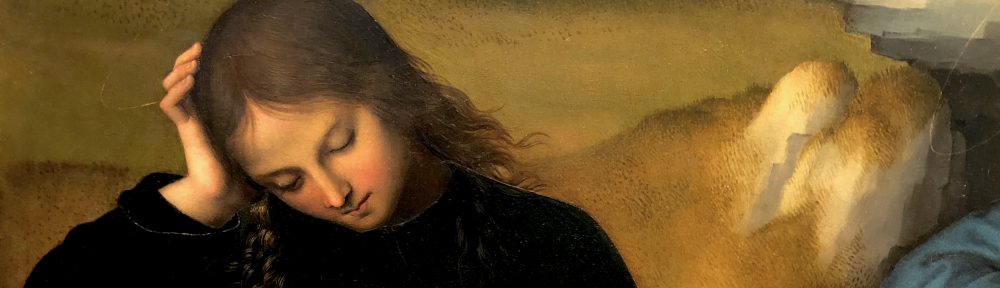
Young priest in the Chapel of the Transfiguration, Grand Tetons National Park (1976)

Young priest in the Chapel of the Transfiguration, Grand Tetons National Park (1976)

When I preached at my wife Karen’s ordination on All Souls Day, 2010, I reflected on the peculiar vocation of priesthood. Since today, the Feast of Hildegard of Bingen, is the 45th anniversary of my own ordination, it seems fitting to publish it here.

In nineteenth-century Paris, there was a certain priest who was not quite right in the head, and one day he walked into a bakery, made the sign of the cross over the assorted breads, and said Hoc est corpus meum (This is my body) – the Words of Institution from the eucharistic prayer. When the Archbishop of Paris heard what had happened, he bought up every baguette and croissant in the shop, and reverently consumed them.

This story reflects an understanding of priesthood and sacrament which we do not share, but it does raise questions about the power that is conferred in ordination. What will happen to Karen tonight when the Holy Spirit is called down, and the hands of bishop and priests are laid on her head? How will she be different? What is the nature of the gift she will receive?

Priesthood has a certain aura. You wear special vestments, preside over worship in the name of the whole assembly, and stand at altar and pulpit to speak for God and Christ as though you were heaven’s ambassador. You are called and set apart by God and the Church to do holy things.

Eventually, the doers of holy things are sometimes regarded as possessors of an occupational holiness. The distinctiveness of what priests do becomes a distinctiveness in who priests are. The parson is seen as a kind of model person.

At its best, this understanding of a priest as a walking icon of the Christian life has produced some remarkable saints, clergy who have indeed exemplified a godly life, clergy whose words, actions, and faithfulness manage to bring God a little closer. At its worst, this attribution of holiness to the priest has let everyone else off the hook. We don’t have to be faithful or devout. The priest does that for us.

But in our own day, we have been rediscovering, to our joy, the ministry of all the baptized. All of us, clergy and laity, are empowered and called to be ministers of the gospel, to be doers of the Word in all the times and places of our lives.

Whatever is true, whatever is honorable, whatever is just, whatever is pure, whatever is pleasing, whatever is commendable [i] – that’s on every Christian’s agenda. When the saints go marching in, we are all “in that number.”

Our common vocation as ministers was beautifully summarized by Paul Moore, the late bishop of New York. When he retired, his last words to his people were these: “You are messengers clothed in the beauty of God. Take hope, be strong, be brave, be free, be open, be loving, and hold up the vision of the Heavenly City.”

You are all messengers clothed in the beauty of God, and you will be reminded of that again tonight, when you renew your baptismal vows and are sprinkled with water from the baptismal font, in the hope that Isaiah’s cry may ever be on your own lips: Here am I; send me.

But if we are all ministers, then what is so distinctive about the role of priest? If your understanding of priesthood is purely functional, based on what a priest does, the ministry of the baptized creates a crisis of definition as more and more of the priest’s jobs are outsourced to the laity.

Parish administration, pastoral counseling, preaching, teaching, evangelism, social witness and outreach, worship planning and a great deal of worship leading can all be done by laypeople. There are really only three things that a priest can do that a layperson cannot: preside at the eucharist, pronounce God’s forgiveness after confession, and give God’s blessing.

Just these three things. But perhaps they are not such little things.
Bread, forgiveness, blessing.
The things that priests give, in the name of God, in the name of Christ.
Bread, forgiveness, blessing.

It’s actually quite a lot, really, requiring no less than everything – and a lifetime of preparation. Why a lifetime of preparation? Can’t anyone do these things? Speak some words, perform a few actions? Simple, yes. Easy, not so much.

Ritual is like art, requiring natural gifts, extensive training, and a deep grasp of the cluster of conditions that constitute ritual practice: theology, history, the meaning of sign and symbol, the nuances of body language, gesture and gaze, and so forth.

Karen comes to this calling with her own particular identity, her own unique blend of gifts and qualities. Priesthood is always an embodied phenomenon, something only realized in the form of particular persons. In that respect, each priest is different.

But when the Church sets a person apart in ordination, she becomes more than her individual self. Whenever Karen puts on her priestly stole, she will become 2000 years old, a public representative of the cumulative tradition and collective wisdom of the Church.

As priest, she will be a keeper and guardian of our sacred stories, whose task it is to tend the flame of their saving grace. At the same time, she is given the privilege of being entrusted with the stories of her people, helping them to understand that their own lives are also sacred stories.

The priestly role is not for everyone. It requires a delicate balance between self-awareness and transparency to Spirit, the sensitivity to be attuned not only to one’s own self but also to all the other selves in the room, and to the Holy One in whose presence we gather.

At the eucharist, who the presider is, and how the presider is, both have an effect on the assembly’s understanding of what is really going on when we gather to worship.

The performance of ritual doesn’t happen by accident. It is the product of charism, call and holiness of life. It is a full-time, serious business, as Richard Baxter insisted in the seventeenth century when he said to worship leaders:

[A]bove all be much in secret prayer and meditation. There you must fetch the heavenly fire that must kindle your sacrifices. Remember that you cannot decline and neglect your duty to your own hurt alone; many will be losers by it as well as you. For your people’s sake, therefore, look to your hearts… If [your hearts] be then cold, how [are they] likely to warm the hearts of [your] hearers?[ii]

In its essence, priesthood is a concrete and visible expression of belief: belief in the presence of God, and belief in the meaning and destiny of the eucharistic assembly as the body of Christ.

Every time the priest stands at the altar and says the holy words, the whole assembly is alerted to the fact that we all stand on the border between earth and heaven, the visible and the invisible. The border is where worship is conducted: it is where God gives us the bread of life and we offer in return “our selves, our souls and bodies, to be a reasonable, holy and living sacrifice”[iii] unto God.

The priest’s ritual words and actions make clear to the assembly what is going on at the border. It’s not a place where we escape the world; it’s where we discover just how sacred the world is. Ordinary bread and wine become the food of heaven and the cup of salvation.

As Gordon Lathrop puts it, the eucharistic assembly is “a hole in the fabric of things, through which life-giving power flows into the world.”[iv]

But the priestly work of bread, forgiveness and blessing is something that belongs to the entire body of Christ – not just the priest, not just this particular assembly, but the whole Church of God’s people throughout the world and throughout all time.

You and I are all priests in a cosmic sacrament, standing in the place of Christ, seeing with the eyes of Christ, in order to make visible and tangible the eucharistic nature of all things. As priests, we look at our neighbor with the most sacred attention – and intention – and say, This is my body, that is to say, Christ’s body.

We look at the stranger and say, This is my body.
We look at our enemy and say, This is my body.
We even look at bread and wine,
ordinary matter, the stuff of the universe,
and say, This is my body.

And so, to return to that bakery in Paris, we may assume that the bread was already sacred before the priest ever got there, and that every crumb was already worthy of reverent consumption. But we would never know these things had not Jesus, and every priest since, taken bread, said the blessing, broken it, and passed it around.

When I was preparing to preach this sermon, I emailed some of my ordained friends around the country, asking if they had any words of counsel or encouragement for a priest at the beginning of her journey.

One priest repeated what a Methodist minister told him at his own ordination 30 years ago: “You can’t help anybody in their relationship with God unless you are completely human.”

Another said that “who you are is infinitely more important to God and the world than the words you speak, the lists you complete or the sermons you write.”

A priest ordained for 46 years offered this advice: “Try to see [God’s people] the way God sees them.”

A seminary classmate who went on to become parish priest, cathedral dean, and diocesan bishop said, “Never leave or forget your diaconal calling. Jesus came as one who serves. As a priest, you must first of all be a servant.”

And a priest I’ve known since elementary school simply said, “Give all to God.”

I also asked my friends if they could provide a few words that distilled for them the essence of priesthood. One of the best teachers I’ve ever had – an Old Testament professor, seminary dean, parish rector, and priest for 63 years – described it this way:

living with and for sisters and brothers
being the body of christ
celebrating with brothers and sisters
word and sacrament and pastoral act
christ recalling us reshaping us refreshing us
being christ’s body for the world

A priest and poet who has worked since the 1960’s in parishes, campus ministry, foreign missions, and the national church office, offered this succinct couplet:

Everything we share is broken;
and yet we remember the whole and make it present.

Another longtime priest wrote: “Yours is to walk with people to the Mystery and back.”

 And finally, the canon to the ordinary in a Midwest diocese, a woman ordained five years ago, quoted a 16th century Sufi mystic:

Go where you are sent
Wait until you are shown what to do
Do it with your whole self
Remain until you have done what you were sent to do
Walk away with empty hands

Empty hands. I have loved this image ever since I first encountered it, just before my own ordination, in Robert Bresson’s film of the Georges Bernanos novel, Diary of a Country Priest.

The story, a retrospective account narrated with passages from a young priest’s journal, turns on a dramatic and transformative pastoral encounter with a parishioner. In one of the great scenes of cinema, fraught with a severe and holy beauty, we witness “a supernatural storm.”[v] And somehow, by what the young and inexperienced priest says to this woman, but even more by who he is, the woman’s hardened heart is broken open, and she is filled with grace and peace.

That night, the priest learns the woman has suddenly died. He hurries to the vigil where her body lies. We see him kneel by her bed to make the sign of the cross over her. At the same time, we hear his voice describe the moment as he would later record it in his journal:

“Be at peace,” I told her.
And she had knelt to
receive this peace.
May she keep it forever.
It will be I that gave it to her.
Oh miracle –
thus to be able to give
what we ourselves do not possess,
sweet miracle of our empty hands.

Sweet miracle of our empty hands. Let us pray that Karen, like every priest before her, may go to the altar of God, the God of her joy, with empty hands:

Hands that offer, and hands that receive,
hands that feed, and hands that heal,
hands that welcome, and hands that bless.

[i] Philippians 4:8

[ii] Christopher Cocksworth and Rosalind Brown, Being a Priest Today: Exploring Priestly Identity (Norwich: Canterbury Press, 2006), 150

[iii] From Thomas Cranmer’s 16th century eucharistic prayer, retained in Rite I of The Book of Common Prayer (1979), 336

[iv] Gordon Lathrop, q. in Graham Hughes, Worship as Meaning: A Liturgical Theology for Late Modernity (Cambridge: Cambridge University Press, 2003), 150

[v] André Bazin, trans. Hugh Gray, What is Cinema? (Berkeley: University of California Press, 1967), 137

Late summer days and the shadows of impermanence

Nelson Cruz

Nelson Cruz

It was supposed to be the Mariners’ year in major league baseball. With a few weeks still left in the regular season, Seattle’s star pitcher has 17 wins, and their best batter has hit 40 home runs. These are great numbers. But the team itself has been out of the pennant race since July. For a long time, the Mariners just couldn’t score when they needed to, lost a lot of close games, and are currently 7 games out of first place, and 6 games below .500. With only 20 games left, their chances of making the playoffs are virtually nil.

So has their season lost all its meaning? Was it all for nothing? If a season is worthwhile only if you win the championship, then only one team can ever stave off meaninglessness. But as basketball legend Bill Russell has noted, in sports “the basic unit of time is the moment. Sports fans and players appreciate each instant.”[i] We enjoy the evening highlights on ESPN even if we don’t follow a particular team, even if our own team is having a bad year, because we are witnessing the timeless essence of the sport: a great pitch, the crack of the bat, a stolen base, a diving catch.

Sportswriter Meg Rowley, in an artful post called “How I learned to stop worrying and love Nelson Cruz,” reminds us that every game, every team, has moments of pure skill and beauty with a value unto themselves, regardless of their relevance to the overall standings. We watch the games even if they don’t “matter” in the long run, because we love those moments.

I once saw Sandy Koufax strike out 18 Giants. I remember cheering and laughing with my dad from a bleacher seat high above right field. I remember Wally Moon blasting a 3-run homer to win the game in the bottom of the ninth. But I didn’t remember, until I looked it up, was the year it happened, or the fact that this dramatic win helped the Dodgers go on to win the World Series. Seasons come and go, fortunes rise and fall, but the special moments endure.

Citing the Mariners’ Nelson Cruz (40 home runs) and the Detroit Tigers’ Miguel Cabrera, who is hitting .351 and will probably win the batting title for a team that is 19 games out of first place, Rowley says that “every season is really about appreciating great performances in the face of eventual failure.” Every team but one will fail in the end. And even the winner is unlikely to repeat next season. “It’s all futile. But guys like Cruz and Cabrera make that futility beautiful … for a couple of at-bats every game, Cruz and Cabrera keep the futility at bay.”[ii]

As I savor the luscious local weather of late summer in Puget Sound, I am also conscious of its imminent departure. No matter how many perfect moments have adorned these summer months, no one gets a winning season in the game with time. The day will come when night falls early, the birds have gone, and it’s too cold to sit outside in the garden with a book.

Emily Dickinson, who loved the “sacrament of summer days,” was haunted by the shadow of impermanence that falls across our sunlit lawns. The times when we forget that shadow, like the brief return of balmy weather in Indian summer, are but a “fraud that cannot cheat the Bee.”[iii] Yet Dickinson’s poetry, in its act of acute noticing, in its cherishing of the beauty which is all the more precious for its brevity, keeps the futility at bay. She could not solve the puzzle of where it was all headed, this ephemeral life. She wasn’t sure whether the future would turn out to be consummation or cessation (to borrow John Dewey’s evocative duality). Despite her inheritance of Christian vocabulary, she was steeped in nineteenth century doubt. But she always stepped to the plate and took her swings, and her readers still share the pleasure of her every at-bat.

I am currently reading Vera Brittain’s Testament of Youth, her moving memoir of the generation who came of age on the eve of the First World War. Her descriptions of “carefree summers” before the war are especially poignant because both writer and reader know what is about to happen. When, in 1915, she received news about the death of one of her ‘summer friends’ – the kind of people “with whom one dances and plays games and perhaps flirts a little,” she wrote to her fiancé serving on the front that “it gives one the shock of incongruity to imagine the Angel of Death brooding over one’s light and pleasant acquaintances, and to think of them with all their lightness and pleasantries shed away.”[iv]

The dream of summer as a timeless sabbath from mortality soon vanished in the trenches, and with it many of Brittain’s generation, including her brother and her lover. But did the shortness of those young and precious lives invalidate whatever love and meaning and joy they did experience, however briefly?

Like Emily Dickinson, Gustav Mahler confronted the shadow of impermanence in all of his work. He said specifically of his Second Symphony (“Resurrection”) that he was asking the big questions: “What did you live for? Why did you suffer? Is it all only a vast terrifying joke?”[v] With the vast orchestral intensity for which he was famous, Mahler takes the listener through a sonic storm of anguish and despair, hope and fear, apocalypse and catharsis, until the extraordinary moment when the chorus refutes the turmoil with the astonishing serenity, verging on silence, of its glorious invitation: Rise again.

I first heard the Resurrection Symphony from the third row of the Los Angeles Philharmonic. Zubin Mehta conducted, and Jessye Norman led the singers in the exultant affirmation of the finale, as voices, strings, brass and percussion carried us in a gigantic wave of sound across the abyss of loss into the transcendent:

Arise, yes, you will arise from the dead,
my heart, in an instant!
What you have overcome
will carry you to God.

In Thomas Mann’s Doctor Faustus, when a fictional composer describes the final passage of his valedictory work, he captures something of what I experienced that night at the end of Mahler’s Resurrection:

It would be the hope beyond hopelessness, the transcendence of despair … Hear the close, listen to it with me! One group of instruments after the other drops out, and what remains, with which the work dies away, is the high g of a cello, the last word, and the last suspended sound, in a pianissima fermata, slowly fading. Then there is nothing more. Silence and night. But the note that continues to hang and pulsate in the silence, the note that is no more, for which only the soul listens, and which was once the expression of sorrow, is no longer that but changes its meaning, and endures like a light in the darkness.[vi]

In the emotionally charged silence which followed the Philharmonic’s inspired performance, no one dared clap or even whisper. Mehta kept his arms high and extended, seemingly frozen in his final gesture, for a very long thirty seconds, forbidding us to drown out “the note that is no more” with the harshness of applause. Norman’s eyes welled up. Some of the orchestra wiped away tears. It was the closest I’ve come to eternity.

At last, very slowly, Mehta lowered his arms. When they finally reached his side, his shoulders relaxed, and we were all released back into time. We rose to our feet and thundered our joy. Yes, that sublime moment had kept futility at bay. More than that, it had carried us to God.

[i] Bill Russell, Second Wind, quoted in Lapham’s Quarterly: Time, Vol. vii, No. 4, Fall 2014, p. 118

[ii] Posted at http://www.foxsports.com/mlb/just-a-bit-outside/story/good-players-bad-teams-nelson-cruz-seattle-mariners-micuel-cabrera-detroit-tigers-090915

[iii] The Complete Poems of Emily Dickinson, ed. Thomas H. Johnson (Boston: Little, Brown and Company, 1960), #130, p. 61

[iv] Vera Brittain, Testament of Youth: An Autobiographical Study of the Years 1900-1925 (New York: Penguin Group, 2004), 158

[v] q. in Philip Kitcher, Deaths in Venice: The Cases of Gustav von Aschenbach (New York: Columbia University Press, 2013), 141

[vi] ibid., 178

“Show me a coin” – A stewardship reflection

Roman coin with the head of the emperor Tiberius. The inscription may contain a claim of divinity.

Roman coin with the head of the emperor Tiberius. The inscription may contain a claim of divinity.

When the temple clergy in Jerusalem sent their stooges to ask Jesus a loaded question, they thought they had him cornered: Should we pay taxes to Caesar or not? If Jesus endorsed the Roman tax, he’d lose the crowd. If he encouraged nonpayment, he’d lose his freedom. His famous answer, of course, outsmarted his opponents and postponed his arrest for a few precious days.

“Show me a coin,” he said. One of them dug into his pockets and pulled out a coin, stamped with the image of the Roman emperor. “Whose picture is on it?” They all looked at the coin, straight men headed for a fall. “Caesar,” they said. Duh! “Well then,” Jesus said. “Give to Caesar the things that are Caesar’s, and to God the things that are God’s.”

We always smile at the Teacher’s wit. I like to think that Jesus pocketed the coin with a wink before walking away. But when the amusement fades, we are left with a puzzle. What does this saying mean for us? Is it a teaching, or even a commandment? What are we being asked to do with the money in our own pockets? The colorful Southern theologian Will Campbell, himself a country preacher, once said to me that if we give to God what belongs to God, there won’t be anything left for Caesar!

I loved what Will said – it had his characteristic prophetic edge – but it didn’t really solve the practicalities of being faithful to God while sharing in the costs and benefits of a complex economy. Most of us are not among the brave few who refuse participation by taxation in the military-industrial complex. We send in our check and accept our complicity in the mixed blessings of the system, which does provide for much common good along with its regrettably baneful effects (drones, for instance).

It’s like Monty Python’s Life of Brian, where a dissident complains, “The Romans took everything from us, and what have they ever given us in return?” His followers, to his chagrin, come up with a long list of benefits, including the aqueducts, sanitation, roads, irrigation, education, public baths, and even the absence of war in the Pax Romana.

While we live in this world, Jesus’ aphorism on taxes will never be an “answer” in the sense of an unambiguous guide for specific action. Instead, it persists as a question that interrogates every individual as well as every system. What does belong to God, exactly? And how then do we return to God what is God’s own?

Pooling our resources through taxation in order to educate our children, feed the hungry, protect the environment, provide universal health care and so on, might be regarded as one form of return, to which we subscribe as citizens with varying degrees of enthusiasm. Common good requires common action. Pooling our resources through church pledging to sustain a community of faith and grow God’s mission to the world is a less messy and more direct form of “giving to God what belongs to God.” Charitable giving is yet another kind of return.

This is how we live as citizens of heaven: we keep the gifts moving – in circulation – rather than hoard them for ourselves.

And did you notice that in this gospel story of the coin the notion of “belonging to” refers only to God or Caesar? We ourselves own nothing. We are but recipients and stewards. The only thing that really belongs to us, Jesus says, is the giving.

“Delightful! Wonderful! Incomparable!” – Thoughts about holy spaces

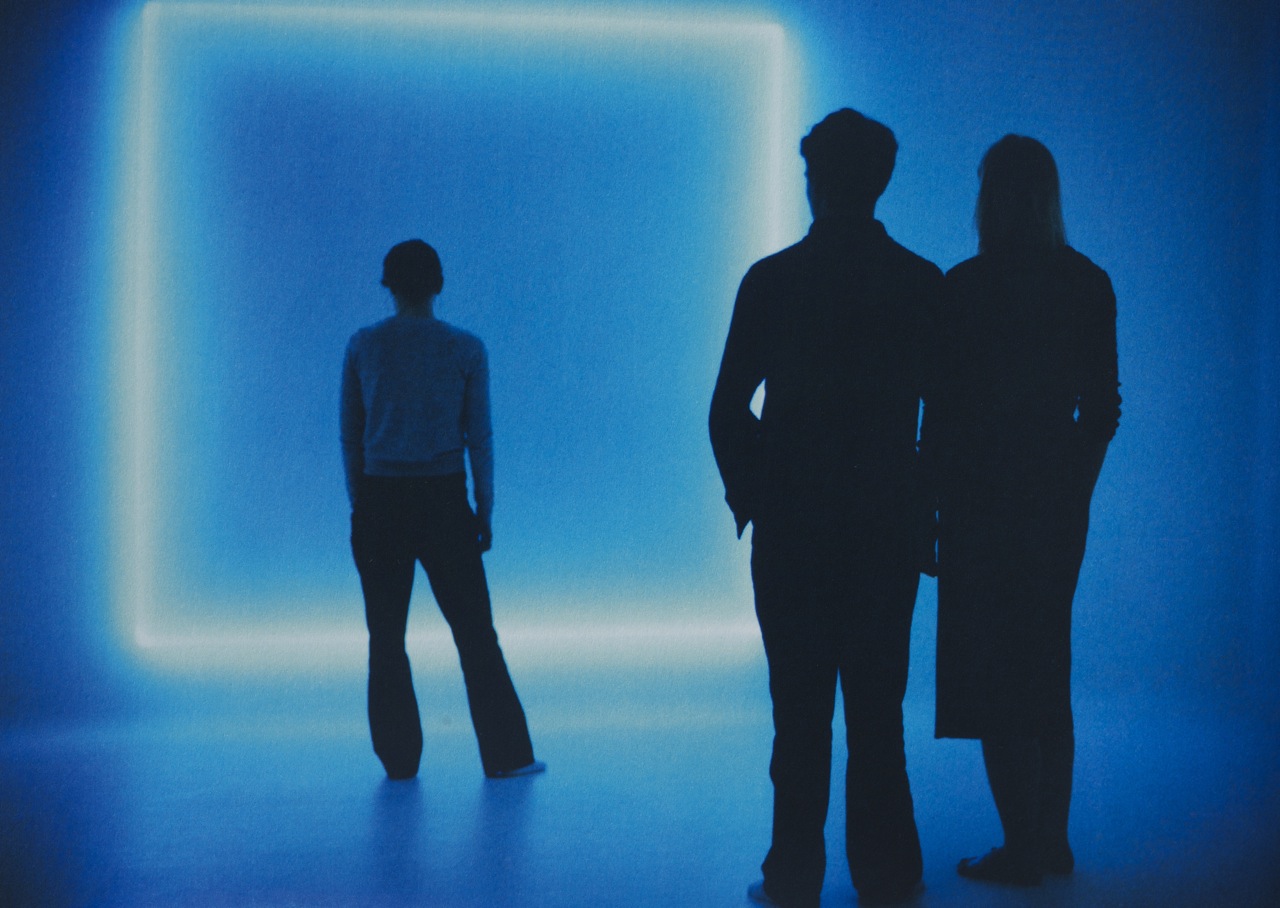
Doug Wheeler, RM 669 (1969)

Doug Wheeler, RM 669 (1969)

For the viewer/participant of Light and Space art, a significant outcome of this experimentation is that the works of art perceptually condition us, whether we are aware of it or not.[i]

– Dawna Schuld

In 1914 the German writer Paul Scheerbart published The Gray Cloth and the Ten Per Cent White, a novel about an architect who constructed buildings made of colored glass. For the opening of each new building, his wife always wore gray clothing containing 10 per cent white, in order to intensify by contrast the effect of all the colors. Anyone who entered these luminous environments felt enveloped by the sublime. “The splendor of the colored glass ornament was so enhanced by the sun that one was at a loss for words to praise this wonder of color. Many visitors shouted repeatedly, ‘Delightful! Wonderful! Incomparable!’”[ii]

As the architect’s fame grew, he became fond of tossing out pithy aphorisms: “Glass brings a new era.” … “Building in brick only does us harm.” … “Colored glass destroys hatred.” He would have loved Twitter. Scheerbart’s utopian dream of transforming human nature through salubrious environments would soon fade in the disillusioning violence of the Great War, but it would surface again in the idealism of Modernist architecture: Design can change the world. Better buildings will make better people.

Architectural idealism has a long history. Plato thought that measure, form and order in the built environment had significant shaping power for both the soul and the community. Eighteenth-century Anglicans applied an exacting symmetry to church buildings in the hope that regularity and order in places of worship would, over time, help produce constancy and balance in believers. Order and form would tame unruly passions.

Such ambitions are easily mocked. In his brilliant and entertaining documentary, Los Angeles Plays Itself, Thom Andersen observes that well-designed environments have become for the movies the equivalent of the bad guy’s black hat. “One of the glories of Los Angeles is its Modernist residential architecture, but Hollywood movies have almost systematically denigrated this heritage by casting many of these houses as the residences of movie villains.”

When L.A. Confidential (1997) placed the sleazy criminal Pierce Patchett in the Lovell House, Richard Neutra’s definitive manifesto for better living, the architecture critic for the Los Angeles Times wrote that the “house’s slick, meticulous form seemed the perfect frame for that kind of power. Neutra’s glass walls open up to expose the dark side of our lives. They suggest the erotic, the broken, the psychologically impure.”[iii] In fact, Andersen points out, the film’s director was a great admirer of Lovell House, whose actual history closely reflected its architect’s ideals. It produced no villains.

Of course there is no simple correlation between environment and ethics or spirituality. A beautiful space does not automatically produce beautiful people. But can more modest claims be made for the influential nature of designed environments?

In the mid-1960s, the Light and Space artists of southern California began to create works that were not objects to look at but environments to experience. “I’ve always been interested in how much I can take away,”[iv] said Bruce Nauman, who stripped a space of light and feeling to create Room with My Soul Left Out, Room That Does Not Care (1984). Its chilling title might be applied to many contemporary enclosures, from the black holes of prisons to many of the places where we shop and work. But most of the Light and Space artists, while also stripping away much of what the public expects from an artwork, preferred to create rooms that do care.

At New York’s Museum of Modern Art in 1970, Robert Irwin was offered a dingy room for whatever installation he wanted to use it for. “The room really was an unhappy space,” Irwin noted.[v] So he cleaned the skylight and installed on the ceiling alternating cool and warm fluorescents, veiled by a translucent scrim. There was nothing “in” the room except for what Irwin called a “subliminal rainbow” effect of the light. People would wander through, see nothing there, and continue on to the next room, full of Brancusi sculptures – something they actually could look at. While they didn’t notice anything in Irwin’s room and thought it empty or unfinished, they did tend to remark on how bad the lighting seemed in the Brancusi room. The pleasant glow of the first space made them critical of the less luminous space that followed. An intentional environment had changed the way they saw the world outside it. Such work has been called “an art of incremental resistances that seeks not to change the world but to sharpen our perception of it.”[vi] 21

Both art and religion – sometimes in collaboration, sometimes independently – have created physical environments designed not only to provide a refuge from the prevailing fixtures and forces of the culture, but to generate resistance to those forces by providing, through a sense of otherworldliness or unnameable presence, a critique of culture’s totalizing claim to be all there is. Such spaces pose questions about what we have settled for as reality, and about what else might lie beyond our cultural constructions.

Critic/historian/collector Melinda Wortz called the Light and Space artists “architects of nothingness,” seeing their work as transcending the purely material level. “By reducing the physical and visual incident in their art to almost nothing, or at least creating the illusion of nothingness, they challenge us to share in these perceptions. And they are important perceptions, which go beyond common sense experience of ineffable states of consciousness, giving us access to the unfamiliar, the unknown, or those levels of knowing that cannot be translated into words. These are precisely the states of being least addressed by our culture at large.”[vii]

A Zen garden has been described as a “locus of stillness, purity, and silence in the midst of ephemerality and sensation, a refuge that intentionally avoids (in the short run) any reference to the outside world.”[viii] Many of us have found such “holy” spaces not only in religious constructions, but in art and nature as well. And whether for refreshment, renewal, or revelation, we are drawn to visit them, to dwell for a time in their aura and remember what the culture has forgotten.

Orthodox icons have long striven to provide a window into a transcendent world. The Light and Space artists, while shunning any theological presumptions for their “disorienting metaphysical enigmas and wordlessly ecstatic experiences,”[ix] seem to take us right through that window to put us inside. As Eric Orr said of his Zero Mass (1972-3), “an uncanny feeling of merging with the space may occur when the viewer loses an absolute sense of the boundaries of the room and perhaps of their body.”[x] Using faint ambient light and coved corners to inhibit visual perception of edges or walls, he dematerialized the space, making it an apparently boundless void where “our selves are tenuously held together in some sort of rapprochement with the surrounding emptiness. If at first it appears that we are surrounded by nothing, to what are we responding and why?”[xi]

These artists all stress the materiality of their work. Their environments are not just metaphors for something else. They are actual physical events, even if not as solid and tangible as traditional art. Doug Wheeler, describing one work, said it “was a real space – not illusory – it was a cloud of light in constant flux. That molecular mist is the most important thing I do. It comes out of my way of seeing from living in Arizona – and the constant awareness of the landscape and the clouds.”[xii]

So is anything being intimated or shown besides the specific phenomena of these environments? Does a hidden reality or transcendent dimension lie behind the physical experience? Where does experience meet faith? And how important is it to put language to the experience? Does conscious reflection about such experience diminish or deepen its effect on us?

Whatever these artists believe, think or intend with their work, those of us who think theologically can’t help but find them revelatory, pointing beyond themselves. A sacramental view of things regards matter as the essential means of encountering Spirit. The givenness of the material world – light and water, bread and wine, flesh and blood – is how we begin to know anything, including the divine.

James Turrell, one of the best known of the Light and Space artists, has spoken of “the need and thought of spiritual sensibilities or dimensions beyond us,” though he avoids the “vocabulary of religion.”[xiii] His Quaker sensibilities prefer direct, unmediated experience. But when he speaks of the “thing-ness” of light which “becomes the revelation,” he blurs the opposition between material and spiritual, leaping across the either-or dualities as adeptly as the mystics.[xiv]

But whatever happens, whatever is encountered in these works, is it merely private experience, a matter solely of personal perception? Olafur Eliasson, an Icelandic artist, is insistent about the social dimension of his work, which is designed not only to produce wonder but also a collective “co-presence” in the sharing of the experiential space.

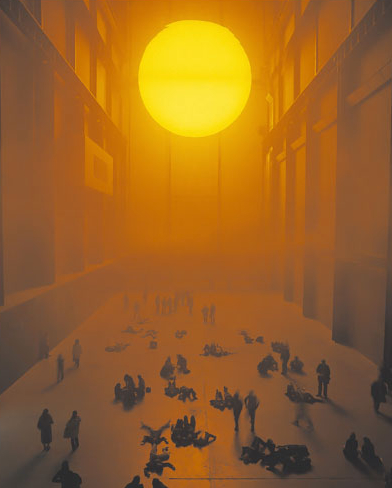
Olafur Eliason, The weather project (2003) at Tate Modern, London

Olafur Eliason, The weather project (2003) at Tate Modern, London

In The weather project (2003), he installed “a giant yellow orb like a dark winter sun” in the 500-foot long Turbine Hall at London’s Tate Modern. Sixteen nozzles sprayed mist into the atmosphere, filling the space with a light fog. Three hundred mirrored panels on the ceiling reflected the people below who glowed in the brownish-yellow haze of the sun’s two hundred sodium lamps.

During that winter season, two million people visited the museum to stand, sit or lie beneath the sun. It had the effect of Scheerbart’s fictional glass buildings: Delightful! Wonderful! Incomparable! Even if they arrived by themselves, people were immersed in provisional community. Sometimes they spontaneously arranged themselves into geometric patterns, symbols or even words. As Madeleine Grynsztejn observed, “This kind of participation calls us out of and beyond ourselves, an effect reinforced when witnessed and shared by others.”[xv]

The weather project, like many of the Light and Space artists’ “experiential processes,” bears resemblance to my ideal of church: a “holy” space, differentiated from the “ordinary” world, dedicated to the participatory experience of being called out of ourselves into an experience of wonder and praise. Not everyone shares this conception of Christian worship spaces. The stricter liturgical theologians argue that God is only present in the assembly and its liturgical actions, not in the physical space itself. Early Calvinists used to lock their churches during the week to discourage the idea that a space without a congregation at prayer retained any residue of holiness.

Peter Hammond, in his influential book, Liturgy and Architecture, argues that a church is not a place for a casual visitor to have a worship experience. It is not a shelter for an altar but for an assembly, and it has no meaning or symbolic power apart from its liturgical function. While I would agree that the primary function of a church is to shelter and enable the communal liturgy, I am sympathetic to Joseph Campbell’s view that one can be “reborn spiritually by entering and leaving a church.”[xvi]

The Light and Space artists would not make such large claims. But something unique and even significant can happen in their alternative spaces. Maybe colored glass can’t destroy hatred, but can certain kinds of experiences in certain kinds of places work on individuals and communities over time in positive, formative ways? In Dawna Schuld’s view, “we take the work with us: our heightened senses, now attuned to the subtleties of the conscious fringe, encounter a more vivid world than the one we left behind.”[xvii]

Eric Orr’s Sunrise (1976) was a nine by twelve foot room sheathed in lead, cutting off all sounds from the outer world. The space was quite dark. “I am engaged in using silence as a color,” Orr explained.[xviii] But the darkness was not total. A single bar of sunlight, guided into the space by a series of mirrors, moved slowly up the wall as time passed.

It reminded art critic Thomas McEvilley of the secret inner chamber of an Egyptian temple, and he reflected on the effect of being there: “Orr’s goal of producing spaces that will transform everyday experiences was mildly fulfilled here. Yet no one flew out the door like a bird. Rather, one walked out as one went in, but with a certain mental aura, as of secret ambiences and veiled promises of transcendence.”[xix]

Related posts

The Woven Light: Reflections on the Transfiguration

“Owl among the ruins” – What shall we do with empty churches?

[i] Dawna Schuld, “Practically Nothing: Light, Space, and the Pragmatics of Phenomenology,” in Robin Clark, ed., Phenomenal: California Light, Space, Surface (Berkeley: University of California Press, 2011), 111

[ii] Paul Scheerbart , The Gray Cloth, tr. John A. Stuart (Cambridge, MA: MIT Press), 3

[iii] Los Angeles Plays Itself (2003/2013), written and directed by Thom Andersen, Part 1, chapter 12: Modern Architecture

[iv] quoted in Michael Auping, “Stealth Architecture: The Rooms of Light and Space,” in Clark, p. 103

[v] Jan Butterfield, The Art of Light and Space (New York: Abbeville 1993), 24

[vi] Take Your Time: Olafur Eliasson, ed. Madeleine Grynsztejn (NY: Thames & Hudson, 2003), 22

[vii] Butterfield, 16

[viii] Lindsay Jones, The Hermeneutics of Sacred Architecture: Experience, Integration, Comparison, Vol. Two: Hermeneutical Calisthentics: A Morphology of Ritual-Architectural Priorities (Cambridge, MA: Harvard University Press, 2000), 280

[ix] Ross Weszsteon, referring to James Turrell, q. in Butterfield, 78

[x] Clark, 45

[xi] Schuld, 120

[xii] Butterfield, 121

[xiii] ibid., 82

[xiv] Michael Govan, “Inner Light: The Radical Reality of James Turrell,” in James Turrell: A Retrospective (Michael Govan & Christine Y. Kim, New York: DelMonico Books, 2014), 49

[xv] Take Your Time: Olafur Eliasson, ed. Madeleine Grynsztejn (NY: Thames & Hudson, 2003), 19

[xvi] I can’t find this citation, which has been in my church architecture notes for years, but it does sound like authentic Campbell!

[xvii] Schuld, 121

[xviii] Butterfield, 159

[xix] ibid., 160

The questions that matter

Figures in open space have always been what film is all about. American film. This is the situation. People in a wilderness, a wild and barren space. The space is the desert, the movie screen, the strip of film, however you see it. What are the people doing here? This is their existence. They’re here to work out their existence. This space, this emptiness is what they have to confront. I’ve always loved American spaces. People at the end of a long lens. Swimming in space.

– Don DeLillo, The Names[i]

I just returned home from a road trip through the “American space” of four western states – Washington, Idaho, Montana and Wyoming – to find that an old post of mine, “You can never go fast enough,” had been selected for “Freshly Picked,” the WordPress showcase for editors’ picks and community favorites. It is a lovely honor, and the theme of that post – the endless road trip of American culture – coincided nicely with my own wanderings.

The video was shot on a lonely Montana highway as the sun sank into a forest fire sky. For a sixty mile stretch, I didn’t see another car. To be the subject of that view, “swimming in space,” was exhilarating.[ii] As I wrote in that featured post:

We are a people enamored of open highways, limitless horizons and liberating journeys to the distant places where we can reinvent ourselves.

Since being “freshly picked” has brought an infusion of new readers and followers, it seems a good time not only to say welcome, and thank you for visiting, but also to indicate what goes on in this space. A lot of you are here because of a post built around a classic car show. But next time the subject will be completely different. Nature, culture, religion, spirituality, liturgy, the arts, cinema, and politics have all made an appearance here.

But while the topics are diverse (see sample links below), they are all grounded in a theological practice of sifting through the substance of this given world – nature, culture, self and spirit – to consider the questions that matter. And what are those questions? The list from Blade Runner comes to mind: “He wanted to know what everybody wants to know. Where do I come from? Where am I going? How long have I got?”

Jill Stoner, in her provocative and thoughtful book on rethinking architecture, gives a wonderful description of her method: “I take enormous pleasure in orchestrating dialogues among writers who may never before have occupied the same page.”[iii] The Religious Imagineer takes similar delight in curating unusual, even unlikely combinations of writings, themes, thoughts and stories which might otherwise not take place.

If there is one underlying subject of this blog, it is imagination. How do we say the unsayable, see the invisible, dance the impossible in our images, rituals and stories? How do we attend to the traces of God amid the chronic unknowing of secular modernity? How do we imagine the really Real and the not-yet?

So to new and old readers alike, thanks for coming along. Who knows what lies around the next bend? As one reader commented about my classic car post, “I don’t know what you said but I enjoyed the ride.”

Selected past posts by theme:

Walking the Camino de Santiago: April and May archives, 2014

Nature

Seasons

Art

Architecture

Music

Cinema: 10 best religious films, 10 best Jesus films, Around a Small Mountain

Spirituality

Solitude: Part 1, Part 2

Alternative worship: Part 1 (multimedia), Part 2 (installation)

Theology

Politics and culture: Immigration, Keystone pipeline

[i] Don DeLillo, The Names (New York: Vintage), 198

[ii] The song on the car stereo is “East of Woodstock, West of Vietnam,” on Tom Russell’s Blood and Candle Smoke.

[iii] Jill Stoner, Toward a Minor Architecture (Cambridge, MA: MIT Press, 2012), x

One vast miracle

Perseids (sm)

Tonight after sunset I will drive over the Cascades to a dark plain 200 miles east of Seattle to watch the Perseid meteor shower, summer’s great nocturnal spectacular. This will be the best one in five years, as there will be no moon to dilute the blackness of space. A night sky free from city lights is an awesome sight. Throw in up to 100 meteors per hour, and it is pure wonder.

Loren Eiseley, a scientist whose nature writings deeply shaped my own sensibility toward the natural world, said that “the word miraculous has been defined as an event transcending the known laws of nature … We forget that nature itself is one vast miracle transcending the reality of night and nothingness. We forget that each of us in [our] personal life repeats that miracle.”

Whether lying in an August meadow with my father as a boy, or trekking to an 11,000′ mesa to keep watch till dawn, I have been religious about keeping my appointment with the Perseids. The photograph above was taken two years ago, when I set my camera to make a series of 30-second exposures starting at midnight. This year’s peak should be about 1 am. I will keep my eyes open as best I can until first light, then drive into the rising sun to spend a week in an alpine lakes basin north of Yellowstone.

I have backpacked in the mountains of the West almost every summer since 1971. It is a week of holy obligation, a blend of adventure, beauty and silence without which my year would be incomplete and my soul undernourished. As a young priest, I helped lead many teenage backpacks in California’s Sierra Nevada. Toward the end of those week-long hikes we would devote an evening to campfire reflections followed by quiet time under the stars.

The first time we did this, I read them a passage from Loren Eiseley’s The Immense Journey, describing one of his bone-hunting expeditions in the Dakota badlands. “Fifty million years lay under my feet,” he wrote, “fifty million years of bellowing monsters moving in a green world now gone so utterly that its very light was travelling on the farther edge of space.” He then listed the chemicals in the soil of that dry and barren land, imagining the strange wild creatures they had once constituted. “The iron did not remember the blood it had once moved within, the phosphorous had forgot the savage brain. The little individual moment had ebbed from all those strange combinations of chemicals as it would ebb from our living bodies into the sinks and runnels of oncoming time.”

But then Eiseley looked up, and saw in the last light of day a flock of warblers hurrying across the sky. Like their extinct ancestors, those birds were also complex combinations of chemicals. And the very fact of their animate life in a “dead” land struck him as a perfect instance of nature transcending “night and nothingness.”

As I read, the campers’ young faces glowed with rapt attention in our circle of firelight. Everything we had experienced together in those mountains seemed transfigured by Eiseley’s words. The “natural” world, in which we lived and moved and had our being, felt radiant with wonder under the spell of his poetic perception. After the reading, we sang a few songs, then dispersed into the darkness beyond the fire to keep a time of quiet.

When I first announced that we would have a “quiet night,” some of the teens expressed concern. At other church camps, they had experienced enforced silence as somewhat uncomfortable. Being alone with one’s thoughts, particularly in the company of others, could feel awkward and unnatural. I assured them that absolute silence was not necessary, that conversations were fine, as long as they maintained the reflective spirit of the evening. So while some did go off by themselves, others engaged in thoughtful exchanges sotto voce. As bedtime neared, I returned to the fire one more time. Two girls were quietly reading to each other from my copy of The Immense Journey:

I had lifted up a fistful of that ground. I held it while that wild flight of south-bound warblers hurtled over me into the oncoming dark. There went phosphorous, there went iron, there went carbon, there beat the calcium in those hurrying wings. Alone on a dead planet I watched that incredible miracle speeding past. It ran by some true compass over field and waste land. It cried its individual ecstasies into the air until the gullies rang, It swerved like a single body, it knew itself and, lonely, it bunched itself close in the racing darkness, its individual entities feeling about them in the rising night. And so, crying to each other their identity, they passed away out of my view.

… As I walked into my camp late that night, one man, rousing from his blankets beside the fire, asked sleepily, “What did you see?”

“I think, a miracle,” I said softly, but I said it to myself. Behind me that vast waste began to glow under the rising moon.

The Woven Light: Reflections on the Transfiguration

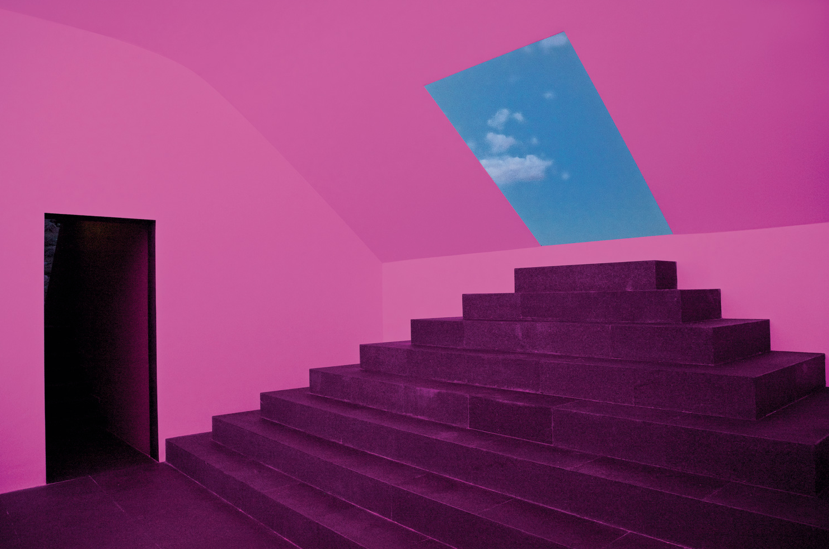
James Turrell, Arrowhead (2009)

James Turrell, Arrowhead (2009)

We would have thrown our clothes away for lightness,
But that even they, though sour and travel stained,
Seemed, like our flesh, made of immortal substance.
And the soiled flax and wool lay light upon us.
Like friendly wonders, flower and flock entwined
As in a morning field. Was it a vision?
Or did we see that day the unseeable
One glory of the everlasting world
Perpetually at work, though never seen
Since Eden locked the gate that’s everywhere
And nowhere?…

– Edwin Muir, “The Transfiguration”

Martin Scorcese’s 1988 film, The Last Temptation of Christ,” was criticized by many for its eccentric portrayal of a Jesus deeply conflicted by the fierce struggle between his two natures. As one reviewer wondered, “Is he God or is he nuts?” Scorcese, who specializes in tormented, confused male characters full of nervous intensity, defended his approach as an attempt to explore Christ’s humanity without the blinding glow of divine self-assurance that made many movie Jesuses seem stiff, complacent and unreal.

“What we were taught in Catholic schools emphasized the divine side of Jesus,” said Scorcese, who had considered priesthood in his adolescence. “Jesus would walk into the room and you would know he was God. Maybe he glowed in the dark or something, I don’t know, but this is the impression they gave us as children.”

The Jesus of Matthew, Mark and Luke does not glow, except in that strange moment called the Transfiguration, celebrated on August 6th in the liturgical calendar. This feast day goes largely unnoticed now in the western churches, who have essentially transferred it to the last Sunday of Epiphany. This neglect of August 6 is in part a concession to the decline of weekday celebrations, but it may also reflect a discomfort with the story itself, which feels like myth or vision rather than actual history. Not even the risen Christ matched the glow of the Transfiguration. What are we being asked to believe here?

We can never know the phenomenon behind the reported perceptions by Peter, James and John. But the symbolic dimensions of the narrative are clear, linking the incident to the ancestral epiphanies of Moses and Elijah. There is a mountain, where earth below meets heaven above. There is a cloud of unknowing, veiling divine presence in hiddenness and mystery. And there is a voice, making contact with human sense, rupturing the boundary between holy and profane to affirm the unique filial status of Jesus as God’s Beloved “Son.”

But what about that “dazzling” glow? What did the disciples actually see in Jesus on that mountain? Was it an unrepeatable moment, a temporary endowment bestowed upon Jesus to make a point to doubting disciples, or was it something Jesus always possessed?

Gregory of Palamas, a 14th century Orthodox theologian, argued the latter. He based his influential meditation practice of Hesychasm on contemplation of the “uncreated light” first seen at the Transfiguration. This light, he taught, was not an ephemeral experience of the senses but the unmediated presence of God. Although this holy light could be seen through physical eyes, it was not a natural light. It was, in fact, the uncreated energies of the Godhead, the splendor of the age to come, a light shining from God’s future into the present moment.

Christ is transfigured, not by putting on some quality he did not possess previously, nor by changing into something he never was before, but by revealing to his disciples what he truly was, in opening their eyes and in giving sight to those who were blind. For while remaining identical to what he had been before, he appeared to the disciples in his splendor; he is indeed the true light, the radiance of glory.[i]

Whatever we make of Gregory’s metaphysical claims, which were disputed by many of his contemporaries, the spiritual resonance of light is undeniable and universal. It is always seems to be about something more than physics. It seems inevitably imbued with Spirit.

Annie Dillard describes “mornings, when light spreads over the pastures like wings, and fans a secret color into everything, and beats the trees senseless with beauty…Outside it is bright…It is the one glare of holiness; it is bare and unspeakable. There is no speech or language; there is nothing, no one thing, nor motion nor time. There is only this everything.”[ii]

Where does such light come from? Is it something that happens to our eyes but is not really in the world, or is it somehow there, in the heart of things, “born of the one light Eden saw play?” Is it not just a simulacrum of divinity, but a direct manifestation?

James Turrell, Breathing Light (2013)

James Turrell, Breathing Light (2013)

James Turrell, one of the most celebrated of the contemporary “Light and Space” artists nurtured under California skies, has been exploring light and its effects since the 1960s. His mesmerizing spaces invite participants to experience not objects made visible by light, but light itself in an astonishing repertoire of varying colors and brightness. If there are walls, they seem to dissolve into the immateriality of radiance. If there is a ceiling, it may have a large opening inviting us to contemplate the luminous canopy of sky. “Light,” says Turrell, “is not so much something that reveals as it is itself the revelation.”

We eat light, drink it in through our skins. With a little more exposure to light, you feel part of things physically. I like the power of light and space physically because then you can order it materially. Seeing is a very sensuous act – there’s a sweet deliciousness to feeling yourself see something.[iii]

For many of us fortunate to have savored the deliciousness of Turrell’s light spaces, feeling ourselves see something is not just an intellectual or psychological act. It is spiritual – the “glare of holiness … beating us senseless with beauty.”

Turrell’s own Quaker tradition says that prayerful attention is “going inside to greet the light.” But is the radiance of divine beauty just in our souls, or does it permeate the universe? Does it show itself to us here, there and everywhere, as it did to Peter, James and John?

David Bentley Hart, an Orthodox theologian, proposes creation as a manifestation of God’s infinite luminosity, what he calls “the agile radiance of the Spirit.”[iv] We see this radiance not by looking away from the world, but by looking more deeply into it. But when the light is in eclipse, what then? “Sometimes,” says Bruce Cockburn, “you have to kick the darkness till it bleeds daylight.” Even at the Transfiguration, according to an Anglican midrash by a seventeenth-century bishop, Moses and Elijah felt impelled to warn Jesus about the suffering and darkness awaiting him once he descended the mountain:

A strange opportunity … when his face shone like the sun, to tell him it must be blubbered and spat upon;… and whilst he was Transfigured on the Mount, to tell him how he must be Disfigured on the Cross![v]

The poet Kathleen Raine perfectly describes the utter bleakness when “the curtain is down, the veil drawn” over the world’s deep radiance. “Nothing means or is,” she says.[vi]

Yet I saw once
The woven light of which all these are made
Otherwise than this. To have seen
Is to know always.

[i] St. Gregory Palamas, The Triads, in Richard Harries, Art and the Beauty of God: A Christian Understanding (London: Mowbray, 1993), 85

[ii] Annie Dillard, Holy the Firm (New York: Harper Perennial, 1998), 67-8

[iii] q. in Michael Govan, “Inner Light: The Radical Reality of James Turrell”, James Turrell: A Retrospective (New York: DelMonico Books, 2014), 13

[iv] The Beauty of the Infinite: The Aesthetics of Christian Truth (David Bentley Hart, Eerdmans 2003), 292

[v] Joseph Hall, Contemplations upon the principal passages of the Old and New Testaments, 1612-28, found on Google Books, p. 383

[vi] Kathleen Raine, in Harries, 87

“Owl among the ruins” – What shall we do with empty churches?

Netherlands church converted to private residence.

Netherlands church converted to private residence.

Entering into a church is a metaphor for entering into a shared world of symbolic narratives and meanings, somewhat like entering into a story and discovering the richness and internal coherence of its structure.   – Richard Kieckhefer[i]

A space’s or a building’s ‘sacredness’ is, with rare exception, neither a permanent nor an absolute black-or-white condition. The sacrality of even the most natural or ‘found’ sanctuary is vulnerable to defilement, and thus desacralization.[ii]   – Lindsay Jones

Where once the spire of the cathedral or the steeple of the church gave the first glimpse of city or village, today it is the Sears and Hancock buildings.[iii]    – Nicholas Wolterstorff

Fifty years ago on Thanksgiving Day, a group of friends shared a festive meal in a former Episcopal church in Great Barrington, Massachusetts. First constructed in 1829 as St. James Chapel, then enlarged and renamed as Trinity Church in 1866, the white wooden structure, with pointed Gothic windows, steeply pitched roof and tall attached tower displays the Platonic ideal of a New England church, the transcendent anchor of so many Northeastern towns. But its congregation had dwindled over the years. In 1964 it was deconsecrated and sold to Alice and Ray Brock, who put a bedroom in the tower and made it their home.

As Arlo Guthrie tells it in his song, “Alice’s Restaurant,” the new owners had “a lot of room downstairs where the pews used to be. Havin’ all that room, seein’ as how they took out all the pews, they decided that they didn’t have to take out their garbage for a long time.” So after dinner, Arlo and friends offered to take all that garbage to the dump in their VW bus. But when they found the dump closed for Thanksgiving, they improvised, emptying their load onto an unofficial garbage pile spotted on a side road. Guthrie was arrested for littering, an offense which would eventually make him “unfit” for the draft. Absurd but true, and Guthrie’s 18-minute song about it became a uniquely comic anthem of the antiwar movement. Many of us would sing its joyful chorus as we marched on the Pentagon in November, 1967.

I thought about Alice and Arlo and old Trinity Church when I read an article by Inga Saffron about the fate of struggling churches in Philadelphia: “In the rush to build houses, churches are being discarded.” Her subject was St. Laurentius, an historic Gothic Revival church built in 1882 with the nickels and dimes of Polish immigrants. A prominent symbol of the city’s Polish heritage, but no longer a viable parish, it was slated for demolition by the Roman Catholic Archdiocese. The property would be sold to housing developers.

It’s a familiar problem. When neighborhoods change or religious affiliation declines, church buildings often lose their sustainability. In addition, significant changes in liturgical understanding and practice make many inherited structures unsatisfactory venues for the renewal of worship. Since historical preservation is not the primary mission of Christianity, religious institutions cannot be expected to hold onto every property in perpetuity.

But the decision to abandon a church building is not without impact on the surrounding community. What happens when a church’s physical and symbolic presence is erased from the landscape? As Saffron writes, “Certainly, Philadelphia’s archdiocese is stuck with far more buildings than it can use. But it’s dispiriting that it has taken to treating their disposition as purely a business problem, compounding the community trauma brought on by the closings of so many churches and schools . . . {T]he city can’t be just houses. It needs the punctuation of civic monuments – churches, schools, libraries, and even old factories. Without those larger structures to break up the relentless grid, our blocks would be run-on sentences, without meaning.”[iv]

It’s hard to imagine a Europe without its cathedrals, England without its country parishes, or a New England village green without its white church. And many residents of Philadelphia’s Fishtown neighborhood have protested the potential disappearance of St. Laurentius. “Can you imagine Fishtown being Fishtown without it?” Saffron asks.

At a city hearing on St. Laurentius, architect Susan Feenan argued for the preservation of historic structures. “I have no delusions about this building being a Catholic church again,” she said, “but a neighborhood without old buildings is like a child without grandparents.”[v]

However, if a building is no longer functions as shelter for a living congregation, or is no longer suitable as an enlivening worship space, is there an alternative to demolition, so that it may continue at least as an aesthetic presence and a repository of historical and cultural memory, without draining the Christian resources needed for mission and service?

One solution has been repurposing – the conversion of churches to primarily secular uses. In the last decade, 52 Philadelphia churches have found a new life without religion. Some of these conversions retain a community function, such as art gallery, bookstore, school, brew pub or restaurant. Some become offices or private residences. There are many examples of converted churches on the web. Their creative adaptation of challenging interiors is impressive, and they are all alluring. Who would not want to spend time in these lovely spaces?

I confess to some uneasiness here. I feel a certain melancholy in deconsecration. A sense of loss. Loss of community, loss of shared symbols, loss of faith, loss of God. Generations of prayers and hymns have thinned to fading echoes. Spatial or visual symbols, detached from their roots like cut flowers, seems sadly bereft and disregarded. The meaning of the space has been disconnected from the intentions of its builders. One couple who has taken up residence in an old Serbian Orthodox church “couldn’t live with all the wall paintings,” and they covered most of them up. The starry ceiling, happily free of explicit religious narratives, did please them, so it survived.

I’m not saying the Church should hold on to specific buildings when their day is done, no matter how many beloved memories they contain. Death and resurrection is the pattern we live by. Death is not the opposite of resurrection, but its necessary component. Sometimes we just need to let go so that the new may happen.

But the continuing physical presence of religious buildings provides a vital sign of a reality beyond our human projects and mirrored desires. Their importance is not only aesthetic and emotional. It is also spiritual, imploring all who pass by: Don’t forget!

Even a repurposed church retains a memory, a trace of the faith that built it. And that trace puts a question mark to the depthless horizontality of materialist culture. Can you dwell within or among such places without pausing to wonder?

Of all the options for church conversion, the residential privatization of sacred communal spaces seems the most troubling. Places once devoted to public welcome and communal prayer seem substantially trivialized when their function is reduced to the personal pleasure of the lucky few. But make old churches into places of public conviviality and conversation, of art and music, teaching and learning, or feeding and sheltering the poor, and Jesus will be there as surely as he was in the midst of the old worship community.

And whatever happened to the former church of “Alice’s Restaurant”? After being a private residence under several owners, it was bought by Arlo Guthrie in 1991, who turned it into the Guthrie Center at the Old Trinity Church. Reconsecrated as a home for all religions by his guru, Ma Jaya Sati Bhagavati, it provides social assistance, communal hospitality, educational events, concerts and lectures, and interfaith services. Sometimes a building just knows what it wants to be.

[i] Richard Kieckhefer, Theology in Stone: Church Architecture from Byzantium to Berkeley (Oxford: Oxford University Press, 2004), 135

[ii] Lindsay Jones, The Hermeneutics of Sacred Architecture: Experience, Integration, Comparison – Vol. Two, Hermeneutical Calisthentics: A Morphology of Ritual-Architectural Priorities (Cambridge, MA: Harvard University Press, 2000), 291

[iii] Nicholas Wolterstorff, Art in Action p. 23, quoted in T.J. Gorringe, A Theology of the Built Environment: Justice, Empowerment, Redemption (Cambridge: Cambridge University Press, 2002), 199

[iv] Inga Saffron, “In the rush to build houses, churches are being discarded”: http://articles.philly.com/2015-06-06/entertainment/63090297_1_historic-register-fishtown-based-st

[v] http://articles.philly.com/2015-07-11/news/64310933_1_fishtown-preservation-law-church-architect

Paying attention

Summer day, Deschutes River, eastern Oregon.

Summer day, Deschutes River, eastern Oregon.

Day creeps after day, each full of facts … And presently the aroused intellect finds … that a fact is an epiphany of God, that on every fact of his life he should rear a temple of wonder and joy.     – Ralph Waldo Emerson

One of today’s first facts was a blackberry that called to me as I ran by at dawn. Blackberries normally ripen in August, but here was one, dark and soft to the touch, ready for harvest in mid-July. Like Moses turning aside from his path to investigate a revelatory shrub, I interrupted my run to taste that precocious berry. How delicious! Sweet sacrament of summer.

This is the day I was born, long ago in another century, and I am celebrating by setting aside tasks and plans to slow down and take time, giving over the hours to what poet Mary Oliver calls “noticing and cherishing.” There are birds to watch, poetry to read, music to play, water to swim in, trails to explore. Or maybe, like Thoreau in his cabin’s sunny doorway, I will just sit among the trees, rapt in reverie, “in undisturbed solitude and stillness.”

After the blackberry, what else will offer itself to my attention?

Never in eternity the same sound –
a small stone falling on a red leaf.

So wrote Jane Kenyon in her poem, “Things,” which shares Emerson’s awareness of facts as epiphanies. But Kenyon, whose own time on earth was all too brief, was keenly aware that such joys are always on the verge of disappearance.

Things: simply lasting, then
failing to last: water, a blue heron’s
eye, and the light passing
between them: into light all things
must fall, glad at last to have fallen.

So much beauty, so many epiphanies. Do we have enough time? Robert Louis Stevenson said that “you have no idea, unless you have tried it, how endlessly long is a summer day.” So today I will try it. I will make an experiment in attentiveness and wonder, gratitude and joy. It is, I know, a luxurious waste of time. But it seems “meet and right so to do.” As photographer and writer Walker Evans reminds us, paying attention is what we were made for:

Stare. Educate the eye.
Die knowing something.
You are not here long.