Kieslowski’s Decalogue: A Masterpiece of Religious Cinema


Pawel (Wojciech Klata), Decalogue 1

Pawel (Wojciech Klata), Decalogue 1

If I had to formulate the message of my Decalogue, I’d say,
‘Live carefully, with your eyes open, and try not to cause pain.’

– Krzysztof Kieslowski[i]

The late Krzysztof Kieslowski’s Decalogue (1988), one of cinema’s great religious masterpieces, had its origins in the depressing bleakness of Polish life in the mid-1980s. “Chaos and disorder ruled . . . everywhere, everything, practically everybody’s life,” wrote the filmmaker. “Tension, a feeling of hopelessness, and a fear of yet worse to come were obvious. I sensed mutual indifference behind polite smiles and had the overwhelming impression that, more and more frequently, I was watching people who didn’t really know why they were living.”[ii]

Driven to explore the questions of why we suffer and how we live, Kieslowski collaborated with Krzysztof Piesiewicz (not a writer but a great talker) to develop a series of scripts based on the Ten Commandments, which he then directed as ten one-hour episodes for Polish television. Subsequent theatrical screenings of the 584-minute series brought him instant international acclaim. A beautiful new restoration is now available on Blu-ray, but if you ever get a chance to see it on the big screen, don’t miss it. I’ve done the full immersion twice––in the nineties, and two months ago­­––and each time I exited the theater deeply affected, as though emerging from an all-night liturgy.

To call this work “religious” may seem a misnomer to those who think religious art requires explicit messaging, dogmatic certainty or a happy resolution of narratives. Decalogue offers neither clear answers nor divine fixes. Instead, it combs the landscape of doubt and anguish for the elusive traces of a power or presence which we might call grace, or even “God.”

Kieslowski’s given name, Krzysztof, means “Christ,” but he staunchly resisted religious labels and institutions. He was, he said, an “agnostic mystic,” a searcher attuned to something beyond the immanent and empirical. In exploring the idea of the Commandments as transcendent guides for living, he argued that “an absolute point of reference does exist … it’s something which is lasting, absolute, evident and is not relative… especially for people like me, who are weak, who are looking for something, who don’t know.”[iii]

The Commandments are not so much about the dictates and prohibitions in themselves as they are about relationships. In setting limits on human failings––violence, acquisitiveness, exploitation, idolatry, etc.––they create a safe space to flourish in just relation with one another, while at the same time binding human community in a covenantal relationship with a transcendent “point of reference.” As they prod us toward love of God and neighbor, the Commandments foster the deep interconnectedness which theologians call the image and way of divinity.

Decalogue’s characters are no saints. They are as weak, muddled and lost as the rest of us. The ten films don’t show us how to keep the Commandments; they show us what happens when we break them––damage and suffering, yes, but possibilities of grace as well.

All the stories involve the residents of a single apartment building, an oppressive concrete high-rise where joy is a rare commodity. Many of its occupants are lonely, broken or suffering. No one smiles much. Since we see little interaction of its inhabitants with a wider socioeconomic environment, it feels like a closed world, a laboratory for experiments in human nature, with God and the film viewer as the only outside observers. The actors themselves were not always sure which commandment applied to their story, since correlations between story and commandment were not always clear in the scripts. And a single story might actually involve multiple commandments.

But even if what to do or how to live may not seem clear to either the characters or the viewers who watch their stories, Decalogue gives us people for whom choices clearly matter. As Kieslowski put it, they “live carefully.” Even when they make a bad choice, it is the product of thought, not just careless impulse. And they convey the sense that even in seemingly small decisions, souls may be won or lost.

The stories are varied and often unexpected in their narrative twists and turns. Every situation centers on family issues: parenting, childhood, conflict, rivalry, infidelity, reconcilation and loss. I won’t spoil the pleasure of anyone’s first viewing by describing the plots, but subjects range from Christmas, ice skating, and stamp collecting to voyeurism, incest, kidnapping, suicide, murder and the holocaust. The totality is less grim than it sounds­­––humor, kindness and even redemption play a part––although Decalogue 1 will break your heart (even as it reveals divine compassion in an unforgettable image), and the murder in Decalogue 5 is almost unwatchable (as is the capital punishment which mirrors the original crime). Kieslowski sought God even in the abysses of human experience. His films are like the homeless drunk in Decalogue 3, dragging a scrawny tree through the streets on Christmas Eve, caroling in a slurred voice, “God is being born.”

If God is really being born, where is the birthplace? How on earth do we find it? German theologian Eberhard Jüngel says that the primary God question for modernity is not “whether God is” or “what God is,” but “where God is.” Before we argue existence or essence, we need to locate divine presence in the stories and places we ourselves inhabit.

Kieslowski looked for it through cinema. His faithful doubt gives Decalogue an honest authenticity. What he finds is not overdetermined by prior theological conviction. As critic Joseph G. Kickasola writes, “There is no evidence that Kieslowski ever felt that he concretely found that Transcendent hope, but his films stand as a testament to the integrity of his search and his longing.”[iv]

How do you show the Divine on film? God’s immanent manifestations may certainly be glimpsed in moments of human forgiveness, reconciliation, healing and liberation. But how might God’s elusive and ineffable transcendent dimension be represented? One way is through film style, using abstraction, reflections, filters, lighting, color, music, sound, and editing to dislodge the eye from habitual perceptions and suggest the possibility of less empirical realities. Decalogue abounds with such visual epiphanies. It is a world full of signs, once you start looking for them.

Another cinematic means of representing invisible Reality is to show one thing while allowing it simultaneously to mean something else. In Decalogue 9, a man lies in the hospital after a bungled suicide attempt. His wife, reading his suicide note, thinks he is dead. A hospital nurse dials her number, and holds a phone to the immobile husband’s ear. His wife answers. “God, you’re there!” she says. He responds, “I am.” It’s a very human moment of reconciliation, but in the context of the story, one cannot miss the dual meaning of this exchange. The object of deepest longing (“God”), thought to be gone forever, has not only been found (“you’re there”), but it answers the seeker with the divine name (“I am”). Fade to black.

In Decalogue 1, a man who has suffered unspeakable loss enters a candlelit church. Angry at a God whose existence he doubts, he overturns an altar beneath a large icon of the Virgin. A candle on top of the icon tips over, spilling its hot wax, which then drips slowly down the Virgin’s cheek. For this viewer at least, this is not simply a mediating image of divine compassion. It feels like direct experience. I know it’s just wax sliding down a painted surface. I know I am watching a film. But still: I see God weeping for our sorrow.

Another indicator of transcendent reality is the recurring sense of fate or destiny suggested by compelling coincidences, as if some intentional, benevolent design is trying to assert itself amid the happenstance of human affairs. There are many such uncanny connections in Decalogue. But such evidence is inherently ambiguous. As Slavoj Žižek wonders, “Is this the final answer of the Real, the proof that we are not alone, that ‘someone is out there,’ or just another stupid coincidence?”[v]

And then there is the enigmatic stranger who neither speaks nor acts. Appearing in every story but one, he witnesses but never intervenes, though at one point we see him wipe away a tear. Like the three strangers in Abraham’s tent, or the one who wrestled all night with Jacob, he suggests divine presence in anonymous human form.

In Decalogue 1, his first appearance is next to a fire, evoking the burning bush. He always seems to possess a secret knowledge of the heart, indicated by his knowing gaze. He turns up, as if omnipresent, at key moments of decision or crisis. Whether he is a powerless divinity who can sympathize but not save, or a mysterious agency which bends human causality, however subtly, toward positve outcomes, remains indeterminate throughout the Decalogue. But crucial changes or differences sometimes follow in his wake.

The script simply calls him “the young man.” The actor, Artur Barcis, thought of him as the Christ. Kieslowski told the actor to play him “as if you were five centimeters off the ground.” One critic compares him to an icon, “materially bearing [God’s] presence and eternal gaze in the broken, desolate community and reminding us that the commandments have always been perceived (by the faithful) to have a living, transcendental dimension.”[vi]

Each time I watch, I am moved by the stranger, so perfectly expressive of God’s ineffable oscillation of presence and absence: a transcendence which cannot be possessed or summoned, though it will never truly abandon us. But perhaps Decalogue’s supreme revelation––an incarnational, unambiguously human image of the divine––is found in an exchange between Pawel, an eleven-year-old boy, and his aunt Irena. Pawel has a great curiosity about God, which his single-parent father, an unbeliever, cannot satisfy. So Pawel takes his questions to his devout Catholic aunt.

Pawel: Do you believe that God exists?
Irena:  Yes.
Pawel: What is God?

Irena puts her arms around Pawel and pulls him close.

Irena:  What do you feel now?
Pawel: I love you.
Irena:   Exactly. That’s what God is.


Related post:   The ten best religious films


[i] Annette Insdorf, Double Lives, Second Chances: The Cinema of Krzysztof Kieslowski (New York: Hyperion/Miramax Books, 1999), 124

[ii] ibid., 69-70

[iii] Monica Maurer, Krzysztof Kieslowski (North Pomfret, VT: Trafalgar Square Publishing, 2000), 13

[iv] Joseph G. Kickasola, The Films of Krzysztof Kieslowski: The Liminal Image (New York: Continuum, 2004), 89

[v] Slavoj Žižek, The Fright of Real Tears: Kryzysztov Kieslowski Between Theory and Philosophy (London: British Film Institute, 2001), 123

[vi] Kickasola, 165-6

Caroling in the Dark: A Christmas Meditation

"And a little child shall lead them." (Isaiah 11:6)

“And a little child shall lead them.” (Isaiah 11:6)


Herod then with fear was filled.
(Medieval carol)

The first Christmas Eve, in the old legends, was “so hallowed and so gracious” a time that flowers bloomed in the Bethlehem snow, kindly beasts knelt to warm the Child with hay-scented breath, the birds of dawning sang all night long, and angels bent near the earth to sing of peace.

Oh that it were so again! Desperate to exit the gloom and foreboding of the present time, “we too would thither bend our joyful footsteps”–to see the birth of New Possibility, to welcome the marriage of heaven and earth, to recover hope for what we might become. But the Christmas story is not about escaping this broken world. It is about repairing it.

The Incarnation began with unconditional acceptance of the human condition. To know our griefs and carry our sorrows, God began mortal life as a refugee from political violence and ended it as a victim of torture and capital punishment. Risk and violence were not confined to the latter days of Jesus. They were there from the start.

That is why, only a few days after singing “Silent Night” at the holy manger, the Christian calendar insists that we take time to remember Herod’s slaughter of Bethlehem’s children. We are allowed no illusions about how the story goes: Love is born into the world, and the powers try to kill it.

Only Matthew’s gospel records Herod’s monstrous act. Its clear parallel to the Exodus story, where Pharoah’s slaughter of the Hebrew children fails to eliminate the child of destiny, suggests some narrative invention. There are no other historical accounts to corroborate Matthew’s tale. But who cannot testify to the truth it contains? The powers will stop at nothing to achieve their ends. That, too, is part of the Christmas story.

Julia Hartwig, a Polish poet, gives a harrowing account of the massacre. It seems haunted by memories of Auschwitz, but reading it today I think of Aleppo.

While the innocents were being massacred who says
that flowers didn’t bloom, that the air didn’t breathe bewildering scents
that birds didn’t rise to the heights of their most accomplished songs
that young lovers didn’t twine in love’s embraces

But would it have been fitting if a scribe of the time had shown this
and not the monstrous uproar on a street drenched with blood
the wild screams of mothers with infants torn from their arms
the scuffling, the senseless laughter of soldiers
aroused by the touch of women’s bodies and young breast warm with milk

Flaming torches tumbled down stone steps
there seemed no hope of rescue
and violent horror soon gave way to the still more awful numbness of despair

At that moment covered by the southern night’s light shadow
a bearded man leaning on a staff and a girl with a child in her arms
were fleeing lands ruled by the cruel tyrant
carrying the world’s hope to a safer place…[1]

And the good news? The coming of God means the shaking of the powers. Even as a baby, the incarnate God struck fear into the hearts of rulers and oppressors. And when Jesus grew up and began to bear witness to the purposes of God, he made it impossible for the powers of this world to claim divine sanction for their monstrous behavior. They still try. Even “pious” rulers can do terrible things, as we know all too well. But the incarnate God has torn the mask from power’s face. By dying at its hands, like all the other victims of hatred, violence, and abuse, the Word made flesh has made absolutely clear which side God is on.

Like the women of Bethlehem weeping for her children, we are not easily consoled in the face of so much human suffering. And yet, even in the worst of times, we must never forget the kind of story we are in. It is, ultimately, a story of mercy and possibility:

I am going to tell of God’s kindness to the people of Israel… All of God’s deeds of mercy… All of God’s many acts of faithful love. (Isaiah 63:7)

Isaiah wrote these encouraging words in his own darkest hour. His people were in exile from the land of promise. Hope was dead and gone; their story had reached its bitter end. And yet, said the prophet, it is precisely in the place of desolation and loss that we are called to make our song. It is how we resist.

Sixty-three years ago, such a song was composed on a scrap of paper in a Soviet labor camp by a Latvian prisoner, one of 50,000 Latvians condemned to exile and imprisonment in Siberia under Joseph Stalin, a twentieth-century Herod, after the Second World War.

When the Kings College choir was touring Latvia in the summer of 2007, singer Emma Disley spotted the carol, scrawled on its original piece of paper, in a museum. She transcribed it and brought it back to England, where it was arranged for four-part choir and sung, in Latvian, in that year’s worldwide Christmas Eve broadcast.

The text was by a Latvian writer in exile, Valda Mora. As for the woman who composed the tune, we know neither her name nor her fate. All we do know is that she wrote it down on a scrap of paper as a handmade Christmas card for a fellow prisoner, Marta Zalaiskalnson, on Christmas Day 1953. Marta, who had been in the labor camp since 1945, sewed the paper into the lining of her dress so that her Soviet guards wouldn’t find it.[2]

The history of this carol has a lot to teach us about faith and hope. Born in a time of terrible darkness, it concedes nothing to the powers. Instead, calmly and assuredly, it sings of only one thing: the Light which has come into the world, a Light which the darkness can never extinguish.

On this holy night earth and heaven shine,
On this night the heart and stars commune,
And enmity fades, each loves the other,
And o’er the stillness warm wings hover.

On this night your footsteps glimmer;
This night transfigures doubt to hope;
This night must banish every sorrow,
And teach you to forgive and love.

On this holy night, in this holy night,
On this holy night, each loves the other;
On this holy night, in this holy night,
On this holy night, each loves the other.

On this night the gates of heaven open,
Above earth’s darkness arc the burning stars,
And softly on each person’s head this night
The Lord in blessing lays His loving hand.


Photograph adapted from an uncredited image of a demonstration against an Islamophobic national registry. Source: MoveOn.org email 12.22/2016.

[1] “Who Says,” by Julia Hartwig, trans. Stanislaw Baranczak and Clare Cavanagh

[2] Translation by Mara Kalnins. The carol was arranged by Stephen Cleobury. The 2007 Lessons and Carols bulletin is at http://www.kings.cam.ac.uk/sites/default/files/chapel/festival-nine-lessons-2007.pdf

The Rich Man and Lazarus

Medieval illumination, The Rich Man and Lazarus

Medieval illumination, The Rich Man and Lazarus

For when we first believed in Christ we did not immediately acquire an exact understanding of what we should be doing, nor was it clear to us what we should stop doing and what we should continue doing.

— Diodore, Bishop of Tarsus (d. 394) [i]

You see, God who lives in heaven kept quiet about the rich man’s name, because he did not find it written in heaven. He spoke the poor man’s name, because he found it written there… [ii]

— St. Augustine

This Sunday’s gospel tells the parable of the nameless rich man, living the high life in his mansion, and Lazarus the poor man, who is starving just outside his gate. When they both die about the same time, their situations are reversed. The poor man, suffering the torments of Hades, gets a distant glimpse of Lazarus enjoying the blessings of heaven “in the bosom of Abraham.” (Luke 16:19-31)

Where do we find ourselves in this gospel parable? At the gate, or at the rich man’s table? When Jesus tells this story, he doesn’t seem to allow us the option of remaining a spectator, detached and uninvolved.

Jesus is calling us to make a decision.
What would you do in the circumstances of the story?

There’s a 19th century song based on this gospel. I learned to sing it 50 years ago from the legendary Ramblin’ Jack Elliott:

 Only a tramp was Lazarus’ sad fate
When he lay down by the rich man’s gate
To beg for some crumbs from the rich man to eat
But he left him to die like a tramp on the street…

 If Jesus should come and knock at your door
Would you let him come in and take from your store
Or would you turn him away with nothing to eat
Would you leave him to die like a tramp on the street?

What would you do?
In our world of extreme economic inequality, it’s not a hypothetical question.

That’s the thing about the lectionary. We come to church to be illumined, fed, inspired, and renewed; to praise our Maker and Redeemer in the company of God’s friends. But sometimes we’re slammed with a question that’s really hard to answer.

In this case, what’s hard isn’t mustering the good will to do the right thing. If you’re a friend of Jesus, you know what is right. What’s hard is figuring out exactly how to implement our good will in complicated long-term situations.

We could empty our wallets for the homeless on a walk through downtown, but homelessness would remain. We could vote for candidates who put the needs of the poor ahead of the billionaires. But we would still remain entwined in a system driven more by greed and consumption than by the nurture of human flourishing and the health of God’s creation.

So where do we start? Does the parable itself provide any clues? It’s not really a story, but more of a snapshot. On one side there is Lazarus the beggar lying outside the rich man’s gate, covered with sores, dreaming of the scraps of food that fall from the rich man’s table. On the other is the rich man, behind locked doors, dressed in purple and fine linen, eating to his heart’s content – with a clear conscience as far as we know.

And the story seems to imply that he is unaware of Lazarus’ very existence. He doesn’t send his servants out to drive the poor man away. He doesn’t callously pass him by, pretending not to see him.

In the story, the rich man remains inside, Lazarus remains outside, and the two worlds are completely sealed off from each other—until a catastrophe shakes the rich man out of his complacency, and opens his eyes to the suffering he has ignored for so long.

The catastrophe is his own death. This not only plunges him into the fires of Hades but also—even more painful!—it opens his eyes to his lifelong indifference to the suffering of Lazarus, a suffering he could have alleviated, had he been more aware.

So now he must gaze up at Lazarus, safe in the bosom of Abraham, tormented by the knowledge of things done and left undone. It turns out that his blindness to suffering was not the same thing as innocence. The words of the prophet Amos could have been addressed to him:

Woe to those who are at ease in Zion,
and for those who are complacent on the mount of Samaria…
Woe to those who lie on beds of ivory,
and sprawl on their couches,
stuffing themselves with lamb and veal,
singing idle songs and drinking wine by the bowlful,
who anoint themselves with the finest oils,
but are not grieved over the ruin of Joseph. (Amos 6: 1, 4-6)

It’s not that the rich man didn’t care about Lazarus. He didn’t even see him. Lazarus did not exist for him, until he was compelled to see reality through God’s eyes:

And what the rich man is shown by God in the end is this: Lazarus, rocking his soul in the bosom of Abraham, turns out to be very precious to God. But he (the rich man) is a prisoner of his own self-regard, the loveless and isolating condition otherwise known as hell.

And then this parable, as parables often do, turns to us expectantly. So, it wonders, is there anything you are not seeing in the places where you live and move and have your being?

Last week I attended a meeting of the Interfaith Economic Justice Coalition in Seattle. The subject was the situation of the workers at the airport, the ones who clean and load the passenger cabins, who push the wheelchairs and guide the planes to their gates, who prepare and serve the food in the facility’s many restaurants and coffee shops, who rent the cars and staff the parking lots.

When we pass through the airport as travelers, we are served by many of these workers. But how often do we really see them as people or understand their situation?

Are we aware that the Seattle airport, the third largest economic producer in the state, has been a notoriously low-wage pocket within the greater urban area? Other West Coast airports, such as LAX, are way ahead of our own in addressing wage and justice issues.

The employment structure at Sea-Tac Airport is complicated. A variety of corporate contractors apply to the Port Commission and the airlines for the right to provide specific services. Individual airlines can choose to work with their own preferred contractors, so there is a bewildering variety of arrangements in which individual workers may fall through the cracks, as their employers play musical chairs in the bidding and renewal process. Without a guarantee that you will keep your job regardless of which corporation wins the next contract for the service you provide, you could be out of a job with little warning.

The process of bidding and contract renewals has sometimes been used, by both airlines and the Port Commission, to shut out union workers and reduce the job security and benefits of airport employees in general.

When Seattle passed the nation’s first $15 minimum wage law in 2014, some contractors complied, some chose to fight the law in the courts, and some simply ignored the law and continued to pay only $9.45 an hour, until lawsuits forced them to comply.

Some of the contractors are still in court, but this month several of them agreed to pay retroactively the full minimum wage, which amounts to about $10,000 per worker for each of the two years in which they were underpaid. This will make a huge difference for those workers, their families, and the communities in which they live.

This ongoing struggle for a living wage is about the workers’ dignity and well-being as equal participants in an interdependent society. And, as people of faith would insist, it is about their inestimable value as the beloved children of God. But until my eyes were opened by what I learned at that meeting last week, they were almost as invisible to me as Lazarus at the gate.

And now that I see them a little more clearly, what shall I do? When I take a flight next Saturday, I will certainly be asking myself this question. I can pray for the workers, I can thank them for their service. This Tuesday I’ll be joining with workers and faith leaders at a Port Commission meeting to exert continuing pressure for economic justice. But what else?

I may not have a lot of answers yet, but the question is not going away as long as we keep replaying the unsustainable story of the rich man and Lazarus in our economics, our politics, and our social order. It will not go away, in fact, until that promised day when we will all sit together at one table, sharing our essential communion as grateful brothers and sisters in the feast of God.

Holy One, Lover of Justice, bring that day closer.


Related Post: Why Do We Work?


[i] q. in Thomas C. Oden, The Good Works Reader (Grand Rapids, MI: Eerdmann’s Publishing, 2007), 333

[ii] Sermon 33a.4, q. in Oden, 54

Why Do We Work? A Labor Day Reflection

Good work is a way of living… it is unifying and healing. It brings us home from pride and despair and places us responsibly within the human estate. It defines us as we are, not too good to work with our bodies, but too good to work poorly or joylessly or selfishly or alone.

— Wendell Berry) [i]

Labor Day began in the late nineteenth century as both an homage to American workers (parade, speeches) and a time of re-creation (picnic, dance, fireworks). Congress declared it a national holiday in the aftermath of a contentious railroad strike in 1894, where 30 workers died in violent confrontations. It was hoped that honoring workers would ease tensions and foster social harmony. As the Department of Labor currently describes it, the first Monday in September “is dedicated to the social and economic achievements of American workers. It constitutes a yearly national tribute to the contributions workers have made to the strength, prosperity, and well-being of our country.” [ii]

The holiday’s explicit homage to labor has long been overshadowed by its seasonal significance as the American farewell to summer—one last stretch of fun in the sun before the year gets busy again. But in our overworked culture, where the inbox follows you everywhere and vacations are a fraction of what Europeans enjoy, could we not make some time to reflect together about the nature of labor? What if churches were to revive the notion of Labor Sunday, where our tools could be blessed and the spirituality of work considered? [iii]

In the Bible, the pleasures of a perpetual weekend in Eden ended abruptly when God created Monday morning as a curse upon the first humans, who evidently needed to learn things the hard way. “By the sweat of your face” will you earn your daily bread,” said the Creator.[iv] The story was a way of thinking about the question, Why do we have to work so darn hard? Before the Fall, Adam and Eve were given light duties of tending the well-watered garden, more like an aristocrat’s hobby than the grueling subsistence farming bequeathed to their descendents.

Hard-working humans have been reminiscing ever since about the “happy Eden of those golden years.” [v] Stephen Duck, an eighteenth-century English poet-priest, voiced the complaint of the exploited farmworker.

Let those who feast at Ease on dainty Fare
Pity the Reapers, who their Feasts prepare …
Think what a painful Life we daily lead;
Each morning early rise, go late to Bed …
No respite from our Labour can be found;
Like Sisyphus, our Work is never done …[vi]

The justice issues arising around working conditions, exploitation, and economic inequality are themselves the shared work of any society worth its name. My ideal Labor Day would involve some serious community conversation—more listening than talking—about these things. But I would also be curious to explore the spirituality of work as well. Why do we do whatever we do? Does it give us joy? Does it matter?

An old Scottish drinking song provides a succinct answer in its praise of various occupations. The carpenter’s verse suggests the inner satisfaction of work well done, honors the process as well as the product, and celebrates the interdependence of the social world where each of us benefits from the labor of others:

Here’s a song for the carpenter, may patience guide your hand,
For the dearer your work to you, the longer it will stand.
And when the wind is at our door, we never will forget;
We’ve sung your praises many a time, and so will we yet. [vii]

Like our Creator, we are all makers and doers who enjoy the fulfillment of intentions and the solving of problems. It’s in our nature to see what needs to be done and then take a hand in making it so. We also find pleasure in the solidarity of labor, not only through our relationships with coworkers but also in the awareness of practicing a skill handed down by so many mentors and predecessors.

In an imperfect and often unjust society, not everyone has access to employment that delivers pleasure or meaning in itself, but one’s paying job may still be part of a larger labor which is absolutely worth doing, such as supporting a family or funding a future dream. Studs Terkel, who collected oral histories of countless Americans, believed that all of us long for meaningful work. “I think most of us are looking for a calling, not a job,” he said. “Most of us … have jobs that are too small for our spirit.” [viii]

Lewis Hyde makes a useful distinction between “work” and “labor.” Work is done by the hour, on the clock, usually for money. Its value is quantified, and has economic exchange value. Labor, on the other hand, keeps its own schedule, sets its own pace, and may include time off or even sleep as part of its process. Its social value may be clear, but its economic value is hard to quantify. Its product is not a commodity to exploit but a gift to share. “Writing a poem, raising a child, developing a new calculus, resolving a neurosis, invention in all forms—these are labors.” So are volunteer work, ministry, visiting the sick and the prisoner, gardening, personal soul work and “the slow maturation of talent.” [ix] Such labor is priceless.

Most of us have performed both work and labor, as well as hybrids which include elements of both. As Citizen Kane’s financial advisor said, “It’s no trick to make a lot of money, if all you want is to make a lot of money.” But the truer and nobler task is to cooperate with the Creator in repairing the world to make it a place of beauty, love and justice.

So my Labor Day question is this: Where and how can we do the labor to which we are called, the thing which étienne Souriau has called the “Angel of the work” [x]— that which gives us joy and blesses others?

There’s another verse in that Scottish song which thanks the singers who keep their voices clear:

For the world as you would have it be,
you sing with all your wit,
And ease the work of Providence,
and so will we yet.

In that spirit, I leave you with two such singers, Joan Baez and her sister Mimi Farina, who “ease the work of Providence” by voicing the universal human right to flourish: bread, yes, but roses too!


[i] Wendell Berry, The Unsettling of America, q. in Karen Speerstra, ed., Divine Sparks: Collected Wisdom of the Heart (Sandpoint, ID: Morning Light Press, 2005), 520

[ii] Department of Labor website: https://www.dol.gov/general/laborday/history

[iii] This was instituted by churches as a companion to Labor Day, but has fallen into disuse.

[iv] Genesis 3:19

[v] John Clare, “Helpstone” (1809) q. in Raymond Williams, The Country and the City (Oxford & New York: Oxford University Press, 1973), 10

[vi] Stephen Duck, “The Thresher’s Labour” (1730), in Williams, op. cit., 88

[vii] The original, “Sae Will We Yet,” is attributed to Walter Watson, but I believe the carpenter verse is a contemporary addition by Ossian’s Tony Cuffe. A fine version by Gordon Bok, Ann Muir, and Ed Trickett is here: https://www.youtube.com/watch?v=h48Db_cvdDE

[viii] In Speerstra, op. cit., 519

[ix] Lewis Hyde, The Gift: Imagination and the Erotic Life of Property (New York: Vintage Books, 1979), 50

[x] étienne Souriau, q. in Isabelle Stengers, Thinking with Whitehead: A Free and Wild Creation of Concepts, trans. Michael Chase (Cambridge, MA: Harvard University Press, 2011), 464

A Voice to Raise the Dead

Lucas Cranach the Younger, Raising of the Son of the Widow of Nain (detail, 1569)

Lucas Cranach the Younger, Raising of the Son of the Widow of Nain (detail, 1569)

I’m writing from Hattiesburg, Mississippi, where I’ve been among some amazing people to reflect together on the deep connections between art and spirituality. The fruit of those conversations will find their way into future posts, but meanwhile here is what I’m preaching this morning from the pulpit of Hattiesburg’s Trinity Episcopal Church, based on the gospel text from Luke 7:11-17. 

Watch out! There’s going to be a collision.

Here comes a funeral parade, with a dead young man, his grieving mother, and a whole crowd of mourners, weeping and wailing and gnashing their teeth.

And from the opposite direction, pretty as you please, here comes the Jesus parade: the holy man everybody’s talking about, along with his passel of disciples and a whole bunch of folks who’ve just seen Jesus cure the centurion’s slave in the blink of an eye and who want to see what in heaven’s name he’s going to do next.

The Jesus people are all laughing and talking and telling stories, but suddenly Jesus raises his hand and they all stop, because he’s seen the widow, he’s heard her crying—they can all hear her crying—and Jesus is so moved by her tears, his heart just fills up and overflows with compassion. and whatever he was on his way to do no longer seems all that important.

He knows that moments like this are why he came into the world. So he heads straight across the town square to meet that funeral procession, with all his folks trailing after him, wondering what’s going to happen.

What is going to happen, in the middle of that dusty little country town, is a great cosmic showdown: the parade of death running smack into the parade of life. And here’s how it goes.

Jesus reaches out to touch the coffin, and the pallbearers come to a dead stop. Everybody gets real quiet. Maybe the widow recognizes Jesus. Maybe she’s heard stories about his miracles. But she’s not asking for any help. Her son is dead. She knows his story is over. Nothing Jesus can do about that, she thinks. She’s long since resigned to her grief.

And the only thing Jesus has to say to her is, “Do not weep,” because it’s her son that he wants to talk to. Then Jesus speaks the words he has been given the power to say:

Young man, arise!

And the dead man sits up, opens his mouth, takes a breath, and words start to spill out, words of wonder and joy, and he is alive again. Then Jesus gives him back to his mother. And all the people standing round don’t know whether to be scared or whether to start shouting “Glory to God! Glory to God!”

And as for all of us who listen to this story today,what do we do with the strangeness of it in a world where too many young men and women die and parents weep and there is no resurrection parade that shows up to make everything all right again?

Can we still take hope from this story, or is being snatched from the jaws of death only for the lucky few, like winning the lottery, while the rest of us can only dream of such a happy fate?

This would be a cruel story if it were about a blessing which most of us will never know. But what Jesus did that day in the village of Nain wasn’t a promise that we all now get a free pass to escape the human condition. Jesus didn’t really go around raising up everybody who died. It only happens three times in the gospels. Jesus didn’t come to give everyone a few extra decades of earthly existence. That’s not why he was here.

He was here to show us God, and to show us how humanity is made to become like God—not by grasping power and glory, but by embodying compassion, which is one of the dearest of God’s names.

It wasn’t God’s plan that Jesus spend all his time putting funeral directors out of business. But on that particular day in Nain, Jesus couldn’t help himself. He felt compassion for the widow, and as the incarnate Author of Life, he returned the widow’s son to the sensory world of dust and sunshine just so death wouldn’t get too uppity. Sometimes death needs to be reminded that it never gets the last word.

But Jesus didn’t mean for us to place our own hope in such temporary reprieves. The resurrection of the dead is a mystery more ultimate and profound than what happened to the widow’s son. Dying and rising are inseparable partners in the same transformative dance. It’s the way the story goes, and we just have to live with it. That is why, even at the grave, we make our song: Alleluia, alleluia, alleluia.

So what does this gospel story want to tell us today, wherever you and I happen to find ourselves on life’s journey in the year of grace 2016? I’ll tell you what I hear.

The first thing is, our God is compassionate. Our God is moved by our tears. And in the end, as poet Jane Kenyon said before her own untimely death, God will prove to be “mercy clothed in light.”

Secondly, I am struck by the power of the voice of the Divine Beloved, the voice of Jesus, speaking to us the word of life: Arise. And I don’t think we have to wait for the Last Day to hear it, either.

We are being called back to life every day, every moment, if we only have ears to hear. On her wonderful website, The Painted Bird, Jan Richardson has posted her poem inspired by this gospel. “Blessing for the Raising of the Dead.” tells us that ‘while this blessing / does not have the power / to raise you, /  it knows how to reach you. / It will come to you, / sit down / beside you, / look you / in the eye / and ask / if you want / to live.’ You can read the whole poem here.

Finally, I hear this gospel telling me one more thing. It is not enough simply to hear the voice that blesses and revives. I believe, now that the tongues of Pentecostal fire have settled on our own heads, that you and I are called to speak that voice as well, to be ourselves the voice that blesses, the voice that calls the dead back to life—dead hopes, dead neighborhoods, dead dreams, dead souls.

The word of life is not something we ourselves possess, but God has empowered us to speak it nonetheless: to be Christ’s voice for those in need, to be Christ’s voice to a broken and longing world—

the voice which speaks the word
uttered for all eternity
in the heart of God:

Arise, it says. Arise.


The Faithful Centurion: A Homily for the 2nd Sunday of Pentecost

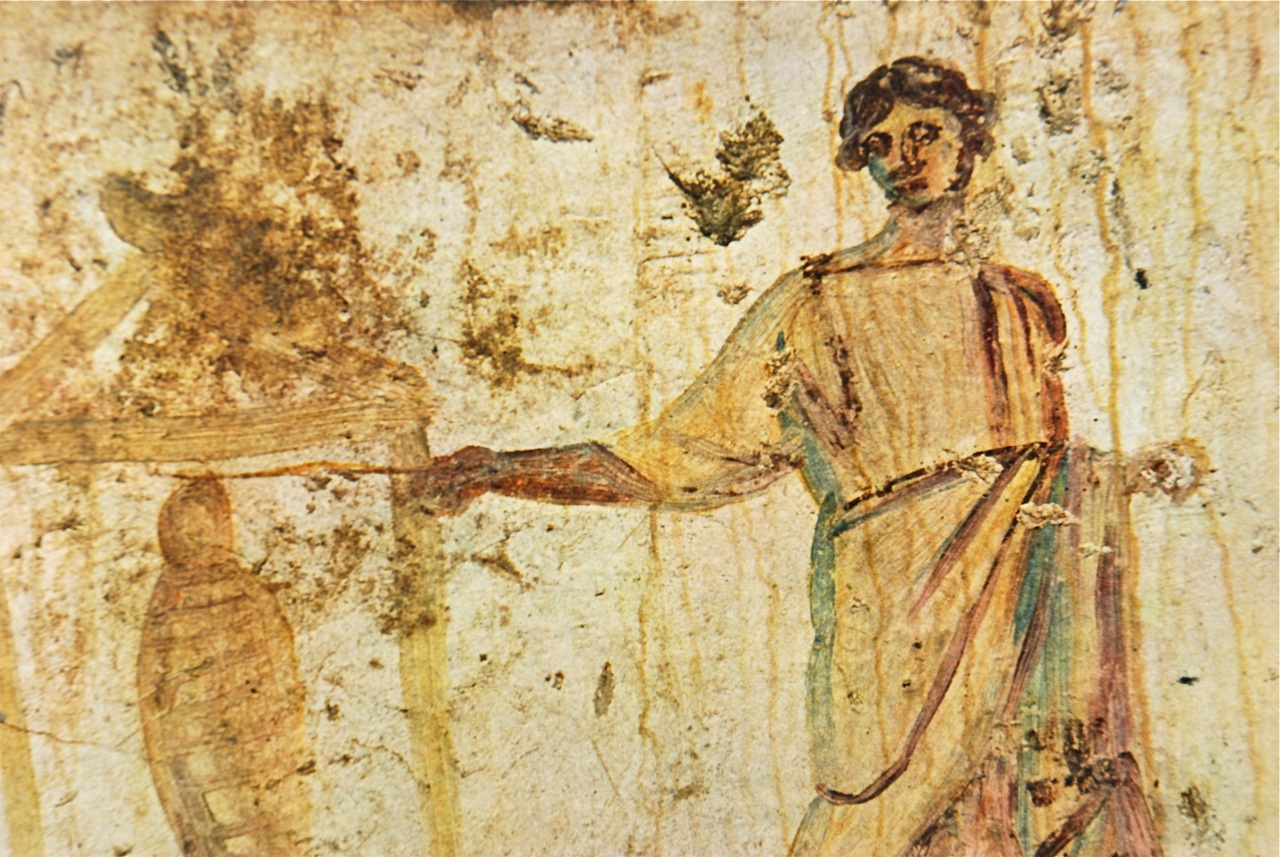
Jesus raises the dead with a wand (Roman catacomb, 3rd century)

Jesus raises the dead with a wand (Roman catacomb, 3rd century)

The gospel story for the Second Sunday of Pentecost[i] describes a world in which things don’t happen the way they’re supposed to.

A Roman centurion treats his slave more like a friend than a piece of property. When the slave gets sick and is close to death, the centurion implores the Jewish community to help him find a healer.

Normally, Jews and Romans were not on the best of terms. Occupying armies just don’t get much love, and besides, doesn’t everybody know that foreigners are just “not our kind?” If only we could build a wall high enough to keep them out!

But this Roman centurion has somehow made friends with the local Jewish elders. He has even built a synagogue for them. So they are happy to help.

The Roman has heard some stories about Jesus and his healing gifts, so he asks the elders to go beg Jesus, that he might come and heal his slave.

Now we’ve heard a lot of stories about Jesus getting the local clergy mad at him, so we may be surprised to learn that there were also some of them who admired Jesus, and maintained good relations with him. That is clearly the case here. And what the elders say to Jesus is this: “The centurion is worthy of having you do this for him, for he loves our people.”

So far, not much is going the way we would expect. A centurion treats his slave like a friend. A Roman loves the Jews, and the Jews love him back. And as for Jesus and the local clergy, they are getting along swimmingly.

But there are more surprises to come.

Jesus goes with the elders to find the centurion’s house, but just before they arrive, the centurion sends some friends out to say, “Lord, do not trouble yourself, for I am not worthy that you should come under my roof; that is why I did not presume to come to you myself. But only speak the word, and my servant shall be healed. For I know something about authority, since I have soldiers serving under me. I say to one, `Go,’ and he goes, and to another, `Come,’ and he comes, and I say to my slave, `Do this,’ and the slave does it.”

How strange to see a Roman officer humbling himself before a wandering Jewish rabbi. “I am not worthy that you should come under my roof,” he says.

And Jesus is “amazed.” That word in the gospel is usually applied to people who are amazed at Jesus. But here it is Jesus’ turn to be amazed. And why? Because the centurion has total faith in the power of Jesus to heal his slave, even at a distance.

“Just as I command my slaves to come and go as I wish, I believe that you have the power to command sickness and death to depart from my house. Only say the word.”

It may seem a little odd that this exchange doesn’t take place directly between Jesus and the centurion. The centurion communicates through intermediaries. This is, he says, because he is not worthy to have Jesus even enter his house. It’s a pretty extraordinary bit of deference on behalf of the powerful Roman.

In any case, Jesus turns to the crowd which has been tagging along because this was clearly the most interesting thing happening in Capernaum that day, and says, “You know what? I haven’t found this kind of faith among any of you folks who go to church. You all could learn something from this centurion fellow. You may call him an unbeliever, but he’s just given you some of the best spiritual teaching you’re ever going to get.”

And then, because this wants to be an odd story from beginning to end, the servant is suddenly well without Jesus ever saying a prayer or speaking a healing word. This miracle happens offstage, and we only hear about it later.

Notice that Jesus never actually meets the centurion or the slave. Everything happens at a distance, through intermediaries, rather the way that prayer works. We may not meet Jesus directly, in the flesh, but his effect on us is still palpable and powerful. And as the centurion believed, it is faith that makes that connection happen.

This strange little story is about a world which is repeatedly and radically disrupted: social and cultural barriers are crossed, enemies act like friends, the master/slave hierarchy is upended, earthly power humbles itself, the religious experts are schooled by a pagan outsider and oh, by the way, a healing miracle happens without any fanfare or even the slightest tangible demonstration of cause and effect. Just another day in the life of the God of surprises.

We could take a number of things from this story, but today my question is this: Who outside our own faith communities has something essential to teach us? And are we capable of appreciative amazement? Are we capable of receiving that teaching with gratitude and humility?

Where are the ones, beyond our institutional and theological boundaries, who are practicing social imagination and nurturing a better future? Where are the ones who are already doing holy work without even knowing God’s name?

Who are the ones
living a practical faith
serving a need
working for change
refusing injustice
breaking boundaries
loving enemies
making peace
showing mercy
finding the lost
tending the sick
visiting the prisoner
binding wounds
soothing the suffering
comforting the afflicted
nourishing wonder
fostering delight
shielding the joyous
organizing the powerless
repairing the world
welcoming the Kingdom . . .

Who are they and how can we learn from them?
How can we support them?
How can we join them?


[i] Luke 7:1-10 (Revised Common Lectionary, Year C)

Cinematic Resurrections (Part 1)

Rossana Di Rocco as the Angel in "The Gospel According to St. Matthew" (Pier Paolo Pasolini, 1964)

Rossana Di Rocco as the Angel in “The Gospel According to St. Matthew” (Pier Paolo Pasolini, 1964)

Very little can be verified historically above and beyond the disciples’ faith: something, a mysterious something, happened to them, but further than that we cannot penetrate.[i]

— A. J. M. Wedderburn

The delayed recognition of Jesus has nothing to do with a lesser visibility of his resurrected body due to the lesser reality of the shadowy afterlife to which he would now belong. The opposite is true. This resurrection is too real for a perception dimmed by the false transfigurations of mimetic idolatry.[ii]

— Rene Girard

The revolution will not be televised.

— Gil Scott- Heron


As a mortal being, Jesus shared the human condition. He lived and died as one of us. In this way, his story is universal. But it is also unique, for it does not end with his death. In the Gospels, the presence of Jesus persists beyond the cross. The violence of the world is not able to consume him. His story is completed not with death but resurrection. But by definition, resurrection is beyond the range of common experience. It doesn’t take place within ordinary history, where just anyone can see it.

The Resurrection is not the restoration of the past, a returning of Jesus’ old body to this life, but the translation of Jesus into a new reality which cannot be neutrally observed, but is only revealed to the faithful. “Things beyond our seeing, things beyond our hearing, things beyond our imagining”[iii] remain discretely offstage in the gospel narratives. The resurrection will not be televised.

 But some things were seen, as attested to in the gospel texts. There was an empty tomb, one or two mysterious messengers who tell them Jesus is not “here,” and a series of encounters with the risen Christ. The reports are fragmentary, and sometimes contradictory, befitting something so strange experienced by different subjects, each of them groping for language to express the inexpressible.

The cinematic accounts of the Jesus story provide an interesting way to consider what can be shown or seen of the Easter event. There is an inherent literalness to whatever the camera shows us: real objects under the light. Music, editing, and other cinematic devices can add layers of interpretation, but we are still seeing actual material things, visible to anyone in their presence.[iv] How, then, can a film show us something that so radically eludes and exceeds the visible, the resurrection that is, in Rene Girard’s delicious phrase, “too real for a perception dimmed by the false transfigurations of mimetic idolatry”?

In this two-part survey of resurrection stories in Jesus films from 1927 to 2014, we will look at three elements: the Resurrection itself, the empty tomb, and the appearances.

The Resurrection

Of the nearly twenty lives of Jesus produced as commercial features or television miniseries since the early twentieth century, few have attempted to represent the actual moment of resurrection. Cecil B. DeMille, always the showman, couldn’t resist giving us Jesus actually walking out of the tomb in The King of Kings (1927). The stone covering the entrance begins to glow, then falls away, and a Jesus bathed in radiance stands tall before our eyes. He looks a bit lonely, perhaps unsure of what to do next as he takes a few tentative steps back into the world of space and time.

DeMille’s camera remains respectfully outside the tomb. We don’t actually see whatever happened inside. Mel Gibson, in The Passion of the Christ (2004), is bolder, placing the viewer within the sacred epicenter. As the camera pans around the tomb, we see the sunlight penetrate the darkness as the stone is rolled away, and then we see the slab where the Savior was laid. But instead of a body, we see only the shroud collapsing into flatness as the form which gave it shape apparently vanishes. If we are witnessing the moment when a a corpse is translated into something else, the facts of the matter remain discretely veiled from sight.

It is a stunning and poetic moment. Not quite seeing the mystery itself, we glimpse its trace — white fabric, suddenly emptied of its content, falling gently onto a stone slab. We see what can be seen, and no more. And yet so much is implied. However, when the camera pulls back to show the naked Christ, sitting quietly on the edge of the slab as he opens his eyes, the delicate balance of the visible and invisible is broken. The image is too literal, too crudely specific for an event which shatters all language.

Pier Paolo Pasolini’s The Gospel According to St. Matthew (1964) presents the Resurrection with the naïve simplicity of a medieval mystery play. Soldiers doze before the sealed tomb. The mother of Jesus arrives with a few disciples, male and female. They kneel, clutching bouquets of wildflowers. Suddenly, an earthquake. The stone door falls. The tomb is empty. The camera zooms in on the abandoned shroud. We hear an exuberant African Gloria. We see a young “angel” in close-up, announcing the resurrection and sending the disciples forth to evangelize the world. Mary smiles and gives a courteous bow to the angel. Cut to the disciples, on fire with the good news, running, running, running, their faces full of joy. With the movements of their bodies compressed and blended tightly by a telephoto lens, the screen explodes with their collective energy, which becomes the perfect icon of the risen life — empowered, unconstrained, joyous and overflowing.

Pasolini doesn’t worry about plausibility. He represents the Resurrection with a kind of magic realism, where the camera, in a matter-of-fact manner, gives equal weight to the natural and the supernatural. This is more like the poetry of an Easter hymn than a documentary. Instead of explanation, here is proclamation.

Son of Man (2006), the South African retelling of the Jesus story in a fictional 21st-century African country, brings Jesus out of the grave twice. Instead of being crucified, Jesus is abducted and “disappeared” — beaten to death and buried in a secret grave the way so many activists were killed in South Africa under apartheid. But Jesus’ mother manages to find the grave, and a few disciples help her dig up the body and display it on a hilltop cross in a gesture of defiance, as if to say, We will not let crimes against the people be hidden. This shockingly literal crucifix inspires the disciples to risk their own lives in protest against the murderous oppressors.

The empowered disciples, singing and dancing in front of armed soldiers at the foot of the cross, made me think of what Oscar Romero said just before his own martyrdom, “If they kill me, I shall arise in the Salvadoran people. Let my blood be a seed of freedom and the sign that hope will soon be reality. A bishop will die, but the Church of God, which is the people, will never die.”[v]

But then the film gives us a second resurrection, proclaiming the Easter faith that the resurrection did not only happen to the community Jesus created. It also happened to Jesus. The time is early morning. The camera puts us a few feet below the rim of the dirt grave where Jesus’ body had lain before the disciples took it away. The sun is behind us. We see the wall of the grave and the blue sky above it. The shadow of a man begins to rise up the wall from below, and a tenor’s voice breaks the silence with a South African song:

The sun in Spring will rise over the mountain.
Today we are united.
We are one people.

The voices of a choir begin to add their soaring harmonies. The man’s tall shadow is joined by shadows of the angels who have watched over Jesus since his birth, played by small boys adorned with ostrich feathers. These elongated sunrise shadows of Jesus and the angels stretch beyond the grave into an open field. It is a haunting image, hovering between the spectral and the substantial.

We cut to close-ups of the boys’ angelic faces, beautiful and smiling as they look into the distance. Then we see what they see: Jesus, dressed in his familiar denim work clothes, ascending a hill. The boys, suddenly a great multitude, follow after him. This powerful final image evokes not only the host of heaven welcoming Jesus home, but also the departed souls he drew into his risen life when he descended to the dead.

The Empty Tomb

In contrast to the affirmative mood of the resurrection scenes, the empty tomb creates uncertainty and bewilderment. What has happened to the body? In The Greatest Story Ever Told (1965), Mary Magdalene goes to the tomb at dawn, only to find the stone rolled away from the entrance. A young man is standing just inside the shadowy cave. “He is gone,” he says. “Why seek ye the living among the dead? He is risen.” There is nothing particularly uncanny about the man’s appearance. Played by Pat Boone, he is disappointingly prosaic.

Magdalene departs the tomb just as some male disciples arrive. When the men enter the tomb, the figure in white doesn’t even speak to them. He simply takes a seat at the rear of the cave like a museum guard, thinking his thoughts while the tourists have a look around. It is awkward staging, without the slightest aura of transcendence. Only the soundtrack’s “Hallelujah Chorus” tells you something religious is happening.

In The Gospel of John (2003), Magdalene is so disturbed to find the stone rolled away, she doesn’t linger to look inside. She goes immediately to tell the other disciples. Peter and John come on the run to check it out for themselves. They appear puzzled by the missing body, though John, the narrator tells us, “saw and believed.” But neither of the men actually looks convinced of anything. According to the narrator, “They still did not understand the scripture, which said that he must rise from death.”

The CBS miniseries Jesus (2000) also follows the Johannine account (John 20: 1-10), but when John joins Peter in the tomb, he has no problem grasping the situation. “He is risen!” he declares. This is faithful to the absence of any psychological processing in John 20:8 (“he saw and believed”), but on film such instant belief seems unconvincing. We need to see John thinking, as the truth sinks in. We want to experience the drama of recognition played out over time, reflecting our own wrestling with doubt as the horizon of the possible is radically expanded before us. Peter offers some token resistance (“Risen? No! The body’s stolen.”), but he soon joins John in embracing resurrection faith as though it were something easy.

The problem with such scenes lies in the inherent ambiguity of the empty tomb. It does not prove resurrection. Christian claims about the meaning of the empty tomb were countered very early on by alternative explanations: the body was stolen; Jesus, not really dead, woke up and walked away; the women went to the wrong tomb; or — my personal favorite — the gardener moved the body so that the disciples wouldn’t trample the vegetables while venerating their master’s grave. The most that the empty tomb can do is prompt questions. The Resurrection is about presence, and the tomb is only absence. He is not here. Why seek the living among the dead?

Still, there is something decidedly uncanny about the messenger(s) at the tomb. In Mark’s early account, the “young man in a white robe” was not yet Matthew’s dramatically embellished angel, with a face like lightning and a dazzling snow-white robe. Even so, the women who saw him were “struck with amazement.” Luke’s later text has them bow to the ground, a clear act of worship. There is something here that does not want to be explained away. The strange quality of this encounter preserves an essential trace of the divine at work. Reducing the story to whatever we call plausibility would only evacuate its power to convey a deeper truth.

How, then, can the filmmaker strike us with amazement? Pat Boone won’t suffice, nor could computer wizardry, riffing on Matthew’s special effects, ever be anything more than distracting artifice. But in Franco Zeffirelli’s Jesus of Nazareth (1977), there is a compelling balance between cinema’s inherent naturalism and the gospel story’s overflowing transcendence. We see three women walking toward the tomb, escorted by a Roman guard. When the soldiers move on ahead, only the disciples are left within the frame. It is then that they hear a voice meant only for the faithful: “Where are you going? Why seek the living among the dead? Jesus is not there.” The women look up to see two gardeners on the hillside. The eerie electronic notes of a Theremin over a low percussive rumble underscore the sense of the uncanny. The women hurry on to the tomb, only to find it empty. They run back, full of questions, to where they saw the gardeners, but now the hillside is empty. Only a couple of hoes remain as tangible signs that this was more than a vision.

Other than the music, everything in this scene is natural: women walking, a gardener speaking, an empty tomb, two abandoned hoes. No faces like lightning, no dazzling raiment, no echo effects on the vocal. And yet, we feel that the women, and we as well, have been touched by something wondrous, just beyond the grasp of our senses.


In Part 2 (coming soon to a computer near you!), we will examine how Jesus movies have handled the most critical element of the resurrection stories: the appearances of the risen Christ to his disciples.

Related Posts

The Ten Best Jesus Movies

My Ten Favorite Jesus Movie Moments


[i] A. J. M. Wedderburn, Beyond Resurrection (London: SCM Press, 1999), 89

[ii] Rene Girard, A Theater of Envy: William Shakespeare (Oxford: Oxford University Press, 2004), 341-2

[iii] I Cor 2:9

[iv] Of course, computer-generated imagery can show us things which do not exist in the empirical universe, but while we may be amused or awed by such effects, we are fully aware of their artificiality. It is quite a different thing to gaze at a real object, or a human face, and wonder whether there might be something there beyond the visible.

[v] Quoted in the Paulist Productions film, Romero (1989) directed by John Duigan

Are we too late for the Resurrection?

Guercino, "The Incredulity of Thomas" (1621)

Guercino, “The Incredulity of Thomas” (1621)

What we have heard,
what we have seen with our eyes,
what we have looked at and touched with our hands—
the Word of life— this is our theme . . .
We declare to you what we have seen and heard,
so that you too may share our life.    (I John 1:1,3)

The Easter Vigil is a night of wonders. Beginning after dark on Holy Saturday, God’s friends gather around a fire under the stars, as poets and singers, accompanied by the sounds of loon, whale and wolf, take us back to the beginning of time, when all things came to be. Then we follow the Paschal Candle, symbol of the risen Christ, into the Story Space to experience creative retellings of our sacred narratives, recalling God’s unfailing covenant with us throughout history. Theater, storytelling, music and multimedia immerse us in the rich play of Scriptural meanings. After that we process into the church, to the font of new birth, renewing our baptismal vows by candlelight. Suddenly, the contemplative quiet is broken by a great tumult of drums, bells, chimes (and sometimes fireworks!) as we welcome the first eucharist of Easter, sharing the feast of heaven with bread and champagne,and dancing our praises around God’s table.[i]

The Easter Vigil is the Christian dreamtime, the molten core of our worship life, but for those who missed it, who didn’t arrive at church until Easter morning, it exists only as a rumor of something quite out of the ordinary, hard to imagine after the fact. I could describe what happened in great detail, but a considerable amount of the joy and the wonder would be lost in the telling. Hearing about it is not the same as actually experiencing it.

Just ask Thomas the Doubter. He had missed out when the risen Christ first appeared to the other disciples.[ii] Oh Thomas, it was so amazing, so incredible! If only you had been there. “No way,” he says. “I just can’t see it. You must have been dreaming.” And so Thomas became known as the Doubter, and the Church made him patron saint of the blind. And yet, we always honor Thomas by telling this story on the Second Sunday of Easter, as if to say,

We welcome those who take questions seriously;
we believe that faith and doubt must dance together;
we are in fact a community of those
who wrestle with God’s absences
as well as God’s presences.

Another Thomas, the 20th century Welsh poet and Anglican priest, R. S. Thomas, wrote a poem about this gospel story:

His are the echoes
We follow, the footprints he has just
Left. We put our hands in
His side hoping to find
It warm.[iii]

The sense of belatedness, of arriving too late, haunts every religious tradition whose foundations lie in definitive past events. Even Jesus’ closest friends, who had shared a last supper with him just days before, felt the warmth of his presence quickly cooling into memory.

But then they discovered that Christ does not come to us out of the past, locked within well-worn expectations. The risen One comes out of the future, often in a form we don’t expect: the stranger, the other, the outcast, even the enemy. If we only look for Jesus in the vacated tombs of past experience, we will get the admonishing angel: “He is not here. He’s already waiting for you somewhere else. Go and see.”

For a while after the resurrection of Jesus, there were sensory appearances in a form the disciples could recognize and relate to in the old familiar ways. They spoke with him. They ate with him. They experienced his peace. And their primal witness remains vital. A positive identification of the risen One as the same person who died on the cross was essential to the core Easter message: Jesus lives! Not a memory, substitute, or simulacrum, but a continuing presence which not even death could kill.

These appearances eventually ceased, but before they did, Thomas finally got his moment with the Jesus he had known. It blew away his doubts and drove him to his knees. But then Jesus said, “Blessed are those who have not seen, and yet believe.” And later he said, “I am with you always, even to the end of time.”

In other words, Christ’s resurrection is not limited to the personal experiences of a few first century people. If that were the case, then it would be something we could only hear about later but never experience for ourselves. Like Thomas before his late encounter, we would have only Christ’s absence.

But the Easter faith affirms the continuing presence of the living Christ among us, now and always. That presence is not always clear or obvious. Even the saints wrestle with doubt and absence. Sometimes divinity seems to withdraw for a time. Sometimes it is we who are absent— distracted, inattentive, looking in the wrong place, using the wrong language. Divine presence can’t be switched on, or grasped possessively. It is elusive. It is fond of surprise.

But we are not left without clues. Jesus tells us, “If you want to keep experiencing me, love one another. Forgive one another.”[iv] Thus we meet the risen Christ in the life of forgiveness, reconciliation, peace, justice, love. Where love and charity abound, there God is, there Christ is. It’s not enough to proclaim resurrection. We need to embody it.

As Rowan Williams explains: “the believer’s life is a testimony to the risen-ness of Jesus: he or she demonstrates that Jesus is not dead by living a life in which Jesus is the never-failing source of affirmation, challenge, enrichment and enlargement.”[v]

The Book of Acts tells us the first believers made their common life a “laboratory of the resurrection”[vi]— not just a theological mystery but a daily practice, rejecting the economics of selfishness and scarcity for radical acts of generosity and compassion. Their belief was a practice of entrusting themselves to the renewing force of divine love that is never exhausted by the sufferings of the world. In other words, resurrections have consequences.

These are large claims, of course, and not universally embraced. But for me resurrection’s greatest challenge is not that I am being asked to believe something difficult; it is that I am being asked to do something difficult:

to be utterly transformed by immersion into the dying-and-rising of Christ,
to become my baptismal self,
to cast off the rags of ego and fear
and be clothed in “garments of indescribable light.”[vii]

It’s not intellectual or empirical doubt that makes me hesitate at the threshold of the risen life. It’s not that I think such transformation to be impossible. No, for countless saints have already demonstrated its possibility. My doubt concerns myself. Am I up to it?

Have you ever stood on a rock
twenty feet above the surface
of an icy mountain lake?
The summer day is hot;
you know the water will refresh you.
You are caked with grime and sweat from hours of hiking.
It will feel so good to wash it all away.

You imagine the explosive energy of the splash,
the exhilarating shock of glacial waters.
And you anticipate the joy of swimming,
the bliss of weightlessness
setting you free from the gravity of things.

But you hesitate.
You doubt.
The water is dark.
Are there rocks beneath the surface?
Will the sudden cold take your breath away?
The very act of stepping out into nothing
is resisted by an inner voice of self-preservation.

There’s no way to stop the mind’s questions or the body’s fears.
They persist for as long as you stand there.
The lake doesn’t get any warmer.
The boulder doesn’t get any lower.

Then you just lean out into space
and let yourself go.


Related Posts

Just a dream? Reflection on the Easter Vigil

Christ is risen!


[i] Although most Easter Vigils don’t happen quite this way, they can, and (IMHO) should. I have been curating them this way for several decades in various worship communities, and I believe that such a rich interplay of ritual and the arts, engaging all the senses in a multigenerational, visionary happening, at once contemplative, playful, and ecstatic, does true justice to our celebration of the Paschal Mystery – the passage from darkness and death into the risen life..

[ii] John 20:24-29

[iii] R.S. Thomas, “Via Negativa,” Collected Poems: 1945-1990 (London: Phoenix Giant, 1995), 220

[iv] My gloss on the Farewell Discourse in the Fourth Gospel (John 14-17)

[v] Rowan Williams, Resurrection (New York: The Pilgrim Press NY, 1984), 62-3

[vi] Dumitru Staniloae, q. in Olivier Clement, The Roots of Christian Mysticism (Hyde Park, NY: New City Press, 1993), 82

[vii] Pseudo-Macarius (desert father, c. 400, Mesopotamia/Asia Minor) First Homily

The Return of the Prodigal Son

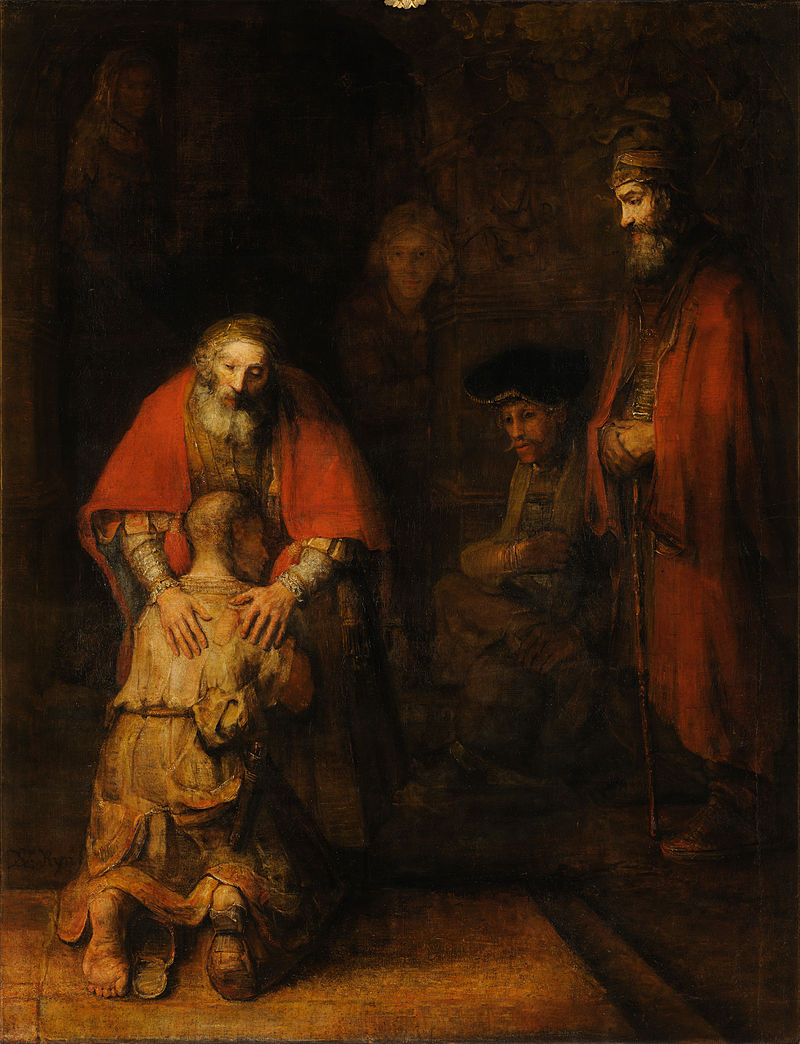
Rembrandt van Rijn, The Return of the Prodigal Son, c. 1661–1669 (Hermitage Museum, Saint Petersburg)

Rembrandt van Rijn, The Return of the Prodigal Son, c. 1661–1669 (Hermitage Museum, Saint Petersburg)

Sometimes I lead retreats to explore correlations between biblical narratives and our own stories. It’s not just a matter of putting ourselves in a given Bible story as a method of interpreting it. We also need to let it interpret us, as we discover the biblical motifs which are playing out in the particular circumstances of our own lives. What is my creation story, what is your exodus story, what is each one’s death and resurrection story?

At one such retreat, we considered Jesus’ parable of the Prodigal Son. After studying the text, we tried out various ways of retelling it in our own words. Then we divided into three groups: Fathers, prodigal sons, and elder brothers. Membership in each group was determined by chance, although it turned out that the “elder brothers” consisted mostly of firstborn children.

Each group was asked to wrestle with their assigned character. What do you feel about this character? What does the story tell you about him? What does the story leave unsaid? Then they were invited to share a related story from their own lives. Tell about the struggles of being a parent, a child, or a sibling. Tell about a time you were forgiven, or needed to forgive. Tell about a time you felt neglected or ignored, envious or resentful.

One man said he had been disappointed at first to draw the father’s group, because he always related more strongly to the elder brother. As the oldest child in his family, he had some of the issues common to that role. He knew the burden of wanting to live up to his parents’ expectations, to be “perfect,” obedient, one who pleases by getting everything right. He had also experienced some envy and resentment of younger siblings who seemed more carefree and less responsible.

But as he listened to others in the group engage with the father’s side of the story, it occurred to him that he himself had actually been a father for as long as he had been only a son and brother. Maybe, he said, it was time to rethink his own story and who he was in it.

In the early nineties, Henri Nouwen wrote “a meditation on fathers, brothers, and sons” using the parable of the Prodigal Son along with Rembrandt’s famous painting of the moment when the errant child is welcomed home. Like the people in my retreat, he found critical insights into his own life in each of the characters. And in doing so, he realized that there were two sons, not just one, who went astray from their father’s will, into “a distant country,” the place of alienation.[i]

The younger son’s sins may have been more dramatic and colorful, but the elder brother’s bitter and jealous heart grieved his father just as much. Both sons are lost. Both need to be welcomed “home.” As Rembrandt’s painting shows, the elder stands in the shadows, separated from the radiant light surrounding the father and his youngest child.

“There is not only the light-filled reconciliation between the father and the younger son, but also the dark, resentful distance of the elder son. There is repentance, but also anger. There is communion, but also alienation. There is the warm glow of healing, but also the cooling of the critical eye; there is the offer of mercy, but also the enormous resistance against receiving it.”[ii]

Whether the elder brother will be able to step out of his darkness into love’s radiance remains unknown in both the painting and the original parable. But the father has made it clear that his parental love will never be withdrawn. Like the loving mercy of God, his welcoming arms remain ever extended and expectant, now and forever. As Nouwen writes, “The heart of the father burns with an immense desire to bring his children home.”[iii]

Nouwen describes the differences between the father’s hands in Rembrandt’s painting. His left hand is strong, masculine, gripping his son encouragingly. His right hand seems more refined, almost feminine, offering the caress of consolation. The father’s red cloak also conveys shelter and protection, like the enfolding wings of a mother bird.

Love so amazing, so divine, has a cost. It does not always produce happy endings. In the “fathers” group at the retreat, one woman told us about her own prodigal son, a forty-year old man who had struggled for years with his own lostness. “I welcomed him home every time,” she said, “and then he would just break my heart all over again.” Six months before our retreat, he had committed suicide.

When we hear the parable, it is natural to focus on the prodigal’s experience of unconditional, unmerited welcome. We all long to hear the word of mercy for ourselves: weary pilgrim welcome home. But Nouwen won’t let us stay there. Although we each need to make our way on the difficult journey home, in the end we are called to claim the role of the father as well. Forgiven so much, may we also become the ones who forgive, whatever it costs.

“His outstretched hands are not begging, grasping, demanding, warning, judging, or condemning. They are hands that only bless, giving all and expecting nothing … As I look at my own aging hands, I know that they have been given to me to stretch out toward all who suffer, to rest upon the shoulders of all who come, and to offer the blessing that emerges from the immensity of God’s love.”[iv]


[i] Henri J. M. Nouwen, The Return of the Prodigal Son: A Meditation on Fathers, Brothers, and Sons (New York: Doubleday, 1992)

[ii] ibid., 126-7

[iii] ibid., 89

[iv] ibid., 127-8, 130

The voice that allows us to remain human

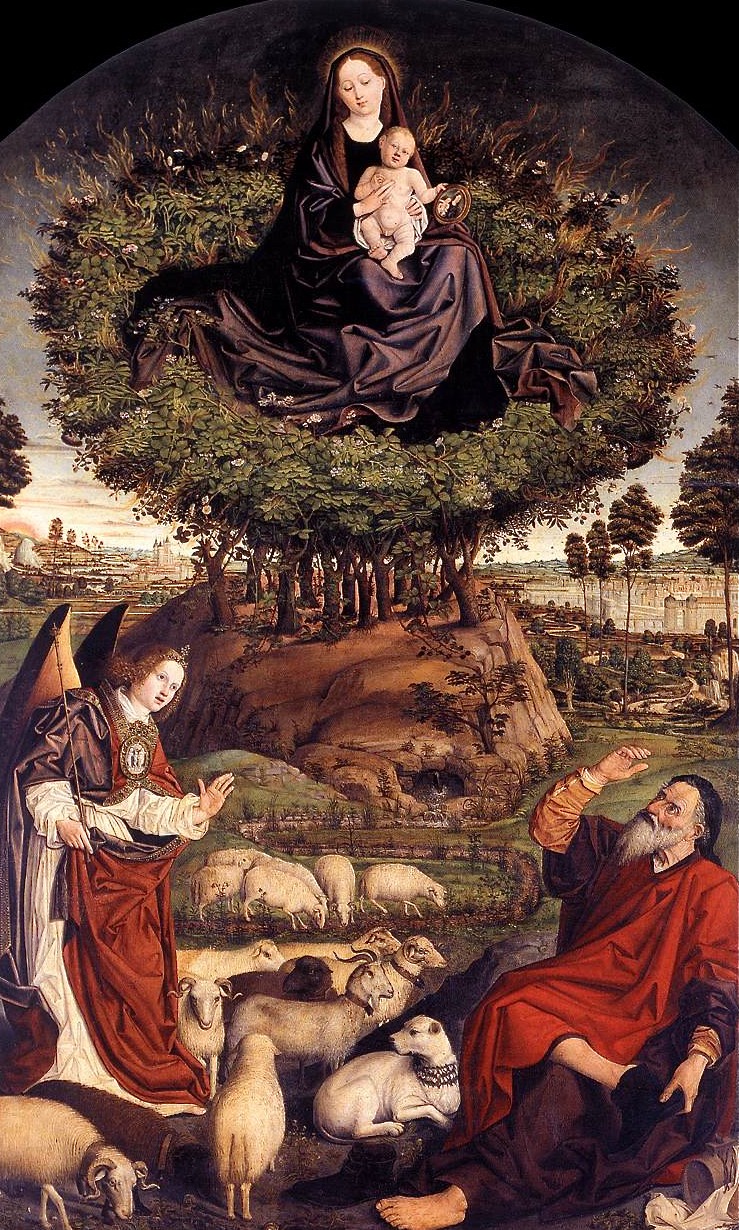
Moses before the Burning Bush, 13th century icon, Monastery of St. Catherine, Mt. Sinai

Moses before the Burning Bush, 13th century icon, Monastery of St. Catherine, Mt. Sinai

Even in the darkest hours of mankind, there might be a voice within us that allows us to remain human.

– László Nemes, director of Son of Saul, accepting the Oscar for Best Foreign Film

These words, spoken last night at the Academy Awards, struck me with particular force, since one of the most famous accounts of that voice had just been told in the morning liturgy. Although Exodus 3: 1-15, the story of the burning bush, does not describe a voice coming from “within,” I believe that the voice which Moses heard at the foot of God’s mountain was the same voice which the Hungarian filmmaker longs to hear, the same voice we all long to hear in a dark time when the humanity of our country, our world, and ourselves is being called into question.

Whether it speaks in an interior whisper, or calls to us from an exterior source, the voice “that allows us to remain human,” to remember (or discover) our true humanity, is the voice which has been speaking us into being since the beginning of the world. It is the voice of revelation.

Revelation, in the words of Ashton Nichols, is “a moment when the soul of the recipient is filled with something outside the self. A literal inspiration occurs. Consciousness finds itself flooded, or breathed into, or simply filled, by a force it ascribes to an external agency. The metaphoric agent may be a wind, a flash of light, or a disembodied voice. Divine grace descends; the voice of God is heard in the whirlwind; a spirit inspires the prophet or poet with a truth that comes from outside the self and is incorporated into the soul of the recipient.”[i]

The sense of a truth coming from “outside the self” may seem a contradiction to Nemes’ “voice within us,” but only if we understand ourselves as separate, autonomous beings more or less self-contained and complete. If we are made in the image of the Trinitarian God, then we are part of a larger, interdependent flow of self-diffusive love in which outside and inside, or divine and human, are not strict opposites, but partners in a dance. We are constituted by a process of receiving our being from somewhere else, and in turn giving ourselves away. We “lose” our life to find it, as Jesus said. Like that bush in the Sinai, we burn with divine fire, yet are not consumed.

The first time I went to the Holy Land, in 1989, I saw a burning bush. It happened to be Ascension Day. I was visiting the Anglican sisters in Ramallah, with whom my mother had once worked to teach and care for Palestinian Christian children. Since a border closing prevented us from going to mass at a Benedictine church known for its beautiful chanting, a couple of the sisters took me for a walk in the local hills. As we descended a ravine, we encountered a shepherd with his small flock. And behind him, a little further on, I saw, with considerable astonishment, a burning bush. Why it was on fire, I never learned. If it spoke, I did not hear. Sometimes the voice is for the shepherd’s ears only. But I never forgot the wonder of it.

The bush which will burn and speak to you, or me, is out there somewhere, waiting for the proper moment of holy meeting. Anglican poet/priest R. S. Thomas described his own encounter in “The Bright Field.”

I have seen the sun break through
to illuminate a small field
for a while, and gone my way
and forgotten it. But that was the pearl
of great price, the one field that had
the treasure in it. I realize now
that I must give all that I have
to possess it. Life is not hurrying

on to a receding future, nor hankering after
an imagined past. It is the turning
aside like Moses to the miracle
of the lit bush, to a brightness
that seemed as transitory as your youth
once, but is the eternity that awaits you.

Mary in The Burning Bush, Nicolas Froment (1475-6)

Mary in The Burning Bush, Nicolas Froment (1475-6)

In an exquisite fifteenth-century tryptich by Nicolas Froment, Moses beholds the Madonna and Christ Child in the “burning” bush. There are no prominent flames. The Word made flesh is both voice and fire. God incarnate is the ultimate revelation by whom and through whom and in whom we may, at last, become fully human.


[i] Ashton Nichols, The Poetics of Epiphany: Nineteenth Century Origins of the Modern Literary Movement