Running on Fast Forward

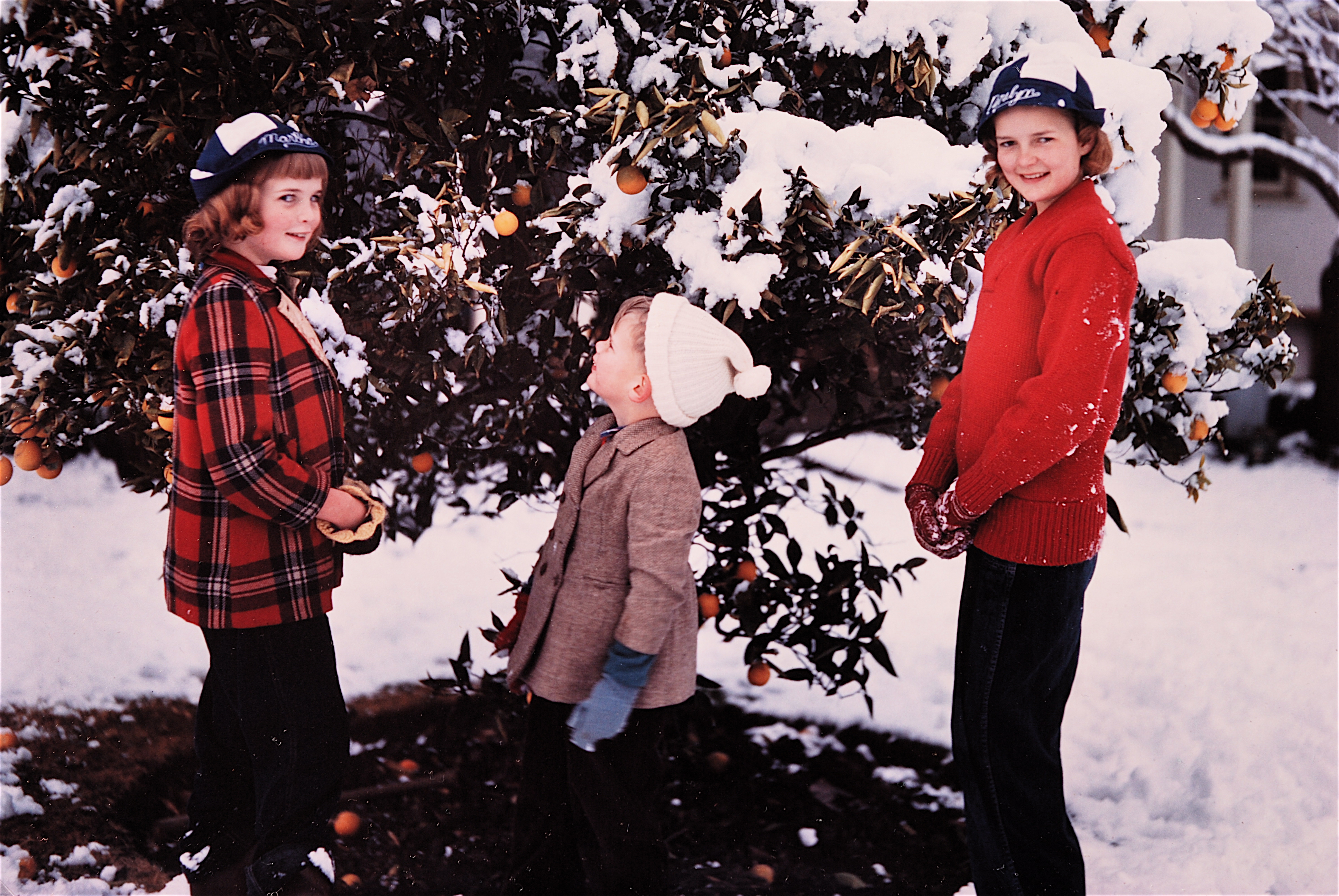
Martha, Jim and Marilyn Friedrich, after the great Los Angeles snowfall (January 1949)

They were so young then, the four of them
sitting on a log in the sand, a row of apartments
in the background, each window facing the sea.

We must have been ten, in matching swimsuits,
riding the long rollers toward shore, dreaming
of soldiers handsome in their uniforms.

They look happy, our parents, as if they had
given away all their secrets and could relax,
not one of them thinking of tomorrow

or yesterday, or any peril that might befall
their children, tumbling about in inner tubes
over the thrilling ocean.

A breeze ruffles the hem of my mother’s skirt.
My father has taken off his shoes.

– Marilyn Robertson, “The Photograph”[i]

My oldest sister Marilyn wrote this poem about an old photo from the 1940s. She and a friend were off-camera, playing in the surf, while their parents kept watch from the shore. “The Photograph” is in a new collection of her poems she presented to her siblings, Martha and me, last weekend, on the occasion of her 80th birthday. I found some of my own childhood inside, like the time I fell out of a moving car at two years old.

In return, I gave her my DVD compilation edit of scenes from our childhood and youth, captured with the clarity of 16mm film by our father. I had added an interpretive music track ranging from “My Blue Heaven” to “Magical Mystery Tour.”

A retrospective mood is common enough on significant birthdays, but the documentary evidence of those home movies gave a vivid immediacy to our memories. Both still and moving pictures preserve long-vanished light. They become the past the instant they are shot. To look at them brings the joy of remembered presence, but also the melancholy of realized absence. Our parents are gone; so is our own past. Who are those bewildered little siblings in the old films, inventing their place in this world, improvising as they go? Did they really grow up to be us?

Eight members of the family––by coincidence, one for each of Marilyn’s decades––gathered for her birthday weekend in one of architect Julia Morgan’s rustic wood and stone houses at Asilomar (“refuge by the sea”) on the tip of California’s Monterey Peninsula. My sisters and I, along with various spouses and children, savored the chance to share memories, plans and dreams, as well as games, walks, and very un-Lenten feasts.

Present and future were as much on our minds as the past. But still, the theme of passing time was inescapable. We grow old, we lose loved ones, we know the meter is running. “Last Times,” another of Marilyn’s poems, considers the divided consciousness of mortal beings. Though “now” is all we ever really have, we can’t help but wonder how long we’ve got.

Halfway through December, a day comes when
I wonder how many more turkeys I’ll bake, worrying
over the gravy, the pan always hard to clean.

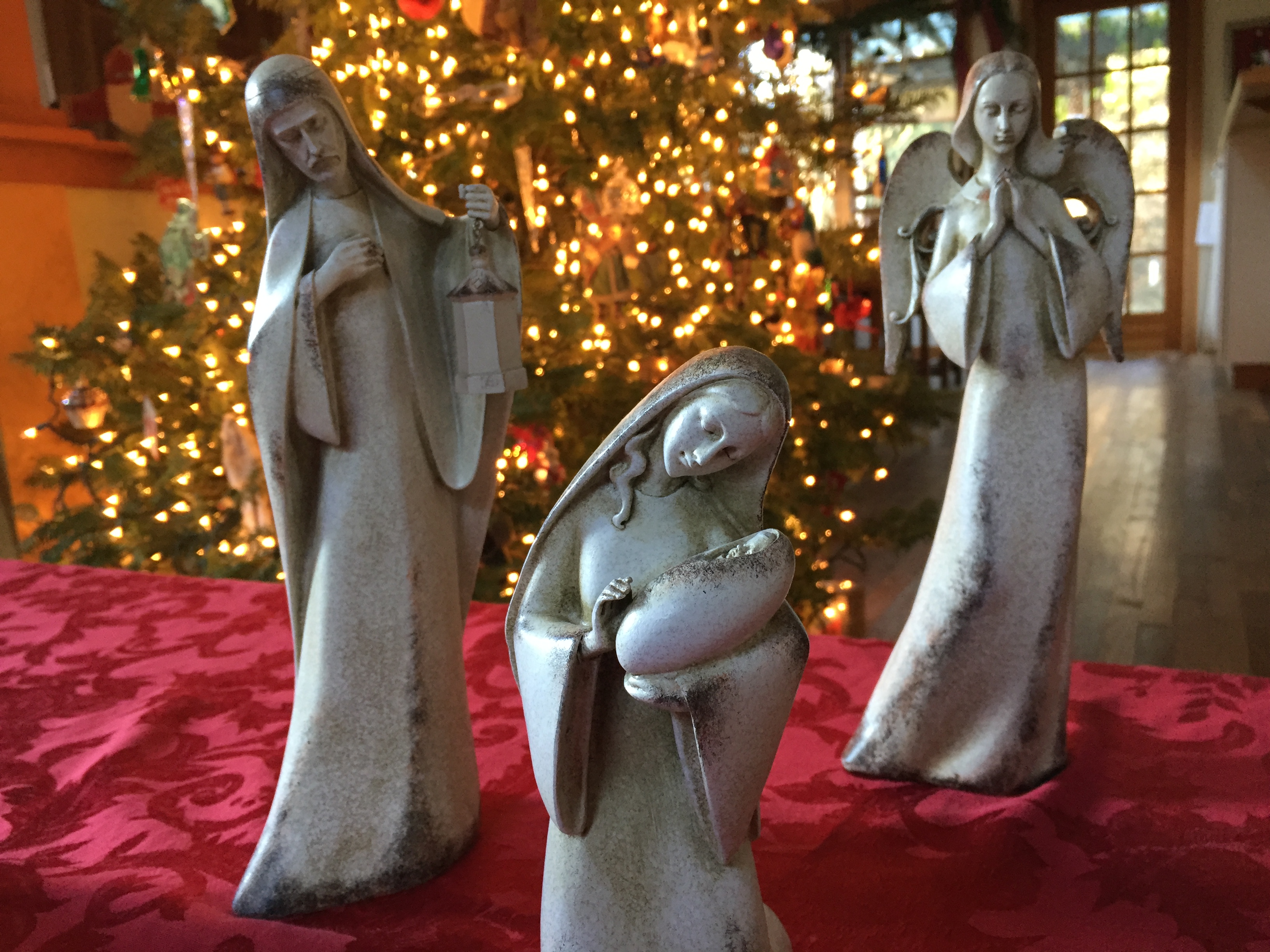
Or how many more times I’ll unwrap the crèche
from its colored tissue, lifting out the holy family,
the shepherds and their docile sheep.

I am running on fast forward.
If only I could change direction, like movies
my father ran backward in the projector:

smashed bricks gathering themselves
into a wall again, a smashed truck suddenly
good as new, rolling backward down the road,
clouds of dust sucked in by the tires.

The last time I saw that film I was a girl.
We’d beg him to run it again
and finally he’d agree: But this is the last time.

I make out the grocery list,
slip on my jacket, plan the week
as if the days will follow one another
through this house forever.[ii]

Marilyn Robertson, Jim Friedrich, and Martha Stevens at their father’s childhood home (Summer 1980)

On our last evening together we lingered well past bedtime, happy to postpone the inevitable scattering of the clan. We wandered out to the coastal dunes beyond the lights, where Orion hovered brightly beside the Paschal Moon. To the music of breaking waves, we recited Greek myths about the heavens. When we returned to the house, Martha, a brilliant storyteller, gave us an epic tale about a red-headed woman, Maud Applegate, who tracks Death across the wide world to beg for the life of her cowboy love, grievously wounded in a gunfight. When Maud finally spots her quarry climbing the steep trail to his mountain home, she shouts, “Hey, Mr. Death, wait up!”

She not only finds Mr. Death, she also meets his mother, who proves very sympathetic, and the three of them form a surprising bond. Death eventually grants Maud the boon of sparing her man, but the cowboy turns out to be a cad, and in the end the red-headed woman goes back to Death’s place, to help out as best she can and ease the burden of his loneliness. It was a story both funny and strange, deftly told. We all listened intently, like children with upturned faces. Somehow a tale about befriending Mr. Death was just the thing for our little group of aging mortals.

My wife lost her father in January. Four other people dear to me have also departed in the last six months. Our family has loved ones struggling with cancer and Parkinson’s. The losses are mounting up.

“Oh the separations we endure!” laments my poet sister.

A young man arrives at the station,
two black stones in his pocket.
His beautiful face breaks into a hundred pieces,

then reassembles itself
as he boards the train, waving
goodbye, goodbye to the life that loved him,

watching it fall backward into the wind,
the bamboo gate, the garden
with its wooden bridge over the pond.[iii]

Goodbye, goodbye to the ones we love. And then it’s goodbye to the life that loved us. And yet, as Rilke insists, “there is Someone, whose hands, infinitely calm, holds up all this falling.”[iv] While it’s no use to deny our mortality, there remains a mysterious surplus to human life for which death has no accounting.

On Sunday morning we celebrated eucharist together (it helps to have two priests in the family!), and the readings for the Fifth Sunday of Lent seemed especially apt. First came Ezekiel’s vision of the Valley of Dry Bones, contradicting the human sense of loss with the divine promise that our story is never quite over. I am going to open your graves, O my people, and raise you up. I will put my Spirit in you and you shall live.

The gospel for the day was the raising of Lazarus, the Fourth Gospel’s overture to resurrection on the brink of Holy Week. Perfect. Two sisters and a brother. Death doing what it does. Then Jesus doing what God does.

On the way to the post office this morning
I thought about the odd things we believe.

Things we swear by, pray for, put our trust in,
or wear printed on the back of a T-shirt.

Tarot cards. Crystal balls.
Runes and rattlesnakes.

First stars, second sight––
not to mention elves and Armageddon.

Just look at me, believing that someone
might have written me a letter,

that the world is in good hands,
that a man once walked out of a stone cold tomb

into the light of day, leaving
poor old Death completely in the dark.[v]


Related posts:

Tick-Tock: Thoughts for New Year’s Eve

Are we too late for the Resurrection?

You say goodbye, I say hello: A Requiem sermon


[i] When a Color Calls Your Name: Poems by Marilyn Robertson (Santa Cruz, California, Limited Edition, 2017), 28

[ii] “Last Times,” ibid., 82

[iii] from “Separations,” ibid., 51

[iv] Rainer Maria Rilke, “Fall”

[v] “Belief,” Robertson, 53

“You say goodbye, I say hello”: A Requiem Sermon

Joe and Phyllis Golowka (1940s)

I’ve brushed the dew on Jordan’s banks, the crossing must be near.

– Jefferson Hascall, “Angel Band” (1860)

This winter, my dear friends Joe and Phyllis Golowka died five weeks apart in their 71st year of marriage. I was privileged to preach the sermon today for their Requiem Eucharist at St. Paul’s Episcopal Church, Cambria, California.

In his younger days, Joe Golowka led teen backpacking trips in California’s Sierra as part of the camping program for the Episcopal Diocese of Los Angeles. I had the joy of being the chaplain on those hikes. At some point time caught up with Joe, and he decided to let a younger generation take over, but not before taking one last big trek. We made it a good one: a 10-day traverse of the Sierra Nevada, ascending the western slope along the Middle Fork of the Kings River, crossing two high passes at the crest of the range, and descending the steep eastern escarpment to the Owens Valley. It was one of those revelatory walks which, as John Muir once put it, open a thousand windows to show us God.

On our sixth day, we stopped around noon to make camp along a stream, Palisades Creek, so we wouldn’t have to make a steep climb to our next lake in the heat of day. Instead, we would get up at 4 the next morning, walk by the light of the full moon and a rosy dawn, and reach the lake at sunrise.

With the rest of the day suddenly free, Joe went fishing. He wandered down the stream until he found a pretty good spot, but after a while he got restless, and went looking for some place better. But the second place also failed to satisfy his longing for that holy grail of fishermen: the perfect fishing hole.

As the fairy tales teach us, the magic is always found in the third place––in this case, a slope of smooth granite where the stream rushed down into a quiet, shaded pool. As Joe approached, he saw golden trout leaping out of the pool into the cascade, only to be swept backward by the swift volume of water. Over and over again, the fish threw themselves against the stream’s powerful flow. But none of them could breach the crest of the cascading whitewater.

As Joe watched this spectacle of fierce desire, so thwarted yet so relentless, he felt the call to intervene on life’s behalf. He cast his barbless hook into the deep blue pool, and almost immediately, a trout tugged on his line. He pulled it out, slipped it unharmed off the hook, and tossed it upstream, beyond the cascade, where it could continue its hero’s journey. Again, Joe cast his line, and the same thing happened. Over and over, a trout would bite almost immediately, surrendering to Joe’s saving presence. It was as if the fish somehow understood that the fatal hook would prove to be the instrument of life, not death.

In the space of forty minutes, Joe caught and released thirty-four golden trout. Overcome by the sheer wonder of it, he finally had to stop. Miracles send a lot of voltage through your body. You need to step away and recover. He returned to camp shaking. When he finally shared his story at the evening campfire, it struck me that he had been privileged, for a moment, to share the work of our Creator and Redeemer–– rescuing the hopeless from the depths, casting living seeds into the future, turning a dead end into a gate of life.

And now, forty years later, Joe himself has gone through that gate, with his beloved Phyllis right behind him. They are in glory now, but what about us? Who will wipe the tears from our eyes?

Joe and Phyllis walked this earth for nearly a century. A presence we always took for granted has suddenly been withdrawn. The empty chair, the empty room, startle us with absence, and trouble us with longing.

There Is a time to be born and a time to die––this is the inescapable human condition––but acknowledging our mortal nature does not lessen our grief. Indeed, grief is the price of love, whenever that time comes when we must take the parting hand.

How we wish it were otherwise. Couldn’t we have had them just a little longer?

There’s an Irish song called “The Parting Glass.” They sing it in pubs at closing time. Its minor key and wistful words express the sorrow of ending the evening’s camaraderie as people go their separate ways into the night––a sorrow which feels like a rehearsal for the end of life itself:

Oh, all the comrades that e’er I had,
Are sorry for my going away.
And all the loved ones that e’er I had
Would wish me one more day to stay.
But since it falls unto my lot
That I should rise and you should not,
I’ll gently rise and softly call,
“Goodnight, and joy be with you all.”

I love that last line. The singer doesn’t just say farewell and disappear. He pronounces a blessing upon those who remain: “Joy be with you all.” Yes, we honor our dead by the tears we shed. We honor them even more by embracing the joy they wish for us.

The Bible describes the company of heaven as a great cloud of witnesses, cheering us on from above. The novelist George Eliot called the departed “the choir invisible whose music is the gladness of the world.”[i]

Give your sadness all the time it needs, but remember to hold a space in your heart for the ways the departed will return to you––the choir invisible whose music is the gladness of the world.

For the absence of a loved one in a bodily and temporal form
is succeeded by new forms of presence.

I once asked a group of high school students to write their own epitaph, and this is what one seventeen-year-old girl proposed for her imaginary tombstone:

You say goodbye,
I say hello.

The people who matter have a way of sticking around. Although death changes the relationship, it doesn’t end it. The dead continue to occupy our thoughts. They remain present to us in stories, memories, emotions, DNA (in some cases), and whatever else they left us with.

Our beloved Joe and Phyllis are no longer in one particular place. They are in every place we remember them. They are present when their voices echo in our ears, or in those places where we shared special times together. They are present whenever we think of them, or speak of them, or tell the stories that were their lives.

When C.S. Lewis wrote about the grief process after the death of his wife, he said that as the acute sense of loss began to fade, he wondered whether he was starting to forget her by being happy again, or whether he might betray the rich complexity of her being by reducing her to a fixed set of memories.

But once he just stopped worrying about it, he found that, as he put it, he “began to meet her everywhere.” It wasn’t a voice or an apparition, or even a big emotional experience. It was, he said, “a sort of unobstrusive but massive sense that she is, just as much as ever, a fact to be taken into account.”[ii]

Michael Smith, a folksinger from Chicago, described a similar sense of presence in a song about his late father.

I brought my father with me
I hope that you don’t mind
I couldn’t find it in me
To make him stay behind…

There are some ways I’m just like him
Some ways he was just like me
And sometimes when the mirror’s dim
His face is clear to see
Tonight the winds of heaven
Blow the stars across the sky
I brought my father with me
I couldn’t say goodbye [iii]

We have all  brought Joe and Phyllis with us this morning. And they will remain with each of us in countless ways. I can’t go on a hike without hearing Joe’s voice, telling me to pay attention, to take in the beauty offering itself in every moment. Don’t just stare down at the trail! Look around!

We carry Joe and Phyllis with us. But we also grieve their absence. They’ve been a presence in our lives for so long, It’s hard to believe they are gone. Our hearts go out to their family, especially to their children. Losing one’s parents is one of the hardest things we ever do, no matter how old they were or how old we are. There is great sorrow in that. It is a time to weep.

But it is also a time to dance.
We lament today, but we also praise.

Thank God we had Joe and Phyllis in our lives for so long.
Thank God that Joe was what only Joe could be,
that Phyllis was what only Phyllis could be.
Thank God for what Joe and Phyllis could only be together.
Thank God for what they gave us.
Thank God for the ways they loved and mentored and befriended us.
Thank God for the ways they blessed us.

Joe and Phyllis will live on in memory and story, and we take great comfort and pleasure in that. But we also make a deeper claim here. Joe’s life, and Phyllis’ life, are not just something we remember––because their journey is not over and done. They still have a future––with Christ and in Christ in the company of heaven. God loses no one.

Death is not the last word, the final chapter. It is, rather, the passage into the unimaginable fullness of unending life in God.

Death, be not proud. though some have called thee 
Mighty and dreadful, for thou art not so; 
For those whom thou think’st thou dost overthrow 
Die not . . .
One short sleep past, we wake eternally 
And death shall be no more . . .[iv]

So said John Donne, 17th century Anglican poet and priest, because he knew how the story goes: Love wins and death dies.

This is the story that God’s friends stake their lives on:
God has loved us into existence.
God sustains us every step of our life’s journey.
And even after our bodies give out,
God loves us too much to let us go.

This Requiem eucharist is above all a celebration of resurrection. In our hymns and our prayers we proclaim the God of life who has made death into the gate of heaven.

Everything we sing and pray today comes down to this: We are here to celebrate the entrance of Joe and Phyllis into the land of light and joy.

Some of you know how I love American shape note hymns. They were written at a time when people with shorter life expectancies had to look death in the face every day, and they still managed to proclaim the victory of life. Even at the grave, they made their song:

Why do we mourn departing friends,
Or shake at death’s alarms?
‘Tis but the voice that Jesus sends
to call them to his arms.[v]

Filled with delight, my raptured soul
Would here no longer stay,
Though Jordan’s wave around me roll,
Fearless, I’d launch away.
I am bound for the Promised Land,
I am bound for the Promised Land![vi]

Farewell, my friends, adieu, adieu,
I can no longer stay with you;
My glitt’ring crown appears in view,
All is well, all is well.[vii]

About the same time those hymns were written, Henry David Thoreau was on his deathbed in Concord, Massachusetts. A few days before he died, a family friend said to him, “You seem so near the brink of the dark river that I almost wonder how the opposite shore may appear to you.”

And Thoreau, who had spent his life carefully observing and describing what he saw in the fields and woods around Walden Pond, replied simply, “One world at a time.”[viii]

However curious we may be about what it’s like across that dark river between the worlds, we can’t see it from here. But I would venture to say that heaven is not so much a place as it is a relationship. We live in God and God lives in us. And that is true on both sides of the river. Whether we live or die, we are the Lord’s possession.

If you want more details, the Scriptures provide so many vivid images of what it means to be in God’s presence:

Isaiah says that wherever the oppressed begin to hear good news, and the prisons go out of business, and the tears of the brokenhearted are replaced by the oil of gladness, heaven is already happening. (Isaiah 61:1-3)

St. Paul assures us that nothing––neither death, nor life, nor angels, nor presidents, nor things to come, nor height, nor depth, nor anything else in all creation, can ever separate us from the love of God in Christ Jesus our Lord. Nothing. Not now, or ever. (Romans 8:38-9)

Today’s Epistle declares: “God will dwell with mortals, and they will be God’s family… Death will be no more; mourning and crying and pain will be no more.” (Revelation 21:3-4)

And Jesus our Brother tells us, “It is the will of the One who sent me that I shall lose nothing of all those entrusted to me. . . and I will raise them up on the last day.” (John 6:39-40)

By the way, when I think of the Last Day, I imagine it’s something like the shock of your first morning on a backpack with Joe. You’re in a peaceful sleep, snug in your down bag, content to postpone the shock of the cold mountain air.

Then, as sudden as the angel’s resurrection trumpet, a hand shakes you awake, and a voice shouts, “Rise and shine! Come out of that fluffy cocoon. This is the day which God has made, let us rejoice and be glad in it!” Those may not have been Joe’s exact words, but some of you were there on those mornings. You know what I’m talking about. The Day of Resurrection!

In a few minutes, we will collectively perform our central image for life in God:
We will gather around a table where Love bids us welcome,
to be richly nourished by the food of heaven.

There’s a place for everyone at God’s feast.
No one is excluded or banned or forgotten.
As they say at heaven’s gate, “Weary pilgrim, welcome home.”

One last thing.

Joe and Phyllis were both blessed to die at home, in hospice care, with family keeping vigil. My father-in-law, Arthur, did the same at the end of January, and I found a strangely beautiful grace in those last days. The soul’s departure is an awesome and holy thing to witness. It is life’s profoundest mystery.

When the time comes, people seem to know exactly what to do: their body gradually letting go as their attention shifts from this world to the next.

And as they depart from us, this is how we pray for them:
Receive them into the arms of your mercy,
into the blessed rest of everlasting peace,
and into the glorious company of the saints in light.[ix]

The contemplative monk Thomas Merton said that death is not something that just happens to us as passive recipients. It is, rather, something we do, an act of self-offering, what Merton called “the last free perfect act of love which is at once surrender and acceptance.”[x]

In other words, in the act of dying, we let everything go
and give ourselves over completely into the hands of God.
That is what Joe has done; that is what Phyllis has done.
And one day, you and I will do the same.

And God, as promised, will prove to be “mercy clothed in light.”[xi]

O glorious day! O blessed hope!
My soul leaps forward at the thought:
When, on that happy, happy land,
We’ll no more take the parting hand.
But with our blessed holy Lord
We’ll shout and sing with one accord.[xii]


Related post: Fathers, we must part


[i] From her poem, “O May I Join the Choir Invisible,” q. in All in the End is HarvestL An Anthology for Those Who Grieve, ed. Agnes Whitaker (London: Darton, Longman, & Todd, 1984, 1995), 83

[ii] C.S. Lewis, A Grief Observed, q. in All in the End, 105

[iii] Michael Smith, “I Brought My Father With Me,” on his album Time, 1994

[iv] John Donne, Holy Sonnets X in John Donne, The Complete English Poems, ed, C.A Patrides (London: Everyman’s Library, 1991), 440-1

[v] “China” in The Sacred Harp 163b (Bremen, GA: The Sacred Harp Publishing Company, 1991)

[vi] “The Promised Land” in ibid., 128

[vii] “All Is Well” in ibid., 122

[viii] Malcolm Clemens Young, The Spiritual Journal of Henry David Thoreau (Macon, GA: Mercer University Press, 2009), 8

[ix] Ministration at the Time of Death in The Book of Common Prayer (New York: Oxford University Press, 1979), 465

[x] From posthumous publication, Love and Living (1979, p. 103), q. in The Thomas Merton Encylopedia (Maryknoll, NY: Orbis Books, 2002), 107

[xi] Jane Kenyon’s sublime image is from her poem, “Notes from the Other Side,” in Jane Kenyon: Collected Poems (St. Paul, MN: Graywolf Press, 2005), 267

[xii] “Parting Hand” in The Sacred Harp, 62
The Temptation: A Gospel Play for Lent’s First Sunday

Duccio di Buoninsegna, The Temptation of Christ on the Mountain, Maesta Altarpiece (c. 1307)

Duccio di Buoninsegna, The Temptation of Christ on the Mountain, Maesta Altarpiece (c. 1307)

There are many ways to tell and experience our sacred stories. Sometimes those ancient texts cry out for the theatrical midrash of dramatized performance. This liturgical play was first performed as the gospel “reading” on the First Sunday of Lent, 1997, in front of the altar at St. Augustine’s Episcopal Church on Whidbey Island, Washington.

The allusions to other biblical stories (Exodus, Peter’s rebuke, Gethsemane) in this account reflects the gospel’s own intertextuality: framing Jesus’ wilderness story as a redo of his ancestors’ flawed pilgrimage. This time around, Jesus would get it right, trusting God where his desert predecessors had doubted and rebelled.

Everyone in the congregation was given two stones to strike together as “Satan’s Theme” before each temptation. The choir functioned as the offstage chorus.


Fade in environmental AUDIO of desert sounds. JESUS enters, attentive to what is around him in this desert place. At center stage, facing out, he takes a deep breath and assumes a posture of prayer. .

CHORUS (offstage)

You are my beloved child. This day have I begotten you.

The people click stones together as SATAN enters to stand near Jesus.
Satan signals for silence.

SATAN (pointing to a cairn of stones):

If you really are God’s beloved child, command these stones to turn into bread.

Jesus contemplates the stones as a CRUCIFER enters, bearing a cross made out of two crossed sticks. An apple is suspended from each end of the crossarm. ADAM and EVE enter. They approach the fruit curiously but hesitate to pluck it.

SATAN

Go ahead. Eat. It won’t kill you. Just one bite, and you’ll be like God.
You’ll know everything.

They each take an apple and bite into it. The taste is bitter. They look at their apples in disgust, then drop them and look around anxiously, as if suddenly aware of being in a more dangerous world. They back away from the “tree,” then turn and run away. The crucifer exits and THREE ISRAELITES enter.

FIRST ISRAELITE

After God rescued us from slavery in Egypt, we wandered for so many years in the wilderness. The desert was hard and bitter, and despite everything God had done for us, we began to complain.

SECOND ISRAELITE

It was crazy to come out here. No food, no water, nothing but stones and thorns.
What were we thinking?

THIRD ISRAELITE

Milk and honey, man. Freedom. The Promised Land . . .  What a joke.
We should have stayed in Egypt. I can’t stop thinking about those fleshpots.

CHORUS (as Israelites exit)

They tested God in their hearts, demanding food for their craving.
They railed against God and said,
“Can God make a feast even in this wilderness?
“Yes, God struck rock and water gushed out,
but can God provide bread and meat to feed us?”
Hearing this, God’s anger was kindled,
for the people had no faith;
they did not trust God’s power to save.  [Psalm 78:18-22]

SATAN

If you are the Christ, no use pretending to be like everybody else.
Don’t be too proud to use your power. People expect it. They need it.
They don’t want a savior who’s weak like them, believe me.
Come on! Let’s see what you’re made of. Turn these stones into bread.

JESUS

Bread is a gift from God — and the work of many hands.
A person who needs nothing from anyone––ends up all alone.
I accept the lesson that hunger teaches.

SATAN

Well, if you’re going to save the world, you’ve got to keep your strength up.

JESUS

As long as anyone is hungry, I will be hungry.

SATAN (offering Jesus a stone)

Take. Eat.

JESUS (taking the stone)

 Human beings do not live by bread alone…
 (He puts the stone on the altar)
.… but by every word that comes from the mouth of God.

The people click stones together. Satan produces a ladder, and gets Jesus to climb it.
Satan then signals for silence.

SATAN

If you are the Christ, throw yourself down from this pinnacle of the Temple.
For it is written, “God will command the angels to protect you;
they will bear you up in their arms, lest you dash your foot against a stone.”

JESUS

I will live without protection.
Where I’m going, angels can’t help.

PETER enters from the back of the congregation, making his way quickly to the ladder.

PETER

Let me through! Let me through!…
(reaching the foot of the ladder)
Rabbi! No! God forbid anything should happen to you.
You’ve got to get out of here. Go somewhere safe.

JESUS (looking down at Peter)

Get behind me, Satan! You’re blocking my way!
You don’t see the way God sees.

Peter continues to look up at Jesus for a few moments, then he drops his head and exits slowly, disconsolate, as Satan addresses Jesus.

SATAN

You know you’re headed for a fall, Jesus.
Aren’t you curious whether God’s going to catch you?
Come on! A little test flight — just to make sure. Jump…

Jesus lets go of the ladder, spreading arms wide as if about to fly — or be crucified.

CONGREGATION (led by Satan)

Jump!…Jump!…Jump!…. (continuing ad lib)

Jesus, as if awakened from a trance, drops his arms suddenly to clutch the ladder before he falls into space. The people stop shouting. Jesus descends carefully to the ground, and stands face to face with Satan.

JESUS

The Scriptures say, “Do not test God. Trust God.”

Jesus turns away from Satan to pray. The people click stones until Satan signals for silence. The ISRAELITES enter, all looking at their smartphones.

 FIRST ISRAELITE

Now when Moses did not come down from the mountain of God, the Israelites began to feel abandoned. So they melted down all their gold, and made themselves a new god, a god who would never leave them, a god who would always take care of them.

 SATAN

Come on, Jesus. I’m not your enemy. I know what people want. I know what you want.
I can give you anything you desire. Look.

Satan directs Jesus’ attention to a large screen displaying a montage of television commercials promising endless happiness and pleasure. The Israelites kneel before the images. Jesus glances at the screen, then turns his back to it. When the montage concludes, the Israelites stand up, pull out smartphones and exit, transfixed by their devices.  

SATAN

Jesus, how long are you going to stick with that two-bit operation of your father’s? Long hours, low pay, miserable working conditions, declining market share, insufficient capital. Am I right or am I right? It’s a dead end, pal. That’s not for you. You’re good, and you know it. You come and work for me, and I’ll guarantee you maximum exposure – worldwide markets, talk show, website, golden parachute… You can write your own ticket. Think of the good you could do with that kind of power. It’ll be fantastic, believe me.

Satan opens a bottle of champagne, fills a flute and offers it to Jesus.

Just say yes, and we’ll drink to your success.

An ANGEL enters holding a communion chalice. Jesus looks at the two different drinks before him, then turns to Satan and pushes aside his extended arm holding the flute.

JESUS

No. I serve God––and no one else!”

SATAN

Satan looks at Jesus a moment, then shrugs and drinks the champagne himself.

 We’ll meet again.

He exits. Jesus approaches the angel.

JESUS

Abba, if it is possible, let this cup pass me by.
Yet not my will, but yours be done.

The angel offers the chalice. Jesus accepts it, drinks deeply, then places it on the altar, kneeling before it. Then the angel gently brings Jesus to his feet and, with a comforting arm around his shoulders, leads him out. Desert sounds slowly fade out.


Related Posts

Via Negativa: A Lenten Worship Installation

The Desert and the Flood


Not in Our House: Why the National Cathedral Should Refuse the Inaugural Prayer Service

St. Ambrose barring Theodosius from Milan Cathedral, Anthony van Dyck (1619-20), National Gallery, London

St. Ambrose barring Theodosius from Milan Cathedral, Anthony van Dyck (1619-20), National Gallery, London

Where once Thy churches prayed and sang
Thy foes profanely rage…

– The Sacred Harp

In the year 390 the populace of Thessalonica rose up in revolt against the local Roman authorities to protest the arrest of a popular charioteer. The Roman emperor Theodosius, known for his thin skin and quick temper, was swift to respond. He sent a letter ordering troops to punish the inhabitants, which they did by means of a terrible ruse. They invited the whole town to attend a special sporting event. Once the stadium was packed, the soldiers locked the exits and slaughtered the entire crowd. The notoriously erratic Theodosius, meanwhile, had cooled off and changed his mind, sending another letter to contradict his original order, but it was too late. Seven thousand Thessalonicans were already dead.

Bishop Ambrose of Milan, where the emperor had his official residence, condemned the massacre, refusing to say mass in the presence of Theodosius until he repented his crime. Van Dyck’s painting (above) depicts the bishop barring the emperor from entering the cathedral. It was an unprecedented example of the Church speaking truth to power. The bishop explained his position in writing:

“What could I do? Should I not hear?… Should I remain silent? But then the worst thing would happen as my conscience would be bound and my words taken away. And where would they be then? When a priest does not talk to a sinner, then the sinner will die in his sin, and the priest will be guilty because he failed to correct him.”

Sadly, there will be no bishop to bar the Father of Lies and his minions from the National Cathedral in Washington this Saturday. The inaugural prayer service, a tradition since FDR’s inauguration in 1933, will go on as usual despite fierce protests from the many Episcopalians who regard such normalization of the president-elect to be at best a foolish mistake and at worst a desecration of sacred space.

The diocesan bishop, Mariann Budde, has cited two “spiritual principles” to justify the cathedral’s decision. The first is inclusiveness: Episcopal churches, she says, “welcome all people into our house of prayer.” She is aware that Trump is not a model citizen. “Welcoming does not mean condoning offensive speech or behavior; it does not mean we agree with or seek to legitimize.” But I think she fails to acknowledge the critical difference between opening our doors to notorious sinners and letting them dictate the content and flavor of our worship.

Bishop Budde’s second principle is that “in times of national division, the Episcopal Church is called to be a place where those who disagree can gather for prayer and learning and to work for the good of all.” This reflects the noble Anglican ideal of church as family. We may not always agree or get along, but we don’t stop gathering or trying to love each other anyway. We recognize truth not as the fixed possession of a single faction, but the product of a dialectic exchange, where we each contribute our incomplete perspectives to a process of mutual listening and collective discernment. This process is ongoing and never finished.

But a commitment to communal harmony has its price. At the time of the Civil War, the Episcopal Church maintained its structural unity by declining to make an official condemnation of slavery. As a result, it was spared the North-South splits of other denominations. While many individual preachers, parishes and dioceses spoke out against slavery, the church at a national level remained silent on the gravest moral crisis of the 19th century, lest they endanger the principle of welcoming all people.

The Bishop of Washington hopes that the inaugural prayer service will, at a time of intense national conflict, “offer a few moments of spiritual solace and the healing gift of transcendent beauty.” As a priest, liturgist and artist, I am a great believer in the value and necessity of providing sacred space and time, where sin and strife are hushed and we may encounter the world of God, not only in our minds and hearts but also with our senses. However, that should not mean losing touch with the imperatives of justice and love. Worship isn’t just to soothe and bless. It must also challenge, unsettle and transform.

As I understand it, the inaugural service will do none of these things. Preaching (always a risk) has been forbidden by Trump’s people, who are tightly controlling the whole order of “worship.” Judging from everything the president-elect has said and done over the years, we may expect no prayers of repentance for racism, misogyny, or xenophobia, or petitions that God may frustrate the designs of evil tyrants. Trump is no more submitting to the norms of Christian worship than he is to the norms of our democracy. He is essentially renting the spectacular Gothic edifice to bathe his authoritarian persona in a faux-religious glow. To allow such a charade threatens the integrity of the cathedral’s essential mission while abetting the fascist tendencies of Trumpworld. All glory be to the Leader.

At least one member of the Mormon Tabernacle Choir has bravely refused to sing at the inauguration. “It would be like throwing roses to Hitler,” she says. The National Cathedral choir, however, has agreed to participate. As the cathedral dean explains, “We do not pray or sing to bless a political ideology or partisan agenda…We sing to honor the nation.” But is it really the church’s business to honor the nation?

Despite our roots in the Church of England, the Episcopal Church is not a state church. It is time to shed all pretensions of being an indispensable cornerstone of civil religion. Our job is not to bless the status quo or national interests, but to proclaim and embody the gospel. Instead of praying for the president as if the soon-to-be-degraded office earns him any special attention, let us pray for everyone in the world who wields power, that they may do no harm and nurture the common good. Let us pray not just for the leaders of the nations and economies of the world, but for the prophets who speak to power and the activists who work for change. Less elitism, more democracy in our prayer life. Less nationalism, more globalism as well. Such an expanded range of attention retains the Anglican commitment to engage public affairs rather than flee them, while rejecting the fiction of American exceptionalism.

Concurrent with the controversy over the inaugural prayer service is a lively debate over prayers for the president at any public worship. Are we praying for the man, the office, or good governance? For those of us who may be his victims, are we praying for an enemy? If so, what is the aim of such prayer? And if we mention him by name, do we risk polluting worship with a rush of negative associations?

All this bears close consideration, but it is not really pertinent to the question of whether the National Cathedral should host the inaugural prayer service, to which the answer should be an unequivocal no. It is one thing to pray for our enemies. It is quite another to let them dictate what happens within our sacred spaces. Bishop Ambrose regrets that he cannot attend on Saturday. Is there anyone who will take his place at the cathedral door?


Related posts

Top Ten Reasons to Stop Trump Now

Can This Be Happening? – Donald Trump and the Rise of Authoritarianism

The Monks Have No Sadness

Mount Calvary Monastery, Santa Barbara, California

Mount Calvary Monastery, Santa Barbara, California

To almost all the questions that might be asked about you the answer would be “perhaps.” Shall you have a large fortune, great talents, a long life? “Perhaps.” Will your last hour find you in the friendship of God? “Perhaps.” After this retreat, will you live long in a state of grace? “Perhaps.” Shall you be saved? “Perhaps.” But shall you die? “Yes. Certainly.”

– Ignatius of Loyola

I spent last night at Mount Calvary Monastery in Santa Barbara. During dinner I asked one of the older monks, whom I hadn’t seen for a while, how he was doing. “Oh,” he said, “I’m biodegrading on schedule.” Later, at Compline, he chanted in a faltering voice,

I will lie down in peace,
and sleep comes at once;
for you alone, Lord, make me dwell in safety.

Earlier in the day, on the plane to California, I had been reading Tracy Daugherty’s riveting biography of Joan Didion, The Last Love Song, which is suffused with the subject of mortality: not just the death of individuals, but the demise of our collective narratives as well. Even the best stories we tell about our lives and our world tend to unravel over time.

Didion’s late writings have explored the grief of private loss- the death of a husband, the death of a daughter- but they also connect with her lifelong attempts to make sense of the country and culture she inhabits. Didion has always been a keen observer and distinctive storyteller, but there have been times, like 1968 and 9/11, when she could no longer “believe in the narrative and the narrative’s intelligibility.”

Whether writing about her own physical decline and the pain of outliving those you love, or documenting the demise of a recognizable public world, Didion gives voice to the laments within us all. As Daugherty writes, “She helped us admit things we intuited but rarely aired: the fragility of our national myths and the constant nearness of death.”

Lately I find myself preoccupied with the coincidence of private and public loss. A friend and significant mentor lost his eldest child to cancer this week, just three months after losing his beloved wife of 71 years. Members of my own family have also had recent occasion to contemplate “the constant nearness of death.” Meanwhile, “the fragility of our national myths” has become all too clear. When President Obama described a lofty vision of democracy in his moving farewell address, it felt like the eulogy at America’s funeral. We wept not just for the noble beauty of his subject, but because we were feeling the loss of it so keenly.

Dragon tree, Mount Calvary Monastery

Dragon tree, Mount Calvary Monastery

After any profound loss, we wonder how we can go on. But we do. And we do it with “quiet confidence,” as the Book of Common Prayer says in the Burial Office, because death is never the end. From the dry bones of our shattered narratives, God will begin to construct a new and better story.

Yes, we’re all freaking out as January 20 draws near. How awful can it get? How do we survive? How do we resist? I’m looking for the same answers you are. But over the last 24 hours, it has been both consoling and empowering to keep the hours with the monks, chanting the psalmody which puts everything in a larger perspective:

Those who dwell in the shelter of the Most High
and abide in the shade of the Almighty
say to the Lord: “My refuge, my stronghold,
my God in whom I trust. (Psalm 91)

The Lord is my light and my help…
Though an army encamp against me,
my heart would not fear.
Though war break out against me,
Even then I would trust. (Psalm 27)

In the shadow of your wings I take refuge
till the storms of destruction pass by…
My heart is ready, O God,
my heart is ready.
I will sing, I will sing your praise.
Awake, my soul!
Awake, lyre and harp!
I will awake the dawn. (Psalm 57)

Faith is not an exemption from struggle, mortality and loss. God’s own self walked the way of the cross. But for the ready heart, enduring all things in quiet confidence like the old monk “biodegrading on schedule,” even the downward path will be the way up. And what St. Chrysostom said about monastics should apply to all:

“The monks have no sadness.
They wage war on the devil
as though they were performing a dance.”

Our Revels Now Are Ended

img_7265

Old Christmas is past,
Twelfth Night is the last,
And we bid you adieu,
great joy to the new.

– Welsh carol

For now the time of gifts is gone­–
O boys that grow, O snows that melt,
O bathos that the years must fill–
Here is dull earth to build upon
Undecorated; we have reached
Twelfth Night or what you will…

– Louis MacNeice[i]

Christmas ends tonight. That may surprise those who thought it done by December 26th, or with the final New Year’s game. I do get funny looks when I utter “Merry Christmas on days 2 thourgh 11. But for those who keep the traditional Feast of the Incarnation, it is best when savored the full twelve days. With the gathering, gifting and communal celebrations mostly behind us, the last days of Christmas can be a peaceful inbreathing of wonder before ordinary time resumes. The angels have returned to heaven, but the starry nights are no less radiant. The shepherds have returned to their flock, but we still linger in the stable, desiring to adore the newborn Mystery just a little longer.

Poet Mary Oliver, experiencing an intuition of charged significance at a New England pond, wrote, “oh, what is that beautiful thing / that just happened?”[ii]– Her question perfectly expresses our devotional response to the Nativity. The event itself is but a moment, but its meaning generates a lifetime of reflection and adoration. So in these last days of Christmas I have continued to carol with guitar, bowed psaltery and hammered dulcimer, read the poems of Incarnation, contemplated the crèche by the light of the decorated evergreen, and gazed in attentive silence at our candlelit icon of Madonna and Child. Oh what is that beautiful thing that just happened?

 But tonight, it’s all about to end. A few savvy churches may observe the playful but largely forgotten Twelfth Night revels tonight, and tomorrow we will make some fuss about the arrival of the Magi to worship the holy Child, but then our retreat into festive space/time will be over and done. The Holy Family’s Christmas concluded that way: abruptly, with a quick exit to escape Herod’s swords. So too will ours, as we resume not only our private travails but also the current dismal prospects of our public life, so well described by W. H. Auden in his “Christmas Oratorio”:

The evil and armed draw near;
The weather smells of their hate
And the houses smell of our fear …

There’s no escaping history. We can’t stay dreaming forever in holy and silent nights. “Well, so that is that,” Auden wrote. “Now we must dismantle the tree, / Putting the decorations back into their cardboard boxes … The Christmas Feast is already a fading memory…”

But, for the time being, here we all are,
Back in the moderate Aristotelian city
Of darning and the Eight-Fifteen, where Euclid’s geometry
And Newton’s mechanics would account for our experience,
And the kitchen table exists because I scrub it.

As for the Christmas revelation of Incarnate Love, will it also fade away in the glare of the everyday, after being too briefly entertained as only “an agreeable possibility?”[iii]

Joseph Pieper, writing about the way we wish each other well at Christmas, says that “the real thing we are wishing is the ‘success’ of the festive celebration itself, not just its outer forms and enrichments, not the trimmings, but the gift that is meant to be the true fruit of the festival: renewal, transformation, rebirth.”[iv]

Renewal. Transformation. Rebirth. Were these among the gifts you received this Christmas? And if so, what are you going to do with them? How will your life be different, now that you have seen the Child of Bethlehem? How will your world be different?

img_7267

Thirty-five years ago, on the Ninth Day of Christmas, I was running on the beach in Santa Monica, California, when I saw four young men standing along the shore, gazing out at the vast Pacific. They wore sweatshirts printed with their school name: IOWA. They had come west for the Rose Bowl, held the previous day. Their team had lost to Washington, 28-0, but now they were discovering the real reason for their journey: the sea.  It was perhaps the first time they had ever seen it. They were standing quite still, not talking, transfixed by its boundless liquid infinity. Wonder shone from their faces.

Earth and sky had been washed clean by a pre-dawn storm. Cumulus billows erupted along the horizon, while the morning sun, having won its battle with the longest nights, blazed above us in a pure blue heaven. It was one of those days when the world seemed freshly made.

I continued running down the beach, but when I returned twenty minutes later, the Iowans were still there, staring at the sea, taking all the time they needed to absorb so much wonder.

I thought to myself: When they return to Iowa, will they carry that bright ocean with them? Would we someday hear about puzzled farmers who swore they’d heard waves roaring in their cornfields?

And when you leave Christmas behind, heading home to your Nazareths, or fleeing to distant Egypts, will you carry its bright immensity with you? Will the people you encounter ever hear its roar?


[i] “Twelfth Night,” q. in William Sansom, The Book of Christmas (New York: McGraw-Hill, 1968), 187

[ii] Mary Oliver, “At Blackwater Pond,” New and Selected Poems (Boston: Beacon Press, 1992), 226

[iii] W.H. Auden, “For the Time Being: A Christmas Oratorio” in Collected Poems, ed. Edward Mendelson (New York: Random House, 1976): “The evil and armed” is in Advent section, 272; the rest is in “The Flight into Egypt,” 307

[iv] Joseph Pieper, In Tune with the World: A Theory of Festivity, trans. Richard & Clara Winston (New York: Harcourt, Brace & World, 1965), 30-31

Foolishness and Hope on the Eve of 2017

Tarot card designed by Pamela Colman Smith

Tarot card designed by Pamela Colman Smith

The free animal has its decrease perpetually behind it,
and God in front.

– Rainer Maria Rilke, Duino Elegies

150 years ago, German immigrants in Philadelphia fired guns out their windows at midnight on New Year’s Eve. “Murdering the old year,” they called it. At the end of such a crazy and dispiriting year, we may envy them. Preparing for our own New Year, we abandon the wreckage of 2016 with little regret. But is there any appetite for what lies ahead in a country poised on the brink of insanity and ruin? The Zero card in the Tarot’s Major Arcana provides a vivid image of our situation, but take note: the Fool himself does not share our fear.

He is festively attired, holding a bright flower beneath a happy sun. The precipice holds no terror. The abyss seems not even to exist for him. His attention is instead on the open sky, and his expression is calmly expectant. He walks in trust as a child of the Light. In the eyes of the world he is indeed a fool, advancing heedlessly toward nonexistence. But to people of faith his foolishness is the wisdom of Christ, who has been defying gravity ever since the resurrection.

We too would do well not to be mesmerized by the abyss, but to focus on the greater power already and always at work amid the blind sufferings of history. God neither causes nor prevents those sufferings, but divine ingenuity always outwits them in the end. I realize that is a big claim in the face of history’s unspeakable horrors, and I do not mean to trivialize their enormity, but the alternative is nihilism or despair. If we belong to a story of life not death, then we must insist on its narrative truth, even in our darkest hour.

No one can say exactly where and how the divine work of repairing the world will manifest itself in 2017, but I have already seen it coming to birth in a widely shared desire to get involved in the work of resisting evil, protecting the vulnerable, and advancing the common good. Yesterday’s Episcopal prayer for the Feast of Holy Innocents states our agenda perfectly: to “frustrate the designs of evil tyrants and establish [God’s] rule of justice, love, and peace.”

May we all, boldly and joyfully, do that holy dance, even on the edge of the precipice, not in terror of the abyss, but trusting in the love that enfolds us in every moment. What better way to celebrate and embody the Christmas feast, which declares the generative power of God pouring itself into the particulars of human experience? As Thomas Merton reminds us, “we exist solely for this: to be the place God has chosen for his Presence. If once we begin to recognize, humbly but truly, the real value of our own self, we would see that this value was the sign of God in our being, the signature of God upon our being.”

As we adore the great mystery of Incarnation–“the signature of God upon our being,”–let the beauty of this primal truth be the Star that guides us out of the old year into the new.

+

At year’s end, allow me to thank you, dear reader, for taking the time to reflect on the writings posted here, and for sharing them with others. Your attention, comments and supportive sharing are deeply nourishing and greatly appreciated. My New Year’s prayer for you is expressed in these lines from Edward Pusey, a nineteenth-century priest:

God ripen you more and more. Each day is a day of growth.
God says to you. “Open thy mouth and I will fill it.”
Only long…the parched soil, by its cracks, opens itself
for the rain from heaven and invites it.
The parched soil cries out to the living God.

Oh then long and long and long, and God will fill thee.
More love, more love, more love.

Caroling in the Dark: A Christmas Meditation

"And a little child shall lead them." (Isaiah 11:6)

“And a little child shall lead them.” (Isaiah 11:6)


Herod then with fear was filled.
(Medieval carol)

The first Christmas Eve, in the old legends, was “so hallowed and so gracious” a time that flowers bloomed in the Bethlehem snow, kindly beasts knelt to warm the Child with hay-scented breath, the birds of dawning sang all night long, and angels bent near the earth to sing of peace.

Oh that it were so again! Desperate to exit the gloom and foreboding of the present time, “we too would thither bend our joyful footsteps”–to see the birth of New Possibility, to welcome the marriage of heaven and earth, to recover hope for what we might become. But the Christmas story is not about escaping this broken world. It is about repairing it.

The Incarnation began with unconditional acceptance of the human condition. To know our griefs and carry our sorrows, God began mortal life as a refugee from political violence and ended it as a victim of torture and capital punishment. Risk and violence were not confined to the latter days of Jesus. They were there from the start.

That is why, only a few days after singing “Silent Night” at the holy manger, the Christian calendar insists that we take time to remember Herod’s slaughter of Bethlehem’s children. We are allowed no illusions about how the story goes: Love is born into the world, and the powers try to kill it.

Only Matthew’s gospel records Herod’s monstrous act. Its clear parallel to the Exodus story, where Pharoah’s slaughter of the Hebrew children fails to eliminate the child of destiny, suggests some narrative invention. There are no other historical accounts to corroborate Matthew’s tale. But who cannot testify to the truth it contains? The powers will stop at nothing to achieve their ends. That, too, is part of the Christmas story.

Julia Hartwig, a Polish poet, gives a harrowing account of the massacre. It seems haunted by memories of Auschwitz, but reading it today I think of Aleppo.

While the innocents were being massacred who says
that flowers didn’t bloom, that the air didn’t breathe bewildering scents
that birds didn’t rise to the heights of their most accomplished songs
that young lovers didn’t twine in love’s embraces

But would it have been fitting if a scribe of the time had shown this
and not the monstrous uproar on a street drenched with blood
the wild screams of mothers with infants torn from their arms
the scuffling, the senseless laughter of soldiers
aroused by the touch of women’s bodies and young breast warm with milk

Flaming torches tumbled down stone steps
there seemed no hope of rescue
and violent horror soon gave way to the still more awful numbness of despair

At that moment covered by the southern night’s light shadow
a bearded man leaning on a staff and a girl with a child in her arms
were fleeing lands ruled by the cruel tyrant
carrying the world’s hope to a safer place…[1]

And the good news? The coming of God means the shaking of the powers. Even as a baby, the incarnate God struck fear into the hearts of rulers and oppressors. And when Jesus grew up and began to bear witness to the purposes of God, he made it impossible for the powers of this world to claim divine sanction for their monstrous behavior. They still try. Even “pious” rulers can do terrible things, as we know all too well. But the incarnate God has torn the mask from power’s face. By dying at its hands, like all the other victims of hatred, violence, and abuse, the Word made flesh has made absolutely clear which side God is on.

Like the women of Bethlehem weeping for her children, we are not easily consoled in the face of so much human suffering. And yet, even in the worst of times, we must never forget the kind of story we are in. It is, ultimately, a story of mercy and possibility:

I am going to tell of God’s kindness to the people of Israel… All of God’s deeds of mercy… All of God’s many acts of faithful love. (Isaiah 63:7)

Isaiah wrote these encouraging words in his own darkest hour. His people were in exile from the land of promise. Hope was dead and gone; their story had reached its bitter end. And yet, said the prophet, it is precisely in the place of desolation and loss that we are called to make our song. It is how we resist.

Sixty-three years ago, such a song was composed on a scrap of paper in a Soviet labor camp by a Latvian prisoner, one of 50,000 Latvians condemned to exile and imprisonment in Siberia under Joseph Stalin, a twentieth-century Herod, after the Second World War.

When the Kings College choir was touring Latvia in the summer of 2007, singer Emma Disley spotted the carol, scrawled on its original piece of paper, in a museum. She transcribed it and brought it back to England, where it was arranged for four-part choir and sung, in Latvian, in that year’s worldwide Christmas Eve broadcast.

The text was by a Latvian writer in exile, Valda Mora. As for the woman who composed the tune, we know neither her name nor her fate. All we do know is that she wrote it down on a scrap of paper as a handmade Christmas card for a fellow prisoner, Marta Zalaiskalnson, on Christmas Day 1953. Marta, who had been in the labor camp since 1945, sewed the paper into the lining of her dress so that her Soviet guards wouldn’t find it.[2]

The history of this carol has a lot to teach us about faith and hope. Born in a time of terrible darkness, it concedes nothing to the powers. Instead, calmly and assuredly, it sings of only one thing: the Light which has come into the world, a Light which the darkness can never extinguish.

On this holy night earth and heaven shine,
On this night the heart and stars commune,
And enmity fades, each loves the other,
And o’er the stillness warm wings hover.

On this night your footsteps glimmer;
This night transfigures doubt to hope;
This night must banish every sorrow,
And teach you to forgive and love.

On this holy night, in this holy night,
On this holy night, each loves the other;
On this holy night, in this holy night,
On this holy night, each loves the other.

On this night the gates of heaven open,
Above earth’s darkness arc the burning stars,
And softly on each person’s head this night
The Lord in blessing lays His loving hand.


Photograph adapted from an uncredited image of a demonstration against an Islamophobic national registry. Source: MoveOn.org email 12.22/2016.

[1] “Who Says,” by Julia Hartwig, trans. Stanislaw Baranczak and Clare Cavanagh

[2] Translation by Mara Kalnins. The carol was arranged by Stephen Cleobury. The 2007 Lessons and Carols bulletin is at http://www.kings.cam.ac.uk/sites/default/files/chapel/festival-nine-lessons-2007.pdf

“God is alive, surprising us everywhere”

Advent moon 2014

I know people who can’t stop crying. America has gone mad. Those who “love evil more than good, and lying more than speaking the truth” (Psalm 52:3) are the new normal. Democracy’s traditional safeguards­–checks and balances, constitutional law, vigilant journalism, the Electoral College, the voices of principle, factual empiricism, and a healthy sense of shame–are being undermined or ignored with impunity. “Who is like the beast, and who can fight against it?” (Rev. 13:4)

That cry of despair in the Book of Revelation is answered by heaven itself: “Look, I am making all things new.” (21:5) The world of evil and suffering will not stand forever. The world of God is being born, and we are invited to make our home in it. That does not mean we get to exit cleanly the dying world for a more perfect one. History consists of both worlds messily mixed like the wheat and the tares. We interact with both simultaneously. But we can still decide which world claims our allegiance: the world of death or the world of life, the world of hate or the world of love.

The Scripture, hymns and prayers of Advent are cognizant of the old broken world and the damage it can do. This prophetic season, mindful of time’s arc bending toward justice, calls every believer to engage evil not just as critics but as activists, resisting it wherever and however we can. But Advent also reminds us that the powers we contend with are neither ultimate nor lasting. The best way to resist the darkness is to be a bearer of the light. Don’t fixate on the dying world, granting it more seriousness than it deserves. Live in the coming dawn, even before you can see it. Be a prisoner of hope.

For most of us, such hope is sustained less by awesome displays of divine power than by small moments of daily grace, the merest hints of benevolent Presence bathing the ordinary with a holy light. Advent spirituality–the poetics of hope–is mostly a matter of paying attention. And while I wish I could report a grand vision of the beast and his minions being cast into a lake of fire, my own Advent revelations this year have been small and personal.

The first was ten days ago, when I was taking a bus to the Roman Catholic cathedral in Seattle for a concert by the Medieval Women’s Choir. I struck up a conversation with a homeless woman who was on her way to a women’s shelter at a local Episcopal church. When we got off the bus, I offered to haul her rolling suitcase for her, since we were going in the same direction. As we walked, she shared her story. Now 72, she had to stop working years ago due to a variety of illnesses. She now has colon cancer. She hopes to get into a housing project soon. Her conversation was articulate and insightful. When we parted, I gave her some money to see her through the weekend. “Give me your hands,” she said. She took them into hers, and began to pray for me and my ministry with eloquent, heartfelt words. Whatever I may have given her, this impoverished woman bestowed upon me far greater riches.

Later, at the concert, the women’s choir sang a 13th century English carol that made a lovely Latin pun about Gabriel’s annunciation to Mary:

Verbum bonum et suave
Pandit intus in conclave,
Et ex Eva formans ave,
Eve verso nomine.

The good and sweet word
Spreads through the room
Forming “ave” out of “Eva”
By changing Eve’s name.[1]

Forming “ave” out of Eva. As I listened, it occurred to me that the “good and sweet” words the woman had prayed over me had transformed her from “Eva”–a mortal woman of the Seattle streets–into a kind of angelic messenger. Had Gabriel himself appeared to utter an “ave,” I could not have been more sure of the divine presence behind that chance meeting.

My second Advent revelation also involved a concert, this time by the Seattle Pro Musica, whose exquisite renderings of seasonal choral music from many centuries moved me to tears more than once. It wasn’t simply that the pieces, ranging from Dufay and Praetorius to contemporary composers like Morten Lauridsen and Eric Whitacre, were sublime marriages of text and music, flawlessly performed. It was that such perfect beauty was being offered up in the gloom of the post-election nightmare. That is why I wept. Those superb voices, expressing everything that is best within the human heart and soul, seemed so brave and yet so vulnerable as we sink deeper and deeper into the American abyss. When the powers of hell have done their worst, what will be left of such beauty? Will all of it, human and divine, just be swept away?

One of the carols they sang, an e.e. cummings text in a setting by Joshua Shank (b. 1980), provided the answer I sought:

mind without soul may blast some universe
to might have been, and stop ten thousand stars
but not one heartbeat of this child; nor shall
even prevail a million questionings against the silence of his mother’s smile
–whose only secret all creation sings.[2]

My third Advent revelation began with a dream the following night. A woman (my soul?) asked me why I liked living in this place. I said I enjoyed the balance of nature and culture. You can hike in a mountain wilderness and attend a symphony on the same day. “Is nature where God has gone?” she asked, perhaps echoing my recent immersion in Thoreau studies. “God is alive, surprising us everywhere,” I told her, aware that it was not exactly a reply to her question. But that’s what came out of my mouth.

Then I awoke. Bright moonlight shone through the window. Though it was only 3 a.m., I felt impelled to go outside for a better view before the big moon disappeared into the Douglas-firs. Small masses of low cumulus clouds raced across the lunar face, veiling and unveiling its brightness. Orion stood watch on the moon’s right. Faint barking of distant seals. A coyote’s cry. Winter cold. Silence. What did the night want to tell me?

God is alive, surprising us everywhere. The message of a dream, intimating something more real than language. But what? Not an idea in my mind. A feeling in my body. I tried briefly to give it words. Nearness. Urgency. Strength. Presence. Then I let the words go, and rested in whatever it was. In times so dark and dangerous, it felt . . . consoling. Heaven and earth may pass away, but this Presence will not. We are not alone. Perhaps, even loved.


Related post

Ten Ways to Keep a Holy Advent

[1] Missus Gabriel de celis is a late 13th century chant for the Solemnity of Mary (Jan. 1). English translation by Ginger Warfield & Ali Corbin

[2] Text from “from spiralling ecstatically” by e.e. cummings. Joseph Shanks’ piece is called “Winter”

The World’s End (An Advent Manifesto)

Standing Rock police assault Water Protectors with fire hoses.

Standing Rock police assault Water Protectors with fire hoses.

Advent is not just a season of quiet waiting.
It is also a time of protest and vision.

As the election consequences unfold, Advent seems less a ritual preparation for Christmas than a realistic description of where we find ourselves in a darkening world. Pitting hope against despair, Advent calls us to “cast away the works of darkness and put on the armor of light.” My last post proposed 7 Spiritual Practices for the Time of Trial. I want to follow that by revisiting a post from November 2014, an Advent manifesto which seems even more timely today. 

When I was 8 years old, I read in LIFE magazine that in so many millions of years, the sun would burn out and life on earth would cease. This worried me, so I asked my parents, “If the world is going to end, how come we say “world without end” when we pray?” And they told me what the Bible says, that heaven and earth may pass away, but God remains. That relieved some of my anxiety, but I still wasn’t sure I liked the idea of the world ending, even if God was in charge.

Of course the world ends all the time. When I moved from California to Puget Sound in the 1990’s, my first Northwest winter felt like a biblical apocalypse: the sun was darkened and the moon gave no light.

Who among us has not seen their world end? Adolescents exiled from childhood. Black teenagers robbed of their future. Elders deprived of their health. Unemployment …retirement …divorce … the death of a parent, a spouse, a child — in every one of these, a world comes to an end.

For anyone who has known serious loss, this is more than metaphor. The experience of grief can be so total and unrelenting that you can’t see anything beyond it. You can’t imagine the future. It feels like the end of the world.

The stars are not wanted now: put out every one;
Pack up the moon and dismantle the sun;
Pour away the ocean and sweep up the wood;
For nothing now can ever come to any good. [i]

W.H. Auden was invoking apocalyptic metaphors to express personal loss, but shared, public worlds also come to an end. As in 1789, or 1914. The Holocaust. Hiroshima. 9/11.My Lord, what a morning, when the stars begin to fall.

But why bring up such dreary stuff on this first day of the new Christian year? Shouldn’t we be breaking out the party hats, blowing horns and shouting “Happy New Year?” The wisdom of the Advent season is that it never begins with “A Holy Trinity Production,” or “The Creator of the World Presents.” No, it always opens with “The End.” Advent knows that every beginning involves some kind of ending. In this season’s Scripture, preaching and prayers, the present arrangements of collective and personal life are judged and found wanting. God’s imagination is far too rich and fertile to settle for our barren and diminished versions of human possibility.

Selfishness, greed, consumerism? Fear, racism and violence? Poverty, militarism, war, environmental degradation? That’s the best we can do? Really? God must be saying, “Come on, people. I made you a little lower than the angels, and this is what you came up with?”

George Eliot said “it is never too late to become what you might have been.” But to get to that “might have been” requires an Exodus into the wilderness beyond the way things are; an Exodus beyond even the best we can imagine for ourselves, into a place of unknowing, where only God possesses the language to speak our future into being.

So much of what we hear and pray and sing in Advent is profoundly disruptive. Bob Franke’s great Advent song, “Stir up your power,” gets right to it in the first line: This world may no longer stand. We are meant to be unsettled, to be driven beyond our narrow boundaries, our constricted realities, toward a beckoning horizon. The Christian life is a perpetual series of departures for a better place.

The world as it is – the world of racial hatred and toxic violence and economic injustice and perpetual war and addictive consumerism and pollution for profit and all the other evils which poison our common life – this world has no future in the emergent Kingdom of God.This world may no longer stand.

But the story doesn’t stop there. In my end is my beginning.[ii] Even when we have gone far astray, even when our story seems over, God remains deeply present in the processes of creation, tenderly leading and luring us into newness of life, making a way where there is no way, opening doors that none can shut.

Advent people do not just wring their hands or shake their heads over the latest news from Ferguson or the Middle East. We work and pray for something better. What we can do on our own is limited, but when we offer our priorities and energies to the larger purposes of God, Love will have its way with us.

As the Christian mystic Hadewijch put it in the thirteenth century:

Since I gave myself to Love’s service,
Whether I lose or win,
I am resolved:
I will always give her thanks,
Whether I lose or win;
I will stand in her power. [iii]

It is not always easy to stand in Love’s power and keep the faith. In some situations it is almost unimaginable. Forty years ago the African-American author James Baldwin wrote:

To be an Afro-American, or an American black, is to be in the situation, intolerably exaggerated, of all those who have ever found themselves part of a civilization which they could in no wise honorably defend – which they were compelled, indeed, endlessly to attack and condemn – and who yet spoke out of the most passionate love, hoping to make the kingdom new, to make it honorable and worthy of life. [iv]

This passionate mixture of protest and love sounds a lot like the Old Testament prophets who permeate our Advent lectionary, making their prophetic plea for history to be broken open by divine justice:

O that you would tear open the heavens and come down …
to make your name known to those who resist you,
so that the nations might tremble at your presence! [v]

Advent is not just a season of quiet waiting. It is also a time of protest and vision. Advent announces an insurgency against the way things are, a revolution to scatter the proud, cast down the mighty, raise the lowly, gather the lost, free the captive, and bind up the brokenhearted. Advent re-imagines the world as paradise restored, a new heaven and new earth suffused with the peace of God.

this is the day of broken sky
this is the space of conflagration-breath
speaking border-trespass
this is the feathered swoop of heaven
on the wing of now …
forking lightning into language …
breaking god into prison …
breaking the truth from jail! …

This is the fire-tongued fork of holy-ghost howl
making love on the tongue …
spitting flames of reconciliation
in the sky of war
making messiah-praise out of the air itself!

this is pentecost in your head
like becoming what you never dared
for the first time and forever

This ecstatic prophecy is from a poem by Jim Perkinson. [vi] He was talking about Pentecost, but his theme fits Advent as well:

“the day of broken sky”
the earth in conflagration
God breaking into the prisons
the truth being set loose at last
and “the fire-tongued fork of holy-ghost howl
making love on the tongue …
making messiah-praise out of the air itself!”

And each of us, all of us, becoming what we never dared.

When Jesus tells us to stay awake, he is warning us not to sleep through the day of God’s coming. Stay alert. Pay attention. Don’t miss it! Become what you never dared. Shake off the sleep of complacency, the sleep of complicity, the sleep of despair. Awake and greet the new dawn.

Jan Richardson describes this dawning reality in her beautiful poem, “Drawing Near.” [vii]

It is difficult to see it from here,
I know,
but trust me when I say
this blessing is inscribed
on the horizon.
Is written on
that far point
you can hardly see…

Richardson accurately expresses the sense of distant horizon that prevents the dominant reality of the moment from closing in on us and locking us in. That reality wants to be believed as fixed and final, permanent and stable. But the horizon calls every finality into question, disrupting its stability with the boundlessness of divine possibility. The horizon draws our attention from what is given to what may yet be. Keeping our eye on the horizon, feeling its pull, is the spiritual practice of Advent. Richardson’s poem expresses the deep longing produced by the distance between the already and the not-yet.

And then the poet discovers what every pilgrim knows: the goal of our long journey is something that has already been inscribed deep within us even before our journey began. Even before the day we were born, we were marked as God’s own forever.

And that is where Advent ultimately leaves us – finding that the thing we have been seeking so long has been with us all the time – within us, and all around us. While we have been walking our Camino to the Promised land, our feet have already been on holy ground, every step of the way. And the God of the far horizon turns out to be the path as well, keeping us company as we stride deeper and deeper into the world.

So when Advent people talk about the end of the world, we are speaking about end in the sense of purpose rather than termination. The word “apocalypse” means “unveiling,” and the apocalypse in our future will not be an annihilation, but a revealing of the world’s ultimate purpose and destiny.

Yes, all the inadequate, incomplete versions of world will come to an end (some of them kicking and screaming!), but creation as it was intended will be restored, not discarded. Like a poet who creates a new language out of old words, Love will remake the ruins and recover the lost. And the Holy One who is the mystery of the world will be its light and its life forever.

This Advent faith is expressed memorably in a short story by British writer Carol Lake, “The Day of Judgment.” On the Last Day of the world, God sails into England aboard a new Ark. But instead of bringing history to a close and pronouncing judgment on everyone, God leaves the Ark to enter the city of Derby. Heading for the run-down inner city neighborhood of Rosehill, he joins the crowd at a local pub, a multi-ethnic mix of the working poor and the unemployed. And there God gets so caught up in being with these people that he loses track of time, and the Ark sails away without him, heading off for the horizon of eternity. As the story describes it:

The Ark is on the edge of the horizon now, its destination the heartlessness of perfection. Most of the inmates already know what they are going to find – endless fruit, endless harmony, endless entropy, endless endless compassion, black and white in endless inane tableaux of equality. It sails off to a perfect world; the sky has turned into rich primary colors and in the distance the Ark bobs about on a bright blue sea.” [viii]

Meanwhile, God is still in that Rosehill pub, in the very heart of imperfection. If you had walked in there, you would have had a hard time picking him out. He blended right in. But if you were paying attention, you might notice that there was now something different about Rosehill. The old non-descript streets and dilapidated buildings had taken on a strange beauty. Maybe it was the warm slant of afternoon light, but people were beginning to see their neighborhood in a new way. And their own faces, too, seemed to glow with an inner radiance, as if they were carrying a wonderful secret, tacitly shared with everyone around them, as if they suddenly knew there was more to life than meets the eye.

They were still poor, the world was still a mess, but something new was in the air, a spirit of change was awakening. And from that day on, the people of Rosehill found themselves becoming what they’d never dared, for the first time and forever.


[i] W.H. Auden, “Twelve Songs (ix)”, Collected Poems, ed. Edward Mendelson (NY: Random House, 1976), 120

[ii] T.S. Eliot, “East Coker,” Collected Poems 1909-1962 (London: Faber and Faber Ltd, 1974), 191

[iii] Hadewijch: The Complete Works, trans. Mother Columba Hart, Classics of Western Spirituality (Mahwah, NJ: Paulist Press, 1980), 213

[iv] James Baldwin, No Name in the Street (NY: Dell, 1972), 194

[v] Isaiah 64:1-2

[vi] Jim Perkinson, “tongues-talk,” q. in Catherine Keller, On the Mystery: Discerning God in Process (Minneapolis: Fortress Press, 2008), 157-8

[vii] Jan Richardson, “Drawing Near” (http://adventdoor.com/2012/11/25/advent-1-drawing-near)

[viii] Carol Lake, Rosehill: Portraits from a Midlands City (London: Bloomsbury, 1989), 119