The roads where we once traveled

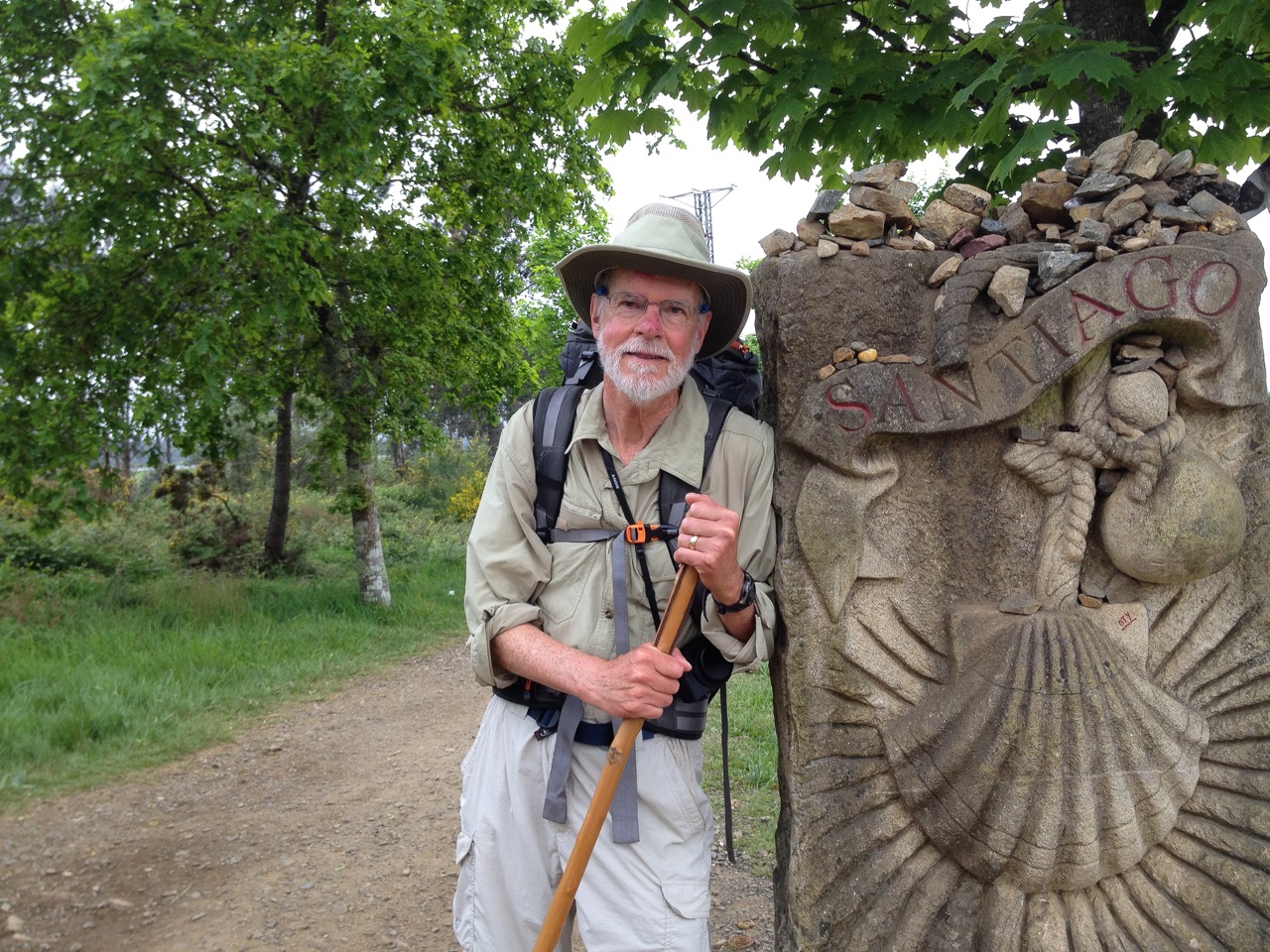
Near the end of my Camino: weary but happy.

Near the end of my Camino: weary but happy.

If I forget my past, Facebook will remind me, popping up a past post for any given date. Today’s memory is a photo and blog link from May 10, 2014, the day before I completed my 500-mile pilgrimage on the Camino de Santiago. I began writing this blog on that journey, and while I try not to repeat myself, I will mark this anniversary by re-posting my blog from that day.  If you are curious to read about my next day’s arrival in Santiago, you can find that here. And all my Camino posts may be found in the April and May archives for 2014. If any of you are inspired to walk the Camino yourselves, I say yes, do not hesitate. You will be blessed.

Songs to Sing and Tales to Tell (May 10, 2014)

And when my journey’s finally over,
when rest and peace upon me lie,
high o’er the roads
where we once traveled,
silently there my mind will fly.

– “Parting Friends”

This is one of the many shape note songs I sang along the Camino. I also sang hymns for Holy Week and Easter, made every tunnel and underpass echo with Kyries and Alleluias, and on a few evenings when a guitar got passed around in a hostel, taught choruses from Steve Earle’s “Pilgrim” (“we’ll meet again on some bright highway, songs to sing and tales to tell”) and Tom Russell’s “Guadalupe” (“I am the least of all your pilgrims here, but I am most in need of hope”). And several times a day I would break out with “Dum pater familias,” the medieval Latin song for St. James that rallied the spirits of the pilgrims who sang it as they walked. Prior to headphones, singing was an important part of the pilgrimage experience – shared voices imprinting the path with songlines.

On my penultimate day, the words of “Parting Friends” are especially apt. My mind indeed flies back over the roads I’ve traveled and the people I’ve met. Previous posts have mentioned some of these, but let me record three more who have embodied for me the spirit of the Camino.

The first is Janine, the hospitalera who welcomed me and six other pilgrims to a humble albergue in Calzadilla de los Hermanillos, a village lost in the vast Meseta like a small boat adrift at sea. In a place forgotten by time and history, this grandmotherly woman provided the most exquisite hospitality, as if we were her own family. The next morning, she saw me off with a blessing. Pointing to her “corazon” and mine, she indicated that we were connected. Then she made a walking motion with her fingers and said, “Buen Camino.” She repeated this touching ritual with each of us. Like saints of old doing good in lonely outposts for no earthly reward, she simply existed to love the stranger.

Then there is Tomas, who has occupied a tiny abandoned village in the mountains near the Camino’s highest point and created, in an eclectic assemblage of flags, signs, sculptures and makeshift structures akin to outsider art, a haven for pilgrims seeking a tranquil respite by day, one of his 35 mattresses by night, or shelter from the storm anytime it’s needed. Whenever he sees a pilgrim approaching, he rings a temple bell to greet and bless them. If a cloud covers the mountain with fog and darkness, he rings the bell to guide lost pilgrims to his safe haven. This is his life: to live as a hermit in order to serve the pilgrim.

Finally, on a shady trail through a eucalyptus grove yesterday, I saw a young man kneeling in the dust to pray before a wayside cross. I don’t know his name or his story, but the evident depth of his devotion reminded me how serious a matter the Camino can be.

And now I am at the outer edge of Santiago, in a quiet albergue with very few occupants. Most pilgrims who get this far simply continue on to the great cathedral less than an hour’s walk from here. But I didn’t want to drag myself to the finish late in the day, wearied and worn by ten miles of walking. I want to arrive fresh and renewed, to finish my Camino in the light of the rising sun on the day of Resurrection. So like Jacob of old, who camped just short of his destination in order to collect himself for the morrow’s big encounter, I shall rest and reflect and – who knows? – maybe wrestle with angels till daybreak.


Related Posts

Hospital for the Soul

The Movement of Hearts and Souls

Surrender

Daniel Berrigan: Sword of Wisdom, Maker of Peace

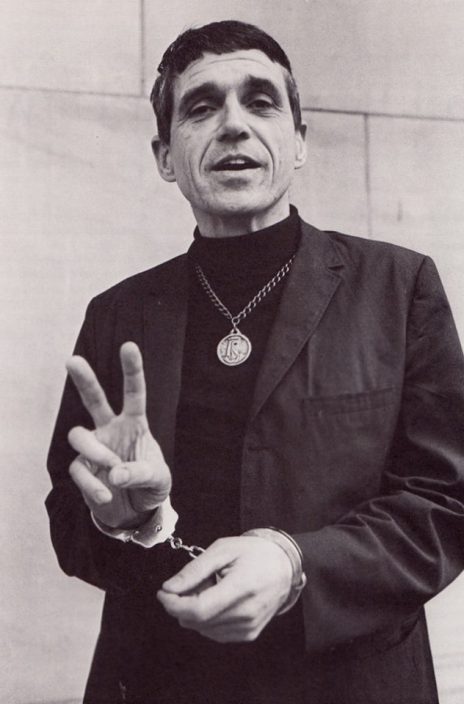
Berrigan in cuffs

There is no peace because there are no peacemakers. There are no makers of peace because the making of peace is at least as costly as the making of war— at least as exigent, at least as disruptive, at least as liable to bring disgrace and prison and death in its wake. — Daniel Berrigan[i]

On May 17, 1968, nine Roman Catholic activists broke into a draft board office in Catonsville, Maryland, transferring 378 files to the parking lot to be incinerated with home-made napalm. As the fire burned, the “Catonsville Nine” prayed for peace. They were arrested, tried and sentenced to prison, but four of them, including two priests— Daniel and Philip Berrigan— went underground, eluding capture for a number of months, occasionally surfacing to speak at antiwar rallies.

At one of these public appearances, following a dramatic tableau of the Last Supper with giant puppets, Dan Berrigan made his escape inside one of the Apostles. “I was hoping it wasn’t the puppet of Judas,” he said later. His comical getaway affirmed irrepressible life even as it mocked the powers of death. Berrigan, a puckish and playful spirit, knew that laughter could be a serious form of subversion.

After being sheltered by 37 different families, Dan Berrigan, S.J., was finally captured August 11, 1970, in the house of Episcopal lawyer and theologian William Stringfellow. He was reading Plato’s The Trial and Death of Socrates when F.B.I. agents showed up at the door.

On Palm Sunday of the following year, I designed a liturgy where two carpenters constructed a large cross near the altar during the course of the ritual. At various points, dialogue between the carpenters would interrupt the liturgical texts. The two workers expressed curiosity about the intended victim and the nature of his crime. They wondered about the morality of their own complicity in the official machinery of death. What if they just stopped making crosses? Would it make any difference? Or would they just find themselves without a job? In the end, they suppressed their doubts and finished the cross, hammering it together loudly during the eucharistic prayer: This is my body, given for you … This is my blood, shed for you …

It was no coincidence that I had just been reading No Bars to Manhood, Dan Berrigan’s compelling account of the influences and experiences underlying his Christian activism. Its conclusions were clear: as witnesses to the Resurrection, the friends of God must say no to death. No more cross-building. No more remaining passive spectators at the world’s crucifixions. “There are times so evil,” he wrote, “that the first and indeed the only genuinely prophetic function is to cast down the images of injustice and death that claim [the human being] as victim.”[ii]

A Newsweek blurb on my well-worn 95-cent paperback from 1971 reads, “Daniel Berrigan is the sort of priest who causes the lights of the Vatican to burn through the night.” The actions he took and the company he kept often strained the patience and understanding of his clerical superiors. One of his friends in the Society of Jesus told him, “Do you want to know why you’re in trouble so frequently? It’s because you and some others show us what Jesuits can be. And that’s why we can’t stand you.”[iii]

Today, when so many horrors are cloaked in euphemisms like “collateral damage,” Dan Berrigan’s truthful language still delivers a shock. His response to the charge of incinerating draft board records is justly famous:

Our apologies, good friends, for the fracture of good order, the burning of paper instead of children, the angering of the orderlies in the front parlor of the charnel house. We could not, so help us God, do otherwise. For we are sick at heart, our hearts give us no rest from thinking of the Land of Burning Children … We have chosen to say with the gift of our liberty, if necessary our lives: the violence stops here. The death stops here. The suppression of the truth stops here. This war stops here.[iv]

Even in his contentious moments with the Church, Berrigan understood his priesthood to be deeply rooted in the ethos of his religious community, where, he wrote, one’s life might “be purified of the inhuman drives of egoism, acculturation, professional pride and dread of life.”[v] In the trial of the Catonsville Nine, when asked whether such radical protest was in harmony with Catholic teaching, he replied, “May I say that if that is not accepted as a substantial part of my action, then the action is eviscerated of all meaning and I should be committed for insanity.”[vi]

For those of us who tend to play it safe in conforming our own choices to the gospel, Berrigan’s life of witness poses hard questions about discipleship and the imperatives of conscience. “He was dangerous, as holiness should be; he was a sword of wisdom.”[vii] A college student, after hearing Berrigan speak at Stanford in the late Sixties, put it this way: “Father Berrigan has raised the ante for all of us.”[viii]

That student’s religion professor, Robert McAfee Brown (one of my own most admired teachers), considered the question of whether the Berrigan brothers were signs or models. Their words and actions clearly signified the world’s sin and brokenness in parabolic gestures difficult to ignore. But were we obligated to model our lives after theirs, or might we find other ways to be faithful, according to our own distinctive calling? This question has troubled the conscience of many, including my own.

“We must continually ask ourselves why we are so attracted to them.” Brown wrote, “when we hear what they say and yet do not do the things they do … [T]heir actions provide a disturbing sign that we must take seriously, particularly if those actions are not yet the model most of us are prepared to imitate.”[ix] Brown himself had the courage to live into those questions for the rest of his life, becoming one of the most eloquent theological voices for justice and peace.

As “the man who hears handcuffs close upon him,”[x] Berrigan felt a deep kinship with biblical prisoners for God like the prophet Jeremiah. “There is a meaning to things, however dark and damaging … Jeremiah wrestles with the meaning; his wrestling is the meaning; it defines the moral substance and limits of his activity in the world. At the same time, his struggle with the unknown One interiorizes, draws to a fine point and gravity his moral life.”[xi]

Like Jeremiah, Berrigan knew a God who contends with human injustice, who plucks up and breaks down our tainted and presumptuous projects.

We are so used to an acculturated and childish religion, whose ethos has joined forces with the society— with its militarism and racism and fear of life, that we are almost illiterate before a document such as Jeremiah’s. Can it be true that God is not a Niagara of pablum, spilling His childish comfort upon the morally and humanly neutral, whose faces are raised blankly to partake of that infantile nourishment?[xii]

Not every Christian received his rhetoric gladly. And the radical priest’s liturgical fusion of sacrament and protest also drew fire. After baptizing a baby in the chapel at Cornell, he kissed the new Christian’s forehead and invited him “out of the world of war and destruction.” While presiding at an “Electric Mass for Peace” on the same campus, he made explicit connections in the eucharistic prayer between Christ’s blood and the blood shed on both sides in Vietnam. Some saw these things as careless, even blasphemous. Others found them prophetic and profoundly faithful.

Berrigan’s words and actions had a deep and lasting influence on many in the antiwar and anti-nuclear movements, as well as progressive Christians. His dramatic forms of witness also drew immense media attention, for which he took some criticism as a “media freak.” But his vocation was stronger than the temptations of celebrity. As Paul Elie, chronicler of the great twentieth century Catholic writers, noted in a New Yorker blog:

He created no foundation, nonprofit, or N.G.O.; headed no pacifist think tank or Jesuit school of advanced study; gave no TED talk; engaged in no stagey dialogues offering equal time to the military point of view; and never reframed the ideals of nonviolence in any pocket-size manual for personal growth.[xiii]

Berrigan had no neutral gear. Even when the public spotlight moved on to other subjects, his writing lost nothing of its urgency and fire. In The Discipline of the Mountain, his poetic reflection on “Dante’s Purgatorio in a Nuclear World,” he wrote, “There is a hell for those who go too far, and there is a hell, or at least an anteroom of hell, for those who refuse to go far enough.”[xiv] Going far enough for the sake of the gospel was the driving force of his life. But as he once confessed to Robert Coles, “We are groping. We shouldn’t be sure of ourselves, because we can’t be, not now— not ever.”[xv]

Only death is sure, and that finally came last week, on Orthodox Holy Saturday, to Daniel Berrigan, S.J., in his 95th year. I barely knew him, hearing him preach twice and breaking bread with him once in a Los Angeles rectory. But this loss feels personal. He was both sign and model for many priests of my generation, and there are things he said which haunt me still.

In 1964, midway in his life’s journey, Berrigan imagined the moment of his own death:

As I walk patiently through life
poems follow close …

The poem called death
is unwritten yet. Some day will show
the violent last line,
the shadow rise,
a bird of omen

snatch me for its ghost.
And a hand somewhere, purposeful as God’s
close like two eyes, this book.[xvi]

And then what? Only faith can say, that Easter faith which alone can contain and complete the fullness of human life. At the end of his meditation on Dante’s Purgatorio, the poet/priest peers beyond death’s horizon to see a resurrected humanity being gathered into God.

Leading the way are “the intractable ones” who have suffered prison, torture and martyrdom for their faithful witness. In them we see at last “the human venture vindicated.” Their faces and Christ’s face become as one, in an upward gaze that “breaks the glacial will of God.”[xvii]

They embrace         one after another
Tears    laughter     two weathers
contending in one sky


[i] Daniel Berrigan. S.J., No Bars to Manhood (New York: Bantam Books, 1971), 49

[ii] ibid., 97

[iii] ibid., 19

[iv] q. in Robert McAfee Brown, “The Berrigans: Signs or Models?”, in The Berrigans, ed. William Van Etten Casey, S.J. & Philip Nobile (New York: Praeger Publisher, 1971), 62

[v] q. in Edward Duff, S.J., “The Burden of the Berrigans,” in The Berrigans, 19

[vi] ibid., 15

[vii] Daniel Berrigan, The Discipline of the Mountain: Dante’s Purgatorio in a Nuclear World (New York: The Seabury Press, 1979), 99. The quote is by Berrigan, describing “an Indian holy man” with whom he once led a retreat. But it also seems aptly applied to Berrigan himself.

[viii] R.M. Brown, 61

[ix] ibid., 66, 69

[x] No Bars, 99

[xi] ibid., 96

[xii] ibid., 97

[xiii] Paul Elie, “Postscript: Daniel Berrigan, 1921-2016” (New Yorker online, May 2, 2016)

[xiv] Discipline, 39

[xv] Robert Coles, “Thinking About Those Priests,” in The Berrigans, 219

[xvi] Daniel Berrigan, “A Dark Word,” Poetry Magazine, April 1964, online at http://www.poetryfoundation.org/poetrymagazine/browse?contentId=29700

[xvii] Discipline, 119-120
Changemaking Churches and the Transformation of Neighborhoods

From "This is not a gentle poem" by Arne Pihl, part of "All Rise," a Seattle art happening about neighborhood change and social struggle, 2014-15 (Photo by Jim Friedrich)

From “This is not a gentle poem” by Arne Pihl, part of “All Rise,” a Seattle art happening about neighborhood change and social struggle, 2014-15 (Photo by Jim Friedrich)

It is not so much the gift of tongues that we now need as the gift of ears, not so much the proclamation of our beliefs as the willingness to listen to the ways in which we ourselves are being addressed, not so much the assertion of our knowledge but the silent admission that we are ready to learn. — Alan Ecclestone[i]


Does institutional Christianity have a future? We have certainly heard the dismal narratives of decline. Churches and seminaries are closing, congregations are aging, and budgets are shrinking, while the unaffiliated— “Nones” and “Dones”— are on the rise. There are still many pockets of vitality— thriving, growing, committed churches— but their long-term sustainability remains a serious question in the unsupportive habitat of postmodernity.

How many Christian bodies, at either the local or the denominational level, have resigned themselves to a diminished role as complacent and compliant chaplains to the dominant culture, or as harmless historical societies dedicated to the preservation of endangered practices and memories? An English priest of the last century, Alan Ecclestone, warned that such abdication of its changemaking mission would produce a “miserly and unexpectant” church.

Thankfully, we have antidotes for such a fate: resurrection and the Holy Spirit. Resurrection transforms death into rebirth; the Holy Spirit makes all things new. The Book of Common Prayer describes this potency with elegant brevity: “things which were cast down are being raised up, and things which had grown old are being made new.”

Enough with the narratives of decline! It is time to tell Easter stories. And at the recent Inhabit Conference in Seattle, I was blessed to hear many encouraging accounts of new life and abundant Spirit. For two days, Christian changemakers shared stories about doing and being “church” in new ways and new places. Even though many of the speakers do ministry in the lusterless environs of makeshift buildings and impoverished neighborhoods, their stories glowed with resurrection light.

Strangers sharing nothing but a zip code become friends over soup suppers. A trashy vacant lot is transformed into a beautiful park or neighborhood garden. Economic wastelands bloom as social entrepreneurs are raised up locally. The hungry and homeless become neighbors-in-need rather than faceless problems. The powerless organize to make their voices heard in civic planning and development. Police and residents defuse tensions and break stereotypes by socializing together. “Low-status neighborhoods” are redeemed by the work of many hands, becoming places of human flourishing. Such things don’t always happen, but when they do, the Kingdom of God draws near, and the church of God rises from the dead.

The Inhabit conference presenters, many in their twenties and thirties, have committed themselves to simplified and generous lifestyles as residents of the struggling communities they serve. Their “churches” tend to be improvisational— living rooms, storefronts, neighborhood centers, local watering holes, and street corners. If any of their ministries employ a traditional church space, it is usually where the old congregation has been on the verge of extinction.

These youthful pastors understand “parish” in its original sense— designating a whole neighborhood rather than simply the church situated within it. Their ministry is dedicated not to their faith community alone, but to the flourishing of their whole geographical parish. Don’t just feed the hungry; get to know them by breaking bread together. Don’t just serve the poor; help them get the skills and opportunities they need. Don’t just care about people, but work with them to challenge and change the forces which impact their lives. Organize for parks and housing. Educate. Demand justice. Reclaim the commons. Foster hope. Develop local economies. Lift up social entrepreneurs. Build equity. Break barriers. Nurture relationships. Network solutions. Innovate. Improvise. Advocate, organize, include, connect, encourage and empower. Be Jesus for others. Imagine.[ii]

The mission statement of Parish Collective, one of the Inhabit conference sponsors, summarizes the vital work of fostering communities of belonging in the forgotten corners of an alienating and divisive society: “We seek to reconcile fractured relationships and celebrate differences by collaborating across cultural barriers and learning to live in solidarity with those in need.” Or put more simply, “Living local together” for “street-level renewal.”[iii]

All of the speakers were passionate about making a difference in the neighborhoods they inhabit. But they are careful to act “with” rather than act “for” the local community. They don’t arrive as colonists imposing their vision, or saviors with the big idea for everyone else to follow. They come as relentless listeners, with the gifts of ears and respectful attention. As one speaker said, “Love listens.” Another added, “Let the neighborhood speak to us, rebuke us, teach us.”

This is not easy work, nor is it quickly done. As one pastor told the conference, “Our church is in the oven, not the microwave. It starts slow and takes longer, but it tastes better.” Sometimes faith is a lot like patience. The Tree of Life doesn’t grow overnight. But still we believe in the promised fruit, as Shane Claiborne, a young Christian changemaker, reminds us:

“Faith is believing despite the evidence—
and then watching that evidence start to change.”


[i] Alan Ecclestone, q. in Gordon Mursell, English Spirituality: From 1700 to the Present Day (London: SPCK 2008), 472

[ii] Good recent resources on these themes are The New Parish: How Neighborhood Churches are Transforming Mission, Discipleship and Community (Paul Sparks, Tim Soerens, Dwight J. Friesen; Downers Grove, IL: InterVarsity Press, 2014) and Live Like You Give a Damn: Join the Changemaking Celebration (Tom Sine; Eugene, OR: Cascade Books, 2016)

[iii] http://parishcollective.org


Are we too late for the Resurrection?

Guercino, "The Incredulity of Thomas" (1621)

Guercino, “The Incredulity of Thomas” (1621)

What we have heard,
what we have seen with our eyes,
what we have looked at and touched with our hands—
the Word of life— this is our theme . . .
We declare to you what we have seen and heard,
so that you too may share our life.    (I John 1:1,3)

The Easter Vigil is a night of wonders. Beginning after dark on Holy Saturday, God’s friends gather around a fire under the stars, as poets and singers, accompanied by the sounds of loon, whale and wolf, take us back to the beginning of time, when all things came to be. Then we follow the Paschal Candle, symbol of the risen Christ, into the Story Space to experience creative retellings of our sacred narratives, recalling God’s unfailing covenant with us throughout history. Theater, storytelling, music and multimedia immerse us in the rich play of Scriptural meanings. After that we process into the church, to the font of new birth, renewing our baptismal vows by candlelight. Suddenly, the contemplative quiet is broken by a great tumult of drums, bells, chimes (and sometimes fireworks!) as we welcome the first eucharist of Easter, sharing the feast of heaven with bread and champagne,and dancing our praises around God’s table.[i]

The Easter Vigil is the Christian dreamtime, the molten core of our worship life, but for those who missed it, who didn’t arrive at church until Easter morning, it exists only as a rumor of something quite out of the ordinary, hard to imagine after the fact. I could describe what happened in great detail, but a considerable amount of the joy and the wonder would be lost in the telling. Hearing about it is not the same as actually experiencing it.

Just ask Thomas the Doubter. He had missed out when the risen Christ first appeared to the other disciples.[ii] Oh Thomas, it was so amazing, so incredible! If only you had been there. “No way,” he says. “I just can’t see it. You must have been dreaming.” And so Thomas became known as the Doubter, and the Church made him patron saint of the blind. And yet, we always honor Thomas by telling this story on the Second Sunday of Easter, as if to say,

We welcome those who take questions seriously;
we believe that faith and doubt must dance together;
we are in fact a community of those
who wrestle with God’s absences
as well as God’s presences.

Another Thomas, the 20th century Welsh poet and Anglican priest, R. S. Thomas, wrote a poem about this gospel story:

His are the echoes
We follow, the footprints he has just
Left. We put our hands in
His side hoping to find
It warm.[iii]

The sense of belatedness, of arriving too late, haunts every religious tradition whose foundations lie in definitive past events. Even Jesus’ closest friends, who had shared a last supper with him just days before, felt the warmth of his presence quickly cooling into memory.

But then they discovered that Christ does not come to us out of the past, locked within well-worn expectations. The risen One comes out of the future, often in a form we don’t expect: the stranger, the other, the outcast, even the enemy. If we only look for Jesus in the vacated tombs of past experience, we will get the admonishing angel: “He is not here. He’s already waiting for you somewhere else. Go and see.”

For a while after the resurrection of Jesus, there were sensory appearances in a form the disciples could recognize and relate to in the old familiar ways. They spoke with him. They ate with him. They experienced his peace. And their primal witness remains vital. A positive identification of the risen One as the same person who died on the cross was essential to the core Easter message: Jesus lives! Not a memory, substitute, or simulacrum, but a continuing presence which not even death could kill.

These appearances eventually ceased, but before they did, Thomas finally got his moment with the Jesus he had known. It blew away his doubts and drove him to his knees. But then Jesus said, “Blessed are those who have not seen, and yet believe.” And later he said, “I am with you always, even to the end of time.”

In other words, Christ’s resurrection is not limited to the personal experiences of a few first century people. If that were the case, then it would be something we could only hear about later but never experience for ourselves. Like Thomas before his late encounter, we would have only Christ’s absence.

But the Easter faith affirms the continuing presence of the living Christ among us, now and always. That presence is not always clear or obvious. Even the saints wrestle with doubt and absence. Sometimes divinity seems to withdraw for a time. Sometimes it is we who are absent— distracted, inattentive, looking in the wrong place, using the wrong language. Divine presence can’t be switched on, or grasped possessively. It is elusive. It is fond of surprise.

But we are not left without clues. Jesus tells us, “If you want to keep experiencing me, love one another. Forgive one another.”[iv] Thus we meet the risen Christ in the life of forgiveness, reconciliation, peace, justice, love. Where love and charity abound, there God is, there Christ is. It’s not enough to proclaim resurrection. We need to embody it.

As Rowan Williams explains: “the believer’s life is a testimony to the risen-ness of Jesus: he or she demonstrates that Jesus is not dead by living a life in which Jesus is the never-failing source of affirmation, challenge, enrichment and enlargement.”[v]

The Book of Acts tells us the first believers made their common life a “laboratory of the resurrection”[vi]— not just a theological mystery but a daily practice, rejecting the economics of selfishness and scarcity for radical acts of generosity and compassion. Their belief was a practice of entrusting themselves to the renewing force of divine love that is never exhausted by the sufferings of the world. In other words, resurrections have consequences.

These are large claims, of course, and not universally embraced. But for me resurrection’s greatest challenge is not that I am being asked to believe something difficult; it is that I am being asked to do something difficult:

to be utterly transformed by immersion into the dying-and-rising of Christ,
to become my baptismal self,
to cast off the rags of ego and fear
and be clothed in “garments of indescribable light.”[vii]

It’s not intellectual or empirical doubt that makes me hesitate at the threshold of the risen life. It’s not that I think such transformation to be impossible. No, for countless saints have already demonstrated its possibility. My doubt concerns myself. Am I up to it?

Have you ever stood on a rock
twenty feet above the surface
of an icy mountain lake?
The summer day is hot;
you know the water will refresh you.
You are caked with grime and sweat from hours of hiking.
It will feel so good to wash it all away.

You imagine the explosive energy of the splash,
the exhilarating shock of glacial waters.
And you anticipate the joy of swimming,
the bliss of weightlessness
setting you free from the gravity of things.

But you hesitate.
You doubt.
The water is dark.
Are there rocks beneath the surface?
Will the sudden cold take your breath away?
The very act of stepping out into nothing
is resisted by an inner voice of self-preservation.

There’s no way to stop the mind’s questions or the body’s fears.
They persist for as long as you stand there.
The lake doesn’t get any warmer.
The boulder doesn’t get any lower.

Then you just lean out into space
and let yourself go.


Related Posts

Just a dream? Reflection on the Easter Vigil

Christ is risen!


[i] Although most Easter Vigils don’t happen quite this way, they can, and (IMHO) should. I have been curating them this way for several decades in various worship communities, and I believe that such a rich interplay of ritual and the arts, engaging all the senses in a multigenerational, visionary happening, at once contemplative, playful, and ecstatic, does true justice to our celebration of the Paschal Mystery – the passage from darkness and death into the risen life..

[ii] John 20:24-29

[iii] R.S. Thomas, “Via Negativa,” Collected Poems: 1945-1990 (London: Phoenix Giant, 1995), 220

[iv] My gloss on the Farewell Discourse in the Fourth Gospel (John 14-17)

[v] Rowan Williams, Resurrection (New York: The Pilgrim Press NY, 1984), 62-3

[vi] Dumitru Staniloae, q. in Olivier Clement, The Roots of Christian Mysticism (Hyde Park, NY: New City Press, 1993), 82

[vii] Pseudo-Macarius (desert father, c. 400, Mesopotamia/Asia Minor) First Homily

Keeping the faith in a time of terror

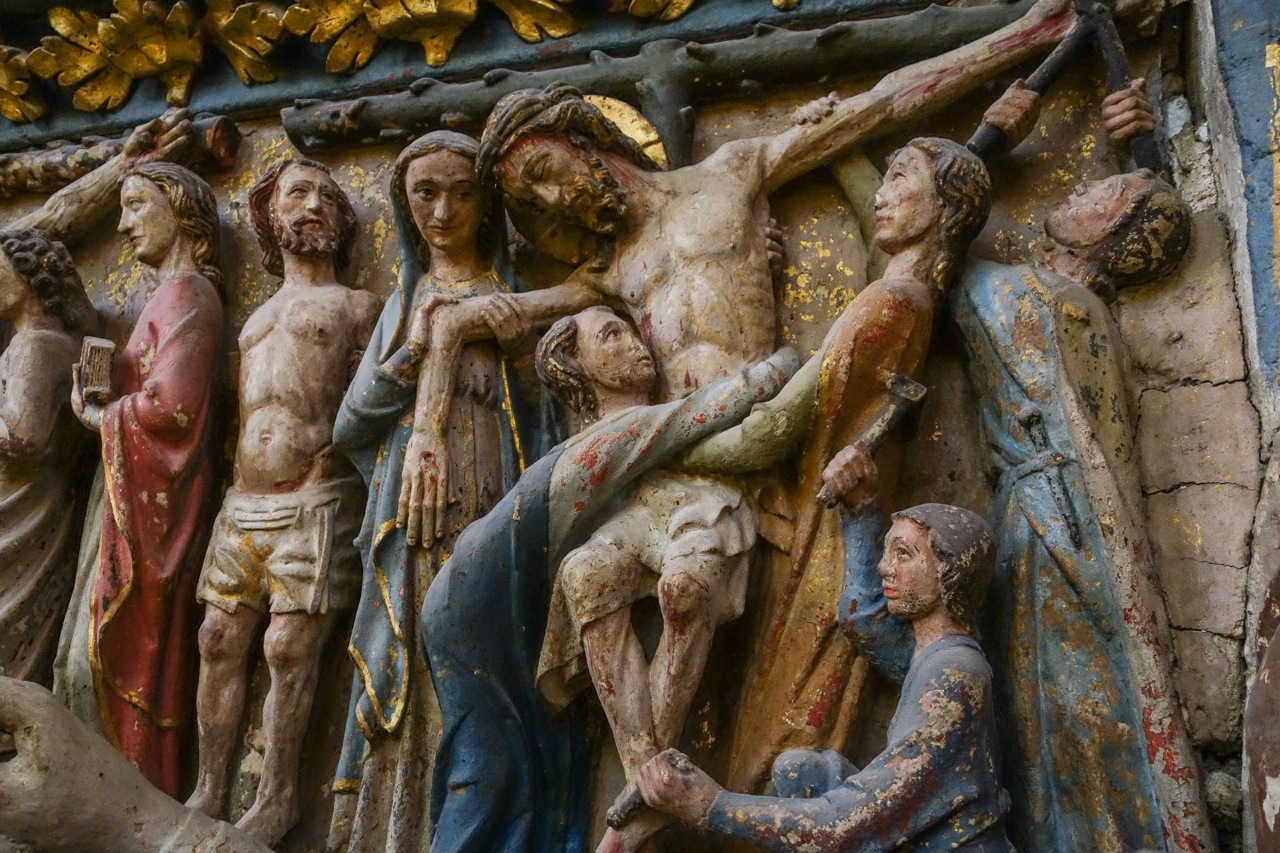
The Deposition (early Gothic; Leon cathedral on the Camino de Santiago)

The Deposition (early Gothic; Leon cathedral on the Camino de Santiago)

Keep your mind in hell, and despair not.

— Staretz Silouan[i]

Ah, children, ah, dear friends, do not be afraid of life!

— Fyodor Dostoevsky[ii]

How do we sing the Lord’s song in the shadow of terror? In solidarity with all the victims of Brussels and the whole human family this week, I protest, I rage, I grieve, I pray. But I must also try to think.

Indiscriminate terror has long been a scourge on this earth, but its globalization through television and social media has now made it emotionally inescapable. Were I to dwell in the uttermost parts of the sea, I could not flee from its presence.[iii]

So as we try to absorb the terrible news from Brussels, how do we “despair not” even in the face of monstrous evil? No simple task, and easy answers seem disrespectful in the time of weeping. But I do believe the antidote to despair is to keep the faith. We must never forget the sacred story we belong to. Even at the grave we make our song: Alleluia, alleluia, alleluia.[iv]

The terrorist, on the other hand, belongs to a story which for most of us in inconceivable. Terror is “the language of being noticed,”[v] a kind of performative rhetoric designed to bring a neglected or disregarded worldview into the open by subjecting others to the violent norms of its alternate reality. They see themselves as global victims, in search of a global audience for their cruel narrative. Mark Juergensmeyer, in his study of religious violence, explains this terrorist rationale:

If the world is perceived as peaceful, violent acts appear as terrorism. If the world is thought to be at war, violent acts may be regarded as legitimate. They may be seen as preemptive strikes, as defensive tactics in an ongoing battle, or as symbols indicating to the world that it is indeed in a state of grave and ultimate conflict.[vi]

In the minds of many terrorists, the war they are so eager to wage is apocalyptic, a cosmic conflict of good and evil in which there is no compromise or bridging of differences. They are, in Don DeLillo’s term, “lethal believers.” And the very worst thing we could do in response would be to play the part they have written for us: satanic enemies in a cosmic struggle. The proposals of certain American presidential candidates to “bomb the hell out of them,” or bring back the good old days of torture, would play perfectly into the terrorists’ hands, conceding the primacy of their deadly story.

However, I choose to belong to a better story, the one enacted and embodied in the powerful liturgies of Christ’s Passion. Step by step on the Way of the Cross this Holy Week, Christians will bring to mind and heart the saving journey which Jesus made, without weapons, into the abyss of suffering and death.

Renouncing all violence and hatred, Jesus remained faithful to the end. After pouring his whole life into a ministry of healing, forgiveness, and reconciliation, he continued to show us the face of love even as he was tortured on the cross. “Father, forgive,” he said with his dying breath. To the last moment, in his most bitter hour, he remained the human who shows us God by doing what God does.

Which story do we choose to live in? The story of terror and violence, or the story of self-diffusive love? Both are costly in the end, but only one leads to new and unconquerable life. Even after Brussels, the word remains: Be not afraid! Love makes the abyss into a Way.

The cross shows us how it is possible to absorb evil and neutralize its effects, rather than pass on the anger and live in bitterness. Turning the other cheek, going the extra mile, giving away your coat to the robber who steals your shirt, loving enemies, doing good to those who hate, blessing those who curse us – all this turns out to be an intelligent and intelligible Christian way of living.[vii]

When medieval women mystics contemplated the cross in prayer and vision, they saw not death’s triumph but a kind of birth. The crucified Jesus was like a woman in labor, enduring pain and travail in order to bring us all to birth: Ah! Sweet Lord Jesus Christ, who ever saw a mother suffer such a birth! For when the hour of your delivery came you were placed on the hard bed of the cross and … in one day you gave birth to the whole world.[viii]

To see such a death and call it birth is the central act of Christian imagination. It is why we declare victory at the cross. We don’t wait for Easter Sunday. We declare victory at the cross, because the Passion isn’t just a story about violent powers that always trample the weak and kill the prophets. It’s also a story about the Realm of God, where dry bones breathe and lost hopes dance, where the prodigal is welcomed home and the tears are wiped from every eye. The Love that makes such a realm was nailed to a cross, but was not consumed by it. Death did what death does, and God did what God does.

And on the outcome of that story, I stake everything.


Related posts

We are the singers of life, not of death

After Paris and Beirut, what story shall we tell?

Beyond Punch and Judy: The art of nonviolent resistance


[i] Staretz Silouan (1866-1938) was a Russian monk on Mt. Athos in Greece. Appearing as an epigraph to Gillian Rose’s book, Love’s Work, I found this provocative saying in Andrew Shanks’ Against Innocence: Gillian Rose’s Reception and Gift of Faith (London: SCM Press, 2008), 9. Rose herself added this typically intense comment: “What Staretz Silouan is talking about is the subjective experience of God-forsakenness,” and even there finding God. “I want to sob and sob and sob,” she says, “until the prolonged shrieking becomes a shout of joy.”

[ii] From Alyosha Karamazov’s final speech in Dostoevsky’s The Brothers Karamazov, trans. Richard Pevear and Larissa Volokhonsky (New York: Vintage Classics, 1991), 776

[iii] cf. Psalm 139:6, 8

[iv] Burial of the Dead, Episcopal Book of Common Prayer, 499

[v] Don DeLillo, quoted in Mark Juergensmeyer, Terror in the Mind of God: The Global Rise of Religious Violence, (Berkeley: University of California Press, 2000 ), 139

[vi] Juergensmeyer, 10

[vii] David Wood, in Consuming Passion: Why the Killing of Jesus Really Matters, eds. Simon Barrow & Jonathan Bartley (London: Darton, Longman and Todd, 2007), 118

[viii] Marguerite d’Oingt (d. 1310)

The voice that allows us to remain human

Moses before the Burning Bush, 13th century icon, Monastery of St. Catherine, Mt. Sinai

Moses before the Burning Bush, 13th century icon, Monastery of St. Catherine, Mt. Sinai

Even in the darkest hours of mankind, there might be a voice within us that allows us to remain human.

– László Nemes, director of Son of Saul, accepting the Oscar for Best Foreign Film

These words, spoken last night at the Academy Awards, struck me with particular force, since one of the most famous accounts of that voice had just been told in the morning liturgy. Although Exodus 3: 1-15, the story of the burning bush, does not describe a voice coming from “within,” I believe that the voice which Moses heard at the foot of God’s mountain was the same voice which the Hungarian filmmaker longs to hear, the same voice we all long to hear in a dark time when the humanity of our country, our world, and ourselves is being called into question.

Whether it speaks in an interior whisper, or calls to us from an exterior source, the voice “that allows us to remain human,” to remember (or discover) our true humanity, is the voice which has been speaking us into being since the beginning of the world. It is the voice of revelation.

Revelation, in the words of Ashton Nichols, is “a moment when the soul of the recipient is filled with something outside the self. A literal inspiration occurs. Consciousness finds itself flooded, or breathed into, or simply filled, by a force it ascribes to an external agency. The metaphoric agent may be a wind, a flash of light, or a disembodied voice. Divine grace descends; the voice of God is heard in the whirlwind; a spirit inspires the prophet or poet with a truth that comes from outside the self and is incorporated into the soul of the recipient.”[i]

The sense of a truth coming from “outside the self” may seem a contradiction to Nemes’ “voice within us,” but only if we understand ourselves as separate, autonomous beings more or less self-contained and complete. If we are made in the image of the Trinitarian God, then we are part of a larger, interdependent flow of self-diffusive love in which outside and inside, or divine and human, are not strict opposites, but partners in a dance. We are constituted by a process of receiving our being from somewhere else, and in turn giving ourselves away. We “lose” our life to find it, as Jesus said. Like that bush in the Sinai, we burn with divine fire, yet are not consumed.

The first time I went to the Holy Land, in 1989, I saw a burning bush. It happened to be Ascension Day. I was visiting the Anglican sisters in Ramallah, with whom my mother had once worked to teach and care for Palestinian Christian children. Since a border closing prevented us from going to mass at a Benedictine church known for its beautiful chanting, a couple of the sisters took me for a walk in the local hills. As we descended a ravine, we encountered a shepherd with his small flock. And behind him, a little further on, I saw, with considerable astonishment, a burning bush. Why it was on fire, I never learned. If it spoke, I did not hear. Sometimes the voice is for the shepherd’s ears only. But I never forgot the wonder of it.

The bush which will burn and speak to you, or me, is out there somewhere, waiting for the proper moment of holy meeting. Anglican poet/priest R. S. Thomas described his own encounter in “The Bright Field.”

I have seen the sun break through
to illuminate a small field
for a while, and gone my way
and forgotten it. But that was the pearl
of great price, the one field that had
the treasure in it. I realize now
that I must give all that I have
to possess it. Life is not hurrying

on to a receding future, nor hankering after
an imagined past. It is the turning
aside like Moses to the miracle
of the lit bush, to a brightness
that seemed as transitory as your youth
once, but is the eternity that awaits you.

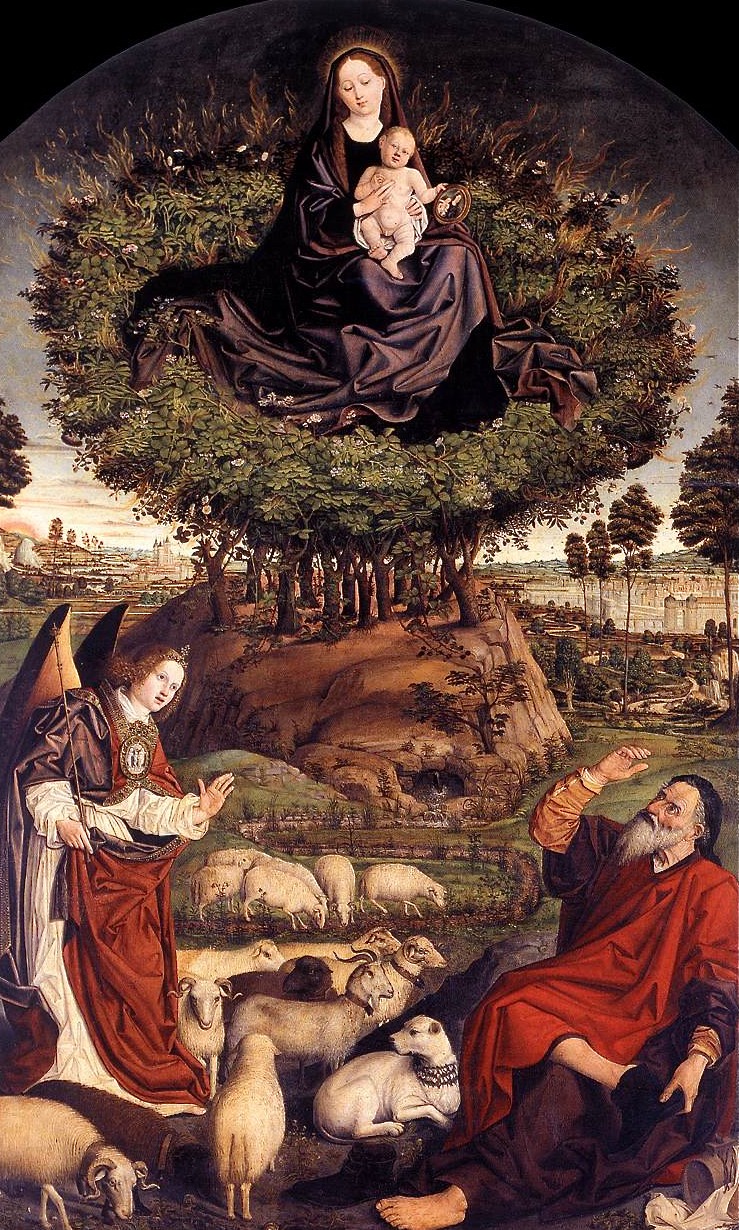
Mary in The Burning Bush, Nicolas Froment (1475-6)

Mary in The Burning Bush, Nicolas Froment (1475-6)

In an exquisite fifteenth-century tryptich by Nicolas Froment, Moses beholds the Madonna and Christ Child in the “burning” bush. There are no prominent flames. The Word made flesh is both voice and fire. God incarnate is the ultimate revelation by whom and through whom and in whom we may, at last, become fully human.


[i] Ashton Nichols, The Poetics of Epiphany: Nineteenth Century Origins of the Modern Literary Movement

Is holiness a Lenten obligation?

Bench carving, Cathedral of Seville, Spain

Bench carving, Cathedral of Seville, Spain

In the liturgical rite for Ash Wednesday, the priest stands up before the people and invites them “to the observance of a holy Lent.” It is a solemn and noble custom. But is it a serious proposal? And if so, what is actually being asked of the faithful?

When people hear the word “holy,” they often think “devout” or “virtuous,” but qodesh, the word for holiness in the Hebrew Bible, is not a moral or behavioral term. It means “apartness,” conveying an inherent, critical difference between what is holy and what is not.

The word itself is set apart. Unlike other divine attributes like power, justice and love, holiness has no analogue in the everyday life of Israel. It doesn’t refer to a common experience and then say God is like that. Instead, it evokes the one quality of God which is unlike anything we know.

In ancient Judaism, holiness meant the radical otherness of God, the Holy One. The divine presence is not to be approached easily or casually, either by our bodies or by our language. God dwells in a sacred zone which is highly charged, difficult and risky to enter.

Israel’s worship practices grew up around this strict sense of separation. At the center of cultic life was a holy of holies, a space set apart from contamination by the world. And only priests, who were themselves set apart and highly trained in the intricacies of access, were allowed to have contact with this sacred center. There was a sense that if the sphere of holiness were to be contaminated or carelessly regarded, the presence of the Holy One might withdraw from Israel, and that would be disastrous.

Leviticus, not a book I spend a lot of time with, contains a long section known as the Holiness Code because of its repeated use of holy and holiness, as well as related terms like sanctify, hallow, consecrate, dedicate, and sacred. It is filled with detailed prescriptions ranging from ritual practice to sexual behavior. Many of these seem archaic and largely inapplicable today. But may we still find something valid in the impulse to preserve the “holy” from profanation or inattention?

The sacred is made present by the attention we give to it. For example, if you come to a labyrinth occupying an open space, do you just walk straight across it, or do you go around it, acknowledging it as a space set apart for prayerful activity? Or does it only become holy space when it is put to its intended use, rather than just lying there as a decorative floor pattern?

I once led a weeklong family retreat for a Nevada parish on the eastern shore of Lake Tahoe. There was a beautiful stone church, with a large window looking across the water to the high peaks of the Sierra mountains. The space around the altar was large enough to hold all of us, so we did most of our worship there, in the intimacy of a circle.

I asked everyone to do two things each time they came inside the altar rails. One was to remove their shoes, like Moses at the Burning Bush. The other was to perform an action of their choice to mark their entrance into holy space: they could lift their hands in prayer, bow, genuflect, cross themselves, kiss the altar, or prostrate themselves on the floor. Most of the children, being the enthusiastically embodied creatures they are, opted for prostration! The effect of these physical observances was tangible. The attention we gave changed the quality of being there. It became for us holy ground.

But what Leviticus is after, and what a holy Lent is about, is more than the quality of a space or the attention we pay to it. Holiness is meant to be something contagious, something which gets inside us and changes us forever.

You shall be holy, for I your God am holy (Leviticus 19:2). God is not content to limit holiness to Godself. God’s people are invited to be holy as well. Not just our sanctuaries, but ourselves, are made to be set apart, consecrated, sanctified, hallowed. Biblical theologian Walter Brueggemann has called this the “obligation tradition,” where “the purpose of Israel’s life is to host the holiness of Yahweh.”[i]

As biblical people gradually figured out, hosting divine holiness means more than maintaining ritual purity or devotional piety. It means embodying justice and peace as well, uncontaminated by the dehumanizing, violent and oppressive practices of the dominant culture. Such holiness requires the consecration and dedication of every aspect of life to the will and purpose of God.

Leviticus 19:9-18 provides some excellent guidelines for our own time:

  • Don’t keep all your food for yourselves
  • Remember the poor and the immigrant
  • Don’t steal, lie, or defraud one another
  • Don’t exploit your workers
  • Be mindful of those with special needs
  • Be fair and just in your dealings with others
  • Don’t slander, seek revenge, or carry grudges
  • Love your neighbor as yourself

The nice thing about such a list is that these are all things we can do. They are not perfections only achievable in a messianic future. We can perform them right now. Jesus offered a similar list. Is somebody hungry? Feed them. Is anybody thirsty? Get them some water. And if curing the sick or setting the prisoner free seems beyond you, surely you can at least visit them. This is not impossible stuff.

Holiness, an attribute of God, becomes for us a practice.
Not something we are, but something we do.

Of course the specific obligations of holiness are not always clear. It is one thing to separate yourself by going to the desert, the monastery, or a countercultural refuge. It is quite another to live in contemporary society with its inevitable complicity in the evils by which the system maintains itself: militarism, consumerism, economic injustice and violence against the planet. How do we say no to the evil and yes to the good in a world of such complex interdependence?

And yet, Scripture remains insistent that we continue to strive for sanctification, dedicating our lives to God and separating ourselves from whatever is not of God.

  • God chose us in Christ to be holy and blameless, full of love (Ephesians 1:4)
  • Clothe yourselves with the new self, created according to the likeness of God in true righteousness and holiness (Ephesians 4:24)
  • Surrender your bodies to righteousness in order to create a holy life (Romans 6:19)

Surrender. Is this too much to ask? Is a holy life too much to ask? Does it set the bar so high that we just abandon the field to an elite corps of ethical heroes: the few, the proud, the saints?

Even worse, does a religion of obligation veer us toward “works righteousness,” overestimating our powers and denying the need for grace? Well, even Calvin admitted the possibility of making progress in personal goodness. He echoed the purity language of Leviticus when he wrote:

Ever since the Holy Spirit dedicated us as temples to the Lord, we should make it our endeavor to show forth the glory of God, and guard against being profaned by the defilement of sin. Ever since our soul and body were destined to heavenly incorruptibility and an unfading crown, we should earnestly strive to keep them pure and uncorrupted against the day of the Lord.[ii]

But where do we begin? Thomas Aquinas outlined three stages of holiness: First, distance yourself from sin and wrong inclinations (holiness as an act of separation, turning your back on sin and turning toward God). Second, work on cultivating the virtues in your life (holiness as a daily practice). Finally, rest in loving union with God (holiness as communion with the Holy One).

This triptych of holiness is echoed in my favorite collect in the service of Morning Prayer:

  • drive far from us all wrong desires (separation)
  • incline our hearts to keep your law, and guide our feet into the way of peace (practice)
  • that, having done your will with cheerfulness during the day, we may, when night comes, rejoice to give you thanks (communion)

Or to put this in the simplest terms:

  • What do I need to let go of?
  • What do I need to acquire and cultivate?
  • In whose reality do I want to dwell?

It’s not about effort, of course. Sola fide, sola gratia, soli Deo. Only faith, only grace, only God. As Augustine knew, “When God crowns our merits, God crowns nothing but God’s own gifts.”[iii]

And it’s never done, this holiness business. It’s an open-ended process of continual striving. Gregory of Nyssa said, “The perfection of human nature consists perhaps in its very growth in goodness.”[iv] In other words, holiness isn’t something we achieve, it’s a commitment to growth.

And as an old eucharistic prayer suggests, the time to start is now:

And here we offer and present unto thee, O Lord,
our selves, our souls and bodies,
to be a reasonable, holy, and living sacrifice unto thee.[v]

What if, every day during Lent, each of us were to make such a prayer?
Here I offer and present to you, O God, my ________.

Just fill in the blank with whatever the time and place requires.


Related posts

Grace me guide

Heart work and heaven work


[i] Walter Brueggemann, Theology of the Old Testament: Testimony, Dispute, Advocacy (Minneapolis: Fortress Press, 1997), 428

[ii] John Calvin, Institutes 3.6.3

[iii] Augustine, Epistle 154, 5.16

[iv] Gregory of Nyssa, Life of Moses 10

[v] Thomas Cranmer, Book of Common Prayer (1549), based on Romans 12:1, in the Episcopal Book of Common Prayer (1979), 336.

Ash Wednesday: A time for self-compassion


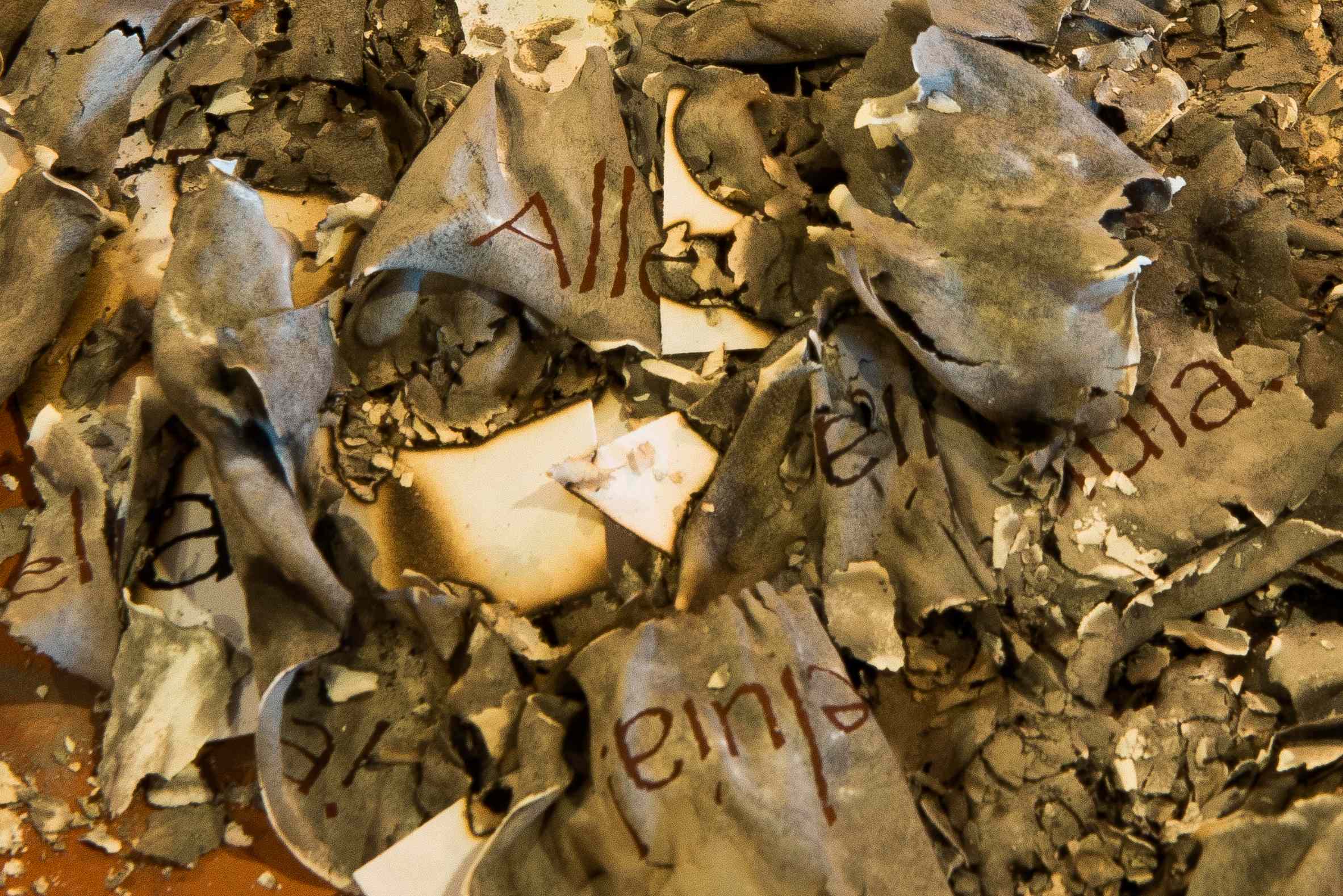
Alleluia ashes 2sm

There is a really deep well inside me. And in it dwells God. Sometimes I am there too. But more often stones and grit block the well, and God is buried beneath. Then he must be dug out again.

– Etty Hillesum[i]


Hillesum’s evocative image expresses the duality of the Lenten season. On the one hand, God is not the end product of spiritual attainment, something brought closer through our own efforts. The deep well of divinity is already present within us, “more intimate to me than I am to myself.”[ii] We don’t have to go somewhere else to find it. Lent is a time to tune in, go deep, and pay heightened attention to the Presence we often miss.

At the same time, our awareness of – and relationship with – this Presence may be hindered or obstructed by any number of things, requiring some real digging on our part. The trouble is, that digging can quickly become a self-improvement project, with Lent’s success judged by the quality and success of our efforts. We imagine a more spiritually heroic self, and strive to make it come true.

The ancient Desert Fathers and Mothers, who fled the corruption and distractions of their culture to seek a holier life in the wastelands beyond Empire, might seem at first glance to be overflowing with heroic aspiration. A typical regimen would be to “get up early every day and acquire the beginning of every virtue and commandment of God. Use great patience, with fear and long-suffering, in the love of God, with all the fervor of your soul and body. Exercise great humility, bear with interior distress, be vigilant and pray often with reverence and groaning, with purity of speech and control of your eyes… Do your work in peace. Persevere in keeping vigil, in hunger and thirst, cold and nakedness, and in sufferings.”[iii]

Such rigorous spiritual practice wasn’t for the halfhearted. But it risked the competitive sin of pride. Paul of Pherme, for instance, undertook the project of “continual prayer” – 300 prayers per day, keeping count with a pile of 300 pebbles in his lap. After each prayer, he tossed away one pebble. But he was crestfallen to learn of a certain woman who had been saying 700 prayers per day for thirty years! He would never catch up. Another desert father, Macarius the Alexandrian, warned Paul that his spiritual life lacked both balance and humility. But Macarius was no moderate. He once did penance for swatting a mosquito by moving to a swamp to endure six months of insect bites, without ever raising a hand in defense.[iv]

Thankfully, the extremists were not the norm. More prevalent was a spirit of deep humility about one’s capacities. John Climacus was a seventh-century monk at Mt. Sinai. His image of the spiritual life as a “Ladder of Divine Ascent” was later pictured in a famous twelfth-century icon.

Ladder of Divine Ascent, St. Catherine's Monastery, Mt. Sinai (12th century)

Ladder of Divine Ascent, St. Catherine’s Monastery, Mt. Sinai (12th century)

If you have ever climbed a very tall ladder, or done any rock-climbing, you know the degree of both effort and risk involved. John’s image makes it very clear that the spiritual life is strenuous and challenging. “We need to exercise ourselves greatly,” he wrote, “to lay upon ourselves many hidden labors after a life of negligence.” But then he said,

Be of good heart. If the passions lord it over us and we are weak, let us with great confidence offer to Christ our spiritual weakness and our impotence . . . He will help us irrespective of what we deserve, on the sole condition that we descend continually to the bottom, into the abyss of humility.[v]

So we don’t have to be heroes after all. What a relief! Humility, not heroism, is the way up the ladder. As the Rule of Saint Benedict teaches us, “by trying to climb we descend, and by humility we ascend.”[vi] That’s why Ash Wednesday strikes just the right note for the beginning of Lent. It brings us down to earth as creatures of ashes, dust and mud, undermining any pretensions of Promethean heroism. The Lenten journey is come-as-you-are.

Mary Oliver puts this perfectly: “You do not have to be good. / You do not have to walk on your knees / for a hundred miles through the desert, repenting. / You only have to let the soft animal of your body love what it loves.”[vii] Or as Simone Weil suggested, self-compassion means to “accept what one is, at a given moment, as a fact – even one’s shame.”

In the 1988 Winter Olympics, American speed skater Dan Jansen was favored in the 500 and 1000 meter events. On the morning of the 500 final, he learned his sister had just died from leukemia. His focus clearly elsewhere, he fell on the first turn of his race and never finished. He would also fall and fail in the 1000 meters. At the 1992 Olympics, he again failed to win the medals expected of him. The 1994 Oympics offered him one last chance, and he came to the line of the 500 meter race as the clear favorite, the only skater ever to break 36 seconds, which he had done four times. But after one slight slip on the ice, he finished out of the medals yet again.

Ash Wednesday came just after that race, and I reflected on Jansen’s story in my homily. Although Jansen would finally win a gold medal a few days later (in the one race where he was an underdog), it was his “failures” that resonated with people. After the liturgy, a therapist in the congregation told me that many of her clients that week had talked with her about Jansen’s story, and how much it moved them. If the world’s greatest skater could fall, then maybe it was all right for them to fall as well. You don’t have to be a hero, only yourself, letting the soft animal of your body love what it loves.

In his youth, the poet David Whyte was hiking in the Himalayas when he came to a deep chasm. The only way across was a rickety old rope bridge with many missing slats. Although he was a confident, experienced mountaineer, he suddenly froze at the prospect of traversing the abyss on so treacherous a path. He sat down on the ground and stared at the bridge for hours, unable to proceed. “There are times when the hero has to sit down,” he said later. “At some bridges in life the part of you that always gets it done has to sit down.” Then an old Tibetan woman came along, gathering yak dung for fuel. She walked with a limp. “Namaste,” she said with a smile. Then she turned and limped across the bridge. Immediately, without thinking, he rose up and followed. Sometimes, he realized, it is “the old interior angel,” the unheroic, limping, unequipped part of ourselves, that gets us to the other side.[viii]

Remember that you are dust, and no hero. Whether your Lent will be a time of giving up, going deep, or reaching out, may it always be done with a generous measure of self-compassion.

As Mary Gauthier sings so beautifully, we could all use a little mercy now.


Related posts

George Herbert: Heart work and heaven work

Solitude (Part 1)

Solitude (Part 2)


[i] Etty Hillesum, An Interrupted Life (New York: Henry Holt and Company, 1996), August 25, 1941 (two years before she died in Auschwitz)

[ii] St. Augustine, Confessions III.

[iii] The Apophthegmata (Sayings of the Desert Fathers), in William Harmless, S.J., Desert Christians: An Introduction to the Literature of Early Monasticism (Oxford and New York: Oxford University Press, 2004), 199-200

[iv] ibid., 288

[v] John Climacus, Ladder of Divine Ascent, 1st Step, 17, in Olivier Clement, The Roots of Christian Mysticism (New York: New City Press, 1993), 152

[vi] ibid., 156 (Rule of St. Benedict VII)

[vii] Mary Oliver, “Wild Geese,” New and Selected Poems (Boston: Beacon Press, 1992), 110

[viii] From a talk given by David Whyte in the 1990’s


Ten questions to ask about your own picture of Jesus

"I was a teenage Jesus" - Jeffrey Hunter as Jesus in Nicholas Ray's King of Kings (1961)

“I was a teenage Jesus” – Jeffrey Hunter as Jesus in Nicholas Ray’s King of Kings (1961)

Are you the Expected One, or should we look for someone else? (Matthew 11:3)

Who do you say that I am? (Mark 8:29)

I’m teaching a course this month on “Jesus and the Movies” at the Graduate Theological Union in Berkeley, California. We are examining nineteen feature films on Jesus, made between 1912 and 2014, through the lenses of biblical criticism, Christology, film theory, and cultural contexts.

But we are also considering our own personal perspectives on the protagonist of “the greatest story ever told.” What influences have shaped our own image(s) of Jesus? How do we picture Jesus? What do we expect him to do? How do we expect him to be? How is our understanding of Jesus enlarged, challenged, confirmed, contradicted or disappointed by what we see on the screen?

Robert Powell, whose portrayal of Jesus in Franco Zefferelli’s Jesus of Nazareth (1977) was generally well received by the public, said some years later that “No one can play Jesus. Not really.” And many critics have agreed. The casting of boyish teen heartthrob Jeffrey Hunter (who was actually 33 when he played the part) elicited sneers of “I Was a Teenage Jesus.” Max von Sydow, praised by some for restoring virility to the role, was ripped by others for “an aphorism-spouting, Confucius-say edge to his speech, an overtone of pomposity.” Jesus Christ Superstar’s Ted Neely was dismissed as “a droopy little fellow with sad eyes and long hair, followed by nondescript young people without any particular place to go.” And Willem Dafoe’s troubled and uncertain Jesus caused NPR’s Tom Shales to say that “this Jesus wonders, wonders, wonders who — who wrote the book of love?”

My take on the subject is that no actor has to be the Jesus, and that no single film needs to be definitive. They only need to show us the “old, old story” in some fresh way, to reveal some dimension we might otherwise have missed. But any claim to have finally gotten it “right” would be idolatry. As Rowan Williams has noted:

If you think representation is copying or reproducing, quite clearly, there is no way you can do this as a religious believer. Not even if you think you are reproducing what Jesus looked like when he was on earth. If on the other hand you think ‘I need to find some kind of vehicle which will put me in touch with the action that underlies and sustains these events’, then of course you won’t necessarily look for a realistic picture… No, you don’t want to represent just the human facts, nor do you want to take refuge in abstract representations … you are put in touch with something, but you mustn’t think it’s a copy.[i]

So the actors and filmmakers are freed of the burden of factual replication. They merely have to put us in touch with that certain something contained in the Jesus story. And in provoking our own responses, both positive and negative, they make us reexamine the nature and history of our own images and ideas for Jesus.

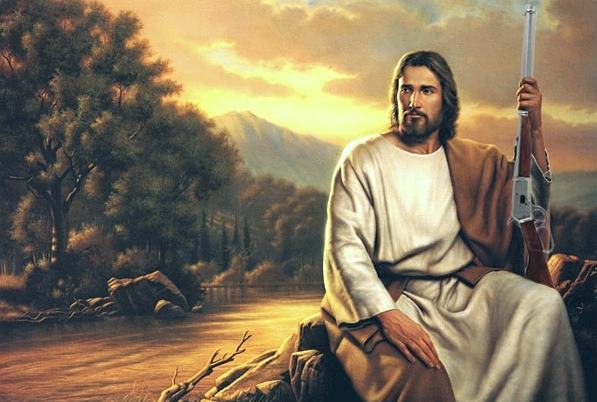
From the Internet, definitely a "not-Jesus".

From the Internet, definitely a “not-Jesus.”

That being said, here are ten preliminary questions to consider when Jesus asks the big one: “Who do you say that I am?”

  1. Where did your first images of Jesus come from? Have any of those become obsolete?
  2. What later images, experiences, and understandings caused those first images to grow, develop, change?
  3. What are your criteria for authenticity? Scripture, theological presuppositions, historical probability, psychological plausibility, inner experience, worship, moral resonance, etc.?
  4. Then vs. Now: Is Jesus only in the past, or can we encounter him in the present? Can faith communities receive information about Jesus that adds to the picture (as in the Fourth Gospel or the Book of Revelation)? Can individuals, such as Julian of Norwich in her visions of the Passion, be shown “new” things about the Jesus story? Can a painter, or a filmmaker, show us something new about Jesus? How can such new insights. assertions, or revelations be tested?
  5. Is historical investigation enough to reach the “real” Jesus? Is faith enough? Or do they shape and influence each other?
  6. What is the role of art, including film, in showing us Jesus? Can different images/actors/styles add to our understanding and experience of Jesus? What are the criteria that affect our receptivity?
  7. If a particular movie Jesus or scene doesn’t fit our own ideas. images, or understandings, do we reject it entirely, or do we engage with it, let its difference be a way to explore and test our presuppositions? Do we say, “That’s not Jesus,” and move on? Or do we wrestle till dawn with that stranger to see whether it might bless us?
  8. All language is difference: this is not that. Can even the not-Jesuses help define who Jesus is?
  9. Ontological Christology vs. functional Christology (being vs. doing): Do the identity of Jesus, and the authenticity of his representations, lie in who he is: a person in whom both human and divine are perfectly integrated (and then manifested in personality, charisma, appearance, and the way he feels to us)? Or does it lie in what he does, what he says, and how the story goes, regardless of our affective responses to his manner of being?
  10. If a particular representation of Jesus makes you uncomfortable, can that be a good thing?


Related Posts

The Ten Best Jesus Movies

My 10 Favorite Jesus Movie Moments


[i] “Faith and Image,” a conversation between Rowan Williams and Neil MacGregor, Art and Christianity 75 (Autumn 2013), 3

Brief prologue for the Nativity

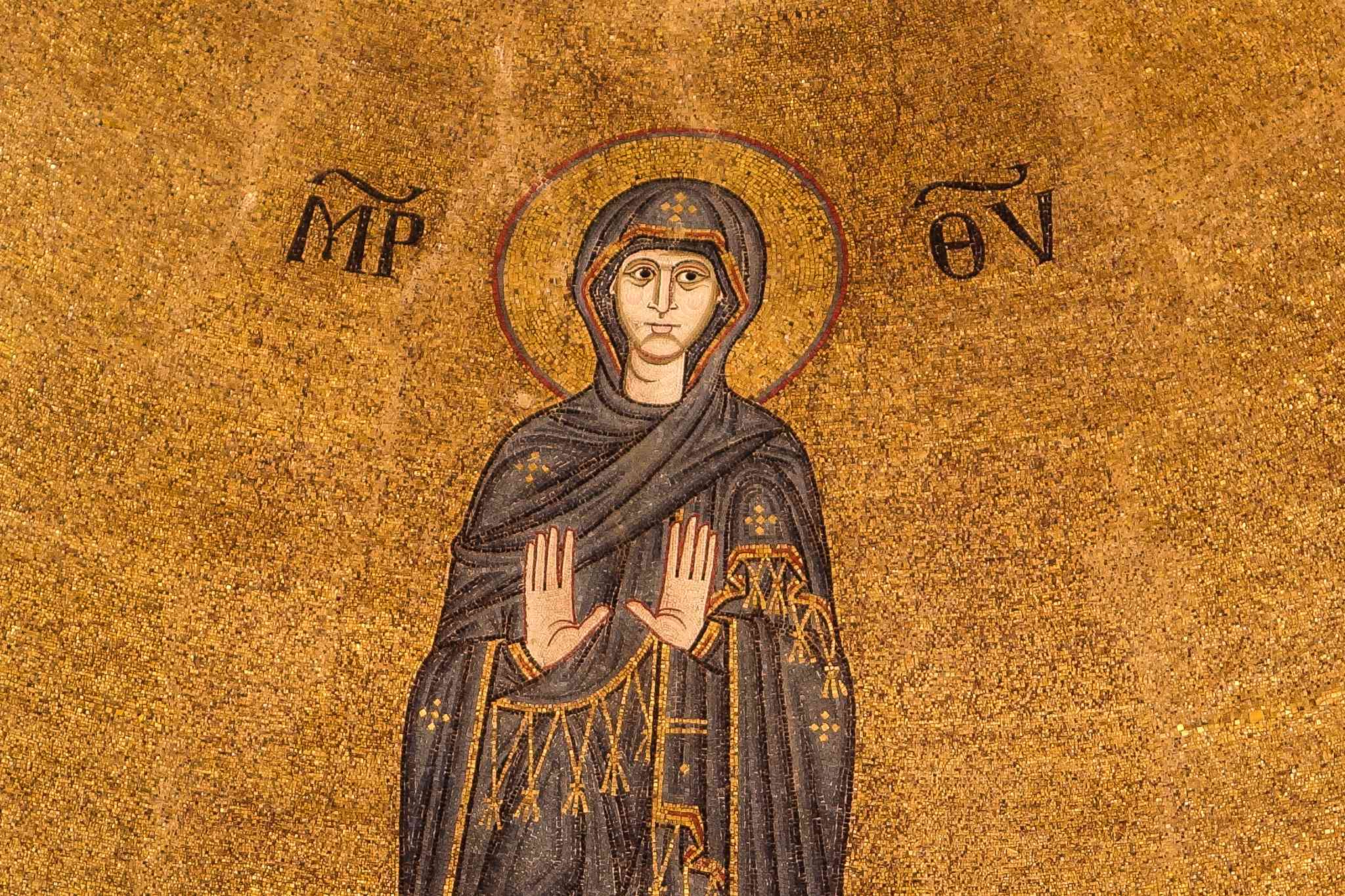
Apse mosaic, Basilica dei Santi Maria e Donato, Murano, Venezia (12th century)

Apse mosaic, Basilica dei Santi Maria e Donato, Murano, Venezia (12th century)

Dear readers, in these last hours before the Feast of the Nativity, let me wish you all a very Merry Christmas. Thank you for your interest in what happens here, and for your thoughtful reading and supportive comments. I am grateful for your visits. May the twelve days of Christmas bring you much joy and blessing.

In lieu of a post today, I offer these three passages as prologue to Christmas Eve:

Today the Virgin is on her way to the cave where she will give birth in a manner beyond understanding to the Word who is, in all eternity. Rejoice, therefore, universe, when you hear it heralded: with the angels and shepherds, glorify the Holy One who chose to be seen as a new-born babe, while remaining God in all eternity.

— Preparation of the Nativity, Orthodox liturgy

“I suppose they try to make you believe an awful lot of nonsense?” “Is it nonsense? I wish it were. It sometimes sounds terribly sensible to me.” “But my dear Sebastian, you can’t seriously believe it all.” “Can’t I?” “I mean about Christmas and the star and the three kings and the ox and the ass.” “Oh yes, I believe that. It’s a lovely idea.” “But you can’t believe things because they’re a lovely idea.” “But I do. That’s how I believe.”

— Evelyn Waugh, Brideshead Revisited


I am the blossom pressed in a book,
found again after two hundred years…

I am the maker, the lover, and the keeper…

When the young girl who starves
sits down to a table
she will sit beside me…

I am food on the prisoner’s plate…

I am water rushing to the wellhead,
filling the pitcher until it spills…

I am the patient gardener
of the dry and weedy garden…

I am the stone step,
the latch, and the working hinge…

I am the heart, contracted by joy…
the longest hair, white
before the rest…

I am there in the basket of fruit
presented to the widow…

I am the musk rose opening
unattended, the fern on the boggy summit…

I am the one whose love
overcomes you, already with you
when you think to call my name…

— Jane Kenyon, “Briefly It Enters, and Briefly Speaks”


Related post: How Can This Be?