The O Antiphons: “Drenched in the speech of God”

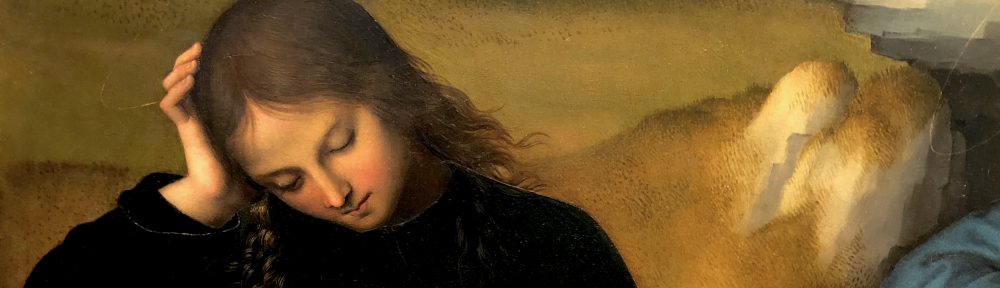
Giovanni Bellini, Madonna and Child with Saints Catherine and Magdalene (detail), c. 1500, Accademia, Venice

Giovanni Bellini, Madonna and Child with Saints Catherine and Magdalene (detail), c. 1500, Accademia, Venice

When belief in God is the matter to be decided, the central question is whether you can and should allow yourself to retain or be drawn into the patterns of thought that make the believer’s world what it is.

– David M. Holley

Pierced by the light of God…drenched in the speech of God,
your body bloomed, swelling with the breath of God.

– Hildegard of Bingen

One of the joys of Advent’s final days is the praying of the O Antiphons, seven eloquent supplications based on biblical images or attributes of the divine. Liturgically, they begin and end the Magnificat at Vespers from December 17th to December 23rd, but they can also be a rich resource for personal prayer as Christ-mass draws near. I tape each day’s particular antiphon to the mirror where I begin and end my day. Doors, dashboards and desks would also be good places to encounter these compelling texts, letting them awaken our attention over and over throughout the day.

Today’s antiphon, in my free paraphrase:

O Sophia, you are the truth of harmonious form,
the pattern of existence, the shapeliness of love.
Come: illumine us, enable us, empower us
to live in your Wisdom, your Torah, your Way.

The best-known version of the O Antiphons is the hymn, “O Come, O Come Emmanuel.” You can find my own variations on the seven antiphons here.

In my December 17 post last year, I wrote:

Each antiphon is both greeting and supplication to the God who comes to save us:

O Sapientia, O Adonai, O Radix Jesse, O Clavis David,
O Oriens, O Rex Gentium, O Emmanuel … O … O … O …

O is such an evocative word. We use it when we come upone something outside ourselves, often unexpected, something that engages us face to face.

 “O” can be an inhalation, a gasp, the cry of astonishment at the heart of every encounter with the Holy. If our place of prayer were suddenly filled with smoke and angels, or if the Holy called us out of a burning bush, our first response might well be “O!”

 There is also the O of understanding, or recognition: “O, now I see, now I get it.” Or even, “O, it’s you!”

 And then there is the ecstatic O, expressing delight, wonder, the sigh of surrender: Ohhhhhhh!

 Each of these is a fitting response when we meet the divine:

 Astonishment
Recognition
Surrender

As the Antiphons return this year, I happen to be reading David M. Holley’s illuminating book, Meaning and Mystery: What it Means to Believe in God. In fresh and thoughtful ways, he suggests that God is not a hypothesis to be tested or a puzzle to be solved by detached observers, but an experience to be encountered by receptive participants, those who know how to say “O!”

Thinking of God as a hypothesis to be inferred from specifiable data means starting from an understanding of a world that does not presuppose God, but belief in God is not a matter of moving from such a world to a reality in which God is included. It is a matter of finding yourself within the kind of world where God is implicit already.[i]

In other words, the truth of belief isn’t something that can be decided from a position outside of the patterns of life and thought that constitute a religious view of the world. If you want to experience God, learn to genuflect, learn to pray, learn to sing and dance in the presence of the Holy.

Astonishment. Recognition. Surrender.

It is certainly possible to live inside an alternative story, where God is absent or nonexistent. But I find that a bleak and unpromising account of reality. This old world, beset by human folly, massive violence, economic injustice, and dispiriting politics, needs divine imagination more than ever.

The prophet Zephaniah responded to his own dark times with a profound hope in God’s Advent as a redemptive rewrite of the human story. Amid the current proliferation of hateful speech, faithless fear and violent bluster, how we long with Zephaniah for a new story, a better language.

At that time I will change the speech of the peoples to a pure speech, that all of them may call on the holy Name and serve God with one accord.[ii]

May that day come when we are all “drenched in the speech of God,” whose language is justice, peace, mercy, forgiveness, compassion, communion.

O Desire of all nations and peoples,
you are the strong force that draws us toward you,
the pattern which choreographs creation
to Love’s bright music.
Come: teach us the steps
that we may dance with you.


Related posts

Praying the O Antiphons

Ten Ways to Keep a Holy Advent

[i] David M. Holley, Meaning and Mystery: What it Means to Believe in God (Malden, MA: Wiley-Blackwell, 2010), 47-48 [the epigraph is also Holley, p. 48]

[ii] Zephaniah 3:9

Reprise: Ten Ways to Keep a Holy Advent

image

Here in Puget Sound, the first Sunday of Advent has begun in darkness, fog, and frost. It is for many of us a deeply felt time, the season where we wait expectantly for the dawning of the New. The spiritual practice of waiting is not a state of passivity, but rather the cultivation of attention, lest we miss what is being offered to us in the unfolding of God’s future.

I do not usually do re-runs of old posts, but some readers found last December’s “Ten Ways to Keep a Holy Advent” a useful list, and you can access it here. I hope you will find some blessing in it. And please feel free to share it with your communities.

Do not fear: Reflections on the Venice Colloquium

image

The greatest thing a human soul ever does in this world is to see something, and tell what it saw in a plain way. Hundreds of people can talk for one who can think, but thousands can think for one who can see. To see clearly is poetry, prophecy, and religion – all in one.

– John Ruskin[i]

I can’t understand why people are frightened of new ideas.
I’m frightened of the old ones.

– John Cage[ii]

John Ruskin, the influential Victorian oracle on all things pertaining to the visual arts, had a particular passion for Venice. As a young man, he made repeated visits to analyze and record, in words, drawings and watercolors, the endangered architecture of the place he described as “a ghost upon the sands of the sea, so weak, so quiet, – so bereft of all but her loveliness, that we might well doubt, as we watched her faint reflection in the mirage of the lagoon, which was the City, and which was the Shadow.”[iii]

A city floating on the sea, a mirage of reflections and watery light, an endless play of surfaces and mazes, seems more imagined than built. Ruskin’s fevered description of San Marco celebrates this fantastic evanescence:

… as if in ecstasy, the crests of the arches break into a marble foam, and toss themselves far into the blue sky in flashes and wreaths of sculptured spray, as if the breakers on the Lido shore had been frost-bound before they fell, and the sea-nymphs had inlaid them with coral and amethyst.[iv]

Artists, writers, and dreamers have long made pilgrimage to Venice not just to admire its beautiful treasures, but to be immersed in its spectral fancies, a provocative analog for their own imaginative processes. When a small group of Christian creatives gathered there for the Venice Colloquium in late October, we arrived with that same longing for inspiration and discovery.

Our collective intention was to “dream the Church that wants to be.” It was born of a shared sense of urgency about the state of imagination in the common life of God’s friends. In my last post, I wrote that “the practice of holy imagination is like a sanctuary lamp in the life of the Church. If not duly attended to, it is in danger of going out.” In a week of group conversations and Venetian wanderings, we tended the flame as best we could.

We had little interest in being theological spin doctors, cranking out persuasive messages or illustrative answers. Art is not argument or propaganda. Its purpose is not to answer questions, make a point, or silence doubt. The artist should not know what is going to happen when she goes to work. One of our group, a painter, said, “I am not trying to get a message out with my work, but to evoke a deep experience. What right do I have to impose my meanings on the incredible lives of other people?”

“Church,” said another, “has become the place where you go if you know, rather than the place to find out. It has become the place of the answer instead of the question.” Could we possibly abandon the project of collecting the best answers and devote our attention to curating the best questions? Where would that lead? Would we just get lost in the maze of unknowability? Or as the Psalmist says, is there anywhere we can go where God is not?

Where can I escape from your Spirit?
Where can I flee from your presence?
If I climb up to heaven, you are there;
if I make my bed in the underworld, you are there.[v]

When we discussed the drag imposed on creativity by the institutional rage for order, the young leader of an “emergent” Christian community spoke up: “I want a wild church, where things are out of our control.” For Christians concerned about communal stability and institutional sustainability, that might sound like a recipe for chaos. But as our sacred stories remind us, chaos is prelude to creation. And if anyone thinks the Church is not in need of some serious re-creation, they aren’t paying attention.

The worship spaces of Venice, with their monumental forms of marble and mosaic, their exuberant decoration, their Bellinis, Titians, and Tintorettos, express a religious confidence that is nearly incomprehensible to our own time. More frequented by tourists than believers, they seem like gorgeous tombs for an expired past. Then what shall we say when the prophet asks: Can these bones live?

Jaume Plensa,

Jaume Plensa, “Together”

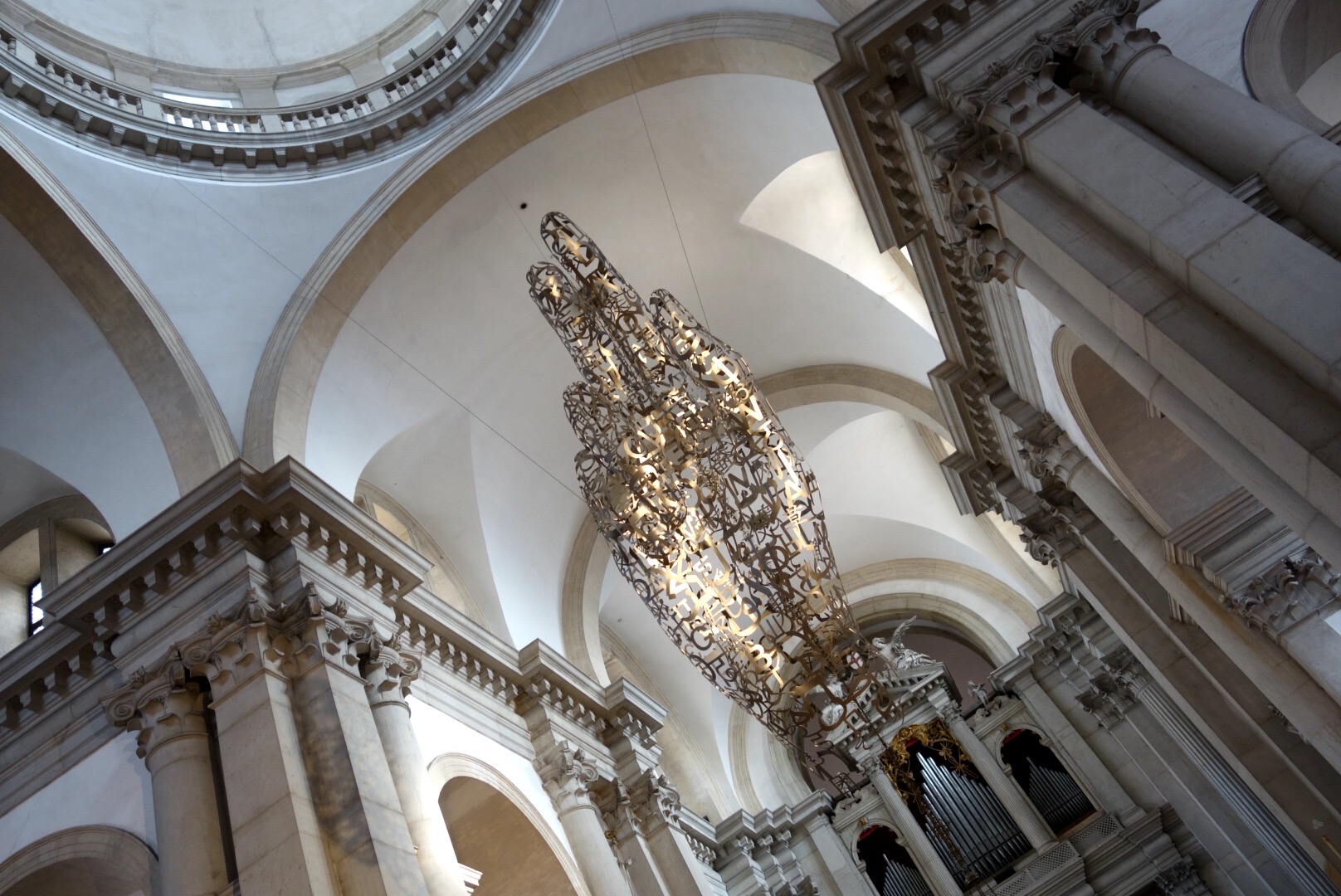
One Sunday morning I attended mass at San Giorgio Maggiore. There were less than forty people present in its vast interior. But as soon as the liturgy ended, many more people began to stream into the church. They had come not to worship, but to experience a contemporary art installation, part of the Biennale art exposition taking place throughout the city. A giant head, made of thick wire, faced the altar from the nave. Consisting of far more empty space than substance, it was a ghostly, immaterial presence, in but not of this world. A great golden hand, suspended over the crossing, bestowed upon that serene and mysterious face a perpetual blessing.

Jaume Plensa,

Jaume Plensa, “Together”

The contrast between the sparsely attended mass and the popular artwork could be interpreted as a simple duality of irreconcilable opposites: religion vs. art, old vs. new, moribund vs. vibrant, neglected vs. popular. But that would be too facile, ignoring the deep connections between the artwork and the worship space it inhabited.

It was not accidental that the head, modeled on a girl of Chinese and Spanish ancestry, faced the altar from the nave, like any common worshipper, or that the blessing hand mimicked the gesture of countless priests who had presided in that place for a thousand years. The work couldn’t be detached from Christian ritual without evacuating much of its meaning.

At the same time, there was something universal about a blessing hand and a receptive face. The extreme magnification of head and hand functioned like a cinematic close-up, focusing on the act of blessing in isolation from any specific ritual context or tradition. We didn’t see the vested body of a Catholic priest, or encounter the sociology of a local congregation. We only saw a hand that blesses and a face that receives. For me, the elemental humanity of this universal gesture reinforced rather than replaced the meaning of Christian blessing.

So instead of a rivalry between art and religion, there was a conversation, in which each informed and enriched the other. An explanatory text said that Jaume Plensa’s artwork, entitled Together, employed “a metaphorical language that will connect people of many faiths and of no faith.”

The conversation between art and religion, and among artists of many faiths and no faith, can only be tentative and experimental in an age of fragmentation and doubt. It will also be wild and unpredictable. If any of our small group came to Venice thinking we might collectively forge a vision of what the Christian artist is called to be in such a time, in such a Church, we were soon awakened from that fond dream. There will be no manifesto from the Venice Colloquium. We have returned to our homes with no answers, only more questions. And some lasting images.

Another Biennale work, Rashad Alakbarov’s The Union of Fire and Water, provided particular inspiration. As part of an installation evoking the turbulent political history of Azerbaijan, an array of swords and daggers was arranged in such a way that a message was created from their shadows: Do not fear. The instruments of violence and death had been transformed into an utterance of encouragement and hope. It was reminiscent of the Arma Christi, where the implements of Christ’s suffering become symbols of salvation.

Through the play of light and shadow, the handwriting on the wall was there for all to see. For artists out on the road of unknowing, with the voices of caution and order tugging us backward lest we lose our way, it seemed like a word from heaven. Do not fear.

Rashad Alakbarov,

Rashad Alakbarov, “The Union of Fire and Water”

[i] John Ruskin, Modern Painters III (IV: 333), abridged and edited by David Barrie (New York: Alfred A. Knopf, 1987), 404

[ii] q. in Kay Larson, Where the Heart Beats: John Cage, Zen Buddhism, and the Inner Life of Artists (New York: The Penguin Group, 2012), x

[iii] Ruskin, The Stones of Venice I, 9:17, quoted in Ruskin’s Venice: The Stones Revisited, ed. Sarah Quill (Farnham, Surrey: Lund Humphries, 2015), 41

[iv] The Stones of Venice (10:82-3), ibid., 55

[v] Psalm 139: 6-7


Tending the lamps of holy imagination

Dreaming in Venice

Dreaming in Venice

We are in the fifth day of the Venice Colloquium, a small gathering of Christian creatives to “dream the Church that wants to be.” We will finish our work on Sunday in time to attend the mass for All Saints Day in the Byzantine splendor of St. Mark’s cathedral.

The conversations and presentations have been extremely rich, and I will be reporting on them in future posts, once I have begun to absorb and process what has happened here. In the meantime, while I have a rare free moment to attend to my blog, let me try to put into one simple statement the sense of need, perhaps even crisis, which has brought us together:

The practice of holy imagination is like a sanctuary lamp in the life of the Church. If not duly attended to, it is in danger of going out.

(In the very moment of writing that statement, the church bells of Venice began to ring all over the island where we are staying. I’ll take that as a “yes.”)

What would the Church be like if that lamp were to be extinguished? I had a vision of that dismal outcome yesterday, in a video by artist Theaster Gates at Biennale, the international art exposition being held in Venice.

Part of an installation called “Gone Are the Days of Shelter and Martyrs,” the video filled the entire wall of a dark room. Shot inside the dim space of a ruined church, it revealed few details of the interior. The two men who moved about inside were faceless shadows. It suggested to me a lower level of Dante’s Inferno, an impression reinforced by the repetitive violence of their actions.

Lying on the floor amid the rubble of a fallen ceiling, there were two heavy doors. They had become useless, meaningless, no longer attached to any place of entry or exit. The two men would circle the doors once or twice, raise one or the other to an upright position, and let it fall with a great echoing crash. They did this over and over, as if condemned to enact this enigmatic distillation of their wounded condition for all eternity. A wailing offstage blues singer was the only other sound, a cry from the depths of darkness.

The space between the image and the opposite wall was not wide, so that the viewer could not keep much distance from what was being projected. It was like sitting in the front row of an Imax theater. There was no escaping the image. I was immersed in it, and that added to its claustrophobic feel.

But after about ten minutes of this, the camera slowly panned away from the men and the doors, toward the end of the church where the altar had been. The apse wall was broken down, open to the sky. Being able finally to see light breaking into all that darkness seemed like the rolling away of Christ’s tombstone. And just below the roofline, one piece of unbroken wall remained, painted with a fresco of the Last Supper. The holy image was ancient and faded, like a memory not yet entirely lost.

Whatever the artist’s specific intentions, I came away from that screening room with an indelible image of a desolate church robbed of its light. Such a prospect is why we tend our lamps so religiously. It is why we have come to Venice.

But that ruined church is no place to leave you, dear reader. Instead, let me offer another image of the Church, in which “she” is depicted an old woman in her declining years. It is by Mark Harris, a member of our Colloquium, and he graciously permitted me to publish it here. I promise you, it ends well.

She is an Old Woman

She is an old woman,
Not well respected over the years.
Shuffling off to the bathroom
She looks in the mirror
And does not see the face of Christ.

Whatever happened to my body,
She wonders, whose parts all work
Together for good?

She has been ravaged
By some who claimed to be lovers,
And by others who had no such pretensions,
Only opportunistic rapine desire.

For the moment before the first service
She is quiet. She gathers the shambles
Of her dignity and rambles
Off to prayer and Thanksgiving.

“Who will come today, who will come.?
Will they remember me in my glory,
When I was all light and lovely?
Will they come in pity, shame and wonder
That I am still here?”

The word goes around that it was all a story,
That she was never beautiful and never lithe.
She hears them whispering. She feels
Their eyes as they wait to see her die.
They will scurry over her remains
Looking for something to take away:
A remembrance of glory past,
If glory was there at all.

She laughs softly,
And in a resurrection moment
Almost worthy of the second coming,
She is consumed in fire.

Renewed and beautiful,
She lifts the veil that hides her face.
“Behold,” she says,
“I make all things new.”

Bill Viola’s “Martyrs”

image

The souls of the righteous are in the hands of God, and no torment will ever touch them. In the eyes of the foolish they seemed to have died, and their departure was thought to be a disaster, and their going from us to be their destruction; but they are at peace.

– Wisdom of Solomon 3:1-9 (Lectionary reading for All Saints)

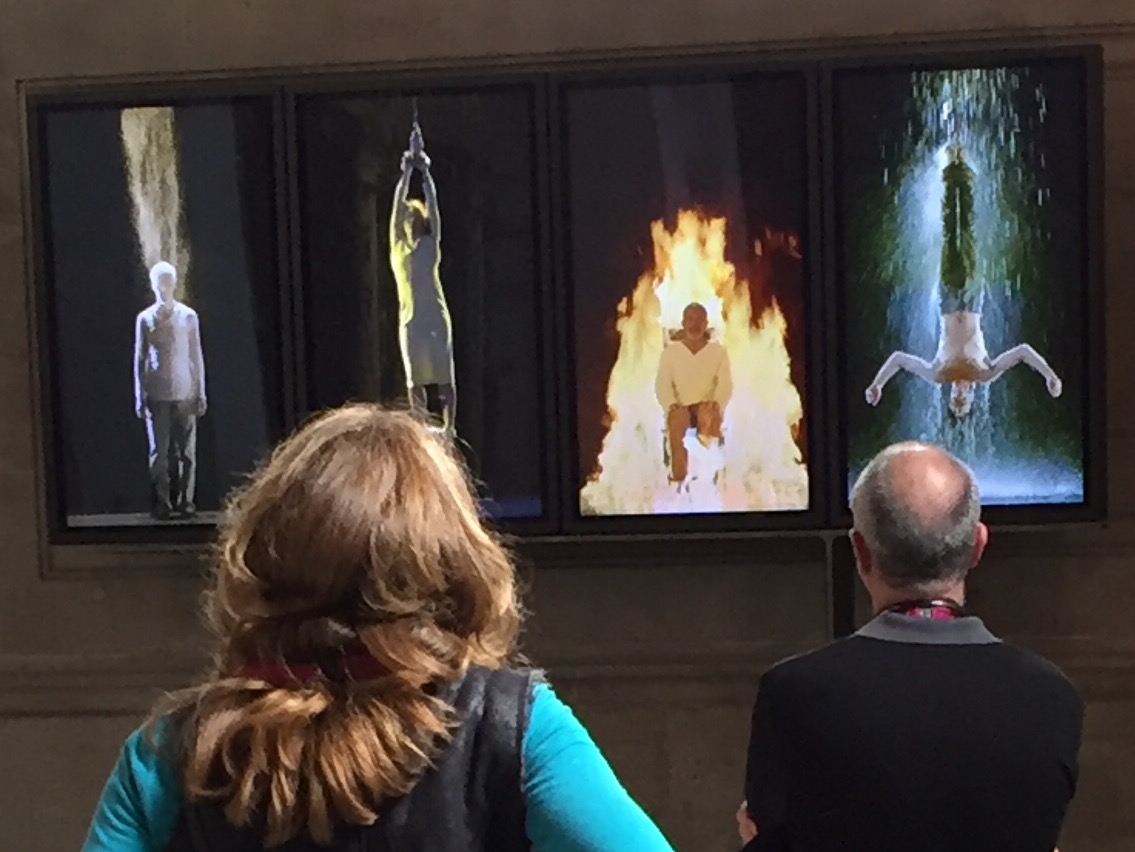
At the far end of the south choir aisle of St. Paul’s Cathedral in London, four “martyrs” perform a perpetual sacrifice in a slow-motion passage from suffering to glory. These martyrs are not the painted or sculptured figures of a traditional altarpiece, but two men and two women, recorded on high-definition video, and played back continuously on a polyptych of four adjacent vertical plasma panels, each 55” x 33.”

This stunning work is by Bill Viola, who has long been exploring the interplay of “technology and revelation.”[i] As David Morgan has written, “Viola’s work suggests that the human condition consists of the fact that we are embodied beings yearning, but ill-prepared, for communion with one another; that we suffer pain and loss, that we struggle to transcend our bodies and our suffering by connecting with a larger or inner aspect of reality; and that we die. Bodies, communion, suffering, transcendence, and death collectively constitute a condition, a worldview that the artist seeks to investigate in his work.”[ii]

Martyrs (Earth, Air, Fire, Water) was installed at St. Paul’s in 2014, and this week I had my first chance to see it. It is 7.5 minutes long, continuously repeated. Mesmerized and deeply moved, I watched it ten times, and each viewing provoked some new thought or feeling.

The figures begin in stasis, undergo an ordeal involving time and motion, and finally come to rest in a perfect stillness: not the anti-life of death or nonbeing, but something implicitly wondrous.

All the figures are facing in our direction. In the first panel, a kneeling man, head bowed to the floor, is almost completely buried beneath a triangular pile of dirt. We only see the top of his head, clutched by his two tense hands. The dirt begins to fly upward in a column, disappearing into whatever is above the frame. He rises to his feet, ever so slowly, as if it is a great struggle against gravity, or stasis. By the time he is upright, the last of the dirt has vanished into the “above,” and he is staring out at us impassively.

In the second panel, a woman in a white shift is suspended by a rope tied to her wrists. Her feet are anchored two feet above the ground by another rope securing her ankles. She is blown by a great wind coming from the left, buffeted back and forth within the constraint of her tethers, at the mercy of a relentless exterior force. After a while, the wind subsides, her suspended body grows still, and she gazes out with an unexpected measure of serenity.

A black man sits in a chair in the next panel, his head tilted to the side and downcast. Then bits of flame begin to drop from above, continuing to burn where they land. More and more flames fall, some leaving trails like shooting stars, until the whole floor, and the chair, are on fire. By this time the man has raised his head to look out at us, but he appears calm and still even as the flames envelop him. He remains in that position as the flames finally relent and die out.

In the last panel, a man is curled up in a fetal position with eyes closed. A rope tied to his angles is suspended from somewhere above the frame. The slack starts to be taken up, pulling his legs upward, and then his entire body, until he is completely upside down like the Hanged Man in the Tarot, or one of those skinned animals dangling in a Dutch genre painting as a secularized image of Christ’s Passion. When a stream of water begins to fall from above, his arms slowly stir, moving into a prayer position, bent 90 degrees at the elbow, then gradually sweeping backward, like a swimmer’s breaststroke, until they are near his side. Meanwhile, his inverted body begins to be pulled upward by the rope, toward the source of the falling water.

All of the figures have been handed over to forces or situations beyond their control. One buried, one bound and buffeted, one burned, and one left for dead. Yet none of them rages or resists. They accept their condition with a calm grounded in something greater than their own survival.

Each of the first three, after gazing out at us for a time, gradually shift their attention to whatever is above them, out of our sight, until their upturned faces glow with the light of eschatalogical radiance. Their faces never become expressive, or call attention to their own personalities; they remain still and quiet, in a condition of “absolute unmixed attention.”[iii]

The fourth figure, the “Hanged Man,” provides the dissonant harmony within this suite of images. He is the one who appeared already dead, his suffering behind him. His eyes, either closed or obscured by the water streaming down his face, are never quite visible. Although his arms eventually make hopeful gestures of prayer or embrace, the rest of his body stays limp, totally given over to the power at the other end of the rope, which pulls him up and out of the frame. The water continues to fall when he is gone.

Unlike the prayerful final images of the other panels, the fourth is fraught with absence. The other martyrs only gaze at the transcendent. The fourth has already ascended there, and we are left with only the water as a reminder of the one we can no longer see.

Noting that martyr means “witness,” an accompanying statement by Viola and his producer Kira Perov compares the active witness of martyrs to the passive witness of those who merely consume images of suffering through mass media, adding that these four figures “exemplify the human capacity to bear pain, hardship, and even death in order to remain faithful to their values, beliefs, and principles. This piece represents ideas of action, fortitude, perseverance, endurance, and sacrifice.”[iv]

But these evocative images can’t be reduced to a single meaning. The more I watched, the more meanings and associations were generated. The first figure suggested Adam formed from the mud, or Christ rising from his grave, shedding mortality clump by clump. It also seemed a kind of birth.

The strongly sidelit second figure, whose white shift and platinum hair glowed against the black background like a Zurburan crucifixion, mirrored both Jesus and Joan of Arc.

Like gold in the furnace God tried them, and like a sacrificial burnt offering God accepted them.[v] The fire in the third panel not only recalled the light of burning martyrs, but the positive biblical tropes of the refiner’s fire and tongues of flame.

The fetal position of the fourth martyr evoked both the womb and the grave. The falling water made me think of both baptism and waterboarding. Once he was gone, however, it spoke to me of both memory and promise: what had happened to him, and what might happen to us.

Just what – or who – is at the other end of that rope anyway?

[i] “Technology and Revelation” is the title of a lecture I heard Viola give at the University of California at Berkeley, September 28, 2009.

[ii] David Morgan, “Spirit and Medium: The Video Art of Bill Viola,” Image, No. 26 ((Spring 2000), 32

[iii] This was Simone Weil’s definition of prayer.

[iv] From the installation’s explanatory text.

[v] Wisdom of Solomon 3:6

Dreaming the Church that wants to be

The Rev. Neil Lambert diagrams his ecclesiastical dream.

The Rev. Neil Lambert diagrams his ecclesiastical dream.

Now I look at my own experience and feel the intimate rightness of Lear’s words: ‘I have taken too little care of this.’…Today it is clear that one’s isolated efforts are straws in the wind, and we can do nothing alone – we need others, all the time… we only begin to exist when we are serving an aim beyond our own likes and aversions.      

– Peter Brook

Make visible what, without you, might never be seen.

– Robert Bresson

During a 6-hour layover at London’s Heathrow Airport last spring, my friends Neil and Helen Lambert, who live nearby, spirited me away to a picnic in the green fields of Runnymede, where the Magna Carta had been signed 799 years and 50 weeks earlier. Rain fell as we arrived, so Helen and I retreated to the site’s tea room while Neil got the lunch together under the shelter of a great oak. While drinking our tea, we met a British army veteran who had played the trumpet solo at Winston Churchill’s funeral.

When the rain let up, Neil summoned us out to the feast he had prepared with colored tablecloth, English china, three different courses and a fine local wine. As an Anglican artist/priest with a gift for ceremonial whimsey, he had successfully answered the Psalmist’s question, “Can God make a banquet in the wilderness?” And so it was that over a delightful lunch we conceived the idea of the Venice Colloquium: an intimate international gathering of Christian creatives to “dream the Church that wants to be.”

As artists of faith, Neil and I had been discussing the need for more imagination and creativity in the churches, not only in the way we worship, learn and grow, but also in the way we engage with the world we exist to serve. Part of the challenge, we agreed, was fostering community among the scattered creatives whose isolated efforts, in Peter Brook’s words, are too often “straws in the wind.”

So in the days following that Runnymede picnic, we began to ask around, starting with some people we knew, who knew some other people, and pretty soon we had collected a group of ten creatives, young and old, from the United States, Great Britain (including a man born in Peru), and New Zealand. There are seven Anglicans, two Methodists and one Baptist. Three are women, seven are clergy. All are practitioners in one or more art forms, including painting, music, film, conceptual and installation art, printmaking, writing and poetry. All have been leaders in the exploration of alternative worship.

In three weeks, we will gather in Venice to spend seven days in conversation with each other, not only exchanging ideas, dreams and stories, but also listening attentively to whatever the Spirit might have to say through the experimental chemistry of ten such people thrown together in one place.

Why Venice? We had to meet somewhere, and monastic housing made it amazingly affordable. And “La Serenissima’s” haunting beauty makes a doubly inspiring venue for creatives, since its renowned wealth of historic art and architecture is augmented by the cutting-edge work on display at Biennale, one of the world’s leading exhibitions of contemporary art.

What can emerge from such a collective interplay and cross-pollination of practitioners and thinkers over the course of a week together in the intimacy of a small-group setting? While we believe our gathering will be inspiring and enriching for everyone’s personal ministry and creativity, we think it can bear fruit as well in the wider communities to which we will return. We also hope that it will stimulate further networking among creatives within and beyond the church, and become a useful prototype for similar gatherings in the future. But as the biblical God repeatedly demonstrates, faith means not falling in love with planned outcomes. As T. S. Eliot put it, “wait without hope / For hope would be hope for the wrong thing … / Wait without thought, for you are not ready for thought.”

Of course we will each arrive in Venice with our share of specific hopes and dreams. We have been exchanging some of these online already. On the one hand, we all care deeply about the nature, quality and purpose of our common life. On the other hand, we also want to look beyond our walls, making sure the boundaries necessary for identity are sufficiently porous to allow flow both inward and outward. What about those who don’t fit the inherited definitions of Christian? How much diversity can we incorporate and still be the Body of Christ? What do the unchurched or uninitiated have to tell us about who we might be for them – and how they might change us? How can we listen to voices from the margins, and cultures beyond our own? Where might interfaith collaboration lead?

As the angel of Resurrection famously said, The tomb is empty and Jesus has left the building. Where should we be looking for Jesus now? In the “other.” In the “elsewhere.” And what does this sometimes unsettling centrifugal dynamic mean for how we are to do and be church?

One participant has asked, “Are artists called to a particular way of being in the world, and if so how do we nurture environments that foster that way of being?” Another calls us to dream collectively a “rebirth of wonder.” Another wants to explore “the salvific power of beauty.” Another envisions doing for church what Cirque du Soleil has done for circus, so that imagination, creativity, and art are not frills or strategies or institutional departments, but “the DNA of who we are as God’s people.”

They say democracy was born at Runnymede. To dream that a rebirth of wonder began there as well would be, of course, ridiculously grandiose. We are simply a few of God’s friends gathering in a small room to see what happens.

“Show me a coin” – A stewardship reflection

Roman coin with the head of the emperor Tiberius. The inscription may contain a claim of divinity.

Roman coin with the head of the emperor Tiberius. The inscription may contain a claim of divinity.

When the temple clergy in Jerusalem sent their stooges to ask Jesus a loaded question, they thought they had him cornered: Should we pay taxes to Caesar or not? If Jesus endorsed the Roman tax, he’d lose the crowd. If he encouraged nonpayment, he’d lose his freedom. His famous answer, of course, outsmarted his opponents and postponed his arrest for a few precious days.

“Show me a coin,” he said. One of them dug into his pockets and pulled out a coin, stamped with the image of the Roman emperor. “Whose picture is on it?” They all looked at the coin, straight men headed for a fall. “Caesar,” they said. Duh! “Well then,” Jesus said. “Give to Caesar the things that are Caesar’s, and to God the things that are God’s.”

We always smile at the Teacher’s wit. I like to think that Jesus pocketed the coin with a wink before walking away. But when the amusement fades, we are left with a puzzle. What does this saying mean for us? Is it a teaching, or even a commandment? What are we being asked to do with the money in our own pockets? The colorful Southern theologian Will Campbell, himself a country preacher, once said to me that if we give to God what belongs to God, there won’t be anything left for Caesar!

I loved what Will said – it had his characteristic prophetic edge – but it didn’t really solve the practicalities of being faithful to God while sharing in the costs and benefits of a complex economy. Most of us are not among the brave few who refuse participation by taxation in the military-industrial complex. We send in our check and accept our complicity in the mixed blessings of the system, which does provide for much common good along with its regrettably baneful effects (drones, for instance).

It’s like Monty Python’s Life of Brian, where a dissident complains, “The Romans took everything from us, and what have they ever given us in return?” His followers, to his chagrin, come up with a long list of benefits, including the aqueducts, sanitation, roads, irrigation, education, public baths, and even the absence of war in the Pax Romana.

While we live in this world, Jesus’ aphorism on taxes will never be an “answer” in the sense of an unambiguous guide for specific action. Instead, it persists as a question that interrogates every individual as well as every system. What does belong to God, exactly? And how then do we return to God what is God’s own?

Pooling our resources through taxation in order to educate our children, feed the hungry, protect the environment, provide universal health care and so on, might be regarded as one form of return, to which we subscribe as citizens with varying degrees of enthusiasm. Common good requires common action. Pooling our resources through church pledging to sustain a community of faith and grow God’s mission to the world is a less messy and more direct form of “giving to God what belongs to God.” Charitable giving is yet another kind of return.

This is how we live as citizens of heaven: we keep the gifts moving – in circulation – rather than hoard them for ourselves.

And did you notice that in this gospel story of the coin the notion of “belonging to” refers only to God or Caesar? We ourselves own nothing. We are but recipients and stewards. The only thing that really belongs to us, Jesus says, is the giving.

Three things you should know about the Trinity (Part 2)

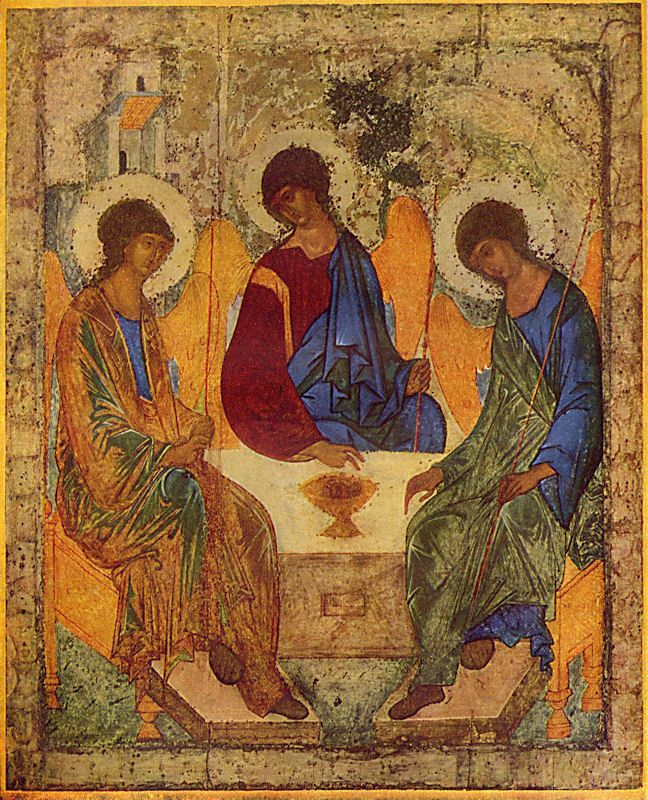
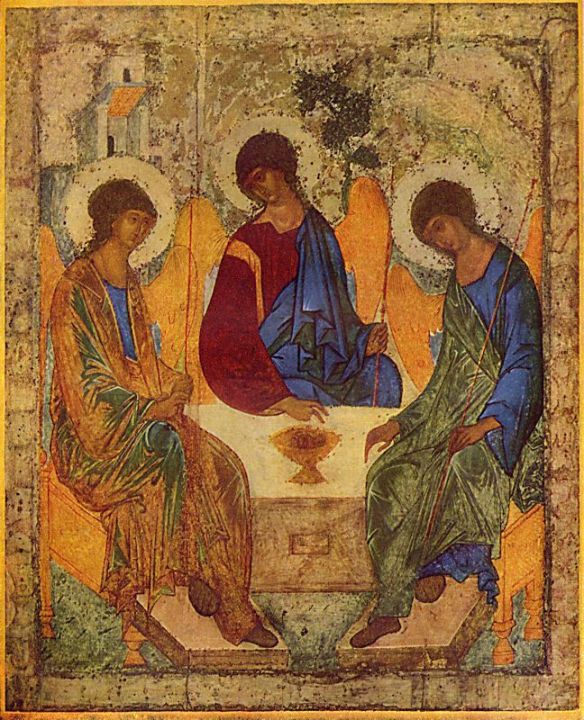
Andrei Rublev, The Holy Trinity (1425)

Andrei Rublev, The Holy Trinity (1425)

Trinitarian doctrine, like other key Christian doctrines, was hammered out, not in sterile study, but rather in the midst of lived spirituality, prayer, and the worship life of the church.[i]

                                                                        – Veli-Matti Kärkkäinen

The Trinity has to do with the lives of each of us, our daily experiences, our struggles to follow our conscience, our love and our joy, our bearing the sufferings of the world and the tragedies of human existence; it also has to do with the struggle against social injustice, with efforts at building a more human form of society, with the sacrifices and martyrdom that these endeavors so often bring. If we fail to include the Trinity in our personal and social odyssey, we shall have failed to show the saving mystery[ii]

– Leonardo Boff

Part 2: You can’t make this stuff up

Early in the twelfth century, a German monk named Rupert of Deutz went into a church where mass was being said by a white-haired bishop. At the offertory procession he experienced a vision of the Holy Trinity:

On the right at the edge of the altar stood three persons of such revered bearing and dignity that no tongue could describe them. Two were quite old, that is, with very white hair; the third was a beautiful youth of royal dignity …[iii]

A century later, Hadewijch of Antwerp, one of those remarkable women mystics who flourished in the late middle ages, also had a vision of the Trinity. But instead of three white males, what she saw was a dark whirlpool, which she described as “divine fruition in its hidden storms.” Hovering over this whirlpool was a spinning disc, on which sat a figure wearing the countenance of God – the face of God – on whose breast were written the words, “The Most Loved of All Beloveds.”

We may find Hadewijch’s vision more congenial: it is genderless, and less crudely specific than Rupert’s. And the tempestuous whirlpool, a flood of energy ceaselessly flowing through the universe, conveys a dynamic image of divinity that resembles the postmodern cosmologies of process theology and quantum physics. It’s probably easier for most of us to believe in a divine whirlpool than in three white guys.

But the crucial difference between Rupert and Hadewijch is not in the relative resonance of their imagery, but rather in what happens next. Rupert remains an observer, one who stands apart and sees God as an object. But Hadewijch does not remain separate from what she sees:

Then I saw myself received in union by the One who sat there in the whirlpool upon the circling disc, and there I became one with him in the certainty of union… In that depth I saw myself swallowed up. Then I received the certainty of being received, in this form, in my Beloved, and my Beloved also in me.

Rupert’s knowledge of God remained conceptual. Hadewijch’s knowledge of God became experiential. She was gathered into the circulating current of divinity. She became part of its flow, and that divine flow became part of her.

The language she uses for this experience is not mathematical or philosophical. Her language is the language of the heart. She describes being “swallowed up… in my Beloved, and my Beloved also in me.”[iv] Love, she discovered, is the way the soul knows. Love is the way the soul sees.

I begin this reflection with a mystic’s personal testimony because Trinitarian theology was not forged by inventive theorists, but by faithful Christians trying to make sense of the concrete, experiential data of salvation, beginning with the biblical narrative and continuing in the ongoing history of believing communities. Based on our collective and personal experience of being “saved” (or, if you prefer: healed, forgiven, reborn, renewed, resurrected, empowered), what can we say about the God who has done this? Trinitarian reflection began within an ancient community deeply grounded in the monotheism of Judaism, which had, over the centuries, found ultimate reality to be not a plurality of disconnected or contradictory energies but a coherent unity. But once the early Christians began to attribute divinity to both Jesus and the Holy Spirit, a simple self-contained oneness was no longer sufficient to describe the Reality.

Without losing the unity of God, how could they account for the divine diversity revealed in the saving activities of Christ and the Spirit? Once they began to call Jesus “Lord” (Kyrios), which happened very early in their worship and their storytelling, traditional monotheism was radically destabilized. The growing perception of the Holy Spirit as a guiding and empowering presence of deity in their communities only compounded the problem.

There were various attempts to solve the problem by downgrading Jesus and Spirit to subordinate, derivative, or semi-divine realities, by no means equal to the eternal and uncreated God. Such “heresies” were popular with those who wanted to keep God simple. But “orthodoxy” was unwilling to deny the fullness of divinity to either Christ or the Spirit. Only God can save us. Christ and Spirit, in the biblical revelation and Christian experience, are integral and essential to salvation. Therefore, they must be equally integral to the Holy One who is the Creator and Redeemer of all things.

The question wasn’t only metaphysical (What is the relation between the one and the many or the finite and the infinite?) or logical (How can One be Three and Three be One?). Trinitarian reflection was also a deep engagement with the question of suffering. If God incarnate in Christ chose to share the human condition, to live and die as one of us, does that mean that vulnerability and suffering have become part of God’s own history? And if these human elements have been added to the divine life through specific temporal events, has time itself disturbed the perfect calm of eternity? If God has been affected and changed by events in time and history, what can we then say about the consistency and transcendence of the divine nature? How can God be decisively linked to the history of the world without losing freedom or transcendence? Can a changeless God weep? Can we be saved by a God without weapons?

In his comprehensive survey of contemporary Trinitarian thought, Veli-Matti Kärkkäinen argues that “the assumption of humanity by God, the Son, means that human capacity to suffer is not foreign to the being of God. How else could one speak of God as love? … It is more biblical to think of God as passionate love, the Father who chooses to engage the suffering of the world, than as a Transcendent One whose separation from the world’s suffering guards his freedom.”[v] Robert Jenson, a foremost North American authority on the Trinity, rejects the notion of divine detachment from creation in dramatically succinct terms: “God … is what happens with Jesus… God is what will come of Jesus and us, together.”[vi]

The problems and paradoxes that arise from such far-reaching assertions have been debated and puzzled over throughout Christian history, and the recent profusion of Trinitarian theology has become an incredibly rich conversation. There is, of course, no final version of God awaiting discovery, no definitive outcome to all this reflection, only an endless attentiveness to the Mystery which may consent to dance with language, but always outruns it in the end.

So why presume to talk about the Trinity at all? Why can’t we simply say and think and pray to “God” and leave it at that? We can’t do that because Christians don’t belong to a theoretical God, a reasonable and logical divine construct worked up by professional philosophers. We belong to the self-revealing but complicated God of the Bible who has, in the form and activity of Christ and the Holy Spirit, rescued us from our own folly and gathered us into the communion that is the very life of God. And no matter what diverse strategies of insight and understanding we may employ, what we can actually say about the Trinity is always grounded in experience, both the experience of our ancestors encoded in Scripture and tradition and the contemporary revelations of communal and personal life.

Trinitarian thought isn’t made out of thin air or abstract speculation. It is produced and nourished by the concrete, tangible history of Christian experience. However each day manifests for us “the means of grace” and “the hope of glory,” whatever the myriad ways by which we love and serve and witness, we need the threefold name to account for the diversity of God’s relations with us. Anything less would impoverish our prayer and considerably reduce the scope of our attention.

For most theologians, our experience of God as threefold also reflects a Trinitarian life within God’s own self. Since God’s inner life is beyond our sight, this can only be an assumption. But it is a crucial one. If God is trustworthy and self-revealing, it must be that when we meet God as Trinity, we get the real thing. God isn’t just pretending to be Three for us; God’s own inner life is constituted by relationality and communion.

Finally, how shall we address or invoke this Mystery, which a Japanese theologian intriguingly calls “Three Betweennesses in One Concord?”[vii] The traditional “Father, Son, and Holy Spirit,” despite its authoritative pedigree, is distractingly masculine for many, and various substitutes have arisen, each with their own impediments. “Creator, Redeemer, Sanctifier,” for example, is a bit impersonal, and risks reducing the three Persons to job descriptions. Likewise, “Source, Word, Spirit,” “Creator, Liberator, Comforter,” “Parent, Child, Paraclete,” “Mother, Daughter, Spirit,” and “Mother, Lover, Friend” all have their particular assets and liabilities. My own current preference, since I suspect that God is more verb than noun, is “Love who loves us[viii], Word who saves us, Spirit who revives us.”

I leave the last word to 16th century reformer Philip Melanchthon, who said, “We adore the mysteries of the Godhead. That is better than to investigate them.”[ix]

[This is the second of three reflections on the Trinity. The first, on the essential relationality of God, may be found here.]

[i] Veli-Matti Kärkkäinen, The Trinity: Global Perspectives (Louisville: Westminster John Knox Press, 2007), 35

[ii] ibid., xv-xvi

[iii] Bernard McGinn, The Growth of Mysticism: Gregory the Great Through the 12th Century (New York: The Crossroad Publishing Company, 1994), 330

[iv] ibid., The Flowering of Mysticism (New York: The Crossroad Publishing Company, 1998), 212-16

[v] Veli-Matti Kärkkäinen, 99

[vi] Robert W. Jenson, The Triune Identity: God According to the Gospel (Philadelphia: Fortress Press, 1982), 22-3

[vii] Nozumu Miyahira, in Kärkkäinen, 314

[viii] I take this resonant phrase from Terrence Malick’s transcendent film, To the Wonder.

[ix] Kärkkäinen, xvi
Cave of the Apocalypse

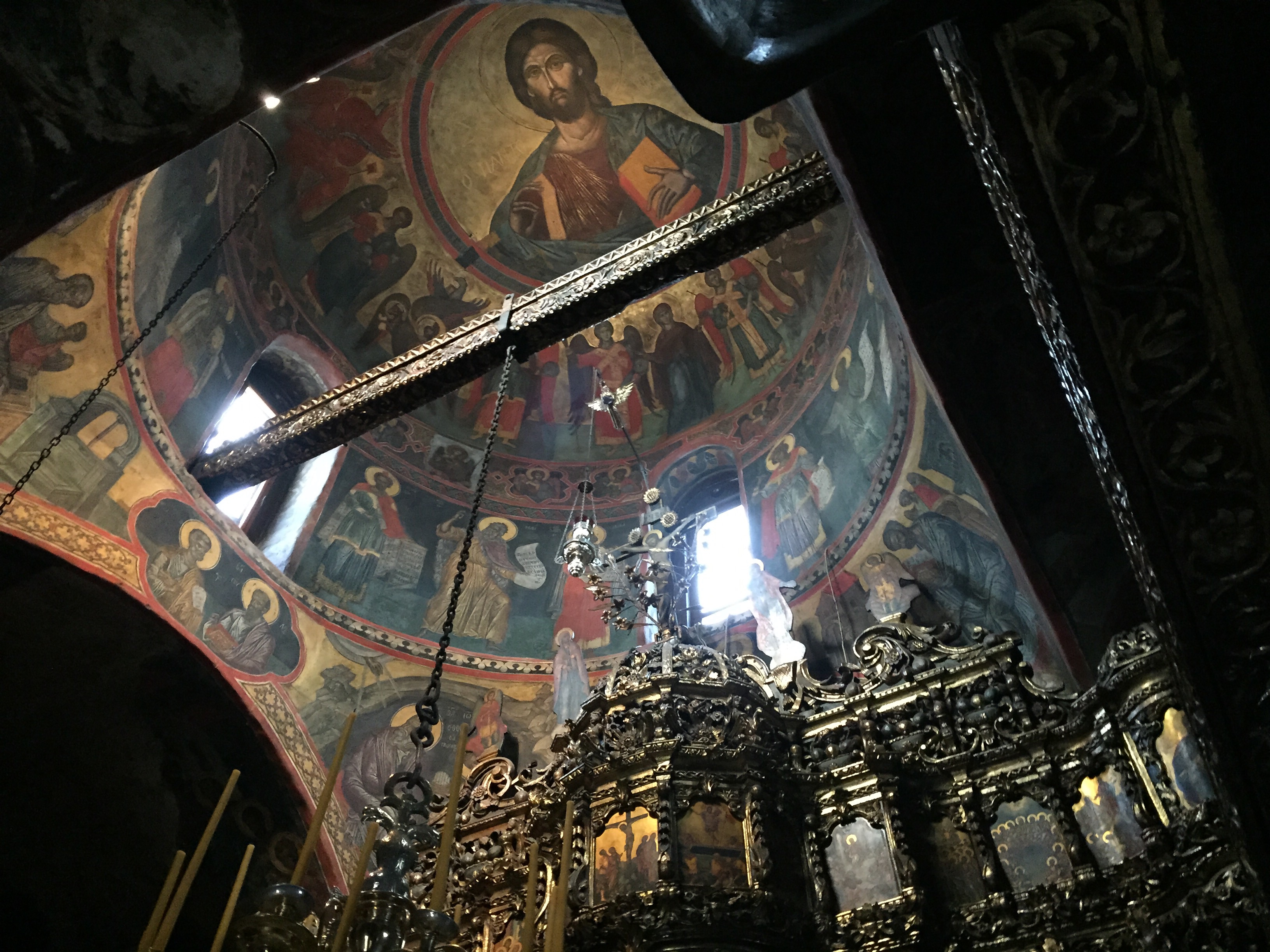
Katholikon of the Holy Monastery of St. John the Theologian

Katholikon of the Holy Monastery of St. John the Theologian


I, John … was on the island called Patmos because of the word of God and the testimony of Jesus. I was in the spirit on the Lord’s day, and I heard behind me a loud voice saying, ‘Write in a book what you see …’    (Rev. 1:9-11)

Patmos is one of the smaller Dodecanese Islands, a grueling 8-hour middle-of-the-night ferry ride east of Athens. It has gorgeous bays and quiet beaches, superb mountain views, charming villages and, at least not in summer’s high season, a tranquil predominance of locals over tourists. The outsiders I have met are themselves “regulars,” returning again and again because they love it. Yesterday a man from the Netherlands told me this was his 23rd straight year of month-long visits.

Patmos is also a place of pilgrimage, where St. John the Theologian (or “the Divine,” as we say in the western church), fell into a swoon and saw things which have intrigued, puzzled, disturbed and inspired readers ever since. The Book of Revelation has, regretfully, provided horrific weapons of mass destruction for hellfire preachers, but it is also the source for many sublime hymns and prayers in my own Anglican tradition.

Most scholars think that the book’s author is not the same person who wrote the Fourth Gospel. Language, style and themes are too different in the two works. But “tradition” has always preferred to link the Galilean fisherman “whom Jesus loved” with both the mystical composer of the Fourth Gospel and the visionary exiled to Patmos. It exemplifies the arc of discipleship as potentially a long, strange trip. As we sang in a hymn at my own ordination years ago, “the peace of God, it is no peace … Young John, who trimmed the flapping sail, homeless in Patmos died; Peter, who hauled the teeming net, headdown was crucified.”

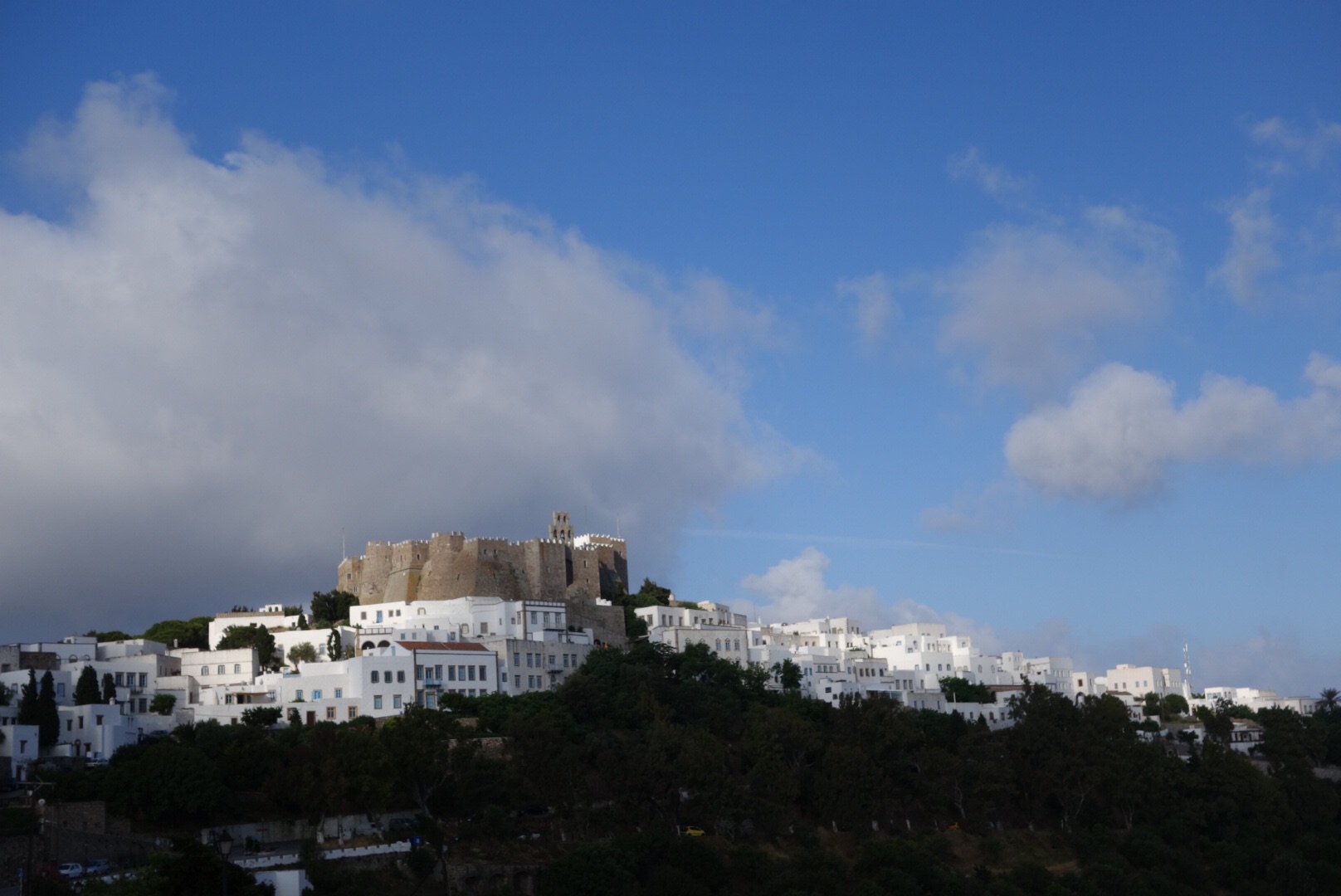
So the Christian can’t come to Patmos and simply lie on the beach or relax in the taverna. The Holy Monastery of St. John the Theologian beckons from the high ridge above the  port. Its dark-hued fortress of lion-colored stone makes somber contrast with the whitewashed village around it, as if to say that the ascent of this hill is serious business.

The monastery rises above the village of Chora.

The monastery rises above the village of Chora.

If you rise early, you can experience the awesome richness of the monastery’s Katholikon (main church) in solitude. The brilliant wall paintings, recently cleaned, immerse you in holy images. Along with the intricately carved iconostasis, hanging oil lamps, and numerous icons, they effect a ceaseless engagement of the eye. Some might find this distracting for prayer, but for me the sense that there is always more than I can take in – the visual inexhaustibility of Orthodox interiors – can lead to a kind of surrender, overwhelming and transcending the subjectivity of my own thoughts and perceptions. Here is Mystery. Give over to it. Lose yourself in it.

The monastery museum holds an eclectic assortment of treasures, including a 6th century gospel book, a 1499 Venetian collection of Aristophanes’ comedies, a 6th century BC bust of Dionysus (god of wine and ecstasy), the largest Orthodox collection of 5th-6th century Coptic textiles, preserved by the dryness of Egyptian tombs, and a police blotter in Arabic from the late 15th century, when Byzantine territories had fallen under Muslim control (“The Cadi [Judge] of the Palace is ordered to find three Patmians who were kidnapped by pirates.”).

Below the monastery, halfway up the hill from the sea, is the Cave of the Apocalypse. Here, according to tradition, John lay on the stone floor for several days while the vision unfolded. The cave is not large, but the insertion of a wooden iconostasis into its contours, along with icons and hanging lamps, has made it a compelling place for worship, prayer and veneration. John’s private ecstasy has been reimagined through specific features of the cave. Here is the cleft from which the Voice spoke. Here is the corner when he laid his head to rest between revelations. Here are the fissures where the Trinitarian God divided the rock into three parts with an earthquake.

Literal belief in the details of the cave’s legends is not required to make the site holy. It is holy because centuries of believers have given a particular kind of attention here to a Reality which yearns to make itself known in the innermost heart, for which a sheltering, enclosing cave is a tangible, sensory analogy.

Another mystical theologian, St. Bonaventure, said, “When you pray, gather up your whole self, enter with your Beloved into the chamber of your heart, and there remain alone with your Beloved, forgetting all exterior concerns.” The Cave, for the attentive, can mirror the chamber of the heart.

I entered it three times during my week here. The first time was the Sunday liturgy, full of incense and chanting voices. It was beautiful, but I had no revelations, or even deep feelings. God was present, but I was a bit absent. I was tired from a long, sleepless ferry ride. And I knew that whatever the Cave offered was not a tourist experience you can just walk in and collect.

So I went back a few days later. The voices I heard then were those of tour guides. Most just reeled off the legends uncritically as if they were prosaic facts. Here this and that happened, blah blah blah, now let’s go back to the bus. But one guide, a Greek woman speaking both in English and German, really got into it.

“People think that the Book of Revelation is about judgment and punishment. That is there, of course, but by the time you get to Chapter 21, you find what it is really about: a new world, a new heaven, a new earth, where we will be with God, and God with us.

“John’s message is trying to wake us up, to make us see that we are all one because God is with us and in us. Our original condition of oneness will be restored in the end. We lost that unity in the beginning because we had free will, and we chose to have our own experience, and forgot our connection with one another.

“If a bomb falls on someone in Syria, we think, ‘Thank God that didn’t happen to me.’ But what happens to others happens to all of us. John is trying to wake us up to this. And when he talks about the destruction of the earth, we have to think about how much closer we ourselves are to bringing that about today, unless we remember what we were made for and what we are a part of.”

When I thanked her afterward for her ‘preaching,’ she said, “I want to tell people what they don’t know, what they don’t hear in the schools, what the priests won’t tell you.” She was pretty sour on the institutional church. “I was baptized Greek Orthodox. I believe in Christ and the power of the sacraments, but I don’t belong to any church. I’m kind of a revolutionary.” I asked her name. “Vera,” she said. “Like veritas– the truth.”

This morning, my last on Patmos, I returned to the Cave for a third time. Two cantors and a priest were chanting the Divine Liturgy. I was the only other person present. This time, the spirit of prayer came easily, like a morning breeze. I received no visions, heard no voices except the beautiful earthly ones I stood among. But it was more than enough. When the priest handed out the holy bread at the end, I was aware of my outsider status as non-Orthodox. But the priest, who had the face of a Baroque Apostle, turned to me with a slight nod. And so I ate the bread of heaven, and departed well satisfied.

Just a dream? – Reflections on the Easter Vigil

Byz Res mosaic

On Holy Saturday in Jerusalem, an hour past sunset 26 years ago, I greeted the Resurrection with the Ethiopian community in their courtyard on the roof above the Church of the Holy Sepulchre. Processing around a small cupola representing the empty tomb, they sang and danced with torches and umbrellas. Their graceful, white-robed bodies and joyful faces were vivid icons of the risen life, producing in me a state of dreamlike wonder. As I later made my way through the deserted stone passages of the old city in search of the midnight liturgy at the Russian church, I fell into an apocryphal reverie.

I imagined the risen Jesus quietly reversing the steps of his Via Dolorosa, away from the cross, away from the mindless crowd now sleeping off its orgiastic fury, away from the city of betrayals and farewells, away from the awful time of trial. Going home. To Galilee.

Of course we don’t know how the Resurrection actually happened, nor do we grasp the concept of passing out of existence only to return the same yet different. Perhaps the closest we come is our daily rising from sleep, when it may take a moment before we remember who we are and reconnect with the continuity of personal identity that somehow survives the abyss of unconsciousness. Even so, there sometimes remains a strange sense that we have crossed over into a new space and time full of unimagined possibilities. We are not quite the same person who closed his or her eyes the night before. Behold, says Jesus, I make all things new.

The sublime intensity of Holy Week, culminating in the Triduum, or Great Three Days of Maundy Thursday, Good Friday and the Easter Vigil, can produce a similar effect on the faithful who make the long journey from the Last Supper to the first Alleluia. We not only learn something along the Way of the Cross to the place of Resurrection, we become something as well. When it’s over, we are somebody else. Forgiven. Set free. Made new.

As I said in the Vigil homily on Saturday night, “we have made an exodus from our tired old stories of death and loss into God’s new story of possibility and promise.” Any Vigil worth its salt will enable us to dwell for a few hours in the light of that new story, the light that penetrates our shadows with the bright splendor of God’s future. And when it’s over, we may wonder: What just happened? Was it only a dream?

One of the striking things about the Easter Vigil is that there is no single representation of the Resurrection. The gospel reading might describe dazzling messengers announcing it after the fact, but the event itself is never described in the text. The closest the liturgy gets to a specific resurrection moment is when the Presider launches the eucharist with a shout of Christ is risen, and a holy tumult is made with chimes, bells and drums while all the lights switch on to banish the darkness. But the victory of Life and Love is actually manifested repeatedly throughout the liturgy in symbol, word and sacrament, as well as in the faces and gestures of the assembly. The liturgy as a whole is an experiential analog of the Paschal Mystery.

Here are a few of this year’s many resonant manifestations for me:

  • The New Fire: It is always moving, after we have all been scattered from the bare and mournful church interior of Good Friday, to see how many return the next night to gather outside around the New Fire with expectant faces. Death has done its worst, and we have come to make our reply: Love wins anyway. I especially rejoiced to see the children, already dressed for the Ark story in their animal costumes, standing right up front with their floppy ears and shaggy coats. As St. Paul said, not just humanity, but the whole creation, eagerly awaits the day of renewal.
  • The Creation: “Once upon a time, human beings had no story. Only the gods did things worth telling.” So began the Prologue to our sacred stories, concluding with the discovery, by an ancient “tribe of nobodies” that their own lives were, in fact, part of something much, much larger. “Human beings had become a story told by God.” Then out of the darkness a voice said, “Let there be light!” Projected on a 15’ screen, we saw the first light of the creation, from Terence Malick’s film, Tree of Life, continuing with spectacular cinematic images of earth’s evolution up through the arrival of the birds. Then the film switched off and a monkey and frog entered to cavort among the assembly, until a flute sounded, and the musical “breath of God” turned them into the first humans. They straightened up, removed their wooden Indonesian masks, and became suddenly conscious of their own humanity. “Adam and Eve” were played by pre-teens, but when they cautiously crossed the gap between them to touch hands and connect with the strange and unknown “other,” they gave us a transcendent image far beyond their years.
  • The Red Sea: This central metaphor for the Paschal Mystery of “crossing over” from death to life was a complex interplay of live actors, projected images (documentary-looking Exodus images from DeMille’s 1927 silent, The Ten Commandments, plus Civil Rights footage from the Selma to Birmingham march of 1965), soundscapes (6 separate cues to mark different stages of the story), and dramatic theatrical lighting. After the Red Sea had been crossed, the narrator concluded by saying, “When the world says no, the power of God is …”. The Israelites, all played by children, completed the sentence by shouting, “YES!” The brave sound of those young voices will long stay with me.
  • “Hallelujah”: After each story, we sang a song and said a prayer to reflect the story’s themes. The last story, The Valley of Dry Bones, was followed by Leonard Cohen’s “Hallelujah,” with powerful Easter lyrics by Scott Lawrence. Our hand candles were relit as we sang: “no darkness can conceal the light within you … hallelujah, hallelujah…” All those candlelit faces, all those beautiful voices raised in song, said Resurrection as powerfully as anything else we did that night.
  • The Dance: At the end, following communion, we invited people to come out of their seats to gather in a great circle to dance. I had been warned to expect only a half-hearted response. Episcopalians are reserved, I was told. Dancing in church might be outside some people’s comfort level. But as we sang a couple of choruses of “I will raise them up” from the Bread of Life hymn, everyone did in fact rise up and come out of their pews. We joined hands, and off we went, circling and spiraling as we sang the Easter Troparion (“Christ is risen from the dead, trampling down death by death”) and “Jesus Christ is risen today.” Resurrection wasn’t just something we heard about or thought about, it was something we embodied, something we danced. As Christ shows us every Easter, “I am the Dance and I still go on.” Amen to that! We proved it with our bodies.

When the Vigil was over, we each went our separate ways. The Vigil “set” was struck, like a circus tent, leaving behind little trace of what had taken place. Had it all – not just the Vigil but the entire Triduum – been just a dream, soon to fade in the glare of everyday life and ordinary time? Or had our extraordinary journey together, soaked in Paschal images, revealed something essential, enduring and profoundly transformative?

Whether in this year’s Triduum, in my Jerusalem Holy Week long ago, or in many other memorable traverses of the Paschal Mystery, I do believe I have encountered, embodied, and imbibed the core of our faith: Christ lives. Love wins. We shall be changed.

The resonant images and experiences of the Triduum have been planted deep within me, year by year. They may still have to struggle in my poor soil or compete with the choking thorns of my world, but as the collect-prayer for Thursday of Easter Week asks, “Grant that all who have been reborn into the fellowship of Christ’s Body may show forth in their lives what they profess by their faith.”

God, bring that day closer!