Bushy the Squirrel: A Justice Parable

My father, an Episcopal priest and producer of Christian media, made a series of filmstrips called Parables from Nature in the 1950s. Based on a children’s book by John Calvin Reid, they retold the parables of Jesus using characters from the natural world. One of these was “Bushy the Squirrel,” inspired by Luke 12:13-21 (the Lectionary gospel for Proper 13, 8th Sunday after Pentecost). The illustrations were painted by Hollywood animation artists, and some of them are included here.

Once upon a time there was a squirrel named Bushy. He was a fine little squirrel, but as he grew older everyone began to notice a change in him. All he cared about was gathering nuts. Every day you could hear his voice ringing through the forest: “Gotta get more nuts! Gotta get more nuts!”

As soon as he stored the nuts he had found, he’d run off to find some more. “This is not enough. Gotta get more! Gotta get more!” Bushy was so obsessed with getting more nuts, he drove all his friends away. And when anyone came to his door collecting for the needy, he just said, “Aw, don’t bother me now. I’m too busy getting nuts.”

After a while, he had so many nuts, he needed a bigger place to put them. And one day he saw an old hickory tree with a big hole in it. It was perfect. But some woodpeckers had made their home in that tree. That didn’t stop Bushy. He kicked the woodpeckers out, and filled the tree with nuts.

Bushy’s neighbors had a hard time finding any nuts left for them to eat. But Bushy didn’t care. He had what he needed. The other squirrels were not his problem.

When winter came, Bushy relaxed in his tree, the happy owner of all those nuts. He didn’t have a care in the world.

Then one night, when he was fast asleep, a wind began to blow, and the wind was so powerful, it broke his tree in half and sent Bushy tumbling into the lake.

“Help me! Help me!” Bushy cried. Mr. Bear heard the shouts, and called the other animals of the forest to the rescue. Suddenly Bushy found that he was not the only person in the world – luckily for him! He needed the others and they needed him.

Bushy’s heart was changed by his experience, and he became a new squirrel, sharing everything he had with anyone who needed it.

The story of Bushy is like a parable Jesus told: There was once a rich man who had a problem. He had too much stuff and didn’t know where to put it all. So he built bigger and bigger storage units. But that didn’t solve his problem, because his appetite for acquisition could never be satisfied. “Gotta get more nuts, gotta get more nuts!”

So is Jesus trying to be Marie Kondo here? Is he offering a useful method of self-help so we can reduce our clutter and make our lives more beautiful and satisfying? Is that why he tells this story––to foster self-improvement? Or is he doing something more radical, more demanding?

What if Jesus had said, “This story is not about you––it’s about us. It’s a story about the foolishness of trying to live as though ‘I’ am the only person in the world. It’s a story about the foolishness of being oblivious to community.” Well, he didn’t say those words, of course. He just told the story, trusting us to have ears that hear.

A certain rich man’s lands brought forth bountiful crops. And he deliberated within himself, saying, “What shall I do, since I do not have a place where I may gather my fruit?”

He deliberated within himself” is a telling image of isolation, suggesting a self utterly cut off from other voices, other perspectives. And notice how he seems surprised by the size of the harvest. As a rich man, he would already possess considerable storage space. But this harvest is bigger than he ever expected or imagined. And when the Bible talks about abundance that is excessive and surprising, that usually means one thing: God is involved, showering down blessings.

A first century listener, steeped in the stories of God’s miracles of generosity, would have picked up on this. And they would have noticed that the rich man’s first response is not one of gratitude or wonder. Does the rich man thank the Creator for the miraculous harvest? Does he laugh in wonder at such a gift? No. His first thought is, “I’ve got a problem. Where am I going to put it all?”

Then he gets an idea:

“I will do this: I will tear down my granaries and build larger ones, and I will gather there all my grain and all my goods and I will say to my self, ‘Self, you have many good things stored up for many a year. Eat, drink, and be merry!’”

In a world full of hungry people, here’s a man who has more than he knows what to do with, and it never occurs to him that he could feed all those hungry people.

As hunger experts point out, hunger is not a problem of supply; it’s a problem of distribution. But distribution is the last thing on this man’s mind. He isn’t just ignoring other people. He seems oblivious to their existence. He is the perfect expression of rampant individualism – untroubled by any sense of interdependent community.

The story makes fun of his isolationism, by having him talk only to himself.

“I will say to myself, ‘Self, you have many good things…”

A narrator would say something like: “Then the man said to himself, ‘Self, you have many good things…’” Instead, the rich man takes over his own narration: “I will say to myself, ‘Self …” and so on. Do you see the difference? This guy doesn’t need anyone, even a narrator. He takes over the telling of his own story. He’s in control, totally self-sufficient.

Whatever the future may bring, he can deal with it, no problem. Just kick back and “eat, drink, and be merry.”

Isn’t this the ideal to which consumerism aspires? Those of us with enough money can acquire everything we need to be self-sufficient. The fundamental unit of our culture is not the tribe or the village, but the single family home. We each have our own rooms, our own food supply, our own car, our own entertainment center, our own set of tools and appliances, our own insurance policies.

The only reason we need to leave the house is to earn the cash in order to maintain the autonomy of our domestic units. If we get rich enough, we don’t even have to do that.

The whole trajectory of the consumerist dream is to declare our independence from the traditional supportive networks of extended family and neighborhood community.

Vincent Miller, a Catholic ethicist, points out that the cash demands of the single family home encourage people to act selfishly:

“Social isolation and the burdens of maintaining a family in this system make it unlikely that other people’s needs will ever present themselves. If and when we do encounter them, we are likely to be so preoccupied with the tasks of maintaining our immediate families that we will have little time and resources to offer. The geography of the single-family home makes it very likely that we will care more about the feeding of our pets that about the millions of children who go to bed hungry around us.” [i]

When we live in isolation from one another, when we fail to nurture the vital aspects of interdependent community, we minimize the ways in which we can either offer help or receive it. Even if we have all the goodwill in the world, we remain trapped within the cash-intensive demands of the consumerist dream. “Gotta get more nuts!”

Ideally, a local church can function as a support system for its members. If someone gets sick or has a family emergency, others in the community step up to provide meals and other forms of assistance. But this kind of support system is exceptional in a society based largely upon isolated autonomous households.

If you don’t have the cash to keep a roof over your head, there is no village to take you in. Maybe you have some relatives somewhere, but they’re probably scattered around the country. And they’re probably running on a tight budget themselves, and don’t have any spare rooms. We’re a long way from the traditional support systems of former times and simpler cultures. Just ask the homeless to tell you their stories.

In American mythology, this is the country of the Lone Ranger, the self-made entrepreneur, the hard-boiled detective with no attachments, or the trucker rolling down that endless highway, free as a bird––and lonesome as hell.

When vast numbers of Vietnamese refugees settled in southern California in the 1970s, they found American culture to be fatal for something they had always taken for granted: the supportive network of extended family. They had to learn, as one writer puts it, that the land of the free means “the perfect freedom of strangers.” [ii]

So Bushy the Squirrel, and the rich man with the storage problem, might be seen as the products of a consumer culture. They don’t need neighbors. They don’t need community. They’ve got everything they need close at hand. There’s nothing for them to do but eat, drink and be merry.

But then what happens? Just when Bushy settles in for a long sleep, a storm breaks open his tree and casts him into the raging waters. In the Bible, whenever something breaks open your neat little world, you can be pretty sure that God is in that storm.

But in Jesus’ parable of the rich man, God intervenes even more explicitly, not with a storm but with words. God speaks to the rich man. In fact, this is the only one of Jesus’ stories where God appears as a character within the story.

And what does God say to the rich man? “Fool!” God says. “Fool!” Now that’s something to wake up your prayer life––to hear God calling you a fool.

Do you remember the most famous use of the word “fool” in the Bible? It’s in the first verse of Psalm 14: The fool says in his heart, ‘There is no God.’  The fool is the one who denies God’s presence, who thinks he or she can grab the gift without acknowledging the Giver––or the Giver’s way, which is not the self-possession of me/myself/and I, but rather a ceaseless pouring out of self.

“Fool, on this night they will demand your life from you.
And all the stuff you have stored up, to whom will it belong?”

In an instant––“this very night”––the rich fool discovers that his autonomous life is not only unstable––it is unsustainable.

He had thought that life was a commodity that could be owned and held onto. But he discovers that God operates a very different kind of economy. God’s economy, which we call the Kingdom of God, is a gift economy, where everything is received and nothing can be held onto.

Everything is like the air we breathe. We take it in, we receive the life it gives us, and then we give it back again. Breathe in, breathe out; receive, give back.

A commodity-based economy is an attempt to hold your breath. You take possession of God’s gifts, you take them out of circulation, you lock them away where others can’t use them.

Whereas a gift always keeps moving from hand to hand, a commodity is grasped and hoarded. And to grasp and to hoard is to live outside of God’s economy, where the gifts are always in circulation, always being given away as fast as they are received. If you reject God’s gift economy, and try to live apart from the interdependent circulation of life’s gifts, you are in effect denying the Trinitarian reality––the eternal self-offering, the ceaseless circulation of gifts, that comprises the heart of God.

That is why the Bible insists that if you try to live as though you were the only person in the room, if you try to exempt yourself from interconnectedness and interdependence, from the need to both give and receive, then you are indeed a fool, trying to live against the way we are made to be as images of the divine reality.

The divine reality is a circulation of gifts. When you are oblivious to the presence of your neighbor, you are oblivious to God as well. When you deny communion, you deny God.

On this night they will demand your life from you.

Most translations use the passive voice: “your life will be demanded of you.” But the original Greek verb is in the active third person plural: “They will demand your life from you.” So who might “they” be? The plural language could be a remnant of archaic mythological imagery, a way of speaking about death as the operation of avenging spiritual powers. But this is not really that kind of story. It’s not steeped in old-fashioned apocalyptic imagery like the Book of Revelation. For all we know the rich man dies in his sleep, without any thunder from heaven.

But what if the “they” who demand his life refers to everyone else in the world, all those neighbors whose existence has been ignored by the rich fool? Other people didn’t exist for him. He took what belonged to his fellow beings and kept it for himself. Now they want it back. As the story puts it, they “demand” his life. Is this punishment, or just a realistic understanding of how God’s universe works?

The story does not have God say, “I will demand your life…” The man’s fate is not an apocalyptic intervention from heaven. It’s simply the way things are in an interdependent reality.

The rich man tried to live outside the way of things, outside the economy of God, and in the end it all caught up with him. In the gift economy in which we live and move and have our being, he discovered that you have to keep the gift moving. You have to give everything away, even your very life.

The parable ends with a question:

What will become of everything that you have stored up?
To whom will it belong?

The question is being posed to the rich man in the parable. But it is also being posed to us. To whom does our wealth belong? Not just our money and our stuff, but every good gift we have been given since God put us on this earth, including our souls and bodies, and every breath we take––to whom does all this belong?

In a country plagued with obscene economic inequality, where the rich and powerful will even take food from the mouths of children to gather more wealth for themselves, how shall we respond to this parable? How do we answer its disturbing question?

Maybe greed is normal now. Maybe selfishness is normal now. Maybe crushing the poor and killing the planet for profit are normal now. But Jesus came to tell us that such things are decidedly not normal––not in God’s world. And we would be fools to think otherwise.

In my father’s filmstrip, Bushy learns his lesson and repents of his selfish ways. Its happy ending was meant to encourage the children who watched it in Sunday School. But Jesus concludes the original parable more ambiguously. He leaves us hanging, without knowing the ultimate fate of the rich man.

I suspect that Jesus is inviting us to finish the story ourselves, to construct a happy ending out of our own actions, as we work together to create a world whose blessings are not hoarded, but freely shared; a world where no need goes unmet, and all God’s children can flourish and thrive.

God, bring that day closer!


[i] Vincent J. Miller, Consuming Religion: Christian Faith and Practice in a Consumer Culture(New York, Continuum, 2004), 50.

[ii] Lewis Hyde, The Gift: Creativity and the Artist in the Modern World(New York: Vintage Books, 1979), 88.

This homily for Proper 13, Year C, will be preached August 4, 2019, at St. Barnabas Episcopal Church, Bainbridge Island, Washington.

Lamentation for Notre Dame

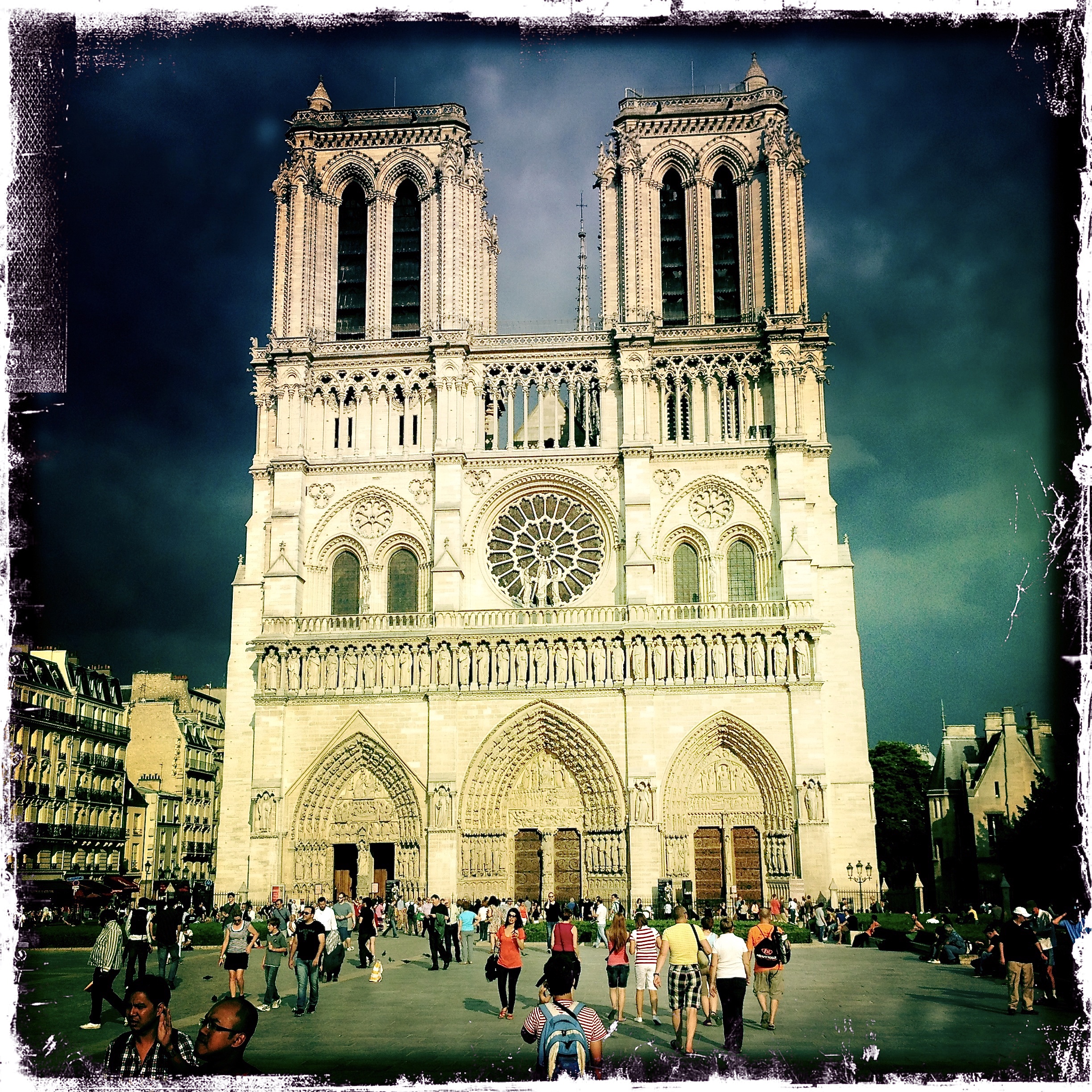
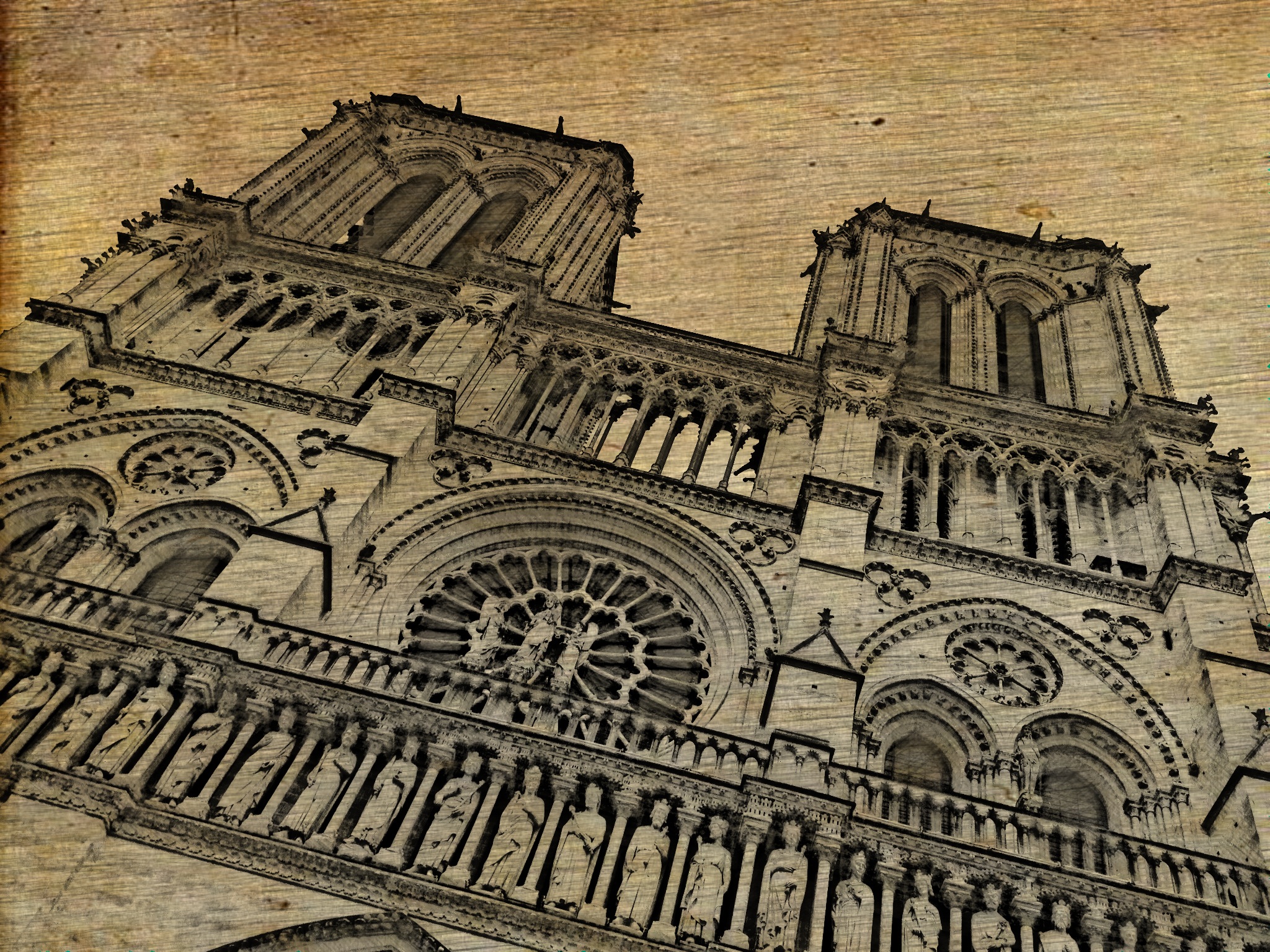
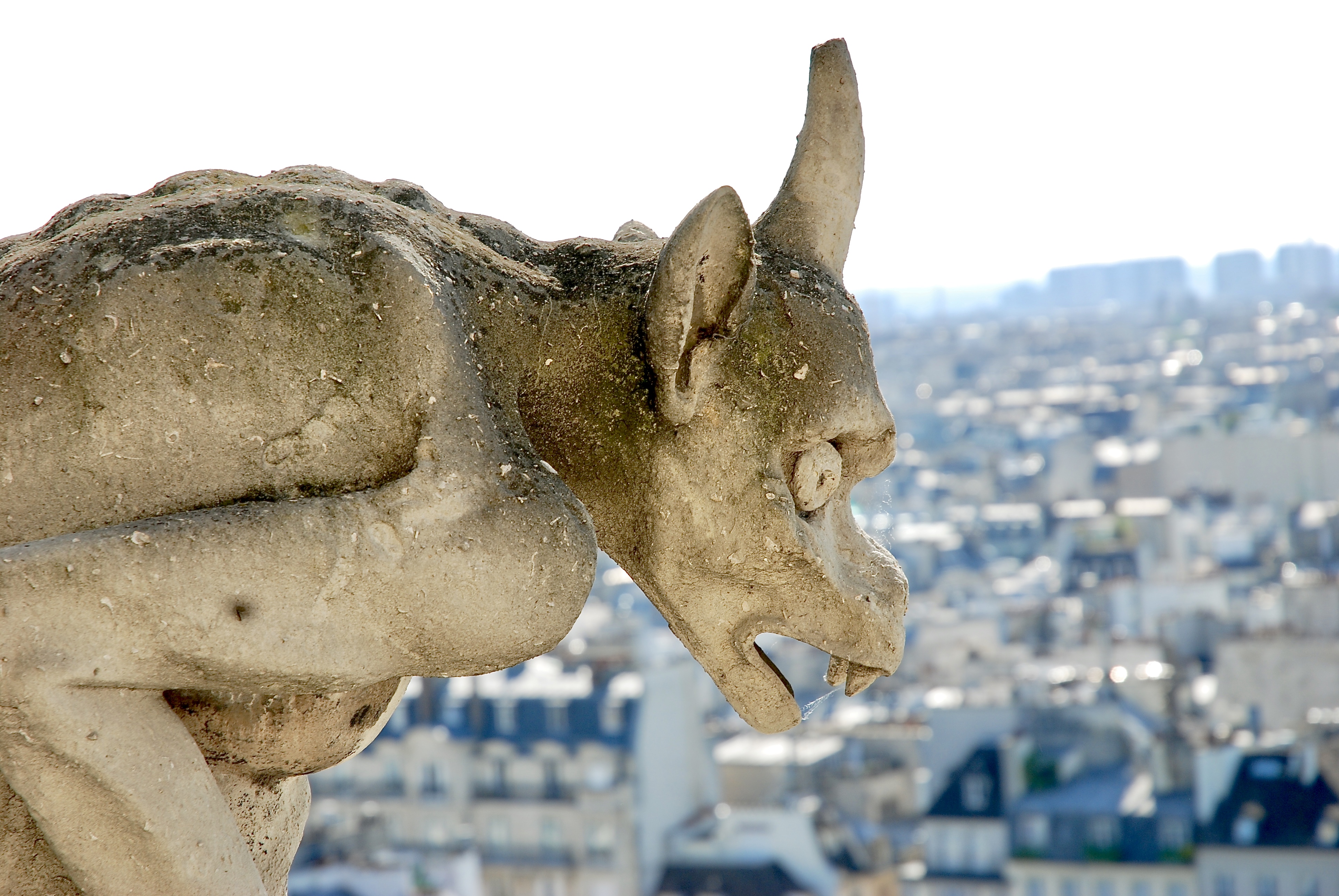
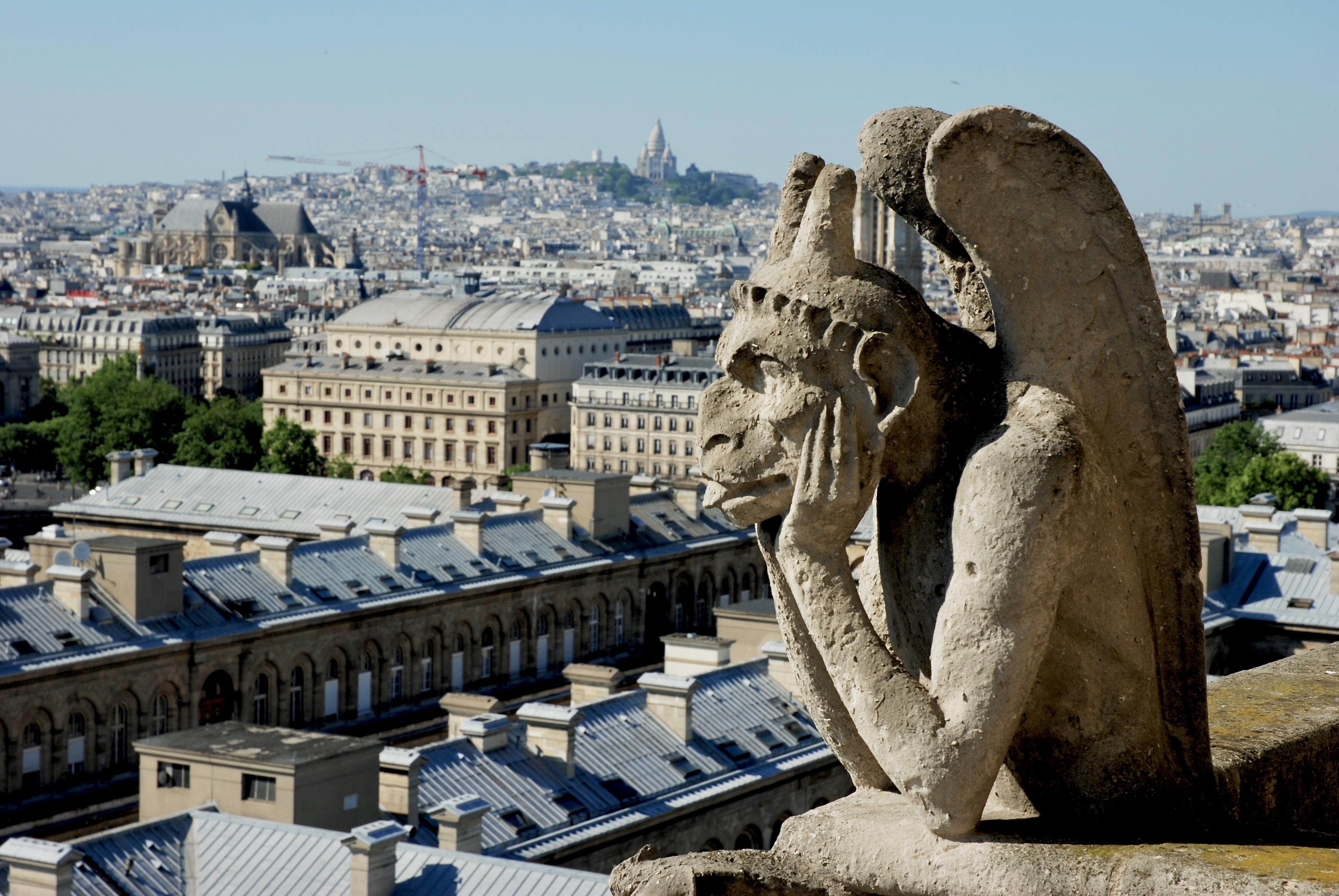
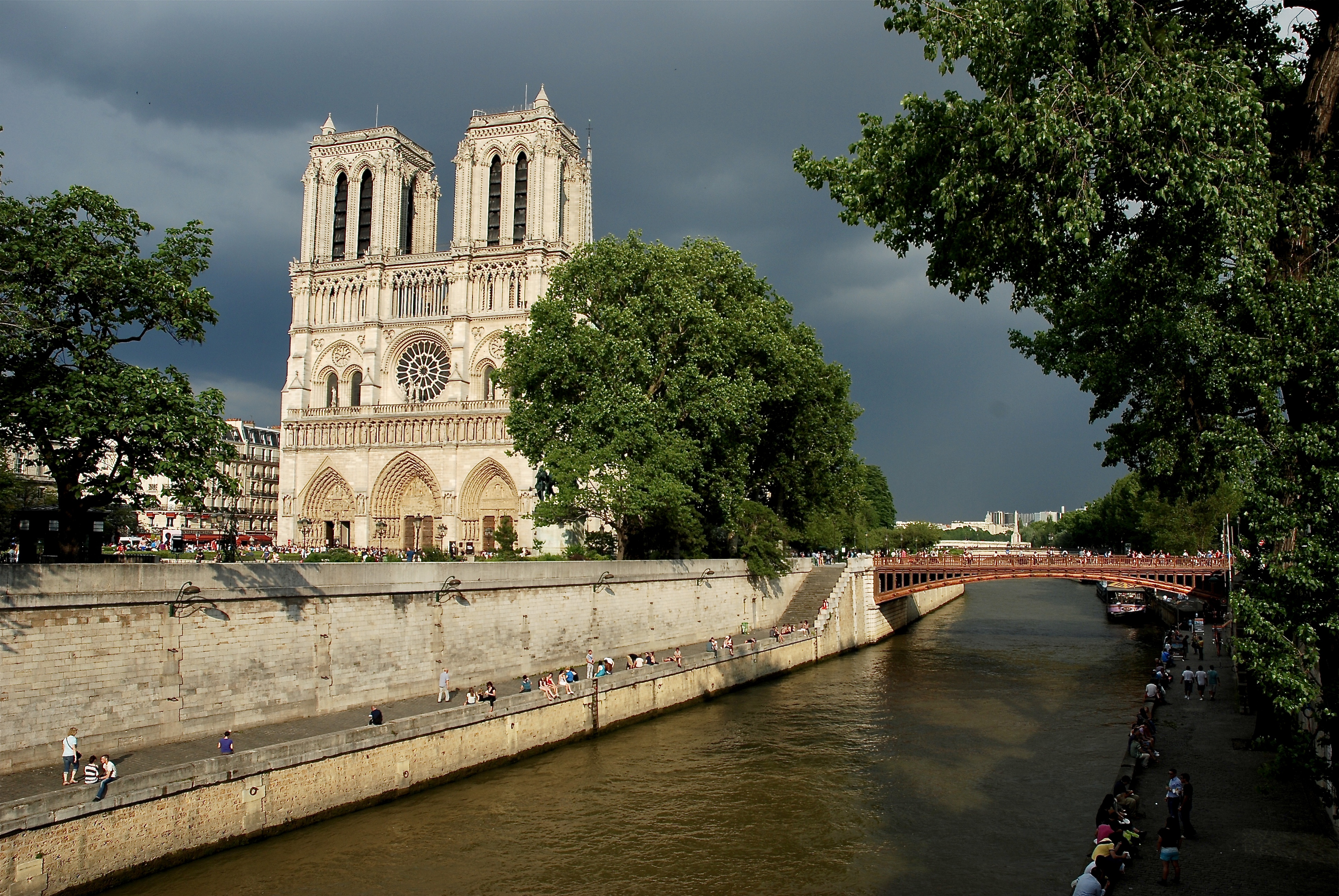
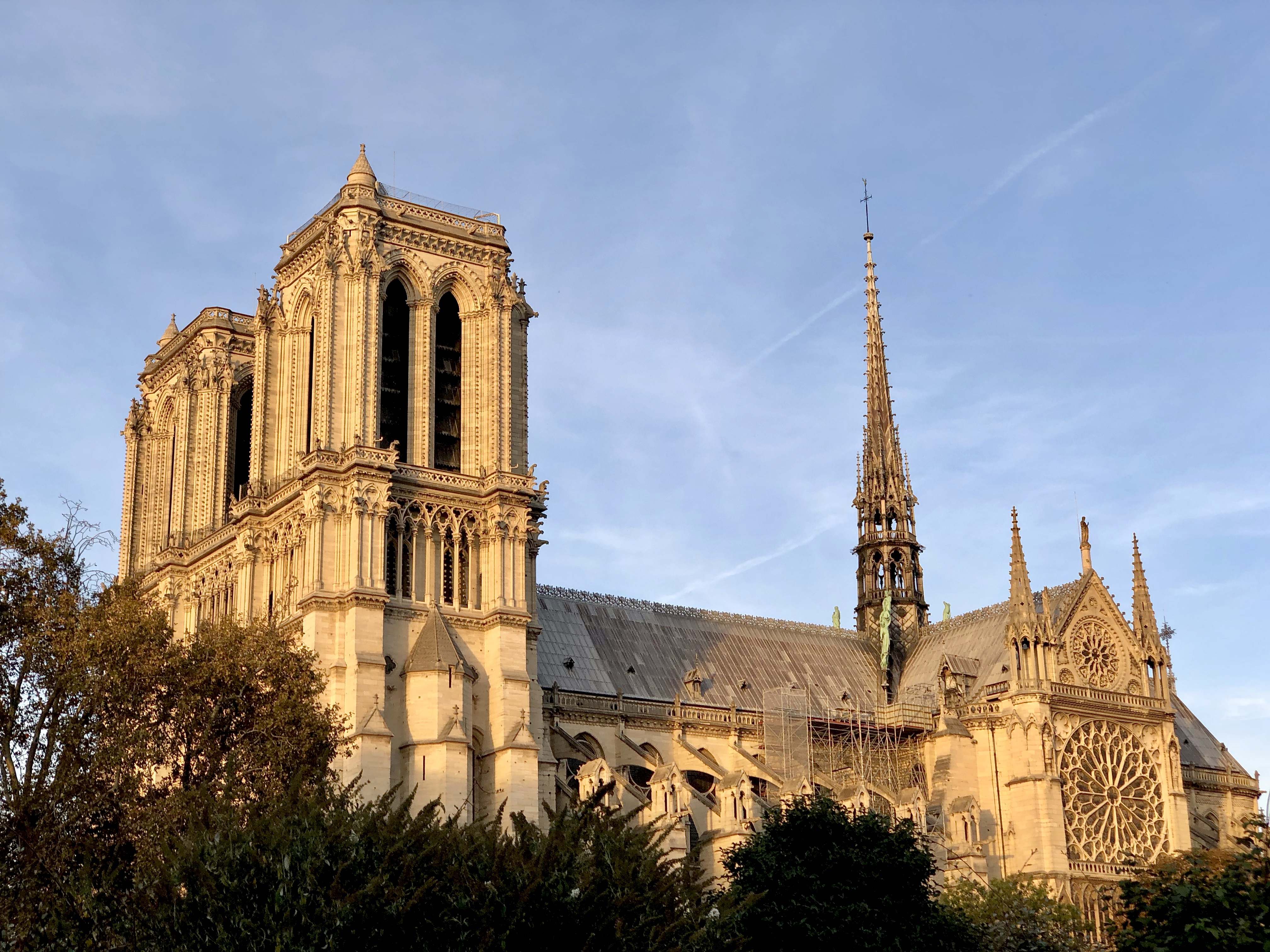
The burning of Notre Dame has broken many hearts, including mine. The fact that it happened in Holy Week feels strangely apocalyptic, as if the stability of our world were suddenly under threat. Like the earthquake at the death of Jesus, it suggests a cosmic shaking of the foundations.

Poems from Book of Lamentations, an anguished response to the destruction of Jerusalem in 587 B.C., are often sung during Holy week. Written to grieve the loss of a sacred place, their eloquent images of affliction and grief were later appropriated by Christian liturgy to lament the suffering of Christ. In gratitude and sorrow for our beloved Notre Dame, here are some of my own past views of the cathedral, accompanied by selected lamentations from the Holy Week lectionary.

How like a widow she has become, she that was great among the nations. (Lam. 1:1)

Jerusalem remembers in the days of her affliction and distress, all the precious things that were hers in days of old. (Lam. 1:7)

All you who pass this way, look and see: is any sorrow like the sorrow inflicted on me? (Lam. 1:12)

Listen, for I am groaning, with no one to comfort me. (Lam. 1:21)

For vast as the sea is your ruin; who can heal you? (Lam. 2:13)

Cry then to the Lord, rampart of the daughter of Zion; let your tears flow like a torrent day and night. (Lam. 2:18)

He has walled me about so that I cannot escape. . . though I call and cry for help, he shuts out my prayer. (Lam. 3:7-8)

But this I call to mind, and so regain some hope: Surely God’s mercies are not over, his kindness is not exhausted. (Lam. 3:21-22)

It is good to wait in silence for Yahweh to save. (Lam.3:26)


Photographs and video by Jim Friedrich

Ultreia!

Camino de Santiago, west of Pamplona.


The Religious Imagineer is five years old this week. It began during my 500-mile pilgrimage on the Camino de Santiago in the spring of 2014, with dispatches on miles I walked, things I saw, people I met, thoughts I had.

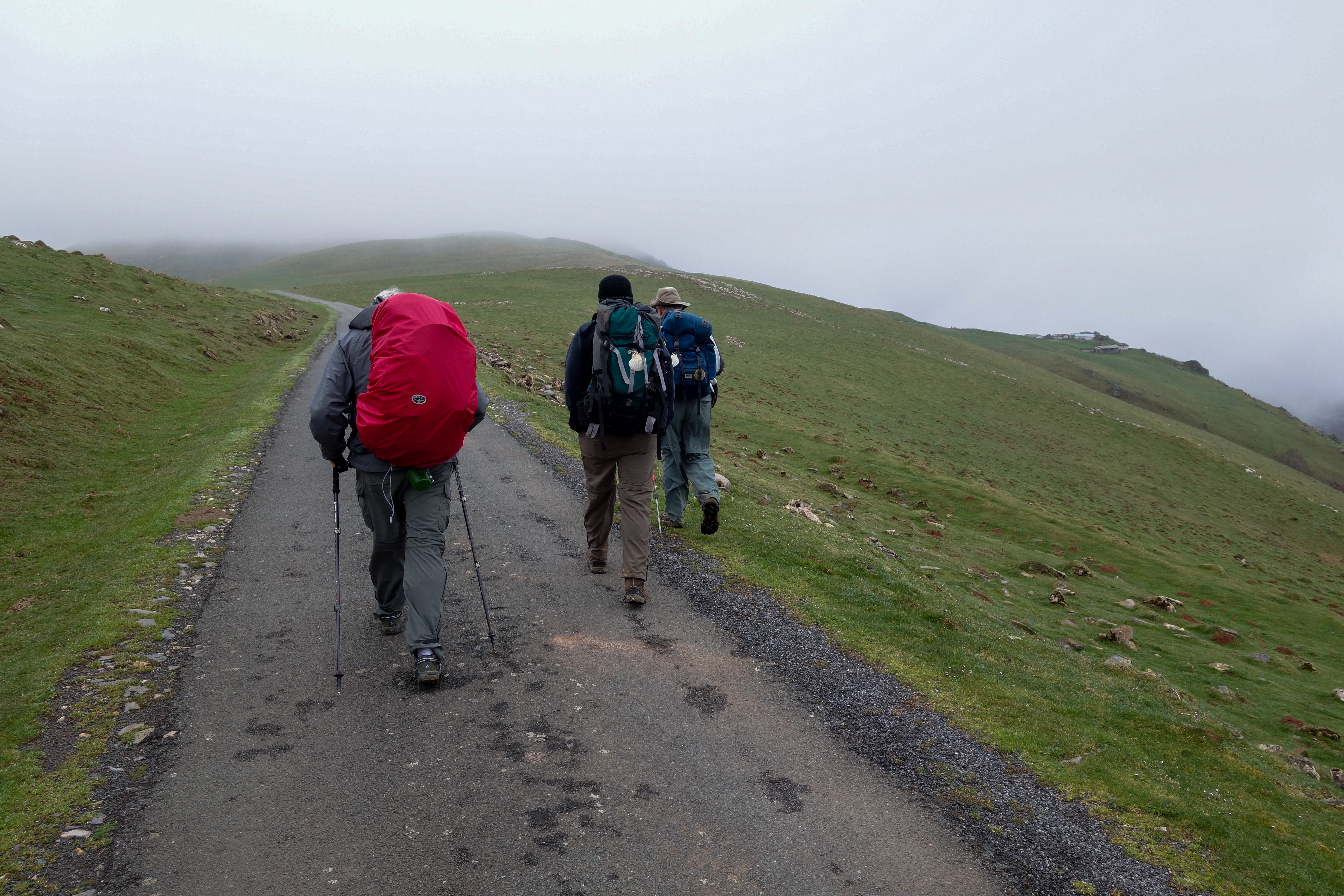
No great views today, but the summit where France turns to Spain was a brooding cloud of unknowing where we walked by faith not sight. (April 8, the first day)


Crossing the Pyrenees on the first day.


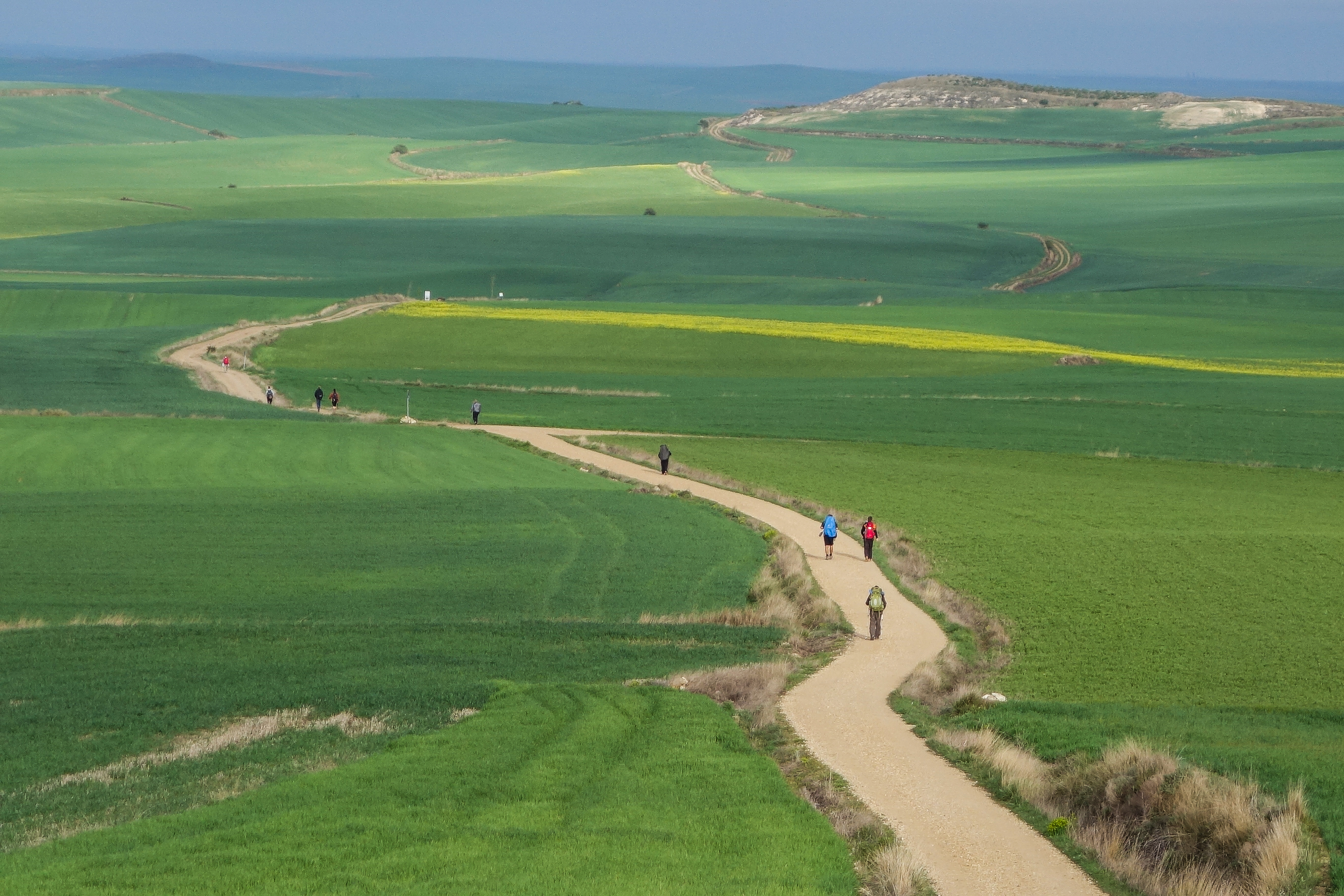
The land through which we pilgrims passed today was painted with a few strong colors: dark green wheat, yellow mustard, blue sky, white clouds. Those four colors filled the eye in every direction, with no lesser hues to dilute the effect. To wander through such a scene was a glorious thing. Whatever else the Camino brings, I will have had this day. As a German woman said as she passed me by, “Cherish every step! Cherish every step!” (April 11)


Pilgrims moving westward from Castrojeriz.


[A 30-second video of my shadow moving along the Camino]: If you want to experience the length of my walk in real time, replay this video 27,000 times. (April 25)


Few trees, big sky, only occasional villages, and long stretches where the only human presence was the long procession of pilgrims migrating westward. The lack of distractions and variations tends to make the very act of walking to be the mind’s principal occupation. As Robert Macfarlane puts it in The Old Ways: A Journey on Foot, walking becomes “sensational” – it isn’t just conducive to thought, it becomes the form thought takes. I walk, therefore I am. Perhaps it is similar to the way that cinema thinks through the movement of the camera. It isn’t forming propositional thought, but is simply absorbing through its attentive motion the shape of the world, the textures of existence. (April 29)


Fellow pilgrim Edward “Monty” Montgomery enters San Juan de Ortega on Good Friday.


There are many along this road who began it as a form of athletic challenge or youthful adventure or unusual vacation. And many will finish it that way. But in talking with those who profess no religious intention, or who are dismissive of Christianity as something they outgrew, I still hear the spiritual language of pilgrimage breaking through the verities of secularism. One has lost a job and is trying to discern a meaningful alternative. Another is trying to listen to her life from a place of unknowing. Another has no answer to the question of why he is walking, but still presses on to Santiago. To borrow a phrase from the great Spanish mystic, John of the Cross, every pilgrim is trying to arrive at a place we know not by following a way which we know not. (May 1)


Halfway to Santiago, a Camino friend was feeling some pain and discouragement on a particularly demanding stretch. But then he saw a handwritten sign: “Don’t give up before the miracle.” (May 7)


But can I, having now trod 478 miles in 31 days, really claim any kind of illumination or transformation as a result? I still get annoyed by the loud and incessant talkers who mar the tranquility, I still get angry when a speeding truck comes close to knocking me into a ditch. I have yet to perfect the pilgrim equanimity urged by my guidebook, which sees every irritation as the sand that produces the pearl. But at least I try to make these things part of my walking prayer. As the monks say of life in the monastery, “We fall down and get up, fall down and get up …” (May 9)


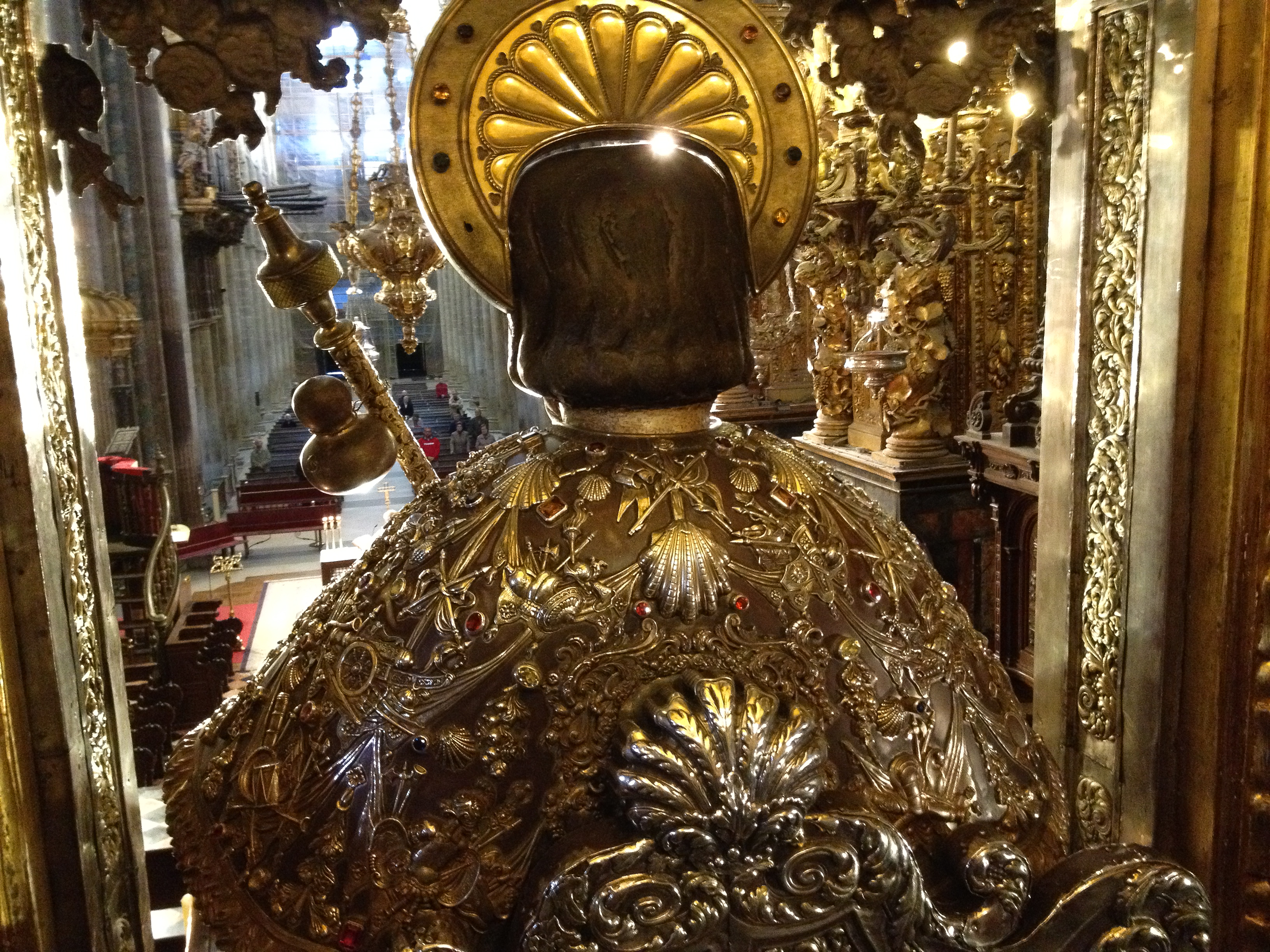
This morning I performed the final Camino ritual: climbing the stairs behind the altar to hug the gleaming metal effigy of Santiago. Despite the cool hardness of the sculpture, it was strangely comforting. I whispered in the saint’s ear: “Thank you for the beautiful voyage.” (May 12)


Statue of St. James behind the high altar, Cathedral of Santiago.

After I reached Camino’s ultimate end in Muxia, on the western shore of northern Spain, my blog just kept on going, continuing its own pilgrimage to God knows where, reporting as it goes. I have written about theology, spirituality, liturgy, poetry, the arts, cinema, music, politics, culture, nature, seasons, time, death and resurrection. My topics––and my influences––may be eclectic, but I trust my Christian faith and Anglican temperament to lend some coherence to these verbal wanderings.

In that spirit, I borrowed my blog’s subtitle from T. S. Eliot’s Four Quartets: “Where the fire and the rose are one.” This union of contraries––passion and tenderness, danger and beauty, wild instability and serene form––draws upon Dante’s imagery in the Commedia. Fire is purgation, divine light and the flame of love. The rose, perhaps inspired by the rose window of an Italian cathedral, images the heavenly city, containing a multitude of saints within its harmonizing circle. Dante unites flame and flower in his image of the Virgin, whose “womb relit the flame of love––/ its heat has made this blossom seed / and flower in eternal peace” (Par. xxxiii.7-9). In the unfolding future of God’s not-yet, the fire and the rose will indeed be one.

Gustave Dore, The Celestial Rose in Dante’s Paradise (1868)

In The Religious Imagineer’s first five years, there have been 237 posts, 61,913 visitors and 92,870 views. My ten most viewed posts so far have been:

1) The ten best Jesus movies (Jan. 6, 2015)–– I have taught Jesus movies for years, and find cinematic gospels, despite (or because of?) their flaws, to be fascinating case studies for questions of biblical representation and interpretation, as well as Christology.

2) Members of the same body? A post-election homily (Nov. 10, 2016) –– “Can we truly delight in each other, make others’ conditions our own, rejoice together, labor and suffer together? In one of the darkest moments in American history, this is the work we have been given to do.”

3) Ten ways to keep a holy Advent (Dec. 6, 2014) –– Interrupting, Silencing, Waiting, Listening, Watching, Praying, Reflecting, Loving, Giving, Receiving.

4) A deep but dazzling darkness (Aug. 25, 2017) –– My account of the 2017 eclipse, seen through the lens of mystical theology, continues to find readers almost every day. It has been viewed on more total days than any other post.

5) You can never go fast enough (Sept. 9, 2014) –– This mix of classic cars, road trips, nostalgia and eschatology got a huge amount of traffic when it became a WordPress editors’ pick.

6) 7 spiritual practices: a to-do list for the time of trial (Nov. 18, 2016) –– This brief guide to engaging the powers of darkness without losing our own souls remains all too relevant.

7) Dreaming the church that wants to be (Oct. 7, 2015) –– Eleven Christian artists gathered for 10 days in Venice to imagine a rebirth of wonder among God’s friends. This prologue, and the several posts that followed it, emerged from that quest.

8) The ten best religious films (Oct. 8, 2014) –– “Most of these films refuse the usual manipulations and excitements of mass cinema, and demand a contemplative mind. Transcendental style can be as rigorous as prayer.”

9) The spirituality of running (Aug. 4, 2016) –– A subject dear to my runner’s heart. “What we do with our bodies manifests and expresses inner states, the sacred ground of our being. But bodily practices can also induceinner states. How we move, how we sit, how we breathe, can all make a difference in our spiritual life. Inner and outer are intertwined and interactive. We pray in, with, through our bodies.”

10) Hospital for the soul (April 24, 2014) –– One of my earliest posts concerns a house of hospitality where pilgrims find momentary respite from the Camino’s onward rush. “Everyone is welcome here,” I was told, “but it’s not for everyone. Many people hurry along the Camino who show little interest in the work of the soul.”

Of the top ten, three are on spiritual practice, three are about movies, three are about widely shared experiences (the Camino, the eclipse, and our current political “time of trial”). And three include a number in the title, always a hit with the search engines!

If you want to explore further in these writings, enter a subject in the Search box, such as “Cinema,” “Nature,” “Liturgy and worship,” or “Imagination,” and you will find a range of selections. Or as we enter Holy Week, you might try “What Shall We Preach on Easter Sunday?” (currently featured in the April 10 issue of The Christian Century) or “Just a dream?­­––Reflections on the Easter Vigil.”

I am grateful to you, dear readers, for joining me in this journey of words and thoughts over the past five years. I deeply appreciate your attentive reading and supportive comments. And if you would like to help me expand the reach of this writing ministry by sharing your favorite posts now and then (share buttons are at the bottom of individual posts), that would be an awesome anniversary gift!

And now, as we say on the Camino, “Ultreia!” (“Let’s go further!”). In the days to come, I will always strive to be worthy of your time.

The author at Camino’s end in Muxia.

All photographs by Jim Friedrich

A fig tree and a burning bush walk into a homily. . .

Richard Misrach, “Desert Fire #81” (1984)

This homily for the Third Sunday of Lent is a double feature. The lessons from the Episcopal lectionary, Exodus 3:1-15 and Luke 13: 1-9, are not thematically connected, but I felt both stories demanded attention.

Today’s gospel shows Jesus and some other folks talking about the local news. It’s something humans have always done, shooting the breeze about unusual or dramatic events. We don’t expect our conversations around the water cooler or wherever to be recorded for posterity. But 2000 years later, we’re still hearing about some Galileans slaughtered by the Romans during a sacred ritual, and eighteen unnamed victims killed by a falling tower.

But there’s no film at 11. We are given no further details. Some scholars speculate that both incidents involved the Zealots, Jewish rebels who may have been killed by the Roman soldiers during acts of resistance. Perhaps some Zealots were staging a demonstration in the Temple when the Romans struck them down. They died in the very spot where animals were being sacrificed in an atonement ritual. The image of their blood mingled with the blood of animals sacrificed on the altar was a horrific mixture of violence and the sacred. People wondered, if the animals were dying for the people’s sins, for whose sins did those Galileans die? Could it have been their own?

As for the Siloam tower, could it have been a rebel stronghold destroyed during a Roman siege, another case of those who live by the sword dying by the sword? Or maybe it collapsed in an earthquake, a so-called “act of God.” Or maybe it was built by crooked contractors who used shoddy materials. Or maybe it collapsed for no apparent reason at all.

Whatever the causes of those tragedies, people wanted to make sense of them, so they could continue to live in a predictable universe where events have reasons and everything can be explained. If we’re unwilling to live in a universe of absurdity or blind chance, we need to know why bad things happen to good people. And one of the easiest answers is to say that maybe good people aren’t so good. Maybe in some way they get what they deserve, like people’s bad habits catching up with them, or our collective addiction to oil bringing the climate apocalypse down on our heads. Or maybe human suffering is somehow God’s will, even if we can’t say why.

Jesus quickly dismisses this kind of simplistic blaming of the victim. He says there is no simple correlation between sin and suffering. The victims of those tragedies were no worse offenders than anyone else. The problem of reconciling human suffering with the providence of a loving God remains complex and ultimately insoluble in human terms. Jesus recognized that. And 2000 years later, we are still puzzled by the question of “why?”

But Jesus was not that interested in a theoretical discussion about the problem of suffering. He wanted the people in that conversation to consider their own situation. Did they think their story needed to get different? Were they prepared to change their life?

“Unless you repent, you will all perish as they did.”

What does Jesus mean by this? Without knowing the actual details of those ancient news stories, it’s hard to say for sure. If both incidents involved acts of armed rebellion, repentance could mean a refusal to participate in a world of reciprocal violence. Stop living by the sword, or else. More broadly, it could mean that we should stop describing the world as a place where God dishes out suffering or endorses any form of human violence.

Jesus could have meant many other things as well.  Renounce your self-righteous pride, and stop demeaning those who suffer as less good or less deserving than you are. Never presume your own innocence. No one is without sin, whether it’s personal sin or collective sin. The world’s troubles are not somebody else’s problem. Like it or not, everyone is implicated in a world of interrelated causes. And don’t treat life’s blessings as rewards for good behavior. They are gifts freely given by a generous and loving God, and you should receive them humbly and gratefully.

Stop trying to make the world controllable or predictable with simplistic explanations. Life is complicated and sometimes it’s sad. You can’t always have it go your way or have it make sense. You have to live by faith in love’s bigger picture.

In other words, if any of you think you can live in this world without grace, without mercy,
you have perished already.

Jesus ends this challenging conversation with a parable of mercy. A barren fig tree is taking up valuable space in a vineyard, sucking up nutrients and moisture needed by the grapevines. “Time to cut it down!” says the owner. But the gardener pleads, “Give it a little more time. I’ll add some fertilizer to help it along. That may make all the difference. If there’s still no fruit next year, then you can cut it down.”

That’s how the parable ends, but when next year rolls around, I suspect that the gardener will be telling the owner the same thing: “Just one more year. I know it can be fruitful. It just needs a little more time, a little more nourishment. A little more tender mercy.”

Now let’s leave that fig tree, and travel further back in time, 1400 years before Jesus, to see a very different kind of plant: a bush in the wilderness of Sinai—a bush which burns, without being consumed.

I saw a burning bush once, not in Sinai, but in the hills of Palestine. I was walking on a trail near Ramallah in the West Bank, when I saw a shepherd leading a small flock through a ravine below me. About 30 yards beyond him, a bush was on fire. I never found out why. But having imbibed the story of Moses since childhood, I could only experience this inexplicable reenactment with a sense of wonder. It was a gift, and I received it gratefully.

I heard no voice. For me, only the story speaks now. But for Moses, the voice came from the midst of the fire: “Moses, Moses!”

The Scripture does not tell us whether Moses is surprised, shocked, or frightened by this sudden intrusion of the divine into the routineness of a shepherd’s day, though we might imagine all of those things. All we know is that Moses responds as if his life were made for precisely this moment: “Here I am,” he says.

God calls, Moses responds. No matter how unlikely or uncanny this encounter between divine and human may be, no matter how unprepared Moses might feel for such a meeting, his whole being rises to the occasion. Before the voice even identifies itself as the God of Moses’ ancestors, Moses experiences the kind of recognition described by the mystics, an awakening to a reality so profound, so insistent, so real, that it seems to make perfect sense despite its utter strangeness.

Nobel laureate Derek Walcott wrote a poem, “Love after Love,” about the sudden recognition of your inmost reality, your deepest truth, which was there all along even though you hadn’t quite known it until it suddenly greeted you face to face:

The time will come
when, with elation,
you will greet yourself arriving
at your own door, in your own mirror,
and each will smile at the other’s welcome,

and say, sit here. Eat.
You will love again
the stranger who was yourself.
Give wine. Give bread. Give back your heart
to itself, to the stranger who has loved you
all your life, whom you ignored
for another, who knows you by heart. . .

That is what I think Moses must have experienced, must have suddenly known, when he heard his name called from the midst of the flaming bush. That voice, however uncanny and unfamiliar, also produced a sense of recognition. Oh! it’s you, isn’t it. It’s you. The one who knows me by heart!

And Moses, however surprised he may be to meet at last the stranger who has loved him all his life, consents to the encounter with his response: “Here I am.” That couldn’t have been easy, for the divine stranger in the burning bush was not the gentle presence in Derek Walcott’s poem. Whatever Moses knew about God, he believed that it was a fearful thing to look divinity in the face. Mortals were not wired to handle so much voltage. So while Moses listened to the voice, he was afraid to stare into the fire.

So what happens next? As we know from our baptismal covenant, when God calls our name, that is not the end of the story. It is the beginning of a new life, a life where something is asked of us. Vocare––to call––is the root of vocation. To be called is to be given a vocation. When God calls us, it is to do the holy work of repairing the world.

That work takes many forms, as each of us must discover as we practice our own vocation in a world of such great need. In Moses’ case, his work was to speak truth to power, stand up to the tyranny of Pharoah, and lead God’s people out of bondage to the land of promise.

That was a huge and intimidating assignment. Moses balked at first. “Who am I to do such an impossible thing?” But God was insistent. When God gets an idea, it’s no use saying no. And there’s no turning back. Keep your eyes on the prize, hold on.

Every time we gather in God’s house, the bush burns and the flames speak. We hear the voice of God, the stranger who has loved us all our lives, who knows us by heart, calling our name. But we don’t get to stay by the fire forever, gently warming ourselves in the loving presence of the divine. Mary Oliver’s poem, “What I have learned so far,” makes this point perfectly:

Meditation is old and honorable, so why should I
not sit, every morning of my life, on the hillside,
looking into the shining world? Because, properly
attended to, delight, as well as havoc, is suggestion.
Can one be passionate about the just, the
ideal, the sublime, and the holy, and yet commit
to no labor in its cause?

The poet goes on to say that our only choice is “indolence, or action. / Be ignited, or be gone.”

The voice in the flame is the voice that ignites us and sends us forth, to do the work God has given us to do. Some of that work seems feasible enough. As the Prayer Book says, “tend the sick, give rest to the weary, bless the dying, soothe the suffering, pity the afflicted, shield the joyous.” But some of the work of loving our neighbor and repairing the world can seems overwhelming, even impossible. When we hear words like “racism,” “mass killings” or “climate change,” we cringe at their magnitude. Like Moses, we are tempted to cry, “Who am I to make a difference?”

And what does God say then? Do not be afraid. I will go with you.

Okay, Moses says. But if we’re in this together, I need to understand something about who you are. I need to know your name.

And God says to Moses, “‘Ehyeh-‘Asher-‘Ehyeh.” It is a strange and mysterious name, whose precise meaning has eluded translators, scholars and theologians ever since. Robert Alter, whose recently published and profusely annotated translation of the Hebrew Bible should be in every library, says that “I-Will-Be-Who-I-Will-Be” is the most plausible rendering of the Hebrew. But he suggests that its linguistic ambiguities could also produce variations such as “I-Am-That-I-Am,” “He-Who-Brings-Things-into-Being,” and “I-Am-He-Who-Endures.”

But whether the preferred translation stresses the being of God or the doing of God, whether it evokes the eternal source and essence of reality or the ongoing providential activity woven into the causalities of time and history, God reveals to Moses that whatever happens in this finite world or in this transitory life, God is. God endures. God will be. God will be with us.

However dark the night of violence and death, however deep the waters of catastrophe, God is with us. The God who endured the cross and grave, the God who makes a way where there is no way, will share our journey and deliver us to the place of promise.

For I will be with thee, thy troubles to bless,
and sanctify to thee thy deepest distress. . .
[the] soul, though all hell should endeavor to shake,
I’ll never, no, never, no, never forsake.

This is not a prescription for passivity, as when people say stupid things like “God will take care of climate change, so why worry?” No. Passivity in the face of human sin and folly is not faith. It is complicity.

To those who are called and ignited by the Spirit’s fire for the work of repairing the world, God’s promise to be with us produces not passivity, but courage and action. Come what may, whatever sorrows, tragedies or defeats may await us: ‘Ehyeh-‘Asher-‘Ehyeh. Heaven and earth may pass away, but the Holy One remains, arms open wide, to welcome us to our abiding home, the loving heart of the divine mystery.

Or as Jesus put it, “I am with you always, even to the end of time.”


Related post: The voice that allows us to remain human


Gathering God’s Children: A Homily for Lent 2

Stanley Spencer, Christ in the Wilderness––The Hen (1939)

A homily preached on the Second Sunday of Lent at St. Barnabas Episcopal Church, Bainbridge Island, WA (Texts: Genesis 15:1-12, 17-18 / Luke 13:31-35)

The word of the Lord came to Abram in a vision:
“Do not be afraid. Your story is not over.
It will continue long into the future.”

But Abram can’t believe this. “I have no offspring, no heirs. How on earth will my story continue?”

And God says, “Step outside, and look at the stars––more than you could ever count. So shall your descendants be.”

This kind of thing happens a lot in the Bible. God makes a way where there is no way. God turns nothing into something. God makes a barren marriage the seed of countless generations.

“Great!” says Abram. “But how can I know for sure?”

So God makes a covenant with Abram––a promise binding Abram’s story to God’s story, a promise to be with Abram’s people through the long journey of time.

Now we may find their covenant ritual pretty weird: cutting three large animals in half––a heifer, a goat, and a ram––but that was a common practice in the ancient Near East. The two parties making a covenant would walk between the cloven parts of animals, as if to say, if either party severs the covenant binding us together, there will be blood.

If one of the parties is human and the other is divine, we should not be surprised to find an uncanny dimension to the ritual, as there is in this story. Abram falls into the altered state of a deep sleep, and then God seems to pass between the cloven animals in the form of a smoking fire pot and a flaming torch, anticipating the pillar of fire and the pillar of cloud which will one day lead the Israelites out of Egypt.

This sense of covenant with God, a binding relationship enduring through all the ups and downs of Jewish history, is the central dynamic of the biblical narrative. And by the time of Jesus, twenty centuries after Abram looked up at those stars, the city of Jerusalem had been well-established as the geographical and spiritual center of that ancient covenant, because it contained the Holy of Holies, the enclosed void believed to be the earthly dwelling place of the Eternal. The Holy of Holies, situated within the Temple on the city’s highest place, was so sacred that it was forbidden to everyone except the High Priest, who could only enter it once a year, on the Day of Atonement, to offer sacrifice to the Most High.

Jerusalem’s sacred stature is affirmed many times in the Hebrew scriptures, especially in the Psalms:

Blessed is the Lord out of Zion,
who dwells in Jerusalem. (Psalm 135:21)

As the hills stand about Jerusalem,
so does the Lord surround God’s people,
from this time forth for evermore. (Psalm 125:2)

If I forget you, O Jerusalem, may my right hand wither.
Let my tongue cleave to the roof of my mouth if I do not remember you,
if I do not set Jerusalem above my highest joy. (Psalm 137:5-6)

Jesus shared his people’s devotion to Jerusalem as central to both their self-understanding and their ultimate destiny. It was the place where earth meets heaven, where the blessings of God’s ancient promise would be most clearly manifested and fulfilled. And however Jesus thought his own mission would work out, he expected its definitive climax to come in the holy city.

Jerusalem is mentioned 139 times in the New Testament, and 90 of those mentions occur in Luke. His gospel might be called The Journey to Jerusalem. During Jesus’ entire ministry of teaching and healing and proclaiming God’s kingdom, Jerusalem is so often on his mind. Every step of his itinerant life takes him closer and closer to that place of destiny. As Luke puts it, “his face was turned toward Jerusalem.”

But when he draws near his goal, some Pharisees try to warn him away. “King Herod wants to kill you,” they said. “Get out of here while you still can.” But for Jesus there is no turning back. “It is necessary for me to journey on,” he tells them. “today and tomorrow and the day after that, because Jerusalem is where a prophet must go to meet his fate.”

So on he goes, eventually making the long climb up from Jericho, through a series of barren hills, until he reaches the Mount of Olives, a high point where suddenly the holy city and its great Temple come into view, stretching across a ridge on the opposite side of a ravine called the Kidron valley.

Have any of you been there, and seen that view? It is a stunning sight. And we might imagine the thrill that Jesus and his disciples must have felt at seeing the end of their long pilgrimage, right there in front of them.

Five years ago, I walked the 500-mile Camino de Santiago across northern Spain, and I remember vividly the moment when I first saw the goal of my journey, the towers of Santiago’s cathedral, from the top of a hill a few miles away. Pilgrims call that hill the Mount of Joy, because joy is what you feel when you see for the first time the place which has pulled on your soul for so many days and so many miles.

So as Jesus descends the slope of the Mount of Olives toward the eastern gate of Jerusalem, he stops for a moment to take in the view. But joy is not what he feels. According to Luke, “as he came near and saw the city, he wept over it.”

Why does Jesus weep? Is it for himself, because he knows that this is where he is going to die? Or is he weeping for Jerusalem, because it is the killer, instead of the fulfiller, of God’s dream for human flourishing? The name Jerusalem means “city of peace”––salem means peace, like the Hebrew shalom and the Arabic salaam. God desired it to be a place of loving community, a just community, a neighborly community where divine blessings would be freely and gratefully shared with one another.

But the holy city was in fact closer to hell than heaven––divided by warring factions demonizing one another, distorted by vast inequalities of wealth, poisoned by fears and tribal hatreds, governed by political and economic forces resistant to change, and blinded by an obsolete pretension of being the greatest nation on earth.

From his vantage point on the Mount of Olives, Jesus gazes upon the broken and faithless city––and he weeps. Then he says, “If you had only known the things that lead to peace! But now they have been hidden from your eyes.” (Luke 19:42)

This compelling moment is commemorated by a tear-shaped church erected on the slope where Jesus had stood. Most churches are designed to face east, toward the rising sun, but this one faces west, toward Jerusalem, as Jesus did when he lamented the sad state of the City of Peace. The window behind the altar is made of clear glass, so that the worshipper can contemplate the same view which filled Jesus’ eyes with tears. The name of the church is Dominus Flevit: The Lord wept.

What if Jesus had not wept there? What if he had looked at the faithless city, so unloving and so unjust, and been filled with anger and judgment? What if the church were called, The Lord raged? There was plenty to be angry about in the way people lived together and treated each other in that city. But the heart of Jesus was all compassion. He came to show us the God of mercy.

And in today’s gospel, when he responds to those Pharisees who urge him to avoid Jerusalem at all costs, Jesus gives perhaps his most startling self-description in all the gospels:

“Jerusalem, Jerusalem, the one killing the prophets and stoning those sent to her, how often I have longed to gather your children together as a hen gathers her brood under her wings.”

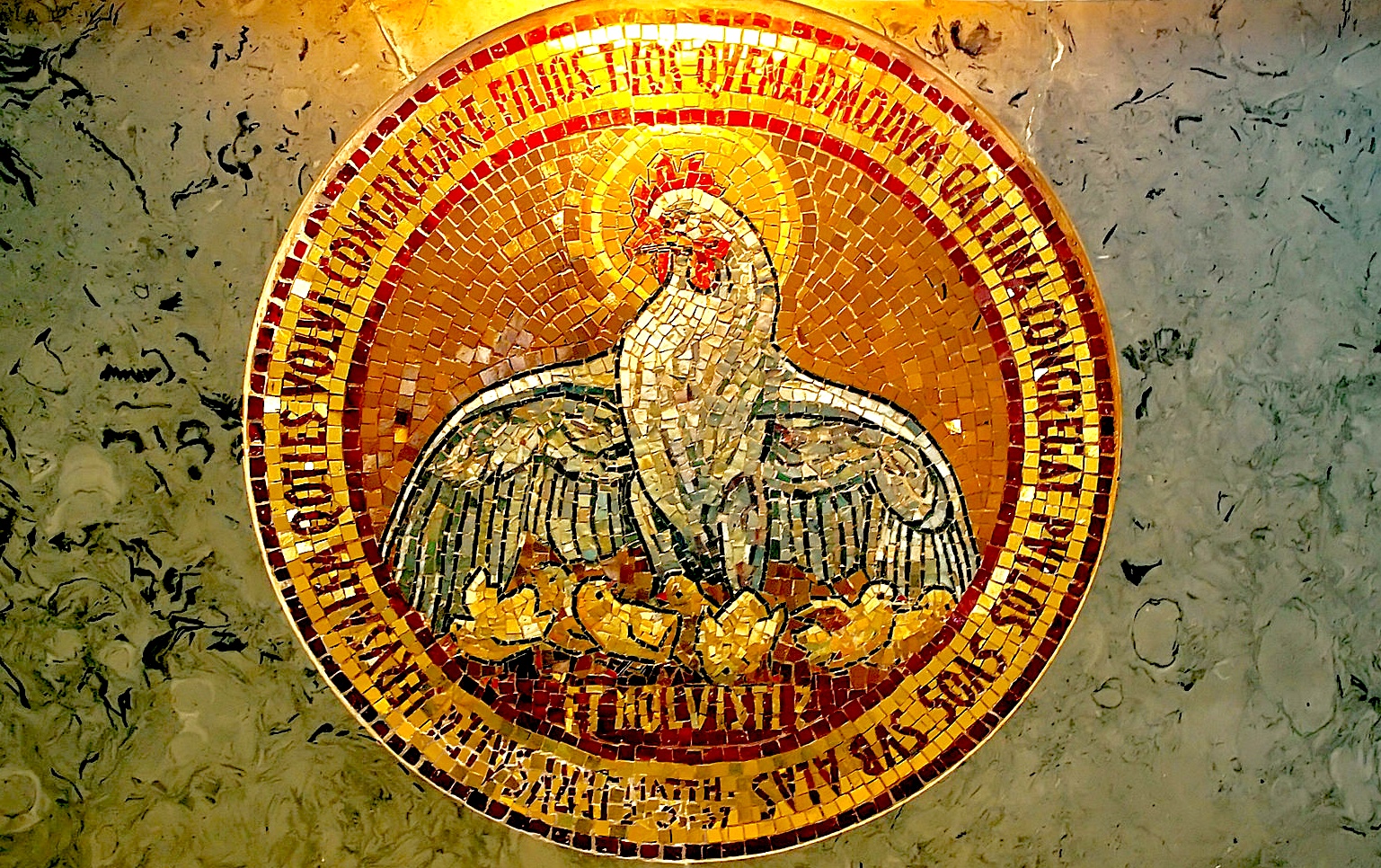
Altar mosaic, Dominus Flevit church, Jerusalem

Look at the image of the altar mosaic  in Dominus Flevit. Notice the golden halo behind the hen’s head. This is a holy creature, showing us God in a new way, as a maternal figure, protective yet vulnerable. Not the lion of Judah, or a mighty eagle, but a barnyard chicken! Her chicks don’t seem to be paying much attention to their mother. They are liable to wander off at any moment and get into all sorts of mischief. But Jesus their mother spreads her wings wide, trying her best to gather them in and keep them safe.

There’s another animal in today’s gospel––the fox. That’s what Jesus calls Herod––a fox. Now as leaders go, Herod was pretty deplorable. He was an insecure bully who didn’t care much about the divine covenant or the holiness of Jerusalem. He only cared about himself. And he was little more than a puppet, easily manipulated by a foreign power (it begins with an “R”).

Why does Jesus call him a fox? Did he mean that Herod was cunning? Perhaps. But in such close juxtaposition with the hen and her chicks, it seems more likely that Jesus was describing Herod as a predator. What a predator does is find a way to isolate and attack the most vulnerable. He divides his victims from the wider community, and then he attacks. If you’re a defenseless chick, a fox is very bad news!

Jesus wants to protect the chicks from the fox, but he refuses to do that with violence. That would only make him a mirror image of the fox. As Episcopal preacher Barbara Brown Taylor says in her memorable commentary on this passage:

“Jesus won’t be king of the jungle in this or any other story. What he will be is a mother hen, who stands between the chicks and those who mean to do them harm. She has no fangs, no claws, no rippling muscles. All she has is her willingness to shield her babies with her own body. If the fox wants them, he will have to kill her first.”

For God so loved the world, that he gave the dearest portion God’s own self, that we might not perish. Self-offering for the sake of others, however costly, is the divine way.

When I first heard about the New Zealand massacre, I had just been reading a gospel commentary comparing the protective hen to Vicki Soto, the first-grade teacher at Sandy Hook who died while shielding her little students from the bullets with her own body.

In times like these, the gospel gets very real, and we are confronted with an immediate choice: do we stand with the fox, or with the hen? God forbid that any of us should ever be in the line of fire, but even at a safe distance, we can raise our voices to resist violence, hatred, bigotry and fear. We can spread our wings to shield the vulnerable.

When our leaders echo the rhetoric of white supremacists by referring to immigrants as “invaders,” we need to shout, “No more!” When defenseless children are taken from their parents and put into cages, we need to insist, “Not in our country!” When the toxins of tribalism inspire violence even in havens like New Zealand, we need to confess our divisive ways and beg forgiveness.

As St. Paul urges us, let us all be imitators of Christ, spreading our wings in welcome, offering warmth, protection, shelter and love without qualification. The foxes of the world want to scatter us, but God yearns to gather every single one of us from the places of isolation, alienation, division and rejection, and bring us home to the welcome table.

Look again at the mosaic of the Christlike hen. She is circled by the Latin text of Jesus’ saying, “how often I have longed to gather your children together as a hen gathers her brood under her wings.” At about 10 o’clock on the circle is the verb congregare, “to gather.” You see, a congregation consists of those who have been gathered safely under the wings of Christ. You have been gathered under the wings of Christ. And we have all committed in our baptism to spread our own wings in turn, and offer our own selves––our souls and bodies––for the sake of the world.

Now just beneath the chicks, there is one more phrase. It is what Jesus says just after the text in the outer circle: et noluisti (“and they were not willing!”). Jesus wants to gather the scattered, but they refuse. For whatever reason––obstinance, foolishness, blindness, or plain old sin––they just won’t be gathered. They were not willing. And that troubling phrase, et noluisti, explains why Jesus wept as he gazed at Jerusalem, Those word are set apart from the rest of the text, and instead of swimming in the gold of eternity like the other words, they are drenched in a deep red color, the color of blood––echoing the message of that primitive covenant ritual with the butchered animals in Genesis. If you don’t find a way to live together in love, there will be blood.

Jesus offers a better way. He did it in his life and teaching, he did it on Calvary’s hill. The hen’s outstretched wings are like the arms of Jesus on the cross, still trying to gather us in with his last breath. “Father, forgive them,” he prays. Even as he is dying on the cross, Jesus is trying to gather God’s children and bring them home.

In Franco Zefferelli’s 1977 film, Jesus of Nazareth, there is an extraordinary moment during the crucifixion sequence. It is not literally scriptural––the screenwriter invented it––but it expresses so well the heart of the gospel message.

Mary, the mother of Jesus, is allowed by a centurion to pass through security to approach her dying son. Then Mary Magdalene tries to follow right behind her, but the centurion stops her.

“Please,” says Magdalene. “I’m one of the family.”

Hearing this, the mother of Jesus turns around sharply, clearly stung by the impudence of this outsider, this woman of questionable reputation, pretending to be related to Jesus. We imagine her thinking, “How dare she try to intrude on our intimate circle!” The centurion asks Mary, “Is she family?” And at that moment, the mother of Jesus has to decide whether she’s going to be tribal and exclusive, or whether she is willing to embrace the welcoming way of her son.

After a brief hesitation, she nods, but it’s not easy for her. “Yes,” she says. “She is one of the family.” And at that moment, at the foot of the cross, beneath Christ’s outstretched wings, the welcoming and sheltering community of mutual and unconditional love is born into the world.

“Flie with angels, fall with dust” –– Appreciating George Herbert


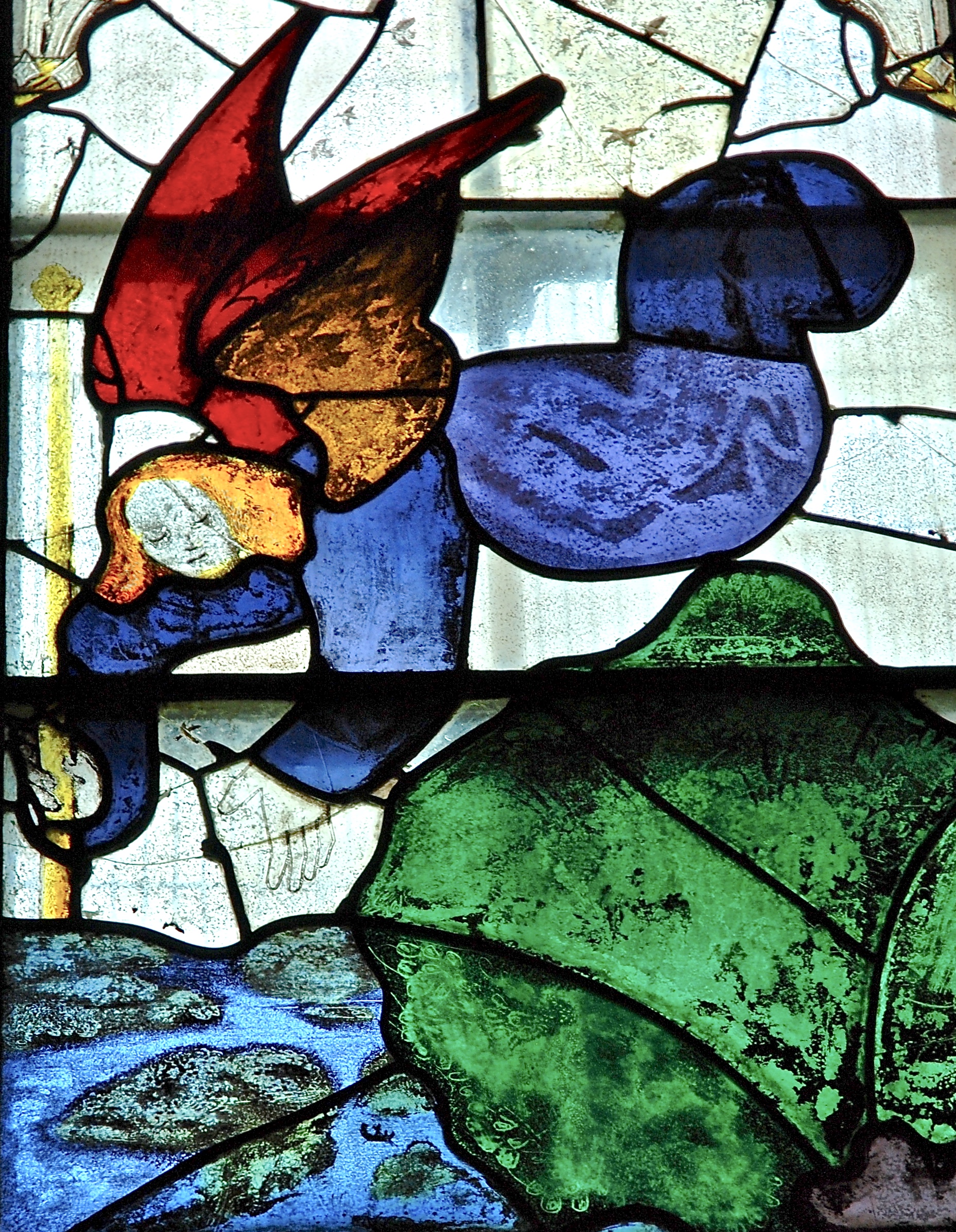
Angel guiding Joshua (detail, c. 1500), St. Mary’s, Fairford, Gloucestershire, UK (Photo by Jim Friedrich)

The seventeenth was almost the last century to succeed in looking within without falling in head first and being submerged––probably because its thinkers had as a governing conception not reality conceived as within the individual consciousness, but, rather, the possibility of inner harmony with reality.

–– Rosemund Tuve [i]

When we find words of the right sort to ask about the divine––words like ‘delight’, ‘enjoy’, ‘pleasure’, and persevere’––God can do nothing better than answer us in our own vocabulary.

–– Helen Vendler [ii]

In his lifetime, George Herbert was appreciated for his attractive personal qualities, his pastoral sense and sensibility, and his faithful Christian practice. But his extraordinary poetry, a primary domain for his soul work, remained hidden from the world until after his death in 1633. I have written about Herbert previously (Heart Work and Heaven Work), and return to him often for devotional reading as well as literary pleasure. In celebration of his feast day (February 27), let’s take another look.

Many of Herbert’s poems do not feel entirely accessible today. His seventeenth-century language and syntax require some translation, while his inventively constructed metaphors and images assume a biblical and theological literacy no longer widely possessed. “[T]his change in the sensibilities of his audience,” laments Rosemund Tuve, “damages some of Herbert’s poems appreciably. The waste for us is more unhappy by far than the unfairness to him.” [iii] I myself find the extensive footnotes and commentary in Helen Wilcox’s magnificent edition of The English Poems of George Herbert to be immensely helpful in letting the poems speak with proper force and meaning.

But the form of Herbert’s poems is not the only hindrance for the modern reader. In the prevailing atmosphere of our secular era, we don’t even breathe the same air as the metaphysical poet. As a recent biographer explains, “Divinity saturated and enclosed his world: the whole of it, from the slightest movements of his own inmost being to his external circumstances in time and the natural world . . . Divinity was the cause and the sum of how things are, without remainder.” [iv]

In contrast, even believers can find themselves acting and thinking like atheists these days, excepting the moments when they engage in conscious religious practice. We no longer live in a world––or a cultural consciousness––saturated with divinity. It is too easy to act as if God is neither necessary nor present. Herbert’s fervent I-Thou relationship with the transcendent can seem alien to the secular mind. Who’s he talking to anyway?

Compared to the modern flattening of human experience in a depthless and disenchanted world––no longer “charged with the grandeur of God” [v]––Herbert’s spiritual environment seems so alive with correspondences between visible things and deeper, invisible realities. The Mystery of the world is met in the humblest of circumstances. The burning bush flashes through the surface of the ordinary. Everyday phenomena are saturated with significance. The gate of heaven might be anywhere, admitting the attentive soul to a luminous eternity beyond the self.

A man that looks on glass,
On it may stay his eye;
Or if he pleaseth, through it pass,
And then the heav’n espy. [vi]

Herbert’s passionate engagement with transcendence––among us, within us, over-against us––was not theoretical or abstract, but intimate and experiential, employing the first-person form of lyric poetry to open a clearing where his inmost feelings could show themselves to both the speaker and his readers. In his striking play of words, images and sounds, a consort of meanings both public and private, we overhear Herbert’s prayers, and witness the argument of his soul. The brilliance of his poetic invention is never for its own sake. He seeks not to show off his skill, but to surrender his will.

Onely thy grace, which with these elements comes,
Knoweth the ready way,
And hath the privie key,
Op’ning the soul’s most subtle rooms. [vii]

Herbert’s humility was one of his most distinctive traits. He was hardly immune to ambition and acclaim, but renounced them for greater treasure. He would die, before his fortieth birthday, as a country priest far removed from the glitter of worldly success.

He seemed perpetually amazed that grace would take up residence in his “poore cabinet of bone.” [viii]

My God, what is a heart?
That thou shouldst it so eye, and wooe,
Powring upon it all thy art,
As if thou hadst nothing els to do? [ix]

He prayed to be worthy of the gift:

Furnish & deck my soul, that thou mayst have
A better lodging than a rack or grave. [x]

And he never forgot to praise the Giver:

Blest be the Architect, whose art
Could build so strong in a weak heart. [xi]

Herbert’s life was not all sunshine and flowers. Five of his poems are called “Affliction.” The first of these begins happily enough:

At first thou gav’st me milk and sweetnesses;
I had my wish and way:
My days were straw’d with flow’rs and happinesse;
There was no month but May.

But then come sorrow and woe, dissatisfaction and disappointment, illness and loss. After a long litany of troubles, the poem ends with a deceptively simple vow crammed with multiple meanings: surrender, self-doubt, anxiety, acceptance, and perhaps a hint of resistance to the demanding terms of the divine-human relationship.

Ah my deare God! though I am clean forgot,
Let me not love thee, if I love thee not. [xii]

Even worse than personal suffering was the experience of divine absence. For a faithful person in a religious world, such absence was nothing like the “out of sight, out of mind” of our secular age. If God does not “exist” in cultural or personal awareness, then the lack of divine presence goes unnoticed and unfelt. But for anyone whose heart belongs to God, the times of divine absence are excruciating.

When my devotions could not pierce
Thy silent ears;
Then was my heart broken, as was my verse . . .
O that thou shouldst give dust a tongue
To cry to thee,
And then not hear it crying! all day long
My heart was in my knee,
But no hearing. [xiii]

As the Psalms so often remind us, God is not an easy partner. Luther supposed that God often “hides his grace” to teach us not to grasp the divine “according to our own feelings and reactions.”[xiv] If faith always needs evidence, how can it be faith? Or as Emily Dickinson described her own wrestling with “that diviner thing,” it does not always respond to our advances, but rather “Flits––glimmers––proves––dissolves––/ Returns––suggests––“ [xv]

If it were otherwise, and Presence were always immediate, filling every place and every moment with plenitude, our journey would be over, and we would no longer be the “heart in pilgrimage.”[xvi] Herbert, like every saint, accepted God’s terms with faithful ambivalence. “I will complain, yet praise,” he said. “I will bewail, approve: / And all my sowre-sweet days / I will lament, and love.” [xvii]

And in the end, all shall be well, and all manner of thing be well: [xviii]

Whether I flie with angels, fall with dust,
Thy hands made both, and I am there:
Thy power and love, my love and trust
Make one place ev’ry where. [xix]


Related post: Heart Work and Heaven Work


[i] Rosemund Tuve, A Reading of George Herbert(Chicago: University of Chicago Press, 1952), 194.

[ii] Helen Vendler, Invisible Listeners: Lyric Intimacy in Herbert, Whitman, and Ashbery(Princeton, 2005), q. in John Drury, Music at Midnight: The Life and Poetry of George Herbert(Chicago: University of Chicago Press, 2013), 336.

[iii] Tuve, 103.

[iv] Drury, 11.

[v] Gerard Manley Hopkns, “God’s Grandeur.”

[vi] “The Elixir.”

[vii] “The Holy Communion.”

[viii] “Ungratefulnesse.”

[ix] “Mattens.”

[x] “Christmas.”

[xi] “The Church-floore.”

[xii] “Affliction (I).”

[xiii] “Deniall.”

[xiv] Martin Luther, Sermon for the Second Sunday in Lent, q. in Richard Strier, Love Known: Theology and Experience in George Herbert’s Poetry (Chicago: University of Chicago Press, 1983), 219.

[xv] Emily Dickinson, “The Love a Life can show Below” (F285, 1862).

[xvi] “Prayer (I).”

[xvii] “Bitter-sweet.”

[xviii] I hope Herbert would appreciate the poetic conceit of combining fellow English artists the Beatles and Julian of Norwich in the same line!

[xix] “The Temper (I).”

Consumed by Love: The Flames of Candlemas

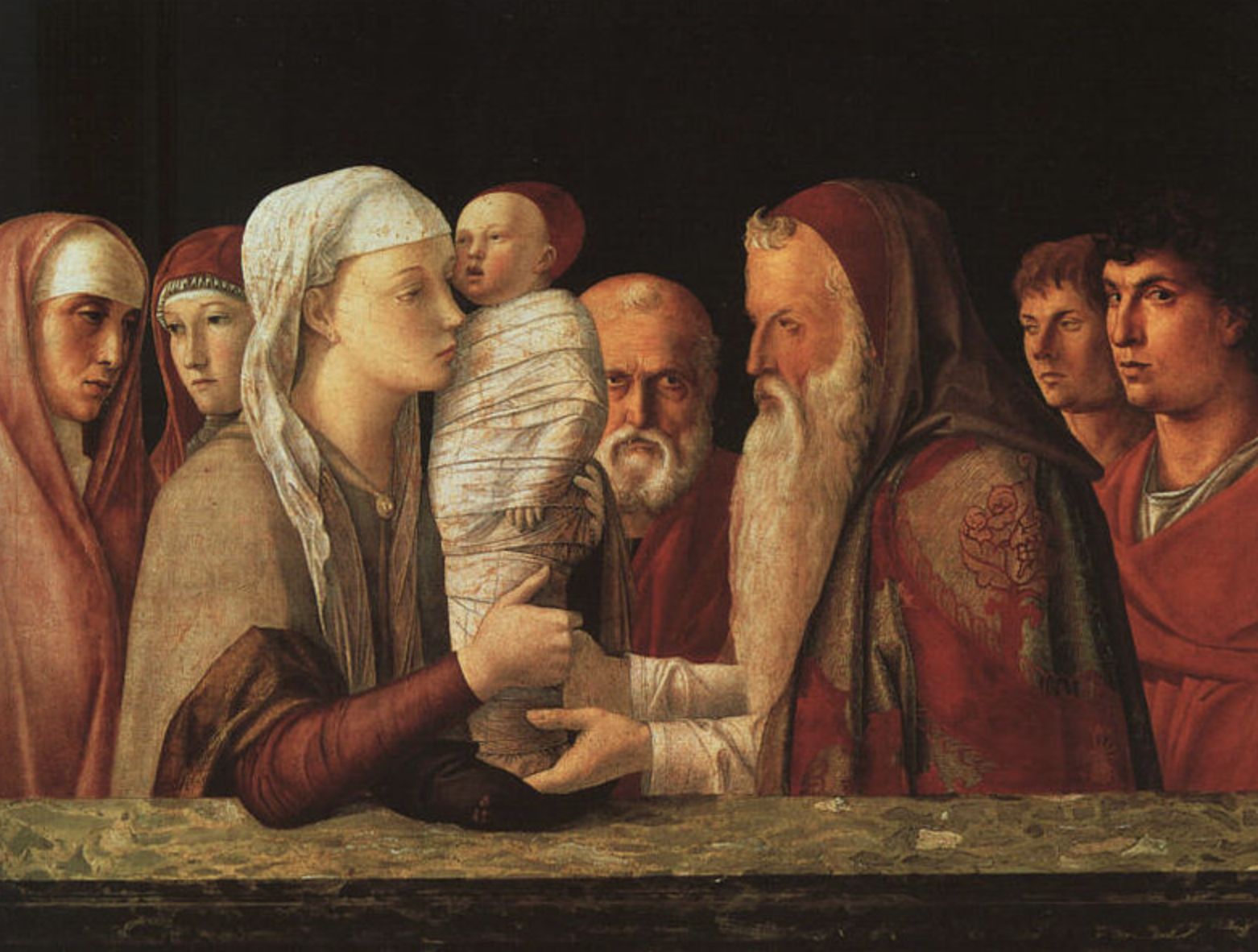
Giovanni Bellini, The Presentation in the Temple (1459)

Today is Candlemas, the 40thday after the Nativity. Its liturgical origins are obscure, but its blazing processions of candles in the winter dark not only made a glorious end to the extended Christmas celebrations of less hurried times, it also provided a brilliant preview of the resurrection fires of the Easter Vigil. Although it still may allow, for a few liturgically-minded procrastinators, a generous extension of the deadline for boxing up our holiday decorations, Candlemas is rarely observed in American homes and churches. Our minds are fixed on groundhogs and football, not the Presentation of our Lord in the Temple.

Still, I would gladly join a candlelight procession to a holy place on this night, to beseech the Light of the World “to pour into the hearts of your faithful people the brilliance of your eternal splendor, that we, who by these kindling flames light up this temple to your glory, may have the darkness of our souls dispelled.”

In the Eastern churches, Candlemas is called “The Meeting,” highlighting the moment when two old souls, Simeon and Anna, met the One for whom they had waited all their lives. Simeon had been told “by the Holy Spirit” that he would not see death before the coming of the Messiah. Every time he went to the Temple, he wondered, “Could this be the Promised Day?” Whatever he may have imagined––the House of God filled with smoke and shining angels, a mighty king arriving in noisy triumph––the long-expected day arrived like any other, without the slightest fanfare.

Simeon liked to go to the Temple early, when it was still blissfully quiet and uncrowded. He began his prayers as usual, but his attention wandered when the entrance of a young couple and their baby caught his eye. He could tell they were country people, the way they looked with such amazement at the vast interior. As they passed by him, he smiled kindly, then closed his eyes to resume his prayers.

But everything within him shouted, “Look! This is the time. Don’t miss it.” As soon as he opened his eyes again, he knew. He didn’t know how, but he knew. That child, cradled in the arms of a peasant girl, was the One!

“Please,” he said. “Please wait!” The couple stopped and turned to face him. Simeon held out his arms, and the girl, as though they had both rehearsed it a hundred times, handed him the baby without the least hesitation. And gazing into those infant eyes, seeing there the future of God’s hopes for all the world, Simeon began to murmur the prayer which the faithful have sung ever since at close of day:

Lord, now at last you release your servant
to depart in peace,
for my eyes have seen the Savior,
just as you have promised.

Then Anna, the old prophetess who had camped out in the Temple for many years, stepped out of the shadows to add her own confirming praises. Joy to the world, the Lord is come!

The Nunc Dimittis of these two old saints, near the end of their lives, being granted the grace of completion on that Temple morning, is beautifully echoed in a passage from Wendell Berry’s novel, Jayber Crow:

I am an old man now and oftentimes I whisper to myself. I have heard myself whispering things that I didn’t know I had ever thought. “Forty years” or “Fifty years” or “Sixty years,” I hear myself whispering. My life lengthens. History grows shorter…

I whisper over to myself the way of loss, the names of the dead. One by one, we lose our loved ones, our friends, our powers of work and pleasure, our landmarks, the days of our allotted time. One by one, the way we lose them, they return to us and are treasured up in our hearts. Grief affirms them, preserves them, sets the cost. Finally a man stands up alone, scoured and charred like a burnt tree, having lost everything and (at the cost only of its loss) found everything, and is ready to go. Now I am ready.

It is a custom at Candlemas to bless the candles for the rest of the year. In 2003, I happened to be in London’s Cathedral of St. Paul for a similar rite, when members of the Wax Chandlers Livery Company, in a practice dating back to the fifteenth century, brought long candles to be blessed for their service on the high altar.

The preacher on that occasion, Canon Martin Warner, took comfort in the fact that when his own brief candle should come to an end, another candle, the Paschal Candle of Easter, would burn over his coffin, declaring by its resurrection light that each of us is but wax “being consumed by the incredible flame of love that is God’s own self, melted not into oblivion but into the freedom of attaining our perfection and deepest longings.”

A candle is a temporal thing, fulfilling its function of radiance and warmth at the cost of its own vanishing. Even so, the fire that consumes it bears Love’s name, and does Love’s work. Whatever is offered up shall receive its true being. Whatever is lost shall be found anew.

Fire of heaven, make us ready.

Piero della Francesca’s Baptism of Christ

Piero della Francesca, The Baptism of Christ (after 1437), National Gallery, London. (Creative Commons license)

A few years ago, while visiting London, I wanted to connect with a friend who lives at the outskirts of the city. Neil, who is an artist as well as a priest[i], told me to meet him at Piero della Francesca’s painting of the Baptism of Christ in the National Gallery. I arrived first, and stood transfixed before that marvelous 15thcentury painting. John the Baptist pours water over Jesus as the Holy Dove hovers just overhead. They stand at the edge of the river, in the shade of a great tree. The formality of the figures and the almost eternal sense of stillness induced a responding quietude in me. When I felt a hand on my shoulder, I knew it was Neil, but I did not look away from the painting. “Remember your baptism,” he whispered, and with a small vial of water drawn from his parish font, he poured a few drops onto my head.

It was a whimsical yet powerful way of connecting my own baptism with the baptism of Christ, making them both present in a single moment, inviting me to receive their multiple meanings into my heart and soul. When the Church celebrates the Baptism of Our Lord this Sunday, I will be thinking of that moment, and that painting.

Piero’s baptismal scene is untroubled by modern oppositions between empirical and spiritual. Its visible world is charged with something more than the eye can see. Or rather, what the eye sees participates in a reality the senses cannot directly grasp.

The Renaissance embrace of the empirical is clear. The sky is blue, not the gold of eternity. The natural world is prominent in the trees and landscape. The human bodies, while in the stylized poses of dancers, are not abstractions. They have weight and substance.

Yet we also see a world governed by invisible meanings: the dove, while rhyming perfectly with the hovering clouds, is the Holy Spirit; the trio on the left is angelic; the principal gestures are sacramental signs of inward grace; and the strong heavenward reach of the picture’s verticals balances harmoniously with its earthly horizontals. Strangely, there are no shadows, as if light is not cast from a distant, separate source, but inheres equally in everything: a sure sign of divine presence.

The more you look, the more you see. The face of the Baptist, who must now “decrease” with the coming of Christ (John 3:30), is only seen in profile, while the full face of Jesus confronts us directly, like an icon. But his eyes do not look outward to fix us with an iconic gaze; their attention is wholly interior. The bent figure on the right could be a realistic touch, another candidate preparing for baptism, but his faceless anonymity suggests a more symbolic meaning. The garment that hides his individuality indicates an identity in transition: either he is shedding the old self which is left behind in the sacrament of new birth, or he is putting on New Being as in the Pauline image from Galations 3:26: “All you who have been baptized have been clothed with Christ.”

The great tree, apparently an Italian walnut, is clearly more than an object of botanical interest. Everything about it suggests the Tree of Life, a mythic image prominent in the first and last chapters of the Bible. Rooted deeply in the earth, it reaches into the heavens, beyond the frame of the painting, where human sight cannot follow. Like the Christ whose erect body it exactly parallels (even its bark shares the identical color and smoothness of Christ’s skin), the Tree unites the dualities of earth and heaven, integrating them into a harmonious whole.

Perhaps the most uncanny element in Piero’s painting is the Jordan River. As the biblical boundary between the wilderness wandering of the Exodus and the land of Promise on the other side, the Jordan became a traditional image of the passage not only between old and new, past and future, but between life and death. Many examples occur in the American spirituals and shape note songs I love to sing with my folkie friends.

I’ve almost gained my heavenly home of friends and kindred dear;
I’ve brushed the dew on Jordan’s banks, the crossing must be near.

These lines, from “Angel Band,” suggest a gentle crossing. But other songs, like “The Promised Land,” strike a note of anxiety and risk:

On Jordan’s stormy banks I stand and cast a wishful eye,
To Canaan’s fair and happy land where my possessions lie. . .
Though Jordan’s waves around me roll, fearless I’d launch away.

But in Piero’s depiction, the river is no formidable flood fraught with difficulty and danger, but a quiet, meandering channel, calm and smooth as a mirror. And it comes to an end at the place where Jesus stands. This could be a direct reference to Joshua’s crossing of the Jordan, which parted like the Red Sea to let God’s people cross over into the Promised Land (Joshua 3:14-17). Or it could be showing Christ to be the one who opens the way between the worlds of life and death, sin and salvation.

The sacrament of baptism employs the tension between water as an image of life (birth, growth, and the quenching of thirst) and an image of death (flood and drowning), expressing the inseparable connection between dying and rising in the Paschal Mystery. We die to self in order to live to God. But in the eternal stillness and calm of this painting, that tension is absent. The raging flood has been tamed into a tranquil pool. We have already crossed over into the peace of heaven.

Of course, it’s only a freeze frame. Soon history will resume and pick up speed. The river will start to rise and become once again tricky to cross. Jesus will begin to make his way through many dangers, toils and snares. So will we. But I am grateful to Piero for this moment of calm, a promising glimpse of something behind and beyond the raucous flow of time.


[i]The Rev. Neil Lambert is the vicar of St. Mary’s, Ash Vale, a 40-minute train ride from Waterloo Station. You can read more about him in my post, “Dreaming the Church that wants to be.”

I Say Rejoice – A Homily for Advent 3

“Pay attention to the open sky / You never know what will be coming down.” –– Jackson Browne

Rejoice in the Lord always. Let me say it again: Rejoice! . . . The Lord is near. . . And the peace of God, which surpasses all understanding, will guard your hearts and minds in Christ Jesus.

 –– Philippians 4:4-7

So said St. Paul 2000 years ago, and we have heard him say it again today: Rejoice!And because these words became the traditional opening chant in the medieval mass on the Third Sunday of Advent, this day became known as Gaudete Sunday, from the Latin for “rejoice.”

Rejoice is one of the most important words in the Bible. It’s full of electricity, meant to jolt you out of sleep and despair. “Rejoice and exult with all your heart, O daughter Jerusalem!” said the prophet Zephaniah. “God will rejoice over you with gladness…God will dance with shouts of joy for you.”

God will dance! In Aramaic, the language of Jesus, the word for rejoice is also the word for dance. An old Jewish Midrash takes great delight in this double meaning:

 In the Time to Come, the Holy One, blessed be He, will lead the chorus of the righteous…and they will dance around Him…and point to Him…saying, “This is God, our God forever and ever; God will lead us…with youthfulness, with liveliness.”

So on Rejoice Sunday, as we celebrate the dancing God, who’s this wild man of the desert crashing our party, calling us snakes and shouting about wrath? Who let him in?

You brood of vipers! You snakes! What are you doing here? Do you really think you are going to escape from the mess you’ve made of this world? Is that what you think? Don’t tell me about your spiritual heritage. That’s not going to save you! You’ve got to show you mean business. You’ve got to turn yourselves around and get right with God. You say you’re Abraham’s children. Well, God doesn’t care a fig about that. You say you go to church. So what?

Are you bearing any fruit? I don’t see it. Your hearts are nothing but dead trees. Where’s the fruit? Where’s the juice? You know what happens to dead trees? They get cut down, leaving nothing but stumps.

Look, I’m baptizing with water the ones who really want to change. But I tell you, there’s someone coming after me who’s a lot more powerful than I am – I’m not even fit to tie his shoes. And he’s not going to be using any water to baptize you. He’s going to baptize you with the Holy Spirit – and with fire.

The winnowing fork is already in his hand. He’s clearing the threshing floor and gathering the wheat into the barn. But the chaff? Oh, the chaff he is going to burn in a fire that will never go out.”

So people, listen up. It’s time to get ready.
Stay awake. Keep watch. Change your lives.

Such an intrusion, such a message, and such a messenger, seem shockingly out of place on Rejoice Sunday. Thank God no wild prophets have wandered into our assembly today. But you never know!

About 25 years ago, a pastor in California asked me if I would make a surprise Advent appearance at his church as John the Baptist. No one else in his congregation knew this was going to happen, not even the ushers, who looked at me nervously when I entered the church in bare feet and a tattered old robe. At the moment when the gospel was to be read, I came up the aisle, looking people in the eyes as I delivered my fiery message. Then, after one last warning to stay awake and keep watch, I slipped out the door and disappeared.

This bit of guerilla liturgy got mixed reviews from the congregation, as you might imagine. But if the Bible is a living word, it doesn’t just tell stories about people in the past. It confronts and challenges us in the present as well, as the biblical truths retell themselves in our own stories.

Be that as it may, what are we to make of the Baptist’s unsettling message? Perhaps his most troubling phrase is “the wrath to come.” It conjures up all those abusive old images of an angry, judgmental and vindictive god, images which have done a lot of harm over the centuries, even though Jesus made it pretty clear that the heart of the law is mercy, and the end of all our stories is the victory of Love.

So what is the “wrath to come”? I believe it is really something of our own devising. If we break the laws of the universe, we will find ourselves contradicted by a reality more true and lasting than the constructions of our own self-will. If we engage in destructive behaviors, those chickens will come home to roost. Or as C. S. Lewis put it, “We are not punished for our sins; we are punished by our sins.”

We all experience this kind of blowback on the level of personal behavior, whenever we reap what we have sown. But it is true on a collective level as well. The rapid acceleration of climate change makes this abundantly clear. For decades we humans have been either unwilling or unable to change our ways, and now the consequent “wrath” is getting too big to ignore––although some still try!

A recent cartoon depicting a climate change denier puts this perfectly. A skeleton is lying on its back on ground that is baked and parched. Nothing is growing there. It’s a wasteland devoid of life. And the skeleton still has its fingers in its ears. Nobody’s going to convince himabout the wrath to come.

Perhaps the most interesting­­––and hopeful––thing about today’s gospel reading is that the people, even after being so fiercely chastised and challenged by the prophet, do not put their fingers in their ears. Instead, they ask the Baptist, “What then should we do?” John responds to each questioner in very concrete ways. And as the story concludes, what looked like judgment––the axe and the fire––turned out to be a strange form of good news, the best thing that could have happened, because it spurred people to let go of the unsustainable chaff and begin to change their ways.

Prophets can be hard, but they are so necessary to move us to repentance and action. Thank God for all those who push us where we need to go, who urge us toward transformation. We must change our lives, they tell us. And the time is now.

It’s hard not to feel overwhelmed by the immense challenges looming before us. Where do we turn for the hope and courage and strength we need for the facing of this hour? What faith says is this: We turn to God our Savior. We turn to the one in whom all our hope is grounded.

But in a world as secular as ours, where divine intention or activity is not a natural presupposition, and things just go on happening whether God is thought about or not, it can seem unintelligible to call God our Savior. What does it mean to say that God will save us? Doesn’t our culture teach us to act as if we are pretty much on our own, for better or worse? Isn’t God an unnecessary hypothesis?

If the question of God were nothing more than a theoretical proposition with which we agree or disagree, or simply ignore in the daily course of our lives, then it’s easy to live as if God makes no difference. But belief is not a theoretical matter. Belief is about how we live, and what kind of story we belong to.

It is certainly possible to live inside a story where God is absent or nonexistent. A lot of people do it. But I find that to be a bleak and unpromising account of reality––perhaps satisfactory, or even exhilarating, when things are good, but too vulnerable to cynicism and despair when the world goes off the rails.

People of faith, however, abide in a different story, a story where death does not have the last word, a story where Love wins. To say that God will save us is to belong to thatstory, and to live accordingly. And what are the fruits of faith’s life-shaping story?––trust, confidence, hope, and the kind of invincible joy which St. Paul proclaims with such passion. “Rejoice! Again I say, rejoice!”

Paul’s own joy was often tested. Even in jail, he wrote to his friends, “Do not worry about anything. Live in hope.” And countless saints have done exactly that.

In the book of Lamentations, a text drenched in the tears of profound suffering, we find one of the most hopeful verses in all of Scripture:

When my soul is bowed down, I keep one thing in mind, and so recover hope: Love’s mercies are never exhausted; they are renewed every morning (Lam. 3:20-23).

In the faith story, no matter how rocky the road or dangerous the journey, our path leads beyond every annihilation toward an unimaginable fulfilment. What has been broken will be restored, what has been wounded will be healed, what has been lost will be found. If such a hope were a statement about the world, it would be a foolish optimism, soon blown away by the winds of calamity. But Christian hope is not a statement about the world. It is a statement about God.

Hope is not about what the creature can do; it is about the never-ending resourcefulness of the Creator, who turns darkness into light and brings life out of death. Even to the blackest night, God will bring the dawn.

One of my Advent rituals is to play my recording of Jackson Browne’s “For a Dancer,” an encouraging song imbued with prayerful hope, despite being written in a time of personal loss:

Keep a fire for the human race,
and let your prayers go drifting into space
you never know what will be coming down.

Perhaps a better world is drawing near;
just as easy it could all disappear,
along with whatever meaning you might have found.
Don’t let the uncertainty turn you around.
Go on and make a joyful sound.

Into a dancer you have grown,
From a seed somebody else has thrown,
Go on ahead and throw some seeds of your own. . .

We are all dancers, the people who rejoice in hope, come what may. Don’t let the uncertainty turn you around. Go on and make a joyful sound.

Now to say that God is our Savior does not mean that God does all the work. Faith is not passivity. To be called into the story of God’s unfolding future means we ourselves have a lot of work to do: the work of changing our lives, the work of letting go what is unsustainable, the work of repairing the world, the work of becoming Love’s body in the here and now. Go on ahead and throw some seeds of your own.

We do not do this work alone.
The Eternal One works beside us––and within us.
Our strength lies in a power deeper than our own capacities.
Our story is more than a dream of our own making.
And God’s mercies, Love’s kindnesses, are never exhausted.

Prayers for the Advent Season

Annunciation (detail), Workshop of Rogier van der Weyden, c. 1440.

I’ve written more about Advent than any other season of the Christian year. It’s like a Mahler symphony, densely packed with vivid contrasts, complex themes, cosmic grandeur, dark abysses and sublime radiance. It begins with the cymbal crash of an exploding world, and concludes with the tender adagio of a baby’s first breaths. Advent haunts our complacency, stirs our longing, and lights a brave candle in the dark.

My ten previous Advent posts, divided into the categories of theology, worship and practice, can be linked directly from last year’s summary compilation, “How long? Not long!––The Advent Collection.”  Whether you love the season as I do, or are wondering what it’s all about, I hope you will find in those ten posts some words to connect with your own journey toward the dawn.

Meanwhile, here is something new: a set of intercessions I composed for this year’s Advent liturgies at St. Barnabas Episcopal Church on Bainbridge Island, the local parish where my wife Karen Haig is the rector. You may recognize specific borrowings from tradition, such as the ancient O Antiphons or the Book of Common Prayer, but it all comes from a lifetime of Advents, soaking up the language and embracing the themes of this transformative season.

I offer these prayers for both liturgical and private use. And if they prompt you to explore your own devotional language of longing and hope, so much the better.

Intercessory Prayers for Advent:

God of many names, God beyond all names; the beginning and the end of every story, the meaning of every life; infinite Mystery both hidden and revealed:

Hear us when we pray to You.

Blessed are You who join us together in the communion of Christ’s Body. Renew and energize your holy Church, in this parish and throughout the world, that we may be a resurrection people, manifesting your steadfast love in our common life of praise and service.

Hear us when we pray to You.

O perfect Wisdom, direct and rule the hearts of the leaders and shapers of society, raise up prophets of justice and peace, and empower your people for the holy vocation of repairing the world. May we entrust all our labors to the work of Providence.

Hear us when we pray to You.

O Deliverer, You unlock every door and make a way where there is no way. Set free all who are afflicted or distressed in body, mind or spirit. Resurrect their hope, grant them peace and refreshment, and restore their joy.

Hear us when we pray to You.

O compassionate One, hold us in your mercy: heal the sick, mend the broken, protect the vulnerable, shelter the refugee, strengthen the weary, rescue the lost, and give courage to all who struggle.

Hear us when we pray to You.

O Morning Star, bright splendor of the light eternal, illumining all things with your radiance: Come, enlighten all who sit in darkness, and those who dwell in the shadow of violence and death. Grant us your peace, and teach us to live in the dawn of your unfailing promise.

Hear us when we pray to you.

O Lover of souls, when we wander far away, lead us back to You; when we refuse your embrace, do not give up on us; when we forget You, do not forget us.

Hear us when we pray to You.

O Desire of every heart, the answer to every longing: You are the strong force that draws us into the mystery of love divine. Forgive us those things which distract and delay us, and lead us ever deeper into the Way, the Truth and the Life.

Hear us when we pray to You.

God who has come, God who does come, God who is yet to come: Make us an Advent people, ready and alert to welcome and receive You in the stranger’s face, the loving act, the moment of grace, the presence of healing, the birth of possibility, the gift of wonder. Let every heart prepare You room.

Hear us when we pray to You.

O Emmanuel, God-with-us, You show us the face of divinity and reveal the fullness of our humanity. Come: renew your creation, restore us all in Christ, and enable us to become who we are, your faithful and loving people. We pray in the name of Jesus. Amen.