Cinematic Resurrections (Part 2)

image

And is not the language of the cinema of its very nature a way of telling stories that carry a reasoned argument, as it were, reasoning by way of stories? Here one can see how the narrative dimension – constitutive of the cinema – complements the icon’s symbolic dimension: and it is by dint of this bringing together of icon and story that the cinema can be a language uniquely capable of mediating transcendence.[i]

— Bruno Forte

The danger, however, that in our attempt to conceive and understand [the Resurrection] we in fact suppress the very revolution that the story embodies, naturalize the alienness of its ideas, tame the violence it does to our logic, and anesthetize its wounding of our pride.[ii]

— Alan E. Lewis


In Part 1 of Cinematic Resurrections, we looked at how Jesus films have represented the event of Jesus’ rising as well as the stories of his empty tomb. But the sensory appearances of the risen Christ present an even greater challenge for the filmmaker, involving a tension between visual plausibility and underlying truth. What really happened in the appearances, and what might that have looked like?

In the gospel texts, these appearances are not presented as private, interior experiences, subjective and dreamlike. They always convey a sense of concreteness and physicality, experienced as something outside the observer. Jesus has a bodily presence which occupies the spaces of encounter.

There is of course an inherent strangeness to meeting someone whose death you just witnessed. And the appearances stories do have a certain inexplicable “now you see me, now you don’t” quality. Jesus comes and goes at will. He is not barred by locked doors, nor does he ever linger for a proper goodbye, since “I am with you always.”

But the strangest aspect of the appearance stories, given their transcendent and astonishing subject, is their plainness. Jesus does not glow with supernal light, as in the mystical Transfiguration story, nor does he radiate the sublime and fearsome grandeur with which he appears in the Book of Revelation. The risen Christ is so down-to-earth that he is mistaken for a gardener. Later we find him barbecuing fish on the beach,

He still has human form, but something about him has changed. Catching sight of him is not enough to make the connection between the crucified teacher and this man from God knows where. Recognition is triggered not by his appearance, but by something he says or does, such as “Peace be with you,” or the breaking of bread at Emmaus (beautifully shown in The Miracle Maker). But even after the disciples discern the Risen One’s identity (“It’s Jesus!”), they still sense that something is different, something which begins to make them fall to their knees.

Both identity and difference are essential components of the Resurrection. The risen Christ is not a different person from the one who was crucified. At the same time, his body has undergone an incomprehensible transformation. As Wolfhart Pannenberg puts it, “Resurrection has to be understood in terms of transformation of the old life into the new one rather than in terms of replacing the perishable body by a new one.”[iii]

It is hard to convey this sense of “same but different” on film when a single actor plays Jesus both before and after the resurrection. In King of Kings (1961), for example, it is still clearly the boyish Jeffrey Hunter, apparently unaffected by the harrowing passage through death into divine futurity, who meets Mary Magdalene outside the tomb. In Jesus (1999), the risen Christ has lost nothing of the California cool which Jeremy Sisto brought to his pre-Easter Jesus. Such scenes are all familiarity without the slightest trace of difference— it’s the same actor, the same affect, the same voice.

Many of the films convey a sense of difference in the way the disciples respond to the appearances. When Jesus comes into their midst, they do not resume their accustomed rapport with their old companion of the road. They don’t rush to embrace him as you would a long-lost friend. They are respectfully hesitant to approach. Is this fear of the uncanny, or is it the beginning of worship? Then they move from astonishment and wonder to a place of prayerful receptivity. They bow their heads or close their eyes as Jesus speaks to them, touches them, or breathes the Holy Spirit upon them (as in The Gospel of John). The risen Christ soothes the anxious heart. Peace be with you.

How far can a film go in representing a resurrection appearance? Whar are the rules of engagement for the visual artist? Son of God (2014) attempts to communicate the strangeness of the Resurrection in two interesting scenes. In the first, we follow Magdalene from the glare of the Middle Eastern sun into the darkness of the tomb. As she puzzles over the grave cloths, the camera shifts to reveal the tomb entrance, and there is Jesus, just outside in the bright light of day.

Since the lens aperture is open wide to compensate for the dimness of the cave, the figure standing in the sunlight is extremely overexposed. The details of his face and body are burned out, erased by intense luminosity. This is not a special effect added to the image in post-production. It is simply how a camera sees under those conditions. With the cinematic eye calibrated to the darkness of death’s realm, we are literally blinded by the light.

So Mary sees, but does not recognize, until Jesus speaks her name. “Teacher?” she answers, hesitant but hopeful. Then her face tells us— she knows him. But the distance between them remains: she in the tomb, Jesus in the light. “Go and tell the others,” he says. “I am here.” Then he turns to walk away, and after a few steps his figure vanishes into the white light.

The encounter feels both plausible and strange at the same time. In this world but not of it. It has the naturalness of story, something which might have happened that way, but also the transcendent otherness of an icon. It’s only a movie— the artifice of representation using actors, camera and music, but it has the capacity to draw the viewer into effective proximity to what is being represented.

Then, the same film gives us an upper room appearance scene unique to the genre— an audacious attempt to bridge the ineffable transition from physical presence to sacramental presence. Once the sensory appearances of Jesus ceased not long after the Resurrection, the eucharist became the tangible and revelatory sign that Christ is now present in all times and places. This scene creatively depicts a single presence behind both experiences.

Peter and John, doubting Magdalene’s news, go back to the tomb with her. Peter enters alone, finds the burial shroud, and takes it outside to John and Mary. “Now do you believe me?” she says. But John shakes his head: “He’s gone.” Suddenly a strong gust of wind whirls a cloud of dust through the frame. It’s like a little Pentecost, the Spirit blowing Peter’s mind with the truth. “Gone?” he says. “No! He’s back.”

They run into town, pick up bread from a street seller and take it to the other disciples, waiting in the upper room. “I need a cup,” Peter cries. “And some wine.” Thomas, bewildered by Peter’s excitement, asks what happened. Peter doesn’t reply. There’s no time to waste.

He joins the others at table, breaking the bread and pouring the wine. “His body … his blood,” he says fervently, as if these things were Jesus himself. Offering the cup to the dubious Thomas, he begins to repeat their teacher’s words: “I am the way, the truth . . . ” but the final line, “and the life,” is spoken by a different voice, off camera. At first we see only a close shot of Thomas, glancing up in surprise. Then we see what he sees: Jesus, coming into focus as he enters the open door. Thomas looks down at the table. “No,” he says. “No, this isn’t real.”

Jesus just smiles, and begins to walk around the table, pausing to lay a hand of blessing on each disciple. In the gospel stories of the upper room, Jesus speaks the words, “Peace be with you,” but here his wordless gesture says it all. When he reaches Thomas, he sits down to face him. Jesus shows him his wounded hand, and then gently caresses the doubter’s cheek with it. Love becomes the evidence Thomas has been longing for.

Like Luke’s Emmaus story, this film scene blends narrative and symbol. Is it describing an original and unique appearance of the risen Christ, or is it representing the common experience of every believer who shares the bread of life and the cup of salvation? I would say both.

What happened then, happens now. What happened there, happens here. And whatever the nature of the first resurrection appearances, those stories are deeply flavored by eucharistic practice. When the lector, deacon or presider says the words, Jesus speaks. When the bread is shared and the wine poured out for many, “he’s back.” And whenever two or three gather in Christ’s name, the peace which passes all understanding is bestowed all over again. As it was in the beginning, is now, and will be forever.

…. I looked
at him, not with the eye
only, but with the whole
of my being, overflowing with
him as a chalice would
with the sea…[iv]


Related Posts

Cinematic Resurrections (Part 1)

Are we too late for the Resurrection?


[i] Bruno Forte, The Portal of Beauty: Towards a Theology of Aesthetics (Grand Rapids, MI: Eerdmans, 2008), 108

[ii] Alan E. Lewis, Between Cross and Resurrection: A Theology of Holy Saturday (Grand Rapids: Eerdmans, 2001), 27

[iii] Wolfhart Pannenberg, “History and the Reality of the Resurrection,” in Resurrection Reconsidered, ed. Gavin D’Costa (Oxford: Oneworld Publications, 1996), 70

[iv] R.S. Thomas, “Suddenly”, in Collected Poems: 1945-1990 (London: Phoenix Giant, 1993), 283

Cinematic Resurrections (Part 1)

Rossana Di Rocco as the Angel in "The Gospel According to St. Matthew" (Pier Paolo Pasolini, 1964)

Rossana Di Rocco as the Angel in “The Gospel According to St. Matthew” (Pier Paolo Pasolini, 1964)

Very little can be verified historically above and beyond the disciples’ faith: something, a mysterious something, happened to them, but further than that we cannot penetrate.[i]

— A. J. M. Wedderburn

The delayed recognition of Jesus has nothing to do with a lesser visibility of his resurrected body due to the lesser reality of the shadowy afterlife to which he would now belong. The opposite is true. This resurrection is too real for a perception dimmed by the false transfigurations of mimetic idolatry.[ii]

— Rene Girard

The revolution will not be televised.

— Gil Scott- Heron


As a mortal being, Jesus shared the human condition. He lived and died as one of us. In this way, his story is universal. But it is also unique, for it does not end with his death. In the Gospels, the presence of Jesus persists beyond the cross. The violence of the world is not able to consume him. His story is completed not with death but resurrection. But by definition, resurrection is beyond the range of common experience. It doesn’t take place within ordinary history, where just anyone can see it.

The Resurrection is not the restoration of the past, a returning of Jesus’ old body to this life, but the translation of Jesus into a new reality which cannot be neutrally observed, but is only revealed to the faithful. “Things beyond our seeing, things beyond our hearing, things beyond our imagining”[iii] remain discretely offstage in the gospel narratives. The resurrection will not be televised.

 But some things were seen, as attested to in the gospel texts. There was an empty tomb, one or two mysterious messengers who tell them Jesus is not “here,” and a series of encounters with the risen Christ. The reports are fragmentary, and sometimes contradictory, befitting something so strange experienced by different subjects, each of them groping for language to express the inexpressible.

The cinematic accounts of the Jesus story provide an interesting way to consider what can be shown or seen of the Easter event. There is an inherent literalness to whatever the camera shows us: real objects under the light. Music, editing, and other cinematic devices can add layers of interpretation, but we are still seeing actual material things, visible to anyone in their presence.[iv] How, then, can a film show us something that so radically eludes and exceeds the visible, the resurrection that is, in Rene Girard’s delicious phrase, “too real for a perception dimmed by the false transfigurations of mimetic idolatry”?

In this two-part survey of resurrection stories in Jesus films from 1927 to 2014, we will look at three elements: the Resurrection itself, the empty tomb, and the appearances.

The Resurrection

Of the nearly twenty lives of Jesus produced as commercial features or television miniseries since the early twentieth century, few have attempted to represent the actual moment of resurrection. Cecil B. DeMille, always the showman, couldn’t resist giving us Jesus actually walking out of the tomb in The King of Kings (1927). The stone covering the entrance begins to glow, then falls away, and a Jesus bathed in radiance stands tall before our eyes. He looks a bit lonely, perhaps unsure of what to do next as he takes a few tentative steps back into the world of space and time.

DeMille’s camera remains respectfully outside the tomb. We don’t actually see whatever happened inside. Mel Gibson, in The Passion of the Christ (2004), is bolder, placing the viewer within the sacred epicenter. As the camera pans around the tomb, we see the sunlight penetrate the darkness as the stone is rolled away, and then we see the slab where the Savior was laid. But instead of a body, we see only the shroud collapsing into flatness as the form which gave it shape apparently vanishes. If we are witnessing the moment when a a corpse is translated into something else, the facts of the matter remain discretely veiled from sight.

It is a stunning and poetic moment. Not quite seeing the mystery itself, we glimpse its trace — white fabric, suddenly emptied of its content, falling gently onto a stone slab. We see what can be seen, and no more. And yet so much is implied. However, when the camera pulls back to show the naked Christ, sitting quietly on the edge of the slab as he opens his eyes, the delicate balance of the visible and invisible is broken. The image is too literal, too crudely specific for an event which shatters all language.

Pier Paolo Pasolini’s The Gospel According to St. Matthew (1964) presents the Resurrection with the naïve simplicity of a medieval mystery play. Soldiers doze before the sealed tomb. The mother of Jesus arrives with a few disciples, male and female. They kneel, clutching bouquets of wildflowers. Suddenly, an earthquake. The stone door falls. The tomb is empty. The camera zooms in on the abandoned shroud. We hear an exuberant African Gloria. We see a young “angel” in close-up, announcing the resurrection and sending the disciples forth to evangelize the world. Mary smiles and gives a courteous bow to the angel. Cut to the disciples, on fire with the good news, running, running, running, their faces full of joy. With the movements of their bodies compressed and blended tightly by a telephoto lens, the screen explodes with their collective energy, which becomes the perfect icon of the risen life — empowered, unconstrained, joyous and overflowing.

Pasolini doesn’t worry about plausibility. He represents the Resurrection with a kind of magic realism, where the camera, in a matter-of-fact manner, gives equal weight to the natural and the supernatural. This is more like the poetry of an Easter hymn than a documentary. Instead of explanation, here is proclamation.

Son of Man (2006), the South African retelling of the Jesus story in a fictional 21st-century African country, brings Jesus out of the grave twice. Instead of being crucified, Jesus is abducted and “disappeared” — beaten to death and buried in a secret grave the way so many activists were killed in South Africa under apartheid. But Jesus’ mother manages to find the grave, and a few disciples help her dig up the body and display it on a hilltop cross in a gesture of defiance, as if to say, We will not let crimes against the people be hidden. This shockingly literal crucifix inspires the disciples to risk their own lives in protest against the murderous oppressors.

The empowered disciples, singing and dancing in front of armed soldiers at the foot of the cross, made me think of what Oscar Romero said just before his own martyrdom, “If they kill me, I shall arise in the Salvadoran people. Let my blood be a seed of freedom and the sign that hope will soon be reality. A bishop will die, but the Church of God, which is the people, will never die.”[v]

But then the film gives us a second resurrection, proclaiming the Easter faith that the resurrection did not only happen to the community Jesus created. It also happened to Jesus. The time is early morning. The camera puts us a few feet below the rim of the dirt grave where Jesus’ body had lain before the disciples took it away. The sun is behind us. We see the wall of the grave and the blue sky above it. The shadow of a man begins to rise up the wall from below, and a tenor’s voice breaks the silence with a South African song:

The sun in Spring will rise over the mountain.
Today we are united.
We are one people.

The voices of a choir begin to add their soaring harmonies. The man’s tall shadow is joined by shadows of the angels who have watched over Jesus since his birth, played by small boys adorned with ostrich feathers. These elongated sunrise shadows of Jesus and the angels stretch beyond the grave into an open field. It is a haunting image, hovering between the spectral and the substantial.

We cut to close-ups of the boys’ angelic faces, beautiful and smiling as they look into the distance. Then we see what they see: Jesus, dressed in his familiar denim work clothes, ascending a hill. The boys, suddenly a great multitude, follow after him. This powerful final image evokes not only the host of heaven welcoming Jesus home, but also the departed souls he drew into his risen life when he descended to the dead.

The Empty Tomb

In contrast to the affirmative mood of the resurrection scenes, the empty tomb creates uncertainty and bewilderment. What has happened to the body? In The Greatest Story Ever Told (1965), Mary Magdalene goes to the tomb at dawn, only to find the stone rolled away from the entrance. A young man is standing just inside the shadowy cave. “He is gone,” he says. “Why seek ye the living among the dead? He is risen.” There is nothing particularly uncanny about the man’s appearance. Played by Pat Boone, he is disappointingly prosaic.

Magdalene departs the tomb just as some male disciples arrive. When the men enter the tomb, the figure in white doesn’t even speak to them. He simply takes a seat at the rear of the cave like a museum guard, thinking his thoughts while the tourists have a look around. It is awkward staging, without the slightest aura of transcendence. Only the soundtrack’s “Hallelujah Chorus” tells you something religious is happening.

In The Gospel of John (2003), Magdalene is so disturbed to find the stone rolled away, she doesn’t linger to look inside. She goes immediately to tell the other disciples. Peter and John come on the run to check it out for themselves. They appear puzzled by the missing body, though John, the narrator tells us, “saw and believed.” But neither of the men actually looks convinced of anything. According to the narrator, “They still did not understand the scripture, which said that he must rise from death.”

The CBS miniseries Jesus (2000) also follows the Johannine account (John 20: 1-10), but when John joins Peter in the tomb, he has no problem grasping the situation. “He is risen!” he declares. This is faithful to the absence of any psychological processing in John 20:8 (“he saw and believed”), but on film such instant belief seems unconvincing. We need to see John thinking, as the truth sinks in. We want to experience the drama of recognition played out over time, reflecting our own wrestling with doubt as the horizon of the possible is radically expanded before us. Peter offers some token resistance (“Risen? No! The body’s stolen.”), but he soon joins John in embracing resurrection faith as though it were something easy.

The problem with such scenes lies in the inherent ambiguity of the empty tomb. It does not prove resurrection. Christian claims about the meaning of the empty tomb were countered very early on by alternative explanations: the body was stolen; Jesus, not really dead, woke up and walked away; the women went to the wrong tomb; or — my personal favorite — the gardener moved the body so that the disciples wouldn’t trample the vegetables while venerating their master’s grave. The most that the empty tomb can do is prompt questions. The Resurrection is about presence, and the tomb is only absence. He is not here. Why seek the living among the dead?

Still, there is something decidedly uncanny about the messenger(s) at the tomb. In Mark’s early account, the “young man in a white robe” was not yet Matthew’s dramatically embellished angel, with a face like lightning and a dazzling snow-white robe. Even so, the women who saw him were “struck with amazement.” Luke’s later text has them bow to the ground, a clear act of worship. There is something here that does not want to be explained away. The strange quality of this encounter preserves an essential trace of the divine at work. Reducing the story to whatever we call plausibility would only evacuate its power to convey a deeper truth.

How, then, can the filmmaker strike us with amazement? Pat Boone won’t suffice, nor could computer wizardry, riffing on Matthew’s special effects, ever be anything more than distracting artifice. But in Franco Zeffirelli’s Jesus of Nazareth (1977), there is a compelling balance between cinema’s inherent naturalism and the gospel story’s overflowing transcendence. We see three women walking toward the tomb, escorted by a Roman guard. When the soldiers move on ahead, only the disciples are left within the frame. It is then that they hear a voice meant only for the faithful: “Where are you going? Why seek the living among the dead? Jesus is not there.” The women look up to see two gardeners on the hillside. The eerie electronic notes of a Theremin over a low percussive rumble underscore the sense of the uncanny. The women hurry on to the tomb, only to find it empty. They run back, full of questions, to where they saw the gardeners, but now the hillside is empty. Only a couple of hoes remain as tangible signs that this was more than a vision.

Other than the music, everything in this scene is natural: women walking, a gardener speaking, an empty tomb, two abandoned hoes. No faces like lightning, no dazzling raiment, no echo effects on the vocal. And yet, we feel that the women, and we as well, have been touched by something wondrous, just beyond the grasp of our senses.


In Part 2 (coming soon to a computer near you!), we will examine how Jesus movies have handled the most critical element of the resurrection stories: the appearances of the risen Christ to his disciples.

Related Posts

The Ten Best Jesus Movies

My Ten Favorite Jesus Movie Moments


[i] A. J. M. Wedderburn, Beyond Resurrection (London: SCM Press, 1999), 89

[ii] Rene Girard, A Theater of Envy: William Shakespeare (Oxford: Oxford University Press, 2004), 341-2

[iii] I Cor 2:9

[iv] Of course, computer-generated imagery can show us things which do not exist in the empirical universe, but while we may be amused or awed by such effects, we are fully aware of their artificiality. It is quite a different thing to gaze at a real object, or a human face, and wonder whether there might be something there beyond the visible.

[v] Quoted in the Paulist Productions film, Romero (1989) directed by John Duigan

The holy grail of cinema: Jacques Rivette’s “Out 1”

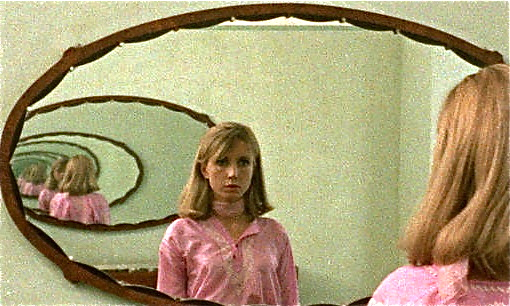
Emilie/Pauline (Bulle Ogier) in Jacques Rivette's Out 1 (1971)

Emilie/Pauline (Bulle Ogier) in Jacques Rivette’s Out 1 (1971)

We are all rehearsing parts of which we are as yet unaware (our roles). We slip into characters which we do not master (our attitudes and postures). We serve a conspiracy of which we are completely oblivious (our masks).

— Gilles Deleuze[i]


Last weekend I watched a nearly 13-hour film on the big screen at the Seattle Film Center. Jacques Rivette’s Out 1: Noli me tangere (1971) has been called the “holy grail of cinema” — made infinitely precious by the rarity of its appearance. Only in recent months have art-house screenings and a home video release[ii] made it accessible to wider veneration.

Critic B. Kite has written about this fabled film as an object of longing: “Out 1 grew in darkness, secret and seemingly made of secrets, and due to this unavailability … it joined that pantheon of broken and vanished objects [e.g., von Stroheim’s Greed or Brian Wilson’s Smile] … in which, even against our better judgment, we place some unspecified hope of a definitive experience, maybe a bit too good for the world, as indicated by the fact that they live in a half-light, next door to oblivion.”[iii]

As soon as I heard about the Seattle screening, I bought my ticket. A thirteen-hour movie? Can’t miss that! I have a penchant for immersive experiences, long-form retreats from everyday reality into alternative worlds. Among the most memorable were a 72-hour science-fiction film marathon, an all-night Epiphany liturgy in a circus tent, Peter Brook’s 11-hour staging of the Mahabharata, Masaki Koybayashi’s 10-hour film epic, The Human Condition, the 500-mile Camino de Santiago, and Christian Marclay’s 24-hour video, The Clock.

But unlike any of these, Out 1 is not so clearly shaped by a sense of plot or structure. It does not set out from a premise or question toward a place of arrival or resolution. Instead, it begins and ends in media res, adrift in a sea of occurrences and characters whose connections or meanings remain perpetually elusive.

There was no original script. Rivette, one of the most experimental of the French New Wave filmmakers, sought the same freedom as the Abstract Expressionist painters, whose process was largely free from the constraints of predetermined outcomes. His actors, provided with various situations, simply improvised their lines throughout the six weeks of shooting. Since much of the action takes place in the streets and cafes of Paris, the actors at times enlisted unsuspecting Parisians in their scenes.

The first hours feel like a documentary as two separate experimental theater companies engage in warm-up exercises, acting games and psychodrama designed to break down barriers, loosen inhibitions, and spark creativity. One exercise, bordering on hysteria, is shown in a single 45-minute shot as the hand-held camera moves restlessly among writhing, clamorous bodies. In a 13-hour film, you can do this sort of thing, and still have plenty of time left over to attend to the story.

However, if this film does have a story, it consists only of hints and speculations whose reality is always in doubt. Documentary and fiction, imagination and reality, the written and the improvised, are intertwined, inseparable, often indistinguishable.

Halfway through the film, a troubled loner named Colin, played by New Wave icon Jean-Pierre Leaud, begins to piece together fragments of Balzac and Lewis Carroll as if they are clues to a great conspiracy involving a secret society called The Thirteen, formed to subvert the social order with a radical utopian vision. But it may be that The Thirteen is no more than a long-dormant idea some of the other characters once dreamed but never enacted. When told that the object of his obsessive quest may be a hoax, Colin replies, “But that would mean that the magical, mysterious world I’ve been living in is nothing but illusion. And that,” he insists, “is impossible!”

To live in a world without underlying connections or purposeful ends is a bleak, even terrifying prospect, as Thomas Pynchon notes in Gravity’s Rainbow:

If there is something comforting-religious, if you want — about paranoia, there is still also anti-paranoia, where nothing is connected to anything, a condition not many of us can bear for long.[iv]

Is there a middle way between the fictions of paranoia and the despair of anti-paranoia? Colin’s quest proves a dead end: there is nothing to find. He stops searching for answers and resumes his original persona as a (pretended) deaf-mute passing out envelopes at sidewalk cafes. Inside the envelopes are “messages of destiny” — pages ripped at random from paperback novels.

The two theater groups, meanwhile, are pursuing their own path toward meaning as they each grapple with a tragedy from Aeschylus. One of these, Prometheus Bound, provides a text perfectly descriptive of the obstacles to coherence in our personal and social narratives:

…they had eyes, but sight was meaningless;
Heard sounds but could not listen; all their length of life
They passed like shapes in dreams, confused and purposeless.

 In stealing fire from Zeus, Prometheus became humanity’s great benefactor, the bringer of light, technology and civilization. He would also be credited with securing us meaning, purpose, and future. But he paid the highest price for this gift. Chained to a rock in a ritual of perpetual sacrifice, he would be devoured and regenerated daily. His sacrificial suffering on behalf of humanity has drawn comparisons with Christ. And while Noli me tangere (“Touch me not”), may have been no more than Rivette’s joke about his film being something that few would ever see, its direct quote of the risen Savior (John 20:17) may be an intended link between Prometheus and Christ.

At the end of the film, Thomas (Michael Lonsdale), who assumes the role of Prometheus in his troupe’s improvisations on Aeschylus, lies forsaken on a beach, arms outspread in a crucifixion pose. After a time, he gets up and walks along the shore toward the rising sun. But this seems only a parody of resurrection. We sense no renewal, no passage to a place of transformation and new life. All the heaven-storming, psyche-delving exertions of the Aeschylus project have led precisely nowhere. Thomas has not been transposed into a higher key. He remains as “confused and purposeless” as ever.

But as we take our leave of him, after twelve hours and forty-one minutes, Thomas is still moving, not yet done, like the protagonist in Samuel Beckett’s The Unnamable: “You must go on. I can’t go on. I’ll go on.”

As the intrepid audience of eighteen men and four women exited the theater sometime after midnight, we were awarded with a button for our labors. I wore it proudly on the 2 a.m. ferry home.

New Wave button

The film ended as it began: in media res. It had not delivered us to a resting place of resolution or catharsis, but it would continue to haunt me in the days that followed. As the many online essays about the film attest, recovering from the experience may take some time. It’s not just that cinema’s magic carpet whisked me off to the Paris of 1970 for thirteen hours, or that the actors were infinitely watchable, or that Rivette’s audacious play with form was deeply fascinating.

What moved me most about Out 1 was its immense sympathy for the human condition as something more to be lived than solved. Comedy and tragedy, laughter and tears, are equally at home in Rivette’s film, as the actors rehearse “the parts of which we are as yet unaware” and “slip into characters which we do not master.”


Related post: Jacques Rivette’s “Around a Small Mountain”


[i] Gilles Deleuze, Cahiers du Cinema, no. 416, February 1989. Reprinted in Two Regimes of Madness (MIT Press, 2006): p. 355-8, and available online at http://www.jacques-rivette.com

[ii] Available from Carlotta Films

[iii] B. Kite, “Jacques Rivette and the Other Place,” Cinema Scope, no. 30 (Spring 2007), p. 12. The article, along with many other essays about the film, may be found at http://www.jacques-rivette.com

[iv] Thomas Pynchon, Gravity’s Rainbow, p. 434

Ten questions to ask about your own picture of Jesus

"I was a teenage Jesus" - Jeffrey Hunter as Jesus in Nicholas Ray's King of Kings (1961)

“I was a teenage Jesus” – Jeffrey Hunter as Jesus in Nicholas Ray’s King of Kings (1961)

Are you the Expected One, or should we look for someone else? (Matthew 11:3)

Who do you say that I am? (Mark 8:29)

I’m teaching a course this month on “Jesus and the Movies” at the Graduate Theological Union in Berkeley, California. We are examining nineteen feature films on Jesus, made between 1912 and 2014, through the lenses of biblical criticism, Christology, film theory, and cultural contexts.

But we are also considering our own personal perspectives on the protagonist of “the greatest story ever told.” What influences have shaped our own image(s) of Jesus? How do we picture Jesus? What do we expect him to do? How do we expect him to be? How is our understanding of Jesus enlarged, challenged, confirmed, contradicted or disappointed by what we see on the screen?

Robert Powell, whose portrayal of Jesus in Franco Zefferelli’s Jesus of Nazareth (1977) was generally well received by the public, said some years later that “No one can play Jesus. Not really.” And many critics have agreed. The casting of boyish teen heartthrob Jeffrey Hunter (who was actually 33 when he played the part) elicited sneers of “I Was a Teenage Jesus.” Max von Sydow, praised by some for restoring virility to the role, was ripped by others for “an aphorism-spouting, Confucius-say edge to his speech, an overtone of pomposity.” Jesus Christ Superstar’s Ted Neely was dismissed as “a droopy little fellow with sad eyes and long hair, followed by nondescript young people without any particular place to go.” And Willem Dafoe’s troubled and uncertain Jesus caused NPR’s Tom Shales to say that “this Jesus wonders, wonders, wonders who — who wrote the book of love?”

My take on the subject is that no actor has to be the Jesus, and that no single film needs to be definitive. They only need to show us the “old, old story” in some fresh way, to reveal some dimension we might otherwise have missed. But any claim to have finally gotten it “right” would be idolatry. As Rowan Williams has noted:

If you think representation is copying or reproducing, quite clearly, there is no way you can do this as a religious believer. Not even if you think you are reproducing what Jesus looked like when he was on earth. If on the other hand you think ‘I need to find some kind of vehicle which will put me in touch with the action that underlies and sustains these events’, then of course you won’t necessarily look for a realistic picture… No, you don’t want to represent just the human facts, nor do you want to take refuge in abstract representations … you are put in touch with something, but you mustn’t think it’s a copy.[i]

So the actors and filmmakers are freed of the burden of factual replication. They merely have to put us in touch with that certain something contained in the Jesus story. And in provoking our own responses, both positive and negative, they make us reexamine the nature and history of our own images and ideas for Jesus.

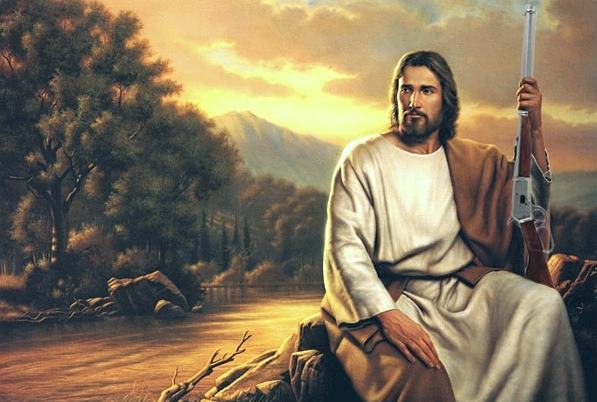
From the Internet, definitely a "not-Jesus".

From the Internet, definitely a “not-Jesus.”

That being said, here are ten preliminary questions to consider when Jesus asks the big one: “Who do you say that I am?”

  1. Where did your first images of Jesus come from? Have any of those become obsolete?
  2. What later images, experiences, and understandings caused those first images to grow, develop, change?
  3. What are your criteria for authenticity? Scripture, theological presuppositions, historical probability, psychological plausibility, inner experience, worship, moral resonance, etc.?
  4. Then vs. Now: Is Jesus only in the past, or can we encounter him in the present? Can faith communities receive information about Jesus that adds to the picture (as in the Fourth Gospel or the Book of Revelation)? Can individuals, such as Julian of Norwich in her visions of the Passion, be shown “new” things about the Jesus story? Can a painter, or a filmmaker, show us something new about Jesus? How can such new insights. assertions, or revelations be tested?
  5. Is historical investigation enough to reach the “real” Jesus? Is faith enough? Or do they shape and influence each other?
  6. What is the role of art, including film, in showing us Jesus? Can different images/actors/styles add to our understanding and experience of Jesus? What are the criteria that affect our receptivity?
  7. If a particular movie Jesus or scene doesn’t fit our own ideas. images, or understandings, do we reject it entirely, or do we engage with it, let its difference be a way to explore and test our presuppositions? Do we say, “That’s not Jesus,” and move on? Or do we wrestle till dawn with that stranger to see whether it might bless us?
  8. All language is difference: this is not that. Can even the not-Jesuses help define who Jesus is?
  9. Ontological Christology vs. functional Christology (being vs. doing): Do the identity of Jesus, and the authenticity of his representations, lie in who he is: a person in whom both human and divine are perfectly integrated (and then manifested in personality, charisma, appearance, and the way he feels to us)? Or does it lie in what he does, what he says, and how the story goes, regardless of our affective responses to his manner of being?
  10. If a particular representation of Jesus makes you uncomfortable, can that be a good thing?


Related Posts

The Ten Best Jesus Movies

My 10 Favorite Jesus Movie Moments


[i] “Faith and Image,” a conversation between Rowan Williams and Neil MacGregor, Art and Christianity 75 (Autumn 2013), 3

The ten best Jesus movies

Enrique Irazoqui and Pier Paolo Pasolini on location for "The Gospel According to St. Matthew"

Enrique Irazoqui and Pier Paolo Pasolini on location for “The Gospel According to St. Matthew”

The Feast of the Epiphany, recalling the journey of the Magi to adore the Christ child, ultimately celebrates the “showing” of Christ to the world. It seems the perfect day to post my list of the “ten best” Jesus movies, a genre which has fascinated me ever since I was a child extra in my father’s production of “Day of Triumph.” Surprisingly, that independent film by an Episcopal priest was the only Jesus film produced in the 1950’s, a decade packed with every other kind of biblical film.

For the last twenty-five years, I have taught “Jesus and the Movies” in seminaries, churches and retreat centers. I use clips from 19 feature films made between 1912 and 2014. The films always provoke rich conversations about biblical studies, Christology, religious art and film studies. Perennial issues of representation and interpretation are both repeated and transformed by the film medium, and the Jesus films, for all their limitations and imperfections, ask each viewer: “Who do you say that I am?” Even you don’t like a particular movie Jesus, you are compelled to think about the Jesus movie in your own head, your own heart. How does it differ from (or resonate with) what is on the screen?

As I noted in a prior post on the ten best religious films, top ten lists are subjective, revisable and always questionable, which is what makes them fun. And the Jesus film genre, burdened by religious expectations, commercial considerations, artistic pretensions and cultural controversies, has not produced any completely great films (each has its flaws, and the gospels themselves resist translation into perfect narratives), but it has given us many great scenes. I’ll list my favorite scenes in another post, but for now, in chronological order, here are my ten recommendations for your Epiphany binge-watching.

King of Kings (1961) Nicholas Ray’s uneven, studio-butchered epic was savaged by reviewers (“Incontestably the corniest, phoniest, ickiest and most monstrously vulgar of all the big Bible stories,” thundered Time Magazine). Blue-eyed fan-mag cover boy Jeffrey Hunter, although 33 years old, was dismissed as the “teenage Jesus,” though other saw echoes of JFK, inspiring and youthful, or “James Dean without the delinquency” (Ray had also made Rebel Without a Cause). And religious critics found too much humanity, not enough divinity. So what’s it doing on my list? Well, Ray was a terrific director, and the film is very watchable. It is also a prime example of cultural context shaping both the making and the reception of a Jesus film. Released at a time when both the biblical epic and the dominant Protestant metanarrative were on the wane in America, it failed for interesting reasons. At the same time, a Jesus constantly preaching “peace and love” reflected the ongoing anxieties of the Cold War era. And where else can you get narration by Orson Welles, a marvelous epic score by Miklos Rozsa (of Ben Hur fame), and the longest traveling shot in film history (160 feet of track on a steep Spanish hillside)?

The Gospel According to St. Matthew (1965) Pasolini’s black & white, hand-held, documentary “you are there” style, the rough-hewn faces of Italian non-actors, and the first dark-eyed Jewish Jesus all created an illusion of realism that instantly overthrew the conventions of biblical cinema. It is the first Jesus movie not to blend all four gospels or invent new dialogue and narration, though it significantly edits Matthew’s text (apocalyptic sayings, the Transfiguration, and some miracles are omitted). The director treats Jesus as a “revolutionary whirlwind” sweeping through Palestine. For some the protagonist is too strident, humorless and emotionally remote, but his relentless otherness nicely resists our domestication.

Jesus Christ Superstar/Godspell (1973) Permit me to link the Jesus musicals together: they came out in the same year, each is dated in its own way (singing and dancing on top of the World Trade Center, for example), and both remain strangely affecting, at least for persons of a certain age. In breaking the conventions of literal treatments, they not only opened new options for the genre, but influenced a rising generation of liturgists who brought street theater, comic play and contemporary music into the churches. Some critics glowered from the other side of a generational divide (“Jesus is just a teeny-bopper stoned on himself”), but there were more substantial controversies as well (in Superstar, a black Judas, an erotic Magdalene, Jewish villains caricatured as vultures, and a doubting Jesus). But each film provides a lively retelling with some very moving scenes.

Jesus of Nazareth (1977) Franco Zefferelli’s beautiful 6-hour miniseries on NBC, while shunning the artificial grandeur of Hollywood sets for a humbler, dustier Palestine, is suffused with its own pictorial conventions: Catholic iconography and Italian painting. Robert Powell’s engaging and self-assured Jesus, whose divine nature is clearly on display in key scenes, gives one of the most popular portrayals, though the film has been criticized for an overly interior spirituality that leaves the sociopolitical world untouched. Rather than trying to make Powell carry the entire burden of his character’s significance, Jesus of Nazareth focuses on the faces, reactions and emotions of his followers. Peter and Mary Magdalene, standing in for all of us who hear and follow, are unforgettable.

The Last Temptation of Christ (1988) The most controversial film of the genre prior to Mel Gibson’s Passion, Scorcese’s energetic, visceral take on the Kazanzakis novel is really a mashup of three bible characters: Jonah (the reluctant prophet resisting his inevitable vocation), Jesus of the gospels (creatively retold with a few quirky additions), and the Prodigal Son (who leaves the cross for the “far country” of a long, ordinary life, only to return “home” to Calvary at the end). This flawed but fascinating film has many firsts: the interior thoughts of Jesus, New York accents, sexuality, a restless camera always on the move, Peter Gabriel’s world music soundtrack, women at the Last Supper, and a novelistic source that exacerbates the confusions of fact and fiction.

Jesus of Montreal (1989) Denys Arcand’s postmodern play within a play furthered the transformation of a genre freeing itself from the restrictive conventions of piety and/or box-office caution. A group of contemporary actors, invited to reinvigorate a staid annual Passion Play, do so in wonderfully imaginative ways. At the same time, they find their personal lives starting to embody the characters they play. Earnest, clever and compelling, the film asks us to consider what it might mean to “play” Jesus in our own place and time.

Jesus (1999) This 4-hour television special offers a Jesus who seems quite modern in manner, speech and outlook. Jeremy Sisto is a “California slacker” type whose identity quest seems very American. This is often effective in putting us in the story, as if it’s something that could happen to us. But does it also reflect our own cultural selves so much that we can no longer believe we are seeing anything resembling history? An unprecedented use of special effects for the miraculous and mythic elements of the gospels is visually interesting, but it does create significant questions about what we are being asked to believe, since a special effect is transparently fictional, undermining the real but unseen content of faith.

The Miracle Maker (2000) Fresh, creative and often moving, this film uses claymation figures by Russian orthodox artists. Parables, dreams and inner experience are contrastingly rendered in two-dimensional animation. The engaging script, written by an Anglican, tells the Jesus story through the eyes of a child. The clay Jesus, resembling an eastern Christian icon (but with a ready smile) is more charismatic than many of his live-action brethren. The voice of Ralph Fiennes is part of the reason, but the animation itself engages us directly with the story in a way that real human faces do not. A dramatic film is always both a scripted fiction and also a kind of documentary about what the actors themselves are doing while the camera is rolling. With animation, you see only the story, not the actors, and that works beautifully here.

The Gospel of John (2003) This film gave itself a uniquely challenging task. Most Jesus movies invent dialogue to fill gaps in the narrative or articulate meanings left unsaid in gospel texts, but such a strategy is renounced here. The script uses only the words of the Fourth Gospel (in modern translation), forcing ingenious, if occasionally labored, strategies to keep the story moving and the viewer involved. The long speeches of the “Farewell Discourses” (John 13-17) are the supreme example. Ian Cusick’s Jesus is warm and passionate. You may never again hear “I am the bread of life” without seeing his smile.

Son of Man (2006) Produced in South Africa, it sets the Jesus story within a fictional 21st century African country beset by the horrendous legacy of colonialism, corporate exploitation, and factionalism. The first black movie Jesus is deeply embedded in contemporary times, teaching nonviolence to his disciples while speaking out against corrupt and evil powers. But we never lose sight of the original gospel story. The stunning depictions of Annunciation, Pieta and Resurrection will knock you flat. And the singing! So exhilarating. Here is a film where you really “meet Jesus again for the first time.”

No place like home

Over the rainbow photo

We didn’t have enough eggs this morning to make the walnut pie, so I headed out at dawn for the village grocery. On the way, I played Charles Ives’ “Thanksgiving Day”, a tone poem permeated with fragments of American hymnody. Ives said that the clashing moods of major and minor chords represented “the sternness and strength and austerity of the Puritan character, and it seemed to me that any of the major, minor, or diminished chords used alone gave too much a feeling of bodily ease, which the Puritan did not give in to.” [i]

The irony of driving my car to the store while contemplating Puritan rigor did not escape me, but I did pass a solitary runner braving the cold drizzle, and joined my spirit to his propitiatory sacrifice.

Ives’ cacophony of broken tunes resolves in the end with the choral singing of a New England hymn:

O God, beneath thy guiding hand
Our exiled fathers crossed the sea;
And when they trod the wintry strand,
With prayer and psalm they worshipped Thee.

We are all exiles: from the Garden of Eden, from our mother’s womb, from the homes we grew up in, from ancestral lands, from pasts best abandoned and futures that never happened. Longing for home is the human condition.

As Dorothy knew, clicking her red shoes, “There’s no place like home.” And on the fourth Thursday of November, millions of Americans go wandering in search of that place, real or imagined, where they were always welcomed and known and understood.

Frank Baum, author of the Oz books, was never quite satisfied with Dorothy’s choice of Kansas over Oz. In his sixth book of the series, Dorothy moves back to Oz, dragging Auntie Em and Uncle Henry with her. As Salman Rushdie notes, “Oz finally became home; the imagined world became the actual world.”

The real secret of the ruby slippers is not that “there’s no place like home,” but rather that there is no longer any such place as home: except, of course, for the home we make, or the homes that are made for us, in Oz; which is anywhere, and everywhere, except the place from which we began. [ii]

Whether you celebrate today in Oz, or in Kansas, or out there somewhere along the Yellow Brick Camino, may it be with a grateful heart and blessed community. And if you need directions home and don’t have your ruby slippers, you might try Raymond Carver:

Left off the highway and
down the hill. At the
bottom, hang another left.
Keep bearing left. The road
will make a Y. Left again.
There’s a creek on the left.
Keep going. Just before
the road ends, there’ll be
another road. Take it
and no other. Otherwise,
your life will be ruined
forever. There’s a log house
with a shake roof, on the left.
It’s not that house. It’s
the next house, just over
a rise. The house
where trees are laden with
fruit. Where phlox, forsythia,
and marigold grow. It’s
the house where the woman
stands in the doorway
wearing sun in her hair. The one
who’s been waiting
all this time.
The woman who loves you.
The one who can say,
“What’s kept you?” [iii]

[i] Liner notes by Paul C. Echols, Charles Ives Holidays Symphony, Chicago Symphony Orchestra and Chorus conducted by Michael Tilson Thomas (CBS 1986)

[ii] Salman Rushdie, The Wizard of Oz (London: British Film Institute, 1992), p. 57

[iii] “Waiting,” by Raymond Carver, from All of Us: The Collected Poems (Alfred A. Knopf)

The ten best religious films

DCP blessing2

A man goes into a butcher shop and says, “Give me your best piece of meat.” And the butcher replies, “Everything in my shop is the best.” (Zen story)

Top ten lists are inherently fraudulent. By what authority do I declare what is best? And by what criteria? And which religion? But if I had titled this post, “Ten compelling films which engage religious questions from a [mostly] western Christian perspective,” it wouldn’t be nearly as much fun. We love rankings, if for no other reason than the pleasure of argument.

My list is totally subjective of course, and infinitely revisable, depending on the day, or where I am in my life (although Robert Bresson’s Diary of a Country Priest has topped my list every since I first saw it in Ann Arbor 45 years ago and subsequently had to wander around for a couple of hours on a rainy night until I was capable of returning to ordinary life).

I have restricted myself to one film per director (or else Bresson would take up about six places, and Tarkovsky a few more, etc.). I have also stuck to the western Christian tradition, with the Russian orthodoxy of Tarkovsky the one exception.

And while there are many films with spiritual subjects or theological themes, I have focused primarily on examples of what Paul Schrader calls “transcendental style” – films which are not just about religious experience, but themselves create religious experience in the viewer, through cinematic form and language as much as story. Icon writers know this well. There’s a lot to say about transcendental style, but for now let me simply cite Susan Sontag’s remark about Robert Bresson: “His form does not merely perfectly express what he wants to say. It is what he wants to say.”

All these films are available on DVD or Blu-ray, and I hope you will be encouraged to explore them. But I must warn you that not all these films are equally accessible. Most of them refuse the usual manipulations and excitements of mass cinema, and demand a contemplative mind. Transcendental style can be as rigorous as prayer. But as Iranian director Abbas Kiorastami has said, “I would rather see a film that might even bore me in the act of watching but that later I can’t stop thinking about, than a film that keeps me on the edge of my seat and then is immediately forgotten.”

Here is my list, in alphabetical order.

1) Decalogue (Krzysztof Kieslowski, Poland 1988)   This extraordinary cycle of short films explores various lives within a single apartment block, whose grey concrete bleakness exudes the alienation and melancholy felt by many of its residents. It is the world after the Fall, when instinct and intuition no longer suffice to guide human living. Each film is roughly based on one of the Ten Commandments, but the imperatives of each situation are far from clear. Choices matter intensely (it is not such a godless world that one can do anything one wishes), but most of the characters are bewildered and beset by the questions before them. And yet – grace happens, people connect, souls find mercy. Not every time, but enough to keep alive the hope that God – embodied by a mysterious figure who always seems to be around at key moments – has not abandoned us.

2) Diary of a Country Priest (Robert Bresson, France 1950)   Bresson pares away everything inessential to show the story of a soul. The miracle of his “transcendental style” is that he shows us not so much what people do as who they are – not through explaining them psychologically, but by letting their mystery be. As with iconography, a kind of inexpressiveness on the surface allows hidden depths to shine through. As the priest walks his own Stations of the Cross, the sorrowful way becomes a revelation of grace. This is not a film about religious experience – it is religious experience.

3) Ida (Pawel Pawlikowski, Poland 2013)   Is the religious life purely a product of environment, or is it indelibly inscribed on the heart? In 1962, a young novice, raised as an orphan in her convent, is sent into the world to visit her only living relative, just prior to taking her final vows. Will her vocation survive outside the cloister? The people she encounters, the discoveries she makes about her past, the suddenly viable prospect of a life in the outside world – all present her with new options for her life and vocation. One of the many beauties of this film is that neither the convent nor the outer world are judged. Both are viewed with sympathy and respect. Until she decides her future, Ida is shown off center, at the edge or bottom of the frame. But in the film’s final shot, she is perfectly centered at last.

4) Into Great Silence (Philip Gröning, Germany 2005)   The director spent 6 months in residence at a Carthusian monastery in the Alps, filming monastic life and worship. Using only natural light, he shows us a numinous world of shadows pierced by the radiance of windows and candles. Dwelling in this world of prayer and silence for nearly three hours, we slow ourselves to the monastic rhythm, and emerge refreshed and centered, and thankful for those who give their lives to providing, as Dan Berrigan once put it, “large reserves of available sanity.”

5) Magnolia (Paul Thomas Anderson, USA 1999)   Is the world only a confusion of chance and arbitrary choice, or do providence and purpose exist? Is the universe a matter of chaos or love? Anderson explores the possibility of connection, pattern and grace in the intersecting lives of many different characters, all of whom are in some way broken, wounded or lost, casualties of a city (Los Angeles) which, like the biblical Egypt, has produced countless captives and victims. In one unforgettable scene, nine of the characters are shown, each in their particular condition of need and supplication, singing along with the soundtrack, Aimee Mann’s “Wise Up” (“It’s not going to stop till you wise up”). Their capacity to exit the prison of the self just enough to partake of the soundtrack’s “common prayer” is both ritual transcendence and the tentative praxis of real liberation. As if in answer, a biblical rain of frogs falls from heaven.

6) The Mill and the Cross (Lech Majewski, Poland 2011)   In a windmill perched high above a broad plain teeming with figures, God is a miller grinding the terrors of history into something better, even as the Christ is being dragged to the cross. This strange, haunting and difficult film immerses us within the complex world of a single painting, Pieter Brueghel’s “The Way to Calvary,” where the Passion of Christ is relocated to the painter’s own 16th century world. Through a visually stunning use of computer imaging, we dwell within the painting’s fantastic landscape and mingle at close range with its numerous characters. The effect is astonishing, as if we are dreaming with a premodern mind. The human suffering is arduous and heartbreaking, but it does not have the last word. In the end, the dance goes on.

7) Nostalghia (Andrei Tarkovsky, Russia 1983)   All of Tarkovsky’s films practice what he called “sculpting in time,” using a contemplative camera and lengthy shots to register a deeper flow and presence than films that hurry from one incident to the next. For western Christians, the image is usually about something. For an orthodox Christian like Tarkovsky, the image is something. The viewer becomes less a spectator than a supplicant. “The aim of art,” said Tarkovsky, “is to prepare a person for death, to plough and harrow the soul, rendering it capable of turning to the good.” Nostalghia is more poetry than narrative, rhyming fire and water, dream and memory, ritual and redemption, to counter the malaise of materialism.

8) Of Gods and Men (Xavier Beauvois, France 2010)   Based on a true story of a monastic community facing martyrdom in 1990’s Algeria, this is a profoundly moving story of self-offering and radical forgiveness. Structured around the liturgical hours and seasons, its unhurried scenes of prayers and chants allow us to worship along with the monks. But they are asked to sacrifice more than praise, and their faithful willingness to take up the cross poses serious questions for our own discipleship.

9) Ordet (Carl Dreyer, Denmark 1955)   Like the parables of Jesus, Ordet (“The Word”) employs the forms and situations of the everyday world only to break open the frame of that world with the startling intrusion of an alternate reality. Dreyer’s film, like its “holy fool” Johannes, presents us with divine impossibility in perpetual tension with the way we expect things to go. It uses material means – faces, architecture, landscape, language, light – to show us the immaterial, but in the end we are led not away from corporeal existence, but rather more deeply into it.

10) To the Wonder (Terrence Malick, USA 2012)   “Love everyone. Every leaf. Every ray of light. Forgive.” This line from The Tree of Life (drawn from Dostoevsky) is the theme of every Malick film. While his work has always reflected a deep interest in philosophy and religion, his most recent films have been theologically explicit to a degree unique in American cinema. The Tree of Life covers the biblical span from Creation to Apocalypse, while To the Wonder narrows its focus to the Song of Songs’ analogy between human relationships and divine-human love. Unlike the plot-driven narratives of most films, To the Wonder unfolds in hints, glimpses, ellipses and temporal leaps. We can’t always be sure whether we are seeing events, memories or thoughts. As with Bresson, there is no psychological explaining of characters. They retain the open-endedness of their essential mystery. It’s not so much a film in the usual sense as it is a dance, a poem, even a prayer. The viewers aren’t simply invited to watch the ecstatic images, but to become ecstatic themselves.

The most dangerous place in the world

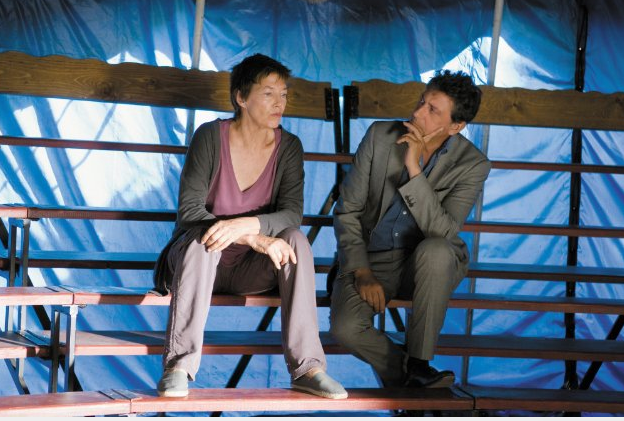
Small mtn tent still

I have come to understand that this small ring is the most dangerous place in the world, but also a place where everything is possible, where eyes are opened.

In Jacques Rivette’s magical film, Around a Small Mountain (2009), a footloose Italian named Vittorio, wandering Europe’s back roads in a sports car, chances upon a small French circus on tour in the backwater of Languedoc. Although the story is set in our own time, it is really a medieval romance. Vittorio is the knight errant questing for that nameless object of desire perpetually beyond his grasp. And the enchanted world of the cirque, curiously untouched by modernity, is the place where the knight will be tested.

When Vittorio encounters the enigmatic Kate, a woman who is “a prisoner to what happened” in the circus ring years ago, he lingers in her domain long enough to attempt a rescue. “All the dragons in our lives may be hurt princesses,” he says, echoing Rilke’s famous line: Perhaps everything terrifying is deep down a helpless thing that needs our help.

As Vittorio attempts to break the spell cast over Kate by the lingering presence of a dead father and the haunting absence of a dead lover, he has to face his own dragon, which is never specifically identified. The secret of his being remains a mystery, unknown to himself and to the actor who plays him, unknown to the audience and the director as well. The sentimentality of a conventionally romantic conclusion – man and woman settling down happily ever after – would betray this mystery, and Rivette rejects such an option. The ultimate fate of Kate and Vittorio is not revealed to themselves or us. “Will I start living again?” she wonders. “I don’t know if I am alive,” he says. Might the future perhaps return them to each other? “Who knows?” is the last line of the film.

We exit this cinematic world still mesmerized by its embrace of uncertainty, its refusal of resolution. Like the knight errant, we remain prisoners of unsatisfied longing. We wouldn’t have it any other way. As C. S. Lewis noted, an unsatisfied desire is “more desirable than any other satisfaction.”

Nevertheless, something transformational has happened to Kate and Vittorio and, vicariously, to us, in that “most dangerous place,” the circus ring. They have each stepped into the exposed and empty space where they must perform the truth of themselves, put themselves at risk, wrestle their demons, without really knowing in advance how they’ll ever get through it. But they have already taken their first steps into a new life. In the words of the German Romantic Friedrich Hölderlin, quoted in another Rivette film, “Where danger is, there grows the saving power also.”

I recently saw Around a Small Mountain for the first time, and I was particularly struck by the hermetic quality of the circus. It seems sealed within its own world, having minimal interaction with contemporary life. The landscape it travels remains little changed from the Middle Ages, as if forgotten by modernity. Though the circus is touring the towns around the perimeter of a small mountain, there is little sense of movement from place to place. Wherever the troupe pauses in their circuit, the mountain’s solitary peak still looms in the background, as if the land itself casts a spell they cannot escape.

In the course of the film, we see a number of performances, but they seem to have no public. The first time we enter the tent, there are only a few people in the audience as the camera sweeps over mostly empty seats. After that, the camera doesn’t even bother to look away from the ring to the surrounding bleachers, so we are never sure whether we are viewing a rehearsal or an actual show.

The acts are performed in an almost eerie silence, without applause or any other sounds to indicate the presence of an audience. This melancholy absence of witnesses seems of no concern to the acrobats, jugglers and clowns who carry out their rituals with as much devotion and attention as a priest saying mass in an empty church. Whether what they do is of any relevance to the outside world does not seem an issue for them. What matters is the faithful performance of the circus rites.

As I watched the ritualized actions in the circus ring, skills and gestures passed down through many centuries, imbued with the strangeness of a premodern sensibility, I could not help thinking about the Christian liturgy. We too perform rites forged in a distant past, shaped by a social imaginary largely unintelligible to secular modernity. And like the circus in the film, our “audience” has largely deserted us.

In his audio commentary on the DVD, Chris Fujimara describes the circus as “an end state, a final repository, a gathering and summation. Everything in life is being distilled and evoked from this ring in a way that has to do with aging, with memory, with death, with the imminent end of things, with the suggestion that the circus, this mode of entertainment and spectacle, already belongs to the past.”

There are those who see Christianity’s own pastness as prelude to extinction, and believe everything alien to the present social imaginary should be jettisoned as quickly as possible. I myself have spent over forty years adding radically contemporary elements to the worship mix. But that has never, I hope, been at the expense of the strangeness of what we do and the mystery of what we worship.

In some future posts I will have more to say about the implications of this strangeness for the concrete practices of worship as well as the need to connect with an absent public. But for now, like the ringmaster, may I simply direct your attention to the center ring, the most dangerous place in the world, the empty space where everything is possible, where eyes are opened. To paraphrase Jacques Rivette, “there is no other subject.”