July 4th and the Pursuit of Happiness

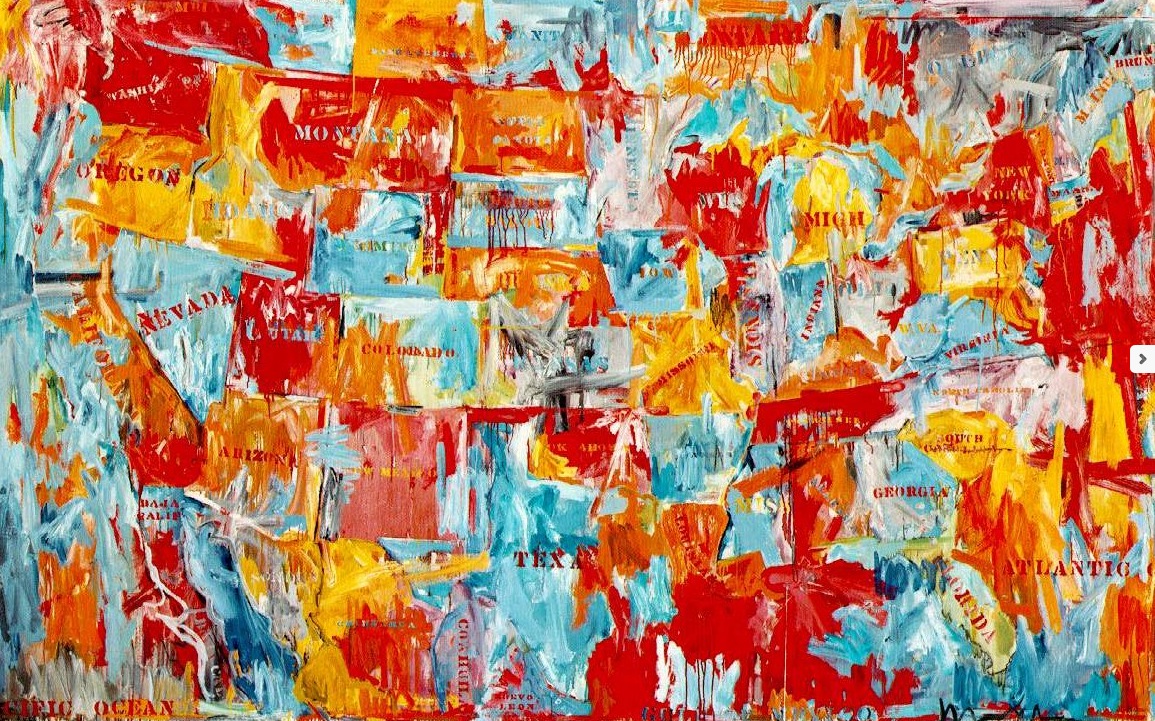
Map (Jasper Johns, 1961)

Map (Jasper Johns, 1961)

On July 4, 1776, Thomas Jefferson rose before dawn, recorded the temperature at 6 a.m. (68 degrees), had some tea and biscuits, and made his way to Independence Hall. Sixty-nine years later, Henry David Thoreau chose the day to begin his sojourn at Walden Pond. On July 4, 1863, Lee’s Confederate army began its decisive retreat from Gettysburg, and on the same date in 1895 Katherine Lee Bates published “America the Beautiful”. Nathaniel Hawthorne, Stephen Foster, Louis B. Mayer and Obama’s oldest daughter were all born on July 4, and both Jefferson and John Adams died on the 50thth anniversary of the Founders’ Declaration. So what do the rest of us have planned for Independence Day?

It was Adams who predicted that the Fourth would be “celebrated by succeeding generations as the great anniversary festival” and “solemnized with pomp and parade, with shows, games, sports, guns, bells, bonfires, and illuminations, from one end of this continent to the other, from this time forth for evermore.”[i] We have more or less fulfilled the externals of Adams’ vision, but the mindfulness with which we keep the feast is subject to question. In 1975, just before the American Bicentennial, a Gallup poll revealed that 28% of Americans were unable to identify what significant event happened in 1776.

What should we remember as a people? Do we create simplifying myths that unite us with some intoxicating blend of nostalgia and amnesia? Sanitizing and depoliticizing the past is a way to reduce conflict, as in the efforts to heal sectional division after the Civil war. But that can leave grievous social ills unaddressed and unhealed. The current debate about the Confederate battle flag shows how deeply embedded such sanitizing mythology can be. Preserving “heritage,” we discover, is a massive process of forgetting where, in Joan Didion’s memorable phrase, “no one is bloodied by history.”[ii]

Some governments try to supervise the formation of collective memory. The late Soviet Union is a notorious example, but there are also more benign forms of cultivating shared cultural identity (mais oui!). But in America, as Michael Kammen has noted, “people forget and remember largely on their own.”[iii] We have no ministry of culture, and national memory is contested without official referees.

But few of us will give much thought to either politics or culture tomorrow. As a radio talk show guy put it in his summary of America’s military mission: “Those guys are fighting so we can have barbecues and drink beer.”[iv] Pursuit of happiness indeed. But as Daniel Webster noted, it has always been so. “The tavern,” he said, “was the headquarters of the Revolution”[v] – a gathering place where ideas were exchanged and debated. In these latter days we have retained the conviviality of the tavern while dispensing with the ideas. The long-winded orations of old-time Fourths are long gone. There will be little thoughtful discussion of liberty and the common good around the barbecue. No radical challenges to tyranny and oppression will be issued. We’ll just enjoy a day off with our families, friends and neighbors as we pursue happiness together. And in a society fraught with so much division and disconnection, being together in peace and play and joy may be as good a way as any to keep the American feast.

One of the moments when I feel community most vividly is after the last fireworks fade to black above our local harbor. All of us who have watched from the beach begin to make our way along a forest path back to the road. It is too dark to see faces, or anything else that distinguishes one from another. We are an egalitarian procession of shadows, walking together. No longer pursuing happiness, we seem to have found it. Being there together in the night, for a few lovely minutes, is the most important fact about us.

The wonder I feel in the holiday’s concluding moment is beautifully expressed in Samuel Hynes’ memoir of his childhood in the 1930s. Although he grew up in a very different America, his description touches on something timeless:

The last rocket is always the best of all – burst after burst, the echoes rebounding, and then another burst just when you think it is all over. And then it is. The families rise slowly in the sudden silence and fold their blankets, and walk home through the dark, still streets, not talking much, purged by the high splendors they have seen, satisfied that another Fourth is over, another summer has been celebrated with a proper hullabaloo.[vi]

[i] Benson Bobrick, Angel in the Whirlwind: The Triumph of the American Revolution (New York: Penguin Books, 1998), 203

[ii] Michael Kammen, Mystic Chords of Memory: The Transformation of Tradition in American Culture (New York: Vintage Books, 1993), 667

[iii] ibid., 700

[iv] Overheard on a Montana roadtrip a few years ago.

[v] Angel in the Whirlwind, 494

[vi] Samuel Hynes, The Growing Seasons: An American Boyhood Before the War (New York: Penguin Books, 2003), 111
The Angel of Possibility

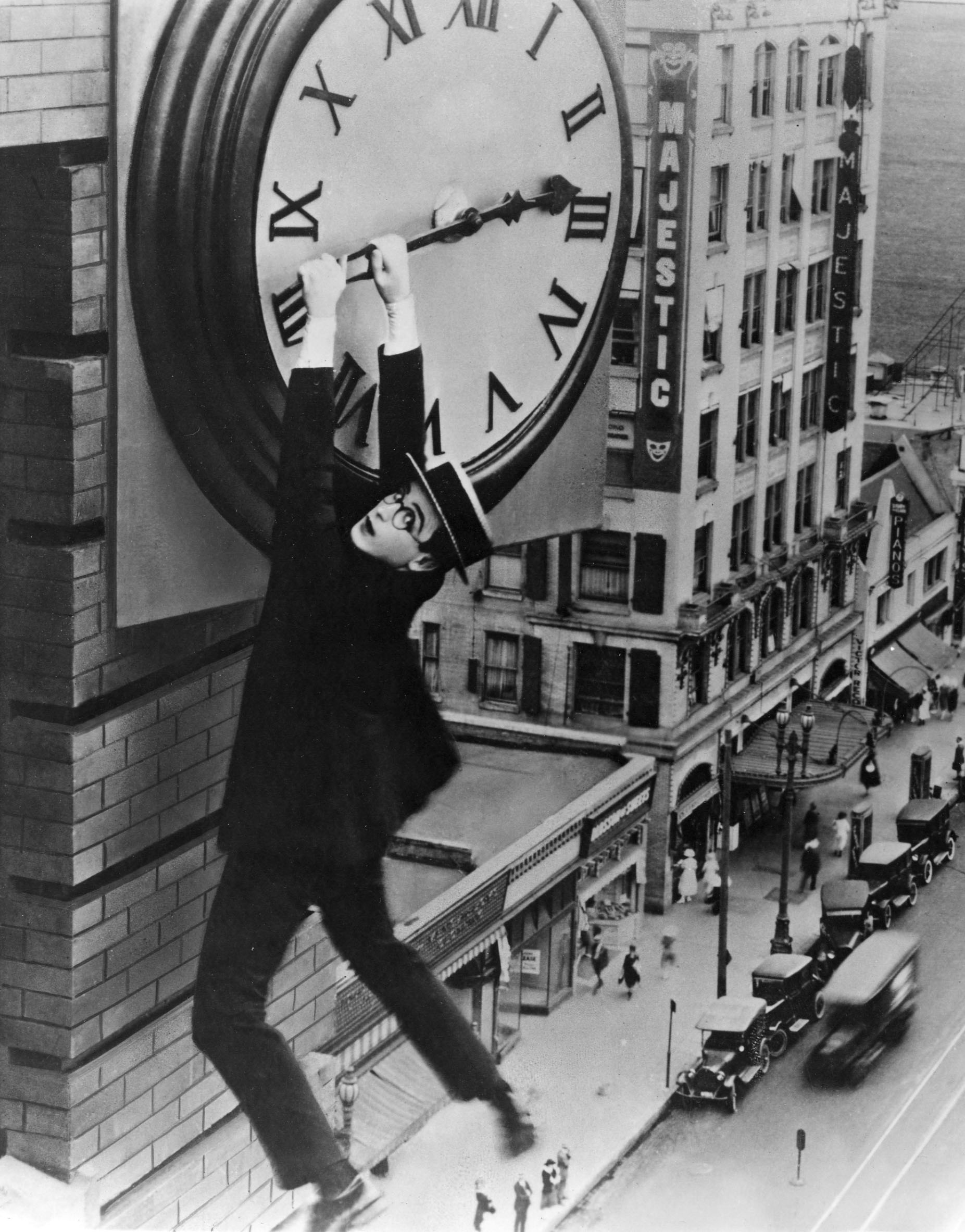
Harold Lloyd clock

My times are in your hand; deliver me.  (Psalm 31:15)

“Let me be the first to wish you a happy and blessed 1984.” This first salutation of the New Year was given, two minutes after midnight, by Bishop Desmond Tutu to several hundred Episcopal college students and campus ministers gathered at a snowy retreat center in the Rocky Mountains. He was preaching at a eucharist begun in the final moments of 1983. The gospel reading, spanning the stroke of midnight, accompanied our entry into the year of Orwellian dread, 1984. Then the bishop’s genial greeting at the start of his homily broke the fatalistic spell cast by the 1949 novel. Orwell’s terrible future had not come to pass. Instead, a man stood before us speaking eloquently and authentically about hope and possibility. A few weeks later he would win the Nobel Peace Prize. The God of history is yet capable of surprise.

But it remains an act of faith to believe this in earnest. Walter Benjamin, a German thinker in the darkest of times, gave a chilling description in 1940 of the “angel of history,” who can see nothing but the terrible past as he is swept backward into the future:

His eyes are staring, his mouth is open, his wings are spread. This is how one pictures the angel of history. His face is turned toward the past. Where we perceive a chain of events, he sees one single catastrophe, which keeps piling wreckage upon wreckage and hurls it in front of his feet. The angel would like to stay, awaken the dead, and make whole what has been smashed. But a storm is blowing from Paradise; it has got caught in his wings with such violence that the angel can no longer close them. This storm irresistibly propels him into the future to which his back is turned, while the pile of debris before him grows skyward. This storm is what we call progress. [i]

As we contemplate the wreckage of 2014, we might well share Benjamin’s despair. But there is another angel, the angel of possibility, who knows better. This angel says: Do not be afraid. Whatever twists and turns the story may take, it is in the end a story of life, not death.

And every New Year’s Eve, we ritually renew our faith in that story. There is an element of carnival this night, as we throw off the tyranny of good order for a bit of wild excess, declaring independence from the way things are in the name of things to come. But the night’s underlying theme is not chaos but renewal, as expressed in the traditional English carol:

The old year now away is fled, the new year it is entered…
Now, like the snake, your skin cast off… and so let the year begin.

This festival of rebirth, ringing out the old, ringing in the new, reflects an abiding human rhythm. Whether it’s every morning or every December 31st, we bid farewell to our flawed efforts and bad habits, resolving to do better this time around. Taken in isolation, New Year’s Eve has a whiff of doubt if not desperation. We know that the midnight noise and kisses will soon fade into the hangovers and broken resolutions of January’s new morning.

But New Year’s Day is also the eighth day of Christmas, the festival of Incarnation. What wants to be born is not a project of our own making, doomed to wither in the wintry blast of time. The Babe of Bethlehem is not the cartoon baby draped in the banner of “2015,” deposing the old man of “2014” in a melancholy preview of its own ultimate fate 365 days hence.

The holy Child is the Lord of the Dance “that will never, never die.” Yes, this new person will share our mortal condition; he will live and die as one of us. But in so doing he will accomplish what we can never do on our own. He will make our own stories part of the divine Dance. He will guide our own steps into the way of peace.

People often fuss about whether Christmas is pagan or Christian, secular or sacred. But the whole point of Christmas is that it is now impossible to tell the two apart. Ever since “the great angel-blinding Light” shrank “His blaze, to shine in a poor shepherd’s eye,”[ii] what George Herbert termed “Heaven in ordinarie”[iii] is the way this Dance goes. When the Christmas festival fades like Scrooge’s transformative dream, we will all return to habitual place and ordinary time. But if we have paid any attention at all, nothing will be quite the same again: neither ourselves, nor the world, nor the flow of time.

God with us. This changes everything.

On this last day of the year I rose early and went outside to see the stars. Orion, winter’s dominant constellation, had already left the stage. Leo, who rules the western sky on spring evenings, now roared in his place. To gaze on the night sky before dawn is to behold the future. Standing in the cold of winter, I looked upon the constellations of spring. And to complicate the metaphor, the starlight itself was a message from the distant past.

Time is a mysterious gift. Past, present and future keep changing partners in the everlasting whirl of the Dance. Breathless, we do our best to keep up. As W. H. Auden put it, “if there when grace dances, I should dance.”[iv]

The poet also wrote perhaps the best New Year’s Eve line of all, which I commend to you with my wishes for a most happy and blessed 2015:

Time is our choice
of How to love
and Why.[v]

[i] Walter Benjamin, Theses on the Philosophy of History, q. in Hugh Rayment Pickard, The Myths of Time: From Saint Augustine to American Beauty (London: Darton, Longman and Todd Ltd, 2004), 75

[ii] Richard Crashaw, “Satan’s Sight of the Nativity,” in The Roads From Bethlehem: Christmas Literature from Writers Ancient and Modern, ed. Pegram Johnson III and Edna M. Troiano (Louisville, KY: Westminster/John Knox Press, 1993) 148

[iii] George Herbert, “Prayer I”, George Herbert: The Country Parson & The Temple, ed. John N. Wall, Jr. (Mahwah, NJ: Paulist Press, 1981)

[iv] W.H. Auden, “Whitsunday in Kirchstetten,” Collected Poems, ed. Edward Mendelson (New York: Random House, 1976), 559

[v] “For the Time Being: A Christmas Oratorio,” Collected Poems p. 297. This remarkable work, a must-read for the Christmas season, was performed live before the New Year’s Eve eucharist mentioned at the beginning of this post. Auden reminds us that, once we have seen the Child of Incarnation, our challenge is to redeem the “Time Being” from insignificance.

No place like home

Over the rainbow photo

We didn’t have enough eggs this morning to make the walnut pie, so I headed out at dawn for the village grocery. On the way, I played Charles Ives’ “Thanksgiving Day”, a tone poem permeated with fragments of American hymnody. Ives said that the clashing moods of major and minor chords represented “the sternness and strength and austerity of the Puritan character, and it seemed to me that any of the major, minor, or diminished chords used alone gave too much a feeling of bodily ease, which the Puritan did not give in to.” [i]

The irony of driving my car to the store while contemplating Puritan rigor did not escape me, but I did pass a solitary runner braving the cold drizzle, and joined my spirit to his propitiatory sacrifice.

Ives’ cacophony of broken tunes resolves in the end with the choral singing of a New England hymn:

O God, beneath thy guiding hand
Our exiled fathers crossed the sea;
And when they trod the wintry strand,
With prayer and psalm they worshipped Thee.

We are all exiles: from the Garden of Eden, from our mother’s womb, from the homes we grew up in, from ancestral lands, from pasts best abandoned and futures that never happened. Longing for home is the human condition.

As Dorothy knew, clicking her red shoes, “There’s no place like home.” And on the fourth Thursday of November, millions of Americans go wandering in search of that place, real or imagined, where they were always welcomed and known and understood.

Frank Baum, author of the Oz books, was never quite satisfied with Dorothy’s choice of Kansas over Oz. In his sixth book of the series, Dorothy moves back to Oz, dragging Auntie Em and Uncle Henry with her. As Salman Rushdie notes, “Oz finally became home; the imagined world became the actual world.”

The real secret of the ruby slippers is not that “there’s no place like home,” but rather that there is no longer any such place as home: except, of course, for the home we make, or the homes that are made for us, in Oz; which is anywhere, and everywhere, except the place from which we began. [ii]

Whether you celebrate today in Oz, or in Kansas, or out there somewhere along the Yellow Brick Camino, may it be with a grateful heart and blessed community. And if you need directions home and don’t have your ruby slippers, you might try Raymond Carver:

Left off the highway and
down the hill. At the
bottom, hang another left.
Keep bearing left. The road
will make a Y. Left again.
There’s a creek on the left.
Keep going. Just before
the road ends, there’ll be
another road. Take it
and no other. Otherwise,
your life will be ruined
forever. There’s a log house
with a shake roof, on the left.
It’s not that house. It’s
the next house, just over
a rise. The house
where trees are laden with
fruit. Where phlox, forsythia,
and marigold grow. It’s
the house where the woman
stands in the doorway
wearing sun in her hair. The one
who’s been waiting
all this time.
The woman who loves you.
The one who can say,
“What’s kept you?” [iii]

[i] Liner notes by Paul C. Echols, Charles Ives Holidays Symphony, Chicago Symphony Orchestra and Chorus conducted by Michael Tilson Thomas (CBS 1986)

[ii] Salman Rushdie, The Wizard of Oz (London: British Film Institute, 1992), p. 57

[iii] “Waiting,” by Raymond Carver, from All of Us: The Collected Poems (Alfred A. Knopf)