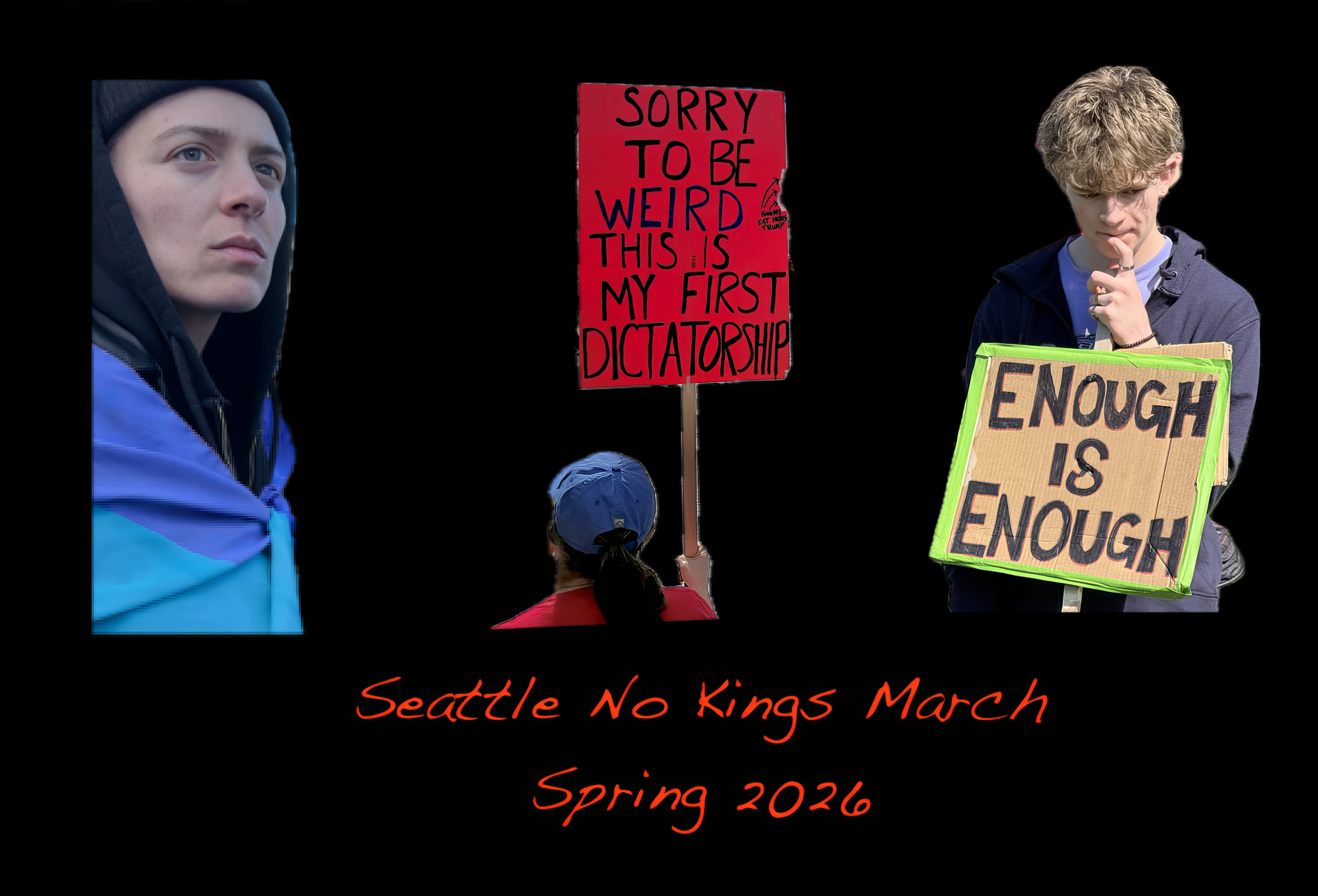
For the latest No Kings March to occur on the eve of Palm Sunday seemed to me a resonant conjunction. Both yesterday’s march and the “triumphal entry” of Jesus into Jerusalem stirred the deepest hopes of people suffering under oppressive regimes. Of course not all hopes are equal, and sometimes they turn out to be, as T. S. Eliot noted, “hope for the wrong thing.” Even if the folks shouting Hosanna in Jerusalem were mistaken about what God was up to that week, I imagine Jesus still being touched by their longing, that crazy feeling that the world might just get better. The capacity for hope is one of humanity’s finest qualities.
There is some irony, of course, in linking No Kings to a biblical event suffused in royal imagery. I’ve been singing the Palm Sunday processional, “All glory, laud, and honor to thee, Redeemer, King!” ever since I was a child. But God is no stranger to irony—manifesting divinity as a helpless child, “ruling” as a servant, and dying to give life. And a line by the late great songwriter Bob Franke neatly resolves, for me at least, any tension between democracy and religious language inherited from monarchists.
Well you kneel to the Lord and you will bless yourself; Ain’t no need to kneel to no one else.
In a week when people of my tradition walk the Way of the Cross in ritual, song and story, we know that hope is no stranger to struggle and suffering. It’s a long and winding road to Easter, passing through Gethsemane and Golgotha. Yet it remains, as the Book of Common Prayer assures us, “none other than the way of life and peace.”
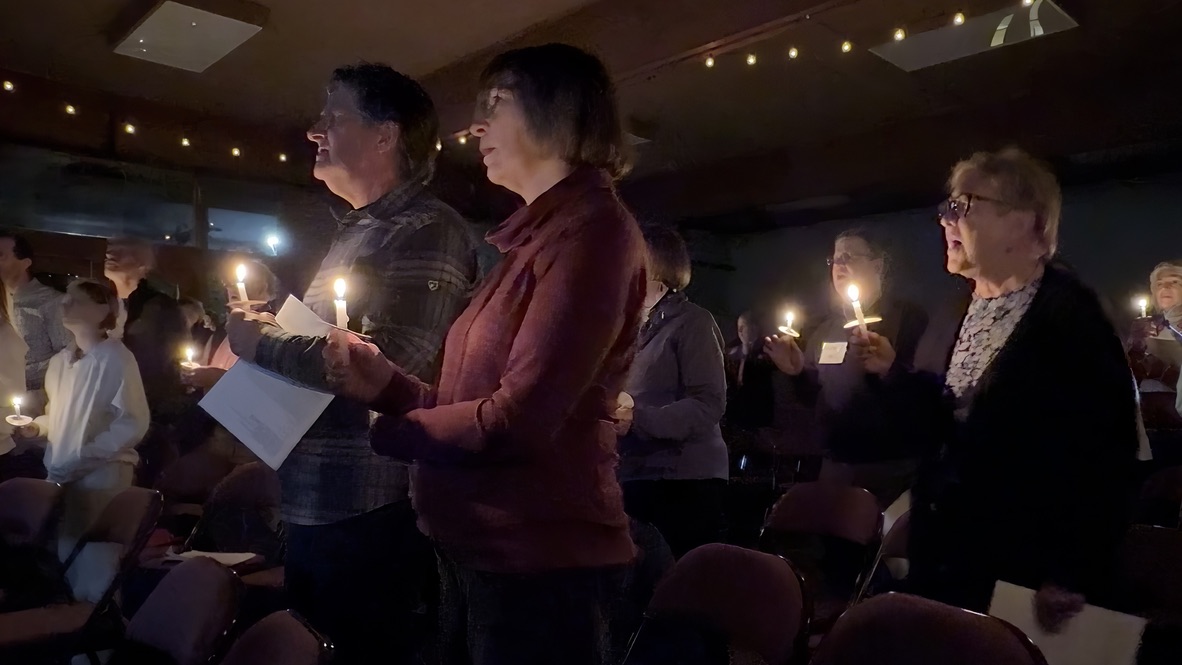
On yesterday’s march in Seattle, I shot video of what I saw, and in putting it together I was struck all over again by the recurrent note of joy. Not everyone would put it this way, of course, but for one gloriously sunny day, we were, as the South Africans sing, “marching in the light of God,” and the divine future of human flourishing made a significant incursion into the present moment. As the crowd chants in the opening of my video:
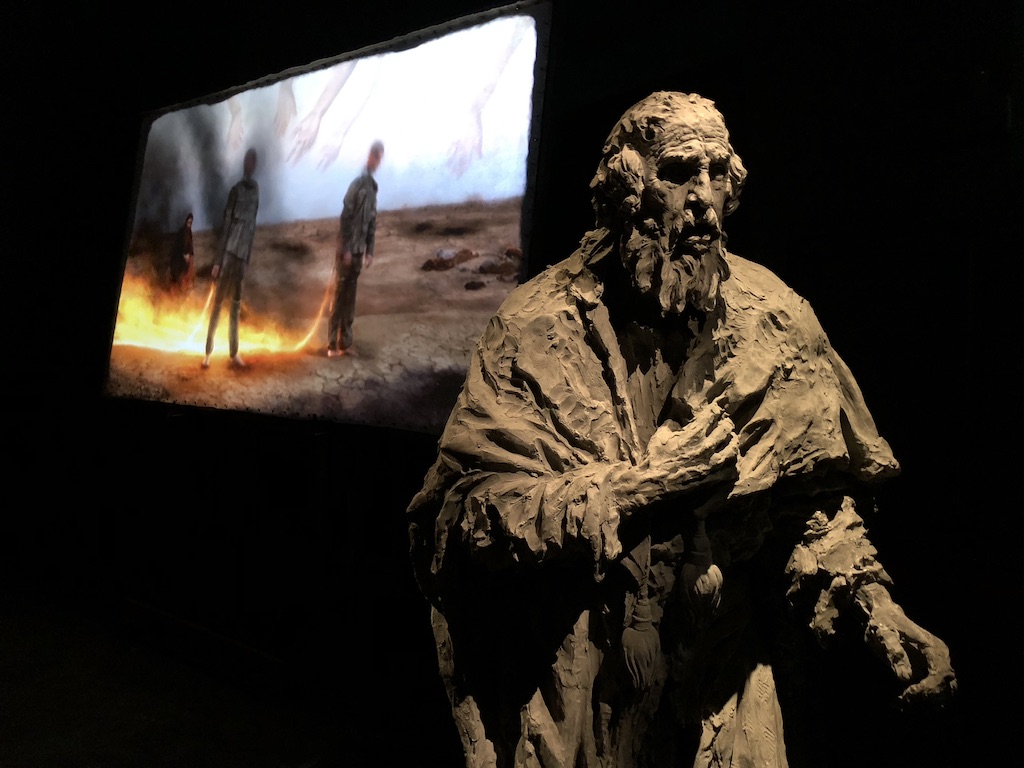
Biblical stories can be retold in many ways with a variety of media. This is part of The Prodigal Son parable in an elaborate and moving installation by Alexander Sokurov at the Venice Biennale in 2019. (Photo by the author)
This is the third in a series of posts responding to the alarming events in Minneapolis. It may be the most arcane, of interest only to worship planners and storytellers. I usually try to write posts of more general interest, but my long experience as a liturgical creative and biblical storyteller impels me to set this down, for what it’s worth, as a small personal contribution to the ongoing efforts of the faithful to resist public malice and hold fast to the good with all the means at our disposal.
In evil times such as these, how can churches be faithful to the Baptismal Covenant to “persevere in resisting evil … seek and serve Christ in all persons … strive for justice and peace among all people, and respect the dignity of every human being”? In recent weeks, we have seen many clergy and laity adding their voices and bodies to the resistance against tyranny and cruelty in Minneapolis, and to the increasingly dangerous work of loving our neighbor and protecting the vulnerable.
As a longtime liturgist, I find myself wondering how—and to what degree—our worship gatherings, in addition to our witness in the public square, might themselves be responsive to what is happening around us—and inside us—during America’s current authoritarian nightmare. Prayer and preaching are two vital ways, and I have given some striking examples in my two previous posts, White House Brutality (prayer as a “refusal to consent to an unredeemed world … It breaks the silence, awakens the passive, and cultivates action, both human and divine.”) and Murder in Minneapolis (featuring one priest’s prophetic sermon, forged in the crucible of tyranny and protest).
Singing is also a powerful weapon against evil and its sad progeny—discouragement, fear and despair. It’s been said that the Civil Rights movement succeeded in part because it had a great soundtrack. Its stirring adaptations of black spirituals, sung not only in the marches but also in the jails, kept voices high and spirits strong. As they say, the people unitedwill never be defeated. And nothing unites like communal singing. The resistance to American fascism is taking this to heart as collective song becomes once again a vital part of public protests.
Prayer, preaching and singing are all powerful ways to say yes to God and no to evil. And to that list I would add the telling of our sacred stories. Creative engagement with Scripture deserves equal attention as a means to lift up our hearts and shine the light of hope against the darkness. Week after week, year after year, Christians tell formative stories of sin and redemption, strife and reconciliation, despair and hope, losing and finding, oppression and liberation, death and resurrection. Then the preacher strives to connect those biblical stories with our own lives and times. But what if we were to make those connections not just in our homiletic reflections following the stories, but in the storytelling act itself?
As a young priest in Los Angeles during the Vietnam War, I staged a dramatized version of Jesus’ parable of the Unforgiving Debtor for an experimental eucharist. The man whose debt was very small was a draft resister, thrown into prison by an angry creditor dressed as Uncle Sam. That creditor was then reminded of the immensity of his own debt, illustrated by projected images of the atrocious violence in Southeast Asia.
Such a pointed retelling of Scripture might be too edgy for typical Sunday worship, but there are times when biblical stories really want to be heard in fresh and compelling ways. Holy Week 2026 can be a great opportunity to do that. How might worship planners think creatively about the Paschal journey from death to life in the context of our current experience of state-sponsored hate and violence?
The next No Kings march is scheduled for March 28, the day before Palm Sunday. How will it feel to reenact Jesus’ provocative entry into Jerusalem after millions of us will have shouted our own hopeful hosannas in the streets of America? What will be in our hearts on Maundy Thursday when our beautiful feast of loving one another concludes with the arrest our Lord by armed thugs? And when we come to the foot of the cross, will we see the God who not only shares our present suffering but also transforms it, making a Way where there is no way?
I love the traditional Scriptural texts for the Holy Week rites which take us on the Paschal journey from death into life. As containers for all the thoughts and feelings we bring to that journey, especially in times of immense public distress, they need no inventive retelling. They will be heard in fresh ways simply by virtue of what is in our minds and in our hearts throughout Holy Week 2026.
But when the sun goes down on Holy Saturday, and the Great Vigil of Easter begins to transport us from the world of sin and death into the realm of light and life, the world of the past is gone, and it is time to let imagination flourish, that we may find our own struggles and hopes vividly enacted in the performance of biblical narratives.
At the Easter Vigil, which I take to be the molten core of Christian worship, it is critical to experience those stories as if they are happening to us. We need to feel ourselves delivered from the flood of chaos and liberated from bondage to the powers-that-be. The dry bones of our damaged hopes need to rise again and inhale the breath of the Spirit. As the ancient Exultet chant declares at the outset of the liturgy,
How holy is this night, when wickedness is put to flight, and sin is washed away. It restores innocence to the fallen, and joy to those who mourn. It casts out pride and hatred, and brings peace and concord.
What does it take to do the Vigil stories justice? Well, it takes time and effort, a creative team, prayerful engagement with the stories, and openness to the Holy Spirit. Before offering a few tips for your own Vigil storytelling, let me give some examples from a Vigil I curated last year, as described in my April 2025 blog post, “For God so loved our stories”—Tales from the Easter Vigil:
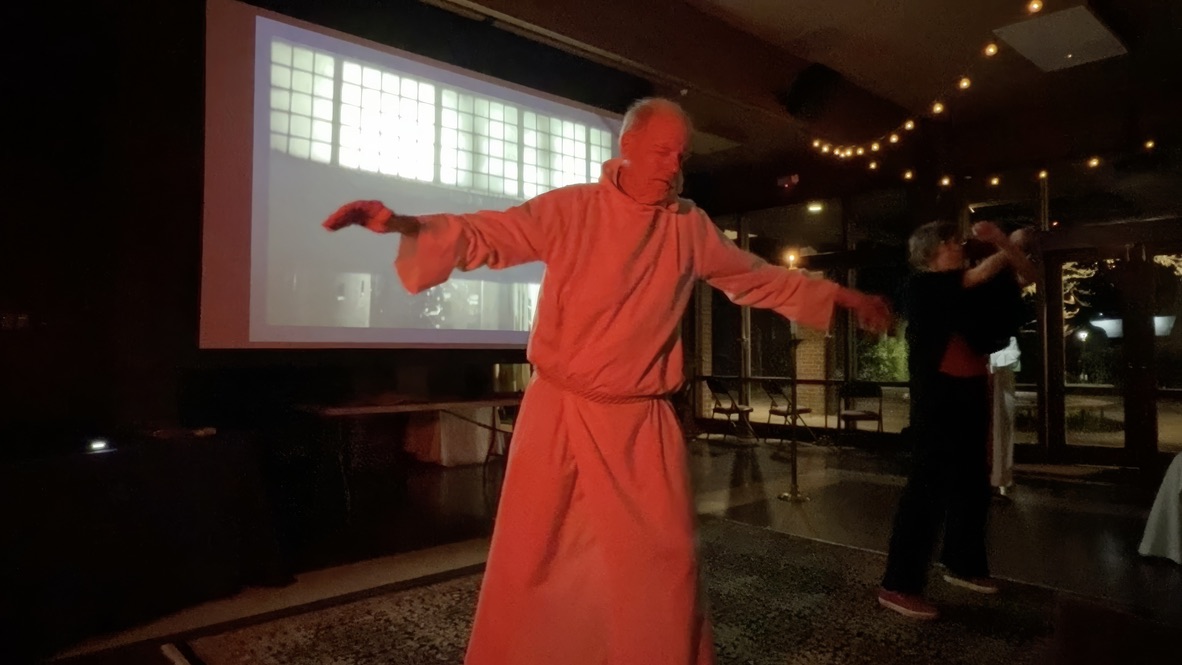
The author as one of the dancers in the Red Sea story at the Easter Vigil 2025.
The Red Sea: Noirish projected images (from Bela Tarr’s bleak film, Werckmeister Harmonies) show anonymous figures shuffling through an imprisoning corridor, while dancers on the stage express the experience of oppression with their bodies. An offstage narrator explains:
Three thousand years ago, in the land of Egypt, there were people who had no name. They were the faceless many, exploited by the powerful, forgotten by the privileged: slaves, immigrants, the poor, the homeless, the vulnerable, the invisible, the outcast.
Then dismissive terms for the oppressed appear on the screen in stark animated graphics: Not like us … worthless … horrible people … trash … less than human. More images of “the faceless many” are shown as the dancers continue, until an offstage choir sings a verse of “Go down, Moses.”
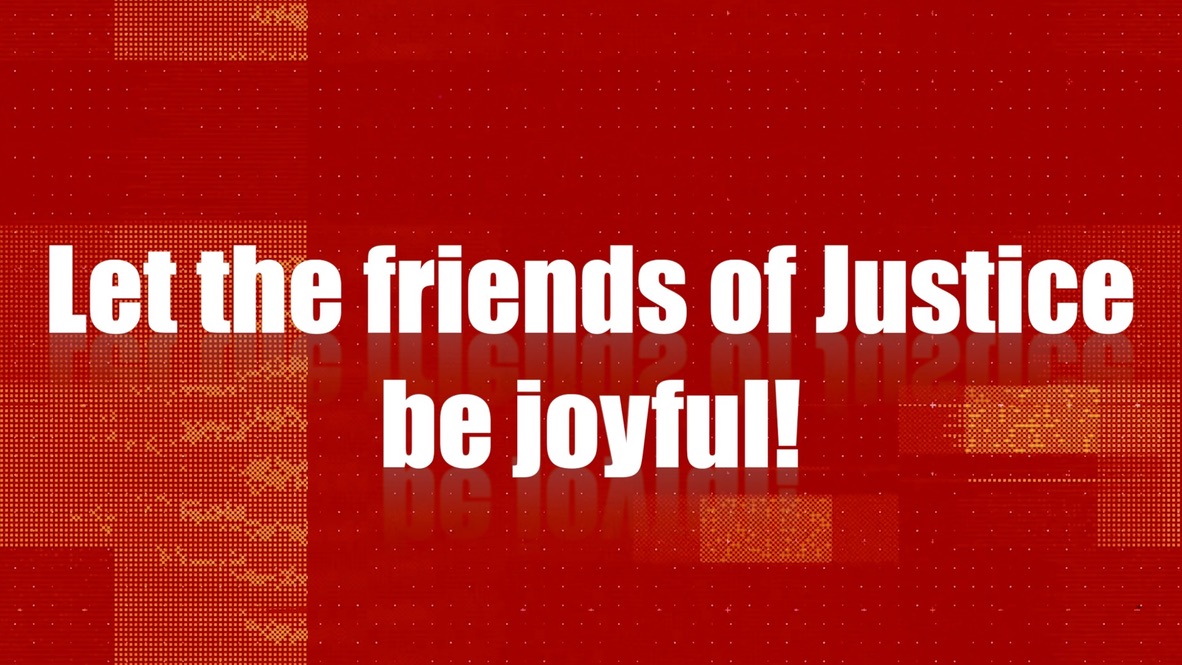
Suddenly, the divine breaks into this dark world: the screen flashes red, and we see the words from Psalm 68 that are always used in Orthodox Paschal liturgies:
Let God arise! Let the foes of Love be scattered! Let the friends of justice be joyful!
Then a song from the Civil Rights movement fills the room: “They say that freedom is a constant struggle … Oh Lord, we’ve struggled so long, we must be free.” The dancers’ bodies shift from oppression to liberation, while the screen shows powerful footage of crowds on the march for justice. As we hear a dub track with a repeated phrase by Martin Luther King, Jr.(“We cannot walk alone!”), the dancers begin their own march across the stage to the “Red Sea,” where they halt while the narrator declares:
This too is a creation story: On this day, God brought a new people into existence. On this day, God became known as the One who delivers the oppressed, the One who remembers the forgotten and saves the lost , the One who opens the Way through the Sea of Impossibility, leading us beyond the chaos and the darkness into the Light. When the world says No, the power of God is YES!
As the dancers, joined by a small crowd of others, begin to cross the Sea, the choir (offstage) sings Pepper Choplin’s moving anthem, “We are not alone, God is with us …” After the song, a bidding to prayer begins:
Pray now for the conscience and courage to renounce our own complicity in the workings of violence, privilege and oppression. Pray in solidarity with all who are despised, rejected, exploited, abused, and oppressed. Pray for the day of liberation and salvation.
The Fiery Furnace: This story from the Book of Daniel is borrowed from the Orthodox lectionary for the Paschal Vigil, and its humor (yes, the Bible can be funny) provides some comic relief after the Red Sea. The story’s mischievous mockery of a vain and cruel king, outwitted in the end by divine intention, feels quite timely. The idol shown on the screen is a golden iPhone, which will be destroyed by a cartoon explosion from Looney Tunes. The humorously tedious repetition of the instruments signaling everyone to bow is performed with the following (admittedly unbiblical) instruments: bodhran, bicycle horn, slide whistle, chimes, train whistle, and Chinese wind gong. The Song of the three “young men” in the furnace is recited by three women in an abbreviated rap version. At the end, the cast of twelve exit happily, singing the old Shape Note chorus, “Babylon is fallen, to rise no more!”
Then we give thanks “for the saints who refuse to bow down to the illusions and idolatries of this world” and pray for “the grace and courage to follow their example, resisting every evil, and entrusting our lives wholeheartedly to the Love who loves us.”
Valley of Dry Bones: Unlike the embellished retellings of the other stories, this one sticks closely to the biblical text, but is delivered in a storytelling mode by a single teller (me) in a spooky atmosphere of dim blue light. The voice of God is a college student on a high ladder. The sound of the bones joining together is made by an Indonesian unklung (8 bamboo rattles tuned to different pitches). When the story describes the breath coming into the lifeless figures sprawled across the valley, I get everyone in the assembly to inhale and exhale audibly a few times so that we can feel and hear the spirit-breath entering all of us. Then I move among them, bidding one after another to rise until everyone is standing, completing the story with their own bodies: the risen assembly itself becomes a visible sign of hope reborn.
Easter Vigil 2025 at St. Barnabas, Bainbridge Island, Washington.
Many churches don’t do the Easter Vigil, and of those that do, all too few give it proper attention as the richest and most luminous liturgy of the entire year. It requires a lot of preparation, effort and energy at the end of a very labor-intensive week. It also involves a long-term project of educating a congregation to understand the Vigil as the preeminent Easter rite.
You can celebrate the Resurrection gloriously on Sunday morning, but if you want to experience Resurrection in a kind of Christian dreamtime, come to the Vigil as well. And if you are in a community which already knows the unique power of the Vigil experience, I encourage you to explore the potential of its stories to empower our bodies and restore our souls in this dark and dangerous age.
If you are not part of a community that does the Easter Vigil, I thank you for reading this far anyway. But if you are in a position to shape a creative Vigil, here are some suggestions to get you started.
You may want to begin with just one or two stories. Find the creatives in your community and form a team to study the texts and discern what they are trying to say now. And think about the connections they make with our lives and our society. For example, footage from the Minneapolis protests could be part of the Red Sea saga, or the king’s ruffians throwing their victims into the fiery furnace could be dressed like ICE agents.
Decide for each story whether to use simple storytelling (one or more voices, scripted or retelling freely) or more theatrical means (scripts, actors, visual design, visual media, singing, musical score, sound effects, etc.). Think about ways to involve children (e.g., animals on the ark, or part of the Red Sea march to freedom) and even the whole assembly, through singing or collective reading, like a Greek chorus, of projected words on a screen. Involving as many people as possible in creating and performing the stories bolsters both attendance and enthusiasm. Play with ideas, images and words until the stories take shape. Then provide sufficient time for learning lines and rehearsals.
Ideally, the Story Space will be separate from the worship space. A parish hall is usually more flexible than a church interior in terms of seating and a stage area. If there is a screen or a large white wall, large images can be projected. Strings of party lights on a dimmer and LED spotlights with variable colors are easy ways to restrict light to the stage area and establish the mood for each story. The other advantage of a separate Story Space is that a liturgy conducted in a sequence of spatial locations underscores the Vigil as a journey—from the New Fire outside to the Story Space to the font to the altar and finally back into the world.
And let each story be followed by an appropriate song (I use both folk music and contemporary songwriters to fit the relaxed spirit of “tales around the sacred campfire,” in contrast to the chant and hymnody in the church portion of the liturgy). Then comes a bidding to prayer, summarizing the themes of the particular story.
Let me close with the bidding I wrote to follow The Valley of Dry Bones. It expresses everything I want to say about the liberating power of our stories to resist evil, proclaim hope, and lift up our hearts:
Dear People of God: There are those who tell our story as a history of defeats and diminishments, a narrative of dashed hopes and inconsolable griefs. But tonight we tell a different story, a story that inhales God’s own breath and sings alleluia even at the grave. By your baptism, you have been entrusted with this story, to live out its great YES against every cry of defeat.
Psalm 68:3, one of the texts projected in the background of the Red Sea story.
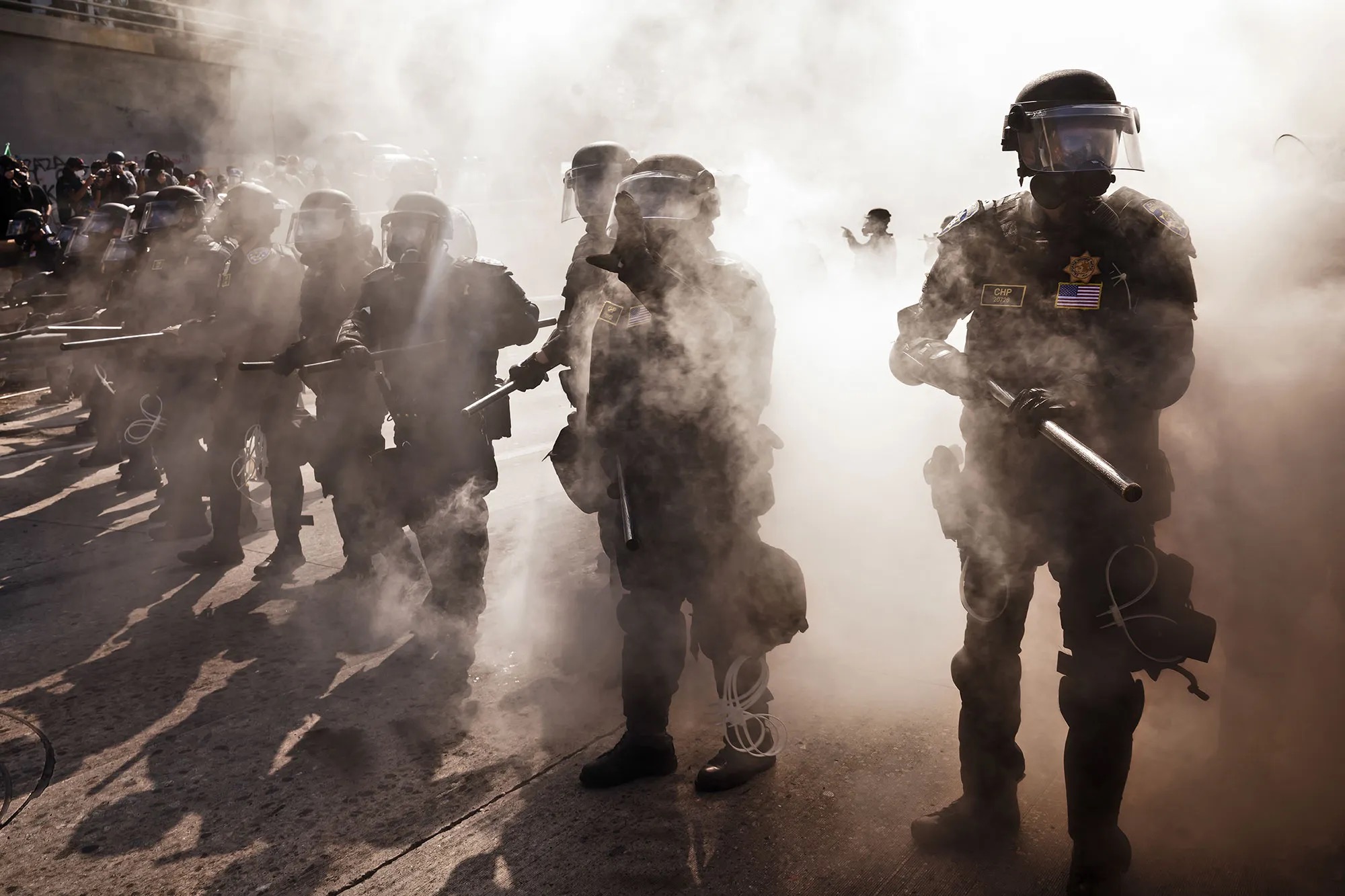
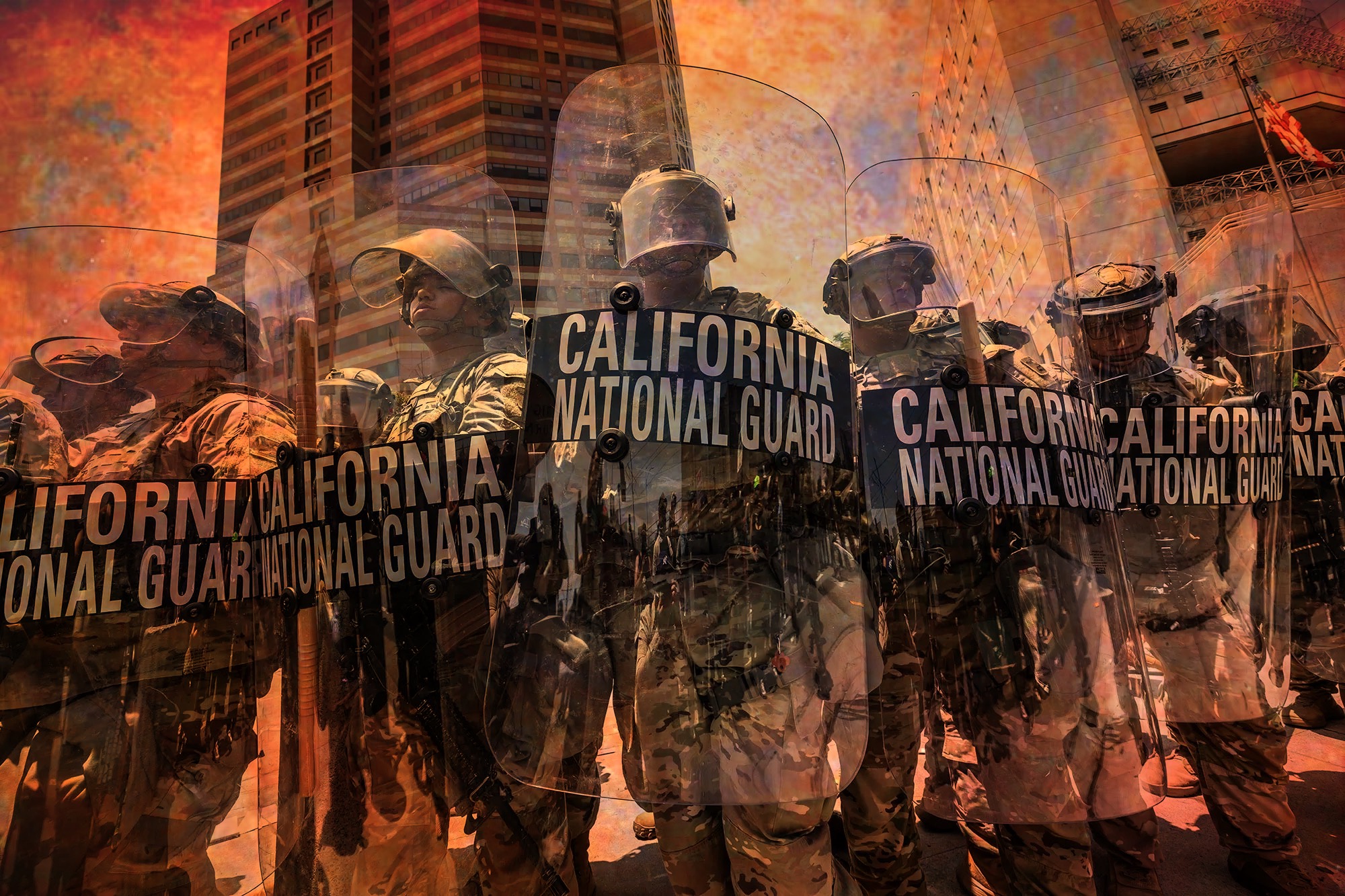
Police clear demonstrators from a freeway during the right wing occupation of Los Angeles in June 2025.
Survivors of the twentieth century, we are all nostalgic for a time when we were not nostalgic. But there seems to be no way back. — Svetlana Boym
In the Second World War, Paris was spared the physical destruction suffered by so many other cities. It surrendered without a fight to the Germans, some of whom cherished fond memories of living there as students before the war. And the Nazi government, believing itself to be the future of Europe, had no desire to smash such a cultural icon into rubble. It coveted the prestige of the City of Light for itself.
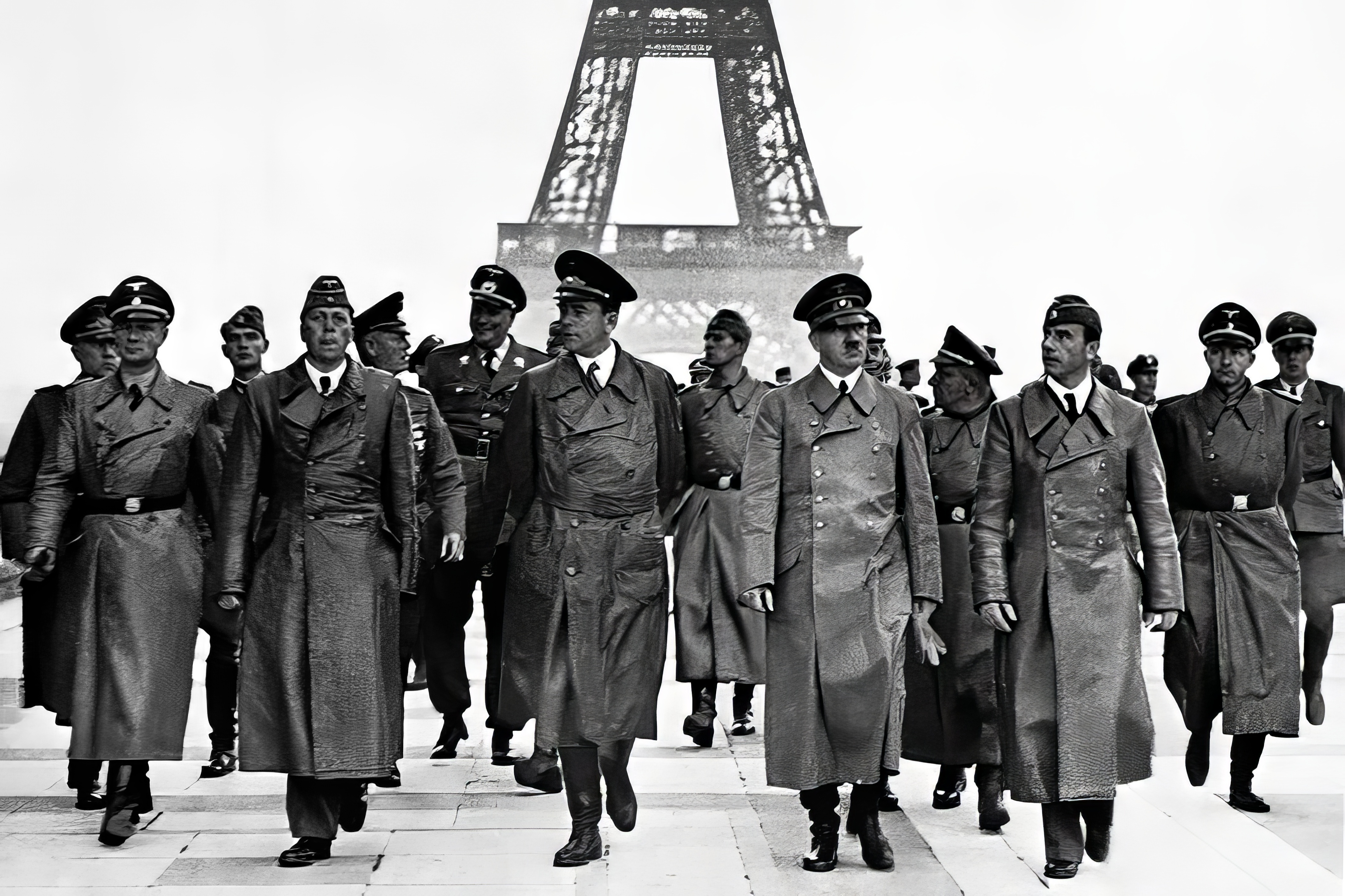
Hitler’s entourage in Paris (June 28, 1940). He was gone the next day, and never saw the city again.
The example of a city physically unchanged while suffering the invasive presence of a hostile power may have something to teach Americans, whose own cities face threats of military occupation by the dictatorial regime in Washington, D.C.. When I read Ronald C. Rosbottom’s riveting study, When Paris Went Dark: The City of Light Under German Occupation, 1940-1944, I could not help noticing some striking parallels to our own “les annes noires” (the dark years).
The radical right in the United States likes to dismiss any comparisons between Nazis and themselves as hyperbolic and slanderous, and it is fair to argue that their own movement may never go as far as the Nazis did. It’s too early to tell. But they’ve made a good start: terrorizing the vulnerable with the ICE-capades of masked thugs, demonizing and disappearing “aliens” and “enemies,” attacking the judicial system, vitiating the free press, purging opposition in the military and civil service, compelling the complicity of corporate leaders, seducing gullible and idolatrous evangelicals, and corrupting everything they touch. Fueling it all is their ceaseless stream of lies and propaganda. As Hannah Arendt warned in the aftermath of World War II:
“If everybody always lies to you, the consequence is not that you believe the lies, but, rather, that nobody believes anything any longer. And the people that no longer can believe anything cannot make up its mind. It is deprived not only of its capacity to act, but also of its capacity to think and to judge. And with such people, you can then do what you please.” [1]
Parisians tried to look the other way, but the invaders were everywhere (Photo by André Zucca for Signal, a German propoganda magazine).
Much more could be said about that, but for now our subject is the occupation of Paris. When the Germans entered the French capital in June, 1940, they encountered no resistance. Parisians were disheartened by the swift collapse of the French army and unhappy to see so many German soldiers and officials suddenly walking their streets and filling their cafés, but what could they do? Many fled Paris before the troops arrived, but most of those returned when they saw how “normal” things seemed. Daily life was not radically affected at first, and few thought the occupation would last such a long time. There was shame in defeat, certainly, and resentment of a foreign presence, but for a time passivity and resignation kept the anger of many Parisians’ turned inward.
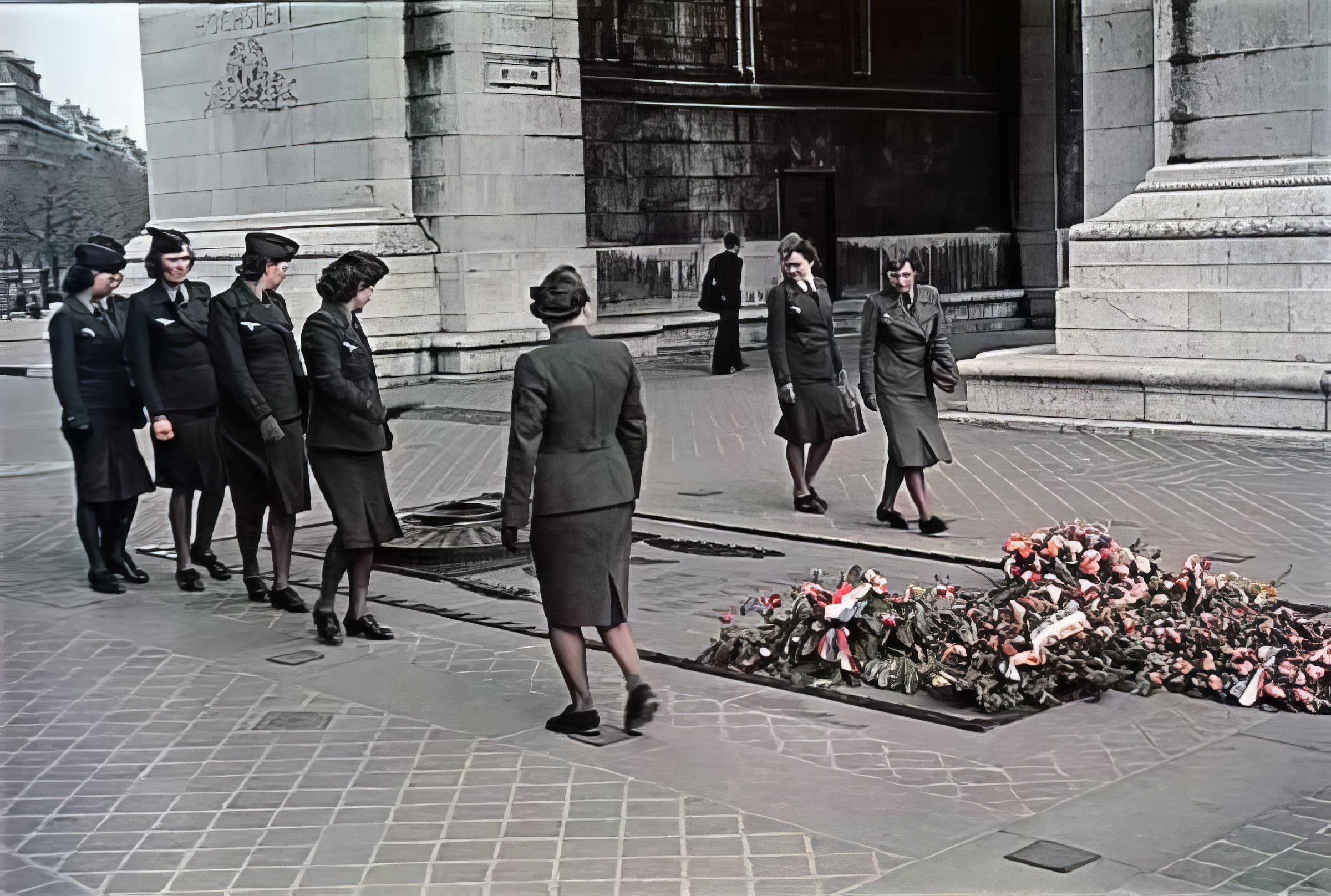
German soldiers at the Arc de Triomphe. The Occupation produced an invasion of unwanted tourists (Photo by André Zucca for Signal, a German propoganda magazine).
There was a degree of make-believe on both sides. German soldiers were instructed to be polite. If someone drops a package on the sidewalk, pick it up for them. Parisians tried not to reciprocate any such acts of kindness, but to practice what they called Paris sans regard (“Paris without looking”). As much as possible, pretend the Germans don’t exist. Over time, this depersonalization would create a great sense of loneliness among the occupiers. As for Parisians, the make-believe minuet with the occupiers was both wearying and fragile. As one young man wrote in his journal,
“In spite of oneself, one dreams, laughs, and then falls back into reality, or even into excessive pessimism, making the situation more painful.” [2]
A month after the Germans arrived, “Tips for the Occupied,” a mimeographed flyer, began to appear in apartment mailboxes. “Don’t be fooled,” it warned. “They are not tourists … If one of them addresses you in German, act confused and continue on your way … Show an elegant indifference, but don’t let your anger diminish. It will eventually come in handy …” [3]
The sense of normality didn’t last. The restaurants, cabarets and cinemas remained crowded, but when audiences began to boo and jeer at Nazi newsreels, the houselights would be turned up. People lost their courage when they could be easily spotted. Parisians also learned to be careful about saying the wrong thing in a café. Neighbors began to denounce each other to the authorities. Singing “The Marseillaise” in public became a punishable crime.
As the Occupation dragged on, the sense of dépaysement (“not feeling at home”) began to wear on the soul. Historian Jean-Paul Cointet describes the condition in his 2001 study of wartime Paris:
“The Parisian now knows the condition of being ‘occupied’ in a city that does not belong to him anymore and that offers him the schizophrenic images of an environment suddenly foreign to his gaze. Constraints and humiliations, restrictions and punishments accompany this disorientation and the upending of daily routine.” [4]
Troops at a federal detention center in Los Angeles (Ted Soqui for Cal Matters, June 8, 2025).
The narrowing of space—both physical and psychological—became increasingly oppressive, as Rosbottom notes:
“Whether because of the sight of German uniforms, the closed-off streets, the insufficient nourishment, the cold winters, crowded transportation, long lines—or just the suffocating feeling of being suspicious of one’s acquaintances, neighbors, or even family—the city seemed to be contracting, closing in on Parisian lives, as the Occupation dragged on.” [5]
By the bitterly cold winter of 1941, life just got harder. Shortages of food and coal brought malnutrition and sickness, especially among the lower classes. French police, willing agents of Nazi oppression, started to raid neighborhoods known for Jewish or immigrant populations. At first, Parisians in uninvaded neighborhoods could close their eyes and swallow the lie that the authorities were simply trying to control immigration and prevent terrorism.
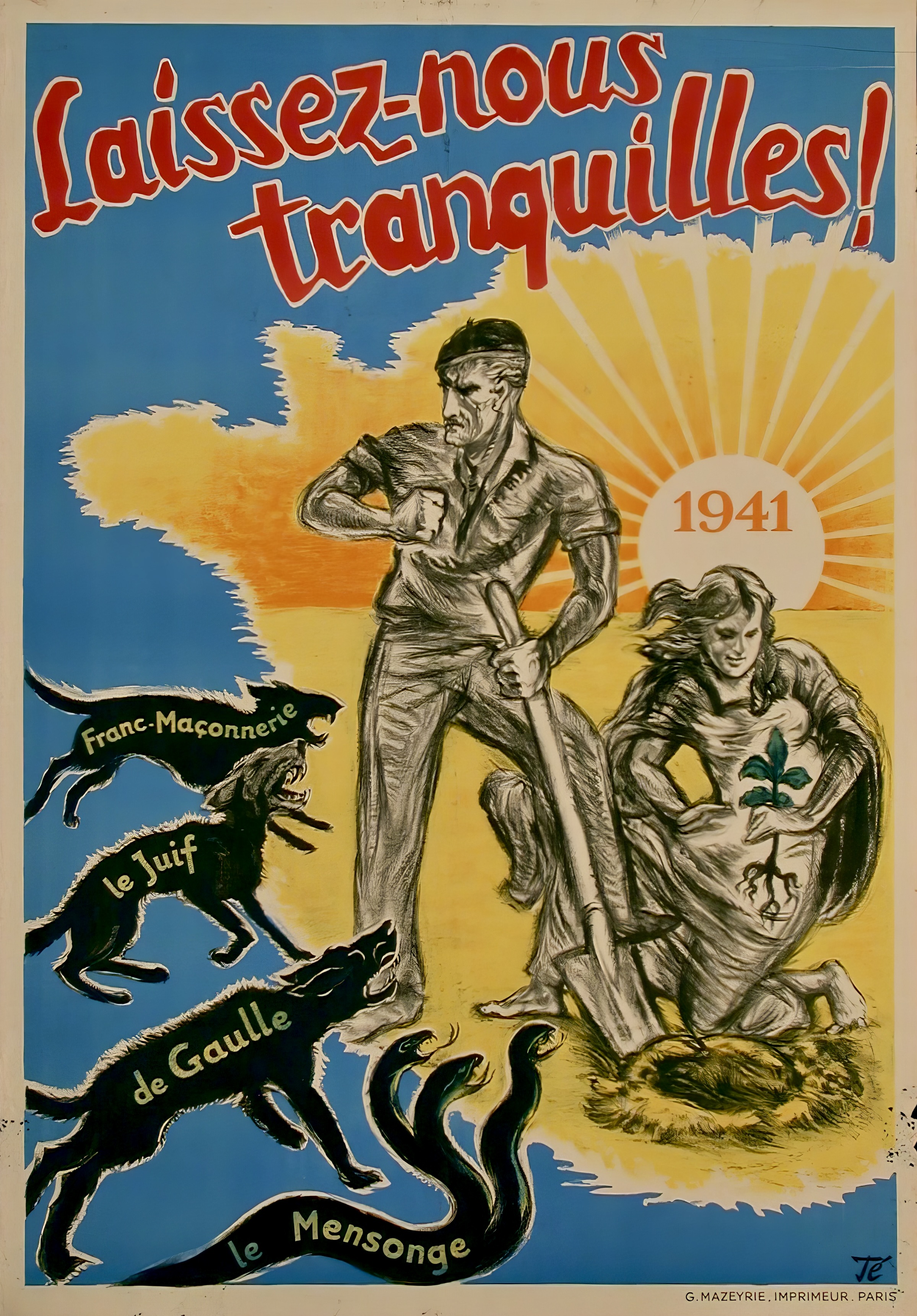
“Leave us in peace!” A German propaganda poster show Vichy France threatened by its perceived enemies: Freemasons, Jews, de Gaulle, and “lies.”
However, by mid-1942, rumors of the “final solution” began to reach Paris, and the mass roundups of Jews in France became impossible to ignore. “[Most Parisians] certainly did not know of the plans to deport them to their deaths,” writes Rosbottom, “but to their deaths they went: the last, sad convoy to carry children, three hundred of them, left Drancy for Auschwitz on July 31, 1944 … The final transport of adult deportees left on August 17, a week before Paris would be liberated.” [6]
Ernst Jünger, a cultured writer serving as a captain in the occupying Wehrmacht, kept a journal of the Occupation. In July 1942 he wrote:
“Yesterday some Jews were arrested here in order to be deported—first they separated parents from their children, so firmly that one could hear their distressed cries in the streets. At no moment must I forget that I am surrounded by unhappy people, humans experiencing the most profound suffering. If I forgot, what sort of man or soldier would I be?” [7]
Jünger may have shed a tear, but he continued to serve as a loyal employee of the Nazi death industry, whose business, as Hannah Arendt so bluntly noted, was “the mass production of corpses.” [8]
Hélène Berr also kept a diary, from Spring, 1942 until Spring, 1944. As a young Jewish woman, she tried to keep terror at bay by imagining herself in a Paris magically untouched by the darkness. A student at the Sorbonne, she copied out verses of Keats to calm her soul, and took refuge in her friendships. She made frequent walking tours of the city she loved, as if to reclaim possession of Paris from the occupiers who made her wear a yellow star, the mark of social exile.
In April of 1943, Hélène wrote:
“I’ve a mad desire to throw it all over. I am fed up with not being normal. I am fed up with no longer feeling free as air, as I did last year. It seems that I have become attached to something invisible and that I cannot move away from it as I wish to, and it makes me hate this thing and deform it … I am obliged to act a part … As time passes, the gulf between inside and outside grows ever deeper.” [9]
As Rosbottom notes, personal accounts of the period recall “the sound of police—French police—beating on the door” as their “most vivid aural memory.” [10] In March 1944, that percussive death knell sounded in the Berr’s apartment. Hélène, along with her parents, was arrested, but she managed to slip her journal to their cook before the police barged in. Three weeks later the Berrs were on a train to Auschwitz. They never returned. Hélène’s beloved Paris would be liberated five months later.
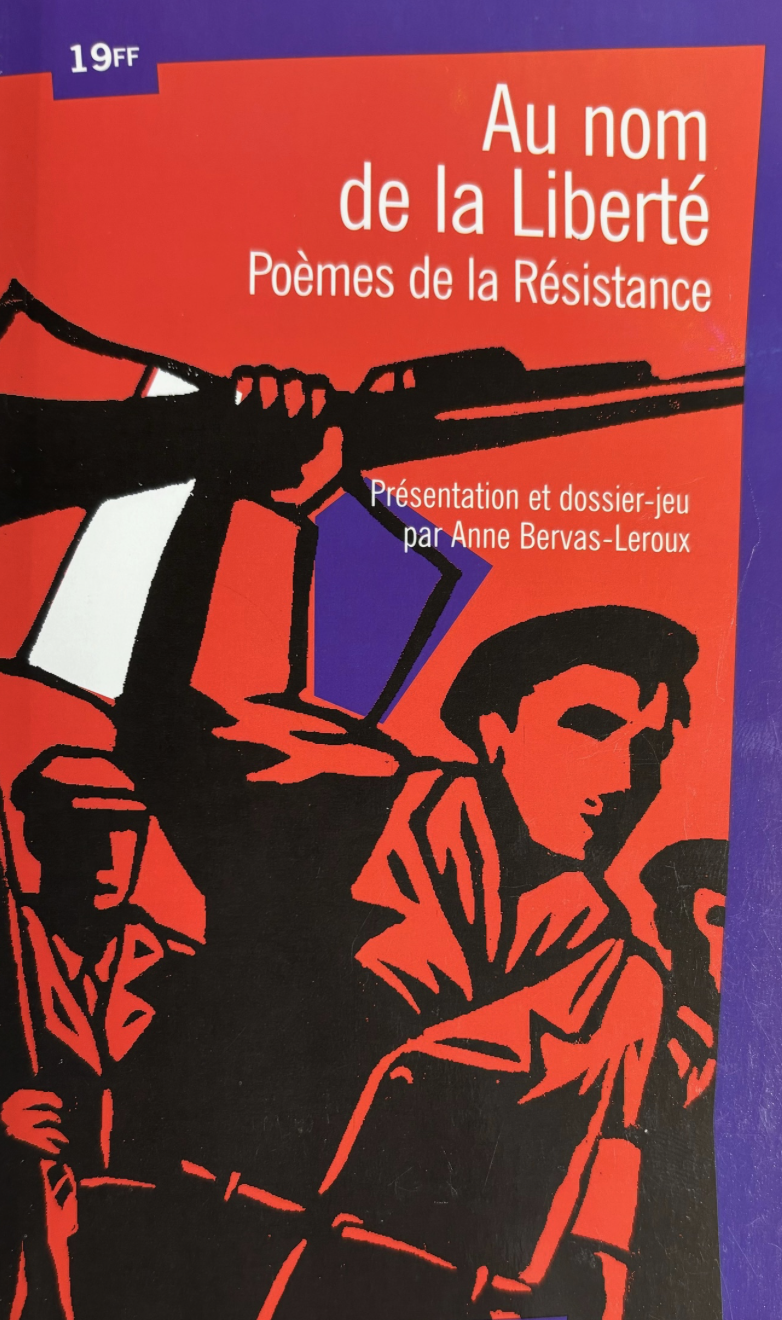
Illustration for a collection of French Resistance poetry.
There were many forms of active resistance to the Nazis in France, but the number of French patriots who risked their own lives was relatively small—less than 2% of the population. The threat of death and brutal reprisals was too daunting for most. For a visceral immersion in the anxious milieu of the French Resistance, watch Jean-Pierre Melville’s haunting film, Army of Shadows. Critic Amy Taubin’s summary of the film feels descriptive of wartime Paris: “Elegant, brutal, anxiety-provoking, and overwhelmingly sad.” [11] One resister recounted his experience in an interview decades after the war:
“Fear never abated; fear for oneself; fear of being denounced, fear of being followed without knowing it, fear that it will be ‘them’ when, at dawn, one hears, or thinks one hears, a door slam shut or someone coming up the stairs. Fear, too, for one’s family, from whom, having no address, we received no news and who perhaps had been betrayed and were taken hostage. Fear, finally, of being afraid and of not being able to surmount it.” [12]
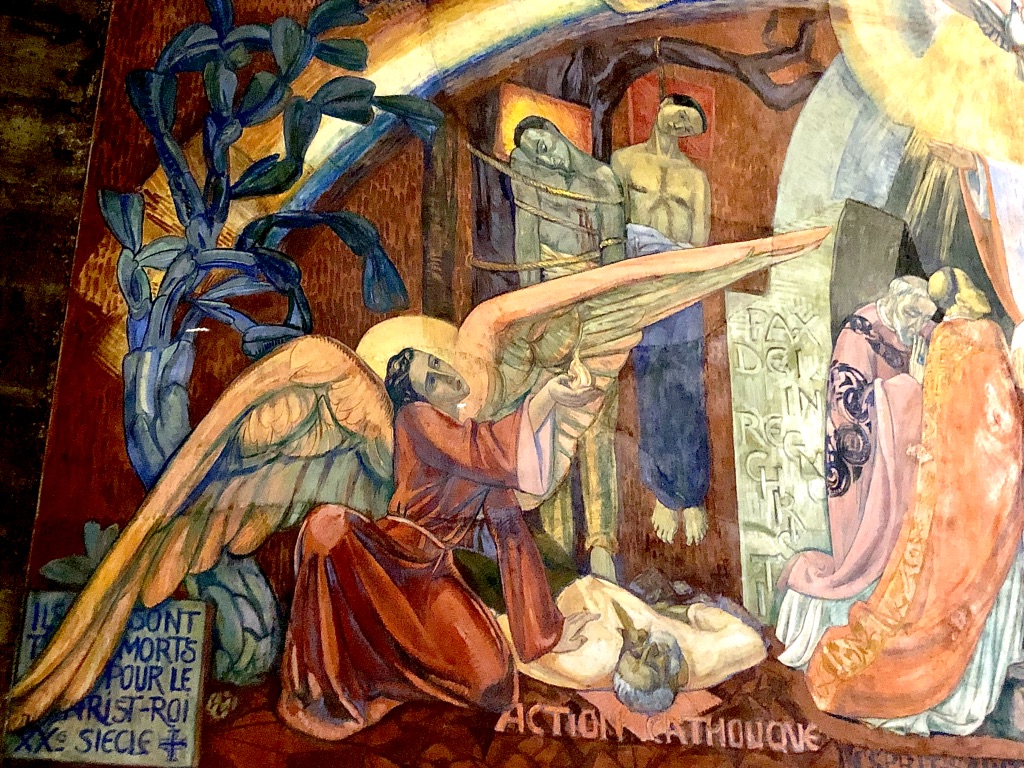
A prewar fresco of modern martyrs who refused to bow to anyone but Christ (Église du Saint-Esprit, Paris, 1930s).
As I read Paris in the Dark, I had to wonder: Is this America’s future? For many of us (to borrow a line from Bob Dylan), “It’s not dark yet—but it’s getting there.” Daily life —for now, at least—goes on pretty much as usual. But for some of our neighbors, the darkness has definitely arrived. The military occupation of cities. The terrifying knock on the door. The roundups, disappearances, and concentration camps. The shamelessly gleeful cruelty. Demonization, bigotry and hate. The repression of customary freedoms. The criminalization of dissent. The collapse of legal safeguards. The willing complicity of the powerful with the enemies of life.
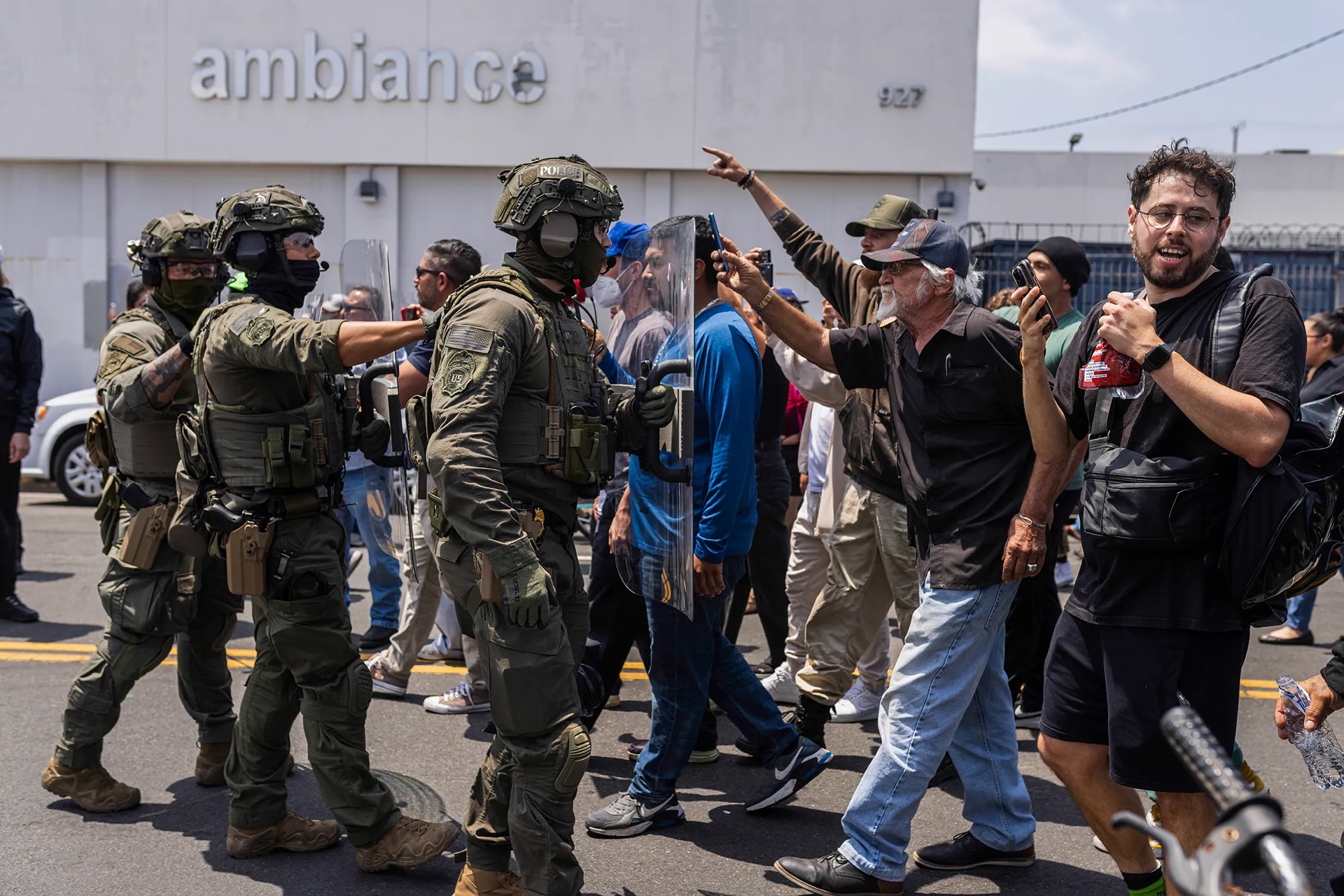
Citizens try to block an ICE roundup of immigrants at the Ambiance Apparel factory, downtown Los Angeles (J.W. Hendricks for CalMatters, June 6, 2025).
I am not without hope. Seven million protesters took to the streets on No Kings Day. Then large majorities voted against America’s reign of madness. And regardless of any political swings of the pendulum, I believe that resurrection continues to plant its seeds among the blind sufferings of history. But the oligarchs and fascists won’t go quietly. On the day after the recent election, the Episcopal Daily Office included this timely verse from the Book of Revelation:
Woe to the earth and the sea, for the devil has come down to you in a great rage, because he knows that his time is short. (Rev. 12:12)
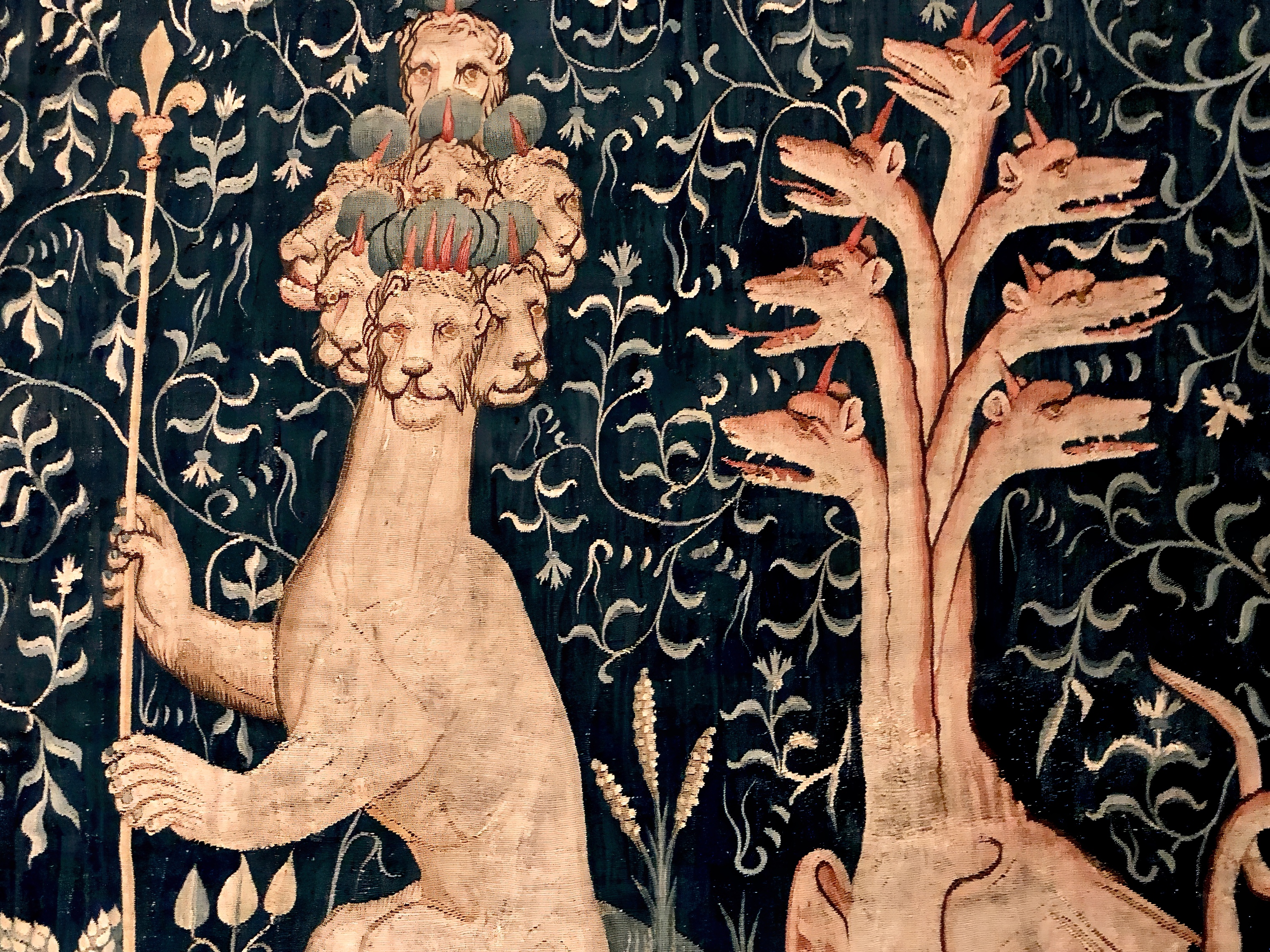
The Beast and Satan rage, but their time is short (Apocalypse Tapestries, Angers, France, 1373-1382).
This Scripture feels ripped from the headlines. We know that satanic rage all too well. It has sickened our country, and we struggle to keep it out of our own hearts. May its time be short. In the meantime, the woes are not done. God’s friends have their work cut out for them. Believe. Resist. Endure.
And guard your heart against the demons of dejection and despair. After Trump’s election in 2016, I suggested seven spiritual practices for the time of trial: pray, fast, repent, prophesy, love, serve, hope. Click the link for the details. Nine years later, these practices are more necessary than ever, and I encourage you to share the link as a small act of resistance.
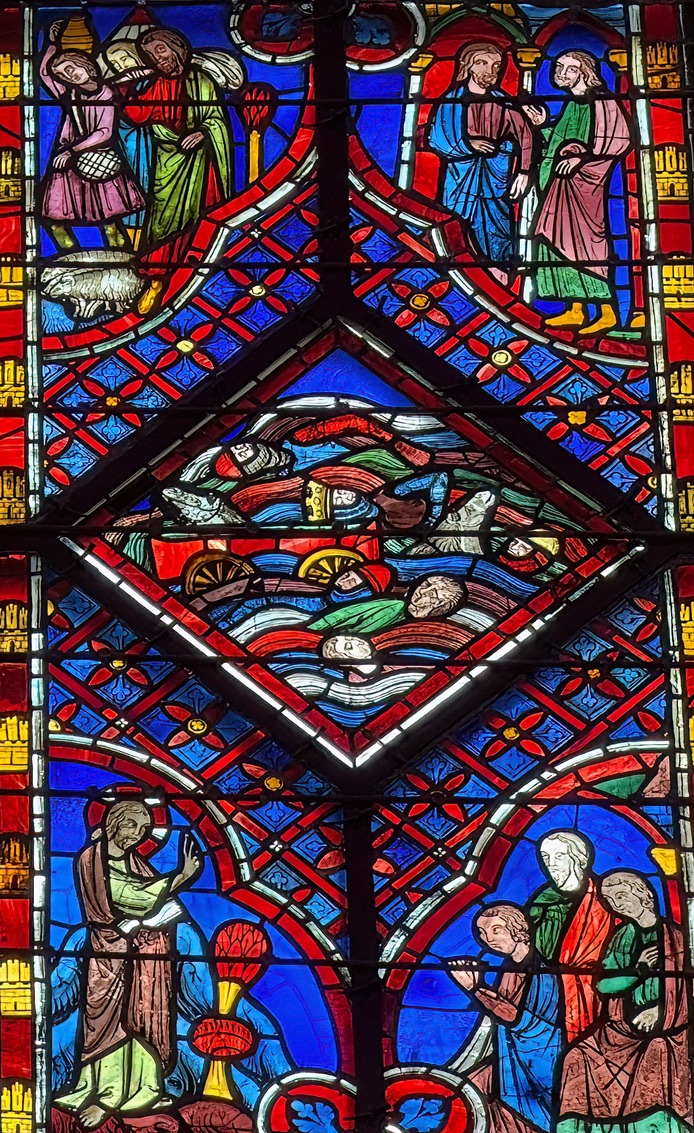
Pharoah sent his troops to round up the Israelites, but the forces of violence ended up sleeping with the fishes (13th-century window, Sainte-Chappelle, Paris).
Finally, don’t be in love with outcomes. Divine intention takes mysterious forms, and should not be confused with our own plans. Let us heed the counsel of two twentieth-century saints who were deeply committed to holy resistance and well acquainted with its challenges and ambiguities. Dietrich Bonhoeffer, martyred in a Nazi prison in 1945, believed that we must always act with deep humility, shedding our presumptions about the part we play or the difference we make. Don’t fret about your success. Just be faithful to Love’s command:
“No one has the responsibility of turning the world into the kingdom of God … The task is not to turn the world upside down but in a given place to do what, from the perspective of reality, is necessary objectively, and to really carry it out.” [13]
And Thomas Merton, who forged a delicate balance between contemplation and activism, taught that right action is not a tactic but a persistent way of being, grounded in something deeper and more enduring than any of our consequences:
“The message of Christians is not that the kingdom ‘might come, that peace might be established, but that the kingdom is come, and that there will be peace for those who seek it.’” [14]
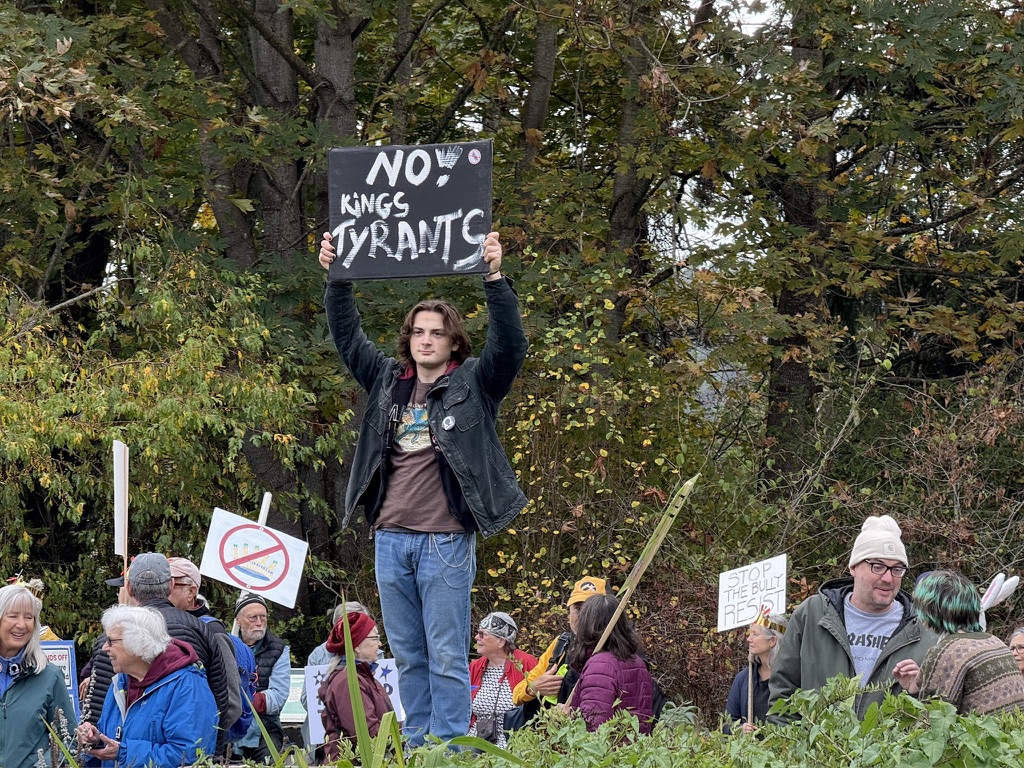
No Kings Day on Bainbridge Island, Washington (Photo by the author, October 18, 2025).
[1] Hannah Arendt, quoted in the PBS documentary, Hannah Arendt: Facing Tyranny (American Masters, 2025).
[2] Ronald C. Rosbottom, When Paris Went Dark: The City of Light Under German Occupation, 1940-1944 (New York: Back Bay Books, 2014), 106.
[3] Ibid., 196-197. The flyer was produced by Jean Texcier.
[11] Amy Taubin, ”Out of the Shadows,” Criterion booklet for their 2010 Blu-ray release of Melville’s 1969 film.
[12] Rosbottom, 223, quoted from interviews with WWII resisters published in 2012.
[13] Dietrich Bonhoeffer, q. in Christiane Tietz, Theologian of Resistance: The Life and Thought of Dietrich Bonhoeffer (Minneapolis, MN: Fortress Press), 121.
[14] Thomas Merton, Turning Toward the World: The Journals of Thomas Merton, Volume Four, 1960-1963 (New York: Harper Collins, 1996), 188.
Mark Harris in his printmaking studio (May, 2019).
Mark Harris is an artist/priest I’ve known over 50 years. In our twenties, we did campus ministry and experimental worship together in Ann Arbor at a coffeehouse featuring concerts by Neil Young, Doc Watson, Ramblin’ Jack Elliott and David Ackles. In our thirties, we collaborated on an all-night Epiphany liturgy in a circus tent. Now entering his eighties, Mark takes issue, brilliantly, with the Republican suggestion that America sacrifice its elders on the altar of capitalism. As another elder, protest singer Faith Petric, once wrote in “Grandma’s Battle Cry”––”I’ll shield you with my brittle bones! I’ll nourish you with rage!” Mark originally published this “J’accuse” on his blog, Preludium, and he has kindly allowed me to share it here. As Mark makes clear, COVID-19 isn’t just about health and economics. It’s about values.
A little personal clarity. I’m 80 years old this year, provided I make it to May 21st.
1. If I am in hospital and the medical folk make a decision that others, younger than I, need to be treated first, or me not at all, I get it. Triage is a sometimes miserable ethical fact. Got it. Perhaps in some way my death could be a noble or valuable or even holy contribution to the life of the world.
2. If I am out there in the world (but of course social distancing) and the bumbling system of supply and manufacture of needed medical gear fail, and I end up in the hospital and am triaged out of care, I get it. But I won’t forget that the “greatest country in the world” screwed up. There is no reason for these shortages except poor planning and bad use of resources. I will die of systemic governmental and business failure. There it is. But it will not be noble, or valuable or holy that I died. It will be stupid.
3. If I am out there in the world and the President or the government, or whatever the powers that be, decide that social distancing and its value to the health and safety of the world is less important than the economic safety of corporations and business enterprises, I will die because someone decided that the triage decision is really about whether my life was worth attending to rather than the life of money-making entities. So when I get the virus, end up in hospital, find myself triaged there and die, I will die because Boeing and some damn cruise ship company would otherwise lose money, place, or even go under. Not because of too many people in hospital. Not because of lack of equipment. Because of the economy. I got it. I will die for the almighty dollar. They will say, no no, you will die because the wellbeing of so many relies on our keeping the economy going. You die so that others may live. But I know. I will have died for reasons of greed, not reasons of need. It will be evil.
If this third possibility takes place, I will hold those who made the decision to go for the economy and not for the health of the society accountable. If alive I will scream in your faces unmercifully. If dead, I will plea to return to haunt you, ruining your sleep, your digestion, and your health. I will be pissed beyond imagination.
Be warned. Old may be just a thing to you. Old is what I have. I use old creatively, and to mostly good ends. The years I have left promise to be some of my best, in terms of action for justice, truth and beauty. But if it ends for the “economic good” I say, screw it. I know about this reasoning. It is the reasoning that was used to weed out the gypsies, the Jews, the queer, the gay, and anyone else who stood in way of the State’s grasp for economic power.
I accuse: The proposition that death as necessary to the well being of the economy is a lie. More, it is evil.
Ask what I will give for the country, but don’t assume you can ask what I will give for the economy. That’s mine to give, not yours to take.
––– Mark Harris, who understands the difference between the cross and the dollar.
Revolutionaries practice without safety nets. Our laboratory is the world around us––the streets, the Internet, the airwaves, our own hearts, as well as the hearts and minds of our fellow citizens. We experiment, we fail, we change things up, we try again, maybe this time a little less disastrously, a little more beautifully––until we win. Always we learn. Case studies are where we learn what we’ve learned.[i]
– Andrew Boyd & Dave Oswald Mitchell
The Empire is striking back––fueled by hate, greed and stupendous unreason, it careens toward authoritarianism, war and perhaps even planetary suicide. This is no time to stand idly by, muttering “It can’t happen here” as a consoling charm against apocalypse. It is happening here, and we need to resist with all our hearts and mind and strength.
There are countless ways to resist evil and promote the common good, but if you want to do it with some creativity and imagination, get a copy of Beautiful Trouble: A Toolbox for Revolution (New York & London: OR Books, 2016). “Assembled” by Andrew Boyd with Dave Oswald Mitchell, it is a 460-page handbook packed with smart tactics, hard-won ideas, and fascinating case studies to illumine and inspire every inventive activist. Along with other recent documentations, Artists Reclaim the Commons (2013)[ii] and Truth Is Concrete (2014),[iii] it is an invaluable primer in creative activism.
“We’re building rhizomatic [non-hierarchical] movements,” write the authors, “marked by creativity, humor, networked intelligence, technological sophistication, a profoundly participatory ethic and the courage to risk it all for a livable future.”[iv] Some of the tactics are indeed high risk, like hanging a banner from a construction crane at the WTO “Battle in Seattle” in 1999, or disrupting an illegal auction of public lands to oil interests by outbidding everyone with no intention of paying (the “bidder” got two years in prison, but the lands were saved).
Seattle (Advent 1999)
But there are plenty of actions which risk neither body nor freedom yet still make a vivid point. During the Iraq war, a woman arranged a row of shoes outside her New York senator’s office with names of Iraqi civilians killed. She invited passersby to “walk in their shoes.” Meanwhile, veterans on the West Coast set up a field of white crosses on Santa Monica beach every Sunday–– one for every soldier killed.
Somewhat edgier was a guerilla theater interruption of a UC Berkeley lecture by UN Ambassador Jeanne Kirkpatrick, during the 1980s when the U.S. was training and supporting Central American death squads. Masked men shouting in Spanish came down the aisles, dragging students (also actors) screaming from their seats, and taking them away to meet their fate. The stunned audience was then showered with leaflets explaining the educational purpose of this disturbing dramatization of American foreign policy.
Making the invisible visible is one of the key principles of art activism. Bring an issue home, tell its story, put a face on it. When Occidental Petroleum threatened to displace indigenous people in the Peruvian jungle, some of those people were brought to the U.S. to speak out. The issue quickly turned from generic opposition to Big Oil to a very personal story of people defending their homes. When Kodak was secretly dumping toxic waste into a river, Greenpeace rigged a public fountain where the disgusting waste bubbled up where all could see. To heighten awareness of climate change, environmentalists staged a mock-drowning of a “polar bear” in the fountain at the Department of the Interior.
Humor is a key weapon of resistance. Power loses authority when it is laughed at, and humor wins more allies than anger. On the 20th anniversary of Dow Chemical’s deadly toxic spill in Bhopal, India, a group called The Yes Men, posing as Dow executives, made a fictitious announcement that the corporation would pay financial reparations to the victims. When actual Dow executives had to publicly reassure stockholders that it would not in fact be doing what was right and just, the laugh was not on their side (though, sadly, their stock went back up––but that only made a salient point about our economic system!)
In 2003, 70 clowns from the Clandestine Insurgent Rebel Clown Army advanced on a police line at a British antiwar demonstration. The police were laughing too hard to stop them. When some arrests were finally made, news footage of clowns being crammed into a police van begged the question, “What did the clowns do wrong?” The “powers” lost ground that day. As the Psalm says, “The Lord has them in derision.”
In Rhode Island, the local HUD office refused to consider an affordable daycare center for a low-income housing project. The tenants petitioned and picketed to no avail. In a brilliant stroke, they decided to make the HUD office itself into a daycare operation. They brought children, song books, toys, cribs, and a table for changing diapers, and stayed the whole day. The point was made, rather amusingly, and they got their center.
The numerous case studies in Beautiful Trouble will inspire and provoke your political imagination, but the book also provides a wealth of practical wisdom––tactics, principles and theory––to build on what has already been learned.
“Power concedes nothing without a demand. It never did and it never will” (Frederick Douglass). Choose your target wisely. Make sure it’s someone who actually holds the power to meet your demands. Pick an issue big enough to matter and small enough to win. Put your target into a “decision dilemma,” where they only have a bad choice or a worse one.
Kill them with kindness. Laugh, sing, dance, clown, hug. Disarm with charm. Be the good ones, win the sympathy of your audience (which includes witnesses via the media). Humanize the situation, make unlikely allies, don’t write anyone off, seek common ground. Use the power of attraction. Design your actions to maximize participation and get spectators involved.
“If you don’t have a strategy, you’re part of someone else’s strategy”(Alvin Toffler). Reframe the narrative, unmask hidden cultural, political and economic assumptions, refute alternative facts, tell a better, truer story. Reappropriate the artifacts of popular media and give them new connotations, as Occupy Wall Street did by projecting a “bat signal” (in Batman, a sign of both distress and promise), shining “99%” in a large circle of light high on a wall above the demonstration.
“Success means going from one failure to the next with no loss of enthusiasm” (Winston Churchill). Nourish group solidarity. Avoid burnout. Maintain nonviolent and non-oppressive discipline. Have fun. Minimize disappointment by knowing the difference between concrete actions with measurable results, and communicative actions which are more symbolic, amplifying a message without necessarily attaining a particular objective.
Show, don’t tell. Be visual. Don’t preach. Create actions which explain themselves. Use powerful metaphors. And keep the rules as simple and open-ended as possible. Occupy Wall Street began with this terse but intriguing instruction: September 17. Wall Street. Bring tent.
As a person of faith, I especially encourage the communities of God’s friends to dig into this book in a study group setting. Activist art has strong biblical roots in the performance art of Jesus and the prophets, and people of faith distressed by current events would do well to engage with, learn from, and contribute to the beautiful trouble currently being made on the world’s behalf.
The opening epigraph for the book, a manifesto by radical theater visionary Judith Malina, sounds the call to action with compelling clarity. Pass it on:
The role of the artist in the social structure follows the need of the changing times ––
In time of social stasis: to activate.
In time of germination: to invent fertile new forms
In time of revolution: to extend the possibilities of peace and liberty
In time of violence: to make peace
In time of despair: to give hope
In time of silence: to sing out[v]
It takes little imagination to create a global state of terror and control. That is the basic dream of every dictator and of the dictator inside all of us. It takes much greater imagination to act upon the idea of a world beyond that.
An art that engages with self-empowerment, then, is about unleashing a sense of being in common, of being part of something bigger than a discrete human body, and of feeling a sense of saying both “I can” and “we can” at the exact same moment.
Holocaust survivor Elie Wiesel observed that there were three kinds of people in the twentieth century: killers, victims, and bystanders. But there were also resisters, who blended conscience and imagination to subvert the inevitability of controlling ideologies and plant the seeds of new possibility—even in the winter of despair.
Now, sixteen years into this new century, when the foundations of American democracy are being shaken and shattered by an authoritarian blitzkrieg, resistance is needed more than ever. It must be our civic duty, moral obligation, and spiritual vocation to question, challenge, mock, outmaneuver, and obstruct the monstrous axis of bigots and billionaires who are about to take power.
Sitting back and “giving Trump a chance” would be fatal. It is already perfectly clear who he is and where he is headed. Like the right-wing populists of Europe, he practices a politics of antagonism, channeling resentment, bigotry and hate into a movement fictionalized as “the people.” Anyone outside his movement, or critical of it, will be scapegoated and denounced. Argentinian philosopher Ernesto Laclau has described such populism as “a form of constructing the political through the division of society into two camps.”[iv]
So with the killers in charge, how do we act like resisters rather than victims or passive bystanders? Timothy Snyder, a Yale historian who has studied the lessons of the Holocaust, has written a 20-Point Guide to Defending Democracy, suggesting practical ways to work within the system before we lose it altogether. And I recently posted a Spiritual Survival Guide for staying grounded on a daily basis in the “time of trial.”
But since this blog’s ongoing theme is transformative imagination, let us also consider another kind of resistance, one which employs art and creativity to awaken people from their passive slumber and empower them with alternative visions. In a 1924 novel, Upton Sinclair made the case for an activist art:
“The artists of our time are like men hypnotized, repeating over and over a dreary formula of futility. And I say: Break this evil spell, young comrade; go out and meet the new dawning life, take your part in the battle, and put it into new art; do this service for a new public, which you yourself will make . . . that your creative gift shall not be content to make artworks, but shall at the same time make a world; shall make new souls, moved by a new ideal of fellowship, a new impulse of love, and faith—and not merely hope, but determination.”[v]
The problem with living within a particular “social imaginary” is that alternative ways of constructing our common life are not just utopian, they are literally inconceivable. As Slavo Zizek noted in a famous speech at Occupy Wall Street: “Look at the movies . . . It’s easy to imagine the end of the world. An asteroid destroying all life and so on. But you can’t imagine the end of capitalism.”[vi]
Art activism doesn’t just critique what is wrong, inadequate or incomplete. By enabling us to imagine alternatives, it breaks the spell of inevitability which the dominant hegemony has cast over us. A recent book, Truth Is Concrete: A Handbook for Artistic Strategies in Real Politics, provides many provocative examples. Here are some of my favorites:
When mathematician-philosopher Antanas Mockus became mayor of Bogotá in 1995, he borrowed strategies from activist art to help citizens re-imagine their city. He mocked the mythology of leadership by wearing a “super-citizen” costume, and cut a heart shape out of his bulletproof vest to demonstrate his shared vulnerability. He created an exchange of guns for toys in which the city’s children pressured parents to turn in their weapons. And he replaced the notoriously corrupt traffic police with 400 mimes, who used humor instead of fines to manage the flow of vehicles. In one of the world’s most dangerous cities, traffic fatalities were cut in half, and the homicide rate declined 70%.
During the oppressive regime of Slobodan Milosevic, Serbian “laughtivists” painted the dictator’s face on an oil drum and left it on a crowded shopping street along with a bat. Passersby took the opportunity to bash the drum image until police finally “arrested” the drum and put it in their van, a comic scene widely covered by the media. “Laughtivism derives its power from the ability to melt fear, the lifeblood of dictators . . . and help to cut away at the leaders’ authority, which often stems from intense narcissism.”[vii]
In 2013, Enmedio, a “media prankster collective” in Barcelona, made striking posters of individuals whose homes were being foreclosed by a Spanish bank, and pasted them onto the façade of the bank’s central downtown branch. The invisible victims, and their stories, were thus made dramatically visible at the scene of the crime.
Large inflatables can create “tactical frivolity,” turning “a grim protest situation into a playful event,” making it “poetic, joyful, and participatory.”[viii] Who can resist a large inflatable? A tense standoff between police and protesters in Berlin became a game when an inflatable was tossed between them, and the two sides began to bat it back and forth.
The Yes Men impersonate the powerful with fake press releases and public appearances to create a “what if?” situation. For a brief moment they pranked the media into believing that DuPont was actually going to act justly by compensating the 100,000 victims of the Bhopal chemical spill. “Before the hoax is revealed, we think, ‘Am I dreaming? Could I possibly be living in such a world?”[ix] Such deception is not meant to last, but rather to make us wonder for a moment: Why don’t we live in such a world? And whenever “reality” is restored, it is never quite as absolute or secure as before. Maybe the evil we know does not need to be “the truth” after all.
Reverend Billy of the Church of Stop Shopping employs an evangelistic preaching style to target the consumerism and greed laying waste to the earth. With choral singing, preaching, masks and dance, his community occupies bank lobbies to proclaim a hectic judgment upon the sins of the system, troubling the sleep of customers and bankers and disturbing the complacency of business as usual.
The UK’s laboratory of insurrectionary imagination “merges art and life, creativity and resistance, proposition and opposition.”[x] Believing that collective action is enhanced by a shared sense of identity, they create temporary affinity groups which work together in the course of a protest. Masks and black clothing to create visual unity are one example. Another is “the rebel clown army,” using clowning to subvert any serious regard for the pretensions of the powerful. As was overheard on a police radio at a demonstration in 2003, “The clowns are organizing … the clowns are organizing … over and out.”[xi]
The Choir Project was founded in Cairo by Salam Yousry, inspired by Finland’s Complaint Choir. Both professional and amateur singers collectively write and compose songs about daily struggles, political conflict, and human hope. Then they take their voices to the streets, sometimes walking backward as well as forward, penetrating public spaces with vital questions. Unlike spoken or written protest rhetoric, their message is delivered in a medium that charms and allures. The practice has spread to other cities such as Paris, Beirut, London, Berlin, Istanbul and Warsaw. Imagine American cities radiant with the voices of such prophetic singers moving in our midst, making their psalmic laments an urban soundtrack for our desperate time:
I have a question
If I don’t voice it if I suppress it
My head will explode
What’s going on?
Art activism is as old as the Bible, from the prophets’ performance art to Jesus’ dramatized subversion of worldly power when he made his “kingly” entry on a donkey. The Book of Revelation, in its radical critique of Empire and its vision of a redeemed and restored creation, is a vivid counternarrative to encourage the faithful in a time of persecution.
In dark times, we can, we must, still live as children of the light—the custodians of hope—enacting rituals and images, as well as daily practices of kindness, solidarity and justice, to express and anticipate the emergent world of divine favor and human flourishing. As for the powers, God laughs them to scorn, and God’s friends, thankfully, are in on the joke.
So let the Resistance begin, in as many forms as we can imagine. May it always be courageous, creative, revelatory, empowering, passionate, constant, artful—and, by all means, alluring.
[i] “The Art of Activism,” in Truth Is Concrete: A Handbook for Artistic Strategies in Real Politics, ed. Steirischer Herbst & Florian Malzacher (Berlin: Sternberg Press, 2015), 57 This book, based on a 170 hour 24/7 teach-in, may be hard to find in the United States. I bought my copy this fall at one of my favorite bookshops, The Literary Guillotine in Santa Cruz, California. A more easily available book on the same subject may be Beautiful Trouble: A Toolbox for Revolution by Andrew Boyd and Dave Oswald Mitchell, to be published on St. Lucy’s Day, Dec. 13, 2016.
Painting by Richard Stott (June 13, 2016). Used by permission of the artist.
Investigators at the scene were overwhelmed by the sounds of endlessly ringing phones coming from the bodies, as people continued to call, hoping for their loved ones to answer.
— CNN
We rise and fall and light from dying embers remembrances that hope and love last longer, And love is love is love is love is love is love is love is love cannot be killed or swept aside.
The Orlando massacre is the 179th mass shooting so far this year in the United States of America.[ii] It will not be the last. There’s too much madness, too many guns, too much hate to hope otherwise. We are angry and we are sad, but then what? Gun worship seems the most powerful religion in America. From presidents to schoolchildren, the blood of countless victims stains its altars. And however much we rage and moan we feel powerless to stay the hand of sacrifice.
Each time it happens, causes are discussed, solutions proposed, and we cry, ‘Never again!’ The pundits wring their hands, the NRA and gun-makers pause briefly to reload, Congress turns a blind eye, and then rat-a-tat-tat! More bodies strewn across our public spaces. The cycle repeats itself endlessly.
Why? Mental illness, social pathologies, alienation, racism, resentment, homophobia, hate, terrorism, profiteering by gun-makers, violence as entertainment, social media copycats, an American predilection for the quick fix and the fast draw—probable causes multiply exponentially.
Songwriter Dan Bern summarized the search for answers in his powerful “Kids’ Prayer,” written after the Springfield, Oregon school shooting in 1996:
And all the world descends to offer up their condolences
And offer up their theories what went wrong
And who and why and when and how:
It’s all the killing day and night on television
It’s all the movies where violence is as natural as breathing
It’s guns and bullets as easily obtainable as candy
It’s video games where you kill and begin to think it’s real
It’s people not having God in their lives anymore
Or it’s all of it, or none of it, or some of it, in various combinations …
As a hate crime directed against the LGBT community, Orlando adds a disturbing new dimension to the plague of gun violence. Whatever blend of madness and calculation drove the killer, he didn’t invent homophobia. He just fed off of it. It is still, sadly, in plentiful supply.
Decades ago, James Baldwin, who was both gay and black, wrote about the American capacity for self-delusion as to the extent of its own sickness. Facing up to our social pathologies, whether racism, bigotry, nativism or gun violence, would endanger the national myth of innocence. Better to remain silent and pretend everything is fine.
“But if we say we have no sin, we deceive ourselves” (I John 1:8). A sin unconfessed only makes us sicker. In a 1961 conversation with Malcolm X, Baldwin said:
If I know that any one of you has murdered your brother, your mother, and the corpse is in this room and under the table, and I know it, and you know it, and you know I know it, and we cannot talk about it, it takes no time at all before we cannot talk about anything. Before absolute silence descends. And that kind of silence has descended on this country.[iii]
In a gesture of protest, a Connecticut Congressman has vowed to abstain from the “moment of silence” which seems to be the only Congressional response to mass shootings. “Our silence does not honor the victims; it mocks them,” said Rep. Jim Himes.[iv]
Or in the words of Dan Bern, how many Orlandos will it take before we “summon up the sanity to scream?”[v]
+
Note: The Pieta image is by British painter and Methodist minister Richard Stott, a member of last October’s Venice Colloquium. He painted it in response to Orlando. Thanks to Ric for letting me use it here. Check out his website, “I ask for wonder.”
[iii] “Notes for a Hypothetical Novel,” in Nobody Knows My Name, quoted in Nathaniel Rich, “James Baldwin and the Fear of a Nation,” The New York Review of Books, May 12, 2016, p. 42.
There is no peace because there are no peacemakers. There are no makers of peace because the making of peace is at least as costly as the making of war— at least as exigent, at least as disruptive, at least as liable to bring disgrace and prison and death in its wake. — Daniel Berrigan[i]
On May 17, 1968, nine Roman Catholic activists broke into a draft board office in Catonsville, Maryland, transferring 378 files to the parking lot to be incinerated with home-made napalm. As the fire burned, the “Catonsville Nine” prayed for peace. They were arrested, tried and sentenced to prison, but four of them, including two priests— Daniel and Philip Berrigan— went underground, eluding capture for a number of months, occasionally surfacing to speak at antiwar rallies.
At one of these public appearances, following a dramatic tableau of the Last Supper with giant puppets, Dan Berrigan made his escape inside one of the Apostles. “I was hoping it wasn’t the puppet of Judas,” he said later. His comical getaway affirmed irrepressible life even as it mocked the powers of death. Berrigan, a puckish and playful spirit, knew that laughter could be a serious form of subversion.
After being sheltered by 37 different families, Dan Berrigan, S.J., was finally captured August 11, 1970, in the house of Episcopal lawyer and theologian William Stringfellow. He was reading Plato’s The Trial and Death of Socrates when F.B.I. agents showed up at the door.
On Palm Sunday of the following year, I designed a liturgy where two carpenters constructed a large cross near the altar during the course of the ritual. At various points, dialogue between the carpenters would interrupt the liturgical texts. The two workers expressed curiosity about the intended victim and the nature of his crime. They wondered about the morality of their own complicity in the official machinery of death. What if they just stopped making crosses? Would it make any difference? Or would they just find themselves without a job? In the end, they suppressed their doubts and finished the cross, hammering it together loudly during the eucharistic prayer: This is my body, given for you … This is my blood, shed for you …
It was no coincidence that I had just been reading No Bars to Manhood, Dan Berrigan’s compelling account of the influences and experiences underlying his Christian activism. Its conclusions were clear: as witnesses to the Resurrection, the friends of God must say no to death. No more cross-building. No more remaining passive spectators at the world’s crucifixions. “There are times so evil,” he wrote, “that the first and indeed the only genuinely prophetic function is to cast down the images of injustice and death that claim [the human being] as victim.”[ii]
A Newsweek blurb on my well-worn 95-cent paperback from 1971 reads, “Daniel Berrigan is the sort of priest who causes the lights of the Vatican to burn through the night.” The actions he took and the company he kept often strained the patience and understanding of his clerical superiors. One of his friends in the Society of Jesus told him, “Do you want to know why you’re in trouble so frequently? It’s because you and some others show us what Jesuits can be. And that’s why we can’t stand you.”[iii]
Today, when so many horrors are cloaked in euphemisms like “collateral damage,” Dan Berrigan’s truthful language still delivers a shock. His response to the charge of incinerating draft board records is justly famous:
Our apologies, good friends, for the fracture of good order, the burning of paper instead of children, the angering of the orderlies in the front parlor of the charnel house. We could not, so help us God, do otherwise. For we are sick at heart, our hearts give us no rest from thinking of the Land of Burning Children … We have chosen to say with the gift of our liberty, if necessary our lives: the violence stops here. The death stops here. The suppression of the truth stops here. This war stops here.[iv]
Even in his contentious moments with the Church, Berrigan understood his priesthood to be deeply rooted in the ethos of his religious community, where, he wrote, one’s life might “be purified of the inhuman drives of egoism, acculturation, professional pride and dread of life.”[v] In the trial of the Catonsville Nine, when asked whether such radical protest was in harmony with Catholic teaching, he replied, “May I say that if that is not accepted as a substantial part of my action, then the action is eviscerated of all meaning and I should be committed for insanity.”[vi]
For those of us who tend to play it safe in conforming our own choices to the gospel, Berrigan’s life of witness poses hard questions about discipleship and the imperatives of conscience. “He was dangerous, as holiness should be; he was a sword of wisdom.”[vii] A college student, after hearing Berrigan speak at Stanford in the late Sixties, put it this way: “Father Berrigan has raised the ante for all of us.”[viii]
That student’s religion professor, Robert McAfee Brown (one of my own most admired teachers), considered the question of whether the Berrigan brothers were signs or models. Their words and actions clearly signified the world’s sin and brokenness in parabolic gestures difficult to ignore. But were we obligated to model our lives after theirs, or might we find other ways to be faithful, according to our own distinctive calling? This question has troubled the conscience of many, including my own.
“We must continually ask ourselves why we are so attracted to them.” Brown wrote, “when we hear what they say and yet do not do the things they do … [T]heir actions provide a disturbing sign that we must take seriously, particularly if those actions are not yet the model most of us are prepared to imitate.”[ix] Brown himself had the courage to live into those questions for the rest of his life, becoming one of the most eloquent theological voices for justice and peace.
As “the man who hears handcuffs close upon him,”[x] Berrigan felt a deep kinship with biblical prisoners for God like the prophet Jeremiah. “There is a meaning to things, however dark and damaging … Jeremiah wrestles with the meaning; his wrestling is the meaning; it defines the moral substance and limits of his activity in the world. At the same time, his struggle with the unknown One interiorizes, draws to a fine point and gravity his moral life.”[xi]
Like Jeremiah, Berrigan knew a God who contends with human injustice, who plucks up and breaks down our tainted and presumptuous projects.
We are so used to an acculturated and childish religion, whose ethos has joined forces with the society— with its militarism and racism and fear of life, that we are almost illiterate before a document such as Jeremiah’s. Can it be true that God is not a Niagara of pablum, spilling His childish comfort upon the morally and humanly neutral, whose faces are raised blankly to partake of that infantile nourishment?[xii]
Not every Christian received his rhetoric gladly. And the radical priest’s liturgical fusion of sacrament and protest also drew fire. After baptizing a baby in the chapel at Cornell, he kissed the new Christian’s forehead and invited him “out of the world of war and destruction.” While presiding at an “Electric Mass for Peace” on the same campus, he made explicit connections in the eucharistic prayer between Christ’s blood and the blood shed on both sides in Vietnam. Some saw these things as careless, even blasphemous. Others found them prophetic and profoundly faithful.
Berrigan’s words and actions had a deep and lasting influence on many in the antiwar and anti-nuclear movements, as well as progressive Christians. His dramatic forms of witness also drew immense media attention, for which he took some criticism as a “media freak.” But his vocation was stronger than the temptations of celebrity. As Paul Elie, chronicler of the great twentieth century Catholic writers, noted in a New Yorker blog:
He created no foundation, nonprofit, or N.G.O.; headed no pacifist think tank or Jesuit school of advanced study; gave no TED talk; engaged in no stagey dialogues offering equal time to the military point of view; and never reframed the ideals of nonviolence in any pocket-size manual for personal growth.[xiii]
Berrigan had no neutral gear. Even when the public spotlight moved on to other subjects, his writing lost nothing of its urgency and fire. In The Discipline of the Mountain, his poetic reflection on “Dante’s Purgatorio in a Nuclear World,” he wrote, “There is a hell for those who go too far, and there is a hell, or at least an anteroom of hell, for those who refuse to go far enough.”[xiv] Going far enough for the sake of the gospel was the driving force of his life. But as he once confessed to Robert Coles, “We are groping. We shouldn’t be sure of ourselves, because we can’t be, not now— not ever.”[xv]
Only death is sure, and that finally came last week, on Orthodox Holy Saturday, to Daniel Berrigan, S.J., in his 95th year. I barely knew him, hearing him preach twice and breaking bread with him once in a Los Angeles rectory. But this loss feels personal. He was both sign and model for many priests of my generation, and there are things he said which haunt me still.
In 1964, midway in his life’s journey, Berrigan imagined the moment of his own death:
As I walk patiently through life
poems follow close …
The poem called death
is unwritten yet. Some day will show
the violent last line,
the shadow rise,
a bird of omen
snatch me for its ghost.
And a hand somewhere, purposeful as God’s
close like two eyes, this book.[xvi]
And then what? Only faith can say, that Easter faith which alone can contain and complete the fullness of human life. At the end of his meditation on Dante’s Purgatorio, the poet/priest peers beyond death’s horizon to see a resurrected humanity being gathered into God.
Leading the way are “the intractable ones” who have suffered prison, torture and martyrdom for their faithful witness. In them we see at last “the human venture vindicated.” Their faces and Christ’s face become as one, in an upward gaze that “breaks the glacial will of God.”[xvii]
They embrace one after another
Tears laughter two weathers
contending in one sky
[i] Daniel Berrigan. S.J., No Bars to Manhood (New York: Bantam Books, 1971), 49
[iv] q. in Robert McAfee Brown, “The Berrigans: Signs or Models?”, in The Berrigans, ed. William Van Etten Casey, S.J. & Philip Nobile (New York: Praeger Publisher, 1971), 62
[v] q. in Edward Duff, S.J., “The Burden of the Berrigans,” in The Berrigans, 19
[vii] Daniel Berrigan, The Discipline of the Mountain: Dante’s Purgatorio in a Nuclear World (New York: The Seabury Press, 1979), 99. The quote is by Berrigan, describing “an Indian holy man” with whom he once led a retreat. But it also seems aptly applied to Berrigan himself.
In Faith and Violence, a book published amid the political turbulence of 1968, Thomas Merton told an old Hasidic story about two men, one drunk and one sober, who were beaten and robbed as they traveled through the forest. Asked later about what had happened, the sober one described the violent encounter in vivid detail, but the drunken one seemed quite placid. “We’re all right,” he said. “Everything is fine.” Merton went on to observe that for some, faith “seems to be a kind of drunkenness, an anesthetic, that keeps you from realizing and believing that anything can ever go wrong.” But, he asked, is faith a “narcotic dream” or is it “an awakening”? Then he delivered his punch line: “What if we were to awaken to discover that we were the robbers, and our destruction comes from the root of hate in ourselves.”[i]
At a time when a brutal war was raging in the jungles of Vietnam, police and protestors were clashing in the American street, and leaders who spoke out for justice and peace were being assassinated, a monk dedicated to contemplative retreat from the world felt compelled to explore the theology of love in an age of violence, one which would “deal realistically with the evil and injustice of the world.”[ii] How do we resist the violence in our society without adding our own anger and demons into the mix? How do we resist systemic and social sin while harboring no illusions about our own capacities to do harm?
In recent days there have been numerous conversations about the escalating political violence surrounding the Trump campaign. My own post (March 12) on the topic has generated heartfelt responses of shared concern. Many of us are wondering what we can do about the situation without defaulting to our own versions of anger or fear. We need experienced guides through such tricky terrain, and Thomas Merton is one of the best.
“We no longer communicate,” Merton said. “We abandon communication in order to celebrate our own favorite group-myths in a ritual pseudo-event.”[iii] He wrote that in the Sixties, but he could have been describing a Trump rally, which, in the absence of substantive content, is mostly a ritual acting out of a group-myth, reaching its crescendo in the anticipated expulsion of protesters. As Rachel Maddow showed in a recent montage of those expulsions, Trump repeatedly asks the crowd, “Isn’t this exciting?” Roughing up protesters may express anything from personal rage to fascist methodology, but it is also entertainment. As Neil Postman has noted, Americans like “amusing ourselves to death.”[iv] When the anti-Trump signs come out, the crowd gets happy, knowing the real fun is about to begin.
This is all contemptible and sad. But I wonder: how do protestors avoid becoming unwitting collaborators in Trump’s entertainments? Even if they don’t hit back or give the crowd the finger, how do they escape complicity in a political Punch and Judy show? How do they avoid getting their own group-myths stuck in the futility of an endless ritualized dualism of “us versus them”?
Blessed are the peacemakers, for they shall be called the children of God. The peacemaker is committed to communion as the nature and destiny of humankind. As Martin Luther King said in a speech I remember from my college days, we must see the face of Christ even in the police who are attacking us with dogs and fire hoses. Or as Jesus himself taught, we must love our enemies. That does not mean capitulating to evil, or abstaining from the tainted ambiguities of political conflict. But it does mean that we ultimately belong to a much better story, where one day the tears will be wiped from every eye, the lion will lie down with the lamb, and the prodigal will be welcomed home. It means that our highest commitment is not to defeat our enemies but to make the divine love story of amazing grace come true for everyone.
As Merton wrote, “Christian nonviolence is not built on a presupposed division, but on the basic unity of [humankind]. It is not out for the conversion of the wicked to the ideas of the good, but for the healing and reconciliation of … the human family.”[v] This isn’t sentimental benevolence or passive submission. It’s a very tough form of love, as Jesus, Gandhi, King and many others have demonstrated in their costly commitment to a wider, more generous perspective than the self-righteous justifications of partisan interests. Our struggles must always reject the ultimacy of division in favor of communion. “The key to nonviolence,” Merton reminds us, “is the willingness of the nonviolent resister to suffer a certain amount of accidental evil in order to bring about a change of mind in the oppressor.”[vi]
But how do we apply this wisdom to the specific challenges of our own day? How can we respond creatively to the upwelling of anger, fear, racism and nativism poisoning our public life? In 1968, Merton compiled a list of principles for nonviolent resisters which is worth considering. While he admitted that the complexity and fluidity of events in that turbulent year could make any opinion lose its value in a matter of weeks, I believe his prescriptions retain an enduring value:
1) “be free from unconscious connivance with an unjust and established abuse of power”
2) “be not for [oneself[ but for others, that is for the poor and underprivileged”
3) “dread a facile and fanatical self-righteousness and refrain from being satisfied with dramatic self-justifying gestures”
4) demonstrate “a desirable alternative” to violence and injustice
5) use means which embody and manifest the emergent way of being which Christians call the Kingdom of God
6) be “willing to learn something from the adversary”
7) be grounded in hope and humility – what we strive for is a gift from God’s future: not of our own making, and not yet fully here [vii]
I particularly like Number 4 (demonstrate a desirable alternative) and Number 6 (embody and manifest the Kingdom of God). It is what we do in the eucharist, where everyone is welcome, everyone practices reconciliation, and everyone shares the bread of heaven. But can we take such countercultural vision into the street?
Yes we can. There are various ways (many of which have yet to be invented!). Even into her nineties, my mother joined the “women in black” every Friday in silent vigil against the Iraq war on the streets of Santa Barbara. Their faithful witness was impossible to ignore, while at the same time it perfectly embodied the peace for which they stood.
A very different display of visionary resistance occurred at the World Trade Organization (WTO) protests in Advent of 1999. Those who watched the news only saw the Punch and Judy show of untrained police and young provocateurs turning a shoving match into a tear-gassed conflict. But the most important things that happened were not on television. This is what I myself witnessed on the day of the big rally and march[viii]:
There was a large banner which read, AN INJURY TO ONE IS AN INJURY TO ALL. It seemed a perfect summary of the gospel: “If you do it to one of the least of my brothers and sisters, you do it to me.” All in Christ, Christ in all. Solidarity forever. We were there to speak for all those whom the WTO would rather silence or forget – voices crying in the wilderness, “Prepare the way of the Lord.”
At 12:30 pm, we took to the streets, marching up Fourth Avenue. to join the thousands more who were already downtown. It was a wonderfully diverse procession: there were people dressed as Santa Claus, sea turtles, trees, and even death. But it was not some crazy fringe out there. As one writer put it, “These were the kids at UW, the ladies from church, the guys at Boeing. It was Seattle that was marching this week.”
As in all street rituals, there was a playful, carnival atmosphere. As Richard Shechner observes in his book, The Future of Ritual:
“When people go into the streets en masse, they are celebrating life’s fertile possibilities…They put on masks and costumes, erect and wave banners, and construct effigies not only to disguise or embellish their ordinary selves, or to flaunt the outrageous, but also to act out the multiplicity each human life is…They protest, often by means of farce and parody, against what is oppressive, ridiculous and outrageous…Such playing challenges official culture’s claims to authority, stability, sobriety, immutability and immortality.”[ix]
In other words, we were exhibiting the same spirit – dare I say “holy spirit”? – of playfulness, camaraderie, irony and subversion that was seen ten years ago at Tiananmen Square and the Berlin Wall and, during biblical times, at the Red Sea and the Triumphal Entry on Palm Sunday. And as faith tells us, the powers don’t stand a chance against the foolishness of God.
There were people on stilts, people carrying giant puppets, babies in carriages and elders with canes and walkers. I stuck close to the Anti-Fascist Marching Band, which played soulful New Orleans versions of “America the Beautiful”, “Battle Hymn of the Republic” and Bob Dylan’s “Masters of War.” We all just danced up Fourth Avenue …
So, my friends, how shall we do the Kingdom dance in the year of grace 2016?
[i] Thomas Merton, Faith and Violence: Christian Teaching and Christian Practice (Notre Dame, Indiana: Indiana University Press, 1968) ix-x (All quotes from Faith and Violence are in The Thomas Merton Encyclopedia (New York: Orbis Books, 2002) under the entry on Merton’s book, but I have listed the original volume’s page numbers in the footnotes.)





 The religious imagineer