
“Owl among the ruins” – What shall we do with empty churches?

Netherlands church converted to private residence.

Netherlands church converted to private residence.

Entering into a church is a metaphor for entering into a shared world of symbolic narratives and meanings, somewhat like entering into a story and discovering the richness and internal coherence of its structure.   – Richard Kieckhefer[i]

A space’s or a building’s ‘sacredness’ is, with rare exception, neither a permanent nor an absolute black-or-white condition. The sacrality of even the most natural or ‘found’ sanctuary is vulnerable to defilement, and thus desacralization.[ii]   – Lindsay Jones

Where once the spire of the cathedral or the steeple of the church gave the first glimpse of city or village, today it is the Sears and Hancock buildings.[iii]    – Nicholas Wolterstorff

Fifty years ago on Thanksgiving Day, a group of friends shared a festive meal in a former Episcopal church in Great Barrington, Massachusetts. First constructed in 1829 as St. James Chapel, then enlarged and renamed as Trinity Church in 1866, the white wooden structure, with pointed Gothic windows, steeply pitched roof and tall attached tower displays the Platonic ideal of a New England church, the transcendent anchor of so many Northeastern towns. But its congregation had dwindled over the years. In 1964 it was deconsecrated and sold to Alice and Ray Brock, who put a bedroom in the tower and made it their home.

As Arlo Guthrie tells it in his song, “Alice’s Restaurant,” the new owners had “a lot of room downstairs where the pews used to be. Havin’ all that room, seein’ as how they took out all the pews, they decided that they didn’t have to take out their garbage for a long time.” So after dinner, Arlo and friends offered to take all that garbage to the dump in their VW bus. But when they found the dump closed for Thanksgiving, they improvised, emptying their load onto an unofficial garbage pile spotted on a side road. Guthrie was arrested for littering, an offense which would eventually make him “unfit” for the draft. Absurd but true, and Guthrie’s 18-minute song about it became a uniquely comic anthem of the antiwar movement. Many of us would sing its joyful chorus as we marched on the Pentagon in November, 1967.

I thought about Alice and Arlo and old Trinity Church when I read an article by Inga Saffron about the fate of struggling churches in Philadelphia: “In the rush to build houses, churches are being discarded.” Her subject was St. Laurentius, an historic Gothic Revival church built in 1882 with the nickels and dimes of Polish immigrants. A prominent symbol of the city’s Polish heritage, but no longer a viable parish, it was slated for demolition by the Roman Catholic Archdiocese. The property would be sold to housing developers.

It’s a familiar problem. When neighborhoods change or religious affiliation declines, church buildings often lose their sustainability. In addition, significant changes in liturgical understanding and practice make many inherited structures unsatisfactory venues for the renewal of worship. Since historical preservation is not the primary mission of Christianity, religious institutions cannot be expected to hold onto every property in perpetuity.

But the decision to abandon a church building is not without impact on the surrounding community. What happens when a church’s physical and symbolic presence is erased from the landscape? As Saffron writes, “Certainly, Philadelphia’s archdiocese is stuck with far more buildings than it can use. But it’s dispiriting that it has taken to treating their disposition as purely a business problem, compounding the community trauma brought on by the closings of so many churches and schools . . . {T]he city can’t be just houses. It needs the punctuation of civic monuments – churches, schools, libraries, and even old factories. Without those larger structures to break up the relentless grid, our blocks would be run-on sentences, without meaning.”[iv]

It’s hard to imagine a Europe without its cathedrals, England without its country parishes, or a New England village green without its white church. And many residents of Philadelphia’s Fishtown neighborhood have protested the potential disappearance of St. Laurentius. “Can you imagine Fishtown being Fishtown without it?” Saffron asks.

At a city hearing on St. Laurentius, architect Susan Feenan argued for the preservation of historic structures. “I have no delusions about this building being a Catholic church again,” she said, “but a neighborhood without old buildings is like a child without grandparents.”[v]

However, if a building is no longer functions as shelter for a living congregation, or is no longer suitable as an enlivening worship space, is there an alternative to demolition, so that it may continue at least as an aesthetic presence and a repository of historical and cultural memory, without draining the Christian resources needed for mission and service?

One solution has been repurposing – the conversion of churches to primarily secular uses. In the last decade, 52 Philadelphia churches have found a new life without religion. Some of these conversions retain a community function, such as art gallery, bookstore, school, brew pub or restaurant. Some become offices or private residences. There are many examples of converted churches on the web. Their creative adaptation of challenging interiors is impressive, and they are all alluring. Who would not want to spend time in these lovely spaces?

I confess to some uneasiness here. I feel a certain melancholy in deconsecration. A sense of loss. Loss of community, loss of shared symbols, loss of faith, loss of God. Generations of prayers and hymns have thinned to fading echoes. Spatial or visual symbols, detached from their roots like cut flowers, seems sadly bereft and disregarded. The meaning of the space has been disconnected from the intentions of its builders. One couple who has taken up residence in an old Serbian Orthodox church “couldn’t live with all the wall paintings,” and they covered most of them up. The starry ceiling, happily free of explicit religious narratives, did please them, so it survived.

I’m not saying the Church should hold on to specific buildings when their day is done, no matter how many beloved memories they contain. Death and resurrection is the pattern we live by. Death is not the opposite of resurrection, but its necessary component. Sometimes we just need to let go so that the new may happen.

But the continuing physical presence of religious buildings provides a vital sign of a reality beyond our human projects and mirrored desires. Their importance is not only aesthetic and emotional. It is also spiritual, imploring all who pass by: Don’t forget!

Even a repurposed church retains a memory, a trace of the faith that built it. And that trace puts a question mark to the depthless horizontality of materialist culture. Can you dwell within or among such places without pausing to wonder?

Of all the options for church conversion, the residential privatization of sacred communal spaces seems the most troubling. Places once devoted to public welcome and communal prayer seem substantially trivialized when their function is reduced to the personal pleasure of the lucky few. But make old churches into places of public conviviality and conversation, of art and music, teaching and learning, or feeding and sheltering the poor, and Jesus will be there as surely as he was in the midst of the old worship community.

And whatever happened to the former church of “Alice’s Restaurant”? After being a private residence under several owners, it was bought by Arlo Guthrie in 1991, who turned it into the Guthrie Center at the Old Trinity Church. Reconsecrated as a home for all religions by his guru, Ma Jaya Sati Bhagavati, it provides social assistance, communal hospitality, educational events, concerts and lectures, and interfaith services. Sometimes a building just knows what it wants to be.

[i] Richard Kieckhefer, Theology in Stone: Church Architecture from Byzantium to Berkeley (Oxford: Oxford University Press, 2004), 135

[ii] Lindsay Jones, The Hermeneutics of Sacred Architecture: Experience, Integration, Comparison – Vol. Two, Hermeneutical Calisthentics: A Morphology of Ritual-Architectural Priorities (Cambridge, MA: Harvard University Press, 2000), 291

[iii] Nicholas Wolterstorff, Art in Action p. 23, quoted in T.J. Gorringe, A Theology of the Built Environment: Justice, Empowerment, Redemption (Cambridge: Cambridge University Press, 2002), 199

[iv] Inga Saffron, “In the rush to build houses, churches are being discarded”: http://articles.philly.com/2015-06-06/entertainment/63090297_1_historic-register-fishtown-based-st

[v] http://articles.philly.com/2015-07-11/news/64310933_1_fishtown-preservation-law-church-architect
Stairway to heaven

image

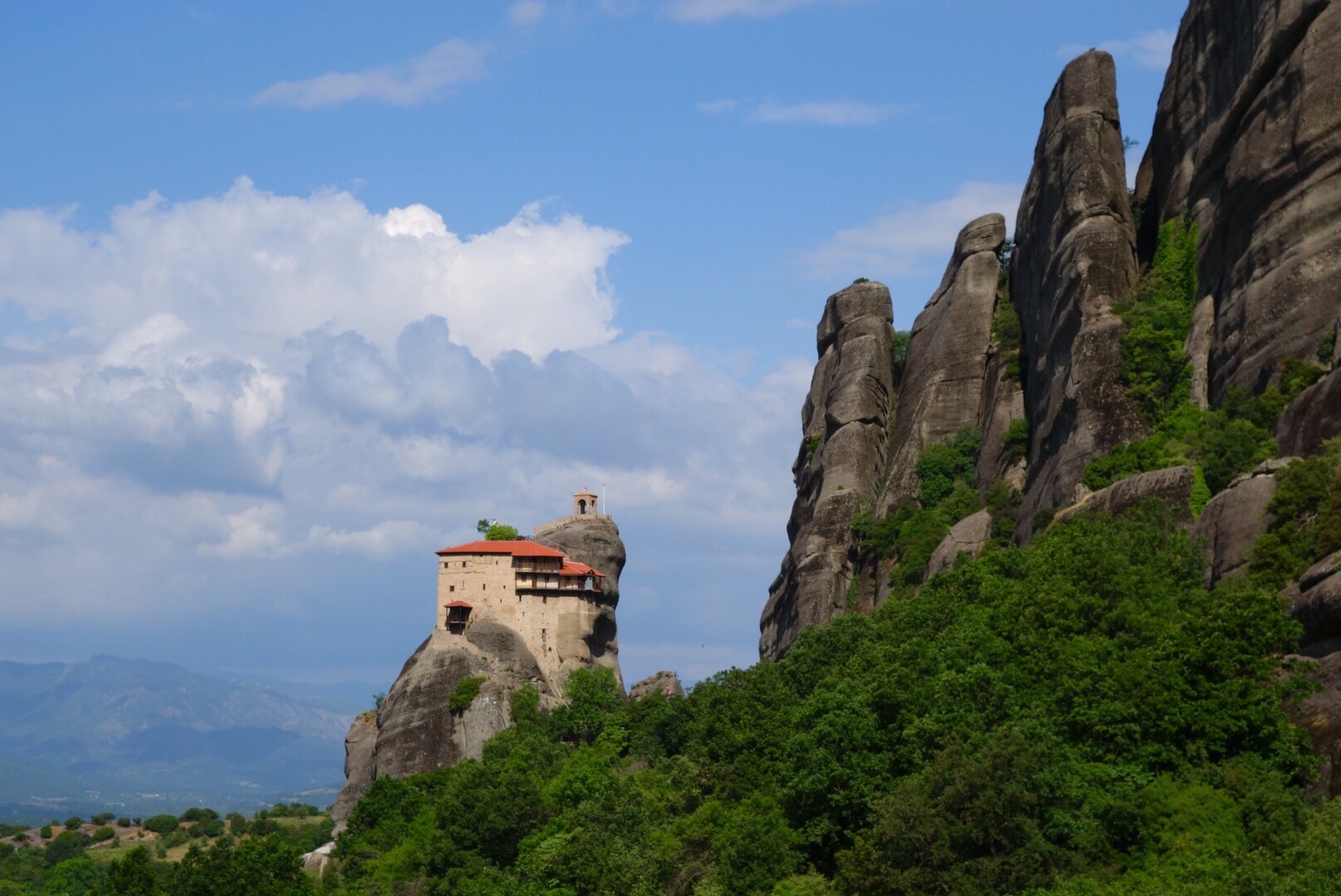
A modern road has made the monasteries accessible to tourists, but a pilgrim may still ascend more deliberately on the old wooded paths leading up from the lowlands. The way is peaceful and full of birdsong, and the upward views of immense cliffs and towers crowned with such fanciful habitats were continuously astonishing.

At the top, the hiker joins the throng who have arrived in bus or car, often to find a prevailing atmosphere of chatter which neglects or obscures the beauty of holiness. People wave and smile at cameras, offer the same brief glance to Christian images which they gave to Athena and Apollo in the Greek museums, enjoy the spectacular views, and head off to the next attraction. It doesn’t always feel like pilgrimage. And many of the monks themselves have long since fled to more solitary retreats.

But patience may be rewarded, and today there were fortunate lulls in the touristic turbulence, when the worship spaces emptied out and prayerful attention was possible.

image

The priestly preface to a guidebook published by one of the monasteries wishes the pilgrim “a rare spiritual journey between heaven and earth, in order to “taste here newfound bliss, spiritual uplift and powerful emotions” providing release from daily routine. And I can testify to the tangible effect of a long and dramatic wilderness ascent to arrive in a room, lit only by the soft daylight falling from a few small, high windows, and there be immersed in a sepulchral interior filled with icons and hanging lanterns, where every wall is painted with frescoes of saints and biblical scenes. It feels like a space praying ceaselessly in story and image, bearing witness to the Divine Mystery until the end of time.

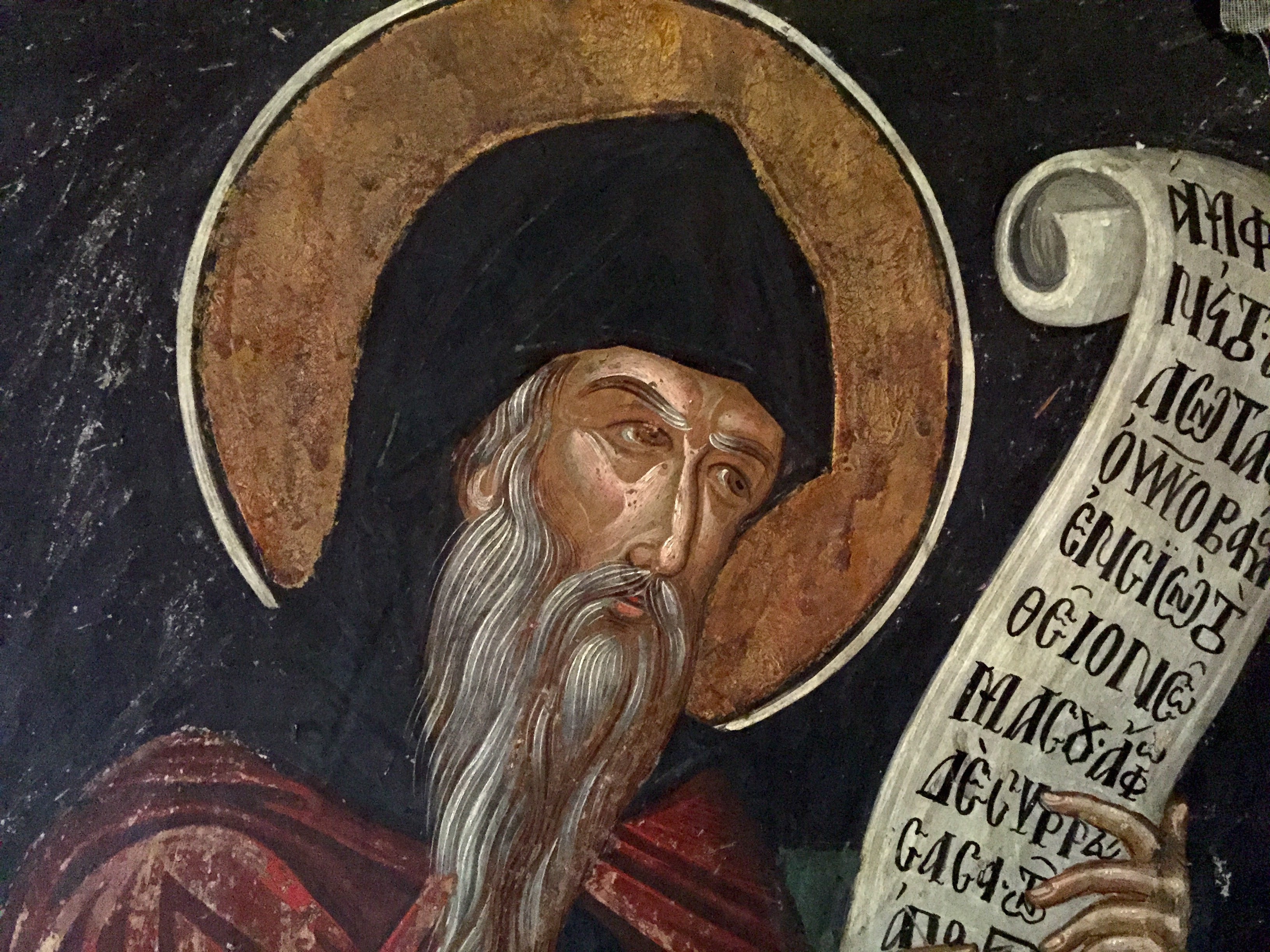
The images are painted in bright colors, which stand out intensely against their ink-black bakgrounds, so strikingly different from the familiar golden environments of most Byzantine iconography. This distinctive style came from Theophanes, a fifteenth-century Cretan artist who worked here as well as at Mt. Athos. To a modern viewer, for whom the gilded world of faith is no longer a given, the blackness suggests a void against which the existential cry of “let there be light” must ever be a proposal fraught with risk.

image

The holy paintings of Meteora, like the Christianity that produced them, have suffered fading and wear over the centuries, and some of their meanings have grown obscure. But unless a grain of wheat should fall into the ground and die, it cannot bear any fruit.

This wondrous day ended with a visit to the oldest Byzantine cutch in the region, built not at the summit but at the foot of the Meteora rocks. It was empty of visitors when my wife Karen and I arrived at sunset. Before leaving, I asked the Greek woman who collected admissions if I could sing a Kyrie in the resonant space. I’m not sure she understood exactly what I was asking, but she seemed agreeable enough. I stepped into the nave and began. The Kyrie I chose was an ancient Greek setting. She recognized the chant and began to sing along somewhere behind me. Orthodox and Anglican, Greek and American, female and male, praying together amid the cloud of painted witnesses all around us. “She had tears in her eyes,” Karen told me later.

As we took our leave, I said the Greek acclamation for Easter: Christos anesti! Christ is risen! “Alithos anesti,” she replied with a smile. Indeed he is risen.

Footsteps and shadows: Inscribing our traces on the Camino

This spring I find my mind often returning to the Camino de Santiago. A year ago today I began my tenth day of walking: 140 miles down, 360 to go. But by then I had stopped counting. It was better – and less tiring – to be in the moment, to “cherish every step” as one pilgrim advised me early on.

When I run long distance, or backpack up a steep mountain pass, I try to apply the mindfulness of Zen walking. Don’t think about some other time, in the past or the future, when you are in a more comfortable state of rest. And stop wondering how far you have left to go. Simply be here now. Concentrate your attention on the physical act of lifting your foot, swinging it forward, setting it down. Take note of your breath. It’s not about forgetting the pain so much as accepting your present state of being-in-motion, not wishing you were doing something less strenuous or challenging.

When you walk ten to twenty miles day after day for over a month, this kind of attention becomes more automatic. Walking becomes what you do and who you are. As I wrote in one of my Camino posts, “Walking”:

The past week was spent traversing the immense agricultural plateau of the Meseta and Tierra de Campos. Few trees, big sky, only occasional villages, and long stretches where the only human presence was the long procession of pilgrims migrating westward. The lack of distractions and variations tends to make the very act of walking to be the mind’s principal occupation. As Robert Macfarlane puts it in The Old Ways: A Journey on Foot, walking becomes “sensational” – it isn’t just conducive to thought; it becomes the form thought takes. I walk, therefore I am. Perhaps it is similar to the way that cinema thinks through the movement of the camera. It isn’t forming propositional thought, but is simply absorbing through its attentive motion the shape of the world, the textures of existence.

I have noticed that I have fewer thoughts out here than I do at home when I run for an hour, or go on a week-long backpack. On the Camino, instead of a lot of thoughts, I simply have thought: not so much words or ideas as awareness. As Thich Nhat Hanh once put it to a walking companion who asked what he was thinking about: “I’m not thinking about anything. I’m aware of the sunlight.”

Macfarlane provides a memorable image of walking as a form of writing on the earth, with every traveler leaving his or her own imprint of dreams, stories and memories as they go. Centuries of pilgrims have been leaving such traces along the Camino, traces which now lie beneath our own feet every step of the Way.

The brief video clip records my shadow and footsteps leaving their faint traces: on the Meseta west of Burgos, on the 13th century bridge of Puente de Orbigo, and among the blooming shrubs of the Alto Predela, a high ridge west of Villafranca. I hope these few steps bring back happy memories for my fellow pilgrims. And for those who want to experience our cumulative act of walking in real time, just replay the 80-second video 11,000 times!

Grace me guide

Holy Saturday dawn at Laguna Beach, California (2005)

Holy Saturday dawn at Laguna Beach, California (2005)

My wife recently asked me what my favorite prayer was. Interesting question. We are both Episcopal priests, steeped in a tradition of eloquent prayers, so there were plenty to choose from (the Lord’s Prayer was ruled ineligible in order to make the competition fair). But one particular “collect” from the Book of Common Prayer came immediately to mind, not only because I know it by heart and begin most days with it, but also because I am drawn to the theology and spirituality that underlie it.

O God, the King eternal, whose light divides the day from the night and turns the shadow of death into the morning: Drive far from us all wrong desires, incline our hearts to keep your law, and guide our feet into the way of peace; that, having done your will with cheerfulness during the day, we may, when night comes, rejoice to give you thanks; through Jesus Christ our Lord. Amen.[i]

In three beautiful clauses, this Collect for the Renewal of Life from the Office of Morning Prayer spans the daily round from night to day to night. Its origins lie in the Benedictine practice of creating liturgies to fit each period of the passing day. Like time-lapse photography, this collect compresses the temporal flow into a single unity of beginning, middle and end. The ordinary succession of the hours is sanctified by the simple act of attention.

But the prayer casts its net into deeper pools as well. The light dividing the day from the night recalls the first day of creation, making every dawn the renewal of the world. And the shadow of death turning into morning invokes the Resurrection, when creation is restored and the wound of death is healed at last.

Having turned our attention to the divine source of this perpetual renewal, the prayer then asks for the grace to become conformed to the shaping pattern or formative way of that originating and empowering source. The first request addresses the obstacles to that conformity – the things that misshape or distort our truest selves.

Drive far from us all wrong desires.

Religion is sometimes caricatured as the repression of desire. It’s not only the mockers who do this; many of the devout have striven for a passionless existence in imitation of a supposedly passionless God. But wanting to want nothing is itself a form of desire, and it doesn’t always end well.

We are made of desire. We come into the world reaching for a larger source of sustenance, nurture and love. Everbody’s got a hungry heart. Springsteen said that. Or was it St. Augustine? Some argue that our primal maternal nurturing is then projected onto the void to produce the consolations of religion, but Christian faith insists that our longing never ceases to thirst for something actual and real, from our first breath to our last.

But desire is easily misdirected to fix on easier, less demanding objects, unworthy of our true nature. In one of Jean-Luc Godard’s early films, a worldly couple is given a ride in a convertible. When the driver reveals that he happens to be God, they immediately ask him for things: Can I own a hotel on Miami Beach? Can you make me more beautiful? God is disgusted. “Is that all you want? I don’t do miracles for jerks like you.” He throws them out of the car and drives away.

As Gregory of Nyssa said, our task is not the eradication of desire, but the education of desire. How do we live in such a way that our desire may find its proper object? It is not desire that is wrong, but only its misdirection. And so we pray for whatever it takes to steer us toward our ultimate goal, “the great meeting with being which one way or another everything in our life strains to achieve.”[ii]

Incline our hearts to keep your law,
and guide our feet into the way of peace.

There may be times in our life when God’s will feels radically disruptive. “Thus says the Lord: I am going to tear down what I have built, and pluck up what I have planted.” (Jer. 45:4) Or John Donne: “Batter my heart, three-person’d God …. / and bend / Your force to break, blow, burn, and make me new.”

But in this prayer said at the start of each day, “incline” and “guide” propose a much gentler formational process than the cataclysmic upheavals of Jeremiah and Donne. An inclination may only be a slight tipping from the vertical, just enough so everything leans or flows in a particular direction. And the act of guiding does not itself create momentum; it only steers a motion which is already underway. These are subtler influences than earthquake, wind and fire, but their long-term effect on us is no less profound.

The entire prayer assumes a dailiness about grace, and the constancy of prayerful attention that allows it to work on us over time. This quiet, steady, cumulative spirituality is so very Anglican. I once found a perfect motto for this habitual spirituality in an old English church. Painted in golden Gothic lettering, repeated in every panel of the coffered ceiling, are the words, Grace me guide. Even a bored worshipper, glancing upward to relieve the tedium of a poor sermon, could not miss this summons to the beauty of holiness.

The prayer’s third clause assumes a happy outcome for a day given over to God’s shaping influence. Throughout the passing hours, God’s will is done “with cheerfulness.” Does this word appear anywhere else in the history of formal Christian prayer? There are plenty of texts to remind us how hard the journey, how recalcitrant the will. But how rare to make the Christian life sound so easy, so effortless, so fun!

But perhaps the prayer has in mind the ease of the ballet dancer, whose extraordinary physical grace, while appearing effortless, is achieved through a sometimes painful and always demanding discipline. Or maybe “cheerfulness” refers to the saintly joy that St. Francis spoke of – the ability to accept even life’s hardest blows with a grateful and trusting heart. Who can say?  I only know that whenever I say this prayer, it is hard not to smile, at least inwardly. Cheerfulness is an attractive quality in the Christian life.

The entire prayer assumes that we are capable, that we can be conformed to divine intention, that this day has potential for us. We may not make it to nightfall without lapses major and minor. The cheerfulness may fail us, more than once. We are well acquainted with that scenario. But to begin each morning by visualizing a day that will end with thanksgiving for what God has done in us and through us – this expresses the incredible hope of Christian faith. God has amazing plans for us, no matter what.

The gratitude the prayer envisions is not contingent on what we manage to accomplish in any given day. Perfection is a process, not a possession. But as this prayer puts it so beautifully, we are nevertheless invited to begin each morning as if we are actually capable of living into the full humanity for which are made. And at the close of a day begun with this kind of mindfulness, even though it be fraught with imperfections, there will be reason enough for thanksgiving.

Saying this prayer was one of the very last things I did with my mother. I had been visiting her in Santa Barbara, and it was always our custom to read Morning Prayer whenever we were together. After our prayers, we said farewell and I headed for home a thousand miles north. A few hours after I left, her 96-year-old heart suddenly gave out. She died three days later. I didn’t quite make it back in time, but we had already made the perfect goodbye, with the cheerfulness of our morning prayers.

We each had our own copy of The Daily Office Book, containing services and Scripture readings for the entire year. After she died, I started using her copy instead of mine. It seemed a way to stay in touch, acknowledging the unbroken connection of the communion of saints. And one day I happened to look at the inside back cover. She had written a prayer on the blank endpaper. Whether she had made it up, or found it somewhere, I don’t know. But it perfectly expressed her own faithful spirit. It also seemed to echo my own favorite prayer. In her distinctive hand, familiar from so many letters over the years, she had written:

God, whatever …. Thanks.

[i] Book of Common Prayer (New York, Oxford University Press, 1979) 99

[ii] Ann & Barry Ulanov, Primary Speech: A Psychology of Prayer (Louisville, KY: Westminster John Knox Press, 1983) 14

How can this be?

Cathedral Films producer James K. Friedrich on the set of Child of Bethlehem (1940)

Cathedral Films producer James K. Friedrich on the set of Child of Bethlehem (1940)

My mother Elaine, pregnant with her firstborn child Marilyn, rode to Bethlehem on a donkey (in 1936 around Jerusalem, cars weren’t safe – they attracted gunfire). My father, the Rev. James K. Friedrich, made biblical films, including several on the birth of Jesus. In Holy Night (1949), I was a shepherd boy at the manger, with a stupefied look on my face from the blinding lights behind the camera. But no one could top my sister Martha, who played the baby Jesus in Child of Bethlehem (1940). You could say the Nativity story runs in our family. Even the Episcopal parish church of my childhood was a converted stable.

The thing about Christmas, though, is that everyone gets to be in it. By virtue of the Incarnation, our human nature, our human stories, have become the place where God chooses to dwell. Meister Eckhart put this claim most vividly in the fourteenth century:

“There is only one birth – and this birth takes place in the being and in the ground and core of the soul…Not only is the Son of the heavenly Creator born in this darkness – but you too are born there as a child of the same heavenly Creator. and the Creator extends this same power to you out of the divine maternity bed located in the Godhead to eternally give birth.”

Of course I have been reminded by women friends that only a male could find the sublime in a labor lasting for eternity. But Eckhart’s image makes us uneasy in other ways, for in these disturbing times it may be hard to imagine ourselves as worthy vessels for divinity. Everywhere we turn, we see human life devalued and held in contempt. The poor, the weak, the wounded are marginalized and forgotten. Abuse, violence, cruelty and self-loathing are rampant. Overt racism is making a comeback. Even torture has its shameless defenders.

But Christmas tells a counter-story, about a God who remembers the glory for which we were made, who yearns to speak the word of Love in the vocabulary of human flesh. The seventeenth-century metaphysical poet Henry Vaughan expressed his astonishment at this fact in a memorable line:

Brave worms, and Earth! that thus could have
A God enclosed within your Cell…

Oh, we are brave worms indeed, to believe our frail flesh made for the Incarnation, for the union of time and eternity, finite and infinite, flesh and Word. “God became human,” said St. Athanasius, “in order that humans might become godlike.” And St. Paul told the Corinthians that “all of us, with our unveiled faces like mirrors reflecting the glory of the Lord, are being transformed into the image we reflect in brighter and brighter glory.” (II Cor. 3:18)

In the face of such a wonder, we find ourselves repeating Mary’s old question: “How can this be?” And the best answer I know was given by the medieval mystic, Mechthild of Magdeburg: “Insofar as we love compassion and practice it steadfastly, to that extent do we resemble the heavenly Creator who practices these things ceaselessly in us.”

As we kneel before the Mystery this night, may we know how beloved of God we mortals are, and how very much the Glory wants to be born in us.

To you, dear readers, I wish the merriest and holiest of Christmastides.
God bless us every one!

Advent adventures in worship (Part 1: The Electric Eschaton)

Multimedia liturgy at Greenbelt Festival in 2006

Multimedia liturgy at Greenbelt Festival in 2006

When I engage in worship design, there is usually some kind of balance – or tension – between tradition and innovation. Tradition is valued for its accumulated wisdom, its hard-won knowledge of what works and what is fitting or ‘true.’ Tradition grounds worship in a shared language and culture by which we are deeply formed over time. And the stability of tradition as something familiar and repeated makes it a repository of meaningful associations, memories and feelings for the community.

Innovation is equally valuable, not only as an antidote for rigidity, staleness, and the idolatry of accustomed forms, but also as a welcoming of divine surprise and the freshening winds of the Spirit. Whenever we enter a new environment, our senses go on heightened alert until we get our bearings. We need to pay close attention. You can’t sleepwalk through strange territory. And so it is with innovative worship. As Jesus counseled, it is imperative to ‘stay awake,’ and even slight shifts in the forms and practices of worship can help this happen.

As the liturgical season when the old is judged and found wanting and the new is never quite what anyone expects, Advent seems particularly suited to a disruption of routine and the intrusion of novelty into the worship experience. Unusual texts and music, film clips, drama, choral readings, dance, and generous silences are among the options. I once showed up as John the Baptist, walking barefoot up the aisle of a congregation who (except for the rector who planned this surprise) did not know my face. I shouted about broods of vipers, warned them to repent, and urged them to keep watch for the One who is coming. Then I left as suddenly as I had arrived. Reviews were mixed!

The two most adventurous Advent liturgies I have curated were both a long time ago, when experiment was in the air for both the culture and the church. Whether such experiences now seem merely aberrant curiosities, relics of a vanished past, or pioneering models with continuing resonance for emerging forms of church, others can judge. But if you will indulge me, I would like to read them into the record, for what it’s worth.

The first took place in 1968 at the chapel of the Episcopal Theological School in Cambridge, Massachusetts, where I was in my last year of seminary. Every senior was required to preach once to the community, and my turn came in the third week of Advent. Since I was experimenting at the time with both 16mm film and audiotape collage, I decided to do a multi-media sermon, which I called The Electric Eschaton.

1968 was a year of apocalyptic turbulence, so there was no shortage of material for Advent preaching. During the summer and fall I gathered hours of audio from television and radio: news, commercials, fragments of movie dialogue and TV shows, as though they were pieces of a great cultural puzzle that could collectively convey the dynamics of a world in upheaval. There was no Internet for searching and downloading. There weren’t even VCRs. Anything I taped was acquired during live broadcasts, using a cassette recorder with a microphone placed near the television or radio.

As a child I had been fascinated by the random sampling of sounds produced by the continuous slow turning of an AM radio dial late at night. Pulled out of context and juxtaposed with one another by pure chance, these slices of voice, music and static together created their own kind of coherence, both familiar and strange, like utterances from a Delphic oracle or the collective unconscious.

When an old school friend, John White, played me his own experiment with sound collage in June of ‘68, I was hooked by this fascinating art form. I would return to seminary in the fall with a box of tapes to begin the construction of The Electric Eschaton, mixing my collected sounds with bits of rock and roll, hymnody, and poetry recordings. From Wolfman Jack to Humphrey Bogart, Mick Jagger to Soupy Sales, E. E. Cummings to Frank Zappa, The Wizard of Oz to Johnny Guitar, the voices are wildly diverse. And the juxtapositions are often intense. A choir sings “O come, O come, Emmanuel” while a jazz singer screams in anguish. The sounds of police beating demonstrators at the Democratic Convention is accompanied by an ad for “the cleaning breakthrough of the century … with fantastic power to break down and disintegrate dirt and stains.” The collage begins with the blustering of a faux deity, the “great and powerful” Wizard of Oz, and ends with a plaintive supplication for deliverance to whoever might be listening (“please don’t be long, please don’t be long”).

You can listen to The Electric Eschaton (20:25) here (headphones recommended):

Is this all just sound and fury, signifying nothing, or as the postmodernists have it, an endless play of signifiers with no final meaning? Some may think so. But to me it was an explicitly theological project, where human longing and divine reality were foundational assumptions, though much of the work was a product of intuition and chance rather than formal design. It felt, like all art (and prayer?), both playful and serious.

Recently I read about a 1951 John Cage performance (“Imaginary Landscape No. 4”) where 12 people each sat by a radio on stage, turning the dials according to a “score” created in advance purely by chance (the throwing of coins). And whatever came out of each radio was in itself a matter of chance. For Cage it was an effort to erase all will and let the combinations of sound happen without his control. In doing so, Cage said, “I saw that all things are related. We don’t have to bring about relationships.”[i] The Electric Eschaton was not as random as Cage’s work, but it perhaps shared with him a sense of pattern underlying the flux of things.

In the laborious assembly of so many fragments, I kept hearing key Advent themes: “I am waiting” … “I can’t reach you” … “what took you so long?” … “it’s so hard loving you” … “so tired, tired of waiting” … “please answer the stupid phone” … “I hear you calling my name” … “here it comes.” A Dantean sense of humanity lost in a dark wood was also pervasive: “my burden is heavy” … “can’t we have something to feel” … “I see a golden calf pointing back at me” … “he could not live much longer with that poison in his system.” And there were echoes of Isaiah in all of it: The people that walked in darkness… What shall I cry? All flesh is grass …. Comfort, comfort my people.

The sermon was performed in a packed chapel at Evening Prayer. There was no one in the pulpit, only a silent, flickering television – a bit of subversive parody, challenging my own apparently absent authority as preacher. Slide and film images were projected on large screens while the sound collage filled the space. When the last strains of “please don’t be long” faded out, the projectors shut down and a jazz drummer began to improvise in total darkness while several female voices shouted out phrases from the liturgy (Lighten our darkness!). After a minute or two of this, drummer and voices ceased, and “Also Sprach Zarathustra” (the famous theme from the year’s trippiest film, 2001) came on full volume, followed by the joyous ‘na-na-na’ chorus of “Hey Jude.” The chapel lights were switched back on for the Beatles song. Most of the people began to dance and sing in a great spiral. The scheduled benediction and closing hymn seemed superfluous at that point, so the presiding minister just let the dance play out as the liturgical finale.

So what happened that night? The sound collage had been a great Advent cry in the darkness, often painful and stricken. What could a preacher have said at the end to counter the cumulative force of that collage? Beautiful words by one person to a seated congregation would not have sufficed. The divine “answer” had to be nonverbal and eventful: first the Strauss, then the dance. As it turned out, a community united in embodied joy proved unimaginably eloquent. The dance was not a rebuttal of the darkness, locked in the dualism of perpetual combat. It was rather an ecstatic overflow of being that the darkness could never comprehend.

[Part 2 will appear in my next post]

[i] q. in Kay Larson, Where the Heart Beats: John Cage, Zen Buddhism, and the Inner Life of Artists (New York: The Penguin Press, 2012), 175

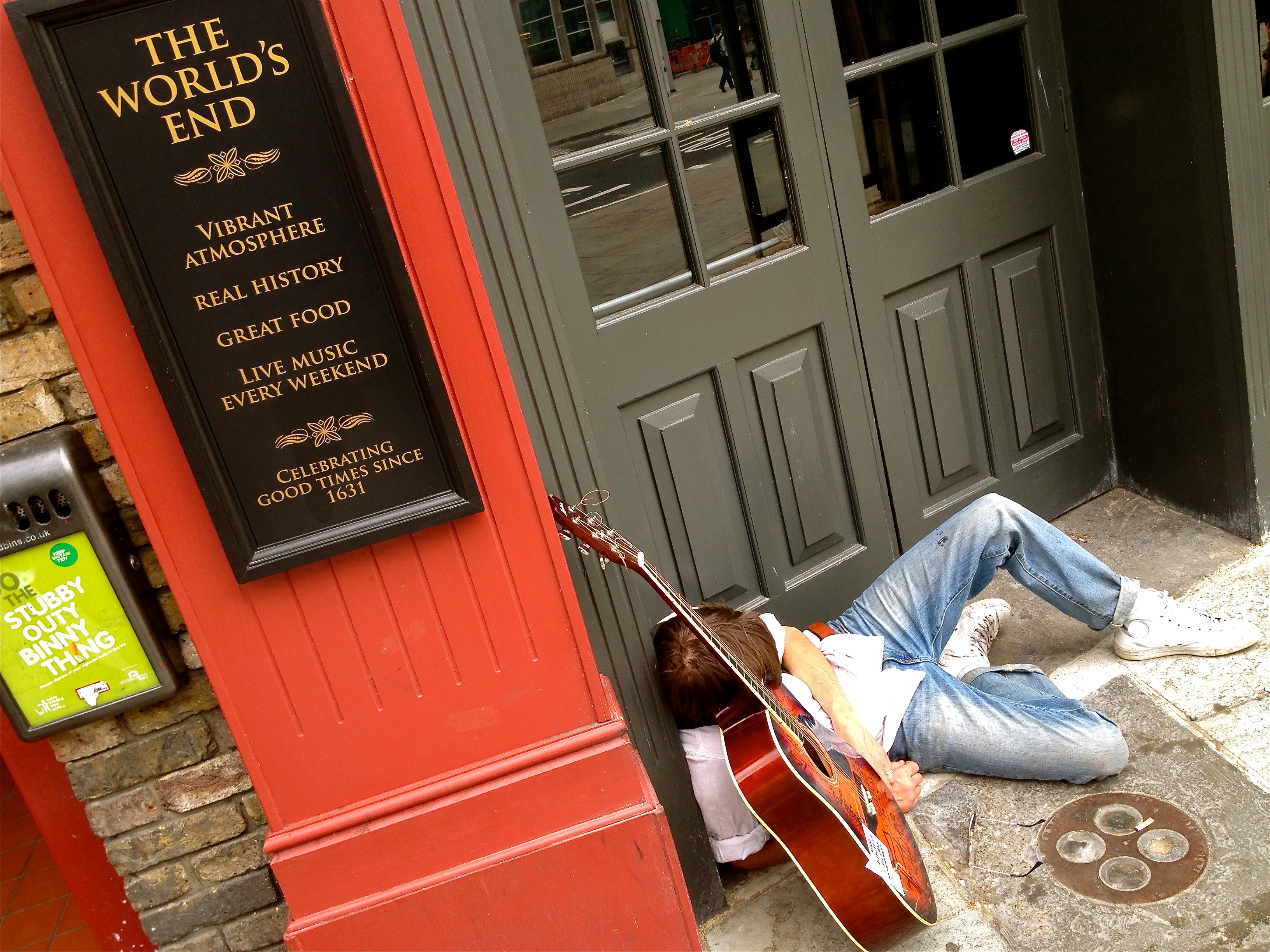
The World’s End

The World's End

When I was 8 years old, I read in LIFE magazine that in so many millions of years, the sun would burn out and life on earth would cease. This worried me, so I asked my parents, “If the world is going to end, how come we say “world without end” when we pray?” And they told me what the Bible says, that heaven and earth may pass away, but God remains. That relieved some of my anxiety, but I still wasn’t sure I liked the idea of the world ending, even if God was in charge.

Of course the world ends all the time. When I moved from California to Puget Sound in the 1990’s, my first Northwest winter felt like today’s gospel: the sun was darkened and the moon gave no light.

Who among us has not seen their world end? Adolescents exiled from childhood. Black teenagers robbed of their future. Elders deprived of their health. Unemployment …retirement …divorce … the death of a parent, a spouse, a child — in every one of these, a world comes to an end.

For anyone who has known serious loss, this is more than metaphor. The experience of grief can be so total and unrelenting that you can’t see anything beyond it. You can’t imagine the future. It feels like the end of the world.

The stars are not wanted now: put out every one;
Pack up the moon and dismantle the sun;
Pour away the ocean and sweep up the wood;
For nothing now can ever come to any good. [i]

W.H. Auden was invoking apocalyptic metaphors to express personal loss, but shared, public worlds also come to an end. As in 1789, or 1914. The Holocaust. Hiroshima. 9/11. My Lord, what a morning, when the stars begin to fall.

But why bring up such dreary stuff on this first day of the new Christian year? Shouldn’t we be breaking out the party hats, blowing horns and shouting “Happy New Year?” The wisdom of the Advent season is that it never begins with “A Holy Trinity Production,” or “The Creator of the World Presents.” No, it always opens with “The End.” Advent knows that every beginning involves some kind of ending. In this season’s Scripture, preaching and prayers, the present arrangements of collective and personal life are judged and found wanting. God’s imagination is far too rich and fertile to settle for our barren and diminished versions of human possibility.

Selfishness, greed, consumerism? Fear, racism and violence? Poverty, militarism, war, environmental degradation? That’s the best we can do? Really? God must be saying, “Come on, people. I made you a little lower than the angels, and this is what you came up with?”

George Eliot said “it is never too late to become what you might have been.” But to get to that “might have been” requires an Exodus into the wilderness beyond the way things are; an Exodus beyond even the best we can imagine for ourselves, into a place of unknowing, where only God possesses the language to speak our future into being.

So much of what we hear and pray and sing in Advent is profoundly disruptive. Bob Franke’s great Advent song, “Stir up your power,” gets right to it in the first line: This world may no longer stand. We are meant to be unsettled, to be driven beyond our narrow boundaries, our constricted realities, toward a beckoning horizon. The Christian life is a perpetual series of departures for a better place.

The world as it is – the world of racial hatred and toxic violence and economic injustice and perpetual war and addictive consumerism and pollution for profit and all the other evils which poison our common life – this world has no future in the emergent Kingdom of God. This world may no longer stand.

But the story doesn’t stop there. In my end is my beginning.[ii] Even when we have gone far astray, even when our story seems over, God remains deeply present in the processes of creation, tenderly leading and luring us into newness of life, making a way where there is no way, opening doors that none can shut.

Advent people do not just wring their hands or shake their heads over the latest news from Ferguson or the Middle East. We work and pray for something better. What we can do on our own is limited, but when we offer our priorities and energies to the larger purposes of God, Love will have its way with us.

As the Christian mystic Hadewijch put it in the thirteenth century:

Since I gave myself to Love’s service,
Whether I lose or win,
I am resolved:
I will always give her thanks,
Whether I lose or win;
I will stand in her power. [iii]

It is not always easy to stand in Love’s power and keep the faith. In some situations it is almost unimaginable. Forty years ago the African-American author James Baldwin wrote:

To be an Afro-American, or an American black, is to be in the situation, intolerably exaggerated, of all those who have ever found themselves part of a civilization which they could in no wise honorably defend – which they were compelled, indeed, endlessly to attack and condemn – and who yet spoke out of the most passionate love, hoping to make the kingdom new, to make it honorable and worthy of life. [iv]

This passionate mixture of protest and love sounds a lot like the Old Testament prophets who permeate our Advent lectionary. The very first reading of the season begins with a prophetic plea for history to be broken open by divine justice:

O that you would tear open the heavens and come down …
to make your name known to those who resist you,
so that the nations might tremble at your presence! [v]

Advent is not just a season of quiet waiting. It is also a time of protest and vision. Advent announces an insurgency against the way things are, a revolution to scatter the proud, cast down the mighty, raise the lowly, gather the lost, free the captive, and bind up the brokenhearted. Advent re-imagines the world as paradise restored, a new heaven and new earth suffused with the peace of God.

this is the day of broken sky
this is the space of conflagration-breath
speaking border-trespass
this is the feathered swoop of heaven
on the wing of now …
forking lightning into language …
breaking god into prison …
breaking the truth from jail! …

This is the fire-tongued fork of holy-ghost howl
making love on the tongue …
spitting flames of reconciliation
in the sky of war
making messiah-praise out of the air itself!

this is pentecost in your head
like becoming what you never dared
for the first time and forever

This ecstatic prophecy is from a poem by Jim Perkinson. [vi] He was talking about Pentecost, but his theme fits Advent as well:

“the day of broken sky”
the earth in conflagration
God breaking into the prisons
the truth being set loose at last
and “the fire-tongued fork of holy-ghost howl
making love on the tongue …
making messiah-praise out of the air itself!”

And each of us, all of us, becoming what we never dared.

When Jesus tells us to stay awake, he is warning us not to sleep through the day of God’s coming. Stay alert. Pay attention. Don’t miss it! Become what you never dared. Shake off the sleep of complacency, the sleep of complicity, the sleep of despair. Awake and greet the new dawn.

Jan Richardson describes this dawning reality in her beautiful poem, “Drawing Near.” [vii]

It is difficult to see it from here,
I know,
but trust me when I say
this blessing is inscribed
on the horizon.
Is written on
that far point
you can hardly see…

Richardson accurately expresses the sense of distant horizon that prevents the dominant reality of the moment from closing in on us and locking us in. That reality wants to be believed as fixed and final, permanent and stable. But the horizon calls every finality into question, disrupting its stability with the boundlessness of divine possibility. The horizon draws our attention from what is given to what may yet be. Keeping our eye on the horizon, feeling its pull, is the spiritual practice of Advent. Richardson’s poem expresses the deep longing produced by the distance between the already and the not-yet.

And then the poet discovers what every pilgrim knows: the goal of our long journey is something that has already been inscribed deep within us even before our journey began. Even before the day we were born, we were marked as God’s own forever.

And that is where Advent ultimately leaves us – finding that the thing we have been seeking so long has been with us all the time – within us, and all around us. While we have been walking our Camino to the Promised land, our feet have already been on holy ground, every step of the way. And the God of the far horizon turns out to be the path as well, keeping us company as we stride deeper and deeper into the world.

So when Advent people talk about the end of the world, we are speaking about end in the sense of purpose rather than termination. The word “apocalypse” means “unveiling,” and the apocalypse in our future will not be an annihilation, but a revealing of the world’s ultimate purpose and destiny.

Yes, all the inadequate, incomplete versions of world will come to an end (some of them kicking and screaming!), but creation as it was intended will be restored, not discarded. Like a poet who creates a new language out of old words, Love will remake the ruins and recover the lost. And the Holy One who is the mystery of the world will be its light and its life forever.

This Advent faith is expressed memorably in a short story by British writer Carol Lake, “The Day of Judgment.” On the Last Day of the world, God sails into England aboard a new Ark. But instead of bringing history to a close and pronouncing judgment on everyone, God leaves the Ark to enter the city of Derby. Heading for the run-down inner city neighborhood of Rosehill, he joins the crowd at a local pub, a multi-ethnic mix of the working poor and the unemployed. And there God gets so caught up in being with these people that he loses track of time, and the Ark sails away without him, heading off for the horizon of eternity. As the story describes it:

The Ark is on the edge of the horizon now, its destination the heartlessness of perfection. Most of the inmates already know what they are going to find – endless fruit, endless harmony, endless entropy, endless endless compassion, black and white in endless inane tableaux of equality. It sails off to a perfect world; the sky has turned into rich primary colors and in the distance the Ark bobs about on a bright blue sea.” [viii]

Meanwhile, God is still in that Rosehill pub, in the very heart of imperfection. If you had walked in there, you would have had a hard time picking him out. He blended right in. But if you were paying attention, you might notice that there was now something different about Rosehill. The old non-descript streets and dilapidated buildings had taken on a strange beauty. Maybe it was the warm slant of afternoon light, but people were beginning to see their neighborhood in a new way. And their own faces, too, seemed to glow with an inner radiance, as if they were carrying a wonderful secret, tacitly shared with everyone around them, as if they suddenly knew there was more to life than meets the eye.

They were still poor, the world was still a mess, but something new was in the air, a spirit of change was awakening. And from that day on, the people of Rosehill found themselves becoming what they’d never dared, for the first time and forever.

[i] W.H. Auden, “Twelve Songs (ix)”, Collected Poems, ed. Edward Mendelson (NY: Random House, 1976), 120

[ii] T.S. Eliot, “East Coker,” Collected Poems 1909-1962 (London: Faber and Faber Ltd, 1974), 191

[iii] Hadewijch: The Complete Works, trans. Mother Columba Hart, Classics of Western Spirituality (Mahwah, NJ: Paulist Press, 1980), 213

[iv] James Baldwin, No Name in the Street (NY: Dell, 1972), 194

[v] Isaiah 64:1-2

[vi] Jim Perkinson, “tongues-talk,” q. in Catherine Keller, On the Mystery: Discerning God in Process (Minneapolis: Fortress Press, 2008), 157-8

[vii] Jan Richardson, “Drawing Near” (http://adventdoor.com/2012/11/25/advent-1-drawing-near)

[viii] Carol Lake, Rosehill: Portraits from a Midlands City (London: Bloomsbury, 1989), 119

No place like home

Over the rainbow photo

We didn’t have enough eggs this morning to make the walnut pie, so I headed out at dawn for the village grocery. On the way, I played Charles Ives’ “Thanksgiving Day”, a tone poem permeated with fragments of American hymnody. Ives said that the clashing moods of major and minor chords represented “the sternness and strength and austerity of the Puritan character, and it seemed to me that any of the major, minor, or diminished chords used alone gave too much a feeling of bodily ease, which the Puritan did not give in to.” [i]

The irony of driving my car to the store while contemplating Puritan rigor did not escape me, but I did pass a solitary runner braving the cold drizzle, and joined my spirit to his propitiatory sacrifice.

Ives’ cacophony of broken tunes resolves in the end with the choral singing of a New England hymn:

O God, beneath thy guiding hand
Our exiled fathers crossed the sea;
And when they trod the wintry strand,
With prayer and psalm they worshipped Thee.

We are all exiles: from the Garden of Eden, from our mother’s womb, from the homes we grew up in, from ancestral lands, from pasts best abandoned and futures that never happened. Longing for home is the human condition.

As Dorothy knew, clicking her red shoes, “There’s no place like home.” And on the fourth Thursday of November, millions of Americans go wandering in search of that place, real or imagined, where they were always welcomed and known and understood.

Frank Baum, author of the Oz books, was never quite satisfied with Dorothy’s choice of Kansas over Oz. In his sixth book of the series, Dorothy moves back to Oz, dragging Auntie Em and Uncle Henry with her. As Salman Rushdie notes, “Oz finally became home; the imagined world became the actual world.”

The real secret of the ruby slippers is not that “there’s no place like home,” but rather that there is no longer any such place as home: except, of course, for the home we make, or the homes that are made for us, in Oz; which is anywhere, and everywhere, except the place from which we began. [ii]

Whether you celebrate today in Oz, or in Kansas, or out there somewhere along the Yellow Brick Camino, may it be with a grateful heart and blessed community. And if you need directions home and don’t have your ruby slippers, you might try Raymond Carver:

Left off the highway and
down the hill. At the
bottom, hang another left.
Keep bearing left. The road
will make a Y. Left again.
There’s a creek on the left.
Keep going. Just before
the road ends, there’ll be
another road. Take it
and no other. Otherwise,
your life will be ruined
forever. There’s a log house
with a shake roof, on the left.
It’s not that house. It’s
the next house, just over
a rise. The house
where trees are laden with
fruit. Where phlox, forsythia,
and marigold grow. It’s
the house where the woman
stands in the doorway
wearing sun in her hair. The one
who’s been waiting
all this time.
The woman who loves you.
The one who can say,
“What’s kept you?” [iii]

[i] Liner notes by Paul C. Echols, Charles Ives Holidays Symphony, Chicago Symphony Orchestra and Chorus conducted by Michael Tilson Thomas (CBS 1986)

[ii] Salman Rushdie, The Wizard of Oz (London: British Film Institute, 1992), p. 57

[iii] “Waiting,” by Raymond Carver, from All of Us: The Collected Poems (Alfred A. Knopf)

Whose world is it?

GTU Jesus icon face

I teach a course on “Jesus and the Movies,” examining nineteen features made on the life of Jesus between 1912 and 2014. And one of my favorites is a South African production, Son of Man (2006), which sets the gospel story in a fictional twenty-first century African country.

It begins in the desert, with Jesus and Satan sitting side by side atop a tall sand dune. There Satan offers Jesus the familiar temptations: use your power, dazzle the world, bow down to me and I will give you everything you desire.

Jesus listens for a while in silence. Suddenly he turns to Satan and shoves him off the ridge. As Satan tumbles downward – Milton’s fall of Lucifer comes to mind – Jesus shouts after him: “This is my world!”

Satan comes to a stop at the foot of the dune. He picks himself up and looks back defiantly at Jesus. “No,” he cries. “It’s my world!”

The film cuts abruptly to a village caught in the crossfire of a civil war. Terrible atrocities are taking place, making Satan’s point perfectly. It’s his world after all.

Tomorrow is the Feast of Christ the King, created by Pope Pius XI in 1925. Originally observed at the end of October as a prelude to All Saints Day, it was later moved to the last Sunday of the liturgical year, where it provides both a grand finale to the calendrical Christ narrative and a dramatic overture to Advent. In 1970 it was adopted by other churches using the Common Lectionary, including Anglicans, Lutherans, Methodists, and Presbyterians.

The pope was responding to the apocalyptic violence of World War I, where evil and madness seemed to have seized control of the world. He wanted to establish a clear reminder that it is Christ to whom the future belongs; it is Christ whom we must follow and serve.

Or in the words of Bob Dylan, “It may be the devil or it may be the Lord, but you gotta serve somebody.”

While the imagery of Christ as Lord of all may require some unpacking for interfaith dialogue, the pope’s original encyclical was clearly focused on Christian practice. If we profess Christ as our way, our truth, our life, then, in the pope’s words, “none of our faculties is exempt from his empire.”

But what do we do when Christ’s “empire” is in conflict with our other allegiances? How much do we give to Jesus, and how much do we hold back? Jesus gets Sunday mornings; does he get the working week? He gets our spiritual life; does he get our worldly affairs? Does he get our relationships, or our stewardship of time? Does Jesus get our politics, our economics?

Clarence Jordan was a Baptist preacher, New Testament teacher, and farmer in rural Georgia. In his celebrated Cotton Patch Gospels, he translated the Jesus story into a southern idiom, explaining that “the Scriptures should be taken out of the classroom and stained-glass sanctuary and put out under God’s skies where people are toiling and crying and wondering; where the mighty events of the good news first happened and where they alone feel at home.” [i]

In the 1940’s, in the middle of “the Good War,” in the heart of the segregated South, Jordan founded Koinonia, an interracial, pacifist farming collective using a communitarian model more like early Christianity than late capitalism. For his faithfulness to the dominion of Christ, he and his community were harassed, shot at, and bombed. The local church expelled him.

He was often invited to speak to groups around the country, and he would ask them, “What’s the biggest lie told in America today?” He’d let the question sink in for a bit, and then he’d say, “The biggest lie told in America today is: Jesus is Lord.”

I first heard this story when I visited Koinonia in 1980 and had a long conversation with his widow Florence (Clarence died in 1969). And in these latter days his words ring truer than ever.

Last year the Ohio legislature, hoping to derail the Affordable Care Act, blocked an expansion of Medicaid that would provide health care to 275,000 people who had no coverage. But the governor, John Kasich, made an end run around the legislature and got it done anyway.

As he said at the time: “For those who live in the shadows of life, for those who are the least among us, I will not accept the fact that the most vulnerable in our state should be ignored.”

The lawmakers howled. How dare he put the needs of the poor above our political agenda! So this is how the governor explained it to one those legislators, whom he knew to be a fellow Christian:

“Now when you die and get to the meeting with St. Peter, he’s probably not going to ask you much about what you did to keep government small; but he is going to ask you what you did for the poor. Better have a good answer.”

Governor Kasich, himself a Republican, was denounced by many in his party for appealing to a power higher than their ideology. The Wall Street Journal, wanting to make it clear that Jesus, lover of the poor, was not in fact Lord in America, offered a tart response: “Republicans get a vote before St. Peter.”

In Matthew’s gospel, the last parable Jesus tells before his arrest and crucifixion pictures all of humanity gathered before the glorified ‘Son of Man’ – the Lord of history – who reveals that he has always been among them in the bodies of the poor and needy: “I was starving … I was naked … I was an undocumented alien … I had AIDS … I was a convict …”

Everyone is of course quite surprised. But they all take his point. When you kneel before Christ the King, it won’t be at the foot of a mighty throne, but before the holy icons of “the least of these” – the vulnerable, the marginalized, the broken, the forgotten.

Well you kneel to the Lord and you will bless yourself…
Ain’t no need to kneel to no one else. [ii]

[i] G. McCleod Bryan, “Theology in Overalls: The Imprint of Clarence Jordan”, Sojourners (Dec. 1979, vol. 8, no. 12)

[ii] Bob Franke, “Trouble in This World (It’ll Be All Right),” on Heart of the Flower (Daring DR3016), © Telephone Pole Music, 1995

Dies Irae

Biblical prophet at Moissac Abbey on Le Chemin de St. Jacques

Biblical prophet at Moissac Abbey on Le Chemin de St. Jacques

Mr. McCleery, my seventh grade Latin teacher, had us memorize verses of the Dies Irae, a medieval chant describing the Last Judgment in strikingly lurid language. Most boys in junior high do not walk around chanting Latin poetry about the end of the world, but I rather enjoyed it. The tune was catchy, and those terse rhyming triplets beat time like the sensuous energy of a drum circle.

Dies irae, dies illa, 
Solvet saeclum in favilla,
Teste David cum Sibylla.

Day of wrath, O day of mourning,
See fulfilled the prophet’s warning,
Heav’n and earth in ashes burning.

The text of Dies Irae is inspired by the first chapter of Zephaniah, which was one of the eucharistic readings last Sunday. I sometimes wonder what churchgoers think about when asked to consider “a day of wrath, a day of distress and anguish, a day of ruin and devastation, a day of darkness and gloom.” In Syria or Ukraine, it’s just the latest news. But for those of us not living in one of history’s infernos, Zephaniah might be dismissed as a colorful crank carried away by the thrill of his own hyperbole.

The effect of the Bible’s more fiery rhetoric is often muted by the flat, inexpressive way it is usually read – or worse, mumbled – in the typical liturgy, as though no one really means it. Readers of prophetic texts should be given bullhorns. They should walk among the people as they shout, looking them in the eye.

I will bring such distress upon people
that they shall walk like the blind;
because they have sinned against the LORD,
their blood shall be poured out like dust,
and their flesh like dung.[i]

The church growth people might have something to say about that sort of messaging, but there is no denying that the prophets are working hard to get our attention. And in these last weeks of the Christian year, both the Sunday lectionary and the daily liturgical readings resound with the trumpet blasts of biblical warnings. People get ready. History’s chickens are coming home to roost.

Those prophetic rants have sometimes been read as endorsements of sacred violence – angry outbursts of a moody and unpredictable god – but God’s best friends have long rejected that crude picture as a tragic misreading of the divine. Nevertheless, there is no denying the violent imagery woven into some biblical texts, and we must find a way to make sense of it.

Walter Brueggemann explains that the prophets “speak in images and metaphors that aim to disrupt, destabilize, and invite to alternative perceptions of reality … [They] speak in outrageous and extreme figures because they intend to disrupt the ‘safe’ construals of reality, which are sponsored and advocated by the dominant opinion makers.”[ii] In other words, prophets blow up the old paradigms in order to make room for the new. They take seriously the power of language both to enslave and to liberate.

Zephaniah targets those “who rest complacently on their dregs,” who are blinded by their illusions, who assume divine indifference to the damage they do to the poor, the vulnerable, and the whole interdependent system of life on earth. We can find similar voices in our own time.

German writer W. G. Sebald’s apocalyptic poem, After Nature, is as harrowing as anything in the Bible. As he contemplates the dark and barren landscape of Matthias Grünewald’s Crucifixion, painted in 1505, Sebald finds a predictive warning of the planet’s own death unless we change our ways.

Here in an evil state of erosion
and desolation the heritage of the ruining
of life that in the end will consume
even the very stones has been depicted.[iii]

Today the United States Senate came just one vote shy of approving the Keystone XL pipeline, a massive fossil fuels project to enrich a few people at the expense of the whole earth. The effects of exploiting the Canadian tar sands, according to climate scientist James Hansen, could well be of biblical proportions.

Canada’s tar sands, deposits of sand saturated with bitumen, contain twice the amount of carbon dioxide emitted by global oil use in our entire history. If we were to fully exploit this new oil source, and continue to burn our conventional oil, gas and coal supplies, concentrations of carbon dioxide in the atmosphere eventually would reach levels higher than in the Pliocene era, more than 2.5 million years ago, when sea level was at least 50 feet higher than it is now. That level of heat-trapping gases would assure that the disintegration of the ice sheets would accelerate out of control. Sea levels would rise and destroy coastal cities. Global temperatures would become intolerable. Twenty to 50 percent of the planet’s species would be driven to extinction. Civilization would be at risk.[iv]

Hansen concludes that Keystone and its aftermath “will be game over for the climate.” The apocalypse was defeated today in the Senate, but there will be another vote early next year, when many of the “no” votes will be out of office. Alarmingly, the next head of the Senate Committee on Environment and Public Works will be a climate change denier who believes in a god who would never allow earth’s climate to be affected by the actions of mortals. If the senior senator from Oklahoma were to study his Bible, he might find that God takes human freedom far more seriously than he does. We do have the power to destroy God’s creations and disrupt the fragile balances of life.

The prophets are trying to make us renounce that power before it is too late. When Zephaniah warns of “a terrible end” he isn’t simply condemning us; he’s trying to save us. The “day of wrath” will not be an arbitrary vengeance from the sky, but the sum of innumerable bad choices here on earth. Zephaniah and his fellow prophets hold before us a chillingly graphic picture of where those choices are headed. What has been called the wrath of God is really something bearing our own signature.

Will God ride to the rescue? In a poem called “Emmanuel’s Nightmare,” African-American poet Gwendolyn Brooks wonders what it might be like if we were simply left to our own devices. She imagines the Second Coming of a Christ who would “clean the earth / of the dirtiness of war.” But the Savior finds himself thwarted. Humans love war too much. It is “what they lived for.” So God’s Son gives up and goes home. Mission not accomplished. “He had not the heart / To take away their chief sweet delectation.”[v] 346

The prospect of being abandoned to our own suicidal impulses is not a happy one, but – thankfully – it is not in fact the story we tell. God has destined us not for wrath but for salvation.[vi] The means of that better destiny will turn out to be quite surprising, not at all like the terrible clamor of the Dies Irae. But that is a tale for another day.

[i] Zephaniah 1:17

[ii] Walter Brueggemann, Theology of the Old Testament: Testimony, Dispute, Advocacy (Minneapolis: Fortress Press, 1997), 625

[iii] W.G. Sebald, After Nature, q. in Colin Riordan, “Ecocentrism in Sebald’s After Nature,” in W.G. Sebald – A Critical Companion, eds. J.J. Long & Anne Whitehead (Seattle: University of Washington Press, 2004), 51

[iv] New York Times, May 9, 2012

[v] Robert Atwan, George Dardess, Peggy Rosenthal, eds., Divine Inspiration: The Life of Jesus in World Poetry (New York: Oxford University Press, 1998), 346

[vi] I Thessalonians 5:9