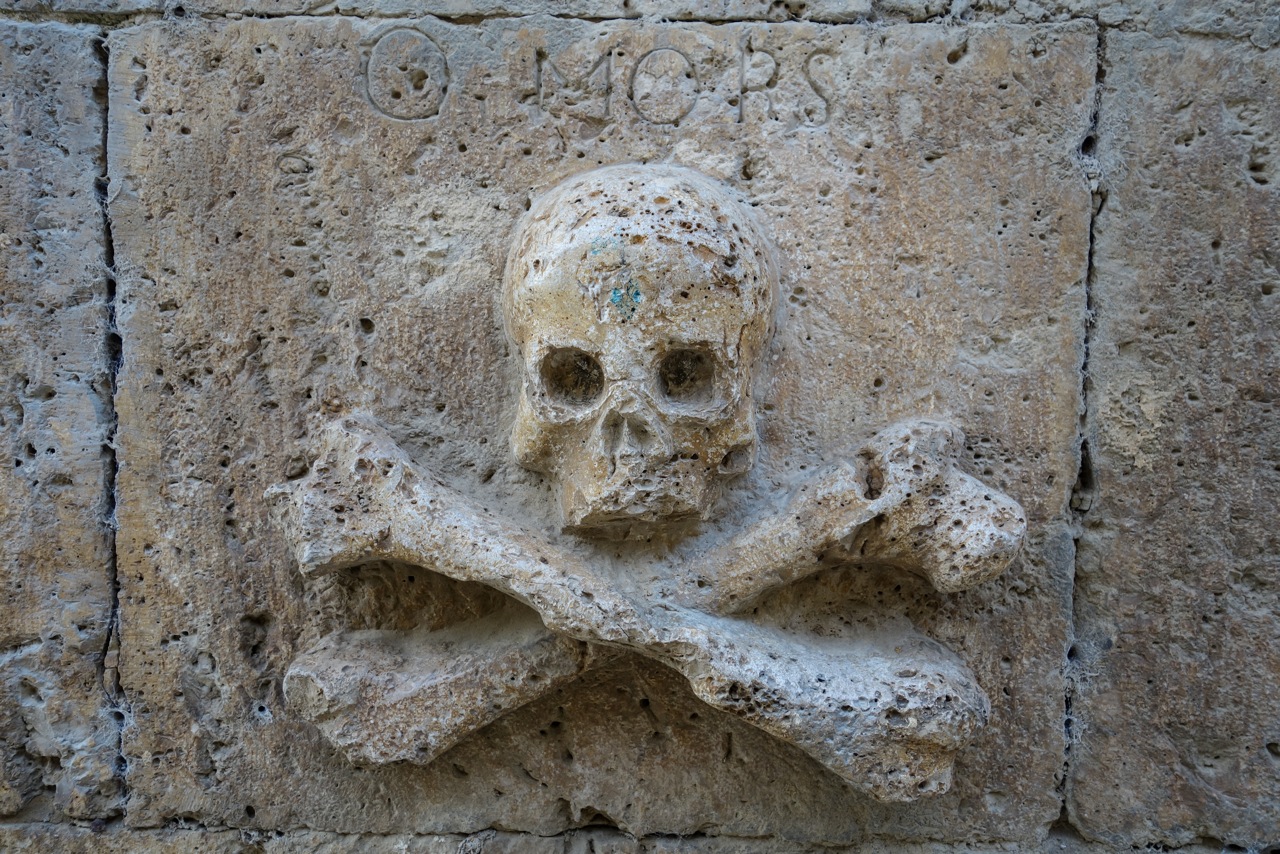
Memento mori

Wall relief in Castrojeriz on the Camino de Santiago

Wall relief in Castrojeriz on the Camino de Santiago

I tell my pupils to live each day as if it were their last… I don’t want children to fear death; I want them to respect life… It’s good for children to confront the idea of death, and… of their own mortality. Sometimes a child feels squeamish about death… skulls and skeletons. When this happens, I tell my pupils to touch themselves. “Why are you afraid?” I ask, “when each of you owns a skull and skeleton. We all carry death within us.” They feel themselves, and they say: “Yes it’s true, we too are made of bones.”

– María Antonieta Sánchez de Escamilla, a kindergarten teacher in Mexico (The Skeleton at the Feast: The Day of the Dead in Mexico, Elizabeth Carmichael & Chloë Sayer)

No leaves, no flowers, no light, no warmth, November. The eleventh month, as the year begins to slip away, evokes mortality like no other. Though it begins with the festivity of All Saints Day, celebrating the friends of God now radiant with the light of heaven, it immediately shifts to the more shadowy realm of All Souls, the Day of the Dead. Death itself, rather than what lies beyond it, becomes our focus. We visit graves, light candles, speak names, gaze at old photographs, tell stories of vanished presences.

In Mexico, death is playfully treated in comic skeleton images and candy skulls, but it is not mocked. A resigned acceptance of mortality pervades the festivities. The living remember not only the dead, but the skeleton inside themselves. They too are “made of bones.”

In American culture, we are not so adept with death. We always seem a little surprised by it. We avoid speaking its name. Memento mori is not a common spiritual practice. Few of us keep skulls on our desk, or sleep in coffins while we still have breath.

Forty-five years ago this month, I had my closest brush with death. I was sleeping in the back of a Volkswagen bus hurtling down a New York thruway at 65 miles per hour. A friend and I had been traveling all night, and it was my turn to rest. Suddenly the bus went out of control and flipped sideways, rolling over and over six times until finally coming to a stop upside down on the grassy median.

I remember two things about that long roll. My mind sped up to make everything appear in slow motion. It was like being inside the giant rotating barrel at an old amusement park. It carries you up and up until gravity kicks in and you are dropped back to the bottom to begin all over again. Slide up, drop. Slide up, drop. But slowed down, so I could observe it all in detail. Meanwhile, guitars, suitcases and croquet balls were flying around in similar motion experiments.

The other thing I remember is how familiar death seemed. I was not thinking, “This can’t be happening.” I was thinking, “Oh, so this is where we finally meet.” I’m sure the words were not so precise in the moment, but the sense of recognition was. When the rolling finally stopped, I lay face down on the ceiling of the inverted bus. I probably blacked out for a moment. Then I heard a voice, “All you all right?” I wasn’t sure how to answer – not until I actually tried to move. What if I couldn’t? I hesitated a moment, delaying the verdict. At last I tested my hands; my arms; my legs. They still worked. I rose slowly to my feet. Thankfully, nothing was broken. My friend was unharmed as well. Life was never so sweet.

The bus itself was totaled, and one of the guitars, my grandfather’s Gibson “Roy Smeck Stage Deluxe” Hawaiian guitar from the 1940’s, was pretty smashed up as well. Its broken body still hangs in our garage, my own memento mori.

In the predominant secular imaginary, a peek through death’s door finds no stairway to heaven, but only darkness. Termination. Void. A terrible forgetting. Emptiness.

This is a reasonable outlook, especially after the charnel house of the past century, but it’s not much to live by. And it is no more provable than belief’s alternative. None of us knows for sure. It’s a gamble either way.

In the 1950’s, Sylvia Plath summarized the modern formulary in her journal:

You don’t believe in God, or a life-after-death, so can’t hope for sugar-plums when your non-existent soul rises… Cats have nine lives, the saying goes. You have one; and somewhere along the thin, tenuous thread of your existence there is … the stopped heartbeat that spells the end of this particular individual which is spelled ‘I’ and ‘You’ and ‘Sylvia.’

John Donne, who himself never took death lightly, saw the outcome differently:

All mankind is of one Author and is one volume; when one man dies, one chapter is not torn out of the book, but translated into a better language; and every chapter must be so translated.

Just a month before his death from cancer in 1631, Donne preached his final sermon, Death’s Duell, at St. Paul’s, London. “That which we call life is … spent in dying,” he wrote, but “a gate into heaven I shall have.” Then, though weak from illness, he posed for a sketch that would be used to make the sculpture for his tomb. After having a fire lit in his study (it was February), he stripped naked and wrapped himself in a burial shroud with only his face showing. Rather than lie down in the traditional sleeping position, he stood erect for the sketch. The resulting statue, the only monument to survive the Great London Fire of 1666, resides in the south choir aisle of St. Paul’s. Donne is standing to greet the resurrection. His eyes are not yet open, but he is smiling with expectant delight. His epitaph reads:

He lies here in the dust
but beholds Him whose name is Rising.
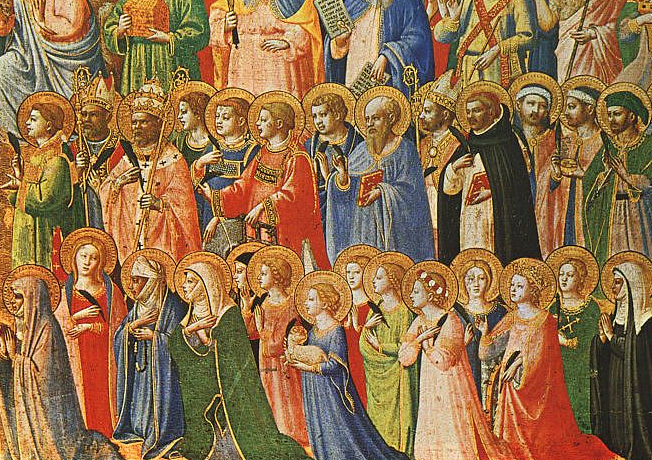
For all the saints

Fra Angelico saints

Dorothy Day, the feisty co-founder of the Catholic Worker movement, has been called the most interesting and significant figure in the history of American Catholicism. Deeply nourished by a discipline of liturgy and prayer, she devoted her life not only to serving the poor on a daily basis, but also to challenging the very forces that create poverty in the first place. She was a pacifist and activist who sometimes practiced civil disobedience to resist militarism. racism and systemic greed. For her faithful witness to the way of Jesus, she was investigated, jailed, and even shot at. Basically, she understood that the Christian life not only produces thoughts, feelings, and beliefs; it also produces actions that make a difference. It produces people who make a difference.

But “don’t call me a saint,” she warned. “When they call you a saint, it means basically that you’re not to be taken seriously.”

The same sort of neglect has been applied to the Beatitudes, and all the other teachings of Jesus: they are dismissed as unattainable ideals rather than guides to the way we might actually live our lives.

And what do you say? Is it enough for the friends of Jesus, the friends of God, to sit on the sidelines and cheer on the great athletes of sanctity whom we ourselves could never hope to imitate? Or is it about time for the rest of us to get in the game?

When we gather for worship, we may be consoled, we may be inspired, we may be refreshed. Sometimes some of those things happen, sometimes all of them happen, sometimes none of them happen.

But what always happens is, God speaks to us in Word and Sacrament, and then sends us out into the world with an assignment: to do the work we have been given to do.

So what exactly is our assignment, on this Feast of All Saints, 2014? It’s right there in the gospel. First of all, Jesus says, you need to turn the world’s values upside down. You need to look at everything in a new way.

The poor will be blessed with the gift of the kingdom,
while the rich will have to learn the hard way that life can’t be owned.

Everyone who weeps will find out what grace and comfort mean,
while those who are smug and self-satisfied
will be unable to grasp their deepest need.

And if you are marginalized and scorned because you follow me, says Jesus,
you are in such good company,
for that is exactly how the saints were treated.

Jesus never gives easy assignments. Discipleship isn’t kindergarten. It’s graduate school. And if you want to get your PhD, here’s the deal:

Love your enemies, do good to those who hate you,
bless those who curse you, pray for those who abuse you.
If anyone needs something, give it to them;
and if anyone should relieve you of your attachments,
don’t make a fuss.
Just let it all go.

When Jesus says such things, is he really talking to us? The saints have always thought so, and they have responded accordingly.

So many of their biographies begin with them giving all their money to the poor, and then the rest of the story tells how they keep giving themselves away to God. Saints are the ones whose discipleship knows no limits. They can seem extravagant, immoderate, audacious, even a little weird.

Risking everything. Pouring out everything. Holding nothing back.
Trusting completely the One they follow, even when the way is rough and steep.
No longer looking out for number one,
but giving themselves away in works of love and mercy.

And you mean to be one too, don’t you?

You never know when you’re going to get the call. It could come in a sudden flash of revelation, or it could come on the freeway when someone cuts you off and you must decide whether to respond with anger or with love.

But when the call does come, you know what to say.
People in the Bible said it all the time.
The saints said it all the time.
Here I am.

Here I am. At your disposal. Your will be done.

Martin Luther King, Jr. wrote about how the call came to him: “Almost out of nowhere I heard a voice. ‘Martin Luther, stand up for righteousness. Stand up for justice. Stand up for truth. And lo, I will be with you, even until the end of the world.’” After that, King said, “I was ready to face anything.”

And some of you will remember Dag Hammarskjöld, elected Secretary-General of the United Nations in 1953, who was a tireless worker for world peace. In 1961 he died in a plane crash on his way to deal with a crisis in Africa, and it was only after his death that the world learned that he was not just a famous and effective public figure, but a Christian mystic as well, with a profound and faithful inner life.

Hammarskjöld wrote this about his own call:

I don’t know Who – or what – put the question. I do not know when it was put. I don’t even remember answering. But at some moment I did answer Yes to Someone – or Something – and from that hour I was certain that existence is meaningful and that, therefore, life, in self-surrender, had a goal.

Most of us don’t get such a definitive summons. Sometimes it comes as gradually as the dawn, making its way slowly into our awareness. But wherever we are in that process of awakening, we are being called every day, every hour, to sanctify the moment with a word or an action that makes God visible to others, and plants another seed of resurrection in the soil of ordinary time.

It doesn’t always have to be extraordinary or monumental. Henri Nouwen, in a short list of questions, shows just how simple the work of a saint can be:

Did I offer peace today?
Did I bring a smile to someone’s face?
Did I say words of healing?
Did I let go of my anger and resentments?
Did I forgive?
Did I love?

But you may be thinking: What’s it going to cost me to follow Jesus?
Well, that’s the tricky part. It will cost no less than everything.
But it will also bring perfect joy.

Whatever saints need to give up, whatever their ordeals, whatever their sufferings, saints are not, by and large, a gloomy lot. Even under the most extreme duress, they manage to sound a note of joy.

Sheila Cassidy, a British physician, forged a striking image for this saintly joy in her own experience in a Chilean prison in the 1970’s. She had been imprisoned for treating a wounded revolutionary, and for a while she was tortured. When the torture finally stopped, and she was able to collect herself, her first impulse was to scream out to God for deliverance, begging to be released.

But then another response rose up in her. In her words, it was “to hold out my empty hands to God, not in supplication, but in offering. I would say, not ‘Please let me out’ but ‘Here I am, Lord, take me. I trust you. Do with me what you will….’ In my powerlessness and captivity there remained to me one freedom: I could abandon myself into the hands of God.”

And the image that emerged for her from that moment was of a bird in a cage, which could either “exhaust itself battering its wings against the bars, or else learn to live within the confines of its prison, and find, to its surprise, that it has the strength to sing.”

And how does it go – the song of the caged bird?
I believe it sounds something like this:

I see God in … the marks of … love in every visible thing and it sometimes happens that I am seized by a supreme joy which is above all other joys.

These are the words of a Dutch priest. He wrote them in the concentration camp at Dachau, before he was killed for preaching in defense of the Jews. Such profound joy under duress is not unique among the friends of Jesus. Saints and martyrs have sung this song in every age. Even in the hour of trial, even at the brink of the grave, they have sung this song, because they knew the secret.

They knew that beneath everything, within everything, beyond everything,
there is a Love which is stronger than suffering,
stronger than evil, stronger than death.
It has brought all things into being
It sustains us on our journey
It will guide us safely home.

This Love calls us in every moment – indeed, it is calling right here, right now – to follow, to serve, to embody, to manifest, to surrender. All the saints before us said yes to this call, over and over again. And they are cheering us on to do the same.

Will you say yes to Jesus, yes to God?
Will you stand with the saints today?
Will you join their song?
Will you share their work?
Will you bear their sacrifice?
Will you embrace their perfect joy?

God and the imagination are one

HS dove

Following this blog’s inaugural series of dispatches from the Camino de Santiago last spring, readers of The Religious Imagineer may have noticed a curious diversity of topics: saints, seasons, nature, culture, theology, Scripture, liturgy, art, theater, circus, classic cars and cinema. And perhaps they wonder, what ties all this stuff together?

The fox knows many things, but the hedgehog knows one big thing. When Isaiah Berlin explored the implications of this ancient Greek saying in his celebrated 1953 essay, he argued that Tolstoy was by nature a fox but by conviction a hedgehog. His interests were wide and his eye for the particular was acute, but he sought to contain the world’s multiplicity within a single defining idea.

I can relate. And the one big thing for this blog is found in a line from Wallace Stevens:

We say God and the imagination are one …
How high that highest candle lights the dark.

This might be taken as a secular celebration of the human mind, reducing God to one of its creative fictions. But if I read Stevens with the hermeneutic of a believer, “God and the imagination are one” is not necessarily a matter of either-or. It might also mean both-and. God dwells both in the mind and outside it. Imagination is both a way we reach beyond ourselves, and a means by which the transcendent finds a home in us, enabling us to see with the eyes of God and the mind of Christ, and to act accordingly. To say that God and the imagination are does not mean for me that they are identical, but that they participate deeply in one another.

The Creator’s “Let there be light!” and Jesus’ refusal of the tomb’s finality are the supreme biblical examples of divine imagination. But there have been countless imagineers engaged in the work (or is it play?) of bringing the new heaven and new earth into being. The activist imagining peace, the oppressed imagining justice, the forgiver imagining reconcilation, the mourner imagining joy, the saint imagining a new way of being, the theologian and the artist imagining the beauty of the infinite in the particular, are all practitioners of the holy and transformative task of conforming the world more closely to God’s image.

When Jesus quoted Isaiah 61 in his hometown sermon, he embraced such prophetic imagination as his own vocation.

The Imagination of God is upon me,
for she has sent me to bring good news to the poor.
She has sent me to proclaim release to the captives
and recovery of sight to the blind;
to let the oppressed go free,
to proclaim the year of divine favor.

So to return the original question about The Religious Imagineer’s diversity of topics, I would say that imagination is the unifying subject of this blog. How do we say the unsayable, see the invisible, dance the impossible in our images, rituals and stories? How do we attend to the traces of God amid the chronic unknowing of secular modernity? How do we imagine the really Real and the not-yet?

Video artist Bill Viola, the subject of an earlier post, has observed that “in the Middle Ages they painted the sky gold in the paintings … It was realism they were after – reality of the divine effused through everything in the physical world.” That is my theme as well.

As ever, thanks for reading.

The ten best religious films

DCP blessing2

A man goes into a butcher shop and says, “Give me your best piece of meat.” And the butcher replies, “Everything in my shop is the best.” (Zen story)

Top ten lists are inherently fraudulent. By what authority do I declare what is best? And by what criteria? And which religion? But if I had titled this post, “Ten compelling films which engage religious questions from a [mostly] western Christian perspective,” it wouldn’t be nearly as much fun. We love rankings, if for no other reason than the pleasure of argument.

My list is totally subjective of course, and infinitely revisable, depending on the day, or where I am in my life (although Robert Bresson’s Diary of a Country Priest has topped my list every since I first saw it in Ann Arbor 45 years ago and subsequently had to wander around for a couple of hours on a rainy night until I was capable of returning to ordinary life).

I have restricted myself to one film per director (or else Bresson would take up about six places, and Tarkovsky a few more, etc.). I have also stuck to the western Christian tradition, with the Russian orthodoxy of Tarkovsky the one exception.

And while there are many films with spiritual subjects or theological themes, I have focused primarily on examples of what Paul Schrader calls “transcendental style” – films which are not just about religious experience, but themselves create religious experience in the viewer, through cinematic form and language as much as story. Icon writers know this well. There’s a lot to say about transcendental style, but for now let me simply cite Susan Sontag’s remark about Robert Bresson: “His form does not merely perfectly express what he wants to say. It is what he wants to say.”

All these films are available on DVD or Blu-ray, and I hope you will be encouraged to explore them. But I must warn you that not all these films are equally accessible. Most of them refuse the usual manipulations and excitements of mass cinema, and demand a contemplative mind. Transcendental style can be as rigorous as prayer. But as Iranian director Abbas Kiorastami has said, “I would rather see a film that might even bore me in the act of watching but that later I can’t stop thinking about, than a film that keeps me on the edge of my seat and then is immediately forgotten.”

Here is my list, in alphabetical order.

1) Decalogue (Krzysztof Kieslowski, Poland 1988)   This extraordinary cycle of short films explores various lives within a single apartment block, whose grey concrete bleakness exudes the alienation and melancholy felt by many of its residents. It is the world after the Fall, when instinct and intuition no longer suffice to guide human living. Each film is roughly based on one of the Ten Commandments, but the imperatives of each situation are far from clear. Choices matter intensely (it is not such a godless world that one can do anything one wishes), but most of the characters are bewildered and beset by the questions before them. And yet – grace happens, people connect, souls find mercy. Not every time, but enough to keep alive the hope that God – embodied by a mysterious figure who always seems to be around at key moments – has not abandoned us.

2) Diary of a Country Priest (Robert Bresson, France 1950)   Bresson pares away everything inessential to show the story of a soul. The miracle of his “transcendental style” is that he shows us not so much what people do as who they are – not through explaining them psychologically, but by letting their mystery be. As with iconography, a kind of inexpressiveness on the surface allows hidden depths to shine through. As the priest walks his own Stations of the Cross, the sorrowful way becomes a revelation of grace. This is not a film about religious experience – it is religious experience.

3) Ida (Pawel Pawlikowski, Poland 2013)   Is the religious life purely a product of environment, or is it indelibly inscribed on the heart? In 1962, a young novice, raised as an orphan in her convent, is sent into the world to visit her only living relative, just prior to taking her final vows. Will her vocation survive outside the cloister? The people she encounters, the discoveries she makes about her past, the suddenly viable prospect of a life in the outside world – all present her with new options for her life and vocation. One of the many beauties of this film is that neither the convent nor the outer world are judged. Both are viewed with sympathy and respect. Until she decides her future, Ida is shown off center, at the edge or bottom of the frame. But in the film’s final shot, she is perfectly centered at last.

4) Into Great Silence (Philip Gröning, Germany 2005)   The director spent 6 months in residence at a Carthusian monastery in the Alps, filming monastic life and worship. Using only natural light, he shows us a numinous world of shadows pierced by the radiance of windows and candles. Dwelling in this world of prayer and silence for nearly three hours, we slow ourselves to the monastic rhythm, and emerge refreshed and centered, and thankful for those who give their lives to providing, as Dan Berrigan once put it, “large reserves of available sanity.”

5) Magnolia (Paul Thomas Anderson, USA 1999)   Is the world only a confusion of chance and arbitrary choice, or do providence and purpose exist? Is the universe a matter of chaos or love? Anderson explores the possibility of connection, pattern and grace in the intersecting lives of many different characters, all of whom are in some way broken, wounded or lost, casualties of a city (Los Angeles) which, like the biblical Egypt, has produced countless captives and victims. In one unforgettable scene, nine of the characters are shown, each in their particular condition of need and supplication, singing along with the soundtrack, Aimee Mann’s “Wise Up” (“It’s not going to stop till you wise up”). Their capacity to exit the prison of the self just enough to partake of the soundtrack’s “common prayer” is both ritual transcendence and the tentative praxis of real liberation. As if in answer, a biblical rain of frogs falls from heaven.

6) The Mill and the Cross (Lech Majewski, Poland 2011)   In a windmill perched high above a broad plain teeming with figures, God is a miller grinding the terrors of history into something better, even as the Christ is being dragged to the cross. This strange, haunting and difficult film immerses us within the complex world of a single painting, Pieter Brueghel’s “The Way to Calvary,” where the Passion of Christ is relocated to the painter’s own 16th century world. Through a visually stunning use of computer imaging, we dwell within the painting’s fantastic landscape and mingle at close range with its numerous characters. The effect is astonishing, as if we are dreaming with a premodern mind. The human suffering is arduous and heartbreaking, but it does not have the last word. In the end, the dance goes on.

7) Nostalghia (Andrei Tarkovsky, Russia 1983)   All of Tarkovsky’s films practice what he called “sculpting in time,” using a contemplative camera and lengthy shots to register a deeper flow and presence than films that hurry from one incident to the next. For western Christians, the image is usually about something. For an orthodox Christian like Tarkovsky, the image is something. The viewer becomes less a spectator than a supplicant. “The aim of art,” said Tarkovsky, “is to prepare a person for death, to plough and harrow the soul, rendering it capable of turning to the good.” Nostalghia is more poetry than narrative, rhyming fire and water, dream and memory, ritual and redemption, to counter the malaise of materialism.

8) Of Gods and Men (Xavier Beauvois, France 2010)   Based on a true story of a monastic community facing martyrdom in 1990’s Algeria, this is a profoundly moving story of self-offering and radical forgiveness. Structured around the liturgical hours and seasons, its unhurried scenes of prayers and chants allow us to worship along with the monks. But they are asked to sacrifice more than praise, and their faithful willingness to take up the cross poses serious questions for our own discipleship.

9) Ordet (Carl Dreyer, Denmark 1955)   Like the parables of Jesus, Ordet (“The Word”) employs the forms and situations of the everyday world only to break open the frame of that world with the startling intrusion of an alternate reality. Dreyer’s film, like its “holy fool” Johannes, presents us with divine impossibility in perpetual tension with the way we expect things to go. It uses material means – faces, architecture, landscape, language, light – to show us the immaterial, but in the end we are led not away from corporeal existence, but rather more deeply into it.

10) To the Wonder (Terrence Malick, USA 2012)   “Love everyone. Every leaf. Every ray of light. Forgive.” This line from The Tree of Life (drawn from Dostoevsky) is the theme of every Malick film. While his work has always reflected a deep interest in philosophy and religion, his most recent films have been theologically explicit to a degree unique in American cinema. The Tree of Life covers the biblical span from Creation to Apocalypse, while To the Wonder narrows its focus to the Song of Songs’ analogy between human relationships and divine-human love. Unlike the plot-driven narratives of most films, To the Wonder unfolds in hints, glimpses, ellipses and temporal leaps. We can’t always be sure whether we are seeing events, memories or thoughts. As with Bresson, there is no psychological explaining of characters. They retain the open-endedness of their essential mystery. It’s not so much a film in the usual sense as it is a dance, a poem, even a prayer. The viewers aren’t simply invited to watch the ecstatic images, but to become ecstatic themselves.

All creatures great and small

Goldfinch

In the 13th century, what you did with animals was either avoid them, cook them, or work them to death. You certainly didn’t preach to them, pray with them, or receive spiritual gifts from them. Unless you were Francis of Assisi. He called animals his brothers and sisters. He saw them as our teachers. Such countercultural regard for the non-human was seen by his biographers as a restoration of a fallen creation, a renewal of the lost paradise where all creatures, great and small, might live in peace. As Bonaventure wrote,

So it was, that by God’s divine power the brute beasts felt drawn towards him and inanimate creation obeyed his will. It seemed as if he had returned to the state of primeval innocence, he was so good, so holy.

But Francis wasn’t just a dreamer. He was an environmental activist. He lobbied the officials, the governors, and even the Emperor for laws against the abuse of animals. He urged farmers to treat cattle humanely, and convinced towns to scatter seeds on the roads in winter so the birds wouldn’t starve (this is still done in Assisi today). He called for hostels for homeless strays, and raged against the caging of larks.

His love and respect for creation continues to nurture and challenge our own evolving sensibilities about the interdependence of all beings. He wasn’t quite calling for a democracy of creation – one beast, one vote. He remained distinctly medieval in his chivalrous notions of honor, deference and courtesy among the various levels of creation.

Nevertheless, Francis expanded the perimeter of love’s circle far beyond the human tribe, and his example pushes us to do the same.

On the Feast of St. Francis (Oct. 4) in 2012, a group of Episcopal clergy and laity blessed the animals at Seattle’s Woodland Park Zoo. In writing the blessings, I tried to honor and bless the qualities of each species, and name the ways in which those qualities in turn might inform and bless their human kin.

I documented the blessings on video, which you may view here.

The most dangerous place in the world

Small mtn tent still

I have come to understand that this small ring is the most dangerous place in the world, but also a place where everything is possible, where eyes are opened.

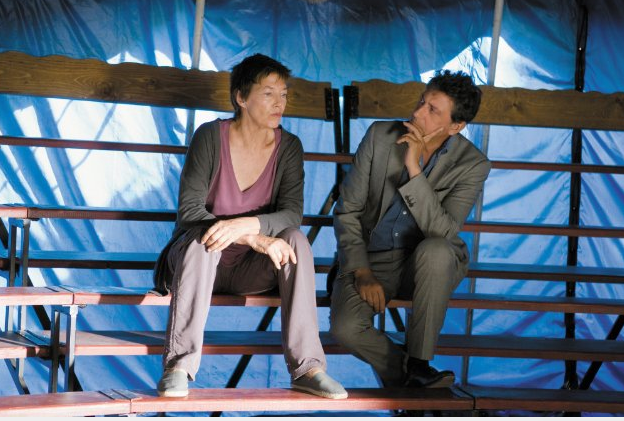
In Jacques Rivette’s magical film, Around a Small Mountain (2009), a footloose Italian named Vittorio, wandering Europe’s back roads in a sports car, chances upon a small French circus on tour in the backwater of Languedoc. Although the story is set in our own time, it is really a medieval romance. Vittorio is the knight errant questing for that nameless object of desire perpetually beyond his grasp. And the enchanted world of the cirque, curiously untouched by modernity, is the place where the knight will be tested.

When Vittorio encounters the enigmatic Kate, a woman who is “a prisoner to what happened” in the circus ring years ago, he lingers in her domain long enough to attempt a rescue. “All the dragons in our lives may be hurt princesses,” he says, echoing Rilke’s famous line: Perhaps everything terrifying is deep down a helpless thing that needs our help.

As Vittorio attempts to break the spell cast over Kate by the lingering presence of a dead father and the haunting absence of a dead lover, he has to face his own dragon, which is never specifically identified. The secret of his being remains a mystery, unknown to himself and to the actor who plays him, unknown to the audience and the director as well. The sentimentality of a conventionally romantic conclusion – man and woman settling down happily ever after – would betray this mystery, and Rivette rejects such an option. The ultimate fate of Kate and Vittorio is not revealed to themselves or us. “Will I start living again?” she wonders. “I don’t know if I am alive,” he says. Might the future perhaps return them to each other? “Who knows?” is the last line of the film.

We exit this cinematic world still mesmerized by its embrace of uncertainty, its refusal of resolution. Like the knight errant, we remain prisoners of unsatisfied longing. We wouldn’t have it any other way. As C. S. Lewis noted, an unsatisfied desire is “more desirable than any other satisfaction.”

Nevertheless, something transformational has happened to Kate and Vittorio and, vicariously, to us, in that “most dangerous place,” the circus ring. They have each stepped into the exposed and empty space where they must perform the truth of themselves, put themselves at risk, wrestle their demons, without really knowing in advance how they’ll ever get through it. But they have already taken their first steps into a new life. In the words of the German Romantic Friedrich Hölderlin, quoted in another Rivette film, “Where danger is, there grows the saving power also.”

I recently saw Around a Small Mountain for the first time, and I was particularly struck by the hermetic quality of the circus. It seems sealed within its own world, having minimal interaction with contemporary life. The landscape it travels remains little changed from the Middle Ages, as if forgotten by modernity. Though the circus is touring the towns around the perimeter of a small mountain, there is little sense of movement from place to place. Wherever the troupe pauses in their circuit, the mountain’s solitary peak still looms in the background, as if the land itself casts a spell they cannot escape.

In the course of the film, we see a number of performances, but they seem to have no public. The first time we enter the tent, there are only a few people in the audience as the camera sweeps over mostly empty seats. After that, the camera doesn’t even bother to look away from the ring to the surrounding bleachers, so we are never sure whether we are viewing a rehearsal or an actual show.

The acts are performed in an almost eerie silence, without applause or any other sounds to indicate the presence of an audience. This melancholy absence of witnesses seems of no concern to the acrobats, jugglers and clowns who carry out their rituals with as much devotion and attention as a priest saying mass in an empty church. Whether what they do is of any relevance to the outside world does not seem an issue for them. What matters is the faithful performance of the circus rites.

As I watched the ritualized actions in the circus ring, skills and gestures passed down through many centuries, imbued with the strangeness of a premodern sensibility, I could not help thinking about the Christian liturgy. We too perform rites forged in a distant past, shaped by a social imaginary largely unintelligible to secular modernity. And like the circus in the film, our “audience” has largely deserted us.

In his audio commentary on the DVD, Chris Fujimara describes the circus as “an end state, a final repository, a gathering and summation. Everything in life is being distilled and evoked from this ring in a way that has to do with aging, with memory, with death, with the imminent end of things, with the suggestion that the circus, this mode of entertainment and spectacle, already belongs to the past.”

There are those who see Christianity’s own pastness as prelude to extinction, and believe everything alien to the present social imaginary should be jettisoned as quickly as possible. I myself have spent over forty years adding radically contemporary elements to the worship mix. But that has never, I hope, been at the expense of the strangeness of what we do and the mystery of what we worship.

In some future posts I will have more to say about the implications of this strangeness for the concrete practices of worship as well as the need to connect with an absent public. But for now, like the ringmaster, may I simply direct your attention to the center ring, the most dangerous place in the world, the empty space where everything is possible, where eyes are opened. To paraphrase Jacques Rivette, “there is no other subject.”

God’s not fair!

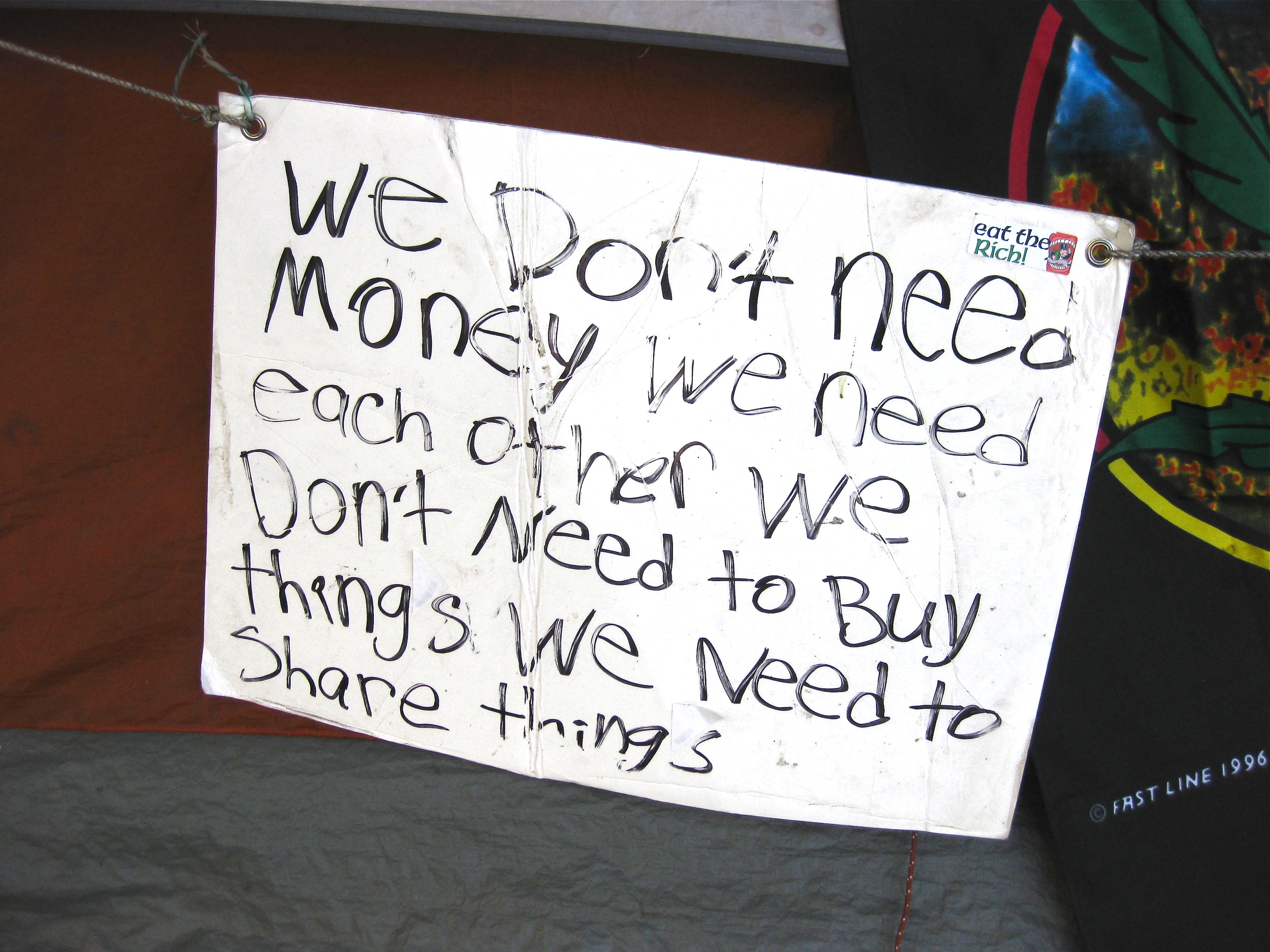
Sign at Occupy LA city hall encampment, October 2011

Sign at Occupy LA city hall encampment, October 2011

If any have toiled from the first hour,
let them receive their due reward;
If any have come after the third hour,
let them with gratitude join in the Feast!
And those that arrived after the sixth hour,
let them not doubt; for they too shall sustain no loss.
And if any delayed until the ninth hour,
let them not hesitate; but let them come too.
And those who arrived only at the eleventh hour,
let them not be afraid by reason of their delay.
For the Lord is gracious
and receives the last even as the first.
Christ gives rest to those that come at the eleventh hour,
as well as to those that toiled from the first.

This famous passage from the ancient Paschal homily of St. John Chrysostom is a marvelous riff on Jesus’ parable of the Workers in the Vineyard (Mt. 20:1-16). It’s certainly good news to the latecomers, but rather disconcerting to those of us who have a strict idea of who’s in and who’s out. You never know what kind of people you’re going to run into at God’s place. You may have to break bread with some who haven’t earned their place at the table the way you have, who haven’t paid their dues the way you have. It’s not fair. The kingdom of God is not fair.

That’s the trouble with mercy and forgiveness and grace. They are so undiscriminating. How are we supposed to know where we stand, how can we measure up, how can we hold others accountable, if the standards are so loose and slippery?

Let’s face it. Jesus was a terrible bookkeeper. He didn’t maintain accurate accounts of how everyone was doing. He was too busy throwing a party for God’s friends. Y’all come. Everyone’s welcome!

The first disciples who listened to this story undoubtedly needed to hear its message. They were anxious about where they stood with Jesus and with God. Lord, who’s going to sit at your right hand and who’s going to sit on your left? What are we going to get for following you? Whom do you love the most? This anxiety about status and privilege continues in the Book of Acts, when some of the original Jewish believers resent the influx of Gentile converts. And we have our own versions of this calculating mentality today. Who’s in, who’s out? Who’s better, who’s worse? Who belongs, who doesn’t? Who’s saved, who’s not?

But with this parable, Jesus tells us:

  • Stop worrying about wages. The kingdom isn’t something you earn. It’s a gift. Be glad you are one of the recipients.
  • Don’t worry about how much you’ll get. You’ll get what you need. You really will.
  • Stop comparing yourselves to others. God loves everyone equally.
  • Don’t be envious or resentful of someone else’s good fortune, even when you think it’s undeserved. Be glad that God is so generous, even if it’s not always about you.

Once the whole idea of a bookkeeping religion has been exploded by this parable, we begin to realize that it’s not a story about wages at all. It’s a story about the vineyard. Everyone gets invited to the vineyard, and ending up there together is the whole point. The latest have not come too late, and the earliest have not come too early. In the end, everyone is there, no one is missing.

Now if you don’t want to be part of this vineyard collective, just take what you’ve earned and go. That’s what the master tells the complainers, the bookkeepers, and to me it’s the most chilling line in the story. You don’t want any part of the kingdom’s undiscriminating generosity? OK, fine. Go off and be by yourself, or with your little circle of the like-minded. But you may find it rather lonely. And you’ll miss one hell of a party.

A feather on the breath of God

Hildegard at desk

When I was 42 years and 7 months old, a burning light of tremendous brightness coming from heaven poured into my entire mind. Like a flame that does not burn but enkindles, it inflamed my entire heart … just like the sun that warms an object with its rays.

So wrote Hildegard of Bingen, a twelfth-century abbess, artist and activist whose feast is celebrated today. In a society where women were more seen than heard, it took her a long time to find an outlet for her voice. She had experienced visions ever since her childhood, but she kept them mostly to herself until she was in her forties. Her reticence wasn’t just due to social pressure. She also shared the self-doubting anxiety of every artist. Did her visions matter? Would the world understand or care? But as every artist knows, if you have a gift and don’t make it visible, it will sicken and die within you, and your own body will suffer the effects.

And Hildegard in fact became a sickly woman: “Not in stubbornness but in humility, I refused to write for so long that I felt pressed down under the whip of God into a bed of sickness.” But at last she overcame her inhibitions. Her call was too strong to resist. She began to write, and compose, and produce paintings of her visions. Her body was restored to health, and from then on, she tried to live the life only she could live.

In one of her visions, God told her: O how beautiful your eyes are when you tell the divine story!

Tell the divine story: That was the work she had been given to do. In addition to the normal duties of a medieval abbess in the Rhineland, Hildegard became a storyteller, a musician, an artist, a writer; and through all these media she obeyed the command given to every artist, to “make visible what, without you, might never be seen.” She was also an activist, reminding the powerful to show compassion to the poor, and railing against clergy who failed to blow “the trumpets of divine justice.”

Hildegard was always mindful of the source of her creativity:

The marvels of God are not brought forth from one’s self.
Rather, it is more like a chord, a sound that is played.
The tone does not come out of the chord itself,
but rather, through the touch of the musician.
I am, of course, the lyre and harp of God’s kindness.

She put this even more succinctly when she called herself “a feather on the breath of God”

The bright-colored enigmas of her illustrated visions, painted by others under her supervision, are unlike anything else in western medieval art. Figures embedded within circles or mandalas express her experience of God as being “like a wheel, a circle, a whole, that can neither be understood, nor divided, nor begun nor ended … just as a circle embraces all that is within it, so does the Godhead embrace all …. You are encircled by the arms of the mystery of God.”

Hildegard’s music was as original as her images. Her compositions resemble the Gregorian chant of her time in their liturgical form and musical modes. They also conform to plainchant’s suppression of extroverted individuality for the sake of devotional calm. At the same time, they go beyond traditional chant in several ways: her melodies have an exotically wide range, often spanning two octaves, with sudden leaps from low notes to high notes; her texts are rhapsodic outpourings of strikingly original imagery; and her songs possess a freedom and exuberance that reflect an artist on the loose.

Her music wasn’t primarily a form of personal expression. It was a manifestation of deepest reality. “O Trinity, you are music, you are life,” she prayed. For Hildegard, “all of creation is a song of praise to God.”

She didn’t make up her songs; she listened in to the music of heaven:

Then I saw the lucent sky, in which I heard different kinds of music, marvelously embodying all the meanings I had heard before. I heard the praises of the joyous citizens of heaven, steadfastly persevering in the ways of Truth; and laments calling people back to those praises and joys; and the exhortations of the virtues.

This was more than metaphor, as her writings make clear. Her compositions came to her whole, given by God, much like the auditory mysticism of St. John the Divine, who wrote in the Book of Revelation: “And I heard a voice from heaven like the sound of many waters and like the sound of loud thunder; the voice I heard was like the sound of harpists playing on their harps, and they sang a new song before the throne.”

Hildegard believed that the music of heaven is in us and all around us. We have been created to harmonize with it. “The soul is symphonic,” she said.

She conceived a charming image of Adam before the Fall: he sang with a voice of pure honey, and the devil knew that as long as Adam managed to remember the sweetness of the heavenly songs, he could never be tempted. So with Adam, as with all of us who have come after, the devil set out “to trouble or destroy the affirmation and beauty and sweetness of divine praise and of the hymns of the spirit.”

In Hildegard’s opera, Ordo Virtutum, an allegory of the virtues, all the characters sing – except the devil, who can only heckle and shout. The devil’s work is dissonance, the shattering of harmony.

Hildegard once had a dispute with the bishops of her diocese, who tried to force her submission on a matter of principle by forbidding her nuns to take communion or to sing the liturgy. It was a terrible ordeal for her community to live without music. Hildegard remarked at the time that those who choose to silence music in their lifetime will go to a place where they will be “without the company of the angelic songs of praises in heaven.” It was her discreet way of telling the prelates to go to hell.

Every artist has to deal with philistines, but we can be thankful that Hildegard’s enormous gifts were for the most part supported by her contemporaries. She fell into obscurity for centuries after her death, but she returns anew to our own time with a voice we long to hear, a voice resonant with compassion, a voice aflame with justice, a voice attuned to the divine harmony for which all of us are made.

Sometimes Hildegard seems to live in a different universe than we do, a universe alive with multi-sensory evidence that God is “burning everywhere,” that everything in the world is dense with meaning and liveliness.

All the senses, in her universe, deliver this message to the receptive soul. Unlike the purely material universe proposed by modernity, a happenstance of mute objects and dead space, Hildegard’s universe was sacramental, alive with significant presence.

In one of her visions, a human figure stands in the center of a cosmic wheel. This Christlike image of Divinity declares to her and to all the world:

I, the highest and fiery power,
have kindled every spark of life …
I, the fiery life of divine essence,
am aflame beyond the beauty of the meadows.
I gleam in the waters. I burn in the sun, moon and stars.
With every breeze, as with invisible life that contains everything,
I awaken everything to life.

Is this not the high calling of every saint – and every artist?
To awaken everything to life.
To set our imagination aflame.
To make visible the unsurpassable beauty of God.

As Simon Weil put it so well in our own era,

A sense of beauty, although mutilated, distorted, and soiled, remains rooted in the human heart as a powerful incentive… If it were made true and pure, it would sweep all secular life in a body to the feet of God.

Messianic light

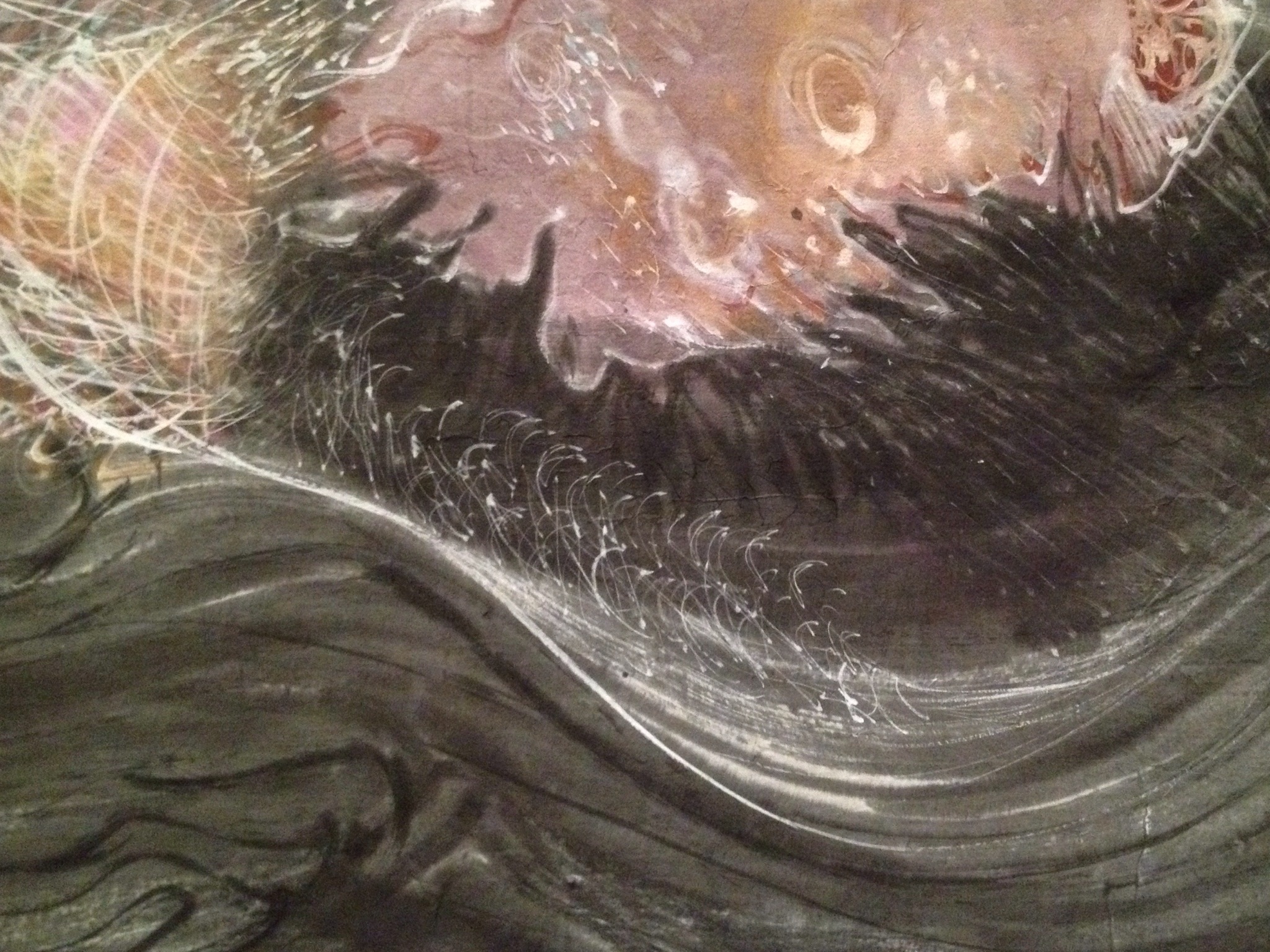
Morris Graves, The Genesis of Life Lay Deep and Anticipant under the Sky II (1944, detail)

Morris Graves, The Genesis of Life Lay Deep and Anticipant under the Sky II (1944, detail)

At the beginning of Moby Dick, Ishmael encounters a strange painting hanging in the entry of an old inn. Dimly lit and “thoroughly besmoked,” it was an indistinguishable mix of “shades and shadows” with a “long, limber, portentous black mass of something hovering in the center.” It seemed a picture of primal chaos, suffused with “a sort of indefinite, half-attained, unimaginable sublimity about it that fairly froze you to it,” prompting Ishmael to obsess about its meaning.

It’s the Black Sea in a midnight gale. – It’s the unnatural combat of the four primal elements. – It’s a blasted heath. – It’s a Hyperborean winter scene. – It’s the breaking up of the ice-bound stream of Time. – But at last all those fancies yielded to that one portentous something in the picture’s midst. That once found out, and all the rest were plain. But stop; does it not bear a faint resemblance to a gigantic fish? even the great Leviathan himself?

Ishmael might have been contemplating the inky monolith of a late Rothko, or one of Morris Graves’ dark wartime nocturnes of a restless and tormented life force. It was a classic experience of the Sublime, where the human and the known are overwhelmed by the transcendent and the unknowable. Whether you are Moses enveloped in Sinai’s stormy cloud or a tourist gawking at Niagara Falls, you feel a sense of shock and awe in the presence of a wild uncontrollable force. For a moment, at least, the stable coordinates of the humanly constructed world are blown away. The tourist may escape with merely a pleasant shudder, but the saint is swept into the divine abyss.

The Sublime is the annihilating negative which questions, disrupts, challenges a world too narrowly constructed in our own image. It is the vast unknowable desert that lies beyond our maps; the nameless voice that asks ‘Why?” and “Why not?”; the apocalypse that rejects the finality of empires. It is the dark night of the soul where language fails and silence speaks; the radically other, ungrasped by imagination; the formlessness prior to every making. It is the ending that births the beginning.

Artists have long attempted to convey the transcendent through sensuous means and materials, but only in the last century have some of them tried to do it without using recognizable images or narratives. Color, shape and texture in themselves would be sufficient to make visible the underlying essence of reality, according to pioneers of the abstract like Kandinsky. As Barnett Newman said in a 1948 manifesto, “We are freeing ourselves of the impediments of memory, association, nostalgia, legend, myth, or what have you, that have been the devices of Western European painting.” An abstract canvas could provide direct revelation through pure sensation, unmediated by stories or symbols or replications of the material world.

Whether the “abstract sublime” actually put the viewer in closer touch with the deepest reality, or was just another form of representation as “fictional” in form as a biblical scene or a landscape, has been widely debated. Can any image be identical to what it portrays? And is form only something that exists in the perceiving mind, and not a quality inherent to the universal flux? If deepest Reality, or God if you will, is unrepresentable, how can you make a picture of it? Can you stand before of the saturated hues of a Rothko and believe you are in the presence of the transcendent? Some have. I have.

Most artists today are reluctant to make overt claims for their work as spiritual events between viewer and the transcendent, as deep speaking to deep. In the postmodern play of signifiers, there is no divine Voice, no Reality trying to communicate with us from a realm beyond finite language. As atheist philosopher Richard Rorty reductively put it, “the world does not speak. Only we do.”

That is not my experience. Nature has spoken to me. Sacrament has spoken to me. Christ in my neighbor has spoken to me. And art, both figurative and abstract, has spoken to me, most recently in the paintings of Morris Graves in a revelatory exhibition at the Seattle Art Museum, Modernism in the Pacific Northwest: The Mythic and the Mystical.

The exhibition makes a case for Seattle as the birthplace of modernism in American art. Mark Tobey’s “white writing” paintings, where thin lines of white paint permeate scenes like an energy field binding all things together, have been credited with the invention of gestural painting, which Jackson Pollock would adapt and make famous. Both Tobey and Graves, imbued with the art and the spirituality of Asian and Northwest native cultures, approached their work with a mystical sensibility that impressed East coast critics and artists alike. Even when the New York School veered away from the spirituality of art into pure painting free of “meaning,” the Northwest painters continued to make substantial connections between art and spirit.

I was particularly moved by Graves’ World War II work. Jailed for refusing to fight, Graves was profoundly troubled by the madness and destruction of the conflict, what he called “the death of all reason.” When he was released in 1943, he began to paint feverish visions of a monochrome night world on the verge of ending, as darkness and deluge swirled all around. There were forms – a crow, a minnow, a waning moon – which resisted the devolution into utter chaos. These few were signs of resistance and grace. Graves wrote of the minnow:

Silvery minnow-moment of awareness flash-gleaming in the depths, now seen, now gone … when crisis occurs, the minnow voluntarily comes into view – to renew faith and give direction.

But Graves’ wartime paintings never showed more than brief glimmers of hope in a world of threat and horror. It was not until the war ended that Graves could fill a canvas with light, in his depiction of a brilliant lotus flower in bloom. This Buddhist symbol of meditation and enlightenment could be seen as a victory of light over darkness, but some have noted the bloom’s resemblance to a nuclear cloud. As with the August 6th coincidence of Hiroshima Day with the Feast of the Transfiguration, the struggle between life and death is far from done.

Graves believed that art has a profoundly meaningful task, and something Theodor Adorno said might well be applied to Graves’ own work:

Knowledge has no light but that shed on the world by redemption: all else is reconstruction, mere technique. Perspectives must be fashioned that displace and estrange the world, reveal it to be, with its rifts and crevices, as indigent and distorted as it will appear one day in the messianic light.

Art can reveal the poverties and distortions of the world.
Can it also enable us to stand in the “messianic light?”
Are there indeed showings of the divine in color, form and light?

On the day after the Feast of the Epiphany in 1956, Sylvia Plath wrote a postcard to her mother, describing her visit to the Matisse Chapel on the Riviera. The entrance was shut when she arrived. The chapel only opened twice a week, and on the other days not even rich tourists waving large sums of money could gain admittance. Plath was “desolate” at her bad timing. She wandered glumly around the walls enclosing the chapel, “feeling like Alice outside the garden.” Then she returned to the locked gate and stood quietly.

I began to cry. I knew it was so lovely inside, pure white with the sun through blue, yellow and green stained windows.
Then I heard a voice. ‘Ne pleurez plus, entrez,’ and the Mother Superior let me in, after denying all the wealthy people in cars.

I just knelt in the heart of the sun and the colors of sky, sea and sun, in the pure white heart of the chapel. ‘Vous êtes si gentille,’ I stammered. The nun smiled. ‘C’est la miséricorde de Dieu.’

It was.

Faith’s endangered habitat

Teton presider

American Christianity is in numerical decline – no news to the inhabitants of graying churches. According to a recent survey by the Pew Research Center, 20% of the population has no religious affiliation. Just five years ago, that number was 15%. Among adults under thirty, 32% are unaffiliated, with little prospect that they will become more religious as they grow older. According to the study, affiliation does not increase as a particular generation advances through the life cycle. The younger generations will remain less affiliated even as they age. If each succeeding generation continues the trend of rejecting institutional religion, will churchgoers become an endangered species?

The habitat for practicing believers has certainly been compromised. The inanities and hypocrisies of media evangelists, the ignorant ravings of fundamentalists, the hatred and violence of religious extremists have all marred and polluted the public landscape of religion. But that in itself need not be fatal. Christianity has a venerable history of toxic clean-up campaigns, with saints and prophets leading the way. A far more serious threat is the steady shrinkage of habitable environments for faith communities, as individualism, materialism and secularization encroach steadily upon the perceptions and behaviors that make religion sustainable. How can the community of God’s friends persist when God has become, for so many, not just unnecessary but virtually unthinkable?

Modernity has, over the last 500 years, gradually detached western culture from transcendent necessities. God is no longer assumed to be the creator and sustainer of every moment, the all-encompassing reality in whom we live and move and have our being. While individuals might retain a strong personal connection with God, the social world is seen as a self-governing reality, not requiring reference to anything “higher” or “beyond” in order to function or develop. Once the sacred dimension was expunged from the world, and “the last king had been strangled with the entrails of the last priest,” human life could achieve full independence from the constraints of any sacred order or transcendent reality beyond itself.

With God demoted from the ever-present sustainer of life to its original but now absent designer, it was not long before God seemed no longer necessary at all for the construction of meaning or purpose. As Charles Taylor writes in The Secular Age, “The modern social imaginary no longer sees the greater trans-local entities as grounded in something other, something higher, than common action in secular time.” In other words, the inherited modern culture in which we live and move and have our being has no apparent or practical need of God to explain things or provide the sources of human flourishing.

When Christians worship or pray or converse among themselves, they radically contradict such premises of modernity, but in the largely unconscious, ingrained, or automatic behaviors of everyday living, it is hard not to find ourselves reverting to the default position of the culture: simply acting without God in mind. Or in our bones. In the words of German theologian Eberhard Jüngel, “It would appear, then, that God has no place in our thought and thus has no place in our language. [God] does not occur, has no topos (place, position).”

This “placelessness” of God is what I mean by the erosion of sustainable habitat for communities of faith. If God has no place in the behavior or even the thought of so many people, why would religion make any sense at all to them, except as a provider of purely human benefits such as community or charity? No wonder the churches dwindle.

Then what do we make of these statistics: 68% of the unaffiliated say they believe in God, 58% feel a deep connection with nature and the earth, 37% call themselves “spiritual but not religious,” 30% have had religious or mystical experience, and 21% say they pray every day. Evidently many are still trying to retain a connection with something deeper than the everyday, with a necessary mystery beyond themselves. However, only 10% of them are interested in seeking religious community. Most would rather be spiritual but not religious.

I’m not sure that’s really possible. We might wish to declare independence from the limitations and messiness of human institutions and opt for the purity of personal practice, but “bowling alone” (to cite Robert Putnam’s famous term for the erosion of civic and communal engagement in America) misses the point of engaging our deeper selves.

Christians say we are made in the image of a Trinitarian (= social and interdependent) God, and we best praise and contemplate and grapple with that communally complex divine reality in the company of others: not only joining with the local worship assembly or even the wider Church on earth, but with the friends of God in every age who cry “Holy!” for all eternity, dancing with the Triune Love Who Loves Us. You can’t worship by yourself anymore than you can be in love by yourself. Worship needs a choir.

Even in private prayer, you use words and images supplied by tradition, and reinforce deep connections with others now absent from you. Even beholding the beauty of a sunset, you do it in company with the poets and painters and photographers who have given you an eye for the beauty of things.

The difference between solo spirituality and religious belonging is like the difference between a lion in the zoo and a lion on the savannah. You need a broad and healthy habitat to flourish. Can the habitat of faith and worship survive and be restored? Will things which were cast down be raised up, and things which have grown old be made new?

God only knows.