Why Do We Work? A Labor Day Reflection

Good work is a way of living… it is unifying and healing. It brings us home from pride and despair and places us responsibly within the human estate. It defines us as we are, not too good to work with our bodies, but too good to work poorly or joylessly or selfishly or alone.

— Wendell Berry) [i]

Labor Day began in the late nineteenth century as both an homage to American workers (parade, speeches) and a time of re-creation (picnic, dance, fireworks). Congress declared it a national holiday in the aftermath of a contentious railroad strike in 1894, where 30 workers died in violent confrontations. It was hoped that honoring workers would ease tensions and foster social harmony. As the Department of Labor currently describes it, the first Monday in September “is dedicated to the social and economic achievements of American workers. It constitutes a yearly national tribute to the contributions workers have made to the strength, prosperity, and well-being of our country.” [ii]

The holiday’s explicit homage to labor has long been overshadowed by its seasonal significance as the American farewell to summer—one last stretch of fun in the sun before the year gets busy again. But in our overworked culture, where the inbox follows you everywhere and vacations are a fraction of what Europeans enjoy, could we not make some time to reflect together about the nature of labor? What if churches were to revive the notion of Labor Sunday, where our tools could be blessed and the spirituality of work considered? [iii]

In the Bible, the pleasures of a perpetual weekend in Eden ended abruptly when God created Monday morning as a curse upon the first humans, who evidently needed to learn things the hard way. “By the sweat of your face” will you earn your daily bread,” said the Creator.[iv] The story was a way of thinking about the question, Why do we have to work so darn hard? Before the Fall, Adam and Eve were given light duties of tending the well-watered garden, more like an aristocrat’s hobby than the grueling subsistence farming bequeathed to their descendents.

Hard-working humans have been reminiscing ever since about the “happy Eden of those golden years.” [v] Stephen Duck, an eighteenth-century English poet-priest, voiced the complaint of the exploited farmworker.

Let those who feast at Ease on dainty Fare
Pity the Reapers, who their Feasts prepare …
Think what a painful Life we daily lead;
Each morning early rise, go late to Bed …
No respite from our Labour can be found;
Like Sisyphus, our Work is never done …[vi]

The justice issues arising around working conditions, exploitation, and economic inequality are themselves the shared work of any society worth its name. My ideal Labor Day would involve some serious community conversation—more listening than talking—about these things. But I would also be curious to explore the spirituality of work as well. Why do we do whatever we do? Does it give us joy? Does it matter?

An old Scottish drinking song provides a succinct answer in its praise of various occupations. The carpenter’s verse suggests the inner satisfaction of work well done, honors the process as well as the product, and celebrates the interdependence of the social world where each of us benefits from the labor of others:

Here’s a song for the carpenter, may patience guide your hand,
For the dearer your work to you, the longer it will stand.
And when the wind is at our door, we never will forget;
We’ve sung your praises many a time, and so will we yet. [vii]

Like our Creator, we are all makers and doers who enjoy the fulfillment of intentions and the solving of problems. It’s in our nature to see what needs to be done and then take a hand in making it so. We also find pleasure in the solidarity of labor, not only through our relationships with coworkers but also in the awareness of practicing a skill handed down by so many mentors and predecessors.

In an imperfect and often unjust society, not everyone has access to employment that delivers pleasure or meaning in itself, but one’s paying job may still be part of a larger labor which is absolutely worth doing, such as supporting a family or funding a future dream. Studs Terkel, who collected oral histories of countless Americans, believed that all of us long for meaningful work. “I think most of us are looking for a calling, not a job,” he said. “Most of us … have jobs that are too small for our spirit.” [viii]

Lewis Hyde makes a useful distinction between “work” and “labor.” Work is done by the hour, on the clock, usually for money. Its value is quantified, and has economic exchange value. Labor, on the other hand, keeps its own schedule, sets its own pace, and may include time off or even sleep as part of its process. Its social value may be clear, but its economic value is hard to quantify. Its product is not a commodity to exploit but a gift to share. “Writing a poem, raising a child, developing a new calculus, resolving a neurosis, invention in all forms—these are labors.” So are volunteer work, ministry, visiting the sick and the prisoner, gardening, personal soul work and “the slow maturation of talent.” [ix] Such labor is priceless.

Most of us have performed both work and labor, as well as hybrids which include elements of both. As Citizen Kane’s financial advisor said, “It’s no trick to make a lot of money, if all you want is to make a lot of money.” But the truer and nobler task is to cooperate with the Creator in repairing the world to make it a place of beauty, love and justice.

So my Labor Day question is this: Where and how can we do the labor to which we are called, the thing which étienne Souriau has called the “Angel of the work” [x]— that which gives us joy and blesses others?

There’s another verse in that Scottish song which thanks the singers who keep their voices clear:

For the world as you would have it be,
you sing with all your wit,
And ease the work of Providence,
and so will we yet.

In that spirit, I leave you with two such singers, Joan Baez and her sister Mimi Farina, who “ease the work of Providence” by voicing the universal human right to flourish: bread, yes, but roses too!


[i] Wendell Berry, The Unsettling of America, q. in Karen Speerstra, ed., Divine Sparks: Collected Wisdom of the Heart (Sandpoint, ID: Morning Light Press, 2005), 520

[ii] Department of Labor website: https://www.dol.gov/general/laborday/history

[iii] This was instituted by churches as a companion to Labor Day, but has fallen into disuse.

[iv] Genesis 3:19

[v] John Clare, “Helpstone” (1809) q. in Raymond Williams, The Country and the City (Oxford & New York: Oxford University Press, 1973), 10

[vi] Stephen Duck, “The Thresher’s Labour” (1730), in Williams, op. cit., 88

[vii] The original, “Sae Will We Yet,” is attributed to Walter Watson, but I believe the carpenter verse is a contemporary addition by Ossian’s Tony Cuffe. A fine version by Gordon Bok, Ann Muir, and Ed Trickett is here: https://www.youtube.com/watch?v=h48Db_cvdDE

[viii] In Speerstra, op. cit., 519

[ix] Lewis Hyde, The Gift: Imagination and the Erotic Life of Property (New York: Vintage Books, 1979), 50

[x] étienne Souriau, q. in Isabelle Stengers, Thinking with Whitehead: A Free and Wild Creation of Concepts, trans. Michael Chase (Cambridge, MA: Harvard University Press, 2011), 464
Merry it is while summer lasts

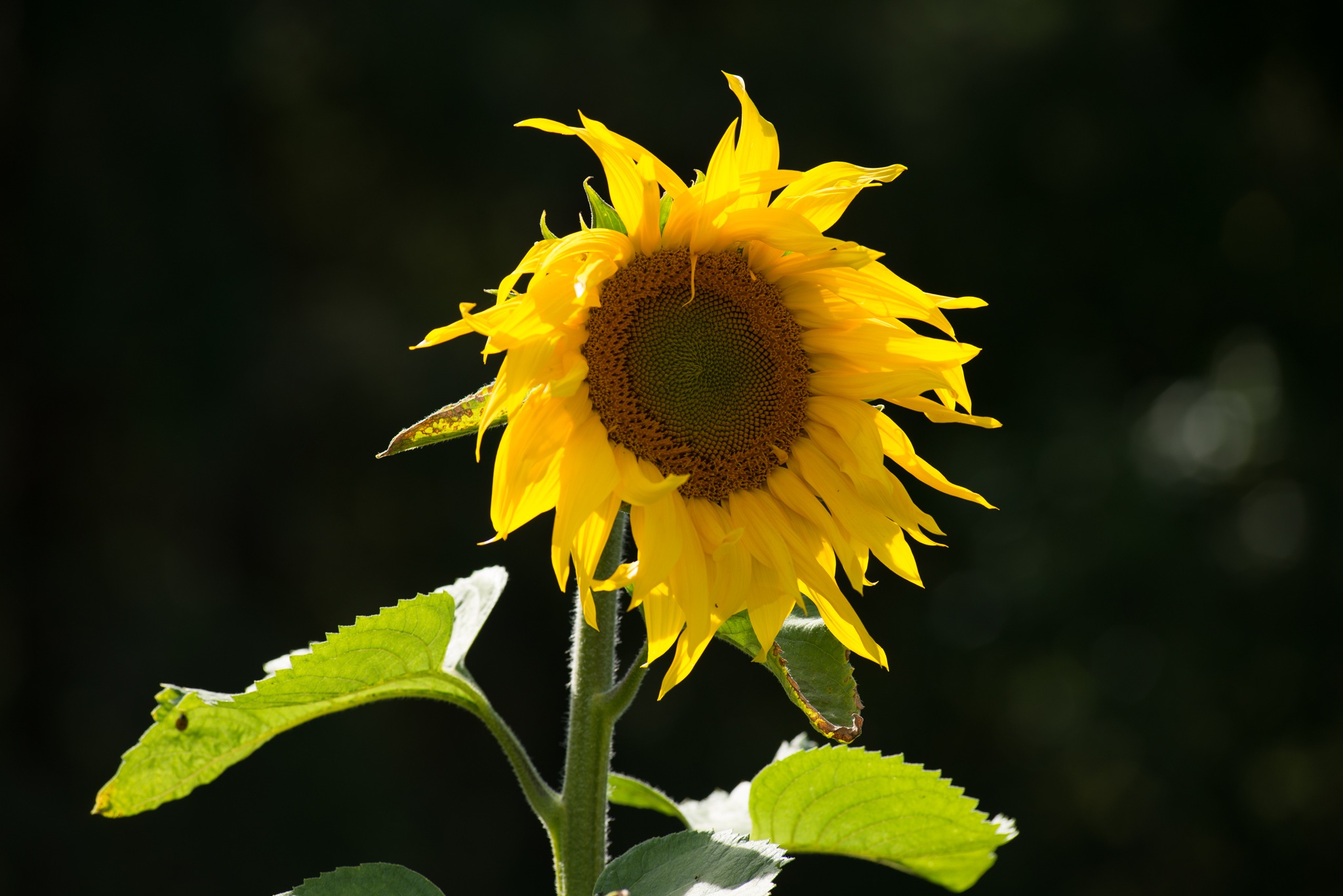
August Sunflower by Jim Friedrich

August Sunflower by Jim Friedrich

Such tenderness, those afternoons and evenings,
saying blackberry, blackberry, blackberry.

— Robert Hass, “Meditation at Lagunitas”

Mirie it is while somer y-last. “Merry it is while summer lasts.” So goes the 13th-century lyric, one of the earliest known secular English songs (the other being Summer is icumen in). But while such praise of summer lacks the explicit theological or liturgical character of its pious predecessors, is not the idealized notion of a happy summer a plausible echo of the joys of Paradise? History takes a vacation. Ambition is deposed. The temporal flow slows its onward rush, deepening into a placid pool of unhurried being. The poet’s longing for “world enough, and time” is fulfilled at last in a sabbath of playful ease. Children romp in the sea, lovers stroll bright gardens, readers open their books, friends converse at evening. Mirie it is.

It should always be so in August, that we might agree with Emerson: “this refulgent summer, it has been a luxury to draw the breath of life.” But of course Thoreau did a better job than his bookish friend at getting outside to see what summer was actually doing day by day. Summer in fact is not a general idea, but an aggregate of particulars.

On this date in 1856, Thoreau wandered the fields and woods of Concord, Massachusetts. His Journal tells us that “Ambrosia pollen now begins to yellow my clothes.” He was surprised to find the cassia “so obvious and abundant.” In an old garden gone wild from British days, he became “intoxicated with the fragrance” of spearmint, hounds-tongue, and bergamot. He named those plants he could, while each new discovery filled him with curiosity and wonder. He bathed in the river, registering how strong the current seemed for mid-August. And he lamented the recent dampness of the weather, causing his pressed plant specimens to mildew. “Give me the dry heat of July,” he wrote.

Reading Thoreau’s Journal entry prompted me to look up August 16 in my own yearly journals. It turns out that I honored the spirit of August by playing more than writing, but I did find one entry for this date in 1989, when I hiked at sunset to the top of Mt. Tallac, a 10,000’ peak above Lake Tahoe in California’s Sierra range, to watch the rise of a full moon in total eclipse. I carefully noted the changes as the reddish lunar disc slipped slowly out of the earth’s shadow to flood the mountain with intense milky light. Then I descended through a ghostly forest of moonlit junipers, grateful to have been present to see and to know. If I had not been there, that night would not have become part of me, nor I of it.

So now I must leave my desk to see what this summer day wants to offer the senses. I will linger in the shade of the peach tree with a book, keeping my eye on the finches, chickadees, juncos and hummingbirds who shelter and sing in its branches. I will praise the sunflowers, each a miniature daystar, towering above the flower garden, and hear the soft music of quivering aspens. I will taste blackberries ripening beyond the drying lawn, plus whatever strawberries the squirrels have spared. My skin will feel the reddish warmth of the late sun as it drops between the Douglas-firs. And when night comes, I will stroll among the lilies and dahlias, so white—and fragrant!—beneath the gibbous moon. Mirie it is.


Related Posts

Paying Attention

The Summer’s Final Mass

Summer Knowledge

Sacraments of Summer

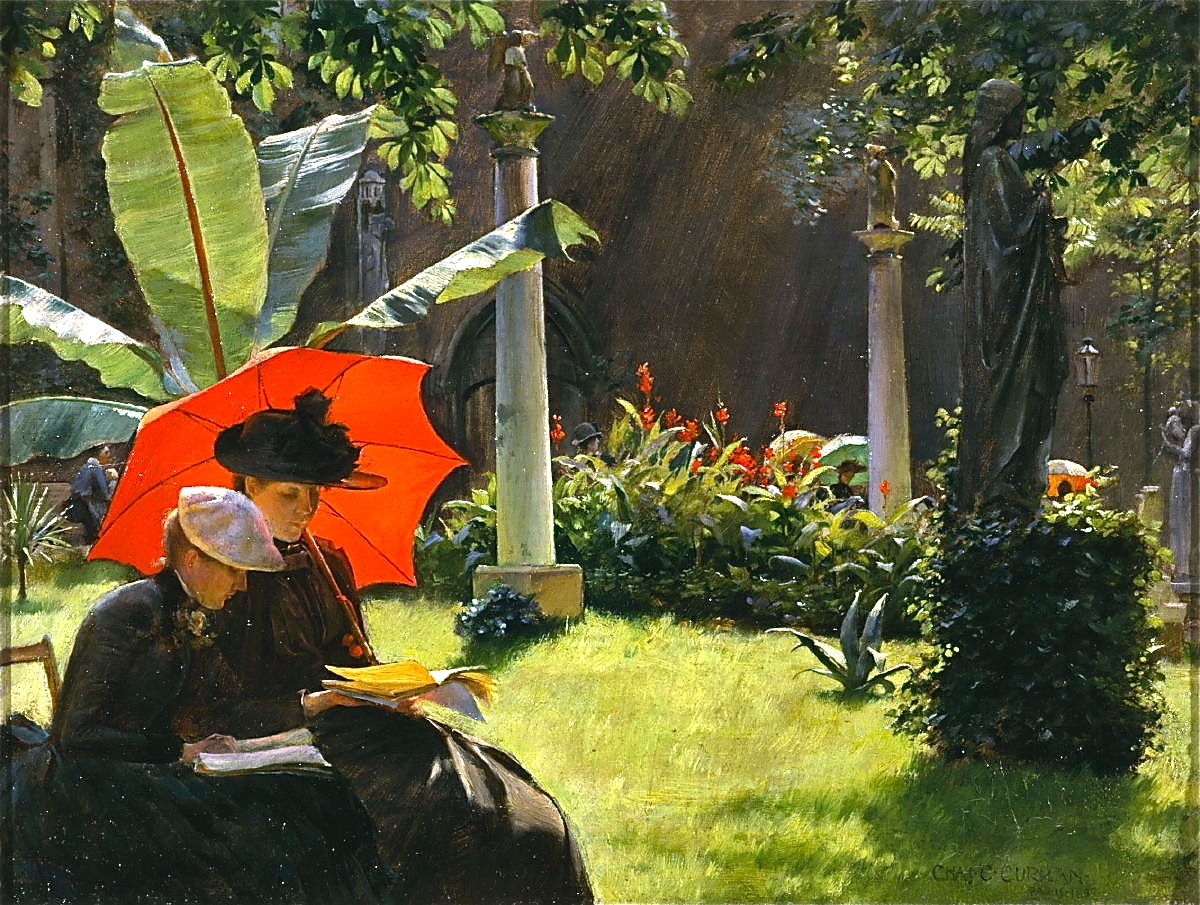
Charles Courtney Curran, Afternoon in the Cluny Garden, Paris (1889)

Charles Courtney Curran, Afternoon in the Cluny Garden, Paris (1889)

Now in midsummer come and all fools slaughtered
And spring’s infuriations over and a long way
To the first autumnal inhalations, young broods
Are in the grass, the roses are heavy with a weight
Of fragrance and the mind lays by its trouble.

– Wallace Stevens, “Credences of Summer”

In a short while, at 3:34 p.m. Pacific Daylight Time, the sun will reach its apogee of 23 degrees 27 minutes above the equator. When that moment comes, I will go outside to give Summer a proper welcome.

Every June Solstice I open Summer like a fresh novel, anticipating adventurous plots, alluring characters, and a world of fascinations presenting itself to my senses without hurry, as if both reader and text had all the time in the world. Summer is one of our sweetest fictions, suffused with a youthful happiness in a shadowless earthly paradise.

Of course, the livin’ isn’t always easy. Agonies and heartbreak may yet interrupt our revels, along with the heat waves, mosquitoes, sunburn, and poison oak. Summer is when my father died, and a dear friend committed suicide. Et in arcadia ego. In timeless Arcadia, death is still around

Even so, when summer smiles, I remember happiness once more:

Firefly nights and swimming hole days,
cold lemonade on a screened porch,
bare feet on warm ground, grass between my toes,
air-conditioned movies on a hot afternoon,
stack of summer reading by the hammock,
the holy calm of nothing to do,
cottonwoods whispering leafy poems to a quiet river,
the pleasurable sublime of high country thunderstorms,
campfire sparks rising to meet the Milky Way,
Springsteen singing us down some lost highway,
windows rolled down in the warm night air,
stars falling into a hayfield after midnight,
moonlight croquet (a candle at each wicket),
swapping songs around red Sonoma wine,
dancing till dawn on Gatsby’s lawn,
those kisses beneath the stars . . .

Do such moments only defer the inevitable erosion of temporal existence, or are they sacramental foretastes of eternal blessedness? Either way, as Michael Cunningham makes clear in The Hours, the Perfect Moment, like Summer itself, is not a gift to be wasted:

It had seemed like the beginning of happiness, and Clarissa is still somewhat shocked, more than thirty years later, to realize that it was happiness…What lives undimmed in Clarissa’s mind more than three decades later is a kiss at dusk on a patch of dead grass, and a walk around a pond as mosquitoes droned in the darkening air. There is still that singular perfection, and it’s perfect in part because it seemed, at the time, so clearly to promise more. Now she knows: That was the moment, right then. There has been no other.


Related posts

That Summer Feeling

Now Welcome Summer


Reprise: Ten Ways to Keep a Holy Advent

image

Here in Puget Sound, the first Sunday of Advent has begun in darkness, fog, and frost. It is for many of us a deeply felt time, the season where we wait expectantly for the dawning of the New. The spiritual practice of waiting is not a state of passivity, but rather the cultivation of attention, lest we miss what is being offered to us in the unfolding of God’s future.

I do not usually do re-runs of old posts, but some readers found last December’s “Ten Ways to Keep a Holy Advent” a useful list, and you can access it here. I hope you will find some blessing in it. And please feel free to share it with your communities.

The summer’s final mass

A perfect summer moment: Blue moon rises on the last day of July 2015.

A perfect summer moment: Blue moon rises on the last day of July 2015.

T-shirts, cut-offs and a pair of thongs,
We’ve been having fun all summer long.

– Brian Wilson & Mike Love

Piecemeal the summer dies ….
The field has droned the summer’s final mass.

– Richard Wilbur

In seventeenth century landscape painting, there was a tendency to idealize, to suspend change and death by capturing an eternal present. Through meticulous depiction of nature’s details, the fantasy of a deathless Arcadia was made concrete for the viewer. Inside the frame, there was no time, no death. Gazing upon one of these pictures, a character in Dostoevsky exclaims,

Here lived beautiful men and women! They rose, they went to sleep, happy and innocent; the groves rang with their merry songs, the great overflow of unspent energies poured itself into love and simple-hearted joys… The sun poured its rays upon these isles and the sea, rejoicing in its fair children. Oh, marvelous dream, lofty illusion![i]

The painting in question was Claude’s “Acis and Galatea.” And indeed, as the lovers embrace in their tent along the shore of a lovely harbor, it seems a perfect moment of harmony and bliss. But will it last? Claude has placed subtle harbingers of change within the scene. The sun is about to set. Polyphemus, the giant who will soon despoil the lovers of their happiness, lurks in the distance – not yet arrived, but on his way. Claude seems to find a heightened sweetness in such mortality; brevity breeds intensity. But Acis and Galatea might take a different view. We’ve been having fun all summer long. Why can’t it go on forever? But there you have it: golden ages, lovers, summer idylls, T-shirts, cutoffs, thongs – all carried off by time’s merciless flow.

Last night another summer slipped away. I was sorry to see it go. If only I could make it stay a little longer. And in fact, here on my island, these first hours of autumn seem no less radiant than yesterday. A warm afternoon is promised. But the idea of summer – marvelous dream, lofty illusion! – is unsustainable. Days shorten. Vacations end. Travelers return. Work calls. Schedules resume. The Sabbath rest of carefree hours and idle days is overruled by necessity. We can no longer enjoy the fiction of having all the time in the world.

In “real” life, a perfectly carefree interval of beach time, lawn parties and magical vacations is an unattainable myth. But now and again, when we do pause to breathe, to notice, to play, to be; when we forget time, giving ourselves wholly to the present moment; when we are attentive and receptive to whatever the universe wants to show us, summer draws near to bathe us in radiance.

All we need is the gift of reverie. Henry David Thoreau spent many a summer morning by his cabin door at Walden Pond, sitting quietly in the sun, listening to birdsong, feeling the warmth on his skin. To those afflicted by the pressures of a 24/7 world, this may seem an incredible waste of time. But like the saints who aspired to pray without ceasing, Thoreau dreamt of even more radical experiments in multi-sensory contemplation:

Would it not be a luxury to stand up to one’s chin in some retired swamp for a whole summer’s day, scenting the sweet-fern and bilberry blows, and lulled by the minstrelsy of gnats and mosquitoes?… Say twelve hours of genial and familiar converse with the leopard frog. The sun to rise behind alder and dogwood, and climb buoyantly to his meridian of three hands’ breadth, and finally sink to rest behind some bold western hummock. To hear the evening chant of the mosquito from a thousand green chapels, and the bittern begin to boom from his concealed fort like a sunset gun![ii]

It’s a comic exaggeration, typically deadpan New England humor, but it makes a point. The luxuriance of summer is a standing invitation to surrender to sensation, to unlearn the cultural imperatives of useful employment in order to pay close attention, moment by moment, to the poetry of the given world. Don’t just look. Dive in and get soaked.

Jesus said, “Unless you throw away your phones and cancel your appointments, unless you go outside and let a wandering cloud be your guide, you cannot enter the kingdom of heaven.” Those who have ears to hear, let them hear.

As a child, Mary Oliver “spent all summer forgetting what I’d been taught.” When she was summoned back to the chalky classroom in the fall, she still treasured the epiphanies of leisure in her heart:

the way the river kept rolling its pebbles,
the way the wild wrens sang though they hadn’t a penny in the bank,
the way the flowers were dressed in nothing but light.[iii]

And if the rest of us have been likewise receptive, we too will exit the summer laden with the gifts of deeply-lived moments. Some will call them memories and be done with them, but that would be a mistake. They can endure within us as a renewing source. Wordsworth called them “spots of time,” potent concentrations of aliveness by which we are ever “nourished and invisibly repaired.”[iv] And as Emerson recommended, on every such epiphany we should “rear a temple of wonder and joy.”[v]

This summer I never stood neck-deep in a swamp to hear mosquitoes chant, but I did keep watch in a field from midnight to dawn as meteors fell from an August sky. Some were brief flashes in the corner of my eye. Others left bright fiery trails lasting long enough for a good look. The profound nocturnal silence was broken only twice. A coyote howled in the brush around three a.m., and at four-thirty an owl whooshed close over my head – twice. That was it. Nothing much “happened.”

Or everything happened, and that night became a temple of wonder and joy I can return to again and again. Even now, as autumn sweeps in with all its portents of vanishing and loss, there is still a summer inside me.

[i] Fyodor Dostoevsky, The Devils

[ii] Thoreau’s Journal, June 16, 1840

[iii] “Just as the Calendar Began to Say Summer,” in Mary Oliver, Long Life: Essays and Other Writings (Cambridge, MA: Da Capo Press, 2004), 35

[iv] William Wordsworth, The Prelude (1799: 1.288-294)

[v] Ralph Waldo Emerson, Lecture (Dec. 19, 1838) in Ashton Nichols, The Poetics of Epiphany: Nineteenth Century Origins of the Modern Literary Movement (Tuscaloosa, AL: University of Alabama Press, 1987), 8

Late summer days and the shadows of impermanence

Nelson Cruz

Nelson Cruz

It was supposed to be the Mariners’ year in major league baseball. With a few weeks still left in the regular season, Seattle’s star pitcher has 17 wins, and their best batter has hit 40 home runs. These are great numbers. But the team itself has been out of the pennant race since July. For a long time, the Mariners just couldn’t score when they needed to, lost a lot of close games, and are currently 7 games out of first place, and 6 games below .500. With only 20 games left, their chances of making the playoffs are virtually nil.

So has their season lost all its meaning? Was it all for nothing? If a season is worthwhile only if you win the championship, then only one team can ever stave off meaninglessness. But as basketball legend Bill Russell has noted, in sports “the basic unit of time is the moment. Sports fans and players appreciate each instant.”[i] We enjoy the evening highlights on ESPN even if we don’t follow a particular team, even if our own team is having a bad year, because we are witnessing the timeless essence of the sport: a great pitch, the crack of the bat, a stolen base, a diving catch.

Sportswriter Meg Rowley, in an artful post called “How I learned to stop worrying and love Nelson Cruz,” reminds us that every game, every team, has moments of pure skill and beauty with a value unto themselves, regardless of their relevance to the overall standings. We watch the games even if they don’t “matter” in the long run, because we love those moments.

I once saw Sandy Koufax strike out 18 Giants. I remember cheering and laughing with my dad from a bleacher seat high above right field. I remember Wally Moon blasting a 3-run homer to win the game in the bottom of the ninth. But I didn’t remember, until I looked it up, was the year it happened, or the fact that this dramatic win helped the Dodgers go on to win the World Series. Seasons come and go, fortunes rise and fall, but the special moments endure.

Citing the Mariners’ Nelson Cruz (40 home runs) and the Detroit Tigers’ Miguel Cabrera, who is hitting .351 and will probably win the batting title for a team that is 19 games out of first place, Rowley says that “every season is really about appreciating great performances in the face of eventual failure.” Every team but one will fail in the end. And even the winner is unlikely to repeat next season. “It’s all futile. But guys like Cruz and Cabrera make that futility beautiful … for a couple of at-bats every game, Cruz and Cabrera keep the futility at bay.”[ii]

As I savor the luscious local weather of late summer in Puget Sound, I am also conscious of its imminent departure. No matter how many perfect moments have adorned these summer months, no one gets a winning season in the game with time. The day will come when night falls early, the birds have gone, and it’s too cold to sit outside in the garden with a book.

Emily Dickinson, who loved the “sacrament of summer days,” was haunted by the shadow of impermanence that falls across our sunlit lawns. The times when we forget that shadow, like the brief return of balmy weather in Indian summer, are but a “fraud that cannot cheat the Bee.”[iii] Yet Dickinson’s poetry, in its act of acute noticing, in its cherishing of the beauty which is all the more precious for its brevity, keeps the futility at bay. She could not solve the puzzle of where it was all headed, this ephemeral life. She wasn’t sure whether the future would turn out to be consummation or cessation (to borrow John Dewey’s evocative duality). Despite her inheritance of Christian vocabulary, she was steeped in nineteenth century doubt. But she always stepped to the plate and took her swings, and her readers still share the pleasure of her every at-bat.

I am currently reading Vera Brittain’s Testament of Youth, her moving memoir of the generation who came of age on the eve of the First World War. Her descriptions of “carefree summers” before the war are especially poignant because both writer and reader know what is about to happen. When, in 1915, she received news about the death of one of her ‘summer friends’ – the kind of people “with whom one dances and plays games and perhaps flirts a little,” she wrote to her fiancé serving on the front that “it gives one the shock of incongruity to imagine the Angel of Death brooding over one’s light and pleasant acquaintances, and to think of them with all their lightness and pleasantries shed away.”[iv]

The dream of summer as a timeless sabbath from mortality soon vanished in the trenches, and with it many of Brittain’s generation, including her brother and her lover. But did the shortness of those young and precious lives invalidate whatever love and meaning and joy they did experience, however briefly?

Like Emily Dickinson, Gustav Mahler confronted the shadow of impermanence in all of his work. He said specifically of his Second Symphony (“Resurrection”) that he was asking the big questions: “What did you live for? Why did you suffer? Is it all only a vast terrifying joke?”[v] With the vast orchestral intensity for which he was famous, Mahler takes the listener through a sonic storm of anguish and despair, hope and fear, apocalypse and catharsis, until the extraordinary moment when the chorus refutes the turmoil with the astonishing serenity, verging on silence, of its glorious invitation: Rise again.

I first heard the Resurrection Symphony from the third row of the Los Angeles Philharmonic. Zubin Mehta conducted, and Jessye Norman led the singers in the exultant affirmation of the finale, as voices, strings, brass and percussion carried us in a gigantic wave of sound across the abyss of loss into the transcendent:

Arise, yes, you will arise from the dead,
my heart, in an instant!
What you have overcome
will carry you to God.

In Thomas Mann’s Doctor Faustus, when a fictional composer describes the final passage of his valedictory work, he captures something of what I experienced that night at the end of Mahler’s Resurrection:

It would be the hope beyond hopelessness, the transcendence of despair … Hear the close, listen to it with me! One group of instruments after the other drops out, and what remains, with which the work dies away, is the high g of a cello, the last word, and the last suspended sound, in a pianissima fermata, slowly fading. Then there is nothing more. Silence and night. But the note that continues to hang and pulsate in the silence, the note that is no more, for which only the soul listens, and which was once the expression of sorrow, is no longer that but changes its meaning, and endures like a light in the darkness.[vi]

In the emotionally charged silence which followed the Philharmonic’s inspired performance, no one dared clap or even whisper. Mehta kept his arms high and extended, seemingly frozen in his final gesture, for a very long thirty seconds, forbidding us to drown out “the note that is no more” with the harshness of applause. Norman’s eyes welled up. Some of the orchestra wiped away tears. It was the closest I’ve come to eternity.

At last, very slowly, Mehta lowered his arms. When they finally reached his side, his shoulders relaxed, and we were all released back into time. We rose to our feet and thundered our joy. Yes, that sublime moment had kept futility at bay. More than that, it had carried us to God.

[i] Bill Russell, Second Wind, quoted in Lapham’s Quarterly: Time, Vol. vii, No. 4, Fall 2014, p. 118

[ii] Posted at http://www.foxsports.com/mlb/just-a-bit-outside/story/good-players-bad-teams-nelson-cruz-seattle-mariners-micuel-cabrera-detroit-tigers-090915

[iii] The Complete Poems of Emily Dickinson, ed. Thomas H. Johnson (Boston: Little, Brown and Company, 1960), #130, p. 61

[iv] Vera Brittain, Testament of Youth: An Autobiographical Study of the Years 1900-1925 (New York: Penguin Group, 2004), 158

[v] q. in Philip Kitcher, Deaths in Venice: The Cases of Gustav von Aschenbach (New York: Columbia University Press, 2013), 141

[vi] ibid., 178

No place like home

Over the rainbow photo

We didn’t have enough eggs this morning to make the walnut pie, so I headed out at dawn for the village grocery. On the way, I played Charles Ives’ “Thanksgiving Day”, a tone poem permeated with fragments of American hymnody. Ives said that the clashing moods of major and minor chords represented “the sternness and strength and austerity of the Puritan character, and it seemed to me that any of the major, minor, or diminished chords used alone gave too much a feeling of bodily ease, which the Puritan did not give in to.” [i]

The irony of driving my car to the store while contemplating Puritan rigor did not escape me, but I did pass a solitary runner braving the cold drizzle, and joined my spirit to his propitiatory sacrifice.

Ives’ cacophony of broken tunes resolves in the end with the choral singing of a New England hymn:

O God, beneath thy guiding hand
Our exiled fathers crossed the sea;
And when they trod the wintry strand,
With prayer and psalm they worshipped Thee.

We are all exiles: from the Garden of Eden, from our mother’s womb, from the homes we grew up in, from ancestral lands, from pasts best abandoned and futures that never happened. Longing for home is the human condition.

As Dorothy knew, clicking her red shoes, “There’s no place like home.” And on the fourth Thursday of November, millions of Americans go wandering in search of that place, real or imagined, where they were always welcomed and known and understood.

Frank Baum, author of the Oz books, was never quite satisfied with Dorothy’s choice of Kansas over Oz. In his sixth book of the series, Dorothy moves back to Oz, dragging Auntie Em and Uncle Henry with her. As Salman Rushdie notes, “Oz finally became home; the imagined world became the actual world.”

The real secret of the ruby slippers is not that “there’s no place like home,” but rather that there is no longer any such place as home: except, of course, for the home we make, or the homes that are made for us, in Oz; which is anywhere, and everywhere, except the place from which we began. [ii]

Whether you celebrate today in Oz, or in Kansas, or out there somewhere along the Yellow Brick Camino, may it be with a grateful heart and blessed community. And if you need directions home and don’t have your ruby slippers, you might try Raymond Carver:

Left off the highway and
down the hill. At the
bottom, hang another left.
Keep bearing left. The road
will make a Y. Left again.
There’s a creek on the left.
Keep going. Just before
the road ends, there’ll be
another road. Take it
and no other. Otherwise,
your life will be ruined
forever. There’s a log house
with a shake roof, on the left.
It’s not that house. It’s
the next house, just over
a rise. The house
where trees are laden with
fruit. Where phlox, forsythia,
and marigold grow. It’s
the house where the woman
stands in the doorway
wearing sun in her hair. The one
who’s been waiting
all this time.
The woman who loves you.
The one who can say,
“What’s kept you?” [iii]

[i] Liner notes by Paul C. Echols, Charles Ives Holidays Symphony, Chicago Symphony Orchestra and Chorus conducted by Michael Tilson Thomas (CBS 1986)

[ii] Salman Rushdie, The Wizard of Oz (London: British Film Institute, 1992), p. 57

[iii] “Waiting,” by Raymond Carver, from All of Us: The Collected Poems (Alfred A. Knopf)

A tender doom

UW fall leaves

The fictions of summer are so persuasive: the constancy of fair weather, the treasure of unhurried time, the allure of nature’s green paradise, the willful suspension of care and duty. In hammock or kayak, who can imagine anything but endless bliss and smiling skies?

Summer’s last full day in Puget Sound was as perfect as they come – brilliant light, delicious warmth. Even after sundown, we lingered outside in summer clothes as if it were still August. But the harbingers of autumn had already begun to intrude. Darkness which delayed until bedtime six weeks ago was now arriving for dinner. The clamor of songbirds at our feeders has dwindled to a lonely remnant. And it’s now almost impossible to find a blackberry worth eating.

In the hours before the equinox yesterday, clouds rolled in and the temperature dropped, like a set change between acts – or, in poet Penelope Shuttle’s fine image, it was “the year changing its mind.”

But as John Burroughs noted, fall “comes like a tide running against a strong wind; it is ever beaten back, but ever gaining ground, with now and then a mad push upon the land.” There are still some lusciously brilliant days to come, but we can no longer claim them as our seasonal right. We may only receive them as gifts of increasing rarity, now that the earth has tipped toward winter.

Describing the mechanisms of autumnal change, Peter J. Marchand points out that the seasonal senescence of plants is not simply a matter of loss. The process of dormancy is just the flip side of growth, and there is “as much life as there is death in the browning of meadows and the drying of leaves in autumn.”

If we could sit under a maple or aspen in the fall and observe all that is going on within the plant, we would witness a remarkable communication of chemicals and flow of materials: a bustling hubbub of messenger molecules and hormones directing complex metabolic processes, a train of nutrients and waste materials being shuttled into storage compartments; a clatter of metabolic machinery being disassembled (Autumn: A Season of Change, p. 14).

We each have our own versions of this slowing down, letting go, turning inward, growing quiet. We can’t hold summer forever. The leaf falls, the year dies, the heart submits to a process beyond its control. In Marchand’s wonderful book on autumn, he catalogs the poetics of the season as well as the science, and his citation of Martha McCulloch Williams, a 19th century American writer, makes a lovely overture to the days before us now.

September, she said, is a “fair month, truly – golden fair, spiced with breath of the orchards, the vineyards’ winy smell,” with the earth “smiling peace to a perfect heaven.” But she knew that beneath the exhilarating splendor of early autumn there sounds “an under-note – a wailing minor of loss and waste. Faint, ah, so faint!” So savor this mellow time while it lasts, and when it goes for good, do not forget the promise of returning spring.

Walk afield [then] every day … Whether sun shines, or rain drips, or white frost bites and stings, you should find a liberal education in the hectic beauty of death; not cruel death, but a tender doom, sweet with the glory of full harvest, and spanned with the rainbow of resurrection.

Fourth of July

Eugene fireworks 2016 (1)

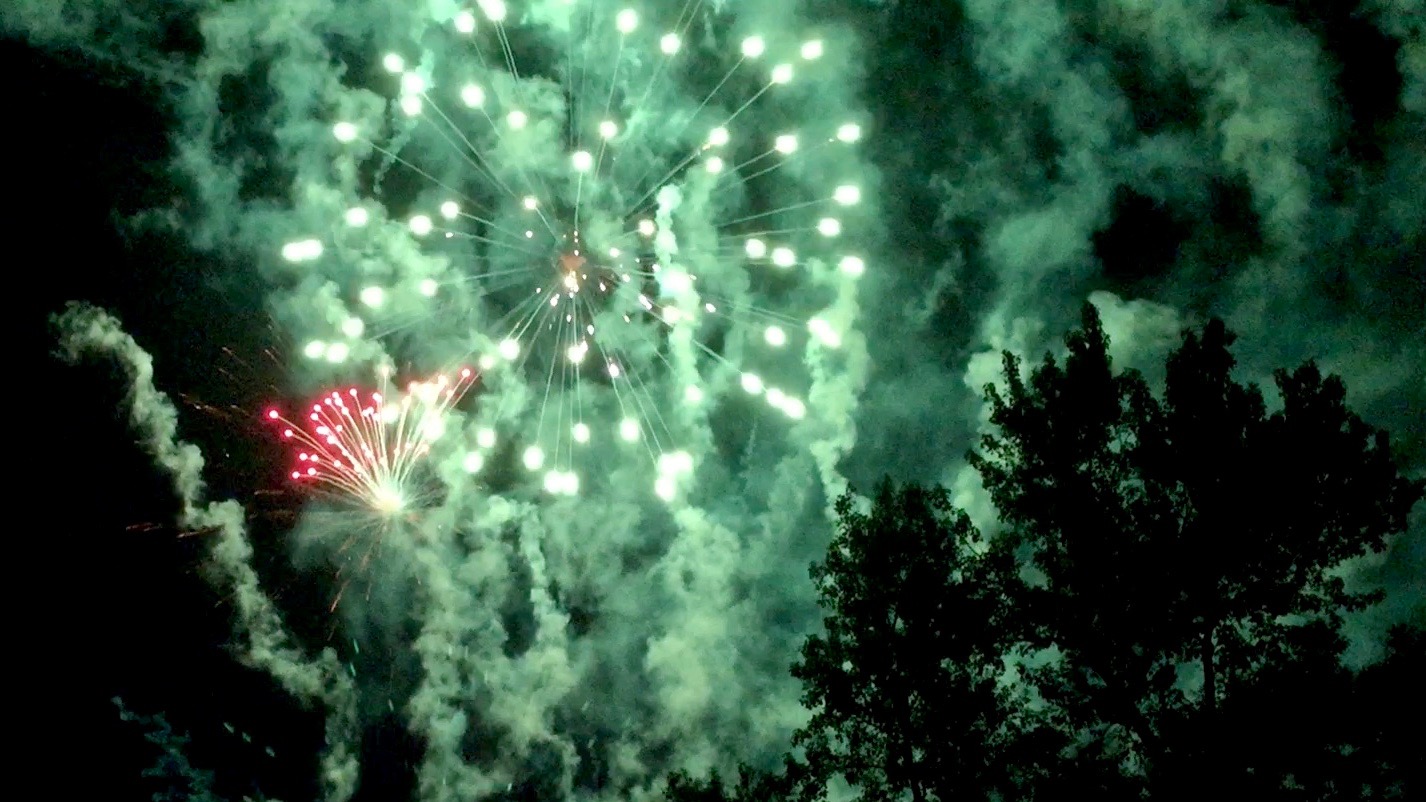
July 4th fireworks (Eugene, Oregon, 2016)

I love the Fourth of July. After beginning the day in the company of Charles Ives and Emily Dickinson, I will run a 5K, watch the ragtag town parade, take in some local baseball, gather with friends for croquet, barbecue and American folk tunes sung around an outdoor fire, and join the annual procession of neighbors to the end of our street for fireworks over the harbor. This in itself is enough to honor the day – life and community affirmed with our fellow citizens as we sound the resonant notes of tradition.

But the liturgist in me wonders if we might do something more consciously formative with our American holiday, as our forebears did. Throughout the nineteenth century and well into the twentieth, the Fourth of July was an occasion not only to celebrate our ideals, but also to educate the public in the habitual virtues of public life by which those ideals might continue to be realized. A central part of this educative function was the Fourth of July oration, a long-winded address that recalled the great deeds of the past, tabulated the growth and progress achieved over the years, and exhorted the listener toward the same zeal for liberty and the common good that had inspired our founders.

The speakers all tried to tune their themes to the situation of their time. An oration given in 1838 before an abolitionist society noted the ironies of church bells and cannons sounding in celebration of liberty while in the same land could be heard the clanking of chains on the limbs of a million slaves. Another, given on the eve of World War I, called upon America to lead the way in the overthrow of war as an instrument of policy.

As a longtime lover of California’s mountains, I am especially fond of Thomas Starr King’s oration of 1860, delivered to the Episcopal Sunday School Mission Celebration in San Francisco, celebrating the fact that California had not seceded from the Union. “Thank heaven,” he declared, “there is no doubt of our geography. The Sacramento is an American river. The San Joaquin is not held by traitors. San Diego is an American port…” King then described the red alpenglow and azure shadows on the white glacier of Mt. Shasta as Nature’s emphatic salute to the Red, White and Blue!

The one thing these orations have in common is their assumption of a people, a public, who are committed to working together to implement the ideals that gave us birth. “We swear,” cried a young John Quincy Adams on July 4, 1793, “we swear by the precious memory of the sages who toiled and of the heroes who bled in her defense, that we will prove ourselves not unworthy of the prize which they so dearly purchased; that we will act as the faithful disciples of those who so magnanimously taught us the instructive lesson of republican virtue.”

In other words, keep your eyes on the prize. The watchwords of the Revolution – liberty and the common good – are powerful ideas. Even the most corrupt and cynical among us must still give them lip service if they aspire to political power. As Daniel Ellsberg once said, the best thing that you can say about the American people is that you have to lie to us.

The American experiment is not over. We no longer conduct it with the illusion that we are innocent of the old corruptions, that humanity’s darker impulses are somehow absent from the American heart. Holden Caulfield and Daisy Miller have grown older and wiser. And yet there are many among us who refuse to give up, who refuse to retreat from public life and the common good. There are many among us who continue to dream, continue to strive, continue to believe that we shall overcome, that “America the beautiful” is still a possibility.

I do not imagine that Americans will ever again submit to the custom of lengthy orations under a hot sun, but might there be other ways to mark the day with experiences, images and rituals which reconnect us with our ideals and with each other? I wouldn’t put any politicians on that planning committee, or preachers either. Instead, I would entrust the task to artists, musicians, poets and activists. My vote to head the enterprise would be the 8-year-old Hopi girl whose recurring daydream of a redeemed public life is recorded in Robert Coles’ The Spiritual Life of Children:

All the people are sitting in a circle, and they are brothers and sisters, everyone! That’s when all the spirits will dance and dance, and the stars will dance, and the sun and moon will dance and the birds will swoop down and they’ll dance, and all the people, everywhere, will stand up and dance, and then they’ll sit down again in a big circle, so huge you can’t see where it goes, or how far, if you’re standing on the mesa and looking into the horizon, and everyone is happy. No more fights. Fights are a sign that we have gotten lost, and forgotten our ancestors, and are in the worst trouble. When the day comes that we’re all holding hands in the big circle – no, not just us Hopis, everyone – then that’s what the word ‘good’ means…and the whole world will be good when we’re all in our big, big circle. We’re going around and around until we all get to be there!

That summer feeling

Toward the end of her life, Emily Dickinson made her short list of the things that truly matter: “First – Poets – then the Sun – / Then Summer – Then the Heaven of God. / And then – the List is done – ”

Although death threw its shadow across many of her poems, Dickinson could be a sublime singer of summer – timeless land of perpetual noons, the practical heaven of the perfect moment. And when I rose early this morning to welcome the season on our sunny island in Puget Sound, I too embraced the necessary fiction of capacious days, green and golden, time enough for everything – the swim in the lake, the unexplored trail, the dulcimer in the corner, the hammock under the willow, campfire nights, a pile of expectant books, slow meals with friends.

The poets have long dreamt of a refuge beyond the reach of decay and sorrow. A medieval Spanish lyric finds healing in a summer meadow:

On occasion, whenever
I wake among flowers,
I scarcely remember
my numberless sorrows,
soon wholly forgotten
as I peacefully doze,
and life is restored
by the murmuring leaves:
in their shade, to the sound of
their rustling, I sleep.

Mary Oliver, recalling her American childhood, locates the gate of Paradise at the classroom door when the final bell rings.

I went out of the schoolhouse fast
and through the gardens and to the woods,
and spent all summer forgetting what I’d been taught

And Wallace Stevens, in his “Credences of Summer,” which I peruse like Scripture every Summer Solstice, captures perfectly the radiant calm of the longest day:

This is the last day of a certain year
Beyond which there is nothing left of time…
Postpone the anatomy of summer…
And fill the foliage with arrested peace,
Joy of such permanence, right ignorance
of change still possible…

Exquisite ripeness. The end of longing. Be. Here. Now. Or to quote the flag that flies over the old family cottage on Minnesota’s Lake Pepin, “Doing nothing is always an option.” It is a fiction, of course, a paradise more imagined than lived. Leisure, and the means to enjoy it, are not equally shared. The very notion of hiatus is endangered in a world where information never sleeps. And now climate change has injected a note of dread into our once happy anticipation of warmer days.

Yet summer remains a necessary fiction, which we abandon at our peril. Without its Sabbath rest, without an unhurried interval of play, adventure, refreshment and renewal, our lives would be poor indeed.

Sometimes, on the longest day, I gather a group of friends to await the sunset. Seated in a circle, we each share a story, memory or sensory image that evokes something of summer for us. Though each recollection is personal and particular, it always brings nods of recognition from the group. We all have our own variations on swimming holes and sandy beaches, road trips and mountain cabins, blackberry pies and corn on the cob, a cold drink from a garden hose, the scent of barbecue and suntan oil, street games at dusk, bare feet on the lawn, kisses beneath the stars. No one forgets that summer feeling.

What are the sacraments and memories of summer for you?

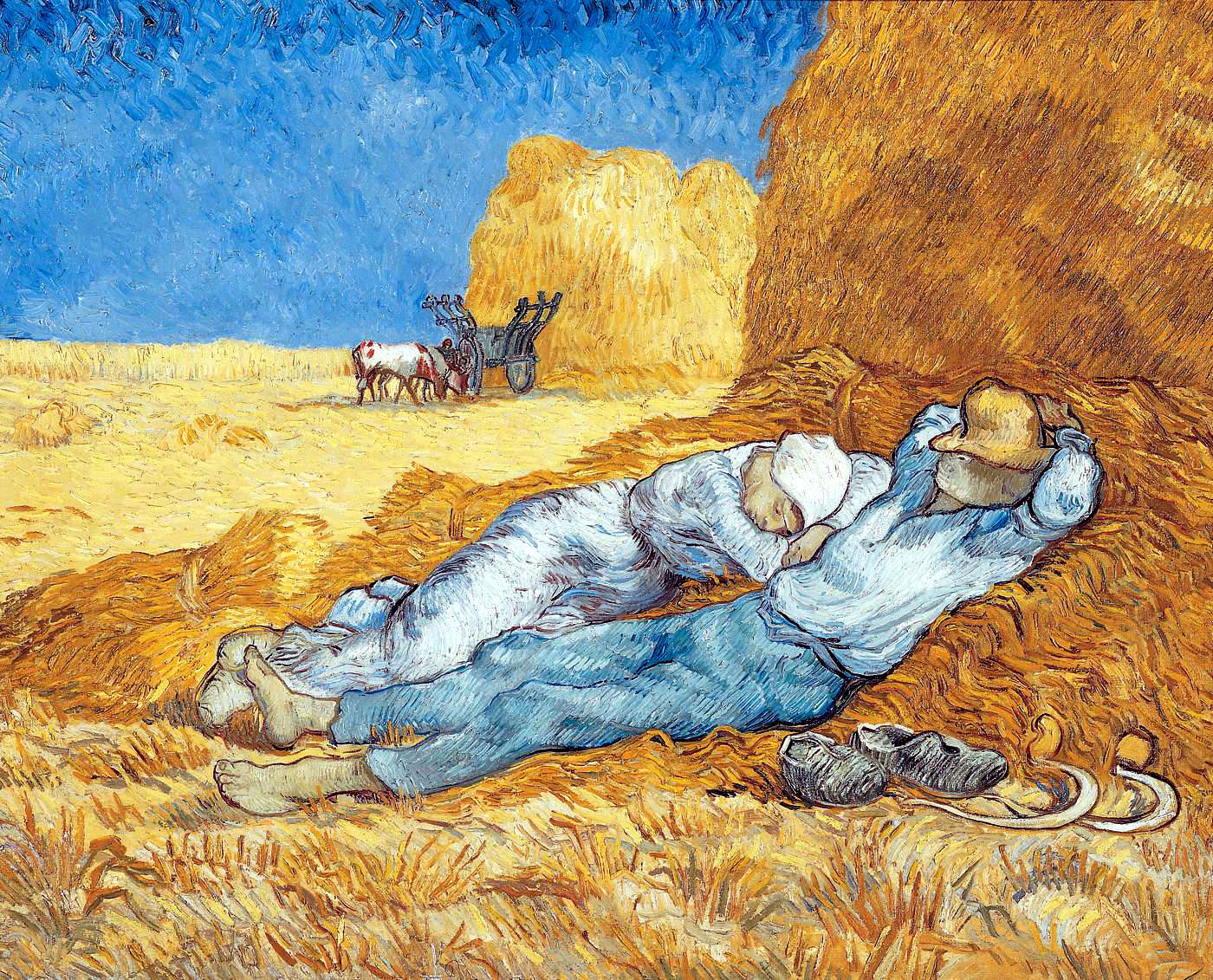
Van Gogh - La Meridienne