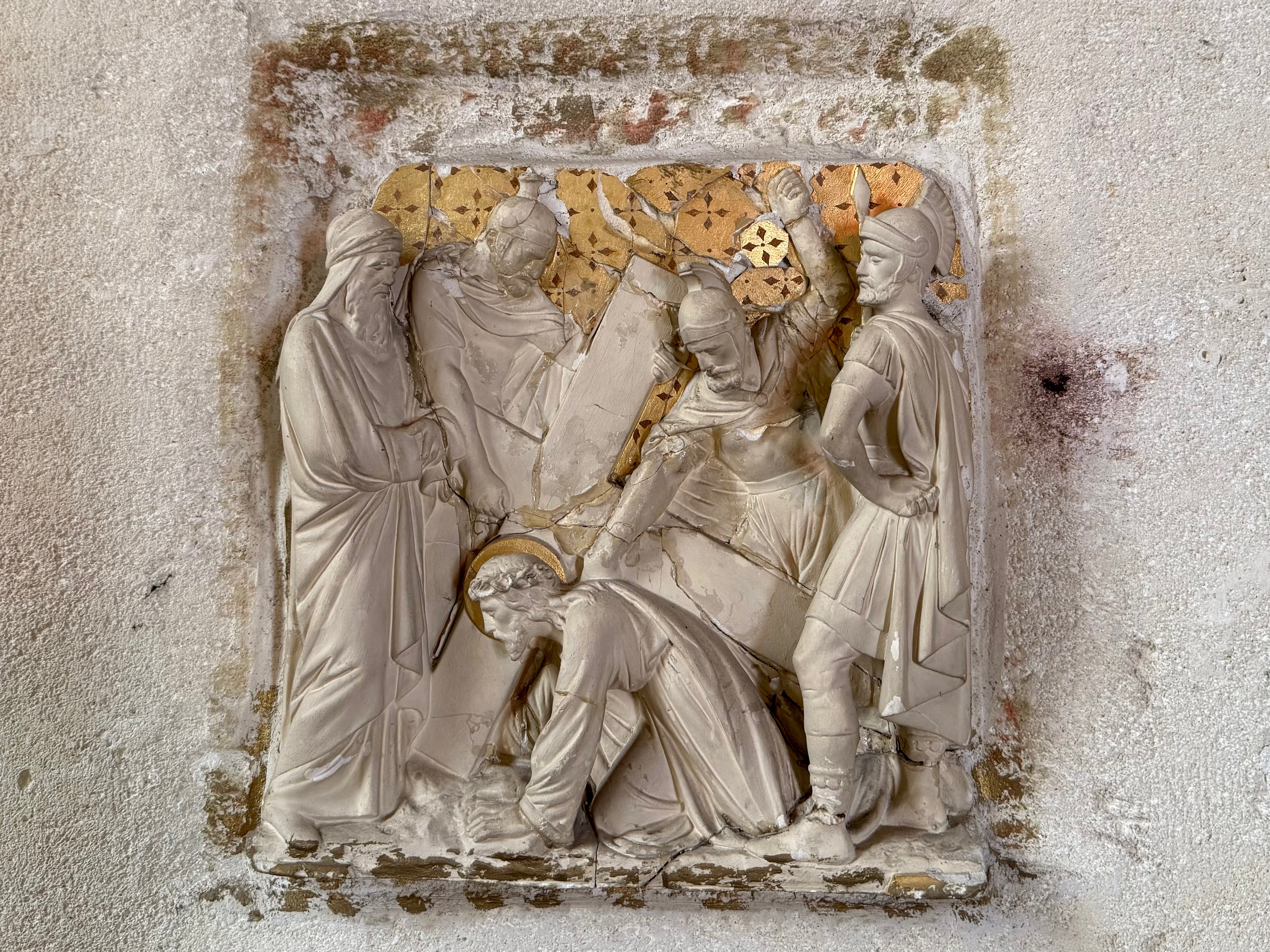
Jesus Falls for the Third Time, Église Saint Laurent, Eygalières, France.
Ilia Malinin is by all accounts the best male figure skater in the world. The winner of the last two World Championships has broken new ground with his technical brilliance and exquisite artistry. He was the overwhelming favorite to win the gold medal last week at the Winter Olympics in Milan. But when he took the ice as the final skater, something went very wrong. In one of the biggest upsets in the history of the sport, Malinin grew hesitant, fell twice, and never regained the timing and composure he is known for. In a disastrous and heartbreaking four minutes, he tumbled from first to eighth.
In a post-race interview, Malinin said that “going into this competition, I felt really good this whole day. Feeling really solid. I just thought that all I needed to do was trust the process that I’ve always been doing.” But “the pressure and the nerves” hit hard. “So it was really just something that overwhelmed me and I just felt like I had no control.”
As the stunned spectators began to file out, the arena DJ put Coldplay’s “Viva la Vida” on the loudspeakers.
I used to rule the world Seas would rise when I gave the word Now in the morning, I sleep alone Sweep the streets I used to own
I used to roll the dice Feel the fear in my enemy’s eyes Listen as the crowd would sing
Now the old king is dead, long live the king One minute, I held the key Next the walls were closed on me And I discovered that my castles stand Upon pillars of salt and pillars of sand
That may have been a harsh choice for that particular moment, but it echoed the truthful reminder spoken to us every Ash Wednesday:
Remember that you are dust, and to dust you shall return.
The coincidence of Olympian failure and Ash Wednesday has happened before, and I believe that the falls touch us more deeply than the triumphs, summoning us to self-compassion in the dust and ashes of our own defeats. So in the light of this Olympics’ unfortunate example, I offer here the Ash Wednesday reflection I first posted ten years ago:
In the 1988 Winter Olympics, American speed skater Dan Jansen, the best in the world, was the consensus pick to win the 500 and 1000 meter events. On the morning of the 500 final, he learned his sister had just died from leukemia. With his focus clearly elsewhere, he fell on the first turn of his race and never finished. He would also fall and fail in the 1000 meters. At the 1992 Olympics, he again failed to win the medals expected of him. The 1994 Olympics offered him one last chance, and he came to the line of the 500 meter race as the clear favorite, the only skater ever to break 36 seconds, which he had done four times. But after one slight slip on the ice, he finished out of the medals yet again.
Ash Wednesday came just after that race, and during the liturgy I reflected on Jansen’s story in my homily. Although Jansen would finally win a gold medal a few days later (in the one race where he was an underdog), it was his “failures” that resonated with people. After the liturgy, a therapist in the congregation told me that many of her clients that week had talked with her about Jansen’s story, and how much it moved them. If the world’s greatest skater could fall, then maybe it was all right for them to fall as well. You don’t have to be a hero, only your own flawed and unfinished self.
In his youth, the poet David Whyte was hiking in the Himalayas when he came to a deep chasm. The only way across was a rickety old rope bridge with many missing slats. Although he was a confident, experienced mountaineer, he suddenly froze at the prospect of traversing the abyss on so treacherous a path. He sat down on the ground and stared at the bridge for hours, unable to proceed. “There are times when the hero has to sit down,” he said later. “At some bridges in life the part of you that always gets it done has to sit down.” Then an old Tibetan woman came along, gathering yak dung for fuel. She walked with a limp. “Namaste,” she said with a smile. Then she turned and limped across the bridge. Immediately, without thinking, he rose up and followed. Sometimes, he realized, it is “the old interior angel,” the unheroic, limping, unequipped part of ourselves, that gets us to the other side.
Remember that you are dust, and no hero. Whether your Lent will be a time of giving up, going deep, or reaching out, may it always be done with a generous measure of self-compassion.
“[Humanity] is suspended in the present, between the past and the future, as if on a rock between two chasms. Behind and ahead, all is darkness.” — Chateaubriand
A year ago, on the eve of 2025, America and the world faced the prospect of evil times ahead. In my New Year’s Eve post of 2024, I tried to look beyond the imminent calamities to the luminous horizon of divine intention.
“The evils of the coming days will be phenomenal and accidental. Though they will hurt, they will never be quite solid or real or enduring in the way that the Love, Justice and Mercy of God are, now and forever. We shall not remain silent about the damage, or complacent about the consequences of those evils. But we must not give them the power and glory which are God’s alone.”
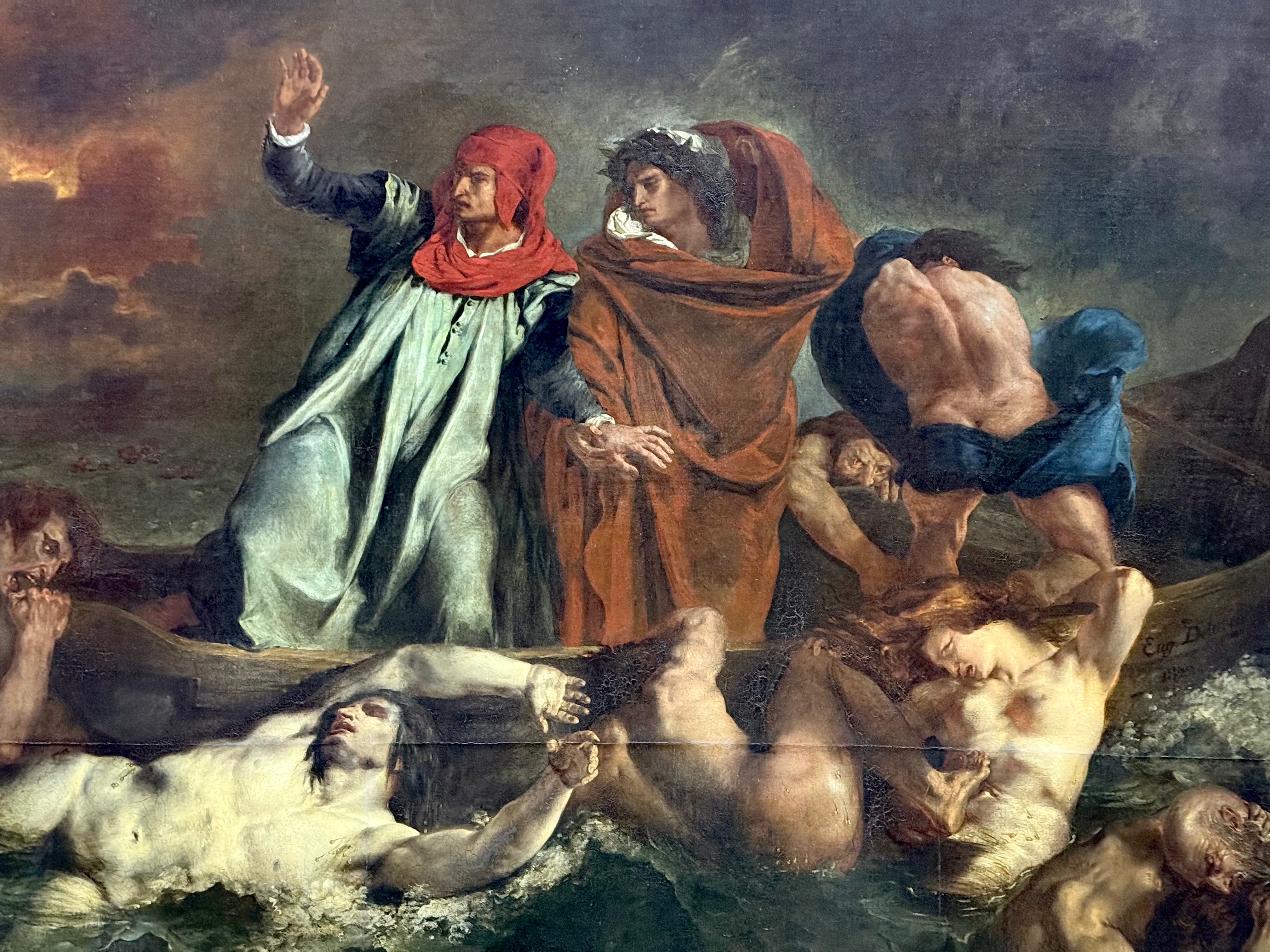
We all know how hard it has been to remain grounded and trusting in the carnival of cruelty and madness that was 2025. The way forward appears equally perilous. It is hard not to feel ourselves in Delacroix’s frail boat with Dante and Virgil, tossed by the turbulence of hell, struggling with outer demons and inner fears.
Eugène Delacroix, Dante and Virgil Cross the Lake of Hell (1822).
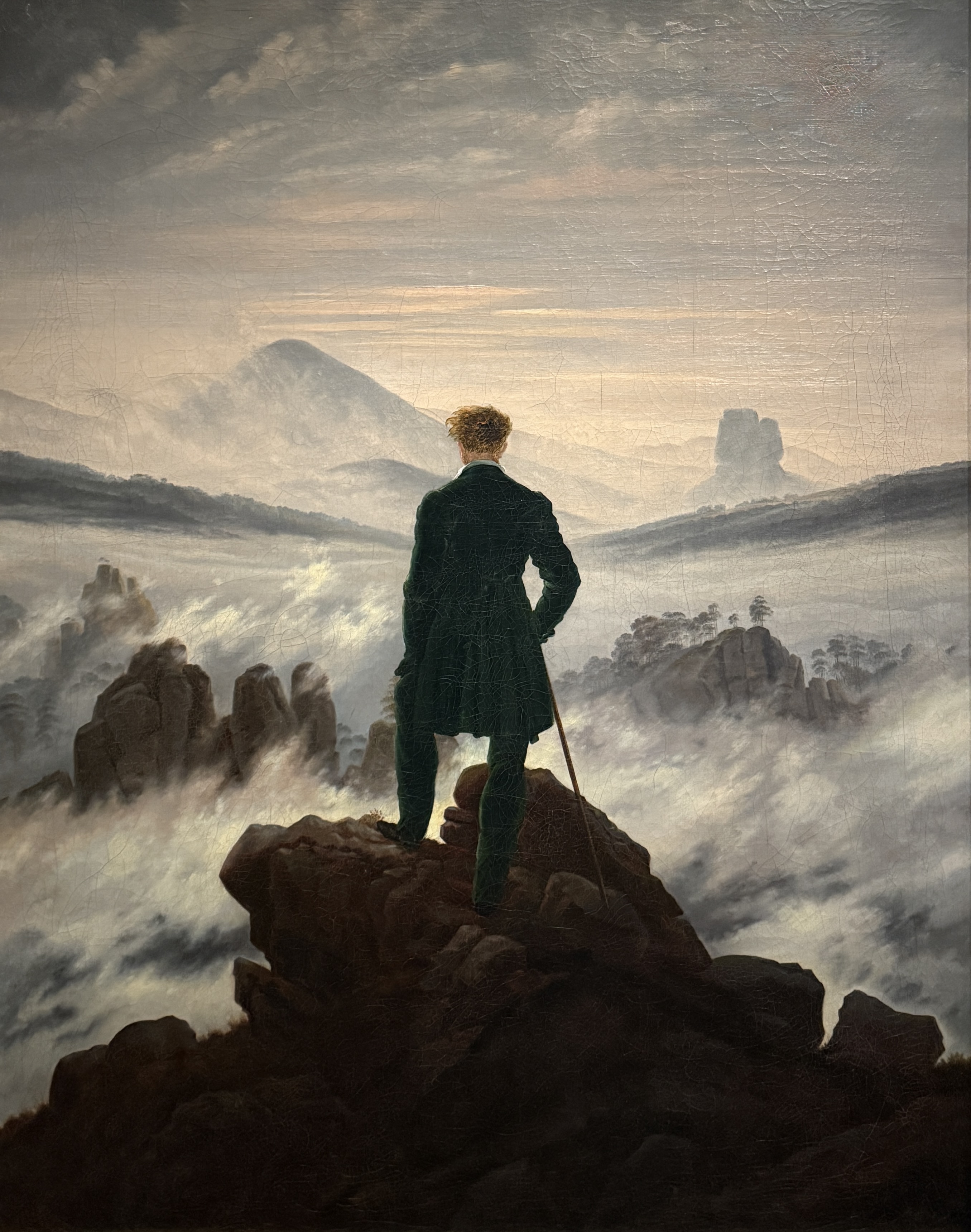
But on the eve of a New Year, I choose to dwell in a different image: Caspar David Friedrich’s Wanderer Above the Sea of Fog. The hiker has risen above the fray of history to stand on a lofty summit, surveying the world before him. We can’t see his facial expression or know his inner thoughts, but his body language conveys a state of contemplative stillness. He is not contorted by fear of what is, or what may come.
Caspar David Friedrich, Wanderer Above the Sea of Fog (c. 1817).
What is out there in the mist, hidden from his eyes and ours? If it’s the future, will it be better, or worse? Or more of the same? Whatever it may be, will we—can we—meet it with hope, courage, and love?
One of Friedrich’s contemporaries, the Romantic poet Joseph von Eichendorf, said that we can, and that doing so will make a difference in the outcome.
“There is a sleeping song in all endlessly dreaming things, and the world will begin to sing if you find the master word.”
Dear reader, in the New Year 2026 may you find that word, and make it your own.
I am so grateful for all of you who have stopped here to read and reflect in 2025, and for all the comments and sharing you do to keep the thoughts circulating. May the days to come bring you many graces and blessings. Happy New Year!
In the dark days of 1943, Hugh Martin and Ralph Blane wrote the most melancholy Christmas song I know, “Have Yourself a Merry Little Christmas.” It made its debut in the 1944 film, Meet Me in St. Louis, when Judy Garland sang it to cheer up her little sister. Their father had taken a job in New York, and the world they knew was about to end. The fact that it was Christmas—their last Christmas in St. Louis—only intensified their sense of loss. As the sisters gaze down from an upstairs window at the family of moonlit snow figures in the front yard, Garland, her moistened eyes seen in gorgeous Technicolor close-ups, delivers the song.
The film’s director, Vincente Minnelli (who would marry Garland the next year), thought the original lyrics too depressing, so he told the writers to make some changes. The line, “It may be your last / Next year we may all be living in the past,” became “Let your heart be light / Next year all our troubles will be out of sight.” But that did little to stop the tears of homesick soldiers viewing the film in distant war zones. In 1957, Frank Sinatra requested another change when he included the song on his holiday album, A Jolly Christmas. He asked Hugh Martin if he could “jolly up” the lyrics a bit more. Thus “until then we’ll have to muddle through somehow,” became “hang a shining star upon the highest bough.” Even so, the tune’s slow pace and moody melody have continued to suffuse the song with the seasonal melancholy which for some is the shadow side of Christmas cheer. If you’re feeling alone, sad, lost, anxious, or afraid, it’s hard to share in the holiday spirit. When your personal world—or our public world—lies in darkness, how do you “let your heart be light?”
A few centuries ago, Turlough O’Carolan, the blind harper and last of the Irish bards, was sitting in a tavern with his friend, the poet Charles McCabe, who said, “Your music, sir, is grand and lovely stuff; but it’s too light-hearted. This is a dark time we live in, Mr. Carolan, and our songs should reflect that.” The harper replied, “Tell me something, McCabe. Tell me this: Which do you think is harder—to make dark songs in the darkness, or to make brilliant ones that shine through the gloom?” [ii]
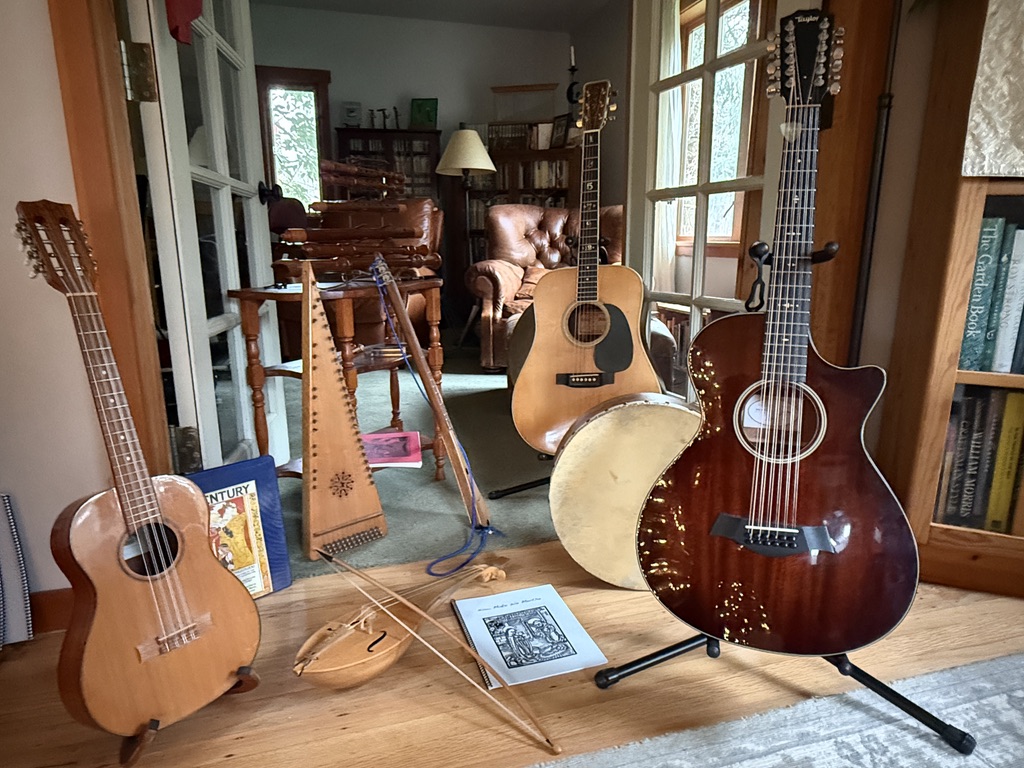
Some of the instruments from our caroling party.
For the last half-century, I have gathered instrumentalists, singers and friends to lighten up the long night with carols and wassails from seven centuries and a dozen countries. “The Praise of Christmas” sums up the spirit of these evenings:
This time of the yeare Is spent in good cheare; Kind neighbors together meet To sit by the fire With friendly desire Each other in love to greet; Old grudges, forgot, Are put in the pot, All sorrowes aside they lay; The old and the yong Doth carol their song To drive the cold winter away.
The old tune is appropriately vigorous, and the lyric by Thomas d’Urfey (1653-1723) is from his aptly titled songbook, Pills to Purge Melancholy. We do sing our share of quiet songs (“Hush! Hush! See how the child is sleeping.”), as well as wistful and mysterious carols in minor keys and medieval modes. But the predominant note is one of joy and wonder. As William Morris declared in his Victorian carol, “Masters in This Hall,”
Christmas is come in And no folk should be sad.
Of course, no one should, but many are. Even in the best of times, there’s going to be some sadness in the room. As Henry Nouwen said, “No one escapes being wounded.” So we don’t sing our carols expecting present reality to be suddenly freed from every sorrow. But singing touches and heals the mind and heart, offering relief and comfort to “those who sit in darkness, and in the shadow of death” (Luke 1:79). As Robert Burton insisted in The Anatomy of Melancholy (1621), music is “the sovereign remedy against despair and melancholy … a “tonick to the saddened soul.” And W.E.B. DuBois, writing in the last century about “The Sorrow Songs” of African-American spirituals, said that “they grope toward some unseen power and sigh for rest in the End.” In other words, even laments can be agents of hope. As DuBois put it,
“Through all the sorrow of the Sorrow Songs there breathes a hope—a faith in the ultimate justice of things. The minor cadences of despair change often to triumph and calm confidence.” [iii]
Compared with the emotional and social realism of black spirituals, what can we say about Christmas carols? Do they have a similar healing power? Or is their bright spirit in denial of the “two thousand years of wrong” which have followed the miraculous “midnight clear” in Bethlehem? Can we who dwell in the shadow of death still sing about joy and peace with whole-hearted conviction? As the Psalmist wondered, “How can we sing the Lord’s song in a strange land?” And yet, we sing. We sing because carols gladden the heart and bring us together. And we sing because carols are eschatological anticipations of God’s unfolding future. They don’t put an end to our troubles, but they give us a foretaste of glory, reminding us that we belong not to what is dying, but to what is being born.
Gabriel’s message does away Satan’s curse and Satan’s sway; Out of darkness brings our Day: So behold, All the gates of heav’n unfold.
“O radiant dawn, bright splendor of the light eternal.” (8th century ‘O Antiphon’ for December 21).
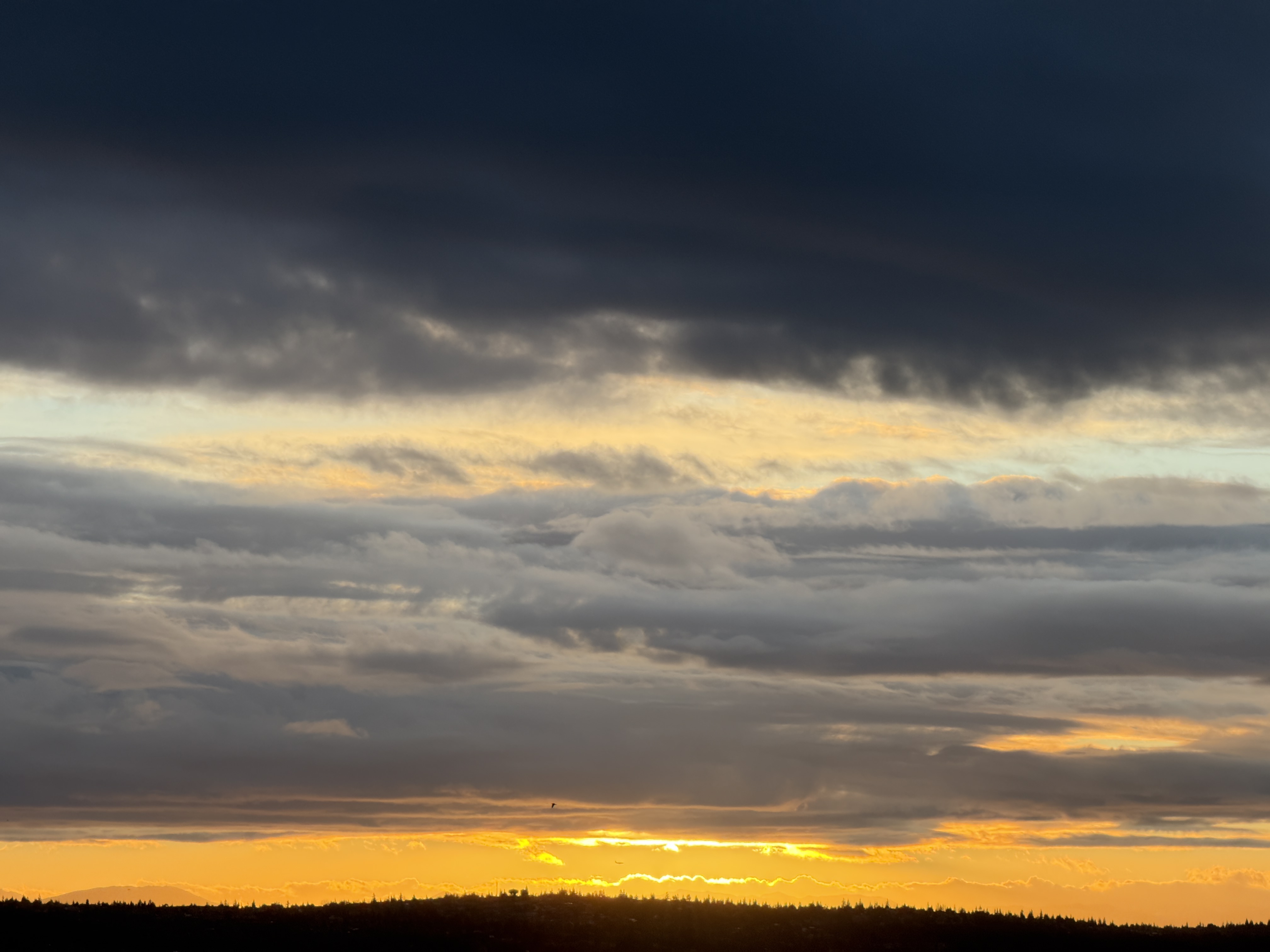
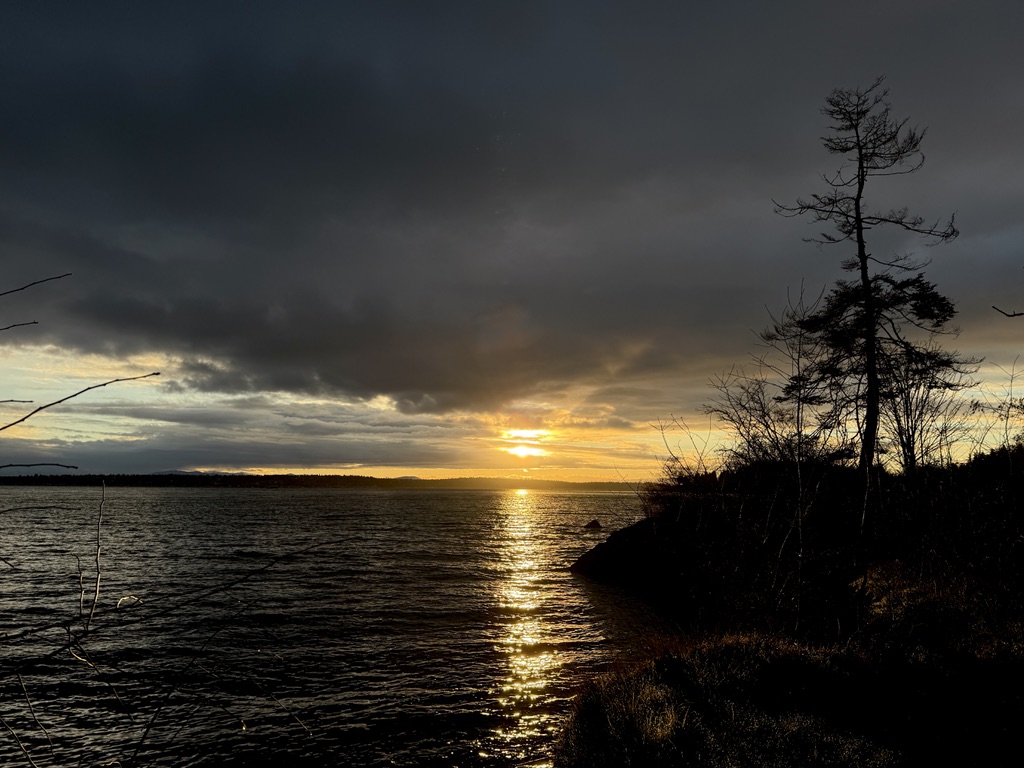
In my Los Angeles days, I’d rise at 4 a.m. at the Winter Solstice, toward the end of the longest night, and drive to a peak above the ocean in the Santa Monica Mountains, where I could see the newborn sun rise over desert peaks 100 miles to the east. But in the Northwest where I live now, a winter sunrise can be a rare sight. This December’s relentless stretch of rain and thick clouds seemed to doom my chances. Still, I awoke at sunrise out of habit, and when I glimpsed the Douglas firs on a hilltop ablaze with fiery light. I jumped in my car and raced to the edge of the island to see the gloom on the run. It was the perfect Advent sign: The people who have lived in darkness, and in the shadow of death (umbra mortis, as the 8th-century O antiphons put it), have seen a great light.
Did it matter that by the end of the day the sun had vanished and rain was pouring down? Not at all. I had received the gift of light as an eloquent sign: Don’t forget what you have seen. Remember hope.
Sunrise after the year’s longest night (Puget Sound, Washington).
Dear reader, I wish you a most blessed and merry Christmas. Let your heart be light!
[ii] I heard this story in the California Revels CD, Christmas in an Irish Castle (2001).
[iii] The Nouwen, Burton, and DuBois quotes are from Kay Redfield Jamison’s powerful and moving book, Fires in the Dark: Healing the Unquiet Mind (New York: Alfred A. Knopf, 2003). It is a fascinatingly documented and beautifully written treatise on the spiritual and imaginative dimensions of healing body and soul.
In all my years as a priest, I had never preached on the apocalyptic imagery of Luke 17:26-37, where people disappear without warning and Jesus concludes with an unnerving proverb: “Where the corpse is, there the vultures will gather.” This is not ideal preaching material, but with the help of the Epistle reading, Hebrews 11:29—12:2, I gave it a try last Sunday.
Today’s gospel [i] has quite a punchline: “Where the corpse is, there the vultures will gather.” It’s got to be pretty low on the list of favorite Jesus quotes, but it certainly gets our attention.
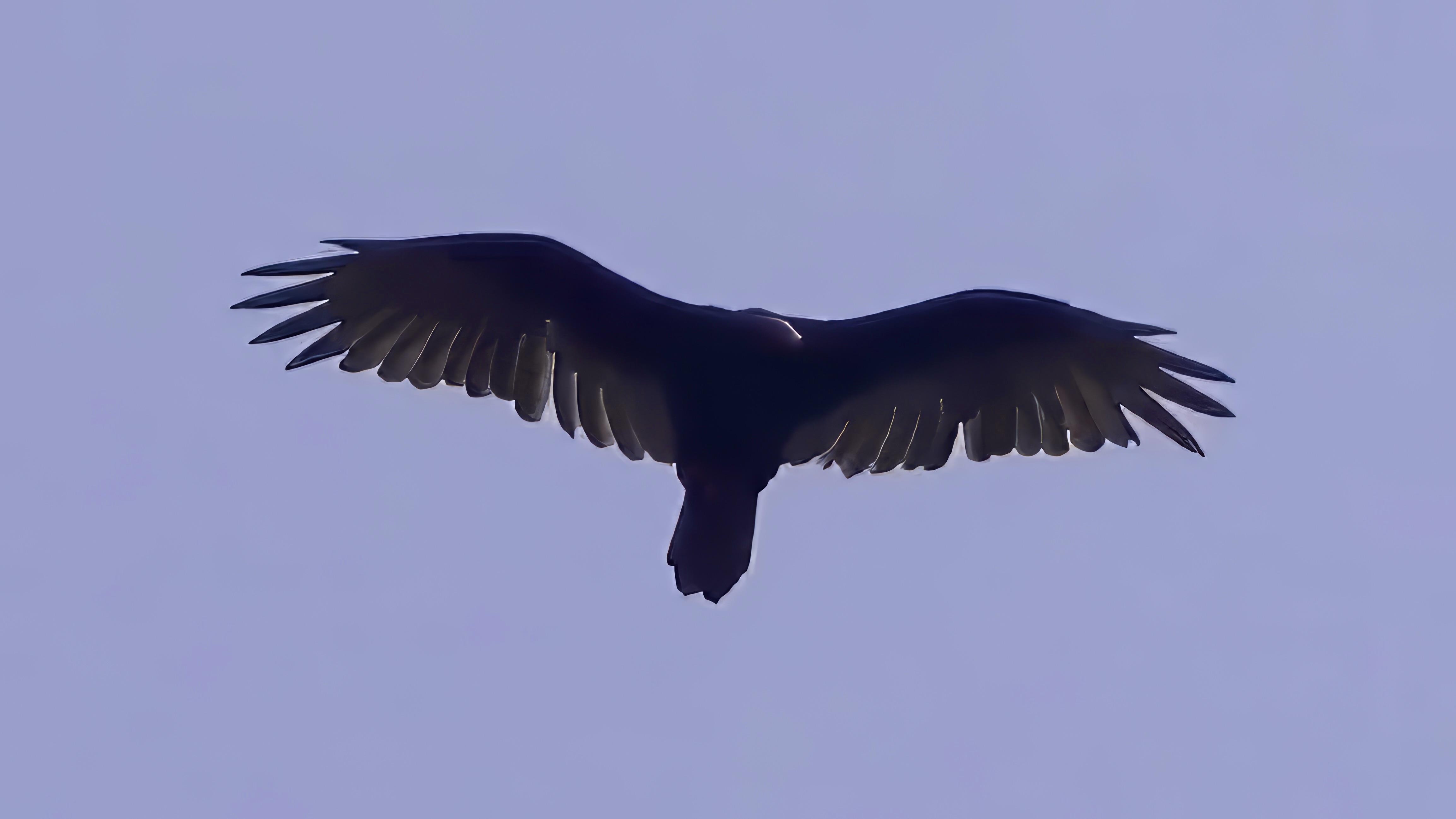
A couple of weeks ago I was at a raptor show at the High Desert Museum in eastern Oregon. A variety of hawks, owls and vultures flew swiftly among the seated spectators, who were warned to stay very still lest we be mistaken for prey. I did my best not to be a target, but a turkey vulture came close enough to brush my head with its wing. Perhaps it was preparing me for this strange gospel verse.
Some scholars say Jesus was simply using a common folk expression in response to a question about discerning the times, meaning something like “where there’s smoke, there’s fire.” Such expressions have nothing to do with smoke or fire or vultures or corpses. They’re just colorful ways of making a point. Still, Jesus’ choice of such a grim illustration puts a sharp edge on his message. It certainly gets our attention. And where the enigmatic text is, there the scholars will gather.
Who is the corpse? they wonder. Who are the vultures? One interpretation suggests the corpse could represent ancient Palestine, with the rapacious vultures being the occupying army of Rome. The Book of Revelation, perhaps inspired by the vultures in the gospel text, imagined the raptors of midheaven being summoned to feast on the remains of the proud powers struck down by divine judgment. An even more fantastical interpretation identifies the sharp-eyed buzzards, who in fact can spot carrion from 3 miles away, as those perceptive disciples who gather to consume the Corpus Christi, the Body of Christ given to feed our deepest hunger.
Well, none of these images is going to qualify for a stained glass window. And the vulture verse is perhaps profitless for the preacher.
And yet, it leaves a haunting impression. It’s unlike anything else Jesus ever said, and its gruesome tone puts an exclamation point on his discourse of crisis. A world is dying, he says. Just as a world died in the days of Noah, or in the days of Lot—names which recall destructive narratives of flood and fire—so it is happening now. The times are in no way normal, Jesus warns his listeners. Anyone who pretends that is not true, who thinks we can just go on about our business as usual—eating and drinking, buying and selling, planting and building—well, they are in for a surprise.
Come gather ’round people Wherever you roam And admit that the waters Around you have grown And accept it that soon You’ll be drenched to the bone If your time to you is worth savin’ You better start swimmin’ Or you’ll sink like a stone For the times they are a-changin’ [ii]
When we sang that song 60 years ago, we thought the times were changing for the better. And that was true in many ways. But the flood of changes washing over us today do not feel like something better. When Jesus speaks of people being snatched up and disappeared without warning, he could be describing what’s happening right now in “the land of the free.” To paraphrase Jesus’ metaphor, “As it was in the days of Dietrich Bonhoeffer—in 1930s Germany—so shall it be in our own time.”
I pray that this will not be our fate, but the fact that such an outcome is even conceivable is a measure of the times. It can happen here. So what are the friends of God to do? How do we start swimming so we don’t sink like a stone?
We are not the first believers to suffer the worst of times. The Epistle to the Hebrews is clear about that. History isn’t always about the lilies of the field. It has its corpses and vultures as well.
But as the author of Hebrews insists, the faithful believe in the victory of God, and they act out that faith with their bodies. Some of God’s friends have “received the test of mocking and whipping and even chains and prison. They were stoned, cut apart in a slaughter; they died upon a sword. They traveled around in ragged clothing, impoverished, oppressed, afflicted.” But for all they suffered, those who kept the faith “subdued monarchies, did the work of justice … shut the mouths of lions, quenched mighty fires …” (Hebrews 11:29-12:2)
As people baptized into the Paschal Mystery, we understand that dying and rising, defeat and victory, are deeply intertwined. You can’t have one without the other.
When certain medieval women mystics contemplated the cross in prayer and vision, they saw not the triumph of death, but a kind of birth. For them the crucified Jesus was like a woman in labor, enduring pain and travail in order to bring us all to birth:
Ah! Sweet Lord Jesus Christ, who ever saw a mother suffer such a birth! For when the hour of your delivery came you were placed on the hard bed of the cross and … in one day you gave birth to the whole world.”[iii]
To behold the death of Christ and call it birth is the central act of Christian imagination. It is why we declare victory at the cross. We don’t wait for Easter Sunday. We declare victory at the cross because the Passion isn’t just a story about the violent powers that always trample the weak and kill the prophets. It’s also a story about the Realm of God, where dry bones breathe and lost hopes dance, where the prodigal is welcomed home and the tears are wiped from every eye.
The Love that creates such a realm was nailed to a cross, but the cross did not consume it. Yes, death did what death does, but then God did what God does. And Love won. This is the story we belong to, and on the outcome of that story, we stake everything.
That is why we are here this morning. That is why we refuse to retreat to our private worlds, why we continue to gather in community at our Savior’s table: to nurture hope, shelter love’s flame, encourage one another, strengthen our hearts for service, eat the bread of life, pray without ceasing, sing our Alleluias and grow ever more fully into the visible, tangible body of Christ.
We are not alone in this journey. We are surrounded by a cloud of witnesses, all those ancestors in the faith, from Abraham and Sarah and Mary and Luke right on down to the wise and loving mentors we’ve known in our own lives, who have taught us how to walk in the Way of life and peace.
I once heard a preacher describe the cloud of witnesses as “the balcony people” who are looking down and cheering us on as we run the race that is set before us. It’s a wonderful and resonant image. I’m sure that each of you has some very special people in that balcony, shouting their encouragement. Listen. You can hear their voices echoing through the years.
St. Luke, pray for us … St. Mary, pray for us … St. Francis, pray for us … Oscar Romero, pray for us … Dorothy Day, pray for us … Mom and Dad, pray for us.
Last Sunday I was in Eugene for the National Track & Field Championships, and in the men’s 800 meters I witnessed one of the most stunning moments in the history of middle-distance racing. A 16-year-old high school sophomore named Cooper Lutkenhaus had qualified for the elite competition by breaking the 29-year-old high school record, running the distance in 1:45. And after stumbling and almost falling in his first race at the championships, he managed to survive the first two rounds.
Much to his surprise, he had made the final. But with some of the world’s top 800 meter runners in the race, no one expected him to be anywhere close to the top three who would earn a trip to the World Championships in September.
Rounding the last turn, Cooper was doing really well for a 16-year-old, in sixth place out of nine racers, 10 meters behind the leader. Then, in the last 100 meters, he passed one runner, and another, and another, and another, to cross the line in second place. His time was 1:42.27, not only a personal best by an unbelievable 3 seconds, but the 18th-best all-time and the fourth-best ever by an American.
Donavan Brazier, Cooper Lutkenhaus, and Bryce Hoppel finish 1-2-3 in the 2025 U.S. Track & Field Championships in Eugene, Oregon.
Now I’ve been at a noisy NBA final with Kareem and Magic and Larry Bird. I’ve been deafened by the 12th man [iv] at a Seahawks game. But the sound of the crowd cheering on young Cooper Lutkenhaus blew my ears off. The cloud of witnesses.
When we run the race that is set before us, there will be times when our lungs burn and our legs scream with lactic acid. There will be the races that disappoint, and workouts that feel listless or discouraging. We may even stumble and fall, more than once.
But always, always, the cloud of witnesses is cheering us on. They know from their own experience what the race is like. They all had their own moments of weakness and doubt. They became acquainted with suffering by training hard every day. They all had to learn how to get up after every fall, lay aside every weight, gulp the breath of the Spirit, and accept pain as the runner’s companion.
I’ve done my own share of racing, and when the pain comes, I try to greet it as a friend. “Hello, brother pain. I knew you’d show up. Well, here we go. I know you’re not going to kill me, right?. We’ll just take it step by step.”
“Even the fittest may stumble and fall (Isaiah 40:31). As Roisin Willis and Maggi Congdon finish 1-2 in the women’s 800 meters at the U.S. Championships, Sage Hurta-Klecker dives for the third and final spot on the World Championship team. In previous years, she had missed out on a championship podium twice due to falls, but this time her fall was a triumph. She made the team.
The perpetual contest between weariness and perseverance is familiar to every athlete—and every saint. You’re going to get tired. You’re going to get discouraged. You may faint and fall. But keep your eyes on the prize, hold on. On both good days and bad, you’ve got to put in the work, “lay aside every weight,” surrender to a power and a strength that is not your own, and stay in the flow.
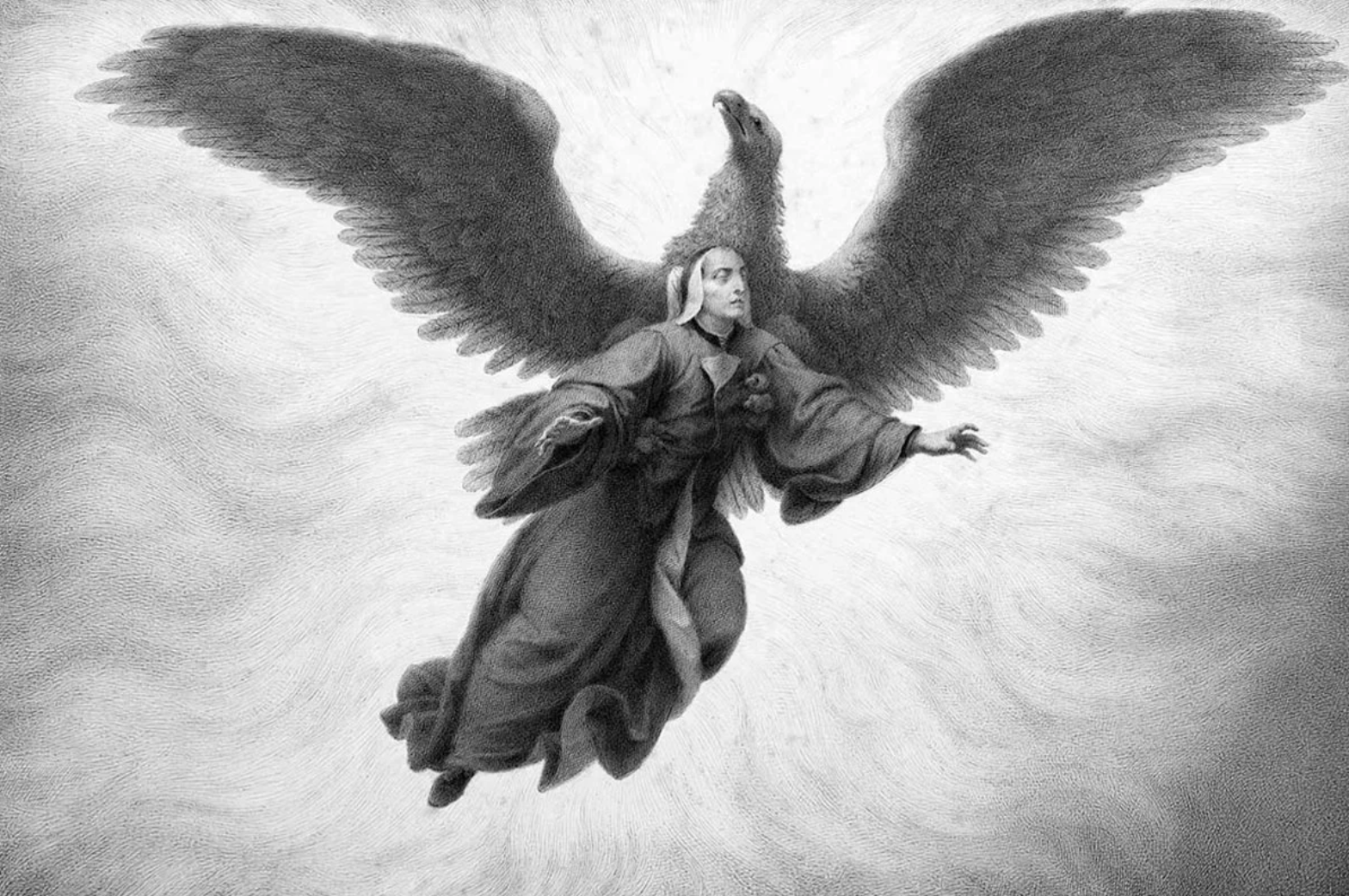
I began with a raptor image, so let me close with another. This time it’s not a vulture, but an eagle, in a beautiful passage from the prophet Isaiah:
Even the youthful may faint and grow weary, even the fittest may stumble and fall, but those who wait for the Lord shall renew their strength, they shall mount up with wings like eagles, they shall run and not be weary, they shall walk and never grow tired. [v]
Francesco Scaramuzza, Dante and the Eagle (c. 1860). The sleeping Dante dreamed he was carried by an eagle, but it was really St. Lucy who helped the poet on his upward journey toward heaven’s light (Purgatorio ix).
This homily was preached at St. Luke’s Episcopal Church, Renton, WA, on the 9th Sunday after Pentecost, 2025.
Race photo and video by the author.
[i] The texts for the 8th Sunday after Pentecost are in Wilda C. Gafney, A Women’s Lectionary for the Whole Church, Year C, which differs significantly for the Revised Common Lectionary used by most liturgical churches.
[ii] Bob Dylan, “The Times They Are A-Changin’” (1964).
[iv] The loudest crowd in professional football is in Seattle, where the fans are called “the 12th man” for their ability to influence the game by making it hard for the other team to hear their quarterback’s signals.
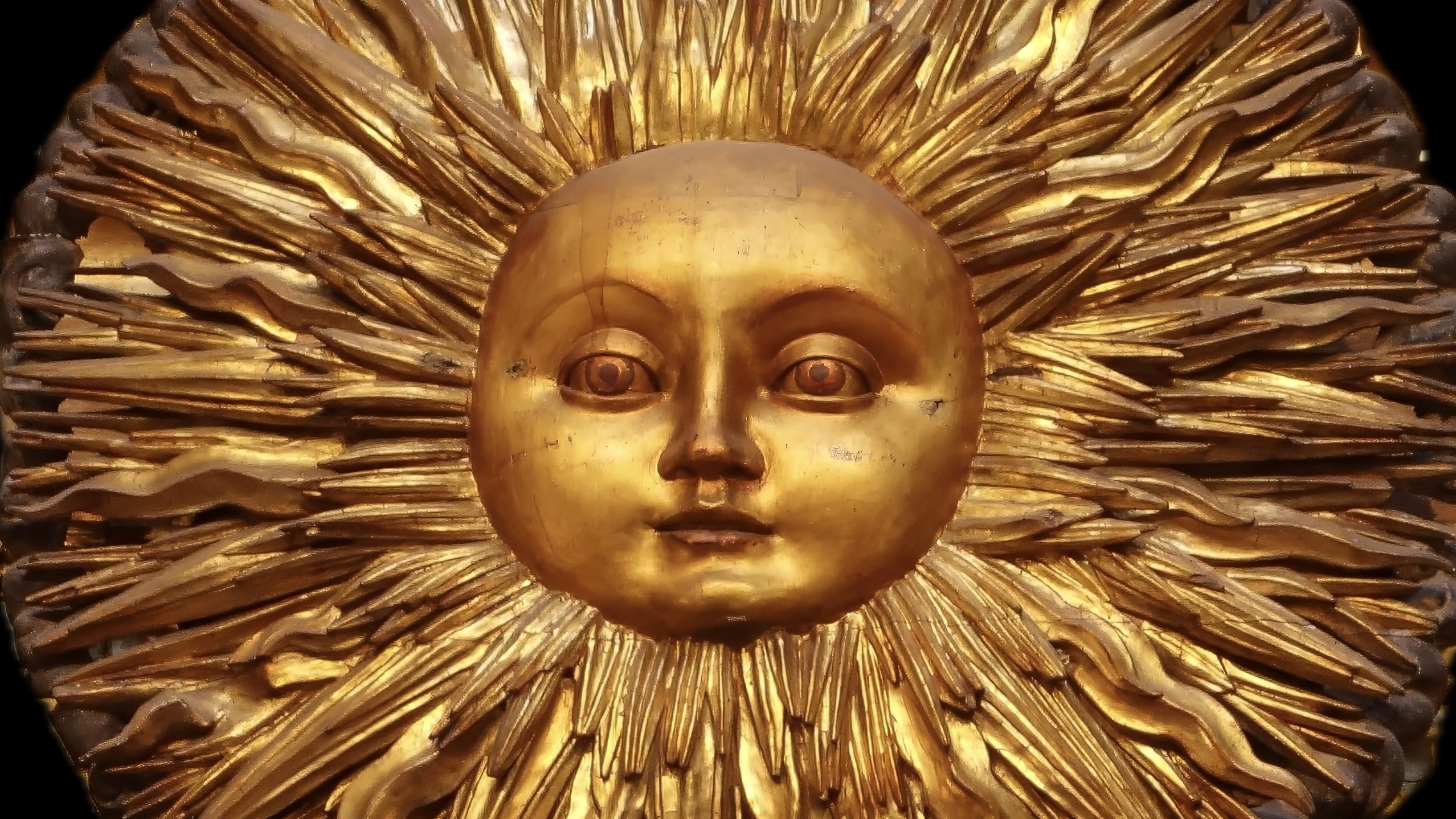
18th-century altarpiece (detail), San Martin Pinario, Santiago, Spain.
“I implore you—be calmer.” — Goethe
I know the world is a hot mess at the moment, but I’m taking the rest of the day off to welcome summer. I’m not even going to compose a long-overdue new post (more of those soon). Instead, before I retire to the garden with a pleasurable book, I’ll do the lazy thing and share a few paragraphs from something I wrote years ago, after my first journey to Greece. I posted the following words on the Summer Solstice in 2001. A few months later, the world as we knew it would come to an end. But the lesson I learned in Greece still speaks to my heart, even in (or especially in) our fractious and fallen present condition.
The author on Naxos, Greece.
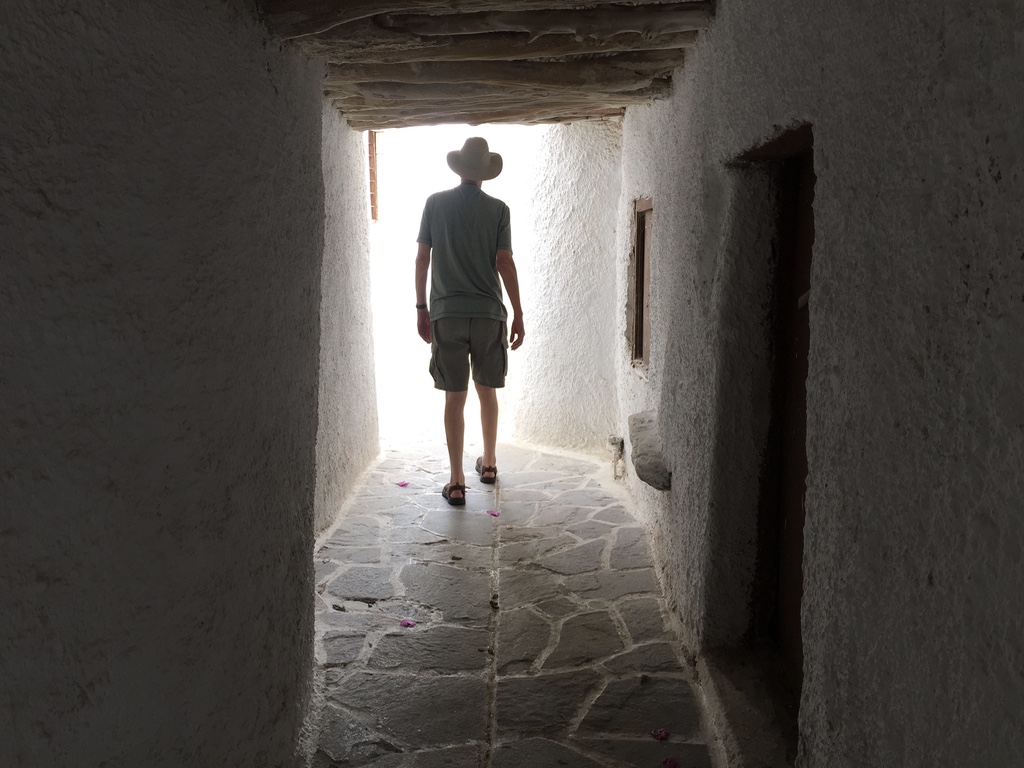
After a few weeks of history, culture and religion on the mainland, I boarded a ferry for the Greek islands, only to be put off by the scene on the sun-drenched deck. Everyone was a tourist, slathered with sun block; the Greeks had vanished. We were like an occupying army, obliterating the local culture with our foreign speech, our alien ways, our crass desires. But there was something else that bothered me. We lacked seriousness. We were a ship of fools.
During the first half of my journey, I had contemplated the noble remnants of classical culture, walked in the footsteps of Socrates and Paul, hiked to Byzantine monasteries scattered along the summits of towering rock formations, breathed the incense of exotic rituals, conversed passionately about ideas late into the night. It had felt something like pilgrimage. But now the only quest was for the perfect tan, the languorous cafe, the idle beach. I feared a loss of purpose. Had I come all this way to fall into a resort mentality, and forget the Greece of myth and history, liturgy and philosophy?
In the end, my Puritan rigor succumbed to the regime of pleasure. I rediscovered summer mind. Time to be, not do. Sink down into the deep pool of the moment. Enjoy the sun-dazzled days and fairy tale nights without anxiety, as though they will last forever. I am not perfect at this. At times I am likely to rush from place to place, acquiring experiences greedily, not wanting to miss anything. But a brisk pace is fatal to deeper forms of attention.
On my first day hike on Naxos, the greenest isle in the Cyclades, I took a quick look inside one of the little Byzantine churches that frequent its charming hills and valleys. I saw only bare stones inside, not too interesting. I soon returned into the sunlight, where I heard a voice calling to me. It was a German hiker, looking for the entrance into the churchyard. I showed her the way in.
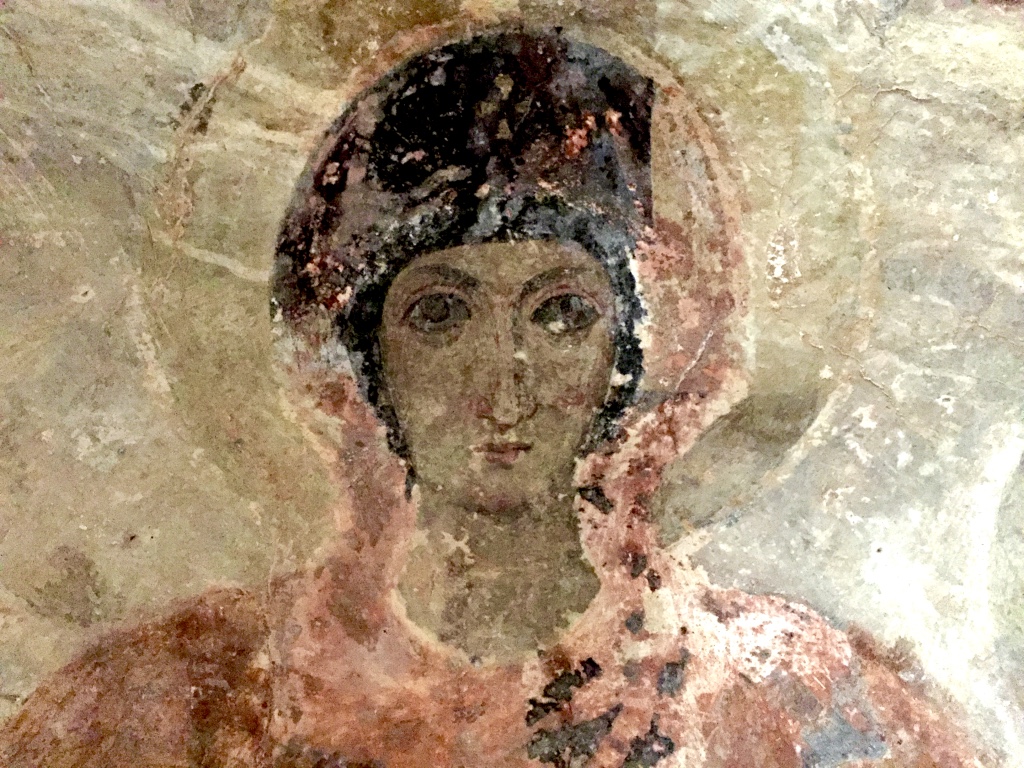
“Look at these wonderful old frescoes!” she said. “What frescoes?” I thought to myself as I peered into the shadows. Once I had given my sun-blinded eyes time to adjust, I began to see what I had missed in my hasty first glances—the faint images of saints. Some of the figures were clearly defined, while others had weathered into dreamlike blurs, like background figures in a Munch painting.
Sixth-century fresco in a Naxos church.
Early in that journey, I had read these words by Thomas Merton in the shaded balcony of a clifftop monastery: “In prayer we discover what we already have. You start where you are and you deepen what you already have. And you realize that you are already there … All we need to do is experience what we already possess. The trouble is, we aren’t taking the time.”
Now welcome summer. Let the heavy fragrance of its green world release you from obligations. Let it be enough for now to wander aimlessly around the neighborhood, linger over relaxed conversations, or lie in the hammock and wait for falling stars. Idleness is the incense we offer the gods of summer.
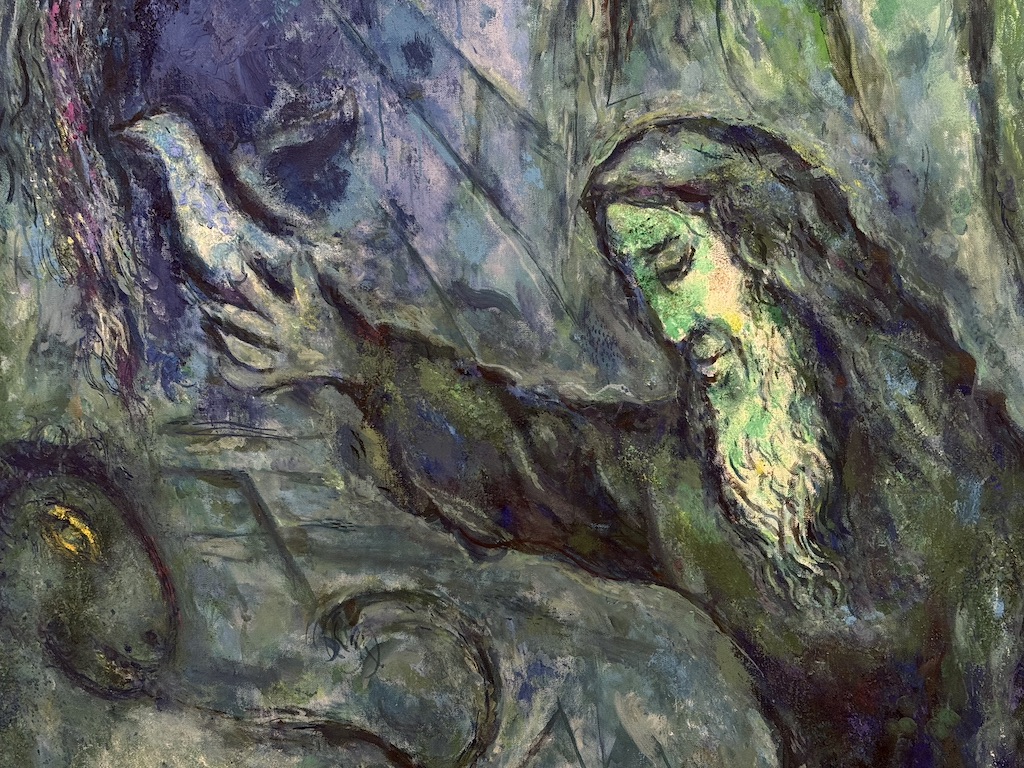
Marc Chagall, Moses at the Burning Bush (1960-1966): Uniting “incompatible distances.”
I have written repeatedly about major moments of the year such as Christmas, Easter and New Year’s Eve, but the only individual person (other than Jesus) to make repeated appearances on this site is the seventeenth-century Anglican poet-priest, George Herbert (1593-1633). I enjoy many poets, but Herbert’s psalmic verse is a regular part of my prayer life, and I am particularly partial to priests for whom art is a spiritual practice.https://jimfriedrich.com/2015/02/27/heart-work-and-heaven-work/
In “Mans medley,” the poet tests the tension between the earthly and heavenly elements in humanity’s hybrid nature. Just as a musical medley is composed of contrasting parts, so are we a unique blend of animal and angel. When Herbert was seven years old, playgoers first heard Hamlet pondering this paradox of human existence: “how like an angel in apprehension” is this “quintessence of dust”. Ten years after Herbert’s poems were published, Sir Thomas Browne wrote that “we are only that amphibious piece between a corporall and spirituall essence, that middle forme that links these two together” and “unites incompatible distances.” [i]
Mans medley
Hark, how the birds do sing, And woods do ring. All creatures have their joy: and man hath his.| Yet if we rightly measure, Mans joy and pleasure Rather hereafter, then in present, is.
To this life things of sense Make their pretence: In th’ other Angels have a right by birth: Man ties them both alone, And makes them one, With th’ one hand touching heav’n, with th’ other earth.
In soul he mounts and flies, In flesh he dies. He wears a stuffe whose thread is course and round, But trimm’d with curious lace, And should take place After the trimming, not the stuffe and ground.
Not that he may not here Taste of the cheer, But as birds drink, and straight lift up their head, So he must sip and think Of better drink He may attain to, after he is dead.
But as his joyes are double; So is his trouble. He hath two winters, other things but one: Bothe frosts and thoughts do nip, And bite his lip; And he of all things fears two deaths alone.
Yet ev’n the greatest griefs May be reliefs, Could he but take them right, and in their wayes. Happie is he, whose heart Hath found the art To turn his double pains to double praise.
The poem begins with a cheerful celebration of creation: Birds sing, forests ring, and all creatures, humans included, “have their joy.” But difference soon declares itself: below and above, material and spiritual, this life and the next. Only humans partake in each of the oppositions, with “th’ one hand touching heav’n, with th’ other earth.” This is a great privilege. The human alone “ties them both” and “makes them one,” but as the next verse reminds us, our mixed nature is also a problem. We may “flie with angels” as Herbert says in another poem, but we also “fall with dust.”[ii] In soul we mount and fly, but in flesh we die.
“Medley” is related to “motley,” and the image in verse 3 of being clothed in an awkward mixture of fine and coarse materials illustrates our chronic discomfort with humanity’s hybrid nature. To resolve the clashing colors of our mortal outfit, some have sought to suppress, downgrade, or disregard either the earthly or the heavenly. But Herbert seeks to harmonize them in the human medley. Let our joys be “double,” that we may “taste of the cheer” in our sensory existence while continuing to cultivate our taste for the “better drink” of spiritual reality.
The verse about the sipping birds is my favorite part of the poem. Unlike the generalized trope of singing birds in the poem’s first line, the birds in verse 4 are keenly observed in a way that was rare until the Romantics and naturalists of later centuries. The birds don’t keep their beaks in the water until they’re done, but follow each sip with a lifting of the head. Here Herbert takes a homely image from the visible world and makes it a lively spiritual metaphor. Like the birds, we should not gulp down reality without giving it our proper attention. We must learn to “sip and think,” alternating our experience with thoughtful reflection.
And from there the meanings multiply. The “better drink” evokes the sacred wine of the Eucharist, while also recalling the water Jesus changed into wine at the Cana wedding feast. Sip and think. Sip and think. Could that be the essence of spiritual practice?
Our mortality is touched upon in verse 3 (“In flesh he dies”) and verse 4 (“after he is dead”), but verse 5 stops to face our fate directly. As both physical and spiritual creatures, we alone fear “two deaths”—the death of the body and the death of the soul. As dwellers in a secular age, some no longer worry about the fate of body and soul in the afterlife, but is anxiety over a failing body, a shriveled soul or an emotionally dead heart any improvement on the medieval fear of hell? There are many kinds of death, but the inward ones may be the worst.
Marc Chagall, The Prophet Jeremiah (1968).
Herbert doesn’t leave us there. As he warns in his manual of advice for country parsons, “nature will not bear everlasting droopings.” We need to stand on the rock of hope, and remember joy. “Yet ev’n the greatest griefs,” he says, “May be reliefs, / Could he but take them right … / Happy is he whose heart / Hath found the art / To turn his double pains to double praise.”
We may wonder what it means specifically to “take them right.” We could all use some detailed instruction in the art of turning pain into praise, given the rapid escalation of pain in our collective life by a heartless coterie of dead souls. Herbert doesn’t spell it out in this poem, but turning pain into praise is a major theme in his work.
In both our personal spiritual journeys and our collective project of repairing the world, we must practice many virtues: patience, persistence, resistance, constancy, solidarity, compassion, humility—and, crucially, faith, hope and love—if we are to keep moving toward the light. And it is my firm conviction that the antidote to despair is trust in what I would call divine intention: the abiding and faithful Mystery whose desire is the flourishing of creation. That doesn’t mean everything goes perfectly. The Cross is planted deep in human history. But God will not leave us comfortless. The divine Yes has more future in it than a billion Nevers. Here’s how Herbert says it:
I knew that thou wast in the grief, To guide and govern it to my relief, Making a scepter of the rod:
Hadst thou not had thy part, Sure the unruly sigh had broke my heart. [iii]
Virgin and St. John at the Cross, Flanders or Northern France (early 16th century).
[i] Sir Thomas Browne, Religio Medici xxxiv (1643).
I have been writing New Year’s Eve posts since I started this blog in 2014, reflecting on time and change, endings and beginnings, hope and dread, impermanence and possibility. If you are curious about the workings of hope in the best of times and the worst of times, follow the links in my post on the last day of 2023. But let me say a few things here and now.
On the eve of 2025, many Americans are finding it hard to celebrate the unfolding of a dubious future. The powers of negation are shamelessly eager to destroy the good and torment the vulnerable, both here and abroad. Their malice and corrruption have no apparent bounds. LIke poor Lillian Gish lying exhausted and unconscious on an ice floe in the silent movie classic, Way Down East (1920), we the people (also exhausted and to some degree unconscious) are being swept toward the waterfall of doom.
Lillian Gish in D. W. Griffith’s Way Down East (1920). Her hand suffered lifelong damage from the freezing river. In the movie, she is rescued just before going over the falls. Will the same go for us?
So Happy New Year, right? But as a friend declared on his Christmas card, “Hope is here—if we have eyes to see and hearts to respond.” Hope isn’t knowledge. It does its work before any outcomes are experienced. Who knows exactly how we will get through the coming year?
Since evil is the rejection of the co-inherence which is Love’s foundation—we are all in this together, part of one another—the toxic collection of so many egos dedicated to themselves alone may eat itself into oblivion. Or perhaps this time of trial will prove the refiner’s fire that burns away enough of our own sins and offenses to produce souls better fit for the human destiny of communnion and service revealed by the Incarnation. Or perhaps these awful times will ruthlessly strip away our false dependencies and hollow illusions until we are able to entrust ourselves wholly to Divine Mercy and nothing else. None of these options is a get-out-of-suffering card, but they are the kinds of things that clarify how real and urgent our faith, hope and love need to be these days.
This Christmastide, I’ve been re-reading Charles Williams’ “supernatural thriller,” War in Heaven, in which several malevolent individuals invoke demonic forces, not only to gain power but also for the perverse pleasure of destroying whatever is true and good. Their chief nemesis is an Anglican archdeacon, who endures their evil words and deeds with an extraordinary calm, rooted in his sense of the creative and loving God holding all things together. “This also is Thou” is one of Williams’ key phrases. Everything is pregnant with invisible reality, and souls may be won or lost in the most ordinary situations, words and gestures as they embody—or renounce—the Way of Love. Neither calamity nor chaos can shake the priest’s steadfast faith in an upholding, transcendent Presence. In the kind of dialogue only Williams could write, the Archdeacon declares,
“After all, one shouldn’t be put out of one’s stride by anything phenomenal and accidental. The just man wouldn’t be.”
Well, there we are. The evils of the coming days will be phenomenal and accidental. Though they will hurt, they will never be quite solid or real or enduring in the way that the Love, Justice and Mercy of God are, now and forever. We shall not remain silent about the damage, or complacent about the consequences of those evils. But we must not give them the power and glory which are God’s alone.
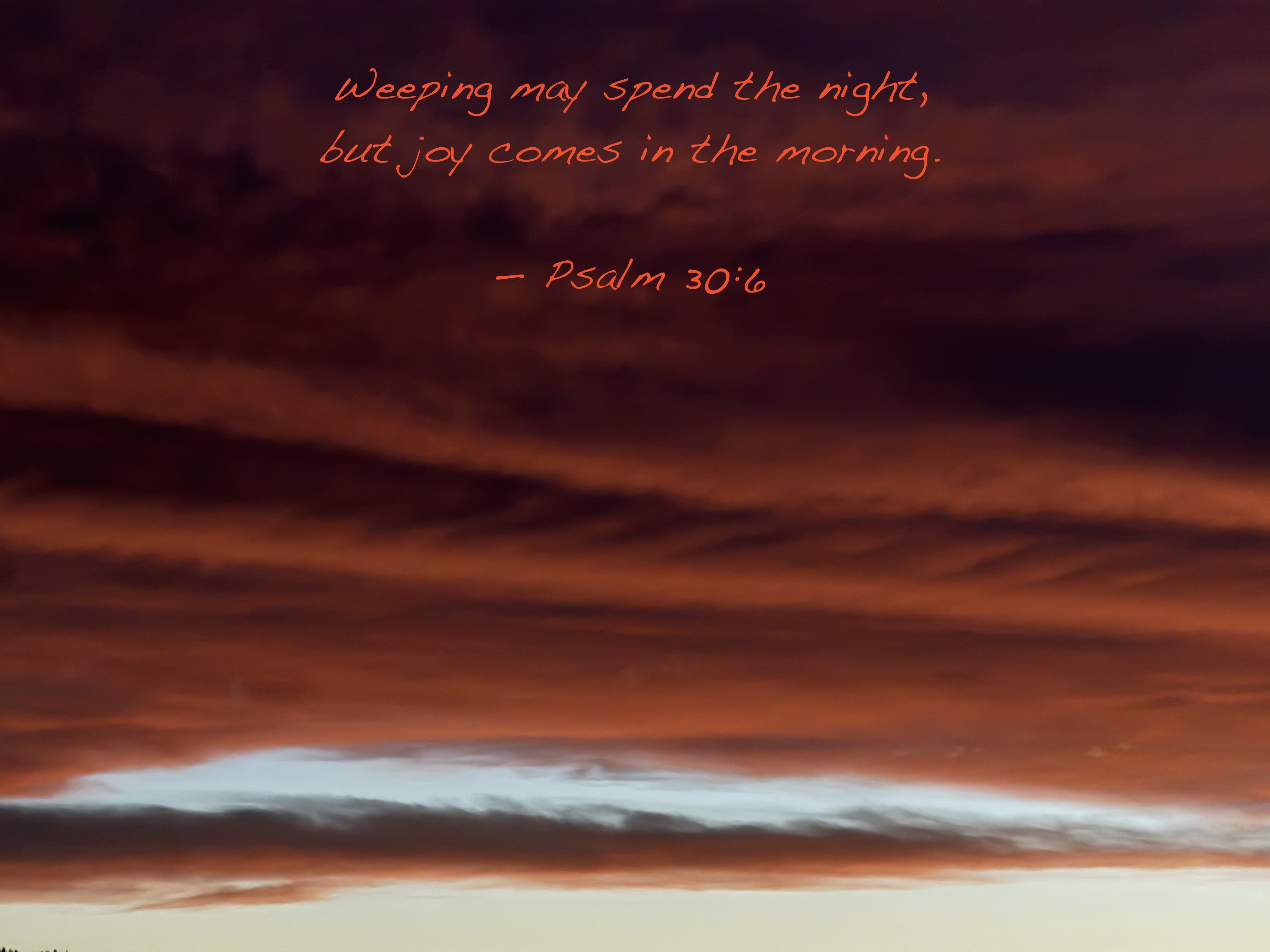
Weeping may spend the night, but joy will come in the morning (Psalm 30:6). In the meantime, may we rest securely in the One who makes all things new.
Marc Chagall, Noah’s Ark (detail), 1961-1966. Artists have typically painted the ark from outside, tossed by an angry sea. But Chagall shows the ark’s interior as an aquatic womb where hope is biirthed amid the storm. His head bent in prayer, Noah sends forth the dove as a sign of enduring faith and living hope.
Thank you to all of you who have read, pondered, commented, and shared my posts during the past year. Your own responses (shared or unshared) are why I write. I wish you great joy and real peace in 2025. Happy New Year! I’ll see you in January. I’m sure there will be lots to talk about.
Anonymous, The Descent from the Cross (detail), German c. 1500.
The evil and the armed draw near; The weather smells of their hate And the houses smell of our fear.
— W. H. Auden, For the Time Being
“ … because all you of Earth are idiots!”
— Plan 9 from Outer Space (Ed Wood, 1957)
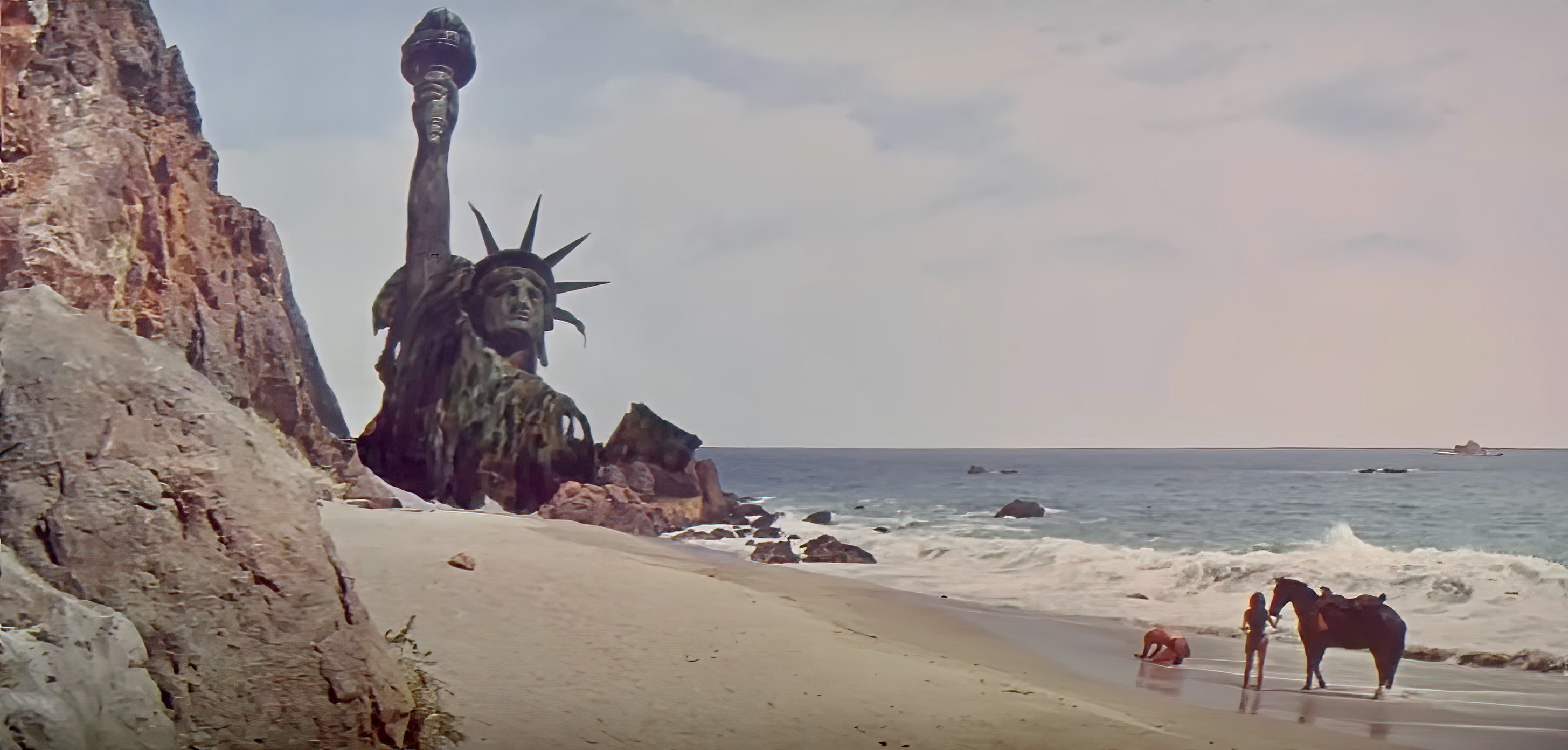
How bad is it, anyway? In the first hours of the new Amerika last Tuesday, the original Planet of the Apes (1968) came to mind. Finding a half-buried Statue of Liberty on a deserted beach, space-and-time traveler Charlton Heston realizes he has not landed on some distant planet, but on his own earthly home, where humanity has evidently committed nuclear suicide. Literally pounding the sand, he cries out to his long-vanished fellow mortals, “You really, finally, did it! You maniacs! You blew it up! Damn you! God damn you all to hell!”
A ruined earh: The final image of Planet of the Apes (1968).
In the Year of our Lord 2024, a decisive majority of Americans have chosen to blow up democracy, the rule of law, the common good, civil liberty, women’s rights, health care, international stability, public sanity, and our last hopes of staving off climate apocalypse. Did they know what they were doing? I confess to zero interest in their motivation at this point. Their decision, measured by its inevitable consequences, was neither rational nor moral. The harm it will do is immeasurable. Even if they thought they were trying to make a point about their personal economic pain, the mad embrace of a fascistic, unstable sociopath and the MAGA dream of demolishing the American experiment—not to mention the livability of our planet—will impose a price none of us can afford.
The American minority, meanwhile, has spent the past week trying to cope with the shock and the horror of the Antichrist’s second coming (I use that name not in a mythical sense, but in a moral one, describing the Trump who in every respect is against the way of Jesus).
Some have engaged in second-guessing the Democratic campaign, as if putting the argument differently could have penetrated the thick shields of delusion and hate erected by right-wing propagandists and their carefully crafted algorithms. Some have sought comfort in the long view, looking toward the distant horizon where hope and history will someday rhyme. Some see the moment as a sobering diagnosis of our national maladies, putting an end to further denial. There’s no use pretending we’re still healthy. Some are tuning out, or contemplating flight to saner climes. Some, sadder and wiser, are vowing to carry on the fight for the common good. God help them.
Marc Chagall, Adam and Eve Expelled from Paradise (detail), 1961.
Many people have been passing poems around on social media, lighting candles of gentleness and peace for one another in this dark night. I have taken comfort in these tender gestures, offered like balm in Gilead for the sin-sick soul. But I also have found myself browsing post-WWII poems that register the shock of brutal conflict. “The Last War” by Kingsley Amis (1948) touched a chord in me with its opening line: “The first country to die was normal in the evening.” By morning it was disfigured and dead
The poem narrates a kind of Agatha Christie murder story in a country house. No one, in the end, survives the weekend. When the sun (the light of Reason? the eye of God?) shows up to survey the damage and “tidy up,” he is unable to separate “the assassins from the victims.” Sickened by the folly and horror of human self-destruction, the sun goes back to bed. The last two stanzas begin with the sound of gunfire and end with a deathly quiet:
Homicide, pacifist, crusader, tyrant, adventurer, boor Staggered about moaning, shooting into the dark. Next day, to tidy up as usual, the sun came in When they and their ammunition were all finished, And found himself alone.
Upset, he looked them over, to separate, if he could, The assassins from the victims, but every face Had taken on the flat anonymity of pain; And soon they’ll all smell alike, he thought, and felt sick, And went to bed at noon.
The sense of recognition I felt in reading the poem oddly eased my post-election malaise. Though I dwell in the valley of the shadow, I’m not alone. Like Dante in hell, I’ve got a good poet for company.
Virgil and Dante in the 8th Circle of Hell The Roman poet would guide Dante through the infernal regions until they found the way out.
Well, what now? If there were ever a time demanding religious imagination—the ability to see resurrection light even on Good Friday—this is it. Such envisioning will be one of the ongoing tasks of The Religious Imagineer. But we can’t just leap into Easter. We must first do our time at the foot of the cross, living in solidarity—and risk?—with the victims and the vulnerable, tuning our hearts to the bells that toll for every human tear:
Tolling for the luckless, the abandoned and forsaked, Tolling for the outcast, burning constantly at stake … Tolling for the aching ones whose wounds cannot be nursed, For the countless confused, accused, misused, strung-out ones and worse, And for every hung-up person in the whole wide universe. [1]
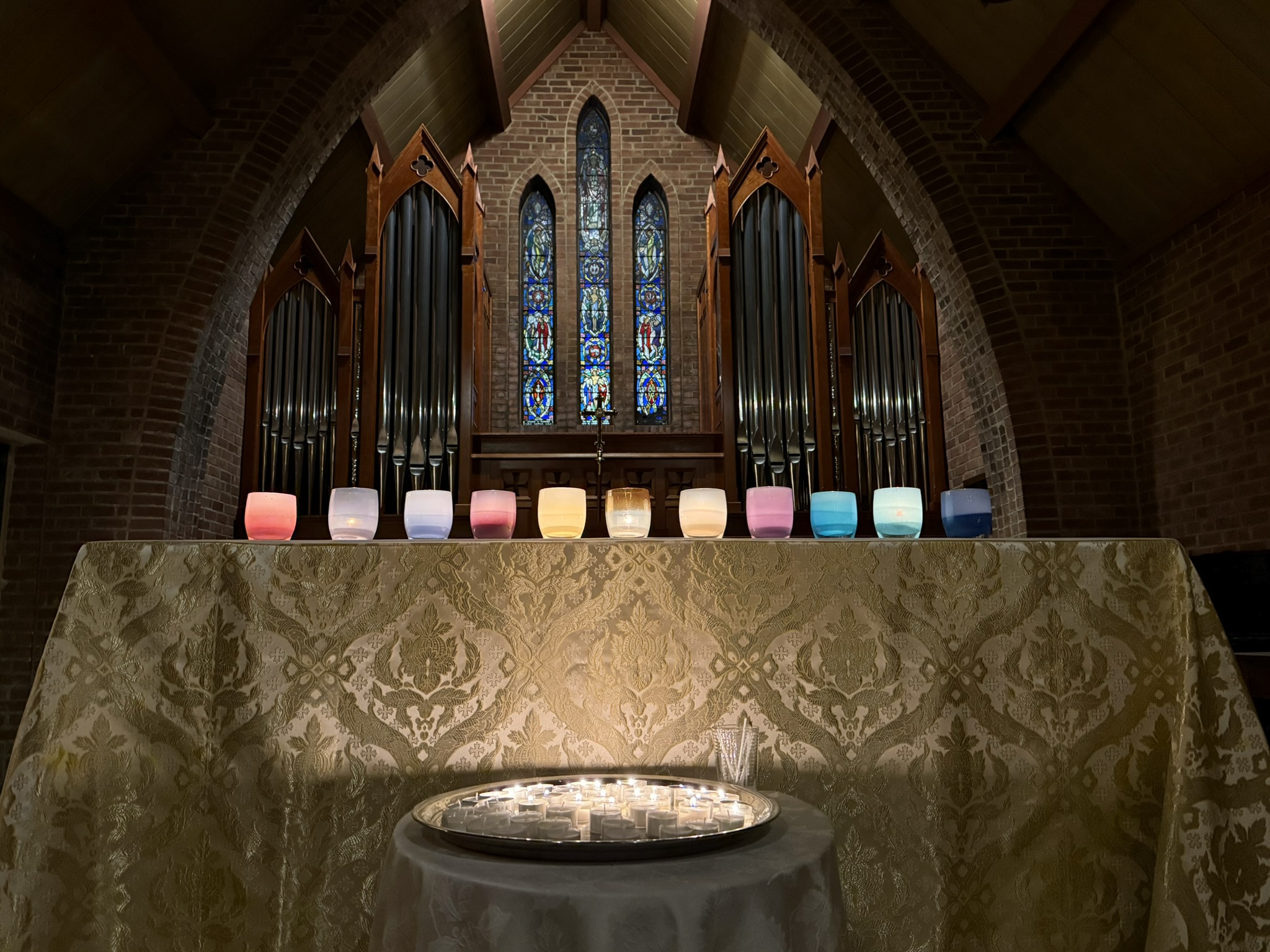
St. Barnabas Episcopal Church, Bainbridge Island, Washington. Prayers silent and aloud were offered here the night before and the night after the election.
I feel blessed to be in Christian community during this time of trial. It is better to hold hands than clench fists. It restores the soul to share our griefs and voice our hopes in sacred discourse and common prayer. Preachers are encouraging our renewed commitment to the Baptismal Covenant: to persevere in resisting evil; seek and serve Christ in all persons; strive for justice and peace among all people; and respect the dignity of every human being.[2] Pastors, meanwhile, are reminding us to love those who voted against most of those things.
(I confess to my own struggle with the Christly precept of loving the haters. Yes, we all fall short, but the so-called Christians cheering the triumph of our basest impulses are, IMHO, falling short with unseemly enthusiasm. As Henry James noted, “when you hate you want to triumph.”) [3]
Tom Tomorrow always nails it: MAGA House of Horror (October 28, 2024).
Many of us, like the desert monks of Late Antiquity, are feeling the need to go on retreat from the public square, to hush the noise and attend the still small voice of holy wisdom. Our spiritual practices seem more necessary than ever.
For me over the past week, that has taken the form of Daily Offices, running, watching the birds in the garden, reading Henry James, a Monteverdi concert, and a splendid evening of Balanchine works by the Pacific Northwest Ballet. I have also been fasting from political news, limiting myself to a small amount of reflective commentary from trusted sources. Such self-care through withdrawal from the fray is “meet and right so to do.” But unless we are contemplatives whose job is to provide for the rest of us what Jesuit activist Dan Berrigan called “large reserves of available sanity,” we can’t stay in the desert forever.
Old Testament scholar Walter Brueggemann has responded to the election with a fine reflection on Elijah’s flight from the danger and exhaustion of public justice-making to the solitude and safety of the holy mountain. After a while, God tracks him down to ask, “What are you doing here, Elijah?”
“Go back to your proper place; you can linger here in self-pity only so long and then you must remember your call and perform your responsibility.” So Elijah is freshly dispatched back to his dangerous work. He is dispatched by the one who has lordly authority for him. The only assurance he is offered is that there are others—7000—who stand alongside in solidarity.[4]
We are not alone. God is with us. The night after the election, some of our local parish church gathered for Evening Prayer, with generous pauses for quiet resting in the Divine Presence. When words fail, let silence speak. Afterward, we had a deep and earnest conversation about the effect of the election on our hearts, minds, and bodies. The empowering richness of that exchange, a gift of the Holy Spirit, raised us from the depths to remember our vocation as God’s friends: to plant the seeds of resurrection amid the blind sufferings of history.
Henri Matisse, The Rosary Chapel in Vence, French Riviera.
Let me close with an encouraging story from the desert monks.
The disciple of a great old man was once attacked by the demons within him. The old man, seeing it in his prayer, said to him, ‘Do you want me to ask God to relieve you of this battle?’ The other said, ‘Abba, I see that I am afflicted, but I also see that this affliction is producing fruit in me; therefore ask God to give me endurance to bear it.’ And his Abba said to him, ‘Today I know you surpass me in perfection.’” [5]
Throughout this time of trial and affliction, God grant each of us, and our communities, the endurance to bear what we must bear, and do what we must do, that our lives may prove both faithful and fruitful in due season.
[1] Bob Dylan, “Chimes of Freedom,” from Another Side of Bob Dylan (Columbia Records, 1964).
[2] From the Baptismal Covenant, Episcopal Book of Common Prayer (1979).
[3] Henry James, The Ambassadors (New York: Modern Library, 2011), 427.
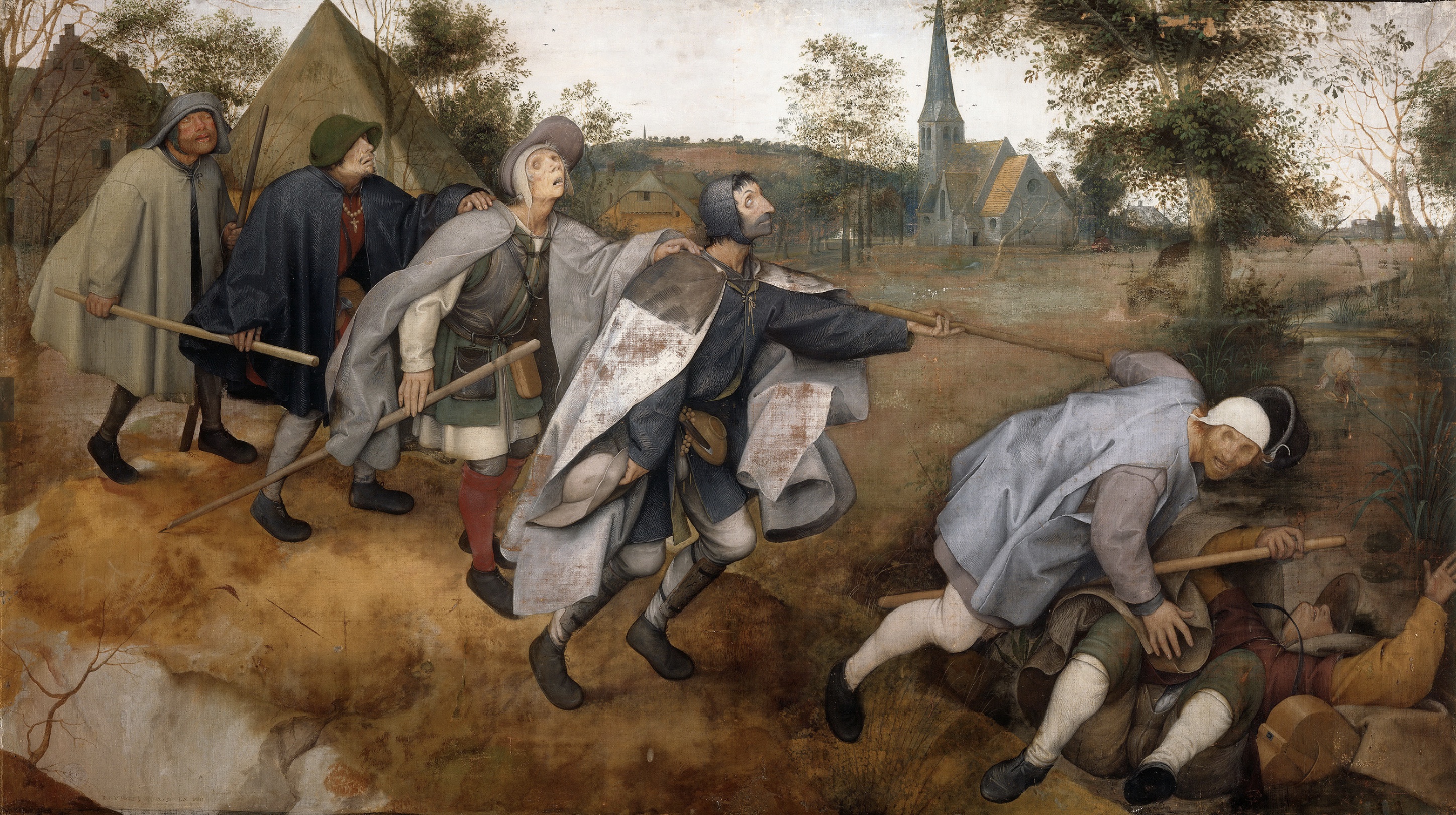
Pieter Brueghel, The Blind Leading the Blind (1658).
Note to reader: This is a post from 2021, revised to include comments on the moral blindness of admitting fascism into our political life.
Jesus was walking out of Jericho, surrounded by a big crowd. Like all such crowds, it was a mix of the curious and the adoring. Jesus was at the height of his popularity. He stirred people’s imaginations and raised their hopes. The excitement was palpable. But amid all the festive clamor, a single shout brought this parade to a sudden halt:
“Jesus, Son of David, have mercy on me!” It was a blind beggar, sitting by the roadside. His name was Bartimaeus.
“Shush,” people said. “Don’t make a scene.” But he cried all the louder: “Son of David, have mercy on me!”
And Jesus stood still, just the way the sun had stood still in the sky for Joshua in that same city of Jericho.
“Call him here,” Jesus said. And so they did. “Take heart!” they told him. “Get up. He is calling you.”
Immediately, Bartimaeus threw off his cloak, sprang to his feet, and came to Jesus. Then Jesus asked him a question that went straight to the point: “What do you want me to do for you?”
“Teacher,” he said, “Let me see again.” And what Bartimaeus asked, Jesus granted. (Mark 10: 46-52)
In Mark’s gospel, this is the last miracle performed by Jesus before he goes to his death in Jerusalem. It marks the fatal turning point between his ministry and his Passion. It is our Lord’s last act, his last word, before he begins the Way of the Cross.
To the world, that looked like the path to oblivion. But to those who have been given the eyes of faith, the Way of the Cross, as we pray every Holy Week, is “none other than the way of life and peace.”
And thus the healing of Bartimaeus is not just the story of one man’s good fortune. It is an invitation to each of us to perceive and receive the vision of salvation which is about to unfold. Mark is telling us that if you want to understand the Paschal Mystery of Passion and Resurrection, you need to open your eyes.
And notice that the climactic words of this story are not “he regained his sight,” but rather, “he followed him on the way.” Once you see what God is doing through Jesus, then it’s your turn to take up your own cross and follow.
And yet, in the story leading up to this moment, even Jesus’ closest friends have suffered their own blindness. “Are your minds closed?” he chides them. “Have you eyes and do not see?” But they go on missing the point again and again.
To their credit, they continue to follow Jesus. They are drawn to him, they know something is happening here—but they don’t know what it is. “Do you not yet understand?” Jesus sighs. I’m sure he said this more than once.
And then, after repeated examples of the disciples’ blindness throughout Mark’s gospel, suddenly we hear a plaintive voice cry out from the crowd: “Jesus! Have mercy on me. Remove this grievous blindness.”
That’s our prayer too, isn’t it?
Lord, take away our blindness.Help us to see. And Jesus replies, “I thought you’d never ask!”
St. Gregory of Nyssa, in the fourth century, was one of many theologians who have shared Mark’s diagnosis of the human condition as one of persistent blindness.
“Humanity was created for this end, that it might see ‘good,’ which is God; but because humanity would not stand in the light, [in fleeing from the light] it lost its eyes… We subjected ourselves to blindness, that we should not see the interior light.”
In other words, we are all stumbling in the dark. That is the human condition, until God brings us into the place of clarity.
St. Augustine talked about the inner eye, our capacity to see the things of God, as “bruised and wounded” by the transgression of Adam and Eve, who, he says, “began to dread the Divine light [and] fled back into darkness, anxious for the shade.”
Refusing to stand in the light… subjecting ourselves to blindness. Is this what we do? Are we truly so “anxious for the shade?”
Arthur Zajonc is a quantum physicist who became fascinated with the literal dimensions of this question, examining case histories of blind people who recovered their sight. In his book, Catching the Light: The Entwined History of Light and Mind, he tells of an 8-year-old boy, blind at birth from cataracts, who underwent surgery in the year 1910. When the time came to remove his bandages, the doctor was very hopeful. He waved his hand in front of the boy’s eyes, which were now physically perfect.
“What do you see?” asked the doctor. “I don’t know,” the boy replied. “Can’t you see my hand moving?” said the doctor. “I don’t know,” said the boy.
The boy’s eyes did not follow the doctor’s slowly moving hand, but stared straight ahead. He only saw a varying brightness before him. Then the doctor asked him to touch his hand as it moved, and when he did, the boy cried out in a voice of triumph, “It’s moving!” He could feel it move, and even, as he said, could “hear it move,” but it would take laborious effort to learn to see it move.
As that first light passed through the child’s newly clear black pupils, it called forth no echoing image from within. His sight, Zajonc tells us, began as a hollow, silent, dark and frightening kind of seeing. The light of day beckoned, but no light of mind replied within the boy’s anxious, open eyes.
“The sober truth” says Zajonc, “remains that vision requires far more than a functioning physical organ. Without an inner light, without a formative visual imagination, we are blind.” This echoes Augustine’s description of our “bruised and wounded” inner eye. What is it that makes us so unable to process what is before us, to see what is being offered to our open eyes?
The mystical Anglican poet Thomas Traherne framed an answer in the ornately vivid language of the seventeenth century:
“As my body without my soul is a carcass, so is my Soul without Thy Spirit, a chaos, a dark obscure heap of empty faculties ignorant of itself, unsensible of Thy goodness, blind to Thy glory.”
And what are the causes of this abysmal state? he asks. He names several:
“[The Light within us is eclipsed] by the customs and manners of [others], which like contrary winds blew it out: by an innumerable company of other objects, rude, vulgar and worthless things, that like so many loads of earth and dung did overwhelm and bury it: by the impetuous torrent of wrong; … by a whole sea of other matters and concernments that covered and drowned it…”
“Contrary winds” blowing out the Light within us… being overwhelmed by “an innumerable company… of rude, vulgar and worthless things”… “the impetuous torrent of wrong desires” — does any of that sound familiar in this age of consumerism, social media, and widespread disinformation?
Not long after Traherne wrote those words, another English writer, John Bunyan, told the story of two pilgrims, named Christian and Faithful, who came upon Vanity Fair, a kind of shopping mall where all the transitory pleasures of this world were on seductive display.
“What will ye buy?” cried one of the merchants. And Christian and Faithful replied, “We buy the truth!”
This was clearly the wrong answer, for the two pilgrims were immediately set upon, beaten, smeared with mud, thrown in a cage, and finally put on trial. The jury was rigged, led by Mr. Blind Man and Mr. Hate-Light. “Guilty,” they cried, and Faithful was put to death. But Christian managed to escape, and his journey into God continued.
Bunyan’s allegorical constructs seem quaintly archaic today, but Vanity Fair is still with us, with its endless commodification of unsatisfiable desires. And Mr. Hate-Light is still at work, generating the ceaseless illusions and lies that blind us to the beauty of holiness, the beauty of one another, the beauty of loving community.
I was born in 1944, 40 days after D-Day, and a few weeks before the liberation of Paris, when the evils of Nazism and fascism were on the run. Once and for all, we thought. But now, eighty years later, Adolf Hitler—Mr. Hate-Light himself—is making a comeback. And millions—millions!—of people are just shrugging their shoulders. So many of the children, and grandchildren, and great-grandchildren of the generation who shed their blood to stop fascist tyranny, seem kind of okay with the return of Mr. Hate-Light.
Lord have mercy, we are stumbling in the dark.
So what happens to Christian in Bunyan’s allegory? He escapes Vanity Fair, but he still has to pass through the Valley of the Shadow of Death, where the light is so scarce, and the path so narrow, that he’s in constant danger of stumbling into the ditch on his right or the quagmire on his left.
But Christian is not without hope in that dark valley. As Isaiah said, the God of light travels with us:
I shall lead the blind by a road they do not know… I shall turn the darkness into light before them, and turn the quagmire into solid ground. (Isa 42:16)
All of us, deep down, want the light. All of us need the light. But sometimes we resist the light, or run away from it, or shut our eyes to it. There are things we’d rather not see, in the world or in ourselves. Illuminating our dark places can feel like a judgment, as if the light were accusing our shadows.
In Franco Zefferelli’s beautiful 1977 film, Jesus of Nazareth, we meet another blind man at the pool of Bethsaida in Jerusalem, but unlike Bartimaeus, he is deathly afraid of being healed. “Leave my eyes alone!” he shouts. “Stop touching my eyes!”
After analyzing sixty-six cases of blind people who had recovered their sight, Arthur Zajonc would concur with Zeffirelli’s portrayal of our resistance to having our eyes opened.
“The project of learning to see,” he writes, “inevitably leads to a psychological crisis in the life of the patients, who may wind up rejecting sight. New impressions threaten the security of a world previously built upon the sensations of touch and hearing. Some decided it is better to be blind in their own world than sighted in an alien one… The prospect of growth is as much a prospect of loss, and threat to security, as a bounty.”
In other words, opening our eyes to a more truthful clarity can be scary—no more fictions or illusions about the state of the world or the state of our souls. If we say we have no sin, we deceive ourselves, and the truth is not in us (I John 1:8).
Seeing—clearly and accurately—the fallenness of our broken world—and our wounded selves—is a painful revelation. Once we face facts, transformation is the only way forward. We must change our life. A new way of seeing demands a new way of being. We can either fight that divine summons, like the man in the Zeffirelli film (Don’t touch my eyes!), or we can jump up and embrace it, like Bartimaeus.
But it’s not just the wrongness of things which is hidden by our blindness. The truth is, there is also so much blessing and beauty in this world, eagerly waiting to be discerned and embraced.
And whatever our doubts and fears about losing our protective blindness, the beauty revealed will be worth the price. It’s the beauty of God’s future—what Jesus called the Kingdom. We often think of the Kingdom of God as impossibly distant, but it is possible to glimpse it even now, in this present age. We only need the eyes to see.
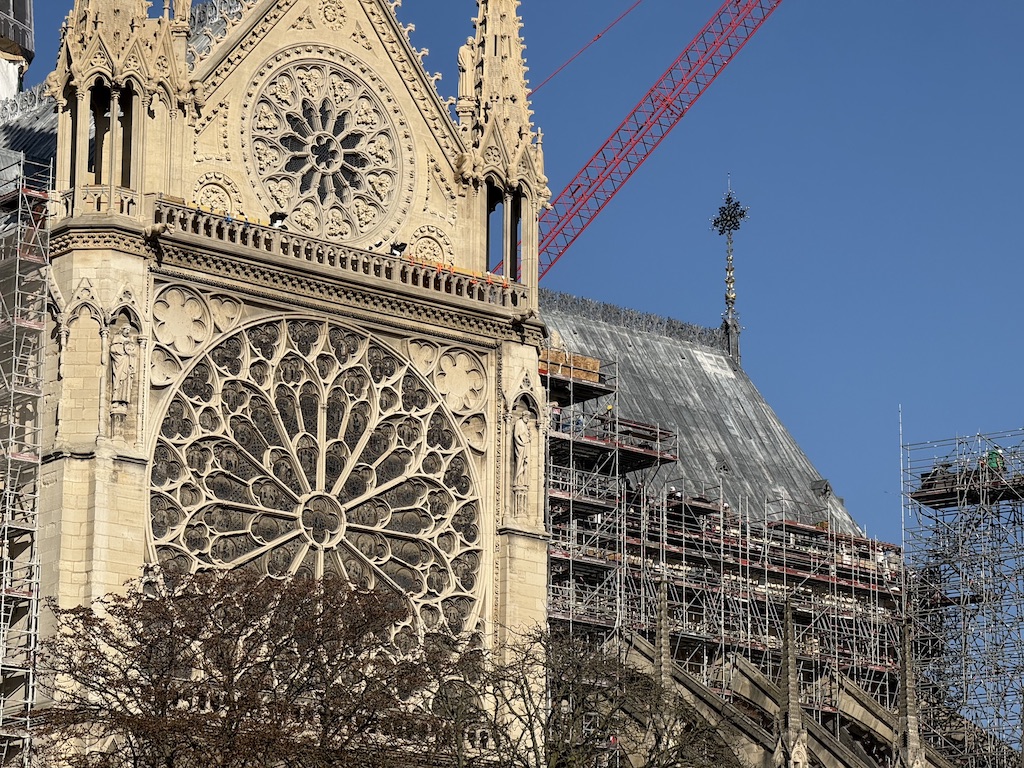
Scaffolding on the west side of Notre Dame in Paris (October 2024).
Last week my wife and I were in Paris, and it was thrilling to see the cathedral of Notre Dame in the final stages of its resurrection from the devastation of that terrible fire in 2019. There are still giant cranes and some scaffolding present, and a construction wall continues to keep the public at a distance until the house of God reopens in Advent.
And even though we could not yet go inside, it was powerful just to stand in the parvis, the open space in front of Notre Dame, joining the thousands and thousands of people who come there every day to wonder at the marriage of human creativity and divine glory.
And what made it especially moving was the beautiful photographs displayed on the temporary wall surrounding the site. In stunning black & white portraits, we saw a representative sample of the many thousands whose labor, skill and love have brought the cathedral back to life: architects, engineers, artisans, restoration experts, carpenters, stone-workers, stained glass artists, roofers, electricians, cleaners, works managers, heritage curators, scholars, liturgists, theologians, and all the service people who fed the multitude every day.
Photo of restoration team member on the construction wall at Notre Dame.Photo of restoration team member on construction wall at Notre Dame.
What we saw in those faces, and in the fruits of their labor, was the very best of humanity, working together to repair the world, redeeming beauty and hope from the ashes of destruction and despair.
But if you walk just behind Notre Dame, to the tiny tip of the Ile de la Cité—the small island on the Seine River where the cathedral stands—you will find some stairs, which take you down into a dim, tomb-like space. There you move through a narrow passage whose floor is inscribed with the words, “They went to the ends of the earth and did not return.”
This subterranean passage is faintly illumined by 200,000 tiny, lighted crystals, representing the 200,000 people deported from France to the death camps during the Nazi occupation of the 1940s.
It is a powerful memorial—and a painful reminder. For the mass deportation in France was not simply the act of bad Germans upon an innocent French population. It was the French police who went door to door, rounding up Jews and dissidents. And though there were many French people who resisted the evils of the Occupation, there were many more who turned a blind eye to the mass deportation. The legacy of complicity and collaboration would long haunt the postwar memory of France.
Lying in the very shadow of the glorious and aspirational cathedral, the Memorial of the Deportation stands as a warning to those of any country who want to believe that “it can’t happen here.”
Lord, remove our grievous blindness. Help us see the light.
There is a passage from Willa Cather’s novel, Death Comes for the Archbishop, which perfectly expresses the faith and the hope that we are not destined to remain in the dark—that we can, by God’s grace, recover the divine light within us. The novel’s protagonist, Jean-Marie Latour, a nineteenth-century missionary bishop to the territory of New Mexico, is discussing visions and miracles with his Vicar.
“Where there is great love,” he says, “there are always miracles. One might almost say that an apparition is human vision corrected by divine love .… The Miracles of the Church seem to me to rest not so much upon faces or voices or healing power coming suddenly near us from afar off, but upon our perceptions being made finer, so that for a moment our eyes can see and our ears can hear what is about us always.”
Human vision corrected by divine love. How blessed are they who receive such a miracle!
“Mercy, O thou Son of David, thus poor blind Bartimaeus prayed. “Others by thy grace are saved, now afford to me thine aid.”
“Lord, remove this grievous blindness, let mine eyes behold the day.” Straight he saw, and, won by kindness, followed Jesus in the way.
Season of mists and mellow fruitfulness, Close bosom-friend of the maturing sun; Conspiring with him how to load and bless With fruit the vines that round the thatch-eves run; To bend with apples the moss’d cottage-trees, And fill all fruit with ripeness to the core …
— John Keats, “To Autumn”
October light! October color! Ripeness to the core! We share the poet’s pleasure in this season of earthly delight. But we know it will not last. As one of the earliest English poets put it over a millennium ago:
A little while the leaves are green; then they fallow again, fall to the earth, and die, turn to dust.
The falling leaf is an ancient trope for decline and fall, and we mortals tend to take it personally. “I have lived long enough,” lamented Shakespeare’s Macbeth:
… my way of life Is fall’n into the sere, the yellow leaf; And that which should accompany old age, As honour, love, obedience, troops of friends, I must not look to have.
Yes, of course. We know where this autumnal existence is headed. Even the finest October day contains the seeds of melancholy. The cold and the dark draw near. But if we can take the long view, these too shall pass.
Pamela Steed Hill says this so poignantly in her poem, “September Pitch”:
Mama, the autumn is deep. Its pitch is only beginning, and will brighten before the end. Brighten into darkness, or into spring.
Here in America, the darkness is already here. As we approach the most consequential—and potentially catastrophic—election of our lifetime, we wonder whether our present world can in fact brighten into spring. If there ever were a time to keep the faith, it is now.
A few days ago I happened to hear on the radio a beautiful autumn song by Jennifer Cutting, encouraging us to move into the unknown with a trusting spirit, come what may.
To know the joy of letting go The giddy flight of falling Surprise at softly landing so Among the leaves of autumn
And though the last refuse to fall And cling for fear of changing October overcomes our song Among the leaves of autumn
O bitterness can shrivel dead What gratitude made rosy The brown leaves curl beside the red Among the leaves of autumn
What was will never be again What will be is uncharted What’s now is change, so let’s begin Among the leaves of autumn
I have set the song link between autumnal images, which I invite you to contemplate as you listen. Grace and peace to you in this season of change.













 The religious imagineer