“We are America!” — Poetic Voices of an Immigrant Nation

Illustration by Shepard Fairey from a photograph by Delphine Diallo.

Last night, at a campaign rally in Pennsyvlania, Donald Trump told the crowd that immigrants are “changing the character of small towns and villages all over our country and changing them forever. They will never be the same … And I’ll say it now: You have to get ’em the hell out! You have to get ’em out … Can’t have it! They’ve destroyed us.” The MAGA mob responded with a chant that would make Hitler smile: SEND THEM BACK! SEND THEM BACK!

At the beginning of this century, the Episcopal Diocese of Chicago asked me to compile texts of the immigrant experience for a public reading in celebration of America’s rich diversity. I first posted these here in 2018. May these eloquent American voices remind us of our common origins as strangers and sojourners. In a country beset with what Canadian scholar Henry A. Giroux has called the “violence of organized forgetting,” remembering is a crucial act of resistance.

Sing to me, call me home in languages I do not yet
understand, to childhoods I have not yet experienced,
to loves that have not yet touched me.
Fill me with the details of our lives.
Filling up, emptying out
and diving in.
It is the holy spirit of existence, the flesh, the blood,
the naked truth that will not be covered.
Tell me everything, all the details – flesh, blood, bone.

– Lisa Kahaleole Chang Hall

From Asia, you crossed a bridge of land,
now called the Bering Strait, now swallowed
in water. No human steps to follow,
you slowly found your way on pathless grounds…
Travelers lost in time – walking, chanting, dancing –
tracks on mapless earth, no man-made lines,
no borders. Arriving not in ships, with no supplies,
waving no flags, claiming nothing, naming
no piece of dirt for wealthy lords of earth.
You did not come to own; you came to live.

– Benjamin Alire Sáenz

America is also the nameless foreigner,
the homeless refugee,
the hungry boy begging for a job,
the illiterate immigrant…
All of us, from the first Adams
to the last Filipino,
native born or alien,
educated or illiterate –
We are America! 

– Carlos Bulosan

She is the woman hanging from the 13th floor window
in east Chicago…
She sees Lake Michigan lapping at the shores of
herself…She sees other
women hanging from many-floored windows
counting their lives in the palms of their hands
and in the palms of their children’s hands.

She is the woman hanging from the 13th floor window
on the Indian side of town…
crying for the lost beauty of her own life.

– Joy Harjo

I am not any of the faces
you have put on me america

every mask has slipped
i am not any of the names

or sounds you have called me
the tones have nearly

made me deaf
this dark skin, both of us have tried to bleach…

– Safiya Henderson-Holmes

I know now that I once longed to be white.
How? you ask.
Let me tell you the ways.

when I was growing up, people told me
I was dark and I believed my own darkness
in the mirror, in my soul, my own narrow vision.

when I was growing up, my sisters
with fair skin got praised
for their beauty and I fell
further, crushed between high walls.

when I was growing up, I read magazines
and saw blonde movie stars, white skin, sensuous lips,
and to be elevated, to become
a woman, a desirable woman, I began to wear
imaginary pale skin.

when I was growing up, I was proud
of my English, my grammar, my spelling,
fitting into the group of smart children,
smart Chinese children, fitting in,
belonging, getting in line.

– Nellie Wong

These men died with the wrong names,
Na’aim Jazeeny, from the beautiful valley
of Jezzine, died as Nephew Sam,
Sine Hussin died without relatives and
because they cut away his last name
at Ellis Island, there was no way to trace
him back even to Lebanon, and Im’a Brahim
had no other name than mother of Brahim
even my own father lost his, went from
Hussein Hamode Subh’ to Sam Hamod.
There is something lost in the blood,
something lost down to the bone
in these small changes. A man in a
dark blue suit at Ellis Island says, with
tiredness and authority, “You only need two
names in America” and suddenly – as cleanly
as the air, you’ve lost
your name. At first, it’s hardly
even noticeable – and it’s easier, you move
about as an American – but looking back
the loss of your name
cuts away some other part,
something unspeakable is lost.

– Sam Hamod

I am Marilyn Mei Ling Chin…
Of course, the name had been changed
somewhere between Angel Island and the sea,
when my father the paper son
in the late 1950’s
obsessed with some bombshell blonde
transliterated “Mei Ling” to Marilyn…
and there I was, a wayward pink baby,
named after some tragic
white woman, swollen with gin and Nembutal.

– Marilyn Chin

“This is my country,” we sang,
And a few years ago there would have been
A scent of figs in the air, mangoes,
And someone playing the oud along a clear stream.

But now it was “My country ’tis of thee”
And I sang it out with all my heart…
“Land where my fathers died,” I bellowed,
And it was not too hard to imagine
A host of my great uncles and -grandfathers
Stunned from their graves in the Turkish interior
And finding themselves suddenly
On a rock among maize and poultry
And Squanto shaking their hands.

– Gregory Djanikian

If I am a newcomer to your country, why teach me about my ancestors? I need to know about seventeenth-century Puritans in order to make sense of the rebellion I notice everywhere in the American city. Teach me about mad British kings so I will understand the American penchant for iconoclasm. Teach me about cowboys and Indians; I should know that tragedies created the country that will create me.

– Richard Rodriguez

Names will change
faces will change
but not much else
the President will still be white
and male
and wasp
still speak with forked tongue…
still uphold the laws of dead white men
still dream about big white monuments
and big white memorials
ain’t nothin’ changed
ain’t nothin’ changed at all.

– Lamont B. Steptoe

My dream of America
is like dà bính lòuh
with people of all persuasions and tastes
sitting down around a common pot
chopsticks and basket scoops here and there
some cooking squid and others beef
some tofu and watercress
all in one broth
like a stew that really isn’t
as each one chooses what she wishes to eat
only that the pot and fire are shared
along with the good company
and the sweet soup
spooned out at the end of the meal.

– Wing Tek Lum

today
we will not be invisible nor silent
as the pilgrims of yesterday continue their war of attrition
forever trying, but never succeeding
in their battle to rid the americas of us
convincing others and ourselves
that we have been assimilated and eliminated,

but we remember who we are

we are the spirit of endurance that lives
in the cities and reservations of north america
and in the barrios and countryside of Nicaragua, Chile
Guatemala, El Salvador

and in all the earth and rivers of the americas.

– Victoria Lena Manyarrows

We are a beautiful people
with African imaginations
full of masks and dances and swelling chants
with African eyes, and noses, and arms,
though we sprawl in gray chains in a place
full of winters, when what we want is sun.

We have been captured,
brothers and sisters. And we labor
to make our getaway, into
the ancient image, into a new
correspondence with ourselves
and our black family.
We need magic
now we need the spells, to raise up
return, destroy, and create. What will be
the sacred words?

– Amiri Baraka

Living on borders, and in margins,
keeping intact one’s shifting and multiple identity and integrity,
is like trying to swim in a new element…
There is an exhilaration in being a participant
in the further evolution of humankind.

– Gloria E. Anzaldúa

We are connected to one another in time and by blood. Each of us is so related, we’re practically the same person living infinite versions of the great human adventure.

– Maxine Hong Kingston

When both of us look backward…we see and are devoted to telling about the lines of people that we see stretching back, breaking, surviving, somehow, somehow, and incredibly, culminating in someone who can tell a story.    

— Louise Erdrich

I am a woman who wants to go home but never figured out where it is or why to go there…I have lost the words to chant my bloodline.    

— Lisa Harris

We are the sum of all our ancestors. Some speak louder than others but they all remain present, alive in our very blood and bone.      

— Lisa Kahaleole Chang Hall

I have the same name as 1 grandfather, 3 cousins, 3 nephews, and 1 uncle. The uncle disappeared when he was 15, just took off and caught a freight (they say). He’s discussed each year when the family has a reunion, he causes uneasiness in the clan, he is an empty space. My father’s mother, who is 93, and who keeps the Family Bible with everybody’s birth dates (and death dates) in it, always mentions him. There is no place in her Bible for ‘wherabouts unknown.’    

— Etheridge Knight

When the census taker, a woman of African descent…came to my door, I looked into the face of my sister….She did not ask me my racial background but checked off the box next to Black American/African American/Afro-Cuban American/Black African….

I met her eyes and said, “I’m not Black; I’m Other, Mixed, Black and White.” …She did not smile, smirk, or frown, but checked the box marked “Other,” and lifted her eyes quickly to mine again. I wanted to see her erase “Black.” She did not do so in my presence….

I had been focused on my personal freedom, on my right to define who I am, on my responsibility to my sense of self. The dignity of the census taker was not a part of my mental equation…

She thanked me. But the price of my self-definition had been the wall I felt I’d built between us before I ever closed the door.        

— Sarah Willie

I am not African. Africa is in me, but I cannot return…I am not european. Europe lives in me,  but I have no home there. I am new. History made me….I was born at the crossroads and I am whole.  

— Sarah Willie

Auntie Raylene, an accomplished chanter and dancer, told us about the necessity of remembering and honoring where we come from….During the question-and-answer session, a worried West African immigrant brother asked her, “But…what if our parents and grandparents refuse to tell us anything? They don’t want to talk about the old days. They are afraid. Or they don’t remember.”

She looked at him with great love and said, “Then you go back further, to the source,” and her hand swept back with assurance to the beginning of time, to the birth of life.

– Lisa Kahaleole Chang Hall

Remember your birth, how your mother struggled
to give you form and breath. You are evidence of
her life, and her mother’s, and hers.

Remember your father. He is your life, also.
Remember the earth whose skin you are:
red earth, black earth, yellow earth, white earth
brown earth, we are earth….

Remember that you are all people and that all people are you.
Remember that you are this universe
and that this universe is you.

Remember that all is in motion, is growing, is you.
Remember that language comes from this.
Remember the dance that language is, that life is.
Remember.

– Joy Harjo


We the People art images are available here as free downloads. Shepard Fairey’s image of 12-year-old Menelik is from a photograph by French and Senegalese artist Delphine Diallo. The texts are drawn from several wonderful collections: UA:Unsettling America: An Anthology of Contemporary Multicultural Poetry , ed. Maria Mazziotti Gillan & Jennifer Gillan (Penguin,1994)… N: Names We Call Home: Autobiography on Racial Identity, eds. Becky Thompson, Sangeeta Tyagi (Routledge, 1995) … and another anthology which has vanished from my library and my memory, though I have traced original sources for most of its selections. In order: Hall (N 241), Sáenz (Calendar of Dust), Bulosan (http://bulosan.org/in-his-words), Harjo (UA 29-30), Henderson-Holmes (UA 60), Wong (UA 55), Hamod (UA130), Chin (UA 134), Djanikian (UA 215), Rodriguez (source unknown), Steptoe (UA 250), Lum (UA 322-23), Manyarrows (UA 330), Baraka (UA 155), Anzaldúa (Borderlands/La Frontera: The New Mestiza), Kingston & Erdrich (third anthology), Harris (N xv), Hall (N 241ff.), Knight (The Essential Etheridge Knight), Willie (N 276, 278), Hall (241ff.), Harjo (She Had Some Horses)

Living by the Sword: Putin and the Perils of Messianic Politics

Vladimir Putin and the icon of the Savior “not made by hands,” (Attibution: AP Photo/RIA Novosti, Alexei Nikolsky, Pool)

“The hour is late. The world is choked with weapons, and dreadful is the mistrust peering from all men’s eyes. The trumpets of war may blow tomorrow. Who knows if we shall see each other in another year? What are we waiting for? Peace must be dared. Peace is the great venture.”

— Dietrich Bonhoeffer (August 1934)

At a pro-war rally in Moscow last month, Vladimir Putin praised his troops for their embodiment of Christian love. “And this is where the words from the Scriptures come to mind,” he said. “‘There is no greater love than if someone gives up his soul for his friends.’ The heart of the message is that this is a universal value for all the people and all the confessions of Russia …. Shoulder to shoulder they are helping and supporting each other and when it’s necessary they cover as if it was their own brother, they cover each other from the bullets. We haven’t had such unity in a long time.”[i]

The crowd loved the speech. “Forward Russia!” they chanted. Jesus! Love! Unity! Was this a political rally, or a religious revival? Some of each, I would think. For a thousand years of Russian history, politics and religion have been closely entwined. In 988, after the Christian conversion of Prince Vladimir of Kievan Rus’—the original Russian state—his subjects waded into the Dnieper River to be baptized en masse.

The fact that this birth narrative of Slavic Orthodoxy took place in Kyiv helps explain the lingering Russian attachment to the Ukrainian capital. It’s their Jerusalem. Even though the Ukrainian Orthodox Church was granted independence from its Russian counterpart in 2018, one third of the Orthodox churches still loyal to the Moscow Patriarchate are situated in the Ukraine, and Putin has argued that his army is coming to their defense. 

The mythology of Holy Rus’, a divinely ordered “kingdom” of Slavic believers—a “Third Rome” inheriting the world-transforming mission of its failed predecessors in Europe and Constantinople—became a staple of Russian identity. In contrast to the perceived decadence, individualism, and secularism of the West, Holy Rus’ was thought to preserve communal spiritual values for the sake of all humankind. In a famous speech given in 1880, Dostoevsky said:

“[T]o be a true Russian does indeed mean to aspire finally to reconcile the contradictions of Europe, to show the end of European yearning in our Russian soul, omni-human and all-uniting, to include within our soul by brotherly love all our brethren, and at last, it may be, to pronounce the final Word of the great general harmony, of the final brotherly communion of all nations in accordance with the law of the gospel of Christ!”[ii]

When Russia seized Crimea in 2014, such Third Rome mythology seemed alive and well when Foreign Minister Sergei Lavrov dismissed the protests of the “godless West, hostile to the Russians because we [remain] Christian traditionalists.”[iii] Many observers think the invasion of Ukraine is fueled by the same mythology. If so, Putin’s nostalgia for the old Russian Empire would be more than the product of personal and political ambition. It would amount, in that case, to a crusade to recover the lost lands of Holy Rus’ and restore the Third Rome to its proper glory. To let Ukraine drift away into western decadence would betray the myth.

Historian Anna Geifman dismisses any speculation about Putin’s mental stability:

“He’s not crazy — he’s messianic,” she says. “What Putin says is logical, and consistent with his entire policy since 2008 … To sustain his legitimacy, the regime chose to delineate a more national-patriotic and anti-Western direction, grounding its appeal on a strong conservative, Orthodox [Christian] foundation …  He may not use that term [the Third Rome], but he talks about the corruption of the West, with its ‘everything goes’ lifestyle that no longer differentiates between good and evil … Disregarding historical evidence to the contrary, Putin views Ukraine as part of the Russian family. Their independence is a slap in the face to his ideology.”[iv]

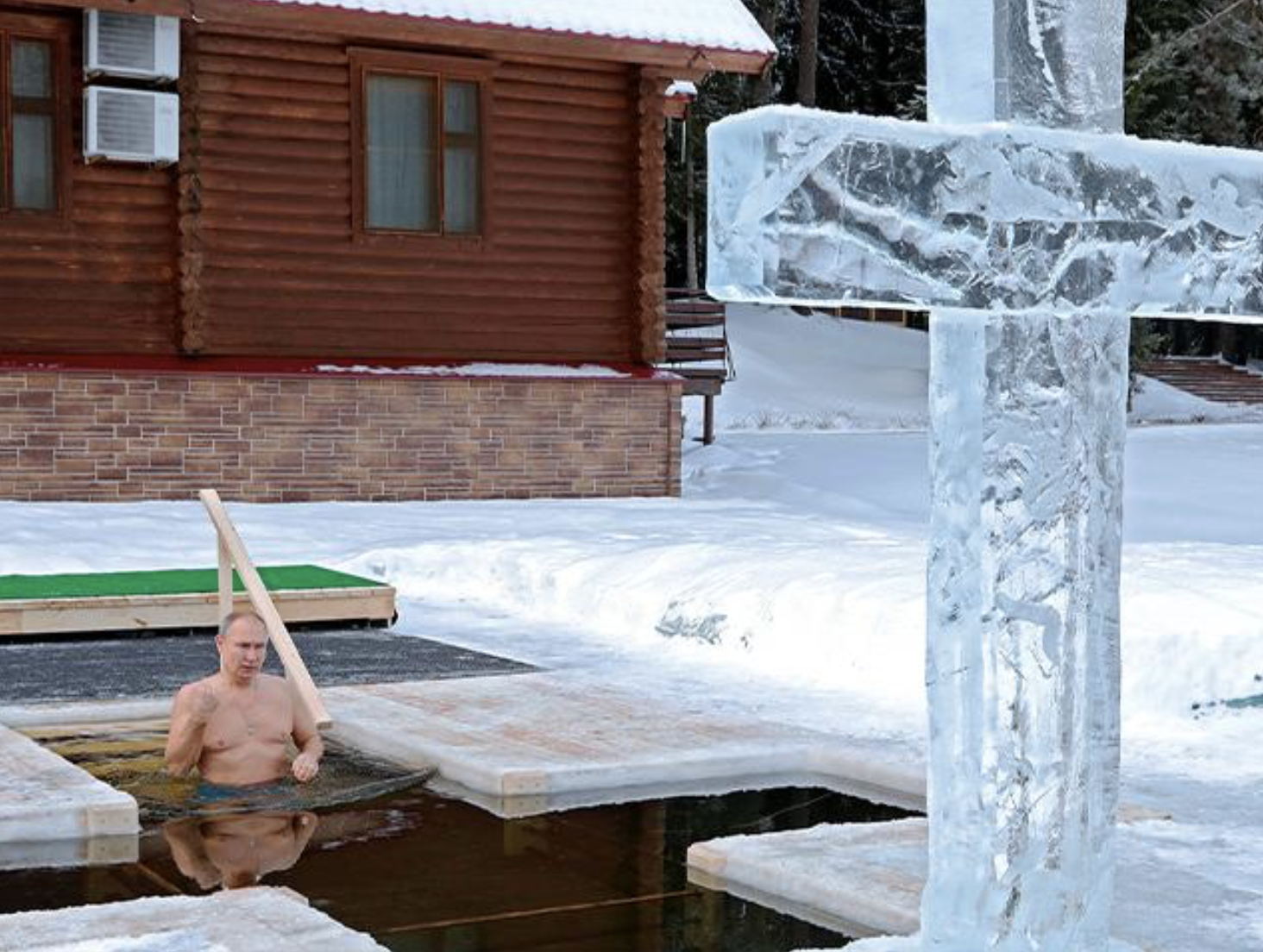
Vladimir Putin observers an Orthodox Epiphany ritual imitating the baptismal immersion of Christ.(Attribution: Mikhail Klimentyev, Sputnik, Kremlin Pool Photo)

Putin is coy about his personal beliefs, though he wears a cross around his neck and makes a public display of his Orthodox rituals. Is his employment of Holy Rus’ rhetoric just a cynical ploy to move the masses, or is he a religious crusader at heart? And which would be worse? Either way, the resulting atrocities have been horrifically evil. The Russian messiah is a war criminal.

Empty strollers in Lviv represent the children killed in the war’s first 3 weeks.

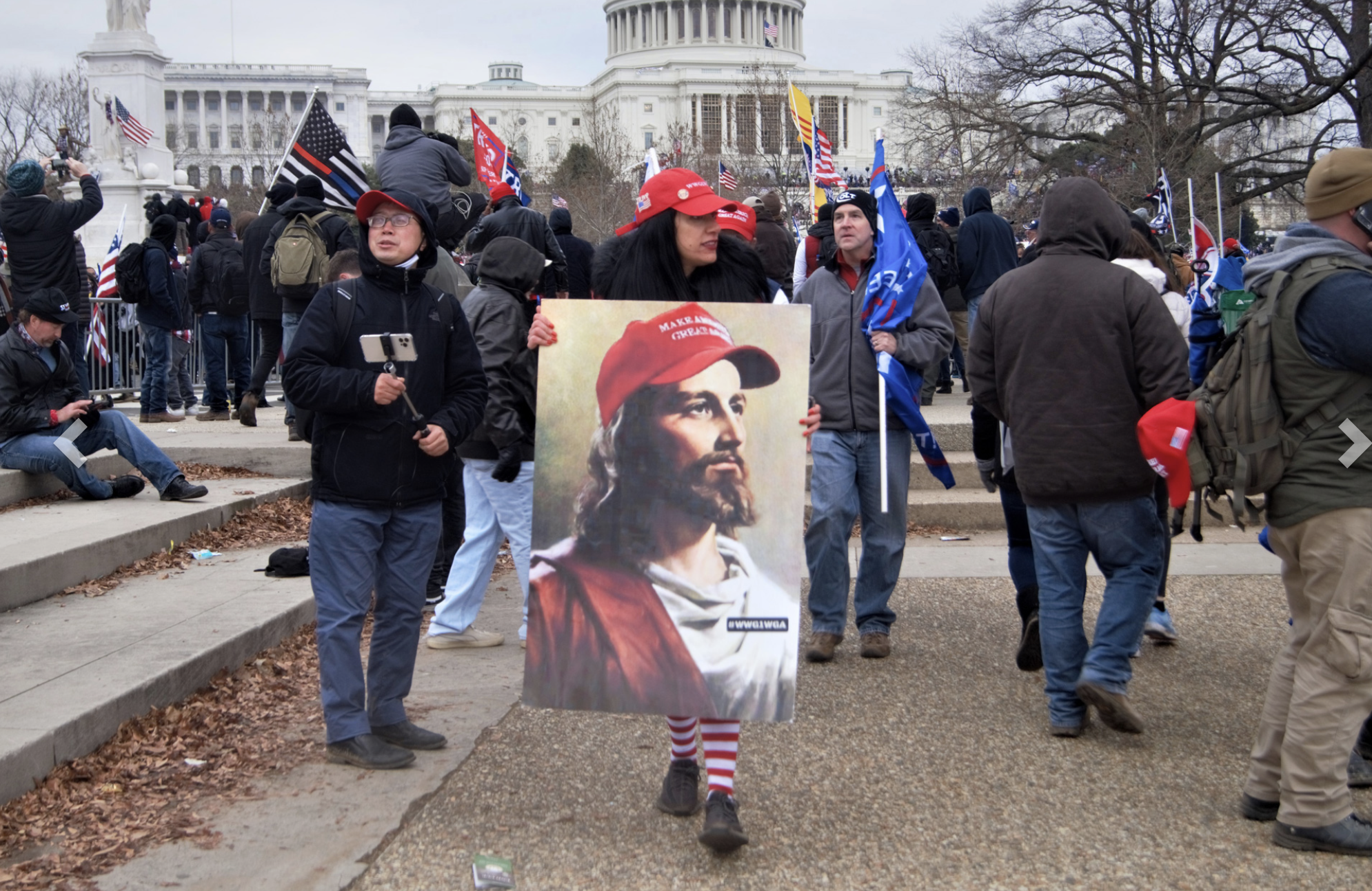
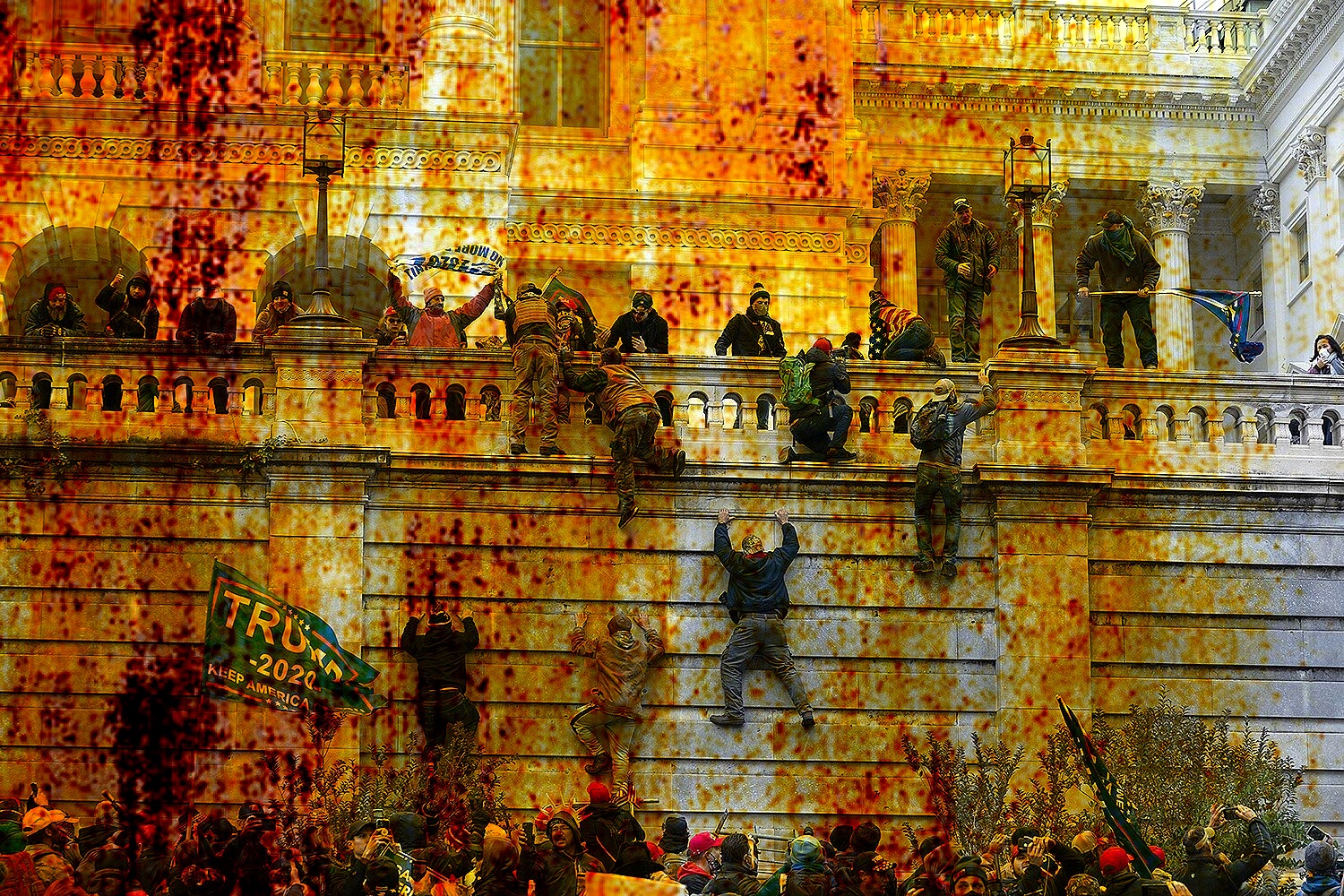
The unholy matrimony of religion and violence is always toxic, poisoning both church and world. We have seen too much of that right here in the United States. Many of the violent seditionists who stormed the Capitol on January 6, 2021, thought they were enacting God’s will. They blew shofars to make “the walls of corruption crumble.” They waved Jesus banners and Bibles, dragged large crosses into the fray, erected a gallows for their enemies. Their madness was driven by a core belief: “God, guns, and guts made America.”[v]

MAGA Jesus at the January 6 insurrection.

It wasn’t just the confused angers of the mob at work. The madness was deployed by the highest levels of government. As Capitol police were being beaten and killed and politicians were running for their lives, the President’s Chief of Staff sent an email from the White House to the sedition-enabling wife of a Supreme Court justice: 

“This is a fight of good and evil … Evil always looks like the victor until the King of Kings triumphs. Do not grow weary in well doing. The fight continues …”[vi]

For the seditionists, and a majority of white Evangelicals overall, Trump was a messianic figure, seeming to offer deliverance and rebirth to a desperate and despised people. “Donald Trump is in the Bible,” a rioter told a journalist. “Get yourself ready.”[vii]

The moral and theological collapse of right-wing Christianity in America echoes the capitulation of the Protestant German Church to the Third Reich. In the 1930s, most German clergy and theologians joined the Nazi party. Some were just playing it safe, but others were swept up in the nationalistic fervor. It became customary to conclude the baptismal rite by praying “that this child may grow up to be like Adolf Hitler.” And the head of the government Ministry of Church Affairs declared in 1935 that the Führer was “the bearer of a new revelation … Germany’s Jesus Christ.”[viii]

In the face of such absurd and blasphemous perversions of Christianity as we have seen in Russia, Germany, and the United States, what are God’s friends to do? Some would have us abandon religion altogether. Recent American studies have shown that many of the “nones” cite bad politics as their primary reason for rejecting Christianity, while many churches are themselves retreating from public life to avoid the contaminating risks of political action.[ix]

Dietrich Bonhoeffer

Dietrich Bonhoeffer was a German theologian and pastor who came of age during the rise of the Nazis. During a fellowship year at Union Theological Seminary in New York, he absorbed Professor Reinhold Niebuhr’s Christian realism. If you avoid history’s messy struggles to preserve your purity, Niebuhr warned, the vacuum you leave will be filled by the demonic. 

Attending an activist black church in Harlem also had an enormous impact on young Bonhoeffer. As his superb biographer Charles Marsh has written, “No longer would he speak of grace as a transcendent idea but as a divine verdict requiring obedience and action. The American social theology … had remade him into a theologian of the concrete.”[x] When, a decade later, he joined a conspiracy to assassinate Hitler, “he would abandon any hope of innocence, incurring the guilt of responsible action. Of the two evils, it was the one he could abide.”[xi] The failed plot would cost him his life. He died in a concentration camp two weeks before it was liberated by the Allies. His body was never found. 

Bonhoeffer had assented to a selective use of violence in order to interrupt mass murder. The unspeakable suffering of the many outweighed his own need for innocence. But he did not do it lightly, and the political captivity of the German Church made him keenly aware of how religion’s engagement with culture can easily go off the rails. He thought deeply about the ambiguities involved in repairing a broken world, but he knew that we cannot just think our way out of the human condition. We need something more, something divine. And words he wrote during the dark days of World War II still point the way:

“Who stands firm amidst the tumult and cataclysms? … The huge masquerade of evil has thrown all ethical concepts into confusion … The failure of ‘the reasonable ones’—those who think, with the best of intentions and in their naïve misreading of reality, that with a bit of reason they can patch up a structure that has come out of joint—is apparent. With their ability to see impaired, they want to do justice on every side, only to be crushed by the colliding forces without having accomplished anything at all. Disappointed that the world is so unreasonable, they see themselves condemned to unproductiveness; they withdraw in resignation or helplessly fall victim to the stronger … Who stands firm? Only the one whose ultimate standard is not their reason, their principles, conscience, freedom, or virtue; only the one who is prepared to sacrifice all of these when, in faith and relationship to God alone, they are called to obedient and responsible action. Such a person is the responsible one, whose life is to be nothing but a response to God’s question and call.”[xii]


[i] https://www.thenationalnews.com/world/europe/2022/03/18/putin-rallies-stadium-crowds-and-lauds-troops-fighting-in-ukraine/ The quotation is a paraphrase of Jesus’ words in John 15:13, just after he says, “Love one another as I have loved you.” Putin used the Russian word for soul (душу (dushu) instead of the biblical “life.”

[ii] Dostoevsky’s speech, given in honor of Russian poet Aleksandr Pushkin (1799-1837), can be found here: http://web.archive.org/web/20050207093332/http://www.dwightwebber.com/pushkinspeech.html

[iii] Quoted in Binyamin Rose, “Russia’s Deep-Seated Messianic Complex,” Mishpacha: Jewish Family Weekly (Mar. 15, 2022) https://mishpacha.com/russias-deep-seated-messianic-complex/

[iv] Ibid.

[v] Emma Green, “A Christian Insurrection” (The Atlantic, Jan. 8, 2021).

[vi] David French, “The Worst Ginni Thomas Text Wasn’t from Ginni Thomas (The Atlantic, March 25, 2022).

[vii] Jeffrey Goldberg, “Mass Delusion in America” (The Atlantic, Jan. 6, 2021).

[viii] Charles Marsh, Strange Glory: A Life of Dietrich Bonhoeffer (New York: Vintage Books, 2014), 283, 271.

[ix] Ruth Braunstein, “The Backlash against rightwing evangelicals is reshaping American politics and faith” (The Guardian, Jan. 25, 2022).

[x] Marsh, 135.

[xi] Ibid., 346.

[xii] Ibid., 341.

“No longer at ease here”

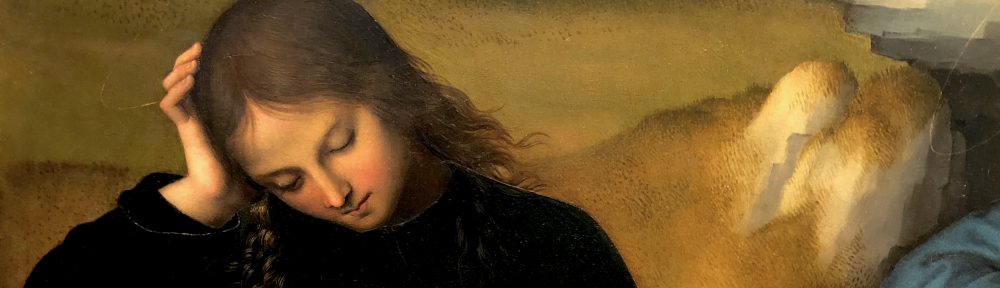
“No longer at ease here, in the old dispensation.” — Leonardo da Vinci, Adoration of the Magi (detail, 1481).

Three days before the 2016 election, I posted The Top Ten Reasons To Stop Trump Now. All of them, sadly, turned out to be valid forecasts, but three of them remain especially worrying over the next two weeks:

Nuclear threat      Giving control of the world’s most powerful military, not to mention the nuclear codes, to an emotional toddler is clearly insane.

Fascism       Believe me. I alone can make America great. Everyone else is stupid. Trump is part of a worldwide erosion of democracy by a resurgent authoritarianism. Fear and hate have made many sell their souls to naked power. When fascism spread in 1930’s Europe, Americans were confident that “it can’t happen here.” Now we aren’t so sure.

Hatred     Racism, bigotry, misogyny, bullying, scapegoating and political violence have been making a shocking comeback, with Trump as their enthusiastic cheerleader. He has endorsed and normalized the most vile sins of the American shadow. God help us should he and his alt-right thugs and cronies ever come to power.

I wrote my warning on November 3, 2016. I wish I’d been wrong.

After yesterday’s insurrection, many are calling for the immediate removal of the President from power, and I add my voice to theirs. His seditious incitement of a coup may have been ridiculously futile, but it cannot be indulged as another childish tantrum. It was both physically dangerous and symbolically toxic. It will take our country a long time to live it down.

Breaking the law and shaming his country should be reason enough for immediate removal. But we should also be genuinely worried about the dangerous unpredictability of a cornered rat. He still controls the nuclear codes. He is still an unstable sociopath, a clear and present danger to America. As a Republican congressman put it today in calling for Trump’s removal, we need “to ensure the next few weeks are safe for the American people, and that we have a sane captain on the ship.”

One way or another, Trump will exit, but the venom that produced him will remain in our system for a long time to come. The alternative universes of social media continue to erode the very notion of a Union. It’s now all too easy to secede from consensual reality. Millions upon millions are joining delusional confederacies of bitterness and hate. And unprincipled, power-hungry cynics like Senators Josh Hawley (educated at Stanford and Yale) and Ted Cruz ( Princeton and Harvard) will continue to harvest money and votes from the killing fields of ignorance and bigotry.

For Christians, the defilement of the Capitol also tainted the Feast of the Epiphany, when we celebrate the manifestation, or revealing, of Christ’s light to the whole wide world. The Episcopal Collect for the Epiphany prays for the Beatific Vision: “Lead us, who know you now by faith, to your presence, where we may see your glory face to face.” Sadly, what the world beheld on Epiphany was not the Light of the world, but an eruption of darkness from the vilest murk of the American id.

As with any healing, you can’t begin treatment until you get a diagnosis. Could yesterday’s “epiphany,” revealing the seriousness of our affliction, be the beginning of a cure? Speaker of the House Nancy Pelosi, herself a Catholic who knows the sacred feasts, expressed this hope. “Let us pray,” she said, “that this instigation to violence will provide an epiphany for our country to heal.”

The bizarre coincidence of the insurrection with the culminating celebration of the Nativity calls to mind the famous ending of William Butler Yeats’ “Second Coming:”

And what rough beast, its hour come round at last,   
Slouches towards Bethlehem to be born?

All of us who were transfixed by the slouching horror on our screens yesterday feel the resonance of Yeats’ disturbing image. But my preferred poem for the day would be T. S. Eliot’s “Journey of the Magi,” a first-person account of the original Bethlehem Epiphany. Like every pilgrim, the speaker has tales to tell about the hardships of the quest. However, about the moment of revelation—beholding the Incarnate God face to face—he is curiously reticent, as though it would diminish the experience to put it into words.

Once he returns home, with time to reflect, the Magus finds himself “no longer at ease here, in the old dispensation, / With an alien people clutching their gods.” Having looked divine Love in the face, he finds a world without that love to be less than “satisfactory.” No longer able to settle for anything less than what he glimpsed in the Bethlehem stable, he finds himself “no longer at ease.” The journey to the Divine birth becomes for him a kind of death, a perishing of his old world and his old self.

In the light of the Epiphany—the revealing of ultimate truth—the Magus is transformed. He will never be the same. Dare we say the same about yesterday’s terrible “epiphany”? Has seeing our own darkness face to face shaken us to the core? Has it shocked us into renouncing its terrible sway? If we suddenly find ourselves “no longer at ease here,” thanks be to God! Our journey toward the Dawn can begin at last.

How Do We Pray for This President?

Angel and Church pray for the victims of a violent century (mural, c. 1940, Église du Saint-Esprit, Paris).

But I say to you, Love your enemies and pray for those who persecute you.

— Matthew 5:44

Beloved, never avenge yourselves, but leave room for the wrath of God; for it is written, “Vengeance is mine, I will repay, says the Lord.”  No, “if your enemies are hungry, feed them; if they are thirsty, give them something to drink; for by doing this you will heap burning coals on their heads.” Do not be overcome by evil, but overcome evil with good.

—Romans 12:19-21

In my last post, “Subjected thus”—The President Gets COVID,” I touched on the question of how to pray for the President. Of course we pray in general for all who have been infected by the coronavirus, but regarding specific petitions on the President’s behalf, I wrote: “I will pray that Trump’s time of trial may effect the healing of his soul. If he is going to suffer, may his illness be for him a birth of empathy, compassion, humility and goodness.”

With every passing day, that prayer becomes harder to offer with any conviction. As we witness Trump’s continuing disregard for the safety of others—both those around him and the country at large—we wonder whether he may be past saving. Instead of being humbled by his illness, he has only grown more malicious. The people around him are dropping like flies, and countless Americans will continue to die from his mismanagement. And now we fear that his relentless disparagement of life-saving protocols will kill even more. “Far less lethal!!!” than the flu, he tweets against all evidence. It’s as if he’s shouting to the world, “Hurry up and die!” 

What, then, is our prayer to be for such a man in such a time?

In the Episcopal Book of Common Prayer, prayers for the sick don’t ask that the ill simply be restored to their former state so they can resume their story exactly where they left off. While those prayers ask for relief from pain, protection from danger, freedom from fear, the banishment of weakness and the gift of healing, they also propose a life transformed by suffering: 

“… enable him to lead the residue of his life in thy fear, and to thy glory.”

“… that, his health being renewed, he may bless your holy Name.”

“… restore to him your gifts of gladness and strength, and raise him up to a life of service to you.”

“… restored to usefulness in your world with a thankful heart.”

“… that he, daily increasing in bodily strength, and rejoicing in your goodness, may order his life and conduct that hemay always think and do those things that please you.” [i]

As for a President and all those in authority, the Prayer Book asks that they be guided by “the spirit of wisdom,” beseeching the “Lord our Governor” to “fill them with the love of truth and righteousness, and make them ever mindful of their calling to serve this people in your fear.”[ii] Would that it were so! But the way things are going, the prayer “For our Enemies” seems more to the point: 

O God, the Father of all, whose Son commanded us to love our enemies: Lead them and us from prejudice to truth; deliver them and us from hatred, cruelty, and revenge; and in your good time enable us all to stand reconciled before you; through Jesus Christ our Lord. Amen.[iii]

The “and us” is a critical part of this prayer, because we have all, symptomatic or not, been infected by the Trumpist pandemic of hate and cruelty. If we say we have not had a few hateful thoughts in the past four years, the truth is not in us. Resistance to evil and purity of heart are not soul mates or easygoing partners. They must work hard to stay coupled. 

Another timely prayer is the Collect for the Feast of Holy Innocents, when we remember the children of Bethlehem murdered by King Herod (Matthew 2:13-18). The prayer is not concerned with the state of Herod’s soul, but with the damage inflicted by his successors: 

We remember today, O God, the slaughter of the holy innocents of Bethlehem by King Herod. Receive, we pray, into the arms of your mercy all innocent victims; and by your 
great might frustrate the designs of evil tyrants and establish your rule of justice, love, and peace; through Jesus Christ our Lord, who lives and reigns with you, in the unity of the 
Holy Spirit, one God, for ever and ever. Amen.[iv]

We are all standing in the need of prayer these days. And even though we can never fully understand what prayer is and what prayer does, prayer “without ceasing” is an essential part of the healing of the world and the perfection of our souls. 

Prayer isn’t like online shopping—placing our order and expecting 2nd-day delivery. It’s not a mechanism for producing outcomes. It’s a relationship, a state of being-with and being-for. It is offering and entrusting ourselves to the One who is “always more ready to hear than we to pray,” who knows “our necessities before we ask and our ignorance in asking.”[v]

Knowing exactly what to pray for is impossible. We cannot see into the hearts of others, nor can we foresee the future. God only knows what is best. As for our own judgments, perspectives and desires, they can taint the purest prayer. In our essential state of imperfection and unknowing, perhaps the safest petitions are these: “Hold us in your mercy” and “Thy will be done.”

But with regard to more specific petitions for this President, I will be guided by the examples cited from the Book of Common Prayer. I will pray for his suffering to be brief but transformative. I will pray for his power to be guided by wisdom and truth. I will pray that his evil designs be frustrated, and that he (and we) be freed from the grip of hatred, cruelty and revenge. But I must confess that Donald Trump is not easy to pray for.

When I think of the monster who has tortured children in cages and caused countless COVID deaths, I struggle with my anger, my horror, and my disgust. But as I sat in the silence of a moonlit garden before this morning’s dawn, I was given the image of a little boy so damaged, so broken, so unloved, locked deep inside the dungeon of Trump’s psyche seventy years ago—guarded by dragons, hidden from the light, lost to the world. That tragic, wounded, forgotten child is someone I can pray for with my whole heart.


[i] The Book of Common Prayer, according to the use of The Episcopal Church USA (New York: Oxford University Press, 1979), 458-459.

[ii] BCP, 820.

[iii] BCP, 816.

[iv] BCP, 238.

[v] BCP, Proper 21 (p. 234) and Proper 11 (p. 231).

What Would Samson Do? — Finding Trump in the Bible

Who can be serene in a country where both the rulers and the ruled are without principle? The remembrance of my country spoils my walk.

— Henry David Thoreau [i]

[T]his president and those in power—those who benefit from keeping things the way they are—they are counting on your cynicism … Do not let them take away your power. Don’t let them take away your democracy. 

— Barack Obama [ii]


When the previous American president called out the most dangerous man in America at the Democratic Convention, he broke the presidential norm of speaking softly about your successor. “Donald Trump hasn’t grown into the job because he can’t,” said Obama. “And the consequences of that failure are severe. 170,000 Americans dead. Millions of jobs gone while those at the top take in more than ever. Our worst impulses unleashed, our proud reputation around the world badly diminished, and our democratic institutions threatened like never before.” [iii]

Three years ago the press would have worried more about the broken norm than the words themselves. No longer. Democracy is on fire, and even some former White House officials are grabbing the nearest hose. In normal times, the Senate report detailing Trump’s extensive Russian collusion would bring an Administration’s swift collapse. But amid the ongoing maelstrom of misdeeds, it’s barely noticed. In normal times, a reporter would not be inviting a president to refute the conspiracy theory of his secret plan to save the world from a satanic cult of pedophiles and cannibals. And in normal times, the president would not respond by wondering “is that supposed to be a good thing or a bad thing?” [iv]

Coincidentally, in recent weeks the Episcopal Daily Office has been taking us through the Book of Judges, one of those disturbing texts that won’t let us mistake the Bible for a handbook on exemplary behavior. It’s a collection of ancient tales—legends with historical origins—from Israel’s history after the Exodus, when the refugees from Egyptian slavery were establishing themselves in a Promised Land. That land’s existing occupants were not so thrilled with the immigrants’ aspirations, and the narrative accounts are filled with appalling violence. It’s not a book I’d care to preach on.

When a later editor wove the stories into the Book of Judges, he sought to make a larger point about the Israelites losing their way as a people whose identity and survival was rooted in the divine Deliverer. Judges begins with stories of charismatic leaders who rise up as needed to guide their people through a formative time. But charisma proved an unreliable form of governance. Judges ends with several tales to demonstrate a need for a more stable political system, as the tribes devolve into civil war. The story of Samson is the turning point.

While Sunday school teachers have long cringed at the sex and violence of the Samson saga, children (and Hollywood producers) have been captivated by his superhero powers and comic-book adventures. Outnumbered by those Philistine bullies, he always gives them their comeuppance. BAM! POW! OOF! Not even a lion can beat him. And though tricked and weakened by a femme fatale, he still brings the house down on the bad guys in the end.

But to what purpose? He has no particular interest in the greater good of his people. All he cares about is himself. He is driven by impulse, not thought. Revenge and lust shape his choices. Although we are told “he led Israel … for twenty years,” he shows no leadership skills, and generates considerable hostility among his own people. However, he does excel at destruction—what Robert Alter calls his “anarchic impulse”—so cruelly exhibited when he ties torches to the tails of three hundred foxes to set Philistine fields and vineyards ablaze.

Finally captured and blinded by his enemies, he refuses to admit defeat. If he has to go down, he’s going to take everyone else down with him. In a famously spectacular finish, he pushes “powerfully” against the pillars of their temple, and the great structure collapses, killing three thousand men and women, including himself. The narrator ends with a chilling summation: “And the dead that he killed in his death were more than he had killed in his life” (Judges 16:30).

As Alter notes, the Book of Judges goes on to relate further episodes of “unbridled lust, implacable hostility, and mutual mayhem,” not to mention “dishonesty and deception … venality and the ruthless pursuit of personal and tribal self-interest.”[v] It’s a disheartening book, whose final sentence conveys the total disintegration of social bonds and the common good: “Every man did what was right in his own eyes” (Judges 21:25).

Sound familiar? Three years ago, few of us imagined how fragile and corruptible our own political institutions would prove to be. As Barack Obama warns us, we are on the verge of losing our democracy—and so much more. The current president’s small hands are pushing hard against the pillars of America. He’d rather kill us all than be the only “loser.”

It’s a stressful time to be an American, even without a pandemic. To paraphrase Thoreau, the “remembrance of my country” is spoiling my summer. Serenity is a rare commodity these days. And that is perhaps how it must be until we expel the demons from White House and Senate. Keep our eyes on the prize and hold on!

In Thoreau’s essay, “Slavery in Massachusetts,” his dark thoughts about America’s sins are succeeded by the memory of a walk when he chances upon a white waterlily. The flower becomes a redemptive epiphany:

“It bursts up so pure and fair to the eye, and so sweet to the scent, as if to show us what purity and sweetness reside in, and can be extracted from, the slime and muck of earth … What confirmation of our hopes is in the fragrance of this flower!”

So many moments in this week’s Democratic Convention have provided a confirmation of my own hopes: the determined voices of those who transform personal suffering and pain into commitment to the common good; the joyful spirits whose ideals still burn bright; the splendor of so many diverse and shining faces; a passionate yearning for beloved community; and the uplifting video segments which burst “so fair upon the eye.”


[i] H. D. Thoreau, “Slavery in Massachusetts,” Collected Essays and Poems (New York: The Library of America, 2001), 346.

[ii] The 44th President’s speech at the Democratic Convention (August 19, 2020).

[iii] Ibid.

[iv] https://www.independent.co.uk/news/world/americas/us-election/donald-trump-qanon-conspiracy-2020-election-a9678946.html

[v] Robert Alter, The Hebrew Bible: A Translation with Commentary, Volume 2: Prophets (New York: W. W. Norton & Company, 2019),

Mr. Schiff Goes to Washington

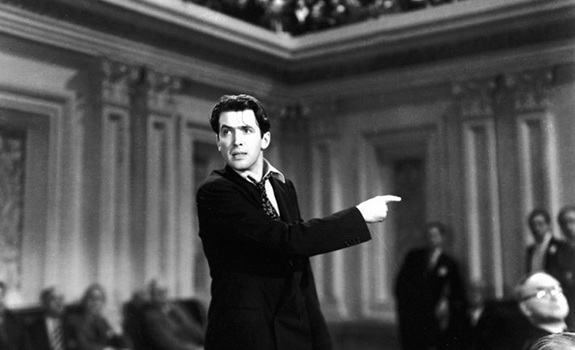
Jefferson Smith (James Stewart) appeals to the Senate in “Mr. Smith Goes to Washington” (1939).

Last night Adam Schiff delivered one of the most electrifying and critical speeches in American history. Standing before the United States Senate, he spoke the truth that can no longer be ignored: Donald Trump is not merely corrupt, ignorant, and malicious. He is dangerous.  

Schiff began by stating the obvious:

“Do we really have any doubt about the facts here? Does anybody really question whether the President is capable of what he’s charged with? No one is really making the argument, “Donald Trump would never do such a thing,” because of course we know that he would, and of course we know that he did. . . We all know what we’re dealing here with this President, but does he really need to be removed?”

Then, after outlining the present and future dangers of the President’s corrupt and reckless behavior, Schiff reminded the Senate, and every citizen, what is at stake––the survival of our country and the ideals on which it was founded. 

“Well, let me tell you something, if right doesn’t matter, . . . it doesn’t matter how good the Constitution is. It doesn’t matter how brilliant the framers were. Doesn’t matter how good or bad our advocacy in this trial is. Doesn’t matter how well written the Oath of Impartiality is. If right doesn’t matter, we’re lost. If the truth doesn’t matter, we’re lost.”

Watch the whole speech (the link is below). If our country survives this crisis, Schiff’s warning will be remembered as one of the monumental texts of American history, powerfully crafted and crucially significant. The United States began with the declaration, “We hold these truths to be self-evident.” Whether Schiff’s declaration––“If the truth doesn’t matter, we’re lost”­­––proves to be our wake-up call, or our epitaph, remains to be seen. 

How I wish Frank Capra were directing the impeachment hearings as a remake of Mr. Smith Goes to Washington. The idealist’s stirring rhetoric would bring the conflict to a decisive crisis point. The Boy Rangers would lead mass protests in the streets of America, crying “This is what democracy looks like!” And Moscow Mitch, taking the role of Claude Rains, would weep and wail his repentance on the Senate floor. 

I’ve been reading Tristan Gooley’s The Nature Instinct: Relearning Our Lost Intuition for the Inner Workings of the Natural World. It’s a guide for cultivating our “sixth sense” as we live and move in nature. When we are tuned in to the cues of our environment, we don’t need to slowly ponder and reflect about what’s going on around us. We can react instinctively and immediately. And when we are threatened by danger, a speedy reaction is essential for our survival.

“Sitting around a fire in the Amazon jungle, the sound of bird alarm calls in the trees sets a tribal group thinking slowly and consciously about its meaning. But the survivors of a jaguar attack didn’t ponder the meaning a second time; they got out of there.” (Gooley, 25)

The signals of alarm are all around us. Danger! Danger! Citizens, we can’t remain where we are. It’s time to move!