

In all my years as a priest, I had never preached on the apocalyptic imagery of Luke 17:26-37, where people disappear without warning and Jesus concludes with an unnerving proverb: “Where the corpse is, there the vultures will gather.” This is not ideal preaching material, but with the help of the Epistle reading, Hebrews 11:29—12:2, I gave it a try last Sunday.
Today’s gospel [i] has quite a punchline: “Where the corpse is, there the vultures will gather.” It’s got to be pretty low on the list of favorite Jesus quotes, but it certainly gets our attention.
A couple of weeks ago I was at a raptor show at the High Desert Museum in eastern Oregon. A variety of hawks, owls and vultures flew swiftly among the seated spectators, who were warned to stay very still lest we be mistaken for prey. I did my best not to be a target, but a turkey vulture came close enough to brush my head with its wing. Perhaps it was preparing me for this strange gospel verse.
Some scholars say Jesus was simply using a common folk expression in response to a question about discerning the times, meaning something like “where there’s smoke, there’s fire.” Such expressions have nothing to do with smoke or fire or vultures or corpses. They’re just colorful ways of making a point. Still, Jesus’ choice of such a grim illustration puts a sharp edge on his message. It certainly gets our attention. And where the enigmatic text is, there the scholars will gather.
Who is the corpse? they wonder. Who are the vultures? One interpretation suggests the corpse could represent ancient Palestine, with the rapacious vultures being the occupying army of Rome. The Book of Revelation, perhaps inspired by the vultures in the gospel text, imagined the raptors of midheaven being summoned to feast on the remains of the proud powers struck down by divine judgment. An even more fantastical interpretation identifies the sharp-eyed buzzards, who in fact can spot carrion from 3 miles away, as those perceptive disciples who gather to consume the Corpus Christi, the Body of Christ given to feed our deepest hunger.
Well, none of these images is going to qualify for a stained glass window. And the vulture verse is perhaps profitless for the preacher.
And yet, it leaves a haunting impression. It’s unlike anything else Jesus ever said, and its gruesome tone puts an exclamation point on his discourse of crisis. A world is dying, he says. Just as a world died in the days of Noah, or in the days of Lot—names which recall destructive narratives of flood and fire—so it is happening now. The times are in no way normal, Jesus warns his listeners. Anyone who pretends that is not true, who thinks we can just go on about our business as usual—eating and drinking, buying and selling, planting and building—well, they are in for a surprise.
Come gather ’round people
Wherever you roam
And admit that the waters
Around you have grown
And accept it that soon
You’ll be drenched to the bone
If your time to you is worth savin’
You better start swimmin’
Or you’ll sink like a stone
For the times they are a-changin’ [ii]
When we sang that song 60 years ago, we thought the times were changing for the better. And that was true in many ways. But the flood of changes washing over us today do not feel like something better. When Jesus speaks of people being snatched up and disappeared without warning, he could be describing what’s happening right now in “the land of the free.” To paraphrase Jesus’ metaphor, “As it was in the days of Dietrich Bonhoeffer—in 1930s Germany—so shall it be in our own time.”
I pray that this will not be our fate, but the fact that such an outcome is even conceivable is a measure of the times. It can happen here. So what are the friends of God to do? How do we start swimming so we don’t sink like a stone?
We are not the first believers to suffer the worst of times. The Epistle to the Hebrews is clear about that. History isn’t always about the lilies of the field. It has its corpses and vultures as well.
But as the author of Hebrews insists, the faithful believe in the victory of God, and they act out that faith with their bodies. Some of God’s friends have “received the test of mocking and whipping and even chains and prison. They were stoned, cut apart in a slaughter; they died upon a sword. They traveled around in ragged clothing, impoverished, oppressed, afflicted.” But for all they suffered, those who kept the faith “subdued monarchies, did the work of justice … shut the mouths of lions, quenched mighty fires …” (Hebrews 11:29-12:2)
As people baptized into the Paschal Mystery, we understand that dying and rising, defeat and victory, are deeply intertwined. You can’t have one without the other.
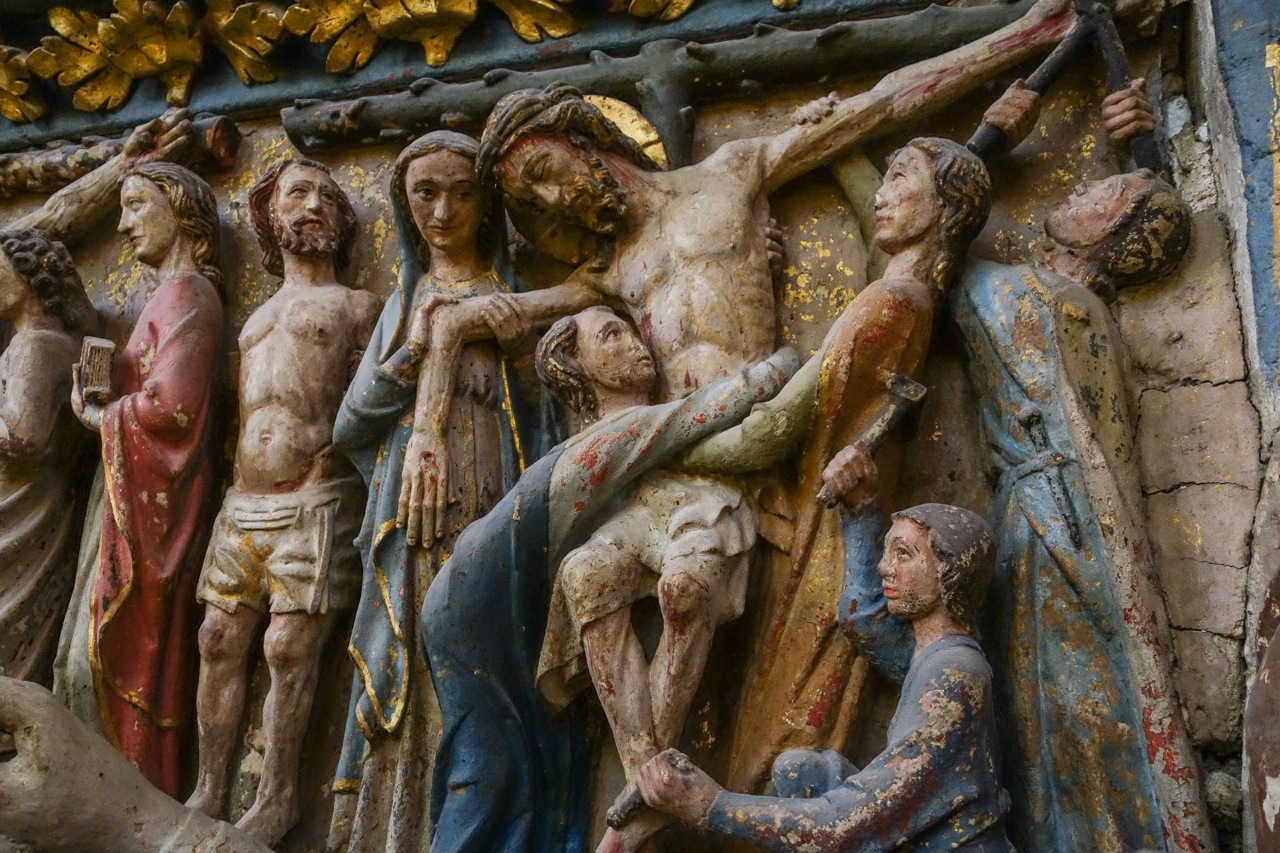
When certain medieval women mystics contemplated the cross in prayer and vision, they saw not the triumph of death, but a kind of birth. For them the crucified Jesus was like a woman in labor, enduring pain and travail in order to bring us all to birth:
Ah! Sweet Lord Jesus Christ, who ever saw a mother suffer such a birth! For when the hour of your delivery came you were placed on the hard bed of the cross and … in one day you gave birth to the whole world.” [iii]
To behold the death of Christ and call it birth is the central act of Christian imagination. It is why we declare victory at the cross. We don’t wait for Easter Sunday. We declare victory at the cross because the Passion isn’t just a story about the violent powers that always trample the weak and kill the prophets. It’s also a story about the Realm of God, where dry bones breathe and lost hopes dance, where the prodigal is welcomed home and the tears are wiped from every eye.
The Love that creates such a realm was nailed to a cross, but the cross did not consume it. Yes, death did what death does, but then God did what God does. And Love won. This is the story we belong to, and on the outcome of that story, we stake everything.
That is why we are here this morning. That is why we refuse to retreat to our private worlds, why we continue to gather in community at our Savior’s table: to nurture hope, shelter love’s flame, encourage one another, strengthen our hearts for service, eat the bread of life, pray without ceasing, sing our Alleluias and grow ever more fully into the visible, tangible body of Christ.
We are not alone in this journey. We are surrounded by a cloud of witnesses, all those ancestors in the faith, from Abraham and Sarah and Mary and Luke right on down to the wise and loving mentors we’ve known in our own lives, who have taught us how to walk in the Way of life and peace.
I once heard a preacher describe the cloud of witnesses as “the balcony people” who are looking down and cheering us on as we run the race that is set before us. It’s a wonderful and resonant image. I’m sure that each of you has some very special people in that balcony, shouting their encouragement. Listen. You can hear their voices echoing through the years.
St. Luke, pray for us … St. Mary, pray for us … St. Francis, pray for us … Oscar Romero, pray for us … Dorothy Day, pray for us … Mom and Dad, pray for us.
Last Sunday I was in Eugene for the National Track & Field Championships, and in the men’s 800 meters I witnessed one of the most stunning moments in the history of middle-distance racing. A 16-year-old high school sophomore named Cooper Lutkenhaus had qualified for the elite competition by breaking the 29-year-old high school record, running the distance in 1:45. And after stumbling and almost falling in his first race at the championships, he managed to survive the first two rounds.
Much to his surprise, he had made the final. But with some of the world’s top 800 meter runners in the race, no one expected him to be anywhere close to the top three who would earn a trip to the World Championships in September.
Rounding the last turn, Cooper was doing really well for a 16-year-old, in sixth place out of nine racers, 10 meters behind the leader. Then, in the last 100 meters, he passed one runner, and another, and another, and another, to cross the line in second place. His time was 1:42.27, not only a personal best by an unbelievable 3 seconds, but the 18th-best all-time and the fourth-best ever by an American.

Now I’ve been at a noisy NBA final with Kareem and Magic and Larry Bird. I’ve been deafened by the 12th man [iv] at a Seahawks game. But the sound of the crowd cheering on young Cooper Lutkenhaus blew my ears off. The cloud of witnesses.
When we run the race that is set before us, there will be times when our lungs burn and our legs scream with lactic acid. There will be the races that disappoint, and workouts that feel listless or discouraging. We may even stumble and fall, more than once.
But always, always, the cloud of witnesses is cheering us on. They know from their own experience what the race is like. They all had their own moments of weakness and doubt. They became acquainted with suffering by training hard every day. They all had to learn how to get up after every fall, lay aside every weight, gulp the breath of the Spirit, and accept pain as the runner’s companion.
I’ve done my own share of racing, and when the pain comes, I try to greet it as a friend. “Hello, brother pain. I knew you’d show up. Well, here we go. I know you’re not going to kill me, right?. We’ll just take it step by step.”
The perpetual contest between weariness and perseverance is familiar to every athlete—and every saint. You’re going to get tired. You’re going to get discouraged. You may faint and fall. But keep your eyes on the prize, hold on. On both good days and bad, you’ve got to put in the work, “lay aside every weight,” surrender to a power and a strength that is not your own, and stay in the flow.
I began with a raptor image, so let me close with another. This time it’s not a vulture, but an eagle, in a beautiful passage from the prophet Isaiah:
Even the youthful may faint and grow weary,
even the fittest may stumble and fall,
but those who wait for the Lord shall renew their strength,
they shall mount up with wings like eagles,
they shall run and not be weary,
they shall walk and never grow tired. [v]

This homily was preached at St. Luke’s Episcopal Church, Renton, WA, on the 9th Sunday after Pentecost, 2025.
Race photo and video by the author.
[i] The texts for the 8th Sunday after Pentecost are in Wilda C. Gafney, A Women’s Lectionary for the Whole Church, Year C, which differs significantly for the Revised Common Lectionary used by most liturgical churches.
[ii] Bob Dylan, “The Times They Are A-Changin’” (1964).
[iii] Marguerite d’Oingt (d. 1310).
[iv] The loudest crowd in professional football is in Seattle, where the fans are called “the 12th man” for their ability to influence the game by making it hard for the other team to hear their quarterback’s signals.
[v] Isaiah 40:30-31.











 The religious imagineer