For the latest No Kings March to occur on the eve of Palm Sunday seemed to me a resonant conjunction. Both yesterday’s march and the “triumphal entry” of Jesus into Jerusalem stirred the deepest hopes of people suffering under oppressive regimes. Of course not all hopes are equal, and sometimes they turn out to be, as T. S. Eliot noted, “hope for the wrong thing.” Even if the folks shouting Hosanna in Jerusalem were mistaken about what God was up to that week, I imagine Jesus still being touched by their longing, that crazy feeling that the world might just get better. The capacity for hope is one of humanity’s finest qualities.
There is some irony, of course, in linking No Kings to a biblical event suffused in royal imagery. I’ve been singing the Palm Sunday processional, “All glory, laud, and honor to thee, Redeemer, King!” ever since I was a child. But God is no stranger to irony—manifesting divinity as a helpless child, “ruling” as a servant, and dying to give life. And a line by the late great songwriter Bob Franke neatly resolves, for me at least, any tension between democracy and religious language inherited from monarchists.
Well you kneel to the Lord and you will bless yourself; Ain’t no need to kneel to no one else.
In a week when people of my tradition walk the Way of the Cross in ritual, song and story, we know that hope is no stranger to struggle and suffering. It’s a long and winding road to Easter, passing through Gethsemane and Golgotha. Yet it remains, as the Book of Common Prayer assures us, “none other than the way of life and peace.”
On yesterday’s march in Seattle, I shot video of what I saw, and in putting it together I was struck all over again by the recurrent note of joy. Not everyone would put it this way, of course, but for one gloriously sunny day, we were, as the South Africans sing, “marching in the light of God,” and the divine future of human flourishing made a significant incursion into the present moment. As the crowd chants in the opening of my video:
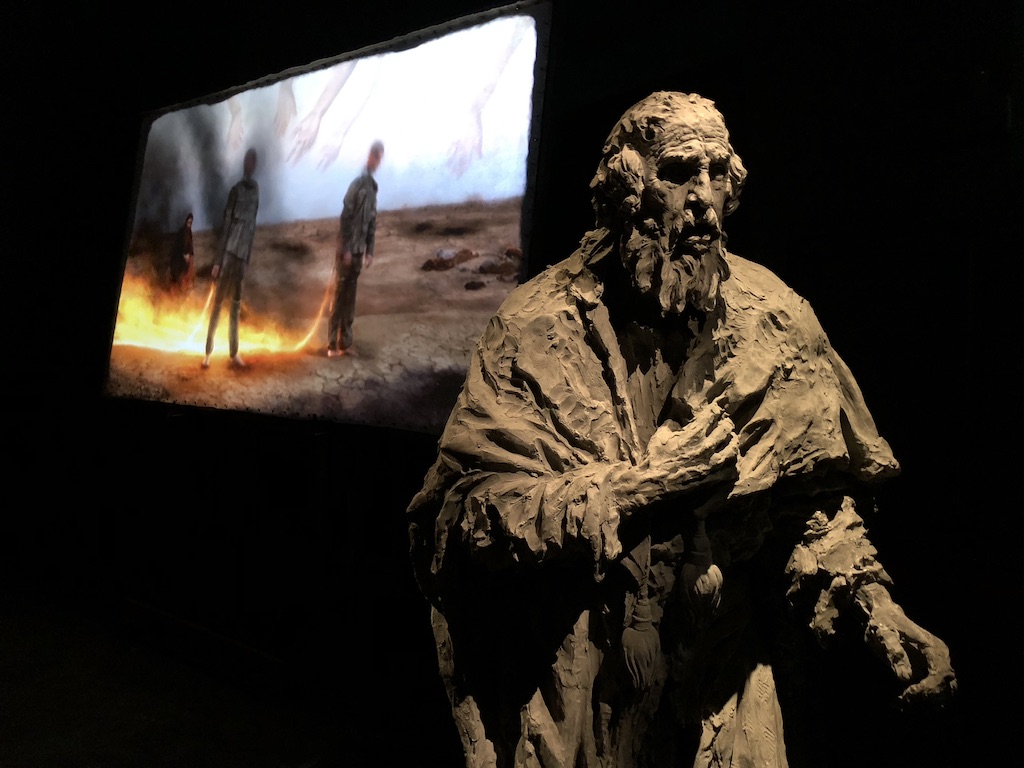
Biblical stories can be retold in many ways with a variety of media. This is part of The Prodigal Son parable in an elaborate and moving installation by Alexander Sokurov at the Venice Biennale in 2019. (Photo by the author)
This is the third in a series of posts responding to the alarming events in Minneapolis. It may be the most arcane, of interest only to worship planners and storytellers. I usually try to write posts of more general interest, but my long experience as a liturgical creative and biblical storyteller impels me to set this down, for what it’s worth, as a small personal contribution to the ongoing efforts of the faithful to resist public malice and hold fast to the good with all the means at our disposal.
In evil times such as these, how can churches be faithful to the Baptismal Covenant to “persevere in resisting evil … seek and serve Christ in all persons … strive for justice and peace among all people, and respect the dignity of every human being”? In recent weeks, we have seen many clergy and laity adding their voices and bodies to the resistance against tyranny and cruelty in Minneapolis, and to the increasingly dangerous work of loving our neighbor and protecting the vulnerable.
As a longtime liturgist, I find myself wondering how—and to what degree—our worship gatherings, in addition to our witness in the public square, might themselves be responsive to what is happening around us—and inside us—during America’s current authoritarian nightmare. Prayer and preaching are two vital ways, and I have given some striking examples in my two previous posts, White House Brutality (prayer as a “refusal to consent to an unredeemed world … It breaks the silence, awakens the passive, and cultivates action, both human and divine.”) and Murder in Minneapolis (featuring one priest’s prophetic sermon, forged in the crucible of tyranny and protest).
Singing is also a powerful weapon against evil and its sad progeny—discouragement, fear and despair. It’s been said that the Civil Rights movement succeeded in part because it had a great soundtrack. Its stirring adaptations of black spirituals, sung not only in the marches but also in the jails, kept voices high and spirits strong. As they say, the people unitedwill never be defeated. And nothing unites like communal singing. The resistance to American fascism is taking this to heart as collective song becomes once again a vital part of public protests.
Prayer, preaching and singing are all powerful ways to say yes to God and no to evil. And to that list I would add the telling of our sacred stories. Creative engagement with Scripture deserves equal attention as a means to lift up our hearts and shine the light of hope against the darkness. Week after week, year after year, Christians tell formative stories of sin and redemption, strife and reconciliation, despair and hope, losing and finding, oppression and liberation, death and resurrection. Then the preacher strives to connect those biblical stories with our own lives and times. But what if we were to make those connections not just in our homiletic reflections following the stories, but in the storytelling act itself?
As a young priest in Los Angeles during the Vietnam War, I staged a dramatized version of Jesus’ parable of the Unforgiving Debtor for an experimental eucharist. The man whose debt was very small was a draft resister, thrown into prison by an angry creditor dressed as Uncle Sam. That creditor was then reminded of the immensity of his own debt, illustrated by projected images of the atrocious violence in Southeast Asia.
Such a pointed retelling of Scripture might be too edgy for typical Sunday worship, but there are times when biblical stories really want to be heard in fresh and compelling ways. Holy Week 2026 can be a great opportunity to do that. How might worship planners think creatively about the Paschal journey from death to life in the context of our current experience of state-sponsored hate and violence?
The next No Kings march is scheduled for March 28, the day before Palm Sunday. How will it feel to reenact Jesus’ provocative entry into Jerusalem after millions of us will have shouted our own hopeful hosannas in the streets of America? What will be in our hearts on Maundy Thursday when our beautiful feast of loving one another concludes with the arrest our Lord by armed thugs? And when we come to the foot of the cross, will we see the God who not only shares our present suffering but also transforms it, making a Way where there is no way?
I love the traditional Scriptural texts for the Holy Week rites which take us on the Paschal journey from death into life. As containers for all the thoughts and feelings we bring to that journey, especially in times of immense public distress, they need no inventive retelling. They will be heard in fresh ways simply by virtue of what is in our minds and in our hearts throughout Holy Week 2026.
But when the sun goes down on Holy Saturday, and the Great Vigil of Easter begins to transport us from the world of sin and death into the realm of light and life, the world of the past is gone, and it is time to let imagination flourish, that we may find our own struggles and hopes vividly enacted in the performance of biblical narratives.
At the Easter Vigil, which I take to be the molten core of Christian worship, it is critical to experience those stories as if they are happening to us. We need to feel ourselves delivered from the flood of chaos and liberated from bondage to the powers-that-be. The dry bones of our damaged hopes need to rise again and inhale the breath of the Spirit. As the ancient Exultet chant declares at the outset of the liturgy,
How holy is this night, when wickedness is put to flight, and sin is washed away. It restores innocence to the fallen, and joy to those who mourn. It casts out pride and hatred, and brings peace and concord.
What does it take to do the Vigil stories justice? Well, it takes time and effort, a creative team, prayerful engagement with the stories, and openness to the Holy Spirit. Before offering a few tips for your own Vigil storytelling, let me give some examples from a Vigil I curated last year, as described in my April 2025 blog post, “For God so loved our stories”—Tales from the Easter Vigil:
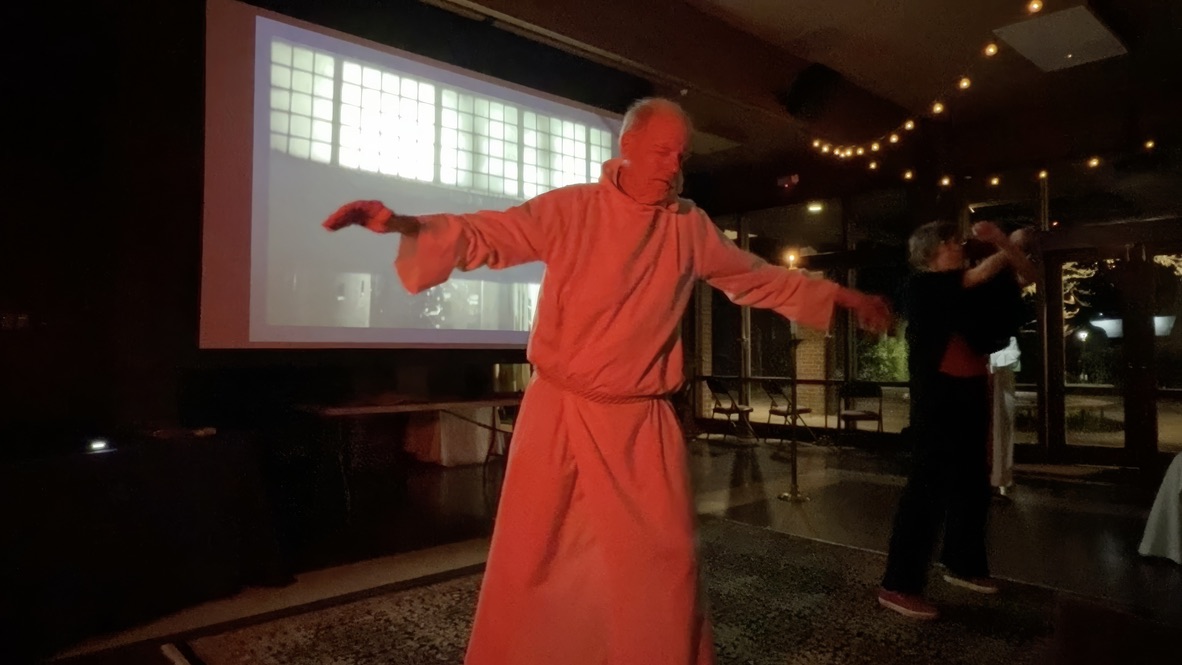
The author as one of the dancers in the Red Sea story at the Easter Vigil 2025.
The Red Sea: Noirish projected images (from Bela Tarr’s bleak film, Werckmeister Harmonies) show anonymous figures shuffling through an imprisoning corridor, while dancers on the stage express the experience of oppression with their bodies. An offstage narrator explains:
Three thousand years ago, in the land of Egypt, there were people who had no name. They were the faceless many, exploited by the powerful, forgotten by the privileged: slaves, immigrants, the poor, the homeless, the vulnerable, the invisible, the outcast.
Then dismissive terms for the oppressed appear on the screen in stark animated graphics: Not like us … worthless … horrible people … trash … less than human. More images of “the faceless many” are shown as the dancers continue, until an offstage choir sings a verse of “Go down, Moses.”
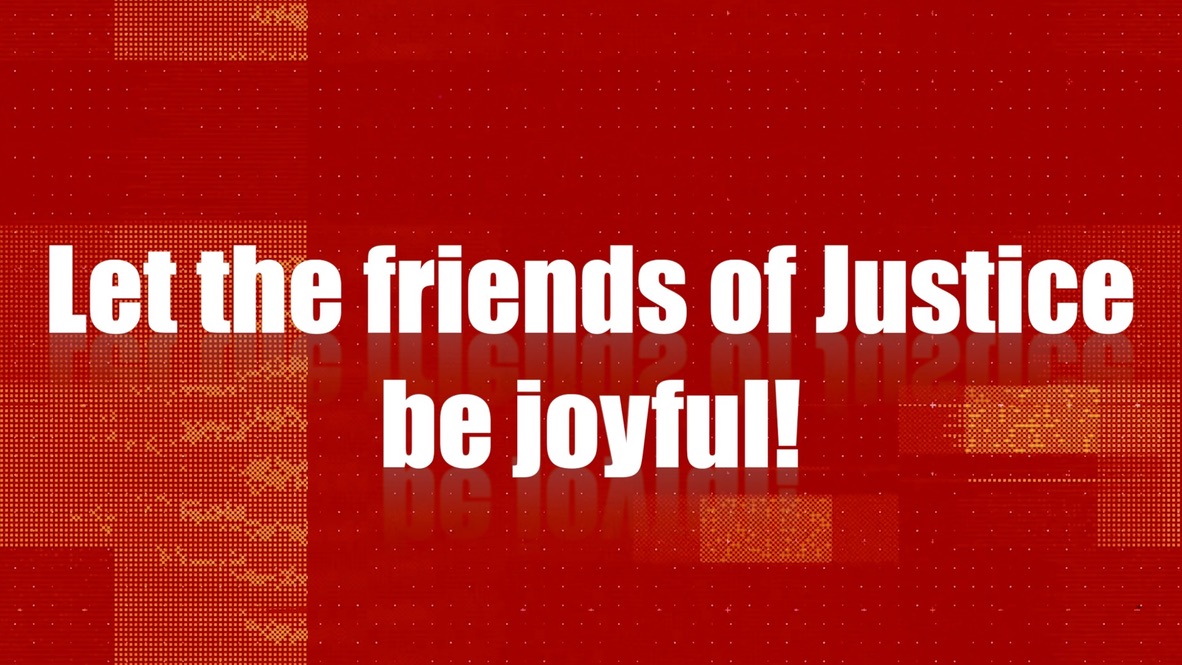
Suddenly, the divine breaks into this dark world: the screen flashes red, and we see the words from Psalm 68 that are always used in Orthodox Paschal liturgies:
Let God arise! Let the foes of Love be scattered! Let the friends of justice be joyful!
Then a song from the Civil Rights movement fills the room: “They say that freedom is a constant struggle … Oh Lord, we’ve struggled so long, we must be free.” The dancers’ bodies shift from oppression to liberation, while the screen shows powerful footage of crowds on the march for justice. As we hear a dub track with a repeated phrase by Martin Luther King, Jr.(“We cannot walk alone!”), the dancers begin their own march across the stage to the “Red Sea,” where they halt while the narrator declares:
This too is a creation story: On this day, God brought a new people into existence. On this day, God became known as the One who delivers the oppressed, the One who remembers the forgotten and saves the lost , the One who opens the Way through the Sea of Impossibility, leading us beyond the chaos and the darkness into the Light. When the world says No, the power of God is YES!
As the dancers, joined by a small crowd of others, begin to cross the Sea, the choir (offstage) sings Pepper Choplin’s moving anthem, “We are not alone, God is with us …” After the song, a bidding to prayer begins:
Pray now for the conscience and courage to renounce our own complicity in the workings of violence, privilege and oppression. Pray in solidarity with all who are despised, rejected, exploited, abused, and oppressed. Pray for the day of liberation and salvation.
The Fiery Furnace: This story from the Book of Daniel is borrowed from the Orthodox lectionary for the Paschal Vigil, and its humor (yes, the Bible can be funny) provides some comic relief after the Red Sea. The story’s mischievous mockery of a vain and cruel king, outwitted in the end by divine intention, feels quite timely. The idol shown on the screen is a golden iPhone, which will be destroyed by a cartoon explosion from Looney Tunes. The humorously tedious repetition of the instruments signaling everyone to bow is performed with the following (admittedly unbiblical) instruments: bodhran, bicycle horn, slide whistle, chimes, train whistle, and Chinese wind gong. The Song of the three “young men” in the furnace is recited by three women in an abbreviated rap version. At the end, the cast of twelve exit happily, singing the old Shape Note chorus, “Babylon is fallen, to rise no more!”
Then we give thanks “for the saints who refuse to bow down to the illusions and idolatries of this world” and pray for “the grace and courage to follow their example, resisting every evil, and entrusting our lives wholeheartedly to the Love who loves us.”
Valley of Dry Bones: Unlike the embellished retellings of the other stories, this one sticks closely to the biblical text, but is delivered in a storytelling mode by a single teller (me) in a spooky atmosphere of dim blue light. The voice of God is a college student on a high ladder. The sound of the bones joining together is made by an Indonesian unklung (8 bamboo rattles tuned to different pitches). When the story describes the breath coming into the lifeless figures sprawled across the valley, I get everyone in the assembly to inhale and exhale audibly a few times so that we can feel and hear the spirit-breath entering all of us. Then I move among them, bidding one after another to rise until everyone is standing, completing the story with their own bodies: the risen assembly itself becomes a visible sign of hope reborn.
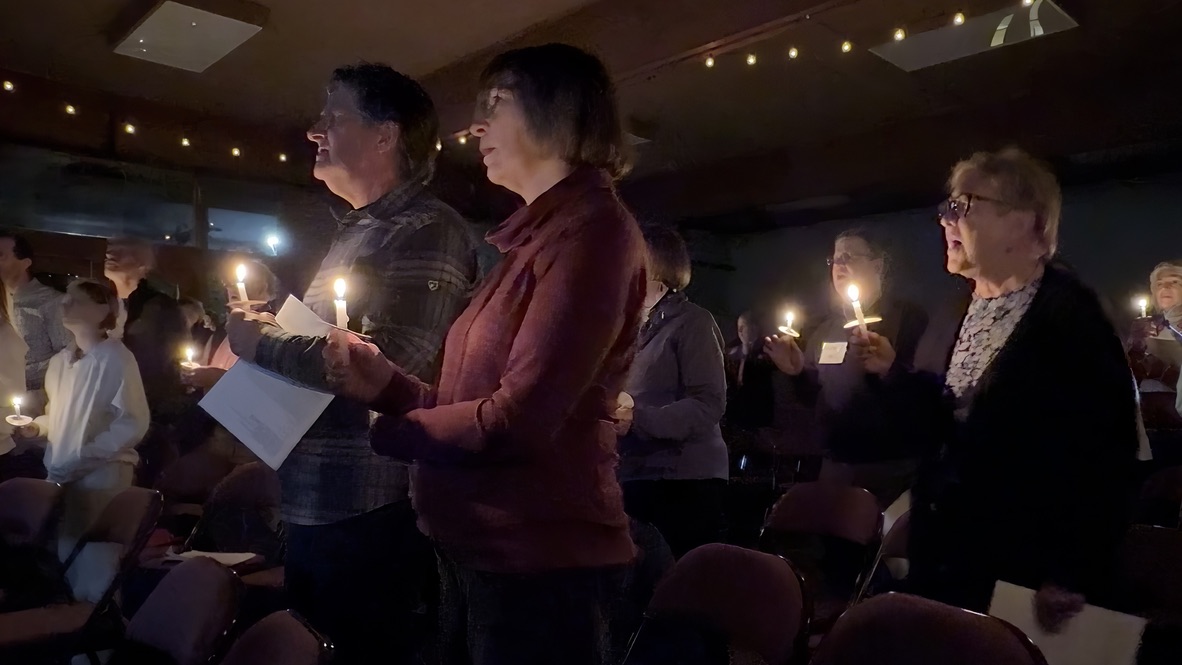
Easter Vigil 2025 at St. Barnabas, Bainbridge Island, Washington.
Many churches don’t do the Easter Vigil, and of those that do, all too few give it proper attention as the richest and most luminous liturgy of the entire year. It requires a lot of preparation, effort and energy at the end of a very labor-intensive week. It also involves a long-term project of educating a congregation to understand the Vigil as the preeminent Easter rite.
You can celebrate the Resurrection gloriously on Sunday morning, but if you want to experience Resurrection in a kind of Christian dreamtime, come to the Vigil as well. And if you are in a community which already knows the unique power of the Vigil experience, I encourage you to explore the potential of its stories to empower our bodies and restore our souls in this dark and dangerous age.
If you are not part of a community that does the Easter Vigil, I thank you for reading this far anyway. But if you are in a position to shape a creative Vigil, here are some suggestions to get you started.
You may want to begin with just one or two stories. Find the creatives in your community and form a team to study the texts and discern what they are trying to say now. And think about the connections they make with our lives and our society. For example, footage from the Minneapolis protests could be part of the Red Sea saga, or the king’s ruffians throwing their victims into the fiery furnace could be dressed like ICE agents.
Decide for each story whether to use simple storytelling (one or more voices, scripted or retelling freely) or more theatrical means (scripts, actors, visual design, visual media, singing, musical score, sound effects, etc.). Think about ways to involve children (e.g., animals on the ark, or part of the Red Sea march to freedom) and even the whole assembly, through singing or collective reading, like a Greek chorus, of projected words on a screen. Involving as many people as possible in creating and performing the stories bolsters both attendance and enthusiasm. Play with ideas, images and words until the stories take shape. Then provide sufficient time for learning lines and rehearsals.
Ideally, the Story Space will be separate from the worship space. A parish hall is usually more flexible than a church interior in terms of seating and a stage area. If there is a screen or a large white wall, large images can be projected. Strings of party lights on a dimmer and LED spotlights with variable colors are easy ways to restrict light to the stage area and establish the mood for each story. The other advantage of a separate Story Space is that a liturgy conducted in a sequence of spatial locations underscores the Vigil as a journey—from the New Fire outside to the Story Space to the font to the altar and finally back into the world.
And let each story be followed by an appropriate song (I use both folk music and contemporary songwriters to fit the relaxed spirit of “tales around the sacred campfire,” in contrast to the chant and hymnody in the church portion of the liturgy). Then comes a bidding to prayer, summarizing the themes of the particular story.
Let me close with the bidding I wrote to follow The Valley of Dry Bones. It expresses everything I want to say about the liberating power of our stories to resist evil, proclaim hope, and lift up our hearts:
Dear People of God: There are those who tell our story as a history of defeats and diminishments, a narrative of dashed hopes and inconsolable griefs. But tonight we tell a different story, a story that inhales God’s own breath and sings alleluia even at the grave. By your baptism, you have been entrusted with this story, to live out its great YES against every cry of defeat.
Psalm 68:3, one of the texts projected in the background of the Red Sea story.
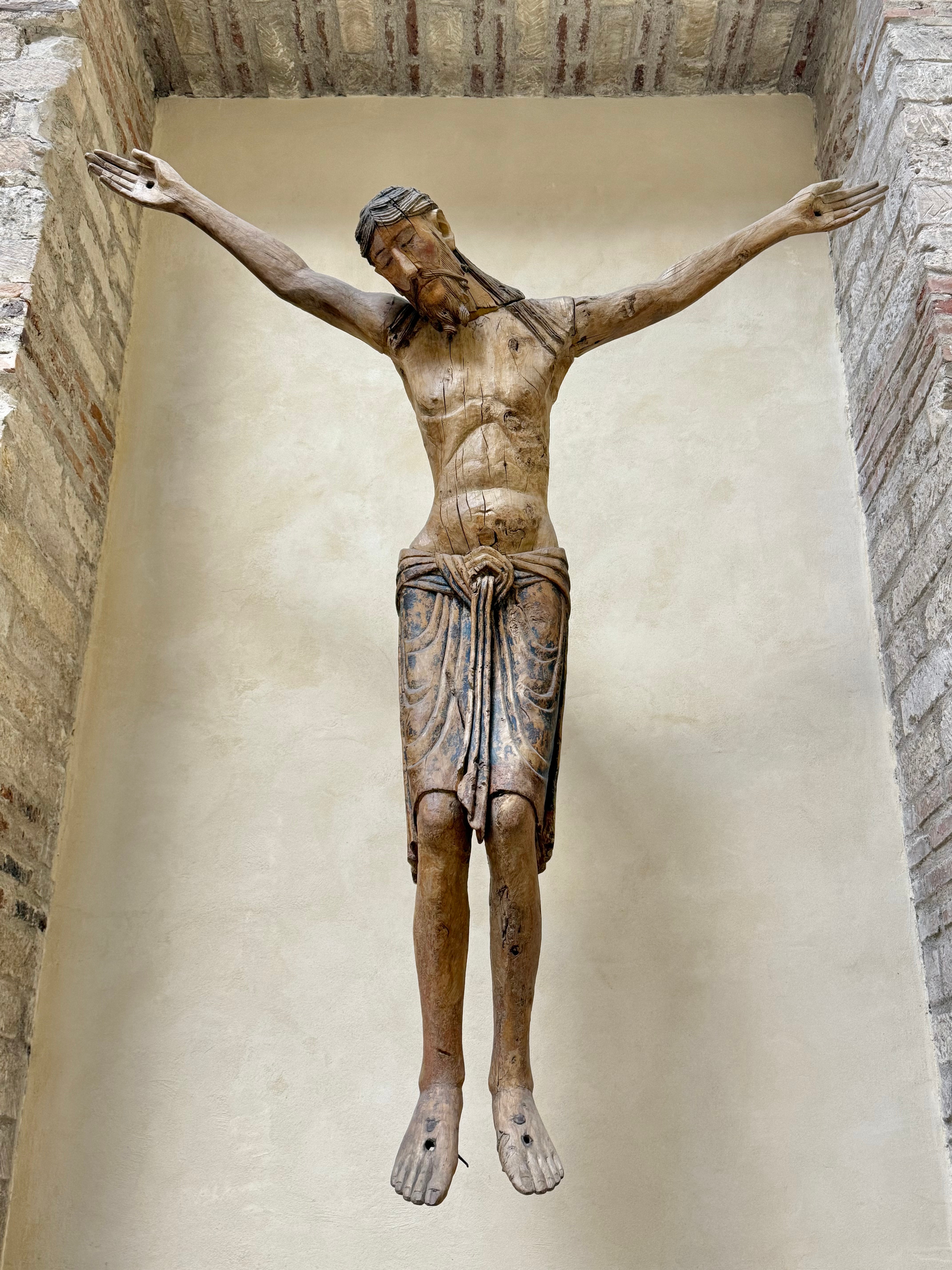
Crucified Christ (northern France, late 12th century).
Isaiah 53:5 But he was wounded for our transgressions, crushed for our iniquities; upon him was the punishment that made us whole, and by his bruises we are healed.
Was it really necessary for Jesus to be pierced and crushed? And how exactly did his suffering and death make us whole? There has never been a conclusive single answer, because any attempt to “solve” the Paschal Mystery with a reductive formula is missing the point. The cross is an experience to enter, not an idea to be explained. “I wonder as I wander out under the sky,” says the old Nativity carol, “why Jesus our Savior did come for to die / for poor ornery people like you and like I. . .” And now, this Holy Week, we come again to the foot of the cross, and we wonder.
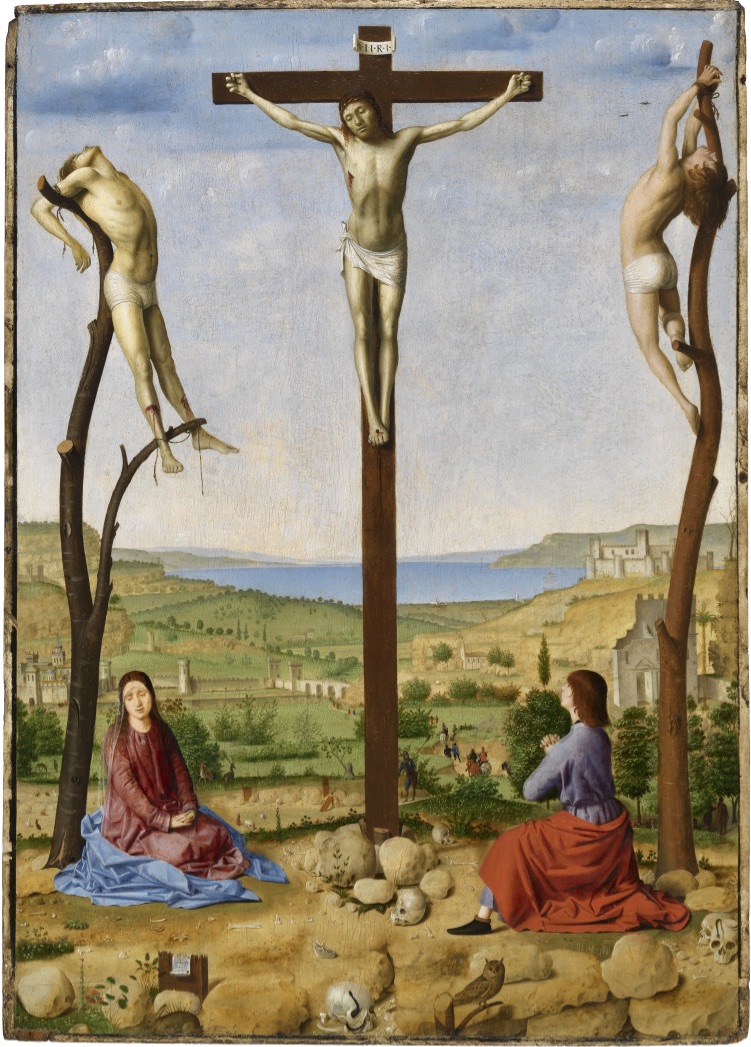
Antonello da Messina, The Antwerp Crucifixion (1475).
Let us discard any crude notions of the cross as a transaction, as if somebody had to pay for all the damage wrought by human sin, so Jesus stepped up like a big spender to declare, “This one’s on me.” Such “substitution” theology either trivializes the cost of sin (can Auschwitz or Gaza be so lightly dismissed?) or risks masochism by stressing the pain of the Passion, as Mel Gibson did in his notorious movie. The sacredness of God’s Friday is not in the violence or the blood, but in the Love that rewrites the darkest story.
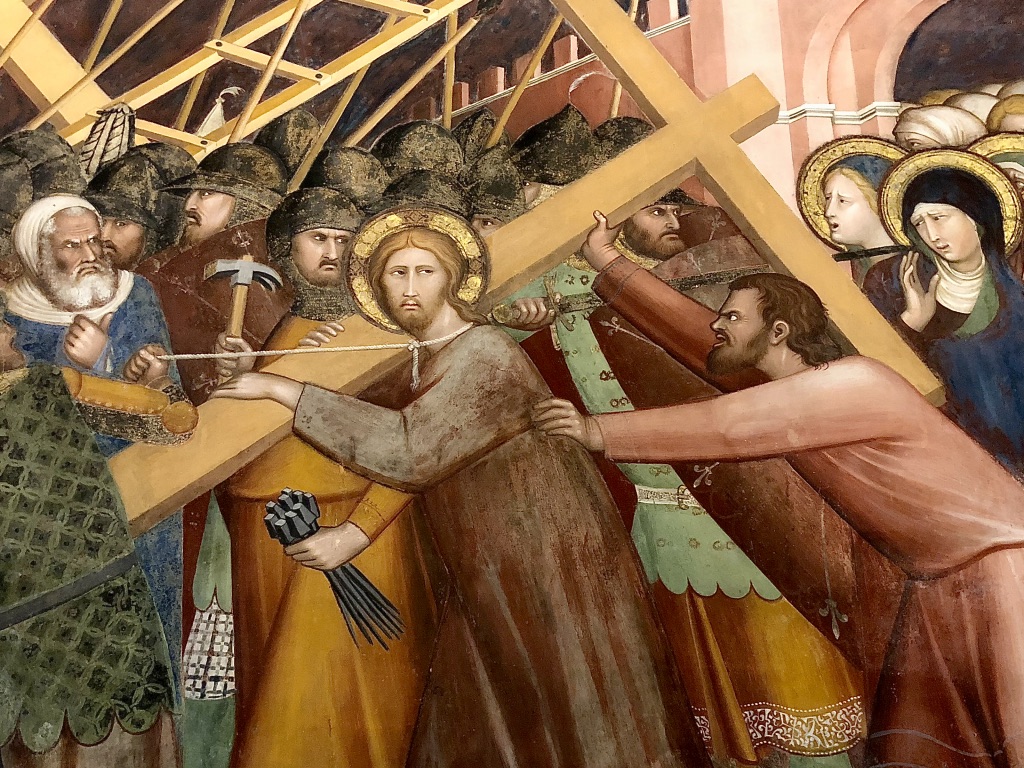
Lippo Memmi, Christ carrying the cross, Duomo di San Gimignano, Tuscany (1335-1345).
And let us not reduce the salvific death of Jesus to a simple case of human cruelty claiming one more victim. Something more than human tyranny and human tragedy—something divine—was at work in the cross. But the divine presence on Calvary’s hill was not in the form of any punishment dished out by an angry God. God was there in the vulnerable, suffering body of Jesus, the Incarnate Word of self-diffusive love, who chose to share the human condition in all its forms—even the bleakest and most wretched. Jesus didn’t suffer instead of us. Jesus suffered with us. And through the humanity of Jesus, our own experience of alienation and affliction has been absorbed into the trinitarian life of God, where it is held in love’s eternal embrace and drained of its toxicity. As the prophet said, By his wounds we are healed.
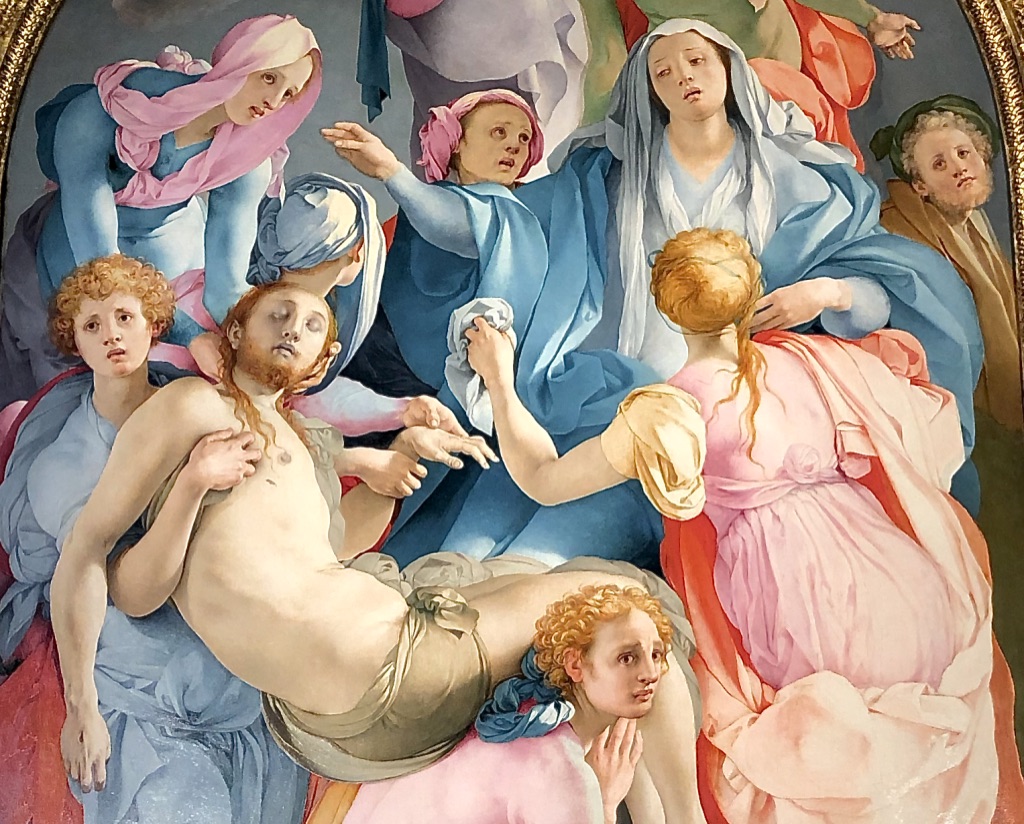
Jacopo Pontormo, Deposition from the Cross, Santa Felicita, Florence (1525-1528).
Or as theologian Paul Fiddes put it, “Far from simply forgetting about the sins of the world, [God] journeys deeply into the heart of [the human] condition. . . God participates in our brokenness, to win us to the offer of healing.” In our own evil time, when hate and cruelty are running wild, sometimes we feel overwhelmed, discouraged, or powerless. But that’s exactly where Jesus comes to join us, not simply to keep us company on the countless crosses of this world, but to transform our sufferings into the seeds of resurrection.
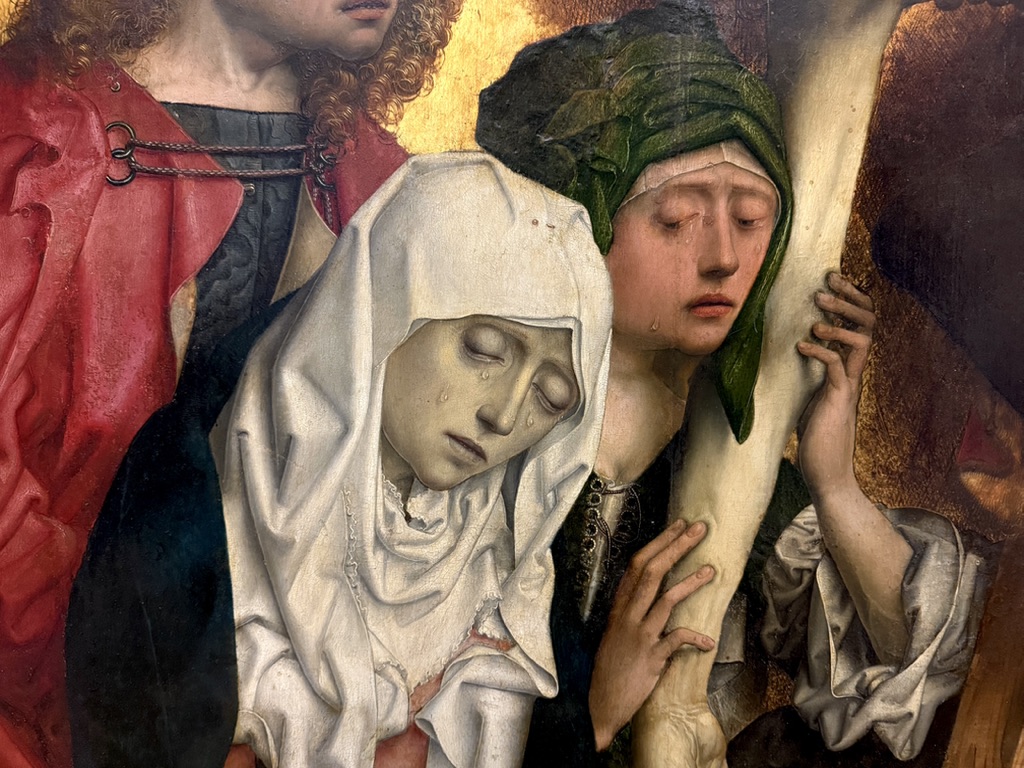
Anonymous “Master of St. Bartholomew,” The Descent from the Cross, Cologne, c. 1480-1510 (detail).
The title is from a hymn by W. H. Vanstone, “Morning Glory, Starlit Sky” (585 in the Episcopal Hymnal 1982)
In the Garden, an icon by the hand of the artist, Angelica Sotiriou, 2009.
I’m writing this on Maundy Thursday, the night of Jesus’ tender farewell supper with his friends—and the night he was handed over to malevolent powers. The beautiful icon from the hand of California sacred artist Angelica Soteriou [i] captures the wrenching moment between the solidarity of his loving community and the fatal desolation of his Passion. He is alone. Neither friends nor enemies share his existential space. He’s kneeling in prayer, arms stretched out, beseeching his Father for whatever is needed to make it through the night. But his hands remain open, receptive to a will not his own. Not my will, but thine. And though an annihilating blackness surrounds him, his body is held safely within the warm color of the mountain of God. Even when we feel alone, even abandoned, we are still enfolded within divine love and mercy. Our divine milieu is not an exemption from trouble, but an assurance against trouble’s finality.
On this holy Thursday, many churches, including mine, do the eucharist in the context of an actual shared meal. It is is our custom to eat in silence, which monastics know is a profound way to be together. Our silence is punctuated by a series of meditative readings from the Farewell Discourses, the words of encouragement, comfort and challenge which, in John’s gospel, Jesus speaks to his friends on the night before his execution. It’s not a reenactment of a past event. Those words are spoken directly to us, in our own fraught time.
Tonight, however, we added a word from one of Jesus’ more recent friends, the theologian Dietrich Bonhoeffer, who was facing his own Gethsemane in a German prison. At Christmastide, 1944, a few months before he would be executed by the Nazis, he wrote a poem which was smuggled out of prison in a letter to his mother. Its expression of confidence and hope in the midst of an evil time not only echoes the spirit of Jesus’ Farewell Discourses, but it speaks strongly to our own latter days, when so many things are in peril.
Here is the versified translation of Bonhoeffer’s poem by the British hymn writer Fred Pratt Green:
By gracious powers so wonderfully sheltered, and confidently waiting come what may, we know that God is with us night and morning, and never fails to greet us each new day.
Yet is this heart by its old foe tormented; still evil days bring burdens hard to bear; O give our frightened souls the sure salvation for which, O Lord, you taught us to prepare.
And when this cup you give is filled to brimming with bitter suffering, hard to understand, we take it thankfully and without trembling, out of so good and so beloved a hand.
Yet when again in this same world you give us the joy we had, the brightness of your Sun, we shall remember all the days we lived through, and our whole life shall then be yours alone.[ii]
Yes, we too are living through “evil days” which weigh down “our frightened souls” with “burdens hard to bear.” But our brother Dietrich, like our brother Jesus, reminds us that there is an alternative to fear and despair, if we can find the courage to live into God’s future, come what may, and the Paschal wisdom to walk the Way of the Cross “thankfully and without trembling,” because we know that death doesn’t get the last word.
Now, as we move into Good Friday, listen to what Rowan Williams, former Archbishop of Canterbury, says about the cross:
Jesus crucified is God crucified; so we believe. Jesus is the total and final embodiment in history of God’s loving mercy; and so this cross is a unique, terrible, extreme act of violence—a summary of all sin. It represents the human rejection of love. And not even that can destroy God; with the wounds of the cross still disfiguring his body, he returns out of hell to his disciples and wishes them peace. There is our hope—the infinite resource of God’s love, the relationship with God’s creatures that no sin can finally unmake. God cares what we do because God suffers what we do. God is forever wounded, but forever loving. The possibilities of our relationship to God are indeed ‘new every morning.’” [iii]
In other words, says Williams, “we have a future because of God’s grace.” Bonhoeffer said the same thing, and he said it from death row. That’s what the Paschal Mystery of dying and rising is trying to tell us—not only in the rituals and narratives of Holy Week, but in the kind of lives we live when we fully embody the archetypal pattern of surrender and transformation. The way down is the way up. Lose your life to find it. Let go and let God.
There’s always more to say about this, of course, but it’s almost midnight, and tomorrow is the rigorous journey to the foot of the cross. And beyond that, there’s the Easter Vigil, a night of wonders when heaven and earth are joined and liturgical curators are left exhausted yet exultant in its wake. If you want to read more about the cross, try What Will the Cross Make of Us?, written in 2022 by my less tired self. For more on the Easter Vigil, try Just a Dream?—Reflections on the Easter Vigil.
I’m going to bed now, but let me leave you with a 3-minute trailer for the Triduum, pushing the point that the Triduum is not a la carte, but a 3-part connected sequence that wants to be experienced in full. The three-day Paschal passage from Passion to Resurrection isn’t just bingeing on liturgy. It’s a profound way of knowing that delivers you to a different place. As we say at my church every Holy Week, “The journey is how we know.”
[iii] Rowan Williams, from a sermon excerpted in A Time to Turn: Anglican Readings for Lent and Easter Week (Harrisburg, PA: Morehouse Publishing, 2004), 99.
Mary took a pound of costly perfume made out of pure nard, anointed Jesus’s feet, and wiped them with her hair. The house was filled with the fragrance of the perfume. But Judas Iscariot, one of his disciples (the one who was about to betray him) said, “Why was this perfume not sold for three hundred denarii and the money given to the poor?” — John 12:3-5
Judas raises a troubling question for everyone who is not destitute. As long as there is human need, how dare we spend our money on anything else? And Jesus’ answer—“The poor are always with you”—might seem equally troubling, if taken to accept economic inequality as inevitable. But Jesus was never complacent about the status quo. In both word and deed he lifted up the lowly—the ones either ignored or shamed by their culture—declaring them worthy of blessing and honor. As Jesus himself put it, he came to bring good news to the poor: Injustice has no future. God’s kingdom of loving interdependence is at hand.
Here’s how I read this text: “You can help the destitute any time you want, Judas. If your concern is sincere, they’ll still be around after I’m gone. But I won’t be. So don’t be so quick to judge this woman. If you could only understand what’s going on here, it would save your life.”
So what is going on here? A woman, Mary of Bethany, whose brother Lazarus had recently been rescued from death by Jesus, pours very expensive oil over the feet of her Lord, and then wipes those feet with her hair. It’s an extravagant gesture of devotion, gratitude and love. The oil, worth a year’s wages for a common laborer, may have cost Mary most of her wealth, while letting down her hair to do the work of a towel was, in that culture, a shocking display of abasement and vulnerability. In other words, she was offering all that she had and all that she was to honor Jesus.
This act, both sensory and symbolic, overflowed with meanings. Anointing with oil was a way to mark the special vocation and identity of authoritative figures, whether powerful rulers or holy persons. It consecrates them as chosen and set apart. The title of “Messiah” or “Christ” means “the anointed one.” It was revolutionary to have a woman be the one to anoint Jesus as priest and ruler, but so was the kingdom he came to manifest and embody.
Anointing was also part of the culture’s preparation of a body for burial. Performed in the week before Jesus’ death, Mary’s gesture inaugurates the sequence of sacrificial acts culminating with her Lord’s burial in the stone-cold tomb. The feet she anoints will walk the Way of the Cross for the salvation of the world. This was his chosen destiny.
The story’s third meaning is in its foreshadowing of the foot-washing, when Jesus, on the night before he died, knelt at the feet of his friends to perform the work of a servant, surrendering his power for love’s sake. He was teaching by showing: This is how we must be with one another. This is exactly how God is with us. Just a few days before Jesus taught this explicit lesson at the Last Supper, Mary of Bethany had performed it instinctively, offering all she had, holding nothing back.
At the time, the disciples did not grasp the full significance of Mary’s act. Nor did Mary herself. How could they? As we like to say about Holy Week, the journey is how we know. The disciples had to follow Jesus all the way to the cross—and beyond—before they could begin to understand—through memory and reflection—what it was all about.
One of the strongest triggers for memory is our sense of smell. When John’s gospel tells us that “the house was filled with the fragrance of the perfume,” it sounds like a vivid personal memory. Recalling the fragrance, the disciples could revisit that moment to absorb all the meanings which had escaped them at the time.
As we make our own personal and communal journey through Holy Week, may we too immerse ourselves extravagantly in the sensory images and sounds of the Passion narratives and rituals, allowing them, by our faithful participation, to take us deeper and deeper into the Paschal Mystery of dying and rising in Christ.
As for Judas’ sour complaint, Sydney Carter’s Passion carol, “Said Judas to Mary,” nicely disposes of its false premise of either/or. Devotion to Jesus and loving service to “the least” of God’s family are not opposed. They are inseparable:
Said Jesus to Mary, “Your love is so deep, today you may do as you will. Tomorrow, you say, I am going away, but my body I leave with you still.”
“The poor of the world are my body,” he said, “to the end of the world they shall be. The bread and the blankets you give to the poor you’ll know you have given to me.”
Here is a lovely rendition of Carter’s Holy Week carol sung by Fiona Dunn:
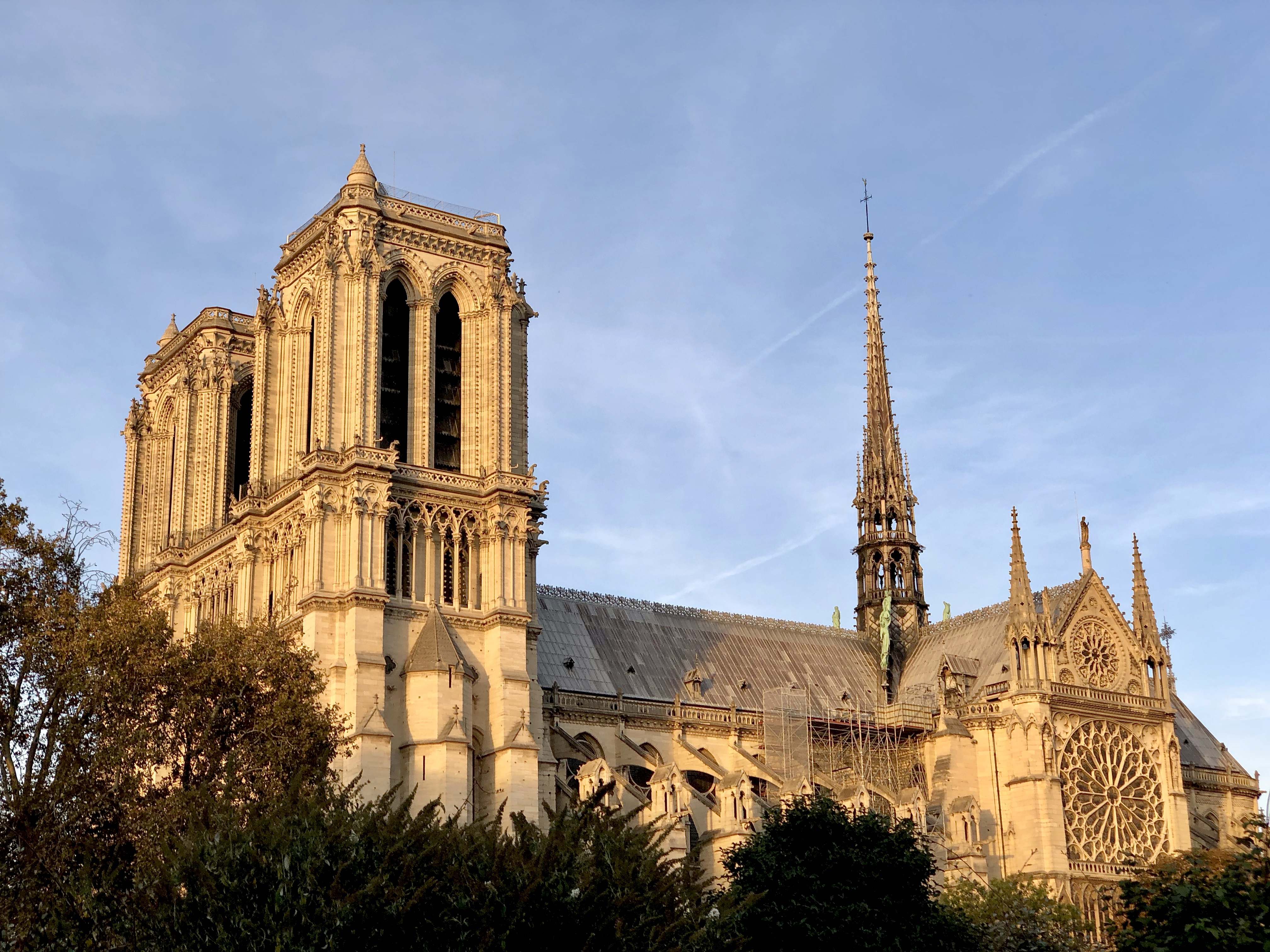
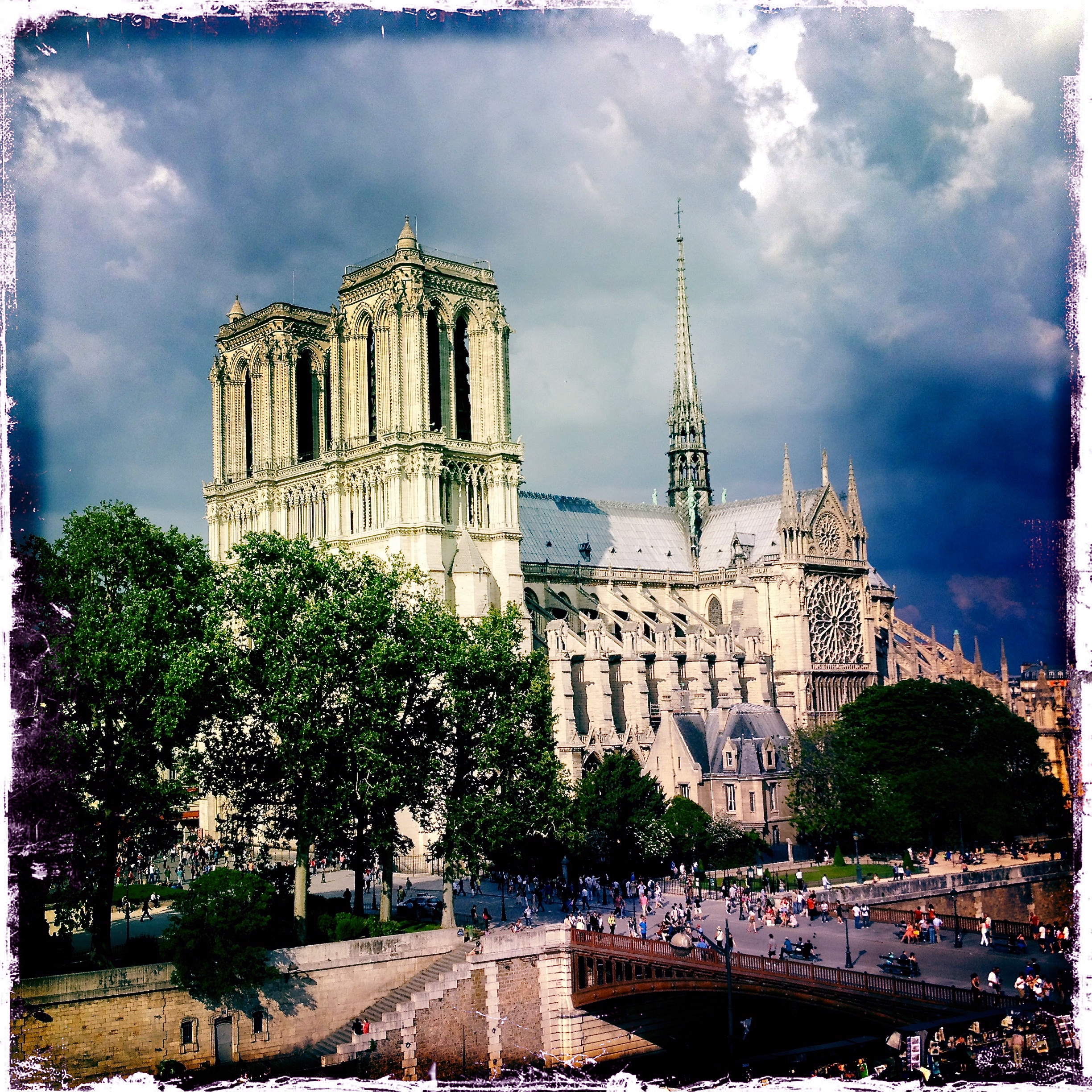
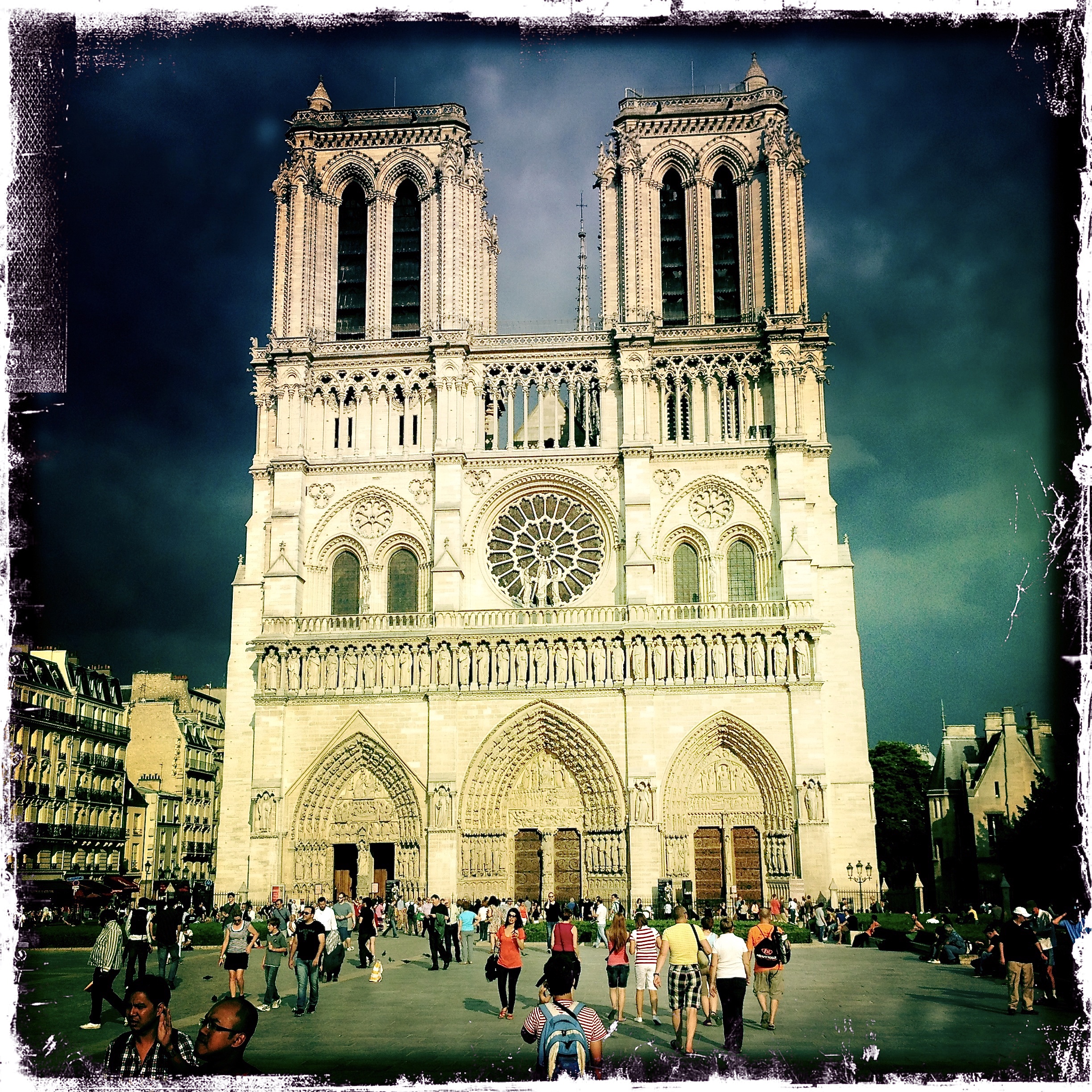
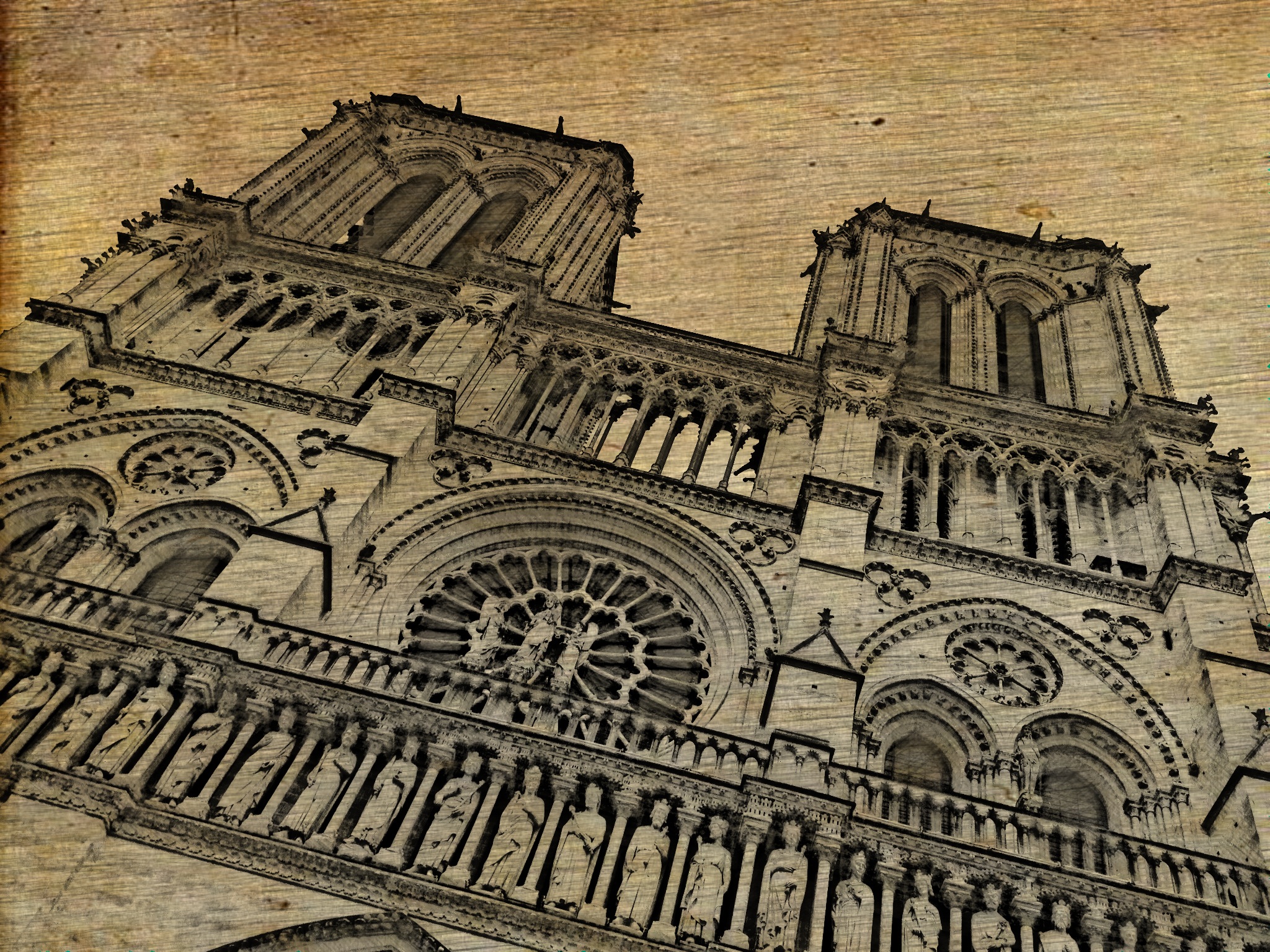
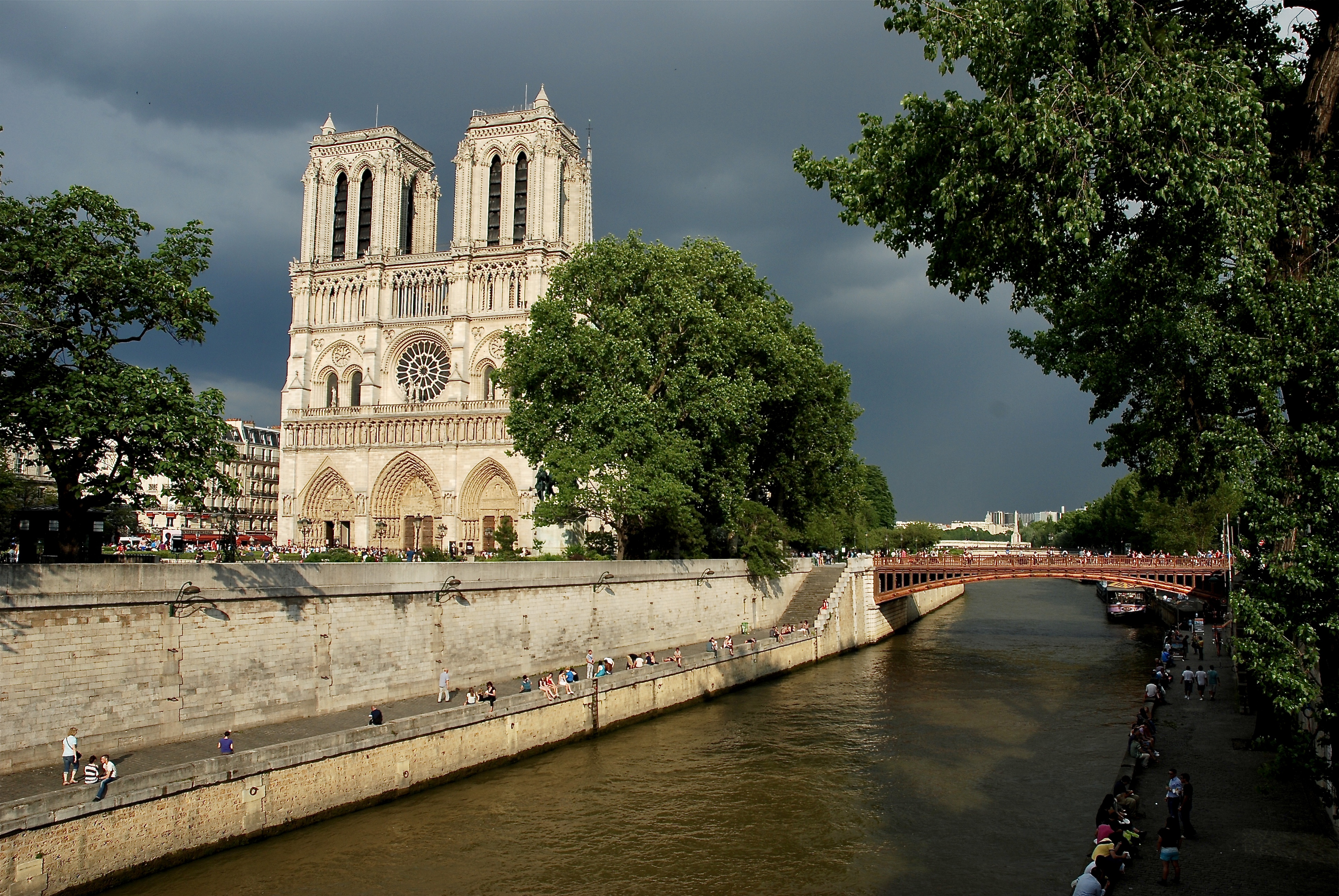
The burning of Notre Dame has broken many hearts, including mine. The fact that it happened in Holy Week feels strangely apocalyptic, as if the stability of our world were suddenly under threat. Like the earthquake at the death of Jesus, it suggests a cosmic shaking of the foundations.
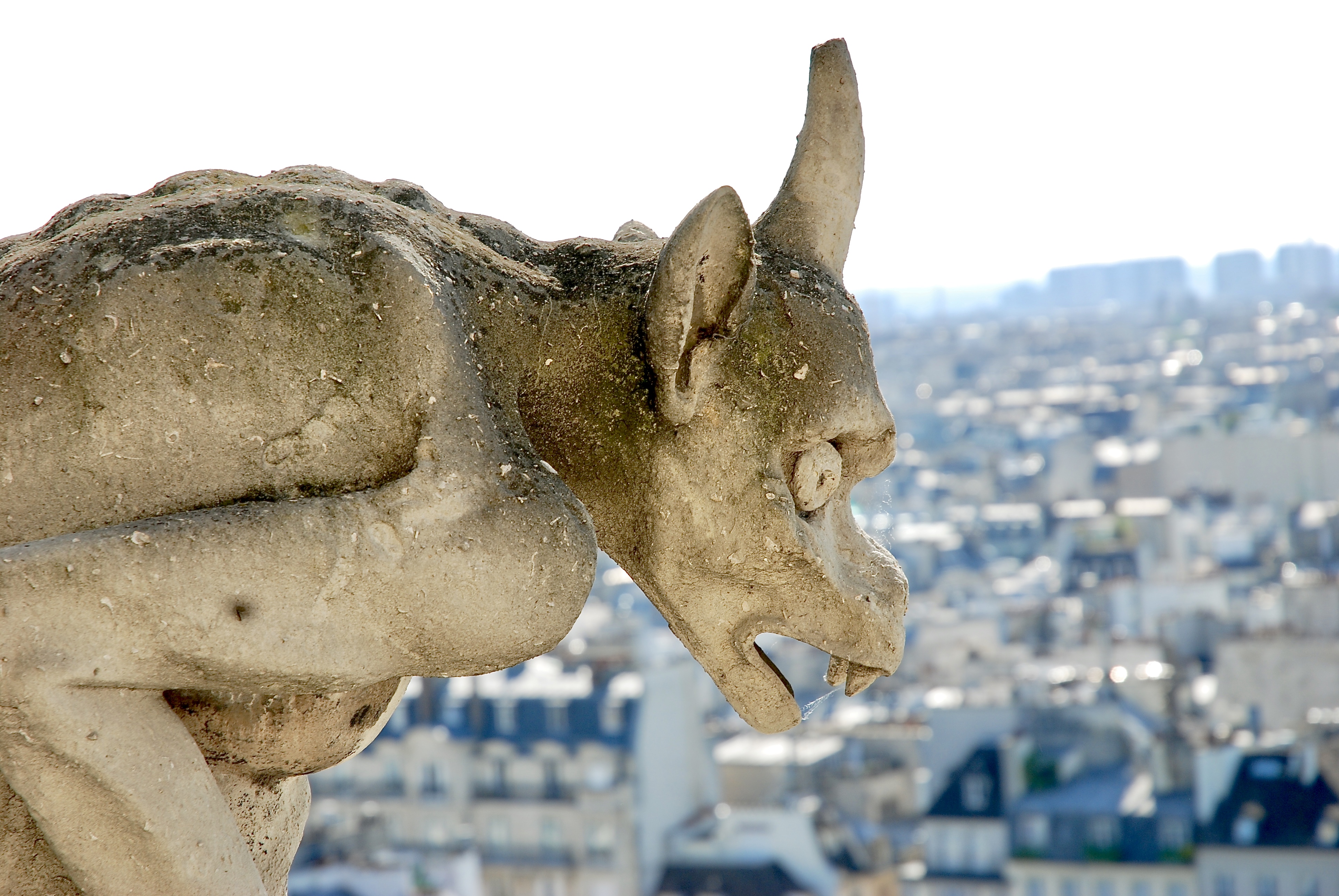
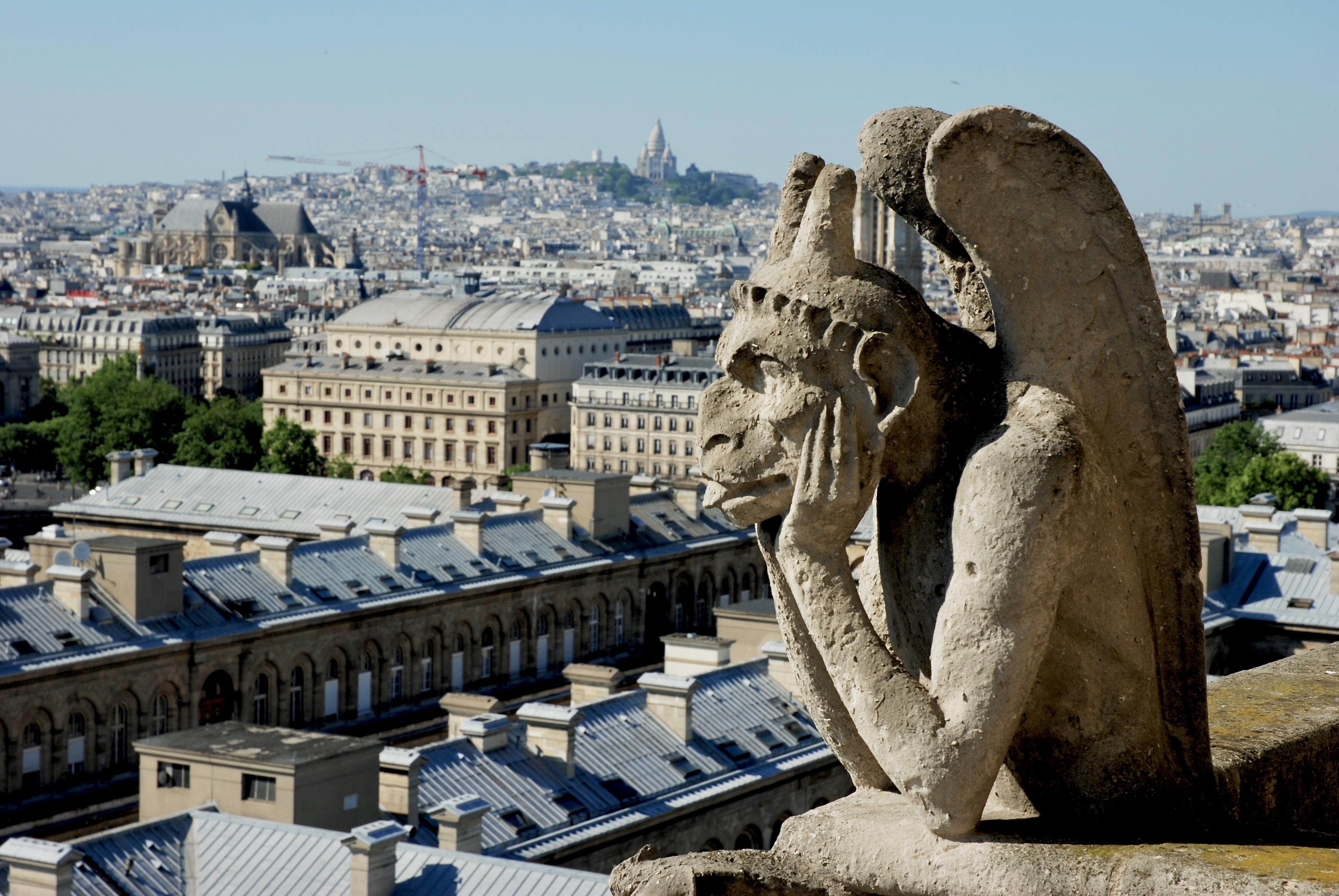
Poems from Book of Lamentations, an anguished response to the destruction of Jerusalem in 587 B.C., are often sung during Holy week. Written to grieve the loss of a sacred place, their eloquent images of affliction and grief were later appropriated by Christian liturgy to lament the suffering of Christ. In gratitude and sorrow for our beloved Notre Dame, here are some of my own past views of the cathedral, accompanied by selected lamentations from the Holy Week lectionary.
How like a widow she has become, she that was great among the nations. (Lam. 1:1)
Jerusalem remembers in the days of her affliction and distress, all the precious things that were hers in days of old. (Lam. 1:7)
All you who pass this way, look and see: is any sorrow like the sorrow inflicted on me? (Lam. 1:12)
Listen, for I am groaning, with no one to comfort me. (Lam. 1:21)
For vast as the sea is your ruin; who can heal you? (Lam. 2:13)
Cry then to the Lord, rampart of the daughter of Zion; let your tears flow like a torrent day and night. (Lam. 2:18)
He has walled me about so that I cannot escape. . . though I call and cry for help, he shuts out my prayer. (Lam. 3:7-8)
But this I call to mind, and so regain some hope: Surely God’s mercies are not over, his kindness is not exhausted. (Lam. 3:21-22)
It is good to wait in silence for Yahweh to save. (Lam.3:26)
Harrowing of Hell, Barberini Exultet Scroll (Italy, c. 1087)
The original disciples were shocked into bliss by the Resurrection––
and they never recovered.
–– Dom Sebastian Moore O.S.B.
At the entrance to the Jerusalem’s Church of All Nations, next to the Garden of Gethsemane, there is a sign warning every visitor:
NO EXPLANATIONS INSIDE THE CHURCH
This was intended to discourage talkative tour guides from disturbing the church’s prayerful ambience with shouted lectures, but it has always struck me as very good advice for preachers on Easter Sunday. Confronted by a room full of people who spend most of their time in the secular social imaginary where the dead stay dead and God––if there is one––does not intervene in the natural order, preachers are tempted to mount a defense of the Resurrection within the plausibility structures of the modern mindset. In doing so, they not only tame a dangerous mystery into a manageable––and rather harmless––assumption, but they also waste a valuable opportunity to bring the assembly into confrontation with the transformative presence of the living Christ.
There is nothing wrong with addressing people’s doubts, or wondering what facts might lie behind the “painfully untidy stories”[i] of the Easter narratives. But that is work for another day. Easter Sunday is for proclamation, not explanation. It is a time to meet the One who changes everything.
The central question of Easter is not, “What happened to Jesus way back then?” but rather, “Where is Jesus now––for us?” Or even more strikingly, “When is Jesus? When is Jesus for us?”[ii] So Easter becomes not a matter of our questioning the Resurrection, but of allowing the Resurrection to question us. Who are we now, and what must we become, in the light of the risen Christ?
If I were preaching on Easter Sunday, I wouldn’t want to convince so much as to invite–– to invite the mixed crowd of believers, seekers and doubters to embrace the Easter experience and consent to its transformative effects. In order to connect the risenness of Jesus with the risenness of us and all creation, I would pursue two fundamental themes: Easter is now! And, Resurrection has consequences!
Easter is now!
Since it only occurs once a year, Easter Sunday is sometimes mistaken for a commemorative anniversary of a past event. In fact, the earliest churches treated the Paschal mystery of Christ’s death and resurrection as the timeless (or time-full) subject of every eucharistic liturgy. The establishment of an annual observance of “Easter Day” was a later development.
The Resurrection, although breaking into history on a specific temporal occasion, is not the property of the past. As God’s future showing itself in our present, it belongs to all times and seasons. Jesus is alive, still showing up as a transfiguring presence in a world fraught with absences. Jesus is not over, and his story is not over. It will only be completed in the divinization of the cosmos, when God is in all and all are in God.
Easter isn’t something we remember. It’s something we live and breathe.
Resurrection has consequences
The Resurrection is more than an idea we talk about or believe propositionally. It’s something we become, something we “prove” in the living of our stories. Rowan Williams describes it this way:
“[T]he believer’s life is a testimony to the risen-ness of Jesus: he or she demonstrates that Jesus is not dead by living a life in which Jesus is the never-failing source of affirmation, challenge, enrichment and enlargement––a pattern, a dance, intelligible as a pattern only when its pivot and heart become manifest. The believer shows Jesus as the center of his or her life.”[iii]
In the Orthodox icon of the Resurrection, Jesus is never by himself. He is always depicted taking the dead by the hand and pulling them out of their own tombs. Christ’s hand snatching us from death is a vivid image (as in the Exultet scroll above), and George Herbert, the seventeenth-century poet-priest, employs it artfully in ‘Easter’:
Sing his praise
Without delayes,
Who takes thee by the hand,
that thou likewise
With him mayst rise . . .
But the things that are killing us exert a powerful gravity. We sag under the weight of our despair, we resist the hand that pulls us upward. Nevertheless, Christ persists. “Arise, sad heart,” says Herbert in ‘The Dawning’:
if thou dost not withstand,
Christ’s resurrection thine may be;
Do not by hanging down break from the hand
Which, as it riseth, raiseth thee.
Do not by hanging down break from Christ’s hand. Christ came to save us from our least selves. That’s the gift––and the challenge––of the Resurrection, and it applies to our common life as well as to our private selves. The first disciples, so scattered and shamed by the events of the Passion, made this perfectly clear when their broken and bewildered community was restored to life. And so it is for all of us who follow.
Resurrection is about the healing and restoration of wounded and severed relationships: relationships between God and humanity, between human persons and, ultimately, among all the elements of creation. An Orthodox theologian puts the case in the widest possible terms: “The Resurrection is not the resuscitation of a body; it is the beginning of the transfiguration of the world.”[iv]
That’s what I would preach on Sunday. Of course we don’t control what people take away from the Easter celebration. But we can hope that the faithful will be inspired and empowered, and that “outsiders” may be intrigued–– and even fed–– by spending time with a resurrection community alive with the Spirit.
The primary task of preachers and evangelists on Easter Sunday is not to recite or argue the evidence for the Resurrection, but to help their communities become that evidence. May the whole world one day see and know a church which has been shocked into bliss––and has never recovered!
+
Holy Week posts
Dear reader, as we enter the Triduum, the Great Three Days of Holy Week, I pray that your own experience of dying and rising, whether ritually embodied in the traditional rites or undergone in the particularity of your own spiritual path, may bring you to the place of new life and true peace. Easter graces be upon you.
I have written a number of posts about aspects of Holy Week, and I link them below as seeds for your own reflection. As always, I am blessed by your reading.
[iv] Patriarch Athenagoras, q. in Michel Quenot, Resurrection and the Icon, trans. Michael Breck (Crestwood, NY: St. Vladimir’s Seminary Press, 1997), 232.
Seattle March for Our Lives (Photo by Jim Friedrich)
History says, Don’t hope
On this side of the grave.
But then, once in a lifetime
The longed-for tidal wave
Of justice can rise up,
And hope and history rhyme.
–– Seamus Heaney, “Doubletake”
Heaney’s powerful words seem the perfect epigraph for this amazing day, when hundreds of thousands of people In over 800 communities took to the streets to say “enough is enough.” Enough shootings! Enough victims! It’s time to heal our national gun-sickness. It’s time to choose life.
Have we finally reached a turning point? We’ve seen countless turning points come to naught. We have become well accustomed not to “hope on this side of the grave.” But this new movement, led by highly committed young people not yet practiced in the art of resignation, does feel different. Could this in fact be one of those rare moments, like the end of apartheid or the fall of the Berlin wall, when “hope and history rhyme”?
Seattle March for Our Lives (Photo by Jim Friedrich)
Gun worship seems the most powerful religion in America. From presidents to schoolchildren, the blood of countless victims stains its altars. And however much we rage and moan we feel powerless to stay the hand of sacrifice.
After the joy of marching with thousands of beautiful fellow citizens in the streets of Seattle, and later viewing media excerpts of the utterly compelling young voices at the demonstration in Washington, D.C., I felt myself being awakened from the deadly illusion of inevitability. I began to let myself hope again. The kids are leading the way out of the Slough of Despond. How can we not follow?
Seattle March for Our Lives (Photo by Jim Friedrich)
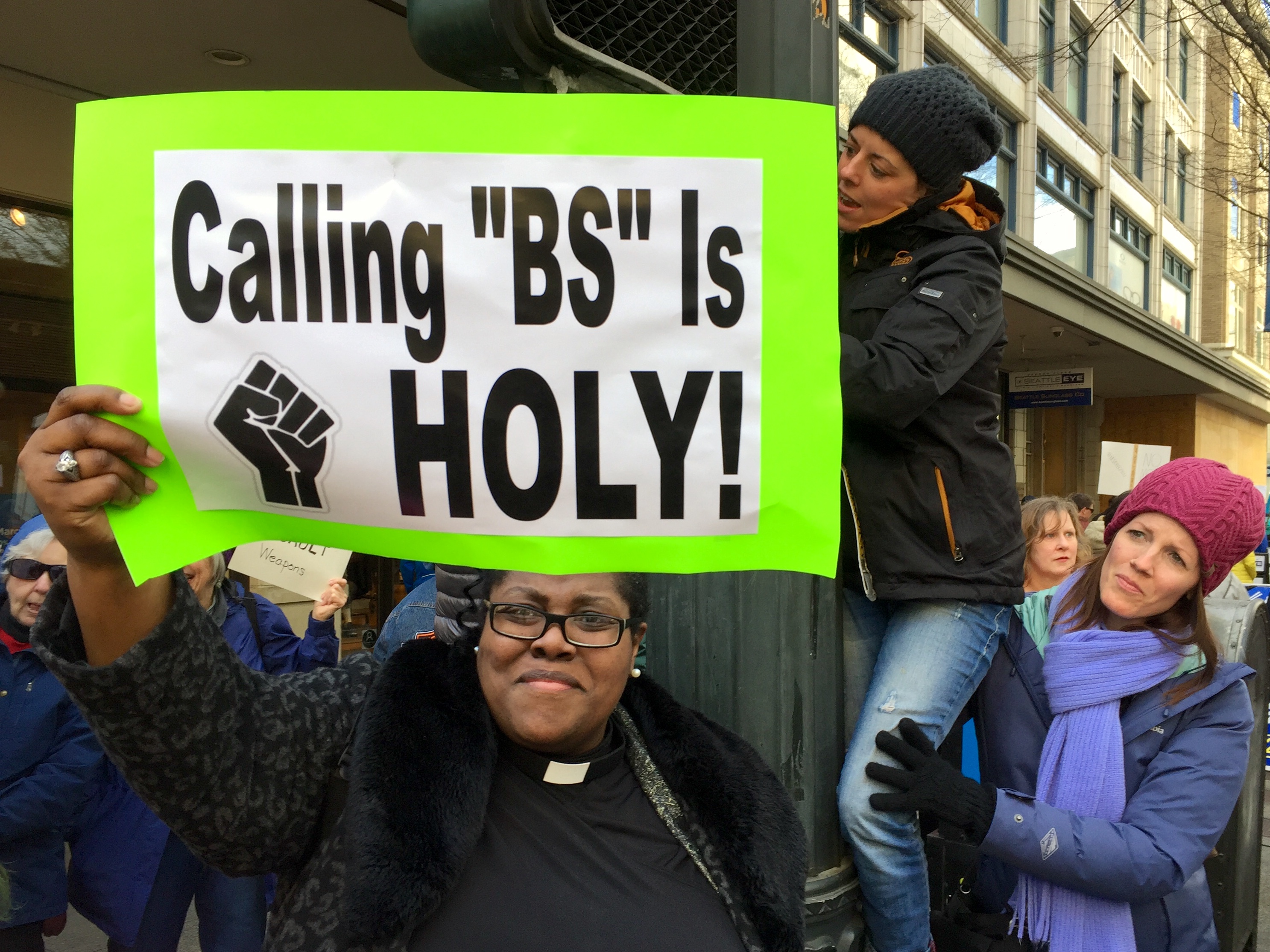
I was especially moved by Emma Gonzalez, a senior at Parkland’s Marjory Stoneman Douglas High School. Already well known for her prophetic cry against the NRA and its political puppets (“We call BS!”), she began with a brief, heartbreaking roll call of her seventeen dead friends. Then, remaining at the podium, she stood in solemn silence for a very long six minutes––ritually enacting the excruciating duration of the mass shooting.
Ms. Gonzalez had not explained her silence in advance, nor had she invited the crowd to observe it with her. Many in the crowd of 800,000 were undoubtedly bewildered by such an exercise, periodically filling the uncomfortable silence with shouts of “We love you, Emma,” or chants of “Never again.” But the camera also showed many faces mute and tearful. It was a risky liturgical move to immerse that vast multitude in such a long silence (almost unendurable for talkative Americans!) without any advance consensus on its intention or meaning. Those weren’t a million Trappists out there. As far as I could tell from the video, she more or less pulled it off, never quite losing them. I suspect that many will be haunted by the experience for a long time to come. You can watch it here.
Seattle March for Our Lives (Photo by Jim Friedrich)
It is late, I am tired from a lot of walking, and I hesitate to reduce what happened today into a few concluding paragraphs. Something great happened out there, and let’s leave it at that for now. But I am prompted to make a brief digression before signing off.
As a priest on the eve of Holy Week, I could not help making connections between today’s events and what Christians will be doing over the next eight days. How could I not carry echoes of today’s joyful urban processions into tomorrow’s commemoration of Jesus’ entry into Jerusalem? Both processions involved cheering crowds envisioning a better world; both posited fundamental challenges to the established powers. As for the fate of today’s crowds compared to the one in first-century Jerusalem, I suspect there are crucial differences as well. While every human dream must endure repeated crucibles of resistance and setback, I suspect that the kids on the streets today will not replicate the failures of the Palm Sunday crowd. In that sense, they may prove to be more like Jesus––enduring faithfully with their eyes on the prize––than like the fickle crowd whose “hosannas” turned so quickly to “crucify.”
The other connection I’m thinking about tonight is Emma Gonzalez’s six-minute silence. Founded on an original experience of unimaginable pain and loss, it created a space where suffering might be both remembered and transcended. Like the rites of Holy Week, it engaged the past as something never to be forgotten, something that is intrinsic to the story, but in the context of a future which can contain and redeem whatever has been lost. We all dwell in the provisional space between memory and hope, where we neither forget nor give up. There is always more to our story than we can ever know. Even in the darkest night, God continues to imagine the dawn.
Seattle March for Our Lives (Photo by Jim Friedrich)
At the Easter Vigil next Saturday night, one of the stories we will tell is the deliverance of the biblical Israelites from the powers that enslave them. Instead of an adult reading the story from the Bible, children will act out the Exodus from Egypt. When they reach the Red Sea (adults blocking their way with waves of blue fabric), the congregation will shout “No way! No way!”–– like Congress telling the kids to give up and go home. But Moses will raise his staff, a way will open through the sea, and the Israelites will cross over. One will be carrying a “Never again” sign; another will wear a “March for our lives” T-shirt.
Once they are safely across the sea, Miriam, Moses’ sister, will reflect on what has happened, concluding with a declaration of faith:
Holy Saturday began, like the previous two days of the Triduum, starting in the dark to walk by the light of Paschal moon and breaking dawn. Those early hours, the matins and lauds of newborn day, will surely remain among the sweetest of the Camino. After woods of oak and pine, sleeping villages in peaceful valleys, and the World Heritage site of the oldest discovered human remains (900,000 years ago), I pressed on into the urban sprawl of Burgos, determined to make the Easter Vigil at the great cathedral.
I knew it would not resemble the creative Vigils I have curated in the States. There would be no storytelling, theater, dance or musical eclecticism. But I was not prepared for the total absence of either mystery or joy. The solemn darkness at the beginning was shattered by the constant flashing of cameras, and the house lights were turned up full before the Exultet was sung, thus negating the holy glow of our candles. Fourteen scowling men in chasubles up front was a poor icon of Easter joy. And if your eye wandered upward to the spectacular golden retablo behind them, you were treated to St. James the Moor Slayer on his horse trampling a couple of Muslims (dressed in colorful costumes like dancers in “The Nutcracker,” so the effect was rather cheerful). Perhaps worst of all, never once did we get to shout “Christ is risen!”
I returned despondent to my tiny, cold, windowless hotel room after midnight. In the first hour of Easter morning, it felt like returning to the tomb. I didn’t go out again until noon. It was raining. The streets of the old city seemed dead. I sang “Welcome, Happy Morning” under my breath, more out of habit than conviction.
I happened to pass by the church of San Nicolas, whose splendid stone retablo was on my must-see list. So I ducked in out of the rain. And there, to my utter surprise, was the risen Christ, returning to the doubting and the sad just as he promised.
It was the end of mass. The priest pronounced the blessing, and then began the most extraordinary outpouring of Easter joy. For the next 45 minutes, children and youth in traditional costumes did festive folk dances to the sound of reeds and drum, Easter songs, and the continuous ringing of small hand bells. Sometimes they danced near the altar, sometimes they danced in procession around the aisles with priest and choir. Here was resurrection indeed:
“I am the dance and I still go on!” All the rest of us joined in hearty singing of the hymns and Alleluias, punctuated by loud shouts of “Viva!” Tears streamed down my face. O beauty so ancient and so new!
And so, as Scripture says, “Surely God’s mercies are not over; God’s kindnesses are never exhausted. They are renewed every morning.” When the celebration concluded, the priest walked among the people with a basket of sweet cookies. As he offered one to me, I received it with recognition:
Yesterday I was in Santa Domingo de la Calzada, whose cathedral keeps a couple of live roosters in the south transept in tribute to a local miracle involving a cooked chicken coming back to life, thus stirring the sheriff to leave his dinner in time to rescue a hanged man from death. It’s a long story.
This morning I slipped out of the sleeping town before dawn, by the light of the Paschal moon. By the time I reached a large wayside cross, the dawn was blazing behind me. It was a dramatic beginning for the great three days of the Paschal Triduum, the ritual mimesis of Christ’s passage through death into resurrection.
I have been wondering what Holy Week, and especially the Triduum, would feel like on the Camino, so far from my accustomed ways of keeping these days. Each day I walk to a new place , hoping there will be some kind of liturgy there, and that despite the language and cultural differences I can still be deeply engaged in the texts, prayers and singing. And there have been some memorable moments so far, especially the processions. But as the week enters its climax, how much will I miss the familiar words and powerful hymns of my own tradition that have always, for me, been essential to the experience? Will my ritual dislocation have its own unique gifts to offer?
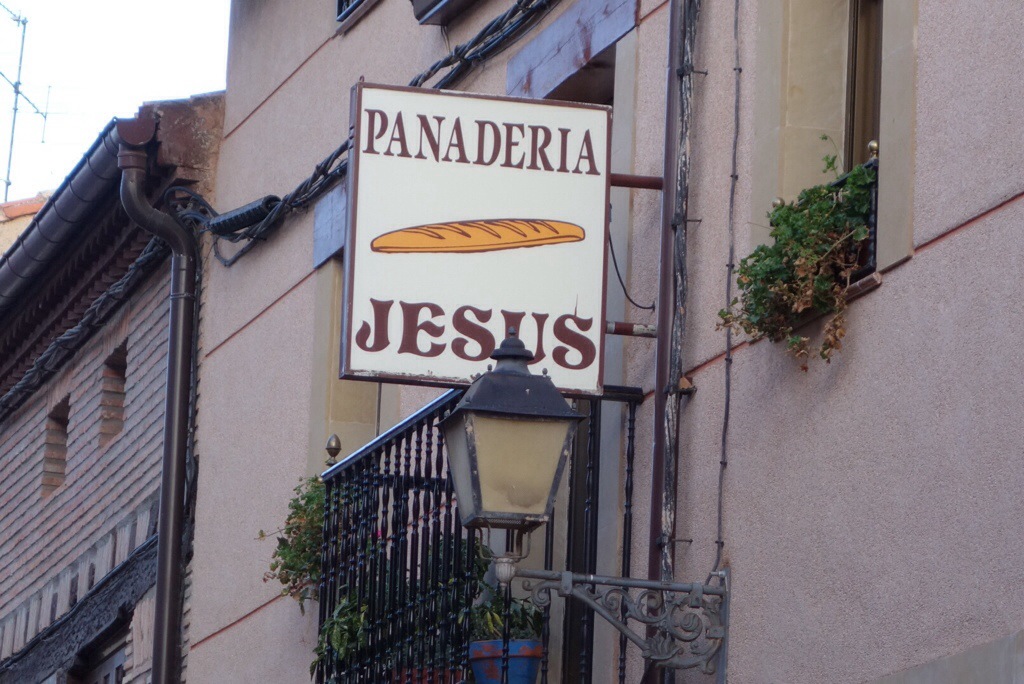
I had my answer this morning, when I entered the village of Granon. After ninety minutes of walking, I was ready for some refreshment. Just past the church, I looked up and saw the sign: PANADERIA JESUS, On the very day we remember the Last Supper, where Jesus took bread and said, “This is my body,” I had found Jesus’ Bakery. It had just opened for the day, and I entered through a bead curtain to find the baker pulling fresh loaves from the oven. The one he handed me was still warm. I have never tasted better bread. As I continued my walk, loaf in hand, I consumed each bite with the reverence of the sacrament. As the Psalmist says,
So mortals ate the bread of angels;
God provided for them food enough.









 The religious imagineer